
PhysicsQ1–21 of 21 questions
Page 1 of 1 · English
1
PhysicsEasyMCQGUJCET · 2014
The output power in a step-up transformer used in practice is . . . . . .
A
Greater than the input power.
B
Equal to the input power.
C
Less than the input power.
D
None of these.
Solution
(C) The correct answer is $C$.
In a practical transformer,there are various energy losses such as hysteresis loss,eddy current loss,copper loss,and flux leakage.
Due to these energy losses,the output power is always less than the input power.
Therefore,the efficiency of a practical transformer is always less than unity $(1)$.
In a practical transformer,there are various energy losses such as hysteresis loss,eddy current loss,copper loss,and flux leakage.
Due to these energy losses,the output power is always less than the input power.
Therefore,the efficiency of a practical transformer is always less than unity $(1)$.
0 likesView Solution
2
PhysicsEasyMCQGUJCET · 2014
An electric current has both $DC$ and $AC$ components. The $DC$ component is $8 \ A$ and the $AC$ component is given as $I = 6 \sin \omega t$. The $rms$ value of the resultant current is . . . . . . (in $A$)
A
$8.05$
B
$9.05$
C
$11.58$
D
$13.58$
Solution
(B) The resultant current is given by $I = 8 + 6 \sin \omega t$.
To find the $rms$ value,we first calculate the mean square value $\langle I^2 \rangle$.
$\langle I^2 \rangle = \langle (8 + 6 \sin \omega t)^2 \rangle$
$\langle I^2 \rangle = \langle 64 + 96 \sin \omega t + 36 \sin^2 \omega t \rangle$
Using the properties of average values over a full cycle: $\langle \sin \omega t \rangle = 0$ and $\langle \sin^2 \omega t \rangle = \frac{1}{2}$.
$\langle I^2 \rangle = 64 + 96(0) + 36(\frac{1}{2})$
$\langle I^2 \rangle = 64 + 18 = 82 \ A^2$
$I_{rms} = \sqrt{\langle I^2 \rangle} = \sqrt{82} \approx 9.05 \ A$.
To find the $rms$ value,we first calculate the mean square value $\langle I^2 \rangle$.
$\langle I^2 \rangle = \langle (8 + 6 \sin \omega t)^2 \rangle$
$\langle I^2 \rangle = \langle 64 + 96 \sin \omega t + 36 \sin^2 \omega t \rangle$
Using the properties of average values over a full cycle: $\langle \sin \omega t \rangle = 0$ and $\langle \sin^2 \omega t \rangle = \frac{1}{2}$.
$\langle I^2 \rangle = 64 + 96(0) + 36(\frac{1}{2})$
$\langle I^2 \rangle = 64 + 18 = 82 \ A^2$
$I_{rms} = \sqrt{\langle I^2 \rangle} = \sqrt{82} \approx 9.05 \ A$.
0 likesView Solution
3
PhysicsEasyMCQGUJCET · 2014
Two wires of the same material having lengths and radii in the ratio of $3:4$ and $3:2$ respectively are connected in parallel with a potential source of $6 \ V$. The ratio of currents flowing through them $I_1:I_2$ is . . . . . . .
A
$1:3$
B
$3:1$
C
$1:2$
D
$2:1$
Solution
(B) Since both wires are connected in parallel to the same potential source,the potential difference across each wire is the same.
$V_1 = V_2 = 6 \ V$
Using Ohm's Law,$V = IR$,we have $I_1 R_1 = I_2 R_2$,which implies $\frac{I_1}{I_2} = \frac{R_2}{R_1}$.
The resistance of a wire is given by $R = \rho \frac{l}{A} = \rho \frac{l}{\pi r^2}$.
Since the material is the same,the resistivity $\rho$ is the same for both wires.
Thus,$\frac{R_2}{R_1} = \frac{\rho \frac{l_2}{\pi r_2^2}}{\rho \frac{l_1}{\pi r_1^2}} = \frac{l_2}{l_1} \times \left(\frac{r_1}{r_2}\right)^2$.
Given $\frac{l_1}{l_2} = \frac{3}{4}$ and $\frac{r_1}{r_2} = \frac{3}{2}$.
Substituting these values: $\frac{I_1}{I_2} = \frac{4}{3} \times \left(\frac{3}{2}\right)^2 = \frac{4}{3} \times \frac{9}{4} = \frac{3}{1}$.
Therefore,the ratio $I_1:I_2 = 3:1$.
$V_1 = V_2 = 6 \ V$
Using Ohm's Law,$V = IR$,we have $I_1 R_1 = I_2 R_2$,which implies $\frac{I_1}{I_2} = \frac{R_2}{R_1}$.
The resistance of a wire is given by $R = \rho \frac{l}{A} = \rho \frac{l}{\pi r^2}$.
Since the material is the same,the resistivity $\rho$ is the same for both wires.
Thus,$\frac{R_2}{R_1} = \frac{\rho \frac{l_2}{\pi r_2^2}}{\rho \frac{l_1}{\pi r_1^2}} = \frac{l_2}{l_1} \times \left(\frac{r_1}{r_2}\right)^2$.
Given $\frac{l_1}{l_2} = \frac{3}{4}$ and $\frac{r_1}{r_2} = \frac{3}{2}$.
Substituting these values: $\frac{I_1}{I_2} = \frac{4}{3} \times \left(\frac{3}{2}\right)^2 = \frac{4}{3} \times \frac{9}{4} = \frac{3}{1}$.
Therefore,the ratio $I_1:I_2 = 3:1$.
0 likesView Solution
4
PhysicsEasyMCQGUJCET · 2014
The carbon resistor has three orange bands. The maximum value of resistance offered by the resistor will be . . . . . . .
A
$49.6 \text{ k}\Omega$
B
$39.6 \text{ k}\Omega$
C
$33 \text{ k}\Omega$
D
$26.4 \text{ k}\Omega$
Solution
(B) The color code for orange is $3$.
Since there are three orange bands,the first two bands represent the digits $3$ and $3$,and the third band represents the multiplier $10^3$.
As there is no fourth band,the tolerance is assumed to be $\pm 20\%$.
The resistance value is $R = (33 \times 10^3 \pm 20\%) \Omega = (33 \text{ k}\Omega \pm 20\%)$.
The maximum value of resistance is calculated as:
$R_{\text{max}} = 33 \text{ k}\Omega + 20\% \text{ of } 33 \text{ k}\Omega$
$R_{\text{max}} = 33000 + 0.20 \times 33000$
$R_{\text{max}} = 33000 + 6600 = 39600 \Omega$
$R_{\text{max}} = 39.6 \text{ k}\Omega$.
Since there are three orange bands,the first two bands represent the digits $3$ and $3$,and the third band represents the multiplier $10^3$.
As there is no fourth band,the tolerance is assumed to be $\pm 20\%$.
The resistance value is $R = (33 \times 10^3 \pm 20\%) \Omega = (33 \text{ k}\Omega \pm 20\%)$.
The maximum value of resistance is calculated as:
$R_{\text{max}} = 33 \text{ k}\Omega + 20\% \text{ of } 33 \text{ k}\Omega$
$R_{\text{max}} = 33000 + 0.20 \times 33000$
$R_{\text{max}} = 33000 + 6600 = 39600 \Omega$
$R_{\text{max}} = 39.6 \text{ k}\Omega$.
0 likesView Solution
5
PhysicsEasyMCQGUJCET · 2014
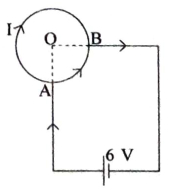
$A$ wire is bent in the form of a circle of radius $2 \ m$. The resistance per unit length of the wire is $\frac{1}{\pi} \ \Omega/m$. $A$ battery of $6 \ V$ is connected between points $A$ and $B$ as shown in the figure. Given $\angle AOB = 90^{\circ}$,find the current flowing through the battery. (in $A$)
A
$8$
B
$4$
C
$3$
D
$9$
Solution
(A) The total length of the wire is $L = 2 \pi r = 2 \pi (2) = 4 \pi \ m$.
The total resistance of the wire is $R_{total} = (\text{resistance per unit length}) \times L = \frac{1}{\pi} \times 4 \pi = 4 \ \Omega$.
Since $\angle AOB = 90^{\circ}$,the wire is divided into two arcs: a minor arc $AB$ and a major arc $AB$.
The length of the minor arc is $L_1 = \frac{90^{\circ}}{360^{\circ}} \times (2 \pi r) = \frac{1}{4} \times 4 \pi = \pi \ m$.
The resistance of the minor arc is $R_1 = \frac{1}{\pi} \times \pi = 1 \ \Omega$.
The length of the major arc is $L_2 = L - L_1 = 4 \pi - \pi = 3 \pi \ m$.
The resistance of the major arc is $R_2 = \frac{1}{\pi} \times 3 \pi = 3 \ \Omega$.
These two resistances are connected in parallel between points $A$ and $B$.
The equivalent resistance $R_p$ is given by $\frac{1}{R_p} = \frac{1}{R_1} + \frac{1}{R_2} = \frac{1}{1} + \frac{1}{3} = \frac{4}{3} \ \Omega^{-1}$,so $R_p = \frac{3}{4} \ \Omega$.
The current flowing through the battery is $I = \frac{V}{R_p} = \frac{6}{3/4} = 6 \times \frac{4}{3} = 8 \ A$.
The total resistance of the wire is $R_{total} = (\text{resistance per unit length}) \times L = \frac{1}{\pi} \times 4 \pi = 4 \ \Omega$.
Since $\angle AOB = 90^{\circ}$,the wire is divided into two arcs: a minor arc $AB$ and a major arc $AB$.
The length of the minor arc is $L_1 = \frac{90^{\circ}}{360^{\circ}} \times (2 \pi r) = \frac{1}{4} \times 4 \pi = \pi \ m$.
The resistance of the minor arc is $R_1 = \frac{1}{\pi} \times \pi = 1 \ \Omega$.
The length of the major arc is $L_2 = L - L_1 = 4 \pi - \pi = 3 \pi \ m$.
The resistance of the major arc is $R_2 = \frac{1}{\pi} \times 3 \pi = 3 \ \Omega$.
These two resistances are connected in parallel between points $A$ and $B$.
The equivalent resistance $R_p$ is given by $\frac{1}{R_p} = \frac{1}{R_1} + \frac{1}{R_2} = \frac{1}{1} + \frac{1}{3} = \frac{4}{3} \ \Omega^{-1}$,so $R_p = \frac{3}{4} \ \Omega$.
The current flowing through the battery is $I = \frac{V}{R_p} = \frac{6}{3/4} = 6 \times \frac{4}{3} = 8 \ A$.
0 likesView Solution
6
PhysicsEasyMCQGUJCET · 2014
Electric field produced due to an infinitely long straight uniformly charged wire at a perpendicular distance of $2 \ cm$ is $3 \times 10^8 \ N C^{-1}$. Then,linear charge density on the wire is . . . . . . . $(k = 9 \times 10^9 \ SI \ unit)$ (in $\mu C/m$)
A
$333$
B
$3.33$
C
$666$
D
$6.66$
Solution
(A) The electric field $E$ at a perpendicular distance $r$ from an infinitely long straight uniformly charged wire is given by the formula:
$E = \frac{\lambda}{2 \pi \varepsilon_0 r} = \frac{2 k \lambda}{r}$
Given:
$E = 3 \times 10^8 \ N C^{-1}$
$r = 2 \ cm = 2 \times 10^{-2} \ m$
$k = 9 \times 10^9 \ N m^2 C^{-2}$
Rearranging the formula to solve for the linear charge density $\lambda$:
$\lambda = \frac{E \cdot r}{2k}$
Substituting the values:
$\lambda = \frac{(3 \times 10^8) \times (2 \times 10^{-2})}{2 \times (9 \times 10^9)}$
$\lambda = \frac{6 \times 10^6}{18 \times 10^9}$
$\lambda = \frac{1}{3} \times 10^{-3} \ C/m$
$\lambda = 0.3333 \times 10^{-3} \ C/m = 333 \times 10^{-6} \ C/m$
$\lambda = 333 \ \mu C/m$
Therefore,the correct option is $A$.
$E = \frac{\lambda}{2 \pi \varepsilon_0 r} = \frac{2 k \lambda}{r}$
Given:
$E = 3 \times 10^8 \ N C^{-1}$
$r = 2 \ cm = 2 \times 10^{-2} \ m$
$k = 9 \times 10^9 \ N m^2 C^{-2}$
Rearranging the formula to solve for the linear charge density $\lambda$:
$\lambda = \frac{E \cdot r}{2k}$
Substituting the values:
$\lambda = \frac{(3 \times 10^8) \times (2 \times 10^{-2})}{2 \times (9 \times 10^9)}$
$\lambda = \frac{6 \times 10^6}{18 \times 10^9}$
$\lambda = \frac{1}{3} \times 10^{-3} \ C/m$
$\lambda = 0.3333 \times 10^{-3} \ C/m = 333 \times 10^{-6} \ C/m$
$\lambda = 333 \ \mu C/m$
Therefore,the correct option is $A$.
0 likesView Solution
7
PhysicsEasyMCQGUJCET · 2014
Two spheres having the same radius and mass are suspended by two strings of equal length from the same point in such a way that their surfaces touch each other. On depositing a charge of $2 \times 10^{-6} \ C$ on them,they repel each other such that in equilibrium,the angle between their strings becomes $60^{\circ}$. If the distance from the point of suspension to the center of the sphere is $10 \ cm$,find the mass of each sphere. $(k = 9 \times 10^9 \ SI, g = 10 \ ms^{-2})$. (in $kg$)
A
$0.3117$
B
$0.6235$
C
$0.1559$
D
$1.2468$
Solution
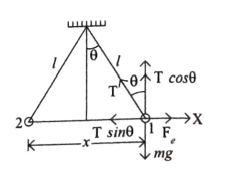
(B) Let $l = 10 \ cm = 0.1 \ m$ be the length of the string. The angle between the strings is $60^{\circ}$,so the angle with the vertical is $\theta = 30^{\circ}$.
In equilibrium,the forces acting on each sphere are tension $T$,gravitational force $mg$,and electrostatic force $F_e = \frac{kq^2}{x^2}$,where $x$ is the distance between the centers of the spheres.
From the geometry,$x = 2l \sin \theta = 2(0.1) \sin 30^{\circ} = 0.2 \times 0.5 = 0.1 \ m$.
Resolving forces:
$T \sin \theta = F_e$
$T \cos \theta = mg$
Dividing the two equations: $\tan \theta = \frac{F_e}{mg} = \frac{kq^2}{x^2 mg}$.
Rearranging for mass $m$: $m = \frac{kq^2}{x^2 g \tan \theta}$.
Substituting the values:
$m = \frac{(9 \times 10^9) \times (2 \times 10^{-6})^2}{(0.1)^2 \times 10 \times \tan 30^{\circ}}$
$m = \frac{9 \times 10^9 \times 4 \times 10^{-12}}{0.01 \times 10 \times (1/\sqrt{3})}$
$m = \frac{36 \times 10^{-3}}{0.1 \times (1/\sqrt{3})} = 36 \times 10^{-2} \times \sqrt{3} \approx 0.36 \times 1.732 = 0.6235 \ kg$.
In equilibrium,the forces acting on each sphere are tension $T$,gravitational force $mg$,and electrostatic force $F_e = \frac{kq^2}{x^2}$,where $x$ is the distance between the centers of the spheres.
From the geometry,$x = 2l \sin \theta = 2(0.1) \sin 30^{\circ} = 0.2 \times 0.5 = 0.1 \ m$.
Resolving forces:
$T \sin \theta = F_e$
$T \cos \theta = mg$
Dividing the two equations: $\tan \theta = \frac{F_e}{mg} = \frac{kq^2}{x^2 mg}$.
Rearranging for mass $m$: $m = \frac{kq^2}{x^2 g \tan \theta}$.
Substituting the values:
$m = \frac{(9 \times 10^9) \times (2 \times 10^{-6})^2}{(0.1)^2 \times 10 \times \tan 30^{\circ}}$
$m = \frac{9 \times 10^9 \times 4 \times 10^{-12}}{0.01 \times 10 \times (1/\sqrt{3})}$
$m = \frac{36 \times 10^{-3}}{0.1 \times (1/\sqrt{3})} = 36 \times 10^{-2} \times \sqrt{3} \approx 0.36 \times 1.732 = 0.6235 \ kg$.
0 likesView Solution
8
PhysicsEasyMCQGUJCET · 2014
$A$ particle having mass $m$ and charge $q$ is at rest. On applying a uniform electric field $E$ on it,it starts moving. When this particle travels a distance $x$ in the direction of the force,its kinetic energy will be . . . . . . .
A
$q E^2 x$
B
$q^2 E x$
C
$q E x^2$
D
$q E x$
Solution
(D) The force acting on the particle due to the electric field is given by $F = qE$.
Since the particle starts from rest and moves in the direction of the force,the work done by the electric field on the particle over a distance $x$ is $W = F \cdot x = (qE) \cdot x = qEx$.
According to the work-energy theorem,the work done on a particle is equal to the change in its kinetic energy.
Since the initial kinetic energy is $0$,the final kinetic energy is equal to the work done,which is $qEx$.
Since the particle starts from rest and moves in the direction of the force,the work done by the electric field on the particle over a distance $x$ is $W = F \cdot x = (qE) \cdot x = qEx$.
According to the work-energy theorem,the work done on a particle is equal to the change in its kinetic energy.
Since the initial kinetic energy is $0$,the final kinetic energy is equal to the work done,which is $qEx$.
0 likesView Solution
9
PhysicsEasyMCQGUJCET · 2014
$A$ conducting coil having $500$ turns has a cross-sectional area of $0.15 \ m^2$. $A$ magnetic field of strength $0.2 \ T$ linked perpendicular to this area changes to $1.0 \ T$ in $0.4 \ s$. The induced emf produced in the coil will be . . . . . . $V$.
A
$100$
B
$15.0$
C
$75.0$
D
$150.0$
Solution
(D) The induced electromotive force (emf) in a coil is given by Faraday's law of induction: $|\varepsilon| = N \frac{|\Delta \phi|}{\Delta t}$.
Here,$N = 500$,$A = 0.15 \ m^2$,$B_1 = 0.2 \ T$,$B_2 = 1.0 \ T$,and $\Delta t = 0.4 \ s$.
Since the magnetic field is perpendicular to the area,the magnetic flux $\phi = BA$.
Therefore,$|\varepsilon| = N \frac{A(B_2 - B_1)}{\Delta t}$.
Substituting the values:
$|\varepsilon| = \frac{500 \times 0.15 \times (1.0 - 0.2)}{0.4}$.
$|\varepsilon| = \frac{500 \times 0.15 \times 0.8}{0.4}$.
$|\varepsilon| = 500 \times 0.15 \times 2 = 150 \ V$.
Here,$N = 500$,$A = 0.15 \ m^2$,$B_1 = 0.2 \ T$,$B_2 = 1.0 \ T$,and $\Delta t = 0.4 \ s$.
Since the magnetic field is perpendicular to the area,the magnetic flux $\phi = BA$.
Therefore,$|\varepsilon| = N \frac{A(B_2 - B_1)}{\Delta t}$.
Substituting the values:
$|\varepsilon| = \frac{500 \times 0.15 \times (1.0 - 0.2)}{0.4}$.
$|\varepsilon| = \frac{500 \times 0.15 \times 0.8}{0.4}$.
$|\varepsilon| = 500 \times 0.15 \times 2 = 150 \ V$.
0 likesView Solution
10
PhysicsEasyMCQGUJCET · 2014
The unit of permeability of vacuum $(\mu_{0})$ is . . . . . . .
A
$\frac{N}{A}$
B
$\frac{N}{A^{2}}$
C
$NA$
D
$\frac{J}{A^{2}}$
Solution
(B) The magnetic force per unit length between two parallel current-carrying wires is given by the formula: $F/L = \frac{\mu_{0} I_{1} I_{2}}{2 \pi d}$.
Rearranging for $\mu_{0}$,we get: $\mu_{0} = \frac{(F/L) \cdot 2 \pi d}{I_{1} I_{2}}$.
The $SI$ unit of force $(F)$ is Newton $(N)$,length $(L)$ is meter $(m)$,distance $(d)$ is meter $(m)$,and current $(I)$ is Ampere $(A)$.
Substituting the units: $\text{Unit of } \mu_{0} = \frac{(N/m) \cdot m}{A \cdot A} = \frac{N}{A^{2}}$.
Alternatively,since $1 \text{ Tesla} = 1 \text{ N}/(A \cdot m)$,the unit can also be expressed as $T \cdot m/A$ or $Wb/(A \cdot m)$.
Rearranging for $\mu_{0}$,we get: $\mu_{0} = \frac{(F/L) \cdot 2 \pi d}{I_{1} I_{2}}$.
The $SI$ unit of force $(F)$ is Newton $(N)$,length $(L)$ is meter $(m)$,distance $(d)$ is meter $(m)$,and current $(I)$ is Ampere $(A)$.
Substituting the units: $\text{Unit of } \mu_{0} = \frac{(N/m) \cdot m}{A \cdot A} = \frac{N}{A^{2}}$.
Alternatively,since $1 \text{ Tesla} = 1 \text{ N}/(A \cdot m)$,the unit can also be expressed as $T \cdot m/A$ or $Wb/(A \cdot m)$.
0 likesView Solution
11
PhysicsEasyMCQGUJCET · 2014
The wavelengths of short radio waves,$X$-rays,and ultraviolet waves are $\lambda_{1}$,$\lambda_{2}$,and $\lambda_{3}$ respectively. Arrange them in decreasing order.
A
$\lambda_{1} > \lambda_{3} > \lambda_{2}$
B
$\lambda_{1} > \lambda_{2} > \lambda_{3}$
C
$\lambda_{3} > \lambda_{2} > \lambda_{1}$
D
$\lambda_{2} > \lambda_{1} > \lambda_{3}$
Solution
(A) The electromagnetic spectrum in increasing order of frequency (or decreasing order of wavelength) is: Radio waves > Microwaves > Infrared > Visible > Ultraviolet > $X$-rays > Gamma rays.
Given:
$\lambda_{1}$ = Short radio waves
$\lambda_{2}$ = $X$-rays
$\lambda_{3}$ = Ultraviolet waves
Comparing their positions in the spectrum,the wavelength order is: $\lambda_{1} > \lambda_{3} > \lambda_{2}$.
Therefore,the correct decreasing order is $\lambda_{1}, \lambda_{3}, \lambda_{2}$.
Given:
$\lambda_{1}$ = Short radio waves
$\lambda_{2}$ = $X$-rays
$\lambda_{3}$ = Ultraviolet waves
Comparing their positions in the spectrum,the wavelength order is: $\lambda_{1} > \lambda_{3} > \lambda_{2}$.
Therefore,the correct decreasing order is $\lambda_{1}, \lambda_{3}, \lambda_{2}$.
0 likesView Solution
12
PhysicsEasyMCQGUJCET · 2014
$A$ total electric charge $Q$ is distributed on the surface of a sphere of radius $R$. What is the electrical potential energy of this system?
A
$\frac{k Q^2}{R}$
B
$\frac{k Q^2}{R^2}$
C
$\frac{1}{2} \frac{k Q^2}{R}$
D
$\frac{1}{2} \frac{k Q^2}{R^2}$
Solution
(C) The electrical potential energy $U$ of a charged sphere can be calculated by considering the work done in bringing small charge elements $dq$ from infinity to the surface of the sphere.
Alternatively,we can use the average potential method.
Initially,when there is no charge on the sphere,the potential $V_1 = 0$.
When the total charge $Q$ is on the sphere,the potential $V_2 = \frac{k Q}{R}$.
The average potential $V$ during the charging process is $V = \frac{V_1 + V_2}{2} = \frac{0 + \frac{k Q}{R}}{2} = \frac{k Q}{2 R}$.
The total potential energy $U$ is the work done to charge the sphere,which is given by $U = \int_0^Q V(q) dq = \int_0^Q \frac{k q}{R} dq = \frac{k}{R} \left[ \frac{q^2}{2} \right]_0^Q = \frac{1}{2} \frac{k Q^2}{R}$.
Alternatively,we can use the average potential method.
Initially,when there is no charge on the sphere,the potential $V_1 = 0$.
When the total charge $Q$ is on the sphere,the potential $V_2 = \frac{k Q}{R}$.
The average potential $V$ during the charging process is $V = \frac{V_1 + V_2}{2} = \frac{0 + \frac{k Q}{R}}{2} = \frac{k Q}{2 R}$.
The total potential energy $U$ is the work done to charge the sphere,which is given by $U = \int_0^Q V(q) dq = \int_0^Q \frac{k q}{R} dq = \frac{k}{R} \left[ \frac{q^2}{2} \right]_0^Q = \frac{1}{2} \frac{k Q^2}{R}$.
0 likesView Solution
13
PhysicsEasyMCQGUJCET · 2014
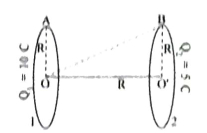
Two identical thin rings each of radius $R \text{ m}$ are kept on the same axis at a distance of $R \text{ m}$ apart. If the charges on them are $10 \text{ C}$ and $5 \text{ C}$ respectively,calculate the work done in moving a charge '$q$' coulomb from the centre of one ring to that of another.
A
$\frac{5 q}{4 \pi \varepsilon_0 R}\left[\frac{\sqrt{2}-1}{2}\right] \text{ J}$
B
$\frac{5 q}{4 \pi \varepsilon_0 R}\left[1-\frac{1}{\sqrt{2}}\right] \text{ J}$
C
$\frac{15 q}{4 \pi \varepsilon_0 R}\left[\frac{\sqrt{2}-1}{\sqrt{2}}\right] \text{ J}$
D
$\frac{10 q}{4 \pi \varepsilon_0 R}\left[\frac{\sqrt{2}-1}{\sqrt{2}}\right] \text{ J}$
Solution
(B) Let the charges on the rings be $Q_1 = 10 \text{ C}$ and $Q_2 = 5 \text{ C}$. The distance between the centres $O$ and $O'$ is $R$.
The potential at the centre $O$ of the first ring is due to its own charge $Q_1$ and the charge $Q_2$ on the second ring:
$V_O = \frac{k Q_1}{R} + \frac{k Q_2}{\sqrt{R^2 + R^2}} = \frac{k Q_1}{R} + \frac{k Q_2}{\sqrt{2}R} = \frac{k}{R} \left( Q_1 + \frac{Q_2}{\sqrt{2}} \right)$
The potential at the centre $O'$ of the second ring is due to its own charge $Q_2$ and the charge $Q_1$ on the first ring:
$V_{O'} = \frac{k Q_2}{R} + \frac{k Q_1}{\sqrt{R^2 + R^2}} = \frac{k Q_2}{R} + \frac{k Q_1}{\sqrt{2}R} = \frac{k}{R} \left( Q_2 + \frac{Q_1}{\sqrt{2}} \right)$
The potential difference is $\Delta V = V_O - V_{O'}$:
$\Delta V = \frac{k}{R} \left( Q_1 + \frac{Q_2}{\sqrt{2}} - Q_2 - \frac{Q_1}{\sqrt{2}} \right) = \frac{k}{R} \left( Q_1(1 - \frac{1}{\sqrt{2}}) - Q_2(1 - \frac{1}{\sqrt{2}}) \right)$
$\Delta V = \frac{k}{R} (Q_1 - Q_2) \left( 1 - \frac{1}{\sqrt{2}} \right)$
Substituting $Q_1 = 10 \text{ C}$,$Q_2 = 5 \text{ C}$,and $k = \frac{1}{4 \pi \varepsilon_0}$:
$W = q \Delta V = \frac{q}{4 \pi \varepsilon_0 R} (10 - 5) \left( 1 - \frac{1}{\sqrt{2}} \right) = \frac{5 q}{4 \pi \varepsilon_0 R} \left( 1 - \frac{1}{\sqrt{2}} \right) \text{ J}$.
The potential at the centre $O$ of the first ring is due to its own charge $Q_1$ and the charge $Q_2$ on the second ring:
$V_O = \frac{k Q_1}{R} + \frac{k Q_2}{\sqrt{R^2 + R^2}} = \frac{k Q_1}{R} + \frac{k Q_2}{\sqrt{2}R} = \frac{k}{R} \left( Q_1 + \frac{Q_2}{\sqrt{2}} \right)$
The potential at the centre $O'$ of the second ring is due to its own charge $Q_2$ and the charge $Q_1$ on the first ring:
$V_{O'} = \frac{k Q_2}{R} + \frac{k Q_1}{\sqrt{R^2 + R^2}} = \frac{k Q_2}{R} + \frac{k Q_1}{\sqrt{2}R} = \frac{k}{R} \left( Q_2 + \frac{Q_1}{\sqrt{2}} \right)$
The potential difference is $\Delta V = V_O - V_{O'}$:
$\Delta V = \frac{k}{R} \left( Q_1 + \frac{Q_2}{\sqrt{2}} - Q_2 - \frac{Q_1}{\sqrt{2}} \right) = \frac{k}{R} \left( Q_1(1 - \frac{1}{\sqrt{2}}) - Q_2(1 - \frac{1}{\sqrt{2}}) \right)$
$\Delta V = \frac{k}{R} (Q_1 - Q_2) \left( 1 - \frac{1}{\sqrt{2}} \right)$
Substituting $Q_1 = 10 \text{ C}$,$Q_2 = 5 \text{ C}$,and $k = \frac{1}{4 \pi \varepsilon_0}$:
$W = q \Delta V = \frac{q}{4 \pi \varepsilon_0 R} (10 - 5) \left( 1 - \frac{1}{\sqrt{2}} \right) = \frac{5 q}{4 \pi \varepsilon_0 R} \left( 1 - \frac{1}{\sqrt{2}} \right) \text{ J}$.
0 likesView Solution
14
PhysicsEasyMCQGUJCET · 2014
The Earth's magnetic field at a place on the magnetic equator of the Earth is $0.5 \times 10^{-4} \text{ T}$. Consider the radius of the Earth at that place as $6400 \text{ km}$. Then the magnetic dipole moment of the Earth is . . . . . . $\text{Am}^2$. (Given: $\mu_0 = 4\pi \times 10^{-7} \text{ T m A}^{-1}$)
A
$1.05 \times 10^{23}$
B
$1.31 \times 10^{23}$
C
$1.15 \times 10^{23}$
D
$1.62 \times 10^{23}$
Solution
(B) The magnetic field $B$ at the magnetic equator of the Earth is given by the formula:
$B = \frac{\mu_0}{4\pi} \frac{m}{R^3}$
where $m$ is the magnetic dipole moment and $R$ is the radius of the Earth.
Given values:
$B = 0.5 \times 10^{-4} \text{ T}$
$R = 6400 \text{ km} = 6.4 \times 10^6 \text{ m}$
$\frac{\mu_0}{4\pi} = 10^{-7} \text{ T m A}^{-1}$
Substituting these values into the formula:
$0.5 \times 10^{-4} = 10^{-7} \times \frac{m}{(6.4 \times 10^6)^3}$
$m = \frac{0.5 \times 10^{-4} \times (6.4 \times 10^6)^3}{10^{-7}}$
$m = 0.5 \times 10^3 \times (6.4)^3 \times 10^{18}$
$m = 0.5 \times 262.144 \times 10^{21}$
$m = 131.072 \times 10^{21} = 1.31 \times 10^{23} \text{ Am}^2$
Thus,the magnetic dipole moment of the Earth is $1.31 \times 10^{23} \text{ Am}^2$.
$B = \frac{\mu_0}{4\pi} \frac{m}{R^3}$
where $m$ is the magnetic dipole moment and $R$ is the radius of the Earth.
Given values:
$B = 0.5 \times 10^{-4} \text{ T}$
$R = 6400 \text{ km} = 6.4 \times 10^6 \text{ m}$
$\frac{\mu_0}{4\pi} = 10^{-7} \text{ T m A}^{-1}$
Substituting these values into the formula:
$0.5 \times 10^{-4} = 10^{-7} \times \frac{m}{(6.4 \times 10^6)^3}$
$m = \frac{0.5 \times 10^{-4} \times (6.4 \times 10^6)^3}{10^{-7}}$
$m = 0.5 \times 10^3 \times (6.4)^3 \times 10^{18}$
$m = 0.5 \times 262.144 \times 10^{21}$
$m = 131.072 \times 10^{21} = 1.31 \times 10^{23} \text{ Am}^2$
Thus,the magnetic dipole moment of the Earth is $1.31 \times 10^{23} \text{ Am}^2$.
0 likesView Solution
15
PhysicsEasyMCQGUJCET · 2014
The magnetic susceptibility of a paramagnetic material is $1.0 \times 10^{-5}$ at $27^{\circ} C$ temperature. Then at what temperature its magnetic susceptibility would be $1.5 \times 10^{-5}$ (in $^{\circ} C$)?
A
$18$
B
$200$
C
$-73$
D
$-18$
Solution
(C) According to Curie's law for a paramagnetic substance,the magnetic susceptibility $\chi_m$ is inversely proportional to the absolute temperature $T$,i.e.,$\chi_m \propto \frac{1}{T}$.
Given:
$\chi_{m_1} = 1.0 \times 10^{-5}$
$T_1 = 27^{\circ} C = 27 + 273 = 300 \ K$
$\chi_{m_2} = 1.5 \times 10^{-5}$
Using the relation $\frac{\chi_{m_1}}{\chi_{m_2}} = \frac{T_2}{T_1}$:
$\frac{1.0 \times 10^{-5}}{1.5 \times 10^{-5}} = \frac{T_2}{300}$
$\frac{1}{1.5} = \frac{T_2}{300}$
$T_2 = \frac{300}{1.5} = 200 \ K$
Converting back to Celsius: $T_2(^{\circ} C) = 200 - 273 = -73^{\circ} C$.
Given:
$\chi_{m_1} = 1.0 \times 10^{-5}$
$T_1 = 27^{\circ} C = 27 + 273 = 300 \ K$
$\chi_{m_2} = 1.5 \times 10^{-5}$
Using the relation $\frac{\chi_{m_1}}{\chi_{m_2}} = \frac{T_2}{T_1}$:
$\frac{1.0 \times 10^{-5}}{1.5 \times 10^{-5}} = \frac{T_2}{300}$
$\frac{1}{1.5} = \frac{T_2}{300}$
$T_2 = \frac{300}{1.5} = 200 \ K$
Converting back to Celsius: $T_2(^{\circ} C) = 200 - 273 = -73^{\circ} C$.
0 likesView Solution
16
PhysicsEasyMCQGUJCET · 2014
The ratio of periods of $\alpha$-particle and proton moving on circular path in uniform magnetic field is . . . . . . .
A
$2: 1$
B
$1: 2$
C
$4: 1$
D
$1: 4$
Solution
(A) The time period $T$ of a charged particle moving in a uniform magnetic field $B$ is given by the formula: $T = \frac{2 \pi m}{q B}$.
Since $2, \pi,$ and $B$ are constants,the time period is proportional to the mass-to-charge ratio: $T \propto \frac{m}{q}$.
For an $\alpha$-particle,the mass $m_{\alpha} = 4 m_p$ and the charge $q_{\alpha} = 2 q_p$,where $m_p$ and $q_p$ are the mass and charge of a proton,respectively.
Therefore,the ratio of the time periods is: $\frac{T_{\alpha}}{T_p} = \frac{m_{\alpha}}{q_{\alpha}} \times \frac{q_p}{m_p}$.
Substituting the values: $\frac{T_{\alpha}}{T_p} = \frac{4 m_p}{2 q_p} \times \frac{q_p}{m_p} = \frac{4}{2} = 2: 1$.
Since $2, \pi,$ and $B$ are constants,the time period is proportional to the mass-to-charge ratio: $T \propto \frac{m}{q}$.
For an $\alpha$-particle,the mass $m_{\alpha} = 4 m_p$ and the charge $q_{\alpha} = 2 q_p$,where $m_p$ and $q_p$ are the mass and charge of a proton,respectively.
Therefore,the ratio of the time periods is: $\frac{T_{\alpha}}{T_p} = \frac{m_{\alpha}}{q_{\alpha}} \times \frac{q_p}{m_p}$.
Substituting the values: $\frac{T_{\alpha}}{T_p} = \frac{4 m_p}{2 q_p} \times \frac{q_p}{m_p} = \frac{4}{2} = 2: 1$.
0 likesView Solution
17
PhysicsEasyMCQGUJCET · 2014
Two concentric rings are kept in the same plane. The number of turns in each ring is $25$. Their radii are $50 \text{ cm}$ and $200 \text{ cm}$,and they carry electric currents of $0.1 \text{ A}$ and $0.2 \text{ A}$ respectively in mutually opposite directions. The magnitude of the magnetic field produced at their centre is . . . . . . $\text{T}$.
A
$4 \mu_0$
B
$2 \mu_0$
C
$\frac{10}{4} \mu_0$
D
$\frac{5}{4} \mu_0$
Solution
(D) The magnetic field at the center of a circular coil with $N$ turns and radius $a$ carrying current $I$ is given by $B = \frac{\mu_0 N I}{2a}$.
Since the currents are in mutually opposite directions,the net magnetic field at the center is the difference between the fields produced by the two rings: $B = |B_1 - B_2|$.
Given: $N = 25$,$I_1 = 0.1 \text{ A}$,$a_1 = 0.5 \text{ m}$,$I_2 = 0.2 \text{ A}$,$a_2 = 2.0 \text{ m}$.
Substituting the values:
$B = \frac{\mu_0 N}{2} \left| \frac{I_1}{a_1} - \frac{I_2}{a_2} \right|$
$B = \frac{\mu_0 \times 25}{2} \left| \frac{0.1}{0.5} - \frac{0.2}{2.0} \right|$
$B = \frac{25 \mu_0}{2} \left| 0.2 - 0.1 \right|$
$B = \frac{25 \mu_0}{2} \times 0.1 = \frac{2.5 \mu_0}{2} = \frac{5}{4} \mu_0 \text{ T}$.
Since the currents are in mutually opposite directions,the net magnetic field at the center is the difference between the fields produced by the two rings: $B = |B_1 - B_2|$.
Given: $N = 25$,$I_1 = 0.1 \text{ A}$,$a_1 = 0.5 \text{ m}$,$I_2 = 0.2 \text{ A}$,$a_2 = 2.0 \text{ m}$.
Substituting the values:
$B = \frac{\mu_0 N}{2} \left| \frac{I_1}{a_1} - \frac{I_2}{a_2} \right|$
$B = \frac{\mu_0 \times 25}{2} \left| \frac{0.1}{0.5} - \frac{0.2}{2.0} \right|$
$B = \frac{25 \mu_0}{2} \left| 0.2 - 0.1 \right|$
$B = \frac{25 \mu_0}{2} \times 0.1 = \frac{2.5 \mu_0}{2} = \frac{5}{4} \mu_0 \text{ T}$.
0 likesView Solution
18
PhysicsEasyMCQGUJCET · 2014
The ratio of time periods of $\alpha$-particle and proton moving on circular path in a uniform magnetic field is . . . . . . .
A
$2: 1$
B
$1: 2$
C
$4: 1$
D
$1: 4$
Solution
(A) The time period $T$ of a charged particle moving in a uniform magnetic field is given by the formula: $T = \frac{2 \pi m}{q B}$.
From this expression,we can see that $T \propto \frac{m}{q}$.
For an $\alpha$-particle,the mass $m_\alpha = 4 m_p$ and the charge $q_\alpha = 2 q_p$,where $m_p$ and $q_p$ are the mass and charge of a proton,respectively.
Now,calculating the ratio of the time periods:
$\frac{T_\alpha}{T_p} = \frac{m_\alpha}{q_\alpha} \times \frac{q_p}{m_p}$
Substituting the values:
$\frac{T_\alpha}{T_p} = \frac{4 m_p}{2 q_p} \times \frac{q_p}{m_p} = \frac{4}{2} = \frac{2}{1}$.
Therefore,the ratio is $2: 1$.
From this expression,we can see that $T \propto \frac{m}{q}$.
For an $\alpha$-particle,the mass $m_\alpha = 4 m_p$ and the charge $q_\alpha = 2 q_p$,where $m_p$ and $q_p$ are the mass and charge of a proton,respectively.
Now,calculating the ratio of the time periods:
$\frac{T_\alpha}{T_p} = \frac{m_\alpha}{q_\alpha} \times \frac{q_p}{m_p}$
Substituting the values:
$\frac{T_\alpha}{T_p} = \frac{4 m_p}{2 q_p} \times \frac{q_p}{m_p} = \frac{4}{2} = \frac{2}{1}$.
Therefore,the ratio is $2: 1$.
0 likesView Solution
19
PhysicsEasyMCQGUJCET · 2014
$A$ galvanometer acting as a voltmeter should have . . . . . . .
A
High resistance in parallel with its coil
B
High resistance in series with its coil
C
Low resistance in parallel with its coil
D
Low resistance in series with its coil
Solution
(B) To convert a galvanometer into a voltmeter,a high resistance (multiplier) must be connected in series with the galvanometer coil.
This is done to ensure that the voltmeter draws a negligible current from the circuit,thereby maintaining the potential difference across the points to be measured.
By increasing the total resistance of the device,the current flowing through the galvanometer is limited,preventing damage and allowing it to measure higher voltages.
This is done to ensure that the voltmeter draws a negligible current from the circuit,thereby maintaining the potential difference across the points to be measured.
By increasing the total resistance of the device,the current flowing through the galvanometer is limited,preventing damage and allowing it to measure higher voltages.
0 likesView Solution
20
PhysicsEasyMCQGUJCET · 2014
The binding energy per nucleon of ${ }_{8}^{16}O$ is $7.97 \text{ MeV}$ and that of ${ }_{8}^{17}O$ is $7.75 \text{ MeV}$. The energy required to remove one neutron from ${ }_{8}^{17}O$ is $\qquad \text{ MeV}$.
A
$3.52$
B
$3.62$
C
$4.23$
D
$7.86$
Solution
(C) The reaction for removing one neutron from ${ }_{8}^{17}O$ is given by: ${ }_{8}^{17}O \rightarrow { }_{8}^{16}O + { }_{0}^{1}n$.
To find the energy required,we calculate the difference between the total binding energy of the products and the reactant.
Total binding energy of ${ }_{8}^{17}O = 17 \times 7.75 \text{ MeV} = 131.75 \text{ MeV}$.
Total binding energy of ${ }_{8}^{16}O = 16 \times 7.97 \text{ MeV} = 127.52 \text{ MeV}$.
The energy required to remove the neutron is the difference in total binding energies:
$E = 131.75 \text{ MeV} - 127.52 \text{ MeV} = 4.23 \text{ MeV}$.
To find the energy required,we calculate the difference between the total binding energy of the products and the reactant.
Total binding energy of ${ }_{8}^{17}O = 17 \times 7.75 \text{ MeV} = 131.75 \text{ MeV}$.
Total binding energy of ${ }_{8}^{16}O = 16 \times 7.97 \text{ MeV} = 127.52 \text{ MeV}$.
The energy required to remove the neutron is the difference in total binding energies:
$E = 131.75 \text{ MeV} - 127.52 \text{ MeV} = 4.23 \text{ MeV}$.
0 likesView Solution
21
PhysicsEasyMCQGUJCET · 2014
In a Zener diode,the reverse bias voltage is $3 \ V$ and the width of the depletion region is $300 \ \mathring{A}$. The electric field intensity will be $\dots \ V/cm$.
A
$10^{4}$
B
$10^{6}$
C
$10^{8}$
D
$10^{-2}$
Solution
(B) The electric field intensity $E$ is given by the formula $E = \frac{V}{d}$,where $V$ is the potential difference and $d$ is the width of the depletion region.
Given: $V = 3 \ V$ and $d = 300 \ \mathring{A} = 300 \times 10^{-8} \ cm$.
Substituting the values:
$E = \frac{3}{300 \times 10^{-8}} \ V/cm$
$E = \frac{3}{3 \times 10^{-6}} \ V/cm$
$E = 10^{6} \ V/cm$.
Therefore,the correct option is $B$.
Given: $V = 3 \ V$ and $d = 300 \ \mathring{A} = 300 \times 10^{-8} \ cm$.
Substituting the values:
$E = \frac{3}{300 \times 10^{-8}} \ V/cm$
$E = \frac{3}{3 \times 10^{-6}} \ V/cm$
$E = 10^{6} \ V/cm$.
Therefore,the correct option is $B$.
0 likesView Solution
Vedclass Products
For Students
Vedclass Test Series
Mock tests in real GUJCET style covering Physics with performance analysis. 5-day free trial.
Start Free TrialFor Teachers
Exam Paper Generator
Generate Set A/B/C/D Physics papers from 7.5L+ questions in 2 minutes. 3 chapters free.
Try FreeFor Institutes
Online Exam Module
Run live GUJCET mock exams with unlimited students, 360° analytics & white-label branding.
See DemoFrequently Asked Questions
How many Physics questions are in GUJCET 2014?
There are 21 Physics questions from the GUJCET 2014 paper on Vedclass, each with a detailed step-by-step solution in English.
Are GUJCET 2014 Physics solutions available in English?
Yes. All solutions on this page are in English. You can also switch to English or Hindi using the language buttons above the questions.
Can I practice GUJCET 2014 Physics as a timed test?
Yes. Use the Vedclass Test Series to attempt a full GUJCET mock test covering Physics with time limits and instant score analysis.
Can teachers create Physics papers from GUJCET previous year questions?
Yes. The Vedclass Exam Paper Generator lets teachers mix GUJCET Physics questions and generate Set A/B/C/D papers in minutes.
For Teachers & Institutes
Build a Custom Physics Paper
Pick GUJCET 2014 Physics questions, set difficulty, and generate Set A/B/C/D in 2 minutes.