
PhysicsQ1–17 of 17 questions
Page 1 of 1 · English
1
PhysicsEasyMCQGUJCET · 2011
The peak value of an alternating current is $5 \ A$ and its frequency is $60 \ Hz$. Find its $rms$ value and the time taken to reach the peak value of current starting from zero.
A
$3.536 \ A, 4.167 \ ms$
B
$3.536 \ A, 15 \ ms$
C
$6.07 \ A, 10 \ ms$
D
$2.536 \ A, 4.167 \ ms$
Solution
(A) The $rms$ value of the alternating current is given by $I_{rms} = \frac{I_m}{\sqrt{2}}$.
Given $I_m = 5 \ A$,we have $I_{rms} = \frac{5}{1.414} \approx 3.536 \ A$.
The time taken to reach the peak value from zero is one-fourth of the time period $T$.
Since $T = \frac{1}{f} = \frac{1}{60} \ s$,the time $t = \frac{T}{4} = \frac{1}{4 \times 60} \ s$.
$t = \frac{1}{240} \ s \approx 0.004167 \ s = 4.167 \ ms$.
Given $I_m = 5 \ A$,we have $I_{rms} = \frac{5}{1.414} \approx 3.536 \ A$.
The time taken to reach the peak value from zero is one-fourth of the time period $T$.
Since $T = \frac{1}{f} = \frac{1}{60} \ s$,the time $t = \frac{T}{4} = \frac{1}{4 \times 60} \ s$.
$t = \frac{1}{240} \ s \approx 0.004167 \ s = 4.167 \ ms$.
0 likesView Solution
2
PhysicsEasyMCQGUJCET · 2011
Masses of three wires of copper are in the ratio of $1 : 3 : 5$ and their lengths are in the ratio of $5 : 3 : 1$. The ratio of their electrical resistance is . . . . . . .
A
$5: 3: 1$
B
$\sqrt{125}: 15: 1$
C
$1: 15: 125$
D
$1: 3: 5$
Solution
(B) The resistance $R$ of a wire is given by $R = \frac{\rho l}{A}$.
Since volume $V = A \times l$,we can write $A = \frac{V}{l}$.
Substituting this into the resistance formula,we get $R = \frac{\rho l^2}{V}$.
Since density $d = \frac{m}{V}$,we have $V = \frac{m}{d}$.
Thus,$R = \frac{\rho l^2 d}{m}$.
For wires of the same material,$\rho$ and $d$ are constant,so $R \propto \frac{l^2}{m}$.
Given the ratios $m_1:m_2:m_3 = 1:3:5$ and $l_1:l_2:l_3 = 5:3:1$,the ratio of resistances is:
$R_1: R_2: R_3 = \frac{l_1^2}{m_1} : \frac{l_2^2}{m_2} : \frac{l_3^2}{m_3}$
$R_1: R_2: R_3 = \frac{5^2}{1} : \frac{3^2}{3} : \frac{1^2}{5}$
$R_1: R_2: R_3 = 25 : 3 : 0.2$
Multiplying by $5$ to clear the fraction:
$R_1: R_2: R_3 = 125 : 15 : 1$.
Since volume $V = A \times l$,we can write $A = \frac{V}{l}$.
Substituting this into the resistance formula,we get $R = \frac{\rho l^2}{V}$.
Since density $d = \frac{m}{V}$,we have $V = \frac{m}{d}$.
Thus,$R = \frac{\rho l^2 d}{m}$.
For wires of the same material,$\rho$ and $d$ are constant,so $R \propto \frac{l^2}{m}$.
Given the ratios $m_1:m_2:m_3 = 1:3:5$ and $l_1:l_2:l_3 = 5:3:1$,the ratio of resistances is:
$R_1: R_2: R_3 = \frac{l_1^2}{m_1} : \frac{l_2^2}{m_2} : \frac{l_3^2}{m_3}$
$R_1: R_2: R_3 = \frac{5^2}{1} : \frac{3^2}{3} : \frac{1^2}{5}$
$R_1: R_2: R_3 = 25 : 3 : 0.2$
Multiplying by $5$ to clear the fraction:
$R_1: R_2: R_3 = 125 : 15 : 1$.
0 likesView Solution
3
PhysicsEasyMCQGUJCET · 2011
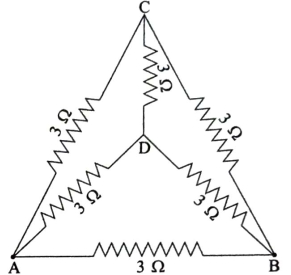
The equivalent resistance between $A$ and $B$ in the given circuit is . . . . . . . . (in $Omega$)
A
$3$
B
$6$
C
$12$
D
$1.5$
Solution
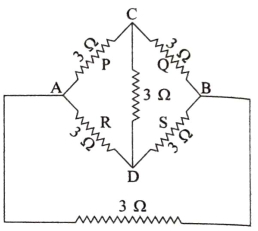
(D) The given circuit can be analyzed by identifying the Wheatstone bridge structure. The resistors form a bridge between points $A$ and $B$ with nodes $C$ and $D$.
Since all resistors are $3 \ \Omega$,the ratio of resistances in the arms is $\frac{3}{3} = \frac{3}{3}$,which satisfies the balanced Wheatstone bridge condition.
Therefore,no current flows through the central resistor connected between $C$ and $D$. We can remove this resistor from the circuit.
After removing the central resistor,the circuit simplifies to two parallel branches connected between $A$ and $B$:
$1$. The upper branch consists of two $3 \ \Omega$ resistors in series: $R_{ACB} = 3 + 3 = 6 \ \Omega$.
$2$. The lower branch consists of two $3 \ \Omega$ resistors in series: $R_{ADB} = 3 + 3 = 6 \ \Omega$.
$3$. There is also a direct $3 \ \Omega$ resistor connected in parallel between $A$ and $B$.
Now,we have three resistors of $6 \ \Omega, 6 \ \Omega$,and $3 \ \Omega$ connected in parallel.
The equivalent resistance $R_{eq}$ is given by:
$\frac{1}{R_{eq}} = \frac{1}{6} + \frac{1}{6} + \frac{1}{3}$
$\frac{1}{R_{eq}} = \frac{1 + 1 + 2}{6} = \frac{4}{6} = \frac{2}{3}$
$R_{eq} = \frac{3}{2} = 1.5 \ \Omega$.
Since all resistors are $3 \ \Omega$,the ratio of resistances in the arms is $\frac{3}{3} = \frac{3}{3}$,which satisfies the balanced Wheatstone bridge condition.
Therefore,no current flows through the central resistor connected between $C$ and $D$. We can remove this resistor from the circuit.
After removing the central resistor,the circuit simplifies to two parallel branches connected between $A$ and $B$:
$1$. The upper branch consists of two $3 \ \Omega$ resistors in series: $R_{ACB} = 3 + 3 = 6 \ \Omega$.
$2$. The lower branch consists of two $3 \ \Omega$ resistors in series: $R_{ADB} = 3 + 3 = 6 \ \Omega$.
$3$. There is also a direct $3 \ \Omega$ resistor connected in parallel between $A$ and $B$.
Now,we have three resistors of $6 \ \Omega, 6 \ \Omega$,and $3 \ \Omega$ connected in parallel.
The equivalent resistance $R_{eq}$ is given by:
$\frac{1}{R_{eq}} = \frac{1}{6} + \frac{1}{6} + \frac{1}{3}$
$\frac{1}{R_{eq}} = \frac{1 + 1 + 2}{6} = \frac{4}{6} = \frac{2}{3}$
$R_{eq} = \frac{3}{2} = 1.5 \ \Omega$.
0 likesView Solution
4
PhysicsEasyMCQGUJCET · 2011
The maximum power dissipated in an external resistance $R$,when connected to a cell of emf $\varepsilon$ and internal resistance $r$,will be . . . . . . .
A
$\frac{\varepsilon^2}{r}$
B
$\frac{\varepsilon^2}{2r}$
C
$\frac{\varepsilon^2}{3r}$
D
$\frac{\varepsilon^2}{4r}$
Solution
(D) The power $P$ dissipated in an external resistance $R$ connected to a cell of emf $\varepsilon$ and internal resistance $r$ is given by the formula:
$P = I^2 R = \left( \frac{\varepsilon}{R+r} \right)^2 R$
To find the maximum power,we differentiate $P$ with respect to $R$ and set it to zero:
$\frac{dP}{dR} = \varepsilon^2 \left[ \frac{(R+r)^2(1) - R(2)(R+r)}{(R+r)^4} \right] = 0$
$(R+r)^2 - 2R(R+r) = 0$
$(R+r)(R+r - 2R) = 0$
$r - R = 0 \implies R = r$
Thus,the power dissipated is maximum when the external resistance equals the internal resistance $(R = r)$.
Substituting $R = r$ into the power equation:
$P_{\max} = \left( \frac{\varepsilon}{r+r} \right)^2 r = \left( \frac{\varepsilon}{2r} \right)^2 r = \frac{\varepsilon^2}{4r^2} \times r = \frac{\varepsilon^2}{4r}$
$P = I^2 R = \left( \frac{\varepsilon}{R+r} \right)^2 R$
To find the maximum power,we differentiate $P$ with respect to $R$ and set it to zero:
$\frac{dP}{dR} = \varepsilon^2 \left[ \frac{(R+r)^2(1) - R(2)(R+r)}{(R+r)^4} \right] = 0$
$(R+r)^2 - 2R(R+r) = 0$
$(R+r)(R+r - 2R) = 0$
$r - R = 0 \implies R = r$
Thus,the power dissipated is maximum when the external resistance equals the internal resistance $(R = r)$.
Substituting $R = r$ into the power equation:
$P_{\max} = \left( \frac{\varepsilon}{r+r} \right)^2 r = \left( \frac{\varepsilon}{2r} \right)^2 r = \frac{\varepsilon^2}{4r^2} \times r = \frac{\varepsilon^2}{4r}$
0 likesView Solution
5
PhysicsEasyMCQGUJCET · 2011
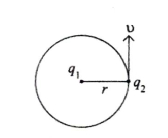
$A$ charge $q_2$ of mass $m$ revolves around a stationary charge $q_1$ in a circular orbit of radius $r$. The orbital periodic time of $q_2$ would be . . . . . . .
A
$\left|\frac{4 \pi^2 m r^3}{k q_1 q_2}\right|^{\frac{1}{2}}$
B
$\left[\frac{k q_1 q_2}{4 \pi^2 m r^3}\right]^{\frac{1}{2}}$
C
$\left[\frac{4 \pi^2 m r^4}{k q_1 q_2}\right]^{\frac{1}{2}}$
D
$\left[\frac{4 \pi^2 m r^2}{k q_1 q_2}\right]^{\frac{1}{2}}$
Solution
(A) For a charge $q_2$ to revolve in a circular orbit,the electrostatic force between $q_1$ and $q_2$ provides the necessary centripetal force.
The centripetal force is given by $F_c = \frac{m v^2}{r}$,where $v$ is the orbital velocity.
The electrostatic force is given by Coulomb's law as $F_e = \frac{k q_1 q_2}{r^2}$.
Equating the two forces: $\frac{m v^2}{r} = \frac{k q_1 q_2}{r^2}$.
Since $v = r \omega$,where $\omega$ is the angular velocity,we have $\frac{m (r \omega)^2}{r} = \frac{k q_1 q_2}{r^2}$.
Simplifying,$m r \omega^2 = \frac{k q_1 q_2}{r^2}$,which gives $\omega^2 = \frac{k q_1 q_2}{m r^3}$.
Since $\omega = \frac{2 \pi}{T}$,where $T$ is the periodic time,we have $\left(\frac{2 \pi}{T}\right)^2 = \frac{k q_1 q_2}{m r^3}$.
$\frac{4 \pi^2}{T^2} = \frac{k q_1 q_2}{m r^3}$.
Therefore,$T^2 = \frac{4 \pi^2 m r^3}{k q_1 q_2}$.
Taking the square root,$T = \left[\frac{4 \pi^2 m r^3}{k q_1 q_2}\right]^{\frac{1}{2}}$.
The centripetal force is given by $F_c = \frac{m v^2}{r}$,where $v$ is the orbital velocity.
The electrostatic force is given by Coulomb's law as $F_e = \frac{k q_1 q_2}{r^2}$.
Equating the two forces: $\frac{m v^2}{r} = \frac{k q_1 q_2}{r^2}$.
Since $v = r \omega$,where $\omega$ is the angular velocity,we have $\frac{m (r \omega)^2}{r} = \frac{k q_1 q_2}{r^2}$.
Simplifying,$m r \omega^2 = \frac{k q_1 q_2}{r^2}$,which gives $\omega^2 = \frac{k q_1 q_2}{m r^3}$.
Since $\omega = \frac{2 \pi}{T}$,where $T$ is the periodic time,we have $\left(\frac{2 \pi}{T}\right)^2 = \frac{k q_1 q_2}{m r^3}$.
$\frac{4 \pi^2}{T^2} = \frac{k q_1 q_2}{m r^3}$.
Therefore,$T^2 = \frac{4 \pi^2 m r^3}{k q_1 q_2}$.
Taking the square root,$T = \left[\frac{4 \pi^2 m r^3}{k q_1 q_2}\right]^{\frac{1}{2}}$.
0 likesView Solution
6
PhysicsEasyMCQGUJCET · 2011
What kind of Gaussian surface is used to calculate the electric field due to the charge distribution?
A
Any surface near the charge distribution.
B
Always a spherical surface.
C
$A$ symmetrical closed surface containing the charge distribution at every point of which electric field has a single fixed value.
D
None of the given options.
Solution
(C) The correct answer is $C$.
To calculate the electric field using Gauss's Law,we choose a Gaussian surface such that the electric field is constant at every point on the surface and the angle between the electric field vector and the area vector is constant.
This is achieved by selecting a symmetrical closed surface that reflects the symmetry of the charge distribution,ensuring that the electric field magnitude is uniform across the surface.
To calculate the electric field using Gauss's Law,we choose a Gaussian surface such that the electric field is constant at every point on the surface and the angle between the electric field vector and the area vector is constant.
This is achieved by selecting a symmetrical closed surface that reflects the symmetry of the charge distribution,ensuring that the electric field magnitude is uniform across the surface.
0 likesView Solution
7
PhysicsEasyMCQGUJCET · 2011
There exists an electric field of $1 \ N/C$ along the $Y$-direction. The flux passing through a square of $1 \ m^2$ placed in the $XY$-plane inside the electric field is . . . . . . .
A
$1.0 \ Nm^2/C$
B
$10.0 \ Nm^2/C$
C
$2.0 \ Nm^2/C$
D
zero
Solution
(D) The electric field is given as $\vec{E} = 1 \hat{j} \ N/C$.
Since the square is placed in the $XY$-plane,its area vector $\vec{A}$ is perpendicular to the $XY$-plane,which is along the $Z$-axis.
Therefore,$\vec{A} = 1 \hat{k} \ m^2$.
The electric flux $\phi$ is defined as the dot product of the electric field and the area vector:
$\phi = \vec{E} \cdot \vec{A}$
$\phi = (1 \hat{j}) \cdot (1 \hat{k})$
Since the dot product of orthogonal unit vectors $\hat{j} \cdot \hat{k} = 0$,the flux is:
$\phi = 0 \ Nm^2/C$.
Since the square is placed in the $XY$-plane,its area vector $\vec{A}$ is perpendicular to the $XY$-plane,which is along the $Z$-axis.
Therefore,$\vec{A} = 1 \hat{k} \ m^2$.
The electric flux $\phi$ is defined as the dot product of the electric field and the area vector:
$\phi = \vec{E} \cdot \vec{A}$
$\phi = (1 \hat{j}) \cdot (1 \hat{k})$
Since the dot product of orthogonal unit vectors $\hat{j} \cdot \hat{k} = 0$,the flux is:
$\phi = 0 \ Nm^2/C$.
0 likesView Solution
8
PhysicsEasyMCQGUJCET · 2011
What is the self-inductance of a solenoid of length $31.4 \ cm$,area of cross-section $10^{-3} \ m^2$,and total number of turns $10^3$?
A
$4$ mH
B
$4$ $H$
C
$40$ $H$
D
$0.4$ $H$
Solution
(A) The formula for the self-inductance $(L)$ of a solenoid is given by:
$L = \frac{\mu_0 N^2 A}{l}$
Given:
Permeability of free space $\mu_0 = 4 \pi \times 10^{-7} \ T \cdot m/A$
Number of turns $N = 10^3$
Area of cross-section $A = 10^{-3} \ m^2$
Length $l = 31.4 \ cm = 31.4 \times 10^{-2} \ m$
Substituting the values:
$L = \frac{4 \times 3.14 \times 10^{-7} \times (10^3)^2 \times 10^{-3}}{31.4 \times 10^{-2}}$
$L = \frac{4 \times 3.14 \times 10^{-7} \times 10^6 \times 10^{-3}}{31.4 \times 10^{-2}}$
$L = \frac{12.56 \times 10^{-4}}{31.4 \times 10^{-2}} = \frac{12.56}{31.4} \times 10^{-2} = 0.4 \times 10^{-2} \ H$
$L = 4 \times 10^{-3} \ H = 4 \ mH$
$L = \frac{\mu_0 N^2 A}{l}$
Given:
Permeability of free space $\mu_0 = 4 \pi \times 10^{-7} \ T \cdot m/A$
Number of turns $N = 10^3$
Area of cross-section $A = 10^{-3} \ m^2$
Length $l = 31.4 \ cm = 31.4 \times 10^{-2} \ m$
Substituting the values:
$L = \frac{4 \times 3.14 \times 10^{-7} \times (10^3)^2 \times 10^{-3}}{31.4 \times 10^{-2}}$
$L = \frac{4 \times 3.14 \times 10^{-7} \times 10^6 \times 10^{-3}}{31.4 \times 10^{-2}}$
$L = \frac{12.56 \times 10^{-4}}{31.4 \times 10^{-2}} = \frac{12.56}{31.4} \times 10^{-2} = 0.4 \times 10^{-2} \ H$
$L = 4 \times 10^{-3} \ H = 4 \ mH$
0 likesView Solution
9
PhysicsEasyMCQGUJCET · 2011
Magnetic flux of $10 \mu Wb$ is linked with a coil,when a current of $2 \ mA$ flows through it. What is the self-inductance of the coil (in $mH$)?
A
$10$
B
$5$
C
$15$
D
$20$
Solution
(B) The magnetic flux $\phi$ linked with a coil is given by the relation $\phi = L \cdot I$,where $L$ is the self-inductance and $I$ is the current flowing through the coil.
Given:
$\phi = 10 \ \mu Wb = 10 \times 10^{-6} \ Wb$
$I = 2 \ mA = 2 \times 10^{-3} \ A$
Rearranging the formula for self-inductance $L$:
$L = \frac{\phi}{I}$
Substituting the values:
$L = \frac{10 \times 10^{-6}}{2 \times 10^{-3}}$
$L = 5 \times 10^{-3} \ H$
$L = 5 \ mH$
Therefore,the self-inductance of the coil is $5 \ mH$.
Given:
$\phi = 10 \ \mu Wb = 10 \times 10^{-6} \ Wb$
$I = 2 \ mA = 2 \times 10^{-3} \ A$
Rearranging the formula for self-inductance $L$:
$L = \frac{\phi}{I}$
Substituting the values:
$L = \frac{10 \times 10^{-6}}{2 \times 10^{-3}}$
$L = 5 \times 10^{-3} \ H$
$L = 5 \ mH$
Therefore,the self-inductance of the coil is $5 \ mH$.
0 likesView Solution
10
PhysicsEasyMCQGUJCET · 2011
In Hertz's experiment,the rods connected with an induction coil behave as . . . . . . .
A
a capacitor
B
an inductor
C
a resistor
D
a transformer
Solution
(A) In Hertz's experiment,the two metal rods connected to the high-voltage induction coil act as the plates of a capacitor. When the potential difference between the rods becomes sufficiently high,the air between them breaks down,causing a spark to jump across the gap. This oscillation of charge creates electromagnetic waves.
0 likesView Solution
11
PhysicsEasyMCQGUJCET · 2011
The unit of the physical quantity obtained by the line integral of the electric field is . . . . . . .
A
$N C^{-1}$
B
$V m^{-1}$
C
$J C^{-1}$
D
$C^2 N^{-1} m^{-1}$
Solution
(C) The line integral of the electric field $\vec{E}$ along a path is defined as the potential difference $V$ between two points.
Mathematically,$V = -\int \vec{E} \cdot d\vec{l}$.
The $SI$ unit of electric potential $V$ is the volt $(V)$,which is defined as the work done per unit charge.
Therefore,$1 \ V = 1 \ J C^{-1}$.
Thus,the unit of the physical quantity obtained by the line integral of the electric field is $J C^{-1}$ (or Volts).
Mathematically,$V = -\int \vec{E} \cdot d\vec{l}$.
The $SI$ unit of electric potential $V$ is the volt $(V)$,which is defined as the work done per unit charge.
Therefore,$1 \ V = 1 \ J C^{-1}$.
Thus,the unit of the physical quantity obtained by the line integral of the electric field is $J C^{-1}$ (or Volts).
0 likesView Solution
12
PhysicsEasyMCQGUJCET · 2011
Charges $5 \mu C$ and $10 \mu C$ are placed $1 \ m$ apart. Work done to bring these charges at a distance $0.5 \ m$ from each other is . . . . . . .
$(k = 9 \times 10^9 \ SI)$
$(k = 9 \times 10^9 \ SI)$
A
$9 \times 10^4 \ J$
B
$18 \times 10^4 \ J$
C
$45 \times 10^{-2} \ J$
D
$9 \times 10^{-1} \ J$
Solution
(C) The work done $W$ to change the separation between two point charges is equal to the change in their electrostatic potential energy $\Delta U$.
The potential energy of a system of two charges is given by $U = \frac{k q_1 q_2}{r}$.
Given: $q_1 = 5 \times 10^{-6} \ C$,$q_2 = 10 \times 10^{-6} \ C$,$r_1 = 1 \ m$,$r_2 = 0.5 \ m$,and $k = 9 \times 10^9 \ N \cdot m^2/C^2$.
Work done $W = U_2 - U_1 = k q_1 q_2 \left( \frac{1}{r_2} - \frac{1}{r_1} \right)$.
Substituting the values:
$W = (9 \times 10^9) \times (5 \times 10^{-6}) \times (10 \times 10^{-6}) \times \left( \frac{1}{0.5} - \frac{1}{1} \right)$
$W = (9 \times 10^9) \times (50 \times 10^{-12}) \times (2 - 1)$
$W = 450 \times 10^{-3} \ J = 0.45 \ J = 45 \times 10^{-2} \ J$.
The potential energy of a system of two charges is given by $U = \frac{k q_1 q_2}{r}$.
Given: $q_1 = 5 \times 10^{-6} \ C$,$q_2 = 10 \times 10^{-6} \ C$,$r_1 = 1 \ m$,$r_2 = 0.5 \ m$,and $k = 9 \times 10^9 \ N \cdot m^2/C^2$.
Work done $W = U_2 - U_1 = k q_1 q_2 \left( \frac{1}{r_2} - \frac{1}{r_1} \right)$.
Substituting the values:
$W = (9 \times 10^9) \times (5 \times 10^{-6}) \times (10 \times 10^{-6}) \times \left( \frac{1}{0.5} - \frac{1}{1} \right)$
$W = (9 \times 10^9) \times (50 \times 10^{-12}) \times (2 - 1)$
$W = 450 \times 10^{-3} \ J = 0.45 \ J = 45 \times 10^{-2} \ J$.
0 likesView Solution
13
PhysicsEasyMCQGUJCET · 2011
$A$ hollow metal sphere of radius $10 \ cm$ is charged such that the potential on its surface becomes $80 \ V$. The potential at the centre of the sphere is . . . . . . . (in $V$)
A
$80$
B
$800$
C
$8$
D
$0$
Solution
(A) For a charged hollow metal sphere,the electric field inside the sphere is zero $(E = 0)$.
Since the electric field is the negative gradient of the potential $(E = -dV/dr)$,if $E = 0$,then the potential $V$ must be constant throughout the interior of the sphere.
Therefore,the potential at any point inside the sphere,including the centre,is equal to the potential on its surface.
Given that the potential on the surface is $80 \ V$,the potential at the centre of the sphere is $80 \ V$.
Since the electric field is the negative gradient of the potential $(E = -dV/dr)$,if $E = 0$,then the potential $V$ must be constant throughout the interior of the sphere.
Therefore,the potential at any point inside the sphere,including the centre,is equal to the potential on its surface.
Given that the potential on the surface is $80 \ V$,the potential at the centre of the sphere is $80 \ V$.
0 likesView Solution
14
PhysicsEasyMCQGUJCET · 2011
The resultant force acting on a diamagnetic material in a non-uniform magnetic field is in the direction . . . . . . .
A
from the stronger to the weaker part of the magnetic field.
B
from the weaker to the stronger part of the magnetic field.
C
perpendicular to the magnetic field.
D
in the direction making $60^{\circ}$ to the magnetic field.
Solution
(A) Diamagnetic materials are weakly repelled by magnetic fields. When placed in a non-uniform magnetic field,the induced magnetic moment is in the direction opposite to the applied field. Consequently,the material experiences a force that pushes it from the region of higher magnetic field intensity (stronger part) to the region of lower magnetic field intensity (weaker part). Therefore,the correct option is $A$.
0 likesView Solution
15
PhysicsEasyMCQGUJCET · 2011
The magnetic field due to a short bar magnet of magnetic dipole moment $M$ and length $2l$,on the axis at a distance $Z$ (where $Z \gg l$) from the centre of the magnet is given by . . . . . . .
A
$\frac{\mu_0}{4 \pi} \frac{M}{Z^3} \hat{M}$
B
$\frac{2 \mu_0}{4 \pi} \frac{M}{Z^3} \hat{M}$
C
$\frac{4 \pi}{\mu_0} \frac{M}{Z^3} \hat{M}$
D
$\frac{\mu_0}{2 \pi} \frac{M}{Z^3} \hat{M}$
Solution
(B) The magnetic field $B$ on the axial line of a bar magnet at a distance $Z$ from its centre is given by the formula $B = \frac{\mu_0}{4 \pi} \frac{2MZ}{(Z^2 - l^2)^2}$.
For a short bar magnet,the length $2l$ is very small compared to the distance $Z$,i.e.,$Z \gg l$.
Therefore,we can approximate $(Z^2 - l^2)^2 \approx (Z^2)^2 = Z^4$.
Substituting this into the formula,we get $B = \frac{\mu_0}{4 \pi} \frac{2MZ}{Z^4} = \frac{\mu_0}{4 \pi} \frac{2M}{Z^3}$.
In vector form,this is expressed as $\vec{B} = \frac{2 \mu_0}{4 \pi} \frac{\vec{M}}{Z^3}$.
For a short bar magnet,the length $2l$ is very small compared to the distance $Z$,i.e.,$Z \gg l$.
Therefore,we can approximate $(Z^2 - l^2)^2 \approx (Z^2)^2 = Z^4$.
Substituting this into the formula,we get $B = \frac{\mu_0}{4 \pi} \frac{2MZ}{Z^4} = \frac{\mu_0}{4 \pi} \frac{2M}{Z^3}$.
In vector form,this is expressed as $\vec{B} = \frac{2 \mu_0}{4 \pi} \frac{\vec{M}}{Z^3}$.
0 likesView Solution
16
PhysicsEasyMCQGUJCET · 2011
The resistance of an ideal voltmeter is . . . . . . .
A
Zero
B
Greater than Zero but finite value
C
Infinite
D
$5000 \Omega$
Solution
(C) An ideal voltmeter is designed to measure the potential difference between two points in a circuit without drawing any current from the circuit.
To ensure that no current flows through the voltmeter,its resistance must be infinitely high.
Therefore,the resistance of an ideal voltmeter is infinite.
To ensure that no current flows through the voltmeter,its resistance must be infinitely high.
Therefore,the resistance of an ideal voltmeter is infinite.
0 likesView Solution
17
PhysicsEasyMCQGUJCET · 2011
To send $10 \%$ of the main current through a moving coil galvanometer of resistance $99 \Omega$,the shunt required is . . . . . . . (in $Omega$)
A
$9$
B
$11$
C
$108$
D
$99$
Solution
(B) The formula for the shunt resistance $S$ required to send a fraction of the total current $I$ through a galvanometer of resistance $G$ is given by:
$S = \frac{G I_G}{I - I_G}$
Given that the galvanometer current $I_G = 10 \% I = 0.1 I$ and the galvanometer resistance $G = 99 \Omega$.
Substituting these values into the formula:
$S = \frac{99 \times 0.1 I}{I - 0.1 I}$
$S = \frac{9.9 I}{0.9 I}$
$S = \frac{9.9}{0.9} = 11 \Omega$
Therefore,the required shunt resistance is $11 \Omega$.
$S = \frac{G I_G}{I - I_G}$
Given that the galvanometer current $I_G = 10 \% I = 0.1 I$ and the galvanometer resistance $G = 99 \Omega$.
Substituting these values into the formula:
$S = \frac{99 \times 0.1 I}{I - 0.1 I}$
$S = \frac{9.9 I}{0.9 I}$
$S = \frac{9.9}{0.9} = 11 \Omega$
Therefore,the required shunt resistance is $11 \Omega$.
0 likesView Solution
Vedclass Products
For Students
Vedclass Test Series
Mock tests in real GUJCET style covering Physics with performance analysis. 5-day free trial.
Start Free TrialFor Teachers
Exam Paper Generator
Generate Set A/B/C/D Physics papers from 7.5L+ questions in 2 minutes. 3 chapters free.
Try FreeFor Institutes
Online Exam Module
Run live GUJCET mock exams with unlimited students, 360° analytics & white-label branding.
See DemoFrequently Asked Questions
How many Physics questions are in GUJCET 2011?
There are 17 Physics questions from the GUJCET 2011 paper on Vedclass, each with a detailed step-by-step solution in English.
Are GUJCET 2011 Physics solutions available in English?
Yes. All solutions on this page are in English. You can also switch to English or Hindi using the language buttons above the questions.
Can I practice GUJCET 2011 Physics as a timed test?
Yes. Use the Vedclass Test Series to attempt a full GUJCET mock test covering Physics with time limits and instant score analysis.
Can teachers create Physics papers from GUJCET previous year questions?
Yes. The Vedclass Exam Paper Generator lets teachers mix GUJCET Physics questions and generate Set A/B/C/D papers in minutes.
For Teachers & Institutes
Build a Custom Physics Paper
Pick GUJCET 2011 Physics questions, set difficulty, and generate Set A/B/C/D in 2 minutes.