
PhysicsQ1–20 of 20 questions
Page 1 of 1 · English
1
PhysicsEasyMCQGUJCET · 2010
The dimensional formula of $\frac{1}{\mu_{0} \varepsilon_{0}}$ is . . . . . . .
A
$M^{0} L^{1} T^{-1}$
B
$M^{0} L^{2} T^{-2}$
C
$M^{0} L^{1} T^{-2}$
D
$M^{0} L^{-2} T^{2}$
Solution
(B) The speed of light in vacuum is given by the relation $c = \frac{1}{\sqrt{\mu_{0} \varepsilon_{0}}}$.
Squaring both sides,we get $c^{2} = \frac{1}{\mu_{0} \varepsilon_{0}}$.
Since $c$ represents velocity,its dimensional formula is $[M^{0} L^{1} T^{-1}]$.
Therefore,the dimensional formula of $\frac{1}{\mu_{0} \varepsilon_{0}}$ is the square of the dimensional formula of velocity:
$\frac{1}{\mu_{0} \varepsilon_{0}} = [M^{0} L^{1} T^{-1}]^{2} = M^{0} L^{2} T^{-2}$.
Thus,the correct option is $B$.
Squaring both sides,we get $c^{2} = \frac{1}{\mu_{0} \varepsilon_{0}}$.
Since $c$ represents velocity,its dimensional formula is $[M^{0} L^{1} T^{-1}]$.
Therefore,the dimensional formula of $\frac{1}{\mu_{0} \varepsilon_{0}}$ is the square of the dimensional formula of velocity:
$\frac{1}{\mu_{0} \varepsilon_{0}} = [M^{0} L^{1} T^{-1}]^{2} = M^{0} L^{2} T^{-2}$.
Thus,the correct option is $B$.
0 likesView Solution
2
PhysicsEasyMCQGUJCET · 2010
What is the average value of the $AC$ voltage over a complete cycle?
A
$\frac{2 V_{\max }}{\pi}$
B
$\frac{V_{\max }}{2}$
C
Zero
D
$V_{\max }$
Solution
(C) The instantaneous value of an alternating voltage is given by $V(t) = V_{\max} \sin(\omega t)$.
To find the average value over a complete cycle (from $t = 0$ to $t = T$),we integrate the function over the period $T$ and divide by the period:
$V_{\text{avg}} = \frac{1}{T} \int_{0}^{T} V_{\max} \sin(\omega t) dt$.
Since $\omega = \frac{2\pi}{T}$,the integral becomes:
$V_{\text{avg}} = \frac{V_{\max}}{T} \int_{0}^{T} \sin\left(\frac{2\pi}{T} t\right) dt$.
The integral of the sine function over a full period is zero because the positive area of the first half-cycle exactly cancels out the negative area of the second half-cycle.
Therefore,$V_{\text{avg}} = 0$.
To find the average value over a complete cycle (from $t = 0$ to $t = T$),we integrate the function over the period $T$ and divide by the period:
$V_{\text{avg}} = \frac{1}{T} \int_{0}^{T} V_{\max} \sin(\omega t) dt$.
Since $\omega = \frac{2\pi}{T}$,the integral becomes:
$V_{\text{avg}} = \frac{V_{\max}}{T} \int_{0}^{T} \sin\left(\frac{2\pi}{T} t\right) dt$.
The integral of the sine function over a full period is zero because the positive area of the first half-cycle exactly cancels out the negative area of the second half-cycle.
Therefore,$V_{\text{avg}} = 0$.
0 likesView Solution
3
PhysicsEasyMCQGUJCET · 2010
$A$ resistor of $R=6 \Omega$,an inductor of $L=1 \text{ H}$,and a capacitor of $C=17.36 \mu \text{F}$ are connected in series with an $AC$ source. Find the $Q$ factor.
A
$2.37$
B
$80$
C
$3.72$
D
$40$
Solution
(D) The $Q$ factor (Quality factor) of a series $LCR$ circuit is given by the formula:
$Q = \frac{1}{R} \sqrt{\frac{L}{C}}$
Given values are $R = 6 \Omega$,$L = 1 \text{ H}$,and $C = 17.36 \times 10^{-6} \text{ F}$.
Substituting these values into the formula:
$Q = \frac{1}{6} \sqrt{\frac{1}{17.36 \times 10^{-6}}}$
$Q = \frac{1}{6} \sqrt{\frac{10^6}{17.36}}$
$Q = \frac{1}{6} \times \sqrt{57603.68}$
$Q \approx \frac{1}{6} \times 240$
$Q \approx 40$
Therefore,the correct option is $D$.
$Q = \frac{1}{R} \sqrt{\frac{L}{C}}$
Given values are $R = 6 \Omega$,$L = 1 \text{ H}$,and $C = 17.36 \times 10^{-6} \text{ F}$.
Substituting these values into the formula:
$Q = \frac{1}{6} \sqrt{\frac{1}{17.36 \times 10^{-6}}}$
$Q = \frac{1}{6} \sqrt{\frac{10^6}{17.36}}$
$Q = \frac{1}{6} \times \sqrt{57603.68}$
$Q \approx \frac{1}{6} \times 240$
$Q \approx 40$
Therefore,the correct option is $D$.
0 likesView Solution
4
PhysicsEasyMCQGUJCET · 2010
The quantity that remains unchanged in the output with respect to the input in an ideal transformer is . . . . . . .
A
frequency
B
current
C
voltage
D
none of these.
Solution
(A) In an ideal transformer,the primary and secondary coils are linked by a common magnetic flux that oscillates at the same rate as the input alternating current source.
Since the frequency of the induced electromotive force $(EMF)$ in the secondary coil depends solely on the frequency of the magnetic flux variation,which is determined by the input source,the frequency remains constant.
Therefore,the frequency of the output voltage is the same as the frequency of the input voltage.
Since the frequency of the induced electromotive force $(EMF)$ in the secondary coil depends solely on the frequency of the magnetic flux variation,which is determined by the input source,the frequency remains constant.
Therefore,the frequency of the output voltage is the same as the frequency of the input voltage.
0 likesView Solution
5
PhysicsEasyMCQGUJCET · 2010
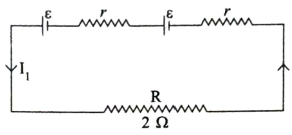
When two identical cells are connected either in series or in parallel across a $2 \ \Omega$ resistor,they send the same current through it. The internal resistance of each cell is: (in $Omega$)
A
$0.5$
B
$1.5$
C
$1$
D
$2$
Solution
(D) For series connection:
The total electromotive force is $2\varepsilon$ and the total internal resistance is $2r$.
The current flowing through the circuit is given by:
$I_1 = \frac{2\varepsilon}{R + 2r} = \frac{2\varepsilon}{2 + 2r}$
For parallel connection:
The total electromotive force is $\varepsilon$ and the total internal resistance is $\frac{r}{2}$.
The current flowing through the circuit is given by:
$I_2 = \frac{\varepsilon}{R + \frac{r}{2}} = \frac{\varepsilon}{2 + \frac{r}{2}} = \frac{2\varepsilon}{4 + r}$
Since the current is the same in both connections,$I_1 = I_2$:
$\frac{2\varepsilon}{2 + 2r} = \frac{2\varepsilon}{4 + r}$
$4 + r = 2 + 2r$
$r = 2 \ \Omega$
Thus,the internal resistance of each cell is $2 \ \Omega$.
The total electromotive force is $2\varepsilon$ and the total internal resistance is $2r$.
The current flowing through the circuit is given by:
$I_1 = \frac{2\varepsilon}{R + 2r} = \frac{2\varepsilon}{2 + 2r}$
For parallel connection:
The total electromotive force is $\varepsilon$ and the total internal resistance is $\frac{r}{2}$.
The current flowing through the circuit is given by:
$I_2 = \frac{\varepsilon}{R + \frac{r}{2}} = \frac{\varepsilon}{2 + \frac{r}{2}} = \frac{2\varepsilon}{4 + r}$
Since the current is the same in both connections,$I_1 = I_2$:
$\frac{2\varepsilon}{2 + 2r} = \frac{2\varepsilon}{4 + r}$
$4 + r = 2 + 2r$
$r = 2 \ \Omega$
Thus,the internal resistance of each cell is $2 \ \Omega$.
0 likesView Solution
6
PhysicsEasyMCQGUJCET · 2010
Two electric bulbs marked $25 W-220 V$ and $100 W-220 V$ are connected in series to a $440 V$ supply. Which of the bulbs will fuse?
A
Both bulbs
B
Not even one
C
$25 W$ bulb
D
$100 W$ bulb
Solution
(C) First,calculate the resistance and rated current capacity for each bulb.
For the $25 W$ bulb: $R_1 = \frac{V^2}{P_1} = \frac{220^2}{25} = 1936 \Omega$. The rated current is $I_1 = \frac{P_1}{V} = \frac{25}{220} \approx 0.114 \ A$.
For the $100 W$ bulb: $R_2 = \frac{V^2}{P_2} = \frac{220^2}{100} = 484 \Omega$. The rated current is $I_2 = \frac{P_2}{V} = \frac{100}{220} \approx 0.454 \ A$.
When connected in series to a $440 \ V$ supply,the total resistance is $R_{eq} = R_1 + R_2 = 1936 + 484 = 2420 \ \Omega$.
The current flowing through the series circuit is $I = \frac{V_{total}}{R_{eq}} = \frac{440}{2420} \approx 0.181 \ A$.
Comparing the circuit current $I$ with the rated capacities: Since $I (0.181 \ A) > I_1 (0.114 \ A)$,the $25 \ W$ bulb will exceed its rated current capacity and fuse. Since $I (0.181 \ A) < I_2 (0.454 \ A)$,the $100 \ W$ bulb will remain safe.
For the $25 W$ bulb: $R_1 = \frac{V^2}{P_1} = \frac{220^2}{25} = 1936 \Omega$. The rated current is $I_1 = \frac{P_1}{V} = \frac{25}{220} \approx 0.114 \ A$.
For the $100 W$ bulb: $R_2 = \frac{V^2}{P_2} = \frac{220^2}{100} = 484 \Omega$. The rated current is $I_2 = \frac{P_2}{V} = \frac{100}{220} \approx 0.454 \ A$.
When connected in series to a $440 \ V$ supply,the total resistance is $R_{eq} = R_1 + R_2 = 1936 + 484 = 2420 \ \Omega$.
The current flowing through the series circuit is $I = \frac{V_{total}}{R_{eq}} = \frac{440}{2420} \approx 0.181 \ A$.
Comparing the circuit current $I$ with the rated capacities: Since $I (0.181 \ A) > I_1 (0.114 \ A)$,the $25 \ W$ bulb will exceed its rated current capacity and fuse. Since $I (0.181 \ A) < I_2 (0.454 \ A)$,the $100 \ W$ bulb will remain safe.
0 likesView Solution
7
PhysicsEasyMCQGUJCET · 2010
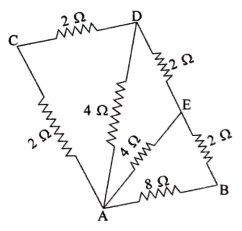
What is the equivalent resistance between $A$ and $B$ in the given circuit?
A
$\frac{3}{8} \ \Omega$
B
$\frac{8}{3} \ \Omega$
C
$2 \ \Omega$
D
$4 \ \Omega$
Solution
(B) The circuit can be simplified step-by-step by identifying series and parallel combinations.
$1$. The resistors of $2 \ \Omega$ and $2 \ \Omega$ in branch $ACD$ are in series. Their equivalent resistance is $R_1 = 2 + 2 = 4 \ \Omega$.
$2$. This $R_1 = 4 \ \Omega$ is in parallel with the $4 \ \Omega$ resistor connected between $A$ and $D$. The equivalent resistance $R_2$ is given by $\frac{1}{R_2} = \frac{1}{4} + \frac{1}{4} = \frac{2}{4} = \frac{1}{2}$,so $R_2 = 2 \ \Omega$.
$3$. Now,$R_2 = 2 \ \Omega$ is in series with the $2 \ \Omega$ resistor in branch $DE$. Their equivalent resistance is $R_3 = 2 + 2 = 4 \ \Omega$.
$4$. This $R_3 = 4 \ \Omega$ is in parallel with the $4 \ \Omega$ resistor connected between $A$ and $E$. The equivalent resistance $R_4$ is given by $\frac{1}{R_4} = \frac{1}{4} + \frac{1}{4} = \frac{2}{4} = \frac{1}{2}$,so $R_4 = 2 \ \Omega$.
$5$. Finally,$R_4 = 2 \ \Omega$ is in series with the $2 \ \Omega$ resistor in branch $EB$. Their equivalent resistance is $R_5 = 2 + 2 = 4 \ \Omega$.
$6$. This $R_5 = 4 \ \Omega$ is in parallel with the $8 \ \Omega$ resistor connected directly between $A$ and $B$. The total equivalent resistance $R_{AB}$ is $\frac{1}{R_{AB}} = \frac{1}{4} + \frac{1}{8} = \frac{2 + 1}{8} = \frac{3}{8}$.
$7$. Therefore,$R_{AB} = \frac{8}{3} \ \Omega$.
$1$. The resistors of $2 \ \Omega$ and $2 \ \Omega$ in branch $ACD$ are in series. Their equivalent resistance is $R_1 = 2 + 2 = 4 \ \Omega$.
$2$. This $R_1 = 4 \ \Omega$ is in parallel with the $4 \ \Omega$ resistor connected between $A$ and $D$. The equivalent resistance $R_2$ is given by $\frac{1}{R_2} = \frac{1}{4} + \frac{1}{4} = \frac{2}{4} = \frac{1}{2}$,so $R_2 = 2 \ \Omega$.
$3$. Now,$R_2 = 2 \ \Omega$ is in series with the $2 \ \Omega$ resistor in branch $DE$. Their equivalent resistance is $R_3 = 2 + 2 = 4 \ \Omega$.
$4$. This $R_3 = 4 \ \Omega$ is in parallel with the $4 \ \Omega$ resistor connected between $A$ and $E$. The equivalent resistance $R_4$ is given by $\frac{1}{R_4} = \frac{1}{4} + \frac{1}{4} = \frac{2}{4} = \frac{1}{2}$,so $R_4 = 2 \ \Omega$.
$5$. Finally,$R_4 = 2 \ \Omega$ is in series with the $2 \ \Omega$ resistor in branch $EB$. Their equivalent resistance is $R_5 = 2 + 2 = 4 \ \Omega$.
$6$. This $R_5 = 4 \ \Omega$ is in parallel with the $8 \ \Omega$ resistor connected directly between $A$ and $B$. The total equivalent resistance $R_{AB}$ is $\frac{1}{R_{AB}} = \frac{1}{4} + \frac{1}{8} = \frac{2 + 1}{8} = \frac{3}{8}$.
$7$. Therefore,$R_{AB} = \frac{8}{3} \ \Omega$.
0 likesView Solution
8
PhysicsEasyMCQGUJCET · 2010
The relation between the intensity of the electric field of an electric dipole at a distance $r$ from its centre on its axis and the distance $r$ is . . . . . . . (where $r \gg 2a$)
A
$E \propto \frac{1}{r^4}$
B
$E \propto \frac{1}{r^3}$
C
$E \propto \frac{1}{r}$
D
$E \propto \frac{1}{r^2}$
Solution
(B) The electric field $E$ on the axial line of an electric dipole at a distance $r$ from its centre is given by the formula:
$E = \frac{1}{4\pi\epsilon_0} \cdot \frac{2pr}{(r^2 - a^2)^2}$
where $p$ is the dipole moment and $2a$ is the distance between the charges.
For a short dipole where $r \gg a$,we can neglect $a^2$ in the denominator:
$E \approx \frac{1}{4\pi\epsilon_0} \cdot \frac{2pr}{r^4}$
$E \approx \frac{1}{4\pi\epsilon_0} \cdot \frac{2p}{r^3}$
Therefore,$E \propto \frac{1}{r^3}$.
$E = \frac{1}{4\pi\epsilon_0} \cdot \frac{2pr}{(r^2 - a^2)^2}$
where $p$ is the dipole moment and $2a$ is the distance between the charges.
For a short dipole where $r \gg a$,we can neglect $a^2$ in the denominator:
$E \approx \frac{1}{4\pi\epsilon_0} \cdot \frac{2pr}{r^4}$
$E \approx \frac{1}{4\pi\epsilon_0} \cdot \frac{2p}{r^3}$
Therefore,$E \propto \frac{1}{r^3}$.
0 likesView Solution
9
PhysicsEasyMCQGUJCET · 2010
Energy required to establish a current of $4 \ A$ in a coil of self-inductance $L = 200 \ mH$ is . . . . . . . (in $J$)
A
$1.6$
B
$0.40$
C
$0.18$
D
$0.16$
Solution
(A) The energy $U$ stored in an inductor with self-inductance $L$ carrying a current $I$ is given by the formula:
$U = \frac{1}{2} LI^2$
Given:
$L = 200 \ mH = 200 \times 10^{-3} \ H = 0.2 \ H$
$I = 4 \ A$
Substituting the values into the formula:
$U = \frac{1}{2} \times 0.2 \times (4)^2$
$U = 0.1 \times 16$
$U = 1.6 \ J$
Therefore,the energy required is $1.6 \ J$.
$U = \frac{1}{2} LI^2$
Given:
$L = 200 \ mH = 200 \times 10^{-3} \ H = 0.2 \ H$
$I = 4 \ A$
Substituting the values into the formula:
$U = \frac{1}{2} \times 0.2 \times (4)^2$
$U = 0.1 \times 16$
$U = 1.6 \ J$
Therefore,the energy required is $1.6 \ J$.
0 likesView Solution
10
PhysicsEasyMCQGUJCET · 2010
If a source is transmitting electromagnetic waves of frequency $8.196 \times 10^{6} \ Hz$,then the wavelength of the $EM$ waves transmitted from the source will be . . . . . . . (in $cm$)
A
$4230$
B
$3660$
C
$5090$
D
$4050$
Solution
(B) The relationship between the speed of light $(c)$,frequency $(v)$,and wavelength $(\lambda)$ is given by the formula: $c = v \lambda$.
Given that the speed of light $c = 3 \times 10^{8} \ m/s$ and the frequency $v = 8.196 \times 10^{6} \ Hz$.
Rearranging the formula to solve for wavelength: $\lambda = \frac{c}{v}$.
Substituting the values: $\lambda = \frac{3 \times 10^{8}}{8.196 \times 10^{6}}$.
$\lambda = \frac{3}{8.196} \times 10^{2} \ m$.
$\lambda \approx 0.3660 \times 10^{2} \ m$.
$\lambda = 36.60 \ m$.
Converting meters to centimeters: $36.60 \ m = 3660 \ cm$.
Therefore,the correct option is $B$.
Given that the speed of light $c = 3 \times 10^{8} \ m/s$ and the frequency $v = 8.196 \times 10^{6} \ Hz$.
Rearranging the formula to solve for wavelength: $\lambda = \frac{c}{v}$.
Substituting the values: $\lambda = \frac{3 \times 10^{8}}{8.196 \times 10^{6}}$.
$\lambda = \frac{3}{8.196} \times 10^{2} \ m$.
$\lambda \approx 0.3660 \times 10^{2} \ m$.
$\lambda = 36.60 \ m$.
Converting meters to centimeters: $36.60 \ m = 3660 \ cm$.
Therefore,the correct option is $B$.
0 likesView Solution
11
PhysicsEasyMCQGUJCET · 2010
Out of two copper spheres of the same size,$x$ is hollow while $y$ is solid. If they are charged at the same potential,what can be said about the charges on them?
A
Sphere $y$ will have more charge.
B
Sphere $x$ will have more charge.
C
Charge on both the spheres is zero.
D
Charge on both the spheres is equal.
Solution
(D) For a conducting sphere,the electric potential $V$ at the surface is given by $V = \frac{kQ}{R}$,where $k$ is Coulomb's constant,$Q$ is the charge on the sphere,and $R$ is the radius of the sphere.
Since both spheres are made of copper (a conductor) and have the same size,they have the same radius $R$.
Given that both spheres are charged to the same potential $V$,we have $V_x = V_y = V$.
Using the formula $V = \frac{kQ}{R}$,we get $V = \frac{kQ_x}{R}$ and $V = \frac{kQ_y}{R}$.
Equating the two,we find $\frac{kQ_x}{R} = \frac{kQ_y}{R}$,which implies $Q_x = Q_y$.
Therefore,the charge on both spheres is equal,regardless of whether the sphere is hollow or solid,because the charge on a conductor resides entirely on its outer surface.
Since both spheres are made of copper (a conductor) and have the same size,they have the same radius $R$.
Given that both spheres are charged to the same potential $V$,we have $V_x = V_y = V$.
Using the formula $V = \frac{kQ}{R}$,we get $V = \frac{kQ_x}{R}$ and $V = \frac{kQ_y}{R}$.
Equating the two,we find $\frac{kQ_x}{R} = \frac{kQ_y}{R}$,which implies $Q_x = Q_y$.
Therefore,the charge on both spheres is equal,regardless of whether the sphere is hollow or solid,because the charge on a conductor resides entirely on its outer surface.
0 likesView Solution
12
PhysicsEasyMCQGUJCET · 2010
$A$ capacitor is charged with a battery and the energy stored is $U$. After disconnecting the battery,another identical uncharged capacitor is connected in parallel with it. The total energy of the system of capacitors is . . . . . . .
A
$\frac{3 U}{2}$
B
$\frac{3 U}{4}$
C
$\frac{U}{4}$
D
$\frac{U}{2}$
Solution
(D) Let the initial charge on the capacitor be $Q$ and its capacitance be $C$.
The initial energy stored in the capacitor is $U = \frac{Q^2}{2C}$.
When the battery is disconnected and an identical uncharged capacitor is connected in parallel,the total charge $Q$ is shared equally between the two capacitors because they are identical.
Thus,the charge on each capacitor becomes $Q' = \frac{Q}{2}$.
The energy stored in each capacitor is $U' = \frac{(Q')^2}{2C} = \frac{(Q/2)^2}{2C} = \frac{Q^2}{8C} = \frac{1}{4} \left( \frac{Q^2}{2C} \right) = \frac{U}{4}$.
The total energy of the system is the sum of the energies of the two capacitors:
$U_{total} = U' + U' = \frac{U}{4} + \frac{U}{4} = \frac{U}{2}$.
The initial energy stored in the capacitor is $U = \frac{Q^2}{2C}$.
When the battery is disconnected and an identical uncharged capacitor is connected in parallel,the total charge $Q$ is shared equally between the two capacitors because they are identical.
Thus,the charge on each capacitor becomes $Q' = \frac{Q}{2}$.
The energy stored in each capacitor is $U' = \frac{(Q')^2}{2C} = \frac{(Q/2)^2}{2C} = \frac{Q^2}{8C} = \frac{1}{4} \left( \frac{Q^2}{2C} \right) = \frac{U}{4}$.
The total energy of the system is the sum of the energies of the two capacitors:
$U_{total} = U' + U' = \frac{U}{4} + \frac{U}{4} = \frac{U}{2}$.
0 likesView Solution
13
PhysicsEasyMCQGUJCET · 2010
Two plates are $20 \ cm$ apart and a potential difference of $10 \ V$ is applied between them. The electric field between the plates is . . . . . . . (in $Vm^{-1}$)
A
$0.5$
B
$20$
C
$50$
D
$500$
Solution
(C) The electric field $E$ between two parallel plates is given by the formula $E = \frac{V}{d}$,where $V$ is the potential difference and $d$ is the distance between the plates.
Given:
Potential difference $V = 10 \ V$
Distance $d = 20 \ cm = 20 \times 10^{-2} \ m = 0.2 \ m$
Substituting these values into the formula:
$E = \frac{10}{0.2} = 50 \ Vm^{-1}$
Therefore,the electric field between the plates is $50 \ Vm^{-1}$.
Given:
Potential difference $V = 10 \ V$
Distance $d = 20 \ cm = 20 \times 10^{-2} \ m = 0.2 \ m$
Substituting these values into the formula:
$E = \frac{10}{0.2} = 50 \ Vm^{-1}$
Therefore,the electric field between the plates is $50 \ Vm^{-1}$.
0 likesView Solution
14
PhysicsEasyMCQGUJCET · 2010
The capacitance of an isolated conducting sphere of radius $R$ is proportional to . . . . . . .
A
$R^{-2}$
B
$R$
C
$R^{-4}$
D
$R^2$
Solution
(B) The capacitance $C$ of an isolated conducting sphere of radius $R$ is given by the formula:
$C = 4 \pi \varepsilon_0 R$
Since $4$,$\pi$,and $\varepsilon_0$ are constants,the capacitance is directly proportional to the radius $R$.
Therefore,$C \propto R$.
Thus,the correct option is $B$.
$C = 4 \pi \varepsilon_0 R$
Since $4$,$\pi$,and $\varepsilon_0$ are constants,the capacitance is directly proportional to the radius $R$.
Therefore,$C \propto R$.
Thus,the correct option is $B$.
0 likesView Solution
15
PhysicsEasyMCQGUJCET · 2010
$A$ short bar magnet experiences a torque of magnitude $0.64 \ J$ when it is placed in a uniform magnetic field of $0.32 \ T$. The magnetic moment of the magnet is . . . . . .
A
$6 \ Am^2$
B
$4 \ Am^2$
C
$2 \ Am^2$
D
None of the above.
Solution
(C) The torque $\tau$ experienced by a magnetic dipole in a uniform magnetic field $B$ is given by $\tau = mB \sin \theta$,where $m$ is the magnetic moment and $\theta$ is the angle between the magnetic moment vector and the magnetic field vector.
Assuming the maximum torque condition (where $\sin \theta = 1$),we have $\tau = mB$.
Given $\tau = 0.64 \ J$ and $B = 0.32 \ T$.
Substituting the values: $0.64 = m \times 0.32$.
Therefore,$m = \frac{0.64}{0.32} = 2 \ Am^2$.
Thus,the magnetic moment of the magnet is $2 \ Am^2$.
Assuming the maximum torque condition (where $\sin \theta = 1$),we have $\tau = mB$.
Given $\tau = 0.64 \ J$ and $B = 0.32 \ T$.
Substituting the values: $0.64 = m \times 0.32$.
Therefore,$m = \frac{0.64}{0.32} = 2 \ Am^2$.
Thus,the magnetic moment of the magnet is $2 \ Am^2$.
0 likesView Solution
16
PhysicsEasyMCQGUJCET · 2010
$A$ short bar magnet has a length $2l$ and a magnetic moment $10 \text{ Am}^2$. Find the magnetic field at a distance of $z = 0.1 \text{ m}$ from its centre on the axial line. Here,$l$ is negligible as compared to $z$.
A
$1 \times 10^{-3} \text{ T}$
B
$4 \times 10^{-3} \text{ T}$
C
$2 \times 10^{-3} \text{ T}$
D
$3 \times 10^{-3} \text{ T}$
Solution
(C) The magnetic field on the axial line of a short bar magnet is given by the formula:
$B = \frac{\mu_0}{4\pi} \frac{2M}{z^3}$
Given:
Magnetic moment $M = 10 \text{ Am}^2$
Distance $z = 0.1 \text{ m}$
Permeability constant $\frac{\mu_0}{4\pi} = 10^{-7} \text{ T m/A}$
Substituting the values:
$B = 10^{-7} \times \frac{2 \times 10}{(0.1)^3}$
$B = 10^{-7} \times \frac{20}{0.001}$
$B = 10^{-7} \times 20000$
$B = 2 \times 10^{-3} \text{ T}$
$B = \frac{\mu_0}{4\pi} \frac{2M}{z^3}$
Given:
Magnetic moment $M = 10 \text{ Am}^2$
Distance $z = 0.1 \text{ m}$
Permeability constant $\frac{\mu_0}{4\pi} = 10^{-7} \text{ T m/A}$
Substituting the values:
$B = 10^{-7} \times \frac{2 \times 10}{(0.1)^3}$
$B = 10^{-7} \times \frac{20}{0.001}$
$B = 10^{-7} \times 20000$
$B = 2 \times 10^{-3} \text{ T}$
0 likesView Solution
17
PhysicsEasyMCQGUJCET · 2010
The unit of magnetic moment is . . . . . . .
A
$A \cdot m^2$
B
$A \cdot m^{-1}$
C
$T \cdot J^{-1}$
D
$J \cdot T^{-1}$
Solution
(D) The magnetic moment $M$ of a current loop is given by $M = I \cdot A$,where $I$ is the current and $A$ is the area. The $SI$ unit is $A \cdot m^2$.
Alternatively,for a magnetic dipole in an external magnetic field $B$,the potential energy $U$ is given by $U = -M \cdot B$.
Thus,$M = U / B$.
The unit of energy $U$ is Joule $(J)$ and the unit of magnetic field $B$ is Tesla $(T)$.
Therefore,the unit of magnetic moment is $J \cdot T^{-1}$.
Alternatively,for a magnetic dipole in an external magnetic field $B$,the potential energy $U$ is given by $U = -M \cdot B$.
Thus,$M = U / B$.
The unit of energy $U$ is Joule $(J)$ and the unit of magnetic field $B$ is Tesla $(T)$.
Therefore,the unit of magnetic moment is $J \cdot T^{-1}$.
0 likesView Solution
18
PhysicsEasyMCQGUJCET · 2010
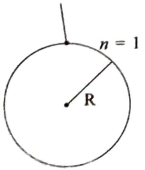
The magnetic field at the centre of a single-turn circular coil of a given length of wire carrying a current $I$ is $B$. If the same wire is bent into a circular coil of two turns and the same current $I$ is passed through it,the new magnetic field at the centre will be:
A
$\frac{B}{2}$
B
$16B$
C
$4B$
D
$\frac{B}{4}$
Solution
(C) Let the total length of the wire be $L$.
For a single-turn coil $(n_1 = 1)$,the circumference is $L = 2\pi R_1$,so $R_1 = \frac{L}{2\pi}$.
The magnetic field at the centre is $B_1 = \frac{\mu_0 I}{2R_1} = \frac{\mu_0 I}{2(L/2\pi)} = \frac{\mu_0 I \pi}{L} = B$.
For a two-turn coil $(n_2 = 2)$,the total length $L = n_2(2\pi R_2) = 2(2\pi R_2) = 4\pi R_2$.
Thus,the new radius is $R_2 = \frac{L}{4\pi} = \frac{R_1}{2}$.
The magnetic field at the centre for $n$ turns is $B_n = \frac{n \mu_0 I}{2R_n}$.
For $n=2$,$B_2 = \frac{2 \mu_0 I}{2R_2} = \frac{\mu_0 I}{R_2}$.
Substituting $R_2 = \frac{R_1}{2}$,we get $B_2 = \frac{\mu_0 I}{R_1/2} = \frac{2 \mu_0 I}{R_1}$.
Since $B = \frac{\mu_0 I}{2R_1}$,we have $\frac{\mu_0 I}{R_1} = 2B$.
Therefore,$B_2 = 2(2B) = 4B$.
For a single-turn coil $(n_1 = 1)$,the circumference is $L = 2\pi R_1$,so $R_1 = \frac{L}{2\pi}$.
The magnetic field at the centre is $B_1 = \frac{\mu_0 I}{2R_1} = \frac{\mu_0 I}{2(L/2\pi)} = \frac{\mu_0 I \pi}{L} = B$.
For a two-turn coil $(n_2 = 2)$,the total length $L = n_2(2\pi R_2) = 2(2\pi R_2) = 4\pi R_2$.
Thus,the new radius is $R_2 = \frac{L}{4\pi} = \frac{R_1}{2}$.
The magnetic field at the centre for $n$ turns is $B_n = \frac{n \mu_0 I}{2R_n}$.
For $n=2$,$B_2 = \frac{2 \mu_0 I}{2R_2} = \frac{\mu_0 I}{R_2}$.
Substituting $R_2 = \frac{R_1}{2}$,we get $B_2 = \frac{\mu_0 I}{R_1/2} = \frac{2 \mu_0 I}{R_1}$.
Since $B = \frac{\mu_0 I}{2R_1}$,we have $\frac{\mu_0 I}{R_1} = 2B$.
Therefore,$B_2 = 2(2B) = 4B$.
0 likesView Solution
19
PhysicsEasyMCQGUJCET · 2010
The energy released in the explosion of an atom bomb is mainly due to $\qquad$ .
A
controlled nuclear chain reaction
B
nuclear fission
C
nuclear fusion
D
none of these
Solution
(B) The correct answer is $B$.
An atom bomb operates on the principle of uncontrolled nuclear fission.
In this process,a heavy nucleus (such as $U^{235}$ or $Pu^{239}$) splits into smaller nuclei when bombarded with neutrons,releasing a tremendous amount of energy along with more neutrons,which sustain the chain reaction.
An atom bomb operates on the principle of uncontrolled nuclear fission.
In this process,a heavy nucleus (such as $U^{235}$ or $Pu^{239}$) splits into smaller nuclei when bombarded with neutrons,releasing a tremendous amount of energy along with more neutrons,which sustain the chain reaction.
0 likesView Solution
20
PhysicsEasyMCQGUJCET · 2010
How many neutrons are more than protons in the ${ }_{92}^{235} U$ nucleus?
A
$51$
B
$143$
C
$49$
D
$54$
Solution
(A) In the ${ }_{92}^{235} U$ nucleus,the atomic number $Z$ (number of protons) is $92$.
The mass number $A$ is $235$.
The number of neutrons $N$ is given by $N = A - Z$.
$N = 235 - 92 = 143$.
The difference between the number of neutrons and protons is $N - Z$.
$N - Z = 143 - 92 = 51$.
Therefore,there are $51$ more neutrons than protons in the nucleus.
The mass number $A$ is $235$.
The number of neutrons $N$ is given by $N = A - Z$.
$N = 235 - 92 = 143$.
The difference between the number of neutrons and protons is $N - Z$.
$N - Z = 143 - 92 = 51$.
Therefore,there are $51$ more neutrons than protons in the nucleus.
0 likesView Solution
Vedclass Products
For Students
Vedclass Test Series
Mock tests in real GUJCET style covering Physics with performance analysis. 5-day free trial.
Start Free TrialFor Teachers
Exam Paper Generator
Generate Set A/B/C/D Physics papers from 7.5L+ questions in 2 minutes. 3 chapters free.
Try FreeFor Institutes
Online Exam Module
Run live GUJCET mock exams with unlimited students, 360° analytics & white-label branding.
See DemoFrequently Asked Questions
How many Physics questions are in GUJCET 2010?
There are 20 Physics questions from the GUJCET 2010 paper on Vedclass, each with a detailed step-by-step solution in English.
Are GUJCET 2010 Physics solutions available in English?
Yes. All solutions on this page are in English. You can also switch to English or Hindi using the language buttons above the questions.
Can I practice GUJCET 2010 Physics as a timed test?
Yes. Use the Vedclass Test Series to attempt a full GUJCET mock test covering Physics with time limits and instant score analysis.
Can teachers create Physics papers from GUJCET previous year questions?
Yes. The Vedclass Exam Paper Generator lets teachers mix GUJCET Physics questions and generate Set A/B/C/D papers in minutes.
For Teachers & Institutes
Build a Custom Physics Paper
Pick GUJCET 2010 Physics questions, set difficulty, and generate Set A/B/C/D in 2 minutes.