
PhysicsQ1–21 of 21 questions
Page 1 of 1 · English
1
PhysicsEasyMCQGUJCET · 2007
If Earth did not have an atmosphere,the temperature would be . . . . . . .
A
none
B
less
C
more
D
same
Solution
(B) The Earth's atmosphere acts as a blanket that traps heat through the greenhouse effect,primarily due to gases like $CO_2$ and water vapor.
Without an atmosphere,the heat received from the Sun during the day would radiate back into space at night without being trapped.
Consequently,the average surface temperature of the Earth would be significantly lower than it is currently.
Therefore,the correct option is $B$.
Without an atmosphere,the heat received from the Sun during the day would radiate back into space at night without being trapped.
Consequently,the average surface temperature of the Earth would be significantly lower than it is currently.
Therefore,the correct option is $B$.
0 likesView Solution
2
PhysicsEasyMCQGUJCET · 2007
Write the dimensional formula for the intensity of radiation.
A
$M^{1} L^{0} T^{-3}$
B
$M^{3} L^{2} T^{1}$
C
$M^{1} L^{2} T^{3}$
D
$M^{0} L^{2} T^{-3}$
Solution
(A) The intensity of radiation $(I)$ is defined as the energy $(E)$ incident per unit area $(A)$ per unit time $(t)$.
Mathematically,$I = \frac{E}{A \times t}$.
The dimensional formula for energy $(E)$ is $[M^{1} L^{2} T^{-2}]$.
The dimensional formula for area $(A)$ is $[L^{2}]$.
The dimensional formula for time $(t)$ is $[T^{1}]$.
Substituting these into the formula:
$I = \frac{[M^{1} L^{2} T^{-2}]}{[L^{2}] \times [T^{1}]}$
$I = [M^{1} L^{2-2} T^{-2-1}]$
$I = [M^{1} L^{0} T^{-3}]$
Therefore,the correct option is $A$.
Mathematically,$I = \frac{E}{A \times t}$.
The dimensional formula for energy $(E)$ is $[M^{1} L^{2} T^{-2}]$.
The dimensional formula for area $(A)$ is $[L^{2}]$.
The dimensional formula for time $(t)$ is $[T^{1}]$.
Substituting these into the formula:
$I = \frac{[M^{1} L^{2} T^{-2}]}{[L^{2}] \times [T^{1}]}$
$I = [M^{1} L^{2-2} T^{-2-1}]$
$I = [M^{1} L^{0} T^{-3}]$
Therefore,the correct option is $A$.
0 likesView Solution
3
PhysicsEasyMCQGUJCET · 2007
The resonance frequency of an $L-C-R$ $AC$ circuit is $\nu_{0}$. If the capacitance is made $4$ times its initial value,then the new resonance frequency will become . . . . . . .
A
$\frac{\nu_{0}}{4}$
B
$2 \nu_{0}$
C
$\nu_{0}$
D
$\frac{\nu_{0}}{2}$
Solution
(D) The resonance frequency of an $L-C-R$ circuit is given by the formula:
$\nu_{0} = \frac{1}{2 \pi \sqrt{LC}}$
From this formula,we can see that the resonance frequency is inversely proportional to the square root of the capacitance $C$:
$\nu_{0} \propto \frac{1}{\sqrt{C}}$
Let the initial frequency be $\nu_{0}$ with capacitance $C$,and the new frequency be $\nu_{0}'$ with capacitance $C' = 4C$.
Taking the ratio of the two frequencies:
$\frac{\nu_{0}}{\nu_{0}'} = \sqrt{\frac{C'}{C}}$
Substituting $C' = 4C$ into the equation:
$\frac{\nu_{0}}{\nu_{0}'} = \sqrt{\frac{4C}{C}} = \sqrt{4} = 2$
Therefore,the new resonance frequency is:
$\nu_{0}' = \frac{\nu_{0}}{2}$
$\nu_{0} = \frac{1}{2 \pi \sqrt{LC}}$
From this formula,we can see that the resonance frequency is inversely proportional to the square root of the capacitance $C$:
$\nu_{0} \propto \frac{1}{\sqrt{C}}$
Let the initial frequency be $\nu_{0}$ with capacitance $C$,and the new frequency be $\nu_{0}'$ with capacitance $C' = 4C$.
Taking the ratio of the two frequencies:
$\frac{\nu_{0}}{\nu_{0}'} = \sqrt{\frac{C'}{C}}$
Substituting $C' = 4C$ into the equation:
$\frac{\nu_{0}}{\nu_{0}'} = \sqrt{\frac{4C}{C}} = \sqrt{4} = 2$
Therefore,the new resonance frequency is:
$\nu_{0}' = \frac{\nu_{0}}{2}$
0 likesView Solution
4
PhysicsEasyMCQGUJCET · 2007
$A$ $L-C-R$ series $AC$ circuit is tuned to resonance. The impedance of the circuit is now . . . . . . .
A
$R$
B
$\left[R^{2}+\left(\frac{1}{\omega C}-\omega L\right)^{2}\right]^{\frac{1}{2}}$
C
$\left[R^{2}+(\omega L)^{2}+\left(\frac{1}{\omega C}\right)^{2}\right]^{\frac{1}{2}}$
D
$\left[R^{2}+\left(\omega L-\frac{1}{\omega C}\right)^{2}\right]^{\frac{1}{2}}$
Solution
(A) In an $L-C-R$ series $AC$ circuit,the impedance $Z$ is given by the formula: $Z = \sqrt{R^{2} + (X_{L} - X_{C})^{2}}$,where $X_{L} = \omega L$ and $X_{C} = \frac{1}{\omega C}$.
At resonance,the inductive reactance equals the capacitive reactance,i.e.,$X_{L} = X_{C}$ or $\omega L = \frac{1}{\omega C}$.
Substituting this into the impedance formula: $Z = \sqrt{R^{2} + (0)^{2}} = \sqrt{R^{2}} = R$.
Therefore,at resonance,the impedance of the circuit is equal to the resistance $R$.
At resonance,the inductive reactance equals the capacitive reactance,i.e.,$X_{L} = X_{C}$ or $\omega L = \frac{1}{\omega C}$.
Substituting this into the impedance formula: $Z = \sqrt{R^{2} + (0)^{2}} = \sqrt{R^{2}} = R$.
Therefore,at resonance,the impedance of the circuit is equal to the resistance $R$.
0 likesView Solution
5
PhysicsEasyMCQGUJCET · 2007
An electrical dipole coincides on the $z$-axis and its midpoint is at the origin of the coordinate system. The electric field at an axial point at a distance $z$ from the origin is $\vec{E}(z)$ and the electric field at an equatorial point at a distance $y$ from the origin is $\vec{E}(y)$. Here $z = y \gg a$,so $\left| \frac{\vec{E}(z)}{\vec{E}(y)} \right| = . . . . . . . .$.
A
$1$
B
$4$
C
$3$
D
$2$
Solution
(D) The electric field of a dipole at an axial point at distance $z$ (where $z \gg a$) is given by $\vec{E}(z) = \frac{2kp}{z^3}$.
The electric field of a dipole at an equatorial point at distance $y$ (where $y \gg a$) is given by $\vec{E}(y) = \frac{kp}{y^3}$.
Given that $z = y$,we can write the ratio of the magnitudes as:
$\left| \frac{\vec{E}(z)}{\vec{E}(y)} \right| = \frac{2kp/z^3}{kp/y^3} = \frac{2kp/z^3}{kp/z^3} = 2$.
Thus,the correct option is $D$.
The electric field of a dipole at an equatorial point at distance $y$ (where $y \gg a$) is given by $\vec{E}(y) = \frac{kp}{y^3}$.
Given that $z = y$,we can write the ratio of the magnitudes as:
$\left| \frac{\vec{E}(z)}{\vec{E}(y)} \right| = \frac{2kp/z^3}{kp/y^3} = \frac{2kp/z^3}{kp/z^3} = 2$.
Thus,the correct option is $D$.
0 likesView Solution
6
PhysicsEasyMCQGUJCET · 2007
$A$ point charge causes an electrical flux of $-1.0 \times 10^3 \ Nm^2 \ C^{-1}$ to pass through a spherical Gaussian surface of $10 \ cm$ radius centered on the charge. If the radius of the Gaussian surface were $3$ times,how much flux would pass through the surface?
A
$3 \times 10^3 \ Nm^2 \ C^{-1}$
B
$-2.0 \times 10^3 \ Nm^2 \ C^{-1}$
C
$-3.0 \times 10^3 \ Nm^2 \ C^{-1}$
D
$-1.0 \times 10^3 \ Nm^2 \ C^{-1}$
Solution
(D) According to Gauss's Law,the total electric flux $\phi$ through any closed surface is given by $\phi = \frac{q_{enclosed}}{\varepsilon_0}$.
Here,$q_{enclosed}$ is the charge enclosed by the Gaussian surface.
Since the charge $q$ remains the same regardless of the radius of the spherical Gaussian surface,the total electric flux passing through the surface remains constant.
Therefore,changing the radius of the Gaussian surface to $3$ times its original value does not change the flux.
The flux remains $-1.0 \times 10^3 \ Nm^2 \ C^{-1}$.
Here,$q_{enclosed}$ is the charge enclosed by the Gaussian surface.
Since the charge $q$ remains the same regardless of the radius of the spherical Gaussian surface,the total electric flux passing through the surface remains constant.
Therefore,changing the radius of the Gaussian surface to $3$ times its original value does not change the flux.
The flux remains $-1.0 \times 10^3 \ Nm^2 \ C^{-1}$.
0 likesView Solution
7
PhysicsEasyMCQGUJCET · 2007
If the uniform surface charge density on an infinite plane sheet is $\sigma$,the electric field near the surface will be . . . . . . .
A
$\frac{\sigma}{2 \varepsilon_0}$
B
$\frac{3 \sigma}{\varepsilon_0}$
C
$\frac{\sigma}{\varepsilon_0}$
D
$\frac{2 \sigma}{\varepsilon_0}$
Solution
(A) According to Gauss's Law,the electric field $E$ produced by an infinite non-conducting plane sheet of charge with uniform surface charge density $\sigma$ is given by the formula:
$E = \frac{\sigma}{2 \varepsilon_0}$
where $\varepsilon_0$ is the permittivity of free space.
This field is uniform and directed perpendicular to the sheet.
$E = \frac{\sigma}{2 \varepsilon_0}$
where $\varepsilon_0$ is the permittivity of free space.
This field is uniform and directed perpendicular to the sheet.
0 likesView Solution
8
PhysicsEasyMCQGUJCET · 2007
What is the self-inductance of a coil which produces a self-induced $EMF$ of $5 \ V$ when the current changes from $3 \ A$ to $2 \ A$ in $1 \ ms$?
A
$5 \ mH$
B
$5 \ H$
C
$50 \ H$
D
$5000 \ H$
Solution
(A) The formula for self-induced $EMF$ is given by $\varepsilon = -L \frac{dI}{dt}$.
Given:
$\varepsilon = 5 \ V$
$dI = I_2 - I_1 = 2 \ A - 3 \ A = -1 \ A$
$dt = 1 \ ms = 1 \times 10^{-3} \ s$
Substituting the values into the formula:
$5 = -L \left( \frac{-1 \ A}{1 \times 10^{-3} \ s} \right)$
$5 = L \times 10^3$
$L = \frac{5}{1000} \ H = 5 \times 10^{-3} \ H = 5 \ mH$.
Given:
$\varepsilon = 5 \ V$
$dI = I_2 - I_1 = 2 \ A - 3 \ A = -1 \ A$
$dt = 1 \ ms = 1 \times 10^{-3} \ s$
Substituting the values into the formula:
$5 = -L \left( \frac{-1 \ A}{1 \times 10^{-3} \ s} \right)$
$5 = L \times 10^3$
$L = \frac{5}{1000} \ H = 5 \times 10^{-3} \ H = 5 \ mH$.
0 likesView Solution
9
PhysicsEasyMCQGUJCET · 2007
$A$ coil of self-inductance $0.5 \ mH$ carries a current of $2 \ A$. The energy stored in Joule is . . . . . . .
A
$1.0$
B
$0.001$
C
$0.5$
D
$0.05$
Solution
(B) The energy $U$ stored in an inductor is given by the formula: $U = \frac{1}{2} LI^2$.
Given: Self-inductance $L = 0.5 \ mH = 0.5 \times 10^{-3} \ H$ and current $I = 2 \ A$.
Substituting the values into the formula:
$U = \frac{1}{2} \times (0.5 \times 10^{-3}) \times (2)^2$
$U = \frac{1}{2} \times 0.5 \times 10^{-3} \times 4$
$U = 0.5 \times 2 \times 10^{-3}$
$U = 1 \times 10^{-3} \ J = 0.001 \ J$.
Given: Self-inductance $L = 0.5 \ mH = 0.5 \times 10^{-3} \ H$ and current $I = 2 \ A$.
Substituting the values into the formula:
$U = \frac{1}{2} \times (0.5 \times 10^{-3}) \times (2)^2$
$U = \frac{1}{2} \times 0.5 \times 10^{-3} \times 4$
$U = 0.5 \times 2 \times 10^{-3}$
$U = 1 \times 10^{-3} \ J = 0.001 \ J$.
0 likesView Solution
10
PhysicsEasyMCQGUJCET · 2007
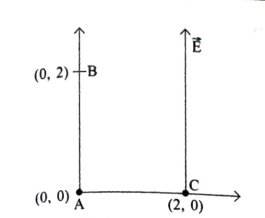
$A$ uniform electric field is directed along the $Y$-axis. Consider point $A$ as the origin $(0,0) \text{ m}$. The coordinates of point $B$ are $(0,2) \text{ m}$. The coordinates of point $C$ are $(2,0) \text{ m}$. If the electric potentials at points $A, B,$ and $C$ are $V_A, V_B,$ and $V_C$ respectively,which of the following options is correct?
A
$V_A = V_C < V_B$
B
$V_A = V_B = V_C$
C
$V_A = V_B > V_C$
D
$V_A = V_C > V_B$
Solution
(D) The electric field $\vec{E}$ is uniform and directed along the positive $Y$-axis.
Points $A(0,0)$ and $C(2,0)$ lie on the $X$-axis,which is perpendicular to the direction of the electric field. Therefore,the electric potential at these points is the same,i.e.,$V_A = V_C$.
The electric potential decreases in the direction of the electric field. Since point $B(0,2)$ is at a higher $Y$-coordinate than points $A$ and $C$,it is at a lower potential.
Thus,$V_A = V_C > V_B$.
Points $A(0,0)$ and $C(2,0)$ lie on the $X$-axis,which is perpendicular to the direction of the electric field. Therefore,the electric potential at these points is the same,i.e.,$V_A = V_C$.
The electric potential decreases in the direction of the electric field. Since point $B(0,2)$ is at a higher $Y$-coordinate than points $A$ and $C$,it is at a lower potential.
Thus,$V_A = V_C > V_B$.
0 likesView Solution
11
PhysicsEasyMCQGUJCET · 2007
Work done in placing a charge of $8 \times 10^{-18} \text{ C}$ on a capacitor of capacitance $800 \mu\text{F}$ is . . . . . . .
A
$4 \times 10^{-32} \text{ J}$
B
$32 \times 10^{-32} \text{ J}$
C
$3.1 \times 10^{-26} \text{ J}$
D
$16 \times 10^{-32} \text{ J}$
Solution
(A) The work done $W$ in charging a capacitor is equal to the potential energy $U$ stored in it.
The formula for energy stored in a capacitor is $W = U = \frac{Q^2}{2C}$.
Given:
Charge $Q = 8 \times 10^{-18} \text{ C}$
Capacitance $C = 800 \mu\text{F} = 800 \times 10^{-6} \text{ F} = 8 \times 10^{-4} \text{ F}$.
Substituting the values:
$W = \frac{(8 \times 10^{-18})^2}{2 \times 8 \times 10^{-4}}$
$W = \frac{64 \times 10^{-36}}{16 \times 10^{-4}}$
$W = 4 \times 10^{-32} \text{ J}$.
The formula for energy stored in a capacitor is $W = U = \frac{Q^2}{2C}$.
Given:
Charge $Q = 8 \times 10^{-18} \text{ C}$
Capacitance $C = 800 \mu\text{F} = 800 \times 10^{-6} \text{ F} = 8 \times 10^{-4} \text{ F}$.
Substituting the values:
$W = \frac{(8 \times 10^{-18})^2}{2 \times 8 \times 10^{-4}}$
$W = \frac{64 \times 10^{-36}}{16 \times 10^{-4}}$
$W = 4 \times 10^{-32} \text{ J}$.
0 likesView Solution
12
PhysicsEasyMCQGUJCET · 2007
To increase the charge on the plates of a capacitor means . . . . . . .
A
to decrease the potential difference between the plates.
B
to decrease the capacitance of the capacitor.
C
to increase the capacitance of the capacitor.
D
to increase the potential difference between the plates.
Solution
(D) The relationship between charge $Q$,capacitance $C$,and potential difference $V$ is given by the formula $Q = CV$.
For a given capacitor,the capacitance $C$ remains constant.
Therefore,the charge $Q$ is directly proportional to the potential difference $V$ $(Q \propto V)$.
To increase the charge $Q$ on the plates,one must increase the potential difference $V$ between the plates.
Thus,the correct option is $D$.
For a given capacitor,the capacitance $C$ remains constant.
Therefore,the charge $Q$ is directly proportional to the potential difference $V$ $(Q \propto V)$.
To increase the charge $Q$ on the plates,one must increase the potential difference $V$ between the plates.
Thus,the correct option is $D$.
0 likesView Solution
13
PhysicsEasyMCQGUJCET · 2007
$A$ bar magnet of magnetic moment $\vec{M}$ is placed in a magnetic field of induction $\vec{B}$. The torque exerted on it is . . . . . . .
A
$-\vec{B} \cdot \vec{M}$
B
$\vec{M} \times \vec{B}$
C
$-\vec{M} \times \vec{B}$
D
$\vec{M} \cdot \vec{B}$
Solution
(B) When a magnetic dipole with magnetic moment $\vec{M}$ is placed in an external magnetic field $\vec{B}$,it experiences a torque $\vec{\tau}$.
The torque is defined as the cross product of the magnetic moment and the magnetic field.
Mathematically,the torque is given by $\vec{\tau} = \vec{M} \times \vec{B}$.
Therefore,the correct option is $B$.
The torque is defined as the cross product of the magnetic moment and the magnetic field.
Mathematically,the torque is given by $\vec{\tau} = \vec{M} \times \vec{B}$.
Therefore,the correct option is $B$.
0 likesView Solution
14
PhysicsEasyMCQGUJCET · 2007
Domain formation is the necessary feature of
A
ferromagnetism
B
paramagnetism
C
diamagnetism
D
All of the above
Solution
(A) The correct answer is $A$.
In $ferromagnetic$ materials,the atoms are grouped into small regions called $domains$.
Within each domain,the magnetic moments of all atoms are aligned in the same direction due to strong exchange coupling.
This domain structure is a characteristic feature of $ferromagnetism$,which explains why these materials can be strongly magnetized.
In $ferromagnetic$ materials,the atoms are grouped into small regions called $domains$.
Within each domain,the magnetic moments of all atoms are aligned in the same direction due to strong exchange coupling.
This domain structure is a characteristic feature of $ferromagnetism$,which explains why these materials can be strongly magnetized.
0 likesView Solution
15
PhysicsEasyMCQGUJCET · 2007
To convert a galvanometer into an ammeter,we connect . . . . . . .
A
high resistance in parallel with it
B
high resistance in series with it
C
low resistance in parallel with it
D
low resistance in series with it
Solution
(C) To convert a galvanometer into an ammeter,a very low resistance,known as a shunt resistance $(S)$,is connected in parallel with the galvanometer coil.
This is done to ensure that the majority of the current passes through the shunt,protecting the sensitive galvanometer coil from damage due to high current.
Also,connecting a low resistance in parallel reduces the overall resistance of the circuit,which is a characteristic requirement for an ideal ammeter.
This is done to ensure that the majority of the current passes through the shunt,protecting the sensitive galvanometer coil from damage due to high current.
Also,connecting a low resistance in parallel reduces the overall resistance of the circuit,which is a characteristic requirement for an ideal ammeter.
0 likesView Solution
16
PhysicsEasyMCQGUJCET · 2007
If the velocity of an electron is $(2 \hat{i} + 3 \hat{j}) \text{ m s}^{-1}$ and it enters a magnetic field of $4 \hat{k} \text{ T}$,then . . . . . . .
A
it will move in the opposite direction to the magnetic field.
B
it will move in the direction of the magnetic field.
C
its speed will change.
D
the direction of its velocity will change.
Solution
(D) The magnetic force on a moving charge is given by $\vec{F} = q(\vec{v} \times \vec{B})$.
Given $\vec{v} = (2 \hat{i} + 3 \hat{j}) \text{ m s}^{-1}$ and $\vec{B} = 4 \hat{k} \text{ T}$.
Since $\vec{v}$ lies in the $xy$-plane and $\vec{B}$ is along the $z$-axis,the velocity vector is perpendicular to the magnetic field $(\vec{v} \perp \vec{B})$.
The magnetic force $\vec{F}$ acts perpendicular to both $\vec{v}$ and $\vec{B}$.
Because the magnetic force is always perpendicular to the velocity,it does no work on the electron,meaning the speed (kinetic energy) remains constant.
However,the force causes a change in the direction of the velocity,resulting in circular motion.
Therefore,the direction of its velocity will change.
Given $\vec{v} = (2 \hat{i} + 3 \hat{j}) \text{ m s}^{-1}$ and $\vec{B} = 4 \hat{k} \text{ T}$.
Since $\vec{v}$ lies in the $xy$-plane and $\vec{B}$ is along the $z$-axis,the velocity vector is perpendicular to the magnetic field $(\vec{v} \perp \vec{B})$.
The magnetic force $\vec{F}$ acts perpendicular to both $\vec{v}$ and $\vec{B}$.
Because the magnetic force is always perpendicular to the velocity,it does no work on the electron,meaning the speed (kinetic energy) remains constant.
However,the force causes a change in the direction of the velocity,resulting in circular motion.
Therefore,the direction of its velocity will change.
0 likesView Solution
17
PhysicsEasyMCQGUJCET · 2007
$A$ voltmeter has a resistance of $G \ \Omega$ and a range of $V \ \text{volt}$. The resistance required in series to convert it into a voltmeter of range $nV \ \text{volt}$ is . . . . . . .
A
$nG$
B
$(n-1)G$
C
$\frac{G}{n-1}$
D
$\frac{G}{n}$
Solution
(B) The correct option is $B$.
To convert a voltmeter of range $V$ and resistance $G$ into a voltmeter of range $nV$,we need to connect a resistance $R_s$ in series.
The current $I_g$ flowing through the voltmeter remains the same for the full-scale deflection.
The initial voltage is $V = I_g G$.
The new voltage is $V' = nV = I_g(G + R_s)$.
Substituting $V = I_g G$ into the new voltage equation:
$nV = I_g(G + R_s)$
$n(I_g G) = I_g(G + R_s)$
$nG = G + R_s$
$R_s = nG - G$
$R_s = (n-1)G$.
To convert a voltmeter of range $V$ and resistance $G$ into a voltmeter of range $nV$,we need to connect a resistance $R_s$ in series.
The current $I_g$ flowing through the voltmeter remains the same for the full-scale deflection.
The initial voltage is $V = I_g G$.
The new voltage is $V' = nV = I_g(G + R_s)$.
Substituting $V = I_g G$ into the new voltage equation:
$nV = I_g(G + R_s)$
$n(I_g G) = I_g(G + R_s)$
$nG = G + R_s$
$R_s = nG - G$
$R_s = (n-1)G$.
0 likesView Solution
18
PhysicsEasyMCQGUJCET · 2007
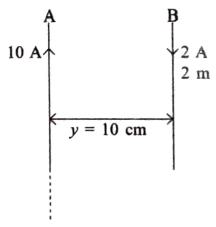
Currents of $10 \ A$ and $2 \ A$ are passed through two parallel wires $A$ and $B$ respectively in opposite directions. If the wire $A$ is infinitely long and the length of the wire $B$ is $2 \ m$,the force acting on the conductor $B$,which is situated at a distance of $10 \ cm$ from $A$,will be . . . . . . .
A
$4 \pi \times 10^{-7} \ N$
B
$5 \times 10^{-5} \ N$
C
$8 \pi \times 10^{-7} \ N$
D
$8 \times 10^{-5} \ N$
Solution
(D) The force per unit length between two parallel current-carrying wires is given by the formula:
$F = \frac{\mu_0 I_1 I_2 l}{2 \pi y}$
Given:
$I_1 = 10 \ A$
$I_2 = 2 \ A$
$l = 2 \ m$
$y = 10 \ cm = 0.1 \ m = 10 \times 10^{-2} \ m$
$\mu_0 = 4 \pi \times 10^{-7} \ T \cdot m/A$
Substituting the values into the formula:
$F = \frac{(4 \pi \times 10^{-7}) \times 10 \times 2 \times 2}{2 \pi \times 10 \times 10^{-2}}$
$F = \frac{4 \pi \times 10^{-7} \times 40}{2 \pi \times 0.1}$
$F = 2 \times 10^{-7} \times 400$
$F = 800 \times 10^{-7} \ N = 8 \times 10^{-5} \ N$
Therefore,the force acting on conductor $B$ is $8 \times 10^{-5} \ N$.
$F = \frac{\mu_0 I_1 I_2 l}{2 \pi y}$
Given:
$I_1 = 10 \ A$
$I_2 = 2 \ A$
$l = 2 \ m$
$y = 10 \ cm = 0.1 \ m = 10 \times 10^{-2} \ m$
$\mu_0 = 4 \pi \times 10^{-7} \ T \cdot m/A$
Substituting the values into the formula:
$F = \frac{(4 \pi \times 10^{-7}) \times 10 \times 2 \times 2}{2 \pi \times 10 \times 10^{-2}}$
$F = \frac{4 \pi \times 10^{-7} \times 40}{2 \pi \times 0.1}$
$F = 2 \times 10^{-7} \times 400$
$F = 800 \times 10^{-7} \ N = 8 \times 10^{-5} \ N$
Therefore,the force acting on conductor $B$ is $8 \times 10^{-5} \ N$.
0 likesView Solution
19
PhysicsEasyMCQGUJCET · 2007
Two identical coils having the same number of turns and carrying equal current have a common centre,and their planes are at right angles to each other. What is the ratio of the magnitude of the resultant magnetic field at the centre to the magnetic field due to one of the coils at the centre?
A
$\sqrt{2}: 1$
B
$1: \sqrt{2}$
C
$2: 1$
D
$1: 1$
Solution
(A) The magnetic field produced by a circular coil of radius $r$ carrying current $I$ at its centre is given by $B = \frac{\mu_0 I}{2r}$.
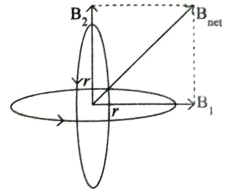
Since the two coils are identical and carry the same current,the magnitude of the magnetic field due to each coil at the common centre is the same,i.e.,$B_1 = B_2 = B$.
Since the planes of the coils are at right angles to each other,the magnetic field vectors $B_1$ and $B_2$ are mutually perpendicular.
The resultant magnetic field $B_{\text{net}}$ at the centre is given by the vector sum:
$B_{\text{net}} = \sqrt{B_1^2 + B_2^2}$
Substituting $B_1 = B_2 = B$:
$B_{\text{net}} = \sqrt{B^2 + B^2} = \sqrt{2B^2} = \sqrt{2}B$
The ratio of the magnitude of the resultant magnetic field to the magnetic field due to one of the coils is:
$\frac{B_{\text{net}}}{B} = \frac{\sqrt{2}B}{B} = \frac{\sqrt{2}}{1}$
Therefore,the ratio is $\sqrt{2}: 1$.
Since the two coils are identical and carry the same current,the magnitude of the magnetic field due to each coil at the common centre is the same,i.e.,$B_1 = B_2 = B$.
Since the planes of the coils are at right angles to each other,the magnetic field vectors $B_1$ and $B_2$ are mutually perpendicular.
The resultant magnetic field $B_{\text{net}}$ at the centre is given by the vector sum:
$B_{\text{net}} = \sqrt{B_1^2 + B_2^2}$
Substituting $B_1 = B_2 = B$:
$B_{\text{net}} = \sqrt{B^2 + B^2} = \sqrt{2B^2} = \sqrt{2}B$
The ratio of the magnitude of the resultant magnetic field to the magnetic field due to one of the coils is:
$\frac{B_{\text{net}}}{B} = \frac{\sqrt{2}B}{B} = \frac{\sqrt{2}}{1}$
Therefore,the ratio is $\sqrt{2}: 1$.
0 likesView Solution
20
PhysicsEasyMCQGUJCET · 2007
$A$ stationary charge produces . . . . . . .
A
electric field and magnetic field both
B
a magnetic field only
C
an electric field only
D
none of these fields
Solution
(C) stationary charge is a charge at rest. According to electrostatics,a charge at rest produces only an electric field in the space surrounding it.
It does not produce a magnetic field because a magnetic field is generated only by moving charges (currents).
Therefore,the correct option is $C$.
It does not produce a magnetic field because a magnetic field is generated only by moving charges (currents).
Therefore,the correct option is $C$.
0 likesView Solution
21
PhysicsEasyMCQGUJCET · 2007
$A$ nucleus at rest splits into two nuclear parts having the same density and radii in the ratio $1:2$. Their velocities are in the ratio $\qquad$ . (in $:1$)
A
$2$
B
$4$
C
$6$
D
$8$
Solution
(D) The correct answer is $D$. $8:1$.
According to the law of conservation of linear momentum,the initial momentum of the nucleus at rest is zero.
Therefore,the magnitude of the momentum of the two parts must be equal: $M_1 v_1 = M_2 v_2$.
Since the density $\rho$ is the same for both parts,the mass $M$ is given by $M = \rho \cdot V = \rho \cdot (\frac{4}{3} \pi r^3)$.
Substituting this into the momentum equation:
$(\rho \cdot \frac{4}{3} \pi r_1^3) v_1 = (\rho \cdot \frac{4}{3} \pi r_2^3) v_2$.
Canceling the common terms $(\rho \cdot \frac{4}{3} \pi)$,we get $r_1^3 v_1 = r_2^3 v_2$.
Rearranging for the ratio of velocities: $\frac{v_1}{v_2} = (\frac{r_2}{r_1})^3$.
Given the ratio of radii $\frac{r_1}{r_2} = \frac{1}{2}$,we have $\frac{r_2}{r_1} = \frac{2}{1}$.
Thus,$\frac{v_1}{v_2} = (\frac{2}{1})^3 = \frac{8}{1}$.
According to the law of conservation of linear momentum,the initial momentum of the nucleus at rest is zero.
Therefore,the magnitude of the momentum of the two parts must be equal: $M_1 v_1 = M_2 v_2$.
Since the density $\rho$ is the same for both parts,the mass $M$ is given by $M = \rho \cdot V = \rho \cdot (\frac{4}{3} \pi r^3)$.
Substituting this into the momentum equation:
$(\rho \cdot \frac{4}{3} \pi r_1^3) v_1 = (\rho \cdot \frac{4}{3} \pi r_2^3) v_2$.
Canceling the common terms $(\rho \cdot \frac{4}{3} \pi)$,we get $r_1^3 v_1 = r_2^3 v_2$.
Rearranging for the ratio of velocities: $\frac{v_1}{v_2} = (\frac{r_2}{r_1})^3$.
Given the ratio of radii $\frac{r_1}{r_2} = \frac{1}{2}$,we have $\frac{r_2}{r_1} = \frac{2}{1}$.
Thus,$\frac{v_1}{v_2} = (\frac{2}{1})^3 = \frac{8}{1}$.
0 likesView Solution
Vedclass Products
For Students
Vedclass Test Series
Mock tests in real GUJCET style covering Physics with performance analysis. 5-day free trial.
Start Free TrialFor Teachers
Exam Paper Generator
Generate Set A/B/C/D Physics papers from 7.5L+ questions in 2 minutes. 3 chapters free.
Try FreeFor Institutes
Online Exam Module
Run live GUJCET mock exams with unlimited students, 360° analytics & white-label branding.
See DemoFrequently Asked Questions
How many Physics questions are in GUJCET 2007?
There are 21 Physics questions from the GUJCET 2007 paper on Vedclass, each with a detailed step-by-step solution in English.
Are GUJCET 2007 Physics solutions available in English?
Yes. All solutions on this page are in English. You can also switch to English or Hindi using the language buttons above the questions.
Can I practice GUJCET 2007 Physics as a timed test?
Yes. Use the Vedclass Test Series to attempt a full GUJCET mock test covering Physics with time limits and instant score analysis.
Can teachers create Physics papers from GUJCET previous year questions?
Yes. The Vedclass Exam Paper Generator lets teachers mix GUJCET Physics questions and generate Set A/B/C/D papers in minutes.
For Teachers & Institutes
Build a Custom Physics Paper
Pick GUJCET 2007 Physics questions, set difficulty, and generate Set A/B/C/D in 2 minutes.