
PhysicsQ151–195 of 345 questions
Page 4 of 4 · English
151
PhysicsMediumMCQAP EAMCET · 2024
Initially,the pressure of $1 \text{ mole}$ of an ideal gas is $10^5 \text{ Nm}^{-2}$ and its volume is $16 \text{ litres}$. When it is adiabatically compressed,its final volume is $2 \text{ litres}$. Calculate the work done on the gas. [Given: Molar specific heat at constant volume $C_v = \frac{3R}{2}$] (in $\text{ kJ}$)
A
$72$
B
$7.2$
C
$720$
D
$360$
Solution
(B) Given: $P_1 = 10^5 \text{ Nm}^{-2}$,$V_1 = 16 \text{ L} = 16 \times 10^{-3} \text{ m}^3$,$V_2 = 2 \text{ L} = 2 \times 10^{-3} \text{ m}^3$,$C_v = \frac{3R}{2}$.
For an ideal gas,$C_p = C_v + R = \frac{3R}{2} + R = \frac{5R}{2}$.
The adiabatic index $\gamma = \frac{C_p}{C_v} = \frac{5/2 R}{3/2 R} = \frac{5}{3}$.
For an adiabatic process,$P_1 V_1^\gamma = P_2 V_2^\gamma$.
$P_2 = P_1 \left( \frac{V_1}{V_2} \right)^\gamma = 10^5 \left( \frac{16}{2} \right)^{5/3} = 10^5 \times (8)^{5/3} = 10^5 \times (2^3)^{5/3} = 10^5 \times 2^5 = 32 \times 10^5 \text{ Nm}^{-2}$.
Work done by the gas $W = \frac{P_1 V_1 - P_2 V_2}{\gamma - 1}$.
$W = \frac{(10^5 \times 16 \times 10^{-3}) - (32 \times 10^5 \times 2 \times 10^{-3})}{5/3 - 1} = \frac{1600 - 6400}{2/3} = \frac{-4800}{2/3} = -4800 \times \frac{3}{2} = -7200 \text{ J} = -7.2 \text{ kJ}$.
Since the work done by the gas is $-7.2 \text{ kJ}$,the work done on the gas is $7.2 \text{ kJ}$.
For an ideal gas,$C_p = C_v + R = \frac{3R}{2} + R = \frac{5R}{2}$.
The adiabatic index $\gamma = \frac{C_p}{C_v} = \frac{5/2 R}{3/2 R} = \frac{5}{3}$.
For an adiabatic process,$P_1 V_1^\gamma = P_2 V_2^\gamma$.
$P_2 = P_1 \left( \frac{V_1}{V_2} \right)^\gamma = 10^5 \left( \frac{16}{2} \right)^{5/3} = 10^5 \times (8)^{5/3} = 10^5 \times (2^3)^{5/3} = 10^5 \times 2^5 = 32 \times 10^5 \text{ Nm}^{-2}$.
Work done by the gas $W = \frac{P_1 V_1 - P_2 V_2}{\gamma - 1}$.
$W = \frac{(10^5 \times 16 \times 10^{-3}) - (32 \times 10^5 \times 2 \times 10^{-3})}{5/3 - 1} = \frac{1600 - 6400}{2/3} = \frac{-4800}{2/3} = -4800 \times \frac{3}{2} = -7200 \text{ J} = -7.2 \text{ kJ}$.
Since the work done by the gas is $-7.2 \text{ kJ}$,the work done on the gas is $7.2 \text{ kJ}$.
0 likesView Solution
152
PhysicsMediumMCQAP EAMCET · 2024
Two ideal gases $A$ and $B$ of the same number of moles expand at constant temperatures $T_1$ and $T_2$ respectively such that the pressure of gas $A$ decreases by $50 \%$ and the pressure of gas $B$ decreases by $75 \%$. If the work done by both the gases is same, then $T_1: T_2$ is:
A
$1: 3$
B
$2: 3$
C
$3: 4$
D
$2: 1$
Solution
(D) The work done in an isothermal process $(T = \text{constant})$ is given by $W = nRT \ln \left( \frac{P_i}{P_f} \right)$.
For gas $A$, the pressure decreases by $50 \%$, so $P_f = P_i - 0.5 P_i = 0.5 P_i$. Thus, $\frac{P_i}{P_f} = \frac{1}{0.5} = 2$.
For gas $B$, the pressure decreases by $75 \%$, so $P_f = P_i - 0.75 P_i = 0.25 P_i$. Thus, $\frac{P_i}{P_f} = \frac{1}{0.25} = 4$.
Given that the work done by both gases is equal $(W_1 = W_2)$ and the number of moles $(n)$ is the same:
$nRT_1 \ln(2) = nRT_2 \ln(4)$
$T_1 \ln(2) = T_2 \ln(2^2)$
$T_1 \ln(2) = 2 T_2 \ln(2)$
Dividing both sides by $\ln(2)$:
$T_1 = 2 T_2 \Rightarrow \frac{T_1}{T_2} = \frac{2}{1}$.
Therefore, the ratio $T_1: T_2$ is $2: 1$.
For gas $A$, the pressure decreases by $50 \%$, so $P_f = P_i - 0.5 P_i = 0.5 P_i$. Thus, $\frac{P_i}{P_f} = \frac{1}{0.5} = 2$.
For gas $B$, the pressure decreases by $75 \%$, so $P_f = P_i - 0.75 P_i = 0.25 P_i$. Thus, $\frac{P_i}{P_f} = \frac{1}{0.25} = 4$.
Given that the work done by both gases is equal $(W_1 = W_2)$ and the number of moles $(n)$ is the same:
$nRT_1 \ln(2) = nRT_2 \ln(4)$
$T_1 \ln(2) = T_2 \ln(2^2)$
$T_1 \ln(2) = 2 T_2 \ln(2)$
Dividing both sides by $\ln(2)$:
$T_1 = 2 T_2 \Rightarrow \frac{T_1}{T_2} = \frac{2}{1}$.
Therefore, the ratio $T_1: T_2$ is $2: 1$.
0 likesView Solution
153
PhysicsMediumMCQAP EAMCET · 2024
When $2 \text{ moles}$ of a monatomic gas expands adiabatically from a temperature of $80^{\circ} C$ to $50^{\circ} C$,the work done is $W$. The work done when $3 \text{ moles}$ of a diatomic gas expands adiabatically from $50^{\circ} C$ to $20^{\circ} C$ is: (in $W$)
A
$7$
B
$5$
C
$2.5$
D
$3.5$
Solution
(C) For an adiabatic process,the work done is given by $W = -\Delta U = -\frac{f}{2} nR \Delta T = \frac{f}{2} nR (T_i - T_f)$.
For the monatomic gas: $n_1 = 2$,$f_1 = 3$,$T_{i1} = 80^{\circ} C$,$T_{f1} = 50^{\circ} C$.
$W = \frac{3}{2} \times 2 \times R \times (80 - 50) = 3R \times 30 = 90R$.
For the diatomic gas: $n_2 = 3$,$f_2 = 5$,$T_{i2} = 50^{\circ} C$,$T_{f2} = 20^{\circ} C$.
$W' = \frac{5}{2} \times 3 \times R \times (50 - 20) = \frac{15}{2} R \times 30 = 15R \times 15 = 225R$.
Now,find the ratio: $\frac{W'}{W} = \frac{225R}{90R} = \frac{225}{90} = 2.5$.
Therefore,$W' = 2.5 W$.
For the monatomic gas: $n_1 = 2$,$f_1 = 3$,$T_{i1} = 80^{\circ} C$,$T_{f1} = 50^{\circ} C$.
$W = \frac{3}{2} \times 2 \times R \times (80 - 50) = 3R \times 30 = 90R$.
For the diatomic gas: $n_2 = 3$,$f_2 = 5$,$T_{i2} = 50^{\circ} C$,$T_{f2} = 20^{\circ} C$.
$W' = \frac{5}{2} \times 3 \times R \times (50 - 20) = \frac{15}{2} R \times 30 = 15R \times 15 = 225R$.
Now,find the ratio: $\frac{W'}{W} = \frac{225R}{90R} = \frac{225}{90} = 2.5$.
Therefore,$W' = 2.5 W$.
0 likesView Solution
154
PhysicsEasyMCQAP EAMCET · 2024
Match the following physical quantities with their respective dimensional formulas:
| $(A)$ Thermal conductivity | $(i)$ $MLT^{-3}K^{-1}$ |
| $(B)$ Boltzmann constant | (ii) $M^0L^2T^{-2}K^{-1}$ |
| $(C)$ Latent heat | (iii) $ML^2T^{-2}K^{-1}$ |
| $(D)$ Specific heat | (iv) $M^0L^2T^{-2}$ |
A
$(A) - (i), (B) - (iii), (C) - (iv), (D) - (ii)$
B
$(A) - (i), (B) - (ii), (C) - (iv), (D) - (iii)$
C
$(A) - (iii), (B) - (ii), (C) - (i), (D) - (iv)$
D
$(A) - (ii), (B) - (i), (C) - (iii), (D) - (iv)$
Solution
(A) $1$. Thermal conductivity $(k)$: From the formula $\frac{Q}{t} = \frac{kA(\theta_1 - \theta_2)}{l}$,we have $[k] = \frac{[Q][l]}{[t][A][\Delta\theta]} = \frac{[ML^2T^{-2}][L]}{[T][L^2][K]} = [MLT^{-3}K^{-1}]$. Thus,$(A) - (i)$.
$2$. Boltzmann constant $(k_B)$: From $PV = Nk_BT$,we have $[k_B] = \frac{[PV]}{[N][T]} = \frac{[ML^2T^{-2}]}{[K]} = [ML^2T^{-2}K^{-1}]$. Thus,$(B) - (iii)$.
$3$. Latent heat $(L)$: From $Q = mL$,we have $[L] = \frac{[Q]}{[m]} = \frac{[ML^2T^{-2}]}{[M]} = [M^0L^2T^{-2}]$. Thus,$(C) - (iv)$.
$4$. Specific heat $(s)$: From $Q = ms\Delta\theta$,we have $[s] = \frac{[Q]}{[m][\Delta\theta]} = \frac{[ML^2T^{-2}]}{[M][K]} = [M^0L^2T^{-2}K^{-1}]$. Thus,$(D) - (ii)$.
Therefore,the correct match is $(A) - (i), (B) - (iii), (C) - (iv), (D) - (ii)$.
$2$. Boltzmann constant $(k_B)$: From $PV = Nk_BT$,we have $[k_B] = \frac{[PV]}{[N][T]} = \frac{[ML^2T^{-2}]}{[K]} = [ML^2T^{-2}K^{-1}]$. Thus,$(B) - (iii)$.
$3$. Latent heat $(L)$: From $Q = mL$,we have $[L] = \frac{[Q]}{[m]} = \frac{[ML^2T^{-2}]}{[M]} = [M^0L^2T^{-2}]$. Thus,$(C) - (iv)$.
$4$. Specific heat $(s)$: From $Q = ms\Delta\theta$,we have $[s] = \frac{[Q]}{[m][\Delta\theta]} = \frac{[ML^2T^{-2}]}{[M][K]} = [M^0L^2T^{-2}K^{-1}]$. Thus,$(D) - (ii)$.
Therefore,the correct match is $(A) - (i), (B) - (iii), (C) - (iv), (D) - (ii)$.
0 likesView Solution
155
PhysicsEasyMCQAP EAMCET · 2024
$E, m, L, G$ represent energy,mass,angular momentum,and gravitational constant respectively. The dimensions of $\frac{EL^2}{m^5 G^2}$ will be that of
A
Angle
B
Length
C
Mass
D
Time
Solution
(A) The dimensions of the given physical quantities are:
$E = [M L^2 T^{-2}]$
$m = [M]$
$L = [M L^2 T^{-1}]$
$G = [M^{-1} L^3 T^{-2}]$
Substituting these into the expression $\frac{E L^2}{m^5 G^2}$:
$\left[\frac{E L^2}{m^5 G^2}\right] = \frac{[M L^2 T^{-2}] [M L^2 T^{-1}]^2}{[M]^5 [M^{-1} L^3 T^{-2}]^2}$
$= \frac{[M L^2 T^{-2}] [M^2 L^4 T^{-2}]}{[M^5] [M^{-2} L^6 T^{-4}]}$
$= \frac{[M^3 L^6 T^{-4}]}{[M^3 L^6 T^{-4}]}$
$= [M^0 L^0 T^0]$
Since the dimensions are $[M^0 L^0 T^0]$,the quantity is dimensionless,which corresponds to the dimensions of an $\text{Angle}$.
$E = [M L^2 T^{-2}]$
$m = [M]$
$L = [M L^2 T^{-1}]$
$G = [M^{-1} L^3 T^{-2}]$
Substituting these into the expression $\frac{E L^2}{m^5 G^2}$:
$\left[\frac{E L^2}{m^5 G^2}\right] = \frac{[M L^2 T^{-2}] [M L^2 T^{-1}]^2}{[M]^5 [M^{-1} L^3 T^{-2}]^2}$
$= \frac{[M L^2 T^{-2}] [M^2 L^4 T^{-2}]}{[M^5] [M^{-2} L^6 T^{-4}]}$
$= \frac{[M^3 L^6 T^{-4}]}{[M^3 L^6 T^{-4}]}$
$= [M^0 L^0 T^0]$
Since the dimensions are $[M^0 L^0 T^0]$,the quantity is dimensionless,which corresponds to the dimensions of an $\text{Angle}$.
0 likesView Solution
156
PhysicsEasyMCQAP EAMCET · 2024
Find the dimensional formula of $\frac{a}{b}$ in the equation $F=a \sqrt{x}+b t^2$,where $F$ is force,$x$ is distance,and $t$ is time.
A
$[M^0 L^{-1/2} T^2]$
B
$[M^0 L^0 T^{3/2}]$
C
$[M^0 L^1 T^{-4}]$
D
$[M^0 L^{-3/2} T^4]$
Solution
(A) Given the equation: $F = a \sqrt{x} + b t^2$.
According to the principle of homogeneity of dimensions,the dimensions of each term on both sides of the equation must be the same.
Therefore,$[F] = [a \sqrt{x}]$ and $[F] = [b t^2]$.
From $[F] = [a \sqrt{x}]$,we get $[a] = \frac{[F]}{[\sqrt{x}]} = \frac{[MLT^{-2}]}{[L^{1/2}]} = [ML^{1/2}T^{-2}]$.
From $[F] = [b t^2]$,we get $[b] = \frac{[F]}{[t^2]} = \frac{[MLT^{-2}]}{[T^2]} = [MLT^{-4}]$.
Now,we find the dimensional formula for $\frac{a}{b}$:
$\left[\frac{a}{b}\right] = \frac{[ML^{1/2}T^{-2}]}{[MLT^{-4}]} = [M^{1-1} L^{1/2-1} T^{-2-(-4)}] = [M^0 L^{-1/2} T^2]$.
Thus,the correct option is $A$.
According to the principle of homogeneity of dimensions,the dimensions of each term on both sides of the equation must be the same.
Therefore,$[F] = [a \sqrt{x}]$ and $[F] = [b t^2]$.
From $[F] = [a \sqrt{x}]$,we get $[a] = \frac{[F]}{[\sqrt{x}]} = \frac{[MLT^{-2}]}{[L^{1/2}]} = [ML^{1/2}T^{-2}]$.
From $[F] = [b t^2]$,we get $[b] = \frac{[F]}{[t^2]} = \frac{[MLT^{-2}]}{[T^2]} = [MLT^{-4}]$.
Now,we find the dimensional formula for $\frac{a}{b}$:
$\left[\frac{a}{b}\right] = \frac{[ML^{1/2}T^{-2}]}{[MLT^{-4}]} = [M^{1-1} L^{1/2-1} T^{-2-(-4)}] = [M^0 L^{-1/2} T^2]$.
Thus,the correct option is $A$.
0 likesView Solution
157
PhysicsMediumMCQAP EAMCET · 2024
The time period of revolution of a satellite $(T)$ around the earth depends on the radius of the circular orbit $(R)$,mass of the earth $(M)$,and universal gravitational constant $(G)$. The expression for $T$,using dimensional analysis is ($K$ is a constant of proportionality):
A
$K \sqrt{\frac{R^2}{GM}}$
B
$K \sqrt{\frac{R}{GM}}$
C
$K \sqrt{\frac{R^3}{GM}}$
D
$K \sqrt{\frac{R^3}{GM^2}}$
Solution
(C) Let the time period $T$ be proportional to $R^a M^b G^c$,so $T = K R^a M^b G^c$.
Writing the dimensional formulas for each quantity:
$[T] = [T]^1$
$[R] = [L]^1$
$[M] = [M]^1$
$[G] = [M^{-1} L^3 T^{-2}]$
Substituting these into the equation: $[T]^1 = [L]^a [M]^b [M^{-1} L^3 T^{-2}]^c = [M]^{b-c} [L]^{a+3c} [T]^{-2c}$.
Comparing the powers of $M$,$L$,and $T$ on both sides:
For $T$: $-2c = 1 \Rightarrow c = -1/2$.
For $M$: $b - c = 0 \Rightarrow b = c = -1/2$.
For $L$: $a + 3c = 0 \Rightarrow a = -3c = -3(-1/2) = 3/2$.
Substituting these values back into the expression: $T = K R^{3/2} M^{-1/2} G^{-1/2} = K \sqrt{\frac{R^3}{GM}}$.
Writing the dimensional formulas for each quantity:
$[T] = [T]^1$
$[R] = [L]^1$
$[M] = [M]^1$
$[G] = [M^{-1} L^3 T^{-2}]$
Substituting these into the equation: $[T]^1 = [L]^a [M]^b [M^{-1} L^3 T^{-2}]^c = [M]^{b-c} [L]^{a+3c} [T]^{-2c}$.
Comparing the powers of $M$,$L$,and $T$ on both sides:
For $T$: $-2c = 1 \Rightarrow c = -1/2$.
For $M$: $b - c = 0 \Rightarrow b = c = -1/2$.
For $L$: $a + 3c = 0 \Rightarrow a = -3c = -3(-1/2) = 3/2$.
Substituting these values back into the expression: $T = K R^{3/2} M^{-1/2} G^{-1/2} = K \sqrt{\frac{R^3}{GM}}$.
0 likesView Solution
158
PhysicsEasyMCQAP EAMCET · 2024
In the equation $(P+\frac{a}{V^2})(V-b)=RT$,where $P$ is pressure,$V$ is volume,$T$ is temperature,$R$ is universal gas constant,and $a$ and $b$ are constants. The dimensions of $a$ are
A
$ML^{-1} T^{-2}$
B
$ML^5 T^{-2}$
C
$M^0 L^3 T^0$
D
$ML^3 T^{-2}$
Solution
(B) According to the principle of homogeneity of dimensions,only physical quantities of the same dimension can be added or subtracted.
In the given equation $(P+\frac{a}{V^2})(V-b)=RT$,the term $\frac{a}{V^2}$ is added to pressure $P$.
Therefore,the dimensions of $\frac{a}{V^2}$ must be equal to the dimensions of pressure $P$.
$[P] = [\frac{a}{V^2}] \implies [a] = [P][V^2]$.
The dimension of pressure $P$ is $[ML^{-1} T^{-2}]$ and the dimension of volume $V$ is $[L^3]$.
Substituting these,we get $[a] = [ML^{-1} T^{-2}] \times [L^3]^2 = [ML^{-1} T^{-2}] \times [L^6] = [ML^5 T^{-2}]$.
In the given equation $(P+\frac{a}{V^2})(V-b)=RT$,the term $\frac{a}{V^2}$ is added to pressure $P$.
Therefore,the dimensions of $\frac{a}{V^2}$ must be equal to the dimensions of pressure $P$.
$[P] = [\frac{a}{V^2}] \implies [a] = [P][V^2]$.
The dimension of pressure $P$ is $[ML^{-1} T^{-2}]$ and the dimension of volume $V$ is $[L^3]$.
Substituting these,we get $[a] = [ML^{-1} T^{-2}] \times [L^3]^2 = [ML^{-1} T^{-2}] \times [L^6] = [ML^5 T^{-2}]$.
0 likesView Solution
159
PhysicsEasyMCQAP EAMCET · 2024
The length of the side of a cube is $1.2 \times 10^{-2} \ m$. Its volume up to correct significant figures is
A
$1.732 \times 10^{-6} \ m^3$
B
$1.73 \times 10^{-6} \ m^3$
C
$1.70 \times 10 \times 10^{-6} \ m^3$
D
$1.7 \times 10^{-6} \ m^3$
Solution
(D) The length of the side of the cube is $l = 1.2 \times 10^{-2} \ m$.
The volume of a cube is given by $V = l^3$.
$V = (1.2 \times 10^{-2} \ m)^3 = 1.728 \times 10^{-6} \ m^3$.
According to the rules of significant figures,the result of a multiplication or division should have the same number of significant figures as the measurement with the fewest significant figures.
The given length $1.2 \times 10^{-2} \ m$ has $2$ significant figures.
Therefore,the volume should be rounded to $2$ significant figures.
Rounding $1.728$ to $2$ significant figures gives $1.7$.
Thus,the volume is $1.7 \times 10^{-6} \ m^3$.
The volume of a cube is given by $V = l^3$.
$V = (1.2 \times 10^{-2} \ m)^3 = 1.728 \times 10^{-6} \ m^3$.
According to the rules of significant figures,the result of a multiplication or division should have the same number of significant figures as the measurement with the fewest significant figures.
The given length $1.2 \times 10^{-2} \ m$ has $2$ significant figures.
Therefore,the volume should be rounded to $2$ significant figures.
Rounding $1.728$ to $2$ significant figures gives $1.7$.
Thus,the volume is $1.7 \times 10^{-6} \ m^3$.
0 likesView Solution
160
PhysicsMediumMCQAP EAMCET · 2024
The speed of a wave on a string is $150 \,ms^{-1}$ when the tension is $120 \,N$. The percentage increase in the tension in order to raise the wave speed by $20 \%$ is
A
$44$
B
$40$
C
$20$
D
$22$
Solution
(A) For a wave on a string, the speed $v$ is given by $v = \sqrt{\frac{T}{\mu}}$, where $T$ is the tension and $\mu$ is the linear mass density.
Since $\mu$ is constant, $v \propto \sqrt{T}$.
Given $v_1 = 150 \,ms^{-1}$ and $T_1 = 120 \,N$.
We want to increase the speed by $20 \%$, so $v_2 = v_1 + 0.20 v_1 = 1.2 v_1$.
Using the proportionality $v \propto \sqrt{T}$, we have $\frac{v_2}{v_1} = \sqrt{\frac{T_2}{T_1}}$.
Substituting the values: $1.2 = \sqrt{\frac{T_2}{120}}$.
Squaring both sides: $1.44 = \frac{T_2}{120}$.
$T_2 = 1.44 \times 120 = 172.8 \,N$.
The percentage increase in tension is given by $\frac{T_2 - T_1}{T_1} \times 100$.
$\% \Delta T = \frac{172.8 - 120}{120} \times 100 = \frac{52.8}{120} \times 100 = 44 \%$.
Since $\mu$ is constant, $v \propto \sqrt{T}$.
Given $v_1 = 150 \,ms^{-1}$ and $T_1 = 120 \,N$.
We want to increase the speed by $20 \%$, so $v_2 = v_1 + 0.20 v_1 = 1.2 v_1$.
Using the proportionality $v \propto \sqrt{T}$, we have $\frac{v_2}{v_1} = \sqrt{\frac{T_2}{T_1}}$.
Substituting the values: $1.2 = \sqrt{\frac{T_2}{120}}$.
Squaring both sides: $1.44 = \frac{T_2}{120}$.
$T_2 = 1.44 \times 120 = 172.8 \,N$.
The percentage increase in tension is given by $\frac{T_2 - T_1}{T_1} \times 100$.
$\% \Delta T = \frac{172.8 - 120}{120} \times 100 = \frac{52.8}{120} \times 100 = 44 \%$.
0 likesView Solution
161
PhysicsEasyMCQAP EAMCET · 2024
Two stretched strings $A$ and $B$ when vibrated together produce $4$ beats per second. If the tension applied to the string $A$ is increased,the number of beats produced per second increases to $7$. If the frequency of string $B$ is $480 \ Hz$ initially,what is the frequency of string $A$ (in $Hz$)?
A
$473$
B
$476$
C
$484$
D
$487$
Solution
(C) The beat frequency is given by $|n_A - n_B| = 4 \ Hz$.
When the tension in string $A$ is increased,its frequency $n_A$ increases because $n \propto \sqrt{T}$.
Since the number of beats increases from $4$ to $7$ upon increasing $n_A$,it implies that $n_A$ must be greater than $n_B$ (i.e.,$n_A - n_B = 4$).
If $n_A$ were less than $n_B$,increasing $n_A$ would decrease the beat frequency towards zero before increasing it again,but the problem implies a direct increase.
Therefore,$n_A = n_B + 4$.
Given $n_B = 480 \ Hz$,we have $n_A = 480 + 4 = 484 \ Hz$.
When the tension in string $A$ is increased,its frequency $n_A$ increases because $n \propto \sqrt{T}$.
Since the number of beats increases from $4$ to $7$ upon increasing $n_A$,it implies that $n_A$ must be greater than $n_B$ (i.e.,$n_A - n_B = 4$).
If $n_A$ were less than $n_B$,increasing $n_A$ would decrease the beat frequency towards zero before increasing it again,but the problem implies a direct increase.
Therefore,$n_A = n_B + 4$.
Given $n_B = 480 \ Hz$,we have $n_A = 480 + 4 = 484 \ Hz$.
0 likesView Solution
162
PhysicsMediumMCQAP EAMCET · 2024
$A$ car sounding a horn of frequency $1000 \,Hz$ passes a stationary observer. The ratio of frequencies of the horn noted by the observer before and after passing of the car is $11:9$. The speed of the car is (Speed of sound $v = 340 \,ms^{-1}$) (in $\,ms^{-1}$)
A
$34$
B
$17$
C
$170$
D
$340$
Solution
(A) Given: Frequency of horn $f = 1000 \,Hz$,Speed of sound $v = 340 \,ms^{-1}$.
When the car is approaching the observer,the observed frequency is $f_1 = \left(\frac{v}{v-v_s}\right) f$.
When the car is moving away from the observer,the observed frequency is $f_2 = \left(\frac{v}{v+v_s}\right) f$.
The ratio of frequencies is given as $\frac{f_1}{f_2} = \frac{11}{9}$.
Substituting the expressions: $\frac{f_1}{f_2} = \frac{v+v_s}{v-v_s} = \frac{11}{9}$.
$\frac{340+v_s}{340-v_s} = \frac{11}{9}$.
$9(340+v_s) = 11(340-v_s)$.
$3060 + 9v_s = 3740 - 11v_s$.
$20v_s = 680$.
$v_s = 34 \,ms^{-1}$.
When the car is approaching the observer,the observed frequency is $f_1 = \left(\frac{v}{v-v_s}\right) f$.
When the car is moving away from the observer,the observed frequency is $f_2 = \left(\frac{v}{v+v_s}\right) f$.
The ratio of frequencies is given as $\frac{f_1}{f_2} = \frac{11}{9}$.
Substituting the expressions: $\frac{f_1}{f_2} = \frac{v+v_s}{v-v_s} = \frac{11}{9}$.
$\frac{340+v_s}{340-v_s} = \frac{11}{9}$.
$9(340+v_s) = 11(340-v_s)$.
$3060 + 9v_s = 3740 - 11v_s$.
$20v_s = 680$.
$v_s = 34 \,ms^{-1}$.
0 likesView Solution
163
PhysicsEasyMCQAP EAMCET · 2024
$A$ pipe with $30 \ cm$ length is open at both ends. Which harmonic mode of the pipe resonates with a $1.65 \ kHz$ source? (Velocity of sound in air $= 330 \ m/s$)
A
$2$
B
$3$
C
$3.5$
D
$2.5$
Solution
(B) For an open organ pipe,the frequency of the $n^{th}$ harmonic is given by $f_n = \frac{n v}{2L}$,where $n = 1, 2, 3, ...$ is the harmonic mode.
Given:
Length $L = 30 \ cm = 0.3 \ m$
Frequency $f = 1.65 \ kHz = 1650 \ Hz$
Velocity of sound $v = 330 \ m/s$
Substituting the values into the formula:
$1650 = \frac{n \times 330}{2 \times 0.3}$
$1650 = \frac{n \times 330}{0.6}$
$1650 = n \times 550$
$n = \frac{1650}{550} = 3$
Therefore,the pipe resonates in the $3^{rd}$ harmonic mode.
Given:
Length $L = 30 \ cm = 0.3 \ m$
Frequency $f = 1.65 \ kHz = 1650 \ Hz$
Velocity of sound $v = 330 \ m/s$
Substituting the values into the formula:
$1650 = \frac{n \times 330}{2 \times 0.3}$
$1650 = \frac{n \times 330}{0.6}$
$1650 = n \times 550$
$n = \frac{1650}{550} = 3$
Therefore,the pipe resonates in the $3^{rd}$ harmonic mode.
0 likesView Solution
164
PhysicsMediumMCQAP EAMCET · 2024
The vibrations of four air columns are shown below. The ratio of frequencies is

A
$1$:$2$:$3$:$4$
B
$1$:$3$:$2$:$4$
C
$1$:$4$:$3$:$2$
D
$1$:$4$:$2$:$3$
Solution
(D) For figure $(a)$,$L = \frac{\lambda_1}{4} \Rightarrow \lambda_1 = 4L$.
For figure $(b)$,$L = \frac{\lambda_2}{4} + \frac{\lambda_2}{2} + \frac{\lambda_2}{4} = \lambda_2 \Rightarrow \lambda_2 = L$.
For figure $(c)$,$L = \frac{\lambda_3}{4} + \frac{\lambda_3}{4} + \frac{\lambda_3}{2} = \lambda_3 \Rightarrow \lambda_3 = L$ (Note: Based on the diagram,it represents a pipe open at both ends with one node in the middle,so $L = \lambda_3/2 \Rightarrow \lambda_3 = 2L$).
For figure $(d)$,$L = \frac{\lambda_4}{2} + \frac{\lambda_4}{4} = \frac{3\lambda_4}{4} \Rightarrow \lambda_4 = \frac{4L}{3}$.
Since frequency $f \propto \frac{1}{\lambda}$,we have $f_1 : f_2 : f_3 : f_4 = \frac{1}{\lambda_1} : \frac{1}{\lambda_2} : \frac{1}{\lambda_3} : \frac{1}{\lambda_4}$.
Substituting the values: $f_1 : f_2 : f_3 : f_4 = \frac{1}{4L} : \frac{1}{L} : \frac{1}{2L} : \frac{3}{4L}$.
Multiplying by $4L$,we get $1 : 4 : 2 : 3$.
For figure $(b)$,$L = \frac{\lambda_2}{4} + \frac{\lambda_2}{2} + \frac{\lambda_2}{4} = \lambda_2 \Rightarrow \lambda_2 = L$.
For figure $(c)$,$L = \frac{\lambda_3}{4} + \frac{\lambda_3}{4} + \frac{\lambda_3}{2} = \lambda_3 \Rightarrow \lambda_3 = L$ (Note: Based on the diagram,it represents a pipe open at both ends with one node in the middle,so $L = \lambda_3/2 \Rightarrow \lambda_3 = 2L$).
For figure $(d)$,$L = \frac{\lambda_4}{2} + \frac{\lambda_4}{4} = \frac{3\lambda_4}{4} \Rightarrow \lambda_4 = \frac{4L}{3}$.
Since frequency $f \propto \frac{1}{\lambda}$,we have $f_1 : f_2 : f_3 : f_4 = \frac{1}{\lambda_1} : \frac{1}{\lambda_2} : \frac{1}{\lambda_3} : \frac{1}{\lambda_4}$.
Substituting the values: $f_1 : f_2 : f_3 : f_4 = \frac{1}{4L} : \frac{1}{L} : \frac{1}{2L} : \frac{3}{4L}$.
Multiplying by $4L$,we get $1 : 4 : 2 : 3$.
0 likesView Solution
165
PhysicsMediumMCQAP EAMCET · 2024
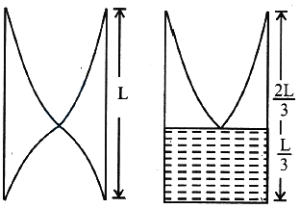
The fundamental frequency of an open pipe is $100 \ Hz$. If the bottom end of the pipe is closed and $1/3$ rd of the pipe is filled with water,then the fundamental frequency of the pipe is: (in $Hz$)
A
$200$
B
$100$
C
$75$
D
$150$
Solution
(C) For an open organ pipe of length $L$,the fundamental frequency is given by:
$f_0 = \frac{v}{2L} = 100 \ Hz$
When the bottom end is closed and $1/3$ of the pipe is filled with water,the effective length of the air column becomes $L' = L - \frac{L}{3} = \frac{2L}{3}$.
For a closed organ pipe of length $L'$,the fundamental frequency is:
$f' = \frac{v}{4L'}$
Substituting $L' = \frac{2L}{3}$:
$f' = \frac{v}{4(2L/3)} = \frac{3v}{8L}$
We can rewrite this as:
$f' = \frac{3}{4} \left( \frac{v}{2L} \right)$
Since $\frac{v}{2L} = 100 \ Hz$,we have:
$f' = \frac{3}{4} \times 100 = 75 \ Hz$
$f_0 = \frac{v}{2L} = 100 \ Hz$
When the bottom end is closed and $1/3$ of the pipe is filled with water,the effective length of the air column becomes $L' = L - \frac{L}{3} = \frac{2L}{3}$.
For a closed organ pipe of length $L'$,the fundamental frequency is:
$f' = \frac{v}{4L'}$
Substituting $L' = \frac{2L}{3}$:
$f' = \frac{v}{4(2L/3)} = \frac{3v}{8L}$
We can rewrite this as:
$f' = \frac{3}{4} \left( \frac{v}{2L} \right)$
Since $\frac{v}{2L} = 100 \ Hz$,we have:
$f' = \frac{3}{4} \times 100 = 75 \ Hz$
0 likesView Solution
166
PhysicsEasyMCQAP EAMCET · 2024
The frequency of the fifth harmonic of a closed pipe is equal to the frequency of the third harmonic of an open pipe. If the length of the open pipe is $72 \ cm$,then the length of the closed pipe is: (in $cm$)
A
$60$
B
$45$
C
$30$
D
$75$
Solution
(A) For an open organ pipe,the frequency of the $n^{th}$ harmonic is given by $f_n = \frac{n v}{2 l_o}$.
For the third harmonic $(n=3)$,$f_{open} = \frac{3 v}{2 l_o}$.
Given $l_o = 72 \ cm$,so $f_{open} = \frac{3 v}{2 \times 72} = \frac{v}{48}$.
For a closed organ pipe,the frequency of the $n^{th}$ harmonic (where $n$ is odd) is given by $f_n = \frac{n v}{4 l_c}$.
For the fifth harmonic $(n=5)$,$f_{closed} = \frac{5 v}{4 l_c}$.
According to the problem,$f_{closed} = f_{open}$.
$\frac{5 v}{4 l_c} = \frac{3 v}{2 l_o}$.
Substituting $l_o = 72 \ cm$:
$\frac{5}{4 l_c} = \frac{3}{2 \times 72} = \frac{3}{144} = \frac{1}{48}$.
$4 l_c = 5 \times 48 = 240$.
$l_c = \frac{240}{4} = 60 \ cm$.
For the third harmonic $(n=3)$,$f_{open} = \frac{3 v}{2 l_o}$.
Given $l_o = 72 \ cm$,so $f_{open} = \frac{3 v}{2 \times 72} = \frac{v}{48}$.
For a closed organ pipe,the frequency of the $n^{th}$ harmonic (where $n$ is odd) is given by $f_n = \frac{n v}{4 l_c}$.
For the fifth harmonic $(n=5)$,$f_{closed} = \frac{5 v}{4 l_c}$.
According to the problem,$f_{closed} = f_{open}$.
$\frac{5 v}{4 l_c} = \frac{3 v}{2 l_o}$.
Substituting $l_o = 72 \ cm$:
$\frac{5}{4 l_c} = \frac{3}{2 \times 72} = \frac{3}{144} = \frac{1}{48}$.
$4 l_c = 5 \times 48 = 240$.
$l_c = \frac{240}{4} = 60 \ cm$.
0 likesView Solution
167
PhysicsEasyMCQAP EAMCET · 2024
If the frequency of a wave is increased by $25 \%$,then the change in its wavelength is (medium not changed).
A
$20 \%$ increase
B
$20 \%$ decrease
C
$25 \%$ increase
D
$25 \%$ decrease
Solution
(B) The speed of a wave $v$ is given by $v = f \lambda$. Since the medium is not changed,the speed $v$ remains constant.
Therefore,$f_1 \lambda_1 = f_2 \lambda_2$,which implies $f \propto \frac{1}{\lambda}$.
Given that the frequency is increased by $25 \%$,the new frequency $f_2 = f_1 + 0.25 f_1 = 1.25 f_1 = \frac{5}{4} f_1$.
Using the inverse relationship,$\frac{\lambda_2}{\lambda_1} = \frac{f_1}{f_2} = \frac{f_1}{1.25 f_1} = \frac{1}{1.25} = \frac{4}{5} = 0.8$.
This means $\lambda_2 = 0.8 \lambda_1$.
The percentage change in wavelength is $\frac{\lambda_2 - \lambda_1}{\lambda_1} \times 100 = \frac{0.8 \lambda_1 - \lambda_1}{\lambda_1} \times 100 = -0.2 \times 100 = -20 \%$.
The negative sign indicates a $20 \%$ decrease in wavelength.
Therefore,$f_1 \lambda_1 = f_2 \lambda_2$,which implies $f \propto \frac{1}{\lambda}$.
Given that the frequency is increased by $25 \%$,the new frequency $f_2 = f_1 + 0.25 f_1 = 1.25 f_1 = \frac{5}{4} f_1$.
Using the inverse relationship,$\frac{\lambda_2}{\lambda_1} = \frac{f_1}{f_2} = \frac{f_1}{1.25 f_1} = \frac{1}{1.25} = \frac{4}{5} = 0.8$.
This means $\lambda_2 = 0.8 \lambda_1$.
The percentage change in wavelength is $\frac{\lambda_2 - \lambda_1}{\lambda_1} \times 100 = \frac{0.8 \lambda_1 - \lambda_1}{\lambda_1} \times 100 = -0.2 \times 100 = -20 \%$.
The negative sign indicates a $20 \%$ decrease in wavelength.
0 likesView Solution
168
PhysicsMediumMCQAP EAMCET · 2024
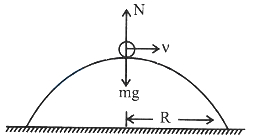
$A$ small disc is placed on the top of a smooth hemisphere of radius $R$. The smallest horizontal velocity $V$ that should be imparted to the disc so that it leaves the hemisphere surface immediately is (there is no friction):
A
$V=\sqrt{g^2 R}$
B
$V=\sqrt{2 g R}$
C
$V=\sqrt{g R}$
D
$V=\sqrt{g / R}$
Solution
(C) At the top of the hemisphere,the forces acting on the disc are the gravitational force $mg$ acting downwards and the normal reaction $N$ acting upwards.
The net centripetal force required for circular motion is provided by the difference between the gravitational force and the normal reaction:
$mg - N = \frac{mv^2}{R}$
For the disc to leave the hemisphere surface immediately,the normal reaction $N$ must become zero at the top point.
Setting $N = 0$ in the equation:
$mg - 0 = \frac{mv^2}{R}$
$mg = \frac{mv^2}{R}$
$v^2 = gR$
$v = \sqrt{gR}$
Thus,the smallest horizontal velocity required is $\sqrt{gR}$.
The net centripetal force required for circular motion is provided by the difference between the gravitational force and the normal reaction:
$mg - N = \frac{mv^2}{R}$
For the disc to leave the hemisphere surface immediately,the normal reaction $N$ must become zero at the top point.
Setting $N = 0$ in the equation:
$mg - 0 = \frac{mv^2}{R}$
$mg = \frac{mv^2}{R}$
$v^2 = gR$
$v = \sqrt{gR}$
Thus,the smallest horizontal velocity required is $\sqrt{gR}$.
0 likesView Solution
169
PhysicsDifficultMCQAP EAMCET · 2024
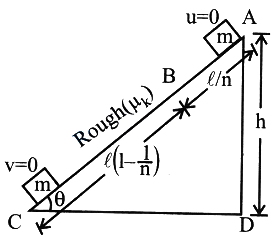
The upper $\left(\frac{1}{n}\right)^{\text{th}}$ of an inclined plane is smooth and the remaining lower part is rough with coefficient of friction $\mu_k$. If a body starting from rest at the top of the inclined plane will again come to rest at the bottom of the plane,then the angle of inclination of the inclined plane is
A
$\sin^{-1}\left[\left(\frac{n}{n-1}\right) \mu_k\right]$
B
$\sin^{-1}\left[\left(\frac{n-1}{n}\right) \mu_k\right]$
C
$\tan^{-1}\left[\left(\frac{n}{n-1}\right) \mu_k\right]$
D
$\tan^{-1}\left[\left(\frac{n-1}{n}\right) \mu_k\right]$
Solution
(D) Let $l$ be the total length of the inclined plane and $\theta$ be the angle of inclination.
According to the work-energy theorem,the total work done on the body is equal to the change in its kinetic energy.
Since the body starts from rest and comes to rest at the bottom,the change in kinetic energy $\Delta K = 0$.
The forces acting on the body are gravity,friction,and the normal force.
$1$. Work done by gravity $(W_g)$: $W_g = mgh = mg(l \sin \theta)$.
$2$. Work done by friction $(W_f)$: Friction acts only on the lower part of length $l(1 - 1/n)$. Thus,$W_f = -f_k \cdot d = -(\mu_k mg \cos \theta) \cdot l(1 - 1/n)$.
$3$. Work done by the normal force $(W_N)$: Since the normal force is always perpendicular to the displacement,$W_N = 0$.
Applying the work-energy theorem: $W_g + W_f + W_N = 0$.
$mg l \sin \theta - \mu_k mg \cos \theta \cdot l \left(\frac{n-1}{n}\right) = 0$.
Dividing by $mg l \cos \theta$ (assuming $\cos \theta \neq 0$):
$\tan \theta = \mu_k \left(\frac{n-1}{n}\right)$.
Therefore,$\theta = \tan^{-1}\left[\left(\frac{n-1}{n}\right) \mu_k\right]$.
According to the work-energy theorem,the total work done on the body is equal to the change in its kinetic energy.
Since the body starts from rest and comes to rest at the bottom,the change in kinetic energy $\Delta K = 0$.
The forces acting on the body are gravity,friction,and the normal force.
$1$. Work done by gravity $(W_g)$: $W_g = mgh = mg(l \sin \theta)$.
$2$. Work done by friction $(W_f)$: Friction acts only on the lower part of length $l(1 - 1/n)$. Thus,$W_f = -f_k \cdot d = -(\mu_k mg \cos \theta) \cdot l(1 - 1/n)$.
$3$. Work done by the normal force $(W_N)$: Since the normal force is always perpendicular to the displacement,$W_N = 0$.
Applying the work-energy theorem: $W_g + W_f + W_N = 0$.
$mg l \sin \theta - \mu_k mg \cos \theta \cdot l \left(\frac{n-1}{n}\right) = 0$.
Dividing by $mg l \cos \theta$ (assuming $\cos \theta \neq 0$):
$\tan \theta = \mu_k \left(\frac{n-1}{n}\right)$.
Therefore,$\theta = \tan^{-1}\left[\left(\frac{n-1}{n}\right) \mu_k\right]$.
0 likesView Solution
170
PhysicsMediumMCQAP EAMCET · 2024
$A$ machine with efficiency $2/3$ uses $12 \text{ J}$ of energy to lift a $2 \text{ kg}$ block to a certain height. If the block is allowed to fall freely from that height,what is its velocity when it reaches the ground?
A
$\sqrt{2} \text{ m/s}$
B
$2 \text{ m/s}$
C
$2\sqrt{2} \text{ m/s}$
D
$0.2 \text{ m/s}$
Solution
(C) The useful work done by the machine (potential energy gained by the block) is given by the efficiency multiplied by the energy input:
$U = \eta \times E_{\text{in}} = \frac{2}{3} \times 12 \text{ J} = 8 \text{ J}$.
Since $U = mgh$,we have $8 = 2 \times 10 \times h$,which gives $h = \frac{8}{20} = 0.4 \text{ m}$.
When the block falls freely,by the law of conservation of energy,the loss in potential energy equals the gain in kinetic energy:
$mgh = \frac{1}{2}mv^2$.
$v = \sqrt{2gh} = \sqrt{2 \times 10 \times 0.4} = \sqrt{8} = 2\sqrt{2} \text{ m/s}$.
$U = \eta \times E_{\text{in}} = \frac{2}{3} \times 12 \text{ J} = 8 \text{ J}$.
Since $U = mgh$,we have $8 = 2 \times 10 \times h$,which gives $h = \frac{8}{20} = 0.4 \text{ m}$.
When the block falls freely,by the law of conservation of energy,the loss in potential energy equals the gain in kinetic energy:
$mgh = \frac{1}{2}mv^2$.
$v = \sqrt{2gh} = \sqrt{2 \times 10 \times 0.4} = \sqrt{8} = 2\sqrt{2} \text{ m/s}$.
0 likesView Solution
171
PhysicsMediumMCQAP EAMCET · 2024
$A$ boy weighing $50 \ kg$ finished a long jump at a distance of $8 \ m$. Considering that he moved along a parabolic path and his angle of jump is $45^{\circ}$,his initial $K.E.$ is (in $J$)
A
$960$
B
$1560$
C
$2460$
D
$1960$
Solution
(D) Given: Mass $m = 50 \ kg$,Range $R = 8 \ m$,Angle $\theta = 45^{\circ}$,Acceleration due to gravity $g = 9.8 \ m/s^2$.
The formula for the horizontal range of a projectile is $R = \frac{u^2 \sin(2\theta)}{g}$.
Substituting the given values:
$8 = \frac{u^2 \sin(2 \times 45^{\circ})}{9.8} = \frac{u^2 \sin(90^{\circ})}{9.8} = \frac{u^2}{9.8}$.
Therefore,$u^2 = 8 \times 9.8 = 78.4 \ m^2/s^2$.
The initial kinetic energy $(K.E.)$ is given by $\frac{1}{2} m u^2$.
$(K.E.) = \frac{1}{2} \times 50 \times 78.4 = 25 \times 78.4 = 1960 \ J$.
The formula for the horizontal range of a projectile is $R = \frac{u^2 \sin(2\theta)}{g}$.
Substituting the given values:
$8 = \frac{u^2 \sin(2 \times 45^{\circ})}{9.8} = \frac{u^2 \sin(90^{\circ})}{9.8} = \frac{u^2}{9.8}$.
Therefore,$u^2 = 8 \times 9.8 = 78.4 \ m^2/s^2$.
The initial kinetic energy $(K.E.)$ is given by $\frac{1}{2} m u^2$.
$(K.E.) = \frac{1}{2} \times 50 \times 78.4 = 25 \times 78.4 = 1960 \ J$.
0 likesView Solution
172
PhysicsEasyMCQAP EAMCET · 2024
The average power generated by a $90 \ kg$ mountain climber who climbs a summit of height $600 \ m$ in $90 \ minutes$ is (Acceleration due to gravity $= 10 \ ms^{-2}$). (in $W$)
A
$100$
B
$25$
C
$200$
D
$50$
Solution
(A) The formula for average power is $P_{av} = \frac{W}{t} = \frac{mgh}{t}$.
Given:
Mass $m = 90 \ kg$
Height $h = 600 \ m$
Time $t = 90 \ minutes = 90 \times 60 \ s = 5400 \ s$
Acceleration due to gravity $g = 10 \ ms^{-2}$.
Substituting the values:
$P_{av} = \frac{90 \times 10 \times 600}{90 \times 60} = \frac{540000}{5400} = 100 \ W$.
Given:
Mass $m = 90 \ kg$
Height $h = 600 \ m$
Time $t = 90 \ minutes = 90 \times 60 \ s = 5400 \ s$
Acceleration due to gravity $g = 10 \ ms^{-2}$.
Substituting the values:
$P_{av} = \frac{90 \times 10 \times 600}{90 \times 60} = \frac{540000}{5400} = 100 \ W$.
0 likesView Solution
173
PhysicsEasyMCQAP EAMCET · 2024
$A$ force of $(6x^2 - 4x + 3) \text{ N}$ acts on a body of mass $0.75 \text{ kg}$ and displaces it from $x = 2 \text{ m}$ to $x = 5 \text{ m}$. The work done by the force is (in $\text{ J}$)
A
$201$
B
$215$
C
$229$
D
$307$
Solution
(A) The work done by a variable force is given by the integral of the force with respect to displacement: $W = \int_{x_1}^{x_2} F(x) dx$.
Given $F(x) = (6x^2 - 4x + 3) \text{ N}$,$x_1 = 2 \text{ m}$,and $x_2 = 5 \text{ m}$.
$W = \int_{2}^{5} (6x^2 - 4x + 3) dx$
$W = [\frac{6x^3}{3} - \frac{4x^2}{2} + 3x]_{2}^{5}$
$W = [2x^3 - 2x^2 + 3x]_{2}^{5}$
Substituting the limits:
$W = [2(5)^3 - 2(5)^2 + 3(5)] - [2(2)^3 - 2(2)^2 + 3(2)]$
$W = [2(125) - 2(25) + 15] - [2(8) - 2(4) + 6]$
$W = [250 - 50 + 15] - [16 - 8 + 6]$
$W = 215 - 14 = 201 \text{ J}$.
Given $F(x) = (6x^2 - 4x + 3) \text{ N}$,$x_1 = 2 \text{ m}$,and $x_2 = 5 \text{ m}$.
$W = \int_{2}^{5} (6x^2 - 4x + 3) dx$
$W = [\frac{6x^3}{3} - \frac{4x^2}{2} + 3x]_{2}^{5}$
$W = [2x^3 - 2x^2 + 3x]_{2}^{5}$
Substituting the limits:
$W = [2(5)^3 - 2(5)^2 + 3(5)] - [2(2)^3 - 2(2)^2 + 3(2)]$
$W = [2(125) - 2(25) + 15] - [2(8) - 2(4) + 6]$
$W = [250 - 50 + 15] - [16 - 8 + 6]$
$W = 215 - 14 = 201 \text{ J}$.
0 likesView Solution
174
PhysicsEasyMCQAP EAMCET · 2024
$A$ force of $(4 \hat{i}+2 \hat{j}+\hat{k}) \text{ N}$ is acting on a particle of mass $2 \text{ kg}$,displacing the particle from a position of $(2 \hat{i}+2 \hat{j}+\hat{k}) \text{ m}$ to a position of $(4 \hat{i}+3 \hat{j}+2 \hat{k}) \text{ m}$. The work done by the force on the particle in joules is: (in $\text{ J}$)
A
$21$
B
$11$
C
$14$
D
$18$
Solution
(B) Given force $\vec{F} = (4 \hat{i} + 2 \hat{j} + \hat{k}) \text{ N}$.
Initial position $\vec{r_1} = (2 \hat{i} + 2 \hat{j} + \hat{k}) \text{ m}$.
Final position $\vec{r_2} = (4 \hat{i} + 3 \hat{j} + 2 \hat{k}) \text{ m}$.
Displacement $\vec{S} = \vec{r_2} - \vec{r_1} = (4-2) \hat{i} + (3-2) \hat{j} + (2-1) \hat{k} = (2 \hat{i} + \hat{j} + \hat{k}) \text{ m}$.
Work done $W = \vec{F} \cdot \vec{S}$.
$W = (4 \hat{i} + 2 \hat{j} + \hat{k}) \cdot (2 \hat{i} + \hat{j} + \hat{k})$.
$W = (4 \times 2) + (2 \times 1) + (1 \times 1) = 8 + 2 + 1 = 11 \text{ J}$.
Initial position $\vec{r_1} = (2 \hat{i} + 2 \hat{j} + \hat{k}) \text{ m}$.
Final position $\vec{r_2} = (4 \hat{i} + 3 \hat{j} + 2 \hat{k}) \text{ m}$.
Displacement $\vec{S} = \vec{r_2} - \vec{r_1} = (4-2) \hat{i} + (3-2) \hat{j} + (2-1) \hat{k} = (2 \hat{i} + \hat{j} + \hat{k}) \text{ m}$.
Work done $W = \vec{F} \cdot \vec{S}$.
$W = (4 \hat{i} + 2 \hat{j} + \hat{k}) \cdot (2 \hat{i} + \hat{j} + \hat{k})$.
$W = (4 \times 2) + (2 \times 1) + (1 \times 1) = 8 + 2 + 1 = 11 \text{ J}$.
0 likesView Solution
175
PhysicsDifficultMCQAP EAMCET · 2024
In an $n-p-n$ transistor circuit,the collector current is $10 \text{ mA}$. If $95\%$ of the electrons emitted reach the collector,then the base current is nearly: (in $mA$)
A
$5.3$
B
$53$
C
$35$
D
$0.53$
Solution
(D) In an $n-p-n$ transistor,the relationship between emitter current $(I_E)$,collector current $(I_C)$,and base current $(I_B)$ is given by $I_E = I_B + I_C$.
Given that $95\%$ of the emitted electrons reach the collector,we have $I_C = 0.95 \times I_E$.
Given $I_C = 10 \text{ mA}$,we can find $I_E$ as:
$I_E = \frac{I_C}{0.95} = \frac{10}{0.95} \approx 10.53 \text{ mA}$.
Now,calculating the base current:
$I_B = I_E - I_C = 10.53 \text{ mA} - 10 \text{ mA} = 0.53 \text{ mA}$.
Given that $95\%$ of the emitted electrons reach the collector,we have $I_C = 0.95 \times I_E$.
Given $I_C = 10 \text{ mA}$,we can find $I_E$ as:
$I_E = \frac{I_C}{0.95} = \frac{10}{0.95} \approx 10.53 \text{ mA}$.
Now,calculating the base current:
$I_B = I_E - I_C = 10.53 \text{ mA} - 10 \text{ mA} = 0.53 \text{ mA}$.
0 likesView Solution
176
PhysicsEasyMCQAP EAMCET · 2024
The current gain of a transistor in common emitter configuration is $80$. The resistances in collector and base sides of the circuit are $5 \text{ k}\Omega$ and $1 \text{ k}\Omega$ respectively. If the input voltage is $2 \text{ mV}$, the output voltage is: (in $\text{ V}$)
A
$4$
B
$0.4$
C
$0.8$
D
$8$
Solution
(C) Given: Current gain $\beta = 80$, Collector resistance $R_C = 5 \text{ k}\Omega$, Base resistance $R_B = 1 \text{ k}\Omega$, Input voltage $V_I = 2 \text{ mV} = 2 \times 10^{-3} \text{ V}$.
The voltage gain $A_V$ for a common emitter transistor is given by the formula:
$A_V = \frac{V_O}{V_I} = \beta \times \frac{R_C}{R_B}$
Substituting the given values:
$V_O = V_I \times \beta \times \frac{R_C}{R_B}$
$V_O = (2 \times 10^{-3} \text{ V}) \times 80 \times \frac{5 \text{ k}\Omega}{1 \text{ k}\Omega}$
$V_O = 2 \times 10^{-3} \times 80 \times 5$
$V_O = 800 \times 10^{-3} \text{ V}$
$V_O = 0.8 \text{ V}$.
The voltage gain $A_V$ for a common emitter transistor is given by the formula:
$A_V = \frac{V_O}{V_I} = \beta \times \frac{R_C}{R_B}$
Substituting the given values:
$V_O = V_I \times \beta \times \frac{R_C}{R_B}$
$V_O = (2 \times 10^{-3} \text{ V}) \times 80 \times \frac{5 \text{ k}\Omega}{1 \text{ k}\Omega}$
$V_O = 2 \times 10^{-3} \times 80 \times 5$
$V_O = 800 \times 10^{-3} \text{ V}$
$V_O = 0.8 \text{ V}$.
0 likesView Solution
177
PhysicsDifficultMCQAP EAMCET · 2024
If $R_C$ and $R_B$ are respectively the resistances of the collector and base sides of the circuit,and $\beta$ is the current amplification factor,then the voltage gain of a transistor amplifier in common emitter configuration is
A
$\beta R_C R_B$
B
$\frac{\beta}{R_C R_B}$
C
$\frac{\beta R_B}{R_C}$
D
$\frac{\beta R_C}{R_B}$
Solution
(D) The voltage gain $A_V$ of a transistor amplifier in common emitter configuration is defined as the ratio of output voltage $V_O$ to input voltage $V_I$.
$A_V = \frac{V_O}{V_I} = \frac{V_C}{V_B}$
Since $V_C = I_C R_C$ and $V_B = I_B R_B$,we can write:
$A_V = \frac{I_C R_C}{I_B R_B}$
Rearranging the terms,we get:
$A_V = \left(\frac{I_C}{I_B}\right) \left(\frac{R_C}{R_B}\right)$
Given that the current amplification factor $\beta = \frac{I_C}{I_B}$,substituting this into the equation gives:
$A_V = \beta \cdot \frac{R_C}{R_B}$
$A_V = \frac{V_O}{V_I} = \frac{V_C}{V_B}$
Since $V_C = I_C R_C$ and $V_B = I_B R_B$,we can write:
$A_V = \frac{I_C R_C}{I_B R_B}$
Rearranging the terms,we get:
$A_V = \left(\frac{I_C}{I_B}\right) \left(\frac{R_C}{R_B}\right)$
Given that the current amplification factor $\beta = \frac{I_C}{I_B}$,substituting this into the equation gives:
$A_V = \beta \cdot \frac{R_C}{R_B}$
0 likesView Solution
178
PhysicsEasyMCQAP EAMCET · 2024
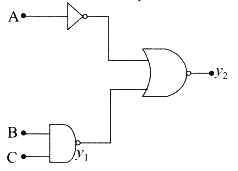
In the given digital circuit,if the inputs are $A=1, B=1$ and $C=1$,then the values of $y_1$ and $y_2$ are respectively:
A
$0, 1$
B
$0, 0$
C
$1, 1$
D
$1, 0$
Solution
(A) The circuit consists of a $NAND$ gate with inputs $B$ and $C$,and a $NOR$ gate with inputs $\overline{A}$ and $y_1$.
First,calculate $y_1$:
$y_1 = \overline{B \cdot C} = \overline{1 \cdot 1} = \overline{1} = 0$.
Next,calculate $y_2$:
The inputs to the $NOR$ gate are $\overline{A}$ and $y_1$.
$\overline{A} = \overline{1} = 0$.
$y_2 = \overline{\overline{A} + y_1} = \overline{0 + 0} = \overline{0} = 1$.
Thus,the values are $y_1 = 0$ and $y_2 = 1$.
First,calculate $y_1$:
$y_1 = \overline{B \cdot C} = \overline{1 \cdot 1} = \overline{1} = 0$.
Next,calculate $y_2$:
The inputs to the $NOR$ gate are $\overline{A}$ and $y_1$.
$\overline{A} = \overline{1} = 0$.
$y_2 = \overline{\overline{A} + y_1} = \overline{0 + 0} = \overline{0} = 1$.
Thus,the values are $y_1 = 0$ and $y_2 = 1$.
0 likesView Solution
179
PhysicsEasyMCQAP EAMCET · 2024
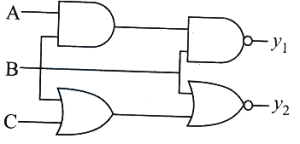
Four logic gates are connected as shown in the figure. If the inputs are $A=0$,$B=1$ and $C=1$,then the values of $y_1$ and $y_2$ respectively are
A
$1$,$0$
B
$1$,$1$
C
$0$,$1$
D
$0$,$0$
Solution
(A) From the figure,the output $y_1$ is the output of a $NAND$ gate with inputs $(A \cdot B)$ and $B$. Thus,$y_1 = \overline{(A \cdot B) \cdot B}$.
Given $A=0$ and $B=1$,$A \cdot B = 0 \cdot 1 = 0$.
So,$y_1 = \overline{0 \cdot 1} = \overline{0} = 1$.
The output $y_2$ is the output of a $NOR$ gate with inputs $(B+C)$ and $B$. Thus,$y_2 = \overline{(B+C) + B}$.
Given $B=1$ and $C=1$,$B+C = 1+1 = 1$.
So,$y_2 = \overline{1 + 1} = \overline{1} = 0$.
Therefore,the values of $y_1$ and $y_2$ are $1$ and $0$ respectively.
Given $A=0$ and $B=1$,$A \cdot B = 0 \cdot 1 = 0$.
So,$y_1 = \overline{0 \cdot 1} = \overline{0} = 1$.
The output $y_2$ is the output of a $NOR$ gate with inputs $(B+C)$ and $B$. Thus,$y_2 = \overline{(B+C) + B}$.
Given $B=1$ and $C=1$,$B+C = 1+1 = 1$.
So,$y_2 = \overline{1 + 1} = \overline{1} = 0$.
Therefore,the values of $y_1$ and $y_2$ are $1$ and $0$ respectively.
0 likesView Solution
180
PhysicsEasyMCQAP EAMCET · 2024
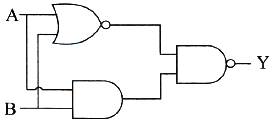
The truth table for the given logic circuit is:
A
| $A$ | $B$ | $Y$ |
| $0$ | $0$ | $1$ |
| $0$ | $1$ | $0$ |
| $1$ | $0$ | $1$ |
| $1$ | $1$ | $1$ |
B
| $A$ | $B$ | $Y$ |
| $0$ | $0$ | $1$ |
| $0$ | $1$ | $1$ |
| $1$ | $0$ | $0$ |
| $1$ | $1$ | $1$ |
C
| $A$ | $B$ | $Y$ |
| $0$ | $0$ | $1$ |
| $0$ | $1$ | $1$ |
| $1$ | $0$ | $1$ |
| $1$ | $1$ | $1$ |
D
| $A$ | $B$ | $Y$ |
| $0$ | $0$ | $0$ |
| $0$ | $1$ | $1$ |
| $1$ | $0$ | $1$ |
| $1$ | $1$ | $1$ |
Solution
(C) The circuit consists of a $NOR$ gate,an $AND$ gate,and a $NAND$ gate.
Let the inputs be $A$ and $B$.
The output of the $NOR$ gate is $\overline{A+B}$.
The output of the $AND$ gate is $A \cdot B$.
These two outputs are fed into a $NAND$ gate.
Therefore,the final output $Y$ is given by:
$Y = \overline{(\overline{A+B}) \cdot (A \cdot B)}$
Using De Morgan's Law,$\overline{X \cdot Z} = \overline{X} + \overline{Z}$:
$Y = \overline{(\overline{A+B})} + \overline{(A \cdot B)}$
$Y = (A+B) + (\overline{A} + \overline{B})$
$Y = (A + \overline{A}) + (B + \overline{B})$
Since $A + \overline{A} = 1$ and $B + \overline{B} = 1$:
$Y = 1 + 1 = 1$
Thus,for any combination of inputs $(A, B)$,the output $Y$ is always $1$.
Let the inputs be $A$ and $B$.
The output of the $NOR$ gate is $\overline{A+B}$.
The output of the $AND$ gate is $A \cdot B$.
These two outputs are fed into a $NAND$ gate.
Therefore,the final output $Y$ is given by:
$Y = \overline{(\overline{A+B}) \cdot (A \cdot B)}$
Using De Morgan's Law,$\overline{X \cdot Z} = \overline{X} + \overline{Z}$:
$Y = \overline{(\overline{A+B})} + \overline{(A \cdot B)}$
$Y = (A+B) + (\overline{A} + \overline{B})$
$Y = (A + \overline{A}) + (B + \overline{B})$
Since $A + \overline{A} = 1$ and $B + \overline{B} = 1$:
$Y = 1 + 1 = 1$
Thus,for any combination of inputs $(A, B)$,the output $Y$ is always $1$.
0 likesView Solution
181
PhysicsEasyMCQAP EAMCET · 2024
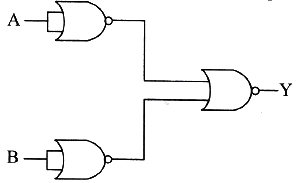
The following configuration of gates is equivalent to
A
$NAND$
B
$XOR$
C
$AND$
D
$OR$
Solution
(C) The given circuit consists of two $NOR$ gates acting as $NOT$ gates,followed by a $NOR$ gate.
$1$. The first two gates are $NOR$ gates with both inputs tied together. $A$ $NOR$ gate with inputs $A$ and $A$ gives output $\overline{A+A} = \overline{A}$.
$2$. Similarly,the second $NOR$ gate with inputs $B$ and $B$ gives output $\overline{B+B} = \overline{B}$.
$3$. These two outputs are fed into the final $NOR$ gate.
$4$. The output $Y$ of the final $NOR$ gate is $Y = \overline{\overline{A} + \overline{B}}$.
$5$. By De Morgan's Law,$\overline{\overline{A} + \overline{B}} = \overline{\overline{A}} \cdot \overline{\overline{B}} = A \cdot B$.
$6$. Therefore,the output $Y = A \cdot B$,which is the Boolean expression for an $AND$ gate.
$1$. The first two gates are $NOR$ gates with both inputs tied together. $A$ $NOR$ gate with inputs $A$ and $A$ gives output $\overline{A+A} = \overline{A}$.
$2$. Similarly,the second $NOR$ gate with inputs $B$ and $B$ gives output $\overline{B+B} = \overline{B}$.
$3$. These two outputs are fed into the final $NOR$ gate.
$4$. The output $Y$ of the final $NOR$ gate is $Y = \overline{\overline{A} + \overline{B}}$.
$5$. By De Morgan's Law,$\overline{\overline{A} + \overline{B}} = \overline{\overline{A}} \cdot \overline{\overline{B}} = A \cdot B$.
$6$. Therefore,the output $Y = A \cdot B$,which is the Boolean expression for an $AND$ gate.
0 likesView Solution
182
PhysicsEasyMCQAP EAMCET · 2024
$A$ full-wave rectifier circuit is operating from $50 \text{ Hz}$ mains. The fundamental frequency in the ripple output will be: (in $\text{ Hz}$)
A
$50$
B
$70.7$
C
$100$
D
$25$
Solution
(C) In a full-wave rectifier, the output consists of two pulses for every cycle of the input $AC$ signal.
Therefore, the fundamental frequency of the output ripple is twice the input frequency.
Given, input frequency $f_{in} = 50 \text{ Hz}$.
Fundamental frequency of output ripple $f_0 = 2 \times f_{in} = 2 \times 50 \text{ Hz} = 100 \text{ Hz}$.
Therefore, the fundamental frequency of the output ripple is twice the input frequency.
Given, input frequency $f_{in} = 50 \text{ Hz}$.
Fundamental frequency of output ripple $f_0 = 2 \times f_{in} = 2 \times 50 \text{ Hz} = 100 \text{ Hz}$.
0 likesView Solution
183
PhysicsEasyMCQAP EAMCET · 2024
If $n_{e}$ and $n_{h}$ are concentrations of electrons and holes in a semiconductor,then the intrinsic carrier concentration $(n_i)$ in thermal equilibrium is
A
$n_i=\sqrt{\frac{n_e}{n_h}}$
B
$n_i=\frac{n_h}{n_e}$
C
$n_i=\sqrt{n_e n_h}$
D
$n_i=n_e+n_h$
Solution
(C) In a semiconductor at thermal equilibrium,the product of the concentration of electrons $(n_e)$ and the concentration of holes $(n_h)$ is equal to the square of the intrinsic carrier concentration $(n_i^2)$.
This is expressed by the law of mass action: $n_e n_h = n_i^2$.
Therefore,the intrinsic carrier concentration is given by $n_i = \sqrt{n_e n_h}$.
This is expressed by the law of mass action: $n_e n_h = n_i^2$.
Therefore,the intrinsic carrier concentration is given by $n_i = \sqrt{n_e n_h}$.
0 likesView Solution
184
PhysicsEasyMCQAP EAMCET · 2024
Pure silicon at $300 \ K$ has equal electron and hole concentration of $1.5 \times 10^{16} \ m^{-3}$. If the hole concentration increases to $3 \times 10^{22} \ m^{-3}$,then the electron concentration in the silicon is
A
$0.75 \times 10^9 \ m^{-3}$
B
$750 \ m^{-3}$
C
$75 \ m^{-3}$
D
$7.5 \times 10^9 \ m^{-3}$
Solution
(D) For an intrinsic semiconductor,the law of mass action states that $n_e n_h = n_i^2$.
Given,$n_e = n_h = n_i = 1.5 \times 10^{16} \ m^{-3}$.
Therefore,$n_i^2 = (1.5 \times 10^{16})^2 = 2.25 \times 10^{32} \ m^{-6}$.
When the hole concentration is increased to $n_h' = 3 \times 10^{22} \ m^{-3}$,the new electron concentration $n_e'$ is given by:
$n_e' = \frac{n_i^2}{n_h'} = \frac{2.25 \times 10^{32}}{3 \times 10^{22}}$.
$n_e' = 0.75 \times 10^{10} \ m^{-3} = 7.5 \times 10^9 \ m^{-3}$.
Given,$n_e = n_h = n_i = 1.5 \times 10^{16} \ m^{-3}$.
Therefore,$n_i^2 = (1.5 \times 10^{16})^2 = 2.25 \times 10^{32} \ m^{-6}$.
When the hole concentration is increased to $n_h' = 3 \times 10^{22} \ m^{-3}$,the new electron concentration $n_e'$ is given by:
$n_e' = \frac{n_i^2}{n_h'} = \frac{2.25 \times 10^{32}}{3 \times 10^{22}}$.
$n_e' = 0.75 \times 10^{10} \ m^{-3} = 7.5 \times 10^9 \ m^{-3}$.
0 likesView Solution
185
PhysicsEasyMCQAP EAMCET · 2024
The semiconductor used for the fabrication of visible LEDs must at least have a band gap of (in $eV$)
A
$0.6$
B
$1.2$
C
$1.8$
D
$0.9$
Solution
(C) Visible light corresponds to the wavelength range of approximately $380 \, nm$ to $750 \, nm$.
Using the relation $E = \frac{hc}{\lambda}$, where $h = 6.63 \times 10^{-34} \, J \cdot s$, $c = 3 \times 10^8 \, m/s$, and $1 \, eV = 1.6 \times 10^{-19} \, J$.
For the longest wavelength of visible light $(\lambda = 750 \, nm)$, the energy is $E = \frac{1240 \, eV \cdot nm}{750 \, nm} \approx 1.65 \, eV$.
In practice, to emit visible light efficiently, the semiconductor material used for the fabrication of visible LEDs must have a band gap of at least $1.8 \, eV$.
Using the relation $E = \frac{hc}{\lambda}$, where $h = 6.63 \times 10^{-34} \, J \cdot s$, $c = 3 \times 10^8 \, m/s$, and $1 \, eV = 1.6 \times 10^{-19} \, J$.
For the longest wavelength of visible light $(\lambda = 750 \, nm)$, the energy is $E = \frac{1240 \, eV \cdot nm}{750 \, nm} \approx 1.65 \, eV$.
In practice, to emit visible light efficiently, the semiconductor material used for the fabrication of visible LEDs must have a band gap of at least $1.8 \, eV$.
0 likesView Solution
186
PhysicsMediumMCQAP EAMCET · 2024
Which of the following is not a unit of permeability?
A
Henry meter$^{-1}$
B
Weber ampere$^{-1}$ meter$^{-1}$
C
Ohm second meter$^{-1}$
D
Volt second meter$^{-1}$
Solution
(D) The permeability of free space $\mu_0$ has the $SI$ unit of Henry per meter $(H \cdot m^{-1})$.
From the formula for self-inductance $L = \frac{\mu_0 N^2 A}{l}$,we get the unit of $\mu_0$ as $\frac{H \cdot m}{m^2} = H \cdot m^{-1}$. Thus,option $A$ is a unit.
Since $L = \frac{\phi}{I}$,the unit of $L$ is $Wb \cdot A^{-1}$. Substituting this into the expression for $\mu_0$,we get $\frac{Wb \cdot A^{-1} \cdot m}{m^2} = Wb \cdot A^{-1} \cdot m^{-1}$. Thus,option $B$ is a unit.
Since $L = \frac{e}{dI/dt}$,the unit of $L$ is $\frac{V}{A \cdot s^{-1}} = V \cdot s \cdot A^{-1} = \Omega \cdot s$. Substituting this into the expression for $\mu_0$,we get $\frac{\Omega \cdot s \cdot m}{m^2} = \Omega \cdot s \cdot m^{-1}$. Thus,option $C$ is a unit.
Option $D$ $(Volt \cdot second \cdot meter^{-1})$ is equivalent to $V \cdot s \cdot m^{-1}$. Comparing this with the derived units,it lacks the $A^{-1}$ factor required for permeability. Therefore,it is not a unit of permeability.
From the formula for self-inductance $L = \frac{\mu_0 N^2 A}{l}$,we get the unit of $\mu_0$ as $\frac{H \cdot m}{m^2} = H \cdot m^{-1}$. Thus,option $A$ is a unit.
Since $L = \frac{\phi}{I}$,the unit of $L$ is $Wb \cdot A^{-1}$. Substituting this into the expression for $\mu_0$,we get $\frac{Wb \cdot A^{-1} \cdot m}{m^2} = Wb \cdot A^{-1} \cdot m^{-1}$. Thus,option $B$ is a unit.
Since $L = \frac{e}{dI/dt}$,the unit of $L$ is $\frac{V}{A \cdot s^{-1}} = V \cdot s \cdot A^{-1} = \Omega \cdot s$. Substituting this into the expression for $\mu_0$,we get $\frac{\Omega \cdot s \cdot m}{m^2} = \Omega \cdot s \cdot m^{-1}$. Thus,option $C$ is a unit.
Option $D$ $(Volt \cdot second \cdot meter^{-1})$ is equivalent to $V \cdot s \cdot m^{-1}$. Comparing this with the derived units,it lacks the $A^{-1}$ factor required for permeability. Therefore,it is not a unit of permeability.
0 likesView Solution
187
PhysicsEasyMCQAP EAMCET · 2024
In the case of diffraction,if '$a$' is the slit width and '$\lambda$' is the wavelength of the incident light,then the required condition for diffraction to take place is:
A
$\frac{a}{\lambda}=1000$
B
$\frac{a}{\lambda} \leq 1$
C
$a \ll \lambda$
D
$a \gg \lambda$
Solution
(B) Diffraction is the phenomenon of bending of light around the corners of an obstacle or aperture of the size comparable to the wavelength of light.
For significant diffraction to occur,the size of the aperture or slit width '$a$' must be comparable to or smaller than the wavelength '$\lambda$' of the incident light.
Mathematically,the condition is expressed as $a \leq \lambda$.
Dividing both sides by '$\lambda$',we get $\frac{a}{\lambda} \leq 1$.
For significant diffraction to occur,the size of the aperture or slit width '$a$' must be comparable to or smaller than the wavelength '$\lambda$' of the incident light.
Mathematically,the condition is expressed as $a \leq \lambda$.
Dividing both sides by '$\lambda$',we get $\frac{a}{\lambda} \leq 1$.
0 likesView Solution
188
PhysicsEasyMCQAP EAMCET · 2024
If a slit of width '$x$' is illuminated by red light having wavelength $6500 \text{ Å}$,the first minima is obtained at $\theta = 30^{\circ}$. Then the value of '$x$' is
A
$1.4 \times 10^{-4} \mu \text{m}$
B
$1.2 \times 10^{-5} \text{ m}$
C
$1.3 \mu \text{m}$
D
$1.2 \mu \text{m}$
Solution
(C) For single-slit diffraction,the condition for the $n^{th}$ minima is given by $x \sin \theta = n \lambda$.
For the first minima,$n = 1$.
Given: $\lambda = 6500 \text{ Å} = 6500 \times 10^{-10} \text{ m} = 6.5 \times 10^{-7} \text{ m}$ and $\theta = 30^{\circ}$.
Substituting these values into the formula:
$x \sin 30^{\circ} = 1 \times 6.5 \times 10^{-7} \text{ m}$.
Since $\sin 30^{\circ} = 0.5$,we have:
$x \times 0.5 = 6.5 \times 10^{-7} \text{ m}$.
$x = \frac{6.5 \times 10^{-7}}{0.5} \text{ m} = 13 \times 10^{-7} \text{ m} = 1.3 \times 10^{-6} \text{ m}$.
Therefore,$x = 1.3 \mu \text{m}$.
For the first minima,$n = 1$.
Given: $\lambda = 6500 \text{ Å} = 6500 \times 10^{-10} \text{ m} = 6.5 \times 10^{-7} \text{ m}$ and $\theta = 30^{\circ}$.
Substituting these values into the formula:
$x \sin 30^{\circ} = 1 \times 6.5 \times 10^{-7} \text{ m}$.
Since $\sin 30^{\circ} = 0.5$,we have:
$x \times 0.5 = 6.5 \times 10^{-7} \text{ m}$.
$x = \frac{6.5 \times 10^{-7}}{0.5} \text{ m} = 13 \times 10^{-7} \text{ m} = 1.3 \times 10^{-6} \text{ m}$.
Therefore,$x = 1.3 \mu \text{m}$.
0 likesView Solution
189
PhysicsEasyMCQAP EAMCET · 2024
The angle between the axes of a polariser and an analyser is $45^{\circ}$. If the intensity of the unpolarized light incident on the polariser is $I$,then the intensity of the light emerged from the analyser is
A
$2I$
B
$\frac{I}{2}$
C
$I$
D
$\frac{I}{4}$
Solution
(D) The intensity of unpolarized light incident on the polariser is $I$.
After passing through the polariser,the intensity of the polarized light becomes $I_1 = \frac{I}{2}$.
According to Malus' Law,the intensity of light emerging from the analyser is $I_2 = I_1 \cos^2 \theta$.
Given $\theta = 45^{\circ}$,we have $I_2 = \frac{I}{2} \cos^2 45^{\circ}$.
Substituting the value of $\cos 45^{\circ} = \frac{1}{\sqrt{2}}$,we get $I_2 = \frac{I}{2} \times (\frac{1}{\sqrt{2}})^2 = \frac{I}{2} \times \frac{1}{2} = \frac{I}{4}$.
After passing through the polariser,the intensity of the polarized light becomes $I_1 = \frac{I}{2}$.
According to Malus' Law,the intensity of light emerging from the analyser is $I_2 = I_1 \cos^2 \theta$.
Given $\theta = 45^{\circ}$,we have $I_2 = \frac{I}{2} \cos^2 45^{\circ}$.
Substituting the value of $\cos 45^{\circ} = \frac{1}{\sqrt{2}}$,we get $I_2 = \frac{I}{2} \times (\frac{1}{\sqrt{2}})^2 = \frac{I}{2} \times \frac{1}{2} = \frac{I}{4}$.
0 likesView Solution
190
PhysicsEasyMCQAP EAMCET · 2024
In Young's double-slit experiment with monochromatic light of wavelength $6000 \text{ Å}$, the fringe width is $3 \text{ mm}$. If the distance between the screen and slits is increased by $50 \%$ and the distance between the slits is decreased by $10 \%$, then the new fringe width is: (in $\text{ mm}$)
A
$12$
B
$5$
C
$6$
D
$10$
Solution
(B) The formula for fringe width in Young's double-slit experiment is $\beta = \frac{\lambda D}{d}$.
Given initial fringe width $\beta_1 = \frac{\lambda D}{d} = 3 \text{ mm}$.
According to the problem, the new distance $D' = D + 0.5D = 1.5D$ and the new slit separation $d' = d - 0.1d = 0.9d$.
The new fringe width $\beta_2$ is given by $\beta_2 = \frac{\lambda D'}{d'} = \frac{\lambda (1.5D)}{0.9d}$.
Simplifying this, $\beta_2 = \frac{1.5}{0.9} \times \frac{\lambda D}{d} = \frac{15}{9} \times \beta_1 = \frac{5}{3} \times 3 \text{ mm}$.
Therefore, $\beta_2 = 5 \text{ mm}$.
Given initial fringe width $\beta_1 = \frac{\lambda D}{d} = 3 \text{ mm}$.
According to the problem, the new distance $D' = D + 0.5D = 1.5D$ and the new slit separation $d' = d - 0.1d = 0.9d$.
The new fringe width $\beta_2$ is given by $\beta_2 = \frac{\lambda D'}{d'} = \frac{\lambda (1.5D)}{0.9d}$.
Simplifying this, $\beta_2 = \frac{1.5}{0.9} \times \frac{\lambda D}{d} = \frac{15}{9} \times \beta_1 = \frac{5}{3} \times 3 \text{ mm}$.
Therefore, $\beta_2 = 5 \text{ mm}$.
0 likesView Solution
191
PhysicsMediumMCQAP EAMCET · 2024
In Young's double slit experiment,the intensity at a point where the path difference is $\frac{\lambda}{6}$ ($\lambda$ being the wavelength of the light used) is $I$. If $I_0$ denotes the maximum intensity,then $\frac{I}{I_0}$ is equal to:
A
$\frac{1}{\sqrt{2}}$
B
$\frac{\sqrt{3}}{2}$
C
$\frac{1}{2}$
D
$\frac{3}{4}$
Solution
(D) In Young's double slit experiment $(YDSE)$,the path difference is given as $\Delta x = \frac{\lambda}{6}$.
Assuming the intensities of the two slits are equal,let $I_1 = I_2 = I_s$.
The phase difference $\Delta \phi$ is given by $\Delta \phi = \frac{2 \pi}{\lambda} \Delta x = \frac{2 \pi}{\lambda} \times \frac{\lambda}{6} = \frac{\pi}{3}$.
The resultant intensity $I$ at any point is given by $I = I_1 + I_2 + 2 \sqrt{I_1 I_2} \cos(\Delta \phi)$.
Substituting the values: $I = I_s + I_s + 2 \sqrt{I_s I_s} \cos(\frac{\pi}{3}) = 2 I_s + 2 I_s (\frac{1}{2}) = 2 I_s + I_s = 3 I_s$.
The maximum intensity $I_0$ occurs when $\cos(\Delta \phi) = 1$,so $I_0 = I_1 + I_2 + 2 \sqrt{I_1 I_2} = (\sqrt{I_s} + \sqrt{I_s})^2 = (2 \sqrt{I_s})^2 = 4 I_s$.
Therefore,the ratio $\frac{I}{I_0} = \frac{3 I_s}{4 I_s} = \frac{3}{4}$.
Assuming the intensities of the two slits are equal,let $I_1 = I_2 = I_s$.
The phase difference $\Delta \phi$ is given by $\Delta \phi = \frac{2 \pi}{\lambda} \Delta x = \frac{2 \pi}{\lambda} \times \frac{\lambda}{6} = \frac{\pi}{3}$.
The resultant intensity $I$ at any point is given by $I = I_1 + I_2 + 2 \sqrt{I_1 I_2} \cos(\Delta \phi)$.
Substituting the values: $I = I_s + I_s + 2 \sqrt{I_s I_s} \cos(\frac{\pi}{3}) = 2 I_s + 2 I_s (\frac{1}{2}) = 2 I_s + I_s = 3 I_s$.
The maximum intensity $I_0$ occurs when $\cos(\Delta \phi) = 1$,so $I_0 = I_1 + I_2 + 2 \sqrt{I_1 I_2} = (\sqrt{I_s} + \sqrt{I_s})^2 = (2 \sqrt{I_s})^2 = 4 I_s$.
Therefore,the ratio $\frac{I}{I_0} = \frac{3 I_s}{4 I_s} = \frac{3}{4}$.
0 likesView Solution
192
PhysicsEasyMCQAP EAMCET · 2024
In Young's double slit experiment,two slits are placed $2 \ mm$ from each other. An interference pattern is observed on a screen placed $2 \ m$ from the plane of the slits. The fringe width for light of wavelength $400 \ nm$ is:
A
$0.4 \times 10^{-6} \ m$
B
$4 \times 10^{-6} \ m$
C
$0.4 \times 10^{-3} \ m$
D
$400 \ m$
Solution
(C) In Young's double slit experiment $(YDSE)$,the fringe width $\beta$ is given by the formula: $\beta = \frac{\lambda D}{d}$.
Given values are:
Slit separation,$d = 2 \ mm = 2 \times 10^{-3} \ m$.
Distance to screen,$D = 2 \ m$.
Wavelength of light,$\lambda = 400 \ nm = 400 \times 10^{-9} \ m$.
Substituting these values into the formula:
$\beta = \frac{(400 \times 10^{-9} \ m) \times (2 \ m)}{2 \times 10^{-3} \ m}$.
$\beta = \frac{800 \times 10^{-9}}{2 \times 10^{-3}} \ m$.
$\beta = 400 \times 10^{-6} \ m = 0.4 \times 10^{-3} \ m$.
Given values are:
Slit separation,$d = 2 \ mm = 2 \times 10^{-3} \ m$.
Distance to screen,$D = 2 \ m$.
Wavelength of light,$\lambda = 400 \ nm = 400 \times 10^{-9} \ m$.
Substituting these values into the formula:
$\beta = \frac{(400 \times 10^{-9} \ m) \times (2 \ m)}{2 \times 10^{-3} \ m}$.
$\beta = \frac{800 \times 10^{-9}}{2 \times 10^{-3}} \ m$.
$\beta = 400 \times 10^{-6} \ m = 0.4 \times 10^{-3} \ m$.
0 likesView Solution
193
PhysicsMediumMCQAP EAMCET · 2024
Two light waves of intensities $I$ and $2I$ superimpose on each other. If the path difference between the light waves reaching a point is $12.5 \%$ of the wavelength of the light,then the resultant intensity at the point is (Both the light waves have same wavelength).
A
$I$
B
$9I$
C
$3I$
D
$5I$
Solution
(D) Given intensities are $I_1 = I$ and $I_2 = 2I$.
Path difference $\Delta x = 12.5 \% \text{ of } \lambda = \frac{12.5}{100} \lambda = \frac{\lambda}{8}$.
Phase difference $\phi = \frac{2\pi}{\lambda} \cdot \Delta x = \frac{2\pi}{\lambda} \cdot \frac{\lambda}{8} = \frac{\pi}{4}$.
The resultant intensity $I_R$ is given by the formula $I_R = I_1 + I_2 + 2\sqrt{I_1 I_2} \cos \phi$.
Substituting the values: $I_R = I + 2I + 2\sqrt{I \cdot 2I} \cos(\frac{\pi}{4})$.
$I_R = 3I + 2\sqrt{2I^2} \cdot \frac{1}{\sqrt{2}}$.
$I_R = 3I + 2I \cdot \sqrt{2} \cdot \frac{1}{\sqrt{2}} = 3I + 2I = 5I$.
Path difference $\Delta x = 12.5 \% \text{ of } \lambda = \frac{12.5}{100} \lambda = \frac{\lambda}{8}$.
Phase difference $\phi = \frac{2\pi}{\lambda} \cdot \Delta x = \frac{2\pi}{\lambda} \cdot \frac{\lambda}{8} = \frac{\pi}{4}$.
The resultant intensity $I_R$ is given by the formula $I_R = I_1 + I_2 + 2\sqrt{I_1 I_2} \cos \phi$.
Substituting the values: $I_R = I + 2I + 2\sqrt{I \cdot 2I} \cos(\frac{\pi}{4})$.
$I_R = 3I + 2\sqrt{2I^2} \cdot \frac{1}{\sqrt{2}}$.
$I_R = 3I + 2I \cdot \sqrt{2} \cdot \frac{1}{\sqrt{2}} = 3I + 2I = 5I$.
0 likesView Solution
194
PhysicsEasyMCQAP EAMCET · 2024
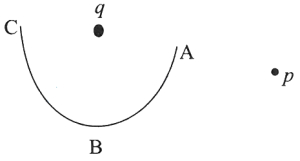
In the following diagram,the work done in moving a point charge from point $P$ to points $A, B$ and $C$ are $W_A, W_B$ and $W_C$ respectively. Then ($A, B, C$ are points on a semicircle and point charge $q$ is at the centre of the semicircle):
A
$W_A = W_B = W_C \neq 0$
B
$W_A = W_B = W_C = 0$
C
$W_A > W_B > W_C$
D
$W_A < W_B < W_C$
Solution
(A) The electric potential $V$ at any point at a distance $r$ from a point charge $q$ is given by $V = \frac{kq}{r}$.
Since points $A, B$ and $C$ lie on a semicircle with the charge $q$ at its centre,all these points are at the same distance $r$ (the radius of the semicircle) from the charge $q$.
Therefore,the electric potential at points $A, B$ and $C$ is the same,i.e.,$V_A = V_B = V_C = V$.
The work done in moving a charge $q_0$ from point $P$ to a point $X$ is given by $W = q_0(V_X - V_P)$.
Thus,the work done to move the charge to points $A, B$ and $C$ are:
$W_A = q_0(V_A - V_P) = q_0(V - V_P)$
$W_B = q_0(V_B - V_P) = q_0(V - V_P)$
$W_C = q_0(V_C - V_P) = q_0(V - V_P)$
Since $V_A = V_B = V_C$,it follows that $W_A = W_B = W_C$.
Since point $P$ is at a different distance from the charge $q$ compared to the points on the semicircle,$V_P \neq V$,therefore $W_A = W_B = W_C \neq 0$.
Since points $A, B$ and $C$ lie on a semicircle with the charge $q$ at its centre,all these points are at the same distance $r$ (the radius of the semicircle) from the charge $q$.
Therefore,the electric potential at points $A, B$ and $C$ is the same,i.e.,$V_A = V_B = V_C = V$.
The work done in moving a charge $q_0$ from point $P$ to a point $X$ is given by $W = q_0(V_X - V_P)$.
Thus,the work done to move the charge to points $A, B$ and $C$ are:
$W_A = q_0(V_A - V_P) = q_0(V - V_P)$
$W_B = q_0(V_B - V_P) = q_0(V - V_P)$
$W_C = q_0(V_C - V_P) = q_0(V - V_P)$
Since $V_A = V_B = V_C$,it follows that $W_A = W_B = W_C$.
Since point $P$ is at a different distance from the charge $q$ compared to the points on the semicircle,$V_P \neq V$,therefore $W_A = W_B = W_C \neq 0$.
0 likesView Solution
195
PhysicsMediumMCQAP EAMCET · 2024
In a nuclear reactor,the fuel is consumed at the rate of $1 \times 10^{-3} \text{ g s}^{-1}$. The power generated in kW is
A
$9 \times 10^{14}$
B
$9 \times 10^7$
C
$9 \times 10^8$
D
$9 \times 10^{12}$
Solution
(B) The rate of mass consumption is given by $\frac{\Delta m}{\Delta t} = 1 \times 10^{-3} \text{ g s}^{-1} = 10^{-6} \text{ kg s}^{-1}$.
According to Einstein's mass-energy equivalence principle,the power $P$ generated is given by $P = \frac{\Delta E}{\Delta t} = \left(\frac{\Delta m}{\Delta t}\right) c^2$.
Substituting the values,where $c = 3 \times 10^8 \text{ m s}^{-1}$:
$P = 10^{-6} \text{ kg s}^{-1} \times (3 \times 10^8 \text{ m s}^{-1})^2$.
$P = 10^{-6} \times 9 \times 10^{16} \text{ W}$.
$P = 9 \times 10^{10} \text{ W}$.
Since $1 \text{ kW} = 10^3 \text{ W}$,we convert the power to kW:
$P = \frac{9 \times 10^{10}}{10^3} \text{ kW} = 9 \times 10^7 \text{ kW}$.
According to Einstein's mass-energy equivalence principle,the power $P$ generated is given by $P = \frac{\Delta E}{\Delta t} = \left(\frac{\Delta m}{\Delta t}\right) c^2$.
Substituting the values,where $c = 3 \times 10^8 \text{ m s}^{-1}$:
$P = 10^{-6} \text{ kg s}^{-1} \times (3 \times 10^8 \text{ m s}^{-1})^2$.
$P = 10^{-6} \times 9 \times 10^{16} \text{ W}$.
$P = 9 \times 10^{10} \text{ W}$.
Since $1 \text{ kW} = 10^3 \text{ W}$,we convert the power to kW:
$P = \frac{9 \times 10^{10}}{10^3} \text{ kW} = 9 \times 10^7 \text{ kW}$.
0 likesView Solution
Vedclass Products
For Students
Vedclass Test Series
Mock tests in real AP EAMCET style covering Physics with performance analysis. 5-day free trial.
Start Free TrialFor Teachers
Exam Paper Generator
Generate Set A/B/C/D Physics papers from 7.5L+ questions in 2 minutes. 3 chapters free.
Try FreeFor Institutes
Online Exam Module
Run live AP EAMCET mock exams with unlimited students, 360° analytics & white-label branding.
See DemoFrequently Asked Questions
How many Physics questions are in AP EAMCET 2024?
There are 345 Physics questions from the AP EAMCET 2024 paper on Vedclass, each with a detailed step-by-step solution in English.
Are AP EAMCET 2024 Physics solutions available in English?
Yes. All solutions on this page are in English. You can also switch to English or Hindi using the language buttons above the questions.
Can I practice AP EAMCET 2024 Physics as a timed test?
Yes. Use the Vedclass Test Series to attempt a full AP EAMCET mock test covering Physics with time limits and instant score analysis.
Can teachers create Physics papers from AP EAMCET previous year questions?
Yes. The Vedclass Exam Paper Generator lets teachers mix AP EAMCET Physics questions and generate Set A/B/C/D papers in minutes.
For Teachers & Institutes
Build a Custom Physics Paper
Pick AP EAMCET 2024 Physics questions, set difficulty, and generate Set A/B/C/D in 2 minutes.