
MathematicsQ301–392 of 723 questions
Page 7 of 8 · English
301
MathematicsMediumMCQAP EAMCET · 2024
If $\lim _{x}$ ${\rightarrow \infty} \frac{(\sqrt{2 x+1}+\sqrt{2 x-1})^8+(\sqrt{2 x+1}-\sqrt{2 x-1})^8(P x^4-16)}{(x+\sqrt{x^2-2})^8+(x-\sqrt{x^2-2})^8} = 1$,then $P=$
A
$16$
B
$64$
C
$\frac{1}{64}$
D
$\frac{1}{16}$
Solution
(D) Let $L = \lim _{x}$ ${\rightarrow \infty} \frac{(\sqrt{2 x+1}+\sqrt{2 x-1})^8+(\sqrt{2 x+1}-\sqrt{2 x-1})^8(P x^4-16)}{(x+\sqrt{x^2-2})^8+(x-\sqrt{x^2-2})^8} = 1$.
Divide the numerator and denominator by $x^4$ inside the terms or analyze the growth rates.
As $x \rightarrow \infty$,$\sqrt{2x+1} + \sqrt{2x-1} \approx 2\sqrt{2x}$ and $\sqrt{2x+1} - \sqrt{2x-1} = \frac{2}{\sqrt{2x+1} + \sqrt{2x-1}} \approx \frac{2}{2\sqrt{2x}} = \frac{1}{\sqrt{2x}}$.
Thus,$(\sqrt{2x+1} + \sqrt{2x-1})^8 \approx (2\sqrt{2x})^8 = 2^4 \cdot (2x)^4 = 16 \cdot 16x^4 = 256x^4$.
Also,$(x+\sqrt{x^2-2})^8 \approx (2x)^8 = 256x^8$.
The expression becomes $\lim _{x \rightarrow \infty} \frac{256x^4 + (\frac{1}{\sqrt{2x}})^8(Px^4-16)}{256x^8} = 1$.
Since $(\frac{1}{\sqrt{2x}})^8 = \frac{1}{16x^4}$,the expression is $\lim _{x \rightarrow \infty} \frac{256x^4 + \frac{1}{16x^4}(Px^4-16)}{256x^8} = 1$.
This simplifies to $\lim _{x \rightarrow \infty} \frac{256x^4 + \frac{P}{16} - \frac{1}{x^4}}{256x^8} = 1$.
For the limit to be $1$,the leading coefficients must match.
$256x^4 \cdot Px^4$ terms dominate,leading to $P = \frac{1}{16}$.
Divide the numerator and denominator by $x^4$ inside the terms or analyze the growth rates.
As $x \rightarrow \infty$,$\sqrt{2x+1} + \sqrt{2x-1} \approx 2\sqrt{2x}$ and $\sqrt{2x+1} - \sqrt{2x-1} = \frac{2}{\sqrt{2x+1} + \sqrt{2x-1}} \approx \frac{2}{2\sqrt{2x}} = \frac{1}{\sqrt{2x}}$.
Thus,$(\sqrt{2x+1} + \sqrt{2x-1})^8 \approx (2\sqrt{2x})^8 = 2^4 \cdot (2x)^4 = 16 \cdot 16x^4 = 256x^4$.
Also,$(x+\sqrt{x^2-2})^8 \approx (2x)^8 = 256x^8$.
The expression becomes $\lim _{x \rightarrow \infty} \frac{256x^4 + (\frac{1}{\sqrt{2x}})^8(Px^4-16)}{256x^8} = 1$.
Since $(\frac{1}{\sqrt{2x}})^8 = \frac{1}{16x^4}$,the expression is $\lim _{x \rightarrow \infty} \frac{256x^4 + \frac{1}{16x^4}(Px^4-16)}{256x^8} = 1$.
This simplifies to $\lim _{x \rightarrow \infty} \frac{256x^4 + \frac{P}{16} - \frac{1}{x^4}}{256x^8} = 1$.
For the limit to be $1$,the leading coefficients must match.
$256x^4 \cdot Px^4$ terms dominate,leading to $P = \frac{1}{16}$.
0 likesView Solution
302
MathematicsEasyMCQAP EAMCET · 2024
$\lim _{x \rightarrow 1} \left( \frac{x+x^2+x^3+\ldots+x^n-n}{x-1} \right) = $
A
$\frac{n(n+1)}{2}$
B
$\frac{n+1}{2}$
C
$\frac{2}{n}$
D
$n$
Solution
(A) Let $L = \lim _{x \rightarrow 1} \left( \frac{x+x^2+x^3+\ldots+x^n-n}{x-1} \right)$.
We can rewrite the numerator as: $(x-1) + (x^2-1) + (x^3-1) + \ldots + (x^n-1)$.
So,$L = \lim _{x \rightarrow 1} \left( \frac{(x-1) + (x^2-1) + (x^3-1) + \ldots + (x^n-1)}{x-1} \right)$.
$L = \lim _{x}$ ${\rightarrow 1} \left( \frac{x-1}{x-1} + \frac{x^2-1}{x-1} + \frac{x^3-1}{x-1} + \ldots + \frac{x^n-1}{x-1} \right)$.
Using the standard limit $\lim _{x \rightarrow a} \frac{x^n-a^n}{x-a} = na^{n-1}$,we get:
$L = 1 + 2(1)^{2-1} + 3(1)^{3-1} + \ldots + n(1)^{n-1}$.
$L = 1 + 2 + 3 + \ldots + n$.
$L = \frac{n(n+1)}{2}$.
We can rewrite the numerator as: $(x-1) + (x^2-1) + (x^3-1) + \ldots + (x^n-1)$.
So,$L = \lim _{x \rightarrow 1} \left( \frac{(x-1) + (x^2-1) + (x^3-1) + \ldots + (x^n-1)}{x-1} \right)$.
$L = \lim _{x}$ ${\rightarrow 1} \left( \frac{x-1}{x-1} + \frac{x^2-1}{x-1} + \frac{x^3-1}{x-1} + \ldots + \frac{x^n-1}{x-1} \right)$.
Using the standard limit $\lim _{x \rightarrow a} \frac{x^n-a^n}{x-a} = na^{n-1}$,we get:
$L = 1 + 2(1)^{2-1} + 3(1)^{3-1} + \ldots + n(1)^{n-1}$.
$L = 1 + 2 + 3 + \ldots + n$.
$L = \frac{n(n+1)}{2}$.
0 likesView Solution
303
MathematicsEasyMCQAP EAMCET · 2024
$\lim _{x \rightarrow 0} \frac{\cos 2x - \cos 3x}{\cos 4x - \cos 5x} = $
A
$\frac{5}{9}$
B
$1$
C
$\frac{3}{4}$
D
$\frac{2}{5}$
Solution
(A) Using $L'H\hat{o}pital's$ rule,we differentiate the numerator and denominator with respect to $x$:
$\lim _{x \rightarrow 0} \frac{\frac{d}{dx}(\cos 2x - \cos 3x)}{\frac{d}{dx}(\cos 4x - \cos 5x)} = \lim _{x \rightarrow 0} \frac{-2 \sin 2x + 3 \sin 3x}{-4 \sin 4x + 5 \sin 5x}$
Since this is still in the $\frac{0}{0}$ form,we apply $L'H\hat{o}pital's$ rule again:
$\lim _{x \rightarrow 0} \frac{-4 \cos 2x + 9 \cos 3x}{-16 \cos 4x + 25 \cos 5x}$
Substituting $x = 0$:
$= \frac{-4 \cos(0) + 9 \cos(0)}{-16 \cos(0) + 25 \cos(0)} = \frac{-4(1) + 9(1)}{-16(1) + 25(1)} = \frac{5}{9}$
$\lim _{x \rightarrow 0} \frac{\frac{d}{dx}(\cos 2x - \cos 3x)}{\frac{d}{dx}(\cos 4x - \cos 5x)} = \lim _{x \rightarrow 0} \frac{-2 \sin 2x + 3 \sin 3x}{-4 \sin 4x + 5 \sin 5x}$
Since this is still in the $\frac{0}{0}$ form,we apply $L'H\hat{o}pital's$ rule again:
$\lim _{x \rightarrow 0} \frac{-4 \cos 2x + 9 \cos 3x}{-16 \cos 4x + 25 \cos 5x}$
Substituting $x = 0$:
$= \frac{-4 \cos(0) + 9 \cos(0)}{-16 \cos(0) + 25 \cos(0)} = \frac{-4(1) + 9(1)}{-16(1) + 25(1)} = \frac{5}{9}$
0 likesView Solution
304
MathematicsMediumMCQAP EAMCET · 2024
$\lim _{x \rightarrow 0} \frac{1-\cos x \cos 2 x}{\sin ^2 x} = $
A
$\frac{11}{4}$
B
$\frac{5}{2}$
C
$3$
D
$5$
Solution
(B) We need to evaluate the limit $L = \lim _{x \rightarrow 0} \frac{1-\cos x \cos 2 x}{\sin ^2 x}$.
Using the identity $\cos 2x = 1 - 2\sin^2 x$,we rewrite the numerator:
$1 - \cos x(1 - 2\sin^2 x) = 1 - \cos x + 2\sin^2 x \cos x$.
So,$L = \lim _{x \rightarrow 0} \frac{1 - \cos x + 2\sin^2 x \cos x}{\sin^2 x}$.
$L = \lim _{x \rightarrow 0} \left( \frac{1 - \cos x}{\sin^2 x} + \frac{2\sin^2 x \cos x}{\sin^2 x} \right)$.
Using $\sin^2 x = 1 - \cos^2 x = (1 - \cos x)(1 + \cos x)$:
$L = \lim _{x \rightarrow 0} \left( \frac{1 - \cos x}{(1 - \cos x)(1 + \cos x)} + 2\cos x \right)$.
$L = \lim _{x \rightarrow 0} \left( \frac{1}{1 + \cos x} + 2\cos x \right)$.
Substituting $x = 0$:
$L = \frac{1}{1 + 1} + 2(1) = \frac{1}{2} + 2 = \frac{5}{2}$.
Using the identity $\cos 2x = 1 - 2\sin^2 x$,we rewrite the numerator:
$1 - \cos x(1 - 2\sin^2 x) = 1 - \cos x + 2\sin^2 x \cos x$.
So,$L = \lim _{x \rightarrow 0} \frac{1 - \cos x + 2\sin^2 x \cos x}{\sin^2 x}$.
$L = \lim _{x \rightarrow 0} \left( \frac{1 - \cos x}{\sin^2 x} + \frac{2\sin^2 x \cos x}{\sin^2 x} \right)$.
Using $\sin^2 x = 1 - \cos^2 x = (1 - \cos x)(1 + \cos x)$:
$L = \lim _{x \rightarrow 0} \left( \frac{1 - \cos x}{(1 - \cos x)(1 + \cos x)} + 2\cos x \right)$.
$L = \lim _{x \rightarrow 0} \left( \frac{1}{1 + \cos x} + 2\cos x \right)$.
Substituting $x = 0$:
$L = \frac{1}{1 + 1} + 2(1) = \frac{1}{2} + 2 = \frac{5}{2}$.
0 likesView Solution
305
MathematicsEasyMCQAP EAMCET · 2024
If $f(x) = \frac{5x \operatorname{cosec}(\sqrt{x}) - 1}{(x - 2) \operatorname{cosec}(\sqrt{x})}$,then $\lim_{x \rightarrow \infty} f(x^2) = $
A
$1$
B
$-1$
C
$5$
D
$-5$
Solution
(C) Given $f(x) = \frac{5x \operatorname{cosec}(\sqrt{x}) - 1}{(x - 2) \operatorname{cosec}(\sqrt{x})}$.
Substituting $x^2$ for $x$,we get:
$f(x^2) = \frac{5x^2 \operatorname{cosec}(x) - 1}{(x^2 - 2) \operatorname{cosec}(x)} = \frac{5x^2 \operatorname{cosec}(x)}{(x^2 - 2) \operatorname{cosec}(x)} - \frac{1}{(x^2 - 2) \operatorname{cosec}(x)}$.
$f(x^2) = \frac{5x^2}{x^2 - 2} - \frac{\sin(x)}{x^2 - 2}$.
Now,taking the limit as $x \rightarrow \infty$:
$\lim_{x \rightarrow \infty} f(x^2) = \lim_{x \rightarrow \infty} \left( \frac{5x^2}{x^2 - 2} - \frac{\sin(x)}{x^2 - 2} \right)$.
Since $\lim_{x \rightarrow \infty} \frac{5x^2}{x^2 - 2} = 5$ and $\lim_{x \rightarrow \infty} \frac{\sin(x)}{x^2 - 2} = 0$ (as $-1 \leq \sin(x) \leq 1$ and $x^2 - 2 \rightarrow \infty$),
$\lim_{x \rightarrow \infty} f(x^2) = 5 - 0 = 5$.
Substituting $x^2$ for $x$,we get:
$f(x^2) = \frac{5x^2 \operatorname{cosec}(x) - 1}{(x^2 - 2) \operatorname{cosec}(x)} = \frac{5x^2 \operatorname{cosec}(x)}{(x^2 - 2) \operatorname{cosec}(x)} - \frac{1}{(x^2 - 2) \operatorname{cosec}(x)}$.
$f(x^2) = \frac{5x^2}{x^2 - 2} - \frac{\sin(x)}{x^2 - 2}$.
Now,taking the limit as $x \rightarrow \infty$:
$\lim_{x \rightarrow \infty} f(x^2) = \lim_{x \rightarrow \infty} \left( \frac{5x^2}{x^2 - 2} - \frac{\sin(x)}{x^2 - 2} \right)$.
Since $\lim_{x \rightarrow \infty} \frac{5x^2}{x^2 - 2} = 5$ and $\lim_{x \rightarrow \infty} \frac{\sin(x)}{x^2 - 2} = 0$ (as $-1 \leq \sin(x) \leq 1$ and $x^2 - 2 \rightarrow \infty$),
$\lim_{x \rightarrow \infty} f(x^2) = 5 - 0 = 5$.
0 likesView Solution
306
MathematicsEasyMCQAP EAMCET · 2024
$\lim _{x \rightarrow 0} \left( \frac{\sin (\pi \cos ^2 x)}{x^2} \right) = $
A
$-\pi$
B
$\pi$
C
$\frac{\pi}{2}$
D
$1$
Solution
(B) Given the limit: $\lim _{x \rightarrow 0} \frac{\sin (\pi \cos ^2 x)}{x^2}$
Since $\cos ^2 x = 1 - \sin ^2 x$,we have $\pi \cos ^2 x = \pi - \pi \sin ^2 x$.
Using the identity $\sin (\pi - \theta) = \sin \theta$,we get $\sin (\pi - \pi \sin ^2 x) = \sin (\pi \sin ^2 x)$.
Now,the limit becomes: $\lim _{x \rightarrow 0} \frac{\sin (\pi \sin ^2 x)}{x^2}$.
Multiplying and dividing by $\pi \sin ^2 x$:
$\lim _{x}$ ${\rightarrow 0} \left( \frac{\sin (\pi \sin ^2 x)}{\pi \sin ^2 x} \right) \times \left( \frac{\pi \sin ^2 x}{x^2} \right)$.
As $x \rightarrow 0$,$\sin ^2 x \rightarrow 0$,so $\frac{\sin (\pi \sin ^2 x)}{\pi \sin ^2 x} \rightarrow 1$.
Also,$\lim _{x \rightarrow 0} \frac{\sin ^2 x}{x^2} = 1$.
Therefore,the limit is $1 \times \pi \times 1 = \pi$.
Since $\cos ^2 x = 1 - \sin ^2 x$,we have $\pi \cos ^2 x = \pi - \pi \sin ^2 x$.
Using the identity $\sin (\pi - \theta) = \sin \theta$,we get $\sin (\pi - \pi \sin ^2 x) = \sin (\pi \sin ^2 x)$.
Now,the limit becomes: $\lim _{x \rightarrow 0} \frac{\sin (\pi \sin ^2 x)}{x^2}$.
Multiplying and dividing by $\pi \sin ^2 x$:
$\lim _{x}$ ${\rightarrow 0} \left( \frac{\sin (\pi \sin ^2 x)}{\pi \sin ^2 x} \right) \times \left( \frac{\pi \sin ^2 x}{x^2} \right)$.
As $x \rightarrow 0$,$\sin ^2 x \rightarrow 0$,so $\frac{\sin (\pi \sin ^2 x)}{\pi \sin ^2 x} \rightarrow 1$.
Also,$\lim _{x \rightarrow 0} \frac{\sin ^2 x}{x^2} = 1$.
Therefore,the limit is $1 \times \pi \times 1 = \pi$.
0 likesView Solution
307
MathematicsEasyMCQAP EAMCET · 2024
If $\lim _{x \rightarrow 0} \frac{e^x-a-\log (1+x)}{\sin x}=0$,then $a=$
A
$2$
B
$0$
C
$-1$
D
$1$
Solution
(D) Given $\lim _{x \rightarrow 0} \frac{e^x-a-\log (1+x)}{\sin x}=0$.
For the limit to exist and be finite,the numerator must approach $0$ as $x \rightarrow 0$ because the denominator $\sin x \rightarrow 0$.
Substituting $x=0$ in the numerator: $e^0 - a - \log(1+0) = 0$.
$1 - a - 0 = 0$.
Therefore,$a = 1$.
Checking with $a=1$: $\lim _{x \rightarrow 0} \frac{e^x-1-\log (1+x)}{\sin x}$.
Using $L$'Hopital's rule: $\lim _{x \rightarrow 0} \frac{e^x - \frac{1}{1+x}}{\cos x} = \frac{1-1}{1} = 0$.
Thus,the condition holds for $a=1$.
For the limit to exist and be finite,the numerator must approach $0$ as $x \rightarrow 0$ because the denominator $\sin x \rightarrow 0$.
Substituting $x=0$ in the numerator: $e^0 - a - \log(1+0) = 0$.
$1 - a - 0 = 0$.
Therefore,$a = 1$.
Checking with $a=1$: $\lim _{x \rightarrow 0} \frac{e^x-1-\log (1+x)}{\sin x}$.
Using $L$'Hopital's rule: $\lim _{x \rightarrow 0} \frac{e^x - \frac{1}{1+x}}{\cos x} = \frac{1-1}{1} = 0$.
Thus,the condition holds for $a=1$.
0 likesView Solution
308
MathematicsEasyMCQAP EAMCET · 2024
$\lim _{x \rightarrow 0} \left[ \frac{1}{x} - \frac{1}{e^x - 1} \right] = $
A
$0$
B
$1$
C
$2$
D
$\frac{1}{2}$
Solution
(D) Given limit: $L = \lim _{x \rightarrow 0} \left[ \frac{1}{x} - \frac{1}{e^x - 1} \right] = \lim _{x \rightarrow 0} \left[ \frac{e^x - 1 - x}{x(e^x - 1)} \right]$
This is in the $\frac{0}{0}$ indeterminate form.
Applying $L'\text{Hopital's rule}$:
$= \lim _{x \rightarrow 0} \frac{\frac{d}{dx}(e^x - 1 - x)}{\frac{d}{dx}(xe^x - x)} = \lim _{x \rightarrow 0} \frac{e^x - 1}{e^x + xe^x - 1}$
This is still in the $\frac{0}{0}$ form.
Applying $L'\text{Hopital's rule}$ again:
$= \lim _{x \rightarrow 0} \frac{\frac{d}{dx}(e^x - 1)}{\frac{d}{dx}(e^x + xe^x - 1)} = \lim _{x \rightarrow 0} \frac{e^x}{e^x + e^x + xe^x} = \lim _{x \rightarrow 0} \frac{e^x}{2e^x + xe^x}$
Substituting $x = 0$:
$= \frac{e^0}{2e^0 + 0 \cdot e^0} = \frac{1}{2 + 0} = \frac{1}{2}$
This is in the $\frac{0}{0}$ indeterminate form.
Applying $L'\text{Hopital's rule}$:
$= \lim _{x \rightarrow 0} \frac{\frac{d}{dx}(e^x - 1 - x)}{\frac{d}{dx}(xe^x - x)} = \lim _{x \rightarrow 0} \frac{e^x - 1}{e^x + xe^x - 1}$
This is still in the $\frac{0}{0}$ form.
Applying $L'\text{Hopital's rule}$ again:
$= \lim _{x \rightarrow 0} \frac{\frac{d}{dx}(e^x - 1)}{\frac{d}{dx}(e^x + xe^x - 1)} = \lim _{x \rightarrow 0} \frac{e^x}{e^x + e^x + xe^x} = \lim _{x \rightarrow 0} \frac{e^x}{2e^x + xe^x}$
Substituting $x = 0$:
$= \frac{e^0}{2e^0 + 0 \cdot e^0} = \frac{1}{2 + 0} = \frac{1}{2}$
0 likesView Solution
309
MathematicsEasyMCQAP EAMCET · 2024
$\lim _{x \rightarrow \infty}\left(\frac{3 x^2-2 x+3}{3 x^2+x-2}\right)^{3 x-2} = $
A
$e^3$
B
$e^{-1}$
C
$e^{-3}$
D
$e^1$
Solution
(C) The given limit is of the form $1^\infty$.
We use the formula $\lim _{x \rightarrow \infty} (f(x))^{g(x)} = e^{\lim _{x \rightarrow \infty} (f(x)-1)g(x)}$.
Here,$f(x) = \frac{3x^2-2x+3}{3x^2+x-2}$ and $g(x) = 3x-2$.
$(f(x)-1) = \frac{3x^2-2x+3 - (3x^2+x-2)}{3x^2+x-2} = \frac{-3x+5}{3x^2+x-2}$.
Now,$\lim _{x \rightarrow \infty} (f(x)-1)g(x) = \lim _{x \rightarrow \infty} \left(\frac{-3x+5}{3x^2+x-2}\right)(3x-2)$.
$= \lim _{x \rightarrow \infty} \frac{-9x^2+6x+15x-10}{3x^2+x-2} = \lim _{x \rightarrow \infty} \frac{-9x^2+21x-10}{3x^2+x-2}$.
Dividing the numerator and denominator by $x^2$,we get $\frac{-9}{3} = -3$.
Therefore,the limit is $e^{-3}$.
We use the formula $\lim _{x \rightarrow \infty} (f(x))^{g(x)} = e^{\lim _{x \rightarrow \infty} (f(x)-1)g(x)}$.
Here,$f(x) = \frac{3x^2-2x+3}{3x^2+x-2}$ and $g(x) = 3x-2$.
$(f(x)-1) = \frac{3x^2-2x+3 - (3x^2+x-2)}{3x^2+x-2} = \frac{-3x+5}{3x^2+x-2}$.
Now,$\lim _{x \rightarrow \infty} (f(x)-1)g(x) = \lim _{x \rightarrow \infty} \left(\frac{-3x+5}{3x^2+x-2}\right)(3x-2)$.
$= \lim _{x \rightarrow \infty} \frac{-9x^2+6x+15x-10}{3x^2+x-2} = \lim _{x \rightarrow \infty} \frac{-9x^2+21x-10}{3x^2+x-2}$.
Dividing the numerator and denominator by $x^2$,we get $\frac{-9}{3} = -3$.
Therefore,the limit is $e^{-3}$.
0 likesView Solution
310
MathematicsMediumMCQAP EAMCET · 2024
$\lim_{x \rightarrow \infty} \frac{[2x - 3]}{x} = $
A
$0$
B
$\infty$
C
$-3$
D
$2$
Solution
(D) We know that for any real number $y$,$y - 1 < [y] \leq y$.
Substituting $y = 2x - 3$,we get:
$(2x - 3) - 1 < [2x - 3] \leq 2x - 3$
$2x - 4 < [2x - 3] \leq 2x - 3$
Dividing the entire inequality by $x$ (for $x > 0$):
$\frac{2x - 4}{x} < \frac{[2x - 3]}{x} \leq \frac{2x - 3}{x}$
$2 - \frac{4}{x} < \frac{[2x - 3]}{x} \leq 2 - \frac{3}{x}$
Applying the limit as $x \rightarrow \infty$:
$\lim_{x \rightarrow \infty} (2 - \frac{4}{x}) \leq \lim_{x \rightarrow \infty} \frac{[2x - 3]}{x} \leq \lim_{x \rightarrow \infty} (2 - \frac{3}{x})$
$2 - 0 \leq \lim_{x \rightarrow \infty} \frac{[2x - 3]}{x} \leq 2 - 0$
By the Squeeze Theorem,$\lim_{x \rightarrow \infty} \frac{[2x - 3]}{x} = 2$.
Substituting $y = 2x - 3$,we get:
$(2x - 3) - 1 < [2x - 3] \leq 2x - 3$
$2x - 4 < [2x - 3] \leq 2x - 3$
Dividing the entire inequality by $x$ (for $x > 0$):
$\frac{2x - 4}{x} < \frac{[2x - 3]}{x} \leq \frac{2x - 3}{x}$
$2 - \frac{4}{x} < \frac{[2x - 3]}{x} \leq 2 - \frac{3}{x}$
Applying the limit as $x \rightarrow \infty$:
$\lim_{x \rightarrow \infty} (2 - \frac{4}{x}) \leq \lim_{x \rightarrow \infty} \frac{[2x - 3]}{x} \leq \lim_{x \rightarrow \infty} (2 - \frac{3}{x})$
$2 - 0 \leq \lim_{x \rightarrow \infty} \frac{[2x - 3]}{x} \leq 2 - 0$
By the Squeeze Theorem,$\lim_{x \rightarrow \infty} \frac{[2x - 3]}{x} = 2$.
0 likesView Solution
311
MathematicsDifficultMCQAP EAMCET · 2024
If $m$ and $M$ denote the mean deviations about the mean and about the median respectively of the data $20, 5, 15, 2, 7, 3, 11$,then the mean deviation about the mean of $m$ and $M$ is
A
$\frac{1}{7}$
B
$\frac{38}{7}$
C
$\frac{36}{7}$
D
$\frac{37}{7}$
Solution
(A) The given data is $20, 5, 15, 2, 7, 3, 11$. The number of observations $n = 7$.
First,calculate the mean $\bar{x} = \frac{20+5+15+2+7+3+11}{7} = \frac{63}{7} = 9$.
Mean deviation about mean $m = \frac{\sum |x_i - \bar{x}|}{n} = \frac{|20-9|+|5-9|+|15-9|+|2-9|+|7-9|+|3-9|+|11-9|}{7} = \frac{11+4+6+7+2+4+2}{7} = \frac{36}{7}$.
Wait,let us re-calculate: $11+4+6+7+2+4+2 = 36$. So $m = \frac{36}{7}$.
Now,for median,arrange data in ascending order: $2, 3, 5, 7, 11, 15, 20$.
Median $= \left(\frac{7+1}{2}\right)^{\text{th}}$ term $= 4^{\text{th}}$ term $= 7$.
Mean deviation about median $M = \frac{\sum |x_i - \text{Median}|}{n} = \frac{|2-7|+|3-7|+|5-7|+|7-7|+|11-7|+|15-7|+|20-7|}{7} = \frac{5+4+2+0+4+8+13}{7} = \frac{36}{7}$.
Wait,let us re-calculate: $5+4+2+0+4+8+13 = 36$. So $M = \frac{36}{7}$.
Actually,$m = \frac{36}{7}$ and $M = \frac{36}{7}$.
The mean of $m$ and $M$ is $\bar{x}^{\prime} = \frac{m+M}{2} = \frac{36/7 + 36/7}{2} = \frac{36}{7}$.
The mean deviation about the mean of $m$ and $M$ is $\frac{|m-\bar{x}^{\prime}| + |M-\bar{x}^{\prime}|}{2} = \frac{|36/7 - 36/7| + |36/7 - 36/7|}{2} = 0$.
Given the options,there might be a calculation error in the provided question's data or options. Re-evaluating the sum for $m$: $|20-9|=11, |5-9|=4, |15-9|=6, |2-9|=7, |7-9|=2, |3-9|=6, |11-9|=2$. Sum $= 11+4+6+7+2+6+2 = 38$. So $m = \frac{38}{7}$.
Re-evaluating the sum for $M$: $|20-7|=13, |5-7|=2, |15-7|=8, |2-7|=5, |7-7|=0, |3-7|=4, |11-7|=4$. Sum $= 13+2+8+5+0+4+4 = 36$. So $M = \frac{36}{7}$.
Mean of $m$ and $M$ is $\bar{x}^{\prime} = \frac{38/7 + 36/7}{2} = \frac{74/7}{2} = \frac{37}{7}$.
Mean deviation about mean of $m$ and $M$ is $\frac{|38/7 - 37/7| + |36/7 - 37/7|}{2} = \frac{1/7 + 1/7}{2} = \frac{2/7}{2} = \frac{1}{7}$.
First,calculate the mean $\bar{x} = \frac{20+5+15+2+7+3+11}{7} = \frac{63}{7} = 9$.
Mean deviation about mean $m = \frac{\sum |x_i - \bar{x}|}{n} = \frac{|20-9|+|5-9|+|15-9|+|2-9|+|7-9|+|3-9|+|11-9|}{7} = \frac{11+4+6+7+2+4+2}{7} = \frac{36}{7}$.
Wait,let us re-calculate: $11+4+6+7+2+4+2 = 36$. So $m = \frac{36}{7}$.
Now,for median,arrange data in ascending order: $2, 3, 5, 7, 11, 15, 20$.
Median $= \left(\frac{7+1}{2}\right)^{\text{th}}$ term $= 4^{\text{th}}$ term $= 7$.
Mean deviation about median $M = \frac{\sum |x_i - \text{Median}|}{n} = \frac{|2-7|+|3-7|+|5-7|+|7-7|+|11-7|+|15-7|+|20-7|}{7} = \frac{5+4+2+0+4+8+13}{7} = \frac{36}{7}$.
Wait,let us re-calculate: $5+4+2+0+4+8+13 = 36$. So $M = \frac{36}{7}$.
Actually,$m = \frac{36}{7}$ and $M = \frac{36}{7}$.
The mean of $m$ and $M$ is $\bar{x}^{\prime} = \frac{m+M}{2} = \frac{36/7 + 36/7}{2} = \frac{36}{7}$.
The mean deviation about the mean of $m$ and $M$ is $\frac{|m-\bar{x}^{\prime}| + |M-\bar{x}^{\prime}|}{2} = \frac{|36/7 - 36/7| + |36/7 - 36/7|}{2} = 0$.
Given the options,there might be a calculation error in the provided question's data or options. Re-evaluating the sum for $m$: $|20-9|=11, |5-9|=4, |15-9|=6, |2-9|=7, |7-9|=2, |3-9|=6, |11-9|=2$. Sum $= 11+4+6+7+2+6+2 = 38$. So $m = \frac{38}{7}$.
Re-evaluating the sum for $M$: $|20-7|=13, |5-7|=2, |15-7|=8, |2-7|=5, |7-7|=0, |3-7|=4, |11-7|=4$. Sum $= 13+2+8+5+0+4+4 = 36$. So $M = \frac{36}{7}$.
Mean of $m$ and $M$ is $\bar{x}^{\prime} = \frac{38/7 + 36/7}{2} = \frac{74/7}{2} = \frac{37}{7}$.
Mean deviation about mean of $m$ and $M$ is $\frac{|38/7 - 37/7| + |36/7 - 37/7|}{2} = \frac{1/7 + 1/7}{2} = \frac{2/7}{2} = \frac{1}{7}$.
0 likesView Solution
312
MathematicsEasyMCQAP EAMCET · 2024
$\bar{x}$ and $\bar{y}$ are the arithmetic means of the runs of two batsmen $A$ and $B$ in $10$ innings respectively,and $\sigma_{A}$ and $\sigma_{B}$ are the standard deviations of their runs. If batsman $A$ is more consistent than $B$,then he is also a higher run scorer only when
A
$0 < \frac{\sigma_{A}}{\sigma_{B}} < \frac{\bar{x}}{\bar{y}}$ and $\frac{\bar{x}}{\bar{y}} > 1$
B
$\frac{\bar{x}}{\bar{y}} > \frac{\sigma_{A}}{\sigma_{B}} > 1$
C
$\frac{\bar{x}}{\bar{y}} < \frac{\sigma_{A}}{\sigma_{B}} > 1$
D
$\frac{\bar{x}}{\bar{y}} > 1$ and $1 \leq \frac{\bar{x}}{\bar{y}} < \frac{\sigma_{A}}{\sigma_{B}}$
Solution
(A) Consistency is measured by the coefficient of variation $(CV)$. $A$ lower $CV$ implies higher consistency.
Batsman $A$ is more consistent than $B$,so $CV_{A} < CV_{B}$.
This implies $\frac{\sigma_{A}}{\bar{x}} < \frac{\sigma_{B}}{\bar{y}}$.
Rearranging this gives $\frac{\sigma_{A}}{\sigma_{B}} < \frac{\bar{x}}{\bar{y}}$.
Since $\sigma_{A}, \sigma_{B}, \bar{x}, \bar{y} > 0$,we have $0 < \frac{\sigma_{A}}{\sigma_{B}} < \frac{\bar{x}}{\bar{y}}$.
For $A$ to be a higher run scorer,we must have $\bar{x} > \bar{y}$,which implies $\frac{\bar{x}}{\bar{y}} > 1$.
Batsman $A$ is more consistent than $B$,so $CV_{A} < CV_{B}$.
This implies $\frac{\sigma_{A}}{\bar{x}} < \frac{\sigma_{B}}{\bar{y}}$.
Rearranging this gives $\frac{\sigma_{A}}{\sigma_{B}} < \frac{\bar{x}}{\bar{y}}$.
Since $\sigma_{A}, \sigma_{B}, \bar{x}, \bar{y} > 0$,we have $0 < \frac{\sigma_{A}}{\sigma_{B}} < \frac{\bar{x}}{\bar{y}}$.
For $A$ to be a higher run scorer,we must have $\bar{x} > \bar{y}$,which implies $\frac{\bar{x}}{\bar{y}} > 1$.
0 likesView Solution
313
MathematicsEasyMCQAP EAMCET · 2024
If the mean of the data $7, 8, 9, 7, 8, 7, \lambda, 8$ is $8$,then the variance of the data is:
A
$2$
B
$\frac{7}{8}$
C
$\frac{9}{8}$
D
$1$
Solution
(D) Given the mean of the data $7, 8, 9, 7, 8, 7, \lambda, 8$ is $8$.
Mean $= \frac{7+8+9+7+8+7+\lambda+8}{8} = 8$
$\Rightarrow \frac{54+\lambda}{8} = 8$
$\Rightarrow 54+\lambda = 64$
$\Rightarrow \lambda = 10$
Now,the data set is $7, 8, 9, 7, 8, 7, 10, 8$.
Variance $(\sigma^2) = \frac{1}{n} \sum (x_i - \bar{x})^2$
Variance $= \frac{(7-8)^2 + (8-8)^2 + (9-8)^2 + (7-8)^2 + (8-8)^2 + (7-8)^2 + (10-8)^2 + (8-8)^2}{8}$
Variance $= \frac{(-1)^2 + 0^2 + 1^2 + (-1)^2 + 0^2 + (-1)^2 + 2^2 + 0^2}{8}$
Variance $= \frac{1 + 0 + 1 + 1 + 0 + 1 + 4 + 0}{8} = \frac{8}{8} = 1$.
Mean $= \frac{7+8+9+7+8+7+\lambda+8}{8} = 8$
$\Rightarrow \frac{54+\lambda}{8} = 8$
$\Rightarrow 54+\lambda = 64$
$\Rightarrow \lambda = 10$
Now,the data set is $7, 8, 9, 7, 8, 7, 10, 8$.
Variance $(\sigma^2) = \frac{1}{n} \sum (x_i - \bar{x})^2$
Variance $= \frac{(7-8)^2 + (8-8)^2 + (9-8)^2 + (7-8)^2 + (8-8)^2 + (7-8)^2 + (10-8)^2 + (8-8)^2}{8}$
Variance $= \frac{(-1)^2 + 0^2 + 1^2 + (-1)^2 + 0^2 + (-1)^2 + 2^2 + 0^2}{8}$
Variance $= \frac{1 + 0 + 1 + 1 + 0 + 1 + 4 + 0}{8} = \frac{8}{8} = 1$.
0 likesView Solution
314
MathematicsEasyMCQAP EAMCET · 2024
$\begin{aligned} &\text{Find the mean deviation about the mean for the following data:} \\ &\begin{array}{|l|c|c|c|c|c|} \hline \text{Class Interval} & 0-6 & 6-12 & 12-18 & 18-24 & 24-30 \\ \hline \text{Frequency} & 1 & 2 & 3 & 2 & 1 \\ \hline \end{array} \end{aligned}$
A
$5$
B
$\frac{16}{3}$
C
$6$
D
$\frac{19}{3}$
Solution
(B) Step $1$: Find the class midpoints $(x_i)$ :
The midpoint for a class interval is calculated as: $x_i = \frac{\text{Lower limit} + \text{Upper limit}}{2}$
- $x_1 = \frac{0+6}{2} = 3$
- $x_2 = \frac{6+12}{2} = 9$
- $x_3 = \frac{12+18}{2} = 15$
- $x_4 = \frac{18+24}{2} = 21$
- $x_5 = \frac{24+30}{2} = 27$
Thus,$x_i = 3, 9, 15, 21, 27$.
Step $2$: Compute the mean $(\bar{x})$ :
The mean is calculated as: $\bar{x} = \frac{\sum f_i x_i}{\sum f_i}$
- $\sum f_i = 1+2+3+2+1 = 9$
- $\sum f_i x_i = (1 \cdot 3) + (2 \cdot 9) + (3 \cdot 15) + (2 \cdot 21) + (1 \cdot 27) = 3 + 18 + 45 + 42 + 27 = 135$
- $\bar{x} = \frac{135}{9} = 15$
Step $3$: Find $|x_i - \bar{x}|$ and $f_i |x_i - \bar{x}|$ :
- For $x_1 = 3: |3-15| = 12, f_1 |x_i - \bar{x}| = 1 \cdot 12 = 12$
- For $x_2 = 9: |9-15| = 6, f_2 |x_i - \bar{x}| = 2 \cdot 6 = 12$
- For $x_3 = 15: |15-15| = 0, f_3 |x_i - \bar{x}| = 3 \cdot 0 = 0$
- For $x_4 = 21: |21-15| = 6, f_4 |x_i - \bar{x}| = 2 \cdot 6 = 12$
- For $x_5 = 27: |27-15| = 12, f_5 |x_i - \bar{x}| = 1 \cdot 12 = 12$
Step $4$: Calculate mean deviation about the mean:
- $\text{Mean deviation} = \frac{\sum f_i |x_i - \bar{x}|}{\sum f_i} = \frac{12+12+0+12+12}{9} = \frac{48}{9} = \frac{16}{3}$
The midpoint for a class interval is calculated as: $x_i = \frac{\text{Lower limit} + \text{Upper limit}}{2}$
- $x_1 = \frac{0+6}{2} = 3$
- $x_2 = \frac{6+12}{2} = 9$
- $x_3 = \frac{12+18}{2} = 15$
- $x_4 = \frac{18+24}{2} = 21$
- $x_5 = \frac{24+30}{2} = 27$
Thus,$x_i = 3, 9, 15, 21, 27$.
Step $2$: Compute the mean $(\bar{x})$ :
The mean is calculated as: $\bar{x} = \frac{\sum f_i x_i}{\sum f_i}$
- $\sum f_i = 1+2+3+2+1 = 9$
- $\sum f_i x_i = (1 \cdot 3) + (2 \cdot 9) + (3 \cdot 15) + (2 \cdot 21) + (1 \cdot 27) = 3 + 18 + 45 + 42 + 27 = 135$
- $\bar{x} = \frac{135}{9} = 15$
Step $3$: Find $|x_i - \bar{x}|$ and $f_i |x_i - \bar{x}|$ :
- For $x_1 = 3: |3-15| = 12, f_1 |x_i - \bar{x}| = 1 \cdot 12 = 12$
- For $x_2 = 9: |9-15| = 6, f_2 |x_i - \bar{x}| = 2 \cdot 6 = 12$
- For $x_3 = 15: |15-15| = 0, f_3 |x_i - \bar{x}| = 3 \cdot 0 = 0$
- For $x_4 = 21: |21-15| = 6, f_4 |x_i - \bar{x}| = 2 \cdot 6 = 12$
- For $x_5 = 27: |27-15| = 12, f_5 |x_i - \bar{x}| = 1 \cdot 12 = 12$
Step $4$: Calculate mean deviation about the mean:
- $\text{Mean deviation} = \frac{\sum f_i |x_i - \bar{x}|}{\sum f_i} = \frac{12+12+0+12+12}{9} = \frac{48}{9} = \frac{16}{3}$
0 likesView Solution
315
MathematicsEasyMCQAP EAMCET · 2024
The coefficient of variation for the frequency distribution is
| $x_i$ | $4$ | $3$ | $1$ |
| $f_i$ | $1$ | $3$ | $5$ |
A
$\frac{50}{\sqrt{3}}$
B
$\frac{125}{2 \sqrt{3}}$
C
$\frac{100}{3 \sqrt{2}}$
D
$\frac{100}{\sqrt{3}}$
Solution
(D)
Mean $(\mu) = \frac{\sum f_i x_i}{\sum f_i} = \frac{18}{9} = 2$
Standard deviation $(\sigma) = \sqrt{\frac{\sum f_i (x_i - \mu)^2}{\sum f_i}} = \sqrt{\frac{12}{9}} = \sqrt{\frac{4}{3}} = \frac{2}{\sqrt{3}}$
Coefficient of variation $= \frac{\sigma}{\mu} \times 100 = \frac{2/\sqrt{3}}{2} \times 100 = \frac{100}{\sqrt{3}}$.
| $x_i$ | $f_i$ | $f_i x_i$ | $D = x_i - \mu$ | $f_i D^2$ |
|---|---|---|---|---|
| $4$ | $1$ | $4$ | $2$ | $4$ |
| $3$ | $3$ | $9$ | $1$ | $3$ |
| $1$ | $5$ | $5$ | $-1$ | $5$ |
| Total | $9$ | $18$ | - | $12$ |
Mean $(\mu) = \frac{\sum f_i x_i}{\sum f_i} = \frac{18}{9} = 2$
Standard deviation $(\sigma) = \sqrt{\frac{\sum f_i (x_i - \mu)^2}{\sum f_i}} = \sqrt{\frac{12}{9}} = \sqrt{\frac{4}{3}} = \frac{2}{\sqrt{3}}$
Coefficient of variation $= \frac{\sigma}{\mu} \times 100 = \frac{2/\sqrt{3}}{2} \times 100 = \frac{100}{\sqrt{3}}$.
0 likesView Solution
316
MathematicsEasyMCQAP EAMCET · 2024
Based on the following statements,choose the correct option.
Statement-$I:$ The variance of the first $n$ even natural numbers is $\frac{n^2-1}{4}$.
Statement-$II:$ The difference between the variance of the first $20$ even natural numbers and their arithmetic mean is $112$.
Statement-$I:$ The variance of the first $n$ even natural numbers is $\frac{n^2-1}{4}$.
Statement-$II:$ The difference between the variance of the first $20$ even natural numbers and their arithmetic mean is $112$.
A
Both Statements are true and $II$ is a correct explanation of $I$.
B
Both Statements are true but $II$ is not a correct explanation of $I$.
C
Statement-$I$ is true and Statement-$II$ is false.
D
Statement-$I$ is false and Statement-$II$ is true.
Solution
(D) The first $n$ even natural numbers are $2, 4, 6, \dots, 2n$.
The mean $\bar{x} = \frac{2(1+2+\dots+n)}{n} = \frac{2 \times n(n+1)}{2n} = n+1$.
The variance is given by $\sigma^2 = \frac{1}{n} \sum_{i=1}^n (2i)^2 - (n+1)^2$.
$\sigma^2 = \frac{4}{n} \times \frac{n(n+1)(2n+1)}{6} - (n+1)^2 = \frac{2(n+1)(2n+1)}{3} - (n+1)^2$.
$\sigma^2 = (n+1) \left[ \frac{4n+2-3n-3}{3} \right] = \frac{(n+1)(n-1)}{3} = \frac{n^2-1}{3}$.
Thus,Statement-$I$ is false.
For $n=20$,the mean is $20+1 = 21$.
The variance is $\frac{20^2-1}{3} = \frac{399}{3} = 133$.
The difference is $133 - 21 = 112$.
Thus,Statement-$II$ is true.
The mean $\bar{x} = \frac{2(1+2+\dots+n)}{n} = \frac{2 \times n(n+1)}{2n} = n+1$.
The variance is given by $\sigma^2 = \frac{1}{n} \sum_{i=1}^n (2i)^2 - (n+1)^2$.
$\sigma^2 = \frac{4}{n} \times \frac{n(n+1)(2n+1)}{6} - (n+1)^2 = \frac{2(n+1)(2n+1)}{3} - (n+1)^2$.
$\sigma^2 = (n+1) \left[ \frac{4n+2-3n-3}{3} \right] = \frac{(n+1)(n-1)}{3} = \frac{n^2-1}{3}$.
Thus,Statement-$I$ is false.
For $n=20$,the mean is $20+1 = 21$.
The variance is $\frac{20^2-1}{3} = \frac{399}{3} = 133$.
The difference is $133 - 21 = 112$.
Thus,Statement-$II$ is true.
0 likesView Solution
317
MathematicsMediumMCQAP EAMCET · 2024
For a set of observations,if the coefficient of variation is $25$ and the mean is $44$,then the variance is:
A
$11$
B
$121$
C
$110$
D
$19$
Solution
(B) We know that the coefficient of variation $(CV)$ is given by the formula:
$CV = \frac{\sigma}{|\bar{x}|} \times 100$
Given $CV = 25$ and mean $\bar{x} = 44$.
Substituting the values:
$25 = \frac{\sigma}{44} \times 100$
$\sigma = \frac{25 \times 44}{100} = \frac{1100}{100} = 11$
Now,the variance is defined as the square of the standard deviation:
$\text{Variance} = \sigma^2 = 11^2 = 121$
$CV = \frac{\sigma}{|\bar{x}|} \times 100$
Given $CV = 25$ and mean $\bar{x} = 44$.
Substituting the values:
$25 = \frac{\sigma}{44} \times 100$
$\sigma = \frac{25 \times 44}{100} = \frac{1100}{100} = 11$
Now,the variance is defined as the square of the standard deviation:
$\text{Variance} = \sigma^2 = 11^2 = 121$
0 likesView Solution
318
MathematicsEasyMCQAP EAMCET · 2024
If the mean deviation about the mean is $m$ and variance is $\sigma^2$ for the following data,then $m + \sigma^2 =$
| $x$ | $1, 3, 5, 7, 9$ |
| $f$ | $4, 24, 28, 16, 8$ |
A
$8$
B
$7.2$
C
$\frac{28}{5}$
D
$6$
Solution
(D) First,we calculate the mean $\bar{x} = \frac{\sum f_i x_i}{\sum f_i} = \frac{4(1) + 24(3) + 28(5) + 16(7) + 8(9)}{4 + 24 + 28 + 16 + 8} = \frac{4 + 72 + 140 + 112 + 72}{80} = \frac{400}{80} = 5$.
Next,the mean deviation about the mean $m = \frac{\sum f_i |x_i - \bar{x}|}{\sum f_i} = \frac{4|1-5| + 24|3-5| + 28|5-5| + 16|7-5| + 8|9-5|}{80} = \frac{4(4) + 24(2) + 28(0) + 16(2) + 8(4)}{80} = \frac{16 + 48 + 0 + 32 + 32}{80} = \frac{128}{80} = \frac{8}{5} = 1.6$.
The variance $\sigma^2 = \frac{\sum f_i x_i^2}{\sum f_i} - (\bar{x})^2 = \frac{4(1)^2 + 24(3)^2 + 28(5)^2 + 16(7)^2 + 8(9)^2}{80} - 5^2 = \frac{4 + 216 + 700 + 784 + 648}{80} - 25 = \frac{2352}{80} - 25 = 29.4 - 25 = 4.4 = \frac{22}{5}$.
Finally,$m + \sigma^2 = \frac{8}{5} + \frac{22}{5} = \frac{30}{5} = 6$.
Next,the mean deviation about the mean $m = \frac{\sum f_i |x_i - \bar{x}|}{\sum f_i} = \frac{4|1-5| + 24|3-5| + 28|5-5| + 16|7-5| + 8|9-5|}{80} = \frac{4(4) + 24(2) + 28(0) + 16(2) + 8(4)}{80} = \frac{16 + 48 + 0 + 32 + 32}{80} = \frac{128}{80} = \frac{8}{5} = 1.6$.
The variance $\sigma^2 = \frac{\sum f_i x_i^2}{\sum f_i} - (\bar{x})^2 = \frac{4(1)^2 + 24(3)^2 + 28(5)^2 + 16(7)^2 + 8(9)^2}{80} - 5^2 = \frac{4 + 216 + 700 + 784 + 648}{80} - 25 = \frac{2352}{80} - 25 = 29.4 - 25 = 4.4 = \frac{22}{5}$.
Finally,$m + \sigma^2 = \frac{8}{5} + \frac{22}{5} = \frac{30}{5} = 6$.
0 likesView Solution
319
MathematicsEasyMCQAP EAMCET · 2024
If $x_1, x_2, x_3, \ldots, x_n$ are $n$ observations such that $\sum(x_i+2)^2 = 28n$ and $\sum(x_i-2)^2 = 12n$,then the variance is:
A
$12$
B
$14$
C
$16$
D
$20$
Solution
(A) Given that $\sum(x_i+2)^2 = 28n$
$\Rightarrow \sum x_i^2 + 4\sum x_i + 4n = 28n$
$\Rightarrow \sum x_i^2 + 4\sum x_i = 24n$ $... (i)$
Similarly,$\sum(x_i-2)^2 = 12n$
$\Rightarrow \sum x_i^2 - 4\sum x_i + 4n = 12n$
$\Rightarrow \sum x_i^2 - 4\sum x_i = 8n$ $... (ii)$
Adding $(i)$ and $(ii)$:
$2\sum x_i^2 = 32n \Rightarrow \sum x_i^2 = 16n$
Subtracting $(ii)$ from $(i)$:
$8\sum x_i = 16n \Rightarrow \sum x_i = 2n$
The variance is given by $\sigma^2 = \frac{\sum x_i^2}{n} - \left(\frac{\sum x_i}{n}\right)^2$
$\sigma^2 = \frac{16n}{n} - \left(\frac{2n}{n}\right)^2 = 16 - 4 = 12$
$\Rightarrow \sum x_i^2 + 4\sum x_i + 4n = 28n$
$\Rightarrow \sum x_i^2 + 4\sum x_i = 24n$ $... (i)$
Similarly,$\sum(x_i-2)^2 = 12n$
$\Rightarrow \sum x_i^2 - 4\sum x_i + 4n = 12n$
$\Rightarrow \sum x_i^2 - 4\sum x_i = 8n$ $... (ii)$
Adding $(i)$ and $(ii)$:
$2\sum x_i^2 = 32n \Rightarrow \sum x_i^2 = 16n$
Subtracting $(ii)$ from $(i)$:
$8\sum x_i = 16n \Rightarrow \sum x_i = 2n$
The variance is given by $\sigma^2 = \frac{\sum x_i^2}{n} - \left(\frac{\sum x_i}{n}\right)^2$
$\sigma^2 = \frac{16n}{n} - \left(\frac{2n}{n}\right)^2 = 16 - 4 = 12$
0 likesView Solution
320
MathematicsMediumMCQAP EAMCET · 2024
In a triangle $ABC$,if $r_1 = 2r_2 = 3r_3$,then $\sin A : \sin B : \sin C =$
A
$5 : 4 : 2$
B
$3 : 4 : 2$
C
$6 : 3 : 2$
D
$5 : 4 : 3$
Solution
(D) Given,in $\triangle ABC$,$r_1 = 2r_2 = 3r_3$.
We know that $r_1 = \frac{\Delta}{s-a}$,$r_2 = \frac{\Delta}{s-b}$,and $r_3 = \frac{\Delta}{s-c}$.
Let $\frac{\Delta}{s-a} = \frac{2\Delta}{s-b} = \frac{3\Delta}{s-c} = \frac{1}{K}$.
Then $s-a = K$,$s-b = 2K$,and $s-c = 3K$.
Adding these,$(s-a) + (s-b) + (s-c) = K + 2K + 3K = 6K$.
$3s - (a+b+c) = 6K$ $\Rightarrow 3s - 2s = 6K$ $\Rightarrow s = 6K$.
Thus,$a = s - K = 5K$,$b = s - 2K = 4K$,and $c = s - 3K = 3K$.
Using the sine rule,$\sin A : \sin B : \sin C = a : b : c = 5K : 4K : 3K = 5 : 4 : 3$.
We know that $r_1 = \frac{\Delta}{s-a}$,$r_2 = \frac{\Delta}{s-b}$,and $r_3 = \frac{\Delta}{s-c}$.
Let $\frac{\Delta}{s-a} = \frac{2\Delta}{s-b} = \frac{3\Delta}{s-c} = \frac{1}{K}$.
Then $s-a = K$,$s-b = 2K$,and $s-c = 3K$.
Adding these,$(s-a) + (s-b) + (s-c) = K + 2K + 3K = 6K$.
$3s - (a+b+c) = 6K$ $\Rightarrow 3s - 2s = 6K$ $\Rightarrow s = 6K$.
Thus,$a = s - K = 5K$,$b = s - 2K = 4K$,and $c = s - 3K = 3K$.
Using the sine rule,$\sin A : \sin B : \sin C = a : b : c = 5K : 4K : 3K = 5 : 4 : 3$.
0 likesView Solution
321
MathematicsEasyMCQAP EAMCET · 2024
In $\triangle ABC$,if $B=90^{\circ}$,then $2(r+R)=$
A
$a+b$
B
$b+c$
C
$a+c$
D
$0$
Solution
(C) Given,in $\triangle ABC$,$B=90^{\circ}$.
Using the sine rule,$\frac{\sin A}{a} = \frac{\sin B}{b} = \frac{\sin C}{c} = \frac{1}{2R}$.
Since $B=90^{\circ}$,$\frac{\sin 90^{\circ}}{b} = \frac{1}{2R} \implies b = 2R$.
The inradius $r$ is given by $r = (s-b) \tan(\frac{B}{2})$.
Substituting $B=90^{\circ}$,$r = (s-b) \tan(45^{\circ}) = s-b$.
Since $s = \frac{a+b+c}{2}$,we have $r = \frac{a+b+c}{2} - b = \frac{a-b+c}{2}$.
Thus,$2r = a-b+c$.
Finally,$2(r+R) = 2r + 2R = (a-b+c) + b = a+c$.
Using the sine rule,$\frac{\sin A}{a} = \frac{\sin B}{b} = \frac{\sin C}{c} = \frac{1}{2R}$.
Since $B=90^{\circ}$,$\frac{\sin 90^{\circ}}{b} = \frac{1}{2R} \implies b = 2R$.
The inradius $r$ is given by $r = (s-b) \tan(\frac{B}{2})$.
Substituting $B=90^{\circ}$,$r = (s-b) \tan(45^{\circ}) = s-b$.
Since $s = \frac{a+b+c}{2}$,we have $r = \frac{a+b+c}{2} - b = \frac{a-b+c}{2}$.
Thus,$2r = a-b+c$.
Finally,$2(r+R) = 2r + 2R = (a-b+c) + b = a+c$.
0 likesView Solution
322
MathematicsMediumMCQAP EAMCET · 2024
In $\triangle ABC$,if $(a+c)^2 = b^2 + 3ca$,then $\frac{a+c}{2R} =$
A
$\frac{\sqrt{3}}{2}$
B
$\sqrt{3} \cos \left(\frac{A-C}{2}\right)$
C
$\cos \left(\frac{A-C}{2}\right)$
D
$\sin \left(\frac{A-C}{2}\right)$
Solution
(B) Given $(a+c)^2 = b^2 + 3ca$,we expand the left side: $a^2 + c^2 + 2ac = b^2 + 3ca$.
Rearranging gives $a^2 + c^2 - b^2 = ca$.
Using the Law of Cosines,$\cos B = \frac{a^2 + c^2 - b^2}{2ac} = \frac{ca}{2ac} = \frac{1}{2}$.
Thus,$B = 60^{\circ}$,which implies $\frac{B}{2} = 30^{\circ}$.
Using the Sine Rule,$\frac{a}{2R} = \sin A$ and $\frac{c}{2R} = \sin C$,so $\frac{a+c}{2R} = \sin A + \sin C$.
Using the sum-to-product formula,$\sin A + \sin C = 2 \sin \left(\frac{A+C}{2}\right) \cos \left(\frac{A-C}{2}\right)$.
Since $A+B+C = 180^{\circ}$,$\frac{A+C}{2} = 90^{\circ} - \frac{B}{2}$.
Therefore,$\frac{a+c}{2R} = 2 \sin \left(90^{\circ} - \frac{B}{2}\right) \cos \left(\frac{A-C}{2}\right) = 2 \cos \left(\frac{B}{2}\right) \cos \left(\frac{A-C}{2}\right)$.
Substituting $B/2 = 30^{\circ}$,we get $2 \cos 30^{\circ} \cos \left(\frac{A-C}{2}\right) = 2 \left(\frac{\sqrt{3}}{2}\right) \cos \left(\frac{A-C}{2}\right) = \sqrt{3} \cos \left(\frac{A-C}{2}\right)$.
Rearranging gives $a^2 + c^2 - b^2 = ca$.
Using the Law of Cosines,$\cos B = \frac{a^2 + c^2 - b^2}{2ac} = \frac{ca}{2ac} = \frac{1}{2}$.
Thus,$B = 60^{\circ}$,which implies $\frac{B}{2} = 30^{\circ}$.
Using the Sine Rule,$\frac{a}{2R} = \sin A$ and $\frac{c}{2R} = \sin C$,so $\frac{a+c}{2R} = \sin A + \sin C$.
Using the sum-to-product formula,$\sin A + \sin C = 2 \sin \left(\frac{A+C}{2}\right) \cos \left(\frac{A-C}{2}\right)$.
Since $A+B+C = 180^{\circ}$,$\frac{A+C}{2} = 90^{\circ} - \frac{B}{2}$.
Therefore,$\frac{a+c}{2R} = 2 \sin \left(90^{\circ} - \frac{B}{2}\right) \cos \left(\frac{A-C}{2}\right) = 2 \cos \left(\frac{B}{2}\right) \cos \left(\frac{A-C}{2}\right)$.
Substituting $B/2 = 30^{\circ}$,we get $2 \cos 30^{\circ} \cos \left(\frac{A-C}{2}\right) = 2 \left(\frac{\sqrt{3}}{2}\right) \cos \left(\frac{A-C}{2}\right) = \sqrt{3} \cos \left(\frac{A-C}{2}\right)$.
0 likesView Solution
323
MathematicsMediumMCQAP EAMCET · 2024
In a $\triangle ABC$,if $r: R: r_2 = 1: 3: 7$,then $\sin(A+C) + \sin B = $
A
$0$
B
$\sqrt{3}$
C
$1$
D
$2$
Solution
(D) Given $r: R: r_2 = 1: 3: 7$. Let $r = k, R = 3k, r_2 = 7k$.
We know that $r_2 - r = 4R \sin \frac{B}{2} \cos \frac{A}{2} \cos \frac{C}{2} - 4R \sin \frac{A}{2} \sin \frac{B}{2} \sin \frac{C}{2} = 4R \sin \frac{B}{2} \cos \left( \frac{A+C}{2} \right)$.
Substituting the values: $7k - k = 4(3k) \sin \frac{B}{2} \cos \left( \frac{\pi - B}{2} \right)$.
$6k = 12k \sin \frac{B}{2} \sin \frac{B}{2} = 12k \sin^2 \frac{B}{2}$.
$\sin^2 \frac{B}{2} = \frac{6k}{12k} = \frac{1}{2}$.
Since $\sin^2 \frac{B}{2} = \frac{1 - \cos B}{2}$,we have $\frac{1 - \cos B}{2} = \frac{1}{2}$,which implies $\cos B = 0$,so $B = 90^{\circ}$.
Now,$\sin(A+C) + \sin B = \sin(\pi - B) + \sin B = \sin B + \sin B = 2 \sin 90^{\circ} = 2(1) = 2$.
We know that $r_2 - r = 4R \sin \frac{B}{2} \cos \frac{A}{2} \cos \frac{C}{2} - 4R \sin \frac{A}{2} \sin \frac{B}{2} \sin \frac{C}{2} = 4R \sin \frac{B}{2} \cos \left( \frac{A+C}{2} \right)$.
Substituting the values: $7k - k = 4(3k) \sin \frac{B}{2} \cos \left( \frac{\pi - B}{2} \right)$.
$6k = 12k \sin \frac{B}{2} \sin \frac{B}{2} = 12k \sin^2 \frac{B}{2}$.
$\sin^2 \frac{B}{2} = \frac{6k}{12k} = \frac{1}{2}$.
Since $\sin^2 \frac{B}{2} = \frac{1 - \cos B}{2}$,we have $\frac{1 - \cos B}{2} = \frac{1}{2}$,which implies $\cos B = 0$,so $B = 90^{\circ}$.
Now,$\sin(A+C) + \sin B = \sin(\pi - B) + \sin B = \sin B + \sin B = 2 \sin 90^{\circ} = 2(1) = 2$.
0 likesView Solution
324
MathematicsEasyMCQAP EAMCET · 2024
In $\triangle ABC$,$a^2 \sin 2B + b^2 \sin 2A =$
A
$2ab \cos A$
B
$2ab \sin A$
C
$2ab \sin C$
D
$2ab \cos C$
Solution
(C) Using the Sine Rule,we have $\frac{a}{\sin A} = \frac{b}{\sin B} = \frac{c}{\sin C} = K$.
Thus,$a = K \sin A$ and $b = K \sin B$.
Substituting these into the expression:
$a^2 \sin 2B + b^2 \sin 2A = (K \sin A)^2 (2 \sin B \cos B) + (K \sin B)^2 (2 \sin A \cos A)$
$= 2K^2 \sin A \sin B (\sin A \cos B + \cos A \sin B)$
$= 2(K \sin A)(K \sin B) \sin(A + B)$
$= 2ab \sin(A + B)$
Since $A + B + C = \pi$,we have $\sin(A + B) = \sin(\pi - C) = \sin C$.
Therefore,the expression equals $2ab \sin C$.
Thus,$a = K \sin A$ and $b = K \sin B$.
Substituting these into the expression:
$a^2 \sin 2B + b^2 \sin 2A = (K \sin A)^2 (2 \sin B \cos B) + (K \sin B)^2 (2 \sin A \cos A)$
$= 2K^2 \sin A \sin B (\sin A \cos B + \cos A \sin B)$
$= 2(K \sin A)(K \sin B) \sin(A + B)$
$= 2ab \sin(A + B)$
Since $A + B + C = \pi$,we have $\sin(A + B) = \sin(\pi - C) = \sin C$.
Therefore,the expression equals $2ab \sin C$.
0 likesView Solution
325
MathematicsDifficultMCQAP EAMCET · 2024
In $\triangle ABC$,what is the value of $\cos A + \cos B + \cos C$?
A
$1 + \frac{r}{2R}$
B
$1 - \frac{r}{R}$
C
$1 + \frac{R}{r}$
D
$1 + \frac{r}{R}$
Solution
(D) We know that in any $\triangle ABC$,$\cos A + \cos B + \cos C = 1 + 4 \sin \left(\frac{A}{2}\right) \sin \left(\frac{B}{2}\right) \sin \left(\frac{C}{2}\right)$.
Using the identity for the inradius $r = 4R \sin \left(\frac{A}{2}\right) \sin \left(\frac{B}{2}\right) \sin \left(\frac{C}{2}\right)$,we can substitute the product of sines.
Thus,$4 \sin \left(\frac{A}{2}\right) \sin \left(\frac{B}{2}\right) \sin \left(\frac{C}{2}\right) = \frac{r}{R}$.
Therefore,$\cos A + \cos B + \cos C = 1 + \frac{r}{R}$.
Using the identity for the inradius $r = 4R \sin \left(\frac{A}{2}\right) \sin \left(\frac{B}{2}\right) \sin \left(\frac{C}{2}\right)$,we can substitute the product of sines.
Thus,$4 \sin \left(\frac{A}{2}\right) \sin \left(\frac{B}{2}\right) \sin \left(\frac{C}{2}\right) = \frac{r}{R}$.
Therefore,$\cos A + \cos B + \cos C = 1 + \frac{r}{R}$.
0 likesView Solution
326
MathematicsMediumMCQAP EAMCET · 2024
In a $\triangle ABC$,if $a=26, b=30$,and $\cos C=\frac{63}{65}$,then $c=$
A
$2$
B
$4$
C
$6$
D
$8$
Solution
(D) Given in $\triangle ABC$:
$a=26, b=30, \cos C=\frac{63}{65}$.
Using the Law of Cosines:
$\cos C = \frac{a^2+b^2-c^2}{2ab}$
$\frac{63}{65} = \frac{26^2+30^2-c^2}{2 \times 26 \times 30}$
$\frac{63}{65} = \frac{676+900-c^2}{1560}$
$c^2 = 1576 - \frac{63 \times 1560}{65}$
$c^2 = 1576 - (63 \times 24)$
$c^2 = 1576 - 1512 = 64$
$c = \sqrt{64} = 8$.
$a=26, b=30, \cos C=\frac{63}{65}$.
Using the Law of Cosines:
$\cos C = \frac{a^2+b^2-c^2}{2ab}$
$\frac{63}{65} = \frac{26^2+30^2-c^2}{2 \times 26 \times 30}$
$\frac{63}{65} = \frac{676+900-c^2}{1560}$
$c^2 = 1576 - \frac{63 \times 1560}{65}$
$c^2 = 1576 - (63 \times 24)$
$c^2 = 1576 - 1512 = 64$
$c = \sqrt{64} = 8$.
0 likesView Solution
327
MathematicsEasyMCQAP EAMCET · 2024
If $7$ and $8$ are the lengths of two sides of a triangle and '$a$' is the length of its smallest side. The angles of the triangle are in $AP$ and '$a$' has two values $a_1$ and $a_2$ satisfying this condition. If $a_1 < a_2$ then $2 a_1 + 3 a_2 =$
A
$15$
B
$21$
C
$24$
D
$28$
Solution
(B) Let the angles of the triangle be $A - d, A, A + d$. Since the sum of angles is $180^{\circ}$,we have $3A = 180^{\circ}$,so $A = 60^{\circ}$.
Thus,the angles are $60^{\circ} - d, 60^{\circ}, 60^{\circ} + d$.
The sides opposite to these angles are $a, b, c$. Given two sides are $7$ and $8$. Let the sides be $a, 7, 8$ where $a$ is the smallest side.
Using the Law of Cosines for the angle $60^{\circ}$:
Case $1$: If the angle $60^{\circ}$ is between sides $7$ and $8$,then $a^2 = 7^2 + 8^2 - 2(7)(8) \cos 60^{\circ} = 49 + 64 - 56 = 57$. This gives $a = \sqrt{57} \approx 7.55$,which is not smaller than $7$.
Case $2$: If the angle $60^{\circ}$ is opposite to side $7$,then $8^2 = a^2 + 7^2 - 2(a)(7) \cos 60^{\circ}$ $\Rightarrow 64 = a^2 + 49 - 7a$ $\Rightarrow a^2 - 7a - 15 = 0$. This yields $a = \frac{7 \pm \sqrt{49 + 60}}{2} = \frac{7 \pm \sqrt{109}}{2}$. Only the positive value is valid,$a \approx 8.72 > 7$.
Case $3$: If the angle $60^{\circ}$ is opposite to side $8$,then $7^2 = a^2 + 8^2 - 2(a)(8) \cos 60^{\circ}$ $\Rightarrow 49 = a^2 + 64 - 8a$ $\Rightarrow a^2 - 8a + 15 = 0$.
Solving $a^2 - 8a + 15 = 0$ gives $(a - 3)(a - 5) = 0$,so $a = 3$ or $a = 5$.
Since $a$ is the smallest side,both $3 < 7$ and $5 < 7$ are valid.
Thus,$a_1 = 3$ and $a_2 = 5$.
Finally,$2 a_1 + 3 a_2 = 2(3) + 3(5) = 6 + 15 = 21$.
Thus,the angles are $60^{\circ} - d, 60^{\circ}, 60^{\circ} + d$.
The sides opposite to these angles are $a, b, c$. Given two sides are $7$ and $8$. Let the sides be $a, 7, 8$ where $a$ is the smallest side.
Using the Law of Cosines for the angle $60^{\circ}$:
Case $1$: If the angle $60^{\circ}$ is between sides $7$ and $8$,then $a^2 = 7^2 + 8^2 - 2(7)(8) \cos 60^{\circ} = 49 + 64 - 56 = 57$. This gives $a = \sqrt{57} \approx 7.55$,which is not smaller than $7$.
Case $2$: If the angle $60^{\circ}$ is opposite to side $7$,then $8^2 = a^2 + 7^2 - 2(a)(7) \cos 60^{\circ}$ $\Rightarrow 64 = a^2 + 49 - 7a$ $\Rightarrow a^2 - 7a - 15 = 0$. This yields $a = \frac{7 \pm \sqrt{49 + 60}}{2} = \frac{7 \pm \sqrt{109}}{2}$. Only the positive value is valid,$a \approx 8.72 > 7$.
Case $3$: If the angle $60^{\circ}$ is opposite to side $8$,then $7^2 = a^2 + 8^2 - 2(a)(8) \cos 60^{\circ}$ $\Rightarrow 49 = a^2 + 64 - 8a$ $\Rightarrow a^2 - 8a + 15 = 0$.
Solving $a^2 - 8a + 15 = 0$ gives $(a - 3)(a - 5) = 0$,so $a = 3$ or $a = 5$.
Since $a$ is the smallest side,both $3 < 7$ and $5 < 7$ are valid.
Thus,$a_1 = 3$ and $a_2 = 5$.
Finally,$2 a_1 + 3 a_2 = 2(3) + 3(5) = 6 + 15 = 21$.
0 likesView Solution
328
MathematicsEasyMCQAP EAMCET · 2024
In $\triangle ABC$,if $a=13, b=14$ and $\cos \frac{C}{2}=\frac{3}{\sqrt{13}}$,then $2r_1=$
A
$2s$
B
$\Delta$
C
$s$
D
$2\Delta$
Solution
(C) Given $a=13, b=14$ and $\cos \frac{C}{2}=\frac{3}{\sqrt{13}}$.
Using the formula $\cos \frac{C}{2} = \sqrt{\frac{s(s-c)}{ab}}$,we have $\frac{s(s-c)}{ab} = \frac{9}{13}$.
Substituting $a=13, b=14$,we get $\frac{s(s-c)}{182} = \frac{9}{13}$,so $s(s-c) = 126$.
Since $s = \frac{a+b+c}{2} = \frac{27+c}{2}$,then $s-c = \frac{27-c}{2}$.
Thus,$\left(\frac{27+c}{2}\right)\left(\frac{27-c}{2}\right) = 126$ $\Rightarrow 729-c^2 = 504$ $\Rightarrow c^2 = 225$ $\Rightarrow c=15$.
Then $s = \frac{13+14+15}{2} = 21$.
The exradius $r_1$ is given by $r_1 = \frac{\Delta}{s-a}$.
Area $\Delta = \sqrt{s(s-a)(s-b)(s-c)} = \sqrt{21(21-13)(21-14)(21-15)} = \sqrt{21 \times 8 \times 7 \times 6} = \sqrt{7056} = 84$.
So,$r_1 = \frac{84}{21-13} = \frac{84}{8} = 10.5$.
Therefore,$2r_1 = 2 \times 10.5 = 21 = s$.
Using the formula $\cos \frac{C}{2} = \sqrt{\frac{s(s-c)}{ab}}$,we have $\frac{s(s-c)}{ab} = \frac{9}{13}$.
Substituting $a=13, b=14$,we get $\frac{s(s-c)}{182} = \frac{9}{13}$,so $s(s-c) = 126$.
Since $s = \frac{a+b+c}{2} = \frac{27+c}{2}$,then $s-c = \frac{27-c}{2}$.
Thus,$\left(\frac{27+c}{2}\right)\left(\frac{27-c}{2}\right) = 126$ $\Rightarrow 729-c^2 = 504$ $\Rightarrow c^2 = 225$ $\Rightarrow c=15$.
Then $s = \frac{13+14+15}{2} = 21$.
The exradius $r_1$ is given by $r_1 = \frac{\Delta}{s-a}$.
Area $\Delta = \sqrt{s(s-a)(s-b)(s-c)} = \sqrt{21(21-13)(21-14)(21-15)} = \sqrt{21 \times 8 \times 7 \times 6} = \sqrt{7056} = 84$.
So,$r_1 = \frac{84}{21-13} = \frac{84}{8} = 10.5$.
Therefore,$2r_1 = 2 \times 10.5 = 21 = s$.
0 likesView Solution
329
MathematicsMediumMCQAP EAMCET · 2024
In $\triangle ABC$,if $b+c : c+a : a+b = 7 : 8 : 9$,then the smallest angle (in radians) of that triangle is
A
$\cos^{-1}\left(\frac{4}{5}\right)$
B
$\frac{\pi}{3}$
C
$\cos^{-1}\left(\frac{3}{5}\right)$
D
$\frac{\pi}{4}$
Solution
(A) Given $b+c = 7k$,$c+a = 8k$,and $a+b = 9k$.
Adding these equations,we get $2(a+b+c) = 24k$,which implies $a+b+c = 12k$.
Subtracting the given equations from $a+b+c = 12k$:
$a = (a+b+c) - (b+c) = 12k - 7k = 5k$.
$b = (a+b+c) - (c+a) = 12k - 8k = 4k$.
$c = (a+b+c) - (a+b) = 12k - 9k = 3k$.
Since $c < b < a$,the smallest angle is $C$ (opposite to side $c$).
Using the Law of Cosines: $\cos C = \frac{a^2+b^2-c^2}{2ab}$.
$\cos C = \frac{(5k)^2 + (4k)^2 - (3k)^2}{2(5k)(4k)} = \frac{25k^2 + 16k^2 - 9k^2}{40k^2} = \frac{32k^2}{40k^2} = \frac{4}{5}$.
Therefore,the smallest angle is $C = \cos^{-1}\left(\frac{4}{5}\right)$.
Adding these equations,we get $2(a+b+c) = 24k$,which implies $a+b+c = 12k$.
Subtracting the given equations from $a+b+c = 12k$:
$a = (a+b+c) - (b+c) = 12k - 7k = 5k$.
$b = (a+b+c) - (c+a) = 12k - 8k = 4k$.
$c = (a+b+c) - (a+b) = 12k - 9k = 3k$.
Since $c < b < a$,the smallest angle is $C$ (opposite to side $c$).
Using the Law of Cosines: $\cos C = \frac{a^2+b^2-c^2}{2ab}$.
$\cos C = \frac{(5k)^2 + (4k)^2 - (3k)^2}{2(5k)(4k)} = \frac{25k^2 + 16k^2 - 9k^2}{40k^2} = \frac{32k^2}{40k^2} = \frac{4}{5}$.
Therefore,the smallest angle is $C = \cos^{-1}\left(\frac{4}{5}\right)$.
0 likesView Solution
330
MathematicsEasyMCQAP EAMCET · 2024
In a triangle $ABC$,if $(a-b)(s-c)=(b-c)(s-a)$,then $r_1+r_3=$
A
$r_2-r_3$
B
$3 r_2$
C
$2 r_2$
D
$3(r_1+r_2)$
Solution
(C) Given $(a-b)(s-c)=(b-c)(s-a)$.
Using the relation $s-a = \frac{\Delta}{r_1}$,$s-b = \frac{\Delta}{r_2}$,and $s-c = \frac{\Delta}{r_3}$,we have $a-b = (s-b)-(s-a) = \Delta(\frac{1}{r_2} - \frac{1}{r_1}) = \Delta \frac{r_1-r_2}{r_1 r_2}$.
Substituting these into the given equation:
$\Delta \frac{r_1-r_2}{r_1 r_2} \cdot \frac{\Delta}{r_3} = \Delta \frac{r_2-r_3}{r_2 r_3} \cdot \frac{\Delta}{r_1}$.
Canceling $\frac{\Delta^2}{r_1 r_2 r_3}$ from both sides,we get:
$r_1-r_2 = r_2-r_3$.
Therefore,$r_1+r_3 = 2r_2$.
Using the relation $s-a = \frac{\Delta}{r_1}$,$s-b = \frac{\Delta}{r_2}$,and $s-c = \frac{\Delta}{r_3}$,we have $a-b = (s-b)-(s-a) = \Delta(\frac{1}{r_2} - \frac{1}{r_1}) = \Delta \frac{r_1-r_2}{r_1 r_2}$.
Substituting these into the given equation:
$\Delta \frac{r_1-r_2}{r_1 r_2} \cdot \frac{\Delta}{r_3} = \Delta \frac{r_2-r_3}{r_2 r_3} \cdot \frac{\Delta}{r_1}$.
Canceling $\frac{\Delta^2}{r_1 r_2 r_3}$ from both sides,we get:
$r_1-r_2 = r_2-r_3$.
Therefore,$r_1+r_3 = 2r_2$.
0 likesView Solution
331
MathematicsMediumMCQAP EAMCET · 2024
In $\triangle ABC$,if $r_1=4, r_2=8, r_3=24$,then $a=$
A
$0$
B
$\frac{16}{\sqrt{5}}$
C
$16 \sqrt{5}$
D
$\sqrt{5}$
Solution
(B) Given $r_1=4, r_2=8, r_3=24$.
We know that $\frac{1}{r} = \frac{1}{r_1} + \frac{1}{r_2} + \frac{1}{r_3} = \frac{1}{4} + \frac{1}{8} + \frac{1}{24} = \frac{6+3+1}{24} = \frac{10}{24} = \frac{5}{12}$.
Thus,$r = \frac{12}{5}$.
We know that $\Delta^2 = r r_1 r_2 r_3 = \frac{12}{5} \times 4 \times 8 \times 24 = \frac{9216}{5}$.
So,$\Delta = \sqrt{\frac{9216}{5}} = \frac{96}{\sqrt{5}}$.
Using $r = \frac{\Delta}{s}$,we get $s = \frac{\Delta}{r} = \frac{96}{\sqrt{5}} \times \frac{5}{12} = 8\sqrt{5}$.
Since $r_1 = \frac{\Delta}{s-a}$,we have $4 = \frac{96/\sqrt{5}}{8\sqrt{5}-a}$.
$4(8\sqrt{5}-a) = \frac{96}{\sqrt{5}} \Rightarrow 32\sqrt{5} - 4a = \frac{96}{\sqrt{5}}$.
$4a = 32\sqrt{5} - \frac{96}{\sqrt{5}} = \frac{160-96}{\sqrt{5}} = \frac{64}{\sqrt{5}}$.
$a = \frac{16}{\sqrt{5}}$.
We know that $\frac{1}{r} = \frac{1}{r_1} + \frac{1}{r_2} + \frac{1}{r_3} = \frac{1}{4} + \frac{1}{8} + \frac{1}{24} = \frac{6+3+1}{24} = \frac{10}{24} = \frac{5}{12}$.
Thus,$r = \frac{12}{5}$.
We know that $\Delta^2 = r r_1 r_2 r_3 = \frac{12}{5} \times 4 \times 8 \times 24 = \frac{9216}{5}$.
So,$\Delta = \sqrt{\frac{9216}{5}} = \frac{96}{\sqrt{5}}$.
Using $r = \frac{\Delta}{s}$,we get $s = \frac{\Delta}{r} = \frac{96}{\sqrt{5}} \times \frac{5}{12} = 8\sqrt{5}$.
Since $r_1 = \frac{\Delta}{s-a}$,we have $4 = \frac{96/\sqrt{5}}{8\sqrt{5}-a}$.
$4(8\sqrt{5}-a) = \frac{96}{\sqrt{5}} \Rightarrow 32\sqrt{5} - 4a = \frac{96}{\sqrt{5}}$.
$4a = 32\sqrt{5} - \frac{96}{\sqrt{5}} = \frac{160-96}{\sqrt{5}} = \frac{64}{\sqrt{5}}$.
$a = \frac{16}{\sqrt{5}}$.
0 likesView Solution
332
MathematicsDifficultMCQAP EAMCET · 2024
Match the items of List-$I$ with those of List-$II$ (Here $\Delta$ denotes the area of $\triangle ABC$.)
Then the correct match is
| List-$I$ | List-$II$ |
| $(A)$ $\sum \cot A$ | $(i)$ $\frac{(a+b+c)^2}{4\Delta}$ |
| $(B)$ $\sum \cot \frac{A}{2}$ | $(ii)$ $\frac{a^2+b^2+c^2}{4\Delta}$ |
| $(C)$ If $\tan A : \tan B : \tan C = 1 : 2 : 3$,then $\sin A : \sin B : \sin C =$ | $(iii)$ $8 : 6 : 5$ |
| $(D)$ If $\cot \frac{A}{2} : \cot \frac{B}{2} : \cot \frac{C}{2} = 3 : 7 : 9$,then $a : b : c =$ | $(iv)$ $12 : 5 : 13$ |
| $(v)$ $\sqrt{5} : 2\sqrt{2} : 3$ | |
| $(vi)$ $4\Delta$ |
Then the correct match is
A
$(A)$ - $(vi)$,$(B)$ - $(i)$,$(C)$ - $(ii)$,$(D)$ - $(iii)$
B
$(A)$ - $(ii)$,$(B)$ - $(i)$,$(C)$ - $(v)$,$(D)$ - $(iii)$
C
$(A)$ - $(ii)$,$(B)$ - $(vi)$,$(C)$ - $(v)$,$(D)$ - $(i)$
D
$(A)$ - $(vi)$,$(B)$ - $(ii)$,$(C)$ - $(i)$,$(D)$ - $(iv)$
Solution
(B) $\sum \cot A = \cot A + \cot B + \cot C = \frac{b^2+c^2-a^2}{4\Delta} + \frac{c^2+a^2-b^2}{4\Delta} + \frac{a^2+b^2-c^2}{4\Delta} = \frac{a^2+b^2+c^2}{4\Delta}$. Thus,$(A)$ matches $(ii)$.
$(B)$ $\sum \cot \frac{A}{2} = \frac{s(s-a)}{\Delta} + \frac{s(s-b)}{\Delta} + \frac{s(s-c)}{\Delta} = \frac{s}{\Delta}(3s - (a+b+c)) = \frac{s}{\Delta}(3s - 2s) = \frac{s^2}{\Delta} = \frac{(a+b+c)^2}{4\Delta}$. Thus,$(B)$ matches $(i)$.
$(C)$ Given $\tan A : \tan B : \tan C = 1 : 2 : 3$. Let $\tan A = k, \tan B = 2k, \tan C = 3k$. Since $A+B+C = \pi$,$\tan A + \tan B + \tan C = \tan A \tan B \tan C \Rightarrow 6k = 6k^3 \Rightarrow k=1$. So $\tan A = 1, \tan B = 2, \tan C = 3$. Then $\sin A = \frac{1}{\sqrt{2}}, \sin B = \frac{2}{\sqrt{5}}, \sin C = \frac{3}{\sqrt{10}}$. Ratio $\sin A : \sin B : \sin C = \frac{1}{\sqrt{2}} : \frac{2}{\sqrt{5}} : \frac{3}{\sqrt{10}} = \sqrt{5} : 2\sqrt{2} : 3$. Thus,$(C)$ matches $(v)$.
$(D)$ Given $\cot \frac{A}{2} : \cot \frac{B}{2} : \cot \frac{C}{2} = 3 : 7 : 9$. Since $\cot \frac{A}{2} = \frac{s(s-a)}{\Delta}$,we have $(s-a) : (s-b) : (s-c) = 3 : 7 : 9$. Let $s-a=3k, s-b=7k, s-c=9k$. Adding gives $3s - (a+b+c) = 19k \Rightarrow s = 19k$. Then $a = 16k, b = 12k, c = 10k$. Ratio $a : b : c = 16 : 12 : 10 = 8 : 6 : 5$. Thus,$(D)$ matches $(iii)$.
$(B)$ $\sum \cot \frac{A}{2} = \frac{s(s-a)}{\Delta} + \frac{s(s-b)}{\Delta} + \frac{s(s-c)}{\Delta} = \frac{s}{\Delta}(3s - (a+b+c)) = \frac{s}{\Delta}(3s - 2s) = \frac{s^2}{\Delta} = \frac{(a+b+c)^2}{4\Delta}$. Thus,$(B)$ matches $(i)$.
$(C)$ Given $\tan A : \tan B : \tan C = 1 : 2 : 3$. Let $\tan A = k, \tan B = 2k, \tan C = 3k$. Since $A+B+C = \pi$,$\tan A + \tan B + \tan C = \tan A \tan B \tan C \Rightarrow 6k = 6k^3 \Rightarrow k=1$. So $\tan A = 1, \tan B = 2, \tan C = 3$. Then $\sin A = \frac{1}{\sqrt{2}}, \sin B = \frac{2}{\sqrt{5}}, \sin C = \frac{3}{\sqrt{10}}$. Ratio $\sin A : \sin B : \sin C = \frac{1}{\sqrt{2}} : \frac{2}{\sqrt{5}} : \frac{3}{\sqrt{10}} = \sqrt{5} : 2\sqrt{2} : 3$. Thus,$(C)$ matches $(v)$.
$(D)$ Given $\cot \frac{A}{2} : \cot \frac{B}{2} : \cot \frac{C}{2} = 3 : 7 : 9$. Since $\cot \frac{A}{2} = \frac{s(s-a)}{\Delta}$,we have $(s-a) : (s-b) : (s-c) = 3 : 7 : 9$. Let $s-a=3k, s-b=7k, s-c=9k$. Adding gives $3s - (a+b+c) = 19k \Rightarrow s = 19k$. Then $a = 16k, b = 12k, c = 10k$. Ratio $a : b : c = 16 : 12 : 10 = 8 : 6 : 5$. Thus,$(D)$ matches $(iii)$.
0 likesView Solution
333
MathematicsMediumMCQAP EAMCET · 2024
In $\triangle ABC$,$bc - r_2 r_3 =$
A
$rr_1$
B
$r_2$
C
$r_1$
D
$ar_1$
Solution
(A) We know that $r = \frac{\Delta}{s}$,$r_1 = \frac{\Delta}{s-a}$,$r_2 = \frac{\Delta}{s-b}$,and $r_3 = \frac{\Delta}{s-c}$.
Consider the expression $rr_1 + r_2 r_3 = \frac{\Delta^2}{s(s-a)} + \frac{\Delta^2}{(s-b)(s-c)}$.
Since $\Delta^2 = s(s-a)(s-b)(s-c)$,we have $\frac{\Delta^2}{s(s-a)} = (s-b)(s-c)$ and $\frac{\Delta^2}{(s-b)(s-c)} = s(s-a)$.
Thus,$rr_1 + r_2 r_3 = (s-b)(s-c) + s(s-a)$.
Expanding this,we get $s^2 - s(b+c) + bc + s^2 - sa = 2s^2 - s(a+b+c) + bc$.
Since $2s = a+b+c$,we have $2s^2 - s(2s) + bc = 2s^2 - 2s^2 + bc = bc$.
Therefore,$rr_1 + r_2 r_3 = bc$,which implies $bc - r_2 r_3 = rr_1$.
Consider the expression $rr_1 + r_2 r_3 = \frac{\Delta^2}{s(s-a)} + \frac{\Delta^2}{(s-b)(s-c)}$.
Since $\Delta^2 = s(s-a)(s-b)(s-c)$,we have $\frac{\Delta^2}{s(s-a)} = (s-b)(s-c)$ and $\frac{\Delta^2}{(s-b)(s-c)} = s(s-a)$.
Thus,$rr_1 + r_2 r_3 = (s-b)(s-c) + s(s-a)$.
Expanding this,we get $s^2 - s(b+c) + bc + s^2 - sa = 2s^2 - s(a+b+c) + bc$.
Since $2s = a+b+c$,we have $2s^2 - s(2s) + bc = 2s^2 - 2s^2 + bc = bc$.
Therefore,$rr_1 + r_2 r_3 = bc$,which implies $bc - r_2 r_3 = rr_1$.
0 likesView Solution
334
MathematicsMediumMCQAP EAMCET · 2024
In $\triangle ABC$,$\frac{r_2(r_1+r_3)}{\sqrt{r_1 r_2+r_2 r_3+r_3 r_1}} =$
A
$a$
B
$b$
C
$c$
D
$s$
Solution
(B) We know that $r_1 = \frac{\Delta}{s-a}$,$r_2 = \frac{\Delta}{s-b}$,$r_3 = \frac{\Delta}{s-c}$ and $\Delta^2 = s(s-a)(s-b)(s-c)$.
Substituting these into the expression:
$\frac{r_2(r_1+r_3)}{\sqrt{r_1 r_2+r_2 r_3+r_3 r_1}} = \frac{\frac{\Delta}{s-b}(\frac{\Delta}{s-a} + \frac{\Delta}{s-c})}{\sqrt{\frac{\Delta^2}{(s-a)(s-b)} + \frac{\Delta^2}{(s-b)(s-c)} + \frac{\Delta^2}{(s-c)(s-a)}}}$
$= \frac{\frac{\Delta^2}{s-b} \cdot \frac{s-c+s-a}{(s-a)(s-c)}}{\Delta \sqrt{\frac{s-c+s-a+s-b}{(s-a)(s-b)(s-c)}}}$
$= \frac{\Delta \cdot b}{(s-a)(s-b)(s-c)} \cdot \sqrt{\frac{(s-a)(s-b)(s-c)}{3s-(a+b+c)}}$
Since $a+b+c = 2s$,the denominator inside the square root is $3s-2s = s$.
$= \frac{\Delta \cdot b}{(s-a)(s-b)(s-c)} \cdot \frac{\sqrt{(s-a)(s-b)(s-c)}}{\sqrt{s}}$
$= \frac{\Delta \cdot b}{\sqrt{s(s-a)(s-b)(s-c)}} = \frac{\Delta \cdot b}{\Delta} = b$.
Substituting these into the expression:
$\frac{r_2(r_1+r_3)}{\sqrt{r_1 r_2+r_2 r_3+r_3 r_1}} = \frac{\frac{\Delta}{s-b}(\frac{\Delta}{s-a} + \frac{\Delta}{s-c})}{\sqrt{\frac{\Delta^2}{(s-a)(s-b)} + \frac{\Delta^2}{(s-b)(s-c)} + \frac{\Delta^2}{(s-c)(s-a)}}}$
$= \frac{\frac{\Delta^2}{s-b} \cdot \frac{s-c+s-a}{(s-a)(s-c)}}{\Delta \sqrt{\frac{s-c+s-a+s-b}{(s-a)(s-b)(s-c)}}}$
$= \frac{\Delta \cdot b}{(s-a)(s-b)(s-c)} \cdot \sqrt{\frac{(s-a)(s-b)(s-c)}{3s-(a+b+c)}}$
Since $a+b+c = 2s$,the denominator inside the square root is $3s-2s = s$.
$= \frac{\Delta \cdot b}{(s-a)(s-b)(s-c)} \cdot \frac{\sqrt{(s-a)(s-b)(s-c)}}{\sqrt{s}}$
$= \frac{\Delta \cdot b}{\sqrt{s(s-a)(s-b)(s-c)}} = \frac{\Delta \cdot b}{\Delta} = b$.
0 likesView Solution
335
MathematicsMediumMCQAP EAMCET · 2024
In $\triangle ABC, (r_2+r_3) \operatorname{cosec}^2 \frac{A}{2} =$
A
$4 R$
B
$4 R \cot^2 \frac{A}{2}$
C
$4 R \tan^2 \frac{A}{2}$
D
$R \tan^2 \frac{A}{2}$
Solution
(B) We know that $r_2 = \frac{\Delta}{s-b}$ and $r_3 = \frac{\Delta}{s-c}$.
Also,$\sin^2 \frac{A}{2} = \frac{(s-b)(s-c)}{bc}$.
Thus,$(r_2+r_3) \operatorname{cosec}^2 \frac{A}{2} = \left(\frac{\Delta}{s-b} + \frac{\Delta}{s-c}\right) \times \frac{bc}{(s-b)(s-c)}$.
$= \Delta \left(\frac{s-c+s-b}{(s-b)(s-c)}\right) \times \frac{bc}{(s-b)(s-c)} = \Delta \left(\frac{a}{(s-b)(s-c)}\right) \times \frac{bc}{(s-b)(s-c)}$.
$= \frac{\Delta abc}{(s-b)^2(s-c)^2} = \frac{4R \Delta^2}{(s-b)^2(s-c)^2}$.
$= 4R \left(\frac{\Delta}{(s-b)(s-c)}\right)^2 = 4R \left(\cot \frac{A}{2}\right)^2 = 4R \cot^2 \frac{A}{2}$.
Also,$\sin^2 \frac{A}{2} = \frac{(s-b)(s-c)}{bc}$.
Thus,$(r_2+r_3) \operatorname{cosec}^2 \frac{A}{2} = \left(\frac{\Delta}{s-b} + \frac{\Delta}{s-c}\right) \times \frac{bc}{(s-b)(s-c)}$.
$= \Delta \left(\frac{s-c+s-b}{(s-b)(s-c)}\right) \times \frac{bc}{(s-b)(s-c)} = \Delta \left(\frac{a}{(s-b)(s-c)}\right) \times \frac{bc}{(s-b)(s-c)}$.
$= \frac{\Delta abc}{(s-b)^2(s-c)^2} = \frac{4R \Delta^2}{(s-b)^2(s-c)^2}$.
$= 4R \left(\frac{\Delta}{(s-b)(s-c)}\right)^2 = 4R \left(\cot \frac{A}{2}\right)^2 = 4R \cot^2 \frac{A}{2}$.
0 likesView Solution
336
MathematicsMediumMCQAP EAMCET · 2024
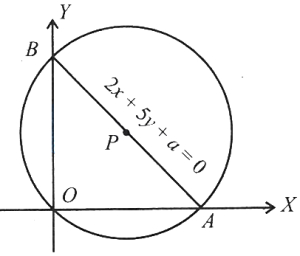
If the area of the circum-circle of the triangle formed by the line $2x + 5y + \alpha = 0$ and the positive coordinate axes is $\frac{29\pi}{4}$ sq. units,then $|\alpha| =$
A
$25$
B
$10$
C
$20$
D
$400$
Solution
(B) The line $2x + 5y + \alpha = 0$ intersects the coordinate axes at points $A$ and $B$. Since the triangle is formed with the positive coordinate axes,the intercepts must be positive. Let $\alpha = -k$ where $k > 0$. The equation becomes $2x + 5y = k$,or $\frac{x}{k/2} + \frac{y}{k/5} = 1$.
Thus,the vertices of the right-angled triangle are $O(0, 0)$,$A(\frac{k}{2}, 0)$,and $B(0, \frac{k}{5})$.
The hypotenuse $AB$ is the diameter of the circum-circle. The length of the hypotenuse is $d = \sqrt{(\frac{k}{2})^2 + (\frac{k}{5})^2} = \sqrt{\frac{k^2}{4} + \frac{k^2}{25}} = \sqrt{\frac{29k^2}{100}} = \frac{k\sqrt{29}}{10}$.
The radius $r$ of the circum-circle is $\frac{d}{2} = \frac{k\sqrt{29}}{20}$.
The area of the circum-circle is $\pi r^2 = \pi \left(\frac{k^2 \cdot 29}{400}\right) = \frac{29\pi k^2}{400}$.
Given the area is $\frac{29\pi}{4}$,we have $\frac{29\pi k^2}{400} = \frac{29\pi}{4}$.
This simplifies to $k^2 = 100$,so $k = 10$.
Since $k = |\alpha|$,we have $|\alpha| = 10$.
Thus,the vertices of the right-angled triangle are $O(0, 0)$,$A(\frac{k}{2}, 0)$,and $B(0, \frac{k}{5})$.
The hypotenuse $AB$ is the diameter of the circum-circle. The length of the hypotenuse is $d = \sqrt{(\frac{k}{2})^2 + (\frac{k}{5})^2} = \sqrt{\frac{k^2}{4} + \frac{k^2}{25}} = \sqrt{\frac{29k^2}{100}} = \frac{k\sqrt{29}}{10}$.
The radius $r$ of the circum-circle is $\frac{d}{2} = \frac{k\sqrt{29}}{20}$.
The area of the circum-circle is $\pi r^2 = \pi \left(\frac{k^2 \cdot 29}{400}\right) = \frac{29\pi k^2}{400}$.
Given the area is $\frac{29\pi}{4}$,we have $\frac{29\pi k^2}{400} = \frac{29\pi}{4}$.
This simplifies to $k^2 = 100$,so $k = 10$.
Since $k = |\alpha|$,we have $|\alpha| = 10$.
0 likesView Solution
337
MathematicsMediumMCQAP EAMCET · 2024
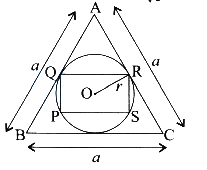
If a circle is inscribed in an equilateral triangle of side $a$,then the area of any square (in sq. units) inscribed in this circle is
A
$\frac{2 a^2}{3}$
B
$\sqrt{3} \frac{a^2}{2}$
C
$\frac{a^2}{2 \sqrt{3}}$
D
$\frac{a^2}{6}$
Solution
(D) The area of an equilateral triangle with side $a$ is $\Delta = \frac{\sqrt{3}}{4} a^2$.
The semi-perimeter of the triangle is $s = \frac{3a}{2}$.
The radius $r$ of the incircle is given by $r = \frac{\Delta}{s} = \frac{\frac{\sqrt{3}}{4} a^2}{\frac{3a}{2}} = \frac{a}{2 \sqrt{3}}$.
$A$ square inscribed in a circle of radius $r$ has a diagonal equal to the diameter of the circle,which is $2r$.
Diagonal of the square $= 2 \times \frac{a}{2 \sqrt{3}} = \frac{a}{\sqrt{3}}$.
The area of a square with diagonal $d$ is $\frac{d^2}{2}$.
Area of the square $= \frac{(\frac{a}{\sqrt{3}})^2}{2} = \frac{\frac{a^2}{3}}{2} = \frac{a^2}{6}$.
The semi-perimeter of the triangle is $s = \frac{3a}{2}$.
The radius $r$ of the incircle is given by $r = \frac{\Delta}{s} = \frac{\frac{\sqrt{3}}{4} a^2}{\frac{3a}{2}} = \frac{a}{2 \sqrt{3}}$.
$A$ square inscribed in a circle of radius $r$ has a diagonal equal to the diameter of the circle,which is $2r$.
Diagonal of the square $= 2 \times \frac{a}{2 \sqrt{3}} = \frac{a}{\sqrt{3}}$.
The area of a square with diagonal $d$ is $\frac{d^2}{2}$.
Area of the square $= \frac{(\frac{a}{\sqrt{3}})^2}{2} = \frac{\frac{a^2}{3}}{2} = \frac{a^2}{6}$.
0 likesView Solution
338
MathematicsMediumMCQAP EAMCET · 2024
In $\triangle ABC$,if $(r_2-r_1)(r_3-r_1)=2 r_2 r_3$,then $2(r+R)=$
A
$a+b$
B
$c+a$
C
$2 \sqrt{2} R \cos \left(\frac{C-A}{2}\right)$
D
$2 \sqrt{2} R \cos \left(\frac{B-C}{2}\right)$
Solution
(D) Given that $(r_2-r_1)(r_3-r_1)=2 r_2 r_3$.
Dividing by $r_2 r_3$,we get $(1-\frac{r_1}{r_2})(1-\frac{r_1}{r_3})=2$.
Using $r_1 = \frac{\Delta}{s-a}, r_2 = \frac{\Delta}{s-b}, r_3 = \frac{\Delta}{s-c}$,we have $(1-\frac{s-b}{s-a})(1-\frac{s-c}{s-a})=2$.
This simplifies to $(\frac{s-a-s+b}{s-a})(\frac{s-a-s+c}{s-a})=2$,which is $(b-a)(c-a)=2(s-a)^2$.
Since $2(s-a) = b+c-a$,we have $(b-a)(c-a) = \frac{1}{2}(b+c-a)^2$.
Expanding this leads to $b^2+c^2-a^2=0$,so $a^2=b^2+c^2$,meaning $\angle A=90^{\circ}$.
We know $2(r+R) = 2r+2R = (b+c-a) + a = b+c$.
Since $b=2R \sin B$ and $c=2R \sin C$,$b+c = 2R(\sin B + \sin C) = 2R(2 \sin \frac{B+C}{2} \cos \frac{B-C}{2})$.
Since $A=90^{\circ}$,$B+C=90^{\circ}$,so $\sin \frac{B+C}{2} = \sin 45^{\circ} = \frac{1}{\sqrt{2}}$.
Thus,$2(r+R) = 4R(\frac{1}{\sqrt{2}}) \cos \frac{B-C}{2} = 2 \sqrt{2} R \cos \frac{B-C}{2}$.
Dividing by $r_2 r_3$,we get $(1-\frac{r_1}{r_2})(1-\frac{r_1}{r_3})=2$.
Using $r_1 = \frac{\Delta}{s-a}, r_2 = \frac{\Delta}{s-b}, r_3 = \frac{\Delta}{s-c}$,we have $(1-\frac{s-b}{s-a})(1-\frac{s-c}{s-a})=2$.
This simplifies to $(\frac{s-a-s+b}{s-a})(\frac{s-a-s+c}{s-a})=2$,which is $(b-a)(c-a)=2(s-a)^2$.
Since $2(s-a) = b+c-a$,we have $(b-a)(c-a) = \frac{1}{2}(b+c-a)^2$.
Expanding this leads to $b^2+c^2-a^2=0$,so $a^2=b^2+c^2$,meaning $\angle A=90^{\circ}$.
We know $2(r+R) = 2r+2R = (b+c-a) + a = b+c$.
Since $b=2R \sin B$ and $c=2R \sin C$,$b+c = 2R(\sin B + \sin C) = 2R(2 \sin \frac{B+C}{2} \cos \frac{B-C}{2})$.
Since $A=90^{\circ}$,$B+C=90^{\circ}$,so $\sin \frac{B+C}{2} = \sin 45^{\circ} = \frac{1}{\sqrt{2}}$.
Thus,$2(r+R) = 4R(\frac{1}{\sqrt{2}}) \cos \frac{B-C}{2} = 2 \sqrt{2} R \cos \frac{B-C}{2}$.
0 likesView Solution
339
MathematicsEasyMCQAP EAMCET · 2024
In $\triangle ABC$,if $A, B, C$ are in arithmetic progression,$\Delta = \frac{\sqrt{3}}{2}$ and $r_1 r_2 = r_3 r$,then $R =$
A
$\sqrt{3}$
B
$2$
C
$1$
D
$\sqrt{2}$
Solution
(C) Given that $A, B, C$ are in arithmetic progression,so $A+C = 2B$. Since $A+B+C = 180^{\circ}$,we have $3B = 180^{\circ}$,which implies $B = 60^{\circ}$.
Given $r_1 r_2 = r_3 r$,we use the formulas $r_1 = \frac{\Delta}{s-a}$,$r_2 = \frac{\Delta}{s-b}$,$r_3 = \frac{\Delta}{s-c}$,and $r = \frac{\Delta}{s}$.
Substituting these,we get $\frac{\Delta^2}{(s-a)(s-b)} = \frac{\Delta^2}{s(s-c)}$,which simplifies to $(s-a)(s-b) = s(s-c)$.
This is equivalent to $\tan^2 \frac{C}{2} = 1$,so $\frac{C}{2} = 45^{\circ}$,which means $C = 90^{\circ}$.
Since $B = 60^{\circ}$ and $C = 90^{\circ}$,then $A = 30^{\circ}$.
The area $\Delta = \frac{1}{2} ab \sin C = \frac{1}{2} (2R \sin A)(2R \sin B) \sin 90^{\circ} = 2R^2 \sin 30^{\circ} \sin 60^{\circ} = 2R^2 (\frac{1}{2}) (\frac{\sqrt{3}}{2}) = \frac{\sqrt{3}}{2} R^2$.
Given $\Delta = \frac{\sqrt{3}}{2}$,we have $\frac{\sqrt{3}}{2} R^2 = \frac{\sqrt{3}}{2}$,so $R^2 = 1$,which gives $R = 1$.
Given $r_1 r_2 = r_3 r$,we use the formulas $r_1 = \frac{\Delta}{s-a}$,$r_2 = \frac{\Delta}{s-b}$,$r_3 = \frac{\Delta}{s-c}$,and $r = \frac{\Delta}{s}$.
Substituting these,we get $\frac{\Delta^2}{(s-a)(s-b)} = \frac{\Delta^2}{s(s-c)}$,which simplifies to $(s-a)(s-b) = s(s-c)$.
This is equivalent to $\tan^2 \frac{C}{2} = 1$,so $\frac{C}{2} = 45^{\circ}$,which means $C = 90^{\circ}$.
Since $B = 60^{\circ}$ and $C = 90^{\circ}$,then $A = 30^{\circ}$.
The area $\Delta = \frac{1}{2} ab \sin C = \frac{1}{2} (2R \sin A)(2R \sin B) \sin 90^{\circ} = 2R^2 \sin 30^{\circ} \sin 60^{\circ} = 2R^2 (\frac{1}{2}) (\frac{\sqrt{3}}{2}) = \frac{\sqrt{3}}{2} R^2$.
Given $\Delta = \frac{\sqrt{3}}{2}$,we have $\frac{\sqrt{3}}{2} R^2 = \frac{\sqrt{3}}{2}$,so $R^2 = 1$,which gives $R = 1$.
0 likesView Solution
340
MathematicsEasyMCQAP EAMCET · 2024
In a $\triangle ABC$,if $a=13, b=14, c=15$,then find the value of $r_1$.
A
$\frac{23}{2}$
B
$\frac{21}{2}$
C
$\frac{25}{2}$
D
$\frac{26}{3}$
Solution
(B) Given sides of the triangle are $a=13, b=14, c=15$.
First,calculate the semi-perimeter $s$:
$s = \frac{a+b+c}{2} = \frac{13+14+15}{2} = \frac{42}{2} = 21$.
Next,calculate the area of the triangle $\Delta$ using Heron's formula:
$\Delta = \sqrt{s(s-a)(s-b)(s-c)} = \sqrt{21(21-13)(21-14)(21-15)} = \sqrt{21 \times 8 \times 7 \times 6} = \sqrt{7056} = 84$.
The exradius $r_1$ is given by the formula $r_1 = \frac{\Delta}{s-a}$:
$r_1 = \frac{84}{21-13} = \frac{84}{8} = \frac{21}{2}$.
First,calculate the semi-perimeter $s$:
$s = \frac{a+b+c}{2} = \frac{13+14+15}{2} = \frac{42}{2} = 21$.
Next,calculate the area of the triangle $\Delta$ using Heron's formula:
$\Delta = \sqrt{s(s-a)(s-b)(s-c)} = \sqrt{21(21-13)(21-14)(21-15)} = \sqrt{21 \times 8 \times 7 \times 6} = \sqrt{7056} = 84$.
The exradius $r_1$ is given by the formula $r_1 = \frac{\Delta}{s-a}$:
$r_1 = \frac{84}{21-13} = \frac{84}{8} = \frac{21}{2}$.
0 likesView Solution
341
MathematicsEasyMCQAP EAMCET · 2024
In $\triangle ABC$,$(r_1+r_2) \operatorname{cosec}^2 \frac{C}{2} =$
A
$2 R \cot ^2 \frac{C}{2}$
B
$4 R \tan ^2 \frac{C}{2}$
C
$4 R \cot ^2 \frac{C}{2}$
D
$2 R \tan ^2 \frac{C}{2}$
Solution
(C) In $\triangle ABC$,$A+B+C=\pi$.
We know that $r_1 = 4R \sin \frac{A}{2} \cos \frac{B}{2} \cos \frac{C}{2}$ and $r_2 = 4R \cos \frac{A}{2} \sin \frac{B}{2} \cos \frac{C}{2}$.
Adding these,$r_1+r_2 = 4R \cos \frac{C}{2} [\sin \frac{A}{2} \cos \frac{B}{2} + \cos \frac{A}{2} \sin \frac{B}{2}]$.
Using the identity $\sin(x+y) = \sin x \cos y + \cos x \sin y$,we get $r_1+r_2 = 4R \cos \frac{C}{2} \sin(\frac{A+B}{2})$.
Since $A+B = \pi - C$,$\sin(\frac{A+B}{2}) = \sin(\frac{\pi}{2} - \frac{C}{2}) = \cos \frac{C}{2}$.
Thus,$r_1+r_2 = 4R \cos^2 \frac{C}{2}$.
Now,$(r_1+r_2) \operatorname{cosec}^2 \frac{C}{2} = \frac{4R \cos^2 \frac{C}{2}}{\sin^2 \frac{C}{2}} = 4R \cot^2 \frac{C}{2}$.
We know that $r_1 = 4R \sin \frac{A}{2} \cos \frac{B}{2} \cos \frac{C}{2}$ and $r_2 = 4R \cos \frac{A}{2} \sin \frac{B}{2} \cos \frac{C}{2}$.
Adding these,$r_1+r_2 = 4R \cos \frac{C}{2} [\sin \frac{A}{2} \cos \frac{B}{2} + \cos \frac{A}{2} \sin \frac{B}{2}]$.
Using the identity $\sin(x+y) = \sin x \cos y + \cos x \sin y$,we get $r_1+r_2 = 4R \cos \frac{C}{2} \sin(\frac{A+B}{2})$.
Since $A+B = \pi - C$,$\sin(\frac{A+B}{2}) = \sin(\frac{\pi}{2} - \frac{C}{2}) = \cos \frac{C}{2}$.
Thus,$r_1+r_2 = 4R \cos^2 \frac{C}{2}$.
Now,$(r_1+r_2) \operatorname{cosec}^2 \frac{C}{2} = \frac{4R \cos^2 \frac{C}{2}}{\sin^2 \frac{C}{2}} = 4R \cot^2 \frac{C}{2}$.
0 likesView Solution
342
MathematicsEasyMCQAP EAMCET · 2024
If set $A$ contains $8$ elements,then the number of subsets of $A$ which contain at least $6$ elements is
A
$28$
B
$73$
C
$37$
D
$82$
Solution
(C) Given $n(A) = 8$.
The number of subsets of $A$ containing at least $6$ elements is given by the sum of combinations:
$^8C_6 + ^8C_7 + ^8C_8$
Using the formula $^nC_r = \frac{n!}{r!(n-r)!}$:
$^8C_6 = \frac{8 \times 7}{2 \times 1} = 28$
$^8C_7 = \frac{8}{1} = 8$
$^8C_8 = 1$
Total subsets $= 28 + 8 + 1 = 37$.
The number of subsets of $A$ containing at least $6$ elements is given by the sum of combinations:
$^8C_6 + ^8C_7 + ^8C_8$
Using the formula $^nC_r = \frac{n!}{r!(n-r)!}$:
$^8C_6 = \frac{8 \times 7}{2 \times 1} = 28$
$^8C_7 = \frac{8}{1} = 8$
$^8C_8 = 1$
Total subsets $= 28 + 8 + 1 = 37$.
0 likesView Solution
343
MathematicsMediumMCQAP EAMCET · 2024
$\cosh^{-1} 2 = $
A
$\log (2+\sqrt{3})$
B
$\log (2+\sqrt{5})$
C
$\log (2-\sqrt{5})$
D
$\log (2+\sqrt{2})$
Solution
(A) We know that the formula for the inverse hyperbolic cosine function is given by:
$\cosh^{-1}(x) = \log(x + \sqrt{x^2 - 1})$
Substituting $x = 2$ into the formula:
$\cosh^{-1}(2) = \log(2 + \sqrt{2^2 - 1})$
$\cosh^{-1}(2) = \log(2 + \sqrt{4 - 1})$
$\cosh^{-1}(2) = \log(2 + \sqrt{3})$
$\cosh^{-1}(x) = \log(x + \sqrt{x^2 - 1})$
Substituting $x = 2$ into the formula:
$\cosh^{-1}(2) = \log(2 + \sqrt{2^2 - 1})$
$\cosh^{-1}(2) = \log(2 + \sqrt{4 - 1})$
$\cosh^{-1}(2) = \log(2 + \sqrt{3})$
0 likesView Solution
344
MathematicsMediumMCQAP EAMCET · 2024
If $\theta$ is an acute angle,$\cosh x = K$ and $\sinh x = \tan \theta$,then $\sin \theta =$
A
$\frac{K}{K^2+1}$
B
$\frac{K^2+1}{K^2+2}$
C
$\frac{\sqrt{K^2-1}}{K}$
D
$\frac{\sqrt{K^2-1}}{\sqrt{K^2+1}}$
Solution
(C) Given $\cosh x = K$ and $\sinh x = \tan \theta$.
We know the identity for hyperbolic functions: $\cosh^2 x - \sinh^2 x = 1$.
Substituting the given values: $K^2 - \sinh^2 x = 1$.
Therefore,$\sinh^2 x = K^2 - 1$,which implies $\sinh x = \sqrt{K^2 - 1}$.
Since $\sinh x = \tan \theta$,we have $\tan \theta = \sqrt{K^2 - 1} = \frac{\sqrt{K^2 - 1}}{1}$.
In a right-angled triangle,$\tan \theta = \frac{\text{Perpendicular}}{\text{Base}} = \frac{\sqrt{K^2 - 1}}{1}$.
The Hypotenuse $H = \sqrt{(\sqrt{K^2 - 1})^2 + 1^2} = \sqrt{K^2 - 1 + 1} = \sqrt{K^2} = K$.
Thus,$\sin \theta = \frac{\text{Perpendicular}}{\text{Hypotenuse}} = \frac{\sqrt{K^2 - 1}}{K}$.
We know the identity for hyperbolic functions: $\cosh^2 x - \sinh^2 x = 1$.
Substituting the given values: $K^2 - \sinh^2 x = 1$.
Therefore,$\sinh^2 x = K^2 - 1$,which implies $\sinh x = \sqrt{K^2 - 1}$.
Since $\sinh x = \tan \theta$,we have $\tan \theta = \sqrt{K^2 - 1} = \frac{\sqrt{K^2 - 1}}{1}$.
In a right-angled triangle,$\tan \theta = \frac{\text{Perpendicular}}{\text{Base}} = \frac{\sqrt{K^2 - 1}}{1}$.
The Hypotenuse $H = \sqrt{(\sqrt{K^2 - 1})^2 + 1^2} = \sqrt{K^2 - 1 + 1} = \sqrt{K^2} = K$.
Thus,$\sin \theta = \frac{\text{Perpendicular}}{\text{Hypotenuse}} = \frac{\sqrt{K^2 - 1}}{K}$.
0 likesView Solution
345
MathematicsDifficultMCQAP EAMCET · 2024
Statement $(S1): \sin 55^{\circ} + \sin 53^{\circ} - \sin 19^{\circ} - \sin 17^{\circ} = \cos 2^{\circ}$.
Statement $(S2):$ The range of $\frac{1}{3 - \cos 2x}$ is $\left[\frac{1}{4}, \frac{1}{2}\right]$.
Which one of the following is correct?
Statement $(S2):$ The range of $\frac{1}{3 - \cos 2x}$ is $\left[\frac{1}{4}, \frac{1}{2}\right]$.
Which one of the following is correct?
A
Both $(S1)$ and $(S2)$ are true
B
Both $(S1)$ and $(S2)$ are false
C
$(S1)$ is true,$(S2)$ is false
D
$(S1)$ is false,$(S2)$ is true
Solution
(D) $I$. Evaluate $(S1): \sin 55^{\circ} + \sin 53^{\circ} - \sin 19^{\circ} - \sin 17^{\circ}$
Using $\sin C - \sin D = 2 \cos \frac{C+D}{2} \sin \frac{C-D}{2}$:
$= (\sin 55^{\circ} - \sin 17^{\circ}) + (\sin 53^{\circ} - \sin 19^{\circ})$
$= 2 \cos 36^{\circ} \sin 19^{\circ} + 2 \cos 36^{\circ} \sin 17^{\circ}$
$= 2 \cos 36^{\circ} (\sin 19^{\circ} + \sin 17^{\circ})$
$= 2 \cos 36^{\circ} (2 \sin 18^{\circ} \cos 1^{\circ})$
Since $\cos 36^{\circ} = \frac{\sqrt{5}+1}{4}$ and $\sin 18^{\circ} = \frac{\sqrt{5}-1}{4}$:
$= 2 \left(\frac{\sqrt{5}+1}{4}\right) \cdot 2 \left(\frac{\sqrt{5}-1}{4}\right) \cos 1^{\circ}$
$= 4 \left(\frac{5-1}{16}\right) \cos 1^{\circ} = \cos 1^{\circ}$.
Thus,$(S1)$ is false as $\cos 1^{\circ} \neq \cos 2^{\circ}$.
$II$. Evaluate $(S2): f(x) = \frac{1}{3 - \cos 2x}$
Since $-1 \leq \cos 2x \leq 1$,we have $-1 \leq -\cos 2x \leq 1$.
Adding $3$: $2 \leq 3 - \cos 2x \leq 4$.
Taking reciprocals: $\frac{1}{4} \leq \frac{1}{3 - \cos 2x} \leq \frac{1}{2}$.
Thus,$(S2)$ is true.
Using $\sin C - \sin D = 2 \cos \frac{C+D}{2} \sin \frac{C-D}{2}$:
$= (\sin 55^{\circ} - \sin 17^{\circ}) + (\sin 53^{\circ} - \sin 19^{\circ})$
$= 2 \cos 36^{\circ} \sin 19^{\circ} + 2 \cos 36^{\circ} \sin 17^{\circ}$
$= 2 \cos 36^{\circ} (\sin 19^{\circ} + \sin 17^{\circ})$
$= 2 \cos 36^{\circ} (2 \sin 18^{\circ} \cos 1^{\circ})$
Since $\cos 36^{\circ} = \frac{\sqrt{5}+1}{4}$ and $\sin 18^{\circ} = \frac{\sqrt{5}-1}{4}$:
$= 2 \left(\frac{\sqrt{5}+1}{4}\right) \cdot 2 \left(\frac{\sqrt{5}-1}{4}\right) \cos 1^{\circ}$
$= 4 \left(\frac{5-1}{16}\right) \cos 1^{\circ} = \cos 1^{\circ}$.
Thus,$(S1)$ is false as $\cos 1^{\circ} \neq \cos 2^{\circ}$.
$II$. Evaluate $(S2): f(x) = \frac{1}{3 - \cos 2x}$
Since $-1 \leq \cos 2x \leq 1$,we have $-1 \leq -\cos 2x \leq 1$.
Adding $3$: $2 \leq 3 - \cos 2x \leq 4$.
Taking reciprocals: $\frac{1}{4} \leq \frac{1}{3 - \cos 2x} \leq \frac{1}{2}$.
Thus,$(S2)$ is true.
0 likesView Solution
346
MathematicsMediumMCQAP EAMCET · 2024
If $M_1$ and $M_2$ are the maximum values of $\frac{1}{11 \cos 2x + 60 \sin 2x + 69}$ and $3 \cos^2 5x + 4 \sin^2 5x$ respectively,then $\frac{M_1}{M_2} = $
A
$\frac{65}{2}$
B
$\frac{1}{32}$
C
$\frac{8}{3}$
D
$2$
Solution
(B) For the first expression,we know that $-\sqrt{11^2 + 60^2} \leq 11 \cos 2x + 60 \sin 2x \leq \sqrt{11^2 + 60^2}$.
This simplifies to $-61 \leq 11 \cos 2x + 60 \sin 2x \leq 61$.
To maximize $\frac{1}{11 \cos 2x + 60 \sin 2x + 69}$,we need to minimize the denominator.
The minimum value of the denominator is $69 - 61 = 8$.
Thus,$M_1 = \frac{1}{8}$.
For the second expression,$3 \cos^2 5x + 4 \sin^2 5x = 3(\cos^2 5x + \sin^2 5x) + \sin^2 5x = 3 + \sin^2 5x$.
The maximum value occurs when $\sin^2 5x = 1$,so $M_2 = 3 + 1 = 4$.
Therefore,$\frac{M_1}{M_2} = \frac{1/8}{4} = \frac{1}{32}$.
This simplifies to $-61 \leq 11 \cos 2x + 60 \sin 2x \leq 61$.
To maximize $\frac{1}{11 \cos 2x + 60 \sin 2x + 69}$,we need to minimize the denominator.
The minimum value of the denominator is $69 - 61 = 8$.
Thus,$M_1 = \frac{1}{8}$.
For the second expression,$3 \cos^2 5x + 4 \sin^2 5x = 3(\cos^2 5x + \sin^2 5x) + \sin^2 5x = 3 + \sin^2 5x$.
The maximum value occurs when $\sin^2 5x = 1$,so $M_2 = 3 + 1 = 4$.
Therefore,$\frac{M_1}{M_2} = \frac{1/8}{4} = \frac{1}{32}$.
0 likesView Solution
347
MathematicsEasyMCQAP EAMCET · 2024
Which of the following functions are odd?
$I. f(x)=x\left(\frac{e^x-1}{e^x+1}\right)$
$II. f(x)=k^x+k^{-x}+\cos x$
$III. f(x)=\log \left(x+\sqrt{x^2+1}\right)$
$I. f(x)=x\left(\frac{e^x-1}{e^x+1}\right)$
$II. f(x)=k^x+k^{-x}+\cos x$
$III. f(x)=\log \left(x+\sqrt{x^2+1}\right)$
A
$II$
B
$I, II$
C
$I, III$
D
$I$
Solution
(C) function $f(x)$ is odd if $f(-x) = -f(x)$.
$I. f(x) = x \left( \frac{e^x-1}{e^x+1} \right)$
$f(-x) = (-x) \left( \frac{e^{-x}-1}{e^{-x}+1} \right) = (-x) \left( \frac{\frac{1}{e^x}-1}{\frac{1}{e^x}+1} \right) = (-x) \left( \frac{1-e^x}{1+e^x} \right) = x \left( \frac{e^x-1}{e^x+1} \right) = f(x)$.
Since $f(-x) = f(x)$,$I$ is an even function.
$II. f(x) = k^x + k^{-x} + \cos x$
$f(-x) = k^{-x} + k^x + \cos(-x) = k^{-x} + k^x + \cos x = f(x)$.
Since $f(-x) = f(x)$,$II$ is an even function.
$III. f(x) = \log \left(x+\sqrt{x^2+1}\right)$
$f(-x) = \log \left(-x+\sqrt{(-x)^2+1}\right) = \log \left(\sqrt{x^2+1}-x\right)$
Multiplying and dividing by $\sqrt{x^2+1}+x$:
$f(-x) = \log \left( \frac{(\sqrt{x^2+1}-x)(\sqrt{x^2+1}+x)}{\sqrt{x^2+1}+x} \right) = \log \left( \frac{x^2+1-x^2}{\sqrt{x^2+1}+x} \right) = \log \left( \frac{1}{\sqrt{x^2+1}+x} \right)$
$f(-x) = \log \left( (x+\sqrt{x^2+1})^{-1} \right) = -\log \left( x+\sqrt{x^2+1} \right) = -f(x)$.
Since $f(-x) = -f(x)$,$III$ is an odd function.
Therefore,only $III$ is an odd function.
$I. f(x) = x \left( \frac{e^x-1}{e^x+1} \right)$
$f(-x) = (-x) \left( \frac{e^{-x}-1}{e^{-x}+1} \right) = (-x) \left( \frac{\frac{1}{e^x}-1}{\frac{1}{e^x}+1} \right) = (-x) \left( \frac{1-e^x}{1+e^x} \right) = x \left( \frac{e^x-1}{e^x+1} \right) = f(x)$.
Since $f(-x) = f(x)$,$I$ is an even function.
$II. f(x) = k^x + k^{-x} + \cos x$
$f(-x) = k^{-x} + k^x + \cos(-x) = k^{-x} + k^x + \cos x = f(x)$.
Since $f(-x) = f(x)$,$II$ is an even function.
$III. f(x) = \log \left(x+\sqrt{x^2+1}\right)$
$f(-x) = \log \left(-x+\sqrt{(-x)^2+1}\right) = \log \left(\sqrt{x^2+1}-x\right)$
Multiplying and dividing by $\sqrt{x^2+1}+x$:
$f(-x) = \log \left( \frac{(\sqrt{x^2+1}-x)(\sqrt{x^2+1}+x)}{\sqrt{x^2+1}+x} \right) = \log \left( \frac{x^2+1-x^2}{\sqrt{x^2+1}+x} \right) = \log \left( \frac{1}{\sqrt{x^2+1}+x} \right)$
$f(-x) = \log \left( (x+\sqrt{x^2+1})^{-1} \right) = -\log \left( x+\sqrt{x^2+1} \right) = -f(x)$.
Since $f(-x) = -f(x)$,$III$ is an odd function.
Therefore,only $III$ is an odd function.
0 likesView Solution
348
MathematicsMediumMCQAP EAMCET · 2024
If the period of the function $f(x) = \frac{\tan 5x \cos 3x}{\sin 6x}$ is $\alpha$,then find the value of $f\left(\frac{\alpha}{8}\right)$.
A
$\frac{1}{2}$
B
$-1$
C
$\frac{1}{\sqrt{2}}$
D
$-\frac{1}{\sqrt{2}}$
Solution
(C) The periods of $\tan 5x$,$\cos 3x$,and $\sin 6x$ are $\frac{\pi}{5}$,$\frac{2\pi}{3}$,and $\frac{\pi}{3}$ respectively.
To find the period $\alpha$ of $f(x) = \frac{\tan 5x \cos 3x}{\sin 6x}$,we simplify the expression:
$f(x) = \frac{\tan 5x \cos 3x}{2 \sin 3x \cos 3x} = \frac{\tan 5x}{2 \sin 3x}$.
The period of $\tan 5x$ is $\frac{\pi}{5}$ and the period of $\sin 3x$ is $\frac{2\pi}{3}$.
The period $\alpha$ of $f(x)$ is the least common multiple of $\frac{\pi}{5}$ and $\frac{2\pi}{3}$,which is $\frac{2\pi}{\gcd(1, 1)} = 2\pi$.
Thus,$\alpha = 2\pi$.
We need to evaluate $f\left(\frac{\alpha}{8}\right) = f\left(\frac{2\pi}{8}\right) = f\left(\frac{\pi}{4}\right)$.
$f\left(\frac{\pi}{4}\right) = \frac{\tan(5\pi/4)}{2 \sin(3\pi/4)} = \frac{1}{2 \times (1/\sqrt{2})} = \frac{1}{\sqrt{2}}$.
To find the period $\alpha$ of $f(x) = \frac{\tan 5x \cos 3x}{\sin 6x}$,we simplify the expression:
$f(x) = \frac{\tan 5x \cos 3x}{2 \sin 3x \cos 3x} = \frac{\tan 5x}{2 \sin 3x}$.
The period of $\tan 5x$ is $\frac{\pi}{5}$ and the period of $\sin 3x$ is $\frac{2\pi}{3}$.
The period $\alpha$ of $f(x)$ is the least common multiple of $\frac{\pi}{5}$ and $\frac{2\pi}{3}$,which is $\frac{2\pi}{\gcd(1, 1)} = 2\pi$.
Thus,$\alpha = 2\pi$.
We need to evaluate $f\left(\frac{\alpha}{8}\right) = f\left(\frac{2\pi}{8}\right) = f\left(\frac{\pi}{4}\right)$.
$f\left(\frac{\pi}{4}\right) = \frac{\tan(5\pi/4)}{2 \sin(3\pi/4)} = \frac{1}{2 \times (1/\sqrt{2})} = \frac{1}{\sqrt{2}}$.
0 likesView Solution
349
MathematicsDifficultMCQAP EAMCET · 2024
$f(x+h)=0$ represents the transformed equation of the equation $f(x)=x^4+2x^3-19x^2-8x+60=0$. If this transformation removes the term containing $x^3$ from $f(x)=0$,then $h=$
A
$-\frac{1}{2}$
B
$1$
C
$2$
D
$-1$
Solution
(A) Given the equation $f(x) = x^4 + 2x^3 - 19x^2 - 8x + 60 = 0$.
To remove the $x^3$ term,we substitute $x$ with $(x+h)$.
The term containing $x^3$ in the expansion of $(x+h)^4 + 2(x+h)^3 - 19(x+h)^2 - 8(x+h) + 60 = 0$ is obtained from the binomial expansion.
$(x+h)^4 = x^4 + 4x^3h + 6x^2h^2 + 4xh^3 + h^4$.
$2(x+h)^3 = 2(x^3 + 3x^2h + 3xh^2 + h^3) = 2x^3 + 6x^2h + 6xh^2 + 2h^3$.
The coefficient of $x^3$ in the transformed equation is $4h + 2$.
For the $x^3$ term to be removed,we set the coefficient to zero:
$4h + 2 = 0$.
$4h = -2$.
$h = -\frac{2}{4} = -\frac{1}{2}$.
To remove the $x^3$ term,we substitute $x$ with $(x+h)$.
The term containing $x^3$ in the expansion of $(x+h)^4 + 2(x+h)^3 - 19(x+h)^2 - 8(x+h) + 60 = 0$ is obtained from the binomial expansion.
$(x+h)^4 = x^4 + 4x^3h + 6x^2h^2 + 4xh^3 + h^4$.
$2(x+h)^3 = 2(x^3 + 3x^2h + 3xh^2 + h^3) = 2x^3 + 6x^2h + 6xh^2 + 2h^3$.
The coefficient of $x^3$ in the transformed equation is $4h + 2$.
For the $x^3$ term to be removed,we set the coefficient to zero:
$4h + 2 = 0$.
$4h = -2$.
$h = -\frac{2}{4} = -\frac{1}{2}$.
0 likesView Solution
350
MathematicsMediumMCQAP EAMCET · 2024
If $1 \cdot 3 \cdot 5 + 3 \cdot 5 \cdot 7 + 5 \cdot 7 \cdot 9 + \ldots \text{ to } n \text{ terms} = n(n+1) f(n) - 3n$,then $f(1) =$
A
$9$
B
$11$
C
$12$
D
$8$
Solution
(A) The $n$-th term of the series is $T_n = (2n-1)(2n+1)(2n+3) = (4n^2-1)(2n+3) = 8n^3 + 12n^2 - 2n - 3$.
The sum of $n$ terms is $S_n = \sum_{k=1}^{n} T_k = 8 \sum k^3 + 12 \sum k^2 - 2 \sum k - 3 \sum 1$.
$S_n = 8 \left[ \frac{n(n+1)}{2} \right]^2 + 12 \left[ \frac{n(n+1)(2n+1)}{6} \right] - 2 \left[ \frac{n(n+1)}{2} \right] - 3n$.
$S_n = 2n^2(n+1)^2 + 2n(n+1)(2n+1) - n(n+1) - 3n$.
$S_n = n(n+1) [2n(n+1) + 2(2n+1) - 1] - 3n$.
$S_n = n(n+1) [2n^2 + 2n + 4n + 2 - 1] - 3n = n(n+1)(2n^2 + 6n + 1) - 3n$.
Comparing with $n(n+1)f(n) - 3n$,we get $f(n) = 2n^2 + 6n + 1$.
Therefore,$f(1) = 2(1)^2 + 6(1) + 1 = 2 + 6 + 1 = 9$.
The sum of $n$ terms is $S_n = \sum_{k=1}^{n} T_k = 8 \sum k^3 + 12 \sum k^2 - 2 \sum k - 3 \sum 1$.
$S_n = 8 \left[ \frac{n(n+1)}{2} \right]^2 + 12 \left[ \frac{n(n+1)(2n+1)}{6} \right] - 2 \left[ \frac{n(n+1)}{2} \right] - 3n$.
$S_n = 2n^2(n+1)^2 + 2n(n+1)(2n+1) - n(n+1) - 3n$.
$S_n = n(n+1) [2n(n+1) + 2(2n+1) - 1] - 3n$.
$S_n = n(n+1) [2n^2 + 2n + 4n + 2 - 1] - 3n = n(n+1)(2n^2 + 6n + 1) - 3n$.
Comparing with $n(n+1)f(n) - 3n$,we get $f(n) = 2n^2 + 6n + 1$.
Therefore,$f(1) = 2(1)^2 + 6(1) + 1 = 2 + 6 + 1 = 9$.
0 likesView Solution
351
MathematicsMediumMCQAP EAMCET · 2024
If $L_1$ and $L_2$ are two lines which pass through the origin and have direction ratios $(3, 1, -5)$ and $(2, 3, -1)$ respectively,then the equation of the plane containing $L_1$ and $L_2$ is
A
$4x + 5y - 63 = 0$
B
$5x - y + 3z = 0$
C
$2x - y + z = 0$
D
$x - 5y + 3z = 0$
Solution
(C) Since the lines $L_1$ and $L_2$ pass through the origin $(0, 0, 0)$,the plane containing them also passes through the origin. The equation of such a plane is given by $ax + by + cz = 0$.
The normal vector $\vec{n}$ to the plane is the cross product of the direction vectors of the two lines,$\vec{v}_1 = 3\hat{i} + \hat{j} - 5\hat{k}$ and $\vec{v}_2 = 2\hat{i} + 3\hat{j} - \hat{k}$.
$\vec{n} = \vec{v}_1 \times \vec{v}_2 = \begin{vmatrix} \hat{i} & \hat{j} & \hat{k} \\ 3 & 1 & -5 \\ 2 & 3 & -1 \end{vmatrix}$
$\vec{n} = \hat{i}(-1 - (-15)) - \hat{j}(-3 - (-10)) + \hat{k}(9 - 2)$
$\vec{n} = 14\hat{i} - 7\hat{j} + 7\hat{k}$
Dividing by $7$,we get the normal vector as $2\hat{i} - \hat{j} + \hat{k}$.
Thus,the equation of the plane is $2(x - 0) - 1(y - 0) + 1(z - 0) = 0$,which simplifies to $2x - y + z = 0$.
The normal vector $\vec{n}$ to the plane is the cross product of the direction vectors of the two lines,$\vec{v}_1 = 3\hat{i} + \hat{j} - 5\hat{k}$ and $\vec{v}_2 = 2\hat{i} + 3\hat{j} - \hat{k}$.
$\vec{n} = \vec{v}_1 \times \vec{v}_2 = \begin{vmatrix} \hat{i} & \hat{j} & \hat{k} \\ 3 & 1 & -5 \\ 2 & 3 & -1 \end{vmatrix}$
$\vec{n} = \hat{i}(-1 - (-15)) - \hat{j}(-3 - (-10)) + \hat{k}(9 - 2)$
$\vec{n} = 14\hat{i} - 7\hat{j} + 7\hat{k}$
Dividing by $7$,we get the normal vector as $2\hat{i} - \hat{j} + \hat{k}$.
Thus,the equation of the plane is $2(x - 0) - 1(y - 0) + 1(z - 0) = 0$,which simplifies to $2x - y + z = 0$.
0 likesView Solution
352
MathematicsEasyMCQAP EAMCET · 2024
If the angle $\theta$ between the line $\frac{x+1}{1}=\frac{y-1}{2}=\frac{z-2}{2}$ and the plane $2x-y+\sqrt{\lambda}z+4=0$ is such that $\sin \theta=\frac{1}{3}$,then the value of $\lambda=$
A
$3/5$
B
$5/4$
C
$5/3$
D
$4/3$
Solution
(C) The direction ratios of the line are $\vec{l} = (1, 2, 2)$.
The normal vector to the plane is $\vec{n} = (2, -1, \sqrt{\lambda})$.
The angle $\theta$ between a line with direction vector $\vec{l}$ and a plane with normal $\vec{n}$ is given by $\sin \theta = \frac{|\vec{l} \cdot \vec{n}|}{|\vec{l}| |\vec{n}|}$.
Calculating the dot product: $\vec{l} \cdot \vec{n} = (1)(2) + (2)(-1) + (2)(\sqrt{\lambda}) = 2 - 2 + 2\sqrt{\lambda} = 2\sqrt{\lambda}$.
Calculating the magnitudes: $|\vec{l}| = \sqrt{1^2 + 2^2 + 2^2} = \sqrt{9} = 3$ and $|\vec{n}| = \sqrt{2^2 + (-1)^2 + (\sqrt{\lambda})^2} = \sqrt{5 + \lambda}$.
Substituting into the formula: $\sin \theta = \frac{2\sqrt{\lambda}}{3\sqrt{5 + \lambda}}$.
Given $\sin \theta = \frac{1}{3}$,we have $\frac{1}{3} = \frac{2\sqrt{\lambda}}{3\sqrt{5 + \lambda}}$.
Simplifying,$\frac{1}{3} = \frac{2}{3} \sqrt{\frac{\lambda}{5 + \lambda}} \Rightarrow \frac{1}{2} = \sqrt{\frac{\lambda}{5 + \lambda}}$.
Squaring both sides: $\frac{1}{4} = \frac{\lambda}{5 + \lambda}$.
$5 + \lambda = 4\lambda \Rightarrow 3\lambda = 5 \Rightarrow \lambda = \frac{5}{3}$.
The normal vector to the plane is $\vec{n} = (2, -1, \sqrt{\lambda})$.
The angle $\theta$ between a line with direction vector $\vec{l}$ and a plane with normal $\vec{n}$ is given by $\sin \theta = \frac{|\vec{l} \cdot \vec{n}|}{|\vec{l}| |\vec{n}|}$.
Calculating the dot product: $\vec{l} \cdot \vec{n} = (1)(2) + (2)(-1) + (2)(\sqrt{\lambda}) = 2 - 2 + 2\sqrt{\lambda} = 2\sqrt{\lambda}$.
Calculating the magnitudes: $|\vec{l}| = \sqrt{1^2 + 2^2 + 2^2} = \sqrt{9} = 3$ and $|\vec{n}| = \sqrt{2^2 + (-1)^2 + (\sqrt{\lambda})^2} = \sqrt{5 + \lambda}$.
Substituting into the formula: $\sin \theta = \frac{2\sqrt{\lambda}}{3\sqrt{5 + \lambda}}$.
Given $\sin \theta = \frac{1}{3}$,we have $\frac{1}{3} = \frac{2\sqrt{\lambda}}{3\sqrt{5 + \lambda}}$.
Simplifying,$\frac{1}{3} = \frac{2}{3} \sqrt{\frac{\lambda}{5 + \lambda}} \Rightarrow \frac{1}{2} = \sqrt{\frac{\lambda}{5 + \lambda}}$.
Squaring both sides: $\frac{1}{4} = \frac{\lambda}{5 + \lambda}$.
$5 + \lambda = 4\lambda \Rightarrow 3\lambda = 5 \Rightarrow \lambda = \frac{5}{3}$.
0 likesView Solution
353
MathematicsEasyMCQAP EAMCET · 2024
If $7$ different balls are distributed among $4$ different boxes,then the probability that the first box contains $3$ balls is
A
$\frac{35}{128}\left(\frac{3}{4}\right)^3$
B
$\frac{35}{64}\left(\frac{3}{4}\right)^4$
C
$\frac{7}{8}\left(\frac{3}{4}\right)^7$
D
$\frac{5}{16}\left(\frac{3}{4}\right)^5$
Solution
(B) The total number of ways to distribute $7$ different balls into $4$ different boxes is $4^7$.
To find the number of ways such that the first box contains exactly $3$ balls,we first choose $3$ balls out of $7$ in ${}^7C_3$ ways.
The remaining $4$ balls can be distributed among the other $3$ boxes in $3^4$ ways.
Thus,the number of favorable ways is ${}^7C_3 \times 3^4$.
The required probability is $\frac{{}^7C_3 \times 3^4}{4^7} = \frac{35 \times 3^4}{4^7} = \frac{35}{4^3} \times \left(\frac{3}{4}\right)^4 = \frac{35}{64} \left(\frac{3}{4}\right)^4$.
To find the number of ways such that the first box contains exactly $3$ balls,we first choose $3$ balls out of $7$ in ${}^7C_3$ ways.
The remaining $4$ balls can be distributed among the other $3$ boxes in $3^4$ ways.
Thus,the number of favorable ways is ${}^7C_3 \times 3^4$.
The required probability is $\frac{{}^7C_3 \times 3^4}{4^7} = \frac{35 \times 3^4}{4^7} = \frac{35}{4^3} \times \left(\frac{3}{4}\right)^4 = \frac{35}{64} \left(\frac{3}{4}\right)^4$.
0 likesView Solution
354
MathematicsEasyMCQAP EAMCET · 2024
Two digits are selected at random from the digits $1$ through $9$. If their sum is even,then the probability that both are odd is
A
$\frac{3}{8}$
B
$\frac{1}{2}$
C
$\frac{5}{8}$
D
$\frac{3}{4}$
Solution
(C) Let $A$ be the event of getting two odd numbers and $B$ be the event of getting an even sum.
We need to find the conditional probability $P(A|B) = \frac{P(A \cap B)}{P(B)}$.
There are $5$ odd digits $(1, 3, 5, 7, 9)$ and $4$ even digits $(2, 4, 6, 8)$.
The total number of ways to select $2$ digits from $9$ is ${}^9C_2 = 36$.
The sum is even if both digits are odd or both digits are even.
Number of ways to get an even sum $= {}^5C_2 + {}^4C_2 = 10 + 6 = 16$.
Number of ways to get both odd $= {}^5C_2 = 10$.
Thus,$P(A|B) = \frac{10}{16} = \frac{5}{8}$.
We need to find the conditional probability $P(A|B) = \frac{P(A \cap B)}{P(B)}$.
There are $5$ odd digits $(1, 3, 5, 7, 9)$ and $4$ even digits $(2, 4, 6, 8)$.
The total number of ways to select $2$ digits from $9$ is ${}^9C_2 = 36$.
The sum is even if both digits are odd or both digits are even.
Number of ways to get an even sum $= {}^5C_2 + {}^4C_2 = 10 + 6 = 16$.
Number of ways to get both odd $= {}^5C_2 = 10$.
Thus,$P(A|B) = \frac{10}{16} = \frac{5}{8}$.
0 likesView Solution
355
MathematicsEasyMCQAP EAMCET · 2024
In a random experiment,two dice are thrown and the sum of the numbers appeared on them is recorded. This experiment is repeated $9$ times. If the probability that a sum of $6$ appears at least once is $P_1$ and a sum of $8$ appears at least once is $P_2$,then $P_1 : P_2 =$
A
$4 : 3$
B
$3 : 1$
C
$1 : 2$
D
$1 : 1$
Solution
(D) When two dice are thrown,the total number of outcomes is $6 \times 6 = 36$.
For a sum of $6$,the favorable outcomes are $(1, 5), (2, 4), (3, 3), (4, 2), (5, 1)$,so there are $5$ outcomes. The probability of getting a sum of $6$ in one trial is $p_1 = \frac{5}{36}$.
The probability of not getting a sum of $6$ in one trial is $q_1 = 1 - \frac{5}{36} = \frac{31}{36}$.
The probability of getting a sum of $6$ at least once in $9$ trials is $P_1 = 1 - (q_1)^9 = 1 - \left(\frac{31}{36}\right)^9$.
For a sum of $8$,the favorable outcomes are $(2, 6), (3, 5), (4, 4), (5, 3), (6, 2)$,so there are $5$ outcomes. The probability of getting a sum of $8$ in one trial is $p_2 = \frac{5}{36}$.
The probability of not getting a sum of $8$ in one trial is $q_2 = 1 - \frac{5}{36} = \frac{31}{36}$.
The probability of getting a sum of $8$ at least once in $9$ trials is $P_2 = 1 - (q_2)^9 = 1 - \left(\frac{31}{36}\right)^9$.
Since $P_1 = P_2$,the ratio $P_1 : P_2 = 1 : 1$.
For a sum of $6$,the favorable outcomes are $(1, 5), (2, 4), (3, 3), (4, 2), (5, 1)$,so there are $5$ outcomes. The probability of getting a sum of $6$ in one trial is $p_1 = \frac{5}{36}$.
The probability of not getting a sum of $6$ in one trial is $q_1 = 1 - \frac{5}{36} = \frac{31}{36}$.
The probability of getting a sum of $6$ at least once in $9$ trials is $P_1 = 1 - (q_1)^9 = 1 - \left(\frac{31}{36}\right)^9$.
For a sum of $8$,the favorable outcomes are $(2, 6), (3, 5), (4, 4), (5, 3), (6, 2)$,so there are $5$ outcomes. The probability of getting a sum of $8$ in one trial is $p_2 = \frac{5}{36}$.
The probability of not getting a sum of $8$ in one trial is $q_2 = 1 - \frac{5}{36} = \frac{31}{36}$.
The probability of getting a sum of $8$ at least once in $9$ trials is $P_2 = 1 - (q_2)^9 = 1 - \left(\frac{31}{36}\right)^9$.
Since $P_1 = P_2$,the ratio $P_1 : P_2 = 1 : 1$.
0 likesView Solution
356
MathematicsMediumMCQAP EAMCET · 2024
If $12$ dice are thrown at a time,then the probability that a multiple of $3$ does not appear on any dice is
A
$\left(\frac{1}{2}\right)^{12}$
B
$\left(\frac{1}{3}\right)^{12}$
C
$\left(\frac{2}{3}\right)^{12}$
D
$\left(\frac{5}{6}\right)^{12}$
Solution
(C) For a single die,the possible outcomes are $\{1, 2, 3, 4, 5, 6\}$.
Multiples of $3$ on a die are $\{3, 6\}$.
The probability of getting a multiple of $3$ on one die is $P(M) = \frac{2}{6} = \frac{1}{3}$.
The probability of $NOT$ getting a multiple of $3$ on one die is $P(M') = 1 - \frac{1}{3} = \frac{2}{3}$.
Since $12$ dice are thrown independently,the probability that a multiple of $3$ does not appear on any of the $12$ dice is $\left(\frac{2}{3}\right)^{12}$.
Multiples of $3$ on a die are $\{3, 6\}$.
The probability of getting a multiple of $3$ on one die is $P(M) = \frac{2}{6} = \frac{1}{3}$.
The probability of $NOT$ getting a multiple of $3$ on one die is $P(M') = 1 - \frac{1}{3} = \frac{2}{3}$.
Since $12$ dice are thrown independently,the probability that a multiple of $3$ does not appear on any of the $12$ dice is $\left(\frac{2}{3}\right)^{12}$.
0 likesView Solution
357
MathematicsMediumMCQAP EAMCET · 2024
Bag $A$ contains $3$ white and $4$ red balls,bag $B$ contains $4$ white and $5$ red balls,and bag $C$ contains $5$ white and $6$ red balls. If one ball is drawn at random from each of these three bags,then the probability of getting one white and two red balls is
A
$\frac{268}{693}$
B
$\frac{310}{693}$
C
$\frac{38}{99}$
D
$\frac{286}{693}$
Solution
(D) Let $W_A, W_B, W_C$ be the events of drawing a white ball from bags $A, B, C$ respectively,and $R_A, R_B, R_C$ be the events of drawing a red ball from bags $A, B, C$ respectively.
$P(W_A) = \frac{3}{7}, P(R_A) = \frac{4}{7}$
$P(W_B) = \frac{4}{9}, P(R_B) = \frac{5}{9}$
$P(W_C) = \frac{5}{11}, P(R_C) = \frac{6}{11}$
We need one white and two red balls. This can happen in three mutually exclusive cases:
Case $I$: White from $A$,Red from $B$,Red from $C$: $P_1 = \frac{3}{7} \times \frac{5}{9} \times \frac{6}{11} = \frac{90}{693}$
Case $II$: Red from $A$,White from $B$,Red from $C$: $P_2 = \frac{4}{7} \times \frac{4}{9} \times \frac{6}{11} = \frac{96}{693}$
Case $III$: Red from $A$,Red from $B$,White from $C$: $P_3 = \frac{4}{7} \times \frac{5}{9} \times \frac{5}{11} = \frac{100}{693}$
Total probability $= P_1 + P_2 + P_3 = \frac{90+96+100}{693} = \frac{286}{693}$.
$P(W_A) = \frac{3}{7}, P(R_A) = \frac{4}{7}$
$P(W_B) = \frac{4}{9}, P(R_B) = \frac{5}{9}$
$P(W_C) = \frac{5}{11}, P(R_C) = \frac{6}{11}$
We need one white and two red balls. This can happen in three mutually exclusive cases:
Case $I$: White from $A$,Red from $B$,Red from $C$: $P_1 = \frac{3}{7} \times \frac{5}{9} \times \frac{6}{11} = \frac{90}{693}$
Case $II$: Red from $A$,White from $B$,Red from $C$: $P_2 = \frac{4}{7} \times \frac{4}{9} \times \frac{6}{11} = \frac{96}{693}$
Case $III$: Red from $A$,Red from $B$,White from $C$: $P_3 = \frac{4}{7} \times \frac{5}{9} \times \frac{5}{11} = \frac{100}{693}$
Total probability $= P_1 + P_2 + P_3 = \frac{90+96+100}{693} = \frac{286}{693}$.
0 likesView Solution
358
MathematicsEasyMCQAP EAMCET · 2024
$A$ student writes an examination which contains $8$ true or false questions. If he answers $6$ or more questions correctly,he passes the examination. If the student answers all the questions,then the probability that he fails in the examination is
A
$\frac{37}{256}$
B
$\frac{19}{256}$
C
$\frac{119}{256}$
D
$\frac{219}{256}$
Solution
(D) The total number of questions is $n = 8$. Since each question is true or false,the probability of answering correctly is $p = \frac{1}{2}$ and incorrectly is $q = \frac{1}{2}$.
Let $X$ be the number of correct answers. $X$ follows a binomial distribution $B(8, \frac{1}{2})$.
The student passes if $X \ge 6$.
$P(\text{Pass}) = P(X=6) + P(X=7) + P(X=8)$
$P(\text{Pass}) = \binom{8}{6}(\frac{1}{2})^8 + \binom{8}{7}(\frac{1}{2})^8 + \binom{8}{8}(\frac{1}{2})^8$
$P(\text{Pass}) = \frac{28 + 8 + 1}{256} = \frac{37}{256}$.
The probability that the student fails is $P(\text{Fail}) = 1 - P(\text{Pass})$.
$P(\text{Fail}) = 1 - \frac{37}{256} = \frac{219}{256}$.
Let $X$ be the number of correct answers. $X$ follows a binomial distribution $B(8, \frac{1}{2})$.
The student passes if $X \ge 6$.
$P(\text{Pass}) = P(X=6) + P(X=7) + P(X=8)$
$P(\text{Pass}) = \binom{8}{6}(\frac{1}{2})^8 + \binom{8}{7}(\frac{1}{2})^8 + \binom{8}{8}(\frac{1}{2})^8$
$P(\text{Pass}) = \frac{28 + 8 + 1}{256} = \frac{37}{256}$.
The probability that the student fails is $P(\text{Fail}) = 1 - P(\text{Pass})$.
$P(\text{Fail}) = 1 - \frac{37}{256} = \frac{219}{256}$.
0 likesView Solution
359
MathematicsEasyMCQAP EAMCET · 2024
$A$ bag contains $2$ white,$3$ green,and $5$ red balls. If three balls are drawn one after the other without replacement,then the probability that the last ball drawn was red is
A
$\frac{2}{3}$
B
$\frac{3}{4}$
C
$\frac{5}{9}$
D
$\frac{1}{2}$
Solution
(D) Total number of balls $= 2 + 3 + 5 = 10$.
Let $R_3$ be the event that the third ball drawn is red.
By the symmetry of drawing balls without replacement,the probability that the $k$-th ball drawn is of a certain color is equal to the initial proportion of that color in the bag.
Specifically,for any position $k$ (where $1 \le k \le 10$),the probability that the $k$-th ball is red is given by $P(R_k) = \frac{\text{Number of red balls}}{\text{Total number of balls}}$.
Thus,$P(R_3) = \frac{5}{10} = \frac{1}{2}$.
Alternatively,using the law of total probability:
$P(R_3) = P(R_3|R_1 R_2)P(R_1 R_2) + P(R_3|R_1 R_2^c)P(R_1 R_2^c) + P(R_3|R_1^c R_2)P(R_1^c R_2) + P(R_3|R_1^c R_2^c)P(R_1^c R_2^c) = \frac{1}{2}$.
Let $R_3$ be the event that the third ball drawn is red.
By the symmetry of drawing balls without replacement,the probability that the $k$-th ball drawn is of a certain color is equal to the initial proportion of that color in the bag.
Specifically,for any position $k$ (where $1 \le k \le 10$),the probability that the $k$-th ball is red is given by $P(R_k) = \frac{\text{Number of red balls}}{\text{Total number of balls}}$.
Thus,$P(R_3) = \frac{5}{10} = \frac{1}{2}$.
Alternatively,using the law of total probability:
$P(R_3) = P(R_3|R_1 R_2)P(R_1 R_2) + P(R_3|R_1 R_2^c)P(R_1 R_2^c) + P(R_3|R_1^c R_2)P(R_1^c R_2) + P(R_3|R_1^c R_2^c)P(R_1^c R_2^c) = \frac{1}{2}$.
0 likesView Solution
360
MathematicsEasyMCQAP EAMCET · 2024
$P(A / A \cap B) + P(B / A \cap B) =$
A
$1$
B
$P(A \cup B)$
C
$P(A \cap B)$
D
$2$
Solution
(D) Using the definition of conditional probability,$P(E/F) = \frac{P(E \cap F)}{P(F)}$.
Given expression: $P(A / A \cap B) + P(B / A \cap B)$
$= \frac{P(A \cap (A \cap B))}{P(A \cap B)} + \frac{P(B \cap (A \cap B))}{P(A \cap B)}$
Since $A \cap (A \cap B) = A \cap B$ and $B \cap (A \cap B) = A \cap B$,we have:
$= \frac{P(A \cap B)}{P(A \cap B)} + \frac{P(A \cap B)}{P(A \cap B)}$
$= 1 + 1 = 2$
Given expression: $P(A / A \cap B) + P(B / A \cap B)$
$= \frac{P(A \cap (A \cap B))}{P(A \cap B)} + \frac{P(B \cap (A \cap B))}{P(A \cap B)}$
Since $A \cap (A \cap B) = A \cap B$ and $B \cap (A \cap B) = A \cap B$,we have:
$= \frac{P(A \cap B)}{P(A \cap B)} + \frac{P(A \cap B)}{P(A \cap B)}$
$= 1 + 1 = 2$
0 likesView Solution
361
MathematicsMediumMCQAP EAMCET · 2024
$A$ and $B$ throw a pair of dice alternately and they note the sum of the numbers appearing on the dice. $A$ wins if he throws $6$ before $B$ throws $7$,and $B$ wins if he throws $7$ before $A$ throws $6$. If $A$ begins,the probability of $A$ winning is:
A
$\frac{15}{61}$
B
$\frac{21}{61}$
C
$\frac{30}{61}$
D
$\frac{36}{61}$
Solution
(C) Let $E_A$ be the event of getting a sum of $6$ and $E_B$ be the event of getting a sum of $7$.
The probability of getting a sum of $6$ is $P(E_A) = \frac{5}{36}$.
The probability of not getting a sum of $6$ is $P(E_A^c) = 1 - \frac{5}{36} = \frac{31}{36}$.
The probability of getting a sum of $7$ is $P(E_B) = \frac{6}{36} = \frac{1}{6}$.
The probability of not getting a sum of $7$ is $P(E_B^c) = 1 - \frac{1}{6} = \frac{5}{6}$.
$A$ wins if he gets $6$ on his $1^{st}$ turn,or if $A$ fails,$B$ fails,and then $A$ gets $6$ on his $2^{nd}$ turn,and so on.
$P(A \text{ wins}) = P(E_A) + P(E_A^c)P(E_B^c)P(E_A) + P(E_A^c)P(E_B^c)P(E_A^c)P(E_B^c)P(E_A) + \dots$
This is an infinite geometric series with first term $a = \frac{5}{36}$ and common ratio $r = P(E_A^c)P(E_B^c) = \frac{31}{36} \times \frac{5}{6} = \frac{155}{216}$.
$P(A \text{ wins}) = \frac{a}{1-r} = \frac{\frac{5}{36}}{1 - \frac{155}{216}} = \frac{\frac{5}{36}}{\frac{61}{216}} = \frac{5}{36} \times \frac{216}{61} = \frac{30}{61}$.
The probability of getting a sum of $6$ is $P(E_A) = \frac{5}{36}$.
The probability of not getting a sum of $6$ is $P(E_A^c) = 1 - \frac{5}{36} = \frac{31}{36}$.
The probability of getting a sum of $7$ is $P(E_B) = \frac{6}{36} = \frac{1}{6}$.
The probability of not getting a sum of $7$ is $P(E_B^c) = 1 - \frac{1}{6} = \frac{5}{6}$.
$A$ wins if he gets $6$ on his $1^{st}$ turn,or if $A$ fails,$B$ fails,and then $A$ gets $6$ on his $2^{nd}$ turn,and so on.
$P(A \text{ wins}) = P(E_A) + P(E_A^c)P(E_B^c)P(E_A) + P(E_A^c)P(E_B^c)P(E_A^c)P(E_B^c)P(E_A) + \dots$
This is an infinite geometric series with first term $a = \frac{5}{36}$ and common ratio $r = P(E_A^c)P(E_B^c) = \frac{31}{36} \times \frac{5}{6} = \frac{155}{216}$.
$P(A \text{ wins}) = \frac{a}{1-r} = \frac{\frac{5}{36}}{1 - \frac{155}{216}} = \frac{\frac{5}{36}}{\frac{61}{216}} = \frac{5}{36} \times \frac{216}{61} = \frac{30}{61}$.
0 likesView Solution
362
MathematicsMediumMCQAP EAMCET · 2024
$S$ is the sample space and $A, B$ are two events of a random experiment. Match the items of List-$A$ with the items of List-$B$.
| List-$A$ | List-$B$ |
|---|---|
| $(I)$ $A, B$ are mutually exclusive events | $(i)$ $P(A \cap B) = P(B) - P(\bar{A})$ |
| $(II)$ $A, B$ are independent events | $(ii)$ $P(A) \leq P(B)$ |
| $(III)$ $A \cap B = A$ | $(iii)$ $P(\frac{\bar{A}}{B}) = 1 - P(A)$ |
| $(IV)$ $A \cup B = S$ | $(iv)$ $P(A \cup B) = P(A) + P(B)$ |
| $(v)$ $P(A) + P(B) = 2$ |
A
$(I)$-$(iv)$,$(II)$-$(iii)$,$(III)$-$(ii)$,$(IV)$-$(i)$
B
$(I)$-$(i)$,$(II)$-$(iii)$,$(III)$-$(v)$,$(IV)$-$(ii)$
C
$(I)$-$(iv)$,$(II)$-$(iii)$,$(III)$-$(ii)$,$(IV)$-$(i)$
D
$(I)$-$(ii)$,$(II)$-$(iv)$,$(III)$-$(i)$,$(IV)$-$(iii)$
Solution
(A) $I$. $A, B$ are mutually exclusive events $\Rightarrow P(A \cap B) = 0$. Therefore,$P(A \cup B) = P(A) + P(B)$. This matches $(iv)$.
$II$. $A, B$ are independent events $\Rightarrow P(A \cap B) = P(A) \cdot P(B)$. Then $P(\frac{\bar{A}}{B}) = \frac{P(\bar{A} \cap B)}{P(B)} = \frac{P(\bar{A}) \cdot P(B)}{P(B)} = P(\bar{A}) = 1 - P(A)$. This matches $(iii)$.
$III$. $A \cap B = A \Rightarrow A \subset B \Rightarrow P(A) \leq P(B)$. This matches $(ii)$.
$IV$. $A \cup B = S \Rightarrow P(A \cup B) = 1$. Since $P(A \cup B) = P(A) + P(B) - P(A \cap B) = 1$,we have $P(A \cap B) = P(A) + P(B) - 1$. Since $P(A) = 1 - P(\bar{A})$,we get $P(A \cap B) = 1 - P(\bar{A}) + P(B) - 1 = P(B) - P(\bar{A})$. This matches $(i)$.
Thus,the correct matching is $(I)$-$(iv)$,$(II)$-$(iii)$,$(III)$-$(ii)$,$(IV)$-$(i)$.
$II$. $A, B$ are independent events $\Rightarrow P(A \cap B) = P(A) \cdot P(B)$. Then $P(\frac{\bar{A}}{B}) = \frac{P(\bar{A} \cap B)}{P(B)} = \frac{P(\bar{A}) \cdot P(B)}{P(B)} = P(\bar{A}) = 1 - P(A)$. This matches $(iii)$.
$III$. $A \cap B = A \Rightarrow A \subset B \Rightarrow P(A) \leq P(B)$. This matches $(ii)$.
$IV$. $A \cup B = S \Rightarrow P(A \cup B) = 1$. Since $P(A \cup B) = P(A) + P(B) - P(A \cap B) = 1$,we have $P(A \cap B) = P(A) + P(B) - 1$. Since $P(A) = 1 - P(\bar{A})$,we get $P(A \cap B) = 1 - P(\bar{A}) + P(B) - 1 = P(B) - P(\bar{A})$. This matches $(i)$.
Thus,the correct matching is $(I)$-$(iv)$,$(II)$-$(iii)$,$(III)$-$(ii)$,$(IV)$-$(i)$.
0 likesView Solution
363
MathematicsEasyMCQAP EAMCET · 2024
$E_1$ and $E_2$ are two independent events of a random experiment such that $P(E_1) = \frac{1}{2}$ and $P(E_1 \cup E_2) = \frac{2}{3}$. Match the items of List-$I$ with the items of List-$II$.
| List-$I$ | List-$II$ |
| $A$. $P(E_2)$ | $(i)$ $\frac{1}{2}$ |
| $B$. $P(\frac{E_1}{E_2})$ | $(ii)$ $\frac{5}{6}$ |
| $C$. $P(\frac{\bar{E}_2}{E_1})$ | $(iii)$ $\frac{1}{3}$ |
| $D$. $P(\bar{E}_1 \cup \bar{E}_2)$ | $(iv)$ $\frac{1}{6}$ |
| $(v)$ $\frac{2}{3}$ |
A
$A-iii, B-i, C-v, D-ii$
B
$A-iii, B-i, C-v, D-ii$
C
$A-i, B-v, C-ii, D-iv$
D
$A-v, B-i, C-iii, D-ii$
Solution
(B) Given: $P(E_1) = \frac{1}{2}$ and $P(E_1 \cup E_2) = \frac{2}{3}$.
Since $E_1$ and $E_2$ are independent events,$P(E_1 \cap E_2) = P(E_1)P(E_2) = \frac{1}{2}P(E_2)$.
Using the formula $P(E_1 \cup E_2) = P(E_1) + P(E_2) - P(E_1 \cap E_2)$:
$\frac{2}{3} = \frac{1}{2} + P(E_2) - \frac{1}{2}P(E_2)$
$\frac{2}{3} - \frac{1}{2} = \frac{1}{2}P(E_2)$
$\frac{1}{6} = \frac{1}{2}P(E_2) \implies P(E_2) = \frac{1}{3}$. (Matches $A-iii$)
Now,$P(E_1 \cap E_2) = \frac{1}{2} \times \frac{1}{3} = \frac{1}{6}$.
$P(\frac{E_1}{E_2}) = \frac{P(E_1 \cap E_2)}{P(E_2)} = \frac{1/6}{1/3} = \frac{1}{2}$. (Matches $B-i$)
$P(\frac{\bar{E}_2}{E_1}) = \frac{P(\bar{E}_2 \cap E_1)}{P(E_1)} = \frac{P(E_1) - P(E_1 \cap E_2)}{P(E_1)} = \frac{1/2 - 1/6}{1/2} = \frac{1/3}{1/2} = \frac{2}{3}$. (Matches $C-v$)
$P(\bar{E}_1 \cup \bar{E}_2) = P(\overline{E_1 \cap E_2}) = 1 - P(E_1 \cap E_2) = 1 - \frac{1}{6} = \frac{5}{6}$. (Matches $D-ii$)
Thus,the correct match is $A-iii, B-i, C-v, D-ii$.
Since $E_1$ and $E_2$ are independent events,$P(E_1 \cap E_2) = P(E_1)P(E_2) = \frac{1}{2}P(E_2)$.
Using the formula $P(E_1 \cup E_2) = P(E_1) + P(E_2) - P(E_1 \cap E_2)$:
$\frac{2}{3} = \frac{1}{2} + P(E_2) - \frac{1}{2}P(E_2)$
$\frac{2}{3} - \frac{1}{2} = \frac{1}{2}P(E_2)$
$\frac{1}{6} = \frac{1}{2}P(E_2) \implies P(E_2) = \frac{1}{3}$. (Matches $A-iii$)
Now,$P(E_1 \cap E_2) = \frac{1}{2} \times \frac{1}{3} = \frac{1}{6}$.
$P(\frac{E_1}{E_2}) = \frac{P(E_1 \cap E_2)}{P(E_2)} = \frac{1/6}{1/3} = \frac{1}{2}$. (Matches $B-i$)
$P(\frac{\bar{E}_2}{E_1}) = \frac{P(\bar{E}_2 \cap E_1)}{P(E_1)} = \frac{P(E_1) - P(E_1 \cap E_2)}{P(E_1)} = \frac{1/2 - 1/6}{1/2} = \frac{1/3}{1/2} = \frac{2}{3}$. (Matches $C-v$)
$P(\bar{E}_1 \cup \bar{E}_2) = P(\overline{E_1 \cap E_2}) = 1 - P(E_1 \cap E_2) = 1 - \frac{1}{6} = \frac{5}{6}$. (Matches $D-ii$)
Thus,the correct match is $A-iii, B-i, C-v, D-ii$.
0 likesView Solution
364
MathematicsEasyMCQAP EAMCET · 2024
The probability that $A$ speaks truth is $75 \%$ and the probability that $B$ speaks truth is $80 \%$. The probability that they contradict each other when asked to speak on a fact is
A
$\frac{3}{20}$
B
$\frac{4}{20}$
C
$\frac{7}{20}$
D
$\frac{5}{20}$
Solution
(C) $P(A) = \frac{75}{100} = \frac{3}{4}$,so $P(\bar{A}) = 1 - \frac{3}{4} = \frac{1}{4}$.
$P(B) = \frac{80}{100} = \frac{4}{5}$,so $P(\bar{B}) = 1 - \frac{4}{5} = \frac{1}{5}$.
They contradict each other if one speaks the truth and the other lies.
This can happen in two ways: ($A$ speaks truth and $B$ lies) $OR$ ($A$ lies and $B$ speaks truth).
$P(\text{contradict}) = P(A \cap \bar{B}) + P(\bar{A} \cap B)$
$P(\text{contradict}) = (P(A) \times P(\bar{B})) + (P(\bar{A}) \times P(B))$
$P(\text{contradict}) = (\frac{3}{4} \times \frac{1}{5}) + (\frac{1}{4} \times \frac{4}{5})$
$P(\text{contradict}) = \frac{3}{20} + \frac{4}{20} = \frac{7}{20}$.
$P(B) = \frac{80}{100} = \frac{4}{5}$,so $P(\bar{B}) = 1 - \frac{4}{5} = \frac{1}{5}$.
They contradict each other if one speaks the truth and the other lies.
This can happen in two ways: ($A$ speaks truth and $B$ lies) $OR$ ($A$ lies and $B$ speaks truth).
$P(\text{contradict}) = P(A \cap \bar{B}) + P(\bar{A} \cap B)$
$P(\text{contradict}) = (P(A) \times P(\bar{B})) + (P(\bar{A}) \times P(B))$
$P(\text{contradict}) = (\frac{3}{4} \times \frac{1}{5}) + (\frac{1}{4} \times \frac{4}{5})$
$P(\text{contradict}) = \frac{3}{20} + \frac{4}{20} = \frac{7}{20}$.
0 likesView Solution
365
MathematicsMediumMCQAP EAMCET · 2024
$A, B, C$ are mutually exclusive and exhaustive events of a random experiment and $E$ is an event that occurs in conjunction with one of the events $A, B, C$. The conditional probabilities of $E$ given the happening of $A, B, C$ are respectively $0.6, 0.3$ and $0.1$. If $P(A)=0.30$ and $P(B)=0.50$,then $P(C \mid E)=$
A
$\frac{2}{35}$
B
$\frac{15}{35}$
C
$\frac{18}{35}$
D
$\frac{17}{35}$
Solution
(A) Given that $A, B, C$ are mutually exclusive and exhaustive events,we have $P(A) + P(B) + P(C) = 1$.
Given $P(A) = 0.30$ and $P(B) = 0.50$,we find $P(C) = 1 - (0.30 + 0.50) = 0.20$.
The conditional probabilities are $P(E \mid A) = 0.6$,$P(E \mid B) = 0.3$,and $P(E \mid C) = 0.1$.
Using Bayes' Theorem,the probability $P(C \mid E)$ is given by:
$P(C \mid E) = \frac{P(C) P(E \mid C)}{P(A) P(E \mid A) + P(B) P(E \mid B) + P(C) P(E \mid C)}$
Substituting the values:
$P(C \mid E) = \frac{0.20 \times 0.1}{(0.30 \times 0.6) + (0.50 \times 0.3) + (0.20 \times 0.1)}$
$P(C \mid E) = \frac{0.02}{0.18 + 0.15 + 0.02} = \frac{0.02}{0.35} = \frac{2}{35}$.
Given $P(A) = 0.30$ and $P(B) = 0.50$,we find $P(C) = 1 - (0.30 + 0.50) = 0.20$.
The conditional probabilities are $P(E \mid A) = 0.6$,$P(E \mid B) = 0.3$,and $P(E \mid C) = 0.1$.
Using Bayes' Theorem,the probability $P(C \mid E)$ is given by:
$P(C \mid E) = \frac{P(C) P(E \mid C)}{P(A) P(E \mid A) + P(B) P(E \mid B) + P(C) P(E \mid C)}$
Substituting the values:
$P(C \mid E) = \frac{0.20 \times 0.1}{(0.30 \times 0.6) + (0.50 \times 0.3) + (0.20 \times 0.1)}$
$P(C \mid E) = \frac{0.02}{0.18 + 0.15 + 0.02} = \frac{0.02}{0.35} = \frac{2}{35}$.
0 likesView Solution
366
MathematicsMediumMCQAP EAMCET · 2024
Two natural numbers are chosen at random from $1$ to $100$ and are multiplied. If $A$ is the event that the product is an even number and $B$ is the event that the product is divisible by $4$,then $P(A \cap \bar{B})=$
A
$\frac{25}{198}$
B
$\frac{49}{198}$
C
$\frac{25}{99}$
D
$\frac{50}{99}$
Solution
(C) Total number of ways to choose $2$ numbers from $100$ is $N = {}^{100}C_2 = \frac{100 \times 99}{2} = 4950$.
Event $A$: The product is even. This happens if at least one number is even. The complement is that both numbers are odd. Number of odd numbers is $50$.
$n(A) = {}^{100}C_2 - {}^{50}C_2 = 4950 - 1225 = 3725$.
Event $B$: The product is divisible by $4$. This happens if (both are even and at least one is a multiple of $4$) or (one is odd and one is a multiple of $4$).
Let $E$ be the set of even numbers ${2, 4, \dots, 100}$ ($50$ numbers) and $O$ be the set of odd numbers ${1, 3, \dots, 99}$ ($50$ numbers).
Let $M_4$ be the set of multiples of $4$ ${4, 8, \dots, 100}$ ($25$ numbers).
Let $E_2$ be the set of even numbers not divisible by $4$ ${2, 6, \dots, 98}$ ($25$ numbers).
$n(A \cap B)$ is the number of pairs whose product is divisible by $4$.
Pairs are: (one from $M_4$,any other) or (both from $E_2$).
$n(A \cap B) = {}^{25}C_1 \times {}^{75}C_1 + {}^{25}C_2 = 25 \times 75 + 300 = 1875 + 300 = 2175$.
$n(A \cap \bar{B}) = n(A) - n(A \cap B) = 3725 - 2175 = 1550$.
$P(A \cap \bar{B}) = \frac{1550}{4950} = \frac{155}{495} = \frac{31}{99}$.
Re-evaluating: The product is even but not divisible by $4$ if one number is from $E_2$ and the other is from $O$.
$n(A \cap \bar{B}) = {}^{25}C_1 \times {}^{50}C_1 = 25 \times 50 = 1250$.
$P(A \cap \bar{B}) = \frac{1250}{4950} = \frac{125}{495} = \frac{25}{99}$.
Event $A$: The product is even. This happens if at least one number is even. The complement is that both numbers are odd. Number of odd numbers is $50$.
$n(A) = {}^{100}C_2 - {}^{50}C_2 = 4950 - 1225 = 3725$.
Event $B$: The product is divisible by $4$. This happens if (both are even and at least one is a multiple of $4$) or (one is odd and one is a multiple of $4$).
Let $E$ be the set of even numbers ${2, 4, \dots, 100}$ ($50$ numbers) and $O$ be the set of odd numbers ${1, 3, \dots, 99}$ ($50$ numbers).
Let $M_4$ be the set of multiples of $4$ ${4, 8, \dots, 100}$ ($25$ numbers).
Let $E_2$ be the set of even numbers not divisible by $4$ ${2, 6, \dots, 98}$ ($25$ numbers).
$n(A \cap B)$ is the number of pairs whose product is divisible by $4$.
Pairs are: (one from $M_4$,any other) or (both from $E_2$).
$n(A \cap B) = {}^{25}C_1 \times {}^{75}C_1 + {}^{25}C_2 = 25 \times 75 + 300 = 1875 + 300 = 2175$.
$n(A \cap \bar{B}) = n(A) - n(A \cap B) = 3725 - 2175 = 1550$.
$P(A \cap \bar{B}) = \frac{1550}{4950} = \frac{155}{495} = \frac{31}{99}$.
Re-evaluating: The product is even but not divisible by $4$ if one number is from $E_2$ and the other is from $O$.
$n(A \cap \bar{B}) = {}^{25}C_1 \times {}^{50}C_1 = 25 \times 50 = 1250$.
$P(A \cap \bar{B}) = \frac{1250}{4950} = \frac{125}{495} = \frac{25}{99}$.
0 likesView Solution
367
MathematicsMediumMCQAP EAMCET · 2024
In a class consisting of $40$ boys and $30$ girls,$30 \%$ of the boys and $40 \%$ of the girls are good at Mathematics. If a student selected at random from that class is found to be a girl,then the probability that she is not good at Mathematics is
A
$3/5$
B
$2/5$
C
$3/10$
D
$7/10$
Solution
(A) Total number of girls $= 30$.
Given that $40 \%$ of the girls are good at Mathematics.
Number of girls good at Mathematics $= \frac{40}{100} \times 30 = 12$.
Number of girls not good at Mathematics $= 30 - 12 = 18$.
Since the student selected is already known to be a girl,we only consider the sample space of girls.
Required probability $= \frac{\text{Number of girls not good at Mathematics}}{\text{Total number of girls}} = \frac{18}{30} = \frac{3}{5}$.
Given that $40 \%$ of the girls are good at Mathematics.
Number of girls good at Mathematics $= \frac{40}{100} \times 30 = 12$.
Number of girls not good at Mathematics $= 30 - 12 = 18$.
Since the student selected is already known to be a girl,we only consider the sample space of girls.
Required probability $= \frac{\text{Number of girls not good at Mathematics}}{\text{Total number of girls}} = \frac{18}{30} = \frac{3}{5}$.
0 likesView Solution
368
MathematicsMediumMCQAP EAMCET · 2024
$A$ bag contains $4$ red and $5$ black balls. Another bag contains $3$ red and $6$ black balls. If one ball is drawn from the first bag and two balls are drawn from the second bag at random,the probability that out of the three balls,two are black and one is red,is
A
$\frac{20}{27}$
B
$\frac{17}{18}$
C
$\frac{25}{54}$
D
$\frac{25}{108}$
Solution
(C) Let $B_1$ be the first bag and $B_2$ be the second bag.
Bag $B_1$ contains $4$ red and $5$ black balls (Total = $9$).
Bag $B_2$ contains $3$ red and $6$ black balls (Total = $9$).
We draw $1$ ball from $B_1$ and $2$ balls from $B_2$. Total balls drawn = $3$.
We need $2$ black and $1$ red ball. There are two cases:
Case $I$: The ball from $B_1$ is red and the two balls from $B_2$ are black.
$P(Case I) = P(R_1) \times P(B_2, B_2) = \frac{4}{9} \times \frac{\binom{6}{2}}{\binom{9}{2}} = \frac{4}{9} \times \frac{15}{36} = \frac{4}{9} \times \frac{5}{12} = \frac{20}{108} = \frac{5}{27}$.
Case $II$: The ball from $B_1$ is black and the two balls from $B_2$ are one red and one black.
$P(Case II) = P(B_1) \times P(R_2, B_2) = \frac{5}{9} \times \frac{\binom{3}{1} \times \binom{6}{1}}{\binom{9}{2}} = \frac{5}{9} \times \frac{3 \times 6}{36} = \frac{5}{9} \times \frac{18}{36} = \frac{5}{9} \times \frac{1}{2} = \frac{5}{18}$.
Total Probability = $P(Case I) + P(Case II) = \frac{5}{27} + \frac{5}{18} = \frac{10 + 15}{54} = \frac{25}{54}$.
Bag $B_1$ contains $4$ red and $5$ black balls (Total = $9$).
Bag $B_2$ contains $3$ red and $6$ black balls (Total = $9$).
We draw $1$ ball from $B_1$ and $2$ balls from $B_2$. Total balls drawn = $3$.
We need $2$ black and $1$ red ball. There are two cases:
Case $I$: The ball from $B_1$ is red and the two balls from $B_2$ are black.
$P(Case I) = P(R_1) \times P(B_2, B_2) = \frac{4}{9} \times \frac{\binom{6}{2}}{\binom{9}{2}} = \frac{4}{9} \times \frac{15}{36} = \frac{4}{9} \times \frac{5}{12} = \frac{20}{108} = \frac{5}{27}$.
Case $II$: The ball from $B_1$ is black and the two balls from $B_2$ are one red and one black.
$P(Case II) = P(B_1) \times P(R_2, B_2) = \frac{5}{9} \times \frac{\binom{3}{1} \times \binom{6}{1}}{\binom{9}{2}} = \frac{5}{9} \times \frac{3 \times 6}{36} = \frac{5}{9} \times \frac{18}{36} = \frac{5}{9} \times \frac{1}{2} = \frac{5}{18}$.
Total Probability = $P(Case I) + P(Case II) = \frac{5}{27} + \frac{5}{18} = \frac{10 + 15}{54} = \frac{25}{54}$.
0 likesView Solution
369
MathematicsMediumMCQAP EAMCET · 2024
The probability that a person goes to college by car is $\frac{1}{5}$,by bus is $\frac{2}{5}$,and by train is $\frac{3}{5}$. The probabilities that he reaches the college late if he takes a car,bus,or train are $\frac{2}{7}$,$\frac{4}{7}$,and $\frac{1}{7}$ respectively. If he reaches the college in time,the probability that he traveled by car is:
A
$\frac{6}{29}$
B
$\frac{24}{29}$
C
$\frac{5}{29}$
D
$\frac{23}{29}$
Solution
(C) Let $C$,$B$,and $T$ be the events that the person travels by car,bus,and train respectively. Let $L$ be the event that the person reaches college late,and $L'$ be the event that the person reaches college in time.
Given probabilities: $P(C) = \frac{1}{5}$,$P(B) = \frac{2}{5}$,$P(T) = \frac{3}{5}$.
Probabilities of being late: $P(L|C) = \frac{2}{7}$,$P(L|B) = \frac{4}{7}$,$P(L|T) = \frac{1}{7}$.
Probabilities of being on time: $P(L'|C) = 1 - \frac{2}{7} = \frac{5}{7}$,$P(L'|B) = 1 - \frac{4}{7} = \frac{3}{7}$,$P(L'|T) = 1 - \frac{1}{7} = \frac{6}{7}$.
Using Bayes' Theorem,the probability that he traveled by car given he reached in time is:
$P(C|L') = \frac{P(L'|C)P(C)}{P(L'|C)P(C) + P(L'|B)P(B) + P(L'|T)P(T)}$
$P(C|L') = \frac{(\frac{5}{7} \times \frac{1}{5})}{(\frac{5}{7} \times \frac{1}{5}) + (\frac{3}{7} \times \frac{2}{5}) + (\frac{6}{7} \times \frac{3}{5})}$
$P(C|L') = \frac{\frac{5}{35}}{\frac{5}{35} + \frac{6}{35} + \frac{18}{35}} = \frac{5}{5 + 6 + 18} = \frac{5}{29}$.
Given probabilities: $P(C) = \frac{1}{5}$,$P(B) = \frac{2}{5}$,$P(T) = \frac{3}{5}$.
Probabilities of being late: $P(L|C) = \frac{2}{7}$,$P(L|B) = \frac{4}{7}$,$P(L|T) = \frac{1}{7}$.
Probabilities of being on time: $P(L'|C) = 1 - \frac{2}{7} = \frac{5}{7}$,$P(L'|B) = 1 - \frac{4}{7} = \frac{3}{7}$,$P(L'|T) = 1 - \frac{1}{7} = \frac{6}{7}$.
Using Bayes' Theorem,the probability that he traveled by car given he reached in time is:
$P(C|L') = \frac{P(L'|C)P(C)}{P(L'|C)P(C) + P(L'|B)P(B) + P(L'|T)P(T)}$
$P(C|L') = \frac{(\frac{5}{7} \times \frac{1}{5})}{(\frac{5}{7} \times \frac{1}{5}) + (\frac{3}{7} \times \frac{2}{5}) + (\frac{6}{7} \times \frac{3}{5})}$
$P(C|L') = \frac{\frac{5}{35}}{\frac{5}{35} + \frac{6}{35} + \frac{18}{35}} = \frac{5}{5 + 6 + 18} = \frac{5}{29}$.
0 likesView Solution
370
MathematicsEasyMCQAP EAMCET · 2024
There are $2$ bags each containing $3$ white and $5$ black balls and $4$ bags each containing $6$ white and $4$ black balls. If a ball drawn randomly from a bag is found to be black,then the probability that this ball is from the first set of bags is
A
$\frac{25}{57}$
B
$\frac{25}{41}$
C
$\frac{2}{5}$
D
$\frac{3}{5}$
Solution
(A) Let $B_1$ be the event of choosing a bag from the first group and $B_2$ be the event of choosing a bag from the second group.
Total bags = $2 + 4 = 6$.
$P(B_1) = \frac{2}{6} = \frac{1}{3}$ and $P(B_2) = \frac{4}{6} = \frac{2}{3}$.
Let $B$ be the event that the drawn ball is black.
For the first group,the probability of drawing a black ball is $P(B|B_1) = \frac{5}{3+5} = \frac{5}{8}$.
For the second group,the probability of drawing a black ball is $P(B|B_2) = \frac{4}{6+4} = \frac{4}{10} = \frac{2}{5}$.
Using Bayes' Theorem,the probability that the ball is from the first set of bags given that it is black is:
$P(B_1|B) = \frac{P(B_1)P(B|B_1)}{P(B_1)P(B|B_1) + P(B_2)P(B|B_2)}$
$P(B_1|B) = \frac{\frac{1}{3} \times \frac{5}{8}}{\frac{1}{3} \times \frac{5}{8} + \frac{2}{3} \times \frac{2}{5}} = \frac{\frac{5}{24}}{\frac{5}{24} + \frac{4}{15}} = \frac{\frac{5}{24}}{\frac{25 + 32}{120}} = \frac{5}{24} \times \frac{120}{57} = \frac{5 \times 5}{57} = \frac{25}{57}$.
Total bags = $2 + 4 = 6$.
$P(B_1) = \frac{2}{6} = \frac{1}{3}$ and $P(B_2) = \frac{4}{6} = \frac{2}{3}$.
Let $B$ be the event that the drawn ball is black.
For the first group,the probability of drawing a black ball is $P(B|B_1) = \frac{5}{3+5} = \frac{5}{8}$.
For the second group,the probability of drawing a black ball is $P(B|B_2) = \frac{4}{6+4} = \frac{4}{10} = \frac{2}{5}$.
Using Bayes' Theorem,the probability that the ball is from the first set of bags given that it is black is:
$P(B_1|B) = \frac{P(B_1)P(B|B_1)}{P(B_1)P(B|B_1) + P(B_2)P(B|B_2)}$
$P(B_1|B) = \frac{\frac{1}{3} \times \frac{5}{8}}{\frac{1}{3} \times \frac{5}{8} + \frac{2}{3} \times \frac{2}{5}} = \frac{\frac{5}{24}}{\frac{5}{24} + \frac{4}{15}} = \frac{\frac{5}{24}}{\frac{25 + 32}{120}} = \frac{5}{24} \times \frac{120}{57} = \frac{5 \times 5}{57} = \frac{25}{57}$.
0 likesView Solution
371
MathematicsMediumMCQAP EAMCET · 2024
$A$ person is known to speak the truth $3$ out of $4$ times. If that person picks a card at random from a pack of $52$ cards and reports that it is a king,then the probability that it is actually a king is
A
$\frac{1}{37}$
B
$\frac{1}{5}$
C
$\frac{12}{37}$
D
$\frac{25}{37}$
Solution
(B) Let $K$ be the event that the card drawn is a king,and $K^c$ be the event that the card drawn is not a king. Let $R$ be the event that the person reports that the card is a king.
Given:
$P(K) = \frac{4}{52} = \frac{1}{13}$
$P(K^c) = 1 - \frac{1}{13} = \frac{12}{13}$
Let $T$ be the event that the person speaks the truth. $P(T) = \frac{3}{4}$ and $P(T^c) = \frac{1}{4}$.
The probability that the person reports a king given it is a king is $P(R|K) = P(T) = \frac{3}{4}$.
The probability that the person reports a king given it is not a king is $P(R|K^c) = P(T^c) = \frac{1}{4}$.
Using Bayes' Theorem,the probability that it is actually a king given the report is:
$P(K|R) = \frac{P(R|K)P(K)}{P(R|K)P(K) + P(R|K^c)P(K^c)}$
$P(K|R) = \frac{(\frac{3}{4} \times \frac{1}{13})}{(\frac{3}{4} \times \frac{1}{13}) + (\frac{1}{4} \times \frac{12}{13})}$
$P(K|R) = \frac{\frac{3}{52}}{\frac{3}{52} + \frac{12}{52}} = \frac{3}{15} = \frac{1}{5}$
Given:
$P(K) = \frac{4}{52} = \frac{1}{13}$
$P(K^c) = 1 - \frac{1}{13} = \frac{12}{13}$
Let $T$ be the event that the person speaks the truth. $P(T) = \frac{3}{4}$ and $P(T^c) = \frac{1}{4}$.
The probability that the person reports a king given it is a king is $P(R|K) = P(T) = \frac{3}{4}$.
The probability that the person reports a king given it is not a king is $P(R|K^c) = P(T^c) = \frac{1}{4}$.
Using Bayes' Theorem,the probability that it is actually a king given the report is:
$P(K|R) = \frac{P(R|K)P(K)}{P(R|K)P(K) + P(R|K^c)P(K^c)}$
$P(K|R) = \frac{(\frac{3}{4} \times \frac{1}{13})}{(\frac{3}{4} \times \frac{1}{13}) + (\frac{1}{4} \times \frac{12}{13})}$
$P(K|R) = \frac{\frac{3}{52}}{\frac{3}{52} + \frac{12}{52}} = \frac{3}{15} = \frac{1}{5}$
0 likesView Solution
372
MathematicsDifficultMCQAP EAMCET · 2024
$A$ bag contains $6$ balls. If three balls are drawn at a time and all of them are found to be green,then the probability that exactly $5$ of the balls in the bag are green is:
A
$\frac{4}{35}$
B
$\frac{5}{35}$
C
$\frac{2}{7}$
D
$\frac{1}{7}$
Solution
(C) Let $A$ be the event that we draw three green balls. Let $E_k$ be the event that there are $k$ green balls in the bag,where $k \in \{3, 4, 5, 6\}$. Assuming each number of green balls is equally likely,$P(E_k) = \frac{1}{4}$.
The probability of drawing $3$ green balls given $k$ green balls are present is $P(A|E_k) = \frac{{}^k C_3}{{}^6 C_3}$.
Using Bayes' Theorem,the probability that there are $5$ green balls given that $3$ green balls were drawn is:
$P(E_5|A) = \frac{P(A|E_5)P(E_5)}{\sum_{k=3}^{6} P(A|E_k)P(E_k)}$
Since $P(E_k) = \frac{1}{4}$ for all $k$,this simplifies to:
$P(E_5|A) = \frac{{}^5 C_3}{\sum_{k=3}^{6} {}^k C_3} = \frac{10}{1 + 4 + 10 + 20} = \frac{10}{35} = \frac{2}{7}$.
The probability of drawing $3$ green balls given $k$ green balls are present is $P(A|E_k) = \frac{{}^k C_3}{{}^6 C_3}$.
Using Bayes' Theorem,the probability that there are $5$ green balls given that $3$ green balls were drawn is:
$P(E_5|A) = \frac{P(A|E_5)P(E_5)}{\sum_{k=3}^{6} P(A|E_k)P(E_k)}$
Since $P(E_k) = \frac{1}{4}$ for all $k$,this simplifies to:
$P(E_5|A) = \frac{{}^5 C_3}{\sum_{k=3}^{6} {}^k C_3} = \frac{10}{1 + 4 + 10 + 20} = \frac{10}{35} = \frac{2}{7}$.
0 likesView Solution
373
MathematicsEasyMCQAP EAMCET · 2024
In a random experiment,events $A$ and $B$ are such that $P(A) = \frac{1}{4}$,$P(A \mid B) = \frac{1}{2}$,and $P(B \mid A) = \frac{2}{3}$. Find $P(B)$.
A
$\frac{1}{3}$
B
$\frac{2}{3}$
C
$\frac{1}{2}$
D
$\frac{1}{6}$
Solution
(A) We know that the conditional probability formula is given by $P(B \mid A) = \frac{P(A \cap B)}{P(A)}$.
Substituting the given values,we get $P(A \cap B) = P(B \mid A) \times P(A) = \frac{2}{3} \times \frac{1}{4} = \frac{2}{12} = \frac{1}{6}$.
Now,we use the conditional probability formula for $P(A \mid B)$:
$P(A \mid B) = \frac{P(A \cap B)}{P(B)}$.
Rearranging for $P(B)$,we get $P(B) = \frac{P(A \cap B)}{P(A \mid B)}$.
Substituting the values,$P(B) = \frac{1/6}{1/2} = \frac{1}{6} \times 2 = \frac{1}{3}$.
Substituting the given values,we get $P(A \cap B) = P(B \mid A) \times P(A) = \frac{2}{3} \times \frac{1}{4} = \frac{2}{12} = \frac{1}{6}$.
Now,we use the conditional probability formula for $P(A \mid B)$:
$P(A \mid B) = \frac{P(A \cap B)}{P(B)}$.
Rearranging for $P(B)$,we get $P(B) = \frac{P(A \cap B)}{P(A \mid B)}$.
Substituting the values,$P(B) = \frac{1/6}{1/2} = \frac{1}{6} \times 2 = \frac{1}{3}$.
0 likesView Solution
374
MathematicsMediumMCQAP EAMCET · 2024
Bag $A$ contains $2$ white and $3$ red balls and bag $B$ contains $4$ white and $5$ red balls. If one ball is drawn at random from one of the bags and is found to be red,then the probability that it was drawn from the bag $B$ is
A
$\frac{23}{54}$
B
$\frac{25}{51}$
C
$\frac{25}{52}$
D
$\frac{27}{55}$
Solution
(C) $E_1$: $A$ ball is drawn from bag $A$.
$E_2$: $A$ ball is drawn from bag $B$.
$F$: $A$ ball is found to be red.
Given:
$P(E_1) = \frac{1}{2}$,$P(E_2) = \frac{1}{2}$.
$P(F|E_1) = \frac{3}{5}$ (probability of drawing a red ball from bag $A$).
$P(F|E_2) = \frac{5}{9}$ (probability of drawing a red ball from bag $B$).
Using Bayes' Theorem:
$P(E_2|F) = \frac{P(F|E_2) \cdot P(E_2)}{P(F|E_1) \cdot P(E_1) + P(F|E_2) \cdot P(E_2)}$
$P(E_2|F) = \frac{\frac{5}{9} \times \frac{1}{2}}{\frac{3}{5} \times \frac{1}{2} + \frac{5}{9} \times \frac{1}{2}}$
$P(E_2|F) = \frac{\frac{5}{9}}{\frac{3}{5} + \frac{5}{9}} = \frac{\frac{5}{9}}{\frac{27 + 25}{45}} = \frac{5}{9} \times \frac{45}{52} = \frac{25}{52}$.
$E_2$: $A$ ball is drawn from bag $B$.
$F$: $A$ ball is found to be red.
Given:
$P(E_1) = \frac{1}{2}$,$P(E_2) = \frac{1}{2}$.
$P(F|E_1) = \frac{3}{5}$ (probability of drawing a red ball from bag $A$).
$P(F|E_2) = \frac{5}{9}$ (probability of drawing a red ball from bag $B$).
Using Bayes' Theorem:
$P(E_2|F) = \frac{P(F|E_2) \cdot P(E_2)}{P(F|E_1) \cdot P(E_1) + P(F|E_2) \cdot P(E_2)}$
$P(E_2|F) = \frac{\frac{5}{9} \times \frac{1}{2}}{\frac{3}{5} \times \frac{1}{2} + \frac{5}{9} \times \frac{1}{2}}$
$P(E_2|F) = \frac{\frac{5}{9}}{\frac{3}{5} + \frac{5}{9}} = \frac{\frac{5}{9}}{\frac{27 + 25}{45}} = \frac{5}{9} \times \frac{45}{52} = \frac{25}{52}$.
0 likesView Solution
375
MathematicsEasyMCQAP EAMCET · 2024
$A$ box contains $20\%$ defective bulbs. Five bulbs are chosen randomly from this box. The probability that exactly $3$ of the chosen bulbs are defective is
A
$\frac{32}{625}$
B
$\frac{32}{125}$
C
$\frac{16}{625}$
D
$\frac{16}{125}$
Solution
(A) Let $X$ be the number of defective bulbs chosen. This follows a binomial distribution $B(n, p)$ where $n = 5$ and $p = 20\% = \frac{1}{5}$.
Then $q = 1 - p = \frac{4}{5}$.
The probability of getting exactly $k$ defective bulbs is given by $P(X = k) = { }^nC_k \cdot p^k \cdot q^{n-k}$.
For $k = 3$,we have:
$P(X = 3) = { }^5C_3 \cdot (\frac{1}{5})^3 \cdot (\frac{4}{5})^{5-3}$
$P(X = 3) = \frac{5 \times 4}{2 \times 1} \cdot (\frac{1}{125}) \cdot (\frac{16}{25})$
$P(X = 3) = 10 \cdot \frac{16}{3125}$
$P(X = 3) = \frac{160}{3125} = \frac{32}{625}$.
Then $q = 1 - p = \frac{4}{5}$.
The probability of getting exactly $k$ defective bulbs is given by $P(X = k) = { }^nC_k \cdot p^k \cdot q^{n-k}$.
For $k = 3$,we have:
$P(X = 3) = { }^5C_3 \cdot (\frac{1}{5})^3 \cdot (\frac{4}{5})^{5-3}$
$P(X = 3) = \frac{5 \times 4}{2 \times 1} \cdot (\frac{1}{125}) \cdot (\frac{16}{25})$
$P(X = 3) = 10 \cdot \frac{16}{3125}$
$P(X = 3) = \frac{160}{3125} = \frac{32}{625}$.
0 likesView Solution
376
MathematicsDifficultMCQAP EAMCET · 2024
For a binomial variate $X \sim B(n, p)$,the difference between the mean and variance is $1$ and the difference between their squares is $11$. If the probability $P(X=2) = m\left(\frac{5}{6}\right)^n$ and $n=36$,then $m : n =$
A
$6 : 5$
B
$7 : 10$
C
$36 : 1$
D
$42 : 25$
Solution
(B) Given that the difference between the mean and variance is $1$:
$np - npq = 1 \Rightarrow np(1-q) = 1 \Rightarrow np^2 = 1$ $\qquad (i)$
Also,the difference between their squares is $11$:
$(np)^2 - (npq)^2 = 11$ $\qquad (ii)$
$n^2p^2 - n^2p^2q^2 = 11 \Rightarrow n^2p^2(1-q^2) = 11$
Dividing $(ii)$ by $(i)$,we get:
$\frac{n^2p^2(1-q^2)}{np^2} = 11 \Rightarrow n(1-q^2) = 11$
Since $n=36$,$36(1-q^2) = 11 \Rightarrow 1-q^2 = \frac{11}{36} \Rightarrow q^2 = 1 - \frac{11}{36} = \frac{25}{36} \Rightarrow q = \frac{5}{6}$
Thus,$p = 1 - q = 1 - \frac{5}{6} = \frac{1}{6}$
Now,$P(X=2) = {}^{36}C_2 \left(\frac{1}{6}\right)^2 \left(\frac{5}{6}\right)^{34} = m\left(\frac{5}{6}\right)^{36}$
$\frac{36 \times 35}{2} \times \frac{1}{36} \times \left(\frac{5}{6}\right)^{34} = m\left(\frac{5}{6}\right)^{36}$
$\frac{35}{2} \times \left(\frac{5}{6}\right)^{34} = m \times \left(\frac{5}{6}\right)^{34} \times \left(\frac{5}{6}\right)^2$
$m = \frac{35}{2} \times \left(\frac{6}{5}\right)^2 = \frac{35}{2} \times \frac{36}{25} = \frac{7 \times 18}{5} = \frac{126}{5} = 25.2$
Wait,re-evaluating $m$: $m = \frac{35}{2} \times \frac{36}{25} = \frac{7 \times 18}{5} = 25.2$.
Given $m : n = 25.2 : 36 = 252 : 360 = 7 : 10$.
$np - npq = 1 \Rightarrow np(1-q) = 1 \Rightarrow np^2 = 1$ $\qquad (i)$
Also,the difference between their squares is $11$:
$(np)^2 - (npq)^2 = 11$ $\qquad (ii)$
$n^2p^2 - n^2p^2q^2 = 11 \Rightarrow n^2p^2(1-q^2) = 11$
Dividing $(ii)$ by $(i)$,we get:
$\frac{n^2p^2(1-q^2)}{np^2} = 11 \Rightarrow n(1-q^2) = 11$
Since $n=36$,$36(1-q^2) = 11 \Rightarrow 1-q^2 = \frac{11}{36} \Rightarrow q^2 = 1 - \frac{11}{36} = \frac{25}{36} \Rightarrow q = \frac{5}{6}$
Thus,$p = 1 - q = 1 - \frac{5}{6} = \frac{1}{6}$
Now,$P(X=2) = {}^{36}C_2 \left(\frac{1}{6}\right)^2 \left(\frac{5}{6}\right)^{34} = m\left(\frac{5}{6}\right)^{36}$
$\frac{36 \times 35}{2} \times \frac{1}{36} \times \left(\frac{5}{6}\right)^{34} = m\left(\frac{5}{6}\right)^{36}$
$\frac{35}{2} \times \left(\frac{5}{6}\right)^{34} = m \times \left(\frac{5}{6}\right)^{34} \times \left(\frac{5}{6}\right)^2$
$m = \frac{35}{2} \times \left(\frac{6}{5}\right)^2 = \frac{35}{2} \times \frac{36}{25} = \frac{7 \times 18}{5} = \frac{126}{5} = 25.2$
Wait,re-evaluating $m$: $m = \frac{35}{2} \times \frac{36}{25} = \frac{7 \times 18}{5} = 25.2$.
Given $m : n = 25.2 : 36 = 252 : 360 = 7 : 10$.
0 likesView Solution
377
MathematicsEasyMCQAP EAMCET · 2024
The probability that a man fails to hit a target is $\frac{1}{3}$. If he fires $4$ times,then the probability that he hits the target at least thrice is
A
$\frac{16}{27}$
B
$\frac{11}{27}$
C
$\frac{8}{81}$
D
$\frac{32}{81}$
Solution
(A) Let $p$ be the probability of hitting the target and $q$ be the probability of failing to hit the target.
Given $q = \frac{1}{3}$,so $p = 1 - q = 1 - \frac{1}{3} = \frac{2}{3}$.
The number of trials is $n = 4$.
We need to find the probability of hitting the target at least thrice,which is $P(X \geq 3) = P(X = 3) + P(X = 4)$.
Using the binomial distribution formula $P(X = k) = {}^nC_k p^k q^{n-k}$:
$P(X = 3) = {}^4C_3 \left(\frac{2}{3}\right)^3 \left(\frac{1}{3}\right)^1 = 4 \times \frac{8}{27} \times \frac{1}{3} = \frac{32}{81}$.
$P(X = 4) = {}^4C_4 \left(\frac{2}{3}\right)^4 \left(\frac{1}{3}\right)^0 = 1 \times \frac{16}{81} \times 1 = \frac{16}{81}$.
Therefore,$P(X \geq 3) = \frac{32}{81} + \frac{16}{81} = \frac{48}{81} = \frac{16}{27}$.
Given $q = \frac{1}{3}$,so $p = 1 - q = 1 - \frac{1}{3} = \frac{2}{3}$.
The number of trials is $n = 4$.
We need to find the probability of hitting the target at least thrice,which is $P(X \geq 3) = P(X = 3) + P(X = 4)$.
Using the binomial distribution formula $P(X = k) = {}^nC_k p^k q^{n-k}$:
$P(X = 3) = {}^4C_3 \left(\frac{2}{3}\right)^3 \left(\frac{1}{3}\right)^1 = 4 \times \frac{8}{27} \times \frac{1}{3} = \frac{32}{81}$.
$P(X = 4) = {}^4C_4 \left(\frac{2}{3}\right)^4 \left(\frac{1}{3}\right)^0 = 1 \times \frac{16}{81} \times 1 = \frac{16}{81}$.
Therefore,$P(X \geq 3) = \frac{32}{81} + \frac{16}{81} = \frac{48}{81} = \frac{16}{27}$.
0 likesView Solution
378
MathematicsEasyMCQAP EAMCET · 2024
$7$ coins are tossed simultaneously and the number of heads turned up is denoted by the random variable $X$. If $\mu$ is the mean and $\sigma^2$ is the variance of $X$,then $\frac{\mu \sigma^2}{P(X=3)}=$
A
$\frac{56}{5}$
B
$\frac{84}{5}$
C
$\frac{112}{5}$
D
$\frac{224}{5}$
Solution
(C) For a binomial distribution with $n=7$ and $p=q=\frac{1}{2}$:
$\mu = np = 7 \times \frac{1}{2} = \frac{7}{2}$
$\sigma^2 = npq = 7 \times \frac{1}{2} \times \frac{1}{2} = \frac{7}{4}$
$P(X=3) = {}^{7}C_{3} \times (\frac{1}{2})^{3} \times (\frac{1}{2})^{4} = \frac{7 \times 6 \times 5}{3 \times 2 \times 1} \times (\frac{1}{2})^{7} = 35 \times \frac{1}{128} = \frac{35}{128}$
$\frac{\mu \sigma^2}{P(X=3)} = \frac{(\frac{7}{2}) \times (\frac{7}{4})}{\frac{35}{128}} = \frac{49}{8} \times \frac{128}{35} = \frac{7}{1} \times \frac{16}{5} = \frac{112}{5}$
$\mu = np = 7 \times \frac{1}{2} = \frac{7}{2}$
$\sigma^2 = npq = 7 \times \frac{1}{2} \times \frac{1}{2} = \frac{7}{4}$
$P(X=3) = {}^{7}C_{3} \times (\frac{1}{2})^{3} \times (\frac{1}{2})^{4} = \frac{7 \times 6 \times 5}{3 \times 2 \times 1} \times (\frac{1}{2})^{7} = 35 \times \frac{1}{128} = \frac{35}{128}$
$\frac{\mu \sigma^2}{P(X=3)} = \frac{(\frac{7}{2}) \times (\frac{7}{4})}{\frac{35}{128}} = \frac{49}{8} \times \frac{128}{35} = \frac{7}{1} \times \frac{16}{5} = \frac{112}{5}$
0 likesView Solution
379
MathematicsMediumMCQAP EAMCET · 2024
$A$ manufacturing company noticed that $1 \%$ of its products are defective. If a dealer orders for $300$ items from this company,then the probability that the number of defective items is at most one is
A
$\frac{3}{e^3}$
B
$\frac{2}{e^3}$
C
$\frac{3}{e^2}$
D
$\frac{4}{e^3}$
Solution
(D) Given: $n = 300$,$p = 0.01$.
Let $m$ be the mean number of defective items.
$m = n \times p = 300 \times 0.01 = 3$.
Since $n$ is large and $p$ is small,we use the Poisson distribution with parameter $m = 3$.
The probability of $X$ defective items is given by $P(X = k) = \frac{e^{-m} m^k}{k!}$.
We need to find the probability that the number of defective items is at most one,i.e.,$P(X \leq 1)$.
$P(X \leq 1) = P(X = 0) + P(X = 1)$.
$P(X = 0) = \frac{e^{-3} 3^0}{0!} = \frac{e^{-3} \times 1}{1} = \frac{1}{e^3}$.
$P(X = 1) = \frac{e^{-3} 3^1}{1!} = \frac{3}{e^3}$.
Therefore,$P(X \leq 1) = \frac{1}{e^3} + \frac{3}{e^3} = \frac{4}{e^3}$.
Let $m$ be the mean number of defective items.
$m = n \times p = 300 \times 0.01 = 3$.
Since $n$ is large and $p$ is small,we use the Poisson distribution with parameter $m = 3$.
The probability of $X$ defective items is given by $P(X = k) = \frac{e^{-m} m^k}{k!}$.
We need to find the probability that the number of defective items is at most one,i.e.,$P(X \leq 1)$.
$P(X \leq 1) = P(X = 0) + P(X = 1)$.
$P(X = 0) = \frac{e^{-3} 3^0}{0!} = \frac{e^{-3} \times 1}{1} = \frac{1}{e^3}$.
$P(X = 1) = \frac{e^{-3} 3^1}{1!} = \frac{3}{e^3}$.
Therefore,$P(X \leq 1) = \frac{1}{e^3} + \frac{3}{e^3} = \frac{4}{e^3}$.
0 likesView Solution
380
MathematicsEasyMCQAP EAMCET · 2024
If $X \sim B(5, p)$ is a binomial variate such that $P(X=3)=P(X=4)$,then $P(|X-3| < 2)=$
A
$\frac{242}{243}$
B
$\frac{201}{243}$
C
$\frac{200}{243}$
D
$\frac{121}{243}$
Solution
(C) Given $X \sim B(5, p)$.
$P(X=3) = P(X=4)$
$\Rightarrow { }^5 C_3 p^3(1-p)^2 = { }^5 C_4 p^4(1-p)$
$\Rightarrow 10(1-p) = 5p$
$\Rightarrow 10 - 10p = 5p \Rightarrow 15p = 10 \Rightarrow p = \frac{2}{3}$.
Now,we need to find $P(|X-3| < 2)$.
$P(|X-3| < 2) = P(-2 < X-3 < 2) = P(1 < X < 5) = P(X=2) + P(X=3) + P(X=4)$.
Since $P(X=3) = P(X=4)$,we have $P(X=2) + 2P(X=3)$.
$P(X=2) = { }^5 C_2 (\frac{2}{3})^2 (\frac{1}{3})^3 = 10 \times \frac{4}{9} \times \frac{1}{27} = \frac{40}{243}$.
$P(X=3) = { }^5 C_3 (\frac{2}{3})^3 (\frac{1}{3})^2 = 10 \times \frac{8}{27} \times \frac{1}{9} = \frac{80}{243}$.
$P(|X-3| < 2) = \frac{40}{243} + 2(\frac{80}{243}) = \frac{40 + 160}{243} = \frac{200}{243}$.
$P(X=3) = P(X=4)$
$\Rightarrow { }^5 C_3 p^3(1-p)^2 = { }^5 C_4 p^4(1-p)$
$\Rightarrow 10(1-p) = 5p$
$\Rightarrow 10 - 10p = 5p \Rightarrow 15p = 10 \Rightarrow p = \frac{2}{3}$.
Now,we need to find $P(|X-3| < 2)$.
$P(|X-3| < 2) = P(-2 < X-3 < 2) = P(1 < X < 5) = P(X=2) + P(X=3) + P(X=4)$.
Since $P(X=3) = P(X=4)$,we have $P(X=2) + 2P(X=3)$.
$P(X=2) = { }^5 C_2 (\frac{2}{3})^2 (\frac{1}{3})^3 = 10 \times \frac{4}{9} \times \frac{1}{27} = \frac{40}{243}$.
$P(X=3) = { }^5 C_3 (\frac{2}{3})^3 (\frac{1}{3})^2 = 10 \times \frac{8}{27} \times \frac{1}{9} = \frac{80}{243}$.
$P(|X-3| < 2) = \frac{40}{243} + 2(\frac{80}{243}) = \frac{40 + 160}{243} = \frac{200}{243}$.
0 likesView Solution
381
MathematicsEasyMCQAP EAMCET · 2024
In a binomial distribution,the difference between the mean and standard deviation is $3$ and the difference between their squares is $21$,then $P(x=1) : P(x=2) =$
A
$2 : 1$
B
$1 : 2$
C
$1 : 3$
D
$3 : 1$
Solution
(C) Let the mean be $\mu = np$ and standard deviation be $\sigma = \sqrt{npq}$,where $q = 1-p$.
Given,$\mu - \sigma = 3 \Rightarrow \mu - 3 = \sigma$.
Squaring both sides,$(\mu - 3)^2 = \sigma^2 = npq$.
Also given,$\mu^2 - \sigma^2 = 21$.
Substituting $\sigma^2 = \mu^2 - 21$ into the first equation:
$(\mu - 3)^2 = \mu^2 - 21$
$\mu^2 - 6\mu + 9 = \mu^2 - 21$
$-6\mu = -30 \Rightarrow \mu = 5$.
Since $\mu = np = 5$,then $\sigma^2 = 5^2 - 21 = 25 - 21 = 4$.
We know $\sigma^2 = npq = 5q = 4$,so $q = \frac{4}{5}$ and $p = 1 - \frac{4}{5} = \frac{1}{5}$.
Since $np = 5$,$n(\frac{1}{5}) = 5 \Rightarrow n = 25$.
The probability mass function is $P(X=k) = {}^{n}C_k p^k q^{n-k}$.
$\frac{P(X=1)}{P(X=2)} = \frac{{}^{25}C_1 p^1 q^{24}}{{}^{25}C_2 p^2 q^{23}} = \frac{25 \cdot q}{300 \cdot p} = \frac{1}{12} \cdot \frac{4/5}{1/5} = \frac{1}{12} \cdot 4 = \frac{1}{3}$.
Given,$\mu - \sigma = 3 \Rightarrow \mu - 3 = \sigma$.
Squaring both sides,$(\mu - 3)^2 = \sigma^2 = npq$.
Also given,$\mu^2 - \sigma^2 = 21$.
Substituting $\sigma^2 = \mu^2 - 21$ into the first equation:
$(\mu - 3)^2 = \mu^2 - 21$
$\mu^2 - 6\mu + 9 = \mu^2 - 21$
$-6\mu = -30 \Rightarrow \mu = 5$.
Since $\mu = np = 5$,then $\sigma^2 = 5^2 - 21 = 25 - 21 = 4$.
We know $\sigma^2 = npq = 5q = 4$,so $q = \frac{4}{5}$ and $p = 1 - \frac{4}{5} = \frac{1}{5}$.
Since $np = 5$,$n(\frac{1}{5}) = 5 \Rightarrow n = 25$.
The probability mass function is $P(X=k) = {}^{n}C_k p^k q^{n-k}$.
$\frac{P(X=1)}{P(X=2)} = \frac{{}^{25}C_1 p^1 q^{24}}{{}^{25}C_2 p^2 q^{23}} = \frac{25 \cdot q}{300 \cdot p} = \frac{1}{12} \cdot \frac{4/5}{1/5} = \frac{1}{12} \cdot 4 = \frac{1}{3}$.
0 likesView Solution
382
MathematicsMediumMCQAP EAMCET · 2024
$A$ radar system can detect an enemy plane in one out of $10$ consecutive scans. The probability that it cannot detect an enemy plane at least two times in four consecutive scans is:
A
$0.9477$
B
$0.9523$
C
$0.9037$
D
$0.9063$
Solution
(A) Let $X$ be the number of times the radar detects the plane in $n = 4$ scans. This follows a binomial distribution $B(n, p)$ where $n = 4$ and $p = 0.1$ (probability of detection).
The probability of not detecting the plane is $q = 1 - p = 0.9$.
We want to find the probability that it cannot detect the plane at least two times,which is equivalent to $1 - P(\text{detecting the plane } 2, 3, \text{ or } 4 \text{ times})$.
$P(X \ge 2) = P(X=2) + P(X=3) + P(X=4)$.
$P(X=2) = {}^{4}C_{2} (0.1)^{2} (0.9)^{2} = 6 \times 0.01 \times 0.81 = 0.0486$.
$P(X=3) = {}^{4}C_{3} (0.1)^{3} (0.9)^{1} = 4 \times 0.001 \times 0.9 = 0.0036$.
$P(X=4) = {}^{4}C_{4} (0.1)^{4} (0.9)^{0} = 1 \times 0.0001 \times 1 = 0.0001$.
$P(X \ge 2) = 0.0486 + 0.0036 + 0.0001 = 0.0523$.
The required probability is $1 - P(X \ge 2) = 1 - 0.0523 = 0.9477$.
The probability of not detecting the plane is $q = 1 - p = 0.9$.
We want to find the probability that it cannot detect the plane at least two times,which is equivalent to $1 - P(\text{detecting the plane } 2, 3, \text{ or } 4 \text{ times})$.
$P(X \ge 2) = P(X=2) + P(X=3) + P(X=4)$.
$P(X=2) = {}^{4}C_{2} (0.1)^{2} (0.9)^{2} = 6 \times 0.01 \times 0.81 = 0.0486$.
$P(X=3) = {}^{4}C_{3} (0.1)^{3} (0.9)^{1} = 4 \times 0.001 \times 0.9 = 0.0036$.
$P(X=4) = {}^{4}C_{4} (0.1)^{4} (0.9)^{0} = 1 \times 0.0001 \times 1 = 0.0001$.
$P(X \ge 2) = 0.0486 + 0.0036 + 0.0001 = 0.0523$.
The required probability is $1 - P(X \ge 2) = 1 - 0.0523 = 0.9477$.
0 likesView Solution
383
MathematicsMediumMCQAP EAMCET · 2024
In a Binomial distribution $B(n, p)$,the sum and product of the mean and the variance are $5$ and $6$ respectively,then $6(n+p-q)=$
A
$50$
B
$53$
C
$52$
D
$51$
Solution
(C) For a Binomial distribution $B(n, p)$,Mean $\mu = np$ and Variance $\sigma^2 = npq$,where $q = 1-p$.
Given:
Sum: $np + npq = 5 \Rightarrow np(1+q) = 5$ ...$(i)$
Product: $(np)(npq) = n^2p^2q = 6$ ...(ii)
From $(i)$,$np = \frac{5}{1+q}$. Substituting this into (ii):
$\left(\frac{5}{1+q}\right)^2 q = 6 \Rightarrow 25q = 6(1+q)^2 \Rightarrow 25q = 6(1+2q+q^2) \Rightarrow 6q^2 - 13q + 6 = 0$.
Solving the quadratic equation: $6q^2 - 9q - 4q + 6 = 0 \Rightarrow 3q(2q-3) - 2(2q-3) = 0 \Rightarrow (3q-2)(2q-3) = 0$.
Since $q < 1$,we have $q = \frac{2}{3}$. Then $p = 1 - q = \frac{1}{3}$.
Substituting $q = \frac{2}{3}$ into $(i)$: $np(1 + \frac{2}{3}) = 5 \Rightarrow np(\frac{5}{3}) = 5 \Rightarrow np = 3$.
Since $p = \frac{1}{3}$,$n(\frac{1}{3}) = 3 \Rightarrow n = 9$.
Finally,$6(n+p-q) = 6(9 + \frac{1}{3} - \frac{2}{3}) = 6(9 - \frac{1}{3}) = 54 - 2 = 52$.
Given:
Sum: $np + npq = 5 \Rightarrow np(1+q) = 5$ ...$(i)$
Product: $(np)(npq) = n^2p^2q = 6$ ...(ii)
From $(i)$,$np = \frac{5}{1+q}$. Substituting this into (ii):
$\left(\frac{5}{1+q}\right)^2 q = 6 \Rightarrow 25q = 6(1+q)^2 \Rightarrow 25q = 6(1+2q+q^2) \Rightarrow 6q^2 - 13q + 6 = 0$.
Solving the quadratic equation: $6q^2 - 9q - 4q + 6 = 0 \Rightarrow 3q(2q-3) - 2(2q-3) = 0 \Rightarrow (3q-2)(2q-3) = 0$.
Since $q < 1$,we have $q = \frac{2}{3}$. Then $p = 1 - q = \frac{1}{3}$.
Substituting $q = \frac{2}{3}$ into $(i)$: $np(1 + \frac{2}{3}) = 5 \Rightarrow np(\frac{5}{3}) = 5 \Rightarrow np = 3$.
Since $p = \frac{1}{3}$,$n(\frac{1}{3}) = 3 \Rightarrow n = 9$.
Finally,$6(n+p-q) = 6(9 + \frac{1}{3} - \frac{2}{3}) = 6(9 - \frac{1}{3}) = 54 - 2 = 52$.
0 likesView Solution
384
MathematicsMediumMCQAP EAMCET · 2024
If a random variable $X$ follows a Poisson distribution with a mean value of $5$,then the probability that $X < 3$ is:
A
$\frac{37}{2} e^5$
B
$6 e^5$
C
$6 e^{-5}$
D
$\frac{37}{2} e^{-5}$
Solution
(D) For a Poisson distribution with mean $\lambda = 5$,the probability mass function is given by $P(X = k) = \frac{e^{-\lambda} \lambda^k}{k!}$.
We need to find $P(X < 3) = P(X = 0) + P(X = 1) + P(X = 2)$.
Substituting the values:
$P(X = 0) = \frac{e^{-5} 5^0}{0!} = e^{-5}$
$P(X = 1) = \frac{e^{-5} 5^1}{1!} = 5e^{-5}$
$P(X = 2) = \frac{e^{-5} 5^2}{2!} = \frac{25}{2}e^{-5}$
Summing these probabilities:
$P(X < 3) = e^{-5} \left( 1 + 5 + \frac{25}{2} \right) = e^{-5} \left( 6 + 12.5 \right) = 18.5 e^{-5} = \frac{37}{2} e^{-5}$.
We need to find $P(X < 3) = P(X = 0) + P(X = 1) + P(X = 2)$.
Substituting the values:
$P(X = 0) = \frac{e^{-5} 5^0}{0!} = e^{-5}$
$P(X = 1) = \frac{e^{-5} 5^1}{1!} = 5e^{-5}$
$P(X = 2) = \frac{e^{-5} 5^2}{2!} = \frac{25}{2}e^{-5}$
Summing these probabilities:
$P(X < 3) = e^{-5} \left( 1 + 5 + \frac{25}{2} \right) = e^{-5} \left( 6 + 12.5 \right) = 18.5 e^{-5} = \frac{37}{2} e^{-5}$.
0 likesView Solution
385
MathematicsEasyMCQAP EAMCET · 2024
If two cards are drawn randomly from a pack of $52$ playing cards,then the mean of the probability distribution of the number of kings is
A
$\frac{215}{221}$
B
$\frac{2}{13}$
C
$\frac{188}{221}$
D
$\frac{13}{2}$
Solution
(B) Let $X$ be the random variable representing the number of kings drawn.
Total number of cards = $52$. Number of kings = $4$. Number of non-kings = $48$.
We draw $2$ cards. The possible values for $X$ are $0, 1, 2$.
$P(X=0) = \frac{{}^{48}C_2}{{}^{52}C_2} = \frac{48 \times 47}{52 \times 51} = \frac{1128}{1326} = \frac{188}{221}$.
$P(X=1) = \frac{{}^{4}C_1 \times {}^{48}C_1}{{}^{52}C_2} = \frac{4 \times 48}{1326} = \frac{192}{1326} = \frac{32}{221}$.
$P(X=2) = \frac{{}^{4}C_2}{{}^{52}C_2} = \frac{6}{1326} = \frac{1}{221}$.
The mean $E(X) = \sum x_i P(x_i) = 0 \times P(X=0) + 1 \times P(X=1) + 2 \times P(X=2)$.
$E(X) = 0 + \frac{32}{221} + 2 \times \frac{1}{221} = \frac{32+2}{221} = \frac{34}{221} = \frac{2}{13}$.
Total number of cards = $52$. Number of kings = $4$. Number of non-kings = $48$.
We draw $2$ cards. The possible values for $X$ are $0, 1, 2$.
$P(X=0) = \frac{{}^{48}C_2}{{}^{52}C_2} = \frac{48 \times 47}{52 \times 51} = \frac{1128}{1326} = \frac{188}{221}$.
$P(X=1) = \frac{{}^{4}C_1 \times {}^{48}C_1}{{}^{52}C_2} = \frac{4 \times 48}{1326} = \frac{192}{1326} = \frac{32}{221}$.
$P(X=2) = \frac{{}^{4}C_2}{{}^{52}C_2} = \frac{6}{1326} = \frac{1}{221}$.
The mean $E(X) = \sum x_i P(x_i) = 0 \times P(X=0) + 1 \times P(X=1) + 2 \times P(X=2)$.
$E(X) = 0 + \frac{32}{221} + 2 \times \frac{1}{221} = \frac{32+2}{221} = \frac{34}{221} = \frac{2}{13}$.
0 likesView Solution
386
MathematicsMediumMCQAP EAMCET · 2024
For the probability distribution of a discrete random variable $X$ as given below,the mean of $X$ is:
| $X = x$ | $-2$ | $-1$ | $0$ | $1$ | $2$ | $3$ |
|---|---|---|---|---|---|---|
| $P(X = x)$ | $\frac{1}{10}$ | $K + \frac{2}{10}$ | $K + \frac{3}{10}$ | $K + \frac{3}{10}$ | $K + \frac{4}{10}$ | $K + \frac{2}{10}$ |
A
$\frac{3}{5}$
B
$\frac{4}{5}$
C
$\frac{6}{5}$
D
$\frac{8}{5}$
Solution
(B) The sum of all probabilities in a probability distribution must be $1$.
$\sum P(X=x) = \frac{1}{10} + (K + \frac{2}{10}) + (K + \frac{3}{10}) + (K + \frac{3}{10}) + (K + \frac{4}{10}) + (K + \frac{2}{10}) = 1$
$\Rightarrow 5K + \frac{15}{10} = 1$
$\Rightarrow 5K + 1.5 = 1$
$\Rightarrow 5K = -0.5$
$\Rightarrow K = -0.1 = -\frac{1}{10}$
Now,substitute $K = -\frac{1}{10}$ into the table:
For $x = -2, P = \frac{1}{10}$
For $x = -1, P = -\frac{1}{10} + \frac{2}{10} = \frac{1}{10}$
For $x = 0, P = -\frac{1}{10} + \frac{3}{10} = \frac{2}{10}$
For $x = 1, P = -\frac{1}{10} + \frac{3}{10} = \frac{2}{10}$
For $x = 2, P = -\frac{1}{10} + \frac{4}{10} = \frac{3}{10}$
For $x = 3, P = -\frac{1}{10} + \frac{2}{10} = \frac{1}{10}$
The mean $\mu = \sum x P(x) = (-2)(\frac{1}{10}) + (-1)(\frac{1}{10}) + (0)(\frac{2}{10}) + (1)(\frac{2}{10}) + (2)(\frac{3}{10}) + (3)(\frac{1}{10})$
$\mu = \frac{-2 - 1 + 0 + 2 + 6 + 3}{10} = \frac{8}{10} = \frac{4}{5}$
$\sum P(X=x) = \frac{1}{10} + (K + \frac{2}{10}) + (K + \frac{3}{10}) + (K + \frac{3}{10}) + (K + \frac{4}{10}) + (K + \frac{2}{10}) = 1$
$\Rightarrow 5K + \frac{15}{10} = 1$
$\Rightarrow 5K + 1.5 = 1$
$\Rightarrow 5K = -0.5$
$\Rightarrow K = -0.1 = -\frac{1}{10}$
Now,substitute $K = -\frac{1}{10}$ into the table:
For $x = -2, P = \frac{1}{10}$
For $x = -1, P = -\frac{1}{10} + \frac{2}{10} = \frac{1}{10}$
For $x = 0, P = -\frac{1}{10} + \frac{3}{10} = \frac{2}{10}$
For $x = 1, P = -\frac{1}{10} + \frac{3}{10} = \frac{2}{10}$
For $x = 2, P = -\frac{1}{10} + \frac{4}{10} = \frac{3}{10}$
For $x = 3, P = -\frac{1}{10} + \frac{2}{10} = \frac{1}{10}$
The mean $\mu = \sum x P(x) = (-2)(\frac{1}{10}) + (-1)(\frac{1}{10}) + (0)(\frac{2}{10}) + (1)(\frac{2}{10}) + (2)(\frac{3}{10}) + (3)(\frac{1}{10})$
$\mu = \frac{-2 - 1 + 0 + 2 + 6 + 3}{10} = \frac{8}{10} = \frac{4}{5}$
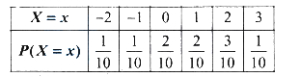
0 likesView Solution
387
MathematicsEasyMCQAP EAMCET · 2024
An urn contains $3$ black and $5$ red balls. If $3$ balls are drawn at random from the urn,the mean of the probability distribution of the number of red balls drawn is
A
$\frac{45}{28}$
B
$\frac{15}{8}$
C
$\frac{2}{5}$
D
$\frac{3}{2}$
Solution
(B) Let $X$ be the number of red balls drawn. The total number of balls is $3 + 5 = 8$. We draw $3$ balls from $8$,so the total number of ways is ${}^8 C_3 = \frac{8 \times 7 \times 6}{3 \times 2 \times 1} = 56$.
The random variable $X$ can take values $0, 1, 2, 3$.
$P(X=0) = \frac{{}^5 C_0 \times {}^3 C_3}{56} = \frac{1 \times 1}{56} = \frac{1}{56}$
$P(X=1) = \frac{{}^5 C_1 \times {}^3 C_2}{56} = \frac{5 \times 3}{56} = \frac{15}{56}$
$P(X=2) = \frac{{}^5 C_2 \times {}^3 C_1}{56} = \frac{10 \times 3}{56} = \frac{30}{56}$
$P(X=3) = \frac{{}^5 C_3 \times {}^3 C_0}{56} = \frac{10 \times 1}{56} = \frac{10}{56}$
The mean $E(X) = \sum x_i P(x_i) = 0 \times \frac{1}{56} + 1 \times \frac{15}{56} + 2 \times \frac{30}{56} + 3 \times \frac{10}{56} = \frac{0 + 15 + 60 + 30}{56} = \frac{105}{56} = \frac{15}{8}$.
The random variable $X$ can take values $0, 1, 2, 3$.
$P(X=0) = \frac{{}^5 C_0 \times {}^3 C_3}{56} = \frac{1 \times 1}{56} = \frac{1}{56}$
$P(X=1) = \frac{{}^5 C_1 \times {}^3 C_2}{56} = \frac{5 \times 3}{56} = \frac{15}{56}$
$P(X=2) = \frac{{}^5 C_2 \times {}^3 C_1}{56} = \frac{10 \times 3}{56} = \frac{30}{56}$
$P(X=3) = \frac{{}^5 C_3 \times {}^3 C_0}{56} = \frac{10 \times 1}{56} = \frac{10}{56}$
The mean $E(X) = \sum x_i P(x_i) = 0 \times \frac{1}{56} + 1 \times \frac{15}{56} + 2 \times \frac{30}{56} + 3 \times \frac{10}{56} = \frac{0 + 15 + 60 + 30}{56} = \frac{105}{56} = \frac{15}{8}$.
0 likesView Solution
388
MathematicsEasyMCQAP EAMCET · 2024
When an unfair dice is thrown,the probability of getting a number $k$ on it is $P(X=k)=k^2 P$,where $k=1, 2, 3, 4, 5, 6$ and $X$ is the random variable denoting a number on the dice,then the mean of $X$ is
A
$25$
B
$5$
C
$\frac{441}{9}$
D
$\frac{441}{91}$
Solution
(D) Given $P(X=k) = k^2 P$ for $k = 1, 2, 3, 4, 5, 6$.
Since the sum of all probabilities must be $1$,we have:
$\sum_{k=1}^6 P(X=k) = 1$
$P(1^2) + P(2^2) + P(3^2) + P(4^2) + P(5^2) + P(6^2) = 1$
$P(1 + 4 + 9 + 16 + 25 + 36) = 1$
$91P = 1 \Rightarrow P = \frac{1}{91}$.
The mean of $X$ is given by $E(X) = \sum_{k=1}^6 k \cdot P(X=k)$.
$E(X) = \sum_{k=1}^6 k \cdot (k^2 P) = P \sum_{k=1}^6 k^3$.
$E(X) = \frac{1}{91} (1^3 + 2^3 + 3^3 + 4^3 + 5^3 + 6^3)$.
$E(X) = \frac{1}{91} (1 + 8 + 27 + 64 + 125 + 216) = \frac{441}{91}$.
Since the sum of all probabilities must be $1$,we have:
$\sum_{k=1}^6 P(X=k) = 1$
$P(1^2) + P(2^2) + P(3^2) + P(4^2) + P(5^2) + P(6^2) = 1$
$P(1 + 4 + 9 + 16 + 25 + 36) = 1$
$91P = 1 \Rightarrow P = \frac{1}{91}$.
The mean of $X$ is given by $E(X) = \sum_{k=1}^6 k \cdot P(X=k)$.
$E(X) = \sum_{k=1}^6 k \cdot (k^2 P) = P \sum_{k=1}^6 k^3$.
$E(X) = \frac{1}{91} (1^3 + 2^3 + 3^3 + 4^3 + 5^3 + 6^3)$.
$E(X) = \frac{1}{91} (1 + 8 + 27 + 64 + 125 + 216) = \frac{441}{91}$.
0 likesView Solution
389
MathematicsEasyMCQAP EAMCET · 2024
If a random variable $X$ has the following probability distribution,then its variance is nearly:
| $X=x$ | $-3$ | $-2$ | $-1$ | $0$ | $1$ | $2$ | $3$ |
| $P(X=x)$ | $0.05$ | $0.1$ | $2K$ | $0$ | $0.3$ | $K$ | $0.1$ |
A
$2.8875$
B
$2.9875$
C
$2.7865$
D
$2.785$
Solution
(A) For a probability distribution,the sum of all probabilities must be $1$.
$\sum P(X=x) = 1$
$0.05 + 0.1 + 2K + 0 + 0.3 + K + 0.1 = 1$
$0.55 + 3K = 1 \Rightarrow 3K = 0.45 \Rightarrow K = 0.15$.
Now,the distribution is:
Mean $\mu = E(X) = \sum x_i P(x_i) = (-3)(0.05) + (-2)(0.1) + (-1)(0.3) + (0)(0) + (1)(0.3) + (2)(0.15) + (3)(0.1)$
$\mu = -0.15 - 0.2 - 0.3 + 0 + 0.3 + 0.3 + 0.3 = 0.25$.
Variance $\sigma^2 = E(X^2) - \mu^2 = \sum x_i^2 P(x_i) - (0.25)^2$.
$E(X^2) = (-3)^2(0.05) + (-2)^2(0.1) + (-1)^2(0.3) + (0)^2(0) + (1)^2(0.3) + (2)^2(0.15) + (3)^2(0.1)$
$E(X^2) = 9(0.05) + 4(0.1) + 1(0.3) + 0 + 1(0.3) + 4(0.15) + 9(0.1)$
$E(X^2) = 0.45 + 0.4 + 0.3 + 0 + 0.3 + 0.6 + 0.9 = 2.95$.
Variance $= 2.95 - (0.25)^2 = 2.95 - 0.0625 = 2.8875$.
$\sum P(X=x) = 1$
$0.05 + 0.1 + 2K + 0 + 0.3 + K + 0.1 = 1$
$0.55 + 3K = 1 \Rightarrow 3K = 0.45 \Rightarrow K = 0.15$.
Now,the distribution is:
| $X$ | $-3$ | $-2$ | $-1$ | $0$ | $1$ | $2$ | $3$ |
| $P(X)$ | $0.05$ | $0.1$ | $0.3$ | $0$ | $0.3$ | $0.15$ | $0.1$ |
Mean $\mu = E(X) = \sum x_i P(x_i) = (-3)(0.05) + (-2)(0.1) + (-1)(0.3) + (0)(0) + (1)(0.3) + (2)(0.15) + (3)(0.1)$
$\mu = -0.15 - 0.2 - 0.3 + 0 + 0.3 + 0.3 + 0.3 = 0.25$.
Variance $\sigma^2 = E(X^2) - \mu^2 = \sum x_i^2 P(x_i) - (0.25)^2$.
$E(X^2) = (-3)^2(0.05) + (-2)^2(0.1) + (-1)^2(0.3) + (0)^2(0) + (1)^2(0.3) + (2)^2(0.15) + (3)^2(0.1)$
$E(X^2) = 9(0.05) + 4(0.1) + 1(0.3) + 0 + 1(0.3) + 4(0.15) + 9(0.1)$
$E(X^2) = 0.45 + 0.4 + 0.3 + 0 + 0.3 + 0.6 + 0.9 = 2.95$.
Variance $= 2.95 - (0.25)^2 = 2.95 - 0.0625 = 2.8875$.
0 likesView Solution
390
MathematicsEasyMCQAP EAMCET · 2024
If the probability distribution of a random variable $X$ is as follows,then $k=$
(in $/10$)
| $X=x$ | $1$ | $2$ | $3$ | $4$ |
| $P(X=x)$ | $2k$ | $4k$ | $3k$ | $k$ |
A
$1$
B
$2$
C
$3$
D
$4$
Solution
(A) For a probability distribution,the sum of all probabilities must be equal to $1$.
$\Sigma P(X=x) = 1$
$2k + 4k + 3k + k = 1$
$10k = 1$
$k = \frac{1}{10}$
$\Sigma P(X=x) = 1$
$2k + 4k + 3k + k = 1$
$10k = 1$
$k = \frac{1}{10}$
0 likesView Solution
391
MathematicsDifficultMCQAP EAMCET · 2024
If the percentage error in the radius of a circle is $3\%$,then the percentage error in its area is (in $\%$)
A
$6$
B
$1.5$
C
$2$
D
$4$
Solution
(A) Let $r$ be the radius and $A$ be the area of the circle.
The area of the circle is given by $A = \pi r^2$.
Taking the natural logarithm on both sides,we get $\ln A = \ln \pi + 2 \ln r$.
Differentiating both sides with respect to $r$,we get $\frac{dA}{A} = 2 \frac{dr}{r}$.
The percentage error in the radius is given as $\frac{dr}{r} \times 100 = 3\%$.
The percentage error in the area is $\frac{dA}{A} \times 100 = 2 \times (\frac{dr}{r} \times 100)$.
Substituting the given value,we get $\frac{dA}{A} \times 100 = 2 \times 3\% = 6\%$.
Thus,the percentage error in the area is $6\%$.
The area of the circle is given by $A = \pi r^2$.
Taking the natural logarithm on both sides,we get $\ln A = \ln \pi + 2 \ln r$.
Differentiating both sides with respect to $r$,we get $\frac{dA}{A} = 2 \frac{dr}{r}$.
The percentage error in the radius is given as $\frac{dr}{r} \times 100 = 3\%$.
The percentage error in the area is $\frac{dA}{A} \times 100 = 2 \times (\frac{dr}{r} \times 100)$.
Substituting the given value,we get $\frac{dA}{A} \times 100 = 2 \times 3\% = 6\%$.
Thus,the percentage error in the area is $6\%$.
0 likesView Solution
392
MathematicsEasyMCQAP EAMCET · 2024
If $P=(0,1,2)$,$Q=(4,-2,1)$,and $O=(0,0,0)$,then $\angle POQ$ is equal to
A
$\frac{\pi}{2}$
B
$\frac{\pi}{4}$
C
$\frac{\pi}{6}$
D
$\frac{\pi}{3}$
Solution
(A) The position vectors of points $P$ and $Q$ with respect to the origin $O(0,0,0)$ are given by $\vec{OP} = 0\hat{i} + 1\hat{j} + 2\hat{k}$ and $\vec{OQ} = 4\hat{i} - 2\hat{j} + 1\hat{k}$.
To find the angle $\theta = \angle POQ$,we use the dot product formula: $\cos \theta = \frac{\vec{OP} \cdot \vec{OQ}}{|\vec{OP}| |\vec{OQ}|}$.
First,calculate the dot product:
$\vec{OP} \cdot \vec{OQ} = (0)(4) + (1)(-2) + (2)(1) = 0 - 2 + 2 = 0$.
Since the dot product is $0$,the vectors $\vec{OP}$ and $\vec{OQ}$ are perpendicular to each other.
Therefore,$\cos \theta = 0$,which implies $\theta = \frac{\pi}{2}$.
To find the angle $\theta = \angle POQ$,we use the dot product formula: $\cos \theta = \frac{\vec{OP} \cdot \vec{OQ}}{|\vec{OP}| |\vec{OQ}|}$.
First,calculate the dot product:
$\vec{OP} \cdot \vec{OQ} = (0)(4) + (1)(-2) + (2)(1) = 0 - 2 + 2 = 0$.
Since the dot product is $0$,the vectors $\vec{OP}$ and $\vec{OQ}$ are perpendicular to each other.
Therefore,$\cos \theta = 0$,which implies $\theta = \frac{\pi}{2}$.
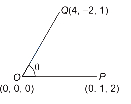
0 likesView Solution
Vedclass Products
For Students
Vedclass Test Series
Mock tests in real AP EAMCET style covering Mathematics with performance analysis. 5-day free trial.
Start Free TrialFor Teachers
Exam Paper Generator
Generate Set A/B/C/D Mathematics papers from 7.5L+ questions in 2 minutes. 3 chapters free.
Try FreeFor Institutes
Online Exam Module
Run live AP EAMCET mock exams with unlimited students, 360° analytics & white-label branding.
See DemoFrequently Asked Questions
How many Mathematics questions are in AP EAMCET 2024?
There are 723 Mathematics questions from the AP EAMCET 2024 paper on Vedclass, each with a detailed step-by-step solution in English.
Are AP EAMCET 2024 Mathematics solutions available in English?
Yes. All solutions on this page are in English. You can also switch to English or Hindi using the language buttons above the questions.
Can I practice AP EAMCET 2024 Mathematics as a timed test?
Yes. Use the Vedclass Test Series to attempt a full AP EAMCET mock test covering Mathematics with time limits and instant score analysis.
Can teachers create Mathematics papers from AP EAMCET previous year questions?
Yes. The Vedclass Exam Paper Generator lets teachers mix AP EAMCET Mathematics questions and generate Set A/B/C/D papers in minutes.
For Teachers & Institutes
Build a Custom Mathematics Paper
Pick AP EAMCET 2024 Mathematics questions, set difficulty, and generate Set A/B/C/D in 2 minutes.