
MathematicsQ351–381 of 723 questions
Page 8 of 8 · English
351
MathematicsMediumMCQAP EAMCET · 2024
The acute angle between the curves $x^2+y^2=x+y$ and $x^2+y^2=2y$ is
A
$\frac{2\pi}{3}$
B
$\frac{\pi}{2}$
C
$\frac{\pi}{3}$
D
$\frac{\pi}{4}$
Solution
(D) The given curves are $x^2+y^2-x-y=0$ $(i)$ and $x^2+y^2-2y=0$ $(ii)$.
To find the intersection points,subtract $(i)$ from $(ii)$: $(x^2+y^2-2y) - (x^2+y^2-x-y) = 0 \Rightarrow x-y=0 \Rightarrow x=y$.
Substitute $x=y$ into $(ii)$: $x^2+x^2=2x \Rightarrow 2x^2-2x=0 \Rightarrow 2x(x-1)=0$. Thus,the intersection points are $(0,0)$ and $(1,1)$.
For curve $(i)$,differentiating w.r.t. $x$: $2x+2y\frac{dy}{dx}=1+\frac{dy}{dx} \Rightarrow \frac{dy}{dx} = \frac{1-2x}{2y-1} = m_1$.
For curve $(ii)$,differentiating w.r.t. $x$: $2x+2y\frac{dy}{dx}=2\frac{dy}{dx} \Rightarrow \frac{dy}{dx} = \frac{x}{1-y} = m_2$.
At $(1,1)$,$m_1 = \frac{1-2}{2-1} = -1$ and $m_2 = \frac{1}{1-1}$ (undefined,vertical tangent).
Since one tangent is vertical,the angle $\theta$ is given by $|\tan \theta| = |\frac{1}{m_1}| = |\frac{1}{-1}| = 1$.
Therefore,$\theta = \frac{\pi}{4}$.
To find the intersection points,subtract $(i)$ from $(ii)$: $(x^2+y^2-2y) - (x^2+y^2-x-y) = 0 \Rightarrow x-y=0 \Rightarrow x=y$.
Substitute $x=y$ into $(ii)$: $x^2+x^2=2x \Rightarrow 2x^2-2x=0 \Rightarrow 2x(x-1)=0$. Thus,the intersection points are $(0,0)$ and $(1,1)$.
For curve $(i)$,differentiating w.r.t. $x$: $2x+2y\frac{dy}{dx}=1+\frac{dy}{dx} \Rightarrow \frac{dy}{dx} = \frac{1-2x}{2y-1} = m_1$.
For curve $(ii)$,differentiating w.r.t. $x$: $2x+2y\frac{dy}{dx}=2\frac{dy}{dx} \Rightarrow \frac{dy}{dx} = \frac{x}{1-y} = m_2$.
At $(1,1)$,$m_1 = \frac{1-2}{2-1} = -1$ and $m_2 = \frac{1}{1-1}$ (undefined,vertical tangent).
Since one tangent is vertical,the angle $\theta$ is given by $|\tan \theta| = |\frac{1}{m_1}| = |\frac{1}{-1}| = 1$.
Therefore,$\theta = \frac{\pi}{4}$.
0 likesView Solution
352
MathematicsEasyMCQAP EAMCET · 2024
If the curves $2x^2 + ky^2 = 30$ and $3y^2 = 28x$ cut each other orthogonally,then $k=$
A
$5$
B
$3$
C
$2$
D
$1$
Solution
(D) Given curves are $2x^2 + ky^2 = 30$ ...$(i)$ and $3y^2 = 28x$ ...(ii).
Differentiating $(i)$ with respect to $x$: $4x + 2ky \frac{dy}{dx} = 0 \Rightarrow \frac{dy}{dx} = \frac{-2x}{ky} = m_1$.
Differentiating (ii) with respect to $x$: $6y \frac{dy}{dx} = 28 \Rightarrow \frac{dy}{dx} = \frac{14}{3y} = m_2$.
Since the curves cut orthogonally,$m_1 m_2 = -1$.
$\left( \frac{-2x}{ky} \right) \left( \frac{14}{3y} \right) = -1 \Rightarrow \frac{28x}{3ky^2} = 1$.
From (ii),$3y^2 = 28x$,so substitute this into the equation:
$\frac{28x}{k(28x)} = 1 \Rightarrow \frac{1}{k} = 1 \Rightarrow k = 1$.
Differentiating $(i)$ with respect to $x$: $4x + 2ky \frac{dy}{dx} = 0 \Rightarrow \frac{dy}{dx} = \frac{-2x}{ky} = m_1$.
Differentiating (ii) with respect to $x$: $6y \frac{dy}{dx} = 28 \Rightarrow \frac{dy}{dx} = \frac{14}{3y} = m_2$.
Since the curves cut orthogonally,$m_1 m_2 = -1$.
$\left( \frac{-2x}{ky} \right) \left( \frac{14}{3y} \right) = -1 \Rightarrow \frac{28x}{3ky^2} = 1$.
From (ii),$3y^2 = 28x$,so substitute this into the equation:
$\frac{28x}{k(28x)} = 1 \Rightarrow \frac{1}{k} = 1 \Rightarrow k = 1$.
0 likesView Solution
353
MathematicsEasyMCQAP EAMCET · 2024
The number of all the values of $x$ for which the function $f(x)=\sin x+\frac{1-\tan ^2 x}{1+\tan ^2 x}$ attains its maximum value on $[0, 2\pi]$ is
A
$4$
B
$1$
C
$2$
D
infinite
Solution
(C) Given $f(x) = \sin x + \frac{1-\tan^2 x}{1+\tan^2 x}$.
Using the identity $\cos 2x = \frac{1-\tan^2 x}{1+\tan^2 x}$,we have $f(x) = \sin x + \cos 2x$.
Since $\cos 2x = 1 - 2\sin^2 x$,we can write $f(x) = \sin x + 1 - 2\sin^2 x$.
Let $t = \sin x$,where $t \in [-1, 1]$. Then $g(t) = -2t^2 + t + 1$.
To find the maximum,we find the derivative $g'(t) = -4t + 1$.
Setting $g'(t) = 0$,we get $t = \frac{1}{4}$.
Since $g''(t) = -4 < 0$,$t = \frac{1}{4}$ is a point of local maxima.
We need to find the number of values of $x \in [0, 2\pi]$ such that $\sin x = \frac{1}{4}$.
Since $\frac{1}{4} > 0$,$\sin x = \frac{1}{4}$ has two solutions in the interval $[0, 2\pi]$ (one in the first quadrant and one in the second quadrant).
Thus,there are $2$ such values of $x$.
Using the identity $\cos 2x = \frac{1-\tan^2 x}{1+\tan^2 x}$,we have $f(x) = \sin x + \cos 2x$.
Since $\cos 2x = 1 - 2\sin^2 x$,we can write $f(x) = \sin x + 1 - 2\sin^2 x$.
Let $t = \sin x$,where $t \in [-1, 1]$. Then $g(t) = -2t^2 + t + 1$.
To find the maximum,we find the derivative $g'(t) = -4t + 1$.
Setting $g'(t) = 0$,we get $t = \frac{1}{4}$.
Since $g''(t) = -4 < 0$,$t = \frac{1}{4}$ is a point of local maxima.
We need to find the number of values of $x \in [0, 2\pi]$ such that $\sin x = \frac{1}{4}$.
Since $\frac{1}{4} > 0$,$\sin x = \frac{1}{4}$ has two solutions in the interval $[0, 2\pi]$ (one in the first quadrant and one in the second quadrant).
Thus,there are $2$ such values of $x$.
0 likesView Solution
354
MathematicsMediumMCQAP EAMCET · 2024
If $\frac{1}{x^4+1}=\frac{A x+B}{x^2+\sqrt{2} x+1}+\frac{C x+D}{x^2-\sqrt{2} x+1}$ then $B D-A C=$
A
$\frac{3}{8}$
B
$\frac{1}{8}$
C
$1$
D
$0$
Solution
(A) Given that $\frac{1}{x^4+1}=\frac{A x+B}{x^2+\sqrt{2} x+1}+\frac{C x+D}{x^2-\sqrt{2} x+1}$.
Multiplying both sides by $(x^4+1)$,we get $(A x+B)(x^2-\sqrt{2} x+1)+(C x+D)(x^2+\sqrt{2} x+1)=1$.
Comparing coefficients:
For $x^3$: $A+C=0 \Rightarrow C=-A$.
For $x^0$ (constant term): $B+D=1$.
For $x^2$: $B-\sqrt{2} A+D+\sqrt{2} C=0 \Rightarrow (B+D)-\sqrt{2}(A-C)=0$.
Since $B+D=1$ and $C=-A$,we have $1-\sqrt{2}(2A)=0 \Rightarrow A=\frac{1}{2\sqrt{2}}$ and $C=-\frac{1}{2\sqrt{2}}$.
For $x^1$: $A-\sqrt{2} B+C+\sqrt{2} D=0 \Rightarrow (A+C)+\sqrt{2}(D-B)=0$.
Since $A+C=0$,we have $\sqrt{2}(D-B)=0 \Rightarrow D=B$.
Since $B+D=1$,we get $2B=1 \Rightarrow B=\frac{1}{2}$ and $D=\frac{1}{2}$.
Now,$B D-A C = (\frac{1}{2})(\frac{1}{2}) - (\frac{1}{2\sqrt{2}})(-\frac{1}{2\sqrt{2}}) = \frac{1}{4} + \frac{1}{8} = \frac{3}{8}$.
Multiplying both sides by $(x^4+1)$,we get $(A x+B)(x^2-\sqrt{2} x+1)+(C x+D)(x^2+\sqrt{2} x+1)=1$.
Comparing coefficients:
For $x^3$: $A+C=0 \Rightarrow C=-A$.
For $x^0$ (constant term): $B+D=1$.
For $x^2$: $B-\sqrt{2} A+D+\sqrt{2} C=0 \Rightarrow (B+D)-\sqrt{2}(A-C)=0$.
Since $B+D=1$ and $C=-A$,we have $1-\sqrt{2}(2A)=0 \Rightarrow A=\frac{1}{2\sqrt{2}}$ and $C=-\frac{1}{2\sqrt{2}}$.
For $x^1$: $A-\sqrt{2} B+C+\sqrt{2} D=0 \Rightarrow (A+C)+\sqrt{2}(D-B)=0$.
Since $A+C=0$,we have $\sqrt{2}(D-B)=0 \Rightarrow D=B$.
Since $B+D=1$,we get $2B=1 \Rightarrow B=\frac{1}{2}$ and $D=\frac{1}{2}$.
Now,$B D-A C = (\frac{1}{2})(\frac{1}{2}) - (\frac{1}{2\sqrt{2}})(-\frac{1}{2\sqrt{2}}) = \frac{1}{4} + \frac{1}{8} = \frac{3}{8}$.
0 likesView Solution
355
MathematicsMediumMCQAP EAMCET · 2024
If $\frac{A}{x-a}+\frac{B x+C}{x^2+b^2}=\frac{1}{(x-a)(x^2+b^2)}$ then $C=$
A
$\frac{-1}{a^2+b^2}$
B
$\frac{1}{a^2+b^2}$
C
$\frac{-a}{a^2+b^2}$
D
$\frac{a}{a^2+b^2}$
Solution
(C) Given the equation: $\frac{A}{x-a}+\frac{B x+C}{x^2+b^2}=\frac{1}{(x-a)(x^2+b^2)}$
Multiplying both sides by $(x-a)(x^2+b^2)$,we get:
$A(x^2+b^2)+(B x+C)(x-a)=1$
Expanding the terms:
$(A+B)x^2+(C-a B)x+(A b^2-a C)=1$
Comparing the coefficients of $x^2$,$x$,and the constant term on both sides:
$A+B=0$ ....$(i)$
$C-a B=0$ ....$(ii)$
$A b^2-a C=1$ ....$(iii)$
From $(i)$,$B=-A$. Substituting this into $(ii)$:
$C-a(-A)=0 \Rightarrow C+a A=0 \Rightarrow A=\frac{-C}{a}$
Substituting $A=\frac{-C}{a}$ into $(iii)$:
$(\frac{-C}{a})b^2-a C=1$
$-C(\frac{b^2+a^2}{a})=1$
$C=\frac{-a}{a^2+b^2}$
Multiplying both sides by $(x-a)(x^2+b^2)$,we get:
$A(x^2+b^2)+(B x+C)(x-a)=1$
Expanding the terms:
$(A+B)x^2+(C-a B)x+(A b^2-a C)=1$
Comparing the coefficients of $x^2$,$x$,and the constant term on both sides:
$A+B=0$ ....$(i)$
$C-a B=0$ ....$(ii)$
$A b^2-a C=1$ ....$(iii)$
From $(i)$,$B=-A$. Substituting this into $(ii)$:
$C-a(-A)=0 \Rightarrow C+a A=0 \Rightarrow A=\frac{-C}{a}$
Substituting $A=\frac{-C}{a}$ into $(iii)$:
$(\frac{-C}{a})b^2-a C=1$
$-C(\frac{b^2+a^2}{a})=1$
$C=\frac{-a}{a^2+b^2}$
0 likesView Solution
356
MathematicsDifficultMCQAP EAMCET · 2024
If $\frac{x+2}{(x^2+3)(x^4+x^2)(x^2+2)} = \frac{Ax+B}{x^2+3} + \frac{Cx+D}{x^2+2} + \frac{Ex^3+Fx^2+Gx+H}{x^4+x^2}$,then find the value of $(E+F)(C+D)(A)$.
A
$-\frac{1}{4}$
B
$-\frac{3}{4}$
C
$\frac{3}{4}$
D
$\frac{1}{4}$
Solution
(D) We decompose the expression using partial fractions:
$\frac{x+2}{(x^2+3)(x^2)(x^2+1)(x^2+2)} = \frac{A'}{x} + \frac{B'}{x^2} + \frac{C'x+D'}{x^2+1} + \frac{E'x+F'}{x^2+2} + \frac{G'x+H'}{x^2+3}$.
By equating coefficients and solving the system of equations,we obtain:
$A' = \frac{1}{6}, B' = \frac{1}{3}, C' = -\frac{1}{2}, D' = -1, E' = \frac{1}{2}, F' = 1, G' = -\frac{1}{6}, H' = -\frac{1}{3}$.
Substituting these back,we group the terms to match the form given in the question:
$\frac{x+2}{(x^2+3)(x^4+x^2)(x^2+2)} = \frac{-\frac{1}{6}x - \frac{1}{3}}{x^2+3} + \frac{\frac{1}{2}x + 1}{x^2+2} + \frac{-\frac{1}{3}x^3 - \frac{2}{3}x^2 + \frac{1}{6}x + \frac{1}{3}}{x^4+x^2}$.
Comparing this with the given expression,we identify:
$A = -\frac{1}{6}, B = -\frac{1}{3}, C = \frac{1}{2}, D = 1, E = -\frac{1}{3}, F = -\frac{2}{3}, G = \frac{1}{6}, H = \frac{1}{3}$.
Finally,calculating the required value:
$(E+F)(C+D)(A) = (-\frac{1}{3} - \frac{2}{3})(\frac{1}{2} + 1)(-\frac{1}{6}) = (-1)(\frac{3}{2})(-\frac{1}{6}) = \frac{3}{12} = \frac{1}{4}$.
$\frac{x+2}{(x^2+3)(x^2)(x^2+1)(x^2+2)} = \frac{A'}{x} + \frac{B'}{x^2} + \frac{C'x+D'}{x^2+1} + \frac{E'x+F'}{x^2+2} + \frac{G'x+H'}{x^2+3}$.
By equating coefficients and solving the system of equations,we obtain:
$A' = \frac{1}{6}, B' = \frac{1}{3}, C' = -\frac{1}{2}, D' = -1, E' = \frac{1}{2}, F' = 1, G' = -\frac{1}{6}, H' = -\frac{1}{3}$.
Substituting these back,we group the terms to match the form given in the question:
$\frac{x+2}{(x^2+3)(x^4+x^2)(x^2+2)} = \frac{-\frac{1}{6}x - \frac{1}{3}}{x^2+3} + \frac{\frac{1}{2}x + 1}{x^2+2} + \frac{-\frac{1}{3}x^3 - \frac{2}{3}x^2 + \frac{1}{6}x + \frac{1}{3}}{x^4+x^2}$.
Comparing this with the given expression,we identify:
$A = -\frac{1}{6}, B = -\frac{1}{3}, C = \frac{1}{2}, D = 1, E = -\frac{1}{3}, F = -\frac{2}{3}, G = \frac{1}{6}, H = \frac{1}{3}$.
Finally,calculating the required value:
$(E+F)(C+D)(A) = (-\frac{1}{3} - \frac{2}{3})(\frac{1}{2} + 1)(-\frac{1}{6}) = (-1)(\frac{3}{2})(-\frac{1}{6}) = \frac{3}{12} = \frac{1}{4}$.
0 likesView Solution
357
MathematicsEasyMCQAP EAMCET · 2024
If $\frac{13x+43}{2x^2+17x+30} = \frac{A}{2x+5} + \frac{B}{x+6}$,then $A+B = $
A
$8$
B
$18$
C
$3$
D
$5$
Solution
(A) Given the partial fraction decomposition: $\frac{13x+43}{2x^2+17x+30} = \frac{A}{2x+5} + \frac{B}{x+6}$
Combining the terms on the right side: $\frac{13x+43}{2x^2+17x+30} = \frac{A(x+6) + B(2x+5)}{(2x+5)(x+6)}$
Since the denominators are equal,we equate the numerators: $13x + 43 = A(x+6) + B(2x+5)$
Expanding the right side: $13x + 43 = (A + 2B)x + (6A + 5B)$
Comparing the coefficients of $x$ and the constant terms,we get the system of equations:
$A + 2B = 13$ ... $(i)$
$6A + 5B = 43$ ... $(ii)$
From $(i)$,$A = 13 - 2B$. Substituting this into $(ii)$:
$6(13 - 2B) + 5B = 43$
$78 - 12B + 5B = 43$
$-7B = 43 - 78$
$-7B = -35 \Rightarrow B = 5$
Substituting $B = 5$ back into $(i)$:
$A + 2(5) = 13 \Rightarrow A + 10 = 13 \Rightarrow A = 3$
Therefore,$A + B = 3 + 5 = 8$.
Combining the terms on the right side: $\frac{13x+43}{2x^2+17x+30} = \frac{A(x+6) + B(2x+5)}{(2x+5)(x+6)}$
Since the denominators are equal,we equate the numerators: $13x + 43 = A(x+6) + B(2x+5)$
Expanding the right side: $13x + 43 = (A + 2B)x + (6A + 5B)$
Comparing the coefficients of $x$ and the constant terms,we get the system of equations:
$A + 2B = 13$ ... $(i)$
$6A + 5B = 43$ ... $(ii)$
From $(i)$,$A = 13 - 2B$. Substituting this into $(ii)$:
$6(13 - 2B) + 5B = 43$
$78 - 12B + 5B = 43$
$-7B = 43 - 78$
$-7B = -35 \Rightarrow B = 5$
Substituting $B = 5$ back into $(i)$:
$A + 2(5) = 13 \Rightarrow A + 10 = 13 \Rightarrow A = 3$
Therefore,$A + B = 3 + 5 = 8$.
0 likesView Solution
358
MathematicsEasyMCQAP EAMCET · 2024
$\frac{4x^2+5}{(x-2)^4} = \frac{A}{(x-2)} + \frac{B}{(x-2)^2} + \frac{C}{(x-2)^3} + \frac{D}{(x-2)^4}$,then $\sqrt{\frac{A}{C} + \frac{B}{C} + \frac{D}{C}} = $
A
$\frac{\sqrt{29}}{4}$
B
$\frac{\sqrt{23}}{4}$
C
$\frac{5}{4}$
D
$\frac{4}{5}$
Solution
(C) Let $x-2 = t$,so $x = t+2$.
Substituting this into the expression: $4(t+2)^2 + 5 = 4(t^2 + 4t + 4) + 5 = 4t^2 + 16t + 21$.
Now,$\frac{4t^2 + 16t + 21}{t^4} = \frac{4}{t^2} + \frac{16}{t^3} + \frac{21}{t^4}$.
Comparing this with $\frac{A}{t} + \frac{B}{t^2} + \frac{C}{t^3} + \frac{D}{t^4}$,we get:
$A = 0$,$B = 4$,$C = 16$,and $D = 21$.
Now,calculate $\sqrt{\frac{A+B+D}{C}} = \sqrt{\frac{0+4+21}{16}} = \sqrt{\frac{25}{16}} = \frac{5}{4}$.
Substituting this into the expression: $4(t+2)^2 + 5 = 4(t^2 + 4t + 4) + 5 = 4t^2 + 16t + 21$.
Now,$\frac{4t^2 + 16t + 21}{t^4} = \frac{4}{t^2} + \frac{16}{t^3} + \frac{21}{t^4}$.
Comparing this with $\frac{A}{t} + \frac{B}{t^2} + \frac{C}{t^3} + \frac{D}{t^4}$,we get:
$A = 0$,$B = 4$,$C = 16$,and $D = 21$.
Now,calculate $\sqrt{\frac{A+B+D}{C}} = \sqrt{\frac{0+4+21}{16}} = \sqrt{\frac{25}{16}} = \frac{5}{4}$.
0 likesView Solution
359
MathematicsDifficultMCQAP EAMCET · 2024
Area of the region enclosed by the curves $3x^2-y^2-2xy+4x+1=0$ and $3x^2-y^2-2xy+6x+2y=0$ is
A
$\frac{3}{4}$
B
$\frac{1}{4}$
C
$1$
D
$\frac{1}{2}$
Solution
(B) The given equations represent pairs of straight lines.
For the first curve $3x^2-y^2-2xy+4x+1=0$,we can rewrite it as $3x^2+(4-2y)x+(1-y^2)=0$. Solving for $x$ using the quadratic formula:
$x = \frac{-(4-2y) \pm \sqrt{(4-2y)^2 - 4(3)(1-y^2)}}{6} = \frac{(2y-4) \pm \sqrt{16-16y+4y^2-12+12y^2}}{6} = \frac{(2y-4) \pm \sqrt{16y^2-16y+4}}{6} = \frac{(2y-4) \pm 2(2y-1)}{6} = \frac{(y-2) \pm (2y-1)}{3}$.
This gives two lines: $L_1: x-y+1=0$ and $L_2: 3x+y+1=0$.
For the second curve $3x^2-y^2-2xy+6x+2y=0$,we rewrite it as $3x^2+(6-2y)x+(2y-y^2)=0$. Solving for $x$:
$x = \frac{-(6-2y) \pm \sqrt{(6-2y)^2 - 4(3)(2y-y^2)}}{6} = \frac{(2y-6) \pm \sqrt{36-24y+4y^2-24y+12y^2}}{6} = \frac{(2y-6) \pm \sqrt{16y^2-48y+36}}{6} = \frac{(2y-6) \pm 2(2y-3)}{6} = \frac{(y-3) \pm (2y-3)}{3}$.
This gives two lines: $L_3: x-y+2=0$ and $L_4: 3x+y=0$.
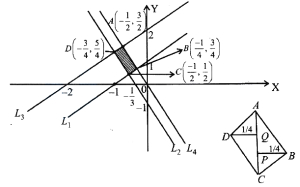
The region is a parallelogram formed by the intersection of these four lines. The vertices are:
$A = L_3 \cap L_4 = (-1/2, 3/2)$
$B = L_1 \cap L_4 = (-1/4, 3/4)$
$C = L_1 \cap L_2 = (-1/2, 1/2)$
$D = L_2 \cap L_3 = (-3/4, 5/4)$
The area of a parallelogram formed by lines $a_1x+b_1y+c_1=0, a_1x+b_1y+c_2=0, a_2x+b_2y+d_1=0, a_2x+b_2y+d_2=0$ is given by $\frac{|(c_1-c_2)(d_1-d_2)|}{|a_1b_2-a_2b_1|}$.
Here,$L_1: x-y+1=0, L_3: x-y+2=0 \implies |c_1-c_2| = |1-2| = 1$.
$L_2: 3x+y+1=0, L_4: 3x+y=0 \implies |d_1-d_2| = |1-0| = 1$.
The denominator is $|(1)(1) - (3)(-1)| = |1+3| = 4$.
Area $= \frac{1 \times 1}{4} = \frac{1}{4}$.
For the first curve $3x^2-y^2-2xy+4x+1=0$,we can rewrite it as $3x^2+(4-2y)x+(1-y^2)=0$. Solving for $x$ using the quadratic formula:
$x = \frac{-(4-2y) \pm \sqrt{(4-2y)^2 - 4(3)(1-y^2)}}{6} = \frac{(2y-4) \pm \sqrt{16-16y+4y^2-12+12y^2}}{6} = \frac{(2y-4) \pm \sqrt{16y^2-16y+4}}{6} = \frac{(2y-4) \pm 2(2y-1)}{6} = \frac{(y-2) \pm (2y-1)}{3}$.
This gives two lines: $L_1: x-y+1=0$ and $L_2: 3x+y+1=0$.
For the second curve $3x^2-y^2-2xy+6x+2y=0$,we rewrite it as $3x^2+(6-2y)x+(2y-y^2)=0$. Solving for $x$:
$x = \frac{-(6-2y) \pm \sqrt{(6-2y)^2 - 4(3)(2y-y^2)}}{6} = \frac{(2y-6) \pm \sqrt{36-24y+4y^2-24y+12y^2}}{6} = \frac{(2y-6) \pm \sqrt{16y^2-48y+36}}{6} = \frac{(2y-6) \pm 2(2y-3)}{6} = \frac{(y-3) \pm (2y-3)}{3}$.
This gives two lines: $L_3: x-y+2=0$ and $L_4: 3x+y=0$.
The region is a parallelogram formed by the intersection of these four lines. The vertices are:
$A = L_3 \cap L_4 = (-1/2, 3/2)$
$B = L_1 \cap L_4 = (-1/4, 3/4)$
$C = L_1 \cap L_2 = (-1/2, 1/2)$
$D = L_2 \cap L_3 = (-3/4, 5/4)$
The area of a parallelogram formed by lines $a_1x+b_1y+c_1=0, a_1x+b_1y+c_2=0, a_2x+b_2y+d_1=0, a_2x+b_2y+d_2=0$ is given by $\frac{|(c_1-c_2)(d_1-d_2)|}{|a_1b_2-a_2b_1|}$.
Here,$L_1: x-y+1=0, L_3: x-y+2=0 \implies |c_1-c_2| = |1-2| = 1$.
$L_2: 3x+y+1=0, L_4: 3x+y=0 \implies |d_1-d_2| = |1-0| = 1$.
The denominator is $|(1)(1) - (3)(-1)| = |1+3| = 4$.
Area $= \frac{1 \times 1}{4} = \frac{1}{4}$.
0 likesView Solution
360
MathematicsEasyMCQAP EAMCET · 2024
Let $P(\alpha, 4, 7)$ and $Q(3, \beta, 8)$ be two points. If the $YZ$-plane divides the line segment joining $P$ and $Q$ in the ratio $2:3$ and the $ZX$-plane divides the line segment joining $P$ and $Q$ in the ratio $4:5$,then the length of the line segment $PQ$ is:
A
$\sqrt{107}$
B
$\sqrt{27}$
C
$\sqrt{83}$
D
$\sqrt{97}$
Solution
(A) Given points are $P(\alpha, 4, 7)$ and $Q(3, \beta, 8)$.
Since the $YZ$-plane divides the line segment $PQ$ in the ratio $2:3$,the $x$-coordinate of the point of division is zero.
Using the section formula: $\frac{2(3) + 3(\alpha)}{2+3} = 0 \Rightarrow 6 + 3\alpha = 0 \Rightarrow \alpha = -2$.
Since the $ZX$-plane divides the line segment $PQ$ in the ratio $4:5$,the $y$-coordinate of the point of division is zero.
Using the section formula: $\frac{4(\beta) + 5(4)}{4+5} = 0 \Rightarrow 4\beta + 20 = 0 \Rightarrow \beta = -5$.
Thus,the points are $P(-2, 4, 7)$ and $Q(3, -5, 8)$.
The length of the line segment $PQ$ is given by the distance formula:
$PQ = \sqrt{(3 - (-2))^2 + (-5 - 4)^2 + (8 - 7)^2}$
$PQ = \sqrt{(5)^2 + (-9)^2 + (1)^2}$
$PQ = \sqrt{25 + 81 + 1} = \sqrt{107}$.
Since the $YZ$-plane divides the line segment $PQ$ in the ratio $2:3$,the $x$-coordinate of the point of division is zero.
Using the section formula: $\frac{2(3) + 3(\alpha)}{2+3} = 0 \Rightarrow 6 + 3\alpha = 0 \Rightarrow \alpha = -2$.
Since the $ZX$-plane divides the line segment $PQ$ in the ratio $4:5$,the $y$-coordinate of the point of division is zero.
Using the section formula: $\frac{4(\beta) + 5(4)}{4+5} = 0 \Rightarrow 4\beta + 20 = 0 \Rightarrow \beta = -5$.
Thus,the points are $P(-2, 4, 7)$ and $Q(3, -5, 8)$.
The length of the line segment $PQ$ is given by the distance formula:
$PQ = \sqrt{(3 - (-2))^2 + (-5 - 4)^2 + (8 - 7)^2}$
$PQ = \sqrt{(5)^2 + (-9)^2 + (1)^2}$
$PQ = \sqrt{25 + 81 + 1} = \sqrt{107}$.
0 likesView Solution
361
MathematicsEasyMCQAP EAMCET · 2024
If $A=(1, 2, 3)$,$B=(3, 4, 7)$,and $C=(-3, -2, -5)$ are three points,then the ratio in which the point $C$ divides $AB$ externally is
A
$2: 3$
B
$3: 2$
C
$4: 3$
D
$3: 4$
Solution
(A) Let the point $C$ divide the line segment $AB$ externally in the ratio $k: 1$.
The coordinates of point $C$ are given by the section formula for external division:
$C = \left( \frac{k x_2 - x_1}{k - 1}, \frac{k y_2 - y_1}{k - 1}, \frac{k z_2 - z_1}{k - 1} \right)$
Substituting the coordinates $A(1, 2, 3)$ and $B(3, 4, 7)$:
$C = \left( \frac{3k - 1}{k - 1}, \frac{4k - 2}{k - 1}, \frac{7k - 3}{k - 1} \right)$
Given $C = (-3, -2, -5)$,we equate the $x$-coordinates:
$\frac{3k - 1}{k - 1} = -3$
$3k - 1 = -3(k - 1)$
$3k - 1 = -3k + 3$
$6k = 4$
$k = \frac{4}{6} = \frac{2}{3}$
Thus,the ratio $k: 1$ is $\frac{2}{3}: 1$,which is $2: 3$.
The coordinates of point $C$ are given by the section formula for external division:
$C = \left( \frac{k x_2 - x_1}{k - 1}, \frac{k y_2 - y_1}{k - 1}, \frac{k z_2 - z_1}{k - 1} \right)$
Substituting the coordinates $A(1, 2, 3)$ and $B(3, 4, 7)$:
$C = \left( \frac{3k - 1}{k - 1}, \frac{4k - 2}{k - 1}, \frac{7k - 3}{k - 1} \right)$
Given $C = (-3, -2, -5)$,we equate the $x$-coordinates:
$\frac{3k - 1}{k - 1} = -3$
$3k - 1 = -3(k - 1)$
$3k - 1 = -3k + 3$
$6k = 4$
$k = \frac{4}{6} = \frac{2}{3}$
Thus,the ratio $k: 1$ is $\frac{2}{3}: 1$,which is $2: 3$.
0 likesView Solution
362
MathematicsMediumMCQAP EAMCET · 2024
If a variable straight line passing through the point of intersection of the lines $x-2y+3=0$ and $2x-y-1=0$ intersects the $X, Y$-axes at $A$ and $B$ respectively,then the equation of the locus of a point which divides the segment $AB$ in the ratio $-2:3$ is
A
$14x^2+3xy-15y^2=0$
B
$xy=14x+15y$
C
$x^2+xy-y^2=0$
D
$14x+3xy-15y=0$
Solution
(D) The equation of a family of lines passing through the intersection of $x-2y+3=0$ and $2x-y-1=0$ is given by $(x-2y+3) + K(2x-y-1) = 0$.
Rearranging terms,we get $(1+2K)x - (2+K)y + (3-K) = 0$.
This can be written as $\frac{(1+2K)}{K-3}x + \frac{-(2+K)}{K-3}y = 1$.
The intercepts on the $X$ and $Y$ axes are $A\left(\frac{K-3}{1+2K}, 0\right)$ and $B\left(0, \frac{K-3}{-(2+K)}\right)$.
Let the point dividing $AB$ in the ratio $-2:3$ be $(x, y)$. Using the section formula:
$x = \frac{-2(0) + 3(\frac{K-3}{1+2K})}{3-2} = \frac{3(K-3)}{1+2K}$ and $y = \frac{-2(\frac{K-3}{-(2+K)}) + 3(0)}{3-2} = \frac{2(K-3)}{2+K}$.
From $x = \frac{3K-9}{2K+1}$,we get $x(2K+1) = 3K-9 \Rightarrow K(2x-3) = -9-x \Rightarrow K = \frac{x+9}{3-2x}$.
From $y = \frac{2K-6}{K+2}$,we get $y(K+2) = 2K-6 \Rightarrow K(y-2) = -6-2y \Rightarrow K = \frac{6+2y}{2-y}$.
Equating the two expressions for $K$: $\frac{x+9}{3-2x} = \frac{6+2y}{2-y}$.
$(x+9)(2-y) = (6+2y)(3-2x) \Rightarrow 2x - xy + 18 - 9y = 18 - 12x + 6y - 4xy$.
Simplifying,we get $14x + 3xy - 15y = 0$.
Rearranging terms,we get $(1+2K)x - (2+K)y + (3-K) = 0$.
This can be written as $\frac{(1+2K)}{K-3}x + \frac{-(2+K)}{K-3}y = 1$.
The intercepts on the $X$ and $Y$ axes are $A\left(\frac{K-3}{1+2K}, 0\right)$ and $B\left(0, \frac{K-3}{-(2+K)}\right)$.
Let the point dividing $AB$ in the ratio $-2:3$ be $(x, y)$. Using the section formula:
$x = \frac{-2(0) + 3(\frac{K-3}{1+2K})}{3-2} = \frac{3(K-3)}{1+2K}$ and $y = \frac{-2(\frac{K-3}{-(2+K)}) + 3(0)}{3-2} = \frac{2(K-3)}{2+K}$.
From $x = \frac{3K-9}{2K+1}$,we get $x(2K+1) = 3K-9 \Rightarrow K(2x-3) = -9-x \Rightarrow K = \frac{x+9}{3-2x}$.
From $y = \frac{2K-6}{K+2}$,we get $y(K+2) = 2K-6 \Rightarrow K(y-2) = -6-2y \Rightarrow K = \frac{6+2y}{2-y}$.
Equating the two expressions for $K$: $\frac{x+9}{3-2x} = \frac{6+2y}{2-y}$.
$(x+9)(2-y) = (6+2y)(3-2x) \Rightarrow 2x - xy + 18 - 9y = 18 - 12x + 6y - 4xy$.
Simplifying,we get $14x + 3xy - 15y = 0$.
0 likesView Solution
363
MathematicsMediumMCQAP EAMCET · 2024
$A$ line $L$ intersects the lines $3x - 2y - 1 = 0$ and $x + 2y + 1 = 0$ at the points $A$ and $B$. If the point $(1, 2)$ bisects the line segment $AB$ and $\frac{x}{a} + \frac{y}{b} = 1$ is the equation of the line $L$,then $a + 2b + 1 = $
A
$-1$
B
$0$
C
$1$
D
$2$
Solution
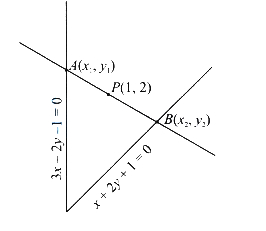
(D) Let the points of intersection be $A(x_1, y_1)$ and $B(x_2, y_2)$.
Since the point $(1, 2)$ bisects the line segment $AB$,we have:
$\frac{x_1 + x_2}{2} = 1 \Rightarrow x_2 = 2 - x_1$
$\frac{y_1 + y_2}{2} = 2 \Rightarrow y_2 = 4 - y_1$
Since $A$ lies on $3x - 2y - 1 = 0$,we have:
$3x_1 - 2y_1 - 1 = 0$ --- $(i)$
Since $B$ lies on $x + 2y + 1 = 0$,we substitute $x_2$ and $y_2$:
$(2 - x_1) + 2(4 - y_1) + 1 = 0$
$2 - x_1 + 8 - 2y_1 + 1 = 0$
$x_1 + 2y_1 - 11 = 0$ --- (ii)
Solving equations $(i)$ and (ii) by adding them:
$(3x_1 - 2y_1 - 1) + (x_1 + 2y_1 - 11) = 0$
$4x_1 - 12 = 0 \Rightarrow x_1 = 3$
Substituting $x_1 = 3$ in $(i)$:
$3(3) - 2y_1 - 1 = 0 \Rightarrow 8 = 2y_1 \Rightarrow y_1 = 4$
Thus,$A = (3, 4)$.
Then $x_2 = 2 - 3 = -1$ and $y_2 = 4 - 4 = 0$,so $B = (-1, 0)$.
The equation of line $L$ passing through $(3, 4)$ and $(-1, 0)$ is:
$y - 0 = \frac{4 - 0}{3 - (-1)}(x - (-1))$
$y = \frac{4}{4}(x + 1) \Rightarrow y = x + 1 \Rightarrow x - y = -1$
Dividing by $-1$,we get $\frac{x}{-1} + \frac{y}{1} = 1$.
Comparing with $\frac{x}{a} + \frac{y}{b} = 1$,we get $a = -1$ and $b = 1$.
Therefore,$a + 2b + 1 = -1 + 2(1) + 1 = -1 + 2 + 1 = 2$.
Since the point $(1, 2)$ bisects the line segment $AB$,we have:
$\frac{x_1 + x_2}{2} = 1 \Rightarrow x_2 = 2 - x_1$
$\frac{y_1 + y_2}{2} = 2 \Rightarrow y_2 = 4 - y_1$
Since $A$ lies on $3x - 2y - 1 = 0$,we have:
$3x_1 - 2y_1 - 1 = 0$ --- $(i)$
Since $B$ lies on $x + 2y + 1 = 0$,we substitute $x_2$ and $y_2$:
$(2 - x_1) + 2(4 - y_1) + 1 = 0$
$2 - x_1 + 8 - 2y_1 + 1 = 0$
$x_1 + 2y_1 - 11 = 0$ --- (ii)
Solving equations $(i)$ and (ii) by adding them:
$(3x_1 - 2y_1 - 1) + (x_1 + 2y_1 - 11) = 0$
$4x_1 - 12 = 0 \Rightarrow x_1 = 3$
Substituting $x_1 = 3$ in $(i)$:
$3(3) - 2y_1 - 1 = 0 \Rightarrow 8 = 2y_1 \Rightarrow y_1 = 4$
Thus,$A = (3, 4)$.
Then $x_2 = 2 - 3 = -1$ and $y_2 = 4 - 4 = 0$,so $B = (-1, 0)$.
The equation of line $L$ passing through $(3, 4)$ and $(-1, 0)$ is:
$y - 0 = \frac{4 - 0}{3 - (-1)}(x - (-1))$
$y = \frac{4}{4}(x + 1) \Rightarrow y = x + 1 \Rightarrow x - y = -1$
Dividing by $-1$,we get $\frac{x}{-1} + \frac{y}{1} = 1$.
Comparing with $\frac{x}{a} + \frac{y}{b} = 1$,we get $a = -1$ and $b = 1$.
Therefore,$a + 2b + 1 = -1 + 2(1) + 1 = -1 + 2 + 1 = 2$.
0 likesView Solution
364
MathematicsMediumMCQAP EAMCET · 2024
$A$ line $L$ passing through the point $(2,0)$ makes an angle $60^{\circ}$ with the line $2x-y+3=0$. If $L$ makes an acute angle with the positive $X$-axis in the anticlockwise direction,then the $Y$-intercept of the line $L$ is:
A
$\frac{10 \sqrt{3}-16}{11}$
B
$\frac{3 \sqrt{2}}{\sqrt{7}}$
C
$\frac{16-10 \sqrt{3}}{11}$
D
$2$
Solution
(C) The slope of the given line $2x-y+3=0$ is $m_1 = 2$.
Let the slope of line $L$ be $m$.
The angle between the lines is $60^{\circ}$,so $\tan 60^{\circ} = |\frac{m-m_1}{1+m m_1}|$.
$\sqrt{3} = |\frac{m-2}{1+2m}|$.
This gives two cases:
Case $1$: $\frac{m-2}{1+2m} = \sqrt{3} \Rightarrow m-2 = \sqrt{3} + 2\sqrt{3}m \Rightarrow m(1-2\sqrt{3}) = 2+\sqrt{3} \Rightarrow m = \frac{2+\sqrt{3}}{1-2\sqrt{3}} = \frac{(2+\sqrt{3})(1+2\sqrt{3})}{1-12} = \frac{2+4\sqrt{3}+\sqrt{3}+6}{-11} = \frac{8+5\sqrt{3}}{-11}$.
Case $2$: $\frac{m-2}{1+2m} = -\sqrt{3} \Rightarrow m-2 = -\sqrt{3} - 2\sqrt{3}m \Rightarrow m(1+2\sqrt{3}) = 2-\sqrt{3} \Rightarrow m = \frac{2-\sqrt{3}}{1+2\sqrt{3}} = \frac{(2-\sqrt{3})(1-2\sqrt{3})}{1-12} = \frac{2-4\sqrt{3}-\sqrt{3}+6}{-11} = \frac{8-5\sqrt{3}}{-11}$.
Since $L$ makes an acute angle with the positive $X$-axis,$m > 0$.
Comparing the two slopes,$\frac{8-5\sqrt{3}}{-11} = \frac{5\sqrt{3}-8}{11} \approx \frac{5(1.732)-8}{11} = \frac{8.66-8}{11} > 0$.
Thus,$m = \frac{5\sqrt{3}-8}{11}$.
The equation of line $L$ is $y - 0 = m(x - 2) \Rightarrow y = \frac{5\sqrt{3}-8}{11}(x - 2)$.
The $Y$-intercept is found by setting $x = 0$: $y = \frac{5\sqrt{3}-8}{11}(-2) = \frac{16-10\sqrt{3}}{11}$.
Let the slope of line $L$ be $m$.
The angle between the lines is $60^{\circ}$,so $\tan 60^{\circ} = |\frac{m-m_1}{1+m m_1}|$.
$\sqrt{3} = |\frac{m-2}{1+2m}|$.
This gives two cases:
Case $1$: $\frac{m-2}{1+2m} = \sqrt{3} \Rightarrow m-2 = \sqrt{3} + 2\sqrt{3}m \Rightarrow m(1-2\sqrt{3}) = 2+\sqrt{3} \Rightarrow m = \frac{2+\sqrt{3}}{1-2\sqrt{3}} = \frac{(2+\sqrt{3})(1+2\sqrt{3})}{1-12} = \frac{2+4\sqrt{3}+\sqrt{3}+6}{-11} = \frac{8+5\sqrt{3}}{-11}$.
Case $2$: $\frac{m-2}{1+2m} = -\sqrt{3} \Rightarrow m-2 = -\sqrt{3} - 2\sqrt{3}m \Rightarrow m(1+2\sqrt{3}) = 2-\sqrt{3} \Rightarrow m = \frac{2-\sqrt{3}}{1+2\sqrt{3}} = \frac{(2-\sqrt{3})(1-2\sqrt{3})}{1-12} = \frac{2-4\sqrt{3}-\sqrt{3}+6}{-11} = \frac{8-5\sqrt{3}}{-11}$.
Since $L$ makes an acute angle with the positive $X$-axis,$m > 0$.
Comparing the two slopes,$\frac{8-5\sqrt{3}}{-11} = \frac{5\sqrt{3}-8}{11} \approx \frac{5(1.732)-8}{11} = \frac{8.66-8}{11} > 0$.
Thus,$m = \frac{5\sqrt{3}-8}{11}$.
The equation of line $L$ is $y - 0 = m(x - 2) \Rightarrow y = \frac{5\sqrt{3}-8}{11}(x - 2)$.
The $Y$-intercept is found by setting $x = 0$: $y = \frac{5\sqrt{3}-8}{11}(-2) = \frac{16-10\sqrt{3}}{11}$.
0 likesView Solution
365
MathematicsEasyMCQAP EAMCET · 2024
If $5$ letters are to be placed in $5$ addressed envelopes,then the probability that at least one letter is placed in the wrongly addressed envelope is
A
$\frac{1}{5}$
B
$\frac{1}{120}$
C
$\frac{4}{5}$
D
$\frac{119}{120}$
Solution
(D) The total number of ways to place $5$ letters in $5$ addressed envelopes is $5! = 120$.
The number of ways in which all letters are placed in the correct envelopes is $1$.
Thus,the probability that all letters are placed correctly is $\frac{1}{120}$.
The probability that at least one letter is placed in the wrongly addressed envelope is $1 - P(\text{all correct}) = 1 - \frac{1}{120} = \frac{119}{120}$.
The number of ways in which all letters are placed in the correct envelopes is $1$.
Thus,the probability that all letters are placed correctly is $\frac{1}{120}$.
The probability that at least one letter is placed in the wrongly addressed envelope is $1 - P(\text{all correct}) = 1 - \frac{1}{120} = \frac{119}{120}$.
0 likesView Solution
366
MathematicsEasyMCQAP EAMCET · 2024
Out of the first $5$ consecutive natural numbers,if two different numbers $x$ and $y$ are chosen at random,then the probability that $x^4 - y^4$ is divisible by $5$ is
A
$\frac{2}{5}$
B
$\frac{4}{5}$
C
$\frac{3}{5}$
D
$\frac{1}{5}$
Solution
(C) The set of the first $5$ natural numbers is $S = \{1, 2, 3, 4, 5\}$.
The total number of ways to choose two different numbers $x$ and $y$ from $S$ is $^5C_2 = \frac{5 \times 4}{2} = 10$.
According to Fermat's Little Theorem,for any integer $a$ not divisible by $5$,$a^4 \equiv 1 \pmod{5}$.
If $a$ is divisible by $5$,then $a^4 \equiv 0 \pmod{5}$.
Let $x, y \in \{1, 2, 3, 4, 5\}$. We want $x^4 - y^4$ to be divisible by $5$,i.e.,$x^4 \equiv y^4 \pmod{5}$.
Case $1$: Both $x$ and $y$ are not divisible by $5$. Then $x^4 \equiv 1$ and $y^4 \equiv 1$,so $x^4 - y^4 \equiv 0 \pmod{5}$.
The numbers not divisible by $5$ are $\{1, 2, 3, 4\}$. The number of ways to choose $2$ distinct numbers from these $4$ is $^4C_2 = 6$.
Case $2$: One of the numbers is $5$. If $x=5$,then $x^4 \equiv 0$. For $x^4 - y^4$ to be divisible by $5$,$y^4$ must also be $0$,which is impossible as there is only one multiple of $5$ in the set.
Thus,the favorable outcomes are $6$.
The probability is $\frac{6}{10} = \frac{3}{5}$.
The total number of ways to choose two different numbers $x$ and $y$ from $S$ is $^5C_2 = \frac{5 \times 4}{2} = 10$.
According to Fermat's Little Theorem,for any integer $a$ not divisible by $5$,$a^4 \equiv 1 \pmod{5}$.
If $a$ is divisible by $5$,then $a^4 \equiv 0 \pmod{5}$.
Let $x, y \in \{1, 2, 3, 4, 5\}$. We want $x^4 - y^4$ to be divisible by $5$,i.e.,$x^4 \equiv y^4 \pmod{5}$.
Case $1$: Both $x$ and $y$ are not divisible by $5$. Then $x^4 \equiv 1$ and $y^4 \equiv 1$,so $x^4 - y^4 \equiv 0 \pmod{5}$.
The numbers not divisible by $5$ are $\{1, 2, 3, 4\}$. The number of ways to choose $2$ distinct numbers from these $4$ is $^4C_2 = 6$.
Case $2$: One of the numbers is $5$. If $x=5$,then $x^4 \equiv 0$. For $x^4 - y^4$ to be divisible by $5$,$y^4$ must also be $0$,which is impossible as there is only one multiple of $5$ in the set.
Thus,the favorable outcomes are $6$.
The probability is $\frac{6}{10} = \frac{3}{5}$.
0 likesView Solution
367
MathematicsEasyMCQAP EAMCET · 2024
In a consignment of $15$ articles,it is found that $3$ are defective. If a sample of $5$ articles is chosen at random from it,then the probability of having $2$ defective articles is
A
$\frac{256}{625}$
B
$\frac{64}{625}$
C
$\frac{220}{1001}$
D
$\frac{512}{625}$
Solution
(C) Step $1$: Define the variables.
Total articles $= 15$.
Defective articles $= 3$.
Non-defective articles $= 15 - 3 = 12$.
Sample size $= 5$.
We need the probability of choosing exactly $2$ defective articles in this sample.
Step $2$: Use combinations to calculate possible outcomes.
The probability is calculated using the hypergeometric distribution formula:
$P(X = k) = \frac{\binom{K}{k} \binom{N-K}{n-k}}{\binom{N}{n}}$
$1$. Number of ways to choose $2$ defective articles out of $3$:
$\binom{3}{2} = \frac{3!}{2!1!} = 3$.
$2$. Number of ways to choose $3$ non-defective articles out of $12$:
$\binom{12}{3} = \frac{12 \times 11 \times 10}{3 \times 2 \times 1} = 220$.
$3$. Total number of ways to choose $5$ articles out of $15$:
$\binom{15}{5} = \frac{15 \times 14 \times 13 \times 12 \times 11}{5 \times 4 \times 3 \times 2 \times 1} = 3003$.
Step $3$: Calculate the probability.
$P = \frac{3 \times 220}{3003} = \frac{660}{3003} = \frac{220}{1001}$.
Thus,the correct answer is $\frac{220}{1001}$.
Total articles $= 15$.
Defective articles $= 3$.
Non-defective articles $= 15 - 3 = 12$.
Sample size $= 5$.
We need the probability of choosing exactly $2$ defective articles in this sample.
Step $2$: Use combinations to calculate possible outcomes.
The probability is calculated using the hypergeometric distribution formula:
$P(X = k) = \frac{\binom{K}{k} \binom{N-K}{n-k}}{\binom{N}{n}}$
$1$. Number of ways to choose $2$ defective articles out of $3$:
$\binom{3}{2} = \frac{3!}{2!1!} = 3$.
$2$. Number of ways to choose $3$ non-defective articles out of $12$:
$\binom{12}{3} = \frac{12 \times 11 \times 10}{3 \times 2 \times 1} = 220$.
$3$. Total number of ways to choose $5$ articles out of $15$:
$\binom{15}{5} = \frac{15 \times 14 \times 13 \times 12 \times 11}{5 \times 4 \times 3 \times 2 \times 1} = 3003$.
Step $3$: Calculate the probability.
$P = \frac{3 \times 220}{3003} = \frac{660}{3003} = \frac{220}{1001}$.
Thus,the correct answer is $\frac{220}{1001}$.
0 likesView Solution
368
MathematicsMediumMCQAP EAMCET · 2024
Three numbers are chosen at random from $1$ to $20$. The probability that the sum of the three numbers is divisible by $3$ is:
A
$\frac{1}{114}$
B
$\frac{147}{342}$
C
$\frac{16}{47}$
D
$\frac{32}{85}$
Solution
(D) The total number of ways to choose $3$ integers from $20$ is ${}^{20}C_3 = \frac{20 \times 19 \times 18}{3 \times 2 \times 1} = 1140$.
We categorize the numbers from $1$ to $20$ based on their remainder when divided by $3$:
$R_0 = \{3, 6, 9, 12, 15, 18\}$ (count $6$)
$R_1 = \{1, 4, 7, 10, 13, 16, 19\}$ (count $7$)
$R_2 = \{2, 5, 8, 11, 14, 17, 20\}$ (count $7$)
The sum is divisible by $3$ in the following cases:
$(I)$ All three numbers from $R_0$: ${}^{6}C_3 = 20$.
$(II)$ All three numbers from $R_1$: ${}^{7}C_3 = 35$.
$(III)$ All three numbers from $R_2$: ${}^{7}C_3 = 35$.
$(IV)$ One number from each set $R_0, R_1, R_2$: ${}^{6}C_1 \times {}^{7}C_1 \times {}^{7}C_1 = 6 \times 7 \times 7 = 294$.
Total favorable outcomes $= 20 + 35 + 35 + 294 = 384$.
Probability $= \frac{384}{1140} = \frac{32}{85}$.
We categorize the numbers from $1$ to $20$ based on their remainder when divided by $3$:
$R_0 = \{3, 6, 9, 12, 15, 18\}$ (count $6$)
$R_1 = \{1, 4, 7, 10, 13, 16, 19\}$ (count $7$)
$R_2 = \{2, 5, 8, 11, 14, 17, 20\}$ (count $7$)
The sum is divisible by $3$ in the following cases:
$(I)$ All three numbers from $R_0$: ${}^{6}C_3 = 20$.
$(II)$ All three numbers from $R_1$: ${}^{7}C_3 = 35$.
$(III)$ All three numbers from $R_2$: ${}^{7}C_3 = 35$.
$(IV)$ One number from each set $R_0, R_1, R_2$: ${}^{6}C_1 \times {}^{7}C_1 \times {}^{7}C_1 = 6 \times 7 \times 7 = 294$.
Total favorable outcomes $= 20 + 35 + 35 + 294 = 384$.
Probability $= \frac{384}{1140} = \frac{32}{85}$.
0 likesView Solution
369
MathematicsEasyMCQAP EAMCET · 2024
Two persons $A$ and $B$ throw three unbiased dice one after the other. If $A$ gets a sum of $13$,then the probability that $B$ gets a higher sum is:
A
$\frac{5}{216}$
B
$\frac{4}{27}$
C
$\frac{35}{216}$
D
$\frac{20}{216}$
Solution
(C) The total number of outcomes when throwing three dice is $6^3 = 216$.
First,we find the number of ways to get a sum $S$ with three dice,denoted by $n(S)$.
The number of ways to get a sum $S = 13$ is $n(13) = 21$.
The number of ways to get a sum $S > 13$ is $n(14) + n(15) + n(16) + n(17) + n(18)$.
Using the formula for the number of ways to get a sum $S$ with $n$ dice,each having $f$ faces:
$n(14) = 15, n(15) = 10, n(16) = 6, n(17) = 3, n(18) = 1$.
Summing these: $15 + 10 + 6 + 3 + 1 = 35$.
Thus,the probability that $B$ gets a sum higher than $13$ is $\frac{35}{216}$.
First,we find the number of ways to get a sum $S$ with three dice,denoted by $n(S)$.
The number of ways to get a sum $S = 13$ is $n(13) = 21$.
The number of ways to get a sum $S > 13$ is $n(14) + n(15) + n(16) + n(17) + n(18)$.
Using the formula for the number of ways to get a sum $S$ with $n$ dice,each having $f$ faces:
$n(14) = 15, n(15) = 10, n(16) = 6, n(17) = 3, n(18) = 1$.
Summing these: $15 + 10 + 6 + 3 + 1 = 35$.
Thus,the probability that $B$ gets a sum higher than $13$ is $\frac{35}{216}$.
0 likesView Solution
370
MathematicsEasyMCQAP EAMCET · 2024
If each of the coefficients $a, b, c$ in the equation $ax^2 + bx + c = 0$ is determined by throwing a die,then the probability that the equation will have equal roots is:
A
$\frac{1}{36}$
B
$\frac{1}{72}$
C
$\frac{7}{216}$
D
$\frac{5}{216}$
Solution
(D) The equation is $ax^2 + bx + c = 0$.
For the equation to have equal roots,the discriminant must be zero,i.e.,$D = b^2 - 4ac = 0$,which implies $b^2 = 4ac$.
Since $a, b, c$ are determined by throwing a die,each can take values from the set $\{1, 2, 3, 4, 5, 6\}$. The total number of outcomes is $6 \times 6 \times 6 = 216$.
We need to find the number of triplets $(a, b, c)$ such that $b^2 = 4ac$.
Total favorable outcomes $= 1 + 3 + 1 = 5$.
Required probability $= \frac{\text{Favorable outcomes}}{\text{Total outcomes}} = \frac{5}{216}$.
For the equation to have equal roots,the discriminant must be zero,i.e.,$D = b^2 - 4ac = 0$,which implies $b^2 = 4ac$.
Since $a, b, c$ are determined by throwing a die,each can take values from the set $\{1, 2, 3, 4, 5, 6\}$. The total number of outcomes is $6 \times 6 \times 6 = 216$.
We need to find the number of triplets $(a, b, c)$ such that $b^2 = 4ac$.
| $b$ | $(a, c)$ | Count |
| $b=1$ | $1 = 4ac$ (No solution) | $0$ |
| $b=2$ | $4 = 4ac \implies ac = 1 \implies (1, 1)$ | $1$ |
| $b=3$ | $9 = 4ac$ (No solution) | $0$ |
| $b=4$ | $16 = 4ac \implies ac = 4 \implies (1, 4), (4, 1), (2, 2)$ | $3$ |
| $b=5$ | $25 = 4ac$ (No solution) | $0$ |
| $b=6$ | $36 = 4ac \implies ac = 9 \implies (3, 3)$ | $1$ |
Total favorable outcomes $= 1 + 3 + 1 = 5$.
Required probability $= \frac{\text{Favorable outcomes}}{\text{Total outcomes}} = \frac{5}{216}$.
0 likesView Solution
371
MathematicsEasyMCQAP EAMCET · 2024
When two dice are thrown,the probability of getting the sum of the values on them as $10$ or $11$ is
A
$\frac{7}{36}$
B
$\frac{5}{36}$
C
$\frac{5}{18}$
D
$\frac{7}{18}$
Solution
(B) The total number of outcomes when two dice are thrown is $6 \times 6 = 36$.
The outcomes where the sum is $10$ are $(4, 6), (5, 5), (6, 4)$.
The outcomes where the sum is $11$ are $(5, 6), (6, 5)$.
The total number of favorable outcomes is $3 + 2 = 5$.
Therefore,the required probability is $\frac{5}{36}$.
The outcomes where the sum is $10$ are $(4, 6), (5, 5), (6, 4)$.
The outcomes where the sum is $11$ are $(5, 6), (6, 5)$.
The total number of favorable outcomes is $3 + 2 = 5$.
Therefore,the required probability is $\frac{5}{36}$.
0 likesView Solution
372
MathematicsMediumMCQAP EAMCET · 2024
If five-digit numbers are formed from the digits $0, 1, 2, 3, 4$ using every digit exactly once,then the probability that a randomly chosen number from those numbers is divisible by $4$ is:
A
$\frac{5}{16}$
B
$\frac{3}{16}$
C
$\frac{3}{8}$
D
$\frac{7}{16}$
Solution
(A) The total number of five-digit numbers formed using the digits $0, 1, 2, 3, 4$ exactly once is $4 \times 4! = 4 \times 24 = 96$.
For a number to be divisible by $4$,the last two digits must form a number divisible by $4$.
The possible pairs for the last two digits are:
$04, 20, 40$ (where $0$ is used): Each gives $3! = 6$ numbers. Total $= 3 \times 6 = 18$.
$12, 24, 32$ (where $0$ is not used): For each,the first digit cannot be $0$,so there are $3$ choices for the first digit and $2!$ for the remaining two. Total $= 3 \times (3 \times 2!) = 3 \times 6 = 18$.
Wait,let us re-evaluate:
If last two digits are $04, 20, 40$: The remaining $3$ digits can be arranged in $3! = 6$ ways. $3 \times 6 = 18$.
If last two digits are $12, 24, 32$: The first digit cannot be $0$ and cannot be one of the two digits used. So $4 - 2 = 2$ choices for the first digit,then $2!$ for the remaining. $3 \times (2 \times 2!) = 3 \times 4 = 12$.
Total favorable numbers $= 18 + 12 = 30$.
Probability $= \frac{30}{96} = \frac{5}{16}$.
For a number to be divisible by $4$,the last two digits must form a number divisible by $4$.
The possible pairs for the last two digits are:
$04, 20, 40$ (where $0$ is used): Each gives $3! = 6$ numbers. Total $= 3 \times 6 = 18$.
$12, 24, 32$ (where $0$ is not used): For each,the first digit cannot be $0$,so there are $3$ choices for the first digit and $2!$ for the remaining two. Total $= 3 \times (3 \times 2!) = 3 \times 6 = 18$.
Wait,let us re-evaluate:
If last two digits are $04, 20, 40$: The remaining $3$ digits can be arranged in $3! = 6$ ways. $3 \times 6 = 18$.
If last two digits are $12, 24, 32$: The first digit cannot be $0$ and cannot be one of the two digits used. So $4 - 2 = 2$ choices for the first digit,then $2!$ for the remaining. $3 \times (2 \times 2!) = 3 \times 4 = 12$.
Total favorable numbers $= 18 + 12 = 30$.
Probability $= \frac{30}{96} = \frac{5}{16}$.
0 likesView Solution
373
MathematicsEasyMCQAP EAMCET · 2024
$P, Q$ and $R$ try to hit the same target one after the other. If their probabilities of hitting the target are $\frac{2}{3}, \frac{3}{5}, \frac{5}{7}$ respectively,then the probability that the target is hit by $P$ or $Q$ but not by $R$ is
A
$\frac{26}{105}$
B
$\frac{79}{105}$
C
$0$
D
$\frac{75}{105}$
Solution
(A) Let $P, Q, R$ be the events that $P, Q, R$ hit the target respectively.
Given probabilities are $P(P) = \frac{2}{3}, P(Q) = \frac{3}{5}, P(R) = \frac{5}{7}$.
The probabilities of not hitting the target are $P(P') = 1 - \frac{2}{3} = \frac{1}{3}$,$P(Q') = 1 - \frac{3}{5} = \frac{2}{5}$,and $P(R') = 1 - \frac{5}{7} = \frac{2}{7}$.
We need the probability that the target is hit by $P$ or $Q$ but not by $R$. This can happen in three mutually exclusive ways:
$1$. $P$ hits,$Q$ misses,$R$ misses: $P(P) \times P(Q') \times P(R') = \frac{2}{3} \times \frac{2}{5} \times \frac{2}{7} = \frac{8}{105}$.
$2$. $P$ misses,$Q$ hits,$R$ misses: $P(P') \times P(Q) \times P(R') = \frac{1}{3} \times \frac{3}{5} \times \frac{2}{7} = \frac{6}{105}$.
$3$. $P$ hits,$Q$ hits,$R$ misses: $P(P) \times P(Q) \times P(R') = \frac{2}{3} \times \frac{3}{5} \times \frac{2}{7} = \frac{12}{105}$.
Summing these probabilities: $\frac{8}{105} + \frac{6}{105} + \frac{12}{105} = \frac{26}{105}$.
Given probabilities are $P(P) = \frac{2}{3}, P(Q) = \frac{3}{5}, P(R) = \frac{5}{7}$.
The probabilities of not hitting the target are $P(P') = 1 - \frac{2}{3} = \frac{1}{3}$,$P(Q') = 1 - \frac{3}{5} = \frac{2}{5}$,and $P(R') = 1 - \frac{5}{7} = \frac{2}{7}$.
We need the probability that the target is hit by $P$ or $Q$ but not by $R$. This can happen in three mutually exclusive ways:
$1$. $P$ hits,$Q$ misses,$R$ misses: $P(P) \times P(Q') \times P(R') = \frac{2}{3} \times \frac{2}{5} \times \frac{2}{7} = \frac{8}{105}$.
$2$. $P$ misses,$Q$ hits,$R$ misses: $P(P') \times P(Q) \times P(R') = \frac{1}{3} \times \frac{3}{5} \times \frac{2}{7} = \frac{6}{105}$.
$3$. $P$ hits,$Q$ hits,$R$ misses: $P(P) \times P(Q) \times P(R') = \frac{2}{3} \times \frac{3}{5} \times \frac{2}{7} = \frac{12}{105}$.
Summing these probabilities: $\frac{8}{105} + \frac{6}{105} + \frac{12}{105} = \frac{26}{105}$.
0 likesView Solution
374
MathematicsMediumMCQAP EAMCET · 2024
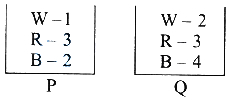
$A$ box $P$ contains one white ball,three red balls and two black balls. Another box $Q$ contains two white balls,three red balls and four black balls. If one ball is drawn at random from each one of the two boxes,then the probability that the balls drawn are of different colour is
A
$\frac{29}{54}$
B
$\frac{25}{42}$
C
$\frac{35}{54}$
D
$\frac{39}{52}$
Solution
(C) Total balls in box $P = 1 + 3 + 2 = 6$.
Total balls in box $Q = 2 + 3 + 4 = 9$.
Let $W_P, R_P, B_P$ be the events of drawing a white,red,and black ball from box $P$ respectively,and $W_Q, R_Q, B_Q$ be the corresponding events for box $Q$.
The probabilities are:
$P(W_P) = \frac{1}{6}, P(R_P) = \frac{3}{6}, P(B_P) = \frac{2}{6}$
$P(W_Q) = \frac{2}{9}, P(R_Q) = \frac{3}{9}, P(B_Q) = \frac{4}{9}$
The probability that the balls are of the same colour is:
$P(\text{same}) = P(W_P)P(W_Q) + P(R_P)P(R_Q) + P(B_P)P(B_Q)$
$P(\text{same}) = (\frac{1}{6} \times \frac{2}{9}) + (\frac{3}{6} \times \frac{3}{9}) + (\frac{2}{6} \times \frac{4}{9}) = \frac{2 + 9 + 8}{54} = \frac{19}{54}$
The probability that the balls are of different colours is:
$P(\text{different}) = 1 - P(\text{same}) = 1 - \frac{19}{54} = \frac{35}{54}$
Total balls in box $Q = 2 + 3 + 4 = 9$.
Let $W_P, R_P, B_P$ be the events of drawing a white,red,and black ball from box $P$ respectively,and $W_Q, R_Q, B_Q$ be the corresponding events for box $Q$.
The probabilities are:
$P(W_P) = \frac{1}{6}, P(R_P) = \frac{3}{6}, P(B_P) = \frac{2}{6}$
$P(W_Q) = \frac{2}{9}, P(R_Q) = \frac{3}{9}, P(B_Q) = \frac{4}{9}$
The probability that the balls are of the same colour is:
$P(\text{same}) = P(W_P)P(W_Q) + P(R_P)P(R_Q) + P(B_P)P(B_Q)$
$P(\text{same}) = (\frac{1}{6} \times \frac{2}{9}) + (\frac{3}{6} \times \frac{3}{9}) + (\frac{2}{6} \times \frac{4}{9}) = \frac{2 + 9 + 8}{54} = \frac{19}{54}$
The probability that the balls are of different colours is:
$P(\text{different}) = 1 - P(\text{same}) = 1 - \frac{19}{54} = \frac{35}{54}$
0 likesView Solution
375
MathematicsEasyMCQAP EAMCET · 2024
If all the letters of the word '$SENSELESSNESS$' are arranged in all possible ways and an arrangement among them is chosen at random,then the probability that all the $E$'s come together in that arrangement is
A
$\frac{1}{990}$
B
$\frac{2}{143}$
C
$\frac{1}{120}$
D
$\frac{1}{429}$
Solution
(B) The word '$SENSELESSNESS$' contains $13$ letters in total: $S$ ($6$ times),$E$ ($4$ times),$N$ ($2$ times),and $L$ ($1$ time).
Total number of arrangements $= \frac{13!}{6!4!2!} = 180180$.
To find the number of arrangements where all $E$'s come together,we treat the $4$ $E$'s as a single unit.
Now,we have $10$ units to arrange: $(EEEE)$,$S$ ($6$ times),$N$ ($2$ times),and $L$ ($1$ time).
Number of arrangements with all $E$'s together $= \frac{10!}{6!2!1!} = \frac{3628800}{720 \times 2} = 2520$.
Therefore,the required probability $= \frac{2520}{180180} = \frac{252}{18018} = \frac{2}{143}$.
Total number of arrangements $= \frac{13!}{6!4!2!} = 180180$.
To find the number of arrangements where all $E$'s come together,we treat the $4$ $E$'s as a single unit.
Now,we have $10$ units to arrange: $(EEEE)$,$S$ ($6$ times),$N$ ($2$ times),and $L$ ($1$ time).
Number of arrangements with all $E$'s together $= \frac{10!}{6!2!1!} = \frac{3628800}{720 \times 2} = 2520$.
Therefore,the required probability $= \frac{2520}{180180} = \frac{252}{18018} = \frac{2}{143}$.
0 likesView Solution
376
MathematicsMediumMCQAP EAMCET · 2024
If two numbers $x$ and $y$ are chosen one after the other at random with replacement from the set of numbers $\{1, 2, 3, \ldots, 10\}$,then the probability that $|x^2 - y^2|$ is divisible by $6$ is
A
$\frac{8}{25}$
B
$\frac{6}{25}$
C
$\frac{3}{10}$
D
$\frac{13}{50}$
Solution
(C) The total number of ways to select two numbers $x$ and $y$ from the set $\{1, 2, 3, \ldots, 10\}$ with replacement is $10 \times 10 = 100$.
We want to find the number of pairs $(x, y)$ such that $|x^2 - y^2|$ is divisible by $6$.
This condition is equivalent to $|(x - y)(x + y)|$ being divisible by $6$.
We analyze the pairs $(x, y)$ by iterating through $x$ from $1$ to $10$ and finding $y$ such that $x^2 \equiv y^2 \pmod{6}$.
The squares modulo $6$ are: $1^2 \equiv 1, 2^2 \equiv 4, 3^2 \equiv 3, 4^2 \equiv 4, 5^2 \equiv 1, 6^2 \equiv 0, 7^2 \equiv 1, 8^2 \equiv 4, 9^2 \equiv 3, 10^2 \equiv 4$.
Grouping by values: $0: \{6\}$,$1: \{1, 5, 7\}$,$3: \{3, 9\}$,$4: \{2, 4, 8, 10\}$.
Number of pairs $(x, y)$ such that $x^2 \equiv y^2 \pmod{6}$ is:
For $x^2 \equiv 0$: $1^2 = 1$ pair $(6, 6)$.
For $x^2 \equiv 1$: $3^2 = 9$ pairs (from $\{1, 5, 7\} \times \{1, 5, 7\}$).
For $x^2 \equiv 3$: $2^2 = 4$ pairs (from $\{3, 9\} \times \{3, 9\}$).
For $x^2 \equiv 4$: $4^2 = 16$ pairs (from $\{2, 4, 8, 10\} \times \{2, 4, 8, 10\}$).
Total favorable outcomes $= 1 + 9 + 4 + 16 = 30$.
Probability $= \frac{30}{100} = \frac{3}{10}$.
We want to find the number of pairs $(x, y)$ such that $|x^2 - y^2|$ is divisible by $6$.
This condition is equivalent to $|(x - y)(x + y)|$ being divisible by $6$.
We analyze the pairs $(x, y)$ by iterating through $x$ from $1$ to $10$ and finding $y$ such that $x^2 \equiv y^2 \pmod{6}$.
The squares modulo $6$ are: $1^2 \equiv 1, 2^2 \equiv 4, 3^2 \equiv 3, 4^2 \equiv 4, 5^2 \equiv 1, 6^2 \equiv 0, 7^2 \equiv 1, 8^2 \equiv 4, 9^2 \equiv 3, 10^2 \equiv 4$.
Grouping by values: $0: \{6\}$,$1: \{1, 5, 7\}$,$3: \{3, 9\}$,$4: \{2, 4, 8, 10\}$.
Number of pairs $(x, y)$ such that $x^2 \equiv y^2 \pmod{6}$ is:
For $x^2 \equiv 0$: $1^2 = 1$ pair $(6, 6)$.
For $x^2 \equiv 1$: $3^2 = 9$ pairs (from $\{1, 5, 7\} \times \{1, 5, 7\}$).
For $x^2 \equiv 3$: $2^2 = 4$ pairs (from $\{3, 9\} \times \{3, 9\}$).
For $x^2 \equiv 4$: $4^2 = 16$ pairs (from $\{2, 4, 8, 10\} \times \{2, 4, 8, 10\}$).
Total favorable outcomes $= 1 + 9 + 4 + 16 = 30$.
Probability $= \frac{30}{100} = \frac{3}{10}$.
0 likesView Solution
377
MathematicsMediumMCQAP EAMCET · 2024
$8$ teachers and $4$ students are sitting around a circular table at random. Then,the probability that no two students sit together is:
A
$\frac{7}{88}$
B
$\frac{14}{33}$
C
$\frac{8}{33}$
D
$\frac{7}{33}$
Solution
(D) Total number of ways to arrange $8$ teachers and $4$ students around a circular table is $(8+4-1)! = 11!$.
To ensure no two students sit together,we first arrange the $8$ teachers in a circle,which can be done in $(8-1)! = 7!$ ways.
This creates $8$ gaps between the teachers. We need to place $4$ students in these $8$ gaps,which can be done in $^8C_4$ ways.
The students can be arranged among themselves in $4!$ ways.
Thus,the number of favorable arrangements is $^8C_4 \times 4! \times 7!$.
The required probability is $\frac{^8C_4 \times 4! \times 7!}{11!} = \frac{\frac{8 \times 7 \times 6 \times 5}{4 \times 3 \times 2 \times 1} \times 4! \times 7!}{11 \times 10 \times 9 \times 8 \times 7!} = \frac{70 \times 24 \times 7!}{11 \times 10 \times 9 \times 8 \times 7!} = \frac{7}{33}$.
To ensure no two students sit together,we first arrange the $8$ teachers in a circle,which can be done in $(8-1)! = 7!$ ways.
This creates $8$ gaps between the teachers. We need to place $4$ students in these $8$ gaps,which can be done in $^8C_4$ ways.
The students can be arranged among themselves in $4!$ ways.
Thus,the number of favorable arrangements is $^8C_4 \times 4! \times 7!$.
The required probability is $\frac{^8C_4 \times 4! \times 7!}{11!} = \frac{\frac{8 \times 7 \times 6 \times 5}{4 \times 3 \times 2 \times 1} \times 4! \times 7!}{11 \times 10 \times 9 \times 8 \times 7!} = \frac{70 \times 24 \times 7!}{11 \times 10 \times 9 \times 8 \times 7!} = \frac{7}{33}$.
0 likesView Solution
378
MathematicsEasyMCQAP EAMCET · 2024
$A$ basket contains $12$ apples in which $3$ are rotten. If $3$ apples are drawn at random simultaneously from it,then the probability of getting at most one rotten apple is
A
$\frac{34}{55}$
B
$\frac{48}{55}$
C
$\frac{21}{55}$
D
$\frac{42}{55}$
Solution
(B) Total number of apples $= 12$. Number of rotten apples $= 3$. Number of good apples $= 9$.
Total ways to draw $3$ apples from $12$ is ${}^{12}C_3 = \frac{12 \times 11 \times 10}{3 \times 2 \times 1} = 220$.
We need the probability of getting at most one rotten apple,which means $0$ or $1$ rotten apple.
Case $1$: No rotten apple is drawn (all $3$ are good).
Number of ways $= {}^{9}C_3 = \frac{9 \times 8 \times 7}{3 \times 2 \times 1} = 84$.
Case $2$: Exactly $1$ rotten apple is drawn (and $2$ are good).
Number of ways $= {}^{3}C_1 \times {}^{9}C_2 = 3 \times \frac{9 \times 8}{2 \times 1} = 3 \times 36 = 108$.
Total favorable ways $= 84 + 108 = 192$.
Required probability $= \frac{192}{220} = \frac{48}{55}$.
Total ways to draw $3$ apples from $12$ is ${}^{12}C_3 = \frac{12 \times 11 \times 10}{3 \times 2 \times 1} = 220$.
We need the probability of getting at most one rotten apple,which means $0$ or $1$ rotten apple.
Case $1$: No rotten apple is drawn (all $3$ are good).
Number of ways $= {}^{9}C_3 = \frac{9 \times 8 \times 7}{3 \times 2 \times 1} = 84$.
Case $2$: Exactly $1$ rotten apple is drawn (and $2$ are good).
Number of ways $= {}^{3}C_1 \times {}^{9}C_2 = 3 \times \frac{9 \times 8}{2 \times 1} = 3 \times 36 = 108$.
Total favorable ways $= 84 + 108 = 192$.
Required probability $= \frac{192}{220} = \frac{48}{55}$.
0 likesView Solution
379
MathematicsMediumMCQAP EAMCET · 2024
Two persons $A$ and $B$ throw a pair of dice alternately until one of them gets the sum of the numbers appeared on the dice as $4$,and the person who gets this result first is declared as the winner. If $A$ starts the game,then the probability that $B$ wins the game is:
A
$\frac{11}{23}$
B
$\frac{1}{2}$
C
$\frac{5}{11}$
D
$\frac{8}{17}$
Solution
(A) The total number of outcomes when throwing two dice is $36$. The outcomes for a sum of $4$ are $(1,3), (3,1), (2,2)$.
Therefore,the probability of getting a sum of $4$ in a single throw is $p = \frac{3}{36} = \frac{1}{12}$.
The probability of not getting a sum of $4$ is $q = 1 - p = 1 - \frac{1}{12} = \frac{11}{12}$.
Since $A$ starts the game,$B$ wins if $A$ fails on the $1^{st}$ turn,$B$ succeeds on the $2^{nd}$ turn,or $A$ fails on the $1^{st}, 3^{rd}$ turns and $B$ fails on the $2^{nd}$ turn and succeeds on the $4^{th}$ turn,and so on.
The probability that $B$ wins is given by the infinite geometric series:
$P(B \text{ wins}) = qp + q^3p + q^5p + \dots$
This is a geometric series with first term $a = qp = \frac{11}{12} \times \frac{1}{12} = \frac{11}{144}$ and common ratio $r = q^2 = (\frac{11}{12})^2 = \frac{121}{144}$.
The sum of an infinite geometric series is $S = \frac{a}{1-r}$.
$P(B \text{ wins}) = \frac{\frac{11}{144}}{1 - \frac{121}{144}} = \frac{\frac{11}{144}}{\frac{144-121}{144}} = \frac{11}{23}$.
Therefore,the probability of getting a sum of $4$ in a single throw is $p = \frac{3}{36} = \frac{1}{12}$.
The probability of not getting a sum of $4$ is $q = 1 - p = 1 - \frac{1}{12} = \frac{11}{12}$.
Since $A$ starts the game,$B$ wins if $A$ fails on the $1^{st}$ turn,$B$ succeeds on the $2^{nd}$ turn,or $A$ fails on the $1^{st}, 3^{rd}$ turns and $B$ fails on the $2^{nd}$ turn and succeeds on the $4^{th}$ turn,and so on.
The probability that $B$ wins is given by the infinite geometric series:
$P(B \text{ wins}) = qp + q^3p + q^5p + \dots$
This is a geometric series with first term $a = qp = \frac{11}{12} \times \frac{1}{12} = \frac{11}{144}$ and common ratio $r = q^2 = (\frac{11}{12})^2 = \frac{121}{144}$.
The sum of an infinite geometric series is $S = \frac{a}{1-r}$.
$P(B \text{ wins}) = \frac{\frac{11}{144}}{1 - \frac{121}{144}} = \frac{\frac{11}{144}}{\frac{144-121}{144}} = \frac{11}{23}$.
0 likesView Solution
380
MathematicsDifficultMCQAP EAMCET · 2024
$\frac{\sin 1^{\circ}+\sin 2^{\circ}+\ldots+\sin 89^{\circ}}{2(\cos 1^{\circ}+\cos 2^{\circ}+\ldots+\cos 44^{\circ})+1} = $
A
$2$
B
$\frac{1}{\sqrt{2}}$
C
$\frac{1}{2}$
D
$\sqrt{2}$
Solution
(B) Let $S = \sin 1^{\circ} + \sin 2^{\circ} + \ldots + \sin 89^{\circ}$.
Using the sum formula for sines in arithmetic progression,$\sum_{k=1}^{n} \sin(k\theta) = \frac{\sin(n\theta/2) \sin((n+1)\theta/2)}{\sin(\theta/2)}$.
Here $n = 89$ and $\theta = 1^{\circ}$,so $S = \frac{\sin(89^{\circ}/2) \sin(90^{\circ}/2)}{\sin(0.5^{\circ})} = \frac{\sin(44.5^{\circ}) \sin(45^{\circ})}{\sin(0.5^{\circ})}$.
Now consider the denominator $D = 2(\cos 1^{\circ} + \cos 2^{\circ} + \ldots + \cos 44^{\circ}) + 1$.
Using the sum formula $\sum_{k=1}^{n} \cos(k\theta) = \frac{\sin(n\theta/2) \cos((n+1)\theta/2)}{\sin(\theta/2)}$,we have $\sum_{k=1}^{44} \cos(k^{\circ}) = \frac{\sin(44^{\circ}/2) \cos(45^{\circ}/2)}{\sin(0.5^{\circ})} = \frac{\sin(22^{\circ}) \cos(22.5^{\circ})}{\sin(0.5^{\circ})}$.
Alternatively,note that $\sin 1^{\circ} + \ldots + \sin 89^{\circ} = (\sin 1^{\circ} + \sin 89^{\circ}) + \ldots + \sin 45^{\circ} = 2 \sin 45^{\circ} \cos 44^{\circ} + 2 \sin 45^{\circ} \cos 43^{\circ} + \ldots + \sin 45^{\circ}$.
This simplifies to $\sqrt{2}(\cos 44^{\circ} + \cos 43^{\circ} + \ldots + \cos 1^{\circ}) + \frac{1}{\sqrt{2}}$.
Multiplying by $\sqrt{2}$,we get $\sqrt{2} \times S = 2(\cos 1^{\circ} + \ldots + \cos 44^{\circ}) + 1$.
Thus,$\frac{S}{2(\cos 1^{\circ} + \ldots + \cos 44^{\circ}) + 1} = \frac{1}{\sqrt{2}}$.
Using the sum formula for sines in arithmetic progression,$\sum_{k=1}^{n} \sin(k\theta) = \frac{\sin(n\theta/2) \sin((n+1)\theta/2)}{\sin(\theta/2)}$.
Here $n = 89$ and $\theta = 1^{\circ}$,so $S = \frac{\sin(89^{\circ}/2) \sin(90^{\circ}/2)}{\sin(0.5^{\circ})} = \frac{\sin(44.5^{\circ}) \sin(45^{\circ})}{\sin(0.5^{\circ})}$.
Now consider the denominator $D = 2(\cos 1^{\circ} + \cos 2^{\circ} + \ldots + \cos 44^{\circ}) + 1$.
Using the sum formula $\sum_{k=1}^{n} \cos(k\theta) = \frac{\sin(n\theta/2) \cos((n+1)\theta/2)}{\sin(\theta/2)}$,we have $\sum_{k=1}^{44} \cos(k^{\circ}) = \frac{\sin(44^{\circ}/2) \cos(45^{\circ}/2)}{\sin(0.5^{\circ})} = \frac{\sin(22^{\circ}) \cos(22.5^{\circ})}{\sin(0.5^{\circ})}$.
Alternatively,note that $\sin 1^{\circ} + \ldots + \sin 89^{\circ} = (\sin 1^{\circ} + \sin 89^{\circ}) + \ldots + \sin 45^{\circ} = 2 \sin 45^{\circ} \cos 44^{\circ} + 2 \sin 45^{\circ} \cos 43^{\circ} + \ldots + \sin 45^{\circ}$.
This simplifies to $\sqrt{2}(\cos 44^{\circ} + \cos 43^{\circ} + \ldots + \cos 1^{\circ}) + \frac{1}{\sqrt{2}}$.
Multiplying by $\sqrt{2}$,we get $\sqrt{2} \times S = 2(\cos 1^{\circ} + \ldots + \cos 44^{\circ}) + 1$.
Thus,$\frac{S}{2(\cos 1^{\circ} + \ldots + \cos 44^{\circ}) + 1} = \frac{1}{\sqrt{2}}$.
0 likesView Solution
381
MathematicsDifficultMCQAP EAMCET · 2024
The slope of one of the pair of lines $2x^2 + hxy + 6y^2 = 0$ is thrice the slope of the other line. Then,$h = $
A
$\pm 16$
B
$\pm 9$
C
$\pm 18$
D
$\pm 8$
Solution
(D) The given equation of the pair of lines is $2x^2 + hxy + 6y^2 = 0$.
Let the slopes of the two lines be $m$ and $3m$.
The equation of the pair of lines can be written as $(y - mx)(y - 3mx) = 0$.
Expanding this,we get $y^2 - 4mxy + 3m^2x^2 = 0$,or $3m^2x^2 - 4mxy + y^2 = 0$.
Dividing the original equation $2x^2 + hxy + 6y^2 = 0$ by $6$,we get $\frac{1}{3}x^2 + \frac{h}{6}xy + y^2 = 0$.
Comparing the coefficients of $x^2$ and $xy$ with $3m^2x^2 - 4mxy + y^2 = 0$,we have:
$3m^2 = \frac{1}{3}$ $\Rightarrow m^2 = \frac{1}{9}$ $\Rightarrow m = \pm \frac{1}{3}$.
Also,$-4m = \frac{h}{6} \Rightarrow h = -24m$.
Substituting $m = \pm \frac{1}{3}$ into the expression for $h$:
$h = -24(\pm \frac{1}{3}) = \mp 8$.
Thus,$h = \pm 8$.
Let the slopes of the two lines be $m$ and $3m$.
The equation of the pair of lines can be written as $(y - mx)(y - 3mx) = 0$.
Expanding this,we get $y^2 - 4mxy + 3m^2x^2 = 0$,or $3m^2x^2 - 4mxy + y^2 = 0$.
Dividing the original equation $2x^2 + hxy + 6y^2 = 0$ by $6$,we get $\frac{1}{3}x^2 + \frac{h}{6}xy + y^2 = 0$.
Comparing the coefficients of $x^2$ and $xy$ with $3m^2x^2 - 4mxy + y^2 = 0$,we have:
$3m^2 = \frac{1}{3}$ $\Rightarrow m^2 = \frac{1}{9}$ $\Rightarrow m = \pm \frac{1}{3}$.
Also,$-4m = \frac{h}{6} \Rightarrow h = -24m$.
Substituting $m = \pm \frac{1}{3}$ into the expression for $h$:
$h = -24(\pm \frac{1}{3}) = \mp 8$.
Thus,$h = \pm 8$.
0 likesView Solution
Vedclass Products
For Students
Vedclass Test Series
Mock tests in real AP EAMCET style covering Mathematics with performance analysis. 5-day free trial.
Start Free TrialFor Teachers
Exam Paper Generator
Generate Set A/B/C/D Mathematics papers from 7.5L+ questions in 2 minutes. 3 chapters free.
Try FreeFor Institutes
Online Exam Module
Run live AP EAMCET mock exams with unlimited students, 360° analytics & white-label branding.
See DemoFrequently Asked Questions
How many Mathematics questions are in AP EAMCET 2024?
There are 723 Mathematics questions from the AP EAMCET 2024 paper on Vedclass, each with a detailed step-by-step solution in English.
Are AP EAMCET 2024 Mathematics solutions available in English?
Yes. All solutions on this page are in English. You can also switch to English or Hindi using the language buttons above the questions.
Can I practice AP EAMCET 2024 Mathematics as a timed test?
Yes. Use the Vedclass Test Series to attempt a full AP EAMCET mock test covering Mathematics with time limits and instant score analysis.
Can teachers create Mathematics papers from AP EAMCET previous year questions?
Yes. The Vedclass Exam Paper Generator lets teachers mix AP EAMCET Mathematics questions and generate Set A/B/C/D papers in minutes.
For Teachers & Institutes
Build a Custom Mathematics Paper
Pick AP EAMCET 2024 Mathematics questions, set difficulty, and generate Set A/B/C/D in 2 minutes.