
MathematicsQ201–300 of 723 questions
Page 5 of 8 · English
201
MathematicsEasyMCQAP EAMCET · 2024
The circle $x^2+y^2-8x-12y+\alpha=0$ lies in the first quadrant without touching the coordinate axes. If $(6, 6)$ is an interior point to the circle,then
A
$4 < \alpha < 6$
B
$6 < \alpha < 16$
C
$16 < \alpha < 48$
D
$36 < \alpha < 48$
Solution
(D) The equation of the circle is $x^2+y^2-8x-12y+\alpha=0$. The center is $(4, 6)$ and the radius $r = \sqrt{4^2+6^2-\alpha} = \sqrt{52-\alpha}$.
Since the circle lies in the first quadrant without touching the axes,the distance from the center to the axes must be greater than the radius: $r < 4$ and $r < 6$. Thus,$r < 4$,which implies $\sqrt{52-\alpha} < 4$ $\Rightarrow 52-\alpha < 16$ $\Rightarrow \alpha > 36$.
Since $(6, 6)$ is an interior point,substituting it into the circle equation gives $6^2+6^2-8(6)-12(6)+\alpha < 0$.
$36+36-48-72+\alpha < 0$ $\Rightarrow \alpha - 48 < 0$ $\Rightarrow \alpha < 48$.
Combining these,we get $36 < \alpha < 48$.
Since the circle lies in the first quadrant without touching the axes,the distance from the center to the axes must be greater than the radius: $r < 4$ and $r < 6$. Thus,$r < 4$,which implies $\sqrt{52-\alpha} < 4$ $\Rightarrow 52-\alpha < 16$ $\Rightarrow \alpha > 36$.
Since $(6, 6)$ is an interior point,substituting it into the circle equation gives $6^2+6^2-8(6)-12(6)+\alpha < 0$.
$36+36-48-72+\alpha < 0$ $\Rightarrow \alpha - 48 < 0$ $\Rightarrow \alpha < 48$.
Combining these,we get $36 < \alpha < 48$.
0 likesView Solution
202
MathematicsMediumMCQAP EAMCET · 2024
If the line through the point $P(5,3)$ meets the circle $x^2+y^2-2x-4y+\alpha=0$ at $A(4,2)$ and $B(x_1, y_1)$,then $PA \cdot PB$ is equal to
A
$6$
B
$12$
C
$9$
D
$8$
Solution
(D) The point $A(4,2)$ lies on the circle $x^2+y^2-2x-4y+\alpha=0$.
Substituting the coordinates of $A$ into the equation:
$16+4-8-8+\alpha=0 \Rightarrow \alpha=-4$.
The equation of the circle is $x^2+y^2-2x-4y-4=0$.
The power of point $P(5,3)$ with respect to the circle is given by $PA \cdot PB$.
The power of a point $(x_0, y_0)$ with respect to the circle $x^2+y^2+2gx+2fy+c=0$ is $x_0^2+y_0^2+2gx_0+2fy_0+c$.
Substituting $P(5,3)$ into the circle equation:
$PA \cdot PB = 5^2+3^2-2(5)-4(3)-4 = 25+9-10-12-4 = 8$.
Substituting the coordinates of $A$ into the equation:
$16+4-8-8+\alpha=0 \Rightarrow \alpha=-4$.
The equation of the circle is $x^2+y^2-2x-4y-4=0$.
The power of point $P(5,3)$ with respect to the circle is given by $PA \cdot PB$.
The power of a point $(x_0, y_0)$ with respect to the circle $x^2+y^2+2gx+2fy+c=0$ is $x_0^2+y_0^2+2gx_0+2fy_0+c$.
Substituting $P(5,3)$ into the circle equation:
$PA \cdot PB = 5^2+3^2-2(5)-4(3)-4 = 25+9-10-12-4 = 8$.
0 likesView Solution
203
MathematicsEasyMCQAP EAMCET · 2024
The angle subtended by the chord $x+y-1=0$ of the circle $x^2+y^2=1$ at the origin is
A
$\cos ^{-1}\left(\frac{6}{\sqrt{34}}\right)$
B
$\frac{\pi}{2}$
C
$\cos ^{-1}\left(\frac{2}{\sqrt{13}}\right)$
D
$\frac{\pi}{3}$
Solution
(B) To find the angle subtended by the chord $x+y-1=0$ at the center of the circle $x^2+y^2=1$,we follow these steps:
Step $1$: Identify the circle and chord.
The circle $x^2+y^2=1$ has its center at the origin $O(0,0)$ and radius $r=1$.
The chord is given by the line $x+y-1=0$.
Step $2$: Find the perpendicular distance $d$ from the origin to the chord.
The distance $d$ from $(0,0)$ to $x+y-1=0$ is given by $d = \frac{|1(0)+1(0)-1|}{\sqrt{1^2+1^2}} = \frac{1}{\sqrt{2}}$.
Step $3$: Calculate the angle.
Let the chord intersect the circle at points $A$ and $B$. In the isosceles triangle $OAB$,the perpendicular from $O$ to $AB$ bisects the angle $\angle AOB$. Let $\angle AOB = 2\theta$.
In the right-angled triangle formed by the origin,the midpoint of the chord,and one endpoint of the chord,we have $\cos(\theta) = \frac{d}{r} = \frac{1/\sqrt{2}}{1} = \frac{1}{\sqrt{2}}$.
Thus,$\theta = 45^{\circ}$ or $\frac{\pi}{4}$ radians.
The total angle subtended at the center is $\angle AOB = 2\theta = 2 \times 45^{\circ} = 90^{\circ}$ or $\frac{\pi}{2}$ radians.
Step $1$: Identify the circle and chord.
The circle $x^2+y^2=1$ has its center at the origin $O(0,0)$ and radius $r=1$.
The chord is given by the line $x+y-1=0$.
Step $2$: Find the perpendicular distance $d$ from the origin to the chord.
The distance $d$ from $(0,0)$ to $x+y-1=0$ is given by $d = \frac{|1(0)+1(0)-1|}{\sqrt{1^2+1^2}} = \frac{1}{\sqrt{2}}$.
Step $3$: Calculate the angle.
Let the chord intersect the circle at points $A$ and $B$. In the isosceles triangle $OAB$,the perpendicular from $O$ to $AB$ bisects the angle $\angle AOB$. Let $\angle AOB = 2\theta$.
In the right-angled triangle formed by the origin,the midpoint of the chord,and one endpoint of the chord,we have $\cos(\theta) = \frac{d}{r} = \frac{1/\sqrt{2}}{1} = \frac{1}{\sqrt{2}}$.
Thus,$\theta = 45^{\circ}$ or $\frac{\pi}{4}$ radians.
The total angle subtended at the center is $\angle AOB = 2\theta = 2 \times 45^{\circ} = 90^{\circ}$ or $\frac{\pi}{2}$ radians.
0 likesView Solution
204
MathematicsMediumMCQAP EAMCET · 2024
Let $\alpha$ be an integer multiple of $8$. If $S$ is the set of all possible values of $\alpha$ such that the line $6 x + 8 y + \alpha = 0$ intersects the circle $x^2 + y^2 - 4 x - 6 y + 9 = 0$ at two distinct points,then the number of elements in $S$ is
A
$4$
B
$6$
C
$2$
D
$1$
Solution
(A) The equation of the circle is $x^2 + y^2 - 4 x - 6 y + 9 = 0$.
Comparing with $x^2 + y^2 + 2gx + 2fy + c = 0$,we get $g = -2, f = -3, c = 9$.
Centre $= (-g, -f) = (2, 3)$ and Radius $r = \sqrt{g^2 + f^2 - c} = \sqrt{4 + 9 - 9} = 2$.
The line $6 x + 8 y + \alpha = 0$ intersects the circle at two distinct points if the perpendicular distance from the centre $(2, 3)$ to the line is less than the radius.
Distance $d = \frac{|6(2) + 8(3) + \alpha|}{\sqrt{6^2 + 8^2}} = \frac{|12 + 24 + \alpha|}{10} = \frac{|36 + \alpha|}{10}$.
Condition: $d < r$ $\Rightarrow \frac{|36 + \alpha|}{10} < 2$ $\Rightarrow |36 + \alpha| < 20$.
This implies $-20 < 36 + \alpha < 20$,which simplifies to $-56 < \alpha < -16$.
Given $\alpha$ is an integer multiple of $8$,let $\alpha = 8k$ for some integer $k$.
$-56 < 8k < -16 \Rightarrow -7 < k < -2$.
The possible integer values for $k$ are $-6, -5, -4, -3$.
Thus,there are $4$ possible values for $\alpha$.
Comparing with $x^2 + y^2 + 2gx + 2fy + c = 0$,we get $g = -2, f = -3, c = 9$.
Centre $= (-g, -f) = (2, 3)$ and Radius $r = \sqrt{g^2 + f^2 - c} = \sqrt{4 + 9 - 9} = 2$.
The line $6 x + 8 y + \alpha = 0$ intersects the circle at two distinct points if the perpendicular distance from the centre $(2, 3)$ to the line is less than the radius.
Distance $d = \frac{|6(2) + 8(3) + \alpha|}{\sqrt{6^2 + 8^2}} = \frac{|12 + 24 + \alpha|}{10} = \frac{|36 + \alpha|}{10}$.
Condition: $d < r$ $\Rightarrow \frac{|36 + \alpha|}{10} < 2$ $\Rightarrow |36 + \alpha| < 20$.
This implies $-20 < 36 + \alpha < 20$,which simplifies to $-56 < \alpha < -16$.
Given $\alpha$ is an integer multiple of $8$,let $\alpha = 8k$ for some integer $k$.
$-56 < 8k < -16 \Rightarrow -7 < k < -2$.
The possible integer values for $k$ are $-6, -5, -4, -3$.
Thus,there are $4$ possible values for $\alpha$.
0 likesView Solution
205
MathematicsMediumMCQAP EAMCET · 2024
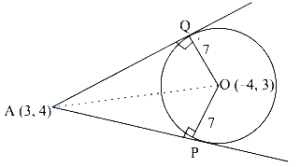
If $2x - 3y + 3 = 0$ and $x + 2y + k = 0$ are conjugate lines with respect to the circle $S \equiv x^2 + y^2 + 8x - 6y - 24 = 0$,then the length of the tangent drawn from the point $\left(\frac{k}{4}, \frac{k}{3}\right)$ to the circle $S = 0$ is
A
$7$
B
$1$
C
$12$
D
$24$
Solution
(B) The given equation of the circle is $x^2 + y^2 + 8x - 6y - 24 = 0$.
Completing the square,we get $(x + 4)^2 + (y - 3)^2 = 24 + 16 + 9 = 49$.
Thus,the center is $C(-4, 3)$ and the radius $r = 7$.
Two lines $l_1: a_1x + b_1y + c_1 = 0$ and $l_2: a_2x + b_2y + c_2 = 0$ are conjugate with respect to a circle with center $(h, k)$ and radius $r$ if $r^2(a_1a_2 + b_1b_2) = (a_1h + b_1k + c_1)(a_2h + b_2k + c_2)$.
Here,$a_1 = 2, b_1 = -3, c_1 = 3$ and $a_2 = 1, b_2 = 2, c_2 = k$.
Substituting the values: $49(2(1) + (-3)(2)) = (2(-4) - 3(3) + 3)(1(-4) + 2(3) + k)$.
$49(2 - 6) = (-8 - 9 + 3)(-4 + 6 + k)$.
$49(-4) = (-14)(2 + k)$.
$196 = 14(2 + k)$ $\Rightarrow 14 = 2 + k$ $\Rightarrow k = 12$.
The point is $\left(\frac{12}{4}, \frac{12}{3}\right) = (3, 4)$.
The length of the tangent from a point $(x_1, y_1)$ to the circle $S = 0$ is $\sqrt{S(x_1, y_1)}$.
$L = \sqrt{3^2 + 4^2 + 8(3) - 6(4) - 24} = \sqrt{9 + 16 + 24 - 24 - 24} = \sqrt{1} = 1$.
Completing the square,we get $(x + 4)^2 + (y - 3)^2 = 24 + 16 + 9 = 49$.
Thus,the center is $C(-4, 3)$ and the radius $r = 7$.
Two lines $l_1: a_1x + b_1y + c_1 = 0$ and $l_2: a_2x + b_2y + c_2 = 0$ are conjugate with respect to a circle with center $(h, k)$ and radius $r$ if $r^2(a_1a_2 + b_1b_2) = (a_1h + b_1k + c_1)(a_2h + b_2k + c_2)$.
Here,$a_1 = 2, b_1 = -3, c_1 = 3$ and $a_2 = 1, b_2 = 2, c_2 = k$.
Substituting the values: $49(2(1) + (-3)(2)) = (2(-4) - 3(3) + 3)(1(-4) + 2(3) + k)$.
$49(2 - 6) = (-8 - 9 + 3)(-4 + 6 + k)$.
$49(-4) = (-14)(2 + k)$.
$196 = 14(2 + k)$ $\Rightarrow 14 = 2 + k$ $\Rightarrow k = 12$.
The point is $\left(\frac{12}{4}, \frac{12}{3}\right) = (3, 4)$.
The length of the tangent from a point $(x_1, y_1)$ to the circle $S = 0$ is $\sqrt{S(x_1, y_1)}$.
$L = \sqrt{3^2 + 4^2 + 8(3) - 6(4) - 24} = \sqrt{9 + 16 + 24 - 24 - 24} = \sqrt{1} = 1$.
0 likesView Solution
206
MathematicsDifficultMCQAP EAMCET · 2024
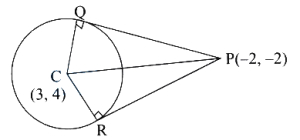
$2x - 3y + 1 = 0$ and $4x - 5y - 1 = 0$ are the equations of two diameters of the circle $S \equiv x^2 + y^2 + 2gx + 2fy - 11 = 0$. $Q$ and $R$ are the points of contact of the tangents drawn from the point $P(-2, -2)$ to this circle. If $C$ is the centre of the circle $S = 0$,then the area (in square units) of the quadrilateral $PQCR$ is
A
$25$
B
$30$
C
$24$
D
$36$
Solution
(B) The equations of the diameters of the circle are:
$2x - 3y + 1 = 0$ ...$(i)$
$4x - 5y - 1 = 0$ ...(ii)
Solving equations $(i)$ and (ii),we find the centre of the circle $C = (-g, -f) = (3, 4)$,which implies $g = -3$ and $f = -4$.
The equation of the circle is $x^2 + y^2 - 6x - 8y - 11 = 0$.
The radius $r$ of the circle is $CQ = \sqrt{g^2 + f^2 - c} = \sqrt{(-3)^2 + (-4)^2 - (-11)} = \sqrt{9 + 16 + 11} = \sqrt{36} = 6$.
The distance $CP$ between the centre $C(3, 4)$ and point $P(-2, -2)$ is $CP = \sqrt{(3 - (-2))^2 + (4 - (-2))^2} = \sqrt{5^2 + 6^2} = \sqrt{25 + 36} = \sqrt{61}$.
In the right-angled triangle $\triangle CQP$,the length of the tangent $PQ$ is $PQ = \sqrt{CP^2 - CQ^2} = \sqrt{61 - 36} = \sqrt{25} = 5$.
The area of the quadrilateral $PQCR$ is the sum of the areas of $\triangle CQP$ and $\triangle CRP$.
Area of $PQCR = 2 \times \text{Area}(\triangle CQP) = 2 \times (\frac{1}{2} \times CQ \times PQ) = 6 \times 5 = 30$ square units.
$2x - 3y + 1 = 0$ ...$(i)$
$4x - 5y - 1 = 0$ ...(ii)
Solving equations $(i)$ and (ii),we find the centre of the circle $C = (-g, -f) = (3, 4)$,which implies $g = -3$ and $f = -4$.
The equation of the circle is $x^2 + y^2 - 6x - 8y - 11 = 0$.
The radius $r$ of the circle is $CQ = \sqrt{g^2 + f^2 - c} = \sqrt{(-3)^2 + (-4)^2 - (-11)} = \sqrt{9 + 16 + 11} = \sqrt{36} = 6$.
The distance $CP$ between the centre $C(3, 4)$ and point $P(-2, -2)$ is $CP = \sqrt{(3 - (-2))^2 + (4 - (-2))^2} = \sqrt{5^2 + 6^2} = \sqrt{25 + 36} = \sqrt{61}$.
In the right-angled triangle $\triangle CQP$,the length of the tangent $PQ$ is $PQ = \sqrt{CP^2 - CQ^2} = \sqrt{61 - 36} = \sqrt{25} = 5$.
The area of the quadrilateral $PQCR$ is the sum of the areas of $\triangle CQP$ and $\triangle CRP$.
Area of $PQCR = 2 \times \text{Area}(\triangle CQP) = 2 \times (\frac{1}{2} \times CQ \times PQ) = 6 \times 5 = 30$ square units.
0 likesView Solution
207
MathematicsEasyMCQAP EAMCET · 2024
The normal drawn at $(1,1)$ to the circle $x^2+y^2-4x+6y-4=0$ is
A
$4x+3y=7$
B
$4x+y=5$
C
$x+y=2$
D
$4x-y=3$
Solution
(B) The equation of the circle is $x^2+y^2-4x+6y-4=0$.
Comparing this with the general form $x^2+y^2+2gx+2fy+c=0$,we get $g=-2$ and $f=3$.
The center of the circle is $(-g, -f) = (2, -3)$.
The normal to a circle at any point $(x_1, y_1)$ always passes through the center of the circle.
Thus,the normal is the line passing through $(1, 1)$ and $(2, -3)$.
The slope of this line is $m = \frac{-3-1}{2-1} = \frac{-4}{1} = -4$.
The equation of the line is $(y-1) = -4(x-1)$.
$y-1 = -4x+4$.
$4x+y = 5$.
Comparing this with the general form $x^2+y^2+2gx+2fy+c=0$,we get $g=-2$ and $f=3$.
The center of the circle is $(-g, -f) = (2, -3)$.
The normal to a circle at any point $(x_1, y_1)$ always passes through the center of the circle.
Thus,the normal is the line passing through $(1, 1)$ and $(2, -3)$.
The slope of this line is $m = \frac{-3-1}{2-1} = \frac{-4}{1} = -4$.
The equation of the line is $(y-1) = -4(x-1)$.
$y-1 = -4x+4$.
$4x+y = 5$.
0 likesView Solution
208
MathematicsEasyMCQAP EAMCET · 2024
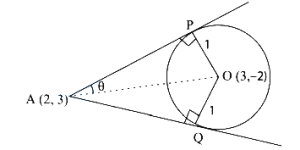
If $\theta$ is the angle between the tangents drawn from the point $(2,3)$ to the circle $x^2+y^2-6x+4y+12=0$,then $\theta=$
A
$\cos^{-1}\left(\frac{5}{13}\right)$
B
$\sin^{-1}\left(\frac{4}{5}\right)$
C
$2 \tan^{-1}\left(\frac{5}{12}\right)$
D
$\tan^{-1}\left(\frac{5}{12}\right)$
Solution
(D) The equation of the circle is $x^2+y^2-6x+4y+12=0$.
Completing the square,we get $(x-3)^2+(y+2)^2 = 3^2+(-2)^2-12 = 9+4-12 = 1$.
So,the center $O$ is $(3,-2)$ and the radius $r$ is $1$.
The distance $d$ from the point $A(2,3)$ to the center $O(3,-2)$ is $d = \sqrt{(3-2)^2+(-2-3)^2} = \sqrt{1^2+(-5)^2} = \sqrt{26}$.
Let $\alpha$ be the half-angle between the tangents. In the right-angled triangle formed by the point $A$,the center $O$,and the point of tangency $P$,we have $\sin(\alpha) = \frac{r}{d} = \frac{1}{\sqrt{26}}$.
Then $\cos(\alpha) = \sqrt{1-\sin^2(\alpha)} = \sqrt{1-\frac{1}{26}} = \sqrt{\frac{25}{26}} = \frac{5}{\sqrt{26}}$.
Thus,$\tan(\alpha) = \frac{\sin(\alpha)}{\cos(\alpha)} = \frac{1/\sqrt{26}}{5/\sqrt{26}} = \frac{1}{5}$.
The total angle between the tangents is $\theta = 2\alpha$.
Using the formula $\tan(2\alpha) = \frac{2\tan(\alpha)}{1-\tan^2(\alpha)}$,we get $\tan(\theta) = \frac{2(1/5)}{1-(1/5)^2} = \frac{2/5}{24/25} = \frac{2}{5} \times \frac{25}{24} = \frac{5}{12}$.
Therefore,$\theta = \tan^{-1}\left(\frac{5}{12}\right)$.
Completing the square,we get $(x-3)^2+(y+2)^2 = 3^2+(-2)^2-12 = 9+4-12 = 1$.
So,the center $O$ is $(3,-2)$ and the radius $r$ is $1$.
The distance $d$ from the point $A(2,3)$ to the center $O(3,-2)$ is $d = \sqrt{(3-2)^2+(-2-3)^2} = \sqrt{1^2+(-5)^2} = \sqrt{26}$.
Let $\alpha$ be the half-angle between the tangents. In the right-angled triangle formed by the point $A$,the center $O$,and the point of tangency $P$,we have $\sin(\alpha) = \frac{r}{d} = \frac{1}{\sqrt{26}}$.
Then $\cos(\alpha) = \sqrt{1-\sin^2(\alpha)} = \sqrt{1-\frac{1}{26}} = \sqrt{\frac{25}{26}} = \frac{5}{\sqrt{26}}$.
Thus,$\tan(\alpha) = \frac{\sin(\alpha)}{\cos(\alpha)} = \frac{1/\sqrt{26}}{5/\sqrt{26}} = \frac{1}{5}$.
The total angle between the tangents is $\theta = 2\alpha$.
Using the formula $\tan(2\alpha) = \frac{2\tan(\alpha)}{1-\tan^2(\alpha)}$,we get $\tan(\theta) = \frac{2(1/5)}{1-(1/5)^2} = \frac{2/5}{24/25} = \frac{2}{5} \times \frac{25}{24} = \frac{5}{12}$.
Therefore,$\theta = \tan^{-1}\left(\frac{5}{12}\right)$.
0 likesView Solution
209
MathematicsEasyMCQAP EAMCET · 2024
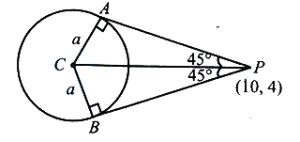
If the pair of tangents drawn to the circle $x^2+y^2=a^2$ from the point $(10,4)$ are perpendicular,then $a=$
A
$\sqrt{58}$
B
$58$
C
$2 \sqrt{63}$
D
$2 \sqrt{45}$
Solution
(A) The locus of the point of intersection of perpendicular tangents to a circle is called the director circle.
For the circle $x^2+y^2=a^2$,the equation of the director circle is $x^2+y^2=2a^2$.
Since the point $(10,4)$ lies on the director circle,we have:
$10^2+4^2 = 2a^2$
$100+16 = 2a^2$
$116 = 2a^2$
$a^2 = 58$
$a = \sqrt{58}$
For the circle $x^2+y^2=a^2$,the equation of the director circle is $x^2+y^2=2a^2$.
Since the point $(10,4)$ lies on the director circle,we have:
$10^2+4^2 = 2a^2$
$100+16 = 2a^2$
$116 = 2a^2$
$a^2 = 58$
$a = \sqrt{58}$
0 likesView Solution
210
MathematicsEasyMCQAP EAMCET · 2024
The locus of the point of intersection of perpendicular tangents drawn to the circle $x^2+y^2=10$ is
A
$x^2+y^2=5$
B
$x^2+y^2=20$
C
$x^2+y^2=25$
D
$x^2+y^2=100$
Solution
(B) The locus of the point of intersection of perpendicular tangents to a circle is known as its director circle.
For a circle given by the equation $x^2+y^2=r^2$,the equation of the director circle is $x^2+y^2=2r^2$.
Given the circle $x^2+y^2=10$,we have $r^2=10$.
Substituting this into the director circle formula,we get $x^2+y^2=2(10) = 20$.
Thus,the required locus is $x^2+y^2=20$.
For a circle given by the equation $x^2+y^2=r^2$,the equation of the director circle is $x^2+y^2=2r^2$.
Given the circle $x^2+y^2=10$,we have $r^2=10$.
Substituting this into the director circle formula,we get $x^2+y^2=2(10) = 20$.
Thus,the required locus is $x^2+y^2=20$.
0 likesView Solution
211
MathematicsMediumMCQAP EAMCET · 2024
If the locus of the midpoints of the chords of the circle $x^2+y^2=25$,which subtend a right angle at the origin,is given by $\frac{x^2}{a^2}+\frac{y^2}{a^2}=1$,then $|a|=$
A
$\frac{2}{5}$
B
$\frac{5}{\sqrt{2}}$
C
$\frac{2}{25}$
D
$5 \sqrt{2}$
Solution
(B) The equation of the circle is $x^2+y^2=25$,so the radius $r=5$.
Let $C(x_1, y_1)$ be the midpoint of a chord $AB$ that subtends a right angle at the origin $O(0, 0)$.
In $\triangle OAB$,$OA=OB=5$ and $\angle AOB = 90^\circ$.
Since $OC$ is the median to the hypotenuse $AB$ in the right-angled $\triangle OAB$,$OC = \frac{1}{2} AB$.
Alternatively,in $\triangle OCB$,$\angle COB = 45^\circ$ and $\angle OCB = 90^\circ$.
Thus,$OC = OB \cos(45^\circ) = 5 \times \frac{1}{\sqrt{2}} = \frac{5}{\sqrt{2}}$.
The distance of the midpoint $C(x_1, y_1)$ from the origin is $\sqrt{x_1^2+y_1^2}$.
Therefore,$\sqrt{x_1^2+y_1^2} = \frac{5}{\sqrt{2}}$,which implies $x_1^2+y_1^2 = \frac{25}{2}$.
Dividing by $\frac{25}{2}$,we get $\frac{x_1^2}{25/2} + \frac{y_1^2}{25/2} = 1$.
Comparing this with $\frac{x^2}{a^2} + \frac{y^2}{a^2} = 1$,we have $a^2 = \frac{25}{2}$,so $|a| = \frac{5}{\sqrt{2}}$.
Let $C(x_1, y_1)$ be the midpoint of a chord $AB$ that subtends a right angle at the origin $O(0, 0)$.
In $\triangle OAB$,$OA=OB=5$ and $\angle AOB = 90^\circ$.
Since $OC$ is the median to the hypotenuse $AB$ in the right-angled $\triangle OAB$,$OC = \frac{1}{2} AB$.
Alternatively,in $\triangle OCB$,$\angle COB = 45^\circ$ and $\angle OCB = 90^\circ$.
Thus,$OC = OB \cos(45^\circ) = 5 \times \frac{1}{\sqrt{2}} = \frac{5}{\sqrt{2}}$.
The distance of the midpoint $C(x_1, y_1)$ from the origin is $\sqrt{x_1^2+y_1^2}$.
Therefore,$\sqrt{x_1^2+y_1^2} = \frac{5}{\sqrt{2}}$,which implies $x_1^2+y_1^2 = \frac{25}{2}$.
Dividing by $\frac{25}{2}$,we get $\frac{x_1^2}{25/2} + \frac{y_1^2}{25/2} = 1$.
Comparing this with $\frac{x^2}{a^2} + \frac{y^2}{a^2} = 1$,we have $a^2 = \frac{25}{2}$,so $|a| = \frac{5}{\sqrt{2}}$.
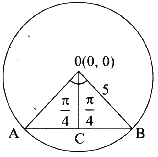
0 likesView Solution
212
MathematicsEasyMCQAP EAMCET · 2024
If $(a, b)$ is the midpoint of the chord $2x - y + 3 = 0$ of the circle $x^2 + y^2 + 6x - 4y + 4 = 0$,then $2a + 3b =$
A
-$1$
B
$0$
C
$1$
D
$3$
Solution
(C) The equation of the chord is $y = 2x + 3$.
Substituting this into the circle equation $x^2 + y^2 + 6x - 4y + 4 = 0$:
$x^2 + (2x + 3)^2 + 6x - 4(2x + 3) + 4 = 0$
$x^2 + 4x^2 + 12x + 9 + 6x - 8x - 12 + 4 = 0$
$5x^2 + 10x + 1 = 0$.
The $x$-coordinate of the midpoint $a$ is the average of the roots: $a = \frac{x_1 + x_2}{2} = \frac{-10/5}{2} = -1$.
Since $(a, b)$ lies on the chord $y = 2x + 3$,we have $b = 2a + 3 = 2(-1) + 3 = 1$.
Thus,$2a + 3b = 2(-1) + 3(1) = -2 + 3 = 1$.
Substituting this into the circle equation $x^2 + y^2 + 6x - 4y + 4 = 0$:
$x^2 + (2x + 3)^2 + 6x - 4(2x + 3) + 4 = 0$
$x^2 + 4x^2 + 12x + 9 + 6x - 8x - 12 + 4 = 0$
$5x^2 + 10x + 1 = 0$.
The $x$-coordinate of the midpoint $a$ is the average of the roots: $a = \frac{x_1 + x_2}{2} = \frac{-10/5}{2} = -1$.
Since $(a, b)$ lies on the chord $y = 2x + 3$,we have $b = 2a + 3 = 2(-1) + 3 = 1$.
Thus,$2a + 3b = 2(-1) + 3(1) = -2 + 3 = 1$.
0 likesView Solution
213
MathematicsEasyMCQAP EAMCET · 2024
If $(1,3)$ is the midpoint of a chord of the circle $x^2+y^2-4x-8y+16=0$,then the area of the triangle formed by that chord with the coordinate axes is
A
$16$
B
$8$
C
$4$
D
$8\sqrt{2}$
Solution
(B) The equation of the circle is $x^2+y^2-4x-8y+16=0$.
Given the midpoint of the chord is $(x_1, y_1) = (1,3)$.
The equation of the chord with midpoint $(x_1, y_1)$ is given by $T = S_1$,where $T = xx_1 + yy_1 + g(x+x_1) + f(y+y_1) + c$ and $S_1 = x_1^2 + y_1^2 + 2gx_1 + 2fy_1 + c$.
Substituting the values: $x(1) + y(3) - 2(x+1) - 4(y+3) + 16 = 1^2 + 3^2 - 4(1) - 8(3) + 16$.
$x + 3y - 2x - 2 - 4y - 12 + 16 = 1 + 9 - 4 - 24 + 16$.
$-x - y + 2 = -2$.
$-x - y = -4$,which simplifies to $x + y = 4$.
The chord intersects the coordinate axes at $A(0,4)$ and $B(4,0)$.
The triangle formed by the chord and the coordinate axes is a right-angled triangle with base $OB = 4$ and height $OA = 4$.
$\text{Area} = \frac{1}{2} \times \text{base} \times \text{height} = \frac{1}{2} \times 4 \times 4 = 8$.
Given the midpoint of the chord is $(x_1, y_1) = (1,3)$.
The equation of the chord with midpoint $(x_1, y_1)$ is given by $T = S_1$,where $T = xx_1 + yy_1 + g(x+x_1) + f(y+y_1) + c$ and $S_1 = x_1^2 + y_1^2 + 2gx_1 + 2fy_1 + c$.
Substituting the values: $x(1) + y(3) - 2(x+1) - 4(y+3) + 16 = 1^2 + 3^2 - 4(1) - 8(3) + 16$.
$x + 3y - 2x - 2 - 4y - 12 + 16 = 1 + 9 - 4 - 24 + 16$.
$-x - y + 2 = -2$.
$-x - y = -4$,which simplifies to $x + y = 4$.
The chord intersects the coordinate axes at $A(0,4)$ and $B(4,0)$.
The triangle formed by the chord and the coordinate axes is a right-angled triangle with base $OB = 4$ and height $OA = 4$.
$\text{Area} = \frac{1}{2} \times \text{base} \times \text{height} = \frac{1}{2} \times 4 \times 4 = 8$.
0 likesView Solution
214
MathematicsDifficultMCQAP EAMCET · 2024
If the circle $S=0$ cuts the circles $x^2+y^2-2x+6y=0$,$x^2+y^2-4x-2y+6=0$,and $x^2+y^2-12x+2y+3=0$ orthogonally,then the equation of the tangent at $(0,3)$ on $S=0$ is
A
$x+y-3=0$
B
$y=3$
C
$x=0$
D
$x-y+3=0$
Solution
(B) Let the circle $S$ be $x^2+y^2+2gx+2fy+c=0$.
Since $S$ cuts the given circles orthogonally,we use the condition $2g_1g_2 + 2f_1f_2 = c_1 + c_2$.
For $S_1: x^2+y^2-2x+6y=0$,we have $g_1=-1, f_1=3, c_1=0$. Thus,$2g(-1) + 2f(3) = c + 0 \Rightarrow -2g + 6f = c$ $(i)$.
For $S_2: x^2+y^2-4x-2y+6=0$,we have $g_2=-2, f_2=-1, c_2=6$. Thus,$2g(-2) + 2f(-1) = c + 6 \Rightarrow -4g - 2f = c + 6$ $(ii)$.
For $S_3: x^2+y^2-12x+2y+3=0$,we have $g_3=-6, f_3=1, c_3=3$. Thus,$2g(-6) + 2f(1) = c + 3 \Rightarrow -12g + 2f = c + 3$ $(iii)$.
Subtracting $(ii)$ from $(i)$: $2g + 8f = -6 \Rightarrow g + 4f = -3$ $(iv)$.
Subtracting $(iii)$ from $(ii)$: $8g - 4f = 3$ $(v)$.
Adding $(iv)$ and $(v)$: $9g = 0 \Rightarrow g = 0$. Then $4f = -3 \Rightarrow f = -3/4$.
Substituting into $(i)$: $c = -2(0) + 6(-3/4) = -18/4 = -9/2$.
The circle $S$ is $x^2+y^2 - \frac{3}{2}y - \frac{9}{2} = 0$.
The tangent at $(0,3)$ is given by $xx_1 + yy_1 + g(x+x_1) + f(y+y_1) + c = 0$.
Substituting $(0,3)$: $x(0) + y(3) + 0(x+0) - \frac{3}{4}(y+3) - \frac{9}{2} = 0$.
$3y - \frac{3}{4}y - \frac{9}{4} - \frac{18}{4} = 0 \Rightarrow \frac{9}{4}y - \frac{27}{4} = 0 \Rightarrow 9y = 27 \Rightarrow y = 3$.
Since $S$ cuts the given circles orthogonally,we use the condition $2g_1g_2 + 2f_1f_2 = c_1 + c_2$.
For $S_1: x^2+y^2-2x+6y=0$,we have $g_1=-1, f_1=3, c_1=0$. Thus,$2g(-1) + 2f(3) = c + 0 \Rightarrow -2g + 6f = c$ $(i)$.
For $S_2: x^2+y^2-4x-2y+6=0$,we have $g_2=-2, f_2=-1, c_2=6$. Thus,$2g(-2) + 2f(-1) = c + 6 \Rightarrow -4g - 2f = c + 6$ $(ii)$.
For $S_3: x^2+y^2-12x+2y+3=0$,we have $g_3=-6, f_3=1, c_3=3$. Thus,$2g(-6) + 2f(1) = c + 3 \Rightarrow -12g + 2f = c + 3$ $(iii)$.
Subtracting $(ii)$ from $(i)$: $2g + 8f = -6 \Rightarrow g + 4f = -3$ $(iv)$.
Subtracting $(iii)$ from $(ii)$: $8g - 4f = 3$ $(v)$.
Adding $(iv)$ and $(v)$: $9g = 0 \Rightarrow g = 0$. Then $4f = -3 \Rightarrow f = -3/4$.
Substituting into $(i)$: $c = -2(0) + 6(-3/4) = -18/4 = -9/2$.
The circle $S$ is $x^2+y^2 - \frac{3}{2}y - \frac{9}{2} = 0$.
The tangent at $(0,3)$ is given by $xx_1 + yy_1 + g(x+x_1) + f(y+y_1) + c = 0$.
Substituting $(0,3)$: $x(0) + y(3) + 0(x+0) - \frac{3}{4}(y+3) - \frac{9}{2} = 0$.
$3y - \frac{3}{4}y - \frac{9}{4} - \frac{18}{4} = 0 \Rightarrow \frac{9}{4}y - \frac{27}{4} = 0 \Rightarrow 9y = 27 \Rightarrow y = 3$.
0 likesView Solution
215
MathematicsMediumMCQAP EAMCET · 2024
The radius of the circle which cuts the circles $x^2+y^2-4x-4y+7=0$,$x^2+y^2+4x-4y+6=0$,and $x^2+y^2+4x+4y+5=0$ orthogonally is
A
$\frac{\sqrt{193}}{4 \sqrt{2}}$
B
$\frac{\sqrt{193}}{8}$
C
$\frac{\sqrt{193}}{4}$
D
$\frac{\sqrt{193}}{2 \sqrt{2}}$
Solution
(A) Let the equation of the required circle be $x^2+y^2+2gx+2fy+c=0$.
Since it cuts the given circles orthogonally,we use the condition $2g_1g_2 + 2f_1f_2 = c_1 + c_2$.
For $x^2+y^2-4x-4y+7=0$: $2g(-2) + 2f(-2) = c+7$ $\Rightarrow -4g-4f-c=7$ $\Rightarrow 4g+4f+c=-7$ $(i)$.
For $x^2+y^2+4x-4y+6=0$: $2g(2) + 2f(-2) = c+6 \Rightarrow 4g-4f-c=6$ $(ii)$.
For $x^2+y^2+4x+4y+5=0$: $2g(2) + 2f(2) = c+5 \Rightarrow 4g+4f-c=5$ $(iii)$.
Subtracting $(iii)$ from $(i)$: $(4g+4f+c) - (4g+4f-c) = -7-5$ $\Rightarrow 2c = -12$ $\Rightarrow c = -6$.
Substituting $c=-6$ into $(i)$ and $(ii)$: $4g+4f = -1$ and $4g-4f = 0$.
Adding these: $8g = -1 \Rightarrow g = -\frac{1}{8}$.
Subtracting: $8f = -1 \Rightarrow f = -\frac{1}{8}$.
The radius $r = \sqrt{g^2+f^2-c} = \sqrt{(-\frac{1}{8})^2 + (-\frac{1}{8})^2 - (-6)} = \sqrt{\frac{1}{64} + \frac{1}{64} + 6} = \sqrt{\frac{2}{64} + 6} = \sqrt{\frac{1}{32} + 6} = \sqrt{\frac{193}{32}} = \frac{\sqrt{193}}{4\sqrt{2}}$.
Since it cuts the given circles orthogonally,we use the condition $2g_1g_2 + 2f_1f_2 = c_1 + c_2$.
For $x^2+y^2-4x-4y+7=0$: $2g(-2) + 2f(-2) = c+7$ $\Rightarrow -4g-4f-c=7$ $\Rightarrow 4g+4f+c=-7$ $(i)$.
For $x^2+y^2+4x-4y+6=0$: $2g(2) + 2f(-2) = c+6 \Rightarrow 4g-4f-c=6$ $(ii)$.
For $x^2+y^2+4x+4y+5=0$: $2g(2) + 2f(2) = c+5 \Rightarrow 4g+4f-c=5$ $(iii)$.
Subtracting $(iii)$ from $(i)$: $(4g+4f+c) - (4g+4f-c) = -7-5$ $\Rightarrow 2c = -12$ $\Rightarrow c = -6$.
Substituting $c=-6$ into $(i)$ and $(ii)$: $4g+4f = -1$ and $4g-4f = 0$.
Adding these: $8g = -1 \Rightarrow g = -\frac{1}{8}$.
Subtracting: $8f = -1 \Rightarrow f = -\frac{1}{8}$.
The radius $r = \sqrt{g^2+f^2-c} = \sqrt{(-\frac{1}{8})^2 + (-\frac{1}{8})^2 - (-6)} = \sqrt{\frac{1}{64} + \frac{1}{64} + 6} = \sqrt{\frac{2}{64} + 6} = \sqrt{\frac{1}{32} + 6} = \sqrt{\frac{193}{32}} = \frac{\sqrt{193}}{4\sqrt{2}}$.
0 likesView Solution
216
MathematicsEasyMCQAP EAMCET · 2024
The angle between the circles $x^2+y^2-4x-6y-3=0$ and $x^2+y^2+8x-4y+11=0$ is
A
$\frac{\pi}{3}$
B
$\frac{\pi}{6}$
C
$\frac{\pi}{2}$
D
$\frac{\pi}{4}$
Solution
(A) The given circles are $S_1: x^2+y^2-4x-6y-3=0$ and $S_2: x^2+y^2+8x-4y+11=0$.
Comparing with $x^2+y^2+2gx+2fy+c=0$,we get:
For $S_1$: $g_1 = -2, f_1 = -3, c_1 = -3$.
For $S_2$: $g_2 = 4, f_2 = -2, c_2 = 11$.
The angle $\theta$ between two circles is given by $\cos \theta = \frac{|2g_1g_2 + 2f_1f_2 - c_1 - c_2|}{2\sqrt{g_1^2+f_1^2-c_1}\sqrt{g_2^2+f_2^2-c_2}}$.
Substituting the values:
$2g_1g_2 = 2(-2)(4) = -16$.
$2f_1f_2 = 2(-3)(-2) = 12$.
Numerator: $|-16 + 12 - (-3) - 11| = |-16 + 12 + 3 - 11| = |-12| = 12$.
Denominator: $2\sqrt{(-2)^2+(-3)^2-(-3)} \sqrt{4^2+(-2)^2-11} = 2\sqrt{4+9+3}\sqrt{16+4-11} = 2\sqrt{16}\sqrt{9} = 2(4)(3) = 24$.
Thus,$\cos \theta = \frac{12}{24} = \frac{1}{2}$.
Therefore,$\theta = \frac{\pi}{3}$.
Comparing with $x^2+y^2+2gx+2fy+c=0$,we get:
For $S_1$: $g_1 = -2, f_1 = -3, c_1 = -3$.
For $S_2$: $g_2 = 4, f_2 = -2, c_2 = 11$.
The angle $\theta$ between two circles is given by $\cos \theta = \frac{|2g_1g_2 + 2f_1f_2 - c_1 - c_2|}{2\sqrt{g_1^2+f_1^2-c_1}\sqrt{g_2^2+f_2^2-c_2}}$.
Substituting the values:
$2g_1g_2 = 2(-2)(4) = -16$.
$2f_1f_2 = 2(-3)(-2) = 12$.
Numerator: $|-16 + 12 - (-3) - 11| = |-16 + 12 + 3 - 11| = |-12| = 12$.
Denominator: $2\sqrt{(-2)^2+(-3)^2-(-3)} \sqrt{4^2+(-2)^2-11} = 2\sqrt{4+9+3}\sqrt{16+4-11} = 2\sqrt{16}\sqrt{9} = 2(4)(3) = 24$.
Thus,$\cos \theta = \frac{12}{24} = \frac{1}{2}$.
Therefore,$\theta = \frac{\pi}{3}$.
0 likesView Solution
217
MathematicsEasyMCQAP EAMCET · 2024
If the circles $x^2+y^2+2 \alpha x+2 y-8=0$ and $x^2+y^2-2 x+\alpha y-14=0$ intersect orthogonally,then the distance between their centres is
A
$\sqrt{242}$
B
$\sqrt{970}$
C
$\sqrt{629}$
D
$\sqrt{541}$
Solution
(C) The given equations of the circles are $S_1: x^2+y^2+2 \alpha x+2 y-8=0$ and $S_2: x^2+y^2-2 x+\alpha y-14=0$.
Comparing with $x^2+y^2+2gx+2fy+c=0$,we get $(g_1, f_1, c_1) = (\alpha, 1, -8)$ and $(g_2, f_2, c_2) = (-1, \frac{\alpha}{2}, -14)$.
Since the circles intersect orthogonally,the condition is $2g_1g_2 + 2f_1f_2 = c_1 + c_2$.
Substituting the values: $2(\alpha)(-1) + 2(1)(\frac{\alpha}{2}) = -8 - 14$.
$-2\alpha + \alpha = -22$,which gives $\alpha = 22$.
The centre of $S_1$ is $C_1 = (-g_1, -f_1) = (-22, -1)$.
The centre of $S_2$ is $C_2 = (-g_2, -f_2) = (1, -\frac{22}{2}) = (1, -11)$.
The distance between the centres $C_1$ and $C_2$ is $d = \sqrt{(1 - (-22))^2 + (-11 - (-1))^2} = \sqrt{(23)^2 + (-10)^2} = \sqrt{529 + 100} = \sqrt{629}$.
Comparing with $x^2+y^2+2gx+2fy+c=0$,we get $(g_1, f_1, c_1) = (\alpha, 1, -8)$ and $(g_2, f_2, c_2) = (-1, \frac{\alpha}{2}, -14)$.
Since the circles intersect orthogonally,the condition is $2g_1g_2 + 2f_1f_2 = c_1 + c_2$.
Substituting the values: $2(\alpha)(-1) + 2(1)(\frac{\alpha}{2}) = -8 - 14$.
$-2\alpha + \alpha = -22$,which gives $\alpha = 22$.
The centre of $S_1$ is $C_1 = (-g_1, -f_1) = (-22, -1)$.
The centre of $S_2$ is $C_2 = (-g_2, -f_2) = (1, -\frac{22}{2}) = (1, -11)$.
The distance between the centres $C_1$ and $C_2$ is $d = \sqrt{(1 - (-22))^2 + (-11 - (-1))^2} = \sqrt{(23)^2 + (-10)^2} = \sqrt{529 + 100} = \sqrt{629}$.
0 likesView Solution
218
MathematicsEasyMCQAP EAMCET · 2024
If the circles $S \equiv x^2+y^2-14x+6y+33=0$ and $S' \equiv x^2+y^2-a^2=0$ where $a \in \mathbb{N}$ have $4$ common tangents,then the possible number of values of $a$ is:
A
$13$
B
$5$
C
$14$
D
$2$
Solution
(D) Given circle $S \equiv x^2+y^2-14x+6y+33=0$.
Completing the square: $(x-7)^2 + (y+3)^2 = 49+9-33 = 25$.
So,center $C = (7, -3)$ and radius $r = 5$.
For circle $S' \equiv x^2+y^2=a^2$,center $C' = (0, 0)$ and radius $r' = a$.
For $4$ common tangents,the circles must be separated,which means the distance between centers $CC' > r + r'$.
$CC' = \sqrt{(7-0)^2 + (-3-0)^2} = \sqrt{49+9} = \sqrt{58} \approx 7.616$.
Condition: $7.616 > 5 + a$.
$a < 2.616$.
Since $a \in \mathbb{N}$,the possible values for $a$ are $1$ and $2$.
Thus,there are $2$ possible values for $a$.
Completing the square: $(x-7)^2 + (y+3)^2 = 49+9-33 = 25$.
So,center $C = (7, -3)$ and radius $r = 5$.
For circle $S' \equiv x^2+y^2=a^2$,center $C' = (0, 0)$ and radius $r' = a$.
For $4$ common tangents,the circles must be separated,which means the distance between centers $CC' > r + r'$.
$CC' = \sqrt{(7-0)^2 + (-3-0)^2} = \sqrt{49+9} = \sqrt{58} \approx 7.616$.
Condition: $7.616 > 5 + a$.
$a < 2.616$.
Since $a \in \mathbb{N}$,the possible values for $a$ are $1$ and $2$.
Thus,there are $2$ possible values for $a$.
0 likesView Solution
219
MathematicsEasyMCQAP EAMCET · 2024
If the circles $x^2+y^2-8x-8y+28=0$ and $x^2+y^2-8x-6y+25-\alpha^2=0$ have only one common tangent,then $\alpha=$
A
$\alpha=4$
B
$\alpha=2$
C
$\alpha=1$
D
$\alpha=5$
Solution
(C) For the first circle $S_1: x^2+y^2-8x-8y+28=0$,the center $C_1 = (4, 4)$ and radius $r_1 = \sqrt{4^2+4^2-28} = \sqrt{16+16-28} = \sqrt{4} = 2$.
For the second circle $S_2: x^2+y^2-8x-6y+25-\alpha^2=0$,the center $C_2 = (4, 3)$ and radius $r_2 = \sqrt{4^2+3^2-(25-\alpha^2)} = \sqrt{16+9-25+\alpha^2} = \sqrt{\alpha^2} = |\alpha|$.
Two circles have only one common tangent if they touch each other internally or externally.
The distance between centers $C_1 C_2 = \sqrt{(4-4)^2 + (4-3)^2} = \sqrt{0^2 + 1^2} = 1$.
For internal touch,$|r_1 - r_2| = C_1 C_2 \Rightarrow |2 - |\alpha|| = 1$.
This gives $2 - |\alpha| = 1$ $\Rightarrow |\alpha| = 1$ $\Rightarrow \alpha = \pm 1$ or $2 - |\alpha| = -1$ $\Rightarrow |\alpha| = 3$ $\Rightarrow \alpha = \pm 3$.
Given the options,$\alpha = 1$ is the correct value.
For the second circle $S_2: x^2+y^2-8x-6y+25-\alpha^2=0$,the center $C_2 = (4, 3)$ and radius $r_2 = \sqrt{4^2+3^2-(25-\alpha^2)} = \sqrt{16+9-25+\alpha^2} = \sqrt{\alpha^2} = |\alpha|$.
Two circles have only one common tangent if they touch each other internally or externally.
The distance between centers $C_1 C_2 = \sqrt{(4-4)^2 + (4-3)^2} = \sqrt{0^2 + 1^2} = 1$.
For internal touch,$|r_1 - r_2| = C_1 C_2 \Rightarrow |2 - |\alpha|| = 1$.
This gives $2 - |\alpha| = 1$ $\Rightarrow |\alpha| = 1$ $\Rightarrow \alpha = \pm 1$ or $2 - |\alpha| = -1$ $\Rightarrow |\alpha| = 3$ $\Rightarrow \alpha = \pm 3$.
Given the options,$\alpha = 1$ is the correct value.
0 likesView Solution
220
MathematicsEasyMCQAP EAMCET · 2024
If a direct common tangent drawn to the circles $x^2+y^2-6x+4y+9=0$ and $x^2+y^2+2x-2y+1=0$ touches the circles at $A$ and $B$,then $AB=$
A
$9$
B
$16$
C
$4\sqrt{6}$
D
$2\sqrt{6}$
Solution
(D) The given equations of the circles are:
$x^2 + y^2 - 6x + 4y + 9 = 0 \Rightarrow (x-3)^2 + (y+2)^2 = 2^2 \quad \dots(i)$
$x^2 + y^2 + 2x - 2y + 1 = 0 \Rightarrow (x+1)^2 + (y-1)^2 = 1^2 \quad \dots(ii)$
From $(i)$ and $(ii)$,the centers and radii are:
$C_1 = (3, -2), r_1 = 2$
$C_2 = (-1, 1), r_2 = 1$
Calculate the distance between the centers $C_1$ and $C_2$:
$C_1C_2 = \sqrt{(3 - (-1))^2 + (-2 - 1)^2} = \sqrt{4^2 + (-3)^2} = \sqrt{16 + 9} = 5$
The length of the direct common tangent $AB$ is given by the formula:
$AB = \sqrt{(C_1C_2)^2 - (r_1 - r_2)^2}$
$AB = \sqrt{5^2 - (2 - 1)^2} = \sqrt{25 - 1} = \sqrt{24} = 2\sqrt{6}$
$x^2 + y^2 - 6x + 4y + 9 = 0 \Rightarrow (x-3)^2 + (y+2)^2 = 2^2 \quad \dots(i)$
$x^2 + y^2 + 2x - 2y + 1 = 0 \Rightarrow (x+1)^2 + (y-1)^2 = 1^2 \quad \dots(ii)$
From $(i)$ and $(ii)$,the centers and radii are:
$C_1 = (3, -2), r_1 = 2$
$C_2 = (-1, 1), r_2 = 1$
Calculate the distance between the centers $C_1$ and $C_2$:
$C_1C_2 = \sqrt{(3 - (-1))^2 + (-2 - 1)^2} = \sqrt{4^2 + (-3)^2} = \sqrt{16 + 9} = 5$
The length of the direct common tangent $AB$ is given by the formula:
$AB = \sqrt{(C_1C_2)^2 - (r_1 - r_2)^2}$
$AB = \sqrt{5^2 - (2 - 1)^2} = \sqrt{25 - 1} = \sqrt{24} = 2\sqrt{6}$
0 likesView Solution
221
MathematicsEasyMCQAP EAMCET · 2024
If all chords of the curve $2x^2 - y^2 + 3x + 2y = 0$,which subtend a right angle at the origin,always pass through a fixed point $(\alpha, \beta)$,then $(\alpha, \beta) =$
A
$(-3, -2)$
B
$(3, 2)$
C
$(3, -2)$
D
$(-3, 2)$
Solution
(A) The equation of the curve is $2x^2 - y^2 + 3x + 2y = 0$.
Let the equation of the chord be $y = mx + c$,which can be written as $\frac{y - mx}{c} = 1$.
Substituting this into the homogeneous form of the curve equation:
$2x^2 - y^2 + (3x + 2y)(\frac{y - mx}{c}) = 0$.
Multiplying by $c$:
$2cx^2 - cy^2 + 3xy - 3mx^2 + 2y^2 - 2mxy = 0$.
Grouping the terms:
$(2c - 3m)x^2 + (2 - c)y^2 + (3 - 2m)xy = 0$.
Since the chord subtends a right angle at the origin,the sum of the coefficients of $x^2$ and $y^2$ must be zero:
$(2c - 3m) + (2 - c) = 0$.
$c - 3m + 2 = 0$.
Substituting $c = 3m - 2$ into the chord equation $y = mx + c$:
$y = mx + 3m - 2$.
$y + 2 = m(x + 3)$.
This equation represents a family of lines passing through the fixed point $(-3, -2)$.
Thus,$(\alpha, \beta) = (-3, -2)$.
Let the equation of the chord be $y = mx + c$,which can be written as $\frac{y - mx}{c} = 1$.
Substituting this into the homogeneous form of the curve equation:
$2x^2 - y^2 + (3x + 2y)(\frac{y - mx}{c}) = 0$.
Multiplying by $c$:
$2cx^2 - cy^2 + 3xy - 3mx^2 + 2y^2 - 2mxy = 0$.
Grouping the terms:
$(2c - 3m)x^2 + (2 - c)y^2 + (3 - 2m)xy = 0$.
Since the chord subtends a right angle at the origin,the sum of the coefficients of $x^2$ and $y^2$ must be zero:
$(2c - 3m) + (2 - c) = 0$.
$c - 3m + 2 = 0$.
Substituting $c = 3m - 2$ into the chord equation $y = mx + c$:
$y = mx + 3m - 2$.
$y + 2 = m(x + 3)$.
This equation represents a family of lines passing through the fixed point $(-3, -2)$.
Thus,$(\alpha, \beta) = (-3, -2)$.
0 likesView Solution
222
MathematicsMediumMCQAP EAMCET · 2024
$C_1$ is the circle with centre at $O(0,0)$ and radius $4$,$C_2$ is a variable circle with centre at $(\alpha, \beta)$ and radius $5$. If the common chord of $C_1$ and $C_2$ has slope $\frac{3}{4}$ and is of maximum length,then one of the possible values of $\alpha+\beta$ is
A
$\frac{21}{5}$
B
$\frac{3}{5}$
C
$\frac{1}{5}$
D
$\frac{19}{5}$
Solution
(B) The equation of circle $C_1$ is $x^2+y^2=16$.
The equation of circle $C_2$ is $(x-\alpha)^2+(y-\beta)^2=25$,which expands to $x^2-2\alpha x+\alpha^2+y^2-2\beta y+\beta^2=25$.
The equation of the common chord is given by $C_2-C_1=0$,which is $-2\alpha x-2\beta y+\alpha^2+\beta^2=9$.
The slope of the common chord is $m = -\frac{-2\alpha}{-2\beta} = -\frac{\alpha}{\beta} = \frac{3}{4}$.
Let $\alpha = -3\lambda$ and $\beta = 4\lambda$.
For the common chord to have maximum length,it must be the diameter of the smaller circle $C_1$,meaning the chord must pass through the centre of $C_1$,which is $(0,0)$.
Substituting $(0,0)$ into the chord equation: $-2\alpha(0)-2\beta(0)+\alpha^2+\beta^2=9$,so $\alpha^2+\beta^2=9$.
Substituting $\alpha$ and $\beta$ in terms of $\lambda$: $(-3\lambda)^2+(4\lambda)^2=9$ $\Rightarrow 25\lambda^2=9$ $\Rightarrow \lambda = \pm \frac{3}{5}$.
If $\lambda = \frac{3}{5}$,then $\alpha = -\frac{9}{5}$ and $\beta = \frac{12}{5}$,so $\alpha+\beta = \frac{3}{5}$.
If $\lambda = -\frac{3}{5}$,then $\alpha = \frac{9}{5}$ and $\beta = -\frac{12}{5}$,so $\alpha+\beta = -\frac{3}{5}$.
The equation of circle $C_2$ is $(x-\alpha)^2+(y-\beta)^2=25$,which expands to $x^2-2\alpha x+\alpha^2+y^2-2\beta y+\beta^2=25$.
The equation of the common chord is given by $C_2-C_1=0$,which is $-2\alpha x-2\beta y+\alpha^2+\beta^2=9$.
The slope of the common chord is $m = -\frac{-2\alpha}{-2\beta} = -\frac{\alpha}{\beta} = \frac{3}{4}$.
Let $\alpha = -3\lambda$ and $\beta = 4\lambda$.
For the common chord to have maximum length,it must be the diameter of the smaller circle $C_1$,meaning the chord must pass through the centre of $C_1$,which is $(0,0)$.
Substituting $(0,0)$ into the chord equation: $-2\alpha(0)-2\beta(0)+\alpha^2+\beta^2=9$,so $\alpha^2+\beta^2=9$.
Substituting $\alpha$ and $\beta$ in terms of $\lambda$: $(-3\lambda)^2+(4\lambda)^2=9$ $\Rightarrow 25\lambda^2=9$ $\Rightarrow \lambda = \pm \frac{3}{5}$.
If $\lambda = \frac{3}{5}$,then $\alpha = -\frac{9}{5}$ and $\beta = \frac{12}{5}$,so $\alpha+\beta = \frac{3}{5}$.
If $\lambda = -\frac{3}{5}$,then $\alpha = \frac{9}{5}$ and $\beta = -\frac{12}{5}$,so $\alpha+\beta = -\frac{3}{5}$.
0 likesView Solution
223
MathematicsEasyMCQAP EAMCET · 2024
$A$ circle $S$ passes through the points of intersection of the circles $x^2+y^2-2x+2y-2=0$ and $x^2+y^2+2x-2y+1=0$. If the centre of this circle $S$ lies on the line $x-y+6=0$,then the radius of the circle $S$ is
A
$\sqrt{5}$
B
$5$
C
$\sqrt{41}$
D
$\sqrt{14}$
Solution
(D) The equation of the family of circles passing through the intersection of two circles $S_1=0$ and $S_2=0$ is given by $S_1 + kS_2 = 0$.
$(x^2+y^2-2x+2y-2) + k(x^2+y^2+2x-2y+1) = 0$
$(1+k)x^2 + (1+k)y^2 + (2k-2)x + (2-2k)y + (k-2) = 0$
Dividing by $(1+k)$,we get $x^2 + y^2 + \frac{2(k-1)}{k+1}x + \frac{2(1-k)}{k+1}y + \frac{k-2}{k+1} = 0$.
The centre of this circle is $\left(-\frac{k-1}{k+1}, -\frac{1-k}{k+1}\right) = \left(\frac{1-k}{k+1}, \frac{k-1}{k+1}\right)$.
Since the centre lies on the line $x-y+6=0$,we substitute the coordinates:
$\frac{1-k}{k+1} - \frac{k-1}{k+1} + 6 = 0$
$\frac{1-k-k+1}{k+1} = -6 \Rightarrow 2-2k = -6k-6$
$4k = -8 \Rightarrow k = -2$.
Substituting $k=-2$ into the equation: $x^2+y^2 + \frac{2(-3)}{-1}x + \frac{2(3)}{-1}y + \frac{-4}{-1} = 0 \Rightarrow x^2+y^2+6x-6y+4=0$.
The radius $r = \sqrt{g^2+f^2-c} = \sqrt{3^2+(-3)^2-4} = \sqrt{9+9-4} = \sqrt{14}$.
$(x^2+y^2-2x+2y-2) + k(x^2+y^2+2x-2y+1) = 0$
$(1+k)x^2 + (1+k)y^2 + (2k-2)x + (2-2k)y + (k-2) = 0$
Dividing by $(1+k)$,we get $x^2 + y^2 + \frac{2(k-1)}{k+1}x + \frac{2(1-k)}{k+1}y + \frac{k-2}{k+1} = 0$.
The centre of this circle is $\left(-\frac{k-1}{k+1}, -\frac{1-k}{k+1}\right) = \left(\frac{1-k}{k+1}, \frac{k-1}{k+1}\right)$.
Since the centre lies on the line $x-y+6=0$,we substitute the coordinates:
$\frac{1-k}{k+1} - \frac{k-1}{k+1} + 6 = 0$
$\frac{1-k-k+1}{k+1} = -6 \Rightarrow 2-2k = -6k-6$
$4k = -8 \Rightarrow k = -2$.
Substituting $k=-2$ into the equation: $x^2+y^2 + \frac{2(-3)}{-1}x + \frac{2(3)}{-1}y + \frac{-4}{-1} = 0 \Rightarrow x^2+y^2+6x-6y+4=0$.
The radius $r = \sqrt{g^2+f^2-c} = \sqrt{3^2+(-3)^2-4} = \sqrt{9+9-4} = \sqrt{14}$.
0 likesView Solution
224
MathematicsMediumMCQAP EAMCET · 2024
If the equation of the circle passing through the points of intersection of the circles $S_1: x^2 - 2x + y^2 - 4y - 4 = 0$ and $S_2: x^2 + 2x + y^2 + 4y - 4 = 0$ passes through the point $(3, 3)$,and its equation is $x^2 + y^2 + \alpha x + \beta y + \gamma = 0$,then find the value of $3(\alpha + \beta + \gamma)$.
A
$32$
B
$-32$
C
$-26$
D
$26$
Solution
(C) The equation of the circle passing through the intersection of $S_1$ and $S_2$ is given by $S_1 + \lambda S_2 = 0$.
$x^2 - 2x + y^2 - 4y - 4 + \lambda(x^2 + 2x + y^2 + 4y - 4) = 0$.
$(1 + \lambda)x^2 + (1 + \lambda)y^2 + 2(\lambda - 1)x + 4(\lambda - 1)y - 4(1 + \lambda) = 0$.
Dividing by $(1 + \lambda)$,we get $x^2 + y^2 + \frac{2(\lambda - 1)}{1 + \lambda}x + \frac{4(\lambda - 1)}{1 + \lambda}y - 4 = 0$.
Since it passes through $(3, 3)$,substitute $x = 3, y = 3$:
$9 + 9 + \frac{6(\lambda - 1)}{1 + \lambda} + \frac{12(\lambda - 1)}{1 + \lambda} - 4 = 0$.
$14 + \frac{18(\lambda - 1)}{1 + \lambda} = 0 \Rightarrow 14(1 + \lambda) + 18(\lambda - 1) = 0$.
$14 + 14\lambda + 18\lambda - 18 = 0$ $\Rightarrow 32\lambda = 4$ $\Rightarrow \lambda = \frac{1}{8}$.
Now,$\alpha = \frac{2(\frac{1}{8} - 1)}{1 + \frac{1}{8}} = \frac{2(-\frac{7}{8})}{\frac{9}{8}} = -\frac{14}{9}$.
$\beta = \frac{4(\frac{1}{8} - 1)}{1 + \frac{1}{8}} = \frac{4(-\frac{7}{8})}{\frac{9}{8}} = -\frac{28}{9}$.
$\gamma = -4$.
$3(\alpha + \beta + \gamma) = 3(-\frac{14}{9} - \frac{28}{9} - 4) = 3(-\frac{42}{9} - 4) = 3(-\frac{14}{3} - 4) = -14 - 12 = -26$.
$x^2 - 2x + y^2 - 4y - 4 + \lambda(x^2 + 2x + y^2 + 4y - 4) = 0$.
$(1 + \lambda)x^2 + (1 + \lambda)y^2 + 2(\lambda - 1)x + 4(\lambda - 1)y - 4(1 + \lambda) = 0$.
Dividing by $(1 + \lambda)$,we get $x^2 + y^2 + \frac{2(\lambda - 1)}{1 + \lambda}x + \frac{4(\lambda - 1)}{1 + \lambda}y - 4 = 0$.
Since it passes through $(3, 3)$,substitute $x = 3, y = 3$:
$9 + 9 + \frac{6(\lambda - 1)}{1 + \lambda} + \frac{12(\lambda - 1)}{1 + \lambda} - 4 = 0$.
$14 + \frac{18(\lambda - 1)}{1 + \lambda} = 0 \Rightarrow 14(1 + \lambda) + 18(\lambda - 1) = 0$.
$14 + 14\lambda + 18\lambda - 18 = 0$ $\Rightarrow 32\lambda = 4$ $\Rightarrow \lambda = \frac{1}{8}$.
Now,$\alpha = \frac{2(\frac{1}{8} - 1)}{1 + \frac{1}{8}} = \frac{2(-\frac{7}{8})}{\frac{9}{8}} = -\frac{14}{9}$.
$\beta = \frac{4(\frac{1}{8} - 1)}{1 + \frac{1}{8}} = \frac{4(-\frac{7}{8})}{\frac{9}{8}} = -\frac{28}{9}$.
$\gamma = -4$.
$3(\alpha + \beta + \gamma) = 3(-\frac{14}{9} - \frac{28}{9} - 4) = 3(-\frac{42}{9} - 4) = 3(-\frac{14}{3} - 4) = -14 - 12 = -26$.
0 likesView Solution
225
MathematicsMediumMCQAP EAMCET · 2024
The equation of the circle whose diameter is the common chord of the circles $x^2+y^2-6x-7=0$ and $x^2+y^2-10x+16=0$ is:
A
$8x^2+8y^2-92x+197=0$
B
$x^2+y^2-23x+197=0$
C
$x^2+y^2-\frac{23}{2}x+\frac{197}{4}=0$
D
$4x^2+4y^2-46x+197=0$
Solution
(A) Let the two circles be $S_1 \equiv x^2+y^2-6x-7=0$ and $S_2 \equiv x^2+y^2-10x+16=0$.
The common chord is given by $S_1 - S_2 = 0$.
$(x^2+y^2-6x-7) - (x^2+y^2-10x+16) = 0$
$4x - 23 = 0 \Rightarrow x = \frac{23}{4}$.
The points of intersection are found by substituting $x = \frac{23}{4}$ into $S_1$:
$(\frac{23}{4})^2 + y^2 - 6(\frac{23}{4}) - 7 = 0$
$\frac{529}{16} + y^2 - \frac{138}{4} - 7 = 0$
$y^2 = \frac{138}{4} + 7 - \frac{529}{16} = \frac{552 + 112 - 529}{16} = \frac{135}{16}$.
So,$y = \pm \frac{3\sqrt{15}}{4}$.
The diameter endpoints are $(\frac{23}{4}, \frac{3\sqrt{15}}{4})$ and $(\frac{23}{4}, -\frac{3\sqrt{15}}{4})$.
The equation of the circle with diameter endpoints $(x_1, y_1)$ and $(x_2, y_2)$ is $(x-x_1)(x-x_2) + (y-y_1)(y-y_2) = 0$.
$(x-\frac{23}{4})(x-\frac{23}{4}) + (y-\frac{3\sqrt{15}}{4})(y+\frac{3\sqrt{15}}{4}) = 0$
$(x-\frac{23}{4})^2 + y^2 - \frac{135}{16} = 0$
$x^2 - \frac{23}{2}x + \frac{529}{16} + y^2 - \frac{135}{16} = 0$
$x^2 + y^2 - \frac{23}{2}x + \frac{394}{16} = 0$
$x^2 + y^2 - \frac{23}{2}x + \frac{197}{8} = 0$
Multiplying by $8$: $8x^2 + 8y^2 - 92x + 197 = 0$.
The common chord is given by $S_1 - S_2 = 0$.
$(x^2+y^2-6x-7) - (x^2+y^2-10x+16) = 0$
$4x - 23 = 0 \Rightarrow x = \frac{23}{4}$.
The points of intersection are found by substituting $x = \frac{23}{4}$ into $S_1$:
$(\frac{23}{4})^2 + y^2 - 6(\frac{23}{4}) - 7 = 0$
$\frac{529}{16} + y^2 - \frac{138}{4} - 7 = 0$
$y^2 = \frac{138}{4} + 7 - \frac{529}{16} = \frac{552 + 112 - 529}{16} = \frac{135}{16}$.
So,$y = \pm \frac{3\sqrt{15}}{4}$.
The diameter endpoints are $(\frac{23}{4}, \frac{3\sqrt{15}}{4})$ and $(\frac{23}{4}, -\frac{3\sqrt{15}}{4})$.
The equation of the circle with diameter endpoints $(x_1, y_1)$ and $(x_2, y_2)$ is $(x-x_1)(x-x_2) + (y-y_1)(y-y_2) = 0$.
$(x-\frac{23}{4})(x-\frac{23}{4}) + (y-\frac{3\sqrt{15}}{4})(y+\frac{3\sqrt{15}}{4}) = 0$
$(x-\frac{23}{4})^2 + y^2 - \frac{135}{16} = 0$
$x^2 - \frac{23}{2}x + \frac{529}{16} + y^2 - \frac{135}{16} = 0$
$x^2 + y^2 - \frac{23}{2}x + \frac{394}{16} = 0$
$x^2 + y^2 - \frac{23}{2}x + \frac{197}{8} = 0$
Multiplying by $8$: $8x^2 + 8y^2 - 92x + 197 = 0$.
0 likesView Solution
226
MathematicsMediumMCQAP EAMCET · 2024
Let $P$ be any point on the circle $x^2+y^2=25$. Let $L$ be the chord of contact of $P$ with respect to the circle $x^2+y^2=9$. The locus of the poles of the lines $L$ with respect to the circle $x^2+y^2=36$ is
A
$y^2=20x$
B
$\frac{x^2}{9}+\frac{y^2}{36}=1$
C
$x^2+y^2=400$
D
$\frac{x^2}{25}-\frac{y^2}{16}=1$
Solution
(C) Let $P(r, s)$ be a point on the circle $x^2+y^2=25$,so $r^2+s^2=25$ $(i)$.
The equation of the chord of contact $L$ of point $P$ with respect to the circle $x^2+y^2=9$ is given by $xr+ys=9$ $(ii)$.
Let $(h, k)$ be the pole of the line $L$ with respect to the circle $x^2+y^2=36$. The equation of the polar of $(h, k)$ with respect to $x^2+y^2=36$ is $xh+yk=36$ $(iii)$.
Comparing equations $(ii)$ and $(iii)$,we have $\frac{r}{h} = \frac{s}{k} = \frac{9}{36} = \frac{1}{4}$.
Thus,$r = \frac{h}{4}$ and $s = \frac{k}{4}$.
Substituting these into equation $(i)$,we get $(\frac{h}{4})^2 + (\frac{k}{4})^2 = 25$.
$\frac{h^2+k^2}{16} = 25 \Rightarrow h^2+k^2 = 400$.
Therefore,the locus of the pole $(h, k)$ is $x^2+y^2=400$.
The equation of the chord of contact $L$ of point $P$ with respect to the circle $x^2+y^2=9$ is given by $xr+ys=9$ $(ii)$.
Let $(h, k)$ be the pole of the line $L$ with respect to the circle $x^2+y^2=36$. The equation of the polar of $(h, k)$ with respect to $x^2+y^2=36$ is $xh+yk=36$ $(iii)$.
Comparing equations $(ii)$ and $(iii)$,we have $\frac{r}{h} = \frac{s}{k} = \frac{9}{36} = \frac{1}{4}$.
Thus,$r = \frac{h}{4}$ and $s = \frac{k}{4}$.
Substituting these into equation $(i)$,we get $(\frac{h}{4})^2 + (\frac{k}{4})^2 = 25$.
$\frac{h^2+k^2}{16} = 25 \Rightarrow h^2+k^2 = 400$.
Therefore,the locus of the pole $(h, k)$ is $x^2+y^2=400$.
0 likesView Solution
227
MathematicsDifficultMCQAP EAMCET · 2024
If the inverse point of the point $(-1, 1)$ with respect to the circle $x^2+y^2-2x+2y-1=0$ is $(p, q)$,then $p^2+q^2=$
A
$\frac{1}{16}$
B
$\frac{1}{8}$
C
$\frac{1}{4}$
D
$\frac{1}{2}$
Solution
(B) The equation of the polar of the point $(-1, 1)$ with respect to the circle $x^2+y^2-2x+2y-1=0$ is given by $x(-1) + y(1) - (x-1) + (y+1) - 1 = 0$.
This simplifies to $-x + y - x + 1 + y + 1 - 1 = 0$,which is $-2x + 2y + 1 = 0$ or $2x - 2y - 1 = 0$.
The inverse point $(p, q)$ is the foot of the perpendicular from the center of the circle to the polar line.
The center of the circle $x^2+y^2-2x+2y-1=0$ is $(1, -1)$.
The foot of the perpendicular $(p, q)$ from $(x_0, y_0) = (1, -1)$ to the line $ax + by + c = 0$ is given by $\frac{p-x_0}{a} = \frac{q-y_0}{b} = -\frac{ax_0+by_0+c}{a^2+b^2}$.
Here $a=2, b=-2, c=-1$.
$\frac{p-1}{2} = \frac{q-(-1)}{-2} = -\frac{2(1)-2(-1)-1}{2^2+(-2)^2} = -\frac{2+2-1}{8} = -\frac{3}{8}$.
$p-1 = 2(-\frac{3}{8}) = -\frac{3}{4} \Rightarrow p = 1 - \frac{3}{4} = \frac{1}{4}$.
$q+1 = -2(-\frac{3}{8}) = \frac{3}{4} \Rightarrow q = \frac{3}{4} - 1 = -\frac{1}{4}$.
Thus,$p^2+q^2 = (\frac{1}{4})^2 + (-\frac{1}{4})^2 = \frac{1}{16} + \frac{1}{16} = \frac{2}{16} = \frac{1}{8}$.
This simplifies to $-x + y - x + 1 + y + 1 - 1 = 0$,which is $-2x + 2y + 1 = 0$ or $2x - 2y - 1 = 0$.
The inverse point $(p, q)$ is the foot of the perpendicular from the center of the circle to the polar line.
The center of the circle $x^2+y^2-2x+2y-1=0$ is $(1, -1)$.
The foot of the perpendicular $(p, q)$ from $(x_0, y_0) = (1, -1)$ to the line $ax + by + c = 0$ is given by $\frac{p-x_0}{a} = \frac{q-y_0}{b} = -\frac{ax_0+by_0+c}{a^2+b^2}$.
Here $a=2, b=-2, c=-1$.
$\frac{p-1}{2} = \frac{q-(-1)}{-2} = -\frac{2(1)-2(-1)-1}{2^2+(-2)^2} = -\frac{2+2-1}{8} = -\frac{3}{8}$.
$p-1 = 2(-\frac{3}{8}) = -\frac{3}{4} \Rightarrow p = 1 - \frac{3}{4} = \frac{1}{4}$.
$q+1 = -2(-\frac{3}{8}) = \frac{3}{4} \Rightarrow q = \frac{3}{4} - 1 = -\frac{1}{4}$.
Thus,$p^2+q^2 = (\frac{1}{4})^2 + (-\frac{1}{4})^2 = \frac{1}{16} + \frac{1}{16} = \frac{2}{16} = \frac{1}{8}$.
0 likesView Solution
228
MathematicsEasyMCQAP EAMCET · 2024
The pole of the straight line $9x + y - 28 = 0$ with respect to the circle $2x^2 + 2y^2 - 3x + 5y - 7 = 0$ is
A
$(-1, 3)$
B
$(2, -3)$
C
$(3, -1)$
D
$(3, -3)$
Solution
(C) Let $(h, k)$ be the pole of the line $9x + y - 28 = 0$ with respect to the circle $2x^2 + 2y^2 - 3x + 5y - 7 = 0$.
The equation of the polar of a point $(h, k)$ with respect to the circle $2x^2 + 2y^2 - 3x + 5y - 7 = 0$ is given by $T = 0$.
The equation is $2hx + 2ky - \frac{3(x + h)}{2} + \frac{5(y + k)}{2} - 7 = 0$.
Multiplying by $2$,we get $4hx + 4ky - 3x - 3h + 5y + 5k - 14 = 0$.
Rearranging terms,we get $(4h - 3)x + (4k + 5)y + (5k - 3h - 14) = 0$.
Comparing this with the given line $9x + y - 28 = 0$,we have:
$\frac{4h - 3}{9} = \frac{4k + 5}{1} = \frac{5k - 3h - 14}{-28}$.
From $\frac{4h - 3}{9} = 4k + 5$,we get $4h - 3 = 36k + 45$ $\Rightarrow 4h - 36k = 48$ $\Rightarrow h - 9k = 12$.
From $\frac{4k + 5}{1} = \frac{5k - 3h - 14}{-28}$,we get $-112k - 140 = 5k - 3h - 14$ $\Rightarrow 3h - 117k = 126$ $\Rightarrow h - 39k = 42$.
Solving $h - 9k = 12$ and $h - 39k = 42$,we subtract the equations: $(h - 9k) - (h - 39k) = 12 - 42$ $\Rightarrow 30k = -30$ $\Rightarrow k = -1$.
Substituting $k = -1$ into $h - 9k = 12$,we get $h - 9(-1) = 12$ $\Rightarrow h + 9 = 12$ $\Rightarrow h = 3$.
Thus,the pole is $(3, -1)$.
The equation of the polar of a point $(h, k)$ with respect to the circle $2x^2 + 2y^2 - 3x + 5y - 7 = 0$ is given by $T = 0$.
The equation is $2hx + 2ky - \frac{3(x + h)}{2} + \frac{5(y + k)}{2} - 7 = 0$.
Multiplying by $2$,we get $4hx + 4ky - 3x - 3h + 5y + 5k - 14 = 0$.
Rearranging terms,we get $(4h - 3)x + (4k + 5)y + (5k - 3h - 14) = 0$.
Comparing this with the given line $9x + y - 28 = 0$,we have:
$\frac{4h - 3}{9} = \frac{4k + 5}{1} = \frac{5k - 3h - 14}{-28}$.
From $\frac{4h - 3}{9} = 4k + 5$,we get $4h - 3 = 36k + 45$ $\Rightarrow 4h - 36k = 48$ $\Rightarrow h - 9k = 12$.
From $\frac{4k + 5}{1} = \frac{5k - 3h - 14}{-28}$,we get $-112k - 140 = 5k - 3h - 14$ $\Rightarrow 3h - 117k = 126$ $\Rightarrow h - 39k = 42$.
Solving $h - 9k = 12$ and $h - 39k = 42$,we subtract the equations: $(h - 9k) - (h - 39k) = 12 - 42$ $\Rightarrow 30k = -30$ $\Rightarrow k = -1$.
Substituting $k = -1$ into $h - 9k = 12$,we get $h - 9(-1) = 12$ $\Rightarrow h + 9 = 12$ $\Rightarrow h = 3$.
Thus,the pole is $(3, -1)$.
0 likesView Solution
229
MathematicsEasyMCQAP EAMCET · 2024
Consider the point $P(\alpha, \beta)$ on the line $2x+y=1$. If $P$ and $(3,2)$ are conjugate points with respect to the circle $x^2+y^2=4$,then $\alpha+\beta=$
A
$3$
B
$-1$
C
$-5$
D
$7$
Solution
(A) The equation of the polar of point $(3,2)$ with respect to the circle $x^2+y^2=4$ is given by $T=0$,which is $3x+2y=4$.
Since $P(\alpha, \beta)$ and $(3,2)$ are conjugate points,the polar of $(3,2)$ must pass through $P(\alpha, \beta)$.
Thus,$3\alpha+2\beta=4$ ...$(i)$.
Given that $P(\alpha, \beta)$ lies on the line $2x+y=1$,we have $2\alpha+\beta=1$ ...(ii).
Solving equations $(i)$ and (ii):
From (ii),$\beta = 1-2\alpha$.
Substituting into $(i)$: $3\alpha + 2(1-2\alpha) = 4$ $\Rightarrow 3\alpha + 2 - 4\alpha = 4$ $\Rightarrow -\alpha = 2$ $\Rightarrow \alpha = -2$.
Then $\beta = 1 - 2(-2) = 5$.
Therefore,$\alpha+\beta = -2+5 = 3$.
Since $P(\alpha, \beta)$ and $(3,2)$ are conjugate points,the polar of $(3,2)$ must pass through $P(\alpha, \beta)$.
Thus,$3\alpha+2\beta=4$ ...$(i)$.
Given that $P(\alpha, \beta)$ lies on the line $2x+y=1$,we have $2\alpha+\beta=1$ ...(ii).
Solving equations $(i)$ and (ii):
From (ii),$\beta = 1-2\alpha$.
Substituting into $(i)$: $3\alpha + 2(1-2\alpha) = 4$ $\Rightarrow 3\alpha + 2 - 4\alpha = 4$ $\Rightarrow -\alpha = 2$ $\Rightarrow \alpha = -2$.
Then $\beta = 1 - 2(-2) = 5$.
Therefore,$\alpha+\beta = -2+5 = 3$.
0 likesView Solution
230
MathematicsMediumMCQAP EAMCET · 2024
If $(a, b)$ and $(c, d)$ are the internal and external centres of similitude of the circles $x^2+y^2+4x-5=0$ and $x^2+y^2-6y+8=0$ respectively,then $(a+d)(b+c)=$
A
$4$
B
$9$
C
$13$
D
$22$
Solution
(C) Given equations of the two circles are:
$x^2+y^2+4x-5=0 \Rightarrow (x+2)^2+y^2=3^2$
$x^2+y^2-6y+8=0 \Rightarrow x^2+(y-3)^2=1$
Thus,$C_1=(-2, 0), r_1=3$ and $C_2=(0, 3), r_2=1$.
The internal centre of similitude is given by $\left(\frac{r_2x_1+r_1x_2}{r_1+r_2}, \frac{r_2y_1+r_1y_2}{r_1+r_2}\right)$:
$(a, b) = \left(\frac{1(-2)+3(0)}{3+1}, \frac{1(0)+3(3)}{3+1}\right) = \left(-\frac{2}{4}, \frac{9}{4}\right) = \left(-\frac{1}{2}, \frac{9}{4}\right)$.
The external centre of similitude is given by $\left(\frac{r_1x_2-r_2x_1}{r_1-r_2}, \frac{r_1y_2-r_2y_1}{r_1-r_2}\right)$:
$(c, d) = \left(\frac{3(0)-1(-2)}{3-1}, \frac{3(3)-1(0)}{3-1}\right) = \left(\frac{2}{2}, \frac{9}{2}\right) = \left(1, \frac{9}{2}\right)$.
Now,calculating $(a+d)(b+c)$:
$(a+d)(b+c) = \left(-\frac{1}{2} + \frac{9}{2}\right) \left(\frac{9}{4} + 1\right) = \left(\frac{8}{2}\right) \left(\frac{13}{4}\right) = 4 \times \frac{13}{4} = 13$.
$x^2+y^2+4x-5=0 \Rightarrow (x+2)^2+y^2=3^2$
$x^2+y^2-6y+8=0 \Rightarrow x^2+(y-3)^2=1$
Thus,$C_1=(-2, 0), r_1=3$ and $C_2=(0, 3), r_2=1$.
The internal centre of similitude is given by $\left(\frac{r_2x_1+r_1x_2}{r_1+r_2}, \frac{r_2y_1+r_1y_2}{r_1+r_2}\right)$:
$(a, b) = \left(\frac{1(-2)+3(0)}{3+1}, \frac{1(0)+3(3)}{3+1}\right) = \left(-\frac{2}{4}, \frac{9}{4}\right) = \left(-\frac{1}{2}, \frac{9}{4}\right)$.
The external centre of similitude is given by $\left(\frac{r_1x_2-r_2x_1}{r_1-r_2}, \frac{r_1y_2-r_2y_1}{r_1-r_2}\right)$:
$(c, d) = \left(\frac{3(0)-1(-2)}{3-1}, \frac{3(3)-1(0)}{3-1}\right) = \left(\frac{2}{2}, \frac{9}{2}\right) = \left(1, \frac{9}{2}\right)$.
Now,calculating $(a+d)(b+c)$:
$(a+d)(b+c) = \left(-\frac{1}{2} + \frac{9}{2}\right) \left(\frac{9}{4} + 1\right) = \left(\frac{8}{2}\right) \left(\frac{13}{4}\right) = 4 \times \frac{13}{4} = 13$.
0 likesView Solution
231
MathematicsMediumMCQAP EAMCET · 2024
The circle $S \equiv x^2+y^2-2x-4y+1=0$ cuts the $y$-axis at $A, B$ $(OA > OB)$. If the radical axis of $S=0$ and $S^{\prime} \equiv x^2+y^2-4x-2y+4=0$ cuts the $y$-axis at $C$,then the ratio in which $C$ divides $AB$ is:
A
$7+2\sqrt{3} : -7+2\sqrt{3}$
B
$\sqrt{3}+2 : \sqrt{3}-2$
C
$6-2\sqrt{3} : 2\sqrt{3}-6$
D
$-3 : \sqrt{3}$
Solution
(A) Given,$S \equiv x^2+y^2-2x-4y+1=0$.
For the $y$-axis,set $x=0$,which gives $y^2-4y+1=0$.
Solving for $y$,we get $y = \frac{4 \pm \sqrt{16-4}}{2} = 2 \pm \sqrt{3}$.
Since $OA > OB$,we have $A(0, 2+\sqrt{3})$ and $B(0, 2-\sqrt{3})$.
The radical axis of $S=0$ and $S^{\prime}=0$ is given by $S-S^{\prime}=0$.
$(x^2+y^2-2x-4y+1) - (x^2+y^2-4x-2y+4) = 0 \Rightarrow 2x-2y-3=0$.
For the $y$-axis,set $x=0$,which gives $-2y-3=0 \Rightarrow y = -\frac{3}{2}$.
So,$C$ is $(0, -\frac{3}{2})$.
Let the ratio in which $C$ divides $AB$ be $k:1$.
Using the section formula for the $y$-coordinate: $-\frac{3}{2} = \frac{k(2-\sqrt{3}) + 1(2+\sqrt{3})}{k+1}$.
$-3(k+1) = 2(k(2-\sqrt{3}) + 2+\sqrt{3})$.
$-3k-3 = 4k - 2k\sqrt{3} + 4 + 2\sqrt{3}$.
$-3k-4k + 2k\sqrt{3} = 4+3+2\sqrt{3}$.
$k(2\sqrt{3}-7) = 7+2\sqrt{3}$.
$k = \frac{7+2\sqrt{3}}{2\sqrt{3}-7} = \frac{7+2\sqrt{3}}{-(7-2\sqrt{3})}$.
Thus,the ratio $k:1$ is $(7+2\sqrt{3}) : (-7+2\sqrt{3})$.
For the $y$-axis,set $x=0$,which gives $y^2-4y+1=0$.
Solving for $y$,we get $y = \frac{4 \pm \sqrt{16-4}}{2} = 2 \pm \sqrt{3}$.
Since $OA > OB$,we have $A(0, 2+\sqrt{3})$ and $B(0, 2-\sqrt{3})$.
The radical axis of $S=0$ and $S^{\prime}=0$ is given by $S-S^{\prime}=0$.
$(x^2+y^2-2x-4y+1) - (x^2+y^2-4x-2y+4) = 0 \Rightarrow 2x-2y-3=0$.
For the $y$-axis,set $x=0$,which gives $-2y-3=0 \Rightarrow y = -\frac{3}{2}$.
So,$C$ is $(0, -\frac{3}{2})$.
Let the ratio in which $C$ divides $AB$ be $k:1$.
Using the section formula for the $y$-coordinate: $-\frac{3}{2} = \frac{k(2-\sqrt{3}) + 1(2+\sqrt{3})}{k+1}$.
$-3(k+1) = 2(k(2-\sqrt{3}) + 2+\sqrt{3})$.
$-3k-3 = 4k - 2k\sqrt{3} + 4 + 2\sqrt{3}$.
$-3k-4k + 2k\sqrt{3} = 4+3+2\sqrt{3}$.
$k(2\sqrt{3}-7) = 7+2\sqrt{3}$.
$k = \frac{7+2\sqrt{3}}{2\sqrt{3}-7} = \frac{7+2\sqrt{3}}{-(7-2\sqrt{3})}$.
Thus,the ratio $k:1$ is $(7+2\sqrt{3}) : (-7+2\sqrt{3})$.
0 likesView Solution
232
MathematicsDifficultMCQAP EAMCET · 2024
The radical centre of the circles $x^2+y^2+2x+3y+1=0$,$x^2+y^2+x-y+3=0$,and $x^2+y^2-3x+2y+5=0$ is
A
$\left(-\frac{7}{38}, \frac{6}{19}\right)$
B
$\left(\frac{6}{19}, \frac{14}{19}\right)$
C
$\left(\frac{14}{19}, \frac{6}{19}\right)$
D
$\left(\frac{2}{19}, \frac{3}{19}\right)$
Solution
(C) Let the equations of the circles be:
$S_1: x^2+y^2+2x+3y+1=0$
$S_2: x^2+y^2+x-y+3=0$
$S_3: x^2+y^2-3x+2y+5=0$
The radical axis of $S_1$ and $S_2$ is given by $S_1 - S_2 = 0$:
$(x^2+y^2+2x+3y+1) - (x^2+y^2+x-y+3) = 0$
$x + 4y - 2 = 0 \quad \dots (i)$
The radical axis of $S_2$ and $S_3$ is given by $S_2 - S_3 = 0$:
$(x^2+y^2+x-y+3) - (x^2+y^2-3x+2y+5) = 0$
$4x - 3y - 2 = 0 \quad \dots (ii)$
Solving equations $(i)$ and $(ii)$ for $x$ and $y$:
From $(i)$,$x = 2 - 4y$. Substituting into $(ii)$:
$4(2 - 4y) - 3y - 2 = 0$
$8 - 16y - 3y - 2 = 0$
$6 - 19y = 0 \Rightarrow y = \frac{6}{19}$
Substituting $y = \frac{6}{19}$ into $x = 2 - 4y$:
$x = 2 - 4\left(\frac{6}{19}\right) = 2 - \frac{24}{19} = \frac{38-24}{19} = \frac{14}{19}$
Thus,the radical centre is $\left(\frac{14}{19}, \frac{6}{19}\right)$.
$S_1: x^2+y^2+2x+3y+1=0$
$S_2: x^2+y^2+x-y+3=0$
$S_3: x^2+y^2-3x+2y+5=0$
The radical axis of $S_1$ and $S_2$ is given by $S_1 - S_2 = 0$:
$(x^2+y^2+2x+3y+1) - (x^2+y^2+x-y+3) = 0$
$x + 4y - 2 = 0 \quad \dots (i)$
The radical axis of $S_2$ and $S_3$ is given by $S_2 - S_3 = 0$:
$(x^2+y^2+x-y+3) - (x^2+y^2-3x+2y+5) = 0$
$4x - 3y - 2 = 0 \quad \dots (ii)$
Solving equations $(i)$ and $(ii)$ for $x$ and $y$:
From $(i)$,$x = 2 - 4y$. Substituting into $(ii)$:
$4(2 - 4y) - 3y - 2 = 0$
$8 - 16y - 3y - 2 = 0$
$6 - 19y = 0 \Rightarrow y = \frac{6}{19}$
Substituting $y = \frac{6}{19}$ into $x = 2 - 4y$:
$x = 2 - 4\left(\frac{6}{19}\right) = 2 - \frac{24}{19} = \frac{38-24}{19} = \frac{14}{19}$
Thus,the radical centre is $\left(\frac{14}{19}, \frac{6}{19}\right)$.
0 likesView Solution
233
MathematicsEasyMCQAP EAMCET · 2024
The radical axis of the circles $x^2+y^2+2gx+2fy+c=0$ and $2x^2+2y^2+3x+8y+2c=0$ touches the circle $x^2+y^2+2x+2y+1=0$. Then
A
$g=\frac{3}{8}$ or $f=1$
B
$g=\frac{2}{3}$ or $f=3$
C
$g=\frac{1}{2}$ or $f=1$
D
$g=\frac{3}{4}$ or $f=2$
Solution
(D) The equation of the first circle is $x^2+y^2+2gx+2fy+c=0$.
Dividing the second circle equation $2x^2+2y^2+3x+8y+2c=0$ by $2$,we get $x^2+y^2+\frac{3}{2}x+4y+c=0$.
The radical axis is obtained by subtracting the two equations: $(2g-\frac{3}{2})x + (2f-4)y = 0$.
This line passes through the origin $(0,0)$.
The circle $x^2+y^2+2x+2y+1=0$ can be written as $(x+1)^2+(y+1)^2=1$,which has center $(-1,-1)$ and radius $r=1$.
For the line $Ax+By=0$ to touch this circle,the perpendicular distance from the center $(-1,-1)$ to the line must equal the radius $1$.
$\frac{|(2g-\frac{3}{2})(-1) + (2f-4)(-1)|}{\sqrt{(2g-\frac{3}{2})^2 + (2f-4)^2}} = 1$.
Squaring both sides: $(-(2g-\frac{3}{2}) - (2f-4))^2 = (2g-\frac{3}{2})^2 + (2f-4)^2$.
Let $A = 2g-\frac{3}{2}$ and $B = 2f-4$. Then $(-A-B)^2 = A^2+B^2$,which simplifies to $A^2+B^2+2AB = A^2+B^2$.
Thus,$2AB = 0$,implying $A=0$ or $B=0$.
If $A=0$,$2g-\frac{3}{2}=0 \Rightarrow g=\frac{3}{4}$.
If $B=0$,$2f-4=0 \Rightarrow f=2$.
Dividing the second circle equation $2x^2+2y^2+3x+8y+2c=0$ by $2$,we get $x^2+y^2+\frac{3}{2}x+4y+c=0$.
The radical axis is obtained by subtracting the two equations: $(2g-\frac{3}{2})x + (2f-4)y = 0$.
This line passes through the origin $(0,0)$.
The circle $x^2+y^2+2x+2y+1=0$ can be written as $(x+1)^2+(y+1)^2=1$,which has center $(-1,-1)$ and radius $r=1$.
For the line $Ax+By=0$ to touch this circle,the perpendicular distance from the center $(-1,-1)$ to the line must equal the radius $1$.
$\frac{|(2g-\frac{3}{2})(-1) + (2f-4)(-1)|}{\sqrt{(2g-\frac{3}{2})^2 + (2f-4)^2}} = 1$.
Squaring both sides: $(-(2g-\frac{3}{2}) - (2f-4))^2 = (2g-\frac{3}{2})^2 + (2f-4)^2$.
Let $A = 2g-\frac{3}{2}$ and $B = 2f-4$. Then $(-A-B)^2 = A^2+B^2$,which simplifies to $A^2+B^2+2AB = A^2+B^2$.
Thus,$2AB = 0$,implying $A=0$ or $B=0$.
If $A=0$,$2g-\frac{3}{2}=0 \Rightarrow g=\frac{3}{4}$.
If $B=0$,$2f-4=0 \Rightarrow f=2$.
0 likesView Solution
234
MathematicsEasyMCQAP EAMCET · 2024
If $x-4=0$ is the radical axis of two orthogonal circles,out of which one is $x^2+y^2=36$,then the centre of the other circle is
A
$(8,0)$
B
$(9,0)$
C
$(6,0)$
D
$(12,0)$
Solution
(B) Let the equation of the first circle be $S_1 \equiv x^2+y^2-36=0$.
Let the equation of the second circle be $S_2 \equiv x^2+y^2+2gx+2fy+c=0$.
The radical axis of two circles $S_1=0$ and $S_2=0$ is given by $S_1-S_2=0$.
Thus,$(x^2+y^2-36) - (x^2+y^2+2gx+2fy+c) = 0$,which simplifies to $-2gx-2fy-36-c=0$.
Given the radical axis is $x-4=0$,we can write it as $x+0y-4=0$.
Comparing the coefficients,we get $\frac{-2g}{1} = \frac{-2f}{0} = \frac{-36-c}{-4} = k$.
This gives $f=0$ and $2g = -k$,so $g = -k/2$. Also,$36+c = 4k$,so $c = 4k-36$.
Since the circles are orthogonal,the condition is $2g_1g_2 + 2f_1f_2 = c_1+c_2$.
Here $g_1=0, f_1=0, c_1=-36$ and $g_2=g, f_2=f, c_2=c$.
Substituting these,$2(0)(g) + 2(0)(f) = -36 + c$.
So,$0 = -36 + c$,which means $c = 36$.
From $c = 4k-36$,we have $36 = 4k-36$,so $4k = 72$,which gives $k = 18$.
Then $g = -k/2 = -18/2 = -9$.
The centre of the second circle is $(-g, -f) = (9, 0)$.
Let the equation of the second circle be $S_2 \equiv x^2+y^2+2gx+2fy+c=0$.
The radical axis of two circles $S_1=0$ and $S_2=0$ is given by $S_1-S_2=0$.
Thus,$(x^2+y^2-36) - (x^2+y^2+2gx+2fy+c) = 0$,which simplifies to $-2gx-2fy-36-c=0$.
Given the radical axis is $x-4=0$,we can write it as $x+0y-4=0$.
Comparing the coefficients,we get $\frac{-2g}{1} = \frac{-2f}{0} = \frac{-36-c}{-4} = k$.
This gives $f=0$ and $2g = -k$,so $g = -k/2$. Also,$36+c = 4k$,so $c = 4k-36$.
Since the circles are orthogonal,the condition is $2g_1g_2 + 2f_1f_2 = c_1+c_2$.
Here $g_1=0, f_1=0, c_1=-36$ and $g_2=g, f_2=f, c_2=c$.
Substituting these,$2(0)(g) + 2(0)(f) = -36 + c$.
So,$0 = -36 + c$,which means $c = 36$.
From $c = 4k-36$,we have $36 = 4k-36$,so $4k = 72$,which gives $k = 18$.
Then $g = -k/2 = -18/2 = -9$.
The centre of the second circle is $(-g, -f) = (9, 0)$.
0 likesView Solution
235
MathematicsMediumMCQAP EAMCET · 2024
From a point $(1,0)$ on the circle $x^2+y^2-2x+2y+1=0$,if chords are drawn to this circle,then the locus of the poles of these chords with respect to the circle $x^2+y^2=4$ is:
A
$x=4$
B
$x+2y=5$
C
$x^2+y^2-x-y=0$
D
$2y^2=(x+1)$
Solution
(A) Let the point on the circle $x^2+y^2-2x+2y+1=0$ be $P(1,0)$.
Any chord passing through $P(1,0)$ can be represented as a line $L$ passing through $(1,0)$.
The pole of a chord with respect to the circle $x^2+y^2=4$ is a point $Q(h,k)$ such that the chord is the polar of $Q$ with respect to $x^2+y^2=4$.
The equation of the polar of $Q(h,k)$ with respect to $x^2+y^2=4$ is $hx+ky=4$.
Since this polar passes through $P(1,0)$,we have $h(1)+k(0)=4$,which implies $h=4$.
Thus,the locus of the poles $(h,k)$ is $x=4$.
Any chord passing through $P(1,0)$ can be represented as a line $L$ passing through $(1,0)$.
The pole of a chord with respect to the circle $x^2+y^2=4$ is a point $Q(h,k)$ such that the chord is the polar of $Q$ with respect to $x^2+y^2=4$.
The equation of the polar of $Q(h,k)$ with respect to $x^2+y^2=4$ is $hx+ky=4$.
Since this polar passes through $P(1,0)$,we have $h(1)+k(0)=4$,which implies $h=4$.
Thus,the locus of the poles $(h,k)$ is $x=4$.
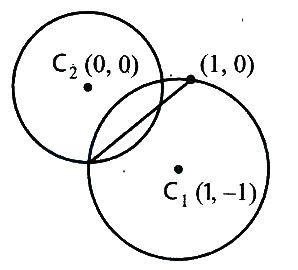
0 likesView Solution
236
MathematicsMediumMCQAP EAMCET · 2024
If the axes are rotated through an angle $45^{\circ}$ about the origin in an anticlockwise direction,then the transformed equation of $y^2=4ax$ is
A
$(x+y)^2=4\sqrt{2}a(x-y)$
B
$(x-y)^2=4\sqrt{2}a(x+y)$
C
$(x-y)^2=\frac{4a}{\sqrt{2}}(x+y)$
D
$(x+y)^2=\frac{4a}{\sqrt{2}}(x-y)$
Solution
(A) Given the rotation angle $\theta = 45^{\circ}$.
Let the new coordinates be $(x', y')$ and the old coordinates be $(x, y)$.
The transformation equations are:
$x = x' \cos 45^{\circ} - y' \sin 45^{\circ} = \frac{x'-y'}{\sqrt{2}}$
$y = x' \sin 45^{\circ} + y' \cos 45^{\circ} = \frac{x'+y'}{\sqrt{2}}$
Substituting these into the equation $y^2 = 4ax$:
$(\frac{x'+y'}{\sqrt{2}})^2 = 4a(\frac{x'-y'}{\sqrt{2}})$
$\frac{(x'+y')^2}{2} = \frac{4a(x'-y')}{\sqrt{2}}$
$(x'+y')^2 = \frac{8a}{\sqrt{2}}(x'-y') = 4\sqrt{2}a(x'-y')$
Replacing $(x', y')$ with $(x, y)$,the transformed equation is $(x+y)^2 = 4\sqrt{2}a(x-y)$.
Let the new coordinates be $(x', y')$ and the old coordinates be $(x, y)$.
The transformation equations are:
$x = x' \cos 45^{\circ} - y' \sin 45^{\circ} = \frac{x'-y'}{\sqrt{2}}$
$y = x' \sin 45^{\circ} + y' \cos 45^{\circ} = \frac{x'+y'}{\sqrt{2}}$
Substituting these into the equation $y^2 = 4ax$:
$(\frac{x'+y'}{\sqrt{2}})^2 = 4a(\frac{x'-y'}{\sqrt{2}})$
$\frac{(x'+y')^2}{2} = \frac{4a(x'-y')}{\sqrt{2}}$
$(x'+y')^2 = \frac{8a}{\sqrt{2}}(x'-y') = 4\sqrt{2}a(x'-y')$
Replacing $(x', y')$ with $(x, y)$,the transformed equation is $(x+y)^2 = 4\sqrt{2}a(x-y)$.
0 likesView Solution
237
MathematicsEasyMCQAP EAMCET · 2024
The line $x-2y-3=0$ cuts the parabola $y^2=4ax$ at the points $P$ and $Q$. If the focus of this parabola is $(\frac{1}{4}, k)$,then $PQ=$
A
$16a\sqrt{5}$
B
$8a\sqrt{5}$
C
$4a\sqrt{5}$
D
$2a\sqrt{5}$
Solution
(A) The standard form of the parabola is $y^2=4ax$. The focus is given as $(a, 0) = (\frac{1}{4}, k)$.
Comparing these,we get $a = \frac{1}{4}$ and $k = 0$.
So,the parabola is $y^2 = 4(\frac{1}{4})x$,which simplifies to $y^2 = x$.
The line is $x - 2y - 3 = 0$,so $x = 2y + 3$.
Substituting $x$ in the parabola equation: $y^2 = 2y + 3 \Rightarrow y^2 - 2y - 3 = 0$.
Factoring the quadratic: $(y-3)(y+1) = 0$,so $y = 3$ or $y = -1$.
If $y = 3$,$x = 2(3) + 3 = 9$. So $Q = (9, 3)$.
If $y = -1$,$x = 2(-1) + 3 = 1$. So $P = (1, -1)$.
The distance $PQ = \sqrt{(9-1)^2 + (3-(-1))^2} = \sqrt{8^2 + 4^2} = \sqrt{64 + 16} = \sqrt{80} = 4\sqrt{5}$.
Since $a = \frac{1}{4}$,we have $16a = 16(\frac{1}{4}) = 4$.
Therefore,$PQ = 16a\sqrt{5}$.
Comparing these,we get $a = \frac{1}{4}$ and $k = 0$.
So,the parabola is $y^2 = 4(\frac{1}{4})x$,which simplifies to $y^2 = x$.
The line is $x - 2y - 3 = 0$,so $x = 2y + 3$.
Substituting $x$ in the parabola equation: $y^2 = 2y + 3 \Rightarrow y^2 - 2y - 3 = 0$.
Factoring the quadratic: $(y-3)(y+1) = 0$,so $y = 3$ or $y = -1$.
If $y = 3$,$x = 2(3) + 3 = 9$. So $Q = (9, 3)$.
If $y = -1$,$x = 2(-1) + 3 = 1$. So $P = (1, -1)$.
The distance $PQ = \sqrt{(9-1)^2 + (3-(-1))^2} = \sqrt{8^2 + 4^2} = \sqrt{64 + 16} = \sqrt{80} = 4\sqrt{5}$.
Since $a = \frac{1}{4}$,we have $16a = 16(\frac{1}{4}) = 4$.
Therefore,$PQ = 16a\sqrt{5}$.
0 likesView Solution
238
MathematicsEasyMCQAP EAMCET · 2024
The equation of a tangent line to the parabola $y^2 = 8x$,which passes through the point $(1, 3)$,is:
A
$y = 2x + 1$
B
$2y = x + 5$
C
$y = -2x + 5$
D
$2y = 3x + 3$
Solution
(A) The equation of a tangent to the parabola $y^2 = 4ax$ with slope $m$ is $y = mx + \frac{a}{m}$.
Here,$4a = 8$,so $a = 2$.
The equation of the tangent is $y = mx + \frac{2}{m}$.
Since it passes through the point $(1, 3)$,we substitute $x = 1$ and $y = 3$:
$3 = m(1) + \frac{2}{m}$
$3 = m + \frac{2}{m}$
$m^2 - 3m + 2 = 0$
$(m - 1)(m - 2) = 0$
Thus,$m = 1$ or $m = 2$.
For $m = 1$,the tangent is $y = 1x + \frac{2}{1} \Rightarrow y = x + 2$.
For $m = 2$,the tangent is $y = 2x + \frac{2}{2} \Rightarrow y = 2x + 1$.
Comparing with the given options,$y = 2x + 1$ is present.
Here,$4a = 8$,so $a = 2$.
The equation of the tangent is $y = mx + \frac{2}{m}$.
Since it passes through the point $(1, 3)$,we substitute $x = 1$ and $y = 3$:
$3 = m(1) + \frac{2}{m}$
$3 = m + \frac{2}{m}$
$m^2 - 3m + 2 = 0$
$(m - 1)(m - 2) = 0$
Thus,$m = 1$ or $m = 2$.
For $m = 1$,the tangent is $y = 1x + \frac{2}{1} \Rightarrow y = x + 2$.
For $m = 2$,the tangent is $y = 2x + \frac{2}{2} \Rightarrow y = 2x + 1$.
Comparing with the given options,$y = 2x + 1$ is present.
0 likesView Solution
239
MathematicsMediumMCQAP EAMCET · 2024
$A$ common tangent to the circle $x^2+y^2=9$ and parabola $y^2=8x$ is
A
$3x-\sqrt{3}y+2=0$
B
$x-\sqrt{3}y+6=0$
C
$2x-\sqrt{3}y+3=0$
D
$x-3y+6=0$
Solution
(B) Let $y=mx+c$ be the equation of a common tangent to the parabola $y^2=8x$ and the circle $x^2+y^2=9$.
Condition for $y=mx+c$ to be a tangent to the parabola $y^2=4ax$ is $c=\frac{a}{m}$. Here $4a=8$,so $a=2$. Thus,$c=\frac{2}{m}$ $(i)$.
The line $y=mx+c$ is also tangent to the circle $x^2+y^2=9$,so the perpendicular distance from the center $(0,0)$ to the line $mx-y+c=0$ must equal the radius $r=3$.
$\frac{|c|}{\sqrt{m^2+1}}=3 \Rightarrow c^2=9(m^2+1)$.
Substituting $c=\frac{2}{m}$ into the equation: $\frac{4}{m^2}=9(m^2+1)$ $\Rightarrow 4=9m^2(m^2+1)$ $\Rightarrow 9m^4+9m^2-4=0$.
Let $m^2=t$,then $9t^2+9t-4=0 \Rightarrow (3t-1)(3t+4)=0$.
Since $m^2=t > 0$,we have $t=\frac{1}{3}$,so $m^2=\frac{1}{3}$ and $m=\pm\frac{1}{\sqrt{3}}$.
For $m=\frac{1}{\sqrt{3}}$,$c=\frac{2}{1/\sqrt{3}}=2\sqrt{3}$.
The equation is $y=\frac{1}{\sqrt{3}}x+2\sqrt{3}$ $\Rightarrow \sqrt{3}y=x+6$ $\Rightarrow x-\sqrt{3}y+6=0$.
Condition for $y=mx+c$ to be a tangent to the parabola $y^2=4ax$ is $c=\frac{a}{m}$. Here $4a=8$,so $a=2$. Thus,$c=\frac{2}{m}$ $(i)$.
The line $y=mx+c$ is also tangent to the circle $x^2+y^2=9$,so the perpendicular distance from the center $(0,0)$ to the line $mx-y+c=0$ must equal the radius $r=3$.
$\frac{|c|}{\sqrt{m^2+1}}=3 \Rightarrow c^2=9(m^2+1)$.
Substituting $c=\frac{2}{m}$ into the equation: $\frac{4}{m^2}=9(m^2+1)$ $\Rightarrow 4=9m^2(m^2+1)$ $\Rightarrow 9m^4+9m^2-4=0$.
Let $m^2=t$,then $9t^2+9t-4=0 \Rightarrow (3t-1)(3t+4)=0$.
Since $m^2=t > 0$,we have $t=\frac{1}{3}$,so $m^2=\frac{1}{3}$ and $m=\pm\frac{1}{\sqrt{3}}$.
For $m=\frac{1}{\sqrt{3}}$,$c=\frac{2}{1/\sqrt{3}}=2\sqrt{3}$.
The equation is $y=\frac{1}{\sqrt{3}}x+2\sqrt{3}$ $\Rightarrow \sqrt{3}y=x+6$ $\Rightarrow x-\sqrt{3}y+6=0$.
0 likesView Solution
240
MathematicsEasyMCQAP EAMCET · 2024
The equation of the line touching both parabolas $y^2=4x$ and $x^2=-32y$ is
A
$x+2y+4=0$
B
$2x+y-4=0$
C
$x-2y-4=0$
D
$x-2y+4=0$
Solution
(D) Let the equation of the tangent to the parabola $y^2=4x$ be $y=mx+\frac{1}{m}$.
For the parabola $x^2=-32y$,the equation of the tangent with slope $m$ is $y=mx-a m^2$,where $x^2=4ay$ gives $a=-8$.
Thus,the tangent is $y=mx-(-8)m^2$,which simplifies to $y=mx+8m^2$.
Comparing the two tangent equations,we have $\frac{1}{m}=8m^2$.
This implies $m^3=\frac{1}{8}$,so $m=\frac{1}{2}$.
Substituting $m=\frac{1}{2}$ into the first tangent equation: $y=\frac{1}{2}x+\frac{1}{1/2} = \frac{1}{2}x+2$.
Multiplying by $2$,we get $2y=x+4$,or $x-2y+4=0$.
For the parabola $x^2=-32y$,the equation of the tangent with slope $m$ is $y=mx-a m^2$,where $x^2=4ay$ gives $a=-8$.
Thus,the tangent is $y=mx-(-8)m^2$,which simplifies to $y=mx+8m^2$.
Comparing the two tangent equations,we have $\frac{1}{m}=8m^2$.
This implies $m^3=\frac{1}{8}$,so $m=\frac{1}{2}$.
Substituting $m=\frac{1}{2}$ into the first tangent equation: $y=\frac{1}{2}x+\frac{1}{1/2} = \frac{1}{2}x+2$.
Multiplying by $2$,we get $2y=x+4$,or $x-2y+4=0$.
0 likesView Solution
241
MathematicsMediumMCQAP EAMCET · 2024
The normal drawn at a point $(2, -4)$ on the parabola $y^2 = 8x$ cuts the same parabola again at $(\alpha, \beta)$. Then $\alpha + \beta =$
A
$8$
B
$16$
C
$24$
D
$30$
Solution
(D) Given the parabola $y^2 = 8x$,we have $4a = 8$,so $a = 2$.
For a point $(at^2, 2at)$ on the parabola,we have $(2, -4) = (2t^2, 4t)$,which gives $t = -1$.
The normal at parameter $t$ meets the parabola again at parameter $t_2 = -t - \frac{2}{t}$.
Substituting $t = -1$,we get $t_2 = -(-1) - \frac{2}{-1} = 1 + 2 = 3$.
The coordinates of the point $(\alpha, \beta)$ are $(at_2^2, 2at_2) = (2(3)^2, 2(2)(3)) = (18, 12)$.
Thus,$\alpha + \beta = 18 + 12 = 30$.
For a point $(at^2, 2at)$ on the parabola,we have $(2, -4) = (2t^2, 4t)$,which gives $t = -1$.
The normal at parameter $t$ meets the parabola again at parameter $t_2 = -t - \frac{2}{t}$.
Substituting $t = -1$,we get $t_2 = -(-1) - \frac{2}{-1} = 1 + 2 = 3$.
The coordinates of the point $(\alpha, \beta)$ are $(at_2^2, 2at_2) = (2(3)^2, 2(2)(3)) = (18, 12)$.
Thus,$\alpha + \beta = 18 + 12 = 30$.
0 likesView Solution
242
MathematicsEasyMCQAP EAMCET · 2024
The equation of the normal drawn to the parabola $y^2=6x$ at the point $(24,12)$ is
A
$3x-y=60$
B
$4x+y=108$
C
$2x+y=60$
D
$x-2y=0$
Solution
(B) The equation of the parabola is $y^2=6x$. Comparing this with $y^2=4ax$,we get $4a=6$,so $a=1.5$.
The equation of the normal to the parabola $y^2=4ax$ at the point $(x_1, y_1)$ is given by $y-y_1 = -\frac{y_1}{2a}(x-x_1)$.
Substituting the values $x_1=24$,$y_1=12$,and $a=1.5$:
$y-12 = -\frac{12}{2(1.5)}(x-24)$
$y-12 = -\frac{12}{3}(x-24)$
$y-12 = -4(x-24)$
$y-12 = -4x+96$
$4x+y = 108$.
The equation of the normal to the parabola $y^2=4ax$ at the point $(x_1, y_1)$ is given by $y-y_1 = -\frac{y_1}{2a}(x-x_1)$.
Substituting the values $x_1=24$,$y_1=12$,and $a=1.5$:
$y-12 = -\frac{12}{2(1.5)}(x-24)$
$y-12 = -\frac{12}{3}(x-24)$
$y-12 = -4(x-24)$
$y-12 = -4x+96$
$4x+y = 108$.
0 likesView Solution
243
MathematicsEasyMCQAP EAMCET · 2024
If the normal chord drawn at $(2 a, 2 a \sqrt{2})$ on the parabola $y^2=4 a x$ subtends an angle $\theta$ at its vertex,then $\theta=$ (in $^{\circ}$)
A
$45$
B
$90$
C
$135$
D
$60$
Solution
(B) The parabola is $y^2 = 4ax$. The point $P$ is $(2a, 2a\sqrt{2})$.
Comparing $P(2a, 2a\sqrt{2})$ with $(at^2, 2at)$,we get $t = \sqrt{2}$.
The normal at $t$ meets the parabola at $t_1 = -t - \frac{2}{t} = -\sqrt{2} - \frac{2}{\sqrt{2}} = -2\sqrt{2}$.
The coordinates of $Q$ are $(at_1^2, 2at_1) = (a(-2\sqrt{2})^2, 2a(-2\sqrt{2})) = (8a, -4a\sqrt{2})$.
The vertex is $O(0, 0)$.
The slope of $OP$ is $m_1 = \frac{2a\sqrt{2}}{2a} = \sqrt{2}$.
The slope of $OQ$ is $m_2 = \frac{-4a\sqrt{2}}{8a} = -\frac{\sqrt{2}}{2} = -\frac{1}{\sqrt{2}}$.
Since $m_1 \times m_2 = \sqrt{2} \times (-\frac{1}{\sqrt{2}}) = -1$,the lines $OP$ and $OQ$ are perpendicular.
Therefore,$\theta = 90^{\circ}$.
Comparing $P(2a, 2a\sqrt{2})$ with $(at^2, 2at)$,we get $t = \sqrt{2}$.
The normal at $t$ meets the parabola at $t_1 = -t - \frac{2}{t} = -\sqrt{2} - \frac{2}{\sqrt{2}} = -2\sqrt{2}$.
The coordinates of $Q$ are $(at_1^2, 2at_1) = (a(-2\sqrt{2})^2, 2a(-2\sqrt{2})) = (8a, -4a\sqrt{2})$.
The vertex is $O(0, 0)$.
The slope of $OP$ is $m_1 = \frac{2a\sqrt{2}}{2a} = \sqrt{2}$.
The slope of $OQ$ is $m_2 = \frac{-4a\sqrt{2}}{8a} = -\frac{\sqrt{2}}{2} = -\frac{1}{\sqrt{2}}$.
Since $m_1 \times m_2 = \sqrt{2} \times (-\frac{1}{\sqrt{2}}) = -1$,the lines $OP$ and $OQ$ are perpendicular.
Therefore,$\theta = 90^{\circ}$.
0 likesView Solution
244
MathematicsMediumMCQAP EAMCET · 2024
If the ordinates of points $P$ and $Q$ on the parabola $y^2=12x$ are in the ratio $1:2$,then the locus of the point of intersection of the normals to the parabola at $P$ and $Q$ is
A
$y+18\left(\frac{x-6}{21}\right)^{3/2}=0$
B
$y-18\left(\frac{x-6}{12}\right)^{3/2}=0$
C
$y+12\left(\frac{x-6}{14}\right)^{1/2}=0$
D
$y-12\left(\frac{x-6}{18}\right)^{3/2}=0$
Solution
(A) Given the parabola $y^2=12x$,we have $4a=12$,so $a=3$. Let the parameters of points $P$ and $Q$ be $t_1$ and $t_2$ respectively. The ordinates are $y_1=2at_1$ and $y_2=2at_2$. Given $y_1:y_2=1:2$,we have $t_1:t_2=1:2$,so $t_2=2t_1$. Let $t_1=t$,then $t_2=2t$.
The point of intersection $(x, y)$ of the normals at $t_1$ and $t_2$ is given by:
$x = 2a + a(t_1^2 + t_2^2 + t_1t_2) = 2(3) + 3(t^2 + 4t^2 + 2t^2) = 6 + 21t^2$
$y = -at_1t_2(t_1+t_2) = -3(t)(2t)(t+2t) = -6t^2(3t) = -18t^3$
From $x=6+21t^2$,we get $t^2 = \frac{x-6}{21}$,so $t = \pm \left(\frac{x-6}{21}\right)^{1/2}$.
Substituting $t$ into $y=-18t^3$,we get $y = -18 \left(\frac{x-6}{21}\right)^{3/2}$,which simplifies to $y+18\left(\frac{x-6}{21}\right)^{3/2}=0$.
The point of intersection $(x, y)$ of the normals at $t_1$ and $t_2$ is given by:
$x = 2a + a(t_1^2 + t_2^2 + t_1t_2) = 2(3) + 3(t^2 + 4t^2 + 2t^2) = 6 + 21t^2$
$y = -at_1t_2(t_1+t_2) = -3(t)(2t)(t+2t) = -6t^2(3t) = -18t^3$
From $x=6+21t^2$,we get $t^2 = \frac{x-6}{21}$,so $t = \pm \left(\frac{x-6}{21}\right)^{1/2}$.
Substituting $t$ into $y=-18t^3$,we get $y = -18 \left(\frac{x-6}{21}\right)^{3/2}$,which simplifies to $y+18\left(\frac{x-6}{21}\right)^{3/2}=0$.
0 likesView Solution
245
MathematicsEasyMCQAP EAMCET · 2024
If $P$ is a point which divides the line segment joining the focus of the parabola $y^2=12x$ and a point on the parabola in the ratio $1:2$,then the locus of $P$ is:
A
$y^2=2(x-2)$
B
$y^2=4x$
C
$y^2=4(x-2)$
D
$y^2=9(x-3)$
Solution
(C) The given parabola is $y^2=12x$. Comparing with $y^2=4ax$,we get $a=3$. The focus is $(3, 0)$.
Let $Q(3t^2, 6t)$ be a point on the parabola.
Point $P(x, y)$ divides the segment joining $(3, 0)$ and $(3t^2, 6t)$ in the ratio $1:2$.
Using the section formula,$P(x, y) = \left(\frac{1(3t^2) + 2(3)}{1+2}, \frac{1(6t) + 2(0)}{1+2}\right) = \left(\frac{3t^2+6}{3}, \frac{6t}{3}\right) = (t^2+2, 2t)$.
Thus,$x = t^2+2$ and $y = 2t$.
From $y = 2t$,we get $t = \frac{y}{2}$.
Substituting $t$ into the equation for $x$: $x = (\frac{y}{2})^2 + 2 = \frac{y^2}{4} + 2$.
$x - 2 = \frac{y^2}{4} \Rightarrow y^2 = 4(x-2)$.
Let $Q(3t^2, 6t)$ be a point on the parabola.
Point $P(x, y)$ divides the segment joining $(3, 0)$ and $(3t^2, 6t)$ in the ratio $1:2$.
Using the section formula,$P(x, y) = \left(\frac{1(3t^2) + 2(3)}{1+2}, \frac{1(6t) + 2(0)}{1+2}\right) = \left(\frac{3t^2+6}{3}, \frac{6t}{3}\right) = (t^2+2, 2t)$.
Thus,$x = t^2+2$ and $y = 2t$.
From $y = 2t$,we get $t = \frac{y}{2}$.
Substituting $t$ into the equation for $x$: $x = (\frac{y}{2})^2 + 2 = \frac{y^2}{4} + 2$.
$x - 2 = \frac{y^2}{4} \Rightarrow y^2 = 4(x-2)$.
0 likesView Solution
246
MathematicsMediumMCQAP EAMCET · 2024
The square root of the independent term in the expansion of $\left(\frac{2x^2}{5} + \sqrt{\frac{5}{x}}\right)^{10}$ is
A
$15\sqrt{10}$
B
$10\sqrt{15}$
C
$30\sqrt{5}$
D
$20\sqrt{5}$
Solution
(C) The general term $T_{r+1}$ in the expansion of $\left(\frac{2x^2}{5} + \left(\frac{5}{x}\right)^{1/2}\right)^{10}$ is given by:
$T_{r+1} = {}^{10}C_r \left(\frac{2x^2}{5}\right)^{10-r} \left(\frac{5^{1/2}}{x^{1/2}}\right)^r$
$T_{r+1} = {}^{10}C_r \cdot \frac{2^{10-r}}{5^{10-r}} \cdot x^{2(10-r)} \cdot \frac{5^{r/2}}{x^{r/2}}$
$T_{r+1} = {}^{10}C_r \cdot \frac{2^{10-r}}{5^{10-r-r/2}} \cdot x^{20-2r-r/2}$
For the term to be independent of $x$,the exponent of $x$ must be zero:
$20 - 2r - \frac{r}{2} = 0$ $\Rightarrow 20 = \frac{5r}{2}$ $\Rightarrow r = 8$
Substituting $r=8$ into the expression:
$T_9 = {}^{10}C_8 \cdot \frac{2^{10-8}}{5^{10-8-4}} = {}^{10}C_2 \cdot \frac{2^2}{5^{-2}} = 45 \cdot 4 \cdot 25 = 4500$
The square root of the independent term is $\sqrt{4500} = \sqrt{900 \times 5} = 30\sqrt{5}$.
$T_{r+1} = {}^{10}C_r \left(\frac{2x^2}{5}\right)^{10-r} \left(\frac{5^{1/2}}{x^{1/2}}\right)^r$
$T_{r+1} = {}^{10}C_r \cdot \frac{2^{10-r}}{5^{10-r}} \cdot x^{2(10-r)} \cdot \frac{5^{r/2}}{x^{r/2}}$
$T_{r+1} = {}^{10}C_r \cdot \frac{2^{10-r}}{5^{10-r-r/2}} \cdot x^{20-2r-r/2}$
For the term to be independent of $x$,the exponent of $x$ must be zero:
$20 - 2r - \frac{r}{2} = 0$ $\Rightarrow 20 = \frac{5r}{2}$ $\Rightarrow r = 8$
Substituting $r=8$ into the expression:
$T_9 = {}^{10}C_8 \cdot \frac{2^{10-8}}{5^{10-8-4}} = {}^{10}C_2 \cdot \frac{2^2}{5^{-2}} = 45 \cdot 4 \cdot 25 = 4500$
The square root of the independent term is $\sqrt{4500} = \sqrt{900 \times 5} = 30\sqrt{5}$.
0 likesView Solution
247
MathematicsDifficultMCQAP EAMCET · 2024
The numerically greatest term in the expansion of $(5+3x)^6$ when $x=1$ is:
A
$3^5 \times 5^3$
B
$3^3 \times 5^5$
C
$3^2 \times 5^5$
D
$3^4 \times 5^4$
Solution
(B) Let $T_{r+1}$ be the greatest term,so $\frac{T_{r+1}}{T_r} \geq 1$.
For the expansion $(a+b)^n$,the condition is $\frac{T_{r+1}}{T_r} = \frac{n-r+1}{r} \times |\frac{b}{a}| \geq 1$.
Here $n=6$,$a=5$,$b=3x$. At $x=1$,$b=3$.
$\frac{6-r+1}{r} \times \frac{3}{5} \geq 1$
$\Rightarrow \frac{7-r}{r} \times \frac{3}{5} \geq 1$
$\Rightarrow 21 - 3r \geq 5r$
$\Rightarrow 8r \leq 21$
$\Rightarrow r \leq 2.625$.
Since $r$ must be an integer,the greatest term occurs at $r=2$,which is $T_{2+1} = T_3$.
$T_3 = {}^6C_2 \times 5^{6-2} \times (3 \times 1)^2$
$T_3 = 15 \times 5^4 \times 3^2$
$T_3 = (3 \times 5) \times 5^4 \times 3^2 = 3^3 \times 5^5$.
For the expansion $(a+b)^n$,the condition is $\frac{T_{r+1}}{T_r} = \frac{n-r+1}{r} \times |\frac{b}{a}| \geq 1$.
Here $n=6$,$a=5$,$b=3x$. At $x=1$,$b=3$.
$\frac{6-r+1}{r} \times \frac{3}{5} \geq 1$
$\Rightarrow \frac{7-r}{r} \times \frac{3}{5} \geq 1$
$\Rightarrow 21 - 3r \geq 5r$
$\Rightarrow 8r \leq 21$
$\Rightarrow r \leq 2.625$.
Since $r$ must be an integer,the greatest term occurs at $r=2$,which is $T_{2+1} = T_3$.
$T_3 = {}^6C_2 \times 5^{6-2} \times (3 \times 1)^2$
$T_3 = 15 \times 5^4 \times 3^2$
$T_3 = (3 \times 5) \times 5^4 \times 3^2 = 3^3 \times 5^5$.
0 likesView Solution
248
MathematicsMediumMCQAP EAMCET · 2024
If $|x| < \frac{2}{3}$ then the $4^{th}$ term in the expansion of $(3x - 2)^{2/3}$ is
A
$\frac{\sqrt[3]{4}}{6} x^3$
B
$-\frac{\sqrt[3]{4}}{6} x^3$
C
$\frac{\sqrt[3]{4}}{8} x^3$
D
$-\frac{\sqrt[3]{4}}{8} x^3$
Solution
(B) Given the expression $(3x - 2)^{2/3}$. For the binomial expansion,we rewrite it as:
$(3x - 2)^{2/3} = [-2(1 - \frac{3x}{2})]^{2/3} = (-2)^{2/3} (1 - \frac{3x}{2})^{2/3} = \sqrt[3]{4} (1 - \frac{3x}{2})^{2/3}$.
The general term $T_{r+1}$ in the expansion of $(1+y)^n$ is $\binom{n}{r} y^r$.
Here $n = \frac{2}{3}$ and $y = -\frac{3x}{2}$.
The $4^{th}$ term $(T_4)$ corresponds to $r = 3$:
$T_4 = \sqrt[3]{4} \times \frac{\frac{2}{3}(\frac{2}{3}-1)(\frac{2}{3}-2)}{3!} (-\frac{3x}{2})^3$
$T_4 = \sqrt[3]{4} \times \frac{\frac{2}{3} \times (-\frac{1}{3}) \times (-\frac{4}{3})}{6} \times (-\frac{27x^3}{8})$
$T_4 = \sqrt[3]{4} \times \frac{8/27}{6} \times (-\frac{27x^3}{8})$
$T_4 = \sqrt[3]{4} \times \frac{8}{162} \times (-\frac{27x^3}{8}) = -\frac{\sqrt[3]{4}}{6} x^3$.
$(3x - 2)^{2/3} = [-2(1 - \frac{3x}{2})]^{2/3} = (-2)^{2/3} (1 - \frac{3x}{2})^{2/3} = \sqrt[3]{4} (1 - \frac{3x}{2})^{2/3}$.
The general term $T_{r+1}$ in the expansion of $(1+y)^n$ is $\binom{n}{r} y^r$.
Here $n = \frac{2}{3}$ and $y = -\frac{3x}{2}$.
The $4^{th}$ term $(T_4)$ corresponds to $r = 3$:
$T_4 = \sqrt[3]{4} \times \frac{\frac{2}{3}(\frac{2}{3}-1)(\frac{2}{3}-2)}{3!} (-\frac{3x}{2})^3$
$T_4 = \sqrt[3]{4} \times \frac{\frac{2}{3} \times (-\frac{1}{3}) \times (-\frac{4}{3})}{6} \times (-\frac{27x^3}{8})$
$T_4 = \sqrt[3]{4} \times \frac{8/27}{6} \times (-\frac{27x^3}{8})$
$T_4 = \sqrt[3]{4} \times \frac{8}{162} \times (-\frac{27x^3}{8}) = -\frac{\sqrt[3]{4}}{6} x^3$.
0 likesView Solution
249
MathematicsEasyMCQAP EAMCET · 2024
The sum of the rational terms in the binomial expansion of $(\sqrt{2} + 3^{1/5})^{10}$ is
A
$41$
B
$39$
C
$32$
D
$30$
Solution
(A) The general term in the expansion of $(\sqrt{2} + 3^{1/5})^{10}$ is given by $T_{r+1} = {}^{10}C_r (\sqrt{2})^{10-r} (3^{1/5})^r = {}^{10}C_r (2)^{(10-r)/2} (3)^{r/5}$.
For the term to be rational,the exponents of $2$ and $3$ must be integers.
Thus,$(10-r)/2$ must be an integer (which is true for all even $r$) and $r/5$ must be an integer.
For $0 \le r \le 10$,the values of $r$ that satisfy both conditions are $r = 0$ and $r = 10$.
For $r = 0$: $T_1 = {}^{10}C_0 (2)^5 (3)^0 = 1 \times 32 \times 1 = 32$.
For $r = 10$: $T_{11} = {}^{10}C_{10} (2)^0 (3)^2 = 1 \times 1 \times 9 = 9$.
The sum of the rational terms is $32 + 9 = 41$.
For the term to be rational,the exponents of $2$ and $3$ must be integers.
Thus,$(10-r)/2$ must be an integer (which is true for all even $r$) and $r/5$ must be an integer.
For $0 \le r \le 10$,the values of $r$ that satisfy both conditions are $r = 0$ and $r = 10$.
For $r = 0$: $T_1 = {}^{10}C_0 (2)^5 (3)^0 = 1 \times 32 \times 1 = 32$.
For $r = 10$: $T_{11} = {}^{10}C_{10} (2)^0 (3)^2 = 1 \times 1 \times 9 = 9$.
The sum of the rational terms is $32 + 9 = 41$.
0 likesView Solution
250
MathematicsMediumMCQAP EAMCET · 2024
If the ratio of the terms equidistant from the middle term in the expansion of $(1+x)^{12}$ is $\frac{1}{256}$ $(x \in N)$,then the sum of all the terms of the expansion $(1+x)^{12}$ is:
A
$4^{12}$ or $6^{12}$
B
$3^{12}$ or $5^{12}$
C
$6^{12}$ or $7^{12}$
D
$12^{12}$
Solution
(B) The middle term is the $(\frac{12}{2}+1)^{\text{th}}$ term,i.e.,the $7^{\text{th}}$ term.
The terms equidistant from the middle term are $T_{7-k}$ and $T_{7+k}$.
For $k=2$,the ratio is $\frac{T_5}{T_9} = \frac{{}^{12}C_4 x^4}{{}^{12}C_8 x^8} = \frac{1}{256}$.
Since ${}^{12}C_4 = {}^{12}C_8$,we have $\frac{1}{x^4} = \frac{1}{256}$ $\Rightarrow x^4 = 256$ $\Rightarrow x = 4$.
For $k=4$,the ratio is $\frac{T_3}{T_{11}} = \frac{{}^{12}C_2 x^2}{{}^{12}C_{10} x^{10}} = \frac{1}{256}$.
Since ${}^{12}C_2 = {}^{12}C_{10}$,we have $\frac{1}{x^8} = \frac{1}{256}$ $\Rightarrow x^8 = 256$ $\Rightarrow x = \sqrt{2}$.
However,given $x \in N$,we check $k=1$: $\frac{T_6}{T_8} = \frac{{}^{12}C_5 x^5}{{}^{12}C_7 x^7} = \frac{1}{x^2} = \frac{1}{256} \Rightarrow x = 16$.
The sum of all terms in the expansion $(1+x)^{12}$ is $(1+x)^{12}$.
For $x=4$,the sum is $(1+4)^{12} = 5^{12}$.
For $x=2$,the sum is $(1+2)^{12} = 3^{12}$.
The terms equidistant from the middle term are $T_{7-k}$ and $T_{7+k}$.
For $k=2$,the ratio is $\frac{T_5}{T_9} = \frac{{}^{12}C_4 x^4}{{}^{12}C_8 x^8} = \frac{1}{256}$.
Since ${}^{12}C_4 = {}^{12}C_8$,we have $\frac{1}{x^4} = \frac{1}{256}$ $\Rightarrow x^4 = 256$ $\Rightarrow x = 4$.
For $k=4$,the ratio is $\frac{T_3}{T_{11}} = \frac{{}^{12}C_2 x^2}{{}^{12}C_{10} x^{10}} = \frac{1}{256}$.
Since ${}^{12}C_2 = {}^{12}C_{10}$,we have $\frac{1}{x^8} = \frac{1}{256}$ $\Rightarrow x^8 = 256$ $\Rightarrow x = \sqrt{2}$.
However,given $x \in N$,we check $k=1$: $\frac{T_6}{T_8} = \frac{{}^{12}C_5 x^5}{{}^{12}C_7 x^7} = \frac{1}{x^2} = \frac{1}{256} \Rightarrow x = 16$.
The sum of all terms in the expansion $(1+x)^{12}$ is $(1+x)^{12}$.
For $x=4$,the sum is $(1+4)^{12} = 5^{12}$.
For $x=2$,the sum is $(1+2)^{12} = 3^{12}$.
0 likesView Solution
251
MathematicsEasyMCQAP EAMCET · 2024
$\lim _{n \rightarrow \infty} \frac{1^{77}+2^{77}+\ldots+n^{77}}{n^{78}} = $
A
$\frac{1}{77}$
B
$1$
C
$76$
D
$\frac{1}{78}$
Solution
(D) We are given the limit: $\lim _{n \rightarrow \infty} \frac{1^{77}+2^{77}+\ldots+n^{77}}{n^{78}}$
This can be rewritten as: $\lim _{n \rightarrow \infty} \frac{1}{n} \sum_{r=1}^{n} \left(\frac{r}{n}\right)^{77}$
Using the definition of a definite integral as the limit of a Riemann sum,$\lim _{n \rightarrow \infty} \frac{1}{n} \sum_{r=1}^{n} f\left(\frac{r}{n}\right) = \int_{0}^{1} f(x) dx$
Here,$f(x) = x^{77}$.
Therefore,the limit becomes: $\int_{0}^{1} x^{77} dx$
Evaluating the integral: $\left[ \frac{x^{78}}{78} \right]_{0}^{1} = \frac{1^{78}}{78} - \frac{0^{78}}{78} = \frac{1}{78}$
This can be rewritten as: $\lim _{n \rightarrow \infty} \frac{1}{n} \sum_{r=1}^{n} \left(\frac{r}{n}\right)^{77}$
Using the definition of a definite integral as the limit of a Riemann sum,$\lim _{n \rightarrow \infty} \frac{1}{n} \sum_{r=1}^{n} f\left(\frac{r}{n}\right) = \int_{0}^{1} f(x) dx$
Here,$f(x) = x^{77}$.
Therefore,the limit becomes: $\int_{0}^{1} x^{77} dx$
Evaluating the integral: $\left[ \frac{x^{78}}{78} \right]_{0}^{1} = \frac{1^{78}}{78} - \frac{0^{78}}{78} = \frac{1}{78}$
0 likesView Solution
252
MathematicsMediumMCQAP EAMCET · 2024
$\lim _{n \rightarrow \infty}\left(\frac{1}{\sqrt{n^2}}+\frac{1}{\sqrt{n^2-1}}+\ldots+\frac{1}{\sqrt{n^2-(n-1)^2}}\right)=$
A
$2 \sqrt{\pi}$
B
$\frac{2}{\sqrt{\pi}}$
C
$\frac{\pi}{2}$
D
$\frac{3 \pi}{2}$
Solution
(C) The given limit is $L = \lim _{n \rightarrow \infty} \sum_{r=0}^{n-1} \frac{1}{\sqrt{n^2-r^2}}$.
We can rewrite the expression by taking $n$ common from the square root in the denominator:
$L = \lim _{n \rightarrow \infty} \sum_{r=0}^{n-1} \frac{1}{n \sqrt{1-(\frac{r}{n})^2}}$.
This is a Riemann sum of the form $\lim _{n \rightarrow \infty} \frac{1}{n} \sum_{r=0}^{n-1} f(\frac{r}{n})$,which is equivalent to the definite integral $\int_0^1 f(x) dx$.
Here,$f(x) = \frac{1}{\sqrt{1-x^2}}$.
Thus,$L = \int_0^1 \frac{1}{\sqrt{1-x^2}} dx$.
The integral of $\frac{1}{\sqrt{1-x^2}}$ is $\sin^{-1}(x)$.
Evaluating the definite integral from $0$ to $1$:
$L = [\sin^{-1}(x)]_0^1 = \sin^{-1}(1) - \sin^{-1}(0) = \frac{\pi}{2} - 0 = \frac{\pi}{2}$.
We can rewrite the expression by taking $n$ common from the square root in the denominator:
$L = \lim _{n \rightarrow \infty} \sum_{r=0}^{n-1} \frac{1}{n \sqrt{1-(\frac{r}{n})^2}}$.
This is a Riemann sum of the form $\lim _{n \rightarrow \infty} \frac{1}{n} \sum_{r=0}^{n-1} f(\frac{r}{n})$,which is equivalent to the definite integral $\int_0^1 f(x) dx$.
Here,$f(x) = \frac{1}{\sqrt{1-x^2}}$.
Thus,$L = \int_0^1 \frac{1}{\sqrt{1-x^2}} dx$.
The integral of $\frac{1}{\sqrt{1-x^2}}$ is $\sin^{-1}(x)$.
Evaluating the definite integral from $0$ to $1$:
$L = [\sin^{-1}(x)]_0^1 = \sin^{-1}(1) - \sin^{-1}(0) = \frac{\pi}{2} - 0 = \frac{\pi}{2}$.
0 likesView Solution
253
MathematicsDifficultMCQAP EAMCET · 2024
$\lim _{n \rightarrow \infty}\left[\left(1+\frac{1}{n^3}\right)^{\frac{1}{n^3}}\left(1+\frac{8}{n^3}\right)^{\frac{4}{n^3}}\left(1+\frac{27}{n^3}\right)^{\frac{9}{n^3}} \ldots \left(1+\frac{n^3}{n^3}\right)^{\frac{n^2}{n^3}}\right]=$
A
$\log 2-\frac{1}{2}$
B
$e^{\left(\log 2-\frac{1}{2}\right)}$
C
$e^{\left(\frac{2 \log 2-1}{3}\right)}$
D
$\frac{1}{3}(2 \log 2-1)$
Solution
(C) Let $I = \lim _{n \rightarrow \infty} \prod_{r=1}^n \left(1+\frac{r^3}{n^3}\right)^{\frac{r^2}{n^3}}$.
Taking the natural logarithm on both sides:
$\log I = \lim _{n \rightarrow \infty} \sum_{r=1}^n \frac{r^2}{n^3} \log \left(1+\frac{r^3}{n^3}\right)$.
We can rewrite this as:
$\log I = \lim _{n \rightarrow \infty} \frac{1}{n} \sum_{r=1}^n \left(\frac{r}{n}\right)^2 \log \left(1+\left(\frac{r}{n}\right)^3\right)$.
Using the definition of a definite integral as the limit of a sum,$\lim _{n \rightarrow \infty} \frac{1}{n} \sum_{r=1}^n f\left(\frac{r}{n}\right) = \int_0^1 f(x) dx$:
$\log I = \int_0^1 x^2 \log(1+x^3) dx$.
Let $t = 1+x^3$,then $dt = 3x^2 dx$,or $x^2 dx = \frac{1}{3} dt$.
When $x=0, t=1$. When $x=1, t=2$.
$\log I = \frac{1}{3} \int_1^2 \log t dt = \frac{1}{3} [t \log t - t]_1^2$.
$\log I = \frac{1}{3} [(2 \log 2 - 2) - (1 \log 1 - 1)] = \frac{1}{3} [2 \log 2 - 2 + 1] = \frac{2 \log 2 - 1}{3}$.
Therefore,$I = e^{\left(\frac{2 \log 2 - 1}{3}\right)}$.
Taking the natural logarithm on both sides:
$\log I = \lim _{n \rightarrow \infty} \sum_{r=1}^n \frac{r^2}{n^3} \log \left(1+\frac{r^3}{n^3}\right)$.
We can rewrite this as:
$\log I = \lim _{n \rightarrow \infty} \frac{1}{n} \sum_{r=1}^n \left(\frac{r}{n}\right)^2 \log \left(1+\left(\frac{r}{n}\right)^3\right)$.
Using the definition of a definite integral as the limit of a sum,$\lim _{n \rightarrow \infty} \frac{1}{n} \sum_{r=1}^n f\left(\frac{r}{n}\right) = \int_0^1 f(x) dx$:
$\log I = \int_0^1 x^2 \log(1+x^3) dx$.
Let $t = 1+x^3$,then $dt = 3x^2 dx$,or $x^2 dx = \frac{1}{3} dt$.
When $x=0, t=1$. When $x=1, t=2$.
$\log I = \frac{1}{3} \int_1^2 \log t dt = \frac{1}{3} [t \log t - t]_1^2$.
$\log I = \frac{1}{3} [(2 \log 2 - 2) - (1 \log 1 - 1)] = \frac{1}{3} [2 \log 2 - 2 + 1] = \frac{2 \log 2 - 1}{3}$.
Therefore,$I = e^{\left(\frac{2 \log 2 - 1}{3}\right)}$.
0 likesView Solution
254
MathematicsDifficultMCQAP EAMCET · 2024
$\int_1^2 \frac{x^4-1}{x^6-1} d x=$
A
$\frac{1}{\sqrt{3}} \tan ^{-1}\left(\frac{\sqrt{3}}{2}\right)$
B
$\frac{121}{6}$
C
$\sqrt{2}-1$
D
$\frac{1}{\sqrt{2}} \tan ^{-1}\left(\frac{2}{\sqrt{3}}\right)$
Solution
(A) Let $I = \int_1^2 \frac{x^4-1}{x^6-1} d x$.
We simplify the integrand: $\frac{x^4-1}{x^6-1} = \frac{(x^2-1)(x^2+1)}{(x^2-1)(x^4+x^2+1)} = \frac{x^2+1}{x^4+x^2+1}$.
Note that $x^4+x^2+1 = (x^2+x+1)(x^2-x+1)$.
Using partial fractions: $\frac{x^2+1}{(x^2+x+1)(x^2-x+1)} = \frac{1}{2} \left( \frac{1}{x^2+x+1} + \frac{1}{x^2-x+1} \right)$.
Integrating: $I = \frac{1}{2} \int_1^2 \left( \frac{1}{(x+\frac{1}{2})^2 + (\frac{\sqrt{3}}{2})^2} + \frac{1}{(x-\frac{1}{2})^2 + (\frac{\sqrt{3}}{2})^2} \right) d x$.
$I = \frac{1}{2} \cdot \frac{2}{\sqrt{3}} \left[ \tan^{-1}\left(\frac{x+1/2}{\sqrt{3}/2}\right) + \tan^{-1}\left(\frac{x-1/2}{\sqrt{3}/2}\right) \right]_1^2$.
$I = \frac{1}{\sqrt{3}} \left[ \tan^{-1}\left(\frac{2x+1}{\sqrt{3}}\right) + \tan^{-1}\left(\frac{2x-1}{\sqrt{3}}\right) \right]_1^2$.
Evaluating at limits: $I = \frac{1}{\sqrt{3}} \left[ (\tan^{-1}(\frac{5}{\sqrt{3}}) + \tan^{-1}(\sqrt{3})) - (\tan^{-1}(\sqrt{3}) + \tan^{-1}(\frac{1}{\sqrt{3}})) \right]$.
$I = \frac{1}{\sqrt{3}} \left[ \tan^{-1}(\frac{5}{\sqrt{3}}) - \tan^{-1}(\frac{1}{\sqrt{3}}) \right]$.
Using $\tan^{-1} A - \tan^{-1} B = \tan^{-1}(\frac{A-B}{1+AB})$: $I = \frac{1}{\sqrt{3}} \tan^{-1} \left( \frac{5/\sqrt{3} - 1/\sqrt{3}}{1 + 5/3} \right) = \frac{1}{\sqrt{3}} \tan^{-1} \left( \frac{4/\sqrt{3}}{8/3} \right) = \frac{1}{\sqrt{3}} \tan^{-1} \left( \frac{\sqrt{3}}{2} \right)$.
We simplify the integrand: $\frac{x^4-1}{x^6-1} = \frac{(x^2-1)(x^2+1)}{(x^2-1)(x^4+x^2+1)} = \frac{x^2+1}{x^4+x^2+1}$.
Note that $x^4+x^2+1 = (x^2+x+1)(x^2-x+1)$.
Using partial fractions: $\frac{x^2+1}{(x^2+x+1)(x^2-x+1)} = \frac{1}{2} \left( \frac{1}{x^2+x+1} + \frac{1}{x^2-x+1} \right)$.
Integrating: $I = \frac{1}{2} \int_1^2 \left( \frac{1}{(x+\frac{1}{2})^2 + (\frac{\sqrt{3}}{2})^2} + \frac{1}{(x-\frac{1}{2})^2 + (\frac{\sqrt{3}}{2})^2} \right) d x$.
$I = \frac{1}{2} \cdot \frac{2}{\sqrt{3}} \left[ \tan^{-1}\left(\frac{x+1/2}{\sqrt{3}/2}\right) + \tan^{-1}\left(\frac{x-1/2}{\sqrt{3}/2}\right) \right]_1^2$.
$I = \frac{1}{\sqrt{3}} \left[ \tan^{-1}\left(\frac{2x+1}{\sqrt{3}}\right) + \tan^{-1}\left(\frac{2x-1}{\sqrt{3}}\right) \right]_1^2$.
Evaluating at limits: $I = \frac{1}{\sqrt{3}} \left[ (\tan^{-1}(\frac{5}{\sqrt{3}}) + \tan^{-1}(\sqrt{3})) - (\tan^{-1}(\sqrt{3}) + \tan^{-1}(\frac{1}{\sqrt{3}})) \right]$.
$I = \frac{1}{\sqrt{3}} \left[ \tan^{-1}(\frac{5}{\sqrt{3}}) - \tan^{-1}(\frac{1}{\sqrt{3}}) \right]$.
Using $\tan^{-1} A - \tan^{-1} B = \tan^{-1}(\frac{A-B}{1+AB})$: $I = \frac{1}{\sqrt{3}} \tan^{-1} \left( \frac{5/\sqrt{3} - 1/\sqrt{3}}{1 + 5/3} \right) = \frac{1}{\sqrt{3}} \tan^{-1} \left( \frac{4/\sqrt{3}}{8/3} \right) = \frac{1}{\sqrt{3}} \tan^{-1} \left( \frac{\sqrt{3}}{2} \right)$.
0 likesView Solution
255
MathematicsDifficultMCQAP EAMCET · 2024
$\int_{-1/24}^{1/24} \sec x \log \left(\frac{1-x}{1+x}\right) dx =$
A
$\frac{\pi}{2}$
B
$\pi$
C
$1$
D
$0$
Solution
(D) Let $I = \int_{-1/24}^{1/24} \sec x \log \left(\frac{1-x}{1+x}\right) dx$.
Define $f(x) = \sec x \log \left(\frac{1-x}{1+x}\right)$.
We check if the function is odd or even by evaluating $f(-x)$:
$f(-x) = \sec(-x) \log \left(\frac{1-(-x)}{1+(-x)}\right) = \sec x \log \left(\frac{1+x}{1-x}\right)$.
Using the property $\log(a^{-1}) = -\log a$,we have:
$f(-x) = \sec x \log \left(\frac{1-x}{1+x}\right)^{-1} = -\sec x \log \left(\frac{1-x}{1+x}\right) = -f(x)$.
Since $f(-x) = -f(x)$,the function $f(x)$ is an odd function.
For an odd function,the integral over a symmetric interval $[-a, a]$ is always $0$.
Therefore,$\int_{-1/24}^{1/24} f(x) dx = 0$.
Define $f(x) = \sec x \log \left(\frac{1-x}{1+x}\right)$.
We check if the function is odd or even by evaluating $f(-x)$:
$f(-x) = \sec(-x) \log \left(\frac{1-(-x)}{1+(-x)}\right) = \sec x \log \left(\frac{1+x}{1-x}\right)$.
Using the property $\log(a^{-1}) = -\log a$,we have:
$f(-x) = \sec x \log \left(\frac{1-x}{1+x}\right)^{-1} = -\sec x \log \left(\frac{1-x}{1+x}\right) = -f(x)$.
Since $f(-x) = -f(x)$,the function $f(x)$ is an odd function.
For an odd function,the integral over a symmetric interval $[-a, a]$ is always $0$.
Therefore,$\int_{-1/24}^{1/24} f(x) dx = 0$.
0 likesView Solution
256
MathematicsDifficultMCQAP EAMCET · 2024
$\int_0^{\frac{\pi}{4}} \log (1+\tan x) \, dx =$
A
$\pi \log 2$
B
$\frac{\pi}{2} \log 2$
C
$\frac{\pi}{4} \log 2$
D
$\frac{\pi}{8} \log 2$
Solution
(D) Let $I = \int_0^{\frac{\pi}{4}} \log (1+\tan x) \, dx$.
Using the property $\int_0^a f(x) \, dx = \int_0^a f(a-x) \, dx$,we get:
$I = \int_0^{\frac{\pi}{4}} \log \left(1+\tan \left(\frac{\pi}{4}-x\right)\right) \, dx$.
Since $\tan(\frac{\pi}{4}-x) = \frac{\tan(\frac{\pi}{4})-\tan x}{1+\tan(\frac{\pi}{4})\tan x} = \frac{1-\tan x}{1+\tan x}$,we have:
$I = \int_0^{\frac{\pi}{4}} \log \left(1+\frac{1-\tan x}{1+\tan x}\right) \, dx = \int_0^{\frac{\pi}{4}} \log \left(\frac{1+\tan x+1-\tan x}{1+\tan x}\right) \, dx$.
$I = \int_0^{\frac{\pi}{4}} \log \left(\frac{2}{1+\tan x}\right) \, dx = \int_0^{\frac{\pi}{4}} (\log 2 - \log(1+\tan x)) \, dx$.
$I = \int_0^{\frac{\pi}{4}} \log 2 \, dx - \int_0^{\frac{\pi}{4}} \log(1+\tan x) \, dx$.
$I = [x \log 2]_0^{\frac{\pi}{4}} - I$.
$2I = \frac{\pi}{4} \log 2$.
$I = \frac{\pi}{8} \log 2$.
Using the property $\int_0^a f(x) \, dx = \int_0^a f(a-x) \, dx$,we get:
$I = \int_0^{\frac{\pi}{4}} \log \left(1+\tan \left(\frac{\pi}{4}-x\right)\right) \, dx$.
Since $\tan(\frac{\pi}{4}-x) = \frac{\tan(\frac{\pi}{4})-\tan x}{1+\tan(\frac{\pi}{4})\tan x} = \frac{1-\tan x}{1+\tan x}$,we have:
$I = \int_0^{\frac{\pi}{4}} \log \left(1+\frac{1-\tan x}{1+\tan x}\right) \, dx = \int_0^{\frac{\pi}{4}} \log \left(\frac{1+\tan x+1-\tan x}{1+\tan x}\right) \, dx$.
$I = \int_0^{\frac{\pi}{4}} \log \left(\frac{2}{1+\tan x}\right) \, dx = \int_0^{\frac{\pi}{4}} (\log 2 - \log(1+\tan x)) \, dx$.
$I = \int_0^{\frac{\pi}{4}} \log 2 \, dx - \int_0^{\frac{\pi}{4}} \log(1+\tan x) \, dx$.
$I = [x \log 2]_0^{\frac{\pi}{4}} - I$.
$2I = \frac{\pi}{4} \log 2$.
$I = \frac{\pi}{8} \log 2$.
0 likesView Solution
257
MathematicsEasyMCQAP EAMCET · 2024
The area of the region (in sq. units) enclosed by the curve $y=x^3-19x+30$ and the $x$-axis is
A
$\frac{167}{2}$
B
$\frac{517}{2}$
C
$36$
D
$72$
Solution
(B) The curve is given by $y=x^3-19x+30$. Factoring the polynomial,we get $y=(x+5)(x-2)(x-3)$.
The roots are $x=-5, 2, 3$. The curve is above the $x$-axis on the interval $[-5, 2]$ and below the $x$-axis on the interval $[2, 3]$.
The total area $A$ is given by:
$A = \int_{-5}^{2} (x^3-19x+30) dx + \left| \int_{2}^{3} (x^3-19x+30) dx \right|$
$A = \int_{-5}^{2} (x^3-19x+30) dx - \int_{2}^{3} (x^3-19x+30) dx$
Evaluating the integral $\int (x^3-19x+30) dx = \frac{x^4}{4} - \frac{19x^2}{2} + 30x + C$.
For the first part: $\left[ \frac{x^4}{4} - \frac{19x^2}{2} + 30x \right]_{-5}^{2} = (4 - 38 + 60) - (\frac{625}{4} - \frac{475}{2} - 150) = 26 - (\frac{625-950-600}{4}) = 26 - (-\frac{925}{4}) = 26 + 231.25 = 257.25 = \frac{1029}{4}$.
For the second part: $\left[ \frac{x^4}{4} - \frac{19x^2}{2} + 30x \right]_{2}^{3} = (\frac{81}{4} - \frac{171}{2} + 90) - (4 - 38 + 60) = (\frac{81-342+360}{4}) - 26 = \frac{99}{4} - 26 = \frac{99-104}{4} = -\frac{5}{4}$.
Total Area $A = \frac{1029}{4} - (-\frac{5}{4}) = \frac{1034}{4} = \frac{517}{2} \text{ sq. units}$.
The roots are $x=-5, 2, 3$. The curve is above the $x$-axis on the interval $[-5, 2]$ and below the $x$-axis on the interval $[2, 3]$.
The total area $A$ is given by:
$A = \int_{-5}^{2} (x^3-19x+30) dx + \left| \int_{2}^{3} (x^3-19x+30) dx \right|$
$A = \int_{-5}^{2} (x^3-19x+30) dx - \int_{2}^{3} (x^3-19x+30) dx$
Evaluating the integral $\int (x^3-19x+30) dx = \frac{x^4}{4} - \frac{19x^2}{2} + 30x + C$.
For the first part: $\left[ \frac{x^4}{4} - \frac{19x^2}{2} + 30x \right]_{-5}^{2} = (4 - 38 + 60) - (\frac{625}{4} - \frac{475}{2} - 150) = 26 - (\frac{625-950-600}{4}) = 26 - (-\frac{925}{4}) = 26 + 231.25 = 257.25 = \frac{1029}{4}$.
For the second part: $\left[ \frac{x^4}{4} - \frac{19x^2}{2} + 30x \right]_{2}^{3} = (\frac{81}{4} - \frac{171}{2} + 90) - (4 - 38 + 60) = (\frac{81-342+360}{4}) - 26 = \frac{99}{4} - 26 = \frac{99-104}{4} = -\frac{5}{4}$.
Total Area $A = \frac{1029}{4} - (-\frac{5}{4}) = \frac{1034}{4} = \frac{517}{2} \text{ sq. units}$.
0 likesView Solution
258
MathematicsEasyMCQAP EAMCET · 2024
The area (in sq. units) bounded by the curves $x=y^2$ and $x=3-2y^2$ is
A
$8$
B
$\frac{8}{3}$
C
$4$
D
$6$
Solution
(A) The given curves are $x=y^2$ and $x=3-2y^2$.
To find the points of intersection, set $y^2 = 3-2y^2$, which gives $3y^2 = 3$, so $y^2 = 1$, implying $y = \pm 1$.
The area is symmetric about the $x$-axis.
$\text{Required Area} = 2 \int_{-1}^{1} (x_{\text{right}} - x_{\text{left}}) dy = 2 \int_{-1}^{1} ((3-2y^2) - y^2) dy$
$= 2 \int_{-1}^{1} (3-3y^2) dy = 6 \int_{-1}^{1} (1-y^2) dy$
$= 6 \left[ y - \frac{y^3}{3} \right]_{-1}^{1} = 6 \left( (1 - \frac{1}{3}) - (-1 + \frac{1}{3}) \right)$
$= 6 \left( \frac{2}{3} - (-\frac{2}{3}) \right) = 6 \left( \frac{4}{3} \right) = 8 \text{ sq. units.}$
To find the points of intersection, set $y^2 = 3-2y^2$, which gives $3y^2 = 3$, so $y^2 = 1$, implying $y = \pm 1$.
The area is symmetric about the $x$-axis.
$\text{Required Area} = 2 \int_{-1}^{1} (x_{\text{right}} - x_{\text{left}}) dy = 2 \int_{-1}^{1} ((3-2y^2) - y^2) dy$
$= 2 \int_{-1}^{1} (3-3y^2) dy = 6 \int_{-1}^{1} (1-y^2) dy$
$= 6 \left[ y - \frac{y^3}{3} \right]_{-1}^{1} = 6 \left( (1 - \frac{1}{3}) - (-1 + \frac{1}{3}) \right)$
$= 6 \left( \frac{2}{3} - (-\frac{2}{3}) \right) = 6 \left( \frac{4}{3} \right) = 8 \text{ sq. units.}$
0 likesView Solution
259
MathematicsMediumMCQAP EAMCET · 2024
The area (in sq. units) of the smaller region lying above the $X$-axis and bounded between the circle $x^2+y^2=2ax$ and the parabola $y^2=ax$ is
A
$2a^2\left(\frac{\pi}{4}-\frac{2}{3}\right)$
B
$a^2\left(\frac{\pi}{4}-\frac{2}{3}\right)$
C
$a^2\left(\frac{\pi}{4}+\frac{2}{3}\right)$
D
$a^2\left(\frac{\pi^2}{4}-\frac{1}{3}\right)$
Solution
(B) Given the curves are $x^2+y^2=2ax$ (which is $(x-a)^2+y^2=a^2$) and $y^2=ax$.
To find the intersection points,substitute $y^2=ax$ into the circle equation: $x^2+ax=2ax \Rightarrow x^2-ax=0 \Rightarrow x(x-a)=0$. Thus,$x=0$ or $x=a$.
For $x=a$,$y^2=a^2 \Rightarrow y=a$ (since we consider the region above the $X$-axis).
The area of the shaded region is the area under the circle minus the area under the parabola from $x=0$ to $x=a$.
Area $= \int_0^a (y_{circle} - y_{parabola}) dx = \int_0^a (\sqrt{a^2-(x-a)^2} - \sqrt{ax}) dx$.
Area $= \int_0^a \sqrt{a^2-(x-a)^2} dx - \int_0^a \sqrt{ax} dx$.
The first integral represents the area of a quarter circle of radius $a$,which is $\frac{\pi a^2}{4}$.
The second integral is $\sqrt{a} \int_0^a x^{1/2} dx = \sqrt{a} \left[ \frac{x^{3/2}}{3/2} \right]_0^a = \sqrt{a} \cdot \frac{2}{3} a^{3/2} = \frac{2a^2}{3}$.
Therefore,the required area is $\frac{\pi a^2}{4} - \frac{2a^2}{3} = a^2\left(\frac{\pi}{4}-\frac{2}{3}\right)$ sq. units.
To find the intersection points,substitute $y^2=ax$ into the circle equation: $x^2+ax=2ax \Rightarrow x^2-ax=0 \Rightarrow x(x-a)=0$. Thus,$x=0$ or $x=a$.
For $x=a$,$y^2=a^2 \Rightarrow y=a$ (since we consider the region above the $X$-axis).
The area of the shaded region is the area under the circle minus the area under the parabola from $x=0$ to $x=a$.
Area $= \int_0^a (y_{circle} - y_{parabola}) dx = \int_0^a (\sqrt{a^2-(x-a)^2} - \sqrt{ax}) dx$.
Area $= \int_0^a \sqrt{a^2-(x-a)^2} dx - \int_0^a \sqrt{ax} dx$.
The first integral represents the area of a quarter circle of radius $a$,which is $\frac{\pi a^2}{4}$.
The second integral is $\sqrt{a} \int_0^a x^{1/2} dx = \sqrt{a} \left[ \frac{x^{3/2}}{3/2} \right]_0^a = \sqrt{a} \cdot \frac{2}{3} a^{3/2} = \frac{2a^2}{3}$.
Therefore,the required area is $\frac{\pi a^2}{4} - \frac{2a^2}{3} = a^2\left(\frac{\pi}{4}-\frac{2}{3}\right)$ sq. units.
0 likesView Solution
260
MathematicsDifficultMCQAP EAMCET · 2024
Area of the region (in square units) enclosed by the curves $y^2=8(x+2)$,$y^2=4(1-x)$ and the $Y$-axis is
A
$\frac{8}{3}(5-3 \sqrt{2})$
B
$\frac{8}{3}(\sqrt{2}-1)$
C
$\frac{8}{3}(3-\sqrt{2})$
D
$\frac{4}{3}(\sqrt{2}+1)$
Solution
(C) The given curves are $y^2=8(x+2)$ and $y^2=4(1-x)$.
First,find the intersection point of the two parabolas:
$8(x+2) = 4(1-x)$
$2(x+2) = 1-x$
$2x+4 = 1-x$
$3x = -3 \implies x = -1$.
At $x=-1$,$y^2 = 8(-1+2) = 8$,so $y = \pm 2\sqrt{2}$.
The region is bounded by the two parabolas and the $Y$-axis $(x=0)$.
The area $A$ is given by $2 \int_{-2}^{0} |y| dx$. Specifically,from $x=-2$ to $x=-1$,the boundary is $y^2=8(x+2)$,and from $x=-1$ to $x=0$,the boundary is $y^2=4(1-x)$.
$A = 2 \left[ \int_{-2}^{-1} \sqrt{8(x+2)} dx + \int_{-1}^{0} \sqrt{4(1-x)} dx \right]$
$A = 2 \left[ 2\sqrt{2} \int_{-2}^{-1} (x+2)^{1/2} dx + 2 \int_{-1}^{0} (1-x)^{1/2} dx \right]$
$A = 2 \left[ 2\sqrt{2} \left[ \frac{2}{3}(x+2)^{3/2} \right]_{-2}^{-1} + 2 \left[ -\frac{2}{3}(1-x)^{3/2} \right]_{-1}^{0} \right]$
$A = 2 \left[ 2\sqrt{2} \cdot \frac{2}{3}(1)^{3/2} - \frac{4}{3} \left( (1-0)^{3/2} - (1-(-1))^{3/2} \right) \right]$
$A = 2 \left[ \frac{4\sqrt{2}}{3} - \frac{4}{3} (1 - 2\sqrt{2}) \right]$
$A = 2 \left[ \frac{4\sqrt{2}}{3} - \frac{4}{3} + \frac{8\sqrt{2}}{3} \right] = 2 \left[ \frac{12\sqrt{2}-4}{3} \right] = \frac{8}{3}(3\sqrt{2}-1)$.
First,find the intersection point of the two parabolas:
$8(x+2) = 4(1-x)$
$2(x+2) = 1-x$
$2x+4 = 1-x$
$3x = -3 \implies x = -1$.
At $x=-1$,$y^2 = 8(-1+2) = 8$,so $y = \pm 2\sqrt{2}$.
The region is bounded by the two parabolas and the $Y$-axis $(x=0)$.
The area $A$ is given by $2 \int_{-2}^{0} |y| dx$. Specifically,from $x=-2$ to $x=-1$,the boundary is $y^2=8(x+2)$,and from $x=-1$ to $x=0$,the boundary is $y^2=4(1-x)$.
$A = 2 \left[ \int_{-2}^{-1} \sqrt{8(x+2)} dx + \int_{-1}^{0} \sqrt{4(1-x)} dx \right]$
$A = 2 \left[ 2\sqrt{2} \int_{-2}^{-1} (x+2)^{1/2} dx + 2 \int_{-1}^{0} (1-x)^{1/2} dx \right]$
$A = 2 \left[ 2\sqrt{2} \left[ \frac{2}{3}(x+2)^{3/2} \right]_{-2}^{-1} + 2 \left[ -\frac{2}{3}(1-x)^{3/2} \right]_{-1}^{0} \right]$
$A = 2 \left[ 2\sqrt{2} \cdot \frac{2}{3}(1)^{3/2} - \frac{4}{3} \left( (1-0)^{3/2} - (1-(-1))^{3/2} \right) \right]$
$A = 2 \left[ \frac{4\sqrt{2}}{3} - \frac{4}{3} (1 - 2\sqrt{2}) \right]$
$A = 2 \left[ \frac{4\sqrt{2}}{3} - \frac{4}{3} + \frac{8\sqrt{2}}{3} \right] = 2 \left[ \frac{12\sqrt{2}-4}{3} \right] = \frac{8}{3}(3\sqrt{2}-1)$.
0 likesView Solution
261
MathematicsEasyMCQAP EAMCET · 2024
The area of the region under the curve $y=|\sin x-\cos x|$,$0 \leq x \leq \frac{\pi}{2}$ and above the $x$-axis,is (in square units)
A
$2 \sqrt{2}$
B
$2 \sqrt{2}-1$
C
$2(\sqrt{2}-1)$
D
$2(\sqrt{2}+1)$
Solution
(C) The area is given by the integral $A = \int_0^{\frac{\pi}{2}} |\sin x - \cos x| \, dx$.
Since $\cos x \geq \sin x$ for $0 \leq x \leq \frac{\pi}{4}$ and $\sin x \geq \cos x$ for $\frac{\pi}{4} \leq x \leq \frac{\pi}{2}$,we split the integral:
$A = \int_0^{\frac{\pi}{4}} (\cos x - \sin x) \, dx + \int_{\frac{\pi}{4}}^{\frac{\pi}{2}} (\sin x - \cos x) \, dx$.
Evaluating the first part: $[\sin x + \cos x]_0^{\frac{\pi}{4}} = (\frac{1}{\sqrt{2}} + \frac{1}{\sqrt{2}}) - (0 + 1) = \sqrt{2} - 1$.
Evaluating the second part: $[-\cos x - \sin x]_{\frac{\pi}{4}}^{\frac{\pi}{2}} = (-0 - 1) - (-\frac{1}{\sqrt{2}} - \frac{1}{\sqrt{2}}) = -1 + \sqrt{2} = \sqrt{2} - 1$.
Adding both parts: $A = (\sqrt{2} - 1) + (\sqrt{2} - 1) = 2(\sqrt{2} - 1)$ square units.
Since $\cos x \geq \sin x$ for $0 \leq x \leq \frac{\pi}{4}$ and $\sin x \geq \cos x$ for $\frac{\pi}{4} \leq x \leq \frac{\pi}{2}$,we split the integral:
$A = \int_0^{\frac{\pi}{4}} (\cos x - \sin x) \, dx + \int_{\frac{\pi}{4}}^{\frac{\pi}{2}} (\sin x - \cos x) \, dx$.
Evaluating the first part: $[\sin x + \cos x]_0^{\frac{\pi}{4}} = (\frac{1}{\sqrt{2}} + \frac{1}{\sqrt{2}}) - (0 + 1) = \sqrt{2} - 1$.
Evaluating the second part: $[-\cos x - \sin x]_{\frac{\pi}{4}}^{\frac{\pi}{2}} = (-0 - 1) - (-\frac{1}{\sqrt{2}} - \frac{1}{\sqrt{2}}) = -1 + \sqrt{2} = \sqrt{2} - 1$.
Adding both parts: $A = (\sqrt{2} - 1) + (\sqrt{2} - 1) = 2(\sqrt{2} - 1)$ square units.
0 likesView Solution
262
MathematicsMediumMCQAP EAMCET · 2024
If $(\alpha, \beta)$ is the stationary point of the curve $y=2x-x^2$,then the area bounded by the curves $y=2^x, y=2x-x^2, x=0$ and $x=\alpha$ is
A
$\frac{3 \log 2+4}{2}$
B
$\frac{3+\log 4}{6}$
C
$\frac{3-\log 4}{3 \log 2}$
D
$\frac{1}{\log 2}+\frac{3}{4}$
Solution
(C) Given the curve $y=2x-x^2$.
For the stationary point,we set $\frac{dy}{dx}=0$.
$\frac{dy}{dx} = 2-2x = 0 \Rightarrow x=1$.
Thus,$\alpha = 1$.
The area is bounded by $y=2^x, y=2x-x^2, x=0$ and $x=1$.
Required Area $= \int_0^1 (2^x - (2x-x^2)) dx$.
$= \int_0^1 2^x dx - \int_0^1 (2x-x^2) dx$.
$= \left[ \frac{2^x}{\log 2} \right]_0^1 - \left[ x^2 - \frac{x^3}{3} \right]_0^1$.
$= \left( \frac{2^1}{\log 2} - \frac{2^0}{\log 2} \right) - \left( (1^2 - \frac{1^3}{3}) - (0) \right)$.
$= \frac{2-1}{\log 2} - (1 - \frac{1}{3}) = \frac{1}{\log 2} - \frac{2}{3}$.
$= \frac{3 - 2 \log 2}{3 \log 2} = \frac{3 - \log 4}{3 \log 2}$.
For the stationary point,we set $\frac{dy}{dx}=0$.
$\frac{dy}{dx} = 2-2x = 0 \Rightarrow x=1$.
Thus,$\alpha = 1$.
The area is bounded by $y=2^x, y=2x-x^2, x=0$ and $x=1$.
Required Area $= \int_0^1 (2^x - (2x-x^2)) dx$.
$= \int_0^1 2^x dx - \int_0^1 (2x-x^2) dx$.
$= \left[ \frac{2^x}{\log 2} \right]_0^1 - \left[ x^2 - \frac{x^3}{3} \right]_0^1$.
$= \left( \frac{2^1}{\log 2} - \frac{2^0}{\log 2} \right) - \left( (1^2 - \frac{1^3}{3}) - (0) \right)$.
$= \frac{2-1}{\log 2} - (1 - \frac{1}{3}) = \frac{1}{\log 2} - \frac{2}{3}$.
$= \frac{3 - 2 \log 2}{3 \log 2} = \frac{3 - \log 4}{3 \log 2}$.
0 likesView Solution
263
MathematicsEasyMCQAP EAMCET · 2024
The difference of the order and degree of the differential equation $\left(\frac{d^2 y}{d x^2}\right)^{-\frac{7}{2}}\left(\frac{d^3 y}{d x^3}\right)^2-\left(\frac{d^2 y}{d x^2}\right)^{-\frac{5}{2}}\left(\frac{d^4 y}{d x^4}\right)=0$ is
A
$5$
B
$3$
C
$4$
D
$2$
Solution
(D) Given differential equation is $\left(\frac{d^2 y}{d x^2}\right)^{-\frac{7}{2}} \left(\frac{d^3 y}{d x^3}\right)^2 = \left(\frac{d^2 y}{d x^2}\right)^{-\frac{5}{2}} \left(\frac{d^4 y}{d x^4}\right)$.
Multiply both sides by $\left(\frac{d^2 y}{d x^2}\right)^{\frac{7}{2}}$ to eliminate negative exponents:
$\left(\frac{d^3 y}{d x^3}\right)^2 = \left(\frac{d^2 y}{d x^2}\right) \left(\frac{d^4 y}{d x^4}\right)$.
To remove the fractional power,we square both sides:
$\left(\frac{d^3 y}{d x^3}\right)^4 = \left(\frac{d^2 y}{d x^2}\right)^2 \left(\frac{d^4 y}{d x^4}\right)^2$.
The highest order derivative present is $\frac{d^4 y}{d x^4}$,so the order is $4$.
The power of the highest order derivative is $2$,so the degree is $2$.
The difference between order and degree is $4 - 2 = 2$.
Multiply both sides by $\left(\frac{d^2 y}{d x^2}\right)^{\frac{7}{2}}$ to eliminate negative exponents:
$\left(\frac{d^3 y}{d x^3}\right)^2 = \left(\frac{d^2 y}{d x^2}\right) \left(\frac{d^4 y}{d x^4}\right)$.
To remove the fractional power,we square both sides:
$\left(\frac{d^3 y}{d x^3}\right)^4 = \left(\frac{d^2 y}{d x^2}\right)^2 \left(\frac{d^4 y}{d x^4}\right)^2$.
The highest order derivative present is $\frac{d^4 y}{d x^4}$,so the order is $4$.
The power of the highest order derivative is $2$,so the degree is $2$.
The difference between order and degree is $4 - 2 = 2$.
0 likesView Solution
264
MathematicsEasyMCQAP EAMCET · 2024
The sum of the order and degree of the differential equation $\frac{d^4 y}{d x^4}=\{c+(\frac{d y}{d x})^2\}^{\frac{3}{2}}$ is
A
$4$
B
$6$
C
$5$
D
$8$
Solution
(B) Given the differential equation: $\frac{d^4 y}{d x^4} = \{c + (\frac{d y}{d x})^2\}^{\frac{3}{2}}$.
To find the degree,we must eliminate the fractional exponent by squaring both sides:
$(\frac{d^4 y}{d x^4})^2 = \{c + (\frac{d y}{d x})^2\}^3$.
The order of the differential equation is the highest derivative present,which is $4$.
The degree is the power of the highest derivative after the equation is made a polynomial in derivatives,which is $2$.
Therefore,the sum of the order and degree is $4 + 2 = 6$.
To find the degree,we must eliminate the fractional exponent by squaring both sides:
$(\frac{d^4 y}{d x^4})^2 = \{c + (\frac{d y}{d x})^2\}^3$.
The order of the differential equation is the highest derivative present,which is $4$.
The degree is the power of the highest derivative after the equation is made a polynomial in derivatives,which is $2$.
Therefore,the sum of the order and degree is $4 + 2 = 6$.
0 likesView Solution
265
MathematicsEasyMCQAP EAMCET · 2024
The order and degree of the differential equation $\frac{d^3 y}{d x^3} = \left[1 + \left(\frac{d y}{d x}\right)^2\right]^{5/2}$ are respectively:
A
$5, 2$
B
$3, 5$
C
$3, 2$
D
$2, 3$
Solution
(C) Given the differential equation: $\frac{d^3 y}{d x^3} = \left[1 + \left(\frac{d y}{d x}\right)^2\right]^{5/2}$.
To find the degree,we must eliminate the fractional exponent by squaring both sides:
$\left(\frac{d^3 y}{d x^3}\right)^2 = \left[1 + \left(\frac{d y}{d x}\right)^2\right]^5$.
The order of a differential equation is the highest derivative present,which is $3$ (from $\frac{d^3 y}{d x^3}$).
The degree is the power of the highest derivative after the equation is made free from radicals and fractions,which is $2$.
Therefore,the order is $3$ and the degree is $2$.
To find the degree,we must eliminate the fractional exponent by squaring both sides:
$\left(\frac{d^3 y}{d x^3}\right)^2 = \left[1 + \left(\frac{d y}{d x}\right)^2\right]^5$.
The order of a differential equation is the highest derivative present,which is $3$ (from $\frac{d^3 y}{d x^3}$).
The degree is the power of the highest derivative after the equation is made free from radicals and fractions,which is $2$.
Therefore,the order is $3$ and the degree is $2$.
0 likesView Solution
266
MathematicsMediumMCQAP EAMCET · 2024
If $y=a^3 e^{b^2 x+c}$ is the general solution of a differential equation,where $a$ and $c$ are arbitrary constants and $b$ is a fixed constant,then the order of the differential equation is
A
$1$
B
$2$
C
$3$
D
$4$
Solution
(A) Given the general solution $y=a^3 e^{b^2 x+c}$.
We can rewrite this as $y = (a^3 e^c) e^{b^2 x}$.
Let $K = a^3 e^c$,where $K$ is an arbitrary constant because $a$ and $c$ are arbitrary constants.
Thus,the equation becomes $y = K e^{b^2 x}$.
Now,differentiate with respect to $x$:
$\frac{dy}{dx} = K e^{b^2 x} \cdot b^2$.
Since $y = K e^{b^2 x}$,we substitute this back into the derivative:
$\frac{dy}{dx} = b^2 y$.
This is a first-order differential equation because it involves only the first derivative $\frac{dy}{dx}$.
Therefore,the order of the differential equation is $1$.
We can rewrite this as $y = (a^3 e^c) e^{b^2 x}$.
Let $K = a^3 e^c$,where $K$ is an arbitrary constant because $a$ and $c$ are arbitrary constants.
Thus,the equation becomes $y = K e^{b^2 x}$.
Now,differentiate with respect to $x$:
$\frac{dy}{dx} = K e^{b^2 x} \cdot b^2$.
Since $y = K e^{b^2 x}$,we substitute this back into the derivative:
$\frac{dy}{dx} = b^2 y$.
This is a first-order differential equation because it involves only the first derivative $\frac{dy}{dx}$.
Therefore,the order of the differential equation is $1$.
0 likesView Solution
267
MathematicsEasyMCQAP EAMCET · 2024
The sum of the order and degree of the differential equation $x\left(\frac{d^2 y}{d x^2}\right)^{\frac{1}{2}}=\left(1+\frac{d y}{d x}\right)^{\frac{4}{3}}$ is
A
$5$
B
$8$
C
$12$
D
$10$
Solution
(A) Given differential equation: $x\left(\frac{d^2 y}{d x^2}\right)^{1/2} = \left(1+\frac{d y}{d x}\right)^{4/3}$.
To find the degree,we must eliminate the fractional exponents.
First,square both sides: $x^2 \left(\frac{d^2 y}{d x^2}\right) = \left(1+\frac{d y}{d x}\right)^{8/3}$.
Next,cube both sides to remove the remaining fraction: $x^6 \left(\frac{d^2 y}{d x^2}\right)^3 = \left(1+\frac{d y}{d x}\right)^8$.
Now,the equation is in polynomial form with respect to the derivatives.
The highest order derivative is $\frac{d^2 y}{d x^2}$,so the order is $2$.
The power of the highest order derivative is $3$,so the degree is $3$.
The sum of the order and degree is $2 + 3 = 5$.
To find the degree,we must eliminate the fractional exponents.
First,square both sides: $x^2 \left(\frac{d^2 y}{d x^2}\right) = \left(1+\frac{d y}{d x}\right)^{8/3}$.
Next,cube both sides to remove the remaining fraction: $x^6 \left(\frac{d^2 y}{d x^2}\right)^3 = \left(1+\frac{d y}{d x}\right)^8$.
Now,the equation is in polynomial form with respect to the derivatives.
The highest order derivative is $\frac{d^2 y}{d x^2}$,so the order is $2$.
The power of the highest order derivative is $3$,so the degree is $3$.
The sum of the order and degree is $2 + 3 = 5$.
0 likesView Solution
268
MathematicsEasyMCQAP EAMCET · 2024
Among the options given below,from which option can a differential equation of order two be formed?
A
All circles passing through the origin
B
All parabolas passing through the origin and having focus on the $x$-axis
C
All the lines passing through the origin
D
All hyperbolas of the form $x^2 - y^2 = k^2$
Solution
(A) The order of a differential equation is equal to the number of arbitrary constants present in the general equation of the family of curves.
For option $A$,the equation of a circle passing through the origin is $x^2 + y^2 + 2gx + 2fy = 0$.
Here,$g$ and $f$ are two independent arbitrary constants.
Since there are $2$ arbitrary constants,the differential equation formed will be of order $2$.
For option $B$,the equation is $y^2 = 4a(x-h)$,which involves two constants,but the condition of passing through the origin and focus on the $x$-axis restricts it.
For option $C$,the equation is $y = mx$,which has only $1$ arbitrary constant.
For option $D$,the equation $x^2 - y^2 = k^2$ has only $1$ arbitrary constant $k$.
Therefore,the correct option is $A$.
For option $A$,the equation of a circle passing through the origin is $x^2 + y^2 + 2gx + 2fy = 0$.
Here,$g$ and $f$ are two independent arbitrary constants.
Since there are $2$ arbitrary constants,the differential equation formed will be of order $2$.
For option $B$,the equation is $y^2 = 4a(x-h)$,which involves two constants,but the condition of passing through the origin and focus on the $x$-axis restricts it.
For option $C$,the equation is $y = mx$,which has only $1$ arbitrary constant.
For option $D$,the equation $x^2 - y^2 = k^2$ has only $1$ arbitrary constant $k$.
Therefore,the correct option is $A$.
0 likesView Solution
269
MathematicsMediumMCQAP EAMCET · 2024
The differential equation representing the family of circles having their centres on the $Y$-axis is (where $y_1 = \frac{dy}{dx}$ and $y_2 = \frac{d^2y}{dx^2}$):
A
$y_2 = y(y_1^2 + 1)$
B
$y_2 = xy(y_1^2 + 1)$
C
$xy_2 = y_1(y_1^2 + 1)$
D
$xy_2 = y(y_1^2 + 1)$
Solution
(C) The equation of a family of circles with center $(0, b)$ on the $Y$-axis and radius $a$ is given by $x^2 + (y - b)^2 = a^2$.
Differentiating with respect to $x$:
$2x + 2(y - b)y_1 = 0$
$x + (y - b)y_1 = 0$ ... $(i)$
Differentiating again with respect to $x$:
$1 + (y - b)y_2 + y_1^2 = 0$
$(y - b)y_2 = -(1 + y_1^2)$
$y - b = -\frac{1 + y_1^2}{y_2}$ ... $(ii)$
Substituting $(ii)$ into $(i)$:
$x + \left(-\frac{1 + y_1^2}{y_2}\right)y_1 = 0$
$x - \frac{y_1(1 + y_1^2)}{y_2} = 0$
$xy_2 = y_1(1 + y_1^2)$
Differentiating with respect to $x$:
$2x + 2(y - b)y_1 = 0$
$x + (y - b)y_1 = 0$ ... $(i)$
Differentiating again with respect to $x$:
$1 + (y - b)y_2 + y_1^2 = 0$
$(y - b)y_2 = -(1 + y_1^2)$
$y - b = -\frac{1 + y_1^2}{y_2}$ ... $(ii)$
Substituting $(ii)$ into $(i)$:
$x + \left(-\frac{1 + y_1^2}{y_2}\right)y_1 = 0$
$x - \frac{y_1(1 + y_1^2)}{y_2} = 0$
$xy_2 = y_1(1 + y_1^2)$
0 likesView Solution
270
MathematicsEasyMCQAP EAMCET · 2024
The differential equation formed by eliminating $a$ and $b$ from the equation $y=a e^{2 x}+b x e^{2 x}$ is
A
$y^{\prime \prime}-4 y^{\prime}-4 y=0$
B
$y^{\prime \prime}+4 y^{\prime}-4 y=0$
C
$y^{\prime \prime}+4 y^{\prime}+4 y=0$
D
$y^{\prime \prime}-4 y^{\prime}+4 y=0$
Solution
(D) Given equation: $y = a e^{2x} + b x e^{2x} = e^{2x}(a + bx)$.
First derivative with respect to $x$: $\frac{dy}{dx} = 2e^{2x}(a + bx) + b e^{2x} = 2y + b e^{2x}$.
Rearranging gives $b e^{2x} = \frac{dy}{dx} - 2y$ ... $(i)$.
Second derivative with respect to $x$: $\frac{d^2y}{dx^2} = 2\frac{dy}{dx} + 2b e^{2x}$ ... $(ii)$.
Substitute $(i)$ into $(ii)$:
$\frac{d^2y}{dx^2} = 2\frac{dy}{dx} + 2(\frac{dy}{dx} - 2y)$.
$\frac{d^2y}{dx^2} = 2\frac{dy}{dx} + 2\frac{dy}{dx} - 4y$.
$\frac{d^2y}{dx^2} - 4\frac{dy}{dx} + 4y = 0$.
Thus,the differential equation is $y^{\prime \prime} - 4y^{\prime} + 4y = 0$.
First derivative with respect to $x$: $\frac{dy}{dx} = 2e^{2x}(a + bx) + b e^{2x} = 2y + b e^{2x}$.
Rearranging gives $b e^{2x} = \frac{dy}{dx} - 2y$ ... $(i)$.
Second derivative with respect to $x$: $\frac{d^2y}{dx^2} = 2\frac{dy}{dx} + 2b e^{2x}$ ... $(ii)$.
Substitute $(i)$ into $(ii)$:
$\frac{d^2y}{dx^2} = 2\frac{dy}{dx} + 2(\frac{dy}{dx} - 2y)$.
$\frac{d^2y}{dx^2} = 2\frac{dy}{dx} + 2\frac{dy}{dx} - 4y$.
$\frac{d^2y}{dx^2} - 4\frac{dy}{dx} + 4y = 0$.
Thus,the differential equation is $y^{\prime \prime} - 4y^{\prime} + 4y = 0$.
0 likesView Solution
271
MathematicsEasyMCQAP EAMCET · 2024
The differential equation formed by eliminating arbitrary constants $A$ and $B$ from the equation $y = A \cos 3x + B \sin 3x$ is
A
$\frac{d^2 y}{dx^2} + y = 0$
B
$\frac{d^2 y}{dx^2} + 9y = 0$
C
$\frac{d^2 y}{dx^2} - 9y = 0$
D
$\frac{d^2 y}{dx^2} - y = 0$
Solution
(B) Given the equation: $y = A \cos 3x + B \sin 3x$
Differentiating with respect to $x$:
$\frac{dy}{dx} = -3A \sin 3x + 3B \cos 3x$
Differentiating again with respect to $x$:
$\frac{d^2y}{dx^2} = -9A \cos 3x - 9B \sin 3x$
Factor out $-9$:
$\frac{d^2y}{dx^2} = -9(A \cos 3x + B \sin 3x)$
Since $y = A \cos 3x + B \sin 3x$,we substitute $y$ into the equation:
$\frac{d^2y}{dx^2} = -9y$
Rearranging gives:
$\frac{d^2y}{dx^2} + 9y = 0$
Differentiating with respect to $x$:
$\frac{dy}{dx} = -3A \sin 3x + 3B \cos 3x$
Differentiating again with respect to $x$:
$\frac{d^2y}{dx^2} = -9A \cos 3x - 9B \sin 3x$
Factor out $-9$:
$\frac{d^2y}{dx^2} = -9(A \cos 3x + B \sin 3x)$
Since $y = A \cos 3x + B \sin 3x$,we substitute $y$ into the equation:
$\frac{d^2y}{dx^2} = -9y$
Rearranging gives:
$\frac{d^2y}{dx^2} + 9y = 0$
0 likesView Solution
272
MathematicsEasyMCQAP EAMCET · 2024
The differential equation of the family of hyperbolas having their centres at the origin and their axes along the coordinate axes is
A
$x y y_2 + x y_1^2 - y y_1 = 0$
B
$x y_2 - x y y_1^2 + y y_1 = 0$
C
$x y y_2 + x y_1^2 + y y_1 = 0$
D
$x y_2 + x y_1^2 - y y_1 = 0$
Solution
(A) The equation of the family of hyperbolas with centres at the origin and axes along the coordinate axes is given by $\frac{x^2}{a^2} - \frac{y^2}{b^2} = 1$ (or $\frac{x^2}{a^2} + \frac{y^2}{b^2} = 1$ for the general conic form). Differentiating with respect to $x$: $\frac{2x}{a^2} - \frac{2y}{b^2} y_1 = 0 \Rightarrow \frac{x}{a^2} = \frac{y y_1}{b^2} \Rightarrow \frac{y y_1}{x} = \frac{b^2}{a^2} = k$ (constant).
Differentiating again with respect to $x$: $\frac{d}{dx} \left( \frac{y y_1}{x} \right) = 0$.
Using the quotient rule: $\frac{x(y y_2 + y_1^2) - y y_1}{x^2} = 0$.
Since $x \neq 0$,we have $x y y_2 + x y_1^2 - y y_1 = 0$.
Differentiating again with respect to $x$: $\frac{d}{dx} \left( \frac{y y_1}{x} \right) = 0$.
Using the quotient rule: $\frac{x(y y_2 + y_1^2) - y y_1}{x^2} = 0$.
Since $x \neq 0$,we have $x y y_2 + x y_1^2 - y y_1 = 0$.
0 likesView Solution
273
MathematicsEasyMCQAP EAMCET · 2024
If $y = (\tan^{-1} 2x)^2 + (\cot^{-1} 2x)^2$,then $(1 + 4x^2)^2 y'' - 16 =$
A
$8x y'$
B
$-8x(1 + 4x^2) y'$
C
$8x(1 + 4x^2) y'$
D
$-8x y'$
Solution
(B) Given $y = (\tan^{-1} 2x)^2 + (\cot^{-1} 2x)^2$.
Differentiating with respect to $x$:
$y' = 2(\tan^{-1} 2x) \cdot \frac{2}{1 + 4x^2} + 2(\cot^{-1} 2x) \cdot \frac{-2}{1 + 4x^2}$
$y' = \frac{4(\tan^{-1} 2x - \cot^{-1} 2x)}{1 + 4x^2}$
$(1 + 4x^2) y' = 4(\tan^{-1} 2x - \cot^{-1} 2x)$
Differentiating again with respect to $x$:
$8x y' + (1 + 4x^2) y'' = 4 \left( \frac{2}{1 + 4x^2} - \frac{-2}{1 + 4x^2} \right)$
$8x y' + (1 + 4x^2) y'' = 4 \left( \frac{4}{1 + 4x^2} \right) = \frac{16}{1 + 4x^2}$
Multiply both sides by $(1 + 4x^2)$:
$8x(1 + 4x^2) y' + (1 + 4x^2)^2 y'' = 16$
$(1 + 4x^2)^2 y'' - 16 = -8x(1 + 4x^2) y'$
Differentiating with respect to $x$:
$y' = 2(\tan^{-1} 2x) \cdot \frac{2}{1 + 4x^2} + 2(\cot^{-1} 2x) \cdot \frac{-2}{1 + 4x^2}$
$y' = \frac{4(\tan^{-1} 2x - \cot^{-1} 2x)}{1 + 4x^2}$
$(1 + 4x^2) y' = 4(\tan^{-1} 2x - \cot^{-1} 2x)$
Differentiating again with respect to $x$:
$8x y' + (1 + 4x^2) y'' = 4 \left( \frac{2}{1 + 4x^2} - \frac{-2}{1 + 4x^2} \right)$
$8x y' + (1 + 4x^2) y'' = 4 \left( \frac{4}{1 + 4x^2} \right) = \frac{16}{1 + 4x^2}$
Multiply both sides by $(1 + 4x^2)$:
$8x(1 + 4x^2) y' + (1 + 4x^2)^2 y'' = 16$
$(1 + 4x^2)^2 y'' - 16 = -8x(1 + 4x^2) y'$
0 likesView Solution
274
MathematicsEasyMCQAP EAMCET · 2024
The differential equation for which $ax + by = 1$ is the general solution is:
A
$\frac{dy}{dx} = x + c$
B
$y \frac{d^2y}{dx^2} + x = 1$
C
$\frac{dy}{dx} = 0$
D
$\frac{d^2y}{dx^2} = 0$
Solution
(D) Given the equation: $ax + by = 1$.
Differentiating with respect to $x$:
$a + b \frac{dy}{dx} = 0$
$\frac{dy}{dx} = -\frac{a}{b}$
Differentiating again with respect to $x$:
$\frac{d^2y}{dx^2} = 0$.
Thus,the required differential equation is $\frac{d^2y}{dx^2} = 0$.
Differentiating with respect to $x$:
$a + b \frac{dy}{dx} = 0$
$\frac{dy}{dx} = -\frac{a}{b}$
Differentiating again with respect to $x$:
$\frac{d^2y}{dx^2} = 0$.
Thus,the required differential equation is $\frac{d^2y}{dx^2} = 0$.
0 likesView Solution
275
MathematicsDifficultMCQAP EAMCET · 2024
The solution of $x dy - y dx = \sqrt{x^2 + y^2} dx$ when $y(\sqrt{3}) = 1$ is
A
$y + \sqrt{x^2 + y^2} = x^2$
B
$y^2 + \sqrt{x^2 + y^2} = x$
C
$y + \sqrt{x^2 + y^2} = x$
D
$y^2 - \sqrt{x^2 + y^2} = x$
Solution
(A) Given the differential equation $x dy - y dx = \sqrt{x^2 + y^2} dx$.
Rearranging the terms,we get $\frac{dy}{dx} = \frac{y + \sqrt{x^2 + y^2}}{x}$.
This is a homogeneous differential equation. Let $y = vx$,then $\frac{dy}{dx} = v + x \frac{dv}{dx}$.
Substituting these into the equation: $v + x \frac{dv}{dx} = \frac{vx + \sqrt{x^2 + v^2x^2}}{x} = v + \sqrt{1 + v^2}$.
Simplifying,we have $x \frac{dv}{dx} = \sqrt{1 + v^2}$.
Separating the variables: $\int \frac{dv}{\sqrt{1 + v^2}} = \int \frac{dx}{x}$.
Integrating both sides: $\ln(v + \sqrt{v^2 + 1}) = \ln|x| + C = \ln|cx|$.
Thus,$v + \sqrt{v^2 + 1} = cx$.
Substituting $v = \frac{y}{x}$: $\frac{y}{x} + \sqrt{\frac{y^2}{x^2} + 1} = cx \Rightarrow y + \sqrt{x^2 + y^2} = cx^2$.
Given $y(\sqrt{3}) = 1$,we have $1 + \sqrt{3 + 1} = c(\sqrt{3})^2 \Rightarrow 1 + 2 = 3c \Rightarrow c = 1$.
Therefore,the solution is $y + \sqrt{x^2 + y^2} = x^2$.
Rearranging the terms,we get $\frac{dy}{dx} = \frac{y + \sqrt{x^2 + y^2}}{x}$.
This is a homogeneous differential equation. Let $y = vx$,then $\frac{dy}{dx} = v + x \frac{dv}{dx}$.
Substituting these into the equation: $v + x \frac{dv}{dx} = \frac{vx + \sqrt{x^2 + v^2x^2}}{x} = v + \sqrt{1 + v^2}$.
Simplifying,we have $x \frac{dv}{dx} = \sqrt{1 + v^2}$.
Separating the variables: $\int \frac{dv}{\sqrt{1 + v^2}} = \int \frac{dx}{x}$.
Integrating both sides: $\ln(v + \sqrt{v^2 + 1}) = \ln|x| + C = \ln|cx|$.
Thus,$v + \sqrt{v^2 + 1} = cx$.
Substituting $v = \frac{y}{x}$: $\frac{y}{x} + \sqrt{\frac{y^2}{x^2} + 1} = cx \Rightarrow y + \sqrt{x^2 + y^2} = cx^2$.
Given $y(\sqrt{3}) = 1$,we have $1 + \sqrt{3 + 1} = c(\sqrt{3})^2 \Rightarrow 1 + 2 = 3c \Rightarrow c = 1$.
Therefore,the solution is $y + \sqrt{x^2 + y^2} = x^2$.
0 likesView Solution
276
MathematicsMediumMCQAP EAMCET · 2024
The general solution of the differential equation $(x+y) y dx + (y-x) x dy = 0$ is
A
$x+y \log (cy) = 0$
B
$\frac{y}{x} = \log (xy) + c$
C
$x+y \log (cxy) = 0$
D
$\frac{y}{x} = \log (cxy)$
Solution
(C) Given the differential equation: $(x+y) y dx + (y-x) x dy = 0$.
Rearranging the terms: $(y-x) x dy = -(x+y) y dx$,which gives $\frac{dy}{dx} = \frac{(x+y) y}{(x-y) x}$.
This is a homogeneous differential equation. Let $y = vx$,then $\frac{dy}{dx} = v + x \frac{dv}{dx}$.
Substituting these into the equation: $v + x \frac{dv}{dx} = \frac{(x+vx) vx}{(x-vx) x} = \frac{v(1+v)}{1-v} = \frac{v+v^2}{1-v}$.
$x \frac{dv}{dx} = \frac{v+v^2}{1-v} - v = \frac{v+v^2-v+v^2}{1-v} = \frac{2v^2}{1-v}$.
Separating the variables: $\int \frac{1-v}{v^2} dv = \int \frac{2}{x} dx$.
Integrating both sides: $\int (v^{-2} - v^{-1}) dv = 2 \int \frac{1}{x} dx$.
$-v^{-1} - \ln|v| = 2 \ln|x| + C$.
Substituting $v = \frac{y}{x}$: $-\frac{x}{y} - \ln(\frac{y}{x}) = 2 \ln|x| + C$.
$-\frac{x}{y} - \ln|y| + \ln|x| = 2 \ln|x| + C$.
$-\frac{x}{y} = \ln|y| + \ln|x| + C = \ln|xy| + C$.
Multiplying by $-y$: $x = -y \ln|xy| - yC$.
$x + y(\ln|xy| + C) = 0$.
$x + y \ln|cxy| = 0$,where $C = \ln|c|$.
Rearranging the terms: $(y-x) x dy = -(x+y) y dx$,which gives $\frac{dy}{dx} = \frac{(x+y) y}{(x-y) x}$.
This is a homogeneous differential equation. Let $y = vx$,then $\frac{dy}{dx} = v + x \frac{dv}{dx}$.
Substituting these into the equation: $v + x \frac{dv}{dx} = \frac{(x+vx) vx}{(x-vx) x} = \frac{v(1+v)}{1-v} = \frac{v+v^2}{1-v}$.
$x \frac{dv}{dx} = \frac{v+v^2}{1-v} - v = \frac{v+v^2-v+v^2}{1-v} = \frac{2v^2}{1-v}$.
Separating the variables: $\int \frac{1-v}{v^2} dv = \int \frac{2}{x} dx$.
Integrating both sides: $\int (v^{-2} - v^{-1}) dv = 2 \int \frac{1}{x} dx$.
$-v^{-1} - \ln|v| = 2 \ln|x| + C$.
Substituting $v = \frac{y}{x}$: $-\frac{x}{y} - \ln(\frac{y}{x}) = 2 \ln|x| + C$.
$-\frac{x}{y} - \ln|y| + \ln|x| = 2 \ln|x| + C$.
$-\frac{x}{y} = \ln|y| + \ln|x| + C = \ln|xy| + C$.
Multiplying by $-y$: $x = -y \ln|xy| - yC$.
$x + y(\ln|xy| + C) = 0$.
$x + y \ln|cxy| = 0$,where $C = \ln|c|$.
0 likesView Solution
277
MathematicsMediumMCQAP EAMCET · 2024
The general solution of the differential equation $(x \sin \frac{y}{x}) dy = (y \sin \frac{y}{x} - x) dx$ is
A
$\cos \frac{x}{y} = \log_e x + c$
B
$\cos \frac{y}{x} = \log_e x + c$
C
$\cos \frac{x}{y} = \log_e y + c$
D
$\cos \frac{y}{x} = \log_e y + c$
Solution
(B) Given differential equation: $(x \sin \frac{y}{x}) dy = (y \sin \frac{y}{x} - x) dx$
Rearranging the terms: $\frac{dy}{dx} = \frac{y \sin \frac{y}{x} - x}{x \sin \frac{y}{x}} = \frac{y}{x} - \frac{1}{\sin \frac{y}{x}} = \frac{y}{x} - \operatorname{cosec} \frac{y}{x}$
Let $\frac{y}{x} = v$,then $y = vx$,so $\frac{dy}{dx} = v + x \frac{dv}{dx}$
Substituting these into the equation: $v + x \frac{dv}{dx} = v - \operatorname{cosec} v$
$x \frac{dv}{dx} = -\operatorname{cosec} v$
Separating the variables: $\frac{dv}{\operatorname{cosec} v} = -\frac{dx}{x} \Rightarrow \sin v dv = -\frac{dx}{x}$
Integrating both sides: $\int \sin v dv = -\int \frac{1}{x} dx$
$-\cos v = -\log_e |x| + C$
$\cos v = \log_e |x| + C'$
Substituting $v = \frac{y}{x}$ back: $\cos \frac{y}{x} = \log_e x + C$
Rearranging the terms: $\frac{dy}{dx} = \frac{y \sin \frac{y}{x} - x}{x \sin \frac{y}{x}} = \frac{y}{x} - \frac{1}{\sin \frac{y}{x}} = \frac{y}{x} - \operatorname{cosec} \frac{y}{x}$
Let $\frac{y}{x} = v$,then $y = vx$,so $\frac{dy}{dx} = v + x \frac{dv}{dx}$
Substituting these into the equation: $v + x \frac{dv}{dx} = v - \operatorname{cosec} v$
$x \frac{dv}{dx} = -\operatorname{cosec} v$
Separating the variables: $\frac{dv}{\operatorname{cosec} v} = -\frac{dx}{x} \Rightarrow \sin v dv = -\frac{dx}{x}$
Integrating both sides: $\int \sin v dv = -\int \frac{1}{x} dx$
$-\cos v = -\log_e |x| + C$
$\cos v = \log_e |x| + C'$
Substituting $v = \frac{y}{x}$ back: $\cos \frac{y}{x} = \log_e x + C$
0 likesView Solution
278
MathematicsEasyMCQAP EAMCET · 2024
$\frac{dy}{dx} = \frac{y + x \tan(\frac{y}{x})}{x} \Rightarrow \sin(\frac{y}{x}) = $
A
$cx^2$
B
$cx$
C
$cx^3$
D
$cx^4$
Solution
(B) Given the differential equation: $\frac{dy}{dx} = \frac{y}{x} + \tan(\frac{y}{x})$.
Let $y = vx$,then $\frac{dy}{dx} = v + x \frac{dv}{dx}$.
Substituting these into the equation:
$v + x \frac{dv}{dx} = v + \tan(v)$.
Subtracting $v$ from both sides:
$x \frac{dv}{dx} = \tan(v)$.
Separating the variables:
$\int \cot(v) dv = \int \frac{1}{x} dx$.
Integrating both sides:
$\ln|\sin(v)| = \ln|x| + \ln|C|$.
$\ln|\sin(v)| = \ln|Cx|$.
Taking the exponential of both sides:
$\sin(v) = Cx$.
Substituting $v = \frac{y}{x}$ back:
$\sin(\frac{y}{x}) = Cx$.
Let $y = vx$,then $\frac{dy}{dx} = v + x \frac{dv}{dx}$.
Substituting these into the equation:
$v + x \frac{dv}{dx} = v + \tan(v)$.
Subtracting $v$ from both sides:
$x \frac{dv}{dx} = \tan(v)$.
Separating the variables:
$\int \cot(v) dv = \int \frac{1}{x} dx$.
Integrating both sides:
$\ln|\sin(v)| = \ln|x| + \ln|C|$.
$\ln|\sin(v)| = \ln|Cx|$.
Taking the exponential of both sides:
$\sin(v) = Cx$.
Substituting $v = \frac{y}{x}$ back:
$\sin(\frac{y}{x}) = Cx$.
0 likesView Solution
279
MathematicsMediumMCQAP EAMCET · 2024
The general solution of the differential equation $x dy - y dx = \sqrt{x^2 + y^2} dx$ is
A
$y + \sqrt{x^2 + y^2} = c x^2$
B
$y + \sqrt{x^2 + y^2} = c x$
C
$x + \sqrt{x^2 + y^2} = c y$
D
$x - \sqrt{x^2 + y^2} = c y^2$
Solution
(A) Given differential equation is $x dy - y dx = \sqrt{x^2 + y^2} dx$.
Dividing both sides by $x dx$ (assuming $x \neq 0$),we get:
$\frac{dy}{dx} = \frac{y}{x} + \sqrt{1 + \frac{y^2}{x^2}}$.
Let $y = vx$,then $\frac{dy}{dx} = v + x \frac{dv}{dx}$.
Substituting these into the equation:
$v + x \frac{dv}{dx} = v + \sqrt{1 + v^2}$.
Subtracting $v$ from both sides:
$x \frac{dv}{dx} = \sqrt{1 + v^2}$.
Separating the variables:
$\frac{dv}{\sqrt{1 + v^2}} = \frac{dx}{x}$.
Integrating both sides:
$\int \frac{dv}{\sqrt{1 + v^2}} = \int \frac{dx}{x}$.
$\log |v + \sqrt{1 + v^2}| = \log |x| + \log |c|$.
$v + \sqrt{1 + v^2} = cx$.
Substituting $v = \frac{y}{x}$ back:
$\frac{y}{x} + \sqrt{1 + \frac{y^2}{x^2}} = cx$.
$\frac{y + \sqrt{x^2 + y^2}}{x} = cx$.
$y + \sqrt{x^2 + y^2} = cx^2$.
Dividing both sides by $x dx$ (assuming $x \neq 0$),we get:
$\frac{dy}{dx} = \frac{y}{x} + \sqrt{1 + \frac{y^2}{x^2}}$.
Let $y = vx$,then $\frac{dy}{dx} = v + x \frac{dv}{dx}$.
Substituting these into the equation:
$v + x \frac{dv}{dx} = v + \sqrt{1 + v^2}$.
Subtracting $v$ from both sides:
$x \frac{dv}{dx} = \sqrt{1 + v^2}$.
Separating the variables:
$\frac{dv}{\sqrt{1 + v^2}} = \frac{dx}{x}$.
Integrating both sides:
$\int \frac{dv}{\sqrt{1 + v^2}} = \int \frac{dx}{x}$.
$\log |v + \sqrt{1 + v^2}| = \log |x| + \log |c|$.
$v + \sqrt{1 + v^2} = cx$.
Substituting $v = \frac{y}{x}$ back:
$\frac{y}{x} + \sqrt{1 + \frac{y^2}{x^2}} = cx$.
$\frac{y + \sqrt{x^2 + y^2}}{x} = cx$.
$y + \sqrt{x^2 + y^2} = cx^2$.
0 likesView Solution
280
MathematicsMediumMCQAP EAMCET · 2024
The general solution of the differential equation $(xy + y^2) dx - (x^2 - 2xy) dy = 0$ is
A
$cxy^2 = e^{\frac{x}{y}}$
B
$cxy^2 e^{\frac{x}{y}} = 1$
C
$cxy e^{\frac{x}{y}} = 1$
D
$cxy = e^{\frac{x}{y}}$
Solution
(B) Given differential equation: $(xy + y^2) dx - (x^2 - 2xy) dy = 0$
Rearranging the terms: $\frac{dy}{dx} = \frac{xy + y^2}{x^2 - 2xy}$
Divide numerator and denominator by $x^2$: $\frac{dy}{dx} = \frac{\frac{y}{x} + (\frac{y}{x})^2}{1 - 2(\frac{y}{x})}$
Let $y = vx$,then $\frac{dy}{dx} = v + x\frac{dv}{dx}$.
Substituting into the equation: $v + x\frac{dv}{dx} = \frac{v + v^2}{1 - 2v}$
$x\frac{dv}{dx} = \frac{v + v^2}{1 - 2v} - v = \frac{v + v^2 - v + 2v^2}{1 - 2v} = \frac{3v^2}{1 - 2v}$
Separating variables: $(\frac{1 - 2v}{3v^2}) dv = \frac{dx}{x} \Rightarrow (\frac{1}{3v^2} - \frac{2}{3v}) dv = \frac{dx}{x}$
Integrating both sides: $\int (\frac{1}{3}v^{-2} - \frac{2}{3v}) dv = \int \frac{1}{x} dx$
$-\frac{1}{3v} - \frac{2}{3} \ln|v| = \ln|x| + C_1$
Substitute $v = \frac{y}{x}$: $-\frac{x}{3y} - \frac{2}{3} \ln(\frac{y}{x}) = \ln|x| + C_1$
Multiply by $3$: $-\frac{x}{y} - 2(\ln y - \ln x) = 3\ln x + 3C_1$
$-\frac{x}{y} = 3\ln x + 2\ln y - 2\ln x + C_2 = \ln x + 2\ln y + C_2 = \ln(xy^2) + C_2$
$-\frac{x}{y} = \ln(Cxy^2) \Rightarrow e^{-\frac{x}{y}} = Cxy^2$
Therefore,$Cxy^2 e^{\frac{x}{y}} = 1$.
Rearranging the terms: $\frac{dy}{dx} = \frac{xy + y^2}{x^2 - 2xy}$
Divide numerator and denominator by $x^2$: $\frac{dy}{dx} = \frac{\frac{y}{x} + (\frac{y}{x})^2}{1 - 2(\frac{y}{x})}$
Let $y = vx$,then $\frac{dy}{dx} = v + x\frac{dv}{dx}$.
Substituting into the equation: $v + x\frac{dv}{dx} = \frac{v + v^2}{1 - 2v}$
$x\frac{dv}{dx} = \frac{v + v^2}{1 - 2v} - v = \frac{v + v^2 - v + 2v^2}{1 - 2v} = \frac{3v^2}{1 - 2v}$
Separating variables: $(\frac{1 - 2v}{3v^2}) dv = \frac{dx}{x} \Rightarrow (\frac{1}{3v^2} - \frac{2}{3v}) dv = \frac{dx}{x}$
Integrating both sides: $\int (\frac{1}{3}v^{-2} - \frac{2}{3v}) dv = \int \frac{1}{x} dx$
$-\frac{1}{3v} - \frac{2}{3} \ln|v| = \ln|x| + C_1$
Substitute $v = \frac{y}{x}$: $-\frac{x}{3y} - \frac{2}{3} \ln(\frac{y}{x}) = \ln|x| + C_1$
Multiply by $3$: $-\frac{x}{y} - 2(\ln y - \ln x) = 3\ln x + 3C_1$
$-\frac{x}{y} = 3\ln x + 2\ln y - 2\ln x + C_2 = \ln x + 2\ln y + C_2 = \ln(xy^2) + C_2$
$-\frac{x}{y} = \ln(Cxy^2) \Rightarrow e^{-\frac{x}{y}} = Cxy^2$
Therefore,$Cxy^2 e^{\frac{x}{y}} = 1$.
0 likesView Solution
281
MathematicsEasyMCQAP EAMCET · 2024
The general solution of the differential equation $(\sin y \cos^2 y - x \sec^2 y) dy = (\tan y) dx$ is
A
$\tan y = 3x \cos^3 y + c$
B
$x(\sec y + \tan y) = \cos^2 y + c$
C
$y \sin y = x^2 \cos^2 y + c$
D
$3x \tan y + \cos^3 y = c$
Solution
(D) Given differential equation: $(\sin y \cos^2 y - x \sec^2 y) dy = \tan y dx$
Rearranging the terms: $\tan y \frac{dx}{dy} + x \sec^2 y = \sin y \cos^2 y$
Dividing by $\tan y$: $\frac{dx}{dy} + x \frac{\sec^2 y}{\tan y} = \frac{\sin y \cos^2 y}{\tan y} = \cos^3 y$
This is a linear differential equation of the form $\frac{dx}{dy} + P(y)x = Q(y)$,where $P(y) = \frac{\sec^2 y}{\tan y}$ and $Q(y) = \cos^3 y$.
Integrating factor ($I$.$F$.) $= e^{\int P(y) dy} = e^{\int \frac{\sec^2 y}{\tan y} dy} = e^{\ln(\tan y)} = \tan y$.
The solution is $x \cdot (I.F.) = \int Q(y) \cdot (I.F.) dy + C$.
$x \tan y = \int \cos^3 y \cdot \tan y dy = \int \cos^3 y \cdot \frac{\sin y}{\cos y} dy = \int \cos^2 y \sin y dy$.
Let $u = \cos y$,then $du = -\sin y dy$.
$x \tan y = -\int u^2 du = -\frac{u^3}{3} + C = -\frac{\cos^3 y}{3} + C$.
Multiplying by $3$: $3x \tan y = -\cos^3 y + 3C$.
Thus,$3x \tan y + \cos^3 y = C$ (where $C$ is a constant).
Rearranging the terms: $\tan y \frac{dx}{dy} + x \sec^2 y = \sin y \cos^2 y$
Dividing by $\tan y$: $\frac{dx}{dy} + x \frac{\sec^2 y}{\tan y} = \frac{\sin y \cos^2 y}{\tan y} = \cos^3 y$
This is a linear differential equation of the form $\frac{dx}{dy} + P(y)x = Q(y)$,where $P(y) = \frac{\sec^2 y}{\tan y}$ and $Q(y) = \cos^3 y$.
Integrating factor ($I$.$F$.) $= e^{\int P(y) dy} = e^{\int \frac{\sec^2 y}{\tan y} dy} = e^{\ln(\tan y)} = \tan y$.
The solution is $x \cdot (I.F.) = \int Q(y) \cdot (I.F.) dy + C$.
$x \tan y = \int \cos^3 y \cdot \tan y dy = \int \cos^3 y \cdot \frac{\sin y}{\cos y} dy = \int \cos^2 y \sin y dy$.
Let $u = \cos y$,then $du = -\sin y dy$.
$x \tan y = -\int u^2 du = -\frac{u^3}{3} + C = -\frac{\cos^3 y}{3} + C$.
Multiplying by $3$: $3x \tan y = -\cos^3 y + 3C$.
Thus,$3x \tan y + \cos^3 y = C$ (where $C$ is a constant).
0 likesView Solution
282
MathematicsMediumMCQAP EAMCET · 2024
If $x dy + (y + y^2 x) dx = 0$ and $y = 1$ at $x = 1$,then
A
$y = \frac{x}{1 + \log x}$
B
$y = \frac{1 + \log x}{x}$
C
$y = x(1 + \log x)$
D
$y = \frac{1}{x(1 + \log x)}$
Solution
(D) Given the differential equation $x dy + (y + y^2 x) dx = 0$.
Dividing by $x dx$,we get $\frac{dy}{dx} + \frac{y}{x} + y^2 = 0$.
This is a Bernoulli differential equation. Divide by $y^2$: $y^{-2} \frac{dy}{dx} + \frac{1}{x} y^{-1} = -1$.
Let $v = y^{-1}$,then $\frac{dv}{dx} = -y^{-2} \frac{dy}{dx}$,so $- \frac{dv}{dx} + \frac{v}{x} = -1$,which simplifies to $\frac{dv}{dx} - \frac{v}{x} = 1$.
This is a linear differential equation with Integrating Factor $I.F. = e^{\int -\frac{1}{x} dx} = e^{-\log x} = \frac{1}{x}$.
The solution is $v \cdot \frac{1}{x} = \int 1 \cdot \frac{1}{x} dx = \log x + C$.
Substituting $v = \frac{1}{y}$,we get $\frac{1}{xy} = \log x + C$.
Given $y = 1$ at $x = 1$,we have $\frac{1}{1 \cdot 1} = \log 1 + C \Rightarrow 1 = 0 + C \Rightarrow C = 1$.
Thus,$\frac{1}{xy} = \log x + 1$,which gives $y = \frac{1}{x(1 + \log x)}$.
Dividing by $x dx$,we get $\frac{dy}{dx} + \frac{y}{x} + y^2 = 0$.
This is a Bernoulli differential equation. Divide by $y^2$: $y^{-2} \frac{dy}{dx} + \frac{1}{x} y^{-1} = -1$.
Let $v = y^{-1}$,then $\frac{dv}{dx} = -y^{-2} \frac{dy}{dx}$,so $- \frac{dv}{dx} + \frac{v}{x} = -1$,which simplifies to $\frac{dv}{dx} - \frac{v}{x} = 1$.
This is a linear differential equation with Integrating Factor $I.F. = e^{\int -\frac{1}{x} dx} = e^{-\log x} = \frac{1}{x}$.
The solution is $v \cdot \frac{1}{x} = \int 1 \cdot \frac{1}{x} dx = \log x + C$.
Substituting $v = \frac{1}{y}$,we get $\frac{1}{xy} = \log x + C$.
Given $y = 1$ at $x = 1$,we have $\frac{1}{1 \cdot 1} = \log 1 + C \Rightarrow 1 = 0 + C \Rightarrow C = 1$.
Thus,$\frac{1}{xy} = \log x + 1$,which gives $y = \frac{1}{x(1 + \log x)}$.
0 likesView Solution
283
MathematicsEasyMCQAP EAMCET · 2024
The general solution of the differential equation $(y^2+x+1) dy = (y+1) dx$ is
A
$x+2+(y+1) \log (y+1)^2=y+c$
B
$x+2+\log (y+1)^2=\frac{y}{y+1}+c$
C
$\frac{x}{y+1}=\log (y+1)^2+y+c$
D
$\frac{x+2}{y+1}+\log (y+1)^2=y+c$
Solution
(D) Given the differential equation: $(y^2+x+1) dy = (y+1) dx$.
Rearranging the terms to form a linear differential equation in $x$:
$\frac{dx}{dy} = \frac{y^2+x+1}{y+1} = \frac{y^2+1}{y+1} + \frac{x}{y+1}$.
$\frac{dx}{dy} - \frac{1}{y+1} x = \frac{y^2+1}{y+1}$.
This is a linear differential equation of the form $\frac{dx}{dy} + P(y)x = Q(y)$,where $P(y) = -\frac{1}{y+1}$ and $Q(y) = \frac{y^2+1}{y+1}$.
The integrating factor $IF = e^{\int P(y) dy} = e^{-\int \frac{1}{y+1} dy} = e^{-\log(y+1)} = \frac{1}{y+1}$.
The solution is $x \cdot IF = \int Q(y) \cdot IF dy + c$.
$x \cdot \frac{1}{y+1} = \int \frac{y^2+1}{(y+1)^2} dy + c$.
Using the substitution $y^2+1 = (y+1)^2 - 2y - 1 + 1 = (y+1)^2 - 2(y+1) + 2$:
$\frac{x}{y+1} = \int \left( 1 - \frac{2}{y+1} + \frac{2}{(y+1)^2} \right) dy + c$.
$\frac{x}{y+1} = y - 2 \log |y+1| - \frac{2}{y+1} + c$.
Multiplying by $(y+1)$: $x = y(y+1) - 2(y+1) \log |y+1| - 2 + c(y+1)$.
Alternatively,rearranging the integral result: $\frac{x+2}{y+1} = y - 2 \log |y+1| + c$.
Thus,$\frac{x+2}{y+1} + 2 \log |y+1| = y + c$,which is $\frac{x+2}{y+1} + \log (y+1)^2 = y + c$.
Rearranging the terms to form a linear differential equation in $x$:
$\frac{dx}{dy} = \frac{y^2+x+1}{y+1} = \frac{y^2+1}{y+1} + \frac{x}{y+1}$.
$\frac{dx}{dy} - \frac{1}{y+1} x = \frac{y^2+1}{y+1}$.
This is a linear differential equation of the form $\frac{dx}{dy} + P(y)x = Q(y)$,where $P(y) = -\frac{1}{y+1}$ and $Q(y) = \frac{y^2+1}{y+1}$.
The integrating factor $IF = e^{\int P(y) dy} = e^{-\int \frac{1}{y+1} dy} = e^{-\log(y+1)} = \frac{1}{y+1}$.
The solution is $x \cdot IF = \int Q(y) \cdot IF dy + c$.
$x \cdot \frac{1}{y+1} = \int \frac{y^2+1}{(y+1)^2} dy + c$.
Using the substitution $y^2+1 = (y+1)^2 - 2y - 1 + 1 = (y+1)^2 - 2(y+1) + 2$:
$\frac{x}{y+1} = \int \left( 1 - \frac{2}{y+1} + \frac{2}{(y+1)^2} \right) dy + c$.
$\frac{x}{y+1} = y - 2 \log |y+1| - \frac{2}{y+1} + c$.
Multiplying by $(y+1)$: $x = y(y+1) - 2(y+1) \log |y+1| - 2 + c(y+1)$.
Alternatively,rearranging the integral result: $\frac{x+2}{y+1} = y - 2 \log |y+1| + c$.
Thus,$\frac{x+2}{y+1} + 2 \log |y+1| = y + c$,which is $\frac{x+2}{y+1} + \log (y+1)^2 = y + c$.
0 likesView Solution
284
MathematicsEasyMCQAP EAMCET · 2024
The integrating factor of the differential equation $\sin x \frac{dy}{dx} - y \cos x = 1$ is
A
$\sin x$
B
$\cos x$
C
$\sec x$
D
$\operatorname{cosec} x$
Solution
(D) Given the differential equation: $\sin x \frac{dy}{dx} - y \cos x = 1$.
Divide the entire equation by $\sin x$ to write it in the standard form $\frac{dy}{dx} + Py = Q$:
$\frac{dy}{dx} - y \cot x = \operatorname{cosec} x$.
Here,$P = -\cot x$.
The integrating factor $(IF)$ is given by the formula $IF = e^{\int P dx}$.
$IF = e^{\int -\cot x dx} = e^{-\ln|\sin x|} = e^{\ln|\sin x|^{-1}} = \frac{1}{\sin x} = \operatorname{cosec} x$.
Divide the entire equation by $\sin x$ to write it in the standard form $\frac{dy}{dx} + Py = Q$:
$\frac{dy}{dx} - y \cot x = \operatorname{cosec} x$.
Here,$P = -\cot x$.
The integrating factor $(IF)$ is given by the formula $IF = e^{\int P dx}$.
$IF = e^{\int -\cot x dx} = e^{-\ln|\sin x|} = e^{\ln|\sin x|^{-1}} = \frac{1}{\sin x} = \operatorname{cosec} x$.
0 likesView Solution
285
MathematicsMediumMCQAP EAMCET · 2024
The solution of the differential equation $(x + 2y^3) \frac{dy}{dx} = y$ is
A
$x = y(2xy + c)$
B
$x = y(y^2 + c)$
C
$y = x(x^2 + c)$
D
$xy = \frac{y^4}{2} + c$
Solution
(B) Given the differential equation: $(x + 2y^3) \frac{dy}{dx} = y$.
Rearranging the equation,we get: $\frac{dx}{dy} = \frac{x + 2y^3}{y} = \frac{x}{y} + 2y^2$.
This is a linear differential equation of the form $\frac{dx}{dy} + P(y)x = Q(y)$,where $P(y) = -\frac{1}{y}$ and $Q(y) = 2y^2$.
The integrating factor ($I$.$F$.) is given by $e^{\int P(y) dy} = e^{\int -\frac{1}{y} dy} = e^{-\ln|y|} = \frac{1}{y}$.
The general solution is $x \cdot (I.F.) = \int Q(y) \cdot (I.F.) dy + c$.
Substituting the values: $x \cdot \frac{1}{y} = \int 2y^2 \cdot \frac{1}{y} dy + c$.
$\frac{x}{y} = \int 2y dy + c$.
$\frac{x}{y} = y^2 + c$.
Therefore,$x = y(y^2 + c)$.
Rearranging the equation,we get: $\frac{dx}{dy} = \frac{x + 2y^3}{y} = \frac{x}{y} + 2y^2$.
This is a linear differential equation of the form $\frac{dx}{dy} + P(y)x = Q(y)$,where $P(y) = -\frac{1}{y}$ and $Q(y) = 2y^2$.
The integrating factor ($I$.$F$.) is given by $e^{\int P(y) dy} = e^{\int -\frac{1}{y} dy} = e^{-\ln|y|} = \frac{1}{y}$.
The general solution is $x \cdot (I.F.) = \int Q(y) \cdot (I.F.) dy + c$.
Substituting the values: $x \cdot \frac{1}{y} = \int 2y^2 \cdot \frac{1}{y} dy + c$.
$\frac{x}{y} = \int 2y dy + c$.
$\frac{x}{y} = y^2 + c$.
Therefore,$x = y(y^2 + c)$.
0 likesView Solution
286
MathematicsMediumMCQAP EAMCET · 2024
The general solution of the differential equation $(1+\tan y)(dx-dy)+2x dy=0$ is
A
$e^{x}(y \cos x+\sin x)+\sin x=c$
B
$e^{x}(y \cos x+y \sin x-\sin x)+\cos x=0$
C
$e^y(x \cos y+x \sin y-\sin y)=c$
D
$e^y(x \cos y+x \sin y+\sin y)=c$
Solution
(C) Given differential equation is $(1+\tan y)(dx-dy)+2x dy=0$.
Rearranging the terms,we get $(1+\tan y)dx = (1+\tan y - 2x)dy$.
Dividing by $(1+\tan y)dy$,we obtain $\frac{dx}{dy} = 1 - \frac{2x}{1+\tan y}$,which simplifies to $\frac{dx}{dy} + \left(\frac{2}{1+\tan y}\right)x = 1$.
This is a linear differential equation of the form $\frac{dx}{dy} + P(y)x = Q(y)$,where $P(y) = \frac{2}{1+\tan y} = \frac{2\cos y}{\sin y + \cos y}$.
The Integrating Factor ($I$.$F$.) is $e^{\int P(y)dy} = e^{\int \frac{2\cos y}{\sin y + \cos y} dy}$.
Since $\int \frac{2\cos y}{\sin y + \cos y} dy = \int \frac{(\cos y - \sin y) + (\cos y + \sin y)}{\sin y + \cos y} dy = \int \left(\frac{\cos y - \sin y}{\sin y + \cos y} + 1\right) dy = \ln|\sin y + \cos y| + y$.
Thus,$I.F. = e^{\ln(\sin y + \cos y) + y} = e^y(\sin y + \cos y)$.
The solution is $x \cdot (I.F.) = \int Q(y) \cdot (I.F.) dy + c$.
$x e^y(\sin y + \cos y) = \int e^y(\sin y + \cos y) dy + c$.
Using the formula $\int e^y(f(y) + f'(y)) dy = e^y f(y) + c$,where $f(y) = \sin y$ and $f'(y) = \cos y$,we get:
$x e^y(\sin y + \cos y) = e^y \sin y + c$.
Rearranging gives $e^y(x \sin y + x \cos y - \sin y) = c$.
Rearranging the terms,we get $(1+\tan y)dx = (1+\tan y - 2x)dy$.
Dividing by $(1+\tan y)dy$,we obtain $\frac{dx}{dy} = 1 - \frac{2x}{1+\tan y}$,which simplifies to $\frac{dx}{dy} + \left(\frac{2}{1+\tan y}\right)x = 1$.
This is a linear differential equation of the form $\frac{dx}{dy} + P(y)x = Q(y)$,where $P(y) = \frac{2}{1+\tan y} = \frac{2\cos y}{\sin y + \cos y}$.
The Integrating Factor ($I$.$F$.) is $e^{\int P(y)dy} = e^{\int \frac{2\cos y}{\sin y + \cos y} dy}$.
Since $\int \frac{2\cos y}{\sin y + \cos y} dy = \int \frac{(\cos y - \sin y) + (\cos y + \sin y)}{\sin y + \cos y} dy = \int \left(\frac{\cos y - \sin y}{\sin y + \cos y} + 1\right) dy = \ln|\sin y + \cos y| + y$.
Thus,$I.F. = e^{\ln(\sin y + \cos y) + y} = e^y(\sin y + \cos y)$.
The solution is $x \cdot (I.F.) = \int Q(y) \cdot (I.F.) dy + c$.
$x e^y(\sin y + \cos y) = \int e^y(\sin y + \cos y) dy + c$.
Using the formula $\int e^y(f(y) + f'(y)) dy = e^y f(y) + c$,where $f(y) = \sin y$ and $f'(y) = \cos y$,we get:
$x e^y(\sin y + \cos y) = e^y \sin y + c$.
Rearranging gives $e^y(x \sin y + x \cos y - \sin y) = c$.
0 likesView Solution
287
MathematicsMediumMCQAP EAMCET · 2024
The general solution of the differential equation $(x-y-1) dy = (x+y+1) dx$ is
A
$\tan^{-1}\left(\frac{y+1}{x}\right) - \frac{1}{2} \log(x^2+y^2+2y+1) = c$
B
$(x-y) + \log(x+y) = c$
C
$y^2 - x^2 + xy - 3y - x = c$
D
$(x-y-1)^2(x+y+1)^3 = c$
Solution
(A) Given differential equation: $\frac{dy}{dx} = \frac{x+y+1}{x-y-1}$.
Let $x = X+h$ and $y = Y+k$,then $\frac{dy}{dx} = \frac{dY}{dX}$.
Substituting these,we get $\frac{dY}{dX} = \frac{X+Y+h+k+1}{X-Y+h-k-1}$.
For the equation to be homogeneous,we set $h+k+1 = 0$ and $h-k-1 = 0$.
Solving these equations,we find $h = 0$ and $k = -1$.
Thus,the equation becomes $\frac{dY}{dX} = \frac{X+Y}{X-Y}$.
Rearranging,we get $(X-Y) dY = (X+Y) dX$,which implies $X dY - Y dX = X dX + Y dY$.
Dividing by $X^2+Y^2$,we have $\frac{X dY - Y dX}{X^2+Y^2} = \frac{X dX + Y dY}{X^2+Y^2}$.
Integrating both sides,$\int d\left(\tan^{-1}\left(\frac{Y}{X}\right)\right) = \frac{1}{2} \int d(\log(X^2+Y^2))$.
This gives $\tan^{-1}\left(\frac{Y}{X}\right) = \frac{1}{2} \log(X^2+Y^2) + C$.
Substituting $X = x$ and $Y = y+1$,we get $\tan^{-1}\left(\frac{y+1}{x}\right) = \frac{1}{2} \log(x^2+(y+1)^2) + C$.
Therefore,$\tan^{-1}\left(\frac{y+1}{x}\right) - \frac{1}{2} \log(x^2+y^2+2y+1) = C$.
Let $x = X+h$ and $y = Y+k$,then $\frac{dy}{dx} = \frac{dY}{dX}$.
Substituting these,we get $\frac{dY}{dX} = \frac{X+Y+h+k+1}{X-Y+h-k-1}$.
For the equation to be homogeneous,we set $h+k+1 = 0$ and $h-k-1 = 0$.
Solving these equations,we find $h = 0$ and $k = -1$.
Thus,the equation becomes $\frac{dY}{dX} = \frac{X+Y}{X-Y}$.
Rearranging,we get $(X-Y) dY = (X+Y) dX$,which implies $X dY - Y dX = X dX + Y dY$.
Dividing by $X^2+Y^2$,we have $\frac{X dY - Y dX}{X^2+Y^2} = \frac{X dX + Y dY}{X^2+Y^2}$.
Integrating both sides,$\int d\left(\tan^{-1}\left(\frac{Y}{X}\right)\right) = \frac{1}{2} \int d(\log(X^2+Y^2))$.
This gives $\tan^{-1}\left(\frac{Y}{X}\right) = \frac{1}{2} \log(X^2+Y^2) + C$.
Substituting $X = x$ and $Y = y+1$,we get $\tan^{-1}\left(\frac{y+1}{x}\right) = \frac{1}{2} \log(x^2+(y+1)^2) + C$.
Therefore,$\tan^{-1}\left(\frac{y+1}{x}\right) - \frac{1}{2} \log(x^2+y^2+2y+1) = C$.
0 likesView Solution
288
MathematicsEasyMCQAP EAMCET · 2024
If $\cos x \frac{dy}{dx} - y \sin x = 6x$,where $0 < x < \frac{\pi}{2}$ and $y(\frac{\pi}{3}) = 0$,then find $y(\frac{\pi}{6})$.
A
$\frac{-\pi^2}{4 \sqrt{3}}$
B
$\frac{-\pi^2}{2}$
C
$\frac{-\pi^2}{2 \sqrt{3}}$
D
$\frac{\pi^2}{2 \sqrt{3}}$
Solution
(C) Given the differential equation: $\cos x \frac{dy}{dx} - y \sin x = 6x$.
This can be written as the derivative of a product: $\frac{d}{dx}(y \cos x) = 6x$.
Integrating both sides with respect to $x$: $y \cos x = \int 6x \, dx = 3x^2 + C$.
Using the initial condition $y(\frac{\pi}{3}) = 0$:
$0 \cdot \cos(\frac{\pi}{3}) = 3(\frac{\pi}{3})^2 + C \Rightarrow 0 = \frac{\pi^2}{3} + C \Rightarrow C = \frac{-\pi^2}{3}$.
Thus,the general solution is $y \cos x = 3x^2 - \frac{\pi^2}{3}$.
Now,to find $y(\frac{\pi}{6})$,substitute $x = \frac{\pi}{6}$:
$y(\frac{\pi}{6}) \cos(\frac{\pi}{6}) = 3(\frac{\pi}{6})^2 - \frac{\pi^2}{3}$.
$y(\frac{\pi}{6}) \cdot \frac{\sqrt{3}}{2} = 3(\frac{\pi^2}{36}) - \frac{\pi^2}{3} = \frac{\pi^2}{12} - \frac{4\pi^2}{12} = \frac{-3\pi^2}{12} = \frac{-\pi^2}{4}$.
Therefore,$y(\frac{\pi}{6}) = \frac{-\pi^2}{4} \cdot \frac{2}{\sqrt{3}} = \frac{-\pi^2}{2 \sqrt{3}}$.
This can be written as the derivative of a product: $\frac{d}{dx}(y \cos x) = 6x$.
Integrating both sides with respect to $x$: $y \cos x = \int 6x \, dx = 3x^2 + C$.
Using the initial condition $y(\frac{\pi}{3}) = 0$:
$0 \cdot \cos(\frac{\pi}{3}) = 3(\frac{\pi}{3})^2 + C \Rightarrow 0 = \frac{\pi^2}{3} + C \Rightarrow C = \frac{-\pi^2}{3}$.
Thus,the general solution is $y \cos x = 3x^2 - \frac{\pi^2}{3}$.
Now,to find $y(\frac{\pi}{6})$,substitute $x = \frac{\pi}{6}$:
$y(\frac{\pi}{6}) \cos(\frac{\pi}{6}) = 3(\frac{\pi}{6})^2 - \frac{\pi^2}{3}$.
$y(\frac{\pi}{6}) \cdot \frac{\sqrt{3}}{2} = 3(\frac{\pi^2}{36}) - \frac{\pi^2}{3} = \frac{\pi^2}{12} - \frac{4\pi^2}{12} = \frac{-3\pi^2}{12} = \frac{-\pi^2}{4}$.
Therefore,$y(\frac{\pi}{6}) = \frac{-\pi^2}{4} \cdot \frac{2}{\sqrt{3}} = \frac{-\pi^2}{2 \sqrt{3}}$.
0 likesView Solution
289
MathematicsEasyMCQAP EAMCET · 2024
The solution of the differential equation $e^x y dx + e^x dy + x dx = 0$ is
A
$e^x + yx^2 = c$
B
$2ye^x + x^2 = c$
C
$ye^x + x^2e^y = c$
D
$e^x + xe^y = c$
Solution
(B) Given differential equation: $e^x y dx + e^x dy + x dx = 0$
We can rewrite this as: $d(ye^x) + x dx = 0$
Integrating both sides: $\int d(ye^x) + \int x dx = \int 0 dx$
$ye^x + \frac{x^2}{2} = C_1$
Multiplying by $2$: $2ye^x + x^2 = 2C_1$
Let $2C_1 = C$,so the solution is $2ye^x + x^2 = C$.
We can rewrite this as: $d(ye^x) + x dx = 0$
Integrating both sides: $\int d(ye^x) + \int x dx = \int 0 dx$
$ye^x + \frac{x^2}{2} = C_1$
Multiplying by $2$: $2ye^x + x^2 = 2C_1$
Let $2C_1 = C$,so the solution is $2ye^x + x^2 = C$.
0 likesView Solution
290
MathematicsEasyMCQAP EAMCET · 2024
In a regular hexagon $ABCDEF$,$\overrightarrow{AB}=\vec{a}$ and $\overrightarrow{BC}=\vec{b}$,then $\overrightarrow{FA}=$
A
$\vec{a}-\vec{b}$
B
$\vec{a}+\vec{b}$
C
$\vec{b}-\vec{a}$
D
$2\vec{b}-\vec{a}$
Solution
(A) In a regular hexagon $ABCDEF$,the center $O$ is such that $\overrightarrow{OA}=\overrightarrow{BC}=\vec{b}$ and $\overrightarrow{AB}=\overrightarrow{OC}=\vec{a}$.
Also,$\overrightarrow{CD}=\overrightarrow{AF}$ and $\overrightarrow{DE}=\overrightarrow{BA}=-\vec{a}$.
By the polygon law of vector addition,the sum of vectors along the sides of a closed polygon is zero:
$\overrightarrow{AB}+\overrightarrow{BC}+\overrightarrow{CD}+\overrightarrow{DE}+\overrightarrow{EF}+\overrightarrow{FA} = 0$
Since $\overrightarrow{CD} = \overrightarrow{AF} = -\overrightarrow{FA}$,we have:
$\vec{a} + \vec{b} + \overrightarrow{CD} - \vec{a} + \overrightarrow{EF} - \overrightarrow{CD} = 0$
Alternatively,using the property of a regular hexagon,$\overrightarrow{FA} = \overrightarrow{CD} - \overrightarrow{BC} = \vec{a} - \vec{b}$.
Also,$\overrightarrow{CD}=\overrightarrow{AF}$ and $\overrightarrow{DE}=\overrightarrow{BA}=-\vec{a}$.
By the polygon law of vector addition,the sum of vectors along the sides of a closed polygon is zero:
$\overrightarrow{AB}+\overrightarrow{BC}+\overrightarrow{CD}+\overrightarrow{DE}+\overrightarrow{EF}+\overrightarrow{FA} = 0$
Since $\overrightarrow{CD} = \overrightarrow{AF} = -\overrightarrow{FA}$,we have:
$\vec{a} + \vec{b} + \overrightarrow{CD} - \vec{a} + \overrightarrow{EF} - \overrightarrow{CD} = 0$
Alternatively,using the property of a regular hexagon,$\overrightarrow{FA} = \overrightarrow{CD} - \overrightarrow{BC} = \vec{a} - \vec{b}$.
0 likesView Solution
291
MathematicsMediumMCQAP EAMCET · 2024
If the points with position vectors $(\alpha \hat{i}+10 \hat{j}+13 \hat{k})$,$(6 \hat{i}+11 \hat{j}+11 \hat{k})$,and $(\frac{9}{2} \hat{i}+\beta \hat{j}-8 \hat{k})$ are collinear,then $(19 \alpha-6 \beta)^2=$
A
$16$
B
$36$
C
$25$
D
$49$
Solution
(B) Let the points be $A(\alpha, 10, 13)$,$B(6, 11, 11)$,and $C(\frac{9}{2}, \beta, -8)$.
Since the points are collinear,the vectors $\vec{AB}$ and $\vec{BC}$ must be proportional.
$\vec{AB} = (6-\alpha)\hat{i} + (11-10)\hat{j} + (11-13)\hat{k} = (6-\alpha)\hat{i} + 1\hat{j} - 2\hat{k}$.
$\vec{BC} = (\frac{9}{2}-6)\hat{i} + (\beta-11)\hat{j} + (-8-11)\hat{k} = -\frac{3}{2}\hat{i} + (\beta-11)\hat{j} - 19\hat{k}$.
For collinearity,$\frac{6-\alpha}{-3/2} = \frac{1}{\beta-11} = \frac{-2}{-19}$.
From $\frac{1}{\beta-11} = \frac{2}{19}$,we get $2(\beta-11) = 19 \Rightarrow 2\beta - 22 = 19 \Rightarrow 2\beta = 41 \Rightarrow 6\beta = 123$.
From $\frac{6-\alpha}{-3/2} = \frac{2}{19}$,we get $19(6-\alpha) = -3 \Rightarrow 114 - 19\alpha = -3 \Rightarrow 19\alpha = 117$.
Thus,$(19\alpha - 6\beta)^2 = (117 - 123)^2 = (-6)^2 = 36$.
Since the points are collinear,the vectors $\vec{AB}$ and $\vec{BC}$ must be proportional.
$\vec{AB} = (6-\alpha)\hat{i} + (11-10)\hat{j} + (11-13)\hat{k} = (6-\alpha)\hat{i} + 1\hat{j} - 2\hat{k}$.
$\vec{BC} = (\frac{9}{2}-6)\hat{i} + (\beta-11)\hat{j} + (-8-11)\hat{k} = -\frac{3}{2}\hat{i} + (\beta-11)\hat{j} - 19\hat{k}$.
For collinearity,$\frac{6-\alpha}{-3/2} = \frac{1}{\beta-11} = \frac{-2}{-19}$.
From $\frac{1}{\beta-11} = \frac{2}{19}$,we get $2(\beta-11) = 19 \Rightarrow 2\beta - 22 = 19 \Rightarrow 2\beta = 41 \Rightarrow 6\beta = 123$.
From $\frac{6-\alpha}{-3/2} = \frac{2}{19}$,we get $19(6-\alpha) = -3 \Rightarrow 114 - 19\alpha = -3 \Rightarrow 19\alpha = 117$.
Thus,$(19\alpha - 6\beta)^2 = (117 - 123)^2 = (-6)^2 = 36$.
0 likesView Solution
292
MathematicsEasyMCQAP EAMCET · 2024
If the vectors $\vec{a}=2 \hat{i}-\hat{j}+\hat{k}$,$\vec{b}=\hat{i}+2 \hat{j}-3 \hat{k}$,and $\vec{c}=3 \hat{i}+p \hat{j}+5 \hat{k}$ are coplanar,then $p=$
A
$4$
B
$14$
C
$-4$
D
$41$
Solution
(C) Three vectors $\vec{a}, \vec{b},$ and $\vec{c}$ are coplanar if and only if their scalar triple product is zero,i.e.,$[\vec{a} \vec{b} \vec{c}] = 0$.
This is equivalent to the determinant of the matrix formed by their components being zero:
$\left|\begin{array}{ccc} 2 & -1 & 1 \\ 1 & 2 & -3 \\ 3 & p & 5 \end{array}\right| = 0$
Expanding the determinant along the first row:
$2(2 \times 5 - (-3) \times p) - (-1)(1 \times 5 - (-3) \times 3) + 1(1 \times p - 2 \times 3) = 0$
$2(10 + 3p) + 1(5 + 9) + 1(p - 6) = 0$
$20 + 6p + 14 + p - 6 = 0$
$7p + 28 = 0$
$7p = -28$
$p = -4$
This is equivalent to the determinant of the matrix formed by their components being zero:
$\left|\begin{array}{ccc} 2 & -1 & 1 \\ 1 & 2 & -3 \\ 3 & p & 5 \end{array}\right| = 0$
Expanding the determinant along the first row:
$2(2 \times 5 - (-3) \times p) - (-1)(1 \times 5 - (-3) \times 3) + 1(1 \times p - 2 \times 3) = 0$
$2(10 + 3p) + 1(5 + 9) + 1(p - 6) = 0$
$20 + 6p + 14 + p - 6 = 0$
$7p + 28 = 0$
$7p = -28$
$p = -4$
0 likesView Solution
293
MathematicsMediumMCQAP EAMCET · 2024
Let $\vec{a}$ and $\vec{b}$ be two non-collinear vectors of unit modulus. If $\vec{u}=\vec{a}-(\vec{a} \cdot \vec{b}) \vec{b}$ and $\vec{v}=\vec{a} \times \vec{b}$,then $|\vec{v}|=$
A
$|\vec{u}|+|\vec{u} \cdot \vec{v}|$
B
$\frac{|\vec{u}|}{2}$
C
$|\vec{u}|+\frac{|\vec{u} \cdot \vec{b}|}{2}$
D
$\frac{|\vec{u}|}{5}$
Solution
(A) Given,$|\vec{a}|=|\vec{b}|=1$.
Since $\vec{u}=\vec{a}-(\vec{a} \cdot \vec{b}) \vec{b}$,let $\theta$ be the angle between $\vec{a}$ and $\vec{b}$. Then $\vec{a} \cdot \vec{b} = \cos \theta$.
So,$\vec{u} = \vec{a} - \cos \theta \vec{b}$.
Calculating the magnitude squared: $|\vec{u}|^2 = |\vec{a}|^2 + \cos^2 \theta |\vec{b}|^2 - 2 \cos \theta (\vec{a} \cdot \vec{b}) = 1 + \cos^2 \theta - 2 \cos^2 \theta = 1 - \cos^2 \theta = \sin^2 \theta$.
Thus,$|\vec{u}| = \sin \theta$ (since $\sin \theta > 0$ for non-collinear vectors).
Also,$|\vec{v}| = |\vec{a} \times \vec{b}| = |\vec{a}| |\vec{b}| \sin \theta = \sin \theta$.
Therefore,$|\vec{v}| = |\vec{u}|$.
Now,$\vec{u} \cdot \vec{v} = (\vec{a} - (\vec{a} \cdot \vec{b}) \vec{b}) \cdot (\vec{a} \times \vec{b}) = \vec{a} \cdot (\vec{a} \times \vec{b}) - (\vec{a} \cdot \vec{b}) \vec{b} \cdot (\vec{a} \times \vec{b}) = 0 - 0 = 0$.
Hence,$|\vec{v}| = |\vec{u}| + |\vec{u} \cdot \vec{v}| = |\vec{u}| + 0 = |\vec{u}|$.
Since $\vec{u}=\vec{a}-(\vec{a} \cdot \vec{b}) \vec{b}$,let $\theta$ be the angle between $\vec{a}$ and $\vec{b}$. Then $\vec{a} \cdot \vec{b} = \cos \theta$.
So,$\vec{u} = \vec{a} - \cos \theta \vec{b}$.
Calculating the magnitude squared: $|\vec{u}|^2 = |\vec{a}|^2 + \cos^2 \theta |\vec{b}|^2 - 2 \cos \theta (\vec{a} \cdot \vec{b}) = 1 + \cos^2 \theta - 2 \cos^2 \theta = 1 - \cos^2 \theta = \sin^2 \theta$.
Thus,$|\vec{u}| = \sin \theta$ (since $\sin \theta > 0$ for non-collinear vectors).
Also,$|\vec{v}| = |\vec{a} \times \vec{b}| = |\vec{a}| |\vec{b}| \sin \theta = \sin \theta$.
Therefore,$|\vec{v}| = |\vec{u}|$.
Now,$\vec{u} \cdot \vec{v} = (\vec{a} - (\vec{a} \cdot \vec{b}) \vec{b}) \cdot (\vec{a} \times \vec{b}) = \vec{a} \cdot (\vec{a} \times \vec{b}) - (\vec{a} \cdot \vec{b}) \vec{b} \cdot (\vec{a} \times \vec{b}) = 0 - 0 = 0$.
Hence,$|\vec{v}| = |\vec{u}| + |\vec{u} \cdot \vec{v}| = |\vec{u}| + 0 = |\vec{u}|$.
0 likesView Solution
294
MathematicsEasyMCQAP EAMCET · 2024
$\vec{a}, \vec{b}, \vec{c}$ are non-coplanar vectors. If $\alpha \vec{d}=\vec{a}+\vec{b}+\vec{c}$ and $\beta \vec{a}=\vec{b}+\vec{c}+\vec{d}$,then $|\vec{a}+\vec{b}+\vec{c}+\vec{d}|=$
A
$1$
B
$2$
C
$|\vec{a}-\vec{b}-\vec{c}|$
D
$0$
Solution
(D) Given: $\vec{a}+\vec{b}+\vec{c}=\alpha \vec{d}$ ....$(i)$
Given: $\vec{b}+\vec{c}+\vec{d}=\beta \vec{a}$ ....(ii)
From $(i)$,$\vec{b}+\vec{c}=\alpha \vec{d}-\vec{a}$.
Substituting this into (ii): $(\alpha \vec{d}-\vec{a})+\vec{d}=\beta \vec{a}$.
Rearranging the terms: $(\alpha+1)\vec{d} = (\beta+1)\vec{a}$.
Since $\vec{a}, \vec{b}, \vec{c}$ are non-coplanar,$\vec{d}$ must be a linear combination of $\vec{a}, \vec{b}, \vec{c}$. For the equation $(\alpha+1)\vec{d} = (\beta+1)\vec{a}$ to hold for non-coplanar vectors,the coefficients must be zero,implying $\alpha+1=0$ and $\beta+1=0$,so $\alpha=-1$ and $\beta=-1$.
Substituting $\alpha=-1$ into $(i)$: $\vec{a}+\vec{b}+\vec{c} = -\vec{d}$.
Therefore,$\vec{a}+\vec{b}+\vec{c}+\vec{d} = \vec{0}$.
Thus,$|\vec{a}+\vec{b}+\vec{c}+\vec{d}| = |\vec{0}| = 0$.
Given: $\vec{b}+\vec{c}+\vec{d}=\beta \vec{a}$ ....(ii)
From $(i)$,$\vec{b}+\vec{c}=\alpha \vec{d}-\vec{a}$.
Substituting this into (ii): $(\alpha \vec{d}-\vec{a})+\vec{d}=\beta \vec{a}$.
Rearranging the terms: $(\alpha+1)\vec{d} = (\beta+1)\vec{a}$.
Since $\vec{a}, \vec{b}, \vec{c}$ are non-coplanar,$\vec{d}$ must be a linear combination of $\vec{a}, \vec{b}, \vec{c}$. For the equation $(\alpha+1)\vec{d} = (\beta+1)\vec{a}$ to hold for non-coplanar vectors,the coefficients must be zero,implying $\alpha+1=0$ and $\beta+1=0$,so $\alpha=-1$ and $\beta=-1$.
Substituting $\alpha=-1$ into $(i)$: $\vec{a}+\vec{b}+\vec{c} = -\vec{d}$.
Therefore,$\vec{a}+\vec{b}+\vec{c}+\vec{d} = \vec{0}$.
Thus,$|\vec{a}+\vec{b}+\vec{c}+\vec{d}| = |\vec{0}| = 0$.
0 likesView Solution
295
MathematicsEasyMCQAP EAMCET · 2024
If $\vec{a}$ and $\vec{b}$ are two non-collinear vectors,then $|\vec{b}| \vec{a} + |\vec{a}| \vec{b}$ represents:
A
a vector parallel to an angle bisector of $\vec{a}$ and $\vec{b}$
B
a vector along the difference of the vectors $\vec{a}$ and $\vec{b}$
C
a vector along $\vec{a} + \vec{b}$
D
a vector outside the triangle having $\vec{a}$ and $\vec{b}$ as adjacent sides
Solution
(A) Let $\hat{a} = \frac{\vec{a}}{|\vec{a}|}$ and $\hat{b} = \frac{\vec{b}}{|\vec{b}|}$ be the unit vectors along $\vec{a}$ and $\vec{b}$ respectively.
Then,$|\vec{b}| \vec{a} + |\vec{a}| \vec{b} = |\vec{a}| |\vec{b}| \left( \frac{\vec{a}}{|\vec{a}|} + \frac{\vec{b}}{|\vec{b}|} \right) = |\vec{a}| |\vec{b}| (\hat{a} + \hat{b})$.
Since $\hat{a} + \hat{b}$ is the diagonal of the rhombus formed by unit vectors $\hat{a}$ and $\hat{b}$,it represents the angle bisector of the angle between $\vec{a}$ and $\vec{b}$.
Thus,$|\vec{b}| \vec{a} + |\vec{a}| \vec{b}$ is a vector parallel to the angle bisector of $\vec{a}$ and $\vec{b}$.
Then,$|\vec{b}| \vec{a} + |\vec{a}| \vec{b} = |\vec{a}| |\vec{b}| \left( \frac{\vec{a}}{|\vec{a}|} + \frac{\vec{b}}{|\vec{b}|} \right) = |\vec{a}| |\vec{b}| (\hat{a} + \hat{b})$.
Since $\hat{a} + \hat{b}$ is the diagonal of the rhombus formed by unit vectors $\hat{a}$ and $\hat{b}$,it represents the angle bisector of the angle between $\vec{a}$ and $\vec{b}$.
Thus,$|\vec{b}| \vec{a} + |\vec{a}| \vec{b}$ is a vector parallel to the angle bisector of $\vec{a}$ and $\vec{b}$.
0 likesView Solution
296
MathematicsEasyMCQAP EAMCET · 2024
If the points having the position vectors $-\hat{i}+4 \hat{j}-4 \hat{k}$,$3 \hat{i}+2 \hat{j}-5 \hat{k}$,$-3 \hat{i}+8 \hat{j}-5 \hat{k}$ and $-3 \hat{i}+2 \hat{j}+\lambda \hat{k}$ are coplanar,then $\lambda=$
A
$1$
B
$2$
C
$-2$
D
$-3$
Solution
(C) Let the position vectors of the points be $\overrightarrow{OA} = -\hat{i} + 4\hat{j} - 4\hat{k}$,$\overrightarrow{OB} = 3\hat{i} + 2\hat{j} - 5\hat{k}$,$\overrightarrow{OC} = -3\hat{i} + 8\hat{j} - 5\hat{k}$,and $\overrightarrow{OD} = -3\hat{i} + 2\hat{j} + \lambda\hat{k}$.
For the points to be coplanar,the scalar triple product of the vectors $\overrightarrow{AB}$,$\overrightarrow{AC}$,and $\overrightarrow{AD}$ must be zero.
First,calculate the vectors:
$\overrightarrow{AB} = \overrightarrow{OB} - \overrightarrow{OA} = (3 - (-1))\hat{i} + (2 - 4)\hat{j} + (-5 - (-4))\hat{k} = 4\hat{i} - 2\hat{j} - \hat{k}$
$\overrightarrow{AC} = \overrightarrow{OC} - \overrightarrow{OA} = (-3 - (-1))\hat{i} + (8 - 4)\hat{j} + (-5 - (-4))\hat{k} = -2\hat{i} + 4\hat{j} - \hat{k}$
$\overrightarrow{AD} = \overrightarrow{OD} - \overrightarrow{OA} = (-3 - (-1))\hat{i} + (2 - 4)\hat{j} + (\lambda - (-4))\hat{k} = -2\hat{i} - 2\hat{j} + (\lambda + 4)\hat{k}$
Now,set the determinant of these vectors to zero:
$\begin{vmatrix} 4 & -2 & -1 \\ -2 & 4 & -1 \\ -2 & -2 & \lambda + 4 \end{vmatrix} = 0$
Expanding the determinant:
$4(4(\lambda + 4) - 2) - (-2)(-2(\lambda + 4) - 2) - 1(4 - (-8)) = 0$
$4(4\lambda + 16 - 2) + 2(-2\lambda - 8 - 2) - 1(12) = 0$
$4(4\lambda + 14) + 2(-2\lambda - 10) - 12 = 0$
$16\lambda + 56 - 4\lambda - 20 - 12 = 0$
$12\lambda + 24 = 0$
$12\lambda = -24$
$\lambda = -2$
For the points to be coplanar,the scalar triple product of the vectors $\overrightarrow{AB}$,$\overrightarrow{AC}$,and $\overrightarrow{AD}$ must be zero.
First,calculate the vectors:
$\overrightarrow{AB} = \overrightarrow{OB} - \overrightarrow{OA} = (3 - (-1))\hat{i} + (2 - 4)\hat{j} + (-5 - (-4))\hat{k} = 4\hat{i} - 2\hat{j} - \hat{k}$
$\overrightarrow{AC} = \overrightarrow{OC} - \overrightarrow{OA} = (-3 - (-1))\hat{i} + (8 - 4)\hat{j} + (-5 - (-4))\hat{k} = -2\hat{i} + 4\hat{j} - \hat{k}$
$\overrightarrow{AD} = \overrightarrow{OD} - \overrightarrow{OA} = (-3 - (-1))\hat{i} + (2 - 4)\hat{j} + (\lambda - (-4))\hat{k} = -2\hat{i} - 2\hat{j} + (\lambda + 4)\hat{k}$
Now,set the determinant of these vectors to zero:
$\begin{vmatrix} 4 & -2 & -1 \\ -2 & 4 & -1 \\ -2 & -2 & \lambda + 4 \end{vmatrix} = 0$
Expanding the determinant:
$4(4(\lambda + 4) - 2) - (-2)(-2(\lambda + 4) - 2) - 1(4 - (-8)) = 0$
$4(4\lambda + 16 - 2) + 2(-2\lambda - 8 - 2) - 1(12) = 0$
$4(4\lambda + 14) + 2(-2\lambda - 10) - 12 = 0$
$16\lambda + 56 - 4\lambda - 20 - 12 = 0$
$12\lambda + 24 = 0$
$12\lambda = -24$
$\lambda = -2$
0 likesView Solution
297
MathematicsEasyMCQAP EAMCET · 2024
If $|\vec{f}|=10, |\vec{g}|=14$ and $|\vec{f}-\vec{g}|=15$,then $|\vec{f}+\vec{g}|=$
A
$367$
B
$\sqrt{367}$
C
$400$
D
$20$
Solution
(B) We are given $|\vec{f}|=10$,$|\vec{g}|=14$,and $|\vec{f}-\vec{g}|=15$.
Using the property $|\vec{f}-\vec{g}|^2 = |\vec{f}|^2 + |\vec{g}|^2 - 2(\vec{f} \cdot \vec{g})$,we have:
$15^2 = 10^2 + 14^2 - 2(\vec{f} \cdot \vec{g})$
$225 = 100 + 196 - 2(\vec{f} \cdot \vec{g})$
$225 = 296 - 2(\vec{f} \cdot \vec{g})$
$2(\vec{f} \cdot \vec{g}) = 296 - 225 = 71$.
Now,we need to find $|\vec{f}+\vec{g}|$.
Using the property $|\vec{f}+\vec{g}|^2 = |\vec{f}|^2 + |\vec{g}|^2 + 2(\vec{f} \cdot \vec{g})$,we substitute the known values:
$|\vec{f}+\vec{g}|^2 = 10^2 + 14^2 + 71$
$|\vec{f}+\vec{g}|^2 = 100 + 196 + 71 = 367$
Therefore,$|\vec{f}+\vec{g}| = \sqrt{367}$.
Using the property $|\vec{f}-\vec{g}|^2 = |\vec{f}|^2 + |\vec{g}|^2 - 2(\vec{f} \cdot \vec{g})$,we have:
$15^2 = 10^2 + 14^2 - 2(\vec{f} \cdot \vec{g})$
$225 = 100 + 196 - 2(\vec{f} \cdot \vec{g})$
$225 = 296 - 2(\vec{f} \cdot \vec{g})$
$2(\vec{f} \cdot \vec{g}) = 296 - 225 = 71$.
Now,we need to find $|\vec{f}+\vec{g}|$.
Using the property $|\vec{f}+\vec{g}|^2 = |\vec{f}|^2 + |\vec{g}|^2 + 2(\vec{f} \cdot \vec{g})$,we substitute the known values:
$|\vec{f}+\vec{g}|^2 = 10^2 + 14^2 + 71$
$|\vec{f}+\vec{g}|^2 = 100 + 196 + 71 = 367$
Therefore,$|\vec{f}+\vec{g}| = \sqrt{367}$.
0 likesView Solution
298
MathematicsEasyMCQAP EAMCET · 2024
If $\vec{a}, \vec{b}, \vec{c}$ are three vectors such that $|\vec{a}|=|\vec{b}|=|\vec{c}|=\sqrt{3}$ and $(\vec{a}+\vec{b}+\vec{c})^2+(\vec{b}+\vec{c}-\vec{a})^2+(\vec{c}+\vec{a}-\vec{b})^2=36$,then $|2 \vec{a}-3 \vec{b}+2 \vec{c}|^2=$
A
$15$
B
$25$
C
$147$
D
$75$
Solution
(D) Given that $|\vec{a}|=|\vec{b}|=|\vec{c}|=\sqrt{3}$.
Expanding the given equation $(\vec{a}+\vec{b}+\vec{c})^2+(\vec{b}+\vec{c}-\vec{a})^2+(\vec{c}+\vec{a}-\vec{b})^2=36$:
$3(|\vec{a}|^2+|\vec{b}|^2+|\vec{c}|^2) + 2(\vec{a} \cdot \vec{b} + \vec{b} \cdot \vec{c} + \vec{c} \cdot \vec{a}) = 36$.
Substituting $|\vec{a}|^2=|\vec{b}|^2=|\vec{c}|^2=3$:
$3(3+3+3) + 2(\vec{a} \cdot \vec{b} + \vec{b} \cdot \vec{c} + \vec{c} \cdot \vec{a}) = 36$.
$27 + 2(\vec{a} \cdot \vec{b} + \vec{b} \cdot \vec{c} + \vec{c} \cdot \vec{a}) = 36 \Rightarrow 2(\vec{a} \cdot \vec{b} + \vec{b} \cdot \vec{c} + \vec{c} \cdot \vec{a}) = 9$.
Now,consider $|\vec{a}+\vec{b}+\vec{c}|^2 = |\vec{a}|^2+|\vec{b}|^2+|\vec{c}|^2 + 2(\vec{a} \cdot \vec{b} + \vec{b} \cdot \vec{c} + \vec{c} \cdot \vec{a}) = 3+3+3+9 = 18$.
We need to find $|2 \vec{a}-3 \vec{b}+2 \vec{c}|^2 = |2(\vec{a}+\vec{c})-3 \vec{b}|^2$.
From the expansion,we have $2(\vec{a} \cdot \vec{b} + \vec{b} \cdot \vec{c} + \vec{c} \cdot \vec{a}) = 9$.
Using the identity $|2 \vec{a}-3 \vec{b}+2 \vec{c}|^2 = 4|\vec{a}|^2 + 9|\vec{b}|^2 + 4|\vec{c}|^2 - 12(\vec{a} \cdot \vec{b}) - 12(\vec{b} \cdot \vec{c}) + 8(\vec{a} \cdot \vec{c})$.
Given the symmetry,$|2 \vec{a}-3 \vec{b}+2 \vec{c}|^2 = 4(3) + 9(3) + 4(3) - 12(\vec{a} \cdot \vec{b} + \vec{b} \cdot \vec{c}) + 8(\vec{a} \cdot \vec{c}) = 75$.
Expanding the given equation $(\vec{a}+\vec{b}+\vec{c})^2+(\vec{b}+\vec{c}-\vec{a})^2+(\vec{c}+\vec{a}-\vec{b})^2=36$:
$3(|\vec{a}|^2+|\vec{b}|^2+|\vec{c}|^2) + 2(\vec{a} \cdot \vec{b} + \vec{b} \cdot \vec{c} + \vec{c} \cdot \vec{a}) = 36$.
Substituting $|\vec{a}|^2=|\vec{b}|^2=|\vec{c}|^2=3$:
$3(3+3+3) + 2(\vec{a} \cdot \vec{b} + \vec{b} \cdot \vec{c} + \vec{c} \cdot \vec{a}) = 36$.
$27 + 2(\vec{a} \cdot \vec{b} + \vec{b} \cdot \vec{c} + \vec{c} \cdot \vec{a}) = 36 \Rightarrow 2(\vec{a} \cdot \vec{b} + \vec{b} \cdot \vec{c} + \vec{c} \cdot \vec{a}) = 9$.
Now,consider $|\vec{a}+\vec{b}+\vec{c}|^2 = |\vec{a}|^2+|\vec{b}|^2+|\vec{c}|^2 + 2(\vec{a} \cdot \vec{b} + \vec{b} \cdot \vec{c} + \vec{c} \cdot \vec{a}) = 3+3+3+9 = 18$.
We need to find $|2 \vec{a}-3 \vec{b}+2 \vec{c}|^2 = |2(\vec{a}+\vec{c})-3 \vec{b}|^2$.
From the expansion,we have $2(\vec{a} \cdot \vec{b} + \vec{b} \cdot \vec{c} + \vec{c} \cdot \vec{a}) = 9$.
Using the identity $|2 \vec{a}-3 \vec{b}+2 \vec{c}|^2 = 4|\vec{a}|^2 + 9|\vec{b}|^2 + 4|\vec{c}|^2 - 12(\vec{a} \cdot \vec{b}) - 12(\vec{b} \cdot \vec{c}) + 8(\vec{a} \cdot \vec{c})$.
Given the symmetry,$|2 \vec{a}-3 \vec{b}+2 \vec{c}|^2 = 4(3) + 9(3) + 4(3) - 12(\vec{a} \cdot \vec{b} + \vec{b} \cdot \vec{c}) + 8(\vec{a} \cdot \vec{c}) = 75$.
0 likesView Solution
299
MathematicsEasyMCQAP EAMCET · 2024
If $\vec{a}=\alpha \hat{i}+\beta \hat{j}+3 \hat{k}$,$\vec{b}=\hat{j}+2 \hat{k}$,and $\vec{c}=3 \hat{i}+2 \hat{j}+\hat{k}$ are linearly dependent vectors and the magnitude of $\vec{a}$ is $\sqrt{14}$. If $\alpha$ and $\beta$ are integers,then $\alpha+\beta=$
A
$3$
B
$-3$
C
$5$
D
$-5$
Solution
(A) Since the vectors $\vec{a}, \vec{b}, \vec{c}$ are linearly dependent,their scalar triple product must be zero:
$\begin{vmatrix} \alpha & \beta & 3 \\ 0 & 1 & 2 \\ 3 & 2 & 1 \end{vmatrix} = 0$
Expanding along the first row:
$\alpha(1 - 4) - \beta(0 - 6) + 3(0 - 3) = 0$
$-3\alpha + 6\beta - 9 = 0$
Dividing by $-3$:
$\alpha - 2\beta + 3 = 0 \Rightarrow \alpha = 2\beta - 3$
Given that the magnitude $|\vec{a}| = \sqrt{14}$,we have:
$\alpha^2 + \beta^2 + 3^2 = 14$
$\alpha^2 + \beta^2 = 5$
Substituting $\alpha = 2\beta - 3$:
$(2\beta - 3)^2 + \beta^2 = 5$
$4\beta^2 - 12\beta + 9 + \beta^2 = 5$
$5\beta^2 - 12\beta + 4 = 0$
Factoring the quadratic equation:
$(5\beta - 2)(\beta - 2) = 0$
Since $\beta$ is an integer,we take $\beta = 2$.
Then $\alpha = 2(2) - 3 = 1$.
Therefore,$\alpha + \beta = 1 + 2 = 3$.
$\begin{vmatrix} \alpha & \beta & 3 \\ 0 & 1 & 2 \\ 3 & 2 & 1 \end{vmatrix} = 0$
Expanding along the first row:
$\alpha(1 - 4) - \beta(0 - 6) + 3(0 - 3) = 0$
$-3\alpha + 6\beta - 9 = 0$
Dividing by $-3$:
$\alpha - 2\beta + 3 = 0 \Rightarrow \alpha = 2\beta - 3$
Given that the magnitude $|\vec{a}| = \sqrt{14}$,we have:
$\alpha^2 + \beta^2 + 3^2 = 14$
$\alpha^2 + \beta^2 = 5$
Substituting $\alpha = 2\beta - 3$:
$(2\beta - 3)^2 + \beta^2 = 5$
$4\beta^2 - 12\beta + 9 + \beta^2 = 5$
$5\beta^2 - 12\beta + 4 = 0$
Factoring the quadratic equation:
$(5\beta - 2)(\beta - 2) = 0$
Since $\beta$ is an integer,we take $\beta = 2$.
Then $\alpha = 2(2) - 3 = 1$.
Therefore,$\alpha + \beta = 1 + 2 = 3$.
0 likesView Solution
300
MathematicsMediumMCQAP EAMCET · 2024
$\vec{c}$ is a vector along the bisector of the internal angle between the vectors $\vec{a}=4 \hat{i}+7 \hat{j}-4 \hat{k}$ and $\vec{b}=12 \hat{i}-3 \hat{j}+4 \hat{k}$. If the magnitude of $\vec{c}$ is $3 \sqrt{13}$,then $\vec{c}=$
A
$5 \hat{i}-8 \hat{j}+2 \sqrt{2} \hat{k}$
B
$10 \hat{i}+4 \hat{j}-\hat{k}$
C
$\hat{i}-10 \hat{j}+4 \hat{k}$
D
$2 \sqrt{2} \hat{i}+5 \hat{j}-8 \hat{k}$
Solution
(B) First,find the unit vectors along $\vec{a}$ and $\vec{b}$.
$|\vec{a}| = \sqrt{4^2 + 7^2 + (-4)^2} = \sqrt{16 + 49 + 16} = \sqrt{81} = 9$.
$|\vec{b}| = \sqrt{12^2 + (-3)^2 + 4^2} = \sqrt{144 + 9 + 16} = \sqrt{169} = 13$.
Unit vectors are $\hat{a} = \frac{4 \hat{i} + 7 \hat{j} - 4 \hat{k}}{9}$ and $\hat{b} = \frac{12 \hat{i} - 3 \hat{j} + 4 \hat{k}}{13}$.
The vector along the internal angle bisector is given by $\vec{v} = \lambda(\hat{a} + \hat{b})$.
$\hat{a} + \hat{b} = \frac{13(4 \hat{i} + 7 \hat{j} - 4 \hat{k}) + 9(12 \hat{i} - 3 \hat{j} + 4 \hat{k})}{117} = \frac{(52 + 108) \hat{i} + (91 - 27) \hat{j} + (-52 + 36) \hat{k}}{117} = \frac{160 \hat{i} + 64 \hat{j} - 16 \hat{k}}{117} = \frac{16}{117}(10 \hat{i} + 4 \hat{j} - \hat{k})$.
Let $\vec{c} = k(10 \hat{i} + 4 \hat{j} - \hat{k})$. The magnitude is $|\vec{c}| = |k| \sqrt{10^2 + 4^2 + (-1)^2} = |k| \sqrt{100 + 16 + 1} = |k| \sqrt{117} = |k| \sqrt{9 \times 13} = 3|k| \sqrt{13}$.
Given $|\vec{c}| = 3 \sqrt{13}$,we have $3|k| \sqrt{13} = 3 \sqrt{13}$,so $k = 1$.
Thus,$\vec{c} = 10 \hat{i} + 4 \hat{j} - \hat{k}$.
$|\vec{a}| = \sqrt{4^2 + 7^2 + (-4)^2} = \sqrt{16 + 49 + 16} = \sqrt{81} = 9$.
$|\vec{b}| = \sqrt{12^2 + (-3)^2 + 4^2} = \sqrt{144 + 9 + 16} = \sqrt{169} = 13$.
Unit vectors are $\hat{a} = \frac{4 \hat{i} + 7 \hat{j} - 4 \hat{k}}{9}$ and $\hat{b} = \frac{12 \hat{i} - 3 \hat{j} + 4 \hat{k}}{13}$.
The vector along the internal angle bisector is given by $\vec{v} = \lambda(\hat{a} + \hat{b})$.
$\hat{a} + \hat{b} = \frac{13(4 \hat{i} + 7 \hat{j} - 4 \hat{k}) + 9(12 \hat{i} - 3 \hat{j} + 4 \hat{k})}{117} = \frac{(52 + 108) \hat{i} + (91 - 27) \hat{j} + (-52 + 36) \hat{k}}{117} = \frac{160 \hat{i} + 64 \hat{j} - 16 \hat{k}}{117} = \frac{16}{117}(10 \hat{i} + 4 \hat{j} - \hat{k})$.
Let $\vec{c} = k(10 \hat{i} + 4 \hat{j} - \hat{k})$. The magnitude is $|\vec{c}| = |k| \sqrt{10^2 + 4^2 + (-1)^2} = |k| \sqrt{100 + 16 + 1} = |k| \sqrt{117} = |k| \sqrt{9 \times 13} = 3|k| \sqrt{13}$.
Given $|\vec{c}| = 3 \sqrt{13}$,we have $3|k| \sqrt{13} = 3 \sqrt{13}$,so $k = 1$.
Thus,$\vec{c} = 10 \hat{i} + 4 \hat{j} - \hat{k}$.
0 likesView Solution
Vedclass Products
For Students
Vedclass Test Series
Mock tests in real AP EAMCET style covering Mathematics with performance analysis. 5-day free trial.
Start Free TrialFor Teachers
Exam Paper Generator
Generate Set A/B/C/D Mathematics papers from 7.5L+ questions in 2 minutes. 3 chapters free.
Try FreeFor Institutes
Online Exam Module
Run live AP EAMCET mock exams with unlimited students, 360° analytics & white-label branding.
See DemoFrequently Asked Questions
How many Mathematics questions are in AP EAMCET 2024?
There are 723 Mathematics questions from the AP EAMCET 2024 paper on Vedclass, each with a detailed step-by-step solution in English.
Are AP EAMCET 2024 Mathematics solutions available in English?
Yes. All solutions on this page are in English. You can also switch to English or Hindi using the language buttons above the questions.
Can I practice AP EAMCET 2024 Mathematics as a timed test?
Yes. Use the Vedclass Test Series to attempt a full AP EAMCET mock test covering Mathematics with time limits and instant score analysis.
Can teachers create Mathematics papers from AP EAMCET previous year questions?
Yes. The Vedclass Exam Paper Generator lets teachers mix AP EAMCET Mathematics questions and generate Set A/B/C/D papers in minutes.
For Teachers & Institutes
Build a Custom Mathematics Paper
Pick AP EAMCET 2024 Mathematics questions, set difficulty, and generate Set A/B/C/D in 2 minutes.