
PhysicsQ101–200 of 349 questions
Page 3 of 4 · English
101
PhysicsMediumMCQAP EAMCET · 2023
$A$ stone of mass $2 \,kg$ is tied at one end of a string of length $2 \,m$ and is whirled in a horizontal circle. If the string can withstand a maximum tension of $64 \,N$, then the permissible maximum number of rotations per minute is
A
$19$
B
$\frac{60}{\pi}$
C
$\frac{152}{3} \pi$
D
$\frac{120}{\pi}$
Solution
(D) Given: Mass of stone, $m = 2 \,kg$.
Length of the string (radius), $r = 2 \,m$.
Maximum tension, $T_{\max} = 64 \,N$.
The centripetal force required for circular motion is provided by the tension in the string: $T_{\max} = \frac{m v_{\max}^2}{r}$.
Substituting the values: $64 = \frac{2 \times v_{\max}^2}{2}$.
Solving for $v_{\max}$: $v_{\max}^2 = 64$, so $v_{\max} = 8 \,m/s$.
We know that $v = r \omega$, where $\omega = 2 \pi f$ and $f$ is the frequency in rotations per second.
So, $v_{\max} = r (2 \pi f) \implies 8 = 2 \times 2 \pi f$.
$4 \pi f = 8 \implies f = \frac{2}{\pi}$ rotations per second.
To find the number of rotations per minute $(N)$, we multiply the frequency by $60$: $N = f \times 60 = \frac{2}{\pi} \times 60 = \frac{120}{\pi}$.
Thus, the permissible maximum number of rotations per minute is $\frac{120}{\pi}$.
Length of the string (radius), $r = 2 \,m$.
Maximum tension, $T_{\max} = 64 \,N$.
The centripetal force required for circular motion is provided by the tension in the string: $T_{\max} = \frac{m v_{\max}^2}{r}$.
Substituting the values: $64 = \frac{2 \times v_{\max}^2}{2}$.
Solving for $v_{\max}$: $v_{\max}^2 = 64$, so $v_{\max} = 8 \,m/s$.
We know that $v = r \omega$, where $\omega = 2 \pi f$ and $f$ is the frequency in rotations per second.
So, $v_{\max} = r (2 \pi f) \implies 8 = 2 \times 2 \pi f$.
$4 \pi f = 8 \implies f = \frac{2}{\pi}$ rotations per second.
To find the number of rotations per minute $(N)$, we multiply the frequency by $60$: $N = f \times 60 = \frac{2}{\pi} \times 60 = \frac{120}{\pi}$.
Thus, the permissible maximum number of rotations per minute is $\frac{120}{\pi}$.
0 likesView Solution
102
PhysicsEasyMCQAP EAMCET · 2023
$A$ car is travelling at $30 \,ms^{-1}$ speed on a circular road of radius $300 \,m$. If its speed is increasing at the rate of $4 \,ms^{-2}$, then its acceleration is (in $\,ms^{-2}$)
A
$2.7$
B
$3$
C
$4$
D
$5$
Solution
(D) Given: Velocity of the car, $v = 30 \,ms^{-1}$. Radius of the circular road, $r = 300 \,m$. Tangential acceleration, $a_t = 4 \,ms^{-2}$.
First, calculate the centripetal acceleration $(a_c)$ using the formula $a_c = \frac{v^2}{r}$.
$a_c = \frac{30^2}{300} = \frac{900}{300} = 3 \,ms^{-2}$.
The net acceleration $(a)$ is the vector sum of the tangential acceleration and the centripetal acceleration, which are perpendicular to each other.
$a = \sqrt{a_t^2 + a_c^2}$.
$a = \sqrt{4^2 + 3^2} = \sqrt{16 + 9} = \sqrt{25} = 5 \,ms^{-2}$.
First, calculate the centripetal acceleration $(a_c)$ using the formula $a_c = \frac{v^2}{r}$.
$a_c = \frac{30^2}{300} = \frac{900}{300} = 3 \,ms^{-2}$.
The net acceleration $(a)$ is the vector sum of the tangential acceleration and the centripetal acceleration, which are perpendicular to each other.
$a = \sqrt{a_t^2 + a_c^2}$.
$a = \sqrt{4^2 + 3^2} = \sqrt{16 + 9} = \sqrt{25} = 5 \,ms^{-2}$.
0 likesView Solution
103
PhysicsDifficultMCQAP EAMCET · 2023
The amplitudes of a damped harmonic oscillator after $2 \ s$ and $4 \ s$ are $A_1$ and $A_2$ respectively. If the initial amplitude of the oscillator is $A_0$,then
A
$A_1 = \sqrt{A_0 A_2}$
B
$A_2 = \sqrt{A_0 A_1}$
C
$A_0 = \sqrt{A_1 A_2}$
D
$A_1 = \frac{A_0 + A_2}{2}$
Solution
(A) For a damped harmonic oscillator,the amplitude at time $t$ is given by $A(t) = A_0 e^{-bt}$,where $A_0$ is the initial amplitude and $b$ is the damping constant.
At $t = 2 \ s$,$A_1 = A_0 e^{-2b} \implies \frac{A_1}{A_0} = e^{-2b}$.
At $t = 4 \ s$,$A_2 = A_0 e^{-4b} \implies \frac{A_2}{A_0} = e^{-4b}$.
We can write $e^{-4b} = (e^{-2b})^2$.
Substituting the expression for $e^{-2b}$,we get $\frac{A_2}{A_0} = \left(\frac{A_1}{A_0}\right)^2$.
$\frac{A_2}{A_0} = \frac{A_1^2}{A_0^2}$.
$A_2 = \frac{A_1^2}{A_0}$.
$A_1^2 = A_0 A_2 \implies A_1 = \sqrt{A_0 A_2}$.
At $t = 2 \ s$,$A_1 = A_0 e^{-2b} \implies \frac{A_1}{A_0} = e^{-2b}$.
At $t = 4 \ s$,$A_2 = A_0 e^{-4b} \implies \frac{A_2}{A_0} = e^{-4b}$.
We can write $e^{-4b} = (e^{-2b})^2$.
Substituting the expression for $e^{-2b}$,we get $\frac{A_2}{A_0} = \left(\frac{A_1}{A_0}\right)^2$.
$\frac{A_2}{A_0} = \frac{A_1^2}{A_0^2}$.
$A_2 = \frac{A_1^2}{A_0}$.
$A_1^2 = A_0 A_2 \implies A_1 = \sqrt{A_0 A_2}$.
0 likesView Solution
104
PhysicsDifficultMCQAP EAMCET · 2023
The time taken for the amplitude of vibrations of a damped oscillator to drop to $25 \%$ of its initial value is $t$. The time taken for its mechanical energy to drop to $50 \%$ of its initial mechanical energy is
A
$t$
B
$\frac{t}{2}$
C
$\frac{t}{4}$
D
$\frac{t}{8}$
Solution
(C) The amplitude of a damped oscillator is given by $A(t) = A_0 e^{-\frac{bt}{2m}}$.
Given that $A(t) = 0.25 A_0 = \frac{A_0}{4}$ at time $t$,we have:
$\frac{A_0}{4} = A_0 e^{-\frac{bt}{2m}} \implies \frac{1}{4} = e^{-\frac{bt}{2m}} \implies 4 = e^{\frac{bt}{2m}}$.
Taking the natural logarithm on both sides: $\ln(4) = \frac{bt}{2m} \implies 2\ln(2) = \frac{bt}{2m} \implies t = \frac{4m \ln(2)}{b} \quad ... (1)$
The mechanical energy of a damped oscillator is given by $E(t) = E_0 e^{-\frac{bt}{m}}$.
Given that $E(t') = 0.5 E_0 = \frac{E_0}{2}$ at time $t'$,we have:
$\frac{E_0}{2} = E_0 e^{-\frac{bt'}{m}} \implies \frac{1}{2} = e^{-\frac{bt'}{m}} \implies 2 = e^{\frac{bt'}{m}}$.
Taking the natural logarithm on both sides: $\ln(2) = \frac{bt'}{m} \implies t' = \frac{m \ln(2)}{b} \quad ... (2)$
Dividing equation $(2)$ by $(1)$:
$\frac{t'}{t} = \frac{m \ln(2) / b}{4m \ln(2) / b} = \frac{1}{4} \implies t' = \frac{t}{4}$.
Given that $A(t) = 0.25 A_0 = \frac{A_0}{4}$ at time $t$,we have:
$\frac{A_0}{4} = A_0 e^{-\frac{bt}{2m}} \implies \frac{1}{4} = e^{-\frac{bt}{2m}} \implies 4 = e^{\frac{bt}{2m}}$.
Taking the natural logarithm on both sides: $\ln(4) = \frac{bt}{2m} \implies 2\ln(2) = \frac{bt}{2m} \implies t = \frac{4m \ln(2)}{b} \quad ... (1)$
The mechanical energy of a damped oscillator is given by $E(t) = E_0 e^{-\frac{bt}{m}}$.
Given that $E(t') = 0.5 E_0 = \frac{E_0}{2}$ at time $t'$,we have:
$\frac{E_0}{2} = E_0 e^{-\frac{bt'}{m}} \implies \frac{1}{2} = e^{-\frac{bt'}{m}} \implies 2 = e^{\frac{bt'}{m}}$.
Taking the natural logarithm on both sides: $\ln(2) = \frac{bt'}{m} \implies t' = \frac{m \ln(2)}{b} \quad ... (2)$
Dividing equation $(2)$ by $(1)$:
$\frac{t'}{t} = \frac{m \ln(2) / b}{4m \ln(2) / b} = \frac{1}{4} \implies t' = \frac{t}{4}$.
0 likesView Solution
105
PhysicsDifficultMCQAP EAMCET · 2023
The mechanical energy of a damped oscillator becomes half of its initial energy in $4 \ s$. In another $t \ s$,its mechanical energy becomes $12.5 \%$ of its initial mechanical energy. Then $t=$ (in $s$)
A
$4$
B
$8$
C
$12$
D
$16$
Solution
(B) The mechanical energy of a damped oscillator is given by $E(t) = E_0 e^{-bt/m}$.
At $t = 4 \ s$,$E = E_0/2$.
So,$E_0/2 = E_0 e^{-4b/m} \Rightarrow e^{-4b/m} = 1/2 \Rightarrow e^{4b/m} = 2$.
Taking the natural logarithm on both sides,$4b/m = \ln 2$,so $b/m = (\ln 2)/4$.
At time $T = 4 + t$,the energy is $12.5 \% E_0 = (1/8) E_0$.
So,$E_0/8 = E_0 e^{-b(4+t)/m} \Rightarrow e^{-b(4+t)/m} = 1/8 \Rightarrow e^{b(4+t)/m} = 8 = 2^3$.
Taking the natural logarithm,$b(4+t)/m = 3 \ln 2$.
Substituting $b/m = (\ln 2)/4$,we get $[(\ln 2)/4] \times (4+t) = 3 \ln 2$.
Dividing by $\ln 2$,we get $(4+t)/4 = 3 \Rightarrow 4+t = 12 \Rightarrow t = 8 \ s$.
At $t = 4 \ s$,$E = E_0/2$.
So,$E_0/2 = E_0 e^{-4b/m} \Rightarrow e^{-4b/m} = 1/2 \Rightarrow e^{4b/m} = 2$.
Taking the natural logarithm on both sides,$4b/m = \ln 2$,so $b/m = (\ln 2)/4$.
At time $T = 4 + t$,the energy is $12.5 \% E_0 = (1/8) E_0$.
So,$E_0/8 = E_0 e^{-b(4+t)/m} \Rightarrow e^{-b(4+t)/m} = 1/8 \Rightarrow e^{b(4+t)/m} = 8 = 2^3$.
Taking the natural logarithm,$b(4+t)/m = 3 \ln 2$.
Substituting $b/m = (\ln 2)/4$,we get $[(\ln 2)/4] \times (4+t) = 3 \ln 2$.
Dividing by $\ln 2$,we get $(4+t)/4 = 3 \Rightarrow 4+t = 12 \Rightarrow t = 8 \ s$.
0 likesView Solution
106
PhysicsEasyMCQAP EAMCET · 2023
Which of the following statements regarding the damping force of a damped oscillator is $NOT$ correct?
A
Damping force depends on the nature of the surrounding medium.
B
Damping force is generally proportional to the velocity of the body making oscillations.
C
Damping force acts in the direction of the velocity of the body.
D
The ratio of the damping force to the velocity of the body depends on the size and shape of the body.
Solution
(C) The damping force $F_d$ is given by the relation $F_d = -bv$,where $b$ is the damping constant and $v$ is the velocity of the oscillator.
Because of the negative sign,the damping force always acts in the direction opposite to the velocity of the body.
Therefore,the statement that the damping force acts in the direction of the velocity is incorrect.
Because of the negative sign,the damping force always acts in the direction opposite to the velocity of the body.
Therefore,the statement that the damping force acts in the direction of the velocity is incorrect.
0 likesView Solution
107
PhysicsMediumMCQAP EAMCET · 2023
The displacement of a damped harmonic oscillator is given by $x(t) = e^{-0.1 t} \cos(10 \pi t + \varphi)$. Here $t$ is in seconds. The time taken for its amplitude of vibration to drop to half of its initial value is close to: (in $s$)
A
$27$
B
$4$
C
$13$
D
$7$
Solution
(D) The displacement of a damped harmonic oscillator is given by $x(t) = A(t) \cos(\omega t + \varphi)$,where $A(t) = A_0 e^{-bt/2m}$.
Comparing this with the given equation $x(t) = e^{-0.1 t} \cos(10 \pi t + \varphi)$,the amplitude is $A(t) = A_0 e^{-0.1 t}$,where $A_0 = 1$.
We need to find the time $t$ when the amplitude becomes half of its initial value,i.e.,$A(t) = \frac{A_0}{2}$.
Substituting this into the amplitude equation: $\frac{A_0}{2} = A_0 e^{-0.1 t}$.
Dividing both sides by $A_0$,we get: $\frac{1}{2} = e^{-0.1 t}$.
Taking the natural logarithm on both sides: $\ln(0.5) = -0.1 t$.
Since $\ln(0.5) = -\ln(2) \approx -0.693$,we have: $-0.693 = -0.1 t$.
Solving for $t$: $t = \frac{0.693}{0.1} = 6.93 \ s$.
Rounding to the nearest integer,we get $t \approx 7 \ s$.
Comparing this with the given equation $x(t) = e^{-0.1 t} \cos(10 \pi t + \varphi)$,the amplitude is $A(t) = A_0 e^{-0.1 t}$,where $A_0 = 1$.
We need to find the time $t$ when the amplitude becomes half of its initial value,i.e.,$A(t) = \frac{A_0}{2}$.
Substituting this into the amplitude equation: $\frac{A_0}{2} = A_0 e^{-0.1 t}$.
Dividing both sides by $A_0$,we get: $\frac{1}{2} = e^{-0.1 t}$.
Taking the natural logarithm on both sides: $\ln(0.5) = -0.1 t$.
Since $\ln(0.5) = -\ln(2) \approx -0.693$,we have: $-0.693 = -0.1 t$.
Solving for $t$: $t = \frac{0.693}{0.1} = 6.93 \ s$.
Rounding to the nearest integer,we get $t \approx 7 \ s$.
0 likesView Solution
108
PhysicsMediumMCQAP EAMCET · 2023
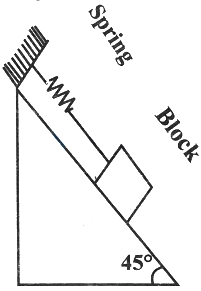
As shown in the figure, a block of weight $20 \,N$ is connected to the top of a smooth inclined plane by a massless spring of constant $8 \pi^2 \,Nm^{-1}$. If the block is pulled slightly from its mean position and released, the period of oscillations is (Acceleration due to gravity $= 10 \,ms^{-2}$) (in $\,s$)
A
$4$
B
$3$
C
$2$
D
$1$
Solution
(D) The weight of the block is $W = mg = 20 \,N$. Given $g = 10 \,ms^{-2}$, the mass of the block is $m = \frac{20}{10} = 2 \,kg$.
For a block-spring system on a smooth inclined plane, the component of gravity along the plane only shifts the equilibrium position and does not affect the frequency or period of oscillation.
The angular frequency of the oscillation is given by $\omega = \sqrt{\frac{K}{m}}$, where $K = 8 \pi^2 \,Nm^{-1}$ is the spring constant.
$\omega = \sqrt{\frac{8 \pi^2}{2}} = \sqrt{4 \pi^2} = 2 \pi \,rad/s$.
The period of oscillation $T$ is given by $T = \frac{2 \pi}{\omega}$.
Substituting the value of $\omega$, we get $T = \frac{2 \pi}{2 \pi} = 1 \,s$.
Therefore, the period of oscillations is $1 \,s$.
For a block-spring system on a smooth inclined plane, the component of gravity along the plane only shifts the equilibrium position and does not affect the frequency or period of oscillation.
The angular frequency of the oscillation is given by $\omega = \sqrt{\frac{K}{m}}$, where $K = 8 \pi^2 \,Nm^{-1}$ is the spring constant.
$\omega = \sqrt{\frac{8 \pi^2}{2}} = \sqrt{4 \pi^2} = 2 \pi \,rad/s$.
The period of oscillation $T$ is given by $T = \frac{2 \pi}{\omega}$.
Substituting the value of $\omega$, we get $T = \frac{2 \pi}{2 \pi} = 1 \,s$.
Therefore, the period of oscillations is $1 \,s$.
0 likesView Solution
109
PhysicsMediumMCQAP EAMCET · 2023
When a body of mass $8 \,kg$ is attached to a spring balance, the reading of the balance is $20 \,cm$. Instead of $8 \,kg$, if another body of mass $M$ is suspended from the spring balance and is made to oscillate vertically, the time period of oscillation is $\frac{\pi}{5} \,s$, then the value of $M$ is (Acceleration due to gravity $= 10 \,m/s^2$) (in $\,kg$)
A
$4$
B
$6$
C
$8$
D
$9$
Solution
(A) Given mass $m = 8 \,kg$ and extension $x = 20 \,cm = 0.2 \,m$.
Using Hooke's Law, $mg = kx$, we find the spring constant $k = \frac{mg}{x} = \frac{8 \times 10}{0.2} = 400 \,N/m$.
For a mass $M$ oscillating on a spring, the time period $T$ is given by $T = 2\pi \sqrt{\frac{M}{k}}$.
Given $T = \frac{\pi}{5} \,s$, we have $\frac{\pi}{5} = 2\pi \sqrt{\frac{M}{400}}$.
Dividing both sides by $\pi$, we get $\frac{1}{5} = 2 \sqrt{\frac{M}{400}} = 2 \frac{\sqrt{M}}{20} = \frac{\sqrt{M}}{10}$.
Thus, $\sqrt{M} = \frac{10}{5} = 2$.
Squaring both sides, $M = 4 \,kg$.
Using Hooke's Law, $mg = kx$, we find the spring constant $k = \frac{mg}{x} = \frac{8 \times 10}{0.2} = 400 \,N/m$.
For a mass $M$ oscillating on a spring, the time period $T$ is given by $T = 2\pi \sqrt{\frac{M}{k}}$.
Given $T = \frac{\pi}{5} \,s$, we have $\frac{\pi}{5} = 2\pi \sqrt{\frac{M}{400}}$.
Dividing both sides by $\pi$, we get $\frac{1}{5} = 2 \sqrt{\frac{M}{400}} = 2 \frac{\sqrt{M}}{20} = \frac{\sqrt{M}}{10}$.
Thus, $\sqrt{M} = \frac{10}{5} = 2$.
Squaring both sides, $M = 4 \,kg$.
0 likesView Solution
110
PhysicsMediumMCQAP EAMCET · 2023
$A$ block of mass $M$ hangs from a spring and oscillates vertically with an angular frequency $\omega$. If the block is removed from the spring,when it is in equilibrium position,the spring shortens by
A
$\frac{g}{\omega}$
B
$\sqrt{\frac{g}{\omega}}$
C
$\frac{g}{\omega^2}$
D
$\sqrt{\frac{g}{\omega^2}}$
Solution
(C) When a block of mass $M$ hangs from a spring in equilibrium,the downward gravitational force is balanced by the upward spring force.
$Mg = kx$,where $k$ is the spring constant and $x$ is the extension in the spring.
Therefore,the extension $x = \frac{Mg}{k}$.
We know that the angular frequency of a spring-mass system is given by $\omega = \sqrt{\frac{k}{M}}$.
Squaring both sides,we get $\omega^2 = \frac{k}{M}$,which implies $k = M\omega^2$.
Substituting the value of $k$ into the expression for $x$:
$x = \frac{Mg}{M\omega^2} = \frac{g}{\omega^2}$.
Thus,when the block is removed,the spring shortens by $\frac{g}{\omega^2}$.
$Mg = kx$,where $k$ is the spring constant and $x$ is the extension in the spring.
Therefore,the extension $x = \frac{Mg}{k}$.
We know that the angular frequency of a spring-mass system is given by $\omega = \sqrt{\frac{k}{M}}$.
Squaring both sides,we get $\omega^2 = \frac{k}{M}$,which implies $k = M\omega^2$.
Substituting the value of $k$ into the expression for $x$:
$x = \frac{Mg}{M\omega^2} = \frac{g}{\omega^2}$.
Thus,when the block is removed,the spring shortens by $\frac{g}{\omega^2}$.
0 likesView Solution
111
PhysicsEasyMCQAP EAMCET · 2023
An object of mass $3 \,kg$ is executing simple harmonic motion with an amplitude $\frac{2}{\pi} \,m$. If the kinetic energy of the object when it crosses the mean position is $6 \,J$, the time period of oscillation of the object is (in $\,s$)
A
$1$
B
$2$
C
$3$
D
$4$
Solution
(B) Given: Mass $m = 3 \,kg$, Amplitude $A = \frac{2}{\pi} \,m$, Kinetic energy at mean position $K_{max} = 6 \,J$.
At the mean position, the kinetic energy is equal to the total energy of the simple harmonic oscillator: $K_{max} = \frac{1}{2} m \omega^2 A^2 = 6 \,J$.
Substituting $\omega = \frac{2\pi}{T}$, we get: $\frac{1}{2} m (\frac{2\pi}{T})^2 A^2 = 6$.
$\frac{1}{2} \times 3 \times \frac{4\pi^2}{T^2} \times (\frac{2}{\pi})^2 = 6$.
$\frac{1}{2} \times 3 \times \frac{4\pi^2}{T^2} \times \frac{4}{\pi^2} = 6$.
$6 \times \frac{4}{T^2} = 6$.
$T^2 = 4$, which gives $T = 2 \,s$.
At the mean position, the kinetic energy is equal to the total energy of the simple harmonic oscillator: $K_{max} = \frac{1}{2} m \omega^2 A^2 = 6 \,J$.
Substituting $\omega = \frac{2\pi}{T}$, we get: $\frac{1}{2} m (\frac{2\pi}{T})^2 A^2 = 6$.
$\frac{1}{2} \times 3 \times \frac{4\pi^2}{T^2} \times (\frac{2}{\pi})^2 = 6$.
$\frac{1}{2} \times 3 \times \frac{4\pi^2}{T^2} \times \frac{4}{\pi^2} = 6$.
$6 \times \frac{4}{T^2} = 6$.
$T^2 = 4$, which gives $T = 2 \,s$.
0 likesView Solution
112
PhysicsMediumMCQAP EAMCET · 2023
The equation of motion of a particle executing simple harmonic motion is given by $x=3 \sin \left(6 t+\frac{\pi}{6}\right)$,where $x$ is in metres and $t$ is in seconds. The ratio of the potential and kinetic energies of the particle at time $t=0$ is
A
$1: 1$
B
$1: 4$
C
$1: 2$
D
$1: 3$
Solution
(D) The equation of motion is $x=3 \sin \left(6 t+\frac{\pi}{6}\right)$,where amplitude $A=3 \ m$.
At time $t=0$,the displacement is $x=3 \sin \left(\frac{\pi}{6}\right) = 3 \times \frac{1}{2} = 1.5 \ m$.
The potential energy $V$ is given by $V = \frac{1}{2} k x^2$.
The kinetic energy $K$ is given by $K = \frac{1}{2} k (A^2 - x^2)$.
The ratio of potential energy to kinetic energy is $\frac{V}{K} = \frac{\frac{1}{2} k x^2}{\frac{1}{2} k (A^2 - x^2)} = \frac{x^2}{A^2 - x^2}$.
Substituting the values $x=1.5$ and $A=3$:
$\frac{V}{K} = \frac{(1.5)^2}{3^2 - (1.5)^2} = \frac{2.25}{9 - 2.25} = \frac{2.25}{6.75} = \frac{1}{3}$.
Thus,the ratio is $1:3$.
At time $t=0$,the displacement is $x=3 \sin \left(\frac{\pi}{6}\right) = 3 \times \frac{1}{2} = 1.5 \ m$.
The potential energy $V$ is given by $V = \frac{1}{2} k x^2$.
The kinetic energy $K$ is given by $K = \frac{1}{2} k (A^2 - x^2)$.
The ratio of potential energy to kinetic energy is $\frac{V}{K} = \frac{\frac{1}{2} k x^2}{\frac{1}{2} k (A^2 - x^2)} = \frac{x^2}{A^2 - x^2}$.
Substituting the values $x=1.5$ and $A=3$:
$\frac{V}{K} = \frac{(1.5)^2}{3^2 - (1.5)^2} = \frac{2.25}{9 - 2.25} = \frac{2.25}{6.75} = \frac{1}{3}$.
Thus,the ratio is $1:3$.
0 likesView Solution
113
PhysicsEasyMCQAP EAMCET · 2023
Under the action of a force $F = -75 y$, where $F$ is in Newton and $y$ is in meters, an object of mass $3 \,kg$ executes simple harmonic motion. If the velocity of the object at the mean position is $2.5 \,ms^{-1}$, the maximum acceleration of the object is (in $\,ms^{-2}$)
A
$5$
B
$7.5$
C
$10$
D
$12.5$
Solution
(D) Given the force equation $F = -75 y$. Comparing this with the standard $SHM$ force equation $F = -ky$, we get the force constant $k = 75 \,N/m$.
Given mass $m = 3 \,kg$, the angular frequency $\omega$ is given by $\omega = \sqrt{\frac{k}{m}} = \sqrt{\frac{75}{3}} = \sqrt{25} = 5 \,rad/s$.
The velocity at the mean position is the maximum velocity $V_{\max} = 2.5 \,m/s$.
Since $V_{\max} = A\omega$, the amplitude $A = \frac{V_{\max}}{\omega} = \frac{2.5}{5} = 0.5 \,m$.
The maximum acceleration is given by $a_{\max} = \omega^2 A$.
Substituting the values, $a_{\max} = (5)^2 \times 0.5 = 25 \times 0.5 = 12.5 \,m/s^2$.
Given mass $m = 3 \,kg$, the angular frequency $\omega$ is given by $\omega = \sqrt{\frac{k}{m}} = \sqrt{\frac{75}{3}} = \sqrt{25} = 5 \,rad/s$.
The velocity at the mean position is the maximum velocity $V_{\max} = 2.5 \,m/s$.
Since $V_{\max} = A\omega$, the amplitude $A = \frac{V_{\max}}{\omega} = \frac{2.5}{5} = 0.5 \,m$.
The maximum acceleration is given by $a_{\max} = \omega^2 A$.
Substituting the values, $a_{\max} = (5)^2 \times 0.5 = 25 \times 0.5 = 12.5 \,m/s^2$.
0 likesView Solution
114
PhysicsEasyMCQAP EAMCET · 2023
When an external force with angular frequency $\omega_d$ acts on a system of natural angular frequency $\omega$,the system oscillates with angular frequency $\omega_d$. The condition for the amplitude of oscillations to be maximum is
A
$\omega_d = 2\omega$
B
$\omega_d = \omega$
C
$\omega_d = \frac{\omega}{2}$
D
$\omega_d = 3\omega$
Solution
(B) When a system is subjected to an external periodic force,it undergoes forced oscillations.
The amplitude of these forced oscillations depends on the driving frequency $\omega_d$ and the natural frequency $\omega$ of the system.
As the driving frequency $\omega_d$ approaches the natural frequency $\omega$,the amplitude of the oscillations increases.
When $\omega_d = \omega$,the system reaches a state known as resonance,where the amplitude of oscillations becomes maximum.
Therefore,the condition for maximum amplitude is $\omega_d = \omega$.
The amplitude of these forced oscillations depends on the driving frequency $\omega_d$ and the natural frequency $\omega$ of the system.
As the driving frequency $\omega_d$ approaches the natural frequency $\omega$,the amplitude of the oscillations increases.
When $\omega_d = \omega$,the system reaches a state known as resonance,where the amplitude of oscillations becomes maximum.
Therefore,the condition for maximum amplitude is $\omega_d = \omega$.
0 likesView Solution
115
PhysicsDifficultMCQAP EAMCET · 2023
$A$ particle initially at the mean position is executing simple harmonic motion with an angular frequency $\omega = \frac{\pi}{4} \text{ rad s}^{-1}$. The ratio of the distances travelled by the particle in the first second and the second second is:
A
$2: 1$
B
$1: 1$
C
$(1+\sqrt{3}): 1$
D
$(1+\sqrt{2}): 1$
Solution
(D) The displacement of a particle executing simple harmonic motion starting from the mean position is given by $y = A \sin(\omega t)$.
Given $\omega = \frac{\pi}{4} \text{ rad s}^{-1}$.
Displacement at $t = 1 \text{ s}$ is $y_1 = A \sin(\frac{\pi}{4} \times 1) = A \sin(\frac{\pi}{4}) = \frac{A}{\sqrt{2}}$.
Displacement at $t = 2 \text{ s}$ is $y_2 = A \sin(\frac{\pi}{4} \times 2) = A \sin(\frac{\pi}{2}) = A$.
Distance travelled in the first second is $d_1 = y_1 = \frac{A}{\sqrt{2}}$.
Distance travelled in the second second is $d_2 = y_2 - y_1 = A - \frac{A}{\sqrt{2}} = A(1 - \frac{1}{\sqrt{2}})$.
The ratio of the distances is $\frac{d_1}{d_2} = \frac{A/\sqrt{2}}{A(1 - 1/\sqrt{2})} = \frac{1/\sqrt{2}}{(\sqrt{2}-1)/\sqrt{2}} = \frac{1}{\sqrt{2}-1}$.
Rationalizing the denominator: $\frac{1}{\sqrt{2}-1} \times \frac{\sqrt{2}+1}{\sqrt{2}+1} = \frac{\sqrt{2}+1}{2-1} = \sqrt{2}+1$.
Thus,the ratio is $(\sqrt{2}+1): 1$.
Given $\omega = \frac{\pi}{4} \text{ rad s}^{-1}$.
Displacement at $t = 1 \text{ s}$ is $y_1 = A \sin(\frac{\pi}{4} \times 1) = A \sin(\frac{\pi}{4}) = \frac{A}{\sqrt{2}}$.
Displacement at $t = 2 \text{ s}$ is $y_2 = A \sin(\frac{\pi}{4} \times 2) = A \sin(\frac{\pi}{2}) = A$.
Distance travelled in the first second is $d_1 = y_1 = \frac{A}{\sqrt{2}}$.
Distance travelled in the second second is $d_2 = y_2 - y_1 = A - \frac{A}{\sqrt{2}} = A(1 - \frac{1}{\sqrt{2}})$.
The ratio of the distances is $\frac{d_1}{d_2} = \frac{A/\sqrt{2}}{A(1 - 1/\sqrt{2})} = \frac{1/\sqrt{2}}{(\sqrt{2}-1)/\sqrt{2}} = \frac{1}{\sqrt{2}-1}$.
Rationalizing the denominator: $\frac{1}{\sqrt{2}-1} \times \frac{\sqrt{2}+1}{\sqrt{2}+1} = \frac{\sqrt{2}+1}{2-1} = \sqrt{2}+1$.
Thus,the ratio is $(\sqrt{2}+1): 1$.
0 likesView Solution
116
PhysicsEasyMCQAP EAMCET · 2023
Two particles execute simple harmonic motion along the same straight line with the same amplitude and same frequency. The two particles pass one another when moving in opposite directions each time at a distance of $\frac{1}{\sqrt{2}}$ times the amplitude from their common mean position. The phase difference between the two particles is (in $^{\circ}$)
A
$30$
B
$45$
C
$60$
D
$90$
Solution
(D) Let the displacement of the two particles be $x_1 = A \sin(\omega t + \phi_1)$ and $x_2 = A \sin(\omega t + \phi_2)$.
At the point where they pass each other,$x_1 = x_2 = \frac{A}{\sqrt{2}}$.
For particle $1$,moving away from the mean position,$\sin(\omega t + \phi_1) = \frac{1}{\sqrt{2}}$,which gives the phase $\theta_1 = \frac{\pi}{4}$.
For particle $2$,moving towards the mean position at the same displacement,$\sin(\omega t + \phi_2) = \frac{1}{\sqrt{2}}$. Since it is moving in the opposite direction,its phase must be in the second quadrant,so $\theta_2 = \pi - \frac{\pi}{4} = \frac{3\pi}{4}$.
The phase difference is $\Delta \phi = |\theta_2 - \theta_1| = |\frac{3\pi}{4} - \frac{\pi}{4}| = \frac{2\pi}{4} = \frac{\pi}{2}$.
Converting to degrees,$\frac{\pi}{2} = 90^{\circ}$.
At the point where they pass each other,$x_1 = x_2 = \frac{A}{\sqrt{2}}$.
For particle $1$,moving away from the mean position,$\sin(\omega t + \phi_1) = \frac{1}{\sqrt{2}}$,which gives the phase $\theta_1 = \frac{\pi}{4}$.
For particle $2$,moving towards the mean position at the same displacement,$\sin(\omega t + \phi_2) = \frac{1}{\sqrt{2}}$. Since it is moving in the opposite direction,its phase must be in the second quadrant,so $\theta_2 = \pi - \frac{\pi}{4} = \frac{3\pi}{4}$.
The phase difference is $\Delta \phi = |\theta_2 - \theta_1| = |\frac{3\pi}{4} - \frac{\pi}{4}| = \frac{2\pi}{4} = \frac{\pi}{2}$.
Converting to degrees,$\frac{\pi}{2} = 90^{\circ}$.
0 likesView Solution
117
PhysicsMediumMCQAP EAMCET · 2023
The equation of motion of a particle executing simple harmonic motion is $4 \frac{d^2 y}{dt^2}+\pi^2 y=0$,where $y$ is in metres and $t$ is in seconds. The time period of oscillation of the particle is (in $s$)
A
$1$
B
$2$
C
$3$
D
$4$
Solution
(D) The given equation of motion is $4 \frac{d^2 y}{dt^2} + \pi^2 y = 0$.
Dividing by $4$,we get $\frac{d^2 y}{dt^2} + \frac{\pi^2}{4} y = 0$.
The general equation for simple harmonic motion is $\frac{d^2 y}{dt^2} + \omega^2 y = 0$.
Comparing the two equations,we find $\omega^2 = \frac{\pi^2}{4}$,which gives $\omega = \frac{\pi}{2} \ rad/s$.
The time period $T$ is given by the formula $T = \frac{2\pi}{\omega}$.
Substituting the value of $\omega$,we get $T = \frac{2\pi}{\pi/2} = 2\pi \times \frac{2}{\pi} = 4 \ s$.
Dividing by $4$,we get $\frac{d^2 y}{dt^2} + \frac{\pi^2}{4} y = 0$.
The general equation for simple harmonic motion is $\frac{d^2 y}{dt^2} + \omega^2 y = 0$.
Comparing the two equations,we find $\omega^2 = \frac{\pi^2}{4}$,which gives $\omega = \frac{\pi}{2} \ rad/s$.
The time period $T$ is given by the formula $T = \frac{2\pi}{\omega}$.
Substituting the value of $\omega$,we get $T = \frac{2\pi}{\pi/2} = 2\pi \times \frac{2}{\pi} = 4 \ s$.
0 likesView Solution
118
PhysicsMediumMCQAP EAMCET · 2023
$A$ particle is executing simple harmonic motion. If the minimum time taken by the particle to move from extreme position to half of the amplitude is $t_1$,and the minimum time taken by the particle to move from mean position to half of the amplitude is $t_2$,then
A
$t_1=t_2$
B
$t_1=0.5 t_2$
C
$t_1=2 t_2$
D
$t_1=\sqrt{2} t_2$
Solution
(C) For the particle to move from the extreme position $(x=A)$ to half of the amplitude $(x=A/2)$:
$x = A \cos(\omega t_1) \implies A/2 = A \cos(\omega t_1) \implies \cos(\omega t_1) = 1/2$.
Thus,$\omega t_1 = \pi/3$,which gives $t_1 = \pi / (3\omega)$.
For the particle to move from the mean position $(x=0)$ to half of the amplitude $(x=A/2)$:
$x = A \sin(\omega t_2) \implies A/2 = A \sin(\omega t_2) \implies \sin(\omega t_2) = 1/2$.
Thus,$\omega t_2 = \pi/6$,which gives $t_2 = \pi / (6\omega)$.
Comparing the two times: $t_1 / t_2 = (\pi / 3\omega) / (\pi / 6\omega) = 6/3 = 2$.
Therefore,$t_1 = 2 t_2$.
$x = A \cos(\omega t_1) \implies A/2 = A \cos(\omega t_1) \implies \cos(\omega t_1) = 1/2$.
Thus,$\omega t_1 = \pi/3$,which gives $t_1 = \pi / (3\omega)$.
For the particle to move from the mean position $(x=0)$ to half of the amplitude $(x=A/2)$:
$x = A \sin(\omega t_2) \implies A/2 = A \sin(\omega t_2) \implies \sin(\omega t_2) = 1/2$.
Thus,$\omega t_2 = \pi/6$,which gives $t_2 = \pi / (6\omega)$.
Comparing the two times: $t_1 / t_2 = (\pi / 3\omega) / (\pi / 6\omega) = 6/3 = 2$.
Therefore,$t_1 = 2 t_2$.
0 likesView Solution
119
PhysicsMediumMCQAP EAMCET · 2023
The time period of a simple pendulum on the surface of the earth is $T$. The height above the surface of the earth at which the time period of the pendulum becomes $2T$ is (Radius of the earth $= 6400 \text{ km}$) (in $\text{ km}$)
A
$3200$
B
$6400$
C
$19200$
D
$800$
Solution
(B) The time period of a simple pendulum is given by $T = 2\pi \sqrt{\frac{L}{g}}$.
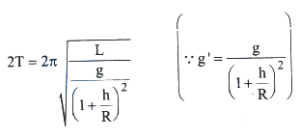
At height $h$ above the surface, the acceleration due to gravity is $g' = \frac{g}{(1 + \frac{h}{R})^2}$.
The new time period $T'$ is given by $T' = 2\pi \sqrt{\frac{L}{g'}} = 2\pi \sqrt{\frac{L}{g / (1 + \frac{h}{R})^2}} = T(1 + \frac{h}{R})$.
Given $T' = 2T$, we have $2T = T(1 + \frac{h}{R})$.
$2 = 1 + \frac{h}{R} \Rightarrow \frac{h}{R} = 1$.
Therefore, $h = R = 6400 \text{ km}$.
At height $h$ above the surface, the acceleration due to gravity is $g' = \frac{g}{(1 + \frac{h}{R})^2}$.
The new time period $T'$ is given by $T' = 2\pi \sqrt{\frac{L}{g'}} = 2\pi \sqrt{\frac{L}{g / (1 + \frac{h}{R})^2}} = T(1 + \frac{h}{R})$.
Given $T' = 2T$, we have $2T = T(1 + \frac{h}{R})$.
$2 = 1 + \frac{h}{R} \Rightarrow \frac{h}{R} = 1$.
Therefore, $h = R = 6400 \text{ km}$.
0 likesView Solution
120
PhysicsMediumMCQAP EAMCET · 2023
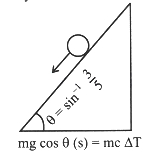
$A$ block of steel of mass $2 \,kg$ slides down a rough inclined plane of inclination $\sin ^{-1}\left(\frac{3}{5}\right)$ at a constant speed. Assuming that the mechanical energy lost due to friction is used to increase the temperature of the block, calculate the rise in temperature of the block as it slides through $80 \,cm$. (Specific heat capacity of steel $= 420 \,J kg^{-1} K^{-1}$ and acceleration due to gravity $= 10 \,ms^{-2}$) (in $^{\circ} C$)
A
$0.0190$
B
$0.0114$
C
$0.0152$
D
$0.0952$
Solution
(B) Given: Mass $m = 2 \,kg$, inclination $\theta = \sin^{-1}(3/5)$, so $\sin \theta = 3/5$ and $\cos \theta = 4/5$. Distance $s = 80 \,cm = 0.8 \,m$. Specific heat $c = 420 \,J kg^{-1} K^{-1}$. Acceleration due to gravity $g = 10 \,ms^{-2}$.
Since the block slides at a constant speed, the work done by friction equals the loss in potential energy. The work done by friction $W_f = f_k \cdot s$, where $f_k = \mu_k N = \mu_k mg \cos \theta$. Since the speed is constant, $mg \sin \theta = f_k$.
Thus, the heat generated $Q = W_f = (mg \sin \theta) \cdot s$.
Equating heat generated to heat absorbed: $Q = mc \Delta T$.
$mc \Delta T = (mg \sin \theta) s$.
$\Delta T = \frac{g \sin \theta \cdot s}{c} = \frac{10 \times (3/5) \times 0.8}{420}$.
$\Delta T = \frac{10 \times 0.6 \times 0.8}{420} = \frac{4.8}{420} \approx 0.0114^{\circ} C$.
Since the block slides at a constant speed, the work done by friction equals the loss in potential energy. The work done by friction $W_f = f_k \cdot s$, where $f_k = \mu_k N = \mu_k mg \cos \theta$. Since the speed is constant, $mg \sin \theta = f_k$.
Thus, the heat generated $Q = W_f = (mg \sin \theta) \cdot s$.
Equating heat generated to heat absorbed: $Q = mc \Delta T$.
$mc \Delta T = (mg \sin \theta) s$.
$\Delta T = \frac{g \sin \theta \cdot s}{c} = \frac{10 \times (3/5) \times 0.8}{420}$.
$\Delta T = \frac{10 \times 0.6 \times 0.8}{420} = \frac{4.8}{420} \approx 0.0114^{\circ} C$.
0 likesView Solution
121
PhysicsEasyMCQAP EAMCET · 2023
The specific heat capacity of a copper block of mass $M$ is $s$. If the mass of the copper block is doubled,the specific heat capacity will be
A
$2s$
B
$s/2$
C
$s$
D
$\sqrt{3/2}s$
Solution
(C) Specific heat capacity is an intrinsic property of a material,which means it depends only on the nature of the substance and not on the amount or mass of the substance.
Since the material remains copper,its specific heat capacity remains constant regardless of the change in mass.
Therefore,if the mass is doubled,the specific heat capacity will remain $s$.
Since the material remains copper,its specific heat capacity remains constant regardless of the change in mass.
Therefore,if the mass is doubled,the specific heat capacity will remain $s$.
0 likesView Solution
122
PhysicsEasyMCQAP EAMCET · 2023
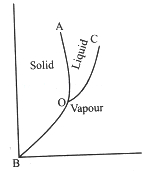
In the given triple point curve as shown in the figure,the curves $AO$,$BO$,and $CO$ represent:
A
$AO =$ Sublimation curve,$BO =$ Fusion curve,$CO =$ Vaporization curve
B
$AO =$ Fusion curve,$BO =$ Sublimation curve,$CO =$ Vaporization curve
C
$AO =$ Fusion curve,$BO =$ Vaporization curve,$CO =$ Sublimation curve
D
$AO =$ Vaporization curve,$BO =$ Fusion curve,$CO =$ Sublimation curve
Solution
(B) In a standard phase diagram (Pressure vs Temperature):
$1$. The curve separating the Solid and Liquid phases is the Fusion (or Melting) curve. In the figure,$AO$ separates the Solid and Liquid regions,so $AO$ is the Fusion curve.
$2$. The curve separating the Solid and Vapour phases is the Sublimation curve. In the figure,$BO$ separates the Solid and Vapour regions,so $BO$ is the Sublimation curve.
$3$. The curve separating the Liquid and Vapour phases is the Vaporization (or Boiling) curve. In the figure,$CO$ separates the Liquid and Vapour regions,so $CO$ is the Vaporization curve.
Therefore,$AO =$ Fusion curve,$BO =$ Sublimation curve,and $CO =$ Vaporization curve.
$1$. The curve separating the Solid and Liquid phases is the Fusion (or Melting) curve. In the figure,$AO$ separates the Solid and Liquid regions,so $AO$ is the Fusion curve.
$2$. The curve separating the Solid and Vapour phases is the Sublimation curve. In the figure,$BO$ separates the Solid and Vapour regions,so $BO$ is the Sublimation curve.
$3$. The curve separating the Liquid and Vapour phases is the Vaporization (or Boiling) curve. In the figure,$CO$ separates the Liquid and Vapour regions,so $CO$ is the Vaporization curve.
Therefore,$AO =$ Fusion curve,$BO =$ Sublimation curve,and $CO =$ Vaporization curve.
0 likesView Solution
123
PhysicsMediumMCQAP EAMCET · 2023
$A$ steel ball of mass $200 \,g$ falls freely from a height of $20 \,m$ and bounces to a height of $10.8 \,m$ from the ground. If the energy lost in this process is absorbed by the ball, the rise in its temperature is ($g = 10 \,ms^{-2}$, specific heat capacity of steel is $460 \,Jkg^{-1} K^{-1}$). (in $^{\circ} C$)
A
$0.1$
B
$1$
C
$0.2$
D
$2$
Solution
(C) The energy lost by the ball during the bounce is equal to the difference in potential energy at the two heights.
Energy lost $\Delta E = mg(h_1 - h_2)$.
Given $m = 200 \,g = 0.2 \,kg$, $h_1 = 20 \,m$, $h_2 = 10.8 \,m$, $g = 10 \,ms^{-2}$, and $c = 460 \,Jkg^{-1} K^{-1}$.
Assuming the lost energy is absorbed by the ball, $\Delta E = mc \Delta T$.
Equating the two: $mg(h_1 - h_2) = mc \Delta T$.
Canceling $m$ from both sides: $g(h_1 - h_2) = c \Delta T$.
Substituting the values: $10 \times (20 - 10.8) = 460 \times \Delta T$.
$10 \times 9.2 = 460 \times \Delta T$.
$92 = 460 \times \Delta T$.
$\Delta T = \frac{92}{460} = 0.2^{\circ} C$.
Energy lost $\Delta E = mg(h_1 - h_2)$.
Given $m = 200 \,g = 0.2 \,kg$, $h_1 = 20 \,m$, $h_2 = 10.8 \,m$, $g = 10 \,ms^{-2}$, and $c = 460 \,Jkg^{-1} K^{-1}$.
Assuming the lost energy is absorbed by the ball, $\Delta E = mc \Delta T$.
Equating the two: $mg(h_1 - h_2) = mc \Delta T$.
Canceling $m$ from both sides: $g(h_1 - h_2) = c \Delta T$.
Substituting the values: $10 \times (20 - 10.8) = 460 \times \Delta T$.
$10 \times 9.2 = 460 \times \Delta T$.
$92 = 460 \times \Delta T$.
$\Delta T = \frac{92}{460} = 0.2^{\circ} C$.
0 likesView Solution
124
PhysicsEasyMCQAP EAMCET · 2023
The heat energy released by water of mass $2 \,kg$ when it is cooled by $10^{\circ} C$ is (Specific heat capacity of water $= 4200 \,J \,kg^{-1} \,K^{-1}$) (in $\,J$)
A
$42000$
B
$21000$
C
$63000$
D
$84000$
Solution
(D) Given: Mass of water,$m = 2 \,kg$
Change in temperature,$\Delta T = 10^{\circ} C$
Specific heat capacity of water,$c = 4200 \,J \,kg^{-1} \,K^{-1}$
The heat energy $Q$ released is calculated using the formula:
$Q = m c \Delta T$
Substituting the values:
$Q = 2 \,kg \times 4200 \,J \,kg^{-1} \,K^{-1} \times 10 \,K$
$Q = 84000 \,J$
Change in temperature,$\Delta T = 10^{\circ} C$
Specific heat capacity of water,$c = 4200 \,J \,kg^{-1} \,K^{-1}$
The heat energy $Q$ released is calculated using the formula:
$Q = m c \Delta T$
Substituting the values:
$Q = 2 \,kg \times 4200 \,J \,kg^{-1} \,K^{-1} \times 10 \,K$
$Q = 84000 \,J$
0 likesView Solution
125
PhysicsEasyMCQAP EAMCET · 2023
$A$ $50 \,g$ ice cube at $-10^{\circ} C$ is added to $200 \,g$ of water at $30^{\circ} C$. The final temperature of the mixture is (specific heat of water $= 1 \,cal \,g^{-1} {}^{\circ} C^{-1}$,latent heat of fusion of ice $= 80 \,cal \,g^{-1}$,specific heat of ice $= 0.5 \,cal \,g^{-1} {}^{\circ} C^{-1}$). (in $^{\circ} C$)
A
$20$
B
$7$
C
$12$
D
$10$
Solution
(B) Step $1$: Calculate heat required to bring ice from $-10^{\circ} C$ to $0^{\circ} C$ (ice): $Q_1 = m_i c_i \Delta T = 50 \times 0.5 \times 10 = 250 \,cal$.
Step $2$: Calculate heat required to melt $50 \,g$ of ice at $0^{\circ} C$: $Q_2 = m_i L_f = 50 \times 80 = 4000 \,cal$.
Total heat required by ice to become water at $0^{\circ} C$ is $Q_{total} = 250 + 4000 = 4250 \,cal$.
Step $3$: Calculate heat released by $200 \,g$ of water cooling from $30^{\circ} C$ to $0^{\circ} C$: $Q_{release} = m_w c_w \Delta T = 200 \times 1 \times 30 = 6000 \,cal$.
Since $Q_{release} > Q_{total}$,the ice melts completely and the final temperature $T_f$ will be above $0^{\circ} C$.
Step $4$: Apply the principle of calorimetry: Heat lost by water = Heat gained by ice.
$200 \times 1 \times (30 - T_f) = 4250 + 50 \times 1 \times (T_f - 0)$.
$6000 - 200 T_f = 4250 + 50 T_f$.
$1750 = 250 T_f$.
$T_f = 7^{\circ} C$.
Step $2$: Calculate heat required to melt $50 \,g$ of ice at $0^{\circ} C$: $Q_2 = m_i L_f = 50 \times 80 = 4000 \,cal$.
Total heat required by ice to become water at $0^{\circ} C$ is $Q_{total} = 250 + 4000 = 4250 \,cal$.
Step $3$: Calculate heat released by $200 \,g$ of water cooling from $30^{\circ} C$ to $0^{\circ} C$: $Q_{release} = m_w c_w \Delta T = 200 \times 1 \times 30 = 6000 \,cal$.
Since $Q_{release} > Q_{total}$,the ice melts completely and the final temperature $T_f$ will be above $0^{\circ} C$.
Step $4$: Apply the principle of calorimetry: Heat lost by water = Heat gained by ice.
$200 \times 1 \times (30 - T_f) = 4250 + 50 \times 1 \times (T_f - 0)$.
$6000 - 200 T_f = 4250 + 50 T_f$.
$1750 = 250 T_f$.
$T_f = 7^{\circ} C$.
0 likesView Solution
126
PhysicsMediumMCQAP EAMCET · 2023
The emissivity (power radiated per unit area) of a perfect black body is increased to $16$ times by increasing its temperature. If the initial temperature is $T$, then the final temperature of that black body is: (in $\,T$)
A
$4$
B
$8$
C
$2$
D
$16$
Solution
(C) According to Stefan-Boltzmann law, the power radiated per unit area $E$ is proportional to the fourth power of the absolute temperature $T$ of the black body:
$E = \sigma T^4$
Given that the final emissivity $E_2$ is $16$ times the initial emissivity $E_1$:
$E_2 = 16 E_1$
Substituting the Stefan-Boltzmann law into the ratio:
$\frac{E_2}{E_1} = \frac{\sigma T_2^4}{\sigma T_1^4} = \left( \frac{T_2}{T_1} \right)^4$
$16 = \left( \frac{T_2}{T} \right)^4$
Taking the fourth root on both sides:
$\sqrt[4]{16} = \frac{T_2}{T}$
$2 = \frac{T_2}{T}$
$T_2 = 2 \,T$
$E = \sigma T^4$
Given that the final emissivity $E_2$ is $16$ times the initial emissivity $E_1$:
$E_2 = 16 E_1$
Substituting the Stefan-Boltzmann law into the ratio:
$\frac{E_2}{E_1} = \frac{\sigma T_2^4}{\sigma T_1^4} = \left( \frac{T_2}{T_1} \right)^4$
$16 = \left( \frac{T_2}{T} \right)^4$
Taking the fourth root on both sides:
$\sqrt[4]{16} = \frac{T_2}{T}$
$2 = \frac{T_2}{T}$
$T_2 = 2 \,T$
0 likesView Solution
127
PhysicsEasyMCQAP EAMCET · 2023
When an iron rod is heated, the variation of colour from dull red to white can be explained by
A
Boltzmann Law
B
Newton's Law of cooling
C
Stefan's Law of radiation
D
Wien's displacement Law
Solution
(D) According to Wien's displacement law, the wavelength corresponding to the maximum intensity of emission $(\lambda_m)$ is inversely proportional to the absolute temperature $(T)$ of the body, given by $\lambda_m T = b$, where $b$ is Wien's constant.
As the temperature of the iron rod increases, the wavelength of the emitted radiation decreases.
Initially, at lower temperatures, the emitted radiation is in the red part of the visible spectrum.
As the temperature increases further, the peak wavelength shifts towards shorter wavelengths (yellow, then blue, and finally white), which is a combination of all visible wavelengths.
Thus, the change in colour is explained by Wien's displacement law.
As the temperature of the iron rod increases, the wavelength of the emitted radiation decreases.
Initially, at lower temperatures, the emitted radiation is in the red part of the visible spectrum.
As the temperature increases further, the peak wavelength shifts towards shorter wavelengths (yellow, then blue, and finally white), which is a combination of all visible wavelengths.
Thus, the change in colour is explained by Wien's displacement law.
0 likesView Solution
128
PhysicsEasyMCQAP EAMCET · 2023
$A$ rod is found to be $0.05 \ cm$ longer at $40^{\circ} C$ than it is at $10^{\circ} C$. The length of the rod at $0^{\circ} C$ is (coefficient of linear expansion of the material of the rod $= 1.5 \times 10^{-5} \ {}^{\circ} C^{-1}$) (in $cm$)
A
$101.1$
B
$120.2$
C
$105.1$
D
$111.1$
Solution
(D) Let $L_0$ be the length of the rod at $0^{\circ} C$ and $\alpha$ be the coefficient of linear expansion.
The length at temperature $T$ is given by $L_T = L_0(1 + \alpha T)$.
Length at $10^{\circ} C$: $L_{10} = L_0(1 + 10\alpha)$.
Length at $40^{\circ} C$: $L_{40} = L_0(1 + 40\alpha)$.
Given that $L_{40} - L_{10} = 0.05 \ cm$.
Substituting the expressions: $L_0(1 + 40\alpha) - L_0(1 + 10\alpha) = 0.05$.
$L_0(40\alpha - 10\alpha) = 0.05$.
$30 L_0 \alpha = 0.05$.
$L_0 = \frac{0.05}{30 \alpha}$.
Substituting $\alpha = 1.5 \times 10^{-5} \ {}^{\circ} C^{-1}$:
$L_0 = \frac{0.05}{30 \times 1.5 \times 10^{-5}} = \frac{0.05}{45 \times 10^{-5}} = \frac{0.05 \times 10^5}{45} = \frac{5000}{45} \approx 111.1 \ cm$.
The length at temperature $T$ is given by $L_T = L_0(1 + \alpha T)$.
Length at $10^{\circ} C$: $L_{10} = L_0(1 + 10\alpha)$.
Length at $40^{\circ} C$: $L_{40} = L_0(1 + 40\alpha)$.
Given that $L_{40} - L_{10} = 0.05 \ cm$.
Substituting the expressions: $L_0(1 + 40\alpha) - L_0(1 + 10\alpha) = 0.05$.
$L_0(40\alpha - 10\alpha) = 0.05$.
$30 L_0 \alpha = 0.05$.
$L_0 = \frac{0.05}{30 \alpha}$.
Substituting $\alpha = 1.5 \times 10^{-5} \ {}^{\circ} C^{-1}$:
$L_0 = \frac{0.05}{30 \times 1.5 \times 10^{-5}} = \frac{0.05}{45 \times 10^{-5}} = \frac{0.05 \times 10^5}{45} = \frac{5000}{45} \approx 111.1 \ cm$.
0 likesView Solution
129
PhysicsEasyMCQAP EAMCET · 2023
$A$ steel tape of $300 \,cm$ length is graduated at $27^{\circ} C$. The length of a steel rod measured using the tape is found to be $110 \,cm$ at $50^{\circ} C$. The actual length of the steel rod at $50^{\circ} C$ is $(\alpha_{\text{steel}} = 1.2 \times 10^{-5} \,K^{-1})$. (in $\,cm$)
A
$110.03$
B
$110.10$
C
$110.07$
D
$110.62$
Solution
(A) Let $L_0 = 300 \,cm$ be the length of the steel tape at $27^{\circ} C$.
At $50^{\circ} C$, the length of the tape becomes $L_T = L_0(1 + \alpha \Delta T)$.
Here, $\Delta T = 50^{\circ} C - 27^{\circ} C = 23^{\circ} C$.
$L_T = 300(1 + 1.2 \times 10^{-5} \times 23) = 300(1 + 0.000276) = 300.0828 \,cm$.
The measured length of the rod is $L_m = 110 \,cm$.
The actual length $L_a$ is given by $L_a = L_m \times \frac{L_T}{L_0}$.
$L_a = 110 \times \frac{300.0828}{300} = 110 \times (1 + 0.000276) = 110 + 0.03036 = 110.03036 \,cm$.
Rounding to two decimal places, the actual length is $110.03 \,cm$.
At $50^{\circ} C$, the length of the tape becomes $L_T = L_0(1 + \alpha \Delta T)$.
Here, $\Delta T = 50^{\circ} C - 27^{\circ} C = 23^{\circ} C$.
$L_T = 300(1 + 1.2 \times 10^{-5} \times 23) = 300(1 + 0.000276) = 300.0828 \,cm$.
The measured length of the rod is $L_m = 110 \,cm$.
The actual length $L_a$ is given by $L_a = L_m \times \frac{L_T}{L_0}$.
$L_a = 110 \times \frac{300.0828}{300} = 110 \times (1 + 0.000276) = 110 + 0.03036 = 110.03036 \,cm$.
Rounding to two decimal places, the actual length is $110.03 \,cm$.
0 likesView Solution
130
PhysicsEasyMCQAP EAMCET · 2023
The heat energy supplied to a diatomic gas at constant pressure is $210 \,J$. Then, the work done by the gas is: (in $\,J$)
A
$60$
B
$150$
C
$90$
D
$210$
Solution
(A) Given: Heat supplied at constant pressure, $Q_P = 210 \,J$.
For a diatomic gas, the molar heat capacity at constant volume is $C_V = \frac{5}{2}R$.
The molar heat capacity at constant pressure is $C_P = C_V + R = \frac{5}{2}R + R = \frac{7}{2}R$.
We know that $Q_P = n C_P \Delta T = 210 \,J$.
Substituting $C_P$, we get $n (\frac{7}{2}R) \Delta T = 210$.
Thus, $n R \Delta T = 210 \times \frac{2}{7} = 60 \,J$.
The work done by the gas at constant pressure is given by $W = P \Delta V = n R \Delta T$.
Therefore, $W = 60 \,J$.
For a diatomic gas, the molar heat capacity at constant volume is $C_V = \frac{5}{2}R$.
The molar heat capacity at constant pressure is $C_P = C_V + R = \frac{5}{2}R + R = \frac{7}{2}R$.
We know that $Q_P = n C_P \Delta T = 210 \,J$.
Substituting $C_P$, we get $n (\frac{7}{2}R) \Delta T = 210$.
Thus, $n R \Delta T = 210 \times \frac{2}{7} = 60 \,J$.
The work done by the gas at constant pressure is given by $W = P \Delta V = n R \Delta T$.
Therefore, $W = 60 \,J$.
0 likesView Solution
131
PhysicsMediumMCQAP EAMCET · 2023
When a monatomic gas expands at constant pressure,the percentages of heat supplied that is used to do external work and to increase its internal energy are respectively:
A
$40$,$60$
B
$25$,$75$
C
$60$,$40$
D
$75$,$25$
Solution
(A) For a monatomic gas,the degrees of freedom $f = 3$.
$C_p = \frac{5}{2}R$ and $C_v = \frac{3}{2}R$.
Total heat supplied at constant pressure is $Q = n C_p \Delta T = \frac{5}{2} nR \Delta T$.
Heat used to increase internal energy is $\Delta U = n C_v \Delta T = \frac{3}{2} nR \Delta T$.
Percentage of heat used to increase internal energy $= \frac{\Delta U}{Q} \times 100 = \frac{\frac{3}{2} nR \Delta T}{\frac{5}{2} nR \Delta T} \times 100 = 60\%$.
Heat used to do external work is $W = P \Delta V = nR \Delta T$.
Percentage of heat used to do external work $= \frac{W}{Q} \times 100 = \frac{nR \Delta T}{\frac{5}{2} nR \Delta T} \times 100 = 40\%$.
Thus,the percentages are $40\%$ and $60\%$ respectively.
$C_p = \frac{5}{2}R$ and $C_v = \frac{3}{2}R$.
Total heat supplied at constant pressure is $Q = n C_p \Delta T = \frac{5}{2} nR \Delta T$.
Heat used to increase internal energy is $\Delta U = n C_v \Delta T = \frac{3}{2} nR \Delta T$.
Percentage of heat used to increase internal energy $= \frac{\Delta U}{Q} \times 100 = \frac{\frac{3}{2} nR \Delta T}{\frac{5}{2} nR \Delta T} \times 100 = 60\%$.
Heat used to do external work is $W = P \Delta V = nR \Delta T$.
Percentage of heat used to do external work $= \frac{W}{Q} \times 100 = \frac{nR \Delta T}{\frac{5}{2} nR \Delta T} \times 100 = 40\%$.
Thus,the percentages are $40\%$ and $60\%$ respectively.
0 likesView Solution
132
PhysicsEasyMCQAP EAMCET · 2023
$A$ gas is expanded from an initial state to a final state along a path that consists of $(a)$ an isothermal expansion doing $40 \,J$ work,$(b)$ an adiabatic expansion doing $W$ work,$(c)$ an isothermal expansion doing $30 \,J$ work. If the total change in the internal energy of the gas is $-20 \,J$,the work done by the gas during the adiabatic expansion $W=$ (in $\,J$)
A
$50$
B
$90$
C
$70$
D
$20$
Solution
(D) According to the first law of thermodynamics,$\Delta Q = \Delta U + \Delta W$,where $\Delta U$ is the change in internal energy and $\Delta W$ is the work done by the gas.
For an isothermal process,the temperature remains constant,so the change in internal energy $\Delta U = 0$.
For an adiabatic process,there is no heat exchange,so $\Delta Q = 0$,which implies $\Delta U = -\Delta W$.
Let the total change in internal energy be $\Delta U_{total} = \Delta U_a + \Delta U_b + \Delta U_c = -20 \,J$.
For the isothermal steps $(a)$ and $(c)$,$\Delta U_a = 0$ and $\Delta U_c = 0$.
Therefore,the total change in internal energy is due to the adiabatic step $(b)$: $\Delta U_b = -20 \,J$.
Since $\Delta U_b = -W$ for the adiabatic process,we have $-W = -20 \,J$.
Thus,$W = 20 \,J$.
For an isothermal process,the temperature remains constant,so the change in internal energy $\Delta U = 0$.
For an adiabatic process,there is no heat exchange,so $\Delta Q = 0$,which implies $\Delta U = -\Delta W$.
Let the total change in internal energy be $\Delta U_{total} = \Delta U_a + \Delta U_b + \Delta U_c = -20 \,J$.
For the isothermal steps $(a)$ and $(c)$,$\Delta U_a = 0$ and $\Delta U_c = 0$.
Therefore,the total change in internal energy is due to the adiabatic step $(b)$: $\Delta U_b = -20 \,J$.
Since $\Delta U_b = -W$ for the adiabatic process,we have $-W = -20 \,J$.
Thus,$W = 20 \,J$.
0 likesView Solution
133
PhysicsMediumMCQAP EAMCET · 2023
Three moles of a gas at a temperature $T$ is heated to thrice its volume by keeping the pressure constant. If $\gamma$ is the ratio of specific heats,then the increase in internal energy of the gas is
A
$\frac{3 RT}{\gamma-1}$
B
$\frac{6 RT}{\gamma-1}$
C
$\frac{8 R}{\gamma-1}$
D
$\frac{3 R}{2(\gamma-1)}$
Solution
(B) Number of moles,$n = 3$.
Initial volume,$V_i = V$.
Final volume,$V_f = 3V$.
Ratio of specific heats,$\gamma = \frac{C_p}{C_v}$.
Change in internal energy is given by $\Delta U = n C_v \Delta T$.
We know that $C_v = \frac{R}{\gamma - 1}$.
At constant pressure,according to Charles's Law,$\frac{V_1}{T_1} = \frac{V_2}{T_2}$.
Substituting the values,$\frac{V}{T} = \frac{3V}{T_2}$,which gives $T_2 = 3T$.
Change in temperature,$\Delta T = T_2 - T_1 = 3T - T = 2T$.
Now,substituting these into the internal energy formula:
$\Delta U = n \left( \frac{R}{\gamma - 1} \right) \Delta T = 3 \left( \frac{R}{\gamma - 1} \right) (2T) = \frac{6RT}{\gamma - 1}$.
Initial volume,$V_i = V$.
Final volume,$V_f = 3V$.
Ratio of specific heats,$\gamma = \frac{C_p}{C_v}$.
Change in internal energy is given by $\Delta U = n C_v \Delta T$.
We know that $C_v = \frac{R}{\gamma - 1}$.
At constant pressure,according to Charles's Law,$\frac{V_1}{T_1} = \frac{V_2}{T_2}$.
Substituting the values,$\frac{V}{T} = \frac{3V}{T_2}$,which gives $T_2 = 3T$.
Change in temperature,$\Delta T = T_2 - T_1 = 3T - T = 2T$.
Now,substituting these into the internal energy formula:
$\Delta U = n \left( \frac{R}{\gamma - 1} \right) \Delta T = 3 \left( \frac{R}{\gamma - 1} \right) (2T) = \frac{6RT}{\gamma - 1}$.
0 likesView Solution
134
PhysicsEasyMCQAP EAMCET · 2023
$A$ diatomic gas has an initial internal energy of $80 cal$. $A$ work of $18 cal$ is done on the gas and the gas releases heat energy of $42 J$. The final internal energy of the gas is
A
$20 J$
B
$369.6 J$
C
$54 J$
D
$20 cal$
Solution
(B) Initial internal energy,$U_i = 80 cal = 80 \times 4.2 J = 336 J$.
Work done on the gas,$W = -18 cal = -18 \times 4.2 J = -75.6 J$ (Work done on the system is negative in the convention $\Delta Q = \Delta U + \Delta W$).
Heat released by the gas,$Q = -42 J$ (Heat released is negative).
According to the first law of thermodynamics,$\Delta Q = \Delta U + \Delta W$.
$-42 = (U_f - 336) + (-75.6)$.
$-42 = U_f - 336 - 75.6$.
$-42 = U_f - 411.6$.
$U_f = 411.6 - 42 = 369.6 J$.
Work done on the gas,$W = -18 cal = -18 \times 4.2 J = -75.6 J$ (Work done on the system is negative in the convention $\Delta Q = \Delta U + \Delta W$).
Heat released by the gas,$Q = -42 J$ (Heat released is negative).
According to the first law of thermodynamics,$\Delta Q = \Delta U + \Delta W$.
$-42 = (U_f - 336) + (-75.6)$.
$-42 = U_f - 336 - 75.6$.
$-42 = U_f - 411.6$.
$U_f = 411.6 - 42 = 369.6 J$.
0 likesView Solution
135
PhysicsEasyMCQAP EAMCET · 2023
The temperature of the sink of a Carnot engine is $300 \,K$ and the efficiency of the engine is $0.25$. If the temperature of the source of the engine is increased by $100 \,K$, the efficiency of the engine increases by:
A
$0.50$
B
$0.25$
C
$0.15$
D
$0.40$
Solution
(C) Temperature of the sink, $T_2 = 300 \,K$. Efficiency of the engine, $\eta_1 = 0.25$.
The formula for efficiency is $\eta = 1 - \frac{T_2}{T_1}$.
Substituting the values: $0.25 = 1 - \frac{300}{T_1} \Rightarrow \frac{300}{T_1} = 0.75 \Rightarrow T_1 = \frac{300}{0.75} = 400 \,K$.
When the source temperature is increased by $100 \,K$, the new source temperature $T_1' = 400 + 100 = 500 \,K$.
The new efficiency $\eta_2 = 1 - \frac{T_2}{T_1'} = 1 - \frac{300}{500} = 1 - 0.6 = 0.40$.
The increase in efficiency is $\Delta\eta = \eta_2 - \eta_1 = 0.40 - 0.25 = 0.15$.
The formula for efficiency is $\eta = 1 - \frac{T_2}{T_1}$.
Substituting the values: $0.25 = 1 - \frac{300}{T_1} \Rightarrow \frac{300}{T_1} = 0.75 \Rightarrow T_1 = \frac{300}{0.75} = 400 \,K$.
When the source temperature is increased by $100 \,K$, the new source temperature $T_1' = 400 + 100 = 500 \,K$.
The new efficiency $\eta_2 = 1 - \frac{T_2}{T_1'} = 1 - \frac{300}{500} = 1 - 0.6 = 0.40$.
The increase in efficiency is $\Delta\eta = \eta_2 - \eta_1 = 0.40 - 0.25 = 0.15$.
0 likesView Solution
136
PhysicsEasyMCQAP EAMCET · 2023
In a Carnot engine,as the gas gives heat energy to the sink,the temperature of the sink
A
increases
B
decreases
C
remains constant
D
becomes zero
Solution
(C) In a Carnot engine,the sink is defined as a thermal energy reservoir. $A$ thermal reservoir is a system with an infinite heat capacity,meaning that it can absorb or reject any amount of heat without undergoing a change in its temperature. Therefore,as the gas gives heat energy to the sink,the temperature of the sink remains constant.
0 likesView Solution
137
PhysicsEasyMCQAP EAMCET · 2023
In a Carnot engine,as the gas absorbs heat energy from the source,the temperature of the source
A
decreases
B
increases
C
remains constant
D
becomes zero
Solution
(C) Carnot engine operates on an idealized reversible cycle. The source is defined as a thermal reservoir with an infinite heat capacity. Therefore,when the working substance (gas) absorbs heat energy from the source during the isothermal expansion process,the temperature of the source remains constant.
0 likesView Solution
138
PhysicsMediumMCQAP EAMCET · 2023
In a Carnot engine,if the temperatures of the source and the sink are decreased by $100 \ K$ each,then the efficiency of the engine:
A
increases
B
decreases
C
remains constant
D
becomes one
Solution
(A) The initial efficiency of a Carnot engine is given by $\eta_1 = 1 - \frac{T_2}{T_1} = \frac{T_1 - T_2}{T_1}$,where $T_1$ is the source temperature and $T_2$ is the sink temperature $(T_1 > T_2)$.
When both temperatures are decreased by $100 \ K$,the new temperatures are $T_1' = T_1 - 100$ and $T_2' = T_2 - 100$.
The new efficiency is $\eta_2 = 1 - \frac{T_2 - 100}{T_1 - 100} = \frac{(T_1 - 100) - (T_2 - 100)}{T_1 - 100} = \frac{T_1 - T_2}{T_1 - 100}$.
Since $T_1 - 100 < T_1$,the denominator of the new efficiency is smaller than the original,while the numerator remains the same.
Therefore,$\eta_2 > \eta_1$,which means the efficiency of the engine increases.
When both temperatures are decreased by $100 \ K$,the new temperatures are $T_1' = T_1 - 100$ and $T_2' = T_2 - 100$.
The new efficiency is $\eta_2 = 1 - \frac{T_2 - 100}{T_1 - 100} = \frac{(T_1 - 100) - (T_2 - 100)}{T_1 - 100} = \frac{T_1 - T_2}{T_1 - 100}$.
Since $T_1 - 100 < T_1$,the denominator of the new efficiency is smaller than the original,while the numerator remains the same.
Therefore,$\eta_2 > \eta_1$,which means the efficiency of the engine increases.
0 likesView Solution
139
PhysicsEasyMCQAP EAMCET · 2023
$2 \text{ moles}$ of a monatomic gas requires heat energy $Q$ to be heated from $30^{\circ} C$ to $40^{\circ} C$ at constant volume. The heat energy required to raise the temperature of $4 \text{ moles}$ of a diatomic gas from $28^{\circ} C$ to $33^{\circ} C$ at constant volume is
A
$2 Q$
B
$\frac{7 Q}{2}$
C
$\frac{4 Q}{3}$
D
$\frac{5 Q}{3}$
Solution
(D) The heat energy required at constant volume is given by the formula $Q = n C_v \Delta T$.
For a monatomic gas,the molar heat capacity at constant volume is $C_v = \frac{3}{2} R$.
Given $n_1 = 2 \text{ moles}$,$\Delta T_1 = 40^{\circ} C - 30^{\circ} C = 10 \text{ K}$.
So,$Q = 2 \times \frac{3}{2} R \times 10 = 30 R$.
For a diatomic gas,the molar heat capacity at constant volume is $C_v = \frac{5}{2} R$.
Given $n_2 = 4 \text{ moles}$,$\Delta T_2 = 33^{\circ} C - 28^{\circ} C = 5 \text{ K}$.
Let the required heat be $Q'$.
$Q' = n_2 C_v \Delta T_2 = 4 \times \frac{5}{2} R \times 5 = 50 R$.
Now,taking the ratio: $\frac{Q'}{Q} = \frac{50 R}{30 R} = \frac{5}{3}$.
Therefore,$Q' = \frac{5}{3} Q$.
For a monatomic gas,the molar heat capacity at constant volume is $C_v = \frac{3}{2} R$.
Given $n_1 = 2 \text{ moles}$,$\Delta T_1 = 40^{\circ} C - 30^{\circ} C = 10 \text{ K}$.
So,$Q = 2 \times \frac{3}{2} R \times 10 = 30 R$.
For a diatomic gas,the molar heat capacity at constant volume is $C_v = \frac{5}{2} R$.
Given $n_2 = 4 \text{ moles}$,$\Delta T_2 = 33^{\circ} C - 28^{\circ} C = 5 \text{ K}$.
Let the required heat be $Q'$.
$Q' = n_2 C_v \Delta T_2 = 4 \times \frac{5}{2} R \times 5 = 50 R$.
Now,taking the ratio: $\frac{Q'}{Q} = \frac{50 R}{30 R} = \frac{5}{3}$.
Therefore,$Q' = \frac{5}{3} Q$.
0 likesView Solution
140
PhysicsDifficultMCQAP EAMCET · 2023
$A$ monatomic gas of volume $V$ and pressure $P$ expands isothermally to a volume $27 V$ and then is compressed adiabatically to a volume $V$. The final pressure of the gas is: (in $P$)
A
$3$
B
$2$
C
$9$
D
$4$
Solution
(C) Initial state: $P_1 = P$,$V_1 = V$.
Step $1$: Isothermal expansion to $V_2 = 27 V$.
For an isothermal process,$P_1 V_1 = P_2 V_2$.
$P_2 = \frac{P_1 V_1}{V_2} = \frac{P \times V}{27 V} = \frac{P}{27}$.
Step $2$: Adiabatic compression to $V_3 = V$.
For a monatomic gas,the adiabatic index $\gamma = \frac{5}{3}$.
For an adiabatic process,$P_2 V_2^\gamma = P_3 V_3^\gamma$.
$P_3 = P_2 \left( \frac{V_2}{V_3} \right)^\gamma = \frac{P}{27} \left( \frac{27 V}{V} \right)^{5/3}$.
$P_3 = \frac{P}{27} \times (27)^{5/3} = \frac{P}{27} \times (3^3)^{5/3} = \frac{P}{27} \times 3^5$.
$P_3 = \frac{P}{27} \times 243 = 9 P$.
The final pressure of the gas is $9 P$.
Step $1$: Isothermal expansion to $V_2 = 27 V$.
For an isothermal process,$P_1 V_1 = P_2 V_2$.
$P_2 = \frac{P_1 V_1}{V_2} = \frac{P \times V}{27 V} = \frac{P}{27}$.
Step $2$: Adiabatic compression to $V_3 = V$.
For a monatomic gas,the adiabatic index $\gamma = \frac{5}{3}$.
For an adiabatic process,$P_2 V_2^\gamma = P_3 V_3^\gamma$.
$P_3 = P_2 \left( \frac{V_2}{V_3} \right)^\gamma = \frac{P}{27} \left( \frac{27 V}{V} \right)^{5/3}$.
$P_3 = \frac{P}{27} \times (27)^{5/3} = \frac{P}{27} \times (3^3)^{5/3} = \frac{P}{27} \times 3^5$.
$P_3 = \frac{P}{27} \times 243 = 9 P$.
The final pressure of the gas is $9 P$.
0 likesView Solution
141
PhysicsEasyMCQAP EAMCET · 2023
$A$ monatomic gas at $630 \,K$ expands adiabatically to $27$ times its initial volume. The final temperature of the gas is (in $\,K$)
A
$30$
B
$130$
C
$170$
D
$70$
Solution
(D) For a monatomic gas, the degrees of freedom $f=3$.
The adiabatic index $\gamma = 1 + \frac{2}{f} = 1 + \frac{2}{3} = \frac{5}{3}$.
For an adiabatic process, the relationship between temperature $T$ and volume $V$ is given by $T_1 V_1^{\gamma-1} = T_2 V_2^{\gamma-1}$.
Given $T_1 = 630 \,K$, $V_1 = V$, and $V_2 = 27V$.
Substituting these values:
$630 \times V^{\frac{5}{3}-1} = T_2 \times (27V)^{\frac{5}{3}-1}$
$630 = T_2 \times (27)^{\frac{2}{3}}$
$630 = T_2 \times (3^3)^{\frac{2}{3}}$
$630 = T_2 \times 3^2$
$630 = T_2 \times 9$
$T_2 = \frac{630}{9} = 70 \,K$.
The adiabatic index $\gamma = 1 + \frac{2}{f} = 1 + \frac{2}{3} = \frac{5}{3}$.
For an adiabatic process, the relationship between temperature $T$ and volume $V$ is given by $T_1 V_1^{\gamma-1} = T_2 V_2^{\gamma-1}$.
Given $T_1 = 630 \,K$, $V_1 = V$, and $V_2 = 27V$.
Substituting these values:
$630 \times V^{\frac{5}{3}-1} = T_2 \times (27V)^{\frac{5}{3}-1}$
$630 = T_2 \times (27)^{\frac{2}{3}}$
$630 = T_2 \times (3^3)^{\frac{2}{3}}$
$630 = T_2 \times 3^2$
$630 = T_2 \times 9$
$T_2 = \frac{630}{9} = 70 \,K$.
0 likesView Solution
142
PhysicsEasyMCQAP EAMCET · 2023
The work done by a gas is maximum when it expands from a volume $V_1$ to $V_2$. This expansion is:
A
Isothermal expansion
B
Adiabatic expansion
C
Isobaric expansion
D
Free expansion
Solution
(C) The work done by a gas during expansion is given by the area under the $P-V$ curve,$W = \int_{V_1}^{V_2} P \, dV$.
For a given change in volume from $V_1$ to $V_2$,the pressure $P$ must be as high as possible throughout the process to maximize the integral.
In an isobaric process,the pressure remains constant at its initial maximum value.
In other processes like isothermal or adiabatic,the pressure decreases as the volume increases.
Therefore,the area under the $P-V$ curve is largest for an isobaric expansion,making the work done maximum.
For a given change in volume from $V_1$ to $V_2$,the pressure $P$ must be as high as possible throughout the process to maximize the integral.
In an isobaric process,the pressure remains constant at its initial maximum value.
In other processes like isothermal or adiabatic,the pressure decreases as the volume increases.
Therefore,the area under the $P-V$ curve is largest for an isobaric expansion,making the work done maximum.
0 likesView Solution
143
PhysicsEasyMCQAP EAMCET · 2023
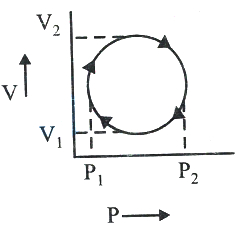
In the cyclic process given in the $P-V$ diagram,the work done is
A
$\pi\left(\frac{P_2-P_1}{2}\right)^2$
B
$\pi\left(\frac{V_2-V_1}{2}\right)^2$
C
$\pi\left(P_2 V_2-P_1 V_1\right)$
D
$\frac{\pi}{4}\left(P_2-P_1\right)\left(V_2-V_1\right)$
Solution
(D) From the given $P-V$ diagram,the cyclic process forms an ellipse.
The length of the axis along the $V$-axis is $2b = V_2 - V_1$,so $b = \frac{V_2 - V_1}{2}$.
The length of the axis along the $P$-axis is $2a = P_2 - P_1$,so $a = \frac{P_2 - P_1}{2}$.
The work done in a cyclic process is equal to the area enclosed by the loop in the $P-V$ diagram.
Area of an ellipse = $\pi ab$.
Therefore,Work done = $\pi \times \left(\frac{P_2 - P_1}{2}\right) \times \left(\frac{V_2 - V_1}{2}\right) = \frac{\pi}{4}(P_2 - P_1)(V_2 - V_1)$.
The length of the axis along the $V$-axis is $2b = V_2 - V_1$,so $b = \frac{V_2 - V_1}{2}$.
The length of the axis along the $P$-axis is $2a = P_2 - P_1$,so $a = \frac{P_2 - P_1}{2}$.
The work done in a cyclic process is equal to the area enclosed by the loop in the $P-V$ diagram.
Area of an ellipse = $\pi ab$.
Therefore,Work done = $\pi \times \left(\frac{P_2 - P_1}{2}\right) \times \left(\frac{V_2 - V_1}{2}\right) = \frac{\pi}{4}(P_2 - P_1)(V_2 - V_1)$.
0 likesView Solution
144
PhysicsEasyMCQAP EAMCET · 2023
$A$ work of $166.28 \ J$ is done to adiabatically compress one mole of a gas. If the increase in the temperature of the gas is $8^{\circ} C$,the gas is $\left(R=8.314 \ J \ mol^{-1} \ K^{-1}\right)$
A
monatomic
B
diatomic
C
polyatomic
D
mixture of diatomic and polyatomic
Solution
(B) Work done on the system,$W = 166.28 \ J$.
Increase in temperature,$\Delta T = 8^{\circ} C = 8 \ K$.
For an adiabatic process,the work done on the gas is given by $W = \frac{nR\Delta T}{\gamma - 1}$.
Given $n = 1 \ mol$ and $R = 8.314 \ J \ mol^{-1} \ K^{-1}$.
Substituting the values: $166.28 = \frac{1 \times 8.314 \times 8}{\gamma - 1}$.
$\gamma - 1 = \frac{66.512}{166.28} = 0.4$.
$\gamma = 1.4$.
Since the adiabatic index $\gamma = 1.4$ corresponds to a diatomic gas,the gas is diatomic.
Increase in temperature,$\Delta T = 8^{\circ} C = 8 \ K$.
For an adiabatic process,the work done on the gas is given by $W = \frac{nR\Delta T}{\gamma - 1}$.
Given $n = 1 \ mol$ and $R = 8.314 \ J \ mol^{-1} \ K^{-1}$.
Substituting the values: $166.28 = \frac{1 \times 8.314 \times 8}{\gamma - 1}$.
$\gamma - 1 = \frac{66.512}{166.28} = 0.4$.
$\gamma = 1.4$.
Since the adiabatic index $\gamma = 1.4$ corresponds to a diatomic gas,the gas is diatomic.
0 likesView Solution
145
PhysicsEasyMCQAP EAMCET · 2023
The relation between absolute temperature $(T)$ and pressure $(P)$ of a gas in an adiabatic process is
A
$P^{\gamma} T^{1-\gamma} = \text{constant}$
B
$P^{1-\gamma} T^{\gamma} = \text{constant}$
C
$P^{\gamma-1} T^{\gamma} = \text{constant}$
D
$P^{\gamma} T^{\gamma-1} = \text{constant}$
Solution
(B) For an adiabatic process,the relation between pressure $(P)$ and volume $(V)$ is given by $PV^{\gamma} = \text{constant}$.
From the ideal gas equation,we know that $PV = nRT$,which implies $V = \frac{nRT}{P}$.
Substituting the expression for $V$ into the adiabatic equation:
$P \left( \frac{nRT}{P} \right)^{\gamma} = \text{constant}$.
Since $n$ and $R$ are constants,we can write:
$P \cdot \frac{T^{\gamma}}{P^{\gamma}} = \text{constant}$.
$P^{1-\gamma} T^{\gamma} = \text{constant}$.
From the ideal gas equation,we know that $PV = nRT$,which implies $V = \frac{nRT}{P}$.
Substituting the expression for $V$ into the adiabatic equation:
$P \left( \frac{nRT}{P} \right)^{\gamma} = \text{constant}$.
Since $n$ and $R$ are constants,we can write:
$P \cdot \frac{T^{\gamma}}{P^{\gamma}} = \text{constant}$.
$P^{1-\gamma} T^{\gamma} = \text{constant}$.
0 likesView Solution
146
PhysicsEasyMCQAP EAMCET · 2023
In a thermodynamic process,if $\Delta W$ and $\Delta U$ are the work done and the change in the internal energy of a system respectively,then:
A
$\Delta U = \Delta W$ in an adiabatic process
B
$\Delta U = \Delta W$ in an isothermal process
C
$\Delta U = -\Delta W$ in an isothermal process
D
$\Delta U = -\Delta W$ in an adiabatic process
Solution
(D) According to the first law of thermodynamics,the heat supplied to a system $(\Delta Q)$ is equal to the sum of the change in internal energy $(\Delta U)$ and the work done by the system $(\Delta W)$:
$\Delta Q = \Delta U + \Delta W$
In an adiabatic process,there is no exchange of heat between the system and the surroundings,so $\Delta Q = 0$.
Substituting this into the first law equation:
$0 = \Delta U + \Delta W$
Therefore,$\Delta U = -\Delta W$.
$\Delta Q = \Delta U + \Delta W$
In an adiabatic process,there is no exchange of heat between the system and the surroundings,so $\Delta Q = 0$.
Substituting this into the first law equation:
$0 = \Delta U + \Delta W$
Therefore,$\Delta U = -\Delta W$.
0 likesView Solution
147
PhysicsEasyMCQAP EAMCET · 2023
The relation between volume $(V)$ and absolute temperature $(T)$ of a gas in an adiabatic process is
A
$TV^{\gamma} = \text{constant}$
B
$VT^{\gamma} = \text{constant}$
C
$TV^{1-\gamma} = \text{constant}$
D
$TV^{\gamma-1} = \text{constant}$
Solution
(D) An adiabatic process is a thermodynamic process in which there is no exchange of heat between the system and its surroundings $(dQ = 0)$.
For an ideal gas undergoing a reversible adiabatic process,the relationship between pressure $(P)$ and volume $(V)$ is given by $PV^{\gamma} = \text{constant}$,where $\gamma$ is the adiabatic index (ratio of specific heats $C_p/C_v$).
Using the ideal gas law $PV = nRT$,we can express pressure as $P = \frac{nRT}{V}$.
Substituting this into the adiabatic equation: $(\frac{nRT}{V})V^{\gamma} = \text{constant}$.
Since $nR$ is a constant,we get $T V^{\gamma-1} = \text{constant}$.
For an ideal gas undergoing a reversible adiabatic process,the relationship between pressure $(P)$ and volume $(V)$ is given by $PV^{\gamma} = \text{constant}$,where $\gamma$ is the adiabatic index (ratio of specific heats $C_p/C_v$).
Using the ideal gas law $PV = nRT$,we can express pressure as $P = \frac{nRT}{V}$.
Substituting this into the adiabatic equation: $(\frac{nRT}{V})V^{\gamma} = \text{constant}$.
Since $nR$ is a constant,we get $T V^{\gamma-1} = \text{constant}$.
0 likesView Solution
148
PhysicsEasyMCQAP EAMCET · 2023
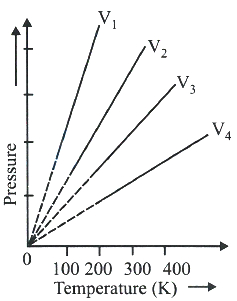
In the given pressure $(P)$ - absolute temperature $(T)$ graph of an ideal gas,the relation between volumes $V_1, V_2, V_3$ and $V_4$ is
A
$V_1=V_2=V_3=V_4$
B
$V_1>V_2>V_3>V_4$
C
$V_1>V_2>V_3 < V_4$
D
$V_1 < V_2 < V_3 < V_4$
Solution
(D) For an ideal gas,the equation of state is $PV = nRT$.
Rearranging this,we get $P = (nR/V)T$.
Comparing this with the equation of a straight line $y = mx$,where $y = P$ and $x = T$,the slope $m$ of the graph is given by $m = nR/V$.
Since $n$ and $R$ are constants,the slope is inversely proportional to the volume,i.e.,$m \propto 1/V$.
From the given graph,the slope of the line for $V_1$ is the largest,and the slope of the line for $V_4$ is the smallest.
Therefore,$m_1 > m_2 > m_3 > m_4$.
Since $V \propto 1/m$,it follows that $V_1 < V_2 < V_3 < V_4$.
Rearranging this,we get $P = (nR/V)T$.
Comparing this with the equation of a straight line $y = mx$,where $y = P$ and $x = T$,the slope $m$ of the graph is given by $m = nR/V$.
Since $n$ and $R$ are constants,the slope is inversely proportional to the volume,i.e.,$m \propto 1/V$.
From the given graph,the slope of the line for $V_1$ is the largest,and the slope of the line for $V_4$ is the smallest.
Therefore,$m_1 > m_2 > m_3 > m_4$.
Since $V \propto 1/m$,it follows that $V_1 < V_2 < V_3 < V_4$.
0 likesView Solution
149
PhysicsEasyMCQAP EAMCET · 2023
The change in internal energy when $20 \,g$ of a gas is heated from $25^{\circ} C$ to $35^{\circ} C$ at constant volume is (Specific heat capacity of the gas at constant volume $C_{v} = 0.2 \,cal \,g^{-1} {}^{\circ} C^{-1}$): (in $\,J$)
A
$74$
B
$336$
C
$136$
D
$168$
Solution
(D) Mass of gas,$m = 20 \,g$.
Change in temperature,$\Delta T = 35^{\circ} C - 25^{\circ} C = 10^{\circ} C$.
Specific heat capacity of the gas at constant volume,$C_{v} = 0.2 \,cal \,g^{-1} {}^{\circ} C^{-1}$.
Since the process occurs at constant volume,the work done $W = 0$.
According to the first law of thermodynamics,$\Delta Q = \Delta U + W$.
Since $W = 0$,the change in internal energy is $\Delta U = \Delta Q = m C_{v} \Delta T$.
Using the conversion factor $1 \,cal = 4.2 \,J$:
$\Delta U = 20 \,g \times 0.2 \,cal \,g^{-1} {}^{\circ} C^{-1} \times 10^{\circ} C \times 4.2 \,J/cal$.
$\Delta U = 40 \times 4.2 \,J = 168 \,J$.
Change in temperature,$\Delta T = 35^{\circ} C - 25^{\circ} C = 10^{\circ} C$.
Specific heat capacity of the gas at constant volume,$C_{v} = 0.2 \,cal \,g^{-1} {}^{\circ} C^{-1}$.
Since the process occurs at constant volume,the work done $W = 0$.
According to the first law of thermodynamics,$\Delta Q = \Delta U + W$.
Since $W = 0$,the change in internal energy is $\Delta U = \Delta Q = m C_{v} \Delta T$.
Using the conversion factor $1 \,cal = 4.2 \,J$:
$\Delta U = 20 \,g \times 0.2 \,cal \,g^{-1} {}^{\circ} C^{-1} \times 10^{\circ} C \times 4.2 \,J/cal$.
$\Delta U = 40 \times 4.2 \,J = 168 \,J$.
0 likesView Solution
150
PhysicsEasyMCQAP EAMCET · 2023
If speed of light in vacuum $\left(3 \times 10^8 \,m/s\right)$, acceleration due to gravity $\left(10 \,m/s^2\right)$ and mass of electron $\left(9.1 \times 10^{-31} \,kg\right)$ are taken as fundamental physical quantities, then the unit of time in this system is
A
$3 \times 10^3 \,s$
B
$5 \times 10^{-19} \,s$
C
$3 \times 10^{19} \,s$
D
$3 \times 10^7 \,s$
Solution
(D) The dimensional formula for speed of light $c$ is $[L T^{-1}]$.
Given $c = 3 \times 10^8 \,m/s$ ... $(1)$
The dimensional formula for acceleration due to gravity $g$ is $[L T^{-2}]$.
Given $g = 10 \,m/s^2$ ... $(2)$
To find the unit of time $[T]$, we divide the dimensions of speed by the dimensions of acceleration:
$\frac{[L T^{-1}]}{[L T^{-2}]} = [T]$
Substituting the given values:
$[T] = \frac{3 \times 10^8}{10} = 3 \times 10^7 \,s$
Therefore, the unit of time in this system is $3 \times 10^7 \,s$.
Given $c = 3 \times 10^8 \,m/s$ ... $(1)$
The dimensional formula for acceleration due to gravity $g$ is $[L T^{-2}]$.
Given $g = 10 \,m/s^2$ ... $(2)$
To find the unit of time $[T]$, we divide the dimensions of speed by the dimensions of acceleration:
$\frac{[L T^{-1}]}{[L T^{-2}]} = [T]$
Substituting the given values:
$[T] = \frac{3 \times 10^8}{10} = 3 \times 10^7 \,s$
Therefore, the unit of time in this system is $3 \times 10^7 \,s$.
0 likesView Solution
151
PhysicsEasyMCQAP EAMCET · 2023
Inside a charged hollow sphere,at any point the electric field $(E)$ and potential $(V)$ are
A
$V=0$ and $E=0$
B
$V$ is constant and $E=0$
C
$V=0$ and $E$ is constant
D
$V$ is constant and $E$ is constant
Solution
(B) For a charged hollow sphere,the electric field $(E)$ inside the sphere is zero because there is no enclosed charge $(q_{enclosed} = 0)$.
According to the relation between electric field and potential,$E = -\frac{dV}{dr}$.
Since $E = 0$,it implies that $\frac{dV}{dr} = 0$,which means the potential $(V)$ must be constant throughout the interior of the sphere.
The value of this constant potential is equal to the potential at the surface of the sphere,given by $V = \frac{1}{4\pi\epsilon_0} \frac{Q}{R}$.
According to the relation between electric field and potential,$E = -\frac{dV}{dr}$.
Since $E = 0$,it implies that $\frac{dV}{dr} = 0$,which means the potential $(V)$ must be constant throughout the interior of the sphere.
The value of this constant potential is equal to the potential at the surface of the sphere,given by $V = \frac{1}{4\pi\epsilon_0} \frac{Q}{R}$.
0 likesView Solution
152
PhysicsEasyMCQAP EAMCET · 2023
The potential is varying with distance $(x, y)$ as $V = \frac{1}{2} (y^2 - 4x) \text{ V}$. The electric field at $x = 1 \text{ m}$ and $y = 1 \text{ m}$ is:
A
$2 \hat{i} + \hat{j} \text{ Vm}^{-1}$
B
$-2 \hat{i} + \hat{j} \text{ Vm}^{-1}$
C
$2 \hat{i} - \hat{j} \text{ Vm}^{-1}$
D
$-2 \hat{i} + 2 \hat{j} \text{ Vm}^{-1}$
Solution
(C) The electric field $\vec{E}$ is given by the negative gradient of the potential $V$: $\vec{E} = -\vec{\nabla} V = -\left( \frac{\partial V}{\partial x} \hat{i} + \frac{\partial V}{\partial y} \hat{j} \right)$.
Given $V = \frac{1}{2} y^2 - 2x$.
Calculating partial derivatives:
$\frac{\partial V}{\partial x} = -2$
$\frac{\partial V}{\partial y} = y$
Substituting these into the electric field formula:
$\vec{E} = -(-2 \hat{i} + y \hat{j}) = 2 \hat{i} - y \hat{j}$.
At the point $(x = 1 \text{ m}, y = 1 \text{ m})$:
$\vec{E} = 2 \hat{i} - (1) \hat{j} = 2 \hat{i} - \hat{j} \text{ Vm}^{-1}$.
Given $V = \frac{1}{2} y^2 - 2x$.
Calculating partial derivatives:
$\frac{\partial V}{\partial x} = -2$
$\frac{\partial V}{\partial y} = y$
Substituting these into the electric field formula:
$\vec{E} = -(-2 \hat{i} + y \hat{j}) = 2 \hat{i} - y \hat{j}$.
At the point $(x = 1 \text{ m}, y = 1 \text{ m})$:
$\vec{E} = 2 \hat{i} - (1) \hat{j} = 2 \hat{i} - \hat{j} \text{ Vm}^{-1}$.
0 likesView Solution
153
PhysicsMediumMCQAP EAMCET · 2023
Three point charges $1 \text{ C}, 2 \text{ C}$ and $3 \text{ C}$ are placed at the corners of an equilateral triangle of side $1 \text{ m}$. The work done to move these charges to the corners of another equilateral triangle of side $0.5 \text{ m}$ is
A
$199 \times 10^9 \text{ J}$
B
$19 \times 10^9 \text{ J}$
C
$99 \times 10^9 \text{ J}$
D
$29 \times 10^9 \text{ J}$
Solution
(C) The potential energy $U$ of a system of point charges is given by $U = k \sum \frac{q_i q_j}{r_{ij}}$.
Initial potential energy $U_i$ with side $r_1 = 1 \text{ m}$:
$U_i = k \left[ \frac{1 \times 2}{1} + \frac{2 \times 3}{1} + \frac{3 \times 1}{1} \right] = k [2 + 6 + 3] = 11k$.
Final potential energy $U_f$ with side $r_2 = 0.5 \text{ m}$:
$U_f = k \left[ \frac{1 \times 2}{0.5} + \frac{2 \times 3}{0.5} + \frac{3 \times 1}{0.5} \right] = k [4 + 12 + 6] = 22k$.
The work done $W$ is the change in potential energy:
$W = U_f - U_i = 22k - 11k = 11k$.
Given $k = 9 \times 10^9 \text{ N m}^2 \text{ C}^{-2}$,
$W = 11 \times 9 \times 10^9 = 99 \times 10^9 \text{ J}$.
Initial potential energy $U_i$ with side $r_1 = 1 \text{ m}$:
$U_i = k \left[ \frac{1 \times 2}{1} + \frac{2 \times 3}{1} + \frac{3 \times 1}{1} \right] = k [2 + 6 + 3] = 11k$.
Final potential energy $U_f$ with side $r_2 = 0.5 \text{ m}$:
$U_f = k \left[ \frac{1 \times 2}{0.5} + \frac{2 \times 3}{0.5} + \frac{3 \times 1}{0.5} \right] = k [4 + 12 + 6] = 22k$.
The work done $W$ is the change in potential energy:
$W = U_f - U_i = 22k - 11k = 11k$.
Given $k = 9 \times 10^9 \text{ N m}^2 \text{ C}^{-2}$,
$W = 11 \times 9 \times 10^9 = 99 \times 10^9 \text{ J}$.
0 likesView Solution
154
PhysicsEasyMCQAP EAMCET · 2023
Two charges $+q$ and $-q$,each $1 \mu C$,are arranged as shown in the figure. If $x=2 \text{ cm}$ and $y=3 \text{ cm}$,then the potential difference $(V_A - V_B)$ is:
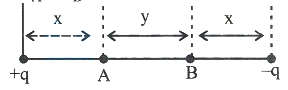
A
$5.4 \times 10^2 \text{ V}$
B
$5.4 \times 10^5 \text{ V}$
C
$5.2 \times 10^2 \text{ V}$
D
$2.7 \times 10^5 \text{ V}$
Solution
(B) The potential at point $A$ due to $+q$ is $V_{A(+q)} = \frac{1}{4\pi\epsilon_0} \frac{q}{x}$ and due to $-q$ is $V_{A(-q)} = \frac{1}{4\pi\epsilon_0} \frac{-q}{x+y}$.
Thus,$V_A = \frac{q}{4\pi\epsilon_0} \left( \frac{1}{x} - \frac{1}{x+y} \right) = \frac{q}{4\pi\epsilon_0} \left( \frac{y}{x(x+y)} \right)$.
Similarly,the potential at point $B$ is $V_B = \frac{1}{4\pi\epsilon_0} \frac{q}{x+y} + \frac{1}{4\pi\epsilon_0} \frac{-q}{x} = \frac{q}{4\pi\epsilon_0} \left( \frac{1}{x+y} - \frac{1}{x} \right) = -V_A$.
Therefore,$V_A - V_B = V_A - (-V_A) = 2V_A = 2 \times \frac{q}{4\pi\epsilon_0} \left( \frac{y}{x(x+y)} \right)$.
Given $q = 10^{-6} \text{ C}$,$x = 0.02 \text{ m}$,$y = 0.03 \text{ m}$,and $\frac{1}{4\pi\epsilon_0} = 9 \times 10^9 \text{ Nm}^2/\text{C}^2$.
$V_A - V_B = 2 \times 9 \times 10^9 \times 10^{-6} \times \frac{0.03}{0.02(0.02+0.03)} = 18 \times 10^3 \times \frac{0.03}{0.02 \times 0.05} = 18 \times 10^3 \times \frac{0.03}{0.001} = 18 \times 10^3 \times 30 = 5.4 \times 10^5 \text{ V}$.
Thus,$V_A = \frac{q}{4\pi\epsilon_0} \left( \frac{1}{x} - \frac{1}{x+y} \right) = \frac{q}{4\pi\epsilon_0} \left( \frac{y}{x(x+y)} \right)$.
Similarly,the potential at point $B$ is $V_B = \frac{1}{4\pi\epsilon_0} \frac{q}{x+y} + \frac{1}{4\pi\epsilon_0} \frac{-q}{x} = \frac{q}{4\pi\epsilon_0} \left( \frac{1}{x+y} - \frac{1}{x} \right) = -V_A$.
Therefore,$V_A - V_B = V_A - (-V_A) = 2V_A = 2 \times \frac{q}{4\pi\epsilon_0} \left( \frac{y}{x(x+y)} \right)$.
Given $q = 10^{-6} \text{ C}$,$x = 0.02 \text{ m}$,$y = 0.03 \text{ m}$,and $\frac{1}{4\pi\epsilon_0} = 9 \times 10^9 \text{ Nm}^2/\text{C}^2$.
$V_A - V_B = 2 \times 9 \times 10^9 \times 10^{-6} \times \frac{0.03}{0.02(0.02+0.03)} = 18 \times 10^3 \times \frac{0.03}{0.02 \times 0.05} = 18 \times 10^3 \times \frac{0.03}{0.001} = 18 \times 10^3 \times 30 = 5.4 \times 10^5 \text{ V}$.
0 likesView Solution
155
PhysicsEasyMCQAP EAMCET · 2023
The strongest force in nature is
A
nuclear force
B
gravitational force
C
coulomb force
D
frictional force
Solution
(A) In nature,there are four fundamental forces: gravitational force,electromagnetic force,weak nuclear force,and strong nuclear force. Among these,the strong nuclear force is the most powerful force,acting between nucleons (protons and neutrons) to hold the nucleus together. Therefore,the strongest force in nature is the nuclear force.
0 likesView Solution
156
PhysicsEasyMCQAP EAMCET · 2023
Curl the palm of your right hand around the circular wire with the fingers pointing in the direction of current and the thumb gives the direction of the magnetic field. In this case,the upper side of the loop may be thought of as
A
direction of current
B
direction of electric field
C
south pole
D
north pole
Solution
(D) According to the Right-Hand Thumb Rule for a circular current-carrying loop,if the fingers of the right hand are curled in the direction of the current,the thumb points in the direction of the magnetic field lines inside the loop.
If the current flows in an anticlockwise direction when viewed from the top,the magnetic field lines point upwards (towards the observer).
Since magnetic field lines emerge from the North Pole,the face of the loop where the current appears anticlockwise acts as a North Pole.
Conversely,if the current flows in a clockwise direction,the face acts as a South Pole.
Therefore,the upper side of the loop acts as a North Pole if the current is anticlockwise.
If the current flows in an anticlockwise direction when viewed from the top,the magnetic field lines point upwards (towards the observer).
Since magnetic field lines emerge from the North Pole,the face of the loop where the current appears anticlockwise acts as a North Pole.
Conversely,if the current flows in a clockwise direction,the face acts as a South Pole.
Therefore,the upper side of the loop acts as a North Pole if the current is anticlockwise.
0 likesView Solution
157
PhysicsEasyMCQAP EAMCET · 2023
For parallel conductors and steady currents, the results in accordance with Newton's third law are
A
Biot-Savart law and the Lorentz force
B
Biot-Savart law and Ampere's law
C
Ampere's law and the Lorentz force
D
Lenz's law and Lorentz force
Solution
(A) When two parallel conductors carry steady currents, each conductor produces a magnetic field in the space around it, which is described by the Biot-Savart law.
These currents then experience a magnetic force due to the magnetic field produced by the other, which is described by the Lorentz force law $(F = I \vec{L} \times \vec{B})$.
According to Newton's third law, the force exerted by the first conductor on the second is equal in magnitude and opposite in direction to the force exerted by the second conductor on the first.
Thus, the combination of the Biot-Savart law and the Lorentz force law explains the interaction between parallel conductors in accordance with Newton's third law.
These currents then experience a magnetic force due to the magnetic field produced by the other, which is described by the Lorentz force law $(F = I \vec{L} \times \vec{B})$.
According to Newton's third law, the force exerted by the first conductor on the second is equal in magnitude and opposite in direction to the force exerted by the second conductor on the first.
Thus, the combination of the Biot-Savart law and the Lorentz force law explains the interaction between parallel conductors in accordance with Newton's third law.
0 likesView Solution
158
PhysicsEasyMCQAP EAMCET · 2023
Among the following,Ampere's circuital law is represented by
A
$\oint B \cdot dl = 0$
B
$\oint B \cdot dl = \mu_0 I$
C
$\oint B \cdot dl = \frac{\mu_0}{I}$
D
$\oint B \cdot dl = \mu_0$
Solution
(B) Ampere's circuital law states that the line integral of the magnetic field $B$ around any closed loop is equal to $\mu_0$ times the total current $I$ passing through the surface enclosed by the loop.
Mathematically,this is expressed as $\oint B \cdot dl = \mu_0 I$.
Mathematically,this is expressed as $\oint B \cdot dl = \mu_0 I$.
0 likesView Solution
159
PhysicsEasyMCQAP EAMCET · 2023
The magnetic force $F = q(v \times B)$ is
A
parallel to both $v$ and $B$
B
perpendicular to $v$
C
perpendicular to both $v$ and $B$
D
parallel to $B$
Solution
(C) The magnetic force on a moving charge is given by the Lorentz force formula: $F = q(v \times B)$.
By the definition of the cross product of two vectors,the resulting vector $F$ is always perpendicular to the plane containing the two vectors $v$ and $B$.
Therefore,the magnetic force $F$ is perpendicular to both the velocity vector $v$ and the magnetic field vector $B$.
By the definition of the cross product of two vectors,the resulting vector $F$ is always perpendicular to the plane containing the two vectors $v$ and $B$.
Therefore,the magnetic force $F$ is perpendicular to both the velocity vector $v$ and the magnetic field vector $B$.
0 likesView Solution
160
PhysicsEasyMCQAP EAMCET · 2023
The force acting per unit length on a very long straight conductor carrying a steady current of $1 \,A$ flowing from south to north is: (The horizontal component of the earth's magnetic field at the place is $3 \times 10^{-5} \,T$ and its direction is from geographical south to geographical north.)
A
$3 \times 10^{-5} \,N/m$
B
$1 \times 10^{-5} \,N/m$
C
$0$
D
$1.5 \times 10^{-5} \,N/m$
Solution
(C) The force per unit length on a current-carrying conductor in a magnetic field is given by the formula: $\frac{F}{l} = iB \sin \theta$.
Here,the current $i = 1 \,A$ flows from south to north.
The magnetic field $B = 3 \times 10^{-5} \,T$ also points from south to north.
Since the current and the magnetic field are in the same direction,the angle $\theta$ between them is $0^\circ$.
Therefore,the force per unit length is: $\frac{F}{l} = 1 \times (3 \times 10^{-5}) \times \sin(0^\circ) = 1 \times (3 \times 10^{-5}) \times 0 = 0 \,N/m$.
Here,the current $i = 1 \,A$ flows from south to north.
The magnetic field $B = 3 \times 10^{-5} \,T$ also points from south to north.
Since the current and the magnetic field are in the same direction,the angle $\theta$ between them is $0^\circ$.
Therefore,the force per unit length is: $\frac{F}{l} = 1 \times (3 \times 10^{-5}) \times \sin(0^\circ) = 1 \times (3 \times 10^{-5}) \times 0 = 0 \,N/m$.
0 likesView Solution
161
PhysicsEasyMCQAP EAMCET · 2023
$A$ galvanometer has a deflection of $25$ divisions for a current of $0.1 \ A$ flowing through it. Then the current sensitivity of the galvanometer is (in $div/A$)
A
$25$
B
$250$
C
$2.5$
D
$0.25$
Solution
(B) Current sensitivity is defined as the deflection produced per unit current flowing through the galvanometer.
It is given by the formula: $I_{S} = \frac{\theta}{I}$
Where $\theta$ is the deflection in divisions and $I$ is the current in amperes.
Given: $\theta = 25 \ div$ and $I = 0.1 \ A$.
Therefore,$I_{S} = \frac{25}{0.1} = 250 \ div/A$.
It is given by the formula: $I_{S} = \frac{\theta}{I}$
Where $\theta$ is the deflection in divisions and $I$ is the current in amperes.
Given: $\theta = 25 \ div$ and $I = 0.1 \ A$.
Therefore,$I_{S} = \frac{25}{0.1} = 250 \ div/A$.
0 likesView Solution
162
PhysicsEasyMCQAP EAMCET · 2023
$A$ circular coil of $30$ turns and radius $8 \,cm$ carrying a current of $6 \,A$ is suspended vertically in a uniform horizontal magnetic field of magnitude $1.0 \,T$. The field lines make an angle of $20^{\circ}$ with the normal of the coil. The magnitude of the counter torque that must be applied to prevent the coil from turning is (in $\,Nm$)
A
$5.4$
B
$7.2$
C
$3.6$
D
$1.8$
Solution
(D) The torque $\tau$ on a current-carrying coil in a magnetic field is given by $\tau = N i A B \sin \theta$, where $\theta$ is the angle between the normal to the coil and the magnetic field.
Given:
$N = 30$
$r = 8 \,cm = 0.08 \,m$
$i = 6 \,A$
$B = 1.0 \,T$
$\theta = 20^{\circ}$
Area $A = \pi r^2 = 3.14 \times (0.08)^2 = 3.14 \times 0.0064 = 0.020096 \,m^2$
Calculating the torque:
$\tau = 30 \times 6 \times 0.020096 \times 1.0 \times \sin(20^{\circ})$
$\tau = 180 \times 0.020096 \times 0.342$
$\tau \approx 1.236 \,Nm$
Note: Based on the provided options and standard textbook problem variations where $\theta$ is often $30^{\circ}$, if $\theta = 30^{\circ}$, then $\tau = 30 \times 6 \times 3.14 \times (0.08)^2 \times 1.0 \times 0.5 = 1.808 \,Nm$. Given the options, the intended angle was likely $30^{\circ}$.
Given:
$N = 30$
$r = 8 \,cm = 0.08 \,m$
$i = 6 \,A$
$B = 1.0 \,T$
$\theta = 20^{\circ}$
Area $A = \pi r^2 = 3.14 \times (0.08)^2 = 3.14 \times 0.0064 = 0.020096 \,m^2$
Calculating the torque:
$\tau = 30 \times 6 \times 0.020096 \times 1.0 \times \sin(20^{\circ})$
$\tau = 180 \times 0.020096 \times 0.342$
$\tau \approx 1.236 \,Nm$
Note: Based on the provided options and standard textbook problem variations where $\theta$ is often $30^{\circ}$, if $\theta = 30^{\circ}$, then $\tau = 30 \times 6 \times 3.14 \times (0.08)^2 \times 1.0 \times 0.5 = 1.808 \,Nm$. Given the options, the intended angle was likely $30^{\circ}$.
0 likesView Solution
163
PhysicsEasyMCQAP EAMCET · 2023
$A$ wire loop of irregular shape carrying current is placed in an external magnetic field. If the wire is flexible,the shape of the loop changes to
A
helical
B
circular
C
straight line
D
parabolic
Solution
(B) When a flexible wire loop carrying current is placed in an external magnetic field,it experiences magnetic forces that tend to expand the loop.
To maximize the magnetic flux linked with the loop,the loop tends to enclose the maximum possible area for a given perimeter.
According to geometric principles,for a fixed perimeter,a circle encloses the maximum area.
Therefore,the loop changes its shape to a circular shape with its plane normal to the magnetic field.
To maximize the magnetic flux linked with the loop,the loop tends to enclose the maximum possible area for a given perimeter.
According to geometric principles,for a fixed perimeter,a circle encloses the maximum area.
Therefore,the loop changes its shape to a circular shape with its plane normal to the magnetic field.
0 likesView Solution
164
PhysicsEasyMCQAP EAMCET · 2023
The magnitude of the axial field due to a short bar magnet at a distance of $50 \,cm$ from its mid-point is (The magnetic moment of the bar magnet is $0.4 \,Am^2$)
A
$3.2 \times 10^{-7} \,T$
B
$1.6 \times 10^{-7} \,T$
C
$6.4 \times 10^{-7} \,T$
D
$4.8 \times 10^{-7} \,T$
Solution
(C) Given: Magnetic moment,$m = 0.4 \,Am^2$
Distance,$r = 50 \,cm = 0.5 \,m$
The formula for the magnitude of the axial magnetic field of a short bar magnet is:
$B_{\text{axial}} = \frac{\mu_0}{4\pi} \left( \frac{2m}{r^3} \right)$
Substituting the values:
$B_{\text{axial}} = (10^{-7}) \times \frac{2 \times 0.4}{(0.5)^3}$
$B_{\text{axial}} = 10^{-7} \times \frac{0.8}{0.125}$
$B_{\text{axial}} = 10^{-7} \times 6.4 = 6.4 \times 10^{-7} \,T$
Distance,$r = 50 \,cm = 0.5 \,m$
The formula for the magnitude of the axial magnetic field of a short bar magnet is:
$B_{\text{axial}} = \frac{\mu_0}{4\pi} \left( \frac{2m}{r^3} \right)$
Substituting the values:
$B_{\text{axial}} = (10^{-7}) \times \frac{2 \times 0.4}{(0.5)^3}$
$B_{\text{axial}} = 10^{-7} \times \frac{0.8}{0.125}$
$B_{\text{axial}} = 10^{-7} \times 6.4 = 6.4 \times 10^{-7} \,T$
0 likesView Solution
165
PhysicsEasyMCQAP EAMCET · 2023
The axial field $(B_{A})$ and the equatorial field $(B_{E})$ due to a short bar magnet at equal distances are related as:
A
$B_{A} = 2 B_{E}$
B
$B_{A} = -2 B_{E}$
C
$B_{A} = -B_{E}$
D
$B_{A} = -2 \pi B_{E}$
Solution
(A) For a short bar magnet of magnetic moment $m$ at a distance $r$ from its center:
$1$. The magnetic field on the axial line is given by: $B_{A} = \frac{\mu_{0}}{4 \pi} \frac{2m}{r^{3}}$
$2$. The magnetic field on the equatorial line is given by: $B_{E} = \frac{\mu_{0}}{4 \pi} \frac{m}{r^{3}}$
$3$. Comparing the two expressions,we can see that $B_{A} = 2 \times \left( \frac{\mu_{0}}{4 \pi} \frac{m}{r^{3}} \right) = 2 B_{E}$.
Therefore,the correct relation is $B_{A} = 2 B_{E}$.
$1$. The magnetic field on the axial line is given by: $B_{A} = \frac{\mu_{0}}{4 \pi} \frac{2m}{r^{3}}$
$2$. The magnetic field on the equatorial line is given by: $B_{E} = \frac{\mu_{0}}{4 \pi} \frac{m}{r^{3}}$
$3$. Comparing the two expressions,we can see that $B_{A} = 2 \times \left( \frac{\mu_{0}}{4 \pi} \frac{m}{r^{3}} \right) = 2 B_{E}$.
Therefore,the correct relation is $B_{A} = 2 B_{E}$.
0 likesView Solution
166
PhysicsMediumMCQAP EAMCET · 2023
$A$ solenoid has a core of a material with relative permeability $400$. The windings of the solenoid are insulated from the core and carry a current of $4 \,A$. If the number of turns is $500$ per metre,then the magnetizing field is
A
$2 \pi \times 10^3 \,Am^{-1}$
B
$1 \times 10^3 \,Am^{-1}$
C
$4 \times 10^3 \,Am^{-1}$
D
None of the above
Solution
(D) The magnetizing field (or magnetic intensity) $H$ of a solenoid is given by the formula $H = nI$,where $n$ is the number of turns per unit length and $I$ is the current flowing through the windings.
Given:
$n = 500 \,m^{-1}$
$I = 4 \,A$
Substituting these values into the formula:
$H = 500 \times 4 = 2000 \,Am^{-1}$
$H = 2 \times 10^3 \,Am^{-1}$
Comparing this result with the given options,none of the options match $2000 \,Am^{-1}$. Therefore,the correct option is $D$.
Given:
$n = 500 \,m^{-1}$
$I = 4 \,A$
Substituting these values into the formula:
$H = 500 \times 4 = 2000 \,Am^{-1}$
$H = 2 \times 10^3 \,Am^{-1}$
Comparing this result with the given options,none of the options match $2000 \,Am^{-1}$. Therefore,the correct option is $D$.
0 likesView Solution
167
PhysicsEasyMCQAP EAMCET · 2023
$A$ wire is first bent in the form of a circular coil of $5$ turns and the same wire is then bent in the form of another circular coil of $10$ turns. If the same current is passed in both the coils,then the ratio of the magnetic fields at their centres is
A
$1: 8$
B
$1: 1$
C
$1: 2$
D
$1: 4$
Solution
(D) The magnetic field at the centre of a circular coil is given by $B = \frac{\mu_0 n I}{2r}$,where $n$ is the number of turns,$I$ is the current,and $r$ is the radius of the coil.
Let $L$ be the total length of the wire. For a coil with $n$ turns and radius $r$,$L = n(2\pi r)$,which implies $r = \frac{L}{2\pi n}$.
Substituting $r$ into the magnetic field formula: $B = \frac{\mu_0 n I}{2(L / 2\pi n)} = \frac{\mu_0 n^2 I \pi}{L}$.
Since the length of the wire $L$ and the current $I$ are constant,$B \propto n^2$.
Therefore,the ratio of the magnetic fields is $\frac{B_1}{B_2} = \left( \frac{n_1}{n_2} \right)^2$.
Given $n_1 = 5$ and $n_2 = 10$,the ratio is $\frac{B_1}{B_2} = \left( \frac{5}{10} \right)^2 = \left( \frac{1}{2} \right)^2 = \frac{1}{4}$.
Let $L$ be the total length of the wire. For a coil with $n$ turns and radius $r$,$L = n(2\pi r)$,which implies $r = \frac{L}{2\pi n}$.
Substituting $r$ into the magnetic field formula: $B = \frac{\mu_0 n I}{2(L / 2\pi n)} = \frac{\mu_0 n^2 I \pi}{L}$.
Since the length of the wire $L$ and the current $I$ are constant,$B \propto n^2$.
Therefore,the ratio of the magnetic fields is $\frac{B_1}{B_2} = \left( \frac{n_1}{n_2} \right)^2$.
Given $n_1 = 5$ and $n_2 = 10$,the ratio is $\frac{B_1}{B_2} = \left( \frac{5}{10} \right)^2 = \left( \frac{1}{2} \right)^2 = \frac{1}{4}$.
0 likesView Solution
168
PhysicsEasyMCQAP EAMCET · 2023
The magnetic field intensity at the centre of a circular wire of radius $0.1 \,m$ carrying a current of $0.2 \,A$ is:
A
$2 \pi \times 10^{-7} \,T$
B
$\pi \times 10^{-7} \,T$
C
$10^{-7} \,T$
D
$4 \pi \times 10^{-7} \,T$
Solution
(D) The formula for the magnetic field intensity $B$ at the centre of a circular loop is given by $B = \frac{\mu_0 i}{2r}$.
Given values are: current $i = 0.2 \,A$ and radius $r = 0.1 \,m$.
The permeability of free space is $\mu_0 = 4 \pi \times 10^{-7} \,T \cdot m/A$.
Substituting these values into the formula:
$B = \frac{(4 \pi \times 10^{-7} \,T \cdot m/A) \times (0.2 \,A)}{2 \times (0.1 \,m)}$
$B = \frac{4 \pi \times 10^{-7} \times 0.2}{0.2}$
$B = 4 \pi \times 10^{-7} \,T$.
Given values are: current $i = 0.2 \,A$ and radius $r = 0.1 \,m$.
The permeability of free space is $\mu_0 = 4 \pi \times 10^{-7} \,T \cdot m/A$.
Substituting these values into the formula:
$B = \frac{(4 \pi \times 10^{-7} \,T \cdot m/A) \times (0.2 \,A)}{2 \times (0.1 \,m)}$
$B = \frac{4 \pi \times 10^{-7} \times 0.2}{0.2}$
$B = 4 \pi \times 10^{-7} \,T$.
0 likesView Solution
169
PhysicsEasyMCQAP EAMCET · 2023
Consider a tightly wound $100$ turn coil of radius $10 \,cm$ carrying a current of $2 \,A$. The magnitude of the magnetic field at the centre of the coil is
A
$3.14 \times 10^{-4} \,T$
B
$6.28 \times 10^{-4} \,T$
C
$12.56 \times 10^{-4} \,T$
D
$0$
Solution
(C) Given:
Number of turns,$n = 100$
Radius,$r = 10 \,cm = 0.1 \,m$
Current,$I = 2 \,A$
Permeability of free space,$\mu_0 = 4\pi \times 10^{-7} \,T \cdot m/A$
The magnetic field $B$ at the centre of a circular coil is given by the formula:
$B = \frac{\mu_0 n I}{2r}$
Substituting the values:
$B = \frac{(4\pi \times 10^{-7}) \times 100 \times 2}{2 \times 0.1}$
$B = \frac{4\pi \times 10^{-5} \times 2}{0.2}$
$B = \frac{8\pi \times 10^{-5}}{0.2} = 40\pi \times 10^{-5} = 4\pi \times 10^{-4} \,T$
Using $\pi \approx 3.14$:
$B = 4 \times 3.14 \times 10^{-4} \,T = 12.56 \times 10^{-4} \,T$
Number of turns,$n = 100$
Radius,$r = 10 \,cm = 0.1 \,m$
Current,$I = 2 \,A$
Permeability of free space,$\mu_0 = 4\pi \times 10^{-7} \,T \cdot m/A$
The magnetic field $B$ at the centre of a circular coil is given by the formula:
$B = \frac{\mu_0 n I}{2r}$
Substituting the values:
$B = \frac{(4\pi \times 10^{-7}) \times 100 \times 2}{2 \times 0.1}$
$B = \frac{4\pi \times 10^{-5} \times 2}{0.2}$
$B = \frac{8\pi \times 10^{-5}}{0.2} = 40\pi \times 10^{-5} = 4\pi \times 10^{-4} \,T$
Using $\pi \approx 3.14$:
$B = 4 \times 3.14 \times 10^{-4} \,T = 12.56 \times 10^{-4} \,T$
0 likesView Solution
170
PhysicsEasyMCQAP EAMCET · 2023
$A$ straight wire carrying a current of $12 \,A$ is bent into a semi-circular arc of radius $2 \,cm$ as shown in the figure. Then the magnetic field due to the straight segments at the centre of the arc is
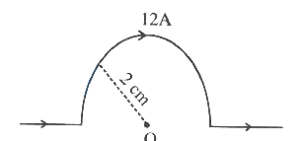
A
$12 \,T$
B
$6 \,T$
C
$24 \,T$
D
$0$
Solution
(D) According to the Biot-Savart Law, the magnetic field $d\vec{B}$ due to a current element $i d\vec{l}$ at a point with position vector $\vec{r}$ is given by $d\vec{B} = \frac{\mu_0}{4\pi} \frac{i d\vec{l} \times \vec{r}}{r^3}$.
For the straight segments of the wire, the current element $d\vec{l}$ and the position vector $\vec{r}$ (pointing from the element to the center $O$) are collinear (either parallel or anti-parallel).
Therefore, the cross product $d\vec{l} \times \vec{r} = 0$.
Consequently, the magnetic field at the center $O$ due to the straight segments is zero.
For the straight segments of the wire, the current element $d\vec{l}$ and the position vector $\vec{r}$ (pointing from the element to the center $O$) are collinear (either parallel or anti-parallel).
Therefore, the cross product $d\vec{l} \times \vec{r} = 0$.
Consequently, the magnetic field at the center $O$ due to the straight segments is zero.
0 likesView Solution
171
PhysicsMediumMCQAP EAMCET · 2023
If ' $\mu$ ' is the magnetic moment of an electron revolving around a hydrogen nucleus in an orbit of principal quantum number ' $n$ ',then
A
$\mu \propto n^2$
B
$\mu \propto n$
C
$\mu \propto \frac{1}{n}$
D
$\mu \propto \frac{1}{n^2}$
Solution
(B) The magnetic moment $\mu$ of an electron revolving in an orbit is given by $\mu = I A$,where $I$ is the current and $A$ is the area of the orbit.
For an electron revolving in an orbit of radius $r$ with velocity $v$,the current $I = \frac{e}{T} = \frac{ev}{2 \pi r}$.
The area $A = \pi r^2$.
Thus,$\mu = \left( \frac{ev}{2 \pi r} \right) (\pi r^2) = \frac{evr}{2}$.
According to Bohr's quantization condition,the angular momentum $L = mvr = \frac{nh}{2 \pi}$.
Therefore,$vr = \frac{nh}{2 \pi m}$.
Substituting this into the expression for $\mu$:
$\mu = \frac{e}{2} \left( \frac{nh}{2 \pi m} \right) = \frac{neh}{4 \pi m}$.
Since $e$,$h$,and $m$ are constants,we have $\mu \propto n$.
For an electron revolving in an orbit of radius $r$ with velocity $v$,the current $I = \frac{e}{T} = \frac{ev}{2 \pi r}$.
The area $A = \pi r^2$.
Thus,$\mu = \left( \frac{ev}{2 \pi r} \right) (\pi r^2) = \frac{evr}{2}$.
According to Bohr's quantization condition,the angular momentum $L = mvr = \frac{nh}{2 \pi}$.
Therefore,$vr = \frac{nh}{2 \pi m}$.
Substituting this into the expression for $\mu$:
$\mu = \frac{e}{2} \left( \frac{nh}{2 \pi m} \right) = \frac{neh}{4 \pi m}$.
Since $e$,$h$,and $m$ are constants,we have $\mu \propto n$.
0 likesView Solution
172
PhysicsEasyMCQAP EAMCET · 2023
$A$ charged particle, when entering a uniform magnetic field, moves in a helical path. If its angular velocity is $4 \pi \times 10^6 \text{ rad s}^{-1}$ and its velocity in the direction of the magnetic field is $3 \times 10^5 \text{ m s}^{-1}$, then the pitch of the helix is: (in $\text{ cm}$)
A
$5$
B
$10$
C
$15$
D
$20$
Solution
(C) The angular velocity is given by $\omega = 4 \pi \times 10^6 \text{ rad s}^{-1}$.
The velocity component parallel to the magnetic field is $v_{\parallel} = 3 \times 10^5 \text{ m s}^{-1}$.
The time period of one complete revolution is $T = \frac{2 \pi}{\omega}$.
The pitch of the helix is the distance traveled along the magnetic field direction in one time period: $\text{Pitch} = v_{\parallel} \times T$.
Substituting the values: $\text{Pitch} = (3 \times 10^5) \times \left( \frac{2 \pi}{4 \pi \times 10^6} \right)$.
$\text{Pitch} = 3 \times 10^5 \times \frac{1}{2 \times 10^6} = \frac{3}{20} \text{ m} = 0.15 \text{ m}$.
Converting to centimeters: $0.15 \text{ m} = 15 \text{ cm}$.
The velocity component parallel to the magnetic field is $v_{\parallel} = 3 \times 10^5 \text{ m s}^{-1}$.
The time period of one complete revolution is $T = \frac{2 \pi}{\omega}$.
The pitch of the helix is the distance traveled along the magnetic field direction in one time period: $\text{Pitch} = v_{\parallel} \times T$.
Substituting the values: $\text{Pitch} = (3 \times 10^5) \times \left( \frac{2 \pi}{4 \pi \times 10^6} \right)$.
$\text{Pitch} = 3 \times 10^5 \times \frac{1}{2 \times 10^6} = \frac{3}{20} \text{ m} = 0.15 \text{ m}$.
Converting to centimeters: $0.15 \text{ m} = 15 \text{ cm}$.
0 likesView Solution
173
PhysicsMediumMCQAP EAMCET · 2023
If $q$ is the electric charge,$B$ is the magnetic field,$R$ is the dee radius,and $m$ is the mass of ions,the kinetic energy of the ions in a cyclotron is given by
A
$\frac{qBR}{2m}$
B
$\frac{qBR}{m}$
C
$\frac{q^2B^2R^2}{4\pi m}$
D
$\frac{q^2B^2R^2}{2m}$
Solution
(D) In a cyclotron,the radius $R$ of the path of an ion is given by the relation $R = \frac{mv}{qB}$,where $v$ is the velocity of the ion.
Rearranging this for velocity,we get $v = \frac{qBR}{m}$.
The kinetic energy $(K.E.)$ of the ion is given by the formula $K.E. = \frac{1}{2}mv^2$.
Substituting the expression for $v$ into the kinetic energy formula:
$K.E. = \frac{1}{2}m \left( \frac{qBR}{m} \right)^2$
$K.E. = \frac{1}{2}m \left( \frac{q^2B^2R^2}{m^2} \right)$
$K.E. = \frac{q^2B^2R^2}{2m}$.
Rearranging this for velocity,we get $v = \frac{qBR}{m}$.
The kinetic energy $(K.E.)$ of the ion is given by the formula $K.E. = \frac{1}{2}mv^2$.
Substituting the expression for $v$ into the kinetic energy formula:
$K.E. = \frac{1}{2}m \left( \frac{qBR}{m} \right)^2$
$K.E. = \frac{1}{2}m \left( \frac{q^2B^2R^2}{m^2} \right)$
$K.E. = \frac{q^2B^2R^2}{2m}$.
0 likesView Solution
174
PhysicsMediumMCQAP EAMCET · 2023
The distance moved by a charged particle along the magnetic field (the component of velocity is parallel to the magnetic field) in one rotation is given by ($m$ - mass of the particle,$v$ - velocity of the particle,$q$ - charge of the particle,$B$ - magnetic field).
A
$\frac{2 \pi m v}{q B}$
B
$\frac{\pi mv}{qB}$
C
$\frac{4 \pi mv}{qB}$
D
$\frac{2 \pi m v}{q B^2}$
Solution
(A) When a charged particle moves in a magnetic field with a velocity component $v_{\perp}$ perpendicular to the field and $v_{\parallel}$ parallel to the field,it follows a helical path.
The time period $T$ for one complete rotation is determined by the perpendicular component of velocity:
$T = \frac{2 \pi m}{q B}$
The distance moved along the magnetic field in one rotation is called the pitch $(p)$.
$p = v_{\parallel} \times T$
Substituting the value of $T$:
$p = v_{\parallel} \times \frac{2 \pi m}{q B}$
If the total velocity $v$ is considered as the parallel component,the distance is $\frac{2 \pi m v}{q B}$.
The time period $T$ for one complete rotation is determined by the perpendicular component of velocity:
$T = \frac{2 \pi m}{q B}$
The distance moved along the magnetic field in one rotation is called the pitch $(p)$.
$p = v_{\parallel} \times T$
Substituting the value of $T$:
$p = v_{\parallel} \times \frac{2 \pi m}{q B}$
If the total velocity $v$ is considered as the parallel component,the distance is $\frac{2 \pi m v}{q B}$.
0 likesView Solution
175
PhysicsMediumMCQAP EAMCET · 2023
$A$ cyclotron's oscillator frequency is $20 MHz$. The operating magnetic field for accelerating protons is (charge of proton $= 1.6 \times 10^{-19} C$,mass of proton $= 1.67 \times 10^{-27} kg$). (in $T$)
A
$0.66$
B
$1.1$
C
$0.33$
D
$1.31$
Solution
(D) The cyclotron frequency is given by the formula $f = \frac{qB}{2\pi m}$.
Rearranging the formula to solve for the magnetic field $B$,we get $B = \frac{2\pi mf}{q}$.
Given values are:
Frequency $f = 20 MHz = 20 \times 10^6 Hz$
Charge of proton $q = 1.6 \times 10^{-19} C$
Mass of proton $m = 1.67 \times 10^{-27} kg$
Substituting these values into the formula:
$B = \frac{2 \times 3.14 \times 1.67 \times 10^{-27} \times 20 \times 10^6}{1.6 \times 10^{-19}}$
$B = \frac{209.536 \times 10^{-21}}{1.6 \times 10^{-19}}$
$B \approx 1.31 T$.
Rearranging the formula to solve for the magnetic field $B$,we get $B = \frac{2\pi mf}{q}$.
Given values are:
Frequency $f = 20 MHz = 20 \times 10^6 Hz$
Charge of proton $q = 1.6 \times 10^{-19} C$
Mass of proton $m = 1.67 \times 10^{-27} kg$
Substituting these values into the formula:
$B = \frac{2 \times 3.14 \times 1.67 \times 10^{-27} \times 20 \times 10^6}{1.6 \times 10^{-19}}$
$B = \frac{209.536 \times 10^{-21}}{1.6 \times 10^{-19}}$
$B \approx 1.31 T$.
0 likesView Solution
176
PhysicsEasyMCQAP EAMCET · 2023
The radius of the path of an electron moving at a speed of $3.2 \times 10^7 \ m/s$ in a magnetic field of $6 \times 10^{-4} \ T$ perpendicular to it is (mass of electron is $9 \times 10^{-31} \ kg$ and charge of electron is $1.6 \times 10^{-19} \ C$). (in $cm$)
A
$22.4$
B
$13$
C
$30$
D
$39$
Solution
(C) The radius $R$ of the circular path of a charged particle moving perpendicular to a magnetic field is given by the formula: $R = \frac{mv}{qB}$.
Given values are:
Mass of electron,$m = 9 \times 10^{-31} \ kg$
Velocity of electron,$v = 3.2 \times 10^7 \ m/s$
Charge of electron,$q = 1.6 \times 10^{-19} \ C$
Magnetic field,$B = 6 \times 10^{-4} \ T$
Substituting these values into the formula:
$R = \frac{(9 \times 10^{-31}) \times (3.2 \times 10^7)}{(1.6 \times 10^{-19}) \times (6 \times 10^{-4})}$
$R = \frac{28.8 \times 10^{-24}}{9.6 \times 10^{-23}}$
$R = \frac{28.8}{9.6} \times 10^{-1} \ m$
$R = 3 \times 10^{-1} \ m = 0.3 \ m = 30 \ cm$.
Given values are:
Mass of electron,$m = 9 \times 10^{-31} \ kg$
Velocity of electron,$v = 3.2 \times 10^7 \ m/s$
Charge of electron,$q = 1.6 \times 10^{-19} \ C$
Magnetic field,$B = 6 \times 10^{-4} \ T$
Substituting these values into the formula:
$R = \frac{(9 \times 10^{-31}) \times (3.2 \times 10^7)}{(1.6 \times 10^{-19}) \times (6 \times 10^{-4})}$
$R = \frac{28.8 \times 10^{-24}}{9.6 \times 10^{-23}}$
$R = \frac{28.8}{9.6} \times 10^{-1} \ m$
$R = 3 \times 10^{-1} \ m = 0.3 \ m = 30 \ cm$.
0 likesView Solution
177
PhysicsMediumMCQAP EAMCET · 2023
One of the following substances having the tendency to move from a stronger region to a weaker region of the magnetic field is:
A
paramagnetic
B
ferromagnetic
C
diamagnetic
D
ferrimagnetic
Solution
(C) Diamagnetic substances are weakly repelled by magnetic fields.
When placed in a non-uniform magnetic field,they experience a force that pushes them from the stronger region of the field toward the weaker region.
This behavior is a characteristic property of diamagnetic materials.
When placed in a non-uniform magnetic field,they experience a force that pushes them from the stronger region of the field toward the weaker region.
This behavior is a characteristic property of diamagnetic materials.
0 likesView Solution
178
PhysicsEasyMCQAP EAMCET · 2023
In some ferromagnetic materials,magnetization disappears on the removal of the external magnetic field. Such materials are called:
A
soft ferromagnetic materials
B
hard ferromagnetic materials
C
anti-ferromagnetic materials
D
semiconductors
Solution
(A) Ferromagnetic materials are classified based on their retentivity and coercivity.
Soft ferromagnetic materials have low retentivity and low coercivity,meaning they are easily magnetized and demagnetized.
Therefore,when the external magnetic field is removed,their magnetization disappears.
In contrast,hard ferromagnetic materials retain their magnetization even after the external field is removed.
Soft ferromagnetic materials have low retentivity and low coercivity,meaning they are easily magnetized and demagnetized.
Therefore,when the external magnetic field is removed,their magnetization disappears.
In contrast,hard ferromagnetic materials retain their magnetization even after the external field is removed.
0 likesView Solution
179
PhysicsEasyMCQAP EAMCET · 2023
The Curie temperature $T_{C}$ represents:
A
temperature of transition from paramagnetic to ferromagnetic
B
temperature of transition from paramagnetic to diamagnetic
C
temperature of transition from ferromagnetic to paramagnetic
D
temperature of transition from diamagnetic to paramagnetic
Solution
(C) The Curie temperature $T_{C}$ is the critical temperature above which a ferromagnetic material loses its spontaneous magnetization and behaves as a paramagnetic material.
When a ferromagnetic substance is heated above its Curie temperature,the thermal agitation of the atoms overcomes the alignment of magnetic dipoles,resulting in a transition to a paramagnetic state.
Therefore,the Curie temperature represents the transition from ferromagnetic to paramagnetic.
When a ferromagnetic substance is heated above its Curie temperature,the thermal agitation of the atoms overcomes the alignment of magnetic dipoles,resulting in a transition to a paramagnetic state.
Therefore,the Curie temperature represents the transition from ferromagnetic to paramagnetic.
0 likesView Solution
180
PhysicsEasyMCQAP EAMCET · 2023
Which of the following do not exist?
A
Electric dipoles
B
Electric monopoles
C
Magnetic monopoles
D
Magnetic dipoles
Solution
(C) In nature,electric charges can exist as isolated monopoles (positive or negative). However,magnetic fields are produced by current loops or intrinsic spin,which always form dipoles. Magnetic monopoles have never been observed experimentally,and Gauss's Law for magnetism states that the net magnetic flux through any closed surface is zero,implying that magnetic monopoles do not exist.
0 likesView Solution
181
PhysicsEasyMCQAP EAMCET · 2023
The magnetic field lines of a bar magnet
A
leave from the south pole of the magnet
B
are absent inside the magnet
C
intersect each other
D
form continuous closed loops
Solution
(D) Magnetic field lines are continuous closed loops. Outside the magnet,they emerge from the north pole and enter the south pole,while inside the magnet,they travel from the south pole to the north pole to complete the loop.
0 likesView Solution
182
PhysicsEasyMCQAP EAMCET · 2023
The nucleus having the highest binding energy per nucleon is
A
${ }_{8}^{16} O$
B
${ }_{26}^{56} Fe$
C
${ }_{82}^{208} Pb$
D
${ }_{2}^{4} He$
Solution
(B) The binding energy per nucleon is a measure of the stability of a nucleus.
Experimental observations show that the binding energy per nucleon is maximum for nuclei with mass numbers in the range of $30 < A < 170$.
Among the given options,${ }_{26}^{56} Fe$ (Iron-$56$) has a mass number of $56$,which falls within this range.
It is well-established that ${ }_{26}^{56} Fe$ possesses the highest binding energy per nucleon,approximately $8.8 \text{ MeV/nucleon}$,making it one of the most stable nuclei.
Experimental observations show that the binding energy per nucleon is maximum for nuclei with mass numbers in the range of $30 < A < 170$.
Among the given options,${ }_{26}^{56} Fe$ (Iron-$56$) has a mass number of $56$,which falls within this range.
It is well-established that ${ }_{26}^{56} Fe$ possesses the highest binding energy per nucleon,approximately $8.8 \text{ MeV/nucleon}$,making it one of the most stable nuclei.
0 likesView Solution
183
PhysicsEasyMCQAP EAMCET · 2023
The following is not used as a nuclear fuel.
A
uranium
B
thorium
C
plutonium
D
titanium
Solution
(D) Nuclear fuels are materials that can be consumed by nuclear fission or fusion to produce energy. Uranium,thorium,and plutonium are well-known radioactive elements used in nuclear reactors. Titanium is a transition metal known for its high strength-to-weight ratio and corrosion resistance,but it is not a radioactive material capable of sustaining a nuclear chain reaction. Therefore,it is not used as a nuclear fuel.
0 likesView Solution
184
PhysicsEasyMCQAP EAMCET · 2023
The process that mainly takes place in stars to produce energy is:
A
nuclear fission
B
nuclear fusion
C
ionization
D
annihilation
Solution
(B) Deep inside the core of stars,protons collide with each other at extremely high speeds due to high temperature and pressure. These collisions result in the formation of a helium nucleus,releasing a tremendous amount of energy in the process. This specific nuclear reaction is known as nuclear fusion.
0 likesView Solution
185
PhysicsEasyMCQAP EAMCET · 2023
The relation between the mean life time $\tau$ and the half-life time $T_{1/2}$ of a radioactive substance is:
A
$T_{1/2} = \tau \ln 2$
B
$T_{1/2} = \tau \log_{10} 2$
C
$T_{1/2} = \tau$
D
$T_{1/2} = 2\tau \ln 2$
Solution
(A) The half-life $T_{1/2}$ of a radioactive substance is given by the formula $T_{1/2} = \frac{\ln 2}{\lambda}$,where $\lambda$ is the decay constant.
The mean life time $\tau$ is defined as the reciprocal of the decay constant,i.e.,$\tau = \frac{1}{\lambda}$.
Substituting $\lambda = \frac{1}{\tau}$ into the half-life formula,we get:
$T_{1/2} = \tau \ln 2$.
Therefore,the correct relation is $T_{1/2} = \tau \ln 2$.
The mean life time $\tau$ is defined as the reciprocal of the decay constant,i.e.,$\tau = \frac{1}{\lambda}$.
Substituting $\lambda = \frac{1}{\tau}$ into the half-life formula,we get:
$T_{1/2} = \tau \ln 2$.
Therefore,the correct relation is $T_{1/2} = \tau \ln 2$.
0 likesView Solution
186
PhysicsEasyMCQAP EAMCET · 2023
Positron is the antiparticle of
A
proton
B
electron
C
neutron
D
photon
Solution
(B) positron,also known as an antielectron,is the antiparticle of the electron. It has the same mass as an electron but carries an opposite electric charge ($+e$ instead of $-e$).
0 likesView Solution
187
PhysicsEasyMCQAP EAMCET · 2023
$A$ radioactive decay forms an isotope of the original nucleus with the emission of which of the following particles?
A
One $\alpha$ and four $\beta$ particles
B
One $\alpha$ and one $\beta$ particle
C
One $\alpha$ and two $\beta$ particles
D
Four $\alpha$ and one $\beta$ particle
Solution
(C) Isotopes are atoms of the same element that have the same atomic number $(Z)$ but different mass numbers $(A)$.
Let the original nucleus be ${ }_{Z}^{A} X$.
After the emission of one $\alpha$ particle $({ }_{2}^{4} He)$,the atomic number decreases by $2$ and the mass number decreases by $4$:
${ }_{Z}^{A} X \rightarrow { }_{Z-2}^{A-4} Y + { }_{2}^{4} He$.
To return to the original atomic number $Z$,we need to increase the atomic number by $2$. This is achieved by the emission of two $\beta^-$ particles $({ }_{-1}^{0} e)$:
${ }_{Z-2}^{A-4} Y + 2({ }_{-1}^{0} e) \rightarrow { }_{Z}^{A-4} Y$.
Thus,the emission of one $\alpha$ particle and two $\beta$ particles results in an isotope of the original nucleus with a mass number reduced by $4$.
Let the original nucleus be ${ }_{Z}^{A} X$.
After the emission of one $\alpha$ particle $({ }_{2}^{4} He)$,the atomic number decreases by $2$ and the mass number decreases by $4$:
${ }_{Z}^{A} X \rightarrow { }_{Z-2}^{A-4} Y + { }_{2}^{4} He$.
To return to the original atomic number $Z$,we need to increase the atomic number by $2$. This is achieved by the emission of two $\beta^-$ particles $({ }_{-1}^{0} e)$:
${ }_{Z-2}^{A-4} Y + 2({ }_{-1}^{0} e) \rightarrow { }_{Z}^{A-4} Y$.
Thus,the emission of one $\alpha$ particle and two $\beta$ particles results in an isotope of the original nucleus with a mass number reduced by $4$.
0 likesView Solution
188
PhysicsEasyMCQAP EAMCET · 2023
$A$ radioactive material whose half-life period is $2$ years weighs $1 \,g$ and is stored in the laboratory for $4$ years. Then the amount of remaining radioactive material is (in $\,g$)
A
$0.5$
B
$0.125$
C
$0.25$
D
$0.0625$
Solution
(C) Given: Half-life period $T_{1/2} = 2$ years,Initial mass $N_0 = 1 \,g$,Total time $t = 4$ years.
Using the formula for radioactive decay: $N = N_0 \left( \frac{1}{2} \right)^n$,where $n$ is the number of half-lives.
The number of half-lives $n = \frac{t}{T_{1/2}} = \frac{4}{2} = 2$.
Substituting the values: $N = 1 \times \left( \frac{1}{2} \right)^2 = 1 \times \frac{1}{4} = 0.25 \,g$.
Therefore,the amount of remaining radioactive material is $0.25 \,g$.
Using the formula for radioactive decay: $N = N_0 \left( \frac{1}{2} \right)^n$,where $n$ is the number of half-lives.
The number of half-lives $n = \frac{t}{T_{1/2}} = \frac{4}{2} = 2$.
Substituting the values: $N = 1 \times \left( \frac{1}{2} \right)^2 = 1 \times \frac{1}{4} = 0.25 \,g$.
Therefore,the amount of remaining radioactive material is $0.25 \,g$.
0 likesView Solution
189
PhysicsEasyMCQAP EAMCET · 2023
The critical angle for diamond with respect to air is nearly (in $^{\circ}$)
A
$48.8$
B
$41.1$
C
$37.3$
D
$24.4$
Solution
(D) The critical angle $i_c$ is given by the formula $\sin(i_c) = \frac{1}{n}$,where $n$ is the refractive index of the material with respect to air.
For diamond,the refractive index $n \approx 2.42$.
Therefore,$\sin(i_c) = \frac{1}{2.42} \approx 0.413$.
Taking the inverse sine,$i_c = \arcsin(0.413) \approx 24.4^{\circ}$.
For diamond,the refractive index $n \approx 2.42$.
Therefore,$\sin(i_c) = \frac{1}{2.42} \approx 0.413$.
Taking the inverse sine,$i_c = \arcsin(0.413) \approx 24.4^{\circ}$.
0 likesView Solution
190
PhysicsMediumMCQAP EAMCET · 2023
With respect to air,the critical angle in a medium for red light of wavelength $\lambda_1$ is $\theta$. Other facts remaining same,the critical angle for yellow light of wavelength $\lambda_2$ will be
A
$\theta$
B
more than $\theta$
C
less than $\theta$
D
$\frac{\theta \lambda_1}{\lambda_2}$
Solution
(C) The critical angle $C$ is given by the formula $\sin C = \frac{1}{n}$,where $n$ is the refractive index of the medium.
Since the refractive index $n$ is inversely proportional to the wavelength $\lambda$ (Cauchy's relation: $n \approx A + \frac{B}{\lambda^2}$),as the wavelength decreases,the refractive index increases.
For red light,the wavelength is $\lambda_1$. For yellow light,the wavelength is $\lambda_2$. Since $\lambda_1 > \lambda_2$,the refractive index for red light $(n_r)$ is less than the refractive index for yellow light $(n_y)$.
Therefore,$n_r < n_y$.
Since $\sin C = \frac{1}{n}$,a higher refractive index results in a smaller critical angle.
Thus,the critical angle for yellow light will be less than the critical angle for red light $(\theta)$.
Since the refractive index $n$ is inversely proportional to the wavelength $\lambda$ (Cauchy's relation: $n \approx A + \frac{B}{\lambda^2}$),as the wavelength decreases,the refractive index increases.
For red light,the wavelength is $\lambda_1$. For yellow light,the wavelength is $\lambda_2$. Since $\lambda_1 > \lambda_2$,the refractive index for red light $(n_r)$ is less than the refractive index for yellow light $(n_y)$.
Therefore,$n_r < n_y$.
Since $\sin C = \frac{1}{n}$,a higher refractive index results in a smaller critical angle.
Thus,the critical angle for yellow light will be less than the critical angle for red light $(\theta)$.
0 likesView Solution
191
PhysicsEasyMCQAP EAMCET · 2023
The image formed by a convex mirror of focal length $30 \,cm$ is a quarter of the size of the object. The distance of the object from the mirror is (in $\,cm$)
A
$30$
B
$90$
C
$120$
D
$60$
Solution
(B) For a convex mirror, the focal length $f = +30 \,cm$.
Magnification $m = \frac{h_i}{h_o} = +\frac{1}{4}$ (since the image formed by a convex mirror is always virtual and erect).
Using the magnification formula $m = -\frac{v}{u}$, we get $\frac{1}{4} = -\frac{v}{u}$, which implies $v = -\frac{u}{4}$.
Using the mirror formula $\frac{1}{f} = \frac{1}{v} + \frac{1}{u}$:
$\frac{1}{30} = \frac{1}{-u/4} + \frac{1}{u}$
$\frac{1}{30} = -\frac{4}{u} + \frac{1}{u}$
$\frac{1}{30} = -\frac{3}{u}$
$u = -30 \times 3 = -90 \,cm$.
The distance of the object from the mirror is $90 \,cm$.
Magnification $m = \frac{h_i}{h_o} = +\frac{1}{4}$ (since the image formed by a convex mirror is always virtual and erect).
Using the magnification formula $m = -\frac{v}{u}$, we get $\frac{1}{4} = -\frac{v}{u}$, which implies $v = -\frac{u}{4}$.
Using the mirror formula $\frac{1}{f} = \frac{1}{v} + \frac{1}{u}$:
$\frac{1}{30} = \frac{1}{-u/4} + \frac{1}{u}$
$\frac{1}{30} = -\frac{4}{u} + \frac{1}{u}$
$\frac{1}{30} = -\frac{3}{u}$
$u = -30 \times 3 = -90 \,cm$.
The distance of the object from the mirror is $90 \,cm$.
0 likesView Solution
192
PhysicsEasyMCQAP EAMCET · 2023
The radius of curvature of a convex lens is $40 \,cm$ for each surface. Its refractive index is $1.5$. Its focal length is: (in $\,cm$)
A
$40$
B
$20$
C
$80$
D
$30$
Solution
(A) For a convex lens,the radius of curvature of the first surface $R_1$ is positive $(+40 \,cm)$ and the radius of curvature of the second surface $R_2$ is negative $(-40 \,cm)$.
Using the Lens Maker's formula:
$\frac{1}{f} = (\mu - 1) \left( \frac{1}{R_1} - \frac{1}{R_2} \right)$
Given $\mu = 1.5$,$R_1 = 40 \,cm$,and $R_2 = -40 \,cm$.
Substituting the values:
$\frac{1}{f} = (1.5 - 1) \left( \frac{1}{40} - \frac{1}{-40} \right)$
$\frac{1}{f} = (0.5) \left( \frac{1}{40} + \frac{1}{40} \right)$
$\frac{1}{f} = (0.5) \left( \frac{2}{40} \right) = 0.5 \times 0.05 = 0.025$
$\frac{1}{f} = \frac{1}{40}$
Therefore,the focal length $f = 40 \,cm$.
Using the Lens Maker's formula:
$\frac{1}{f} = (\mu - 1) \left( \frac{1}{R_1} - \frac{1}{R_2} \right)$
Given $\mu = 1.5$,$R_1 = 40 \,cm$,and $R_2 = -40 \,cm$.
Substituting the values:
$\frac{1}{f} = (1.5 - 1) \left( \frac{1}{40} - \frac{1}{-40} \right)$
$\frac{1}{f} = (0.5) \left( \frac{1}{40} + \frac{1}{40} \right)$
$\frac{1}{f} = (0.5) \left( \frac{2}{40} \right) = 0.5 \times 0.05 = 0.025$
$\frac{1}{f} = \frac{1}{40}$
Therefore,the focal length $f = 40 \,cm$.
0 likesView Solution
193
PhysicsEasyMCQAP EAMCET · 2023
Blue colour of the sky is due to
A
reflection of light
B
refraction of light
C
diffraction of light
D
scattering of light
Solution
(D) The blue colour of the sky is due to the scattering of light.
According to Rayleigh's law of scattering,the intensity of scattered light is inversely proportional to the fourth power of its wavelength,i.e.,$I \propto \frac{1}{\lambda^4}$.
Among the visible colours,blue light has a shorter wavelength compared to red light.
Because the wavelength of blue light is smaller,it is scattered much more strongly by the atmospheric particles (molecules of air) than other colours.
Therefore,the sky appears blue to our eyes.
According to Rayleigh's law of scattering,the intensity of scattered light is inversely proportional to the fourth power of its wavelength,i.e.,$I \propto \frac{1}{\lambda^4}$.
Among the visible colours,blue light has a shorter wavelength compared to red light.
Because the wavelength of blue light is smaller,it is scattered much more strongly by the atmospheric particles (molecules of air) than other colours.
Therefore,the sky appears blue to our eyes.
0 likesView Solution
194
PhysicsEasyMCQAP EAMCET · 2023
If $r_1$ and $r_2$ are the angles of refraction at the first and second faces of a prism,respectively,then the angle of the prism is:
A
$r_1-r_2$
B
$\frac{(r_1-r_2)}{2}$
C
$\frac{(r_1+r_2)}{2}$
D
$r_1+r_2$
Solution
(D) In a prism,let the angle of the prism be $A$.
When a light ray enters the first face,it refracts at an angle $r_1$.
When it reaches the second face,it strikes at an angle $r_2$ with respect to the normal.
From the geometry of the quadrilateral formed by the two normals and the two refracting faces of the prism,the sum of the angle of the prism $A$ and the angle between the two normals is $180^{\circ}$.
Also,in the triangle formed by the refracted ray inside the prism and the two refracting faces,the sum of the angles is $180^{\circ}$,which gives $A + r_1 + r_2 = 180^{\circ}$ (considering the interior angles of the triangle).
Thus,the relationship between the angle of the prism and the angles of refraction is $A = r_1 + r_2$.
When a light ray enters the first face,it refracts at an angle $r_1$.
When it reaches the second face,it strikes at an angle $r_2$ with respect to the normal.
From the geometry of the quadrilateral formed by the two normals and the two refracting faces of the prism,the sum of the angle of the prism $A$ and the angle between the two normals is $180^{\circ}$.
Also,in the triangle formed by the refracted ray inside the prism and the two refracting faces,the sum of the angles is $180^{\circ}$,which gives $A + r_1 + r_2 = 180^{\circ}$ (considering the interior angles of the triangle).
Thus,the relationship between the angle of the prism and the angles of refraction is $A = r_1 + r_2$.
0 likesView Solution
195
PhysicsEasyMCQAP EAMCET · 2023
Light enters from air into a given medium at an angle of $45^{\circ}$ with the interface of the air-medium surface. After refraction,the light ray is deviated through an angle of $15^{\circ}$ from its original direction. The refractive index of the medium is
A
$1.732$
B
$1.333$
C
$1.414$
D
$2.732$
Solution
(C) The angle of incidence $i$ is the angle between the incident ray and the normal. The problem states the light enters at an angle of $45^{\circ}$ with the interface. Therefore,the angle of incidence is $i = 90^{\circ} - 45^{\circ} = 45^{\circ}$.
The angle of deviation $D$ is given as $15^{\circ}$. The relationship between the angle of incidence $i$,the angle of refraction $r$,and the angle of deviation $D$ is $D = i - r$.
Substituting the given values: $15^{\circ} = 45^{\circ} - r$,which gives $r = 45^{\circ} - 15^{\circ} = 30^{\circ}$.
Using Snell's law,$n_1 \sin i = n_2 \sin r$,where $n_1 = 1$ (for air) and $n_2 = \mu$ (refractive index of the medium):
$1 \times \sin 45^{\circ} = \mu \times \sin 30^{\circ}$
$\frac{1}{\sqrt{2}} = \mu \times \frac{1}{2}$
$\mu = \frac{2}{\sqrt{2}} = \sqrt{2} \approx 1.414$.
Thus,the refractive index of the medium is $1.414$.
The angle of deviation $D$ is given as $15^{\circ}$. The relationship between the angle of incidence $i$,the angle of refraction $r$,and the angle of deviation $D$ is $D = i - r$.
Substituting the given values: $15^{\circ} = 45^{\circ} - r$,which gives $r = 45^{\circ} - 15^{\circ} = 30^{\circ}$.
Using Snell's law,$n_1 \sin i = n_2 \sin r$,where $n_1 = 1$ (for air) and $n_2 = \mu$ (refractive index of the medium):
$1 \times \sin 45^{\circ} = \mu \times \sin 30^{\circ}$
$\frac{1}{\sqrt{2}} = \mu \times \frac{1}{2}$
$\mu = \frac{2}{\sqrt{2}} = \sqrt{2} \approx 1.414$.
Thus,the refractive index of the medium is $1.414$.
0 likesView Solution
196
PhysicsMediumMCQAP EAMCET · 2023
$A$ $p-n$ junction diode is reverse biased with a voltage of $8 \, V$. If the resistance of the diode is $4 \times 10^7 \, \Omega$, then the reverse saturation current is: (in $ \, \mu A$)
A
$32$
B
$2$
C
$0.2$
D
$0.5$
Solution
(C) The reverse saturation current $I$ in a $p-n$ junction diode under reverse bias is given by Ohm's law:
$I = \frac{V}{R}$
Given:
Voltage $V = 8 \, V$
Resistance $R = 4 \times 10^7 \, \Omega$
Substituting the values:
$I = \frac{8}{4 \times 10^7} \, A$
$I = 2 \times 10^{-7} \, A$
To convert this into microamperes $(\mu A)$, we multiply by $10^6$:
$I = 2 \times 10^{-7} \times 10^6 \, \mu A$
$I = 2 \times 10^{-1} \, \mu A = 0.2 \, \mu A$
Therefore, the correct option is $C$.
$I = \frac{V}{R}$
Given:
Voltage $V = 8 \, V$
Resistance $R = 4 \times 10^7 \, \Omega$
Substituting the values:
$I = \frac{8}{4 \times 10^7} \, A$
$I = 2 \times 10^{-7} \, A$
To convert this into microamperes $(\mu A)$, we multiply by $10^6$:
$I = 2 \times 10^{-7} \times 10^6 \, \mu A$
$I = 2 \times 10^{-1} \, \mu A = 0.2 \, \mu A$
Therefore, the correct option is $C$.
0 likesView Solution
197
PhysicsEasyMCQAP EAMCET · 2023
$A$ reverse biased Zener diode when operated in the breakdown region works as
A
an amplifier
B
an oscillator
C
a voltage regulator
D
a rectifier
Solution
(C) When a Zener diode is reverse biased and operated in the breakdown region,the voltage across it remains constant even if the current through it changes significantly.
Due to this property,it is widely used as a voltage regulator to maintain a steady output voltage across a load.
Due to this property,it is widely used as a voltage regulator to maintain a steady output voltage across a load.
0 likesView Solution
198
PhysicsEasyMCQAP EAMCET · 2023
In a $p-n-p$ transistor,
A
emitter is heavily doped and collector is moderately doped.
B
emitter is moderately doped and collector is heavily doped.
C
both emitter and collector are heavily doped.
D
both emitter and collector are moderately doped.
Solution
(A) In a $p-n-p$ transistor,the emitter is heavily doped to provide a large number of charge carriers for current flow. The base is very thin and lightly doped to allow most carriers to pass through to the collector. The collector is moderately doped and has a larger physical area compared to the emitter to dissipate heat generated during operation.
0 likesView Solution
199
PhysicsEasyMCQAP EAMCET · 2023
In a transistor,when the emitter current changes by $9.85 \,mA$,the collector current changes by $9.5 \,mA$. Then the base current is (in $\,mA$)
A
$0.05$
B
$0.85$
C
$0.8$
D
$0.35$
Solution
(D) The relationship between emitter current $(I_E)$,collector current $(I_C)$,and base current $(I_B)$ in a transistor is given by the equation:
$I_E = I_B + I_C$
Given:
$I_E = 9.85 \,mA$
$I_C = 9.5 \,mA$
To find the base current $(I_B)$,we rearrange the formula:
$I_B = I_E - I_C$
Substituting the given values:
$I_B = 9.85 \,mA - 9.5 \,mA = 0.35 \,mA$
Therefore,the base current is $0.35 \,mA$.
$I_E = I_B + I_C$
Given:
$I_E = 9.85 \,mA$
$I_C = 9.5 \,mA$
To find the base current $(I_B)$,we rearrange the formula:
$I_B = I_E - I_C$
Substituting the given values:
$I_B = 9.85 \,mA - 9.5 \,mA = 0.35 \,mA$
Therefore,the base current is $0.35 \,mA$.
0 likesView Solution
200
PhysicsMediumMCQAP EAMCET · 2023
For a $CE$ transistor amplifier, the current amplification factor is $59$ and the emitter current is $6.6 \, mA$. Then the base current is
A
$0.11 \, mA$
B
$1.1 \, mA$
C
$11 \, \mu A$
D
$0.11 \, A$
Solution
(A) Given: Emitter current, $I_{E} = 6.6 \, mA$.
Current amplification factor, $\beta = 59$.
We know that the relationship between emitter current $(I_{E})$, collector current $(I_{C})$, and base current $(I_{B})$ is $I_{E} = I_{C} + I_{B}$.
Since $I_{C} = \beta I_{B}$, we can write $I_{E} = \beta I_{B} + I_{B} = I_{B}(\beta + 1)$.
Therefore, the base current is $I_{B} = \frac{I_{E}}{\beta + 1}$.
Substituting the values: $I_{B} = \frac{6.6 \, mA}{59 + 1} = \frac{6.6 \, mA}{60} = 0.11 \, mA$.
Current amplification factor, $\beta = 59$.
We know that the relationship between emitter current $(I_{E})$, collector current $(I_{C})$, and base current $(I_{B})$ is $I_{E} = I_{C} + I_{B}$.
Since $I_{C} = \beta I_{B}$, we can write $I_{E} = \beta I_{B} + I_{B} = I_{B}(\beta + 1)$.
Therefore, the base current is $I_{B} = \frac{I_{E}}{\beta + 1}$.
Substituting the values: $I_{B} = \frac{6.6 \, mA}{59 + 1} = \frac{6.6 \, mA}{60} = 0.11 \, mA$.
0 likesView Solution
Vedclass Products
For Students
Vedclass Test Series
Mock tests in real AP EAMCET style covering Physics with performance analysis. 5-day free trial.
Start Free TrialFor Teachers
Exam Paper Generator
Generate Set A/B/C/D Physics papers from 7.5L+ questions in 2 minutes. 3 chapters free.
Try FreeFor Institutes
Online Exam Module
Run live AP EAMCET mock exams with unlimited students, 360° analytics & white-label branding.
See DemoFrequently Asked Questions
How many Physics questions are in AP EAMCET 2023?
There are 349 Physics questions from the AP EAMCET 2023 paper on Vedclass, each with a detailed step-by-step solution in English.
Are AP EAMCET 2023 Physics solutions available in English?
Yes. All solutions on this page are in English. You can also switch to English or Hindi using the language buttons above the questions.
Can I practice AP EAMCET 2023 Physics as a timed test?
Yes. Use the Vedclass Test Series to attempt a full AP EAMCET mock test covering Physics with time limits and instant score analysis.
Can teachers create Physics papers from AP EAMCET previous year questions?
Yes. The Vedclass Exam Paper Generator lets teachers mix AP EAMCET Physics questions and generate Set A/B/C/D papers in minutes.
For Teachers & Institutes
Build a Custom Physics Paper
Pick AP EAMCET 2023 Physics questions, set difficulty, and generate Set A/B/C/D in 2 minutes.