
MathematicsQ351–400 of 799 questions
Page 8 of 10 · English
351
MathematicsMediumMCQAP EAMCET · 2022
$\lim _{n}$ ${\rightarrow \infty} \sqrt{2} \left[ \frac{(2+\sqrt{2})^n + (2-\sqrt{2})^n}{(2+\sqrt{2})^n - (2-\sqrt{2})^n} \right] =$
A
$2-\sqrt{2}$
B
$2+\sqrt{2}$
C
$1$
D
$\sqrt{2}$
Solution
(D) Given the limit as $n \rightarrow \infty$:
Since $2-\sqrt{2} \approx 0.586 < 1$,we have $\lim _{n \rightarrow \infty} (2-\sqrt{2})^n = 0$.
Dividing the numerator and denominator by $(2+\sqrt{2})^n$:
$= \lim _{n}$ ${\rightarrow \infty} \sqrt{2} \left[ \frac{1 + \left( \frac{2-\sqrt{2}}{2+\sqrt{2}} \right)^n}{1 - \left( \frac{2-\sqrt{2}}{2+\sqrt{2}} \right)^n} \right] = \sqrt{2} \left[ \frac{1+0}{1-0} \right] = \sqrt{2}$.
Since $2-\sqrt{2} \approx 0.586 < 1$,we have $\lim _{n \rightarrow \infty} (2-\sqrt{2})^n = 0$.
Dividing the numerator and denominator by $(2+\sqrt{2})^n$:
$= \lim _{n}$ ${\rightarrow \infty} \sqrt{2} \left[ \frac{1 + \left( \frac{2-\sqrt{2}}{2+\sqrt{2}} \right)^n}{1 - \left( \frac{2-\sqrt{2}}{2+\sqrt{2}} \right)^n} \right] = \sqrt{2} \left[ \frac{1+0}{1-0} \right] = \sqrt{2}$.
0 likesView Solution
352
MathematicsMediumMCQAP EAMCET · 2022
Evaluate the limit: $\lim _{n \rightarrow \infty} \frac{A+e^{n x}}{x+A e^{n x}}$
A
$\frac{A}{x}$,when $x < 0$
B
$1$,when $x > 0$
C
$0$,when $\forall x \in \mathbb{R}$
D
$A$,when $x = 0$
Solution
(A) Case $1$: When $x < 0$,as $n \rightarrow \infty$,$nx \rightarrow -\infty$. Thus,$e^{nx} \rightarrow 0$. The limit becomes $\lim _{n \rightarrow \infty} \frac{A+0}{x+A(0)} = \frac{A}{x}$.
Case $2$: When $x > 0$,as $n \rightarrow \infty$,$nx \rightarrow \infty$. Thus,$e^{nx} \rightarrow \infty$. Dividing numerator and denominator by $e^{nx}$,we get $\lim _{n \rightarrow \infty} \frac{A/e^{nx} + 1}{x/e^{nx} + A} = \frac{0+1}{0+A} = \frac{1}{A}$ (assuming $A \neq 0$).
Case $2$: When $x > 0$,as $n \rightarrow \infty$,$nx \rightarrow \infty$. Thus,$e^{nx} \rightarrow \infty$. Dividing numerator and denominator by $e^{nx}$,we get $\lim _{n \rightarrow \infty} \frac{A/e^{nx} + 1}{x/e^{nx} + A} = \frac{0+1}{0+A} = \frac{1}{A}$ (assuming $A \neq 0$).
0 likesView Solution
353
MathematicsMediumMCQAP EAMCET · 2022
If $\lim _{x \rightarrow 0^{+}} x^2\left(\frac{e^{1 / x}-e^{-1 / x}}{e^{1 / x}+e^{-1 / x}}\right)=k$ and $\lim _{x \rightarrow 0^{-}} x^2\left(\frac{e^{1 / x}-e^{-1 / x}}{e^{1 / x}+e^{-1 / x}}\right)=l$,then which of the following is true?
A
$k=l=0$
B
$k=1, l=-1$
C
$k=-1, l=1$
D
$k \neq l \neq \pm 1$
Solution
(A) For $k = \lim _{x \rightarrow 0^{+}} x^2 \left( \frac{e^{1/x} - e^{-1/x}}{e^{1/x} + e^{-1/x}} \right)$,let $t = 1/x$. As $x \rightarrow 0^{+}$,$t \rightarrow \infty$.
$k = \lim _{t \rightarrow \infty} \frac{1}{t^2} \left( \frac{e^t - e^{-t}}{e^t + e^{-t}} \right) = \lim _{t \rightarrow \infty} \frac{1}{t^2} \left( \frac{1 - e^{-2t}}{1 + e^{-2t}} \right) = 0 \times 1 = 0$.
For $l = \lim _{x \rightarrow 0^{-}} x^2 \left( \frac{e^{1/x} - e^{-1/x}}{e^{1/x} + e^{-1/x}} \right)$,let $y = 1/x$. As $x \rightarrow 0^{-}$,$y \rightarrow -\infty$.
$l = \lim _{y \rightarrow -\infty} \frac{1}{y^2} \left( \frac{e^y - e^{-y}}{e^y + e^{-y}} \right) = \lim _{y \rightarrow -\infty} \frac{1}{y^2} \left( \frac{e^{2y} - 1}{e^{2y} + 1} \right) = 0 \times (-1) = 0$.
Therefore,$k = l = 0$.
$k = \lim _{t \rightarrow \infty} \frac{1}{t^2} \left( \frac{e^t - e^{-t}}{e^t + e^{-t}} \right) = \lim _{t \rightarrow \infty} \frac{1}{t^2} \left( \frac{1 - e^{-2t}}{1 + e^{-2t}} \right) = 0 \times 1 = 0$.
For $l = \lim _{x \rightarrow 0^{-}} x^2 \left( \frac{e^{1/x} - e^{-1/x}}{e^{1/x} + e^{-1/x}} \right)$,let $y = 1/x$. As $x \rightarrow 0^{-}$,$y \rightarrow -\infty$.
$l = \lim _{y \rightarrow -\infty} \frac{1}{y^2} \left( \frac{e^y - e^{-y}}{e^y + e^{-y}} \right) = \lim _{y \rightarrow -\infty} \frac{1}{y^2} \left( \frac{e^{2y} - 1}{e^{2y} + 1} \right) = 0 \times (-1) = 0$.
Therefore,$k = l = 0$.
0 likesView Solution
354
MathematicsEasyMCQAP EAMCET · 2022
If $f(x) = \frac{e^{1/x} - 1}{e^{1/x} + 1}$,then
A
$\lim_{x \rightarrow 0^+} f(x) = 1$
B
$\lim_{x \rightarrow 0^-} f(x) = -1$
C
$\lim_{x \rightarrow 0} f(x) = 0$
D
$\lim_{x \rightarrow \infty} f(x) = 0$
Solution
(D) To find $\lim_{x \rightarrow 0^+} f(x)$,let $x \rightarrow 0^+$,then $\frac{1}{x} \rightarrow \infty$.
Thus,$\lim_{x \rightarrow 0^+} \frac{e^{1/x} - 1}{e^{1/x} + 1} = \lim_{x \rightarrow 0^+} \frac{1 - e^{-1/x}}{1 + e^{-1/x}} = \frac{1 - 0}{1 + 0} = 1$.
To find $\lim_{x \rightarrow 0^-} f(x)$,let $x \rightarrow 0^-$,then $\frac{1}{x} \rightarrow -\infty$.
Thus,$\lim_{x \rightarrow 0^-} \frac{e^{1/x} - 1}{e^{1/x} + 1} = \frac{0 - 1}{0 + 1} = -1$.
Since the left-hand limit and right-hand limit are not equal,$\lim_{x \rightarrow 0} f(x)$ does not exist.
For $\lim_{x \rightarrow \infty} f(x)$,$\frac{1}{x} \rightarrow 0$,so $\lim_{x \rightarrow \infty} f(x) = \frac{e^0 - 1}{e^0 + 1} = \frac{1 - 1}{1 + 1} = 0$.
Therefore,option $D$ is correct.
Thus,$\lim_{x \rightarrow 0^+} \frac{e^{1/x} - 1}{e^{1/x} + 1} = \lim_{x \rightarrow 0^+} \frac{1 - e^{-1/x}}{1 + e^{-1/x}} = \frac{1 - 0}{1 + 0} = 1$.
To find $\lim_{x \rightarrow 0^-} f(x)$,let $x \rightarrow 0^-$,then $\frac{1}{x} \rightarrow -\infty$.
Thus,$\lim_{x \rightarrow 0^-} \frac{e^{1/x} - 1}{e^{1/x} + 1} = \frac{0 - 1}{0 + 1} = -1$.
Since the left-hand limit and right-hand limit are not equal,$\lim_{x \rightarrow 0} f(x)$ does not exist.
For $\lim_{x \rightarrow \infty} f(x)$,$\frac{1}{x} \rightarrow 0$,so $\lim_{x \rightarrow \infty} f(x) = \frac{e^0 - 1}{e^0 + 1} = \frac{1 - 1}{1 + 1} = 0$.
Therefore,option $D$ is correct.
0 likesView Solution
355
MathematicsMediumMCQAP EAMCET · 2022
If $a > 0, b > 0$,then $\lim _{n \rightarrow \infty}\left(\frac{a + b^{1 / n} - 1}{a}\right)^n =$
A
$a^b$
B
$b^a$
C
$b^{1 / a}$
D
$a^{1 / b}$
Solution
(C) Let $L = \lim _{n \rightarrow \infty}\left(\frac{a + b^{1 / n} - 1}{a}\right)^n$.
Taking the natural logarithm on both sides:
$\ln L = \lim _{n \rightarrow \infty} n \ln \left(1 + \frac{b^{1 / n} - 1}{a}\right)$.
Using the limit formula $\lim _{x \rightarrow 0} \frac{\ln(1 + x)}{x} = 1$,let $x = \frac{b^{1 / n} - 1}{a}$. As $n \rightarrow \infty$,$x \rightarrow 0$.
$\ln L = \lim _{n \rightarrow \infty} n \cdot \left(\frac{b^{1 / n} - 1}{a}\right) \cdot \frac{\ln(1 + x)}{x} = \lim _{n \rightarrow \infty} \frac{n}{a} (b^{1 / n} - 1)$.
Let $t = 1/n$. As $n \rightarrow \infty$,$t \rightarrow 0$.
$\ln L = \frac{1}{a} \lim _{t \rightarrow 0} \frac{b^t - 1}{t}$.
Since $\lim _{t \rightarrow 0} \frac{b^t - 1}{t} = \ln b$,we have:
$\ln L = \frac{1}{a} \ln b = \ln(b^{1 / a})$.
Therefore,$L = b^{1 / a}$.
Taking the natural logarithm on both sides:
$\ln L = \lim _{n \rightarrow \infty} n \ln \left(1 + \frac{b^{1 / n} - 1}{a}\right)$.
Using the limit formula $\lim _{x \rightarrow 0} \frac{\ln(1 + x)}{x} = 1$,let $x = \frac{b^{1 / n} - 1}{a}$. As $n \rightarrow \infty$,$x \rightarrow 0$.
$\ln L = \lim _{n \rightarrow \infty} n \cdot \left(\frac{b^{1 / n} - 1}{a}\right) \cdot \frac{\ln(1 + x)}{x} = \lim _{n \rightarrow \infty} \frac{n}{a} (b^{1 / n} - 1)$.
Let $t = 1/n$. As $n \rightarrow \infty$,$t \rightarrow 0$.
$\ln L = \frac{1}{a} \lim _{t \rightarrow 0} \frac{b^t - 1}{t}$.
Since $\lim _{t \rightarrow 0} \frac{b^t - 1}{t} = \ln b$,we have:
$\ln L = \frac{1}{a} \ln b = \ln(b^{1 / a})$.
Therefore,$L = b^{1 / a}$.
0 likesView Solution
356
MathematicsMediumMCQAP EAMCET · 2022
Evaluate the limit: $\lim _{x \rightarrow 0}\left(\frac{e^x-1}{x}\right)^{\frac{x}{x+1-e^x}}$
A
$e$
B
$e^{-1}$
C
$e^2$
D
$e^{-2}$
Solution
(B) Let $L = \lim _{x \rightarrow 0}\left(\frac{e^x-1}{x}\right)^{\frac{x}{x+1-e^x}}$.
Since $\lim _{x \rightarrow 0} \frac{e^x-1}{x} = 1$ and the exponent $\frac{x}{x+1-e^x} \to \infty$ as $x \to 0$,this is an indeterminate form of type $1^\infty$.
We use the formula $\lim _{x \to a} f(x)^{g(x)} = e^{\lim _{x \to a} g(x)(f(x)-1)}$.
$L = e^{\lim _{x \to 0} \left( \frac{x}{x+1-e^x} \right) \left( \frac{e^x-1}{x} - 1 \right)}$.
$L = e^{\lim _{x \to 0} \left( \frac{x}{x+1-e^x} \right) \left( \frac{e^x-1-x}{x} \right)}$.
$L = e^{\lim _{x \to 0} \frac{e^x-1-x}{x+1-e^x}}$.
$L = e^{\lim _{x \to 0} \frac{-(x+1-e^x)}{x+1-e^x}} = e^{-1}$.
Since $\lim _{x \rightarrow 0} \frac{e^x-1}{x} = 1$ and the exponent $\frac{x}{x+1-e^x} \to \infty$ as $x \to 0$,this is an indeterminate form of type $1^\infty$.
We use the formula $\lim _{x \to a} f(x)^{g(x)} = e^{\lim _{x \to a} g(x)(f(x)-1)}$.
$L = e^{\lim _{x \to 0} \left( \frac{x}{x+1-e^x} \right) \left( \frac{e^x-1}{x} - 1 \right)}$.
$L = e^{\lim _{x \to 0} \left( \frac{x}{x+1-e^x} \right) \left( \frac{e^x-1-x}{x} \right)}$.
$L = e^{\lim _{x \to 0} \frac{e^x-1-x}{x+1-e^x}}$.
$L = e^{\lim _{x \to 0} \frac{-(x+1-e^x)}{x+1-e^x}} = e^{-1}$.
0 likesView Solution
357
MathematicsDifficultMCQAP EAMCET · 2022
Let $f(x) = \lim_{y \rightarrow \infty} y(x^{1/y} - 1)$,and $2022 f(\frac{1}{x}) + P f(x) = f(x^2)$,then $P =$
A
$2020$
B
$2021$
C
$2023$
D
$2024$
Solution
(D) Given,$f(x) = \lim_{y \rightarrow \infty} y(x^{1/y} - 1)$.
First,we simplify $f(x)$:
$f(x) = \lim_{y \rightarrow \infty} \frac{x^{1/y} - 1}{1/y}$.
Let $t = 1/y$. As $y \rightarrow \infty$,$t \rightarrow 0^+$.
$f(x) = \lim_{t \rightarrow 0} \frac{x^t - 1}{t}$.
Using the standard limit $\lim_{t \rightarrow 0} \frac{a^t - 1}{t} = \ln(a)$,we get $f(x) = \ln(x)$.
Now,substitute $f(x) = \ln(x)$ into the given equation $2022 f(\frac{1}{x}) + P f(x) = f(x^2)$:
$2022 \ln(\frac{1}{x}) + P \ln(x) = \ln(x^2)$.
Since $\ln(\frac{1}{x}) = -\ln(x)$ and $\ln(x^2) = 2 \ln(x)$:
$2022(-\ln(x)) + P \ln(x) = 2 \ln(x)$.
$-2022 \ln(x) + P \ln(x) = 2 \ln(x)$.
Dividing by $\ln(x)$ (for $x \neq 1$):
$-2022 + P = 2$.
$P = 2024$.
First,we simplify $f(x)$:
$f(x) = \lim_{y \rightarrow \infty} \frac{x^{1/y} - 1}{1/y}$.
Let $t = 1/y$. As $y \rightarrow \infty$,$t \rightarrow 0^+$.
$f(x) = \lim_{t \rightarrow 0} \frac{x^t - 1}{t}$.
Using the standard limit $\lim_{t \rightarrow 0} \frac{a^t - 1}{t} = \ln(a)$,we get $f(x) = \ln(x)$.
Now,substitute $f(x) = \ln(x)$ into the given equation $2022 f(\frac{1}{x}) + P f(x) = f(x^2)$:
$2022 \ln(\frac{1}{x}) + P \ln(x) = \ln(x^2)$.
Since $\ln(\frac{1}{x}) = -\ln(x)$ and $\ln(x^2) = 2 \ln(x)$:
$2022(-\ln(x)) + P \ln(x) = 2 \ln(x)$.
$-2022 \ln(x) + P \ln(x) = 2 \ln(x)$.
Dividing by $\ln(x)$ (for $x \neq 1$):
$-2022 + P = 2$.
$P = 2024$.
0 likesView Solution
358
MathematicsDifficultMCQAP EAMCET · 2022
Evaluate the limit: $\lim _{n \rightarrow \infty} \sum_{r=1}^n \frac{r+2}{r(r+1)(r+3)}$
A
$\frac{29}{36}$
B
$\frac{1}{36}$
C
$\frac{5}{36}$
D
$\frac{23}{36}$
Solution
(A) Let $a_r = \frac{r+2}{r(r+1)(r+3)}$. Using partial fractions,we write $\frac{r+2}{r(r+1)(r+3)} = \frac{A}{r} + \frac{B}{r+1} + \frac{C}{r+3}$.
Solving for coefficients: $r+2 = A(r+1)(r+3) + Br(r+3) + Cr(r+1)$.
For $r=0$: $2 = 3A \implies A = \frac{2}{3}$.
For $r=-1$: $1 = B(-1)(2) \implies B = -\frac{1}{2}$.
For $r=-3$: $-1 = C(-3)(-2) \implies C = -\frac{1}{6}$.
Thus,$a_r = \frac{2}{3r} - \frac{1}{2(r+1)} - \frac{1}{6(r+3)}$.
The sum $S_n = \sum_{r=1}^n (\frac{2}{3r} - \frac{1}{2(r+1)} - \frac{1}{6(r+3)})$.
As $n \rightarrow \infty$,the sum converges to $\sum_{r=1}^{\infty} (\frac{2}{3r} - \frac{1}{2(r+1)} - \frac{1}{6(r+3)})$.
Rearranging terms: $\frac{2}{3} \sum \frac{1}{r} - \frac{1}{2} \sum \frac{1}{r+1} - \frac{1}{6} \sum \frac{1}{r+3} = \frac{2}{3}(1 + \frac{1}{2} + \frac{1}{3} + \dots) - \frac{1}{2}(\frac{1}{2} + \frac{1}{3} + \frac{1}{4} + \dots) - \frac{1}{6}(\frac{1}{4} + \frac{1}{5} + \dots)$.
$= \frac{2}{3}(1) + (\frac{2}{3} - \frac{1}{2})(\frac{1}{2}) + (\frac{2}{3} - \frac{1}{2} - \frac{1}{6})(\frac{1}{3}) = \frac{2}{3} + \frac{1}{6}(\frac{1}{2}) + 0 = \frac{2}{3} + \frac{1}{12} = \frac{8+1}{12} = \frac{9}{12} = \frac{3}{4}$.
Wait,re-evaluating the partial fraction sum: $\sum_{r=1}^{\infty} [(\frac{1}{3r} - \frac{1}{2(r+1)}) + (\frac{1}{3r} - \frac{1}{6(r+3)})]$.
$= (\frac{1}{3} - \frac{1}{4} + \frac{1}{6} - \frac{1}{6} + \dots) + (\frac{1}{3} - \frac{1}{12} + \frac{1}{6} - \frac{1}{18} + \dots) = \frac{29}{36}$.
Solving for coefficients: $r+2 = A(r+1)(r+3) + Br(r+3) + Cr(r+1)$.
For $r=0$: $2 = 3A \implies A = \frac{2}{3}$.
For $r=-1$: $1 = B(-1)(2) \implies B = -\frac{1}{2}$.
For $r=-3$: $-1 = C(-3)(-2) \implies C = -\frac{1}{6}$.
Thus,$a_r = \frac{2}{3r} - \frac{1}{2(r+1)} - \frac{1}{6(r+3)}$.
The sum $S_n = \sum_{r=1}^n (\frac{2}{3r} - \frac{1}{2(r+1)} - \frac{1}{6(r+3)})$.
As $n \rightarrow \infty$,the sum converges to $\sum_{r=1}^{\infty} (\frac{2}{3r} - \frac{1}{2(r+1)} - \frac{1}{6(r+3)})$.
Rearranging terms: $\frac{2}{3} \sum \frac{1}{r} - \frac{1}{2} \sum \frac{1}{r+1} - \frac{1}{6} \sum \frac{1}{r+3} = \frac{2}{3}(1 + \frac{1}{2} + \frac{1}{3} + \dots) - \frac{1}{2}(\frac{1}{2} + \frac{1}{3} + \frac{1}{4} + \dots) - \frac{1}{6}(\frac{1}{4} + \frac{1}{5} + \dots)$.
$= \frac{2}{3}(1) + (\frac{2}{3} - \frac{1}{2})(\frac{1}{2}) + (\frac{2}{3} - \frac{1}{2} - \frac{1}{6})(\frac{1}{3}) = \frac{2}{3} + \frac{1}{6}(\frac{1}{2}) + 0 = \frac{2}{3} + \frac{1}{12} = \frac{8+1}{12} = \frac{9}{12} = \frac{3}{4}$.
Wait,re-evaluating the partial fraction sum: $\sum_{r=1}^{\infty} [(\frac{1}{3r} - \frac{1}{2(r+1)}) + (\frac{1}{3r} - \frac{1}{6(r+3)})]$.
$= (\frac{1}{3} - \frac{1}{4} + \frac{1}{6} - \frac{1}{6} + \dots) + (\frac{1}{3} - \frac{1}{12} + \frac{1}{6} - \frac{1}{18} + \dots) = \frac{29}{36}$.
0 likesView Solution
359
MathematicsEasyMCQAP EAMCET · 2022
The range of the data $35, 12, 21, 24, 15, 7, 16, 12, 30, 32, 13, 17$ is
A
$28$
B
$42$
C
$17$
D
$21$
Solution
(A) The range of a data set is calculated as the difference between the highest value and the lowest value in the set.
Given data: $35, 12, 21, 24, 15, 7, 16, 12, 30, 32, 13, 17$.
Highest value = $35$.
Lowest value = $7$.
Range = $\text{Highest value} - \text{Lowest value} = 35 - 7 = 28$.
Given data: $35, 12, 21, 24, 15, 7, 16, 12, 30, 32, 13, 17$.
Highest value = $35$.
Lowest value = $7$.
Range = $\text{Highest value} - \text{Lowest value} = 35 - 7 = 28$.
0 likesView Solution
360
MathematicsEasyMCQAP EAMCET · 2022
The mean deviation about the mean for the following data: $5, 6, 7, 8, 6, 9, 13, 12, 15$ is
A
$1.55$
B
$2.88$
C
$3.89$
D
$5$
Solution
(B) Step $1$: Calculate the mean $(\bar{x})$:
$\bar{x} = \frac{5+6+7+8+6+9+13+12+15}{9} = \frac{81}{9} = 9$
Step $2$: Calculate the mean deviation about the mean using the formula $\frac{\sum |x_i - \bar{x}|}{N}$:
$|5-9| + |6-9| + |7-9| + |8-9| + |6-9| + |9-9| + |13-9| + |12-9| + |15-9|$
$= 4 + 3 + 2 + 1 + 3 + 0 + 4 + 3 + 6 = 26$
Step $3$: Divide by the total number of observations $(N=9)$:
$\text{Mean Deviation} = \frac{26}{9} \approx 2.88$
$\bar{x} = \frac{5+6+7+8+6+9+13+12+15}{9} = \frac{81}{9} = 9$
Step $2$: Calculate the mean deviation about the mean using the formula $\frac{\sum |x_i - \bar{x}|}{N}$:
$|5-9| + |6-9| + |7-9| + |8-9| + |6-9| + |9-9| + |13-9| + |12-9| + |15-9|$
$= 4 + 3 + 2 + 1 + 3 + 0 + 4 + 3 + 6 = 26$
Step $3$: Divide by the total number of observations $(N=9)$:
$\text{Mean Deviation} = \frac{26}{9} \approx 2.88$
0 likesView Solution
361
MathematicsEasyMCQAP EAMCET · 2022
If the mean of the data $p, 6, 6, 7, 8, 11, 15, 16$ is $3$ times $p$,then the mean deviation of the data from its mean is
A
$2.25$
B
$3.75$
C
$4.4$
D
$2.5$
Solution
(B) The mean of the data $p, 6, 6, 7, 8, 11, 15, 16$ is given by $\bar{x} = \frac{p + 6 + 6 + 7 + 8 + 11 + 15 + 16}{8} = \frac{p + 69}{8}$.
Given that the mean is $3p$,we have $\frac{p + 69}{8} = 3p$.
$p + 69 = 24p$ $\Rightarrow 23p = 69$ $\Rightarrow p = 3$.
Thus,the data set is $3, 6, 6, 7, 8, 11, 15, 16$ and the mean is $\bar{x} = 3 \times 3 = 9$.
The mean deviation about the mean is given by $M.D. = \frac{1}{n} \sum_{i=1}^n |x_i - \bar{x}|$.
$M.D. = \frac{|3-9| + |6-9| + |6-9| + |7-9| + |8-9| + |11-9| + |15-9| + |16-9|}{8}$.
$M.D. = \frac{6 + 3 + 3 + 2 + 1 + 2 + 6 + 7}{8} = \frac{30}{8} = 3.75$.
Given that the mean is $3p$,we have $\frac{p + 69}{8} = 3p$.
$p + 69 = 24p$ $\Rightarrow 23p = 69$ $\Rightarrow p = 3$.
Thus,the data set is $3, 6, 6, 7, 8, 11, 15, 16$ and the mean is $\bar{x} = 3 \times 3 = 9$.
The mean deviation about the mean is given by $M.D. = \frac{1}{n} \sum_{i=1}^n |x_i - \bar{x}|$.
$M.D. = \frac{|3-9| + |6-9| + |6-9| + |7-9| + |8-9| + |11-9| + |15-9| + |16-9|}{8}$.
$M.D. = \frac{6 + 3 + 3 + 2 + 1 + 2 + 6 + 7}{8} = \frac{30}{8} = 3.75$.
0 likesView Solution
362
MathematicsMediumMCQAP EAMCET · 2022
Find the mean deviation about the mean for the following data:
| Marks obtained | $0-20$ | $20-40$ | $40-60$ | $60-80$ | $80-100$ |
| Number of students | $10$ | $8$ | $12$ | $9$ | $11$ |
A
$14.33$
B
$15.66$
C
$18$
D
$23.84$
Solution
(D) First,find the mid-values $(x_i)$ for each class interval:
$0-20: 10$
$20-40: 30$
$40-60: 50$
$60-80: 70$
$80-100: 90$
Calculate the mean $(\bar{x})$:
$\bar{x} = \frac{\Sigma f_i x_i}{\Sigma f_i} = \frac{(10 \times 10) + (8 \times 30) + (12 \times 50) + (9 \times 70) + (11 \times 90)}{10+8+12+9+11} = \frac{100+240+600+630+990}{50} = \frac{2560}{50} = 51.2$
Now,calculate the mean deviation about the mean using the formula: $\text{M.D.}(\bar{x}) = \frac{\Sigma f_i |x_i - \bar{x}|}{\Sigma f_i}$
$\Sigma f_i |x_i - 51.2| = 10|10-51.2| + 8|30-51.2| + 12|50-51.2| + 9|70-51.2| + 11|90-51.2|$
$= 10(41.2) + 8(21.2) + 12(1.2) + 9(18.8) + 11(38.8)$
$= 412 + 169.6 + 14.4 + 169.2 + 426.8 = 1192$
$\text{M.D.}(\bar{x}) = \frac{1192}{50} = 23.84$
$0-20: 10$
$20-40: 30$
$40-60: 50$
$60-80: 70$
$80-100: 90$
Calculate the mean $(\bar{x})$:
$\bar{x} = \frac{\Sigma f_i x_i}{\Sigma f_i} = \frac{(10 \times 10) + (8 \times 30) + (12 \times 50) + (9 \times 70) + (11 \times 90)}{10+8+12+9+11} = \frac{100+240+600+630+990}{50} = \frac{2560}{50} = 51.2$
Now,calculate the mean deviation about the mean using the formula: $\text{M.D.}(\bar{x}) = \frac{\Sigma f_i |x_i - \bar{x}|}{\Sigma f_i}$
$\Sigma f_i |x_i - 51.2| = 10|10-51.2| + 8|30-51.2| + 12|50-51.2| + 9|70-51.2| + 11|90-51.2|$
$= 10(41.2) + 8(21.2) + 12(1.2) + 9(18.8) + 11(38.8)$
$= 412 + 169.6 + 14.4 + 169.2 + 426.8 = 1192$
$\text{M.D.}(\bar{x}) = \frac{1192}{50} = 23.84$
0 likesView Solution
363
MathematicsEasyMCQAP EAMCET · 2022
The standard deviation of the first $10$ multiples of $4$ is:
A
$7$
B
$8$
C
$11.5$
D
$14$
Solution
(C) The first $10$ multiples of $4$ are $4, 8, 12, 16, 20, 24, 28, 32, 36, 40$.
Let $X = 4i$ where $i = 1, 2, \dots, 10$.
The standard deviation of the first $n$ natural numbers is $\sigma_n = \sqrt{\frac{n^2 - 1}{12}}$.
Since each term is multiplied by $4$,the standard deviation of the multiples is $4 \times \sigma_{10}$.
$\sigma_{10} = \sqrt{\frac{10^2 - 1}{12}} = \sqrt{\frac{99}{12}} = \sqrt{8.25}$.
Standard deviation $= 4 \times \sqrt{8.25} = \sqrt{16 \times 8.25} = \sqrt{132} \approx 11.489 \approx 11.5$.
Let $X = 4i$ where $i = 1, 2, \dots, 10$.
The standard deviation of the first $n$ natural numbers is $\sigma_n = \sqrt{\frac{n^2 - 1}{12}}$.
Since each term is multiplied by $4$,the standard deviation of the multiples is $4 \times \sigma_{10}$.
$\sigma_{10} = \sqrt{\frac{10^2 - 1}{12}} = \sqrt{\frac{99}{12}} = \sqrt{8.25}$.
Standard deviation $= 4 \times \sqrt{8.25} = \sqrt{16 \times 8.25} = \sqrt{132} \approx 11.489 \approx 11.5$.
0 likesView Solution
364
MathematicsEasyMCQAP EAMCET · 2022
The mean deviation about the median for the following data $6, 3, 4, 9, 2, 7, 11$ is
A
$1.89$
B
$2.57$
C
$3.14$
D
$6.23$
Solution
(B) The given data is $6, 3, 4, 9, 2, 7, 11$.
First,arrange the data in ascending order: $2, 3, 4, 6, 7, 9, 11$.
There are $n = 7$ observations,which is odd.
The median $M$ is the $\left(\frac{n+1}{2}\right)^{th}$ observation,which is the $4^{th}$ observation.
Thus,$M = 6$.
The mean deviation about the median is given by $\frac{1}{n} \sum_{i=1}^{n} |x_i - M|$.
Mean deviation $= \frac{1}{7} [|2-6| + |3-6| + |4-6| + |6-6| + |7-6| + |9-6| + |11-6|]$.
Mean deviation $= \frac{1}{7} [|-4| + |-3| + |-2| + 0 + |1| + |3| + |5|]$.
Mean deviation $= \frac{1}{7} [4 + 3 + 2 + 0 + 1 + 3 + 5] = \frac{18}{7} \approx 2.57$.
First,arrange the data in ascending order: $2, 3, 4, 6, 7, 9, 11$.
There are $n = 7$ observations,which is odd.
The median $M$ is the $\left(\frac{n+1}{2}\right)^{th}$ observation,which is the $4^{th}$ observation.
Thus,$M = 6$.
The mean deviation about the median is given by $\frac{1}{n} \sum_{i=1}^{n} |x_i - M|$.
Mean deviation $= \frac{1}{7} [|2-6| + |3-6| + |4-6| + |6-6| + |7-6| + |9-6| + |11-6|]$.
Mean deviation $= \frac{1}{7} [|-4| + |-3| + |-2| + 0 + |1| + |3| + |5|]$.
Mean deviation $= \frac{1}{7} [4 + 3 + 2 + 0 + 1 + 3 + 5] = \frac{18}{7} \approx 2.57$.
0 likesView Solution
365
MathematicsMediumMCQAP EAMCET · 2022
The mean deviation from the median for the following data is:
| $x$ | $10$ | $11$ | $12$ | $13$ |
|---|---|---|---|---|
| $f$ | $6$ | $12$ | $18$ | $12$ |
A
$0.75$
B
$7.5$
C
$0.65$
D
$0.40$
Solution
(A) First,we calculate the cumulative frequency $(cf)$ and the median $(M)$:
Total frequency $N = \sum f_i = 6 + 12 + 18 + 12 = 48$.
The median is the value corresponding to the $\frac{N}{2} = \frac{48}{2} = 24$th observation. Looking at the $cf$ column,the $24$th observation falls in the class where $x = 12$. Thus,$M = 12$.
The mean deviation about the median is given by:
$MD = \frac{\sum f_i|x_i - M|}{N} = \frac{12 + 12 + 0 + 12}{48} = \frac{36}{48} = 0.75$.
| $x_i$ | $f_i$ | $cf$ | $|x_i - M|$ | $f_i|x_i - M|$ |
|---|---|---|---|---|
| $10$ | $6$ | $6$ | $|10-12|=2$ | $12$ |
| $11$ | $12$ | $18$ | $|11-12|=1$ | $12$ |
| $12$ | $18$ | $36$ | $|12-12|=0$ | $0$ |
| $13$ | $12$ | $48$ | $|13-12|=1$ | $12$ |
Total frequency $N = \sum f_i = 6 + 12 + 18 + 12 = 48$.
The median is the value corresponding to the $\frac{N}{2} = \frac{48}{2} = 24$th observation. Looking at the $cf$ column,the $24$th observation falls in the class where $x = 12$. Thus,$M = 12$.
The mean deviation about the median is given by:
$MD = \frac{\sum f_i|x_i - M|}{N} = \frac{12 + 12 + 0 + 12}{48} = \frac{36}{48} = 0.75$.
0 likesView Solution
366
MathematicsEasyMCQAP EAMCET · 2022
If the mean deviation of the data $1, 1+d, 1+2d, \ldots, 1+100d$ $(d > 0)$ from their mean is $255$,then $d$ is equal to:
A
$10.1$
B
$10.2$
C
$10.3$
D
$10.4$
Solution
(A) The given data is an arithmetic progression with $n = 101$ terms,where the first term $a = 1$ and the common difference is $d$.
The mean $\bar{x} = \frac{1}{101} \sum_{i=0}^{100} (1 + id) = 1 + \frac{d}{101} \times \frac{100 \times 101}{2} = 1 + 50d$.
The mean deviation about the mean is given by $MD = \frac{1}{n} \sum_{i=0}^{100} |x_i - \bar{x}|$.
$MD = \frac{1}{101} \sum_{i=0}^{100} |(1 + id) - (1 + 50d)| = \frac{1}{101} \sum_{i=0}^{100} |(i - 50)d| = \frac{d}{101} \sum_{i=0}^{100} |i - 50|$.
The sum $\sum_{i=0}^{100} |i - 50| = |0-50| + |1-50| + \ldots + |50-50| + \ldots + |100-50| = 50 + 49 + \ldots + 0 + \ldots + 50 = 2 \times \frac{50 \times 51}{2} = 2550$.
Given $MD = 255$,we have $255 = \frac{d}{101} \times 2550$.
$255 = d \times \frac{2550}{101} \Rightarrow d = \frac{255 \times 101}{2550} = \frac{101}{10} = 10.1$.
The mean $\bar{x} = \frac{1}{101} \sum_{i=0}^{100} (1 + id) = 1 + \frac{d}{101} \times \frac{100 \times 101}{2} = 1 + 50d$.
The mean deviation about the mean is given by $MD = \frac{1}{n} \sum_{i=0}^{100} |x_i - \bar{x}|$.
$MD = \frac{1}{101} \sum_{i=0}^{100} |(1 + id) - (1 + 50d)| = \frac{1}{101} \sum_{i=0}^{100} |(i - 50)d| = \frac{d}{101} \sum_{i=0}^{100} |i - 50|$.
The sum $\sum_{i=0}^{100} |i - 50| = |0-50| + |1-50| + \ldots + |50-50| + \ldots + |100-50| = 50 + 49 + \ldots + 0 + \ldots + 50 = 2 \times \frac{50 \times 51}{2} = 2550$.
Given $MD = 255$,we have $255 = \frac{d}{101} \times 2550$.
$255 = d \times \frac{2550}{101} \Rightarrow d = \frac{255 \times 101}{2550} = \frac{101}{10} = 10.1$.
0 likesView Solution
367
MathematicsEasyMCQAP EAMCET · 2022
If the total number of observations is $n = 20$,$\sum x_i = 1000$ and $\sum x_i^2 = 84000$,then the variance of the distribution is
A
$1500$
B
$1600$
C
$1700$
D
$1800$
Solution
(C) Given,number of observations $n = 20$,$\sum x_i = 1000$,and $\sum x_i^2 = 84000$.
The mean $\overline{x} = \frac{\sum x_i}{n} = \frac{1000}{20} = 50$.
The variance $\sigma^2$ is given by the formula:
$\sigma^2 = \frac{1}{n} \sum x_i^2 - (\overline{x})^2$.
Substituting the values:
$\sigma^2 = \frac{84000}{20} - (50)^2$.
$\sigma^2 = 4200 - 2500$.
$\sigma^2 = 1700$.
The mean $\overline{x} = \frac{\sum x_i}{n} = \frac{1000}{20} = 50$.
The variance $\sigma^2$ is given by the formula:
$\sigma^2 = \frac{1}{n} \sum x_i^2 - (\overline{x})^2$.
Substituting the values:
$\sigma^2 = \frac{84000}{20} - (50)^2$.
$\sigma^2 = 4200 - 2500$.
$\sigma^2 = 1700$.
0 likesView Solution
368
MathematicsEasyMCQAP EAMCET · 2022
If the variance of four numbers $w, x, y,$ and $z$ is $9$,then the variance of $5w, 5x, 5y,$ and $5z$ is:
A
$225$
B
$5$/$9$
C
$45$
D
$54$
Solution
(A) Let the original numbers be $w, x, y, z$ with variance $\sigma^2 = 9$.
The variance of a set of numbers is defined as $\text{Var}(X) = E[X^2] - (E[X])^2$.
If each number is multiplied by a constant $k$,the new variance is given by the property $\text{Var}(kX) = k^2 \text{Var}(X)$.
Here,$k = 5$ and $\text{Var}(X) = 9$.
Therefore,the new variance is $5^2 \times 9 = 25 \times 9 = 225$.
The variance of a set of numbers is defined as $\text{Var}(X) = E[X^2] - (E[X])^2$.
If each number is multiplied by a constant $k$,the new variance is given by the property $\text{Var}(kX) = k^2 \text{Var}(X)$.
Here,$k = 5$ and $\text{Var}(X) = 9$.
Therefore,the new variance is $5^2 \times 9 = 25 \times 9 = 225$.
0 likesView Solution
369
MathematicsMediumMCQAP EAMCET · 2022
In a triangle $ABC$,$r_1 \cot \frac{A}{2} + r_2 \cot \frac{B}{2} + r_3 \cot \frac{C}{2} =$
A
$s$
B
$2s$
C
$3s$
D
$\frac{s}{2}$
Solution
(C) We know that the exradii are given by $r_1 = \frac{\Delta}{s-a}$,$r_2 = \frac{\Delta}{s-b}$,and $r_3 = \frac{\Delta}{s-c}$.
Also,$\cot \frac{A}{2} = \sqrt{\frac{s(s-a)}{(s-b)(s-c)}} = \frac{s(s-a)}{\Delta}$.
Substituting these into the expression:
$r_1 \cot \frac{A}{2} + r_2 \cot \frac{B}{2} + r_3 \cot \frac{C}{2} = \left( \frac{\Delta}{s-a} \cdot \frac{s(s-a)}{\Delta} \right) + \left( \frac{\Delta}{s-b} \cdot \frac{s(s-b)}{\Delta} \right) + \left( \frac{\Delta}{s-c} \cdot \frac{s(s-c)}{\Delta} \right)$
$= s + s + s = 3s$.
Also,$\cot \frac{A}{2} = \sqrt{\frac{s(s-a)}{(s-b)(s-c)}} = \frac{s(s-a)}{\Delta}$.
Substituting these into the expression:
$r_1 \cot \frac{A}{2} + r_2 \cot \frac{B}{2} + r_3 \cot \frac{C}{2} = \left( \frac{\Delta}{s-a} \cdot \frac{s(s-a)}{\Delta} \right) + \left( \frac{\Delta}{s-b} \cdot \frac{s(s-b)}{\Delta} \right) + \left( \frac{\Delta}{s-c} \cdot \frac{s(s-c)}{\Delta} \right)$
$= s + s + s = 3s$.
0 likesView Solution
370
MathematicsMediumMCQAP EAMCET · 2022
In a triangle $ABC$,$s\left[\frac{r_1-r}{a}+\frac{r_2-r}{b}+\frac{r_3-r}{c}\right]=$
A
$\frac{1}{r_1}+\frac{1}{r_2}+\frac{1}{r_3}$
B
$r_1+r_2+r_3$
C
$r_1 r_2 r_3$
D
$\frac{1}{r}-\frac{1}{r_1}+\frac{1}{r_2}+\frac{1}{r_3}$
Solution
(B) We know that $r = (s-a) \tan(A/2) = (s-b) \tan(B/2) = (s-c) \tan(C/2)$ and $r_1 = s \tan(A/2)$,$r_2 = s \tan(B/2)$,$r_3 = s \tan(C/2)$.
Then,$r_1 - r = s \tan(A/2) - (s-a) \tan(A/2) = a \tan(A/2)$.
Thus,$\frac{r_1-r}{a} = \tan(A/2)$.
Similarly,$\frac{r_2-r}{b} = \tan(B/2)$ and $\frac{r_3-r}{c} = \tan(C/2)$.
Substituting these into the expression,we get $s[\tan(A/2) + \tan(B/2) + \tan(C/2)]$.
Since $r_1 = s \tan(A/2)$,$r_2 = s \tan(B/2)$,and $r_3 = s \tan(C/2)$,the expression becomes $r_1 + r_2 + r_3$.
Then,$r_1 - r = s \tan(A/2) - (s-a) \tan(A/2) = a \tan(A/2)$.
Thus,$\frac{r_1-r}{a} = \tan(A/2)$.
Similarly,$\frac{r_2-r}{b} = \tan(B/2)$ and $\frac{r_3-r}{c} = \tan(C/2)$.
Substituting these into the expression,we get $s[\tan(A/2) + \tan(B/2) + \tan(C/2)]$.
Since $r_1 = s \tan(A/2)$,$r_2 = s \tan(B/2)$,and $r_3 = s \tan(C/2)$,the expression becomes $r_1 + r_2 + r_3$.
0 likesView Solution
371
MathematicsMediumMCQAP EAMCET · 2022
In the triangle $ABC$,if $a=7, b=6$ and $A=120^{\circ}$,then the approximate value of $B$ is (in $^{\circ}$)
A
$47.9$
B
$44.9$
C
$59.9$
D
$61.9$
Solution
(A) Using the Law of Sines: $\frac{\sin A}{a} = \frac{\sin B}{b}$.
Given $a=7, b=6, A=120^{\circ}$.
$\sin B = \frac{b \sin A}{a} = \frac{6 \sin 120^{\circ}}{7}$.
Since $\sin 120^{\circ} = \frac{\sqrt{3}}{2} \approx 0.866$.
$\sin B = \frac{6 \times 0.866}{7} = \frac{5.196}{7} \approx 0.7423$.
$B = \arcsin(0.7423) \approx 47.9^{\circ}$.
Given $a=7, b=6, A=120^{\circ}$.
$\sin B = \frac{b \sin A}{a} = \frac{6 \sin 120^{\circ}}{7}$.
Since $\sin 120^{\circ} = \frac{\sqrt{3}}{2} \approx 0.866$.
$\sin B = \frac{6 \times 0.866}{7} = \frac{5.196}{7} \approx 0.7423$.
$B = \arcsin(0.7423) \approx 47.9^{\circ}$.
0 likesView Solution
372
MathematicsMediumMCQAP EAMCET · 2022
In a $\triangle ABC$,$\frac{a-b}{a+b} = $
A
$\cot \left(\frac{A-B}{2}\right) \cot \frac{C}{2}$
B
$\tan \left(\frac{A+B}{2}\right) \tan \frac{C}{2}$
C
$\tan \left(\frac{A-B}{2}\right) \tan \frac{C}{2}$
D
$\tan \left(\frac{A+B+C}{2}\right)$
Solution
(C) Using the sine rule,we have $a = k \sin A$ and $b = k \sin B$.
Substituting these into the expression:
$\frac{a-b}{a+b} = \frac{k \sin A - k \sin B}{k \sin A + k \sin B} = \frac{\sin A - \sin B}{\sin A + \sin B}$
Using the sum-to-product formulas:
$= \frac{2 \cos \left(\frac{A+B}{2}\right) \sin \left(\frac{A-B}{2}\right)}{2 \sin \left(\frac{A+B}{2}\right) \cos \left(\frac{A-B}{2}\right)}$
$= \cot \left(\frac{A+B}{2}\right) \tan \left(\frac{A-B}{2}\right)$
Since $A+B+C = 180^{\circ}$,we have $\frac{A+B}{2} = 90^{\circ} - \frac{C}{2}$.
Therefore,$\cot \left(\frac{A+B}{2}\right) = \cot \left(90^{\circ} - \frac{C}{2}\right) = \tan \frac{C}{2}$.
Thus,$\frac{a-b}{a+b} = \tan \frac{C}{2} \tan \left(\frac{A-B}{2}\right)$.
Substituting these into the expression:
$\frac{a-b}{a+b} = \frac{k \sin A - k \sin B}{k \sin A + k \sin B} = \frac{\sin A - \sin B}{\sin A + \sin B}$
Using the sum-to-product formulas:
$= \frac{2 \cos \left(\frac{A+B}{2}\right) \sin \left(\frac{A-B}{2}\right)}{2 \sin \left(\frac{A+B}{2}\right) \cos \left(\frac{A-B}{2}\right)}$
$= \cot \left(\frac{A+B}{2}\right) \tan \left(\frac{A-B}{2}\right)$
Since $A+B+C = 180^{\circ}$,we have $\frac{A+B}{2} = 90^{\circ} - \frac{C}{2}$.
Therefore,$\cot \left(\frac{A+B}{2}\right) = \cot \left(90^{\circ} - \frac{C}{2}\right) = \tan \frac{C}{2}$.
Thus,$\frac{a-b}{a+b} = \tan \frac{C}{2} \tan \left(\frac{A-B}{2}\right)$.
0 likesView Solution
373
MathematicsEasyMCQAP EAMCET · 2022
In $\triangle ABC$,if $3 \sin A + 4 \cos B = 6$ and $4 \sin B + 3 \cos A = 1$,then the $\angle C$ is
A
$\frac{\pi}{2}$
B
$\frac{\pi}{3}$
C
$\frac{\pi}{4}$
D
$\frac{\pi}{6}$
Solution
(D) Given equations are:
$3 \sin A + 4 \cos B = 6$ ... $(i)$
$4 \sin B + 3 \cos A = 1$ ... (ii)
Squaring and adding both equations:
$(3 \sin A + 4 \cos B)^2 + (4 \sin B + 3 \cos A)^2 = 6^2 + 1^2$
$(9 \sin^2 A + 16 \cos^2 B + 24 \sin A \cos B) + (16 \sin^2 B + 9 \cos^2 A + 24 \sin B \cos A) = 37$
$9(\sin^2 A + \cos^2 A) + 16(\sin^2 B + \cos^2 B) + 24(\sin A \cos B + \cos A \sin B) = 37$
$9(1) + 16(1) + 24 \sin(A + B) = 37$
$25 + 24 \sin(A + B) = 37$
$24 \sin(A + B) = 12$
$\sin(A + B) = \frac{1}{2}$
Since $A+B+C = \pi$,we have $\sin(A+B) = \sin(\pi - C) = \sin C$.
Therefore,$\sin C = \frac{1}{2}$.
Since $A, B, C$ are angles of a triangle,$C$ can be $\frac{\pi}{6}$ or $\frac{5\pi}{6}$.
However,if $C = \frac{5\pi}{6}$,then $A+B = \frac{\pi}{6}$,which makes $\sin A$ and $\sin B$ very small,contradicting the initial equations.
Thus,$C = \frac{\pi}{6}$.
$3 \sin A + 4 \cos B = 6$ ... $(i)$
$4 \sin B + 3 \cos A = 1$ ... (ii)
Squaring and adding both equations:
$(3 \sin A + 4 \cos B)^2 + (4 \sin B + 3 \cos A)^2 = 6^2 + 1^2$
$(9 \sin^2 A + 16 \cos^2 B + 24 \sin A \cos B) + (16 \sin^2 B + 9 \cos^2 A + 24 \sin B \cos A) = 37$
$9(\sin^2 A + \cos^2 A) + 16(\sin^2 B + \cos^2 B) + 24(\sin A \cos B + \cos A \sin B) = 37$
$9(1) + 16(1) + 24 \sin(A + B) = 37$
$25 + 24 \sin(A + B) = 37$
$24 \sin(A + B) = 12$
$\sin(A + B) = \frac{1}{2}$
Since $A+B+C = \pi$,we have $\sin(A+B) = \sin(\pi - C) = \sin C$.
Therefore,$\sin C = \frac{1}{2}$.
Since $A, B, C$ are angles of a triangle,$C$ can be $\frac{\pi}{6}$ or $\frac{5\pi}{6}$.
However,if $C = \frac{5\pi}{6}$,then $A+B = \frac{\pi}{6}$,which makes $\sin A$ and $\sin B$ very small,contradicting the initial equations.
Thus,$C = \frac{\pi}{6}$.
0 likesView Solution
374
MathematicsEasyMCQAP EAMCET · 2022
In a $\triangle ABC$,if $a=2, b=3$ and $\sin A=\frac{2}{3}$,then $\angle B=$
A
$\frac{\pi}{2}$
B
$\frac{\pi}{6}$
C
$\frac{\pi}{3}$
D
$\frac{\pi}{4}$
Solution
(A) Given: $a=2, b=3, \sin A=\frac{2}{3}$.
Using the sine rule: $\frac{a}{\sin A} = \frac{b}{\sin B}$.
Substituting the values: $\frac{2}{2/3} = \frac{3}{\sin B}$.
$\Rightarrow 3 = \frac{3}{\sin B}$.
$\Rightarrow \sin B = 1$.
Therefore,$B = \frac{\pi}{2}$.
Using the sine rule: $\frac{a}{\sin A} = \frac{b}{\sin B}$.
Substituting the values: $\frac{2}{2/3} = \frac{3}{\sin B}$.
$\Rightarrow 3 = \frac{3}{\sin B}$.
$\Rightarrow \sin B = 1$.
Therefore,$B = \frac{\pi}{2}$.
0 likesView Solution
375
MathematicsEasyMCQAP EAMCET · 2022
In a $\triangle ABC$,if $a=4, b=5$ and $c=7$,then $\sin \left(\frac{A}{2}\right) = $
A
$\sqrt{\frac{3}{35}}$
B
$\sqrt{\frac{35}{3}}$
C
$\sqrt{\frac{2}{35}}$
D
$\sqrt{\frac{1}{35}}$
Solution
(A) Given sides are $a=4, b=5, c=7$.
First,calculate the semi-perimeter $s$:
$s = \frac{a+b+c}{2} = \frac{4+5+7}{2} = \frac{16}{2} = 8$.
The formula for $\sin \left(\frac{A}{2}\right)$ is:
$\sin \left(\frac{A}{2}\right) = \sqrt{\frac{(s-b)(s-c)}{bc}}$.
Substituting the values:
$\sin \left(\frac{A}{2}\right) = \sqrt{\frac{(8-5)(8-7)}{5 \times 7}} = \sqrt{\frac{3 \times 1}{35}} = \sqrt{\frac{3}{35}}$.
First,calculate the semi-perimeter $s$:
$s = \frac{a+b+c}{2} = \frac{4+5+7}{2} = \frac{16}{2} = 8$.
The formula for $\sin \left(\frac{A}{2}\right)$ is:
$\sin \left(\frac{A}{2}\right) = \sqrt{\frac{(s-b)(s-c)}{bc}}$.
Substituting the values:
$\sin \left(\frac{A}{2}\right) = \sqrt{\frac{(8-5)(8-7)}{5 \times 7}} = \sqrt{\frac{3 \times 1}{35}} = \sqrt{\frac{3}{35}}$.
0 likesView Solution
376
MathematicsMediumMCQAP EAMCET · 2022
In any triangle $ABC$,$\sin \frac{A}{2} \leq$
A
$\frac{2 a}{\sqrt{b c}}$
B
$\frac{a}{2 \sqrt{b c}}$
C
$\frac{3 a}{\sqrt{b c}}$
D
$\frac{\sqrt{b c}}{2 a}$
Solution
(B) By the Sine Rule,$\frac{a}{\sin A} = \frac{b}{\sin B} = \frac{c}{\sin C} = 2R$.
Using the identity $\sin A = 2 \sin \frac{A}{2} \cos \frac{A}{2}$,we have $\sin \frac{A}{2} = \frac{a}{2R \cdot 2 \cos \frac{A}{2}} = \frac{a}{4R \cos \frac{A}{2}}$.
Alternatively,using the formula $\sin \frac{A}{2} = \sqrt{\frac{(s-b)(s-c)}{bc}}$,where $s$ is the semi-perimeter.
By the $AM$-$GM$ inequality,$\sqrt{(s-b)(s-c)} \leq \frac{(s-b)+(s-c)}{2} = \frac{2s-b-c}{2} = \frac{a}{2}$.
Therefore,$\sin \frac{A}{2} = \frac{\sqrt{(s-b)(s-c)}}{\sqrt{bc}} \leq \frac{a}{2 \sqrt{bc}}$.
Thus,$\sin \frac{A}{2} \leq \frac{a}{2 \sqrt{bc}}$.
Using the identity $\sin A = 2 \sin \frac{A}{2} \cos \frac{A}{2}$,we have $\sin \frac{A}{2} = \frac{a}{2R \cdot 2 \cos \frac{A}{2}} = \frac{a}{4R \cos \frac{A}{2}}$.
Alternatively,using the formula $\sin \frac{A}{2} = \sqrt{\frac{(s-b)(s-c)}{bc}}$,where $s$ is the semi-perimeter.
By the $AM$-$GM$ inequality,$\sqrt{(s-b)(s-c)} \leq \frac{(s-b)+(s-c)}{2} = \frac{2s-b-c}{2} = \frac{a}{2}$.
Therefore,$\sin \frac{A}{2} = \frac{\sqrt{(s-b)(s-c)}}{\sqrt{bc}} \leq \frac{a}{2 \sqrt{bc}}$.
Thus,$\sin \frac{A}{2} \leq \frac{a}{2 \sqrt{bc}}$.
0 likesView Solution
377
MathematicsEasyMCQAP EAMCET · 2022
In a $\triangle ABC$,if $a=13, b=14$ and $c=15$,then $\sin(\frac{A}{2})$ is:
A
$\frac{1}{\sqrt{5}}$
B
$\frac{1}{\sqrt{7}}$
C
$\frac{3}{4}$
D
$\frac{4}{5}$
Solution
(A) Given sides are $a=13, b=14, c=15$.
Semi-perimeter $s = \frac{a+b+c}{2} = \frac{13+14+15}{2} = \frac{42}{2} = 21$.
Using the formula $\sin(\frac{A}{2}) = \sqrt{\frac{(s-b)(s-c)}{bc}}$:
$s-b = 21-14 = 7$
$s-c = 21-15 = 6$
$\sin(\frac{A}{2}) = \sqrt{\frac{7 \times 6}{14 \times 15}} = \sqrt{\frac{42}{210}} = \sqrt{\frac{1}{5}} = \frac{1}{\sqrt{5}}$.
Semi-perimeter $s = \frac{a+b+c}{2} = \frac{13+14+15}{2} = \frac{42}{2} = 21$.
Using the formula $\sin(\frac{A}{2}) = \sqrt{\frac{(s-b)(s-c)}{bc}}$:
$s-b = 21-14 = 7$
$s-c = 21-15 = 6$
$\sin(\frac{A}{2}) = \sqrt{\frac{7 \times 6}{14 \times 15}} = \sqrt{\frac{42}{210}} = \sqrt{\frac{1}{5}} = \frac{1}{\sqrt{5}}$.
0 likesView Solution
378
MathematicsDifficultMCQAP EAMCET · 2022
In a triangle $ABC$,if $a \neq b$,then the value of $\frac{a \cos A - b \cos B}{a \cos B - b \cos A} + \cos C$ is:
A
$0$
B
$1$
C
$2$
D
$-1$
Solution
(A) Given,in triangle $ABC$,we need to evaluate $\frac{a \cos A - b \cos B}{a \cos B - b \cos A} + \cos C$.
Using the sine rule,$a = 2R \sin A$ and $b = 2R \sin B$.
Substituting these values:
$= \frac{2R \sin A \cos A - 2R \sin B \cos B}{2R \sin A \cos B - 2R \sin B \cos A} + \cos C$
$= \frac{\sin 2A - \sin 2B}{2(\sin A \cos B - \sin B \cos A)} + \cos C$
Using the formula $\sin 2A - \sin 2B = 2 \sin(A - B) \cos(A + B)$ and $\sin(A - B) = \sin A \cos B - \sin B \cos A$:
$= \frac{2 \sin(A - B) \cos(A + B)}{2 \sin(A - B)} + \cos C$
$= \cos(A + B) + \cos C$
Since $A + B = \pi - C$,we have $\cos(A + B) = \cos(\pi - C) = -\cos C$.
$= -\cos C + \cos C = 0$.
Using the sine rule,$a = 2R \sin A$ and $b = 2R \sin B$.
Substituting these values:
$= \frac{2R \sin A \cos A - 2R \sin B \cos B}{2R \sin A \cos B - 2R \sin B \cos A} + \cos C$
$= \frac{\sin 2A - \sin 2B}{2(\sin A \cos B - \sin B \cos A)} + \cos C$
Using the formula $\sin 2A - \sin 2B = 2 \sin(A - B) \cos(A + B)$ and $\sin(A - B) = \sin A \cos B - \sin B \cos A$:
$= \frac{2 \sin(A - B) \cos(A + B)}{2 \sin(A - B)} + \cos C$
$= \cos(A + B) + \cos C$
Since $A + B = \pi - C$,we have $\cos(A + B) = \cos(\pi - C) = -\cos C$.
$= -\cos C + \cos C = 0$.
0 likesView Solution
379
MathematicsMediumMCQAP EAMCET · 2022
If in a triangle $ABC$,$a=2$,$b=3$ and $c=4$,then $\tan \left(\frac{A}{2}\right) = $
A
$\sqrt{\frac{3}{15}}$
B
$\sqrt{\frac{4}{15}}$
C
$\sqrt{\frac{2}{15}}$
D
$\sqrt{\frac{1}{15}}$
Solution
(D) Given,in a triangle $ABC$,$a=2$,$b=3$,and $c=4$.
We know that the semi-perimeter $s = \frac{a+b+c}{2} = \frac{2+3+4}{2} = 4.5$.
The formula for $\tan \left(\frac{A}{2}\right)$ is $\sqrt{\frac{(s-b)(s-c)}{s(s-a)}}$.
Substituting the values:
$\tan \left(\frac{A}{2}\right) = \sqrt{\frac{(4.5-3)(4.5-4)}{4.5(4.5-2)}}$
$= \sqrt{\frac{1.5 \times 0.5}{4.5 \times 2.5}}$
$= \sqrt{\frac{0.75}{11.25}}$
$= \sqrt{\frac{75}{1125}} = \sqrt{\frac{1}{15}}$.
We know that the semi-perimeter $s = \frac{a+b+c}{2} = \frac{2+3+4}{2} = 4.5$.
The formula for $\tan \left(\frac{A}{2}\right)$ is $\sqrt{\frac{(s-b)(s-c)}{s(s-a)}}$.
Substituting the values:
$\tan \left(\frac{A}{2}\right) = \sqrt{\frac{(4.5-3)(4.5-4)}{4.5(4.5-2)}}$
$= \sqrt{\frac{1.5 \times 0.5}{4.5 \times 2.5}}$
$= \sqrt{\frac{0.75}{11.25}}$
$= \sqrt{\frac{75}{1125}} = \sqrt{\frac{1}{15}}$.
0 likesView Solution
380
MathematicsMediumMCQAP EAMCET · 2022
If the angles of a triangle $ABC$ are in the ratio $1: 2: 3$,then the corresponding sides are in the ratio
A
$1: 2: 3$
B
$3: 2: 1$
C
$1: \sqrt{3}: 2$
D
$1: \sqrt{3}: \sqrt{2}$
Solution
(C) Given that the angles of a triangle are in the ratio $1: 2: 3$.
From the angle sum property,the sum of all angles of a triangle is $180^{\circ}$.
Let the angles be $x, 2x, 3x$.
Then $x + 2x + 3x = 180^{\circ}$ $\Rightarrow 6x = 180^{\circ}$ $\Rightarrow x = 30^{\circ}$.
So,the angles are $A = 30^{\circ}, B = 60^{\circ}, C = 90^{\circ}$.
According to the sine rule,$\frac{a}{\sin A} = \frac{b}{\sin B} = \frac{c}{\sin C}$.
Substituting the values: $\frac{a}{\sin 30^{\circ}} = \frac{b}{\sin 60^{\circ}} = \frac{c}{\sin 90^{\circ}}$.
$\Rightarrow \frac{a}{1/2} = \frac{b}{\sqrt{3}/2} = \frac{c}{1}$.
Multiplying by $1/2$,we get $a : b : c = 1 : \sqrt{3} : 2$.
From the angle sum property,the sum of all angles of a triangle is $180^{\circ}$.
Let the angles be $x, 2x, 3x$.
Then $x + 2x + 3x = 180^{\circ}$ $\Rightarrow 6x = 180^{\circ}$ $\Rightarrow x = 30^{\circ}$.
So,the angles are $A = 30^{\circ}, B = 60^{\circ}, C = 90^{\circ}$.
According to the sine rule,$\frac{a}{\sin A} = \frac{b}{\sin B} = \frac{c}{\sin C}$.
Substituting the values: $\frac{a}{\sin 30^{\circ}} = \frac{b}{\sin 60^{\circ}} = \frac{c}{\sin 90^{\circ}}$.
$\Rightarrow \frac{a}{1/2} = \frac{b}{\sqrt{3}/2} = \frac{c}{1}$.
Multiplying by $1/2$,we get $a : b : c = 1 : \sqrt{3} : 2$.
0 likesView Solution
381
MathematicsMediumMCQAP EAMCET · 2022
In a $\triangle ABC$,$2(bc \cos A + ca \cos B + ab \cos C) = ?$
A
$(a^2 + b^2 - c^2)$
B
$(a^2 + c^2 - b^2)$
C
$(b^2 + c^2 - a^2)$
D
$(a^2 + b^2 + c^2)$
Solution
(D) Given the expression $2(bc \cos A + ca \cos B + ab \cos C) = 2bc \cos A + 2ca \cos B + 2ab \cos C$.
Using the Law of Cosines,we know that $\cos A = \frac{b^2 + c^2 - a^2}{2bc}$,$\cos B = \frac{c^2 + a^2 - b^2}{2ca}$,and $\cos C = \frac{a^2 + b^2 - c^2}{2ab}$.
Substituting these values into the expression:
$= 2bc \left(\frac{b^2 + c^2 - a^2}{2bc}\right) + 2ca \left(\frac{c^2 + a^2 - b^2}{2ca}\right) + 2ab \left(\frac{a^2 + b^2 - c^2}{2ab}\right)$
$= (b^2 + c^2 - a^2) + (c^2 + a^2 - b^2) + (a^2 + b^2 - c^2)$
$= a^2 + b^2 + c^2$.
Thus,the value is $a^2 + b^2 + c^2$.
Using the Law of Cosines,we know that $\cos A = \frac{b^2 + c^2 - a^2}{2bc}$,$\cos B = \frac{c^2 + a^2 - b^2}{2ca}$,and $\cos C = \frac{a^2 + b^2 - c^2}{2ab}$.
Substituting these values into the expression:
$= 2bc \left(\frac{b^2 + c^2 - a^2}{2bc}\right) + 2ca \left(\frac{c^2 + a^2 - b^2}{2ca}\right) + 2ab \left(\frac{a^2 + b^2 - c^2}{2ab}\right)$
$= (b^2 + c^2 - a^2) + (c^2 + a^2 - b^2) + (a^2 + b^2 - c^2)$
$= a^2 + b^2 + c^2$.
Thus,the value is $a^2 + b^2 + c^2$.
0 likesView Solution
382
MathematicsMediumMCQAP EAMCET · 2022
In a triangle $ABC$,$\frac{a}{b}=2+\sqrt{3}$ and $\angle C=60^{\circ}$. Then the measure of $\angle A$ is (in $^{\circ}$)
A
$95$
B
$65$
C
$105$
D
$115$
Solution
(C) Given: $\frac{a}{b}=2+\sqrt{3}$ and $\angle C=60^{\circ}$.
Since $A+B+C=180^{\circ}$,we have $A+B=120^{\circ}$ $(1)$.
By the sine rule,$\frac{\sin A}{\sin B} = \frac{a}{b} = 2+\sqrt{3}$.
Applying componendo and dividendo:
$\frac{\sin A + \sin B}{\sin A - \sin B} = \frac{2+\sqrt{3}+1}{2+\sqrt{3}-1} = \frac{3+\sqrt{3}}{\sqrt{3}+1} = \frac{\sqrt{3}(\sqrt{3}+1)}{\sqrt{3}+1} = \sqrt{3}$.
Using the sum-to-product formulas:
$\frac{2 \sin(\frac{A+B}{2}) \cos(\frac{A-B}{2})}{2 \cos(\frac{A+B}{2}) \sin(\frac{A-B}{2})} = \sqrt{3}$.
$\tan(\frac{A+B}{2}) \cot(\frac{A-B}{2}) = \sqrt{3}$.
Since $\frac{A+B}{2} = 60^{\circ}$,$\tan(60^{\circ}) \cot(\frac{A-B}{2}) = \sqrt{3}$.
$\sqrt{3} \cot(\frac{A-B}{2}) = \sqrt{3} \Rightarrow \cot(\frac{A-B}{2}) = 1$.
Thus,$\frac{A-B}{2} = 45^{\circ} \Rightarrow A-B = 90^{\circ}$ $(2)$.
Adding $(1)$ and $(2)$: $2A = 210^{\circ} \Rightarrow A = 105^{\circ}$.
Since $A+B+C=180^{\circ}$,we have $A+B=120^{\circ}$ $(1)$.
By the sine rule,$\frac{\sin A}{\sin B} = \frac{a}{b} = 2+\sqrt{3}$.
Applying componendo and dividendo:
$\frac{\sin A + \sin B}{\sin A - \sin B} = \frac{2+\sqrt{3}+1}{2+\sqrt{3}-1} = \frac{3+\sqrt{3}}{\sqrt{3}+1} = \frac{\sqrt{3}(\sqrt{3}+1)}{\sqrt{3}+1} = \sqrt{3}$.
Using the sum-to-product formulas:
$\frac{2 \sin(\frac{A+B}{2}) \cos(\frac{A-B}{2})}{2 \cos(\frac{A+B}{2}) \sin(\frac{A-B}{2})} = \sqrt{3}$.
$\tan(\frac{A+B}{2}) \cot(\frac{A-B}{2}) = \sqrt{3}$.
Since $\frac{A+B}{2} = 60^{\circ}$,$\tan(60^{\circ}) \cot(\frac{A-B}{2}) = \sqrt{3}$.
$\sqrt{3} \cot(\frac{A-B}{2}) = \sqrt{3} \Rightarrow \cot(\frac{A-B}{2}) = 1$.
Thus,$\frac{A-B}{2} = 45^{\circ} \Rightarrow A-B = 90^{\circ}$ $(2)$.
Adding $(1)$ and $(2)$: $2A = 210^{\circ} \Rightarrow A = 105^{\circ}$.
0 likesView Solution
383
MathematicsEasyMCQAP EAMCET · 2022
If $a=2, b=3, c=4$ in a triangle $ABC$,then $\cos C=$
A
$\frac{1}{4}$
B
$\frac{-1}{4}$
C
$\frac{1}{2}$
D
$\frac{-1}{2}$
Solution
(B) Given: $a=2, b=3, c=4$.
Using the Law of Cosines: $\cos C = \frac{a^2 + b^2 - c^2}{2ab}$.
Substituting the values: $\cos C = \frac{2^2 + 3^2 - 4^2}{2 \times 2 \times 3}$.
$\cos C = \frac{4 + 9 - 16}{12}$.
$\cos C = \frac{13 - 16}{12} = \frac{-3}{12}$.
Therefore,$\cos C = -\frac{1}{4}$.
Using the Law of Cosines: $\cos C = \frac{a^2 + b^2 - c^2}{2ab}$.
Substituting the values: $\cos C = \frac{2^2 + 3^2 - 4^2}{2 \times 2 \times 3}$.
$\cos C = \frac{4 + 9 - 16}{12}$.
$\cos C = \frac{13 - 16}{12} = \frac{-3}{12}$.
Therefore,$\cos C = -\frac{1}{4}$.
0 likesView Solution
384
MathematicsMediumMCQAP EAMCET · 2022
In any triangle $ABC$,$(b+c) \cos A + (c+a) \cos B + (a+b) \cos C$ equals
A
$0$
B
$a+b+c$
C
$a+b-c$
D
$a-b-c$
Solution
(B) Given expression: $(b+c) \cos A + (c+a) \cos B + (a+b) \cos C$
Expand the terms: $(b \cos A + c \cos A) + (c \cos B + a \cos B) + (a \cos C + b \cos C)$
Rearrange the terms: $(b \cos A + a \cos B) + (c \cos A + a \cos C) + (c \cos B + b \cos C)$
Using the projection formula for a triangle:
$c = a \cos B + b \cos A$
$b = a \cos C + c \cos A$
$a = b \cos C + c \cos B$
Substituting these into the rearranged expression:
$= c + b + a = a + b + c$
Expand the terms: $(b \cos A + c \cos A) + (c \cos B + a \cos B) + (a \cos C + b \cos C)$
Rearrange the terms: $(b \cos A + a \cos B) + (c \cos A + a \cos C) + (c \cos B + b \cos C)$
Using the projection formula for a triangle:
$c = a \cos B + b \cos A$
$b = a \cos C + c \cos A$
$a = b \cos C + c \cos B$
Substituting these into the rearranged expression:
$= c + b + a = a + b + c$
0 likesView Solution
385
MathematicsMediumMCQAP EAMCET · 2022
In any $\triangle ABC$,$\frac{\cos A}{a} + \frac{\cos B}{b} + \frac{\cos C}{c} =$
A
$a^2+b^2+c^2$
B
$\frac{a^2+b^2+c^2}{2abc}$
C
$\frac{2abc}{a^2+b^2+c^2}$
D
$a+b+c$
Solution
(B) In any $\triangle ABC$,by the Law of Cosines,we have:
$\cos A = \frac{b^2+c^2-a^2}{2bc}$,$\cos B = \frac{a^2+c^2-b^2}{2ac}$,and $\cos C = \frac{a^2+b^2-c^2}{2ab}$.
Substituting these into the expression:
$\frac{\cos A}{a} + \frac{\cos B}{b} + \frac{\cos C}{c} = \frac{b^2+c^2-a^2}{2abc} + \frac{a^2+c^2-b^2}{2abc} + \frac{a^2+b^2-c^2}{2abc}$
$= \frac{(b^2+c^2-a^2) + (a^2+c^2-b^2) + (a^2+b^2-c^2)}{2abc}$
$= \frac{a^2+b^2+c^2}{2abc}$.
$\cos A = \frac{b^2+c^2-a^2}{2bc}$,$\cos B = \frac{a^2+c^2-b^2}{2ac}$,and $\cos C = \frac{a^2+b^2-c^2}{2ab}$.
Substituting these into the expression:
$\frac{\cos A}{a} + \frac{\cos B}{b} + \frac{\cos C}{c} = \frac{b^2+c^2-a^2}{2abc} + \frac{a^2+c^2-b^2}{2abc} + \frac{a^2+b^2-c^2}{2abc}$
$= \frac{(b^2+c^2-a^2) + (a^2+c^2-b^2) + (a^2+b^2-c^2)}{2abc}$
$= \frac{a^2+b^2+c^2}{2abc}$.
0 likesView Solution
386
MathematicsEasyMCQAP EAMCET · 2022
In a $\triangle ABC$,if $a=6$,$b=5$,and $c=4$,then find the value of $\cos 2A$.
A
$-\frac{31}{32}$
B
$-\frac{15}{16}$
C
$\frac{31}{32}$
D
$\frac{15}{16}$
Solution
(A) Given in $\triangle ABC$: $a=6$,$b=5$,$c=4$.
Using the Law of Cosines: $\cos A = \frac{b^2 + c^2 - a^2}{2bc}$.
Substituting the values: $\cos A = \frac{5^2 + 4^2 - 6^2}{2 \times 5 \times 4} = \frac{25 + 16 - 36}{40} = \frac{5}{40} = \frac{1}{8}$.
Now,using the formula $\cos 2A = 2\cos^2 A - 1$:
$\cos 2A = 2 \left(\frac{1}{8}\right)^2 - 1 = 2 \left(\frac{1}{64}\right) - 1 = \frac{1}{32} - 1 = \frac{1 - 32}{32} = -\frac{31}{32}$.
Using the Law of Cosines: $\cos A = \frac{b^2 + c^2 - a^2}{2bc}$.
Substituting the values: $\cos A = \frac{5^2 + 4^2 - 6^2}{2 \times 5 \times 4} = \frac{25 + 16 - 36}{40} = \frac{5}{40} = \frac{1}{8}$.
Now,using the formula $\cos 2A = 2\cos^2 A - 1$:
$\cos 2A = 2 \left(\frac{1}{8}\right)^2 - 1 = 2 \left(\frac{1}{64}\right) - 1 = \frac{1}{32} - 1 = \frac{1 - 32}{32} = -\frac{31}{32}$.
0 likesView Solution
387
MathematicsDifficultMCQAP EAMCET · 2022
In any triangle $ABC$,what is the value of $a(b \cos C - c \cos B)$?
A
$b-c$
B
$b+c$
C
$b^2-c^2$
D
$b^2+c^2$
Solution
(C) Given expression: $a(b \cos C - c \cos B)$.
Using the projection formula or cosine rule:
$\cos C = \frac{a^2+b^2-c^2}{2ab}$ and $\cos B = \frac{a^2+c^2-b^2}{2ac}$.
Substituting these values into the expression:
$a \left( b \left( \frac{a^2+b^2-c^2}{2ab} \right) - c \left( \frac{a^2+c^2-b^2}{2ac} \right) \right)$
$= a \left( \frac{a^2+b^2-c^2}{2a} - \frac{a^2+c^2-b^2}{2a} \right)$
$= \frac{1}{2} (a^2+b^2-c^2 - a^2 - c^2 + b^2)$
$= \frac{1}{2} (2b^2 - 2c^2)$
$= b^2 - c^2$.
Using the projection formula or cosine rule:
$\cos C = \frac{a^2+b^2-c^2}{2ab}$ and $\cos B = \frac{a^2+c^2-b^2}{2ac}$.
Substituting these values into the expression:
$a \left( b \left( \frac{a^2+b^2-c^2}{2ab} \right) - c \left( \frac{a^2+c^2-b^2}{2ac} \right) \right)$
$= a \left( \frac{a^2+b^2-c^2}{2a} - \frac{a^2+c^2-b^2}{2a} \right)$
$= \frac{1}{2} (a^2+b^2-c^2 - a^2 - c^2 + b^2)$
$= \frac{1}{2} (2b^2 - 2c^2)$
$= b^2 - c^2$.
0 likesView Solution
388
MathematicsMediumMCQAP EAMCET · 2022
In a $\triangle ABC$,if $\angle A = 60^{\circ}$,then $\frac{b}{c+a} + \frac{c}{a+b} = $
A
$a+b+c$
B
$0$
C
$1$
D
$abc$
Solution
(C) Apply the cosine rule: $\cos A = \frac{b^2+c^2-a^2}{2bc}$.
Given $\angle A = 60^{\circ}$,we have $\cos 60^{\circ} = \frac{1}{2}$.
$\frac{1}{2} = \frac{b^2+c^2-a^2}{2bc}$ $\Rightarrow bc = b^2+c^2-a^2$ $\Rightarrow b^2+c^2 = bc+a^2 \dots (i)$.
Now,consider the expression $\frac{b}{c+a} + \frac{c}{a+b} = \frac{b(a+b) + c(c+a)}{(c+a)(a+b)}$.
$= \frac{ab+b^2+c^2+ac}{ac+a^2+bc+ab}$.
Substitute $b^2+c^2 = bc+a^2$ from $(i)$:
$= \frac{ab+(bc+a^2)+ac}{ac+a^2+bc+ab} = \frac{ab+bc+a^2+ac}{ab+bc+a^2+ac} = 1$.
Given $\angle A = 60^{\circ}$,we have $\cos 60^{\circ} = \frac{1}{2}$.
$\frac{1}{2} = \frac{b^2+c^2-a^2}{2bc}$ $\Rightarrow bc = b^2+c^2-a^2$ $\Rightarrow b^2+c^2 = bc+a^2 \dots (i)$.
Now,consider the expression $\frac{b}{c+a} + \frac{c}{a+b} = \frac{b(a+b) + c(c+a)}{(c+a)(a+b)}$.
$= \frac{ab+b^2+c^2+ac}{ac+a^2+bc+ab}$.
Substitute $b^2+c^2 = bc+a^2$ from $(i)$:
$= \frac{ab+(bc+a^2)+ac}{ac+a^2+bc+ab} = \frac{ab+bc+a^2+ac}{ab+bc+a^2+ac} = 1$.
0 likesView Solution
389
MathematicsMediumMCQAP EAMCET · 2022
In a $\triangle ABC$,if $a \cos A = b \cos B$,where $a \neq b$,then $\triangle ABC$ is
A
Obtuse angled triangle
B
Equilateral triangle
C
Acute angled triangle
D
Right angled triangle
Solution
(D) Given $a \cos A = b \cos B$.
Using the cosine rule $\cos A = \frac{b^2 + c^2 - a^2}{2bc}$ and $\cos B = \frac{a^2 + c^2 - b^2}{2ac}$:
$a \left(\frac{b^2 + c^2 - a^2}{2bc}\right) = b \left(\frac{a^2 + c^2 - b^2}{2ac}\right)$
$\Rightarrow \frac{a}{b} (b^2 + c^2 - a^2) = \frac{b}{a} (a^2 + c^2 - b^2)$
$\Rightarrow a^2 (b^2 + c^2 - a^2) = b^2 (a^2 + c^2 - b^2)$
$\Rightarrow a^2b^2 + a^2c^2 - a^4 = a^2b^2 + b^2c^2 - b^4$
$\Rightarrow a^4 - b^4 + b^2c^2 - a^2c^2 = 0$
$\Rightarrow (a^2 - b^2)(a^2 + b^2) - c^2(a^2 - b^2) = 0$
$\Rightarrow (a^2 - b^2)(a^2 + b^2 - c^2) = 0$
Since $a \neq b$,we have $a^2 - b^2 \neq 0$.
Therefore,$a^2 + b^2 - c^2 = 0$,which implies $a^2 + b^2 = c^2$.
Thus,$\triangle ABC$ is a right-angled triangle.
Using the cosine rule $\cos A = \frac{b^2 + c^2 - a^2}{2bc}$ and $\cos B = \frac{a^2 + c^2 - b^2}{2ac}$:
$a \left(\frac{b^2 + c^2 - a^2}{2bc}\right) = b \left(\frac{a^2 + c^2 - b^2}{2ac}\right)$
$\Rightarrow \frac{a}{b} (b^2 + c^2 - a^2) = \frac{b}{a} (a^2 + c^2 - b^2)$
$\Rightarrow a^2 (b^2 + c^2 - a^2) = b^2 (a^2 + c^2 - b^2)$
$\Rightarrow a^2b^2 + a^2c^2 - a^4 = a^2b^2 + b^2c^2 - b^4$
$\Rightarrow a^4 - b^4 + b^2c^2 - a^2c^2 = 0$
$\Rightarrow (a^2 - b^2)(a^2 + b^2) - c^2(a^2 - b^2) = 0$
$\Rightarrow (a^2 - b^2)(a^2 + b^2 - c^2) = 0$
Since $a \neq b$,we have $a^2 - b^2 \neq 0$.
Therefore,$a^2 + b^2 - c^2 = 0$,which implies $a^2 + b^2 = c^2$.
Thus,$\triangle ABC$ is a right-angled triangle.
0 likesView Solution
390
MathematicsEasyMCQAP EAMCET · 2022
The sides of a $\triangle ABC$ are given by $a=3, b=5$ and $c=3$. Then,$\cos A=$
A
$2/6$
B
$1/6$
C
$2/3$
D
$5/6$
Solution
(D) Given sides are $a=3, b=5, c=3$.
Using the Law of Cosines: $\cos A = \frac{b^2 + c^2 - a^2}{2bc}$.
Substituting the values: $\cos A = \frac{5^2 + 3^2 - 3^2}{2 \times 5 \times 3}$.
$\cos A = \frac{25 + 9 - 9}{30} = \frac{25}{30}$.
$\cos A = \frac{5}{6}$.
Using the Law of Cosines: $\cos A = \frac{b^2 + c^2 - a^2}{2bc}$.
Substituting the values: $\cos A = \frac{5^2 + 3^2 - 3^2}{2 \times 5 \times 3}$.
$\cos A = \frac{25 + 9 - 9}{30} = \frac{25}{30}$.
$\cos A = \frac{5}{6}$.
0 likesView Solution
391
MathematicsEasyMCQAP EAMCET · 2022
In any $\triangle ABC$,$\frac{\cos 2A}{a^2} - \frac{\cos 2B}{b^2} =$
A
$a^2 - b^2$
B
$\frac{1}{a^2} - \frac{1}{b^2}$
C
$a^2 + b^2$
D
$\frac{1}{a^2} + \frac{1}{b^2}$
Solution
(B) We know that $\cos 2A = 1 - 2\sin^2 A$ and $\cos 2B = 1 - 2\sin^2 B$.
Substituting these into the expression:
$\frac{1 - 2\sin^2 A}{a^2} - \frac{1 - 2\sin^2 B}{b^2} = \frac{1}{a^2} - \frac{2\sin^2 A}{a^2} - \left(\frac{1}{b^2} - \frac{2\sin^2 B}{b^2}\right)$
$= \frac{1}{a^2} - \frac{1}{b^2} - 2 \left( \frac{\sin^2 A}{a^2} - \frac{\sin^2 B}{b^2} \right)$
By the Sine Rule,$\frac{\sin A}{a} = \frac{\sin B}{b} = k$,so $\frac{\sin^2 A}{a^2} = \frac{\sin^2 B}{b^2} = k^2$.
Thus,$\frac{\sin^2 A}{a^2} - \frac{\sin^2 B}{b^2} = 0$.
Therefore,the expression simplifies to $\frac{1}{a^2} - \frac{1}{b^2}$.
Substituting these into the expression:
$\frac{1 - 2\sin^2 A}{a^2} - \frac{1 - 2\sin^2 B}{b^2} = \frac{1}{a^2} - \frac{2\sin^2 A}{a^2} - \left(\frac{1}{b^2} - \frac{2\sin^2 B}{b^2}\right)$
$= \frac{1}{a^2} - \frac{1}{b^2} - 2 \left( \frac{\sin^2 A}{a^2} - \frac{\sin^2 B}{b^2} \right)$
By the Sine Rule,$\frac{\sin A}{a} = \frac{\sin B}{b} = k$,so $\frac{\sin^2 A}{a^2} = \frac{\sin^2 B}{b^2} = k^2$.
Thus,$\frac{\sin^2 A}{a^2} - \frac{\sin^2 B}{b^2} = 0$.
Therefore,the expression simplifies to $\frac{1}{a^2} - \frac{1}{b^2}$.
0 likesView Solution
392
MathematicsMediumMCQAP EAMCET · 2022
In a $\triangle ABC$,if $\angle A = 60^{\circ}$,then $(a+b+c)(b+c-a) =$
A
$3bc$
B
$2abc$
C
$abc$
D
$a+b+c$
Solution
(A) Given $\angle A = 60^{\circ}$. By the Cosine Rule,$a^2 = b^2 + c^2 - 2bc \cos A$.
Since $\cos 60^{\circ} = \frac{1}{2}$,we have $a^2 = b^2 + c^2 - 2bc \left(\frac{1}{2}\right) = b^2 + c^2 - bc$.
Now,consider the expression $(a+b+c)(b+c-a)$.
This can be rewritten as $((b+c)+a)((b+c)-a) = (b+c)^2 - a^2$.
Expanding this,we get $b^2 + c^2 + 2bc - a^2$.
Substituting $a^2 = b^2 + c^2 - bc$,we get:
$b^2 + c^2 + 2bc - (b^2 + c^2 - bc) = b^2 + c^2 + 2bc - b^2 - c^2 + bc = 3bc$.
Since $\cos 60^{\circ} = \frac{1}{2}$,we have $a^2 = b^2 + c^2 - 2bc \left(\frac{1}{2}\right) = b^2 + c^2 - bc$.
Now,consider the expression $(a+b+c)(b+c-a)$.
This can be rewritten as $((b+c)+a)((b+c)-a) = (b+c)^2 - a^2$.
Expanding this,we get $b^2 + c^2 + 2bc - a^2$.
Substituting $a^2 = b^2 + c^2 - bc$,we get:
$b^2 + c^2 + 2bc - (b^2 + c^2 - bc) = b^2 + c^2 + 2bc - b^2 - c^2 + bc = 3bc$.
0 likesView Solution
393
MathematicsEasyMCQAP EAMCET · 2022
$A$ farmer owns a triangular plot in Guntur. He measures the lengths of the sides of his property as $4 \text{ cm}$,$5 \text{ cm}$,and $7 \text{ cm}$. Then the area of land of the farmer in $\text{sq. cm}$ is
A
$2 \sqrt{6}$
B
$4 \sqrt{6}$
C
$\sqrt{6}$
D
$8 \sqrt{6}$
Solution
(B) Given sides are $a = 4 \text{ cm}$,$b = 5 \text{ cm}$,and $c = 7 \text{ cm}$.
First,calculate the semi-perimeter $s$:
$s = \frac{a + b + c}{2} = \frac{4 + 5 + 7}{2} = \frac{16}{2} = 8 \text{ cm}$.
Using Heron's formula,the area of the triangle is:
$\text{Area} = \sqrt{s(s - a)(s - b)(s - c)}$
$= \sqrt{8(8 - 4)(8 - 5)(8 - 7)}$
$= \sqrt{8 \times 4 \times 3 \times 1}$
$= \sqrt{96}$
$= \sqrt{16 \times 6}$
$= 4 \sqrt{6} \text{ cm}^2$.
First,calculate the semi-perimeter $s$:
$s = \frac{a + b + c}{2} = \frac{4 + 5 + 7}{2} = \frac{16}{2} = 8 \text{ cm}$.
Using Heron's formula,the area of the triangle is:
$\text{Area} = \sqrt{s(s - a)(s - b)(s - c)}$
$= \sqrt{8(8 - 4)(8 - 5)(8 - 7)}$
$= \sqrt{8 \times 4 \times 3 \times 1}$
$= \sqrt{96}$
$= \sqrt{16 \times 6}$
$= 4 \sqrt{6} \text{ cm}^2$.
0 likesView Solution
394
MathematicsMediumMCQAP EAMCET · 2022
In a triangle,if $b=5, c=6$,and $\tan \frac{A}{2}=\frac{1}{\sqrt{2}}$,then $a=$
A
$\sqrt{41}$
B
$\sqrt{21}$
C
$\sqrt{14}$
D
$8 \sqrt{6}$
Solution
(A) Given $\tan \frac{A}{2} = \frac{1}{\sqrt{2}}$.
Using the formula $\cos A = \frac{1-\tan^2 \frac{A}{2}}{1+\tan^2 \frac{A}{2}}$:
$\cos A = \frac{1 - (\frac{1}{\sqrt{2}})^2}{1 + (\frac{1}{\sqrt{2}})^2} = \frac{1 - 1/2}{1 + 1/2} = \frac{1/2}{3/2} = \frac{1}{3}$.
Using the Law of Cosines: $\cos A = \frac{b^2+c^2-a^2}{2bc}$.
$\frac{1}{3} = \frac{5^2 + 6^2 - a^2}{2(5)(6)}$.
$\frac{1}{3} = \frac{25 + 36 - a^2}{60}$.
$20 = 61 - a^2$.
$a^2 = 41$.
$a = \sqrt{41}$.
Using the formula $\cos A = \frac{1-\tan^2 \frac{A}{2}}{1+\tan^2 \frac{A}{2}}$:
$\cos A = \frac{1 - (\frac{1}{\sqrt{2}})^2}{1 + (\frac{1}{\sqrt{2}})^2} = \frac{1 - 1/2}{1 + 1/2} = \frac{1/2}{3/2} = \frac{1}{3}$.
Using the Law of Cosines: $\cos A = \frac{b^2+c^2-a^2}{2bc}$.
$\frac{1}{3} = \frac{5^2 + 6^2 - a^2}{2(5)(6)}$.
$\frac{1}{3} = \frac{25 + 36 - a^2}{60}$.
$20 = 61 - a^2$.
$a^2 = 41$.
$a = \sqrt{41}$.
0 likesView Solution
395
MathematicsEasyMCQAP EAMCET · 2022
Let $ABC$ be an acute-angled triangle with area $R$. Then,$\sqrt{a^2 b^2-4 R^2}+\sqrt{b^2 c^2-4 R^2}+\sqrt{c^2 a^2-4 R^2} = $
A
$a+b+c$
B
$a^2+b^2+c^2$
C
$\frac{a^2+b^2+c^2}{2}$
D
$2(a^2+b^2+c^2)$
Solution
(C) We know that the area $R = \frac{1}{2}ab \sin C$,so $2R = ab \sin C$,which implies $4R^2 = a^2b^2 \sin^2 C$.
Substituting this into the first term: $\sqrt{a^2b^2 - 4R^2} = \sqrt{a^2b^2 - a^2b^2 \sin^2 C} = \sqrt{a^2b^2(1 - \sin^2 C)} = \sqrt{a^2b^2 \cos^2 C} = ab \cos C$.
Similarly,$\sqrt{b^2c^2 - 4R^2} = bc \cos A$ and $\sqrt{c^2a^2 - 4R^2} = ca \cos B$.
Using the Law of Cosines,$\cos C = \frac{a^2+b^2-c^2}{2ab}$,so $ab \cos C = \frac{a^2+b^2-c^2}{2}$.
Thus,the expression becomes: $\frac{a^2+b^2-c^2}{2} + \frac{b^2+c^2-a^2}{2} + \frac{c^2+a^2-b^2}{2} = \frac{a^2+b^2+c^2}{2}$.
Substituting this into the first term: $\sqrt{a^2b^2 - 4R^2} = \sqrt{a^2b^2 - a^2b^2 \sin^2 C} = \sqrt{a^2b^2(1 - \sin^2 C)} = \sqrt{a^2b^2 \cos^2 C} = ab \cos C$.
Similarly,$\sqrt{b^2c^2 - 4R^2} = bc \cos A$ and $\sqrt{c^2a^2 - 4R^2} = ca \cos B$.
Using the Law of Cosines,$\cos C = \frac{a^2+b^2-c^2}{2ab}$,so $ab \cos C = \frac{a^2+b^2-c^2}{2}$.
Thus,the expression becomes: $\frac{a^2+b^2-c^2}{2} + \frac{b^2+c^2-a^2}{2} + \frac{c^2+a^2-b^2}{2} = \frac{a^2+b^2+c^2}{2}$.
0 likesView Solution
396
MathematicsEasyMCQAP EAMCET · 2022
$\tanh (\log x) = $
A
$\frac{x+1}{x-1}$
B
$\frac{x^2+1}{x^2-1}$
C
$\frac{x^2-1}{x^2+1}$
D
$2x$
Solution
(C) We know that $\tanh(y) = \frac{e^y - e^{-y}}{e^y + e^{-y}}$.
Substituting $y = \log x$,we get:
$\tanh(\log x) = \frac{e^{\log x} - e^{-\log x}}{e^{\log x} + e^{-\log x}}$
Since $e^{\log x} = x$ and $e^{-\log x} = e^{\log(x^{-1})} = \frac{1}{x}$,the expression becomes:
$\tanh(\log x) = \frac{x - \frac{1}{x}}{x + \frac{1}{x}}$
Multiplying the numerator and denominator by $x$,we get:
$\tanh(\log x) = \frac{x^2 - 1}{x^2 + 1}$
Substituting $y = \log x$,we get:
$\tanh(\log x) = \frac{e^{\log x} - e^{-\log x}}{e^{\log x} + e^{-\log x}}$
Since $e^{\log x} = x$ and $e^{-\log x} = e^{\log(x^{-1})} = \frac{1}{x}$,the expression becomes:
$\tanh(\log x) = \frac{x - \frac{1}{x}}{x + \frac{1}{x}}$
Multiplying the numerator and denominator by $x$,we get:
$\tanh(\log x) = \frac{x^2 - 1}{x^2 + 1}$
0 likesView Solution
397
MathematicsMediumMCQAP EAMCET · 2022
In a $\triangle ABC$,if $r_1=36, r_2=18$ and $r_3=12$,then $s=$
A
$6$
B
$8$
C
$16$
D
$36$
Solution
(D) Given,$r_1=36, r_2=18, r_3=12$.
We know that in a $\triangle ABC$,the relation between the inradius $r$ and exradii $r_1, r_2, r_3$ is $\frac{1}{r} = \frac{1}{r_1} + \frac{1}{r_2} + \frac{1}{r_3}$.
Substituting the values: $\frac{1}{r} = \frac{1}{36} + \frac{1}{18} + \frac{1}{12} = \frac{1+2+3}{36} = \frac{6}{36} = \frac{1}{6}$.
Thus,$r=6$.
We also know that $\Delta^2 = r \cdot r_1 \cdot r_2 \cdot r_3$.
$\Delta^2 = 6 \times 36 \times 18 \times 12 = 6 \times 6^2 \times (6 \times 3) \times (6 \times 2) = 6^4 \times 36 = 6^4 \times 6^2 = 6^6$.
Therefore,$\Delta = 6^3 = 216$.
Since $r = \frac{\Delta}{s}$,we have $s = \frac{\Delta}{r} = \frac{216}{6} = 36$.
We know that in a $\triangle ABC$,the relation between the inradius $r$ and exradii $r_1, r_2, r_3$ is $\frac{1}{r} = \frac{1}{r_1} + \frac{1}{r_2} + \frac{1}{r_3}$.
Substituting the values: $\frac{1}{r} = \frac{1}{36} + \frac{1}{18} + \frac{1}{12} = \frac{1+2+3}{36} = \frac{6}{36} = \frac{1}{6}$.
Thus,$r=6$.
We also know that $\Delta^2 = r \cdot r_1 \cdot r_2 \cdot r_3$.
$\Delta^2 = 6 \times 36 \times 18 \times 12 = 6 \times 6^2 \times (6 \times 3) \times (6 \times 2) = 6^4 \times 36 = 6^4 \times 6^2 = 6^6$.
Therefore,$\Delta = 6^3 = 216$.
Since $r = \frac{\Delta}{s}$,we have $s = \frac{\Delta}{r} = \frac{216}{6} = 36$.
0 likesView Solution
398
MathematicsMediumMCQAP EAMCET · 2022
The vertices of a triangle are $A(0,0), B(0,2)$ and $C(2,0)$. Find the distance between its orthocentre and circumcentre.
A
$0$
B
$\sqrt{2} \text{ units}$
C
$\frac{1}{\sqrt{2}} \text{ units}$
D
$\sqrt{3} \text{ units}$
Solution
(B) Given vertices are $A(0,0)$,$B(0,2)$,and $C(2,0)$.
Since $\overline{AC}$ lies on the $x$-axis and $\overline{AB}$ lies on the $y$-axis,the triangle is a right-angled triangle with the right angle at vertex $A(0,0)$.
In a right-angled triangle,the orthocentre is the vertex where the right angle is formed,so the orthocentre is $H(0,0)$.
The circumcentre of a right-angled triangle is the midpoint of the hypotenuse $\overline{BC}$.
Circumcentre $O = \left(\frac{0+2}{2}, \frac{2+0}{2}\right) = (1,1)$.
The distance between the orthocentre $(0,0)$ and the circumcentre $(1,1)$ is $\sqrt{(1-0)^2 + (1-0)^2} = \sqrt{1^2 + 1^2} = \sqrt{2} \text{ units}$.
Since $\overline{AC}$ lies on the $x$-axis and $\overline{AB}$ lies on the $y$-axis,the triangle is a right-angled triangle with the right angle at vertex $A(0,0)$.
In a right-angled triangle,the orthocentre is the vertex where the right angle is formed,so the orthocentre is $H(0,0)$.
The circumcentre of a right-angled triangle is the midpoint of the hypotenuse $\overline{BC}$.
Circumcentre $O = \left(\frac{0+2}{2}, \frac{2+0}{2}\right) = (1,1)$.
The distance between the orthocentre $(0,0)$ and the circumcentre $(1,1)$ is $\sqrt{(1-0)^2 + (1-0)^2} = \sqrt{1^2 + 1^2} = \sqrt{2} \text{ units}$.
0 likesView Solution
399
MathematicsEasyMCQAP EAMCET · 2022
In a $\triangle ABC$,$a: b: c = 4: 5: 6$. The ratio of the radius of the circumcircle to that of the incircle is
A
$7: 16$
B
$17: 16$
C
$16: 17$
D
$16: 7$
Solution
(D) Given,$\frac{a}{4} = \frac{b}{5} = \frac{c}{6} = k$ (let).
So,$a = 4k, b = 5k, c = 6k$.
The semi-perimeter $s = \frac{a+b+c}{2} = \frac{15k}{2}$.
The area of the triangle $\Delta = \sqrt{s(s-a)(s-b)(s-c)} = \sqrt{\frac{15k}{2} \cdot \frac{7k}{2} \cdot \frac{5k}{2} \cdot \frac{3k}{2}} = \frac{15\sqrt{7}k^2}{4}$.
The inradius $r = \frac{\Delta}{s} = \frac{15\sqrt{7}k^2 / 4}{15k / 2} = \frac{\sqrt{7}k}{2}$.
The circumradius $R = \frac{abc}{4\Delta} = \frac{(4k)(5k)(6k)}{4 \cdot (15\sqrt{7}k^2 / 4)} = \frac{120k^3}{15\sqrt{7}k^2} = \frac{8k}{\sqrt{7}}$.
Therefore,the ratio $\frac{R}{r} = \frac{8k}{\sqrt{7}} \div \frac{\sqrt{7}k}{2} = \frac{8k}{\sqrt{7}} \cdot \frac{2}{\sqrt{7}k} = \frac{16}{7}$.
So,$a = 4k, b = 5k, c = 6k$.
The semi-perimeter $s = \frac{a+b+c}{2} = \frac{15k}{2}$.
The area of the triangle $\Delta = \sqrt{s(s-a)(s-b)(s-c)} = \sqrt{\frac{15k}{2} \cdot \frac{7k}{2} \cdot \frac{5k}{2} \cdot \frac{3k}{2}} = \frac{15\sqrt{7}k^2}{4}$.
The inradius $r = \frac{\Delta}{s} = \frac{15\sqrt{7}k^2 / 4}{15k / 2} = \frac{\sqrt{7}k}{2}$.
The circumradius $R = \frac{abc}{4\Delta} = \frac{(4k)(5k)(6k)}{4 \cdot (15\sqrt{7}k^2 / 4)} = \frac{120k^3}{15\sqrt{7}k^2} = \frac{8k}{\sqrt{7}}$.
Therefore,the ratio $\frac{R}{r} = \frac{8k}{\sqrt{7}} \div \frac{\sqrt{7}k}{2} = \frac{8k}{\sqrt{7}} \cdot \frac{2}{\sqrt{7}k} = \frac{16}{7}$.
0 likesView Solution
400
MathematicsMediumMCQAP EAMCET · 2022
In a $\triangle ABC$,let $\angle C = \frac{\pi}{2}$. If $r$ and $R$ are the inradius and circumradius of $\triangle ABC$ respectively,then $R+r=$
A
$\frac{a-b}{2}$
B
$\frac{a+b}{2}$
C
$a+b$
D
$a-b$
Solution
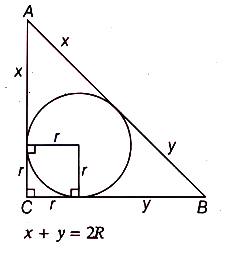
(B) In a right-angled triangle $\triangle ABC$ with $\angle C = \frac{\pi}{2}$,the sides are $a$ (opposite to $A$),$b$ (opposite to $B$),and $c$ (hypotenuse opposite to $C$).
From the properties of the incircle,the distance from vertex $C$ to the points of tangency on sides $AC$ and $BC$ is $r$.
Thus,the sides can be expressed as $b = x+r$ and $a = y+r$,where $x$ and $y$ are the lengths of the tangents from vertices $A$ and $B$ to the incircle respectively.
The hypotenuse $c = x+y$.
Since $c$ is the diameter of the circumcircle,$c = 2R$,so $x+y = 2R$.
Now,adding the expressions for $a$ and $b$:
$a+b = (y+r) + (x+r) = (x+y) + 2r = 2R + 2r$.
Dividing by $2$,we get:
$R+r = \frac{a+b}{2}$.
From the properties of the incircle,the distance from vertex $C$ to the points of tangency on sides $AC$ and $BC$ is $r$.
Thus,the sides can be expressed as $b = x+r$ and $a = y+r$,where $x$ and $y$ are the lengths of the tangents from vertices $A$ and $B$ to the incircle respectively.
The hypotenuse $c = x+y$.
Since $c$ is the diameter of the circumcircle,$c = 2R$,so $x+y = 2R$.
Now,adding the expressions for $a$ and $b$:
$a+b = (y+r) + (x+r) = (x+y) + 2r = 2R + 2r$.
Dividing by $2$,we get:
$R+r = \frac{a+b}{2}$.
0 likesView Solution
Vedclass Products
For Students
Vedclass Test Series
Mock tests in real AP EAMCET style covering Mathematics with performance analysis. 5-day free trial.
Start Free TrialFor Teachers
Exam Paper Generator
Generate Set A/B/C/D Mathematics papers from 7.5L+ questions in 2 minutes. 3 chapters free.
Try FreeFor Institutes
Online Exam Module
Run live AP EAMCET mock exams with unlimited students, 360° analytics & white-label branding.
See DemoFrequently Asked Questions
How many Mathematics questions are in AP EAMCET 2022?
There are 799 Mathematics questions from the AP EAMCET 2022 paper on Vedclass, each with a detailed step-by-step solution in English.
Are AP EAMCET 2022 Mathematics solutions available in English?
Yes. All solutions on this page are in English. You can also switch to English or Hindi using the language buttons above the questions.
Can I practice AP EAMCET 2022 Mathematics as a timed test?
Yes. Use the Vedclass Test Series to attempt a full AP EAMCET mock test covering Mathematics with time limits and instant score analysis.
Can teachers create Mathematics papers from AP EAMCET previous year questions?
Yes. The Vedclass Exam Paper Generator lets teachers mix AP EAMCET Mathematics questions and generate Set A/B/C/D papers in minutes.
For Teachers & Institutes
Build a Custom Mathematics Paper
Pick AP EAMCET 2022 Mathematics questions, set difficulty, and generate Set A/B/C/D in 2 minutes.