
MathematicsQ401–450 of 799 questions
Page 9 of 10 · English
401
MathematicsMediumMCQAP EAMCET · 2022
In a $\triangle ABC$,if $r_1 > r_2 > r_3$,then which of the following is true?
A
$a > b > c$
B
$a > b, b < c$
C
$a < b < c$
D
$a < b, b > c$
Solution
(A) Given $r_1 > r_2 > r_3$.
We know that $r_1 = \frac{\Delta}{s-a}$,$r_2 = \frac{\Delta}{s-b}$,and $r_3 = \frac{\Delta}{s-c}$.
Substituting these values,we get $\frac{\Delta}{s-a} > \frac{\Delta}{s-b} > \frac{\Delta}{s-c}$.
Since $\Delta > 0$,we have $s-a < s-b < s-c$.
Subtracting $s$ from all parts,we get $-a < -b < -c$.
Multiplying by $-1$ reverses the inequality signs,resulting in $a > b > c$.
We know that $r_1 = \frac{\Delta}{s-a}$,$r_2 = \frac{\Delta}{s-b}$,and $r_3 = \frac{\Delta}{s-c}$.
Substituting these values,we get $\frac{\Delta}{s-a} > \frac{\Delta}{s-b} > \frac{\Delta}{s-c}$.
Since $\Delta > 0$,we have $s-a < s-b < s-c$.
Subtracting $s$ from all parts,we get $-a < -b < -c$.
Multiplying by $-1$ reverses the inequality signs,resulting in $a > b > c$.
0 likesView Solution
402
MathematicsMediumMCQAP EAMCET · 2022
In a $\triangle ABC$,if $r_1=12, r_2=18$ and $r_3=36$,then $b=$
A
$12$
B
$6$
C
$24$
D
$18$
Solution
(C) Given,in $\triangle ABC$,$r_1=12, r_2=18, r_3=36$.
We know that $\frac{1}{r} = \frac{1}{r_1} + \frac{1}{r_2} + \frac{1}{r_3}$.
Substituting the values: $\frac{1}{r} = \frac{1}{12} + \frac{1}{18} + \frac{1}{36} = \frac{3+2+1}{36} = \frac{6}{36} = \frac{1}{6}$.
Thus,$r = 6$.
Also,$\Delta^2 = r_1 r_2 r_3 r = 12 \times 18 \times 36 \times 6 = 46656$.
So,$\Delta = \sqrt{46656} = 216$.
Since $r = \frac{\Delta}{s}$,we have $s = \frac{\Delta}{r} = \frac{216}{6} = 36$.
We know $r_2 = \frac{\Delta}{s-b}$.
Substituting the values: $18 = \frac{216}{36-b}$.
$36-b = \frac{216}{18} = 12$.
$b = 36 - 12 = 24$.
We know that $\frac{1}{r} = \frac{1}{r_1} + \frac{1}{r_2} + \frac{1}{r_3}$.
Substituting the values: $\frac{1}{r} = \frac{1}{12} + \frac{1}{18} + \frac{1}{36} = \frac{3+2+1}{36} = \frac{6}{36} = \frac{1}{6}$.
Thus,$r = 6$.
Also,$\Delta^2 = r_1 r_2 r_3 r = 12 \times 18 \times 36 \times 6 = 46656$.
So,$\Delta = \sqrt{46656} = 216$.
Since $r = \frac{\Delta}{s}$,we have $s = \frac{\Delta}{r} = \frac{216}{6} = 36$.
We know $r_2 = \frac{\Delta}{s-b}$.
Substituting the values: $18 = \frac{216}{36-b}$.
$36-b = \frac{216}{18} = 12$.
$b = 36 - 12 = 24$.
0 likesView Solution
403
MathematicsEasyMCQAP EAMCET · 2022
$205$ students take an examination,of whom $105$ pass in English,$70$ students pass in Mathematics,and $30$ students pass in both. How many students fail in both subjects?
A
$60$
B
$145$
C
$175$
D
$30$
Solution
(A) Let $E$ be the set of students who passed in English and $M$ be the set of students who passed in Mathematics.
Given:
Total students $= 205$
$n(E) = 105$
$n(M) = 70$
$n(E \cap M) = 30$
We need to find the number of students who passed in at least one subject,which is $n(E \cup M)$.
Using the formula: $n(E \cup M) = n(E) + n(M) - n(E \cap M)$
$n(E \cup M) = 105 + 70 - 30 = 145$
Now,the number of students who failed in both subjects is the total number of students minus those who passed in at least one subject.
Students failed in both $= 205 - 145 = 60$
Given:
Total students $= 205$
$n(E) = 105$
$n(M) = 70$
$n(E \cap M) = 30$
We need to find the number of students who passed in at least one subject,which is $n(E \cup M)$.
Using the formula: $n(E \cup M) = n(E) + n(M) - n(E \cap M)$
$n(E \cup M) = 105 + 70 - 30 = 145$
Now,the number of students who failed in both subjects is the total number of students minus those who passed in at least one subject.
Students failed in both $= 205 - 145 = 60$
0 likesView Solution
404
MathematicsMediumMCQAP EAMCET · 2022
Let $x \in R$ and $|x| < 1$. Then $\tanh ^{-1} x=$
A
$\frac{1}{2} \log \left(\frac{1+x}{1-x}\right)$
B
$\frac{1}{2} \log \left(\frac{1-x}{1+x}\right)$
C
$\frac{1}{2} \log \left(x+\sqrt{1-x^2}\right)$
D
$\frac{1}{2} \log \left(x-\sqrt{1-x^2}\right)$
Solution
(A) Let $y = \tanh^{-1} x$.
Then $x = \tanh y$.
Using the definition of the hyperbolic tangent function,we have $x = \frac{e^y - e^{-y}}{e^y + e^{-y}}$.
Multiplying both sides by $(e^y + e^{-y})$,we get $x(e^y + e^{-y}) = e^y - e^{-y}$.
$xe^y + xe^{-y} = e^y - e^{-y}$.
Rearranging the terms,we get $e^y(1 - x) = e^{-y}(1 + x)$.
Dividing both sides by $(1 - x)$,we get $e^y = e^{-y} \frac{1 + x}{1 - x}$.
Multiplying both sides by $e^y$,we get $e^{2y} = \frac{1 + x}{1 - x}$.
Taking the natural logarithm on both sides,we get $2y = \log \left(\frac{1 + x}{1 - x}\right)$.
Therefore,$y = \frac{1}{2} \log \left(\frac{1 + x}{1 - x}\right)$.
Then $x = \tanh y$.
Using the definition of the hyperbolic tangent function,we have $x = \frac{e^y - e^{-y}}{e^y + e^{-y}}$.
Multiplying both sides by $(e^y + e^{-y})$,we get $x(e^y + e^{-y}) = e^y - e^{-y}$.
$xe^y + xe^{-y} = e^y - e^{-y}$.
Rearranging the terms,we get $e^y(1 - x) = e^{-y}(1 + x)$.
Dividing both sides by $(1 - x)$,we get $e^y = e^{-y} \frac{1 + x}{1 - x}$.
Multiplying both sides by $e^y$,we get $e^{2y} = \frac{1 + x}{1 - x}$.
Taking the natural logarithm on both sides,we get $2y = \log \left(\frac{1 + x}{1 - x}\right)$.
Therefore,$y = \frac{1}{2} \log \left(\frac{1 + x}{1 - x}\right)$.
0 likesView Solution
405
MathematicsMediumMCQAP EAMCET · 2022
The number of solutions of the equations $x+y+z=12$,$x^2+y^2+z^2=50$,and $x^3+y^3+z^3=216$ is
A
$6$
B
$24$
C
$3$
D
$9$
Solution
(A) Given equations are:
$x+y+z=12$ ... $(i)$
$x^2+y^2+z^2=50$ ... $(ii)$
$x^3+y^3+z^3=216$ ... $(iii)$
Using the identity $(x+y+z)^2 = x^2+y^2+z^2+2(xy+yz+zx)$:
$12^2 = 50 + 2(xy+yz+zx)$
$144 - 50 = 2(xy+yz+zx)$
$xy+yz+zx = 47$
Using the identity $x^3+y^3+z^3-3xyz = (x+y+z)(x^2+y^2+z^2-(xy+yz+zx))$:
$216 - 3xyz = 12(50 - 47)$
$216 - 3xyz = 12(3) = 36$
$3xyz = 180 \Rightarrow xyz = 60$
Now,$x, y, z$ are roots of the cubic equation $t^3 - (x+y+z)t^2 + (xy+yz+zx)t - xyz = 0$:
$t^3 - 12t^2 + 47t - 60 = 0$
Testing roots,for $t=3$: $27 - 12(9) + 47(3) - 60 = 27 - 108 + 141 - 60 = 0$. So $(t-3)$ is a factor.
$(t-3)(t^2-9t+20) = 0$
$(t-3)(t-4)(t-5) = 0$
The roots are $3, 4, 5$.
Since $x, y, z$ can be any permutation of ${3, 4, 5}$,the number of solutions is $3! = 6$.
$x+y+z=12$ ... $(i)$
$x^2+y^2+z^2=50$ ... $(ii)$
$x^3+y^3+z^3=216$ ... $(iii)$
Using the identity $(x+y+z)^2 = x^2+y^2+z^2+2(xy+yz+zx)$:
$12^2 = 50 + 2(xy+yz+zx)$
$144 - 50 = 2(xy+yz+zx)$
$xy+yz+zx = 47$
Using the identity $x^3+y^3+z^3-3xyz = (x+y+z)(x^2+y^2+z^2-(xy+yz+zx))$:
$216 - 3xyz = 12(50 - 47)$
$216 - 3xyz = 12(3) = 36$
$3xyz = 180 \Rightarrow xyz = 60$
Now,$x, y, z$ are roots of the cubic equation $t^3 - (x+y+z)t^2 + (xy+yz+zx)t - xyz = 0$:
$t^3 - 12t^2 + 47t - 60 = 0$
Testing roots,for $t=3$: $27 - 12(9) + 47(3) - 60 = 27 - 108 + 141 - 60 = 0$. So $(t-3)$ is a factor.
$(t-3)(t^2-9t+20) = 0$
$(t-3)(t-4)(t-5) = 0$
The roots are $3, 4, 5$.
Since $x, y, z$ can be any permutation of ${3, 4, 5}$,the number of solutions is $3! = 6$.
0 likesView Solution
406
MathematicsEasyMCQAP EAMCET · 2022
If $f$ is a relation from the set of positive real numbers to the set of positive real numbers defined by $f(x) = 3x^2 - 2$,then $f$ is
A
one-one but not onto
B
onto but not one-one
C
a bijection
D
not a function
Solution
(D) Given the relation $f: R_{+} \rightarrow R_{+}$ defined by $f(x) = 3x^2 - 2$.
For $f$ to be a function,every element $x$ in the domain $R_{+}$ must have a unique image $f(x)$ in the codomain $R_{+}$.
Given $x \in (0, \infty)$,we have $x^2 > 0$,so $3x^2 > 0$.
Thus,$f(x) = 3x^2 - 2 > -2$.
This means the range of $f$ is $(-2, \infty)$.
Since the codomain is given as $R_{+} = (0, \infty)$,and the range $(-2, \infty)$ is not a subset of the codomain $(0, \infty)$ (for example,if $x=0.5$,$f(0.5) = 3(0.25) - 2 = 0.75 - 2 = -1.25$,which is not in $R_{+}$),the relation $f$ does not map every element of the domain to an element in the codomain.
Therefore,$f$ is not a function.
For $f$ to be a function,every element $x$ in the domain $R_{+}$ must have a unique image $f(x)$ in the codomain $R_{+}$.
Given $x \in (0, \infty)$,we have $x^2 > 0$,so $3x^2 > 0$.
Thus,$f(x) = 3x^2 - 2 > -2$.
This means the range of $f$ is $(-2, \infty)$.
Since the codomain is given as $R_{+} = (0, \infty)$,and the range $(-2, \infty)$ is not a subset of the codomain $(0, \infty)$ (for example,if $x=0.5$,$f(0.5) = 3(0.25) - 2 = 0.75 - 2 = -1.25$,which is not in $R_{+}$),the relation $f$ does not map every element of the domain to an element in the codomain.
Therefore,$f$ is not a function.
0 likesView Solution
407
MathematicsEasyMCQAP EAMCET · 2022
If $f(x)=ax^2+bx+c$ satisfies $f(1)+2f(2)=0$ and $2f(1)+f(2)=0$,then $3a+b=$
A
$2$
B
$-1$
C
$0$
D
$1$
Solution
(C) Given $f(x) = ax^2 + bx + c$.
$f(1) = a + b + c$ and $f(2) = 4a + 2b + c$.
From the first condition: $f(1) + 2f(2) = 0$
$(a + b + c) + 2(4a + 2b + c) = 0$
$a + b + c + 8a + 4b + 2c = 0$
$9a + 5b + 3c = 0$ ... $(i)$
From the second condition: $2f(1) + f(2) = 0$
$2(a + b + c) + (4a + 2b + c) = 0$
$2a + 2b + 2c + 4a + 2b + c = 0$
$6a + 4b + 3c = 0$ ... $(ii)$
Subtracting equation $(ii)$ from equation $(i)$:
$(9a + 5b + 3c) - (6a + 4b + 3c) = 0 - 0$
$3a + b = 0$.
$f(1) = a + b + c$ and $f(2) = 4a + 2b + c$.
From the first condition: $f(1) + 2f(2) = 0$
$(a + b + c) + 2(4a + 2b + c) = 0$
$a + b + c + 8a + 4b + 2c = 0$
$9a + 5b + 3c = 0$ ... $(i)$
From the second condition: $2f(1) + f(2) = 0$
$2(a + b + c) + (4a + 2b + c) = 0$
$2a + 2b + 2c + 4a + 2b + c = 0$
$6a + 4b + 3c = 0$ ... $(ii)$
Subtracting equation $(ii)$ from equation $(i)$:
$(9a + 5b + 3c) - (6a + 4b + 3c) = 0 - 0$
$3a + b = 0$.
0 likesView Solution
408
MathematicsMediumMCQAP EAMCET · 2022
For $x$ and $y$ satisfying $|x|+|y|=|x-3|+|y-2|$,which of the following is correct?
A
$x=\frac{1}{2}$ for $0 \leq x < 3$ and $1 \leq y < 2$
B
$x+y=\frac{5}{2}$ for $x \geq 3$ and $y \geq 2$
C
$x=\frac{1}{2}$ for $x \geq 2$ and $0 \leq y < 3$
D
$x+y=\frac{5}{2}$ for $0 \leq x < 3, 0 \leq y < 2$
Solution
(D) Given equation: $|x|+|y|=|x-3|+|y-2|$.
Case $I$: $0 \leq x < 3$ and $0 \leq y < 2$.
In this region,$|x|=x$,$|y|=y$,$|x-3|=-(x-3)$,and $|y-2|=-(y-2)$.
Substituting these into the equation: $x+y = -(x-3) - (y-2)$.
$x+y = -x+3-y+2$.
$2x+2y = 5$.
$x+y = 5/2$.
Case $II$: $x \geq 3$ and $y \geq 2$.
In this region,$|x|=x$,$|y|=y$,$|x-3|=x-3$,and $|y-2|=y-2$.
Substituting these into the equation: $x+y = (x-3) + (y-2)$.
$x+y = x+y-5$.
$0 = -5$,which is impossible.
Therefore,the condition $x+y = 5/2$ holds for $0 \leq x < 3$ and $0 \leq y < 2$.
Case $I$: $0 \leq x < 3$ and $0 \leq y < 2$.
In this region,$|x|=x$,$|y|=y$,$|x-3|=-(x-3)$,and $|y-2|=-(y-2)$.
Substituting these into the equation: $x+y = -(x-3) - (y-2)$.
$x+y = -x+3-y+2$.
$2x+2y = 5$.
$x+y = 5/2$.
Case $II$: $x \geq 3$ and $y \geq 2$.
In this region,$|x|=x$,$|y|=y$,$|x-3|=x-3$,and $|y-2|=y-2$.
Substituting these into the equation: $x+y = (x-3) + (y-2)$.
$x+y = x+y-5$.
$0 = -5$,which is impossible.
Therefore,the condition $x+y = 5/2$ holds for $0 \leq x < 3$ and $0 \leq y < 2$.
0 likesView Solution
409
MathematicsMediumMCQAP EAMCET · 2022
The number of solutions of the equations $x+y+z=1$,$x^2+y^2+z^2=1$,and $x^3+y^3+z^3=1$ is:
A
$6$
B
$3$
C
$9$
D
$12$
Solution
(B) Given equations are:
$1) x+y+z=1$
$2) x^2+y^2+z^2=1$
$3) x^3+y^3+z^3=1$
From $(1)$,we have $z = 1 - x - y$. Substituting this into $(2)$:
$x^2 + y^2 + (1 - x - y)^2 = 1$
$x^2 + y^2 + 1 + x^2 + y^2 - 2x - 2y + 2xy = 1$
$2x^2 + 2y^2 + 2xy - 2x - 2y = 0$
$x^2 + y^2 + xy - x - y = 0$
Multiplying by $2$: $2x^2 + 2y^2 + 2xy - 2x - 2y = 0$,which can be written as $(x+y)^2 + x^2 + y^2 - 2x - 2y = 0$.
Alternatively,note that if two variables are $0$,the third must be $1$. For example,if $x=1, y=0, z=0$,then $1+0+0=1$,$1^2+0^2+0^2=1$,and $1^3+0^3+0^3=1$. These satisfy all equations.
Testing permutations of $(1, 0, 0)$,we get $(1, 0, 0)$,$(0, 1, 0)$,and $(0, 0, 1)$.
Thus,there are $3$ solutions.
$1) x+y+z=1$
$2) x^2+y^2+z^2=1$
$3) x^3+y^3+z^3=1$
From $(1)$,we have $z = 1 - x - y$. Substituting this into $(2)$:
$x^2 + y^2 + (1 - x - y)^2 = 1$
$x^2 + y^2 + 1 + x^2 + y^2 - 2x - 2y + 2xy = 1$
$2x^2 + 2y^2 + 2xy - 2x - 2y = 0$
$x^2 + y^2 + xy - x - y = 0$
Multiplying by $2$: $2x^2 + 2y^2 + 2xy - 2x - 2y = 0$,which can be written as $(x+y)^2 + x^2 + y^2 - 2x - 2y = 0$.
Alternatively,note that if two variables are $0$,the third must be $1$. For example,if $x=1, y=0, z=0$,then $1+0+0=1$,$1^2+0^2+0^2=1$,and $1^3+0^3+0^3=1$. These satisfy all equations.
Testing permutations of $(1, 0, 0)$,we get $(1, 0, 0)$,$(0, 1, 0)$,and $(0, 0, 1)$.
Thus,there are $3$ solutions.
0 likesView Solution
410
MathematicsDifficultMCQAP EAMCET · 2022
If $a \neq 0$ and the line $2bx + 3cy + 4d = 0$ passes through the points of intersection of the parabolas $y^2 = 4ax$ and $x^2 = 4ay$,then
A
$d^2 + (2b + 3c)^2 = 0$
B
$d^2 + (3b + 2c)^2 = 0$
C
$d^2 + (2b - 3c)^2 = 0$
D
$d^2 + (3b - 2c)^2 = 0$
Solution
(A) The parabolas $y^2 = 4ax$ and $x^2 = 4ay$ are symmetric with respect to the line $y = x$.
Therefore,the line $y = x$ passes through their points of intersection.
Solving $y^2 = 4ax$ and $y = x$:
$x^2 = 4ax \Rightarrow x(x - 4a) = 0 \Rightarrow x = 0$ or $x = 4a$.
When $x = 0$,$y = 0$. When $x = 4a$,$y = 4a$.
Thus,the points of intersection are $(0, 0)$ and $(4a, 4a)$.
Since the line $2bx + 3cy + 4d = 0$ passes through $(0, 0)$:
$2b(0) + 3c(0) + 4d = 0 \Rightarrow 4d = 0 \Rightarrow d = 0$.
Since it also passes through $(4a, 4a)$:
$2b(4a) + 3c(4a) + 4d = 0 \Rightarrow 8ab + 12ac + 4d = 0$.
Since $d = 0$ and $a \neq 0$,we have $8ab + 12ac = 0 \Rightarrow 4a(2b + 3c) = 0 \Rightarrow 2b + 3c = 0$.
Therefore,$d^2 + (2b + 3c)^2 = 0^2 + 0^2 = 0$.
Therefore,the line $y = x$ passes through their points of intersection.
Solving $y^2 = 4ax$ and $y = x$:
$x^2 = 4ax \Rightarrow x(x - 4a) = 0 \Rightarrow x = 0$ or $x = 4a$.
When $x = 0$,$y = 0$. When $x = 4a$,$y = 4a$.
Thus,the points of intersection are $(0, 0)$ and $(4a, 4a)$.
Since the line $2bx + 3cy + 4d = 0$ passes through $(0, 0)$:
$2b(0) + 3c(0) + 4d = 0 \Rightarrow 4d = 0 \Rightarrow d = 0$.
Since it also passes through $(4a, 4a)$:
$2b(4a) + 3c(4a) + 4d = 0 \Rightarrow 8ab + 12ac + 4d = 0$.
Since $d = 0$ and $a \neq 0$,we have $8ab + 12ac = 0 \Rightarrow 4a(2b + 3c) = 0 \Rightarrow 2b + 3c = 0$.
Therefore,$d^2 + (2b + 3c)^2 = 0^2 + 0^2 = 0$.
0 likesView Solution
411
MathematicsMediumMCQAP EAMCET · 2022
The condition that the two curves $y^2 = 4ax$ and $xy = c^2$ cut orthogonally is
A
$c^2 = 16a^2$
B
$c^2 = 32a^2$
C
$c^4 = 16a^4$
D
$c^4 = 32a^4$
Solution
(D) Let the point of intersection be $(x_1, y_1)$.
For the curve $y^2 = 4ax$,differentiating with respect to $x$ gives $2y \frac{dy}{dx} = 4a$,so $\frac{dy}{dx} = \frac{2a}{y}$.
Thus,the slope of the tangent at $(x_1, y_1)$ is $m_1 = \frac{2a}{y_1}$.
For the curve $xy = c^2$,differentiating with respect to $x$ gives $x \frac{dy}{dx} + y = 0$,so $\frac{dy}{dx} = -\frac{y}{x}$.
Thus,the slope of the tangent at $(x_1, y_1)$ is $m_2 = -\frac{y_1}{x_1}$.
Since the curves cut orthogonally,$m_1 \times m_2 = -1$.
$\frac{2a}{y_1} \times (-\frac{y_1}{x_1}) = -1 \Rightarrow \frac{2a}{x_1} = 1 \Rightarrow x_1 = 2a$.
Since $(x_1, y_1)$ lies on $y^2 = 4ax$,$y_1^2 = 4a(2a) = 8a^2$.
Since $(x_1, y_1)$ lies on $xy = c^2$,$x_1 y_1 = c^2$,so $(x_1 y_1)^2 = c^4$.
Substituting $x_1 = 2a$ and $y_1^2 = 8a^2$,we get $c^4 = x_1^2 y_1^2 = (2a)^2 (8a^2) = 4a^2 \times 8a^2 = 32a^4$.
For the curve $y^2 = 4ax$,differentiating with respect to $x$ gives $2y \frac{dy}{dx} = 4a$,so $\frac{dy}{dx} = \frac{2a}{y}$.
Thus,the slope of the tangent at $(x_1, y_1)$ is $m_1 = \frac{2a}{y_1}$.
For the curve $xy = c^2$,differentiating with respect to $x$ gives $x \frac{dy}{dx} + y = 0$,so $\frac{dy}{dx} = -\frac{y}{x}$.
Thus,the slope of the tangent at $(x_1, y_1)$ is $m_2 = -\frac{y_1}{x_1}$.
Since the curves cut orthogonally,$m_1 \times m_2 = -1$.
$\frac{2a}{y_1} \times (-\frac{y_1}{x_1}) = -1 \Rightarrow \frac{2a}{x_1} = 1 \Rightarrow x_1 = 2a$.
Since $(x_1, y_1)$ lies on $y^2 = 4ax$,$y_1^2 = 4a(2a) = 8a^2$.
Since $(x_1, y_1)$ lies on $xy = c^2$,$x_1 y_1 = c^2$,so $(x_1 y_1)^2 = c^4$.
Substituting $x_1 = 2a$ and $y_1^2 = 8a^2$,we get $c^4 = x_1^2 y_1^2 = (2a)^2 (8a^2) = 4a^2 \times 8a^2 = 32a^4$.
0 likesView Solution
412
MathematicsMediumMCQAP EAMCET · 2022
The number of distinct solutions of the equation $x^{11}-x^7+x^4-1=0$ is
A
$9$
B
$11$
C
$10$
D
$8$
Solution
(C) Given equation is $x^{11}-x^7+x^4-1=0$.
Factorizing the expression:
$x^7(x^4-1) + 1(x^4-1) = 0$
$(x^4-1)(x^7+1) = 0$.
Case $(i)$: $x^4-1=0 \implies x^4=1$.
The roots are $x = e^{i(2k\pi/4)}$ for $k=0, 1, 2, 3$. These are $1, i, -1, -i$. There are $4$ distinct roots.
Case $(ii)$: $x^7+1=0 \implies x^7=-1$.
The roots are $x = e^{i((2k+1)\pi/7)}$ for $k=0, 1, 2, 3, 4, 5, 6$. There are $7$ distinct roots.
To find the total number of distinct solutions,we check for common roots:
If $x^4=1$ and $x^7=-1$,then $x^4=1 \implies |x|=1$.
Also $x^7=-1 \implies |x|=1$.
If $x$ is a common root,then $x^4=1$ and $x^7=-1$.
Then $x^8 = (x^4)^2 = 1^2 = 1$.
Since $x^8 = x^7 \cdot x = 1$,we have $(-1) \cdot x = 1$,so $x = -1$.
Check if $x = -1$ satisfies both:
$(-1)^4 = 1$ (True) and $(-1)^7 = -1$ (True).
So,$x = -1$ is the only common root.
Total distinct solutions = (Number of roots of $x^4-1=0$) + (Number of roots of $x^7+1=0$) - (Number of common roots)
Total = $4 + 7 - 1 = 10$.
Factorizing the expression:
$x^7(x^4-1) + 1(x^4-1) = 0$
$(x^4-1)(x^7+1) = 0$.
Case $(i)$: $x^4-1=0 \implies x^4=1$.
The roots are $x = e^{i(2k\pi/4)}$ for $k=0, 1, 2, 3$. These are $1, i, -1, -i$. There are $4$ distinct roots.
Case $(ii)$: $x^7+1=0 \implies x^7=-1$.
The roots are $x = e^{i((2k+1)\pi/7)}$ for $k=0, 1, 2, 3, 4, 5, 6$. There are $7$ distinct roots.
To find the total number of distinct solutions,we check for common roots:
If $x^4=1$ and $x^7=-1$,then $x^4=1 \implies |x|=1$.
Also $x^7=-1 \implies |x|=1$.
If $x$ is a common root,then $x^4=1$ and $x^7=-1$.
Then $x^8 = (x^4)^2 = 1^2 = 1$.
Since $x^8 = x^7 \cdot x = 1$,we have $(-1) \cdot x = 1$,so $x = -1$.
Check if $x = -1$ satisfies both:
$(-1)^4 = 1$ (True) and $(-1)^7 = -1$ (True).
So,$x = -1$ is the only common root.
Total distinct solutions = (Number of roots of $x^4-1=0$) + (Number of roots of $x^7+1=0$) - (Number of common roots)
Total = $4 + 7 - 1 = 10$.
0 likesView Solution
413
MathematicsEasyMCQAP EAMCET · 2022
Let $a_n, a_{n-1}, \ldots, a_1, a_0 \in \mathbb{C}$ and $f(x) = a_n x^n + a_{n-1} x^{n-1} + \ldots + a_1 x + a_0$ be a polynomial. If the polynomial $f(x)$ is monic,then:
A
$a_n \neq 0$
B
$a_n = 1$
C
$a_n > 0$
D
$a_n < 0$
Solution
(B) polynomial $f(x) = a_n x^n + a_{n-1} x^{n-1} + \ldots + a_1 x + a_0$ is defined as a monic polynomial if the leading coefficient,which is the coefficient of the highest degree term $x^n$,is equal to $1$.
Therefore,for the given polynomial $f(x)$ to be monic,we must have $a_n = 1$.
Therefore,for the given polynomial $f(x)$ to be monic,we must have $a_n = 1$.
0 likesView Solution
414
MathematicsDifficultMCQAP EAMCET · 2022
The minimum value of $\left(1+\frac{1}{\sin ^n \alpha}\right)\left(1+\frac{1}{\cos ^n \alpha}\right)$ is
A
$1$
B
$2$
C
$\left(1+2^n\right)^2$
D
$\left(1+2^{n / 2}\right)^2$
Solution
(D) Let $f(\alpha) = \left(1 + \frac{1}{\sin^n \alpha}\right) \left(1 + \frac{1}{\cos^n \alpha}\right)$.
By the $AM$-$GM$ inequality,for positive terms,the minimum value occurs when $\sin^n \alpha = \cos^n \alpha$,which implies $\sin \alpha = \cos \alpha$,so $\alpha = \frac{\pi}{4}$.
At $\alpha = \frac{\pi}{4}$,we have $\sin \alpha = \cos \alpha = \frac{1}{\sqrt{2}} = 2^{-1/2}$.
Then $\sin^n \alpha = \cos^n \alpha = (2^{-1/2})^n = 2^{-n/2}$.
Substituting this into the expression:
$f\left(\frac{\pi}{4}\right) = \left(1 + \frac{1}{2^{-n/2}}\right) \left(1 + \frac{1}{2^{-n/2}}\right) = (1 + 2^{n/2})(1 + 2^{n/2}) = (1 + 2^{n/2})^2$.
Thus,the minimum value is $(1 + 2^{n/2})^2$.
By the $AM$-$GM$ inequality,for positive terms,the minimum value occurs when $\sin^n \alpha = \cos^n \alpha$,which implies $\sin \alpha = \cos \alpha$,so $\alpha = \frac{\pi}{4}$.
At $\alpha = \frac{\pi}{4}$,we have $\sin \alpha = \cos \alpha = \frac{1}{\sqrt{2}} = 2^{-1/2}$.
Then $\sin^n \alpha = \cos^n \alpha = (2^{-1/2})^n = 2^{-n/2}$.
Substituting this into the expression:
$f\left(\frac{\pi}{4}\right) = \left(1 + \frac{1}{2^{-n/2}}\right) \left(1 + \frac{1}{2^{-n/2}}\right) = (1 + 2^{n/2})(1 + 2^{n/2}) = (1 + 2^{n/2})^2$.
Thus,the minimum value is $(1 + 2^{n/2})^2$.
0 likesView Solution
415
MathematicsEasyMCQAP EAMCET · 2022
The vertices of a triangle are at $-\hat{i}+3 \hat{j}$ and $2 \hat{i}+5 \hat{j}$ and its orthocenter is at $\hat{i}+2 \hat{j}$. If the position vector of the third vertex is $a \hat{i}+b \hat{j}$,then $(a, b)=$
A
$\left(\frac{5}{7}, \frac{5}{7}\right)$
B
$\left(\frac{5}{7}, \frac{17}{7}\right)$
C
$\left(\frac{-5}{7}, \frac{17}{7}\right)$
D
$\left(\frac{5}{7}, \frac{-17}{7}\right)$
Solution
(B) Let the vertices be $A=(-1, 3)$,$B=(2, 5)$,and $C=(a, b)$. The orthocenter is $H=(1, 2)$.
Since $AH \perp BC$,the slope of $AH$ $(m_{AH})$ multiplied by the slope of $BC$ $(m_{BC})$ is $-1$.
$m_{AH} = \frac{2-3}{1-(-1)} = \frac{-1}{2}$.
$m_{BC} = \frac{b-5}{a-2}$.
Since $m_{AH} \times m_{BC} = -1$,we have $\left(\frac{-1}{2}\right) \times \left(\frac{b-5}{a-2}\right) = -1 \Rightarrow b-5 = 2(a-2) \Rightarrow b-5 = 2a-4 \Rightarrow 2a-b = -1$ ... $(i)$
Similarly,since $BH \perp AC$,the slope of $BH$ $(m_{BH})$ multiplied by the slope of $AC$ $(m_{AC})$ is $-1$.
$m_{BH} = \frac{2-5}{1-2} = \frac{-3}{-1} = 3$.
$m_{AC} = \frac{b-3}{a-(-1)} = \frac{b-3}{a+1}$.
Since $m_{BH} \times m_{AC} = -1$,we have $3 \times \left(\frac{b-3}{a+1}\right) = -1 \Rightarrow 3b-9 = -a-1 \Rightarrow a+3b = 8$ ... (ii)
Solving equations $(i)$ and (ii):
From $(i)$,$b = 2a+1$. Substituting into (ii): $a + 3(2a+1) = 8 \Rightarrow a + 6a + 3 = 8 \Rightarrow 7a = 5 \Rightarrow a = \frac{5}{7}$.
Then $b = 2(\frac{5}{7}) + 1 = \frac{10}{7} + \frac{7}{7} = \frac{17}{7}$.
Thus,$(a, b) = \left(\frac{5}{7}, \frac{17}{7}\right)$.
Since $AH \perp BC$,the slope of $AH$ $(m_{AH})$ multiplied by the slope of $BC$ $(m_{BC})$ is $-1$.
$m_{AH} = \frac{2-3}{1-(-1)} = \frac{-1}{2}$.
$m_{BC} = \frac{b-5}{a-2}$.
Since $m_{AH} \times m_{BC} = -1$,we have $\left(\frac{-1}{2}\right) \times \left(\frac{b-5}{a-2}\right) = -1 \Rightarrow b-5 = 2(a-2) \Rightarrow b-5 = 2a-4 \Rightarrow 2a-b = -1$ ... $(i)$
Similarly,since $BH \perp AC$,the slope of $BH$ $(m_{BH})$ multiplied by the slope of $AC$ $(m_{AC})$ is $-1$.
$m_{BH} = \frac{2-5}{1-2} = \frac{-3}{-1} = 3$.
$m_{AC} = \frac{b-3}{a-(-1)} = \frac{b-3}{a+1}$.
Since $m_{BH} \times m_{AC} = -1$,we have $3 \times \left(\frac{b-3}{a+1}\right) = -1 \Rightarrow 3b-9 = -a-1 \Rightarrow a+3b = 8$ ... (ii)
Solving equations $(i)$ and (ii):
From $(i)$,$b = 2a+1$. Substituting into (ii): $a + 3(2a+1) = 8 \Rightarrow a + 6a + 3 = 8 \Rightarrow 7a = 5 \Rightarrow a = \frac{5}{7}$.
Then $b = 2(\frac{5}{7}) + 1 = \frac{10}{7} + \frac{7}{7} = \frac{17}{7}$.
Thus,$(a, b) = \left(\frac{5}{7}, \frac{17}{7}\right)$.
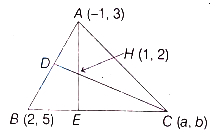
0 likesView Solution
416
MathematicsMediumMCQAP EAMCET · 2022
If the points $P = \hat{i} + 2 \hat{j}$,$Q = 4 \hat{i} + 6 \hat{j}$,$R = 5 \hat{i} + 7 \hat{j}$,and $S = a \hat{i} + b \hat{j}$ are the consecutive vertices of a parallelogram $PQRS$,then:
A
$a = 2, b = 4$
B
$a = 3, b = 4$
C
$a = 2, b = 3$
D
$a = 3, b = 5$
Solution
(C) Given vertices of the parallelogram $PQRS$ are $P(1, 2)$,$Q(4, 6)$,$R(5, 7)$,and $S(a, b)$.
In a parallelogram,the diagonals bisect each other,meaning they share the same midpoint.
Let $A$ be the midpoint of the diagonals $PR$ and $QS$.
The midpoint $A$ of diagonal $PR$ is given by:
$A = \left( \frac{1 + 5}{2}, \frac{2 + 7}{2} \right) = \left( \frac{6}{2}, \frac{9}{2} \right) = \left( 3, 4.5 \right)$.
The midpoint $A$ of diagonal $QS$ is given by:
$A = \left( \frac{4 + a}{2}, \frac{6 + b}{2} \right)$.
Equating the coordinates of the midpoints:
$\frac{4 + a}{2} = 3 \implies 4 + a = 6 \implies a = 2$.
$\frac{6 + b}{2} = 4.5 \implies 6 + b = 9 \implies b = 3$.
Therefore,the values are $a = 2$ and $b = 3$.
In a parallelogram,the diagonals bisect each other,meaning they share the same midpoint.
Let $A$ be the midpoint of the diagonals $PR$ and $QS$.
The midpoint $A$ of diagonal $PR$ is given by:
$A = \left( \frac{1 + 5}{2}, \frac{2 + 7}{2} \right) = \left( \frac{6}{2}, \frac{9}{2} \right) = \left( 3, 4.5 \right)$.
The midpoint $A$ of diagonal $QS$ is given by:
$A = \left( \frac{4 + a}{2}, \frac{6 + b}{2} \right)$.
Equating the coordinates of the midpoints:
$\frac{4 + a}{2} = 3 \implies 4 + a = 6 \implies a = 2$.
$\frac{6 + b}{2} = 4.5 \implies 6 + b = 9 \implies b = 3$.
Therefore,the values are $a = 2$ and $b = 3$.
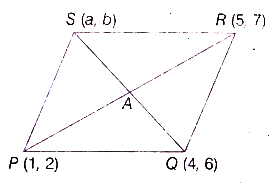
0 likesView Solution
417
MathematicsEasyMCQAP EAMCET · 2022
If the point $(a, 8, -2)$ divides the line segment joining the points $(1, 4, 6)$ and $(5, 2, 10)$ in the ratio $m: n$,then $\frac{2m}{n} - \frac{a}{3} =$
A
$-7$
B
$1$
C
$-2$
D
$3$
Solution
(B) Given that the point $(a, 8, -2)$ divides the line segment joining $(1, 4, 6)$ and $(5, 2, 10)$ in the ratio $m: n$.
By the section formula,the coordinates are given by:
$x = \frac{5m + n}{m + n}$,$y = \frac{2m + 4n}{m + n}$,$z = \frac{10m + 6n}{m + n}$.
Equating the $y$-coordinate:
$8 = \frac{2m + 4n}{m + n} \implies 8m + 8n = 2m + 4n \implies 6m = -4n \implies \frac{m}{n} = -\frac{2}{3}$.
Equating the $z$-coordinate:
$-2 = \frac{10m + 6n}{m + n} \implies -2m - 2n = 10m + 6n \implies -12m = 8n \implies \frac{m}{n} = -\frac{8}{12} = -\frac{2}{3}$.
Since both equations yield the same ratio,we find $a$ using the $x$-coordinate:
$a = \frac{5m + n}{m + n} = \frac{5(\frac{m}{n}) + 1}{(\frac{m}{n}) + 1} = \frac{5(-\frac{2}{3}) + 1}{(-\frac{2}{3}) + 1} = \frac{-\frac{10}{3} + 1}{\frac{1}{3}} = \frac{-\frac{7}{3}}{\frac{1}{3}} = -7$.
Finally,calculating the expression:
$\frac{2m}{n} - \frac{a}{3} = 2(-\frac{2}{3}) - (\frac{-7}{3}) = -\frac{4}{3} + \frac{7}{3} = \frac{3}{3} = 1$.
By the section formula,the coordinates are given by:
$x = \frac{5m + n}{m + n}$,$y = \frac{2m + 4n}{m + n}$,$z = \frac{10m + 6n}{m + n}$.
Equating the $y$-coordinate:
$8 = \frac{2m + 4n}{m + n} \implies 8m + 8n = 2m + 4n \implies 6m = -4n \implies \frac{m}{n} = -\frac{2}{3}$.
Equating the $z$-coordinate:
$-2 = \frac{10m + 6n}{m + n} \implies -2m - 2n = 10m + 6n \implies -12m = 8n \implies \frac{m}{n} = -\frac{8}{12} = -\frac{2}{3}$.
Since both equations yield the same ratio,we find $a$ using the $x$-coordinate:
$a = \frac{5m + n}{m + n} = \frac{5(\frac{m}{n}) + 1}{(\frac{m}{n}) + 1} = \frac{5(-\frac{2}{3}) + 1}{(-\frac{2}{3}) + 1} = \frac{-\frac{10}{3} + 1}{\frac{1}{3}} = \frac{-\frac{7}{3}}{\frac{1}{3}} = -7$.
Finally,calculating the expression:
$\frac{2m}{n} - \frac{a}{3} = 2(-\frac{2}{3}) - (\frac{-7}{3}) = -\frac{4}{3} + \frac{7}{3} = \frac{3}{3} = 1$.
0 likesView Solution
418
MathematicsEasyMCQAP EAMCET · 2022
If $P$ divides the line segment joining the points $A(1, 2, -1)$ and $B(-1, 0, 1)$ externally in the ratio $1: 2$ and $Q = (1, 3, -1)$,then $PQ =$
A
$\sqrt{10}$
B
$3$
C
$1$
D
$\sqrt{13}$
Solution
(B) Given points $A(1, 2, -1)$ and $B(-1, 0, 1)$. Point $P$ divides the line segment $AB$ externally in the ratio $m_1: m_2 = 1: 2$.
For external division,the coordinates of $P$ are given by $\left( \frac{m_1 x_2 - m_2 x_1}{m_1 - m_2}, \frac{m_1 y_2 - m_2 y_1}{m_1 - m_2}, \frac{m_1 z_2 - m_2 z_1}{m_1 - m_2} \right)$.
Substituting the values:
$P = \left( \frac{1(-1) - 2(1)}{1 - 2}, \frac{1(0) - 2(2)}{1 - 2}, \frac{1(1) - 2(-1)}{1 - 2} \right)$
$P = \left( \frac{-1 - 2}{-1}, \frac{-4}{-1}, \frac{1 + 2}{-1} \right)$
$P = \left( \frac{-3}{-1}, \frac{-4}{-1}, \frac{3}{-1} \right) = (3, 4, -3)$.
Now,we find the distance $PQ$ where $Q = (1, 3, -1)$:
$PQ = \sqrt{(3 - 1)^2 + (4 - 3)^2 + (-3 - (-1))^2}$
$PQ = \sqrt{(2)^2 + (1)^2 + (-2)^2}$
$PQ = \sqrt{4 + 1 + 4} = \sqrt{9} = 3$ units.
For external division,the coordinates of $P$ are given by $\left( \frac{m_1 x_2 - m_2 x_1}{m_1 - m_2}, \frac{m_1 y_2 - m_2 y_1}{m_1 - m_2}, \frac{m_1 z_2 - m_2 z_1}{m_1 - m_2} \right)$.
Substituting the values:
$P = \left( \frac{1(-1) - 2(1)}{1 - 2}, \frac{1(0) - 2(2)}{1 - 2}, \frac{1(1) - 2(-1)}{1 - 2} \right)$
$P = \left( \frac{-1 - 2}{-1}, \frac{-4}{-1}, \frac{1 + 2}{-1} \right)$
$P = \left( \frac{-3}{-1}, \frac{-4}{-1}, \frac{3}{-1} \right) = (3, 4, -3)$.
Now,we find the distance $PQ$ where $Q = (1, 3, -1)$:
$PQ = \sqrt{(3 - 1)^2 + (4 - 3)^2 + (-3 - (-1))^2}$
$PQ = \sqrt{(2)^2 + (1)^2 + (-2)^2}$
$PQ = \sqrt{4 + 1 + 4} = \sqrt{9} = 3$ units.
0 likesView Solution
419
MathematicsEasyMCQAP EAMCET · 2022
Let the centroid of a triangle formed by the points $A(4, x, 1)$,$B(y, -5, 2)$ and $C(7, 8, 3)$ be $G(3, 5, 2)$ and $CG$ meet $AB$ in $F$. Then,$F=$
A
$\left(\frac{5}{2}, \frac{3}{2}, \frac{5}{2}\right)$
B
$\left(\frac{11}{2}, 10, 2\right)$
C
$\left(1, \frac{7}{2}, \frac{3}{2}\right)$
D
$(10, 12, 5)$
Solution
(C) The coordinates of the centroid $G$ of a triangle with vertices $A(x_1, y_1, z_1)$,$B(x_2, y_2, z_2)$,and $C(x_3, y_3, z_3)$ are given by $\left(\frac{x_1+x_2+x_3}{3}, \frac{y_1+y_2+y_3}{3}, \frac{z_1+z_2+z_3}{3}\right)$.
Given $A(4, x, 1)$,$B(y, -5, 2)$,$C(7, 8, 3)$,and $G(3, 5, 2)$,we have:
$G = \left(\frac{4+y+7}{3}, \frac{x-5+8}{3}, \frac{1+2+3}{3}\right) = (3, 5, 2)$
Equating the coordinates:
$\frac{11+y}{3} = 3 \Rightarrow 11+y = 9 \Rightarrow y = -2$
$\frac{x+3}{3} = 5 \Rightarrow x+3 = 15 \Rightarrow x = 12$
Since $CG$ is a median,$F$ is the midpoint of $AB$. The coordinates of $F$ are:
$F = \left(\frac{4+y}{2}, \frac{x-5}{2}, \frac{1+2}{2}\right)$
Substituting $x=12$ and $y=-2$:
$F = \left(\frac{4-2}{2}, \frac{12-5}{2}, \frac{3}{2}\right) = \left(\frac{2}{2}, \frac{7}{2}, \frac{3}{2}\right) = \left(1, \frac{7}{2}, \frac{3}{2}\right)$.
Given $A(4, x, 1)$,$B(y, -5, 2)$,$C(7, 8, 3)$,and $G(3, 5, 2)$,we have:
$G = \left(\frac{4+y+7}{3}, \frac{x-5+8}{3}, \frac{1+2+3}{3}\right) = (3, 5, 2)$
Equating the coordinates:
$\frac{11+y}{3} = 3 \Rightarrow 11+y = 9 \Rightarrow y = -2$
$\frac{x+3}{3} = 5 \Rightarrow x+3 = 15 \Rightarrow x = 12$
Since $CG$ is a median,$F$ is the midpoint of $AB$. The coordinates of $F$ are:
$F = \left(\frac{4+y}{2}, \frac{x-5}{2}, \frac{1+2}{2}\right)$
Substituting $x=12$ and $y=-2$:
$F = \left(\frac{4-2}{2}, \frac{12-5}{2}, \frac{3}{2}\right) = \left(\frac{2}{2}, \frac{7}{2}, \frac{3}{2}\right) = \left(1, \frac{7}{2}, \frac{3}{2}\right)$.
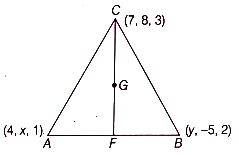
0 likesView Solution
420
MathematicsEasyMCQAP EAMCET · 2022
If the point $(3,4,5)$ divides the line segment joining the points $(1,2,3)$ and $(4,5,6)$ in the ratio $\lambda: 1$,then the point which divides the line segment joining the points $(3,4,5)$ and $(1,2,3)$ in the ratio $-1: \lambda$ is
A
$(6,7,8)$
B
$(5,6,7)$
C
$(-4,-5,-6)$
D
$(-5,-6,-7)$
Solution
(B) Let the points be $P(1,2,3)$ and $R(4,5,6)$. The point $Q(3,4,5)$ divides $PR$ in the ratio $\lambda: 1$.
Using the section formula,the coordinates of $Q$ are given by:
$Q = \left( \frac{\lambda(4) + 1(1)}{\lambda + 1}, \frac{\lambda(5) + 1(2)}{\lambda + 1}, \frac{\lambda(6) + 1(3)}{\lambda + 1} \right) = (3,4,5)$
Comparing the $x$-coordinates:
$\frac{4\lambda + 1}{\lambda + 1} = 3$
$4\lambda + 1 = 3\lambda + 3$
$\lambda = 2$
Now,we need to find the point that divides the line segment joining $Q(3,4,5)$ and $P(1,2,3)$ in the ratio $-1: \lambda$ (which is $-1: 2$).
Let the required point be $S(x, y, z)$. Using the section formula for internal division with ratio $m:n = -1: 2$:
$x = \frac{-1(1) + 2(3)}{-1 + 2} = \frac{-1 + 6}{1} = 5$
$y = \frac{-1(2) + 2(4)}{-1 + 2} = \frac{-2 + 8}{1} = 6$
$z = \frac{-1(3) + 2(5)}{-1 + 2} = \frac{-3 + 10}{1} = 7$
Thus,the required point is $(5,6,7)$.
Using the section formula,the coordinates of $Q$ are given by:
$Q = \left( \frac{\lambda(4) + 1(1)}{\lambda + 1}, \frac{\lambda(5) + 1(2)}{\lambda + 1}, \frac{\lambda(6) + 1(3)}{\lambda + 1} \right) = (3,4,5)$
Comparing the $x$-coordinates:
$\frac{4\lambda + 1}{\lambda + 1} = 3$
$4\lambda + 1 = 3\lambda + 3$
$\lambda = 2$
Now,we need to find the point that divides the line segment joining $Q(3,4,5)$ and $P(1,2,3)$ in the ratio $-1: \lambda$ (which is $-1: 2$).
Let the required point be $S(x, y, z)$. Using the section formula for internal division with ratio $m:n = -1: 2$:
$x = \frac{-1(1) + 2(3)}{-1 + 2} = \frac{-1 + 6}{1} = 5$
$y = \frac{-1(2) + 2(4)}{-1 + 2} = \frac{-2 + 8}{1} = 6$
$z = \frac{-1(3) + 2(5)}{-1 + 2} = \frac{-3 + 10}{1} = 7$
Thus,the required point is $(5,6,7)$.
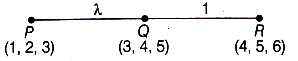
0 likesView Solution
421
MathematicsEasyMCQAP EAMCET · 2022
If the centroid of a triangle with vertices $(4, p, -3)$,$(-1, -1, 2)$,and $(3, 5, -8)$ is given by the mid-point of $(1, 4, -2)$ and $(q, 2, -4)$,then $p^2 + q^2 =$
A
$26$
B
$25$
C
$24$
D
$34$
Solution
(D) The centroid of a triangle with vertices $(x_1, y_1, z_1)$,$(x_2, y_2, z_2)$,and $(x_3, y_3, z_3)$ is given by $\left(\frac{x_1+x_2+x_3}{3}, \frac{y_1+y_2+y_3}{3}, \frac{z_1+z_2+z_3}{3}\right)$.
For the given vertices $(4, p, -3)$,$(-1, -1, 2)$,and $(3, 5, -8)$,the centroid is $\left(\frac{4-1+3}{3}, \frac{p-1+5}{3}, \frac{-3+2-8}{3}\right) = \left(2, \frac{p+4}{3}, -3\right)$.
The mid-point of $(1, 4, -2)$ and $(q, 2, -4)$ is $\left(\frac{1+q}{2}, \frac{4+2}{2}, \frac{-2-4}{2}\right) = \left(\frac{1+q}{2}, 3, -3\right)$.
Equating the coordinates of the centroid and the mid-point:
$2 = \frac{1+q}{2} \Rightarrow 4 = 1+q \Rightarrow q = 3$.
$\frac{p+4}{3} = 3 \Rightarrow p+4 = 9 \Rightarrow p = 5$.
Thus,$p^2 + q^2 = 5^2 + 3^2 = 25 + 9 = 34$.
For the given vertices $(4, p, -3)$,$(-1, -1, 2)$,and $(3, 5, -8)$,the centroid is $\left(\frac{4-1+3}{3}, \frac{p-1+5}{3}, \frac{-3+2-8}{3}\right) = \left(2, \frac{p+4}{3}, -3\right)$.
The mid-point of $(1, 4, -2)$ and $(q, 2, -4)$ is $\left(\frac{1+q}{2}, \frac{4+2}{2}, \frac{-2-4}{2}\right) = \left(\frac{1+q}{2}, 3, -3\right)$.
Equating the coordinates of the centroid and the mid-point:
$2 = \frac{1+q}{2} \Rightarrow 4 = 1+q \Rightarrow q = 3$.
$\frac{p+4}{3} = 3 \Rightarrow p+4 = 9 \Rightarrow p = 5$.
Thus,$p^2 + q^2 = 5^2 + 3^2 = 25 + 9 = 34$.
0 likesView Solution
422
MathematicsEasyMCQAP EAMCET · 2022
In a lottery containing $35$ tickets,exactly $10$ tickets bear a prize. If a ticket is drawn at random,then the probability of not getting a prize is
A
$\frac{1}{10}$
B
$\frac{2}{5}$
C
$\frac{2}{7}$
D
$\frac{5}{7}$
Solution
(D) Total number of tickets = $35$.
Number of prize-bearing tickets = $10$.
Number of tickets without a prize = $35 - 10 = 25$.
Probability of not getting a prize = $\frac{\text{Number of tickets without a prize}}{\text{Total number of tickets}} = \frac{25}{35} = \frac{5}{7}$.
Number of prize-bearing tickets = $10$.
Number of tickets without a prize = $35 - 10 = 25$.
Probability of not getting a prize = $\frac{\text{Number of tickets without a prize}}{\text{Total number of tickets}} = \frac{25}{35} = \frac{5}{7}$.
0 likesView Solution
423
MathematicsEasyMCQAP EAMCET · 2022
$A$ bag contains $7$ green and $5$ black balls. $3$ balls are drawn at random one after the other. If the balls are not replaced,then the probability of all three balls being green is
A
$\frac{343}{1720}$
B
$\frac{21}{36}$
C
$\frac{12}{35}$
D
$\frac{7}{44}$
Solution
(D) Total number of balls $= 7 + 5 = 12$.
Probability of drawing the first green ball $= \frac{7}{12}$.
Since the balls are not replaced,the number of green balls remaining is $6$ and the total number of balls remaining is $11$.
Probability of drawing the second green ball $= \frac{6}{11}$.
After drawing two green balls,the number of green balls remaining is $5$ and the total number of balls remaining is $10$.
Probability of drawing the third green ball $= \frac{5}{10} = \frac{1}{2}$.
The probability that all three balls are green is the product of these individual probabilities:
$P = \frac{7}{12} \times \frac{6}{11} \times \frac{5}{10} = \frac{7 \times 6 \times 5}{12 \times 11 \times 10} = \frac{210}{1320} = \frac{7}{44}$.
Probability of drawing the first green ball $= \frac{7}{12}$.
Since the balls are not replaced,the number of green balls remaining is $6$ and the total number of balls remaining is $11$.
Probability of drawing the second green ball $= \frac{6}{11}$.
After drawing two green balls,the number of green balls remaining is $5$ and the total number of balls remaining is $10$.
Probability of drawing the third green ball $= \frac{5}{10} = \frac{1}{2}$.
The probability that all three balls are green is the product of these individual probabilities:
$P = \frac{7}{12} \times \frac{6}{11} \times \frac{5}{10} = \frac{7 \times 6 \times 5}{12 \times 11 \times 10} = \frac{210}{1320} = \frac{7}{44}$.
0 likesView Solution
424
MathematicsMediumMCQAP EAMCET · 2022
If $x$ is chosen at random from the set $\{1, 2, 3, 4\}$ and $y$ is chosen at random from the set $\{5, 6, 7\}$,then the probability that $xy$ will be even is
A
$\frac{5}{6}$
B
$\frac{1}{6}$
C
$\frac{1}{2}$
D
$\frac{2}{3}$
Solution
(D) The set for $x$ is $\{1, 2, 3, 4\}$ and the set for $y$ is $\{5, 6, 7\}$.
Total number of possible outcomes is $4 \times 3 = 12$.
The product $xy$ is even if at least one of $x$ or $y$ is even.
Alternatively,$xy$ is odd only if both $x$ and $y$ are odd.
Odd values in $x$ are $\{1, 3\}$ (count = $2$).
Odd values in $y$ are $\{5, 7\}$ (count = $2$).
Number of outcomes where $xy$ is odd = $2 \times 2 = 4$.
Number of outcomes where $xy$ is even = $\text{Total outcomes} - \text{Odd outcomes} = 12 - 4 = 8$.
Probability that $xy$ is even = $\frac{8}{12} = \frac{2}{3}$.
Total number of possible outcomes is $4 \times 3 = 12$.
The product $xy$ is even if at least one of $x$ or $y$ is even.
Alternatively,$xy$ is odd only if both $x$ and $y$ are odd.
Odd values in $x$ are $\{1, 3\}$ (count = $2$).
Odd values in $y$ are $\{5, 7\}$ (count = $2$).
Number of outcomes where $xy$ is odd = $2 \times 2 = 4$.
Number of outcomes where $xy$ is even = $\text{Total outcomes} - \text{Odd outcomes} = 12 - 4 = 8$.
Probability that $xy$ is even = $\frac{8}{12} = \frac{2}{3}$.
0 likesView Solution
425
MathematicsEasyMCQAP EAMCET · 2022
In a box there are $8$ red,$7$ blue,and $6$ green balls. One ball is picked up randomly. What is the probability that it is neither red nor green?
A
$\frac{2}{3}$
B
$\frac{3}{4}$
C
$\frac{1}{3}$
D
$\frac{1}{2}$
Solution
(C) It can be noted that if the ball is neither red nor green,then it must be blue.
Number of blue balls $= 7$.
Total number of balls $= 8 + 7 + 6 = 21$.
Thus,the probability of picking a blue ball is $= \frac{7}{21} = \frac{1}{3}$.
Number of blue balls $= 7$.
Total number of balls $= 8 + 7 + 6 = 21$.
Thus,the probability of picking a blue ball is $= \frac{7}{21} = \frac{1}{3}$.
0 likesView Solution
426
MathematicsEasyMCQAP EAMCET · 2022
$A$ five-digit number is formed by the digits $1, 2, 3, 4, 5$ with no digit being repeated. The probability that the number is divisible by $4$ is
A
$\frac{1}{5}$
B
$\frac{5}{6}$
C
$\frac{4}{5}$
D
$\frac{4}{6}$
Solution
(A) The total number of five-digit numbers formed using the digits $1, 2, 3, 4, 5$ without repetition is $5! = 120$.
$A$ number is divisible by $4$ if its last two digits form a number divisible by $4$.
Using the digits ${1, 2, 3, 4, 5}$,the possible two-digit combinations divisible by $4$ are $12, 24, 32, 52$.
For each of these $4$ cases,the remaining $3$ digits can be arranged in the first $3$ positions in $3! = 6$ ways.
Thus,the total number of favorable outcomes is $4 \times 3! = 4 \times 6 = 24$.
The required probability is $\frac{24}{120} = \frac{1}{5}$.
$A$ number is divisible by $4$ if its last two digits form a number divisible by $4$.
Using the digits ${1, 2, 3, 4, 5}$,the possible two-digit combinations divisible by $4$ are $12, 24, 32, 52$.
For each of these $4$ cases,the remaining $3$ digits can be arranged in the first $3$ positions in $3! = 6$ ways.
Thus,the total number of favorable outcomes is $4 \times 3! = 4 \times 6 = 24$.
The required probability is $\frac{24}{120} = \frac{1}{5}$.
0 likesView Solution
427
MathematicsDifficultMCQAP EAMCET · 2022
$A$ manager decides to distribute $Rs. 20000$ between two employees $X$ and $Y$. He knows $X$ deserves more than $Y$,but does not know how much more. So,he decides to arbitrarily break $Rs. 20000$ into two parts and gives $X$ the bigger part. Then,the chance that $X$ gets twice as much as $Y$ or more is
A
$2/5$
B
$1/2$
C
$1/3$
D
$2/3$
Solution
(D) Let the total amount be $S = 20000$. Let $X$ be the amount given to employee $X$ and $Y$ be the amount given to employee $Y$.
Given $X + Y = 20000$ and $X > Y$.
Since $X$ is the bigger part,$X$ must be in the range $(10000, 20000]$.
The total length of the sample space for $X$ is $20000 - 10000 = 10000$.
We want the probability that $X \geq 2Y$.
Substituting $Y = 20000 - X$,we get $X \geq 2(20000 - X)$.
$X \geq 40000 - 2X \Rightarrow 3X \geq 40000 \Rightarrow X \geq 40000/3$.
Since $X$ must be at most $20000$,the favorable range for $X$ is $[40000/3, 20000]$.
The length of this interval is $20000 - 40000/3 = 20000/3$.
The probability is $\frac{20000/3}{10000} = \frac{2}{3}$.
Given $X + Y = 20000$ and $X > Y$.
Since $X$ is the bigger part,$X$ must be in the range $(10000, 20000]$.
The total length of the sample space for $X$ is $20000 - 10000 = 10000$.
We want the probability that $X \geq 2Y$.
Substituting $Y = 20000 - X$,we get $X \geq 2(20000 - X)$.
$X \geq 40000 - 2X \Rightarrow 3X \geq 40000 \Rightarrow X \geq 40000/3$.
Since $X$ must be at most $20000$,the favorable range for $X$ is $[40000/3, 20000]$.
The length of this interval is $20000 - 40000/3 = 20000/3$.
The probability is $\frac{20000/3}{10000} = \frac{2}{3}$.
0 likesView Solution
428
MathematicsEasyMCQAP EAMCET · 2022
The probability of getting a sum of $9$ when two dice are thrown is
A
$\frac{1}{6}$
B
$\frac{1}{8}$
C
$\frac{1}{9}$
D
$\frac{1}{12}$
Solution
(C) When two dice are rolled together,the total number of outcomes is $6 \times 6 = 36$.
The pairs that result in a sum of $9$ are $(3,6), (4,5), (5,4), (6,3)$.
Thus,the number of favourable outcomes is $4$.
The probability of getting a sum of $9$ is given by the ratio of favourable outcomes to total outcomes:
$P(\text{sum of } 9) = \frac{4}{36} = \frac{1}{9}$.
The pairs that result in a sum of $9$ are $(3,6), (4,5), (5,4), (6,3)$.
Thus,the number of favourable outcomes is $4$.
The probability of getting a sum of $9$ is given by the ratio of favourable outcomes to total outcomes:
$P(\text{sum of } 9) = \frac{4}{36} = \frac{1}{9}$.
0 likesView Solution
429
MathematicsEasyMCQAP EAMCET · 2022
From a pack of $52$ cards,$3$ cards are drawn at random. Then,the probability that one is an ace,one is a queen,and one is a jack is
A
$\frac{19}{5525}$
B
$\frac{21}{5525}$
C
$\frac{17}{5525}$
D
$\frac{16}{5525}$
Solution
(D) The total number of ways to select $3$ cards from $52$ is given by ${}^{52}C_3 = \frac{52 \times 51 \times 50}{3 \times 2 \times 1} = 22100$.
Favourable outcomes involve selecting $1$ ace from $4$,$1$ queen from $4$,and $1$ jack from $4$.
This can be done in ${}^{4}C_1 \times {}^{4}C_1 \times {}^{4}C_1 = 4 \times 4 \times 4 = 64$ ways.
The required probability is $\frac{64}{22100} = \frac{16}{5525}$.
Favourable outcomes involve selecting $1$ ace from $4$,$1$ queen from $4$,and $1$ jack from $4$.
This can be done in ${}^{4}C_1 \times {}^{4}C_1 \times {}^{4}C_1 = 4 \times 4 \times 4 = 64$ ways.
The required probability is $\frac{64}{22100} = \frac{16}{5525}$.
0 likesView Solution
430
MathematicsEasyMCQAP EAMCET · 2022
$A$ bag contains $2$ red,$3$ green,and $2$ blue balls. Two balls are drawn at random. The probability that none of the balls drawn is blue is
A
$10 / 21$
B
$11 / 21$
C
$2 / 7$
D
$5 / 7$
Solution
(A) Total number of balls = $2 + 3 + 2 = 7$.
Number of ways to draw $2$ balls from $7$ is $^7C_2 = \frac{7 \times 6}{2} = 21$.
We want the probability that none of the balls drawn is blue. This means both balls must be chosen from the red and green balls.
Total non-blue balls = $2 \text{ (red)} + 3 \text{ (green)} = 5$.
Number of ways to choose $2$ balls from $5$ non-blue balls is $^5C_2 = \frac{5 \times 4}{2} = 10$.
Therefore,the probability is $\frac{10}{21}$.
Number of ways to draw $2$ balls from $7$ is $^7C_2 = \frac{7 \times 6}{2} = 21$.
We want the probability that none of the balls drawn is blue. This means both balls must be chosen from the red and green balls.
Total non-blue balls = $2 \text{ (red)} + 3 \text{ (green)} = 5$.
Number of ways to choose $2$ balls from $5$ non-blue balls is $^5C_2 = \frac{5 \times 4}{2} = 10$.
Therefore,the probability is $\frac{10}{21}$.
0 likesView Solution
431
MathematicsEasyMCQAP EAMCET · 2022
$A$ bag contains $21$ toys numbered $1$ to $21$. $A$ toy is drawn and then another toy is drawn without replacement. The probability that both toys will show even numbers is
A
$\frac{5}{21}$
B
$\frac{3}{14}$
C
$\frac{11}{42}$
D
$\frac{4}{21}$
Solution
(B) Total number of toys is $21$. The even numbers between $1$ and $21$ are $2, 4, 6, 8, 10, 12, 14, 16, 18, 20$. There are $10$ even numbers.
Probability of drawing the first even number is $\frac{10}{21}$.
After drawing one even number,there are $9$ even numbers left out of $20$ total toys.
Probability of drawing the second even number is $\frac{9}{20}$.
The probability that both toys show even numbers is $\frac{10}{21} \times \frac{9}{20} = \frac{90}{420} = \frac{3}{14}$.
Probability of drawing the first even number is $\frac{10}{21}$.
After drawing one even number,there are $9$ even numbers left out of $20$ total toys.
Probability of drawing the second even number is $\frac{9}{20}$.
The probability that both toys show even numbers is $\frac{10}{21} \times \frac{9}{20} = \frac{90}{420} = \frac{3}{14}$.
0 likesView Solution
432
MathematicsEasyMCQAP EAMCET · 2022
Two dice are rolled. Then,the probability that the total score is a prime number is
A
$\frac{1}{16}$
B
$\frac{5}{12}$
C
$\frac{1}{2}$
D
$\frac{7}{9}$
Solution
(B) When two dice are rolled,the total number of possible outcomes is $6 \times 6 = 36$.
The possible total scores range from $2$ to $12$.
The prime numbers in this range are $2, 3, 5, 7, 11$.
The outcomes resulting in these sums are:
Sum $= 2: (1,1)$
Sum $= 3: (1,2), (2,1)$
Sum $= 5: (1,4), (2,3), (3,2), (4,1)$
Sum $= 7: (1,6), (2,5), (3,4), (4,3), (5,2), (6,1)$
Sum $= 11: (5,6), (6,5)$
Total number of favorable outcomes $= 1 + 2 + 4 + 6 + 2 = 15$.
The probability is $\frac{15}{36} = \frac{5}{12}$.
The possible total scores range from $2$ to $12$.
The prime numbers in this range are $2, 3, 5, 7, 11$.
The outcomes resulting in these sums are:
Sum $= 2: (1,1)$
Sum $= 3: (1,2), (2,1)$
Sum $= 5: (1,4), (2,3), (3,2), (4,1)$
Sum $= 7: (1,6), (2,5), (3,4), (4,3), (5,2), (6,1)$
Sum $= 11: (5,6), (6,5)$
Total number of favorable outcomes $= 1 + 2 + 4 + 6 + 2 = 15$.
The probability is $\frac{15}{36} = \frac{5}{12}$.
0 likesView Solution
433
MathematicsMediumMCQAP EAMCET · 2022
An unbiased dice with faces marked $1, 2, 3, 4, 5,$ and $6$ is rolled four times. Out of the four face values obtained,the probability that the minimum face value is not less than $2$ and the maximum face value is not greater than $5$ is: (in $/ 81$)
A
$16$
B
$1$
C
$80$
D
$65$
Solution
(A) The total number of outcomes when a die is rolled $4$ times is $6^4 = 1296$.
For each roll,the face value must be in the set $\{2, 3, 4, 5\}$ to satisfy the condition that the minimum is $\ge 2$ and the maximum is $\le 5$.
There are $4$ such favorable outcomes for each roll.
The number of favorable outcomes for $4$ rolls is $4^4 = 256$.
The required probability is $\frac{4^4}{6^4} = \left(\frac{4}{6}\right)^4 = \left(\frac{2}{3}\right)^4 = \frac{16}{81}$.
For each roll,the face value must be in the set $\{2, 3, 4, 5\}$ to satisfy the condition that the minimum is $\ge 2$ and the maximum is $\le 5$.
There are $4$ such favorable outcomes for each roll.
The number of favorable outcomes for $4$ rolls is $4^4 = 256$.
The required probability is $\frac{4^4}{6^4} = \left(\frac{4}{6}\right)^4 = \left(\frac{2}{3}\right)^4 = \frac{16}{81}$.
0 likesView Solution
434
MathematicsEasyMCQAP EAMCET · 2022
In a set of $30$ game cards,$17$ are white and the rest are green. Out of $30$,$4$ white and $5$ green cards are marked $IMPORTANT$. If a card is chosen randomly from this set,then the probability of choosing a green card or an $IMPORTANT$ card is:
A
$13 / 30$
B
$22 / 30$
C
$17 / 30$
D
$9 / 13$
Solution
(C) Total cards $= 30$.
Number of white cards $= 17$.
Number of green cards $= 30 - 17 = 13$.
Number of $IMPORTANT$ cards $= 4 + 5 = 9$.
Number of cards that are both green and $IMPORTANT = 5$.
Let $G$ be the event of choosing a green card and $I$ be the event of choosing an $IMPORTANT$ card.
We need to find $P(G \cup I) = P(G) + P(I) - P(G \cap I)$.
$P(G) = \frac{13}{30}$,$P(I) = \frac{9}{30}$,$P(G \cap I) = \frac{5}{30}$.
$P(G \cup I) = \frac{13}{30} + \frac{9}{30} - \frac{5}{30} = \frac{17}{30}$.
Number of white cards $= 17$.
Number of green cards $= 30 - 17 = 13$.
Number of $IMPORTANT$ cards $= 4 + 5 = 9$.
Number of cards that are both green and $IMPORTANT = 5$.
Let $G$ be the event of choosing a green card and $I$ be the event of choosing an $IMPORTANT$ card.
We need to find $P(G \cup I) = P(G) + P(I) - P(G \cap I)$.
$P(G) = \frac{13}{30}$,$P(I) = \frac{9}{30}$,$P(G \cap I) = \frac{5}{30}$.
$P(G \cup I) = \frac{13}{30} + \frac{9}{30} - \frac{5}{30} = \frac{17}{30}$.
0 likesView Solution
435
MathematicsEasyMCQAP EAMCET · 2022
If a number is chosen at random from the set $\{1, 2, 3, \ldots, 100\}$,then the probability that the chosen number is a perfect cube is
A
$1 / 25$
B
$1 / 2$
C
$1 / 10$
D
$9 / 13$
Solution
(A) The total number of elements in the set is $n(S) = 100$.
The perfect cubes between $1$ and $100$ are $1^3 = 1$,$2^3 = 8$,$3^3 = 27$,and $4^3 = 64$.
Thus,the set of favorable outcomes is $E = \{1, 8, 27, 64\}$,so $n(E) = 4$.
The required probability is $P(E) = \frac{n(E)}{n(S)} = \frac{4}{100} = \frac{1}{25}$.
The perfect cubes between $1$ and $100$ are $1^3 = 1$,$2^3 = 8$,$3^3 = 27$,and $4^3 = 64$.
Thus,the set of favorable outcomes is $E = \{1, 8, 27, 64\}$,so $n(E) = 4$.
The required probability is $P(E) = \frac{n(E)}{n(S)} = \frac{4}{100} = \frac{1}{25}$.
0 likesView Solution
436
MathematicsEasyMCQAP EAMCET · 2022
From a well-shuffled pack of $52$ cards,two cards are drawn at random. The probability that both cards are kings is:
A
$\frac{1}{15}$
B
$\frac{25}{57}$
C
$\frac{35}{256}$
D
$\frac{1}{221}$
Solution
(D) Total number of cards $= 52$.
Total number of kings in a deck $= 4$.
The number of ways to choose $2$ cards out of $52$ is given by $^{52}C_2 = \frac{52 \times 51}{2 \times 1} = 1326$.
The number of ways to choose $2$ kings out of $4$ is given by $^4C_2 = \frac{4 \times 3}{2 \times 1} = 6$.
Therefore,the probability that both cards are kings is $P = \frac{^4C_2}{^{52}C_2} = \frac{6}{1326} = \frac{1}{221}$.
Total number of kings in a deck $= 4$.
The number of ways to choose $2$ cards out of $52$ is given by $^{52}C_2 = \frac{52 \times 51}{2 \times 1} = 1326$.
The number of ways to choose $2$ kings out of $4$ is given by $^4C_2 = \frac{4 \times 3}{2 \times 1} = 6$.
Therefore,the probability that both cards are kings is $P = \frac{^4C_2}{^{52}C_2} = \frac{6}{1326} = \frac{1}{221}$.
0 likesView Solution
437
MathematicsEasyMCQAP EAMCET · 2022
$A$ bag contains $3$ white,$2$ blue,and $5$ red balls. One ball is drawn at random from this bag. The probability that the ball drawn is not red is
A
$3/10$
B
$1/5$
C
$1/2$
D
$4/5$
Solution
(C) Total number of balls = $3 + 2 + 5 = 10$.
Number of balls that are not red = $3$ (white) + $2$ (blue) = $5$.
Probability of drawing a ball that is not red = $\frac{\text{Number of non-red balls}}{\text{Total number of balls}} = \frac{5}{10} = \frac{1}{2}$.
Number of balls that are not red = $3$ (white) + $2$ (blue) = $5$.
Probability of drawing a ball that is not red = $\frac{\text{Number of non-red balls}}{\text{Total number of balls}} = \frac{5}{10} = \frac{1}{2}$.
0 likesView Solution
438
MathematicsEasyMCQAP EAMCET · 2022
$A$ person $P$ speaks the truth in $75\%$ of cases and another person $R$ in $80\%$ of cases. What is the probability that they are likely to contradict each other in narrating the same event?
A
$\frac{7}{20}$
B
$\frac{7}{10}$
C
$0.2$
D
$0.3$
Solution
(A) Let $P(P)$ be the probability that person $P$ speaks the truth and $P(R)$ be the probability that person $R$ speaks the truth.
Given: $P(P) = \frac{75}{100} = \frac{3}{4}$ and $P(R) = \frac{80}{100} = \frac{4}{5}$.
Consequently,the probabilities of them lying are $P(P') = 1 - \frac{3}{4} = \frac{1}{4}$ and $P(R') = 1 - \frac{4}{5} = \frac{1}{5}$.
They contradict each other if one speaks the truth and the other lies.
Case $I$: $P$ speaks the truth and $R$ lies: $P(P) \times P(R') = \frac{3}{4} \times \frac{1}{5} = \frac{3}{20}$.
Case $II$: $R$ speaks the truth and $P$ lies: $P(R) \times P(P') = \frac{4}{5} \times \frac{1}{4} = \frac{4}{20}$.
Total probability of contradiction $= \frac{3}{20} + \frac{4}{20} = \frac{7}{20}$.
Given: $P(P) = \frac{75}{100} = \frac{3}{4}$ and $P(R) = \frac{80}{100} = \frac{4}{5}$.
Consequently,the probabilities of them lying are $P(P') = 1 - \frac{3}{4} = \frac{1}{4}$ and $P(R') = 1 - \frac{4}{5} = \frac{1}{5}$.
They contradict each other if one speaks the truth and the other lies.
Case $I$: $P$ speaks the truth and $R$ lies: $P(P) \times P(R') = \frac{3}{4} \times \frac{1}{5} = \frac{3}{20}$.
Case $II$: $R$ speaks the truth and $P$ lies: $P(R) \times P(P') = \frac{4}{5} \times \frac{1}{4} = \frac{4}{20}$.
Total probability of contradiction $= \frac{3}{20} + \frac{4}{20} = \frac{7}{20}$.
0 likesView Solution
439
MathematicsEasyMCQAP EAMCET · 2022
$A$ box contains $6$ bottles of $V_1$ drink,$3$ bottles of $V_2$ drink and $4$ bottles of $V_3$ drink. If three bottles are drawn at random,then the probability that the three are not of the same variety is
A
$\frac{632}{713}$
B
$\frac{752}{833}$
C
$\frac{833}{858}$
D
$\frac{261}{286}$
Solution
(D) Total number of bottles = $6 + 3 + 4 = 13$.
Number of ways to choose $3$ bottles out of $13$ is $^{13}C_3 = \frac{13 \times 12 \times 11}{3 \times 2 \times 1} = 286$.
Let $E$ be the event that all three bottles are of the same variety.
$E$ occurs if we choose $3$ bottles of $V_1$,or $3$ bottles of $V_2$,or $3$ bottles of $V_3$.
Number of ways to choose $3$ bottles of the same variety = $^6C_3 + ^3C_3 + ^4C_3$.
$^6C_3 = \frac{6 \times 5 \times 4}{3 \times 2 \times 1} = 20$.
$^3C_3 = 1$.
$^4C_3 = 4$.
Total favorable ways for $E = 20 + 1 + 4 = 25$.
$P(E) = \frac{25}{286}$.
The probability that the three bottles are not of the same variety is $1 - P(E) = 1 - \frac{25}{286} = \frac{286 - 25}{286} = \frac{261}{286}$.
Number of ways to choose $3$ bottles out of $13$ is $^{13}C_3 = \frac{13 \times 12 \times 11}{3 \times 2 \times 1} = 286$.
Let $E$ be the event that all three bottles are of the same variety.
$E$ occurs if we choose $3$ bottles of $V_1$,or $3$ bottles of $V_2$,or $3$ bottles of $V_3$.
Number of ways to choose $3$ bottles of the same variety = $^6C_3 + ^3C_3 + ^4C_3$.
$^6C_3 = \frac{6 \times 5 \times 4}{3 \times 2 \times 1} = 20$.
$^3C_3 = 1$.
$^4C_3 = 4$.
Total favorable ways for $E = 20 + 1 + 4 = 25$.
$P(E) = \frac{25}{286}$.
The probability that the three bottles are not of the same variety is $1 - P(E) = 1 - \frac{25}{286} = \frac{286 - 25}{286} = \frac{261}{286}$.
0 likesView Solution
440
MathematicsEasyMCQAP EAMCET · 2022
One card is drawn at random from a well-shuffled pack of $52$ cards. The probability that the card drawn is a face card (Jack,Queen,and King only) is
A
$1 / 13$
B
$3 / 13$
C
$1 / 4$
D
$9 / 52$
Solution
(B) The total number of cards in a pack is $52$.
There are $4$ Jacks,$4$ Queens,and $4$ Kings in a pack.
Total number of face cards = $4 + 4 + 4 = 12$.
The probability of drawing a face card is given by the ratio of the number of face cards to the total number of cards.
$P(\text{Face Card}) = \frac{12}{52} = \frac{3}{13}$.
There are $4$ Jacks,$4$ Queens,and $4$ Kings in a pack.
Total number of face cards = $4 + 4 + 4 = 12$.
The probability of drawing a face card is given by the ratio of the number of face cards to the total number of cards.
$P(\text{Face Card}) = \frac{12}{52} = \frac{3}{13}$.
0 likesView Solution
441
MathematicsEasyMCQAP EAMCET · 2022
Four cards are drawn at random from a pack of $52$ playing cards. The probability of getting all four cards of the same suit is
A
$\frac{13}{270725}$
B
$\frac{91}{190}$
C
$\frac{178}{20825}$
D
$\frac{44}{4165}$
Solution
(D) The total number of ways to draw $4$ cards from $52$ is $^{52}C_{4}$.
There are $4$ suits in a pack,each containing $13$ cards.
The number of ways to choose $4$ cards of the same suit is $4 \times ^{13}C_{4}$.
The probability $P$ is given by:
$P = \frac{4 \times ^{13}C_{4}}{^{52}C_{4}}$
$P = \frac{4 \times \frac{13 \times 12 \times 11 \times 10}{4 \times 3 \times 2 \times 1}}{\frac{52 \times 51 \times 50 \times 49}{4 \times 3 \times 2 \times 1}}$
$P = \frac{4 \times 715}{270725} = \frac{2860}{270725}$
Simplifying the fraction:
$P = \frac{44}{4165}$
There are $4$ suits in a pack,each containing $13$ cards.
The number of ways to choose $4$ cards of the same suit is $4 \times ^{13}C_{4}$.
The probability $P$ is given by:
$P = \frac{4 \times ^{13}C_{4}}{^{52}C_{4}}$
$P = \frac{4 \times \frac{13 \times 12 \times 11 \times 10}{4 \times 3 \times 2 \times 1}}{\frac{52 \times 51 \times 50 \times 49}{4 \times 3 \times 2 \times 1}}$
$P = \frac{4 \times 715}{270725} = \frac{2860}{270725}$
Simplifying the fraction:
$P = \frac{44}{4165}$
0 likesView Solution
442
MathematicsEasyMCQAP EAMCET · 2022
$A$ box contains $6$ black,$4$ red,$2$ white,and $3$ blue shirts. If $2$ shirts are picked at random,what is the probability that both are white or both are blue?
A
$4/105$
B
$1/35$
C
$1/105$
D
$1/15$
Solution
(A) Total number of shirts $= 6 + 4 + 2 + 3 = 15$.
Number of ways to pick $2$ shirts from $15$ is given by $^{15}C_2 = \frac{15 \times 14}{2 \times 1} = 105$.
Number of ways to pick $2$ white shirts from $2$ is $^{2}C_2 = 1$.
Number of ways to pick $2$ blue shirts from $3$ is $^{3}C_2 = 3$.
Since these are mutually exclusive events,the probability is:
$P = \frac{^{2}C_2 + ^{3}C_2}{^{15}C_2} = \frac{1 + 3}{105} = \frac{4}{105}$.
Number of ways to pick $2$ shirts from $15$ is given by $^{15}C_2 = \frac{15 \times 14}{2 \times 1} = 105$.
Number of ways to pick $2$ white shirts from $2$ is $^{2}C_2 = 1$.
Number of ways to pick $2$ blue shirts from $3$ is $^{3}C_2 = 3$.
Since these are mutually exclusive events,the probability is:
$P = \frac{^{2}C_2 + ^{3}C_2}{^{15}C_2} = \frac{1 + 3}{105} = \frac{4}{105}$.
0 likesView Solution
443
MathematicsMediumMCQAP EAMCET · 2022
Two brothers $X$ and $Y$ appeared for an exam. Let $A$ be the event that $X$ has passed the exam and $B$ is the event that $Y$ has passed. The probability of $A$ is $\frac{1}{7}$ and of $B$ is $\frac{2}{9}$. Then,the probability that both of them pass the exam is
A
$\frac{1}{63}$
B
$\frac{2}{35}$
C
$\frac{2}{63}$
D
$\frac{9}{14}$
Solution
(C) Given that $A$ is the event that $X$ passes the exam and $B$ is the event that $Y$ passes the exam.
$P(A) = \frac{1}{7}$ and $P(B) = \frac{2}{9}$.
Since the events $A$ and $B$ are independent,the probability that both pass the exam is given by $P(A \cap B) = P(A) \times P(B)$.
Substituting the values,we get $P(A \cap B) = \frac{1}{7} \times \frac{2}{9} = \frac{2}{63}$.
$P(A) = \frac{1}{7}$ and $P(B) = \frac{2}{9}$.
Since the events $A$ and $B$ are independent,the probability that both pass the exam is given by $P(A \cap B) = P(A) \times P(B)$.
Substituting the values,we get $P(A \cap B) = \frac{1}{7} \times \frac{2}{9} = \frac{2}{63}$.
0 likesView Solution
444
MathematicsEasyMCQAP EAMCET · 2022
Three unbiased coins are tossed. Then,the probability of getting at most two heads is
A
$3 / 4$
B
$1 / 4$
C
$3 / 8$
D
$7 / 8$
Solution
(D) When three unbiased coins are tossed,the sample space $S$ is given by:
$S = \{HHH, HHT, HTH, HTT, THH, THT, TTH, TTT\}$
The total number of outcomes is $n(S) = 8$.
Let $E$ be the event of getting at most two heads.
It is easier to calculate the complement event $E'$,which is the event of getting three heads.
$E' = \{HHH\}$
The number of outcomes in $E'$ is $n(E') = 1$.
The probability of getting three heads is $P(E') = \frac{n(E')}{n(S)} = \frac{1}{8}$.
The probability of getting at most two heads is $P(E) = 1 - P(E') = 1 - \frac{1}{8} = \frac{7}{8}$.
$S = \{HHH, HHT, HTH, HTT, THH, THT, TTH, TTT\}$
The total number of outcomes is $n(S) = 8$.
Let $E$ be the event of getting at most two heads.
It is easier to calculate the complement event $E'$,which is the event of getting three heads.
$E' = \{HHH\}$
The number of outcomes in $E'$ is $n(E') = 1$.
The probability of getting three heads is $P(E') = \frac{n(E')}{n(S)} = \frac{1}{8}$.
The probability of getting at most two heads is $P(E) = 1 - P(E') = 1 - \frac{1}{8} = \frac{7}{8}$.
0 likesView Solution
445
MathematicsEasyMCQAP EAMCET · 2022
Two dice are thrown simultaneously. The probability of getting a multiple of $2$ on one die and a multiple of $3$ on the other die is
A
$\frac{5}{12}$
B
$\frac{11}{36}$
C
$\frac{13}{36}$
D
$\frac{5}{36}$
Solution
(B) When two dice are thrown simultaneously,the total number of outcomes is $n(S) = 6 \times 6 = 36$.
Let $A$ be the event of getting a multiple of $2$ on the first die,i.e.,$A \in \{2, 4, 6\}$.
Let $B$ be the event of getting a multiple of $3$ on the second die,i.e.,$B \in \{3, 6\}$.
We want to find the probability of getting a multiple of $2$ on one die and a multiple of $3$ on the other.
Let $E$ be the set of favorable outcomes:
$E = \{(2,3), (4,3), (6,3), (2,6), (4,6), (6,6), (3,2), (3,4), (3,6), (6,2), (6,4)\}$.
Note that $(6,6)$ is included because it satisfies the condition of having a multiple of $2$ on one die and a multiple of $3$ on the other.
Counting the elements in $E$,we get $n(E) = 11$.
Therefore,the probability $P(E) = \frac{n(E)}{n(S)} = \frac{11}{36}$.
Let $A$ be the event of getting a multiple of $2$ on the first die,i.e.,$A \in \{2, 4, 6\}$.
Let $B$ be the event of getting a multiple of $3$ on the second die,i.e.,$B \in \{3, 6\}$.
We want to find the probability of getting a multiple of $2$ on one die and a multiple of $3$ on the other.
Let $E$ be the set of favorable outcomes:
$E = \{(2,3), (4,3), (6,3), (2,6), (4,6), (6,6), (3,2), (3,4), (3,6), (6,2), (6,4)\}$.
Note that $(6,6)$ is included because it satisfies the condition of having a multiple of $2$ on one die and a multiple of $3$ on the other.
Counting the elements in $E$,we get $n(E) = 11$.
Therefore,the probability $P(E) = \frac{n(E)}{n(S)} = \frac{11}{36}$.
0 likesView Solution
446
MathematicsMediumMCQAP EAMCET · 2022
Three students $X, Y$ and $Z$ appear for an examination. The probability of $X$ passing the examination is $\frac{1}{5}$,the probability of $Y$ passing the examination is $\frac{1}{4}$ and the probability of $Z$ failing the examination is $\frac{2}{3}$. The probability that at least two of them pass the exam is
A
$\frac{1}{6}$
B
$\frac{2}{5}$
C
$\frac{3}{4}$
D
$\frac{3}{5}$
Solution
(A) Let $P(X), P(Y), P(Z)$ be the probabilities of students $X, Y, Z$ passing the exam respectively.
Given:
$P(X) = \frac{1}{5} \implies P(X') = 1 - \frac{1}{5} = \frac{4}{5}$
$P(Y) = \frac{1}{4} \implies P(Y') = 1 - \frac{1}{4} = \frac{3}{4}$
$P(Z') = \frac{2}{3} \implies P(Z) = 1 - \frac{2}{3} = \frac{1}{3}$
We need the probability that at least two of them pass,which is the sum of probabilities of exactly two passing and all three passing.
$P(\text{at least 2 pass}) = P(X)P(Y)P(Z') + P(X)P(Y')P(Z) + P(X')P(Y)P(Z) + P(X)P(Y)P(Z)$
$= (\frac{1}{5} \times \frac{1}{4} \times \frac{2}{3}) + (\frac{1}{5} \times \frac{3}{4} \times \frac{1}{3}) + (\frac{4}{5} \times \frac{1}{4} \times \frac{1}{3}) + (\frac{1}{5} \times \frac{1}{4} \times \frac{1}{3})$
$= \frac{2}{60} + \frac{3}{60} + \frac{4}{60} + \frac{1}{60} = \frac{10}{60} = \frac{1}{6}$
Given:
$P(X) = \frac{1}{5} \implies P(X') = 1 - \frac{1}{5} = \frac{4}{5}$
$P(Y) = \frac{1}{4} \implies P(Y') = 1 - \frac{1}{4} = \frac{3}{4}$
$P(Z') = \frac{2}{3} \implies P(Z) = 1 - \frac{2}{3} = \frac{1}{3}$
We need the probability that at least two of them pass,which is the sum of probabilities of exactly two passing and all three passing.
$P(\text{at least 2 pass}) = P(X)P(Y)P(Z') + P(X)P(Y')P(Z) + P(X')P(Y)P(Z) + P(X)P(Y)P(Z)$
$= (\frac{1}{5} \times \frac{1}{4} \times \frac{2}{3}) + (\frac{1}{5} \times \frac{3}{4} \times \frac{1}{3}) + (\frac{4}{5} \times \frac{1}{4} \times \frac{1}{3}) + (\frac{1}{5} \times \frac{1}{4} \times \frac{1}{3})$
$= \frac{2}{60} + \frac{3}{60} + \frac{4}{60} + \frac{1}{60} = \frac{10}{60} = \frac{1}{6}$
0 likesView Solution
447
MathematicsEasyMCQAP EAMCET · 2022
Two dice are thrown simultaneously. The probability of getting two numbers whose product is even is
A
$1 / 2$
B
$3 / 4$
C
$3 / 8$
D
$5 / 16$
Solution
(B) The total number of outcomes when two dice are thrown is $6 \times 6 = 36$.
The product of two numbers is odd only if both numbers are odd.
The odd numbers on a die are $\{1, 3, 5\}$.
The number of outcomes where both dice show an odd number is $3 \times 3 = 9$.
The product is even if it is not odd.
Therefore,the number of favorable outcomes where the product is even is $36 - 9 = 27$.
The probability of getting an even product is $\frac{27}{36} = \frac{3}{4}$.
The product of two numbers is odd only if both numbers are odd.
The odd numbers on a die are $\{1, 3, 5\}$.
The number of outcomes where both dice show an odd number is $3 \times 3 = 9$.
The product is even if it is not odd.
Therefore,the number of favorable outcomes where the product is even is $36 - 9 = 27$.
The probability of getting an even product is $\frac{27}{36} = \frac{3}{4}$.
0 likesView Solution
448
MathematicsEasyMCQAP EAMCET · 2022
There are $4$ hotels in a town. If $3$ men check into the hotels in a day,then the probability that each checks into a different hotel is
A
$\frac{6}{7}$
B
$\frac{1}{8}$
C
$\frac{3}{8}$
D
$\frac{5}{9}$
Solution
(C) Total number of ways in which $3$ men can check into $4$ hotels is $4 \times 4 \times 4 = 64$.
If each man has to check into a different hotel,the number of ways is $4 \times 3 \times 2 = 24$.
(The first man has $4$ choices,the second man has $3$ choices,and the third man has $2$ choices).
Therefore,the required probability is $\frac{24}{64} = \frac{3}{8}$.
If each man has to check into a different hotel,the number of ways is $4 \times 3 \times 2 = 24$.
(The first man has $4$ choices,the second man has $3$ choices,and the third man has $2$ choices).
Therefore,the required probability is $\frac{24}{64} = \frac{3}{8}$.
0 likesView Solution
449
MathematicsEasyMCQAP EAMCET · 2022
Person $A$ can solve $90 \%$ of the problems given in the book and Person $B$ can solve $70 \%$. Then,the probability that at least one of them will solve the problem selected at random from the book is
A
$0.16$
B
$0.69$
C
$0.97$
D
$0.20$
Solution
(C) Let $A$ be the event that person $A$ solves the problem and $B$ be the event that person $B$ solves the problem.
Given,$P(A) = 0.90$ and $P(B) = 0.70$.
The probability that person $A$ fails to solve the problem is $P(\bar{A}) = 1 - 0.90 = 0.10$.
The probability that person $B$ fails to solve the problem is $P(\bar{B}) = 1 - 0.70 = 0.30$.
The probability that at least one of them solves the problem is given by $1 - P(\text{none solves the problem})$.
Since the events are independent,$P(\text{none solves}) = P(\bar{A}) \times P(\bar{B}) = 0.10 \times 0.30 = 0.03$.
Therefore,the probability that at least one of them solves the problem is $1 - 0.03 = 0.97$.
Given,$P(A) = 0.90$ and $P(B) = 0.70$.
The probability that person $A$ fails to solve the problem is $P(\bar{A}) = 1 - 0.90 = 0.10$.
The probability that person $B$ fails to solve the problem is $P(\bar{B}) = 1 - 0.70 = 0.30$.
The probability that at least one of them solves the problem is given by $1 - P(\text{none solves the problem})$.
Since the events are independent,$P(\text{none solves}) = P(\bar{A}) \times P(\bar{B}) = 0.10 \times 0.30 = 0.03$.
Therefore,the probability that at least one of them solves the problem is $1 - 0.03 = 0.97$.
0 likesView Solution
450
MathematicsMediumMCQAP EAMCET · 2022
$A$ special lottery is to be held to select a student who will live in the only deluxe room available in a hostel. $100$ $III$ year,$150$ $II$ year,and $200$ $I$ year students have applied for the room. Each $III$ year student's name is placed in the lottery $3$ times,each $II$ year student's name $2$ times,and each $I$ year student's name $1$ time. The probability that a $III$ year student gets the room is:
A
$\frac{1}{8}$
B
$\frac{2}{9}$
C
$\frac{2}{7}$
D
$\frac{3}{8}$
Solution
(D) Total number of slips for $III$ year students $= 3 \times 100 = 300$.
Total number of slips for $II$ year students $= 2 \times 150 = 300$.
Total number of slips for $I$ year students $= 1 \times 200 = 200$.
Total number of slips in the lottery $= 300 + 300 + 200 = 800$.
The probability that a $III$ year student gets the room is the ratio of the number of $III$ year student slips to the total number of slips.
Required probability $= \frac{300}{800} = \frac{3}{8}$.
Total number of slips for $II$ year students $= 2 \times 150 = 300$.
Total number of slips for $I$ year students $= 1 \times 200 = 200$.
Total number of slips in the lottery $= 300 + 300 + 200 = 800$.
The probability that a $III$ year student gets the room is the ratio of the number of $III$ year student slips to the total number of slips.
Required probability $= \frac{300}{800} = \frac{3}{8}$.
0 likesView Solution
Vedclass Products
For Students
Vedclass Test Series
Mock tests in real AP EAMCET style covering Mathematics with performance analysis. 5-day free trial.
Start Free TrialFor Teachers
Exam Paper Generator
Generate Set A/B/C/D Mathematics papers from 7.5L+ questions in 2 minutes. 3 chapters free.
Try FreeFor Institutes
Online Exam Module
Run live AP EAMCET mock exams with unlimited students, 360° analytics & white-label branding.
See DemoFrequently Asked Questions
How many Mathematics questions are in AP EAMCET 2022?
There are 799 Mathematics questions from the AP EAMCET 2022 paper on Vedclass, each with a detailed step-by-step solution in English.
Are AP EAMCET 2022 Mathematics solutions available in English?
Yes. All solutions on this page are in English. You can also switch to English or Hindi using the language buttons above the questions.
Can I practice AP EAMCET 2022 Mathematics as a timed test?
Yes. Use the Vedclass Test Series to attempt a full AP EAMCET mock test covering Mathematics with time limits and instant score analysis.
Can teachers create Mathematics papers from AP EAMCET previous year questions?
Yes. The Vedclass Exam Paper Generator lets teachers mix AP EAMCET Mathematics questions and generate Set A/B/C/D papers in minutes.
For Teachers & Institutes
Build a Custom Mathematics Paper
Pick AP EAMCET 2022 Mathematics questions, set difficulty, and generate Set A/B/C/D in 2 minutes.