
ChemistryQ1–77 of 179 questions
Page 1 of 4 · English
1
ChemistryMCQAP EAMCET · 2012
$A$ magnetic needle lying parallel to a magnetic field requires $W$ units of work to turn it through $60^{\circ}$. The torque required to maintain the needle in this position will be
A
$\sqrt{3} W$
B
$W$
C
$\frac{\sqrt{3}}{2} W$
D
$2 W$
Solution
(A) The work done $W$ in rotating a magnetic needle from an angle $\theta_1$ to $\theta_2$ in a magnetic field $B$ is given by $W = MB(\cos \theta_1 - \cos \theta_2)$.
Given $\theta_1 = 0^{\circ}$ and $\theta_2 = 60^{\circ}$,we have:
$W = MB(\cos 0^{\circ} - \cos 60^{\circ}) = MB(1 - 0.5) = 0.5 MB = \frac{MB}{2}$.
Thus,$MB = 2W$.
The torque $\tau$ required to maintain the needle at an angle $\theta = 60^{\circ}$ is given by $\tau = MB \sin \theta$.
Substituting the values,$\tau = MB \sin 60^{\circ} = (2W) \times \frac{\sqrt{3}}{2} = \sqrt{3} W$.
Given $\theta_1 = 0^{\circ}$ and $\theta_2 = 60^{\circ}$,we have:
$W = MB(\cos 0^{\circ} - \cos 60^{\circ}) = MB(1 - 0.5) = 0.5 MB = \frac{MB}{2}$.
Thus,$MB = 2W$.
The torque $\tau$ required to maintain the needle at an angle $\theta = 60^{\circ}$ is given by $\tau = MB \sin \theta$.
Substituting the values,$\tau = MB \sin 60^{\circ} = (2W) \times \frac{\sqrt{3}}{2} = \sqrt{3} W$.
0 likesView Solution
2
ChemistryMCQAP EAMCET · 2012
If the $x$-coordinate of a point $P$ on the line joining the points $Q(2, 2, 1)$ and $R(5, 2, -2)$ is $4$,then the $z$-coordinate of $P$ is:
A
$-2$
B
$-1$
C
$1$
D
$2$
Solution
(B) Let the point $P$ divide the line segment $QR$ in the ratio $\lambda : 1$.
The coordinates of $P$ are given by the section formula as $\left( \frac{5\lambda + 2}{\lambda + 1}, \frac{2\lambda + 2}{\lambda + 1}, \frac{-2\lambda + 1}{\lambda + 1} \right)$.
Given that the $x$-coordinate of $P$ is $4$,we have:
$\frac{5\lambda + 2}{\lambda + 1} = 4$
Solving for $\lambda$:
$5\lambda + 2 = 4(\lambda + 1)$
$5\lambda + 2 = 4\lambda + 4$
$\lambda = 2$
Now,substitute $\lambda = 2$ into the expression for the $z$-coordinate of $P$:
$z = \frac{-2\lambda + 1}{\lambda + 1} = \frac{-2(2) + 1}{2 + 1} = \frac{-4 + 1}{3} = \frac{-3}{3} = -1$.
Thus,the $z$-coordinate of $P$ is $-1$.
The coordinates of $P$ are given by the section formula as $\left( \frac{5\lambda + 2}{\lambda + 1}, \frac{2\lambda + 2}{\lambda + 1}, \frac{-2\lambda + 1}{\lambda + 1} \right)$.
Given that the $x$-coordinate of $P$ is $4$,we have:
$\frac{5\lambda + 2}{\lambda + 1} = 4$
Solving for $\lambda$:
$5\lambda + 2 = 4(\lambda + 1)$
$5\lambda + 2 = 4\lambda + 4$
$\lambda = 2$
Now,substitute $\lambda = 2$ into the expression for the $z$-coordinate of $P$:
$z = \frac{-2\lambda + 1}{\lambda + 1} = \frac{-2(2) + 1}{2 + 1} = \frac{-4 + 1}{3} = \frac{-3}{3} = -1$.
Thus,the $z$-coordinate of $P$ is $-1$.
0 likesView Solution
3
ChemistryMCQAP EAMCET · 2012
In an entrance test,there are multiple-choice questions. There are four possible answers to each question,of which one is correct. The probability that a student knows the answer to a question is $90\%$. If he gets the correct answer to a question,then the probability that he was guessing is:
A
$\frac{37}{40}$
B
$\frac{1}{37}$
C
$\frac{36}{37}$
D
$\frac{1}{9}$
Solution
(B) Let the following events be defined:
$A_1$: The student knows the answer.
$A_2$: The student does not know the answer (guesses).
$E$: The student gets the correct answer.
Given:
$P(A_1) = 0.9 = \frac{9}{10}$
$P(A_2) = 1 - 0.9 = 0.1 = \frac{1}{10}$
$P(E|A_1) = 1$ (If he knows,he answers correctly with certainty).
$P(E|A_2) = \frac{1}{4}$ (If he guesses,there is $1$ correct option out of $4$).
We need to find the probability that he was guessing given that he got the correct answer,i.e.,$P(A_2|E)$.
Using Bayes' Theorem:
$P(A_2|E) = \frac{P(A_2)P(E|A_2)}{P(A_1)P(E|A_1) + P(A_2)P(E|A_2)}$
$P(A_2|E) = \frac{(\frac{1}{10}) \times (\frac{1}{4})}{(\frac{9}{10}) \times (1) + (\frac{1}{10}) \times (\frac{1}{4})}$
$P(A_2|E) = \frac{\frac{1}{40}}{\frac{9}{10} + \frac{1}{40}} = \frac{\frac{1}{40}}{\frac{36+1}{40}} = \frac{1}{37}$.
$A_1$: The student knows the answer.
$A_2$: The student does not know the answer (guesses).
$E$: The student gets the correct answer.
Given:
$P(A_1) = 0.9 = \frac{9}{10}$
$P(A_2) = 1 - 0.9 = 0.1 = \frac{1}{10}$
$P(E|A_1) = 1$ (If he knows,he answers correctly with certainty).
$P(E|A_2) = \frac{1}{4}$ (If he guesses,there is $1$ correct option out of $4$).
We need to find the probability that he was guessing given that he got the correct answer,i.e.,$P(A_2|E)$.
Using Bayes' Theorem:
$P(A_2|E) = \frac{P(A_2)P(E|A_2)}{P(A_1)P(E|A_1) + P(A_2)P(E|A_2)}$
$P(A_2|E) = \frac{(\frac{1}{10}) \times (\frac{1}{4})}{(\frac{9}{10}) \times (1) + (\frac{1}{10}) \times (\frac{1}{4})}$
$P(A_2|E) = \frac{\frac{1}{40}}{\frac{9}{10} + \frac{1}{40}} = \frac{\frac{1}{40}}{\frac{36+1}{40}} = \frac{1}{37}$.
0 likesView Solution
4
ChemistryMCQAP EAMCET · 2012
Identify the product in the following reaction:
$Phenol + CHCl_3 + NaOH \rightarrow \text{Product}$
$Phenol + CHCl_3 + NaOH \rightarrow \text{Product}$
A
Benzaldehyde
B
Salicylaldehyde ($o$-hydroxybenzaldehyde)
C
Salicylic acid ($o$-hydroxybenzoic acid)
D
Benzoic acid
Solution
(B) The given reaction is the Reimer-Tiemann reaction.
In this reaction,phenol reacts with chloroform $(CHCl_3)$ in the presence of an aqueous base like sodium hydroxide $(NaOH)$ to form an ortho-substituted product,which is salicylaldehyde ($o$-hydroxybenzaldehyde).
The mechanism involves the formation of a dichlorocarbene $(:CCl_2)$ intermediate,which acts as an electrophile and attacks the phenol ring at the ortho position.
In this reaction,phenol reacts with chloroform $(CHCl_3)$ in the presence of an aqueous base like sodium hydroxide $(NaOH)$ to form an ortho-substituted product,which is salicylaldehyde ($o$-hydroxybenzaldehyde).
The mechanism involves the formation of a dichlorocarbene $(:CCl_2)$ intermediate,which acts as an electrophile and attacks the phenol ring at the ortho position.
0 likesView Solution
5
ChemistryMCQAP EAMCET · 2012
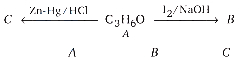
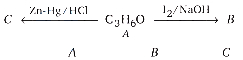
Compound $A$ $(C_3H_6O)$ undergoes the following reactions to form $B$ and $C$. Identify $A$,$B$,and $C$.
A
$A = CH_3COCH_3$,$B = CHI_3$,$C = CH_3CH_2CH_3$
B
$A = CH_2=C(H)CH_2OH$,$B = CH_3I$,$C = CH_3CH_2CH_2OH$
C
$A = CH_3CH_2CHO$,$B = CHI_3$,$C = CH_3CH(OH)CH_3$
D
$A = CH_3COCH_3$,$B = CHI_3$,$C = CH_3CH(OH)CH_3$
Solution
(A) The compound $A$ $(C_3H_6O)$ reacts with $I_2 / NaOH$ (iodoform test),which indicates it is a methyl ketone. Thus,$A$ is acetone $(CH_3COCH_3)$.
$1$. Reaction with $I_2 / NaOH$ (Iodoform reaction):
$CH_3COCH_3 + 3I_2 + 4NaOH \rightarrow CHI_3 (B) + CH_3COONa + 3NaI + 3H_2O$
Here,$B$ is iodoform $(CHI_3)$.
$2$. Reaction with $Zn-Hg / HCl$ (Clemmensen reduction):
$CH_3COCH_3 + 4[H] \xrightarrow{Zn-Hg / HCl} CH_3CH_2CH_3 (C) + H_2O$
Here,$C$ is propane $(CH_3CH_2CH_3)$.
$1$. Reaction with $I_2 / NaOH$ (Iodoform reaction):
$CH_3COCH_3 + 3I_2 + 4NaOH \rightarrow CHI_3 (B) + CH_3COONa + 3NaI + 3H_2O$
Here,$B$ is iodoform $(CHI_3)$.
$2$. Reaction with $Zn-Hg / HCl$ (Clemmensen reduction):
$CH_3COCH_3 + 4[H] \xrightarrow{Zn-Hg / HCl} CH_3CH_2CH_3 (C) + H_2O$
Here,$C$ is propane $(CH_3CH_2CH_3)$.
0 likesView Solution
6
ChemistryMCQAP EAMCET · 2012
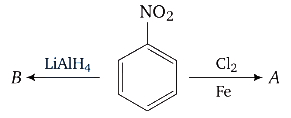
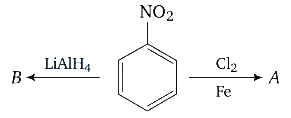
Identify $A$ and $B$ in the following reactions:
A
$A = m\text{-chloronitrobenzene}, B = \text{azobenzene}$
B
$A = p\text{-chloronitrobenzene}, B = \text{azobenzene}$
C
$A = m\text{-chloronitrobenzene}, B = \text{aniline}$
D
$A = o\text{-chloronitrobenzene}, B = \text{azobenzene}$
Solution
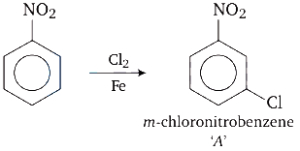
(A) $1$. The $-NO_2$ group is a deactivating and meta-directing group. Therefore,electrophilic aromatic substitution of nitrobenzene with $Cl_2$ in the presence of $Fe$ (Lewis acid) yields $m\text{-chloronitrobenzene}$ as the major product $(A)$.
$2$. The reduction of nitrobenzene with $LiAlH_4$ is a complex process. While $LiAlH_4$ is a strong reducing agent,under specific conditions,it can reduce nitrobenzene to azobenzene $(C_6H_5-N=N-C_6H_5)$ $(B)$.
$2$. The reduction of nitrobenzene with $LiAlH_4$ is a complex process. While $LiAlH_4$ is a strong reducing agent,under specific conditions,it can reduce nitrobenzene to azobenzene $(C_6H_5-N=N-C_6H_5)$ $(B)$.
0 likesView Solution
7
ChemistryMCQAP EAMCET · 2012
The formal charges of $C$ and $O$ atoms in $CO_2$ $(\ddot{O}=C=\ddot{O})$ are,respectively
A
$1, -1$
B
$-1, 1$
C
$2, -2$
D
$0, 0$
Solution
(D) The formula for formal charge $(FC)$ is: $FC = V - lp - \frac{1}{2} bp$
Where $V$ is the number of valence electrons,$lp$ is the number of lone pair electrons,and $bp$ is the number of bonding electrons.
For the structure $\ddot{O}=C=\ddot{O}$:
For $O$ atom: $V = 6$,$lp = 4$,$bp = 4$. So,$FC = 6 - 4 - \frac{1}{2}(4) = 0$.
For $C$ atom: $V = 4$,$lp = 0$,$bp = 8$. So,$FC = 4 - 0 - \frac{1}{2}(8) = 0$.
Thus,the formal charges of $C$ and $O$ are $0$ and $0$ respectively.
Where $V$ is the number of valence electrons,$lp$ is the number of lone pair electrons,and $bp$ is the number of bonding electrons.
For the structure $\ddot{O}=C=\ddot{O}$:
For $O$ atom: $V = 6$,$lp = 4$,$bp = 4$. So,$FC = 6 - 4 - \frac{1}{2}(4) = 0$.
For $C$ atom: $V = 4$,$lp = 0$,$bp = 8$. So,$FC = 4 - 0 - \frac{1}{2}(8) = 0$.
Thus,the formal charges of $C$ and $O$ are $0$ and $0$ respectively.
0 likesView Solution
8
ChemistryMCQAP EAMCET · 2012
According to molecular orbital theory,the total number of bonding electron pairs in $O_2$ is
A
$2$
B
$3$
C
$5$
D
$4$
Solution
(C) The molecular orbital electronic configuration of $O_2$ $(16 \ e^-)$ is: $\sigma 1s^2, \sigma^* 1s^2, \sigma 2s^2, \sigma^* 2s^2, \sigma 2p_z^2, \pi 2p_x^2, \pi 2p_y^2, \pi^* 2p_x^1, \pi^* 2p_y^1$.
Bonding orbitals are those without an asterisk $(*)$.
The bonding orbitals are $\sigma 1s, \sigma 2s, \sigma 2p_z, \pi 2p_x, \text{ and } \pi 2p_y$.
Each of these $5$ orbitals contains $2$ electrons,so the total number of bonding electrons is $10$.
Therefore,the total number of bonding electron pairs is $10 / 2 = 5$.
Bonding orbitals are those without an asterisk $(*)$.
The bonding orbitals are $\sigma 1s, \sigma 2s, \sigma 2p_z, \pi 2p_x, \text{ and } \pi 2p_y$.
Each of these $5$ orbitals contains $2$ electrons,so the total number of bonding electrons is $10$.
Therefore,the total number of bonding electron pairs is $10 / 2 = 5$.
0 likesView Solution
9
ChemistryDifficultMCQAP EAMCET · 2012
Which of the following is not correct?
A
$LiOH$ is a weaker base than $NaOH$
B
Salts of $Be$ undergo hydrolysis
C
$Ca(HCO_3)_2$ is soluble in water
D
Hydrolysis of beryllium carbide gives acetylene
Solution
(D) . $LiOH$ is a weaker base than $NaOH$ because $Li^+$ has a higher charge density than $Na^+$,which increases the covalent character of the $Li-OH$ bond,making it less ionic and thus a weaker base. This statement is correct.
$B$. Salts of $Be$ undergo hydrolysis due to the high charge density and small size of $Be^{2+}$ ion,which polarizes the water molecules. This statement is correct.
$C$. $Ca(HCO_3)_2$ is soluble in water. This statement is correct.
$D$. Hydrolysis of beryllium carbide $(Be_2C)$ gives methane $(CH_4)$,not acetylene $(C_2H_2)$. The reaction is: $Be_2C + 4H_2O \rightarrow CH_4 + 2Be(OH)_2$. Therefore,this statement is incorrect.
$B$. Salts of $Be$ undergo hydrolysis due to the high charge density and small size of $Be^{2+}$ ion,which polarizes the water molecules. This statement is correct.
$C$. $Ca(HCO_3)_2$ is soluble in water. This statement is correct.
$D$. Hydrolysis of beryllium carbide $(Be_2C)$ gives methane $(CH_4)$,not acetylene $(C_2H_2)$. The reaction is: $Be_2C + 4H_2O \rightarrow CH_4 + 2Be(OH)_2$. Therefore,this statement is incorrect.
0 likesView Solution
10
ChemistryMCQAP EAMCET · 2012
Which one of the following cannot form an amphoteric oxide?
A
$Al$
B
$Sn$
C
$Sb$
D
$P$
Solution
(D) Phosphorus $(P)$ is a non-metal and typically forms acidic oxides such as $P_4O_6$ and $P_4O_{10}$.
$Al_2O_3$,$SnO$,and $Sb_2O_3$ are known to be amphoteric oxides,meaning they can react with both acids and bases.
$Al_2O_3$,$SnO$,and $Sb_2O_3$ are known to be amphoteric oxides,meaning they can react with both acids and bases.
0 likesView Solution
11
ChemistryMCQAP EAMCET · 2012
In the photoelectric effect,if the work functions of $Li$,$Na$,and $Rb$ are $2.41 \ eV$,$2.30 \ eV$,and $2.09 \ eV$ respectively,what could be the approximate work function of $K$ in $eV$?
A
$2.52$
B
$2.20$
C
$2.35$
D
$2.01$
Solution
(B) As the atomic size increases down a group,the ionization energy and the work function decrease because the outermost electron is held less tightly by the nucleus.
$Li$,$Na$,$K$,and $Rb$ belong to Group $1$ of the periodic table.
The order of their atomic sizes is $Li < Na < K < Rb$.
Therefore,the order of their work functions is $Li > Na > K > Rb$.
Given values: $Li = 2.41 \ eV$,$Na = 2.30 \ eV$,and $Rb = 2.09 \ eV$.
The work function of $K$ must lie between the values of $Na$ $(2.30 \ eV)$ and $Rb$ $(2.09 \ eV)$.
Among the given options,$2.20 \ eV$ is the only value that falls in the range $2.09 \ eV < K < 2.30 \ eV$.
$Li$,$Na$,$K$,and $Rb$ belong to Group $1$ of the periodic table.
The order of their atomic sizes is $Li < Na < K < Rb$.
Therefore,the order of their work functions is $Li > Na > K > Rb$.
Given values: $Li = 2.41 \ eV$,$Na = 2.30 \ eV$,and $Rb = 2.09 \ eV$.
The work function of $K$ must lie between the values of $Na$ $(2.30 \ eV)$ and $Rb$ $(2.09 \ eV)$.
Among the given options,$2.20 \ eV$ is the only value that falls in the range $2.09 \ eV < K < 2.30 \ eV$.
0 likesView Solution
12
ChemistryMCQAP EAMCET · 2012
$A$ coordination complex contains $Co^{3+}$,$Cl^{-}$,and $NH_3$. When dissolved in water,one mole of this complex gives a total of $3$ moles of ions. The complex is
A
$[Co(NH_3)_6]Cl_3$
B
$[Co(NH_3)_5Cl]Cl_2$
C
$[Co(NH_3)_4Cl_2]Cl$
D
$[Co(NH_3)_3Cl_3]$
Solution
(B) When the complex is dissolved in water,it dissociates to give $3$ ions in total.
This indicates that there are $2$ chloride ions $(Cl^-)$ outside the coordination sphere and one complex cation.
Thus,the formula of the complex is $[Co(NH_3)_5Cl]Cl_2$.
Dissociation: $[Co(NH_3)_5Cl]Cl_2 \rightarrow [Co(NH_3)_5Cl]^{2+} + 2Cl^-$
Total ions = $1$ (complex ion) + $2$ (chloride ions) = $3$ ions.
This indicates that there are $2$ chloride ions $(Cl^-)$ outside the coordination sphere and one complex cation.
Thus,the formula of the complex is $[Co(NH_3)_5Cl]Cl_2$.
Dissociation: $[Co(NH_3)_5Cl]Cl_2 \rightarrow [Co(NH_3)_5Cl]^{2+} + 2Cl^-$
Total ions = $1$ (complex ion) + $2$ (chloride ions) = $3$ ions.
0 likesView Solution
13
ChemistryMCQAP EAMCET · 2012
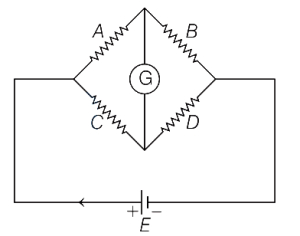
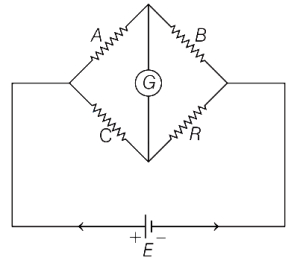
Four resistors $A, B, C$ and $D$ form a Wheatstone bridge as shown in the figure. The bridge is balanced when $C = 100 \Omega$. If $A$ and $B$ are interchanged,the bridge balances for $C = 121 \Omega$. The value of $D$ is (in $Omega$)
A
$10$
B
$100$
C
$110$
D
$120$
Solution
(C) For a balanced Wheatstone bridge,the condition is $\frac{A}{B} = \frac{C}{D}$.
Case $1$: When $C = 100 \Omega$,the bridge is balanced,so $\frac{A}{B} = \frac{100}{D}$ ... $(i)$
Case $2$: When $A$ and $B$ are interchanged,the new resistances in the arms are $B$ and $A$ respectively. The bridge balances for $C = 121 \Omega$,so $\frac{B}{A} = \frac{121}{D}$ ... (ii)
From equation $(i)$,we have $\frac{A}{B} = \frac{100}{D}$. Therefore,$\frac{B}{A} = \frac{D}{100}$.
Substituting this into equation (ii),we get $\frac{D}{100} = \frac{121}{D}$.
$D^2 = 100 \times 121 = 12100$.
$D = \sqrt{12100} = 110 \Omega$.
Case $1$: When $C = 100 \Omega$,the bridge is balanced,so $\frac{A}{B} = \frac{100}{D}$ ... $(i)$
Case $2$: When $A$ and $B$ are interchanged,the new resistances in the arms are $B$ and $A$ respectively. The bridge balances for $C = 121 \Omega$,so $\frac{B}{A} = \frac{121}{D}$ ... (ii)
From equation $(i)$,we have $\frac{A}{B} = \frac{100}{D}$. Therefore,$\frac{B}{A} = \frac{D}{100}$.
Substituting this into equation (ii),we get $\frac{D}{100} = \frac{121}{D}$.
$D^2 = 100 \times 121 = 12100$.
$D = \sqrt{12100} = 110 \Omega$.
0 likesView Solution
14
ChemistryMCQAP EAMCET · 2012
Four resistors $A, B, C$ and $D$ form a Wheatstone bridge. The bridge is balanced when $C = 100 \ \Omega$. If $A$ and $B$ are interchanged,the bridge balances for $C = 121 \ \Omega$. The value of $D$ is (in $Omega$)
A
$10$
B
$100$
C
$110$
D
$120$
Solution
(C) For a balanced Wheatstone bridge,the ratio of resistances is given by $\frac{A}{B} = \frac{C}{D}$.
Let $D = x$. Initially,$\frac{A}{B} = \frac{100}{x}$.
When $A$ and $B$ are interchanged,the new condition is $\frac{B}{A} = \frac{121}{x}$.
From the first equation,$\frac{B}{A} = \frac{x}{100}$.
Equating the two expressions for $\frac{B}{A}$,we get $\frac{x}{100} = \frac{121}{x}$.
$x^2 = 121 \times 100 = 12100$.
$x = \sqrt{12100} = 110 \ \Omega$.
Thus,the value of $D$ is $110 \ \Omega$.
Let $D = x$. Initially,$\frac{A}{B} = \frac{100}{x}$.
When $A$ and $B$ are interchanged,the new condition is $\frac{B}{A} = \frac{121}{x}$.
From the first equation,$\frac{B}{A} = \frac{x}{100}$.
Equating the two expressions for $\frac{B}{A}$,we get $\frac{x}{100} = \frac{121}{x}$.
$x^2 = 121 \times 100 = 12100$.
$x = \sqrt{12100} = 110 \ \Omega$.
Thus,the value of $D$ is $110 \ \Omega$.
0 likesView Solution
15
ChemistryMCQAP EAMCET · 2012
$A$ proton, when accelerated through a potential difference of $V$, has a de-Broglie wavelength $\lambda$ associated with it. If an $\alpha$-particle is to have the same de-Broglie wavelength $\lambda$, it must be accelerated through a potential difference of:
A
$\frac{V}{8}$
B
$\frac{V}{4}$
C
$4 \, V$
D
$8 \, V$
Solution
(A) The de-Broglie wavelength $\lambda$ for a particle of mass $m$ and charge $q$ accelerated through a potential difference $V$ is given by $\lambda = \frac{h}{\sqrt{2mqV}}$.
For the proton $(p)$: $\lambda_p = \frac{h}{\sqrt{2m_p q_p V}}$.
For the $\alpha$-particle $(\alpha)$: $\lambda_\alpha = \frac{h}{\sqrt{2m_\alpha q_\alpha V_\alpha}}$.
Given $\lambda_p = \lambda_\alpha$, we have $\sqrt{2m_p q_p V} = \sqrt{2m_\alpha q_\alpha V_\alpha}$.
Squaring both sides: $m_p q_p V = m_\alpha q_\alpha V_\alpha$.
We know that $m_\alpha = 4m_p$ and $q_\alpha = 2q_p$.
Substituting these values: $m_p q_p V = (4m_p)(2q_p) V_\alpha$.
$m_p q_p V = 8 m_p q_p V_\alpha$.
Therefore, $V_\alpha = \frac{V}{8}$.
For the proton $(p)$: $\lambda_p = \frac{h}{\sqrt{2m_p q_p V}}$.
For the $\alpha$-particle $(\alpha)$: $\lambda_\alpha = \frac{h}{\sqrt{2m_\alpha q_\alpha V_\alpha}}$.
Given $\lambda_p = \lambda_\alpha$, we have $\sqrt{2m_p q_p V} = \sqrt{2m_\alpha q_\alpha V_\alpha}$.
Squaring both sides: $m_p q_p V = m_\alpha q_\alpha V_\alpha$.
We know that $m_\alpha = 4m_p$ and $q_\alpha = 2q_p$.
Substituting these values: $m_p q_p V = (4m_p)(2q_p) V_\alpha$.
$m_p q_p V = 8 m_p q_p V_\alpha$.
Therefore, $V_\alpha = \frac{V}{8}$.
0 likesView Solution
16
ChemistryMCQAP EAMCET · 2012
The $emf$ (in $V$) of a Daniell cell containing $0.1 \ M$ $ZnSO_4$ and $0.01 \ M$ $CuSO_4$ solutions at their respective electrodes is
$(E_{Cu^{2+} / Cu}^{\circ} = +0.34 \ V; E_{Zn^{2+} / Zn}^{\circ} = -0.76 \ V)$
$(E_{Cu^{2+} / Cu}^{\circ} = +0.34 \ V; E_{Zn^{2+} / Zn}^{\circ} = -0.76 \ V)$
A
$1.10$
B
$1.16$
C
$1.13$
D
$1.07$
Solution
(D) $E_{\text{cell}}^{\circ} = E_{Cu^{2+} / Cu}^{\circ} - E_{Zn^{2+} / Zn}^{\circ} = +0.34 - (-0.76) \ V = 1.1 \ V$
Using the Nernst equation: $E_{\text{cell}} = E_{\text{cell}}^{\circ} - \frac{0.059}{n} \log \frac{[Zn^{2+}]}{[Cu^{2+}]}$
For the reaction $Cu^{2+} + Zn \longrightarrow Zn^{2+} + Cu$,$n = 2$.
$E_{\text{cell}} = 1.1 - \frac{0.059}{2} \log \frac{0.1}{0.01}$
$E_{\text{cell}} = 1.1 - 0.0295 \times \log(10)$
$E_{\text{cell}} = 1.1 - 0.0295 \times 1 = 1.0705 \ V \approx 1.07 \ V$
Using the Nernst equation: $E_{\text{cell}} = E_{\text{cell}}^{\circ} - \frac{0.059}{n} \log \frac{[Zn^{2+}]}{[Cu^{2+}]}$
For the reaction $Cu^{2+} + Zn \longrightarrow Zn^{2+} + Cu$,$n = 2$.
$E_{\text{cell}} = 1.1 - \frac{0.059}{2} \log \frac{0.1}{0.01}$
$E_{\text{cell}} = 1.1 - 0.0295 \times \log(10)$
$E_{\text{cell}} = 1.1 - 0.0295 \times 1 = 1.0705 \ V \approx 1.07 \ V$
0 likesView Solution
17
ChemistryMCQAP EAMCET · 2012
The number of moles of electrons required to deposit $36 \ g$ of $Al$ from an aqueous solution of $Al(NO_3)_3$ is (At. wt. of $Al = 27$)
A
$4$
B
$2$
C
$3$
D
$1$
Solution
(A) The reduction reaction for $Al^{3+}$ is: $Al^{3+} + 3e^{-} \longrightarrow Al(s)$.
From the stoichiometry,$1 \ mol$ of $Al$ $(27 \ g)$ requires $3 \ moles$ of electrons.
To deposit $36 \ g$ of $Al$,the number of moles of electrons required is:
$\text{Moles of } e^{-} = \frac{3 \ mol \ e^{-}}{27 \ g} \times 36 \ g = 4 \ mol$.
From the stoichiometry,$1 \ mol$ of $Al$ $(27 \ g)$ requires $3 \ moles$ of electrons.
To deposit $36 \ g$ of $Al$,the number of moles of electrons required is:
$\text{Moles of } e^{-} = \frac{3 \ mol \ e^{-}}{27 \ g} \times 36 \ g = 4 \ mol$.
0 likesView Solution
18
ChemistryMCQAP EAMCET · 2012
$A$ straight conductor of length $4 ~m$ moves at a speed of $10 ~m/s$. When the conductor makes an angle of $30^{\circ}$ with the direction of the magnetic field of induction $0.1 ~Wb/m^2$,the induced emf is: (in $~V$)
A
$8$
B
$4$
C
$1$
D
$2$
Solution
(D) The induced electromotive force (emf) in a moving conductor is given by the formula:
$e = B v l \sin \theta$
Where:
$B = 0.1 ~Wb/m^2$ (Magnetic field induction)
$v = 10 ~m/s$ (Velocity of the conductor)
$l = 4 ~m$ (Length of the conductor)
$\theta = 30^{\circ}$ (Angle between the conductor and the magnetic field)
Substituting the values into the formula:
$e = 0.1 \times 10 \times 4 \times \sin(30^{\circ})$
$e = 0.1 \times 10 \times 4 \times 0.5$
$e = 1 \times 4 \times 0.5$
$e = 2 ~V$
Thus,the induced emf is $2 ~V$.
$e = B v l \sin \theta$
Where:
$B = 0.1 ~Wb/m^2$ (Magnetic field induction)
$v = 10 ~m/s$ (Velocity of the conductor)
$l = 4 ~m$ (Length of the conductor)
$\theta = 30^{\circ}$ (Angle between the conductor and the magnetic field)
Substituting the values into the formula:
$e = 0.1 \times 10 \times 4 \times \sin(30^{\circ})$
$e = 0.1 \times 10 \times 4 \times 0.5$
$e = 1 \times 4 \times 0.5$
$e = 2 ~V$
Thus,the induced emf is $2 ~V$.
0 likesView Solution
19
ChemistryMCQAP EAMCET · 2012
Total emf produced in a thermocouple does not depend on
A
the metals in the thermocouple
B
Thomson coefficients of the metals in the thermocouple
C
temperature of the junctions
D
the duration of time for which the current is passed through thermocouple
Solution
(D) The total electromotive force $(emf)$ produced in a thermocouple is determined by the Seebeck effect,which depends on the nature of the metals used (Seebeck coefficients),the temperatures of the hot and cold junctions,and the Thomson coefficients of the metals. It is an instantaneous phenomenon related to the temperature gradient and material properties. Therefore,the total $emf$ does not depend on the duration of time for which the current is passed through the thermocouple.
0 likesView Solution
20
ChemistryMCQAP EAMCET · 2012
$A$ primary coil and a secondary coil are placed close to each other. $A$ current, which changes at the rate of $25 \, A$ in a millisecond, is present in the primary coil. If the mutual inductance is $92 \times 10^{-6} \, H$, then the value of the induced emf in the secondary coil is:
A
$4.6 \, V$
B
$2.3 \, V$
C
$0.368 \, mV$
D
$0.23 \, mV$
Solution
(B) The induced emf $(e)$ in the secondary coil is given by the formula: $e = M \frac{di}{dt}$.
Given:
Mutual inductance $(M) = 92 \times 10^{-6} \, H$
Rate of change of current $(\frac{di}{dt}) = \frac{25 \, A}{1 \, ms} = \frac{25 \, A}{1 \times 10^{-3} \, s} = 25 \times 10^{3} \, A/s$.
Substituting these values into the formula:
$e = (92 \times 10^{-6} \, H) \times (25 \times 10^{3} \, A/s)$
$e = 92 \times 25 \times 10^{-3} \, V$
$e = 2300 \times 10^{-3} \, V$
$e = 2.3 \, V$.
Given:
Mutual inductance $(M) = 92 \times 10^{-6} \, H$
Rate of change of current $(\frac{di}{dt}) = \frac{25 \, A}{1 \, ms} = \frac{25 \, A}{1 \times 10^{-3} \, s} = 25 \times 10^{3} \, A/s$.
Substituting these values into the formula:
$e = (92 \times 10^{-6} \, H) \times (25 \times 10^{3} \, A/s)$
$e = 92 \times 25 \times 10^{-3} \, V$
$e = 2300 \times 10^{-3} \, V$
$e = 2.3 \, V$.
0 likesView Solution
21
ChemistryMCQAP EAMCET · 2012
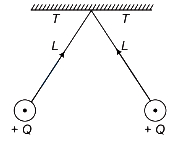
Two small spheres,each having an equal positive charge $Q$ (Coulomb),are suspended by two insulating strings of equal length $L$ (metre) from a rigid hook. The whole setup is taken into a satellite where there is no gravity. The two balls are now held by electrostatic forces in a horizontal position. The tension in each string is then:
A
$\frac{Q^2}{16 \pi \varepsilon_0 L^2}$
B
$\frac{Q^2}{8 \pi \varepsilon_0 L^2}$
C
$\frac{Q^2}{4 \pi \varepsilon_0 L^2}$
D
$\frac{Q^2}{2 \pi \varepsilon_0 L^2}$
Solution
(A) In the absence of gravity,the only force acting on each sphere is the electrostatic repulsive force exerted by the other sphere.
Since the spheres are held in a horizontal position,the distance between the two spheres is $2L$.
According to Coulomb's law,the electrostatic force $F$ between the two charges is given by:
$F = \frac{1}{4 \pi \varepsilon_0} \frac{Q \cdot Q}{(2L)^2} = \frac{1}{4 \pi \varepsilon_0} \frac{Q^2}{4L^2} = \frac{Q^2}{16 \pi \varepsilon_0 L^2}$.
Since the spheres are in equilibrium,the tension $T$ in each string must balance this electrostatic force.
Therefore,$T = F = \frac{Q^2}{16 \pi \varepsilon_0 L^2}$.
Since the spheres are held in a horizontal position,the distance between the two spheres is $2L$.
According to Coulomb's law,the electrostatic force $F$ between the two charges is given by:
$F = \frac{1}{4 \pi \varepsilon_0} \frac{Q \cdot Q}{(2L)^2} = \frac{1}{4 \pi \varepsilon_0} \frac{Q^2}{4L^2} = \frac{Q^2}{16 \pi \varepsilon_0 L^2}$.
Since the spheres are in equilibrium,the tension $T$ in each string must balance this electrostatic force.
Therefore,$T = F = \frac{Q^2}{16 \pi \varepsilon_0 L^2}$.
0 likesView Solution
22
ChemistryMCQAP EAMCET · 2012
The pair of gases responsible for acid rain are
A
$H_2, O_3$
B
$CH_4, O_3$
C
$NO_2, SO_2$
D
$CO, CH_4$
Solution
(C) Oxides of nitrogen and sulphur are responsible for acid rain.
$NO_2 + H_2O \rightarrow HNO_3$
$SO_2$ $\xrightarrow{[O]} SO_3 + H_2O$ $\rightarrow H_2SO_4$
Due to the presence of $HNO_3$ and $H_2SO_4$ (strong acids),rainwater becomes acidic,and this phenomenon is called acid rain.
$NO_2 + H_2O \rightarrow HNO_3$
$SO_2$ $\xrightarrow{[O]} SO_3 + H_2O$ $\rightarrow H_2SO_4$
Due to the presence of $HNO_3$ and $H_2SO_4$ (strong acids),rainwater becomes acidic,and this phenomenon is called acid rain.
0 likesView Solution
23
ChemistryMCQAP EAMCET · 2012
With respect to chlorobenzene,which of the following statements is not correct?
A
$Cl$ is ortho/para directing
B
$Cl$ exhibits $+M$ effect
C
$Cl$ is ring deactivating
D
$Cl$ is meta directing
Solution
(D) The chlorine atom $(Cl)$ in chlorobenzene exhibits both $-I$ (inductive) and $+M$ (mesomeric) effects.
Due to the $-I$ effect,it is ring deactivating.
Due to the $+M$ effect,it is ortho/para directing.
Therefore,the statement that $Cl$ is meta directing is incorrect.
Due to the $-I$ effect,it is ring deactivating.
Due to the $+M$ effect,it is ortho/para directing.
Therefore,the statement that $Cl$ is meta directing is incorrect.
0 likesView Solution
24
ChemistryMCQAP EAMCET · 2012
Different conformations of the same molecule are called
A
isomers
B
epimers
C
enantiomers
D
rotamers
Solution
(D) Conformational isomers are also known as $rotamers$ and the isomerism as $rotamerism$. These are different spatial arrangements of atoms in a molecule that can be interconverted by rotation about single bonds.
0 likesView Solution
25
ChemistryMediumMCQAP EAMCET · 2012
Match the following:
| $A$. Acetaldehyde,vinyl alcohol | $1$. Enantiomers |
| $B$. Eclipsed and staggered ethane | $2$. Tautomers |
| $C$. $(+)2$-butanol,$(-)2$-butanol | $3$. Chain isomers |
| $D$. Methyl-$n$-propylamine and diethylamine | $4$. Conformational isomers |
| $5$. Metamers |
A
$A-4, B-1, C-3, D-5$
B
$A-2, B-4, C-1, D-5$
C
$A-5, B-1, C-4, D-2$
D
$A-5, B-1, C-3, D-2$
Solution
(B) The correct matches are as follows:
$A$. Acetaldehyde $(CH_3CHO)$ and vinyl alcohol $(CH_2=CH-OH)$ are tautomers.
$B$. Eclipsed and staggered ethane are two conformations of ethane,hence they are conformational isomers.
$C$. $(+)2$-butanol and $(-)2$-butanol are non-superimposable mirror images of each other,hence they are enantiomers.
$D$. Methyl-$n$-propylamine $(CH_3-NH-CH_2CH_2CH_3)$ and diethylamine $((C_2H_5)_2NH)$ have different alkyl groups attached to the same functional group $(-NH-)$,hence they are metamers.
Therefore,the correct matching is $A-2, B-4, C-1, D-5$.
$A$. Acetaldehyde $(CH_3CHO)$ and vinyl alcohol $(CH_2=CH-OH)$ are tautomers.
$B$. Eclipsed and staggered ethane are two conformations of ethane,hence they are conformational isomers.
$C$. $(+)2$-butanol and $(-)2$-butanol are non-superimposable mirror images of each other,hence they are enantiomers.
$D$. Methyl-$n$-propylamine $(CH_3-NH-CH_2CH_2CH_3)$ and diethylamine $((C_2H_5)_2NH)$ have different alkyl groups attached to the same functional group $(-NH-)$,hence they are metamers.
Therefore,the correct matching is $A-2, B-4, C-1, D-5$.
0 likesView Solution
26
ChemistryMCQAP EAMCET · 2012
The chlorination of ethane is an example of which of the following types of reactions?
A
Nucleophilic substitution
B
Electrophilic substitution
C
Free radical substitution
D
Rearrangement
Solution
(C) The chlorination of ethane is a classic example of a free radical substitution reaction. It proceeds through a chain mechanism involving three main steps:
$1.$ Initiation: The homolytic cleavage of $Cl_2$ by ultraviolet light $(h\nu)$ to form chlorine free radicals.
$Cl_2 \xrightarrow{h\nu} 2Cl^{\bullet}$
$2.$ Propagation: The chlorine radical abstracts a hydrogen atom from ethane to form an ethyl radical $(CH_3CH_2^{\bullet})$,which then reacts with another $Cl_2$ molecule to form ethyl chloride and regenerate a chlorine radical.
$CH_3CH_3 + Cl^{\bullet} \rightarrow CH_3CH_2^{\bullet} + HCl$
$CH_3CH_2^{\bullet} + Cl_2 \rightarrow CH_3CH_2Cl + Cl^{\bullet}$
$3.$ Termination: The combination of any two free radicals to end the chain reaction.
$CH_3CH_2^{\bullet} + Cl^{\bullet} \rightarrow CH_3CH_2Cl$
$Cl^{\bullet} + Cl^{\bullet} \rightarrow Cl_2$
$2CH_3CH_2^{\bullet} \rightarrow CH_3CH_2CH_2CH_3$
$1.$ Initiation: The homolytic cleavage of $Cl_2$ by ultraviolet light $(h\nu)$ to form chlorine free radicals.
$Cl_2 \xrightarrow{h\nu} 2Cl^{\bullet}$
$2.$ Propagation: The chlorine radical abstracts a hydrogen atom from ethane to form an ethyl radical $(CH_3CH_2^{\bullet})$,which then reacts with another $Cl_2$ molecule to form ethyl chloride and regenerate a chlorine radical.
$CH_3CH_3 + Cl^{\bullet} \rightarrow CH_3CH_2^{\bullet} + HCl$
$CH_3CH_2^{\bullet} + Cl_2 \rightarrow CH_3CH_2Cl + Cl^{\bullet}$
$3.$ Termination: The combination of any two free radicals to end the chain reaction.
$CH_3CH_2^{\bullet} + Cl^{\bullet} \rightarrow CH_3CH_2Cl$
$Cl^{\bullet} + Cl^{\bullet} \rightarrow Cl_2$
$2CH_3CH_2^{\bullet} \rightarrow CH_3CH_2CH_2CH_3$
0 likesView Solution
27
ChemistryMCQAP EAMCET · 2012
Which of the following statements is not correct?
A
The six carbons in benzene are $sp^2$ hybridised
B
Benzene has $(4n+2) \pi$ electrons
C
Benzene undergoes substitution reactions
D
Benzene has two carbon-carbon bond lengths,$1.54 \mathring{A}$ and $1.34 \mathring{A}$
Solution
(D) In benzene,all the $C-C$ bond lengths are equal to $1.39 \mathring{A}$ due to resonance.
Therefore,the statement that benzene has two different carbon-carbon bond lengths is incorrect.
Therefore,the statement that benzene has two different carbon-carbon bond lengths is incorrect.
0 likesView Solution
28
ChemistryMCQAP EAMCET · 2012
The product$(s)$ formed when $H_2O_2$ reacts with disodium hydrogen phosphate is
A
$P_2O_5 \cdot Na_3PO_4$
B
$Na_2HPO_4 \cdot H_2O_2$
C
$NaH_2PO_4, H_2O$
D
$Na_2HPO_4 \cdot H_2O$
Solution
(B) $H_2O_2$ reacts with disodium hydrogen phosphate $(Na_2HPO_4)$ to form an addition product known as sodium phosphate perhydrate.
The chemical reaction is:
$H_2O_2 + Na_2HPO_4 \rightarrow Na_2HPO_4 \cdot H_2O_2$
The chemical reaction is:
$H_2O_2 + Na_2HPO_4 \rightarrow Na_2HPO_4 \cdot H_2O_2$
0 likesView Solution
29
ChemistryMCQAP EAMCET · 2012
Which one of the following statements is not correct?
A
The $pH$ of $1.0 \times 10^{-8} \ M \ HCl$ is less than $7$
B
The ionic product of water at $25^{\circ}C$ is $1.0 \times 10^{-14} \ mol^2 \ L^{-2}$
C
$Cl^{-}$ is a Lewis acid
D
Bronsted-Lowry theory cannot explain the acidic character of $AlCl_3$
Solution
(C) Lewis acid is an electron pair acceptor,while a Lewis base is an electron pair donor.
$Cl^{-}$ has a complete octet and possesses lone pairs of electrons,which it can donate; therefore,it acts as a Lewis base,not a Lewis acid.
Thus,the statement '$Cl^{-}$ is a Lewis acid' is incorrect.
$Cl^{-}$ has a complete octet and possesses lone pairs of electrons,which it can donate; therefore,it acts as a Lewis base,not a Lewis acid.
Thus,the statement '$Cl^{-}$ is a Lewis acid' is incorrect.
0 likesView Solution
30
ChemistryMCQAP EAMCET · 2012
$A$ magnetic needle lying parallel to a magnetic field is turned through $60^{\circ}$. The work done on it is $W$. The torque required to maintain the magnetic needle in the position mentioned above is
A
$\sqrt{3} W$
B
$\frac{\sqrt{3}}{2} W$
C
$\frac{W}{2}$
D
$2 W$
Solution
(A) The work done in rotating a magnetic dipole in a magnetic field is given by $W = MB(1 - \cos \theta)$.
Given $\theta = 60^{\circ}$,we have $W = MB(1 - \cos 60^{\circ}) = MB(1 - 0.5) = \frac{MB}{2}$.
From this,we find $MB = 2W$.
The torque required to maintain the needle at an angle $\theta$ is $\tau = MB \sin \theta$.
Substituting $\theta = 60^{\circ}$ and $MB = 2W$,we get $\tau = (2W) \sin 60^{\circ}$.
$\tau = 2W \times \frac{\sqrt{3}}{2} = \sqrt{3} W$.
Given $\theta = 60^{\circ}$,we have $W = MB(1 - \cos 60^{\circ}) = MB(1 - 0.5) = \frac{MB}{2}$.
From this,we find $MB = 2W$.
The torque required to maintain the needle at an angle $\theta$ is $\tau = MB \sin \theta$.
Substituting $\theta = 60^{\circ}$ and $MB = 2W$,we get $\tau = (2W) \sin 60^{\circ}$.
$\tau = 2W \times \frac{\sqrt{3}}{2} = \sqrt{3} W$.
0 likesView Solution
31
ChemistryMCQAP EAMCET · 2012
At a certain place,a magnet makes $30$ oscillations per minute. At another place where the magnetic field is double,its time period will be:
A
$4 ~s$
B
$2 ~s$
C
$\frac{1}{2} ~s$
D
$\sqrt{2} ~s$
Solution
(D) The time period of a vibrating magnet is given by $T = 2\pi \sqrt{\frac{I}{MB_H}}$.
This implies $T \propto \frac{1}{\sqrt{B_H}}$.
Given at the first place,$n_1 = 30 \text{ oscillations/min} = 0.5 \text{ oscillations/s}$.
Therefore,the time period $T_1 = \frac{1}{n_1} = \frac{1}{0.5} = 2 ~s$.
At the second place,the magnetic field is doubled,so $(B_H)_2 = 2(B_H)_1$.
The ratio of time periods is $\frac{T_2}{T_1} = \sqrt{\frac{(B_H)_1}{(B_H)_2}} = \sqrt{\frac{(B_H)_1}{2(B_H)_1}} = \frac{1}{\sqrt{2}}$.
Thus,$T_2 = T_1 \times \frac{1}{\sqrt{2}} = 2 \times \frac{1}{\sqrt{2}} = \sqrt{2} ~s$.
This implies $T \propto \frac{1}{\sqrt{B_H}}$.
Given at the first place,$n_1 = 30 \text{ oscillations/min} = 0.5 \text{ oscillations/s}$.
Therefore,the time period $T_1 = \frac{1}{n_1} = \frac{1}{0.5} = 2 ~s$.
At the second place,the magnetic field is doubled,so $(B_H)_2 = 2(B_H)_1$.
The ratio of time periods is $\frac{T_2}{T_1} = \sqrt{\frac{(B_H)_1}{(B_H)_2}} = \sqrt{\frac{(B_H)_1}{2(B_H)_1}} = \frac{1}{\sqrt{2}}$.
Thus,$T_2 = T_1 \times \frac{1}{\sqrt{2}} = 2 \times \frac{1}{\sqrt{2}} = \sqrt{2} ~s$.
0 likesView Solution
32
ChemistryMCQAP EAMCET · 2012
The sum of the magnitudes of two forces acting at a point is $16 ~N$. If their resultant is normal to the smaller force and has a magnitude of $8 ~N$,then the forces are:
A
$6 ~N, 10 ~N$
B
$8 ~N, 8 ~N$
C
$4 ~N, 12 ~N$
D
$2 ~N, 14 ~N$
Solution
(A) Let the two forces be $F_1$ and $F_2$,where $F_1$ is the smaller force.
Given: $F_1 + F_2 = 16 ~N$,so $F_2 = 16 - F_1$.
Let the resultant force be $R = 8 ~N$.
Since the resultant is perpendicular to the smaller force $F_1$,we have the relation $R^2 + F_1^2 = F_2^2$.
Substituting the values: $8^2 + F_1^2 = (16 - F_1)^2$.
$64 + F_1^2 = 256 + F_1^2 - 32 F_1$.
$32 F_1 = 256 - 64$.
$32 F_1 = 192$.
$F_1 = 6 ~N$.
Then,$F_2 = 16 - 6 = 10 ~N$.
Thus,the forces are $6 ~N$ and $10 ~N$.
Given: $F_1 + F_2 = 16 ~N$,so $F_2 = 16 - F_1$.
Let the resultant force be $R = 8 ~N$.
Since the resultant is perpendicular to the smaller force $F_1$,we have the relation $R^2 + F_1^2 = F_2^2$.
Substituting the values: $8^2 + F_1^2 = (16 - F_1)^2$.
$64 + F_1^2 = 256 + F_1^2 - 32 F_1$.
$32 F_1 = 256 - 64$.
$32 F_1 = 192$.
$F_1 = 6 ~N$.
Then,$F_2 = 16 - 6 = 10 ~N$.
Thus,the forces are $6 ~N$ and $10 ~N$.
0 likesView Solution
33
ChemistryMCQAP EAMCET · 2012
The length of a pendulum is measured as $1.01 \ m$ and the time for $30$ oscillations is measured as $1 \ \text{minute} \ 3 \ s$. The error in length is $0.01 \ m$ and the error in time is $3 \ s$. The percentage error in the measurement of acceleration due to gravity is:
A
$1$
B
$5$
C
$10$
D
$15$
Solution
(C) The formula for the time period of a simple pendulum is $T = 2\pi \sqrt{\frac{l}{g}}$.
Squaring both sides,we get $T^2 = 4\pi^2 \frac{l}{g}$,which implies $g = 4\pi^2 \frac{l}{T^2}$.
The relative error in $g$ is given by $\frac{\Delta g}{g} = \frac{\Delta l}{l} + 2 \frac{\Delta T}{T}$.
Given: $l = 1.01 \ m$,$\Delta l = 0.01 \ m$,$t_{total} = 63 \ s$,$\Delta t = 3 \ s$.
The time period $T = \frac{t_{total}}{30} = \frac{63}{30} = 2.1 \ s$.
The error in time period $\Delta T = \frac{\Delta t}{30} = \frac{3}{30} = 0.1 \ s$.
Substituting these values into the error formula:
$\frac{\Delta g}{g} = \frac{0.01}{1.01} + 2 \left( \frac{0.1}{2.1} \right) \approx 0.0099 + 0.0952 \approx 0.1051$.
Converting to percentage: $\frac{\Delta g}{g} \times 100 \% \approx 10.51 \% \approx 10 \%$.
Squaring both sides,we get $T^2 = 4\pi^2 \frac{l}{g}$,which implies $g = 4\pi^2 \frac{l}{T^2}$.
The relative error in $g$ is given by $\frac{\Delta g}{g} = \frac{\Delta l}{l} + 2 \frac{\Delta T}{T}$.
Given: $l = 1.01 \ m$,$\Delta l = 0.01 \ m$,$t_{total} = 63 \ s$,$\Delta t = 3 \ s$.
The time period $T = \frac{t_{total}}{30} = \frac{63}{30} = 2.1 \ s$.
The error in time period $\Delta T = \frac{\Delta t}{30} = \frac{3}{30} = 0.1 \ s$.
Substituting these values into the error formula:
$\frac{\Delta g}{g} = \frac{0.01}{1.01} + 2 \left( \frac{0.1}{2.1} \right) \approx 0.0099 + 0.0952 \approx 0.1051$.
Converting to percentage: $\frac{\Delta g}{g} \times 100 \% \approx 10.51 \% \approx 10 \%$.
0 likesView Solution
34
ChemistryMCQAP EAMCET · 2012
If $\alpha, \beta$ and $\gamma$ are the roots of the equation $x^3+p x^2+q x+r=0$,then the coefficient of $x$ in the cubic equation whose roots are $\alpha(\beta+\gamma), \beta(\gamma+\alpha)$ and $\gamma(\alpha+\beta)$ is
A
$2 q$
B
$q^2+p r$
C
$p^2-q r$
D
$r(p q-r)$
Solution
(B) Given $\alpha, \beta, \gamma$ are roots of $x^3+p x^2+q x+r=0$.
By Vieta's formulas: $\alpha+\beta+\gamma = -p$,$\alpha\beta+\beta\gamma+\gamma\alpha = q$,and $\alpha\beta\gamma = -r$.
Let the new roots be $y_1 = \alpha(\beta+\gamma)$,$y_2 = \beta(\gamma+\alpha)$,and $y_3 = \gamma(\alpha+\beta)$.
Note that $\alpha(\beta+\gamma) = \alpha(\beta+\gamma+\alpha) - \alpha^2 = -p\alpha - \alpha^2$.
Since $\alpha$ is a root,$\alpha^3+p\alpha^2+q\alpha+r=0$,so $\alpha^3+p\alpha^2 = -q\alpha-r$.
Thus,$y_1 = -p\alpha - \alpha^2$.
Alternatively,$y_1 = \alpha\beta+\alpha\gamma = q - \beta\gamma = q - (\frac{-r}{\alpha}) = q + \frac{r}{\alpha}$.
So,$\alpha = \frac{r}{y-q}$.
Substituting this into the original equation: $(\frac{r}{y-q})^3 + p(\frac{r}{y-q})^2 + q(\frac{r}{y-q}) + r = 0$.
Dividing by $r$ (assuming $r \neq 0$): $\frac{r^2}{(y-q)^3} + \frac{pr}{(y-q)^2} + \frac{q}{y-q} + 1 = 0$.
Multiplying by $(y-q)^3$: $r^2 + pr(y-q) + q(y-q)^2 + (y-q)^3 = 0$.
Expanding: $r^2 + pry - prq + q(y^2 - 2qy + q^2) + (y^3 - 3y^2q + 3yq^2 - q^3) = 0$.
$y^3 + (q-3q)y^2 + (3q^2 - 2q^2 + pr)y + (r^2 - prq + q^3 - q^3) = 0$.
$y^3 - 2qy^2 + (q^2 + pr)y + (r^2 - prq) = 0$.
The coefficient of $y$ is $q^2+pr$.
By Vieta's formulas: $\alpha+\beta+\gamma = -p$,$\alpha\beta+\beta\gamma+\gamma\alpha = q$,and $\alpha\beta\gamma = -r$.
Let the new roots be $y_1 = \alpha(\beta+\gamma)$,$y_2 = \beta(\gamma+\alpha)$,and $y_3 = \gamma(\alpha+\beta)$.
Note that $\alpha(\beta+\gamma) = \alpha(\beta+\gamma+\alpha) - \alpha^2 = -p\alpha - \alpha^2$.
Since $\alpha$ is a root,$\alpha^3+p\alpha^2+q\alpha+r=0$,so $\alpha^3+p\alpha^2 = -q\alpha-r$.
Thus,$y_1 = -p\alpha - \alpha^2$.
Alternatively,$y_1 = \alpha\beta+\alpha\gamma = q - \beta\gamma = q - (\frac{-r}{\alpha}) = q + \frac{r}{\alpha}$.
So,$\alpha = \frac{r}{y-q}$.
Substituting this into the original equation: $(\frac{r}{y-q})^3 + p(\frac{r}{y-q})^2 + q(\frac{r}{y-q}) + r = 0$.
Dividing by $r$ (assuming $r \neq 0$): $\frac{r^2}{(y-q)^3} + \frac{pr}{(y-q)^2} + \frac{q}{y-q} + 1 = 0$.
Multiplying by $(y-q)^3$: $r^2 + pr(y-q) + q(y-q)^2 + (y-q)^3 = 0$.
Expanding: $r^2 + pry - prq + q(y^2 - 2qy + q^2) + (y^3 - 3y^2q + 3yq^2 - q^3) = 0$.
$y^3 + (q-3q)y^2 + (3q^2 - 2q^2 + pr)y + (r^2 - prq + q^3 - q^3) = 0$.
$y^3 - 2qy^2 + (q^2 + pr)y + (r^2 - prq) = 0$.
The coefficient of $y$ is $q^2+pr$.
0 likesView Solution
35
ChemistryMCQAP EAMCET · 2012
If $\alpha$ is a non-real root of the equation $x^6-1=0$,then $\frac{\alpha^2+\alpha^3+\alpha^4+\alpha^5}{\alpha+1}$ is equal to
A
$\alpha$
B
$1$
C
$0$
D
$-1$
Solution
(D) Given that $\alpha$ is a non-real root of $x^6-1=0$.
Since $x^6-1 = (x-1)(x^5+x^4+x^3+x^2+x+1) = 0$,and $\alpha \neq 1$ (as it is a non-real root),we have:
$\alpha^5+\alpha^4+\alpha^3+\alpha^2+\alpha+1 = 0$ --- $(i)$
We need to evaluate $\frac{\alpha^2+\alpha^3+\alpha^4+\alpha^5}{\alpha+1}$.
Factorizing the numerator:
$\alpha^2+\alpha^3+\alpha^4+\alpha^5 = \alpha^2(1+\alpha) + \alpha^4(1+\alpha) = (1+\alpha)(\alpha^2+\alpha^4)$
Therefore,the expression becomes:
$\frac{(1+\alpha)(\alpha^2+\alpha^4)}{\alpha+1} = \alpha^2+\alpha^4$
From equation $(i)$,$\alpha^5+\alpha^4+\alpha^3+\alpha^2+\alpha+1 = 0$.
This can be written as $(1+\alpha) + \alpha^2(1+\alpha) + \alpha^4(1+\alpha) = 0$.
$(1+\alpha)(1+\alpha^2+\alpha^4) = 0$.
Since $\alpha \neq -1$ (because $(-1)^6-1 \neq 0$),we must have $1+\alpha^2+\alpha^4 = 0$.
Thus,$\alpha^2+\alpha^4 = -1$.
Since $x^6-1 = (x-1)(x^5+x^4+x^3+x^2+x+1) = 0$,and $\alpha \neq 1$ (as it is a non-real root),we have:
$\alpha^5+\alpha^4+\alpha^3+\alpha^2+\alpha+1 = 0$ --- $(i)$
We need to evaluate $\frac{\alpha^2+\alpha^3+\alpha^4+\alpha^5}{\alpha+1}$.
Factorizing the numerator:
$\alpha^2+\alpha^3+\alpha^4+\alpha^5 = \alpha^2(1+\alpha) + \alpha^4(1+\alpha) = (1+\alpha)(\alpha^2+\alpha^4)$
Therefore,the expression becomes:
$\frac{(1+\alpha)(\alpha^2+\alpha^4)}{\alpha+1} = \alpha^2+\alpha^4$
From equation $(i)$,$\alpha^5+\alpha^4+\alpha^3+\alpha^2+\alpha+1 = 0$.
This can be written as $(1+\alpha) + \alpha^2(1+\alpha) + \alpha^4(1+\alpha) = 0$.
$(1+\alpha)(1+\alpha^2+\alpha^4) = 0$.
Since $\alpha \neq -1$ (because $(-1)^6-1 \neq 0$),we must have $1+\alpha^2+\alpha^4 = 0$.
Thus,$\alpha^2+\alpha^4 = -1$.
0 likesView Solution
36
ChemistryMCQAP EAMCET · 2012
$A$ committee of $12$ members is to be formed from $9$ women and $8$ men. The number of committees in which the women are in majority is
A
$2720$
B
$2702$
C
$2270$
D
$2278$
Solution
(B) committee of $12$ members is to be formed such that women are in majority. The total number of women is $9$ and men is $8$.
Case $I$: $9$ women and $3$ men
$\text{Number of ways} = {^9C_9} \times {^8C_3} = 1 \times \frac{8 \times 7 \times 6}{3 \times 2 \times 1} = 56$
Case $II$: $8$ women and $4$ men
$\text{Number of ways} = {^9C_8} \times {^8C_4} = 9 \times \frac{8 \times 7 \times 6 \times 5}{4 \times 3 \times 2 \times 1} = 9 \times 70 = 630$
Case $III$: $7$ women and $5$ men
$\text{Number of ways} = {^9C_7} \times {^8C_5} = \frac{9 \times 8}{2 \times 1} \times \frac{8 \times 7 \times 6}{3 \times 2 \times 1} = 36 \times 56 = 2016$
$\text{Total number of ways} = 56 + 630 + 2016 = 2702$
Case $I$: $9$ women and $3$ men
$\text{Number of ways} = {^9C_9} \times {^8C_3} = 1 \times \frac{8 \times 7 \times 6}{3 \times 2 \times 1} = 56$
Case $II$: $8$ women and $4$ men
$\text{Number of ways} = {^9C_8} \times {^8C_4} = 9 \times \frac{8 \times 7 \times 6 \times 5}{4 \times 3 \times 2 \times 1} = 9 \times 70 = 630$
Case $III$: $7$ women and $5$ men
$\text{Number of ways} = {^9C_7} \times {^8C_5} = \frac{9 \times 8}{2 \times 1} \times \frac{8 \times 7 \times 6}{3 \times 2 \times 1} = 36 \times 56 = 2016$
$\text{Total number of ways} = 56 + 630 + 2016 = 2702$
0 likesView Solution
37
ChemistryMCQAP EAMCET · 2012
$A$ student has to answer $10$ out of $13$ questions in an examination,choosing at least $5$ questions from the first $6$ questions. The number of choices available to the student is:
A
$63$
B
$91$
C
$161$
D
$196$
Solution
(C) The student must choose $10$ questions out of $13$. The first $6$ questions form one group,and the remaining $7$ questions form another group. The student must choose at least $5$ questions from the first $6$.
Case $I$: Choosing $5$ questions from the first $6$ and $5$ questions from the remaining $7$.
Number of ways $= {}^{6}C_{5} \times {}^{7}C_{5} = 6 \times 21 = 126$.
Case $II$: Choosing $6$ questions from the first $6$ and $4$ questions from the remaining $7$.
Number of ways $= {}^{6}C_{6} \times {}^{7}C_{4} = 1 \times 35 = 35$.
Total number of ways $= 126 + 35 = 161$.
Case $I$: Choosing $5$ questions from the first $6$ and $5$ questions from the remaining $7$.
Number of ways $= {}^{6}C_{5} \times {}^{7}C_{5} = 6 \times 21 = 126$.
Case $II$: Choosing $6$ questions from the first $6$ and $4$ questions from the remaining $7$.
Number of ways $= {}^{6}C_{6} \times {}^{7}C_{4} = 1 \times 35 = 35$.
Total number of ways $= 126 + 35 = 161$.
0 likesView Solution
38
ChemistryMCQAP EAMCET · 2012
Drops of liquid of density $d$ are floating half immersed in a liquid of density $\rho$. If the surface tension of the liquid is $T$,then the radius of the drop is
A
$\sqrt{\frac{3 T}{g(3 d-\rho)}}$
B
$\sqrt{\frac{6 T}{g(2 d-\rho)}}$
C
$\sqrt{\frac{3 T}{g(2 d-\rho)}}$
D
$\sqrt{\frac{3 T}{g(4 d-3 \rho)}}$
Solution
(C) For a drop floating in equilibrium,the downward gravitational force must be balanced by the upward buoyant force and the upward surface tension force.
Weight of the drop = $\frac{4}{3} \pi r^3 d g$.
Buoyant force (half immersed) = $\frac{2}{3} \pi r^3 \rho g$.
Surface tension force acting along the circumference of the contact circle = $T \times 2 \pi r$.
Equating the forces: $\frac{4}{3} \pi r^3 d g = \frac{2}{3} \pi r^3 \rho g + 2 \pi r T$.
Dividing by $\pi r$: $\frac{4}{3} r^2 d g = \frac{2}{3} r^2 \rho g + 2 T$.
Rearranging terms: $r^2 g (\frac{4}{3} d - \frac{2}{3} \rho) = 2 T$.
$r^2 g (\frac{2}{3}) (2 d - \rho) = 2 T$.
$r^2 = \frac{3 T}{g(2 d - \rho)}$.
Therefore,$r = \sqrt{\frac{3 T}{g(2 d - \rho)}}$.
Weight of the drop = $\frac{4}{3} \pi r^3 d g$.
Buoyant force (half immersed) = $\frac{2}{3} \pi r^3 \rho g$.
Surface tension force acting along the circumference of the contact circle = $T \times 2 \pi r$.
Equating the forces: $\frac{4}{3} \pi r^3 d g = \frac{2}{3} \pi r^3 \rho g + 2 \pi r T$.
Dividing by $\pi r$: $\frac{4}{3} r^2 d g = \frac{2}{3} r^2 \rho g + 2 T$.
Rearranging terms: $r^2 g (\frac{4}{3} d - \frac{2}{3} \rho) = 2 T$.
$r^2 g (\frac{2}{3}) (2 d - \rho) = 2 T$.
$r^2 = \frac{3 T}{g(2 d - \rho)}$.
Therefore,$r = \sqrt{\frac{3 T}{g(2 d - \rho)}}$.
0 likesView Solution
39
ChemistryMCQAP EAMCET · 2012
The half-life of a radioactive element is $10 \ h$. The fraction of initial radioactivity of the element that will remain after $40 \ h$ is
A
$\frac{1}{2}$
B
$\frac{1}{16}$
C
$\frac{1}{8}$
D
$\frac{1}{4}$
Solution
(B) The half-life $(T_{1/2})$ of the radioactive element is $10 \ h$.
The total time elapsed $(t)$ is $40 \ h$.
The number of half-lives $(n)$ is calculated as $n = \frac{t}{T_{1/2}} = \frac{40 \ h}{10 \ h} = 4$.
The fraction of the initial radioactivity remaining is given by the formula $\frac{N}{N_0} = (\frac{1}{2})^n$.
Substituting the value of $n$,we get $\frac{N}{N_0} = (\frac{1}{2})^4 = \frac{1}{16}$.
The total time elapsed $(t)$ is $40 \ h$.
The number of half-lives $(n)$ is calculated as $n = \frac{t}{T_{1/2}} = \frac{40 \ h}{10 \ h} = 4$.
The fraction of the initial radioactivity remaining is given by the formula $\frac{N}{N_0} = (\frac{1}{2})^n$.
Substituting the value of $n$,we get $\frac{N}{N_0} = (\frac{1}{2})^4 = \frac{1}{16}$.
0 likesView Solution
40
ChemistryMCQAP EAMCET · 2012
The half-life of $Ra^{226}$ is $1620$ years. Calculate the number of atoms that decay in one second in $1 \ g$ of radium (Avogadro number $= 6.023 \times 10^{23}$).
A
$4.23 \times 10^9$
B
$3.16 \times 10^{10}$
C
$3.61 \times 10^{10}$
D
$2.16 \times 10^{10}$
Solution
(C) The number of atoms decaying per second is given by the activity $A = \lambda N$.
First,calculate the decay constant $\lambda = \frac{0.693}{T_{1/2}}$.
Half-life $T_{1/2} = 1620 \text{ years} = 1620 \times 365 \times 24 \times 3600 \text{ seconds} \approx 5.11 \times 10^{10} \text{ s}$.
The number of atoms $N$ in $1 \ g$ of $Ra^{226}$ is $N = \frac{\text{mass}}{\text{molar mass}} \times N_A = \frac{1}{226} \times 6.023 \times 10^{23} \approx 2.665 \times 10^{21} \text{ atoms}$.
Now,calculate activity $A = \lambda N = \left( \frac{0.693}{5.11 \times 10^{10}} \right) \times 2.665 \times 10^{21} \approx 3.61 \times 10^{10} \text{ decays/s}$.
First,calculate the decay constant $\lambda = \frac{0.693}{T_{1/2}}$.
Half-life $T_{1/2} = 1620 \text{ years} = 1620 \times 365 \times 24 \times 3600 \text{ seconds} \approx 5.11 \times 10^{10} \text{ s}$.
The number of atoms $N$ in $1 \ g$ of $Ra^{226}$ is $N = \frac{\text{mass}}{\text{molar mass}} \times N_A = \frac{1}{226} \times 6.023 \times 10^{23} \approx 2.665 \times 10^{21} \text{ atoms}$.
Now,calculate activity $A = \lambda N = \left( \frac{0.693}{5.11 \times 10^{10}} \right) \times 2.665 \times 10^{21} \approx 3.61 \times 10^{10} \text{ decays/s}$.
0 likesView Solution
41
ChemistryMCQAP EAMCET · 2012
The time period of a particle in simple harmonic motion is $8 \ s$. At $t=0$,it is at the mean position. The ratio of the distances travelled by it in the first and second seconds is
A
$\frac{1}{2}$
B
$\frac{1}{\sqrt{2}}$
C
$\frac{1}{\sqrt{2}-1}$
D
$\frac{1}{\sqrt{3}}$
Solution
(C) The displacement of a particle in simple harmonic motion starting from the mean position is given by $y(t) = A \sin(\omega t)$,where $\omega = \frac{2\pi}{T} = \frac{2\pi}{8} = \frac{\pi}{4} \ rad/s$.
At $t=1 \ s$,the distance from the mean position is $y_1 = A \sin(\frac{\pi}{4} \times 1) = A \times \frac{1}{\sqrt{2}}$.
Since the particle starts from the mean position,the distance travelled in the first second is $d_1 = y_1 = \frac{A}{\sqrt{2}}$.
At $t=2 \ s$,the displacement is $y_2 = A \sin(\frac{\pi}{4} \times 2) = A \sin(\frac{\pi}{2}) = A$.
The distance travelled in the second second is $d_2 = y_2 - y_1 = A - \frac{A}{\sqrt{2}} = A(1 - \frac{1}{\sqrt{2}})$.
The ratio of the distances is $\frac{d_1}{d_2} = \frac{A/\sqrt{2}}{A(1 - 1/\sqrt{2})} = \frac{1/\sqrt{2}}{(\sqrt{2}-1)/\sqrt{2}} = \frac{1}{\sqrt{2}-1}$.
At $t=1 \ s$,the distance from the mean position is $y_1 = A \sin(\frac{\pi}{4} \times 1) = A \times \frac{1}{\sqrt{2}}$.
Since the particle starts from the mean position,the distance travelled in the first second is $d_1 = y_1 = \frac{A}{\sqrt{2}}$.
At $t=2 \ s$,the displacement is $y_2 = A \sin(\frac{\pi}{4} \times 2) = A \sin(\frac{\pi}{2}) = A$.
The distance travelled in the second second is $d_2 = y_2 - y_1 = A - \frac{A}{\sqrt{2}} = A(1 - \frac{1}{\sqrt{2}})$.
The ratio of the distances is $\frac{d_1}{d_2} = \frac{A/\sqrt{2}}{A(1 - 1/\sqrt{2})} = \frac{1/\sqrt{2}}{(\sqrt{2}-1)/\sqrt{2}} = \frac{1}{\sqrt{2}-1}$.
0 likesView Solution
42
ChemistryMediumMCQAP EAMCET · 2012
What is $Z$ in the following reactions?
$BCl_3 + H_2 \xrightarrow[450^{\circ}C]{Cu-Al} X + HCl$
$X \xrightarrow{\text{methylation}} Z$
$BCl_3 + H_2 \xrightarrow[450^{\circ}C]{Cu-Al} X + HCl$
$X \xrightarrow{\text{methylation}} Z$
A
$(CH_3)BH_2$
B
$(CH_3)_4B_2H_2$
C
$(CH_3)_3B_2H_3$
D
$(CH_3)_6B_2$
Solution
(B) The reaction of $BCl_3$ with $H_2$ in the presence of a $Cu-Al$ catalyst at $450^{\circ}C$ produces diborane $(B_2H_6)$ as $X$.
$2BCl_3 + 6H_2 \xrightarrow{Cu-Al, 450^{\circ}C} B_2H_6 + 6HCl$
Methylation of diborane $(B_2H_6)$ with methyl chloride $(CH_3Cl)$ leads to the formation of tetramethyldiborane as $Z$.
$B_2H_6 + 4CH_3Cl \rightarrow (CH_3)_4B_2H_2 + 4HCl$
Thus,$Z$ is $(CH_3)_4B_2H_2$.
$2BCl_3 + 6H_2 \xrightarrow{Cu-Al, 450^{\circ}C} B_2H_6 + 6HCl$
Methylation of diborane $(B_2H_6)$ with methyl chloride $(CH_3Cl)$ leads to the formation of tetramethyldiborane as $Z$.
$B_2H_6 + 4CH_3Cl \rightarrow (CH_3)_4B_2H_2 + 4HCl$
Thus,$Z$ is $(CH_3)_4B_2H_2$.
0 likesView Solution
43
ChemistryMCQAP EAMCET · 2012
Which one of the following elements,when present as an impurity in silicon,makes it a $p$-type semiconductor?
A
$As$
B
$P$
C
$In$
D
$Sb$
Solution
(C) When silicon is doped with an impurity having a valency less than $4$,a $p$-type semiconductor is obtained.
The valency of $As$,$P$,and $Sb$ is $+5$ (Group $15$ elements),while the valency of $In$ is $+3$ (Group $13$ element).
Thus,$In$ is the impurity which,when added to $Si$,creates a $p$-type semiconductor.
The valency of $As$,$P$,and $Sb$ is $+5$ (Group $15$ elements),while the valency of $In$ is $+3$ (Group $13$ element).
Thus,$In$ is the impurity which,when added to $Si$,creates a $p$-type semiconductor.
0 likesView Solution
44
ChemistryMCQAP EAMCET · 2012
Which one of the following is used in the preparation of cellulose nitrate?
A
$KNO_3$
B
$HNO_3$
C
$KNO_2$
D
$HNO_2$
Solution
(B) The treatment of cellulose with concentrated $HNO_3$ (nitric acid) in the presence of concentrated $H_2SO_4$ results in the formation of cellulose nitrate.
Cellulose nitrate is a significant industrial chemical used in the manufacture of explosives,such as gun cotton,as well as in lacquers,paints,and certain medicinal applications.
Cellulose nitrate is a significant industrial chemical used in the manufacture of explosives,such as gun cotton,as well as in lacquers,paints,and certain medicinal applications.
0 likesView Solution
45
ChemistryMCQAP EAMCET · 2012
The catalyst and promoter respectively used in the Haber's process of industrial synthesis of ammonia are
A
$Mo, V_2O_5$
B
$V_2O_5, Fe$
C
$Fe, Mo$
D
$Mo, Fe$
Solution
(C) In the Haber's process for the synthesis of ammonia from $N_2$ and $H_2$,$Fe$ is used as a catalyst and $Mo$ acts as a promoter (activator).
The chemical equation is: $N_{2(g)} + 3H_{2(g)} \rightleftharpoons[Mo]{Fe} 2NH_{3(g)} + 22.4 \ kcal$.
The chemical equation is: $N_{2(g)} + 3H_{2(g)} \rightleftharpoons[Mo]{Fe} 2NH_{3(g)} + 22.4 \ kcal$.
0 likesView Solution
46
ChemistryMCQAP EAMCET · 2012
The oxoacid of sulphur which contains two sulphur atoms in different oxidation states is
A
pyrosulphurous acid
B
hyposulphurous acid
C
pyrosulphuric acid
D
persulphuric acid
Solution
(A) The structures of the given oxoacids of sulphur are as follows:
$1$. Pyrosulphurous acid $(H_2S_2O_5)$: Contains two $S$ atoms with oxidation states $+3$ and $+5$.
$2$. Hyposulphurous acid $(H_2S_2O_4)$: Contains two $S$ atoms with oxidation states $+3$ and $+3$.
$3$. Pyrosulphuric acid $(H_2S_2O_7)$: Contains two $S$ atoms with oxidation states $+6$ and $+6$.
$4$. Peroxodisulphuric acid $(H_2S_2O_8)$: Contains two $S$ atoms with oxidation states $+6$ and $+6$.
Thus,pyrosulphurous acid is the only oxoacid among the options that contains two sulphur atoms in different oxidation states.
$1$. Pyrosulphurous acid $(H_2S_2O_5)$: Contains two $S$ atoms with oxidation states $+3$ and $+5$.
$2$. Hyposulphurous acid $(H_2S_2O_4)$: Contains two $S$ atoms with oxidation states $+3$ and $+3$.
$3$. Pyrosulphuric acid $(H_2S_2O_7)$: Contains two $S$ atoms with oxidation states $+6$ and $+6$.
$4$. Peroxodisulphuric acid $(H_2S_2O_8)$: Contains two $S$ atoms with oxidation states $+6$ and $+6$.
Thus,pyrosulphurous acid is the only oxoacid among the options that contains two sulphur atoms in different oxidation states.
0 likesView Solution
47
ChemistryMCQAP EAMCET · 2012
Assertion $(A)$: The boiling points of noble gases increase from $He$ to $Xe$.
Reason $(R)$: The interatomic van der Waals' attractive forces increase from $He$ to $Xe$.
The correct answer is:
Reason $(R)$: The interatomic van der Waals' attractive forces increase from $He$ to $Xe$.
The correct answer is:
A
Both $(A)$ and $(R)$ are true,and $(R)$ is the correct explanation of $(A)$
B
Both $(A)$ and $(R)$ are true,and $(R)$ is not the correct explanation of $(A)$
C
$(A)$ is true but $(R)$ is not true
D
$(A)$ is not true but $(R)$ is true
Solution
(A) As the atomic size of noble gases increases from $He$ to $Xe$,the magnitude of the interatomic van der Waals' forces increases.
Stronger van der Waals' forces require more energy to overcome,which leads to an increase in the boiling point of the noble gases from $He$ to $Xe$.
Therefore,both $(A)$ and $(R)$ are true,and $(R)$ is the correct explanation of $(A)$.
Stronger van der Waals' forces require more energy to overcome,which leads to an increase in the boiling point of the noble gases from $He$ to $Xe$.
Therefore,both $(A)$ and $(R)$ are true,and $(R)$ is the correct explanation of $(A)$.
0 likesView Solution
48
ChemistryMCQAP EAMCET · 2012
$A$ regular polygon of $n$ sides has $170$ diagonals,then $n$ is equal to
A
$12$
B
$17$
C
$20$
D
$25$
Solution
(C) The number of diagonals in a polygon with $n$ sides is given by the formula: $\frac{n(n-3)}{2}$.
Given that the number of diagonals is $170$,we have:
$\frac{n(n-3)}{2} = 170$
$n(n-3) = 340$
$n^2 - 3n - 340 = 0$
Solving the quadratic equation:
$n^2 - 20n + 17n - 340 = 0$
$n(n - 20) + 17(n - 20) = 0$
$(n - 20)(n + 17) = 0$
Since $n$ must be positive,$n = 20$.
Given that the number of diagonals is $170$,we have:
$\frac{n(n-3)}{2} = 170$
$n(n-3) = 340$
$n^2 - 3n - 340 = 0$
Solving the quadratic equation:
$n^2 - 20n + 17n - 340 = 0$
$n(n - 20) + 17(n - 20) = 0$
$(n - 20)(n + 17) = 0$
Since $n$ must be positive,$n = 20$.
0 likesView Solution
49
ChemistryMCQAP EAMCET · 2012
$1+\frac{1}{3 \cdot 2^2}+\frac{1}{5 \cdot 2^4}+\frac{1}{7 \cdot 2^6}+\ldots$ is equal to
A
$\log _e 2$
B
$\log _e 3$
C
$\log _e 4$
D
$\log _e 5$
Solution
(B) The given series is $S = 1 + \frac{1}{3 \cdot 2^2} + \frac{1}{5 \cdot 2^4} + \frac{1}{7 \cdot 2^6} + \ldots$
We know the logarithmic expansion $\log _e \left( \frac{1+x}{1-x} \right) = 2 \left( x + \frac{x^3}{3} + \frac{x^5}{5} + \ldots \right)$ for $|x| < 1$.
Multiplying the series by $2$,we get $2S = 2 + \frac{2}{3 \cdot 2^2} + \frac{2}{5 \cdot 2^4} + \ldots = 2 + \frac{1}{3 \cdot 2} + \frac{1}{5 \cdot 2^3} + \ldots$
This is not quite right. Let us rewrite the series as $S = 2 \left( \frac{1}{2} + \frac{(1/2)^3}{3 \cdot 2} + \ldots \right)$ is incorrect.
Let $x = 1/2$. The expansion is $2(x + x^3/3 + x^5/5 + \ldots) = \log _e \left( \frac{1+x}{1-x} \right)$.
Our series is $1 + \frac{1}{3 \cdot 2^2} + \frac{1}{5 \cdot 2^4} + \ldots = \frac{1}{x} (x + \frac{x^3}{3} + \frac{x^5}{5} + \ldots)$ where $x = 1/2$.
So,$S = \frac{1}{x} \cdot \frac{1}{2} \log _e \left( \frac{1+x}{1-x} \right) = \frac{1}{1/2} \cdot \frac{1}{2} \log _e \left( \frac{1+1/2}{1-1/2} \right) = \log _e \left( \frac{3/2}{1/2} \right) = \log _e 3$.
We know the logarithmic expansion $\log _e \left( \frac{1+x}{1-x} \right) = 2 \left( x + \frac{x^3}{3} + \frac{x^5}{5} + \ldots \right)$ for $|x| < 1$.
Multiplying the series by $2$,we get $2S = 2 + \frac{2}{3 \cdot 2^2} + \frac{2}{5 \cdot 2^4} + \ldots = 2 + \frac{1}{3 \cdot 2} + \frac{1}{5 \cdot 2^3} + \ldots$
This is not quite right. Let us rewrite the series as $S = 2 \left( \frac{1}{2} + \frac{(1/2)^3}{3 \cdot 2} + \ldots \right)$ is incorrect.
Let $x = 1/2$. The expansion is $2(x + x^3/3 + x^5/5 + \ldots) = \log _e \left( \frac{1+x}{1-x} \right)$.
Our series is $1 + \frac{1}{3 \cdot 2^2} + \frac{1}{5 \cdot 2^4} + \ldots = \frac{1}{x} (x + \frac{x^3}{3} + \frac{x^5}{5} + \ldots)$ where $x = 1/2$.
So,$S = \frac{1}{x} \cdot \frac{1}{2} \log _e \left( \frac{1+x}{1-x} \right) = \frac{1}{1/2} \cdot \frac{1}{2} \log _e \left( \frac{1+1/2}{1-1/2} \right) = \log _e \left( \frac{3/2}{1/2} \right) = \log _e 3$.
0 likesView Solution
50
ChemistryMCQAP EAMCET · 2012
If $\tan x + \tan \left(x + \frac{\pi}{3}\right) + \tan \left(x + \frac{2\pi}{3}\right) = 3$,then $\tan 3x$ is equal to
A
$3$
B
$2$
C
$1$
D
$0$
Solution
(C) Given the equation: $\tan x + \tan \left(x + \frac{\pi}{3}\right) + \tan \left(x + \frac{2\pi}{3}\right) = 3$.
Using the formula $\tan(A+B) = \frac{\tan A + \tan B}{1 - \tan A \tan B}$,we have:
$\tan x + \frac{\tan x + \sqrt{3}}{1 - \sqrt{3} \tan x} + \frac{\tan x - \sqrt{3}}{1 + \sqrt{3} \tan x} = 3$.
Combining the last two terms:
$\tan x + \frac{(\tan x + \sqrt{3})(1 + \sqrt{3} \tan x) + (\tan x - \sqrt{3})(1 - \sqrt{3} \tan x)}{1 - 3 \tan^2 x} = 3$.
Simplifying the numerator:
$(\tan x + \sqrt{3} \tan^2 x + \sqrt{3} + 3 \tan x) + (\tan x - \sqrt{3} \tan^2 x - \sqrt{3} + 3 \tan x) = 8 \tan x$.
So,$\tan x + \frac{8 \tan x}{1 - 3 \tan^2 x} = 3$.
$\frac{\tan x(1 - 3 \tan^2 x) + 8 \tan x}{1 - 3 \tan^2 x} = 3$.
$\frac{\tan x - 3 \tan^3 x + 8 \tan x}{1 - 3 \tan^2 x} = 3$.
$\frac{9 \tan x - 3 \tan^3 x}{1 - 3 \tan^2 x} = 3$.
Dividing both sides by $3$:
$\frac{3 \tan x - \tan^3 x}{1 - 3 \tan^2 x} = 1$.
Since $\tan 3x = \frac{3 \tan x - \tan^3 x}{1 - 3 \tan^2 x}$,we get $\tan 3x = 1$.
Using the formula $\tan(A+B) = \frac{\tan A + \tan B}{1 - \tan A \tan B}$,we have:
$\tan x + \frac{\tan x + \sqrt{3}}{1 - \sqrt{3} \tan x} + \frac{\tan x - \sqrt{3}}{1 + \sqrt{3} \tan x} = 3$.
Combining the last two terms:
$\tan x + \frac{(\tan x + \sqrt{3})(1 + \sqrt{3} \tan x) + (\tan x - \sqrt{3})(1 - \sqrt{3} \tan x)}{1 - 3 \tan^2 x} = 3$.
Simplifying the numerator:
$(\tan x + \sqrt{3} \tan^2 x + \sqrt{3} + 3 \tan x) + (\tan x - \sqrt{3} \tan^2 x - \sqrt{3} + 3 \tan x) = 8 \tan x$.
So,$\tan x + \frac{8 \tan x}{1 - 3 \tan^2 x} = 3$.
$\frac{\tan x(1 - 3 \tan^2 x) + 8 \tan x}{1 - 3 \tan^2 x} = 3$.
$\frac{\tan x - 3 \tan^3 x + 8 \tan x}{1 - 3 \tan^2 x} = 3$.
$\frac{9 \tan x - 3 \tan^3 x}{1 - 3 \tan^2 x} = 3$.
Dividing both sides by $3$:
$\frac{3 \tan x - \tan^3 x}{1 - 3 \tan^2 x} = 1$.
Since $\tan 3x = \frac{3 \tan x - \tan^3 x}{1 - 3 \tan^2 x}$,we get $\tan 3x = 1$.
0 likesView Solution
51
ChemistryMediumMCQAP EAMCET · 2012
Identify $A$ and $B$ in the following reaction: $C_6H_5CH_2-O-C_6H_5 + HI \rightarrow A + B$
A
$A = C_6H_5I, B = C_6H_5OCH_3$
B
$A = C_6H_5CH_2I, B = C_6H_5OH$
C
$A = C_6H_5CH_2OH, B = C_6H_5I$
D
$A = C_6H_6, B = C_6H_5CH_2OI$
Solution
(B) The reaction of an alkyl aryl ether with $HI$ involves the cleavage of the $C-O$ bond. In the case of benzyl phenyl ether $(C_6H_5CH_2-O-C_6H_5)$,the $C-O$ bond between the benzyl carbon and oxygen is cleaved because the benzyl carbocation is stabilized by resonance. The oxygen atom remains attached to the phenyl ring,forming phenol $(C_6H_5OH)$,while the benzyl group forms benzyl iodide $(C_6H_5CH_2I)$. Therefore,$A = C_6H_5CH_2I$ and $B = C_6H_5OH$.
0 likesView Solution
52
ChemistryDifficultMCQAP EAMCET · 2012
What is the product obtained in the reaction of acetaldehyde with semicarbazide?
A
$H_3C-CH=N-NH-CO-NH_2$
B
$H_3C-CH=N-NH_2$
C
$H_3C-CH=N-OH$
D
$H_3C-C(CH_3)=N-NH-CO-NH_2$
Solution
(A) The reaction of acetaldehyde $(CH_3CHO)$ with semicarbazide $(H_2N-NH-CO-NH_2)$ is a nucleophilic addition-elimination reaction.
In this reaction,the carbonyl oxygen of the aldehyde is replaced by the nitrogen of the semicarbazide,resulting in the formation of a semicarbazone.
The reaction is as follows:
$CH_3CHO + H_2N-NH-CO-NH_2 \rightarrow CH_3CH=N-NH-CO-NH_2 + H_2O$
The product formed is acetaldehyde semicarbazone,which corresponds to the structure $H_3C-CH=N-NH-CO-NH_2$.
In this reaction,the carbonyl oxygen of the aldehyde is replaced by the nitrogen of the semicarbazide,resulting in the formation of a semicarbazone.
The reaction is as follows:
$CH_3CHO + H_2N-NH-CO-NH_2 \rightarrow CH_3CH=N-NH-CO-NH_2 + H_2O$
The product formed is acetaldehyde semicarbazone,which corresponds to the structure $H_3C-CH=N-NH-CO-NH_2$.
0 likesView Solution
53
ChemistryEasyMCQAP EAMCET · 2012
The time required for completion of $93.75 \%$ of a first order reaction is $x$ minutes. The half life of it (in minutes) is
A
$x / 8$
B
$x / 2$
C
$x / 4$
D
$x / 3$
Solution
(C) For a first order reaction,the integrated rate equation is $k = \frac{2.303}{t} \log \frac{[A]_0}{[A]_t}$.
Given that $93.75 \%$ of the reaction is complete,the remaining concentration is $[A]_t = [A]_0 - 0.9375[A]_0 = 0.0625[A]_0$.
Substituting this into the rate equation for $t = x$:
$k = \frac{2.303}{x} \log \frac{[A]_0}{0.0625[A]_0} = \frac{2.303}{x} \log(16) = \frac{2.303}{x} \log(2^4) = \frac{2.303 \times 4 \times \log(2)}{x} = \frac{4 \times 0.693}{x}$.
We know that the half-life $t_{1/2}$ is given by $k = \frac{0.693}{t_{1/2}}$.
Equating the two expressions for $k$:
$\frac{0.693}{t_{1/2}} = \frac{4 \times 0.693}{x}$.
Therefore,$t_{1/2} = \frac{x}{4}$ minutes.
Given that $93.75 \%$ of the reaction is complete,the remaining concentration is $[A]_t = [A]_0 - 0.9375[A]_0 = 0.0625[A]_0$.
Substituting this into the rate equation for $t = x$:
$k = \frac{2.303}{x} \log \frac{[A]_0}{0.0625[A]_0} = \frac{2.303}{x} \log(16) = \frac{2.303}{x} \log(2^4) = \frac{2.303 \times 4 \times \log(2)}{x} = \frac{4 \times 0.693}{x}$.
We know that the half-life $t_{1/2}$ is given by $k = \frac{0.693}{t_{1/2}}$.
Equating the two expressions for $k$:
$\frac{0.693}{t_{1/2}} = \frac{4 \times 0.693}{x}$.
Therefore,$t_{1/2} = \frac{x}{4}$ minutes.
0 likesView Solution
54
ChemistryEasyMCQAP EAMCET · 2012
In a first order reaction,the concentration of the reactant is reduced from $0.6 \ mol \ L^{-1}$ to $0.2 \ mol \ L^{-1}$ in $5 \ min$. What is the rate constant of the reaction (in $min^{-1}$)? $(\log 3 = 0.4771)$
A
$0.219$
B
$0.325$
C
$0.421$
D
$0.522$
Solution
(A) For a first order reaction,the rate constant $k$ is given by the formula:
$k = \frac{2.303}{t} \log \frac{[A]_0}{[A]}$
Given values are:
$t = 5 \ min$
$[A]_0 = 0.6 \ mol \ L^{-1}$
$[A] = 0.2 \ mol \ L^{-1}$
Substituting the values in the formula:
$k = \frac{2.303}{5} \log \frac{0.6}{0.2}$
$k = \frac{2.303}{5} \log 3$
Using $\log 3 = 0.4771$:
$k = \frac{2.303 \times 0.4771}{5}$
$k = \frac{1.0988}{5} = 0.21976 \ min^{-1} \approx 0.219 \ min^{-1}$
$k = \frac{2.303}{t} \log \frac{[A]_0}{[A]}$
Given values are:
$t = 5 \ min$
$[A]_0 = 0.6 \ mol \ L^{-1}$
$[A] = 0.2 \ mol \ L^{-1}$
Substituting the values in the formula:
$k = \frac{2.303}{5} \log \frac{0.6}{0.2}$
$k = \frac{2.303}{5} \log 3$
Using $\log 3 = 0.4771$:
$k = \frac{2.303 \times 0.4771}{5}$
$k = \frac{1.0988}{5} = 0.21976 \ min^{-1} \approx 0.219 \ min^{-1}$
0 likesView Solution
55
ChemistryEasyMCQAP EAMCET · 2012
$4-$hydroxyacetanilide belongs to which of the following?
A
Antipyretic
B
Antacid
C
Antiseptic
D
Antihistamine
Solution
(A) $4-$hydroxyacetanilide is commonly known as paracetamol.
It acts as an antipyretic (used to lower body temperature) and an analgesic (used to relieve pain).
It acts as an antipyretic (used to lower body temperature) and an analgesic (used to relieve pain).
0 likesView Solution
56
ChemistryEasyMCQAP EAMCET · 2012
Identify the product in the following reaction:
Phenol + $CHCl_3 + NaOH \rightarrow \text{Product}$
Phenol + $CHCl_3 + NaOH \rightarrow \text{Product}$
A
Benzaldehyde
B
Salicylaldehyde ($o$-hydroxybenzaldehyde)
C
Salicylic acid ($o$-hydroxybenzoic acid)
D
Benzoic acid
Solution
(B) The given reaction is the Reimer-Tiemann reaction. In this reaction,phenol reacts with chloroform $(CHCl_3)$ in the presence of an aqueous base like sodium hydroxide $(NaOH)$ to form an ortho-substituted product,which is salicylaldehyde ($o$-hydroxybenzaldehyde). The mechanism involves the formation of a dichlorocarbene $(:CCl_2)$ intermediate,which acts as an electrophile and attacks the phenol ring.
0 likesView Solution
57
ChemistryMediumMCQAP EAMCET · 2012
What is the product obtained in the reaction of acetaldehyde with semicarbazide?
A
$H_3C-CH=N-NH-C(=O)-NH_2$
B
$H_3C-CH=N-NH_2$
C
$H_3C-CH=N-OH$
D
$H_3C-C(CH_3)=N-NH-C(=O)-NH_2$
Solution
(A) The reaction between acetaldehyde $(CH_3CHO)$ and semicarbazide $(H_2N-NHCONH_2)$ is a nucleophilic addition-elimination reaction.
In this reaction,the carbonyl oxygen of the acetaldehyde is replaced by the nitrogen atom of the semicarbazide,resulting in the formation of a semicarbazone derivative.
The reaction is as follows:
$CH_3CHO + H_2N-NHCONH_2 \rightarrow CH_3CH=N-NHCONH_2 + H_2O$
The product formed is acetaldehyde semicarbazone,which corresponds to the structure $H_3C-CH=N-NH-C(=O)-NH_2$.
In this reaction,the carbonyl oxygen of the acetaldehyde is replaced by the nitrogen atom of the semicarbazide,resulting in the formation of a semicarbazone derivative.
The reaction is as follows:
$CH_3CHO + H_2N-NHCONH_2 \rightarrow CH_3CH=N-NHCONH_2 + H_2O$
The product formed is acetaldehyde semicarbazone,which corresponds to the structure $H_3C-CH=N-NH-C(=O)-NH_2$.
0 likesView Solution
58
ChemistryMediumMCQAP EAMCET · 2012
Compound $A$ $(C_3H_6O)$ undergoes the following reactions to form $B$ and $C$. Identify $A, B$ and $C$.
A
$A = CH_3COCH_3, B = CHI_3, C = CH_3CH_2CH_3$
B
$A = CH_2=C(H)CH_2OH, B = CH_3I, C = CH_3CH_2CH_2OH$
C
$A = CH_3CH_2CHO, B = CHI_3, C = CH_3CH(OH)CH_3$
D
$A = CH_3COCH_3, B = CHI_3, C = CH_3CH(OH)CH_3$
Solution
(A) The compound $A$ is $CH_3COCH_3$ (acetone),which has the molecular formula $C_3H_6O$.
$1$. Reaction with $I_2/NaOH$ (Iodoform test): Acetone reacts with $I_2$ in the presence of $NaOH$ to give a yellow precipitate of iodoform $(CHI_3)$.
$CH_3COCH_3 + 3I_2 + 4NaOH \rightarrow CHI_3 + CH_3COONa + 3NaI + 3H_2O$. Here,$B$ is $CHI_3$.
$2$. Reaction with $Zn-Hg/HCl$ (Clemmensen reduction): Acetone undergoes reduction to form propane $(CH_3CH_2CH_3)$.
$CH_3COCH_3 \xrightarrow{Zn-Hg/HCl} CH_3CH_2CH_3$. Here,$C$ is $CH_3CH_2CH_3$.
$1$. Reaction with $I_2/NaOH$ (Iodoform test): Acetone reacts with $I_2$ in the presence of $NaOH$ to give a yellow precipitate of iodoform $(CHI_3)$.
$CH_3COCH_3 + 3I_2 + 4NaOH \rightarrow CHI_3 + CH_3COONa + 3NaI + 3H_2O$. Here,$B$ is $CHI_3$.
$2$. Reaction with $Zn-Hg/HCl$ (Clemmensen reduction): Acetone undergoes reduction to form propane $(CH_3CH_2CH_3)$.
$CH_3COCH_3 \xrightarrow{Zn-Hg/HCl} CH_3CH_2CH_3$. Here,$C$ is $CH_3CH_2CH_3$.
0 likesView Solution
59
ChemistryMediumMCQAP EAMCET · 2012
Identify $A$ and $B$ in the following reactions:
A
$A = m-\text{chloronitrobenzene}, B = \text{azobenzene}$
B
$A = p-\text{chloronitrobenzene}, B = \text{azobenzene}$
C
$A = m-\text{chloronitrobenzene}, B = \text{aniline}$
D
$A = m-\text{chloronitrobenzene}, B = \text{hydrazobenzene}$
Solution
(A) $1$. The $-NO_2$ group is a deactivating and meta-directing group. Therefore,when nitrobenzene reacts with $Cl_2$ in the presence of $Fe$ (a Lewis acid catalyst),electrophilic aromatic substitution occurs at the meta position to form $m$-chloronitrobenzene $(A)$.
$2$. The reduction of nitrobenzene with $LiAlH_4$ is a complex process. While $LiAlH_4$ is a strong reducing agent,its reaction with nitrobenzene typically leads to the formation of azobenzene $(C_6H_5-N=N-C_6H_5)$ as the major product $(B)$.
$2$. The reduction of nitrobenzene with $LiAlH_4$ is a complex process. While $LiAlH_4$ is a strong reducing agent,its reaction with nitrobenzene typically leads to the formation of azobenzene $(C_6H_5-N=N-C_6H_5)$ as the major product $(B)$.
0 likesView Solution
60
ChemistryEasyMCQAP EAMCET · 2012
$4$-hydroxyacetanilide is commonly known as which of the following?
A
Antipyretic
B
Antacid
C
Antiseptic
D
Antihistamine
Solution
(A) $4$-hydroxyacetanilide is commonly known as $Paracetamol$.
It acts as an $Antipyretic$ (used to reduce body temperature) and as an $Analgesic$ (used to relieve pain).
It acts as an $Antipyretic$ (used to reduce body temperature) and as an $Analgesic$ (used to relieve pain).
0 likesView Solution
61
ChemistryEasyMCQAP EAMCET · 2012
Which one of the following cannot form an amphoteric oxide?
A
$Al$
B
$Sn$
C
$Sb$
D
$P$
Solution
(D) Phosphorus $(P)$ is a non-metal and typically forms acidic oxides such as $P_2O_3$ and $P_4O_{10}$.
$Al_2O_3$ (Aluminum oxide),$SnO$ (Tin oxide),and $Sb_2O_3$ (Antimony oxide) are known to be amphoteric,meaning they can react with both acids and bases.
Therefore,$P$ cannot form an amphoteric oxide.
$Al_2O_3$ (Aluminum oxide),$SnO$ (Tin oxide),and $Sb_2O_3$ (Antimony oxide) are known to be amphoteric,meaning they can react with both acids and bases.
Therefore,$P$ cannot form an amphoteric oxide.
0 likesView Solution
62
ChemistryMediumMCQAP EAMCET · 2012
$A$ coordination complex contains $Co^{3+}$,$Cl^{-}$,and $NH_3$. When dissolved in water,one mole of this complex gives a total of $3$ moles of ions. The complex is
A
$[Co(NH_3)_6]Cl_3$
B
$[Co(NH_3)_5Cl]Cl_2$
C
$[Co(NH_3)_4Cl_2]Cl$
D
$[Co(NH_3)_3Cl_3]$
Solution
(B) When the complex is dissolved in water,it dissociates to give $3$ ions. This indicates that there are $2$ $Cl^{-}$ ions present outside the coordination sphere as counter ions.
Therefore,the formula of the complex must be $[Co(NH_3)_5Cl]Cl_2$.
The dissociation reaction is:
$[Co(NH_3)_5Cl]Cl_2 \xrightarrow{H_2O} [Co(NH_3)_5Cl]^{2+} + 2Cl^{-}$
Therefore,the formula of the complex must be $[Co(NH_3)_5Cl]Cl_2$.
The dissociation reaction is:
$[Co(NH_3)_5Cl]Cl_2 \xrightarrow{H_2O} [Co(NH_3)_5Cl]^{2+} + 2Cl^{-}$
0 likesView Solution
63
ChemistryDifficultMCQAP EAMCET · 2012
The $emf$ (in $V$) of a $Daniell$ cell containing $0.1 \ M \ ZnSO_4$ and $0.01 \ M \ CuSO_4$ solutions at their respective electrodes is $\left(E_{Cu^{2+} / Cu}^{\circ}=+0.34 \ V ; E_{Zn^{2+} / Zn}^{\circ}=-0.76 \ V\right)$
A
$1.10$
B
$1.16$
C
$1.13$
D
$1.07$
Solution
(D) The standard cell potential is calculated as: $E_{\text{cell}}^{\circ} = E_{Cu^{2+} / Cu}^{\circ} - E_{Zn^{2+} / Zn}^{\circ} = 0.34 - (-0.76) = 1.1 \ V$.
Using the $Nernst$ equation: $E_{\text{cell}} = E_{\text{cell}}^{\circ} - \frac{0.059}{n} \log \frac{[Zn^{2+}]}{[Cu^{2+}]}$.
For the reaction $Zn + Cu^{2+} \rightarrow Zn^{2+} + Cu$,the number of electrons transferred is $n = 2$.
Substituting the values: $E_{\text{cell}} = 1.1 - \frac{0.059}{2} \log \frac{0.1}{0.01} = 1.1 - 0.0295 \times \log(10)$.
Since $\log(10) = 1$,we get $E_{\text{cell}} = 1.1 - 0.0295 = 1.0705 \ V \approx 1.07 \ V$.
Using the $Nernst$ equation: $E_{\text{cell}} = E_{\text{cell}}^{\circ} - \frac{0.059}{n} \log \frac{[Zn^{2+}]}{[Cu^{2+}]}$.
For the reaction $Zn + Cu^{2+} \rightarrow Zn^{2+} + Cu$,the number of electrons transferred is $n = 2$.
Substituting the values: $E_{\text{cell}} = 1.1 - \frac{0.059}{2} \log \frac{0.1}{0.01} = 1.1 - 0.0295 \times \log(10)$.
Since $\log(10) = 1$,we get $E_{\text{cell}} = 1.1 - 0.0295 = 1.0705 \ V \approx 1.07 \ V$.
0 likesView Solution
64
ChemistryDifficultMCQAP EAMCET · 2012
The number of moles of electrons required to deposit $36 \ g$ of $Al$ from an aqueous solution of $Al(NO_3)_3$ is (At. wt. of $Al = 27$)
A
$4$
B
$2$
C
$3$
D
$1$
Solution
(A) The reduction reaction for $Al^{3+}$ is:
$Al^{3+} + 3e^{-} \longrightarrow Al$
From the stoichiometry,$1 \ mol$ of $Al$ $(27 \ g)$ requires $3 \ mol$ of electrons.
Therefore,the number of moles of electrons required for $36 \ g$ of $Al$ is:
$\text{Moles of electrons} = \frac{3 \ mol \ e^{-}}{27 \ g \ Al} \times 36 \ g \ Al = 4 \ mol \ e^{-}$
$Al^{3+} + 3e^{-} \longrightarrow Al$
From the stoichiometry,$1 \ mol$ of $Al$ $(27 \ g)$ requires $3 \ mol$ of electrons.
Therefore,the number of moles of electrons required for $36 \ g$ of $Al$ is:
$\text{Moles of electrons} = \frac{3 \ mol \ e^{-}}{27 \ g \ Al} \times 36 \ g \ Al = 4 \ mol \ e^{-}$
0 likesView Solution
65
ChemistryEasyMCQAP EAMCET · 2012
With respect to chlorobenzene,which of the following statements is not correct?
A
$Cl$ is ortho/para directing
B
$Cl$ exhibits $+M$ effect
C
$Cl$ is ring deactivating
D
$Cl$ is meta directing
Solution
(D) In chlorobenzene,the chlorine atom exhibits both $-I$ (inductive) and $+M$ (mesomeric) effects.
Due to the $+M$ effect,the electron density increases at the ortho and para positions,making it ortho/para directing.
However,because of the strong $-I$ effect,the overall electron density of the benzene ring decreases,making it ring deactivating.
Therefore,the statement that $Cl$ is meta directing is incorrect.
Due to the $+M$ effect,the electron density increases at the ortho and para positions,making it ortho/para directing.
However,because of the strong $-I$ effect,the overall electron density of the benzene ring decreases,making it ring deactivating.
Therefore,the statement that $Cl$ is meta directing is incorrect.
0 likesView Solution
66
ChemistryEasyMCQAP EAMCET · 2012
Which one of the following elements,when present as an impurity in silicon,makes it a $p$-type semiconductor?
A
$As$
B
$P$
C
$In$
D
$Sb$
Solution
(C) When silicon $(Si)$ is doped with an impurity having a valency less than $4$,a $p$-type semiconductor is obtained.
Silicon belongs to group $14$ and has a valency of $4$.
Elements like $As$ (Arsenic),$P$ (Phosphorus),and $Sb$ (Antimony) belong to group $15$ and have a valency of $5$,which results in $n$-type semiconductors.
$In$ (Indium) belongs to group $13$ and has a valency of $3$.
Therefore,doping $Si$ with $In$ creates electron holes,resulting in a $p$-type semiconductor.
Silicon belongs to group $14$ and has a valency of $4$.
Elements like $As$ (Arsenic),$P$ (Phosphorus),and $Sb$ (Antimony) belong to group $15$ and have a valency of $5$,which results in $n$-type semiconductors.
$In$ (Indium) belongs to group $13$ and has a valency of $3$.
Therefore,doping $Si$ with $In$ creates electron holes,resulting in a $p$-type semiconductor.
0 likesView Solution
67
ChemistryEasyMCQAP EAMCET · 2012
Which one of the following is used in the preparation of cellulose nitrate?
A
$KNO_3$
B
$HNO_3$
C
$KNO_2$
D
$HNO_2$
Solution
(B) Cellulose is treated with concentrated $HNO_3$ in the presence of concentrated $H_2SO_4$ to produce cellulose nitrate.
Cellulose nitrate is an important substance used in the manufacture of explosives (gun cotton),lacquers,and plastics.
Cellulose nitrate is an important substance used in the manufacture of explosives (gun cotton),lacquers,and plastics.
0 likesView Solution
68
ChemistryEasyMCQAP EAMCET · 2012
The catalyst and promoter respectively used in the Haber's process of industrial synthesis of ammonia are
A
$Mo, V_2O_5$
B
$V_2O_5, Fe$
C
$Fe, Mo$
D
$Mo, Fe$
Solution
(C) In the Haber's process for the synthesis of ammonia from $N_2$ and $H_2$,$Fe$ is used as a catalyst and $Mo$ acts as a promoter (activator).
The chemical equation is: $N_{2(g)} + 3H_{2(g)} \rightleftharpoons[Mo]{Fe} 2NH_{3(g)} + 22.4 \text{ kcal}$.
The chemical equation is: $N_{2(g)} + 3H_{2(g)} \rightleftharpoons[Mo]{Fe} 2NH_{3(g)} + 22.4 \text{ kcal}$.
0 likesView Solution
69
ChemistryMediumMCQAP EAMCET · 2012
The oxoacid of sulphur which contains two sulphur atoms in different oxidation states is
A
pyrosulphurous acid
B
hyposulphurous acid
C
pyrosulphuric acid
D
persulphuric acid
Solution
(A) The structures of the given oxoacids of sulphur are as follows:
$1$. Pyrosulphurous acid $(H_2S_2O_5)$: Contains two $S$ atoms with oxidation states $+3$ and $+5$.
$2$. Hyposulphurous acid $(H_2S_2O_4)$: Contains two $S$ atoms with oxidation states $+3$ and $+3$.
$3$. Pyrosulphuric acid $(H_2S_2O_7)$: Contains two $S$ atoms with oxidation states $+6$ and $+6$.
$4$. Peroxodisulphuric acid $(H_2S_2O_8)$: Contains two $S$ atoms with oxidation states $+6$ and $+6$.
Thus,pyrosulphurous acid is the only oxoacid among the options where the two sulphur atoms have different oxidation states.
$1$. Pyrosulphurous acid $(H_2S_2O_5)$: Contains two $S$ atoms with oxidation states $+3$ and $+5$.
$2$. Hyposulphurous acid $(H_2S_2O_4)$: Contains two $S$ atoms with oxidation states $+3$ and $+3$.
$3$. Pyrosulphuric acid $(H_2S_2O_7)$: Contains two $S$ atoms with oxidation states $+6$ and $+6$.
$4$. Peroxodisulphuric acid $(H_2S_2O_8)$: Contains two $S$ atoms with oxidation states $+6$ and $+6$.
Thus,pyrosulphurous acid is the only oxoacid among the options where the two sulphur atoms have different oxidation states.
0 likesView Solution
70
ChemistryEasyMCQAP EAMCET · 2012
Assertion $(A)$: The boiling points of noble gases increase from $He$ to $Xe$.
Reason $(R)$: The interatomic van der Waals' attractive forces increase from $He$ to $Xe$.
The correct answer is:
Reason $(R)$: The interatomic van der Waals' attractive forces increase from $He$ to $Xe$.
The correct answer is:
A
Both $(A)$ and $(R)$ are true,and $(R)$ is the correct explanation of $(A)$
B
Both $(A)$ and $(R)$ are true,and $(R)$ is not the correct explanation of $(A)$
C
$(A)$ is true but $(R)$ is not true
D
$(A)$ is not true but $(R)$ is true
Solution
(A) Noble gases are monoatomic and held together by weak van der Waals' forces.
As the atomic size increases from $He$ to $Xe$,the magnitude of van der Waals' forces increases due to an increase in the number of electrons and polarizability.
Consequently,more energy is required to overcome these forces,leading to an increase in the boiling point.
Therefore,both $(A)$ and $(R)$ are true,and $(R)$ is the correct explanation of $(A)$.
As the atomic size increases from $He$ to $Xe$,the magnitude of van der Waals' forces increases due to an increase in the number of electrons and polarizability.
Consequently,more energy is required to overcome these forces,leading to an increase in the boiling point.
Therefore,both $(A)$ and $(R)$ are true,and $(R)$ is the correct explanation of $(A)$.
0 likesView Solution
71
ChemistryEasyMCQAP EAMCET · 2012
The monomer of neoprene is
A
$1,3-$butadiene
B
$2-$chloro$-1,3-$butadiene
C
$2-$methyl$-1,3-$butadiene
D
vinyl chloride
Solution
(B) Neoprene is a synthetic rubber formed by the polymerization of chloroprene.
Chloroprene is chemically known as $2-$chlorobuta$-1,3-$diene.
The reaction is as follows:
$n \ CH_2=C(Cl)-CH=CH_2 \xrightarrow{\text{Polymerization}} [-CH_2-C(Cl)=CH-CH_2-]_n$
Chloroprene is chemically known as $2-$chlorobuta$-1,3-$diene.
The reaction is as follows:
$n \ CH_2=C(Cl)-CH=CH_2 \xrightarrow{\text{Polymerization}} [-CH_2-C(Cl)=CH-CH_2-]_n$
0 likesView Solution
72
ChemistryEasyMCQAP EAMCET · 2012
$Ni$ anode is used in the electrolytic extraction of
A
$Al$
B
$Mg$
C
$Na$ by Down's process
D
$Na$ by Castner's process
Solution
(D) $Ni$ anode is used in the electrolytic extraction of $Na$ by Castner's process. In this process,molten $NaOH$ is electrolyzed using a $Ni$ anode and an iron cathode.
0 likesView Solution
73
ChemistryEasyMCQAP EAMCET · 2012
The weight in grams of a non-volatile solute (mol. wt. $60$) to be dissolved in $90 \ g$ of water to produce a relative lowering of vapour pressure of $0.02$ is
A
$4$
B
$8$
C
$6$
D
$10$
Solution
(C) The formula for relative lowering of vapour pressure is given by: $\frac{p^{\circ}-p_s}{p^{\circ}} = \frac{n_A}{n_A+n_B} = \frac{\frac{w_A}{m_A}}{\frac{w_A}{m_A}+\frac{w_B}{m_B}}$
Where $w_A$ and $m_A$ are the mass and molar mass of the solute,and $w_B$ and $m_B$ are the mass and molar mass of the solvent (water).
Given: $\frac{p^{\circ}-p_s}{p^{\circ}} = 0.02$,$m_A = 60 \ g/mol$,$w_B = 90 \ g$,$m_B = 18 \ g/mol$.
Substituting the values: $0.02 = \frac{\frac{w_A}{60}}{\frac{w_A}{60} + \frac{90}{18}}$
$0.02 = \frac{\frac{w_A}{60}}{\frac{w_A}{60} + 5}$
$0.02 \times (\frac{w_A}{60} + 5) = \frac{w_A}{60}$
$0.02 \times \frac{w_A}{60} + 0.1 = \frac{w_A}{60}$
$0.1 = \frac{w_A}{60} - 0.02 \times \frac{w_A}{60}$
$0.1 = \frac{w_A}{60} \times (1 - 0.02) = \frac{w_A}{60} \times 0.98$
$w_A = \frac{0.1 \times 60}{0.98} = \frac{6}{0.98} \approx 6.12 \ g$. Since the closest option is $6 \ g$,the correct answer is $C$.
Where $w_A$ and $m_A$ are the mass and molar mass of the solute,and $w_B$ and $m_B$ are the mass and molar mass of the solvent (water).
Given: $\frac{p^{\circ}-p_s}{p^{\circ}} = 0.02$,$m_A = 60 \ g/mol$,$w_B = 90 \ g$,$m_B = 18 \ g/mol$.
Substituting the values: $0.02 = \frac{\frac{w_A}{60}}{\frac{w_A}{60} + \frac{90}{18}}$
$0.02 = \frac{\frac{w_A}{60}}{\frac{w_A}{60} + 5}$
$0.02 \times (\frac{w_A}{60} + 5) = \frac{w_A}{60}$
$0.02 \times \frac{w_A}{60} + 0.1 = \frac{w_A}{60}$
$0.1 = \frac{w_A}{60} - 0.02 \times \frac{w_A}{60}$
$0.1 = \frac{w_A}{60} \times (1 - 0.02) = \frac{w_A}{60} \times 0.98$
$w_A = \frac{0.1 \times 60}{0.98} = \frac{6}{0.98} \approx 6.12 \ g$. Since the closest option is $6 \ g$,the correct answer is $C$.
0 likesView Solution
74
ChemistryMediumMCQAP EAMCET · 2012
The experimentally determined molar mass of a non-volatile solute,$BaCl_2$,in water by Cottrell's method,is
A
equal to the calculated molar mass
B
more than the calculated molar mass
C
less than the calculated molar mass
D
double of the calculated molar mass
Solution
(C) $BaCl_2$ is an electrolyte that dissociates in water as $BaCl_2 \rightarrow Ba^{2+} + 2Cl^-$.
Since the number of particles increases due to dissociation,the observed colligative property (elevation in boiling point) is higher than the theoretical value.
Because the molar mass is inversely proportional to the colligative property,the experimental molar mass is found to be less than the calculated (theoretical) molar mass.
Since the number of particles increases due to dissociation,the observed colligative property (elevation in boiling point) is higher than the theoretical value.
Because the molar mass is inversely proportional to the colligative property,the experimental molar mass is found to be less than the calculated (theoretical) molar mass.
0 likesView Solution
75
ChemistryMediumMCQAP EAMCET · 2012
The site of action of insulin is
A
mitochondria
B
nucleus
C
plasma membrane
D
$DNA$
Solution
(C) Insulin is a peptide hormone secreted by the pancreas.
It is transported to different body parts via the bloodstream.
Insulin acts by binding to specific insulin receptors located on the surface of the target cells.
These receptors are transmembrane proteins,meaning its primary site of action is the $plasma \ membrane$.
It is transported to different body parts via the bloodstream.
Insulin acts by binding to specific insulin receptors located on the surface of the target cells.
These receptors are transmembrane proteins,meaning its primary site of action is the $plasma \ membrane$.
0 likesView Solution
76
ChemistryEasyMCQAP EAMCET · 2012
Jelly is a colloidal solution of
A
solid in liquid
B
liquid in solid
C
liquid in liquid
D
solid in solid
Solution
(B) In jelly,the dispersed phase is $liquid$ and the dispersion medium is $solid$.
Thus,it is a colloidal solution of $liquid$ in $solid$.
Thus,it is a colloidal solution of $liquid$ in $solid$.
0 likesView Solution
77
ChemistryMediumMCQAP EAMCET · 2012
The bond energy of $Cl_2, Br_2$ and $I_2$ follows the order:
A
$Cl_2 > Br_2 > I_2$
B
$Br_2 > Cl_2 > I_2$
C
$I_2 > Br_2 > Cl_2$
D
$I_2 > Cl_2 > Br_2$
Solution
(A) As the atomic size increases down the group,the $A-A$ bond length increases.
Since bond energy is inversely proportional to bond length,the bond energy decreases as the size of the halogen atom increases.
Therefore,the order of bond energy for the given halogens is $Cl_2 > Br_2 > I_2$.
Since bond energy is inversely proportional to bond length,the bond energy decreases as the size of the halogen atom increases.
Therefore,the order of bond energy for the given halogens is $Cl_2 > Br_2 > I_2$.
0 likesView Solution
Vedclass Products
For Students
Vedclass Test Series
Mock tests in real AP EAMCET style covering Chemistry with performance analysis. 5-day free trial.
Start Free TrialFor Teachers
Exam Paper Generator
Generate Set A/B/C/D Chemistry papers from 7.5L+ questions in 2 minutes. 3 chapters free.
Try FreeFor Institutes
Online Exam Module
Run live AP EAMCET mock exams with unlimited students, 360° analytics & white-label branding.
See DemoFrequently Asked Questions
How many Chemistry questions are in AP EAMCET 2012?
There are 179 Chemistry questions from the AP EAMCET 2012 paper on Vedclass, each with a detailed step-by-step solution in English.
Are AP EAMCET 2012 Chemistry solutions available in English?
Yes. All solutions on this page are in English. You can also switch to English or Hindi using the language buttons above the questions.
Can I practice AP EAMCET 2012 Chemistry as a timed test?
Yes. Use the Vedclass Test Series to attempt a full AP EAMCET mock test covering Chemistry with time limits and instant score analysis.
Can teachers create Chemistry papers from AP EAMCET previous year questions?
Yes. The Vedclass Exam Paper Generator lets teachers mix AP EAMCET Chemistry questions and generate Set A/B/C/D papers in minutes.
For Teachers & Institutes
Build a Custom Chemistry Paper
Pick AP EAMCET 2012 Chemistry questions, set difficulty, and generate Set A/B/C/D in 2 minutes.