
ChemistryQ51–100 of 200 questions
Page 2 of 4 · English
51
ChemistryMCQAP EAMCET · 2009
$A$ clock pendulum made of invar has a period of $0.5 \, s$ at $20^{\circ} C$. If the clock is used in a climate where the temperature averages to $30^{\circ} C$, how much time does the clock lose in each oscillation? (For invar, $\alpha = 9 \times 10^{-7} /{ }^{\circ} C$, $g = \text{constant}$)
A
$2.25 \times 10^{-6} \, s$
B
$2.5 \times 10^{-7} \, s$
C
$5 \times 10^{-7} \, s$
D
$1.125 \times 10^{-6} \, s$
Solution
(A) The time period of a simple pendulum is given by $T = 2 \pi \sqrt{\frac{l}{g}}$.
Taking the logarithmic derivative, we get $\frac{dT}{T} = \frac{1}{2} \frac{dl}{l}$.
Since the change in length is given by $\frac{dl}{l} = \alpha \Delta \theta$, where $\Delta \theta$ is the change in temperature, we have $\frac{dT}{T} = \frac{1}{2} \alpha \Delta \theta$.
Given $\alpha = 9 \times 10^{-7} /{ }^{\circ} C$, $\Delta \theta = 30^{\circ} C - 20^{\circ} C = 10^{\circ} C$, and $T = 0.5 \, s$.
The change in time period (loss in time per oscillation) is $dT = T \times \frac{1}{2} \alpha \Delta \theta$.
Substituting the values: $dT = 0.5 \times \frac{1}{2} \times 9 \times 10^{-7} \times 10$.
$dT = 0.5 \times 4.5 \times 10^{-6} = 2.25 \times 10^{-6} \, s$.
Taking the logarithmic derivative, we get $\frac{dT}{T} = \frac{1}{2} \frac{dl}{l}$.
Since the change in length is given by $\frac{dl}{l} = \alpha \Delta \theta$, where $\Delta \theta$ is the change in temperature, we have $\frac{dT}{T} = \frac{1}{2} \alpha \Delta \theta$.
Given $\alpha = 9 \times 10^{-7} /{ }^{\circ} C$, $\Delta \theta = 30^{\circ} C - 20^{\circ} C = 10^{\circ} C$, and $T = 0.5 \, s$.
The change in time period (loss in time per oscillation) is $dT = T \times \frac{1}{2} \alpha \Delta \theta$.
Substituting the values: $dT = 0.5 \times \frac{1}{2} \times 9 \times 10^{-7} \times 10$.
$dT = 0.5 \times 4.5 \times 10^{-6} = 2.25 \times 10^{-6} \, s$.
0 likesView Solution
52
ChemistryMCQAP EAMCET · 2009
The displacement of a particle executing $SHM$ is given by $y=5 \sin \left(4 t+\frac{\pi}{3}\right)$. If $T$ is the time period and the mass of the particle is $2 \text{ g}$,the kinetic energy of the particle when $t=\frac{T}{4}$ is given by (in $J$)
A
$0.4$
B
$0.5$
C
$3$
D
$0.3$
Solution
(D) The displacement of the particle executing $SHM$ is given by $y=5 \sin \left(4 t+\frac{\pi}{3}\right)$.
The velocity of the particle is $v = \frac{dy}{dt} = 5 \cdot \cos \left(4 t+\frac{\pi}{3}\right) \cdot 4 = 20 \cos \left(4 t+\frac{\pi}{3}\right)$.
Comparing the given equation with the standard $SHM$ equation $y=a \sin (\omega t+\phi)$,we get angular frequency $\omega = 4 \text{ rad/s}$.
Since $\omega = \frac{2\pi}{T}$,the time period is $T = \frac{2\pi}{\omega} = \frac{2\pi}{4} = \frac{\pi}{2} \text{ s}$.
At $t = \frac{T}{4} = \frac{1}{4} \cdot \frac{\pi}{2} = \frac{\pi}{8} \text{ s}$,the velocity is:
$v = 20 \cos \left(4 \cdot \frac{\pi}{8} + \frac{\pi}{3}\right) = 20 \cos \left(\frac{\pi}{2} + \frac{\pi}{3}\right) = -20 \sin \left(\frac{\pi}{3}\right) = -20 \cdot \frac{\sqrt{3}}{2} = -10\sqrt{3} \text{ m/s}$.
Given mass $m = 2 \text{ g} = 2 \times 10^{-3} \text{ kg}$.
The kinetic energy is $KE = \frac{1}{2}mv^2 = \frac{1}{2} \cdot (2 \times 10^{-3}) \cdot (-10\sqrt{3})^2 = 10^{-3} \cdot (100 \cdot 3) = 300 \times 10^{-3} = 0.3 \text{ J}$.
The velocity of the particle is $v = \frac{dy}{dt} = 5 \cdot \cos \left(4 t+\frac{\pi}{3}\right) \cdot 4 = 20 \cos \left(4 t+\frac{\pi}{3}\right)$.
Comparing the given equation with the standard $SHM$ equation $y=a \sin (\omega t+\phi)$,we get angular frequency $\omega = 4 \text{ rad/s}$.
Since $\omega = \frac{2\pi}{T}$,the time period is $T = \frac{2\pi}{\omega} = \frac{2\pi}{4} = \frac{\pi}{2} \text{ s}$.
At $t = \frac{T}{4} = \frac{1}{4} \cdot \frac{\pi}{2} = \frac{\pi}{8} \text{ s}$,the velocity is:
$v = 20 \cos \left(4 \cdot \frac{\pi}{8} + \frac{\pi}{3}\right) = 20 \cos \left(\frac{\pi}{2} + \frac{\pi}{3}\right) = -20 \sin \left(\frac{\pi}{3}\right) = -20 \cdot \frac{\sqrt{3}}{2} = -10\sqrt{3} \text{ m/s}$.
Given mass $m = 2 \text{ g} = 2 \times 10^{-3} \text{ kg}$.
The kinetic energy is $KE = \frac{1}{2}mv^2 = \frac{1}{2} \cdot (2 \times 10^{-3}) \cdot (-10\sqrt{3})^2 = 10^{-3} \cdot (100 \cdot 3) = 300 \times 10^{-3} = 0.3 \text{ J}$.

0 likesView Solution
53
ChemistryMCQAP EAMCET · 2009
Aluminium reacts with $NaOH$ and forms compound '$X$'. If the coordination number of aluminium in '$X$' is $6$,the correct formula of $X$ is
A
$[Al(H_2O)_4(OH)_2]^{+}$
B
$[Al(H_2O)_3(OH)_3]$
C
$[Al(H_2O)_2(OH)_4]^{-}$
D
$[Al(H_2O)_6](OH)_3$
Solution
(C) Aluminium reacts with aqueous $NaOH$ to form sodium tetrahydroxoaluminate$(III)$.
The reaction is: $2Al(s) + 2NaOH(aq) + 6H_2O(l) \longrightarrow 2Na[Al(OH)_4](aq) + 3H_2(g)$.
In aqueous solution,this exists as the complex ion $[Al(H_2O)_2(OH)_4]^{-}$.
In this complex,the aluminium atom is coordinated to $2$ water molecules and $4$ hydroxide ions,resulting in a coordination number of $2 + 4 = 6$.
The reaction is: $2Al(s) + 2NaOH(aq) + 6H_2O(l) \longrightarrow 2Na[Al(OH)_4](aq) + 3H_2(g)$.
In aqueous solution,this exists as the complex ion $[Al(H_2O)_2(OH)_4]^{-}$.
In this complex,the aluminium atom is coordinated to $2$ water molecules and $4$ hydroxide ions,resulting in a coordination number of $2 + 4 = 6$.
0 likesView Solution
54
ChemistryMCQAP EAMCET · 2009
$SiCl_4$ on hydrolysis forms '$X$' and $HCl$. Compound '$X$' loses water at $1000^\circ C$ and gives '$Y$'. Compounds '$X$' and '$Y$' respectively are:
A
$H_2SiCl_6, SiO_2$
B
$H_4SiO_4, Si$
C
$SiO_2, Si$
D
$H_4SiO_4, SiO_2$
Solution
(D) The hydrolysis of $SiCl_4$ produces orthosilicic acid $(H_4SiO_4)$,which is denoted as '$X$'.
$SiCl_4 + 4H_2O \rightarrow H_4SiO_4 (X) + 4HCl$
Upon heating at $1000^\circ C$,orthosilicic acid undergoes dehydration to form silica $(SiO_2)$,which is denoted as '$Y$'.
$H_4SiO_4 \xrightarrow{1000^\circ C} SiO_2 (Y) + 2H_2O$
Therefore,'$X$' is $H_4SiO_4$ and '$Y$' is $SiO_2$.
$SiCl_4 + 4H_2O \rightarrow H_4SiO_4 (X) + 4HCl$
Upon heating at $1000^\circ C$,orthosilicic acid undergoes dehydration to form silica $(SiO_2)$,which is denoted as '$Y$'.
$H_4SiO_4 \xrightarrow{1000^\circ C} SiO_2 (Y) + 2H_2O$
Therefore,'$X$' is $H_4SiO_4$ and '$Y$' is $SiO_2$.
0 likesView Solution
55
ChemistryMCQAP EAMCET · 2009
Which pair of oxyacids of phosphorus contains $P-H$ bonds?
A
$H_3PO_4, H_3PO_3$
B
$H_3PO_5, H_4P_2O_7$
C
$H_3PO_3, H_3PO_2$
D
$H_3PO_2, HPO_3$
Solution
(C) The presence of $P-H$ bonds in phosphorus oxyacids is determined by their structures:
$1$. $H_3PO_3$ (Phosphorous acid) has one $P-H$ bond.
$2$. $H_3PO_2$ (Hypophosphorous acid) has two $P-H$ bonds.
$3$. $H_3PO_4$ (Orthophosphoric acid) has no $P-H$ bonds.
Therefore,the pair $H_3PO_3$ and $H_3PO_2$ contains $P-H$ bonds.
$1$. $H_3PO_3$ (Phosphorous acid) has one $P-H$ bond.
$2$. $H_3PO_2$ (Hypophosphorous acid) has two $P-H$ bonds.
$3$. $H_3PO_4$ (Orthophosphoric acid) has no $P-H$ bonds.
Therefore,the pair $H_3PO_3$ and $H_3PO_2$ contains $P-H$ bonds.
0 likesView Solution
56
ChemistryDifficultMCQAP EAMCET · 2009
Fluorine reacts with dilute $NaOH$ and forms a gaseous product $A$. The bond angle in the molecule of $A$ is
A
$104^{\circ} 40^{\prime}$
B
$103^{\circ}$
C
$107^{\circ}$
D
$109^{\circ} 28^{\prime}$
Solution
(B) The reaction of fluorine with dilute $NaOH$ is given by:
$2F_2 + 2NaOH \rightarrow 2NaF + OF_2 + H_2O$
Thus,the gaseous product $A$ is oxygen difluoride $(OF_2)$.
In $OF_2$,the central oxygen atom is $sp^3$ hybridized with two bond pairs and two lone pairs.
Due to the high electronegativity of fluorine atoms,the lone pair-lone pair repulsion is significant,which compresses the bond angle.
The bond angle in $OF_2$ is $103^{\circ}$.
$2F_2 + 2NaOH \rightarrow 2NaF + OF_2 + H_2O$
Thus,the gaseous product $A$ is oxygen difluoride $(OF_2)$.
In $OF_2$,the central oxygen atom is $sp^3$ hybridized with two bond pairs and two lone pairs.
Due to the high electronegativity of fluorine atoms,the lone pair-lone pair repulsion is significant,which compresses the bond angle.
The bond angle in $OF_2$ is $103^{\circ}$.
0 likesView Solution
57
ChemistryMCQAP EAMCET · 2009
The number of subsets of $\{1, 2, 3, \ldots, 9\}$ containing at least one odd number is
A
$324$
B
$396$
C
$496$
D
$512$
Solution
(C) The total number of subsets of the set $S = \{1, 2, 3, 4, 5, 6, 7, 8, 9\}$ is $2^9 = 512$.
To find the number of subsets containing at least one odd number,we use the complement method:
Total subsets - Subsets containing no odd numbers.
$A$ subset contains no odd numbers if it only contains even numbers from the set $S$.
The even numbers in $S$ are $\{2, 4, 6, 8\}$.
The number of subsets formed using only these even numbers is $2^4 = 16$.
These $16$ subsets include the empty set $\emptyset$.
Therefore,the number of subsets containing at least one odd number is $512 - 16 = 496$.
To find the number of subsets containing at least one odd number,we use the complement method:
Total subsets - Subsets containing no odd numbers.
$A$ subset contains no odd numbers if it only contains even numbers from the set $S$.
The even numbers in $S$ are $\{2, 4, 6, 8\}$.
The number of subsets formed using only these even numbers is $2^4 = 16$.
These $16$ subsets include the empty set $\emptyset$.
Therefore,the number of subsets containing at least one odd number is $512 - 16 = 496$.
0 likesView Solution
58
ChemistryMCQAP EAMCET · 2009
$\cos A \cos 2 A \cos 4 A \ldots \cos 2^{n-1} A$ equals
A
$\frac{\sin 2^n A}{2^n \sin A}$
B
$\frac{2^n \sin 2^n A}{\sin A}$
C
$\frac{2^n \sin A}{\sin 2^n A}$
D
$\frac{\sin A}{2^n \sin 2^n A}$
Solution
(A) To evaluate the product $P = \cos A \cos 2 A \cos 4 A \ldots \cos 2^{n-1} A$,multiply and divide by $2 \sin A$:
$P = \frac{2 \sin A \cos A \cos 2 A \cos 4 A \ldots \cos 2^{n-1} A}{2 \sin A}$
Using the identity $\sin 2\theta = 2 \sin \theta \cos \theta$,we get:
$P = \frac{\sin 2A \cos 2A \cos 4 A \ldots \cos 2^{n-1} A}{2 \sin A}$
Multiply and divide by $2$ again:
$P = \frac{2 \sin 2A \cos 2A \cos 4 A \ldots \cos 2^{n-1} A}{2^2 \sin A} = \frac{\sin 4A \cos 4A \ldots \cos 2^{n-1} A}{2^2 \sin A}$
Repeating this process $n$ times,we obtain:
$P = \frac{\sin 2^n A}{2^n \sin A}$
$P = \frac{2 \sin A \cos A \cos 2 A \cos 4 A \ldots \cos 2^{n-1} A}{2 \sin A}$
Using the identity $\sin 2\theta = 2 \sin \theta \cos \theta$,we get:
$P = \frac{\sin 2A \cos 2A \cos 4 A \ldots \cos 2^{n-1} A}{2 \sin A}$
Multiply and divide by $2$ again:
$P = \frac{2 \sin 2A \cos 2A \cos 4 A \ldots \cos 2^{n-1} A}{2^2 \sin A} = \frac{\sin 4A \cos 4A \ldots \cos 2^{n-1} A}{2^2 \sin A}$
Repeating this process $n$ times,we obtain:
$P = \frac{\sin 2^n A}{2^n \sin A}$
0 likesView Solution
59
ChemistryMCQAP EAMCET · 2009
The equation of the straight line perpendicular to the straight line $3x + 2y = 0$ and passing through the point of intersection of the lines $x + 3y - 1 = 0$ and $x - 2y + 4 = 0$ is
A
$2x - 3y + 1 = 0$
B
$2x - 3y + 3 = 0$
C
$2x - 3y + 5 = 0$
D
$2x - 3y + 7 = 0$
Solution
(D) Step $1$: Find the point of intersection of the lines $x + 3y - 1 = 0$ and $x - 2y + 4 = 0$.
Subtracting the second equation from the first: $(x + 3y - 1) - (x - 2y + 4) = 0$ $\Rightarrow 5y - 5 = 0$ $\Rightarrow y = 1$.
Substituting $y = 1$ into $x + 3y - 1 = 0$,we get $x + 3(1) - 1 = 0 \Rightarrow x = -2$.
So,the point of intersection is $(-2, 1)$.
Step $2$: Find the equation of the line perpendicular to $3x + 2y = 0$.
The slope of $3x + 2y = 0$ is $m_1 = -3/2$.
The slope of the perpendicular line $m_2$ satisfies $m_1 \times m_2 = -1$,so $m_2 = 2/3$.
The equation of the line with slope $2/3$ passing through $(-2, 1)$ is $y - 1 = (2/3)(x + 2)$.
Multiplying by $3$: $3y - 3 = 2x + 4 \Rightarrow 2x - 3y + 7 = 0$.
Subtracting the second equation from the first: $(x + 3y - 1) - (x - 2y + 4) = 0$ $\Rightarrow 5y - 5 = 0$ $\Rightarrow y = 1$.
Substituting $y = 1$ into $x + 3y - 1 = 0$,we get $x + 3(1) - 1 = 0 \Rightarrow x = -2$.
So,the point of intersection is $(-2, 1)$.
Step $2$: Find the equation of the line perpendicular to $3x + 2y = 0$.
The slope of $3x + 2y = 0$ is $m_1 = -3/2$.
The slope of the perpendicular line $m_2$ satisfies $m_1 \times m_2 = -1$,so $m_2 = 2/3$.
The equation of the line with slope $2/3$ passing through $(-2, 1)$ is $y - 1 = (2/3)(x + 2)$.
Multiplying by $3$: $3y - 3 = 2x + 4 \Rightarrow 2x - 3y + 7 = 0$.
0 likesView Solution
60
ChemistryMCQAP EAMCET · 2009
The area (in square units) of the circle which touches the lines $4x + 3y = 15$ and $4x + 3y = 5$ is
A
$4\pi$
B
$3\pi$
C
$2\pi$
D
$\pi$
Solution
(D) The given lines are $4x + 3y - 15 = 0$ and $4x + 3y - 5 = 0$. Since these lines are parallel,the distance $d$ between them is the diameter of the circle.
$d = \frac{|c_1 - c_2|}{\sqrt{a^2 + b^2}} = \frac{|-15 - (-5)|}{\sqrt{4^2 + 3^2}} = \frac{|-10|}{\sqrt{16 + 9}} = \frac{10}{5} = 2$.
Since the diameter $d = 2$,the radius $r = \frac{d}{2} = 1$.
The area of the circle is $\pi r^2 = \pi(1)^2 = \pi \text{ square units}$.
$d = \frac{|c_1 - c_2|}{\sqrt{a^2 + b^2}} = \frac{|-15 - (-5)|}{\sqrt{4^2 + 3^2}} = \frac{|-10|}{\sqrt{16 + 9}} = \frac{10}{5} = 2$.
Since the diameter $d = 2$,the radius $r = \frac{d}{2} = 1$.
The area of the circle is $\pi r^2 = \pi(1)^2 = \pi \text{ square units}$.
0 likesView Solution
61
ChemistryMCQAP EAMCET · 2009
The point on the line $3x + 4y = 5$ which is equidistant from $(1, 2)$ and $(3, 4)$ is
A
$(7, -4)$
B
$(15, -10)$
C
$(1/7, 8/7)$
D
$(0, 5/4)$
Solution
(B) Let the point be $P(x, y)$. Since $P$ lies on the line $3x + 4y = 5$,we have $3x + 4y = 5$ ... $(i)$.
Since $P$ is equidistant from $A(1, 2)$ and $B(3, 4)$,we have $PA^2 = PB^2$.
$(x - 1)^2 + (y - 2)^2 = (x - 3)^2 + (y - 4)^2$
$x^2 - 2x + 1 + y^2 - 4y + 4 = x^2 - 6x + 9 + y^2 - 8y + 16$
$-2x - 4y + 5 = -6x - 8y + 25$
$4x + 4y = 20$
$x + y = 5$ ... $(ii)$.
From $(ii)$,$y = 5 - x$. Substituting this into $(i)$:
$3x + 4(5 - x) = 5$
$3x + 20 - 4x = 5$
$-x = -15 \Rightarrow x = 15$.
Then $y = 5 - 15 = -10$.
Thus,the point is $(15, -10)$.
Since $P$ is equidistant from $A(1, 2)$ and $B(3, 4)$,we have $PA^2 = PB^2$.
$(x - 1)^2 + (y - 2)^2 = (x - 3)^2 + (y - 4)^2$
$x^2 - 2x + 1 + y^2 - 4y + 4 = x^2 - 6x + 9 + y^2 - 8y + 16$
$-2x - 4y + 5 = -6x - 8y + 25$
$4x + 4y = 20$
$x + y = 5$ ... $(ii)$.
From $(ii)$,$y = 5 - x$. Substituting this into $(i)$:
$3x + 4(5 - x) = 5$
$3x + 20 - 4x = 5$
$-x = -15 \Rightarrow x = 15$.
Then $y = 5 - 15 = -10$.
Thus,the point is $(15, -10)$.
0 likesView Solution
62
ChemistryMCQAP EAMCET · 2009
The area (in square units) of the triangle formed by $x+y+1=0$ and the pair of straight lines $x^2-3xy+2y^2=0$ is
A
$\frac{7}{12}$
B
$\frac{5}{12}$
C
$\frac{1}{12}$
D
$\frac{1}{6}$
Solution
(C) The given pair of straight lines is $x^2-3xy+2y^2=0$.
Factoring the equation: $x^2-2xy-xy+2y^2=0$ $\Rightarrow x(x-2y)-y(x-2y)=0$ $\Rightarrow (x-y)(x-2y)=0$.
This represents two lines: $L_1: x-y=0$ and $L_2: x-2y=0$.
The third line is $L_3: x+y+1=0$.
To find the vertices of the triangle,we find the intersection points of these lines:
$1$. Intersection of $L_1$ and $L_2$: Solving $x=y$ and $x=2y$ gives $(0,0)$.
$2$. Intersection of $L_1$ and $L_3$: Solving $x=y$ and $x+y+1=0$ gives $2x+1=0 \Rightarrow x=-\frac{1}{2}, y=-\frac{1}{2}$. Point is $(-\frac{1}{2}, -\frac{1}{2})$.
$3$. Intersection of $L_2$ and $L_3$: Solving $x=2y$ and $x+y+1=0$ gives $2y+y+1=0$ $\Rightarrow 3y=-1$ $\Rightarrow y=-\frac{1}{3}, x=-\frac{2}{3}$. Point is $(-\frac{2}{3}, -\frac{1}{3})$.
The area of the triangle with vertices $(0,0)$,$(-\frac{1}{2}, -\frac{1}{2})$,and $(-\frac{2}{3}, -\frac{1}{3})$ is given by:
Area $= \frac{1}{2} |x_1(y_2-y_3) + x_2(y_3-y_1) + x_3(y_1-y_2)|$
Area $= \frac{1}{2} |0(-\frac{1}{2} - (-\frac{1}{3})) + (-\frac{1}{2})(-\frac{1}{3} - 0) + (-\frac{2}{3})(0 - (-\frac{1}{2}))|$
Area $= \frac{1}{2} |0 + \frac{1}{6} - \frac{1}{3}| = \frac{1}{2} |-\frac{1}{6}| = \frac{1}{12}$ square units.
Factoring the equation: $x^2-2xy-xy+2y^2=0$ $\Rightarrow x(x-2y)-y(x-2y)=0$ $\Rightarrow (x-y)(x-2y)=0$.
This represents two lines: $L_1: x-y=0$ and $L_2: x-2y=0$.
The third line is $L_3: x+y+1=0$.
To find the vertices of the triangle,we find the intersection points of these lines:
$1$. Intersection of $L_1$ and $L_2$: Solving $x=y$ and $x=2y$ gives $(0,0)$.
$2$. Intersection of $L_1$ and $L_3$: Solving $x=y$ and $x+y+1=0$ gives $2x+1=0 \Rightarrow x=-\frac{1}{2}, y=-\frac{1}{2}$. Point is $(-\frac{1}{2}, -\frac{1}{2})$.
$3$. Intersection of $L_2$ and $L_3$: Solving $x=2y$ and $x+y+1=0$ gives $2y+y+1=0$ $\Rightarrow 3y=-1$ $\Rightarrow y=-\frac{1}{3}, x=-\frac{2}{3}$. Point is $(-\frac{2}{3}, -\frac{1}{3})$.
The area of the triangle with vertices $(0,0)$,$(-\frac{1}{2}, -\frac{1}{2})$,and $(-\frac{2}{3}, -\frac{1}{3})$ is given by:
Area $= \frac{1}{2} |x_1(y_2-y_3) + x_2(y_3-y_1) + x_3(y_1-y_2)|$
Area $= \frac{1}{2} |0(-\frac{1}{2} - (-\frac{1}{3})) + (-\frac{1}{2})(-\frac{1}{3} - 0) + (-\frac{2}{3})(0 - (-\frac{1}{2}))|$
Area $= \frac{1}{2} |0 + \frac{1}{6} - \frac{1}{3}| = \frac{1}{2} |-\frac{1}{6}| = \frac{1}{12}$ square units.
0 likesView Solution
63
ChemistryMCQAP EAMCET · 2009
The pairs of straight lines $x^2-3xy+2y^2=0$ and $x^2-3xy+2y^2+x-2=0$ form a
A
square but not rhombus
B
rhombus
C
parallelogram
D
rectangle but not a square
Solution
(C) The given equations are $x^2-3xy+2y^2=0$ and $x^2-3xy+2y^2+x-2=0$.
Factorizing the first equation: $(x-2y)(x-y)=0$,which gives lines $L_1: x-2y=0$ and $L_2: x-y=0$.
Factorizing the second equation: $(x-2y+2)(x-y-1)=0$,which gives lines $L_3: x-2y+2=0$ and $L_4: x-y-1=0$.
Since $L_1 \parallel L_3$ and $L_2 \parallel L_4$,the figure formed is a parallelogram.
The slopes of the lines are $m_1 = 1/2$ and $m_2 = 1$.
Since $m_1 \times m_2 \neq -1$,the angle between the lines is not $90^{\circ}$.
Thus,the figure is a parallelogram.
Factorizing the first equation: $(x-2y)(x-y)=0$,which gives lines $L_1: x-2y=0$ and $L_2: x-y=0$.
Factorizing the second equation: $(x-2y+2)(x-y-1)=0$,which gives lines $L_3: x-2y+2=0$ and $L_4: x-y-1=0$.
Since $L_1 \parallel L_3$ and $L_2 \parallel L_4$,the figure formed is a parallelogram.
The slopes of the lines are $m_1 = 1/2$ and $m_2 = 1$.
Since $m_1 \times m_2 \neq -1$,the angle between the lines is not $90^{\circ}$.
Thus,the figure is a parallelogram.
0 likesView Solution
64
ChemistryMCQAP EAMCET · 2009
The pairs of straight lines $x^2-3xy+2y^2=0$ and $x^2-3xy+2y^2+x-2=0$ form a
A
square but not rhombus
B
rhombus
C
parallelogram
D
rectangle but not a square
Solution
(C) The given pairs of lines are $x^2-3xy+2y^2=0$ and $x^2-3xy+2y^2+x-2=0$.
Factorizing the first equation: $(x-2y)(x-y)=0$,which represents lines $x-2y=0$ and $x-y=0$.
Factorizing the second equation: $(x-2y+2)(x-y-1)=0$,which represents lines $x-2y+2=0$ and $x-y-1=0$.
Since the lines $x-2y=0$ and $x-2y+2=0$ are parallel,and the lines $x-y=0$ and $x-y-1=0$ are parallel,the figure formed is a parallelogram.
To check if it is a rectangle,we find the angle between $x-2y=0$ and $x-y=0$. The slopes are $m_1 = 1/2$ and $m_2 = 1$. Since $m_1 \times m_2 \neq -1$,the angle is not $90^{\circ}$.
Thus,it is a parallelogram.
Factorizing the first equation: $(x-2y)(x-y)=0$,which represents lines $x-2y=0$ and $x-y=0$.
Factorizing the second equation: $(x-2y+2)(x-y-1)=0$,which represents lines $x-2y+2=0$ and $x-y-1=0$.
Since the lines $x-2y=0$ and $x-2y+2=0$ are parallel,and the lines $x-y=0$ and $x-y-1=0$ are parallel,the figure formed is a parallelogram.
To check if it is a rectangle,we find the angle between $x-2y=0$ and $x-y=0$. The slopes are $m_1 = 1/2$ and $m_2 = 1$. Since $m_1 \times m_2 \neq -1$,the angle is not $90^{\circ}$.
Thus,it is a parallelogram.
0 likesView Solution
65
ChemistryMCQAP EAMCET · 2009
The value of $\lambda$ with $|\lambda| < 16$ such that $2 x^2-10 x y+12 y^2+5 x+\lambda y-3=0$ represents a pair of straight lines,is
A
-$10$
B
-$9$
C
$10$
D
$9$
Solution
(B) The given equation is $2 x^2-10 x y+12 y^2+5 x+\lambda y-3=0$.
Comparing this with the general second-degree equation $ax^2 + 2hxy + by^2 + 2gx + 2fy + c = 0$,we get $a=2, h=-5, b=12, g=5/2, f=\lambda/2, c=-3$.
For the equation to represent a pair of straight lines,the determinant of the matrix must be zero:
$\begin{vmatrix} a & h & g \\ h & b & f \\ g & f & c \end{vmatrix} = 0$.
Substituting the values:
$\begin{vmatrix} 2 & -5 & 5/2 \\ -5 & 12 & \lambda/2 \\ 5/2 & \lambda/2 & -3 \end{vmatrix} = 0$.
Expanding the determinant:
$2(-36 - \lambda^2/4) + 5(15 - 5\lambda/4) + (5/2)(-5\lambda/2 - 30) = 0$.
$-72 - \lambda^2/2 + 75 - 25\lambda/4 - 25\lambda/4 - 75 = 0$.
$-\lambda^2/2 - 25\lambda/2 - 72 = 0$.
Multiplying by $-2$:
$\lambda^2 + 25\lambda + 144 = 0$.
Factoring the quadratic:
$(\lambda + 9)(\lambda + 16) = 0$.
Thus,$\lambda = -9$ or $\lambda = -16$.
Given the condition $|\lambda| < 16$,the only valid solution is $\lambda = -9$.
Comparing this with the general second-degree equation $ax^2 + 2hxy + by^2 + 2gx + 2fy + c = 0$,we get $a=2, h=-5, b=12, g=5/2, f=\lambda/2, c=-3$.
For the equation to represent a pair of straight lines,the determinant of the matrix must be zero:
$\begin{vmatrix} a & h & g \\ h & b & f \\ g & f & c \end{vmatrix} = 0$.
Substituting the values:
$\begin{vmatrix} 2 & -5 & 5/2 \\ -5 & 12 & \lambda/2 \\ 5/2 & \lambda/2 & -3 \end{vmatrix} = 0$.
Expanding the determinant:
$2(-36 - \lambda^2/4) + 5(15 - 5\lambda/4) + (5/2)(-5\lambda/2 - 30) = 0$.
$-72 - \lambda^2/2 + 75 - 25\lambda/4 - 25\lambda/4 - 75 = 0$.
$-\lambda^2/2 - 25\lambda/2 - 72 = 0$.
Multiplying by $-2$:
$\lambda^2 + 25\lambda + 144 = 0$.
Factoring the quadratic:
$(\lambda + 9)(\lambda + 16) = 0$.
Thus,$\lambda = -9$ or $\lambda = -16$.
Given the condition $|\lambda| < 16$,the only valid solution is $\lambda = -9$.
0 likesView Solution
66
ChemistryMCQAP EAMCET · 2009
The value of $\lambda$ with $|\lambda| < 16$ such that $2 x^2 - 10 x y + 12 y^2 + 5 x + \lambda y - 3 = 0$ represents a pair of straight lines,is
A
-$10$
B
-$9$
C
$10$
D
$9$
Solution
(B) The given equation is $2 x^2 - 10 x y + 12 y^2 + 5 x + \lambda y - 3 = 0$.
Comparing this with the general second-degree equation $a x^2 + 2 h x y + b y^2 + 2 g x + 2 f y + c = 0$,we get:
$a = 2, h = -5, b = 12, g = \frac{5}{2}, f = \frac{\lambda}{2}, c = -3$.
For the equation to represent a pair of straight lines,the determinant must be zero:
$\begin{vmatrix} a & h & g \\ h & b & f \\ g & f & c \end{vmatrix} = 0$.
Substituting the values:
$\begin{vmatrix} 2 & -5 & 5/2 \\ -5 & 12 & \lambda/2 \\ 5/2 & \lambda/2 & -3 \end{vmatrix} = 0$.
Expanding the determinant:
$2 \left( -36 - \frac{\lambda^2}{4} \right) + 5 \left( 15 - \frac{5 \lambda}{4} \right) + \frac{5}{2} \left( -\frac{5 \lambda}{2} - 30 \right) = 0$.
$-72 - \frac{\lambda^2}{2} + 75 - \frac{25 \lambda}{4} - \frac{25 \lambda}{4} - 75 = 0$.
$-\frac{\lambda^2}{2} - \frac{50 \lambda}{4} - 72 = 0$.
$-\frac{\lambda^2}{2} - \frac{25 \lambda}{2} - 72 = 0$.
Multiplying by $-2$:
$\lambda^2 + 25 \lambda + 144 = 0$.
$(\lambda + 9)(\lambda + 16) = 0$.
So,$\lambda = -9$ or $\lambda = -16$.
Given $|\lambda| < 16$,the only valid solution is $\lambda = -9$.
Comparing this with the general second-degree equation $a x^2 + 2 h x y + b y^2 + 2 g x + 2 f y + c = 0$,we get:
$a = 2, h = -5, b = 12, g = \frac{5}{2}, f = \frac{\lambda}{2}, c = -3$.
For the equation to represent a pair of straight lines,the determinant must be zero:
$\begin{vmatrix} a & h & g \\ h & b & f \\ g & f & c \end{vmatrix} = 0$.
Substituting the values:
$\begin{vmatrix} 2 & -5 & 5/2 \\ -5 & 12 & \lambda/2 \\ 5/2 & \lambda/2 & -3 \end{vmatrix} = 0$.
Expanding the determinant:
$2 \left( -36 - \frac{\lambda^2}{4} \right) + 5 \left( 15 - \frac{5 \lambda}{4} \right) + \frac{5}{2} \left( -\frac{5 \lambda}{2} - 30 \right) = 0$.
$-72 - \frac{\lambda^2}{2} + 75 - \frac{25 \lambda}{4} - \frac{25 \lambda}{4} - 75 = 0$.
$-\frac{\lambda^2}{2} - \frac{50 \lambda}{4} - 72 = 0$.
$-\frac{\lambda^2}{2} - \frac{25 \lambda}{2} - 72 = 0$.
Multiplying by $-2$:
$\lambda^2 + 25 \lambda + 144 = 0$.
$(\lambda + 9)(\lambda + 16) = 0$.
So,$\lambda = -9$ or $\lambda = -16$.
Given $|\lambda| < 16$,the only valid solution is $\lambda = -9$.
0 likesView Solution
67
ChemistryMCQAP EAMCET · 2009
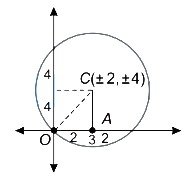
The equations of the circle which pass through the origin and make intercepts of lengths $4$ and $8$ on the $x$ and $y$-axes respectively are
A
$x^2+y^2 \pm 4x \pm 8y=0$
B
$x^2+y^2 \pm 2x \pm 4y=0$
C
$x^2+y^2 \pm 8x \pm 16y=0$
D
$x^2+y^2 \pm x \pm y=0$
Solution
(A) Let the equation of the circle be $x^2 + y^2 + 2gx + 2fy + c = 0$.
Since the circle passes through the origin $(0, 0)$,we have $c = 0$.
The circle makes an intercept of length $4$ on the $x$-axis,so $2\sqrt{g^2 - c} = 4$. Since $c = 0$,$2|g| = 4$,which implies $g = \pm 2$.
The circle makes an intercept of length $8$ on the $y$-axis,so $2\sqrt{f^2 - c} = 8$. Since $c = 0$,$2|f| = 8$,which implies $f = \pm 4$.
Substituting $g = \pm 2$ and $f = \pm 4$ into the equation $x^2 + y^2 + 2gx + 2fy = 0$,we get $x^2 + y^2 \pm 4x \pm 8y = 0$.
Since the circle passes through the origin $(0, 0)$,we have $c = 0$.
The circle makes an intercept of length $4$ on the $x$-axis,so $2\sqrt{g^2 - c} = 4$. Since $c = 0$,$2|g| = 4$,which implies $g = \pm 2$.
The circle makes an intercept of length $8$ on the $y$-axis,so $2\sqrt{f^2 - c} = 8$. Since $c = 0$,$2|f| = 8$,which implies $f = \pm 4$.
Substituting $g = \pm 2$ and $f = \pm 4$ into the equation $x^2 + y^2 + 2gx + 2fy = 0$,we get $x^2 + y^2 \pm 4x \pm 8y = 0$.
0 likesView Solution
68
ChemistryMCQAP EAMCET · 2009
The diameters of a circle are along $2x+y-7=0$ and $x+3y-11=0$. Then,the equation of this circle,which also passes through $(5,7)$,is
A
$x^2+y^2-4x-6y-16=0$
B
$x^2+y^2-4x-6y-20=0$
C
$x^2+y^2-4x-6y-12=0$
D
$x^2+y^2+4x+6y-12=0$
Solution
(C) The intersection point of the diameter lines is the center of the circle. Solving $2x+y=7$ and $x+3y=11$:
From the first equation,$y=7-2x$.
Substituting into the second: $x+3(7-2x)=11$ $\Rightarrow x+21-6x=11$ $\Rightarrow -5x=-10$ $\Rightarrow x=2$.
Then $y=7-2(2)=3$.
So,the center is $(h,k) = (2,3)$.
The radius $r$ is the distance between the center $(2,3)$ and the point $(5,7)$:
$r = \sqrt{(5-2)^2+(7-3)^2} = \sqrt{3^2+4^2} = \sqrt{9+16} = 5$.
The equation of the circle is $(x-h)^2+(y-k)^2=r^2$:
$(x-2)^2+(y-3)^2 = 5^2$
$x^2-4x+4+y^2-6y+9 = 25$
$x^2+y^2-4x-6y+13-25 = 0$
$x^2+y^2-4x-6y-12 = 0$.
From the first equation,$y=7-2x$.
Substituting into the second: $x+3(7-2x)=11$ $\Rightarrow x+21-6x=11$ $\Rightarrow -5x=-10$ $\Rightarrow x=2$.
Then $y=7-2(2)=3$.
So,the center is $(h,k) = (2,3)$.
The radius $r$ is the distance between the center $(2,3)$ and the point $(5,7)$:
$r = \sqrt{(5-2)^2+(7-3)^2} = \sqrt{3^2+4^2} = \sqrt{9+16} = 5$.
The equation of the circle is $(x-h)^2+(y-k)^2=r^2$:
$(x-2)^2+(y-3)^2 = 5^2$
$x^2-4x+4+y^2-6y+9 = 25$
$x^2+y^2-4x-6y+13-25 = 0$
$x^2+y^2-4x-6y-12 = 0$.
0 likesView Solution
69
ChemistryMCQAP EAMCET · 2009
The point $(3,-4)$ lies on both the circles $x^2+y^2-2x+8y+13=0$ and $x^2+y^2-4x+6y+11=0$. Then,the angle between the circles is
A
$60^{\circ}$
B
$\tan^{-1}\left(\frac{1}{2}\right)$
C
$\tan^{-1}\left(\frac{3}{5}\right)$
D
$135^{\circ}$
Solution
(D) The given circles are $S_1: x^2+y^2-2x+8y+13=0$ and $S_2: x^2+y^2-4x+6y+11=0$.
For $S_1$,the center $C_1 = (1, -4)$ and radius $r_1 = \sqrt{1^2+(-4)^2-13} = \sqrt{1+16-13} = 2$.
For $S_2$,the center $C_2 = (2, -3)$ and radius $r_2 = \sqrt{2^2+(-3)^2-11} = \sqrt{4+9-11} = \sqrt{2}$.
The distance between the centers $d = C_1C_2 = \sqrt{(2-1)^2+(-3-(-4))^2} = \sqrt{1^2+1^2} = \sqrt{2}$.
The angle $\theta$ between the circles is given by $\cos \theta = \frac{d^2-r_1^2-r_2^2}{2r_1r_2}$.
Substituting the values,$\cos \theta = \frac{(\sqrt{2})^2 - 2^2 - (\sqrt{2})^2}{2 \times 2 \times \sqrt{2}} = \frac{2-4-2}{4\sqrt{2}} = \frac{-4}{4\sqrt{2}} = -\frac{1}{\sqrt{2}}$.
Thus,$\theta = 135^{\circ}$.
For $S_1$,the center $C_1 = (1, -4)$ and radius $r_1 = \sqrt{1^2+(-4)^2-13} = \sqrt{1+16-13} = 2$.
For $S_2$,the center $C_2 = (2, -3)$ and radius $r_2 = \sqrt{2^2+(-3)^2-11} = \sqrt{4+9-11} = \sqrt{2}$.
The distance between the centers $d = C_1C_2 = \sqrt{(2-1)^2+(-3-(-4))^2} = \sqrt{1^2+1^2} = \sqrt{2}$.
The angle $\theta$ between the circles is given by $\cos \theta = \frac{d^2-r_1^2-r_2^2}{2r_1r_2}$.
Substituting the values,$\cos \theta = \frac{(\sqrt{2})^2 - 2^2 - (\sqrt{2})^2}{2 \times 2 \times \sqrt{2}} = \frac{2-4-2}{4\sqrt{2}} = \frac{-4}{4\sqrt{2}} = -\frac{1}{\sqrt{2}}$.
Thus,$\theta = 135^{\circ}$.
0 likesView Solution
70
ChemistryMCQAP EAMCET · 2009
The equation of the circle which passes through the origin and cuts orthogonally each of the circles $x^2+y^2-6x+8=0$ and $x^2+y^2-2x-2y-7=0$ is
A
$3x^2+3y^2-8x-13y=0$
B
$3x^2+3y^2+8x+29y=0$
C
$3x^2+3y^2-8x+29y=0$
D
$3x^2+3y^2-8x-29y=0$
Solution
(C) Let the required equation of the circle be $x^2+y^2+2gx+2fy=0$ (since it passes through the origin,$c=0$).
For the circle $x^2+y^2+2g_1x+2f_1y+c_1=0$ to cut $x^2+y^2+2g_2x+2f_2y+c_2=0$ orthogonally,the condition is $2g_1g_2+2f_1f_2=c_1+c_2$.
For the first circle $x^2+y^2-6x+8=0$,we have $g_1=-3, f_1=0, c_1=8$. Applying the condition: $2g(-3)+2f(0)=0+8$ $\Rightarrow -6g=8$ $\Rightarrow g=-\frac{4}{3}$.
For the second circle $x^2+y^2-2x-2y-7=0$,we have $g_2=-1, f_2=-1, c_2=-7$. Applying the condition: $2g(-1)+2f(-1)=0-7 \Rightarrow -2g-2f=-7$.
Substituting $g=-\frac{4}{3}$ into the second equation: $-2(-\frac{4}{3})-2f=-7$ $\Rightarrow \frac{8}{3}-2f=-7$ $\Rightarrow 2f = 7+\frac{8}{3} = \frac{29}{3}$ $\Rightarrow f=\frac{29}{6}$.
The equation is $x^2+y^2+2(-\frac{4}{3})x+2(\frac{29}{6})y=0$.
$x^2+y^2-\frac{8}{3}x+\frac{29}{3}y=0$.
Multiplying by $3$,we get $3x^2+3y^2-8x+29y=0$.
For the circle $x^2+y^2+2g_1x+2f_1y+c_1=0$ to cut $x^2+y^2+2g_2x+2f_2y+c_2=0$ orthogonally,the condition is $2g_1g_2+2f_1f_2=c_1+c_2$.
For the first circle $x^2+y^2-6x+8=0$,we have $g_1=-3, f_1=0, c_1=8$. Applying the condition: $2g(-3)+2f(0)=0+8$ $\Rightarrow -6g=8$ $\Rightarrow g=-\frac{4}{3}$.
For the second circle $x^2+y^2-2x-2y-7=0$,we have $g_2=-1, f_2=-1, c_2=-7$. Applying the condition: $2g(-1)+2f(-1)=0-7 \Rightarrow -2g-2f=-7$.
Substituting $g=-\frac{4}{3}$ into the second equation: $-2(-\frac{4}{3})-2f=-7$ $\Rightarrow \frac{8}{3}-2f=-7$ $\Rightarrow 2f = 7+\frac{8}{3} = \frac{29}{3}$ $\Rightarrow f=\frac{29}{6}$.
The equation is $x^2+y^2+2(-\frac{4}{3})x+2(\frac{29}{6})y=0$.
$x^2+y^2-\frac{8}{3}x+\frac{29}{3}y=0$.
Multiplying by $3$,we get $3x^2+3y^2-8x+29y=0$.
0 likesView Solution
71
ChemistryMCQAP EAMCET · 2009
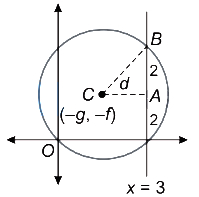
The locus of the centre of a circle which passes through the origin and cuts off a chord of length $4$ units from the line $x=3$ is
A
$y^2+6x=0$
B
$y^2+6x=13$
C
$y^2+6x=10$
D
$x^2+6y=13$
Solution
(B) Let the centre of the circle be $C(h, k)$. Since the circle passes through the origin $(0,0)$,its radius $r$ is given by $r^2 = h^2 + k^2$.
The equation of the circle is $(x-h)^2 + (y-k)^2 = h^2 + k^2$,which simplifies to $x^2 + y^2 - 2hx - 2ky = 0$.
The perpendicular distance $d$ from the centre $(h, k)$ to the line $x=3$ (or $x-3=0$) is $d = |h-3|$.
In the right-angled triangle formed by the centre,the midpoint of the chord,and an endpoint of the chord,we have $r^2 = d^2 + (L/2)^2$,where $L=4$ is the length of the chord.
Thus,$h^2 + k^2 = (h-3)^2 + 2^2$.
$h^2 + k^2 = h^2 - 6h + 9 + 4$.
$k^2 = -6h + 13$.
Replacing $(h, k)$ with $(x, y)$,the locus is $y^2 = -6x + 13$,or $y^2 + 6x = 13$.
The equation of the circle is $(x-h)^2 + (y-k)^2 = h^2 + k^2$,which simplifies to $x^2 + y^2 - 2hx - 2ky = 0$.
The perpendicular distance $d$ from the centre $(h, k)$ to the line $x=3$ (or $x-3=0$) is $d = |h-3|$.
In the right-angled triangle formed by the centre,the midpoint of the chord,and an endpoint of the chord,we have $r^2 = d^2 + (L/2)^2$,where $L=4$ is the length of the chord.
Thus,$h^2 + k^2 = (h-3)^2 + 2^2$.
$h^2 + k^2 = h^2 - 6h + 9 + 4$.
$k^2 = -6h + 13$.
Replacing $(h, k)$ with $(x, y)$,the locus is $y^2 = -6x + 13$,or $y^2 + 6x = 13$.
0 likesView Solution
72
ChemistryMCQAP EAMCET · 2009
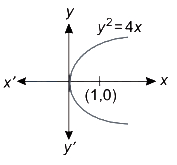
The number of normals drawn to the parabola $y^2 = 4x$ from the point $(1, 0)$ is
A
$0$
B
$1$
C
$2$
D
$3$
Solution
(B) The equation of the parabola is $y^2 = 4ax$,where $a = 1$. The focus of the parabola is $(a, 0) = (1, 0)$.
Any normal to the parabola $y^2 = 4ax$ at point $(at^2, 2at)$ is given by $y = -tx + 2at + at^3$.
Since the normal passes through $(1, 0)$,we substitute $x = 1$ and $y = 0$ into the equation:
$0 = -t(1) + 2(1)t + (1)t^3$
$0 = -t + 2t + t^3$
$0 = t + t^3$
$t(1 + t^2) = 0$
Since $t$ must be a real number,the only solution is $t = 0$.
For $t = 0$,the normal is $y = 0$,which is the $x$-axis.
Thus,only $1$ normal can be drawn from the point $(1, 0)$ to the parabola.
Any normal to the parabola $y^2 = 4ax$ at point $(at^2, 2at)$ is given by $y = -tx + 2at + at^3$.
Since the normal passes through $(1, 0)$,we substitute $x = 1$ and $y = 0$ into the equation:
$0 = -t(1) + 2(1)t + (1)t^3$
$0 = -t + 2t + t^3$
$0 = t + t^3$
$t(1 + t^2) = 0$
Since $t$ must be a real number,the only solution is $t = 0$.
For $t = 0$,the normal is $y = 0$,which is the $x$-axis.
Thus,only $1$ normal can be drawn from the point $(1, 0)$ to the parabola.
0 likesView Solution
73
ChemistryMCQAP EAMCET · 2009
The coefficient of $x^{24}$ in the expansion of $(1+x^2)^{12}(1+x^{12})(1+x^{24})$ is
A
${}^{12}C_6$
B
${}^{12}C_6+2$
C
${}^{12}C_6+4$
D
${}^{12}C_6+6$
Solution
(B) We are given the expression $(1+x^2)^{12}(1+x^{12})(1+x^{24})$.
First,expand the product $(1+x^{12})(1+x^{24}) = 1 + x^{12} + x^{24} + x^{36}$.
Now,the expression becomes $(1+x^2)^{12}(1 + x^{12} + x^{24} + x^{36})$.
Using the binomial theorem,$(1+x^2)^{12} = \sum_{k=0}^{12} {}^{12}C_k (x^2)^k = \sum_{k=0}^{12} {}^{12}C_k x^{2k}$.
We need the coefficient of $x^{24}$ in the product $(\sum_{k=0}^{12} {}^{12}C_k x^{2k})(1 + x^{12} + x^{24} + x^{36})$.
This is obtained by summing the coefficients of terms that result in $x^{24}$:
$1$. From $1 \times ({}^{12}C_{12} x^{24}) = {}^{12}C_{12} x^{24} = 1 \cdot x^{24}$.
$2$. From $x^{12} \times ({}^{12}C_6 x^{12}) = {}^{12}C_6 x^{24}$.
$3$. From $x^{24} \times ({}^{12}C_0 x^0) = {}^{12}C_0 x^{24} = 1 \cdot x^{24}$.
Summing these,the coefficient of $x^{24}$ is ${}^{12}C_6 + 1 + 1 = {}^{12}C_6 + 2$.
First,expand the product $(1+x^{12})(1+x^{24}) = 1 + x^{12} + x^{24} + x^{36}$.
Now,the expression becomes $(1+x^2)^{12}(1 + x^{12} + x^{24} + x^{36})$.
Using the binomial theorem,$(1+x^2)^{12} = \sum_{k=0}^{12} {}^{12}C_k (x^2)^k = \sum_{k=0}^{12} {}^{12}C_k x^{2k}$.
We need the coefficient of $x^{24}$ in the product $(\sum_{k=0}^{12} {}^{12}C_k x^{2k})(1 + x^{12} + x^{24} + x^{36})$.
This is obtained by summing the coefficients of terms that result in $x^{24}$:
$1$. From $1 \times ({}^{12}C_{12} x^{24}) = {}^{12}C_{12} x^{24} = 1 \cdot x^{24}$.
$2$. From $x^{12} \times ({}^{12}C_6 x^{12}) = {}^{12}C_6 x^{24}$.
$3$. From $x^{24} \times ({}^{12}C_0 x^0) = {}^{12}C_0 x^{24} = 1 \cdot x^{24}$.
Summing these,the coefficient of $x^{24}$ is ${}^{12}C_6 + 1 + 1 = {}^{12}C_6 + 2$.
0 likesView Solution
74
ChemistryMCQAP EAMCET · 2009
For $|x| < 1$,the constant term in the expansion of $\frac{1}{(x-1)^2(x-2)}$ is
A
$2$
B
$1$
C
$0$
D
$-\frac{1}{2}$
Solution
(D) Given the expression $\frac{1}{(x-1)^2(x-2)}$.
We can rewrite this as $\frac{1}{(-1)^2(1-x)^2(-2)(1-\frac{x}{2})} = \frac{1}{1 \cdot (1-x)^2 \cdot (-2) \cdot (1-\frac{x}{2})} = -\frac{1}{2}(1-x)^{-2}(1-\frac{x}{2})^{-1}$.
Using the binomial expansion $(1-z)^{-n} = 1 + nz + \frac{n(n+1)}{2!}z^2 + \dots$,we have:
$(1-x)^{-2} = 1 + 2x + 3x^2 + \dots$
$(1-\frac{x}{2})^{-1} = 1 + \frac{x}{2} + \frac{x^2}{4} + \dots$
Multiplying these series:
$-\frac{1}{2}(1 + 2x + \dots)(1 + \frac{x}{2} + \dots) = -\frac{1}{2}(1 + \frac{x}{2} + 2x + \dots) = -\frac{1}{2}(1 + \frac{5x}{2} + \dots)$.
The constant term is the term independent of $x$,which is $-\frac{1}{2} \times 1 = -\frac{1}{2}$.
We can rewrite this as $\frac{1}{(-1)^2(1-x)^2(-2)(1-\frac{x}{2})} = \frac{1}{1 \cdot (1-x)^2 \cdot (-2) \cdot (1-\frac{x}{2})} = -\frac{1}{2}(1-x)^{-2}(1-\frac{x}{2})^{-1}$.
Using the binomial expansion $(1-z)^{-n} = 1 + nz + \frac{n(n+1)}{2!}z^2 + \dots$,we have:
$(1-x)^{-2} = 1 + 2x + 3x^2 + \dots$
$(1-\frac{x}{2})^{-1} = 1 + \frac{x}{2} + \frac{x^2}{4} + \dots$
Multiplying these series:
$-\frac{1}{2}(1 + 2x + \dots)(1 + \frac{x}{2} + \dots) = -\frac{1}{2}(1 + \frac{x}{2} + 2x + \dots) = -\frac{1}{2}(1 + \frac{5x}{2} + \dots)$.
The constant term is the term independent of $x$,which is $-\frac{1}{2} \times 1 = -\frac{1}{2}$.
0 likesView Solution
75
ChemistryMCQAP EAMCET · 2009
$\frac{1}{e^{3x}}(e^x + e^{5x}) = a_0 + a_1x + a_2x^2 + \ldots$
$\Rightarrow 2a_1 + 2^3a_3 + 2^5a_5 + \ldots$ is equal to
$\Rightarrow 2a_1 + 2^3a_3 + 2^5a_5 + \ldots$ is equal to
A
$e$
B
$e^{-1}$
C
$1$
D
$0$
Solution
(D) Given,$\frac{1}{e^{3x}}(e^x + e^{5x}) = a_0 + a_1x + a_2x^2 + \ldots$
$\Rightarrow e^{-2x} + e^{2x} = a_0 + a_1x + a_2x^2 + \ldots$
Using the expansion $e^y + e^{-y} = 2(1 + \frac{y^2}{2!} + \frac{y^4}{4!} + \ldots)$,we get:
$2(1 + \frac{(2x)^2}{2!} + \frac{(2x)^4}{4!} + \ldots) = a_0 + a_1x + a_2x^2 + \ldots$
Comparing the coefficients of $x^n$ on both sides,we observe that all odd-indexed coefficients $a_1, a_3, a_5, \ldots$ are $0$.
Therefore,$2a_1 + 2^3a_3 + 2^5a_5 + \ldots = 2(0) + 2^3(0) + 2^5(0) + \ldots = 0$.
$\Rightarrow e^{-2x} + e^{2x} = a_0 + a_1x + a_2x^2 + \ldots$
Using the expansion $e^y + e^{-y} = 2(1 + \frac{y^2}{2!} + \frac{y^4}{4!} + \ldots)$,we get:
$2(1 + \frac{(2x)^2}{2!} + \frac{(2x)^4}{4!} + \ldots) = a_0 + a_1x + a_2x^2 + \ldots$
Comparing the coefficients of $x^n$ on both sides,we observe that all odd-indexed coefficients $a_1, a_3, a_5, \ldots$ are $0$.
Therefore,$2a_1 + 2^3a_3 + 2^5a_5 + \ldots = 2(0) + 2^3(0) + 2^5(0) + \ldots = 0$.
0 likesView Solution
76
ChemistryMCQAP EAMCET · 2009
If $x$ is numerically so small that $x^2$ and higher powers of $x$ can be neglected,then $\left(1+\frac{2 x}{3}\right)^{3 / 2} \cdot(32+5 x)^{-1 / 5}$ is approximately equal to
A
$\frac{32+31 x}{64}$
B
$\frac{31+32 x}{64}$
C
$\frac{31-32 x}{64}$
D
$\frac{1-2 x}{64}$
Solution
(A) Using the binomial approximation $(1+u)^n \approx 1+nu$ for small $u$:
$\left(1+\frac{2 x}{3}\right)^{3 / 2} \approx 1 + \frac{3}{2} \cdot \frac{2x}{3} = 1+x$
For the second term:
$(32+5 x)^{-1 / 5} = 32^{-1 / 5} \left(1+\frac{5 x}{32}\right)^{-1 / 5} = \frac{1}{2} \left(1+\frac{5 x}{32}\right)^{-1 / 5}$
Using the approximation $(1+u)^n \approx 1+nu$:
$\frac{1}{2} \left(1 - \frac{1}{5} \cdot \frac{5x}{32}\right) = \frac{1}{2} \left(1 - \frac{x}{32}\right)$
Multiplying the two approximations:
$(1+x) \cdot \frac{1}{2} \left(1 - \frac{x}{32}\right) = \frac{1}{2} \left(1 - \frac{x}{32} + x - \frac{x^2}{32}\right)$
Neglecting $x^2$:
$\approx \frac{1}{2} \left(1 + \frac{31x}{32}\right) = \frac{32+31x}{64}$
$\left(1+\frac{2 x}{3}\right)^{3 / 2} \approx 1 + \frac{3}{2} \cdot \frac{2x}{3} = 1+x$
For the second term:
$(32+5 x)^{-1 / 5} = 32^{-1 / 5} \left(1+\frac{5 x}{32}\right)^{-1 / 5} = \frac{1}{2} \left(1+\frac{5 x}{32}\right)^{-1 / 5}$
Using the approximation $(1+u)^n \approx 1+nu$:
$\frac{1}{2} \left(1 - \frac{1}{5} \cdot \frac{5x}{32}\right) = \frac{1}{2} \left(1 - \frac{x}{32}\right)$
Multiplying the two approximations:
$(1+x) \cdot \frac{1}{2} \left(1 - \frac{x}{32}\right) = \frac{1}{2} \left(1 - \frac{x}{32} + x - \frac{x^2}{32}\right)$
Neglecting $x^2$:
$\approx \frac{1}{2} \left(1 + \frac{31x}{32}\right) = \frac{32+31x}{64}$
0 likesView Solution
77
ChemistryMCQAP EAMCET · 2009
If the distance between the foci of an ellipse is $6$ and the length of the minor axis is $8$,then the eccentricity is
A
$\frac{1}{\sqrt{5}}$
B
$\frac{1}{2}$
C
$\frac{3}{5}$
D
$\frac{4}{5}$
Solution
(C) Given that the distance between the foci is $2ae = 6$,so $ae = 3$.
Given that the length of the minor axis is $2b = 8$,so $b = 4$.
We know the relation $b^2 = a^2(1 - e^2)$,which can be written as $b^2 = a^2 - a^2e^2$.
Substituting $b = 4$ and $ae = 3$:
$4^2 = a^2 - (ae)^2$
$16 = a^2 - 3^2$
$16 = a^2 - 9$
$a^2 = 25 \Rightarrow a = 5$.
Now,using $ae = 3$:
$5e = 3$
$e = \frac{3}{5}$.
Given that the length of the minor axis is $2b = 8$,so $b = 4$.
We know the relation $b^2 = a^2(1 - e^2)$,which can be written as $b^2 = a^2 - a^2e^2$.
Substituting $b = 4$ and $ae = 3$:
$4^2 = a^2 - (ae)^2$
$16 = a^2 - 3^2$
$16 = a^2 - 9$
$a^2 = 25 \Rightarrow a = 5$.
Now,using $ae = 3$:
$5e = 3$
$e = \frac{3}{5}$.
0 likesView Solution
78
ChemistryMCQAP EAMCET · 2009
The eccentricity of the conic $\frac{5}{r}=2+3 \cos \theta+4 \sin \theta$ is
A
$\frac{1}{2}$
B
$1$
C
$\frac{3}{2}$
D
$\frac{5}{2}$
Solution
(D) Given,$\frac{5}{r} = 2 + 3 \cos \theta + 4 \sin \theta$.
Divide by $2$: $\frac{5/2}{r} = 1 + \frac{3}{2} \cos \theta + 2 \sin \theta$.
We can write $\frac{3}{2} \cos \theta + 2 \sin \theta$ in the form $e \cos(\theta - \phi)$,where $e = \sqrt{(\frac{3}{2})^2 + 2^2} = \sqrt{\frac{9}{4} + 4} = \sqrt{\frac{25}{4}} = \frac{5}{2}$.
Thus,the equation becomes $\frac{5/2}{r} = 1 + \frac{5}{2} \cos(\theta - \phi)$.
Comparing this with the standard polar form of a conic $\frac{l}{r} = 1 + e \cos(\theta - \phi)$,we get the eccentricity $e = \frac{5}{2}$.
Divide by $2$: $\frac{5/2}{r} = 1 + \frac{3}{2} \cos \theta + 2 \sin \theta$.
We can write $\frac{3}{2} \cos \theta + 2 \sin \theta$ in the form $e \cos(\theta - \phi)$,where $e = \sqrt{(\frac{3}{2})^2 + 2^2} = \sqrt{\frac{9}{4} + 4} = \sqrt{\frac{25}{4}} = \frac{5}{2}$.
Thus,the equation becomes $\frac{5/2}{r} = 1 + \frac{5}{2} \cos(\theta - \phi)$.
Comparing this with the standard polar form of a conic $\frac{l}{r} = 1 + e \cos(\theta - \phi)$,we get the eccentricity $e = \frac{5}{2}$.
0 likesView Solution
79
ChemistryMCQAP EAMCET · 2009
The midpoint of the chord $4x - 3y = 5$ of the hyperbola $2x^2 - 3y^2 = 12$ is
A
$\left(0, -\frac{5}{3}\right)$
B
$(2, 1)$
C
$\left(\frac{5}{4}, 0\right)$
D
$\left(\frac{11}{4}, 2\right)$
Solution
(B) The equation of the chord of a hyperbola $S = 0$ with midpoint $(x_1, y_1)$ is given by $T = S_1$,where $T$ is the tangent at $(x_1, y_1)$ and $S_1$ is the value of the hyperbola equation at $(x_1, y_1)$.
For the hyperbola $2x^2 - 3y^2 - 12 = 0$,the equation of the chord with midpoint $(x_1, y_1)$ is $2xx_1 - 3yy_1 - 12 = 2x_1^2 - 3y_1^2 - 12$,which simplifies to $2xx_1 - 3yy_1 = 2x_1^2 - 3y_1^2$.
Comparing this with the given chord equation $4x - 3y = 5$,we have:
$\frac{2x_1}{4} = \frac{-3y_1}{-3} = \frac{2x_1^2 - 3y_1^2}{5}$.
From $\frac{2x_1}{4} = y_1$,we get $x_1 = 2y_1$.
Substituting $x_1 = 2y_1$ into $\frac{2x_1}{4} = \frac{2x_1^2 - 3y_1^2}{5}$:
$\frac{y_1}{1} = \frac{2(2y_1)^2 - 3y_1^2}{5}$ $\Rightarrow 5y_1 = 8y_1^2 - 3y_1^2$ $\Rightarrow 5y_1 = 5y_1^2$.
This gives $y_1^2 - y_1 = 0$,so $y_1 = 0$ or $y_1 = 1$.
If $y_1 = 0$,then $x_1 = 0$. Checking the point $(0, 0)$ in the chord equation $4(0) - 3(0) = 0 \neq 5$. So,$y_1 = 0$ is rejected.
If $y_1 = 1$,then $x_1 = 2(1) = 2$. The point $(2, 1)$ satisfies the chord equation $4(2) - 3(1) = 8 - 3 = 5$.
Thus,the midpoint is $(2, 1)$.
For the hyperbola $2x^2 - 3y^2 - 12 = 0$,the equation of the chord with midpoint $(x_1, y_1)$ is $2xx_1 - 3yy_1 - 12 = 2x_1^2 - 3y_1^2 - 12$,which simplifies to $2xx_1 - 3yy_1 = 2x_1^2 - 3y_1^2$.
Comparing this with the given chord equation $4x - 3y = 5$,we have:
$\frac{2x_1}{4} = \frac{-3y_1}{-3} = \frac{2x_1^2 - 3y_1^2}{5}$.
From $\frac{2x_1}{4} = y_1$,we get $x_1 = 2y_1$.
Substituting $x_1 = 2y_1$ into $\frac{2x_1}{4} = \frac{2x_1^2 - 3y_1^2}{5}$:
$\frac{y_1}{1} = \frac{2(2y_1)^2 - 3y_1^2}{5}$ $\Rightarrow 5y_1 = 8y_1^2 - 3y_1^2$ $\Rightarrow 5y_1 = 5y_1^2$.
This gives $y_1^2 - y_1 = 0$,so $y_1 = 0$ or $y_1 = 1$.
If $y_1 = 0$,then $x_1 = 0$. Checking the point $(0, 0)$ in the chord equation $4(0) - 3(0) = 0 \neq 5$. So,$y_1 = 0$ is rejected.
If $y_1 = 1$,then $x_1 = 2(1) = 2$. The point $(2, 1)$ satisfies the chord equation $4(2) - 3(1) = 8 - 3 = 5$.
Thus,the midpoint is $(2, 1)$.
0 likesView Solution
80
ChemistryMCQAP EAMCET · 2009
If the circle $x^2+y^2=a^2$ intersects the hyperbola $xy=c^2$ in four points $(x_i, y_i)$,for $i=1, 2, 3, 4$,then $y_1+y_2+y_3+y_4$ equals
A
$0$
B
$c$
C
$a$
D
$c^4$
Solution
(A) Given equations are $x^2+y^2=a^2$ and $xy=c^2$.
From the second equation,$x = \frac{c^2}{y}$.
Substituting this into the first equation:
$\left(\frac{c^2}{y}\right)^2 + y^2 = a^2$
$\frac{c^4}{y^2} + y^2 = a^2$
$c^4 + y^4 = a^2 y^2$
$y^4 - a^2 y^2 + c^4 = 0$
This is a biquadratic equation in $y$. Let the roots be $y_1, y_2, y_3, y_4$.
The sum of the roots of the equation $y^4 + 0y^3 - a^2 y^2 + 0y + c^4 = 0$ is given by the coefficient of $y^3$ divided by the coefficient of $y^4$ with a negative sign.
Sum $= -\frac{0}{1} = 0$.
Therefore,$y_1+y_2+y_3+y_4 = 0$.
From the second equation,$x = \frac{c^2}{y}$.
Substituting this into the first equation:
$\left(\frac{c^2}{y}\right)^2 + y^2 = a^2$
$\frac{c^4}{y^2} + y^2 = a^2$
$c^4 + y^4 = a^2 y^2$
$y^4 - a^2 y^2 + c^4 = 0$
This is a biquadratic equation in $y$. Let the roots be $y_1, y_2, y_3, y_4$.
The sum of the roots of the equation $y^4 + 0y^3 - a^2 y^2 + 0y + c^4 = 0$ is given by the coefficient of $y^3$ divided by the coefficient of $y^4$ with a negative sign.
Sum $= -\frac{0}{1} = 0$.
Therefore,$y_1+y_2+y_3+y_4 = 0$.
0 likesView Solution
81
ChemistryMCQAP EAMCET · 2009
$\lim _{x \rightarrow \infty}\left(\frac{x+5}{x+2}\right)^{x+3}$ equals
A
$e$
B
$e^2$
C
$e^3$
D
$e^5$
Solution
(C) We know that $\lim _{x \rightarrow \infty} (1 + \frac{a}{x})^x = e^a$.
Given expression: $\lim _{x \rightarrow \infty} (\frac{x+5}{x+2})^{x+3}$
$= \lim _{x \rightarrow \infty} (1 + \frac{3}{x+2})^{x+3}$
$= \lim _{x \rightarrow \infty} [(1 + \frac{3}{x+2})^{\frac{x+2}{3}}]^{\frac{3(x+3)}{x+2}}$
$= e^{\lim _{x \rightarrow \infty} \frac{3x+9}{x+2}}$
$= e^{\lim _{x \rightarrow \infty} \frac{3 + 9/x}{1 + 2/x}}$
$= e^3$
Given expression: $\lim _{x \rightarrow \infty} (\frac{x+5}{x+2})^{x+3}$
$= \lim _{x \rightarrow \infty} (1 + \frac{3}{x+2})^{x+3}$
$= \lim _{x \rightarrow \infty} [(1 + \frac{3}{x+2})^{\frac{x+2}{3}}]^{\frac{3(x+3)}{x+2}}$
$= e^{\lim _{x \rightarrow \infty} \frac{3x+9}{x+2}}$
$= e^{\lim _{x \rightarrow \infty} \frac{3 + 9/x}{1 + 2/x}}$
$= e^3$
0 likesView Solution
82
ChemistryMCQAP EAMCET · 2009
If $m$ and $\sigma^2$ are the mean and variance of the random variable $X$,whose distribution is given by:
Then:
| $X = x$ | $0$ | $1$ | $2$ | $3$ |
|---|---|---|---|---|
| $P(X = x)$ | $\frac{1}{3}$ | $\frac{1}{2}$ | $0$ | $\frac{1}{6}$ |
Then:
A
$m=\sigma^2=2$
B
$m=1, \sigma^2=2$
C
$m=\sigma^2=1$
D
$m=2, \sigma^2=1$
Solution
(C) The mean $m$ is calculated as $E[X] = \sum p_i x_i$:
$m = (0 \times \frac{1}{3}) + (1 \times \frac{1}{2}) + (2 \times 0) + (3 \times \frac{1}{6})$
$m = 0 + \frac{1}{2} + 0 + \frac{1}{2} = 1$
The variance $\sigma^2$ is calculated as $E[X^2] - (E[X])^2$:
$E[X^2] = \sum p_i x_i^2 = (0^2 \times \frac{1}{3}) + (1^2 \times \frac{1}{2}) + (2^2 \times 0) + (3^2 \times \frac{1}{6})$
$E[X^2] = 0 + \frac{1}{2} + 0 + \frac{9}{6} = \frac{1}{2} + \frac{3}{2} = 2$
$\sigma^2 = E[X^2] - m^2 = 2 - (1)^2 = 2 - 1 = 1$
Thus,$m = 1$ and $\sigma^2 = 1$,so $m = \sigma^2 = 1$.
$m = (0 \times \frac{1}{3}) + (1 \times \frac{1}{2}) + (2 \times 0) + (3 \times \frac{1}{6})$
$m = 0 + \frac{1}{2} + 0 + \frac{1}{2} = 1$
The variance $\sigma^2$ is calculated as $E[X^2] - (E[X])^2$:
$E[X^2] = \sum p_i x_i^2 = (0^2 \times \frac{1}{3}) + (1^2 \times \frac{1}{2}) + (2^2 \times 0) + (3^2 \times \frac{1}{6})$
$E[X^2] = 0 + \frac{1}{2} + 0 + \frac{9}{6} = \frac{1}{2} + \frac{3}{2} = 2$
$\sigma^2 = E[X^2] - m^2 = 2 - (1)^2 = 2 - 1 = 1$
Thus,$m = 1$ and $\sigma^2 = 1$,so $m = \sigma^2 = 1$.
0 likesView Solution
83
ChemistryMCQAP EAMCET · 2009
In any $\triangle ABC$,$a(b \cos C - c \cos B)$ equals
A
$b^2 + c^2$
B
$b^2 - c^2$
C
$\frac{1}{b} + \frac{1}{c}$
D
$\frac{1}{b^2} - \frac{1}{c^2}$
Solution
(B) Using the projection formula or the cosine rule: $\cos C = \frac{a^2 + b^2 - c^2}{2ab}$ and $\cos B = \frac{a^2 + c^2 - b^2}{2ac}$.
Substituting these into the expression:
$a(b \cos C - c \cos B) = a(b \cdot \frac{a^2 + b^2 - c^2}{2ab} - c \cdot \frac{a^2 + c^2 - b^2}{2ac})$
$= a(\frac{a^2 + b^2 - c^2}{2a} - \frac{a^2 + c^2 - b^2}{2a})$
$= \frac{a^2 + b^2 - c^2 - (a^2 + c^2 - b^2)}{2}$
$= \frac{a^2 + b^2 - c^2 - a^2 - c^2 + b^2}{2}$
$= \frac{2b^2 - 2c^2}{2}$
$= b^2 - c^2$.
Substituting these into the expression:
$a(b \cos C - c \cos B) = a(b \cdot \frac{a^2 + b^2 - c^2}{2ab} - c \cdot \frac{a^2 + c^2 - b^2}{2ac})$
$= a(\frac{a^2 + b^2 - c^2}{2a} - \frac{a^2 + c^2 - b^2}{2a})$
$= \frac{a^2 + b^2 - c^2 - (a^2 + c^2 - b^2)}{2}$
$= \frac{a^2 + b^2 - c^2 - a^2 - c^2 + b^2}{2}$
$= \frac{2b^2 - 2c^2}{2}$
$= b^2 - c^2$.
0 likesView Solution
84
ChemistryMCQAP EAMCET · 2009
In a $\triangle ABC$,the expression $\frac{(a+b+c)(b+c-a)(c+a-b)(a+b-c)}{4b^2c^2}$ is equal to:
A
$\cos^2 A$
B
$\cos^2 B$
C
$\sin^2 A$
D
$\sin^2 B$
Solution
(C) Let $2s = a+b+c$. Then $b+c-a = 2s-2a$,$c+a-b = 2s-2b$,and $a+b-c = 2s-2c$.
Substituting these into the expression:
$\frac{(2s)(2s-2a)(2s-2b)(2s-2c)}{4b^2c^2} = \frac{16s(s-a)(s-b)(s-c)}{4b^2c^2} = 4 \frac{s(s-a)}{bc} \cdot \frac{(s-b)(s-c)}{bc}$.
Using the half-angle formulas $\cos^2(\frac{A}{2}) = \frac{s(s-a)}{bc}$ and $\sin^2(\frac{A}{2}) = \frac{(s-b)(s-c)}{bc}$,we get:
$4 \cos^2(\frac{A}{2}) \sin^2(\frac{A}{2}) = (2 \sin(\frac{A}{2}) \cos(\frac{A}{2}))^2 = \sin^2 A$.
Substituting these into the expression:
$\frac{(2s)(2s-2a)(2s-2b)(2s-2c)}{4b^2c^2} = \frac{16s(s-a)(s-b)(s-c)}{4b^2c^2} = 4 \frac{s(s-a)}{bc} \cdot \frac{(s-b)(s-c)}{bc}$.
Using the half-angle formulas $\cos^2(\frac{A}{2}) = \frac{s(s-a)}{bc}$ and $\sin^2(\frac{A}{2}) = \frac{(s-b)(s-c)}{bc}$,we get:
$4 \cos^2(\frac{A}{2}) \sin^2(\frac{A}{2}) = (2 \sin(\frac{A}{2}) \cos(\frac{A}{2}))^2 = \sin^2 A$.
0 likesView Solution
85
ChemistryMCQAP EAMCET · 2009
In any $\triangle ABC$,the expression $\frac{(a+b+c)(b+c-a)(c+a-b)(a+b-c)}{4b^2c^2}$ is equal to:
A
$\sin^2 B$
B
$\cos^2 A$
C
$\cos^2 B$
D
$\sin^2 A$
Solution
(D) Let $s = \frac{a+b+c}{2}$ be the semi-perimeter of the triangle,so $a+b+c = 2s$.
Then,$b+c-a = 2s-2a$,$c+a-b = 2s-2b$,and $a+b-c = 2s-2c$.
The expression becomes:
$\frac{(2s)(2s-2a)(2s-2b)(2s-2c)}{4b^2c^2} = \frac{16s(s-a)(s-b)(s-c)}{4b^2c^2}$.
Using Heron's formula,$\Delta^2 = s(s-a)(s-b)(s-c)$,so the expression is $\frac{16\Delta^2}{4b^2c^2} = \frac{4\Delta^2}{b^2c^2}$.
This can be written as $\left(\frac{2\Delta}{bc}\right)^2$.
Since the area of a triangle is $\Delta = \frac{1}{2}bc \sin A$,we have $\sin A = \frac{2\Delta}{bc}$.
Therefore,the expression equals $\sin^2 A$.
Then,$b+c-a = 2s-2a$,$c+a-b = 2s-2b$,and $a+b-c = 2s-2c$.
The expression becomes:
$\frac{(2s)(2s-2a)(2s-2b)(2s-2c)}{4b^2c^2} = \frac{16s(s-a)(s-b)(s-c)}{4b^2c^2}$.
Using Heron's formula,$\Delta^2 = s(s-a)(s-b)(s-c)$,so the expression is $\frac{16\Delta^2}{4b^2c^2} = \frac{4\Delta^2}{b^2c^2}$.
This can be written as $\left(\frac{2\Delta}{bc}\right)^2$.
Since the area of a triangle is $\Delta = \frac{1}{2}bc \sin A$,we have $\sin A = \frac{2\Delta}{bc}$.
Therefore,the expression equals $\sin^2 A$.
0 likesView Solution
86
ChemistryMCQAP EAMCET · 2009
Let $A$ and $B$ be two symmetric matrices of the same order. Then,the matrix $AB - BA$ is
A
a symmetric matrix
B
a skew-symmetric matrix
C
a null matrix
D
the identity matrix
Solution
(B) Given that $A$ and $B$ are symmetric matrices,we have $A^{\prime} = A$ and $B^{\prime} = B$.
Consider the transpose of the matrix $(AB - BA)$:
$(AB - BA)^{\prime} = (AB)^{\prime} - (BA)^{\prime}$
Using the property $(XY)^{\prime} = Y^{\prime}X^{\prime}$,we get:
$(AB - BA)^{\prime} = B^{\prime}A^{\prime} - A^{\prime}B^{\prime}$
Since $A^{\prime} = A$ and $B^{\prime} = B$,we substitute these values:
$(AB - BA)^{\prime} = BA - AB$
$(AB - BA)^{\prime} = -(AB - BA)$
Since the transpose of the matrix $(AB - BA)$ is equal to the negative of the matrix itself,$AB - BA$ is a skew-symmetric matrix.
Consider the transpose of the matrix $(AB - BA)$:
$(AB - BA)^{\prime} = (AB)^{\prime} - (BA)^{\prime}$
Using the property $(XY)^{\prime} = Y^{\prime}X^{\prime}$,we get:
$(AB - BA)^{\prime} = B^{\prime}A^{\prime} - A^{\prime}B^{\prime}$
Since $A^{\prime} = A$ and $B^{\prime} = B$,we substitute these values:
$(AB - BA)^{\prime} = BA - AB$
$(AB - BA)^{\prime} = -(AB - BA)$
Since the transpose of the matrix $(AB - BA)$ is equal to the negative of the matrix itself,$AB - BA$ is a skew-symmetric matrix.
0 likesView Solution
87
ChemistryMCQAP EAMCET · 2009
If $\left[\begin{array}{rrr}1 & -1 & x \\ 1 & x & 1 \\ x & -1 & 1\end{array}\right]$ has no inverse,then the real value of $x$ is
A
$2$
B
$3$
C
$0$
D
$1$
Solution
(D) matrix has no inverse if and only if its determinant is equal to $0$.
Let $A = \left[\begin{array}{rrr}1 & -1 & x \\ 1 & x & 1 \\ x & -1 & 1\end{array}\right]$.
We set $|A| = 0$:
$|A| = 1(x - (-1)) - (-1)(1 - x) + x(-1 - x^2) = 0$
$|A| = 1(x + 1) + 1(1 - x) + x(-1 - x^2) = 0$
$|A| = x + 1 + 1 - x - x - x^3 = 0$
$|A| = -x^3 - x + 2 = 0$
$x^3 + x - 2 = 0$
By inspection,if $x = 1$,then $1^3 + 1 - 2 = 0$,which satisfies the equation.
Alternatively,if $x = 1$,the matrix becomes $\left[\begin{array}{rrr}1 & -1 & 1 \\ 1 & 1 & 1 \\ 1 & -1 & 1\end{array}\right]$.
Since the first and third columns are identical,the determinant is $0$.
Thus,the real value of $x$ is $1$.
Let $A = \left[\begin{array}{rrr}1 & -1 & x \\ 1 & x & 1 \\ x & -1 & 1\end{array}\right]$.
We set $|A| = 0$:
$|A| = 1(x - (-1)) - (-1)(1 - x) + x(-1 - x^2) = 0$
$|A| = 1(x + 1) + 1(1 - x) + x(-1 - x^2) = 0$
$|A| = x + 1 + 1 - x - x - x^3 = 0$
$|A| = -x^3 - x + 2 = 0$
$x^3 + x - 2 = 0$
By inspection,if $x = 1$,then $1^3 + 1 - 2 = 0$,which satisfies the equation.
Alternatively,if $x = 1$,the matrix becomes $\left[\begin{array}{rrr}1 & -1 & 1 \\ 1 & 1 & 1 \\ 1 & -1 & 1\end{array}\right]$.
Since the first and third columns are identical,the determinant is $0$.
Thus,the real value of $x$ is $1$.
0 likesView Solution
88
ChemistryMCQAP EAMCET · 2009
If one of the roots of $\left|\begin{array}{lll}3 & 5 & x \\ 7 & x & 7 \\ x & 5 & 3\end{array}\right|=0$ is $-10$,then the other roots are
A
$3, 7$
B
$4, 7$
C
$3, 9$
D
$3, 4$
Solution
(A) Given the determinant equation: $\left|\begin{array}{lll}3 & 5 & x \\ 7 & x & 7 \\ x & 5 & 3\end{array}\right|=0$
Expanding along the first row:
$3(3x - 35) - 5(21 - 7x) + x(35 - x^2) = 0$
$9x - 105 - 105 + 35x + 35x - x^3 = 0$
$-x^3 + 79x - 210 = 0$
$x^3 - 79x + 210 = 0$
Since $x = -10$ is a root,$(x + 10)$ is a factor. Dividing $x^3 - 79x + 210$ by $(x + 10)$ gives $(x^2 - 10x + 21)$.
Factoring the quadratic: $(x^2 - 10x + 21) = (x - 3)(x - 7)$.
Thus,the equation is $(x + 10)(x - 3)(x - 7) = 0$.
The roots are $x = -10, 3, 7$.
Therefore,the other roots are $3$ and $7$.
Expanding along the first row:
$3(3x - 35) - 5(21 - 7x) + x(35 - x^2) = 0$
$9x - 105 - 105 + 35x + 35x - x^3 = 0$
$-x^3 + 79x - 210 = 0$
$x^3 - 79x + 210 = 0$
Since $x = -10$ is a root,$(x + 10)$ is a factor. Dividing $x^3 - 79x + 210$ by $(x + 10)$ gives $(x^2 - 10x + 21)$.
Factoring the quadratic: $(x^2 - 10x + 21) = (x - 3)(x - 7)$.
Thus,the equation is $(x + 10)(x - 3)(x - 7) = 0$.
The roots are $x = -10, 3, 7$.
Therefore,the other roots are $3$ and $7$.
0 likesView Solution
89
ChemistryMCQAP EAMCET · 2009
If $x, y, z$ are all positive and are the $p$-th,$q$-th and $r$-th terms of a geometric progression respectively,then the value of the determinant $\left|\begin{array}{lll} \log x & p & 1 \\ \log y & q & 1 \\ \log z & r & 1 \end{array}\right|$ equals
A
$0$
B
$(p-1)(q-1)(r-1)$
C
$pqr$
D
$\log xyz$
Solution
(A) Let $a$ be the first term and $R$ be the common ratio of the geometric progression $(GP)$.
Then,the $n$-th term is given by $T_n = a R^{n-1}$.
Given that $x, y, z$ are the $p$-th,$q$-th,and $r$-th terms respectively:
$x = a R^{p-1}$,$y = a R^{q-1}$,$z = a R^{r-1}$.
Taking the logarithm on both sides:
$\log x = \log a + (p-1) \log R$
$\log y = \log a + (q-1) \log R$
$\log z = \log a + (r-1) \log R$
Now,substitute these into the determinant $\Delta = \left|\begin{array}{lll} \log x & p & 1 \\ \log y & q & 1 \\ \log z & r & 1 \end{array}\right|$.
$\Delta = \left|\begin{array}{lll} \log a + (p-1) \log R & p & 1 \\ \log a + (q-1) \log R & q & 1 \\ \log a + (r-1) \log R & r & 1 \end{array}\right|$.
Using the property of determinants,we can split this into two determinants:
$\Delta = \left|\begin{array}{lll} \log a & p & 1 \\ \log a & q & 1 \\ \log a & r & 1 \end{array}\right| + \left|\begin{array}{lll} (p-1) \log R & p & 1 \\ (q-1) \log R & q & 1 \\ (r-1) \log R & r & 1 \end{array}\right|$.
In the first determinant,the first column is $\log a$ times the third column,so it is $0$.
In the second determinant,perform the operation $C_1 \rightarrow C_1 - C_3 \log R$ (or simply observe that $C_1$ is proportional to $C_2 - C_3$):
Specifically,$C_1 = (C_2 - C_3) \log R$. Since $C_1$ is a multiple of $(C_2 - C_3)$,the determinant is $0$.
Thus,$\Delta = 0 + 0 = 0$.
Then,the $n$-th term is given by $T_n = a R^{n-1}$.
Given that $x, y, z$ are the $p$-th,$q$-th,and $r$-th terms respectively:
$x = a R^{p-1}$,$y = a R^{q-1}$,$z = a R^{r-1}$.
Taking the logarithm on both sides:
$\log x = \log a + (p-1) \log R$
$\log y = \log a + (q-1) \log R$
$\log z = \log a + (r-1) \log R$
Now,substitute these into the determinant $\Delta = \left|\begin{array}{lll} \log x & p & 1 \\ \log y & q & 1 \\ \log z & r & 1 \end{array}\right|$.
$\Delta = \left|\begin{array}{lll} \log a + (p-1) \log R & p & 1 \\ \log a + (q-1) \log R & q & 1 \\ \log a + (r-1) \log R & r & 1 \end{array}\right|$.
Using the property of determinants,we can split this into two determinants:
$\Delta = \left|\begin{array}{lll} \log a & p & 1 \\ \log a & q & 1 \\ \log a & r & 1 \end{array}\right| + \left|\begin{array}{lll} (p-1) \log R & p & 1 \\ (q-1) \log R & q & 1 \\ (r-1) \log R & r & 1 \end{array}\right|$.
In the first determinant,the first column is $\log a$ times the third column,so it is $0$.
In the second determinant,perform the operation $C_1 \rightarrow C_1 - C_3 \log R$ (or simply observe that $C_1$ is proportional to $C_2 - C_3$):
Specifically,$C_1 = (C_2 - C_3) \log R$. Since $C_1$ is a multiple of $(C_2 - C_3)$,the determinant is $0$.
Thus,$\Delta = 0 + 0 = 0$.
0 likesView Solution
90
ChemistryMCQAP EAMCET · 2009
$\cos ^{-1}\left(\frac{-1}{2}\right)-2 \sin ^{-1}\left(\frac{1}{2}\right)+3 \cos ^{-1}\left(\frac{-1}{\sqrt{2}}\right)-4 \tan ^{-1}(-1)$ equals:
A
$\frac{19 \pi}{12}$
B
$\frac{35 \pi}{12}$
C
$\frac{47 \pi}{12}$
D
$\frac{43 \pi}{12}$
Solution
(D) We use the properties of inverse trigonometric functions:
$\cos ^{-1}(-x) = \pi - \cos ^{-1}(x)$,$\sin ^{-1}(-x) = -\sin ^{-1}(x)$,and $\tan ^{-1}(-x) = -\tan ^{-1}(x)$.
Given expression:
$E = \cos ^{-1}\left(-\frac{1}{2}\right) - 2 \sin ^{-1}\left(\frac{1}{2}\right) + 3 \cos ^{-1}\left(-\frac{1}{\sqrt{2}}\right) - 4 \tan ^{-1}(-1)$
$E = \left(\pi - \cos ^{-1}\left(\frac{1}{2}\right)\right) - 2\left(\frac{\pi}{6}\right) + 3\left(\pi - \cos ^{-1}\left(\frac{1}{\sqrt{2}}\right)\right) - 4\left(-\frac{\pi}{4}\right)$
$E = \left(\pi - \frac{\pi}{3}\right) - \frac{\pi}{3} + 3\left(\pi - \frac{\pi}{4}\right) + \pi$
$E = \frac{2\pi}{3} - \frac{\pi}{3} + 3\left(\frac{3\pi}{4}\right) + \pi$
$E = \frac{\pi}{3} + \frac{9\pi}{4} + \pi$
$E = \frac{4\pi + 27\pi + 12\pi}{12} = \frac{43\pi}{12}$
$\cos ^{-1}(-x) = \pi - \cos ^{-1}(x)$,$\sin ^{-1}(-x) = -\sin ^{-1}(x)$,and $\tan ^{-1}(-x) = -\tan ^{-1}(x)$.
Given expression:
$E = \cos ^{-1}\left(-\frac{1}{2}\right) - 2 \sin ^{-1}\left(\frac{1}{2}\right) + 3 \cos ^{-1}\left(-\frac{1}{\sqrt{2}}\right) - 4 \tan ^{-1}(-1)$
$E = \left(\pi - \cos ^{-1}\left(\frac{1}{2}\right)\right) - 2\left(\frac{\pi}{6}\right) + 3\left(\pi - \cos ^{-1}\left(\frac{1}{\sqrt{2}}\right)\right) - 4\left(-\frac{\pi}{4}\right)$
$E = \left(\pi - \frac{\pi}{3}\right) - \frac{\pi}{3} + 3\left(\pi - \frac{\pi}{4}\right) + \pi$
$E = \frac{2\pi}{3} - \frac{\pi}{3} + 3\left(\frac{3\pi}{4}\right) + \pi$
$E = \frac{\pi}{3} + \frac{9\pi}{4} + \pi$
$E = \frac{4\pi + 27\pi + 12\pi}{12} = \frac{43\pi}{12}$
0 likesView Solution
91
ChemistryMCQAP EAMCET · 2009
$\left\{x \in R: \frac{2x-1}{x^3+4x^2+3x} \in R\right\}$ equals
A
$R-\{0\}$
B
$R-\{0, 1, 3\}$
C
$R-\{0, -1, -3\}$
D
$R-\{0, -1, -3, \frac{1}{2}\}$
Solution
(C) The expression $\frac{2x-1}{x^3+4x^2+3x}$ is defined for all real numbers $x$ except where the denominator is zero.
Set the denominator equal to zero: $x^3+4x^2+3x = 0$.
Factor out $x$: $x(x^2+4x+3) = 0$.
Factor the quadratic: $x(x+1)(x+3) = 0$.
The roots are $x = 0, x = -1, x = -3$.
Thus,the expression is defined for all real numbers except $0, -1, -3$.
Therefore,the set is $R - \{0, -1, -3\}$.
Set the denominator equal to zero: $x^3+4x^2+3x = 0$.
Factor out $x$: $x(x^2+4x+3) = 0$.
Factor the quadratic: $x(x+1)(x+3) = 0$.
The roots are $x = 0, x = -1, x = -3$.
Thus,the expression is defined for all real numbers except $0, -1, -3$.
Therefore,the set is $R - \{0, -1, -3\}$.
0 likesView Solution
92
ChemistryMCQAP EAMCET · 2009
The period of $\sin ^4 x + \cos ^4 x$ is
A
$\frac{\pi^4}{2}$
B
$\frac{\pi^2}{2}$
C
$\frac{\pi}{4}$
D
$\frac{\pi}{2}$
Solution
(D) Let $f(x) = \sin ^4 x + \cos ^4 x$.
We can rewrite this using the identity $\sin ^2 x + \cos ^2 x = 1$:
$f(x) = (\sin ^2 x + \cos ^2 x)^2 - 2 \sin ^2 x \cos ^2 x$
$f(x) = 1 - \frac{1}{2} (2 \sin x \cos x)^2$
$f(x) = 1 - \frac{1}{2} \sin ^2 (2x)$
Using the identity $\sin ^2 \theta = \frac{1 - \cos 2\theta}{2}$:
$f(x) = 1 - \frac{1}{2} \left( \frac{1 - \cos 4x}{2} \right)$
$f(x) = 1 - \frac{1}{4} + \frac{\cos 4x}{4} = \frac{3}{4} + \frac{1}{4} \cos 4x$.
The period of $\cos(kx)$ is $\frac{2\pi}{|k|}$.
Here,$k = 4$,so the period is $\frac{2\pi}{4} = \frac{\pi}{2}$.
We can rewrite this using the identity $\sin ^2 x + \cos ^2 x = 1$:
$f(x) = (\sin ^2 x + \cos ^2 x)^2 - 2 \sin ^2 x \cos ^2 x$
$f(x) = 1 - \frac{1}{2} (2 \sin x \cos x)^2$
$f(x) = 1 - \frac{1}{2} \sin ^2 (2x)$
Using the identity $\sin ^2 \theta = \frac{1 - \cos 2\theta}{2}$:
$f(x) = 1 - \frac{1}{2} \left( \frac{1 - \cos 4x}{2} \right)$
$f(x) = 1 - \frac{1}{4} + \frac{\cos 4x}{4} = \frac{3}{4} + \frac{1}{4} \cos 4x$.
The period of $\cos(kx)$ is $\frac{2\pi}{|k|}$.
Here,$k = 4$,so the period is $\frac{2\pi}{4} = \frac{\pi}{2}$.
0 likesView Solution
93
ChemistryMCQAP EAMCET · 2009
The velocity of a particle which starts from rest is given by the following table. The total distance travelled (in metre) by the particle in $10 \ s$,using the Trapezoidal rule is given by:
| $t$ (in second) | $0$ | $2$ | $4$ | $6$ | $8$ | $10$ |
|---|---|---|---|---|---|---|
| $v$ (in m/s) | $0$ | $12$ | $16$ | $20$ | $35$ | $60$ |
A
$113$
B
$226$
C
$143$
D
$246$
Solution
(B) The Trapezoidal rule for numerical integration is given by:
$\text{Distance} = \int_{0}^{10} v(t) \ dt \approx \frac{h}{2} [v_0 + 2(v_1 + v_2 + v_3 + v_4) + v_5]$
Here,the interval width $h = 2 \ s$.
The values are $v_0 = 0, v_1 = 12, v_2 = 16, v_3 = 20, v_4 = 35, v_5 = 60$.
Substituting these values into the formula:
$\text{Distance} = \frac{2}{2} [0 + 2(12 + 16 + 20 + 35) + 60]$
$\text{Distance} = 1 \times [0 + 2(83) + 60]$
$\text{Distance} = 166 + 60 = 226 \ m$.
$\text{Distance} = \int_{0}^{10} v(t) \ dt \approx \frac{h}{2} [v_0 + 2(v_1 + v_2 + v_3 + v_4) + v_5]$
Here,the interval width $h = 2 \ s$.
The values are $v_0 = 0, v_1 = 12, v_2 = 16, v_3 = 20, v_4 = 35, v_5 = 60$.
Substituting these values into the formula:
$\text{Distance} = \frac{2}{2} [0 + 2(12 + 16 + 20 + 35) + 60]$
$\text{Distance} = 1 \times [0 + 2(83) + 60]$
$\text{Distance} = 166 + 60 = 226 \ m$.
0 likesView Solution
94
ChemistryMCQAP EAMCET · 2009
If $f: R \rightarrow R$ is defined by $f(x) = \begin{cases} \frac{2 \sin x - \sin 2x}{2x \cos x}, & \text{if } x \neq 0 \\ a, & \text{if } x = 0 \end{cases}$,then the value of $a$ so that $f$ is continuous at $x = 0$ is
A
$2$
B
$1$
C
-$1$
D
$0$
Solution
(D) For $f(x)$ to be continuous at $x = 0$,we must have $\lim_{x \rightarrow 0} f(x) = f(0)$.
Given $f(0) = a$.
Now,calculate the limit: $\lim_{x \rightarrow 0} \frac{2 \sin x - \sin 2x}{2x \cos x}$.
Using the identity $\sin 2x = 2 \sin x \cos x$,we get:
$\lim_{x \rightarrow 0} \frac{2 \sin x - 2 \sin x \cos x}{2x \cos x} = \lim_{x \rightarrow 0} \frac{2 \sin x (1 - \cos x)}{2x \cos x}$.
$= \lim_{x \rightarrow 0} \left( \frac{\sin x}{x} \right) \cdot \left( \frac{1 - \cos x}{\cos x} \right)$.
Since $\lim_{x \rightarrow 0} \frac{\sin x}{x} = 1$ and $\lim_{x \rightarrow 0} \frac{1 - \cos x}{\cos x} = \frac{1 - 1}{1} = 0$.
Therefore,$\lim_{x \rightarrow 0} f(x) = 1 \cdot 0 = 0$.
Since $f(x)$ is continuous at $x = 0$,$a = 0$.
Given $f(0) = a$.
Now,calculate the limit: $\lim_{x \rightarrow 0} \frac{2 \sin x - \sin 2x}{2x \cos x}$.
Using the identity $\sin 2x = 2 \sin x \cos x$,we get:
$\lim_{x \rightarrow 0} \frac{2 \sin x - 2 \sin x \cos x}{2x \cos x} = \lim_{x \rightarrow 0} \frac{2 \sin x (1 - \cos x)}{2x \cos x}$.
$= \lim_{x \rightarrow 0} \left( \frac{\sin x}{x} \right) \cdot \left( \frac{1 - \cos x}{\cos x} \right)$.
Since $\lim_{x \rightarrow 0} \frac{\sin x}{x} = 1$ and $\lim_{x \rightarrow 0} \frac{1 - \cos x}{\cos x} = \frac{1 - 1}{1} = 0$.
Therefore,$\lim_{x \rightarrow 0} f(x) = 1 \cdot 0 = 0$.
Since $f(x)$ is continuous at $x = 0$,$a = 0$.
0 likesView Solution
95
ChemistryMCQAP EAMCET · 2009
$x = \frac{1-\sqrt{y}}{1+\sqrt{y}} \Rightarrow \frac{dy}{dx}$ is equal to
A
$\frac{4}{(x+1)^2}$
B
$\frac{4(x-1)}{(1+x)^3}$
C
$\frac{x-1}{(1+x)^3}$
D
$\frac{4}{(x+1)^3}$
Solution
(B) Given,$x = \frac{1-\sqrt{y}}{1+\sqrt{y}}$.
Applying componendo and dividendo,we get:
$\frac{1+x}{1-x} = \frac{(1+\sqrt{y})+(1-\sqrt{y})}{(1+\sqrt{y})-(1-\sqrt{y})} = \frac{2}{2\sqrt{y}} = \frac{1}{\sqrt{y}}$.
Squaring both sides,we get $\sqrt{y} = \frac{1-x}{1+x}$,so $y = \left(\frac{1-x}{1+x}\right)^2$.
Now,differentiating $y$ with respect to $x$ using the chain rule:
$\frac{dy}{dx} = 2\left(\frac{1-x}{1+x}\right) \cdot \frac{d}{dx}\left(\frac{1-x}{1+x}\right)$.
Using the quotient rule $\frac{d}{dx}\left(\frac{u}{v}\right) = \frac{u'v - uv'}{v^2}$:
$\frac{d}{dx}\left(\frac{1-x}{1+x}\right) = \frac{(-1)(1+x) - (1-x)(1)}{(1+x)^2} = \frac{-1-x-1+x}{(1+x)^2} = \frac{-2}{(1+x)^2}$.
Therefore,$\frac{dy}{dx} = 2\left(\frac{1-x}{1+x}\right) \cdot \left(\frac{-2}{(1+x)^2}\right) = \frac{-4(1-x)}{(1+x)^3} = \frac{4(x-1)}{(1+x)^3}$.
Applying componendo and dividendo,we get:
$\frac{1+x}{1-x} = \frac{(1+\sqrt{y})+(1-\sqrt{y})}{(1+\sqrt{y})-(1-\sqrt{y})} = \frac{2}{2\sqrt{y}} = \frac{1}{\sqrt{y}}$.
Squaring both sides,we get $\sqrt{y} = \frac{1-x}{1+x}$,so $y = \left(\frac{1-x}{1+x}\right)^2$.
Now,differentiating $y$ with respect to $x$ using the chain rule:
$\frac{dy}{dx} = 2\left(\frac{1-x}{1+x}\right) \cdot \frac{d}{dx}\left(\frac{1-x}{1+x}\right)$.
Using the quotient rule $\frac{d}{dx}\left(\frac{u}{v}\right) = \frac{u'v - uv'}{v^2}$:
$\frac{d}{dx}\left(\frac{1-x}{1+x}\right) = \frac{(-1)(1+x) - (1-x)(1)}{(1+x)^2} = \frac{-1-x-1+x}{(1+x)^2} = \frac{-2}{(1+x)^2}$.
Therefore,$\frac{dy}{dx} = 2\left(\frac{1-x}{1+x}\right) \cdot \left(\frac{-2}{(1+x)^2}\right) = \frac{-4(1-x)}{(1+x)^3} = \frac{4(x-1)}{(1+x)^3}$.
0 likesView Solution
96
ChemistryMCQAP EAMCET · 2009
There is an error of $\pm 0.04 \text{ cm}$ in the measurement of the diameter of a sphere. When the radius is $10 \text{ cm}$,the percentage error in the volume of the sphere is
A
$\pm 1.2$
B
$\pm 1.0$
C
$\pm 0.8$
D
$\pm 0.6$
Solution
(D) Given,error in diameter $\Delta D = \pm 0.04 \text{ cm}$.
Since $D = 2r$,the error in radius is $\Delta r = \frac{\Delta D}{2} = \frac{\pm 0.04}{2} = \pm 0.02 \text{ cm}$.
The volume of a sphere is $V = \frac{4}{3} \pi r^3$.
Differentiating with respect to $r$,we get $\frac{dV}{dr} = 4 \pi r^2$,so $dV = 4 \pi r^2 \Delta r$.
The percentage error in volume is given by $\frac{dV}{V} \times 100$.
Substituting the values: $\frac{dV}{V} \times 100 = \frac{4 \pi r^2 \Delta r}{\frac{4}{3} \pi r^3} \times 100 = \frac{3 \Delta r}{r} \times 100$.
Given $r = 10 \text{ cm}$ and $\Delta r = \pm 0.02 \text{ cm}$,we have:
Percentage error $= \frac{3 \times (\pm 0.02)}{10} \times 100 = \frac{\pm 0.06}{10} \times 100 = \pm 0.6 \%$.
Since $D = 2r$,the error in radius is $\Delta r = \frac{\Delta D}{2} = \frac{\pm 0.04}{2} = \pm 0.02 \text{ cm}$.
The volume of a sphere is $V = \frac{4}{3} \pi r^3$.
Differentiating with respect to $r$,we get $\frac{dV}{dr} = 4 \pi r^2$,so $dV = 4 \pi r^2 \Delta r$.
The percentage error in volume is given by $\frac{dV}{V} \times 100$.
Substituting the values: $\frac{dV}{V} \times 100 = \frac{4 \pi r^2 \Delta r}{\frac{4}{3} \pi r^3} \times 100 = \frac{3 \Delta r}{r} \times 100$.
Given $r = 10 \text{ cm}$ and $\Delta r = \pm 0.02 \text{ cm}$,we have:
Percentage error $= \frac{3 \times (\pm 0.02)}{10} \times 100 = \frac{\pm 0.06}{10} \times 100 = \pm 0.6 \%$.
0 likesView Solution
97
ChemistryMCQAP EAMCET · 2009
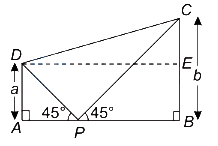
$P$ is a point on the segment joining the feet of two vertical poles of heights $a$ and $b$. The angles of elevation of the tops of the poles from $P$ are $45^{\circ}$ each. Then,the square of the distance between the tops of the poles is
A
$\frac{a^2+b^2}{2}$
B
$a^2+b^2$
C
$2(a^2+b^2)$
D
$4(a^2+b^2)$
Solution
(C) Let the two poles be $AD$ and $BC$ with heights $a$ and $b$ respectively,standing on a horizontal ground $AB$. $P$ is a point on $AB$.
In $\triangle APD$,$\tan 45^{\circ} = \frac{AD}{AP} = \frac{a}{AP} \Rightarrow AP = a$.
In $\triangle BPC$,$\tan 45^{\circ} = \frac{BC}{BP} = \frac{b}{BP} \Rightarrow BP = b$.
Draw a line $DE$ perpendicular to $BC$ at $E$. Then $DE = AB = AP + PB = a + b$ and $CE = BC - BE = BC - AD = b - a$.
In right-angled $\triangle DEC$,by Pythagoras theorem:
$DC^2 = DE^2 + CE^2$
$DC^2 = (a+b)^2 + (b-a)^2$
$DC^2 = (a^2 + 2ab + b^2) + (b^2 - 2ab + a^2)$
$DC^2 = 2(a^2 + b^2)$.
In $\triangle APD$,$\tan 45^{\circ} = \frac{AD}{AP} = \frac{a}{AP} \Rightarrow AP = a$.
In $\triangle BPC$,$\tan 45^{\circ} = \frac{BC}{BP} = \frac{b}{BP} \Rightarrow BP = b$.
Draw a line $DE$ perpendicular to $BC$ at $E$. Then $DE = AB = AP + PB = a + b$ and $CE = BC - BE = BC - AD = b - a$.
In right-angled $\triangle DEC$,by Pythagoras theorem:
$DC^2 = DE^2 + CE^2$
$DC^2 = (a+b)^2 + (b-a)^2$
$DC^2 = (a^2 + 2ab + b^2) + (b^2 - 2ab + a^2)$
$DC^2 = 2(a^2 + b^2)$.
0 likesView Solution
98
ChemistryMCQAP EAMCET · 2009
$\frac{d}{d x}\left[a \tan ^{-1} x+b \log \left(\frac{x-1}{x+1}\right)\right]=\frac{1}{x^4-1}$
$\Rightarrow a-2 b$ is equal to
$\Rightarrow a-2 b$ is equal to
A
$1$
B
$-1$
C
$0$
D
$2$
Solution
(B) Given,$\frac{d}{d x}\left[a \tan ^{-1} x+b \log \left(\frac{x-1}{x+1}\right)\right]=\frac{1}{x^4-1}$.
Integrating both sides with respect to $x$,we get:
$a \tan ^{-1} x+b \log \left(\frac{x-1}{x+1}\right) = \int \frac{1}{x^4-1} dx$.
We know that $\frac{1}{x^4-1} = \frac{1}{(x^2-1)(x^2+1)} = \frac{1}{2} \left[ \frac{1}{x^2-1} - \frac{1}{x^2+1} \right]$.
Thus,$\int \frac{1}{x^4-1} dx = \frac{1}{2} \int \frac{1}{x^2-1} dx - \frac{1}{2} \int \frac{1}{x^2+1} dx$.
Using standard integrals $\int \frac{1}{x^2-a^2} dx = \frac{1}{2a} \log \left| \frac{x-a}{x+a} \right|$ and $\int \frac{1}{x^2+1} dx = \tan^{-1} x$:
$\int \frac{1}{x^4-1} dx = \frac{1}{2} \left( \frac{1}{2} \log \left| \frac{x-1}{x+1} \right| \right) - \frac{1}{2} \tan^{-1} x = \frac{1}{4} \log \left| \frac{x-1}{x+1} \right| - \frac{1}{2} \tan^{-1} x$.
Comparing this with $a \tan^{-1} x + b \log \left( \frac{x-1}{x+1} \right)$,we get $a = -\frac{1}{2}$ and $b = \frac{1}{4}$.
Therefore,$a - 2b = -\frac{1}{2} - 2 \left( \frac{1}{4} \right) = -\frac{1}{2} - \frac{1}{2} = -1$.
Integrating both sides with respect to $x$,we get:
$a \tan ^{-1} x+b \log \left(\frac{x-1}{x+1}\right) = \int \frac{1}{x^4-1} dx$.
We know that $\frac{1}{x^4-1} = \frac{1}{(x^2-1)(x^2+1)} = \frac{1}{2} \left[ \frac{1}{x^2-1} - \frac{1}{x^2+1} \right]$.
Thus,$\int \frac{1}{x^4-1} dx = \frac{1}{2} \int \frac{1}{x^2-1} dx - \frac{1}{2} \int \frac{1}{x^2+1} dx$.
Using standard integrals $\int \frac{1}{x^2-a^2} dx = \frac{1}{2a} \log \left| \frac{x-a}{x+a} \right|$ and $\int \frac{1}{x^2+1} dx = \tan^{-1} x$:
$\int \frac{1}{x^4-1} dx = \frac{1}{2} \left( \frac{1}{2} \log \left| \frac{x-1}{x+1} \right| \right) - \frac{1}{2} \tan^{-1} x = \frac{1}{4} \log \left| \frac{x-1}{x+1} \right| - \frac{1}{2} \tan^{-1} x$.
Comparing this with $a \tan^{-1} x + b \log \left( \frac{x-1}{x+1} \right)$,we get $a = -\frac{1}{2}$ and $b = \frac{1}{4}$.
Therefore,$a - 2b = -\frac{1}{2} - 2 \left( \frac{1}{4} \right) = -\frac{1}{2} - \frac{1}{2} = -1$.
0 likesView Solution
99
ChemistryMCQAP EAMCET · 2009
$\int \frac{dx}{(x+1) \sqrt{4x+3}}$ is equal to
A
$\tan^{-1} \sqrt{4x+3} + c$
B
$3 \tan^{-1} \sqrt{4x+3} + c$
C
$2 \tan^{-1} \sqrt{4x+3} + c$
D
$4 \tan^{-1} \sqrt{4x+3} + c$
Solution
(C) Let $I = \int \frac{dx}{(x+1) \sqrt{4x+3}}$.
Substitute $4x+3 = t^2$,which implies $4dx = 2tdt$ or $dx = \frac{1}{2} t dt$.
Also,$x = \frac{t^2-3}{4}$,so $x+1 = \frac{t^2-3}{4} + 1 = \frac{t^2+1}{4}$.
Substituting these into the integral:
$I = \int \frac{\frac{1}{2} t dt}{(\frac{t^2+1}{4}) t} = \int \frac{\frac{1}{2} dt}{\frac{t^2+1}{4}} = 2 \int \frac{dt}{t^2+1}$.
Integrating,we get $I = 2 \tan^{-1}(t) + c$.
Substituting back $t = \sqrt{4x+3}$,we get $I = 2 \tan^{-1} \sqrt{4x+3} + c$.
Substitute $4x+3 = t^2$,which implies $4dx = 2tdt$ or $dx = \frac{1}{2} t dt$.
Also,$x = \frac{t^2-3}{4}$,so $x+1 = \frac{t^2-3}{4} + 1 = \frac{t^2+1}{4}$.
Substituting these into the integral:
$I = \int \frac{\frac{1}{2} t dt}{(\frac{t^2+1}{4}) t} = \int \frac{\frac{1}{2} dt}{\frac{t^2+1}{4}} = 2 \int \frac{dt}{t^2+1}$.
Integrating,we get $I = 2 \tan^{-1}(t) + c$.
Substituting back $t = \sqrt{4x+3}$,we get $I = 2 \tan^{-1} \sqrt{4x+3} + c$.
0 likesView Solution
100
ChemistryMCQAP EAMCET · 2009
If $I_n = \int \sin^n x \, dx$,then $n I_n - (n-1) I_{n-2}$ equals
A
$\sin^{n-1} x \cos x$
B
$\cos^{n-1} x \sin x$
C
$-\sin^{n-1} x \cos x$
D
$-\cos^{n-1} x \sin x$
Solution
(C) We are given the reduction formula for $I_n = \int \sin^n x \, dx$.
Using integration by parts,let $u = \sin^{n-1} x$ and $dv = \sin x \, dx$.
Then $du = (n-1) \sin^{n-2} x \cos x \, dx$ and $v = -\cos x$.
Applying the formula $\int u \, dv = uv - \int v \, du$:
$I_n = -\sin^{n-1} x \cos x - \int (-\cos x) (n-1) \sin^{n-2} x \cos x \, dx$
$I_n = -\sin^{n-1} x \cos x + (n-1) \int \sin^{n-2} x \cos^2 x \, dx$
$I_n = -\sin^{n-1} x \cos x + (n-1) \int \sin^{n-2} x (1 - \sin^2 x) \, dx$
$I_n = -\sin^{n-1} x \cos x + (n-1) I_{n-2} - (n-1) I_n$
Rearranging the terms:
$I_n + (n-1) I_n = -\sin^{n-1} x \cos x + (n-1) I_{n-2}$
$n I_n = -\sin^{n-1} x \cos x + (n-1) I_{n-2}$
Therefore,$n I_n - (n-1) I_{n-2} = -\sin^{n-1} x \cos x$.
Using integration by parts,let $u = \sin^{n-1} x$ and $dv = \sin x \, dx$.
Then $du = (n-1) \sin^{n-2} x \cos x \, dx$ and $v = -\cos x$.
Applying the formula $\int u \, dv = uv - \int v \, du$:
$I_n = -\sin^{n-1} x \cos x - \int (-\cos x) (n-1) \sin^{n-2} x \cos x \, dx$
$I_n = -\sin^{n-1} x \cos x + (n-1) \int \sin^{n-2} x \cos^2 x \, dx$
$I_n = -\sin^{n-1} x \cos x + (n-1) \int \sin^{n-2} x (1 - \sin^2 x) \, dx$
$I_n = -\sin^{n-1} x \cos x + (n-1) I_{n-2} - (n-1) I_n$
Rearranging the terms:
$I_n + (n-1) I_n = -\sin^{n-1} x \cos x + (n-1) I_{n-2}$
$n I_n = -\sin^{n-1} x \cos x + (n-1) I_{n-2}$
Therefore,$n I_n - (n-1) I_{n-2} = -\sin^{n-1} x \cos x$.
0 likesView Solution
Vedclass Products
For Students
Vedclass Test Series
Mock tests in real AP EAMCET style covering Chemistry with performance analysis. 5-day free trial.
Start Free TrialFor Teachers
Exam Paper Generator
Generate Set A/B/C/D Chemistry papers from 7.5L+ questions in 2 minutes. 3 chapters free.
Try FreeFor Institutes
Online Exam Module
Run live AP EAMCET mock exams with unlimited students, 360° analytics & white-label branding.
See DemoFrequently Asked Questions
How many Chemistry questions are in AP EAMCET 2009?
There are 200 Chemistry questions from the AP EAMCET 2009 paper on Vedclass, each with a detailed step-by-step solution in English.
Are AP EAMCET 2009 Chemistry solutions available in English?
Yes. All solutions on this page are in English. You can also switch to English or Hindi using the language buttons above the questions.
Can I practice AP EAMCET 2009 Chemistry as a timed test?
Yes. Use the Vedclass Test Series to attempt a full AP EAMCET mock test covering Chemistry with time limits and instant score analysis.
Can teachers create Chemistry papers from AP EAMCET previous year questions?
Yes. The Vedclass Exam Paper Generator lets teachers mix AP EAMCET Chemistry questions and generate Set A/B/C/D papers in minutes.
For Teachers & Institutes
Build a Custom Chemistry Paper
Pick AP EAMCET 2009 Chemistry questions, set difficulty, and generate Set A/B/C/D in 2 minutes.