
ChemistryQ101–150 of 200 questions
Page 3 of 4 · English
101
ChemistryMCQAP EAMCET · 2009
$\int_0^\pi \frac{1}{1+\sin x} \, dx$ is equal to
A
$1$
B
$2$
C
$-1$
D
$-2$
Solution
(B) Let $I = \int_0^\pi \frac{1}{1+\sin x} \, dx$.
Using the identity $\sin x = \frac{2 \tan(x/2)}{1+\tan^2(x/2)}$,we get:
$I = \int_0^\pi \frac{1}{1 + \frac{2 \tan(x/2)}{1+\tan^2(x/2)}} \, dx = \int_0^\pi \frac{1+\tan^2(x/2)}{(1+\tan(x/2))^2} \, dx$.
Since $1+\tan^2(x/2) = \sec^2(x/2)$,we have:
$I = \int_0^\pi \frac{\sec^2(x/2)}{(1+\tan(x/2))^2} \, dx$.
Let $t = \tan(x/2)$,then $dt = \frac{1}{2} \sec^2(x/2) \, dx$,which implies $\sec^2(x/2) \, dx = 2 \, dt$.
As $x \to 0$,$t \to 0$. As $x \to \pi$,$t \to \infty$.
Thus,$I = \int_0^\infty \frac{2 \, dt}{(1+t)^2} = 2 \left[ -\frac{1}{1+t} \right]_0^\infty$.
$I = 2 [0 - (-1)] = 2 \times 1 = 2$.
Using the identity $\sin x = \frac{2 \tan(x/2)}{1+\tan^2(x/2)}$,we get:
$I = \int_0^\pi \frac{1}{1 + \frac{2 \tan(x/2)}{1+\tan^2(x/2)}} \, dx = \int_0^\pi \frac{1+\tan^2(x/2)}{(1+\tan(x/2))^2} \, dx$.
Since $1+\tan^2(x/2) = \sec^2(x/2)$,we have:
$I = \int_0^\pi \frac{\sec^2(x/2)}{(1+\tan(x/2))^2} \, dx$.
Let $t = \tan(x/2)$,then $dt = \frac{1}{2} \sec^2(x/2) \, dx$,which implies $\sec^2(x/2) \, dx = 2 \, dt$.
As $x \to 0$,$t \to 0$. As $x \to \pi$,$t \to \infty$.
Thus,$I = \int_0^\infty \frac{2 \, dt}{(1+t)^2} = 2 \left[ -\frac{1}{1+t} \right]_0^\infty$.
$I = 2 [0 - (-1)] = 2 \times 1 = 2$.
0 likesView Solution
102
ChemistryMCQAP EAMCET · 2009
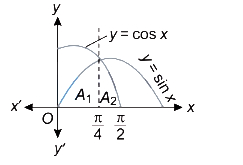
The line $x=\frac{\pi}{4}$ divides the area of the region bounded by $y=\sin x$,$y=\cos x$ and the $x$-axis $(0 \leq x \leq \frac{\pi}{2})$ into two regions of areas $A_1$ and $A_2$. Then $A_1 : A_2$ equals (in $: 1$)
A
$4$
B
$3$
C
$2$
D
$1$
Solution
(D) The region is bounded by $y=\sin x$,$y=\cos x$ and the $x$-axis for $0 \leq x \leq \frac{\pi}{2}$.
For $0 \leq x \leq \frac{\pi}{4}$,the region is bounded by $y=\sin x$ and the $x$-axis. Thus,the area $A_1$ is given by:
$A_1 = \int_0^{\pi/4} \sin x \, dx = [-\cos x]_0^{\pi/4} = -(\cos \frac{\pi}{4} - \cos 0) = -(\frac{1}{\sqrt{2}} - 1) = 1 - \frac{1}{\sqrt{2}} = \frac{\sqrt{2}-1}{\sqrt{2}}$.
For $\frac{\pi}{4} \leq x \leq \frac{\pi}{2}$,the region is bounded by $y=\cos x$ and the $x$-axis. Thus,the area $A_2$ is given by:
$A_2 = \int_{\pi/4}^{\pi/2} \cos x \, dx = [\sin x]_{\pi/4}^{\pi/2} = \sin \frac{\pi}{2} - \sin \frac{\pi}{4} = 1 - \frac{1}{\sqrt{2}} = \frac{\sqrt{2}-1}{\sqrt{2}}$.
Comparing the two areas,we get $A_1 : A_2 = \frac{\sqrt{2}-1}{\sqrt{2}} : \frac{\sqrt{2}-1}{\sqrt{2}} = 1 : 1$.
For $0 \leq x \leq \frac{\pi}{4}$,the region is bounded by $y=\sin x$ and the $x$-axis. Thus,the area $A_1$ is given by:
$A_1 = \int_0^{\pi/4} \sin x \, dx = [-\cos x]_0^{\pi/4} = -(\cos \frac{\pi}{4} - \cos 0) = -(\frac{1}{\sqrt{2}} - 1) = 1 - \frac{1}{\sqrt{2}} = \frac{\sqrt{2}-1}{\sqrt{2}}$.
For $\frac{\pi}{4} \leq x \leq \frac{\pi}{2}$,the region is bounded by $y=\cos x$ and the $x$-axis. Thus,the area $A_2$ is given by:
$A_2 = \int_{\pi/4}^{\pi/2} \cos x \, dx = [\sin x]_{\pi/4}^{\pi/2} = \sin \frac{\pi}{2} - \sin \frac{\pi}{4} = 1 - \frac{1}{\sqrt{2}} = \frac{\sqrt{2}-1}{\sqrt{2}}$.
Comparing the two areas,we get $A_1 : A_2 = \frac{\sqrt{2}-1}{\sqrt{2}} : \frac{\sqrt{2}-1}{\sqrt{2}} = 1 : 1$.
0 likesView Solution
103
ChemistryMCQAP EAMCET · 2009
The two lenses of an achromatic doublet should have:
A
equal powers
B
equal dispersive powers
C
equal ratio of their power and dispersive power
D
sum of the product of their powers and dispersive power equal to zero
Solution
(D) For an achromatic doublet, the condition to eliminate chromatic aberration is that the sum of the product of the power $(P)$ and the dispersive power $(\omega)$ of the two lenses must be zero.
Mathematically, this is expressed as: $P_1 \omega_1 + P_2 \omega_2 = 0$.
Therefore, the sum of the product of their powers and dispersive powers must be equal to zero.
Mathematically, this is expressed as: $P_1 \omega_1 + P_2 \omega_2 = 0$.
Therefore, the sum of the product of their powers and dispersive powers must be equal to zero.
0 likesView Solution
104
ChemistryMCQAP EAMCET · 2009
Assertion $(A)$: $K, Rb$ and $Cs$ form superoxides.
Reason $(R)$: The stability of the superoxides increases from $K$ to $Cs$ due to decrease in lattice energy.
The correct answer is
Reason $(R)$: The stability of the superoxides increases from $K$ to $Cs$ due to decrease in lattice energy.
The correct answer is
A
Both $(A)$ and $(R)$ are true and $(R)$ is the correct explanation of $(A)$
B
Both $(A)$ and $(R)$ are true but $(R)$ is not the correct explanation of $(A)$
C
$(A)$ is true but $(R)$ is not true
D
$(A)$ is not true but $(R)$ is true
Solution
(C) Superoxides are species containing the $O_2^-$ ion,where oxygen has an oxidation state of $-\frac{1}{2}$.
These are typically formed by larger alkali metals such as $K, Rb$ and $Cs$,resulting in $KO_2, RbO_2$ and $CsO_2$.
For salts containing large anions like $O_2^-$,the lattice energy increases as the size of the cation increases down the group.
Since higher lattice energy contributes to greater thermodynamic stability of the ionic crystal,the stability of superoxides increases from $K$ to $Cs$.
Therefore,the assertion $(A)$ is true,but the reason $(R)$ is false because stability increases due to an increase in lattice energy,not a decrease.
These are typically formed by larger alkali metals such as $K, Rb$ and $Cs$,resulting in $KO_2, RbO_2$ and $CsO_2$.
For salts containing large anions like $O_2^-$,the lattice energy increases as the size of the cation increases down the group.
Since higher lattice energy contributes to greater thermodynamic stability of the ionic crystal,the stability of superoxides increases from $K$ to $Cs$.
Therefore,the assertion $(A)$ is true,but the reason $(R)$ is false because stability increases due to an increase in lattice energy,not a decrease.
0 likesView Solution
105
ChemistryMCQAP EAMCET · 2009
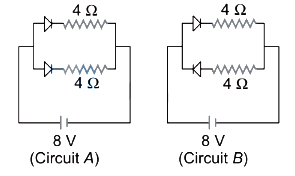
Currents flowing in each of the following circuits $A$ and $B$ respectively are:
A
$1 \text{ A}, 2 \text{ A}$
B
$2 \text{ A}, 1 \text{ A}$
C
$4 \text{ A}, 2 \text{ A}$
D
$2 \text{ A}, 4 \text{ A}$
Solution
(C) In circuit $A$,both $p-n$ junction diodes are in forward bias. Therefore,current flows through both branches.
The equivalent resistance $R_A$ is given by:
$\frac{1}{R_A} = \frac{1}{4} + \frac{1}{4} = \frac{2}{4} = \frac{1}{2} \implies R_A = 2 \Omega$
Using Ohm's law,$V = I_A R_A$:
$8 = I_A \times 2 \implies I_A = 4 \text{ A}$
In circuit $B$,the upper diode is in forward bias,but the lower diode is in reverse bias. Therefore,no current flows through the lower branch.
The resistance of the circuit is $R_B = 4 \Omega$.
Using Ohm's law,$V = I_B R_B$:
$8 = I_B \times 4 \implies I_B = 2 \text{ A}$
Thus,the currents are $4 \text{ A}$ and $2 \text{ A}$ respectively.
The equivalent resistance $R_A$ is given by:
$\frac{1}{R_A} = \frac{1}{4} + \frac{1}{4} = \frac{2}{4} = \frac{1}{2} \implies R_A = 2 \Omega$
Using Ohm's law,$V = I_A R_A$:
$8 = I_A \times 2 \implies I_A = 4 \text{ A}$
In circuit $B$,the upper diode is in forward bias,but the lower diode is in reverse bias. Therefore,no current flows through the lower branch.
The resistance of the circuit is $R_B = 4 \Omega$.
Using Ohm's law,$V = I_B R_B$:
$8 = I_B \times 4 \implies I_B = 2 \text{ A}$
Thus,the currents are $4 \text{ A}$ and $2 \text{ A}$ respectively.
0 likesView Solution
106
ChemistryMCQAP EAMCET · 2009
If $m_1, m_2, m_3$ and $m_4$ are respectively the magnitudes of the vectors $\overrightarrow{a}_1=2 \hat{i}-\hat{j}+\hat{k}$,$\overrightarrow{a}_2=3 \hat{i}-4 \hat{j}-4 \hat{k}$,$\overrightarrow{a}_3=\hat{i}+\hat{j}-\hat{k}$ and $\overrightarrow{a}_4=-\hat{i}+3 \hat{j}+\hat{k}$,then the correct order of $m_1, m_2, m_3$ and $m_4$ is
A
$m_3 < m_1 < m_4 < m_2$
B
$m_3 < m_1 < m_2 < m_4$
C
$m_3 < m_4 < m_1 < m_2$
D
$m_3 < m_4 < m_2 < m_1$
Solution
(A) The magnitude of a vector $\overrightarrow{a} = x\hat{i} + y\hat{j} + z\hat{k}$ is given by $|\overrightarrow{a}| = \sqrt{x^2 + y^2 + z^2}$.
Calculating the magnitudes:
$m_1 = |\overrightarrow{a}_1| = \sqrt{2^2 + (-1)^2 + 1^2} = \sqrt{4 + 1 + 1} = \sqrt{6} \approx 2.45$
$m_2 = |\overrightarrow{a}_2| = \sqrt{3^2 + (-4)^2 + (-4)^2} = \sqrt{9 + 16 + 16} = \sqrt{41} \approx 6.40$
$m_3 = |\overrightarrow{a}_3| = \sqrt{1^2 + 1^2 + (-1)^2} = \sqrt{1 + 1 + 1} = \sqrt{3} \approx 1.73$
$m_4 = |\overrightarrow{a}_4| = \sqrt{(-1)^2 + 3^2 + 1^2} = \sqrt{1 + 9 + 1} = \sqrt{11} \approx 3.32$
Comparing the values: $\sqrt{3} < \sqrt{6} < \sqrt{11} < \sqrt{41}$,which implies $m_3 < m_1 < m_4 < m_2$.
Calculating the magnitudes:
$m_1 = |\overrightarrow{a}_1| = \sqrt{2^2 + (-1)^2 + 1^2} = \sqrt{4 + 1 + 1} = \sqrt{6} \approx 2.45$
$m_2 = |\overrightarrow{a}_2| = \sqrt{3^2 + (-4)^2 + (-4)^2} = \sqrt{9 + 16 + 16} = \sqrt{41} \approx 6.40$
$m_3 = |\overrightarrow{a}_3| = \sqrt{1^2 + 1^2 + (-1)^2} = \sqrt{1 + 1 + 1} = \sqrt{3} \approx 1.73$
$m_4 = |\overrightarrow{a}_4| = \sqrt{(-1)^2 + 3^2 + 1^2} = \sqrt{1 + 9 + 1} = \sqrt{11} \approx 3.32$
Comparing the values: $\sqrt{3} < \sqrt{6} < \sqrt{11} < \sqrt{41}$,which implies $m_3 < m_1 < m_4 < m_2$.
0 likesView Solution
107
ChemistryMCQAP EAMCET · 2009
Suppose $\overrightarrow{a}=\lambda \hat{i}-7 \hat{j}+3 \hat{k}$ and $\overrightarrow{b}=\lambda \hat{i}+\hat{j}+2 \lambda \hat{k}$. If the angle between $\overrightarrow{a}$ and $\overrightarrow{b}$ is greater than $90^{\circ}$,then $\lambda$ satisfies the inequality
A
$-7 < \lambda < 1$
B
$\lambda > 1$
C
$1 < \lambda < 7$
D
$-5 < \lambda < 1$
Solution
(A) The angle $\theta$ between two vectors $\overrightarrow{a}$ and $\overrightarrow{b}$ is given by $\cos \theta = \frac{\overrightarrow{a} \cdot \overrightarrow{b}}{|\overrightarrow{a}| |\overrightarrow{b}|}$.
Given that the angle $\theta > 90^{\circ}$,we know that $\cos \theta < 0$.
Since the magnitudes $|\overrightarrow{a}|$ and $|\overrightarrow{b}|$ are always positive,the condition $\cos \theta < 0$ implies that the dot product $\overrightarrow{a} \cdot \overrightarrow{b} < 0$.
Calculating the dot product: $\overrightarrow{a} \cdot \overrightarrow{b} = (\lambda)(\lambda) + (-7)(1) + (3)(2\lambda) = \lambda^2 - 7 + 6\lambda$.
Setting the dot product to be less than zero: $\lambda^2 + 6\lambda - 7 < 0$.
Factoring the quadratic expression: $(\lambda + 7)(\lambda - 1) < 0$.
The inequality holds when $\lambda$ lies between the roots of the quadratic equation,which are $-7$ and $1$.
Therefore,the solution is $-7 < \lambda < 1$.
Given that the angle $\theta > 90^{\circ}$,we know that $\cos \theta < 0$.
Since the magnitudes $|\overrightarrow{a}|$ and $|\overrightarrow{b}|$ are always positive,the condition $\cos \theta < 0$ implies that the dot product $\overrightarrow{a} \cdot \overrightarrow{b} < 0$.
Calculating the dot product: $\overrightarrow{a} \cdot \overrightarrow{b} = (\lambda)(\lambda) + (-7)(1) + (3)(2\lambda) = \lambda^2 - 7 + 6\lambda$.
Setting the dot product to be less than zero: $\lambda^2 + 6\lambda - 7 < 0$.
Factoring the quadratic expression: $(\lambda + 7)(\lambda - 1) < 0$.
The inequality holds when $\lambda$ lies between the roots of the quadratic equation,which are $-7$ and $1$.
Therefore,the solution is $-7 < \lambda < 1$.
0 likesView Solution
108
ChemistryMCQAP EAMCET · 2009
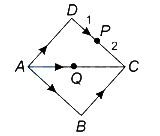
In a quadrilateral $ABCD$,the point $P$ divides $DC$ in the ratio $1:2$ and $Q$ is the midpoint of $AC$. If $\overrightarrow{AB}+2\overrightarrow{AD}+\overrightarrow{BC}-2\overrightarrow{DC}=k\overrightarrow{PQ}$,then $k$ is equal to
A
-$6$
B
-$4$
C
$6$
D
$4$
Solution
(A) Given the expression: $\overrightarrow{AB}+2\overrightarrow{AD}+\overrightarrow{BC}-2\overrightarrow{DC}$.
Using the triangle law of vector addition,$\overrightarrow{AB}+\overrightarrow{BC} = \overrightarrow{AC}$.
So,the expression becomes: $\overrightarrow{AC}+2\overrightarrow{AD}-2\overrightarrow{DC}$.
Since $\overrightarrow{AD}+\overrightarrow{DC} = \overrightarrow{AC}$,we have $\overrightarrow{AD} = \overrightarrow{AC}-\overrightarrow{DC}$.
Substituting this: $\overrightarrow{AC}+2(\overrightarrow{AC}-\overrightarrow{DC})-2\overrightarrow{DC} = 3\overrightarrow{AC}-4\overrightarrow{DC}$.
Given $Q$ is the midpoint of $AC$,$\overrightarrow{AC} = 2\overrightarrow{QC}$.
Given $P$ divides $DC$ in ratio $1:2$,$\overrightarrow{DP} = \frac{1}{3}\overrightarrow{DC}$ and $\overrightarrow{PC} = \frac{2}{3}\overrightarrow{DC}$,so $\overrightarrow{DC} = \frac{3}{2}\overrightarrow{PC}$.
Substituting these: $3(2\overrightarrow{QC})-4(\frac{3}{2}\overrightarrow{PC}) = 6\overrightarrow{QC}-6\overrightarrow{PC} = 6(\overrightarrow{QC}+\overrightarrow{CP}) = 6\overrightarrow{QP}$.
Since $\overrightarrow{QP} = -\overrightarrow{PQ}$,we have $6\overrightarrow{QP} = -6\overrightarrow{PQ}$.
Thus,$k\overrightarrow{PQ} = -6\overrightarrow{PQ}$,which implies $k = -6$.
Using the triangle law of vector addition,$\overrightarrow{AB}+\overrightarrow{BC} = \overrightarrow{AC}$.
So,the expression becomes: $\overrightarrow{AC}+2\overrightarrow{AD}-2\overrightarrow{DC}$.
Since $\overrightarrow{AD}+\overrightarrow{DC} = \overrightarrow{AC}$,we have $\overrightarrow{AD} = \overrightarrow{AC}-\overrightarrow{DC}$.
Substituting this: $\overrightarrow{AC}+2(\overrightarrow{AC}-\overrightarrow{DC})-2\overrightarrow{DC} = 3\overrightarrow{AC}-4\overrightarrow{DC}$.
Given $Q$ is the midpoint of $AC$,$\overrightarrow{AC} = 2\overrightarrow{QC}$.
Given $P$ divides $DC$ in ratio $1:2$,$\overrightarrow{DP} = \frac{1}{3}\overrightarrow{DC}$ and $\overrightarrow{PC} = \frac{2}{3}\overrightarrow{DC}$,so $\overrightarrow{DC} = \frac{3}{2}\overrightarrow{PC}$.
Substituting these: $3(2\overrightarrow{QC})-4(\frac{3}{2}\overrightarrow{PC}) = 6\overrightarrow{QC}-6\overrightarrow{PC} = 6(\overrightarrow{QC}+\overrightarrow{CP}) = 6\overrightarrow{QP}$.
Since $\overrightarrow{QP} = -\overrightarrow{PQ}$,we have $6\overrightarrow{QP} = -6\overrightarrow{PQ}$.
Thus,$k\overrightarrow{PQ} = -6\overrightarrow{PQ}$,which implies $k = -6$.
0 likesView Solution
109
ChemistryMCQAP EAMCET · 2009
The perimeter of the triangle with vertices at $(1,0,0), (0,1,0)$ and $(0,0,1)$ is
A
$3$
B
$2$
C
$2 \sqrt{2}$
D
$3 \sqrt{2}$
Solution
(D) Let the vertices of the triangle be $A = (1, 0, 0)$,$B = (0, 1, 0)$,and $C = (0, 0, 1)$.
Using the distance formula $d = \sqrt{(x_2-x_1)^2 + (y_2-y_1)^2 + (z_2-z_1)^2}$,we calculate the lengths of the sides:
$AB = \sqrt{(0-1)^2 + (1-0)^2 + (0-0)^2} = \sqrt{(-1)^2 + 1^2 + 0^2} = \sqrt{1+1} = \sqrt{2}$.
$BC = \sqrt{(0-0)^2 + (0-1)^2 + (1-0)^2} = \sqrt{0^2 + (-1)^2 + 1^2} = \sqrt{1+1} = \sqrt{2}$.
$CA = \sqrt{(1-0)^2 + (0-0)^2 + (0-1)^2} = \sqrt{1^2 + 0^2 + (-1)^2} = \sqrt{1+1} = \sqrt{2}$.
The perimeter of the triangle is the sum of the lengths of its sides:
$\text{Perimeter} = AB + BC + CA = \sqrt{2} + \sqrt{2} + \sqrt{2} = 3\sqrt{2}$.
Using the distance formula $d = \sqrt{(x_2-x_1)^2 + (y_2-y_1)^2 + (z_2-z_1)^2}$,we calculate the lengths of the sides:
$AB = \sqrt{(0-1)^2 + (1-0)^2 + (0-0)^2} = \sqrt{(-1)^2 + 1^2 + 0^2} = \sqrt{1+1} = \sqrt{2}$.
$BC = \sqrt{(0-0)^2 + (0-1)^2 + (1-0)^2} = \sqrt{0^2 + (-1)^2 + 1^2} = \sqrt{1+1} = \sqrt{2}$.
$CA = \sqrt{(1-0)^2 + (0-0)^2 + (0-1)^2} = \sqrt{1^2 + 0^2 + (-1)^2} = \sqrt{1+1} = \sqrt{2}$.
The perimeter of the triangle is the sum of the lengths of its sides:
$\text{Perimeter} = AB + BC + CA = \sqrt{2} + \sqrt{2} + \sqrt{2} = 3\sqrt{2}$.
0 likesView Solution
110
ChemistryMCQAP EAMCET · 2009
The radius of the sphere $x^2+y^2+z^2=12x+4y+3z$ is
A
$\frac{13}{2}$
B
$13$
C
$26$
D
$52$
Solution
(A) The given equation of the sphere is $x^2+y^2+z^2-12x-4y-3z=0$.
Comparing this with the general equation of a sphere $x^2+y^2+z^2+2ux+2vy+2wz+d=0$,we get $2u=-12$,$2v=-4$,and $2w=-3$.
Thus,$u=-6$,$v=-2$,and $w=-\frac{3}{2}$.
The radius of the sphere is given by the formula $r = \sqrt{u^2+v^2+w^2-d}$.
Substituting the values,we get $r = \sqrt{(-6)^2+(-2)^2+(-\frac{3}{2})^2-0}$.
$r = \sqrt{36+4+\frac{9}{4}} = \sqrt{40+\frac{9}{4}} = \sqrt{\frac{160+9}{4}} = \sqrt{\frac{169}{4}}$.
Therefore,$r = \frac{13}{2}$.
Comparing this with the general equation of a sphere $x^2+y^2+z^2+2ux+2vy+2wz+d=0$,we get $2u=-12$,$2v=-4$,and $2w=-3$.
Thus,$u=-6$,$v=-2$,and $w=-\frac{3}{2}$.
The radius of the sphere is given by the formula $r = \sqrt{u^2+v^2+w^2-d}$.
Substituting the values,we get $r = \sqrt{(-6)^2+(-2)^2+(-\frac{3}{2})^2-0}$.
$r = \sqrt{36+4+\frac{9}{4}} = \sqrt{40+\frac{9}{4}} = \sqrt{\frac{160+9}{4}} = \sqrt{\frac{169}{4}}$.
Therefore,$r = \frac{13}{2}$.
0 likesView Solution
111
ChemistryMCQAP EAMCET · 2009
The angle between the lines whose direction cosines are given by the equations $l^2+m^2-n^2=0$ and $l+m+n=0$ is
A
$\frac{\pi}{6}$
B
$\frac{\pi}{4}$
C
$\frac{\pi}{3}$
D
$\frac{\pi}{2}$
Solution
(C) Given,$l^2+m^2-n^2=0$ $(i)$ and $l+m+n=0$ $(ii)$.
From $(ii)$,$n=-(l+m)$. Substituting this into $(i)$:
$l^2+m^2=(-(l+m))^2 = l^2+m^2+2lm$.
This implies $2lm=0$,so $l=0$ or $m=0$.
Case $1$: If $l=0$,then $n=-m$. Since $l^2+m^2+n^2=1$,we have $0^2+m^2+(-m)^2=1 \Rightarrow 2m^2=1 \Rightarrow m=\pm\frac{1}{\sqrt{2}}$. Thus,the direction cosines are $(0, \frac{1}{\sqrt{2}}, -\frac{1}{\sqrt{2}})$ and $(0, -\frac{1}{\sqrt{2}}, \frac{1}{\sqrt{2}})$.
Case $2$: If $m=0$,then $n=-l$. Since $l^2+m^2+n^2=1$,we have $l^2+0^2+(-l)^2=1 \Rightarrow 2l^2=1 \Rightarrow l=\pm\frac{1}{\sqrt{2}}$. Thus,the direction cosines are $(\frac{1}{\sqrt{2}}, 0, -\frac{1}{\sqrt{2}})$ and $(-\frac{1}{\sqrt{2}}, 0, \frac{1}{\sqrt{2}})$.
Let the direction vectors of the two lines be $\vec{a} = (0, \frac{1}{\sqrt{2}}, -\frac{1}{\sqrt{2}})$ and $\vec{b} = (\frac{1}{\sqrt{2}}, 0, -\frac{1}{\sqrt{2}})$.
The angle $\theta$ between the lines is given by $\cos \theta = |l_1l_2 + m_1m_2 + n_1n_2|$.
$\cos \theta = |(0)(\frac{1}{\sqrt{2}}) + (\frac{1}{\sqrt{2}})(0) + (-\frac{1}{\sqrt{2}})(-\frac{1}{\sqrt{2}})| = |0 + 0 + \frac{1}{2}| = \frac{1}{2}$.
Therefore,$\theta = \cos^{-1}(\frac{1}{2}) = \frac{\pi}{3}$.
From $(ii)$,$n=-(l+m)$. Substituting this into $(i)$:
$l^2+m^2=(-(l+m))^2 = l^2+m^2+2lm$.
This implies $2lm=0$,so $l=0$ or $m=0$.
Case $1$: If $l=0$,then $n=-m$. Since $l^2+m^2+n^2=1$,we have $0^2+m^2+(-m)^2=1 \Rightarrow 2m^2=1 \Rightarrow m=\pm\frac{1}{\sqrt{2}}$. Thus,the direction cosines are $(0, \frac{1}{\sqrt{2}}, -\frac{1}{\sqrt{2}})$ and $(0, -\frac{1}{\sqrt{2}}, \frac{1}{\sqrt{2}})$.
Case $2$: If $m=0$,then $n=-l$. Since $l^2+m^2+n^2=1$,we have $l^2+0^2+(-l)^2=1 \Rightarrow 2l^2=1 \Rightarrow l=\pm\frac{1}{\sqrt{2}}$. Thus,the direction cosines are $(\frac{1}{\sqrt{2}}, 0, -\frac{1}{\sqrt{2}})$ and $(-\frac{1}{\sqrt{2}}, 0, \frac{1}{\sqrt{2}})$.
Let the direction vectors of the two lines be $\vec{a} = (0, \frac{1}{\sqrt{2}}, -\frac{1}{\sqrt{2}})$ and $\vec{b} = (\frac{1}{\sqrt{2}}, 0, -\frac{1}{\sqrt{2}})$.
The angle $\theta$ between the lines is given by $\cos \theta = |l_1l_2 + m_1m_2 + n_1n_2|$.
$\cos \theta = |(0)(\frac{1}{\sqrt{2}}) + (\frac{1}{\sqrt{2}})(0) + (-\frac{1}{\sqrt{2}})(-\frac{1}{\sqrt{2}})| = |0 + 0 + \frac{1}{2}| = \frac{1}{2}$.
Therefore,$\theta = \cos^{-1}(\frac{1}{2}) = \frac{\pi}{3}$.
0 likesView Solution
112
ChemistryMCQAP EAMCET · 2009
If the direction cosines of two lines are given by $l+m+n=0$ and $l^2-5m^2+n^2=0$,then the angle between them is
A
$\frac{\pi}{2}$
B
$\frac{\pi}{6}$
C
$\frac{\pi}{4}$
D
$\frac{\pi}{3}$
Solution
(D) Given the equations for the direction cosines $(l, m, n)$ of two lines:
$l+m+n=0 \implies n = -(l+m)$
Substitute $n$ into the second equation $l^2-5m^2+n^2=0$:
$l^2-5m^2+(-l-m)^2 = 0$
$l^2-5m^2+l^2+2lm+m^2 = 0$
$2l^2+2lm-4m^2 = 0$
$l^2+lm-2m^2 = 0$
$(l+2m)(l-m) = 0$
This gives two cases:
Case $1$: $l=m$. Then $n = -(l+m) = -2l$. The direction ratios are $(l, l, -2l)$,which simplifies to $(1, 1, -2)$. The direction cosines are $(\frac{1}{\sqrt{6}}, \frac{1}{\sqrt{6}}, -\frac{2}{\sqrt{6}})$.
Case $2$: $l=-2m$. Then $n = -(-2m+m) = m$. The direction ratios are $(-2m, m, m)$,which simplifies to $(-2, 1, 1)$. The direction cosines are $(-\frac{2}{\sqrt{6}}, \frac{1}{\sqrt{6}}, \frac{1}{\sqrt{6}})$.
Let the two lines have direction cosines $(l_1, m_1, n_1) = (\frac{1}{\sqrt{6}}, \frac{1}{\sqrt{6}}, -\frac{2}{\sqrt{6}})$ and $(l_2, m_2, n_2) = (-\frac{2}{\sqrt{6}}, \frac{1}{\sqrt{6}}, \frac{1}{\sqrt{6}})$.
The cosine of the angle $\theta$ between them is given by:
$\cos \theta = |l_1 l_2 + m_1 m_2 + n_1 n_2|$
$\cos \theta = |(\frac{1}{\sqrt{6}})(-\frac{2}{\sqrt{6}}) + (\frac{1}{\sqrt{6}})(\frac{1}{\sqrt{6}}) + (-\frac{2}{\sqrt{6}})(\frac{1}{\sqrt{6}})|$
$\cos \theta = |-\frac{2}{6} + \frac{1}{6} - \frac{2}{6}| = |-\frac{3}{6}| = \frac{1}{2}$
Since $\cos \theta = \frac{1}{2}$,we have $\theta = 60^{\circ} = \frac{\pi}{3}$.
$l+m+n=0 \implies n = -(l+m)$
Substitute $n$ into the second equation $l^2-5m^2+n^2=0$:
$l^2-5m^2+(-l-m)^2 = 0$
$l^2-5m^2+l^2+2lm+m^2 = 0$
$2l^2+2lm-4m^2 = 0$
$l^2+lm-2m^2 = 0$
$(l+2m)(l-m) = 0$
This gives two cases:
Case $1$: $l=m$. Then $n = -(l+m) = -2l$. The direction ratios are $(l, l, -2l)$,which simplifies to $(1, 1, -2)$. The direction cosines are $(\frac{1}{\sqrt{6}}, \frac{1}{\sqrt{6}}, -\frac{2}{\sqrt{6}})$.
Case $2$: $l=-2m$. Then $n = -(-2m+m) = m$. The direction ratios are $(-2m, m, m)$,which simplifies to $(-2, 1, 1)$. The direction cosines are $(-\frac{2}{\sqrt{6}}, \frac{1}{\sqrt{6}}, \frac{1}{\sqrt{6}})$.
Let the two lines have direction cosines $(l_1, m_1, n_1) = (\frac{1}{\sqrt{6}}, \frac{1}{\sqrt{6}}, -\frac{2}{\sqrt{6}})$ and $(l_2, m_2, n_2) = (-\frac{2}{\sqrt{6}}, \frac{1}{\sqrt{6}}, \frac{1}{\sqrt{6}})$.
The cosine of the angle $\theta$ between them is given by:
$\cos \theta = |l_1 l_2 + m_1 m_2 + n_1 n_2|$
$\cos \theta = |(\frac{1}{\sqrt{6}})(-\frac{2}{\sqrt{6}}) + (\frac{1}{\sqrt{6}})(\frac{1}{\sqrt{6}}) + (-\frac{2}{\sqrt{6}})(\frac{1}{\sqrt{6}})|$
$\cos \theta = |-\frac{2}{6} + \frac{1}{6} - \frac{2}{6}| = |-\frac{3}{6}| = \frac{1}{2}$
Since $\cos \theta = \frac{1}{2}$,we have $\theta = 60^{\circ} = \frac{\pi}{3}$.
0 likesView Solution
113
ChemistryMCQAP EAMCET · 2009
The angle between the lines whose direction cosines satisfy the equations $l+m+n=0$ and $l^2+m^2-n^2=0$ is
A
$\frac{\pi}{6}$
B
$\frac{\pi}{4}$
C
$\frac{\pi}{3}$
D
$\frac{\pi}{2}$
Solution
(C) Given,$l+m+n=0 \implies l = -m-n$ and $l^2+m^2-n^2=0$.
Substituting $l = -m-n$ into the second equation:
$(-m-n)^2 + m^2 - n^2 = 0$
$m^2 + 2mn + n^2 + m^2 - n^2 = 0$
$2m^2 + 2mn = 0$
$2m(m+n) = 0$.
This gives two cases:
Case $1$: If $m=0$,then $l = -n$. The direction ratios are $(-n, 0, n)$,which simplifies to $(-1, 0, 1)$. Let $\vec{v_1} = (-1, 0, 1)$.
Case $2$: If $m+n=0$,then $m = -n$. Substituting into $l = -m-n$,we get $l = -(-n)-n = 0$. The direction ratios are $(0, -n, n)$,which simplifies to $(0, -1, 1)$. Let $\vec{v_2} = (0, -1, 1)$.
The angle $\theta$ between the lines is given by $\cos \theta = \frac{|\vec{v_1} \cdot \vec{v_2}|}{|\vec{v_1}| |\vec{v_2}|}$.
$\vec{v_1} \cdot \vec{v_2} = (-1)(0) + (0)(-1) + (1)(1) = 1$.
$|\vec{v_1}| = \sqrt{(-1)^2 + 0^2 + 1^2} = \sqrt{2}$.
$|\vec{v_2}| = \sqrt{0^2 + (-1)^2 + 1^2} = \sqrt{2}$.
$\cos \theta = \frac{1}{\sqrt{2} \cdot \sqrt{2}} = \frac{1}{2}$.
Therefore,$\theta = \frac{\pi}{3}$.
Substituting $l = -m-n$ into the second equation:
$(-m-n)^2 + m^2 - n^2 = 0$
$m^2 + 2mn + n^2 + m^2 - n^2 = 0$
$2m^2 + 2mn = 0$
$2m(m+n) = 0$.
This gives two cases:
Case $1$: If $m=0$,then $l = -n$. The direction ratios are $(-n, 0, n)$,which simplifies to $(-1, 0, 1)$. Let $\vec{v_1} = (-1, 0, 1)$.
Case $2$: If $m+n=0$,then $m = -n$. Substituting into $l = -m-n$,we get $l = -(-n)-n = 0$. The direction ratios are $(0, -n, n)$,which simplifies to $(0, -1, 1)$. Let $\vec{v_2} = (0, -1, 1)$.
The angle $\theta$ between the lines is given by $\cos \theta = \frac{|\vec{v_1} \cdot \vec{v_2}|}{|\vec{v_1}| |\vec{v_2}|}$.
$\vec{v_1} \cdot \vec{v_2} = (-1)(0) + (0)(-1) + (1)(1) = 1$.
$|\vec{v_1}| = \sqrt{(-1)^2 + 0^2 + 1^2} = \sqrt{2}$.
$|\vec{v_2}| = \sqrt{0^2 + (-1)^2 + 1^2} = \sqrt{2}$.
$\cos \theta = \frac{1}{\sqrt{2} \cdot \sqrt{2}} = \frac{1}{2}$.
Therefore,$\theta = \frac{\pi}{3}$.
0 likesView Solution
114
ChemistryMCQAP EAMCET · 2009
If $\overrightarrow{a}=-\hat{i}+\hat{j}+2 \hat{k}$,$\overrightarrow{b}=2 \hat{i}-\hat{j}-\hat{k}$ and $\overrightarrow{c}=-2 \hat{i}+\hat{j}+3 \hat{k}$,then the angle between $2 \overrightarrow{a}-\overrightarrow{c}$ and $\overrightarrow{a}+\overrightarrow{b}$ is
A
$\frac{\pi}{4}$
B
$\frac{\pi}{3}$
C
$\frac{\pi}{2}$
D
$\frac{3 \pi}{2}$
Solution
(B) First,calculate the vectors $2 \overrightarrow{a}-\overrightarrow{c}$ and $\overrightarrow{a}+\overrightarrow{b}$.
$2 \overrightarrow{a}-\overrightarrow{c} = 2(-\hat{i}+\hat{j}+2 \hat{k}) - (-2 \hat{i}+\hat{j}+3 \hat{k}) = (-2\hat{i}+2\hat{j}+4\hat{k}) + (2\hat{i}-\hat{j}-3\hat{k}) = \hat{j}+\hat{k}$.
$\overrightarrow{a}+\overrightarrow{b} = (-\hat{i}+\hat{j}+2 \hat{k}) + (2 \hat{i}-\hat{j}-\hat{k}) = \hat{i}+\hat{k}$.
Let $\theta$ be the angle between these two vectors.
The cosine of the angle is given by $\cos \theta = \frac{(\hat{j}+\hat{k}) \cdot (\hat{i}+\hat{k})}{|\hat{j}+\hat{k}| |\hat{i}+\hat{k}|}$.
Calculating the dot product: $(\hat{j}+\hat{k}) \cdot (\hat{i}+\hat{k}) = (0)(1) + (1)(0) + (1)(1) = 1$.
Calculating the magnitudes: $|\hat{j}+\hat{k}| = \sqrt{0^2+1^2+1^2} = \sqrt{2}$ and $|\hat{i}+\hat{k}| = \sqrt{1^2+0^2+1^2} = \sqrt{2}$.
Thus,$\cos \theta = \frac{1}{\sqrt{2} \cdot \sqrt{2}} = \frac{1}{2}$.
Therefore,$\theta = \frac{\pi}{3}$.
$2 \overrightarrow{a}-\overrightarrow{c} = 2(-\hat{i}+\hat{j}+2 \hat{k}) - (-2 \hat{i}+\hat{j}+3 \hat{k}) = (-2\hat{i}+2\hat{j}+4\hat{k}) + (2\hat{i}-\hat{j}-3\hat{k}) = \hat{j}+\hat{k}$.
$\overrightarrow{a}+\overrightarrow{b} = (-\hat{i}+\hat{j}+2 \hat{k}) + (2 \hat{i}-\hat{j}-\hat{k}) = \hat{i}+\hat{k}$.
Let $\theta$ be the angle between these two vectors.
The cosine of the angle is given by $\cos \theta = \frac{(\hat{j}+\hat{k}) \cdot (\hat{i}+\hat{k})}{|\hat{j}+\hat{k}| |\hat{i}+\hat{k}|}$.
Calculating the dot product: $(\hat{j}+\hat{k}) \cdot (\hat{i}+\hat{k}) = (0)(1) + (1)(0) + (1)(1) = 1$.
Calculating the magnitudes: $|\hat{j}+\hat{k}| = \sqrt{0^2+1^2+1^2} = \sqrt{2}$ and $|\hat{i}+\hat{k}| = \sqrt{1^2+0^2+1^2} = \sqrt{2}$.
Thus,$\cos \theta = \frac{1}{\sqrt{2} \cdot \sqrt{2}} = \frac{1}{2}$.
Therefore,$\theta = \frac{\pi}{3}$.
0 likesView Solution
115
ChemistryMCQAP EAMCET · 2009
The image of the point $(3, 2, 1)$ in the plane $2x - y + 3z = 7$ is
A
$(1, 2, 3)$
B
$(2, 3, 1)$
C
$(3, 2, 1)$
D
$(2, 1, 3)$
Solution
(C) The formula for the image $(x, y, z)$ of a point $(x_1, y_1, z_1)$ in the plane $ax + by + cz + d = 0$ is given by:
$\frac{x - x_1}{a} = \frac{y - y_1}{b} = \frac{z - z_1}{c} = \frac{-2(ax_1 + by_1 + cz_1 + d)}{a^2 + b^2 + c^2}$
Given the point $(3, 2, 1)$ and the plane $2x - y + 3z - 7 = 0$,we have $a = 2, b = -1, c = 3, d = -7$.
Substituting these values into the formula:
$\frac{x - 3}{2} = \frac{y - 2}{-1} = \frac{z - 1}{3} = \frac{-2(2(3) - 1(2) + 3(1) - 7)}{2^2 + (-1)^2 + 3^2}$
$\frac{x - 3}{2} = \frac{y - 2}{-1} = \frac{z - 1}{3} = \frac{-2(6 - 2 + 3 - 7)}{4 + 1 + 9}$
$\frac{x - 3}{2} = \frac{y - 2}{-1} = \frac{z - 1}{3} = \frac{-2(0)}{14} = 0$
Setting each part equal to $0$:
$x - 3 = 0 \Rightarrow x = 3$
$y - 2 = 0 \Rightarrow y = 2$
$z - 1 = 0 \Rightarrow z = 1$
Thus,the image of the point is $(3, 2, 1)$,which means the point lies on the plane.
$\frac{x - x_1}{a} = \frac{y - y_1}{b} = \frac{z - z_1}{c} = \frac{-2(ax_1 + by_1 + cz_1 + d)}{a^2 + b^2 + c^2}$
Given the point $(3, 2, 1)$ and the plane $2x - y + 3z - 7 = 0$,we have $a = 2, b = -1, c = 3, d = -7$.
Substituting these values into the formula:
$\frac{x - 3}{2} = \frac{y - 2}{-1} = \frac{z - 1}{3} = \frac{-2(2(3) - 1(2) + 3(1) - 7)}{2^2 + (-1)^2 + 3^2}$
$\frac{x - 3}{2} = \frac{y - 2}{-1} = \frac{z - 1}{3} = \frac{-2(6 - 2 + 3 - 7)}{4 + 1 + 9}$
$\frac{x - 3}{2} = \frac{y - 2}{-1} = \frac{z - 1}{3} = \frac{-2(0)}{14} = 0$
Setting each part equal to $0$:
$x - 3 = 0 \Rightarrow x = 3$
$y - 2 = 0 \Rightarrow y = 2$
$z - 1 = 0 \Rightarrow z = 1$
Thus,the image of the point is $(3, 2, 1)$,which means the point lies on the plane.
0 likesView Solution
116
ChemistryMCQAP EAMCET · 2009
If $A$ and $B$ are events of a random experiment such that $P(A \cup B) = \frac{4}{5}$,$P(\bar{A} \cup \bar{B}) = \frac{7}{10}$ and $P(B) = \frac{2}{5}$,then $P(A)$ equals
A
$\frac{9}{10}$
B
$\frac{8}{10}$
C
$\frac{7}{10}$
D
$\frac{3}{5}$
Solution
(C) Given,$P(\bar{A} \cup \bar{B}) = P(\overline{A \cap B}) = \frac{7}{10}$.
Since,$P(A \cap B) + P(\overline{A \cap B}) = 1$.
$\Rightarrow P(A \cap B) = 1 - \frac{7}{10} = \frac{3}{10}$.
Also,$P(A \cup B) = P(A) + P(B) - P(A \cap B)$.
$\Rightarrow \frac{4}{5} = P(A) + \frac{2}{5} - \frac{3}{10}$.
$\Rightarrow P(A) = \frac{4}{5} - \frac{2}{5} + \frac{3}{10}$.
$\Rightarrow P(A) = \frac{2}{5} + \frac{3}{10} = \frac{4+3}{10} = \frac{7}{10}$.
Since,$P(A \cap B) + P(\overline{A \cap B}) = 1$.
$\Rightarrow P(A \cap B) = 1 - \frac{7}{10} = \frac{3}{10}$.
Also,$P(A \cup B) = P(A) + P(B) - P(A \cap B)$.
$\Rightarrow \frac{4}{5} = P(A) + \frac{2}{5} - \frac{3}{10}$.
$\Rightarrow P(A) = \frac{4}{5} - \frac{2}{5} + \frac{3}{10}$.
$\Rightarrow P(A) = \frac{2}{5} + \frac{3}{10} = \frac{4+3}{10} = \frac{7}{10}$.
0 likesView Solution
117
ChemistryMCQAP EAMCET · 2009
The probability of choosing randomly a number $c$ from the set $\{1, 2, 3, \ldots, 9\}$ such that the quadratic equation $x^2 + 4x + c = 0$ has real roots is
A
$\frac{1}{9}$
B
$\frac{2}{9}$
C
$\frac{3}{9}$
D
$\frac{4}{9}$
Solution
(D) The given quadratic equation is $x^2 + 4x + c = 0$.
For the roots to be real,the discriminant $D$ must be greater than or equal to $0$.
$D = b^2 - 4ac \geq 0$
Substituting $a = 1$,$b = 4$,we get:
$4^2 - 4(1)(c) \geq 0$
$16 - 4c \geq 0$
$16 \geq 4c$
$c \leq 4$.
Since $c$ is chosen from the set $\{1, 2, 3, 4, 5, 6, 7, 8, 9\}$,the possible values for $c$ are $\{1, 2, 3, 4\}$.
There are $4$ favorable outcomes out of $9$ total outcomes.
Therefore,the required probability is $\frac{4}{9}$.
For the roots to be real,the discriminant $D$ must be greater than or equal to $0$.
$D = b^2 - 4ac \geq 0$
Substituting $a = 1$,$b = 4$,we get:
$4^2 - 4(1)(c) \geq 0$
$16 - 4c \geq 0$
$16 \geq 4c$
$c \leq 4$.
Since $c$ is chosen from the set $\{1, 2, 3, 4, 5, 6, 7, 8, 9\}$,the possible values for $c$ are $\{1, 2, 3, 4\}$.
There are $4$ favorable outcomes out of $9$ total outcomes.
Therefore,the required probability is $\frac{4}{9}$.
0 likesView Solution
118
ChemistryMCQAP EAMCET · 2009
The cubic unit cell of a metal (molar mass $= 63.55 \ g \ mol^{-1}$) has an edge length of $362 \ pm$. Its density is $8.92 \ g \ cm^{-3}$. The type of unit cell is
A
primitive
B
face centred
C
body centred
D
end centred
Solution
(B) The density formula is given by $d = \frac{Z M}{N_A a^3}$,where $Z$ is the number of atoms per unit cell,$M$ is the molar mass,$N_A$ is Avogadro's constant $(6.022 \times 10^{23} \ mol^{-1})$,and $a$ is the edge length.
Rearranging for $Z$: $Z = \frac{d N_A a^3}{M}$.
Given: $d = 8.92 \ g \ cm^{-3}$,$M = 63.55 \ g \ mol^{-1}$,$a = 362 \ pm = 362 \times 10^{-10} \ cm$.
Substituting the values: $Z = \frac{8.92 \times 6.022 \times 10^{23} \times (362 \times 10^{-10})^3}{63.55}$.
$Z \approx \frac{8.92 \times 6.022 \times 10^{23} \times 47.458 \times 10^{-24}}{63.55} \approx 4.01$.
Since $Z = 4$,the unit cell is face-centred cubic $(FCC)$.
Rearranging for $Z$: $Z = \frac{d N_A a^3}{M}$.
Given: $d = 8.92 \ g \ cm^{-3}$,$M = 63.55 \ g \ mol^{-1}$,$a = 362 \ pm = 362 \times 10^{-10} \ cm$.
Substituting the values: $Z = \frac{8.92 \times 6.022 \times 10^{23} \times (362 \times 10^{-10})^3}{63.55}$.
$Z \approx \frac{8.92 \times 6.022 \times 10^{23} \times 47.458 \times 10^{-24}}{63.55} \approx 4.01$.
Since $Z = 4$,the unit cell is face-centred cubic $(FCC)$.
0 likesView Solution
119
ChemistryMCQAP EAMCET · 2009
During the depression in freezing point experiment,an equilibrium is established between the molecules of
A
liquid solvent and solid solvent
B
liquid solute and solid solvent
C
liquid solute and solid solute
D
liquid solvent and solid solute
Solution
(A) The freezing point of a substance is defined as the temperature at which the solid and liquid phases of the substance exist in equilibrium,meaning their vapour pressures are equal.
In the context of the depression in freezing point experiment,the equilibrium is established between the $ \text{liquid solvent} $ and the $ \text{solid solvent} $.
When a non-volatile solute is added to a solvent,the vapour pressure of the solution decreases,which leads to a lower temperature required to reach the equilibrium between the solid solvent and the liquid solution.
In the context of the depression in freezing point experiment,the equilibrium is established between the $ \text{liquid solvent} $ and the $ \text{solid solvent} $.
When a non-volatile solute is added to a solvent,the vapour pressure of the solution decreases,which leads to a lower temperature required to reach the equilibrium between the solid solvent and the liquid solution.
0 likesView Solution
120
ChemistryMCQAP EAMCET · 2009
$1.5 \ g$ of $CdCl_2$ was found to contain $0.9 \ g$ of $Cd$. Calculate the atomic weight of $Cd$.
A
$118$
B
$112$
C
$106.5$
D
$53.25$
Solution
(C) Mass of $Cd = 0.9 \ g$.
Mass of $Cl_2 = 1.5 \ g - 0.9 \ g = 0.6 \ g$.
Atomic weight of $Cl = 35.5 \ g/mol$,so mass of $Cl_2 = 2 \times 35.5 = 71 \ g/mol$.
In $CdCl_2$,$0.6 \ g$ of $Cl_2$ corresponds to $71 \ g/mol$.
Therefore,$0.9 \ g$ of $Cd$ corresponds to atomic weight $X$ of $Cd$.
Using the ratio: $\frac{\text{Mass of } Cd}{\text{Mass of } Cl_2} = \frac{\text{Atomic weight of } Cd}{\text{Atomic weight of } Cl_2}$.
$\frac{0.9}{0.6} = \frac{X}{71}$.
$X = \frac{0.9 \times 71}{0.6} = 1.5 \times 71 = 106.5 \ g/mol$.
Mass of $Cl_2 = 1.5 \ g - 0.9 \ g = 0.6 \ g$.
Atomic weight of $Cl = 35.5 \ g/mol$,so mass of $Cl_2 = 2 \times 35.5 = 71 \ g/mol$.
In $CdCl_2$,$0.6 \ g$ of $Cl_2$ corresponds to $71 \ g/mol$.
Therefore,$0.9 \ g$ of $Cd$ corresponds to atomic weight $X$ of $Cd$.
Using the ratio: $\frac{\text{Mass of } Cd}{\text{Mass of } Cl_2} = \frac{\text{Atomic weight of } Cd}{\text{Atomic weight of } Cl_2}$.
$\frac{0.9}{0.6} = \frac{X}{71}$.
$X = \frac{0.9 \times 71}{0.6} = 1.5 \times 71 = 106.5 \ g/mol$.
0 likesView Solution
121
ChemistryMCQAP EAMCET · 2009
The percentage composition of an organic compound $A$ is: carbon $85.71 \%$ and hydrogen $14.29 \%$. Its vapour density is $14$. Consider the following reaction sequence:
$A$ $\xrightarrow{Cl_2 / H_2O} B$ $\xrightarrow[(ii) H_3O^+]{(i) KCN / EtOH} C$
Identify $\underline{C}$.
$A$ $\xrightarrow{Cl_2 / H_2O} B$ $\xrightarrow[(ii) H_3O^+]{(i) KCN / EtOH} C$
Identify $\underline{C}$.
A
$HO-CH_2-CH_2-CH_2-CO_2H$
B
$HO-CH_2-CH_2-CO_2H$
C
$HO-CH_2-CO_2H$
D
$CH_3-CH_2-CO_2H$
Solution
(B) $1$. Determine the empirical formula of $A$:
$C = 85.71 \% / 12 = 7.14$; $H = 14.29 \% / 1 = 14.29$.
Ratio $C:H = 7.14 : 14.29 = 1 : 2$. Empirical formula is $CH_2$.
$2$. Determine the molecular formula of $A$:
Molecular weight $= 2 \times \text{vapour density} = 2 \times 14 = 28$.
$n = 28 / 14 = 2$. Molecular formula is $(CH_2)_2 = C_2H_4$ (ethene).
$3$. Reaction sequence:
$A$ is $CH_2=CH_2$.
$CH_2=CH_2 + HOCl \rightarrow HO-CH_2-CH_2-Cl$ ($B$ is $2-$chloroethanol).
$HO-CH_2-CH_2-Cl + KCN \rightarrow HO-CH_2-CH_2-CN + KCl$.
$HO-CH_2-CH_2-CN + H_3O^+ \rightarrow HO-CH_2-CH_2-COOH$ ($C$ is $3-$hydroxypropanoic acid).
Therefore,the correct option is $B$.
$C = 85.71 \% / 12 = 7.14$; $H = 14.29 \% / 1 = 14.29$.
Ratio $C:H = 7.14 : 14.29 = 1 : 2$. Empirical formula is $CH_2$.
$2$. Determine the molecular formula of $A$:
Molecular weight $= 2 \times \text{vapour density} = 2 \times 14 = 28$.
$n = 28 / 14 = 2$. Molecular formula is $(CH_2)_2 = C_2H_4$ (ethene).
$3$. Reaction sequence:
$A$ is $CH_2=CH_2$.
$CH_2=CH_2 + HOCl \rightarrow HO-CH_2-CH_2-Cl$ ($B$ is $2-$chloroethanol).
$HO-CH_2-CH_2-Cl + KCN \rightarrow HO-CH_2-CH_2-CN + KCl$.
$HO-CH_2-CH_2-CN + H_3O^+ \rightarrow HO-CH_2-CH_2-COOH$ ($C$ is $3-$hydroxypropanoic acid).
Therefore,the correct option is $B$.
0 likesView Solution
122
ChemistryMCQAP EAMCET · 2009
How many $mL$ of perhydrol is required to produce sufficient oxygen which can be used to completely convert $2 \ L$ of $SO_2$ gas to $SO_3$ gas (in $mL$)?
A
$10$
B
$5$
C
$20$
D
$30$
Solution
(A) Perhydrol is a $30\% \ w/v$ $H_2O_2$ solution,which is known as $100$ volume $H_2O_2$.
This means $1 \ mL$ of perhydrol produces $100 \ mL$ of $O_2$ at $\text{STP}$.
The chemical reaction for the conversion is:
$2SO_2(g) + O_2(g) \rightarrow 2SO_3(g)$
From the stoichiometry,$2 \ L$ of $SO_2$ requires $1 \ L$ (or $1000 \ mL$) of $O_2$ for complete conversion.
Therefore,the volume of perhydrol required $= \frac{1000 \ mL}{100} = 10 \ mL$.
This means $1 \ mL$ of perhydrol produces $100 \ mL$ of $O_2$ at $\text{STP}$.
The chemical reaction for the conversion is:
$2SO_2(g) + O_2(g) \rightarrow 2SO_3(g)$
From the stoichiometry,$2 \ L$ of $SO_2$ requires $1 \ L$ (or $1000 \ mL$) of $O_2$ for complete conversion.
Therefore,the volume of perhydrol required $= \frac{1000 \ mL}{100} = 10 \ mL$.
0 likesView Solution
123
ChemistryEasyMCQAP EAMCET · 2009
The average kinetic energy of one molecule of an ideal gas at $27^{\circ} C$ and $1 \ atm$ pressure is
A
$900 \ cal \ K^{-1} \ mol^{-1}$
B
$6.21 \times 10^{-21} \ J \ molecule^{-1}$
C
$336.7 \ J \ K^{-1} \ molecule^{-1}$
D
$3741.3 \ J \ K^{-1} \ mol^{-1}$
Solution
(B) The average kinetic energy per molecule of an ideal gas is given by the formula: $KE_{avg} = \frac{3}{2} k T$
Where $k$ is the Boltzmann constant $(k = \frac{R}{N_A})$ and $T$ is the temperature in Kelvin.
Given $T = 27^{\circ} C = 27 + 273 = 300 \ K$.
Substituting the values:
$KE_{avg} = \frac{3}{2} \times \frac{8.314 \ J \ K^{-1} \ mol^{-1}}{6.022 \times 10^{23} \ mol^{-1}} \times 300 \ K$
$KE_{avg} = 1.5 \times 1.38 \times 10^{-23} \times 300 \ J$
$KE_{avg} \approx 6.21 \times 10^{-21} \ J \ molecule^{-1}$
Where $k$ is the Boltzmann constant $(k = \frac{R}{N_A})$ and $T$ is the temperature in Kelvin.
Given $T = 27^{\circ} C = 27 + 273 = 300 \ K$.
Substituting the values:
$KE_{avg} = \frac{3}{2} \times \frac{8.314 \ J \ K^{-1} \ mol^{-1}}{6.022 \times 10^{23} \ mol^{-1}} \times 300 \ K$
$KE_{avg} = 1.5 \times 1.38 \times 10^{-23} \times 300 \ J$
$KE_{avg} \approx 6.21 \times 10^{-21} \ J \ molecule^{-1}$
0 likesView Solution
124
ChemistryMCQAP EAMCET · 2009
Electrons with a kinetic energy of $6.023 \times 10^4 \ J/mol$ are evolved from the surface of a metal when it is exposed to radiation of wavelength $600 \ nm$. The minimum amount of energy required to remove an electron from the metal atom is
A
$2.313 \times 10^{-19} \ J$
B
$3 \times 10^{-19} \ J$
C
$6.02 \times 10^{-19} \ J$
D
$6.62 \times 10^{-34} \ J$
Solution
(A) The kinetic energy $(KE)$ of $1 \ mol$ of electrons is $6.023 \times 10^4 \ J$.
Therefore,the $KE$ of $1$ electron is $\frac{6.023 \times 10^4 \ J/mol}{6.023 \times 10^{23} \ mol^{-1}} = 1.0 \times 10^{-19} \ J$.
The energy of the incident photon $(E)$ is given by $E = \frac{hc}{\lambda}$.
$E = \frac{6.626 \times 10^{-34} \ J \cdot s \times 3 \times 10^8 \ m/s}{600 \times 10^{-9} \ m} = 3.313 \times 10^{-19} \ J$.
According to the photoelectric effect equation,$E = \Phi + KE$,where $\Phi$ is the work function (threshold energy).
$\Phi = E - KE = 3.313 \times 10^{-19} \ J - 1.0 \times 10^{-19} \ J = 2.313 \times 10^{-19} \ J$.
Therefore,the $KE$ of $1$ electron is $\frac{6.023 \times 10^4 \ J/mol}{6.023 \times 10^{23} \ mol^{-1}} = 1.0 \times 10^{-19} \ J$.
The energy of the incident photon $(E)$ is given by $E = \frac{hc}{\lambda}$.
$E = \frac{6.626 \times 10^{-34} \ J \cdot s \times 3 \times 10^8 \ m/s}{600 \times 10^{-9} \ m} = 3.313 \times 10^{-19} \ J$.
According to the photoelectric effect equation,$E = \Phi + KE$,where $\Phi$ is the work function (threshold energy).
$\Phi = E - KE = 3.313 \times 10^{-19} \ J - 1.0 \times 10^{-19} \ J = 2.313 \times 10^{-19} \ J$.
0 likesView Solution
125
ChemistryMCQAP EAMCET · 2009
The wavelengths of electron waves in two orbits is $3: 5$. The ratio of kinetic energy of electrons will be
A
$25: 9$
B
$5: 3$
C
$9: 25$
D
$3: 5$
Solution
(A) From de-Broglie's equation,$\lambda = \frac{h}{mv}$.
Since $KE = \frac{1}{2}mv^2 = \frac{p^2}{2m}$ and $p = \frac{h}{\lambda}$,we have $KE = \frac{h^2}{2m\lambda^2}$.
Thus,$KE \propto \frac{1}{\lambda^2}$.
Therefore,$\frac{K_1}{K_2} = \left( \frac{\lambda_2}{\lambda_1} \right)^2$.
Given $\frac{\lambda_1}{\lambda_2} = \frac{3}{5}$,we have $\frac{\lambda_2}{\lambda_1} = \frac{5}{3}$.
So,$\frac{K_1}{K_2} = \left( \frac{5}{3} \right)^2 = \frac{25}{9}$.
The ratio of kinetic energy is $25: 9$.
Since $KE = \frac{1}{2}mv^2 = \frac{p^2}{2m}$ and $p = \frac{h}{\lambda}$,we have $KE = \frac{h^2}{2m\lambda^2}$.
Thus,$KE \propto \frac{1}{\lambda^2}$.
Therefore,$\frac{K_1}{K_2} = \left( \frac{\lambda_2}{\lambda_1} \right)^2$.
Given $\frac{\lambda_1}{\lambda_2} = \frac{3}{5}$,we have $\frac{\lambda_2}{\lambda_1} = \frac{5}{3}$.
So,$\frac{K_1}{K_2} = \left( \frac{5}{3} \right)^2 = \frac{25}{9}$.
The ratio of kinetic energy is $25: 9$.
0 likesView Solution
126
ChemistryMCQAP EAMCET · 2009
Which one of the following is most effective in causing the coagulation of an $As_2S_3$ sol?
A
$KCl$
B
$AlCl_3$
C
$MgSO_4$
D
$K_3Fe(CN)_6$
Solution
(B) $As_2S_3$ is a negatively charged sol.
According to the Hardy-Schulze rule,the coagulating power of an ion is directly proportional to its valency.
Since $As_2S_3$ is a negative sol,it is coagulated by the addition of cations.
The valencies of the cations in the given options are:
$K^+$ $(KCl)$ = $+1$
$Al^{3+}$ $(AlCl_3)$ = $+3$
$Mg^{2+}$ $(MgSO_4)$ = $+2$
$K^+$ $(K_3Fe(CN)_6)$ = $+1$
Since $Al^{3+}$ has the highest valency $(+3)$,it is the most effective in causing coagulation.
According to the Hardy-Schulze rule,the coagulating power of an ion is directly proportional to its valency.
Since $As_2S_3$ is a negative sol,it is coagulated by the addition of cations.
The valencies of the cations in the given options are:
$K^+$ $(KCl)$ = $+1$
$Al^{3+}$ $(AlCl_3)$ = $+3$
$Mg^{2+}$ $(MgSO_4)$ = $+2$
$K^+$ $(K_3Fe(CN)_6)$ = $+1$
Since $Al^{3+}$ has the highest valency $(+3)$,it is the most effective in causing coagulation.
0 likesView Solution
127
ChemistryMCQAP EAMCET · 2009
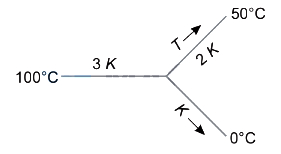
Three rods of the same dimensions have thermal conductivities $3 K, 2 K$,and $K$. They are arranged as shown in the figure below. The temperature of the junction in the steady state is:
A
$\frac{200}{3}^{\circ} C$
B
$\frac{100}{3}^{\circ} C$
C
$75^{\circ} C$
D
$\frac{50}{3}^{\circ} C$
Solution
(A) In the steady state,the heat current flowing into the junction must equal the heat current flowing out of the junction.
Let $T$ be the temperature of the junction.
The heat current $H$ is given by $H = \frac{KA(T_1 - T_2)}{l}$.
Since the dimensions (area $A$ and length $l$) are the same for all rods,the heat current is proportional to the thermal conductivity $K$.
According to the figure,the heat flows from the $100^{\circ} C$ source to the junction,and then from the junction to the $50^{\circ} C$ and $0^{\circ} C$ sinks.
Applying the principle of conservation of energy (Kirchhoff's law for heat current):
$H_{in} = H_{out1} + H_{out2}$
$\frac{3KA(100 - T)}{l} = \frac{2KA(T - 50)}{l} + \frac{KA(T - 0)}{l}$
Canceling $\frac{KA}{l}$ from both sides:
$3(100 - T) = 2(T - 50) + T$
$300 - 3T = 2T - 100 + T$
$300 - 3T = 3T - 100$
$6T = 400$
$T = \frac{400}{6} = \frac{200}{3}^{\circ} C$.
Let $T$ be the temperature of the junction.
The heat current $H$ is given by $H = \frac{KA(T_1 - T_2)}{l}$.
Since the dimensions (area $A$ and length $l$) are the same for all rods,the heat current is proportional to the thermal conductivity $K$.
According to the figure,the heat flows from the $100^{\circ} C$ source to the junction,and then from the junction to the $50^{\circ} C$ and $0^{\circ} C$ sinks.
Applying the principle of conservation of energy (Kirchhoff's law for heat current):
$H_{in} = H_{out1} + H_{out2}$
$\frac{3KA(100 - T)}{l} = \frac{2KA(T - 50)}{l} + \frac{KA(T - 0)}{l}$
Canceling $\frac{KA}{l}$ from both sides:
$3(100 - T) = 2(T - 50) + T$
$300 - 3T = 2T - 100 + T$
$300 - 3T = 3T - 100$
$6T = 400$
$T = \frac{400}{6} = \frac{200}{3}^{\circ} C$.
0 likesView Solution
128
ChemistryMCQAP EAMCET · 2009
$A$ piece of metal weighs $45 \ g$ in air and $25 \ g$ in a liquid of density $1.5 \times 10^3 \ kg \ m^{-3}$ kept at $30^{\circ} C$. When the temperature of the liquid is raised to $40^{\circ} C$,the metal piece weighs $27 \ g$. The density of liquid at $40^{\circ} C$ is $1.25 \times 10^3 \ kg \ m^{-3}$. The coefficient of linear expansion of the metal is
A
$1.3 \times 10^{-3} /^{\circ} C$
B
$5.2 \times 10^{-3} /^{\circ} C$
C
$2.6 \times 10^{-3} /^{\circ} C$
D
$0.26 \times 10^{-3} /^{\circ} C$
Solution
(C) The apparent weight loss is equal to the weight of the displaced liquid (Archimedes' principle). Let $V_{30}$ and $V_{40}$ be the volumes of the metal at $30^{\circ} C$ and $40^{\circ} C$ respectively.
At $30^{\circ} C$: Loss in weight $= 45 - 25 = 20 \ g$.
$V_{30} = \frac{\text{Loss in weight}}{\rho_{30}} = \frac{20 \ g}{1.5 \ g/cm^3} = 13.33 \ cm^3$.
At $40^{\circ} C$: Loss in weight $= 45 - 27 = 18 \ g$.
$V_{40} = \frac{\text{Loss in weight}}{\rho_{40}} = \frac{18 \ g}{1.25 \ g/cm^3} = 14.40 \ cm^3$.
Using the volume expansion formula: $V_{40} = V_{30}(1 + \gamma \Delta T)$,where $\Delta T = 10^{\circ} C$.
$\gamma = \frac{V_{40} - V_{30}}{V_{30} \Delta T} = \frac{14.40 - 13.33}{13.33 \times 10} = \frac{1.07}{133.3} \approx 8.027 \times 10^{-3} /^{\circ} C$.
The coefficient of linear expansion $\alpha = \frac{\gamma}{3} = \frac{8.027 \times 10^{-3}}{3} \approx 2.67 \times 10^{-3} /^{\circ} C$.
Rounding to the nearest option,we get $2.6 \times 10^{-3} /^{\circ} C$.
At $30^{\circ} C$: Loss in weight $= 45 - 25 = 20 \ g$.
$V_{30} = \frac{\text{Loss in weight}}{\rho_{30}} = \frac{20 \ g}{1.5 \ g/cm^3} = 13.33 \ cm^3$.
At $40^{\circ} C$: Loss in weight $= 45 - 27 = 18 \ g$.
$V_{40} = \frac{\text{Loss in weight}}{\rho_{40}} = \frac{18 \ g}{1.25 \ g/cm^3} = 14.40 \ cm^3$.
Using the volume expansion formula: $V_{40} = V_{30}(1 + \gamma \Delta T)$,where $\Delta T = 10^{\circ} C$.
$\gamma = \frac{V_{40} - V_{30}}{V_{30} \Delta T} = \frac{14.40 - 13.33}{13.33 \times 10} = \frac{1.07}{133.3} \approx 8.027 \times 10^{-3} /^{\circ} C$.
The coefficient of linear expansion $\alpha = \frac{\gamma}{3} = \frac{8.027 \times 10^{-3}}{3} \approx 2.67 \times 10^{-3} /^{\circ} C$.
Rounding to the nearest option,we get $2.6 \times 10^{-3} /^{\circ} C$.
0 likesView Solution
129
ChemistryMCQAP EAMCET · 2009
Two cylinders $A$ and $B$ fitted with pistons contain equal number of moles of an ideal monoatomic gas at $400 ~K$. The piston of $A$ is free to move while that of $B$ is held fixed. Same amount of heat energy is given to the gas in each cylinder. If the rise in temperature of the gas in $A$ is $42 ~K$,the rise in temperature of the gas in $B$ is (in $~K$)
A
$21$
B
$35$
C
$42$
D
$70$
Solution
(D) For an ideal monoatomic gas,the molar heat capacity at constant pressure is $C_P = \frac{5}{2}R$ and at constant volume is $C_V = \frac{3}{2}R$.
For cylinder $A$ (isobaric process),the heat supplied is $Q = n C_P \Delta T_A$.
Given $n$ is the same,$Q = n \times \frac{5}{2}R \times 42 = 105 nR$.
For cylinder $B$ (isochoric process),the heat supplied is $Q = n C_V \Delta T_B$.
Since the heat supplied is the same,$n C_P \Delta T_A = n C_V \Delta T_B$.
$\frac{5}{2}R \times 42 = \frac{3}{2}R \times \Delta T_B$.
$5 \times 42 = 3 \times \Delta T_B$.
$\Delta T_B = \frac{210}{3} = 70 ~K$.
For cylinder $A$ (isobaric process),the heat supplied is $Q = n C_P \Delta T_A$.
Given $n$ is the same,$Q = n \times \frac{5}{2}R \times 42 = 105 nR$.
For cylinder $B$ (isochoric process),the heat supplied is $Q = n C_V \Delta T_B$.
Since the heat supplied is the same,$n C_P \Delta T_A = n C_V \Delta T_B$.
$\frac{5}{2}R \times 42 = \frac{3}{2}R \times \Delta T_B$.
$5 \times 42 = 3 \times \Delta T_B$.
$\Delta T_B = \frac{210}{3} = 70 ~K$.
0 likesView Solution
130
ChemistryMCQAP EAMCET · 2009
An ideal gas is subjected to a cyclic process involving four thermodynamic states. The amounts of heat $(Q)$ and work $(W)$ involved in each of these states are:
$\begin{aligned} & Q_1=6000 \text{ J}, \quad Q_2=-5500 \text{ J}, \quad Q_3=-3000 \text{ J}, \quad Q_4=3500 \text{ J} \\ & W_1=2500 \text{ J}, \quad W_2=-1000 \text{ J}, \quad W_3=-1200 \text{ J}, \quad W_4=x \text{ J} \end{aligned}$
The ratio of the net work done by the gas to the total heat absorbed by the gas is $\eta$. The values of $x$ and $\eta$ respectively are:
$\begin{aligned} & Q_1=6000 \text{ J}, \quad Q_2=-5500 \text{ J}, \quad Q_3=-3000 \text{ J}, \quad Q_4=3500 \text{ J} \\ & W_1=2500 \text{ J}, \quad W_2=-1000 \text{ J}, \quad W_3=-1200 \text{ J}, \quad W_4=x \text{ J} \end{aligned}$
The ratio of the net work done by the gas to the total heat absorbed by the gas is $\eta$. The values of $x$ and $\eta$ respectively are:
A
$500; 7.5 \%$
B
$700; 10.5 \%$
C
$1000; 21 \%$
D
$1500; 15 \%$
Solution
(B) For a cyclic process,the change in internal energy over the complete cycle is zero,i.e.,$\sum \Delta U = 0$.
From the first law of thermodynamics,$\Delta U = Q - W$.
Calculating $\Delta U$ for each state:
$\Delta U_1 = Q_1 - W_1 = 6000 - 2500 = 3500 \text{ J}$
$\Delta U_2 = Q_2 - W_2 = -5500 - (-1000) = -4500 \text{ J}$
$\Delta U_3 = Q_3 - W_3 = -3000 - (-1200) = -1800 \text{ J}$
$\Delta U_4 = Q_4 - W_4 = 3500 - x$
Since $\sum \Delta U = 0$:
$3500 - 4500 - 1800 + 3500 - x = 0$
$700 - x = 0 \implies x = 700 \text{ J}$.
Net work done $W_{\text{net}} = W_1 + W_2 + W_3 + W_4 = 2500 - 1000 - 1200 + 700 = 1000 \text{ J}$.
Total heat absorbed $Q_{\text{in}} = Q_1 + Q_4 = 6000 + 3500 = 9500 \text{ J}$.
Efficiency $\eta = \frac{W_{\text{net}}}{Q_{\text{in}}} \times 100 = \frac{1000}{9500} \times 100 \approx 10.5 \%$.
From the first law of thermodynamics,$\Delta U = Q - W$.
Calculating $\Delta U$ for each state:
$\Delta U_1 = Q_1 - W_1 = 6000 - 2500 = 3500 \text{ J}$
$\Delta U_2 = Q_2 - W_2 = -5500 - (-1000) = -4500 \text{ J}$
$\Delta U_3 = Q_3 - W_3 = -3000 - (-1200) = -1800 \text{ J}$
$\Delta U_4 = Q_4 - W_4 = 3500 - x$
Since $\sum \Delta U = 0$:
$3500 - 4500 - 1800 + 3500 - x = 0$
$700 - x = 0 \implies x = 700 \text{ J}$.
Net work done $W_{\text{net}} = W_1 + W_2 + W_3 + W_4 = 2500 - 1000 - 1200 + 700 = 1000 \text{ J}$.
Total heat absorbed $Q_{\text{in}} = Q_1 + Q_4 = 6000 + 3500 = 9500 \text{ J}$.
Efficiency $\eta = \frac{W_{\text{net}}}{Q_{\text{in}}} \times 100 = \frac{1000}{9500} \times 100 \approx 10.5 \%$.
0 likesView Solution
131
ChemistryEasyMCQAP EAMCET · 2009
Calculate $\Delta H^{\circ}$ for the reaction,$Na_2O_{(s)} + SO_{3(g)} \longrightarrow Na_2SO_{4(s)}$ given the following:
$(A) \ Na_{(s)} + H_2O_{(l)} \longrightarrow NaOH_{(s)} + \frac{1}{2} H_{2(g)} \quad \Delta H^{\circ} = -146 \ kJ$
$(B) \ Na_2SO_{4(s)} + H_2O_{(l)} \longrightarrow 2NaOH_{(s)} + SO_{3(g)} \quad \Delta H^{\circ} = +418 \ kJ$
$(C) \ 2Na_2O_{(s)} + 2H_{2(g)} \longrightarrow 4Na_{(s)} + 2H_2O_{(l)} \quad \Delta H^{\circ} = +259 \ kJ$
$(A) \ Na_{(s)} + H_2O_{(l)} \longrightarrow NaOH_{(s)} + \frac{1}{2} H_{2(g)} \quad \Delta H^{\circ} = -146 \ kJ$
$(B) \ Na_2SO_{4(s)} + H_2O_{(l)} \longrightarrow 2NaOH_{(s)} + SO_{3(g)} \quad \Delta H^{\circ} = +418 \ kJ$
$(C) \ 2Na_2O_{(s)} + 2H_{2(g)} \longrightarrow 4Na_{(s)} + 2H_2O_{(l)} \quad \Delta H^{\circ} = +259 \ kJ$
A
$+823 \ kJ$
B
$-581 \ kJ$
C
$-435 \ kJ$
D
$+531 \ kJ$
Solution
(B) We need to find $\Delta H^{\circ}$ for the reaction: $Na_2O_{(s)} + SO_{3(g)} \longrightarrow Na_2SO_{4(s)}$.
Given equations:
$(A) \ Na_{(s)} + H_2O_{(l)} \longrightarrow NaOH_{(s)} + \frac{1}{2} H_{2(g)} \quad \Delta H^{\circ} = -146 \ kJ$
$(B) \ Na_2SO_{4(s)} + H_2O_{(l)} \longrightarrow 2NaOH_{(s)} + SO_{3(g)} \quad \Delta H^{\circ} = +418 \ kJ$
$(C) \ 2Na_2O_{(s)} + 2H_{2(g)} \longrightarrow 4Na_{(s)} + 2H_2O_{(l)} \quad \Delta H^{\circ} = +259 \ kJ$
To get the target reaction,perform the operation: $2 \times (A) + \frac{1}{2} \times (C) - (B)$.
$2 \times [Na_{(s)} + H_2O_{(l)}$ $\longrightarrow NaOH_{(s)} + \frac{1}{2} H_{2(g)}] \implies 2Na_{(s)} + 2H_2O_{(l)}$ $\longrightarrow 2NaOH_{(s)} + H_{2(g)} \quad \Delta H^{\circ} = 2 \times (-146) = -292 \ kJ$
$\frac{1}{2} \times [2Na_2O_{(s)} + 2H_{2(g)}$ $\longrightarrow 4Na_{(s)} + 2H_2O_{(l)}] \implies Na_2O_{(s)} + H_{2(g)}$ $\longrightarrow 2Na_{(s)} + H_2O_{(l)} \quad \Delta H^{\circ} = \frac{259}{2} = 129.5 \ kJ$
$-(B) \implies 2NaOH_{(s)} + SO_{3(g)} \longrightarrow Na_2SO_{4(s)} + H_2O_{(l)} \quad \Delta H^{\circ} = -418 \ kJ$
Adding these: $(2Na_{(s)} + 2H_2O_{(l)} + Na_2O_{(s)} + H_{2(g)} + 2NaOH_{(s)} + SO_{3(g)})$ $\longrightarrow (2NaOH_{(s)} + H_{2(g)} + 2Na_{(s)} + H_2O_{(l)} + Na_2SO_{4(s)} + H_2O_{(l)})$
Simplifying gives: $Na_2O_{(s)} + SO_{3(g)} \longrightarrow Na_2SO_{4(s)}$.
$\Delta H^{\circ} = -292 + 129.5 - 418 = -580.5 \ kJ \approx -581 \ kJ$.
Given equations:
$(A) \ Na_{(s)} + H_2O_{(l)} \longrightarrow NaOH_{(s)} + \frac{1}{2} H_{2(g)} \quad \Delta H^{\circ} = -146 \ kJ$
$(B) \ Na_2SO_{4(s)} + H_2O_{(l)} \longrightarrow 2NaOH_{(s)} + SO_{3(g)} \quad \Delta H^{\circ} = +418 \ kJ$
$(C) \ 2Na_2O_{(s)} + 2H_{2(g)} \longrightarrow 4Na_{(s)} + 2H_2O_{(l)} \quad \Delta H^{\circ} = +259 \ kJ$
To get the target reaction,perform the operation: $2 \times (A) + \frac{1}{2} \times (C) - (B)$.
$2 \times [Na_{(s)} + H_2O_{(l)}$ $\longrightarrow NaOH_{(s)} + \frac{1}{2} H_{2(g)}] \implies 2Na_{(s)} + 2H_2O_{(l)}$ $\longrightarrow 2NaOH_{(s)} + H_{2(g)} \quad \Delta H^{\circ} = 2 \times (-146) = -292 \ kJ$
$\frac{1}{2} \times [2Na_2O_{(s)} + 2H_{2(g)}$ $\longrightarrow 4Na_{(s)} + 2H_2O_{(l)}] \implies Na_2O_{(s)} + H_{2(g)}$ $\longrightarrow 2Na_{(s)} + H_2O_{(l)} \quad \Delta H^{\circ} = \frac{259}{2} = 129.5 \ kJ$
$-(B) \implies 2NaOH_{(s)} + SO_{3(g)} \longrightarrow Na_2SO_{4(s)} + H_2O_{(l)} \quad \Delta H^{\circ} = -418 \ kJ$
Adding these: $(2Na_{(s)} + 2H_2O_{(l)} + Na_2O_{(s)} + H_{2(g)} + 2NaOH_{(s)} + SO_{3(g)})$ $\longrightarrow (2NaOH_{(s)} + H_{2(g)} + 2Na_{(s)} + H_2O_{(l)} + Na_2SO_{4(s)} + H_2O_{(l)})$
Simplifying gives: $Na_2O_{(s)} + SO_{3(g)} \longrightarrow Na_2SO_{4(s)}$.
$\Delta H^{\circ} = -292 + 129.5 - 418 = -580.5 \ kJ \approx -581 \ kJ$.
0 likesView Solution
132
ChemistryMCQAP EAMCET · 2009
Given that $\Delta H_f(H) = 218 \ kJ/mol$,express the $H-H$ bond energy in $kcal/mol$.
A
$52.15$
B
$911$
C
$104$
D
$52153$
Solution
(C) The enthalpy of formation of $H$ atoms is given as $\Delta H_f(H) = 218 \ kJ/mol$.
This corresponds to the reaction: $\frac{1}{2} H_2(g) \longrightarrow H(g) ; \Delta H = 218 \ kJ/mol$.
For the dissociation of one mole of $H_2$ molecules into $H$ atoms: $H_2(g) \longrightarrow 2H(g) ; \Delta H = 2 \times 218 = 436 \ kJ/mol$.
To convert this energy into $kcal/mol$,we use the conversion factor $1 \ kcal = 4.18 \ kJ$.
Bond energy $= \frac{436 \ kJ/mol}{4.18 \ kJ/kcal} \approx 104.3 \ kcal/mol$.
Thus,the $H-H$ bond energy is approximately $104 \ kcal/mol$.
This corresponds to the reaction: $\frac{1}{2} H_2(g) \longrightarrow H(g) ; \Delta H = 218 \ kJ/mol$.
For the dissociation of one mole of $H_2$ molecules into $H$ atoms: $H_2(g) \longrightarrow 2H(g) ; \Delta H = 2 \times 218 = 436 \ kJ/mol$.
To convert this energy into $kcal/mol$,we use the conversion factor $1 \ kcal = 4.18 \ kJ$.
Bond energy $= \frac{436 \ kJ/mol}{4.18 \ kJ/kcal} \approx 104.3 \ kcal/mol$.
Thus,the $H-H$ bond energy is approximately $104 \ kcal/mol$.
0 likesView Solution
133
ChemistryMCQAP EAMCET · 2009
When a wave traverses a medium,the displacement of a particle located at $x$ at a time $t$ is given by $y = a \sin (bt - cx)$,where $a, b,$ and $c$ are constants of the wave. Which of the following is a quantity with dimensions?
A
$\frac{y}{a}$
B
$bt$
C
$cx$
D
$\frac{b}{c}$
Solution
(D) Given the wave equation: $y = a \sin (bt - cx)$.
In the expression $y = a \sin (\theta)$,the argument of the trigonometric function $\theta = (bt - cx)$ must be dimensionless.
Since $bt$ and $cx$ are added/subtracted,they must have the same dimensions as the argument of the sine function,which is dimensionless.
$(a)$ $\frac{y}{a}$ is the ratio of two lengths,so it is dimensionless.
$(b)$ $bt$ is the argument of the sine function,so it is dimensionless.
$(c)$ $cx$ is the argument of the sine function,so it is dimensionless.
$(d)$ The dimension of $b$ is $[T^{-1}]$ and the dimension of $c$ is $[L^{-1}]$.
Therefore,the dimension of $\frac{b}{c} = \frac{[T^{-1}]}{[L^{-1}]} = [LT^{-1}]$,which represents the dimension of velocity.
Thus,$\frac{b}{c}$ is a quantity with dimensions.
In the expression $y = a \sin (\theta)$,the argument of the trigonometric function $\theta = (bt - cx)$ must be dimensionless.
Since $bt$ and $cx$ are added/subtracted,they must have the same dimensions as the argument of the sine function,which is dimensionless.
$(a)$ $\frac{y}{a}$ is the ratio of two lengths,so it is dimensionless.
$(b)$ $bt$ is the argument of the sine function,so it is dimensionless.
$(c)$ $cx$ is the argument of the sine function,so it is dimensionless.
$(d)$ The dimension of $b$ is $[T^{-1}]$ and the dimension of $c$ is $[L^{-1}]$.
Therefore,the dimension of $\frac{b}{c} = \frac{[T^{-1}]}{[L^{-1}]} = [LT^{-1}]$,which represents the dimension of velocity.
Thus,$\frac{b}{c}$ is a quantity with dimensions.
0 likesView Solution
134
ChemistryMCQAP EAMCET · 2009
In Young's double slit experiment,the $10^{\text{th}}$ maximum of wavelength $\lambda_1$ is at a distance of $y_1$ from the central maximum. When the wavelength of the source is changed to $\lambda_2$,the $5^{\text{th}}$ maximum is at a distance of $y_2$ from its central maximum. The ratio $\left(\frac{y_1}{y_2}\right)$ is
A
$\frac{2 \lambda_1}{\lambda_2}$
B
$\frac{2 \lambda_2}{\lambda_1}$
C
$\frac{\lambda_1}{2 \lambda_2}$
D
$\frac{\lambda_2}{2 \lambda_1}$
Solution
(A) The position of the $n^{\text{th}}$ bright fringe (maximum) from the central maximum in Young's double slit experiment is given by the formula:
$y_n = \frac{n \lambda D}{d}$
where $D$ is the distance between the screen and the slits,and $d$ is the distance between the two slits.
For the first case,with wavelength $\lambda_1$ and $n_1 = 10$:
$y_1 = \frac{10 \lambda_1 D}{d}$
For the second case,with wavelength $\lambda_2$ and $n_2 = 5$:
$y_2 = \frac{5 \lambda_2 D}{d}$
Now,calculating the ratio $\left(\frac{y_1}{y_2}\right)$:
$\frac{y_1}{y_2} = \frac{\frac{10 \lambda_1 D}{d}}{\frac{5 \lambda_2 D}{d}}$
$\frac{y_1}{y_2} = \frac{10 \lambda_1}{5 \lambda_2}$
$\frac{y_1}{y_2} = \frac{2 \lambda_1}{\lambda_2}$
$y_n = \frac{n \lambda D}{d}$
where $D$ is the distance between the screen and the slits,and $d$ is the distance between the two slits.
For the first case,with wavelength $\lambda_1$ and $n_1 = 10$:
$y_1 = \frac{10 \lambda_1 D}{d}$
For the second case,with wavelength $\lambda_2$ and $n_2 = 5$:
$y_2 = \frac{5 \lambda_2 D}{d}$
Now,calculating the ratio $\left(\frac{y_1}{y_2}\right)$:
$\frac{y_1}{y_2} = \frac{\frac{10 \lambda_1 D}{d}}{\frac{5 \lambda_2 D}{d}}$
$\frac{y_1}{y_2} = \frac{10 \lambda_1}{5 \lambda_2}$
$\frac{y_1}{y_2} = \frac{2 \lambda_1}{\lambda_2}$

0 likesView Solution
135
ChemistryMCQAP EAMCET · 2009
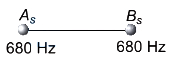
Two sources $A$ and $B$ are sending notes of frequency $680 \, Hz$. A listener moves from $A$ towards $B$ with a constant velocity $u$. If the speed of sound in air is $340 \, ms^{-1}$, what must be the value of $u$ so that the listener hears $10$ beats per second (in $ \, ms^{-1}$)?
A
$2.0$
B
$2.5$
C
$3.0$
D
$3.5$
Solution
(B) Let the frequency of the sources be $n = 680 \, Hz$ and the speed of sound be $v = 340 \, ms^{-1}$.
The listener moves from $A$ towards $B$ with velocity $u$.
As the listener moves away from source $A$, the apparent frequency $n^{\prime}$ heard from $A$ is:
$n^{\prime} = n \left( \frac{v - u}{v} \right) = 680 \left( \frac{340 - u}{340} \right) = 2(340 - u)$
As the listener moves towards source $B$, the apparent frequency $n^{\prime \prime}$ heard from $B$ is:
$n^{\prime \prime} = n \left( \frac{v + u}{v} \right) = 680 \left( \frac{340 + u}{340} \right) = 2(340 + u)$
The beat frequency is the difference between the two apparent frequencies:
$n^{\prime \prime} - n^{\prime} = 10$
$2(340 + u) - 2(340 - u) = 10$
$680 + 2u - 680 + 2u = 10$
$4u = 10$
$u = 2.5 \, ms^{-1}$
The listener moves from $A$ towards $B$ with velocity $u$.
As the listener moves away from source $A$, the apparent frequency $n^{\prime}$ heard from $A$ is:
$n^{\prime} = n \left( \frac{v - u}{v} \right) = 680 \left( \frac{340 - u}{340} \right) = 2(340 - u)$
As the listener moves towards source $B$, the apparent frequency $n^{\prime \prime}$ heard from $B$ is:
$n^{\prime \prime} = n \left( \frac{v + u}{v} \right) = 680 \left( \frac{340 + u}{340} \right) = 2(340 + u)$
The beat frequency is the difference between the two apparent frequencies:
$n^{\prime \prime} - n^{\prime} = 10$
$2(340 + u) - 2(340 - u) = 10$
$680 + 2u - 680 + 2u = 10$
$4u = 10$
$u = 2.5 \, ms^{-1}$
0 likesView Solution
136
ChemistryMCQAP EAMCET · 2009
Four light sources produce the following four waves:
$(i)$ $y_1 = a \sin(\omega t + \phi_1)$
(ii) $y_2 = a \sin(2\omega t)$
(iii) $y_3 = d' \sin(\omega t + \phi_2)$
(iv) $y_4 = d' \sin(3\omega t + \phi)$
Superposition of which two waves gives rise to interference?
$(i)$ $y_1 = a \sin(\omega t + \phi_1)$
(ii) $y_2 = a \sin(2\omega t)$
(iii) $y_3 = d' \sin(\omega t + \phi_2)$
(iv) $y_4 = d' \sin(3\omega t + \phi)$
Superposition of which two waves gives rise to interference?
A
$(i)$ and (ii)
B
(ii) and (iii)
C
$(i)$ and (iii)
D
(iii) and (iv)
Solution
(C) The phenomenon of interference occurs between two waves that have the same frequency and a constant phase difference.
Looking at the given waves:
$(i)$ $y_1 = a \sin(\omega t + \phi_1)$ has angular frequency $\omega$.
(ii) $y_2 = a \sin(2\omega t)$ has angular frequency $2\omega$.
(iii) $y_3 = d' \sin(\omega t + \phi_2)$ has angular frequency $\omega$.
(iv) $y_4 = d' \sin(3\omega t + \phi)$ has angular frequency $3\omega$.
Since waves $(i)$ and (iii) have the same angular frequency $\omega$,their superposition will result in interference.
Therefore,the correct option is $(C)$.
Looking at the given waves:
$(i)$ $y_1 = a \sin(\omega t + \phi_1)$ has angular frequency $\omega$.
(ii) $y_2 = a \sin(2\omega t)$ has angular frequency $2\omega$.
(iii) $y_3 = d' \sin(\omega t + \phi_2)$ has angular frequency $\omega$.
(iv) $y_4 = d' \sin(3\omega t + \phi)$ has angular frequency $3\omega$.
Since waves $(i)$ and (iii) have the same angular frequency $\omega$,their superposition will result in interference.
Therefore,the correct option is $(C)$.
0 likesView Solution
137
ChemistryMCQAP EAMCET · 2009
Two identical piano wires have a fundamental frequency of $600 \text{ Hz}$ when kept under the same tension. What fractional increase in the tension of one wire will lead to the occurrence of $6 \text{ beats per second}$ when both wires vibrate simultaneously?
A
$0.01$
B
$0.02$
C
$0.03$
D
$0.04$
Solution
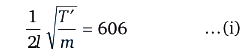
(B) The fundamental frequency of a stretched wire is given by $n = \frac{1}{2l} \sqrt{\frac{T}{m}}$.
Given,$n_1 = 600 \text{ Hz}$.
When the tension in one wire is increased to $T'$,its new frequency becomes $n_2 = 606 \text{ Hz}$ to produce $6 \text{ beats per second}$ $(n_2 - n_1 = 606 - 600 = 6 \text{ Hz})$.
We have $\frac{n_2}{n_1} = \sqrt{\frac{T'}{T}}$.
Substituting the values: $\frac{606}{600} = \sqrt{\frac{T'}{T}}$.
$1.01 = \sqrt{\frac{T'}{T}}$.
Squaring both sides: $\frac{T'}{T} = (1.01)^2 = 1.0201 \approx 1.02$.
The fractional increase in tension is $\frac{\Delta T}{T} = \frac{T' - T}{T} = \frac{T'}{T} - 1 = 1.02 - 1 = 0.02$.
Given,$n_1 = 600 \text{ Hz}$.
When the tension in one wire is increased to $T'$,its new frequency becomes $n_2 = 606 \text{ Hz}$ to produce $6 \text{ beats per second}$ $(n_2 - n_1 = 606 - 600 = 6 \text{ Hz})$.
We have $\frac{n_2}{n_1} = \sqrt{\frac{T'}{T}}$.
Substituting the values: $\frac{606}{600} = \sqrt{\frac{T'}{T}}$.
$1.01 = \sqrt{\frac{T'}{T}}$.
Squaring both sides: $\frac{T'}{T} = (1.01)^2 = 1.0201 \approx 1.02$.
The fractional increase in tension is $\frac{\Delta T}{T} = \frac{T' - T}{T} = \frac{T'}{T} - 1 = 1.02 - 1 = 0.02$.
0 likesView Solution
138
ChemistryMCQAP EAMCET · 2009
$A$ motor of power $P_0$ is used to deliver water at a certain rate through a given horizontal pipe. To increase the rate of flow of water through the same pipe $n$ times,the power of the motor is increased to $P_1$. The ratio of $P_1$ to $P_0$ is
A
$n: 1$
B
$n^2: 1$
C
$n^3: 1$
D
$n^4: 1$
Solution
(C) The power $P$ required to move a fluid through a pipe is given by the work done per unit time. For a horizontal pipe,the work done is primarily to overcome the kinetic energy of the fluid.
The kinetic energy $K$ of a mass $m$ moving with velocity $v$ is $K = \frac{1}{2}mv^2$.
The power $P$ is the rate of change of kinetic energy: $P = \frac{dK}{dt} = \frac{1}{2} v^2 \frac{dm}{dt}$.
Let the mass flow rate be $\frac{dm}{dt} = \dot{m}$. Since the pipe is the same,the cross-sectional area $A$ is constant. The flow rate (volume per unit time) is $Q = Av$. Thus,the mass flow rate $\dot{m} = \rho A v$,where $\rho$ is the density of water.
Substituting $\dot{m}$ into the power equation: $P = \frac{1}{2} v^2 (\rho A v) = \frac{1}{2} \rho A v^3$.
Since $Q = Av$,we have $v = Q/A$. Substituting this into the power equation: $P = \frac{1}{2} \rho A (Q/A)^3 = \frac{\rho}{2A^2} Q^3$.
This shows that $P \propto Q^3$.
Given that the initial flow rate is $Q_0$ and the final flow rate is $Q_1 = n Q_0$,the ratio of powers is:
$\frac{P_1}{P_0} = \left( \frac{Q_1}{Q_0} \right)^3 = n^3$.
Therefore,the ratio $P_1 : P_0 = n^3 : 1$.
The kinetic energy $K$ of a mass $m$ moving with velocity $v$ is $K = \frac{1}{2}mv^2$.
The power $P$ is the rate of change of kinetic energy: $P = \frac{dK}{dt} = \frac{1}{2} v^2 \frac{dm}{dt}$.
Let the mass flow rate be $\frac{dm}{dt} = \dot{m}$. Since the pipe is the same,the cross-sectional area $A$ is constant. The flow rate (volume per unit time) is $Q = Av$. Thus,the mass flow rate $\dot{m} = \rho A v$,where $\rho$ is the density of water.
Substituting $\dot{m}$ into the power equation: $P = \frac{1}{2} v^2 (\rho A v) = \frac{1}{2} \rho A v^3$.
Since $Q = Av$,we have $v = Q/A$. Substituting this into the power equation: $P = \frac{1}{2} \rho A (Q/A)^3 = \frac{\rho}{2A^2} Q^3$.
This shows that $P \propto Q^3$.
Given that the initial flow rate is $Q_0$ and the final flow rate is $Q_1 = n Q_0$,the ratio of powers is:
$\frac{P_1}{P_0} = \left( \frac{Q_1}{Q_0} \right)^3 = n^3$.
Therefore,the ratio $P_1 : P_0 = n^3 : 1$.
0 likesView Solution
139
ChemistryDifficultMCQAP EAMCET · 2009
Identify the alkyne in the following sequence of reactions:
Alkyne $\xrightarrow{\text{H}_2, \text{Lindlar's catalyst}} A$ $\xrightarrow{\text{Ozonolysis}} B \text{ (only)}$
Given that $B$ is obtained from $\text{CH}_2=\text{CH}_2$ via the Wacker process.
Alkyne $\xrightarrow{\text{H}_2, \text{Lindlar's catalyst}} A$ $\xrightarrow{\text{Ozonolysis}} B \text{ (only)}$
Given that $B$ is obtained from $\text{CH}_2=\text{CH}_2$ via the Wacker process.
A
$H_3C-C \equiv C-CH_3$
B
$H_3C-CH_2-C \equiv CH$
C
$H_2C=CH-C \equiv CH$
D
$HC \equiv C-CH_2-C \equiv CH$
Solution
(A) $1$. The Wacker process converts ethene $(\text{CH}_2=\text{CH}_2)$ to ethanal $(\text{CH}_3\text{CHO})$,so $B$ is $\text{CH}_3\text{CHO}$.
$2$. Ozonolysis of an alkene $A$ yields $B$ (ethanal). Since $A \xrightarrow{\text{O}_3} 2 \text{CH}_3\text{CHO}$,$A$ must be but$-2-$ene $(\text{CH}_3\text{CH}=\text{CHCH}_3)$.
$3$. The alkyne is reduced to $A$ (cis-but$-2-$ene) using Lindlar's catalyst. Therefore,the starting alkyne is but$-2-$yne $(\text{CH}_3\text{C} \equiv \text{CCH}_3)$.
$2$. Ozonolysis of an alkene $A$ yields $B$ (ethanal). Since $A \xrightarrow{\text{O}_3} 2 \text{CH}_3\text{CHO}$,$A$ must be but$-2-$ene $(\text{CH}_3\text{CH}=\text{CHCH}_3)$.
$3$. The alkyne is reduced to $A$ (cis-but$-2-$ene) using Lindlar's catalyst. Therefore,the starting alkyne is but$-2-$yne $(\text{CH}_3\text{C} \equiv \text{CCH}_3)$.
0 likesView Solution
140
ChemistryMediumMCQAP EAMCET · 2009
The type of bonds present in sulphuric anhydride $(SO_3)$ are:
A
$3 \sigma$ and three $p \pi-d \pi$ bonds
B
$3 \sigma$,one $p \pi-p \pi$ and two $p \pi-d \pi$ bonds
C
$2 \sigma$ and three $p \pi-d \pi$ bonds
D
$2 \sigma$ and two $p \pi-d \pi$ bonds
Solution
(B) Sulphuric anhydride is $SO_3$. In its structure,the central sulfur atom is $sp^2$ hybridized.
It forms three $\sigma$ bonds with three oxygen atoms.
Out of the three $\pi$ bonds,one is a $p \pi-p \pi$ bond (formed by the overlap of $p$-orbitals of $S$ and $O$) and two are $p \pi-d \pi$ bonds (formed by the overlap of $d$-orbitals of $S$ and $p$-orbitals of $O$).
Therefore,the molecule contains $3 \sigma$,$1 p \pi-p \pi$,and $2 p \pi-d \pi$ bonds.
It forms three $\sigma$ bonds with three oxygen atoms.
Out of the three $\pi$ bonds,one is a $p \pi-p \pi$ bond (formed by the overlap of $p$-orbitals of $S$ and $O$) and two are $p \pi-d \pi$ bonds (formed by the overlap of $d$-orbitals of $S$ and $p$-orbitals of $O$).
Therefore,the molecule contains $3 \sigma$,$1 p \pi-p \pi$,and $2 p \pi-d \pi$ bonds.
0 likesView Solution
141
ChemistryDifficultMCQAP EAMCET · 2009
Dipole moment of $HCl = 1.03 \ D$ and $HI = 0.38 \ D$. Bond length of $HCl = 1.3 \ \mathring{A}$ and $HI = 1.6 \ \mathring{A}$. The ratio of the fraction of electric charge,$\delta$,existing on each atom in $HCl$ and $HI$ is:
A
$12: 1$
B
$2.7: 1$
C
$3.3: 1$
D
$1: 3.3$
Solution
(C) From the definition of dipole moment,$\mu = \delta \times d$,where $\delta$ is the magnitude of the electric charge and $d$ is the bond length.
Therefore,$\delta = \frac{\mu}{d}$.
The ratio of the fraction of electric charge for $HCl$ and $HI$ is given by:
$\frac{\delta_{HCl}}{\delta_{HI}} = \frac{\mu_{HCl}}{d_{HCl}} \times \frac{d_{HI}}{\mu_{HI}}$
Substituting the given values:
$\frac{\delta_{HCl}}{\delta_{HI}} = \frac{1.03 \times 1.6}{1.3 \times 0.38} = \frac{1.648}{0.494} \approx 3.33: 1$.
Thus,the ratio is approximately $3.3: 1$.
Therefore,$\delta = \frac{\mu}{d}$.
The ratio of the fraction of electric charge for $HCl$ and $HI$ is given by:
$\frac{\delta_{HCl}}{\delta_{HI}} = \frac{\mu_{HCl}}{d_{HCl}} \times \frac{d_{HI}}{\mu_{HI}}$
Substituting the given values:
$\frac{\delta_{HCl}}{\delta_{HI}} = \frac{1.03 \times 1.6}{1.3 \times 0.38} = \frac{1.648}{0.494} \approx 3.33: 1$.
Thus,the ratio is approximately $3.3: 1$.
0 likesView Solution
142
ChemistryMediumMCQAP EAMCET · 2009
The equilibrium constant for the given reaction is $100$.
$N_{2(g)} + 2 O_{2(g)} \rightleftharpoons 2 NO_{2(g)}$
What is the equilibrium constant for the reaction given below?
$NO_{2(g)} \rightleftharpoons \frac{1}{2} N_{2(g)} + O_{2(g)}$
$N_{2(g)} + 2 O_{2(g)} \rightleftharpoons 2 NO_{2(g)}$
What is the equilibrium constant for the reaction given below?
$NO_{2(g)} \rightleftharpoons \frac{1}{2} N_{2(g)} + O_{2(g)}$
A
$10$
B
$1$
C
$0.1$
D
$0.01$
Solution
(C) For the reaction: $N_{2(g)} + 2 O_{2(g)} \rightleftharpoons 2 NO_{2(g)}$,the equilibrium constant is $K_1 = 100$.
$K_1 = \frac{[NO_2]^2}{[N_2][O_2]^2} = 100$ ... $(i)$
For the target reaction: $NO_{2(g)} \rightleftharpoons \frac{1}{2} N_{2(g)} + O_{2(g)}$,the equilibrium constant is $K_2$.
$K_2 = \frac{[N_2]^{1/2} [O_2]}{[NO_2]}$ ... $(ii)$
Comparing $(i)$ and $(ii)$,we observe that $K_2 = \sqrt{\frac{1}{K_1}}$.
$K_2 = \sqrt{\frac{1}{100}} = \frac{1}{10} = 0.1$.
$K_1 = \frac{[NO_2]^2}{[N_2][O_2]^2} = 100$ ... $(i)$
For the target reaction: $NO_{2(g)} \rightleftharpoons \frac{1}{2} N_{2(g)} + O_{2(g)}$,the equilibrium constant is $K_2$.
$K_2 = \frac{[N_2]^{1/2} [O_2]}{[NO_2]}$ ... $(ii)$
Comparing $(i)$ and $(ii)$,we observe that $K_2 = \sqrt{\frac{1}{K_1}}$.
$K_2 = \sqrt{\frac{1}{100}} = \frac{1}{10} = 0.1$.
0 likesView Solution
143
ChemistryMediumMCQAP EAMCET · 2009
Which one of the following orders is correct for the first ionisation energies of the elements?
A
$B < Be < N < O$
B
$Be < B < N < O$
C
$B < Be < O < N$
D
$B < O < Be < N$
Solution
(C) The first ionisation energy $(IE)$ generally increases across a period from left to right. For the second period elements,the expected order is $Li < Be < B < C < N < O < F < Ne$.
However,due to the stability of fully-filled and half-filled orbitals,the actual order for $B, Be, N,$ and $O$ is $B < Be < O < N$.
The lower $IE$ of $B$ $(1s^2, 2s^2 2p^1)$ compared to $Be$ $(1s^2, 2s^2)$ is because the electron is removed from a $2p$ orbital in $B$,which is easier than removing an electron from the stable,fully-filled $2s$ orbital in $Be$.
The lower $IE$ of $O$ $(1s^2, 2s^2 2p^4)$ compared to $N$ $(1s^2, 2s^2 2p^3)$ is because $N$ has a stable,half-filled $2p$ subshell,making it harder to remove an electron compared to $O$.
However,due to the stability of fully-filled and half-filled orbitals,the actual order for $B, Be, N,$ and $O$ is $B < Be < O < N$.
The lower $IE$ of $B$ $(1s^2, 2s^2 2p^1)$ compared to $Be$ $(1s^2, 2s^2)$ is because the electron is removed from a $2p$ orbital in $B$,which is easier than removing an electron from the stable,fully-filled $2s$ orbital in $Be$.
The lower $IE$ of $O$ $(1s^2, 2s^2 2p^4)$ compared to $N$ $(1s^2, 2s^2 2p^3)$ is because $N$ has a stable,half-filled $2p$ subshell,making it harder to remove an electron compared to $O$.
0 likesView Solution
144
ChemistryMCQAP EAMCET · 2009
If $\alpha$ and $\beta$ are the roots of $x^2-2x+4=0$,then the value of $\alpha^6+\beta^6$ is
A
$32$
B
$64$
C
$128$
D
$256$
Solution
(C) Given that $\alpha$ and $\beta$ are the roots of the quadratic equation $x^2-2x+4=0$.
From the relation between roots and coefficients,we have:
$\alpha+\beta = 2$ $(i)$
$\alpha\beta = 4$ $(ii)$
We can write $x^2-2x+4=0$ as $x^2-2x+1+3=0$,which implies $(x-1)^2 = -3$.
Thus,$x-1 = \pm \sqrt{3}i$,so $x = 1 \pm \sqrt{3}i$.
Let $\alpha = 1+\sqrt{3}i = 2(\frac{1}{2} + i\frac{\sqrt{3}}{2}) = 2e^{i\pi/3}$ and $\beta = 1-\sqrt{3}i = 2(\frac{1}{2} - i\frac{\sqrt{3}}{2}) = 2e^{-i\pi/3}$.
Then,$\alpha^6 = (2e^{i\pi/3})^6 = 2^6 e^{i2\pi} = 64(1) = 64$.
Similarly,$\beta^6 = (2e^{-i\pi/3})^6 = 2^6 e^{-i2\pi} = 64(1) = 64$.
Therefore,$\alpha^6+\beta^6 = 64+64 = 128$.
From the relation between roots and coefficients,we have:
$\alpha+\beta = 2$ $(i)$
$\alpha\beta = 4$ $(ii)$
We can write $x^2-2x+4=0$ as $x^2-2x+1+3=0$,which implies $(x-1)^2 = -3$.
Thus,$x-1 = \pm \sqrt{3}i$,so $x = 1 \pm \sqrt{3}i$.
Let $\alpha = 1+\sqrt{3}i = 2(\frac{1}{2} + i\frac{\sqrt{3}}{2}) = 2e^{i\pi/3}$ and $\beta = 1-\sqrt{3}i = 2(\frac{1}{2} - i\frac{\sqrt{3}}{2}) = 2e^{-i\pi/3}$.
Then,$\alpha^6 = (2e^{i\pi/3})^6 = 2^6 e^{i2\pi} = 64(1) = 64$.
Similarly,$\beta^6 = (2e^{-i\pi/3})^6 = 2^6 e^{-i2\pi} = 64(1) = 64$.
Therefore,$\alpha^6+\beta^6 = 64+64 = 128$.
0 likesView Solution
145
ChemistryMCQAP EAMCET · 2009
$p$ points are chosen on each of the three coplanar lines. The maximum number of triangles formed with vertices at these points is
A
$p^3+3 p^2$
B
$\frac{1}{2}(p^3+p)$
C
$\frac{p^2}{2}(5 p-3)$
D
$p^2(4 p-3)$
Solution
(D) Total number of points is $3p$.
To form a triangle,we need to select $3$ points that are not collinear.
The total number of ways to select $3$ points from $3p$ points is $^{3p}C_3$.
Since $p$ points are collinear on each of the $3$ lines,we must subtract the sets of $3$ points that lie on the same line.
Number of triangles $= ^{3p}C_3 - 3 \times (^pC_3)$.
$= \frac{3p(3p-1)(3p-2)}{6} - 3 \times \frac{p(p-1)(p-2)}{6}$.
$= \frac{p(3p-1)(3p-2) - p(p-1)(p-2)}{2}$.
$= \frac{p}{2} [ (9p^2 - 9p + 2) - (p^2 - 3p + 2) ]$.
$= \frac{p}{2} [ 8p^2 - 6p ] = p(4p^2 - 3p) = p^2(4p-3)$.
To form a triangle,we need to select $3$ points that are not collinear.
The total number of ways to select $3$ points from $3p$ points is $^{3p}C_3$.
Since $p$ points are collinear on each of the $3$ lines,we must subtract the sets of $3$ points that lie on the same line.
Number of triangles $= ^{3p}C_3 - 3 \times (^pC_3)$.
$= \frac{3p(3p-1)(3p-2)}{6} - 3 \times \frac{p(p-1)(p-2)}{6}$.
$= \frac{p(3p-1)(3p-2) - p(p-1)(p-2)}{2}$.
$= \frac{p}{2} [ (9p^2 - 9p + 2) - (p^2 - 3p + 2) ]$.
$= \frac{p}{2} [ 8p^2 - 6p ] = p(4p^2 - 3p) = p^2(4p-3)$.
0 likesView Solution
146
ChemistryEasyMCQAP EAMCET · 2009
The chemical entities present in the thermosphere of the atmosphere are
A
$O_2^{+}, O^{+}, NO^{+}$
B
$O_3$
C
$N_2, O_2, CO_2, H_2O$
D
$O_3, O_2^{+}, O_2$
Solution
(A) The thermosphere is the fourth layer of the Earth's atmosphere and is located above the mesosphere.
In this region,the air is very thin.
The thermosphere includes the ionosphere,which is a region filled with charged particles.
Due to high temperatures and solar radiation,molecules undergo ionization to form species such as $O_2^{+}$,$O^{+}$,and $NO^{+}$.
In this region,the air is very thin.
The thermosphere includes the ionosphere,which is a region filled with charged particles.
Due to high temperatures and solar radiation,molecules undergo ionization to form species such as $O_2^{+}$,$O^{+}$,and $NO^{+}$.
0 likesView Solution
147
ChemistryMCQAP EAMCET · 2009
If $\frac{\cos x}{\cos (x-2y)} = \lambda$,then $\tan (x-y) \tan y$ is equal to
A
$\frac{1+\lambda}{1-\lambda}$
B
$\frac{1-\lambda}{1+\lambda}$
C
$\frac{\lambda}{1+\lambda}$
D
$\frac{\lambda}{1-\lambda}$
Solution
(B) We have $\tan (x-y) \tan y = \frac{\sin (x-y) \sin y}{\cos (x-y) \cos y}$.
Multiplying numerator and denominator by $2$,we get $\frac{2 \sin (x-y) \sin y}{2 \cos (x-y) \cos y}$.
Using the product-to-sum formulas $2 \sin A \sin B = \cos (A-B) - \cos (A+B)$ and $2 \cos A \cos B = \cos (A-B) + \cos (A+B)$:
$\tan (x-y) \tan y = \frac{\cos (x-2y) - \cos x}{\cos (x-2y) + \cos x}$.
Dividing numerator and denominator by $\cos (x-2y)$:
$= \frac{1 - \frac{\cos x}{\cos (x-2y)}}{1 + \frac{\cos x}{\cos (x-2y)}}$.
Substituting $\lambda = \frac{\cos x}{\cos (x-2y)}$,we get $\frac{1-\lambda}{1+\lambda}$.
Multiplying numerator and denominator by $2$,we get $\frac{2 \sin (x-y) \sin y}{2 \cos (x-y) \cos y}$.
Using the product-to-sum formulas $2 \sin A \sin B = \cos (A-B) - \cos (A+B)$ and $2 \cos A \cos B = \cos (A-B) + \cos (A+B)$:
$\tan (x-y) \tan y = \frac{\cos (x-2y) - \cos x}{\cos (x-2y) + \cos x}$.
Dividing numerator and denominator by $\cos (x-2y)$:
$= \frac{1 - \frac{\cos x}{\cos (x-2y)}}{1 + \frac{\cos x}{\cos (x-2y)}}$.
Substituting $\lambda = \frac{\cos x}{\cos (x-2y)}$,we get $\frac{1-\lambda}{1+\lambda}$.
0 likesView Solution
148
ChemistryMCQAP EAMCET · 2009
$\sinh ^{-1} 2 + \sinh ^{-1} 3 = x \Rightarrow \cosh x$ is equal to
A
$\frac{1}{2}(3 \sqrt{5} + 2 \sqrt{10})$
B
$\frac{1}{2}(3 \sqrt{5} - 2 \sqrt{10})$
C
$\frac{1}{2}(12 + 2 \sqrt{50})$
D
$\frac{1}{2}(12 - 2 \sqrt{50})$
Solution
(C) Given,$\sinh ^{-1} 2 + \sinh ^{-1} 3 = x$.
Taking $\cosh$ on both sides,$\cosh x = \cosh(\sinh ^{-1} 2 + \sinh ^{-1} 3)$.
Using the identity $\cosh(A + B) = \cosh A \cosh B + \sinh A \sinh B$,we get:
$\cosh x = \cosh(\sinh ^{-1} 2) \cosh(\sinh ^{-1} 3) + \sinh(\sinh ^{-1} 2) \sinh(\sinh ^{-1} 3)$.
Since $\cosh(\sinh ^{-1} y) = \sqrt{1 + y^2}$,we have:
$\cosh(\sinh ^{-1} 2) = \sqrt{1 + 2^2} = \sqrt{5}$ and $\cosh(\sinh ^{-1} 3) = \sqrt{1 + 3^2} = \sqrt{10}$.
Substituting these values:
$\cosh x = (\sqrt{5})(\sqrt{10}) + (2)(3) = \sqrt{50} + 6$.
To match the options,we write this as $\frac{2(6 + \sqrt{50})}{2} = \frac{1}{2}(12 + 2 \sqrt{50})$.
Taking $\cosh$ on both sides,$\cosh x = \cosh(\sinh ^{-1} 2 + \sinh ^{-1} 3)$.
Using the identity $\cosh(A + B) = \cosh A \cosh B + \sinh A \sinh B$,we get:
$\cosh x = \cosh(\sinh ^{-1} 2) \cosh(\sinh ^{-1} 3) + \sinh(\sinh ^{-1} 2) \sinh(\sinh ^{-1} 3)$.
Since $\cosh(\sinh ^{-1} y) = \sqrt{1 + y^2}$,we have:
$\cosh(\sinh ^{-1} 2) = \sqrt{1 + 2^2} = \sqrt{5}$ and $\cosh(\sinh ^{-1} 3) = \sqrt{1 + 3^2} = \sqrt{10}$.
Substituting these values:
$\cosh x = (\sqrt{5})(\sqrt{10}) + (2)(3) = \sqrt{50} + 6$.
To match the options,we write this as $\frac{2(6 + \sqrt{50})}{2} = \frac{1}{2}(12 + 2 \sqrt{50})$.
0 likesView Solution
149
ChemistryMCQAP EAMCET · 2009
If $3 \cos x \neq 2 \sin x$,then the general solution of $\sin^2 x - \cos 2x = 2 - \sin 2x$ is
A
$n \pi + (-1)^n \frac{\pi}{2}, n \in \mathbb{Z}$
B
$\frac{n \pi}{2}, n \in \mathbb{Z}$
C
$(4n \pm 1) \frac{\pi}{2}, n \in \mathbb{Z}$
D
$(2n - 1) \pi, n \in \mathbb{Z}$
Solution
(C) Given equation: $\sin^2 x - \cos 2x = 2 - \sin 2x$
Using identities $\cos 2x = 1 - 2\sin^2 x$ and $\sin 2x = 2\sin x \cos x$:
$\sin^2 x - (1 - 2\sin^2 x) = 2 - 2\sin x \cos x$
$3\sin^2 x - 1 = 2 - 2\sin x \cos x$
Alternatively,using $\sin^2 x = 1 - \cos^2 x$ and $\cos 2x = 2\cos^2 x - 1$:
$(1 - \cos^2 x) - (2\cos^2 x - 1) = 2 - 2\sin x \cos x$
$2 - 3\cos^2 x = 2 - 2\sin x \cos x$
$-3\cos^2 x + 2\sin x \cos x = 0$
$\cos x (2\sin x - 3\cos x) = 0$
Since $3\cos x \neq 2\sin x$,we have $2\sin x - 3\cos x \neq 0$.
Therefore,$\cos x = 0$.
The general solution for $\cos x = 0$ is $x = (2n + 1) \frac{\pi}{2}$,which can be written as $x = (4n \pm 1) \frac{\pi}{2}$ for $n \in \mathbb{Z}$.
Using identities $\cos 2x = 1 - 2\sin^2 x$ and $\sin 2x = 2\sin x \cos x$:
$\sin^2 x - (1 - 2\sin^2 x) = 2 - 2\sin x \cos x$
$3\sin^2 x - 1 = 2 - 2\sin x \cos x$
Alternatively,using $\sin^2 x = 1 - \cos^2 x$ and $\cos 2x = 2\cos^2 x - 1$:
$(1 - \cos^2 x) - (2\cos^2 x - 1) = 2 - 2\sin x \cos x$
$2 - 3\cos^2 x = 2 - 2\sin x \cos x$
$-3\cos^2 x + 2\sin x \cos x = 0$
$\cos x (2\sin x - 3\cos x) = 0$
Since $3\cos x \neq 2\sin x$,we have $2\sin x - 3\cos x \neq 0$.
Therefore,$\cos x = 0$.
The general solution for $\cos x = 0$ is $x = (2n + 1) \frac{\pi}{2}$,which can be written as $x = (4n \pm 1) \frac{\pi}{2}$ for $n \in \mathbb{Z}$.
0 likesView Solution
150
ChemistryMCQAP EAMCET · 2009
The transformed equation of $x^2+y^2=r^2$ when the axes are rotated through an angle $36^{\circ}$ is
A
$X^2+Y^2=r^2$
B
$X^2+2XY-\sqrt{5}Y^2=r^2$
C
$X^2-Y^2=r^2$
D
$X^2+Y^2=2r^2$
Solution
(A) The given equation is $x^2+y^2=r^2$.
When the axes are rotated through an angle $\theta = 36^{\circ}$,the transformation equations are:
$x = X \cos 36^{\circ} - Y \sin 36^{\circ}$
$y = X \sin 36^{\circ} + Y \cos 36^{\circ}$
Substituting these into the original equation:
$(X \cos 36^{\circ} - Y \sin 36^{\circ})^2 + (X \sin 36^{\circ} + Y \cos 36^{\circ})^2 = r^2$
Expanding the terms:
$X^2 \cos^2 36^{\circ} + Y^2 \sin^2 36^{\circ} - 2XY \sin 36^{\circ} \cos 36^{\circ} + X^2 \sin^2 36^{\circ} + Y^2 \cos^2 36^{\circ} + 2XY \sin 36^{\circ} \cos 36^{\circ} = r^2$
Simplifying:
$X^2(\cos^2 36^{\circ} + \sin^2 36^{\circ}) + Y^2(\sin^2 36^{\circ} + \cos^2 36^{\circ}) = r^2$
Since $\cos^2 \theta + \sin^2 \theta = 1$,we get:
$X^2(1) + Y^2(1) = r^2$
$X^2 + Y^2 = r^2$
When the axes are rotated through an angle $\theta = 36^{\circ}$,the transformation equations are:
$x = X \cos 36^{\circ} - Y \sin 36^{\circ}$
$y = X \sin 36^{\circ} + Y \cos 36^{\circ}$
Substituting these into the original equation:
$(X \cos 36^{\circ} - Y \sin 36^{\circ})^2 + (X \sin 36^{\circ} + Y \cos 36^{\circ})^2 = r^2$
Expanding the terms:
$X^2 \cos^2 36^{\circ} + Y^2 \sin^2 36^{\circ} - 2XY \sin 36^{\circ} \cos 36^{\circ} + X^2 \sin^2 36^{\circ} + Y^2 \cos^2 36^{\circ} + 2XY \sin 36^{\circ} \cos 36^{\circ} = r^2$
Simplifying:
$X^2(\cos^2 36^{\circ} + \sin^2 36^{\circ}) + Y^2(\sin^2 36^{\circ} + \cos^2 36^{\circ}) = r^2$
Since $\cos^2 \theta + \sin^2 \theta = 1$,we get:
$X^2(1) + Y^2(1) = r^2$
$X^2 + Y^2 = r^2$
0 likesView Solution
Vedclass Products
For Students
Vedclass Test Series
Mock tests in real AP EAMCET style covering Chemistry with performance analysis. 5-day free trial.
Start Free TrialFor Teachers
Exam Paper Generator
Generate Set A/B/C/D Chemistry papers from 7.5L+ questions in 2 minutes. 3 chapters free.
Try FreeFor Institutes
Online Exam Module
Run live AP EAMCET mock exams with unlimited students, 360° analytics & white-label branding.
See DemoFrequently Asked Questions
How many Chemistry questions are in AP EAMCET 2009?
There are 200 Chemistry questions from the AP EAMCET 2009 paper on Vedclass, each with a detailed step-by-step solution in English.
Are AP EAMCET 2009 Chemistry solutions available in English?
Yes. All solutions on this page are in English. You can also switch to English or Hindi using the language buttons above the questions.
Can I practice AP EAMCET 2009 Chemistry as a timed test?
Yes. Use the Vedclass Test Series to attempt a full AP EAMCET mock test covering Chemistry with time limits and instant score analysis.
Can teachers create Chemistry papers from AP EAMCET previous year questions?
Yes. The Vedclass Exam Paper Generator lets teachers mix AP EAMCET Chemistry questions and generate Set A/B/C/D papers in minutes.
For Teachers & Institutes
Build a Custom Chemistry Paper
Pick AP EAMCET 2009 Chemistry questions, set difficulty, and generate Set A/B/C/D in 2 minutes.