
PhysicsQ1–13 of 13 questions
Page 1 of 1 · English
1
PhysicsMediumMCQAIIMS · 1982
$A$ $1 \,kg$ stone at the end of a $1 \,m$ long string is whirled in a vertical circle at a constant speed of $4 \,m/s$. The tension in the string is $6 \,N$ when the stone is at:
A
Top of the circle
B
Bottom of the circle
C
Halfway down
D
None of the above
Solution
(A) Given: Mass $m = 1 \,kg$,radius $r = 1 \,m$,speed $v = 4 \,m/s$,acceleration due to gravity $g = 10 \,m/s^2$.
The centripetal force required is $F_c = \frac{mv^2}{r} = \frac{1 \times 4^2}{1} = 16 \,N$.
The weight of the stone is $W = mg = 1 \times 10 = 10 \,N$.
At the top of the vertical circle,the tension $T_{top}$ is given by $T_{top} = \frac{mv^2}{r} - mg$.
Substituting the values: $T_{top} = 16 \,N - 10 \,N = 6 \,N$.
Since the calculated tension matches the given value,the stone is at the top of the circle.
The centripetal force required is $F_c = \frac{mv^2}{r} = \frac{1 \times 4^2}{1} = 16 \,N$.
The weight of the stone is $W = mg = 1 \times 10 = 10 \,N$.
At the top of the vertical circle,the tension $T_{top}$ is given by $T_{top} = \frac{mv^2}{r} - mg$.
Substituting the values: $T_{top} = 16 \,N - 10 \,N = 6 \,N$.
Since the calculated tension matches the given value,the stone is at the top of the circle.
2 likesView Solution
2
PhysicsMediumMCQAIIMS · 1982
$A$ $2 \, kg$ stone at the end of a string $1 \, m$ long is whirled in a vertical circle at a constant speed. The speed of the stone is $4 \, m/s$. The tension in the string will be $52 \, N$ when the stone is:
A
At the top of the circle
B
At the bottom of the circle
C
Halfway down
D
None of the above
Solution
(B) Given: Mass $m = 2 \, kg$,length of string $r = 1 \, m$,speed $v = 4 \, m/s$,and acceleration due to gravity $g = 10 \, m/s^2$.
The weight of the stone is $mg = 2 \times 10 = 20 \, N$.
The centripetal force required is $F_c = \frac{mv^2}{r} = \frac{2 \times (4)^2}{1} = 32 \, N$.
In a vertical circular motion,the tension $T$ at any point is given by $T = \frac{mv^2}{r} + mg \cos \theta$,where $\theta$ is the angle with the downward vertical.
At the bottom of the circle,$\theta = 0^\circ$,so $T_{bottom} = \frac{mv^2}{r} + mg = 32 + 20 = 52 \, N$.
Therefore,the tension is $52 \, N$ when the stone is at the bottom of the circle.
The weight of the stone is $mg = 2 \times 10 = 20 \, N$.
The centripetal force required is $F_c = \frac{mv^2}{r} = \frac{2 \times (4)^2}{1} = 32 \, N$.
In a vertical circular motion,the tension $T$ at any point is given by $T = \frac{mv^2}{r} + mg \cos \theta$,where $\theta$ is the angle with the downward vertical.
At the bottom of the circle,$\theta = 0^\circ$,so $T_{bottom} = \frac{mv^2}{r} + mg = 32 + 20 = 52 \, N$.
Therefore,the tension is $52 \, N$ when the stone is at the bottom of the circle.
0 likesView Solution
3
PhysicsMediumMCQAIIMS · 1982
$A$ satellite of the earth is revolving in a circular orbit with a uniform speed $v$. If the gravitational force suddenly disappears,the satellite will
A
Continue to move with velocity $v$ along the original orbit
B
Move with a velocity $v$,tangentially to the original orbit
C
Fall down with increasing velocity
D
Ultimately come to rest somewhere on the original orbit
Solution
(B) According to Newton's first law of motion,an object in motion will continue to move in a straight line with constant velocity unless acted upon by an external force.
In a circular orbit,the gravitational force provides the necessary centripetal force to keep the satellite moving in a circle.
If the gravitational force suddenly disappears,there is no longer any centripetal force to change the direction of the satellite's velocity.
Therefore,due to the inertia of direction,the satellite will continue to move in a straight line along the direction of its velocity at that instant.
Since the velocity vector is always tangent to the circular path,the satellite will move with velocity $v$ tangentially to the original orbit.
In a circular orbit,the gravitational force provides the necessary centripetal force to keep the satellite moving in a circle.
If the gravitational force suddenly disappears,there is no longer any centripetal force to change the direction of the satellite's velocity.
Therefore,due to the inertia of direction,the satellite will continue to move in a straight line along the direction of its velocity at that instant.
Since the velocity vector is always tangent to the circular path,the satellite will move with velocity $v$ tangentially to the original orbit.
0 likesView Solution
4
PhysicsEasyMCQAIIMS · 1982
Two gases of equal mass are in thermal equilibrium. If $P_a, P_b$ and $V_a, V_b$ are their respective pressures and volumes,then which relation is true?
A
$P_a \neq P_b; V_a = V_b$
B
$P_a = P_b; V_a \neq V_b$
C
$\frac{P_a}{V_a} = \frac{P_b}{V_b}$
D
$P_a V_a = P_b V_b$
Solution
(D) The ideal gas equation is given by $PV = nRT$,where $n = \frac{m}{M}$ ($m$ is mass,$M$ is molar mass).
Since the two gases are in thermal equilibrium,their temperatures $T$ are equal.
Given that the masses $m$ are equal,the equation becomes $PV = \frac{m}{M} RT$.
For the two gases,$P_a V_a = \frac{m}{M_a} RT$ and $P_b V_b = \frac{m}{M_b} RT$.
However,if we assume the gases are the same or have the same molar mass $M$,then $P_a V_a = P_b V_b$ holds true.
In the context of standard physics problems of this type,the relation $P_a V_a = P_b V_b$ is the expected result.
Since the two gases are in thermal equilibrium,their temperatures $T$ are equal.
Given that the masses $m$ are equal,the equation becomes $PV = \frac{m}{M} RT$.
For the two gases,$P_a V_a = \frac{m}{M_a} RT$ and $P_b V_b = \frac{m}{M_b} RT$.
However,if we assume the gases are the same or have the same molar mass $M$,then $P_a V_a = P_b V_b$ holds true.
In the context of standard physics problems of this type,the relation $P_a V_a = P_b V_b$ is the expected result.
0 likesView Solution
5
PhysicsMediumMCQAIIMS · 1982
The pressure $P$,volume $V$,and temperature $T$ of a gas in jar $A$ are given. Another gas in jar $B$ has pressure $2P$,volume $V/4$,and temperature $2T$. The ratio of the number of molecules in jar $A$ to jar $B$ is:
A
$1:1$
B
$1:2$
C
$2:1$
D
$4:1$
Solution
(D) The ideal gas equation is given by $PV = NkT$,where $N$ is the number of molecules and $k$ is the Boltzmann constant.
For jar $A$: $P_A = P$,$V_A = V$,$T_A = T$. Thus,$N_A = \frac{PV}{kT}$.
For jar $B$: $P_B = 2P$,$V_B = V/4$,$T_B = 2T$. Thus,$N_B = \frac{(2P)(V/4)}{k(2T)} = \frac{PV/2}{2kT} = \frac{PV}{4kT}$.
The ratio of the number of molecules is $\frac{N_A}{N_B} = \frac{PV/kT}{PV/4kT} = \frac{4}{1}$.
Therefore,the ratio is $4:1$.
For jar $A$: $P_A = P$,$V_A = V$,$T_A = T$. Thus,$N_A = \frac{PV}{kT}$.
For jar $B$: $P_B = 2P$,$V_B = V/4$,$T_B = 2T$. Thus,$N_B = \frac{(2P)(V/4)}{k(2T)} = \frac{PV/2}{2kT} = \frac{PV}{4kT}$.
The ratio of the number of molecules is $\frac{N_A}{N_B} = \frac{PV/kT}{PV/4kT} = \frac{4}{1}$.
Therefore,the ratio is $4:1$.
0 likesView Solution
6
PhysicsEasyMCQAIIMS · 1982
$A$ particle executes $S.H.M.$ with a period of $6 \, s$ and amplitude of $3 \, cm$. Its maximum speed in $cm/s$ is
A
$\pi / 2$
B
$\pi$
C
$2\pi$
D
$3\pi$
Solution
(B) The maximum speed of a particle executing $S.H.M.$ is given by the formula $v_{\max} = a\omega$.
Here,$a$ is the amplitude and $\omega$ is the angular frequency.
The angular frequency $\omega$ is related to the time period $T$ by $\omega = \frac{2\pi}{T}$.
Given: Amplitude $a = 3 \, cm$ and time period $T = 6 \, s$.
Substituting these values into the formula:
$v_{\max} = a \times \frac{2\pi}{T} = 3 \times \frac{2\pi}{6} = \pi \, cm/s$.
Therefore,the correct option is $B$.
Here,$a$ is the amplitude and $\omega$ is the angular frequency.
The angular frequency $\omega$ is related to the time period $T$ by $\omega = \frac{2\pi}{T}$.
Given: Amplitude $a = 3 \, cm$ and time period $T = 6 \, s$.
Substituting these values into the formula:
$v_{\max} = a \times \frac{2\pi}{T} = 3 \times \frac{2\pi}{6} = \pi \, cm/s$.
Therefore,the correct option is $B$.
0 likesView Solution
7
PhysicsMediumMCQAIIMS · 1982
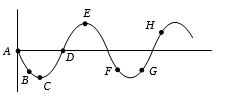
The diagram below shows the propagation of a wave. Which points are in the same phase?
A
$F$ and $G$
B
$C$ and $E$
C
$B$ and $G$
D
$B$ and $F$
Solution
(D) Two points are in the same phase if they have the same displacement from the equilibrium position and are moving in the same direction.
This occurs when the distance between the two points is an integer multiple of the wavelength,$\lambda$.
In the given wave diagram,points $B$ and $F$ are at the same vertical displacement from the equilibrium line and are both moving in the same direction (downwards).
The horizontal distance between $B$ and $F$ is exactly one wavelength,$\lambda$.
Therefore,points $B$ and $F$ are in the same phase.
This occurs when the distance between the two points is an integer multiple of the wavelength,$\lambda$.
In the given wave diagram,points $B$ and $F$ are at the same vertical displacement from the equilibrium line and are both moving in the same direction (downwards).
The horizontal distance between $B$ and $F$ is exactly one wavelength,$\lambda$.
Therefore,points $B$ and $F$ are in the same phase.
0 likesView Solution
8
PhysicsMediumMCQAIIMS · 1982
$A$ $2\,V$ battery,a $15\,\Omega$ resistor,and a potentiometer of $100\,cm$ length are all connected in series. If the resistance of the potentiometer wire is $5\,\Omega$,then the potential gradient of the potentiometer wire is ............... $V/cm$.
A
$0.005$
B
$0.05$
C
$0.02$
D
$0.2$
Solution
(A) The total resistance of the circuit is $R_{total} = R_{resistor} + R_{potentiometer} = 15\,\Omega + 5\,\Omega = 20\,\Omega$.
The current flowing through the circuit is $I = \frac{V}{R_{total}} = \frac{2\,V}{20\,\Omega} = 0.1\,A$.
The potential drop across the potentiometer wire is $V_{wire} = I \times R_{potentiometer} = 0.1\,A \times 5\,\Omega = 0.5\,V$.
The potential gradient $k$ is defined as the potential drop per unit length: $k = \frac{V_{wire}}{L} = \frac{0.5\,V}{100\,cm} = 0.005\,V/cm$.
The current flowing through the circuit is $I = \frac{V}{R_{total}} = \frac{2\,V}{20\,\Omega} = 0.1\,A$.
The potential drop across the potentiometer wire is $V_{wire} = I \times R_{potentiometer} = 0.1\,A \times 5\,\Omega = 0.5\,V$.
The potential gradient $k$ is defined as the potential drop per unit length: $k = \frac{V_{wire}}{L} = \frac{0.5\,V}{100\,cm} = 0.005\,V/cm$.
0 likesView Solution
9
PhysicsEasyMCQAIIMS · 1982
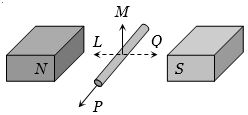
An electric potential difference will be induced between the ends of the conductor shown in the diagram,when the conductor moves in the direction
A
$P$
B
$Q$
C
$L$
D
$M$
Solution
(D) The motional electromotive force $(EMF)$ induced in a conductor moving in a magnetic field is given by the formula $\varepsilon = B l v \sin \theta$,where $B$ is the magnetic field,$l$ is the length of the conductor,$v$ is the velocity,and $\theta$ is the angle between the velocity vector and the magnetic field lines.
For an $EMF$ to be induced,the conductor must cut the magnetic field lines. In the given diagram,the magnetic field lines are directed from the North $(N)$ pole to the South $(S)$ pole (horizontally).
If the conductor moves in the direction $L$ or $Q$,it moves parallel to the magnetic field lines,so $\theta = 0^\circ$ or $180^\circ$,and $\sin \theta = 0$,resulting in no induced $EMF$.
If the conductor moves in the direction $P$,it moves parallel to its own length,which does not cut the magnetic field lines effectively to induce a potential difference across its ends.
If the conductor moves in the direction $M$ (perpendicular to the magnetic field lines),it cuts the magnetic field lines,resulting in the induction of an electric potential difference between its ends. Therefore,the correct direction is $M$.
For an $EMF$ to be induced,the conductor must cut the magnetic field lines. In the given diagram,the magnetic field lines are directed from the North $(N)$ pole to the South $(S)$ pole (horizontally).
If the conductor moves in the direction $L$ or $Q$,it moves parallel to the magnetic field lines,so $\theta = 0^\circ$ or $180^\circ$,and $\sin \theta = 0$,resulting in no induced $EMF$.
If the conductor moves in the direction $P$,it moves parallel to its own length,which does not cut the magnetic field lines effectively to induce a potential difference across its ends.
If the conductor moves in the direction $M$ (perpendicular to the magnetic field lines),it cuts the magnetic field lines,resulting in the induction of an electric potential difference between its ends. Therefore,the correct direction is $M$.
1 likesView Solution
10
PhysicsMediumMCQAIIMS · 1982
In the given reaction $_Z{X^A} \to _{Z+1}{Y^A} \to _{Z-1}{K^{A-4}} \to _{Z-1}{K^{A-4}}$,radioactive radiations are emitted in the sequence:
A
$\alpha, \beta, \gamma$
B
$\beta, \alpha, \gamma$
C
$\gamma, \alpha, \beta$
D
$\beta, \gamma, \alpha$
Solution
(B) The given reaction sequence is: $_Z{X^A} \to _{Z+1}{Y^A} \to _{Z-1}{K^{A-4}} \to _{Z-1}{K^{A-4}}$.
$1$. In the first step,$_Z{X^A} \to _{Z+1}{Y^A}$,the atomic number increases by $1$ while the mass number remains the same. This corresponds to the emission of a $\beta^-$-particle $(_{-1}e^0)$.
$2$. In the second step,$_{Z+1}{Y^A} \to _{Z-1}{K^{A-4}}$,the atomic number decreases by $2$ and the mass number decreases by $4$. This corresponds to the emission of an $\alpha$-particle $(_{2}He^4)$.
$3$. In the third step,$_{Z-1}{K^{A-4}} \to _{Z-1}{K^{A-4}}$,there is no change in atomic number or mass number,which indicates the emission of a $\gamma$-ray (electromagnetic radiation).
Therefore,the sequence of emissions is $\beta, \alpha, \gamma$.
$1$. In the first step,$_Z{X^A} \to _{Z+1}{Y^A}$,the atomic number increases by $1$ while the mass number remains the same. This corresponds to the emission of a $\beta^-$-particle $(_{-1}e^0)$.
$2$. In the second step,$_{Z+1}{Y^A} \to _{Z-1}{K^{A-4}}$,the atomic number decreases by $2$ and the mass number decreases by $4$. This corresponds to the emission of an $\alpha$-particle $(_{2}He^4)$.
$3$. In the third step,$_{Z-1}{K^{A-4}} \to _{Z-1}{K^{A-4}}$,there is no change in atomic number or mass number,which indicates the emission of a $\gamma$-ray (electromagnetic radiation).
Therefore,the sequence of emissions is $\beta, \alpha, \gamma$.
0 likesView Solution
11
PhysicsMediumMCQAIIMS · 1982
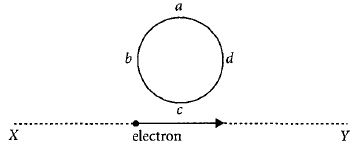
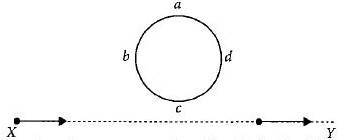
An electron moves on a straight line path $XY$ as shown. The $abcd$ is a coil adjacent to the path of the electron. What will be the direction of current,if any,induced in the coil?
A
No current induced
B
$abcd$
C
$adcb$
D
The current will reverse its direction as the electron goes past the coil.
Solution
(D) As the electron moves from $X$ to $Y$,it creates a magnetic field. According to the right-hand rule,the magnetic field lines pass through the coil $abcd$ in a direction perpendicular to the plane of the coil (into the page).
As the electron approaches the coil,the magnetic flux linked with the coil increases. According to Lenz's Law,the induced current will oppose this increase by creating a magnetic field in the opposite direction (out of the page),which corresponds to an anticlockwise direction $(adcb)$.
As the electron moves away from the coil,the magnetic flux linked with the coil decreases. The induced current will now oppose this decrease by creating a magnetic field in the same direction as the original field (into the page),which corresponds to a clockwise direction $(abcd)$.
Therefore,the current will reverse its direction as the electron goes past the coil.
As the electron approaches the coil,the magnetic flux linked with the coil increases. According to Lenz's Law,the induced current will oppose this increase by creating a magnetic field in the opposite direction (out of the page),which corresponds to an anticlockwise direction $(adcb)$.
As the electron moves away from the coil,the magnetic flux linked with the coil decreases. The induced current will now oppose this decrease by creating a magnetic field in the same direction as the original field (into the page),which corresponds to a clockwise direction $(abcd)$.
Therefore,the current will reverse its direction as the electron goes past the coil.
0 likesView Solution
12
PhysicsEasyMCQAIIMS · 1982
The graph which shows the variation of the de Broglie wavelength $(\lambda)$ of a particle and its associated momentum $(p)$ is
A
B
C
D
Solution
(C) According to the de Broglie hypothesis,the wavelength $(\lambda)$ associated with a particle of momentum $(p)$ is given by the relation: $\lambda = \frac{h}{p}$,where $h$ is Planck's constant.
This equation shows that $\lambda$ is inversely proportional to $p$ (i.e.,$\lambda \propto \frac{1}{p}$).
As the momentum $(p)$ increases,the de Broglie wavelength $(\lambda)$ decreases.
This relationship represents a rectangular hyperbola,which is correctly depicted in option $C$.
This equation shows that $\lambda$ is inversely proportional to $p$ (i.e.,$\lambda \propto \frac{1}{p}$).
As the momentum $(p)$ increases,the de Broglie wavelength $(\lambda)$ decreases.
This relationship represents a rectangular hyperbola,which is correctly depicted in option $C$.

0 likesView Solution
13
PhysicsMediumMCQAIIMS · 1982
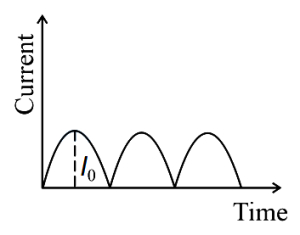
The output current versus time curve of a rectifier is shown in the figure. The average value of output current in this case is
A
$0$
B
$\frac{I_0}{2}$
C
$\frac{2 I_0}{\pi}$
D
$I_0$
Solution
(C) From the given figure,it is evident that the rectifier is a full-wave rectifier.
For a full-wave rectifier,the output current is given by $I = I_0 \sin(\omega t)$ for the first half-cycle and $I = I_0 \sin(\omega t)$ for the second half-cycle (due to rectification).
The average value of the current over one complete cycle $T$ is given by:
$I_{\text{avg}} = \frac{1}{T} \int_{0}^{T} I(t) dt$
For a full-wave rectifier,the period is $T/2$. The average value is calculated as:
$I_{\text{avg}} = \frac{1}{T/2} \int_{0}^{T/2} I_0 \sin(\omega t) dt$
$I_{\text{avg}} = \frac{2}{T} \cdot I_0 \left[ -\frac{\cos(\omega t)}{\omega} \right]_{0}^{T/2}$
Since $\omega = \frac{2\pi}{T}$,we have:
$I_{\text{avg}} = \frac{2 I_0}{T} \cdot \frac{T}{2\pi} [-\cos(\pi) + \cos(0)]$
$I_{\text{avg}} = \frac{I_0}{\pi} [1 + 1] = \frac{2 I_0}{\pi}$
For a full-wave rectifier,the output current is given by $I = I_0 \sin(\omega t)$ for the first half-cycle and $I = I_0 \sin(\omega t)$ for the second half-cycle (due to rectification).
The average value of the current over one complete cycle $T$ is given by:
$I_{\text{avg}} = \frac{1}{T} \int_{0}^{T} I(t) dt$
For a full-wave rectifier,the period is $T/2$. The average value is calculated as:
$I_{\text{avg}} = \frac{1}{T/2} \int_{0}^{T/2} I_0 \sin(\omega t) dt$
$I_{\text{avg}} = \frac{2}{T} \cdot I_0 \left[ -\frac{\cos(\omega t)}{\omega} \right]_{0}^{T/2}$
Since $\omega = \frac{2\pi}{T}$,we have:
$I_{\text{avg}} = \frac{2 I_0}{T} \cdot \frac{T}{2\pi} [-\cos(\pi) + \cos(0)]$
$I_{\text{avg}} = \frac{I_0}{\pi} [1 + 1] = \frac{2 I_0}{\pi}$
0 likesView Solution
Vedclass Products
For Students
Vedclass Test Series
Mock tests in real AIIMS style covering Physics with performance analysis. 5-day free trial.
Start Free TrialFor Teachers
Exam Paper Generator
Generate Set A/B/C/D Physics papers from 7.5L+ questions in 2 minutes. 3 chapters free.
Try FreeFor Institutes
Online Exam Module
Run live AIIMS mock exams with unlimited students, 360° analytics & white-label branding.
See DemoFrequently Asked Questions
How many Physics questions are in AIIMS 1982?
There are 13 Physics questions from the AIIMS 1982 paper on Vedclass, each with a detailed step-by-step solution in English.
Are AIIMS 1982 Physics solutions available in English?
Yes. All solutions on this page are in English. You can also switch to English or Hindi using the language buttons above the questions.
Can I practice AIIMS 1982 Physics as a timed test?
Yes. Use the Vedclass Test Series to attempt a full AIIMS mock test covering Physics with time limits and instant score analysis.
Can teachers create Physics papers from AIIMS previous year questions?
Yes. The Vedclass Exam Paper Generator lets teachers mix AIIMS Physics questions and generate Set A/B/C/D papers in minutes.
For Teachers & Institutes
Build a Custom Physics Paper
Pick AIIMS 1982 Physics questions, set difficulty, and generate Set A/B/C/D in 2 minutes.