
A English
Measurement of Area Questions in English
Competitive Exam Quantitative Aptitude · Mensuration · Measurement of Area
407+
Questions
English
Language
100%
With Solutions
Showing 50 of 407 questions in English
251
EasyMCQ
The area of a rectangular field is $27000 \, m^2$. The ratio of its length and breadth is $6:5$. The length and breadth of the field are respectively:
A
$180 \, m, 150 \, m$
B
$200 \, m, 150 \, m$
C
$180 \, m, 120 \, m$
D
$150 \, m, 100 \, m$
Solution
(A) Let the length of the field be $6x \, m$ and the breadth be $5x \, m$.
Given that the area of the rectangular field is $27000 \, m^2$.
Since the area of a rectangle is $\text{length} \times \text{breadth}$,we have:
$6x \times 5x = 27000$
$30x^2 = 27000$
$x^2 = \frac{27000}{30} = 900$
$x = \sqrt{900} = 30$
Therefore,the length is $6 \times 30 = 180 \, m$ and the breadth is $5 \times 30 = 150 \, m$.
Given that the area of the rectangular field is $27000 \, m^2$.
Since the area of a rectangle is $\text{length} \times \text{breadth}$,we have:
$6x \times 5x = 27000$
$30x^2 = 27000$
$x^2 = \frac{27000}{30} = 900$
$x = \sqrt{900} = 30$
Therefore,the length is $6 \times 30 = 180 \, m$ and the breadth is $5 \times 30 = 150 \, m$.
0 likes
View Solution252
EasyMCQ
The area of a sector of a circle of radius $5 \, cm$,formed by an arc of length $3.5 \, cm$,is ..... $cm^2$.
A
$35$
B
$17.5$
C
$8.75$
D
$55$
Solution
(C) The area of a sector of a circle can be calculated using the formula: $\text{Area} = \frac{1}{2} \times \text{arc length} \times \text{radius}$.
Given,$\text{arc length} = 3.5 \, cm$ and $\text{radius} = 5 \, cm$.
Substituting these values into the formula:
$\text{Area} = \frac{1}{2} \times 3.5 \times 5 \, cm^2$.
$\text{Area} = \frac{17.5}{2} \, cm^2$.
$\text{Area} = 8.75 \, cm^2$.
Given,$\text{arc length} = 3.5 \, cm$ and $\text{radius} = 5 \, cm$.
Substituting these values into the formula:
$\text{Area} = \frac{1}{2} \times 3.5 \times 5 \, cm^2$.
$\text{Area} = \frac{17.5}{2} \, cm^2$.
$\text{Area} = 8.75 \, cm^2$.
0 likes
View Solution253
MediumMCQ
The length of a plot is double its width. If a square piece of land of area $150 \, m^2$ occupies $\frac{1}{3}$ area of the plot,then what is the length of the plot? (in $m$)
A
$15$
B
$7.5$
C
$30$
D
$10$
Solution
(C) Let the width of the plot be $w \, m$. Then the length of the plot is $l = 2w \, m$.
Area of the plot $= l \times w = (2w) \times w = 2w^2 \, m^2$.
Given that a square piece of land of area $150 \, m^2$ occupies $\frac{1}{3}$ of the total area of the plot.
Therefore,$\frac{1}{3} \times (\text{Area of the plot}) = 150 \, m^2$.
Area of the plot $= 150 \times 3 = 450 \, m^2$.
Equating the two expressions for the area: $2w^2 = 450$.
$w^2 = 225$.
$w = \sqrt{225} = 15 \, m$.
The length of the plot is $l = 2w = 2 \times 15 = 30 \, m$.
Area of the plot $= l \times w = (2w) \times w = 2w^2 \, m^2$.
Given that a square piece of land of area $150 \, m^2$ occupies $\frac{1}{3}$ of the total area of the plot.
Therefore,$\frac{1}{3} \times (\text{Area of the plot}) = 150 \, m^2$.
Area of the plot $= 150 \times 3 = 450 \, m^2$.
Equating the two expressions for the area: $2w^2 = 450$.
$w^2 = 225$.
$w = \sqrt{225} = 15 \, m$.
The length of the plot is $l = 2w = 2 \times 15 = 30 \, m$.
0 likes
View Solution254
MediumMCQ
$A$ wire is in the form of a semi-circle of $7 \, cm$ radius. The length of the wire will be (in $cm$):
A
$25$
B
$36$
C
$5$
D
$69$
Solution
(B) The length of a wire bent into a semi-circle is equal to the perimeter of the semi-circle.
The perimeter of a semi-circle is given by the formula: $P = \pi r + 2r$,where $r$ is the radius.
Given $r = 7 \, cm$ and taking $\pi = \frac{22}{7}$:
$P = (\frac{22}{7} \times 7) + (2 \times 7)$
$P = 22 + 14$
$P = 36 \, cm$.
Therefore,the length of the wire is $36 \, cm$.
The perimeter of a semi-circle is given by the formula: $P = \pi r + 2r$,where $r$ is the radius.
Given $r = 7 \, cm$ and taking $\pi = \frac{22}{7}$:
$P = (\frac{22}{7} \times 7) + (2 \times 7)$
$P = 22 + 14$
$P = 36 \, cm$.
Therefore,the length of the wire is $36 \, cm$.
0 likes
View Solution255
MediumMCQ
$A$ circular road runs round a circular ground. If the difference between the circumferences of the outer circle and the inner circle is $66 \, m$,the width of the road is ....... $m$.
A
$21$
B
$10.5$
C
$7$
D
$5.25$
Solution
(B) Let the radius of the outer circle be $R$ and the radius of the inner circle be $r$.
The width of the road is the difference between the radii,which is $(R - r)$.
The circumference of the outer circle is $2 \pi R$ and the circumference of the inner circle is $2 \pi r$.
Given that the difference between the circumferences is $66 \, m$:
$2 \pi R - 2 \pi r = 66$
$2 \pi (R - r) = 66$
$2 \times \frac{22}{7} \times (R - r) = 66$
$(R - r) = 66 \times \frac{7}{22} \times \frac{1}{2}$
$(R - r) = 3 \times 7 \times \frac{1}{2} = \frac{21}{2} = 10.5 \, m$.
Thus,the width of the road is $10.5 \, m$.
The width of the road is the difference between the radii,which is $(R - r)$.
The circumference of the outer circle is $2 \pi R$ and the circumference of the inner circle is $2 \pi r$.
Given that the difference between the circumferences is $66 \, m$:
$2 \pi R - 2 \pi r = 66$
$2 \pi (R - r) = 66$
$2 \times \frac{22}{7} \times (R - r) = 66$
$(R - r) = 66 \times \frac{7}{22} \times \frac{1}{2}$
$(R - r) = 3 \times 7 \times \frac{1}{2} = \frac{21}{2} = 10.5 \, m$.
Thus,the width of the road is $10.5 \, m$.
0 likes
View Solution256
MediumMCQ
If the area of a square is $50$ $sq$ units,then the area of the circle drawn on its diagonal is
A
$25\, \pi$ $sq$ units
B
$50\, \pi$ $sq$ units
C
$100\, \pi$ $sq$ units
D
None of these
Solution
(A) Let the side of the square be $a$.
Given that the area of the square is $a^2 = 50$.
The diagonal of the square $d$ is given by $d = a\sqrt{2}$.
Substituting $a^2 = 50$,we get $a = \sqrt{50} = 5\sqrt{2}$.
Thus,the diagonal $d = (5\sqrt{2}) \times \sqrt{2} = 10$ units.
The circle is drawn on the diagonal as its diameter,so the diameter of the circle is $10$ units.
The radius $r$ of the circle is $d/2 = 10/2 = 5$ units.
The area of the circle is $\pi r^2 = \pi (5)^2 = 25\pi$ $sq$ units.
Given that the area of the square is $a^2 = 50$.
The diagonal of the square $d$ is given by $d = a\sqrt{2}$.
Substituting $a^2 = 50$,we get $a = \sqrt{50} = 5\sqrt{2}$.
Thus,the diagonal $d = (5\sqrt{2}) \times \sqrt{2} = 10$ units.
The circle is drawn on the diagonal as its diameter,so the diameter of the circle is $10$ units.
The radius $r$ of the circle is $d/2 = 10/2 = 5$ units.
The area of the circle is $\pi r^2 = \pi (5)^2 = 25\pi$ $sq$ units.
0 likes
View Solution257
EasyMCQ
$A$ rectangular sheet of cardboard is of $4 \, cm \times 2 \, cm$. If a circle of the greatest possible area is cut from it,then the area of the remaining portion is:
A
$(2-\pi) \, cm^{2}$
B
$(4-\pi) \, cm^{2}$
C
$(8-\pi) \, cm^{2}$
D
$(16-\pi) \, cm^{2}$
Solution
(C) The area of the rectangular sheet is given by $Area_{rect} = length \times width = 4 \, cm \times 2 \, cm = 8 \, cm^{2}$.
To cut a circle of the greatest possible area from a rectangle,the diameter of the circle must be equal to the smaller side of the rectangle.
Here,the smaller side is $2 \, cm$,so the diameter $d = 2 \, cm$,which means the radius $r = 1 \, cm$.
The area of this circle is $Area_{circle} = \pi r^{2} = \pi \times (1)^{2} = \pi \, cm^{2}$.
The area of the remaining portion is the difference between the area of the rectangle and the area of the circle.
$Area_{remaining} = Area_{rect} - Area_{circle} = 8 - \pi \, cm^{2}$.
To cut a circle of the greatest possible area from a rectangle,the diameter of the circle must be equal to the smaller side of the rectangle.
Here,the smaller side is $2 \, cm$,so the diameter $d = 2 \, cm$,which means the radius $r = 1 \, cm$.
The area of this circle is $Area_{circle} = \pi r^{2} = \pi \times (1)^{2} = \pi \, cm^{2}$.
The area of the remaining portion is the difference between the area of the rectangle and the area of the circle.
$Area_{remaining} = Area_{rect} - Area_{circle} = 8 - \pi \, cm^{2}$.
0 likes
View Solution258
EasyMCQ
What is the radius of a circle,to the nearest $cm$,whose area is equal to the sum of the areas of the three circles of radii $22\, cm$,$19\, cm$,and $8\, cm$ respectively? (in $cm$)
A
$17$
B
$30$
C
$29$
D
$19$
Solution
(B) Let the radius of the new circle be $R$. The area of the new circle is equal to the sum of the areas of the three given circles.
$\pi R^{2} = \pi(22)^{2} + \pi(19)^{2} + \pi(8)^{2}$
Dividing both sides by $\pi$,we get:
$R^{2} = 22^{2} + 19^{2} + 8^{2}$
$R^{2} = 484 + 361 + 64$
$R^{2} = 909$
$R = \sqrt{909} \approx 30.15$
Rounding to the nearest $cm$,we get $R = 30\, cm$.
$\pi R^{2} = \pi(22)^{2} + \pi(19)^{2} + \pi(8)^{2}$
Dividing both sides by $\pi$,we get:
$R^{2} = 22^{2} + 19^{2} + 8^{2}$
$R^{2} = 484 + 361 + 64$
$R^{2} = 909$
$R = \sqrt{909} \approx 30.15$
Rounding to the nearest $cm$,we get $R = 30\, cm$.
0 likes
View Solution259
MediumMCQ
The length of a rectangle is increased by $33.33 \%$. By what percent should the width be decreased to maintain the same area? (in $\%$)
A
$25$
B
$33.33$
C
$22.5$
D
None of these
Solution
(A) Let the original length be $l$ and the original width be $b$. The original area is $A = l \times b$.
The length is increased by $33.33 \%$,which is equivalent to an increase of $\frac{1}{3}$.
New length $l' = l + \frac{1}{3}l = \frac{4}{3}l$.
Let the new width be $b'$. To maintain the same area,$l \times b = l' \times b'$.
$l \times b = \frac{4}{3}l \times b'$.
$b' = \frac{3}{4}b = 0.75b$.
The reduction in width is $b - b' = b - 0.75b = 0.25b$.
Percentage decrease in width $= \frac{0.25b}{b} \times 100 \% = 25 \%$.
The length is increased by $33.33 \%$,which is equivalent to an increase of $\frac{1}{3}$.
New length $l' = l + \frac{1}{3}l = \frac{4}{3}l$.
Let the new width be $b'$. To maintain the same area,$l \times b = l' \times b'$.
$l \times b = \frac{4}{3}l \times b'$.
$b' = \frac{3}{4}b = 0.75b$.
The reduction in width is $b - b' = b - 0.75b = 0.25b$.
Percentage decrease in width $= \frac{0.25b}{b} \times 100 \% = 25 \%$.
0 likes
View Solution260
EasyMCQ
If the area of a square is equal to the area of a rectangle $6.4 \, m$ long and $2.5 \, m$ wide,then each side of the square measures (in $m$)
A
$8$
B
$5.4$
C
$3.8$
D
$4$
Solution
(D) The area of a rectangle is calculated as $\text{Length} \times \text{Width}$.
Given,$\text{Length} = 6.4 \, m$ and $\text{Width} = 2.5 \, m$.
$\text{Area of rectangle} = 6.4 \, m \times 2.5 \, m = 16 \, m^2$.
According to the problem,the area of the square is equal to the area of the rectangle.
Therefore,$\text{Area of square} = 16 \, m^2$.
Since the $\text{Area of a square} = \text{side}^2$,we have $\text{side}^2 = 16 \, m^2$.
Taking the square root of both sides,$\text{side} = \sqrt{16} \, m = 4 \, m$.
Thus,each side of the square measures $4 \, m$.
Given,$\text{Length} = 6.4 \, m$ and $\text{Width} = 2.5 \, m$.
$\text{Area of rectangle} = 6.4 \, m \times 2.5 \, m = 16 \, m^2$.
According to the problem,the area of the square is equal to the area of the rectangle.
Therefore,$\text{Area of square} = 16 \, m^2$.
Since the $\text{Area of a square} = \text{side}^2$,we have $\text{side}^2 = 16 \, m^2$.
Taking the square root of both sides,$\text{side} = \sqrt{16} \, m = 4 \, m$.
Thus,each side of the square measures $4 \, m$.
0 likes
View Solution261
EasyMCQ
The diameters of two concentric circles are $8\, cm$ and $10\, cm$. The area of the region between them is
A
$1\, \pi\, cm^2$
B
$3\, \pi\, cm^2$
C
$6\, \pi\, cm^2$
D
$9\, \pi\, cm^2$
Solution
(D) The diameter of the larger circle is $10\, cm$,so its radius $R = 10/2 = 5\, cm$.
The diameter of the smaller circle is $8\, cm$,so its radius $r = 8/2 = 4\, cm$.
The area of the region between the two concentric circles (annulus) is given by the formula: $\text{Area} = \pi R^2 - \pi r^2$.
Substituting the values: $\text{Area} = \pi(5)^2 - \pi(4)^2$.
$\text{Area} = 25\pi - 16\pi = 9\pi\, cm^2$.
The diameter of the smaller circle is $8\, cm$,so its radius $r = 8/2 = 4\, cm$.
The area of the region between the two concentric circles (annulus) is given by the formula: $\text{Area} = \pi R^2 - \pi r^2$.
Substituting the values: $\text{Area} = \pi(5)^2 - \pi(4)^2$.
$\text{Area} = 25\pi - 16\pi = 9\pi\, cm^2$.
0 likes
View Solution262
EasyMCQ
The length of a rectangular room is $4\, m.$ If it can be partitioned into two equal square rooms,what is the length of the partition in metres?
A
$1$
B
$2$
C
$4$
D
Data inadequate
Solution
(B) The length of the rectangular room is $4\, m.$
Since the room is partitioned into two equal square rooms,the length of the rectangle must be divided into two equal segments to form the sides of the squares.
Each square will have a side length of $4\, m / 2 = 2\, m.$
The partition is the line segment that divides the rectangle,which corresponds to the side of the square.
Therefore,the length of the partition is $2\, m.$
Since the room is partitioned into two equal square rooms,the length of the rectangle must be divided into two equal segments to form the sides of the squares.
Each square will have a side length of $4\, m / 2 = 2\, m.$
The partition is the line segment that divides the rectangle,which corresponds to the side of the square.
Therefore,the length of the partition is $2\, m.$
0 likes
View Solution263
MediumMCQ
$A$ rectangular carpet has an area of $120 \, m^{2}$ and a perimeter of $46 \, m$. The length of its diagonal is ...... $m$.
A
$15$
B
$16$
C
$17$
D
$20$
Solution
(C) Let the length be $a \, m$ and the breadth be $b \, m$.
The perimeter of a rectangle is given by $2(a + b) = 46 \, m$.
Therefore,$a + b = 23 \, m$.
The area of the rectangle is given by $a \times b = 120 \, m^{2}$.
The length of the diagonal $d$ is given by the formula $d = \sqrt{a^{2} + b^{2}}$.
Using the algebraic identity $(a + b)^{2} = a^{2} + b^{2} + 2ab$,we can write $a^{2} + b^{2} = (a + b)^{2} - 2ab$.
Substituting the known values: $a^{2} + b^{2} = (23)^{2} - 2(120) = 529 - 240 = 289$.
Thus,the diagonal $d = \sqrt{289} = 17 \, m$.
The perimeter of a rectangle is given by $2(a + b) = 46 \, m$.
Therefore,$a + b = 23 \, m$.
The area of the rectangle is given by $a \times b = 120 \, m^{2}$.
The length of the diagonal $d$ is given by the formula $d = \sqrt{a^{2} + b^{2}}$.
Using the algebraic identity $(a + b)^{2} = a^{2} + b^{2} + 2ab$,we can write $a^{2} + b^{2} = (a + b)^{2} - 2ab$.
Substituting the known values: $a^{2} + b^{2} = (23)^{2} - 2(120) = 529 - 240 = 289$.
Thus,the diagonal $d = \sqrt{289} = 17 \, m$.
0 likes
View Solution264
EasyMCQ
The side of a square is $22 \, m$. What is the radius of the circle whose circumference is equal to the perimeter of the square? (in $m$)
A
$28$
B
$3.5$
C
$14$
D
$7$
Solution
(C) The perimeter of a square is given by the formula $P = 4 \times \text{side}$.
Given the side is $22 \, m$,the perimeter $P = 4 \times 22 \, m = 88 \, m$.
Let the radius of the circle be $r$. The circumference of the circle is given by $C = 2 \pi r$.
According to the problem,the circumference of the circle is equal to the perimeter of the square,so $2 \pi r = 88 \, m$.
Using $\pi \approx \frac{22}{7}$,we have $2 \times \frac{22}{7} \times r = 88$.
$r = 88 \times \frac{7}{2 \times 22} = 88 \times \frac{7}{44} = 2 \times 7 = 14 \, m$.
Therefore,the radius of the circle is $14 \, m$.
Given the side is $22 \, m$,the perimeter $P = 4 \times 22 \, m = 88 \, m$.
Let the radius of the circle be $r$. The circumference of the circle is given by $C = 2 \pi r$.
According to the problem,the circumference of the circle is equal to the perimeter of the square,so $2 \pi r = 88 \, m$.
Using $\pi \approx \frac{22}{7}$,we have $2 \times \frac{22}{7} \times r = 88$.
$r = 88 \times \frac{7}{2 \times 22} = 88 \times \frac{7}{44} = 2 \times 7 = 14 \, m$.
Therefore,the radius of the circle is $14 \, m$.
0 likes
View Solution265
DifficultMCQ
$A$ piece of wire $132 \, cm$ long is bent successively in the shapes of an equilateral triangle,a square,a regular hexagon,and a circle. Then,which has the largest surface area?
A
Equilateral triangle
B
Square
C
Circle
D
Regular hexagon
Solution
(C) The perimeter of each shape is $P = 132 \, cm$.
$1$. For an equilateral triangle: $3a = 132 \implies a = 44 \, cm$. Area $= \frac{\sqrt{3}}{4} a^2 = \frac{\sqrt{3}}{4} \times 44^2 \approx 0.433 \times 1936 \approx 838.31 \, cm^2$.
$2$. For a square: $4a = 132 \implies a = 33 \, cm$. Area $= a^2 = 33^2 = 1089 \, cm^2$.
$3$. For a regular hexagon: $6a = 132 \implies a = 22 \, cm$. Area $= \frac{3\sqrt{3}}{2} a^2 = \frac{3\sqrt{3}}{2} \times 22^2 \approx 2.598 \times 484 \approx 1257.47 \, cm^2$.
$4$. For a circle: $2\pi r = 132 \implies r = \frac{132}{2 \times (22/7)} = 21 \, cm$. Area $= \pi r^2 = \frac{22}{7} \times 21^2 = 1386 \, cm^2$.
Comparing the areas: $838.31 < 1089 < 1257.47 < 1386$. Thus,the circle has the largest surface area.
$1$. For an equilateral triangle: $3a = 132 \implies a = 44 \, cm$. Area $= \frac{\sqrt{3}}{4} a^2 = \frac{\sqrt{3}}{4} \times 44^2 \approx 0.433 \times 1936 \approx 838.31 \, cm^2$.
$2$. For a square: $4a = 132 \implies a = 33 \, cm$. Area $= a^2 = 33^2 = 1089 \, cm^2$.
$3$. For a regular hexagon: $6a = 132 \implies a = 22 \, cm$. Area $= \frac{3\sqrt{3}}{2} a^2 = \frac{3\sqrt{3}}{2} \times 22^2 \approx 2.598 \times 484 \approx 1257.47 \, cm^2$.
$4$. For a circle: $2\pi r = 132 \implies r = \frac{132}{2 \times (22/7)} = 21 \, cm$. Area $= \pi r^2 = \frac{22}{7} \times 21^2 = 1386 \, cm^2$.
Comparing the areas: $838.31 < 1089 < 1257.47 < 1386$. Thus,the circle has the largest surface area.
0 likes
View Solution266
MediumMCQ
If the radius of one circle is $12$ times the radius of another,how many times does the area of the greater circle contain the area of the smaller circle?
A
$12$
B
$72$
C
$144$
D
$96$
Solution
(C) Let $r$ be the radius of the smaller circle.
Then,the radius of the larger circle is $R = 12r$.
The area of the smaller circle is $A_1 = \pi r^2$.
The area of the larger circle is $A_2 = \pi R^2 = \pi (12r)^2 = 144\pi r^2$.
To find how many times the area of the larger circle contains the area of the smaller circle,we calculate the ratio:
$\frac{A_2}{A_1} = \frac{144\pi r^2}{\pi r^2} = 144$.
Therefore,the area of the larger circle is $144$ times the area of the smaller circle.
Then,the radius of the larger circle is $R = 12r$.
The area of the smaller circle is $A_1 = \pi r^2$.
The area of the larger circle is $A_2 = \pi R^2 = \pi (12r)^2 = 144\pi r^2$.
To find how many times the area of the larger circle contains the area of the smaller circle,we calculate the ratio:
$\frac{A_2}{A_1} = \frac{144\pi r^2}{\pi r^2} = 144$.
Therefore,the area of the larger circle is $144$ times the area of the smaller circle.
0 likes
View Solution267
DifficultMCQ
If the circumference of a circle is equal to the perimeter of a square,what is the ratio of the area of the circle to the area of the square?
A
$22: 7$
B
$14: 11$
C
$11: 7$
D
$4: 1$
Solution
(B) Let $a$ be the side of the square and $r$ be the radius of the circle.
Given that the circumference of the circle is equal to the perimeter of the square:
$2 \pi r = 4a$
$r = \frac{4a}{2 \pi} = \frac{2a}{\pi}$
Now,the area of the circle is $A_c = \pi r^2$ and the area of the square is $A_s = a^2$.
The ratio of the area of the circle to the area of the square is:
$\frac{A_c}{A_s} = \frac{\pi r^2}{a^2} = \frac{\pi (\frac{2a}{\pi})^2}{a^2}$
$= \frac{\pi \cdot \frac{4a^2}{\pi^2}}{a^2} = \frac{4}{\pi}$
Substituting $\pi = \frac{22}{7}$:
$= \frac{4}{22/7} = \frac{4 \times 7}{22} = \frac{28}{22} = \frac{14}{11}$
Thus,the ratio is $14: 11$.
Given that the circumference of the circle is equal to the perimeter of the square:
$2 \pi r = 4a$
$r = \frac{4a}{2 \pi} = \frac{2a}{\pi}$
Now,the area of the circle is $A_c = \pi r^2$ and the area of the square is $A_s = a^2$.
The ratio of the area of the circle to the area of the square is:
$\frac{A_c}{A_s} = \frac{\pi r^2}{a^2} = \frac{\pi (\frac{2a}{\pi})^2}{a^2}$
$= \frac{\pi \cdot \frac{4a^2}{\pi^2}}{a^2} = \frac{4}{\pi}$
Substituting $\pi = \frac{22}{7}$:
$= \frac{4}{22/7} = \frac{4 \times 7}{22} = \frac{28}{22} = \frac{14}{11}$
Thus,the ratio is $14: 11$.
0 likes
View Solution268
MediumMCQ
The length of a rectangular plot of land is three times as much as its breadth. $A$ playground measuring $1200 \ ft^2$ occupies $\frac{1}{4}$ of the total area of the plot. What is the length of the plot in feet?
A
$40$
B
$360$
C
$120$
D
Data inadequate
Solution
(C) Let the breadth of the rectangular plot be $x \ ft$. Then,the length of the plot is $3x \ ft$.
The area of the plot is given by $\text{Length} \times \text{Breadth} = 3x \times x = 3x^2 \ ft^2$.
It is given that a playground of $1200 \ ft^2$ occupies $\frac{1}{4}$ of the total area of the plot.
Therefore,$\frac{1}{4} \times \text{Total Area} = 1200 \ ft^2$.
$\text{Total Area} = 1200 \times 4 = 4800 \ ft^2$.
Equating the two expressions for the area: $3x^2 = 4800$.
$x^2 = \frac{4800}{3} = 1600$.
$x = \sqrt{1600} = 40 \ ft$.
Since the length is $3x$,the length $= 3 \times 40 = 120 \ ft$.
The area of the plot is given by $\text{Length} \times \text{Breadth} = 3x \times x = 3x^2 \ ft^2$.
It is given that a playground of $1200 \ ft^2$ occupies $\frac{1}{4}$ of the total area of the plot.
Therefore,$\frac{1}{4} \times \text{Total Area} = 1200 \ ft^2$.
$\text{Total Area} = 1200 \times 4 = 4800 \ ft^2$.
Equating the two expressions for the area: $3x^2 = 4800$.
$x^2 = \frac{4800}{3} = 1600$.
$x = \sqrt{1600} = 40 \ ft$.
Since the length is $3x$,the length $= 3 \times 40 = 120 \ ft$.
0 likes
View Solution269
MediumMCQ
There are two squares $s_{1}$ and $s_{2}$. The ratio of their areas is $4:25$. If the side of $s_{1}$ is $6 \text{ cm}$,what is the side of $s_{2}$? (in $\text{cm}$)
A
$20$
B
$15$
C
$5$
D
$12$
Solution
(B) The area of a square is given by the formula $\text{Area} = \text{side}^2$.
Let the sides of squares $s_{1}$ and $s_{2}$ be $a_{1}$ and $a_{2}$ respectively.
The ratio of their areas is given as $\frac{a_{1}^2}{a_{2}^2} = \frac{4}{25}$.
Taking the square root of both sides,we get the ratio of their sides: $\frac{a_{1}}{a_{2}} = \sqrt{\frac{4}{25}} = \frac{2}{5}$.
Given that the side of $s_{1}$ $(a_{1})$ is $6 \text{ cm}$,we can set up the equation: $\frac{6}{a_{2}} = \frac{2}{5}$.
Solving for $a_{2}$: $a_{2} = \frac{6 \times 5}{2} = 3 \times 5 = 15 \text{ cm}$.
Therefore,the side of $s_{2}$ is $15 \text{ cm}$.
Let the sides of squares $s_{1}$ and $s_{2}$ be $a_{1}$ and $a_{2}$ respectively.
The ratio of their areas is given as $\frac{a_{1}^2}{a_{2}^2} = \frac{4}{25}$.
Taking the square root of both sides,we get the ratio of their sides: $\frac{a_{1}}{a_{2}} = \sqrt{\frac{4}{25}} = \frac{2}{5}$.
Given that the side of $s_{1}$ $(a_{1})$ is $6 \text{ cm}$,we can set up the equation: $\frac{6}{a_{2}} = \frac{2}{5}$.
Solving for $a_{2}$: $a_{2} = \frac{6 \times 5}{2} = 3 \times 5 = 15 \text{ cm}$.
Therefore,the side of $s_{2}$ is $15 \text{ cm}$.
0 likes
View Solution270
MediumMCQ
The radius of the wheel of a vehicle is $70\, cm$. The wheel makes $10$ revolutions in $5\, seconds$. The speed of the vehicle is......$km/h$.
A
$29.46$
B
$31.68$
C
$36.25$
D
$32.72$
Solution
(B) The circumference of the wheel is given by $C = 2 \pi r = 2 \times \frac{22}{7} \times 70\, cm = 440\, cm$.
The distance traveled in $10$ revolutions is $10 \times 440\, cm = 4400\, cm = 44\, m$.
The time taken is $5\, seconds$.
The speed in $m/s$ is $\text{Speed} = \frac{\text{Distance}}{\text{Time}} = \frac{44}{5}\, m/s = 8.8\, m/s$.
To convert the speed from $m/s$ to $km/h$,we multiply by $\frac{18}{5}$:
$\text{Speed} = 8.8 \times \frac{18}{5}\, km/h = 31.68\, km/h$.
The distance traveled in $10$ revolutions is $10 \times 440\, cm = 4400\, cm = 44\, m$.
The time taken is $5\, seconds$.
The speed in $m/s$ is $\text{Speed} = \frac{\text{Distance}}{\text{Time}} = \frac{44}{5}\, m/s = 8.8\, m/s$.
To convert the speed from $m/s$ to $km/h$,we multiply by $\frac{18}{5}$:
$\text{Speed} = 8.8 \times \frac{18}{5}\, km/h = 31.68\, km/h$.
0 likes
View Solution271
DifficultMCQ
$A$ rectangular carpet has an area of $60 \, m^{2}$. Its diagonal and longer side together equal $5$ times the shorter side. The length of the carpet is.........$m$
A
$5$
B
$13$
C
$14.5$
D
$12$
Solution
(D) Let the length of the carpet be $l$ and the breadth be $b$. Given,$l \times b = 60 \, m^{2}$.
By the Pythagorean theorem,the diagonal $d = \sqrt{l^{2} + b^{2}}$,so $d^{2} = l^{2} + b^{2}$.
According to the problem,$d + l = 5b$,which implies $d = 5b - l$.
Squaring both sides,$d^{2} = (5b - l)^{2} = 25b^{2} + l^{2} - 10bl$.
Substituting $d^{2} = l^{2} + b^{2}$,we get $l^{2} + b^{2} = 25b^{2} + l^{2} - 10bl$.
Simplifying,$b^{2} = 25b^{2} - 10(60)$,which gives $24b^{2} = 600$.
Thus,$b^{2} = 25$,so $b = 5 \, m$.
Since $l \times b = 60$,$l = 60 / 5 = 12 \, m$.
By the Pythagorean theorem,the diagonal $d = \sqrt{l^{2} + b^{2}}$,so $d^{2} = l^{2} + b^{2}$.
According to the problem,$d + l = 5b$,which implies $d = 5b - l$.
Squaring both sides,$d^{2} = (5b - l)^{2} = 25b^{2} + l^{2} - 10bl$.
Substituting $d^{2} = l^{2} + b^{2}$,we get $l^{2} + b^{2} = 25b^{2} + l^{2} - 10bl$.
Simplifying,$b^{2} = 25b^{2} - 10(60)$,which gives $24b^{2} = 600$.
Thus,$b^{2} = 25$,so $b = 5 \, m$.
Since $l \times b = 60$,$l = 60 / 5 = 12 \, m$.
0 likes
View Solution272
DifficultMCQ
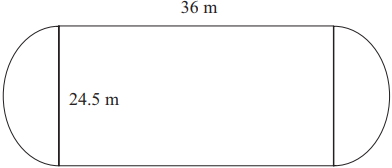
$A$ playground has the shape of a rectangle with two semi-circles on its smaller sides as diameters,added outside. If the sides of the rectangle are $36 \, m$ and $24.5 \, m$,then the area of the playground is ......... $m^2$ (use $\pi = \frac{22}{7}$).
A
$2259.529$
B
$1353.625$
C
$1139.523$
D
None of these
Solution
(B) The playground consists of a rectangle and two semi-circles on its smaller sides.
Length of the rectangle $(l)$ $= 36 \, m$.
Width of the rectangle $(b)$ $= 24.5 \, m$.
Diameter of each semi-circle $= 24.5 \, m$.
Radius of each semi-circle $(r)$ $= \frac{24.5}{2} = 12.25 \, m$.
Area of the playground $=$ Area of the rectangle $+$ Area of two semi-circles
Area of the playground $= (l \times b) + \pi r^2$
Area of the playground $= (36 \times 24.5) + \left( \frac{22}{7} \times 12.25 \times 12.25 \right)$
Area of the playground $= 882 + \left( \frac{22}{7} \times 150.0625 \right)$
Area of the playground $= 882 + 471.625 = 1353.625 \, m^2$.
Length of the rectangle $(l)$ $= 36 \, m$.
Width of the rectangle $(b)$ $= 24.5 \, m$.
Diameter of each semi-circle $= 24.5 \, m$.
Radius of each semi-circle $(r)$ $= \frac{24.5}{2} = 12.25 \, m$.
Area of the playground $=$ Area of the rectangle $+$ Area of two semi-circles
Area of the playground $= (l \times b) + \pi r^2$
Area of the playground $= (36 \times 24.5) + \left( \frac{22}{7} \times 12.25 \times 12.25 \right)$
Area of the playground $= 882 + \left( \frac{22}{7} \times 150.0625 \right)$
Area of the playground $= 882 + 471.625 = 1353.625 \, m^2$.
0 likes
View Solution273
MediumMCQ
$A$ man runs around a circle of $50\, m$ radius at a speed of $12\, km/h$. Find the time taken by him for going around it ten times (in $minutes$).
A
$10$
B
$12.5$
C
$15.7$
D
None of these
Solution
(C) The radius of the circle is $r = 50\, m$.
The circumference of the circle is $C = 2 \pi r = 2 \times 3.14 \times 50 = 314\, m$.
The total distance covered for $10$ rounds is $D = 10 \times C = 10 \times 314 = 3140\, m$.
The speed of the man is $v = 12\, km/h$. Converting this to $m/s$:
$v = 12 \times \frac{5}{18} = \frac{60}{18} = \frac{10}{3}\, m/s$.
The time taken in seconds is $t = \frac{D}{v} = \frac{3140}{10/3} = 3140 \times \frac{3}{10} = 314 \times 3 = 942\, s$.
To convert the time into minutes, divide by $60$:
$t = \frac{942}{60} = 15.7\, \text{minutes}$.
The circumference of the circle is $C = 2 \pi r = 2 \times 3.14 \times 50 = 314\, m$.
The total distance covered for $10$ rounds is $D = 10 \times C = 10 \times 314 = 3140\, m$.
The speed of the man is $v = 12\, km/h$. Converting this to $m/s$:
$v = 12 \times \frac{5}{18} = \frac{60}{18} = \frac{10}{3}\, m/s$.
The time taken in seconds is $t = \frac{D}{v} = \frac{3140}{10/3} = 3140 \times \frac{3}{10} = 314 \times 3 = 942\, s$.
To convert the time into minutes, divide by $60$:
$t = \frac{942}{60} = 15.7\, \text{minutes}$.
0 likes
View Solution274
MediumMCQ
$A$ room $5\, m \times 8\, m$ is to be carpeted leaving a margin of $10\, cm$ from each wall. If the cost of the carpet is ₹ $18$ per $m^2$,then the cost of carpeting the room will be (in $Rs.$)
A
$702.60$
B
$691.80$
C
$682.46$
D
$673.92$
Solution
(D) The dimensions of the room are $5\, m$ and $8\, m$.
$A$ margin of $10\, cm$ $(0.1\, m)$ is left from each of the four walls.
Therefore,the length of the carpeted area $= 8\, m - (0.1\, m + 0.1\, m) = 8 - 0.2 = 7.8\, m$.
The width of the carpeted area $= 5\, m - (0.1\, m + 0.1\, m) = 5 - 0.2 = 4.8\, m$.
Area to be carpeted $= 7.8\, m \times 4.8\, m = 37.44\, m^2$.
Total cost of carpeting $= 37.44\, m^2 \times ₹ 18/m^2 = ₹ 673.92$.
$A$ margin of $10\, cm$ $(0.1\, m)$ is left from each of the four walls.
Therefore,the length of the carpeted area $= 8\, m - (0.1\, m + 0.1\, m) = 8 - 0.2 = 7.8\, m$.
The width of the carpeted area $= 5\, m - (0.1\, m + 0.1\, m) = 5 - 0.2 = 4.8\, m$.
Area to be carpeted $= 7.8\, m \times 4.8\, m = 37.44\, m^2$.
Total cost of carpeting $= 37.44\, m^2 \times ₹ 18/m^2 = ₹ 673.92$.
0 likes
View Solution275
MediumMCQ
The area of a big rectangle is equal to the area of a small rectangle. If the length of the big rectangle is equal to the length of the small rectangle and the width of the big rectangle is $2 \ m$,what is the width of the small rectangle?
A
$1 \ m$
B
$2 \ m$
C
$4 \ m$
D
Cannot be determined
Solution
(B) Let the length of the big rectangle be $L$ and the width be $W_1 = 2 \ m$.
Area of the big rectangle $= L \times W_1 = L \times 2 = 2L \ m^2$.
Let the length of the small rectangle be $L$ (as given,lengths are equal) and the width be $W_2$.
Area of the small rectangle $= L \times W_2$.
According to the problem,the area of the big rectangle is equal to the area of the small rectangle.
Therefore,$2L = L \times W_2$.
Dividing both sides by $L$ (assuming $L \neq 0$),we get $W_2 = 2 \ m$.
Thus,the width of the small rectangle is $2 \ m$.
Area of the big rectangle $= L \times W_1 = L \times 2 = 2L \ m^2$.
Let the length of the small rectangle be $L$ (as given,lengths are equal) and the width be $W_2$.
Area of the small rectangle $= L \times W_2$.
According to the problem,the area of the big rectangle is equal to the area of the small rectangle.
Therefore,$2L = L \times W_2$.
Dividing both sides by $L$ (assuming $L \neq 0$),we get $W_2 = 2 \ m$.
Thus,the width of the small rectangle is $2 \ m$.
0 likes
View Solution276
MediumMCQ
If the radius of a circle is reduced by $40 \%$,then its circumference is reduced by (in $\%$).
A
$60$
B
$40$
C
$35$
D
$45$
Solution
(B) Let the original radius of the circle be $r$.
The original circumference $C_1 = 2 \pi r$.
If the radius is reduced by $40 \%$,the new radius $r' = r - 0.40r = 0.60r$.
The new circumference $C_2 = 2 \pi (0.60r) = 1.2 \pi r$.
The reduction in circumference is $C_1 - C_2 = 2 \pi r - 1.2 \pi r = 0.8 \pi r$.
The percentage reduction in circumference is given by $\frac{C_1 - C_2}{C_1} \times 100$.
Percentage reduction $= \frac{0.8 \pi r}{2 \pi r} \times 100 = 0.4 \times 100 = 40 \%$.
The original circumference $C_1 = 2 \pi r$.
If the radius is reduced by $40 \%$,the new radius $r' = r - 0.40r = 0.60r$.
The new circumference $C_2 = 2 \pi (0.60r) = 1.2 \pi r$.
The reduction in circumference is $C_1 - C_2 = 2 \pi r - 1.2 \pi r = 0.8 \pi r$.
The percentage reduction in circumference is given by $\frac{C_1 - C_2}{C_1} \times 100$.
Percentage reduction $= \frac{0.8 \pi r}{2 \pi r} \times 100 = 0.4 \times 100 = 40 \%$.
0 likes
View Solution277
MediumMCQ
$A$ figure consists of a square of side '$a$' $m$ with semi-circles drawn on the outside of the square. The area (in $m^{2}$) of the figure so formed will be
A
$a^{2}$
B
$a^{2} + 2\pi a^{2}$
C
$4\pi a^{2}$
D
$a^{2} + \frac{\pi a^{2}}{2}$
Solution
(D) The total area is the sum of the area of the square and the areas of the four semi-circles.
Area of the square $= a^{2}$.
Each side of the square acts as the diameter of a semi-circle,so the radius $r = \frac{a}{2}$.
Area of one semi-circle $= \frac{1}{2} \pi r^{2} = \frac{1}{2} \pi (\frac{a}{2})^{2} = \frac{\pi a^{2}}{8}$.
Since there are four such semi-circles,the total area of the four semi-circles $= 4 \times \frac{\pi a^{2}}{8} = \frac{\pi a^{2}}{2}$.
Therefore,the total area of the figure $= a^{2} + \frac{\pi a^{2}}{2}$.
Area of the square $= a^{2}$.
Each side of the square acts as the diameter of a semi-circle,so the radius $r = \frac{a}{2}$.
Area of one semi-circle $= \frac{1}{2} \pi r^{2} = \frac{1}{2} \pi (\frac{a}{2})^{2} = \frac{\pi a^{2}}{8}$.
Since there are four such semi-circles,the total area of the four semi-circles $= 4 \times \frac{\pi a^{2}}{8} = \frac{\pi a^{2}}{2}$.
Therefore,the total area of the figure $= a^{2} + \frac{\pi a^{2}}{2}$.
0 likes
View Solution278
EasyMCQ
The area of a square field is $6050\, m^2$. How much time will it take to reach from one of its corners to the opposite corner at the rate of $10\, m$ in every $30$ seconds?
A
$5 \frac{1}{2}$ minutes
B
$11$ minutes
C
$22$ minutes
D
$110$ minutes
Solution
(A) The area of the square field is $6050\, m^2$. Let the side of the square be $a$. Then $a^2 = 6050$.
The diagonal of a square is given by $d = a\sqrt{2}$.
Thus,$d^2 = 2a^2 = 2 \times 6050 = 12100\, m^2$.
Therefore,the length of the diagonal $d = \sqrt{12100} = 110\, m$.
The speed is given as $10\, m$ per $30$ seconds,which is $10\, m$ per $0.5$ minutes.
Time taken = $\frac{\text{Distance}}{\text{Speed}} = \frac{110\, m}{10\, m / 0.5\, \text{min}} = 11 \times 0.5 = 5.5$ minutes.
This is equal to $5 \frac{1}{2}$ minutes.
The diagonal of a square is given by $d = a\sqrt{2}$.
Thus,$d^2 = 2a^2 = 2 \times 6050 = 12100\, m^2$.
Therefore,the length of the diagonal $d = \sqrt{12100} = 110\, m$.
The speed is given as $10\, m$ per $30$ seconds,which is $10\, m$ per $0.5$ minutes.
Time taken = $\frac{\text{Distance}}{\text{Speed}} = \frac{110\, m}{10\, m / 0.5\, \text{min}} = 11 \times 0.5 = 5.5$ minutes.
This is equal to $5 \frac{1}{2}$ minutes.
0 likes
View Solution279
EasyMCQ
If a regular hexagon is inscribed in a circle of radius $r,$ then its perimeter is........$r$.
A
$3$
B
$6$
C
$9$
D
$12$
Solution
(B) regular hexagon inscribed in a circle of radius $r$ consists of $6$ equilateral triangles,each with a side length equal to the radius $r$ of the circle.
Therefore,the length of each side of the regular hexagon is $r$.
The perimeter of a regular hexagon is the sum of the lengths of its $6$ sides.
Perimeter $= 6 \times r = 6r$.
Thus,the perimeter is $6r$.
Therefore,the length of each side of the regular hexagon is $r$.
The perimeter of a regular hexagon is the sum of the lengths of its $6$ sides.
Perimeter $= 6 \times r = 6r$.
Thus,the perimeter is $6r$.
0 likes
View Solution280
MediumMCQ
$2$ poles of heights $15\, m$ and $30\, m$ stand upright on a playground. If their feet are $36\, m$ apart,find the distance between their tops in meters.
A
$36$
B
$39$
C
$15$
D
None of these
Solution
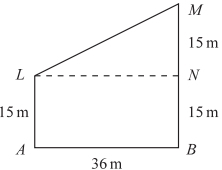
(B) Let $AL$ and $BM$ be the two poles with heights $15\, m$ and $30\, m$ respectively,standing on the ground $AB = 36\, m$.
Draw a line $LN$ parallel to $AB$ such that $LN = AB = 36\, m$ and $N$ lies on $BM$.
Then,$BN = AL = 15\, m$.
Therefore,$MN = BM - BN = 30\, m - 15\, m = 15\, m$.
In the right-angled triangle $\triangle LNM$,by the Pythagorean theorem:
$LM^2 = LN^2 + MN^2$
$LM^2 = 36^2 + 15^2$
$LM^2 = 1296 + 225 = 1521$
$LM = \sqrt{1521} = 39\, m$.
Thus,the distance between their tops is $39\, m$.
Draw a line $LN$ parallel to $AB$ such that $LN = AB = 36\, m$ and $N$ lies on $BM$.
Then,$BN = AL = 15\, m$.
Therefore,$MN = BM - BN = 30\, m - 15\, m = 15\, m$.
In the right-angled triangle $\triangle LNM$,by the Pythagorean theorem:
$LM^2 = LN^2 + MN^2$
$LM^2 = 36^2 + 15^2$
$LM^2 = 1296 + 225 = 1521$
$LM = \sqrt{1521} = 39\, m$.
Thus,the distance between their tops is $39\, m$.
0 likes
View Solution281
MediumMCQ
The length of a rectangular hall is $\frac{4}{3}$ of its width. If the area of the hall is $300 \, m^2$,what is the difference between the length and the breadth? (in $m$)
A
$15$
B
$20$
C
$3$
D
$5$
Solution
(D) Let the breadth of the rectangular hall be $x \, m$.
According to the problem,the length is $\frac{4}{3}$ of its width,so length $= \frac{4x}{3} \, m$.
The area of a rectangle is given by $\text{length} \times \text{breadth} = \text{Area}$.
Substituting the values: $\frac{4x}{3} \times x = 300$.
$\frac{4x^2}{3} = 300$.
$x^2 = 300 \times \frac{3}{4} = 75 \times 3 = 225$.
$x = \sqrt{225} = 15 \, m$.
So,the breadth is $15 \, m$.
The length is $\frac{4}{3} \times 15 = 20 \, m$.
The difference between the length and the breadth is $20 \, m - 15 \, m = 5 \, m$.
According to the problem,the length is $\frac{4}{3}$ of its width,so length $= \frac{4x}{3} \, m$.
The area of a rectangle is given by $\text{length} \times \text{breadth} = \text{Area}$.
Substituting the values: $\frac{4x}{3} \times x = 300$.
$\frac{4x^2}{3} = 300$.
$x^2 = 300 \times \frac{3}{4} = 75 \times 3 = 225$.
$x = \sqrt{225} = 15 \, m$.
So,the breadth is $15 \, m$.
The length is $\frac{4}{3} \times 15 = 20 \, m$.
The difference between the length and the breadth is $20 \, m - 15 \, m = 5 \, m$.
0 likes
View Solution282
DifficultMCQ
Each side of an equilateral triangle is increased by $1.5 \%$. The percentage increase in its area is......$\%$
A
$1.5$
B
$3$
C
$3.0225$
D
$4.5$
Solution
(C) Let the original side of the equilateral triangle be $a$.
The original area $A = \frac{\sqrt{3}}{4} a^2$.
The new side length $a' = a + 1.5\% \text{ of } a = a(1 + 0.015) = 1.015a$.
The new area $A' = \frac{\sqrt{3}}{4} (a')^2 = \frac{\sqrt{3}}{4} (1.015a)^2 = \frac{\sqrt{3}}{4} a^2 (1.015)^2$.
Since $A' = A \times (1.015)^2$,we calculate $(1.015)^2 = 1.030225$.
So,$A' = 1.030225 A$.
The percentage increase in area $= \frac{A' - A}{A} \times 100 = (1.030225 - 1) \times 100 = 0.030225 \times 100 = 3.0225 \%.$
The original area $A = \frac{\sqrt{3}}{4} a^2$.
The new side length $a' = a + 1.5\% \text{ of } a = a(1 + 0.015) = 1.015a$.
The new area $A' = \frac{\sqrt{3}}{4} (a')^2 = \frac{\sqrt{3}}{4} (1.015a)^2 = \frac{\sqrt{3}}{4} a^2 (1.015)^2$.
Since $A' = A \times (1.015)^2$,we calculate $(1.015)^2 = 1.030225$.
So,$A' = 1.030225 A$.
The percentage increase in area $= \frac{A' - A}{A} \times 100 = (1.030225 - 1) \times 100 = 0.030225 \times 100 = 3.0225 \%.$
0 likes
View Solution283
MediumMCQ
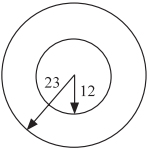
$A$ rope,by which a horse is tied,is increased from $12 \ m$ to $23 \ m$. How much additional ground will it be able to graze? (in $m^2$)
A
$1315$
B
$765$
C
$1210$
D
$1012$
Solution
(C) The area grazed by the horse is the area of a circle with the rope length as the radius.
Initial radius $r = 12 \ m$.
Final radius $R = 23 \ m$.
The additional area grazed is the area of the annulus (the region between two concentric circles) given by $\pi R^2 - \pi r^2 = \pi(R^2 - r^2) = \pi(R+r)(R-r)$.
Using $\pi = \frac{22}{7}$:
Additional area $= \frac{22}{7} \times (23 + 12) \times (23 - 12) \ m^2$
$= \frac{22}{7} \times 35 \times 11 \ m^2$
$= 22 \times 5 \times 11 \ m^2$
$= 110 \times 11 \ m^2$
$= 1210 \ m^2$.
Initial radius $r = 12 \ m$.
Final radius $R = 23 \ m$.
The additional area grazed is the area of the annulus (the region between two concentric circles) given by $\pi R^2 - \pi r^2 = \pi(R^2 - r^2) = \pi(R+r)(R-r)$.
Using $\pi = \frac{22}{7}$:
Additional area $= \frac{22}{7} \times (23 + 12) \times (23 - 12) \ m^2$
$= \frac{22}{7} \times 35 \times 11 \ m^2$
$= 22 \times 5 \times 11 \ m^2$
$= 110 \times 11 \ m^2$
$= 1210 \ m^2$.
0 likes
View Solution284
DifficultMCQ
If a diagonal of a square is doubled,how does the area of the square change?
A
Becomes $4$-fold
B
Becomes $3$-fold
C
Becomes $2$-fold
D
None of these
Solution
(A) Let the original diagonal of the square be $d$.
The area of a square in terms of its diagonal is given by the formula: $\text{Area} = \frac{1}{2} d^2$.
Original area $A_1 = \frac{1}{2} d^2$.
If the diagonal is doubled,the new diagonal $d' = 2d$.
New area $A_2 = \frac{1}{2} (d')^2 = \frac{1}{2} (2d)^2 = \frac{1}{2} (4d^2) = 2d^2$.
Comparing the new area with the original area:
$A_2 = 4 \times (\frac{1}{2} d^2) = 4 A_1$.
Therefore,the area of the square becomes $4$-fold.
The area of a square in terms of its diagonal is given by the formula: $\text{Area} = \frac{1}{2} d^2$.
Original area $A_1 = \frac{1}{2} d^2$.
If the diagonal is doubled,the new diagonal $d' = 2d$.
New area $A_2 = \frac{1}{2} (d')^2 = \frac{1}{2} (2d)^2 = \frac{1}{2} (4d^2) = 2d^2$.
Comparing the new area with the original area:
$A_2 = 4 \times (\frac{1}{2} d^2) = 4 A_1$.
Therefore,the area of the square becomes $4$-fold.
0 likes
View Solution285
MediumMCQ
If the sides of a rectangle are increased by $20 \%$,the percentage increase in its perimeter is
A
$80$
B
$40$
C
$20$
D
None of these
Solution
(C) Let the length of the rectangle be $L$ and its width be $B$. The original perimeter is $P_1 = 2(L + B)$.
When the sides are increased by $20 \%$,the new length becomes $L' = L + 0.2L = 1.2L$ and the new width becomes $B' = B + 0.2B = 1.2B$.
The new perimeter is $P_2 = 2(L' + B') = 2(1.2L + 1.2B)$.
Simplifying this,we get $P_2 = 2 \times 1.2(L + B) = 2.4(L + B)$.
The increase in perimeter is $\Delta P = P_2 - P_1 = 2.4(L + B) - 2(L + B) = 0.4(L + B)$.
The percentage increase in perimeter is $\frac{\Delta P}{P_1} \times 100 = \frac{0.4(L + B)}{2(L + B)} \times 100 = 0.2 \times 100 = 20 \%$.
When the sides are increased by $20 \%$,the new length becomes $L' = L + 0.2L = 1.2L$ and the new width becomes $B' = B + 0.2B = 1.2B$.
The new perimeter is $P_2 = 2(L' + B') = 2(1.2L + 1.2B)$.
Simplifying this,we get $P_2 = 2 \times 1.2(L + B) = 2.4(L + B)$.
The increase in perimeter is $\Delta P = P_2 - P_1 = 2.4(L + B) - 2(L + B) = 0.4(L + B)$.
The percentage increase in perimeter is $\frac{\Delta P}{P_1} \times 100 = \frac{0.4(L + B)}{2(L + B)} \times 100 = 0.2 \times 100 = 20 \%$.
0 likes
View Solution286
DifficultMCQ
$A$ circular road runs around a circular garden. If the difference between the circumference of the outer circle and the inner circle is $44\, m$,then find the width of the road in $m$.
A
$4$
B
$7$
C
$3.5$
D
$7.5$
Solution
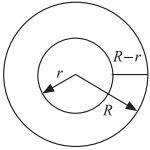
(B) Let the radius of the outer circle be $R$ and the radius of the inner circle be $r$.
The width of the road is given by $(R - r)$.
The circumference of the outer circle is $2 \pi R$ and the circumference of the inner circle is $2 \pi r$.
Given that the difference between the circumferences is $44\, m$:
$2 \pi R - 2 \pi r = 44$
$2 \pi (R - r) = 44$
$R - r = \frac{44}{2 \pi}$
$R - r = \frac{44}{2 \times (22/7)}$
$R - r = \frac{44 \times 7}{44} = 7\, m$.
Thus,the width of the road is $7\, m$.
The width of the road is given by $(R - r)$.
The circumference of the outer circle is $2 \pi R$ and the circumference of the inner circle is $2 \pi r$.
Given that the difference between the circumferences is $44\, m$:
$2 \pi R - 2 \pi r = 44$
$2 \pi (R - r) = 44$
$R - r = \frac{44}{2 \pi}$
$R - r = \frac{44}{2 \times (22/7)}$
$R - r = \frac{44 \times 7}{44} = 7\, m$.
Thus,the width of the road is $7\, m$.
0 likes
View Solution287
DifficultMCQ
The length of a rectangular field is double its width. Inside the field,there is a square-shaped pond $8 \, m$ long. If the area of the pond is $\frac{1}{8}$ of the area of the field,what is the length of the field? (in $m$)
A
$32$
B
$64$
C
$16$
D
$20$
Solution
(A) The area of the square-shaped pond is given by $side^2 = 8 \, m \times 8 \, m = 64 \, m^2$.
Given that the area of the pond is $\frac{1}{8}$ of the area of the field,the area of the field is $8 \times 64 \, m^2 = 512 \, m^2$.
Let the length of the rectangular field be $L$ and its width be $W$.
According to the problem,$L = 2W$,which implies $W = \frac{L}{2}$.
The area of the rectangular field is $L \times W = L \times \frac{L}{2} = \frac{L^2}{2}$.
Equating this to the calculated area: $\frac{L^2}{2} = 512$.
$L^2 = 512 \times 2 = 1024$.
$L = \sqrt{1024} = 32 \, m$.
Given that the area of the pond is $\frac{1}{8}$ of the area of the field,the area of the field is $8 \times 64 \, m^2 = 512 \, m^2$.
Let the length of the rectangular field be $L$ and its width be $W$.
According to the problem,$L = 2W$,which implies $W = \frac{L}{2}$.
The area of the rectangular field is $L \times W = L \times \frac{L}{2} = \frac{L^2}{2}$.
Equating this to the calculated area: $\frac{L^2}{2} = 512$.
$L^2 = 512 \times 2 = 1024$.
$L = \sqrt{1024} = 32 \, m$.
0 likes
View Solution288
EasyMCQ
$A$ circular disc of area $0.49 \pi \, m^2$ rolls down a length of $1.76 \, km$. The number of revolutions it makes is:
A
$300$
B
$400$
C
$600$
D
$4000$
Solution
(B) The area of the circular disc is given by $A = \pi r^2 = 0.49 \pi \, m^2$.
By equating the two,we get $r^2 = 0.49$,which implies $r = 0.7 \, m$.
The circumference of the disc is $C = 2 \pi r = 2 \times \frac{22}{7} \times 0.7 = 4.4 \, m$.
The total distance covered is $1.76 \, km = 1760 \, m$.
The number of revolutions is given by the ratio of the total distance to the circumference: $\text{Number of revolutions} = \frac{1760}{4.4} = 400$.
By equating the two,we get $r^2 = 0.49$,which implies $r = 0.7 \, m$.
The circumference of the disc is $C = 2 \pi r = 2 \times \frac{22}{7} \times 0.7 = 4.4 \, m$.
The total distance covered is $1.76 \, km = 1760 \, m$.
The number of revolutions is given by the ratio of the total distance to the circumference: $\text{Number of revolutions} = \frac{1760}{4.4} = 400$.
0 likes
View Solution289
MediumMCQ
If the area of a triangle whose base is $6\, cm$ is equal to the area of a circle of radius $6\, cm$,then find the height of this triangle (in $cm$).
A
$10$
B
$22$
C
$12\pi$
D
$24\pi$
Solution
(C) The radius of the circle is $r = 6\, cm$.
The area of the circle is given by the formula $A = \pi r^2$.
$A = \pi \times (6)^2 = 36\pi\, cm^2$.
Let the height of the triangle be $h\, cm$ and the base be $b = 6\, cm$.
The area of the triangle is given by $\frac{1}{2} \times \text{base} \times \text{height}$.
According to the problem,the area of the triangle is equal to the area of the circle:
$\frac{1}{2} \times 6 \times h = 36\pi$.
$3 \times h = 36\pi$.
$h = \frac{36\pi}{3} = 12\pi\, cm$.
The area of the circle is given by the formula $A = \pi r^2$.
$A = \pi \times (6)^2 = 36\pi\, cm^2$.
Let the height of the triangle be $h\, cm$ and the base be $b = 6\, cm$.
The area of the triangle is given by $\frac{1}{2} \times \text{base} \times \text{height}$.
According to the problem,the area of the triangle is equal to the area of the circle:
$\frac{1}{2} \times 6 \times h = 36\pi$.
$3 \times h = 36\pi$.
$h = \frac{36\pi}{3} = 12\pi\, cm$.
0 likes
View Solution290
MediumMCQ
The length of a ladder exactly equals the height of a wall. If the ladder is placed on a $2$-feet tall stool placed $10$ feet away from the wall,its tip just touches the top of the wall. The height of the wall in feet is
A
$15$
B
$26$
C
$28$
D
$32$
Solution
(B) Let the height of the wall be $h$ feet. The length of the ladder is also $h$ feet.
When the ladder is placed on a $2$-feet tall stool at a distance of $10$ feet from the wall,the vertical height covered by the ladder against the wall is $(h - 2)$ feet.
This forms a right-angled triangle where the base is $10$ feet,the perpendicular height is $(h - 2)$ feet,and the hypotenuse (the ladder) is $h$ feet.
According to the Pythagorean theorem: $h^2 = 10^2 + (h - 2)^2$.
$h^2 = 100 + (h^2 - 4h + 4)$.
$h^2 = 100 + h^2 - 4h + 4$.
Subtracting $h^2$ from both sides: $0 = 104 - 4h$.
$4h = 104$.
$h = 26$ feet.
Thus,the height of the wall is $26$ feet.
When the ladder is placed on a $2$-feet tall stool at a distance of $10$ feet from the wall,the vertical height covered by the ladder against the wall is $(h - 2)$ feet.
This forms a right-angled triangle where the base is $10$ feet,the perpendicular height is $(h - 2)$ feet,and the hypotenuse (the ladder) is $h$ feet.
According to the Pythagorean theorem: $h^2 = 10^2 + (h - 2)^2$.
$h^2 = 100 + (h^2 - 4h + 4)$.
$h^2 = 100 + h^2 - 4h + 4$.
Subtracting $h^2$ from both sides: $0 = 104 - 4h$.
$4h = 104$.
$h = 26$ feet.
Thus,the height of the wall is $26$ feet.
0 likes
View Solution291
MediumMCQ
If the diagonal of a square is doubled to make another square,the area of the new square will
A
Become $4$-fold
B
Become $2$-fold
C
Become $6$-fold
D
Become $8$-fold
Solution
(A) Let the side of the original square be $x \text{ cm}$.
The diagonal of the original square is $d_1 = \sqrt{2}x \text{ cm}$.
The area of the original square is $A_1 = \frac{d_1^2}{2} = \frac{(\sqrt{2}x)^2}{2} = x^2 \text{ cm}^2$.
According to the question,the diagonal of the new square is doubled,so $d_2 = 2 \times d_1 = 2\sqrt{2}x \text{ cm}$.
The area of the new square is $A_2 = \frac{d_2^2}{2} = \frac{(2\sqrt{2}x)^2}{2} = \frac{8x^2}{2} = 4x^2 \text{ cm}^2$.
Comparing the areas,$A_2 = 4 \times A_1$.
Therefore,the area of the new square becomes $4$-fold.
The diagonal of the original square is $d_1 = \sqrt{2}x \text{ cm}$.
The area of the original square is $A_1 = \frac{d_1^2}{2} = \frac{(\sqrt{2}x)^2}{2} = x^2 \text{ cm}^2$.
According to the question,the diagonal of the new square is doubled,so $d_2 = 2 \times d_1 = 2\sqrt{2}x \text{ cm}$.
The area of the new square is $A_2 = \frac{d_2^2}{2} = \frac{(2\sqrt{2}x)^2}{2} = \frac{8x^2}{2} = 4x^2 \text{ cm}^2$.
Comparing the areas,$A_2 = 4 \times A_1$.
Therefore,the area of the new square becomes $4$-fold.
0 likes
View Solution292
DifficultMCQ
The area of a circle is $154 \, cm^{2}$. The length of an arc of the circle which subtends an angle of $45^{\circ}$ at the centre is......$cm$.
A
$11$
B
$5.5$
C
$7$
D
None of these
Solution
(B) The area of the circle is given by $A = \pi r^{2} = 154 \, cm^{2}$.
Given $\pi = \frac{22}{7}$,we have $\frac{22}{7} \times r^{2} = 154$.
$r^{2} = \frac{154 \times 7}{22} = 7 \times 7 = 49$.
Thus,the radius $r = 7 \, cm$.
The circumference of the circle is $C = 2 \pi r = 2 \times \frac{22}{7} \times 7 = 44 \, cm$.
The length of an arc that subtends an angle $\theta = 45^{\circ}$ at the centre is given by the formula $L = \frac{\theta}{360^{\circ}} \times 2 \pi r$.
$L = \frac{45}{360} \times 44 = \frac{1}{8} \times 44 = 5.5 \, cm$.
Given $\pi = \frac{22}{7}$,we have $\frac{22}{7} \times r^{2} = 154$.
$r^{2} = \frac{154 \times 7}{22} = 7 \times 7 = 49$.
Thus,the radius $r = 7 \, cm$.
The circumference of the circle is $C = 2 \pi r = 2 \times \frac{22}{7} \times 7 = 44 \, cm$.
The length of an arc that subtends an angle $\theta = 45^{\circ}$ at the centre is given by the formula $L = \frac{\theta}{360^{\circ}} \times 2 \pi r$.
$L = \frac{45}{360} \times 44 = \frac{1}{8} \times 44 = 5.5 \, cm$.
0 likes
View Solution293
MediumMCQ
$A$ lawn is in the form of a triangle having its base and height in the ratio $2:3$. The area of the lawn is $\frac{1}{12}$ hectare. Find the base and height of the lawn.
A
$55\, m, 34\, m$
B
$33\frac{1}{3}\, m, 50\, m$
C
$50\, m, 35\, m$
D
Data inadequate
Solution
(B) Let the base of the triangle be $2x\, m$ and the height be $3x\, m$.
The area of a triangle is given by $\frac{1}{2} \times \text{base} \times \text{height}$.
Given that $1\, \text{hectare} = 10000\, m^2$,the area of the lawn is $\frac{1}{12} \times 10000 = \frac{10000}{12} = \frac{2500}{3}\, m^2$.
Setting up the equation: $\frac{1}{2} \times (2x) \times (3x) = \frac{2500}{3}$.
$3x^2 = \frac{2500}{3}$.
$x^2 = \frac{2500}{9}$.
$x = \sqrt{\frac{2500}{9}} = \frac{50}{3}$.
Base $= 2x = 2 \times \frac{50}{3} = \frac{100}{3} = 33\frac{1}{3}\, m$.
Height $= 3x = 3 \times \frac{50}{3} = 50\, m$.
The area of a triangle is given by $\frac{1}{2} \times \text{base} \times \text{height}$.
Given that $1\, \text{hectare} = 10000\, m^2$,the area of the lawn is $\frac{1}{12} \times 10000 = \frac{10000}{12} = \frac{2500}{3}\, m^2$.
Setting up the equation: $\frac{1}{2} \times (2x) \times (3x) = \frac{2500}{3}$.
$3x^2 = \frac{2500}{3}$.
$x^2 = \frac{2500}{9}$.
$x = \sqrt{\frac{2500}{9}} = \frac{50}{3}$.
Base $= 2x = 2 \times \frac{50}{3} = \frac{100}{3} = 33\frac{1}{3}\, m$.
Height $= 3x = 3 \times \frac{50}{3} = 50\, m$.
0 likes
View Solution294
MediumMCQ
$A$ rectangular farm has to be fenced on one long side, one short side, and the diagonal. If the cost of fencing is ₹ $10$ per $m$, the area of the farm is $1200 \ m^2$, and the short side is $30 \ m$ long, how much would the job cost? (in ₹)
A
$700$
B
$1200$
C
$1400$
D
$1500$
Solution
(B) The area of the rectangular farm is given by $Area = \text{length} \times \text{width} = 1200 \ m^2$.
Given the short side (width) is $30 \ m$, the length of the longer side is $\frac{1200}{30} = 40 \ m$.
The diagonal of the rectangle forms a right-angled triangle with the sides. Using the Pythagorean theorem, the length of the diagonal is $\sqrt{30^2 + 40^2} = \sqrt{900 + 1600} = \sqrt{2500} = 50 \ m$.
The total length of the fence required is the sum of one long side, one short side, and the diagonal: $40 + 30 + 50 = 120 \ m$.
Given the cost of fencing is ₹ $10$ per $m$, the total cost of the job is $120 \times 10 = ₹ 1200$.
Given the short side (width) is $30 \ m$, the length of the longer side is $\frac{1200}{30} = 40 \ m$.
The diagonal of the rectangle forms a right-angled triangle with the sides. Using the Pythagorean theorem, the length of the diagonal is $\sqrt{30^2 + 40^2} = \sqrt{900 + 1600} = \sqrt{2500} = 50 \ m$.
The total length of the fence required is the sum of one long side, one short side, and the diagonal: $40 + 30 + 50 = 120 \ m$.
Given the cost of fencing is ₹ $10$ per $m$, the total cost of the job is $120 \times 10 = ₹ 1200$.
0 likes
View Solution295
MediumMCQ
The diameter of a circle is $105 \, cm$ less than its circumference. What is the diameter of the circle? (in $cm$)
A
$44$
B
$46$
C
$48$
D
$49$
Solution
(D) Let the diameter of the circle be $d$ and the circumference be $C$.
We know that the circumference of a circle is given by $C = \pi d$.
According to the problem,the diameter is $105 \, cm$ less than the circumference,so $d = C - 105$.
Substituting $C = \pi d$ into the equation,we get $d = \pi d - 105$.
Rearranging the terms,we have $\pi d - d = 105$,which implies $d(\pi - 1) = 105$.
Using $\pi = \frac{22}{7}$,we get $d(\frac{22}{7} - 1) = 105$.
$d(\frac{22 - 7}{7}) = 105 \Rightarrow d(\frac{15}{7}) = 105$.
$d = 105 \times \frac{7}{15} = 7 \times 7 = 49 \, cm$.
Therefore,the diameter of the circle is $49 \, cm$.
We know that the circumference of a circle is given by $C = \pi d$.
According to the problem,the diameter is $105 \, cm$ less than the circumference,so $d = C - 105$.
Substituting $C = \pi d$ into the equation,we get $d = \pi d - 105$.
Rearranging the terms,we have $\pi d - d = 105$,which implies $d(\pi - 1) = 105$.
Using $\pi = \frac{22}{7}$,we get $d(\frac{22}{7} - 1) = 105$.
$d(\frac{22 - 7}{7}) = 105 \Rightarrow d(\frac{15}{7}) = 105$.
$d = 105 \times \frac{7}{15} = 7 \times 7 = 49 \, cm$.
Therefore,the diameter of the circle is $49 \, cm$.
0 likes
View Solution296
DifficultMCQ
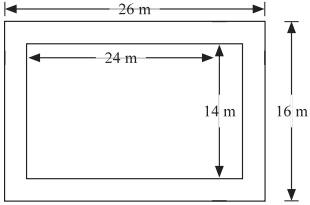
$A$ garden is $24\, m$ long and $14\, m$ wide. There is a path $1\, m$ wide outside the garden along its sides. If the path is to be constructed with square marble tiles of $20\, cm \times 20\, cm$,then find the number of tiles required to cover the path.
A
$1800$
B
$200$
C
$2000$
D
$2150$
Solution
(C) Area of the garden $= 24\, m \times 14\, m = 336\, m^2$.
The path is $1\, m$ wide outside the garden,so the new length $= 24 + 1 + 1 = 26\, m$ and the new width $= 14 + 1 + 1 = 16\, m$.
Area of the (garden $+$ path) $= 26\, m \times 16\, m = 416\, m^2$.
Area of the path $= 416\, m^2 - 336\, m^2 = 80\, m^2$.
Area of $1$ tile $= 20\, cm \times 20\, cm = 400\, cm^2$.
Since $1\, m^2 = 10000\, cm^2$,the area of $1$ tile in $m^2 = \frac{400}{10000} = 0.04\, m^2$.
Number of tiles required $= \frac{\text{Area of the path}}{\text{Area of 1 tile}} = \frac{80}{0.04} = 2000$.
The path is $1\, m$ wide outside the garden,so the new length $= 24 + 1 + 1 = 26\, m$ and the new width $= 14 + 1 + 1 = 16\, m$.
Area of the (garden $+$ path) $= 26\, m \times 16\, m = 416\, m^2$.
Area of the path $= 416\, m^2 - 336\, m^2 = 80\, m^2$.
Area of $1$ tile $= 20\, cm \times 20\, cm = 400\, cm^2$.
Since $1\, m^2 = 10000\, cm^2$,the area of $1$ tile in $m^2 = \frac{400}{10000} = 0.04\, m^2$.
Number of tiles required $= \frac{\text{Area of the path}}{\text{Area of 1 tile}} = \frac{80}{0.04} = 2000$.
0 likes
View Solution297
MediumMCQ
If the length of one diagonal of a rhombus is $80 \%$ of the length of the other diagonal,the area of the rhombus is how many times the square of the length of the longer diagonal?
A
$4/5$
B
$2/5$
C
$3/4$
D
$1/4$
Solution
(B) Let the length of the longer diagonal be $d_1 = x$.
Then,the length of the shorter diagonal is $d_2 = 80\% \text{ of } x = 0.8x = \frac{4}{5}x$.
The area of a rhombus is given by the formula $A = \frac{1}{2} \times d_1 \times d_2$.
Substituting the values,$A = \frac{1}{2} \times x \times \frac{4}{5}x = \frac{2}{5}x^2$.
Thus,the area of the rhombus is $\frac{2}{5}$ times the square of the length of the longer diagonal.
Then,the length of the shorter diagonal is $d_2 = 80\% \text{ of } x = 0.8x = \frac{4}{5}x$.
The area of a rhombus is given by the formula $A = \frac{1}{2} \times d_1 \times d_2$.
Substituting the values,$A = \frac{1}{2} \times x \times \frac{4}{5}x = \frac{2}{5}x^2$.
Thus,the area of the rhombus is $\frac{2}{5}$ times the square of the length of the longer diagonal.
0 likes
View Solution298
DifficultMCQ
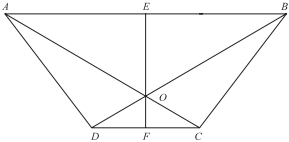
$ABCD$ is a trapezium in which $AB \parallel CD$ and $AB = 2CD$. If its diagonals intersect each other at $O$,the ratio of the area of triangle $AOB$ and $COD$ is
A
$1:2$
B
$2:1$
C
$1:4$
D
$4:1$
Solution
(D) In a trapezium $ABCD$ with $AB \parallel CD$,triangles $\Delta AOB$ and $\Delta COD$ are similar by $AA$ similarity criterion because $\angle OAB = \angle OCD$ and $\angle OBA = \angle ODC$ (alternate interior angles).
The ratio of the areas of two similar triangles is equal to the square of the ratio of their corresponding sides.
Therefore,$\frac{\text{Area}(\Delta AOB)}{\text{Area}(\Delta COD)} = \left( \frac{AB}{CD} \right)^2$.
Given $AB = 2CD$,we have $\frac{AB}{CD} = \frac{2}{1}$.
Thus,$\frac{\text{Area}(\Delta AOB)}{\text{Area}(\Delta COD)} = \left( \frac{2}{1} \right)^2 = \frac{4}{1}$.
The ratio is $4:1$.
The ratio of the areas of two similar triangles is equal to the square of the ratio of their corresponding sides.
Therefore,$\frac{\text{Area}(\Delta AOB)}{\text{Area}(\Delta COD)} = \left( \frac{AB}{CD} \right)^2$.
Given $AB = 2CD$,we have $\frac{AB}{CD} = \frac{2}{1}$.
Thus,$\frac{\text{Area}(\Delta AOB)}{\text{Area}(\Delta COD)} = \left( \frac{2}{1} \right)^2 = \frac{4}{1}$.
The ratio is $4:1$.
0 likes
View Solution299
EasyMCQ
The ratio of the corresponding sides of two similar triangles is $3:4$. The ratio of their areas is
A
$4:3$
B
$3:4$
C
$9:16$
D
$\sqrt{3}:2$
Solution
(C) According to the theorem of areas of similar triangles,the ratio of the areas of two similar triangles is equal to the ratio of the squares of their corresponding sides.
Let the sides be $3x$ and $4x$.
Ratio of areas $= \frac{(3x)^2}{(4x)^2} = \frac{9x^2}{16x^2} = \frac{9}{16}$.
Therefore,the ratio of their areas is $9:16$.
Let the sides be $3x$ and $4x$.
Ratio of areas $= \frac{(3x)^2}{(4x)^2} = \frac{9x^2}{16x^2} = \frac{9}{16}$.
Therefore,the ratio of their areas is $9:16$.
0 likes
View Solution300
MediumMCQ
The area of the circle inscribed in an equilateral triangle of side $24 \, cm$ is
A
$24 \pi \, cm^2$
B
$36 \pi \, cm^2$
C
$48 \pi \, cm^2$
D
$18 \pi \, cm^2$
Solution
(C) For an equilateral triangle with side $a = 24 \, cm$,the height $h$ is given by $h = \frac{\sqrt{3}}{2} a = \frac{\sqrt{3}}{2} \times 24 = 12 \sqrt{3} \, cm$.
The radius $r$ of the inscribed circle (inradius) of an equilateral triangle is given by $r = \frac{h}{3}$.
Substituting the value of $h$,we get $r = \frac{12 \sqrt{3}}{3} = 4 \sqrt{3} \, cm$.
The area of the circle is given by $A = \pi r^2$.
Substituting the value of $r$,$A = \pi (4 \sqrt{3})^2 = \pi (16 \times 3) = 48 \pi \, cm^2$.
The radius $r$ of the inscribed circle (inradius) of an equilateral triangle is given by $r = \frac{h}{3}$.
Substituting the value of $h$,we get $r = \frac{12 \sqrt{3}}{3} = 4 \sqrt{3} \, cm$.
The area of the circle is given by $A = \pi r^2$.
Substituting the value of $r$,$A = \pi (4 \sqrt{3})^2 = \pi (16 \times 3) = 48 \pi \, cm^2$.
0 likes
View SolutionMensuration — Measurement of Area · Frequently Asked Questions
1Are these Mensuration questions useful for JEE and NEET?
Yes. All questions in this section are mapped to JEE Main and NEET exam patterns. Previous year questions from JEE Main, NEET, GUJCET and state-level exams are included with full solutions.
2Can I switch to Hindi or Gujarati for these questions?
Yes. Use the language tabs in the hero section or the sidebar to view the same questions and solutions in English, Hindi or Gujarati.
3How do I generate a question paper from this subtopic?
Use the Vedclass Exam Paper Generator — select the chapter and subtopic, set difficulty, and generate Sets A, B, C, D automatically. First 3 chapters of every subject are free.
Vedclass Products
For Students
Vedclass Test Series
Mock tests in real JEE/NEET style with performance analysis. 5-day free trial.
Start Free TrialFor Teachers
Exam Paper Generator
Generate Set A/B/C/D papers from this chapter in 2 minutes. 3 chapters free.
Try FreeFor Institutes
Online Exam Module
Live online exams with unlimited students, 360° analytics & white-label branding.
See DemoFor Teachers & Institutes
Generate a Mensuration Exam Paper in 2 Minutes
Select subtopic & difficulty — Sets A, B, C, D auto-generated with No Repeat logic.
First 3 chapters of every subject are free — no payment required.