
A English
Mix Example - FORCE AND LAWS OF MOTION Questions in English
Class 9 Science · FORCE AND LAWS OF MOTION · Mix Example - FORCE AND LAWS OF MOTION
199+
Questions
English
Language
100%
With Solutions
Showing 50 of 199 questions in English
51
EasyMCQ
Which has the highest inertia among solids made of aluminium,steel,and wood of the same shape and same volume?
A
Aluminium
B
Steel
C
Wood
D
All have equal inertia
Solution
(B) Inertia is directly proportional to the mass of an object $(I \propto m)$.
Since all objects have the same volume $(V)$,their mass $(m)$ depends on their density $(d)$ according to the formula $m = d \times V$.
Among aluminium,steel,and wood,steel has the highest density.
Therefore,the steel object will have the greatest mass,and consequently,it will possess the highest inertia.
Since all objects have the same volume $(V)$,their mass $(m)$ depends on their density $(d)$ according to the formula $m = d \times V$.
Among aluminium,steel,and wood,steel has the highest density.
Therefore,the steel object will have the greatest mass,and consequently,it will possess the highest inertia.
0 likes
View Solution52
Easy
State Newton's third law of motion.
Solution
(N/A) Newton's third law of motion states that to every action,there is always an equal and opposite reaction. This means that when one object exerts a force on a second object,the second object simultaneously exerts a force equal in magnitude and opposite in direction on the first object.
0 likes
View Solution53
EasyMCQ
Name the unbalanced force which slows down a moving bicycle when we stop pedalling it.
A
Gravitational force
B
Magnetic force
C
Frictional force
D
Electrostatic force
Solution
(C) When we stop pedalling a moving bicycle,it gradually slows down and eventually comes to a stop. This happens because of the force of friction acting between the road surface and the bicycle tyres. Friction is an unbalanced force that opposes the motion of the bicycle,causing it to decelerate.
0 likes
View Solution54
EasyMCQ
While playing football,the goalkeeper did not get sufficient time to stop a fast ball shot towards him. Why did he hurt his hand while doing so?
A
The ball exerted a small force on his hands.
B
The momentum of the ball was reduced to zero in a very short interval of time,resulting in a large impulsive force.
C
The ball had very little mass.
D
The goalkeeper's hands were not strong enough.
Solution
(B) According to Newton's second law of motion,the force exerted is given by $F = \frac{\Delta p}{\Delta t}$,where $\Delta p$ is the change in momentum and $\Delta t$ is the time interval.
When the goalkeeper stops a fast-moving ball,the momentum of the ball changes from its initial value to zero.
Since the time interval $\Delta t$ is very small,the force $F$ exerted by the ball on the goalkeeper's hands becomes very large.
This large force causes the injury to the goalkeeper's hands.
When the goalkeeper stops a fast-moving ball,the momentum of the ball changes from its initial value to zero.
Since the time interval $\Delta t$ is very small,the force $F$ exerted by the ball on the goalkeeper's hands becomes very large.
This large force causes the injury to the goalkeeper's hands.
0 likes
View Solution55
EasyMCQ
During a game of table tennis,if the ball hits a player,it does not hurt him. On the other hand,when a fast-moving cricket ball hits a spectator,it may hurt him. State the reason.
A
The cricket ball has more mass and velocity.
B
The table tennis ball has more mass.
C
The cricket ball has less momentum.
D
The spectator is more sensitive than the player.
Solution
(A) The impact of a moving object depends on its momentum,which is the product of its mass $(m)$ and velocity $(v)$,given by $p = m \times v$.
$1$. $A$ table tennis ball has a very small mass,so even at high speeds,its momentum is relatively low,causing negligible impact.
$2$. $A$ cricket ball has a significantly larger mass compared to a table tennis ball. When it moves at a high velocity,its momentum $(p = mv)$ becomes very high.
$3$. According to Newton's second law,the force exerted during an impact is proportional to the rate of change of momentum. Since the cricket ball carries much higher momentum,it exerts a larger force upon impact,which can cause injury.
$1$. $A$ table tennis ball has a very small mass,so even at high speeds,its momentum is relatively low,causing negligible impact.
$2$. $A$ cricket ball has a significantly larger mass compared to a table tennis ball. When it moves at a high velocity,its momentum $(p = mv)$ becomes very high.
$3$. According to Newton's second law,the force exerted during an impact is proportional to the rate of change of momentum. Since the cricket ball carries much higher momentum,it exerts a larger force upon impact,which can cause injury.
0 likes
View Solution56
Easy
Give an example to show that friction is an important factor in satisfying Newton's third law of motion.
Solution
(N/A) Walking is a classic example. When a person walks,they push the ground backward with their feet (action). According to Newton's third law,the ground exerts an equal and opposite force on the feet (reaction). This reaction force is provided by the friction between the soles of the shoes and the surface of the ground. Without friction,the feet would slip,and it would be impossible to exert the necessary backward force to move forward.
0 likes
View Solution57
Easy
Explain with a suitable example whether or not the force of friction always acts opposite to the direction of motion.
Solution
(N/A) The statement that the force of friction always acts opposite to the direction of motion is not entirely correct. While friction generally opposes the relative motion between two surfaces,it can sometimes act in the direction of motion.
Example: Consider a person walking. When a person walks,they push the ground backward with their foot. According to Newton's third law,the ground exerts an equal and opposite force on the foot in the forward direction. This forward force is the static friction acting on the foot,which enables the person to move forward. In this case,the force of friction acts in the direction of motion.
Example: Consider a person walking. When a person walks,they push the ground backward with their foot. According to Newton's third law,the ground exerts an equal and opposite force on the foot in the forward direction. This forward force is the static friction acting on the foot,which enables the person to move forward. In this case,the force of friction acts in the direction of motion.
0 likes
View Solution58
EasyMCQ
Which would require a greater force $-$ accelerating a $2 \ kg$ mass at $5 \ m s^{-2}$ or a $5 \ kg$ mass at $3 \ m s^{-2}$?
A
Accelerating a $2 \ kg$ mass at $5 \ m s^{-2}$
B
Accelerating a $5 \ kg$ mass at $3 \ m s^{-2}$
C
Both require the same force
D
Cannot be determined
Solution
(B) According to Newton's second law of motion,the force $F$ is given by the product of mass $m$ and acceleration $a$,i.e.,$F = m \times a$.
For the first case:
Mass $m_1 = 2 \ kg$,Acceleration $a_1 = 5 \ m s^{-2}$
Force $F_1 = 2 \ kg \times 5 \ m s^{-2} = 10 \ N$.
For the second case:
Mass $m_2 = 5 \ kg$,Acceleration $a_2 = 3 \ m s^{-2}$
Force $F_2 = 5 \ kg \times 3 \ m s^{-2} = 15 \ N$.
Comparing the two forces,$15 \ N > 10 \ N$.
Therefore,accelerating a $5 \ kg$ mass at $3 \ m s^{-2}$ requires a greater force.
For the first case:
Mass $m_1 = 2 \ kg$,Acceleration $a_1 = 5 \ m s^{-2}$
Force $F_1 = 2 \ kg \times 5 \ m s^{-2} = 10 \ N$.
For the second case:
Mass $m_2 = 5 \ kg$,Acceleration $a_2 = 3 \ m s^{-2}$
Force $F_2 = 5 \ kg \times 3 \ m s^{-2} = 15 \ N$.
Comparing the two forces,$15 \ N > 10 \ N$.
Therefore,accelerating a $5 \ kg$ mass at $3 \ m s^{-2}$ requires a greater force.
0 likes
View Solution59
MediumMCQ
Find the ratio of momentum of the two bodies $A$ and $B$ of masses $m$ and $4m$ respectively,moving with the same velocity $v$.
A
$1:4$
B
$4:1$
C
$1:1$
D
$2:1$
Solution
(A) The momentum $p$ of a body is defined as the product of its mass $m$ and velocity $v$,given by the formula $p = mv$.
For body $A$ with mass $m$ and velocity $v$,the momentum is $p_A = m \times v = mv$.
For body $B$ with mass $4m$ and velocity $v$,the momentum is $p_B = 4m \times v = 4mv$.
The ratio of the momentum of body $A$ to body $B$ is $\frac{p_A}{p_B} = \frac{mv}{4mv} = \frac{1}{4}$.
Therefore,the ratio is $1:4$.
For body $A$ with mass $m$ and velocity $v$,the momentum is $p_A = m \times v = mv$.
For body $B$ with mass $4m$ and velocity $v$,the momentum is $p_B = 4m \times v = 4mv$.
The ratio of the momentum of body $A$ to body $B$ is $\frac{p_A}{p_B} = \frac{mv}{4mv} = \frac{1}{4}$.
Therefore,the ratio is $1:4$.
0 likes
View Solution60
Easy
$A$ player catching a moving ball moves his hand backwards. Why?
Solution
(N/A) According to Newton's second law of motion,the force exerted by the ball is given by $F = m \times a$,where $a = \frac{v - u}{t}$.
By moving his hands backwards,the player increases the time $(t)$ taken to bring the ball to rest.
Since force is inversely proportional to time $(F \propto \frac{1}{t})$,increasing the time reduces the impulsive force exerted by the ball on the player's hands.
This prevents injury and makes it easier to catch the ball.
By moving his hands backwards,the player increases the time $(t)$ taken to bring the ball to rest.
Since force is inversely proportional to time $(F \propto \frac{1}{t})$,increasing the time reduces the impulsive force exerted by the ball on the player's hands.
This prevents injury and makes it easier to catch the ball.
0 likes
View Solution61
EasyMCQ
Which Newton's law of motion is applied in the flight of a bird?
A
Newton's first law of motion
B
Newton's second law of motion
C
Newton's third law of motion
D
Newton's law of gravitation
Solution
(C) Newton's third law of motion is applied in the flight of a bird.
For flight,a bird applies force on the air in the backward direction by flapping its wings (action).
In response,the air exerts an equal and opposite force on the bird in the forward direction (reaction),which helps the bird to fly.
For flight,a bird applies force on the air in the backward direction by flapping its wings (action).
In response,the air exerts an equal and opposite force on the bird in the forward direction (reaction),which helps the bird to fly.
0 likes
View Solution62
Medium
State the reason for the following:
$(i)$ Some leaves may get detached from a tree if we vigorously shake its branch.
$(ii)$ It is advised to tie any luggage kept on the roof of a bus with a rope.
$(i)$ Some leaves may get detached from a tree if we vigorously shake its branch.
$(ii)$ It is advised to tie any luggage kept on the roof of a bus with a rope.
Solution
(N/A) $(i)$ This happens due to the inertia of rest. When the branch is shaken,it comes into motion,but the leaves tend to remain in their state of rest due to inertia. As a result,the connection between the leaf and the branch breaks,causing the leaf to detach.
$(ii)$ It is advised to tie luggage with a rope to prevent it from falling off due to inertia of motion or rest. When a bus suddenly starts or stops,the luggage tends to maintain its previous state of motion or rest,which could cause it to slide or fall off the roof.
$(ii)$ It is advised to tie luggage with a rope to prevent it from falling off due to inertia of motion or rest. When a bus suddenly starts or stops,the luggage tends to maintain its previous state of motion or rest,which could cause it to slide or fall off the roof.
0 likes
View Solution63
Medium
In which direction do the following forces act when an object is in motion?
$(i)$ Frictional force
$(ii)$ Gravitational force
$(iii)$ Centripetal force
$(i)$ Frictional force
$(ii)$ Gravitational force
$(iii)$ Centripetal force
Solution
(N/A) $(i)$ Frictional force acts in the direction opposite to the motion of the object.
$(ii)$ Gravitational force acts vertically downwards towards the center of the Earth.
$(iii)$ Centripetal force acts towards the center of the circular path along which the object moves.
$(ii)$ Gravitational force acts vertically downwards towards the center of the Earth.
$(iii)$ Centripetal force acts towards the center of the circular path along which the object moves.
0 likes
View Solution64
Medium
Explain the following:
$(i)$ Why do we jerk wet clothes before spreading them on a line?
$(ii)$ Why does dust fly off when a carpet is hit with a stick?
$(iii)$ Why do fruits fall off the branches in a strong wind?
$(iv)$ Why does a pillion rider fall forward when the driver of a two-wheeler suddenly applies brakes?
$(i)$ Why do we jerk wet clothes before spreading them on a line?
$(ii)$ Why does dust fly off when a carpet is hit with a stick?
$(iii)$ Why do fruits fall off the branches in a strong wind?
$(iv)$ Why does a pillion rider fall forward when the driver of a two-wheeler suddenly applies brakes?
Solution
(N/A) $(i)$ Initially,both water and clothes are at rest. When wet clothes are jerked,the water particles tend to remain in their state of rest due to the inertia of rest. This causes the water droplets to detach from the clothes,helping them dry faster.
$(ii)$ When a carpet is struck with a stick,the carpet moves suddenly,but the dust particles tend to remain at rest due to the inertia of rest. Consequently,the dust separates from the carpet and flies off.
$(iii)$ Initially,the fruits on the branches are at rest. Due to the inertia of rest,the fruits tend to remain in their state of rest even when the branches are moved by a strong wind,causing the fruits to detach and fall.
$(iv)$ Initially,both the driver and the pillion rider are in a state of motion. When the driver applies brakes,the lower part of the pillion rider's body comes to rest with the vehicle,but the upper part continues to move forward due to the inertia of motion,causing the rider to fall forward.
$(ii)$ When a carpet is struck with a stick,the carpet moves suddenly,but the dust particles tend to remain at rest due to the inertia of rest. Consequently,the dust separates from the carpet and flies off.
$(iii)$ Initially,the fruits on the branches are at rest. Due to the inertia of rest,the fruits tend to remain in their state of rest even when the branches are moved by a strong wind,causing the fruits to detach and fall.
$(iv)$ Initially,both the driver and the pillion rider are in a state of motion. When the driver applies brakes,the lower part of the pillion rider's body comes to rest with the vehicle,but the upper part continues to move forward due to the inertia of motion,causing the rider to fall forward.
0 likes
View Solution65
Easy
Define momentum and state its $SI$ unit. State the principle of conservation of momentum.
Solution
(N/A) Momentum is defined as the product of the mass of a body and its velocity. It is also known as the quantity of motion contained in a body. Its $SI$ unit is $kg \cdot m \cdot s^{-1}$.
The principle of conservation of momentum states that if no external force acts on a system, the total momentum of the system remains conserved (constant).
The principle of conservation of momentum states that if no external force acts on a system, the total momentum of the system remains conserved (constant).
0 likes
View Solution66
Medium
Show that the rate of change of momentum $=$ mass $\times$ acceleration.
Solution
(N/A) Let a force $F$ act on a body of mass $m$ for time $t$ and change its velocity from $u$ to $v$.
Initial momentum of the body $= mu$
Final momentum of the body $= mv$
Change in momentum of the body in time $t = mv - mu = m(v - u)$
The rate of change of momentum $= \frac{\text{Change in momentum}}{\text{Time}} = \frac{m(v - u)}{t}$
Since acceleration $a = \frac{v - u}{t}$, we substitute this into the equation.
Therefore, the rate of change of momentum $= m \times a = \text{mass} \times \text{acceleration}$.
According to Newton's second law of motion, this rate of change of momentum is equal to the applied force $F$.
Initial momentum of the body $= mu$
Final momentum of the body $= mv$
Change in momentum of the body in time $t = mv - mu = m(v - u)$
The rate of change of momentum $= \frac{\text{Change in momentum}}{\text{Time}} = \frac{m(v - u)}{t}$
Since acceleration $a = \frac{v - u}{t}$, we substitute this into the equation.
Therefore, the rate of change of momentum $= m \times a = \text{mass} \times \text{acceleration}$.
According to Newton's second law of motion, this rate of change of momentum is equal to the applied force $F$.
0 likes
View Solution67
Medium
Prove that $1 \text{ N} = 10^{5} \text{ dynes}$.
Solution
(N/A) $1 \text{ N} = 1 \text{ kg} \times 1 \text{ m s}^{-2}$
Since $1 \text{ kg} = 1000 \text{ g}$ and $1 \text{ m} = 100 \text{ cm}$,we substitute these values:
$1 \text{ N} = 1000 \text{ g} \times 100 \text{ cm s}^{-2}$
$1 \text{ N} = 100,000 \text{ g cm s}^{-2}$
Since $1 \text{ dyne} = 1 \text{ g cm s}^{-2}$,we get:
$1 \text{ N} = 10^{5} \text{ dynes}$.
Since $1 \text{ kg} = 1000 \text{ g}$ and $1 \text{ m} = 100 \text{ cm}$,we substitute these values:
$1 \text{ N} = 1000 \text{ g} \times 100 \text{ cm s}^{-2}$
$1 \text{ N} = 100,000 \text{ g cm s}^{-2}$
Since $1 \text{ dyne} = 1 \text{ g cm s}^{-2}$,we get:
$1 \text{ N} = 10^{5} \text{ dynes}$.
0 likes
View Solution68
Medium
What would happen if a fielder stops a fast-moving ball suddenly? Justify your answer.
Solution
(N/A) When a fielder stops a fast-moving ball suddenly,the velocity of the ball decreases to $0$ in a very short interval of time.
According to Newton's second law of motion,the force applied is directly proportional to the rate of change of momentum,given by $F = \frac{m(v - u)}{t}$.
Since the time interval $(t)$ is very small,the rate of change of momentum is very high.
This requires the fielder to apply a large impulsive force to stop the ball.
Consequently,the ball exerts an equal and opposite reaction force on the fielder's hands,which may cause injury to the palm.
According to Newton's second law of motion,the force applied is directly proportional to the rate of change of momentum,given by $F = \frac{m(v - u)}{t}$.
Since the time interval $(t)$ is very small,the rate of change of momentum is very high.
This requires the fielder to apply a large impulsive force to stop the ball.
Consequently,the ball exerts an equal and opposite reaction force on the fielder's hands,which may cause injury to the palm.
0 likes
View Solution69
MediumMCQ
Write the relation for the collision of two balls $A$ and $B$ and state the related law.
A
Conservation of Energy
B
Conservation of Momentum
C
Newton's Second Law
D
Newton's Third Law
Solution
(B) The relation for the collision of two balls $A$ and $B$ is given by the principle of conservation of momentum:
$m_A u_A + m_B u_B = m_A v_A + m_B v_B$
Where:
$m_A, m_B$ are the masses of balls $A$ and $B$.
$u_A, u_B$ are the initial velocities of balls $A$ and $B$ before collision.
$v_A, v_B$ are the final velocities of balls $A$ and $B$ after collision.
The related law is the $\text{Law}$ $\text{of}$ $\text{Conservation}$ $\text{of}$ $\text{Momentum}$, which states that if no external unbalanced force acts on a system of two interacting objects, then the total momentum of the system remains conserved (constant).
$m_A u_A + m_B u_B = m_A v_A + m_B v_B$
Where:
$m_A, m_B$ are the masses of balls $A$ and $B$.
$u_A, u_B$ are the initial velocities of balls $A$ and $B$ before collision.
$v_A, v_B$ are the final velocities of balls $A$ and $B$ after collision.
The related law is the $\text{Law}$ $\text{of}$ $\text{Conservation}$ $\text{of}$ $\text{Momentum}$, which states that if no external unbalanced force acts on a system of two interacting objects, then the total momentum of the system remains conserved (constant).
0 likes
View Solution70
Medium
What are the changes possible on an object at rest if we apply on it:
$(a)$ a balanced force?
$(b)$ an unbalanced force?
$(a)$ a balanced force?
$(b)$ an unbalanced force?
Solution
(N/A) balanced force does not change the state of rest or motion of an object,but it may change the shape or size of the body.
$(b)$ An unbalanced force will change the state of rest of the object by producing acceleration in the direction of the applied force.
$(b)$ An unbalanced force will change the state of rest of the object by producing acceleration in the direction of the applied force.
0 likes
View Solution71
Medium
State Newton's third law of motion. Give two examples.
Solution
(N/A) Newton's third law of motion states that to every action,there is an equal and opposite reaction.
Examples are:
$(i)$ When we exert a force (action) on a wall by pushing it with the palm of our hand,we experience a force (reaction) exerted by the wall on our palm.
$(ii)$ When a bullet is fired from a gun,the recoil of the gun is the reaction produced by the bullet on the gun.
Examples are:
$(i)$ When we exert a force (action) on a wall by pushing it with the palm of our hand,we experience a force (reaction) exerted by the wall on our palm.
$(ii)$ When a bullet is fired from a gun,the recoil of the gun is the reaction produced by the bullet on the gun.
0 likes
View Solution72
Medium
Give reasons and state the laws related to these statements:
$(a)$ It is easier to push an empty box than to push a box full of books.
$(b)$ It is difficult for a fireman to hold a hose which ejects a large amount of water with high velocity.
$(a)$ It is easier to push an empty box than to push a box full of books.
$(b)$ It is difficult for a fireman to hold a hose which ejects a large amount of water with high velocity.
Solution
(N/A) This is based on Newton's $\text{Second}$ Law of Motion $(F = ma)$. An empty box has less mass, and therefore less inertia, compared to a box full of books. Since force is directly proportional to mass, less force is required to accelerate the empty box.
$(b)$ This is based on Newton's $\text{Third}$ Law of Motion (Action and Reaction). When water is ejected from the hose with high velocity in the forward direction, it exerts an equal and opposite reaction force on the hose in the backward direction. This makes it difficult for the fireman to hold the hose steady.
$(b)$ This is based on Newton's $\text{Third}$ Law of Motion (Action and Reaction). When water is ejected from the hose with high velocity in the forward direction, it exerts an equal and opposite reaction force on the hose in the backward direction. This makes it difficult for the fireman to hold the hose steady.
0 likes
View Solution73
Medium
$(a)$ Name the force that keeps the object moving in a circular path with constant acceleration.
$(b)$ What would happen if this force is absent?
$(b)$ What would happen if this force is absent?
Solution
(N/A) The force that keeps an object moving in a circular path with constant acceleration is known as the centripetal force.
$(b)$ If this force is absent,the object will no longer move in a circular path. Instead,it will move in a straight line along the direction of the tangent to the circular path at the point where the force ceased to act,in accordance with Newton's first law of motion.
$(b)$ If this force is absent,the object will no longer move in a circular path. Instead,it will move in a straight line along the direction of the tangent to the circular path at the point where the force ceased to act,in accordance with Newton's first law of motion.
0 likes
View Solution74
Medium
Write answers to the following:
$(i)$ Mention the direction in which the force of friction acts on a moving body. State its units.
$(ii)$ Name the property of bodies (or objects) to resist a change in their state of rest or of motion. Name the quantity that is a measure of this property.
$(iii)$ Name the physical quantity whose unit is $kg\, m s^{-1}$. Define this quantity.
$(i)$ Mention the direction in which the force of friction acts on a moving body. State its units.
$(ii)$ Name the property of bodies (or objects) to resist a change in their state of rest or of motion. Name the quantity that is a measure of this property.
$(iii)$ Name the physical quantity whose unit is $kg\, m s^{-1}$. Define this quantity.
Solution
(N/A) $(i)$ The force of friction acts in the direction opposite to the direction of motion of the body. Its $SI$ unit is the newton $(N)$.
$(ii)$ The property of bodies to resist a change in their state of rest or motion is called inertia. Mass is the quantitative measure of inertia.
$(iii)$ The physical quantity is momentum. Momentum is defined as the product of the mass and velocity of a body $(p = mv)$.
$(ii)$ The property of bodies to resist a change in their state of rest or motion is called inertia. Mass is the quantitative measure of inertia.
$(iii)$ The physical quantity is momentum. Momentum is defined as the product of the mass and velocity of a body $(p = mv)$.
0 likes
View Solution75
Easy
If the time taken to bring a ball to rest from a certain velocity $v$ is reduced to half,what will be the changes in values of
$(a)$ Initial and final momentum.
$(b)$ Change of momentum.
$(c)$ Rate of change of momentum.
$(a)$ Initial and final momentum.
$(b)$ Change of momentum.
$(c)$ Rate of change of momentum.
Solution
(C) Initial momentum $p_i = mv$ and final momentum $p_f = 0$. Since $m$ and $v$ remain constant,there is no change in initial and final momentum.
$(b)$ Change of momentum $\Delta p = p_f - p_i = 0 - mv = -mv$. Since the magnitude of change depends only on initial and final states,there is no change.
$(c)$ Rate of change of momentum is given by $F = \frac{\Delta p}{t}$. If time $t$ is reduced to half $(t' = t/2)$,the new rate of change of momentum $F' = \frac{\Delta p}{t/2} = 2 \times \frac{\Delta p}{t} = 2F$. Thus,the rate of change of momentum is doubled.
$(b)$ Change of momentum $\Delta p = p_f - p_i = 0 - mv = -mv$. Since the magnitude of change depends only on initial and final states,there is no change.
$(c)$ Rate of change of momentum is given by $F = \frac{\Delta p}{t}$. If time $t$ is reduced to half $(t' = t/2)$,the new rate of change of momentum $F' = \frac{\Delta p}{t/2} = 2 \times \frac{\Delta p}{t} = 2F$. Thus,the rate of change of momentum is doubled.
0 likes
View Solution76
Medium
In the following cases,identify the direction of the net force acting on the objects:
$(a)$ $A$ car drives around a circular race track at a constant speed.
$(b)$ Earth moving around the sun.
$(c)$ $A$ ball,rolling across a grassy field,slowly comes to a stop.
$(a)$ $A$ car drives around a circular race track at a constant speed.
$(b)$ Earth moving around the sun.
$(c)$ $A$ ball,rolling across a grassy field,slowly comes to a stop.
Solution
(N/A) The car is performing uniform circular motion. The net force acting on it is the centripetal force,which is directed towards the centre of the circular track.
$(b)$ The Earth is revolving around the sun in a nearly circular orbit. The net force acting on the Earth is the gravitational force exerted by the sun,which is directed towards the sun.
$(c)$ The ball is moving on a grassy field. The net force acting on it is the frictional force,which acts in the direction opposite to the direction of motion,causing the ball to decelerate and eventually come to a stop.
$(b)$ The Earth is revolving around the sun in a nearly circular orbit. The net force acting on the Earth is the gravitational force exerted by the sun,which is directed towards the sun.
$(c)$ The ball is moving on a grassy field. The net force acting on it is the frictional force,which acts in the direction opposite to the direction of motion,causing the ball to decelerate and eventually come to a stop.
0 likes
View Solution77
Medium
What is the effect of force when it is applied in the following cases?
$(a)$ $A$ balloon is pressed from opposite sides.
$(b)$ $A$ ball is hit with a bat.
$(c)$ $A$ spring is compressed.
$(a)$ $A$ balloon is pressed from opposite sides.
$(b)$ $A$ ball is hit with a bat.
$(c)$ $A$ spring is compressed.
Solution
(N/A) The force causes a change in the shape of the balloon.
$(b)$ The force causes a change in the direction and velocity of the ball.
$(c)$ The force causes a change in the shape of the spring.
$(b)$ The force causes a change in the direction and velocity of the ball.
$(c)$ The force causes a change in the shape of the spring.
0 likes
View Solution78
Medium
Identify the type of inertia experienced by the brain,when
$(a)$ the head is hit suddenly with a stick.
$(b)$ a car is suddenly made to stop using brakes.
$(c)$ a boxer punches another boxer in the face.
$(a)$ the head is hit suddenly with a stick.
$(b)$ a car is suddenly made to stop using brakes.
$(c)$ a boxer punches another boxer in the face.
Solution
(N/A) Inertia of rest: When the head is hit suddenly,the skull moves forward due to the impact,but the brain,due to its inertia of rest,tends to remain in its original position,causing it to strike against the inner wall of the skull.
$(b)$ Inertia of motion: When a car stops suddenly,the body and the brain are in a state of motion. Due to the inertia of motion,they continue to move forward even after the car has stopped,causing the brain to hit the front part of the skull.
$(c)$ Inertia of rest: When a boxer is punched,the head is pushed backward suddenly. The brain,due to its inertia of rest,tends to stay in its initial position,causing it to strike against the back wall of the skull.
$(b)$ Inertia of motion: When a car stops suddenly,the body and the brain are in a state of motion. Due to the inertia of motion,they continue to move forward even after the car has stopped,causing the brain to hit the front part of the skull.
$(c)$ Inertia of rest: When a boxer is punched,the head is pushed backward suddenly. The brain,due to its inertia of rest,tends to stay in its initial position,causing it to strike against the back wall of the skull.
0 likes
View Solution79
Medium
State the law of conservation of momentum. How does conservation of momentum take place in each of the following?
$(i)$ $A$ rocket taking off from ground.
$(ii)$ Flying of a jet aeroplane.
$(i)$ $A$ rocket taking off from ground.
$(ii)$ Flying of a jet aeroplane.
Solution
(N/A) Law of conservation of momentum:
It states that in an isolated system,the total momentum of the system remains conserved (constant) if no external unbalanced force acts on it.
$(i)$ $A$ rocket taking off from ground: The chemicals inside the rocket burn and produce a high-velocity blast of hot gases. These gases are ejected through the tail nozzle in the downward direction. According to the law of conservation of momentum,the rocket gains an equal and opposite momentum in the upward direction,causing it to lift off.
$(ii)$ Flying of a jet aeroplane: In jet aeroplanes,a large volume of gases produced by the combustion of fuel is ejected through a jet in the backward direction at high velocity. The backward momentum of these gases results in an equal and opposite forward momentum for the aeroplane,which provides the necessary thrust for flight.
It states that in an isolated system,the total momentum of the system remains conserved (constant) if no external unbalanced force acts on it.
$(i)$ $A$ rocket taking off from ground: The chemicals inside the rocket burn and produce a high-velocity blast of hot gases. These gases are ejected through the tail nozzle in the downward direction. According to the law of conservation of momentum,the rocket gains an equal and opposite momentum in the upward direction,causing it to lift off.
$(ii)$ Flying of a jet aeroplane: In jet aeroplanes,a large volume of gases produced by the combustion of fuel is ejected through a jet in the backward direction at high velocity. The backward momentum of these gases results in an equal and opposite forward momentum for the aeroplane,which provides the necessary thrust for flight.
0 likes
View Solution80
Medium
What type of force is acting in the cases given above?
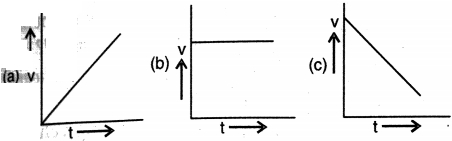
Solution
(N/A) Accelerating unbalanced force: The velocity-time graph shows a constant positive slope,indicating uniform acceleration. According to Newton's second law,$F = ma$,an unbalanced force is required to produce acceleration.
$(b)$ No net force: The velocity-time graph is a horizontal line,indicating constant velocity (zero acceleration). According to Newton's first law,if the net external force is zero,an object will continue to move with a constant velocity.
$(c)$ Retarding unbalanced force: The velocity-time graph shows a constant negative slope,indicating uniform retardation (deceleration). An unbalanced force acting in the direction opposite to the motion is required to decrease the velocity.
$(b)$ No net force: The velocity-time graph is a horizontal line,indicating constant velocity (zero acceleration). According to Newton's first law,if the net external force is zero,an object will continue to move with a constant velocity.
$(c)$ Retarding unbalanced force: The velocity-time graph shows a constant negative slope,indicating uniform retardation (deceleration). An unbalanced force acting in the direction opposite to the motion is required to decrease the velocity.
0 likes
View Solution81
Medium
Calculate the ratio of momentum,when
$(i)$ velocity of an object is doubled.
$(ii)$ mass of an object is halved.
$(iii)$ both mass and velocity are increased by three times.
$(i)$ velocity of an object is doubled.
$(ii)$ mass of an object is halved.
$(iii)$ both mass and velocity are increased by three times.
Solution
(N/A) Let a body of mass $m$ be moving with velocity $v$. The initial momentum is $p_{1} = m v$.
$(i)$ When the velocity is doubled,the new velocity is $2v$. The new momentum $p_{2} = m(2v) = 2mv = 2p_{1}$. Therefore,the ratio $p_{1} : p_{2} = 1 : 2$.
$(ii)$ When the mass is halved,the new mass is $\frac{1}{2}m$. The new momentum $p_{3} = (\frac{1}{2}m)v = \frac{1}{2}mv = \frac{1}{2}p_{1}$. Therefore,the ratio $p_{1} : p_{3} = 2 : 1$.
$(iii)$ When both mass and velocity are increased by three times,the new mass is $3m$ and the new velocity is $3v$. The new momentum $p_{4} = (3m)(3v) = 9mv = 9p_{1}$. Therefore,the ratio $p_{1} : p_{4} = 1 : 9$.
$(i)$ When the velocity is doubled,the new velocity is $2v$. The new momentum $p_{2} = m(2v) = 2mv = 2p_{1}$. Therefore,the ratio $p_{1} : p_{2} = 1 : 2$.
$(ii)$ When the mass is halved,the new mass is $\frac{1}{2}m$. The new momentum $p_{3} = (\frac{1}{2}m)v = \frac{1}{2}mv = \frac{1}{2}p_{1}$. Therefore,the ratio $p_{1} : p_{3} = 2 : 1$.
$(iii)$ When both mass and velocity are increased by three times,the new mass is $3m$ and the new velocity is $3v$. The new momentum $p_{4} = (3m)(3v) = 9mv = 9p_{1}$. Therefore,the ratio $p_{1} : p_{4} = 1 : 9$.
0 likes
View Solution82
Medium
$A$ motor car is moving with a velocity of $108 \, km \, h^{-1}$ and it takes $4 \, s$ to stop after the brakes are applied. Find the force exerted by the brakes on the motor car if its mass along with the passengers is $1000 \, kg$.
Solution
(N/A) Mass of the car along with passengers,$m = 1000 \, kg$.
Initial velocity,$u = 108 \, km \, h^{-1} = \frac{108 \times 1000}{3600} \, m \, s^{-1} = 30 \, m \, s^{-1}$.
Final velocity,$v = 0 \, m \, s^{-1}$ (since the car stops).
Time taken,$t = 4 \, s$.
Acceleration,$a = \frac{v - u}{t} = \frac{0 - 30}{4} = -7.5 \, m \, s^{-2}$.
Force exerted by the brakes,$F = m \times a = 1000 \, kg \times (-7.5 \, m \, s^{-2}) = -7500 \, N$.
The negative sign indicates that the force is applied in the direction opposite to the motion of the car.
Therefore,the magnitude of the force exerted by the brakes is $7500 \, N$.
Initial velocity,$u = 108 \, km \, h^{-1} = \frac{108 \times 1000}{3600} \, m \, s^{-1} = 30 \, m \, s^{-1}$.
Final velocity,$v = 0 \, m \, s^{-1}$ (since the car stops).
Time taken,$t = 4 \, s$.
Acceleration,$a = \frac{v - u}{t} = \frac{0 - 30}{4} = -7.5 \, m \, s^{-2}$.
Force exerted by the brakes,$F = m \times a = 1000 \, kg \times (-7.5 \, m \, s^{-2}) = -7500 \, N$.
The negative sign indicates that the force is applied in the direction opposite to the motion of the car.
Therefore,the magnitude of the force exerted by the brakes is $7500 \, N$.
0 likes
View Solution83
Medium
$A$ large truck and a car,both moving with a velocity of magnitude $v$,have a head-on collision and both of them come to a halt after that. If the collision lasts for $1$ second:
$(i)$ Which vehicle experiences the greater force and why?
$(ii)$ Which vehicle experiences the greater change in momentum and why?
$(iii)$ Which vehicle experiences the greater acceleration and why?
$(i)$ Which vehicle experiences the greater force and why?
$(ii)$ Which vehicle experiences the greater change in momentum and why?
$(iii)$ Which vehicle experiences the greater acceleration and why?
Solution
(N/A) $(i)$ Both vehicles experience the same magnitude of force. According to Newton's third law of motion,for every action,there is an equal and opposite reaction. Thus,the force exerted by the truck on the car is equal to the force exerted by the car on the truck.
$(ii)$ The truck experiences a greater change in momentum. Momentum is defined as $p = mv$. Since the truck has a much larger mass $(M)$ compared to the car $(m)$,and both come to a halt (final velocity $= 0$),the change in momentum $\Delta p = |0 - mv| = mv$ is greater for the truck.
$(iii)$ The car experiences greater acceleration. According to Newton's second law,$F = ma$,which implies $a = F/m$. Since the force $(F)$ is the same for both,the vehicle with the smaller mass $(m)$ will experience a larger acceleration $(a)$.
$(ii)$ The truck experiences a greater change in momentum. Momentum is defined as $p = mv$. Since the truck has a much larger mass $(M)$ compared to the car $(m)$,and both come to a halt (final velocity $= 0$),the change in momentum $\Delta p = |0 - mv| = mv$ is greater for the truck.
$(iii)$ The car experiences greater acceleration. According to Newton's second law,$F = ma$,which implies $a = F/m$. Since the force $(F)$ is the same for both,the vehicle with the smaller mass $(m)$ will experience a larger acceleration $(a)$.
0 likes
View Solution84
MediumMCQ
Two cars each of mass $1000 \ kg$ are moving in a straight line but in opposite directions. The velocity of each car is $5 \ m s^{-1}$ before the collision during which they stick together. What will be the velocity of the combined cars after collision (in $m s^{-1}$)?
A
$0$
B
$5$
C
$10$
D
$2.5$
Solution
(A) Mass of both cars,$m_1 = m_2 = 1000 \ kg$.
Initial velocity of the first car,$u_1 = 5 \ m s^{-1}$.
Initial velocity of the second car,$u_2 = -5 \ m s^{-1}$ (since they are moving in opposite directions).
Let $v$ be the common velocity of the combined cars after the collision.
According to the law of conservation of momentum,the total momentum before the collision is equal to the total momentum after the collision.
$m_1 u_1 + m_2 u_2 = (m_1 + m_2) v$
Substituting the values:
$1000 \times 5 + 1000 \times (-5) = (1000 + 1000) v$
$5000 - 5000 = 2000 v$
$0 = 2000 v$
$v = 0 \ m s^{-1}$.
Therefore,the combined cars will come to rest after the collision.
Initial velocity of the first car,$u_1 = 5 \ m s^{-1}$.
Initial velocity of the second car,$u_2 = -5 \ m s^{-1}$ (since they are moving in opposite directions).
Let $v$ be the common velocity of the combined cars after the collision.
According to the law of conservation of momentum,the total momentum before the collision is equal to the total momentum after the collision.
$m_1 u_1 + m_2 u_2 = (m_1 + m_2) v$
Substituting the values:
$1000 \times 5 + 1000 \times (-5) = (1000 + 1000) v$
$5000 - 5000 = 2000 v$
$0 = 2000 v$
$v = 0 \ m s^{-1}$.
Therefore,the combined cars will come to rest after the collision.
0 likes
View Solution85
Medium
$A$ man weighing $60 \, kg$ runs along the rails with a velocity of $18 \, km \, h^{-1}$ and jumps into a car of mass $1 \, \text{quintal} \, (100 \, kg)$ standing on the rails. Calculate the velocity with which the car will start travelling along the rails.
Solution
Mass of the man,$m_{1} = 60 \, kg$.
Initial speed of the man,$u_{1} = 18 \, km \, h^{-1} = \frac{18 \times 1000}{3600} \, m \, s^{-1} = 5 \, m \, s^{-1}$.
Mass of the car,$m_{2} = 100 \, kg$.
Initial speed of the car,$u_{2} = 0 \, m \, s^{-1}$.
Let the final velocity of the car with the man be $v$.
According to the law of conservation of momentum:
$m_{1}u_{1} + m_{2}u_{2} = (m_{1} + m_{2})v$.
Substituting the values:
$(60 \times 5) + (100 \times 0) = (60 + 100)v$.
$300 = 160v$.
$v = \frac{300}{160} \, m \, s^{-1} = 1.875 \, m \, s^{-1}$.
Converting to $km \, h^{-1}$:
$v = 1.875 \times \frac{18}{5} \, km \, h^{-1} = 6.75 \, km \, h^{-1}$.
Initial speed of the man,$u_{1} = 18 \, km \, h^{-1} = \frac{18 \times 1000}{3600} \, m \, s^{-1} = 5 \, m \, s^{-1}$.
Mass of the car,$m_{2} = 100 \, kg$.
Initial speed of the car,$u_{2} = 0 \, m \, s^{-1}$.
Let the final velocity of the car with the man be $v$.
According to the law of conservation of momentum:
$m_{1}u_{1} + m_{2}u_{2} = (m_{1} + m_{2})v$.
Substituting the values:
$(60 \times 5) + (100 \times 0) = (60 + 100)v$.
$300 = 160v$.
$v = \frac{300}{160} \, m \, s^{-1} = 1.875 \, m \, s^{-1}$.
Converting to $km \, h^{-1}$:
$v = 1.875 \times \frac{18}{5} \, km \, h^{-1} = 6.75 \, km \, h^{-1}$.
0 likes
View Solution86
Medium
Explain the following:
$(i)$ Why does a boatman push the river bank backward with a long bamboo pole when launching his boat into the water?
$(ii)$ Why does a boat tend to leave the shore when passengers are alighting from it? How does the boatman overcome this difficulty?
$(iii)$ Why does a gun recoil when fired?
$(iv)$ How do rockets operate in space?
$(i)$ Why does a boatman push the river bank backward with a long bamboo pole when launching his boat into the water?
$(ii)$ Why does a boat tend to leave the shore when passengers are alighting from it? How does the boatman overcome this difficulty?
$(iii)$ Why does a gun recoil when fired?
$(iv)$ How do rockets operate in space?
Solution
(N/A) $(i)$ While launching his boat into the water,the boatman pushes the river bank backward with a long pole. In accordance with Newton's third law of motion,the bank applies an equal and opposite reaction force on the pole,thereby pushing the boat forward.
$(ii)$ When passengers alight from the boat,they push the boat in the backward direction. As a result,the boat tends to move away from the shore. The boatman overcomes this by tying the boat to a rigid support on the bank.
$(iii)$ When a bullet is fired,the gun exerts a forward force on the bullet. According to Newton's third law,the bullet exerts an equal and opposite force on the gun,causing it to recoil.
$(iv)$ Rockets operate in space by ejecting burnt gases at high velocity from the rear. According to Newton's third law,the gases exert an equal and opposite reaction force on the rocket,propelling it forward.
$(ii)$ When passengers alight from the boat,they push the boat in the backward direction. As a result,the boat tends to move away from the shore. The boatman overcomes this by tying the boat to a rigid support on the bank.
$(iii)$ When a bullet is fired,the gun exerts a forward force on the bullet. According to Newton's third law,the bullet exerts an equal and opposite force on the gun,causing it to recoil.
$(iv)$ Rockets operate in space by ejecting burnt gases at high velocity from the rear. According to Newton's third law,the gases exert an equal and opposite reaction force on the rocket,propelling it forward.
0 likes
View Solution87
Difficult
Explain the following:
$(i)$ Why is it dangerous to jump out of a moving vehicle? How can the danger be minimised?
$(ii)$ Why does a boatman push the water backward with the oars while rowing a boat?
$(i)$ Why is it dangerous to jump out of a moving vehicle? How can the danger be minimised?
$(ii)$ Why does a boatman push the water backward with the oars while rowing a boat?
Solution
(N/A) $(i)$ If a person jumps out of a moving vehicle,their feet will suddenly come to rest upon touching the ground,while the rest of the body remains in motion due to inertia. This causes the person to fall forward and potentially get hurt. This danger can be minimised by running along with the moving vehicle in the same direction for some distance after jumping out,which allows the body to come to rest gradually.
$(ii)$ When the boatman pushes the water backward with the oars,the water exerts an equal and opposite force on the boat in the forward direction,according to Newton's third law of motion. This reaction force helps the boat move forward.
$(ii)$ When the boatman pushes the water backward with the oars,the water exerts an equal and opposite force on the boat in the forward direction,according to Newton's third law of motion. This reaction force helps the boat move forward.
0 likes
View Solution88
Medium
Name and state the action and reaction in the following cases:
$(i)$ Firing of a bullet from a gun.
$(ii)$ Hammering a nail.
$(iii)$ $A$ book lying on a table.
$(iv)$ Moving rocket.
$(v)$ $A$ person moving on the floor.
$(vi)$ $A$ moving train colliding with a stationary train.
$(i)$ Firing of a bullet from a gun.
$(ii)$ Hammering a nail.
$(iii)$ $A$ book lying on a table.
$(iv)$ Moving rocket.
$(v)$ $A$ person moving on the floor.
$(vi)$ $A$ moving train colliding with a stationary train.
Solution
(N/A) $(i)$ When a bullet is fired from a gun,the force exerted on the bullet is the action,and the recoil force experienced by the gun is the reaction.
$(ii)$ When a nail is hammered,the force exerted by the hammer on the nail is the action,and the force exerted by the nail on the hammer is the reaction.
$(iii)$ When a book is placed on a table,the weight of the book acting downwards on the table is the action,and the normal force exerted by the table upwards on the book is the reaction.
$(iv)$ In a moving rocket,the force exerted by the rocket on the exhaust gases is the action,and the force exerted by the gases on the rocket is the reaction.
$(v)$ When a person walks,the force exerted by the person's foot pushing the ground backwards is the action,and the frictional force exerted by the ground on the foot in the forward direction is the reaction.
$(vi)$ When a moving train collides with a stationary train,the force exerted by the moving train on the stationary train is the action,and the force exerted by the stationary train on the moving train is the reaction.
$(ii)$ When a nail is hammered,the force exerted by the hammer on the nail is the action,and the force exerted by the nail on the hammer is the reaction.
$(iii)$ When a book is placed on a table,the weight of the book acting downwards on the table is the action,and the normal force exerted by the table upwards on the book is the reaction.
$(iv)$ In a moving rocket,the force exerted by the rocket on the exhaust gases is the action,and the force exerted by the gases on the rocket is the reaction.
$(v)$ When a person walks,the force exerted by the person's foot pushing the ground backwards is the action,and the frictional force exerted by the ground on the foot in the forward direction is the reaction.
$(vi)$ When a moving train collides with a stationary train,the force exerted by the moving train on the stationary train is the action,and the force exerted by the stationary train on the moving train is the reaction.
0 likes
View Solution89
Medium
Explain the following:
$(i)$ Why do the doors of a corridor train open or shut when the train starts or stops?
$(ii)$ Why is it necessary to run along with a moving bus in the same direction while alighting from it?
$(iii)$ Why does a player run for some distance before taking a long jump?
$(iv)$ Why does a person fall off the back of a stationary horse if the horse starts off suddenly?
$(v)$ Why is a neat hole formed in a glass pane if a bullet is fired at it from a close range?
$(i)$ Why do the doors of a corridor train open or shut when the train starts or stops?
$(ii)$ Why is it necessary to run along with a moving bus in the same direction while alighting from it?
$(iii)$ Why does a player run for some distance before taking a long jump?
$(iv)$ Why does a person fall off the back of a stationary horse if the horse starts off suddenly?
$(v)$ Why is a neat hole formed in a glass pane if a bullet is fired at it from a close range?
Solution
(N/A) $(i)$ The doors of a train tend to continue in their state of rest or motion due to the inertia of rest or motion when the train starts or stops suddenly. Thus,the doors swing due to the change in the state of the train.
$(ii)$ While alighting from a moving bus,the feet of the person come to rest upon touching the ground,while the upper body remains in a state of motion. To avoid falling forward due to inertia of motion,it is necessary to run in the same direction as the bus.
$(iii)$ $A$ player runs for some distance before taking a long jump to gain inertia of motion,which helps the player cover a greater distance during the jump.
$(iv)$ $A$ person falls backward when a stationary horse starts suddenly because the lower part of the person's body,which is in contact with the horse,moves forward,but the upper part of the body tends to remain in its state of rest due to the inertia of rest.
$(v)$ When a bullet is fired at a glass pane,a neat hole is formed because the bullet moves at a very high speed. Due to the inertia of rest,the glass particles in the immediate path of the bullet do not get enough time to move,while the rest of the glass pane remains stationary.
$(ii)$ While alighting from a moving bus,the feet of the person come to rest upon touching the ground,while the upper body remains in a state of motion. To avoid falling forward due to inertia of motion,it is necessary to run in the same direction as the bus.
$(iii)$ $A$ player runs for some distance before taking a long jump to gain inertia of motion,which helps the player cover a greater distance during the jump.
$(iv)$ $A$ person falls backward when a stationary horse starts suddenly because the lower part of the person's body,which is in contact with the horse,moves forward,but the upper part of the body tends to remain in its state of rest due to the inertia of rest.
$(v)$ When a bullet is fired at a glass pane,a neat hole is formed because the bullet moves at a very high speed. Due to the inertia of rest,the glass particles in the immediate path of the bullet do not get enough time to move,while the rest of the glass pane remains stationary.
0 likes
View Solution90
Medium
Explain the following:
$(i)$ Why is it difficult to walk on marshy land?
$(ii)$ Why does an air-filled balloon rise up slightly when punctured from below?
$(iii)$ Why does a swimmer push water backward with his hands in order to swim in the forward direction?
$(i)$ Why is it difficult to walk on marshy land?
$(ii)$ Why does an air-filled balloon rise up slightly when punctured from below?
$(iii)$ Why does a swimmer push water backward with his hands in order to swim in the forward direction?
Solution
(N/A) $(i)$ It is difficult to walk on marshy land because when we push the ground with our feet,the ground is soft and yields,failing to provide an equal and opposite reaction force as per Newton's third law.
$(ii)$ When an air-filled balloon is punctured from below,the escaping air exerts a downward force. According to Newton's third law,the air exerts an equal and opposite upward reaction force on the balloon,causing it to rise slightly.
$(iii)$ According to Newton's third law of motion,for every action,there is an equal and opposite reaction. When a swimmer pushes the water backward (action),the water exerts an equal and opposite force on the swimmer in the forward direction (reaction),which helps the swimmer move forward.
$(ii)$ When an air-filled balloon is punctured from below,the escaping air exerts a downward force. According to Newton's third law,the air exerts an equal and opposite upward reaction force on the balloon,causing it to rise slightly.
$(iii)$ According to Newton's third law of motion,for every action,there is an equal and opposite reaction. When a swimmer pushes the water backward (action),the water exerts an equal and opposite force on the swimmer in the forward direction (reaction),which helps the swimmer move forward.
0 likes
View Solution91
Medium
$A$ javelin throw is marked foul if an athlete crosses over the line marked for throw. Explain why the athletes often fail to stop themselves before the line.
Solution
(N/A) This occurs due to the $inertia$ of motion. An athlete runs for a considerable distance to build up momentum,which helps in throwing the javelin a longer distance. However,the large momentum of the athlete makes it difficult to stop abruptly before the marked line,and as a result,the athlete may cross the line,causing the throw to be declared foul.
0 likes
View Solution92
Medium
If action is always equal to the reaction,explain,why a cart pulled by a horse can be moved.
Solution
(D) The motion of the horse and cart system is governed by the following forces:
$(i)$ The weight of the horse and cart acting vertically downward.
$(ii)$ The normal reaction of the ground acting vertically upward,which balances the weight.
$(iii)$ The force exerted by the horse's feet on the ground in the backward direction (Action).
$(iv)$ The reaction force of the ground on the horse's feet in the forward direction (Reaction).
$(v)$ The force of friction acting on the cart wheels in the backward direction.
Forces $(i)$ and $(ii)$ are balanced and do not contribute to horizontal motion. The horse pushes the ground backward with force $(iii)$,and the ground exerts an equal and opposite reaction force $(iv)$ on the horse in the forward direction. The cart moves forward because the forward reaction force $(iv)$ is greater than the backward frictional force $(v)$ acting on the cart. Thus,the system moves due to the net unbalanced force in the forward direction.
$(i)$ The weight of the horse and cart acting vertically downward.
$(ii)$ The normal reaction of the ground acting vertically upward,which balances the weight.
$(iii)$ The force exerted by the horse's feet on the ground in the backward direction (Action).
$(iv)$ The reaction force of the ground on the horse's feet in the forward direction (Reaction).
$(v)$ The force of friction acting on the cart wheels in the backward direction.
Forces $(i)$ and $(ii)$ are balanced and do not contribute to horizontal motion. The horse pushes the ground backward with force $(iii)$,and the ground exerts an equal and opposite reaction force $(iv)$ on the horse in the forward direction. The cart moves forward because the forward reaction force $(iv)$ is greater than the backward frictional force $(v)$ acting on the cart. Thus,the system moves due to the net unbalanced force in the forward direction.
0 likes
View Solution93
MediumMCQ
Quick sand consists of very smooth and tiny grains of sand. What would happen if a man or a heavy animal steps over a patch of such sand in a desert?
A
The person or animal will walk across it easily.
B
The person or animal will sink into the sand.
C
The person or animal will float on the surface.
D
The sand will become hard and support the weight.
Solution
(B) On normal sand,the weight of a heavy animal or person is counterbalanced by the normal reaction force provided by the ground,allowing them to stand or walk on it.
However,quicksand consists of very fine,smooth particles saturated with water or air,which behave like a fluid.
Because of this fluid-like nature,the sand cannot provide a sufficient upward reaction force to support the weight of the object.
Consequently,the animal or person is likely to sink into the quicksand.
However,quicksand consists of very fine,smooth particles saturated with water or air,which behave like a fluid.
Because of this fluid-like nature,the sand cannot provide a sufficient upward reaction force to support the weight of the object.
Consequently,the animal or person is likely to sink into the quicksand.
0 likes
View Solution94
Difficult
In oil tankers,some space is left at the top while filling them. Explain why.
Solution
(N/A) When a stationary tanker suddenly accelerates,the oil inside,due to the $inertia$ of rest,tends to remain in its state of rest. Consequently,the oil is pushed towards the rear wall,exerting a large force on it.
Conversely,when a moving tanker suddenly brakes,the oil continues to move forward due to the $inertia$ of motion,exerting a large force on the front wall.
These sudden forces can damage or crack the walls of the tanker.
Therefore,to allow for the free movement of oil and to prevent such damage,some space is left at the top of the tanker.
Conversely,when a moving tanker suddenly brakes,the oil continues to move forward due to the $inertia$ of motion,exerting a large force on the front wall.
These sudden forces can damage or crack the walls of the tanker.
Therefore,to allow for the free movement of oil and to prevent such damage,some space is left at the top of the tanker.
0 likes
View Solution95
DifficultMCQ
Why is it advised to tie luggage with a rope on the roof of buses?
A
To increase the weight of the bus.
B
To prevent the luggage from falling due to inertia.
C
To make the luggage look organized.
D
To reduce the air resistance on the luggage.
Solution
(B) When a bus suddenly starts,the luggage on its roof has a tendency to continue in its state of rest due to inertia of rest,causing it to fall backward.
Conversely,when a moving bus stops suddenly,the luggage on its top has a tendency to continue in its state of motion due to inertia of motion,causing it to fall forward.
Thus,to prevent the luggage from falling due to these changes in motion,it is tied with a rope to hold it securely in place.
Conversely,when a moving bus stops suddenly,the luggage on its top has a tendency to continue in its state of motion due to inertia of motion,causing it to fall forward.
Thus,to prevent the luggage from falling due to these changes in motion,it is tied with a rope to hold it securely in place.
0 likes
View Solution96
EasyMCQ
If someone jumps to the shore from a boat,the boat moves in the opposite direction. Explain.
A
Due to inertia of rest
B
Due to Newton's first law of motion
C
Due to Newton's third law of motion
D
Due to conservation of momentum
Solution
(C) This phenomenon is based on $Newton's$ third law of motion,which states that for every action,there is an equal and opposite reaction.
When a person jumps from a boat towards the shore,they exert a muscular force on the boat in the backward direction (action).
In response,the boat exerts an equal and opposite force on the person,propelling them forward towards the shore.
Simultaneously,due to the action force applied by the person,the boat moves in the opposite direction,i.e.,away from the shore (reaction).
When a person jumps from a boat towards the shore,they exert a muscular force on the boat in the backward direction (action).
In response,the boat exerts an equal and opposite force on the person,propelling them forward towards the shore.
Simultaneously,due to the action force applied by the person,the boat moves in the opposite direction,i.e.,away from the shore (reaction).
0 likes
View Solution97
Medium
$A$ large truck and a car,both moving with speed $v$,have a head-on collision and both of them come to a halt after that. If the collision lasts for $10 \ s$:
$(i)$ Which vehicle experiences the greater force of impact?
$(ii)$ Which vehicle experiences the greater momentum change?
$(iii)$ Which vehicle experiences the greater acceleration?
$(iv)$ Why is the car likely to suffer more damage than the truck?
$(i)$ Which vehicle experiences the greater force of impact?
$(ii)$ Which vehicle experiences the greater momentum change?
$(iii)$ Which vehicle experiences the greater acceleration?
$(iv)$ Why is the car likely to suffer more damage than the truck?
Solution
(N/A) $(i)$ Both vehicles experience the same force of impact because action and reaction are equal and opposite (Newton's Third Law).
$(ii)$ The truck experiences a greater change in momentum because momentum change $\Delta p = m \Delta v$. Since the truck has a much larger mass $(M > m)$,the change in momentum is greater for the truck.
$(iii)$ The car experiences greater acceleration. Since $F = ma$,then $a = F/m$. For the same force $F$,the vehicle with the smaller mass (the car) experiences higher acceleration.
$(iv)$ The car suffers more damage because it experiences a much higher magnitude of deceleration (acceleration) during the impact,leading to greater structural stress.
$(ii)$ The truck experiences a greater change in momentum because momentum change $\Delta p = m \Delta v$. Since the truck has a much larger mass $(M > m)$,the change in momentum is greater for the truck.
$(iii)$ The car experiences greater acceleration. Since $F = ma$,then $a = F/m$. For the same force $F$,the vehicle with the smaller mass (the car) experiences higher acceleration.
$(iv)$ The car suffers more damage because it experiences a much higher magnitude of deceleration (acceleration) during the impact,leading to greater structural stress.
0 likes
View Solution98
Medium
Amar, Javed, and Rita were riding in a bus that was moving with a high velocity on a highway when a bug hit the windshield and its dead body got stuck on the windscreen. Amar and Javed began discussing the situation. Amar suggested that the change in momentum of the bug is much greater than that of the bus. After all, argued Amar, there was no noticeable change in the velocity of the bus compared to the obvious change in the velocity of the bug. Javed opined that since the bus was moving with a larger velocity, so it exerted a larger force on the bug, as a result of which it died. Rita disagreed entirely, arguing that both the bug and bus experienced the same force and a change in their momentum. Who do you agree with? Support your answer.
Solution
(D) According to Newton's third law of motion, for every action, there is an equal and opposite reaction. Therefore, the force exerted by the bus on the bug is equal in magnitude to the force exerted by the bug on the bus.
Since the force $(F)$ and the time of impact $(t)$ are the same for both, the change in momentum $(\Delta p = F \times t)$ is also the same for both the bug and the bus.
However, because the mass of the bus is much larger than the mass of the bug, the change in velocity $(\Delta v = \Delta p / m)$ for the bus is negligible, whereas the change in velocity for the bug is very large.
Consequently, the bug experiences a much higher acceleration, leading to its death. Rita is correct in stating that both experience the same force and the same change in momentum.
Since the force $(F)$ and the time of impact $(t)$ are the same for both, the change in momentum $(\Delta p = F \times t)$ is also the same for both the bug and the bus.
However, because the mass of the bus is much larger than the mass of the bug, the change in velocity $(\Delta v = \Delta p / m)$ for the bus is negligible, whereas the change in velocity for the bug is very large.
Consequently, the bug experiences a much higher acceleration, leading to its death. Rita is correct in stating that both experience the same force and the same change in momentum.
0 likes
View Solution99
Medium
$(a)$ Why do we jerk wet clothes before spreading them on a clothesline?
$(b)$ Fruits fall off the branches when a strong wind blows. Give a reason.
$(b)$ Fruits fall off the branches when a strong wind blows. Give a reason.
Solution
(N/A) When we jerk wet clothes,the clothes suddenly come into motion,but the water droplets in them tend to remain in a state of rest due to the inertia of rest. As a result,the water droplets get detached from the fabric,causing the clothes to dry more quickly.
$(b)$ Initially,both the fruits and the branches are in a state of rest. When a strong wind blows,the branches suddenly come into motion,but the fruits tend to remain in a state of rest due to the inertia of rest. Consequently,the fruits get detached from the branches and fall down.
$(b)$ Initially,both the fruits and the branches are in a state of rest. When a strong wind blows,the branches suddenly come into motion,but the fruits tend to remain in a state of rest due to the inertia of rest. Consequently,the fruits get detached from the branches and fall down.
0 likes
View Solution100
Medium
$(a)$ Define momentum of a body.
$(b)$ $A$ ball is thrown vertically upward. What is its momentum at the highest point?
$(c)$ State the law of conservation of momentum.
$(b)$ $A$ ball is thrown vertically upward. What is its momentum at the highest point?
$(c)$ State the law of conservation of momentum.
Solution
(N/A) Momentum is defined as the product of the mass $(m)$ and velocity $(v)$ of a body. It is given by the formula $p = m \times v$.
$(b)$ At the highest point of its trajectory,the vertical velocity $(v)$ of the ball becomes $0 \ m/s$. Since momentum $p = m \times v$,substituting $v = 0$ gives $p = m \times 0 = 0$. Thus,the momentum at the highest point is zero.
$(c)$ The law of conservation of momentum states that in the absence of an external unbalanced force,the total momentum of a system of objects remains conserved (constant).
$(b)$ At the highest point of its trajectory,the vertical velocity $(v)$ of the ball becomes $0 \ m/s$. Since momentum $p = m \times v$,substituting $v = 0$ gives $p = m \times 0 = 0$. Thus,the momentum at the highest point is zero.
$(c)$ The law of conservation of momentum states that in the absence of an external unbalanced force,the total momentum of a system of objects remains conserved (constant).
0 likes
View SolutionFORCE AND LAWS OF MOTION — Mix Example - FORCE AND LAWS OF MOTION · Frequently Asked Questions
1Are these FORCE AND LAWS OF MOTION questions useful for JEE and NEET?
Yes. All questions in this section are mapped to JEE Main and NEET exam patterns. Previous year questions from JEE Main, NEET, GUJCET and state-level exams are included with full solutions.
2Can I switch to Hindi or Gujarati for these questions?
Yes. Use the language tabs in the hero section or the sidebar to view the same questions and solutions in English, Hindi or Gujarati.
3How do I generate a question paper from this subtopic?
Use the Vedclass Exam Paper Generator — select the chapter and subtopic, set difficulty, and generate Sets A, B, C, D automatically. First 3 chapters of every subject are free.
Vedclass Products
For Students
Vedclass Test Series
Mock tests in real JEE/NEET style with performance analysis. 5-day free trial.
Start Free TrialFor Teachers
Exam Paper Generator
Generate Set A/B/C/D papers from this chapter in 2 minutes. 3 chapters free.
Try FreeFor Institutes
Online Exam Module
Live online exams with unlimited students, 360° analytics & white-label branding.
See DemoFor Teachers & Institutes
Generate a FORCE AND LAWS OF MOTION Exam Paper in 2 Minutes
Select subtopic & difficulty — Sets A, B, C, D auto-generated with No Repeat logic.
First 3 chapters of every subject are free — no payment required.