
A English
Textbook - FORCE AND LAWS OF MOTION Questions in English
Class 9 Science · FORCE AND LAWS OF MOTION · Textbook - FORCE AND LAWS OF MOTION
31+
Questions
English
Language
100%
With Solutions
Showing 31 of 31 questions in English
1
Medium
Which of the following has more inertia: $(a)$ a rubber ball and a stone of the same size? $(b)$ a bicycle and a train? $(c)$ a five-rupee coin and a one-rupee coin?
Solution
(N/A) Inertia is the measure of the mass of an object. The greater the mass of the object,the greater is its inertia,and vice-versa.
$(a)$ $A$ stone has more mass than a rubber ball of the same size. Therefore,the stone has more inertia.
$(b)$ $A$ train has significantly more mass than a bicycle. Therefore,the train has more inertia.
$(c)$ $A$ five-rupee coin has more mass than a one-rupee coin. Therefore,the five-rupee coin has more inertia.
$(a)$ $A$ stone has more mass than a rubber ball of the same size. Therefore,the stone has more inertia.
$(b)$ $A$ train has significantly more mass than a bicycle. Therefore,the train has more inertia.
$(c)$ $A$ five-rupee coin has more mass than a one-rupee coin. Therefore,the five-rupee coin has more inertia.
0 likes
View Solution2
Medium
In the following example, try to identify the number of times the velocity of the ball changes:
"$A$ football player kicks a football to another player of his team who kicks the football towards the goal. The goalkeeper of the opposite team collects the football and kicks it towards a player of his own team".
Also identify the agent supplying the force in each case.
"$A$ football player kicks a football to another player of his team who kicks the football towards the goal. The goalkeeper of the opposite team collects the football and kicks it towards a player of his own team".
Also identify the agent supplying the force in each case.
Solution
(N/A) The velocity of the ball changes $4$ times.
$1$. The first player kicks the ball: The velocity changes from $0$ to a certain value. The agent is the first player.
$2$. The second player kicks the ball towards the goal: The direction changes, hence velocity changes. The agent is the second player.
$3$. The goalkeeper collects the ball: The ball comes to rest, so velocity changes from a certain value to $0$. The agent is the goalkeeper.
$4$. The goalkeeper kicks the ball to his teammate: The velocity changes from $0$ to a certain value. The agent is the goalkeeper.
$1$. The first player kicks the ball: The velocity changes from $0$ to a certain value. The agent is the first player.
$2$. The second player kicks the ball towards the goal: The direction changes, hence velocity changes. The agent is the second player.
$3$. The goalkeeper collects the ball: The ball comes to rest, so velocity changes from a certain value to $0$. The agent is the goalkeeper.
$4$. The goalkeeper kicks the ball to his teammate: The velocity changes from $0$ to a certain value. The agent is the goalkeeper.
2 likes
View Solution3
Medium
Explain why some of the leaves may get detached from a tree if we vigorously shake its branch.
Solution
(N/A) When we shake the branch of a tree vigorously,the branch comes into motion. However,the leaves tend to remain in their state of rest due to the inertia of rest. Because the leaves resist the change in their state of motion,they experience a force that causes them to detach and fall from the tree.
0 likes
View Solution4
MediumMCQ
Why do you fall in the forward direction when a moving bus brakes to a stop and fall backwards when it accelerates from rest?
A
Due to the inertia of motion
B
Due to the inertia of rest
C
Due to the inertia of direction
D
Due to the inertia of mass
Solution
(A) This phenomenon occurs due to the $inertia$ of the passenger.
$1$. When a bus is moving, the passenger is also in a state of motion. When the driver applies brakes, the lower part of the passenger's body, which is in contact with the bus, comes to rest. However, the upper part of the body continues to be in a state of motion due to the $inertia$ of motion, causing the passenger to fall forward.
$2$. When the bus accelerates from rest, the lower part of the passenger's body starts moving with the bus, but the upper part tends to remain at rest due to the $inertia$ of rest. This causes the passenger to fall backward relative to the bus.
$1$. When a bus is moving, the passenger is also in a state of motion. When the driver applies brakes, the lower part of the passenger's body, which is in contact with the bus, comes to rest. However, the upper part of the body continues to be in a state of motion due to the $inertia$ of motion, causing the passenger to fall forward.
$2$. When the bus accelerates from rest, the lower part of the passenger's body starts moving with the bus, but the upper part tends to remain at rest due to the $inertia$ of rest. This causes the passenger to fall backward relative to the bus.
0 likes
View Solution5
EasyMCQ
If action is always equal to the reaction,explain how a horse can pull a cart.
A
The horse pulls the cart with a force greater than the reaction force.
B
The horse pushes the ground backward,and the reaction force from the ground moves the horse forward.
C
The cart moves because the horse is stronger than the cart.
D
The friction between the cart and the ground is zero.
Solution
(B) According to Newton's third law of motion,for every action,there is an equal and opposite reaction.
When a horse pulls a cart,it pushes the ground backward with its feet at an angle.
This action force exerted by the horse on the ground results in an equal and opposite reaction force exerted by the ground on the horse in the forward direction.
This reaction force allows the horse to move forward,and since the cart is attached to the horse,the cart is pulled along with it.
When a horse pulls a cart,it pushes the ground backward with its feet at an angle.
This action force exerted by the horse on the ground results in an equal and opposite reaction force exerted by the ground on the horse in the forward direction.
This reaction force allows the horse to move forward,and since the cart is attached to the horse,the cart is pulled along with it.
0 likes
View Solution6
Medium
Explain,why is it difficult for a fireman to hold a hose,which ejects large amounts of water at a high velocity.
Solution
(N/A) The difficulty arises due to the backward reaction force of the water being ejected.
When a fireman holds a hose that ejects a large volume of water at a high velocity,the water exerts an equal and opposite reaction force on the hose in the backward direction,according to $Newton's$ third law of motion.
This backward force pushes the fireman,making it difficult for him to maintain his balance and stability while holding the hose.
When a fireman holds a hose that ejects a large volume of water at a high velocity,the water exerts an equal and opposite reaction force on the hose in the backward direction,according to $Newton's$ third law of motion.
This backward force pushes the fireman,making it difficult for him to maintain his balance and stability while holding the hose.
0 likes
View Solution7
MediumMCQ
From a rifle of mass $4\, kg$,a bullet of mass $50\, g$ is fired with an initial velocity of $35\, m\, s^{-1}$. Calculate the initial recoil velocity (in $m/s$) of the rifle.
A
$0.8375$
B
$0.1023$
C
$0.4375$
D
$0.6523$
Solution
(C) Mass of the rifle,$m_1 = 4\, kg$.
Mass of the bullet,$m_2 = 50\, g = 0.05\, kg$.
Initial velocity of the bullet,$v_2 = 35\, m/s$.
Let the recoil velocity of the rifle be $v_1$.
Initially,the system is at rest,so the initial momentum is $0$.
According to the law of conservation of momentum,the total momentum after firing must be equal to the total momentum before firing.
$m_1 v_1 + m_2 v_2 = 0$.
$4(v_1) + (0.05 \times 35) = 0$.
$4 v_1 + 1.75 = 0$.
$4 v_1 = -1.75$.
$v_1 = -1.75 / 4 = -0.4375\, m/s$.
The negative sign indicates that the rifle recoils in the direction opposite to the bullet,with a magnitude of $0.4375\, m/s$.
Mass of the bullet,$m_2 = 50\, g = 0.05\, kg$.
Initial velocity of the bullet,$v_2 = 35\, m/s$.
Let the recoil velocity of the rifle be $v_1$.
Initially,the system is at rest,so the initial momentum is $0$.
According to the law of conservation of momentum,the total momentum after firing must be equal to the total momentum before firing.
$m_1 v_1 + m_2 v_2 = 0$.
$4(v_1) + (0.05 \times 35) = 0$.
$4 v_1 + 1.75 = 0$.
$4 v_1 = -1.75$.
$v_1 = -1.75 / 4 = -0.4375\, m/s$.
The negative sign indicates that the rifle recoils in the direction opposite to the bullet,with a magnitude of $0.4375\, m/s$.
1 likes
View Solution8
DifficultMCQ
Two objects of masses $100 \, g$ and $200 \, g$ are moving along the same line and direction with velocities of $2 \, m \, s^{-1}$ and $1 \, m \, s^{-1}$,respectively. They collide and after the collision,the first object moves at a velocity of $1.67 \, m \, s^{-1}$. Determine the velocity (in $m/s$) of the second object.
A
$1.125$
B
$1.556$
C
$1.365$
D
$1.165$
Solution
(D) Mass of the first object,$m_1 = 100 \, g = 0.1 \, kg$.
Mass of the second object,$m_2 = 200 \, g = 0.2 \, kg$.
Velocity of $m_1$ before collision,$u_1 = 2 \, m/s$.
Velocity of $m_2$ before collision,$u_2 = 1 \, m/s$.
Velocity of $m_1$ after collision,$v_1 = 1.67 \, m/s$.
Let the velocity of $m_2$ after collision be $v_2$.
According to the law of conservation of momentum:
Total momentum before collision = Total momentum after collision
$m_1 u_1 + m_2 u_2 = m_1 v_1 + m_2 v_2$
$(0.1 \times 2) + (0.2 \times 1) = (0.1 \times 1.67) + (0.2 \times v_2)$
$0.2 + 0.2 = 0.167 + 0.2 v_2$
$0.4 = 0.167 + 0.2 v_2$
$0.2 v_2 = 0.4 - 0.167$
$0.2 v_2 = 0.233$
$v_2 = 0.233 / 0.2 = 1.165 \, m/s$.
Thus,the velocity of the second object after the collision is $1.165 \, m/s$.
Mass of the second object,$m_2 = 200 \, g = 0.2 \, kg$.
Velocity of $m_1$ before collision,$u_1 = 2 \, m/s$.
Velocity of $m_2$ before collision,$u_2 = 1 \, m/s$.
Velocity of $m_1$ after collision,$v_1 = 1.67 \, m/s$.
Let the velocity of $m_2$ after collision be $v_2$.
According to the law of conservation of momentum:
Total momentum before collision = Total momentum after collision
$m_1 u_1 + m_2 u_2 = m_1 v_1 + m_2 v_2$
$(0.1 \times 2) + (0.2 \times 1) = (0.1 \times 1.67) + (0.2 \times v_2)$
$0.2 + 0.2 = 0.167 + 0.2 v_2$
$0.4 = 0.167 + 0.2 v_2$
$0.2 v_2 = 0.4 - 0.167$
$0.2 v_2 = 0.233$
$v_2 = 0.233 / 0.2 = 1.165 \, m/s$.
Thus,the velocity of the second object after the collision is $1.165 \, m/s$.
0 likes
View Solution9
Medium
An object experiences a net zero external unbalanced force. Is it possible for the object to be travelling with a non-zero velocity? If yes,state the conditions that must be placed on the magnitude and direction of the velocity. If no,provide a reason.
Solution
(N/A) Yes. According to Newton's First Law of Motion,an object will continue to be in a state of rest or of uniform motion along a straight line unless acted upon by an unbalanced force.
If the net external unbalanced force is zero,the object will maintain its state of motion.
Therefore,if the object is already moving with a non-zero velocity,it will continue to move with the same constant velocity (i.e.,constant magnitude and constant direction) in a straight line.
Thus,it is possible for an object to travel with a non-zero velocity under zero net external force,provided the velocity remains constant in both magnitude and direction.
If the net external unbalanced force is zero,the object will maintain its state of motion.
Therefore,if the object is already moving with a non-zero velocity,it will continue to move with the same constant velocity (i.e.,constant magnitude and constant direction) in a straight line.
Thus,it is possible for an object to travel with a non-zero velocity under zero net external force,provided the velocity remains constant in both magnitude and direction.
1 likes
View Solution10
Medium
When a carpet is beaten with a stick,dust comes out of it. Explain.
Solution
(N/A) Inertia of an object tends to resist any change in its state of rest or state of motion. When a carpet is beaten with a stick,the carpet is set into motion. However,the dust particles present in the carpet tend to resist this change and remain in their state of rest due to the inertia of rest. According to Newton's first law of motion,an object at rest remains at rest unless acted upon by an external force. As the carpet moves away,the dust particles remain behind due to their inertia,causing them to fall out of the carpet.
0 likes
View Solution11
Medium
Why is it advised to tie any luggage kept on the roof of a bus with a rope?
Solution
(N/A) When the bus accelerates and moves forward,it acquires a state of motion. However,the luggage kept on the roof,owing to its inertia,tends to remain in its state of rest. Hence,with the forward movement of the bus,the luggage tends to remain at its original position and ultimately falls from the roof of the bus. To avoid this,it is advised to tie any luggage kept on the roof of a bus with a rope.
0 likes
View Solution12
MediumMCQ
$A$ batsman hits a cricket ball which then rolls on a level ground. After covering a short distance,the ball comes to rest. The ball slows to a stop because
A
the batsman did not hit the ball hard enough.
B
velocity is proportional to the force exerted on the ball.
C
there is no unbalanced force on the ball,so the ball would want to come to rest.
D
there is a force on the ball opposing the motion.
Solution
(D) batsman hits a cricket ball,which then rolls on a level ground. After covering a short distance,the ball comes to rest because there is a frictional force acting on the ball that opposes its motion.
Frictional force always acts in the direction opposite to the direction of motion. Hence,this force is responsible for slowing down and eventually stopping the cricket ball.
Frictional force always acts in the direction opposite to the direction of motion. Hence,this force is responsible for slowing down and eventually stopping the cricket ball.
0 likes
View Solution13
MediumMCQ
$A$ truck starts from rest and rolls down a hill with a constant acceleration. It travels a distance of $400 \, m$ in $20 \, s$. Find the force (in $N$) acting on it if its mass is $7 \, \text{tonnes}$ $(1 \, \text{tonne} = 1000 \, kg)$.
A
$14000$
B
$41000$
C
$16000$
D
$11000$
Solution
$(A)$ Initial velocity of the truck,$u = 0 \, m/s$.
Time taken,$t = 20 \, s$.
Distance covered,$s = 400 \, m$.
According to the second equation of motion,$s = ut + \frac{1}{2}at^2$.
Substituting the values: $400 = 0 \times 20 + \frac{1}{2} \times a \times (20)^2$.
$400 = 200a$.
Therefore,acceleration $a = 2 \, m/s^2$.
Mass of the truck,$m = 7 \, \text{tonnes} = 7000 \, kg$.
Force is given by $F = m \times a$.
$F = 7000 \times 2 = 14000 \, N$.
Time taken,$t = 20 \, s$.
Distance covered,$s = 400 \, m$.
According to the second equation of motion,$s = ut + \frac{1}{2}at^2$.
Substituting the values: $400 = 0 \times 20 + \frac{1}{2} \times a \times (20)^2$.
$400 = 200a$.
Therefore,acceleration $a = 2 \, m/s^2$.
Mass of the truck,$m = 7 \, \text{tonnes} = 7000 \, kg$.
Force is given by $F = m \times a$.
$F = 7000 \times 2 = 14000 \, N$.
0 likes
View Solution14
MediumMCQ
$A$ stone of $1\, kg$ is thrown with a velocity of $20\, m\ s^{-1}$ across the frozen surface of a lake and comes to rest after travelling a distance of $50\, m$. What is the force of friction (in $N$) between the stone and the ice?
A
$-6$
B
$-4$
C
$-3$
D
$-2$
Solution
(B) Initial velocity of the stone,$u = 20\, m/s$.
Final velocity of the stone,$v = 0\, m/s$.
Distance covered by the stone,$s = 50\, m$.
According to the third equation of motion,$v^2 = u^2 + 2as$.
Substituting the values: $(0)^2 = (20)^2 + 2 \times a \times 50$.
$0 = 400 + 100a$.
$100a = -400$.
$a = -4\, m/s^2$.
The negative sign indicates that acceleration is acting against the motion of the stone.
Mass of the stone,$m = 1\, kg$.
From Newton's second law of motion,Force $F = m \times a$.
$F = 1\, kg \times (-4\, m/s^2) = -4\, N$.
Hence,the force of friction between the stone and the ice is $-4\, N$.
Final velocity of the stone,$v = 0\, m/s$.
Distance covered by the stone,$s = 50\, m$.
According to the third equation of motion,$v^2 = u^2 + 2as$.
Substituting the values: $(0)^2 = (20)^2 + 2 \times a \times 50$.
$0 = 400 + 100a$.
$100a = -400$.
$a = -4\, m/s^2$.
The negative sign indicates that acceleration is acting against the motion of the stone.
Mass of the stone,$m = 1\, kg$.
From Newton's second law of motion,Force $F = m \times a$.
$F = 1\, kg \times (-4\, m/s^2) = -4\, N$.
Hence,the force of friction between the stone and the ice is $-4\, N$.
0 likes
View Solution15
EasyMCQ
$A$ $8000 \,kg$ engine pulls a train of $5$ wagons,each of $2000 \,kg$,along a horizontal track. If the engine exerts a force of $40000 \,N$ and the track offers a friction force of $5000 \,N$,then calculate the net accelerating force (in $N$).
A
$30000$
B
$53000$
C
$35000$
D
$32000$
Solution
(C) Force exerted by the engine,$F = 40000 \,N$.
Frictional force offered by the track,$F_f = 5000 \,N$.
The net accelerating force is the difference between the applied force and the opposing frictional force.
Net accelerating force,$F_a = F - F_f$.
$F_a = 40000 \,N - 5000 \,N = 35000 \,N$.
Hence,the net accelerating force is $35000 \,N$.
Frictional force offered by the track,$F_f = 5000 \,N$.
The net accelerating force is the difference between the applied force and the opposing frictional force.
Net accelerating force,$F_a = F - F_f$.
$F_a = 40000 \,N - 5000 \,N = 35000 \,N$.
Hence,the net accelerating force is $35000 \,N$.
0 likes
View Solution16
MediumMCQ
$A$ $8000 \,kg$ engine pulls a train of $5$ wagons,each of $2000 \,kg$,along a horizontal track. If the engine exerts a force of $40000 \,N$ and the track offers a friction force of $5000 \,N$,then calculate the acceleration (in $m/s^2$) of the train.
A
$1.454$
B
$2.645$
C
$0.965$
D
$1.944$
Solution
(D) Total mass of the train $(M)$ = Mass of engine + Mass of $5$ wagons.
Mass of engine = $8000 \,kg$.
Mass of $5$ wagons = $5 \times 2000 \,kg = 10000 \,kg$.
Total mass $(M)$ = $8000 + 10000 = 18000 \,kg$.
Net force $(F_{net})$ = Applied force - Frictional force.
$F_{net} = 40000 \,N - 5000 \,N = 35000 \,N$.
Using Newton's second law of motion,$F_{net} = M \times a$.
$a = \frac{F_{net}}{M} = \frac{35000}{18000} \,m/s^2$.
$a = 1.944 \,m/s^2$.
Mass of engine = $8000 \,kg$.
Mass of $5$ wagons = $5 \times 2000 \,kg = 10000 \,kg$.
Total mass $(M)$ = $8000 + 10000 = 18000 \,kg$.
Net force $(F_{net})$ = Applied force - Frictional force.
$F_{net} = 40000 \,N - 5000 \,N = 35000 \,N$.
Using Newton's second law of motion,$F_{net} = M \times a$.
$a = \frac{F_{net}}{M} = \frac{35000}{18000} \,m/s^2$.
$a = 1.944 \,m/s^2$.
0 likes
View Solution17
MediumMCQ
An automobile vehicle has a mass of $1500 \, kg$. What must be the force (in $N$) between the vehicle and road if the vehicle is to be stopped with a negative acceleration of $1.7 \, m \, s^{-2}$?
A
$-2550$
B
$-5025$
C
$-5525$
D
$-2525$
Solution
(A) Mass of the automobile vehicle,$m = 1500 \, kg$.
Acceleration of the automobile,$a = -1.7 \, m \, s^{-2}$.
From Newton's second law of motion,the force $F$ is given by the product of mass and acceleration:
$F = m \times a$
$F = 1500 \, kg \times (-1.7 \, m \, s^{-2})$
$F = -2550 \, N$.
Therefore,the force between the vehicle and the road is $-2550 \, N$,acting in the direction opposite to the motion of the vehicle.
Acceleration of the automobile,$a = -1.7 \, m \, s^{-2}$.
From Newton's second law of motion,the force $F$ is given by the product of mass and acceleration:
$F = m \times a$
$F = 1500 \, kg \times (-1.7 \, m \, s^{-2})$
$F = -2550 \, N$.
Therefore,the force between the vehicle and the road is $-2550 \, N$,acting in the direction opposite to the motion of the vehicle.
0 likes
View Solution18
EasyMCQ
What is the momentum of an object of mass $m$, moving with a velocity $v$?
A
$(mv)^2$
B
$mv$
C
$\frac{1}{2}mv^2$
D
$mv^2$
Solution
(B) The momentum of an object is defined as the product of its mass and its velocity.
Given:
Mass of the object $= m$
Velocity of the object $= v$
Therefore, Momentum $(p) = \text{Mass} \times \text{Velocity} = mv$.
Given:
Mass of the object $= m$
Velocity of the object $= v$
Therefore, Momentum $(p) = \text{Mass} \times \text{Velocity} = mv$.
0 likes
View Solution19
EasyMCQ
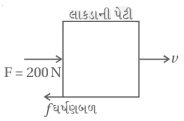
Using a horizontal force of $200\, N$,we intend to move a wooden cabinet across a floor at a constant velocity. What is the friction force (in $N$) that will be exerted on the cabinet?
A
$100$
B
$400$
C
$200$
D
$300$
Solution
(C) When an object moves at a constant velocity,the net force acting on it is zero.
This means that the applied force must be perfectly balanced by the opposing frictional force.
Given that the applied horizontal force is $200\, N$,the frictional force must also be $200\, N$ in the opposite direction to maintain a constant velocity.
Therefore,the friction force exerted on the cabinet is $200\, N$.
This means that the applied force must be perfectly balanced by the opposing frictional force.
Given that the applied horizontal force is $200\, N$,the frictional force must also be $200\, N$ in the opposite direction to maintain a constant velocity.
Therefore,the friction force exerted on the cabinet is $200\, N$.
0 likes
View Solution20
DifficultMCQ
Two objects,each of mass $1.5\, kg$,are moving in the same straight line but in opposite directions. The velocity of each object is $2.5\, m/s$ before the collision during which they stick together. What will be the velocity (in $m/s$) of the combined object after collision?
A
$3$
B
$1$
C
$2$
D
$0$
Solution
(D) Mass of one object,$m_1 = 1.5\, kg$.
Mass of the other object,$m_2 = 1.5\, kg$.
Velocity of $m_1$ before collision,$v_1 = 2.5\, m/s$.
Velocity of $m_2$ before collision,$v_2 = -2.5\, m/s$ (since it moves in the opposite direction).
According to the law of conservation of momentum,the total momentum before collision equals the total momentum after collision.
$m_1v_1 + m_2v_2 = (m_1 + m_2)v$
Substituting the values:
$1.5(2.5) + 1.5(-2.5) = (1.5 + 1.5)v$
$3.75 - 3.75 = 3v$
$0 = 3v$
$v = 0\, m/s$.
Thus,the velocity of the combined object after the collision is $0\, m/s$.
Mass of the other object,$m_2 = 1.5\, kg$.
Velocity of $m_1$ before collision,$v_1 = 2.5\, m/s$.
Velocity of $m_2$ before collision,$v_2 = -2.5\, m/s$ (since it moves in the opposite direction).
According to the law of conservation of momentum,the total momentum before collision equals the total momentum after collision.
$m_1v_1 + m_2v_2 = (m_1 + m_2)v$
Substituting the values:
$1.5(2.5) + 1.5(-2.5) = (1.5 + 1.5)v$
$3.75 - 3.75 = 3v$
$0 = 3v$
$v = 0\, m/s$.
Thus,the velocity of the combined object after the collision is $0\, m/s$.
0 likes
View Solution21
Medium
According to the third law of motion,when we push on an object,the object pushes back on us with an equal and opposite force. If the object is a massive truck parked along the roadside,it will probably not move. $A$ student justifies this by answering that the two opposite and equal forces cancel each other. Comment on this logic and explain why the truck does not move.
Solution
(N/A) The truck has a large mass,which results in a very high static friction between the tires and the road.
To move the truck,the applied force must exceed the maximum static frictional force.
When a person pushes the truck and it does not move,the applied force is balanced by the static frictional force acting in the opposite direction.
Therefore,the student's logic is correct in the context that the net force on the truck is zero because the applied force and the frictional force cancel each other out.
To move the truck,the applied force must exceed the maximum static frictional force.
When a person pushes the truck and it does not move,the applied force is balanced by the static frictional force acting in the opposite direction.
Therefore,the student's logic is correct in the context that the net force on the truck is zero because the applied force and the frictional force cancel each other out.
0 likes
View Solution22
MediumMCQ
$A$ hockey ball of mass $200 \,g$ travelling at $10 \,m \,s^{-1}$ is struck by a hockey stick so as to return it along its original path with a velocity of $5 \,m \,s^{-1}$. Calculate the magnitude of the change in momentum of the hockey ball due to the force applied by the hockey stick.
A
$6 \,kg \,m \,s^{-1}$
B
$3 \,kg \,m \,s^{-1}$
C
$2 \,kg \,m \,s^{-1}$
D
$4 \,kg \,m \,s^{-1}$
Solution
(B) Mass of the hockey ball,$m = 200 \,g = 0.2 \,kg$.
Initial velocity of the hockey ball,$u = 10 \,m \,s^{-1}$.
Initial momentum,$p_i = m \times u = 0.2 \,kg \times 10 \,m \,s^{-1} = 2 \,kg \,m \,s^{-1}$.
Since the ball returns along its original path,the final velocity is in the opposite direction,$v = -5 \,m \,s^{-1}$.
Final momentum,$p_f = m \times v = 0.2 \,kg \times (-5 \,m \,s^{-1}) = -1 \,kg \,m \,s^{-1}$.
Change in momentum,$\Delta p = p_f - p_i = -1 \,kg \,m \,s^{-1} - 2 \,kg \,m \,s^{-1} = -3 \,kg \,m \,s^{-1}$.
The magnitude of the change in momentum is $|\Delta p| = 3 \,kg \,m \,s^{-1}$.
Initial velocity of the hockey ball,$u = 10 \,m \,s^{-1}$.
Initial momentum,$p_i = m \times u = 0.2 \,kg \times 10 \,m \,s^{-1} = 2 \,kg \,m \,s^{-1}$.
Since the ball returns along its original path,the final velocity is in the opposite direction,$v = -5 \,m \,s^{-1}$.
Final momentum,$p_f = m \times v = 0.2 \,kg \times (-5 \,m \,s^{-1}) = -1 \,kg \,m \,s^{-1}$.
Change in momentum,$\Delta p = p_f - p_i = -1 \,kg \,m \,s^{-1} - 2 \,kg \,m \,s^{-1} = -3 \,kg \,m \,s^{-1}$.
The magnitude of the change in momentum is $|\Delta p| = 3 \,kg \,m \,s^{-1}$.
0 likes
View Solution23
DifficultMCQ
$A$ bullet of mass $10\, g$ travelling horizontally with a velocity of $150\, m/s$ strikes a stationary wooden block and comes to rest in $0.03\, s$. Calculate the distance of penetration of the bullet into the block. Also,calculate the magnitude of the force exerted by the wooden block on the bullet.
A
$2.75\, m, 55\, N$
B
$2.52\, m, 45\, N$
C
$2.25\, m, 50\, N$
D
$2.45\, m, 25\, N$
Solution
(C) Given:
Initial velocity of the bullet,$u = 150\, m/s$
Final velocity of the bullet,$v = 0\, m/s$ (as it comes to rest)
Time taken,$t = 0.03\, s$
Mass of the bullet,$m = 10\, g = 0.01\, kg$
Using the first equation of motion,$v = u + at$:
$0 = 150 + a(0.03)$
$a = -150 / 0.03 = -5000\, m/s^2$
Using the second equation of motion to find the distance of penetration $(s)$:
$s = ut + (1/2)at^2$
$s = (150 \times 0.03) + (1/2 \times -5000 \times (0.03)^2)$
$s = 4.5 - (2500 \times 0.0009)$
$s = 4.5 - 2.25 = 2.25\, m$
Using Newton's second law of motion to find the force $(F)$:
$F = ma$
$F = 0.01\, kg \times 5000\, m/s^2 = 50\, N$
Thus,the distance of penetration is $2.25\, m$ and the force exerted is $50\, N$.
Initial velocity of the bullet,$u = 150\, m/s$
Final velocity of the bullet,$v = 0\, m/s$ (as it comes to rest)
Time taken,$t = 0.03\, s$
Mass of the bullet,$m = 10\, g = 0.01\, kg$
Using the first equation of motion,$v = u + at$:
$0 = 150 + a(0.03)$
$a = -150 / 0.03 = -5000\, m/s^2$
Using the second equation of motion to find the distance of penetration $(s)$:
$s = ut + (1/2)at^2$
$s = (150 \times 0.03) + (1/2 \times -5000 \times (0.03)^2)$
$s = 4.5 - (2500 \times 0.0009)$
$s = 4.5 - 2.25 = 2.25\, m$
Using Newton's second law of motion to find the force $(F)$:
$F = ma$
$F = 0.01\, kg \times 5000\, m/s^2 = 50\, N$
Thus,the distance of penetration is $2.25\, m$ and the force exerted is $50\, N$.
0 likes
View Solution24
DifficultMCQ
An object of mass $1 \,kg$ travelling in a straight line with a velocity of $10\, m\, s^{-1}$ collides with,and sticks to,a stationary wooden block of mass $5\, kg$. Then they both move off together in the same straight line. Calculate the total momentum just before the impact and just after the impact. Also,calculate the velocity of the combined object.
A
$12\, kg\, m\, s^{-1}$,$5/6\, m/s$
B
$15\, kg\, m\, s^{-1}$,$4/3\, m/s$
C
$20\, kg\, m\, s^{-1}$,$3/5\, m/s$
D
$10\, kg\, m\, s^{-1}$,$5/3\, m/s$
Solution
(D) Mass of the object,$m_1 = 1\, kg$.
Velocity of the object before collision,$v_1 = 10\, m/s$.
Mass of the stationary wooden block,$m_2 = 5\, kg$.
Velocity of the wooden block before collision,$v_2 = 0\, m/s$.
Total momentum before collision $= m_1 v_1 + m_2 v_2 = 1(10) + 5(0) = 10\, kg\, m\, s^{-1}$.
According to the law of conservation of momentum,the total momentum remains conserved.
Therefore,total momentum after collision $= 10\, kg\, m\, s^{-1}$.
Total mass of the combined system $= m_1 + m_2 = 1 + 5 = 6\, kg$.
Let the velocity of the combined object be $v$.
$10 = (m_1 + m_2)v$
$10 = 6v$
$v = 10/6 = 5/3\, m/s$.
Velocity of the object before collision,$v_1 = 10\, m/s$.
Mass of the stationary wooden block,$m_2 = 5\, kg$.
Velocity of the wooden block before collision,$v_2 = 0\, m/s$.
Total momentum before collision $= m_1 v_1 + m_2 v_2 = 1(10) + 5(0) = 10\, kg\, m\, s^{-1}$.
According to the law of conservation of momentum,the total momentum remains conserved.
Therefore,total momentum after collision $= 10\, kg\, m\, s^{-1}$.
Total mass of the combined system $= m_1 + m_2 = 1 + 5 = 6\, kg$.
Let the velocity of the combined object be $v$.
$10 = (m_1 + m_2)v$
$10 = 6v$
$v = 10/6 = 5/3\, m/s$.
0 likes
View Solution25
MediumMCQ
An object of mass $100 \,kg$ is accelerated uniformly from a velocity of $5 \,m \,s^{-1}$ to $8 \,m \,s^{-1}$ in $6 \,s$. Calculate the initial and final momentum of the object. Also, find the magnitude of the force exerted on the object.
A
$100 \,kg \,m \,s^{-1}$ and $200 \,kg \,m \,s^{-1}$, $30 \,N$
B
$300 \,kg \,m \,s^{-1}$ and $500 \,kg \,m \,s^{-1}$, $20 \,N$
C
$400 \,kg \,m \,s^{-1}$ and $600 \,kg \,m \,s^{-1}$, $40 \,N$
D
$500 \,kg \,m \,s^{-1}$ and $800 \,kg \,m \,s^{-1}$, $50 \,N$
Solution
(D) Initial velocity of the object, $u = 5 \,m \,s^{-1}$.
Final velocity of the object, $v = 8 \,m \,s^{-1}$.
Mass of the object, $m = 100 \,kg$.
Time taken, $t = 6 \,s$.
Initial momentum $= m \times u = 100 \times 5 = 500 \,kg \,m \,s^{-1}$.
Final momentum $= m \times v = 100 \times 8 = 800 \,kg \,m \,s^{-1}$.
Force exerted on the object, $F = \frac{mv - mu}{t}$.
$F = \frac{800 - 500}{6} = \frac{300}{6} = 50 \,N$.
Thus, the initial momentum is $500 \,kg \,m \,s^{-1}$, the final momentum is $800 \,kg \,m \,s^{-1}$, and the force exerted is $50 \,N$.
Final velocity of the object, $v = 8 \,m \,s^{-1}$.
Mass of the object, $m = 100 \,kg$.
Time taken, $t = 6 \,s$.
Initial momentum $= m \times u = 100 \times 5 = 500 \,kg \,m \,s^{-1}$.
Final momentum $= m \times v = 100 \times 8 = 800 \,kg \,m \,s^{-1}$.
Force exerted on the object, $F = \frac{mv - mu}{t}$.
$F = \frac{800 - 500}{6} = \frac{300}{6} = 50 \,N$.
Thus, the initial momentum is $500 \,kg \,m \,s^{-1}$, the final momentum is $800 \,kg \,m \,s^{-1}$, and the force exerted is $50 \,N$.
0 likes
View Solution26
Medium
Akhtar, Kiran, and Rahul were riding in a motorcar that was moving with a high velocity on an expressway when an insect hit the windshield and got stuck on the windscreen. Kiran suggested that the insect suffered a greater change in momentum compared to the motorcar. Akhtar said that since the motorcar was moving with a larger velocity, it exerted a larger force on the insect. Rahul said that both the motorcar and the insect experienced the same force and the same change in momentum. Comment on these suggestions.
Solution
(C) According to the law of conservation of momentum, the total momentum of the system remains conserved during the collision.
$1$. Kiran's suggestion: The insect experiences a much larger change in velocity compared to the car. Since $p = mv$, the change in momentum $(\Delta p = m \Delta v)$ for the insect is significant relative to its mass. Because the car's mass is massive, its change in velocity is negligible, meaning the insect experiences a greater change in momentum relative to its own state, but the magnitude of momentum change for both is equal.
$2$. Akhtar's suggestion: Akhtar is partially correct that the car exerts a large force, but the force exerted by the car on the insect is equal to the force exerted by the insect on the car (Newton's $3^{rd}$ Law).
$3$. Rahul's suggestion: Rahul is correct. According to Newton's $3^{rd}$ Law, the force exerted by the car on the insect is equal and opposite to the force exerted by the insect on the car. Since the time of impact is the same for both, the change in momentum $(F \times t = \Delta p)$ is equal in magnitude for both the car and the insect.
$1$. Kiran's suggestion: The insect experiences a much larger change in velocity compared to the car. Since $p = mv$, the change in momentum $(\Delta p = m \Delta v)$ for the insect is significant relative to its mass. Because the car's mass is massive, its change in velocity is negligible, meaning the insect experiences a greater change in momentum relative to its own state, but the magnitude of momentum change for both is equal.
$2$. Akhtar's suggestion: Akhtar is partially correct that the car exerts a large force, but the force exerted by the car on the insect is equal to the force exerted by the insect on the car (Newton's $3^{rd}$ Law).
$3$. Rahul's suggestion: Rahul is correct. According to Newton's $3^{rd}$ Law, the force exerted by the car on the insect is equal and opposite to the force exerted by the insect on the car. Since the time of impact is the same for both, the change in momentum $(F \times t = \Delta p)$ is equal in magnitude for both the car and the insect.
0 likes
View Solution27
MediumMCQ
How much momentum will a dumbbell of mass $10\, kg$ transfer to the floor if it falls from a height of $80\, cm$? Take its downward acceleration to be $10\, m \,s^{-2}$.
A
$25\, kg\, m \,s^{-1}$
B
$49\, kg\, m \,s^{-1}$
C
$40\, kg\, m \,s^{-1}$
D
$45\, kg\, m \,s^{-1}$
Solution
(C) Given: Mass of the dumbbell,$m = 10\, kg$.
Distance covered,$s = 80\, cm = 0.8\, m$.
Acceleration,$a = 10\, m \,s^{-2}$.
Initial velocity,$u = 0\, m \,s^{-1}$.
Using the third equation of motion,$v^2 = u^2 + 2as$:
$v^2 = 0^2 + 2 \times 10 \times 0.8$
$v^2 = 16$
$v = 4\, m \,s^{-1}$.
Momentum $(p)$ is given by the product of mass and velocity: $p = m \times v$.
$p = 10\, kg \times 4\, m \,s^{-1} = 40\, kg\, m \,s^{-1}$.
Therefore,the dumbbell will transfer $40\, kg\, m \,s^{-1}$ of momentum to the floor.
Distance covered,$s = 80\, cm = 0.8\, m$.
Acceleration,$a = 10\, m \,s^{-2}$.
Initial velocity,$u = 0\, m \,s^{-1}$.
Using the third equation of motion,$v^2 = u^2 + 2as$:
$v^2 = 0^2 + 2 \times 10 \times 0.8$
$v^2 = 16$
$v = 4\, m \,s^{-1}$.
Momentum $(p)$ is given by the product of mass and velocity: $p = m \times v$.
$p = 10\, kg \times 4\, m \,s^{-1} = 40\, kg\, m \,s^{-1}$.
Therefore,the dumbbell will transfer $40\, kg\, m \,s^{-1}$ of momentum to the floor.
0 likes
View Solution28
Medium
The following is the distance-time table of an object in motion:
$(a)$ What conclusion can you draw about the acceleration? Is it constant, increasing, decreasing, or zero?
$(b)$ What do you infer about the forces acting on the object?
| Time in seconds | Distance in metres |
| $0$ | $0$ |
| $1$ | $1$ |
| $2$ | $8$ |
| $3$ | $27$ |
| $4$ | $64$ |
| $5$ | $125$ |
| $6$ | $216$ |
| $7$ | $343$ |
$(a)$ What conclusion can you draw about the acceleration? Is it constant, increasing, decreasing, or zero?
$(b)$ What do you infer about the forces acting on the object?
Solution
(N/A) The distance covered by the object in equal intervals of time is unequal (it follows the cube of time, $d = t^3$). This indicates non-uniform motion. Since the velocity (rate of change of distance) is increasing at an increasing rate, the acceleration is increasing.
$(b)$ According to Newton's second law of motion, $F = ma$. Since the acceleration $(a)$ of the object is increasing over time, the net force $(F)$ acting on the object must also be increasing.
$(b)$ According to Newton's second law of motion, $F = ma$. Since the acceleration $(a)$ of the object is increasing over time, the net force $(F)$ acting on the object must also be increasing.
0 likes
View Solution29
MediumMCQ
Two persons manage to push a motorcar of mass $1200 \, kg$ at a uniform velocity along a level road. The same motorcar can be pushed by three persons to produce an acceleration of $0.2 \, m \, s^{-2}$. With what force (in $N$) does each person push the motorcar? (Assume that all persons push the motorcar with the same muscular effort.)
A
$240$
B
$244$
C
$248$
D
$225$
Solution
(A) Mass of the motorcar $(m)$ $= 1200 \, kg$.
When two persons push the car at a uniform velocity,the net external force is zero. This means the force applied by the two persons is exactly balanced by the frictional force $(f)$.
So,$2F = f$,where $F$ is the force applied by each person.
When three persons push the car,the total applied force is $3F$. The net force $(F_{net})$ causing acceleration is the total applied force minus the frictional force:
$F_{net} = 3F - f = 3F - 2F = F$.
According to Newton's second law of motion,$F_{net} = m \times a$.
Given $a = 0.2 \, m \, s^{-2}$,we have:
$F = 1200 \, kg \times 0.2 \, m \, s^{-2} = 240 \, N$.
Therefore,each person pushes the motorcar with a force of $240 \, N$.
When two persons push the car at a uniform velocity,the net external force is zero. This means the force applied by the two persons is exactly balanced by the frictional force $(f)$.
So,$2F = f$,where $F$ is the force applied by each person.
When three persons push the car,the total applied force is $3F$. The net force $(F_{net})$ causing acceleration is the total applied force minus the frictional force:
$F_{net} = 3F - f = 3F - 2F = F$.
According to Newton's second law of motion,$F_{net} = m \times a$.
Given $a = 0.2 \, m \, s^{-2}$,we have:
$F = 1200 \, kg \times 0.2 \, m \, s^{-2} = 240 \, N$.
Therefore,each person pushes the motorcar with a force of $240 \, N$.
1 likes
View Solution30
MediumMCQ
$A$ hammer of mass $500 \,g$,moving at $50 \,m/s$,strikes a nail. The nail stops the hammer in a very short time of $0.01 \,s$. What is the force (in $N$) of the nail on the hammer?
A
$5000$
B
$2500$
C
$3500$
D
$4500$
Solution
(B) Mass of the hammer,$m = 500 \,g = 0.5 \,kg$.
Initial velocity of the hammer,$u = 50 \,m/s$.
Time taken by the nail to stop the hammer,$t = 0.01 \,s$.
Final velocity of the hammer,$v = 0 \,m/s$ (since the hammer comes to rest).
According to Newton's second law of motion,the force $F$ exerted on the hammer is given by $F = m \times a = m \times \frac{v - u}{t}$.
Substituting the values: $F = 0.5 \times \frac{0 - 50}{0.01} = 0.5 \times (-5000) = -2500 \,N$.
The negative sign indicates that the force exerted by the nail on the hammer is in the opposite direction of the hammer's motion.
According to Newton's third law of motion,the magnitude of the force exerted by the nail on the hammer is $2500 \,N$.
Initial velocity of the hammer,$u = 50 \,m/s$.
Time taken by the nail to stop the hammer,$t = 0.01 \,s$.
Final velocity of the hammer,$v = 0 \,m/s$ (since the hammer comes to rest).
According to Newton's second law of motion,the force $F$ exerted on the hammer is given by $F = m \times a = m \times \frac{v - u}{t}$.
Substituting the values: $F = 0.5 \times \frac{0 - 50}{0.01} = 0.5 \times (-5000) = -2500 \,N$.
The negative sign indicates that the force exerted by the nail on the hammer is in the opposite direction of the hammer's motion.
According to Newton's third law of motion,the magnitude of the force exerted by the nail on the hammer is $2500 \,N$.
0 likes
View Solution31
DifficultMCQ
$A$ motorcar of mass $1200\, kg$ is moving along a straight line with a uniform velocity of $90\, km/h$. Its velocity is slowed down to $18\, km/h$ in $4\, s$ by an unbalanced external force. Calculate the acceleration and change in momentum. Also,calculate the magnitude of the force required.
A
$ -8\, m/s^2$ and $ -30000\, kg\, m/s$,$2000\, N$
B
$ -1\, m/s^2$ and $ -28000\, kg\, m/s$,$8000\, N$
C
$ -5\, m/s^2$ and $ -24000\, kg\, m/s$,$6000\, N$
D
$ -2\, m/s^2$ and $ -42000\, kg\, m/s$,$5000\, N$
Solution
(C) Mass of the motor car,$m = 1200\, kg$.
Initial velocity,$u = 90\, km/h = 90 \times (5/18) = 25\, m/s$.
Final velocity,$v = 18\, km/h = 18 \times (5/18) = 5\, m/s$.
Time taken,$t = 4\, s$.
Acceleration $a = (v - u) / t = (5 - 25) / 4 = -20 / 4 = -5\, m/s^2$.
Change in momentum = $m(v - u) = 1200 \times (5 - 25) = 1200 \times (-20) = -24000\, kg\, m/s$.
Force $F = m \times a = 1200 \times (-5) = -6000\, N$.
The magnitude of the force required is $6000\, N$.
Initial velocity,$u = 90\, km/h = 90 \times (5/18) = 25\, m/s$.
Final velocity,$v = 18\, km/h = 18 \times (5/18) = 5\, m/s$.
Time taken,$t = 4\, s$.
Acceleration $a = (v - u) / t = (5 - 25) / 4 = -20 / 4 = -5\, m/s^2$.
Change in momentum = $m(v - u) = 1200 \times (5 - 25) = 1200 \times (-20) = -24000\, kg\, m/s$.
Force $F = m \times a = 1200 \times (-5) = -6000\, N$.
The magnitude of the force required is $6000\, N$.
0 likes
View SolutionFORCE AND LAWS OF MOTION — Textbook - FORCE AND LAWS OF MOTION · Frequently Asked Questions
1Are these FORCE AND LAWS OF MOTION questions useful for JEE and NEET?
Yes. All questions in this section are mapped to JEE Main and NEET exam patterns. Previous year questions from JEE Main, NEET, GUJCET and state-level exams are included with full solutions.
2Can I switch to Hindi or Gujarati for these questions?
Yes. Use the language tabs in the hero section or the sidebar to view the same questions and solutions in English, Hindi or Gujarati.
3How do I generate a question paper from this subtopic?
Use the Vedclass Exam Paper Generator — select the chapter and subtopic, set difficulty, and generate Sets A, B, C, D automatically. First 3 chapters of every subject are free.
Vedclass Products
For Students
Vedclass Test Series
Mock tests in real JEE/NEET style with performance analysis. 5-day free trial.
Start Free TrialFor Teachers
Exam Paper Generator
Generate Set A/B/C/D papers from this chapter in 2 minutes. 3 chapters free.
Try FreeFor Institutes
Online Exam Module
Live online exams with unlimited students, 360° analytics & white-label branding.
See DemoFor Teachers & Institutes
Generate a FORCE AND LAWS OF MOTION Exam Paper in 2 Minutes
Select subtopic & difficulty — Sets A, B, C, D auto-generated with No Repeat logic.
First 3 chapters of every subject are free — no payment required.