
A English
Mix Example - FORCE AND LAWS OF MOTION Questions in English
Class 9 Science · FORCE AND LAWS OF MOTION · Mix Example - FORCE AND LAWS OF MOTION
199+
Questions
English
Language
100%
With Solutions
Showing 49 of 199 questions in English
151
Medium
It is required to increase the velocity of a scooter of mass $80 \ kg$ from $5 \ m s^{-1}$ to $25 \ m s^{-1}$ in $2 \ s$. Calculate the force required.
Solution
(D) Given: mass $m = 80 \ kg$,initial velocity $u = 5 \ m s^{-1}$,final velocity $v = 25 \ m s^{-1}$,and time $t = 2 \ s$.
First,calculate the acceleration $a$ using the formula:
$a = \frac{v - u}{t}$
Substituting the values:
$a = \frac{25 - 5}{2} = \frac{20}{2} = 10 \ m s^{-2}$
Now,calculate the force $F$ using Newton's second law of motion:
$F = m \times a$
Substituting the values:
$F = 80 \ kg \times 10 \ m s^{-2} = 800 \ N$
Therefore,the force required is $800 \ N$.
First,calculate the acceleration $a$ using the formula:
$a = \frac{v - u}{t}$
Substituting the values:
$a = \frac{25 - 5}{2} = \frac{20}{2} = 10 \ m s^{-2}$
Now,calculate the force $F$ using Newton's second law of motion:
$F = m \times a$
Substituting the values:
$F = 80 \ kg \times 10 \ m s^{-2} = 800 \ N$
Therefore,the force required is $800 \ N$.
0 likes
View Solution152
DifficultMCQ
$A$ truck starts from rest and rolls down a hill with constant acceleration. It travels a distance of $400 \, m$ in $20 \, s$. Find its acceleration. Find the force acting on it, if its mass is $7$ metric tons.
A
Acceleration = $2 \, m/s^2$, Force = $14000 \, N$
B
Acceleration = $1 \, m/s^2$, Force = $7000 \, N$
C
Acceleration = $4 \, m/s^2$, Force = $28000 \, N$
D
Acceleration = $0.5 \, m/s^2$, Force = $3500 \, N$
Solution
(A) Given:
Initial velocity, $u = 0 \, m/s$
Distance traveled, $S = 400 \, m$
Time taken, $t = 20 \, s$
Mass of the truck, $m = 7 \, \text{metric tons} = 7000 \, kg$
$(a)$ To find the acceleration $(a)$:
Using the second equation of motion, $S = ut + \frac{1}{2}at^2$
$400 = (0)(20) + \frac{1}{2} \times a \times (20)^2$
$400 = \frac{1}{2} \times a \times 400$
$a = \frac{400 \times 2}{400} = 2 \, m/s^2$
$(b)$ To find the force $(F)$:
Using Newton's second law of motion, $F = m \times a$
$F = 7000 \, kg \times 2 \, m/s^2 = 14000 \, N$
Initial velocity, $u = 0 \, m/s$
Distance traveled, $S = 400 \, m$
Time taken, $t = 20 \, s$
Mass of the truck, $m = 7 \, \text{metric tons} = 7000 \, kg$
$(a)$ To find the acceleration $(a)$:
Using the second equation of motion, $S = ut + \frac{1}{2}at^2$
$400 = (0)(20) + \frac{1}{2} \times a \times (20)^2$
$400 = \frac{1}{2} \times a \times 400$
$a = \frac{400 \times 2}{400} = 2 \, m/s^2$
$(b)$ To find the force $(F)$:
Using Newton's second law of motion, $F = m \times a$
$F = 7000 \, kg \times 2 \, m/s^2 = 14000 \, N$
0 likes
View Solution153
Difficult
$A$ certain force exerted for $1.2 \, s$ raises the speed of an object from $1.8 \, m s^{-1}$ to $4.2 \, m s^{-1}$. Later, the same force is applied for $2 \, s$. How much does the speed change in $2 \, s$?
Solution
(D) Given:
Time interval, $t_1 = 1.2 \, s$
Initial speed, $u_1 = 1.8 \, m s^{-1}$
Final speed, $v_1 = 4.2 \, m s^{-1}$
Using the first equation of motion, $v = u + at$, we calculate the acceleration $(a)$:
$a = \frac{v_1 - u_1}{t_1} = \frac{4.2 - 1.8}{1.2} = \frac{2.4}{1.2} = 2 \, m s^{-2}$
Since the same force is applied to the same object, the acceleration remains constant at $a = 2 \, m s^{-2}$.
For the second interval, $t_2 = 2 \, s$:
The change in speed $(\Delta v)$ is given by $\Delta v = a \times t_2$.
$\Delta v = 2 \, m s^{-2} \times 2 \, s = 4 \, m s^{-1}$.
Thus, the speed changes by $4 \, m s^{-1}$.
Time interval, $t_1 = 1.2 \, s$
Initial speed, $u_1 = 1.8 \, m s^{-1}$
Final speed, $v_1 = 4.2 \, m s^{-1}$
Using the first equation of motion, $v = u + at$, we calculate the acceleration $(a)$:
$a = \frac{v_1 - u_1}{t_1} = \frac{4.2 - 1.8}{1.2} = \frac{2.4}{1.2} = 2 \, m s^{-2}$
Since the same force is applied to the same object, the acceleration remains constant at $a = 2 \, m s^{-2}$.
For the second interval, $t_2 = 2 \, s$:
The change in speed $(\Delta v)$ is given by $\Delta v = a \times t_2$.
$\Delta v = 2 \, m s^{-2} \times 2 \, s = 4 \, m s^{-1}$.
Thus, the speed changes by $4 \, m s^{-1}$.
0 likes
View Solution154
MediumMCQ
$A$ body of mass $500 \, g$ is at rest on a frictionless surface. Calculate the distance travelled by it in $10 \, s$ when acted upon by a force of $10^{-2} \, N$. (in $, m$)
A
$0.5$
B
$1$
C
$2$
D
$5$
Solution
(B) Given: Mass $m = 500 \, g = 0.5 \, kg$,Time $t = 10 \, s$,Force $F = 10^{-2} \, N = 0.01 \, N$,and Initial velocity $u = 0 \, m/s$.
First,calculate the acceleration $a$ using Newton's second law of motion,$F = ma$:
$a = \frac{F}{m} = \frac{0.01 \, N}{0.5 \, kg} = 0.02 \, m/s^2$.
Next,use the second equation of motion to calculate the distance $S$ travelled:
$S = ut + \frac{1}{2}at^2$
$S = 0 \times 10 + \frac{1}{2} \times 0.02 \times (10)^2$
$S = 0 + 0.01 \times 100 = 1 \, m$.
Therefore,the distance travelled by the body is $1 \, m$.
First,calculate the acceleration $a$ using Newton's second law of motion,$F = ma$:
$a = \frac{F}{m} = \frac{0.01 \, N}{0.5 \, kg} = 0.02 \, m/s^2$.
Next,use the second equation of motion to calculate the distance $S$ travelled:
$S = ut + \frac{1}{2}at^2$
$S = 0 \times 10 + \frac{1}{2} \times 0.02 \times (10)^2$
$S = 0 + 0.01 \times 100 = 1 \, m$.
Therefore,the distance travelled by the body is $1 \, m$.
0 likes
View Solution155
Medium
$A$ bullet of mass $5\, g$ travelling at a speed of $120\, m s^{-1}$ penetrates deeply into a fixed target and is brought to rest in $0.01\, s$. Calculate
$(a)$ the distance of penetration in the target
$(b)$ the average force exerted on the bullet
$(a)$ the distance of penetration in the target
$(b)$ the average force exerted on the bullet
Solution
(N/A) Given: Mass $m = 5\, g = 5 \times 10^{-3}\, kg$,Initial velocity $u = 120\, m s^{-1}$,Final velocity $v = 0\, m s^{-1}$,Time $t = 0.01\, s$.
$(a)$ First,calculate the acceleration $a$ using the equation $v = u + at$:
$0 = 120 + a \times 0.01$
$a = -\frac{120}{0.01} = -12000\, m s^{-2}$ (The negative sign indicates retardation).
Now,calculate the distance of penetration $S$ using the equation $S = ut + \frac{1}{2}at^2$:
$S = (120 \times 0.01) + \frac{1}{2} \times (-12000) \times (0.01)^2$
$S = 1.2 - 0.6 = 0.6\, m$.
$(b)$ Calculate the average force $F$ using Newton's second law $F = ma$:
$F = (5 \times 10^{-3}\, kg) \times (12000\, m s^{-2})$
$F = 60\, N$.
$(a)$ First,calculate the acceleration $a$ using the equation $v = u + at$:
$0 = 120 + a \times 0.01$
$a = -\frac{120}{0.01} = -12000\, m s^{-2}$ (The negative sign indicates retardation).
Now,calculate the distance of penetration $S$ using the equation $S = ut + \frac{1}{2}at^2$:
$S = (120 \times 0.01) + \frac{1}{2} \times (-12000) \times (0.01)^2$
$S = 1.2 - 0.6 = 0.6\, m$.
$(b)$ Calculate the average force $F$ using Newton's second law $F = ma$:
$F = (5 \times 10^{-3}\, kg) \times (12000\, m s^{-2})$
$F = 60\, N$.
1 likes
View Solution156
MediumMCQ
How much momentum will a dumbbell of mass $10 \, kg$ transfer to the floor,if it falls from a height of $0.8 \, m$? Take acceleration due to gravity as $10 \, m s^{-2}$.
A
$20 \, kg \, m s^{-1}$
B
$40 \, kg \, m s^{-1}$
C
$80 \, kg \, m s^{-1}$
D
$100 \, kg \, m s^{-1}$
Solution
(B) Given: Mass $(m) = 10 \, kg$,Initial velocity $(u) = 0 \, m s^{-1}$,Height $(S) = 0.8 \, m$,Acceleration due to gravity $(g) = 10 \, m s^{-2}$.
Using the equation of motion $v^2 - u^2 = 2gS$:
$v^2 - (0)^2 = 2 \times 10 \times 0.8$
$v^2 = 16$
$v = 4 \, m s^{-1}$.
Momentum $(p)$ is defined as the product of mass and velocity:
$p = m \times v$
$p = 10 \, kg \times 4 \, m s^{-1} = 40 \, kg \, m s^{-1}$ (or $40 \, N s$).
Thus,the dumbbell will transfer $40 \, kg \, m s^{-1}$ of momentum to the floor.
Using the equation of motion $v^2 - u^2 = 2gS$:
$v^2 - (0)^2 = 2 \times 10 \times 0.8$
$v^2 = 16$
$v = 4 \, m s^{-1}$.
Momentum $(p)$ is defined as the product of mass and velocity:
$p = m \times v$
$p = 10 \, kg \times 4 \, m s^{-1} = 40 \, kg \, m s^{-1}$ (or $40 \, N s$).
Thus,the dumbbell will transfer $40 \, kg \, m s^{-1}$ of momentum to the floor.
0 likes
View Solution157
MediumMCQ
What would be the force required to stop a car of mass $1000 \ kg$ and a loaded truck of mass $10000 \ kg$ in $2 \ s$,if they are moving with the same velocity of $5 \ m s^{-1}$?
A
$2500 \ N$ and $25000 \ N$
B
$25000 \ N$ and $2500 \ N$
C
$5000 \ N$ and $50000 \ N$
D
$50000 \ N$ and $5000 \ N$
Solution
(A) Given: Initial velocity $(u) = 5 \ m s^{-1}$,Final velocity $(v) = 0$,Time $(t) = 2 \ s$.
Using the first equation of motion,$v = u + at$:
$0 = 5 + a \times 2$
$2a = -5$
$a = -2.5 \ m s^{-2}$ (retardation).
Force required to stop the car $(m = 1000 \ kg)$:
$F_{car} = m \times a = 1000 \ kg \times (-2.5 \ m s^{-2}) = -2500 \ N$.
Force required to stop the truck $(m = 10000 \ kg)$:
$F_{truck} = m \times a = 10000 \ kg \times (-2.5 \ m s^{-2}) = -25000 \ N$.
The negative sign indicates that the force is applied in the direction opposite to the motion (retarding force).
Using the first equation of motion,$v = u + at$:
$0 = 5 + a \times 2$
$2a = -5$
$a = -2.5 \ m s^{-2}$ (retardation).
Force required to stop the car $(m = 1000 \ kg)$:
$F_{car} = m \times a = 1000 \ kg \times (-2.5 \ m s^{-2}) = -2500 \ N$.
Force required to stop the truck $(m = 10000 \ kg)$:
$F_{truck} = m \times a = 10000 \ kg \times (-2.5 \ m s^{-2}) = -25000 \ N$.
The negative sign indicates that the force is applied in the direction opposite to the motion (retarding force).
0 likes
View Solution158
MediumMCQ
$A$ cricket ball of mass $70 \, g$,moving with a velocity of $0.5 \, m s^{-1}$ is stopped by a player in $0.5 \, s$. What is the force applied by the player to stop the ball (in $, N$)?
A
$0.07$
B
$-0.07$
C
$0.7$
D
$-0.7$
Solution
(B) Given:
Initial velocity of the ball $(u) = 0.5 \, m s^{-1}$
Final velocity of the ball $(v) = 0 \, m s^{-1}$
Time $(t) = 0.5 \, s$
Mass of the ball $(m) = 70 \, g = 0.07 \, kg$
According to Newton's second law of motion,the force $(F)$ is given by the rate of change of momentum:
$F = \frac{m(v - u)}{t}$
Substituting the values:
$F = \frac{0.07 \times (0 - 0.5)}{0.5}$
$F = \frac{0.07 \times (-0.5)}{0.5}$
$F = -0.07 \, N$
The negative sign indicates that the force applied by the player is a retarding force (opposing the motion of the ball).
Initial velocity of the ball $(u) = 0.5 \, m s^{-1}$
Final velocity of the ball $(v) = 0 \, m s^{-1}$
Time $(t) = 0.5 \, s$
Mass of the ball $(m) = 70 \, g = 0.07 \, kg$
According to Newton's second law of motion,the force $(F)$ is given by the rate of change of momentum:
$F = \frac{m(v - u)}{t}$
Substituting the values:
$F = \frac{0.07 \times (0 - 0.5)}{0.5}$
$F = \frac{0.07 \times (-0.5)}{0.5}$
$F = -0.07 \, N$
The negative sign indicates that the force applied by the player is a retarding force (opposing the motion of the ball).
0 likes
View Solution159
Medium
$A$ car of mass $1000 \, kg$ moving with a velocity of $15 \, m/s$ collides with a tree and comes to rest in $5 \, s$. What will be the force exerted by the car on the tree?
Solution
(3000 N) Given:
Mass of the car $(m) = 1000 \, kg$
Initial velocity of the car $(u) = 15 \, m/s$
Final velocity of the car $(v) = 0 \, m/s$ (since it comes to rest)
Time taken $(t) = 5 \, s$
Using Newton's second law of motion,the force exerted by the tree on the car is given by:
$F = m \times a = m \times \frac{(v - u)}{t}$
Substituting the values:
$F = 1000 \times \frac{(0 - 15)}{5}$
$F = 1000 \times (-3) = -3000 \, N$
The negative sign indicates that the force exerted by the tree on the car is in the opposite direction of motion.
According to Newton's third law of motion,the force exerted by the car on the tree is equal in magnitude but opposite in direction to the force exerted by the tree on the car.
Therefore,the force exerted by the car on the tree is $3000 \, N$.
Mass of the car $(m) = 1000 \, kg$
Initial velocity of the car $(u) = 15 \, m/s$
Final velocity of the car $(v) = 0 \, m/s$ (since it comes to rest)
Time taken $(t) = 5 \, s$
Using Newton's second law of motion,the force exerted by the tree on the car is given by:
$F = m \times a = m \times \frac{(v - u)}{t}$
Substituting the values:
$F = 1000 \times \frac{(0 - 15)}{5}$
$F = 1000 \times (-3) = -3000 \, N$
The negative sign indicates that the force exerted by the tree on the car is in the opposite direction of motion.
According to Newton's third law of motion,the force exerted by the car on the tree is equal in magnitude but opposite in direction to the force exerted by the tree on the car.
Therefore,the force exerted by the car on the tree is $3000 \, N$.
0 likes
View Solution160
MediumMCQ
$A$ bullet of mass $10\, g$ is fired from a rifle. The bullet takes $0.003\, s$ to move through its barrel and leaves with a velocity of $300\, m s^{-1}$. What is the force exerted on the bullet by the rifle (in $, N$)?
A
$1000$
B
$100$
C
$10000$
D
$10$
Solution
(A) Given:
Mass of the bullet $(m) = 10\, g = 0.01\, kg$
Initial velocity of the bullet $(u) = 0\, m s^{-1}$
Final velocity of the bullet $(v) = 300\, m s^{-1}$
Time taken $(t) = 0.003\, s$
Step $1$: Calculate the acceleration $(a)$ of the bullet using the formula $a = \frac{v - u}{t}$.
$a = \frac{300 - 0}{0.003} = \frac{300}{0.003} = 100,000\, m s^{-2}$.
Step $2$: Calculate the force $(F)$ exerted on the bullet using Newton's second law of motion,$F = m \times a$.
$F = 0.01\, kg \times 100,000\, m s^{-2} = 1000\, N$.
Therefore,the force exerted on the bullet by the rifle is $1000\, N$.
Mass of the bullet $(m) = 10\, g = 0.01\, kg$
Initial velocity of the bullet $(u) = 0\, m s^{-1}$
Final velocity of the bullet $(v) = 300\, m s^{-1}$
Time taken $(t) = 0.003\, s$
Step $1$: Calculate the acceleration $(a)$ of the bullet using the formula $a = \frac{v - u}{t}$.
$a = \frac{300 - 0}{0.003} = \frac{300}{0.003} = 100,000\, m s^{-2}$.
Step $2$: Calculate the force $(F)$ exerted on the bullet using Newton's second law of motion,$F = m \times a$.
$F = 0.01\, kg \times 100,000\, m s^{-2} = 1000\, N$.
Therefore,the force exerted on the bullet by the rifle is $1000\, N$.
0 likes
View Solution161
Medium
$A$ man pushes a box of mass $50\, kg$ with a force of $80\, N$. What will be the acceleration of the box due to this force? What would be the acceleration if the mass were doubled?
Solution
(N/A) Given: Mass $m = 50\, kg$,Force $F = 80\, N$.
Using Newton's second law of motion,$F = m \times a$,the acceleration $a$ is given by:
$a = F / m = 80 / 50 = 1.6\, m/s^2$.
If the mass is doubled,the new mass $m' = 2 \times 50 = 100\, kg$.
The new acceleration $a'$ is:
$a' = F / m' = 80 / 100 = 0.8\, m/s^2$.
Using Newton's second law of motion,$F = m \times a$,the acceleration $a$ is given by:
$a = F / m = 80 / 50 = 1.6\, m/s^2$.
If the mass is doubled,the new mass $m' = 2 \times 50 = 100\, kg$.
The new acceleration $a'$ is:
$a' = F / m' = 80 / 100 = 0.8\, m/s^2$.
0 likes
View Solution162
MediumMCQ
$A$ machine gun can fire $50 \, g$ bullets with a velocity of $150 \, m s^{-1}$. $A$ $60 \, kg$ stone is moving towards the machine gun with a velocity of $10 \, m s^{-1}$. How many bullets must be fired from the gun to just stop the stone in its tracks?
A
$80$
B
$100$
C
$120$
D
$150$
Solution
(A) Given:
Mass of bullet $m_{B} = 50 \, g = 50 \times 10^{-3} \, kg = 0.05 \, kg$.
Velocity of bullet $v_{B} = 150 \, m s^{-1}$.
Mass of stone $m_{S} = 60 \, kg$.
Velocity of stone $v_{S} = 10 \, m s^{-1}$.
Let $n$ be the number of bullets required to stop the stone.
According to the law of conservation of momentum,the total momentum of the system must be zero to stop the stone.
$n(m_{B} v_{B}) + m_{S} v_{S} = 0$.
Taking the direction of the stone as positive,the bullets are fired in the opposite direction,so their velocity is negative relative to the stone's motion.
$n(0.05 \times 150) + 60 \times (-10) = 0$.
$n(7.5) = 600$.
$n = \frac{600}{7.5} = 80$.
Therefore,$80$ bullets must be fired to stop the stone.
Mass of bullet $m_{B} = 50 \, g = 50 \times 10^{-3} \, kg = 0.05 \, kg$.
Velocity of bullet $v_{B} = 150 \, m s^{-1}$.
Mass of stone $m_{S} = 60 \, kg$.
Velocity of stone $v_{S} = 10 \, m s^{-1}$.
Let $n$ be the number of bullets required to stop the stone.
According to the law of conservation of momentum,the total momentum of the system must be zero to stop the stone.
$n(m_{B} v_{B}) + m_{S} v_{S} = 0$.
Taking the direction of the stone as positive,the bullets are fired in the opposite direction,so their velocity is negative relative to the stone's motion.
$n(0.05 \times 150) + 60 \times (-10) = 0$.
$n(7.5) = 600$.
$n = \frac{600}{7.5} = 80$.
Therefore,$80$ bullets must be fired to stop the stone.
0 likes
View Solution163
Difficult
$A$ constant force acts on an object of $5 \ kg$ for a period of $2 \ s$. It increases the velocity of the object from $3 \ m s^{-1}$ to $7 \ m s^{-1}$. Find the magnitude of the applied force. Now,if the force were applied for a period of $5 \ s$,what would be the final velocity of the object?
Solution
(D) Given: Mass $m = 5 \ kg$,initial velocity $u = 3 \ m s^{-1}$,final velocity $v = 7 \ m s^{-1}$,time $t = 2 \ s$.
Using Newton's second law of motion,$F = m \times a = m \times \frac{(v - u)}{t}$.
Substituting the values: $F = \frac{5 \times (7 - 3)}{2} = \frac{5 \times 4}{2} = 10 \ N$.
Now,for the second part,the force $F = 10 \ N$ is applied for $t' = 5 \ s$.
The acceleration $a = \frac{F}{m} = \frac{10}{5} = 2 \ m s^{-2}$.
Using the first equation of motion,$v' = u + a \times t'$.
$v' = 3 + (2 \times 5) = 3 + 10 = 13 \ m s^{-1}$.
Using Newton's second law of motion,$F = m \times a = m \times \frac{(v - u)}{t}$.
Substituting the values: $F = \frac{5 \times (7 - 3)}{2} = \frac{5 \times 4}{2} = 10 \ N$.
Now,for the second part,the force $F = 10 \ N$ is applied for $t' = 5 \ s$.
The acceleration $a = \frac{F}{m} = \frac{10}{5} = 2 \ m s^{-2}$.
Using the first equation of motion,$v' = u + a \times t'$.
$v' = 3 + (2 \times 5) = 3 + 10 = 13 \ m s^{-1}$.
0 likes
View Solution164
Medium
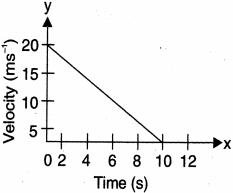
The velocity-time graph of a ball of mass $20 \ g$ moving along a straight line on a level ground is given below. How much force does the ground exert on the ball to bring it to rest?
Solution
(N/A) Given:
Mass of the ball,$m = 20 \ g = 0.02 \ kg$.
From the velocity-time graph:
Initial velocity,$u = 20 \ m \ s^{-1}$ (at $t = 0 \ s$).
Final velocity,$v = 0 \ m \ s^{-1}$ (at $t = 10 \ s$).
Time taken,$t = 10 \ s$.
Using Newton's second law of motion,the force $F$ exerted by the ground on the ball is given by:
$F = m \times a = m \times \frac{(v - u)}{t}$
Substituting the values:
$F = 0.02 \times \frac{(0 - 20)}{10}$
$F = 0.02 \times (-2) = -0.04 \ N$.
The negative sign indicates that the force exerted by the ground (frictional force) is in the direction opposite to the motion of the ball. Thus,the magnitude of the force is $0.04 \ N$.
Mass of the ball,$m = 20 \ g = 0.02 \ kg$.
From the velocity-time graph:
Initial velocity,$u = 20 \ m \ s^{-1}$ (at $t = 0 \ s$).
Final velocity,$v = 0 \ m \ s^{-1}$ (at $t = 10 \ s$).
Time taken,$t = 10 \ s$.
Using Newton's second law of motion,the force $F$ exerted by the ground on the ball is given by:
$F = m \times a = m \times \frac{(v - u)}{t}$
Substituting the values:
$F = 0.02 \times \frac{(0 - 20)}{10}$
$F = 0.02 \times (-2) = -0.04 \ N$.
The negative sign indicates that the force exerted by the ground (frictional force) is in the direction opposite to the motion of the ball. Thus,the magnitude of the force is $0.04 \ N$.
0 likes
View Solution165
Medium
$A$ steam engine of mass $3 \times 10^{4} \text{ kg}$ pulls two wagons,each of mass $2 \times 10^{4} \text{ kg}$,with an acceleration of $0.2 \text{ m s}^{-2}$. Neglecting frictional forces,calculate the:
$(i)$ force exerted by the engine.
$(ii)$ force experienced by each wagon.
$(i)$ force exerted by the engine.
$(ii)$ force experienced by each wagon.
Solution
(N/A) Given:
Mass of engine $M_{E} = 3 \times 10^{4} \text{ kg}$
Mass of each wagon $M_{w} = 2 \times 10^{4} \text{ kg}$
Acceleration $a = 0.2 \text{ m s}^{-2}$
$(i)$ The total mass being pulled by the engine is $M_{total} = M_{E} + 2M_{w} = 3 \times 10^{4} + 4 \times 10^{4} = 7 \times 10^{4} \text{ kg}$.
The force exerted by the engine is $F = M_{total} \times a = (7 \times 10^{4} \text{ kg}) \times (0.2 \text{ m s}^{-2}) = 1.4 \times 10^{4} \text{ N}$.
$(ii)$ The force experienced by each wagon is the force required to accelerate that specific wagon. For one wagon,$F_{w} = M_{w} \times a = (2 \times 10^{4} \text{ kg}) \times (0.2 \text{ m s}^{-2}) = 0.4 \times 10^{4} \text{ N} = 4000 \text{ N}$.
Mass of engine $M_{E} = 3 \times 10^{4} \text{ kg}$
Mass of each wagon $M_{w} = 2 \times 10^{4} \text{ kg}$
Acceleration $a = 0.2 \text{ m s}^{-2}$
$(i)$ The total mass being pulled by the engine is $M_{total} = M_{E} + 2M_{w} = 3 \times 10^{4} + 4 \times 10^{4} = 7 \times 10^{4} \text{ kg}$.
The force exerted by the engine is $F = M_{total} \times a = (7 \times 10^{4} \text{ kg}) \times (0.2 \text{ m s}^{-2}) = 1.4 \times 10^{4} \text{ N}$.
$(ii)$ The force experienced by each wagon is the force required to accelerate that specific wagon. For one wagon,$F_{w} = M_{w} \times a = (2 \times 10^{4} \text{ kg}) \times (0.2 \text{ m s}^{-2}) = 0.4 \times 10^{4} \text{ N} = 4000 \text{ N}$.
0 likes
View Solution166
Difficult
$A$ man throws a ball of mass $0.5\, kg$ vertically upward with a velocity of $25\, m s^{-1}$. Find:
$(a)$ The initial momentum of the ball.
$(b)$ The momentum of the ball at the halfway mark of the maximum height (given $g = 10\, m s^{-2}$).
$(a)$ The initial momentum of the ball.
$(b)$ The momentum of the ball at the halfway mark of the maximum height (given $g = 10\, m s^{-2}$).
Solution
(N/A) Initial momentum is calculated as $p = m \times u = 0.5 \times 25 = 12.5\, kg\, m s^{-1}$.
$(b)$ First,find the maximum height $h$ using the equation $v^2 = u^2 - 2gh$. At maximum height,$v = 0$,so $0 = (25)^2 - 2 \times 10 \times h$,which gives $h = 625 / 20 = 31.25\, m$.
The halfway mark is $H = h / 2 = 31.25 / 2 = 15.625\, m$.
Now,find the velocity $v$ at this height using $v^2 = u^2 - 2gH$:
$v^2 = (25)^2 - 2 \times 10 \times 15.625 = 625 - 312.5 = 312.5$.
$v = \sqrt{312.5} \approx 17.68\, m s^{-1}$.
The momentum at the halfway mark is $p = m \times v = 0.5 \times 17.68 = 8.84\, kg\, m s^{-1}$.
$(b)$ First,find the maximum height $h$ using the equation $v^2 = u^2 - 2gh$. At maximum height,$v = 0$,so $0 = (25)^2 - 2 \times 10 \times h$,which gives $h = 625 / 20 = 31.25\, m$.
The halfway mark is $H = h / 2 = 31.25 / 2 = 15.625\, m$.
Now,find the velocity $v$ at this height using $v^2 = u^2 - 2gH$:
$v^2 = (25)^2 - 2 \times 10 \times 15.625 = 625 - 312.5 = 312.5$.
$v = \sqrt{312.5} \approx 17.68\, m s^{-1}$.
The momentum at the halfway mark is $p = m \times v = 0.5 \times 17.68 = 8.84\, kg\, m s^{-1}$.
0 likes
View Solution167
Medium
$A$ bullet of mass $5 \, g$ travelling at a speed of $120 \, m s^{-1}$ penetrates deeply into a fixed target and is brought to rest in $0.01 \, s$. Calculate: $(a)$ the distance of penetration in the target,$(b)$ the average force exerted on the bullet.
Solution
(N/A) Given: Mass $m = 5 \, g = 5 \times 10^{-3} \, kg$,initial velocity $u = 120 \, m s^{-1}$,final velocity $v = 0$,time $t = 0.01 \, s$.
$(a)$ To find the distance of penetration $(S)$,we first find the acceleration $(a)$ using the first equation of motion: $v = u + at$.
$0 = 120 + a \times 0.01$
$a = -120 / 0.01 = -12000 \, m s^{-2}$.
(The negative sign indicates retardation).
Now,using the second equation of motion: $S = ut + \frac{1}{2}at^2$.
$S = (120 \times 0.01) + \frac{1}{2} \times (-12000) \times (0.01)^2$
$S = 1.2 - 0.6 = 0.6 \, m$.
$(b)$ The average force $(F)$ exerted on the bullet is calculated using Newton's second law: $F = ma$.
$F = (5 \times 10^{-3} \, kg) \times (12000 \, m s^{-2})$
$F = 60 \, N$ (The force is retarding in nature).
$(a)$ To find the distance of penetration $(S)$,we first find the acceleration $(a)$ using the first equation of motion: $v = u + at$.
$0 = 120 + a \times 0.01$
$a = -120 / 0.01 = -12000 \, m s^{-2}$.
(The negative sign indicates retardation).
Now,using the second equation of motion: $S = ut + \frac{1}{2}at^2$.
$S = (120 \times 0.01) + \frac{1}{2} \times (-12000) \times (0.01)^2$
$S = 1.2 - 0.6 = 0.6 \, m$.
$(b)$ The average force $(F)$ exerted on the bullet is calculated using Newton's second law: $F = ma$.
$F = (5 \times 10^{-3} \, kg) \times (12000 \, m s^{-2})$
$F = 60 \, N$ (The force is retarding in nature).
0 likes
View Solution168
MediumMCQ
$A$ bullet of mass $10 \, g$ is fired with a velocity of $400 \, m s^{-1}$ from a gun of mass $4 \, kg$. What is the recoil velocity of the gun (in $, m s^{-1}$)?
A
$1$
B
$-1$
C
$0.1$
D
$-0.1$
Solution
(B) According to the law of conservation of linear momentum,the total momentum before firing is equal to the total momentum after firing.
Initial momentum of the system (gun + bullet) = $0$ (since both are at rest).
Final momentum of the system = $m \times v + M \times V$,where $m = 0.01 \, kg$ (mass of bullet),$v = 400 \, m s^{-1}$ (velocity of bullet),$M = 4 \, kg$ (mass of gun),and $V$ is the recoil velocity of the gun.
Setting the initial momentum equal to the final momentum:
$0 = (0.01 \, kg \times 400 \, m s^{-1}) + (4 \, kg \times V)$
$0 = 4 + 4V$
$4V = -4$
$V = -1 \, m s^{-1}$.
The negative sign indicates that the gun recoils in the direction opposite to the bullet.
Initial momentum of the system (gun + bullet) = $0$ (since both are at rest).
Final momentum of the system = $m \times v + M \times V$,where $m = 0.01 \, kg$ (mass of bullet),$v = 400 \, m s^{-1}$ (velocity of bullet),$M = 4 \, kg$ (mass of gun),and $V$ is the recoil velocity of the gun.
Setting the initial momentum equal to the final momentum:
$0 = (0.01 \, kg \times 400 \, m s^{-1}) + (4 \, kg \times V)$
$0 = 4 + 4V$
$4V = -4$
$V = -1 \, m s^{-1}$.
The negative sign indicates that the gun recoils in the direction opposite to the bullet.
0 likes
View Solution169
DifficultMCQ
$A$ man weighing $60 \ kg$ runs along the rails with a velocity of $18 \ km \ h^{-1}$ and jumps into a car of mass $1$ quintal $(100 \ kg)$ standing on the rails. Calculate the velocity with which the car will start travelling along the rails. (in $m \ s^{-1}$)
A
$1.875$
B
$2.5$
C
$3.0$
D
$1.5$
Solution
(A) Given:
Mass of man $m_{1} = 60 \ kg$
Initial velocity of man $u_{1} = 18 \ km \ h^{-1} = 18 \times (5/18) \ m \ s^{-1} = 5 \ m \ s^{-1}$
Mass of car $m_{2} = 1 \ quintal = 100 \ kg$
Initial velocity of car $u_{2} = 0 \ m \ s^{-1}$
Let $V$ be the common velocity of the car and the man after the man jumps into the car.
Applying the law of conservation of momentum:
Total momentum after jump = Total momentum before jump
$(m_{1} + m_{2}) V = m_{1} u_{1} + m_{2} u_{2}$
$(60 + 100) V = (60 \times 5) + (100 \times 0)$
$160 V = 300$
$V = 300 / 160 = 1.875 \ m \ s^{-1}$
Thus, the car will start travelling with a velocity of $1.875 \ m \ s^{-1}$.
Mass of man $m_{1} = 60 \ kg$
Initial velocity of man $u_{1} = 18 \ km \ h^{-1} = 18 \times (5/18) \ m \ s^{-1} = 5 \ m \ s^{-1}$
Mass of car $m_{2} = 1 \ quintal = 100 \ kg$
Initial velocity of car $u_{2} = 0 \ m \ s^{-1}$
Let $V$ be the common velocity of the car and the man after the man jumps into the car.
Applying the law of conservation of momentum:
Total momentum after jump = Total momentum before jump
$(m_{1} + m_{2}) V = m_{1} u_{1} + m_{2} u_{2}$
$(60 + 100) V = (60 \times 5) + (100 \times 0)$
$160 V = 300$
$V = 300 / 160 = 1.875 \ m \ s^{-1}$
Thus, the car will start travelling with a velocity of $1.875 \ m \ s^{-1}$.
0 likes
View Solution170
Easy
$A$ car starts from rest and rolls down a hill with constant acceleration. It travels a distance of $800 \ m$ in $10 \ s$. Find its acceleration. Also,find the force acting on it if its mass is $800 \ kg$.
Solution
(N/A) Given: Initial velocity $u = 0 \ m/s$,Distance $S = 800 \ m$,Time $t = 10 \ s$,Mass $m = 800 \ kg$.
Using the second equation of motion: $S = ut + \frac{1}{2}at^2$.
Substituting the values: $800 = (0 \times 10) + \frac{1}{2} \times a \times (10)^2$.
$800 = 0 + \frac{1}{2} \times a \times 100$.
$800 = 50a$.
$a = \frac{800}{50} = 16 \ m/s^2$.
Now,calculating the force using Newton's second law: $F = ma$.
$F = 800 \ kg \times 16 \ m/s^2 = 12800 \ N$.
Using the second equation of motion: $S = ut + \frac{1}{2}at^2$.
Substituting the values: $800 = (0 \times 10) + \frac{1}{2} \times a \times (10)^2$.
$800 = 0 + \frac{1}{2} \times a \times 100$.
$800 = 50a$.
$a = \frac{800}{50} = 16 \ m/s^2$.
Now,calculating the force using Newton's second law: $F = ma$.
$F = 800 \ kg \times 16 \ m/s^2 = 12800 \ N$.
0 likes
View Solution171
Medium
$A$ constant force of friction of $50 \ N$ is acting on a body of mass $200 \ kg$ moving initially with a speed of $15 \ m \ s^{-1}$. How long does the body take to stop? What distance will it cover before coming to rest?
Solution
(N/A) Given: Force $F = -50 \ N$ (retarding force),mass $m = 200 \ kg$,initial velocity $u = 15 \ m \ s^{-1}$,final velocity $v = 0 \ m \ s^{-1}$.
$1$. Calculate acceleration $(a)$:
Using Newton's second law,$F = ma$,so $a = F / m = -50 / 200 = -0.25 \ m \ s^{-2}$.
$2$. Calculate time $(t)$:
Using the first equation of motion,$v = u + at$,we get $0 = 15 + (-0.25)t$.
$0.25t = 15$,therefore $t = 15 / 0.25 = 60 \ s$.
$3$. Calculate distance $(S)$:
Using the second equation of motion,$S = ut + 1/2 at^2$.
$S = (15 \times 60) + 1/2 \times (-0.25) \times (60)^2$.
$S = 900 - 0.125 \times 3600 = 900 - 450 = 450 \ m$.
$1$. Calculate acceleration $(a)$:
Using Newton's second law,$F = ma$,so $a = F / m = -50 / 200 = -0.25 \ m \ s^{-2}$.
$2$. Calculate time $(t)$:
Using the first equation of motion,$v = u + at$,we get $0 = 15 + (-0.25)t$.
$0.25t = 15$,therefore $t = 15 / 0.25 = 60 \ s$.
$3$. Calculate distance $(S)$:
Using the second equation of motion,$S = ut + 1/2 at^2$.
$S = (15 \times 60) + 1/2 \times (-0.25) \times (60)^2$.
$S = 900 - 0.125 \times 3600 = 900 - 450 = 450 \ m$.
0 likes
View Solution172
EasyMCQ
$A$ sledge of mass $80 \, kg$ moves over the frozen surface of a lake with a velocity of $30 \, m s^{-1}$ and comes to rest in $5 \, s$. Find its negative acceleration and the frictional force between the lake and the sledge.
A
$-6 \, m s^{-2}, 480 \, N$
B
$-5 \, m s^{-2}, 400 \, N$
C
$-4 \, m s^{-2}, 320 \, N$
D
$-6 \, m s^{-2}, 400 \, N$
Solution
(A) Given: Mass $m = 80 \, kg$,initial velocity $u = 30 \, m s^{-1}$,final velocity $v = 0 \, m s^{-1}$,time $t = 5 \, s$.
Using the first equation of motion: $v = u + at$
$0 = 30 + a \times 5$
$5a = -30$
$a = -6 \, m s^{-2}$.
The negative acceleration (retardation) is $6 \, m s^{-2}$.
Using Newton's second law of motion,the frictional force $F = m \times a$ (magnitude):
$F = 80 \, kg \times 6 \, m s^{-2} = 480 \, N$.
Using the first equation of motion: $v = u + at$
$0 = 30 + a \times 5$
$5a = -30$
$a = -6 \, m s^{-2}$.
The negative acceleration (retardation) is $6 \, m s^{-2}$.
Using Newton's second law of motion,the frictional force $F = m \times a$ (magnitude):
$F = 80 \, kg \times 6 \, m s^{-2} = 480 \, N$.
0 likes
View Solution173
Easy
State whether the following statement is true or false:
Force may or may not produce any motion in a body.
Force may or may not produce any motion in a body.
Solution
(A) The statement is $True$.
$A$ force is defined as a push or a pull acting on an object. While a force can cause an object to accelerate,change its speed,or change its direction,it does not always result in motion.
For example,if you push against a heavy wall,you are applying a force,but the wall does not move because the frictional force or the structural resistance balances your applied force. Therefore,force does not always produce motion in a body.
$A$ force is defined as a push or a pull acting on an object. While a force can cause an object to accelerate,change its speed,or change its direction,it does not always result in motion.
For example,if you push against a heavy wall,you are applying a force,but the wall does not move because the frictional force or the structural resistance balances your applied force. Therefore,force does not always produce motion in a body.
0 likes
View Solution174
Easy
State whether the following statement is true or false:
Action and reaction act on the same body.
Action and reaction act on the same body.
Solution
(B) The statement is False.
According to Newton's $Third$ Law of Motion, for every action, there is an equal and opposite reaction. These two forces always act on two different bodies, not on the same body. Therefore, they cannot cancel each other out.
According to Newton's $Third$ Law of Motion, for every action, there is an equal and opposite reaction. These two forces always act on two different bodies, not on the same body. Therefore, they cannot cancel each other out.
0 likes
View Solution175
Easy
State whether the following statement is true or false:
Impulse represents the rate of change of momentum of a body.
Impulse represents the rate of change of momentum of a body.
Solution
(B) The statement is False.
Impulse is defined as the change in momentum of a body, not the rate of change of momentum.
Mathematically, Impulse $(J) = \Delta p = F \times \Delta t$, where $\Delta p$ is the change in momentum.
The rate of change of momentum $(\frac{\Delta p}{\Delta t})$ is equal to the force $(F)$ applied to the body, according to Newton's Second Law of Motion.
Impulse is defined as the change in momentum of a body, not the rate of change of momentum.
Mathematically, Impulse $(J) = \Delta p = F \times \Delta t$, where $\Delta p$ is the change in momentum.
The rate of change of momentum $(\frac{\Delta p}{\Delta t})$ is equal to the force $(F)$ applied to the body, according to Newton's Second Law of Motion.
0 likes
View Solution176
Easy
State whether the following statement is true or false:
$1 \ N$ is the force that produces an acceleration of $1 \ m \ s^{-2}$ in a body of mass $1 \ g$.
$1 \ N$ is the force that produces an acceleration of $1 \ m \ s^{-2}$ in a body of mass $1 \ g$.
Solution
(FALSE) The statement is False.
According to Newton's second law of motion,$F = m \times a$.
$1 \ N$ is defined as the force required to produce an acceleration of $1 \ m \ s^{-2}$ in a body of mass $1 \ kg$,not $1 \ g$.
Since $1 \ kg = 1000 \ g$,the force required to accelerate $1 \ g$ $(0.001 \ kg)$ at $1 \ m \ s^{-2}$ is $0.001 \ N$.
According to Newton's second law of motion,$F = m \times a$.
$1 \ N$ is defined as the force required to produce an acceleration of $1 \ m \ s^{-2}$ in a body of mass $1 \ kg$,not $1 \ g$.
Since $1 \ kg = 1000 \ g$,the force required to accelerate $1 \ g$ $(0.001 \ kg)$ at $1 \ m \ s^{-2}$ is $0.001 \ N$.
0 likes
View Solution177
Easy
State whether the following statement is true or false:
In any interaction,there are always at least two forces in play.
In any interaction,there are always at least two forces in play.
Solution
(TRUE) The statement is True.
According to Newton's Third Law of Motion,forces always exist in pairs. Whenever one object exerts a force on a second object,the second object simultaneously exerts a force equal in magnitude and opposite in direction on the first object. Thus,an interaction between two bodies always involves a pair of forces.
According to Newton's Third Law of Motion,forces always exist in pairs. Whenever one object exerts a force on a second object,the second object simultaneously exerts a force equal in magnitude and opposite in direction on the first object. Thus,an interaction between two bodies always involves a pair of forces.
0 likes
View Solution178
Easy
State whether the following statement is true or false:
The force of friction is smaller in solids than in liquids.
The force of friction is smaller in solids than in liquids.
Solution
(FALSE) The statement is False.
Friction is the resistance to motion between two surfaces in contact. In general,the force of friction (specifically fluid friction or drag) is significantly lower in liquids compared to the friction between two solid surfaces. Solids have higher intermolecular forces and surface irregularities that create greater resistance to motion compared to the flow characteristics of liquids.
Friction is the resistance to motion between two surfaces in contact. In general,the force of friction (specifically fluid friction or drag) is significantly lower in liquids compared to the friction between two solid surfaces. Solids have higher intermolecular forces and surface irregularities that create greater resistance to motion compared to the flow characteristics of liquids.
0 likes
View Solution179
Easy
State whether the following statement is true or false:
The first law of motion is also known as Galileo's law of inertia.
The first law of motion is also known as Galileo's law of inertia.
Solution
(TRUE) The statement is true. Newton's first law of motion states that an object will remain at rest or in uniform motion in a straight line unless acted upon by an external unbalanced force. This concept was originally proposed by Galileo Galilei,which is why the first law of motion is frequently referred to as the law of inertia or Galileo's law of inertia.
0 likes
View Solution180
EasyMCQ
An athlete runs some distance before taking a long jump,because
A
he gains energy to take him through the long distance
B
it helps to apply larger force
C
by running action and reaction forces increase
D
by running he gives himself large inertia of motion
Solution
(D) An athlete runs before taking a long jump to gain momentum.
According to Newton's first law of motion,an object in motion tends to stay in motion unless acted upon by an external force.
By running,the athlete acquires a high velocity,which increases their inertia of motion.
This inertia of motion helps the athlete cover a greater distance during the jump,as the body continues to move forward due to the momentum gained during the run-up.
According to Newton's first law of motion,an object in motion tends to stay in motion unless acted upon by an external force.
By running,the athlete acquires a high velocity,which increases their inertia of motion.
This inertia of motion helps the athlete cover a greater distance during the jump,as the body continues to move forward due to the momentum gained during the run-up.
0 likes
View Solution181
EasyMCQ
While dusting a carpet,we suddenly jerk or beat it with a stick because:
A
Inertia of rest keeps the dust in its position and the dirt is removed by the movement of the carpet away.
B
Inertia of motion removes the dirt.
C
No inertia is involved; it is due to practical experience.
D
None of these.
Solution
(A) When a carpet is at rest,the dust particles on it are also at rest.
According to Newton's first law of motion,an object at rest tends to remain at rest unless acted upon by an external force (Inertia of rest).
When the carpet is beaten with a stick,the carpet suddenly moves,but the dust particles tend to remain in their state of rest due to inertia.
Consequently,the carpet moves away from the dust particles,causing the dust to fall off.
According to Newton's first law of motion,an object at rest tends to remain at rest unless acted upon by an external force (Inertia of rest).
When the carpet is beaten with a stick,the carpet suddenly moves,but the dust particles tend to remain in their state of rest due to inertia.
Consequently,the carpet moves away from the dust particles,causing the dust to fall off.
0 likes
View Solution182
EasyMCQ
$A$ man is at rest in the middle of a pond on perfectly smooth ice. He can get himself to the shore by making use of Newton's:
A
first law
B
third law
C
second law
D
all the laws
Solution
(B) On a perfectly smooth ice surface, there is no friction. To move, the man must exert a force on an object and throw it in the opposite direction of the shore.
According to Newton's $third$ law of motion, for every action, there is an equal and opposite reaction.
By throwing an object away from the shore, the man experiences a reaction force in the direction of the shore, which allows him to move towards it.
According to Newton's $third$ law of motion, for every action, there is an equal and opposite reaction.
By throwing an object away from the shore, the man experiences a reaction force in the direction of the shore, which allows him to move towards it.
0 likes
View Solution183
EasyMCQ
Inertia is that property of a body by virtue of which the body is
A
unable to change by itself its state of rest
B
unable to change by itself its state of uniform motion
C
all of these
D
unable to change by itself its direction of motion
Solution
(C) Inertia is the inherent property of a body to resist any change in its state of rest,uniform motion,or direction of motion.
According to Newton's First Law of Motion,an object remains in its state of rest or uniform motion in a straight line unless compelled to change that state by an external unbalanced force.
Since inertia prevents a body from changing its state of rest,uniform motion,or direction of motion on its own,all the given statements are correct.
Therefore,the correct option is $C$.
According to Newton's First Law of Motion,an object remains in its state of rest or uniform motion in a straight line unless compelled to change that state by an external unbalanced force.
Since inertia prevents a body from changing its state of rest,uniform motion,or direction of motion on its own,all the given statements are correct.
Therefore,the correct option is $C$.
0 likes
View Solution184
EasyMCQ
$A$ force can be completely described by
A
its magnitude
B
its direction
C
neither magnitude nor direction
D
its magnitude and direction
Solution
(D) force is a vector quantity. $A$ vector quantity is defined as a physical quantity that has both magnitude (size) and direction. Therefore,to completely describe a force,one must specify both how strong the push or pull is (magnitude) and the direction in which it is applied.
0 likes
View Solution185
EasyMCQ
The $SI$ unit of force is
A
newton
B
newton per second
C
newton-metre
D
newton per square metre
Solution
(A) The $SI$ unit of force is the $newton$ $(N)$.
According to $Newton's$ second law of motion, $Force = mass \times acceleration$ $(F = m \times a)$.
The unit of mass is $kilogram$ $(kg)$ and the unit of acceleration is $metre$ per $second$ squared $(m/s^2)$.
Therefore, $1 \ N = 1 \ kg \cdot m/s^2$.
According to $Newton's$ second law of motion, $Force = mass \times acceleration$ $(F = m \times a)$.
The unit of mass is $kilogram$ $(kg)$ and the unit of acceleration is $metre$ per $second$ squared $(m/s^2)$.
Therefore, $1 \ N = 1 \ kg \cdot m/s^2$.
0 likes
View Solution186
EasyMCQ
Which of the following has the largest inertia?
A
$A$ pin
B
Your school bag
C
$A$ pen
D
Your physics book
Solution
(B) Inertia is the property of an object by virtue of which it resists any change in its state of rest or motion.
Inertia is directly proportional to the mass of an object.
Greater the mass,greater is the inertia.
Comparing the masses of the given objects:
$1$. $A$ pin has very little mass.
$2$. $A$ pen has very little mass.
$3$. $A$ physics book has more mass than a pin or a pen.
$4$. $A$ school bag contains books,notebooks,and other items,making its total mass significantly higher than the other options.
Since the school bag has the largest mass,it possesses the largest inertia.
Inertia is directly proportional to the mass of an object.
Greater the mass,greater is the inertia.
Comparing the masses of the given objects:
$1$. $A$ pin has very little mass.
$2$. $A$ pen has very little mass.
$3$. $A$ physics book has more mass than a pin or a pen.
$4$. $A$ school bag contains books,notebooks,and other items,making its total mass significantly higher than the other options.
Since the school bag has the largest mass,it possesses the largest inertia.
0 likes
View Solution187
EasyMCQ
The rate of change of momentum is
A
velocity
B
acceleration
C
force
D
impulse
Solution
(C) According to Newton's $Second$ $Law$ of $Motion$, the rate of change of momentum of an object is directly proportional to the applied unbalanced force in the direction of the force.
Mathematically, if $p$ is momentum, $m$ is mass, and $v$ is velocity, then $p = mv$.
The rate of change of momentum is given by $\frac{dp}{dt} = \frac{d(mv)}{dt} = m \frac{dv}{dt} = ma$.
Since $F = ma$, the rate of change of momentum is equal to the force applied.
Mathematically, if $p$ is momentum, $m$ is mass, and $v$ is velocity, then $p = mv$.
The rate of change of momentum is given by $\frac{dp}{dt} = \frac{d(mv)}{dt} = m \frac{dv}{dt} = ma$.
Since $F = ma$, the rate of change of momentum is equal to the force applied.
0 likes
View Solution188
EasyMCQ
$A$ jet engine works on the principle of Newton's:
A
first law of motion
B
second law of motion
C
none of these
D
third law of motion
Solution
(D) jet engine operates by expelling high-speed exhaust gases out of the back of the engine.
According to Newton's $third$ law of motion, for every action, there is an equal and opposite reaction.
The high-speed ejection of gases (action) creates an equal and opposite force (reaction) that pushes the jet engine forward, known as thrust.
According to Newton's $third$ law of motion, for every action, there is an equal and opposite reaction.
The high-speed ejection of gases (action) creates an equal and opposite force (reaction) that pushes the jet engine forward, known as thrust.
0 likes
View Solution189
EasyMCQ
Action-reaction forces act
A
on different bodies
B
on the same body
C
along different lines
D
in the same direction
Solution
(A) According to $Newton's$ $third$ $law$ of motion, for every action, there is an equal and opposite reaction.
These two forces always act on two different bodies.
For example, if a person pushes a wall, the person exerts a force on the wall (action), and the wall exerts an equal and opposite force on the person (reaction).
Since they act on different bodies, they do not cancel each other out.
These two forces always act on two different bodies.
For example, if a person pushes a wall, the person exerts a force on the wall (action), and the wall exerts an equal and opposite force on the person (reaction).
Since they act on different bodies, they do not cancel each other out.
0 likes
View Solution190
EasyMCQ
The acceleration of a body is to be doubled from its initial value. By what factor is the acting force to be increased?
A
half
B
two
C
four
D
one
Solution
(B) According to Newton's second law of motion,the force $F$ acting on a body is given by the product of its mass $m$ and acceleration $a$,expressed as $F = m \times a$.
If the mass $m$ of the body remains constant,the force $F$ is directly proportional to the acceleration $a$ $(F \propto a)$.
If the acceleration is doubled $(a' = 2a)$,then the new force $F'$ will be $F' = m \times (2a) = 2 \times (m \times a) = 2F$.
Therefore,the acting force must be increased by a factor of $2$.
If the mass $m$ of the body remains constant,the force $F$ is directly proportional to the acceleration $a$ $(F \propto a)$.
If the acceleration is doubled $(a' = 2a)$,then the new force $F'$ will be $F' = m \times (2a) = 2 \times (m \times a) = 2F$.
Therefore,the acting force must be increased by a factor of $2$.
0 likes
View Solution191
EasyMCQ
The momentum of a body of given mass is proportional to its
A
volume
B
density
C
speed
D
shape
Solution
(C) The momentum $(p)$ of a body is defined as the product of its mass $(m)$ and its velocity $(v)$.
Mathematically,it is expressed as $p = m \times v$.
Since the mass $(m)$ of the body is given as constant,the momentum $(p)$ is directly proportional to the velocity $(v)$ or speed of the body ($p \propto v$ when $m$ is constant).
Therefore,the momentum of a body of given mass is proportional to its speed.
Mathematically,it is expressed as $p = m \times v$.
Since the mass $(m)$ of the body is given as constant,the momentum $(p)$ is directly proportional to the velocity $(v)$ or speed of the body ($p \propto v$ when $m$ is constant).
Therefore,the momentum of a body of given mass is proportional to its speed.
0 likes
View Solution192
EasyMCQ
Newton's second law of motion gives us a measure of
A
momentum
B
inertia
C
acceleration
D
force
Solution
(D) Newton's second law of motion states that the rate of change of momentum of an object is directly proportional to the applied unbalanced force in the direction of the force.
Mathematically,$F = ma$,where $F$ is the force,$m$ is the mass,and $a$ is the acceleration.
Thus,the second law provides a quantitative measure of force.
Mathematically,$F = ma$,where $F$ is the force,$m$ is the mass,and $a$ is the acceleration.
Thus,the second law provides a quantitative measure of force.
0 likes
View Solution193
EasyMCQ
When a net force acts on an object,the object will be accelerated in the direction of the force with an acceleration proportional to:
A
force on the object
B
velocity of object
C
mass of object
D
inertia of object
Solution
(A) According to Newton's Second Law of Motion,the force $(F)$ acting on an object is equal to the product of its mass $(m)$ and acceleration $(a)$.
This is expressed by the formula: $F = m \times a$.
Rearranging this formula to solve for acceleration,we get: $a = F / m$.
Since the mass $(m)$ of the object is constant,the acceleration $(a)$ is directly proportional to the net force $(F)$ applied to the object $(a \propto F)$.
This is expressed by the formula: $F = m \times a$.
Rearranging this formula to solve for acceleration,we get: $a = F / m$.
Since the mass $(m)$ of the object is constant,the acceleration $(a)$ is directly proportional to the net force $(F)$ applied to the object $(a \propto F)$.
0 likes
View Solution194
EasyMCQ
The action-reaction forces:
A
must act on the same object
B
must act on different objects
C
may act on same object
D
may act on different objects
Solution
(B) According to $Newton's$ $third$ $law$ of motion, for every action, there is an equal and opposite reaction.
These two forces always act on two different bodies.
If they acted on the same body, the net force would be zero, and no motion would be possible.
Therefore, action and reaction forces must act on different objects.
These two forces always act on two different bodies.
If they acted on the same body, the net force would be zero, and no motion would be possible.
Therefore, action and reaction forces must act on different objects.
0 likes
View Solution195
EasyMCQ
$A$ gun recoils after firing to conserve
A
velocity
B
force
C
momentum
D
speed
Solution
(C) According to the Law of Conservation of Momentum,the total momentum of an isolated system remains constant if no external force acts on it.
Before firing,the gun and the bullet are at rest,so the total initial momentum is $0$.
When the gun is fired,the bullet moves forward with a certain momentum. To keep the total momentum at $0$,the gun must move backward with an equal and opposite momentum.
This backward movement of the gun is known as recoil,which ensures that the total linear momentum of the system is conserved.
Before firing,the gun and the bullet are at rest,so the total initial momentum is $0$.
When the gun is fired,the bullet moves forward with a certain momentum. To keep the total momentum at $0$,the gun must move backward with an equal and opposite momentum.
This backward movement of the gun is known as recoil,which ensures that the total linear momentum of the system is conserved.
0 likes
View Solution196
EasyMCQ
The quantitative definition of force is given by
A
Newton's first law of motion
B
Newton's third law of motion
C
Law of conservation of momentum
D
Newton's second law of motion
Solution
(D) $Newton's$ second law of motion states that the rate of change of momentum of an object is directly proportional to the applied unbalanced force in the direction of the force.
Mathematically,$F = ma$,where $F$ is the force,$m$ is the mass,and $a$ is the acceleration.
This law provides a quantitative measure of force,allowing us to calculate the magnitude of force required to produce a specific acceleration in an object of a given mass.
Mathematically,$F = ma$,where $F$ is the force,$m$ is the mass,and $a$ is the acceleration.
This law provides a quantitative measure of force,allowing us to calculate the magnitude of force required to produce a specific acceleration in an object of a given mass.
0 likes
View Solution197
EasyMCQ
The qualitative definition of force is given by
A
Newton's first law of motion
B
Newton's second law of motion
C
Newton's third law of motion
D
Law of conservation of momentum
Solution
(A) Newton's first law of motion defines force qualitatively as an external agency that changes or tends to change the state of rest or uniform motion of an object.
Newton's second law of motion provides the quantitative definition of force,which is given by the product of mass and acceleration $(F = ma)$.
Newton's second law of motion provides the quantitative definition of force,which is given by the product of mass and acceleration $(F = ma)$.
0 likes
View Solution198
EasyMCQ
When balanced forces act on a body,the body is
A
moving with variable speed
B
either at rest or moving with constant velocity
C
moving with variable velocity
D
accelerating
Solution
(B) According to Newton's $1^{st}$ Law of Motion,if the net external force acting on a body is zero (i.e.,balanced forces),the body will maintain its state of rest or uniform motion in a straight line.
Balanced forces do not change the state of motion of an object,meaning the acceleration of the body is zero.
Therefore,the body is either at rest or moving with a constant velocity.
Balanced forces do not change the state of motion of an object,meaning the acceleration of the body is zero.
Therefore,the body is either at rest or moving with a constant velocity.
0 likes
View Solution199
MediumMCQ
If a body experiences a net zero unbalanced force, then the body:
A
can be accelerated
B
cannot remain at rest
C
moves with constant velocity
D
none of these
Solution
(C) According to Newton's $First$ Law of Motion, an object will remain at rest or continue to move at a constant velocity in a straight line unless acted upon by an external unbalanced force.
If the net unbalanced force acting on a body is zero, the acceleration of the body is zero ($F = ma$, so if $F = 0$, then $a = 0$).
If the acceleration is zero, the body will either remain at rest (if it was initially at rest) or continue to move with a constant velocity (if it was already in motion).
Therefore, the statement that the body moves with constant velocity is a correct description of its state of motion under zero net force.
If the net unbalanced force acting on a body is zero, the acceleration of the body is zero ($F = ma$, so if $F = 0$, then $a = 0$).
If the acceleration is zero, the body will either remain at rest (if it was initially at rest) or continue to move with a constant velocity (if it was already in motion).
Therefore, the statement that the body moves with constant velocity is a correct description of its state of motion under zero net force.
0 likes
View SolutionFORCE AND LAWS OF MOTION — Mix Example - FORCE AND LAWS OF MOTION · Frequently Asked Questions
1Are these FORCE AND LAWS OF MOTION questions useful for JEE and NEET?
Yes. All questions in this section are mapped to JEE Main and NEET exam patterns. Previous year questions from JEE Main, NEET, GUJCET and state-level exams are included with full solutions.
2Can I switch to Hindi or Gujarati for these questions?
Yes. Use the language tabs in the hero section or the sidebar to view the same questions and solutions in English, Hindi or Gujarati.
3How do I generate a question paper from this subtopic?
Use the Vedclass Exam Paper Generator — select the chapter and subtopic, set difficulty, and generate Sets A, B, C, D automatically. First 3 chapters of every subject are free.
Vedclass Products
For Students
Vedclass Test Series
Mock tests in real JEE/NEET style with performance analysis. 5-day free trial.
Start Free TrialFor Teachers
Exam Paper Generator
Generate Set A/B/C/D papers from this chapter in 2 minutes. 3 chapters free.
Try FreeFor Institutes
Online Exam Module
Live online exams with unlimited students, 360° analytics & white-label branding.
See DemoFor Teachers & Institutes
Generate a FORCE AND LAWS OF MOTION Exam Paper in 2 Minutes
Select subtopic & difficulty — Sets A, B, C, D auto-generated with No Repeat logic.
First 3 chapters of every subject are free — no payment required.