
A English
Mix Example - FORCE AND LAWS OF MOTION Questions in English
Class 9 Science · FORCE AND LAWS OF MOTION · Mix Example - FORCE AND LAWS OF MOTION
199+
Questions
English
Language
100%
With Solutions
Showing 50 of 199 questions in English
1
EasyMCQ
Which of the following statements is not correct for an object moving along a straight path in an accelerated motion?
A
It always goes away from the earth
B
Its velocity always changes
C
Its speed keeps changing
D
$A$ force is always acting on it
Solution
(A) An object moving in an accelerated motion along a straight path must have a changing velocity,which implies that its speed may change or its direction of motion might change (though in a straight line,only speed changes). According to Newton's $Second$ $Law$ of $Motion$,an acceleration requires a net external force to act on the object. Therefore,options $B$,$C$,and $D$ are correct characteristics of accelerated motion. Option $A$ is incorrect because an object moving in an accelerated motion along a straight path does not necessarily move away from the earth; it could be moving towards the earth or horizontally.
0 likes
View Solution2
EasyMCQ
According to the third law of motion,action and reaction
A
always act on the same body
B
always act on different bodies in opposite directions
C
have same magnitude and directions
D
act on either body at normal to each other
Solution
(B) According to Newton's third law of motion,for every action,there is an equal and opposite reaction.
These two forces always act on two different bodies.
They are equal in magnitude and opposite in direction.
These two forces always act on two different bodies.
They are equal in magnitude and opposite in direction.
0 likes
View Solution3
EasyMCQ
$A$ goalkeeper in a game of football pulls his hands backwards after holding the ball shot at the goal. This enables the goalkeeper to
A
exert larger force on the ball
B
increase the rate of change of momentum
C
reduce the force exerted by the ball on hands
D
decrease the rate of change of momentum
Solution
(C) According to Newton's second law of motion,the force exerted is given by $F = \frac{\Delta p}{\Delta t}$,where $\Delta p$ is the change in momentum and $\Delta t$ is the time taken.
By pulling his hands backwards,the goalkeeper increases the time $(\Delta t)$ taken to bring the ball to rest.
Since the force is inversely proportional to time,increasing the time interval reduces the impact force exerted by the ball on the goalkeeper's hands,thereby preventing injury.
By pulling his hands backwards,the goalkeeper increases the time $(\Delta t)$ taken to bring the ball to rest.
Since the force is inversely proportional to time,increasing the time interval reduces the impact force exerted by the ball on the goalkeeper's hands,thereby preventing injury.
0 likes
View Solution4
EasyMCQ
The inertia of an object tends to cause the object
A
to increase its speed
B
to decrease its speed
C
to decelerate due to friction
D
to resist any change in its state of motion
Solution
(D) Inertia is defined as the inherent property of a body by virtue of which it opposes or resists any change in its state of rest or uniform motion in a straight line.
According to Newton's first law of motion,an object will remain at rest or continue to move at a constant velocity unless acted upon by an external unbalanced force.
Therefore,inertia is the tendency of an object to resist any change in its state of motion.
According to Newton's first law of motion,an object will remain at rest or continue to move at a constant velocity unless acted upon by an external unbalanced force.
Therefore,inertia is the tendency of an object to resist any change in its state of motion.
0 likes
View Solution5
EasyMCQ
$A$ passenger in a moving train tosses a coin which falls behind him. It means that the motion of the train is
A
accelerated
B
uniform
C
retarded
D
along circular tracks
Solution
(A) According to the law of inertia,the coin and the passenger are moving with the same initial velocity as the train. When the coin is tossed,it maintains its horizontal velocity due to inertia. If the train were moving with uniform velocity,the coin would fall back into the passenger's hand. If the train were decelerating (retarded),the train would slow down while the coin continues at the higher initial velocity,causing the coin to fall in front of the passenger. Since the coin falls behind the passenger,the train must be accelerating,meaning the train's velocity increases while the coin is in the air,leaving the passenger ahead of the coin's landing position.
0 likes
View Solution6
EasyMCQ
An object of mass $2\, kg$ is sliding with a constant velocity of $4\, m\, s^{-1}$ on a frictionless horizontal table. The force required to keep the object moving with the same velocity is (in $, N$)
A
$32$
B
$0$
C
$2$
D
$8$
Solution
(B) According to Newton's first law of motion,an object in uniform motion will continue to move with the same velocity unless acted upon by an external unbalanced force.
Since the table is frictionless and the object is moving with a constant velocity,there is no opposing force (like friction) acting on it.
Therefore,no external force is required to maintain its state of motion.
Thus,the force required is $0\, N$.
Since the table is frictionless and the object is moving with a constant velocity,there is no opposing force (like friction) acting on it.
Therefore,no external force is required to maintain its state of motion.
Thus,the force required is $0\, N$.
0 likes
View Solution7
EasyMCQ
$A$ rocket works on the principle of conservation of
A
mass
B
energy
C
momentum
D
velocity
Solution
(C) rocket operates based on Newton's $3^{rd}$ law of motion and the principle of conservation of linear momentum.
As the fuel burns,the rocket expels hot gases at high velocity in the downward direction.
According to the law of conservation of momentum,the total momentum of the system (rocket + gases) remains constant in the absence of external forces.
Since the gases gain momentum in the downward direction,the rocket gains an equal and opposite momentum in the upward direction,which provides the necessary thrust for the rocket to lift off.
As the fuel burns,the rocket expels hot gases at high velocity in the downward direction.
According to the law of conservation of momentum,the total momentum of the system (rocket + gases) remains constant in the absence of external forces.
Since the gases gain momentum in the downward direction,the rocket gains an equal and opposite momentum in the upward direction,which provides the necessary thrust for the rocket to lift off.
0 likes
View Solution8
EasyMCQ
$A$ water tanker filled up to $2/3$ of its height is moving with a uniform speed. On sudden application of the brake,the water in the tank would
A
move backward
B
rise upwards
C
be unaffected
D
move forward
Solution
(D) According to Newton's first law of motion,an object in motion continues to be in motion unless acted upon by an external force.
When the tanker is moving at a uniform speed,the water inside it is also moving at the same speed.
When the brakes are applied suddenly,the tanker comes to rest,but the water inside continues to be in a state of motion due to inertia.
Therefore,the water in the tank would move forward.
When the tanker is moving at a uniform speed,the water inside it is also moving at the same speed.
When the brakes are applied suddenly,the tanker comes to rest,but the water inside continues to be in a state of motion due to inertia.
Therefore,the water in the tank would move forward.
0 likes
View Solution9
EasyMCQ
There are three solids made up of aluminium,steel,and wood,of the same shape and same volume. Which of them would have the highest inertia?
A
Aluminium
B
Steel
C
Wood
D
All have equal inertia
Solution
(B) Inertia is directly proportional to the mass of an object $(I \propto m)$.
Since all three solids have the same shape and volume,their masses depend on their densities $(m = \rho \times V)$.
Among aluminium,steel,and wood,steel has the highest density.
Therefore,the steel solid will have the greatest mass.
Since it has the greatest mass,it will possess the highest inertia.
Since all three solids have the same shape and volume,their masses depend on their densities $(m = \rho \times V)$.
Among aluminium,steel,and wood,steel has the highest density.
Therefore,the steel solid will have the greatest mass.
Since it has the greatest mass,it will possess the highest inertia.
0 likes
View Solution10
Medium
Two balls of the same size but of different materials,rubber and iron,are kept on the smooth floor of a moving train. The brakes are applied suddenly to stop the train. Will the balls start rolling? If so,in which direction? Will they move with the same speed? Give reasons for your answer.
Solution
(N/A) Yes,the balls will start rolling in the direction in which the train was moving.
Due to the application of the brakes,the train comes to rest,but due to the property of inertia,the balls try to remain in their state of motion; therefore,they begin to roll forward.
Since the masses of the rubber and iron balls are different,their inertia of motion is different.
Consequently,the inertial forces acting on them are not the same,and they will move with different speeds.
Due to the application of the brakes,the train comes to rest,but due to the property of inertia,the balls try to remain in their state of motion; therefore,they begin to roll forward.
Since the masses of the rubber and iron balls are different,their inertia of motion is different.
Consequently,the inertial forces acting on them are not the same,and they will move with different speeds.
0 likes
View Solution11
MediumMCQ
Two identical bullets are fired,one by a light rifle and another by a heavy rifle with the same force. Which rifle will hurt the shoulder more and why?
A
Light rifle
B
Heavy rifle
C
Both will hurt equally
D
None of these
Solution
(A) According to the law of conservation of momentum,the momentum of the bullet is equal to the momentum of the rifle $(p = mv)$.
Since the force applied is the same,the impulse $(F \times t)$ imparted to both rifles is the same,resulting in the same change in momentum.
For a light rifle,the mass $(m)$ is smaller,so to achieve the same momentum,the recoil velocity $(v)$ must be significantly higher.
For a heavy rifle,the mass $(m)$ is larger,resulting in a lower recoil velocity $(v)$.
Since the kinetic energy of recoil $(KE = \frac{1}{2}mv^2)$ is proportional to the square of the velocity,the lighter rifle experiences a higher recoil velocity,which causes a greater impact force on the shoulder. Therefore,the lighter rifle will hurt the shoulder more.
Since the force applied is the same,the impulse $(F \times t)$ imparted to both rifles is the same,resulting in the same change in momentum.
For a light rifle,the mass $(m)$ is smaller,so to achieve the same momentum,the recoil velocity $(v)$ must be significantly higher.
For a heavy rifle,the mass $(m)$ is larger,resulting in a lower recoil velocity $(v)$.
Since the kinetic energy of recoil $(KE = \frac{1}{2}mv^2)$ is proportional to the square of the velocity,the lighter rifle experiences a higher recoil velocity,which causes a greater impact force on the shoulder. Therefore,the lighter rifle will hurt the shoulder more.
0 likes
View Solution12
Easy
$A$ horse continues to apply a force in order to move a cart with a constant speed. Explain why?
Solution
(N/A) When a cart moves on the road,it encounters frictional force between the wheels and the ground.
According to Newton's first law of motion,an object in motion will continue to move at a constant velocity only if the net external force acting on it is zero.
Since friction acts as an opposing force that tends to slow down the cart,the horse must apply an external force equal and opposite to the frictional force to maintain a net force of zero.
Therefore,the horse continues to apply a force to overcome friction and maintain a constant speed.
According to Newton's first law of motion,an object in motion will continue to move at a constant velocity only if the net external force acting on it is zero.
Since friction acts as an opposing force that tends to slow down the cart,the horse must apply an external force equal and opposite to the frictional force to maintain a net force of zero.
Therefore,the horse continues to apply a force to overcome friction and maintain a constant speed.
0 likes
View Solution13
Medium
Suppose a ball of mass $m$ is thrown vertically upward with an initial speed $v$. Its speed decreases continuously until it becomes zero. Thereafter,the ball begins to fall downward and attains the speed $v$ again before striking the ground. It implies that the magnitude of the initial and final momentum of the ball are the same. Yet,it is not an example of the conservation of momentum. Explain why?
Solution
(N/A) The Law of Conservation of Momentum is applicable only to an isolated system where no external force acts on the system.
In this case,the ball is not an isolated system because it is constantly acted upon by the external gravitational force of the Earth.
This external force causes a change in the velocity and,consequently,the momentum of the ball.
Therefore,since an external force is present,the momentum of the ball alone is not conserved.
In this case,the ball is not an isolated system because it is constantly acted upon by the external gravitational force of the Earth.
This external force causes a change in the velocity and,consequently,the momentum of the ball.
Therefore,since an external force is present,the momentum of the ball alone is not conserved.
0 likes
View Solution14
Medium
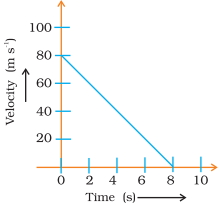
The velocity versus time graph of a ball of mass $50 \, g$ rolling on a concrete floor is shown in the figure. Calculate the acceleration and the frictional force exerted by the floor on the ball.
Solution
(N/A) Given:
Mass of the ball,$m = 50 \, g = 0.05 \, kg$
Initial velocity,$u = 80 \, m \, s^{-1}$ (at $t = 0 \, s$)
Final velocity,$v = 0 \, m \, s^{-1}$ (at $t = 8 \, s$)
Time taken,$t = 8 \, s$
$1$. Calculation of acceleration $(a)$:
$a = \frac{v - u}{t} = \frac{0 - 80 \, m \, s^{-1}}{8 \, s} = -10 \, m \, s^{-2}$
The negative sign indicates retardation (deceleration).
$2$. Calculation of frictional force $(F)$:
$F = m \times a$
$F = 0.05 \, kg \times (-10 \, m \, s^{-2}) = -0.5 \, N$
The negative sign indicates that the frictional force acts in the direction opposite to the motion of the ball.
Mass of the ball,$m = 50 \, g = 0.05 \, kg$
Initial velocity,$u = 80 \, m \, s^{-1}$ (at $t = 0 \, s$)
Final velocity,$v = 0 \, m \, s^{-1}$ (at $t = 8 \, s$)
Time taken,$t = 8 \, s$
$1$. Calculation of acceleration $(a)$:
$a = \frac{v - u}{t} = \frac{0 - 80 \, m \, s^{-1}}{8 \, s} = -10 \, m \, s^{-2}$
The negative sign indicates retardation (deceleration).
$2$. Calculation of frictional force $(F)$:
$F = m \times a$
$F = 0.05 \, kg \times (-10 \, m \, s^{-2}) = -0.5 \, N$
The negative sign indicates that the frictional force acts in the direction opposite to the motion of the ball.
0 likes
View Solution15
MediumMCQ
$A$ truck of mass $M$ is moved under a force $F$. If the truck is then loaded with an object equal to the mass of the truck and the driving force is halved,then how does the acceleration change?
A
$\frac{1}{6}$
B
$\frac{3}{4}$
C
$\frac{1}{4}$
D
$\frac{2}{4}$
Solution
(C) According to Newton's second law of motion,the acceleration $a$ is given by $a = \frac{F}{m}$.
Initially,the acceleration of the truck is $a_1 = \frac{F}{M}$.
When the truck is loaded with an object of mass equal to the truck,the new mass becomes $M' = M + M = 2M$.
The driving force is halved,so the new force becomes $F' = \frac{F}{2}$.
The new acceleration $a_2$ is given by $a_2 = \frac{F'}{M'} = \frac{F/2}{2M} = \frac{F}{4M}$.
Comparing the new acceleration with the initial acceleration: $\frac{a_2}{a_1} = \frac{F/4M}{F/M} = \frac{1}{4}$.
Therefore,the acceleration becomes one-fourth of its original value.
Initially,the acceleration of the truck is $a_1 = \frac{F}{M}$.
When the truck is loaded with an object of mass equal to the truck,the new mass becomes $M' = M + M = 2M$.
The driving force is halved,so the new force becomes $F' = \frac{F}{2}$.
The new acceleration $a_2$ is given by $a_2 = \frac{F'}{M'} = \frac{F/2}{2M} = \frac{F}{4M}$.
Comparing the new acceleration with the initial acceleration: $\frac{a_2}{a_1} = \frac{F/4M}{F/M} = \frac{1}{4}$.
Therefore,the acceleration becomes one-fourth of its original value.
0 likes
View Solution16
Medium
Two friends on roller-skates are standing $5\, m$ apart facing each other. One of them throws a ball of $2\, kg$ towards the other,who catches it. How will this activity affect the position of the two? Explain your answer.
Solution
(N/A) The separation between them will increase.
Initially,the momentum of both friends is zero as they are at rest.
According to the law of conservation of momentum,when the first person throws the ball,they must move in the opposite direction to the ball to conserve momentum.
When the second person catches the ball,they receive the momentum of the ball,which causes them to move backward in the direction of the ball's motion.
Consequently,both friends move away from each other,increasing the distance between them.
Initially,the momentum of both friends is zero as they are at rest.
According to the law of conservation of momentum,when the first person throws the ball,they must move in the opposite direction to the ball to conserve momentum.
When the second person catches the ball,they receive the momentum of the ball,which causes them to move backward in the direction of the ball's motion.
Consequently,both friends move away from each other,increasing the distance between them.
0 likes
View Solution17
Medium
$A$ water sprinkler used for grass lawns begins to rotate as soon as the water is supplied. Explain the principle on which it works.
Solution
(N/A) The rotation of the water sprinkler is based on Newton's $Third$ Law of Motion.
When water is supplied, it rushes out through the nozzles of the sprinkler at a high velocity.
According to Newton's $Third$ Law of Motion, for every action, there is an equal and opposite reaction.
The water exerts an action force on the nozzle in the backward direction, and the nozzle exerts an equal and opposite reaction force on the water.
Due to this reaction force, the sprinkler arm experiences a torque that causes it to rotate in the opposite direction of the water flow.
When water is supplied, it rushes out through the nozzles of the sprinkler at a high velocity.
According to Newton's $Third$ Law of Motion, for every action, there is an equal and opposite reaction.
The water exerts an action force on the nozzle in the backward direction, and the nozzle exerts an equal and opposite reaction force on the water.
Due to this reaction force, the sprinkler arm experiences a torque that causes it to rotate in the opposite direction of the water flow.
0 likes
View Solution18
DifficultMCQ
Using the second law of motion,derive the relation between force and acceleration. $A$ bullet of $10 \, g$ strikes a sandbag at a speed of $10^3 \, m \, s^{-1}$ and gets embedded after traveling $5 \, cm$. Calculate:
$(i)$ The resistive force exerted by the sand on the bullet.
$(ii)$ The time taken by the bullet to come to rest.
$(i)$ The resistive force exerted by the sand on the bullet.
$(ii)$ The time taken by the bullet to come to rest.
A
$10^{2} \, N, 10^{-2} \, s$
B
$10^{5} \, N, 10^{-4} \, s$
C
$10^{6} \, N, 10^{-6} \, s$
D
$10^{7} \, N, 10^{-7} \, s$
Solution
(B) Derivation: According to Newton's second law,$F \propto \frac{dp}{dt}$. Since $p = mv$,$F = k \frac{d(mv)}{dt} = kma$. Taking $k=1$,we get $F = ma$.
$(i)$ Given: $m = 10 \, g = 0.01 \, kg$,$u = 10^3 \, m \, s^{-1}$,$v = 0$,$s = 5 \, cm = 0.05 \, m$.
Using $v^2 - u^2 = 2as$:
$0^2 - (10^3)^2 = 2 \cdot a \cdot 0.05$
$-10^6 = 0.1 \cdot a$
$a = -10^7 \, m \, s^{-2}$.
Resistive force $F = |ma| = 0.01 \times 10^7 = 10^5 \, N$.
$(ii)$ Using $v = u + at$:
$0 = 10^3 + (-10^7) \cdot t$
$10^7 \cdot t = 10^3$
$t = 10^{-4} \, s$.
$(i)$ Given: $m = 10 \, g = 0.01 \, kg$,$u = 10^3 \, m \, s^{-1}$,$v = 0$,$s = 5 \, cm = 0.05 \, m$.
Using $v^2 - u^2 = 2as$:
$0^2 - (10^3)^2 = 2 \cdot a \cdot 0.05$
$-10^6 = 0.1 \cdot a$
$a = -10^7 \, m \, s^{-2}$.
Resistive force $F = |ma| = 0.01 \times 10^7 = 10^5 \, N$.
$(ii)$ Using $v = u + at$:
$0 = 10^3 + (-10^7) \cdot t$
$10^7 \cdot t = 10^3$
$t = 10^{-4} \, s$.
1 likes
View Solution19
MediumMCQ
Derive the unit of force using the second law of motion. $A$ force of $5 \, N$ produces an acceleration of $8 \, m s^{-2}$ on a mass $m_1$ and an acceleration of $24 \, m s^{-2}$ on a mass $m_2$. What acceleration would the same force provide if both the masses are tied together (in $, m s^{-2}$)?
A
$4$
B
$3$
C
$6$
D
$9$
Solution
(C) According to Newton's second law of motion,$F = ma$. The $SI$ unit of force is $kg \, m s^{-2}$,which is defined as $1 \, N$.
Given:
Force $F = 5 \, N$
Acceleration $a_1 = 8 \, m s^{-2}$ for mass $m_1$
Acceleration $a_2 = 24 \, m s^{-2}$ for mass $m_2$
Calculating individual masses:
$m_1 = \frac{F}{a_1} = \frac{5}{8} \, kg$
$m_2 = \frac{F}{a_2} = \frac{5}{24} \, kg$
When both masses are tied together,the total mass $M$ is:
$M = m_1 + m_2 = \frac{5}{8} + \frac{5}{24} = \frac{15 + 5}{24} = \frac{20}{24} = \frac{5}{6} \, kg$
Acceleration $a$ produced by the same force $F$ on the combined mass $M$ is:
$a = \frac{F}{M} = \frac{5}{5/6} = 6 \, m s^{-2}$
Given:
Force $F = 5 \, N$
Acceleration $a_1 = 8 \, m s^{-2}$ for mass $m_1$
Acceleration $a_2 = 24 \, m s^{-2}$ for mass $m_2$
Calculating individual masses:
$m_1 = \frac{F}{a_1} = \frac{5}{8} \, kg$
$m_2 = \frac{F}{a_2} = \frac{5}{24} \, kg$
When both masses are tied together,the total mass $M$ is:
$M = m_1 + m_2 = \frac{5}{8} + \frac{5}{24} = \frac{15 + 5}{24} = \frac{20}{24} = \frac{5}{6} \, kg$
Acceleration $a$ produced by the same force $F$ on the combined mass $M$ is:
$a = \frac{F}{M} = \frac{5}{5/6} = 6 \, m s^{-2}$
0 likes
View Solution20
Medium
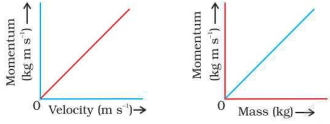
What is momentum? Write its $SI$ unit. Interpret force in terms of momentum. Represent the following graphically:
$(a)$ Momentum versus velocity when mass is fixed.
$(b)$ Momentum versus mass when velocity is constant.
$(a)$ Momentum versus velocity when mass is fixed.
$(b)$ Momentum versus mass when velocity is constant.
Solution
(N/A) Momentum is defined as the product of the mass and velocity of an object. It is a vector quantity.
Momentum $(p)$ = mass $(m)$ $\times$ velocity $(v)$
The $SI$ unit of momentum is $kg\, m\, s^{-1}$.
Force is defined as the rate of change of momentum. According to Newton's second law of motion,the force applied on an object is directly proportional to the rate of change of its momentum.
Force $(F)$ = $\frac{\Delta p}{\Delta t}$
Graphical representation:
$(a)$ Since $p = mv$,if mass $(m)$ is fixed,momentum $(p)$ is directly proportional to velocity $(v)$. The graph of momentum versus velocity is a straight line passing through the origin.
$(b)$ Since $p = mv$,if velocity $(v)$ is constant,momentum $(p)$ is directly proportional to mass $(m)$. The graph of momentum versus mass is a straight line passing through the origin.
Momentum $(p)$ = mass $(m)$ $\times$ velocity $(v)$
The $SI$ unit of momentum is $kg\, m\, s^{-1}$.
Force is defined as the rate of change of momentum. According to Newton's second law of motion,the force applied on an object is directly proportional to the rate of change of its momentum.
Force $(F)$ = $\frac{\Delta p}{\Delta t}$
Graphical representation:
$(a)$ Since $p = mv$,if mass $(m)$ is fixed,momentum $(p)$ is directly proportional to velocity $(v)$. The graph of momentum versus velocity is a straight line passing through the origin.
$(b)$ Since $p = mv$,if velocity $(v)$ is constant,momentum $(p)$ is directly proportional to mass $(m)$. The graph of momentum versus mass is a straight line passing through the origin.
0 likes
View Solution21
EasyMCQ
Why does friction not roll a ball backward if no external force is pushing or pulling it?
A
Friction is a self-adjusting force.
B
Friction only acts to oppose relative motion or the tendency of motion.
C
Friction is a non-contact force.
D
Friction is always zero.
Solution
(B) Friction is a resistive force that acts only when there is relative motion or a tendency for relative motion between two surfaces in contact.
If a ball is at rest on a horizontal surface and no external force is applied to it,there is no tendency for the ball to move.
Therefore,the net force acting on the ball is zero,and the frictional force remains zero.
Friction does not initiate motion on its own; it only opposes the motion caused by an external force.
If a ball is at rest on a horizontal surface and no external force is applied to it,there is no tendency for the ball to move.
Therefore,the net force acting on the ball is zero,and the frictional force remains zero.
Friction does not initiate motion on its own; it only opposes the motion caused by an external force.
0 likes
View Solution22
EasyMCQ
What is the force required to accelerate a $2 \, kg$ mass by $5 \, m s^{-2}$ (in $, N$)?
A
$5$
B
$10$
C
$20$
D
$2.5$
Solution
(B) According to Newton's second law of motion,the force $(F)$ is given by the product of mass $(m)$ and acceleration $(a)$.
Formula: $F = m \times a$
Given:
Mass $(m)$ = $2 \, kg$
Acceleration $(a)$ = $5 \, m s^{-2}$
Calculation:
$F = 2 \, kg \times 5 \, m s^{-2} = 10 \, N$
Therefore,the force required is $10 \, N$.
Formula: $F = m \times a$
Given:
Mass $(m)$ = $2 \, kg$
Acceleration $(a)$ = $5 \, m s^{-2}$
Calculation:
$F = 2 \, kg \times 5 \, m s^{-2} = 10 \, N$
Therefore,the force required is $10 \, N$.
0 likes
View Solution23
EasyMCQ
If a man jumps out from a boat to the bank of the river,the boat moves backwards. Identify the action and reaction in this situation.
A
Action: Man pushing the boat; Reaction: Boat pushing the man.
B
Action: Boat moving backwards; Reaction: Man jumping forward.
C
Action: Man jumping forward; Reaction: Boat moving backwards.
D
Action: Gravity acting on the man; Reaction: Buoyancy acting on the boat.
Solution
(A) According to Newton's $3^{rd}$ Law of Motion,every action has an equal and opposite reaction.
In this scenario,when the man jumps forward,he exerts a backward force on the boat,which is the action.
The boat simultaneously exerts an equal and opposite forward force on the man,which is the reaction.
Therefore,the push of the man on the boat is the action,and the force exerted by the boat on the man is the reaction.
In this scenario,when the man jumps forward,he exerts a backward force on the boat,which is the action.
The boat simultaneously exerts an equal and opposite forward force on the man,which is the reaction.
Therefore,the push of the man on the boat is the action,and the force exerted by the boat on the man is the reaction.
0 likes
View Solution24
EasyMCQ
Kicking a football requires less force than kicking a basketball. Why?
A
Football is lighter than a basketball.
B
Football is heavier than a basketball.
C
Football has more inertia than a basketball.
D
Both have equal mass.
Solution
(A) Inertia is the property of an object to resist a change in its state of motion or rest,and it is directly proportional to the mass of the object.
Since a basketball has a greater mass than a football,it possesses more inertia.
Therefore,a greater amount of force is required to overcome the inertia of the basketball compared to the football.
Since a basketball has a greater mass than a football,it possesses more inertia.
Therefore,a greater amount of force is required to overcome the inertia of the basketball compared to the football.
0 likes
View Solution25
Easy
When a carpet is beaten with a stick,it releases dust. Explain why?
Solution
(N/A) The dust particles lying on the carpet possess inertia of rest. When the carpet is beaten with a stick,the carpet moves suddenly,but the dust particles tend to remain in their state of rest due to inertia of rest. Consequently,the dust particles get separated from the carpet and fall down due to gravity.
0 likes
View Solution26
EasyMCQ
How does the safety belt in a car help when a moving car applies brakes suddenly?
A
It increases the speed of the passenger.
B
It exerts a force on the body to slow down its forward motion due to inertia.
C
It prevents the car from stopping.
D
It has no effect on the passenger.
Solution
(B) When the brakes are applied,the car slows down,but due to the law of inertia,the body of the passenger continues to be in the same state of motion.
Safety belts exert a force on the body to slow down its forward motion,thereby preventing the passenger from hitting the dashboard or windshield.
Safety belts exert a force on the body to slow down its forward motion,thereby preventing the passenger from hitting the dashboard or windshield.
0 likes
View Solution27
Easy
Name the physical quantity that measures inertia. State its $SI$ unit.
Solution
(N/A) The physical quantity that measures the inertia of an object is its mass.
Inertia is the inherent property of a body to resist any change in its state of rest or uniform motion.
Greater the mass of an object,greater is its inertia.
The $SI$ unit of mass is kilogram $(kg).$
Inertia is the inherent property of a body to resist any change in its state of rest or uniform motion.
Greater the mass of an object,greater is its inertia.
The $SI$ unit of mass is kilogram $(kg).$
0 likes
View Solution28
EasyMCQ
Given below are some measuring units of different physical quantities:
$kg\, ms^{-2}, ms^{-2}, kg\, ms^{-1}, ms^{-1}, kg\, m^2 s^{-2}$
Select the units which measure force and momentum respectively.
$kg\, ms^{-2}, ms^{-2}, kg\, ms^{-1}, ms^{-1}, kg\, m^2 s^{-2}$
Select the units which measure force and momentum respectively.
A
$kg\, ms^{-2}$ and $kg\, ms^{-1}$
B
$ms^{-2}$ and $ms^{-1}$
C
$kg\, ms^{-1}$ and $kg\, ms^{-2}$
D
$kg\, m^2 s^{-2}$ and $kg\, ms^{-1}$
Solution
(A) The $SI$ unit of force is the Newton $(N)$,which is equivalent to $kg\, m s^{-2}$ according to Newton's second law $(F = ma)$.
The $SI$ unit of momentum $(p)$ is the product of mass and velocity $(p = mv)$,which is $kg\, m s^{-1}$.
Therefore,the units for force and momentum are $kg\, m s^{-2}$ and $kg\, m s^{-1}$ respectively.
The $SI$ unit of momentum $(p)$ is the product of mass and velocity $(p = mv)$,which is $kg\, m s^{-1}$.
Therefore,the units for force and momentum are $kg\, m s^{-2}$ and $kg\, m s^{-1}$ respectively.
0 likes
View Solution29
EasyMCQ
$A$ book of mass $2 \, kg$ is sliding with a constant velocity of $4 \, m s^{-1}$ on a frictionless horizontal table. What is the force required to keep the object moving with the same velocity (in $, N$)?
A
$0$
B
$2$
C
$4$
D
$8$
Solution
(A) According to Newton's First Law of Motion,an object moving with a constant velocity in a straight line will continue to do so unless acted upon by an external unbalanced force.
Since the book is moving with a constant velocity of $4 \, m s^{-1}$ on a frictionless surface,its acceleration is zero $(a = 0)$.
Using Newton's Second Law,$F = m \times a$,where $m = 2 \, kg$ and $a = 0$.
Therefore,$F = 2 \, kg \times 0 \, m s^{-2} = 0 \, N$.
Thus,zero force is required to maintain the same velocity.
Since the book is moving with a constant velocity of $4 \, m s^{-1}$ on a frictionless surface,its acceleration is zero $(a = 0)$.
Using Newton's Second Law,$F = m \times a$,where $m = 2 \, kg$ and $a = 0$.
Therefore,$F = 2 \, kg \times 0 \, m s^{-2} = 0 \, N$.
Thus,zero force is required to maintain the same velocity.
0 likes
View Solution30
Easy
What is the mathematical formula and $SI$ unit of momentum?
Solution
(N/A) Momentum $(p)$ is defined as the product of mass $(m)$ and velocity $(v)$.
The mathematical formula is: $p = m \times v$.
The $SI$ unit of mass is kilogram $(kg)$ and the $SI$ unit of velocity is metre per second $(m/s)$.
Therefore,the $SI$ unit of momentum is kilogram metre per second,denoted as $kg \cdot m/s$ or $kg \cdot m \cdot s^{-1}$.
The mathematical formula is: $p = m \times v$.
The $SI$ unit of mass is kilogram $(kg)$ and the $SI$ unit of velocity is metre per second $(m/s)$.
Therefore,the $SI$ unit of momentum is kilogram metre per second,denoted as $kg \cdot m/s$ or $kg \cdot m \cdot s^{-1}$.
0 likes
View Solution31
Easy
What force would be needed to produce an acceleration of $4 \, m s^{-2}$ on a ball of mass $6 \, kg$?
Solution
(D) According to Newton's second law of motion,the force $(F)$ is the product of mass $(m)$ and acceleration $(a)$.
Formula: $F = m \times a$
Given:
Mass $(m) = 6 \, kg$
Acceleration $(a) = 4 \, m s^{-2}$
Calculation:
$F = 6 \, kg \times 4 \, m s^{-2} = 24 \, N$
Therefore,the force required is $24 \, N$.
Formula: $F = m \times a$
Given:
Mass $(m) = 6 \, kg$
Acceleration $(a) = 4 \, m s^{-2}$
Calculation:
$F = 6 \, kg \times 4 \, m s^{-2} = 24 \, N$
Therefore,the force required is $24 \, N$.
0 likes
View Solution32
EasyMCQ
$A$ ball is thrown vertically upwards. What is its momentum at the highest point?
A
$0$
B
$m \times g$
C
$m \times v$
D
Cannot be determined
Solution
(A) Momentum $(p)$ is defined as the product of mass $(m)$ and velocity $(v)$,expressed as $p = m \times v$.
At the highest point of its trajectory,the ball momentarily comes to rest before falling back down,meaning its velocity $(v)$ is $0 \ m/s$.
Therefore,the momentum at the highest point is $p = m \times 0 = 0$.
At the highest point of its trajectory,the ball momentarily comes to rest before falling back down,meaning its velocity $(v)$ is $0 \ m/s$.
Therefore,the momentum at the highest point is $p = m \times 0 = 0$.
0 likes
View Solution33
Medium
Give two examples in each case,of a force that:
$(i)$ lifts
$(ii)$ pushes
$(iii)$ pulls
$(iv)$ stretches
$(v)$ compresses
$(vi)$ resists
$(vii)$ attracts
$(viii)$ squeezes
$(i)$ lifts
$(ii)$ pushes
$(iii)$ pulls
$(iv)$ stretches
$(v)$ compresses
$(vi)$ resists
$(vii)$ attracts
$(viii)$ squeezes
Solution
(N/A) $(i)$ Lifting a bucket; lifting a stone.
$(ii)$ Pushing open a door; pushing a luggage trolley.
$(iii)$ Pulling of a train by an engine; pulling of a cart by a horse.
$(iv)$ Stretching a rubber balloon before inflating; stretching a spring.
$(v)$ Compressing the air with a piston; a doctor compressing the plunger of a syringe while injecting.
$(vi)$ Friction resists motion; air resistance opposes the motion of falling bodies.
$(vii)$ $A$ magnet attracting a piece of iron; a stone falling towards the ground due to gravity.
$(viii)$ Squeezing out the toothpaste from a tube; squeezing wet clothes.
$(ii)$ Pushing open a door; pushing a luggage trolley.
$(iii)$ Pulling of a train by an engine; pulling of a cart by a horse.
$(iv)$ Stretching a rubber balloon before inflating; stretching a spring.
$(v)$ Compressing the air with a piston; a doctor compressing the plunger of a syringe while injecting.
$(vi)$ Friction resists motion; air resistance opposes the motion of falling bodies.
$(vii)$ $A$ magnet attracting a piece of iron; a stone falling towards the ground due to gravity.
$(viii)$ Squeezing out the toothpaste from a tube; squeezing wet clothes.
0 likes
View Solution34
Easy
State and explain the law of inertia (or Newton's first law of motion).
Solution
(N/A) Newton's first law of motion,also known as the law of inertia,states that an object will remain at rest or continue to move at a constant velocity in a straight line unless acted upon by an external unbalanced force.
This law implies that objects have a natural tendency to resist changes in their state of motion,a property known as inertia.
For example,a book lying on a table will remain there until someone pushes it,and a ball rolling on a frictionless surface would theoretically continue moving forever unless stopped by an external force.
This law implies that objects have a natural tendency to resist changes in their state of motion,a property known as inertia.
For example,a book lying on a table will remain there until someone pushes it,and a ball rolling on a frictionless surface would theoretically continue moving forever unless stopped by an external force.
0 likes
View Solution35
EasyMCQ
You are hurt when you kick a stone. Why?
A
Due to inertia of rest.
B
Due to Newton's third law of motion.
C
Due to Newton's first law of motion.
D
Due to gravitational force.
Solution
(B) According to Newton's third law of motion,for every action,there is an equal and opposite reaction.
When you kick a stone,your foot exerts a force on the stone (action).
Simultaneously,the stone exerts an equal and opposite force on your foot (reaction).
This reaction force from the hard surface of the stone causes the pain in your foot.
When you kick a stone,your foot exerts a force on the stone (action).
Simultaneously,the stone exerts an equal and opposite force on your foot (reaction).
This reaction force from the hard surface of the stone causes the pain in your foot.
0 likes
View Solution36
Easy
Give an example of a force that merely changes the direction of motion of a body.
Solution
(N/A) force acting towards the centre of a circular path,known as centripetal force,in which a body moves with constant speed,merely changes the direction of motion of the body without changing its speed.
0 likes
View Solution37
Easy
Define $(i)$ force $(ii)$ dyne $(iii)$ newton.
Solution
(N/A) $(i)$ Force is an external push or pull that changes or tends to change the state of rest or uniform motion of a body in a straight line.
$(ii)$ Dyne is the absolute unit of force in the $CGS$ system. One dyne is defined as the force that produces an acceleration of $1 \ cm \ s^{-2}$ when acting on a body of mass $1 \ g$.
$(iii)$ Newton is the absolute unit of force in the $SI$ system. One newton is defined as the force that produces an acceleration of $1 \ m \ s^{-2}$ when acting on a body of mass $1 \ kg$.
$(ii)$ Dyne is the absolute unit of force in the $CGS$ system. One dyne is defined as the force that produces an acceleration of $1 \ cm \ s^{-2}$ when acting on a body of mass $1 \ g$.
$(iii)$ Newton is the absolute unit of force in the $SI$ system. One newton is defined as the force that produces an acceleration of $1 \ m \ s^{-2}$ when acting on a body of mass $1 \ kg$.
0 likes
View Solution38
Easy
State Newton's second law of motion.
Solution
(N/A) Newton's second law of motion states that the rate of change of momentum of an object is directly proportional to the applied unbalanced force in the direction of the force.
Mathematically,$F = ma$,where $F$ is the force,$m$ is the mass,and $a$ is the acceleration.
Mathematically,$F = ma$,where $F$ is the force,$m$ is the mass,and $a$ is the acceleration.
0 likes
View Solution39
EasyMCQ
What is the $SI$ unit of force?
A
Joule
B
Newton
C
Pascal
D
Watt
Solution
(B) The $SI$ unit of force is the Newton $(N)$.
It is defined as the force required to accelerate a mass of $1 \ kg$ by $1 \ m/s^2$.
It is defined as the force required to accelerate a mass of $1 \ kg$ by $1 \ m/s^2$.
0 likes
View Solution40
Easy
Name the $CGS$ unit of force. How is it related to Newton?
Solution
(N/A) The $CGS$ unit of force is the dyne.
$1 \text{ Newton (N)} = 10^5 \text{ dynes}$.
This relationship is derived from the fact that $1 \text{ N} = 1 \text{ kg} \cdot \text{m/s}^2$,and since $1 \text{ kg} = 10^3 \text{ g}$ and $1 \text{ m} = 10^2 \text{ cm}$,we get $1 \text{ N} = 10^3 \text{ g} \times 10^2 \text{ cm/s}^2 = 10^5 \text{ g} \cdot \text{cm/s}^2$,which is equal to $10^5 \text{ dynes}$.
$1 \text{ Newton (N)} = 10^5 \text{ dynes}$.
This relationship is derived from the fact that $1 \text{ N} = 1 \text{ kg} \cdot \text{m/s}^2$,and since $1 \text{ kg} = 10^3 \text{ g}$ and $1 \text{ m} = 10^2 \text{ cm}$,we get $1 \text{ N} = 10^3 \text{ g} \times 10^2 \text{ cm/s}^2 = 10^5 \text{ g} \cdot \text{cm/s}^2$,which is equal to $10^5 \text{ dynes}$.
0 likes
View Solution41
Easy
State Newton's first law of motion.
Solution
(N/A) Newton's first law of motion states that an object remains in a state of rest or of uniform motion in a straight line unless it is compelled to change that state by an applied external force.
This law is also known as the Law of Inertia,as it describes the tendency of objects to resist changes in their state of motion.
This law is also known as the Law of Inertia,as it describes the tendency of objects to resist changes in their state of motion.
0 likes
View Solution42
EasyMCQ
An athlete always runs some distance before taking a jump. Why?
A
To increase the friction between shoes and the ground.
B
To gain momentum,which helps in jumping a longer distance.
C
To relax the muscles before the jump.
D
To estimate the distance of the jump.
Solution
(B) An athlete runs before taking a jump to gain momentum.
According to Newton's first law of motion,an object in motion tends to stay in motion.
By running,the athlete's body acquires a state of inertia of motion.
This momentum helps the athlete to cover a longer distance during the jump.
According to Newton's first law of motion,an object in motion tends to stay in motion.
By running,the athlete's body acquires a state of inertia of motion.
This momentum helps the athlete to cover a longer distance during the jump.
0 likes
View Solution43
Easy
Define $1\, kg$ weight and express it in newton.
Solution
(N/A) $1\, kg$ weight is defined as the gravitational force exerted by the Earth on an object with a mass of $1\, kg$.
It is calculated using the formula $F = m \times g$,where $m = 1\, kg$ and $g \approx 9.8\, m/s^2$.
Therefore,$1\, kg\, wt = 1\, kg \times 9.8\, m/s^2 = 9.8\, N$.
It is calculated using the formula $F = m \times g$,where $m = 1\, kg$ and $g \approx 9.8\, m/s^2$.
Therefore,$1\, kg\, wt = 1\, kg \times 9.8\, m/s^2 = 9.8\, N$.
0 likes
View Solution44
EasyMCQ
Why is glass or chinaware packed with straw?
A
To make the package look attractive
B
To increase the weight of the package
C
To increase the time of impact during a collision
D
To prevent the items from getting dirty
Solution
(C) Glass or chinaware items are fragile and prone to breaking upon impact.
When these items are packed with straw,the straw acts as a cushion.
According to Newton's Second Law of Motion,the force exerted is inversely proportional to the time taken for the change in momentum $(F = \Delta p / \Delta t)$.
By using straw,the time taken for the change in momentum is increased during any sudden jerk or collision.
As a result,the force exerted on the glass or chinaware is significantly reduced,preventing breakage.
When these items are packed with straw,the straw acts as a cushion.
According to Newton's Second Law of Motion,the force exerted is inversely proportional to the time taken for the change in momentum $(F = \Delta p / \Delta t)$.
By using straw,the time taken for the change in momentum is increased during any sudden jerk or collision.
As a result,the force exerted on the glass or chinaware is significantly reduced,preventing breakage.
0 likes
View Solution45
EasyMCQ
In a high jump athletic event,the athletes are made to fall on a cushioned bed. Why?
A
To increase the time of impact
B
To decrease the time of impact
C
To increase the force of impact
D
To increase the momentum
Solution
(A) According to Newton's second law of motion,the force exerted is given by $F = \frac{dp}{dt}$,where $dp$ is the change in momentum and $dt$ is the time taken.
When an athlete falls on a cushioned bed,the bed compresses,which increases the time $(dt)$ taken for the athlete to come to rest.
Since the force $(F)$ is inversely proportional to the time $(dt)$,an increase in time results in a significant decrease in the impulsive force exerted on the athlete.
This prevents the athlete from getting injured.
When an athlete falls on a cushioned bed,the bed compresses,which increases the time $(dt)$ taken for the athlete to come to rest.
Since the force $(F)$ is inversely proportional to the time $(dt)$,an increase in time results in a significant decrease in the impulsive force exerted on the athlete.
This prevents the athlete from getting injured.
0 likes
View Solution46
Easy
Why is it advised to tie luggage kept on the roof of a bus?
Solution
(N/A) When a speeding bus stops suddenly,the luggage continues to move forward due to the inertia of motion. This happens because the luggage is in a state of motion along with the bus,and according to Newton's first law of motion,it tends to maintain its state of motion. Consequently,if the luggage is not tied,it is likely to fall off the bus due to its inertia.
0 likes
View Solution47
EasyMCQ
Which would require a greater force $-$ accelerating a $1\, kg$ mass at $10\, m s^{-2}$ or a $2\, kg$ mass at $4\, m s^{-2}$?
A
Accelerating a $1\, kg$ mass at $10\, m s^{-2}$
B
Accelerating a $2\, kg$ mass at $4\, m s^{-2}$
C
Both require the same force
D
Cannot be determined
Solution
(A) We know that the force $F$ is calculated using the formula $F = m \times a$,where $m$ is mass and $a$ is acceleration.
For the first case:
$F_1 = m_1 \times a_1 = 1\, kg \times 10\, m s^{-2} = 10\, N$
For the second case:
$F_2 = m_2 \times a_2 = 2\, kg \times 4\, m s^{-2} = 8\, N$
Comparing the two forces,we find that $10\, N > 8\, N$,which means $F_1 > F_2$.
Therefore,accelerating a $1\, kg$ mass at $10\, m s^{-2}$ requires a greater force.
For the first case:
$F_1 = m_1 \times a_1 = 1\, kg \times 10\, m s^{-2} = 10\, N$
For the second case:
$F_2 = m_2 \times a_2 = 2\, kg \times 4\, m s^{-2} = 8\, N$
Comparing the two forces,we find that $10\, N > 8\, N$,which means $F_1 > F_2$.
Therefore,accelerating a $1\, kg$ mass at $10\, m s^{-2}$ requires a greater force.
0 likes
View Solution48
EasyMCQ
While riding a bicycle,if we stop pedalling,why does the bicycle begin to slow down?
A
Due to gravitational force
B
Due to frictional force
C
Due to inertia of motion
D
Due to air resistance only
Solution
(B) When we stop pedalling,the external force that was maintaining the motion is removed. The bicycle begins to slow down because of the frictional force acting between the tires and the road,as well as air resistance,which opposes the motion of the bicycle.
0 likes
View Solution49
Easy
Name the factor on which the inertia of a body depends.
Solution
(N/A) The inertia of a body depends on its $mass$. $A$ body with a larger $mass$ possesses greater inertia, while a body with a smaller $mass$ possesses lesser inertia. Therefore, $mass$ is the quantitative measure of the inertia of a body.
0 likes
View Solution50
Easy
Name the physical quantity whose $SI$ unit is "newton".
Solution
$(FORCE)$ The physical quantity whose $SI$ unit is "newton" $(N)$ is force. Force is defined as a push or pull acting on an object, which can cause an object to accelerate, decelerate, or change its shape.
0 likes
View SolutionFORCE AND LAWS OF MOTION — Mix Example - FORCE AND LAWS OF MOTION · Frequently Asked Questions
1Are these FORCE AND LAWS OF MOTION questions useful for JEE and NEET?
Yes. All questions in this section are mapped to JEE Main and NEET exam patterns. Previous year questions from JEE Main, NEET, GUJCET and state-level exams are included with full solutions.
2Can I switch to Hindi or Gujarati for these questions?
Yes. Use the language tabs in the hero section or the sidebar to view the same questions and solutions in English, Hindi or Gujarati.
3How do I generate a question paper from this subtopic?
Use the Vedclass Exam Paper Generator — select the chapter and subtopic, set difficulty, and generate Sets A, B, C, D automatically. First 3 chapters of every subject are free.
Vedclass Products
For Students
Vedclass Test Series
Mock tests in real JEE/NEET style with performance analysis. 5-day free trial.
Start Free TrialFor Teachers
Exam Paper Generator
Generate Set A/B/C/D papers from this chapter in 2 minutes. 3 chapters free.
Try FreeFor Institutes
Online Exam Module
Live online exams with unlimited students, 360° analytics & white-label branding.
See DemoFor Teachers & Institutes
Generate a FORCE AND LAWS OF MOTION Exam Paper in 2 Minutes
Select subtopic & difficulty — Sets A, B, C, D auto-generated with No Repeat logic.
First 3 chapters of every subject are free — no payment required.