
A English
Mix Example - FORCE AND LAWS OF MOTION Questions in English
Class 9 Science · FORCE AND LAWS OF MOTION · Mix Example - FORCE AND LAWS OF MOTION
199+
Questions
English
Language
100%
With Solutions
Showing 50 of 199 questions in English
101
EasyMCQ
Which has a higher value of momentum: $A$ bullet of mass $10 \, g$ moving with a velocity of $400 \, m s^{-1}$ or a cricket ball of mass $400 \, g$ thrown with a speed of $90 \, km h^{-1}$?
A
Bullet
B
Cricket ball
C
Both have equal momentum
D
Cannot be determined
Solution
(B) $1$. Calculate the momentum of the bullet:
Mass of bullet $(m_1)$ = $10 \, g = 0.01 \, kg$
Velocity of bullet $(v_1)$ = $400 \, m s^{-1}$
Momentum $(p_1)$ = $m_1 \times v_1 = 0.01 \, kg \times 400 \, m s^{-1} = 4 \, kg \, m s^{-1}$
$2$. Calculate the momentum of the cricket ball:
Mass of cricket ball $(m_2)$ = $400 \, g = 0.4 \, kg$
Velocity of cricket ball $(v_2)$ = $90 \, km h^{-1} = 90 \times (5/18) \, m s^{-1} = 25 \, m s^{-1}$
Momentum $(p_2)$ = $m_2 \times v_2 = 0.4 \, kg \times 25 \, m s^{-1} = 10 \, kg \, m s^{-1}$
$3$. Comparison:
Since $10 \, kg \, m s^{-1} > 4 \, kg \, m s^{-1}$,the cricket ball has a higher momentum.
Mass of bullet $(m_1)$ = $10 \, g = 0.01 \, kg$
Velocity of bullet $(v_1)$ = $400 \, m s^{-1}$
Momentum $(p_1)$ = $m_1 \times v_1 = 0.01 \, kg \times 400 \, m s^{-1} = 4 \, kg \, m s^{-1}$
$2$. Calculate the momentum of the cricket ball:
Mass of cricket ball $(m_2)$ = $400 \, g = 0.4 \, kg$
Velocity of cricket ball $(v_2)$ = $90 \, km h^{-1} = 90 \times (5/18) \, m s^{-1} = 25 \, m s^{-1}$
Momentum $(p_2)$ = $m_2 \times v_2 = 0.4 \, kg \times 25 \, m s^{-1} = 10 \, kg \, m s^{-1}$
$3$. Comparison:
Since $10 \, kg \, m s^{-1} > 4 \, kg \, m s^{-1}$,the cricket ball has a higher momentum.
0 likes
View Solution102
Difficult
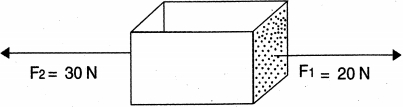
Two forces $F_{1} = 20 \, N$ and $F_{2} = 30 \, N$ are acting on an object in opposite directions as shown in the figure.
$(i)$ What is the net force acting on the object?
$(ii)$ What is the direction of the net force acting on the object?
$(iii)$ If the mass of the body is $10 \, kg$,what will be the acceleration produced in it?
$(i)$ What is the net force acting on the object?
$(ii)$ What is the direction of the net force acting on the object?
$(iii)$ If the mass of the body is $10 \, kg$,what will be the acceleration produced in it?
Solution
(N/A) $(i)$ The net force $F_{net}$ is the difference between the two opposing forces:
$F_{net} = F_{2} - F_{1} = 30 \, N - 20 \, N = 10 \, N$.
$(ii)$ Since $F_{2} > F_{1}$,the net force acts in the direction of the larger force,which is the direction of $F_{2}$ (towards the left).
$(iii)$ According to Newton's second law of motion,$F = ma$,where $m = 10 \, kg$ and $F = 10 \, N$:
$a = F / m = 10 \, N / 10 \, kg = 1 \, m \, s^{-2}$.
$F_{net} = F_{2} - F_{1} = 30 \, N - 20 \, N = 10 \, N$.
$(ii)$ Since $F_{2} > F_{1}$,the net force acts in the direction of the larger force,which is the direction of $F_{2}$ (towards the left).
$(iii)$ According to Newton's second law of motion,$F = ma$,where $m = 10 \, kg$ and $F = 10 \, N$:
$a = F / m = 10 \, N / 10 \, kg = 1 \, m \, s^{-2}$.
0 likes
View Solution103
Medium
$(i)$ Name the property by virtue of which a body resists a change in its state of motion. Name the physical quantity which is a measure of this property.
$(ii)$ Explain why some of the leaves may get detached from a tree if we vigorously shake its branch.
$(ii)$ Explain why some of the leaves may get detached from a tree if we vigorously shake its branch.
Solution
(N/A) $(i)$ The property by virtue of which a body resists a change in its state of motion is called inertia. Mass is the measure of inertia.
$(ii)$ This phenomenon occurs due to the inertia of rest. Initially,the leaves are in a state of rest. When the tree branch is shaken vigorously,the branch comes into a state of motion,but the leaves tend to maintain their state of rest due to inertia. Consequently,they resist the change,get detached,and fall down due to gravity.
$(ii)$ This phenomenon occurs due to the inertia of rest. Initially,the leaves are in a state of rest. When the tree branch is shaken vigorously,the branch comes into a state of motion,but the leaves tend to maintain their state of rest due to inertia. Consequently,they resist the change,get detached,and fall down due to gravity.
0 likes
View Solution104
Medium
An object experiences a net zero external unbalanced force. Is it possible for the object to be moving with a non-zero velocity? If yes,state the conditions that must be placed on the magnitude and direction of the velocity. If no,provide a reason.
Solution
(A) When an object experiences a net zero external unbalanced force,in accordance with Newton's second law of motion $F = ma$,its acceleration is zero.
If the object was initially in a state of motion,then in accordance with Newton's first law of motion,the object will continue to move in the same direction with the same speed.
It means that the object may be travelling with a non-zero velocity,but the magnitude as well as the direction of the velocity must remain unchanged or constant throughout.
If the object was initially in a state of motion,then in accordance with Newton's first law of motion,the object will continue to move in the same direction with the same speed.
It means that the object may be travelling with a non-zero velocity,but the magnitude as well as the direction of the velocity must remain unchanged or constant throughout.
0 likes
View Solution105
Medium
Two balls $A$ and $B$ of masses $m$ and $2m$ are in motion with velocities $2V$ and $V$ respectively. Compare:
$(i)$ their inertia,
$(ii)$ their momentum,and
$(iii)$ the force needed to stop them in the same time.
$(i)$ their inertia,
$(ii)$ their momentum,and
$(iii)$ the force needed to stop them in the same time.
Solution
(A) $(i)$ Inertia of a body is directly proportional to its mass. Therefore,the ratio of inertia of ball $A$ to ball $B$ is $m : 2m = 1 : 2$.
$(ii)$ Momentum $p$ is defined as the product of mass and velocity $(p = mv)$. For ball $A$,$p_A = m \times 2V = 2mV$. For ball $B$,$p_B = 2m \times V = 2mV$. Thus,the ratio of their momentum is $2mV : 2mV = 1 : 1$.
$(iii)$ According to Newton's second law of motion,the force $F$ required to stop a body in a given time $t$ is $F = \frac{\Delta p}{t}$. Since both balls have the same initial momentum and are brought to rest (final momentum $= 0$) in the same time $t$,the change in momentum $\Delta p$ is the same for both. Therefore,the ratio of the force needed to stop them is $1 : 1$.
$(ii)$ Momentum $p$ is defined as the product of mass and velocity $(p = mv)$. For ball $A$,$p_A = m \times 2V = 2mV$. For ball $B$,$p_B = 2m \times V = 2mV$. Thus,the ratio of their momentum is $2mV : 2mV = 1 : 1$.
$(iii)$ According to Newton's second law of motion,the force $F$ required to stop a body in a given time $t$ is $F = \frac{\Delta p}{t}$. Since both balls have the same initial momentum and are brought to rest (final momentum $= 0$) in the same time $t$,the change in momentum $\Delta p$ is the same for both. Therefore,the ratio of the force needed to stop them is $1 : 1$.
0 likes
View Solution106
Medium
$(a)$ State the law of conservation of momentum.
$(b)$ $A$ body of mass $2 \, kg$,initially moving with a velocity of $10 \, m s^{-1}$,collides with another body of mass $5 \, kg$ at rest. After the collision,the velocity of the first body becomes $1 \, m s^{-1}$. Find the velocity of the second body.
$(b)$ $A$ body of mass $2 \, kg$,initially moving with a velocity of $10 \, m s^{-1}$,collides with another body of mass $5 \, kg$ at rest. After the collision,the velocity of the first body becomes $1 \, m s^{-1}$. Find the velocity of the second body.
Solution
(D) The law of conservation of momentum states that in the absence of an external unbalanced force,the total linear momentum of a system remains conserved (constant).
$(b)$ Given:
Mass of the first body,$m_{1} = 2 \, kg$
Initial velocity of the first body,$u_{1} = 10 \, m s^{-1}$
Mass of the second body,$m_{2} = 5 \, kg$
Initial velocity of the second body,$u_{2} = 0 \, m s^{-1}$ (at rest)
Final velocity of the first body,$v_{1} = 1 \, m s^{-1}$
Let the final velocity of the second body be $v_{2}$.
According to the law of conservation of momentum:
$m_{1}u_{1} + m_{2}u_{2} = m_{1}v_{1} + m_{2}v_{2}$
Substituting the values:
$(2 \times 10) + (5 \times 0) = (2 \times 1) + (5 \times v_{2})$
$20 + 0 = 2 + 5v_{2}$
$20 - 2 = 5v_{2}$
$18 = 5v_{2}$
$v_{2} = \frac{18}{5} = 3.6 \, m s^{-1}$
Thus,the velocity of the second body after the collision is $3.6 \, m s^{-1}$.
$(b)$ Given:
Mass of the first body,$m_{1} = 2 \, kg$
Initial velocity of the first body,$u_{1} = 10 \, m s^{-1}$
Mass of the second body,$m_{2} = 5 \, kg$
Initial velocity of the second body,$u_{2} = 0 \, m s^{-1}$ (at rest)
Final velocity of the first body,$v_{1} = 1 \, m s^{-1}$
Let the final velocity of the second body be $v_{2}$.
According to the law of conservation of momentum:
$m_{1}u_{1} + m_{2}u_{2} = m_{1}v_{1} + m_{2}v_{2}$
Substituting the values:
$(2 \times 10) + (5 \times 0) = (2 \times 1) + (5 \times v_{2})$
$20 + 0 = 2 + 5v_{2}$
$20 - 2 = 5v_{2}$
$18 = 5v_{2}$
$v_{2} = \frac{18}{5} = 3.6 \, m s^{-1}$
Thus,the velocity of the second body after the collision is $3.6 \, m s^{-1}$.
0 likes
View Solution107
Medium
$(a)$ Define momentum. Write its $SI$ unit.
$(b)$ $A$ bullet of mass $0.02 \ kg$ is fired from a gun weighing $7.5 \ kg$. If the initial velocity of the bullet is $200 \ m \ s^{-1}$,calculate the speed with which the gun recoils.
$(b)$ $A$ bullet of mass $0.02 \ kg$ is fired from a gun weighing $7.5 \ kg$. If the initial velocity of the bullet is $200 \ m \ s^{-1}$,calculate the speed with which the gun recoils.
Solution
(N/A) Momentum is defined as the total quantity of motion possessed by a body. It is equal to the product of the mass and velocity of the body. Its $SI$ unit is $kg \ m \ s^{-1}$.
$(b)$ Given:
Mass of bullet $(m) = 0.02 \ kg$
Mass of gun $(M) = 7.5 \ kg$
Velocity of bullet $(v) = 200 \ m \ s^{-1}$
Recoil velocity of gun $(V) = ?$
According to the law of conservation of momentum,the total momentum before firing is equal to the total momentum after firing:
$m \times v + M \times V = 0$
$0.02 \times 200 + 7.5 \times V = 0$
$4 + 7.5 \times V = 0$
$7.5 \times V = -4$
$V = -4 / 7.5 = -0.533 \ m \ s^{-1}$
The negative sign indicates that the gun recoils in the direction opposite to the bullet. The speed of recoil is $0.533 \ m \ s^{-1}$.
$(b)$ Given:
Mass of bullet $(m) = 0.02 \ kg$
Mass of gun $(M) = 7.5 \ kg$
Velocity of bullet $(v) = 200 \ m \ s^{-1}$
Recoil velocity of gun $(V) = ?$
According to the law of conservation of momentum,the total momentum before firing is equal to the total momentum after firing:
$m \times v + M \times V = 0$
$0.02 \times 200 + 7.5 \times V = 0$
$4 + 7.5 \times V = 0$
$7.5 \times V = -4$
$V = -4 / 7.5 = -0.533 \ m \ s^{-1}$
The negative sign indicates that the gun recoils in the direction opposite to the bullet. The speed of recoil is $0.533 \ m \ s^{-1}$.
0 likes
View Solution108
Easy
State the reason for the following:
$(a)$ All cars are provided with seat belts.
$(b)$ It is dangerous to jump out of a moving bus.
$(c)$ Road accidents at high speeds are much worse than accidents at low speeds.
$(a)$ All cars are provided with seat belts.
$(b)$ It is dangerous to jump out of a moving bus.
$(c)$ Road accidents at high speeds are much worse than accidents at low speeds.
Solution
(N/A) Cars are provided with seat belts to prevent injuries in case of an accident. The seat belt increases the time taken by the passenger to fall forward,thereby reducing the force exerted on them.
$(b)$ When a person jumps out of a moving bus,their body is in a state of motion due to inertia. Upon hitting the ground,the lower part of the body comes to rest suddenly due to friction,while the upper part continues to move forward,which can cause the person to fall and get injured.
$(c)$ This is because the momentum $(p = mv)$ of a vehicle is directly proportional to its velocity. At high speeds,the momentum is significantly higher,leading to a greater impulsive force during a collision,which causes more severe damage and injuries.
$(b)$ When a person jumps out of a moving bus,their body is in a state of motion due to inertia. Upon hitting the ground,the lower part of the body comes to rest suddenly due to friction,while the upper part continues to move forward,which can cause the person to fall and get injured.
$(c)$ This is because the momentum $(p = mv)$ of a vehicle is directly proportional to its velocity. At high speeds,the momentum is significantly higher,leading to a greater impulsive force during a collision,which causes more severe damage and injuries.
0 likes
View Solution109
Medium
$A$ large truck and a mini bus both moving with a velocity of magnitude $V$ have a head-on collision and both of them come to a halt after that. If the collision lasts for $1 \, s$:
$(a)$ Which vehicle experiences the greater force of impact?
$(b)$ Which vehicle experiences the greater change in momentum?
$(c)$ Which vehicle experiences the greater acceleration?
$(a)$ Which vehicle experiences the greater force of impact?
$(b)$ Which vehicle experiences the greater change in momentum?
$(c)$ Which vehicle experiences the greater acceleration?
Solution
$(a-d)$ According to Newton's third law, the force exerted by the truck on the bus is equal in magnitude to the force exerted by the bus on the truck. Therefore, both vehicles experience the same force of impact.
$(b)$ Change in momentum $(\Delta p)$ is given by $m(v - u)$. Since the truck has a larger mass $(M > m)$, the magnitude of the change in momentum $|M(0 - V)|$ is greater for the truck than for the mini bus $|m(0 - V)|$.
$(c)$ Acceleration is given by $a = F/m$. Since both experience the same force $(F)$ but the mini bus has a smaller mass $(m)$, the mini bus experiences greater acceleration.
$(b)$ Change in momentum $(\Delta p)$ is given by $m(v - u)$. Since the truck has a larger mass $(M > m)$, the magnitude of the change in momentum $|M(0 - V)|$ is greater for the truck than for the mini bus $|m(0 - V)|$.
$(c)$ Acceleration is given by $a = F/m$. Since both experience the same force $(F)$ but the mini bus has a smaller mass $(m)$, the mini bus experiences greater acceleration.
0 likes
View Solution110
Easy
$(a)$ Why are the wheels of vehicles provided with mudguards?
$(b)$ $A$ cricket player lowers his hands while catching a ball. Why?
$(c)$ Why is a glass pane of a window shattered when a flying pebble hits it?
$(b)$ $A$ cricket player lowers his hands while catching a ball. Why?
$(c)$ Why is a glass pane of a window shattered when a flying pebble hits it?
Solution
(N/A) This is because the wheel rotates continuously,but the mud sticking to the wheel tends to move in a straight line due to the inertia of direction. Consequently,it flies off tangentially.
$(b)$ By lowering his hands,the cricketer increases the time taken to catch the ball. This decreases the rate of change of momentum,thereby reducing the impulsive force exerted on his hands.
$(c)$ The high velocity of the pebble is reduced to zero in a very short interval of time. According to Newton's second law,this results in a very large force being exerted on the glass pane,causing it to shatter.
$(b)$ By lowering his hands,the cricketer increases the time taken to catch the ball. This decreases the rate of change of momentum,thereby reducing the impulsive force exerted on his hands.
$(c)$ The high velocity of the pebble is reduced to zero in a very short interval of time. According to Newton's second law,this results in a very large force being exerted on the glass pane,causing it to shatter.
0 likes
View Solution111
Easy
When a fast-moving horse stops suddenly,a careless rider falls in the forward direction. Give the reason for this.
Solution
(N/A) This happens due to the $inertia$ of motion.
When the horse is in motion,the entire body of the rider is also in motion.
When the horse stops suddenly,the lower part of the rider's body,which is in contact with the horse,comes to rest due to the horse's deceleration.
However,the upper part of the rider's body continues to remain in a state of motion due to the $inertia$ of motion,causing the rider to fall forward.
When the horse is in motion,the entire body of the rider is also in motion.
When the horse stops suddenly,the lower part of the rider's body,which is in contact with the horse,comes to rest due to the horse's deceleration.
However,the upper part of the rider's body continues to remain in a state of motion due to the $inertia$ of motion,causing the rider to fall forward.
0 likes
View Solution112
Easy
$A$ passenger in a moving car slips to one side of the seat when the car takes a sharp turn. Give the reason for this.
Solution
(N/A) This phenomenon occurs due to the $inertia$ of direction. According to Newton's first law of motion,a body continues to move in a straight line unless an external force acts upon it. When the car takes a sharp turn,the car changes its direction,but the passenger's body,due to $inertia$,tends to maintain its original straight-line path. Consequently,the passenger feels a push towards the opposite side of the turn.
0 likes
View Solution113
Difficult
$(a)$ State Newton's second law of motion. Express it mathematically and find the $SI$ unit of force from it.
$(b)$ In the diagram given below, if the card is flicked away with a jerk, what will you observe? Explain the reason for this observation.
$(b)$ In the diagram given below, if the card is flicked away with a jerk, what will you observe? Explain the reason for this observation.

Solution
(N/A) Newton's second law of motion states that the rate of change of momentum of an object is directly proportional to the applied unbalanced force in the direction of the force.
Mathematically, let an object of mass $m$ have an initial velocity $u$ and a final velocity $v$ after time $t$ under the influence of force $F$.
Initial momentum $p_1 = mu$
Final momentum $p_2 = mv$
Change in momentum = $p_2 - p_1 = m(v - u)$
Rate of change of momentum = $\frac{m(v - u)}{t}$
According to the law, $F \propto \frac{m(v - u)}{t}$
$F = k \cdot m \cdot \frac{(v - u)}{t}$
Since $\frac{(v - u)}{t} = a$ (acceleration), we have $F = kma$.
Taking $k = 1$, we get $F = ma$.
The $SI$ unit of force is the newton $(N)$, where $1 \, N = 1 \, kg \cdot m \cdot s^{-2}$.
$(b)$ Observation: The card flies away, and the coin falls into the glass.
Reason: This happens due to the inertia of rest. The coin is initially at rest and tends to remain at rest due to its inertia. When the card is flicked, it moves away, but the coin, due to its inertia, does not move with the card and falls into the glass under the influence of gravity.
Mathematically, let an object of mass $m$ have an initial velocity $u$ and a final velocity $v$ after time $t$ under the influence of force $F$.
Initial momentum $p_1 = mu$
Final momentum $p_2 = mv$
Change in momentum = $p_2 - p_1 = m(v - u)$
Rate of change of momentum = $\frac{m(v - u)}{t}$
According to the law, $F \propto \frac{m(v - u)}{t}$
$F = k \cdot m \cdot \frac{(v - u)}{t}$
Since $\frac{(v - u)}{t} = a$ (acceleration), we have $F = kma$.
Taking $k = 1$, we get $F = ma$.
The $SI$ unit of force is the newton $(N)$, where $1 \, N = 1 \, kg \cdot m \cdot s^{-2}$.
$(b)$ Observation: The card flies away, and the coin falls into the glass.
Reason: This happens due to the inertia of rest. The coin is initially at rest and tends to remain at rest due to its inertia. When the card is flicked, it moves away, but the coin, due to its inertia, does not move with the card and falls into the glass under the influence of gravity.
0 likes
View Solution114
MediumMCQ
State the law of conservation of momentum. Mention two factors which determine the momentum of a body. $A$ ball of mass $0.4 \ kg$ is thrown vertically upwards with a velocity of $10 \ m s^{-1}$. What will be its initial momentum and what would be its momentum at the highest point of its reach? If this change in momentum occurs in one second, find the negatively accelerating force acting on the ball, when it was going up.
A
$N/A$
B
$N/A$
C
$N/A$
D
$N/A$
Solution
(N/A) The law of conservation of momentum states that in the absence of an external unbalanced force, the total momentum of a system of bodies remains conserved.
The two factors that determine the momentum of a body are:
$(i)$ Mass of the body $(m)$
$(ii)$ Velocity of the body $(v)$
Given:
Mass $(m)$ = $0.4 \ kg$
Initial velocity $(u)$ = $10 \ m s^{-1}$
Initial momentum $(p_i)$ = $m \times u = 0.4 \ kg \times 10 \ m s^{-1} = 4 \ kg \ m s^{-1}$.
At the highest point of its reach, the final velocity $(v)$ of the ball becomes $0 \ m s^{-1}$.
Therefore, momentum at the highest point $(p_f)$ = $m \times v = 0.4 \ kg \times 0 \ m s^{-1} = 0 \ kg \ m s^{-1}$.
Change in momentum $(\Delta p)$ = $p_f - p_i = 0 - 4 = -4 \ kg \ m s^{-1}$.
Time taken $(t)$ = $1 \ s$.
Force $(F)$ = $\frac{\Delta p}{t} = \frac{-4 \ kg \ m s^{-1}}{1 \ s} = -4 \ N$.
The negative sign indicates that the force is acting in the direction opposite to the motion (retarding force).
Thus, the negatively accelerating force (retarding force) acting on the ball is $4 \ N$.
The two factors that determine the momentum of a body are:
$(i)$ Mass of the body $(m)$
$(ii)$ Velocity of the body $(v)$
Given:
Mass $(m)$ = $0.4 \ kg$
Initial velocity $(u)$ = $10 \ m s^{-1}$
Initial momentum $(p_i)$ = $m \times u = 0.4 \ kg \times 10 \ m s^{-1} = 4 \ kg \ m s^{-1}$.
At the highest point of its reach, the final velocity $(v)$ of the ball becomes $0 \ m s^{-1}$.
Therefore, momentum at the highest point $(p_f)$ = $m \times v = 0.4 \ kg \times 0 \ m s^{-1} = 0 \ kg \ m s^{-1}$.
Change in momentum $(\Delta p)$ = $p_f - p_i = 0 - 4 = -4 \ kg \ m s^{-1}$.
Time taken $(t)$ = $1 \ s$.
Force $(F)$ = $\frac{\Delta p}{t} = \frac{-4 \ kg \ m s^{-1}}{1 \ s} = -4 \ N$.
The negative sign indicates that the force is acting in the direction opposite to the motion (retarding force).
Thus, the negatively accelerating force (retarding force) acting on the ball is $4 \ N$.
0 likes
View Solution115
Medium
$(a)$ Define momentum and mention its $SI$ unit.
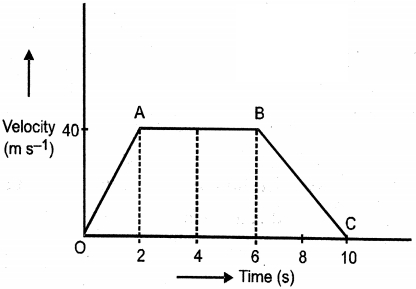
$(b)$ From the velocity-time graph shown in the figure for a body of mass $5\, kg$,find the force on the body from:
$(i)$ $O$ to $A$ and $(ii)$ $B$ to $C$.
$(c)$ Which would require a greater force: accelerating a $2\, kg$ mass at $5\, m s^{-2}$ or a $4\, kg$ mass at $2\, m s^{-2}$?
$(b)$ From the velocity-time graph shown in the figure for a body of mass $5\, kg$,find the force on the body from:
$(i)$ $O$ to $A$ and $(ii)$ $B$ to $C$.
$(c)$ Which would require a greater force: accelerating a $2\, kg$ mass at $5\, m s^{-2}$ or a $4\, kg$ mass at $2\, m s^{-2}$?
Solution
(C) Momentum is defined as the product of the mass and velocity of an object. Its $SI$ unit is $kg\, m s^{-1}$.
$(b)$ Force is given by $F = m \times a$,where $a = (v - u) / t$.
$(i)$ For interval $O$ to $A$: $u = 0\, m s^{-1}$,$v = 40\, m s^{-1}$,$t = 2\, s$. Acceleration $a = (40 - 0) / 2 = 20\, m s^{-2}$. Force $F = 5\, kg \times 20\, m s^{-2} = 100\, N$.
$(ii)$ For interval $B$ to $C$: $u = 40\, m s^{-1}$,$v = 0\, m s^{-1}$,$t = (10 - 6) = 4\, s$. Acceleration $a = (0 - 40) / 4 = -10\, m s^{-2}$. Force $F = 5\, kg \times (-10\, m s^{-2}) = -50\, N$ (The negative sign indicates a retarding force).
$(c)$ Force required for $2\, kg$ mass: $F_1 = 2\, kg \times 5\, m s^{-2} = 10\, N$.
Force required for $4\, kg$ mass: $F_2 = 4\, kg \times 2\, m s^{-2} = 8\, N$.
Since $10\, N > 8\, N$,accelerating a $2\, kg$ mass at $5\, m s^{-2}$ requires a greater force.
$(b)$ Force is given by $F = m \times a$,where $a = (v - u) / t$.
$(i)$ For interval $O$ to $A$: $u = 0\, m s^{-1}$,$v = 40\, m s^{-1}$,$t = 2\, s$. Acceleration $a = (40 - 0) / 2 = 20\, m s^{-2}$. Force $F = 5\, kg \times 20\, m s^{-2} = 100\, N$.
$(ii)$ For interval $B$ to $C$: $u = 40\, m s^{-1}$,$v = 0\, m s^{-1}$,$t = (10 - 6) = 4\, s$. Acceleration $a = (0 - 40) / 4 = -10\, m s^{-2}$. Force $F = 5\, kg \times (-10\, m s^{-2}) = -50\, N$ (The negative sign indicates a retarding force).
$(c)$ Force required for $2\, kg$ mass: $F_1 = 2\, kg \times 5\, m s^{-2} = 10\, N$.
Force required for $4\, kg$ mass: $F_2 = 4\, kg \times 2\, m s^{-2} = 8\, N$.
Since $10\, N > 8\, N$,accelerating a $2\, kg$ mass at $5\, m s^{-2}$ requires a greater force.
0 likes
View Solution116
Medium
$(a)$ $(i)$ Define momentum. State its $SI$ unit.
$(ii)$ An object of mass $50 \ kg$ is accelerated uniformly from a velocity of $4 \ m/s$ to $8 \ m/s$ in $8 \ s$. Find the magnitude of the force exerted on the object.
$(b)$ State Newton's first law of motion.
$(ii)$ An object of mass $50 \ kg$ is accelerated uniformly from a velocity of $4 \ m/s$ to $8 \ m/s$ in $8 \ s$. Find the magnitude of the force exerted on the object.
$(b)$ State Newton's first law of motion.
Solution
(N/A) $(i)$ Momentum is defined as the product of the mass and velocity of a body. Its $SI$ unit is $kg \ m/s$.
$(ii)$ Given: Mass $(m) = 50 \ kg$,Initial velocity $(u) = 4 \ m/s$,Final velocity $(v) = 8 \ m/s$,Time $(t) = 8 \ s$.
Using the first equation of motion,$v = u + at$,we find acceleration $(a)$:
$a = (v - u) / t = (8 - 4) / 8 = 4 / 8 = 0.5 \ m/s^2$.
Using Newton's second law of motion,$F = ma$:
$F = 50 \ kg \times 0.5 \ m/s^2 = 25 \ N$.
$(b)$ Newton's first law of motion states that an object remains in a state of rest or of uniform motion in a straight line unless compelled to change that state by an applied external force.
$(ii)$ Given: Mass $(m) = 50 \ kg$,Initial velocity $(u) = 4 \ m/s$,Final velocity $(v) = 8 \ m/s$,Time $(t) = 8 \ s$.
Using the first equation of motion,$v = u + at$,we find acceleration $(a)$:
$a = (v - u) / t = (8 - 4) / 8 = 4 / 8 = 0.5 \ m/s^2$.
Using Newton's second law of motion,$F = ma$:
$F = 50 \ kg \times 0.5 \ m/s^2 = 25 \ N$.
$(b)$ Newton's first law of motion states that an object remains in a state of rest or of uniform motion in a straight line unless compelled to change that state by an applied external force.
0 likes
View Solution117
Difficult
$(i)$ Define momentum. Write its $SI$ unit.
$(ii)$ How much momentum will an object of mass $10 \ kg$ transfer to the floor if it falls from a height of $5 \ m$? $(g = 10 \ m \ s^{-2})$
$(iii)$ Explain how a karate player can break a pile of tiles with a single blow of his hand.
$(ii)$ How much momentum will an object of mass $10 \ kg$ transfer to the floor if it falls from a height of $5 \ m$? $(g = 10 \ m \ s^{-2})$
$(iii)$ Explain how a karate player can break a pile of tiles with a single blow of his hand.
Solution
$(100 \ kg \ m \ s^{-1})$ $(i)$ The product of mass and velocity of an object is known as its momentum. The $SI$ unit of momentum is $kg \ m \ s^{-1}$.
$(ii)$ Mass of the object, $m = 10 \ kg$.
Height, $h = 5 \ m$.
Acceleration due to gravity, $g = 10 \ m \ s^{-2}$.
Initial velocity of the object, $u = 0$.
From the third equation of motion, $v^2 - u^2 = 2gh$.
$v^2 - 0^2 = 2 \times 10 \times 5$.
$v^2 = 100$.
$v = 10 \ m \ s^{-1}$.
Momentum transferred to the floor = Change in momentum = $mv - mu$.
$= (10 \times 10) - (10 \times 0) = 100 \ kg \ m \ s^{-1}$.
$(iii)$ A karate player moves his hand at a very high speed to strike the tiles. By doing this, the large momentum of his hand is reduced to zero in a very short interval of time. According to Newton's second law, $F = \frac{\Delta p}{\Delta t}$, since the time interval $\Delta t$ is extremely small, the force $F$ exerted on the tiles becomes very large, which is sufficient to break them.
$(ii)$ Mass of the object, $m = 10 \ kg$.
Height, $h = 5 \ m$.
Acceleration due to gravity, $g = 10 \ m \ s^{-2}$.
Initial velocity of the object, $u = 0$.
From the third equation of motion, $v^2 - u^2 = 2gh$.
$v^2 - 0^2 = 2 \times 10 \times 5$.
$v^2 = 100$.
$v = 10 \ m \ s^{-1}$.
Momentum transferred to the floor = Change in momentum = $mv - mu$.
$= (10 \times 10) - (10 \times 0) = 100 \ kg \ m \ s^{-1}$.
$(iii)$ A karate player moves his hand at a very high speed to strike the tiles. By doing this, the large momentum of his hand is reduced to zero in a very short interval of time. According to Newton's second law, $F = \frac{\Delta p}{\Delta t}$, since the time interval $\Delta t$ is extremely small, the force $F$ exerted on the tiles becomes very large, which is sufficient to break them.
0 likes
View Solution118
Difficult
How would you arrive at a mathematical formula to measure force using the second law of motion?
Solution
(N/A) Let an unbalanced force $F$ act on a body of mass $m$ moving with an initial velocity $u \, m s^{-1}$. The velocity changes to $v \, m s^{-1}$ after time $t$ seconds.
Initial momentum of the body $(p_1) = m \times u = mu$.
Final momentum of the body after $t$ seconds $(p_2) = m \times v = mv$.
Change in momentum $= p_2 - p_1 = mv - mu = m(v - u)$.
Rate of change of momentum $= \frac{m(v - u)}{t}$.
According to Newton's second law of motion, the rate of change of momentum is directly proportional to the applied force $F$:
$F \propto \frac{m(v - u)}{t}$.
Since acceleration $a = \frac{v - u}{t}$, we can write:
$F \propto ma$.
$F = kma$, where $k$ is a constant of proportionality.
By defining the unit of force such that $1 \, N$ of force produces an acceleration of $1 \, m s^{-2}$ in a body of $1 \, kg$ mass, we get $k = 1$.
Therefore, the mathematical formula for force is $F = ma$.
Initial momentum of the body $(p_1) = m \times u = mu$.
Final momentum of the body after $t$ seconds $(p_2) = m \times v = mv$.
Change in momentum $= p_2 - p_1 = mv - mu = m(v - u)$.
Rate of change of momentum $= \frac{m(v - u)}{t}$.
According to Newton's second law of motion, the rate of change of momentum is directly proportional to the applied force $F$:
$F \propto \frac{m(v - u)}{t}$.
Since acceleration $a = \frac{v - u}{t}$, we can write:
$F \propto ma$.
$F = kma$, where $k$ is a constant of proportionality.
By defining the unit of force such that $1 \, N$ of force produces an acceleration of $1 \, m s^{-2}$ in a body of $1 \, kg$ mass, we get $k = 1$.
Therefore, the mathematical formula for force is $F = ma$.
0 likes
View Solution119
Difficult
State the law of conservation of momentum. Derive it by using Newton's third law of motion.
Solution
(N/A) The law of conservation of momentum states that if no external force acts on a system of particles,the total linear momentum of the system remains conserved.
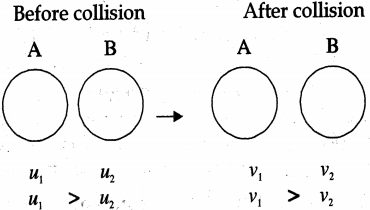
Consider two particles $A$ and $B$ with masses $m_{1}$ and $m_{2}$ moving in a straight line. Let their initial velocities be $u_{1}$ and $u_{2}$ respectively,where $u_{1} > u_{2}$. They collide for a time $t$. After the collision,their final velocities become $v_{1}$ and $v_{2}$ respectively.
Initial momentum of particle $A = m_{1}u_{1}$
Initial momentum of particle $B = m_{2}u_{2}$
Final momentum of particle $A = m_{1}v_{1}$
Final momentum of particle $B = m_{2}v_{2}$
Rate of change of momentum of particle $A$ (Force exerted by $B$ on $A$,$F_{AB}$) = $\frac{m_{1}(v_{1} - u_{1})}{t}$
Rate of change of momentum of particle $B$ (Force exerted by $A$ on $B$,$F_{BA}$) = $\frac{m_{2}(v_{2} - u_{2})}{t}$
According to Newton's third law of motion,the force exerted by $A$ on $B$ is equal and opposite to the force exerted by $B$ on $A$:
$F_{AB} = -F_{BA}$
Substituting the values:
$\frac{m_{1}(v_{1} - u_{1})}{t} = -\frac{m_{2}(v_{2} - u_{2})}{t}$
Multiplying both sides by $t$:
$m_{1}v_{1} - m_{1}u_{1} = -(m_{2}v_{2} - m_{2}u_{2})$
$m_{1}v_{1} - m_{1}u_{1} = -m_{2}v_{2} + m_{2}u_{2}$
Rearranging the terms:
$m_{1}u_{1} + m_{2}u_{2} = m_{1}v_{1} + m_{2}v_{2}$
This shows that the total initial momentum of the system is equal to the total final momentum of the system,which proves the law of conservation of momentum.
Consider two particles $A$ and $B$ with masses $m_{1}$ and $m_{2}$ moving in a straight line. Let their initial velocities be $u_{1}$ and $u_{2}$ respectively,where $u_{1} > u_{2}$. They collide for a time $t$. After the collision,their final velocities become $v_{1}$ and $v_{2}$ respectively.
Initial momentum of particle $A = m_{1}u_{1}$
Initial momentum of particle $B = m_{2}u_{2}$
Final momentum of particle $A = m_{1}v_{1}$
Final momentum of particle $B = m_{2}v_{2}$
Rate of change of momentum of particle $A$ (Force exerted by $B$ on $A$,$F_{AB}$) = $\frac{m_{1}(v_{1} - u_{1})}{t}$
Rate of change of momentum of particle $B$ (Force exerted by $A$ on $B$,$F_{BA}$) = $\frac{m_{2}(v_{2} - u_{2})}{t}$
According to Newton's third law of motion,the force exerted by $A$ on $B$ is equal and opposite to the force exerted by $B$ on $A$:
$F_{AB} = -F_{BA}$
Substituting the values:
$\frac{m_{1}(v_{1} - u_{1})}{t} = -\frac{m_{2}(v_{2} - u_{2})}{t}$
Multiplying both sides by $t$:
$m_{1}v_{1} - m_{1}u_{1} = -(m_{2}v_{2} - m_{2}u_{2})$
$m_{1}v_{1} - m_{1}u_{1} = -m_{2}v_{2} + m_{2}u_{2}$
Rearranging the terms:
$m_{1}u_{1} + m_{2}u_{2} = m_{1}v_{1} + m_{2}v_{2}$
This shows that the total initial momentum of the system is equal to the total final momentum of the system,which proves the law of conservation of momentum.
0 likes
View Solution120
Medium
$A$ bullet of mass $m$ is fired from a gun of mass $M$. If the velocity of the bullet is $v$,derive an expression for the recoil velocity of the gun. On which principle is this based?
Solution
(N/A) When a bullet is fired from a gun,the gun experiences a backward jerk,which is known as the recoil of the gun.
This phenomenon is based on the Law of Conservation of Momentum.
According to this law,if no external force acts on a system,the total momentum of the system remains conserved.
Initially,both the gun and the bullet are at rest,so the initial momentum of the system is $0$.
Let $m$ be the mass of the bullet,$v$ be the velocity of the bullet,$M$ be the mass of the gun,and $V$ be the recoil velocity of the gun.
According to the law of conservation of momentum:
Initial Momentum = Final Momentum
$0 = mv + MV$
$MV = -mv$
$V = -\frac{mv}{M}$
The negative sign indicates that the direction of the recoil velocity of the gun is opposite to the direction of the bullet's velocity.
This phenomenon is based on the Law of Conservation of Momentum.
According to this law,if no external force acts on a system,the total momentum of the system remains conserved.
Initially,both the gun and the bullet are at rest,so the initial momentum of the system is $0$.
Let $m$ be the mass of the bullet,$v$ be the velocity of the bullet,$M$ be the mass of the gun,and $V$ be the recoil velocity of the gun.
According to the law of conservation of momentum:
Initial Momentum = Final Momentum
$0 = mv + MV$
$MV = -mv$
$V = -\frac{mv}{M}$
The negative sign indicates that the direction of the recoil velocity of the gun is opposite to the direction of the bullet's velocity.
0 likes
View Solution121
Medium
$(a)$ State Newton's first and third laws of motion.
$(b)$ $A$ car of mass $1800 \, kg$ moving with a speed of $10 \, m s^{-1}$ is brought to rest after covering a distance of $50 \, m$. Calculate the force acting on the car.
$(b)$ $A$ car of mass $1800 \, kg$ moving with a speed of $10 \, m s^{-1}$ is brought to rest after covering a distance of $50 \, m$. Calculate the force acting on the car.
Solution
(D) First Law: It states, "Everybody in the universe stays in a state of rest or of uniform motion along a straight line unless compelled by an external force to change its state."
Third Law: It states, "To every action, there is an equal (in magnitude) and opposite (in direction) reaction." In other words, action and reaction are equal and opposite.
$(b)$ Given: Mass $m = 1800 \, kg$, initial velocity $u = 10 \, m s^{-1}$, final velocity $v = 0$, and distance $S = 50 \, m$.
Using the third equation of motion: $v^2 - u^2 = 2aS$
$0^2 - (10)^2 = 2 \times a \times 50$
$-100 = 100a$
$a = -1 \, m s^{-2}$ (The negative sign indicates retardation).
Now, calculating the force using Newton's second law: $F = ma$
$F = 1800 \times (-1)$
$F = -1800 \, N$
The force acting on the car is $1800 \, N$ in the direction opposite to the motion.
Third Law: It states, "To every action, there is an equal (in magnitude) and opposite (in direction) reaction." In other words, action and reaction are equal and opposite.
$(b)$ Given: Mass $m = 1800 \, kg$, initial velocity $u = 10 \, m s^{-1}$, final velocity $v = 0$, and distance $S = 50 \, m$.
Using the third equation of motion: $v^2 - u^2 = 2aS$
$0^2 - (10)^2 = 2 \times a \times 50$
$-100 = 100a$
$a = -1 \, m s^{-2}$ (The negative sign indicates retardation).
Now, calculating the force using Newton's second law: $F = ma$
$F = 1800 \times (-1)$
$F = -1800 \, N$
The force acting on the car is $1800 \, N$ in the direction opposite to the motion.
0 likes
View Solution122
Medium
$(a)$ State Newton's second law of motion. Use this law to find a method to measure force acting on an object.
$(b)$ From a rifle of mass $4 \ kg$,a bullet of mass $50 \ g$ is fired horizontally with an initial velocity of $40 \ m \ s^{-1}$. Calculate the initial recoil velocity of the rifle.
$(b)$ From a rifle of mass $4 \ kg$,a bullet of mass $50 \ g$ is fired horizontally with an initial velocity of $40 \ m \ s^{-1}$. Calculate the initial recoil velocity of the rifle.
Solution
(D) Newton's second law of motion states that the rate of change of momentum of an object is directly proportional to the applied unbalanced force in the direction of the force.
Mathematically,if $F$ is the force,$m$ is mass,$v$ is final velocity,$u$ is initial velocity,and $t$ is time:
$F \propto \frac{m(v-u)}{t}$
Since $\frac{v-u}{t} = a$ (acceleration),we get $F = kma$. By taking the constant $k = 1$,we derive the formula to measure force: $F = ma$.
$(b)$ Given:
Mass of rifle $(M)$ = $4 \ kg$
Mass of bullet $(m)$ = $50 \ g = 0.05 \ kg$
Velocity of bullet $(v)$ = $40 \ m \ s^{-1}$
Initial velocity of system = $0$
According to the law of conservation of momentum:
$MV + mv = 0$
$4 \times V + 0.05 \times 40 = 0$
$4V + 2 = 0$
$4V = -2$
$V = -0.5 \ m \ s^{-1}$
The negative sign indicates that the rifle recoils in the direction opposite to the bullet.
Mathematically,if $F$ is the force,$m$ is mass,$v$ is final velocity,$u$ is initial velocity,and $t$ is time:
$F \propto \frac{m(v-u)}{t}$
Since $\frac{v-u}{t} = a$ (acceleration),we get $F = kma$. By taking the constant $k = 1$,we derive the formula to measure force: $F = ma$.
$(b)$ Given:
Mass of rifle $(M)$ = $4 \ kg$
Mass of bullet $(m)$ = $50 \ g = 0.05 \ kg$
Velocity of bullet $(v)$ = $40 \ m \ s^{-1}$
Initial velocity of system = $0$
According to the law of conservation of momentum:
$MV + mv = 0$
$4 \times V + 0.05 \times 40 = 0$
$4V + 2 = 0$
$4V = -2$
$V = -0.5 \ m \ s^{-1}$
The negative sign indicates that the rifle recoils in the direction opposite to the bullet.
0 likes
View Solution123
Difficult
$(a)$ Using Newton's law of motion, derive the relation between force and acceleration.
$(b)$ Define one newton.
$(c)$ Which would require a greater force to accelerate: a $0.5 \, kg$ mass at $5 \, m s^{-2}$ or a $4 \, kg$ mass at $2 \, m s^{-2}$? Give reason.
$(b)$ Define one newton.
$(c)$ Which would require a greater force to accelerate: a $0.5 \, kg$ mass at $5 \, m s^{-2}$ or a $4 \, kg$ mass at $2 \, m s^{-2}$? Give reason.
Solution
$(c)$ According to Newton's second law of motion, the rate of change of momentum of an object is proportional to the applied unbalanced force in the direction of the force.
Let a body of mass $m$ have an initial velocity $u$ and a final velocity $v$ after time $t$ under the influence of force $F$.
Initial momentum $p_1 = mu$.
Final momentum $p_2 = mv$.
Change in momentum = $p_2 - p_1 = m(v - u)$.
Rate of change of momentum = $\frac{m(v - u)}{t}$.
According to the law, $F \propto \frac{m(v - u)}{t}$.
Since acceleration $a = \frac{v - u}{t}$, we get $F \propto ma$, or $F = kma$. By defining the unit of force such that $k = 1$, we get $F = ma$.
$(b)$ One newton is defined as the force required to produce an acceleration of $1 \, m s^{-2}$ in an object of mass $1 \, kg$.
$(c)$ For the first case: $F_1 = m_1 \times a_1 = 0.5 \, kg \times 5 \, m s^{-2} = 2.5 \, N$.
For the second case: $F_2 = m_2 \times a_2 = 4 \, kg \times 2 \, m s^{-2} = 8 \, N$.
Since $8 \, N$ > $2.5 \, N$, the $4 \, kg$ mass requires a greater force.
Let a body of mass $m$ have an initial velocity $u$ and a final velocity $v$ after time $t$ under the influence of force $F$.
Initial momentum $p_1 = mu$.
Final momentum $p_2 = mv$.
Change in momentum = $p_2 - p_1 = m(v - u)$.
Rate of change of momentum = $\frac{m(v - u)}{t}$.
According to the law, $F \propto \frac{m(v - u)}{t}$.
Since acceleration $a = \frac{v - u}{t}$, we get $F \propto ma$, or $F = kma$. By defining the unit of force such that $k = 1$, we get $F = ma$.
$(b)$ One newton is defined as the force required to produce an acceleration of $1 \, m s^{-2}$ in an object of mass $1 \, kg$.
$(c)$ For the first case: $F_1 = m_1 \times a_1 = 0.5 \, kg \times 5 \, m s^{-2} = 2.5 \, N$.
For the second case: $F_2 = m_2 \times a_2 = 4 \, kg \times 2 \, m s^{-2} = 8 \, N$.
Since $8 \, N$ > $2.5 \, N$, the $4 \, kg$ mass requires a greater force.
0 likes
View Solution124
Medium
$(a)$ Define inertia. There are three solid balls, made of aluminium, steel, and wood, of the same shape and volume. Which of them would have the highest inertia? Why?
$(b)$ Describe in brief an activity to illustrate the property of inertia of rest.
$(b)$ Describe in brief an activity to illustrate the property of inertia of rest.
Solution
$(B)$ Inertia is the inherent property of a body to resist any change in its state of rest or uniform motion unless acted upon by an external unbalanced force.
Since all three balls have the same shape and volume, their mass depends on their density $(\text{Mass} = \text{Density} \times \text{Volume})$.
Steel has the highest density among aluminium, steel, and wood. Therefore, the steel ball has the highest mass and consequently the highest inertia.
$(b)$ Activity to illustrate inertia of rest:
$1$. Place an empty glass tumbler on a table and cover its mouth with a stiff playing card.
$2$. Place a five-rupee coin on the center of the card.
$3$. Give the card a sharp horizontal flick with your finger.
$4$. Observation: The card moves away quickly, while the coin falls vertically into the glass tumbler.
$5$. Conclusion: The coin remains in its state of rest due to inertia of rest, even when the card is removed suddenly.
Since all three balls have the same shape and volume, their mass depends on their density $(\text{Mass} = \text{Density} \times \text{Volume})$.
Steel has the highest density among aluminium, steel, and wood. Therefore, the steel ball has the highest mass and consequently the highest inertia.
$(b)$ Activity to illustrate inertia of rest:
$1$. Place an empty glass tumbler on a table and cover its mouth with a stiff playing card.
$2$. Place a five-rupee coin on the center of the card.
$3$. Give the card a sharp horizontal flick with your finger.
$4$. Observation: The card moves away quickly, while the coin falls vertically into the glass tumbler.
$5$. Conclusion: The coin remains in its state of rest due to inertia of rest, even when the card is removed suddenly.
0 likes
View Solution125
Medium
$(a)$ State the law of conservation of momentum.
$(b)$ Mention two factors which determine the momentum of a body.
$(c)$ Prove the law of conservation of momentum with clear explanation,diagram and equation.
$(b)$ Mention two factors which determine the momentum of a body.
$(c)$ Prove the law of conservation of momentum with clear explanation,diagram and equation.
Solution
(N/A) The law states that if no external force acts on a system of interacting bodies,the total momentum of the system remains constant.
$(b)$ The two factors that determine the momentum $(p)$ of a body are:
$1$. Mass $(m)$ of the body.
$2$. Velocity $(v)$ of the body.
$(c)$ Consider two objects $A$ and $B$ with masses $m_{1}$ and $m_{2}$ moving in the same direction with initial velocities $u_{1}$ and $u_{2}$ respectively,where $u_{1} > u_{2}$. They collide for a time $t$. During collision,$A$ exerts a force $F_{AB}$ on $B$,and $B$ exerts a force $F_{BA}$ on $A$.
Initial momentum of $A = m_{1}u_{1}$
Initial momentum of $B = m_{2}u_{2}$
Final momentum of $A = m_{1}v_{1}$
Final momentum of $B = m_{2}v_{2}$
According to Newton's second law,the force exerted by $A$ on $B$ is $F_{AB} = m_{2} \frac{(v_{2} - u_{2})}{t}$.
The force exerted by $B$ on $A$ is $F_{BA} = m_{1} \frac{(v_{1} - u_{1})}{t}$.
According to Newton's third law,$F_{AB} = -F_{BA}$.
$m_{2} \frac{(v_{2} - u_{2})}{t} = -m_{1} \frac{(v_{1} - u_{1})}{t}$
$m_{2}(v_{2} - u_{2}) = -m_{1}(v_{1} - u_{1})$
$m_{2}v_{2} - m_{2}u_{2} = -m_{1}v_{1} + m_{1}u_{1}$
$m_{1}u_{1} + m_{2}u_{2} = m_{1}v_{1} + m_{2}v_{2}$
This proves that the total initial momentum equals the total final momentum.
$(b)$ The two factors that determine the momentum $(p)$ of a body are:
$1$. Mass $(m)$ of the body.
$2$. Velocity $(v)$ of the body.
$(c)$ Consider two objects $A$ and $B$ with masses $m_{1}$ and $m_{2}$ moving in the same direction with initial velocities $u_{1}$ and $u_{2}$ respectively,where $u_{1} > u_{2}$. They collide for a time $t$. During collision,$A$ exerts a force $F_{AB}$ on $B$,and $B$ exerts a force $F_{BA}$ on $A$.
Initial momentum of $A = m_{1}u_{1}$
Initial momentum of $B = m_{2}u_{2}$
Final momentum of $A = m_{1}v_{1}$
Final momentum of $B = m_{2}v_{2}$
According to Newton's second law,the force exerted by $A$ on $B$ is $F_{AB} = m_{2} \frac{(v_{2} - u_{2})}{t}$.
The force exerted by $B$ on $A$ is $F_{BA} = m_{1} \frac{(v_{1} - u_{1})}{t}$.
According to Newton's third law,$F_{AB} = -F_{BA}$.
$m_{2} \frac{(v_{2} - u_{2})}{t} = -m_{1} \frac{(v_{1} - u_{1})}{t}$
$m_{2}(v_{2} - u_{2}) = -m_{1}(v_{1} - u_{1})$
$m_{2}v_{2} - m_{2}u_{2} = -m_{1}v_{1} + m_{1}u_{1}$
$m_{1}u_{1} + m_{2}u_{2} = m_{1}v_{1} + m_{2}v_{2}$
This proves that the total initial momentum equals the total final momentum.
0 likes
View Solution126
Medium
$(a)$ How much momentum will an object of mass $10 \ kg$ transfer to the floor if it falls from a height of $0.8 \ m$? $(g = 10 \ m s^{-2})$
$(b)$ Explain why it is difficult for a fireman to hold a hose,which ejects a large amount of water at a high velocity.
$(b)$ Explain why it is difficult for a fireman to hold a hose,which ejects a large amount of water at a high velocity.
Solution
(N/A) Given: Mass $m = 10 \ kg$,initial velocity $u = 0 \ m s^{-1}$,acceleration $a = g = 10 \ m s^{-2}$,and displacement $S = 0.8 \ m$.
Using the equation of motion $v^2 - u^2 = 2aS$:
$v^2 - 0^2 = 2 \times 10 \times 0.8$
$v^2 = 16$
$v = 4 \ m s^{-1}$
Now,momentum $p = m \times v = 10 \ kg \times 4 \ m s^{-1} = 40 \ kg \ m s^{-1}$.
$(b)$ According to Newton's third law of motion,for every action,there is an equal and opposite reaction. When water is ejected from the hose at a high velocity,it exerts a forward force (action). The hose,in turn,exerts an equal and opposite backward force (reaction) on the fireman. To counteract this reaction force,the fireman must hold the hose with a significant amount of force,making it difficult to control.
Using the equation of motion $v^2 - u^2 = 2aS$:
$v^2 - 0^2 = 2 \times 10 \times 0.8$
$v^2 = 16$
$v = 4 \ m s^{-1}$
Now,momentum $p = m \times v = 10 \ kg \times 4 \ m s^{-1} = 40 \ kg \ m s^{-1}$.
$(b)$ According to Newton's third law of motion,for every action,there is an equal and opposite reaction. When water is ejected from the hose at a high velocity,it exerts a forward force (action). The hose,in turn,exerts an equal and opposite backward force (reaction) on the fireman. To counteract this reaction force,the fireman must hold the hose with a significant amount of force,making it difficult to control.
0 likes
View Solution127
Medium
$(a)$ When a motorcar makes a sharp turn at a high speed,we tend to get thrown to one side. Why?
$(b)$ State Newton's first and third law of motion.
$(c)$ $A$ force of $5 \ N$ gives a body of mass $m$ an acceleration of $10 \ m \ s^{-2}$. Calculate the mass of the body in grams.
$(b)$ State Newton's first and third law of motion.
$(c)$ $A$ force of $5 \ N$ gives a body of mass $m$ an acceleration of $10 \ m \ s^{-2}$. Calculate the mass of the body in grams.
Solution
(C) This happens due to the inertia of direction. According to Newton's first law,an object continues to move in its original direction unless an external force acts on it. When the car turns,our body tends to maintain its original straight-line path,causing us to lean to the side.
$(b)$ Newton's first law of motion states that an object remains in a state of rest or uniform motion in a straight line unless compelled to change that state by an applied external force. Newton's third law of motion states that to every action,there is always an equal and opposite reaction.
$(c)$ Given: Force $F = 5 \ N$,acceleration $a = 10 \ m \ s^{-2}$.
Using Newton's second law,$F = m \times a$,so $m = F / a$.
$m = 5 \ N / 10 \ m \ s^{-2} = 0.5 \ kg$.
Since $1 \ kg = 1000 \ g$,the mass is $0.5 \times 1000 = 500 \ g$.
$(b)$ Newton's first law of motion states that an object remains in a state of rest or uniform motion in a straight line unless compelled to change that state by an applied external force. Newton's third law of motion states that to every action,there is always an equal and opposite reaction.
$(c)$ Given: Force $F = 5 \ N$,acceleration $a = 10 \ m \ s^{-2}$.
Using Newton's second law,$F = m \times a$,so $m = F / a$.
$m = 5 \ N / 10 \ m \ s^{-2} = 0.5 \ kg$.
Since $1 \ kg = 1000 \ g$,the mass is $0.5 \times 1000 = 500 \ g$.
0 likes
View Solution128
Medium
$(a)$ If the mass of a body is doubled, what happens to its acceleration when acted upon by the same force? Justify your answer.
$(b)$ It is easier to stop a tennis ball than a cricket ball moving with the same speed. Why?
$(c)$ A girl of mass $40 \, kg$ jumps with a horizontal velocity of $5 \, m s^{-1}$ onto a stationary cart with frictionless wheels. The mass of the cart is $10 \, kg$. Find her velocity as the cart starts moving. Assume that there is no external unbalanced force working in the horizontal direction.
$(b)$ It is easier to stop a tennis ball than a cricket ball moving with the same speed. Why?
$(c)$ A girl of mass $40 \, kg$ jumps with a horizontal velocity of $5 \, m s^{-1}$ onto a stationary cart with frictionless wheels. The mass of the cart is $10 \, kg$. Find her velocity as the cart starts moving. Assume that there is no external unbalanced force working in the horizontal direction.
Solution
(N/A) According to Newton's second law, $F = ma$, which implies $a = F/m$. If the force $F$ remains constant and the mass $m$ is doubled $(2m)$, the new acceleration $a' = F/(2m) = a/2$. Thus, the acceleration becomes half.
$(b)$ Momentum is defined as the product of mass and velocity $(p = mv)$. Since the tennis ball has a smaller mass than the cricket ball, its momentum is lower when moving at the same speed. Therefore, it requires less force to stop it, making it easier to stop.
$(c)$ According to the law of conservation of momentum, since there is no external unbalanced force, the total momentum before the interaction equals the total momentum after the interaction.
Initial momentum = $(m_{girl} \times v_{girl}) + (m_{cart} \times v_{cart}) = (40 \times 5) + (10 \times 0) = 200 \, kg \, m s^{-1}$.
Final momentum = $(m_{girl} + m_{cart}) \times v_{final} = (40 + 10) \times v = 50v$.
Equating the two: $50v = 200$.
$v = 200 / 50 = 4 \, m s^{-1}$.
$(b)$ Momentum is defined as the product of mass and velocity $(p = mv)$. Since the tennis ball has a smaller mass than the cricket ball, its momentum is lower when moving at the same speed. Therefore, it requires less force to stop it, making it easier to stop.
$(c)$ According to the law of conservation of momentum, since there is no external unbalanced force, the total momentum before the interaction equals the total momentum after the interaction.
Initial momentum = $(m_{girl} \times v_{girl}) + (m_{cart} \times v_{cart}) = (40 \times 5) + (10 \times 0) = 200 \, kg \, m s^{-1}$.
Final momentum = $(m_{girl} + m_{cart}) \times v_{final} = (40 + 10) \times v = 50v$.
Equating the two: $50v = 200$.
$v = 200 / 50 = 4 \, m s^{-1}$.
0 likes
View Solution129
Medium
$(a)$ Define force and state three possible effects of force on an object.
$(b)$ $A$ motorcycle is moving with a velocity of $90 \, km \, h^{-1}$ and it takes $5 \, s$ to stop after the brakes are applied. Calculate the force exerted by the brakes on the motorcycle if its mass along with the rider is $200 \, kg$.
$(b)$ $A$ motorcycle is moving with a velocity of $90 \, km \, h^{-1}$ and it takes $5 \, s$ to stop after the brakes are applied. Calculate the force exerted by the brakes on the motorcycle if its mass along with the rider is $200 \, kg$.
Solution
(N/A) Force is an external agent that produces or tends to produce acceleration in an object. Three possible effects of force are:
$(i)$ It can set a stationary object into motion.
$(ii)$ It can stop a moving object.
$(iii)$ It can change the speed or direction of motion of an object.
$(b)$ Given:
Initial velocity $u = 90 \, km \, h^{-1} = 90 \times \frac{5}{18} = 25 \, m \, s^{-1}$
Final velocity $v = 0 \, m \, s^{-1}$
Time $t = 5 \, s$
Mass $m = 200 \, kg$
Using the first equation of motion $v = u + at$:
$0 = 25 + a(5)$
$5a = -25$
$a = -5 \, m \, s^{-2}$
Using Newton's second law of motion $F = ma$:
$F = 200 \times (-5) = -1000 \, N$
The magnitude of the force exerted by the brakes is $1000 \, N$ in the direction opposite to the motion.
$(i)$ It can set a stationary object into motion.
$(ii)$ It can stop a moving object.
$(iii)$ It can change the speed or direction of motion of an object.
$(b)$ Given:
Initial velocity $u = 90 \, km \, h^{-1} = 90 \times \frac{5}{18} = 25 \, m \, s^{-1}$
Final velocity $v = 0 \, m \, s^{-1}$
Time $t = 5 \, s$
Mass $m = 200 \, kg$
Using the first equation of motion $v = u + at$:
$0 = 25 + a(5)$
$5a = -25$
$a = -5 \, m \, s^{-2}$
Using Newton's second law of motion $F = ma$:
$F = 200 \times (-5) = -1000 \, N$
The magnitude of the force exerted by the brakes is $1000 \, N$ in the direction opposite to the motion.
0 likes
View Solution130
Medium
$(a)$ State Newton's second law of motion and show that the first law of motion can be mathematically derived from the mathematical expression for the second law of motion.
$(b)$ A stone dropped from a window reaches the ground in $0.5 \, s$ (given $g = 10 \, m \, s^{-2}$):
$(i)$ Calculate the speed just before it hits the ground.
$(ii)$ What is the average speed during $0.5 \, s$?
$(iii)$ Calculate the height of the window from the ground.
$(b)$ A stone dropped from a window reaches the ground in $0.5 \, s$ (given $g = 10 \, m \, s^{-2}$):
$(i)$ Calculate the speed just before it hits the ground.
$(ii)$ What is the average speed during $0.5 \, s$?
$(iii)$ Calculate the height of the window from the ground.
Solution
(N/A) The second law of motion states that, "The rate of change of momentum of an object is directly proportional to the applied unbalanced force and it takes place in the direction of the force." The mathematical expression is $F = ma$.
Since $a = \frac{v-u}{t}$, we have $F = m \frac{v-u}{t}$, which implies $Ft = mv - mu$.
If the external force $F = 0$, then $mv - mu = 0$, which means $mv = mu$, or $v = u$. This implies that if no external force acts on an object, its velocity remains constant (uniform motion). If $u = 0$, then $v = 0$, meaning the object remains at rest. This is the definition of Newton's first law of motion.
$(b)$ Given: $u = 0 \, m \, s^{-1}$, $t = 0.5 \, s$, $g = 10 \, m \, s^{-2}$.
$(i)$ Using $v = u + gt$: $v = 0 + 10 \times 0.5 = 5 \, m \, s^{-1}$.
$(ii)$ Average speed = $\frac{v + u}{2} = \frac{5 + 0}{2} = 2.5 \, m \, s^{-1}$.
$(iii)$ Using $h = ut + \frac{1}{2}gt^2$: $h = 0 + \frac{1}{2} \times 10 \times (0.5)^2 = 5 \times 0.25 = 1.25 \, m$.
Since $a = \frac{v-u}{t}$, we have $F = m \frac{v-u}{t}$, which implies $Ft = mv - mu$.
If the external force $F = 0$, then $mv - mu = 0$, which means $mv = mu$, or $v = u$. This implies that if no external force acts on an object, its velocity remains constant (uniform motion). If $u = 0$, then $v = 0$, meaning the object remains at rest. This is the definition of Newton's first law of motion.
$(b)$ Given: $u = 0 \, m \, s^{-1}$, $t = 0.5 \, s$, $g = 10 \, m \, s^{-2}$.
$(i)$ Using $v = u + gt$: $v = 0 + 10 \times 0.5 = 5 \, m \, s^{-1}$.
$(ii)$ Average speed = $\frac{v + u}{2} = \frac{5 + 0}{2} = 2.5 \, m \, s^{-1}$.
$(iii)$ Using $h = ut + \frac{1}{2}gt^2$: $h = 0 + \frac{1}{2} \times 10 \times (0.5)^2 = 5 \times 0.25 = 1.25 \, m$.
0 likes
View Solution131
Easy
$(i)$ Name the property of bodies to resist a change in their velocity.
$(ii)$ What is the relationship between force and acceleration?
$(iii)$ What name is given to the product of mass and velocity of a body?
$(iv)$ Which physical quantity corresponds to the rate of change of momentum?
$(v)$ Name the principle on which a rocket works.
$(ii)$ What is the relationship between force and acceleration?
$(iii)$ What name is given to the product of mass and velocity of a body?
$(iv)$ Which physical quantity corresponds to the rate of change of momentum?
$(v)$ Name the principle on which a rocket works.
Solution
(N/A) $(i)$ The property of bodies to resist a change in their state of rest or motion is called Inertia.
$(ii)$ According to Newton's second law of motion,the relationship is $F = ma$,where $F$ is force,$m$ is mass,and $a$ is acceleration.
$(iii)$ The product of mass and velocity of a body is called Momentum $(p = mv)$.
$(iv)$ The rate of change of momentum is equal to the applied Force.
$(v)$ $A$ rocket works on the principle of Newton's third law of motion and the law of conservation of linear momentum.
$(ii)$ According to Newton's second law of motion,the relationship is $F = ma$,where $F$ is force,$m$ is mass,and $a$ is acceleration.
$(iii)$ The product of mass and velocity of a body is called Momentum $(p = mv)$.
$(iv)$ The rate of change of momentum is equal to the applied Force.
$(v)$ $A$ rocket works on the principle of Newton's third law of motion and the law of conservation of linear momentum.
0 likes
View Solution132
Medium
$(a)$ Two objects of masses $100\, g$ and $200\, g$ are moving along the same line and direction with velocities $2\, m s^{-1}$ and $1\, m s^{-1}$ respectively. They collide and after the collision,the first object moves at a velocity of $1.67\, m s^{-1}$. Determine the velocity of the second object.
$(b)$ If a man jumps out from a boat,the boat moves backwards. Why?
$(b)$ If a man jumps out from a boat,the boat moves backwards. Why?
Solution
(N/A) Given: $m_1 = 100\, g = 0.1\, kg$,$m_2 = 200\, g = 0.2\, kg$,$u_1 = 2\, m s^{-1}$,$u_2 = 1\, m s^{-1}$,$v_1 = 1.67\, m s^{-1}$.
Using the law of conservation of linear momentum: $m_1 u_1 + m_2 u_2 = m_1 v_1 + m_2 v_2$.
Substituting the values: $(0.1 \times 2) + (0.2 \times 1) = (0.1 \times 1.67) + (0.2 \times v_2)$.
$0.2 + 0.2 = 0.167 + 0.2 v_2$.
$0.4 = 0.167 + 0.2 v_2$.
$0.2 v_2 = 0.4 - 0.167 = 0.233$.
$v_2 = 0.233 / 0.2 = 1.165\, m s^{-1}$.
$(b)$ This phenomenon is based on Newton's third law of motion and the law of conservation of momentum. When the man jumps forward,he exerts a force on the boat in the backward direction. Since the boat is floating in water and is not fixed,it moves backwards to conserve the total momentum of the system.
Using the law of conservation of linear momentum: $m_1 u_1 + m_2 u_2 = m_1 v_1 + m_2 v_2$.
Substituting the values: $(0.1 \times 2) + (0.2 \times 1) = (0.1 \times 1.67) + (0.2 \times v_2)$.
$0.2 + 0.2 = 0.167 + 0.2 v_2$.
$0.4 = 0.167 + 0.2 v_2$.
$0.2 v_2 = 0.4 - 0.167 = 0.233$.
$v_2 = 0.233 / 0.2 = 1.165\, m s^{-1}$.
$(b)$ This phenomenon is based on Newton's third law of motion and the law of conservation of momentum. When the man jumps forward,he exerts a force on the boat in the backward direction. Since the boat is floating in water and is not fixed,it moves backwards to conserve the total momentum of the system.
0 likes
View Solution133
Medium
$(a)$ State Newton's third law of motion and give two examples to illustrate the law.
$(b)$ Calculate the force required to produce:
$(i)$ an acceleration of $2.5 \, m s^{-2}$ in a body of $4 \, kg$.
$(ii)$ an acceleration of $3 \, m s^{-2}$ in a body of $10 \, kg$.
$(b)$ Calculate the force required to produce:
$(i)$ an acceleration of $2.5 \, m s^{-2}$ in a body of $4 \, kg$.
$(ii)$ an acceleration of $3 \, m s^{-2}$ in a body of $10 \, kg$.
Solution
(N/A) Newton's third law of motion states that, "To every action, there is always an equal and opposite reaction."
Examples:
$(i)$ Walking: When a person walks, they push the ground backward with their foot (action). The ground exerts an equal and opposite force on the foot (reaction), which pushes the person forward.
$(ii)$ Recoil of a boat: When a person jumps out of a boat, they push the boat backward (action). The boat exerts an equal and opposite force on the person, pushing them forward, while the boat moves backward (reaction).
$(b)$ Using the formula $F = m \times a$:
$(i)$ Given $m = 4 \, kg$ and $a = 2.5 \, m s^{-2}$.
$F = 4 \, kg \times 2.5 \, m s^{-2} = 10 \, N$.
$(ii)$ Given $m = 10 \, kg$ and $a = 3 \, m s^{-2}$.
$F = 10 \, kg \times 3 \, m s^{-2} = 30 \, N$.
Examples:
$(i)$ Walking: When a person walks, they push the ground backward with their foot (action). The ground exerts an equal and opposite force on the foot (reaction), which pushes the person forward.
$(ii)$ Recoil of a boat: When a person jumps out of a boat, they push the boat backward (action). The boat exerts an equal and opposite force on the person, pushing them forward, while the boat moves backward (reaction).
$(b)$ Using the formula $F = m \times a$:
$(i)$ Given $m = 4 \, kg$ and $a = 2.5 \, m s^{-2}$.
$F = 4 \, kg \times 2.5 \, m s^{-2} = 10 \, N$.
$(ii)$ Given $m = 10 \, kg$ and $a = 3 \, m s^{-2}$.
$F = 10 \, kg \times 3 \, m s^{-2} = 30 \, N$.
0 likes
View Solution134
Medium
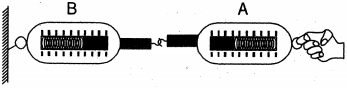
Look at the diagram below and answer the following questions:
$(i)$ When a force is applied through the free end of the spring balance $A$,the reading on the spring balance $A$ is $20 \ g \ wt$. What will be the reading shown by the spring balance $B$?
$(ii)$ Write the reason for your answer.
$(b)$ If a balloon is filled with air and its mouth is untied,air is released from its mouth in the downward direction. Write the other observations made by you and justify your answer.
$(i)$ When a force is applied through the free end of the spring balance $A$,the reading on the spring balance $A$ is $20 \ g \ wt$. What will be the reading shown by the spring balance $B$?
$(ii)$ Write the reason for your answer.
$(b)$ If a balloon is filled with air and its mouth is untied,air is released from its mouth in the downward direction. Write the other observations made by you and justify your answer.
Solution
(N/A) $(a) (i)$ Spring balance $B$ will show $20 \ g \ wt$.
$(ii)$ This is due to Newton's third law of motion. When spring balance $A$ exerts a force on balance $B$,balance $B$ exerts an equal and opposite force of reaction on balance $A$. Since the force applied is $20 \ g \ wt$,the reaction force is also $20 \ g \ wt$.
$(b)$ It is observed that the balloon moves in the upward direction. Air rushes out from the balloon in the downward direction (action). As a result,there is an equal and opposite reaction in the form of upward motion of the balloon,which is in accordance with Newton's third law of motion.
$(ii)$ This is due to Newton's third law of motion. When spring balance $A$ exerts a force on balance $B$,balance $B$ exerts an equal and opposite force of reaction on balance $A$. Since the force applied is $20 \ g \ wt$,the reaction force is also $20 \ g \ wt$.
$(b)$ It is observed that the balloon moves in the upward direction. Air rushes out from the balloon in the downward direction (action). As a result,there is an equal and opposite reaction in the form of upward motion of the balloon,which is in accordance with Newton's third law of motion.
0 likes
View Solution135
Medium
$(a)$ Define inertia. You are provided with three bodies made of wood,rubber,and iron of the same shape and size. Which one of them will have greater inertia? Explain it.
$(b)$ When a striker hits the bottom of the pile of coins placed at the centre of a carom board,only the lowest coin is removed. Give reason for it.
$(b)$ When a striker hits the bottom of the pile of coins placed at the centre of a carom board,only the lowest coin is removed. Give reason for it.
Solution
(D) Inertia is the property of a body by virtue of which it resists any change in its state of rest or of uniform motion in a straight line. Among wood,rubber,and iron of the same shape and size,the iron body will have the greatest inertia. This is because mass is the measure of inertia; since iron has the highest density and thus the greatest mass among the three,it possesses the greatest inertia.
$(b)$ This phenomenon is due to the inertia of rest. When the striker hits the lowest coin,it suddenly comes into motion due to the applied force. However,the rest of the coins in the pile remain in their state of rest due to their inertia of rest. Consequently,they fall vertically downwards into the same position as the bottom coin moves away.
$(b)$ This phenomenon is due to the inertia of rest. When the striker hits the lowest coin,it suddenly comes into motion due to the applied force. However,the rest of the coins in the pile remain in their state of rest due to their inertia of rest. Consequently,they fall vertically downwards into the same position as the bottom coin moves away.
0 likes
View Solution136
Medium
$(a)$ Define momentum. Write its $SI$ unit.
$(b)$ $A$ car and a truck have the same momentum. Whose velocity is more and why?
$(c)$ $A$ bullet of mass $20 \ g$ moving with a speed of $500 \ m s^{-1}$ strikes a wooden block of mass $1 \ kg$ and gets embedded in it. Find the speed with which the block moves along with the bullet.
$(b)$ $A$ car and a truck have the same momentum. Whose velocity is more and why?
$(c)$ $A$ bullet of mass $20 \ g$ moving with a speed of $500 \ m s^{-1}$ strikes a wooden block of mass $1 \ kg$ and gets embedded in it. Find the speed with which the block moves along with the bullet.
Solution
(N/A) Momentum is defined as the product of mass and velocity of an object. Its $SI$ unit is $kg \ m s^{-1}$.
$(b)$ The formula for momentum is $p = m v$. Since the momentum $p$ is the same for both,$m_{T} v_{T} = m_{C} v_{C}$. Because the mass of the truck $m_{T}$ is greater than the mass of the car $m_{C}$,the velocity of the car $v_{C}$ must be greater than the velocity of the truck $v_{T}$ to maintain the same momentum.
$(c)$ Given: Mass of bullet $m_{1} = 20 \ g = 0.02 \ kg$,initial velocity $u_{1} = 500 \ m s^{-1}$. Mass of block $m_{2} = 1 \ kg$,initial velocity $u_{2} = 0 \ m s^{-1}$.
Applying the law of conservation of momentum: $m_{1} u_{1} + m_{2} u_{2} = (m_{1} + m_{2}) v$.
$(0.02 \times 500) + (1 \times 0) = (0.02 + 1) v$.
$10 = 1.02 \times v$.
$v = 10 / 1.02 \approx 9.8 \ m s^{-1}$.
$(b)$ The formula for momentum is $p = m v$. Since the momentum $p$ is the same for both,$m_{T} v_{T} = m_{C} v_{C}$. Because the mass of the truck $m_{T}$ is greater than the mass of the car $m_{C}$,the velocity of the car $v_{C}$ must be greater than the velocity of the truck $v_{T}$ to maintain the same momentum.
$(c)$ Given: Mass of bullet $m_{1} = 20 \ g = 0.02 \ kg$,initial velocity $u_{1} = 500 \ m s^{-1}$. Mass of block $m_{2} = 1 \ kg$,initial velocity $u_{2} = 0 \ m s^{-1}$.
Applying the law of conservation of momentum: $m_{1} u_{1} + m_{2} u_{2} = (m_{1} + m_{2}) v$.
$(0.02 \times 500) + (1 \times 0) = (0.02 + 1) v$.
$10 = 1.02 \times v$.
$v = 10 / 1.02 \approx 9.8 \ m s^{-1}$.
0 likes
View Solution137
Medium
For a $2 \ kg$ mass,the $v-t$ graph is given. Find the force experienced by the mass in $OA$,$AB$,and $BC$.
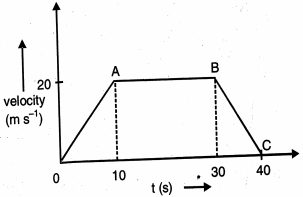
Solution
(N/A) The force experienced by a mass is given by Newton's second law of motion,$F = ma$,where $a$ is the acceleration calculated from the slope of the $v-t$ graph.
$1$. For portion $OA$:
Acceleration $a = \frac{v_f - v_i}{t_f - t_i} = \frac{20 - 0}{10 - 0} = 2 \ m \ s^{-2}$.
Force $F = ma = 2 \ kg \times 2 \ m \ s^{-2} = 4 \ N$.
$2$. For portion $AB$:
The velocity is constant,so acceleration $a = 0 \ m \ s^{-2}$.
Force $F = ma = 2 \ kg \times 0 \ m \ s^{-2} = 0 \ N$.
$3$. For portion $BC$:
Acceleration $a = \frac{v_f - v_i}{t_f - t_i} = \frac{0 - 20}{40 - 30} = -2 \ m \ s^{-2}$.
Force $F = ma = 2 \ kg \times (-2) \ m \ s^{-2} = -4 \ N$.
The negative sign indicates a retarding force.
$1$. For portion $OA$:
Acceleration $a = \frac{v_f - v_i}{t_f - t_i} = \frac{20 - 0}{10 - 0} = 2 \ m \ s^{-2}$.
Force $F = ma = 2 \ kg \times 2 \ m \ s^{-2} = 4 \ N$.
$2$. For portion $AB$:
The velocity is constant,so acceleration $a = 0 \ m \ s^{-2}$.
Force $F = ma = 2 \ kg \times 0 \ m \ s^{-2} = 0 \ N$.
$3$. For portion $BC$:
Acceleration $a = \frac{v_f - v_i}{t_f - t_i} = \frac{0 - 20}{40 - 30} = -2 \ m \ s^{-2}$.
Force $F = ma = 2 \ kg \times (-2) \ m \ s^{-2} = -4 \ N$.
The negative sign indicates a retarding force.
0 likes
View Solution138
Medium
Two similar vehicles are moving with the same velocity on roads,such that one of them is loaded and the other is empty. Which of the two vehicles will require a larger force to stop it? Give reasons.
Solution
(A) The force required to stop a moving object is directly proportional to the rate of change of momentum $(F = \frac{dp}{dt} = ma)$.
Since both vehicles are moving with the same velocity $(v)$,the momentum $(p = mv)$ depends on the mass $(m)$ of the vehicle.
The loaded vehicle has a greater mass compared to the empty vehicle.
Therefore,the loaded vehicle possesses more momentum.
According to Newton's second law of motion,a larger force is required to change the momentum of an object with greater mass in the same amount of time.
Thus,the loaded vehicle will require a larger force to stop.
Since both vehicles are moving with the same velocity $(v)$,the momentum $(p = mv)$ depends on the mass $(m)$ of the vehicle.
The loaded vehicle has a greater mass compared to the empty vehicle.
Therefore,the loaded vehicle possesses more momentum.
According to Newton's second law of motion,a larger force is required to change the momentum of an object with greater mass in the same amount of time.
Thus,the loaded vehicle will require a larger force to stop.
0 likes
View Solution139
Medium
An object experiences a net zero external unbalanced force. Is it possible for the object to be moving with a non-$zero$ velocity? If yes, state the conditions that must be placed on the magnitude and direction of velocity. If no, provide a reason.
Solution
(A) Yes, it is possible for the object to be moving with a non-$zero$ velocity.
According to Newton's $First$ Law of Motion, an object will continue to be in a state of rest or of uniform motion along a straight line unless acted upon by an unbalanced force.
If the net external unbalanced force is $zero$, the object will maintain its state of motion.
Therefore, the object must move with a constant magnitude (speed) and a constant direction (straight line path) to maintain uniform motion.
According to Newton's $First$ Law of Motion, an object will continue to be in a state of rest or of uniform motion along a straight line unless acted upon by an unbalanced force.
If the net external unbalanced force is $zero$, the object will maintain its state of motion.
Therefore, the object must move with a constant magnitude (speed) and a constant direction (straight line path) to maintain uniform motion.
0 likes
View Solution140
Medium
In the following table,the mass and speed of two bodies are given. Which body has more momentum? Justify your answer.
| Body | Mass $(kg)$ | Speed $(m s^{-1})$ |
| $A$ | $1$ | $10$ |
| $B$ | $2$ | $9$ |
Solution
(B) Momentum $(p)$ is defined as the product of mass $(m)$ and velocity $(v)$,given by the formula: $p = m \times v$.
For body $A$:
Mass $(m_A)$ = $1 \ kg$
Speed $(v_A)$ = $10 \ m s^{-1}$
Momentum $(p_A)$ = $1 \ kg \times 10 \ m s^{-1} = 10 \ kg \ m s^{-1}$.
For body $B$:
Mass $(m_B)$ = $2 \ kg$
Speed $(v_B)$ = $9 \ m s^{-1}$
Momentum $(p_B)$ = $2 \ kg \times 9 \ m s^{-1} = 18 \ kg \ m s^{-1}$.
Comparing the two values,$18 \ kg \ m s^{-1} > 10 \ kg \ m s^{-1}$.
Therefore,body $B$ has more momentum.
For body $A$:
Mass $(m_A)$ = $1 \ kg$
Speed $(v_A)$ = $10 \ m s^{-1}$
Momentum $(p_A)$ = $1 \ kg \times 10 \ m s^{-1} = 10 \ kg \ m s^{-1}$.
For body $B$:
Mass $(m_B)$ = $2 \ kg$
Speed $(v_B)$ = $9 \ m s^{-1}$
Momentum $(p_B)$ = $2 \ kg \times 9 \ m s^{-1} = 18 \ kg \ m s^{-1}$.
Comparing the two values,$18 \ kg \ m s^{-1} > 10 \ kg \ m s^{-1}$.
Therefore,body $B$ has more momentum.
0 likes
View Solution141
MediumMCQ
If a body is in motion,is it necessary that it is being acted upon by a force?
A
Yes,always.
B
No,not necessarily.
C
Only if the body is accelerating.
D
Only if the body is at rest.
Solution
(B) According to Newton's First Law of Motion,an object in uniform motion will continue to move in a straight line at a constant speed unless acted upon by an external unbalanced force.
Therefore,it is not necessary for a force to act on a body for it to remain in motion.
Force is only required to change the state of motion (i.e.,to accelerate,decelerate,or change the direction of the object).
Therefore,it is not necessary for a force to act on a body for it to remain in motion.
Force is only required to change the state of motion (i.e.,to accelerate,decelerate,or change the direction of the object).
0 likes
View Solution142
Medium
$m_{1}$ and $m_{2}$ masses of two blocks are connected by a light spring on a smooth horizontal surface. The two masses are pulled apart and then released. Prove that the ratio of their acceleration is inversely proportional to their masses.
Solution
(N/A) According to Newton's third law of motion,the spring exerts equal and opposite forces on both masses.
Let $F_{1}$ be the force on mass $m_{1}$ and $F_{2}$ be the force on mass $m_{2}$.
Since the forces are equal in magnitude and opposite in direction,we have $F_{1} = -F_{2}$.
Using Newton's second law,$F = ma$,we can write:
$m_{1} a_{1} = -m_{2} a_{2}$
Here,$a_{1}$ and $a_{2}$ are the accelerations of the masses $m_{1}$ and $m_{2}$ respectively.
The negative sign indicates that the accelerations are in opposite directions.
Taking the magnitude of the ratio of accelerations:
$\frac{|a_{1}|}{|a_{2}|} = \frac{m_{2}}{m_{1}}$
This proves that the ratio of their accelerations is inversely proportional to their masses.
Let $F_{1}$ be the force on mass $m_{1}$ and $F_{2}$ be the force on mass $m_{2}$.
Since the forces are equal in magnitude and opposite in direction,we have $F_{1} = -F_{2}$.
Using Newton's second law,$F = ma$,we can write:
$m_{1} a_{1} = -m_{2} a_{2}$
Here,$a_{1}$ and $a_{2}$ are the accelerations of the masses $m_{1}$ and $m_{2}$ respectively.
The negative sign indicates that the accelerations are in opposite directions.
Taking the magnitude of the ratio of accelerations:
$\frac{|a_{1}|}{|a_{2}|} = \frac{m_{2}}{m_{1}}$
This proves that the ratio of their accelerations is inversely proportional to their masses.
0 likes
View Solution143
Medium
$A$ block is supported by a cord $A$ from a rigid support,and another cord $B$ is attached to the bottom of the block. If you give a sudden jerk to $B$,it will break. But if you pull on $B$ steadily,$A$ will break. Why?
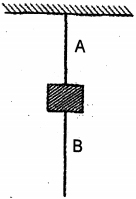
Solution
(N/A) When a sudden jerk is given to the lower cord $B$,the upper portion of the system is not able to receive the force of the jerk in a very short interval of time due to the inertia of the block,and the block tends to remain at rest. As a result,the tension in cord $B$ exceeds its breaking strength,and it breaks.
On pulling the cord $B$ steadily,the force gets sufficient time to be transmitted to the upper cord $A$. In this case,the total tension in cord $A$ becomes the sum of the force applied and the weight of the block $(T_A = F + mg)$,while the tension in cord $B$ is only the force applied $(T_B = F)$. Since the tension in $A$ is greater than in $B$,cord $A$ breaks first.
On pulling the cord $B$ steadily,the force gets sufficient time to be transmitted to the upper cord $A$. In this case,the total tension in cord $A$ becomes the sum of the force applied and the weight of the block $(T_A = F + mg)$,while the tension in cord $B$ is only the force applied $(T_B = F)$. Since the tension in $A$ is greater than in $B$,cord $A$ breaks first.
0 likes
View Solution144
Easy
Newton's first law of motion is also called the law of inertia. Why?
Solution
(N/A) According to the first law of motion,a body at rest remains at rest,and a body in motion continues to move in a straight line at a constant speed unless acted upon by an external unbalanced force.
This inherent property of a body to resist any change in its state of rest or uniform motion is known as inertia.
Since the first law of motion defines this property,it is commonly referred to as the law of inertia.
This inherent property of a body to resist any change in its state of rest or uniform motion is known as inertia.
Since the first law of motion defines this property,it is commonly referred to as the law of inertia.
0 likes
View Solution145
Easy
Air is blown onto a sail attached to a boat from an electric fan placed on the boat. Will the boat start moving?
Solution
(B) No,the boat will not move. According to Newton's $3^{rd}$ Law of Motion,when the air from the fan pushes the sail,the sail exerts an equal and opposite force on the fan. Since the fan is attached to the boat,the system (fan + boat) experiences internal forces that cancel each other out. Motion occurs only when an external unbalanced force acts on a body. Since the fan is part of the boat,no net external force is applied to the system,and therefore,the boat will not move.
0 likes
View Solution146
Easy
According to Newton's third law,every force is accompanied by an equal and opposite force. How then can anything move?
Solution
(N/A) Newton's third law states that for every action,there is an equal and opposite reaction. However,these two forces act on different bodies,not the same body. Since the forces do not cancel each other out on a single object,the net force acting on a body can be non-zero,thereby allowing the body to move.
0 likes
View Solution147
Medium
Give the magnitude and direction of the net force acting on:
$(a)$ a drop of rain falling down with a constant speed.
$(b)$ a cork of mass $10 \,g$ floating on water.
$(c)$ a kite skilfully held stationary in the sky.
$(a)$ a drop of rain falling down with a constant speed.
$(b)$ a cork of mass $10 \,g$ floating on water.
$(c)$ a kite skilfully held stationary in the sky.
Solution
(N/A) The rain drop is falling with a constant speed,which means its acceleration $a = 0$. According to Newton's second law,the net force $F = ma = m(0) = 0$. Thus,the net force is zero.
$(b)$ $A$ cork floating on water is in equilibrium. The downward gravitational force (weight) is balanced by the upward buoyant force (upthrust). Therefore,the net force acting on the cork is zero.
$(c)$ Since the kite is held stationary,its velocity is zero and its acceleration is zero. According to Newton's first law,if an object is at rest,the net external force acting on it must be zero.
$(b)$ $A$ cork floating on water is in equilibrium. The downward gravitational force (weight) is balanced by the upward buoyant force (upthrust). Therefore,the net force acting on the cork is zero.
$(c)$ Since the kite is held stationary,its velocity is zero and its acceleration is zero. According to Newton's first law,if an object is at rest,the net external force acting on it must be zero.
0 likes
View Solution148
EasyMCQ
When a missile is fired from a tank,it gets a momentum of $2000 \ kg \ m \ s^{-1}$. If the velocity of the missile is $50 \ m \ s^{-1}$,what will be its mass (in $kg$)?
A
$40$
B
$50$
C
$20$
D
$100$
Solution
(A) Given: Momentum $(p)$ = $2000 \ kg \ m \ s^{-1}$,Velocity $(v)$ = $50 \ m \ s^{-1}$.
We know that momentum is the product of mass and velocity,given by the formula: $p = m \times v$.
To find the mass $(m)$,we rearrange the formula: $m = \frac{p}{v}$.
Substituting the given values: $m = \frac{2000}{50} = 40 \ kg$.
Therefore,the mass of the missile is $40 \ kg$.
We know that momentum is the product of mass and velocity,given by the formula: $p = m \times v$.
To find the mass $(m)$,we rearrange the formula: $m = \frac{p}{v}$.
Substituting the given values: $m = \frac{2000}{50} = 40 \ kg$.
Therefore,the mass of the missile is $40 \ kg$.
0 likes
View Solution149
MediumMCQ
$A$ girl of mass $50 \, kg$ jumps out of a moving boat of mass $300 \, kg$ onto the bank with a horizontal velocity of $3 \, m s^{-1}$. With what velocity will the boat begin to move backwards (in $, m s^{-1}$)?
A
$0.5$
B
$0.25$
C
$1.0$
D
$0.75$
Solution
(A) According to the Law of Conservation of Momentum,the total momentum before the jump is equal to the total momentum after the jump.
Since the system (girl + boat) is initially at rest,the initial momentum is $0$.
Let $m_1 = 50 \, kg$ be the mass of the girl and $v_1 = 3 \, m s^{-1}$ be her velocity.
Let $m_2 = 300 \, kg$ be the mass of the boat and $v_2$ be the velocity of the boat.
Using the formula: $m_1 v_1 + m_2 v_2 = 0$.
Substituting the values: $(50 \times 3) + (300 \times v_2) = 0$.
$150 + 300 v_2 = 0$.
$300 v_2 = -150$.
$v_2 = -\frac{150}{300} = -0.5 \, m s^{-1}$.
The negative sign indicates that the boat moves in the opposite direction (backwards) with a velocity of $0.5 \, m s^{-1}$.
Since the system (girl + boat) is initially at rest,the initial momentum is $0$.
Let $m_1 = 50 \, kg$ be the mass of the girl and $v_1 = 3 \, m s^{-1}$ be her velocity.
Let $m_2 = 300 \, kg$ be the mass of the boat and $v_2$ be the velocity of the boat.
Using the formula: $m_1 v_1 + m_2 v_2 = 0$.
Substituting the values: $(50 \times 3) + (300 \times v_2) = 0$.
$150 + 300 v_2 = 0$.
$300 v_2 = -150$.
$v_2 = -\frac{150}{300} = -0.5 \, m s^{-1}$.
The negative sign indicates that the boat moves in the opposite direction (backwards) with a velocity of $0.5 \, m s^{-1}$.
0 likes
View Solution150
EasyMCQ
When a force of $40\, N$ is applied on a body,it moves with an acceleration of $5\, m s^{-2}$. Calculate the mass of the body. (in $kg$)
A
$5$
B
$8$
C
$10$
D
$200$
Solution
(B) Let $m$ be the mass of the body.
Given: Force $F = 40\, N$ and acceleration $a = 5\, m s^{-2}$.
According to Newton's second law of motion,the relationship is $F = m \times a$.
Substituting the given values,we get $40 = m \times 5$.
Therefore,$m = \frac{40}{5} = 8\, kg$.
The mass of the body is $8\, kg$.
Given: Force $F = 40\, N$ and acceleration $a = 5\, m s^{-2}$.
According to Newton's second law of motion,the relationship is $F = m \times a$.
Substituting the given values,we get $40 = m \times 5$.
Therefore,$m = \frac{40}{5} = 8\, kg$.
The mass of the body is $8\, kg$.
0 likes
View SolutionFORCE AND LAWS OF MOTION — Mix Example - FORCE AND LAWS OF MOTION · Frequently Asked Questions
1Are these FORCE AND LAWS OF MOTION questions useful for JEE and NEET?
Yes. All questions in this section are mapped to JEE Main and NEET exam patterns. Previous year questions from JEE Main, NEET, GUJCET and state-level exams are included with full solutions.
2Can I switch to Hindi or Gujarati for these questions?
Yes. Use the language tabs in the hero section or the sidebar to view the same questions and solutions in English, Hindi or Gujarati.
3How do I generate a question paper from this subtopic?
Use the Vedclass Exam Paper Generator — select the chapter and subtopic, set difficulty, and generate Sets A, B, C, D automatically. First 3 chapters of every subject are free.
Vedclass Products
For Students
Vedclass Test Series
Mock tests in real JEE/NEET style with performance analysis. 5-day free trial.
Start Free TrialFor Teachers
Exam Paper Generator
Generate Set A/B/C/D papers from this chapter in 2 minutes. 3 chapters free.
Try FreeFor Institutes
Online Exam Module
Live online exams with unlimited students, 360° analytics & white-label branding.
See DemoFor Teachers & Institutes
Generate a FORCE AND LAWS OF MOTION Exam Paper in 2 Minutes
Select subtopic & difficulty — Sets A, B, C, D auto-generated with No Repeat logic.
First 3 chapters of every subject are free — no payment required.