
A English
Thin film Interference, fresnel biprism, lloyd's mirror Questions in English
Class 12 Physics · Wave Optics · Thin film Interference, fresnel biprism, lloyd's mirror
95+
Questions
English
Language
100%
With Solutions
Showing 43 of 95 questions in English
51
EasyMCQ
Assertion: Newton's rings are formed in the reflected system when the space between the lens and the glass plate is filled with a liquid of refractive index greater than that of glass; the central spot of the pattern is bright.
Reason: This is because the reflection in these cases will be from a denser to rarer medium and the two interfering rays are reflected under similar conditions.
Reason: This is because the reflection in these cases will be from a denser to rarer medium and the two interfering rays are reflected under similar conditions.
A
If both Assertion and Reason are correct and the Reason is a correct explanation of the Assertion.
B
If both Assertion and Reason are correct but Reason is not a correct explanation of the Assertion.
C
If the Assertion is correct but Reason is incorrect.
D
If both the Assertion and Reason are incorrect.
Solution
(A) In the standard Newton's rings experiment,the air film is between the lens $(n_l)$ and the glass plate $(n_g)$,where $n_l > n_{air}$ and $n_g > n_{air}$. The reflection at the bottom surface of the air film occurs at the glass-air interface (denser to rarer),while the top surface reflection occurs at the air-glass interface (rarer to denser). This introduces a phase change of $\pi$ for one ray,resulting in a dark central spot.
When the space is filled with a liquid of refractive index $n_{liq} > n_g$,the reflection at the bottom surface occurs at the glass-liquid interface (rarer to denser),and the reflection at the top surface occurs at the liquid-glass interface (denser to rarer).
Since both reflections now occur under similar conditions (either both undergo phase change or neither does),the path difference at the center is effectively zero,leading to constructive interference. Thus,the central spot becomes bright. Both the Assertion and the Reason are correct,and the Reason explains why the phase change conditions lead to a bright center.
When the space is filled with a liquid of refractive index $n_{liq} > n_g$,the reflection at the bottom surface occurs at the glass-liquid interface (rarer to denser),and the reflection at the top surface occurs at the liquid-glass interface (denser to rarer).
Since both reflections now occur under similar conditions (either both undergo phase change or neither does),the path difference at the center is effectively zero,leading to constructive interference. Thus,the central spot becomes bright. Both the Assertion and the Reason are correct,and the Reason explains why the phase change conditions lead to a bright center.
0 likes
View Solution52
EasyMCQ
Assertion: Thin films such as a soap bubble or a thin layer of oil on water show beautiful colours when illuminated by white light.
Reason: It happens due to the interference of light reflected from the upper surface of the thin film.
Reason: It happens due to the interference of light reflected from the upper surface of the thin film.
A
If both Assertion and Reason are correct and the Reason is a correct explanation of the Assertion.
B
If both Assertion and Reason are correct but Reason is not a correct explanation of the Assertion.
C
If the Assertion is correct but Reason is incorrect.
D
If both the Assertion and Reason are incorrect.
Solution
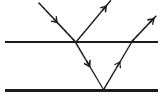
(C) The Assertion is correct because thin films exhibit interference patterns when illuminated by white light,resulting in the observation of colours.
However,the Reason is incomplete and therefore incorrect. The phenomenon of interference in thin films occurs due to the superposition of light waves reflected from $BOTH$ the upper surface $AND$ the lower surface of the thin film,not just the upper surface. The path difference between these two reflected rays leads to constructive or destructive interference for different wavelengths,which creates the observed colours.
However,the Reason is incomplete and therefore incorrect. The phenomenon of interference in thin films occurs due to the superposition of light waves reflected from $BOTH$ the upper surface $AND$ the lower surface of the thin film,not just the upper surface. The path difference between these two reflected rays leads to constructive or destructive interference for different wavelengths,which creates the observed colours.
0 likes
View Solution53
EasyMCQ
Assertion: At the first glance,the top surface of the Morpho butterfly's wing appears a beautiful blue-green. If the wind moves the colour changes.
Reason: Different pigments in the wing reflect light at different angles.
Reason: Different pigments in the wing reflect light at different angles.
A
If both Assertion and Reason are correct and the Reason is a correct explanation of the Assertion.
B
If both Assertion and Reason are correct but Reason is not a correct explanation of the Assertion.
C
If the Assertion is correct but Reason is incorrect.
D
If both the Assertion and Reason are incorrect.
Solution
(C) The Assertion is correct. The colour of the Morpho butterfly's wing is not due to pigments,but due to structural colouration caused by the interference of light reflected from the microscopic scales on the wing surface.
When the wind moves the wing,the angle of incidence and the path difference between the light waves reflected from different layers of the scales change. This causes a shift in the interference pattern,resulting in a change in the observed colour.
The Reason is incorrect because the colour is not caused by pigments,but by the physical structure of the wing surface (thin-film interference).
Therefore,the correct option is $(C)$.
When the wind moves the wing,the angle of incidence and the path difference between the light waves reflected from different layers of the scales change. This causes a shift in the interference pattern,resulting in a change in the observed colour.
The Reason is incorrect because the colour is not caused by pigments,but by the physical structure of the wing surface (thin-film interference).
Therefore,the correct option is $(C)$.
0 likes
View Solution54
Difficult
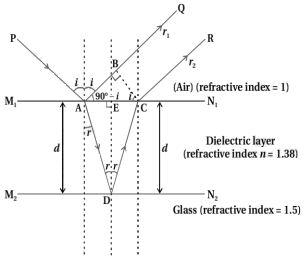
To ensure almost $100$ per cent transmittivity,photographic lenses are often coated with a thin layer of dielectric material. The refractive index of this material is intermediate between that of air and glass (which makes the optical element of the lens). $A$ typically used dielectric film is $MgF_2$ $(n = 1.38)$. What should the thickness of the film be so that at the center of the visible spectrum $5500 \, \mathring{A}$ there is maximum transmission?
Solution
(N/A) For maximum transmission,the reflected rays must interfere destructively. This occurs when the path difference between the two reflected rays is an odd multiple of $\frac{\lambda}{2}$.
For normal incidence $(i = 0)$,the path difference is $\Delta x = 2nd$.
Since both reflections occur at a rarer to denser medium interface,there is no additional phase shift due to reflection.
Thus,the condition for destructive interference (minimum reflection,maximum transmission) is $2nd = (m + \frac{1}{2}) \lambda$,where $m = 0, 1, 2, \dots$.
For minimum thickness,we take $m = 0$,so $2nd = \frac{\lambda}{2}$.
$d = \frac{\lambda}{4n} = \frac{5500 \times 10^{-10} \, \text{m}}{4 \times 1.38} \approx 996.4 \times 10^{-10} \, \text{m} \approx 996.4 \, \mathring{A}$.
For normal incidence $(i = 0)$,the path difference is $\Delta x = 2nd$.
Since both reflections occur at a rarer to denser medium interface,there is no additional phase shift due to reflection.
Thus,the condition for destructive interference (minimum reflection,maximum transmission) is $2nd = (m + \frac{1}{2}) \lambda$,where $m = 0, 1, 2, \dots$.
For minimum thickness,we take $m = 0$,so $2nd = \frac{\lambda}{2}$.
$d = \frac{\lambda}{4n} = \frac{5500 \times 10^{-10} \, \text{m}}{4 \times 1.38} \approx 996.4 \times 10^{-10} \, \text{m} \approx 996.4 \, \mathring{A}$.
0 likes
View Solution55
EasyMCQ
Oil floating on water looks coloured due to interference of light. What should be the order of magnitude of the thickness of the oil layer in order that this effect may be observed? (in $m$)
A
$10^{-6}$
B
$10^{-2}$
C
$10^{-10}$
D
$10^{-8}$
Solution
(A) The phenomenon of colours in thin films is due to the interference of light waves reflected from the top and bottom surfaces of the film.
For constructive interference to occur in the visible spectrum, the path difference must be related to the wavelength of light $(\lambda)$.
The condition for interference in a thin film of thickness $t$ is approximately $2\mu t \approx n\lambda$.
Since the wavelength of visible light ranges from approximately $400\,nm$ to $700\,nm$ (i.e., $4 \times 10^{-7}\,m$ to $7 \times 10^{-7}\,m$), the thickness $t$ of the oil film must be of the same order of magnitude as the wavelength of visible light.
Therefore, the order of magnitude of the thickness is $10^{-7}\,m$ to $10^{-6}\,m$.
Among the given options, $10^{-6}\,m$ is the most appropriate order of magnitude.
For constructive interference to occur in the visible spectrum, the path difference must be related to the wavelength of light $(\lambda)$.
The condition for interference in a thin film of thickness $t$ is approximately $2\mu t \approx n\lambda$.
Since the wavelength of visible light ranges from approximately $400\,nm$ to $700\,nm$ (i.e., $4 \times 10^{-7}\,m$ to $7 \times 10^{-7}\,m$), the thickness $t$ of the oil film must be of the same order of magnitude as the wavelength of visible light.
Therefore, the order of magnitude of the thickness is $10^{-7}\,m$ to $10^{-6}\,m$.
Among the given options, $10^{-6}\,m$ is the most appropriate order of magnitude.
0 likes
View Solution56
MediumMCQ
When white light is incident normally on an oil film of thickness $10^{-4} \,cm$ and refractive index $1.4$,the wavelength which will not be seen in the reflected system of light is ........... $\mathring{A}$.
A
$7000$
B
$5600$
C
$4000$
D
All of these
Solution
(D) For destructive interference in the reflected light from a thin film,the condition is given by $2 \mu t \cos r = n \lambda$,where $n = 1, 2, 3, \dots$.
Given: $\mu = 1.4$,$t = 10^{-4} \,cm = 10^{-6} \,m = 10^{-4} \times 10^{10} \, \mathring{A} = 10^6 \, \mathring{A}$.
For normal incidence,$r = 0^{\circ}$,so $\cos r = 1$.
The condition becomes $2 \times 1.4 \times 10^{-4} \,cm = n \lambda$.
$2.8 \times 10^{-4} \,cm = n \lambda$.
Converting to $\mathring{A}$s: $2.8 \times 10^{-4} \times 10^8 \, \mathring{A} = n \lambda$.
$28000 \, \mathring{A} = n \lambda$.
Thus,$\lambda = \frac{28000}{n} \, \mathring{A}$.
For $n = 4$,$\lambda = \frac{28000}{4} = 7000 \, \mathring{A}$.
For $n = 5$,$\lambda = \frac{28000}{5} = 5600 \, \mathring{A}$.
For $n = 7$,$\lambda = \frac{28000}{7} = 4000 \, \mathring{A}$.
Since all the given options satisfy the condition for destructive interference,they will not be seen in the reflected light.
Given: $\mu = 1.4$,$t = 10^{-4} \,cm = 10^{-6} \,m = 10^{-4} \times 10^{10} \, \mathring{A} = 10^6 \, \mathring{A}$.
For normal incidence,$r = 0^{\circ}$,so $\cos r = 1$.
The condition becomes $2 \times 1.4 \times 10^{-4} \,cm = n \lambda$.
$2.8 \times 10^{-4} \,cm = n \lambda$.
Converting to $\mathring{A}$s: $2.8 \times 10^{-4} \times 10^8 \, \mathring{A} = n \lambda$.
$28000 \, \mathring{A} = n \lambda$.
Thus,$\lambda = \frac{28000}{n} \, \mathring{A}$.
For $n = 4$,$\lambda = \frac{28000}{4} = 7000 \, \mathring{A}$.
For $n = 5$,$\lambda = \frac{28000}{5} = 5600 \, \mathring{A}$.
For $n = 7$,$\lambda = \frac{28000}{7} = 4000 \, \mathring{A}$.
Since all the given options satisfy the condition for destructive interference,they will not be seen in the reflected light.
0 likes
View Solution57
EasyMCQ
Imperfections in optical lenses can be observed with the help of
A
Fresnel's Biprism
B
Newton's Rings
C
Young's double slit experiment
D
Lloyd's single mirror experiment
Solution
(A) The correct answer is $A$.
Fresnel's Biprism is an optical device used to produce interference patterns.
It is specifically employed in optical testing to detect surface irregularities and imperfections in lenses by observing the distortion in the interference fringes produced by the device.
Fresnel's Biprism is an optical device used to produce interference patterns.
It is specifically employed in optical testing to detect surface irregularities and imperfections in lenses by observing the distortion in the interference fringes produced by the device.
0 likes
View Solution58
EasyMCQ
Dark and colour patterns on thin soap films are due to
A
Interference of light
B
Diffraction of light
C
Dispersion of light
D
Polarization of light
Solution
(A) The phenomenon of observing colours on thin soap films is caused by the interference of light waves.
When white light is incident on a thin soap film,light waves are reflected from both the outer and inner surfaces of the film.
These reflected waves undergo superposition,leading to constructive or destructive interference depending on the path difference and the wavelength of the light.
Since the thickness of the film varies and the path difference depends on the angle of incidence,different wavelengths (colours) interfere constructively at different points,resulting in the observed colourful patterns.
When white light is incident on a thin soap film,light waves are reflected from both the outer and inner surfaces of the film.
These reflected waves undergo superposition,leading to constructive or destructive interference depending on the path difference and the wavelength of the light.
Since the thickness of the film varies and the path difference depends on the angle of incidence,different wavelengths (colours) interfere constructively at different points,resulting in the observed colourful patterns.
0 likes
View Solution59
MediumMCQ
Choose the correct statement.
A
While watching television by means of an antenna,a passing nearby aeroplane can produce wavering ghost images in the television picture.
B
Solar cells are often coated with a transparent thin film,such as silicon monoxide $(SiO)$,to minimize reflective losses.
C
Glass lenses used in cameras and other optical instruments are usually coated with a transparent thin film,such as magnesium fluoride $(MgF_2)$,to reduce or eliminate unwanted reflection.
D
All of these.
Solution
(D) Option $A$ is correct because the reflection of electromagnetic waves from a moving aeroplane causes interference,leading to ghost images.
Option $B$ is correct because thin-film interference is used to reduce reflection in solar cells,increasing light absorption.
Option $C$ is correct because non-reflective coatings (like $MgF_2$) use destructive interference to eliminate unwanted reflections in optical lenses.
Since all statements are scientifically accurate,the correct choice is $D$.
Option $B$ is correct because thin-film interference is used to reduce reflection in solar cells,increasing light absorption.
Option $C$ is correct because non-reflective coatings (like $MgF_2$) use destructive interference to eliminate unwanted reflections in optical lenses.
Since all statements are scientifically accurate,the correct choice is $D$.
0 likes
View Solution60
MediumMCQ
The beautiful iridescent (like a rainbow) colors on the wings of a tropical or morpho butterfly are due to
A
Thin film interference of light
B
Diffraction of light
C
Polarization of light
D
Dispersion of light
Solution
(A) The correct answer is $A$.
The wings of butterflies and moths consist of a colorless translucent membrane covered by a layer of scales. Each scale is a flattened outgrowth of a single cell and is about $100 \,\mu m$ long and $50 \,\mu m$ wide.
The scales overlap like roof tiles and completely cover the membrane,appearing as dust to the naked eye.
The iridescence in the wings is caused by thin-film interference. The structure of the scales contains microscopic layers that reflect light. When sunlight hits these layers,the light waves reflected from the top and bottom surfaces of these thin structures interfere with each other.
Depending on the thickness of these layers and the angle of viewing,certain wavelengths of light undergo constructive interference while others undergo destructive interference. This selective reinforcement of specific colors results in the beautiful iridescent colors observed on the wings.
The wings of butterflies and moths consist of a colorless translucent membrane covered by a layer of scales. Each scale is a flattened outgrowth of a single cell and is about $100 \,\mu m$ long and $50 \,\mu m$ wide.
The scales overlap like roof tiles and completely cover the membrane,appearing as dust to the naked eye.
The iridescence in the wings is caused by thin-film interference. The structure of the scales contains microscopic layers that reflect light. When sunlight hits these layers,the light waves reflected from the top and bottom surfaces of these thin structures interfere with each other.
Depending on the thickness of these layers and the angle of viewing,certain wavelengths of light undergo constructive interference while others undergo destructive interference. This selective reinforcement of specific colors results in the beautiful iridescent colors observed on the wings.
0 likes
View Solution61
EasyMCQ
Some currency notes (to avoid counterfeits) change their colour as you tilt them. This is due to
A
Diffraction
B
Polarization
C
Interference
D
Refraction
Solution
(C) The phenomenon responsible for the change in colour of currency notes when tilted is $Interference$ of light.
Currency notes often use special inks containing thin-film layers. When light falls on these layers, it undergoes reflection from both the top and bottom surfaces of the thin film.
The path difference between the light waves reflected from the top and bottom surfaces depends on the angle of incidence (which changes as you tilt the note) and the thickness of the film.
Due to this path difference, constructive or destructive interference occurs for specific wavelengths of light, causing the observed colour to shift as the viewing angle changes.
Currency notes often use special inks containing thin-film layers. When light falls on these layers, it undergoes reflection from both the top and bottom surfaces of the thin film.
The path difference between the light waves reflected from the top and bottom surfaces depends on the angle of incidence (which changes as you tilt the note) and the thickness of the film.
Due to this path difference, constructive or destructive interference occurs for specific wavelengths of light, causing the observed colour to shift as the viewing angle changes.
0 likes
View Solution62
MediumMCQ
$A$ thin film of water $(\mu = 4/3)$ is $3100 \,\mathring{A}$ thick. If it is illuminated by white light at normal incidence,the colour of the film in the reflected light will be:
A
Blue
B
Black
C
Yellow
D
Red
Solution
(C) For constructive interference in a thin film (reflected light),the condition is $2 \mu t \cos r = (2n - 1) \frac{\lambda}{2}$,where $n = 1, 2, 3, \dots$
Given $\mu = 4/3$,$t = 3100 \,\mathring{A}$,and normal incidence ($r = 0$,so $\cos r = 1$).
The formula becomes $\lambda = \frac{4 \mu t}{2n - 1}$.
For $n = 1$: $\lambda = 4 \times (4/3) \times 3100 = 16533 \,\mathring{A}$ (Infrared).
For $n = 2$: $\lambda = \frac{4 \times (4/3) \times 3100}{3} = \frac{16533}{3} = 5511 \,\mathring{A}$.
This wavelength $(5511 \,\mathring{A})$ corresponds to the yellow region of the visible spectrum.
Therefore,the film appears yellow.
Given $\mu = 4/3$,$t = 3100 \,\mathring{A}$,and normal incidence ($r = 0$,so $\cos r = 1$).
The formula becomes $\lambda = \frac{4 \mu t}{2n - 1}$.
For $n = 1$: $\lambda = 4 \times (4/3) \times 3100 = 16533 \,\mathring{A}$ (Infrared).
For $n = 2$: $\lambda = \frac{4 \times (4/3) \times 3100}{3} = \frac{16533}{3} = 5511 \,\mathring{A}$.
This wavelength $(5511 \,\mathring{A})$ corresponds to the yellow region of the visible spectrum.
Therefore,the film appears yellow.
0 likes
View Solution63
MediumMCQ
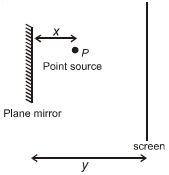
What is the shape of the interference fringes formed on the screen due to a point source $P$,in the case shown here?
A
Parabolic
B
Elliptical
C
Circular
D
Hyperbolic
Solution
(C) In this setup,the point source $P$ and its virtual image $P'$ formed by the plane mirror act as two coherent point sources. The interference pattern produced by two coherent point sources on a screen perpendicular to the line joining them consists of concentric circles. Therefore,the interference fringes formed on the screen are circular.
0 likes
View Solution64
EasyMCQ
The approximate thickness of an oil film required to observe the interference of light (due to which it appears coloured) is .......
A
$10\,mm$
B
$10^{-3}\,mm$
C
$10\,pm$
D
$1\,cm$
Solution
(B) The phenomenon of interference in thin films occurs when the path difference between the reflected rays is comparable to the wavelength of visible light.
Visible light has a wavelength range of approximately $400\,nm$ to $700\,nm$, which is $4 \times 10^{-7}\,m$ to $7 \times 10^{-7}\,m$.
Converting this to millimeters, we get $4 \times 10^{-4}\,mm$ to $7 \times 10^{-4}\,mm$.
Among the given options, $10^{-3}\,mm$ (which is $10^{-6}\,m$ or $1\,\mu m$) is the only value that is of the same order of magnitude as the wavelength of visible light.
Therefore, the correct option is $B$.
Visible light has a wavelength range of approximately $400\,nm$ to $700\,nm$, which is $4 \times 10^{-7}\,m$ to $7 \times 10^{-7}\,m$.
Converting this to millimeters, we get $4 \times 10^{-4}\,mm$ to $7 \times 10^{-4}\,mm$.
Among the given options, $10^{-3}\,mm$ (which is $10^{-6}\,m$ or $1\,\mu m$) is the only value that is of the same order of magnitude as the wavelength of visible light.
Therefore, the correct option is $B$.
0 likes
View Solution65
EasyMCQ
When a mica sheet of thickness $7 \ \mu m$ and refractive index $\mu = 1.6$ is placed in the path of one of the interfering beams in a biprism experiment, the central fringe shifts to the position of the seventh bright fringe. The wavelength of the light used is $............ \ \mathring{A}$.
A
$4000$
B
$5000$
C
$6000$
D
$7000$
Solution
(C) The shift in the central fringe due to the introduction of a mica sheet is given by the formula: $\Delta x = \frac{(\mu - 1) t D}{d}$.
Given that the central fringe shifts to the position of the $n^{th}$ bright fringe, the shift is equal to $n \beta$, where $\beta = \frac{\lambda D}{d}$ is the fringe width.
Equating the two: $(\mu - 1) t \frac{D}{d} = n \frac{\lambda D}{d}$.
This simplifies to: $\lambda = \frac{(\mu - 1) t}{n}$.
Given values: $\mu = 1.6$, $t = 7 \ \mu m = 7 \times 10^{-6} \ m$, and $n = 7$.
Substituting these values: $\lambda = \frac{(1.6 - 1) \times 7 \times 10^{-6}}{7}$.
$\lambda = 0.6 \times 10^{-6} \ m = 6 \times 10^{-7} \ m$.
Converting to $\mathring{A}$s: $\lambda = 6000 \ \mathring{A}$.
Given that the central fringe shifts to the position of the $n^{th}$ bright fringe, the shift is equal to $n \beta$, where $\beta = \frac{\lambda D}{d}$ is the fringe width.
Equating the two: $(\mu - 1) t \frac{D}{d} = n \frac{\lambda D}{d}$.
This simplifies to: $\lambda = \frac{(\mu - 1) t}{n}$.
Given values: $\mu = 1.6$, $t = 7 \ \mu m = 7 \times 10^{-6} \ m$, and $n = 7$.
Substituting these values: $\lambda = \frac{(1.6 - 1) \times 7 \times 10^{-6}}{7}$.
$\lambda = 0.6 \times 10^{-6} \ m = 6 \times 10^{-7} \ m$.
Converting to $\mathring{A}$s: $\lambda = 6000 \ \mathring{A}$.
0 likes
View Solution66
DifficultMCQ
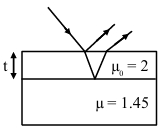
$A$ transparent film of refractive index $2.0$ is coated on a glass slab of refractive index $1.45$. What is the minimum thickness of the transparent film to be coated for the maximum transmission of green light of wavelength $550 \ \text{nm}$ (in $\text{nm}$)? [Assume that the light is incident nearly perpendicular to the glass surface.]
A
$94.8$
B
$68.7$
C
$137.5$
D
$275$
Solution
(C) For maximum transmission of light, the reflected light must undergo destructive interference (minima).
Since the refractive index of the film $(\mu_f = 2.0)$ is greater than that of air $(\mu_a = 1.0)$ and also greater than that of the glass slab $(\mu_g = 1.45)$, there is a phase change of $\pi$ at both the top and bottom surfaces of the film.
The condition for destructive interference (minima) in reflected light is given by $2 \mu_f t = n \lambda$, where $n = 1, 2, 3, \dots$
For minimum thickness, we take $n = 1$:
$2 \mu_f t = \lambda$
$t = \frac{\lambda}{2 \mu_f}$
Substituting the given values $\lambda = 550 \ \text{nm}$ and $\mu_f = 2.0$:
$t = \frac{550 \ \text{nm}}{2 \times 2.0} = \frac{550}{4} \ \text{nm} = 137.5 \ \text{nm}$.
Since the refractive index of the film $(\mu_f = 2.0)$ is greater than that of air $(\mu_a = 1.0)$ and also greater than that of the glass slab $(\mu_g = 1.45)$, there is a phase change of $\pi$ at both the top and bottom surfaces of the film.
The condition for destructive interference (minima) in reflected light is given by $2 \mu_f t = n \lambda$, where $n = 1, 2, 3, \dots$
For minimum thickness, we take $n = 1$:
$2 \mu_f t = \lambda$
$t = \frac{\lambda}{2 \mu_f}$
Substituting the given values $\lambda = 550 \ \text{nm}$ and $\mu_f = 2.0$:
$t = \frac{550 \ \text{nm}}{2 \times 2.0} = \frac{550}{4} \ \text{nm} = 137.5 \ \text{nm}$.
0 likes
View Solution67
DifficultMCQ
$A$ thin transparent film with refractive index $1.4$ is held on a circular ring of radius $1.8 \ cm$. The fluid in the film evaporates such that transmission through the film at wavelength $560 \ nm$ goes to a minimum every $12 \ seconds$. Assuming that the film is flat on its two sides, the rate of evaporation is . . . . . . $\pi \times 10^{-13} \ m^3/s$.
A
$54$
B
$56$
C
$58$
D
$59$
Solution
(A) For a thin film, the condition for destructive interference (minima) in transmitted light is given by $2 \mu t = n \lambda$, where $n = 1, 2, 3, \dots$.
Here, $\mu = 1.4$ and $\lambda = 560 \times 10^{-9} \ m$.
The change in thickness $\Delta t$ for consecutive minima is $\Delta t = \frac{\lambda}{2 \mu}$.
Substituting the values: $\Delta t = \frac{560 \times 10^{-9}}{2 \times 1.4} = \frac{560 \times 10^{-9}}{2.8} = 200 \times 10^{-9} \ m = 2 \times 10^{-7} \ m$.
The area of the film is $A = \pi r^2 = \pi (1.8 \times 10^{-2} \ m)^2 = \pi \times 3.24 \times 10^{-4} \ m^2$.
The rate of evaporation is $R = \frac{A \times \Delta t}{\Delta T}$, where $\Delta T = 12 \ s$.
$R = \frac{\pi \times 3.24 \times 10^{-4} \times 2 \times 10^{-7}}{12} = \frac{\pi \times 6.48 \times 10^{-11}}{12} = 0.54 \times 10^{-11} \ m^3/s = 54 \times 10^{-13} \ m^3/s$.
Thus, the rate of evaporation is $54 \pi \times 10^{-13} \ m^3/s$.
Here, $\mu = 1.4$ and $\lambda = 560 \times 10^{-9} \ m$.
The change in thickness $\Delta t$ for consecutive minima is $\Delta t = \frac{\lambda}{2 \mu}$.
Substituting the values: $\Delta t = \frac{560 \times 10^{-9}}{2 \times 1.4} = \frac{560 \times 10^{-9}}{2.8} = 200 \times 10^{-9} \ m = 2 \times 10^{-7} \ m$.
The area of the film is $A = \pi r^2 = \pi (1.8 \times 10^{-2} \ m)^2 = \pi \times 3.24 \times 10^{-4} \ m^2$.
The rate of evaporation is $R = \frac{A \times \Delta t}{\Delta T}$, where $\Delta T = 12 \ s$.
$R = \frac{\pi \times 3.24 \times 10^{-4} \times 2 \times 10^{-7}}{12} = \frac{\pi \times 6.48 \times 10^{-11}}{12} = 0.54 \times 10^{-11} \ m^3/s = 54 \times 10^{-13} \ m^3/s$.
Thus, the rate of evaporation is $54 \pi \times 10^{-13} \ m^3/s$.
0 likes
View Solution68
MediumMCQ
When exposed to sunlight,thin films of oil on water often exhibit brilliant colours due to the phenomenon of
A
interference
B
diffraction
C
dispersion
D
polarisation
Solution
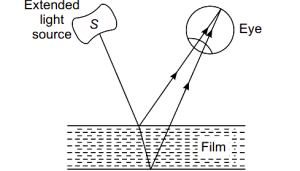
(A) When a thin film of oil spreads over the surface of water and is viewed in broad daylight,brilliant colours are observed.
These colours arise due to the interference of sunlight reflected from the upper and lower surfaces of the thin oil film.
Diffraction is the bending of light rays around the corners of obstacles.
Dispersion is the splitting of white light into its constituent colours.
Polarisation is the restriction of the vibrations of a transverse wave to a single plane.
These colours arise due to the interference of sunlight reflected from the upper and lower surfaces of the thin oil film.
Diffraction is the bending of light rays around the corners of obstacles.
Dispersion is the splitting of white light into its constituent colours.
Polarisation is the restriction of the vibrations of a transverse wave to a single plane.
0 likes
View Solution69
EasyMCQ
The thickness of a plate having refractive index $\mu$ which will produce a change in optical path equal to half the wavelength $\lambda$ of the light passing through it is
A
$\frac{\lambda}{4(\mu-1)}$
B
$\frac{\lambda}{(\mu-1)}$
C
$\frac{3 \lambda}{4(\mu-1)}$
D
$\frac{\lambda}{2(\mu-1)}$
Solution
(D) Let $t$ be the thickness of the plate.
When light passes through a plate of thickness $t$ and refractive index $\mu$,the optical path length is $\mu t$.
The optical path length in air for the same distance $t$ is $t$.
The change in optical path (optical path difference) is given by $\Delta = \mu t - t = (\mu - 1)t$.
According to the problem,this change in optical path is equal to half the wavelength,i.e.,$\Delta = \frac{\lambda}{2}$.
Equating the two expressions: $(\mu - 1)t = \frac{\lambda}{2}$.
Solving for $t$,we get $t = \frac{\lambda}{2(\mu - 1)}$.
When light passes through a plate of thickness $t$ and refractive index $\mu$,the optical path length is $\mu t$.
The optical path length in air for the same distance $t$ is $t$.
The change in optical path (optical path difference) is given by $\Delta = \mu t - t = (\mu - 1)t$.
According to the problem,this change in optical path is equal to half the wavelength,i.e.,$\Delta = \frac{\lambda}{2}$.
Equating the two expressions: $(\mu - 1)t = \frac{\lambda}{2}$.
Solving for $t$,we get $t = \frac{\lambda}{2(\mu - 1)}$.
0 likes
View Solution70
EasyMCQ
In a biprism experiment,monochromatic light of wavelength $\lambda$ is used. The distance between the two coherent sources $d$ is kept constant. If the distance between the slit and the eyepiece $D$ is varied as $D_1, D_2, D_3, D_4$ and the corresponding measured fringe widths are $W_1, W_2, W_3, W_4$,then:
A
$W_1 D_1 = W_2 D_2 = W_3 D_3 = W_4 D_4$
B
$\frac{W_1}{D_1} = \frac{W_2}{D_2} = \frac{W_3}{D_3} = \frac{W_4}{D_4}$
C
$W_1 \sqrt{D_1} = W_2 \sqrt{D_2} = W_3 \sqrt{D_3} = W_4 \sqrt{D_4}$
D
$D_1 \sqrt{W_1} = D_2 \sqrt{W_2} = D_3 \sqrt{W_3} = D_4 \sqrt{W_4}$
Solution
(B) The formula for fringe width in a biprism experiment is given by $W = \frac{\lambda D}{d}$.
Since the wavelength $\lambda$ and the distance between coherent sources $d$ are kept constant,the ratio $\frac{\lambda}{d}$ is a constant.
Therefore,$\frac{W}{D} = \frac{\lambda}{d} = \text{constant}$.
This implies that $\frac{W_1}{D_1} = \frac{W_2}{D_2} = \frac{W_3}{D_3} = \frac{W_4}{D_4}$.
Since the wavelength $\lambda$ and the distance between coherent sources $d$ are kept constant,the ratio $\frac{\lambda}{d}$ is a constant.
Therefore,$\frac{W}{D} = \frac{\lambda}{d} = \text{constant}$.
This implies that $\frac{W_1}{D_1} = \frac{W_2}{D_2} = \frac{W_3}{D_3} = \frac{W_4}{D_4}$.
0 likes
View Solution71
MediumMCQ
In a biprism experiment,if the $5^{\text{th}}$ bright band with wavelength $\lambda_1$ coincides with the $6^{\text{th}}$ dark band with wavelength $\lambda_2$,then the ratio $(\lambda_1 / \lambda_2)$ is:
A
$\frac{7}{9}$
B
$\frac{10}{11}$
C
$\frac{11}{10}$
D
$\frac{9}{7}$
Solution
(C) The position of the $n^{\text{th}}$ bright fringe is given by $y_n = \frac{n \lambda_1 D}{d}$.
The position of the $m^{\text{th}}$ dark fringe is given by $y'_m = \frac{(2m - 1) \lambda_2 D}{2d}$.
Given that the $5^{\text{th}}$ bright band coincides with the $6^{\text{th}}$ dark band,we set $n = 5$ and $m = 6$:
$\frac{5 \lambda_1 D}{d} = \frac{(2 \times 6 - 1) \lambda_2 D}{2d}$
$\frac{5 \lambda_1 D}{d} = \frac{11 \lambda_2 D}{2d}$
Canceling $D$ and $d$ from both sides:
$5 \lambda_1 = \frac{11 \lambda_2}{2}$
$\frac{\lambda_1}{\lambda_2} = \frac{11}{5 \times 2} = \frac{11}{10}$
The position of the $m^{\text{th}}$ dark fringe is given by $y'_m = \frac{(2m - 1) \lambda_2 D}{2d}$.
Given that the $5^{\text{th}}$ bright band coincides with the $6^{\text{th}}$ dark band,we set $n = 5$ and $m = 6$:
$\frac{5 \lambda_1 D}{d} = \frac{(2 \times 6 - 1) \lambda_2 D}{2d}$
$\frac{5 \lambda_1 D}{d} = \frac{11 \lambda_2 D}{2d}$
Canceling $D$ and $d$ from both sides:
$5 \lambda_1 = \frac{11 \lambda_2}{2}$
$\frac{\lambda_1}{\lambda_2} = \frac{11}{5 \times 2} = \frac{11}{10}$
0 likes
View Solution72
MediumMCQ
In a biprism experiment,the fringe width is $0.6 \ mm$. The distance between the $6^{th}$ dark fringe and the $8^{th}$ bright fringe on the same side of the central bright fringe is: (in $mm$)
A
$6$
B
$4$
C
$1.5$
D
$0.9$
Solution
(C) The position of the $n^{th}$ bright fringe is given by $x_n = n \beta$,where $\beta$ is the fringe width.
For the $8^{th}$ bright fringe $(n=8)$: $x_8 = 8 \beta = 8 \times 0.6 \ mm = 4.8 \ mm$.
The position of the $n^{th}$ dark fringe is given by $x'_n = (n - 0.5) \beta$.
For the $6^{th}$ dark fringe $(n=6)$: $x'_6 = (6 - 0.5) \beta = 5.5 \beta = 5.5 \times 0.6 \ mm = 3.3 \ mm$.
The distance between the $8^{th}$ bright fringe and the $6^{th}$ dark fringe is $\Delta x = x_8 - x'_6 = 4.8 \ mm - 3.3 \ mm = 1.5 \ mm$.
For the $8^{th}$ bright fringe $(n=8)$: $x_8 = 8 \beta = 8 \times 0.6 \ mm = 4.8 \ mm$.
The position of the $n^{th}$ dark fringe is given by $x'_n = (n - 0.5) \beta$.
For the $6^{th}$ dark fringe $(n=6)$: $x'_6 = (6 - 0.5) \beta = 5.5 \beta = 5.5 \times 0.6 \ mm = 3.3 \ mm$.
The distance between the $8^{th}$ bright fringe and the $6^{th}$ dark fringe is $\Delta x = x_8 - x'_6 = 4.8 \ mm - 3.3 \ mm = 1.5 \ mm$.
0 likes
View Solution73
DifficultMCQ
In a biprism experiment,the $6^{\text{th}}$ bright band with wavelength $\lambda_1$ coincides with the $7^{\text{th}}$ dark band with wavelength $\lambda_2$. Then the ratio $\lambda_1 : \lambda_2$ is (other settings remain the same):
A
$7$ : $6$
B
$13$ : $12$
C
$12$ : $13$
D
$6$ : $7$
Solution
(B) The position of the $n^{\text{th}}$ bright band is given by $y_n = \frac{n \lambda D}{d}$.
For the $6^{\text{th}}$ bright band with wavelength $\lambda_1$,the position is $y_6 = \frac{6 \lambda_1 D}{d}$.
The position of the $m^{\text{th}}$ dark band is given by $y_m = \frac{(m - 0.5) \lambda D}{d}$.
For the $7^{\text{th}}$ dark band with wavelength $\lambda_2$,the position is $y_7 = \frac{(7 - 0.5) \lambda_2 D}{d} = \frac{6.5 \lambda_2 D}{d}$.
Since the bands coincide,we equate the positions:
$\frac{6 \lambda_1 D}{d} = \frac{6.5 \lambda_2 D}{d}$.
Canceling the common terms $\frac{D}{d}$,we get $6 \lambda_1 = 6.5 \lambda_2$.
Therefore,the ratio $\frac{\lambda_1}{\lambda_2} = \frac{6.5}{6} = \frac{13}{12}$.
For the $6^{\text{th}}$ bright band with wavelength $\lambda_1$,the position is $y_6 = \frac{6 \lambda_1 D}{d}$.
The position of the $m^{\text{th}}$ dark band is given by $y_m = \frac{(m - 0.5) \lambda D}{d}$.
For the $7^{\text{th}}$ dark band with wavelength $\lambda_2$,the position is $y_7 = \frac{(7 - 0.5) \lambda_2 D}{d} = \frac{6.5 \lambda_2 D}{d}$.
Since the bands coincide,we equate the positions:
$\frac{6 \lambda_1 D}{d} = \frac{6.5 \lambda_2 D}{d}$.
Canceling the common terms $\frac{D}{d}$,we get $6 \lambda_1 = 6.5 \lambda_2$.
Therefore,the ratio $\frac{\lambda_1}{\lambda_2} = \frac{6.5}{6} = \frac{13}{12}$.
0 likes
View Solution74
EasyMCQ
In a biprism experiment,monochromatic light of wavelength $\lambda$ is used. The distance between two coherent sources is kept constant. If the distance between the slit and the eyepiece $(D)$ is varied as $D_{1}, D_{2}, D_{3}$ and $D_{4}$,and the corresponding measured fringe widths are $z_{1}, z_{2}, z_{3}$ and $z_{4}$,then:
A
$\frac{z_{1}}{D_{1}}=\frac{z_{2}}{D_{2}}=\frac{z_{3}}{D_{3}}=\frac{z_{4}}{D_{4}}$
B
$z_{1} D_{1}=z_{2} D_{2}=z_{3} D_{3}=z_{4} D_{4}$
C
$z_{1} \sqrt{D_{1}}=z_{2} \sqrt{D_{2}}=z_{3} \sqrt{D_{3}}=z_{4} \sqrt{D_{4}}$
D
$z_{1} D_{1}^{2}=z_{2} D_{2}^{2}=z_{3} D_{3}^{2}=z_{4} D_{4}^{2}$
Solution
(A) The fringe width $(z)$ in a biprism experiment (or Young's Double Slit Experiment) is given by the formula:
$z = \frac{\lambda D}{d}$
where $\lambda$ is the wavelength of light,$D$ is the distance between the slit and the eyepiece (screen),and $d$ is the distance between the two coherent sources.
Given that the wavelength $\lambda$ and the distance between the coherent sources $d$ are kept constant,we can write:
$z \propto D$
This implies that the ratio $\frac{z}{D}$ is a constant.
Therefore,$\frac{z_{1}}{D_{1}} = \frac{z_{2}}{D_{2}} = \frac{z_{3}}{D_{3}} = \frac{z_{4}}{D_{4}}$.
Thus,option $A$ is correct.
$z = \frac{\lambda D}{d}$
where $\lambda$ is the wavelength of light,$D$ is the distance between the slit and the eyepiece (screen),and $d$ is the distance between the two coherent sources.
Given that the wavelength $\lambda$ and the distance between the coherent sources $d$ are kept constant,we can write:
$z \propto D$
This implies that the ratio $\frac{z}{D}$ is a constant.
Therefore,$\frac{z_{1}}{D_{1}} = \frac{z_{2}}{D_{2}} = \frac{z_{3}}{D_{3}} = \frac{z_{4}}{D_{4}}$.
Thus,option $A$ is correct.
0 likes
View Solution75
MediumMCQ
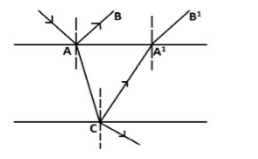
$A$ ray of light of intensity $I$ is incident on a parallel glass slab at a point $A$ as shown in the figure. It undergoes partial reflection and refraction. At each reflection,$25\%$ of the incident energy is reflected. The rays $AB$ and $A^1B^1$ undergo interference. The ratio $I_{\text{max}} / I_{\text{min}}$ is (in $: 1$)
A
$7$
B
$49$
C
$4$
D
$8$
Solution
(B) Let the incident intensity be $I$.
At point $A$,$25\%$ of $I$ is reflected as ray $AB$. So,$I_1 = 0.25I = I/4$.
The intensity of the refracted ray is $0.75I$.
At point $C$,this ray is reflected. $25\%$ of the incident energy $(0.75I)$ is reflected. So,the intensity of the ray reaching $A^1$ is $0.25 \times 0.75I = 0.1875I = (3/16)I$.
At point $A^1$,this ray is refracted out as $A^1B^1$. Since $25\%$ is reflected at $A^1$,$75\%$ of the incident energy is transmitted.
So,$I_2 = 0.75 \times (3/16)I = (3/4) \times (3/16)I = (9/64)I$.
The amplitudes are $a_1 = \sqrt{I_1} = \sqrt{I/4} = (1/2)\sqrt{I}$ and $a_2 = \sqrt{I_2} = \sqrt{9I/64} = (3/8)\sqrt{I}$.
The ratio of amplitudes is $a_1/a_2 = (1/2) / (3/8) = 4/3$.
$I_{\text{max}} / I_{\text{min}} = (a_1 + a_2)^2 / (a_1 - a_2)^2 = ((4+3)/ (4-3))^2 = (7/1)^2 = 49/1$.
At point $A$,$25\%$ of $I$ is reflected as ray $AB$. So,$I_1 = 0.25I = I/4$.
The intensity of the refracted ray is $0.75I$.
At point $C$,this ray is reflected. $25\%$ of the incident energy $(0.75I)$ is reflected. So,the intensity of the ray reaching $A^1$ is $0.25 \times 0.75I = 0.1875I = (3/16)I$.
At point $A^1$,this ray is refracted out as $A^1B^1$. Since $25\%$ is reflected at $A^1$,$75\%$ of the incident energy is transmitted.
So,$I_2 = 0.75 \times (3/16)I = (3/4) \times (3/16)I = (9/64)I$.
The amplitudes are $a_1 = \sqrt{I_1} = \sqrt{I/4} = (1/2)\sqrt{I}$ and $a_2 = \sqrt{I_2} = \sqrt{9I/64} = (3/8)\sqrt{I}$.
The ratio of amplitudes is $a_1/a_2 = (1/2) / (3/8) = 4/3$.
$I_{\text{max}} / I_{\text{min}} = (a_1 + a_2)^2 / (a_1 - a_2)^2 = ((4+3)/ (4-3))^2 = (7/1)^2 = 49/1$.
0 likes
View Solution76
DifficultMCQ
In a biprism experiment,monochromatic light of wavelength $\lambda$ is used. The distance between two coherent sources $d$ is kept constant. If the distance between the slit and the eyepiece $D$ is varied as $D_1, D_2, D_3$ and $D_4$,and the corresponding measured fringe widths are $Z_1, Z_2, Z_3$ and $Z_4$,then:
A
$Z_1 D_1 = Z_2 D_2 = Z_3 D_3 = Z_4 D_4$
B
$\frac{Z_1}{D_1} = \frac{Z_2}{D_2} = \frac{Z_3}{D_3} = \frac{Z_4}{D_4}$
C
$D_1 \sqrt{Z_1} = D_2 \sqrt{Z_2} = D_3 \sqrt{Z_3} = D_4 \sqrt{Z_4}$
D
$Z_1 \sqrt{D_1} = Z_2 \sqrt{D_2} = Z_3 \sqrt{D_3} = Z_4 \sqrt{D_4}$
Solution
(B) The formula for fringe width in a biprism experiment is given by $Z = \frac{\lambda D}{d}$.
Since the wavelength $\lambda$ and the distance between the coherent sources $d$ are kept constant,the ratio $\frac{\lambda}{d}$ is a constant value.
Therefore,we can write $\frac{Z}{D} = \frac{\lambda}{d} = \text{constant}$.
This implies that for different values of $D$ and $Z$,the ratio remains the same:
$\frac{Z_1}{D_1} = \frac{Z_2}{D_2} = \frac{Z_3}{D_3} = \frac{Z_4}{D_4}$.
Since the wavelength $\lambda$ and the distance between the coherent sources $d$ are kept constant,the ratio $\frac{\lambda}{d}$ is a constant value.
Therefore,we can write $\frac{Z}{D} = \frac{\lambda}{d} = \text{constant}$.
This implies that for different values of $D$ and $Z$,the ratio remains the same:
$\frac{Z_1}{D_1} = \frac{Z_2}{D_2} = \frac{Z_3}{D_3} = \frac{Z_4}{D_4}$.
0 likes
View Solution77
MediumMCQ
In a biprism experiment,$21$ fringes are observed in a given region using light of wavelength $4800 \text{ Å}$. If light of wavelength $5600 \text{ Å}$ is used,the number of fringes in the same region will be:
A
$18$
B
$24$
C
$14$
D
$21$
Solution
(A) The width of the region $L$ is constant and is given by the product of the number of fringes $n$ and the fringe width $\beta$.
$L = n_1 \beta_1 = n_2 \beta_2$
Since the fringe width $\beta = \frac{\lambda D}{d}$,we have:
$n_1 \frac{\lambda_1 D}{d} = n_2 \frac{\lambda_2 D}{d}$
$n_1 \lambda_1 = n_2 \lambda_2$
Given $n_1 = 21$,$\lambda_1 = 4800 \text{ Å}$,and $\lambda_2 = 5600 \text{ Å}$:
$21 \times 4800 = n_2 \times 5600$
$n_2 = \frac{21 \times 4800}{5600} = \frac{21 \times 48}{56} = \frac{21 \times 6}{7} = 3 \times 6 = 18$
Thus,the number of fringes observed is $18$.
$L = n_1 \beta_1 = n_2 \beta_2$
Since the fringe width $\beta = \frac{\lambda D}{d}$,we have:
$n_1 \frac{\lambda_1 D}{d} = n_2 \frac{\lambda_2 D}{d}$
$n_1 \lambda_1 = n_2 \lambda_2$
Given $n_1 = 21$,$\lambda_1 = 4800 \text{ Å}$,and $\lambda_2 = 5600 \text{ Å}$:
$21 \times 4800 = n_2 \times 5600$
$n_2 = \frac{21 \times 4800}{5600} = \frac{21 \times 48}{56} = \frac{21 \times 6}{7} = 3 \times 6 = 18$
Thus,the number of fringes observed is $18$.
0 likes
View Solution78
MediumMCQ
In a biprism experiment,the slit separation is $1 \,mm$. Using monochromatic light of wavelength $5000 \text{ Å}$,an interference pattern is obtained on the screen. Where should the screen be moved,so that the change in fringe width is $12.5 \times 10^{-5} \,m$?
A
Away or towards the slit by $25 \,cm$
B
Away or towards the slit by $12.5 \,cm$
C
Away from the slit by $5 \,cm$
D
Towards the slit by $10 \,cm$
Solution
(A) Given: Slit separation $d = 1 \,mm = 10^{-3} \,m$,Wavelength $\lambda = 5000 \text{ Å} = 5 \times 10^{-7} \,m$,Change in fringe width $\Delta \beta = \beta_{2} - \beta_{1} = 12.5 \times 10^{-5} \,m$.
Fringe width formula is $\beta = \frac{\lambda D}{d}$.
The change in fringe width is given by $\Delta \beta = \frac{\lambda}{d} \Delta D$,where $\Delta D = D_{2} - D_{1}$ is the shift in the screen position.
Rearranging for $\Delta D$: $\Delta D = \frac{d \cdot \Delta \beta}{\lambda}$.
Substituting the values: $\Delta D = \frac{10^{-3} \times 12.5 \times 10^{-5}}{5 \times 10^{-7}}$.
$\Delta D = \frac{12.5 \times 10^{-8}}{5 \times 10^{-7}} = 2.5 \times 10^{-1} \,m = 0.25 \,m = 25 \,cm$.
Therefore,the screen should be moved away or towards the slit by $25 \,cm$.
Fringe width formula is $\beta = \frac{\lambda D}{d}$.
The change in fringe width is given by $\Delta \beta = \frac{\lambda}{d} \Delta D$,where $\Delta D = D_{2} - D_{1}$ is the shift in the screen position.
Rearranging for $\Delta D$: $\Delta D = \frac{d \cdot \Delta \beta}{\lambda}$.
Substituting the values: $\Delta D = \frac{10^{-3} \times 12.5 \times 10^{-5}}{5 \times 10^{-7}}$.
$\Delta D = \frac{12.5 \times 10^{-8}}{5 \times 10^{-7}} = 2.5 \times 10^{-1} \,m = 0.25 \,m = 25 \,cm$.
Therefore,the screen should be moved away or towards the slit by $25 \,cm$.
0 likes
View Solution79
EasyMCQ
In a biprism experiment,a steady interference pattern is observed on the screen using light of wavelength $\lambda_1 = 5000 \ Å$. Without disturbing the setup of the experiment,the source of light is replaced by a source of wavelength $\lambda_2 = 6400 \ Å$. The fringe width will:
A
decrease by $48 \%$
B
decrease by $28 \%$
C
increase by $48 \%$
D
increase by $28 \%$
Solution
(D) The fringe width $\beta$ in a biprism experiment is given by the formula $\beta = \frac{\lambda D}{d}$,where $\lambda$ is the wavelength,$D$ is the distance between the source and the screen,and $d$ is the distance between the two virtual sources.
Since $D$ and $d$ remain constant,the fringe width is directly proportional to the wavelength: $\beta \propto \lambda$.
Given $\lambda_1 = 5000 \ Å$ and $\lambda_2 = 6400 \ Å$.
The ratio of the new fringe width $\beta_2$ to the initial fringe width $\beta_1$ is $\frac{\beta_2}{\beta_1} = \frac{\lambda_2}{\lambda_1} = \frac{6400}{5000} = 1.28$.
This means $\beta_2 = 1.28 \beta_1$.
The percentage increase in fringe width is given by $\frac{\beta_2 - \beta_1}{\beta_1} \times 100\% = (1.28 - 1) \times 100\% = 0.28 \times 100\% = 28\%$.
Therefore,the fringe width increases by $28\%$.
Since $D$ and $d$ remain constant,the fringe width is directly proportional to the wavelength: $\beta \propto \lambda$.
Given $\lambda_1 = 5000 \ Å$ and $\lambda_2 = 6400 \ Å$.
The ratio of the new fringe width $\beta_2$ to the initial fringe width $\beta_1$ is $\frac{\beta_2}{\beta_1} = \frac{\lambda_2}{\lambda_1} = \frac{6400}{5000} = 1.28$.
This means $\beta_2 = 1.28 \beta_1$.
The percentage increase in fringe width is given by $\frac{\beta_2 - \beta_1}{\beta_1} \times 100\% = (1.28 - 1) \times 100\% = 0.28 \times 100\% = 28\%$.
Therefore,the fringe width increases by $28\%$.
0 likes
View Solution80
EasyMCQ
In a biprism experiment,the distance of the second dark fringe from the central fringe is $3 \ mm$. The distance of the sixth bright fringe from the central fringe is (in $mm$)
A
$12$
B
$8$
C
$6$
D
$4$
Solution
(A) The distance of the $n^{th}$ dark fringe from the central fringe is given by $y_n = (n - 1/2) \beta$,where $\beta$ is the fringe width.
For the second dark fringe $(n = 2)$:
$y_2 = (2 - 1/2) \beta = 1.5 \beta = 3 \ mm$.
Therefore,$\beta = 3 / 1.5 = 2 \ mm$.
The distance of the $n^{th}$ bright fringe from the central fringe is given by $y_n = n \beta$.
For the sixth bright fringe $(n = 6)$:
$y_6 = 6 \times \beta = 6 \times 2 \ mm = 12 \ mm$.
For the second dark fringe $(n = 2)$:
$y_2 = (2 - 1/2) \beta = 1.5 \beta = 3 \ mm$.
Therefore,$\beta = 3 / 1.5 = 2 \ mm$.
The distance of the $n^{th}$ bright fringe from the central fringe is given by $y_n = n \beta$.
For the sixth bright fringe $(n = 6)$:
$y_6 = 6 \times \beta = 6 \times 2 \ mm = 12 \ mm$.
0 likes
View Solution81
DifficultMCQ
$A$ parallel beam of light of intensity $I_0$ is incident on a glass plate. $25 \%$ of light is reflected by the upper surface and $50 \%$ of light is reflected from the lower surface. The ratio of maximum to minimum intensity in the interference region of the reflected rays is
A
$\left[\frac{\frac{1}{2}+\sqrt{\frac{3}{8}}}{\frac{1}{2}-\sqrt{\frac{3}{8}}}\right]^2$
B
$\left[\frac{\frac{1}{4}+\sqrt{\frac{3}{8}}}{\frac{1}{2}-\sqrt{\frac{3}{8}}}\right]^2$
C
$\frac{5}{8}$
D
$\frac{8}{5}$
Solution
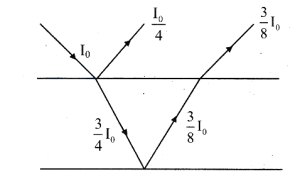
(A) Given that $25 \%$ of the total intensity of incident light is reflected from the upper surface. This implies that if the intensity of incident light is $I_0$,the intensity of the first reflected ray is $I_1 = 0.25 I_0 = \frac{I_0}{4}$.
The intensity of light reaching the lower surface of the plate is $I_0 - 0.25 I_0 = 0.75 I_0 = \frac{3}{4} I_0$.
Since $50 \%$ of this intensity is reflected from the lower surface,the intensity of the second reflected ray is $I_2 = 0.50 \times \frac{3}{4} I_0 = \frac{3}{8} I_0$.
The ratio of maximum to minimum intensity is given by the formula:
$\frac{I_{\max }}{I_{\min }}=\frac{\left(\sqrt{I_1}+\sqrt{I_2}\right)^2}{\left(\sqrt{I_1}-\sqrt{I_2}\right)^2}$
Substituting the values of $I_1$ and $I_2$:
$\frac{I_{\max }}{I_{\min }}=\frac{\left(\sqrt{\frac{I_0}{4}}+\sqrt{\frac{3 I_0}{8}}\right)^2}{\left(\sqrt{\frac{I_0}{4}}-\sqrt{\frac{3 I_0}{8}}\right)^2} = \left(\frac{\frac{1}{2} \sqrt{I_0} + \sqrt{\frac{3}{8}} \sqrt{I_0}}{\frac{1}{2} \sqrt{I_0} - \sqrt{\frac{3}{8}} \sqrt{I_0}}\right)^2 = \left(\frac{\frac{1}{2}+\sqrt{\frac{3}{8}}}{\frac{1}{2}-\sqrt{\frac{3}{8}}}\right)^2$
The intensity of light reaching the lower surface of the plate is $I_0 - 0.25 I_0 = 0.75 I_0 = \frac{3}{4} I_0$.
Since $50 \%$ of this intensity is reflected from the lower surface,the intensity of the second reflected ray is $I_2 = 0.50 \times \frac{3}{4} I_0 = \frac{3}{8} I_0$.
The ratio of maximum to minimum intensity is given by the formula:
$\frac{I_{\max }}{I_{\min }}=\frac{\left(\sqrt{I_1}+\sqrt{I_2}\right)^2}{\left(\sqrt{I_1}-\sqrt{I_2}\right)^2}$
Substituting the values of $I_1$ and $I_2$:
$\frac{I_{\max }}{I_{\min }}=\frac{\left(\sqrt{\frac{I_0}{4}}+\sqrt{\frac{3 I_0}{8}}\right)^2}{\left(\sqrt{\frac{I_0}{4}}-\sqrt{\frac{3 I_0}{8}}\right)^2} = \left(\frac{\frac{1}{2} \sqrt{I_0} + \sqrt{\frac{3}{8}} \sqrt{I_0}}{\frac{1}{2} \sqrt{I_0} - \sqrt{\frac{3}{8}} \sqrt{I_0}}\right)^2 = \left(\frac{\frac{1}{2}+\sqrt{\frac{3}{8}}}{\frac{1}{2}-\sqrt{\frac{3}{8}}}\right)^2$
0 likes
View Solution82
MediumMCQ
In two separate setups for a Biprism experiment using the same wavelength,fringes of equal width are obtained. If the ratio of slit separation is $2:3$,then the ratio of the distance between the slit and the screen in the two setups is:
A
$2:3$
B
$1:2$
C
$4:9$
D
$3:2$
Solution
(A) The formula for fringe width $W$ in a Biprism experiment is given by $W = \frac{\lambda D}{d}$,where $\lambda$ is the wavelength,$D$ is the distance between the slit and the screen,and $d$ is the slit separation.
Since the fringe width $W$ and the wavelength $\lambda$ are constant for both setups,we have $W = \frac{\lambda D_1}{d_1} = \frac{\lambda D_2}{d_2}$.
This implies that $\frac{D_1}{d_1} = \frac{D_2}{d_2}$,or $\frac{D_1}{D_2} = \frac{d_1}{d_2}$.
Given the ratio of slit separation $\frac{d_1}{d_2} = \frac{2}{3}$,it follows that the ratio of the distances is $\frac{D_1}{D_2} = \frac{2}{3}$.
Since the fringe width $W$ and the wavelength $\lambda$ are constant for both setups,we have $W = \frac{\lambda D_1}{d_1} = \frac{\lambda D_2}{d_2}$.
This implies that $\frac{D_1}{d_1} = \frac{D_2}{d_2}$,or $\frac{D_1}{D_2} = \frac{d_1}{d_2}$.
Given the ratio of slit separation $\frac{d_1}{d_2} = \frac{2}{3}$,it follows that the ratio of the distances is $\frac{D_1}{D_2} = \frac{2}{3}$.
0 likes
View Solution83
MediumMCQ
In a biprism experiment,a wavelength $\lambda$ is used to obtain an interference pattern. The fringe width is $W_1$ at a distance $D_1$ from the screen. When the screen is moved towards the biprism,the fringe width becomes $W_2$ at a distance $D_2$. The distance between the two virtual images of the slit is:
A
$\frac{\lambda(D_2-D_1)}{(W_1-W_2)}$
B
$\frac{\lambda(W_1-W_2)}{(D_1-D_2)}$
C
$\frac{\lambda(W_2-W_1)}{(D_1-D_2)}$
D
$\frac{\lambda(D_1-D_2)}{(W_1-W_2)}$
Solution
(D) The formula for fringe width is given by $\beta = \frac{\lambda D}{d}$,where $d$ is the distance between the two virtual sources.
For the first position: $W_1 = \frac{\lambda D_1}{d}$
For the second position: $W_2 = \frac{\lambda D_2}{d}$
Subtracting the two equations: $W_1 - W_2 = \frac{\lambda}{d}(D_1 - D_2)$
Rearranging for $d$: $d = \frac{\lambda(D_1 - D_2)}{(W_1 - W_2)}$
For the first position: $W_1 = \frac{\lambda D_1}{d}$
For the second position: $W_2 = \frac{\lambda D_2}{d}$
Subtracting the two equations: $W_1 - W_2 = \frac{\lambda}{d}(D_1 - D_2)$
Rearranging for $d$: $d = \frac{\lambda(D_1 - D_2)}{(W_1 - W_2)}$
0 likes
View Solution84
EasyMCQ
In a biprism experiment,the $4^{\text{th}}$ dark band is formed opposite to one of the slits. The wavelength of light used is ($D=$ distance between source and screen,$d=$ distance between the slits).
A
$\frac{d^2}{9 D}$
B
$\frac{d^2}{11 D}$
C
$\frac{d^2}{14 D}$
D
$\frac{d^2}{7 D}$
Solution
(D) Concept: In a biprism experiment,the position of the $n^{\text{th}}$ dark fringe from the central axis is given by the formula: $y_n = (2n - 1) \frac{\lambda D}{2d}$.
Given that the $4^{\text{th}}$ dark band is formed opposite to one of the slits,the distance of the slit from the central axis is $y = \frac{d}{2}$.
For $n = 4$,the position is $y_4 = (2(4) - 1) \frac{\lambda D}{2d} = \frac{7 \lambda D}{2d}$.
Equating the two expressions for $y_4$: $\frac{7 \lambda D}{2d} = \frac{d}{2}$.
Solving for $\lambda$: $7 \lambda D = d^2 \implies \lambda = \frac{d^2}{7D}$.
Thus,option $(D)$ is correct.
Given that the $4^{\text{th}}$ dark band is formed opposite to one of the slits,the distance of the slit from the central axis is $y = \frac{d}{2}$.
For $n = 4$,the position is $y_4 = (2(4) - 1) \frac{\lambda D}{2d} = \frac{7 \lambda D}{2d}$.
Equating the two expressions for $y_4$: $\frac{7 \lambda D}{2d} = \frac{d}{2}$.
Solving for $\lambda$: $7 \lambda D = d^2 \implies \lambda = \frac{d^2}{7D}$.
Thus,option $(D)$ is correct.
0 likes
View Solution85
MediumMCQ
In a biprism experiment,the distance between the two sources is doubled and the distance between the slit and the eyepiece is also doubled. Then the width of the fringe is
A
halved.
B
unchanged.
C
reduced to $\left(\frac{1}{3}\right)^{rd}$
D
doubled.
Solution
(B) The fringe width $\beta$ is given by the formula $\beta = \frac{\lambda D}{d}$,where $\lambda$ is the wavelength of light,$D$ is the distance between the slit and the eyepiece,and $d$ is the distance between the two coherent sources.
Initially,$\beta = \frac{\lambda D}{d}$.
In the new situation,the distance between the sources becomes $d' = 2d$ and the distance between the slit and the eyepiece becomes $D' = 2D$.
The new fringe width $\beta'$ is given by $\beta' = \frac{\lambda D'}{d'} = \frac{\lambda (2D)}{(2d)} = \frac{\lambda D}{d}$.
Therefore,$\beta' = \beta$,which means the fringe width remains unchanged.
Initially,$\beta = \frac{\lambda D}{d}$.
In the new situation,the distance between the sources becomes $d' = 2d$ and the distance between the slit and the eyepiece becomes $D' = 2D$.
The new fringe width $\beta'$ is given by $\beta' = \frac{\lambda D'}{d'} = \frac{\lambda (2D)}{(2d)} = \frac{\lambda D}{d}$.
Therefore,$\beta' = \beta$,which means the fringe width remains unchanged.
0 likes
View Solution86
EasyMCQ
In a Billet's split lens experiment,the distance between the source and the eyepiece is $1.2 \ m$,and the distance between the two virtual sources is $0.84 \ mm$. If the eyepiece is moved transversely through a distance of $2.799 \ cm$ to shift $30$ fringes,calculate the wavelength of the light used.
A
$6533 \ \mathring{A}$
B
$6537 \ \mathring{A}$
C
$6535 \ \mathring{A}$
D
$6531 \ \mathring{A}$
Solution
(D) The fringe width $\beta$ is given by $\beta = \frac{\lambda D}{d}$,where $D = 1.2 \ m$ is the distance between the source and the eyepiece,and $d = 0.84 \ mm = 0.84 \times 10^{-3} \ m$ is the distance between the virtual sources.
When the eyepiece is moved transversely by a distance $y = 2.799 \ cm = 2.799 \times 10^{-2} \ m$,the number of fringes shifted is $n = 30$.
The relationship is $y = n \beta = n \frac{\lambda D}{d}$.
Substituting the values: $2.799 \times 10^{-2} = 30 \times \frac{\lambda \times 1.2}{0.84 \times 10^{-3}}$.
$\lambda = \frac{2.799 \times 10^{-2} \times 0.84 \times 10^{-3}}{30 \times 1.2}$.
$\lambda = \frac{2.35116 \times 10^{-5}}{36} = 0.06531 \times 10^{-5} \ m = 6531 \times 10^{-10} \ m$.
Therefore,$\lambda = 6531 \ \mathring{A}$.
When the eyepiece is moved transversely by a distance $y = 2.799 \ cm = 2.799 \times 10^{-2} \ m$,the number of fringes shifted is $n = 30$.
The relationship is $y = n \beta = n \frac{\lambda D}{d}$.
Substituting the values: $2.799 \times 10^{-2} = 30 \times \frac{\lambda \times 1.2}{0.84 \times 10^{-3}}$.
$\lambda = \frac{2.799 \times 10^{-2} \times 0.84 \times 10^{-3}}{30 \times 1.2}$.
$\lambda = \frac{2.35116 \times 10^{-5}}{36} = 0.06531 \times 10^{-5} \ m = 6531 \times 10^{-10} \ m$.
Therefore,$\lambda = 6531 \ \mathring{A}$.
0 likes
View Solution87
MediumMCQ
What is the minimum thickness of a thin film required for constructive interference in the reflected light from it (in $ nm$)? Given, the refractive index of the film $= 1.5$, wavelength of the light incident on the film $= 600 \, nm$.
A
$100$
B
$300$
C
$50$
D
$200$
Solution
(A) The condition for constructive interference in reflected light from a thin film is given by $2 \mu t = (2n + 1) \frac{\lambda}{2}$, where $n = 0, 1, 2, \dots$ and $\mu$ is the refractive index, $t$ is the thickness, and $\lambda$ is the wavelength.
For the minimum thickness, we take $n = 0$.
Substituting the values: $2 \mu t = \frac{\lambda}{2}$.
Rearranging for $t$: $t = \frac{\lambda}{4 \mu}$.
Given $\lambda = 600 \, nm$ and $\mu = 1.5$, we get $t = \frac{600}{4 \times 1.5} = \frac{600}{6} = 100 \, nm$.
For the minimum thickness, we take $n = 0$.
Substituting the values: $2 \mu t = \frac{\lambda}{2}$.
Rearranging for $t$: $t = \frac{\lambda}{4 \mu}$.
Given $\lambda = 600 \, nm$ and $\mu = 1.5$, we get $t = \frac{600}{4 \times 1.5} = \frac{600}{6} = 100 \, nm$.
0 likes
View Solution88
MediumMCQ
White light reflected from a soap film (Refractive Index $\mu = 1.5$) has a maxima at $600 \ nm$ and a minima at $450 \ nm$ with no minimum in between. Then the thickness of the film in units of $10^{-7} \ m$ is:
A
$1$
B
$2$
C
$3$
D
$4$
Solution
(C) For a thin film,the condition for constructive interference (maxima) in reflected light is $2 \mu t \cos r = (n + 1/2) \lambda_1$,where $n$ is an integer.
For destructive interference (minima),the condition is $2 \mu t \cos r = m \lambda_2$,where $m$ is an integer.
Given $\lambda_1 = 600 \ nm$ and $\lambda_2 = 450 \ nm$. Assuming normal incidence $(\cos r = 1)$:
$2 \mu t = (n + 1/2) \lambda_1 = (2n + 1) \frac{\lambda_1}{2} = (2n + 1) \times 300 \ nm$
$2 \mu t = m \lambda_2 = m \times 450 \ nm$
Equating the two: $(2n + 1) \times 300 = m \times 450 \implies (2n + 1) \times 2 = 3m \implies 4n + 2 = 3m$.
For the smallest thickness with no minimum in between,we test $n=1$: $4(1) + 2 = 6 = 3m \implies m = 2$.
Substituting $n=1$ into the maxima condition:
$2 \times 1.5 \times t = (1 + 0.5) \times 600 \ nm$
$3t = 1.5 \times 600 \ nm = 900 \ nm$
$t = 300 \ nm = 3 \times 10^{-7} \ m$.
Thus,the thickness is $3$ units.
For destructive interference (minima),the condition is $2 \mu t \cos r = m \lambda_2$,where $m$ is an integer.
Given $\lambda_1 = 600 \ nm$ and $\lambda_2 = 450 \ nm$. Assuming normal incidence $(\cos r = 1)$:
$2 \mu t = (n + 1/2) \lambda_1 = (2n + 1) \frac{\lambda_1}{2} = (2n + 1) \times 300 \ nm$
$2 \mu t = m \lambda_2 = m \times 450 \ nm$
Equating the two: $(2n + 1) \times 300 = m \times 450 \implies (2n + 1) \times 2 = 3m \implies 4n + 2 = 3m$.
For the smallest thickness with no minimum in between,we test $n=1$: $4(1) + 2 = 6 = 3m \implies m = 2$.
Substituting $n=1$ into the maxima condition:
$2 \times 1.5 \times t = (1 + 0.5) \times 600 \ nm$
$3t = 1.5 \times 600 \ nm = 900 \ nm$
$t = 300 \ nm = 3 \times 10^{-7} \ m$.
Thus,the thickness is $3$ units.
0 likes
View Solution89
DifficultMCQ
$A$ mixture of yellow light of wavelength $580 \ nm$ and blue light of wavelength $450 \ nm$ is incident normally on an air film of thickness $2.9 \times 10^{-4} \ mm$. The colour of reflected light is
A
Red
B
Blue
C
Violet
D
Yellow
Solution
(D) The condition for constructive interference in a thin film for reflected light (considering a phase change of $\pi$ at the first surface) is given by $2 \mu d \cos r = (n + 1/2) \lambda$. However,for an air film between two glass plates or similar,the path difference is $2 \mu d \cos r = n \lambda$ for constructive interference if we consider the specific setup of thin film interference.
Given thickness $d = 2.9 \times 10^{-4} \ mm = 2.9 \times 10^{-7} \ m$.
For normal incidence,$\cos r = 1$ and $\mu = 1$ (air).
The path difference is $\Delta = 2d = 2 \times 2.9 \times 10^{-7} \ m = 5.8 \times 10^{-7} \ m = 580 \ nm$.
For constructive interference,the condition is $2d = n \lambda$.
For $n = 1$,$\lambda = 580 \ nm$.
Since the wavelength of yellow light is $580 \ nm$,it undergoes constructive interference and is reflected strongly.
Thus,the reflected light appears yellow.
Given thickness $d = 2.9 \times 10^{-4} \ mm = 2.9 \times 10^{-7} \ m$.
For normal incidence,$\cos r = 1$ and $\mu = 1$ (air).
The path difference is $\Delta = 2d = 2 \times 2.9 \times 10^{-7} \ m = 5.8 \times 10^{-7} \ m = 580 \ nm$.
For constructive interference,the condition is $2d = n \lambda$.
For $n = 1$,$\lambda = 580 \ nm$.
Since the wavelength of yellow light is $580 \ nm$,it undergoes constructive interference and is reflected strongly.
Thus,the reflected light appears yellow.
0 likes
View Solution90
EasyMCQ
Which of the following phenomena produces the colour in a soap bubble?
A
Diffraction
B
Interference
C
Polarisation
D
Refraction
Solution
(B) The colours observed in a soap bubble are produced due to the phenomenon of interference.
When light falls on the thin film of the soap bubble,it reflects from both the outer and inner surfaces.
These reflected waves undergo superposition,leading to constructive or destructive interference depending on the thickness of the film and the wavelength of the light.
This interference pattern results in the appearance of various colours.
When light falls on the thin film of the soap bubble,it reflects from both the outer and inner surfaces.
These reflected waves undergo superposition,leading to constructive or destructive interference depending on the thickness of the film and the wavelength of the light.
This interference pattern results in the appearance of various colours.
0 likes
View Solution91
DifficultMCQ
$A$ parallel beam of light of intensity $I_0$ is incident on a coated glass plate. If $25 \%$ of the incident light is reflected from the upper surface and $50 \%$ of the light that enters the glass is reflected from the lower surface of the glass plate,the ratio of maximum to minimum intensity in the interference region of the reflected light is
A
$\left(\frac{\frac{1}{2}+\sqrt{\frac{3}{8}}}{\frac{1}{2}-\sqrt{\frac{3}{8}}}\right)^2$
B
$\left(\frac{\frac{1}{4}+\sqrt{\frac{3}{8}}}{\frac{1}{2}-\sqrt{\frac{3}{8}}}\right)^2$
C
$\frac{5}{8}$
D
$\frac{8}{5}$
Solution
(A) Let $I_0$ be the intensity of the incident light.
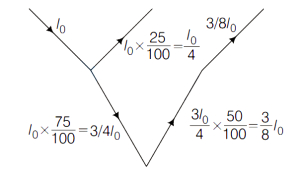
Intensity reflected from the upper surface,$I_1 = 25 \% \text{ of } I_0 = \frac{I_0}{4}$.
Intensity transmitted into the glass plate = $I_0 - \frac{I_0}{4} = \frac{3I_0}{4}$.
Intensity reflected from the lower surface,$I_2 = 50 \% \text{ of } \frac{3I_0}{4} = \frac{1}{2} \times \frac{3I_0}{4} = \frac{3I_0}{8}$.
The ratio of maximum to minimum intensity is given by the formula:
$\frac{I_{\max}}{I_{\min}} = \frac{(\sqrt{I_1} + \sqrt{I_2})^2}{(\sqrt{I_1} - \sqrt{I_2})^2} = \left( \frac{\sqrt{\frac{I_0}{4}} + \sqrt{\frac{3I_0}{8}}}{\sqrt{\frac{I_0}{4}} - \sqrt{\frac{3I_0}{8}}} \right)^2 = \left( \frac{\frac{1}{2} + \sqrt{\frac{3}{8}}}{\frac{1}{2} - \sqrt{\frac{3}{8}}} \right)^2$.
Intensity reflected from the upper surface,$I_1 = 25 \% \text{ of } I_0 = \frac{I_0}{4}$.
Intensity transmitted into the glass plate = $I_0 - \frac{I_0}{4} = \frac{3I_0}{4}$.
Intensity reflected from the lower surface,$I_2 = 50 \% \text{ of } \frac{3I_0}{4} = \frac{1}{2} \times \frac{3I_0}{4} = \frac{3I_0}{8}$.
The ratio of maximum to minimum intensity is given by the formula:
$\frac{I_{\max}}{I_{\min}} = \frac{(\sqrt{I_1} + \sqrt{I_2})^2}{(\sqrt{I_1} - \sqrt{I_2})^2} = \left( \frac{\sqrt{\frac{I_0}{4}} + \sqrt{\frac{3I_0}{8}}}{\sqrt{\frac{I_0}{4}} - \sqrt{\frac{3I_0}{8}}} \right)^2 = \left( \frac{\frac{1}{2} + \sqrt{\frac{3}{8}}}{\frac{1}{2} - \sqrt{\frac{3}{8}}} \right)^2$.
0 likes
View Solution92
DifficultMCQ
Calculate the minimum thickness of a soap film $(n=1.33)$ that results in constructive interference in reflected light, if the film is illuminated with light whose wavelength in free space is $532 \,nm$. (in $\,nm$)
A
$113$
B
$100$
C
$200$
D
$226$
Solution
(B) For constructive interference in reflected light from a thin film, the condition is given by $2nt = (m + 1/2)\lambda$, where $m = 0, 1, 2, \dots$ and $n$ is the refractive index of the film.
To find the minimum thickness, we set $m = 0$.
Thus, $2nt = \lambda/2$.
Rearranging for $t$, we get $t = \lambda / (4n)$.
Substituting the given values: $\lambda = 532 \,nm$ and $n = 1.33$.
$t = 532 / (4 \times 1.33) = 532 / 5.32 = 100 \,nm$.
Therefore, the minimum thickness is $100 \,nm$.
To find the minimum thickness, we set $m = 0$.
Thus, $2nt = \lambda/2$.
Rearranging for $t$, we get $t = \lambda / (4n)$.
Substituting the given values: $\lambda = 532 \,nm$ and $n = 1.33$.
$t = 532 / (4 \times 1.33) = 532 / 5.32 = 100 \,nm$.
Therefore, the minimum thickness is $100 \,nm$.
0 likes
View Solution93
MediumMCQ
Light of wavelength $6000 \text{ Å}$ is incident on a thin glass plate of refractive index $\mu = 1.5$ such that the angle of refraction into the plate is $60^{\circ}$. Calculate the smallest thickness of the plate which will make a dark fringe by reflected beam interference.
A
$1.5 \times 10^{-7} \text{ m}$
B
$2 \times 10^{-7} \text{ m}$
C
$3.5 \times 10^{-7} \text{ m}$
D
$4 \times 10^{-7} \text{ m}$
Solution
(D) For reflected light,the condition for destructive interference (dark fringe) is given by:
$2 \mu t \cos r = n \lambda$
where $\mu$ is the refractive index,$t$ is the thickness,$r$ is the angle of refraction,and $n$ is an integer $(n = 1, 2, 3, ...)$.
For the smallest thickness,we take $n = 1$:
$2 \mu t \cos r = \lambda$
Given values:
$\lambda = 6000 \text{ Å} = 6000 \times 10^{-10} \text{ m} = 6 \times 10^{-7} \text{ m}$
$\mu = 1.5$
$r = 60^{\circ} \Rightarrow \cos 60^{\circ} = 0.5$
Substituting these values into the equation:
$2 \times 1.5 \times t \times 0.5 = 6 \times 10^{-7}$
$1.5 \times t = 6 \times 10^{-7}$
$t = \frac{6 \times 10^{-7}}{1.5} = 4 \times 10^{-7} \text{ m}$
$2 \mu t \cos r = n \lambda$
where $\mu$ is the refractive index,$t$ is the thickness,$r$ is the angle of refraction,and $n$ is an integer $(n = 1, 2, 3, ...)$.
For the smallest thickness,we take $n = 1$:
$2 \mu t \cos r = \lambda$
Given values:
$\lambda = 6000 \text{ Å} = 6000 \times 10^{-10} \text{ m} = 6 \times 10^{-7} \text{ m}$
$\mu = 1.5$
$r = 60^{\circ} \Rightarrow \cos 60^{\circ} = 0.5$
Substituting these values into the equation:
$2 \times 1.5 \times t \times 0.5 = 6 \times 10^{-7}$
$1.5 \times t = 6 \times 10^{-7}$
$t = \frac{6 \times 10^{-7}}{1.5} = 4 \times 10^{-7} \text{ m}$
0 likes
View SolutionWave Optics — Thin film Interference, fresnel biprism, lloyd's mirror · Frequently Asked Questions
1Are these Wave Optics questions useful for JEE and NEET?
Yes. All questions in this section are mapped to JEE Main and NEET exam patterns. Previous year questions from JEE Main, NEET, GUJCET and state-level exams are included with full solutions.
2Can I switch to Hindi or Gujarati for these questions?
Yes. Use the language tabs in the hero section or the sidebar to view the same questions and solutions in English, Hindi or Gujarati.
3How do I generate a question paper from this subtopic?
Use the Vedclass Exam Paper Generator — select the chapter and subtopic, set difficulty, and generate Sets A, B, C, D automatically. First 3 chapters of every subject are free.
Vedclass Products
For Students
Vedclass Test Series
Mock tests in real JEE/NEET style with performance analysis. 5-day free trial.
Start Free TrialFor Teachers
Exam Paper Generator
Generate Set A/B/C/D papers from this chapter in 2 minutes. 3 chapters free.
Try FreeFor Institutes
Online Exam Module
Live online exams with unlimited students, 360° analytics & white-label branding.
See DemoFor Teachers & Institutes
Generate a Wave Optics Exam Paper in 2 Minutes
Select subtopic & difficulty — Sets A, B, C, D auto-generated with No Repeat logic.
First 3 chapters of every subject are free — no payment required.