
A English
Polarisation of Light and Malus' Law Questions in English
Class 12 Physics · Wave Optics · Polarisation of Light and Malus' Law
159+
Questions
English
Language
100%
With Solutions
Showing 49 of 159 questions in English
101
AdvancedMCQ
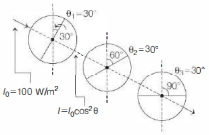
Three linear polarisers are placed coaxially. The transmission axis of the first polariser is at $30^{\circ}$,the second one is at $60^{\circ}$,and the third at $90^{\circ}$ to the vertical,all in the clockwise sense. Each polariser additionally absorbs $10 \%$ of the light. If a vertically polarised beam of light of intensity $I=100 \, W/m^2$ is incident on this assembly of polarisers,then the final intensity of the transmitted light will be close to ................ $W/m^2$.
A
$10$
B
$20$
C
$30$
D
$50$
Solution
(C) When an already polarised beam passes through a polariser,the intensity $I$ of light obtained is given by Malus' law: $I = I_0 \cos^2 \theta$,where $I_0$ is the intensity of incident polarised light and $\theta$ is the angle between the plane of polarisation and the transmission axis of the polariser.
Given that each polariser absorbs $10 \%$ of the light,the transmission factor is $k = 0.9$.
$1$. For the first polariser $(P_1)$: The incident light is vertical. The transmission axis is at $30^{\circ}$ to the vertical. So,$\theta_1 = 30^{\circ}$.
$I_1 = k \cdot I_0 \cdot \cos^2(30^{\circ}) = 0.9 \cdot 100 \cdot (\sqrt{3}/2)^2 = 0.9 \cdot 100 \cdot 0.75 = 67.5 \, W/m^2$.
$2$. For the second polariser $(P_2)$: The light incident on $P_2$ is polarised at $30^{\circ}$. The transmission axis of $P_2$ is at $60^{\circ}$ to the vertical. The angle between the incident light and the axis is $\theta_2 = 60^{\circ} - 30^{\circ} = 30^{\circ}$.
$I_2 = k \cdot I_1 \cdot \cos^2(30^{\circ}) = 0.9 \cdot 67.5 \cdot 0.75 = 45.5625 \, W/m^2$.
$3$. For the third polariser $(P_3)$: The light incident on $P_3$ is polarised at $60^{\circ}$. The transmission axis of $P_3$ is at $90^{\circ}$ to the vertical. The angle between the incident light and the axis is $\theta_3 = 90^{\circ} - 60^{\circ} = 30^{\circ}$.
$I_3 = k \cdot I_2 \cdot \cos^2(30^{\circ}) = 0.9 \cdot 45.5625 \cdot 0.75 \approx 30.75 \, W/m^2$.
The final intensity is approximately $30 \, W/m^2$.
Given that each polariser absorbs $10 \%$ of the light,the transmission factor is $k = 0.9$.
$1$. For the first polariser $(P_1)$: The incident light is vertical. The transmission axis is at $30^{\circ}$ to the vertical. So,$\theta_1 = 30^{\circ}$.
$I_1 = k \cdot I_0 \cdot \cos^2(30^{\circ}) = 0.9 \cdot 100 \cdot (\sqrt{3}/2)^2 = 0.9 \cdot 100 \cdot 0.75 = 67.5 \, W/m^2$.
$2$. For the second polariser $(P_2)$: The light incident on $P_2$ is polarised at $30^{\circ}$. The transmission axis of $P_2$ is at $60^{\circ}$ to the vertical. The angle between the incident light and the axis is $\theta_2 = 60^{\circ} - 30^{\circ} = 30^{\circ}$.
$I_2 = k \cdot I_1 \cdot \cos^2(30^{\circ}) = 0.9 \cdot 67.5 \cdot 0.75 = 45.5625 \, W/m^2$.
$3$. For the third polariser $(P_3)$: The light incident on $P_3$ is polarised at $60^{\circ}$. The transmission axis of $P_3$ is at $90^{\circ}$ to the vertical. The angle between the incident light and the axis is $\theta_3 = 90^{\circ} - 60^{\circ} = 30^{\circ}$.
$I_3 = k \cdot I_2 \cdot \cos^2(30^{\circ}) = 0.9 \cdot 45.5625 \cdot 0.75 \approx 30.75 \, W/m^2$.
The final intensity is approximately $30 \, W/m^2$.
0 likes
View Solution102
MediumMCQ
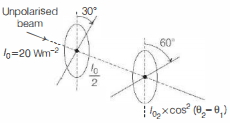
Two linear polarisers are placed coaxially. The transmission axis of the first polariser is at $30^{\circ}$ from the vertical,while the second one is at $60^{\circ}$ from the vertical,both in the clockwise sense. If an unpolarised beam of light of intensity $I_{0}=20 \,W/m^{2}$ is incident on this pair of polarisers,then the intensities $I_{1}$ and $I_{2}$ transmitted by the first and second polarisers respectively,will be close to:
A
$I_{1}=10.0 \,W/m^{2}$ and $I_{2}=7.5 \,W/m^{2}$
B
$I_{1}=20 \,W/m^{2}$ and $I_{2}=15 \,W/m^{2}$
C
$I_{1}=10.0 \,W/m^{2}$ and $I_{2}=8.6 \,W/m^{2}$
D
$I_{1}=15.0 \,W/m^{2}$ and $I_{2}=0.0 \,W/m^{2}$
Solution
(A) Since the beam incident on the first polariser is unpolarised,its intensity is reduced to half upon passing through the first polariser. Malus' law is not applicable here.
Therefore,the intensity $I_{1}$ after the first polariser is:
$I_{1} = \frac{I_{0}}{2} = \frac{20}{2} = 10 \,W/m^{2}$
As the light emerging from the first polariser is linearly polarised,Malus' law is applicable for the second polariser.
The intensity $I_{2}$ obtained after the second polariser is given by:
$I_{2} = I_{1} \cdot \cos^{2} \theta$
where $\theta$ is the angle between the transmission axes of the first and second polarisers.
Given the angles are $30^{\circ}$ and $60^{\circ}$ from the vertical,the angle between them is $\theta = 60^{\circ} - 30^{\circ} = 30^{\circ}$.
Thus,$I_{2} = 10 \times \cos^{2} 30^{\circ}$
$I_{2} = 10 \times \left(\frac{\sqrt{3}}{2}\right)^{2} = 10 \times \frac{3}{4} = 7.5 \,W/m^{2}$
Therefore,the intensity $I_{1}$ after the first polariser is:
$I_{1} = \frac{I_{0}}{2} = \frac{20}{2} = 10 \,W/m^{2}$
As the light emerging from the first polariser is linearly polarised,Malus' law is applicable for the second polariser.
The intensity $I_{2}$ obtained after the second polariser is given by:
$I_{2} = I_{1} \cdot \cos^{2} \theta$
where $\theta$ is the angle between the transmission axes of the first and second polarisers.
Given the angles are $30^{\circ}$ and $60^{\circ}$ from the vertical,the angle between them is $\theta = 60^{\circ} - 30^{\circ} = 30^{\circ}$.
Thus,$I_{2} = 10 \times \cos^{2} 30^{\circ}$
$I_{2} = 10 \times \left(\frac{\sqrt{3}}{2}\right)^{2} = 10 \times \frac{3}{4} = 7.5 \,W/m^{2}$
0 likes
View Solution103
MediumMCQ
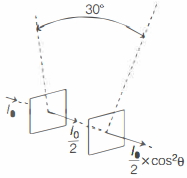
An unpolarised beam of light of intensity $I_0$ passes through two linear polarisers making an angle of $30^{\circ}$ with respect to each other. The emergent beam will have an intensity:
A
$\frac{3 I_0}{4}$
B
$\frac{\sqrt{3} I_0}{4}$
C
$\frac{3 I_0}{8}$
D
$\frac{I_0}{8}$
Solution
(C) When an unpolarised light of intensity $I_0$ passes through the first polariser,the intensity of the transmitted light becomes $I_1 = \frac{I_0}{2}$.
Now,this polarised light passes through the second polariser,which is at an angle $\theta = 30^{\circ}$ with respect to the first one. According to Malus' Law,the intensity of the emergent light $I'$ is given by:
$I' = I_1 \cos^2 \theta$
Substituting the values:
$I' = \frac{I_0}{2} \times \cos^2 30^{\circ}$
$I' = \frac{I_0}{2} \times \left( \frac{\sqrt{3}}{2} \right)^2$
$I' = \frac{I_0}{2} \times \frac{3}{4}$
$I' = \frac{3 I_0}{8}$
Now,this polarised light passes through the second polariser,which is at an angle $\theta = 30^{\circ}$ with respect to the first one. According to Malus' Law,the intensity of the emergent light $I'$ is given by:
$I' = I_1 \cos^2 \theta$
Substituting the values:
$I' = \frac{I_0}{2} \times \cos^2 30^{\circ}$
$I' = \frac{I_0}{2} \times \left( \frac{\sqrt{3}}{2} \right)^2$
$I' = \frac{I_0}{2} \times \frac{3}{4}$
$I' = \frac{3 I_0}{8}$
0 likes
View Solution104
MediumMCQ
$A$ plane polarised light passes through successive polarisers which are rotated by $30^{\circ}$ with respect to each other in the clockwise direction. Neglecting absorption by the polarisers and given that the first polariser's axis is parallel to the plane of polarisation of the incident light,the intensity of light at the exit of the fifth polariser is closest to
A
same as that of the incident light
B
$17.5 \%$ of the incident light
C
$30 \%$ of the incident light
D
zero
Solution
(C) Let the intensity of the incident light be $I_0$. According to Malus' law,the intensity of light after passing through a polariser is $I = I_{in} \cos^2 \theta$,where $\theta$ is the angle between the incident light's polarisation plane and the polariser's axis.
Since the first polariser's axis is parallel to the plane of polarisation of the incident light,the angle $\theta_1 = 0^{\circ}$. Thus,the intensity after the first polariser is $I_1 = I_0 \cos^2(0^{\circ}) = I_0$.
For the subsequent polarisers,each is rotated by $30^{\circ}$ relative to the previous one. Therefore,the angle between the light's polarisation plane and the next polariser is $30^{\circ}$.
Intensity after the second polariser: $I_2 = I_1 \cos^2(30^{\circ}) = I_0 (\frac{\sqrt{3}}{2})^2 = \frac{3}{4} I_0$.
Intensity after the third polariser: $I_3 = I_2 \cos^2(30^{\circ}) = (\frac{3}{4} I_0) \times \frac{3}{4} = (\frac{3}{4})^2 I_0$.
Intensity after the fourth polariser: $I_4 = I_3 \cos^2(30^{\circ}) = (\frac{3}{4})^2 I_0 \times \frac{3}{4} = (\frac{3}{4})^3 I_0$.
Intensity after the fifth polariser: $I_5 = I_4 \cos^2(30^{\circ}) = (\frac{3}{4})^3 I_0 \times \frac{3}{4} = (\frac{3}{4})^4 I_0$.
Calculating the value: $I_5 = (0.75)^4 I_0 = 0.3164 I_0 \approx 31.6 \% I_0$.
Comparing with the given options,the intensity is closest to $30 \%$ of the incident light.
Since the first polariser's axis is parallel to the plane of polarisation of the incident light,the angle $\theta_1 = 0^{\circ}$. Thus,the intensity after the first polariser is $I_1 = I_0 \cos^2(0^{\circ}) = I_0$.
For the subsequent polarisers,each is rotated by $30^{\circ}$ relative to the previous one. Therefore,the angle between the light's polarisation plane and the next polariser is $30^{\circ}$.
Intensity after the second polariser: $I_2 = I_1 \cos^2(30^{\circ}) = I_0 (\frac{\sqrt{3}}{2})^2 = \frac{3}{4} I_0$.
Intensity after the third polariser: $I_3 = I_2 \cos^2(30^{\circ}) = (\frac{3}{4} I_0) \times \frac{3}{4} = (\frac{3}{4})^2 I_0$.
Intensity after the fourth polariser: $I_4 = I_3 \cos^2(30^{\circ}) = (\frac{3}{4})^2 I_0 \times \frac{3}{4} = (\frac{3}{4})^3 I_0$.
Intensity after the fifth polariser: $I_5 = I_4 \cos^2(30^{\circ}) = (\frac{3}{4})^3 I_0 \times \frac{3}{4} = (\frac{3}{4})^4 I_0$.
Calculating the value: $I_5 = (0.75)^4 I_0 = 0.3164 I_0 \approx 31.6 \% I_0$.
Comparing with the given options,the intensity is closest to $30 \%$ of the incident light.
0 likes
View Solution105
EasyMCQ
Which of the following phenomena can be demonstrated by light,but not with sound waves in an air column?
A
Reflection
B
Diffraction
C
Refraction
D
Polarisation
Solution
(D) The correct answer is $D$.
Polarisation is a phenomenon that occurs only in transverse waves,where the oscillations of the medium particles (or electric field vectors in electromagnetic waves) are restricted to a specific plane perpendicular to the direction of wave propagation.
Light is an electromagnetic wave,which is transverse in nature,and therefore it exhibits the phenomenon of polarisation.
Sound waves in an air column are longitudinal waves,meaning the particles of the medium oscillate parallel to the direction of wave propagation. Longitudinal waves cannot be polarised because they lack the necessary transverse components to restrict oscillation to a single plane.
Reflection,diffraction,and refraction are properties exhibited by both light waves and sound waves.
Polarisation is a phenomenon that occurs only in transverse waves,where the oscillations of the medium particles (or electric field vectors in electromagnetic waves) are restricted to a specific plane perpendicular to the direction of wave propagation.
Light is an electromagnetic wave,which is transverse in nature,and therefore it exhibits the phenomenon of polarisation.
Sound waves in an air column are longitudinal waves,meaning the particles of the medium oscillate parallel to the direction of wave propagation. Longitudinal waves cannot be polarised because they lack the necessary transverse components to restrict oscillation to a single plane.
Reflection,diffraction,and refraction are properties exhibited by both light waves and sound waves.
0 likes
View Solution106
MediumMCQ
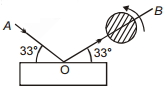
$A$ beam of light $AO$ is incident on a glass slab $(\mu = 1.54)$ in a direction as shown in the diagram. The reflected ray $OB$ is passed through a polaroid. On viewing through the polaroid,we find that on rotating the polaroid: (Given $\tan 57^{\circ} = 1.54$)
A
The intensity is reduced down to zero and remains zero.
B
The intensity reduces down somewhat and rises again.
C
There is no change in intensity.
D
The intensity gradually reduces to zero and then again increases.
Solution
(D) The angle of incidence $i$ is the angle between the incident ray and the normal. From the diagram,the angle between the incident ray and the surface is $33^{\circ}$. Therefore,the angle of incidence $i = 90^{\circ} - 33^{\circ} = 57^{\circ}$.
Given the refractive index $\mu = 1.54$ and $\tan 57^{\circ} = 1.54$,we have $\mu = \tan i_p$,where $i_p$ is the Brewster's angle.
Since the light is incident at Brewster's angle,the reflected ray $OB$ is completely plane-polarized.
When this plane-polarized light passes through a rotating polaroid,the intensity $I$ of the transmitted light varies according to Malus's Law: $I = I_0 \cos^2 \theta$,where $\theta$ is the angle between the transmission axis of the polaroid and the plane of polarization of the light.
As the polaroid is rotated,the intensity will gradually decrease to zero (when $\theta = 90^{\circ}$) and then increase again as the polaroid continues to rotate.
Given the refractive index $\mu = 1.54$ and $\tan 57^{\circ} = 1.54$,we have $\mu = \tan i_p$,where $i_p$ is the Brewster's angle.
Since the light is incident at Brewster's angle,the reflected ray $OB$ is completely plane-polarized.
When this plane-polarized light passes through a rotating polaroid,the intensity $I$ of the transmitted light varies according to Malus's Law: $I = I_0 \cos^2 \theta$,where $\theta$ is the angle between the transmission axis of the polaroid and the plane of polarization of the light.
As the polaroid is rotated,the intensity will gradually decrease to zero (when $\theta = 90^{\circ}$) and then increase again as the polaroid continues to rotate.
0 likes
View Solution107
MediumMCQ
Choose the correct alternative regarding the polarisation of light.
A
When plane polarised light passes through a polaroid,it changes its nature to linearly polarised.
B
Refracted light,when light is incident at Brewster's angle,is linearly polarised.
C
Polarised light can be produced by scattering through $\frac{\pi}{2}$ in the Earth's atmosphere.
D
Natural light from the Sun is polarised.
Solution
(C) Option $C$ is correct. When sunlight enters the Earth's atmosphere,the atoms and molecules scatter the light. For light scattered at an angle of $\frac{\pi}{2}$ ($90$ degrees) relative to the incident beam,the scattered light is found to be plane-polarised. Option $A$ is incorrect because plane-polarised light remains plane-polarised after passing through a polaroid (its intensity may change). Option $B$ is incorrect because the refracted light at Brewster's angle is partially polarised,not fully linearly polarised. Option $D$ is incorrect because natural sunlight is unpolarised.
0 likes
View Solution108
MediumMCQ
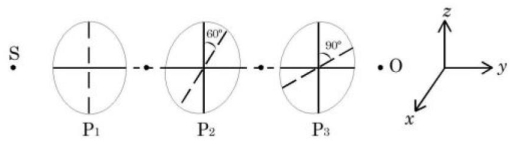
As shown in the figure,three identical polaroids $P_1$,$P_2$,and $P_3$ are placed one after another. The pass axis of $P_2$ and $P_3$ are inclined at angles of $60^{\circ}$ and $90^{\circ}$ with respect to the axis of $P_1$. The source $S$ has an intensity of $256 \text{ W/m}^2$. The intensity of light at point $O$ is $........... \text{ W/m}^2$.
A
$24$
B
$23$
C
$22$
D
$21$
Solution
(A) Let the initial intensity of the unpolarized light from source $S$ be $I_0 = 256 \text{ W/m}^2$.
When unpolarized light passes through the first polaroid $P_1$,the intensity becomes $I_1 = \frac{I_0}{2} = \frac{256}{2} = 128 \text{ W/m}^2$.
According to Malus' Law,when polarized light passes through a second polaroid with its pass axis at an angle $\theta$ to the polarization direction of the incident light,the transmitted intensity is $I = I_{incident} \cos^2(\theta)$.
For $P_2$,the angle with $P_1$ is $\theta_1 = 60^{\circ}$. So,$I_2 = I_1 \cos^2(60^{\circ}) = 128 \times (\frac{1}{2})^2 = 128 \times \frac{1}{4} = 32 \text{ W/m}^2$.
For $P_3$,the angle with $P_2$ is $\theta_2 = 90^{\circ} - 60^{\circ} = 30^{\circ}$. So,$I_3 = I_2 \cos^2(30^{\circ}) = 32 \times (\frac{\sqrt{3}}{2})^2 = 32 \times \frac{3}{4} = 24 \text{ W/m}^2$.
Thus,the intensity at point $O$ is $24 \text{ W/m}^2$.
When unpolarized light passes through the first polaroid $P_1$,the intensity becomes $I_1 = \frac{I_0}{2} = \frac{256}{2} = 128 \text{ W/m}^2$.
According to Malus' Law,when polarized light passes through a second polaroid with its pass axis at an angle $\theta$ to the polarization direction of the incident light,the transmitted intensity is $I = I_{incident} \cos^2(\theta)$.
For $P_2$,the angle with $P_1$ is $\theta_1 = 60^{\circ}$. So,$I_2 = I_1 \cos^2(60^{\circ}) = 128 \times (\frac{1}{2})^2 = 128 \times \frac{1}{4} = 32 \text{ W/m}^2$.
For $P_3$,the angle with $P_2$ is $\theta_2 = 90^{\circ} - 60^{\circ} = 30^{\circ}$. So,$I_3 = I_2 \cos^2(30^{\circ}) = 32 \times (\frac{\sqrt{3}}{2})^2 = 32 \times \frac{3}{4} = 24 \text{ W/m}^2$.
Thus,the intensity at point $O$ is $24 \text{ W/m}^2$.
0 likes
View Solution109
MediumMCQ
Two polaroids $A$ and $B$ are placed in such a way that the pass-axis of polaroids are perpendicular to each other. Now,another polaroid $C$ is placed between $A$ and $B$ bisecting the angle between them. If the intensity of unpolarised light is $I_0$,then the intensity of transmitted light after passing through polaroid $B$ will be:
A
$\frac{I_0}{4}$
B
$\frac{I_0}{2}$
C
$\frac{I_0}{8}$
D
$0$
Solution
(C) When unpolarised light of intensity $I_0$ passes through the first polaroid $A$,the intensity of the transmitted light is $I_A = \frac{I_0}{2}$.
The pass-axis of polaroid $C$ makes an angle of $45^{\circ}$ with the pass-axis of $A$. According to Malus' Law,the intensity of light after passing through $C$ is $I_C = I_A \cos^2(45^{\circ}) = \frac{I_0}{2} \times (\frac{1}{\sqrt{2}})^2 = \frac{I_0}{4}$.
The pass-axis of polaroid $B$ is perpendicular to $A$,so it makes an angle of $45^{\circ}$ with the pass-axis of $C$. The intensity of light after passing through $B$ is $I_B = I_C \cos^2(45^{\circ}) = \frac{I_0}{4} \times (\frac{1}{\sqrt{2}})^2 = \frac{I_0}{8}$.
The pass-axis of polaroid $C$ makes an angle of $45^{\circ}$ with the pass-axis of $A$. According to Malus' Law,the intensity of light after passing through $C$ is $I_C = I_A \cos^2(45^{\circ}) = \frac{I_0}{2} \times (\frac{1}{\sqrt{2}})^2 = \frac{I_0}{4}$.
The pass-axis of polaroid $B$ is perpendicular to $A$,so it makes an angle of $45^{\circ}$ with the pass-axis of $C$. The intensity of light after passing through $B$ is $I_B = I_C \cos^2(45^{\circ}) = \frac{I_0}{4} \times (\frac{1}{\sqrt{2}})^2 = \frac{I_0}{8}$.
0 likes
View Solution110
MediumMCQ
$n$ polarizing sheets are arranged such that each makes an angle $45^{\circ}$ with the preceding sheet. An unpolarized light of intensity $I$ is incident on this arrangement. The output intensity is found to be $\frac{I}{64}$. The value of $n$ will be:
A
$3$
B
$6$
C
$5$
D
$4$
Solution
(B) When unpolarized light of intensity $I$ passes through the first polarizing sheet,the intensity becomes $I_1 = \frac{I}{2}$.
For subsequent sheets,we use Malus' Law: $I_{k} = I_{k-1} \cos^2(\theta)$,where $\theta = 45^{\circ}$.
Since $\cos^2(45^{\circ}) = (\frac{1}{\sqrt{2}})^2 = \frac{1}{2}$,the intensity after each subsequent sheet is halved.
After the first sheet,the intensity is $I_1 = \frac{I}{2}$.
After the second sheet,$I_2 = I_1 \cos^2(45^{\circ}) = \frac{I}{2} \cdot \frac{1}{2} = \frac{I}{2^2}$.
After the $n^{\text{th}}$ sheet,the intensity is $I_n = \frac{I}{2} \cdot (\frac{1}{2})^{n-1} = \frac{I}{2^n}$.
Given $I_n = \frac{I}{64}$,we have $\frac{I}{2^n} = \frac{I}{64}$.
$2^n = 64 = 2^6$.
Therefore,$n = 6$.
For subsequent sheets,we use Malus' Law: $I_{k} = I_{k-1} \cos^2(\theta)$,where $\theta = 45^{\circ}$.
Since $\cos^2(45^{\circ}) = (\frac{1}{\sqrt{2}})^2 = \frac{1}{2}$,the intensity after each subsequent sheet is halved.
After the first sheet,the intensity is $I_1 = \frac{I}{2}$.
After the second sheet,$I_2 = I_1 \cos^2(45^{\circ}) = \frac{I}{2} \cdot \frac{1}{2} = \frac{I}{2^2}$.
After the $n^{\text{th}}$ sheet,the intensity is $I_n = \frac{I}{2} \cdot (\frac{1}{2})^{n-1} = \frac{I}{2^n}$.
Given $I_n = \frac{I}{64}$,we have $\frac{I}{2^n} = \frac{I}{64}$.
$2^n = 64 = 2^6$.
Therefore,$n = 6$.
0 likes
View Solution111
EasyMCQ
After passing through a polariser,a linearly polarised light of intensity $I$ is incident on an analyser making an angle of $30^{\circ}$ with that of the polariser. The intensity of light emitted from the analyser will be
A
$\frac{I}{2}$
B
$\frac{I}{3}$
C
$\frac{3I}{4}$
D
$\frac{2I}{3}$
Solution
(C) According to Malus's law,the intensity of light transmitted through an analyser is given by $I_2 = I_1 \cos^2 \theta$.
Here,$I_1 = I$ is the intensity of the incident linearly polarised light.
The angle between the transmission axes of the polariser and the analyser is $\theta = 30^{\circ}$.
Substituting these values into the formula:
$I_2 = I \cos^2(30^{\circ})$
Since $\cos(30^{\circ}) = \frac{\sqrt{3}}{2}$,we have:
$I_2 = I \left( \frac{\sqrt{3}}{2} \right)^2 = I \left( \frac{3}{4} \right) = \frac{3I}{4}$.
Here,$I_1 = I$ is the intensity of the incident linearly polarised light.
The angle between the transmission axes of the polariser and the analyser is $\theta = 30^{\circ}$.
Substituting these values into the formula:
$I_2 = I \cos^2(30^{\circ})$
Since $\cos(30^{\circ}) = \frac{\sqrt{3}}{2}$,we have:
$I_2 = I \left( \frac{\sqrt{3}}{2} \right)^2 = I \left( \frac{3}{4} \right) = \frac{3I}{4}$.
0 likes
View Solution112
MediumMCQ
Unpolarised light of intensity $32 \, W m^{-2}$ passes through a combination of three polaroids such that the pass axis of the last polaroid is perpendicular to that of the pass axis of the first polaroid. If the intensity of the emerging light is $3 \, W m^{-2}$,then the angle between the pass axis of the first two polaroids is $............ \, ^{\circ}$.
A
$20$
B
$40$
C
$90$
D
$30$
Solution
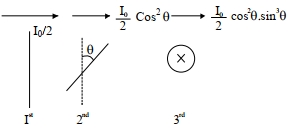
(D) Let the intensity of unpolarised light be $I_0 = 32 \, W m^{-2}$.
After passing through the first polaroid,the intensity becomes $I_1 = \frac{I_0}{2} = 16 \, W m^{-2}$.
Let $\theta$ be the angle between the pass axis of the first and second polaroid.
The intensity after the second polaroid is $I_2 = I_1 \cos^2 \theta = \frac{I_0}{2} \cos^2 \theta$.
The angle between the second and third polaroid is $(90^{\circ} - \theta)$ because the first and third polaroids are perpendicular.
The intensity after the third polaroid is $I_3 = I_2 \cos^2(90^{\circ} - \theta) = I_2 \sin^2 \theta$.
Substituting $I_2$,we get $I_3 = \frac{I_0}{2} \cos^2 \theta \sin^2 \theta = \frac{I_0}{8} (2 \sin \theta \cos \theta)^2 = \frac{I_0}{8} \sin^2(2 \theta)$.
Given $I_3 = 3 \, W m^{-2}$ and $I_0 = 32 \, W m^{-2}$,we have $3 = \frac{32}{8} \sin^2(2 \theta) = 4 \sin^2(2 \theta)$.
$\sin^2(2 \theta) = \frac{3}{4} \implies \sin(2 \theta) = \frac{\sqrt{3}}{2}$.
Thus,$2 \theta = 60^{\circ}$ or $120^{\circ}$,which gives $\theta = 30^{\circ}$ or $60^{\circ}$.
After passing through the first polaroid,the intensity becomes $I_1 = \frac{I_0}{2} = 16 \, W m^{-2}$.
Let $\theta$ be the angle between the pass axis of the first and second polaroid.
The intensity after the second polaroid is $I_2 = I_1 \cos^2 \theta = \frac{I_0}{2} \cos^2 \theta$.
The angle between the second and third polaroid is $(90^{\circ} - \theta)$ because the first and third polaroids are perpendicular.
The intensity after the third polaroid is $I_3 = I_2 \cos^2(90^{\circ} - \theta) = I_2 \sin^2 \theta$.
Substituting $I_2$,we get $I_3 = \frac{I_0}{2} \cos^2 \theta \sin^2 \theta = \frac{I_0}{8} (2 \sin \theta \cos \theta)^2 = \frac{I_0}{8} \sin^2(2 \theta)$.
Given $I_3 = 3 \, W m^{-2}$ and $I_0 = 32 \, W m^{-2}$,we have $3 = \frac{32}{8} \sin^2(2 \theta) = 4 \sin^2(2 \theta)$.
$\sin^2(2 \theta) = \frac{3}{4} \implies \sin(2 \theta) = \frac{\sqrt{3}}{2}$.
Thus,$2 \theta = 60^{\circ}$ or $120^{\circ}$,which gives $\theta = 30^{\circ}$ or $60^{\circ}$.
0 likes
View Solution113
DifficultMCQ
When a polaroid sheet is rotated between two crossed polaroids,then the transmitted light intensity will be maximum for a rotation of: (in $^{\circ}$)
A
$60$
B
$30$
C
$90$
D
$45$
Solution
(D) Let $I_0$ be the intensity of unpolarized light incident on the first polaroid.
$I_1 = I_0 / 2$ is the intensity of light transmitted from the first polaroid.
Let $\theta$ be the angle between the first and second polaroid,and $\phi$ be the angle between the second and third polaroid.
Since the first and third polaroids are crossed,$\theta + \phi = 90^{\circ}$,so $\phi = 90^{\circ} - \theta$.
The intensity transmitted from the second polaroid is $I_2 = I_1 \cos^2 \theta$.
The intensity transmitted from the third polaroid is $I_3 = I_2 \cos^2 \phi = I_1 \cos^2 \theta \cos^2 (90^{\circ} - \theta) = I_1 \cos^2 \theta \sin^2 \theta$.
Using the identity $\sin 2\theta = 2 \sin \theta \cos \theta$,we get $I_3 = I_1 (\sin 2\theta / 2)^2 = (I_0 / 2) \cdot (\sin^2 2\theta / 4) = (I_0 / 8) \sin^2 2\theta$.
$I_3$ is maximum when $\sin^2 2\theta = 1$,which implies $2\theta = 90^{\circ}$,so $\theta = 45^{\circ}$.
$I_1 = I_0 / 2$ is the intensity of light transmitted from the first polaroid.
Let $\theta$ be the angle between the first and second polaroid,and $\phi$ be the angle between the second and third polaroid.
Since the first and third polaroids are crossed,$\theta + \phi = 90^{\circ}$,so $\phi = 90^{\circ} - \theta$.
The intensity transmitted from the second polaroid is $I_2 = I_1 \cos^2 \theta$.
The intensity transmitted from the third polaroid is $I_3 = I_2 \cos^2 \phi = I_1 \cos^2 \theta \cos^2 (90^{\circ} - \theta) = I_1 \cos^2 \theta \sin^2 \theta$.
Using the identity $\sin 2\theta = 2 \sin \theta \cos \theta$,we get $I_3 = I_1 (\sin 2\theta / 2)^2 = (I_0 / 2) \cdot (\sin^2 2\theta / 4) = (I_0 / 8) \sin^2 2\theta$.
$I_3$ is maximum when $\sin^2 2\theta = 1$,which implies $2\theta = 90^{\circ}$,so $\theta = 45^{\circ}$.
0 likes
View Solution114
DifficultMCQ
$A$ beam of unpolarised light of intensity $I_0$ is passed through a polaroid $A$ and then through another polaroid $B$ which is oriented so that its principal plane makes an angle of $45^{\circ}$ relative to that of $A$. The intensity of emergent light is:
A
$I_0 / 4$
B
$I_0$
C
$I_0 / 2$
D
$I_0 / 8$
Solution
(A) $1$. When unpolarised light of intensity $I_0$ passes through the first polaroid $A$,the intensity of the transmitted light becomes $I_1 = I_0 / 2$.
$2$. According to Malus' Law,when this polarised light passes through a second polaroid $B$ whose transmission axis is at an angle $\theta = 45^{\circ}$ with respect to the first polaroid,the final intensity $I_2$ is given by $I_2 = I_1 \cos^2 \theta$.
$3$. Substituting the values: $I_2 = (I_0 / 2) \cos^2(45^{\circ})$.
$4$. Since $\cos(45^{\circ}) = 1 / \sqrt{2}$,then $\cos^2(45^{\circ}) = 1/2$.
$5$. Therefore,$I_2 = (I_0 / 2) \times (1 / 2) = I_0 / 4$.
$2$. According to Malus' Law,when this polarised light passes through a second polaroid $B$ whose transmission axis is at an angle $\theta = 45^{\circ}$ with respect to the first polaroid,the final intensity $I_2$ is given by $I_2 = I_1 \cos^2 \theta$.
$3$. Substituting the values: $I_2 = (I_0 / 2) \cos^2(45^{\circ})$.
$4$. Since $\cos(45^{\circ}) = 1 / \sqrt{2}$,then $\cos^2(45^{\circ}) = 1/2$.
$5$. Therefore,$I_2 = (I_0 / 2) \times (1 / 2) = I_0 / 4$.
0 likes
View Solution115
AdvancedMCQ
$A$ point source $S$ emits unpolarized light uniformly in all directions. At two points $A$ and $B$,the ratio $r = I_A / I_B$ of the intensities of light is $2$. If a set of two polaroids having $45^{\circ}$ angle between their pass-axes is placed just before point $B$,then the new value of $r$ will be.
A
$4$
B
$6$
C
$7$
D
$8$
Solution
(D) The intensity of unpolarized light passing through a single polarizer is reduced to half: $I_{P} = I_B / 2$.
According to Malus' Law,when this light passes through a second polarizer with an angle $\theta = 45^{\circ}$ between the pass-axes,the intensity becomes $I_B' = I_P \cos^2(45^{\circ})$.
Substituting the values: $I_B' = (I_B / 2) \times (1 / \sqrt{2})^2 = (I_B / 2) \times (1 / 2) = I_B / 4$.
The new ratio $r'$ is given by $r' = I_A / I_B' = I_A / (I_B / 4) = 4 \times (I_A / I_B)$.
Given $I_A / I_B = 2$,we get $r' = 4 \times 2 = 8$.
According to Malus' Law,when this light passes through a second polarizer with an angle $\theta = 45^{\circ}$ between the pass-axes,the intensity becomes $I_B' = I_P \cos^2(45^{\circ})$.
Substituting the values: $I_B' = (I_B / 2) \times (1 / \sqrt{2})^2 = (I_B / 2) \times (1 / 2) = I_B / 4$.
The new ratio $r'$ is given by $r' = I_A / I_B' = I_A / (I_B / 4) = 4 \times (I_A / I_B)$.
Given $I_A / I_B = 2$,we get $r' = 4 \times 2 = 8$.
0 likes
View Solution116
DifficultMCQ
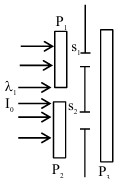
In a Young's double slit experiment,three polarizers are kept as shown in the figure. The transmission axes of $P_1$ and $P_2$ are orthogonal to each other. The polarizer $P_3$ covers both the slits with its transmission axis at $45^{\circ}$ to those of $P_1$ and $P_2$. An unpolarized light of wavelength $\lambda$ and intensity $I_0$ is incident on $P_1$ and $P_2$. The intensity at a point after $P_3$ where the path difference between the light waves from $s_1$ and $s_2$ is $\frac{\lambda}{3}$,is
A
$\frac{I_0}{2}$
B
$\frac{I_0}{4}$
C
$I_0$
D
$\frac{I_0}{3}$
Solution
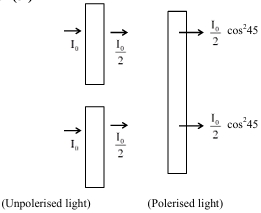
(B) When unpolarized light of intensity $I_0$ passes through a polarizer,the transmitted intensity is $\frac{I_0}{2}$.
Thus,the intensity of light emerging from $P_1$ and $P_2$ is $I_1 = I_2 = \frac{I_0}{2}$.
When this light passes through $P_3$ (whose axis is at $45^{\circ}$ to both $P_1$ and $P_2$),the intensity of each wave becomes $I' = I_1 \cos^2(45^{\circ}) = \frac{I_0}{2} \times \frac{1}{2} = \frac{I_0}{4}$.
At a point where the path difference is $\Delta x = \frac{\lambda}{3}$,the phase difference is $\Delta \phi = \frac{2\pi}{\lambda} \Delta x = \frac{2\pi}{\lambda} \times \frac{\lambda}{3} = \frac{2\pi}{3}$.
The resultant intensity $I_{res}$ is given by $I_{res} = I' + I' + 2\sqrt{I' I'} \cos(\Delta \phi) = 2I' + 2I' \cos(\frac{2\pi}{3})$.
Substituting $I' = \frac{I_0}{4}$ and $\cos(\frac{2\pi}{3}) = -\frac{1}{2}$:
$I_{res} = 2(\frac{I_0}{4}) + 2(\frac{I_0}{4})(-\frac{1}{2}) = \frac{I_0}{2} - \frac{I_0}{4} = \frac{I_0}{4}$.
Thus,the intensity of light emerging from $P_1$ and $P_2$ is $I_1 = I_2 = \frac{I_0}{2}$.
When this light passes through $P_3$ (whose axis is at $45^{\circ}$ to both $P_1$ and $P_2$),the intensity of each wave becomes $I' = I_1 \cos^2(45^{\circ}) = \frac{I_0}{2} \times \frac{1}{2} = \frac{I_0}{4}$.
At a point where the path difference is $\Delta x = \frac{\lambda}{3}$,the phase difference is $\Delta \phi = \frac{2\pi}{\lambda} \Delta x = \frac{2\pi}{\lambda} \times \frac{\lambda}{3} = \frac{2\pi}{3}$.
The resultant intensity $I_{res}$ is given by $I_{res} = I' + I' + 2\sqrt{I' I'} \cos(\Delta \phi) = 2I' + 2I' \cos(\frac{2\pi}{3})$.
Substituting $I' = \frac{I_0}{4}$ and $\cos(\frac{2\pi}{3}) = -\frac{1}{2}$:
$I_{res} = 2(\frac{I_0}{4}) + 2(\frac{I_0}{4})(-\frac{1}{2}) = \frac{I_0}{2} - \frac{I_0}{4} = \frac{I_0}{4}$.
0 likes
View Solution117
MediumMCQ
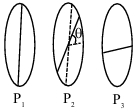
Two polarisers $P_1$ and $P_2$ are placed such that the intensity of the transmitted light is zero. $A$ third polariser $P_3$ is inserted between $P_1$ and $P_2$. If the transmitted intensity of the light passing through all three polarisers is maximum,what is the angle between the polarisers $P_2$ and $P_3$?
A
$\frac{\pi}{4}$
B
$\frac{\pi}{6}$
C
$\frac{\pi}{8}$
D
$\frac{\pi}{3}$
Solution
(A) Let the intensity of light incident on $P_1$ be $I_0$. Since $P_1$ and $P_2$ are crossed,the angle between them is $90^{\circ}$ or $\frac{\pi}{2}$.
Let the angle between $P_1$ and $P_3$ be $\theta$. Then the angle between $P_3$ and $P_2$ is $(\frac{\pi}{2} - \theta)$.
According to Malus' Law,the intensity after passing through $P_3$ is $I_1 = I_0 \cos^2 \theta$.
The intensity after passing through $P_2$ is $I_{\text{net}} = I_1 \cos^2(\frac{\pi}{2} - \theta) = I_0 \cos^2 \theta \sin^2 \theta$.
$I_{\text{net}} = I_0 (\sin \theta \cos \theta)^2 = I_0 (\frac{\sin 2\theta}{2})^2 = \frac{I_0}{4} \sin^2(2\theta)$.
For maximum intensity,$\sin^2(2\theta)$ must be $1$,so $2\theta = 90^{\circ}$ or $\theta = 45^{\circ}$ or $\frac{\pi}{4}$.
The angle between $P_3$ and $P_2$ is $\frac{\pi}{2} - \theta = \frac{\pi}{2} - \frac{\pi}{4} = \frac{\pi}{4}$.
Let the angle between $P_1$ and $P_3$ be $\theta$. Then the angle between $P_3$ and $P_2$ is $(\frac{\pi}{2} - \theta)$.
According to Malus' Law,the intensity after passing through $P_3$ is $I_1 = I_0 \cos^2 \theta$.
The intensity after passing through $P_2$ is $I_{\text{net}} = I_1 \cos^2(\frac{\pi}{2} - \theta) = I_0 \cos^2 \theta \sin^2 \theta$.
$I_{\text{net}} = I_0 (\sin \theta \cos \theta)^2 = I_0 (\frac{\sin 2\theta}{2})^2 = \frac{I_0}{4} \sin^2(2\theta)$.
For maximum intensity,$\sin^2(2\theta)$ must be $1$,so $2\theta = 90^{\circ}$ or $\theta = 45^{\circ}$ or $\frac{\pi}{4}$.
The angle between $P_3$ and $P_2$ is $\frac{\pi}{2} - \theta = \frac{\pi}{2} - \frac{\pi}{4} = \frac{\pi}{4}$.
0 likes
View Solution118
DifficultMCQ
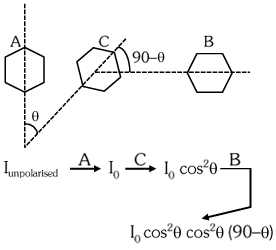
The intensity of transmitted light when a polaroid sheet is placed between two crossed polaroids at $22.5^{\circ}$ from the polarization axis of one of the polaroids is (where $I_0$ is the intensity of polarized light after passing through the first polaroid):
A
$\frac{I_0}{2}$
B
$\frac{I_0}{4}$
C
$\frac{I_0}{8}$
D
$\frac{I_0}{16}$
Solution
(C) Let the intensity of light after passing through the first polaroid be $I_0$.
When a second polaroid is placed at an angle $\theta = 22.5^{\circ}$ with the first,the intensity of light transmitted through it is given by Malus' Law: $I_1 = I_0 \cos^2 \theta$.
The third polaroid is placed at an angle $(90^{\circ} - \theta)$ with respect to the second polaroid.
The intensity of light transmitted through the third polaroid is $I_2 = I_1 \cos^2(90^{\circ} - \theta) = I_0 \cos^2 \theta \sin^2 \theta$.
Using the identity $\sin(2\theta) = 2 \sin \theta \cos \theta$,we have $\sin^2(2\theta) = 4 \sin^2 \theta \cos^2 \theta$,so $\sin^2 \theta \cos^2 \theta = \frac{\sin^2(2\theta)}{4}$.
Substituting this into the expression for $I_2$: $I_2 = I_0 \frac{\sin^2(2\theta)}{4}$.
Given $\theta = 22.5^{\circ}$,then $2\theta = 45^{\circ}$.
$I_2 = \frac{I_0}{4} \sin^2(45^{\circ}) = \frac{I_0}{4} \times (\frac{1}{\sqrt{2}})^2 = \frac{I_0}{4} \times \frac{1}{2} = \frac{I_0}{8}$.
When a second polaroid is placed at an angle $\theta = 22.5^{\circ}$ with the first,the intensity of light transmitted through it is given by Malus' Law: $I_1 = I_0 \cos^2 \theta$.
The third polaroid is placed at an angle $(90^{\circ} - \theta)$ with respect to the second polaroid.
The intensity of light transmitted through the third polaroid is $I_2 = I_1 \cos^2(90^{\circ} - \theta) = I_0 \cos^2 \theta \sin^2 \theta$.
Using the identity $\sin(2\theta) = 2 \sin \theta \cos \theta$,we have $\sin^2(2\theta) = 4 \sin^2 \theta \cos^2 \theta$,so $\sin^2 \theta \cos^2 \theta = \frac{\sin^2(2\theta)}{4}$.
Substituting this into the expression for $I_2$: $I_2 = I_0 \frac{\sin^2(2\theta)}{4}$.
Given $\theta = 22.5^{\circ}$,then $2\theta = 45^{\circ}$.
$I_2 = \frac{I_0}{4} \sin^2(45^{\circ}) = \frac{I_0}{4} \times (\frac{1}{\sqrt{2}})^2 = \frac{I_0}{4} \times \frac{1}{2} = \frac{I_0}{8}$.
0 likes
View Solution119
EasyMCQ
Two polaroids have their polarizing directions parallel so that the intensity of the transmitted light is maximum. The angle through which either polaroid must be turned so that the intensity of the transmitted light is dropped to one-half of the previous transmitted intensity is $.....^\circ$.
A
$180$
B
$120$
C
$90$
D
$45$
Solution
(D) According to Malus' Law,the intensity of transmitted light $I$ through a polaroid is given by $I = I_0 \cos^2(\phi)$,where $I_0$ is the maximum intensity and $\phi$ is the angle between the polarizing directions of the two polaroids.
Initially,the polarizing directions are parallel,so $\phi = 0^\circ$ and $I = I_0$.
We want the new intensity $I'$ to be half of the initial intensity,so $I' = \frac{I_0}{2}$.
Substituting this into Malus' Law: $\frac{I_0}{2} = I_0 \cos^2(\phi)$.
This simplifies to $\cos^2(\phi) = \frac{1}{2}$,which means $\cos(\phi) = \frac{1}{\sqrt{2}}$.
Therefore,$\phi = 45^\circ$.
Initially,the polarizing directions are parallel,so $\phi = 0^\circ$ and $I = I_0$.
We want the new intensity $I'$ to be half of the initial intensity,so $I' = \frac{I_0}{2}$.
Substituting this into Malus' Law: $\frac{I_0}{2} = I_0 \cos^2(\phi)$.
This simplifies to $\cos^2(\phi) = \frac{1}{2}$,which means $\cos(\phi) = \frac{1}{\sqrt{2}}$.
Therefore,$\phi = 45^\circ$.
0 likes
View Solution120
MediumMCQ
$A$ beam of natural light falls on a system of $5$ polaroids,which are arranged in succession such that the pass axis of each polaroid is turned through $60^{\circ}$ with respect to the preceding one. The fraction of the intensity of incident light that passes through the system is:
A
$\frac{1}{64}$
B
$\frac{1}{32}$
C
$\frac{1}{256}$
D
$\frac{1}{512}$
Solution
(D) When natural light of intensity $I_0$ passes through the first polaroid,the transmitted intensity is $I_1 = \frac{I_0}{2}$.
For subsequent polaroids,Malus' Law states $I_n = I_{n-1} \cos^2 \theta$,where $\theta = 60^{\circ}$.
Since $\cos 60^{\circ} = \frac{1}{2}$,then $\cos^2 60^{\circ} = \frac{1}{4}$.
For $P_2$: $I_2 = I_1 \cos^2 60^{\circ} = \frac{I_0}{2} \times \frac{1}{4} = \frac{I_0}{8}$.
For $P_3$: $I_3 = I_2 \cos^2 60^{\circ} = \frac{I_0}{8} \times \frac{1}{4} = \frac{I_0}{32}$.
For $P_4$: $I_4 = I_3 \cos^2 60^{\circ} = \frac{I_0}{32} \times \frac{1}{4} = \frac{I_0}{128}$.
For $P_5$: $I_5 = I_4 \cos^2 60^{\circ} = \frac{I_0}{128} \times \frac{1}{4} = \frac{I_0}{512}$.
The fraction of incident intensity is $\frac{I_5}{I_0} = \frac{1}{512}$.
For subsequent polaroids,Malus' Law states $I_n = I_{n-1} \cos^2 \theta$,where $\theta = 60^{\circ}$.
Since $\cos 60^{\circ} = \frac{1}{2}$,then $\cos^2 60^{\circ} = \frac{1}{4}$.
For $P_2$: $I_2 = I_1 \cos^2 60^{\circ} = \frac{I_0}{2} \times \frac{1}{4} = \frac{I_0}{8}$.
For $P_3$: $I_3 = I_2 \cos^2 60^{\circ} = \frac{I_0}{8} \times \frac{1}{4} = \frac{I_0}{32}$.
For $P_4$: $I_4 = I_3 \cos^2 60^{\circ} = \frac{I_0}{32} \times \frac{1}{4} = \frac{I_0}{128}$.
For $P_5$: $I_5 = I_4 \cos^2 60^{\circ} = \frac{I_0}{128} \times \frac{1}{4} = \frac{I_0}{512}$.
The fraction of incident intensity is $\frac{I_5}{I_0} = \frac{1}{512}$.
0 likes
View Solution121
EasyMCQ
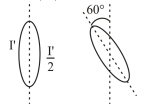
Two polarizers are oriented with their principal planes making an angle of $60^{\circ}$ with each other. The percentage of incident unpolarized light which passes through the system is: (in $\%$)
A
$50$
B
$100$
C
$12.5$
D
$37.5$
Solution
(C) Let the intensity of the incident unpolarized light be $I_0$.
When unpolarized light passes through the first polarizer,the intensity of the transmitted polarized light becomes $I_1 = \frac{I_0}{2}$.
According to Malus' Law,when this polarized light passes through the second polarizer whose principal plane is at an angle $\theta = 60^{\circ}$ to the first,the transmitted intensity $I_2$ is given by $I_2 = I_1 \cos^2 \theta$.
Substituting the values: $I_2 = \left(\frac{I_0}{2}\right) \cos^2 60^{\circ} = \left(\frac{I_0}{2}\right) \left(\frac{1}{2}\right)^2 = \frac{I_0}{2} \times \frac{1}{4} = \frac{I_0}{8}$.
The percentage of incident light that passes through the system is $\frac{I_2}{I_0} \times 100 = \frac{I_0/8}{I_0} \times 100 = \frac{100}{8} = 12.5 \%$.
When unpolarized light passes through the first polarizer,the intensity of the transmitted polarized light becomes $I_1 = \frac{I_0}{2}$.
According to Malus' Law,when this polarized light passes through the second polarizer whose principal plane is at an angle $\theta = 60^{\circ}$ to the first,the transmitted intensity $I_2$ is given by $I_2 = I_1 \cos^2 \theta$.
Substituting the values: $I_2 = \left(\frac{I_0}{2}\right) \cos^2 60^{\circ} = \left(\frac{I_0}{2}\right) \left(\frac{1}{2}\right)^2 = \frac{I_0}{2} \times \frac{1}{4} = \frac{I_0}{8}$.
The percentage of incident light that passes through the system is $\frac{I_2}{I_0} \times 100 = \frac{I_0/8}{I_0} \times 100 = \frac{100}{8} = 12.5 \%$.
0 likes
View Solution122
EasyMCQ
The tourmaline crystal:
A
absorbs ordinary light and transmits extraordinary light.
B
absorbs extraordinary light and transmits ordinary light.
C
absorbs both ordinary and extraordinary light.
D
transmits both ordinary and extraordinary light.
Solution
(A) tourmaline crystal is a dichroic material. When unpolarized light passes through it,the crystal selectively absorbs the ordinary ray (the component of light vibrating perpendicular to the optic axis) and transmits the extraordinary ray (the component of light vibrating parallel to the optic axis). Therefore,the light emerging from the crystal is plane-polarized.
0 likes
View Solution123
MediumMCQ
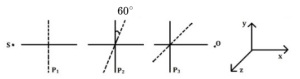
Three identical polaroids $P_1, P_2$ and $P_3$ are placed one after another. The pass axis of $P_2$ and $P_3$ are inclined at an angle of $60^{\circ}$ and $90^{\circ}$ with respect to the axis of $P_1$. The source has an intensity $I_0 = 256 \ W/m^2$. Find the intensity of light at point $O$. (in $W/m^2$)
A
$24$
B
$20$
C
$16$
D
$8$
Solution
(A) Let the initial intensity of unpolarized light be $I_0 = 256 \ W/m^2$.
When unpolarized light passes through the first polaroid $P_1$,the intensity of the transmitted light becomes $I_1 = I_0 / 2 = 256 / 2 = 128 \ W/m^2$.
The pass axis of $P_2$ is at an angle $\theta_1 = 60^{\circ}$ with respect to $P_1$. According to Malus' Law,the intensity after $P_2$ is $I_2 = I_1 \cos^2(\theta_1) = 128 \times \cos^2(60^{\circ}) = 128 \times (0.5)^2 = 128 \times 0.25 = 32 \ W/m^2$.
The pass axis of $P_3$ is at an angle of $90^{\circ}$ with respect to $P_1$. The angle between the pass axes of $P_2$ and $P_3$ is $\theta_2 = 90^{\circ} - 60^{\circ} = 30^{\circ}$.
Applying Malus' Law again for $P_3$,the final intensity at point $O$ is $I_3 = I_2 \cos^2(\theta_2) = 32 \times \cos^2(30^{\circ}) = 32 \times (\sqrt{3}/2)^2 = 32 \times (3/4) = 24 \ W/m^2$.
When unpolarized light passes through the first polaroid $P_1$,the intensity of the transmitted light becomes $I_1 = I_0 / 2 = 256 / 2 = 128 \ W/m^2$.
The pass axis of $P_2$ is at an angle $\theta_1 = 60^{\circ}$ with respect to $P_1$. According to Malus' Law,the intensity after $P_2$ is $I_2 = I_1 \cos^2(\theta_1) = 128 \times \cos^2(60^{\circ}) = 128 \times (0.5)^2 = 128 \times 0.25 = 32 \ W/m^2$.
The pass axis of $P_3$ is at an angle of $90^{\circ}$ with respect to $P_1$. The angle between the pass axes of $P_2$ and $P_3$ is $\theta_2 = 90^{\circ} - 60^{\circ} = 30^{\circ}$.
Applying Malus' Law again for $P_3$,the final intensity at point $O$ is $I_3 = I_2 \cos^2(\theta_2) = 32 \times \cos^2(30^{\circ}) = 32 \times (\sqrt{3}/2)^2 = 32 \times (3/4) = 24 \ W/m^2$.
0 likes
View Solution124
MediumMCQ
Four polaroids are placed such that the optic axis of each is inclined at an angle of $30^{\circ}$ with the optic axis of the preceding one. If unpolarised light of intensity $I_0$ falls on the first polaroid,the intensity of light transmitted from the fourth polaroid is $[\cos 30^{\circ} = \sqrt{3} / 2]$.
A
$\frac{9 I_0}{32}$
B
$\frac{27 I_0}{128}$
C
$\frac{35 I_0}{128}$
D
$\frac{27 I_0}{32}$
Solution
(B) When unpolarised light of intensity $I_0$ passes through the first polaroid,the intensity of the transmitted light is $I_1 = I_0 / 2$.
For subsequent polaroids,we use Malus' Law: $I_n = I_{n-1} \cos^2 \theta$,where $\theta = 30^{\circ}$.
Intensity after the second polaroid: $I_2 = I_1 \cos^2 30^{\circ} = (I_0 / 2) \times (\sqrt{3} / 2)^2 = (I_0 / 2) \times (3 / 4) = 3 I_0 / 8$.
Intensity after the third polaroid: $I_3 = I_2 \cos^2 30^{\circ} = (3 I_0 / 8) \times (3 / 4) = 9 I_0 / 32$.
Intensity after the fourth polaroid: $I_4 = I_3 \cos^2 30^{\circ} = (9 I_0 / 32) \times (3 / 4) = 27 I_0 / 128$.
Thus,the correct option is $B$.
For subsequent polaroids,we use Malus' Law: $I_n = I_{n-1} \cos^2 \theta$,where $\theta = 30^{\circ}$.
Intensity after the second polaroid: $I_2 = I_1 \cos^2 30^{\circ} = (I_0 / 2) \times (\sqrt{3} / 2)^2 = (I_0 / 2) \times (3 / 4) = 3 I_0 / 8$.
Intensity after the third polaroid: $I_3 = I_2 \cos^2 30^{\circ} = (3 I_0 / 8) \times (3 / 4) = 9 I_0 / 32$.
Intensity after the fourth polaroid: $I_4 = I_3 \cos^2 30^{\circ} = (9 I_0 / 32) \times (3 / 4) = 27 I_0 / 128$.
Thus,the correct option is $B$.
0 likes
View Solution125
MediumMCQ
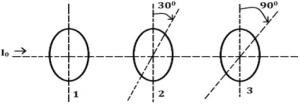
Three polarising sheets are placed co-axially. The pass axes of polaroids $2$ and $3$ make angles of $30^{\circ}$ and $90^{\circ}$ respectively with the pass axis of polaroid $1$. If $I_0$ is the intensity of unpolarised light entering sheet $1$,what is the intensity of the light emerging from sheet $3$? $(\cos 30^{\circ}=\sqrt{3} / 2, \cos 90^{\circ}=0, \cos 60^{\circ}=1 / 2)$
A
zero
B
$\frac{3 I_0}{32}$
C
$\frac{3 I_0}{8}$
D
$\frac{3 I_0}{16}$
Solution
(B) When unpolarised light of intensity $I_0$ passes through the first polaroid,the intensity of the emergent light is $I_1 = \frac{I_0}{2}$.
According to Malus' Law,the intensity of light emerging from a polaroid is $I = I_{incident} \cos^2 \theta$,where $\theta$ is the angle between the pass axis of the polaroid and the plane of polarisation of the incident light.
For the second polaroid,the angle between its pass axis and the pass axis of the first polaroid is $\theta_1 = 30^{\circ}$. Thus,the intensity of light emerging from the second polaroid is $I_2 = I_1 \cos^2 30^{\circ} = \left(\frac{I_0}{2}\right) \left(\frac{\sqrt{3}}{2}\right)^2 = \left(\frac{I_0}{2}\right) \left(\frac{3}{4}\right) = \frac{3 I_0}{8}$.
For the third polaroid,the angle between its pass axis and the pass axis of the second polaroid is $\theta_2 = 90^{\circ} - 30^{\circ} = 60^{\circ}$. Thus,the intensity of light emerging from the third polaroid is $I_3 = I_2 \cos^2 60^{\circ} = \left(\frac{3 I_0}{8}\right) \left(\frac{1}{2}\right)^2 = \left(\frac{3 I_0}{8}\right) \left(\frac{1}{4}\right) = \frac{3 I_0}{32}$.
According to Malus' Law,the intensity of light emerging from a polaroid is $I = I_{incident} \cos^2 \theta$,where $\theta$ is the angle between the pass axis of the polaroid and the plane of polarisation of the incident light.
For the second polaroid,the angle between its pass axis and the pass axis of the first polaroid is $\theta_1 = 30^{\circ}$. Thus,the intensity of light emerging from the second polaroid is $I_2 = I_1 \cos^2 30^{\circ} = \left(\frac{I_0}{2}\right) \left(\frac{\sqrt{3}}{2}\right)^2 = \left(\frac{I_0}{2}\right) \left(\frac{3}{4}\right) = \frac{3 I_0}{8}$.
For the third polaroid,the angle between its pass axis and the pass axis of the second polaroid is $\theta_2 = 90^{\circ} - 30^{\circ} = 60^{\circ}$. Thus,the intensity of light emerging from the third polaroid is $I_3 = I_2 \cos^2 60^{\circ} = \left(\frac{3 I_0}{8}\right) \left(\frac{1}{2}\right)^2 = \left(\frac{3 I_0}{8}\right) \left(\frac{1}{4}\right) = \frac{3 I_0}{32}$.
0 likes
View Solution126
MediumMCQ
Two polaroids are placed in the path of an unpolarised beam of intensity $I_0$ such that no light is emitted from the second polaroid. If a third polaroid,whose polarisation axis makes an angle $\theta$ with the polarisation axis of the first polaroid,is placed between these polaroids,then the intensity of light emerging from the last polaroid will be:
A
$\frac{I_0}{4}(\sin 2 \theta)^2$
B
$\frac{I_0}{8}(\sin 2 \theta)^2$
C
$\frac{I_0}{4} \sin ^2 \theta$
D
$\frac{I_0}{8} \sin ^2 \theta$
Solution
(B) $1$. When unpolarised light of intensity $I_0$ passes through the first polaroid,the intensity of the transmitted light becomes $I_1 = \frac{I_0}{2}$.
$2$. The first and second polaroids are crossed (angle between axes is $90^\circ$),so no light passes through the second polaroid initially.
$3$. $A$ third polaroid is placed between them at an angle $\theta$ with the first polaroid. The angle between the third and the second polaroid is $(90^\circ - \theta)$.
$4$. Intensity after the third polaroid: $I_2 = I_1 \cos^2 \theta = \frac{I_0}{2} \cos^2 \theta$.
$5$. Intensity after the second (last) polaroid using Malus' Law: $I_3 = I_2 \cos^2(90^\circ - \theta) = I_2 \sin^2 \theta$.
$6$. Substituting $I_2$: $I_3 = (\frac{I_0}{2} \cos^2 \theta) \sin^2 \theta = \frac{I_0}{2} (\sin \theta \cos \theta)^2 = \frac{I_0}{2} (\frac{\sin 2 \theta}{2})^2 = \frac{I_0}{8} \sin^2 2 \theta$.
$2$. The first and second polaroids are crossed (angle between axes is $90^\circ$),so no light passes through the second polaroid initially.
$3$. $A$ third polaroid is placed between them at an angle $\theta$ with the first polaroid. The angle between the third and the second polaroid is $(90^\circ - \theta)$.
$4$. Intensity after the third polaroid: $I_2 = I_1 \cos^2 \theta = \frac{I_0}{2} \cos^2 \theta$.
$5$. Intensity after the second (last) polaroid using Malus' Law: $I_3 = I_2 \cos^2(90^\circ - \theta) = I_2 \sin^2 \theta$.
$6$. Substituting $I_2$: $I_3 = (\frac{I_0}{2} \cos^2 \theta) \sin^2 \theta = \frac{I_0}{2} (\sin \theta \cos \theta)^2 = \frac{I_0}{2} (\frac{\sin 2 \theta}{2})^2 = \frac{I_0}{8} \sin^2 2 \theta$.
0 likes
View Solution127
MediumMCQ
Two polaroids are oriented with their planes perpendicular to incident light and transmission axis making an angle $30^{\circ}$ with each other. What fraction of incident unpolarised light is transmitted (in $\%$)? $(\cos 30^{\circ} = \sqrt{3} / 2)$
A
$57.5$
B
$17.5$
C
$27.5$
D
$37.5$
Solution
(D) When unpolarised light of intensity $I_0$ passes through the first polaroid,the intensity of the transmitted light becomes $I_1 = I_0 / 2$.
This light is now plane-polarised.
When this light passes through the second polaroid whose transmission axis makes an angle $\theta = 30^{\circ}$ with the first,the intensity of the transmitted light $I_2$ is given by Malus' Law: $I_2 = I_1 \cos^2 \theta$.
Substituting the values: $I_2 = (I_0 / 2) \cos^2 30^{\circ}$.
Since $\cos 30^{\circ} = \sqrt{3} / 2$,we have $\cos^2 30^{\circ} = 3 / 4$.
Therefore,$I_2 = (I_0 / 2) \times (3 / 4) = 3 I_0 / 8$.
Calculating the fraction: $3 / 8 = 0.375$,which is $37.5 \%$.
This light is now plane-polarised.
When this light passes through the second polaroid whose transmission axis makes an angle $\theta = 30^{\circ}$ with the first,the intensity of the transmitted light $I_2$ is given by Malus' Law: $I_2 = I_1 \cos^2 \theta$.
Substituting the values: $I_2 = (I_0 / 2) \cos^2 30^{\circ}$.
Since $\cos 30^{\circ} = \sqrt{3} / 2$,we have $\cos^2 30^{\circ} = 3 / 4$.
Therefore,$I_2 = (I_0 / 2) \times (3 / 4) = 3 I_0 / 8$.
Calculating the fraction: $3 / 8 = 0.375$,which is $37.5 \%$.
0 likes
View Solution128
MediumMCQ
$A$ beam of light of intensity $I_0$ falls on a system of three polaroids which are arranged in succession such that the pass (transmission) axis is turned through $60^{\circ}$ with respect to the preceding one. The fraction of the incident light intensity that passes through the system is $\left(\cos 60^{\circ} = 1/2\right)$.
A
$1/8$
B
$1/32$
C
$1/16$
D
$1/2$
Solution
(B) Let the intensity of the incident light be $I_0$.
When light passes through the first polaroid,its intensity becomes $I_1 = I_0/2$ (assuming unpolarized light).
For the second polaroid,the angle between the transmission axis and the incident light is $\theta = 60^{\circ}$. According to Malus' Law,$I_2 = I_1 \cos^2(60^{\circ}) = (I_0/2) \times (1/2)^2 = I_0/8$.
For the third polaroid,the angle between its transmission axis and the second polaroid's axis is also $\theta = 60^{\circ}$.
Thus,$I_3 = I_2 \cos^2(60^{\circ}) = (I_0/8) \times (1/2)^2 = I_0/32$.
The fraction of the incident light intensity that passes through the system is $I_3/I_0 = 1/32$.
When light passes through the first polaroid,its intensity becomes $I_1 = I_0/2$ (assuming unpolarized light).
For the second polaroid,the angle between the transmission axis and the incident light is $\theta = 60^{\circ}$. According to Malus' Law,$I_2 = I_1 \cos^2(60^{\circ}) = (I_0/2) \times (1/2)^2 = I_0/8$.
For the third polaroid,the angle between its transmission axis and the second polaroid's axis is also $\theta = 60^{\circ}$.
Thus,$I_3 = I_2 \cos^2(60^{\circ}) = (I_0/8) \times (1/2)^2 = I_0/32$.
The fraction of the incident light intensity that passes through the system is $I_3/I_0 = 1/32$.
0 likes
View Solution129
EasyMCQ
Three identical polaroids $P_1, P_2$ and $P_3$ are placed one after another. The pass axis of $P_2$ and $P_3$ are inclined at an angle $60^{\circ}$ and $90^{\circ}$ with respect to the axis of $P_1$. The source has an intensity $I_0$. What is the intensity of transmitted light through $P_3$? $\left(\cos 60^{\circ}=0.5, \cos 30^{\circ}=\frac{\sqrt{3}}{2}\right)$
A
$\frac{I_0}{8}$
B
$\frac{3 I_0}{16}$
C
$\frac{3 I_0}{32}$
D
$\frac{I_0}{32}$
Solution
(C) According to Malus' law,the intensity of light transmitted through a polarizer is $I = I_{in} \cos^2 \theta$,where $\theta$ is the angle between the polarization direction of incident light and the pass axis of the polarizer.
$1$. When unpolarized light of intensity $I_0$ passes through the first polaroid $P_1$,the intensity of the transmitted light is $I_1 = \frac{I_0}{2}$.
$2$. The light from $P_1$ is now polarized at an angle $0^{\circ}$ relative to $P_1$'s axis. $P_2$ is at $60^{\circ}$ to $P_1$. Thus,the intensity after $P_2$ is:
$I_2 = I_1 \cos^2(60^{\circ}) = \frac{I_0}{2} \times (0.5)^2 = \frac{I_0}{2} \times \frac{1}{4} = \frac{I_0}{8}$.
$3$. The light from $P_2$ is polarized at $60^{\circ}$ relative to $P_1$. $P_3$ is at $90^{\circ}$ relative to $P_1$. The angle between the polarization of light from $P_2$ and the pass axis of $P_3$ is $\theta = 90^{\circ} - 60^{\circ} = 30^{\circ}$.
$4$. The intensity after $P_3$ is:
$I_3 = I_2 \cos^2(30^{\circ}) = \frac{I_0}{8} \times \left(\frac{\sqrt{3}}{2}\right)^2 = \frac{I_0}{8} \times \frac{3}{4} = \frac{3 I_0}{32}$.
$1$. When unpolarized light of intensity $I_0$ passes through the first polaroid $P_1$,the intensity of the transmitted light is $I_1 = \frac{I_0}{2}$.
$2$. The light from $P_1$ is now polarized at an angle $0^{\circ}$ relative to $P_1$'s axis. $P_2$ is at $60^{\circ}$ to $P_1$. Thus,the intensity after $P_2$ is:
$I_2 = I_1 \cos^2(60^{\circ}) = \frac{I_0}{2} \times (0.5)^2 = \frac{I_0}{2} \times \frac{1}{4} = \frac{I_0}{8}$.
$3$. The light from $P_2$ is polarized at $60^{\circ}$ relative to $P_1$. $P_3$ is at $90^{\circ}$ relative to $P_1$. The angle between the polarization of light from $P_2$ and the pass axis of $P_3$ is $\theta = 90^{\circ} - 60^{\circ} = 30^{\circ}$.
$4$. The intensity after $P_3$ is:
$I_3 = I_2 \cos^2(30^{\circ}) = \frac{I_0}{8} \times \left(\frac{\sqrt{3}}{2}\right)^2 = \frac{I_0}{8} \times \frac{3}{4} = \frac{3 I_0}{32}$.
0 likes
View Solution130
MediumMCQ
$A$ beam of unpolarized light passes through a tourmaline crystal $A$ and then it passes through a second tourmaline crystal $B$ oriented so that its principal plane is parallel to that of $A$. The intensity of emergent light is $I_0$. Now $B$ is rotated by $45^{\circ}$ about the ray. The emergent light will have intensity $(\cos 45^{\circ} = \frac{1}{\sqrt{2}})$.
A
$\frac{I_0}{2}$
B
$\frac{I_0}{\sqrt{2}}$
C
$\frac{\sqrt{2}}{I_0}$
D
$\frac{2}{I_0}$
Solution
(A) According to Malus' Law,the intensity of light transmitted through a polarizer is given by $I = I_{max} \cos^2 \theta$,where $\theta$ is the angle between the transmission axes of the two polarizers.
Initially,the principal planes are parallel,so $\theta = 0^{\circ}$ and the intensity is $I_0 = I_{max}$.
When crystal $B$ is rotated by $45^{\circ}$,the new angle between the transmission axes becomes $\theta = 45^{\circ}$.
Substituting the values into the formula:
$I = I_0 \cos^2(45^{\circ})$
$I = I_0 \left(\frac{1}{\sqrt{2}}\right)^2$
$I = I_0 \left(\frac{1}{2}\right) = \frac{I_0}{2}$.
Initially,the principal planes are parallel,so $\theta = 0^{\circ}$ and the intensity is $I_0 = I_{max}$.
When crystal $B$ is rotated by $45^{\circ}$,the new angle between the transmission axes becomes $\theta = 45^{\circ}$.
Substituting the values into the formula:
$I = I_0 \cos^2(45^{\circ})$
$I = I_0 \left(\frac{1}{\sqrt{2}}\right)^2$
$I = I_0 \left(\frac{1}{2}\right) = \frac{I_0}{2}$.
0 likes
View Solution131
EasyMCQ
When unpolarised light is passed through crossed polaroids, then light passing through the first polaroid:
A
also passes through the second polaroid.
B
partially passes through the second polaroid.
C
is blocked by the second polaroid.
D
passes with greater intensity.
Solution
(C) When unpolarised light passes through the first polaroid, it becomes linearly polarised with intensity $I_0 = I_{in} / 2$.
When this polarised light hits the second polaroid, the intensity transmitted is given by Malus' Law: $I = I_0 \cos^2 \theta$.
Since the polaroids are crossed, the angle between their transmission axes is $\theta = 90^{\circ}$.
Substituting this value, we get $I = I_0 \cos^2(90^{\circ}) = I_0 \times 0 = 0$.
Therefore, the light is completely blocked by the second polaroid.
When this polarised light hits the second polaroid, the intensity transmitted is given by Malus' Law: $I = I_0 \cos^2 \theta$.
Since the polaroids are crossed, the angle between their transmission axes is $\theta = 90^{\circ}$.
Substituting this value, we get $I = I_0 \cos^2(90^{\circ}) = I_0 \times 0 = 0$.
Therefore, the light is completely blocked by the second polaroid.
0 likes
View Solution132
EasyMCQ
When an unpolarized light of intensity $I_{0}$ is incident on a polarizing sheet, the intensity of the light which does not get transmitted is
A
$\frac{1}{2} I_{0}$
B
$\frac{1}{4} I_{0}$
C
zero
D
$I_{0}$
Solution
(A) When unpolarized light of intensity $I_{0}$ is incident on a polarizing sheet, the intensity of the transmitted light is given by $I_{t} = \frac{I_{0}}{2}$.
Since the total incident intensity is $I_{0}$ and the transmitted intensity is $\frac{I_{0}}{2}$, the intensity of the light that does not get transmitted is the difference between the incident and transmitted intensities.
Intensity of untransmitted light = $I_{0} - I_{t} = I_{0} - \frac{I_{0}}{2} = \frac{I_{0}}{2}$.
Since the total incident intensity is $I_{0}$ and the transmitted intensity is $\frac{I_{0}}{2}$, the intensity of the light that does not get transmitted is the difference between the incident and transmitted intensities.
Intensity of untransmitted light = $I_{0} - I_{t} = I_{0} - \frac{I_{0}}{2} = \frac{I_{0}}{2}$.
0 likes
View Solution133
EasyMCQ
$A$ plane polarized light is incident normally on a tourmaline plate. Its $\vec{E}$ vectors make an angle of $60^{\circ}$ with the optic axis of the plate. Find the percentage difference between initial and final intensities. (in $\%$)
A
$50$
B
$25$
C
$75$
D
$90$
Solution
(C) Let the initial intensity of the light be $I_{0}$.
According to Malus's Law,the final intensity $I$ of the light after passing through the tourmaline plate is given by:
$I = I_{0} \cos^{2} \theta$
Given that the angle $\theta = 60^{\circ}$,we have:
$I = I_{0} \cos^{2} 60^{\circ} = I_{0} \left(\frac{1}{2}\right)^{2} = \frac{I_{0}}{4}$
The percentage difference between the initial and final intensities is calculated as:
$\text{Percentage Difference} = \left(\frac{I_{0} - I}{I_{0}}\right) \times 100$
Substituting the value of $I$:
$\text{Percentage Difference} = \left(\frac{I_{0} - \frac{I_{0}}{4}}{I_{0}}\right) \times 100 = \left(\frac{\frac{3I_{0}}{4}}{I_{0}}\right) \times 100 = \frac{3}{4} \times 100 = 75 \%$
According to Malus's Law,the final intensity $I$ of the light after passing through the tourmaline plate is given by:
$I = I_{0} \cos^{2} \theta$
Given that the angle $\theta = 60^{\circ}$,we have:
$I = I_{0} \cos^{2} 60^{\circ} = I_{0} \left(\frac{1}{2}\right)^{2} = \frac{I_{0}}{4}$
The percentage difference between the initial and final intensities is calculated as:
$\text{Percentage Difference} = \left(\frac{I_{0} - I}{I_{0}}\right) \times 100$
Substituting the value of $I$:
$\text{Percentage Difference} = \left(\frac{I_{0} - \frac{I_{0}}{4}}{I_{0}}\right) \times 100 = \left(\frac{\frac{3I_{0}}{4}}{I_{0}}\right) \times 100 = \frac{3}{4} \times 100 = 75 \%$
0 likes
View Solution134
EasyMCQ
The intensity of incident unpolarized light on a polaroid is $I_1$ and the intensity of emergent polarized light from this polaroid is $I_2$. The relation between $I_1$ and $I_2$ is $.......$
A
$I_1 > I_2$
B
$I_1 = I_2$
C
$I_1 < I_2$
D
$I_1 = 2I_2$
Solution
(D) When unpolarized light of intensity $I_1$ is incident on a polaroid,the intensity of the emergent polarized light $I_2$ is given by Malus's Law for unpolarized light.
According to the law,the intensity of light transmitted through a polarizer is half the intensity of the incident unpolarized light.
Therefore,$I_2 = \frac{I_1}{2}$.
Rearranging this equation,we get $I_1 = 2I_2$.
According to the law,the intensity of light transmitted through a polarizer is half the intensity of the incident unpolarized light.
Therefore,$I_2 = \frac{I_1}{2}$.
Rearranging this equation,we get $I_1 = 2I_2$.
0 likes
View Solution135
EasyMCQ
$A$ polarized light of intensity $I_{0}$ is passed through another polarizer whose pass axis makes an angle of $60^{\circ}$ with the pass axis of the former. What is the intensity of emergent polarized light from the second polarizer?
A
$I = I_{0}$
B
$I = I_{0} / 6$
C
$I = I_{0} / 5$
D
$I = I_{0} / 4$
Solution
(D) According to Malus's Law,the intensity of the emergent light is given by:
$I = I_{0} \cos^{2} \theta$
where $I$ is the intensity of the emergent polarized light,$I_{0}$ is the intensity of the incident polarized light,and $\theta$ is the angle between the pass axes of the two polarizers.
Given that $\theta = 60^{\circ}$,we substitute this value into the formula:
$I = I_{0} \cos^{2}(60^{\circ})$
Since $\cos(60^{\circ}) = 1/2$,we have:
$I = I_{0} \times (1/2)^{2}$
$I = I_{0} \times (1/4)$
$I = I_{0} / 4$
Thus,the intensity of the emergent polarized light from the second polarizer is $I_{0} / 4$.
$I = I_{0} \cos^{2} \theta$
where $I$ is the intensity of the emergent polarized light,$I_{0}$ is the intensity of the incident polarized light,and $\theta$ is the angle between the pass axes of the two polarizers.
Given that $\theta = 60^{\circ}$,we substitute this value into the formula:
$I = I_{0} \cos^{2}(60^{\circ})$
Since $\cos(60^{\circ}) = 1/2$,we have:
$I = I_{0} \times (1/2)^{2}$
$I = I_{0} \times (1/4)$
$I = I_{0} / 4$
Thus,the intensity of the emergent polarized light from the second polarizer is $I_{0} / 4$.
0 likes
View Solution136
MediumMCQ
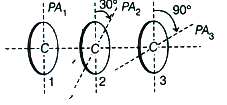
Three polaroid sheets are co-axially placed as indicated in the diagram. Pass axes of the polaroids $2$ and $3$ make $30^{\circ}$ and $90^{\circ}$ with the pass axis of polaroid sheet $1$. If $I_0$ is the intensity of the incident unpolarised light entering sheet $1$,the intensity of the emergent light through sheet $3$ is
A
zero
B
$\frac{3 I_0}{32}$
C
$\frac{3 I_0}{8}$
D
$\frac{3 I_0}{16}$
Solution
(B) When unpolarised light of intensity $I_0$ passes through the first polaroid,the intensity of the transmitted light is $I_1 = \frac{I_0}{2}$.
The angle between the pass axes of the first and second polaroid is $\theta_{12} = 30^{\circ}$. According to Malus' Law,the intensity of light transmitted through the second polaroid is $I_2 = I_1 \cos^2(30^{\circ}) = \frac{I_0}{2} \times (\frac{\sqrt{3}}{2})^2 = \frac{I_0}{2} \times \frac{3}{4} = \frac{3 I_0}{8}$.
The angle between the pass axes of the second and third polaroid is $\theta_{23} = 90^{\circ} - 30^{\circ} = 60^{\circ}$.
According to Malus' Law,the intensity of light transmitted through the third polaroid is $I_3 = I_2 \cos^2(60^{\circ}) = \frac{3 I_0}{8} \times (\frac{1}{2})^2 = \frac{3 I_0}{8} \times \frac{1}{4} = \frac{3 I_0}{32}$.
The angle between the pass axes of the first and second polaroid is $\theta_{12} = 30^{\circ}$. According to Malus' Law,the intensity of light transmitted through the second polaroid is $I_2 = I_1 \cos^2(30^{\circ}) = \frac{I_0}{2} \times (\frac{\sqrt{3}}{2})^2 = \frac{I_0}{2} \times \frac{3}{4} = \frac{3 I_0}{8}$.
The angle between the pass axes of the second and third polaroid is $\theta_{23} = 90^{\circ} - 30^{\circ} = 60^{\circ}$.
According to Malus' Law,the intensity of light transmitted through the third polaroid is $I_3 = I_2 \cos^2(60^{\circ}) = \frac{3 I_0}{8} \times (\frac{1}{2})^2 = \frac{3 I_0}{8} \times \frac{1}{4} = \frac{3 I_0}{32}$.
0 likes
View Solution137
EasyMCQ
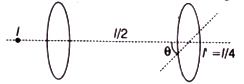
An unpolarised light of intensity $I$ is passed through two polaroids kept one after the other with their planes parallel to each other. The intensity of light emerging from the second polaroid is $\frac{I}{4}$. The angle between the pass axes of the polaroids is (in $^{\circ}$)
A
$45$
B
$0$
C
$60$
D
$30$
Solution
(A) When unpolarised light of intensity $I$ passes through the first polaroid,its intensity becomes $\frac{I}{2}$.
According to Malus' Law,the intensity $I^{\prime}$ of light emerging from the second polaroid is given by:
$I^{\prime} = I_{0} \cos^2 \theta$
where $I_{0} = \frac{I}{2}$ is the intensity of light incident on the second polaroid and $\theta$ is the angle between the pass axes.
Given $I^{\prime} = \frac{I}{4}$,we have:
$\frac{I}{4} = \frac{I}{2} \cos^2 \theta$
$\cos^2 \theta = \frac{1}{2}$
$\cos \theta = \frac{1}{\sqrt{2}}$
$\theta = 45^{\circ}$
According to Malus' Law,the intensity $I^{\prime}$ of light emerging from the second polaroid is given by:
$I^{\prime} = I_{0} \cos^2 \theta$
where $I_{0} = \frac{I}{2}$ is the intensity of light incident on the second polaroid and $\theta$ is the angle between the pass axes.
Given $I^{\prime} = \frac{I}{4}$,we have:
$\frac{I}{4} = \frac{I}{2} \cos^2 \theta$
$\cos^2 \theta = \frac{1}{2}$
$\cos \theta = \frac{1}{\sqrt{2}}$
$\theta = 45^{\circ}$
0 likes
View Solution138
EasyMCQ
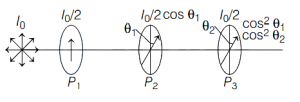
Three polaroid sheets $P_{1}, P_{2}$ and $P_{3}$ are kept parallel to each other such that the angle between pass axes of $P_{1}$ and $P_{2}$ is $45^{\circ}$ and that between $P_{2}$ and $P_{3}$ is $45^{\circ}$. If an unpolarised beam of light of intensity $128 \ Wm^{-2}$ is incident on $P_{1}$,what is the intensity of light coming out of $P_{3}$?
A
$128 \ Wm^{-2}$
B
zero
C
$16 \ Wm^{-2}$
D
$64 \ Wm^{-2}$
Solution
(C) When unpolarised light of intensity $I_{0}$ passes through the first polaroid $P_{1}$,the intensity of the transmitted light becomes $I_{1} = \frac{I_{0}}{2}$.
Given $I_{0} = 128 \ Wm^{-2}$,so $I_{1} = \frac{128}{2} = 64 \ Wm^{-2}$.
According to Malus's law,when light of intensity $I_{1}$ passes through a polaroid whose pass axis makes an angle $\theta$ with the incident light's polarization direction,the transmitted intensity is $I = I_{1} \cos^{2} \theta$.
For $P_{2}$,the angle between the pass axis of $P_{1}$ and $P_{2}$ is $\theta_{1} = 45^{\circ}$.
Intensity after $P_{2}$ is $I_{2} = I_{1} \cos^{2} 45^{\circ} = 64 \times (\frac{1}{\sqrt{2}})^{2} = 64 \times \frac{1}{2} = 32 \ Wm^{-2}$.
For $P_{3}$,the angle between the pass axis of $P_{2}$ and $P_{3}$ is $\theta_{2} = 45^{\circ}$.
Intensity after $P_{3}$ is $I_{3} = I_{2} \cos^{2} 45^{\circ} = 32 \times (\frac{1}{\sqrt{2}})^{2} = 32 \times \frac{1}{2} = 16 \ Wm^{-2}$.
Given $I_{0} = 128 \ Wm^{-2}$,so $I_{1} = \frac{128}{2} = 64 \ Wm^{-2}$.
According to Malus's law,when light of intensity $I_{1}$ passes through a polaroid whose pass axis makes an angle $\theta$ with the incident light's polarization direction,the transmitted intensity is $I = I_{1} \cos^{2} \theta$.
For $P_{2}$,the angle between the pass axis of $P_{1}$ and $P_{2}$ is $\theta_{1} = 45^{\circ}$.
Intensity after $P_{2}$ is $I_{2} = I_{1} \cos^{2} 45^{\circ} = 64 \times (\frac{1}{\sqrt{2}})^{2} = 64 \times \frac{1}{2} = 32 \ Wm^{-2}$.
For $P_{3}$,the angle between the pass axis of $P_{2}$ and $P_{3}$ is $\theta_{2} = 45^{\circ}$.
Intensity after $P_{3}$ is $I_{3} = I_{2} \cos^{2} 45^{\circ} = 32 \times (\frac{1}{\sqrt{2}})^{2} = 32 \times \frac{1}{2} = 16 \ Wm^{-2}$.
0 likes
View Solution139
MediumMCQ
In a system of two crossed polarisers,it is found that the intensity of light from the second polariser is half of that from the first polariser. The angle between their pass axes is (in $^{\circ}$)
A
$45$
B
$60$
C
$30$
D
$0$
Solution
(A) According to Malus's Law,the intensity of light transmitted through a polariser is given by:
$I = I_{0} \cos^{2} \theta$
Where $I_{0}$ is the intensity of light incident on the second polariser (which is the intensity of light emerging from the first polariser),and $\theta$ is the angle between the pass axes of the two polarisers.
Given that the intensity of light from the second polariser $(I)$ is half of the intensity from the first polariser $(I_{0})$,we have:
$I = \frac{I_{0}}{2}$
Substituting this into Malus's Law:
$\frac{I_{0}}{2} = I_{0} \cos^{2} \theta$
$\frac{1}{2} = \cos^{2} \theta$
$\cos \theta = \frac{1}{\sqrt{2}}$
$\theta = \cos^{-1}\left(\frac{1}{\sqrt{2}}\right) = 45^{\circ}$
Therefore,the angle between the pass axes of the polarisers is $45^{\circ}$.
$I = I_{0} \cos^{2} \theta$
Where $I_{0}$ is the intensity of light incident on the second polariser (which is the intensity of light emerging from the first polariser),and $\theta$ is the angle between the pass axes of the two polarisers.
Given that the intensity of light from the second polariser $(I)$ is half of the intensity from the first polariser $(I_{0})$,we have:
$I = \frac{I_{0}}{2}$
Substituting this into Malus's Law:
$\frac{I_{0}}{2} = I_{0} \cos^{2} \theta$
$\frac{1}{2} = \cos^{2} \theta$
$\cos \theta = \frac{1}{\sqrt{2}}$
$\theta = \cos^{-1}\left(\frac{1}{\sqrt{2}}\right) = 45^{\circ}$
Therefore,the angle between the pass axes of the polarisers is $45^{\circ}$.
0 likes
View Solution140
MediumMCQ
$A$ cylindrical tube of length $0.2 \,m$ and radius $R$ with sugar solution of concentration $C$ produces a rotation of $\theta$ in the plane of vibration of a plane-polarized light. The same sugar solution is transferred to another tube of length $0.3 \,m$ of the same radius. The remaining gap is filled by distilled water. Now, the optical rotation produced is:
A
$\theta$
B
$2 \frac{\theta}{3}$
C
$3 \frac{\theta}{2}$
D
$9 \frac{\theta}{4}$
Solution
(A) The optical rotation $\theta$ produced by a sugar solution is given by the formula: $\theta = S \cdot l \cdot C$, where $S$ is the specific rotation, $l$ is the length of the tube, and $C$ is the concentration of the solution.
In the first case, $\theta = S \cdot l \cdot C$, where $l = 0.2 \,m$ and $C = \frac{m}{V}$, where $m$ is the mass of sugar and $V$ is the volume of the tube $(V = \pi R^2 l)$.
Thus, $\theta = S \cdot l \cdot \frac{m}{\pi R^2 l} = \frac{S \cdot m}{\pi R^2}$.
In the second case, the same amount of sugar $m$ is placed in a tube of length $l_1 = 0.3 \,m$ with the same radius $R$. The volume of the new tube is $V_1 = \pi R^2 l_1 = \pi R^2 (0.3)$.
The concentration of the solution in the second case is $C_1 = \frac{m}{V_1} = \frac{m}{\pi R^2 (0.3)}$.
The new rotation $\theta_1$ is given by $\theta_1 = S \cdot l_1 \cdot C_1 = S \cdot (0.3) \cdot \frac{m}{\pi R^2 (0.3)} = \frac{S \cdot m}{\pi R^2}$.
Comparing the two expressions, we find $\theta_1 = \theta$.
In the first case, $\theta = S \cdot l \cdot C$, where $l = 0.2 \,m$ and $C = \frac{m}{V}$, where $m$ is the mass of sugar and $V$ is the volume of the tube $(V = \pi R^2 l)$.
Thus, $\theta = S \cdot l \cdot \frac{m}{\pi R^2 l} = \frac{S \cdot m}{\pi R^2}$.
In the second case, the same amount of sugar $m$ is placed in a tube of length $l_1 = 0.3 \,m$ with the same radius $R$. The volume of the new tube is $V_1 = \pi R^2 l_1 = \pi R^2 (0.3)$.
The concentration of the solution in the second case is $C_1 = \frac{m}{V_1} = \frac{m}{\pi R^2 (0.3)}$.
The new rotation $\theta_1$ is given by $\theta_1 = S \cdot l_1 \cdot C_1 = S \cdot (0.3) \cdot \frac{m}{\pi R^2 (0.3)} = \frac{S \cdot m}{\pi R^2}$.
Comparing the two expressions, we find $\theta_1 = \theta$.
0 likes
View Solution141
EasyMCQ
The phenomenon of polarization shows that light has ......... nature.
A
dual
B
particle
C
transverse
D
longitudinal
Solution
(C) The phenomenon of polarization is a characteristic property of transverse waves. Longitudinal waves,such as sound waves,cannot be polarized because their oscillations occur along the direction of propagation. Since light can be polarized,it confirms that light waves are transverse in nature.
0 likes
View Solution142
EasyMCQ
An unpolarised beam of intensity $I_{0}$ falls on a polaroid. The intensity of the emergent light is
A
$\frac{I_{0}}{2}$
B
$I_{0}$
C
$\frac{I_{0}}{4}$
D
Zero
Solution
(A) When an unpolarised light beam of intensity $I_{0}$ passes through a polaroid,it becomes plane-polarised.
According to the properties of polaroids,the intensity of the emergent plane-polarised light is exactly half of the intensity of the incident unpolarised light.
Therefore,the intensity of the emergent light is $I = \frac{I_{0}}{2}$.
According to the properties of polaroids,the intensity of the emergent plane-polarised light is exactly half of the intensity of the incident unpolarised light.
Therefore,the intensity of the emergent light is $I = \frac{I_{0}}{2}$.
0 likes
View Solution143
EasyMCQ
Which of the following is a dichroic crystal?
A
Quartz
B
Tourmaline
C
Mica
D
Selenite
Solution
(B) dichroic crystal is a material that exhibits the property of dichroism,which is the selective absorption of light based on its polarization direction.
Some crystals,such as tourmaline,have the property of strongly absorbing light with vibrations perpendicular to a specific direction (called the transmission axis) while transmitting light with vibrations parallel to it.
This selective absorption of light is known as dichroism.
Therefore,tourmaline is a well-known example of a dichroic crystal.
Some crystals,such as tourmaline,have the property of strongly absorbing light with vibrations perpendicular to a specific direction (called the transmission axis) while transmitting light with vibrations parallel to it.
This selective absorption of light is known as dichroism.
Therefore,tourmaline is a well-known example of a dichroic crystal.
0 likes
View Solution144
DifficultMCQ
$A$ $20 \ cm$ length of a certain solution causes right-handed rotation of $38^{\circ}$. $A$ $30 \ cm$ length of another solution causes left-handed rotation of $24^{\circ}$. The optical rotation caused by a $30 \ cm$ length of a mixture of the above solutions in the volume ratio $1:2$ is
A
left-handed rotation of $14^{\circ}$
B
right-handed rotation of $14^{\circ}$
C
left-handed rotation of $3^{\circ}$
D
right-handed rotation of $3^{\circ}$
Solution
(D) For solution $A$: $L_{1} = 20 \ cm$,$\theta_{1} = +38^{\circ}$. Let concentration be $C_{1}$. The specific rotation is $\alpha_{1} = \frac{\theta_{1}}{L_{1} C_{1}} = \frac{38^{\circ}}{20 C_{1}}$.
For solution $B$: $L_{2} = 30 \ cm$,$\theta_{2} = -24^{\circ}$ (left-handed). Let concentration be $C_{2}$. The specific rotation is $\alpha_{2} = \frac{\theta_{2}}{L_{2} C_{2}} = \frac{-24^{\circ}}{30 C_{2}}$.
In the mixture,the volume ratio is $1:2$. Thus,the new concentrations are $C_{1}' = \frac{C_{1}}{3}$ and $C_{2}' = \frac{2C_{2}}{3}$.
The total optical rotation $\theta$ for a path length $l = 30 \ cm$ is given by $\theta = (\alpha_{1} C_{1}' + \alpha_{2} C_{2}') l$.
Substituting the values: $\theta = \left( \frac{38^{\circ}}{20 C_{1}} \cdot \frac{C_{1}}{3} + \frac{-24^{\circ}}{30 C_{2}} \cdot \frac{2 C_{2}}{3} \right) \times 30$.
$\theta = \left( \frac{38^{\circ}}{60} - \frac{48^{\circ}}{90} \right) \times 30 = \left( \frac{19^{\circ}}{30} - \frac{16^{\circ}}{30} \right) \times 30 = 19^{\circ} - 16^{\circ} = +3^{\circ}$.
Since the result is positive,it is a right-handed rotation of $3^{\circ}$.
For solution $B$: $L_{2} = 30 \ cm$,$\theta_{2} = -24^{\circ}$ (left-handed). Let concentration be $C_{2}$. The specific rotation is $\alpha_{2} = \frac{\theta_{2}}{L_{2} C_{2}} = \frac{-24^{\circ}}{30 C_{2}}$.
In the mixture,the volume ratio is $1:2$. Thus,the new concentrations are $C_{1}' = \frac{C_{1}}{3}$ and $C_{2}' = \frac{2C_{2}}{3}$.
The total optical rotation $\theta$ for a path length $l = 30 \ cm$ is given by $\theta = (\alpha_{1} C_{1}' + \alpha_{2} C_{2}') l$.
Substituting the values: $\theta = \left( \frac{38^{\circ}}{20 C_{1}} \cdot \frac{C_{1}}{3} + \frac{-24^{\circ}}{30 C_{2}} \cdot \frac{2 C_{2}}{3} \right) \times 30$.
$\theta = \left( \frac{38^{\circ}}{60} - \frac{48^{\circ}}{90} \right) \times 30 = \left( \frac{19^{\circ}}{30} - \frac{16^{\circ}}{30} \right) \times 30 = 19^{\circ} - 16^{\circ} = +3^{\circ}$.
Since the result is positive,it is a right-handed rotation of $3^{\circ}$.
0 likes
View Solution145
MediumMCQ
An unpolarised beam of light is incident on a group of three polarising sheets arranged such that the angle between the axes of any two adjacent sheets is $30^{\circ}$. The ratio of the intensities of polarised light emerging from the second and third sheets is
A
$1: 1$
B
$2: 1$
C
$4: 3$
D
$3: 2$
Solution
(C) Let the intensity of the unpolarised incident light be $I_0$.
After passing through the first polariser, the intensity becomes $I_1 = I_0 / 2$.
According to Malus' Law, the intensity of light emerging from a polariser is $I = I_{in} \cos^2 \theta$, where $\theta$ is the angle between the incident light's polarisation axis and the polariser's axis.
For the second sheet, the angle between the first and second sheet is $\theta = 30^{\circ}$. Thus, $I_2 = I_1 \cos^2(30^{\circ}) = (I_0 / 2) \times (\sqrt{3} / 2)^2 = (I_0 / 2) \times (3 / 4) = 3I_0 / 8$.
For the third sheet, the angle between the second and third sheet is also $\theta = 30^{\circ}$. Thus, $I_3 = I_2 \cos^2(30^{\circ}) = (3I_0 / 8) \times (3 / 4) = 9I_0 / 32$.
The ratio of intensities emerging from the second and third sheets is $I_2 / I_3 = (3I_0 / 8) / (9I_0 / 32) = (3 / 8) \times (32 / 9) = 4 / 3$.
Therefore, the ratio is $4: 3$.
After passing through the first polariser, the intensity becomes $I_1 = I_0 / 2$.
According to Malus' Law, the intensity of light emerging from a polariser is $I = I_{in} \cos^2 \theta$, where $\theta$ is the angle between the incident light's polarisation axis and the polariser's axis.
For the second sheet, the angle between the first and second sheet is $\theta = 30^{\circ}$. Thus, $I_2 = I_1 \cos^2(30^{\circ}) = (I_0 / 2) \times (\sqrt{3} / 2)^2 = (I_0 / 2) \times (3 / 4) = 3I_0 / 8$.
For the third sheet, the angle between the second and third sheet is also $\theta = 30^{\circ}$. Thus, $I_3 = I_2 \cos^2(30^{\circ}) = (3I_0 / 8) \times (3 / 4) = 9I_0 / 32$.
The ratio of intensities emerging from the second and third sheets is $I_2 / I_3 = (3I_0 / 8) / (9I_0 / 32) = (3 / 8) \times (32 / 9) = 4 / 3$.
Therefore, the ratio is $4: 3$.
0 likes
View Solution146
MediumMCQ
In an experiment,two polaroids are arranged such that the intensity of the polarised light emerged from the second polaroid is $37.5 \%$ of the intensity of the unpolarised light incident on the first polaroid. Then the angle between the axes of the two polaroids is (in $^{\circ}$)
A
$60$
B
$90$
C
$45$
D
$30$
Solution
(D) Let $I_0$ be the intensity of the unpolarised light incident on the first polaroid.
When unpolarised light passes through the first polaroid,the intensity of the transmitted polarised light is $I_1 = \frac{I_0}{2}$.
According to Malus' Law,when this polarised light passes through the second polaroid,the intensity of the light emerging from it is $I_2 = I_1 \cos^2 \theta$,where $\theta$ is the angle between the axes of the two polaroids.
Given that $I_2 = 37.5 \% \text{ of } I_0 = 0.375 I_0$.
Substituting $I_1 = \frac{I_0}{2}$ into the equation: $0.375 I_0 = \frac{I_0}{2} \cos^2 \theta$.
$0.375 = 0.5 \cos^2 \theta$.
$\cos^2 \theta = \frac{0.375}{0.5} = 0.75 = \frac{3}{4}$.
Taking the square root on both sides: $\cos \theta = \frac{\sqrt{3}}{2}$.
Therefore,$\theta = 30^{\circ}$.
When unpolarised light passes through the first polaroid,the intensity of the transmitted polarised light is $I_1 = \frac{I_0}{2}$.
According to Malus' Law,when this polarised light passes through the second polaroid,the intensity of the light emerging from it is $I_2 = I_1 \cos^2 \theta$,where $\theta$ is the angle between the axes of the two polaroids.
Given that $I_2 = 37.5 \% \text{ of } I_0 = 0.375 I_0$.
Substituting $I_1 = \frac{I_0}{2}$ into the equation: $0.375 I_0 = \frac{I_0}{2} \cos^2 \theta$.
$0.375 = 0.5 \cos^2 \theta$.
$\cos^2 \theta = \frac{0.375}{0.5} = 0.75 = \frac{3}{4}$.
Taking the square root on both sides: $\cos \theta = \frac{\sqrt{3}}{2}$.
Therefore,$\theta = 30^{\circ}$.
0 likes
View Solution147
EasyMCQ
The angle between the axes of a polariser and an analyser is $45^{\circ}$. If the intensity of the unpolarized light incident on the polariser is $I$,then the intensity of the light emerged from the analyser is
A
$2I$
B
$\frac{I}{2}$
C
$I$
D
$\frac{I}{4}$
Solution
(D) The intensity of unpolarized light incident on the polariser is $I$.
After passing through the polariser,the intensity of the polarized light becomes $I_1 = \frac{I}{2}$.
According to Malus' Law,the intensity of light emerging from the analyser is $I_2 = I_1 \cos^2 \theta$.
Given $\theta = 45^{\circ}$,we have $I_2 = \frac{I}{2} \cos^2 45^{\circ}$.
Substituting the value of $\cos 45^{\circ} = \frac{1}{\sqrt{2}}$,we get $I_2 = \frac{I}{2} \times (\frac{1}{\sqrt{2}})^2 = \frac{I}{2} \times \frac{1}{2} = \frac{I}{4}$.
After passing through the polariser,the intensity of the polarized light becomes $I_1 = \frac{I}{2}$.
According to Malus' Law,the intensity of light emerging from the analyser is $I_2 = I_1 \cos^2 \theta$.
Given $\theta = 45^{\circ}$,we have $I_2 = \frac{I}{2} \cos^2 45^{\circ}$.
Substituting the value of $\cos 45^{\circ} = \frac{1}{\sqrt{2}}$,we get $I_2 = \frac{I}{2} \times (\frac{1}{\sqrt{2}})^2 = \frac{I}{2} \times \frac{1}{2} = \frac{I}{4}$.
0 likes
View Solution148
EasyMCQ
The relation $I = I_0 \cos^2 \theta$ is known as (where $I_0$ is the intensity of incident light on the analyser,$I$ is the intensity of emergent light from the analyser,and $\theta$ is the angle between the plane of polarization and the axis of the analyser):
A
Newton's law
B
Snell's law
C
Brewster's law
D
Malus's law
Solution
(D) The relation $I = I_0 \cos^2 \theta$ is known as Malus's law.
This law states that when completely plane-polarized light is incident on an analyser,the intensity of the light transmitted by the analyser is directly proportional to the square of the cosine of the angle between the transmission axis of the analyser and the plane of polarization of the incident light.
Here,$I_0$ represents the maximum intensity of the incident light,$I$ represents the intensity of the emergent light,and $\theta$ is the angle between the polarization direction and the analyser axis.
This law states that when completely plane-polarized light is incident on an analyser,the intensity of the light transmitted by the analyser is directly proportional to the square of the cosine of the angle between the transmission axis of the analyser and the plane of polarization of the incident light.
Here,$I_0$ represents the maximum intensity of the incident light,$I$ represents the intensity of the emergent light,and $\theta$ is the angle between the polarization direction and the analyser axis.
0 likes
View Solution149
MediumMCQ
Unpolarised light from air is incident on the surface of a transparent medium of refractive index $1.414$ such that the reflected light is completely polarised. Match the angles given in List-$I$ with the corresponding values given in List-$II$.
| $A$. Angle of reflection | $(i)$ $2 \sin^{-1} \left(\sqrt{\frac{2}{3}}\right)$ |
| $B$. Angle of refraction | $(ii)$ $\sin^{-1} \left(\sqrt{\frac{2}{3}}\right) - \sin^{-1} \left(\frac{1}{\sqrt{3}}\right)$ |
| $C$. Angle between incident and completely polarised light | $(iii)$ $\sin^{-1} \left(\frac{1}{\sqrt{3}}\right)$ |
| $D$. Angle of deviation of the incident ray | $(iv)$ $\cos^{-1} \left(\frac{1}{\sqrt{3}}\right)$ |
A
$(ii), (iii), (i), (iv)$
B
$(ii), (iii), (iv), (i)$
C
$(iv), (i), (iii), (ii)$
D
$(iv), (iii), (i), (ii)$
Solution
(D) Given, refractive index $\mu = 1.414 = \sqrt{2}$.
For complete polarisation, the angle of incidence is the Brewster's angle $i_p$, where $\tan i_p = \mu = \sqrt{2}$.
Thus, $\sin i_p = \sqrt{\frac{2}{3}}$ and $\cos i_p = \frac{1}{\sqrt{3}}$.
From Snell's law, $\sin i_p = \mu \sin r$, so $\sin r = \frac{\sin i_p}{\mu} = \frac{\sqrt{2/3}}{\sqrt{2}} = \frac{1}{\sqrt{3}}$.
Therefore, $r = \sin^{-1} \left(\frac{1}{\sqrt{3}}\right)$. This matches $(iii)$.
The angle of reflection $\theta$ is equal to the angle of incidence $i_p$. Since $\cos i_p = \frac{1}{\sqrt{3}}$, we have $i_p = \cos^{-1} \left(\frac{1}{\sqrt{3}}\right)$. This matches $(iv)$.
The angle of deviation $\delta$ of the refracted ray is $i_p - r = \sin^{-1} \left(\sqrt{\frac{2}{3}}\right) - \sin^{-1} \left(\frac{1}{\sqrt{3}}\right)$. This matches $(ii)$.
The angle $\phi$ between the incident ray and the reflected (polarised) ray is $i_p + \theta = 2i_p = 2 \sin^{-1} \left(\sqrt{\frac{2}{3}}\right)$. This matches $(i)$.
The correct matching is $A-(iv), B-(iii), C-(i), D-(ii)$.
For complete polarisation, the angle of incidence is the Brewster's angle $i_p$, where $\tan i_p = \mu = \sqrt{2}$.
Thus, $\sin i_p = \sqrt{\frac{2}{3}}$ and $\cos i_p = \frac{1}{\sqrt{3}}$.
From Snell's law, $\sin i_p = \mu \sin r$, so $\sin r = \frac{\sin i_p}{\mu} = \frac{\sqrt{2/3}}{\sqrt{2}} = \frac{1}{\sqrt{3}}$.
Therefore, $r = \sin^{-1} \left(\frac{1}{\sqrt{3}}\right)$. This matches $(iii)$.
The angle of reflection $\theta$ is equal to the angle of incidence $i_p$. Since $\cos i_p = \frac{1}{\sqrt{3}}$, we have $i_p = \cos^{-1} \left(\frac{1}{\sqrt{3}}\right)$. This matches $(iv)$.
The angle of deviation $\delta$ of the refracted ray is $i_p - r = \sin^{-1} \left(\sqrt{\frac{2}{3}}\right) - \sin^{-1} \left(\frac{1}{\sqrt{3}}\right)$. This matches $(ii)$.
The angle $\phi$ between the incident ray and the reflected (polarised) ray is $i_p + \theta = 2i_p = 2 \sin^{-1} \left(\sqrt{\frac{2}{3}}\right)$. This matches $(i)$.
The correct matching is $A-(iv), B-(iii), C-(i), D-(ii)$.
0 likes
View SolutionWave Optics — Polarisation of Light and Malus' Law · Frequently Asked Questions
1Are these Wave Optics questions useful for JEE and NEET?
Yes. All questions in this section are mapped to JEE Main and NEET exam patterns. Previous year questions from JEE Main, NEET, GUJCET and state-level exams are included with full solutions.
2Can I switch to Hindi or Gujarati for these questions?
Yes. Use the language tabs in the hero section or the sidebar to view the same questions and solutions in English, Hindi or Gujarati.
3How do I generate a question paper from this subtopic?
Use the Vedclass Exam Paper Generator — select the chapter and subtopic, set difficulty, and generate Sets A, B, C, D automatically. First 3 chapters of every subject are free.
Vedclass Products
For Students
Vedclass Test Series
Mock tests in real JEE/NEET style with performance analysis. 5-day free trial.
Start Free TrialFor Teachers
Exam Paper Generator
Generate Set A/B/C/D papers from this chapter in 2 minutes. 3 chapters free.
Try FreeFor Institutes
Online Exam Module
Live online exams with unlimited students, 360° analytics & white-label branding.
See DemoFor Teachers & Institutes
Generate a Wave Optics Exam Paper in 2 Minutes
Select subtopic & difficulty — Sets A, B, C, D auto-generated with No Repeat logic.
First 3 chapters of every subject are free — no payment required.