
A English
Polarisation of Light and Malus' Law Questions in English
Class 12 Physics · Wave Optics · Polarisation of Light and Malus' Law
159+
Questions
English
Language
100%
With Solutions
Showing 50 of 159 questions in English
1
EasyMCQ
It is possible to distinguish between the transverse and longitudinal waves by studying the property of
A
Interference
B
Diffraction
C
Reflection
D
Polarisation
Solution
(D) The phenomena of interference,diffraction,and reflection are exhibited by both transverse and longitudinal waves.
Polarisation is a property that is unique to transverse waves because it involves the orientation of oscillations perpendicular to the direction of wave propagation.
Longitudinal waves,where oscillations occur parallel to the direction of propagation,cannot be polarised.
Therefore,polarisation is the correct property to distinguish between the two types of waves.
Polarisation is a property that is unique to transverse waves because it involves the orientation of oscillations perpendicular to the direction of wave propagation.
Longitudinal waves,where oscillations occur parallel to the direction of propagation,cannot be polarised.
Therefore,polarisation is the correct property to distinguish between the two types of waves.
0 likes
View Solution2
EasyMCQ
Which of the following is a biaxial crystal?
A
Calcite
B
Quartz
C
Selenite
D
Tourmaline
Solution
(C) Crystals are classified based on their optical properties into isotropic,uniaxial,and biaxial crystals.
$1$. Isotropic crystals (e.g.,glass,rock salt) have the same refractive index in all directions.
$2$. Uniaxial crystals (e.g.,Calcite,Quartz,Tourmaline) have one optic axis.
$3$. Biaxial crystals (e.g.,Selenite,Mica,Aragonite) have two optic axes.
Among the given options,Selenite is a biaxial crystal,while Calcite,Quartz,and Tourmaline are uniaxial crystals. Therefore,the correct option is $C$.
$1$. Isotropic crystals (e.g.,glass,rock salt) have the same refractive index in all directions.
$2$. Uniaxial crystals (e.g.,Calcite,Quartz,Tourmaline) have one optic axis.
$3$. Biaxial crystals (e.g.,Selenite,Mica,Aragonite) have two optic axes.
Among the given options,Selenite is a biaxial crystal,while Calcite,Quartz,and Tourmaline are uniaxial crystals. Therefore,the correct option is $C$.
0 likes
View Solution3
EasyMCQ
Which of the following statements indicates that light waves are transverse?
A
Light waves can travel in vacuum
B
Light waves show interference
C
Light waves can be polarized
D
Light waves can be diffracted
Solution
(C) The phenomenon of polarization is a unique property of transverse waves. Longitudinal waves,such as sound waves,cannot be polarized because their oscillations occur along the direction of propagation. Since light waves can be polarized,it confirms that light waves are transverse in nature.
0 likes
View Solution4
EasyMCQ
Light waves can be polarised as they are
A
Transverse
B
Of high frequency
C
Longitudinal
D
Reflected
Solution
(A) Polarisation is a phenomenon that occurs only in transverse waves.
In transverse waves,the oscillations of the medium particles (or the electric and magnetic field vectors in the case of light) occur perpendicular to the direction of wave propagation.
Since light waves are electromagnetic waves and their electric field vectors oscillate perpendicular to the direction of travel,they exhibit the property of polarisation.
Longitudinal waves,such as sound waves,cannot be polarised because their oscillations occur along the direction of propagation.
In transverse waves,the oscillations of the medium particles (or the electric and magnetic field vectors in the case of light) occur perpendicular to the direction of wave propagation.
Since light waves are electromagnetic waves and their electric field vectors oscillate perpendicular to the direction of travel,they exhibit the property of polarisation.
Longitudinal waves,such as sound waves,cannot be polarised because their oscillations occur along the direction of propagation.
0 likes
View Solution5
EasyMCQ
Through which characteristic can we distinguish light waves from sound waves?
A
Interference
B
Refraction
C
Polarisation
D
Reflection
Solution
(C) Light waves are transverse waves,whereas sound waves are longitudinal waves.
Polarisation is a phenomenon that occurs only in transverse waves.
Since sound waves are longitudinal,they cannot be polarised.
Therefore,polarisation is the characteristic that distinguishes light waves from sound waves.
Polarisation is a phenomenon that occurs only in transverse waves.
Since sound waves are longitudinal,they cannot be polarised.
Therefore,polarisation is the characteristic that distinguishes light waves from sound waves.
0 likes
View Solution6
MediumMCQ
Plane polarised light is passed through a polaroid. On viewing through the polaroid,we find that when the polaroid is given one complete rotation about the direction of the light,one of the following is observed:
A
The intensity of light gradually decreases to zero and remains at zero.
B
The intensity of light gradually increases to a maximum and remains at maximum.
C
There is no change in intensity.
D
The intensity of light is twice maximum and twice zero.
Solution
(D) The intensity of light transmitted through a polaroid is given by Malus' Law: $I = I_0 \cos^2 \theta$,where $\theta$ is the angle between the plane of polarization of the incident light and the transmission axis of the polaroid.
As the polaroid is rotated by $2\pi$ $(360^\circ)$,the angle $\theta$ varies from $0$ to $2\pi$.
- The intensity $I$ becomes maximum $(I = I_0)$ when $\theta = 0$ and $\theta = \pi$ (twice).
- The intensity $I$ becomes zero when $\theta = \pi/2$ and $\theta = 3\pi/2$ (twice).
Therefore,during one complete rotation,the intensity of light becomes maximum twice and zero twice.
As the polaroid is rotated by $2\pi$ $(360^\circ)$,the angle $\theta$ varies from $0$ to $2\pi$.
- The intensity $I$ becomes maximum $(I = I_0)$ when $\theta = 0$ and $\theta = \pi$ (twice).
- The intensity $I$ becomes zero when $\theta = \pi/2$ and $\theta = 3\pi/2$ (twice).
Therefore,during one complete rotation,the intensity of light becomes maximum twice and zero twice.
0 likes
View Solution7
EasyMCQ
Out of the following statements,which is not correct?
A
When unpolarised light passes through a Nicol's prism,the emergent light is elliptically polarised.
B
Nicol's prism works on the principle of double refraction and total internal reflection.
C
Nicol's prism can be used to produce and analyse polarised light.
D
Calcite and Quartz are both doubly refracting crystals.
Solution
(A) Nicol's prism is an optical device made from a calcite crystal that produces plane-polarized light.
When unpolarized light enters the Nicol's prism,it undergoes double refraction into ordinary ($O$-ray) and extraordinary ($E$-ray) rays.
The $O$-ray is removed by total internal reflection at the Canada balsam layer,while the $E$-ray emerges as plane-polarized light,not elliptically polarized light.
Therefore,the statement in option $A$ is incorrect.
When unpolarized light enters the Nicol's prism,it undergoes double refraction into ordinary ($O$-ray) and extraordinary ($E$-ray) rays.
The $O$-ray is removed by total internal reflection at the Canada balsam layer,while the $E$-ray emerges as plane-polarized light,not elliptically polarized light.
Therefore,the statement in option $A$ is incorrect.
0 likes
View Solution8
EasyMCQ
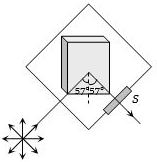
The figure shows a glass plate placed vertically on a horizontal table. $A$ beam of unpolarised light falls on its surface at the polarising angle of $57^\circ$ with the normal. The electric vector in the reflected light on screen $S$ will vibrate with respect to the plane of incidence in a:
A
Vertical plane
B
Horizontal plane
C
Plane making an angle of $45^\circ$ with the vertical
D
Plane making an angle of $57^\circ$ with the horizontal
Solution
(A) According to Brewster's Law,when unpolarised light is incident on a transparent surface at the polarising angle,the reflected light is completely plane-polarised.
The electric field vector of this reflected light vibrates in a direction perpendicular to the plane of incidence.
In the given figure,the glass plate is placed vertically on a horizontal table. The plane of incidence is the plane containing the incident ray and the normal to the surface. Since the light is incident at an angle with the normal on a vertical surface,the plane of incidence is horizontal.
Therefore,the electric vector of the reflected light,being perpendicular to the horizontal plane of incidence,will vibrate in a vertical plane.
The electric field vector of this reflected light vibrates in a direction perpendicular to the plane of incidence.
In the given figure,the glass plate is placed vertically on a horizontal table. The plane of incidence is the plane containing the incident ray and the normal to the surface. Since the light is incident at an angle with the normal on a vertical surface,the plane of incidence is horizontal.
Therefore,the electric vector of the reflected light,being perpendicular to the horizontal plane of incidence,will vibrate in a vertical plane.
0 likes
View Solution9
EasyMCQ
Polarised glass is used in sunglasses because
A
It reduces the light intensity to half on account of polarisation
B
It is fashionable
C
It has good colour
D
It is cheaper
Solution
(A) Polaroid glass cuts glare and haze by reducing the light intensity to half on account of polarisation. This makes the eyes more comfortable and allows the viewer to see better,which is why they are used in sunglasses.
0 likes
View Solution10
MediumMCQ
The wave property of electrons implies that they will show diffraction effects. Davisson and Germer demonstrated this by diffracting electrons from crystals. The law governing the diffraction from a crystal is obtained by requiring that electron waves reflected from the planes of atoms in a crystal interfere constructively. Which of the following phenomena establishes the transverse nature of light?
A
Interference of light
B
Refraction of light
C
Polarisation of light
D
Dispersion of light
Solution
(C) The phenomenon of $Polarisation$ of light establishes that light waves are transverse in nature. Before this, it was widely believed that light waves were longitudinal, similar to sound waves. Since only transverse waves can be polarized, the observation of polarization confirms the transverse nature of light.
0 likes
View Solution11
EasyMCQ
$A$ light beam has an amplitude $A$,and the angle between the analyser and the polariser is $60^o$. What is the amplitude of the light reflected by the analyser?
A
$A\sqrt{2}$
B
$A/\sqrt{2}$
C
$\sqrt{3}A/2$
D
$A/2$
Solution
(D) According to the law of Malus for amplitudes,the amplitude of the light transmitted through an analyser is given by $A' = A \cos \theta$,where $A$ is the initial amplitude and $\theta$ is the angle between the transmission axes of the polariser and the analyser.
Given,$A = A$ and $\theta = 60^o$.
Substituting the values,we get $A' = A \cos(60^o)$.
Since $\cos(60^o) = 1/2$,the amplitude of the light transmitted by the analyser is $A' = A \times (1/2) = A/2$.
Given,$A = A$ and $\theta = 60^o$.
Substituting the values,we get $A' = A \cos(60^o)$.
Since $\cos(60^o) = 1/2$,the amplitude of the light transmitted by the analyser is $A' = A \times (1/2) = A/2$.
0 likes
View Solution12
EasyMCQ
When light is incident on a doubly refracting crystal,two refracted rays-ordinary ray ($O$-ray) and extraordinary ray ($E$-ray) are produced. Then:
A
Both $O$-ray and $E$-ray are polarised perpendicular to the plane of incidence.
B
Both $O$-ray and $E$-ray are polarised in the plane of incidence.
C
$E$-ray is polarised perpendicular to the plane of incidence and $O$-ray in the plane of incidence.
D
$E$-ray is polarised in the plane of incidence and $O$-ray perpendicular to the plane of incidence.
Solution
(D) In a doubly refracting (birefringent) crystal,the incident unpolarised light splits into two plane-polarised rays.
$1$. The ordinary ray ($O$-ray) obeys the standard laws of refraction and its vibrations are perpendicular to the principal section (plane of incidence).
$2$. The extraordinary ray ($E$-ray) does not obey the standard laws of refraction and its vibrations occur within the principal section (plane of incidence).
Therefore,the $E$-ray is polarised in the plane of incidence,and the $O$-ray is polarised perpendicular to the plane of incidence.
Thus,the correct option is $(D)$.
$1$. The ordinary ray ($O$-ray) obeys the standard laws of refraction and its vibrations are perpendicular to the principal section (plane of incidence).
$2$. The extraordinary ray ($E$-ray) does not obey the standard laws of refraction and its vibrations occur within the principal section (plane of incidence).
Therefore,the $E$-ray is polarised in the plane of incidence,and the $O$-ray is polarised perpendicular to the plane of incidence.
Thus,the correct option is $(D)$.
0 likes
View Solution13
DifficultMCQ
Light passes successively through two polarimeter tubes,each of length $0.29 \ m$. The first tube contains a dextrorotatory solution of concentration $60 \ kg/m^3$ and specific rotation $0.01 \ rad \ m^2/kg$. The second tube contains a laevorotatory solution of concentration $30 \ kg/m^3$ and specific rotation $0.02 \ rad \ m^2/kg$. The net rotation produced is.......$^\circ$.
A
$15$
B
$0$
C
$20$
D
$10$
Solution
(B) The rotation produced by a polarimeter tube is given by the formula $\theta = S \cdot l \cdot c$,where $S$ is the specific rotation,$l$ is the length of the tube,and $c$ is the concentration.
For the first tube (dextrorotatory): $\theta_1 = S_1 \cdot l \cdot c_1 = 0.01 \times 0.29 \times 60 = 0.174 \ rad$.
For the second tube (laevorotatory): $\theta_2 = S_2 \cdot l \cdot c_2 = 0.02 \times 0.29 \times 30 = 0.174 \ rad$.
Since the first solution is dextrorotatory (positive rotation) and the second is laevorotatory (negative rotation),the net rotation is $\theta_{net} = \theta_1 - \theta_2 = 0.174 - 0.174 = 0 \ rad$.
Thus,the net rotation produced is $0^\circ$.
For the first tube (dextrorotatory): $\theta_1 = S_1 \cdot l \cdot c_1 = 0.01 \times 0.29 \times 60 = 0.174 \ rad$.
For the second tube (laevorotatory): $\theta_2 = S_2 \cdot l \cdot c_2 = 0.02 \times 0.29 \times 30 = 0.174 \ rad$.
Since the first solution is dextrorotatory (positive rotation) and the second is laevorotatory (negative rotation),the net rotation is $\theta_{net} = \theta_1 - \theta_2 = 0.174 - 0.174 = 0 \ rad$.
Thus,the net rotation produced is $0^\circ$.
0 likes
View Solution14
MediumMCQ
$V_o$ and $V_E$ represent the velocities,$\mu_o$ and $\mu_E$ represent the refractive indices of ordinary and extraordinary rays for a doubly refracting crystal. Then:
A
$V_o \ge V_E, \mu_o \le \mu_E$ if the crystal is calcite
B
$V_o \le V_E, \mu_o \le \mu_E$ if the crystal is quartz
C
$V_o \le V_E, \mu_o \ge \mu_E$ if the crystal is calcite
D
$V_o \ge V_E, \mu_o \ge \mu_E$ if the crystal is quartz
Solution
(C) In double refraction,an incident light ray splits into two rays: the ordinary ray ($O$-ray) and the extraordinary ray ($E$-ray).
For a negative uniaxial crystal like calcite,the velocity of the extraordinary ray $(V_E)$ is greater than the velocity of the ordinary ray $(V_o)$,which implies $\mu_E < \mu_o$ or $\mu_o > \mu_E$.
Thus,for calcite,$V_o < V_E$ and $\mu_o > \mu_E$.
For a positive uniaxial crystal like quartz,the velocity of the extraordinary ray $(V_E)$ is less than the velocity of the ordinary ray $(V_o)$,which implies $\mu_E > \mu_o$.
Therefore,option $(c)$ correctly describes the relationship for calcite.
For a negative uniaxial crystal like calcite,the velocity of the extraordinary ray $(V_E)$ is greater than the velocity of the ordinary ray $(V_o)$,which implies $\mu_E < \mu_o$ or $\mu_o > \mu_E$.
Thus,for calcite,$V_o < V_E$ and $\mu_o > \mu_E$.
For a positive uniaxial crystal like quartz,the velocity of the extraordinary ray $(V_E)$ is less than the velocity of the ordinary ray $(V_o)$,which implies $\mu_E > \mu_o$.
Therefore,option $(c)$ correctly describes the relationship for calcite.
0 likes
View Solution15
EasyMCQ
When a plane-polarised light is passed through an analyser and the analyser is rotated through $90^{\circ}$,the intensity of the emerging light
A
Varies between a maximum and minimum
B
Becomes zero
C
Does not vary
D
Varies between a maximum and zero
Solution
(D) According to Malus' Law,when a plane-polarised light of intensity $I_0$ passes through an analyser,the intensity of the emerging light $I$ is given by $I = I_0 \cos^2 \theta$,where $\theta$ is the angle between the transmission axis of the analyser and the plane of polarisation of the incident light.
Initially,if the transmission axis is aligned with the plane of polarisation,$\theta = 0^{\circ}$,then $I = I_0 \cos^2(0^{\circ}) = I_0$ (Maximum intensity).
As the analyser is rotated through $90^{\circ}$,the angle $\theta$ changes from $0^{\circ}$ to $90^{\circ}$.
At $\theta = 90^{\circ}$,the intensity $I = I_0 \cos^2(90^{\circ}) = 0$ (Minimum intensity).
Therefore,the intensity varies continuously from a maximum value $(I_0)$ to zero as the analyser is rotated through $90^{\circ}$.
Hence,the correct answer is option $(D)$.
Initially,if the transmission axis is aligned with the plane of polarisation,$\theta = 0^{\circ}$,then $I = I_0 \cos^2(0^{\circ}) = I_0$ (Maximum intensity).
As the analyser is rotated through $90^{\circ}$,the angle $\theta$ changes from $0^{\circ}$ to $90^{\circ}$.
At $\theta = 90^{\circ}$,the intensity $I = I_0 \cos^2(90^{\circ}) = 0$ (Minimum intensity).
Therefore,the intensity varies continuously from a maximum value $(I_0)$ to zero as the analyser is rotated through $90^{\circ}$.
Hence,the correct answer is option $(D)$.
0 likes
View Solution16
EasyMCQ
Consider the following statements $A$ and $B$ and identify the correct answer:
$A$. Polarised light can be used to study the helical surface of nucleic acids.
$B$. Optical axis is a direction and not any particular line in the crystal.
$A$. Polarised light can be used to study the helical surface of nucleic acids.
$B$. Optical axis is a direction and not any particular line in the crystal.
A
$A$ and $B$ are correct
B
$A$ and $B$ are wrong
C
$A$ is correct but $B$ is wrong
D
$A$ is wrong but $B$ is correct
Solution
(A) Statement $A$ is correct: Nucleic acids are optically active molecules. Circularly polarized light interacts differently with the helical structure of these molecules,allowing researchers to study their conformation using techniques like Circular Dichroism.
Statement $B$ is correct: An optical axis is defined as a specific direction within a crystal along which the ordinary and extraordinary rays travel with the same velocity. It is a direction,not a fixed line in space,meaning any line parallel to this direction is also an optical axis.
Statement $B$ is correct: An optical axis is defined as a specific direction within a crystal along which the ordinary and extraordinary rays travel with the same velocity. It is a direction,not a fixed line in space,meaning any line parallel to this direction is also an optical axis.
0 likes
View Solution17
MediumMCQ
Two Nicols are oriented with their principal planes making an angle of $60^\circ$. The percentage of incident unpolarized light which passes through the system is......$\%$
A
$50$
B
$100$
C
$12.5$
D
$37.5$
Solution
(C) Let the intensity of the incident unpolarized light be $I_0$.
When unpolarized light passes through the first Nicol prism (polarizer),the intensity of the transmitted polarized light becomes $I_1 = \frac{I_0}{2}$.
According to Malus' Law,when this polarized light passes through the second Nicol prism (analyzer) oriented at an angle $\theta = 60^\circ$ with respect to the first,the transmitted intensity $I_2$ is given by $I_2 = I_1 \cos^2 \theta$.
Substituting the values: $I_2 = \frac{I_0}{2} \cos^2(60^\circ) = \frac{I_0}{2} \times (\frac{1}{2})^2 = \frac{I_0}{2} \times \frac{1}{4} = \frac{I_0}{8}$.
The percentage of incident light transmitted is $\frac{I_2}{I_0} \times 100 = \frac{1}{8} \times 100 = 12.5\%$.
When unpolarized light passes through the first Nicol prism (polarizer),the intensity of the transmitted polarized light becomes $I_1 = \frac{I_0}{2}$.
According to Malus' Law,when this polarized light passes through the second Nicol prism (analyzer) oriented at an angle $\theta = 60^\circ$ with respect to the first,the transmitted intensity $I_2$ is given by $I_2 = I_1 \cos^2 \theta$.
Substituting the values: $I_2 = \frac{I_0}{2} \cos^2(60^\circ) = \frac{I_0}{2} \times (\frac{1}{2})^2 = \frac{I_0}{2} \times \frac{1}{4} = \frac{I_0}{8}$.
The percentage of incident light transmitted is $\frac{I_2}{I_0} \times 100 = \frac{1}{8} \times 100 = 12.5\%$.
0 likes
View Solution18
MediumMCQ
Unpolarized light falls on two polarizing sheets placed one on top of the other. What must be the angle between the characteristic directions of the sheets if the intensity of the final transmitted light is one-third the maximum intensity of the first transmitted beam.......$^o$
A
$75$
B
$55$
C
$35$
D
$15$
Solution
(B) Let $I_0$ be the intensity of the unpolarized light.
When it passes through the first polarizer,the intensity of the transmitted light is $I_1 = \frac{I_0}{2}$.
When this light passes through the second polarizer,the intensity of the final transmitted light $I_2$ is given by Malus' Law: $I_2 = I_1 \cos^2 \theta$,where $\theta$ is the angle between the characteristic directions of the sheets.
Given that the final intensity $I_2$ is one-third of the maximum intensity of the first transmitted beam $(I_1)$,we have $I_2 = \frac{1}{3} I_1$.
Substituting this into the equation: $\frac{1}{3} I_1 = I_1 \cos^2 \theta$.
This simplifies to $\cos^2 \theta = \frac{1}{3}$,which means $\cos \theta = \frac{1}{\sqrt{3}} \approx 0.577$.
Calculating the angle: $\theta = \cos^{-1}(0.577) \approx 54.7^o$,which rounds to $55^o$.
When it passes through the first polarizer,the intensity of the transmitted light is $I_1 = \frac{I_0}{2}$.
When this light passes through the second polarizer,the intensity of the final transmitted light $I_2$ is given by Malus' Law: $I_2 = I_1 \cos^2 \theta$,where $\theta$ is the angle between the characteristic directions of the sheets.
Given that the final intensity $I_2$ is one-third of the maximum intensity of the first transmitted beam $(I_1)$,we have $I_2 = \frac{1}{3} I_1$.
Substituting this into the equation: $\frac{1}{3} I_1 = I_1 \cos^2 \theta$.
This simplifies to $\cos^2 \theta = \frac{1}{3}$,which means $\cos \theta = \frac{1}{\sqrt{3}} \approx 0.577$.
Calculating the angle: $\theta = \cos^{-1}(0.577) \approx 54.7^o$,which rounds to $55^o$.
0 likes
View Solution19
DifficultMCQ
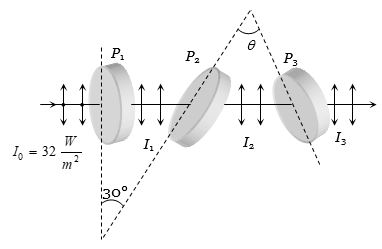
Unpolarized light of intensity $32 \ W m^{-2}$ passes through three polarizers such that the transmission axes of the first and second polarizers make an angle of $30^\circ$ with each other,and the transmission axis of the last polarizer is crossed with that of the first. The intensity of the final emerging light will be.......$W m^{-2}$
A
$32$
B
$3$
C
$8$
D
$4$
Solution
(B) The angle between the transmission axes of $P_1$ and $P_2$ is $\theta_1 = 30^\circ$ (given).
The transmission axis of the last polarizer $P_3$ is crossed with the first polarizer $P_1$,meaning the angle between $P_1$ and $P_3$ is $90^\circ$.
Therefore,the angle between the transmission axes of $P_2$ and $P_3$ is $\theta_2 = 90^\circ - 30^\circ = 60^\circ$.
The intensity of light transmitted by the first polarizer $P_1$ is $I_1 = \frac{I_0}{2} = \frac{32}{2} = 16 \ W m^{-2}$.
According to Malus' law,the intensity of light transmitted by $P_2$ is $I_2 = I_1 \cos^2(30^\circ) = 16 \times (\frac{\sqrt{3}}{2})^2 = 16 \times \frac{3}{4} = 12 \ W m^{-2}$.
Similarly,the intensity of light transmitted by $P_3$ is $I_3 = I_2 \cos^2(60^\circ) = 12 \times (\frac{1}{2})^2 = 12 \times \frac{1}{4} = 3 \ W m^{-2}$.
The transmission axis of the last polarizer $P_3$ is crossed with the first polarizer $P_1$,meaning the angle between $P_1$ and $P_3$ is $90^\circ$.
Therefore,the angle between the transmission axes of $P_2$ and $P_3$ is $\theta_2 = 90^\circ - 30^\circ = 60^\circ$.
The intensity of light transmitted by the first polarizer $P_1$ is $I_1 = \frac{I_0}{2} = \frac{32}{2} = 16 \ W m^{-2}$.
According to Malus' law,the intensity of light transmitted by $P_2$ is $I_2 = I_1 \cos^2(30^\circ) = 16 \times (\frac{\sqrt{3}}{2})^2 = 16 \times \frac{3}{4} = 12 \ W m^{-2}$.
Similarly,the intensity of light transmitted by $P_3$ is $I_3 = I_2 \cos^2(60^\circ) = 12 \times (\frac{1}{2})^2 = 12 \times \frac{1}{4} = 3 \ W m^{-2}$.
0 likes
View Solution20
DifficultMCQ
In the visible region of the spectrum,the rotation of the plane of polarization is given by $\theta = a + \frac{b}{\lambda^2}$. The optical rotation produced by a particular material is found to be $30^\circ$ per mm at $\lambda = 5000 \ \mathring{A}$ and $50^\circ$ per mm at $\lambda = 4000 \ \mathring{A}$. The value of constant $a$ will be:
A
$+ \frac{50^\circ}{9}$ per mm
B
$- \frac{50^\circ}{9}$ per mm
C
$+ \frac{9^\circ}{50}$ per mm
D
$- \frac{9^\circ}{50}$ per mm
Solution
(B) Given the equation for optical rotation: $\theta = a + \frac{b}{\lambda^2}$.
At $\lambda_1 = 5000 \ \mathring{A}$,$\theta_1 = 30^\circ$ per mm: $30 = a + \frac{b}{(5000)^2} \quad (1)$.
At $\lambda_2 = 4000 \ \mathring{A}$,$\theta_2 = 50^\circ$ per mm: $50 = a + \frac{b}{(4000)^2} \quad (2)$.
Subtracting equation $(1)$ from equation $(2)$:
$50 - 30 = b \left( \frac{1}{4000^2} - \frac{1}{5000^2} \right) = b \left( \frac{5000^2 - 4000^2}{4000^2 \times 5000^2} \right)$.
$20 = b \left( \frac{(5000-4000)(5000+4000)}{16 \times 10^6 \times 25 \times 10^6} \right) = b \left( \frac{1000 \times 9000}{400 \times 10^{12}} \right) = b \left( \frac{9 \times 10^6}{400 \times 10^{12}} \right) = b \left( \frac{9}{400 \times 10^6} \right)$.
$b = \frac{20 \times 400 \times 10^6}{9} = \frac{8000 \times 10^6}{9}$.
Substitute $b$ into equation $(1)$:
$a = 30 - \frac{8000 \times 10^6}{9 \times 25 \times 10^6} = 30 - \frac{8000}{225} = 30 - \frac{320}{9} = \frac{270 - 320}{9} = - \frac{50^\circ}{9} \text{ per mm}$.
At $\lambda_1 = 5000 \ \mathring{A}$,$\theta_1 = 30^\circ$ per mm: $30 = a + \frac{b}{(5000)^2} \quad (1)$.
At $\lambda_2 = 4000 \ \mathring{A}$,$\theta_2 = 50^\circ$ per mm: $50 = a + \frac{b}{(4000)^2} \quad (2)$.
Subtracting equation $(1)$ from equation $(2)$:
$50 - 30 = b \left( \frac{1}{4000^2} - \frac{1}{5000^2} \right) = b \left( \frac{5000^2 - 4000^2}{4000^2 \times 5000^2} \right)$.
$20 = b \left( \frac{(5000-4000)(5000+4000)}{16 \times 10^6 \times 25 \times 10^6} \right) = b \left( \frac{1000 \times 9000}{400 \times 10^{12}} \right) = b \left( \frac{9 \times 10^6}{400 \times 10^{12}} \right) = b \left( \frac{9}{400 \times 10^6} \right)$.
$b = \frac{20 \times 400 \times 10^6}{9} = \frac{8000 \times 10^6}{9}$.
Substitute $b$ into equation $(1)$:
$a = 30 - \frac{8000 \times 10^6}{9 \times 25 \times 10^6} = 30 - \frac{8000}{225} = 30 - \frac{320}{9} = \frac{270 - 320}{9} = - \frac{50^\circ}{9} \text{ per mm}$.
0 likes
View Solution21
EasyMCQ
In the case of linearly polarized light,the magnitude of the electric field vector:
A
Does not change with time
B
Varies periodically with time
C
Increases and decreases linearly with time
D
Is parallel to the direction of propagation
Solution
(B) In an electromagnetic wave,the electric field vector $\vec{E}$ at any point in space is given by $\vec{E} = E_0 \sin(kx - \omega t) \hat{n}$.
Here,$E_0$ is the amplitude,$k$ is the wave number,$\omega$ is the angular frequency,and $t$ is time.
The magnitude of the electric field vector is $|\vec{E}| = |E_0 \sin(kx - \omega t)|$.
Since the sine function oscillates between $-1$ and $1$,the magnitude of the electric field vector varies periodically with time at any fixed position $x$.
Here,$E_0$ is the amplitude,$k$ is the wave number,$\omega$ is the angular frequency,and $t$ is time.
The magnitude of the electric field vector is $|\vec{E}| = |E_0 \sin(kx - \omega t)|$.
Since the sine function oscillates between $-1$ and $1$,the magnitude of the electric field vector varies periodically with time at any fixed position $x$.
0 likes
View Solution22
EasyMCQ
An optically active compound:
A
Rotates the plane of polarised light.
B
Changes the direction of polarised light.
C
Does not allow plane polarised light to pass through.
D
None of the above.
Solution
(A) An optically active compound is a substance that has the ability to rotate the plane of vibration of plane-polarised light.
When plane-polarised light passes through such a substance,the plane of polarisation is rotated by a certain angle about the direction of propagation of the light.
Therefore,the correct option is $A$.
When plane-polarised light passes through such a substance,the plane of polarisation is rotated by a certain angle about the direction of propagation of the light.
Therefore,the correct option is $A$.
0 likes
View Solution23
EasyMCQ
For the study of the helical structure of nucleic acids,the property of electromagnetic radiation generally used is
A
Reflection
B
Interference
C
Diffraction
D
Polarization
Solution
(D) The helical structure of nucleic acids,such as $DNA$,is studied using $X$-ray crystallography.
In this technique,the diffraction of $X$-rays is the primary phenomenon used to determine the structure.
However,in the context of specific optical studies involving the helical nature of biological molecules,the property of polarization (specifically circular dichroism) is used to analyze the handedness and helical structure of these molecules.
Therefore,polarization is the correct property used for this specific study.
In this technique,the diffraction of $X$-rays is the primary phenomenon used to determine the structure.
However,in the context of specific optical studies involving the helical nature of biological molecules,the property of polarization (specifically circular dichroism) is used to analyze the handedness and helical structure of these molecules.
Therefore,polarization is the correct property used for this specific study.
0 likes
View Solution24
DifficultMCQ
The specific rotation of a sugar solution is $0.01 \ SI$ units. $A$ $200 \ kg/m^3$ solution of impure sugar is taken in a polarimeter tube of length $0.25 \ m$,and an optical rotation of $0.4 \ rad$ is observed. The percentage of purity of sugar in the sample is.....$\%$
A
$80$
B
$89$
C
$11$
D
$20$
Solution
(A) The formula for specific rotation is given by $\alpha = \frac{\theta}{l \cdot c}$,where $\theta$ is the optical rotation,$l$ is the length of the tube,and $c$ is the concentration of the pure sugar.
Rearranging the formula to find the concentration of pure sugar: $c = \frac{\theta}{\alpha \cdot l}$.
Substituting the given values: $c = \frac{0.4}{0.01 \times 0.25} = \frac{0.4}{0.0025} = 160 \ kg/m^3$.
The percentage purity is calculated as the ratio of the concentration of pure sugar to the concentration of the impure sample multiplied by $100$.
Percentage purity $= \left( \frac{160}{200} \right) \times 100 = 80\%$.
Rearranging the formula to find the concentration of pure sugar: $c = \frac{\theta}{\alpha \cdot l}$.
Substituting the given values: $c = \frac{0.4}{0.01 \times 0.25} = \frac{0.4}{0.0025} = 160 \ kg/m^3$.
The percentage purity is calculated as the ratio of the concentration of pure sugar to the concentration of the impure sample multiplied by $100$.
Percentage purity $= \left( \frac{160}{200} \right) \times 100 = 80\%$.
0 likes
View Solution25
MediumMCQ
$A$ beam of natural light falls on a system of $6$ polaroids,which are arranged in succession such that each polaroid is turned through $30^\circ$ with respect to the preceding one. The percentage of incident intensity that passes through the system will be....$\%$
A
$100$
B
$50$
C
$30$
D
$12$
Solution
(D) When natural (unpolarized) light of intensity $I_0$ passes through the first polaroid,the transmitted intensity becomes $I_1 = \frac{I_0}{2}$.
For the subsequent $5$ polaroids,we apply Malus' Law: $I_n = I_{n-1} \cos^2(\theta)$,where $\theta = 30^\circ$.
The final intensity $I_6$ after passing through all $6$ polaroids is given by:
$I_6 = I_1 \times (\cos^2 30^\circ)^5 = \frac{I_0}{2} \times (\cos^2 30^\circ)^5$.
Substituting $\cos 30^\circ = \frac{\sqrt{3}}{2}$:
$I_6 = \frac{I_0}{2} \times \left(\frac{3}{4}\right)^5 = \frac{I_0}{2} \times \frac{243}{1024} = \frac{243}{2048} I_0 \approx 0.1186 I_0$.
Converting to percentage: $0.1186 \times 100 \approx 11.86\% \approx 12\%$.
For the subsequent $5$ polaroids,we apply Malus' Law: $I_n = I_{n-1} \cos^2(\theta)$,where $\theta = 30^\circ$.
The final intensity $I_6$ after passing through all $6$ polaroids is given by:
$I_6 = I_1 \times (\cos^2 30^\circ)^5 = \frac{I_0}{2} \times (\cos^2 30^\circ)^5$.
Substituting $\cos 30^\circ = \frac{\sqrt{3}}{2}$:
$I_6 = \frac{I_0}{2} \times \left(\frac{3}{4}\right)^5 = \frac{I_0}{2} \times \frac{243}{1024} = \frac{243}{2048} I_0 \approx 0.1186 I_0$.
Converting to percentage: $0.1186 \times 100 \approx 11.86\% \approx 12\%$.
0 likes
View Solution26
DifficultMCQ
$A$ beam of plane polarized light falls normally on a polarizer of cross-sectional area $3 \times 10^{-4} \, m^2$. The flux of energy of the incident ray is $10^{-3} \, W$. The polarizer rotates with an angular frequency of $31.4 \, rad/s$. The energy of light passing through the polarizer per revolution is:
A
$10^{-4} \, J$
B
$10^{-3} \, J$
C
$10^{-2} \, J$
D
$10^{-1} \, J$
Solution
(A) According to Malus's law,the intensity of transmitted light is $I = I_0 \cos^2 \theta$,where $I_0$ is the incident intensity and $\theta$ is the angle between the polarization direction and the polarizer axis.
Since the polarizer is rotating,$\theta$ varies from $0$ to $2\pi$ in one revolution.
The average intensity $I_{av}$ is given by $I_{av} = \frac{1}{2\pi} \int_0^{2\pi} I_0 \cos^2 \theta \, d\theta = \frac{I_0}{2}$.
The incident power $P = 10^{-3} \, W$. The incident intensity $I_0 = \frac{P}{A} = \frac{10^{-3}}{3 \times 10^{-4}} = \frac{10}{3} \, W/m^2$.
The average power transmitted is $P_{av} = I_{av} \times A = \frac{I_0}{2} \times A = \frac{P}{2} = \frac{10^{-3}}{2} = 0.5 \times 10^{-3} \, W$.
The time period for one revolution is $T = \frac{2\pi}{\omega} = \frac{2 \times 3.14}{31.4} = 0.2 \, s$.
The energy passing through the polarizer per revolution is $E = P_{av} \times T = (0.5 \times 10^{-3}) \times 0.2 = 10^{-4} \, J$.
Since the polarizer is rotating,$\theta$ varies from $0$ to $2\pi$ in one revolution.
The average intensity $I_{av}$ is given by $I_{av} = \frac{1}{2\pi} \int_0^{2\pi} I_0 \cos^2 \theta \, d\theta = \frac{I_0}{2}$.
The incident power $P = 10^{-3} \, W$. The incident intensity $I_0 = \frac{P}{A} = \frac{10^{-3}}{3 \times 10^{-4}} = \frac{10}{3} \, W/m^2$.
The average power transmitted is $P_{av} = I_{av} \times A = \frac{I_0}{2} \times A = \frac{P}{2} = \frac{10^{-3}}{2} = 0.5 \times 10^{-3} \, W$.
The time period for one revolution is $T = \frac{2\pi}{\omega} = \frac{2 \times 3.14}{31.4} = 0.2 \, s$.
The energy passing through the polarizer per revolution is $E = P_{av} \times T = (0.5 \times 10^{-3}) \times 0.2 = 10^{-4} \, J$.
0 likes
View Solution27
MediumMCQ
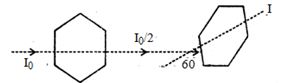
Two Nicol prisms are inclined at an angle of $60^o$ to each other. What percentage of the incident unpolarized light passes through the system?
A
$50$
B
$100$
C
$12.5$
D
$37.5$
Solution
(C) When unpolarized light of intensity $I_0$ passes through the first Nicol prism (polarizer),the intensity of the transmitted light becomes $I_1 = \frac{I_0}{2}$.
According to Malus' Law,when this polarized light passes through the second Nicol prism (analyzer) inclined at an angle $\theta = 60^o$ to the first,the transmitted intensity $I$ is given by:
$I = I_1 \cos^2 \theta = \left(\frac{I_0}{2}\right) \cos^2(60^o)$.
Since $\cos(60^o) = \frac{1}{2}$,we have $\cos^2(60^o) = \frac{1}{4}$.
Therefore,$I = \left(\frac{I_0}{2}\right) \times \left(\frac{1}{4}\right) = \frac{I_0}{8}$.
The percentage of incident light transmitted is $\left(\frac{I}{I_0}\right) \times 100 = \left(\frac{I_0/8}{I_0}\right) \times 100 = \frac{100}{8} = 12.5\%$.
According to Malus' Law,when this polarized light passes through the second Nicol prism (analyzer) inclined at an angle $\theta = 60^o$ to the first,the transmitted intensity $I$ is given by:
$I = I_1 \cos^2 \theta = \left(\frac{I_0}{2}\right) \cos^2(60^o)$.
Since $\cos(60^o) = \frac{1}{2}$,we have $\cos^2(60^o) = \frac{1}{4}$.
Therefore,$I = \left(\frac{I_0}{2}\right) \times \left(\frac{1}{4}\right) = \frac{I_0}{8}$.
The percentage of incident light transmitted is $\left(\frac{I}{I_0}\right) \times 100 = \left(\frac{I_0/8}{I_0}\right) \times 100 = \frac{100}{8} = 12.5\%$.
0 likes
View Solution28
EasyMCQ
$A$ polariser is used to
A
Reduce intensity of light
B
Produce polarised light
C
Increase intensity of light
D
Produce unpolarised light
Solution
(B) polariser is an optical device that converts unpolarised light into polarised light by allowing only those light waves whose electric field vectors oscillate in a specific plane to pass through. Therefore,the primary function of a polariser is to produce polarised light.
0 likes
View Solution29
MediumMCQ
Light waves can be polarized if they are...
A
Transverse
B
Longitudinal
C
Of high frequency
D
Reflected
Solution
(A) Polarization is a phenomenon that occurs only in transverse waves. Since light waves exhibit polarization,it confirms that light is a transverse wave in nature. Longitudinal waves,such as sound waves,cannot be polarized because their oscillations occur in the direction of propagation.
0 likes
View Solution30
MediumMCQ
For light of intensity $I_0$,a polaroid is placed at an angle of $45^\circ$. What will be the intensity of the light passing through the polaroid after polarization?
A
$I_0$
B
$I_0 / 2$
C
$I_0 / 4$
D
Zero
Solution
(B) According to Malus's Law,the intensity of light passing through a polaroid is given by $I = I_0 \cos^2 \theta$.
Here,the angle $\theta = 45^\circ$.
Substituting the value: $I = I_0 \cos^2(45^\circ)$.
Since $\cos(45^\circ) = 1/\sqrt{2}$,we have $\cos^2(45^\circ) = 1/2$.
Therefore,$I = I_0 \times (1/2) = I_0 / 2$.
Here,the angle $\theta = 45^\circ$.
Substituting the value: $I = I_0 \cos^2(45^\circ)$.
Since $\cos(45^\circ) = 1/\sqrt{2}$,we have $\cos^2(45^\circ) = 1/2$.
Therefore,$I = I_0 \times (1/2) = I_0 / 2$.
0 likes
View Solution31
DifficultMCQ
Two nicols are crossed to each other. Now one of them is rotated through $60^{\circ}$. What percentage of incident light will pass through the system (in $\%$)?
A
$30.8$
B
$37.5$
C
$35.5$
D
$40.3$
Solution
(B) When unpolarized light is incident on the first nicol prism (polarizer),the intensity of the transmitted light is $I_1 = \frac{1}{2} I_0$,where $I_0$ is the intensity of the incident light.
Initially,the two nicols are crossed,meaning the angle between their transmission axes is $\theta_{initial} = 90^{\circ}$.
When one of them is rotated by $60^{\circ}$,the new angle between the transmission axes becomes $\theta = 90^{\circ} - 60^{\circ} = 30^{\circ}$.
According to Malus' Law,the intensity of light emerging from the second nicol prism (analyzer) is $I = I_1 \cos^2 \theta$.
Substituting the values: $I = (\frac{1}{2} I_0) \cos^2 30^{\circ}$.
Since $\cos 30^{\circ} = \frac{\sqrt{3}}{2}$,we have $\cos^2 30^{\circ} = \frac{3}{4}$.
Thus,$I = \frac{1}{2} I_0 \times \frac{3}{4} = \frac{3}{8} I_0$.
The percentage of incident light passing through the system is $\frac{I}{I_0} \times 100 = \frac{3}{8} \times 100 = 37.5\%$.
Initially,the two nicols are crossed,meaning the angle between their transmission axes is $\theta_{initial} = 90^{\circ}$.
When one of them is rotated by $60^{\circ}$,the new angle between the transmission axes becomes $\theta = 90^{\circ} - 60^{\circ} = 30^{\circ}$.
According to Malus' Law,the intensity of light emerging from the second nicol prism (analyzer) is $I = I_1 \cos^2 \theta$.
Substituting the values: $I = (\frac{1}{2} I_0) \cos^2 30^{\circ}$.
Since $\cos 30^{\circ} = \frac{\sqrt{3}}{2}$,we have $\cos^2 30^{\circ} = \frac{3}{4}$.
Thus,$I = \frac{1}{2} I_0 \times \frac{3}{4} = \frac{3}{8} I_0$.
The percentage of incident light passing through the system is $\frac{I}{I_0} \times 100 = \frac{3}{8} \times 100 = 37.5\%$.
0 likes
View Solution32
MediumMCQ
An unpolarized light beam of intensity $I_0$ is passed through a first polaroid $A$ and then through a second polaroid $B$. If the principal plane of polaroid $B$ makes an angle of $45^{\circ}$ with that of $A$,find the intensity of the emerging light.
A
$I_0$
B
$I_0/2$
C
$I_0/4$
D
$I_0/8$
Solution
(C) Step $1$: When unpolarized light of intensity $I_0$ passes through the first polaroid $A$,the intensity of the transmitted light becomes half of the initial intensity.
$I_A = \frac{I_0}{2}$
Step $2$: According to Malus's Law,when this polarized light passes through the second polaroid $B$ whose transmission axis makes an angle $\theta = 45^{\circ}$ with the transmission axis of $A$,the intensity of the emerging light $I_B$ is given by:
$I_B = I_A \cos^2 \theta$
Step $3$: Substituting the values:
$I_B = \frac{I_0}{2} \cos^2(45^{\circ})$
Since $\cos(45^{\circ}) = \frac{1}{\sqrt{2}}$,then $\cos^2(45^{\circ}) = \frac{1}{2}$.
$I_B = \frac{I_0}{2} \times \frac{1}{2} = \frac{I_0}{4}$
$I_A = \frac{I_0}{2}$
Step $2$: According to Malus's Law,when this polarized light passes through the second polaroid $B$ whose transmission axis makes an angle $\theta = 45^{\circ}$ with the transmission axis of $A$,the intensity of the emerging light $I_B$ is given by:
$I_B = I_A \cos^2 \theta$
Step $3$: Substituting the values:
$I_B = \frac{I_0}{2} \cos^2(45^{\circ})$
Since $\cos(45^{\circ}) = \frac{1}{\sqrt{2}}$,then $\cos^2(45^{\circ}) = \frac{1}{2}$.
$I_B = \frac{I_0}{2} \times \frac{1}{2} = \frac{I_0}{4}$
0 likes
View Solution33
MediumMCQ
When unpolarized light of intensity $I_0$ is incident on a polarizing sheet,the intensity of light that does not pass through is:
A
Zero
B
$I_0$
C
$\frac{1}{2} I_0$
D
$\frac{1}{4} I_0$
Solution
(C) When unpolarized light of intensity $I_0$ is incident on a polarizing sheet,the transmitted intensity is given by Malus's Law concept for unpolarized light,which is $I = \frac{1}{2} I_0$.
Since the total incident intensity is $I_0$ and the transmitted intensity is $\frac{1}{2} I_0$,the intensity of light that does not pass through (absorbed intensity) is $I_{absorbed} = I_0 - \frac{1}{2} I_0 = \frac{1}{2} I_0$.
Since the total incident intensity is $I_0$ and the transmitted intensity is $\frac{1}{2} I_0$,the intensity of light that does not pass through (absorbed intensity) is $I_{absorbed} = I_0 - \frac{1}{2} I_0 = \frac{1}{2} I_0$.
0 likes
View Solution34
MediumMCQ
$A$ polarizer and an analyzer are placed such that the intensity of the transmitted light is maximum. If the analyzer is rotated by $60^{\circ}$,find the intensity of the transmitted light.
A
$\frac{I_0}{4}$
B
$2I_0$
C
$\frac{I_0}{3}$
D
$\frac{I_0}{2}$
Solution
(A) According to Malus's Law,the intensity of transmitted light is given by $I = I_0 \cos^2 \theta$,where $I_0$ is the maximum intensity and $\theta$ is the angle between the transmission axes of the polarizer and the analyzer.
Initially,the intensity is maximum,meaning the axes are parallel $(\theta = 0^{\circ})$.
When the analyzer is rotated by $60^{\circ}$,the new angle becomes $\theta = 60^{\circ}$.
Substituting the values into the formula:
$I = I_0 \cos^2(60^{\circ})$
$I = I_0 \left( \frac{1}{2} \right)^2$
$I = \frac{I_0}{4}$
Initially,the intensity is maximum,meaning the axes are parallel $(\theta = 0^{\circ})$.
When the analyzer is rotated by $60^{\circ}$,the new angle becomes $\theta = 60^{\circ}$.
Substituting the values into the formula:
$I = I_0 \cos^2(60^{\circ})$
$I = I_0 \left( \frac{1}{2} \right)^2$
$I = \frac{I_0}{4}$
0 likes
View Solution35
MediumMCQ
Which property can be used to distinguish between light waves and sound waves?
A
Interference
B
Refraction
C
Polarization
D
Reflection
Solution
(C) Light waves are transverse in nature and can be polarized,whereas sound waves are longitudinal in nature and cannot be polarized. Therefore,polarization is the property that distinguishes light waves from sound waves.
0 likes
View Solution36
MediumMCQ
The angle between a polarizer and an analyzer is $60^o$. If light with an amplitude $A$ is incident on the polarizer,what is the amplitude of the light emerging from the analyzer?
A
$A/\sqrt{2}$
B
$A\sqrt{2}$
C
$\frac{\sqrt{3}A}{2}$
D
$A/2$
Solution
(D) According to Malus's Law,the intensity of light emerging from an analyzer is $I = I_0 \cos^2 \theta$,where $I_0$ is the intensity of light incident on the analyzer and $\theta$ is the angle between the polarizer and the analyzer.
Since intensity $I$ is proportional to the square of the amplitude $(I \propto A^2)$,the amplitude of the light emerging from the analyzer is given by $A' = A_0 \cos \theta$,where $A_0$ is the amplitude of light incident on the analyzer.
Given that the light incident on the polarizer has amplitude $A$,the light emerging from the polarizer has amplitude $A_0 = A$.
Substituting the given values: $A' = A \cos(60^o) = A \times (1/2) = A/2$.
Since intensity $I$ is proportional to the square of the amplitude $(I \propto A^2)$,the amplitude of the light emerging from the analyzer is given by $A' = A_0 \cos \theta$,where $A_0$ is the amplitude of light incident on the analyzer.
Given that the light incident on the polarizer has amplitude $A$,the light emerging from the polarizer has amplitude $A_0 = A$.
Substituting the given values: $A' = A \cos(60^o) = A \times (1/2) = A/2$.
0 likes
View Solution37
EasyMCQ
When an unpolarized light of intensity $I_0$ is incident on a polarizing sheet,the intensity of light which does not get transmitted is
A
$I_0 / 2$
B
$I_0 / 4$
C
Zero
D
$I_0$
Solution
(A) When unpolarized light of intensity $I_0$ is incident on a polarizing sheet,the intensity of the transmitted polarized light is given by $I_t = I_0 / 2$.
The intensity of light that does not get transmitted (absorbed or reflected) is the difference between the incident intensity and the transmitted intensity.
Intensity of untransmitted light $= I_0 - I_t = I_0 - I_0 / 2 = I_0 / 2$.
The intensity of light that does not get transmitted (absorbed or reflected) is the difference between the incident intensity and the transmitted intensity.
Intensity of untransmitted light $= I_0 - I_t = I_0 - I_0 / 2 = I_0 / 2$.
0 likes
View Solution38
MediumMCQ
When unpolarized light of intensity $I_0$ is incident on a polarizer,what will be the intensity of the light that does not pass through it?
A
$0$
B
$I_0$
C
$I_0/2$
D
$I_0/4$
Solution
(C) When unpolarized light of intensity $I_0$ passes through a polarizer,the intensity of the transmitted light is given by Malus's Law principle for unpolarized light,which is $I_{transmitted} = \frac{I_0}{2}$.
The intensity of the light that does not pass through the polarizer is the difference between the incident intensity and the transmitted intensity.
$I_{blocked} = I_0 - I_{transmitted} = I_0 - \frac{I_0}{2} = \frac{I_0}{2}$.
The intensity of the light that does not pass through the polarizer is the difference between the incident intensity and the transmitted intensity.
$I_{blocked} = I_0 - I_{transmitted} = I_0 - \frac{I_0}{2} = \frac{I_0}{2}$.
0 likes
View Solution39
EasyMCQ
The transverse nature of light is shown by
A
Interference of light
B
Refraction of light
C
Polarization of light
D
Dispersion of light
Solution
(C) The transverse nature of light means that the oscillations of the electric and magnetic fields occur perpendicular to the direction of wave propagation.
Interference,refraction,and dispersion can be explained by both longitudinal and transverse wave models.
Polarization is a phenomenon that occurs only in transverse waves,where the orientation of the oscillations can be restricted to a specific plane.
Since light exhibits polarization,it confirms that light is a transverse wave.
Interference,refraction,and dispersion can be explained by both longitudinal and transverse wave models.
Polarization is a phenomenon that occurs only in transverse waves,where the orientation of the oscillations can be restricted to a specific plane.
Since light exhibits polarization,it confirms that light is a transverse wave.
0 likes
View Solution40
DifficultMCQ
The angle between the principal planes of two Nicol prisms is $60^o$. What percentage of the incident unpolarized light will be transmitted through this system?
A
$50$
B
$100$
C
$12.5$
D
$37.5$
Solution
(C) When unpolarized light of intensity $I_0$ is incident on the first Nicol prism (polarizer),the intensity of the transmitted light is $I_1 = I_0 / 2$.
This light then passes through the second Nicol prism (analyzer) whose principal plane is at an angle $\theta = 60^o$ with respect to the first.
According to Malus's Law,the intensity of light transmitted through the analyzer is $I = I_1 \cos^2 \theta$.
Substituting the values: $I = (I_0 / 2) \cos^2(60^o) = (I_0 / 2) \times (1/2)^2 = I_0 / 8$.
To find the percentage of transmitted light: $(I / I_0) \times 100 = (1/8) \times 100 = 12.5\%$.
This light then passes through the second Nicol prism (analyzer) whose principal plane is at an angle $\theta = 60^o$ with respect to the first.
According to Malus's Law,the intensity of light transmitted through the analyzer is $I = I_1 \cos^2 \theta$.
Substituting the values: $I = (I_0 / 2) \cos^2(60^o) = (I_0 / 2) \times (1/2)^2 = I_0 / 8$.
To find the percentage of transmitted light: $(I / I_0) \times 100 = (1/8) \times 100 = 12.5\%$.
0 likes
View Solution41
MediumMCQ
Polarized glass is used for sunglasses because...
A
It reduces the intensity of light by half.
B
It is fashionable.
C
It looks good in color.
D
It is cheap.
Solution
(A) Polarized sunglasses are used because they reduce glare caused by reflected light from surfaces like water,roads,or snow. By blocking the horizontally polarized component of light,they significantly reduce eye strain and improve visibility,preventing the eyes from being dazzled by intense light.
0 likes
View Solution42
MediumMCQ
Plane-polarized light passes through a Polaroid. While observing through the Polaroid,it is seen that when the Polaroid completes one rotation about the direction of light,which of the following is observed?
A
The intensity of light gradually decreases to zero.
B
The intensity of light gradually increases to a maximum and remains at the maximum.
C
There is no change in the intensity of light.
D
The intensity of light becomes maximum twice and zero twice.
Solution
(D) According to Malus's Law,the intensity of transmitted light is given by $I = I_0 \cos^2 \theta$,where $\theta$ is the angle between the transmission axis of the Polaroid and the plane of polarization of the incident light.
As the Polaroid completes one full rotation ($0$ to $2\pi$),the angle $\theta$ changes continuously.
The intensity $I$ becomes maximum when $\theta = 0$ and $\theta = \pi$,and it becomes zero (minimum) when $\theta = \pi/2$ and $\theta = 3\pi/2$.
Therefore,the intensity of light becomes maximum twice and zero twice during one full rotation.
As the Polaroid completes one full rotation ($0$ to $2\pi$),the angle $\theta$ changes continuously.
The intensity $I$ becomes maximum when $\theta = 0$ and $\theta = \pi$,and it becomes zero (minimum) when $\theta = \pi/2$ and $\theta = 3\pi/2$.
Therefore,the intensity of light becomes maximum twice and zero twice during one full rotation.
0 likes
View Solution43
DifficultMCQ
An unpolarized light beam of intensity $I_0$ is incident on a polarizer $A$ and then passed through a second polarizer $B$. If the principal plane of polarizer $B$ makes an angle of $45^\circ$ with respect to polarizer $A$,the intensity of the emerging light will be ........
A
$I_0/8$
B
$I_0$
C
$I_0/2$
D
$I_0/4$
Solution
(D) When an unpolarized light beam of intensity $I_0$ is incident on polarizer $A$,the intensity of the emerging polarized light is $I_1 = I_0/2$.
Now,this polarized light of intensity $I_1 = I_0/2$ is incident on polarizer $B$ at an angle $\theta = 45^\circ$ with respect to its transmission axis.
According to Malus's Law,the intensity of light emerging from polarizer $B$ is given by $I = I_1 \cos^2 \theta$.
Substituting the values: $I = (I_0/2) \cos^2(45^\circ) = (I_0/2) \times (1/\sqrt{2})^2 = (I_0/2) \times (1/2) = I_0/4$.
Now,this polarized light of intensity $I_1 = I_0/2$ is incident on polarizer $B$ at an angle $\theta = 45^\circ$ with respect to its transmission axis.
According to Malus's Law,the intensity of light emerging from polarizer $B$ is given by $I = I_1 \cos^2 \theta$.
Substituting the values: $I = (I_0/2) \cos^2(45^\circ) = (I_0/2) \times (1/\sqrt{2})^2 = (I_0/2) \times (1/2) = I_0/4$.
0 likes
View Solution44
MediumMCQ
Statement-$1$: The blue part of the sky is clearly visible through a calcite crystal. The intensity of the transmitted light changes as the crystal is rotated.
Statement-$2$: Light from the sky is due to the scattering of sunlight by particles in the atmosphere.
Statement-$2$: Light from the sky is due to the scattering of sunlight by particles in the atmosphere.
A
Statement-$1$ is false,Statement-$2$ is true.
B
Statement-$1$ is true,Statement-$2$ is false.
C
Statement-$1$ is true,Statement-$2$ is true,and Statement-$2$ is the correct explanation of Statement-$1$.
D
Statement-$1$ is true,Statement-$2$ is true,and Statement-$2$ is not the correct explanation of Statement-$1$.
Solution
(C) When a calcite crystal is rotated,the intensity of the transmitted light changes because the light from the sky is partially polarized due to scattering.
According to Rayleigh's law of scattering,the intensity of scattered light $I \propto 1/\lambda^4$.
Since the wavelength $\lambda$ of blue light is minimal,its scattering intensity $I$ is maximum.
Thus,light from the sky is polarized due to scattering by atmospheric particles.
Both statements are true,and Statement-$2$ provides the correct explanation for the polarization observed in Statement-$1$.
According to Rayleigh's law of scattering,the intensity of scattered light $I \propto 1/\lambda^4$.
Since the wavelength $\lambda$ of blue light is minimal,its scattering intensity $I$ is maximum.
Thus,light from the sky is polarized due to scattering by atmospheric particles.
Both statements are true,and Statement-$2$ provides the correct explanation for the polarization observed in Statement-$1$.
0 likes
View Solution45
DifficultMCQ
$A$ $300 \, mm$ long tube contains $60 \, cm^3$ of a concentrated sugar solution. When placed in a polarimeter,it produces an optical rotation of $10^\circ$. If the specific rotation of sugar is $60^\circ$,calculate the amount of sugar in grams present in the tube.
A
$2.45$
B
$3.33$
C
$4.20$
D
$1.90$
Solution
(B) The formula for optical rotation is $\theta = [\alpha]_\lambda^T \cdot l \cdot C$,where $\theta$ is the rotation,$[\alpha]_\lambda^T$ is the specific rotation,$l$ is the length of the tube in decimeters $(dm)$,and $C$ is the concentration in $g/cm^3$.
Given: $l = 300 \, mm = 30 \, cm = 3 \, dm$,$\theta = 10^\circ$,$[\alpha]_\lambda^T = 60^\circ$,and volume $V = 60 \, cm^3$.
First,calculate the concentration $C$: $C = \frac{\theta}{[\alpha]_\lambda^T \cdot l} = \frac{10}{60 \cdot 3} = \frac{10}{180} = \frac{1}{18} \, g/cm^3$.
The total amount of sugar $m$ is given by $m = C \cdot V$.
$m = \frac{1}{18} \cdot 60 = \frac{60}{18} = 3.33 \, g$.
Given: $l = 300 \, mm = 30 \, cm = 3 \, dm$,$\theta = 10^\circ$,$[\alpha]_\lambda^T = 60^\circ$,and volume $V = 60 \, cm^3$.
First,calculate the concentration $C$: $C = \frac{\theta}{[\alpha]_\lambda^T \cdot l} = \frac{10}{60 \cdot 3} = \frac{10}{180} = \frac{1}{18} \, g/cm^3$.
The total amount of sugar $m$ is given by $m = C \cdot V$.
$m = \frac{1}{18} \cdot 60 = \frac{60}{18} = 3.33 \, g$.
0 likes
View Solution46
MediumMCQ
Two polaroids $P_1$ and $P_2$ are placed with their axes perpendicular to each other. Unpolarised light of intensity $I_0$ is incident on $P_1$. $A$ third polaroid $P_3$ is kept in between $P_1$ and $P_2$ such that its axis makes an angle $45^{\circ}$ with that of $P_1$. The intensity of transmitted light through $P_2$ is
A
$\frac{I_0}{4}$
B
$\frac{I_0}{8}$
C
$\frac{I_0}{16}$
D
$\frac{I_0}{2}$
Solution
(B) The intensity of unpolarised light incident on $P_1$ is $I_0$. After passing through $P_1$,the intensity becomes $I_1 = \frac{I_0}{2}$.
The intensity of light transmitted through $P_3$,which is at an angle $\theta_1 = 45^{\circ}$ with $P_1$,is given by Malus' Law: $I_2 = I_1 \cos^2(45^{\circ}) = \frac{I_0}{2} \times (\frac{1}{\sqrt{2}})^2 = \frac{I_0}{4}$.
The angle between the axes of $P_3$ and $P_2$ is $\theta_2 = 90^{\circ} - 45^{\circ} = 45^{\circ}$.
The intensity of light transmitted through $P_2$ is $I_3 = I_2 \cos^2(45^{\circ}) = \frac{I_0}{4} \times (\frac{1}{\sqrt{2}})^2 = \frac{I_0}{8}$.
The intensity of light transmitted through $P_3$,which is at an angle $\theta_1 = 45^{\circ}$ with $P_1$,is given by Malus' Law: $I_2 = I_1 \cos^2(45^{\circ}) = \frac{I_0}{2} \times (\frac{1}{\sqrt{2}})^2 = \frac{I_0}{4}$.
The angle between the axes of $P_3$ and $P_2$ is $\theta_2 = 90^{\circ} - 45^{\circ} = 45^{\circ}$.
The intensity of light transmitted through $P_2$ is $I_3 = I_2 \cos^2(45^{\circ}) = \frac{I_0}{4} \times (\frac{1}{\sqrt{2}})^2 = \frac{I_0}{8}$.
0 likes
View Solution47
EasyMCQ
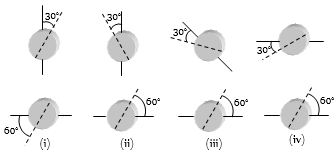
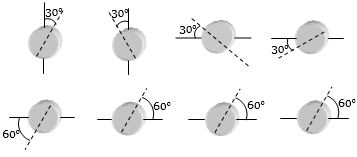
The figure shows four pairs of polarizing sheets,seen face-on. Each pair is mounted in the path of initially unpolarized light. The polarizing direction of each sheet (indicated by the dashed line) is referenced to either a horizontal $x$-axis or a vertical $y$-axis. Rank the pairs according to the fraction of the initial intensity that they pass,greatest first.
A
$(i) > (ii) > (iii) > (iv)$
B
$(i) > (iv) > (ii) > (iii)$
C
$(i) > (iii) > (ii) > (iv)$
D
$(iv) > (iii) > (ii) > (i)$
Solution
(C) The intensity of light passing through a pair of polarizers is given by Malus' Law: $I = I_0 \cos^2 \theta$,where $\theta$ is the angle between the transmission axes of the two polarizers.
For unpolarized light incident on the first polarizer,the intensity becomes $I_1 = I_0 / 2$. The intensity after the second polarizer is $I = I_1 \cos^2 \theta = (I_0 / 2) \cos^2 \theta$.
To rank the pairs,we calculate the angle $\theta$ between the two sheets for each case:
$(i)$ The first sheet is at $30^\circ$ to the vertical,the second is at $60^\circ$ to the horizontal. The angle between them is $\theta = 90^\circ - 30^\circ - 60^\circ = 0^\circ$. Thus,$\cos^2(0^\circ) = 1$.
(ii) The first sheet is at $30^\circ$ to the vertical,the second is at $60^\circ$ to the horizontal. The angle between them is $\theta = 60^\circ$. Thus,$\cos^2(60^\circ) = 0.25$.
(iii) The first sheet is at $30^\circ$ to the horizontal,the second is at $60^\circ$ to the horizontal. The angle between them is $\theta = 30^\circ$. Thus,$\cos^2(30^\circ) = 0.75$.
(iv) The first sheet is at $30^\circ$ to the horizontal,the second is at $60^\circ$ to the horizontal. The angle between them is $\theta = 90^\circ$. Thus,$\cos^2(90^\circ) = 0$.
Comparing the values: $1 > 0.75 > 0.25 > 0$,which corresponds to $(i) > (iii) > (ii) > (iv)$.
For unpolarized light incident on the first polarizer,the intensity becomes $I_1 = I_0 / 2$. The intensity after the second polarizer is $I = I_1 \cos^2 \theta = (I_0 / 2) \cos^2 \theta$.
To rank the pairs,we calculate the angle $\theta$ between the two sheets for each case:
$(i)$ The first sheet is at $30^\circ$ to the vertical,the second is at $60^\circ$ to the horizontal. The angle between them is $\theta = 90^\circ - 30^\circ - 60^\circ = 0^\circ$. Thus,$\cos^2(0^\circ) = 1$.
(ii) The first sheet is at $30^\circ$ to the vertical,the second is at $60^\circ$ to the horizontal. The angle between them is $\theta = 60^\circ$. Thus,$\cos^2(60^\circ) = 0.25$.
(iii) The first sheet is at $30^\circ$ to the horizontal,the second is at $60^\circ$ to the horizontal. The angle between them is $\theta = 30^\circ$. Thus,$\cos^2(30^\circ) = 0.75$.
(iv) The first sheet is at $30^\circ$ to the horizontal,the second is at $60^\circ$ to the horizontal. The angle between them is $\theta = 90^\circ$. Thus,$\cos^2(90^\circ) = 0$.
Comparing the values: $1 > 0.75 > 0.25 > 0$,which corresponds to $(i) > (iii) > (ii) > (iv)$.
0 likes
View Solution48
MediumMCQ
When an unpolarized light of intensity $I_o$ is incident on a polarizing sheet,the intensity of the light which does not get transmitted is
A
$0$
B
$I_o$
C
$\frac{I_o}{2}$
D
$\frac{I_o}{4}$
Solution
(C) When unpolarized light of intensity $I_o$ is incident on a polarizing sheet,the intensity of the transmitted light is given by $I_t = \frac{I_o}{2}$.
The intensity of the light that does not get transmitted is the difference between the incident intensity and the transmitted intensity.
$\text{Intensity of untransmitted light} = I_o - I_t$
$\text{Intensity of untransmitted light} = I_o - \frac{I_o}{2} = \frac{I_o}{2}$.
The intensity of the light that does not get transmitted is the difference between the incident intensity and the transmitted intensity.
$\text{Intensity of untransmitted light} = I_o - I_t$
$\text{Intensity of untransmitted light} = I_o - \frac{I_o}{2} = \frac{I_o}{2}$.
0 likes
View Solution49
MediumMCQ
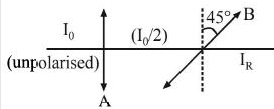
$A$ beam of unpolarised light of intensity $I_0$ is passed through a polaroid $A$ and then through another polaroid $B$ which is oriented so that its principal plane makes an angle of $45^{\circ}$ relative to that of $A$. The intensity of the emergent light is
A
$\frac{I_0}{8}$
B
$I_0$
C
$\frac{I_0}{2}$
D
$\frac{I_0}{4}$
Solution
(D) When unpolarised light of intensity $I_0$ passes through the first polaroid $A$,the intensity of the transmitted light becomes $I_1 = \frac{I_0}{2}$.
According to Malus' Law,when this polarised light passes through the second polaroid $B$ whose transmission axis makes an angle $\theta = 45^{\circ}$ with the axis of $A$,the intensity of the emergent light $I_R$ is given by:
$I_R = I_1 \cos^2(\theta)$
Substituting the values:
$I_R = \left(\frac{I_0}{2}\right) \cos^2(45^{\circ})$
Since $\cos(45^{\circ}) = \frac{1}{\sqrt{2}}$,we have $\cos^2(45^{\circ}) = \frac{1}{2}$.
Therefore,$I_R = \frac{I_0}{2} \times \frac{1}{2} = \frac{I_0}{4}$.
According to Malus' Law,when this polarised light passes through the second polaroid $B$ whose transmission axis makes an angle $\theta = 45^{\circ}$ with the axis of $A$,the intensity of the emergent light $I_R$ is given by:
$I_R = I_1 \cos^2(\theta)$
Substituting the values:
$I_R = \left(\frac{I_0}{2}\right) \cos^2(45^{\circ})$
Since $\cos(45^{\circ}) = \frac{1}{\sqrt{2}}$,we have $\cos^2(45^{\circ}) = \frac{1}{2}$.
Therefore,$I_R = \frac{I_0}{2} \times \frac{1}{2} = \frac{I_0}{4}$.
0 likes
View Solution50
MediumMCQ
Two beams,$A$ and $B$,of plane polarized light with mutually perpendicular planes of polarization are seen through a polaroid. From the position when the beam $A$ has maximum intensity (and beam $B$ has zero intensity),a rotation of the polaroid through $30^{\circ}$ makes the two beams appear equally bright. If the initial intensities of the two beams are $I_A$ and $I_B$ respectively,then $\frac{I_A}{I_B} = $
A
$\frac{3}{2}$
B
$1$
C
$\frac{1}{3}$
D
$3$
Solution
(C) According to Malus's law,the intensity of the emerging beam is given by $I = I_0 \cos^2 \theta$.
Let the initial intensity of beam $A$ be $I_A$ and beam $B$ be $I_B$. When the polaroid is at the position where beam $A$ has maximum intensity,the angle between the transmission axis of the polaroid and the plane of polarization of beam $A$ is $0^{\circ}$,and for beam $B$ it is $90^{\circ}$.
After rotating the polaroid by $30^{\circ}$,the new angle for beam $A$ is $\theta_A = 30^{\circ}$ and for beam $B$ is $\theta_B = 90^{\circ} - 30^{\circ} = 60^{\circ}$.
The intensities of the beams after passing through the polaroid are:
$I_A' = I_A \cos^2(30^{\circ}) = I_A \left(\frac{\sqrt{3}}{2}\right)^2 = I_A \cdot \frac{3}{4}$
$I_B' = I_B \cos^2(60^{\circ}) = I_B \left(\frac{1}{2}\right)^2 = I_B \cdot \frac{1}{4}$
Given that the beams appear equally bright,$I_A' = I_B'$:
$I_A \cdot \frac{3}{4} = I_B \cdot \frac{1}{4}$
$\frac{I_A}{I_B} = \frac{1}{3}$
Let the initial intensity of beam $A$ be $I_A$ and beam $B$ be $I_B$. When the polaroid is at the position where beam $A$ has maximum intensity,the angle between the transmission axis of the polaroid and the plane of polarization of beam $A$ is $0^{\circ}$,and for beam $B$ it is $90^{\circ}$.
After rotating the polaroid by $30^{\circ}$,the new angle for beam $A$ is $\theta_A = 30^{\circ}$ and for beam $B$ is $\theta_B = 90^{\circ} - 30^{\circ} = 60^{\circ}$.
The intensities of the beams after passing through the polaroid are:
$I_A' = I_A \cos^2(30^{\circ}) = I_A \left(\frac{\sqrt{3}}{2}\right)^2 = I_A \cdot \frac{3}{4}$
$I_B' = I_B \cos^2(60^{\circ}) = I_B \left(\frac{1}{2}\right)^2 = I_B \cdot \frac{1}{4}$
Given that the beams appear equally bright,$I_A' = I_B'$:
$I_A \cdot \frac{3}{4} = I_B \cdot \frac{1}{4}$
$\frac{I_A}{I_B} = \frac{1}{3}$
0 likes
View SolutionWave Optics — Polarisation of Light and Malus' Law · Frequently Asked Questions
1Are these Wave Optics questions useful for JEE and NEET?
Yes. All questions in this section are mapped to JEE Main and NEET exam patterns. Previous year questions from JEE Main, NEET, GUJCET and state-level exams are included with full solutions.
2Can I switch to Hindi or Gujarati for these questions?
Yes. Use the language tabs in the hero section or the sidebar to view the same questions and solutions in English, Hindi or Gujarati.
3How do I generate a question paper from this subtopic?
Use the Vedclass Exam Paper Generator — select the chapter and subtopic, set difficulty, and generate Sets A, B, C, D automatically. First 3 chapters of every subject are free.
Vedclass Products
For Students
Vedclass Test Series
Mock tests in real JEE/NEET style with performance analysis. 5-day free trial.
Start Free TrialFor Teachers
Exam Paper Generator
Generate Set A/B/C/D papers from this chapter in 2 minutes. 3 chapters free.
Try FreeFor Institutes
Online Exam Module
Live online exams with unlimited students, 360° analytics & white-label branding.
See DemoFor Teachers & Institutes
Generate a Wave Optics Exam Paper in 2 Minutes
Select subtopic & difficulty — Sets A, B, C, D auto-generated with No Repeat logic.
First 3 chapters of every subject are free — no payment required.