
A English
Refraction through Plane Surface and Glass Slab Questions in English
Class 12 Physics · Ray Optics and Optical Instruments · Refraction through Plane Surface and Glass Slab
154+
Questions
English
Language
100%
With Solutions
Showing 4 of 154 questions in English
151
MediumMCQ
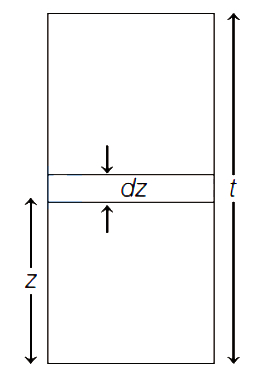
$A$ printed page is kept pressed by a transparent cube of edge $t$. The refractive index of the cube varies as $\mu(z) = 1 + \frac{z}{t}$,where $z$ is the vertical distance from the bottom of the cube. If viewed from the top,then the printed letters appear to be shifted by an amount
A
$(1 - \ln 2) t$
B
$(2 \ln 2 - 1) t$
C
$\frac{t}{2 \ln 2}$
D
$\frac{2 t}{3 \ln 2}$
Solution
(A) Consider an elemental strip of thickness $dz$ at a height $z$ from the bottom of the cube.
The apparent thickness $dh$ of this elemental strip is given by:
$dh = \frac{dz}{\mu(z)} = \frac{dz}{1 + \frac{z}{t}} = \frac{t}{t + z} dz$
The total apparent depth $h'$ of the cube as seen from the top is the integral of $dh$ from $z = 0$ to $z = t$:
$h' = \int_0^t \frac{t}{t + z} dz = t [\ln(t + z)]_0^t$
$h' = t [\ln(2t) - \ln(t)] = t \ln\left(\frac{2t}{t}\right) = t \ln 2$
The shift in the position of the printed letters is the difference between the real thickness $t$ and the apparent thickness $h'$:
$\text{Shift} = t - h' = t - t \ln 2 = (1 - \ln 2) t$
The apparent thickness $dh$ of this elemental strip is given by:
$dh = \frac{dz}{\mu(z)} = \frac{dz}{1 + \frac{z}{t}} = \frac{t}{t + z} dz$
The total apparent depth $h'$ of the cube as seen from the top is the integral of $dh$ from $z = 0$ to $z = t$:
$h' = \int_0^t \frac{t}{t + z} dz = t [\ln(t + z)]_0^t$
$h' = t [\ln(2t) - \ln(t)] = t \ln\left(\frac{2t}{t}\right) = t \ln 2$
The shift in the position of the printed letters is the difference between the real thickness $t$ and the apparent thickness $h'$:
$\text{Shift} = t - h' = t - t \ln 2 = (1 - \ln 2) t$
0 likes
View Solution152
DifficultMCQ
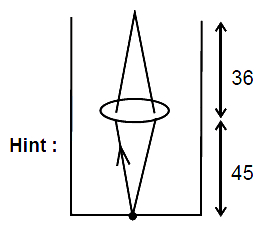
When a convex lens is placed above an empty tank,the image of a mark at the bottom of the tank,which is $45 \ cm$ from the lens,is formed $36 \ cm$ above the lens. When a liquid is poured in the tank to a depth of $40 \ cm$,the distance of the image of the mark above the lens is $48 \ cm$. The refractive index of the liquid is
A
$1.358$
B
$1.544$
C
$1.472$
D
$1.366$
Solution
(D) Initially,with the empty tank,the object distance $u = -45 \ cm$ and the image distance $v = +36 \ cm$. Using the lens formula $\frac{1}{f} = \frac{1}{v} - \frac{1}{u}$:
$\frac{1}{f} = \frac{1}{36} - \frac{1}{-45} = \frac{1}{36} + \frac{1}{45} = \frac{5+4}{180} = \frac{9}{180} = \frac{1}{20} \Rightarrow f = 20 \ cm$.
When the liquid is poured to a depth of $40 \ cm$,the apparent depth of the mark is $d' = \frac{40}{\mu}$. The remaining distance from the lens to the liquid surface is $45 - 40 = 5 \ cm$. Thus,the new object distance is $u' = -(\frac{40}{\mu} + 5) \ cm$. The new image distance is $v' = +48 \ cm$.
Using the lens formula again: $\frac{1}{f} = \frac{1}{v'} - \frac{1}{u'}$
$\frac{1}{20} = \frac{1}{48} - \frac{1}{-(\frac{40}{\mu} + 5)} = \frac{1}{48} + \frac{1}{\frac{40}{\mu} + 5}$
$\frac{1}{\frac{40}{\mu} + 5} = \frac{1}{20} - \frac{1}{48} = \frac{12 - 5}{240} = \frac{7}{240}$
$\frac{40}{\mu} + 5 = \frac{240}{7} \approx 34.286$
$\frac{40}{\mu} = 34.286 - 5 = 29.286$
$\mu = \frac{40}{29.286} \approx 1.366$.
$\frac{1}{f} = \frac{1}{36} - \frac{1}{-45} = \frac{1}{36} + \frac{1}{45} = \frac{5+4}{180} = \frac{9}{180} = \frac{1}{20} \Rightarrow f = 20 \ cm$.
When the liquid is poured to a depth of $40 \ cm$,the apparent depth of the mark is $d' = \frac{40}{\mu}$. The remaining distance from the lens to the liquid surface is $45 - 40 = 5 \ cm$. Thus,the new object distance is $u' = -(\frac{40}{\mu} + 5) \ cm$. The new image distance is $v' = +48 \ cm$.
Using the lens formula again: $\frac{1}{f} = \frac{1}{v'} - \frac{1}{u'}$
$\frac{1}{20} = \frac{1}{48} - \frac{1}{-(\frac{40}{\mu} + 5)} = \frac{1}{48} + \frac{1}{\frac{40}{\mu} + 5}$
$\frac{1}{\frac{40}{\mu} + 5} = \frac{1}{20} - \frac{1}{48} = \frac{12 - 5}{240} = \frac{7}{240}$
$\frac{40}{\mu} + 5 = \frac{240}{7} \approx 34.286$
$\frac{40}{\mu} = 34.286 - 5 = 29.286$
$\mu = \frac{40}{29.286} \approx 1.366$.
0 likes
View Solution153
EasyMCQ
Light travels through a glass plate of thickness $t$ and having refractive index $\mu$. If $c$ is the velocity of light in vacuum,the time taken by the light to travel through this thickness of glass is:
A
$\frac{t}{\mu c}$
B
$\frac{tc}{\mu}$
C
$\frac{\mu t}{c}$
D
$\mu tc$
Solution
(C) The thickness of the glass plate is given as $t$.
The refractive index of the glass is $\mu$.
The velocity of light in vacuum is $c$.
The velocity of light in a medium $(v)$ is related to the refractive index $(\mu)$ and the velocity of light in vacuum $(c)$ by the formula: $\mu = \frac{c}{v}$.
Therefore,the speed of light in the glass plate is $v = \frac{c}{\mu}$.
The time $(T)$ taken to travel a distance $(t)$ at a constant speed $(v)$ is given by $T = \frac{\text{distance}}{\text{speed}} = \frac{t}{v}$.
Substituting the value of $v$: $T = \frac{t}{c / \mu} = \frac{\mu t}{c}$.
Thus,the time taken is $\frac{\mu t}{c}$.
The refractive index of the glass is $\mu$.
The velocity of light in vacuum is $c$.
The velocity of light in a medium $(v)$ is related to the refractive index $(\mu)$ and the velocity of light in vacuum $(c)$ by the formula: $\mu = \frac{c}{v}$.
Therefore,the speed of light in the glass plate is $v = \frac{c}{\mu}$.
The time $(T)$ taken to travel a distance $(t)$ at a constant speed $(v)$ is given by $T = \frac{\text{distance}}{\text{speed}} = \frac{t}{v}$.
Substituting the value of $v$: $T = \frac{t}{c / \mu} = \frac{\mu t}{c}$.
Thus,the time taken is $\frac{\mu t}{c}$.
0 likes
View Solution154
EasyMCQ
If the velocity of light in vacuum is $3 \times 10^{8} \text{ m/s}$,the time taken (in nanoseconds) to travel through a glass plate of thickness $10 \text{ cm}$ and refractive index $1.5$ is:
A
$0.5$
B
$1$
C
$2$
D
$3$
Solution
(A) Given: Velocity of light in vacuum $(c)$ = $3 \times 10^{8} \text{ m/s}$,thickness of glass plate $(d)$ = $10 \text{ cm} = 0.1 \text{ m}$,and refractive index $(\mu)$ = $1.5$.
The velocity of light in the glass plate $(v)$ is given by $v = \frac{c}{\mu} = \frac{3 \times 10^{8}}{1.5} = 2 \times 10^{8} \text{ m/s}$.
The time taken $(t)$ to travel through the glass plate is $t = \frac{d}{v}$.
Substituting the values: $t = \frac{0.1 \text{ m}}{2 \times 10^{8} \text{ m/s}} = 0.05 \times 10^{-8} \text{ s} = 0.5 \times 10^{-9} \text{ s}$.
Since $1 \text{ nanosecond} = 10^{-9} \text{ s}$,the time taken is $0.5 \text{ ns}$.
The velocity of light in the glass plate $(v)$ is given by $v = \frac{c}{\mu} = \frac{3 \times 10^{8}}{1.5} = 2 \times 10^{8} \text{ m/s}$.
The time taken $(t)$ to travel through the glass plate is $t = \frac{d}{v}$.
Substituting the values: $t = \frac{0.1 \text{ m}}{2 \times 10^{8} \text{ m/s}} = 0.05 \times 10^{-8} \text{ s} = 0.5 \times 10^{-9} \text{ s}$.
Since $1 \text{ nanosecond} = 10^{-9} \text{ s}$,the time taken is $0.5 \text{ ns}$.
0 likes
View SolutionRay Optics and Optical Instruments — Refraction through Plane Surface and Glass Slab · Frequently Asked Questions
1Are these Ray Optics and Optical Instruments questions useful for JEE and NEET?
Yes. All questions in this section are mapped to JEE Main and NEET exam patterns. Previous year questions from JEE Main, NEET, GUJCET and state-level exams are included with full solutions.
2Can I switch to Hindi or Gujarati for these questions?
Yes. Use the language tabs in the hero section or the sidebar to view the same questions and solutions in English, Hindi or Gujarati.
3How do I generate a question paper from this subtopic?
Use the Vedclass Exam Paper Generator — select the chapter and subtopic, set difficulty, and generate Sets A, B, C, D automatically. First 3 chapters of every subject are free.
Vedclass Products
For Students
Vedclass Test Series
Mock tests in real JEE/NEET style with performance analysis. 5-day free trial.
Start Free TrialFor Teachers
Exam Paper Generator
Generate Set A/B/C/D papers from this chapter in 2 minutes. 3 chapters free.
Try FreeFor Institutes
Online Exam Module
Live online exams with unlimited students, 360° analytics & white-label branding.
See DemoFor Teachers & Institutes
Generate a Ray Optics and Optical Instruments Exam Paper in 2 Minutes
Select subtopic & difficulty — Sets A, B, C, D auto-generated with No Repeat logic.
First 3 chapters of every subject are free — no payment required.