
A English
Refraction of Light Questions in English
Class 12 Physics · Ray Optics and Optical Instruments · Refraction of Light
261+
Questions
English
Language
100%
With Solutions
Showing 49 of 261 questions in English
1
MediumMCQ
$A$ wave has velocity $u$ in medium $P$ and velocity $2u$ in medium $Q.$ If the wave is incident in medium $P$ at an angle of $30^\circ,$ then the angle of refraction will be .... $^o$
A
$30$
B
$45$
C
$60$
D
$90$
Solution
(D) According to Snell's Law for waves,the ratio of the sine of the angle of incidence to the sine of the angle of refraction is equal to the ratio of the velocities in the respective media:
$\frac{\sin i}{\sin r} = \frac{v_1}{v_2}$
Given:
Angle of incidence $i = 30^\circ$
Velocity in medium $P$ $(v_1)$ = $u$
Velocity in medium $Q$ $(v_2)$ = $2u$
Substituting the values into the formula:
$\frac{\sin 30^\circ}{\sin r} = \frac{u}{2u}$
$\frac{0.5}{\sin r} = \frac{1}{2}$
$\sin r = 0.5 \times 2 = 1$
Since $\sin r = 1,$ the angle of refraction $r = 90^\circ.$
$\frac{\sin i}{\sin r} = \frac{v_1}{v_2}$
Given:
Angle of incidence $i = 30^\circ$
Velocity in medium $P$ $(v_1)$ = $u$
Velocity in medium $Q$ $(v_2)$ = $2u$
Substituting the values into the formula:
$\frac{\sin 30^\circ}{\sin r} = \frac{u}{2u}$
$\frac{0.5}{\sin r} = \frac{1}{2}$
$\sin r = 0.5 \times 2 = 1$
Since $\sin r = 1,$ the angle of refraction $r = 90^\circ.$
0 likes
View Solution2
EasyMCQ
The ratio of the refractive index of red light to blue light in air is
A
Less than unity
B
Equal to unity
C
Greater than unity
D
Less as well as greater than unity depending upon the experimental arrangement
Solution
(A) The refractive index of a medium depends on the wavelength of light,given by Cauchy's equation: $\mu = A + \frac{B}{\lambda^2}$.
Since the wavelength of red light $(\lambda_{red})$ is greater than the wavelength of blue light $(\lambda_{blue})$,the refractive index for red light is less than that for blue light $(\mu_{red} < \mu_{blue})$.
Therefore,the ratio of the refractive index of red light to blue light is $\frac{\mu_{red}}{\mu_{blue}} < 1$.
Thus,the ratio is less than unity.
Since the wavelength of red light $(\lambda_{red})$ is greater than the wavelength of blue light $(\lambda_{blue})$,the refractive index for red light is less than that for blue light $(\mu_{red} < \mu_{blue})$.
Therefore,the ratio of the refractive index of red light to blue light is $\frac{\mu_{red}}{\mu_{blue}} < 1$.
Thus,the ratio is less than unity.
0 likes
View Solution3
EasyMCQ
The refractive index of a certain glass is $1.5$ for light whose wavelength in vacuum is $6000\;\mathring A.$ The wavelength of this light when it passes through glass is.......$\mathring A.$
A
$4000$
B
$6000$
C
$9000$
D
$15000$
Solution
(A) The relationship between the wavelength of light in a medium $(\lambda_{medium})$ and its wavelength in a vacuum $(\lambda_{vacuum})$ is given by the formula: $\lambda_{medium} = \frac{\lambda_{vacuum}}{\mu}$,where $\mu$ is the refractive index of the medium.
Given: $\lambda_{vacuum} = 6000\;\mathring A$ and $\mu = 1.5$.
Substituting the values into the formula:
$\lambda_{medium} = \frac{6000}{1.5} = 4000\;\mathring A$.
Therefore,the wavelength of light in glass is $4000\;\mathring A$.
Given: $\lambda_{vacuum} = 6000\;\mathring A$ and $\mu = 1.5$.
Substituting the values into the formula:
$\lambda_{medium} = \frac{6000}{1.5} = 4000\;\mathring A$.
Therefore,the wavelength of light in glass is $4000\;\mathring A$.
0 likes
View Solution4
EasyMCQ
When light travels from one medium to another with a different refractive index, which of the following will change?
A
Frequency, wavelength and velocity
B
Frequency and wavelength
C
Frequency and velocity
D
Wavelength and velocity
Solution
(D) When light travels from one medium to another, the frequency of the light remains constant because it depends on the source of the light. However, the velocity $(v)$ and wavelength $(\lambda)$ of the light change according to the relation $v = f \lambda$, where $f$ is the frequency. Since the refractive index $(n)$ of the medium changes, the velocity changes as $v = c/n$, which subsequently causes the wavelength to change to maintain the constant frequency. Therefore, only wavelength and velocity change.
0 likes
View Solution5
EasyMCQ
Monochromatic light is refracted from air into glass of refractive index $\mu$. The ratio of the wavelength of incident and refracted waves is
A
$1 : \mu$
B
$1 : \mu^2$
C
$\mu : 1$
D
$1 : 1$
Solution
(C) The frequency of light remains constant during refraction.
We know that the speed of light $v = f \lambda$,where $f$ is the frequency and $\lambda$ is the wavelength.
Since $f$ is constant,$v \propto \lambda$.
Also,the refractive index $\mu$ is defined as $\mu = c / v$,which implies $v = c / \mu$.
Therefore,$\lambda \propto 1 / \mu$.
Let $\lambda_1$ be the wavelength in air $(\mu_1 = 1)$ and $\lambda_2$ be the wavelength in glass $(\mu_2 = \mu)$.
Then,$\lambda_1 / \lambda_2 = \mu_2 / \mu_1 = \mu / 1 = \mu : 1$.
We know that the speed of light $v = f \lambda$,where $f$ is the frequency and $\lambda$ is the wavelength.
Since $f$ is constant,$v \propto \lambda$.
Also,the refractive index $\mu$ is defined as $\mu = c / v$,which implies $v = c / \mu$.
Therefore,$\lambda \propto 1 / \mu$.
Let $\lambda_1$ be the wavelength in air $(\mu_1 = 1)$ and $\lambda_2$ be the wavelength in glass $(\mu_2 = \mu)$.
Then,$\lambda_1 / \lambda_2 = \mu_2 / \mu_1 = \mu / 1 = \mu : 1$.
0 likes
View Solution6
EasyMCQ
$A$ monochromatic beam of light passes from a denser medium into a rarer medium. As a result,
A
Its velocity increases
B
Its velocity decreases
C
Its frequency decreases
D
Its wavelength decreases
Solution
(A) When light travels from a denser medium (refractive index $\mu_1$) to a rarer medium (refractive index $\mu_2$),where $\mu_2 < \mu_1$,the speed of light $v$ is given by $v = \frac{c}{\mu}$.
Since the refractive index $\mu$ decreases,the velocity $v$ of the light beam increases.
The frequency of light depends only on the source and remains constant during refraction.
The wavelength $\lambda$ is given by $\lambda = \frac{v}{f}$. Since $v$ increases and $f$ is constant,the wavelength $\lambda$ also increases.
Therefore,the correct statement is that its velocity increases.
Since the refractive index $\mu$ decreases,the velocity $v$ of the light beam increases.
The frequency of light depends only on the source and remains constant during refraction.
The wavelength $\lambda$ is given by $\lambda = \frac{v}{f}$. Since $v$ increases and $f$ is constant,the wavelength $\lambda$ also increases.
Therefore,the correct statement is that its velocity increases.
0 likes
View Solution7
EasyMCQ
The refractive index of a material for infrared light is:
A
Equal to that of ultraviolet light
B
Less than that for ultraviolet light
C
Equal to that for red light
D
Greater than that for ultraviolet light
Solution
(B) According to Cauchy's dispersion formula,the refractive index $\mu$ of a material is related to the wavelength $\lambda$ by the relation $\mu \approx A + \frac{B}{\lambda^2}$.
This shows that the refractive index $\mu$ is inversely related to the wavelength $\lambda$.
Since the wavelength of infrared light is greater than the wavelength of ultraviolet light $(\lambda_{\text{infrared}} > \lambda_{\text{ultraviolet}})$,the refractive index for infrared light will be less than the refractive index for ultraviolet light.
Therefore,$\mu_{\text{infrared}} < \mu_{\text{ultraviolet}}$.
This shows that the refractive index $\mu$ is inversely related to the wavelength $\lambda$.
Since the wavelength of infrared light is greater than the wavelength of ultraviolet light $(\lambda_{\text{infrared}} > \lambda_{\text{ultraviolet}})$,the refractive index for infrared light will be less than the refractive index for ultraviolet light.
Therefore,$\mu_{\text{infrared}} < \mu_{\text{ultraviolet}}$.
0 likes
View Solution8
EasyMCQ
The index of refraction of diamond is $2.0$. The velocity of light in diamond in $cm/s$ is approximately:
A
$6 \times 10^{10}$
B
$3.0 \times 10^{10}$
C
$2 \times 10^{10}$
D
$1.5 \times 10^{10}$
Solution
(D) The refractive index $\mu$ is defined as the ratio of the speed of light in vacuum $c$ to the speed of light in the medium $v$: $\mu = \frac{c}{v}$.
Given,$\mu = 2.0$ and $c = 3 \times 10^8 \ m/s$.
Rearranging the formula for velocity: $v = \frac{c}{\mu}$.
Substituting the values: $v = \frac{3 \times 10^8 \ m/s}{2.0} = 1.5 \times 10^8 \ m/s$.
To convert the velocity from $m/s$ to $cm/s$,we multiply by $100$ $(1 \ m = 100 \ cm)$:
$v = 1.5 \times 10^8 \times 10^2 \ cm/s = 1.5 \times 10^{10} \ cm/s$.
Given,$\mu = 2.0$ and $c = 3 \times 10^8 \ m/s$.
Rearranging the formula for velocity: $v = \frac{c}{\mu}$.
Substituting the values: $v = \frac{3 \times 10^8 \ m/s}{2.0} = 1.5 \times 10^8 \ m/s$.
To convert the velocity from $m/s$ to $cm/s$,we multiply by $100$ $(1 \ m = 100 \ cm)$:
$v = 1.5 \times 10^8 \times 10^2 \ cm/s = 1.5 \times 10^{10} \ cm/s$.
0 likes
View Solution9
EasyMCQ
$A$ beam of light propagating in medium $A$ with index of refraction $n(A)$ passes across an interface into medium $B$ with index of refraction $n(B)$. The angle of incidence is greater than the angle of refraction; $v(A)$ and $v(B)$ denote the speed of light in $A$ and $B$. Then which of the following is true?
A
$v(A) > v(B)$ and $n(A) > n(B)$
B
$v(A) > v(B)$ and $n(A) < n(B)$
C
$v(A) < v(B)$ and $n(A) > n(B)$
D
$v(A) < v(B)$ and $n(A) < n(B)$
Solution
(B) According to Snell's Law,$n(A) \sin(i) = n(B) \sin(r)$.
Given that the angle of incidence $i$ is greater than the angle of refraction $r$ $(i > r)$,it follows that $\sin(i) > \sin(r)$.
For the equation to hold,we must have $n(A) < n(B)$,which means medium $B$ is optically denser than medium $A$.
The speed of light in a medium is given by $v = c/n$. Since $n(A) < n(B)$,it follows that $v(A) > v(B)$.
Therefore,the correct relationship is $v(A) > v(B)$ and $n(A) < n(B)$.
Given that the angle of incidence $i$ is greater than the angle of refraction $r$ $(i > r)$,it follows that $\sin(i) > \sin(r)$.
For the equation to hold,we must have $n(A) < n(B)$,which means medium $B$ is optically denser than medium $A$.
The speed of light in a medium is given by $v = c/n$. Since $n(A) < n(B)$,it follows that $v(A) > v(B)$.
Therefore,the correct relationship is $v(A) > v(B)$ and $n(A) < n(B)$.
0 likes
View Solution10
EasyMCQ
Light travels through a glass plate of thickness $t$ and having refractive index $n$. If $c$ is the velocity of light in vacuum,the time taken by the light to travel this thickness of glass is
A
$t / (nc)$
B
$tnc$
C
$nt / c$
D
$tc / n$
Solution
(C) The speed of light in a medium with refractive index $n$ is given by $v = c / n$,where $c$ is the speed of light in vacuum.
Time taken to travel a distance $t$ is given by the formula: $Time = \text{Distance} / \text{Speed}$.
Substituting the values,we get: $Time = t / (c / n) = (nt) / c$.
Therefore,the correct option is $C$.
Time taken to travel a distance $t$ is given by the formula: $Time = \text{Distance} / \text{Speed}$.
Substituting the values,we get: $Time = t / (c / n) = (nt) / c$.
Therefore,the correct option is $C$.
0 likes
View Solution11
EasyMCQ
Light takes $8$ min $20$ sec to reach the Earth from the Sun. If the whole atmosphere were filled with water,how much time would the light take to reach the Earth? (Given refractive index of water,$_a\mu_w = 4/3$)
A
$8$ min $20$ sec
B
$8$ min
C
$6$ min $11$ sec
D
$11$ min $6$ sec
Solution
(D) The time taken by light to travel a distance $d$ in a medium is given by $t = d/v$,where $v$ is the speed of light in that medium.
Since $v = c/\mu$,where $c$ is the speed of light in vacuum and $\mu$ is the refractive index,we have $t = d\mu/c$.
Let $t_a$ be the time taken in vacuum (or air) and $t_w$ be the time taken in water.
Then,$t_a = d/c$ and $t_w = d/v_w = d\mu_w/c$.
Therefore,$t_w = t_a \times \mu_w$.
Given $t_a = 8$ min $20$ sec $= 500$ sec and $\mu_w = 4/3$.
$t_w = 500 \times (4/3) = 2000/3$ sec.
$t_w = 666.67$ sec.
Converting to minutes: $666.67 / 60 = 11.11$ min.
$0.11$ min $= 0.11 \times 60 = 6.6$ sec $\approx 6$ sec.
Thus,$t_w = 11$ min $6$ sec.
Since $v = c/\mu$,where $c$ is the speed of light in vacuum and $\mu$ is the refractive index,we have $t = d\mu/c$.
Let $t_a$ be the time taken in vacuum (or air) and $t_w$ be the time taken in water.
Then,$t_a = d/c$ and $t_w = d/v_w = d\mu_w/c$.
Therefore,$t_w = t_a \times \mu_w$.
Given $t_a = 8$ min $20$ sec $= 500$ sec and $\mu_w = 4/3$.
$t_w = 500 \times (4/3) = 2000/3$ sec.
$t_w = 666.67$ sec.
Converting to minutes: $666.67 / 60 = 11.11$ min.
$0.11$ min $= 0.11 \times 60 = 6.6$ sec $\approx 6$ sec.
Thus,$t_w = 11$ min $6$ sec.
0 likes
View Solution12
EasyMCQ
The length of the optical path of two media in contact of lengths $d_1$ and $d_2$ with refractive indices $\mu_1$ and $\mu_2$ respectively,is
A
$\mu_1 d_1 + \mu_2 d_2$
B
$\mu_1 d_2 + \mu_2 d_1$
C
$\frac{d_1 d_2}{\mu_1 \mu_2}$
D
$\frac{d_1 + d_2}{\mu_1 \mu_2}$
Solution
(A) The optical path length is defined as the product of the refractive index of the medium and the geometric distance traveled by light in that medium.
Optical path = $\mu \times d$
For medium $1$,the optical path is $\mu_1 d_1$.
For medium $2$,the optical path is $\mu_2 d_2$.
Therefore,the total optical path length for the two media in contact is the sum of the individual optical paths:
Total optical path = $\mu_1 d_1 + \mu_2 d_2$.
Optical path = $\mu \times d$
For medium $1$,the optical path is $\mu_1 d_1$.
For medium $2$,the optical path is $\mu_2 d_2$.
Therefore,the total optical path length for the two media in contact is the sum of the individual optical paths:
Total optical path = $\mu_1 d_1 + \mu_2 d_2$.
0 likes
View Solution13
EasyMCQ
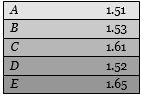
Immiscible transparent liquids $A, B, C, D$ and $E$ are placed in a rectangular glass container,forming layers based on their densities. The refractive indices of the liquids are given in the table below. The container is illuminated from the side,and a small piece of glass with a refractive index of $1.61$ is gently dropped into the liquid layers. In which liquid will the glass piece not be visible as it descends?
| Liquid | Refractive Index |
| :--- | :--- |
| $A$ | $1.51$ |
| $B$ | $1.53$ |
| $C$ | $1.61$ |
| $D$ | $1.52$ |
| $E$ | $1.65$ |
| Liquid | Refractive Index |
| :--- | :--- |
| $A$ | $1.51$ |
| $B$ | $1.53$ |
| $C$ | $1.61$ |
| $D$ | $1.52$ |
| $E$ | $1.65$ |
A
Liquid $A$ and $B$ only
B
Liquid $C$ only
C
Liquid $D$ and $E$ only
D
Liquid $A, B, D$ and $E$
Solution
(B) An object becomes invisible in a transparent medium if the refractive index of the object is equal to the refractive index of the medium. This is because there is no refraction or reflection of light at the interface between the object and the medium.
The refractive index of the glass piece is $\mu_{glass} = 1.61$.
From the given data:
- Refractive index of liquid $A = 1.51$
- Refractive index of liquid $B = 1.53$
- Refractive index of liquid $C = 1.61$
- Refractive index of liquid $D = 1.52$
- Refractive index of liquid $E = 1.65$
Since the refractive index of liquid $C$ is equal to the refractive index of the glass piece $(1.61 = 1.61)$,the glass piece will not be visible when it is in liquid $C$.
The refractive index of the glass piece is $\mu_{glass} = 1.61$.
From the given data:
- Refractive index of liquid $A = 1.51$
- Refractive index of liquid $B = 1.53$
- Refractive index of liquid $C = 1.61$
- Refractive index of liquid $D = 1.52$
- Refractive index of liquid $E = 1.65$
Since the refractive index of liquid $C$ is equal to the refractive index of the glass piece $(1.61 = 1.61)$,the glass piece will not be visible when it is in liquid $C$.
0 likes
View Solution14
MediumMCQ
The refractive indices of glass and water with respect to air are $3/2$ and $4/3$ respectively. The refractive index of glass with respect to water will be
A
$8/9$
B
$9/8$
C
$7/6$
D
None of these
Solution
(B) Given:
Refractive index of glass with respect to air,$_a\mu_g = 3/2$
Refractive index of water with respect to air,$_a\mu_w = 4/3$
We need to find the refractive index of glass with respect to water,$_w\mu_g$.
The formula for relative refractive index is:
$_w\mu_g = \frac{_a\mu_g}{_a\mu_w}$
Substituting the given values:
$_w\mu_g = \frac{3/2}{4/3} = \frac{3}{2} \times \frac{3}{4} = \frac{9}{8}$
Therefore,the refractive index of glass with respect to water is $9/8$.
Refractive index of glass with respect to air,$_a\mu_g = 3/2$
Refractive index of water with respect to air,$_a\mu_w = 4/3$
We need to find the refractive index of glass with respect to water,$_w\mu_g$.
The formula for relative refractive index is:
$_w\mu_g = \frac{_a\mu_g}{_a\mu_w}$
Substituting the given values:
$_w\mu_g = \frac{3/2}{4/3} = \frac{3}{2} \times \frac{3}{4} = \frac{9}{8}$
Therefore,the refractive index of glass with respect to water is $9/8$.
0 likes
View Solution15
EasyMCQ
If $_i{\mu _j}$ represents the refractive index when a light ray goes from medium $i$ to medium $j,$ then the product $_2{\mu _1} \times {\,_3}{\mu _2} \times {\,_4}{\mu _3}$ is equal to
A
$_3{\mu _1}$
B
$_3{\mu _2}$
C
$\frac{1}{{_1{\mu _4}}}$
D
$_4{\mu _2}$
Solution
(C) The refractive index of medium $j$ with respect to medium $i$ is defined as $_i{\mu _j} = \frac{\mu_j}{\mu_i}$,where $\mu$ represents the absolute refractive index of the medium.
Given the expression: $_2{\mu _1} \times {\,_3}{\mu _2} \times {\,_4}{\mu _3}$.
Substituting the definition: $\frac{\mu_1}{\mu_2} \times \frac{\mu_2}{\mu_3} \times \frac{\mu_3}{\mu_4}$.
Canceling the common terms $\mu_2$ and $\mu_3$,we get: $\frac{\mu_1}{\mu_4}$.
By definition,$\frac{\mu_1}{\mu_4} = {_4}{\mu _1}$.
Since $_4{\mu _1} = \frac{1}{{_1{\mu _4}}}$,the product is equal to $\frac{1}{{_1{\mu _4}}}$.
Given the expression: $_2{\mu _1} \times {\,_3}{\mu _2} \times {\,_4}{\mu _3}$.
Substituting the definition: $\frac{\mu_1}{\mu_2} \times \frac{\mu_2}{\mu_3} \times \frac{\mu_3}{\mu_4}$.
Canceling the common terms $\mu_2$ and $\mu_3$,we get: $\frac{\mu_1}{\mu_4}$.
By definition,$\frac{\mu_1}{\mu_4} = {_4}{\mu _1}$.
Since $_4{\mu _1} = \frac{1}{{_1{\mu _4}}}$,the product is equal to $\frac{1}{{_1{\mu _4}}}$.
0 likes
View Solution16
EasyMCQ
The wavelength of light diminishes $\mu$ times ($\mu = 1.33$ for water) in a medium. $A$ diver from inside water looks at an object whose natural colour is green. He sees the object as
A
Green
B
Blue
C
Yellow
D
Red
Solution
(A) The colour of light is determined by its frequency.
When light travels from one medium to another,its speed and wavelength change,but its frequency remains constant.
Since the frequency of the light does not change,the perceived colour of the object remains the same.
Therefore,the diver sees the object as green.
When light travels from one medium to another,its speed and wavelength change,but its frequency remains constant.
Since the frequency of the light does not change,the perceived colour of the object remains the same.
Therefore,the diver sees the object as green.
0 likes
View Solution17
EasyMCQ
When light travels from air to water,then from water to glass,then from glass to $CO_2$ gas,and finally back to air,the relation between their refractive indices is given by:
A
$_a{n_w} \times {_w}{n_{gl}} \times {_{gl}}{n_{gas}} \times {_{gas}}{n_a} = 1$
B
$_a{n_w} \times {_w}{n_{gl}} \times {_{gas}}{n_{gl}} \times {_{gl}}{n_a} = 1$
C
$_a{n_w} \times {_w}{n_{gl}} \times {_{gl}}{n_{gas}} = 1$
D
There is no such relation.
Solution
(A) The refractive index of medium $2$ with respect to medium $1$ is defined as $_1{n_2} = \frac{n_2}{n_1}$.
For a series of media,the product of refractive indices is:
$_a{n_w} \times {_w}{n_{gl}} \times {_{gl}}{n_{gas}} \times {_{gas}}{n_a} = \left( \frac{n_w}{n_a} \right) \times \left( \frac{n_{gl}}{n_w} \right) \times \left( \frac{n_{gas}}{n_{gl}} \right) \times \left( \frac{n_a}{n_{gas}} \right) = 1$.
Thus,the product of the refractive indices for a closed loop of media returns to the initial medium is equal to $1$.
For a series of media,the product of refractive indices is:
$_a{n_w} \times {_w}{n_{gl}} \times {_{gl}}{n_{gas}} \times {_{gas}}{n_a} = \left( \frac{n_w}{n_a} \right) \times \left( \frac{n_{gl}}{n_w} \right) \times \left( \frac{n_{gas}}{n_{gl}} \right) \times \left( \frac{n_a}{n_{gas}} \right) = 1$.
Thus,the product of the refractive indices for a closed loop of media returns to the initial medium is equal to $1$.
0 likes
View Solution18
MediumMCQ
For a colour of light,the wavelength in air is $6000 \ \mathring A$ and in water,the wavelength is $4500 \ \mathring A$. Then the speed of light in water will be:
A
$5.0 \times 10^{14} \ m/s$
B
$2.25 \times 10^8 \ m/s$
C
$4.0 \times 10^8 \ m/s$
D
$0 \ m/s$
Solution
(B) The frequency of light remains constant when it travels from one medium to another. The speed of light $v$ is related to wavelength $\lambda$ and frequency $f$ by the equation $v = f \lambda$.
Since $f$ is constant,$v \propto \lambda$.
Therefore,$\frac{v_w}{v_a} = \frac{\lambda_w}{\lambda_a}$,where $v_w$ and $\lambda_w$ are the speed and wavelength in water,and $v_a$ and $\lambda_a$ are the speed and wavelength in air.
Given $v_a = 3 \times 10^8 \ m/s$,$\lambda_a = 6000 \ \mathring A$,and $\lambda_w = 4500 \ \mathring A$.
$v_w = v_a \times \frac{\lambda_w}{\lambda_a} = (3 \times 10^8 \ m/s) \times \frac{4500}{6000}$.
$v_w = 3 \times 10^8 \times 0.75 = 2.25 \times 10^8 \ m/s$.
Since $f$ is constant,$v \propto \lambda$.
Therefore,$\frac{v_w}{v_a} = \frac{\lambda_w}{\lambda_a}$,where $v_w$ and $\lambda_w$ are the speed and wavelength in water,and $v_a$ and $\lambda_a$ are the speed and wavelength in air.
Given $v_a = 3 \times 10^8 \ m/s$,$\lambda_a = 6000 \ \mathring A$,and $\lambda_w = 4500 \ \mathring A$.
$v_w = v_a \times \frac{\lambda_w}{\lambda_a} = (3 \times 10^8 \ m/s) \times \frac{4500}{6000}$.
$v_w = 3 \times 10^8 \times 0.75 = 2.25 \times 10^8 \ m/s$.
0 likes
View Solution19
EasyMCQ
$A$ beam of monochromatic blue light of wavelength $4200 \, \mathring{A}$ in air travels into water $(\mu = 4/3)$. Its wavelength in water will be.......$\mathring{A}$
A
$2800$
B
$5600$
C
$3150$
D
$4000$
Solution
(C) The wavelength of light in a medium is given by the formula $\lambda_m = \frac{\lambda_a}{\mu}$,where $\lambda_a$ is the wavelength in air and $\mu$ is the refractive index of the medium.
Given: $\lambda_a = 4200 \, \mathring{A}$ and $\mu = 4/3$.
Substituting the values:
$\lambda_m = \frac{4200}{4/3} = 4200 \times \frac{3}{4} = 1050 \times 3 = 3150 \, \mathring{A}$.
Therefore,the wavelength of the light in water is $3150 \, \mathring{A}$.
Given: $\lambda_a = 4200 \, \mathring{A}$ and $\mu = 4/3$.
Substituting the values:
$\lambda_m = \frac{4200}{4/3} = 4200 \times \frac{3}{4} = 1050 \times 3 = 3150 \, \mathring{A}$.
Therefore,the wavelength of the light in water is $3150 \, \mathring{A}$.
0 likes
View Solution20
EasyMCQ
If the speed of light in vacuum is $C \ m/s$,then what is the velocity of light in a medium of refractive index $1.5$?
A
$1.5 \times C$
B
$C$
C
$\frac{C}{1.5}$
D
It can have any velocity
Solution
(C) The refractive index $\mu$ of a medium is defined as the ratio of the speed of light in vacuum $(C)$ to the speed of light in that medium $(v)$:
$\mu = \frac{C}{v}$
Given that the refractive index $\mu = 1.5$ and the speed of light in vacuum is $C$,we can rearrange the formula to solve for the velocity in the medium $(v)$:
$v = \frac{C}{\mu} = \frac{C}{1.5}$
Therefore,the velocity of light in the medium is $\frac{C}{1.5}$.
$\mu = \frac{C}{v}$
Given that the refractive index $\mu = 1.5$ and the speed of light in vacuum is $C$,we can rearrange the formula to solve for the velocity in the medium $(v)$:
$v = \frac{C}{\mu} = \frac{C}{1.5}$
Therefore,the velocity of light in the medium is $\frac{C}{1.5}$.
0 likes
View Solution21
EasyMCQ
When light enters from air to water,then its
A
Frequency increases and speed decreases
B
Frequency is same but the wavelength is smaller in water than in air
C
Frequency is same but the wavelength in water is greater than in air
D
Frequency decreases and wavelength is smaller in water than in air
Solution
(B) When light travels from one medium to another,its frequency remains constant because it depends on the source of light.
Since the refractive index of water $(n_w \approx 1.33)$ is greater than that of air $(n_a \approx 1.0)$,the speed of light decreases in water $(v = c/n)$.
According to the relation $v = f \lambda$,since $v$ decreases and $f$ remains constant,the wavelength $\lambda$ must also decrease.
Therefore,the frequency remains the same,but the wavelength is smaller in water than in air.
Since the refractive index of water $(n_w \approx 1.33)$ is greater than that of air $(n_a \approx 1.0)$,the speed of light decreases in water $(v = c/n)$.
According to the relation $v = f \lambda$,since $v$ decreases and $f$ remains constant,the wavelength $\lambda$ must also decrease.
Therefore,the frequency remains the same,but the wavelength is smaller in water than in air.
0 likes
View Solution22
MediumMCQ
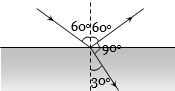
On a glass plate,a light wave is incident at an angle of $60^o$. If the reflected and the refracted waves are mutually perpendicular,the refractive index of the material is:
A
$\frac{\sqrt{3}}{2}$
B
$\sqrt{3}$
C
$\frac{3}{2}$
D
$\frac{1}{\sqrt{3}}$
Solution
(B) According to the problem,the angle of incidence $i = 60^o$.
Since the reflected and refracted rays are mutually perpendicular,the angle between them is $90^o$.
From the geometry of the reflection and refraction,we have $i + 90^o + r = 180^o$,where $r$ is the angle of refraction.
Substituting $i = 60^o$,we get $60^o + 90^o + r = 180^o$,which gives $r = 30^o$.
Using Snell's Law,$\mu = \frac{\sin i}{\sin r} = \frac{\sin 60^o}{\sin 30^o}$.
Substituting the values,$\mu = \frac{\sqrt{3}/2}{1/2} = \sqrt{3}$.
Since the reflected and refracted rays are mutually perpendicular,the angle between them is $90^o$.
From the geometry of the reflection and refraction,we have $i + 90^o + r = 180^o$,where $r$ is the angle of refraction.
Substituting $i = 60^o$,we get $60^o + 90^o + r = 180^o$,which gives $r = 30^o$.
Using Snell's Law,$\mu = \frac{\sin i}{\sin r} = \frac{\sin 60^o}{\sin 30^o}$.
Substituting the values,$\mu = \frac{\sqrt{3}/2}{1/2} = \sqrt{3}$.
0 likes
View Solution23
EasyMCQ
The refractive index of glass is $3/2$ and the refractive index of water is $4/3$. If the speed of light in glass is $2.00 \times 10^8 \ m/s$,the speed of light in water will be:
A
$2.67 \times 10^8 \ m/s$
B
$2.25 \times 10^8 \ m/s$
C
$1.78 \times 10^8 \ m/s$
D
$1.50 \times 10^8 \ m/s$
Solution
(B) The refractive index $\mu$ of a medium is inversely proportional to the speed of light $v$ in that medium,given by $\mu = c/v$,where $c$ is the speed of light in a vacuum.
Therefore,$\mu \propto 1/v$,which implies $\mu_g v_g = \mu_w v_w$.
Given: $\mu_g = 3/2$,$\mu_w = 4/3$,and $v_g = 2.00 \times 10^8 \ m/s$.
Using the relation $\frac{\mu_g}{\mu_w} = \frac{v_w}{v_g}$:
$\frac{3/2}{4/3} = \frac{v_w}{2.00 \times 10^8 \ m/s}$
$\frac{9}{8} = \frac{v_w}{2.00 \times 10^8 \ m/s}$
$v_w = \frac{9}{8} \times 2.00 \times 10^8 \ m/s = 2.25 \times 10^8 \ m/s$.
Therefore,$\mu \propto 1/v$,which implies $\mu_g v_g = \mu_w v_w$.
Given: $\mu_g = 3/2$,$\mu_w = 4/3$,and $v_g = 2.00 \times 10^8 \ m/s$.
Using the relation $\frac{\mu_g}{\mu_w} = \frac{v_w}{v_g}$:
$\frac{3/2}{4/3} = \frac{v_w}{2.00 \times 10^8 \ m/s}$
$\frac{9}{8} = \frac{v_w}{2.00 \times 10^8 \ m/s}$
$v_w = \frac{9}{8} \times 2.00 \times 10^8 \ m/s = 2.25 \times 10^8 \ m/s$.
0 likes
View Solution24
EasyMCQ
Monochromatic light of frequency $5 \times 10^{14} \ Hz$ travelling in vacuum enters a medium of refractive index $1.5$. Its wavelength in the medium is ....... $\mathring{A}$.
A
$4000$
B
$5000$
C
$6000$
D
$5500$
Solution
(A) The frequency of light remains unchanged when it enters a different medium. The frequency is $\nu = 5 \times 10^{14} \ Hz$.
The speed of light in vacuum is $c = 3 \times 10^8 \ m/s$.
The wavelength in vacuum is $\lambda_a = \frac{c}{\nu} = \frac{3 \times 10^8}{5 \times 10^{14}} = 0.6 \times 10^{-6} \ m = 6000 \ \mathring{A}$.
The wavelength in a medium of refractive index $\mu$ is given by $\lambda_m = \frac{\lambda_a}{\mu}$.
Given $\mu = 1.5$,we have $\lambda_m = \frac{6000 \ \mathring{A}}{1.5} = 4000 \ \mathring{A}$.
The speed of light in vacuum is $c = 3 \times 10^8 \ m/s$.
The wavelength in vacuum is $\lambda_a = \frac{c}{\nu} = \frac{3 \times 10^8}{5 \times 10^{14}} = 0.6 \times 10^{-6} \ m = 6000 \ \mathring{A}$.
The wavelength in a medium of refractive index $\mu$ is given by $\lambda_m = \frac{\lambda_a}{\mu}$.
Given $\mu = 1.5$,we have $\lambda_m = \frac{6000 \ \mathring{A}}{1.5} = 4000 \ \mathring{A}$.
0 likes
View Solution25
EasyMCQ
Light of wavelength $7200 \ \mathring{A}$ in air. It has a wavelength in glass $(\mu = 1.5)$ equal to.......$\mathring{A}$
A
$7200$
B
$4800$
C
$10800$
D
$7201.5$
Solution
(B) The wavelength of light in a medium is given by the formula $\lambda_{medium} = \frac{\lambda_{air}}{\mu}$.
Given,$\lambda_{air} = 7200 \ \mathring{A}$ and refractive index $\mu = 1.5$.
Substituting the values,we get $\lambda_{glass} = \frac{7200}{1.5} = 4800 \ \mathring{A}$.
Therefore,the correct option is $B$.
Given,$\lambda_{air} = 7200 \ \mathring{A}$ and refractive index $\mu = 1.5$.
Substituting the values,we get $\lambda_{glass} = \frac{7200}{1.5} = 4800 \ \mathring{A}$.
Therefore,the correct option is $B$.
0 likes
View Solution26
EasyMCQ
Which of the following is a correct relation?
A
$_a\mu_r = _a\mu_w \times _r\mu_w$
B
$_a\mu_r \times _r\mu_w = _w\mu_a$
C
$_a\mu_r \times _r\mu_a = 0$
D
$_a\mu_r / _w\mu_r = _a\mu_w$
Solution
(D) The refractive index of a medium $2$ with respect to medium $1$ is given by $_1\mu_2 = \frac{\mu_2}{\mu_1}$.
Given the expression in option $D$: $\frac{_a\mu_r}{_w\mu_r}$.
Substituting the refractive indices: $\frac{_a\mu_r}{_w\mu_r} = \frac{\mu_r / \mu_a}{\mu_r / \mu_w}$.
Simplifying the fraction: $\frac{\mu_r}{\mu_a} \times \frac{\mu_w}{\mu_r} = \frac{\mu_w}{\mu_a}$.
By definition,$\frac{\mu_w}{\mu_a} = _a\mu_w$.
Therefore,the relation $\frac{_a\mu_r}{_w\mu_r} = _a\mu_w$ is correct.
Given the expression in option $D$: $\frac{_a\mu_r}{_w\mu_r}$.
Substituting the refractive indices: $\frac{_a\mu_r}{_w\mu_r} = \frac{\mu_r / \mu_a}{\mu_r / \mu_w}$.
Simplifying the fraction: $\frac{\mu_r}{\mu_a} \times \frac{\mu_w}{\mu_r} = \frac{\mu_w}{\mu_a}$.
By definition,$\frac{\mu_w}{\mu_a} = _a\mu_w$.
Therefore,the relation $\frac{_a\mu_r}{_w\mu_r} = _a\mu_w$ is correct.
0 likes
View Solution27
EasyMCQ
The distance travelled by light in glass (refractive index $= 1.5$) in a nanosecond will be.......$cm$.
A
$45$
B
$40$
C
$30$
D
$20$
Solution
(D) The speed of light in a medium is given by $v = \frac{c}{\mu}$,where $c = 3 \times 10^8 \ m/s$ is the speed of light in vacuum and $\mu = 1.5$ is the refractive index of glass.
Substituting the values,we get $v = \frac{3 \times 10^8}{1.5} = 2 \times 10^8 \ m/s$.
The time given is $t = 1 \text{ nanosecond} = 10^{-9} \ s$.
The distance travelled is $d = v \times t = (2 \times 10^8 \ m/s) \times (10^{-9} \ s) = 0.2 \ m$.
Converting meters to centimeters,$d = 0.2 \times 100 \ cm = 20 \ cm$.
Substituting the values,we get $v = \frac{3 \times 10^8}{1.5} = 2 \times 10^8 \ m/s$.
The time given is $t = 1 \text{ nanosecond} = 10^{-9} \ s$.
The distance travelled is $d = v \times t = (2 \times 10^8 \ m/s) \times (10^{-9} \ s) = 0.2 \ m$.
Converting meters to centimeters,$d = 0.2 \times 100 \ cm = 20 \ cm$.
0 likes
View Solution28
EasyMCQ
When light is refracted from air into glass,
A
Its wavelength and frequency both increase
B
Its wavelength increases but frequency remains unchanged
C
Its wavelength decreases but frequency remains unchanged
D
Its wavelength and frequency both decrease
Solution
(C) When light travels from one medium to another,its frequency $(f)$ remains constant because it depends on the source of the light.
The speed of light $(v)$ in a medium is given by $v = f \lambda$,where $\lambda$ is the wavelength.
Since the refractive index of glass $(\mu_g)$ is greater than that of air $(\mu_a)$,the speed of light decreases when it enters the glass $(v_g < v_a)$.
Because $v = f \lambda$ and $f$ is constant,the decrease in speed $(v)$ must result in a decrease in wavelength $(\lambda)$.
Therefore,the wavelength decreases while the frequency remains unchanged.
The speed of light $(v)$ in a medium is given by $v = f \lambda$,where $\lambda$ is the wavelength.
Since the refractive index of glass $(\mu_g)$ is greater than that of air $(\mu_a)$,the speed of light decreases when it enters the glass $(v_g < v_a)$.
Because $v = f \lambda$ and $f$ is constant,the decrease in speed $(v)$ must result in a decrease in wavelength $(\lambda)$.
Therefore,the wavelength decreases while the frequency remains unchanged.
0 likes
View Solution29
EasyMCQ
$A$ mark at the bottom of a liquid appears to rise by $0.1 \ m$. The depth of the liquid is $1 \ m$. The refractive index of the liquid is
A
$1.33$
B
$\frac{9}{10}$
C
$\frac{10}{9}$
D
$1.5$
Solution
(C) The real depth of the liquid is $d = 1 \ m$.
The apparent shift in the position of the mark is $\Delta d = 0.1 \ m$.
The apparent depth $d'$ is given by $d' = d - \Delta d = 1 - 0.1 = 0.9 \ m$.
The refractive index $\mu$ is defined as the ratio of real depth to apparent depth:
$\mu = \frac{d}{d'} = \frac{1}{0.9} = \frac{10}{9}$.
The apparent shift in the position of the mark is $\Delta d = 0.1 \ m$.
The apparent depth $d'$ is given by $d' = d - \Delta d = 1 - 0.1 = 0.9 \ m$.
The refractive index $\mu$ is defined as the ratio of real depth to apparent depth:
$\mu = \frac{d}{d'} = \frac{1}{0.9} = \frac{10}{9}$.
0 likes
View Solution30
EasyMCQ
On heating a liquid,the refractive index generally
A
Decreases
B
Increases or decreases depending on the rate of heating
C
Does not change
D
Increases
Solution
(A) When a liquid is heated,its density generally decreases because the molecules move further apart due to increased thermal energy.
According to the Lorentz-Lorenz formula,the refractive index $n$ is related to the density $\rho$ of the medium.
As the temperature increases,the density $\rho$ decreases,which leads to a decrease in the refractive index $n$.
Therefore,the refractive index of a liquid generally decreases upon heating.
According to the Lorentz-Lorenz formula,the refractive index $n$ is related to the density $\rho$ of the medium.
As the temperature increases,the density $\rho$ decreases,which leads to a decrease in the refractive index $n$.
Therefore,the refractive index of a liquid generally decreases upon heating.
0 likes
View Solution31
EasyMCQ
If $\hat{i}$ denotes a unit vector along the incident light ray,$\hat{r}$ a unit vector along the refracted ray into a medium of refractive index $\mu$,and $\hat{n}$ a unit vector normal to the boundary of the medium directed towards the incident medium,then the law of refraction is:
A
$\hat{i} \cdot \hat{n} = \mu (\hat{r} \cdot \hat{n})$
B
$\hat{i} \times \hat{n} = \mu (\hat{n} \times \hat{r})$
C
$\hat{i} \times \hat{n} = \mu (\hat{r} \times \hat{n})$
D
$\mu (\hat{i} \times \hat{n}) = \hat{r} \times \hat{n}$
Solution
(C) Snell's law in vector form relates the incident ray vector $\hat{i}$,the refracted ray vector $\hat{r}$,and the normal vector $\hat{n}$ to the interface.
According to the law of refraction,$\mu_1 \sin \theta_1 = \mu_2 \sin \theta_2$.
In vector notation,where $\hat{n}$ is the normal directed towards the incident medium,the cross product $\hat{i} \times \hat{n}$ has a magnitude of $\sin \theta_1$ (since $\hat{i}$ and $\hat{n}$ are unit vectors).
Similarly,$\hat{r} \times \hat{n}$ has a magnitude of $\sin \theta_2$.
Thus,the vector form of Snell's law is expressed as $\hat{i} \times \hat{n} = \mu (\hat{r} \times \hat{n})$,where $\mu$ is the refractive index of the second medium relative to the first.
According to the law of refraction,$\mu_1 \sin \theta_1 = \mu_2 \sin \theta_2$.
In vector notation,where $\hat{n}$ is the normal directed towards the incident medium,the cross product $\hat{i} \times \hat{n}$ has a magnitude of $\sin \theta_1$ (since $\hat{i}$ and $\hat{n}$ are unit vectors).
Similarly,$\hat{r} \times \hat{n}$ has a magnitude of $\sin \theta_2$.
Thus,the vector form of Snell's law is expressed as $\hat{i} \times \hat{n} = \mu (\hat{r} \times \hat{n})$,where $\mu$ is the refractive index of the second medium relative to the first.
0 likes
View Solution32
EasyMCQ
The bottom of a container filled with liquid appears slightly raised because of
A
Refraction
B
Interference
C
Diffraction
D
Reflection
Solution
(A) When light travels from a denser medium (liquid) to a rarer medium (air),it bends away from the normal.
Due to this phenomenon of refraction,the light rays coming from the bottom of the container appear to originate from a point higher than their actual position.
This makes the bottom of the container appear slightly raised to an observer looking from above.
Therefore,the correct option is $A$.
Due to this phenomenon of refraction,the light rays coming from the bottom of the container appear to originate from a point higher than their actual position.
This makes the bottom of the container appear slightly raised to an observer looking from above.
Therefore,the correct option is $A$.
0 likes
View Solution33
EasyMCQ
The speed of light in air is $3 \times 10^8 \, m/s$. What will be its speed in diamond,whose refractive index is $2.4$?
A
$3 \times 10^8 \, m/s$
B
$332 \, m/s$
C
$1.25 \times 10^8 \, m/s$
D
$7.2 \times 10^8 \, m/s$
Solution
(C) The refractive index $\mu$ of a medium is defined as the ratio of the speed of light in vacuum (or air) $c$ to the speed of light in that medium $v$.
Formula: $\mu = \frac{c}{v}$
Given:
Speed of light in air,$c = 3 \times 10^8 \, m/s$
Refractive index of diamond,$\mu = 2.4$
Rearranging the formula to find the speed in diamond $(v)$:
$v = \frac{c}{\mu}$
$v = \frac{3 \times 10^8}{2.4}$
$v = 1.25 \times 10^8 \, m/s$
Therefore,the speed of light in diamond is $1.25 \times 10^8 \, m/s$.
Formula: $\mu = \frac{c}{v}$
Given:
Speed of light in air,$c = 3 \times 10^8 \, m/s$
Refractive index of diamond,$\mu = 2.4$
Rearranging the formula to find the speed in diamond $(v)$:
$v = \frac{c}{\mu}$
$v = \frac{3 \times 10^8}{2.4}$
$v = 1.25 \times 10^8 \, m/s$
Therefore,the speed of light in diamond is $1.25 \times 10^8 \, m/s$.
0 likes
View Solution34
EasyMCQ
The refractive index of water is $1.33$. What will be the speed of light in water?
A
$3 \times 10^8 \ m/s$
B
$2.25 \times 10^8 \ m/s$
C
$4 \times 10^8 \ m/s$
D
$1.33 \times 10^8 \ m/s$
Solution
(B) The refractive index $\mu$ is defined as the ratio of the speed of light in a vacuum $(c)$ to the speed of light in the medium $(v)$: $\mu = \frac{c}{v}$.
Given: $\mu = 1.33$ and $c = 3 \times 10^8 \ m/s$.
Rearranging the formula to solve for $v$: $v = \frac{c}{\mu}$.
Substituting the values: $v = \frac{3 \times 10^8}{1.33} \approx 2.25 \times 10^8 \ m/s$.
Therefore,the speed of light in water is $2.25 \times 10^8 \ m/s$.
Given: $\mu = 1.33$ and $c = 3 \times 10^8 \ m/s$.
Rearranging the formula to solve for $v$: $v = \frac{c}{\mu}$.
Substituting the values: $v = \frac{3 \times 10^8}{1.33} \approx 2.25 \times 10^8 \ m/s$.
Therefore,the speed of light in water is $2.25 \times 10^8 \ m/s$.
0 likes
View Solution35
EasyMCQ
The refractive index of water with respect to air is $4/3$ and the refractive index of glass with respect to air is $3/2$. The refractive index of water with respect to glass is
A
$9/8$
B
$8/9$
C
$1/2$
D
$2$
Solution
(B) Given:
Refractive index of water with respect to air,$^a\mu_w = 4/3$.
Refractive index of glass with respect to air,$^a\mu_g = 3/2$.
We need to find the refractive index of water with respect to glass,denoted as $^g\mu_w$.
The formula for the refractive index of medium $2$ with respect to medium $1$ is given by $^1\mu_2 = \frac{\mu_2}{\mu_1}$.
Therefore,$^g\mu_w = \frac{^a\mu_w}{^a\mu_g}$.
Substituting the given values:
$^g\mu_w = \frac{4/3}{3/2} = \frac{4}{3} \times \frac{2}{3} = \frac{8}{9}$.
Thus,the refractive index of water with respect to glass is $8/9$.
Refractive index of water with respect to air,$^a\mu_w = 4/3$.
Refractive index of glass with respect to air,$^a\mu_g = 3/2$.
We need to find the refractive index of water with respect to glass,denoted as $^g\mu_w$.
The formula for the refractive index of medium $2$ with respect to medium $1$ is given by $^1\mu_2 = \frac{\mu_2}{\mu_1}$.
Therefore,$^g\mu_w = \frac{^a\mu_w}{^a\mu_g}$.
Substituting the given values:
$^g\mu_w = \frac{4/3}{3/2} = \frac{4}{3} \times \frac{2}{3} = \frac{8}{9}$.
Thus,the refractive index of water with respect to glass is $8/9$.
0 likes
View Solution36
MediumMCQ
Electromagnetic radiation of frequency $n$,wavelength $\lambda$,travelling with velocity $v$ in air,enters a glass slab of refractive index $\mu$. The frequency,wavelength,and velocity of light in the glass slab will be respectively:
A
$\frac{n}{\mu}, \frac{\lambda}{\mu}, \frac{v}{\mu}$
B
$n, \frac{\lambda}{\mu}, \frac{v}{\mu}$
C
$n, \lambda, \frac{v}{\mu}$
D
$\frac{n}{\mu}, \frac{\lambda}{\mu}, v$
Solution
(B) When light travels from one medium to another,its frequency $(n)$ remains constant because it depends on the source of the light.
When light enters a medium with refractive index $\mu > 1$,its velocity $(v')$ decreases and is given by $v' = \frac{v}{\mu}$.
Since the relation between velocity,frequency,and wavelength is $v = n\lambda$,and $n$ is constant,the new wavelength $\lambda'$ is given by $\lambda' = \frac{v'}{n} = \frac{v/\mu}{n} = \frac{\lambda}{\mu}$.
Therefore,the new frequency,wavelength,and velocity are $n, \frac{\lambda}{\mu}, \frac{v}{\mu}$ respectively.
When light enters a medium with refractive index $\mu > 1$,its velocity $(v')$ decreases and is given by $v' = \frac{v}{\mu}$.
Since the relation between velocity,frequency,and wavelength is $v = n\lambda$,and $n$ is constant,the new wavelength $\lambda'$ is given by $\lambda' = \frac{v'}{n} = \frac{v/\mu}{n} = \frac{\lambda}{\mu}$.
Therefore,the new frequency,wavelength,and velocity are $n, \frac{\lambda}{\mu}, \frac{v}{\mu}$ respectively.
0 likes
View Solution37
MediumMCQ
$A$ ray of light is incident on the surface of separation of a medium at an angle of $45^\circ$ and is refracted in the medium at an angle of $30^\circ$. What will be the velocity of light in the medium?
A
$1.96 \times 10^8 \ m/s$
B
$2.12 \times 10^8 \ m/s$
C
$3.18 \times 10^8 \ m/s$
D
$3.33 \times 10^8 \ m/s$
Solution
(B) According to Snell's Law,the refractive index $\mu$ of the medium with respect to air is given by $\mu = \frac{\sin i}{\sin r}$.
Also,the refractive index is related to the velocity of light in vacuum $(c)$ and in the medium $(v)$ by $\mu = \frac{c}{v}$.
Equating these,we get $\frac{c}{v} = \frac{\sin i}{\sin r}$.
Given $i = 45^\circ$,$r = 30^\circ$,and $c = 3 \times 10^8 \ m/s$.
Substituting the values: $\frac{3 \times 10^8}{v} = \frac{\sin 45^\circ}{\sin 30^\circ} = \frac{1/\sqrt{2}}{1/2} = \sqrt{2}$.
Therefore,$v = \frac{3 \times 10^8}{\sqrt{2}} \approx \frac{3 \times 10^8}{1.414} \approx 2.12 \times 10^8 \ m/s$.
Also,the refractive index is related to the velocity of light in vacuum $(c)$ and in the medium $(v)$ by $\mu = \frac{c}{v}$.
Equating these,we get $\frac{c}{v} = \frac{\sin i}{\sin r}$.
Given $i = 45^\circ$,$r = 30^\circ$,and $c = 3 \times 10^8 \ m/s$.
Substituting the values: $\frac{3 \times 10^8}{v} = \frac{\sin 45^\circ}{\sin 30^\circ} = \frac{1/\sqrt{2}}{1/2} = \sqrt{2}$.
Therefore,$v = \frac{3 \times 10^8}{\sqrt{2}} \approx \frac{3 \times 10^8}{1.414} \approx 2.12 \times 10^8 \ m/s$.
0 likes
View Solution38
MediumMCQ
The absolute refractive indices of glass and water are $\frac{3}{2}$ and $\frac{4}{3}$,respectively. The ratio of the velocity of light in glass to that in water will be:
A
$4:3$
B
$8:7$
C
$8:9$
D
$3:4$
Solution
(C) The velocity of light $v$ in a medium is inversely proportional to its refractive index $\mu$,given by the relation $v = \frac{c}{\mu}$,where $c$ is the speed of light in a vacuum.
Therefore,the ratio of the velocity of light in glass $(v_g)$ to the velocity of light in water $(v_w)$ is given by:
$\frac{v_g}{v_w} = \frac{\mu_w}{\mu_g}$
Given $\mu_g = \frac{3}{2}$ and $\mu_w = \frac{4}{3}$.
Substituting these values:
$\frac{v_g}{v_w} = \frac{4/3}{3/2} = \frac{4}{3} \times \frac{2}{3} = \frac{8}{9}$
Thus,the ratio is $8:9$.
Therefore,the ratio of the velocity of light in glass $(v_g)$ to the velocity of light in water $(v_w)$ is given by:
$\frac{v_g}{v_w} = \frac{\mu_w}{\mu_g}$
Given $\mu_g = \frac{3}{2}$ and $\mu_w = \frac{4}{3}$.
Substituting these values:
$\frac{v_g}{v_w} = \frac{4/3}{3/2} = \frac{4}{3} \times \frac{2}{3} = \frac{8}{9}$
Thus,the ratio is $8:9$.
0 likes
View Solution39
EasyMCQ
The ratio of the thickness of plates of two transparent mediums $A$ and $B$ is $6 : 4$. If light takes equal time in passing through them,then the refractive index of $B$ with respect to $A$ will be:
A
$1.4$
B
$1.5$
C
$1.75$
D
$1.33$
Solution
(B) The time taken $t$ by light to travel a distance $x$ through a medium of refractive index $\mu$ is given by $t = \frac{\mu x}{c}$,where $c$ is the speed of light in a vacuum.
Since the time taken is equal for both mediums,we have $t_A = t_B$.
Therefore,$\frac{\mu_A x_A}{c} = \frac{\mu_B x_B}{c}$.
This simplifies to $\frac{\mu_B}{\mu_A} = \frac{x_A}{x_B}$.
Given the ratio of thicknesses $x_A : x_B = 6 : 4$,we substitute these values:
$\frac{\mu_B}{\mu_A} = \frac{6}{4} = 1.5$.
The refractive index of $B$ with respect to $A$ is denoted as $_A\mu_B = \frac{\mu_B}{\mu_A} = 1.5$.
Since the time taken is equal for both mediums,we have $t_A = t_B$.
Therefore,$\frac{\mu_A x_A}{c} = \frac{\mu_B x_B}{c}$.
This simplifies to $\frac{\mu_B}{\mu_A} = \frac{x_A}{x_B}$.
Given the ratio of thicknesses $x_A : x_B = 6 : 4$,we substitute these values:
$\frac{\mu_B}{\mu_A} = \frac{6}{4} = 1.5$.
The refractive index of $B$ with respect to $A$ is denoted as $_A\mu_B = \frac{\mu_B}{\mu_A} = 1.5$.
0 likes
View Solution40
EasyMCQ
The refractive index of water and glass with respect to air is $1.3$ and $1.5$ respectively. Then the refractive index of glass with respect to water is
A
$\frac{2.6}{1.5}$
B
$\frac{1.5}{2.6}$
C
$\frac{1.3}{1.5}$
D
$\frac{1.5}{1.3}$
Solution
(D) Given that the refractive index of water with respect to air is $_a\mu_w = 1.3$.
Given that the refractive index of glass with respect to air is $_a\mu_g = 1.5$.
The refractive index of glass with respect to water is given by the formula:
$_w\mu_g = \frac{_a\mu_g}{_a\mu_w}$
Substituting the given values:
$_w\mu_g = \frac{1.5}{1.3}$
Therefore,the correct option is $D$.
Given that the refractive index of glass with respect to air is $_a\mu_g = 1.5$.
The refractive index of glass with respect to water is given by the formula:
$_w\mu_g = \frac{_a\mu_g}{_a\mu_w}$
Substituting the given values:
$_w\mu_g = \frac{1.5}{1.3}$
Therefore,the correct option is $D$.
0 likes
View Solution41
EasyMCQ
$A$ tank is filled with benzene to a height of $120 \,mm$. The apparent depth of a needle lying at the bottom of the tank is measured by a microscope to be $80 \,mm$. The refractive index of benzene is: (in $.5$)
A
$1$
B
$2$
C
$3$
D
$4$
Solution
(A) The refractive index $\mu$ is defined as the ratio of real depth to apparent depth.
Given:
Real depth $d = 120 \,mm$
Apparent depth $d' = 80 \,mm$
Formula: $\mu = \frac{d}{d'}$
Calculation: $\mu = \frac{120}{80} = 1.5$
Therefore,the refractive index of benzene is $1.5$.
Given:
Real depth $d = 120 \,mm$
Apparent depth $d' = 80 \,mm$
Formula: $\mu = \frac{d}{d'}$
Calculation: $\mu = \frac{120}{80} = 1.5$
Therefore,the refractive index of benzene is $1.5$.
0 likes
View Solution42
EasyMCQ
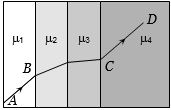
$A$ ray of light passes through four transparent media with refractive indices $\mu_1, \mu_2, \mu_3$ and $\mu_4$ as shown in the figure. The surfaces of all media are parallel. If the emergent ray $CD$ is parallel to the incident ray $AB$,we must have
A
$\mu_1 = \mu_2$
B
$\mu_2 = \mu_3$
C
$\mu_3 = \mu_4$
D
$\mu_4 = \mu_1$
Solution
(D) According to Snell's law for multiple parallel interfaces,the product of the refractive index and the sine of the angle of incidence at each interface remains constant.
Let $\theta_1$ be the angle of incidence in the first medium and $\theta_4$ be the angle of refraction in the fourth medium.
Applying Snell's law at each interface:
$\mu_1 \sin \theta_1 = \mu_2 \sin \theta_2 = \mu_3 \sin \theta_3 = \mu_4 \sin \theta_4$.
Since the emergent ray $CD$ is parallel to the incident ray $AB$,the angle of incidence $\theta_1$ must be equal to the angle of emergence $\theta_4$ (i.e.,$\theta_1 = \theta_4$).
Substituting this into the equation,we get $\mu_1 \sin \theta_1 = \mu_4 \sin \theta_1$.
Therefore,$\mu_1 = \mu_4$.
Let $\theta_1$ be the angle of incidence in the first medium and $\theta_4$ be the angle of refraction in the fourth medium.
Applying Snell's law at each interface:
$\mu_1 \sin \theta_1 = \mu_2 \sin \theta_2 = \mu_3 \sin \theta_3 = \mu_4 \sin \theta_4$.
Since the emergent ray $CD$ is parallel to the incident ray $AB$,the angle of incidence $\theta_1$ must be equal to the angle of emergence $\theta_4$ (i.e.,$\theta_1 = \theta_4$).
Substituting this into the equation,we get $\mu_1 \sin \theta_1 = \mu_4 \sin \theta_1$.
Therefore,$\mu_1 = \mu_4$.
0 likes
View Solution43
MediumMCQ
The optical path of a monochromatic light is the same if it goes through $4.0 \, cm$ of glass or $4.5 \, cm$ of water. If the refractive index of glass is $1.53$,the refractive index of water is:
A
$1.3$
B
$1.36$
C
$1.42$
D
$1.46$
Solution
(B) The optical path length is defined as the product of the refractive index $(\mu)$ and the geometric path length $(x)$.
Given that the optical path is the same for both media,we have:
$\mu_{glass} \times x_{glass} = \mu_{water} \times x_{water}$
Substituting the given values:
$1.53 \times 4.0 = \mu_{water} \times 4.5$
$\mu_{water} = \frac{1.53 \times 4.0}{4.5}$
$\mu_{water} = \frac{6.12}{4.5} = 1.36$
Therefore,the refractive index of water is $1.36$.
Given that the optical path is the same for both media,we have:
$\mu_{glass} \times x_{glass} = \mu_{water} \times x_{water}$
Substituting the given values:
$1.53 \times 4.0 = \mu_{water} \times 4.5$
$\mu_{water} = \frac{1.53 \times 4.0}{4.5}$
$\mu_{water} = \frac{6.12}{4.5} = 1.36$
Therefore,the refractive index of water is $1.36$.
0 likes
View Solution44
EasyMCQ
Which of the following statements is true?
A
Velocity of light is constant in all media.
B
Velocity of light in vacuum is maximum.
C
Velocity of light is same in all reference frames.
D
Laws of nature have identical form in all reference frames.
Solution
(B) The speed of light in a vacuum is a universal constant denoted by $c \approx 3 \times 10^8 \ m/s$.
In any other medium,the velocity of light is given by $v = c/n$,where $n$ is the refractive index of the medium.
Since the refractive index $n$ of any material medium is always greater than $1$,the velocity of light in any medium is always less than the velocity of light in a vacuum.
Therefore,the velocity of light is maximum in a vacuum.
In any other medium,the velocity of light is given by $v = c/n$,where $n$ is the refractive index of the medium.
Since the refractive index $n$ of any material medium is always greater than $1$,the velocity of light in any medium is always less than the velocity of light in a vacuum.
Therefore,the velocity of light is maximum in a vacuum.
0 likes
View Solution45
EasyMCQ
The velocity of light in glass,whose refractive index with respect to air is $1.5$,is $2 \times 10^8 \ m/s$. In a certain liquid,the velocity of light is found to be $2.5 \times 10^8 \ m/s$. The refractive index of the liquid with respect to air is:
A
$0.64$
B
$0.8$
C
$1.2$
D
$1.44$
Solution
(C) The refractive index $\mu$ of a medium is inversely proportional to the velocity of light $v$ in that medium,given by $\mu = \frac{c}{v}$,where $c$ is the speed of light in a vacuum.
For glass $(g)$ and liquid $(l)$:
$\mu_g = \frac{c}{v_g}$ and $\mu_l = \frac{c}{v_l}$
Taking the ratio:
$\frac{\mu_l}{\mu_g} = \frac{v_g}{v_l}$
Given:
$\mu_g = 1.5$
$v_g = 2 \times 10^8 \ m/s$
$v_l = 2.5 \times 10^8 \ m/s$
Substituting the values:
$\frac{\mu_l}{1.5} = \frac{2 \times 10^8}{2.5 \times 10^8}$
$\frac{\mu_l}{1.5} = \frac{2}{2.5} = 0.8$
$\mu_l = 1.5 \times 0.8 = 1.2$
Thus,the refractive index of the liquid is $1.2$.
For glass $(g)$ and liquid $(l)$:
$\mu_g = \frac{c}{v_g}$ and $\mu_l = \frac{c}{v_l}$
Taking the ratio:
$\frac{\mu_l}{\mu_g} = \frac{v_g}{v_l}$
Given:
$\mu_g = 1.5$
$v_g = 2 \times 10^8 \ m/s$
$v_l = 2.5 \times 10^8 \ m/s$
Substituting the values:
$\frac{\mu_l}{1.5} = \frac{2 \times 10^8}{2.5 \times 10^8}$
$\frac{\mu_l}{1.5} = \frac{2}{2.5} = 0.8$
$\mu_l = 1.5 \times 0.8 = 1.2$
Thus,the refractive index of the liquid is $1.2$.
0 likes
View Solution46
MediumMCQ
$A$ thin oil layer floats on water. $A$ ray of light making an angle of incidence of $40^o$ shines on the oil layer. The angle of refraction of the light ray in water is......$^o$ $({\mu _{oil}} = 1.45, {\mu _{water}} = 1.33)$
A
$36.1$
B
$44.5$
C
$26.8$
D
$28.9$
Solution
(D) According to Snell's Law at the air-oil interface:
${\mu _{air}} \sin i = {\mu _{oil}} \sin {r_1}$
Given $i = 40^o$,${\mu _{air}} = 1$,${\mu _{oil}} = 1.45$:
$1 \times \sin 40^o = 1.45 \times \sin {r_1}$
$\sin {r_1} = \frac{\sin 40^o}{1.45} = \frac{0.6428}{1.45} \approx 0.4433$
Now,applying Snell's Law at the oil-water interface:
${\mu _{oil}} \sin {r_1} = {\mu _{water}} \sin r$
Since ${\mu _{oil}} \sin {r_1} = \sin i$ (from the first interface):
$\sin i = {\mu _{water}} \sin r$
$\sin 40^o = 1.33 \times \sin r$
$\sin r = \frac{\sin 40^o}{1.33} = \frac{0.6428}{1.33} \approx 0.4833$
$r = \arcsin(0.4833) \approx 28.9^o$
${\mu _{air}} \sin i = {\mu _{oil}} \sin {r_1}$
Given $i = 40^o$,${\mu _{air}} = 1$,${\mu _{oil}} = 1.45$:
$1 \times \sin 40^o = 1.45 \times \sin {r_1}$
$\sin {r_1} = \frac{\sin 40^o}{1.45} = \frac{0.6428}{1.45} \approx 0.4433$
Now,applying Snell's Law at the oil-water interface:
${\mu _{oil}} \sin {r_1} = {\mu _{water}} \sin r$
Since ${\mu _{oil}} \sin {r_1} = \sin i$ (from the first interface):
$\sin i = {\mu _{water}} \sin r$
$\sin 40^o = 1.33 \times \sin r$
$\sin r = \frac{\sin 40^o}{1.33} = \frac{0.6428}{1.33} \approx 0.4833$
$r = \arcsin(0.4833) \approx 28.9^o$
0 likes
View Solution47
EasyMCQ
An object is immersed in a fluid. In order that the object becomes invisible,it should
A
Behave as a perfect reflector
B
Absorb all light falling on it
C
Have refractive index one
D
Have refractive index exactly matching with that of the surrounding fluid
Solution
(D) When an object is immersed in a fluid,light rays undergo refraction at the interface of the object and the fluid.
If the refractive index of the object $(n_1)$ is equal to the refractive index of the surrounding fluid $(n_2)$,then the light rays do not bend or reflect at the interface.
As a result,the object becomes invisible because there is no change in the optical path of the light passing through the medium.
Therefore,the correct condition is that the refractive index of the object must exactly match that of the surrounding fluid.
If the refractive index of the object $(n_1)$ is equal to the refractive index of the surrounding fluid $(n_2)$,then the light rays do not bend or reflect at the interface.
As a result,the object becomes invisible because there is no change in the optical path of the light passing through the medium.
Therefore,the correct condition is that the refractive index of the object must exactly match that of the surrounding fluid.
0 likes
View Solution48
EasyMCQ
When light travels from glass to air,the incident angle is ${\theta _1}$ and the refracted angle is ${\theta _2}$. The true relation is:
A
${\theta _1} = {\theta _2}$
B
${\theta _1} < {\theta _2}$
C
${\theta _1} > {\theta _2}$
D
Not predictable
Solution
(B) According to Snell's Law,$n_1 \sin \theta_1 = n_2 \sin \theta_2$.
Here,light travels from glass (denser medium,$n_1 \approx 1.5$) to air (rarer medium,$n_2 \approx 1.0$).
Since $n_1 > n_2$,the light ray bends away from the normal.
Therefore,the angle of refraction ${\theta _2}$ must be greater than the angle of incidence ${\theta _1}$.
Thus,the correct relation is ${\theta _1} < {\theta _2}$.
Here,light travels from glass (denser medium,$n_1 \approx 1.5$) to air (rarer medium,$n_2 \approx 1.0$).
Since $n_1 > n_2$,the light ray bends away from the normal.
Therefore,the angle of refraction ${\theta _2}$ must be greater than the angle of incidence ${\theta _1}$.
Thus,the correct relation is ${\theta _1} < {\theta _2}$.
0 likes
View Solution49
EasyMCQ
The velocity of light in a medium is $1.5 \times 10^8 \ m/s$. Its refractive index will be:
A
$8$
B
$6$
C
$4$
D
$2$
Solution
(D) The refractive index $\mu$ of a medium is defined as the ratio of the speed of light in a vacuum $(c)$ to the speed of light in the medium $(v)$.
Given:
Speed of light in vacuum,$c = 3 \times 10^8 \ m/s$
Speed of light in the medium,$v = 1.5 \times 10^8 \ m/s$
Formula:
$\mu = \frac{c}{v}$
Calculation:
$\mu = \frac{3 \times 10^8 \ m/s}{1.5 \times 10^8 \ m/s} = \frac{3}{1.5} = 2$
Therefore,the refractive index of the medium is $2$.
Given:
Speed of light in vacuum,$c = 3 \times 10^8 \ m/s$
Speed of light in the medium,$v = 1.5 \times 10^8 \ m/s$
Formula:
$\mu = \frac{c}{v}$
Calculation:
$\mu = \frac{3 \times 10^8 \ m/s}{1.5 \times 10^8 \ m/s} = \frac{3}{1.5} = 2$
Therefore,the refractive index of the medium is $2$.
0 likes
View SolutionRay Optics and Optical Instruments — Refraction of Light · Frequently Asked Questions
1Are these Ray Optics and Optical Instruments questions useful for JEE and NEET?
Yes. All questions in this section are mapped to JEE Main and NEET exam patterns. Previous year questions from JEE Main, NEET, GUJCET and state-level exams are included with full solutions.
2Can I switch to Hindi or Gujarati for these questions?
Yes. Use the language tabs in the hero section or the sidebar to view the same questions and solutions in English, Hindi or Gujarati.
3How do I generate a question paper from this subtopic?
Use the Vedclass Exam Paper Generator — select the chapter and subtopic, set difficulty, and generate Sets A, B, C, D automatically. First 3 chapters of every subject are free.
Vedclass Products
For Students
Vedclass Test Series
Mock tests in real JEE/NEET style with performance analysis. 5-day free trial.
Start Free TrialFor Teachers
Exam Paper Generator
Generate Set A/B/C/D papers from this chapter in 2 minutes. 3 chapters free.
Try FreeFor Institutes
Online Exam Module
Live online exams with unlimited students, 360° analytics & white-label branding.
See DemoFor Teachers & Institutes
Generate a Ray Optics and Optical Instruments Exam Paper in 2 Minutes
Select subtopic & difficulty — Sets A, B, C, D auto-generated with No Repeat logic.
First 3 chapters of every subject are free — no payment required.