
A English
Mass-Energy, Nuclear Binding Energy, Nuclear Stability Questions in English
Class 12 Physics · Nuclei · Mass-Energy, Nuclear Binding Energy, Nuclear Stability
209+
Questions
English
Language
100%
With Solutions
Showing 49 of 209 questions in English
1
EasyMCQ
One million electron volt $(1\,MeV)$ is equal to
A
$10^5\,eV$
B
$10^6\,eV$
C
$10^4\,eV$
D
$10^7\,eV$
Solution
(B) The prefix 'mega' $(M)$ in the $SI$ system represents a factor of $10^6$.
Therefore,$1\,MeV$ is equivalent to $10^6\,eV$.
Therefore,$1\,MeV$ is equivalent to $10^6\,eV$.
0 likes
View Solution2
EasyMCQ
The binding energy of a nucleon in a nucleus is of the order of a few
A
$eV$
B
$Ergs$
C
$MeV$
D
$Volts$
Solution
(C) The binding energy per nucleon in a nucleus represents the average energy required to remove a single nucleon from the nucleus. Experimental observations show that this energy is typically in the range of $7$ to $9 \ MeV$ for most stable nuclei. Therefore,the binding energy of a nucleon is of the order of a few $MeV$.
0 likes
View Solution3
EasyMCQ
$1 \text{ a.m.u.}$ is equivalent to
A
$1.6 \times 10^{-12} \text{ J}$
B
$1.6 \times 10^{-19} \text{ J}$
C
$1.5 \times 10^{-10} \text{ J}$
D
$1.5 \times 10^{-19} \text{ J}$
Solution
(C) The mass of $1 \text{ a.m.u.}$ is $1.66 \times 10^{-27} \text{ kg}$.
Using Einstein's mass-energy equivalence formula,$E = mc^2$,where $c = 3 \times 10^8 \text{ m/s}$ is the speed of light.
$E = (1.66 \times 10^{-27} \text{ kg}) \times (3 \times 10^8 \text{ m/s})^2$
$E = 1.66 \times 10^{-27} \times 9 \times 10^{16} \text{ J}$
$E \approx 14.94 \times 10^{-11} \text{ J} \approx 1.5 \times 10^{-10} \text{ J}$.
Therefore,the correct option is $C$.
Using Einstein's mass-energy equivalence formula,$E = mc^2$,where $c = 3 \times 10^8 \text{ m/s}$ is the speed of light.
$E = (1.66 \times 10^{-27} \text{ kg}) \times (3 \times 10^8 \text{ m/s})^2$
$E = 1.66 \times 10^{-27} \times 9 \times 10^{16} \text{ J}$
$E \approx 14.94 \times 10^{-11} \text{ J} \approx 1.5 \times 10^{-10} \text{ J}$.
Therefore,the correct option is $C$.
0 likes
View Solution4
EasyMCQ
If mass-energy equivalence is taken into account,when water is cooled to form ice,the mass of water should
A
Increase
B
Decrease
C
Remain unchanged
D
First increase then decrease
Solution
(B) According to Einstein's mass-energy equivalence principle,$E = mc^2$,energy and mass are interchangeable. When water is cooled to form ice,it releases latent heat to the surroundings. Since the system loses energy,there must be a corresponding decrease in its total mass. Therefore,the mass of the water decreases when it turns into ice.
0 likes
View Solution5
EasyMCQ
The energy equivalent of $1 \text{ kg}$ of matter is about
A
$10^{-15} \text{ J}$
B
$1 \text{ J}$
C
$10^{-12} \text{ J}$
D
$10^{17} \text{ J}$
Solution
(D) According to Einstein's mass-energy equivalence principle,the energy $E$ is given by the formula $E = mc^2$.
Here,$m = 1 \text{ kg}$ and $c \approx 3 \times 10^8 \text{ m/s}$ (speed of light).
Substituting these values into the equation:
$E = 1 \times (3 \times 10^8)^2$
$E = 1 \times 9 \times 10^{16}$
$E = 9 \times 10^{16} \text{ J}$
This value is approximately equal to $10^{17} \text{ J}$.
Therefore,the correct option is $D$.
Here,$m = 1 \text{ kg}$ and $c \approx 3 \times 10^8 \text{ m/s}$ (speed of light).
Substituting these values into the equation:
$E = 1 \times (3 \times 10^8)^2$
$E = 1 \times 9 \times 10^{16}$
$E = 9 \times 10^{16} \text{ J}$
This value is approximately equal to $10^{17} \text{ J}$.
Therefore,the correct option is $D$.
0 likes
View Solution6
EasyMCQ
Nuclear binding energy is equivalent to
A
Mass of proton
B
Mass of neutron
C
Mass of nucleus
D
Mass defect of nucleus
Solution
(D) The nuclear binding energy $(B.E.)$ is the energy required to disassemble a nucleus into its constituent protons and neutrons.
According to Einstein's mass-energy equivalence principle, this energy is equivalent to the mass defect $(\Delta m)$ of the nucleus.
The relationship is given by the formula: $B.E. = \Delta m \times c^2$.
In terms of atomic mass units, it is expressed as: $B.E. = \Delta m \times 931 \, MeV$.
According to Einstein's mass-energy equivalence principle, this energy is equivalent to the mass defect $(\Delta m)$ of the nucleus.
The relationship is given by the formula: $B.E. = \Delta m \times c^2$.
In terms of atomic mass units, it is expressed as: $B.E. = \Delta m \times 931 \, MeV$.
0 likes
View Solution7
EasyMCQ
If the binding energy of the deuterium is $2.23 \, MeV$, the mass defect in $a.m.u.$ is:
A
$0.0024$
B
$0.0012$
C
$0.0024$
D
$0.0048$
Solution
(A) The binding energy $(BE)$ of a nucleus is related to the mass defect $(\Delta m)$ by the equation: $BE = \Delta m \times 931.5 \, MeV/a.m.u.$
Given, $BE = 2.23 \, MeV$.
Therefore, $\Delta m = \frac{BE}{931.5} = \frac{2.23}{931.5} \approx 0.00239 \, a.m.u.$
Rounding this value, we get $\Delta m \approx 0.0024 \, a.m.u.$
Given, $BE = 2.23 \, MeV$.
Therefore, $\Delta m = \frac{BE}{931.5} = \frac{2.23}{931.5} \approx 0.00239 \, a.m.u.$
Rounding this value, we get $\Delta m \approx 0.0024 \, a.m.u.$
0 likes
View Solution8
MediumMCQ
The mass of a proton is $1.0073 \; u$ and that of a neutron is $1.0087 \; u$ ($u =$ atomic mass unit). The binding energy of ${ }_2^4 \text{He}$ is (Given: helium nucleus mass $\approx 4.0015 \; u$):
A
$28.4 \; \text{MeV}$
B
$0.0305 \; \text{J}$
C
$0.0305 \; \text{erg}$
D
$0.061 \; \text{u}$
Solution
(A) The helium nucleus ${ }_2^4 \text{He}$ consists of $2$ protons and $2$ neutrons.
Mass of $2$ protons $= 2 \times 1.0073 \; \text{u} = 2.0146 \; \text{u}$.
Mass of $2$ neutrons $= 2 \times 1.0087 \; \text{u} = 2.0174 \; \text{u}$.
Total mass of nucleons $= 2.0146 + 2.0174 = 4.0320 \; \text{u}$.
Mass defect $\Delta m = (\text{Total mass of nucleons}) - (\text{Mass of nucleus}) = 4.0320 \; \text{u} - 4.0015 \; \text{u} = 0.0305 \; \text{u}$.
Binding energy $\text{B.E.} = \Delta m \times 931.5 \; \text{MeV/u} = 0.0305 \times 931.5 \approx 28.4 \; \text{MeV}$.
Mass of $2$ protons $= 2 \times 1.0073 \; \text{u} = 2.0146 \; \text{u}$.
Mass of $2$ neutrons $= 2 \times 1.0087 \; \text{u} = 2.0174 \; \text{u}$.
Total mass of nucleons $= 2.0146 + 2.0174 = 4.0320 \; \text{u}$.
Mass defect $\Delta m = (\text{Total mass of nucleons}) - (\text{Mass of nucleus}) = 4.0320 \; \text{u} - 4.0015 \; \text{u} = 0.0305 \; \text{u}$.
Binding energy $\text{B.E.} = \Delta m \times 931.5 \; \text{MeV/u} = 0.0305 \times 931.5 \approx 28.4 \; \text{MeV}$.
0 likes
View Solution9
EasyMCQ
The mass defect for the nucleus of helium is $0.0303 \, a.m.u.$ What is the binding energy per nucleon for helium in $MeV$?
A
$28$
B
$7$
C
$4$
D
$1$
Solution
(B) The mass defect $(\Delta m)$ for the helium nucleus is $0.0303 \, a.m.u.$
We know that $1 \, a.m.u. = 931 \, MeV$ of energy.
Total binding energy $(BE)$ = $\Delta m \times 931 \, MeV = 0.0303 \times 931 \approx 28.21 \, MeV$.
Helium nucleus $(_{2}^{4}He)$ has $4$ nucleons ($2$ protons and $2$ neutrons).
Binding energy per nucleon = $\frac{BE}{\text{Number of nucleons}} = \frac{28.21}{4} \approx 7.05 \, MeV$.
Thus, the binding energy per nucleon is approximately $7 \, MeV$.
We know that $1 \, a.m.u. = 931 \, MeV$ of energy.
Total binding energy $(BE)$ = $\Delta m \times 931 \, MeV = 0.0303 \times 931 \approx 28.21 \, MeV$.
Helium nucleus $(_{2}^{4}He)$ has $4$ nucleons ($2$ protons and $2$ neutrons).
Binding energy per nucleon = $\frac{BE}{\text{Number of nucleons}} = \frac{28.21}{4} \approx 7.05 \, MeV$.
Thus, the binding energy per nucleon is approximately $7 \, MeV$.
0 likes
View Solution10
MediumMCQ
One microgram of matter converted into energy will give:
A
$90 \ J$
B
$9 \times 10^3 \ J$
C
$9 \times 10^7 \ J$
D
$9 \times 10^5 \ J$
Solution
(C) The mass-energy equivalence is given by Einstein's equation: $E = \Delta m c^2$.
Given mass $\Delta m = 1 \ \mu g = 10^{-6} \ g = 10^{-9} \ kg$.
The speed of light $c = 3 \times 10^8 \ m/s$.
Substituting these values into the equation:
$E = 10^{-9} \ kg \times (3 \times 10^8 \ m/s)^2$
$E = 10^{-9} \times 9 \times 10^{16} \ J$
$E = 9 \times 10^7 \ J$.
Therefore,the correct option is $C$.
Given mass $\Delta m = 1 \ \mu g = 10^{-6} \ g = 10^{-9} \ kg$.
The speed of light $c = 3 \times 10^8 \ m/s$.
Substituting these values into the equation:
$E = 10^{-9} \ kg \times (3 \times 10^8 \ m/s)^2$
$E = 10^{-9} \times 9 \times 10^{16} \ J$
$E = 9 \times 10^7 \ J$.
Therefore,the correct option is $C$.
0 likes
View Solution11
EasyMCQ
The average binding energy per nucleon in the nucleus of an atom is approximately
A
$8 \, eV$
B
$8 \, keV$
C
$8 \, MeV$
D
$8 \, J$
Solution
(C) The binding energy per nucleon of a nucleus is defined as the total binding energy of the nucleus divided by its mass number $(A)$,which represents the total number of nucleons.
Experimental observations of the binding energy per nucleon versus mass number graph show that for most nuclei (excluding very light nuclei),the value remains relatively constant.
The average binding energy per nucleon for stable nuclei is approximately $8 \, MeV$ per nucleon.
Experimental observations of the binding energy per nucleon versus mass number graph show that for most nuclei (excluding very light nuclei),the value remains relatively constant.
The average binding energy per nucleon for stable nuclei is approximately $8 \, MeV$ per nucleon.
0 likes
View Solution12
EasyMCQ
Binding energy of a nucleus is
A
Energy given to its nucleus during its formation
B
Total mass of nucleus converted to energy units
C
Loss of energy from the nucleus during its formation
D
Total $K.E.$ and $P.E.$ of the nucleons in the nucleus
Solution
(C) The binding energy of a nucleus is defined as the energy equivalent of the mass defect.
When nucleons (protons and neutrons) come together to form a stable nucleus, the mass of the nucleus is found to be less than the sum of the individual masses of the constituent nucleons.
This difference in mass, known as the mass defect $(\Delta m)$, is released as energy during the formation of the nucleus.
Therefore, the binding energy is the energy released from the nucleus during its formation, which is equivalent to the work required to disassemble the nucleus into its constituent nucleons.
Thus, option $(C)$ is the correct description.
When nucleons (protons and neutrons) come together to form a stable nucleus, the mass of the nucleus is found to be less than the sum of the individual masses of the constituent nucleons.
This difference in mass, known as the mass defect $(\Delta m)$, is released as energy during the formation of the nucleus.
Therefore, the binding energy is the energy released from the nucleus during its formation, which is equivalent to the work required to disassemble the nucleus into its constituent nucleons.
Thus, option $(C)$ is the correct description.
0 likes
View Solution13
EasyMCQ
One requires energy ${E_n}$ to remove a nucleon from a nucleus and an energy ${E_e}$ to remove an electron from the orbit of an atom. Then:
A
${E_n} = {E_e}$
B
${E_n} < {E_e}$
C
${E_n} > {E_e}$
D
${E_n} \ge {E_e}$
Solution
(C) The energy required to remove a nucleon from a nucleus is related to the nuclear binding energy,which is governed by the strong nuclear force.
The energy required to remove an electron from an atom is related to the ionization energy,which is governed by the electromagnetic (Coulomb) force.
Since the strong nuclear force is significantly stronger than the electromagnetic force,the energy required to remove a nucleon $({E_n})$ is much greater than the energy required to remove an electron $({E_e})$.
Therefore,${E_n} > {E_e}$.
The energy required to remove an electron from an atom is related to the ionization energy,which is governed by the electromagnetic (Coulomb) force.
Since the strong nuclear force is significantly stronger than the electromagnetic force,the energy required to remove a nucleon $({E_n})$ is much greater than the energy required to remove an electron $({E_e})$.
Therefore,${E_n} > {E_e}$.
0 likes
View Solution14
MediumMCQ
The equivalent energy of a mass equal to $1 \, a.m.u.$ is
A
$931 \, KeV$
B
$931 \, eV$
C
$931 \, MeV$
D
$9.31 \, MeV$
Solution
(C) $1 \, a.m.u. = 1.66 \times 10^{-27} \, kg$.
According to Einstein's mass-energy equivalence,$E = mc^2$,where $c$ is the speed of light $(c \approx 3 \times 10^8 \, m/s)$.
Substituting the values:
$E = 1.66 \times 10^{-27} \times (3 \times 10^8)^2 \, J$
$E = 1.66 \times 10^{-27} \times 9 \times 10^{16} \, J$
$E = 14.94 \times 10^{-11} \, J$.
To convert this energy into electron-volts $(eV)$,divide by $1.6 \times 10^{-19} \, J/eV$:
$E = \frac{14.94 \times 10^{-11}}{1.6 \times 10^{-19}} \, eV$
$E \approx 9.3375 \times 10^8 \, eV \approx 931 \times 10^6 \, eV$.
Since $10^6 \, eV = 1 \, MeV$,the equivalent energy is $931 \, MeV$.
According to Einstein's mass-energy equivalence,$E = mc^2$,where $c$ is the speed of light $(c \approx 3 \times 10^8 \, m/s)$.
Substituting the values:
$E = 1.66 \times 10^{-27} \times (3 \times 10^8)^2 \, J$
$E = 1.66 \times 10^{-27} \times 9 \times 10^{16} \, J$
$E = 14.94 \times 10^{-11} \, J$.
To convert this energy into electron-volts $(eV)$,divide by $1.6 \times 10^{-19} \, J/eV$:
$E = \frac{14.94 \times 10^{-11}}{1.6 \times 10^{-19}} \, eV$
$E \approx 9.3375 \times 10^8 \, eV \approx 931 \times 10^6 \, eV$.
Since $10^6 \, eV = 1 \, MeV$,the equivalent energy is $931 \, MeV$.
0 likes
View Solution15
EasyMCQ
The mass defect per nucleon is called
A
Binding energy
B
Packing fraction
C
Ionisation energy
D
Excitation energy
Solution
(B) The mass defect $(\Delta m)$ is the difference between the sum of the masses of individual nucleons and the actual mass of the nucleus.
Packing fraction $(f)$ is defined as the ratio of the mass defect $(\Delta m)$ to the mass number $(A)$ of the nucleus.
Mathematically, $f = \frac{\Delta m}{A}$.
Therefore, the mass defect per nucleon is known as the packing fraction.
Packing fraction $(f)$ is defined as the ratio of the mass defect $(\Delta m)$ to the mass number $(A)$ of the nucleus.
Mathematically, $f = \frac{\Delta m}{A}$.
Therefore, the mass defect per nucleon is known as the packing fraction.
0 likes
View Solution16
MediumMCQ
The binding energy per nucleon is maximum in the case of
A
$_{2}^{4}He$
B
$_{26}^{56}Fe$
C
$_{56}^{141}Ba$
D
$_{92}^{235}U$
Solution
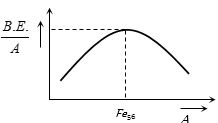
(B) The binding energy per nucleon $(B.E./A)$ is a measure of the stability of a nucleus.
According to the binding energy curve,the value of $B.E./A$ increases with the mass number $A$ for light nuclei,reaches a maximum value of approximately $8.8 \text{ MeV}$ for iron $(_{26}^{56}Fe)$,and then gradually decreases for heavier nuclei.
Therefore,the binding energy per nucleon is maximum for $_{26}^{56}Fe$.
According to the binding energy curve,the value of $B.E./A$ increases with the mass number $A$ for light nuclei,reaches a maximum value of approximately $8.8 \text{ MeV}$ for iron $(_{26}^{56}Fe)$,and then gradually decreases for heavier nuclei.
Therefore,the binding energy per nucleon is maximum for $_{26}^{56}Fe$.
0 likes
View Solution17
EasyMCQ
The mass of an $\alpha$-particle is
A
Less than the sum of masses of two protons and two neutrons
B
Equal to mass of four protons
C
Equal to mass of four neutrons
D
Equal to sum of masses of two protons and two neutrons
Solution
(A) The mass of an $\alpha$-particle is less than the sum of the masses of its constituent particles (two protons and two neutrons).
This difference in mass is known as the mass defect $(\Delta m)$.
The mass defect is converted into binding energy,which is required to hold the nucleons together within the nucleus of the $\alpha$-particle.
Therefore,the correct option is $A$.
This difference in mass is known as the mass defect $(\Delta m)$.
The mass defect is converted into binding energy,which is required to hold the nucleons together within the nucleus of the $\alpha$-particle.
Therefore,the correct option is $A$.
0 likes
View Solution18
DifficultMCQ
If the binding energy per nucleon in $Li^7$ and $He^4$ nuclei are respectively $5.60 \ MeV$ and $7.06 \ MeV$, then the energy of the reaction $Li^7 + p \to 2He^4$ is ......... $MeV$.
A
$19.6$
B
$2.4$
C
$8.4$
D
$17.3$
Solution
(D) The binding energy $(B.E.)$ of a nucleus is calculated as: $B.E. = (\text{number of nucleons}) \times (\text{binding energy per nucleon})$.
For $Li^7$, $B.E. = 7 \times 5.60 \ MeV = 39.20 \ MeV$.
For $He^4$, $B.E. = 4 \times 7.06 \ MeV = 28.24 \ MeV$.
The reaction is $Li^7 + p \to 2He^4$.
The binding energy of the proton $(p)$ is $0 \ MeV$ as it is a single nucleon.
The total binding energy of the reactants is $39.20 \ MeV + 0 \ MeV = 39.20 \ MeV$.
The total binding energy of the products is $2 \times 28.24 \ MeV = 56.48 \ MeV$.
The energy released in the reaction ($Q$-value) is the difference between the total binding energy of the products and the reactants: $Q = 56.48 \ MeV - 39.20 \ MeV = 17.28 \ MeV$.
Rounding to one decimal place, we get $17.3 \ MeV$.
For $Li^7$, $B.E. = 7 \times 5.60 \ MeV = 39.20 \ MeV$.
For $He^4$, $B.E. = 4 \times 7.06 \ MeV = 28.24 \ MeV$.
The reaction is $Li^7 + p \to 2He^4$.
The binding energy of the proton $(p)$ is $0 \ MeV$ as it is a single nucleon.
The total binding energy of the reactants is $39.20 \ MeV + 0 \ MeV = 39.20 \ MeV$.
The total binding energy of the products is $2 \times 28.24 \ MeV = 56.48 \ MeV$.
The energy released in the reaction ($Q$-value) is the difference between the total binding energy of the products and the reactants: $Q = 56.48 \ MeV - 39.20 \ MeV = 17.28 \ MeV$.
Rounding to one decimal place, we get $17.3 \ MeV$.
0 likes
View Solution19
EasyMCQ
Energy of $1 \, g$ uranium is equal to
A
$9.0 \times 10^{13} \, J$
B
$9.0 \times 10^{19} \, J$
C
$3.0 \times 10^{16} \, J$
D
$3.0 \times 10^{17} \, J$
Solution
(A) According to Einstein's mass-energy equivalence principle,the energy $E$ is given by the formula $E = mc^2$.
Here,the mass $m = 1 \, g = 1 \times 10^{-3} \, kg$.
The speed of light $c = 3 \times 10^8 \, m/s$.
Substituting these values into the equation:
$E = (1 \times 10^{-3} \, kg) \times (3 \times 10^8 \, m/s)^2$
$E = 10^{-3} \times 9 \times 10^{16} \, J$
$E = 9.0 \times 10^{13} \, J$.
Therefore,the correct option is $A$.
Here,the mass $m = 1 \, g = 1 \times 10^{-3} \, kg$.
The speed of light $c = 3 \times 10^8 \, m/s$.
Substituting these values into the equation:
$E = (1 \times 10^{-3} \, kg) \times (3 \times 10^8 \, m/s)^2$
$E = 10^{-3} \times 9 \times 10^{16} \, J$
$E = 9.0 \times 10^{13} \, J$.
Therefore,the correct option is $A$.
0 likes
View Solution20
MediumMCQ
$M_n$ and $M_p$ represent the mass of a neutron and a proton, respectively. If an element having atomic mass $M$ has $N$ neutrons and $Z$ protons, then the correct relation is:
A
$M < [N M_n + Z M_p]$
B
$M > [N M_n + Z M_p]$
C
$M = [N M_n + Z M_p]$
D
$M = N[M_n + M_p]$
Solution
(A) The actual mass of a nucleus $(M)$ is always less than the sum of the individual masses of its constituent nucleons (protons and neutrons).
This difference in mass is known as the mass defect $(\Delta m)$, which is converted into binding energy according to Einstein's mass-energy equivalence principle $(E = \Delta m c^2)$.
Therefore, the mass of the nucleus $M$ is related to the sum of the masses of $N$ neutrons and $Z$ protons as:
$M < (N M_n + Z M_p)$.
This difference in mass is known as the mass defect $(\Delta m)$, which is converted into binding energy according to Einstein's mass-energy equivalence principle $(E = \Delta m c^2)$.
Therefore, the mass of the nucleus $M$ is related to the sum of the masses of $N$ neutrons and $Z$ protons as:
$M < (N M_n + Z M_p)$.
0 likes
View Solution21
EasyMCQ
If a $H_2$ nucleus (deuteron) is completely converted into energy,the energy produced will be around .......... $MeV$.
A
$1$
B
$931$
C
$9.38$
D
$238$
Solution
(B) The mass of a $H_2$ nucleus (deuteron) is approximately $2.014 \, amu$.
However,in the context of standard physics problems regarding energy equivalence of nucleons,the mass of a single nucleon (proton or neutron) is approximately $1 \, amu$.
Since $1 \, amu$ is equivalent to $931 \, MeV$ of energy,and a deuteron consists of $2$ nucleons,the energy would be approximately $2 \times 931 \, MeV = 1862 \, MeV$.
Given the provided options,the question likely refers to the energy equivalent of $1 \, amu$ (the mass of a single proton),which is $931 \, MeV$.
Thus,the correct option is $(b)$.
However,in the context of standard physics problems regarding energy equivalence of nucleons,the mass of a single nucleon (proton or neutron) is approximately $1 \, amu$.
Since $1 \, amu$ is equivalent to $931 \, MeV$ of energy,and a deuteron consists of $2$ nucleons,the energy would be approximately $2 \times 931 \, MeV = 1862 \, MeV$.
Given the provided options,the question likely refers to the energy equivalent of $1 \, amu$ (the mass of a single proton),which is $931 \, MeV$.
Thus,the correct option is $(b)$.
0 likes
View Solution22
MediumMCQ
The mass and energy equivalent to $1\, a.m.u.$ are respectively:
A
$1.67 \times 10^{-27}\,g, 9.30\, MeV$
B
$1.67 \times 10^{-27}\,kg, 930\, MeV$
C
$1.67 \times 10^{-27}\,kg, 1\, MeV$
D
$1.67 \times 10^{-34}\,kg, 1\, MeV$
Solution
(B) $1\, amu$ is defined as one-twelfth of the mass of an unbound neutral atom of carbon-$12$ in its nuclear and electronic ground state.
Mass of $1$ mole of $C$ atoms $= 12\, g = 0.012\, kg$.
$1\, amu = \frac{0.012\, kg}{6.023 \times 10^{23}} \approx 1.66 \times 10^{-27}\, kg$.
Using Einstein's mass-energy equivalence formula,$E = mc^2$:
$E = (1.66 \times 10^{-27}\, kg) \times (3 \times 10^8\, m/s)^2 = 1.494 \times 10^{-10}\, J$.
Converting Joules to $MeV$ $(1\, eV = 1.602 \times 10^{-19}\, J)$:
$E = \frac{1.494 \times 10^{-10}}{1.602 \times 10^{-13}}\, MeV \approx 931.5\, MeV \approx 930\, MeV$.
Thus,the correct option is $B$.
Mass of $1$ mole of $C$ atoms $= 12\, g = 0.012\, kg$.
$1\, amu = \frac{0.012\, kg}{6.023 \times 10^{23}} \approx 1.66 \times 10^{-27}\, kg$.
Using Einstein's mass-energy equivalence formula,$E = mc^2$:
$E = (1.66 \times 10^{-27}\, kg) \times (3 \times 10^8\, m/s)^2 = 1.494 \times 10^{-10}\, J$.
Converting Joules to $MeV$ $(1\, eV = 1.602 \times 10^{-19}\, J)$:
$E = \frac{1.494 \times 10^{-10}}{1.602 \times 10^{-13}}\, MeV \approx 931.5\, MeV \approx 930\, MeV$.
Thus,the correct option is $B$.
0 likes
View Solution23
EasyMCQ
If $m$ is the mass of the $_Z{X^A}$ nucleus,and $m_n$ and $m_p$ are the masses of a neutron and a proton respectively,then which of the following is correct?
A
$m < (A - Z)m_n + Zm_p$
B
$m = (A - Z)m_n + Zm_p$
C
$m = (A - Z)m_p + Zm_n$
D
$m > (A - Z)m_n + Zm_p$
Solution
(A) The mass of a nucleus is always less than the sum of the masses of its individual constituent nucleons (protons and neutrons). This difference in mass is known as the mass defect $(\Delta m)$,which is converted into binding energy according to Einstein's mass-energy equivalence principle $(E = \Delta mc^2)$.
Given that the nucleus $_Z{X^A}$ contains $Z$ protons and $(A - Z)$ neutrons,the sum of the masses of the individual nucleons is $(A - Z)m_n + Zm_p$.
Since the mass of the nucleus $m$ is less than the sum of the masses of its constituents due to the mass defect,we have:
$m < (A - Z)m_n + Zm_p$.
Given that the nucleus $_Z{X^A}$ contains $Z$ protons and $(A - Z)$ neutrons,the sum of the masses of the individual nucleons is $(A - Z)m_n + Zm_p$.
Since the mass of the nucleus $m$ is less than the sum of the masses of its constituents due to the mass defect,we have:
$m < (A - Z)m_n + Zm_p$.
0 likes
View Solution24
EasyMCQ
If the speed of light were $2/3$ of its present value,the energy released in a given atomic explosion will be decreased by a fraction:
A
$2/3$
B
$5/9$
C
$3/4$
D
$4/9$
Solution
(B) The energy released in an atomic explosion is given by Einstein's mass-energy equivalence relation: $E = \Delta m C^2$.
Let the original speed of light be $C$ and the new speed of light be $C' = \frac{2}{3} C$.
The new energy released $E'$ is given by: $E' = \Delta m (C')^2$.
Substituting the value of $C'$: $E' = \Delta m \left(\frac{2}{3} C\right)^2 = \Delta m \left(\frac{4}{9} C^2\right) = \frac{4}{9} E$.
The fraction by which the energy is decreased is given by: $\text{Fraction} = \frac{E - E'}{E}$.
Substituting $E' = \frac{4}{9} E$: $\text{Fraction} = \frac{E - \frac{4}{9} E}{E} = \frac{\frac{5}{9} E}{E} = \frac{5}{9}$.
Let the original speed of light be $C$ and the new speed of light be $C' = \frac{2}{3} C$.
The new energy released $E'$ is given by: $E' = \Delta m (C')^2$.
Substituting the value of $C'$: $E' = \Delta m \left(\frac{2}{3} C\right)^2 = \Delta m \left(\frac{4}{9} C^2\right) = \frac{4}{9} E$.
The fraction by which the energy is decreased is given by: $\text{Fraction} = \frac{E - E'}{E}$.
Substituting $E' = \frac{4}{9} E$: $\text{Fraction} = \frac{E - \frac{4}{9} E}{E} = \frac{\frac{5}{9} E}{E} = \frac{5}{9}$.
0 likes
View Solution25
EasyMCQ
In nuclear reactions,which of the following quantities are conserved?
A
Mass only
B
Energy only
C
Momentum only
D
Mass,energy and momentum
Solution
(D) In nuclear reactions,the total energy (including mass-energy equivalence),linear momentum,angular momentum,and charge are conserved. According to the law of conservation of mass-energy,the total mass-energy of the system remains constant. Since no external forces act on the system,the total linear momentum is also conserved. Therefore,mass (in terms of mass-energy),energy,and momentum are all conserved.
0 likes
View Solution26
EasyMCQ
In a nuclear fission process,a nucleus $A$ divides into two nuclei $B$ and $C$. If their binding energies are ${E_a}$,${E_b}$,and ${E_c}$ respectively,which of the following relations is correct?
A
${E_b} + {E_c} = {E_a}$
B
${E_b} + {E_c} > {E_a}$
C
${E_b} + {E_c} < {E_a}$
D
${E_b} \cdot {E_c} = {E_a}$
Solution
(B) In a nuclear fission process,a heavy nucleus splits into two lighter nuclei.
For the process to be energetically favorable and release energy,the total binding energy of the product nuclei must be greater than the binding energy of the parent nucleus.
This is because the binding energy per nucleon increases as we move from a heavy nucleus towards the middle of the periodic table (near iron).
Therefore,the sum of the binding energies of the daughter nuclei $B$ and $C$ is greater than the binding energy of the parent nucleus $A$.
Thus,${E_b} + {E_c} > {E_a}$.
For the process to be energetically favorable and release energy,the total binding energy of the product nuclei must be greater than the binding energy of the parent nucleus.
This is because the binding energy per nucleon increases as we move from a heavy nucleus towards the middle of the periodic table (near iron).
Therefore,the sum of the binding energies of the daughter nuclei $B$ and $C$ is greater than the binding energy of the parent nucleus $A$.
Thus,${E_b} + {E_c} > {E_a}$.
0 likes
View Solution27
EasyMCQ
The mass equivalent of $931\, MeV$ energy is
A
$1.66 \times 10^{-27}\,kg$
B
$6.02 \times 10^{-24}\,kg$
C
$1.66 \times 10^{-20}\,kg$
D
$6.02 \times 10^{-27}\,kg$
Solution
(A) According to Einstein's mass-energy equivalence relation,$E = mc^2$,where $E$ is energy,$m$ is mass,and $c$ is the speed of light $(c = 3 \times 10^8\,m/s)$.
To find the mass $m$,we use the formula $m = \frac{E}{c^2}$.
Given $E = 931\, MeV = 931 \times 10^6 \times 1.602 \times 10^{-19}\,J \approx 931 \times 1.6 \times 10^{-13}\,J$.
Substituting the values: $m = \frac{931 \times 1.6 \times 10^{-13}}{(3 \times 10^8)^2} = \frac{1489.6 \times 10^{-13}}{9 \times 10^{16}} \approx 1.66 \times 10^{-27}\,kg$.
To find the mass $m$,we use the formula $m = \frac{E}{c^2}$.
Given $E = 931\, MeV = 931 \times 10^6 \times 1.602 \times 10^{-19}\,J \approx 931 \times 1.6 \times 10^{-13}\,J$.
Substituting the values: $m = \frac{931 \times 1.6 \times 10^{-13}}{(3 \times 10^8)^2} = \frac{1489.6 \times 10^{-13}}{9 \times 10^{16}} \approx 1.66 \times 10^{-27}\,kg$.
0 likes
View Solution28
EasyMCQ
$\gamma$-rays radiation can be used to create an electron-positron pair. In this process of pair production,$\gamma$-rays energy cannot be less than ....... $MeV$.
A
$5$
B
$4.02$
C
$15$
D
$1.02$
Solution
(D) The process of pair production involves the conversion of a high-energy photon into an electron-positron pair.
The rest mass energy of an electron is $m_e c^2 \approx 0.511 \, MeV$.
The rest mass energy of a positron is also $m_p c^2 \approx 0.511 \, MeV$.
To create this pair,the total energy of the $\gamma$-ray photon must be at least equal to the sum of the rest mass energies of the electron and the positron.
Therefore,the minimum energy required is $E_{min} = 0.511 \, MeV + 0.511 \, MeV = 1.02 \, MeV$.
The rest mass energy of an electron is $m_e c^2 \approx 0.511 \, MeV$.
The rest mass energy of a positron is also $m_p c^2 \approx 0.511 \, MeV$.
To create this pair,the total energy of the $\gamma$-ray photon must be at least equal to the sum of the rest mass energies of the electron and the positron.
Therefore,the minimum energy required is $E_{min} = 0.511 \, MeV + 0.511 \, MeV = 1.02 \, MeV$.
0 likes
View Solution29
EasyMCQ
In a nuclear reaction,which of the following is conserved?
A
Atomic number
B
Mass number
C
Atomic number,mass number and energy
D
None of these
Solution
(C) In any nuclear reaction,several fundamental quantities are conserved. These include:
$1$. Conservation of mass number $(A)$: The total number of nucleons (protons + neutrons) remains constant.
$2$. Conservation of atomic number $(Z)$: The total charge of the system remains constant.
$3$. Conservation of energy: The total energy,including the rest mass energy $(E = mc^2)$,is conserved.
$4$. Conservation of linear momentum and angular momentum.
Therefore,atomic number,mass number,and energy are all conserved in a nuclear reaction. The correct option is $C$.
$1$. Conservation of mass number $(A)$: The total number of nucleons (protons + neutrons) remains constant.
$2$. Conservation of atomic number $(Z)$: The total charge of the system remains constant.
$3$. Conservation of energy: The total energy,including the rest mass energy $(E = mc^2)$,is conserved.
$4$. Conservation of linear momentum and angular momentum.
Therefore,atomic number,mass number,and energy are all conserved in a nuclear reaction. The correct option is $C$.
0 likes
View Solution30
MediumMCQ
If a proton and an anti-proton come close to each other and annihilate, how much energy will be released?
A
$1.5 \times 10^{-10} \; J$
B
$3 \times 10^{-10} \; J$
C
$4.5 \times 10^{-10} \; J$
D
None of these
Solution
(B) When a proton and an anti-proton annihilate, their total mass is converted into energy according to Einstein's mass-energy equivalence principle, $E = mc^2$.
The mass of a proton is approximately $1.67 \times 10^{-27} \; kg$, which is equivalent to $1 \; amu$.
The mass of an anti-proton is the same as that of a proton, i.e., $1 \; amu$.
Total mass annihilated = $1 \; amu + 1 \; amu = 2 \; amu$.
We know that $1 \; amu$ is equivalent to $931.5 \; MeV$.
Therefore, total energy released = $2 \times 931.5 \; MeV = 1863 \; MeV$.
Converting this energy into Joules:
$E = 1863 \times 10^6 \times 1.602 \times 10^{-19} \; J \approx 2.98 \times 10^{-10} \; J$.
Rounding this value, we get approximately $3 \times 10^{-10} \; J$.
The mass of a proton is approximately $1.67 \times 10^{-27} \; kg$, which is equivalent to $1 \; amu$.
The mass of an anti-proton is the same as that of a proton, i.e., $1 \; amu$.
Total mass annihilated = $1 \; amu + 1 \; amu = 2 \; amu$.
We know that $1 \; amu$ is equivalent to $931.5 \; MeV$.
Therefore, total energy released = $2 \times 931.5 \; MeV = 1863 \; MeV$.
Converting this energy into Joules:
$E = 1863 \times 10^6 \times 1.602 \times 10^{-19} \; J \approx 2.98 \times 10^{-10} \; J$.
Rounding this value, we get approximately $3 \times 10^{-10} \; J$.
0 likes
View Solution31
EasyMCQ
If an electron and a positron annihilate,then the energy released is
A
$3.2 \times 10^{-13} \ J$
B
$1.6 \times 10^{-13} \ J$
C
$4.8 \times 10^{-13} \ J$
D
$6.4 \times 10^{-13} \ J$
Solution
(B) The mass of an electron $(m_e)$ is $9.1 \times 10^{-31} \ kg$.
Since a positron has the same mass as an electron,the total mass involved in the annihilation is $2m_e$.
The energy released $(E)$ is given by Einstein's mass-energy equivalence formula: $E = (2m_e)c^2$.
Substituting the values: $E = 2 \times (9.1 \times 10^{-31} \ kg) \times (3 \times 10^8 \ m/s)^2$.
$E = 18.2 \times 10^{-31} \times 9 \times 10^{16} \ J$.
$E = 163.8 \times 10^{-15} \ J = 1.638 \times 10^{-13} \ J$.
Rounding to the nearest provided option,the energy released is approximately $1.6 \times 10^{-13} \ J$.
Since a positron has the same mass as an electron,the total mass involved in the annihilation is $2m_e$.
The energy released $(E)$ is given by Einstein's mass-energy equivalence formula: $E = (2m_e)c^2$.
Substituting the values: $E = 2 \times (9.1 \times 10^{-31} \ kg) \times (3 \times 10^8 \ m/s)^2$.
$E = 18.2 \times 10^{-31} \times 9 \times 10^{16} \ J$.
$E = 163.8 \times 10^{-15} \ J = 1.638 \times 10^{-13} \ J$.
Rounding to the nearest provided option,the energy released is approximately $1.6 \times 10^{-13} \ J$.
0 likes
View Solution32
EasyMCQ
The binding energy of a nucleus is a measure of its
A
Charge
B
Mass
C
Momentum
D
Stability
Solution
(D) The binding energy per nucleon is a direct measure of the stability of a nucleus. $A$ higher binding energy per nucleon indicates that the nucleons are more tightly bound,making the nucleus more stable. Therefore,the binding energy is a measure of nuclear stability.
0 likes
View Solution33
EasyMCQ
If $M$ is the atomic mass and $A$ is the mass number,the packing fraction is given by
A
$\frac{A}{M - A}$
B
$\frac{A - M}{A}$
C
$\frac{M}{M - A}$
D
$\frac{M - A}{A}$
Solution
(D) The packing fraction $(f)$ is defined as the difference between the actual atomic mass $(M)$ and the mass number $(A)$,divided by the mass number $(A)$.
Mathematically,it is expressed as:
$f = \frac{M - A}{A}$
This quantity provides a measure of the stability of a nucleus.
Mathematically,it is expressed as:
$f = \frac{M - A}{A}$
This quantity provides a measure of the stability of a nucleus.
0 likes
View Solution34
MediumMCQ
$M_p$ denotes the mass of a proton and $M_n$ that of a neutron. $A$ given nucleus,of binding energy $B$,contains $Z$ protons and $N$ neutrons. The mass $M(N, Z)$ of the nucleus is given by ($c$ is the velocity of light):
A
$M(N, Z) = N M_n + Z M_p - B c^2$
B
$M(N, Z) = N M_n + Z M_p + B c^2$
C
$M(N, Z) = N M_n + Z M_p - B / c^2$
D
$M(N, Z) = N M_n + Z M_p + B / c^2$
Solution
(C) The binding energy $B$ of a nucleus is defined as the energy equivalent of the mass defect $\Delta m$.
The mass defect is given by $\Delta m = (Z M_p + N M_n) - M(N, Z)$.
According to Einstein's mass-energy equivalence relation,$B = \Delta m c^2$.
Substituting the expression for $\Delta m$,we get $B = [Z M_p + N M_n - M(N, Z)] c^2$.
Rearranging the terms to solve for $M(N, Z)$:
$B / c^2 = Z M_p + N M_n - M(N, Z)$
$M(N, Z) = Z M_p + N M_n - B / c^2$.
The mass defect is given by $\Delta m = (Z M_p + N M_n) - M(N, Z)$.
According to Einstein's mass-energy equivalence relation,$B = \Delta m c^2$.
Substituting the expression for $\Delta m$,we get $B = [Z M_p + N M_n - M(N, Z)] c^2$.
Rearranging the terms to solve for $M(N, Z)$:
$B / c^2 = Z M_p + N M_n - M(N, Z)$
$M(N, Z) = Z M_p + N M_n - B / c^2$.
0 likes
View Solution35
EasyMCQ
The curve of binding energy per nucleon as a function of atomic mass number has a sharp peak for the helium nucleus. This implies that helium
A
Can easily be broken up
B
Is very stable
C
Can be used as fissionable material
D
Is radioactive
Solution
(B) The binding energy per nucleon $(B.E./A)$ is a measure of the stability of a nucleus.
$A$ higher value of $B.E./A$ indicates that the nucleons are more tightly bound together,making the nucleus more stable.
The curve of $B.E./A$ versus mass number $(A)$ shows a sharp peak for the helium nucleus $(^4_2He)$,which indicates that it has a very high binding energy per nucleon compared to its neighbors.
Therefore,the helium nucleus is exceptionally stable.
$A$ higher value of $B.E./A$ indicates that the nucleons are more tightly bound together,making the nucleus more stable.
The curve of $B.E./A$ versus mass number $(A)$ shows a sharp peak for the helium nucleus $(^4_2He)$,which indicates that it has a very high binding energy per nucleon compared to its neighbors.
Therefore,the helium nucleus is exceptionally stable.
0 likes
View Solution36
EasyMCQ
The energy in $MeV$ released due to the complete transformation of $1\, kg$ of mass into energy is $(c = 3 \times 10^8\, m/s)$:
A
$7.625 \times 10\, MeV$
B
$10.5 \times 10^{29}\, MeV$
C
$2.8 \times 10^{-28}\, MeV$
D
$5.625 \times 10^{29}\, MeV$
Solution
(D) Using Einstein's mass-energy equivalence principle,$E = \Delta m c^2$.
Given,$\Delta m = 1\, kg$ and $c = 3 \times 10^8\, m/s$.
$E = 1 \times (3 \times 10^8)^2 = 9 \times 10^{16}\, J$.
To convert energy from Joules $(J)$ to electron-volts $(eV)$,divide by $1.6 \times 10^{-19}\, J/eV$:
$E = \frac{9 \times 10^{16}}{1.6 \times 10^{-19}} = 5.625 \times 10^{35}\, eV$.
Since $1\, MeV = 10^6\, eV$,we have:
$E = \frac{5.625 \times 10^{35}}{10^6} = 5.625 \times 10^{29}\, MeV$.
Given,$\Delta m = 1\, kg$ and $c = 3 \times 10^8\, m/s$.
$E = 1 \times (3 \times 10^8)^2 = 9 \times 10^{16}\, J$.
To convert energy from Joules $(J)$ to electron-volts $(eV)$,divide by $1.6 \times 10^{-19}\, J/eV$:
$E = \frac{9 \times 10^{16}}{1.6 \times 10^{-19}} = 5.625 \times 10^{35}\, eV$.
Since $1\, MeV = 10^6\, eV$,we have:
$E = \frac{5.625 \times 10^{35}}{10^6} = 5.625 \times 10^{29}\, MeV$.
0 likes
View Solution37
MediumMCQ
In the nuclear reaction $_1^2H + _1^3H \to _2^4He + _0^1n$, if the binding energies of $_1^2H$, $_1^3H$, and $_2^4He$ are respectively $a$, $b$, and $c$ (in $MeV$), then the energy (in $MeV$) released in this reaction is:
A
$c + a - b$
B
$c - a - b$
C
$a + b + c$
D
$a + b - c$
Solution
(B) The energy released in a nuclear reaction is given by the difference between the total binding energy of the products and the total binding energy of the reactants.
In the given reaction: $_1^2H + _1^3H \to _2^4He + _0^1n$.
The binding energy of the neutron $_0^1n$ is $0 \ MeV$.
The total binding energy of the reactants is $a + b$.
The total binding energy of the products is $c + 0 = c$.
Therefore, the energy released $Q = (\text{Total Binding Energy of Products}) - (\text{Total Binding Energy of Reactants})$.
$Q = c - (a + b) = c - a - b \ MeV$.
In the given reaction: $_1^2H + _1^3H \to _2^4He + _0^1n$.
The binding energy of the neutron $_0^1n$ is $0 \ MeV$.
The total binding energy of the reactants is $a + b$.
The total binding energy of the products is $c + 0 = c$.
Therefore, the energy released $Q = (\text{Total Binding Energy of Products}) - (\text{Total Binding Energy of Reactants})$.
$Q = c - (a + b) = c - a - b \ MeV$.
0 likes
View Solution38
MediumMCQ
The sun radiates energy in all directions. The average radiation received on the earth's surface from the sun is $1.4 \; kW/m^2$. The average earth-sun distance is $1.5 \times 10^{11} \; m$. Calculate the mass lost by the sun per day $(1 \; \text{day} = 86400 \; s)$.
A
$4.4 \times 10^9 \; kg$
B
$7.6 \times 10^{14} \; kg$
C
$3.8 \times 10^{12} \; kg$
D
$3.8 \times 10^{14} \; kg$
Solution
(D) The intensity of solar radiation at the earth's surface is $I = 1.4 \; kW/m^2 = 1.4 \times 10^3 \; J/(s \cdot m^2)$.
The total power radiated by the sun is $P = I \times A$, where $A$ is the surface area of a sphere with radius $r = 1.5 \times 10^{11} \; m$.
$A = 4 \pi r^2 = 4 \times 3.14 \times (1.5 \times 10^{11})^2 \approx 2.827 \times 10^{23} \; m^2$.
Total energy radiated per day $(E)$ is $P \times t$, where $t = 86400 \; s$.
$E = (1.4 \times 10^3 \; J/s \cdot m^2) \times (2.827 \times 10^{23} \; m^2) \times (86400 \; s) \approx 3.42 \times 10^{31} \; J$.
Using Einstein's mass-energy equivalence, $E = mc^2$, where $c = 3 \times 10^8 \; m/s$:
$m = \frac{E}{c^2} = \frac{3.42 \times 10^{31}}{(3 \times 10^8)^2} = \frac{3.42 \times 10^{31}}{9 \times 10^{16}} \approx 3.8 \times 10^{14} \; kg$.
The total power radiated by the sun is $P = I \times A$, where $A$ is the surface area of a sphere with radius $r = 1.5 \times 10^{11} \; m$.
$A = 4 \pi r^2 = 4 \times 3.14 \times (1.5 \times 10^{11})^2 \approx 2.827 \times 10^{23} \; m^2$.
Total energy radiated per day $(E)$ is $P \times t$, where $t = 86400 \; s$.
$E = (1.4 \times 10^3 \; J/s \cdot m^2) \times (2.827 \times 10^{23} \; m^2) \times (86400 \; s) \approx 3.42 \times 10^{31} \; J$.
Using Einstein's mass-energy equivalence, $E = mc^2$, where $c = 3 \times 10^8 \; m/s$:
$m = \frac{E}{c^2} = \frac{3.42 \times 10^{31}}{(3 \times 10^8)^2} = \frac{3.42 \times 10^{31}}{9 \times 10^{16}} \approx 3.8 \times 10^{14} \; kg$.
0 likes
View Solution39
MediumMCQ
The binding energy per nucleon of ${O^{16}}$ is $7.97 \,MeV$ and that of ${O^{17}}$ is $7.75 \,MeV$. The energy (in $MeV$) required to remove a neutron from ${O^{17}}$ is
A
$3.52$
B
$3.64$
C
$4.23$
D
$7.86$
Solution
(C) The nuclear reaction for removing a neutron from ${O^{17}}$ is given by: ${O^{17}} \to {O^{16}} + {n^1}$.
The total binding energy $(B.E.)$ of a nucleus is calculated as: $B.E. = (\text{Number of nucleons}) \times (\text{Binding energy per nucleon})$.
Total $B.E.$ of ${O^{17}} = 17 \times 7.75 \,MeV = 131.75 \,MeV$.
Total $B.E.$ of ${O^{16}} = 16 \times 7.97 \,MeV = 127.52 \,MeV$.
The energy required to remove the neutron is the difference between the total binding energies of the parent and daughter nuclei:
$\text{Energy required} = B.E.({O^{17}}) - B.E.({O^{16}})$
$\text{Energy required} = 131.75 \,MeV - 127.52 \,MeV = 4.23 \,MeV$.
The total binding energy $(B.E.)$ of a nucleus is calculated as: $B.E. = (\text{Number of nucleons}) \times (\text{Binding energy per nucleon})$.
Total $B.E.$ of ${O^{17}} = 17 \times 7.75 \,MeV = 131.75 \,MeV$.
Total $B.E.$ of ${O^{16}} = 16 \times 7.97 \,MeV = 127.52 \,MeV$.
The energy required to remove the neutron is the difference between the total binding energies of the parent and daughter nuclei:
$\text{Energy required} = B.E.({O^{17}}) - B.E.({O^{16}})$
$\text{Energy required} = 131.75 \,MeV - 127.52 \,MeV = 4.23 \,MeV$.
0 likes
View Solution40
DifficultMCQ
Let ${m_p}$ be the mass of a proton,${m_n}$ the mass of a neutron,${M_1}$ the mass of a $_{10}^{20}Ne$ nucleus,and ${M_2}$ the mass of a $_{20}^{40}Ca$ nucleus. Then:
A
${M_1} < 10({m_n} + {m_p})$
B
${M_2} > 2{M_1}$
C
${M_2} < 2{M_1}$
D
Both $(a)$ and $(c)$
Solution
(D) The mass of a nucleus is always less than the sum of the masses of its constituent nucleons due to the mass defect,which accounts for the binding energy of the nucleus.
For the $_{10}^{20}Ne$ nucleus,which consists of $10$ protons and $10$ neutrons,the mass ${M_1}$ is given by ${M_1} < 10({m_p} + {m_n})$. This confirms option $(a)$.
For the $_{20}^{40}Ca$ nucleus,which consists of $20$ protons and $20$ neutrons,the binding energy per nucleon is higher than that of $_{10}^{20}Ne$. Since the binding energy per nucleon increases with the mass number for lighter nuclei,the mass defect per nucleon is greater for $_{20}^{40}Ca$ than for $_{10}^{20}Ne$.
Therefore,the mass of the $_{20}^{40}Ca$ nucleus ${M_2}$ is less than twice the mass of the $_{10}^{20}Ne$ nucleus ${M_1}$,i.e.,${M_2} < 2{M_1}$. This confirms option $(c)$.
Thus,both $(a)$ and $(c)$ are correct.
For the $_{10}^{20}Ne$ nucleus,which consists of $10$ protons and $10$ neutrons,the mass ${M_1}$ is given by ${M_1} < 10({m_p} + {m_n})$. This confirms option $(a)$.
For the $_{20}^{40}Ca$ nucleus,which consists of $20$ protons and $20$ neutrons,the binding energy per nucleon is higher than that of $_{10}^{20}Ne$. Since the binding energy per nucleon increases with the mass number for lighter nuclei,the mass defect per nucleon is greater for $_{20}^{40}Ca$ than for $_{10}^{20}Ne$.
Therefore,the mass of the $_{20}^{40}Ca$ nucleus ${M_2}$ is less than twice the mass of the $_{10}^{20}Ne$ nucleus ${M_1}$,i.e.,${M_2} < 2{M_1}$. This confirms option $(c)$.
Thus,both $(a)$ and $(c)$ are correct.
0 likes
View Solution41
MediumMCQ
The dependence of binding energy per nucleon,$B_N$ on the mass number,$A$,is represented by
A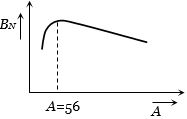
B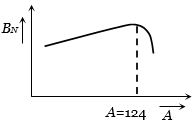
C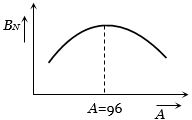
D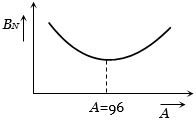
Solution
(A) The binding energy per nucleon $(B_N)$ is a measure of the stability of a nucleus.
Experimental observations show that $B_N$ increases rapidly for light nuclei and reaches a maximum value of approximately $8.8 \text{ MeV}$ for iron $(Fe^{56})$,which corresponds to a mass number $A = 56$.
For nuclei with $A > 56$,the binding energy per nucleon gradually decreases as the mass number increases.
Therefore,the graph that correctly represents this dependence shows a peak at $A = 56$.
Experimental observations show that $B_N$ increases rapidly for light nuclei and reaches a maximum value of approximately $8.8 \text{ MeV}$ for iron $(Fe^{56})$,which corresponds to a mass number $A = 56$.
For nuclei with $A > 56$,the binding energy per nucleon gradually decreases as the mass number increases.
Therefore,the graph that correctly represents this dependence shows a peak at $A = 56$.
0 likes
View Solution42
MediumMCQ
The plot of binding energy per nucleon against the mass number for stable nuclei is shown in the figure. Which curve is correct?
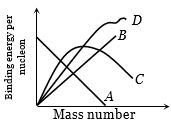
A
$A$
B
$B$
C
$C$
D
$D$
Solution
(C) The binding energy per nucleon $(BE/A)$ is a measure of the stability of a nucleus.
For light nuclei,the $BE/A$ increases rapidly with the mass number $(A)$.
It reaches a maximum value of about $8.8 \text{ MeV}$ for nuclei with mass numbers between $30$ and $170$ (e.g.,$^{56}Fe$).
For heavier nuclei,the $BE/A$ decreases gradually as the mass number increases due to the increased Coulomb repulsion between protons.
Curve $C$ correctly represents this behavior,showing an initial increase,a broad maximum,and a subsequent gradual decrease.
Therefore,the correct option is $C$.
For light nuclei,the $BE/A$ increases rapidly with the mass number $(A)$.
It reaches a maximum value of about $8.8 \text{ MeV}$ for nuclei with mass numbers between $30$ and $170$ (e.g.,$^{56}Fe$).
For heavier nuclei,the $BE/A$ decreases gradually as the mass number increases due to the increased Coulomb repulsion between protons.
Curve $C$ correctly represents this behavior,showing an initial increase,a broad maximum,and a subsequent gradual decrease.
Therefore,the correct option is $C$.
0 likes
View Solution43
DifficultMCQ
The binding energy per nucleon versus mass number curve for nuclei is shown in the figure. $W, X, Y$ and $Z$ are four nuclei indicated on the curve. The process that would release energy is
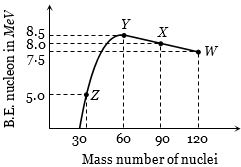
A
$Y \to 2Z$
B
$W \to X + Z$
C
$W \to 2Y$
D
$X \to Y + Z$
Solution
(C) Energy is released in a nuclear process when the total binding energy $(B.E.)$ of the products is greater than the total binding energy of the reactants.
From the graph, we can identify the mass number $(A)$ and binding energy per nucleon $(B.E./A)$ for each nucleus:
For $W$: $A = 120, B.E./A = 7.5 \, MeV \implies \text{Total } B.E. = 120 \times 7.5 = 900 \, MeV$
For $X$: $A = 90, B.E./A = 8.0 \, MeV \implies \text{Total } B.E. = 90 \times 8.0 = 720 \, MeV$
For $Y$: $A = 60, B.E./A = 8.5 \, MeV \implies \text{Total } B.E. = 60 \times 8.5 = 510 \, MeV$
For $Z$: $A = 30, B.E./A = 5.0 \, MeV \implies \text{Total } B.E. = 30 \times 5.0 = 150 \, MeV$
Now, checking option $(c)$: $W \to 2Y$
Total $B.E.$ of reactants $= 900 \, MeV$
Total $B.E.$ of products $= 2 \times (510) = 1020 \, MeV$
Since the total $B.E.$ of products $(1020 \, MeV)$ is greater than the total $B.E.$ of reactants $(900 \, MeV)$, energy is released in this process.
From the graph, we can identify the mass number $(A)$ and binding energy per nucleon $(B.E./A)$ for each nucleus:
For $W$: $A = 120, B.E./A = 7.5 \, MeV \implies \text{Total } B.E. = 120 \times 7.5 = 900 \, MeV$
For $X$: $A = 90, B.E./A = 8.0 \, MeV \implies \text{Total } B.E. = 90 \times 8.0 = 720 \, MeV$
For $Y$: $A = 60, B.E./A = 8.5 \, MeV \implies \text{Total } B.E. = 60 \times 8.5 = 510 \, MeV$
For $Z$: $A = 30, B.E./A = 5.0 \, MeV \implies \text{Total } B.E. = 30 \times 5.0 = 150 \, MeV$
Now, checking option $(c)$: $W \to 2Y$
Total $B.E.$ of reactants $= 900 \, MeV$
Total $B.E.$ of products $= 2 \times (510) = 1020 \, MeV$
Since the total $B.E.$ of products $(1020 \, MeV)$ is greater than the total $B.E.$ of reactants $(900 \, MeV)$, energy is released in this process.
0 likes
View Solution44
EasyMCQ
The value of $1 \, \text{a.m.u.}$ is equivalent to how many $MeV/c^2$?
A
$139$
B
$339$
C
$93$
D
$931$
Solution
(D) The atomic mass unit $(\text{a.m.u.})$ is defined as $1/12$ of the mass of a carbon-$12$ atom.
Using the mass-energy equivalence principle $E = mc^2$, the energy equivalent of $1 \, \text{a.m.u.}$ is calculated as follows:
$1 \, \text{a.m.u.} = 1.660539 \times 10^{-27} \, \text{kg}$.
$E = (1.660539 \times 10^{-27} \, \text{kg}) \times (2.9979 \times 10^8 \, \text{m/s})^2$.
$E \approx 1.4924 \times 10^{-10} \, \text{J}$.
Converting Joules to $MeV$ $(1 \, \text{eV} = 1.602 \times 10^{-19} \, \text{J})$:
$E \approx (1.4924 \times 10^{-10}) / (1.602 \times 10^{-13} \, \text{J/MeV}) \approx 931.5 \, \text{MeV}$.
Therefore, $1 \, \text{a.m.u.} \approx 931 \, \text{MeV}/c^2$.
Using the mass-energy equivalence principle $E = mc^2$, the energy equivalent of $1 \, \text{a.m.u.}$ is calculated as follows:
$1 \, \text{a.m.u.} = 1.660539 \times 10^{-27} \, \text{kg}$.
$E = (1.660539 \times 10^{-27} \, \text{kg}) \times (2.9979 \times 10^8 \, \text{m/s})^2$.
$E \approx 1.4924 \times 10^{-10} \, \text{J}$.
Converting Joules to $MeV$ $(1 \, \text{eV} = 1.602 \times 10^{-19} \, \text{J})$:
$E \approx (1.4924 \times 10^{-10}) / (1.602 \times 10^{-13} \, \text{J/MeV}) \approx 931.5 \, \text{MeV}$.
Therefore, $1 \, \text{a.m.u.} \approx 931 \, \text{MeV}/c^2$.
0 likes
View Solution45
EasyMCQ
$A$ nucleus of mass $M + \Delta m$ is at rest and decays into two daughter nuclei of equal mass. If $C$ is the speed of light,and $E_1$ is the binding energy per nucleon for the parent nucleus and $E_2$ is that for the daughter nuclei,then:
A
$E_1 = 2 E_2$
B
$E_2 = 2 E_1$
C
$E_1 > E_2$
D
$E_2 > E_1$
Solution
(D) In a nuclear decay process,energy is released because the system moves towards a more stable state.
Stability is directly related to the binding energy per nucleon.
$A$ nucleus with higher binding energy per nucleon is more stable.
Since the parent nucleus decays into daughter nuclei,the daughter nuclei must be more stable than the parent nucleus.
Therefore,the binding energy per nucleon of the daughter nuclei $(E_2)$ must be greater than the binding energy per nucleon of the parent nucleus $(E_1)$.
Thus,$E_2 > E_1$.
Stability is directly related to the binding energy per nucleon.
$A$ nucleus with higher binding energy per nucleon is more stable.
Since the parent nucleus decays into daughter nuclei,the daughter nuclei must be more stable than the parent nucleus.
Therefore,the binding energy per nucleon of the daughter nuclei $(E_2)$ must be greater than the binding energy per nucleon of the parent nucleus $(E_1)$.
Thus,$E_2 > E_1$.
0 likes
View Solution46
MediumMCQ
As the mass number increases, the binding energy per nucleon .....
A
increases
B
decreases
C
remains the same
D
increases or decreases
Solution
(B) The binding energy per nucleon $(BE/A)$ is not a monotonic function of the mass number $(A)$.
For light nuclei $(A < 30)$, $BE/A$ generally increases with $A$.
For intermediate nuclei $(30 < A < 170)$, $BE/A$ is relatively constant (around $8 \text{ MeV}$).
For heavy nuclei $(A > 170)$, $BE/A$ decreases as $A$ increases.
Since the question asks for the general trend as mass number increases across the entire range, it is observed that for heavy nuclei, the binding energy per nucleon decreases. However, in the context of standard physics curriculum questions, if the question implies the trend for heavy nuclei or the general behavior of stability, the most appropriate answer is that it decreases for heavy nuclei.
For light nuclei $(A < 30)$, $BE/A$ generally increases with $A$.
For intermediate nuclei $(30 < A < 170)$, $BE/A$ is relatively constant (around $8 \text{ MeV}$).
For heavy nuclei $(A > 170)$, $BE/A$ decreases as $A$ increases.
Since the question asks for the general trend as mass number increases across the entire range, it is observed that for heavy nuclei, the binding energy per nucleon decreases. However, in the context of standard physics curriculum questions, if the question implies the trend for heavy nuclei or the general behavior of stability, the most appropriate answer is that it decreases for heavy nuclei.
0 likes
View Solution47
EasyMCQ
For which mass number range is the binding energy per nucleon maximum?
A
$10$ or less
B
Between $50$ and $100$
C
Greater than $100$
D
Between $100$ and $200$
Solution
(B) The binding energy per nucleon $(BE/A)$ curve shows that for light nuclei $(A < 30)$,the binding energy per nucleon is low.
As the mass number increases,$BE/A$ increases rapidly and reaches a maximum value of approximately $8.8 \text{ MeV}$ for nuclei with mass numbers between $50$ and $80$.
Specifically,for iron $(^{56}_{26}Fe)$,the binding energy per nucleon is maximum.
Therefore,the range of mass numbers where the binding energy per nucleon is maximum is between $50$ and $100$.
As the mass number increases,$BE/A$ increases rapidly and reaches a maximum value of approximately $8.8 \text{ MeV}$ for nuclei with mass numbers between $50$ and $80$.
Specifically,for iron $(^{56}_{26}Fe)$,the binding energy per nucleon is maximum.
Therefore,the range of mass numbers where the binding energy per nucleon is maximum is between $50$ and $100$.
0 likes
View Solution48
EasyMCQ
Nuclear fission is possible because the binding energy per nucleon ...
A
increases with increasing mass number at low mass numbers.
B
decreases with increasing mass number at low mass numbers.
C
increases with increasing mass number at high mass numbers.
D
decreases with increasing mass number at high mass numbers.
Solution
(D) The binding energy per nucleon curve shows that for mass numbers $A > 56$,the binding energy per nucleon gradually decreases as the mass number increases.
Because heavy nuclei (high mass number) have lower binding energy per nucleon compared to intermediate-mass nuclei,they become more stable by splitting into smaller fragments,which is the process of nuclear fission.
Because heavy nuclei (high mass number) have lower binding energy per nucleon compared to intermediate-mass nuclei,they become more stable by splitting into smaller fragments,which is the process of nuclear fission.
0 likes
View Solution49
EasyMCQ
The average binding energy per nucleon in the nucleus of an atom is approximately ........
A
$8 \, MeV$
B
$8 \, eV$
C
$8 \, J$
D
$8 \, erg$
Solution
(A) The binding energy per nucleon is a measure of the stability of a nucleus. For most stable nuclei,the binding energy per nucleon is found to be approximately $8 \, MeV$. This value is relatively constant for nuclei with mass numbers between $30$ and $170$.
0 likes
View SolutionNuclei — Mass-Energy, Nuclear Binding Energy, Nuclear Stability · Frequently Asked Questions
1Are these Nuclei questions useful for JEE and NEET?
Yes. All questions in this section are mapped to JEE Main and NEET exam patterns. Previous year questions from JEE Main, NEET, GUJCET and state-level exams are included with full solutions.
2Can I switch to Hindi or Gujarati for these questions?
Yes. Use the language tabs in the hero section or the sidebar to view the same questions and solutions in English, Hindi or Gujarati.
3How do I generate a question paper from this subtopic?
Use the Vedclass Exam Paper Generator — select the chapter and subtopic, set difficulty, and generate Sets A, B, C, D automatically. First 3 chapters of every subject are free.
Vedclass Products
For Students
Vedclass Test Series
Mock tests in real JEE/NEET style with performance analysis. 5-day free trial.
Start Free TrialFor Teachers
Exam Paper Generator
Generate Set A/B/C/D papers from this chapter in 2 minutes. 3 chapters free.
Try FreeFor Institutes
Online Exam Module
Live online exams with unlimited students, 360° analytics & white-label branding.
See DemoFor Teachers & Institutes
Generate a Nuclei Exam Paper in 2 Minutes
Select subtopic & difficulty — Sets A, B, C, D auto-generated with No Repeat logic.
First 3 chapters of every subject are free — no payment required.