
A English
Mass-Energy, Nuclear Binding Energy, Nuclear Stability Questions in English
Class 12 Physics · Nuclei · Mass-Energy, Nuclear Binding Energy, Nuclear Stability
209+
Questions
English
Language
100%
With Solutions
Showing 50 of 209 questions in English
51
EasyMCQ
What is the order of binding energy per nucleon?
A
$7.6 \,eV$
B
$7.6 \,\mu eV$
C
$7.6 \,MeV$
D
$7.6 \,KeV$
Solution
(C) The binding energy per nucleon is defined as the total binding energy of a nucleus divided by its mass number $(A)$.
For most stable nuclei,the binding energy per nucleon lies in the range of $7 \,MeV$ to $9 \,MeV$.
Specifically,for intermediate mass nuclei,it is approximately $8 \,MeV$.
Among the given options,$7.6 \,MeV$ is the correct order of magnitude for binding energy per nucleon.
For most stable nuclei,the binding energy per nucleon lies in the range of $7 \,MeV$ to $9 \,MeV$.
Specifically,for intermediate mass nuclei,it is approximately $8 \,MeV$.
Among the given options,$7.6 \,MeV$ is the correct order of magnitude for binding energy per nucleon.
0 likes
View Solution52
DifficultMCQ
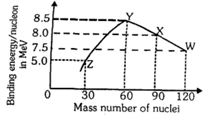
The binding energy per nucleon versus mass number curve is shown in the figure. $W, X, Y$ and $Z$ are four nuclei on the curve. In which process is energy released?
A
$Y \rightarrow 2Z$
B
$W \rightarrow X + Z$
C
$W \rightarrow 2Y$
D
$X \rightarrow Y + Z$
Solution
(C) Energy is released in a nuclear reaction if the total binding energy of the products is greater than the total binding energy of the reactants.
Let $BE_N$ be the binding energy per nucleon. The total binding energy is $BE = A \times BE_N$,where $A$ is the mass number.
For option $C$: $W \rightarrow 2Y$
Reactant $W$: $A = 120, BE_N = 7.5 \text{ MeV}$. Total $BE = 120 \times 7.5 = 900 \text{ MeV}$.
Products $2Y$: $A = 60, BE_N = 8.5 \text{ MeV}$. Total $BE = 2 \times (60 \times 8.5) = 1020 \text{ MeV}$.
Since $1020 \text{ MeV} > 900 \text{ MeV}$,energy is released.
For option $A$: $Y \rightarrow 2Z$
Reactant $Y$: $A = 60, BE_N = 8.5 \text{ MeV}$. Total $BE = 510 \text{ MeV}$.
Products $2Z$: $A = 30, BE_N = 5.0 \text{ MeV}$. Total $BE = 2 \times (30 \times 5.0) = 300 \text{ MeV}$.
Since $300 \text{ MeV} < 510 \text{ MeV}$,energy is absorbed.
Thus,the process $W \rightarrow 2Y$ releases energy.
Let $BE_N$ be the binding energy per nucleon. The total binding energy is $BE = A \times BE_N$,where $A$ is the mass number.
For option $C$: $W \rightarrow 2Y$
Reactant $W$: $A = 120, BE_N = 7.5 \text{ MeV}$. Total $BE = 120 \times 7.5 = 900 \text{ MeV}$.
Products $2Y$: $A = 60, BE_N = 8.5 \text{ MeV}$. Total $BE = 2 \times (60 \times 8.5) = 1020 \text{ MeV}$.
Since $1020 \text{ MeV} > 900 \text{ MeV}$,energy is released.
For option $A$: $Y \rightarrow 2Z$
Reactant $Y$: $A = 60, BE_N = 8.5 \text{ MeV}$. Total $BE = 510 \text{ MeV}$.
Products $2Z$: $A = 30, BE_N = 5.0 \text{ MeV}$. Total $BE = 2 \times (30 \times 5.0) = 300 \text{ MeV}$.
Since $300 \text{ MeV} < 510 \text{ MeV}$,energy is absorbed.
Thus,the process $W \rightarrow 2Y$ releases energy.
0 likes
View Solution53
EasyMCQ
The mass of a nucleus,a neutron,and a proton are $M$,$M_n$,and $M_p$ respectively. Then which of the following is true?
A
$M = (A - Z) M_n + Z M_p$
B
$M = Z M_n + (A - Z) M_p$
C
$M > (A - Z) M_n + Z M_p$
D
$M < (A - Z) M_n + Z M_p$
Solution
(D) The mass of a nucleus $M$ is always less than the sum of the masses of its constituent nucleons (protons and neutrons) due to the mass defect $\Delta m$,which is converted into binding energy.
For a nucleus with atomic number $Z$ and mass number $A$,the number of protons is $Z$ and the number of neutrons is $(A - Z)$.
The sum of the masses of the individual nucleons is $Z M_p + (A - Z) M_n$.
Since the binding energy is positive,the mass of the nucleus must be less than the sum of the masses of its constituents.
Therefore,$M < Z M_p + (A - Z) M_n$.
For a nucleus with atomic number $Z$ and mass number $A$,the number of protons is $Z$ and the number of neutrons is $(A - Z)$.
The sum of the masses of the individual nucleons is $Z M_p + (A - Z) M_n$.
Since the binding energy is positive,the mass of the nucleus must be less than the sum of the masses of its constituents.
Therefore,$M < Z M_p + (A - Z) M_n$.
0 likes
View Solution54
EasyMCQ
The energy released in a nuclear reaction is due to:
A
Conversion of potential energy into kinetic energy
B
Resultant kinetic energy
C
Energy equivalent to the mass defect
D
None of these
Solution
(C) In a nuclear reaction, the total mass of the products is less than the total mass of the reactants. This difference in mass is known as the mass defect $(\Delta m)$.
According to Einstein's mass-energy equivalence principle, $E = \Delta m c^2$, where $c$ is the speed of light.
Therefore, the energy released in a nuclear reaction is the energy equivalent to the mass defect.
According to Einstein's mass-energy equivalence principle, $E = \Delta m c^2$, where $c$ is the speed of light.
Therefore, the energy released in a nuclear reaction is the energy equivalent to the mass defect.
0 likes
View Solution55
EasyMCQ
If $E_e$ is the energy required to remove an electron from an atom and $E_n$ is the energy required to remove a nucleon from a nucleus,then:
A
$E_n < E_e$
B
$E_e < E_n$
C
$E_e = E_n$
D
$E_e \le E_n$
Solution
(B) The energy required to remove an electron from an atom is known as the ionization energy,which is typically in the range of $eV$ (electron-volts).
The energy required to remove a nucleon from a nucleus is known as the binding energy per nucleon,which is typically in the range of $MeV$ (mega electron-volts).
Since $1 \ MeV = 10^6 \ eV$,the energy required to remove a nucleon is significantly higher than the energy required to remove an electron.
Therefore,$E_e < E_n$.
The energy required to remove a nucleon from a nucleus is known as the binding energy per nucleon,which is typically in the range of $MeV$ (mega electron-volts).
Since $1 \ MeV = 10^6 \ eV$,the energy required to remove a nucleon is significantly higher than the energy required to remove an electron.
Therefore,$E_e < E_n$.
0 likes
View Solution56
MediumMCQ
The binding energies of $_1H^2$,$_2He^4$,$_{26}Fe^{56}$,and $_{92}U^{235}$ are $2.22 \ MeV$,$28.3 \ MeV$,$492 \ MeV$,and $1786 \ MeV$ respectively. Which nucleus is the most stable?
A
$_{26}Fe^{56}$
B
$_1H^2$
C
$_{92}U^{235}$
D
$_2He^4$
Solution
(A) Stability of a nucleus is determined by its binding energy per nucleon $(BE/A)$.
$1$. For $_1H^2$: $BE/A = 2.22 / 2 = 1.11 \ MeV/nucleon$.
$2$. For $_2He^4$: $BE/A = 28.3 / 4 = 7.075 \ MeV/nucleon$.
$3$. For $_{26}Fe^{56}$: $BE/A = 492 / 56 \approx 8.79 \ MeV/nucleon$.
$4$. For $_{92}U^{235}$: $BE/A = 1786 / 235 \approx 7.60 \ MeV/nucleon$.
Since $_{26}Fe^{56}$ has the highest binding energy per nucleon,it is the most stable nucleus.
$1$. For $_1H^2$: $BE/A = 2.22 / 2 = 1.11 \ MeV/nucleon$.
$2$. For $_2He^4$: $BE/A = 28.3 / 4 = 7.075 \ MeV/nucleon$.
$3$. For $_{26}Fe^{56}$: $BE/A = 492 / 56 \approx 8.79 \ MeV/nucleon$.
$4$. For $_{92}U^{235}$: $BE/A = 1786 / 235 \approx 7.60 \ MeV/nucleon$.
Since $_{26}Fe^{56}$ has the highest binding energy per nucleon,it is the most stable nucleus.
0 likes
View Solution57
EasyMCQ
The mass of an $\alpha$-particle is . . . . . . .
A
Less than the combined mass of $2$ protons and $2$ neutrons.
B
Equal to the mass of $4$ protons.
C
Equal to the mass of $4$ neutrons.
D
Equal to the mass of $2$ protons and $2$ neutrons.
Solution
(A) An $\alpha$-particle is a helium nucleus $(_{2}^{4}He^{2+})$,which consists of $2$ protons and $2$ neutrons.
According to the mass-energy equivalence principle,the mass of a nucleus is always less than the sum of the masses of its individual constituent nucleons due to the mass defect $(\Delta m)$,which is converted into binding energy $(E = \Delta m c^2)$.
Therefore,the mass of an $\alpha$-particle is slightly less than the combined mass of $2$ free protons and $2$ free neutrons.
According to the mass-energy equivalence principle,the mass of a nucleus is always less than the sum of the masses of its individual constituent nucleons due to the mass defect $(\Delta m)$,which is converted into binding energy $(E = \Delta m c^2)$.
Therefore,the mass of an $\alpha$-particle is slightly less than the combined mass of $2$ free protons and $2$ free neutrons.
0 likes
View Solution58
EasyMCQ
If the binding energy of deuterium is $2.23 \, MeV$, then its mass defect is ........ $amu$.
A
$0.0012$
B
$0.0024$
C
$0.0048$
D
$0.0060$
Solution
(B) The binding energy $(BE)$ of a nucleus is related to its mass defect $(\Delta M)$ by the equation: $BE = \Delta M \times 931 \, MeV/amu$.
Given $BE = 2.23 \, MeV$.
Substituting the values: $2.23 = \Delta M \times 931$.
Therefore, $\Delta M = \frac{2.23}{931} \, amu$.
$\Delta M \approx 0.002395 \, amu \approx 0.0024 \, amu$.
Given $BE = 2.23 \, MeV$.
Substituting the values: $2.23 = \Delta M \times 931$.
Therefore, $\Delta M = \frac{2.23}{931} \, amu$.
$\Delta M \approx 0.002395 \, amu \approx 0.0024 \, amu$.
0 likes
View Solution59
DifficultMCQ
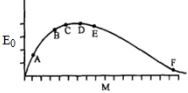
The graph shows the binding energy per nucleon versus mass number. $A, B, C, D, E, F$ are different nuclei. Four processes are given where $\varepsilon$ is the energy released. In which process is $\varepsilon > 0$?
$(i) \, A + B \rightarrow C + \varepsilon$
$(ii) \, C \rightarrow A + B + \varepsilon$
$(iii) \, D + E \rightarrow F + \varepsilon$
$(iv) \, F \rightarrow D + E + \varepsilon$
$(i) \, A + B \rightarrow C + \varepsilon$
$(ii) \, C \rightarrow A + B + \varepsilon$
$(iii) \, D + E \rightarrow F + \varepsilon$
$(iv) \, F \rightarrow D + E + \varepsilon$
A
$(ii)$ and $(iv)$
B
$(ii)$ and $(iii)$
C
$(i)$ and $(iv)$
D
$(i)$ and $(iii)$
Solution
(C) Energy is released in a nuclear process if the total binding energy of the products is greater than the total binding energy of the reactants. This corresponds to the products being more stable than the reactants.
$(i)$ $A + B \rightarrow C + \varepsilon$: Here,light nuclei $A$ and $B$ fuse to form a heavier nucleus $C$. Since $C$ has a higher binding energy per nucleon than $A$ and $B$,the total binding energy increases,and energy is released $(\varepsilon > 0)$.
$(ii)$ $C \rightarrow A + B + \varepsilon$: This is the reverse of process $(i)$. Since the product nuclei are less stable,energy is absorbed $(\varepsilon < 0)$.
$(iii)$ $D + E \rightarrow F + \varepsilon$: Here,$D$ and $E$ are relatively heavy nuclei. Fusing them to form $F$ (which is even heavier and less stable) would require energy input $(\varepsilon < 0)$.
$(iv)$ $F \rightarrow D + E + \varepsilon$: This represents nuclear fission where a heavy,unstable nucleus $F$ splits into more stable,lighter nuclei $D$ and $E$. The total binding energy increases,so energy is released $(\varepsilon > 0)$.
Therefore,processes $(i)$ and $(iv)$ result in energy release.
$(i)$ $A + B \rightarrow C + \varepsilon$: Here,light nuclei $A$ and $B$ fuse to form a heavier nucleus $C$. Since $C$ has a higher binding energy per nucleon than $A$ and $B$,the total binding energy increases,and energy is released $(\varepsilon > 0)$.
$(ii)$ $C \rightarrow A + B + \varepsilon$: This is the reverse of process $(i)$. Since the product nuclei are less stable,energy is absorbed $(\varepsilon < 0)$.
$(iii)$ $D + E \rightarrow F + \varepsilon$: Here,$D$ and $E$ are relatively heavy nuclei. Fusing them to form $F$ (which is even heavier and less stable) would require energy input $(\varepsilon < 0)$.
$(iv)$ $F \rightarrow D + E + \varepsilon$: This represents nuclear fission where a heavy,unstable nucleus $F$ splits into more stable,lighter nuclei $D$ and $E$. The total binding energy increases,so energy is released $(\varepsilon > 0)$.
Therefore,processes $(i)$ and $(iv)$ result in energy release.
0 likes
View Solution60
EasyMCQ
What is the energy produced in $MeV$ when the mass equivalent to $1$ proton is completely converted into energy?
A
$989.21$
B
$931.49$
C
$896.12$
D
$756.50$
Solution
(B) The mass of a proton is approximately $1.007276 \ u$.
Using the mass-energy equivalence relation,$E = mc^2$.
Since $1 \ u$ is equivalent to $931.5 \ MeV/c^2$,the energy equivalent to the mass of a proton is calculated as:
$E = 1.007276 \ u \times 931.5 \ MeV/u \approx 938.27 \ MeV$.
However,in many textbook contexts,the mass of a proton is approximated as $1 \ u$ (atomic mass unit) for simplified calculations,which yields:
$E = 1 \ u \times 931.49 \ MeV/u = 931.49 \ MeV$.
Thus,the energy produced is $931.49 \ MeV$.
Using the mass-energy equivalence relation,$E = mc^2$.
Since $1 \ u$ is equivalent to $931.5 \ MeV/c^2$,the energy equivalent to the mass of a proton is calculated as:
$E = 1.007276 \ u \times 931.5 \ MeV/u \approx 938.27 \ MeV$.
However,in many textbook contexts,the mass of a proton is approximated as $1 \ u$ (atomic mass unit) for simplified calculations,which yields:
$E = 1 \ u \times 931.49 \ MeV/u = 931.49 \ MeV$.
Thus,the energy produced is $931.49 \ MeV$.
0 likes
View Solution61
DifficultMCQ
The binding energy per nucleon for a deuteron and an $\alpha$-particle are $x_1$ and $x_2$ respectively. The energy $Q$ released in the following reaction is:
$_1H^2 + _1H^2 \rightarrow {_2}{He}^4 + Q$
$_1H^2 + _1H^2 \rightarrow {_2}{He}^4 + Q$
A
$4(x_2 - x_1)$
B
$4(x_1 - x_2)$
C
$2(x_1 - x_2)$
D
$2(x_2 - x_1)$
Solution
(A) The reaction is $_1H^2 + _1H^2 \rightarrow {_2}{He}^4 + Q$.
The total number of nucleons in the reactants is $2 + 2 = 4$.
The binding energy per nucleon for the deuteron is $x_1$, so the total binding energy of the reactants is $4x_1$.
The total number of nucleons in the product is $4$.
The binding energy per nucleon for the $\alpha$-particle is $x_2$, so the total binding energy of the product is $4x_2$.
The energy released $Q$ is given by the difference in total binding energies: $Q = (\text{Total Binding Energy of Products}) - (\text{Total Binding Energy of Reactants})$.
Therefore, $Q = 4x_2 - 4x_1 = 4(x_2 - x_1)$.
The total number of nucleons in the reactants is $2 + 2 = 4$.
The binding energy per nucleon for the deuteron is $x_1$, so the total binding energy of the reactants is $4x_1$.
The total number of nucleons in the product is $4$.
The binding energy per nucleon for the $\alpha$-particle is $x_2$, so the total binding energy of the product is $4x_2$.
The energy released $Q$ is given by the difference in total binding energies: $Q = (\text{Total Binding Energy of Products}) - (\text{Total Binding Energy of Reactants})$.
Therefore, $Q = 4x_2 - 4x_1 = 4(x_2 - x_1)$.
0 likes
View Solution62
DifficultMCQ
The mass of a proton is $1.0073 \, u$ and that of a neutron is $1.0087 \, u$. The binding energy of $_2He^4$ is .... ($u = \text{atomic mass unit}$,mass of helium nucleus = $4.0015 \, u$)
A
$0.0305 \, J$
B
$0.0305 \, erg$
C
$28.4 \, MeV$
D
$0.061 \, u$
Solution
(C) The binding energy $(B.E.)$ is calculated using the mass defect formula: $B.E. = [Z m_p + (A - Z) m_n - M_{nucleus}] c^2$.
Here,$Z = 2$ (number of protons),$A = 4$ (mass number),$m_p = 1.0073 \, u$,$m_n = 1.0087 \, u$,and $M_{nucleus} = 4.0015 \, u$.
Mass defect $\Delta m = [2(1.0073) + 2(1.0087) - 4.0015] \, u$.
$\Delta m = [2.0146 + 2.0174 - 4.0015] \, u = [4.0320 - 4.0015] \, u = 0.0305 \, u$.
Since $1 \, u = 931.5 \, MeV/c^2$,the binding energy is $B.E. = 0.0305 \times 931.5 \, MeV \approx 28.4 \, MeV$.
Here,$Z = 2$ (number of protons),$A = 4$ (mass number),$m_p = 1.0073 \, u$,$m_n = 1.0087 \, u$,and $M_{nucleus} = 4.0015 \, u$.
Mass defect $\Delta m = [2(1.0073) + 2(1.0087) - 4.0015] \, u$.
$\Delta m = [2.0146 + 2.0174 - 4.0015] \, u = [4.0320 - 4.0015] \, u = 0.0305 \, u$.
Since $1 \, u = 931.5 \, MeV/c^2$,the binding energy is $B.E. = 0.0305 \times 931.5 \, MeV \approx 28.4 \, MeV$.
0 likes
View Solution63
MediumMCQ
The mass of the oxygen isotope $_8O^{17}$ is $M_0$. If $M_p$ and $M_n$ are the masses of a proton and a neutron respectively,the nuclear binding energy of the isotope is ......
A
$(17 M_n - M_0) c^2$
B
$(8 M_p - M_0) c^2$
C
$(8 M_p + 9 M_n - M_0) c^2$
D
$M_0 c^2$
Solution
(C) The binding energy $(BE)$ of a nucleus is given by the formula: $BE = [Z M_p + (A - Z) M_n - M_{nucleus}] c^2$.
For the oxygen isotope $_8O^{17}$,the atomic number $Z = 8$ and the mass number $A = 17$.
The number of neutrons is $N = A - Z = 17 - 8 = 9$.
Substituting these values into the formula,we get:
$BE = [8 M_p + 9 M_n - M_0] c^2$.
For the oxygen isotope $_8O^{17}$,the atomic number $Z = 8$ and the mass number $A = 17$.
The number of neutrons is $N = A - Z = 17 - 8 = 9$.
Substituting these values into the formula,we get:
$BE = [8 M_p + 9 M_n - M_0] c^2$.
0 likes
View Solution64
MediumMCQ
The binding energy per nucleon for $_8O^{16}$ and $_8O^{17}$ are $7.97 \, MeV$ and $7.75 \, MeV$ respectively. The energy required to remove a neutron from $_8O^{17}$ is (in $MeV$):
A
$3.52$
B
$3.64$
C
$4.23$
D
$7.86$
Solution
(C) The reaction for removing a neutron from $_8O^{17}$ is: $_8O^{17} \rightarrow _8O^{16} + _0n^1$.
The total binding energy of a nucleus is given by $BE = A \times (BE/A)$,where $A$ is the mass number.
Total binding energy of $_8O^{17} = 17 \times 7.75 \, MeV = 131.75 \, MeV$.
Total binding energy of $_8O^{16} = 16 \times 7.97 \, MeV = 127.52 \, MeV$.
The energy required to remove the neutron is the difference in total binding energies:
$E = BE(O^{17}) - BE(O^{16}) = 131.75 \, MeV - 127.52 \, MeV = 4.23 \, MeV$.
The total binding energy of a nucleus is given by $BE = A \times (BE/A)$,where $A$ is the mass number.
Total binding energy of $_8O^{17} = 17 \times 7.75 \, MeV = 131.75 \, MeV$.
Total binding energy of $_8O^{16} = 16 \times 7.97 \, MeV = 127.52 \, MeV$.
The energy required to remove the neutron is the difference in total binding energies:
$E = BE(O^{17}) - BE(O^{16}) = 131.75 \, MeV - 127.52 \, MeV = 4.23 \, MeV$.
0 likes
View Solution65
DifficultMCQ
If the binding energy per nucleon for $\,_3^7\,Li\,\,$ and $\,_2^4\,\,He$ are $5.60 \,MeV$ and $7.06 \,MeV$ respectively, then the energy of the proton in the reaction $p\,\, + \,\,_3^7\,\,Li\,\, \to \,\,2\,_2^4\,\,He$ must be .......... $MeV$.
A
$28.24$
B
$17.28$
C
$1.46$
D
$39.2$
Solution
(B) The binding energy of $\,_3^7\,Li\,\,$ nucleus $= 7 \times 5.60 = 39.2 \,MeV$.
The binding energy of $\,_2^4\,He\,\,$ nucleus $= 4 \times 7.06 = 28.24 \,MeV$.
The reaction is $p + \,_3^7\,Li \to 2\,_2^4\,He$.
The energy released ($Q$-value) in the reaction is given by the difference in total binding energies of the products and the reactants.
$Q = [2 \times (\text{Binding Energy of } \,_2^4\,He)] - [(\text{Binding Energy of } \,_3^7\,Li) + (\text{Binding Energy of } p)]$.
Since the binding energy of a free proton is $0$, we have:
$Q = (2 \times 28.24) - 39.2 = 56.48 - 39.2 = 17.28 \,MeV$.
The binding energy of $\,_2^4\,He\,\,$ nucleus $= 4 \times 7.06 = 28.24 \,MeV$.
The reaction is $p + \,_3^7\,Li \to 2\,_2^4\,He$.
The energy released ($Q$-value) in the reaction is given by the difference in total binding energies of the products and the reactants.
$Q = [2 \times (\text{Binding Energy of } \,_2^4\,He)] - [(\text{Binding Energy of } \,_3^7\,Li) + (\text{Binding Energy of } p)]$.
Since the binding energy of a free proton is $0$, we have:
$Q = (2 \times 28.24) - 39.2 = 56.48 - 39.2 = 17.28 \,MeV$.
0 likes
View Solution66
MediumMCQ
The mass of a $_3^7Li$ nucleus is $0.042 \, u$ less than the sum of the masses of its constituent nucleons. The binding energy per nucleon of the $_3^7Li$ nucleus is approximately ......... $MeV$.
A
$46$
B
$5.6$
C
$3.9$
D
$2.3$
Solution
(B) For a $_3^7Li$ nucleus,the mass defect is $\Delta m = 0.042 \, u$.
Given that $1 \, u \approx 931.5 \, MeV/c^2$,the total binding energy $E_b$ is calculated as:
$E_b = \Delta m \times 931.5 \, MeV = 0.042 \times 931.5 \, MeV \approx 39.123 \, MeV$.
The mass number $A$ for $_3^7Li$ is $7$.
The binding energy per nucleon $E_{bn}$ is given by:
$E_{bn} = \frac{E_b}{A} = \frac{39.123 \, MeV}{7} \approx 5.589 \, MeV$.
Rounding to the nearest value,we get $5.6 \, MeV$.
Given that $1 \, u \approx 931.5 \, MeV/c^2$,the total binding energy $E_b$ is calculated as:
$E_b = \Delta m \times 931.5 \, MeV = 0.042 \times 931.5 \, MeV \approx 39.123 \, MeV$.
The mass number $A$ for $_3^7Li$ is $7$.
The binding energy per nucleon $E_{bn}$ is given by:
$E_{bn} = \frac{E_b}{A} = \frac{39.123 \, MeV}{7} \approx 5.589 \, MeV$.
Rounding to the nearest value,we get $5.6 \, MeV$.
0 likes
View Solution67
EasyMCQ
An electron and a positron annihilate each other to produce two $\gamma$-ray photons of equal energy. The minimum energy of each photon is .....
A
$8.2 \times 10^{-14} \, \text{MeV}$
B
$8.2 \times 10^{-14} \, \text{J}$
C
$16.4 \times 10^{-14} \, \text{MeV}$
D
$16.4 \times 10^{-14} \, \text{J}$
Solution
(B) The rest mass energy of an electron (or positron) is $E_0 = m_0 c^2 = 0.511 \, \text{MeV}$.
Converting this to Joules: $E_0 = 0.511 \times 10^6 \, \text{eV} \times 1.602 \times 10^{-19} \, \text{J/eV} \approx 8.186 \times 10^{-14} \, \text{J}$.
Since the total energy of the electron-positron pair $(2 \times 0.511 \, \text{MeV})$ is shared equally between two photons,the energy of each photon is equal to the rest mass energy of one particle.
Therefore,the energy of each photon is $E = 8.2 \times 10^{-14} \, \text{J}$.
Converting this to Joules: $E_0 = 0.511 \times 10^6 \, \text{eV} \times 1.602 \times 10^{-19} \, \text{J/eV} \approx 8.186 \times 10^{-14} \, \text{J}$.
Since the total energy of the electron-positron pair $(2 \times 0.511 \, \text{MeV})$ is shared equally between two photons,the energy of each photon is equal to the rest mass energy of one particle.
Therefore,the energy of each photon is $E = 8.2 \times 10^{-14} \, \text{J}$.
0 likes
View Solution68
DifficultMCQ
If the binding energy per nucleon for $_3{Li}^7$ and $_2{He}^4$ nuclei are $5.60 \, MeV$ and $7.06 \, MeV$ respectively,then the energy released in the reaction $_3{Li}^7 + _1H^1 \rightarrow 2 \, _2{He}^4$ is ...... $MeV$.
A
$29.6$
B
$2.4$
C
$8.4$
D
$17.3$
Solution
(D) The given nuclear reaction is: $_3{Li}^7 + _1H^1 \rightarrow 2 \, _2{He}^4$.
The total binding energy of the reactants is:
$BE_{reactants} = (7 \times 5.60) + (0) = 39.2 \, MeV$ (since the binding energy of a single proton is $0$).
The total binding energy of the products is:
$BE_{products} = 2 \times (4 \times 7.06) = 2 \times 28.24 = 56.48 \, MeV$.
The energy released $(Q)$ is the difference between the total binding energy of the products and the reactants:
$Q = BE_{products} - BE_{reactants}$
$Q = 56.48 \, MeV - 39.2 \, MeV = 17.28 \, MeV \approx 17.3 \, MeV$.
The total binding energy of the reactants is:
$BE_{reactants} = (7 \times 5.60) + (0) = 39.2 \, MeV$ (since the binding energy of a single proton is $0$).
The total binding energy of the products is:
$BE_{products} = 2 \times (4 \times 7.06) = 2 \times 28.24 = 56.48 \, MeV$.
The energy released $(Q)$ is the difference between the total binding energy of the products and the reactants:
$Q = BE_{products} - BE_{reactants}$
$Q = 56.48 \, MeV - 39.2 \, MeV = 17.28 \, MeV \approx 17.3 \, MeV$.
0 likes
View Solution69
EasyMCQ
The mass of a nucleus $_Z^AX$ is denoted by $M(A, Z)$. If $M_p$ and $M_n$ are the masses of a proton and a neutron respectively, the binding energy of this nucleus is given by:
A
$BE = [ZM_p + (A - Z)M_n - M(A, Z)]c^2$
B
$BE = [ZM_p + AM_n - M(A, Z)]c^2$
C
$BE = M(A, Z) - ZM_p - (A - Z)M_n$
D
$BE = [M(A, Z) - ZM_p - (A - Z)M_n]c^2$
Solution
(A) The binding energy $(BE)$ of a nucleus is defined as the energy equivalent of the mass defect $(\Delta m)$.
Mass defect is the difference between the sum of the masses of individual nucleons and the actual mass of the nucleus.
Number of protons = $Z$.
Number of neutrons = $A - Z$.
Mass of nucleons = $ZM_p + (A - Z)M_n$.
Mass defect $\Delta m = [ZM_p + (A - Z)M_n - M(A, Z)]$.
Using Einstein's mass-energy equivalence relation, $E = mc^2$, the binding energy is $BE = \Delta m c^2$.
Therefore, $BE = [ZM_p + (A - Z)M_n - M(A, Z)]c^2$.
Mass defect is the difference between the sum of the masses of individual nucleons and the actual mass of the nucleus.
Number of protons = $Z$.
Number of neutrons = $A - Z$.
Mass of nucleons = $ZM_p + (A - Z)M_n$.
Mass defect $\Delta m = [ZM_p + (A - Z)M_n - M(A, Z)]$.
Using Einstein's mass-energy equivalence relation, $E = mc^2$, the binding energy is $BE = \Delta m c^2$.
Therefore, $BE = [ZM_p + (A - Z)M_n - M(A, Z)]c^2$.
0 likes
View Solution70
MediumMCQ
If an electron and a positron annihilate,the energy released is ........
A
$3.2 \times 10^{-13} \, J$
B
$1.6 \times 10^{-13} \, J$
C
$4.8 \times 10^{-13} \, J$
D
$6.4 \times 10^{-13} \, J$
Solution
(B) The mass of an electron $(m_e)$ is equal to the mass of a positron $(m_p)$,which is $9.1 \times 10^{-31} \, kg$.
When an electron and a positron annihilate,their total mass is converted into energy.
The total mass involved is $M = m_e + m_p = 2 \times 9.1 \times 10^{-31} \, kg = 18.2 \times 10^{-31} \, kg$.
Using Einstein's mass-energy equivalence formula,$E = Mc^2$,where $c = 3 \times 10^8 \, m/s$:
$E = (18.2 \times 10^{-31} \, kg) \times (3 \times 10^8 \, m/s)^2$
$E = 18.2 \times 10^{-31} \times 9 \times 10^{16} \, J$
$E = 163.8 \times 10^{-15} \, J = 1.638 \times 10^{-13} \, J$.
Rounding to the nearest provided option,the energy released is $1.6 \times 10^{-13} \, J$.
When an electron and a positron annihilate,their total mass is converted into energy.
The total mass involved is $M = m_e + m_p = 2 \times 9.1 \times 10^{-31} \, kg = 18.2 \times 10^{-31} \, kg$.
Using Einstein's mass-energy equivalence formula,$E = Mc^2$,where $c = 3 \times 10^8 \, m/s$:
$E = (18.2 \times 10^{-31} \, kg) \times (3 \times 10^8 \, m/s)^2$
$E = 18.2 \times 10^{-31} \times 9 \times 10^{16} \, J$
$E = 163.8 \times 10^{-15} \, J = 1.638 \times 10^{-13} \, J$.
Rounding to the nearest provided option,the energy released is $1.6 \times 10^{-13} \, J$.
0 likes
View Solution71
DifficultMCQ
In the nuclear process $n \to p + e^- + \bar{\nu}$,if the masses of proton,neutron,and electron are $1.6725 \times 10^{-27} \ kg$,$1.6747 \times 10^{-27} \ kg$,and $9 \times 10^{-31} \ kg$ respectively,then the energy released is ...... $MeV$.
A
$0.51$
B
$0.73$
C
$1.03$
D
$4.21$
Solution
(B) The nuclear process is $n \to p + e^- + \bar{\nu}$.
Mass of reactant (neutron) $m_n = 1.6747 \times 10^{-27} \ kg$.
Mass of products (proton + electron) $m_p + m_e = (1.6725 \times 10^{-27} + 9 \times 10^{-31}) \ kg$.
$m_p + m_e = (1.6725 + 0.0009) \times 10^{-27} \ kg = 1.6734 \times 10^{-27} \ kg$.
The mass defect $\Delta m = m_n - (m_p + m_e) = (1.6747 - 1.6734) \times 10^{-27} \ kg = 0.0013 \times 10^{-27} \ kg = 1.3 \times 10^{-30} \ kg$.
The energy released $E = \Delta m c^2 = (1.3 \times 10^{-30}) \times (3 \times 10^8)^2 \ J$.
$E = 1.3 \times 10^{-30} \times 9 \times 10^{16} \ J = 11.7 \times 10^{-14} \ J$.
To convert energy into $MeV$,divide by $1.6 \times 10^{-13} \ J/MeV$:
$E = \frac{11.7 \times 10^{-14}}{1.6 \times 10^{-13}} \ MeV = \frac{1.17}{1.6} \ MeV \approx 0.73 \ MeV$.
Mass of reactant (neutron) $m_n = 1.6747 \times 10^{-27} \ kg$.
Mass of products (proton + electron) $m_p + m_e = (1.6725 \times 10^{-27} + 9 \times 10^{-31}) \ kg$.
$m_p + m_e = (1.6725 + 0.0009) \times 10^{-27} \ kg = 1.6734 \times 10^{-27} \ kg$.
The mass defect $\Delta m = m_n - (m_p + m_e) = (1.6747 - 1.6734) \times 10^{-27} \ kg = 0.0013 \times 10^{-27} \ kg = 1.3 \times 10^{-30} \ kg$.
The energy released $E = \Delta m c^2 = (1.3 \times 10^{-30}) \times (3 \times 10^8)^2 \ J$.
$E = 1.3 \times 10^{-30} \times 9 \times 10^{16} \ J = 11.7 \times 10^{-14} \ J$.
To convert energy into $MeV$,divide by $1.6 \times 10^{-13} \ J/MeV$:
$E = \frac{11.7 \times 10^{-14}}{1.6 \times 10^{-13}} \ MeV = \frac{1.17}{1.6} \ MeV \approx 0.73 \ MeV$.
0 likes
View Solution72
MediumMCQ
One atomic mass unit is equivalent to .............. $MeV$ energy.
A
$39$
B
$93$
C
$139$
D
$931.5$
Solution
(D) $1\, amu$ is defined as $1/12$ of the mass of a carbon-$12$ atom.
Using Einstein's mass-energy equivalence relation,$E = mc^2$,where $m = 1.660539 \times 10^{-27}\, kg$ and $c = 2.99792458 \times 10^8\, m/s$:
$E = (1.660539 \times 10^{-27}\, kg) \times (2.99792458 \times 10^8\, m/s)^2$
$E \approx 1.4924 \times 10^{-10}\, J$
To convert this energy into $MeV$,we divide by $1.60218 \times 10^{-13}\, J/MeV$:
$E = \frac{1.4924 \times 10^{-10}}{1.60218 \times 10^{-13}}\, MeV \approx 931.5\, MeV$.
Therefore,$1\, amu$ is equivalent to approximately $931.5\, MeV$ of energy.
Using Einstein's mass-energy equivalence relation,$E = mc^2$,where $m = 1.660539 \times 10^{-27}\, kg$ and $c = 2.99792458 \times 10^8\, m/s$:
$E = (1.660539 \times 10^{-27}\, kg) \times (2.99792458 \times 10^8\, m/s)^2$
$E \approx 1.4924 \times 10^{-10}\, J$
To convert this energy into $MeV$,we divide by $1.60218 \times 10^{-13}\, J/MeV$:
$E = \frac{1.4924 \times 10^{-10}}{1.60218 \times 10^{-13}}\, MeV \approx 931.5\, MeV$.
Therefore,$1\, amu$ is equivalent to approximately $931.5\, MeV$ of energy.
0 likes
View Solution73
DifficultMCQ
How much energy is released when $1 \,g$ of hydrogen is converted into $0.993 \,g$ of helium?
A
$63 \times 10^7 \,J$
B
$63 \times 10^{10} \,J$
C
$63 \times 10^{14} \,J$
D
$63 \times 10^{20} \,J$
Solution
(B) The mass defect $\Delta m$ is given by the difference between the initial mass and the final mass.
$\Delta m = 1 \,g - 0.993 \,g = 0.007 \,g = 0.007 \times 10^{-3} \,kg = 7 \times 10^{-6} \,kg$.
Using Einstein's mass-energy equivalence principle,$E = \Delta m c^2$,where $c = 3 \times 10^8 \,m/s$ is the speed of light.
$E = (7 \times 10^{-6} \,kg) \times (3 \times 10^8 \,m/s)^2$.
$E = 7 \times 10^{-6} \times 9 \times 10^{16} \,J$.
$E = 63 \times 10^{10} \,J$.
$\Delta m = 1 \,g - 0.993 \,g = 0.007 \,g = 0.007 \times 10^{-3} \,kg = 7 \times 10^{-6} \,kg$.
Using Einstein's mass-energy equivalence principle,$E = \Delta m c^2$,where $c = 3 \times 10^8 \,m/s$ is the speed of light.
$E = (7 \times 10^{-6} \,kg) \times (3 \times 10^8 \,m/s)^2$.
$E = 7 \times 10^{-6} \times 9 \times 10^{16} \,J$.
$E = 63 \times 10^{10} \,J$.
0 likes
View Solution74
EasyMCQ
The binding energy per nucleon for ${O^{16}}$ and ${O^{17}}$ are $7.97 \, MeV$ and $7.75 \, MeV$ respectively. How much energy in $MeV$ is required to remove one neutron from ${O^{17}}$?
A
$3.52$
B
$3.64$
C
$4.23$
D
$7.86$
Solution
(C) The nuclear reaction for removing a neutron from ${O^{17}}$ is given by: ${O^{17}} \to {O^{16}} + {n^1}$.
The total binding energy of a nucleus is calculated as: $BE = (\text{Number of nucleons}) \times (\text{Binding energy per nucleon})$.
Total binding energy of ${O^{17}} = 17 \times 7.75 \, MeV = 131.75 \, MeV$.
Total binding energy of ${O^{16}} = 16 \times 7.97 \, MeV = 127.52 \, MeV$.
The energy required to remove the neutron is the difference in the total binding energies: $\Delta E = BE({O^{17}}) - BE({O^{16}})$.
$\Delta E = 131.75 \, MeV - 127.52 \, MeV = 4.23 \, MeV$.
The total binding energy of a nucleus is calculated as: $BE = (\text{Number of nucleons}) \times (\text{Binding energy per nucleon})$.
Total binding energy of ${O^{17}} = 17 \times 7.75 \, MeV = 131.75 \, MeV$.
Total binding energy of ${O^{16}} = 16 \times 7.97 \, MeV = 127.52 \, MeV$.
The energy required to remove the neutron is the difference in the total binding energies: $\Delta E = BE({O^{17}}) - BE({O^{16}})$.
$\Delta E = 131.75 \, MeV - 127.52 \, MeV = 4.23 \, MeV$.
0 likes
View Solution75
DifficultMCQ
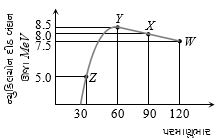
The graph of binding energy per nucleon $B_N$ versus mass number $A$ is given. In which process will energy be released?
A
$Y \rightarrow 2Z$
B
$W \rightarrow X + Z$
C
$W \rightarrow 2Y$
D
$X \rightarrow Y + Z$
Solution
(C) Energy is released in a nuclear reaction if the total binding energy of the products is greater than the total binding energy of the reactants.
Let us evaluate option $C$: $W \rightarrow 2Y$.
For reactant $W$ $(A=120, B_N=7.5 \, MeV)$: Total binding energy $= 120 \times 7.5 = 900 \, MeV$.
For products $2Y$ $(A=60, B_N=8.5 \, MeV)$: Total binding energy $= 2 \times (60 \times 8.5) = 1020 \, MeV$.
Since $1020 \, MeV > 900 \, MeV$,energy is released in this process.
Let us evaluate option $C$: $W \rightarrow 2Y$.
For reactant $W$ $(A=120, B_N=7.5 \, MeV)$: Total binding energy $= 120 \times 7.5 = 900 \, MeV$.
For products $2Y$ $(A=60, B_N=8.5 \, MeV)$: Total binding energy $= 2 \times (60 \times 8.5) = 1020 \, MeV$.
Since $1020 \, MeV > 900 \, MeV$,energy is released in this process.
0 likes
View Solution76
MediumMCQ
$A$ nucleus $^{A}_{Z} X$ has mass represented by $M(A, Z)$. If $M_p$ and $M_n$ denote the mass of a proton and a neutron respectively, and $B.E.$ is the binding energy in $MeV$, then:
A
$B.E. = [Z M_p + (A - Z) M_n - M(A, Z)] c^2$
B
$B.E. = [Z M_p + A M_n - M(A, Z)] c^2$
C
$B.E. = M(A, Z) - Z M_p - (A - Z) M_n$
D
$B.E. = [M(A, Z) - Z M_p - (A - Z) M_n] c^2$
Solution
(A) The binding energy $(B.E.)$ of a nucleus is the energy equivalent of the mass defect $(\Delta m)$.
The mass defect is defined as the difference between the sum of the masses of individual nucleons (protons and neutrons) and the actual mass of the nucleus.
Number of protons = $Z$
Number of neutrons = $A - Z$
Mass defect $\Delta m = [Z M_p + (A - Z) M_n - M(A, Z)]$
According to Einstein's mass-energy equivalence principle, $B.E. = \Delta m c^2$.
Therefore, $B.E. = [Z M_p + (A - Z) M_n - M(A, Z)] c^2$.
The mass defect is defined as the difference between the sum of the masses of individual nucleons (protons and neutrons) and the actual mass of the nucleus.
Number of protons = $Z$
Number of neutrons = $A - Z$
Mass defect $\Delta m = [Z M_p + (A - Z) M_n - M(A, Z)]$
According to Einstein's mass-energy equivalence principle, $B.E. = \Delta m c^2$.
Therefore, $B.E. = [Z M_p + (A - Z) M_n - M(A, Z)] c^2$.
0 likes
View Solution77
MediumMCQ
If $M(A, Z)$,$M_p$,and $M_n$ represent the masses of the nucleus ${}_{Z}^{A}X$,proton,and neutron in $u$ units respectively $(1u = 931.5 \, MeV/c^2)$,and $BE$ represents the binding energy in $MeV$,then which of the following relations is correct?
A
$M(A, Z) = ZM_p + (A-Z)M_n - BE/c^2$
B
$M(A, Z) = ZM_p + (A-Z)M_n + BE/c^2$
C
$M(A, Z) = ZM_p + (A-Z)M_n - BE$
D
$M(A, Z) = ZM_p + (A-Z)M_n + BE$
Solution
(A) The binding energy $(BE)$ is the energy equivalent to the mass defect $(\Delta m)$,which is the difference between the total mass of the constituent nucleons and the actual mass of the nucleus.
The mass defect is given by $\Delta m = [ZM_p + (A-Z)M_n] - M(A, Z)$.
According to Einstein's mass-energy equivalence principle,$BE = \Delta m \times c^2$.
Substituting the expression for $\Delta m$,we get $BE = [ZM_p + (A-Z)M_n - M(A, Z)] \times c^2$.
Dividing by $c^2$,we have $BE/c^2 = ZM_p + (A-Z)M_n - M(A, Z)$.
Rearranging the terms to solve for $M(A, Z)$,we get $M(A, Z) = ZM_p + (A-Z)M_n - BE/c^2$.
Thus,the correct relation is $M(A, Z) = ZM_p + (A-Z)M_n - BE/c^2$.
The mass defect is given by $\Delta m = [ZM_p + (A-Z)M_n] - M(A, Z)$.
According to Einstein's mass-energy equivalence principle,$BE = \Delta m \times c^2$.
Substituting the expression for $\Delta m$,we get $BE = [ZM_p + (A-Z)M_n - M(A, Z)] \times c^2$.
Dividing by $c^2$,we have $BE/c^2 = ZM_p + (A-Z)M_n - M(A, Z)$.
Rearranging the terms to solve for $M(A, Z)$,we get $M(A, Z) = ZM_p + (A-Z)M_n - BE/c^2$.
Thus,the correct relation is $M(A, Z) = ZM_p + (A-Z)M_n - BE/c^2$.
0 likes
View Solution78
MediumMCQ
The mass of a ${}_{3}^{7}Li$ nucleus is $0.042 \, u$ less than the sum of the masses of all its nucleons. The binding energy per nucleon of ${}_{3}^{7}Li$ nucleus is nearly...........$MeV$.
A
$46$
B
$5.6$
C
$3.9$
D
$23$
Solution
(B) For the ${}_{3}^{7}Li$ nucleus,the mass defect is given as $\Delta M = 0.042 \, u$.
We know that $1 \, u = 931.5 \, MeV/c^2$.
Therefore,the total binding energy $E_b$ is calculated as:
$E_b = \Delta M \times 931.5 \, MeV/u = 0.042 \times 931.5 \, MeV \approx 39.123 \, MeV$.
The number of nucleons $A$ in ${}_{3}^{7}Li$ is $7$.
The binding energy per nucleon is given by $E_{bn} = \frac{E_b}{A}$.
$E_{bn} = \frac{39.123 \, MeV}{7} \approx 5.589 \, MeV \approx 5.6 \, MeV$.
We know that $1 \, u = 931.5 \, MeV/c^2$.
Therefore,the total binding energy $E_b$ is calculated as:
$E_b = \Delta M \times 931.5 \, MeV/u = 0.042 \times 931.5 \, MeV \approx 39.123 \, MeV$.
The number of nucleons $A$ in ${}_{3}^{7}Li$ is $7$.
The binding energy per nucleon is given by $E_{bn} = \frac{E_b}{A}$.
$E_{bn} = \frac{39.123 \, MeV}{7} \approx 5.589 \, MeV \approx 5.6 \, MeV$.
0 likes
View Solution79
MediumMCQ
The binding energy per nucleon of ${}_3^7Li$ and ${}_2^4He$ nuclei are $5.60\,MeV$ and $7.06\,MeV$ respectively. In the nuclear reaction ${}_3^7Li + {}_1^1H \to 2{}_2^4He + Q$, the value of energy $Q$ released is.........$MeV$.
A
$19.6$
B
$2.4$
C
$8.4$
D
$17.3$
Solution
(D) The binding energy of a nucleus is given by $BE = (\text{number of nucleons}) \times (\text{binding energy per nucleon})$.
For ${}_3^7Li$: $BE_1 = 7 \times 5.60\,MeV = 39.2\,MeV$.
For ${}_1^1H$: The binding energy is $0\,MeV$ as it is a single proton.
For $2{}_2^4He$: $BE_2 = 2 \times (4 \times 7.06\,MeV) = 2 \times 28.24\,MeV = 56.48\,MeV$.
The energy released $Q$ is the difference between the total binding energy of the products and the reactants:
$Q = BE_{\text{products}} - BE_{\text{reactants}}$
$Q = 56.48\,MeV - (39.2\,MeV + 0\,MeV)$
$Q = 17.28\,MeV \approx 17.3\,MeV$.
For ${}_3^7Li$: $BE_1 = 7 \times 5.60\,MeV = 39.2\,MeV$.
For ${}_1^1H$: The binding energy is $0\,MeV$ as it is a single proton.
For $2{}_2^4He$: $BE_2 = 2 \times (4 \times 7.06\,MeV) = 2 \times 28.24\,MeV = 56.48\,MeV$.
The energy released $Q$ is the difference between the total binding energy of the products and the reactants:
$Q = BE_{\text{products}} - BE_{\text{reactants}}$
$Q = 56.48\,MeV - (39.2\,MeV + 0\,MeV)$
$Q = 17.28\,MeV \approx 17.3\,MeV$.
0 likes
View Solution80
MediumMCQ
Consider the nuclear reaction $X^{200} \rightarrow A^{110} + B^{90}$. If the binding energy per nucleon for $X, A,$ and $B$ is $7.4 \, MeV, 8.2 \, MeV,$ and $8.2 \, MeV$ respectively, what is the energy released in $MeV$?
A
$200$
B
$160$
C
$110$
D
$90$
Solution
(B) The energy released in a nuclear reaction is given by the difference between the total binding energy of the products and the total binding energy of the reactants.
Total binding energy of reactant $X = 200 \times 7.4 \, MeV = 1480 \, MeV$.
Total binding energy of products $A$ and $B = (110 \times 8.2 \, MeV) + (90 \times 8.2 \, MeV) = (110 + 90) \times 8.2 \, MeV = 200 \times 8.2 \, MeV = 1640 \, MeV$.
Energy released $Q = (\text{Total binding energy of products}) - (\text{Total binding energy of reactants})$.
$Q = 1640 \, MeV - 1480 \, MeV = 160 \, MeV$.
Total binding energy of reactant $X = 200 \times 7.4 \, MeV = 1480 \, MeV$.
Total binding energy of products $A$ and $B = (110 \times 8.2 \, MeV) + (90 \times 8.2 \, MeV) = (110 + 90) \times 8.2 \, MeV = 200 \times 8.2 \, MeV = 1640 \, MeV$.
Energy released $Q = (\text{Total binding energy of products}) - (\text{Total binding energy of reactants})$.
$Q = 1640 \, MeV - 1480 \, MeV = 160 \, MeV$.
0 likes
View Solution81
MediumMCQ
The binding energy per nucleon for $C^{12}$ is $7.68 \text{ MeV}$ and that for $C^{13}$ is $7.5 \text{ MeV}$. The energy required to remove a neutron from $C^{13}$ is ......... $\text{MeV}$.
A
$5.34$
B
$5.5$
C
$9.5$
D
$9.34$
Solution
(A) The nuclear reaction for removing a neutron from $C^{13}$ is given by: $C^{13} + \text{Energy} \rightarrow C^{12} + n$.
The total binding energy of a nucleus is calculated as the product of the number of nucleons $(A)$ and the binding energy per nucleon $(BE/A)$.
Total binding energy of $C^{13} = 13 \times 7.5 \text{ MeV} = 97.5 \text{ MeV}$.
Total binding energy of $C^{12} = 12 \times 7.68 \text{ MeV} = 92.16 \text{ MeV}$.
The energy required to remove a neutron is the difference between the total binding energy of $C^{13}$ and $C^{12}$:
$\text{Energy} = (13 \times 7.5) - (12 \times 7.68) \text{ MeV}$.
$\text{Energy} = 97.5 - 92.16 = 5.34 \text{ MeV}$.
The total binding energy of a nucleus is calculated as the product of the number of nucleons $(A)$ and the binding energy per nucleon $(BE/A)$.
Total binding energy of $C^{13} = 13 \times 7.5 \text{ MeV} = 97.5 \text{ MeV}$.
Total binding energy of $C^{12} = 12 \times 7.68 \text{ MeV} = 92.16 \text{ MeV}$.
The energy required to remove a neutron is the difference between the total binding energy of $C^{13}$ and $C^{12}$:
$\text{Energy} = (13 \times 7.5) - (12 \times 7.68) \text{ MeV}$.
$\text{Energy} = 97.5 - 92.16 = 5.34 \text{ MeV}$.
0 likes
View Solution82
MediumMCQ
The rest mass of the deuteron,${}_1^2H$,is equivalent to an energy of $1876 \, MeV$. The rest mass of a proton is equivalent to $939 \, MeV$ and that of a neutron is $940 \, MeV$. $A$ deuteron may disintegrate into a proton and a neutron if it:
A
emits a $\gamma$-ray photon of energy $2 \, MeV$
B
captures a $\gamma$-ray photon of energy $2 \, MeV$
C
emits a $\gamma$-ray photon of energy $3 \, MeV$
D
captures a $\gamma$-ray photon of energy $3 \, MeV$
Solution
(D) The mass-energy of the deuteron is $E_d = 1876 \, MeV$.
The combined mass-energy of a proton and a neutron is $E_p + E_n = 939 \, MeV + 940 \, MeV = 1879 \, MeV$.
The energy required to disintegrate the deuteron into a proton and a neutron is $\Delta E = (E_p + E_n) - E_d = 1879 \, MeV - 1876 \, MeV = 3 \, MeV$.
Since the deuteron is in a lower energy state than the sum of its constituents,it must absorb (capture) energy from an external source to disintegrate.
Therefore,the deuteron must capture a $\gamma$-ray photon of energy $3 \, MeV$ to provide the necessary binding energy for disintegration.
The combined mass-energy of a proton and a neutron is $E_p + E_n = 939 \, MeV + 940 \, MeV = 1879 \, MeV$.
The energy required to disintegrate the deuteron into a proton and a neutron is $\Delta E = (E_p + E_n) - E_d = 1879 \, MeV - 1876 \, MeV = 3 \, MeV$.
Since the deuteron is in a lower energy state than the sum of its constituents,it must absorb (capture) energy from an external source to disintegrate.
Therefore,the deuteron must capture a $\gamma$-ray photon of energy $3 \, MeV$ to provide the necessary binding energy for disintegration.
0 likes
View Solution83
MediumMCQ
When the atomic number $A$ of the nucleus increases,
A
initially the neutron-proton ratio is constant $= 1$
B
initially neutron-proton ratio increases and later decreases
C
initially binding energy per nucleon increases and later decreases
D
$(A)$ and $(C)$ both
Solution
(D) For light nuclei,the number of protons and neutrons is roughly equal,so the neutron-proton ratio is approximately $1$. As the atomic number $A$ increases,the Coulomb repulsion between protons increases,requiring more neutrons to provide additional nuclear force to maintain stability,causing the ratio to increase beyond $1$.
Regarding binding energy,for light nuclei,the binding energy per nucleon increases as the mass number increases,reaching a maximum for nuclei like $Fe$ $(A \approx 56)$. For heavier nuclei,the binding energy per nucleon decreases due to the increasing Coulomb repulsion between protons.
Therefore,both statements $(A)$ and $(C)$ are correct.
Regarding binding energy,for light nuclei,the binding energy per nucleon increases as the mass number increases,reaching a maximum for nuclei like $Fe$ $(A \approx 56)$. For heavier nuclei,the binding energy per nucleon decreases due to the increasing Coulomb repulsion between protons.
Therefore,both statements $(A)$ and $(C)$ are correct.
0 likes
View Solution84
MediumMCQ
Let $m_p$ be the mass of a proton,$m_n$ the mass of a neutron,$M_1$ the mass of a ${}_{10}^{20}Ne$ nucleus,and $M_2$ the mass of a ${}_{20}^{40}Ca$ nucleus. Then:
A
$M_2 = 2M_1$
B
$M_1 < 10(m_n + m_p)$
C
$M_2 < 2M_1$
D
$(B)$ and $(C)$ both
Solution
(D) The mass of a nucleus is always less than the sum of the masses of its constituent nucleons due to the mass defect $(\Delta m)$,which is converted into binding energy $(B.E.)$.
For ${}_{10}^{20}Ne$,$M_1 < 10(m_p + m_n)$.
For ${}_{20}^{40}Ca$,$M_2 < 20(m_p + m_n)$.
Since the binding energy per nucleon is higher for ${}_{20}^{40}Ca$ than for ${}_{10}^{20}Ne$,the mass defect per nucleon is greater for ${}_{20}^{40}Ca$.
Therefore,the mass of the ${}_{20}^{40}Ca$ nucleus is slightly less than twice the mass of the ${}_{10}^{20}Ne$ nucleus,i.e.,$M_2 < 2M_1$.
For ${}_{10}^{20}Ne$,$M_1 < 10(m_p + m_n)$.
For ${}_{20}^{40}Ca$,$M_2 < 20(m_p + m_n)$.
Since the binding energy per nucleon is higher for ${}_{20}^{40}Ca$ than for ${}_{10}^{20}Ne$,the mass defect per nucleon is greater for ${}_{20}^{40}Ca$.
Therefore,the mass of the ${}_{20}^{40}Ca$ nucleus is slightly less than twice the mass of the ${}_{10}^{20}Ne$ nucleus,i.e.,$M_2 < 2M_1$.
0 likes
View Solution85
MediumMCQ
If the binding energy per nucleon in $_3^7Li$ and $_2^4He$ nuclei are $5.60 \, MeV$ and $7.06 \, MeV$ respectively,then in the reaction $p + {}_3^7Li \to 2 {}_2^4He$,the energy of the proton must be ........... $MeV$.
A
$39.2$
B
$28.24$
C
$17.28$
D
$1.46$
Solution
(C) The binding energy of a nucleus is given by the product of the number of nucleons and the binding energy per nucleon.
For $_3^7Li$,the total binding energy is $7 \times 5.60 \, MeV = 39.20 \, MeV$.
For $_2^4He$,the total binding energy of one nucleus is $4 \times 7.06 \, MeV = 28.24 \, MeV$.
In the reaction $p + {}_3^7Li \to 2 {}_2^4He$,the total energy must be conserved.
The energy of the proton $(E_p)$ plus the binding energy of the reactant nucleus must equal the total binding energy of the product nuclei.
$E_p + 39.20 \, MeV = 2 \times (28.24 \, MeV)$.
$E_p + 39.20 = 56.48$.
$E_p = 56.48 - 39.20 = 17.28 \, MeV$.
For $_3^7Li$,the total binding energy is $7 \times 5.60 \, MeV = 39.20 \, MeV$.
For $_2^4He$,the total binding energy of one nucleus is $4 \times 7.06 \, MeV = 28.24 \, MeV$.
In the reaction $p + {}_3^7Li \to 2 {}_2^4He$,the total energy must be conserved.
The energy of the proton $(E_p)$ plus the binding energy of the reactant nucleus must equal the total binding energy of the product nuclei.
$E_p + 39.20 \, MeV = 2 \times (28.24 \, MeV)$.
$E_p + 39.20 = 56.48$.
$E_p = 56.48 - 39.20 = 17.28 \, MeV$.
0 likes
View Solution86
MediumMCQ
If $M_o$ is the mass of an oxygen isotope $_8O^{17}$,$M_p$ and $M_N$ are the masses of a proton and a neutron respectively,the nuclear binding energy of the isotope is
A
$(M_o - 17 M_n) c^2$
B
$(M_o - 8 M_p) c^2$
C
$(8 M_p + 9 M_n - M_o) c^2$
D
$M_o c^2$
Solution
(C) The nuclear binding energy of a nucleus is defined as the energy equivalent of the mass defect,given by the formula:
$B.E. = \Delta m c^2 = (\text{mass of nucleons} - \text{mass of nucleus}) c^2$
where $\Delta m$ is the mass defect.
For the oxygen isotope $_8O^{17}$:
Number of protons $(p)$ = $8$
Number of neutrons $(n)$ = $17 - 8 = 9$
Mass of nucleons = $8 M_p + 9 M_n$
Mass of the nucleus = $M_o$
Therefore,the binding energy is:
$B.E. = (8 M_p + 9 M_n - M_o) c^2$
$B.E. = \Delta m c^2 = (\text{mass of nucleons} - \text{mass of nucleus}) c^2$
where $\Delta m$ is the mass defect.
For the oxygen isotope $_8O^{17}$:
Number of protons $(p)$ = $8$
Number of neutrons $(n)$ = $17 - 8 = 9$
Mass of nucleons = $8 M_p + 9 M_n$
Mass of the nucleus = $M_o$
Therefore,the binding energy is:
$B.E. = (8 M_p + 9 M_n - M_o) c^2$
0 likes
View Solution87
MediumMCQ
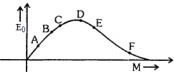
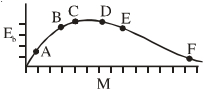
The figure shows a plot of binding energy per nucleon $E_b$ against the nuclear mass number $A$. $A, B, C, D, E, F$ correspond to different nuclei. Consider four reactions:
$(i) A + B \to C + \varepsilon$
$(ii) C \to A + B + \varepsilon$
$(iii) D + E \to F + \varepsilon$
$(iv) F \to D + E + \varepsilon$
Here, $\varepsilon$ is the energy released. In which reactions is $\varepsilon$ > 0?
$(i) A + B \to C + \varepsilon$
$(ii) C \to A + B + \varepsilon$
$(iii) D + E \to F + \varepsilon$
$(iv) F \to D + E + \varepsilon$
Here, $\varepsilon$ is the energy released. In which reactions is $\varepsilon$ > 0?
A
$(i)$ and $(iv)$
B
$(i)$ and $(iii)$
C
$(ii)$ and $(iv)$
D
$(iv)$ and $(iii)$
Solution
(A) Energy is released $(\varepsilon > 0)$ in a nuclear reaction if the total binding energy of the products is greater than the total binding energy of the reactants.
$1$. For reaction $(i)$, $A + B \to C + \varepsilon$: The nucleus $C$ has a higher binding energy per nucleon than $A$ and $B$. Thus, the total binding energy of the product $C$ is greater than the sum of the binding energies of $A$ and $B$. Therefore, $\varepsilon > 0$.
$2$. For reaction $(iv)$, $F \to D + E + \varepsilon$: The nuclei $D$ and $E$ have higher binding energy per nucleon than $F$. Thus, the total binding energy of the products $D$ and $E$ is greater than the binding energy of the reactant $F$. Therefore, $\varepsilon > 0$.
Hence, $\varepsilon$ is positive in reactions $(i)$ and $(iv)$.
$1$. For reaction $(i)$, $A + B \to C + \varepsilon$: The nucleus $C$ has a higher binding energy per nucleon than $A$ and $B$. Thus, the total binding energy of the product $C$ is greater than the sum of the binding energies of $A$ and $B$. Therefore, $\varepsilon > 0$.
$2$. For reaction $(iv)$, $F \to D + E + \varepsilon$: The nuclei $D$ and $E$ have higher binding energy per nucleon than $F$. Thus, the total binding energy of the products $D$ and $E$ is greater than the binding energy of the reactant $F$. Therefore, $\varepsilon > 0$.
Hence, $\varepsilon$ is positive in reactions $(i)$ and $(iv)$.
0 likes
View Solution88
MediumMCQ
$A$ nucleus of mass $M + \Delta m$ is at rest and decays into two daughter nuclei of equal mass $\frac{M}{2}$ each. The speed of light is $c$. The speed of the daughter nuclei is:
A
$c \sqrt{\frac{\Delta m}{M + \Delta m}}$
B
$c \frac{\Delta m}{M + \Delta m}$
C
$c \sqrt{\frac{2 \Delta m}{M}}$
D
$c \sqrt{\frac{\Delta m}{M}}$
Solution
(C) According to the law of conservation of energy,the total energy before decay equals the total energy after decay.
The initial energy is the rest mass energy: $E_i = (M + \Delta m)c^2$.
The final energy consists of the rest mass energy of the two daughter nuclei and their kinetic energy: $E_f = 2 \times (\frac{M}{2})c^2 + 2 \times (\frac{1}{2} \times \frac{M}{2} \times v^2)$.
Equating $E_i = E_f$:
$(M + \Delta m)c^2 = Mc^2 + \frac{M}{2}v^2$.
Subtracting $Mc^2$ from both sides:
$\Delta m c^2 = \frac{M}{2}v^2$.
Solving for $v$:
$v^2 = \frac{2 \Delta m c^2}{M} \Rightarrow v = c \sqrt{\frac{2 \Delta m}{M}}$.
The initial energy is the rest mass energy: $E_i = (M + \Delta m)c^2$.
The final energy consists of the rest mass energy of the two daughter nuclei and their kinetic energy: $E_f = 2 \times (\frac{M}{2})c^2 + 2 \times (\frac{1}{2} \times \frac{M}{2} \times v^2)$.
Equating $E_i = E_f$:
$(M + \Delta m)c^2 = Mc^2 + \frac{M}{2}v^2$.
Subtracting $Mc^2$ from both sides:
$\Delta m c^2 = \frac{M}{2}v^2$.
Solving for $v$:
$v^2 = \frac{2 \Delta m c^2}{M} \Rightarrow v = c \sqrt{\frac{2 \Delta m}{M}}$.
0 likes
View Solution89
EasyMCQ
$A$ nucleus of mass $M + \Delta m$ is at rest and decays into two daughter nuclei of equal mass $\frac{M}{2}$ each. The speed of light is $c$. The binding energy per nucleon for the parent nucleus is $E_1$ and that for the daughter nuclei is $E_2$. Then:
A
$E_1 = 2E_2$
B
$E_2 = 2E_1$
C
$E_1 > E_2$
D
$E_2 > E_1$
Solution
(D) In a nuclear decay or fission process,the system moves toward a more stable state.
Stability is determined by the binding energy per nucleon.
$A$ nucleus with a higher binding energy per nucleon is more stable.
Since the parent nucleus decays into two daughter nuclei,the daughter nuclei must be more stable than the parent nucleus to satisfy the energy release condition.
Therefore,the binding energy per nucleon of the daughter nuclei $(E_2)$ must be greater than that of the parent nucleus $(E_1)$.
Thus,$E_2 > E_1$.
Stability is determined by the binding energy per nucleon.
$A$ nucleus with a higher binding energy per nucleon is more stable.
Since the parent nucleus decays into two daughter nuclei,the daughter nuclei must be more stable than the parent nucleus to satisfy the energy release condition.
Therefore,the binding energy per nucleon of the daughter nuclei $(E_2)$ must be greater than that of the parent nucleus $(E_1)$.
Thus,$E_2 > E_1$.
0 likes
View Solution90
EasyMCQ
For the decay of a nucleus,which of the following is $NOT$ a possible reason?
A
Neutron-proton ratio is too high
B
Neutron-proton ratio is too low
C
Size of the nucleus is very large
D
Binding energy of the nucleus is more than that of its products
Solution
(D) nucleus decays to achieve a more stable state. Radioactive decay occurs when the binding energy per nucleon of the parent nucleus is less than that of the daughter products,making the parent nucleus unstable. Therefore,the statement that the binding energy of the nucleus is more than that of its products is incorrect,as this would imply the nucleus is already in a more stable state than its potential decay products.
0 likes
View Solution91
DifficultMCQ
The radionuclide $^{11}_{6}C$ decays by $\beta^+$ emission. Given that $m(^{11}_{6}C) = 11.011434 \ u$,$m(^{11}_{5}B) = 11.009305 \ u$,$m_e = 0.000548 \ u$,and $1 \ u = 931.5 \ MeV/c^2$. The $Q$-value of this decay process is:
A
$0.962 \ MeV$
B
$0.962 \times 10^3 \ MeV$
C
$0.962 \ eV$
D
$0$
Solution
(A) The $\beta^+$-decay equation for $^{11}_{6}C$ is:
$^{11}_{6}C \longrightarrow ^{11}_{5}B + ^{0}_{+1}e + \nu + Q$
To calculate the $Q$-value,we use the atomic masses. The decay of a nucleus $^{A}_{Z}X$ into $^{A}_{Z-1}Y$ via $\beta^+$ emission is given by:
$Q = [m(^{A}_{Z}X) - m(^{A}_{Z-1}Y) - 2m_e]c^2$
Substituting the given values:
$Q = [11.011434 \ u - 11.009305 \ u - 2(0.000548 \ u)] \times 931.5 \ MeV/u$
$Q = [11.011434 - 11.009305 - 0.001096] \times 931.5 \ MeV$
$Q = [0.001033] \times 931.5 \ MeV$
$Q \approx 0.962 \ MeV$
$^{11}_{6}C \longrightarrow ^{11}_{5}B + ^{0}_{+1}e + \nu + Q$
To calculate the $Q$-value,we use the atomic masses. The decay of a nucleus $^{A}_{Z}X$ into $^{A}_{Z-1}Y$ via $\beta^+$ emission is given by:
$Q = [m(^{A}_{Z}X) - m(^{A}_{Z-1}Y) - 2m_e]c^2$
Substituting the given values:
$Q = [11.011434 \ u - 11.009305 \ u - 2(0.000548 \ u)] \times 931.5 \ MeV/u$
$Q = [11.011434 - 11.009305 - 0.001096] \times 931.5 \ MeV$
$Q = [0.001033] \times 931.5 \ MeV$
$Q \approx 0.962 \ MeV$
0 likes
View Solution92
MediumMCQ
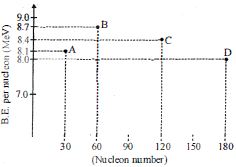
The positions of four different nuclei in the binding energy curve are shown in the figure. The process that might not proceed spontaneously is
A
$C \to 2B$
B
$D \to B+C$
C
$B \to 2A$
D
None of these
Solution
(C) For a nuclear process to be spontaneous,the total binding energy of the products must be greater than the total binding energy of the reactants,meaning the $Q$-value must be positive. This implies that the final products must be more stable (higher binding energy per nucleon) than the initial reactants.
Let $BE_A, BE_B, BE_C, BE_D$ be the binding energy per nucleon for nuclei $A, B, C, D$ respectively.
From the graph:
$BE_A = 8.1 \text{ MeV}$,$BE_B = 8.7 \text{ MeV}$,$BE_C = 8.4 \text{ MeV}$,$BE_D = 8.0 \text{ MeV}$.
$(A)$ $C \to 2B$: Initial $BE = 120 \times 8.4 = 1008 \text{ MeV}$. Final $BE = 2 \times (60 \times 8.7) = 1044 \text{ MeV}$. Since $1044 > 1008$,this is spontaneous.
$(B)$ $D \to B+C$: Initial $BE = 180 \times 8.0 = 1440 \text{ MeV}$. Final $BE = (60 \times 8.7) + (120 \times 8.4) = 522 + 1008 = 1530 \text{ MeV}$. Since $1530 > 1440$,this is spontaneous.
$(C)$ $B \to 2A$: Initial $BE = 60 \times 8.7 = 522 \text{ MeV}$. Final $BE = 2 \times (30 \times 8.1) = 486 \text{ MeV}$. Since $486 < 522$,this process is not spontaneous.
Thus,the process $B \to 2A$ will not proceed spontaneously.
Let $BE_A, BE_B, BE_C, BE_D$ be the binding energy per nucleon for nuclei $A, B, C, D$ respectively.
From the graph:
$BE_A = 8.1 \text{ MeV}$,$BE_B = 8.7 \text{ MeV}$,$BE_C = 8.4 \text{ MeV}$,$BE_D = 8.0 \text{ MeV}$.
$(A)$ $C \to 2B$: Initial $BE = 120 \times 8.4 = 1008 \text{ MeV}$. Final $BE = 2 \times (60 \times 8.7) = 1044 \text{ MeV}$. Since $1044 > 1008$,this is spontaneous.
$(B)$ $D \to B+C$: Initial $BE = 180 \times 8.0 = 1440 \text{ MeV}$. Final $BE = (60 \times 8.7) + (120 \times 8.4) = 522 + 1008 = 1530 \text{ MeV}$. Since $1530 > 1440$,this is spontaneous.
$(C)$ $B \to 2A$: Initial $BE = 60 \times 8.7 = 522 \text{ MeV}$. Final $BE = 2 \times (30 \times 8.1) = 486 \text{ MeV}$. Since $486 < 522$,this process is not spontaneous.
Thus,the process $B \to 2A$ will not proceed spontaneously.
0 likes
View Solution93
MediumMCQ
Binding energy per nucleon of a fixed nucleus $X^A$ is $8 \ MeV$. It absorbs a neutron moving with kinetic energy $2 \ MeV$ and converts into $Y$,emitting two photons of energy $1 \ MeV$ and $4 \ MeV$ respectively one after the other. The binding energy per nucleon of $Y$ (in $MeV$) is:
A
$\frac{8A - 7}{A + 1}$
B
$\frac{8A + 3}{A + 1}$
C
$\frac{8A + 7}{A + 1}$
D
$\frac{8A - 3}{A + 1}$
Solution
(B) The initial energy of the system is the sum of the mass energy of the nucleus $X^A$ and the kinetic energy of the neutron.
Let $BE_X$ be the binding energy of $X^A$,so $BE_X = 8A \ MeV$.
The total energy before the reaction is $E_i = (M_X + m_n)c^2 + K_n = (M_X c^2 + m_n c^2) + 2 \ MeV$.
Since $BE = Z m_p c^2 + N m_n c^2 - M c^2$,we have $M_X c^2 = Z m_p c^2 + (A-Z) m_n c^2 - 8A$.
The total energy after the reaction is $E_f = M_Y c^2 + E_{\gamma 1} + E_{\gamma 2} = M_Y c^2 + 1 + 4 = M_Y c^2 + 5 \ MeV$.
Equating $E_i = E_f$:
$(M_X c^2 + m_n c^2) + 2 = M_Y c^2 + 5$
$M_Y c^2 = M_X c^2 + m_n c^2 - 3$.
Substituting the mass expressions in terms of binding energy:
$(A+1) BE_Y = (A+1) (Z m_p c^2 + (A+1-Z) m_n c^2) - M_Y c^2$
$(A+1) BE_Y = (A+1) (Z m_p c^2 + (A+1-Z) m_n c^2) - (M_X c^2 + m_n c^2 - 3)$
Using $M_X c^2 = Z m_p c^2 + (A-Z) m_n c^2 - 8A$:
$(A+1) BE_Y = 8A + 3$.
Therefore,the binding energy per nucleon of $Y$ is $BE_Y = \frac{8A + 3}{A + 1} \ MeV$.
Let $BE_X$ be the binding energy of $X^A$,so $BE_X = 8A \ MeV$.
The total energy before the reaction is $E_i = (M_X + m_n)c^2 + K_n = (M_X c^2 + m_n c^2) + 2 \ MeV$.
Since $BE = Z m_p c^2 + N m_n c^2 - M c^2$,we have $M_X c^2 = Z m_p c^2 + (A-Z) m_n c^2 - 8A$.
The total energy after the reaction is $E_f = M_Y c^2 + E_{\gamma 1} + E_{\gamma 2} = M_Y c^2 + 1 + 4 = M_Y c^2 + 5 \ MeV$.
Equating $E_i = E_f$:
$(M_X c^2 + m_n c^2) + 2 = M_Y c^2 + 5$
$M_Y c^2 = M_X c^2 + m_n c^2 - 3$.
Substituting the mass expressions in terms of binding energy:
$(A+1) BE_Y = (A+1) (Z m_p c^2 + (A+1-Z) m_n c^2) - M_Y c^2$
$(A+1) BE_Y = (A+1) (Z m_p c^2 + (A+1-Z) m_n c^2) - (M_X c^2 + m_n c^2 - 3)$
Using $M_X c^2 = Z m_p c^2 + (A-Z) m_n c^2 - 8A$:
$(A+1) BE_Y = 8A + 3$.
Therefore,the binding energy per nucleon of $Y$ is $BE_Y = \frac{8A + 3}{A + 1} \ MeV$.
0 likes
View Solution94
DifficultMCQ
In the nuclear reaction,$_1H^2 + _1H^2 \to _0n^1 + _2He^3$. If the binding energy of deuteron is $2.23 \ MeV$ and the $Q$-value of the reaction is $3.27 \ MeV$,then the binding energy of $_2He^3$ is ......... $MeV$.
A
$1.19$
B
$7.37$
C
$4.46$
D
$3.27$
Solution
(B) The $Q$-value of a nuclear reaction is given by the difference between the total binding energy of the products and the total binding energy of the reactants.
$Q = (BE_{\text{products}}) - (BE_{\text{reactants}})$
Here,the reactants are two deuterons $(1H^2)$ and the products are one neutron $(0n^1)$ and one helium-$3$ nucleus $(2He^3)$.
The binding energy of a neutron is $0 \ MeV$.
So,$Q = (BE(2He^3) + BE(0n^1)) - (2 \times BE(1H^2))$.
Given $Q = 3.27 \ MeV$,$BE(1H^2) = 2.23 \ MeV$,and $BE(0n^1) = 0 \ MeV$.
$3.27 = BE(2He^3) + 0 - (2 \times 2.23)$.
$3.27 = BE(2He^3) - 4.46$.
$BE(2He^3) = 3.27 + 4.46 = 7.73 \ MeV$.
$Q = (BE_{\text{products}}) - (BE_{\text{reactants}})$
Here,the reactants are two deuterons $(1H^2)$ and the products are one neutron $(0n^1)$ and one helium-$3$ nucleus $(2He^3)$.
The binding energy of a neutron is $0 \ MeV$.
So,$Q = (BE(2He^3) + BE(0n^1)) - (2 \times BE(1H^2))$.
Given $Q = 3.27 \ MeV$,$BE(1H^2) = 2.23 \ MeV$,and $BE(0n^1) = 0 \ MeV$.
$3.27 = BE(2He^3) + 0 - (2 \times 2.23)$.
$3.27 = BE(2He^3) - 4.46$.
$BE(2He^3) = 3.27 + 4.46 = 7.73 \ MeV$.
0 likes
View Solution95
DifficultMCQ
$A$ free nucleus of mass $24 \, amu$ emits a gamma photon (when initially at rest). The energy of the photon is $7 \, MeV$. The recoil energy of the nucleus in $keV$ is:
A
$2.2$
B
$1.1$
C
$3.1$
D
$22$
Solution
(B) The momentum of the photon is given by $p = \frac{E}{c}$,where $E = 7 \, MeV = 7 \times 10^6 \, eV$.
By the law of conservation of momentum,the recoil momentum of the nucleus $p_N$ must be equal to the momentum of the photon $p_{Ph}$.
$p_N = p_{Ph} = \frac{E}{c}$.
The recoil kinetic energy of the nucleus is $K = \frac{p_N^2}{2M}$.
Substituting $p_N = \frac{E}{c}$,we get $K = \frac{E^2}{2Mc^2}$.
Given $M = 24 \, amu$. Since $1 \, amu \approx 931.5 \, MeV/c^2$,we have $Mc^2 = 24 \times 931.5 \, MeV = 22356 \, MeV$.
Now,$K = \frac{(7 \, MeV)^2}{2 \times 22356 \, MeV} = \frac{49}{44712} \, MeV$.
$K \approx 0.0010959 \, MeV$.
Converting to $keV$ by multiplying by $1000$: $K \approx 1.0959 \, keV \approx 1.1 \, keV$.
By the law of conservation of momentum,the recoil momentum of the nucleus $p_N$ must be equal to the momentum of the photon $p_{Ph}$.
$p_N = p_{Ph} = \frac{E}{c}$.
The recoil kinetic energy of the nucleus is $K = \frac{p_N^2}{2M}$.
Substituting $p_N = \frac{E}{c}$,we get $K = \frac{E^2}{2Mc^2}$.
Given $M = 24 \, amu$. Since $1 \, amu \approx 931.5 \, MeV/c^2$,we have $Mc^2 = 24 \times 931.5 \, MeV = 22356 \, MeV$.
Now,$K = \frac{(7 \, MeV)^2}{2 \times 22356 \, MeV} = \frac{49}{44712} \, MeV$.
$K \approx 0.0010959 \, MeV$.
Converting to $keV$ by multiplying by $1000$: $K \approx 1.0959 \, keV \approx 1.1 \, keV$.
0 likes
View Solution96
DifficultMCQ
The binding energy per nucleon of a nucleus ${}_Z X^A$ at rest is $6 \ MeV$. It undergoes $\beta^-$ decay as shown below:
${}_Z X^A \to {}_{Z+1} Y^A + {}_{-1}^0 e + \bar{\nu}$
The total kinetic energy $(K.E.)$ of the products is $3 \ MeV$. The binding energy per nucleon of $Y$ (in $MeV$) is:
${}_Z X^A \to {}_{Z+1} Y^A + {}_{-1}^0 e + \bar{\nu}$
The total kinetic energy $(K.E.)$ of the products is $3 \ MeV$. The binding energy per nucleon of $Y$ (in $MeV$) is:
A
$\frac{6A + 3}{A}$
B
$\frac{6A - 3}{A+1}$
C
$7$
D
$\frac{7}{6}$
Solution
(A) The energy released in a nuclear decay is equal to the change in binding energy of the system.
Initial binding energy of $X = 6A \ MeV$.
Final binding energy of $Y = BE_Y$ (where $BE_Y$ is the total binding energy of nucleus $Y$).
Since the electron and antineutrino have negligible binding energy, the total binding energy of the products is $BE_Y$.
The energy released ($Q$-value) is given by the difference in binding energies: $Q = BE_{final} - BE_{initial}$.
Given $Q = 3 \ MeV$, we have:
$3 = BE_Y - 6A$
$BE_Y = 6A + 3$.
The binding energy per nucleon of $Y$ is $\frac{BE_Y}{A} = \frac{6A + 3}{A}$.
Initial binding energy of $X = 6A \ MeV$.
Final binding energy of $Y = BE_Y$ (where $BE_Y$ is the total binding energy of nucleus $Y$).
Since the electron and antineutrino have negligible binding energy, the total binding energy of the products is $BE_Y$.
The energy released ($Q$-value) is given by the difference in binding energies: $Q = BE_{final} - BE_{initial}$.
Given $Q = 3 \ MeV$, we have:
$3 = BE_Y - 6A$
$BE_Y = 6A + 3$.
The binding energy per nucleon of $Y$ is $\frac{BE_Y}{A} = \frac{6A + 3}{A}$.
0 likes
View Solution97
DifficultMCQ
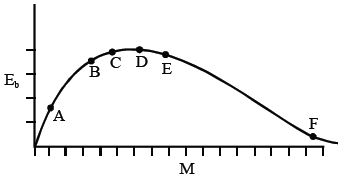
The figure shows a plot of binding energy per nucleon $E_b$ against the nuclear mass $M$. $A, B, C, D, E, F$ correspond to different nuclei. Consider four reactions:
$(i) \, A + B \to C + \varepsilon$
$(ii) \, C \to A + B + \varepsilon$
$(iii) \, D + E \to F + \varepsilon$
$(iv) \, F \to D + E + \varepsilon$
where $\varepsilon$ is the energy released. In which reactions is $\varepsilon$ positive?
$(i) \, A + B \to C + \varepsilon$
$(ii) \, C \to A + B + \varepsilon$
$(iii) \, D + E \to F + \varepsilon$
$(iv) \, F \to D + E + \varepsilon$
where $\varepsilon$ is the energy released. In which reactions is $\varepsilon$ positive?
A
$(ii)$ and $(iv)$
B
$(ii)$ and $(iii)$
C
$(i)$ and $(iv)$
D
$(i)$ and $(iii)$
Solution
(C) Energy is released $(\varepsilon > 0)$ in a nuclear reaction if the total binding energy of the products is greater than the total binding energy of the reactants. This corresponds to a process where the system moves towards a state of higher binding energy per nucleon $(E_b/A)$.
$1$. In reaction $(i)$,$A + B \to C$,the product $C$ has a higher $E_b/A$ than the reactants $A$ and $B$. Thus,energy is released $(\varepsilon > 0)$.
$2$. In reaction $(iv)$,$F \to D + E$,the products $D$ and $E$ have a higher $E_b/A$ than the reactant $F$. Thus,energy is released $(\varepsilon > 0)$.
Therefore,$\varepsilon$ is positive in reactions $(i)$ and $(iv)$.
$1$. In reaction $(i)$,$A + B \to C$,the product $C$ has a higher $E_b/A$ than the reactants $A$ and $B$. Thus,energy is released $(\varepsilon > 0)$.
$2$. In reaction $(iv)$,$F \to D + E$,the products $D$ and $E$ have a higher $E_b/A$ than the reactant $F$. Thus,energy is released $(\varepsilon > 0)$.
Therefore,$\varepsilon$ is positive in reactions $(i)$ and $(iv)$.
0 likes
View Solution98
EasyMCQ
The energy equivalent to $1\,mg$ of matter in $MeV$ is
A
$9 \times 10^{23}$
B
$9 \times 10^{26}$
C
$5.625 \times 10^{23}$
D
$5.625 \times 10^{26}$
Solution
(C) According to Einstein's mass-energy equivalence principle,$E = mc^2$.
Given mass $m = 1\,mg = 1 \times 10^{-6}\,kg$.
The speed of light $c = 3 \times 10^8\,m/s$.
$E = (1 \times 10^{-6}\,kg) \times (3 \times 10^8\,m/s)^2 = 9 \times 10^{10}\,J$.
To convert Joules to $eV$,divide by $1.6 \times 10^{-19}\,J/eV$:
$E = \frac{9 \times 10^{10}}{1.6 \times 10^{-19}}\,eV = 5.625 \times 10^{29}\,eV$.
Since $1\,MeV = 10^6\,eV$,we have:
$E = \frac{5.625 \times 10^{29}}{10^6}\,MeV = 5.625 \times 10^{23}\,MeV$.
Given mass $m = 1\,mg = 1 \times 10^{-6}\,kg$.
The speed of light $c = 3 \times 10^8\,m/s$.
$E = (1 \times 10^{-6}\,kg) \times (3 \times 10^8\,m/s)^2 = 9 \times 10^{10}\,J$.
To convert Joules to $eV$,divide by $1.6 \times 10^{-19}\,J/eV$:
$E = \frac{9 \times 10^{10}}{1.6 \times 10^{-19}}\,eV = 5.625 \times 10^{29}\,eV$.
Since $1\,MeV = 10^6\,eV$,we have:
$E = \frac{5.625 \times 10^{29}}{10^6}\,MeV = 5.625 \times 10^{23}\,MeV$.
0 likes
View Solution99
DifficultMCQ
The binding energy per nucleon for a deuteron $(_{1}^{2}H)$ and an $\alpha -$ particle $(_{2}^{4}He)$ are $x_1$ and $x_2$ respectively. The energy $(Q)$ released in the reaction $_{1}^{2}H + {}_{1}^{2}H \to {}_{2}^{4}He + Q$ is
A
$2(x_2 - x_1)$
B
$2(x_1 + x_2)$
C
$4(x_1 + x_2)$
D
$4(x_2 - x_1)$
Solution
(D) The given nuclear reaction is: $_{1}^{2}H + {}_{1}^{2}H \to {}_{2}^{4}He + Q$.
The binding energy per nucleon for $_{1}^{2}H$ is $x_1$. Since there are $2$ nucleons in a deuteron,the total binding energy of one deuteron is $2x_1$.
The binding energy per nucleon for $_{2}^{4}He$ is $x_2$. Since there are $4$ nucleons in an $\alpha -$ particle,the total binding energy of one $\alpha -$ particle is $4x_2$.
The energy released $(Q)$ in a nuclear reaction is equal to the difference between the total binding energy of the products and the total binding energy of the reactants.
$Q = (\text{Total B.E. of products}) - (\text{Total B.E. of reactants})$
$Q = (4x_2) - (2x_1 + 2x_1)$
$Q = 4x_2 - 4x_1 = 4(x_2 - x_1)$.
The binding energy per nucleon for $_{1}^{2}H$ is $x_1$. Since there are $2$ nucleons in a deuteron,the total binding energy of one deuteron is $2x_1$.
The binding energy per nucleon for $_{2}^{4}He$ is $x_2$. Since there are $4$ nucleons in an $\alpha -$ particle,the total binding energy of one $\alpha -$ particle is $4x_2$.
The energy released $(Q)$ in a nuclear reaction is equal to the difference between the total binding energy of the products and the total binding energy of the reactants.
$Q = (\text{Total B.E. of products}) - (\text{Total B.E. of reactants})$
$Q = (4x_2) - (2x_1 + 2x_1)$
$Q = 4x_2 - 4x_1 = 4(x_2 - x_1)$.
0 likes
View Solution100
MediumMCQ
If $M(A, Z)$,$M_p$,and $M_n$ denote the masses of the nucleus ${}_Z^AX$,proton,and neutron respectively in units of $u$ $(1u = 931.5 \text{ MeV}/c^2)$,and $BE$ represents its binding energy in $\text{MeV}$,then:
A
$M(A, Z) = ZM_p + (A - Z)M_n - BE$
B
$M(A, Z) = ZM_p + (A - Z)M_n + BE/c^2$
C
$M(A, Z) = ZM_p + (A - Z)M_n - BE/c^2$
D
$M(A, Z) = ZM_p + (A - Z)M_n + BE$
Solution
(C) The mass defect $\Delta m$ of a nucleus is given by the difference between the sum of the masses of its constituent nucleons and the actual mass of the nucleus: $\Delta m = [ZM_p + (A - Z)M_n] - M(A, Z)$.
The binding energy $BE$ is related to the mass defect by the equation $BE = \Delta m \cdot c^2$,which implies $\Delta m = BE/c^2$.
Substituting this into the mass defect equation: $BE/c^2 = [ZM_p + (A - Z)M_n] - M(A, Z)$.
Rearranging the terms to solve for the nuclear mass $M(A, Z)$,we get: $M(A, Z) = [ZM_p + (A - Z)M_n] - BE/c^2$.
The binding energy $BE$ is related to the mass defect by the equation $BE = \Delta m \cdot c^2$,which implies $\Delta m = BE/c^2$.
Substituting this into the mass defect equation: $BE/c^2 = [ZM_p + (A - Z)M_n] - M(A, Z)$.
Rearranging the terms to solve for the nuclear mass $M(A, Z)$,we get: $M(A, Z) = [ZM_p + (A - Z)M_n] - BE/c^2$.
0 likes
View SolutionNuclei — Mass-Energy, Nuclear Binding Energy, Nuclear Stability · Frequently Asked Questions
1Are these Nuclei questions useful for JEE and NEET?
Yes. All questions in this section are mapped to JEE Main and NEET exam patterns. Previous year questions from JEE Main, NEET, GUJCET and state-level exams are included with full solutions.
2Can I switch to Hindi or Gujarati for these questions?
Yes. Use the language tabs in the hero section or the sidebar to view the same questions and solutions in English, Hindi or Gujarati.
3How do I generate a question paper from this subtopic?
Use the Vedclass Exam Paper Generator — select the chapter and subtopic, set difficulty, and generate Sets A, B, C, D automatically. First 3 chapters of every subject are free.
Vedclass Products
For Students
Vedclass Test Series
Mock tests in real JEE/NEET style with performance analysis. 5-day free trial.
Start Free TrialFor Teachers
Exam Paper Generator
Generate Set A/B/C/D papers from this chapter in 2 minutes. 3 chapters free.
Try FreeFor Institutes
Online Exam Module
Live online exams with unlimited students, 360° analytics & white-label branding.
See DemoFor Teachers & Institutes
Generate a Nuclei Exam Paper in 2 Minutes
Select subtopic & difficulty — Sets A, B, C, D auto-generated with No Repeat logic.
First 3 chapters of every subject are free — no payment required.