
A English
Law of Radioactivity by Rutherford and Soddy and Half Life and Mean Life Questions in English
Class 12 Physics · Nuclei · Law of Radioactivity by Rutherford and Soddy and Half Life and Mean Life
573+
Questions
English
Language
100%
With Solutions
Showing 50 of 573 questions in English
401
MediumMCQ
$A$ radioactive substance decays to $\left(\frac{1}{16}\right)^{th}$ of its initial activity in $80\, days$. The half-life of the radioactive substance expressed in days is ... .
A
$20$
B
$200$
C
$2$
D
$4$
Solution
(A) The activity of a radioactive substance follows the relation $A = A_0 \left(\frac{1}{2}\right)^n$,where $n$ is the number of half-lives.
Given that the activity decays to $\frac{1}{16}$ of its initial value,we have $\frac{1}{16} = \left(\frac{1}{2}\right)^n$.
Since $\frac{1}{16} = \left(\frac{1}{2}\right)^4$,we find that $n = 4$.
The total time taken is $T = n \times t_{1/2}$,where $t_{1/2}$ is the half-life.
Given $T = 80\, days$,we have $80 = 4 \times t_{1/2}$.
Therefore,$t_{1/2} = \frac{80}{4} = 20\, days$.
Given that the activity decays to $\frac{1}{16}$ of its initial value,we have $\frac{1}{16} = \left(\frac{1}{2}\right)^n$.
Since $\frac{1}{16} = \left(\frac{1}{2}\right)^4$,we find that $n = 4$.
The total time taken is $T = n \times t_{1/2}$,where $t_{1/2}$ is the half-life.
Given $T = 80\, days$,we have $80 = 4 \times t_{1/2}$.
Therefore,$t_{1/2} = \frac{80}{4} = 20\, days$.
0 likes
View Solution402
DifficultMCQ
The half-life of ${}^{198} {Au}$ is $3 \, \text{days}$. If the atomic weight of ${}^{198} {Au}$ is $198 \, \text{g/mol}$, then the activity of $2 \, \text{mg}$ of ${}^{198} {Au}$ is ..... $\times 10^{12} \, \text{disintegration/second}$.
A
$2.67$
B
$16.18$
C
$6.06$
D
$32.36$
Solution
(B) The activity $A$ is given by $A = \lambda N$.
First, calculate the decay constant $\lambda$:
$\lambda = \frac{\ln 2}{t_{1/2}} = \frac{0.693}{3 \times 24 \times 3600 \, \text{s}} \approx 2.67 \times 10^{-6} \, \text{s}^{-1}$.
Next, calculate the number of atoms $N$ in $2 \, \text{mg}$ of ${}^{198} {Au}$:
$N = \frac{\text{mass}}{\text{molar mass}} \times N_A = \frac{2 \times 10^{-3} \, \text{g}}{198 \, \text{g/mol}} \times 6.022 \times 10^{23} \, \text{atoms/mol} \approx 6.08 \times 10^{18} \, \text{atoms}$.
(Using $N_A \approx 6 \times 10^{23}$ as per standard approximation in such problems):
$N = \frac{2 \times 10^{-3}}{198} \times 6 \times 10^{23} \approx 6.06 \times 10^{18} \, \text{atoms}$.
Now, calculate the activity $A$:
$A = \lambda N = (2.67 \times 10^{-6} \, \text{s}^{-1}) \times (6.06 \times 10^{18}) \approx 16.18 \times 10^{12} \, \text{disintegrations/second}$.
First, calculate the decay constant $\lambda$:
$\lambda = \frac{\ln 2}{t_{1/2}} = \frac{0.693}{3 \times 24 \times 3600 \, \text{s}} \approx 2.67 \times 10^{-6} \, \text{s}^{-1}$.
Next, calculate the number of atoms $N$ in $2 \, \text{mg}$ of ${}^{198} {Au}$:
$N = \frac{\text{mass}}{\text{molar mass}} \times N_A = \frac{2 \times 10^{-3} \, \text{g}}{198 \, \text{g/mol}} \times 6.022 \times 10^{23} \, \text{atoms/mol} \approx 6.08 \times 10^{18} \, \text{atoms}$.
(Using $N_A \approx 6 \times 10^{23}$ as per standard approximation in such problems):
$N = \frac{2 \times 10^{-3}}{198} \times 6 \times 10^{23} \approx 6.06 \times 10^{18} \, \text{atoms}$.
Now, calculate the activity $A$:
$A = \lambda N = (2.67 \times 10^{-6} \, \text{s}^{-1}) \times (6.06 \times 10^{18}) \approx 16.18 \times 10^{12} \, \text{disintegrations/second}$.
0 likes
View Solution403
DifficultMCQ
Some nuclei of a radioactive material are undergoing radioactive decay. The time gap between the instances when a quarter of the nuclei have decayed and when half of the nuclei have decayed is given as: (where $\lambda$ is the decay constant)
A
$\frac{2 \ln 2}{\lambda}$
B
$\frac{1}{2} \frac{\ln 2}{\lambda}$
C
$\frac{\ln (3/2)}{\lambda}$
D
$\frac{\ln 2}{\lambda}$
Solution
(C) Let $N_0$ be the initial number of nuclei.
$1$. Time $t_1$ when a quarter of the nuclei have decayed:
Remaining nuclei $N_1 = N_0 - \frac{1}{4}N_0 = \frac{3}{4}N_0$.
Using the decay law $N = N_0 e^{-\lambda t}$,we have $\frac{3}{4}N_0 = N_0 e^{-\lambda t_1}$,which gives $\ln(3/4) = -\lambda t_1$,or $t_1 = \frac{\ln(4/3)}{\lambda}$.
$2$. Time $t_2$ when half of the nuclei have decayed:
Remaining nuclei $N_2 = N_0 - \frac{1}{2}N_0 = \frac{1}{2}N_0$.
Using the decay law,$\frac{1}{2}N_0 = N_0 e^{-\lambda t_2}$,which gives $\ln(1/2) = -\lambda t_2$,or $t_2 = \frac{\ln 2}{\lambda}$.
$3$. The time gap $\Delta t = t_2 - t_1$:
$\Delta t = \frac{\ln 2}{\lambda} - \frac{\ln(4/3)}{\lambda} = \frac{1}{\lambda} [\ln 2 - (\ln 4 - \ln 3)] = \frac{1}{\lambda} [\ln 2 - 2\ln 2 + \ln 3] = \frac{\ln(3/2)}{\lambda}$.
$1$. Time $t_1$ when a quarter of the nuclei have decayed:
Remaining nuclei $N_1 = N_0 - \frac{1}{4}N_0 = \frac{3}{4}N_0$.
Using the decay law $N = N_0 e^{-\lambda t}$,we have $\frac{3}{4}N_0 = N_0 e^{-\lambda t_1}$,which gives $\ln(3/4) = -\lambda t_1$,or $t_1 = \frac{\ln(4/3)}{\lambda}$.
$2$. Time $t_2$ when half of the nuclei have decayed:
Remaining nuclei $N_2 = N_0 - \frac{1}{2}N_0 = \frac{1}{2}N_0$.
Using the decay law,$\frac{1}{2}N_0 = N_0 e^{-\lambda t_2}$,which gives $\ln(1/2) = -\lambda t_2$,or $t_2 = \frac{\ln 2}{\lambda}$.
$3$. The time gap $\Delta t = t_2 - t_1$:
$\Delta t = \frac{\ln 2}{\lambda} - \frac{\ln(4/3)}{\lambda} = \frac{1}{\lambda} [\ln 2 - (\ln 4 - \ln 3)] = \frac{1}{\lambda} [\ln 2 - 2\ln 2 + \ln 3] = \frac{\ln(3/2)}{\lambda}$.
0 likes
View Solution404
MediumMCQ
The nuclear activity of a radioactive element becomes $\left(\frac{1}{8}\right)^{\text{th}}$ of its initial value in $30\, \text{years}$. The half-life of the radioactive element is $....\, \text{years}$.
A
$15$
B
$10$
C
$20$
D
$25$
Solution
(B) The activity $A$ of a radioactive sample at time $t$ is given by $A = A_0 \left(\frac{1}{2}\right)^{\frac{t}{T_{1/2}}}$, where $A_0$ is the initial activity and $T_{1/2}$ is the half-life.
Given that $A = \frac{1}{8} A_0$ at $t = 30\, \text{years}$.
Substituting the values: $\frac{1}{8} A_0 = A_0 \left(\frac{1}{2}\right)^{\frac{30}{T_{1/2}}}$.
$\left(\frac{1}{2}\right)^3 = \left(\frac{1}{2}\right)^{\frac{30}{T_{1/2}}}$.
Equating the exponents: $3 = \frac{30}{T_{1/2}}$.
Therefore, $T_{1/2} = \frac{30}{3} = 10\, \text{years}$.
Given that $A = \frac{1}{8} A_0$ at $t = 30\, \text{years}$.
Substituting the values: $\frac{1}{8} A_0 = A_0 \left(\frac{1}{2}\right)^{\frac{30}{T_{1/2}}}$.
$\left(\frac{1}{2}\right)^3 = \left(\frac{1}{2}\right)^{\frac{30}{T_{1/2}}}$.
Equating the exponents: $3 = \frac{30}{T_{1/2}}$.
Therefore, $T_{1/2} = \frac{30}{3} = 10\, \text{years}$.
0 likes
View Solution405
MediumMCQ
If $f$ denotes the ratio of the number of nuclei decayed $(N_{d})$ to the number of nuclei at $t=0$ $(N_{0})$,then for a collection of radioactive nuclei,the rate of change of $f$ with respect to time is given as: [$\lambda$ is the radioactive decay constant]
A
$\lambda(1-e^{-\lambda t})$
B
$-\lambda e^{-\lambda t}$
C
$\lambda e^{-\lambda t}$
D
$-\lambda(1-e^{-\lambda t})$
Solution
(C) The number of undecayed nuclei at time $t$ is given by $N = N_{0}e^{-\lambda t}$.
The number of decayed nuclei is $N_{d} = N_{0} - N = N_{0} - N_{0}e^{-\lambda t} = N_{0}(1 - e^{-\lambda t})$.
Given $f = \frac{N_{d}}{N_{0}}$,we have $f = \frac{N_{0}(1 - e^{-\lambda t})}{N_{0}} = 1 - e^{-\lambda t}$.
To find the rate of change of $f$ with respect to time,we differentiate $f$ with respect to $t$:
$\frac{df}{dt} = \frac{d}{dt}(1 - e^{-\lambda t}) = 0 - (e^{-\lambda t})(-\lambda) = \lambda e^{-\lambda t}$.
The number of decayed nuclei is $N_{d} = N_{0} - N = N_{0} - N_{0}e^{-\lambda t} = N_{0}(1 - e^{-\lambda t})$.
Given $f = \frac{N_{d}}{N_{0}}$,we have $f = \frac{N_{0}(1 - e^{-\lambda t})}{N_{0}} = 1 - e^{-\lambda t}$.
To find the rate of change of $f$ with respect to time,we differentiate $f$ with respect to $t$:
$\frac{df}{dt} = \frac{d}{dt}(1 - e^{-\lambda t}) = 0 - (e^{-\lambda t})(-\lambda) = \lambda e^{-\lambda t}$.
0 likes
View Solution406
DifficultMCQ
$A$ radioactive sample has an average life of $30 \, ms$ and is decaying. $A$ capacitor of capacitance $200 \, \mu F$ is first charged and later connected with a resistor $R$. If the ratio of charge on the capacitor to the activity of the radioactive sample is fixed with respect to time,then the value of $R$ should be $.... \, \Omega$.
A
$100$
B
$200$
C
$150$
D
$250$
Solution
(C) The charge on the capacitor at time $t$ is given by $q = q_0 e^{-\frac{t}{RC}}$,where $RC$ is the time constant of the $RC$ circuit.
The activity $A$ of the radioactive sample at time $t$ is given by $A = A_0 e^{-\lambda t}$,where $A_0$ is the initial activity and $\lambda$ is the decay constant.
Given that the ratio $\frac{q}{A}$ is constant with respect to time,we have:
$\frac{q}{A} = \frac{q_0 e^{-\frac{t}{RC}}}{A_0 e^{-\lambda t}} = \text{constant}$
For this ratio to be independent of time,the exponential terms must cancel out,which implies:
$-\frac{t}{RC} = -\lambda t \implies \lambda = \frac{1}{RC}$
We know that the average life $\tau = \frac{1}{\lambda} = 30 \, ms = 30 \times 10^{-3} \, s$.
Therefore,$\lambda = \frac{1}{30 \times 10^{-3}} \, s^{-1}$.
Substituting $\lambda = \frac{1}{RC}$ into the equation for $R$:
$R = \frac{1}{\lambda C} = \tau \times \frac{1}{C}$
Given $C = 200 \, \mu F = 200 \times 10^{-6} \, F$:
$R = \frac{30 \times 10^{-3}}{200 \times 10^{-6}} = \frac{30000}{200} = 150 \, \Omega$.
The activity $A$ of the radioactive sample at time $t$ is given by $A = A_0 e^{-\lambda t}$,where $A_0$ is the initial activity and $\lambda$ is the decay constant.
Given that the ratio $\frac{q}{A}$ is constant with respect to time,we have:
$\frac{q}{A} = \frac{q_0 e^{-\frac{t}{RC}}}{A_0 e^{-\lambda t}} = \text{constant}$
For this ratio to be independent of time,the exponential terms must cancel out,which implies:
$-\frac{t}{RC} = -\lambda t \implies \lambda = \frac{1}{RC}$
We know that the average life $\tau = \frac{1}{\lambda} = 30 \, ms = 30 \times 10^{-3} \, s$.
Therefore,$\lambda = \frac{1}{30 \times 10^{-3}} \, s^{-1}$.
Substituting $\lambda = \frac{1}{RC}$ into the equation for $R$:
$R = \frac{1}{\lambda C} = \tau \times \frac{1}{C}$
Given $C = 200 \, \mu F = 200 \times 10^{-6} \, F$:
$R = \frac{30 \times 10^{-3}}{200 \times 10^{-6}} = \frac{30000}{200} = 150 \, \Omega$.
0 likes
View Solution407
MediumMCQ
$A$ sample contains $10^{-2} \ kg$ each of two substances $A$ and $B$ with half-lives $4 \ s$ and $8 \ s$ respectively. The ratio of their atomic weights is $1:2$. The ratio of the amounts (number of atoms) of $A$ and $B$ remaining after $16 \ s$ is $\frac{x}{100}$. The value of $x$ is:
A
$55$
B
$50$
C
$90$
D
$150$
Solution
(B) The number of atoms $N$ in a mass $m$ with atomic weight $M$ is given by $N = \frac{m}{M} N_A$,where $N_A$ is Avogadro's number.
Initial number of atoms: $N_{A,0} = \frac{m}{M_A} N_A$ and $N_{B,0} = \frac{m}{M_B} N_A$.
Given $m_A = m_B = 10^{-2} \ kg$ and $\frac{M_A}{M_B} = \frac{1}{2}$,so $M_B = 2M_A$.
Thus,$\frac{N_{A,0}}{N_{B,0}} = \frac{M_B}{M_A} = 2$.
After time $t = 16 \ s$,the number of remaining atoms is $N(t) = N_0 (0.5)^{\frac{t}{T_{1/2}}}$.
For substance $A$: $N_A(16) = N_{A,0} (0.5)^{\frac{16}{4}} = N_{A,0} (0.5)^4 = \frac{N_{A,0}}{16}$.
For substance $B$: $N_B(16) = N_{B,0} (0.5)^{\frac{16}{8}} = N_{B,0} (0.5)^2 = \frac{N_{B,0}}{4}$.
The ratio is $\frac{N_A(16)}{N_B(16)} = \frac{N_{A,0}}{16} \times \frac{4}{N_{B,0}} = \frac{1}{4} \times \frac{N_{A,0}}{N_{B,0}} = \frac{1}{4} \times 2 = \frac{1}{2} = \frac{50}{100}$.
Therefore,$x = 50$.
Initial number of atoms: $N_{A,0} = \frac{m}{M_A} N_A$ and $N_{B,0} = \frac{m}{M_B} N_A$.
Given $m_A = m_B = 10^{-2} \ kg$ and $\frac{M_A}{M_B} = \frac{1}{2}$,so $M_B = 2M_A$.
Thus,$\frac{N_{A,0}}{N_{B,0}} = \frac{M_B}{M_A} = 2$.
After time $t = 16 \ s$,the number of remaining atoms is $N(t) = N_0 (0.5)^{\frac{t}{T_{1/2}}}$.
For substance $A$: $N_A(16) = N_{A,0} (0.5)^{\frac{16}{4}} = N_{A,0} (0.5)^4 = \frac{N_{A,0}}{16}$.
For substance $B$: $N_B(16) = N_{B,0} (0.5)^{\frac{16}{8}} = N_{B,0} (0.5)^2 = \frac{N_{B,0}}{4}$.
The ratio is $\frac{N_A(16)}{N_B(16)} = \frac{N_{A,0}}{16} \times \frac{4}{N_{B,0}} = \frac{1}{4} \times \frac{N_{A,0}}{N_{B,0}} = \frac{1}{4} \times 2 = \frac{1}{2} = \frac{50}{100}$.
Therefore,$x = 50$.
0 likes
View Solution408
MediumMCQ
$A$ radioactive nucleus can decay by two different processes. The half-life for the first process is $3.0 \, hours$ while it is $4.5 \, hours$ for the second process. The effective half-life of the nucleus will be $......... \, hours.$
A
$3.75$
B
$0.56$
C
$0.26$
D
$1.80$
Solution
(D) The total decay constant $\lambda_{\text{eq}}$ is the sum of the individual decay constants for the two processes: $\lambda_{\text{eq}} = \lambda_1 + \lambda_2$.
Since the decay constant $\lambda$ is related to the half-life $T_{1/2}$ by the formula $\lambda = \frac{\ln 2}{T_{1/2}}$,we can write:
$\frac{\ln 2}{(T_{1/2})_{\text{eq}}} = \frac{\ln 2}{(T_{1/2})_1} + \frac{\ln 2}{(T_{1/2})_2}$.
Dividing both sides by $\ln 2$,we get the formula for the effective half-life:
$(T_{1/2})_{\text{eq}} = \frac{(T_{1/2})_1 \times (T_{1/2})_2}{(T_{1/2})_1 + (T_{1/2})_2}$.
Substituting the given values $(T_{1/2})_1 = 3.0 \, hours$ and $(T_{1/2})_2 = 4.5 \, hours$:
$(T_{1/2})_{\text{eq}} = \frac{3.0 \times 4.5}{3.0 + 4.5} = \frac{13.5}{7.5} = 1.8 \, hours$.
Since the decay constant $\lambda$ is related to the half-life $T_{1/2}$ by the formula $\lambda = \frac{\ln 2}{T_{1/2}}$,we can write:
$\frac{\ln 2}{(T_{1/2})_{\text{eq}}} = \frac{\ln 2}{(T_{1/2})_1} + \frac{\ln 2}{(T_{1/2})_2}$.
Dividing both sides by $\ln 2$,we get the formula for the effective half-life:
$(T_{1/2})_{\text{eq}} = \frac{(T_{1/2})_1 \times (T_{1/2})_2}{(T_{1/2})_1 + (T_{1/2})_2}$.
Substituting the given values $(T_{1/2})_1 = 3.0 \, hours$ and $(T_{1/2})_2 = 4.5 \, hours$:
$(T_{1/2})_{\text{eq}} = \frac{3.0 \times 4.5}{3.0 + 4.5} = \frac{13.5}{7.5} = 1.8 \, hours$.
0 likes
View Solution409
DifficultMCQ
Following statements related to radioactivity are given below:
$(A)$ Radioactivity is a random and spontaneous process and is dependent on physical and chemical conditions.
$(B)$ The number of undecayed nuclei in the radioactive sample decays exponentially with time.
$(C)$ Slope of the graph of $\log_{e}$ (no. of undecayed nuclei) $Vs.$ time represents the negative reciprocal of mean life time $(-\frac{1}{\tau})$.
$(D)$ Product of decay constant $(\lambda)$ and half-life time $(T_{1/2})$ is constant,equal to $\ln(2)$.
Choose the most appropriate answer from the options given below.
$(A)$ Radioactivity is a random and spontaneous process and is dependent on physical and chemical conditions.
$(B)$ The number of undecayed nuclei in the radioactive sample decays exponentially with time.
$(C)$ Slope of the graph of $\log_{e}$ (no. of undecayed nuclei) $Vs.$ time represents the negative reciprocal of mean life time $(-\frac{1}{\tau})$.
$(D)$ Product of decay constant $(\lambda)$ and half-life time $(T_{1/2})$ is constant,equal to $\ln(2)$.
Choose the most appropriate answer from the options given below.
A
$(A)$ and $(B)$ only
B
$(B)$ and $(D)$ only
C
$(B)$ and $(C)$ only
D
$(C)$ and $(D)$ only
Solution
(C) Statement $(A)$ is incorrect because radioactivity is independent of physical and chemical conditions.
Statement $(B)$ is correct. The law of radioactive decay is given by $N(t) = N_0 e^{-\lambda t}$,which represents exponential decay.
Statement $(C)$ is correct. Taking the natural logarithm of the decay law: $\ln(N) = \ln(N_0) - \lambda t$. The slope of the graph of $\ln(N)$ versus $t$ is $-\lambda$. Since mean life $\tau = 1/\lambda$,the slope is $-1/\tau$.
Statement $(D)$ is incorrect because $\lambda \times T_{1/2} = \ln(2) \approx 0.693$,which is a constant.
Therefore,statements $(B)$ and $(C)$ are correct.
Statement $(B)$ is correct. The law of radioactive decay is given by $N(t) = N_0 e^{-\lambda t}$,which represents exponential decay.
Statement $(C)$ is correct. Taking the natural logarithm of the decay law: $\ln(N) = \ln(N_0) - \lambda t$. The slope of the graph of $\ln(N)$ versus $t$ is $-\lambda$. Since mean life $\tau = 1/\lambda$,the slope is $-1/\tau$.
Statement $(D)$ is incorrect because $\lambda \times T_{1/2} = \ln(2) \approx 0.693$,which is a constant.
Therefore,statements $(B)$ and $(C)$ are correct.
0 likes
View Solution410
MediumMCQ
The half-life of a radioactive substance is $5$ years. After $x$ years,a given sample of the radioactive substance gets reduced to $6.25 \%$ of its initial value. The value of $x$ is ...............
A
$20$
B
$19$
C
$21$
D
$22$
Solution
(A) The half-life $T_{1/2} = 5$ years.
The radioactive decay law is given by $N = N_0 \left(\frac{1}{2}\right)^n$,where $n$ is the number of half-lives.
Given that the sample reduces to $6.25 \%$ of its initial value,we have $\frac{N}{N_0} = \frac{6.25}{100} = \frac{1}{16}$.
Since $\frac{1}{16} = \left(\frac{1}{2}\right)^4$,we have $n = 4$.
The total time $x$ is given by $x = n \times T_{1/2} = 4 \times 5 = 20$ years.
The radioactive decay law is given by $N = N_0 \left(\frac{1}{2}\right)^n$,where $n$ is the number of half-lives.
Given that the sample reduces to $6.25 \%$ of its initial value,we have $\frac{N}{N_0} = \frac{6.25}{100} = \frac{1}{16}$.
Since $\frac{1}{16} = \left(\frac{1}{2}\right)^4$,we have $n = 4$.
The total time $x$ is given by $x = n \times T_{1/2} = 4 \times 5 = 20$ years.
0 likes
View Solution411
MediumMCQ
The activity of a radioactive material is $2.56 \times 10^{-3} \, Ci$. If the half-life of the material is $5 \, \text{days}$, after how many days will the activity become $2 \times 10^{-5} \, Ci$?
A
$30$
B
$35$
C
$40$
D
$25$
Solution
(B) The activity $A$ at any time $t$ is related to the initial activity $A_0$ by the formula $A = A_0 \left( \frac{1}{2} \right)^n$, where $n = \frac{t}{T_{1/2}}$ is the number of half-lives.
Given $A_0 = 2.56 \times 10^{-3} \, Ci$, $A = 2 \times 10^{-5} \, Ci$, and $T_{1/2} = 5 \, \text{days}$.
Substituting the values: $\frac{2 \times 10^{-5}}{2.56 \times 10^{-3}} = \left( \frac{1}{2} \right)^n$.
$\frac{2}{256} = \left( \frac{1}{2} \right)^n \Rightarrow \frac{1}{128} = \left( \frac{1}{2} \right)^n$.
Since $128 = 2^7$, we have $\left( \frac{1}{2} \right)^7 = \left( \frac{1}{2} \right)^n$, which implies $n = 7$.
Since $n = \frac{t}{T_{1/2}}$, we have $t = n \times T_{1/2} = 7 \times 5 = 35 \, \text{days}$.
Given $A_0 = 2.56 \times 10^{-3} \, Ci$, $A = 2 \times 10^{-5} \, Ci$, and $T_{1/2} = 5 \, \text{days}$.
Substituting the values: $\frac{2 \times 10^{-5}}{2.56 \times 10^{-3}} = \left( \frac{1}{2} \right)^n$.
$\frac{2}{256} = \left( \frac{1}{2} \right)^n \Rightarrow \frac{1}{128} = \left( \frac{1}{2} \right)^n$.
Since $128 = 2^7$, we have $\left( \frac{1}{2} \right)^7 = \left( \frac{1}{2} \right)^n$, which implies $n = 7$.
Since $n = \frac{t}{T_{1/2}}$, we have $t = n \times T_{1/2} = 7 \times 5 = 35 \, \text{days}$.
0 likes
View Solution412
MediumMCQ
The disintegration rate of a certain radioactive sample at any instant is $4250$ disintegrations per minute. $10$ minutes later,the rate becomes $2250$ disintegrations per minute. The approximate decay constant is $......... \min^{-1}$.
A
$0.02$
B
$2.7$
C
$0.063$
D
$6.3$
Solution
(C) The disintegration rate $A$ follows the law $A = A_0 e^{-\lambda t}$.
At $t = 0$,$A_0 = 4250 \, \text{dpm}$.
At $t = 10 \, \text{min}$,$A = 2250 \, \text{dpm}$.
Substituting these values into the equation:
$2250 = 4250 e^{-\lambda (10)}$
$e^{-10\lambda} = \frac{2250}{4250} = \frac{45}{85} = \frac{9}{17}$
Taking the natural logarithm on both sides:
$-10\lambda = \ln\left(\frac{9}{17}\right)$
$10\lambda = \ln\left(\frac{17}{9}\right) \approx \ln(1.888)$
$10\lambda \approx 0.6356$
$\lambda \approx 0.06356 \, \min^{-1}$.
Thus,the approximate decay constant is $0.063 \, \min^{-1}$.
At $t = 0$,$A_0 = 4250 \, \text{dpm}$.
At $t = 10 \, \text{min}$,$A = 2250 \, \text{dpm}$.
Substituting these values into the equation:
$2250 = 4250 e^{-\lambda (10)}$
$e^{-10\lambda} = \frac{2250}{4250} = \frac{45}{85} = \frac{9}{17}$
Taking the natural logarithm on both sides:
$-10\lambda = \ln\left(\frac{9}{17}\right)$
$10\lambda = \ln\left(\frac{17}{9}\right) \approx \ln(1.888)$
$10\lambda \approx 0.6356$
$\lambda \approx 0.06356 \, \min^{-1}$.
Thus,the approximate decay constant is $0.063 \, \min^{-1}$.
0 likes
View Solution413
MediumMCQ
The activity of a radioactive material is $6.4 \times 10^{-4} \text{ curie}$. Its half-life is $5 \text{ days}$. The activity will become $5 \times 10^{-6} \text{ curie}$ after how many days?
A
$7$
B
$15$
C
$25$
D
$35$
Solution
(D) Given: Initial activity $A_0 = 6.4 \times 10^{-4} \text{ Ci}$,Final activity $A = 5 \times 10^{-6} \text{ Ci}$,Half-life $T_{1/2} = 5 \text{ days}$.
Using the law of radioactive decay: $A = A_0 e^{-\lambda t}$.
Substituting the values: $5 \times 10^{-6} = 6.4 \times 10^{-4} e^{-\lambda t}$.
Rearranging: $\frac{5 \times 10^{-6}}{6.4 \times 10^{-4}} = e^{-\lambda t} \implies \frac{5}{640} = e^{-\lambda t} \implies \frac{1}{128} = e^{-\lambda t}$.
Taking natural logarithm on both sides: $\ln(1/128) = -\lambda t \implies -\ln(2^7) = -\lambda t \implies 7 \ln 2 = \lambda t$.
Since $\lambda = \frac{\ln 2}{T_{1/2}}$,we have $7 \ln 2 = \left(\frac{\ln 2}{5}\right) t$.
Solving for $t$: $7 = \frac{t}{5} \implies t = 35 \text{ days}$.
Using the law of radioactive decay: $A = A_0 e^{-\lambda t}$.
Substituting the values: $5 \times 10^{-6} = 6.4 \times 10^{-4} e^{-\lambda t}$.
Rearranging: $\frac{5 \times 10^{-6}}{6.4 \times 10^{-4}} = e^{-\lambda t} \implies \frac{5}{640} = e^{-\lambda t} \implies \frac{1}{128} = e^{-\lambda t}$.
Taking natural logarithm on both sides: $\ln(1/128) = -\lambda t \implies -\ln(2^7) = -\lambda t \implies 7 \ln 2 = \lambda t$.
Since $\lambda = \frac{\ln 2}{T_{1/2}}$,we have $7 \ln 2 = \left(\frac{\ln 2}{5}\right) t$.
Solving for $t$: $7 = \frac{t}{5} \implies t = 35 \text{ days}$.
0 likes
View Solution414
MediumMCQ
What is the half-life (in years) of a radioactive material if its activity drops to $1/16$th of its initial value in $30$ years (in $.5$)?
A
$9$
B
$8$
C
$7$
D
$10$
Solution
(C) The activity of a radioactive sample is given by $A = A_0 (1/2)^n$,where $n$ is the number of half-lives.
Given that the activity drops to $1/16$ of its initial value,we have $A/A_0 = 1/16$.
Since $1/16 = (1/2)^4$,we can equate the powers: $n = 4$.
The number of half-lives $n$ is related to the total time $t$ and the half-life $T_{1/2}$ by the formula $n = t / T_{1/2}$.
Given $t = 30$ years and $n = 4$,we have $4 = 30 / T_{1/2}$.
Therefore,$T_{1/2} = 30 / 4 = 7.5$ years.
Given that the activity drops to $1/16$ of its initial value,we have $A/A_0 = 1/16$.
Since $1/16 = (1/2)^4$,we can equate the powers: $n = 4$.
The number of half-lives $n$ is related to the total time $t$ and the half-life $T_{1/2}$ by the formula $n = t / T_{1/2}$.
Given $t = 30$ years and $n = 4$,we have $4 = 30 / T_{1/2}$.
Therefore,$T_{1/2} = 30 / 4 = 7.5$ years.
0 likes
View Solution415
MediumMCQ
$A$ radioactive sample decays $\frac{7}{8}$ times its original quantity in $15$ minutes. The half-life of the sample is $......$ minutes.
A
$5$
B
$7.5$
C
$15$
D
$30$
Solution
(A) Let the initial quantity be $N_0$.
Given that the sample decays by $\frac{7}{8}$ of its original quantity,the remaining quantity $N$ is:
$N = N_0 - \frac{7}{8}N_0 = \frac{1}{8}N_0$.
We know the radioactive decay law is $N = N_0 (\frac{1}{2})^n$,where $n$ is the number of half-lives.
$\frac{1}{8}N_0 = N_0 (\frac{1}{2})^n$
$(\frac{1}{2})^3 = (\frac{1}{2})^n$
Thus,$n = 3$.
Since $n = \frac{t}{T_{1/2}}$,where $t = 15$ minutes and $T_{1/2}$ is the half-life:
$3 = \frac{15}{T_{1/2}}$
$T_{1/2} = \frac{15}{3} = 5$ minutes.
Given that the sample decays by $\frac{7}{8}$ of its original quantity,the remaining quantity $N$ is:
$N = N_0 - \frac{7}{8}N_0 = \frac{1}{8}N_0$.
We know the radioactive decay law is $N = N_0 (\frac{1}{2})^n$,where $n$ is the number of half-lives.
$\frac{1}{8}N_0 = N_0 (\frac{1}{2})^n$
$(\frac{1}{2})^3 = (\frac{1}{2})^n$
Thus,$n = 3$.
Since $n = \frac{t}{T_{1/2}}$,where $t = 15$ minutes and $T_{1/2}$ is the half-life:
$3 = \frac{15}{T_{1/2}}$
$T_{1/2} = \frac{15}{3} = 5$ minutes.
0 likes
View Solution416
MediumMCQ
The half-life period of a radioactive substance is $60 \ days$. The time taken for $\frac{7}{8}$ of its original mass to disintegrate will be $...... \ days$.
A
$120$
B
$130$
C
$180$
D
$20$
Solution
(C) Given that the half-life $T_{1/2} = 60 \ days$.
If $\frac{7}{8}$ of the original mass disintegrates,the remaining mass $N$ is $N = N_0 - \frac{7}{8}N_0 = \frac{1}{8}N_0$.
The relation between remaining mass and initial mass is given by $N = N_0 \left(\frac{1}{2}\right)^n$,where $n$ is the number of half-lives.
Substituting the values: $\frac{1}{8}N_0 = N_0 \left(\frac{1}{2}\right)^n$.
This simplifies to $\left(\frac{1}{2}\right)^3 = \left(\frac{1}{2}\right)^n$,which gives $n = 3$.
The total time taken $t = n \times T_{1/2} = 3 \times 60 \ days = 180 \ days$.
If $\frac{7}{8}$ of the original mass disintegrates,the remaining mass $N$ is $N = N_0 - \frac{7}{8}N_0 = \frac{1}{8}N_0$.
The relation between remaining mass and initial mass is given by $N = N_0 \left(\frac{1}{2}\right)^n$,where $n$ is the number of half-lives.
Substituting the values: $\frac{1}{8}N_0 = N_0 \left(\frac{1}{2}\right)^n$.
This simplifies to $\left(\frac{1}{2}\right)^3 = \left(\frac{1}{2}\right)^n$,which gives $n = 3$.
The total time taken $t = n \times T_{1/2} = 3 \times 60 \ days = 180 \ days$.
0 likes
View Solution417
MediumMCQ
$A$ freshly prepared radioactive source of half-life $2$ hours $30$ minutes emits radiation which is $64$ times the permissible safe level. The minimum time,after which it would be possible to work safely with the source,will be in hours.
A
$14$
B
$18$
C
$15$
D
$75$
Solution
(C) The radioactive decay law is given by $A = A_0 \times (1/2)^{t/T}$,where $A$ is the activity at time $t$,$A_0$ is the initial activity,and $T$ is the half-life.
Given,$A_0 = 64 \times A_{safe}$ and we want to find the time $t$ when $A = A_{safe}$.
Substituting these values: $A_{safe} = 64 \times A_{safe} \times (1/2)^{t/T}$.
This simplifies to $1/64 = (1/2)^{t/T}$.
Since $64 = 2^6$,we have $(1/2)^6 = (1/2)^{t/T}$.
Therefore,$t/T = 6$,which means $t = 6 \times T$.
Given the half-life $T = 2$ hours $30$ minutes = $2.5$ hours.
Thus,$t = 6 \times 2.5 = 15$ hours.
Given,$A_0 = 64 \times A_{safe}$ and we want to find the time $t$ when $A = A_{safe}$.
Substituting these values: $A_{safe} = 64 \times A_{safe} \times (1/2)^{t/T}$.
This simplifies to $1/64 = (1/2)^{t/T}$.
Since $64 = 2^6$,we have $(1/2)^6 = (1/2)^{t/T}$.
Therefore,$t/T = 6$,which means $t = 6 \times T$.
Given the half-life $T = 2$ hours $30$ minutes = $2.5$ hours.
Thus,$t = 6 \times 2.5 = 15$ hours.
0 likes
View Solution418
MediumMCQ
Two radioactive materials $A$ and $B$ have decay constants $25 \lambda$ and $16 \lambda$ respectively. If initially they have the same number of nuclei,then the ratio of the number of nuclei of $B$ to that of $A$ will be $e$ after a time $t = \frac{1}{a \lambda}$. The value of $a$ is $......$
A
$9$
B
$8$
C
$5$
D
$6$
Solution
(A) The number of nuclei remaining at time $t$ is given by $N(t) = N_0 e^{-\lambda t}$.
Given that initially both have the same number of nuclei,$N_{0A} = N_{0B} = N_0$.
The number of nuclei of $A$ at time $t$ is $N_A = N_0 e^{-25 \lambda t}$.
The number of nuclei of $B$ at time $t$ is $N_B = N_0 e^{-16 \lambda t}$.
We are given that the ratio $\frac{N_B}{N_A} = e$ at time $t = \frac{1}{a \lambda}$.
$\frac{N_B}{N_A} = \frac{N_0 e^{-16 \lambda t}}{N_0 e^{-25 \lambda t}} = e^{(-16 \lambda + 25 \lambda) t} = e^{9 \lambda t}$.
Setting this equal to $e^1$,we get $9 \lambda t = 1$,which implies $t = \frac{1}{9 \lambda}$.
Comparing this with $t = \frac{1}{a \lambda}$,we find $a = 9$.
Given that initially both have the same number of nuclei,$N_{0A} = N_{0B} = N_0$.
The number of nuclei of $A$ at time $t$ is $N_A = N_0 e^{-25 \lambda t}$.
The number of nuclei of $B$ at time $t$ is $N_B = N_0 e^{-16 \lambda t}$.
We are given that the ratio $\frac{N_B}{N_A} = e$ at time $t = \frac{1}{a \lambda}$.
$\frac{N_B}{N_A} = \frac{N_0 e^{-16 \lambda t}}{N_0 e^{-25 \lambda t}} = e^{(-16 \lambda + 25 \lambda) t} = e^{9 \lambda t}$.
Setting this equal to $e^1$,we get $9 \lambda t = 1$,which implies $t = \frac{1}{9 \lambda}$.
Comparing this with $t = \frac{1}{a \lambda}$,we find $a = 9$.
0 likes
View Solution419
AdvancedMCQ
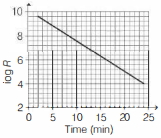
The graph shows the $\log$ of activity $\log R$ of a radioactive material as a function of time $t$ in minutes. The half-life (in minutes) for the decay is closest to
A
$2.1$
B
$3.0$
C
$3.9$
D
$4.4$
Solution
(B) The activity $R$ of a radioactive sample is given by $R = R_0 e^{-\lambda t}$.
Taking the logarithm on both sides,we get $\log R = \log R_0 - \lambda t \log e$.
Assuming the base of the logarithm is $e$,we have $\log R = \log R_0 - \lambda t$.
This equation is in the form of a straight line $y = mx + c$,where the slope $m = -\lambda$.
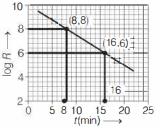
From the given graph,we can pick two points $(t_1, \log R_1) = (8, 8)$ and $(t_2, \log R_2) = (16, 6)$.
The slope of the line is $m = \frac{\log R_2 - \log R_1}{t_2 - t_1} = \frac{6 - 8}{16 - 8} = \frac{-2}{8} = -0.25$.
Since the slope $m = -\lambda$,we have $-\lambda = -0.25$,which gives the decay constant $\lambda = 0.25 \text{ min}^{-1}$.
The half-life $T_{1/2}$ is given by $T_{1/2} = \frac{\ln 2}{\lambda} = \frac{0.693}{0.25} = 2.772 \text{ minutes}$.
Rounding to the nearest value provided in the options,we get $T_{1/2} \approx 3.0 \text{ minutes}$.
Taking the logarithm on both sides,we get $\log R = \log R_0 - \lambda t \log e$.
Assuming the base of the logarithm is $e$,we have $\log R = \log R_0 - \lambda t$.
This equation is in the form of a straight line $y = mx + c$,where the slope $m = -\lambda$.
From the given graph,we can pick two points $(t_1, \log R_1) = (8, 8)$ and $(t_2, \log R_2) = (16, 6)$.
The slope of the line is $m = \frac{\log R_2 - \log R_1}{t_2 - t_1} = \frac{6 - 8}{16 - 8} = \frac{-2}{8} = -0.25$.
Since the slope $m = -\lambda$,we have $-\lambda = -0.25$,which gives the decay constant $\lambda = 0.25 \text{ min}^{-1}$.
The half-life $T_{1/2}$ is given by $T_{1/2} = \frac{\ln 2}{\lambda} = \frac{0.693}{0.25} = 2.772 \text{ minutes}$.
Rounding to the nearest value provided in the options,we get $T_{1/2} \approx 3.0 \text{ minutes}$.
0 likes
View Solution420
AdvancedMCQ
The half-life of a particle of mass $1.6 \times 10^{-26} \,kg$ is $6.9 \,s$. $A$ stream of such particles is travelling with a kinetic energy of $0.05 \,eV$ per particle. The fraction of particles that will decay when they travel a distance of $1 \,m$ is
A
$0.1$
B
$0.01$
C
$0.001$
D
$0.0001$
Solution
(D) The kinetic energy $K$ of the particle is given by $K = \frac{1}{2}mv^2$.
Given $K = 0.05 \,eV = 0.05 \times 1.6 \times 10^{-19} \,J$ and $m = 1.6 \times 10^{-26} \,kg$.
$0.05 \times 1.6 \times 10^{-19} = \frac{1}{2} \times 1.6 \times 10^{-26} \times v^2$.
$v^2 = \frac{0.05 \times 1.6 \times 10^{-19} \times 2}{1.6 \times 10^{-26}} = 0.1 \times 10^7 = 10^6 \,m^2/s^2$.
$v = 10^3 \,m/s$.
The time $t$ taken to travel a distance $D = 1 \,m$ is $t = \frac{D}{v} = \frac{1}{10^3} = 10^{-3} \,s$.
The number of half-lives $n$ is $n = \frac{t}{T_{1/2}} = \frac{10^{-3}}{6.9} \approx 1.45 \times 10^{-4}$.
The fraction of particles remaining is $N/N_0 = (1/2)^n = 2^{-n}$.
The fraction decayed is $1 - 2^{-n} = 1 - e^{-n \ln 2} \approx 1 - (1 - n \ln 2) = n \ln 2$.
Since $n \approx 1.45 \times 10^{-4}$ and $\ln 2 \approx 0.69$,the fraction decayed $\approx 1.45 \times 10^{-4} \times 0.69 \approx 10^{-4} = 0.0001$.
Given $K = 0.05 \,eV = 0.05 \times 1.6 \times 10^{-19} \,J$ and $m = 1.6 \times 10^{-26} \,kg$.
$0.05 \times 1.6 \times 10^{-19} = \frac{1}{2} \times 1.6 \times 10^{-26} \times v^2$.
$v^2 = \frac{0.05 \times 1.6 \times 10^{-19} \times 2}{1.6 \times 10^{-26}} = 0.1 \times 10^7 = 10^6 \,m^2/s^2$.
$v = 10^3 \,m/s$.
The time $t$ taken to travel a distance $D = 1 \,m$ is $t = \frac{D}{v} = \frac{1}{10^3} = 10^{-3} \,s$.
The number of half-lives $n$ is $n = \frac{t}{T_{1/2}} = \frac{10^{-3}}{6.9} \approx 1.45 \times 10^{-4}$.
The fraction of particles remaining is $N/N_0 = (1/2)^n = 2^{-n}$.
The fraction decayed is $1 - 2^{-n} = 1 - e^{-n \ln 2} \approx 1 - (1 - n \ln 2) = n \ln 2$.
Since $n \approx 1.45 \times 10^{-4}$ and $\ln 2 \approx 0.69$,the fraction decayed $\approx 1.45 \times 10^{-4} \times 0.69 \approx 10^{-4} = 0.0001$.
0 likes
View Solution421
MediumMCQ
Two species of radioactive atoms are mixed in equal number. The disintegration constant of the first species is $\lambda$ and of the second is $\lambda / 3$. After a long time,the mixture will behave as a species with a mean life of approximately:
A
$0.70 / \lambda$
B
$2.10 / \lambda$
C
$1.00 / \lambda$
D
$0.52 / \lambda$
Solution
(B) The mean life of the first species is $\tau_1 = 1 / \lambda$.
The mean life of the second species is $\tau_2 = 1 / (\lambda / 3) = 3 / \lambda$.
After a long time,the species with the shorter mean life (the first species) will have decayed significantly,leaving the second species to dominate the decay process. However,the question asks for the mean life of the mixture. The effective mean life $\tau_{avg}$ for a mixture of two radioactive substances with equal initial numbers of atoms $N_0$ is given by the weighted average of their mean lives:
$\tau_{avg} = \frac{N_0 \tau_1 + N_0 \tau_2}{N_0 + N_0} = \frac{\tau_1 + \tau_2}{2}$.
Substituting the values:
$\tau_{avg} = \frac{(1 / \lambda) + (3 / \lambda)}{2} = \frac{4 / \lambda}{2} = 2 / \lambda$.
Comparing this with the given options,$2 / \lambda$ is approximately $2.10 / \lambda$ (considering the decay kinetics over time). Thus,the correct option is $B$.
The mean life of the second species is $\tau_2 = 1 / (\lambda / 3) = 3 / \lambda$.
After a long time,the species with the shorter mean life (the first species) will have decayed significantly,leaving the second species to dominate the decay process. However,the question asks for the mean life of the mixture. The effective mean life $\tau_{avg}$ for a mixture of two radioactive substances with equal initial numbers of atoms $N_0$ is given by the weighted average of their mean lives:
$\tau_{avg} = \frac{N_0 \tau_1 + N_0 \tau_2}{N_0 + N_0} = \frac{\tau_1 + \tau_2}{2}$.
Substituting the values:
$\tau_{avg} = \frac{(1 / \lambda) + (3 / \lambda)}{2} = \frac{4 / \lambda}{2} = 2 / \lambda$.
Comparing this with the given options,$2 / \lambda$ is approximately $2.10 / \lambda$ (considering the decay kinetics over time). Thus,the correct option is $B$.
0 likes
View Solution422
MediumMCQ
$A$ parent nucleus $X$ decays into a daughter nucleus $Y$,which in turn decays into $Z$. The half-lives of $X$ and $Y$ are $40000 \, yr$ and $20 \, yr$,respectively. In a certain sample,it is found that the number of $Y$ nuclei hardly changes with time. If the number of $X$ nuclei in the sample is $4 \times 10^{20}$,the number of $Y$ nuclei present in it is
A
$2 \times 10^{17}$
B
$2 \times 10^{20}$
C
$4 \times 10^{23}$
D
$4 \times 10^{20}$
Solution
(A) The decay process is given by $X \xrightarrow{T_{1/2, X} = 40000 \, yr} Y \xrightarrow{T_{1/2, Y} = 20 \, yr} Z$.
Since the number of $Y$ nuclei remains constant over time,the rate of production of $Y$ must equal the rate of decay of $Y$.
This condition is known as secular equilibrium.
Therefore,$\lambda_X N_X = \lambda_Y N_Y$.
Using the relation $\lambda = \frac{\ln 2}{T_{1/2}}$,we get $\frac{\ln 2}{T_X} N_X = \frac{\ln 2}{T_Y} N_Y$.
This simplifies to $\frac{N_X}{T_X} = \frac{N_Y}{T_Y}$.
Rearranging for $N_Y$,we get $N_Y = N_X \times \frac{T_Y}{T_X}$.
Substituting the given values: $N_Y = (4 \times 10^{20}) \times \frac{20}{40000}$.
$N_Y = (4 \times 10^{20}) \times \frac{1}{2000} = 2 \times 10^{17}$ nuclei.
Since the number of $Y$ nuclei remains constant over time,the rate of production of $Y$ must equal the rate of decay of $Y$.
This condition is known as secular equilibrium.
Therefore,$\lambda_X N_X = \lambda_Y N_Y$.
Using the relation $\lambda = \frac{\ln 2}{T_{1/2}}$,we get $\frac{\ln 2}{T_X} N_X = \frac{\ln 2}{T_Y} N_Y$.
This simplifies to $\frac{N_X}{T_X} = \frac{N_Y}{T_Y}$.
Rearranging for $N_Y$,we get $N_Y = N_X \times \frac{T_Y}{T_X}$.
Substituting the given values: $N_Y = (4 \times 10^{20}) \times \frac{20}{40000}$.
$N_Y = (4 \times 10^{20}) \times \frac{1}{2000} = 2 \times 10^{17}$ nuclei.
0 likes
View Solution423
MediumMCQ
$A$ radioactive nucleus $A$ has a single decay mode with half-life $\tau_A$. Another radioactive nucleus $B$ has two decay modes $1$ and $2$. If decay mode $2$ were absent,the half-life of $B$ would have been $\tau_A / 2$. If decay mode $1$ were absent,the half-life of $B$ would have been $3 \tau_A$. If the actual half-life of $B$ is $\tau_B$,then the ratio $\tau_B / \tau_A$ is
A
$3 / 7$
B
$7 / 2$
C
$7 / 3$
D
$1$
Solution
(A) For a radioactive nucleus with multiple decay modes,the total decay constant $\lambda_B$ is the sum of the individual decay constants: $\lambda_B = \lambda_1 + \lambda_2$.
Since the decay constant $\lambda$ is related to the half-life $\tau$ by $\lambda = \ln(2) / \tau$,we can write the relationship as $1 / \tau_B = 1 / \tau_1 + 1 / \tau_2$.
Given that if decay mode $2$ were absent,the half-life is $\tau_1 = \tau_A / 2$.
Given that if decay mode $1$ were absent,the half-life is $\tau_2 = 3 \tau_A$.
Substituting these into the formula for the actual half-life $\tau_B$:
$1 / \tau_B = 1 / (\tau_A / 2) + 1 / (3 \tau_A)$
$1 / \tau_B = 2 / \tau_A + 1 / (3 \tau_A)$
$1 / \tau_B = (6 + 1) / (3 \tau_A) = 7 / (3 \tau_A)$
Therefore,$\tau_B = (3 / 7) \tau_A$,which implies $\tau_B / \tau_A = 3 / 7$.
Since the decay constant $\lambda$ is related to the half-life $\tau$ by $\lambda = \ln(2) / \tau$,we can write the relationship as $1 / \tau_B = 1 / \tau_1 + 1 / \tau_2$.
Given that if decay mode $2$ were absent,the half-life is $\tau_1 = \tau_A / 2$.
Given that if decay mode $1$ were absent,the half-life is $\tau_2 = 3 \tau_A$.
Substituting these into the formula for the actual half-life $\tau_B$:
$1 / \tau_B = 1 / (\tau_A / 2) + 1 / (3 \tau_A)$
$1 / \tau_B = 2 / \tau_A + 1 / (3 \tau_A)$
$1 / \tau_B = (6 + 1) / (3 \tau_A) = 7 / (3 \tau_A)$
Therefore,$\tau_B = (3 / 7) \tau_A$,which implies $\tau_B / \tau_A = 3 / 7$.
0 likes
View Solution424
MediumMCQ
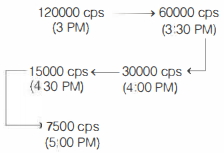
$A$ nucleus has a half-life of $30 \; min$. At $3 \; PM$, its decay rate was measured as $120000 \; cps$. What is the decay rate in $cps$ at $5 \; PM$?
A
$120000$
B
$30000$
C
$60000$
D
$7500$
Solution
(D) The half-life $(T_{1/2})$ of the nucleus is $30 \; min$.
The time interval between $3 \; PM$ and $5 \; PM$ is $2 \; hours$, which is equal to $120 \; min$.
The number of half-lives $(n)$ elapsed is given by $n = \frac{\text{Total time}}{T_{1/2}} = \frac{120 \; min}{30 \; min} = 4$.
The decay rate $(R)$ follows the law $R = R_0 \left( \frac{1}{2} \right)^n$, where $R_0 = 120000 \; cps$.
Substituting the values, we get $R = 120000 \times \left( \frac{1}{2} \right)^4 = 120000 \times \frac{1}{16} = 7500 \; cps$.
Thus, the decay rate at $5 \; PM$ is $7500 \; cps$.
The time interval between $3 \; PM$ and $5 \; PM$ is $2 \; hours$, which is equal to $120 \; min$.
The number of half-lives $(n)$ elapsed is given by $n = \frac{\text{Total time}}{T_{1/2}} = \frac{120 \; min}{30 \; min} = 4$.
The decay rate $(R)$ follows the law $R = R_0 \left( \frac{1}{2} \right)^n$, where $R_0 = 120000 \; cps$.
Substituting the values, we get $R = 120000 \times \left( \frac{1}{2} \right)^4 = 120000 \times \frac{1}{16} = 7500 \; cps$.
Thus, the decay rate at $5 \; PM$ is $7500 \; cps$.
0 likes
View Solution425
AdvancedMCQ
At time $t=0$,a container has $N_{0}$ radioactive atoms with a decay constant $\lambda$. In addition,$c$ number of atoms of the same type are being added to the container per unit time. How many atoms of this type are there at $t=T$?
A
$\frac{c}{\lambda} \exp(-\lambda T) - N_0 \exp(-\lambda T)$
B
$\frac{c}{\lambda} \exp(-\lambda T) + N_0 \exp(-\lambda T)$
C
$\frac{c}{\lambda}(1 - \exp(-\lambda T)) + N_0 \exp(-\lambda T)$
D
$\frac{c}{\lambda}(1 + \exp(-\lambda T)) + N_0 \exp(-\lambda T)$
Solution
(C) The rate of change of the number of radioactive atoms $N$ is given by the difference between the rate of addition and the rate of decay:
$\frac{dN}{dt} = c - \lambda N$
Rearranging the terms for integration:
$\frac{dN}{c - \lambda N} = dt$
Integrating both sides with the initial condition $N = N_0$ at $t = 0$ and $N = N$ at $t = T$:
$\int_{N_0}^{N} \frac{dN}{c - \lambda N} = \int_{0}^{T} dt$
Let $u = c - \lambda N$,then $du = -\lambda dN$,or $dN = -\frac{du}{\lambda}$:
$-\frac{1}{\lambda} [\ln(c - \lambda N)]_{N_0}^{N} = T$
$\ln\left(\frac{c - \lambda N}{c - \lambda N_0}\right) = -\lambda T$
Taking the exponential of both sides:
$\frac{c - \lambda N}{c - \lambda N_0} = e^{-\lambda T}$
$c - \lambda N = (c - \lambda N_0)e^{-\lambda T}$
$\lambda N = c - (c - \lambda N_0)e^{-\lambda T}$
$N = \frac{c}{\lambda}(1 - e^{-\lambda T}) + N_0 e^{-\lambda T}$
$\frac{dN}{dt} = c - \lambda N$
Rearranging the terms for integration:
$\frac{dN}{c - \lambda N} = dt$
Integrating both sides with the initial condition $N = N_0$ at $t = 0$ and $N = N$ at $t = T$:
$\int_{N_0}^{N} \frac{dN}{c - \lambda N} = \int_{0}^{T} dt$
Let $u = c - \lambda N$,then $du = -\lambda dN$,or $dN = -\frac{du}{\lambda}$:
$-\frac{1}{\lambda} [\ln(c - \lambda N)]_{N_0}^{N} = T$
$\ln\left(\frac{c - \lambda N}{c - \lambda N_0}\right) = -\lambda T$
Taking the exponential of both sides:
$\frac{c - \lambda N}{c - \lambda N_0} = e^{-\lambda T}$
$c - \lambda N = (c - \lambda N_0)e^{-\lambda T}$
$\lambda N = c - (c - \lambda N_0)e^{-\lambda T}$
$N = \frac{c}{\lambda}(1 - e^{-\lambda T}) + N_0 e^{-\lambda T}$
0 likes
View Solution426
AdvancedMCQ
The percentage of ${}^{235}U$ presently on Earth is $0.72\%$ and the rest $(99.28\%)$ may be taken to be ${}^{238}U$. Assume that all uranium on Earth was produced in a supernova explosion long ago with the initial ratio ${}^{235}U / {}^{238}U = 2.0$. How long ago did the supernova event occur? (Take the half-lives of ${}^{235}U$ and ${}^{238}U$ to be $7.1 \times 10^8$ years and $4.5 \times 10^9$ years respectively).
A
$4 \times 10^9$ years
B
$5 \times 10^9$ years
C
$6 \times 10^9$ years
D
$7 \times 10^9$ years
Solution
(D) Let $N_1$ and $N_2$ be the present amounts of ${}^{235}U$ and ${}^{238}U$,and $N_{01}$ and $N_{02}$ be their initial amounts.
Given: $\frac{N_1}{N_2} = \frac{0.72}{99.28}$ and $\frac{N_{01}}{N_{02}} = 2.0$.
The decay law is $N = N_0 e^{-\lambda t}$,where $\lambda = \frac{\ln 2}{T_{1/2}}$.
Thus,$\frac{N_1}{N_2} = \frac{N_{01} e^{-\lambda_1 t}}{N_{02} e^{-\lambda_2 t}} = \frac{N_{01}}{N_{02}} e^{-(\lambda_1 - \lambda_2)t}$.
Substituting the values: $\frac{0.72}{99.28} = 2.0 \times e^{-(\lambda_1 - \lambda_2)t}$.
$e^{(\lambda_1 - \lambda_2)t} = 2.0 \times \frac{99.28}{0.72} \approx 275.78$.
Taking natural log on both sides: $(\lambda_1 - \lambda_2)t = \ln(275.78) \approx 5.62$.
Using $\lambda = \frac{\ln 2}{T_{1/2}}$: $(\frac{\ln 2}{7.1 \times 10^8} - \frac{\ln 2}{4.5 \times 10^9})t = 5.62$.
$(\ln 2) \times (1.408 \times 10^{-9} - 0.222 \times 10^{-9})t = 5.62$.
$0.693 \times (1.186 \times 10^{-9})t = 5.62$.
$t = \frac{5.62}{8.219 \times 10^{-10}} \approx 6.84 \times 10^9 \approx 7 \times 10^9$ years.
Given: $\frac{N_1}{N_2} = \frac{0.72}{99.28}$ and $\frac{N_{01}}{N_{02}} = 2.0$.
The decay law is $N = N_0 e^{-\lambda t}$,where $\lambda = \frac{\ln 2}{T_{1/2}}$.
Thus,$\frac{N_1}{N_2} = \frac{N_{01} e^{-\lambda_1 t}}{N_{02} e^{-\lambda_2 t}} = \frac{N_{01}}{N_{02}} e^{-(\lambda_1 - \lambda_2)t}$.
Substituting the values: $\frac{0.72}{99.28} = 2.0 \times e^{-(\lambda_1 - \lambda_2)t}$.
$e^{(\lambda_1 - \lambda_2)t} = 2.0 \times \frac{99.28}{0.72} \approx 275.78$.
Taking natural log on both sides: $(\lambda_1 - \lambda_2)t = \ln(275.78) \approx 5.62$.
Using $\lambda = \frac{\ln 2}{T_{1/2}}$: $(\frac{\ln 2}{7.1 \times 10^8} - \frac{\ln 2}{4.5 \times 10^9})t = 5.62$.
$(\ln 2) \times (1.408 \times 10^{-9} - 0.222 \times 10^{-9})t = 5.62$.
$0.693 \times (1.186 \times 10^{-9})t = 5.62$.
$t = \frac{5.62}{8.219 \times 10^{-10}} \approx 6.84 \times 10^9 \approx 7 \times 10^9$ years.
0 likes
View Solution427
EasyMCQ
In the radioactive decay of an element,it is found that the count rate reduces from $1024$ to $128$ in $3$ minutes. Its half-life will be ...... minutes.
A
$1$
B
$2$
C
$3$
D
$5$
Solution
(A) The radioactive decay law is given by $R = R_0 \left(\frac{1}{2}\right)^n$,where $n$ is the number of half-lives.
Given,initial count rate $R_0 = 1024$ and final count rate $R = 128$.
Substituting the values: $\frac{128}{1024} = \left(\frac{1}{2}\right)^n$.
Simplifying the fraction: $\frac{1}{8} = \left(\frac{1}{2}\right)^n$.
Since $\frac{1}{8} = \left(\frac{1}{2}\right)^3$,we get $n = 3$.
This means $3$ half-lives have passed in $3$ minutes.
Therefore,$1$ half-life = $\frac{3 \text{ minutes}}{3} = 1$ minute.
Given,initial count rate $R_0 = 1024$ and final count rate $R = 128$.
Substituting the values: $\frac{128}{1024} = \left(\frac{1}{2}\right)^n$.
Simplifying the fraction: $\frac{1}{8} = \left(\frac{1}{2}\right)^n$.
Since $\frac{1}{8} = \left(\frac{1}{2}\right)^3$,we get $n = 3$.
This means $3$ half-lives have passed in $3$ minutes.
Therefore,$1$ half-life = $\frac{3 \text{ minutes}}{3} = 1$ minute.
0 likes
View Solution428
EasyMCQ
If a radioactive material remains $25 \%$ after $16$ days,then its half-life will be ......... days.
A
$32$
B
$8$
C
$64$
D
$28$
Solution
(B) The amount of radioactive material remaining is given by the formula $N = N_0 \left(\frac{1}{2}\right)^n$,where $n$ is the number of half-lives.
Given that $25 \%$ of the material remains,we have $\frac{N}{N_0} = 25 \% = \frac{25}{100} = \frac{1}{4}$.
Substituting this into the formula: $\frac{1}{4} = \left(\frac{1}{2}\right)^n$.
Since $\frac{1}{4} = \left(\frac{1}{2}\right)^2$,we get $n = 2$.
This means $2$ half-lives have passed in $16$ days.
Therefore,the duration of $1$ half-life is $T_{1/2} = \frac{16 \text{ days}}{2} = 8 \text{ days}$.
Given that $25 \%$ of the material remains,we have $\frac{N}{N_0} = 25 \% = \frac{25}{100} = \frac{1}{4}$.
Substituting this into the formula: $\frac{1}{4} = \left(\frac{1}{2}\right)^n$.
Since $\frac{1}{4} = \left(\frac{1}{2}\right)^2$,we get $n = 2$.
This means $2$ half-lives have passed in $16$ days.
Therefore,the duration of $1$ half-life is $T_{1/2} = \frac{16 \text{ days}}{2} = 8 \text{ days}$.
0 likes
View Solution429
MediumMCQ
At time $t=0$ some radioactive gas is injected into a sealed vessel. At time $T$ some more of the gas is injected into the vessel. Which one of the following graphs best represents the logarithm of the activity $A$ of the gas with time $t$?
A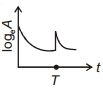
B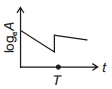
C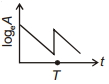
D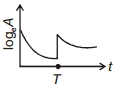
Solution
(C) The activity $A$ of a radioactive substance at time $t$ is given by the law of radioactive decay: $A = A_0 e^{-\lambda t}$.
Taking the natural logarithm on both sides,we get: $\ln A = \ln A_0 - \lambda t$.
This equation represents a straight line with a negative slope $(-\lambda)$ and a $y$-intercept of $\ln A_0$.
When more gas is injected at time $T$,the activity $A$ increases abruptly,causing a vertical jump in the value of $\ln A$ at $t=T$.
After the injection,the decay continues with the same decay constant $\lambda$,so the slope of the $\ln A$ versus $t$ graph remains the same (i.e.,$-\lambda$).
Therefore,the graph should consist of two parallel straight-line segments with a negative slope,separated by a vertical jump at $t=T$. This corresponds to graph $C$.
Taking the natural logarithm on both sides,we get: $\ln A = \ln A_0 - \lambda t$.
This equation represents a straight line with a negative slope $(-\lambda)$ and a $y$-intercept of $\ln A_0$.
When more gas is injected at time $T$,the activity $A$ increases abruptly,causing a vertical jump in the value of $\ln A$ at $t=T$.
After the injection,the decay continues with the same decay constant $\lambda$,so the slope of the $\ln A$ versus $t$ graph remains the same (i.e.,$-\lambda$).
Therefore,the graph should consist of two parallel straight-line segments with a negative slope,separated by a vertical jump at $t=T$. This corresponds to graph $C$.
0 likes
View Solution430
MediumMCQ
Two radioactive isotopes $P$ and $Q$ have half-lives $10 \text{ minutes}$ and $15 \text{ minutes}$ respectively. Freshly prepared samples of each isotope initially contain the same number of atoms. After $30 \text{ minutes}$,the ratio $\frac{\text{number of atoms of } P}{\text{number of atoms of } Q}$ will be
A
$0.5$
B
$2.0$
C
$1.0$
D
$3.0$
Solution
(A) Given,half-life of $P$,$T_P = 10 \text{ min}$ and half-life of $Q$,$T_Q = 15 \text{ min}$.
Initially,both samples have the same number of atoms,$N_0$.
After time $t = 30 \text{ min}$,the number of half-lives for $P$ is $n_P = \frac{t}{T_P} = \frac{30}{10} = 3$.
The number of half-lives for $Q$ is $n_Q = \frac{t}{T_Q} = \frac{30}{15} = 2$.
The remaining number of atoms for $P$ is $N_P = N_0 \left(\frac{1}{2}\right)^{n_P} = N_0 \left(\frac{1}{2}\right)^3 = \frac{N_0}{8}$.
The remaining number of atoms for $Q$ is $N_Q = N_0 \left(\frac{1}{2}\right)^{n_Q} = N_0 \left(\frac{1}{2}\right)^2 = \frac{N_0}{4}$.
The ratio $\frac{N_P}{N_Q} = \frac{N_0/8}{N_0/4} = \frac{4}{8} = 0.5$.
Initially,both samples have the same number of atoms,$N_0$.
After time $t = 30 \text{ min}$,the number of half-lives for $P$ is $n_P = \frac{t}{T_P} = \frac{30}{10} = 3$.
The number of half-lives for $Q$ is $n_Q = \frac{t}{T_Q} = \frac{30}{15} = 2$.
The remaining number of atoms for $P$ is $N_P = N_0 \left(\frac{1}{2}\right)^{n_P} = N_0 \left(\frac{1}{2}\right)^3 = \frac{N_0}{8}$.
The remaining number of atoms for $Q$ is $N_Q = N_0 \left(\frac{1}{2}\right)^{n_Q} = N_0 \left(\frac{1}{2}\right)^2 = \frac{N_0}{4}$.
The ratio $\frac{N_P}{N_Q} = \frac{N_0/8}{N_0/4} = \frac{4}{8} = 0.5$.
0 likes
View Solution431
DifficultMCQ
$A$ freshly-prepared radioactive source of half-life $2 \, h$ emits radiation of intensity which is $64$ times the permissible safe level. The minimum time after which it would be possible to work safely with this source is ....... $h$.
A
$6$
B
$12$
C
$24$
D
$128$
Solution
(B) Given,half-life $T_{1/2} = 2 \, h$.
Let the initial intensity be $I_0$ and the safe intensity be $I$.
We are given that $I_0 = 64I$,so the ratio $\frac{I}{I_0} = \frac{1}{64}$.
The intensity of radiation follows the law of radioactive decay: $I = I_0 \left( \frac{1}{2} \right)^n$,where $n$ is the number of half-lives.
Substituting the values: $\frac{1}{64} = \left( \frac{1}{2} \right)^n$.
Since $64 = 2^6$,we have $\left( \frac{1}{2} \right)^6 = \left( \frac{1}{2} \right)^n$,which gives $n = 6$.
The total time $t$ is given by $t = n \times T_{1/2}$.
Therefore,$t = 6 \times 2 \, h = 12 \, h$.
Let the initial intensity be $I_0$ and the safe intensity be $I$.
We are given that $I_0 = 64I$,so the ratio $\frac{I}{I_0} = \frac{1}{64}$.
The intensity of radiation follows the law of radioactive decay: $I = I_0 \left( \frac{1}{2} \right)^n$,where $n$ is the number of half-lives.
Substituting the values: $\frac{1}{64} = \left( \frac{1}{2} \right)^n$.
Since $64 = 2^6$,we have $\left( \frac{1}{2} \right)^6 = \left( \frac{1}{2} \right)^n$,which gives $n = 6$.
The total time $t$ is given by $t = n \times T_{1/2}$.
Therefore,$t = 6 \times 2 \, h = 12 \, h$.
0 likes
View Solution432
EasyMCQ
The sample of a radioactive substance has $10^6$ nuclei. Its half-life is $20 \, s$. The number of nuclei that will be left after $10 \, s$ is nearly ...... $\times 10^5$.
A
$1$
B
$2$
C
$7$
D
$11$
Solution
(C) The number of nuclei remaining after time $t$ is given by the formula $N = N_0 \left( \frac{1}{2} \right)^n$,where $n = \frac{t}{T_{1/2}}$ is the number of half-lives.
Given $N_0 = 10^6$,$t = 10 \, s$,and $T_{1/2} = 20 \, s$.
Calculating the number of half-lives: $n = \frac{10}{20} = 0.5$.
Substituting the values into the formula: $N = 10^6 \times \left( \frac{1}{2} \right)^{0.5} = 10^6 \times \frac{1}{\sqrt{2}}$.
Since $\sqrt{2} \approx 1.414$,we have $\frac{1}{\sqrt{2}} \approx 0.707$.
Therefore,$N \approx 10^6 \times 0.707 = 0.707 \times 10^6 = 7.07 \times 10^5$.
Rounding to the nearest integer,the number of nuclei left is approximately $7 \times 10^5$.
Given $N_0 = 10^6$,$t = 10 \, s$,and $T_{1/2} = 20 \, s$.
Calculating the number of half-lives: $n = \frac{10}{20} = 0.5$.
Substituting the values into the formula: $N = 10^6 \times \left( \frac{1}{2} \right)^{0.5} = 10^6 \times \frac{1}{\sqrt{2}}$.
Since $\sqrt{2} \approx 1.414$,we have $\frac{1}{\sqrt{2}} \approx 0.707$.
Therefore,$N \approx 10^6 \times 0.707 = 0.707 \times 10^6 = 7.07 \times 10^5$.
Rounding to the nearest integer,the number of nuclei left is approximately $7 \times 10^5$.
0 likes
View Solution433
EasyMCQ
The half-life of a radioactive element depends upon:
A
Amount of element present
B
Temperature
C
Pressure
D
The nature of the element
Solution
(D) The half-life $(T_{1/2})$ of a radioactive substance is defined as the time required for half of the radioactive nuclei in a sample to decay.
It is given by the formula $T_{1/2} = \frac{\ln(2)}{\lambda}$,where $\lambda$ is the decay constant.
The decay constant $\lambda$ is a characteristic property of the radioactive isotope and is independent of external physical conditions such as temperature,pressure,or the initial amount of the substance present.
Therefore,the half-life depends solely on the nature of the radioactive element.
It is given by the formula $T_{1/2} = \frac{\ln(2)}{\lambda}$,where $\lambda$ is the decay constant.
The decay constant $\lambda$ is a characteristic property of the radioactive isotope and is independent of external physical conditions such as temperature,pressure,or the initial amount of the substance present.
Therefore,the half-life depends solely on the nature of the radioactive element.
0 likes
View Solution434
EasyMCQ
After $3$ hours,only $0.25 \,mg$ of a pure radioactive material is left. If the initial mass was $2 \,mg$,then the half-life of the substance is ...... $hr$.
A
$1.5$
B
$1$
C
$0.5$
D
$2$
Solution
(B) Given:
Initial mass $N_0 = 2 \,mg$
Final mass $N = 0.25 \,mg$
Total time $t = 3 \,hr$
The radioactive decay law is given by $N = N_0 \left(\frac{1}{2}\right)^n$,where $n$ is the number of half-lives.
Substituting the values:
$0.25 = 2 \times \left(\frac{1}{2}\right)^n$
$\frac{0.25}{2} = \left(\frac{1}{2}\right)^n$
$\frac{1}{8} = \left(\frac{1}{2}\right)^n$
$\left(\frac{1}{2}\right)^3 = \left(\frac{1}{2}\right)^n$
Therefore,$n = 3$.
Since $n = \frac{t}{T_{1/2}}$,where $T_{1/2}$ is the half-life:
$3 = \frac{3 \,hr}{T_{1/2}}$
$T_{1/2} = 1 \,hr$.
Initial mass $N_0 = 2 \,mg$
Final mass $N = 0.25 \,mg$
Total time $t = 3 \,hr$
The radioactive decay law is given by $N = N_0 \left(\frac{1}{2}\right)^n$,where $n$ is the number of half-lives.
Substituting the values:
$0.25 = 2 \times \left(\frac{1}{2}\right)^n$
$\frac{0.25}{2} = \left(\frac{1}{2}\right)^n$
$\frac{1}{8} = \left(\frac{1}{2}\right)^n$
$\left(\frac{1}{2}\right)^3 = \left(\frac{1}{2}\right)^n$
Therefore,$n = 3$.
Since $n = \frac{t}{T_{1/2}}$,where $T_{1/2}$ is the half-life:
$3 = \frac{3 \,hr}{T_{1/2}}$
$T_{1/2} = 1 \,hr$.
0 likes
View Solution435
MediumMCQ
Half-lives for $\alpha$ and $\beta$ emission of a radioactive material are $16$ years and $48$ years respectively. When the material decays by giving $\alpha$ and $\beta$ emission simultaneously,the time in which $3/4$th of the material decays is ....... years.
A
$29$
B
$24$
C
$64$
D
$12$
Solution
(B) When a radioactive material decays through two different processes simultaneously,the effective decay constant $\lambda_{eff}$ is the sum of the individual decay constants: $\lambda_{eff} = \lambda_{\alpha} + \lambda_{\beta}$.
Given $T_{\alpha} = 16$ years and $T_{\beta} = 48$ years.
The decay constants are $\lambda_{\alpha} = \frac{\ln 2}{16}$ and $\lambda_{\beta} = \frac{\ln 2}{48}$.
Thus,$\lambda_{eff} = \frac{\ln 2}{16} + \frac{\ln 2}{48} = \ln 2 \left( \frac{3+1}{48} \right) = \frac{\ln 2}{12}$.
The effective half-life $T_{eff} = \frac{\ln 2}{\lambda_{eff}} = 12$ years.
We want to find the time $t$ when $3/4$th of the material has decayed,which means $1/4$th of the material remains.
Using the radioactive decay law: $\frac{N}{N_0} = \left( \frac{1}{2} \right)^{t/T_{eff}}$.
$\frac{1}{4} = \left( \frac{1}{2} \right)^{t/12} \implies \left( \frac{1}{2} \right)^2 = \left( \frac{1}{2} \right)^{t/12}$.
Equating the exponents: $2 = \frac{t}{12} \implies t = 24$ years.
Given $T_{\alpha} = 16$ years and $T_{\beta} = 48$ years.
The decay constants are $\lambda_{\alpha} = \frac{\ln 2}{16}$ and $\lambda_{\beta} = \frac{\ln 2}{48}$.
Thus,$\lambda_{eff} = \frac{\ln 2}{16} + \frac{\ln 2}{48} = \ln 2 \left( \frac{3+1}{48} \right) = \frac{\ln 2}{12}$.
The effective half-life $T_{eff} = \frac{\ln 2}{\lambda_{eff}} = 12$ years.
We want to find the time $t$ when $3/4$th of the material has decayed,which means $1/4$th of the material remains.
Using the radioactive decay law: $\frac{N}{N_0} = \left( \frac{1}{2} \right)^{t/T_{eff}}$.
$\frac{1}{4} = \left( \frac{1}{2} \right)^{t/12} \implies \left( \frac{1}{2} \right)^2 = \left( \frac{1}{2} \right)^{t/12}$.
Equating the exponents: $2 = \frac{t}{12} \implies t = 24$ years.
0 likes
View Solution436
MediumMCQ
Two radioactive samples $A$ and $B$ have half-lives $T_1$ and $T_2$ $(T_1 > T_2)$ respectively. At $t=0$,the activity of $B$ was twice the activity of $A$. Their activity will become equal after a time:
A
$\frac{T_1 T_2}{T_1-T_2} \ln(2)$
B
$\frac{T_1 T_2}{T_1-T_2} \ln(1/2)$
C
$\frac{T_1+T_2}{2}$
D
$\frac{T_1 T_2}{T_1+T_2}$
Solution
(A) Let the initial activities be $R_{A,0}$ and $R_{B,0}$. Given $R_{B,0} = 2 R_{A,0}$.
The activity at time $t$ is given by $R(t) = R_0 e^{-\lambda t}$,where $\lambda = \frac{\ln(2)}{T}$.
Equating the activities at time $t$: $R_{A,0} e^{-\lambda_1 t} = R_{B,0} e^{-\lambda_2 t}$.
Substituting $R_{B,0} = 2 R_{A,0}$: $R_{A,0} e^{-\lambda_1 t} = 2 R_{A,0} e^{-\lambda_2 t}$.
$e^{(\lambda_2 - \lambda_1)t} = 2$.
Taking the natural logarithm on both sides: $(\lambda_2 - \lambda_1)t = \ln(2)$.
Since $\lambda = \frac{\ln(2)}{T}$,we have $(\frac{\ln(2)}{T_2} - \frac{\ln(2)}{T_1})t = \ln(2)$.
Dividing by $\ln(2)$: $(\frac{1}{T_2} - \frac{1}{T_1})t = 1$.
$(\frac{T_1 - T_2}{T_1 T_2})t = 1$.
Therefore,$t = \frac{T_1 T_2}{T_1 - T_2}$.
The activity at time $t$ is given by $R(t) = R_0 e^{-\lambda t}$,where $\lambda = \frac{\ln(2)}{T}$.
Equating the activities at time $t$: $R_{A,0} e^{-\lambda_1 t} = R_{B,0} e^{-\lambda_2 t}$.
Substituting $R_{B,0} = 2 R_{A,0}$: $R_{A,0} e^{-\lambda_1 t} = 2 R_{A,0} e^{-\lambda_2 t}$.
$e^{(\lambda_2 - \lambda_1)t} = 2$.
Taking the natural logarithm on both sides: $(\lambda_2 - \lambda_1)t = \ln(2)$.
Since $\lambda = \frac{\ln(2)}{T}$,we have $(\frac{\ln(2)}{T_2} - \frac{\ln(2)}{T_1})t = \ln(2)$.
Dividing by $\ln(2)$: $(\frac{1}{T_2} - \frac{1}{T_1})t = 1$.
$(\frac{T_1 - T_2}{T_1 T_2})t = 1$.
Therefore,$t = \frac{T_1 T_2}{T_1 - T_2}$.
0 likes
View Solution437
EasyMCQ
$N$ atoms of a radioactive element emit $n$ number of $\alpha$-particles per second. The mean life of the element in seconds is:
A
$\frac{n}{N}$
B
$\frac{N}{n}$
C
$0.693 \frac{N}{n}$
D
$0.693 \frac{n}{N}$
Solution
(B) The rate of decay of a radioactive substance is given by the law of radioactive decay: $n = \lambda N$,where $n$ is the number of particles emitted per second,$\lambda$ is the decay constant,and $N$ is the number of radioactive atoms present.
From this relation,the decay constant is $\lambda = \frac{n}{N}$.
The mean life $(\tau)$ of a radioactive element is defined as the reciprocal of the decay constant: $\tau = \frac{1}{\lambda}$.
Substituting the value of $\lambda$,we get $\tau = \frac{1}{n/N} = \frac{N}{n}$.
Therefore,the mean life is $\frac{N}{n}$ seconds.
From this relation,the decay constant is $\lambda = \frac{n}{N}$.
The mean life $(\tau)$ of a radioactive element is defined as the reciprocal of the decay constant: $\tau = \frac{1}{\lambda}$.
Substituting the value of $\lambda$,we get $\tau = \frac{1}{n/N} = \frac{N}{n}$.
Therefore,the mean life is $\frac{N}{n}$ seconds.
0 likes
View Solution438
MediumMCQ
Ten percent of a radioactive sample has decayed in $1$ day. After $2$ days,the decayed percentage of nuclei will be ...... $\%$
A
$81$
B
$19$
C
$20$
D
$100$
Solution
(B) Let the initial number of nuclei be $N_0$.
After $t = 1$ day,the number of decayed nuclei is $10 \%$ of $N_0$,so the number of nuclei remaining is $N(1) = N_0 - 0.10 N_0 = 0.90 N_0$.
Using the radioactive decay law $N(t) = N_0 e^{-\lambda t}$,we have $0.90 N_0 = N_0 e^{-\lambda(1)}$,which gives $e^{-\lambda} = 0.9$.
After $t = 2$ days,the number of nuclei remaining is $N(2) = N_0 e^{-\lambda(2)} = N_0 (e^{-\lambda})^2$.
Substituting $e^{-\lambda} = 0.9$,we get $N(2) = N_0 (0.9)^2 = 0.81 N_0$.
The number of decayed nuclei after $2$ days is $N_{decayed} = N_0 - N(2) = N_0 - 0.81 N_0 = 0.19 N_0$.
Thus,the decayed percentage is $19 \%$.
After $t = 1$ day,the number of decayed nuclei is $10 \%$ of $N_0$,so the number of nuclei remaining is $N(1) = N_0 - 0.10 N_0 = 0.90 N_0$.
Using the radioactive decay law $N(t) = N_0 e^{-\lambda t}$,we have $0.90 N_0 = N_0 e^{-\lambda(1)}$,which gives $e^{-\lambda} = 0.9$.
After $t = 2$ days,the number of nuclei remaining is $N(2) = N_0 e^{-\lambda(2)} = N_0 (e^{-\lambda})^2$.
Substituting $e^{-\lambda} = 0.9$,we get $N(2) = N_0 (0.9)^2 = 0.81 N_0$.
The number of decayed nuclei after $2$ days is $N_{decayed} = N_0 - N(2) = N_0 - 0.81 N_0 = 0.19 N_0$.
Thus,the decayed percentage is $19 \%$.
0 likes
View Solution439
MediumMCQ
After five half-lives, the percentage of original radioactive atoms left is ...... $ \%$
A
$1$
B
$0.3$
C
$3.125$
D
$0.2$
Solution
(C) The number of radioactive atoms remaining after $n$ half-lives is given by the formula: $N = N_0 \left( \frac{1}{2} \right)^n$.
Here, the number of half-lives $n = 5$.
Substituting the value of $n$ into the formula:
$N = N_0 \left( \frac{1}{2} \right)^5 = N_0 \left( \frac{1}{32} \right)$.
To find the percentage remaining, we calculate $\frac{N}{N_0} \times 100 \%$.
$\frac{N}{N_0} = \frac{1}{32} = 0.03125$.
Therefore, the percentage remaining is $0.03125 \times 100 \% = 3.125 \%$.
Here, the number of half-lives $n = 5$.
Substituting the value of $n$ into the formula:
$N = N_0 \left( \frac{1}{2} \right)^5 = N_0 \left( \frac{1}{32} \right)$.
To find the percentage remaining, we calculate $\frac{N}{N_0} \times 100 \%$.
$\frac{N}{N_0} = \frac{1}{32} = 0.03125$.
Therefore, the percentage remaining is $0.03125 \times 100 \% = 3.125 \%$.
0 likes
View Solution440
EasyMCQ
The radioactivity of a certain radioactive element drops to $\frac{1}{64}$ of its initial value in $30$ seconds. Its half-life is ............. seconds.
A
$8$
B
$15$
C
$7.5$
D
$5$
Solution
(D) The radioactive decay law is given by $\frac{N}{N_0} = \left(\frac{1}{2}\right)^n$,where $n$ is the number of half-lives.
Given $\frac{N}{N_0} = \frac{1}{64}$.
So,$\frac{1}{64} = \left(\frac{1}{2}\right)^n$.
Since $64 = 2^6$,we have $\left(\frac{1}{2}\right)^6 = \left(\frac{1}{2}\right)^n$,which implies $n = 6$.
The total time $t = 30$ seconds.
The number of half-lives $n = \frac{t}{T_{1/2}}$,where $T_{1/2}$ is the half-life.
Therefore,$6 = \frac{30}{T_{1/2}}$.
$T_{1/2} = \frac{30}{6} = 5$ seconds.
Given $\frac{N}{N_0} = \frac{1}{64}$.
So,$\frac{1}{64} = \left(\frac{1}{2}\right)^n$.
Since $64 = 2^6$,we have $\left(\frac{1}{2}\right)^6 = \left(\frac{1}{2}\right)^n$,which implies $n = 6$.
The total time $t = 30$ seconds.
The number of half-lives $n = \frac{t}{T_{1/2}}$,where $T_{1/2}$ is the half-life.
Therefore,$6 = \frac{30}{T_{1/2}}$.
$T_{1/2} = \frac{30}{6} = 5$ seconds.
0 likes
View Solution441
MediumMCQ
Radioactive nuclei $P$ and $Q$ disintegrate into $R$ with half-lives $1$ month and $2$ months respectively. At time $t=0$,the number of nuclei of each $P$ and $Q$ is $x$. At the time when the rates of disintegration of $P$ and $Q$ are equal,the number of nuclei of $R$ is ........ $x$.
A
$1$
B
$1.25$
C
$1.5$
D
$1.75$
Solution
(B) Given: Half-lives $T_P = 1$ month,$T_Q = 2$ months.
Decay constants: $\lambda_P = \frac{\ln 2}{T_P} = \ln 2$ and $\lambda_Q = \frac{\ln 2}{T_Q} = \frac{\ln 2}{2}$.
Rate of disintegration $R = \lambda N$,where $N = N_0 e^{-\lambda t}$.
At time $t$,rates are equal: $\lambda_P x e^{-\lambda_P t} = \lambda_Q x e^{-\lambda_Q t}$.
$(\ln 2) e^{-(\ln 2) t} = (\frac{\ln 2}{2}) e^{-(\frac{\ln 2}{2}) t}$.
$1 = \frac{1}{2} e^{(\ln 2 - \frac{\ln 2}{2}) t} = \frac{1}{2} e^{(\frac{\ln 2}{2}) t}$.
$2 = e^{(\frac{\ln 2}{2}) t} \implies \ln 2 = \frac{\ln 2}{2} t \implies t = 2$ months.
Number of nuclei remaining: $N_P = x e^{-\lambda_P t} = x e^{-(\ln 2)(2)} = x(2)^{-2} = \frac{x}{4} = 0.25x$.
$N_Q = x e^{-\lambda_Q t} = x e^{-(\frac{\ln 2}{2})(2)} = x(2)^{-1} = \frac{x}{2} = 0.5x$.
Total nuclei disintegrated into $R$: $N_R = (x - 0.25x) + (x - 0.5x) = 0.75x + 0.5x = 1.25x$.
Decay constants: $\lambda_P = \frac{\ln 2}{T_P} = \ln 2$ and $\lambda_Q = \frac{\ln 2}{T_Q} = \frac{\ln 2}{2}$.
Rate of disintegration $R = \lambda N$,where $N = N_0 e^{-\lambda t}$.
At time $t$,rates are equal: $\lambda_P x e^{-\lambda_P t} = \lambda_Q x e^{-\lambda_Q t}$.
$(\ln 2) e^{-(\ln 2) t} = (\frac{\ln 2}{2}) e^{-(\frac{\ln 2}{2}) t}$.
$1 = \frac{1}{2} e^{(\ln 2 - \frac{\ln 2}{2}) t} = \frac{1}{2} e^{(\frac{\ln 2}{2}) t}$.
$2 = e^{(\frac{\ln 2}{2}) t} \implies \ln 2 = \frac{\ln 2}{2} t \implies t = 2$ months.
Number of nuclei remaining: $N_P = x e^{-\lambda_P t} = x e^{-(\ln 2)(2)} = x(2)^{-2} = \frac{x}{4} = 0.25x$.
$N_Q = x e^{-\lambda_Q t} = x e^{-(\frac{\ln 2}{2})(2)} = x(2)^{-1} = \frac{x}{2} = 0.5x$.
Total nuclei disintegrated into $R$: $N_R = (x - 0.25x) + (x - 0.5x) = 0.75x + 0.5x = 1.25x$.
0 likes
View Solution442
EasyMCQ
If a radioactive element having a half-life of $30 \ min$ is undergoing beta decay,the fraction of the radioactive element that remains undecayed after $90 \ min$ will be:
A
$\frac{1}{8}$
B
$\frac{1}{16}$
C
$\frac{1}{4}$
D
$\frac{1}{2}$
Solution
(A) The formula for the fraction of a radioactive substance remaining after time $t$ is given by $\frac{N}{N_0} = \left(\frac{1}{2}\right)^{\frac{t}{T_{1/2}}}$.
Given,half-life $T_{1/2} = 30 \ min$ and total time $t = 90 \ min$.
The number of half-lives elapsed is $n = \frac{t}{T_{1/2}} = \frac{90}{30} = 3$.
Substituting these values into the formula:
$\frac{N}{N_0} = \left(\frac{1}{2}\right)^3 = \frac{1}{8}$.
Thus,the fraction of the radioactive element remaining undecayed is $\frac{1}{8}$.
Given,half-life $T_{1/2} = 30 \ min$ and total time $t = 90 \ min$.
The number of half-lives elapsed is $n = \frac{t}{T_{1/2}} = \frac{90}{30} = 3$.
Substituting these values into the formula:
$\frac{N}{N_0} = \left(\frac{1}{2}\right)^3 = \frac{1}{8}$.
Thus,the fraction of the radioactive element remaining undecayed is $\frac{1}{8}$.
0 likes
View Solution443
MediumMCQ
Substance $A$ has an atomic mass number of $16$ and a half-life of $1$ day. Another substance $B$ has an atomic mass number of $32$ and a half-life of $0.5$ day. If both $A$ and $B$ start undergoing radioactivity simultaneously with an initial mass of $320 \, g$ each,how many total atoms of $A$ and $B$ combined would be left after $2$ days? (Answer in $......... \times 10^{24}$)
A
$3.38$
B
$6.76$
C
$67.6$
D
$1.69$
Solution
(A) Initial moles of $A$: $(n_0)_A = \frac{320}{16} = 20 \text{ moles}$.
Initial moles of $B$: $(n_0)_B = \frac{320}{32} = 10 \text{ moles}$.
Number of moles of $A$ remaining after $t = 2$ days ($T_{1/2} = 1$ day): $n_A = \frac{(n_0)_A}{2^{t/T_{1/2}}} = \frac{20}{2^{2/1}} = \frac{20}{4} = 5 \text{ moles}$.
Number of moles of $B$ remaining after $t = 2$ days ($T_{1/2} = 0.5$ day): $n_B = \frac{(n_0)_B}{2^{t/T_{1/2}}} = \frac{10}{2^{2/0.5}} = \frac{10}{2^4} = \frac{10}{16} = 0.625 \text{ moles}$.
Total moles remaining: $n_{total} = 5 + 0.625 = 5.625 \text{ moles}$.
Total number of atoms: $N = n_{total} \times N_A = 5.625 \times 6.023 \times 10^{23} \approx 33.88 \times 10^{23} = 3.388 \times 10^{24}$.
Thus,the value is approximately $3.38$.
Initial moles of $B$: $(n_0)_B = \frac{320}{32} = 10 \text{ moles}$.
Number of moles of $A$ remaining after $t = 2$ days ($T_{1/2} = 1$ day): $n_A = \frac{(n_0)_A}{2^{t/T_{1/2}}} = \frac{20}{2^{2/1}} = \frac{20}{4} = 5 \text{ moles}$.
Number of moles of $B$ remaining after $t = 2$ days ($T_{1/2} = 0.5$ day): $n_B = \frac{(n_0)_B}{2^{t/T_{1/2}}} = \frac{10}{2^{2/0.5}} = \frac{10}{2^4} = \frac{10}{16} = 0.625 \text{ moles}$.
Total moles remaining: $n_{total} = 5 + 0.625 = 5.625 \text{ moles}$.
Total number of atoms: $N = n_{total} \times N_A = 5.625 \times 6.023 \times 10^{23} \approx 33.88 \times 10^{23} = 3.388 \times 10^{24}$.
Thus,the value is approximately $3.38$.
0 likes
View Solution444
MediumMCQ
$A$ radioactive nucleus decays by two different processes. The half-life of the first process is $5$ minutes and that of the second process is $30\,s$. The effective half-life of the nucleus is calculated to be $\frac{\alpha}{11}\,s$. The value of $\alpha$ is $..............$
A
$301$
B
$302$
C
$300$
D
$303$
Solution
(C) The decay constant $\lambda$ is related to the half-life $T_{1/2}$ by the formula $\lambda = \frac{\ln 2}{T_{1/2}}$.
For two simultaneous decay processes, the effective decay constant is $\lambda_{\text{eff}} = \lambda_1 + \lambda_2$.
Given $T_1 = 5\, \text{min} = 300\, s$ and $T_2 = 30\, s$.
Thus, $\lambda_1 = \frac{\ln 2}{300}$ and $\lambda_2 = \frac{\ln 2}{30}$.
$\lambda_{\text{eff}} = \frac{\ln 2}{T_{\text{eff}}} = \frac{\ln 2}{300} + \frac{\ln 2}{30}$.
Dividing by $\ln 2$, we get $\frac{1}{T_{\text{eff}}} = \frac{1}{300} + \frac{1}{30} = \frac{1 + 10}{300} = \frac{11}{300}$.
Therefore, $T_{\text{eff}} = \frac{300}{11}\, s$.
Comparing this with $\frac{\alpha}{11}\, s$, we find $\alpha = 300$.
For two simultaneous decay processes, the effective decay constant is $\lambda_{\text{eff}} = \lambda_1 + \lambda_2$.
Given $T_1 = 5\, \text{min} = 300\, s$ and $T_2 = 30\, s$.
Thus, $\lambda_1 = \frac{\ln 2}{300}$ and $\lambda_2 = \frac{\ln 2}{30}$.
$\lambda_{\text{eff}} = \frac{\ln 2}{T_{\text{eff}}} = \frac{\ln 2}{300} + \frac{\ln 2}{30}$.
Dividing by $\ln 2$, we get $\frac{1}{T_{\text{eff}}} = \frac{1}{300} + \frac{1}{30} = \frac{1 + 10}{300} = \frac{11}{300}$.
Therefore, $T_{\text{eff}} = \frac{300}{11}\, s$.
Comparing this with $\frac{\alpha}{11}\, s$, we find $\alpha = 300$.
0 likes
View Solution445
MediumMCQ
Given below are two statements:
Statement $I$: The law of radioactive decay states that the number of nuclei undergoing the decay per unit time is directly proportional to the total number of nuclei in the sample.
Statement $II$: The half-life of a radionuclide is the time required for the number of radioactive nuclei to reduce to half of its initial value at time $t = 0$.
In the light of the above statements, choose the most appropriate answer from the options given below:
Statement $I$: The law of radioactive decay states that the number of nuclei undergoing the decay per unit time is directly proportional to the total number of nuclei in the sample.
Statement $II$: The half-life of a radionuclide is the time required for the number of radioactive nuclei to reduce to half of its initial value at time $t = 0$.
In the light of the above statements, choose the most appropriate answer from the options given below:
A
Both Statement $I$ and Statement $II$ are correct
B
Both Statement $I$ and Statement $II$ are incorrect
C
Statement $I$ is correct but Statement $II$ is incorrect
D
Statement $I$ is incorrect but Statement $II$ is correct
Solution
(B) Statement $I$ is incorrect because the law of radioactive decay states that the rate of decay $(dN/dt)$ is directly proportional to the number of nuclei present $(N)$, i.e., $dN/dt = -\lambda N$.
Statement $II$ is incorrect because the definition provided in the statement describes the mean life (average life), not the half-life. The half-life $(T_{1/2})$ is defined as the time required for the number of radioactive nuclei to reduce to half of its initial value.
Therefore, both statements are incorrect.
Statement $II$ is incorrect because the definition provided in the statement describes the mean life (average life), not the half-life. The half-life $(T_{1/2})$ is defined as the time required for the number of radioactive nuclei to reduce to half of its initial value.
Therefore, both statements are incorrect.
0 likes
View Solution446
MediumMCQ
$A$ radioactive material is reduced to $1/8$ of its original amount in $3$ days. If $8 \times 10^{-3} \, kg$ of the material is left after $5$ days,the initial amount of the material is $....... \, g$.
A
$64$
B
$40$
C
$32$
D
$256$
Solution
(D) The law of radioactive decay is given by $N = N_0 \left(\frac{1}{2}\right)^n$,where $n$ is the number of half-lives.
Given that the material reduces to $1/8$ of its original amount in $3$ days:
$\frac{N_0}{8} = N_0 \left(\frac{1}{2}\right)^n \implies \left(\frac{1}{2}\right)^3 = \left(\frac{1}{2}\right)^n \implies n = 3$.
Since $3$ half-lives correspond to $3$ days,the half-life $T_{1/2} = 1$ day.
After $5$ days,the number of half-lives elapsed is $n = \frac{5 \text{ days}}{1 \text{ day}} = 5$.
The remaining amount is $N = 8 \times 10^{-3} \, kg = 8 \, g$.
Using the decay formula: $8 = N_0 \left(\frac{1}{2}\right)^5$.
$8 = N_0 \left(\frac{1}{32}\right)$.
$N_0 = 8 \times 32 = 256 \, g$.
Given that the material reduces to $1/8$ of its original amount in $3$ days:
$\frac{N_0}{8} = N_0 \left(\frac{1}{2}\right)^n \implies \left(\frac{1}{2}\right)^3 = \left(\frac{1}{2}\right)^n \implies n = 3$.
Since $3$ half-lives correspond to $3$ days,the half-life $T_{1/2} = 1$ day.
After $5$ days,the number of half-lives elapsed is $n = \frac{5 \text{ days}}{1 \text{ day}} = 5$.
The remaining amount is $N = 8 \times 10^{-3} \, kg = 8 \, g$.
Using the decay formula: $8 = N_0 \left(\frac{1}{2}\right)^5$.
$8 = N_0 \left(\frac{1}{32}\right)$.
$N_0 = 8 \times 32 = 256 \, g$.
0 likes
View Solution447
DifficultMCQ
The decay constant for a radioactive nuclide is $1.5 \times 10^{-5} \, s^{-1}$. The molar mass of the substance is $60 \, g \, mol^{-1}$,$(N_A = 6 \times 10^{23})$. The activity of $1.0 \, \mu g$ of the substance is $....... \times 10^{10} \, Bq$.
A
$14$
B
$13$
C
$12$
D
$15$
Solution
(D) Given: Decay constant $\lambda = 1.5 \times 10^{-5} \, s^{-1}$.
Mass of substance $m = 1.0 \, \mu g = 1.0 \times 10^{-6} \, g$.
Molar mass $M = 60 \, g \, mol^{-1}$.
Number of moles $n = \frac{m}{M} = \frac{1.0 \times 10^{-6}}{60} = \frac{1}{6} \times 10^{-7} \, mol$.
Number of atoms $N = n \times N_A = (\frac{1}{6} \times 10^{-7}) \times (6 \times 10^{23}) = 10^{16}$ atoms.
Activity $A = N \lambda = 10^{16} \times 1.5 \times 10^{-5} \, Bq$.
$A = 1.5 \times 10^{11} \, Bq = 15 \times 10^{10} \, Bq$.
Therefore,the value is $15$.
Mass of substance $m = 1.0 \, \mu g = 1.0 \times 10^{-6} \, g$.
Molar mass $M = 60 \, g \, mol^{-1}$.
Number of moles $n = \frac{m}{M} = \frac{1.0 \times 10^{-6}}{60} = \frac{1}{6} \times 10^{-7} \, mol$.
Number of atoms $N = n \times N_A = (\frac{1}{6} \times 10^{-7}) \times (6 \times 10^{23}) = 10^{16}$ atoms.
Activity $A = N \lambda = 10^{16} \times 1.5 \times 10^{-5} \, Bq$.
$A = 1.5 \times 10^{11} \, Bq = 15 \times 10^{10} \, Bq$.
Therefore,the value is $15$.
0 likes
View Solution448
MediumMCQ
The half-life of a radioactive substance is $T$. The time taken for disintegrating $\frac{7}{8}$th part of its original mass will be
A
$3T$
B
$8T$
C
$T$
D
$2T$
Solution
(A) The half-life of the substance is given as $t_{1/2} = T$.
If the original mass is $N_0$,then after disintegrating $\frac{7}{8}$th of its mass,the remaining mass $N$ is:
$N = N_0 - \frac{7}{8}N_0 = \frac{1}{8}N_0$.
We know that the remaining mass after $n$ half-lives is given by $N = N_0 \left(\frac{1}{2}\right)^n$.
Substituting the values: $\frac{1}{8}N_0 = N_0 \left(\frac{1}{2}\right)^n$.
$\left(\frac{1}{2}\right)^3 = \left(\frac{1}{2}\right)^n$,which implies $n = 3$.
The total time taken is $t = n \times T = 3T$.
If the original mass is $N_0$,then after disintegrating $\frac{7}{8}$th of its mass,the remaining mass $N$ is:
$N = N_0 - \frac{7}{8}N_0 = \frac{1}{8}N_0$.
We know that the remaining mass after $n$ half-lives is given by $N = N_0 \left(\frac{1}{2}\right)^n$.
Substituting the values: $\frac{1}{8}N_0 = N_0 \left(\frac{1}{2}\right)^n$.
$\left(\frac{1}{2}\right)^3 = \left(\frac{1}{2}\right)^n$,which implies $n = 3$.
The total time taken is $t = n \times T = 3T$.
0 likes
View Solution449
EasyMCQ
Two radioactive elements $A$ and $B$ initially have the same number of atoms. The half-life of $A$ is equal to the mean life of $B$. If $\lambda_A$ and $\lambda_B$ are the decay constants of $A$ and $B$ respectively,then choose the correct relation from the given options.
A
$\lambda_A = \lambda_B$
B
$\lambda_A = 2 \lambda_B$
C
$\lambda_A = \lambda_B \ln 2$
D
$\lambda_A \ln 2 = \lambda_B$
Solution
(C) The half-life of element $A$ is given by $T_{1/2}(A) = \frac{\ln 2}{\lambda_A}$.
The mean life (average life) of element $B$ is given by $\tau(B) = \frac{1}{\lambda_B}$.
According to the problem,the half-life of $A$ is equal to the mean life of $B$:
$T_{1/2}(A) = \tau(B)$
Substituting the expressions:
$\frac{\ln 2}{\lambda_A} = \frac{1}{\lambda_B}$
Rearranging the equation to solve for $\lambda_A$:
$\lambda_A = \lambda_B \ln 2$
Therefore,the correct relation is $\lambda_A = \lambda_B \ln 2$.
The mean life (average life) of element $B$ is given by $\tau(B) = \frac{1}{\lambda_B}$.
According to the problem,the half-life of $A$ is equal to the mean life of $B$:
$T_{1/2}(A) = \tau(B)$
Substituting the expressions:
$\frac{\ln 2}{\lambda_A} = \frac{1}{\lambda_B}$
Rearranging the equation to solve for $\lambda_A$:
$\lambda_A = \lambda_B \ln 2$
Therefore,the correct relation is $\lambda_A = \lambda_B \ln 2$.
0 likes
View Solution450
MediumMCQ
The half-life of a radioactive nucleus is $5$ years. The fraction of the original sample that would decay in $15$ years is
A
$\frac{1}{8}$
B
$\frac{1}{4}$
C
$\frac{7}{8}$
D
$\frac{3}{4}$
Solution
(C) The half-life $T_{1/2} = 5$ years.
Total time $t = 15$ years.
The number of half-lives $n = \frac{t}{T_{1/2}} = \frac{15}{5} = 3$.
The fraction of nuclei remaining after $n$ half-lives is given by $\frac{N}{N_0} = (\frac{1}{2})^n = (\frac{1}{2})^3 = \frac{1}{8}$.
The fraction of the sample that decays is $1 - \frac{N}{N_0} = 1 - \frac{1}{8} = \frac{7}{8}$.
Total time $t = 15$ years.
The number of half-lives $n = \frac{t}{T_{1/2}} = \frac{15}{5} = 3$.
The fraction of nuclei remaining after $n$ half-lives is given by $\frac{N}{N_0} = (\frac{1}{2})^n = (\frac{1}{2})^3 = \frac{1}{8}$.
The fraction of the sample that decays is $1 - \frac{N}{N_0} = 1 - \frac{1}{8} = \frac{7}{8}$.
0 likes
View SolutionNuclei — Law of Radioactivity by Rutherford and Soddy and Half Life and Mean Life · Frequently Asked Questions
1Are these Nuclei questions useful for JEE and NEET?
Yes. All questions in this section are mapped to JEE Main and NEET exam patterns. Previous year questions from JEE Main, NEET, GUJCET and state-level exams are included with full solutions.
2Can I switch to Hindi or Gujarati for these questions?
Yes. Use the language tabs in the hero section or the sidebar to view the same questions and solutions in English, Hindi or Gujarati.
3How do I generate a question paper from this subtopic?
Use the Vedclass Exam Paper Generator — select the chapter and subtopic, set difficulty, and generate Sets A, B, C, D automatically. First 3 chapters of every subject are free.
Vedclass Products
For Students
Vedclass Test Series
Mock tests in real JEE/NEET style with performance analysis. 5-day free trial.
Start Free TrialFor Teachers
Exam Paper Generator
Generate Set A/B/C/D papers from this chapter in 2 minutes. 3 chapters free.
Try FreeFor Institutes
Online Exam Module
Live online exams with unlimited students, 360° analytics & white-label branding.
See DemoFor Teachers & Institutes
Generate a Nuclei Exam Paper in 2 Minutes
Select subtopic & difficulty — Sets A, B, C, D auto-generated with No Repeat logic.
First 3 chapters of every subject are free — no payment required.