
A English
Law of Radioactivity by Rutherford and Soddy and Half Life and Mean Life Questions in English
Class 12 Physics · Nuclei · Law of Radioactivity by Rutherford and Soddy and Half Life and Mean Life
573+
Questions
English
Language
100%
With Solutions
Showing 48 of 573 questions in English
301
MediumMCQ
$A$ sample originally contained $10^{20}$ radioactive atoms,which emit $\alpha$-particles. The ratio of $\alpha$-particles emitted in the third year to that emitted during the second year is $0.3$. How many $\alpha$-particles were emitted in the first year?
A
$3 \times 10^{18}$
B
$7 \times 10^{19}$
C
$5 \times 10^{18}$
D
$3 \times 10^{19}$
Solution
(B) Let $N_0 = 10^{20}$ be the initial number of radioactive atoms.
Let $\lambda$ be the decay constant.
The number of atoms remaining after time $t$ is $N(t) = N_0 e^{-\lambda t}$.
The number of $\alpha$-particles emitted in the $n$-th year is the difference in the number of atoms at the start and end of that year: $\Delta N_n = N(n-1) - N(n) = N_0 e^{-\lambda(n-1)} - N_0 e^{-\lambda n} = N_0 e^{-\lambda(n-1)}(1 - e^{-\lambda})$.
The ratio of particles emitted in the third year to the second year is given by:
$\frac{\Delta N_3}{\Delta N_2} = \frac{N_0 e^{-2\lambda}(1 - e^{-\lambda})}{N_0 e^{-\lambda}(1 - e^{-\lambda})} = e^{-\lambda} = 0.3$.
The number of $\alpha$-particles emitted in the first year is $\Delta N_1 = N(0) - N(1) = N_0(1 - e^{-\lambda})$.
Substituting the values: $\Delta N_1 = 10^{20}(1 - 0.3) = 10^{20}(0.7) = 7 \times 10^{19}$.
Let $\lambda$ be the decay constant.
The number of atoms remaining after time $t$ is $N(t) = N_0 e^{-\lambda t}$.
The number of $\alpha$-particles emitted in the $n$-th year is the difference in the number of atoms at the start and end of that year: $\Delta N_n = N(n-1) - N(n) = N_0 e^{-\lambda(n-1)} - N_0 e^{-\lambda n} = N_0 e^{-\lambda(n-1)}(1 - e^{-\lambda})$.
The ratio of particles emitted in the third year to the second year is given by:
$\frac{\Delta N_3}{\Delta N_2} = \frac{N_0 e^{-2\lambda}(1 - e^{-\lambda})}{N_0 e^{-\lambda}(1 - e^{-\lambda})} = e^{-\lambda} = 0.3$.
The number of $\alpha$-particles emitted in the first year is $\Delta N_1 = N(0) - N(1) = N_0(1 - e^{-\lambda})$.
Substituting the values: $\Delta N_1 = 10^{20}(1 - 0.3) = 10^{20}(0.7) = 7 \times 10^{19}$.
0 likes
View Solution302
MediumMCQ
The decay constants of a radioactive substance for $\alpha$ and $\beta$ emission are $\lambda_{\alpha}$ and $\lambda_{\beta}$ respectively. If the substance emits $\alpha$ and $\beta$ simultaneously,then the average half-life of the material will be:
A
$\frac{2T_{\alpha}T_{\beta}}{T_{\alpha} + T_{\beta}}$
B
$T_{\alpha} + T_{\beta}$
C
$\frac{T_{\alpha}T_{\beta}}{T_{\alpha} + T_{\beta}}$
D
$\frac{1}{2}(T_{\alpha} + T_{\beta})$
Solution
(C) When a radioactive substance decays through multiple processes simultaneously,the total decay constant is the sum of the individual decay constants.
Thus,the effective decay constant is $\lambda_{eff} = \lambda_{\alpha} + \lambda_{\beta}$.
The half-life $T$ is related to the decay constant $\lambda$ by $T = \frac{\ln 2}{\lambda}$,which implies $\lambda = \frac{\ln 2}{T}$.
Substituting this into the effective decay constant equation:
$\frac{\ln 2}{T_{eff}} = \frac{\ln 2}{T_{\alpha}} + \frac{\ln 2}{T_{\beta}}$.
Dividing by $\ln 2$ on both sides,we get $\frac{1}{T_{eff}} = \frac{1}{T_{\alpha}} + \frac{1}{T_{\beta}}$.
Solving for $T_{eff}$,we obtain $T_{eff} = \frac{T_{\alpha}T_{\beta}}{T_{\alpha} + T_{\beta}}$.
Thus,the effective decay constant is $\lambda_{eff} = \lambda_{\alpha} + \lambda_{\beta}$.
The half-life $T$ is related to the decay constant $\lambda$ by $T = \frac{\ln 2}{\lambda}$,which implies $\lambda = \frac{\ln 2}{T}$.
Substituting this into the effective decay constant equation:
$\frac{\ln 2}{T_{eff}} = \frac{\ln 2}{T_{\alpha}} + \frac{\ln 2}{T_{\beta}}$.
Dividing by $\ln 2$ on both sides,we get $\frac{1}{T_{eff}} = \frac{1}{T_{\alpha}} + \frac{1}{T_{\beta}}$.
Solving for $T_{eff}$,we obtain $T_{eff} = \frac{T_{\alpha}T_{\beta}}{T_{\alpha} + T_{\beta}}$.
0 likes
View Solution303
DifficultMCQ
The counting rate observed from a radioactive source at $t = 0$ was $1600 \ counts \ s^{-1}$,and at $t = 8 \ s$,it was $100 \ counts \ s^{-1}$. The counting rate observed as $counts \ s^{-1}$ at $t = 6 \ s$ will be
A
$250$
B
$400$
C
$300$
D
$200$
Solution
(D) The radioactive decay law states that the activity $A$ at time $t$ is given by $A = A_0 (1/2)^n$,where $n = t/T_{1/2}$ is the number of half-lives.
Given $A_0 = 1600 \ counts \ s^{-1}$ at $t = 0$ and $A = 100 \ counts \ s^{-1}$ at $t = 8 \ s$.
Substituting these values: $100 = 1600 \times (1/2)^{8/T_{1/2}}$.
$1/16 = (1/2)^{8/T_{1/2}} \Rightarrow (1/2)^4 = (1/2)^{8/T_{1/2}}$.
Equating the exponents: $4 = 8/T_{1/2} \Rightarrow T_{1/2} = 2 \ s$.
Now,for $t = 6 \ s$,the number of half-lives $n = 6/2 = 3$.
The activity at $t = 6 \ s$ is $A = A_0 \times (1/2)^n = 1600 \times (1/2)^3$.
$A = 1600 \times (1/8) = 200 \ counts \ s^{-1}$.
Given $A_0 = 1600 \ counts \ s^{-1}$ at $t = 0$ and $A = 100 \ counts \ s^{-1}$ at $t = 8 \ s$.
Substituting these values: $100 = 1600 \times (1/2)^{8/T_{1/2}}$.
$1/16 = (1/2)^{8/T_{1/2}} \Rightarrow (1/2)^4 = (1/2)^{8/T_{1/2}}$.
Equating the exponents: $4 = 8/T_{1/2} \Rightarrow T_{1/2} = 2 \ s$.
Now,for $t = 6 \ s$,the number of half-lives $n = 6/2 = 3$.
The activity at $t = 6 \ s$ is $A = A_0 \times (1/2)^n = 1600 \times (1/2)^3$.
$A = 1600 \times (1/8) = 200 \ counts \ s^{-1}$.
0 likes
View Solution304
DifficultMCQ
$A$ sample of radioactive material $A$,which has an activity of $10\, mCi$ $(1\, Ci = 3.7 \times 10^{10}\, \text{decays/s})$,has twice the number of nuclei as another sample of different radioactive material $B$,which has an activity of $20\, mCi$. The correct choices for half-lives of $A$ and $B$ would then be respectively:
A
$5$ days and $10$ days
B
$10$ days and $40$ days
C
$20$ days and $5$ days
D
$20$ days and $10$ days
Solution
(C) The activity of a radioactive sample is given by $R = \lambda N$,where $\lambda$ is the decay constant and $N$ is the number of nuclei.
For sample $A$: $R_A = \lambda_A N_A = 10\, mCi$ ... $(1)$
For sample $B$: $R_B = \lambda_B N_B = 20\, mCi$ ... $(2)$
Given $N_A = 2 N_B$ ... $(3)$
Dividing $(1)$ by $(2)$: $\frac{\lambda_A N_A}{\lambda_B N_B} = \frac{10}{20} = \frac{1}{2}$.
Substituting $N_A = 2 N_B$: $\frac{\lambda_A (2 N_B)}{\lambda_B N_B} = \frac{1}{2} \implies 2 \frac{\lambda_A}{\lambda_B} = \frac{1}{2} \implies \frac{\lambda_A}{\lambda_B} = \frac{1}{4}$.
Since half-life $T_{1/2} = \frac{\ln 2}{\lambda}$,we have $\frac{T_{1/2, A}}{T_{1/2, B}} = \frac{\lambda_B}{\lambda_A} = 4$.
This means $T_{1/2, A} = 4 \times T_{1/2, B}$.
Checking the options,for option $B$: $T_{1/2, A} = 10$ days and $T_{1/2, B} = 2.5$ days (not listed). Wait,checking the ratio $T_{1/2, A} / T_{1/2, B} = 4$:
Option $B$: $10/40 = 1/4$ (Incorrect).
Option $C$: $20/5 = 4$ (Correct).
Thus,the correct choice is $C$.
For sample $A$: $R_A = \lambda_A N_A = 10\, mCi$ ... $(1)$
For sample $B$: $R_B = \lambda_B N_B = 20\, mCi$ ... $(2)$
Given $N_A = 2 N_B$ ... $(3)$
Dividing $(1)$ by $(2)$: $\frac{\lambda_A N_A}{\lambda_B N_B} = \frac{10}{20} = \frac{1}{2}$.
Substituting $N_A = 2 N_B$: $\frac{\lambda_A (2 N_B)}{\lambda_B N_B} = \frac{1}{2} \implies 2 \frac{\lambda_A}{\lambda_B} = \frac{1}{2} \implies \frac{\lambda_A}{\lambda_B} = \frac{1}{4}$.
Since half-life $T_{1/2} = \frac{\ln 2}{\lambda}$,we have $\frac{T_{1/2, A}}{T_{1/2, B}} = \frac{\lambda_B}{\lambda_A} = 4$.
This means $T_{1/2, A} = 4 \times T_{1/2, B}$.
Checking the options,for option $B$: $T_{1/2, A} = 10$ days and $T_{1/2, B} = 2.5$ days (not listed). Wait,checking the ratio $T_{1/2, A} / T_{1/2, B} = 4$:
Option $B$: $10/40 = 1/4$ (Incorrect).
Option $C$: $20/5 = 4$ (Correct).
Thus,the correct choice is $C$.
0 likes
View Solution305
DifficultMCQ
At a given instant,say $t = 0$,two radioactive substances $A$ and $B$ have equal activities. The ratio $\frac{R_B}{R_A}$ of their activities after time $t$ decays with time $t$ as $e^{-3t}$. If the half-life of $A$ is $\ln 2$,the half-life of $B$ is:
A
$4 \ln 2$
B
$\frac{\ln 2}{2}$
C
$\frac{\ln 2}{4}$
D
$2 \ln 2$
Solution
(C) The activity of a radioactive substance at time $t$ is given by $R = R_0 e^{-\lambda t}$.
Given that at $t = 0$,$R_{A,0} = R_{B,0} = R_0$.
The ratio of activities at time $t$ is $\frac{R_B}{R_A} = \frac{R_0 e^{-\lambda_B t}}{R_0 e^{-\lambda_A t}} = e^{-(\lambda_B - \lambda_A)t}$.
According to the problem,this ratio is $e^{-3t}$.
Comparing the exponents,we get $\lambda_B - \lambda_A = 3$.
The decay constant $\lambda$ is related to half-life $T_{1/2}$ by $\lambda = \frac{\ln 2}{T_{1/2}}$.
Given $T_{A,1/2} = \ln 2$,so $\lambda_A = \frac{\ln 2}{\ln 2} = 1$.
Substituting $\lambda_A$ into the equation: $\lambda_B - 1 = 3 \Rightarrow \lambda_B = 4$.
Since $\lambda_B = \frac{\ln 2}{T_{B,1/2}}$,we have $4 = \frac{\ln 2}{T_{B,1/2}}$.
Therefore,$T_{B,1/2} = \frac{\ln 2}{4}$.
Given that at $t = 0$,$R_{A,0} = R_{B,0} = R_0$.
The ratio of activities at time $t$ is $\frac{R_B}{R_A} = \frac{R_0 e^{-\lambda_B t}}{R_0 e^{-\lambda_A t}} = e^{-(\lambda_B - \lambda_A)t}$.
According to the problem,this ratio is $e^{-3t}$.
Comparing the exponents,we get $\lambda_B - \lambda_A = 3$.
The decay constant $\lambda$ is related to half-life $T_{1/2}$ by $\lambda = \frac{\ln 2}{T_{1/2}}$.
Given $T_{A,1/2} = \ln 2$,so $\lambda_A = \frac{\ln 2}{\ln 2} = 1$.
Substituting $\lambda_A$ into the equation: $\lambda_B - 1 = 3 \Rightarrow \lambda_B = 4$.
Since $\lambda_B = \frac{\ln 2}{T_{B,1/2}}$,we have $4 = \frac{\ln 2}{T_{B,1/2}}$.
Therefore,$T_{B,1/2} = \frac{\ln 2}{4}$.
0 likes
View Solution306
MediumMCQ
Using a nuclear counter, the count rate of emitted particles from a radioactive source is measured. At $t = 0$, it was $1600$ counts per second, and at $t = 8 \, s$, it was $100$ counts per second. The count rate observed, in counts per second, at $t = 6 \, s$ is close to:
A
$200$
B
$150$
C
$400$
D
$360$
Solution
(A) The radioactive decay follows the law $N(t) = N_0 \left( \frac{1}{2} \right)^{t/T_{1/2}}$, where $T_{1/2}$ is the half-life.
Given $N(0) = 1600$ and $N(8) = 100$.
$100 = 1600 \left( \frac{1}{2} \right)^{8/T_{1/2}}$
$\frac{1}{16} = \left( \frac{1}{2} \right)^{8/T_{1/2}}$
$\left( \frac{1}{2} \right)^4 = \left( \frac{1}{2} \right)^{8/T_{1/2}}$
$4 = \frac{8}{T_{1/2}} \implies T_{1/2} = 2 \, s$.
Now, at $t = 6 \, s$, the number of half-lives elapsed is $n = \frac{6}{2} = 3$.
The count rate is $N(6) = 1600 \times \left( \frac{1}{2} \right)^3 = \frac{1600}{8} = 200 \, \text{counts per second}$.
Given $N(0) = 1600$ and $N(8) = 100$.
$100 = 1600 \left( \frac{1}{2} \right)^{8/T_{1/2}}$
$\frac{1}{16} = \left( \frac{1}{2} \right)^{8/T_{1/2}}$
$\left( \frac{1}{2} \right)^4 = \left( \frac{1}{2} \right)^{8/T_{1/2}}$
$4 = \frac{8}{T_{1/2}} \implies T_{1/2} = 2 \, s$.
Now, at $t = 6 \, s$, the number of half-lives elapsed is $n = \frac{6}{2} = 3$.
The count rate is $N(6) = 1600 \times \left( \frac{1}{2} \right)^3 = \frac{1600}{8} = 200 \, \text{counts per second}$.
0 likes
View Solution307
MediumMCQ
Two radioactive materials $A$ and $B$ have decay constants $10\lambda$ and $\lambda$,respectively. If initially they have the same number of nuclei,then the ratio of the number of nuclei of $A$ to that of $B$ will be $1/e$ after a time:
A
$\frac{1}{11\lambda}$
B
$\frac{1}{10\lambda}$
C
$\frac{1}{9\lambda}$
D
$\frac{11}{10\lambda}$
Solution
(C) Let $N_0$ be the initial number of nuclei for both materials.
For material $A$,the number of nuclei at time $t$ is $N_A = N_0 e^{-10\lambda t}$.
For material $B$,the number of nuclei at time $t$ is $N_B = N_0 e^{-\lambda t}$.
We are given that the ratio $\frac{N_A}{N_B} = \frac{1}{e}$.
Substituting the expressions,we get $\frac{N_0 e^{-10\lambda t}}{N_0 e^{-\lambda t}} = e^{-1}$.
This simplifies to $e^{-10\lambda t + \lambda t} = e^{-1}$,which means $e^{-9\lambda t} = e^{-1}$.
Equating the exponents,we have $-9\lambda t = -1$.
Therefore,$t = \frac{1}{9\lambda}$.
For material $A$,the number of nuclei at time $t$ is $N_A = N_0 e^{-10\lambda t}$.
For material $B$,the number of nuclei at time $t$ is $N_B = N_0 e^{-\lambda t}$.
We are given that the ratio $\frac{N_A}{N_B} = \frac{1}{e}$.
Substituting the expressions,we get $\frac{N_0 e^{-10\lambda t}}{N_0 e^{-\lambda t}} = e^{-1}$.
This simplifies to $e^{-10\lambda t + \lambda t} = e^{-1}$,which means $e^{-9\lambda t} = e^{-1}$.
Equating the exponents,we have $-9\lambda t = -1$.
Therefore,$t = \frac{1}{9\lambda}$.
0 likes
View Solution308
MediumMCQ
Two radioactive substances $A$ and $B$ have decay constants $5\lambda$ and $\lambda$ respectively. At $t = 0$,a sample has the same number of the two nuclei. The time taken for the ratio of the number of nuclei to become $(1/e)^2$ will be
A
$1/\lambda$
B
$1/4\lambda$
C
$2/\lambda$
D
$1/2\lambda$
Solution
(D) Let $N_0$ be the initial number of nuclei for both substances $A$ and $B$.
The number of nuclei remaining at time $t$ is given by $N(t) = N_0 e^{-\lambda t}$.
For substance $A$: $N_A(t) = N_0 e^{-5\lambda t}$.
For substance $B$: $N_B(t) = N_0 e^{-\lambda t}$.
The ratio of the number of nuclei is $\frac{N_A(t)}{N_B(t)} = \frac{N_0 e^{-5\lambda t}}{N_0 e^{-\lambda t}} = e^{-4\lambda t}$.
We are given that this ratio is $(1/e)^2 = e^{-2}$.
So,$e^{-4\lambda t} = e^{-2}$.
Equating the exponents: $-4\lambda t = -2$.
Solving for $t$: $t = \frac{-2}{-4\lambda} = \frac{1}{2\lambda}$.
The number of nuclei remaining at time $t$ is given by $N(t) = N_0 e^{-\lambda t}$.
For substance $A$: $N_A(t) = N_0 e^{-5\lambda t}$.
For substance $B$: $N_B(t) = N_0 e^{-\lambda t}$.
The ratio of the number of nuclei is $\frac{N_A(t)}{N_B(t)} = \frac{N_0 e^{-5\lambda t}}{N_0 e^{-\lambda t}} = e^{-4\lambda t}$.
We are given that this ratio is $(1/e)^2 = e^{-2}$.
So,$e^{-4\lambda t} = e^{-2}$.
Equating the exponents: $-4\lambda t = -2$.
Solving for $t$: $t = \frac{-2}{-4\lambda} = \frac{1}{2\lambda}$.
0 likes
View Solution309
DifficultMCQ
Half-lives of two radioactive nuclei $A$ and $B$ are $10 \, minutes$ and $20 \, minutes$,respectively. If,initially,a sample has an equal number of nuclei,then after $60 \, minutes$,the ratio of the number of decayed nuclei of $A$ and $B$ will be:
A
$9 : 8$
B
$1 : 8$
C
$8 : 1$
D
$3 : 8$
Solution
(A) Let the initial number of nuclei be $N_0$ for both $A$ and $B$.
For nucleus $A$,half-life $T_{1/2, A} = 10 \, min$. After $t = 60 \, min$,the number of half-lives $n_A = 60/10 = 6$.
The number of undecayed nuclei $N_A = N_0 / 2^6 = N_0 / 64$.
The number of decayed nuclei $D_A = N_0 - N_A = N_0(1 - 1/64) = 63N_0 / 64$.
For nucleus $B$,half-life $T_{1/2, B} = 20 \, min$. After $t = 60 \, min$,the number of half-lives $n_B = 60/20 = 3$.
The number of undecayed nuclei $N_B = N_0 / 2^3 = N_0 / 8$.
The number of decayed nuclei $D_B = N_0 - N_B = N_0(1 - 1/8) = 7N_0 / 8$.
The ratio of decayed nuclei $D_A / D_B = (63N_0 / 64) / (7N_0 / 8) = (63/64) \times (8/7) = 9/8$.
For nucleus $A$,half-life $T_{1/2, A} = 10 \, min$. After $t = 60 \, min$,the number of half-lives $n_A = 60/10 = 6$.
The number of undecayed nuclei $N_A = N_0 / 2^6 = N_0 / 64$.
The number of decayed nuclei $D_A = N_0 - N_A = N_0(1 - 1/64) = 63N_0 / 64$.
For nucleus $B$,half-life $T_{1/2, B} = 20 \, min$. After $t = 60 \, min$,the number of half-lives $n_B = 60/20 = 3$.
The number of undecayed nuclei $N_B = N_0 / 2^3 = N_0 / 8$.
The number of decayed nuclei $D_B = N_0 - N_B = N_0(1 - 1/8) = 7N_0 / 8$.
The ratio of decayed nuclei $D_A / D_B = (63N_0 / 64) / (7N_0 / 8) = (63/64) \times (8/7) = 9/8$.
0 likes
View Solution310
DifficultMCQ
The radioactivity of a sample is $R_1$ at a time $T_1$ and $R_2$ at a time $T_2$. If the half-life of the specimen is $T$,then the number of atoms that have disintegrated in the time interval $(T_2 - T_1)$ is proportional to
A
$R_1 T_1 = R_2 T_2$
B
$(R_2 - R_1) / T$
C
$(R_1 - R_2) / T$
D
$(R_1 - R_2)$
Solution
(D) The activity $R$ of a radioactive sample is given by $R = N \lambda$,where $N$ is the number of radioactive nuclei present and $\lambda$ is the decay constant.
The decay constant $\lambda$ is related to the half-life $T$ by $\lambda = \frac{\ln 2}{T}$.
At time $T_1$,the activity is $R_1 = N_1 \lambda$,so $N_1 = \frac{R_1}{\lambda} = \frac{R_1 T}{\ln 2}$.
At time $T_2$,the activity is $R_2 = N_2 \lambda$,so $N_2 = \frac{R_2}{\lambda} = \frac{R_2 T}{\ln 2}$.
The number of atoms that have disintegrated in the time interval $(T_2 - T_1)$ is the difference in the number of nuclei present at these times: $\Delta N = N_1 - N_2$.
Substituting the expressions for $N_1$ and $N_2$:
$\Delta N = \frac{R_1 T}{\ln 2} - \frac{R_2 T}{\ln 2} = \frac{T}{\ln 2} (R_1 - R_2)$.
Since $T$ and $\ln 2$ are constants,the number of disintegrated atoms is proportional to $(R_1 - R_2)$.
The decay constant $\lambda$ is related to the half-life $T$ by $\lambda = \frac{\ln 2}{T}$.
At time $T_1$,the activity is $R_1 = N_1 \lambda$,so $N_1 = \frac{R_1}{\lambda} = \frac{R_1 T}{\ln 2}$.
At time $T_2$,the activity is $R_2 = N_2 \lambda$,so $N_2 = \frac{R_2}{\lambda} = \frac{R_2 T}{\ln 2}$.
The number of atoms that have disintegrated in the time interval $(T_2 - T_1)$ is the difference in the number of nuclei present at these times: $\Delta N = N_1 - N_2$.
Substituting the expressions for $N_1$ and $N_2$:
$\Delta N = \frac{R_1 T}{\ln 2} - \frac{R_2 T}{\ln 2} = \frac{T}{\ln 2} (R_1 - R_2)$.
Since $T$ and $\ln 2$ are constants,the number of disintegrated atoms is proportional to $(R_1 - R_2)$.
0 likes
View Solution311
MediumMCQ
If $10\%$ of a radioactive material decays in $5\, days$,then the amount of the original material left after $20\, days$ is approximately .......... $\%$
A
$60$
B
$65$
C
$70$
D
$75$
Solution
(B) The radioactive decay law is given by $N(t) = N_0 e^{-\lambda t}$ or $N(t) = N_0 (1/2)^{t/T_{1/2}}$.
Given that $10\%$ decays in $5\, days$,the amount remaining is $90\%$ of the initial amount $N_0$.
So,$\frac{N(5)}{N_0} = 0.90$.
We can write $0.90 = (1/2)^{5/T_{1/2}}$.
We need to find the amount remaining after $20\, days$,which is $N(20) = N_0 (1/2)^{20/T_{1/2}}$.
This can be rewritten as $N(20) = N_0 [(1/2)^{5/T_{1/2}}]^4$.
Substituting the value of $(1/2)^{5/T_{1/2}} = 0.90$,we get:
$N(20) = N_0 (0.90)^4$.
Calculating $(0.90)^4 = 0.9 \times 0.9 \times 0.9 \times 0.9 = 0.6561$.
Therefore,the percentage remaining is $0.6561 \times 100\% = 65.61\%$.
Rounding to the nearest integer,the value is approximately $65\%$.
Given that $10\%$ decays in $5\, days$,the amount remaining is $90\%$ of the initial amount $N_0$.
So,$\frac{N(5)}{N_0} = 0.90$.
We can write $0.90 = (1/2)^{5/T_{1/2}}$.
We need to find the amount remaining after $20\, days$,which is $N(20) = N_0 (1/2)^{20/T_{1/2}}$.
This can be rewritten as $N(20) = N_0 [(1/2)^{5/T_{1/2}}]^4$.
Substituting the value of $(1/2)^{5/T_{1/2}} = 0.90$,we get:
$N(20) = N_0 (0.90)^4$.
Calculating $(0.90)^4 = 0.9 \times 0.9 \times 0.9 \times 0.9 = 0.6561$.
Therefore,the percentage remaining is $0.6561 \times 100\% = 65.61\%$.
Rounding to the nearest integer,the value is approximately $65\%$.
0 likes
View Solution312
DifficultMCQ
The half-life of a radioactive substance is $20 \, \text{minutes}$. The approximate time interval $(t_2 - t_1)$ between the time $t_2$ when $\frac{3}{4}$ of it has decayed and time $t_1$ when $\frac{1}{4}$ of it has decayed is:
A
$\frac{20}{\ln 2} \, \text{min}$
B
$\frac{20 \ln 3}{\ln 2} \, \text{min}$
C
$20 \, \text{min}$
D
$20 \ln 2 \, \text{min}$
Solution
(B) Let $N_0$ be the initial amount of the radioactive substance.
The amount remaining at time $t$ is given by $N(t) = N_0 e^{-\lambda t}$,where $\lambda = \frac{\ln 2}{T_{1/2}} = \frac{\ln 2}{20}$.
At time $t_1$,$\frac{1}{4}$ has decayed,so the remaining amount is $N(t_1) = N_0 - \frac{1}{4}N_0 = \frac{3}{4}N_0$.
At time $t_2$,$\frac{3}{4}$ has decayed,so the remaining amount is $N(t_2) = N_0 - \frac{3}{4}N_0 = \frac{1}{4}N_0$.
Using the decay law: $\frac{N(t_2)}{N(t_1)} = \frac{e^{-\lambda t_2}}{e^{-\lambda t_1}} = e^{-\lambda(t_2 - t_1)}$.
Substituting the values: $\frac{1/4 N_0}{3/4 N_0} = e^{-\lambda(t_2 - t_1)} \Rightarrow \frac{1}{3} = e^{-\lambda(t_2 - t_1)}$.
Taking the natural logarithm on both sides: $\ln(1/3) = -\lambda(t_2 - t_1) \Rightarrow \ln 3 = \lambda(t_2 - t_1)$.
Substituting $\lambda = \frac{\ln 2}{20}$: $\ln 3 = \frac{\ln 2}{20} (t_2 - t_1)$.
Therefore,$t_2 - t_1 = 20 \frac{\ln 3}{\ln 2} \, \text{min}$.
The amount remaining at time $t$ is given by $N(t) = N_0 e^{-\lambda t}$,where $\lambda = \frac{\ln 2}{T_{1/2}} = \frac{\ln 2}{20}$.
At time $t_1$,$\frac{1}{4}$ has decayed,so the remaining amount is $N(t_1) = N_0 - \frac{1}{4}N_0 = \frac{3}{4}N_0$.
At time $t_2$,$\frac{3}{4}$ has decayed,so the remaining amount is $N(t_2) = N_0 - \frac{3}{4}N_0 = \frac{1}{4}N_0$.
Using the decay law: $\frac{N(t_2)}{N(t_1)} = \frac{e^{-\lambda t_2}}{e^{-\lambda t_1}} = e^{-\lambda(t_2 - t_1)}$.
Substituting the values: $\frac{1/4 N_0}{3/4 N_0} = e^{-\lambda(t_2 - t_1)} \Rightarrow \frac{1}{3} = e^{-\lambda(t_2 - t_1)}$.
Taking the natural logarithm on both sides: $\ln(1/3) = -\lambda(t_2 - t_1) \Rightarrow \ln 3 = \lambda(t_2 - t_1)$.
Substituting $\lambda = \frac{\ln 2}{20}$: $\ln 3 = \frac{\ln 2}{20} (t_2 - t_1)$.
Therefore,$t_2 - t_1 = 20 \frac{\ln 3}{\ln 2} \, \text{min}$.
0 likes
View Solution313
MediumMCQ
$Rn$ decays into $Po$ by emitting an $\alpha$-particle with a half-life of $4 \text{ days}$. $A$ sample contains $6.4 \times 10^{10}$ atoms of $Rn$. After $12 \text{ days}$,the number of atoms of $Rn$ left in the sample will be:
A
$3.2 \times 10^{10}$
B
$0.53 \times 10^{10}$
C
$2.1 \times 10^{10}$
D
$0.8 \times 10^{10}$
Solution
(D) The formula for radioactive decay is given by $N = N_0 \left(\frac{1}{2}\right)^{\frac{t}{T_{1/2}}}$.
Given:
Initial number of atoms $N_0 = 6.4 \times 10^{10}$.
Half-life $T_{1/2} = 4 \text{ days}$.
Total time $t = 12 \text{ days}$.
Substituting the values into the formula:
$N = 6.4 \times 10^{10} \times \left(\frac{1}{2}\right)^{\frac{12}{4}}$
$N = 6.4 \times 10^{10} \times \left(\frac{1}{2}\right)^3$
$N = 6.4 \times 10^{10} \times \frac{1}{8}$
$N = 0.8 \times 10^{10}$ atoms.
Given:
Initial number of atoms $N_0 = 6.4 \times 10^{10}$.
Half-life $T_{1/2} = 4 \text{ days}$.
Total time $t = 12 \text{ days}$.
Substituting the values into the formula:
$N = 6.4 \times 10^{10} \times \left(\frac{1}{2}\right)^{\frac{12}{4}}$
$N = 6.4 \times 10^{10} \times \left(\frac{1}{2}\right)^3$
$N = 6.4 \times 10^{10} \times \frac{1}{8}$
$N = 0.8 \times 10^{10}$ atoms.
0 likes
View Solution314
DifficultMCQ
$A$ $280\, \text{day}$ old radioactive substance shows an activity of $6000\, \text{dps}$. $140\, \text{days}$ later, its activity becomes $3000\, \text{dps}$. What was its initial activity? ......... $\text{dps}$
A
$20000$
B
$24000$
C
$12000$
D
$6000$
Solution
(B) The activity of a radioactive substance at time $t$ is given by $A = A_0 e^{-\lambda t}$, where $A_0$ is the initial activity.
Let $A_1 = 6000\, \text{dps}$ at $t_1 = 280\, \text{days}$.
Let $A_2 = 3000\, \text{dps}$ at $t_2 = 280 + 140 = 420\, \text{days}$.
Since the activity drops from $6000\, \text{dps}$ to $3000\, \text{dps}$ in $140\, \text{days}$, the half-life $T_{1/2}$ is $140\, \text{days}$.
Using the relation $A = A_0 (1/2)^{t/T_{1/2}}$, we find the initial activity $A_0$ at $t = 0$ using the state at $t_1 = 280\, \text{days}$:
$6000 = A_0 (1/2)^{280/140}$
$6000 = A_0 (1/2)^2$
$6000 = A_0 / 4$
$A_0 = 6000 \times 4 = 24000\, \text{dps}$.
Let $A_1 = 6000\, \text{dps}$ at $t_1 = 280\, \text{days}$.
Let $A_2 = 3000\, \text{dps}$ at $t_2 = 280 + 140 = 420\, \text{days}$.
Since the activity drops from $6000\, \text{dps}$ to $3000\, \text{dps}$ in $140\, \text{days}$, the half-life $T_{1/2}$ is $140\, \text{days}$.
Using the relation $A = A_0 (1/2)^{t/T_{1/2}}$, we find the initial activity $A_0$ at $t = 0$ using the state at $t_1 = 280\, \text{days}$:
$6000 = A_0 (1/2)^{280/140}$
$6000 = A_0 (1/2)^2$
$6000 = A_0 / 4$
$A_0 = 6000 \times 4 = 24000\, \text{dps}$.
0 likes
View Solution315
DifficultMCQ
Two radioactive substances $X$ and $Y$ initially contain equal number of nuclei. $X$ has a half-life of $1\, hour$ and $Y$ has a half-life of $2\, hours$. After $2\, hours$,the ratio of the activity of $X$ to the activity of $Y$ is
A
$1 : 4$
B
$1 : 2$
C
$1 : 1$
D
$2 : 1$
Solution
(C) Let $N_0$ be the initial number of nuclei for both $X$ and $Y$.
Given half-lives: $T_{1/2, X} = 1\, h$ and $T_{1/2, Y} = 2\, h$.
After time $t = 2\, h$,the number of nuclei remaining is given by $N = N_0 (1/2)^{t/T_{1/2}}$.
For $X$: $N_X = N_0 (1/2)^{2/1} = N_0 / 4$.
For $Y$: $N_Y = N_0 (1/2)^{2/2} = N_0 / 2$.
Activity $A = \lambda N$,where $\lambda = \ln(2) / T_{1/2}$.
Ratio of activities: $\frac{A_X}{A_Y} = \frac{\lambda_X N_X}{\lambda_Y N_Y} = \frac{(\ln 2 / T_{1/2, X}) N_X}{(\ln 2 / T_{1/2, Y}) N_Y} = \frac{T_{1/2, Y}}{T_{1/2, X}} \times \frac{N_X}{N_Y}$.
Substituting the values: $\frac{A_X}{A_Y} = \frac{2}{1} \times \frac{N_0/4}{N_0/2} = 2 \times \frac{1}{2} = 1$.
Thus,the ratio is $1 : 1$.
Given half-lives: $T_{1/2, X} = 1\, h$ and $T_{1/2, Y} = 2\, h$.
After time $t = 2\, h$,the number of nuclei remaining is given by $N = N_0 (1/2)^{t/T_{1/2}}$.
For $X$: $N_X = N_0 (1/2)^{2/1} = N_0 / 4$.
For $Y$: $N_Y = N_0 (1/2)^{2/2} = N_0 / 2$.
Activity $A = \lambda N$,where $\lambda = \ln(2) / T_{1/2}$.
Ratio of activities: $\frac{A_X}{A_Y} = \frac{\lambda_X N_X}{\lambda_Y N_Y} = \frac{(\ln 2 / T_{1/2, X}) N_X}{(\ln 2 / T_{1/2, Y}) N_Y} = \frac{T_{1/2, Y}}{T_{1/2, X}} \times \frac{N_X}{N_Y}$.
Substituting the values: $\frac{A_X}{A_Y} = \frac{2}{1} \times \frac{N_0/4}{N_0/2} = 2 \times \frac{1}{2} = 1$.
Thus,the ratio is $1 : 1$.
0 likes
View Solution316
EasyMCQ
The rate of disintegration of a fixed quantity of a radioactive element can be increased by
A
Increasing the temperature
B
Increasing the pressure
C
Chemical reaction
D
It is not possible
Solution
(D) Radioactive decay is a nuclear process that depends solely on the nature of the nucleus itself.
It is independent of external physical factors such as temperature,pressure,or chemical environment.
Since the rate of disintegration is determined by the decay constant $\lambda$ and the number of radioactive nuclei $N$ (given by $R = \lambda N$),and $\lambda$ is a constant characteristic of the specific radioactive isotope,it cannot be altered by external conditions.
Therefore,it is not possible to increase the rate of disintegration of a fixed quantity of a radioactive element by any external means.
It is independent of external physical factors such as temperature,pressure,or chemical environment.
Since the rate of disintegration is determined by the decay constant $\lambda$ and the number of radioactive nuclei $N$ (given by $R = \lambda N$),and $\lambda$ is a constant characteristic of the specific radioactive isotope,it cannot be altered by external conditions.
Therefore,it is not possible to increase the rate of disintegration of a fixed quantity of a radioactive element by any external means.
0 likes
View Solution317
DifficultMCQ
$A$ mixture consists of two radioactive materials $A_1$ and $A_2$ with half-lives of $20 \, s$ and $10 \, s$ respectively. Initially,the mixture has $40 \, g$ of $A_1$ and $160 \, g$ of $A_2$. The amount of the two in the mixture will become equal after ......... $s$.
A
$60$
B
$80$
C
$20$
D
$40$
Solution
(D) Let $t$ be the time after which the amounts of $A_1$ and $A_2$ become equal.
Using the radioactive decay law,the amount $N$ at time $t$ is given by $N = N_0 (1/2)^{t/T_{1/2}}$.
For $A_1$: $N_1 = 40 \times (1/2)^{t/20}$.
For $A_2$: $N_2 = 160 \times (1/2)^{t/10}$.
Setting $N_1 = N_2$,we get:
$40 \times (1/2)^{t/20} = 160 \times (1/2)^{t/10}$.
Dividing both sides by $40$:
$(1/2)^{t/20} = 4 \times (1/2)^{t/10}$.
Rearranging the terms:
$(1/2)^{t/20} / (1/2)^{t/10} = 4$.
$(1/2)^{(t/20 - t/10)} = 4$.
$(1/2)^{-t/20} = 4$.
$2^{t/20} = 2^2$.
Comparing the exponents,$t/20 = 2$,which gives $t = 40 \, s$.
Using the radioactive decay law,the amount $N$ at time $t$ is given by $N = N_0 (1/2)^{t/T_{1/2}}$.
For $A_1$: $N_1 = 40 \times (1/2)^{t/20}$.
For $A_2$: $N_2 = 160 \times (1/2)^{t/10}$.
Setting $N_1 = N_2$,we get:
$40 \times (1/2)^{t/20} = 160 \times (1/2)^{t/10}$.
Dividing both sides by $40$:
$(1/2)^{t/20} = 4 \times (1/2)^{t/10}$.
Rearranging the terms:
$(1/2)^{t/20} / (1/2)^{t/10} = 4$.
$(1/2)^{(t/20 - t/10)} = 4$.
$(1/2)^{-t/20} = 4$.
$2^{t/20} = 2^2$.
Comparing the exponents,$t/20 = 2$,which gives $t = 40 \, s$.
0 likes
View Solution318
EasyMCQ
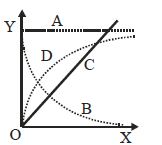
In the figure,$X$ represents time and $Y$ represents the activity of a radioactive sample. Then the activity of the sample varies with time according to the curve:
A
$A$
B
$B$
C
$C$
D
$D$
Solution
(B) The activity $A(t)$ of a radioactive sample at time $t$ is given by the law of radioactive decay:
$A(t) = -\frac{dN}{dt} = \lambda N = \lambda N_0 e^{-\lambda t}$
where $\lambda$ is the decay constant and $N_0$ is the initial number of radioactive nuclei.
This equation represents an exponential decay function.
As time $t$ increases,the activity $A(t)$ decreases exponentially from its initial value $\lambda N_0$ towards zero.
Looking at the provided graph,curve $B$ represents an exponential decay,which matches the mathematical relationship between activity and time.
Therefore,the correct curve is $B$.
$A(t) = -\frac{dN}{dt} = \lambda N = \lambda N_0 e^{-\lambda t}$
where $\lambda$ is the decay constant and $N_0$ is the initial number of radioactive nuclei.
This equation represents an exponential decay function.
As time $t$ increases,the activity $A(t)$ decreases exponentially from its initial value $\lambda N_0$ towards zero.
Looking at the provided graph,curve $B$ represents an exponential decay,which matches the mathematical relationship between activity and time.
Therefore,the correct curve is $B$.
0 likes
View Solution319
DifficultMCQ
$A$ small quantity of solution containing $Na^{24}$ radionuclide of activity $1 \, \mu Ci$ is injected into the blood of a person. $A$ sample of the blood of volume $1 \, cm^3$ taken after $5 \, hours$ shows an activity of $296$ disintegrations per minute. What will be the total volume of the blood in the body of the person? Assume that the radioactive solution mixes uniformly in the blood of the person: ............ $L$ (Take $1 \, Ci = 3.7 \times 10^{10}$ disintegrations per second and $e^{-\lambda t} = 0.7927$; where $\lambda$ is the disintegration constant).
A
$5.94$
B
$2$
C
$317$
D
$1$
Solution
(A) Initial activity $R_0 = 1 \, \mu Ci = 10^{-6} \times 3.7 \times 10^{10} \, dps = 3.7 \times 10^4 \, dps$.
Activity of $1 \, cm^3$ sample at $t = 5 \, hours$ is $r = \frac{296}{60} \, dps \approx 4.933 \, dps$.
The activity of the total blood volume $V$ at time $t$ is given by $R = R_0 e^{-\lambda t}$.
Since the radioactive substance is uniformly mixed,the activity per unit volume is $r = \frac{R}{V}$.
Therefore,$V = \frac{R}{r} = \frac{R_0 e^{-\lambda t}}{r}$.
Substituting the values: $V = \frac{3.7 \times 10^4 \times 0.7927}{4.933} \approx 5945 \, cm^3$.
Since $1000 \, cm^3 = 1 \, L$,the total volume $V \approx 5.94 \, L$.
Activity of $1 \, cm^3$ sample at $t = 5 \, hours$ is $r = \frac{296}{60} \, dps \approx 4.933 \, dps$.
The activity of the total blood volume $V$ at time $t$ is given by $R = R_0 e^{-\lambda t}$.
Since the radioactive substance is uniformly mixed,the activity per unit volume is $r = \frac{R}{V}$.
Therefore,$V = \frac{R}{r} = \frac{R_0 e^{-\lambda t}}{r}$.
Substituting the values: $V = \frac{3.7 \times 10^4 \times 0.7927}{4.933} \approx 5945 \, cm^3$.
Since $1000 \, cm^3 = 1 \, L$,the total volume $V \approx 5.94 \, L$.
0 likes
View Solution320
DifficultMCQ
The radioactivity of a given sample of whisky due to tritium (half-life $12.5 \text{ years}$) was found to be only $3\%$ of that measured in a recently purchased bottle marked "$7 \text{ years}$ old". The sample must have been prepared about:
A
$220 \text{ years}$ back
B
$300 \text{ years}$ back
C
$400 \text{ years}$ back
D
$70 \text{ years}$ back
Solution
(D) The activity $A$ at time $t$ is given by $A = A_0 (1/2)^n$, where $n$ is the number of half-lives.
Given that the activity is $3\%$ of the original, we have $0.03 = (1/2)^n$.
Taking the logarithm, $\ln(0.03) = n \ln(0.5)$, which gives $n = \ln(0.03) / \ln(0.5) \approx 5.06$.
Thus, the time elapsed for the tritium decay is $t = n \times T_{1/2} = 5.06 \times 12.5 \text{ years} \approx 63.25 \text{ years}$.
Since the reference bottle was already $7 \text{ years}$ old, the total age of the sample is $63.25 + 7 \approx 70.25 \text{ years}$.
Therefore, the sample was prepared about $70 \text{ years}$ back.
Given that the activity is $3\%$ of the original, we have $0.03 = (1/2)^n$.
Taking the logarithm, $\ln(0.03) = n \ln(0.5)$, which gives $n = \ln(0.03) / \ln(0.5) \approx 5.06$.
Thus, the time elapsed for the tritium decay is $t = n \times T_{1/2} = 5.06 \times 12.5 \text{ years} \approx 63.25 \text{ years}$.
Since the reference bottle was already $7 \text{ years}$ old, the total age of the sample is $63.25 + 7 \approx 70.25 \text{ years}$.
Therefore, the sample was prepared about $70 \text{ years}$ back.
0 likes
View Solution321
EasyMCQ
If the decay or disintegration constant of a radioactive substance is $\lambda$,then its half-life and mean life are respectively:
A
$\frac{1}{\lambda}$ and $\frac{\log_e 2}{\lambda}$
B
$\frac{\log_e 2}{\lambda}$ and $\frac{1}{\lambda}$
C
$\lambda \log_e 2$ and $\frac{1}{\lambda}$
D
$\frac{\lambda}{\log_e 2}$ and $\frac{1}{\lambda}$
Solution
(B) The half-life $(T_{1/2})$ of a radioactive substance is defined as the time required for half of the radioactive nuclei to decay. It is given by the formula: $T_{1/2} = \frac{\ln 2}{\lambda} = \frac{\log_e 2}{\lambda}$.
The mean life or average life ($T_{av}$ or $\tau$) is defined as the sum of the lives of all atoms divided by the total number of atoms. It is given by the formula: $T_{av} = \frac{1}{\lambda}$.
Therefore,the half-life and mean life are $\frac{\log_e 2}{\lambda}$ and $\frac{1}{\lambda}$ respectively.
The mean life or average life ($T_{av}$ or $\tau$) is defined as the sum of the lives of all atoms divided by the total number of atoms. It is given by the formula: $T_{av} = \frac{1}{\lambda}$.
Therefore,the half-life and mean life are $\frac{\log_e 2}{\lambda}$ and $\frac{1}{\lambda}$ respectively.
0 likes
View Solution322
MediumMCQ
$A$ radioactive element has a half-life period of $800$ years. After $6400$ years,what fraction of the initial amount will remain?
A
$1/4$
B
$1/16$
C
$1/8$
D
$1/256$
Solution
(D) The formula for the remaining fraction of a radioactive substance is given by $\frac{N}{N_{0}} = \left(\frac{1}{2}\right)^{n}$,where $n$ is the number of half-lives.
First,calculate the number of half-lives $n = \frac{t}{T_{1/2}} = \frac{6400}{800} = 8$.
Now,substitute the value of $n$ into the formula:
$\frac{N}{N_{0}} = \left(\frac{1}{2}\right)^{8} = \frac{1}{256}$.
Therefore,the fraction remaining after $6400$ years is $\frac{1}{256}$.
First,calculate the number of half-lives $n = \frac{t}{T_{1/2}} = \frac{6400}{800} = 8$.
Now,substitute the value of $n$ into the formula:
$\frac{N}{N_{0}} = \left(\frac{1}{2}\right)^{8} = \frac{1}{256}$.
Therefore,the fraction remaining after $6400$ years is $\frac{1}{256}$.
0 likes
View Solution323
DifficultMCQ
Two radioactive materials $X_1$ and $X_2$ have decay constants $5\lambda$ and $\lambda$ respectively. If initially they have the same number of nuclei,then the ratio of the number of nuclei of $X_1$ to that of $X_2$ will be $\frac{1}{e}$ after a time:
A
$\frac{1}{4\lambda}$
B
$\frac{e}{\lambda}$
C
$\lambda$
D
$\frac{1}{2}\lambda$
Solution
(A) The number of nuclei remaining at time $t$ is given by $N = N_0 e^{-\lambda t}$.
Given initial number of nuclei $N_0$ is the same for both materials.
Let $N_1$ and $N_2$ be the number of nuclei of $X_1$ and $X_2$ at time $t$ respectively.
$N_1 = N_0 e^{-5\lambda t}$ and $N_2 = N_0 e^{-\lambda t}$.
The ratio is $\frac{N_1}{N_2} = \frac{N_0 e^{-5\lambda t}}{N_0 e^{-\lambda t}} = e^{-5\lambda t + \lambda t} = e^{-4\lambda t}$.
We are given that $\frac{N_1}{N_2} = \frac{1}{e} = e^{-1}$.
Equating the exponents: $-4\lambda t = -1$.
Therefore,$t = \frac{1}{4\lambda}$.
Given initial number of nuclei $N_0$ is the same for both materials.
Let $N_1$ and $N_2$ be the number of nuclei of $X_1$ and $X_2$ at time $t$ respectively.
$N_1 = N_0 e^{-5\lambda t}$ and $N_2 = N_0 e^{-\lambda t}$.
The ratio is $\frac{N_1}{N_2} = \frac{N_0 e^{-5\lambda t}}{N_0 e^{-\lambda t}} = e^{-5\lambda t + \lambda t} = e^{-4\lambda t}$.
We are given that $\frac{N_1}{N_2} = \frac{1}{e} = e^{-1}$.
Equating the exponents: $-4\lambda t = -1$.
Therefore,$t = \frac{1}{4\lambda}$.
0 likes
View Solution324
MediumMCQ
$x$ fraction of a radioactive sample decays in $t$ time. What fraction will decay in $2t$ time?
A
$1-x^2$
B
$2x-x^2$
C
$1+x^2$
D
$2x+x^2$
Solution
(B) Let $N_0$ be the initial number of radioactive nuclei.
The fraction of nuclei that decay in time $t$ is $x = \frac{N_0 - N_t}{N_0} = 1 - \frac{N_t}{N_0}$.
From this,the fraction remaining after time $t$ is $\frac{N_t}{N_0} = 1 - x$.
According to the law of radioactive decay,the number of nuclei remaining after time $2t$ is $N_{2t} = N_0 \left( \frac{N_t}{N_0} \right)^2$.
Substituting the value of $\frac{N_t}{N_0}$,we get $N_{2t} = N_0 (1 - x)^2$.
The fraction of nuclei that decay in time $2t$ is given by $\frac{N_0 - N_{2t}}{N_0} = 1 - \frac{N_{2t}}{N_0}$.
Substituting $N_{2t}$,we get $1 - (1 - x)^2 = 1 - (1 - 2x + x^2) = 1 - 1 + 2x - x^2 = 2x - x^2$.
The fraction of nuclei that decay in time $t$ is $x = \frac{N_0 - N_t}{N_0} = 1 - \frac{N_t}{N_0}$.
From this,the fraction remaining after time $t$ is $\frac{N_t}{N_0} = 1 - x$.
According to the law of radioactive decay,the number of nuclei remaining after time $2t$ is $N_{2t} = N_0 \left( \frac{N_t}{N_0} \right)^2$.
Substituting the value of $\frac{N_t}{N_0}$,we get $N_{2t} = N_0 (1 - x)^2$.
The fraction of nuclei that decay in time $2t$ is given by $\frac{N_0 - N_{2t}}{N_0} = 1 - \frac{N_{2t}}{N_0}$.
Substituting $N_{2t}$,we get $1 - (1 - x)^2 = 1 - (1 - 2x + x^2) = 1 - 1 + 2x - x^2 = 2x - x^2$.
0 likes
View Solution325
MediumMCQ
The atomic weight of a radioactive element is $M_w \, g/mol$. The radioactivity of $m \, g$ of its mass is: ($N_A =$ Avogadro number,$\lambda =$ decay constant)
A
$N_A \lambda$
B
$\left( \frac{N_A}{M_w} m \right) \lambda$
C
$\left( \frac{N_A}{m} \right) \lambda$
D
$\left( \frac{N_A}{m} M_w \right) \lambda$
Solution
(B) The number of atoms $N$ in a mass $m$ is given by $N = \frac{m}{M_w} \times N_A$.
Radioactivity $R$ is defined as the rate of decay,given by $R = \lambda N$.
Substituting the value of $N$,we get $R = \lambda \left( \frac{m}{M_w} \times N_A \right) = \left( \frac{N_A}{M_w} m \right) \lambda$.
Radioactivity $R$ is defined as the rate of decay,given by $R = \lambda N$.
Substituting the value of $N$,we get $R = \lambda \left( \frac{m}{M_w} \times N_A \right) = \left( \frac{N_A}{M_w} m \right) \lambda$.
0 likes
View Solution326
DifficultMCQ
The half-life of a radioactive sample,where the initial activity of the material was $8 \text{ counts}$ and after $3 \text{ hours}$ it becomes $1 \text{ count}$,is ............... $hours$.
A
$2$
B
$1$
C
$3$
D
$4$
Solution
(B) The activity of a radioactive sample follows the law $A = A_0 \left( \frac{1}{2} \right)^n$,where $n$ is the number of half-lives.
Given,initial activity $A_0 = 8 \text{ counts}$ and final activity $A = 1 \text{ count}$.
Substituting the values: $1 = 8 \left( \frac{1}{2} \right)^n$.
This simplifies to $\left( \frac{1}{2} \right)^n = \frac{1}{8}$.
Since $\frac{1}{8} = \left( \frac{1}{2} \right)^3$,we have $n = 3$.
The total time $t = 3 \text{ hours}$.
The number of half-lives is given by $n = \frac{t}{T_{1/2}}$,where $T_{1/2}$ is the half-life.
Therefore,$3 = \frac{3}{T_{1/2}}$,which gives $T_{1/2} = 1 \text{ hour}$.
Given,initial activity $A_0 = 8 \text{ counts}$ and final activity $A = 1 \text{ count}$.
Substituting the values: $1 = 8 \left( \frac{1}{2} \right)^n$.
This simplifies to $\left( \frac{1}{2} \right)^n = \frac{1}{8}$.
Since $\frac{1}{8} = \left( \frac{1}{2} \right)^3$,we have $n = 3$.
The total time $t = 3 \text{ hours}$.
The number of half-lives is given by $n = \frac{t}{T_{1/2}}$,where $T_{1/2}$ is the half-life.
Therefore,$3 = \frac{3}{T_{1/2}}$,which gives $T_{1/2} = 1 \text{ hour}$.
0 likes
View Solution327
DifficultMCQ
$A$ fresh radioactive sample is given at $t = 0$. Its decay fraction is $\frac{1}{5}$ at $t_1$ instant and $\frac{4}{5}$ at $t_2$ instant. Its mean life is
A
$\frac{t_2 - t_1}{\ln 2}$
B
$\frac{t_2 - t_1}{\ln 4}$
C
$\frac{t_2 - t_1}{2}$
D
$\frac{t_2 - t_1}{4}$
Solution
(B) Let $N_0$ be the initial number of nuclei. The number of nuclei remaining at time $t$ is given by $N(t) = N_0 e^{-\lambda t}$.
At $t_1$,the decay fraction is $\frac{1}{5}$,so the remaining fraction is $1 - \frac{1}{5} = \frac{4}{5}$. Thus,$N(t_1) = N_0 \frac{4}{5} = N_0 e^{-\lambda t_1}$.
At $t_2$,the decay fraction is $\frac{4}{5}$,so the remaining fraction is $1 - \frac{4}{5} = \frac{1}{5}$. Thus,$N(t_2) = N_0 \frac{1}{5} = N_0 e^{-\lambda t_2}$.
Dividing the two equations: $\frac{N(t_1)}{N(t_2)} = \frac{4/5}{1/5} = 4 = \frac{e^{-\lambda t_1}}{e^{-\lambda t_2}} = e^{\lambda(t_2 - t_1)}$.
Taking the natural logarithm on both sides: $\ln 4 = \lambda(t_2 - t_1)$.
Since the mean life $\tau = \frac{1}{\lambda}$,we have $\lambda = \frac{1}{\tau}$.
Substituting this into the equation: $\ln 4 = \frac{t_2 - t_1}{\tau}$.
Therefore,$\tau = \frac{t_2 - t_1}{\ln 4}$.
At $t_1$,the decay fraction is $\frac{1}{5}$,so the remaining fraction is $1 - \frac{1}{5} = \frac{4}{5}$. Thus,$N(t_1) = N_0 \frac{4}{5} = N_0 e^{-\lambda t_1}$.
At $t_2$,the decay fraction is $\frac{4}{5}$,so the remaining fraction is $1 - \frac{4}{5} = \frac{1}{5}$. Thus,$N(t_2) = N_0 \frac{1}{5} = N_0 e^{-\lambda t_2}$.
Dividing the two equations: $\frac{N(t_1)}{N(t_2)} = \frac{4/5}{1/5} = 4 = \frac{e^{-\lambda t_1}}{e^{-\lambda t_2}} = e^{\lambda(t_2 - t_1)}$.
Taking the natural logarithm on both sides: $\ln 4 = \lambda(t_2 - t_1)$.
Since the mean life $\tau = \frac{1}{\lambda}$,we have $\lambda = \frac{1}{\tau}$.
Substituting this into the equation: $\ln 4 = \frac{t_2 - t_1}{\tau}$.
Therefore,$\tau = \frac{t_2 - t_1}{\ln 4}$.
0 likes
View Solution328
DifficultMCQ
Half-life of a radioactive substance is $20 \, min$. The time between $20\%$ and $80\%$ decay will be ......... $min$.
A
$20$
B
$40$
C
$30$
D
$25$
Solution
(B) The half-life of the substance is $T_{1/2} = 20 \, min$. The decay constant is $\lambda = \frac{\ln 2}{T_{1/2}} = \frac{\ln 2}{20}$.
Let $N_0$ be the initial amount of the substance.
For $20\%$ decay,the amount remaining is $N_1 = N_0 - 0.20 N_0 = 0.80 N_0$. The time taken is $t_1$,where $0.80 N_0 = N_0 e^{-\lambda t_1}$.
For $80\%$ decay,the amount remaining is $N_2 = N_0 - 0.80 N_0 = 0.20 N_0$. The time taken is $t_2$,where $0.20 N_0 = N_0 e^{-\lambda t_2}$.
Dividing the two equations:
$\frac{0.80 N_0}{0.20 N_0} = \frac{e^{-\lambda t_1}}{e^{-\lambda t_2}}$
$4 = e^{\lambda(t_2 - t_1)}$
Taking the natural logarithm on both sides:
$\ln 4 = \lambda(t_2 - t_1)$
$2 \ln 2 = \left( \frac{\ln 2}{20} \right) (t_2 - t_1)$
$2 = \frac{t_2 - t_1}{20}$
$t_2 - t_1 = 40 \, min$.
Let $N_0$ be the initial amount of the substance.
For $20\%$ decay,the amount remaining is $N_1 = N_0 - 0.20 N_0 = 0.80 N_0$. The time taken is $t_1$,where $0.80 N_0 = N_0 e^{-\lambda t_1}$.
For $80\%$ decay,the amount remaining is $N_2 = N_0 - 0.80 N_0 = 0.20 N_0$. The time taken is $t_2$,where $0.20 N_0 = N_0 e^{-\lambda t_2}$.
Dividing the two equations:
$\frac{0.80 N_0}{0.20 N_0} = \frac{e^{-\lambda t_1}}{e^{-\lambda t_2}}$
$4 = e^{\lambda(t_2 - t_1)}$
Taking the natural logarithm on both sides:
$\ln 4 = \lambda(t_2 - t_1)$
$2 \ln 2 = \left( \frac{\ln 2}{20} \right) (t_2 - t_1)$
$2 = \frac{t_2 - t_1}{20}$
$t_2 - t_1 = 40 \, min$.
0 likes
View Solution329
DifficultMCQ
The half-life period of a radioactive element is $10$ days. How long does it take for $90\%$ of a given mass of this element to disintegrate?
A
$19$
B
$27$
C
$33$
D
$47$
Solution
(C) The radioactive decay law is given by $N(t) = N_0(1/2)^{t/T_{1/2}}$,where $N(t)$ is the amount remaining at time $t$,$N_0$ is the initial amount,and $T_{1/2} = 10$ days.
If $90\%$ of the element disintegrates,the amount remaining is $N(t) = 10\%$ of $N_0 = 0.1 N_0$.
Substituting this into the decay equation: $0.1 N_0 = N_0(1/2)^{t/10}$.
$0.1 = (1/2)^{t/10}$.
Taking the logarithm on both sides: $\log_{10}(0.1) = (t/10) \log_{10}(0.5)$.
$-1 = (t/10) \times (-0.3010)$.
$t/10 = 1 / 0.3010 \approx 3.322$.
$t \approx 33.22$ days.
Rounding to the nearest integer,the time taken is $33$ days.
If $90\%$ of the element disintegrates,the amount remaining is $N(t) = 10\%$ of $N_0 = 0.1 N_0$.
Substituting this into the decay equation: $0.1 N_0 = N_0(1/2)^{t/10}$.
$0.1 = (1/2)^{t/10}$.
Taking the logarithm on both sides: $\log_{10}(0.1) = (t/10) \log_{10}(0.5)$.
$-1 = (t/10) \times (-0.3010)$.
$t/10 = 1 / 0.3010 \approx 3.322$.
$t \approx 33.22$ days.
Rounding to the nearest integer,the time taken is $33$ days.
0 likes
View Solution330
DifficultMCQ
The half-life of a radioactive substance is $20 \ min$. The time taken for the decay to increase from $20\%$ to $80\%$ is ........ $min$.
A
$20$
B
$40$
C
$30$
D
$25$
Solution
(B) Given,half-life $T_{1/2} = 20 \ min$. The decay constant is $\lambda = \frac{\ln 2}{T_{1/2}} = \frac{\ln 2}{20} \ min^{-1}$.
Let $N_0$ be the initial amount of radioactive substance.
At time $t_1$,$20\%$ has decayed,so the remaining amount is $N(t_1) = 0.8 N_0$. Using $N(t) = N_0 e^{-\lambda t}$,we have $0.8 N_0 = N_0 e^{-\lambda t_1} \implies e^{-\lambda t_1} = 0.8$.
At time $t_2$,$80\%$ has decayed,so the remaining amount is $N(t_2) = 0.2 N_0$. Thus,$0.2 N_0 = N_0 e^{-\lambda t_2} \implies e^{-\lambda t_2} = 0.2$.
Dividing the two equations: $\frac{e^{-\lambda t_1}}{e^{-\lambda t_2}} = \frac{0.8}{0.2} = 4$.
$e^{\lambda(t_2 - t_1)} = 4$.
Taking the natural logarithm on both sides: $\lambda(t_2 - t_1) = \ln 4 = 2 \ln 2$.
Substituting $\lambda = \frac{\ln 2}{20}$:
$\frac{\ln 2}{20} (t_2 - t_1) = 2 \ln 2$.
$t_2 - t_1 = 2 \times 20 = 40 \ min$.
Let $N_0$ be the initial amount of radioactive substance.
At time $t_1$,$20\%$ has decayed,so the remaining amount is $N(t_1) = 0.8 N_0$. Using $N(t) = N_0 e^{-\lambda t}$,we have $0.8 N_0 = N_0 e^{-\lambda t_1} \implies e^{-\lambda t_1} = 0.8$.
At time $t_2$,$80\%$ has decayed,so the remaining amount is $N(t_2) = 0.2 N_0$. Thus,$0.2 N_0 = N_0 e^{-\lambda t_2} \implies e^{-\lambda t_2} = 0.2$.
Dividing the two equations: $\frac{e^{-\lambda t_1}}{e^{-\lambda t_2}} = \frac{0.8}{0.2} = 4$.
$e^{\lambda(t_2 - t_1)} = 4$.
Taking the natural logarithm on both sides: $\lambda(t_2 - t_1) = \ln 4 = 2 \ln 2$.
Substituting $\lambda = \frac{\ln 2}{20}$:
$\frac{\ln 2}{20} (t_2 - t_1) = 2 \ln 2$.
$t_2 - t_1 = 2 \times 20 = 40 \ min$.
0 likes
View Solution331
DifficultMCQ
The half-life period of a radioactive sample is $T$. If a fraction $x$ disintegrates in time $t$,what fraction will decay in time $\frac{t}{2}$?
A
$\frac{x}{2}$
B
$\frac{x}{\sqrt{2}}$
C
$1 - \frac{x}{\sqrt{2}}$
D
$1 - \sqrt{1 - x}$
Solution
(D) Let $N_0$ be the initial number of radioactive nuclei.
At time $t$,the fraction of nuclei that have disintegrated is $x$.
Therefore,the fraction of nuclei remaining is $N(t)/N_0 = 1 - x$.
According to the law of radioactive decay,$N(t) = N_0(1/2)^{t/T}$.
So,$1 - x = (1/2)^{t/T}$.
Now,we need to find the fraction decayed in time $t/2$,which is $1 - N(t/2)/N_0$.
$N(t/2)/N_0 = (1/2)^{(t/2)/T} = [(1/2)^{t/T}]^{1/2}$.
Substituting $1 - x = (1/2)^{t/T}$,we get $N(t/2)/N_0 = \sqrt{1 - x}$.
The fraction that decays in time $t/2$ is $1 - N(t/2)/N_0 = 1 - \sqrt{1 - x}$.
At time $t$,the fraction of nuclei that have disintegrated is $x$.
Therefore,the fraction of nuclei remaining is $N(t)/N_0 = 1 - x$.
According to the law of radioactive decay,$N(t) = N_0(1/2)^{t/T}$.
So,$1 - x = (1/2)^{t/T}$.
Now,we need to find the fraction decayed in time $t/2$,which is $1 - N(t/2)/N_0$.
$N(t/2)/N_0 = (1/2)^{(t/2)/T} = [(1/2)^{t/T}]^{1/2}$.
Substituting $1 - x = (1/2)^{t/T}$,we get $N(t/2)/N_0 = \sqrt{1 - x}$.
The fraction that decays in time $t/2$ is $1 - N(t/2)/N_0 = 1 - \sqrt{1 - x}$.
0 likes
View Solution332
DifficultMCQ
The half-life of a radioactive isotope $x$ is $50$ years. It decays to another element $y$ which is stable. The two elements $x$ and $y$ were found to be in the ratio of $1 : 7$ in a sample of a given rock. The age of the rock was estimated to be ........... $years$.
A
$150$
B
$200$
C
$250$
D
$100$
Solution
(A) Let $N_x$ be the amount of radioactive isotope $x$ and $N_y$ be the amount of stable element $y$ present in the rock.
The ratio is given as $N_x : N_y = 1 : 7$.
The initial amount of the radioactive isotope $N_0$ is the sum of the remaining isotope and the decayed product:
$N_0 = N_x + N_y = 1 + 7 = 8$.
We know that $N_x = N_0 \times (1/2)^n$, where $n$ is the number of half-lives.
$1 = 8 \times (1/2)^n \Rightarrow (1/2)^n = 1/8 = (1/2)^3$.
Thus, $n = 3$.
The age of the rock $t$ is given by $t = n \times T_{1/2}$, where $T_{1/2} = 50$ years.
$t = 3 \times 50 = 150$ $years$.
The ratio is given as $N_x : N_y = 1 : 7$.
The initial amount of the radioactive isotope $N_0$ is the sum of the remaining isotope and the decayed product:
$N_0 = N_x + N_y = 1 + 7 = 8$.
We know that $N_x = N_0 \times (1/2)^n$, where $n$ is the number of half-lives.
$1 = 8 \times (1/2)^n \Rightarrow (1/2)^n = 1/8 = (1/2)^3$.
Thus, $n = 3$.
The age of the rock $t$ is given by $t = n \times T_{1/2}$, where $T_{1/2} = 50$ years.
$t = 3 \times 50 = 150$ $years$.
0 likes
View Solution333
DifficultMCQ
$A$ radioactive sample at any instant has its disintegration rate $5000$ disintegrations per minute. After $5\, minutes$,the rate becomes $1250$ disintegrations per minute. Then,its decay constant (per minute) is
A
$0.8\, \log_e 2$
B
$0.4\, \log_e 2$
C
$0.2\, \log_e 2$
D
$0.1\, \log_e 2$
Solution
(B) The activity $R$ of a radioactive sample at time $t$ is given by the law of radioactive decay: $R = R_0 e^{-\lambda t}$.
Rearranging the formula,we get: $\frac{R_0}{R} = e^{\lambda t}$.
Taking the natural logarithm on both sides: $\lambda t = \log_e \left( \frac{R_0}{R} \right)$.
Therefore,the decay constant $\lambda$ is: $\lambda = \frac{1}{t} \log_e \left( \frac{R_0}{R} \right)$.
Given values are: $R_0 = 5000 \text{ disintegrations/min}$,$R = 1250 \text{ disintegrations/min}$,and $t = 5 \text{ min}$.
Substituting these values into the equation:
$\lambda = \frac{1}{5} \log_e \left( \frac{5000}{1250} \right) = \frac{1}{5} \log_e (4)$.
Since $4 = 2^2$,we have:
$\lambda = \frac{1}{5} \log_e (2^2) = \frac{2}{5} \log_e 2$.
Calculating the fraction: $\frac{2}{5} = 0.4$.
Thus,the decay constant is $\lambda = 0.4 \log_e 2 \text{ min}^{-1}$.
Rearranging the formula,we get: $\frac{R_0}{R} = e^{\lambda t}$.
Taking the natural logarithm on both sides: $\lambda t = \log_e \left( \frac{R_0}{R} \right)$.
Therefore,the decay constant $\lambda$ is: $\lambda = \frac{1}{t} \log_e \left( \frac{R_0}{R} \right)$.
Given values are: $R_0 = 5000 \text{ disintegrations/min}$,$R = 1250 \text{ disintegrations/min}$,and $t = 5 \text{ min}$.
Substituting these values into the equation:
$\lambda = \frac{1}{5} \log_e \left( \frac{5000}{1250} \right) = \frac{1}{5} \log_e (4)$.
Since $4 = 2^2$,we have:
$\lambda = \frac{1}{5} \log_e (2^2) = \frac{2}{5} \log_e 2$.
Calculating the fraction: $\frac{2}{5} = 0.4$.
Thus,the decay constant is $\lambda = 0.4 \log_e 2 \text{ min}^{-1}$.
0 likes
View Solution334
MediumMCQ
$A$ certain radioactive substance has a half-life of $5\, years$. Thus, for a nucleus in a sample of the element, the probability of decay in $10\, years$ is ......... $\%$
A
$50$
B
$75$
C
$100$
D
$60$
Solution
(B) The half-life of the radioactive substance is $T_{1/2} = 5\, years$.
The total time elapsed is $t = 10\, years$.
The number of half-lives passed is $n = t / T_{1/2} = 10 / 5 = 2$.
The fraction of undecayed nuclei remaining after $n$ half-lives is given by $N/N_0 = (1/2)^n$.
Substituting $n = 2$, we get $N/N_0 = (1/2)^2 = 1/4$.
This means $1/4$ of the original nuclei remain undecayed.
The fraction of nuclei that have decayed is $1 - N/N_0 = 1 - 1/4 = 3/4$.
To express this as a percentage, we multiply by $100$: $(3/4) \times 100\% = 75\%$.
Therefore, the probability of decay for a nucleus in $10\, years$ is $75\%$.
The total time elapsed is $t = 10\, years$.
The number of half-lives passed is $n = t / T_{1/2} = 10 / 5 = 2$.
The fraction of undecayed nuclei remaining after $n$ half-lives is given by $N/N_0 = (1/2)^n$.
Substituting $n = 2$, we get $N/N_0 = (1/2)^2 = 1/4$.
This means $1/4$ of the original nuclei remain undecayed.
The fraction of nuclei that have decayed is $1 - N/N_0 = 1 - 1/4 = 3/4$.
To express this as a percentage, we multiply by $100$: $(3/4) \times 100\% = 75\%$.
Therefore, the probability of decay for a nucleus in $10\, years$ is $75\%$.
0 likes
View Solution335
DifficultMCQ
$A$ freshly prepared radioactive source of half-life $2\, hours$ emits radiation of intensity which is $64\, times$ the permissible safe level. The minimum time after which it would be possible to work safely with the source is .......... $hours$.
A
$6$
B
$12$
C
$24$
D
$128$
Solution
(B) The intensity of radiation $I$ follows the law $I = I_0 \left( \frac{1}{2} \right)^n$, where $n$ is the number of half-lives.
Given that the initial intensity $I_0 = 64 \times I_{\text{safe}}$, we want to find the time when $I = I_{\text{safe}}$.
Substituting the values: $I_{\text{safe}} = 64 \times I_{\text{safe}} \times \left( \frac{1}{2} \right)^n$.
This simplifies to $\left( \frac{1}{2} \right)^n = \frac{1}{64}$.
Since $64 = 2^6$, we have $\left( \frac{1}{2} \right)^n = \left( \frac{1}{2} \right)^6$, which implies $n = 6$.
The total time $t = n \times T_{1/2}$, where $T_{1/2} = 2\, hours$.
Therefore, $t = 6 \times 2\, hours = 12\, hours$.
Given that the initial intensity $I_0 = 64 \times I_{\text{safe}}$, we want to find the time when $I = I_{\text{safe}}$.
Substituting the values: $I_{\text{safe}} = 64 \times I_{\text{safe}} \times \left( \frac{1}{2} \right)^n$.
This simplifies to $\left( \frac{1}{2} \right)^n = \frac{1}{64}$.
Since $64 = 2^6$, we have $\left( \frac{1}{2} \right)^n = \left( \frac{1}{2} \right)^6$, which implies $n = 6$.
The total time $t = n \times T_{1/2}$, where $T_{1/2} = 2\, hours$.
Therefore, $t = 6 \times 2\, hours = 12\, hours$.
0 likes
View Solution336
MediumMCQ
The half-life of a radioactive element is $12.5 \; h$ and its initial quantity is $256 \; g$. After how much time (in $h$) will its quantity remain $1 \; g$?
A
$50$
B
$100$
C
$150$
D
$200$
Solution
(B) The formula for radioactive decay is given by $M = M_{0} \left(\frac{1}{2}\right)^{n}$,where $n = \frac{t}{T_{1/2}}$ is the number of half-lives.
Given: $M = 1 \; g$,$M_{0} = 256 \; g$,and $T_{1/2} = 12.5 \; h$.
Substituting the values: $1 = 256 \left(\frac{1}{2}\right)^{n}$.
This simplifies to $\frac{1}{256} = \left(\frac{1}{2}\right)^{n}$.
Since $256 = 2^{8}$,we have $\left(\frac{1}{2}\right)^{8} = \left(\frac{1}{2}\right)^{n}$.
Therefore,$n = 8$.
Using $n = \frac{t}{T_{1/2}}$,we get $t = n \times T_{1/2} = 8 \times 12.5 \; h = 100 \; h$.
Given: $M = 1 \; g$,$M_{0} = 256 \; g$,and $T_{1/2} = 12.5 \; h$.
Substituting the values: $1 = 256 \left(\frac{1}{2}\right)^{n}$.
This simplifies to $\frac{1}{256} = \left(\frac{1}{2}\right)^{n}$.
Since $256 = 2^{8}$,we have $\left(\frac{1}{2}\right)^{8} = \left(\frac{1}{2}\right)^{n}$.
Therefore,$n = 8$.
Using $n = \frac{t}{T_{1/2}}$,we get $t = n \times T_{1/2} = 8 \times 12.5 \; h = 100 \; h$.
0 likes
View Solution337
MediumMCQ
Two radioactive nuclei $A$ and $B$ both convert into a stable nucleus $C$. At time $t = 0$,the number of nuclei of $A$ is $4N_0$ and that of $B$ is $N_0$. The half-life of $A$ is $1 \, min$ and that of $B$ is $2 \, min$. Initially,the number of nuclei of $C$ is zero. At what time are the rates of disintegration of $A$ and $B$ equal?
A
$4$
B
$6$
C
$8$
D
$2$
Solution
(B) The rate of disintegration is given by $R = \lambda N$,where $\lambda = \frac{\ln 2}{T_{1/2}}$.
For nucleus $A$: $T_{1/2, A} = 1 \, min$,so $\lambda_A = \frac{\ln 2}{1} = \ln 2 \, min^{-1}$.
For nucleus $B$: $T_{1/2, B} = 2 \, min$,so $\lambda_B = \frac{\ln 2}{2} \, min^{-1}$.
The number of nuclei at time $t$ is $N_A(t) = 4N_0 e^{-\lambda_A t}$ and $N_B(t) = N_0 e^{-\lambda_B t}$.
The rates of disintegration are $R_A = \lambda_A N_A = \lambda_A (4N_0 e^{-\lambda_A t})$ and $R_B = \lambda_B N_B = \lambda_B (N_0 e^{-\lambda_B t})$.
Setting $R_A = R_B$:
$4 \lambda_A N_0 e^{-\lambda_A t} = \lambda_B N_0 e^{-\lambda_B t}$
$4 (\ln 2) e^{-(\ln 2) t} = \frac{\ln 2}{2} e^{-(\frac{\ln 2}{2}) t}$
$8 = \frac{e^{-(\frac{\ln 2}{2}) t}}{e^{-(\ln 2) t}} = e^{(\ln 2 - \frac{\ln 2}{2}) t} = e^{(\frac{\ln 2}{2}) t}$
Taking the natural logarithm on both sides:
$\ln 8 = \frac{\ln 2}{2} t$
$3 \ln 2 = \frac{\ln 2}{2} t$
$t = 6 \, min$.
For nucleus $A$: $T_{1/2, A} = 1 \, min$,so $\lambda_A = \frac{\ln 2}{1} = \ln 2 \, min^{-1}$.
For nucleus $B$: $T_{1/2, B} = 2 \, min$,so $\lambda_B = \frac{\ln 2}{2} \, min^{-1}$.
The number of nuclei at time $t$ is $N_A(t) = 4N_0 e^{-\lambda_A t}$ and $N_B(t) = N_0 e^{-\lambda_B t}$.
The rates of disintegration are $R_A = \lambda_A N_A = \lambda_A (4N_0 e^{-\lambda_A t})$ and $R_B = \lambda_B N_B = \lambda_B (N_0 e^{-\lambda_B t})$.
Setting $R_A = R_B$:
$4 \lambda_A N_0 e^{-\lambda_A t} = \lambda_B N_0 e^{-\lambda_B t}$
$4 (\ln 2) e^{-(\ln 2) t} = \frac{\ln 2}{2} e^{-(\frac{\ln 2}{2}) t}$
$8 = \frac{e^{-(\frac{\ln 2}{2}) t}}{e^{-(\ln 2) t}} = e^{(\ln 2 - \frac{\ln 2}{2}) t} = e^{(\frac{\ln 2}{2}) t}$
Taking the natural logarithm on both sides:
$\ln 8 = \frac{\ln 2}{2} t$
$3 \ln 2 = \frac{\ln 2}{2} t$
$t = 6 \, min$.
0 likes
View Solution338
MediumMCQ
At $t = 0$,the number of active nuclei in a sample is $N_0$. How many nuclei will decay in the time interval between its first mean life and second half-life?
A
$\frac{N_0}{e}$
B
$\frac{N_0}{e} - \frac{N_0}{4}$
C
$\frac{N_0}{2} - \frac{N_0}{e}$
D
$\frac{N_0}{4}$
Solution
(B) The number of active nuclei at any time $t$ is given by $N(t) = N_0 e^{-\lambda t}$.
The mean life is $\tau = \frac{1}{\lambda}$. At $t = \tau$,the number of remaining nuclei is $N_1 = N_0 e^{-\lambda(1/\lambda)} = \frac{N_0}{e}$.
The half-life is $T_{1/2} = \frac{\ln 2}{\lambda}$. At $t = 2T_{1/2}$,the number of remaining nuclei is $N_2 = N_0 (\frac{1}{2})^2 = \frac{N_0}{4}$.
The number of nuclei that decay between these two times is the difference in the number of remaining nuclei: $\Delta N = N_1 - N_2 = \frac{N_0}{e} - \frac{N_0}{4}$.
The mean life is $\tau = \frac{1}{\lambda}$. At $t = \tau$,the number of remaining nuclei is $N_1 = N_0 e^{-\lambda(1/\lambda)} = \frac{N_0}{e}$.
The half-life is $T_{1/2} = \frac{\ln 2}{\lambda}$. At $t = 2T_{1/2}$,the number of remaining nuclei is $N_2 = N_0 (\frac{1}{2})^2 = \frac{N_0}{4}$.
The number of nuclei that decay between these two times is the difference in the number of remaining nuclei: $\Delta N = N_1 - N_2 = \frac{N_0}{e} - \frac{N_0}{4}$.
0 likes
View Solution339
DifficultMCQ
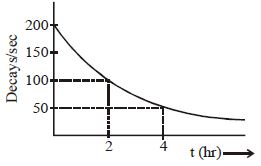
The decay rate for a certain mass of a radioactive substance measured at different times varies with time as shown in the figure. The count rate at $t = 8 \, hr$ will be:
A
$\frac{25}{2} \, \text{decays/sec}$
B
$50 \, \text{decays/sec}$
C
$500 \, \text{decays/sec}$
D
$750 \, \text{decays/sec}$
Solution
(A) From the graph, at $t = 0 \, hr$, the initial decay rate $R_0 = 200 \, \text{decays/sec}$.
At $t = 2 \, hr$, the decay rate $R = 100 \, \text{decays/sec}$.
Since the decay rate becomes half of its initial value in $2 \, hr$, the half-life $T_{1/2} = 2 \, hr$.
The decay rate at any time $t$ is given by $R = R_0 \left( \frac{1}{2} \right)^{t/T_{1/2}}$.
For $t = 8 \, hr$, $R = 200 \left( \frac{1}{2} \right)^{8/2} = 200 \left( \frac{1}{2} \right)^4 = \frac{200}{16} = \frac{25}{2} \, \text{decays/sec}$.
At $t = 2 \, hr$, the decay rate $R = 100 \, \text{decays/sec}$.
Since the decay rate becomes half of its initial value in $2 \, hr$, the half-life $T_{1/2} = 2 \, hr$.
The decay rate at any time $t$ is given by $R = R_0 \left( \frac{1}{2} \right)^{t/T_{1/2}}$.
For $t = 8 \, hr$, $R = 200 \left( \frac{1}{2} \right)^{8/2} = 200 \left( \frac{1}{2} \right)^4 = \frac{200}{16} = \frac{25}{2} \, \text{decays/sec}$.
0 likes
View Solution340
DifficultMCQ
The activity of a sample of radioactive material is $A_1$ at time $t_1$ and $A_2$ at time $t_2$ $(t_2 > t_1)$. If its mean life is $T$,then which of the following is true?
A
$A_1t_1 = A_2t_2$
B
$A_1 - A_2 = t_2 - t_1$
C
$A_2 = A_1 e^{(t_1 - t_2)/T}$
D
$A_2 = A_1^{(t_1 / t_2)/T}$
Solution
(C) Let $A_0$ be the initial activity of the radioactive sample.
The activity at any time $t$ is given by the law of radioactive decay: $A = A_0 e^{-\lambda t}$,where $\lambda$ is the decay constant.
At time $t_1$,the activity is $A_1 = A_0 e^{-\lambda t_1}$.
At time $t_2$,the activity is $A_2 = A_0 e^{-\lambda t_2}$.
Dividing the two equations: $\frac{A_2}{A_1} = \frac{A_0 e^{-\lambda t_2}}{A_0 e^{-\lambda t_1}} = e^{-\lambda(t_2 - t_1)}$.
Since the mean life $T = \frac{1}{\lambda}$,we can substitute $\lambda = \frac{1}{T}$.
Thus,$\frac{A_2}{A_1} = e^{-(t_2 - t_1)/T} = e^{(t_1 - t_2)/T}$.
Therefore,$A_2 = A_1 e^{(t_1 - t_2)/T}$.
The activity at any time $t$ is given by the law of radioactive decay: $A = A_0 e^{-\lambda t}$,where $\lambda$ is the decay constant.
At time $t_1$,the activity is $A_1 = A_0 e^{-\lambda t_1}$.
At time $t_2$,the activity is $A_2 = A_0 e^{-\lambda t_2}$.
Dividing the two equations: $\frac{A_2}{A_1} = \frac{A_0 e^{-\lambda t_2}}{A_0 e^{-\lambda t_1}} = e^{-\lambda(t_2 - t_1)}$.
Since the mean life $T = \frac{1}{\lambda}$,we can substitute $\lambda = \frac{1}{T}$.
Thus,$\frac{A_2}{A_1} = e^{-(t_2 - t_1)/T} = e^{(t_1 - t_2)/T}$.
Therefore,$A_2 = A_1 e^{(t_1 - t_2)/T}$.
0 likes
View Solution341
MediumMCQ
Starting with a sample of pure ${}^{66}Cu$,$\frac{7}{8}$ of it decays into $Zn$ in $15 \ minutes$. The corresponding half-life is .......... $minutes$.
A
$15$
B
$10$
C
$7\frac{1}{2}$
D
$5$
Solution
(D) Given that $\frac{7}{8}$ of the sample of ${}^{66}Cu$ decays in $15 \ minutes$.
The fraction of the sample remaining undecayed is $N = 1 - \frac{7}{8} = \frac{1}{8}$.
We know that the remaining amount $N$ after $n$ half-lives is given by $N = \left(\frac{1}{2}\right)^n$.
Since $\frac{1}{8} = \left(\frac{1}{2}\right)^3$,the number of half-lives $n$ is $3$.
The relationship between time $t$,number of half-lives $n$,and half-life $T$ is $n = \frac{t}{T}$.
Substituting the values,$3 = \frac{15}{T}$.
Therefore,the half-life $T = \frac{15}{3} = 5 \ minutes$.
The fraction of the sample remaining undecayed is $N = 1 - \frac{7}{8} = \frac{1}{8}$.
We know that the remaining amount $N$ after $n$ half-lives is given by $N = \left(\frac{1}{2}\right)^n$.
Since $\frac{1}{8} = \left(\frac{1}{2}\right)^3$,the number of half-lives $n$ is $3$.
The relationship between time $t$,number of half-lives $n$,and half-life $T$ is $n = \frac{t}{T}$.
Substituting the values,$3 = \frac{15}{T}$.
Therefore,the half-life $T = \frac{15}{3} = 5 \ minutes$.
0 likes
View Solution342
MediumMCQ
The activity of a radioactive sample decreases to $(1/3)$ of its original value in $3\, \text{days}$. Then, in $9\, \text{days}$, its activity will become:
A
$(1/27)$ of the original value
B
$(1/9)$ of the original value
C
$(1/18)$ of the original value
D
$(1/3)$ of the original value
Solution
(A) The activity of a radioactive sample is given by $R = R_0 e^{-\lambda t}$.
Given that in $t = 3\, \text{days}$, the activity becomes $R = R_0/3$:
$\frac{1}{3} = e^{-\lambda \times 3} = e^{-3\lambda}$ .........$(1)$
We need to find the activity $R'$ after $t = 9\, \text{days}$:
$R' = R_0 e^{-\lambda \times 9} = R_0 (e^{-3\lambda})^3$
Substituting the value from equation $(1)$:
$R' = R_0 \times (1/3)^3$
$R' = R_0 \times (1/27)$
Therefore, the activity becomes $(1/27)$ of the original value.
Given that in $t = 3\, \text{days}$, the activity becomes $R = R_0/3$:
$\frac{1}{3} = e^{-\lambda \times 3} = e^{-3\lambda}$ .........$(1)$
We need to find the activity $R'$ after $t = 9\, \text{days}$:
$R' = R_0 e^{-\lambda \times 9} = R_0 (e^{-3\lambda})^3$
Substituting the value from equation $(1)$:
$R' = R_0 \times (1/3)^3$
$R' = R_0 \times (1/27)$
Therefore, the activity becomes $(1/27)$ of the original value.
0 likes
View Solution343
MediumMCQ
The half-life of a radioactive substance against $\alpha$-decay is $1.2 \times 10^7 \, s$. What is the decay rate for $4.0 \times 10^{15}$ atoms of the substance?
A
$4.6 \times 10^{12} \, \text{atoms/s}$
B
$2.3 \times 10^{11} \, \text{atoms/s}$
C
$4.6 \times 10^{10} \, \text{atoms/s}$
D
$2.3 \times 10^{8} \, \text{atoms/s}$
Solution
(D) The decay rate (activity) is given by the formula: $\frac{dN}{dt} = \lambda N$.
First, calculate the decay constant $\lambda$ using the half-life $T_{1/2} = 1.2 \times 10^7 \, s$:
$\lambda = \frac{0.693}{T_{1/2}} = \frac{0.693}{1.2 \times 10^7} \, s^{-1}$.
Now, substitute the values of $\lambda$ and $N = 4.0 \times 10^{15}$ atoms into the decay rate formula:
$\frac{dN}{dt} = \left( \frac{0.693}{1.2 \times 10^7} \right) \times (4.0 \times 10^{15})$
$\frac{dN}{dt} = \frac{0.693 \times 4.0}{1.2} \times 10^{15-7}$
$\frac{dN}{dt} = \frac{2.772}{1.2} \times 10^8$
$\frac{dN}{dt} = 2.31 \times 10^8 \, \text{atoms/s}$.
Rounding to the appropriate significant figures, the decay rate is $2.3 \times 10^8 \, \text{atoms/s}$.
First, calculate the decay constant $\lambda$ using the half-life $T_{1/2} = 1.2 \times 10^7 \, s$:
$\lambda = \frac{0.693}{T_{1/2}} = \frac{0.693}{1.2 \times 10^7} \, s^{-1}$.
Now, substitute the values of $\lambda$ and $N = 4.0 \times 10^{15}$ atoms into the decay rate formula:
$\frac{dN}{dt} = \left( \frac{0.693}{1.2 \times 10^7} \right) \times (4.0 \times 10^{15})$
$\frac{dN}{dt} = \frac{0.693 \times 4.0}{1.2} \times 10^{15-7}$
$\frac{dN}{dt} = \frac{2.772}{1.2} \times 10^8$
$\frac{dN}{dt} = 2.31 \times 10^8 \, \text{atoms/s}$.
Rounding to the appropriate significant figures, the decay rate is $2.3 \times 10^8 \, \text{atoms/s}$.
0 likes
View Solution344
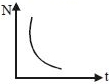
MediumMCQ
$A$ radioactive element decays to form a stable nuclide. The graph representing the number of radioactive nuclei $(N)$ versus time $(t)$ is:
A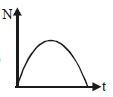
B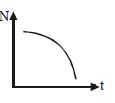
C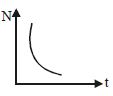
D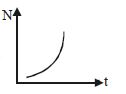
Solution
(C) The number of radioactive nuclei $N$ at any time $t$ is given by the radioactive decay law:
$N(t) = N_0 e^{-\lambda t}$
Where $N_0$ is the initial number of radioactive nuclei at $t = 0$ and $\lambda$ is the decay constant.
This equation represents an exponential decay function,which is of the form $y = a e^{-kx}$.
As $t$ increases,$N$ decreases exponentially from the initial value $N_0$ and approaches zero as $t \to \infty$.
Therefore,the correct graph is the one showing an exponential decay curve starting from a positive value on the $N$-axis,which corresponds to option $C$.
$N(t) = N_0 e^{-\lambda t}$
Where $N_0$ is the initial number of radioactive nuclei at $t = 0$ and $\lambda$ is the decay constant.
This equation represents an exponential decay function,which is of the form $y = a e^{-kx}$.
As $t$ increases,$N$ decreases exponentially from the initial value $N_0$ and approaches zero as $t \to \infty$.
Therefore,the correct graph is the one showing an exponential decay curve starting from a positive value on the $N$-axis,which corresponds to option $C$.
0 likes
View Solution345
EasyMCQ
An archaeologist analyses the wood in a prehistoric structure and finds that the ratio of $C^{14}$ (half-life $= 5700 \, years$) to $C^{12}$ is only one-fourth of that found in the cells of buried plants. The age of the wood is about .......... $years$.
A
$5700$
B
$2850$
C
$11400$
D
$22800$
Solution
(C) The radioactive decay law is given by $N(t) = N_0 \left(\frac{1}{2}\right)^{t/T_{1/2}}$.
Given that the ratio of $C^{14}$ to $C^{12}$ is one-fourth of the original amount,we have $\frac{N(t)}{N_0} = \frac{1}{4}$.
Substituting the values,we get $\frac{1}{4} = \left(\frac{1}{2}\right)^{t/5700}$.
Since $\frac{1}{4} = \left(\frac{1}{2}\right)^2$,we can equate the exponents: $2 = \frac{t}{5700}$.
Solving for $t$,we get $t = 2 \times 5700 = 11400 \, years$.
Given that the ratio of $C^{14}$ to $C^{12}$ is one-fourth of the original amount,we have $\frac{N(t)}{N_0} = \frac{1}{4}$.
Substituting the values,we get $\frac{1}{4} = \left(\frac{1}{2}\right)^{t/5700}$.
Since $\frac{1}{4} = \left(\frac{1}{2}\right)^2$,we can equate the exponents: $2 = \frac{t}{5700}$.
Solving for $t$,we get $t = 2 \times 5700 = 11400 \, years$.
0 likes
View Solution346
DifficultMCQ
$A$ radioactive nuclide is produced at a constant rate of $n$ per second (e.g.,by bombarding a target with neutrons). If the number of nuclei at $t = 0$ is $N_0$,the number of nuclei $N$ at time $t$ is given by (where $\lambda$ is the decay constant):
A
$N = N_0 e^{-\lambda t}$
B
$N = \frac{n}{\lambda} + N_0 e^{-\lambda t}$
C
$N = \frac{n}{\lambda} + \left( N_0 - \frac{n}{\lambda} \right) e^{-\lambda t}$
D
$N = \frac{n}{\lambda} + \left( N_0 + \frac{n}{\lambda} \right) e^{-\lambda t}$
Solution
(C) The rate of change of the number of nuclei $N$ is given by the production rate minus the decay rate: $\frac{dN}{dt} = n - \lambda N$.
Rearranging the terms,we get $\frac{dN}{n - \lambda N} = dt$.
Integrating both sides with limits from $t = 0$ $(N = N_0)$ to $t = t$ $(N = N)$:
$\int_{N_0}^{N} \frac{dN}{n - \lambda N} = \int_{0}^{t} dt$.
Using the substitution method,$-\frac{1}{\lambda} [\ln(n - \lambda N)]_{N_0}^{N} = t$.
$-\frac{1}{\lambda} \ln\left( \frac{n - \lambda N}{n - \lambda N_0} \right) = t$.
$\ln\left( \frac{n - \lambda N}{n - \lambda N_0} \right) = -\lambda t$.
$\frac{n - \lambda N}{n - \lambda N_0} = e^{-\lambda t}$.
$n - \lambda N = (n - \lambda N_0) e^{-\lambda t}$.
$\lambda N = n - (n - \lambda N_0) e^{-\lambda t}$.
$N = \frac{n}{\lambda} - \left( \frac{n}{\lambda} - N_0 \right) e^{-\lambda t} = \frac{n}{\lambda} + \left( N_0 - \frac{n}{\lambda} \right) e^{-\lambda t}$.
Rearranging the terms,we get $\frac{dN}{n - \lambda N} = dt$.
Integrating both sides with limits from $t = 0$ $(N = N_0)$ to $t = t$ $(N = N)$:
$\int_{N_0}^{N} \frac{dN}{n - \lambda N} = \int_{0}^{t} dt$.
Using the substitution method,$-\frac{1}{\lambda} [\ln(n - \lambda N)]_{N_0}^{N} = t$.
$-\frac{1}{\lambda} \ln\left( \frac{n - \lambda N}{n - \lambda N_0} \right) = t$.
$\ln\left( \frac{n - \lambda N}{n - \lambda N_0} \right) = -\lambda t$.
$\frac{n - \lambda N}{n - \lambda N_0} = e^{-\lambda t}$.
$n - \lambda N = (n - \lambda N_0) e^{-\lambda t}$.
$\lambda N = n - (n - \lambda N_0) e^{-\lambda t}$.
$N = \frac{n}{\lambda} - \left( \frac{n}{\lambda} - N_0 \right) e^{-\lambda t} = \frac{n}{\lambda} + \left( N_0 - \frac{n}{\lambda} \right) e^{-\lambda t}$.
0 likes
View Solution347
MediumMCQ
The fossil bone has a ${}^{14}C:{}^{12}C$ ratio,which is $\frac{1}{16}$ of that in a living animal bone. If the half-life of ${}^{14}C$ is $5730 \, years$,then the age of the fossil bone is .......... $years$.
A
$11460$
B
$17190$
C
$22920$
D
$45840$
Solution
(C) The ratio of ${}^{14}C$ to ${}^{12}C$ in the fossil bone is given as $\frac{N}{N_0} = \frac{1}{16}$.
The law of radioactive decay states that $\frac{N}{N_0} = \left(\frac{1}{2}\right)^n$,where $n$ is the number of half-lives.
Equating the two,we get $\left(\frac{1}{2}\right)^n = \frac{1}{16} = \left(\frac{1}{2}\right)^4$.
Therefore,the number of half-lives $n = 4$.
The age of the fossil $t$ is given by $t = n \times T_{1/2}$,where $T_{1/2} = 5730 \, years$.
$t = 4 \times 5730 = 22920 \, years$.
The law of radioactive decay states that $\frac{N}{N_0} = \left(\frac{1}{2}\right)^n$,where $n$ is the number of half-lives.
Equating the two,we get $\left(\frac{1}{2}\right)^n = \frac{1}{16} = \left(\frac{1}{2}\right)^4$.
Therefore,the number of half-lives $n = 4$.
The age of the fossil $t$ is given by $t = n \times T_{1/2}$,where $T_{1/2} = 5730 \, years$.
$t = 4 \times 5730 = 22920 \, years$.
0 likes
View Solution348
MediumMCQ
The activity of a radioactive sample is measured as $N_0$ counts per minute at $t = 0$ and $N_0/e$ counts per minute at $t = 5 \, minutes$. The time (in $minutes$) at which the activity reduces to half its value is
A
$(\log_e 2)/5$
B
$5/(\log_e 2)$
C
$5 \log_{10} 2$
D
$5 \log_e 2$
Solution
(D) The activity of a radioactive sample follows the law $N(t) = N_0 e^{-\lambda t}$.
Given that at $t = 5 \, minutes$,the activity is $N = N_0/e$.
Substituting these values into the equation: $N_0/e = N_0 e^{-\lambda(5)}$.
This simplifies to $e^{-1} = e^{-5\lambda}$,which implies $5\lambda = 1$,so $\lambda = 1/5 \, min^{-1}$.
The half-life $T_{1/2}$ is defined as the time required for the activity to reduce to half its initial value,given by $T_{1/2} = \frac{\ln 2}{\lambda}$.
Substituting $\lambda = 1/5$,we get $T_{1/2} = \frac{\ln 2}{1/5} = 5 \ln 2 \, minutes$.
Therefore,the correct option is $D$.
Given that at $t = 5 \, minutes$,the activity is $N = N_0/e$.
Substituting these values into the equation: $N_0/e = N_0 e^{-\lambda(5)}$.
This simplifies to $e^{-1} = e^{-5\lambda}$,which implies $5\lambda = 1$,so $\lambda = 1/5 \, min^{-1}$.
The half-life $T_{1/2}$ is defined as the time required for the activity to reduce to half its initial value,given by $T_{1/2} = \frac{\ln 2}{\lambda}$.
Substituting $\lambda = 1/5$,we get $T_{1/2} = \frac{\ln 2}{1/5} = 5 \ln 2 \, minutes$.
Therefore,the correct option is $D$.
0 likes
View SolutionNuclei — Law of Radioactivity by Rutherford and Soddy and Half Life and Mean Life · Frequently Asked Questions
1Are these Nuclei questions useful for JEE and NEET?
Yes. All questions in this section are mapped to JEE Main and NEET exam patterns. Previous year questions from JEE Main, NEET, GUJCET and state-level exams are included with full solutions.
2Can I switch to Hindi or Gujarati for these questions?
Yes. Use the language tabs in the hero section or the sidebar to view the same questions and solutions in English, Hindi or Gujarati.
3How do I generate a question paper from this subtopic?
Use the Vedclass Exam Paper Generator — select the chapter and subtopic, set difficulty, and generate Sets A, B, C, D automatically. First 3 chapters of every subject are free.
Vedclass Products
For Students
Vedclass Test Series
Mock tests in real JEE/NEET style with performance analysis. 5-day free trial.
Start Free TrialFor Teachers
Exam Paper Generator
Generate Set A/B/C/D papers from this chapter in 2 minutes. 3 chapters free.
Try FreeFor Institutes
Online Exam Module
Live online exams with unlimited students, 360° analytics & white-label branding.
See DemoFor Teachers & Institutes
Generate a Nuclei Exam Paper in 2 Minutes
Select subtopic & difficulty — Sets A, B, C, D auto-generated with No Repeat logic.
First 3 chapters of every subject are free — no payment required.