
A English
Law of Radioactivity by Rutherford and Soddy and Half Life and Mean Life Questions in English
Class 12 Physics · Nuclei · Law of Radioactivity by Rutherford and Soddy and Half Life and Mean Life
573+
Questions
English
Language
100%
With Solutions
Showing 49 of 573 questions in English
451
MediumMCQ
The half-life of a radioactive substance is $20 \text{ minutes}$. In $........ \text{ minutes}$ time,the activity of the substance drops to $\left(\frac{1}{16}\right)^{th}$ of its initial value.
A
$80$
B
$20$
C
$40$
D
$60$
Solution
(A) Given: Half-life $T = 20 \text{ min}$.
The activity of a radioactive substance at time $t$ is given by the relation: $\frac{R}{R_0} = \left(\frac{1}{2}\right)^{n}$,where $n = \frac{t}{T}$ is the number of half-lives.
We are given that the activity drops to $\frac{1}{16}$ of its initial value,so $\frac{R}{R_0} = \frac{1}{16}$.
Substituting this into the equation:
$\frac{1}{16} = \left(\frac{1}{2}\right)^{t/20}$
Since $\frac{1}{16} = \left(\frac{1}{2}\right)^4$,we have:
$\left(\frac{1}{2}\right)^4 = \left(\frac{1}{2}\right)^{t/20}$
Equating the exponents:
$4 = \frac{t}{20}$
Solving for $t$:
$t = 4 \times 20 = 80 \text{ minutes}$.
The activity of a radioactive substance at time $t$ is given by the relation: $\frac{R}{R_0} = \left(\frac{1}{2}\right)^{n}$,where $n = \frac{t}{T}$ is the number of half-lives.
We are given that the activity drops to $\frac{1}{16}$ of its initial value,so $\frac{R}{R_0} = \frac{1}{16}$.
Substituting this into the equation:
$\frac{1}{16} = \left(\frac{1}{2}\right)^{t/20}$
Since $\frac{1}{16} = \left(\frac{1}{2}\right)^4$,we have:
$\left(\frac{1}{2}\right)^4 = \left(\frac{1}{2}\right)^{t/20}$
Equating the exponents:
$4 = \frac{t}{20}$
Solving for $t$:
$t = 4 \times 20 = 80 \text{ minutes}$.
0 likes
View Solution452
DifficultMCQ
$A$ radioactive sample $S_1$ having an activity $5 \mu Ci$ has twice the number of nuclei as another sample $S_2$ which has an activity of $10 \mu Ci$. The half-lives of $S_1$ and $S_2$ can be
A
$20$ years and $5$ years,respectively
B
$20$ years and $10$ years,respectively
C
$10$ years each
D
$5$ years each
Solution
(A) The activity $A$ of a radioactive sample is given by $A = \lambda N = \frac{\ln 2}{T_{1/2}} N$,where $N$ is the number of nuclei and $T_{1/2}$ is the half-life.
For sample $S_1$: $A_1 = 5 \mu Ci$ and $N_1 = 2N_0$.
Thus,$5 = \frac{\ln 2}{T_1} (2N_0) \implies \frac{\ln 2}{T_1} = \frac{2.5}{N_0}$.
For sample $S_2$: $A_2 = 10 \mu Ci$ and $N_2 = N_0$.
Thus,$10 = \frac{\ln 2}{T_2} (N_0) \implies \frac{\ln 2}{T_2} = \frac{10}{N_0}$.
Dividing the two expressions: $\frac{T_2}{T_1} = \frac{2.5}{10} = \frac{1}{4}$.
Therefore,$T_1 = 4T_2$.
Checking the options,if $T_2 = 5$ years,then $T_1 = 20$ years. This matches option $A$.
For sample $S_1$: $A_1 = 5 \mu Ci$ and $N_1 = 2N_0$.
Thus,$5 = \frac{\ln 2}{T_1} (2N_0) \implies \frac{\ln 2}{T_1} = \frac{2.5}{N_0}$.
For sample $S_2$: $A_2 = 10 \mu Ci$ and $N_2 = N_0$.
Thus,$10 = \frac{\ln 2}{T_2} (N_0) \implies \frac{\ln 2}{T_2} = \frac{10}{N_0}$.
Dividing the two expressions: $\frac{T_2}{T_1} = \frac{2.5}{10} = \frac{1}{4}$.
Therefore,$T_1 = 4T_2$.
Checking the options,if $T_2 = 5$ years,then $T_1 = 20$ years. This matches option $A$.
0 likes
View Solution453
MediumMCQ
An accident in a nuclear laboratory resulted in the deposition of a certain amount of radioactive material with a half-life of $18$ days inside the laboratory. Tests revealed that the radiation level was $64$ times higher than the permissible level required for safe operation. What is the minimum number of days after which the laboratory can be considered safe for use?
A
$64$
B
$90$
C
$108$
D
$120$
Solution
(C) The activity of a radioactive sample at time $t$ is given by the formula: $R = R_0 \left( \frac{1}{2} \right)^{n}$,where $n = \frac{t}{T_{1/2}}$ is the number of half-lives.
Given that the initial activity is $64$ times the permissible level $(R = 64 R_0)$,we set the final activity to $R_0$ to reach the safe limit.
Thus,$64 R_0 \left( \frac{1}{2} \right)^{n} = R_0$.
This simplifies to $\left( \frac{1}{2} \right)^{n} = \frac{1}{64}$.
Since $64 = 2^6$,we have $\left( \frac{1}{2} \right)^{n} = \left( \frac{1}{2} \right)^{6}$.
Therefore,$n = 6$.
Given the half-life $T_{1/2} = 18$ days,the total time $t$ is $t = n \times T_{1/2} = 6 \times 18 = 108$ days.
Hence,the laboratory will be safe after $108$ days.
Given that the initial activity is $64$ times the permissible level $(R = 64 R_0)$,we set the final activity to $R_0$ to reach the safe limit.
Thus,$64 R_0 \left( \frac{1}{2} \right)^{n} = R_0$.
This simplifies to $\left( \frac{1}{2} \right)^{n} = \frac{1}{64}$.
Since $64 = 2^6$,we have $\left( \frac{1}{2} \right)^{n} = \left( \frac{1}{2} \right)^{6}$.
Therefore,$n = 6$.
Given the half-life $T_{1/2} = 18$ days,the total time $t$ is $t = n \times T_{1/2} = 6 \times 18 = 108$ days.
Hence,the laboratory will be safe after $108$ days.
0 likes
View Solution454
MediumMCQ
In a radioactive decay process,the activity is defined as $A = -\frac{dN}{dt}$,where $N(t)$ is the number of radioactive nuclei at time $t$. Two radioactive sources,$S_1$ and $S_2$,have the same activity at time $t = 0$. At a later time,the activities of $S_1$ and $S_2$ are $A_1$ and $A_2$,respectively. When $S_1$ and $S_2$ have just completed their $3^{\text{rd}}$ and $7^{\text{th}}$ half-lives,respectively,the ratio $A_1/A_2$ is:
A
$10$
B
$12$
C
$15$
D
$16$
Solution
(D) The activity of a radioactive source at time $t$ is given by $A(t) = A_0 (0.5)^{t/T_{1/2}}$,where $T_{1/2}$ is the half-life.
Given that both sources $S_1$ and $S_2$ have the same initial activity $A_0$ at $t = 0$.
For source $S_1$,after $n_1 = 3$ half-lives,the activity is $A_1 = A_0 (0.5)^3$.
For source $S_2$,after $n_2 = 7$ half-lives,the activity is $A_2 = A_0 (0.5)^7$.
The ratio of the activities is $\frac{A_1}{A_2} = \frac{A_0 (0.5)^3}{A_0 (0.5)^7} = \frac{(0.5)^3}{(0.5)^7} = (0.5)^{3-7} = (0.5)^{-4} = 2^4 = 16$.
Given that both sources $S_1$ and $S_2$ have the same initial activity $A_0$ at $t = 0$.
For source $S_1$,after $n_1 = 3$ half-lives,the activity is $A_1 = A_0 (0.5)^3$.
For source $S_2$,after $n_2 = 7$ half-lives,the activity is $A_2 = A_0 (0.5)^7$.
The ratio of the activities is $\frac{A_1}{A_2} = \frac{A_0 (0.5)^3}{A_0 (0.5)^7} = \frac{(0.5)^3}{(0.5)^7} = (0.5)^{3-7} = (0.5)^{-4} = 2^4 = 16$.
0 likes
View Solution455
AdvancedMCQ
${ }^{131} I$ is an isotope of Iodine that $\beta$ decays to an isotope of Xenon with a half-life of $8$ days. $A$ small amount of a serum labelled with ${ }^{131} I$ is injected into the blood of a person. The activity of the amount of ${ }^{131} I$ injected was $2.4 \times 10^5 \text{ Bq}$. It is known that the injected serum will get distributed uniformly in the blood stream in less than half an hour. After $11.5$ hours,$2.5 \text{ ml}$ of blood is drawn from the person's body,and gives an activity of $115 \text{ Bq}$. The total volume of blood in the person's body,in liters,is approximately (you may use $e^{x} \approx 1+x$ for $|x| \ll 1$ and $\ln 2 \approx 0.7$):
A
$2$
B
$3$
C
$4$
D
$5$
Solution
(D) The initial activity is $A_0 = 2.4 \times 10^5 \text{ Bq}$.
The half-life $T_{1/2} = 8 \text{ days} = 8 \times 24 = 192 \text{ hours}$.
The decay constant $\lambda = \frac{\ln 2}{T_{1/2}} = \frac{0.7}{192} \text{ h}^{-1}$.
After time $t = 11.5 \text{ hours}$,the activity of the total blood volume $V$ is $A(t) = A_0 e^{-\lambda t}$.
Using the approximation $e^{-x} \approx 1 - x$ for small $x$:
$A(t) \approx A_0 (1 - \lambda t) = 2.4 \times 10^5 \times (1 - \frac{0.7 \times 11.5}{192}) \approx 2.4 \times 10^5 \times (1 - 0.0419) \approx 2.4 \times 10^5 \times 0.9581 = 2.299 \times 10^5 \text{ Bq}$.
The activity of $2.5 \text{ ml}$ of blood is $115 \text{ Bq}$.
Therefore,the total activity $A(t)$ is related to the sample activity $A_s$ by $A(t) = A_s \times \frac{V}{V_s}$,where $V_s = 2.5 \text{ ml}$.
$V = \frac{A(t) \times V_s}{A_s} = \frac{2.299 \times 10^5 \times 2.5 \text{ ml}}{115} \approx 4997.8 \text{ ml} \approx 5 \text{ liters}$.
The half-life $T_{1/2} = 8 \text{ days} = 8 \times 24 = 192 \text{ hours}$.
The decay constant $\lambda = \frac{\ln 2}{T_{1/2}} = \frac{0.7}{192} \text{ h}^{-1}$.
After time $t = 11.5 \text{ hours}$,the activity of the total blood volume $V$ is $A(t) = A_0 e^{-\lambda t}$.
Using the approximation $e^{-x} \approx 1 - x$ for small $x$:
$A(t) \approx A_0 (1 - \lambda t) = 2.4 \times 10^5 \times (1 - \frac{0.7 \times 11.5}{192}) \approx 2.4 \times 10^5 \times (1 - 0.0419) \approx 2.4 \times 10^5 \times 0.9581 = 2.299 \times 10^5 \text{ Bq}$.
The activity of $2.5 \text{ ml}$ of blood is $115 \text{ Bq}$.
Therefore,the total activity $A(t)$ is related to the sample activity $A_s$ by $A(t) = A_s \times \frac{V}{V_s}$,where $V_s = 2.5 \text{ ml}$.
$V = \frac{A(t) \times V_s}{A_s} = \frac{2.299 \times 10^5 \times 2.5 \text{ ml}}{115} \approx 4997.8 \text{ ml} \approx 5 \text{ liters}$.
0 likes
View Solution456
DifficultMCQ
The activity of a freshly prepared radioactive sample is $10^{10}$ disintegrations per second,whose mean life is $10^9 \ s$. The mass of an atom of this radioisotope is $10^{-25} \ kg$. The mass (in $mg$) of the radioactive sample is
A
$1$
B
$2$
C
$3$
D
$4$
Solution
(A) Given: Activity $A = |\frac{dN}{dt}| = 10^{10} \ s^{-1}$.
Mean life $\tau = 10^9 \ s$.
We know that $\tau = \frac{1}{\lambda}$,so the decay constant $\lambda = \frac{1}{\tau} = 10^{-9} \ s^{-1}$.
From the law of radioactive decay,$A = \lambda N$,where $N$ is the number of atoms.
$10^{10} = 10^{-9} \times N \implies N = 10^{19}$ atoms.
The mass of one atom is $m_a = 10^{-25} \ kg$.
Total mass $M = N \times m_a = 10^{19} \times 10^{-25} \ kg = 10^{-6} \ kg$.
Converting to milligrams $(mg)$: $10^{-6} \ kg = 10^{-3} \ g = 1 \ mg$.
Mean life $\tau = 10^9 \ s$.
We know that $\tau = \frac{1}{\lambda}$,so the decay constant $\lambda = \frac{1}{\tau} = 10^{-9} \ s^{-1}$.
From the law of radioactive decay,$A = \lambda N$,where $N$ is the number of atoms.
$10^{10} = 10^{-9} \times N \implies N = 10^{19}$ atoms.
The mass of one atom is $m_a = 10^{-25} \ kg$.
Total mass $M = N \times m_a = 10^{19} \times 10^{-25} \ kg = 10^{-6} \ kg$.
Converting to milligrams $(mg)$: $10^{-6} \ kg = 10^{-3} \ g = 1 \ mg$.
0 likes
View Solution457
AdvancedMCQ
If the measurement errors in all the independent quantities are known,then it is possible to determine the error in any dependent quantity. This is done by the use of series expansion and truncating the expansion at the first power of the error. For example,consider the relation $z = x / y$. If the errors in $x, y$ and $z$ are $\Delta x, \Delta y$ and $\Delta z$,respectively,then $z \pm \Delta z = \frac{x \pm \Delta x}{y \pm \Delta y} = \frac{x}{y}(1 \pm \frac{\Delta x}{x})(1 \pm \frac{\Delta y}{y})^{-1}$. The series expansion for $(1 \pm \frac{\Delta y}{y})^{-1}$,to first power in $\Delta y / y$,is $1 \mp(\Delta y / y)$. The relative errors in independent variables are always added. So the error in $z$ will be $\Delta z = z(\frac{\Delta x}{x} + \frac{\Delta y}{y})$. The above derivation makes the assumption that $\Delta x / x \ll 1, \Delta y / y \ll 1$. Therefore,the higher powers of these quantities are neglected.
$(1)$ Consider the ratio $r = \frac{(1-a)}{(1+a)}$ to be determined by measuring a dimensionless quantity $a$. If the error in the measurement of $a$ is $\Delta a$ $(\Delta a / a \ll 1)$,then what is the error $\Delta r$?
$(2)$ In an experiment,the initial number of radioactive nuclei is $3000$. It is found that $1000 \pm 40$ nuclei decayed in the first $1.0 \ s$. For $|x| \ll 1$,$\ln(1+x) \approx x$ up to the first power in $x$. The error $\Delta \lambda$,in the determination of the decay constant $\lambda$,in $s^{-1}$,is:
$(1)$ Consider the ratio $r = \frac{(1-a)}{(1+a)}$ to be determined by measuring a dimensionless quantity $a$. If the error in the measurement of $a$ is $\Delta a$ $(\Delta a / a \ll 1)$,then what is the error $\Delta r$?
$(2)$ In an experiment,the initial number of radioactive nuclei is $3000$. It is found that $1000 \pm 40$ nuclei decayed in the first $1.0 \ s$. For $|x| \ll 1$,$\ln(1+x) \approx x$ up to the first power in $x$. The error $\Delta \lambda$,in the determination of the decay constant $\lambda$,in $s^{-1}$,is:
A
$B, C$
B
$B, D$
C
$B, A$
D
$B, C, D$
Solution
(C) $(1)$ Given $r = \frac{1-a}{1+a}$. Taking the natural logarithm on both sides: $\ln r = \ln(1-a) - \ln(1+a)$. Differentiating both sides: $\frac{dr}{r} = \frac{-da}{1-a} - \frac{da}{1+a}$. Since errors are always added,$\frac{\Delta r}{r} = \frac{\Delta a}{1-a} + \frac{\Delta a}{1+a} = \Delta a \frac{(1+a) + (1-a)}{(1-a)(1+a)} = \frac{2 \Delta a}{1-a^2}$. Thus,$\Delta r = r \cdot \frac{2 \Delta a}{1-a^2} = \frac{1-a}{1+a} \cdot \frac{2 \Delta a}{(1-a)(1+a)} = \frac{2 \Delta a}{(1+a)^2}$. The correct option is $B$.
$(2)$ The number of nuclei remaining is $N = N_0 - N_{decayed} = 3000 - 1000 = 2000$. The decay law is $N = N_0 e^{-\lambda t}$,so $\ln N = \ln N_0 - \lambda t$. Differentiating,$\frac{dN}{N} = -t \cdot d\lambda$. Considering magnitudes for errors,$\Delta \lambda = \frac{\Delta N}{N \cdot t}$. Here $\Delta N = 40$,$N = 2000$,and $t = 1.0 \ s$. Therefore,$\Delta \lambda = \frac{40}{2000 \times 1} = 0.02 \ s^{-1}$. The correct option is $C$.
$(2)$ The number of nuclei remaining is $N = N_0 - N_{decayed} = 3000 - 1000 = 2000$. The decay law is $N = N_0 e^{-\lambda t}$,so $\ln N = \ln N_0 - \lambda t$. Differentiating,$\frac{dN}{N} = -t \cdot d\lambda$. Considering magnitudes for errors,$\Delta \lambda = \frac{\Delta N}{N \cdot t}$. Here $\Delta N = 40$,$N = 2000$,and $t = 1.0 \ s$. Therefore,$\Delta \lambda = \frac{40}{2000 \times 1} = 0.02 \ s^{-1}$. The correct option is $C$.
0 likes
View Solution458
AdvancedMCQ
If the measurement errors in all the independent quantities are known,then it is possible to determine the error in any dependent quantity. This is done by the use of series expansion and truncating the expansion at the first power of the error. For example,consider the relation $z = x / y$. If the errors in $x, y$ and $z$ are $\Delta x, \Delta y$ and $\Delta z$,respectively,then $z \pm \Delta z = \frac{x \pm \Delta x}{y \pm \Delta y} = \frac{x}{y} (1 \pm \frac{\Delta x}{x}) (1 \pm \frac{\Delta y}{y})^{-1}$. The series expansion for $(1 \pm \frac{\Delta y}{y})^{-1}$,to first power in $\Delta y / y$,is $1 \mp (\Delta y / y)$. The relative errors in independent variables are always added. So the error in $z$ will be $\Delta z = z (\frac{\Delta x}{x} + \frac{\Delta y}{y})$. The above derivation makes the assumption that $\Delta x / x \ll 1, \Delta y / y \ll 1$. Therefore,the higher powers of these quantities are neglected.
$(1)$ Consider the ratio $r = \frac{(1 - a)}{(1 + a)}$ to be determined by measuring a dimensionless quantity $a$. If the error in the measurement of $a$ is $\Delta a$ $(\Delta a / a \ll 1)$,then what is the error $\Delta r$?
$(2)$ In an experiment,the initial number of radioactive nuclei is $3000$. It is found that $1000 \pm 40$ nuclei decayed in the first $1.0 \ s$. For $|x| < 1$,$\ln(1 + x) = x$ up to first power in $x$. The error $\Delta \lambda$,in the determination of the decay constant $\lambda$,in $s^{-1}$,is:
$(1)$ Consider the ratio $r = \frac{(1 - a)}{(1 + a)}$ to be determined by measuring a dimensionless quantity $a$. If the error in the measurement of $a$ is $\Delta a$ $(\Delta a / a \ll 1)$,then what is the error $\Delta r$?
$(2)$ In an experiment,the initial number of radioactive nuclei is $3000$. It is found that $1000 \pm 40$ nuclei decayed in the first $1.0 \ s$. For $|x| < 1$,$\ln(1 + x) = x$ up to first power in $x$. The error $\Delta \lambda$,in the determination of the decay constant $\lambda$,in $s^{-1}$,is:
A
$A, B$
B
$A, C$
C
$B, C$
D
$B, D$
Solution
(B, C) $(1)$ Given $r = \frac{1 - a}{1 + a}$.
Taking the natural logarithm: $\ln r = \ln(1 - a) - \ln(1 + a)$.
Differentiating: $\frac{dr}{r} = \frac{-da}{1 - a} - \frac{da}{1 + a}$.
Taking magnitudes for maximum error: $\frac{\Delta r}{r} = \frac{\Delta a}{1 - a} + \frac{\Delta a}{1 + a} = \Delta a \left( \frac{1 + a + 1 - a}{1 - a^2} \right) = \frac{2 \Delta a}{1 - a^2}$.
Substituting $r = \frac{1 - a}{1 + a}$: $\Delta r = r \left( \frac{2 \Delta a}{1 - a^2} \right) = \left( \frac{1 - a}{1 + a} \right) \left( \frac{2 \Delta a}{(1 - a)(1 + a)} \right) = \frac{2 \Delta a}{(1 + a)^2}$.
$(2)$ Given $N = N_0 e^{-\lambda t}$,where $N_0 = 3000$.
Number of decayed nuclei is $1000 \pm 40$,so remaining nuclei $N = 3000 - 1000 = 2000$. The error in $N$ is $\Delta N = 40$.
Taking $\ln$: $\ln N = \ln N_0 - \lambda t$.
Differentiating: $\frac{dN}{N} = -d(\lambda t) \implies \Delta \lambda = \frac{\Delta N}{N \cdot t}$.
Substituting values: $\Delta \lambda = \frac{40}{2000 \times 1.0} = 0.02 \ s^{-1}$.
Taking the natural logarithm: $\ln r = \ln(1 - a) - \ln(1 + a)$.
Differentiating: $\frac{dr}{r} = \frac{-da}{1 - a} - \frac{da}{1 + a}$.
Taking magnitudes for maximum error: $\frac{\Delta r}{r} = \frac{\Delta a}{1 - a} + \frac{\Delta a}{1 + a} = \Delta a \left( \frac{1 + a + 1 - a}{1 - a^2} \right) = \frac{2 \Delta a}{1 - a^2}$.
Substituting $r = \frac{1 - a}{1 + a}$: $\Delta r = r \left( \frac{2 \Delta a}{1 - a^2} \right) = \left( \frac{1 - a}{1 + a} \right) \left( \frac{2 \Delta a}{(1 - a)(1 + a)} \right) = \frac{2 \Delta a}{(1 + a)^2}$.
$(2)$ Given $N = N_0 e^{-\lambda t}$,where $N_0 = 3000$.
Number of decayed nuclei is $1000 \pm 40$,so remaining nuclei $N = 3000 - 1000 = 2000$. The error in $N$ is $\Delta N = 40$.
Taking $\ln$: $\ln N = \ln N_0 - \lambda t$.
Differentiating: $\frac{dN}{N} = -d(\lambda t) \implies \Delta \lambda = \frac{\Delta N}{N \cdot t}$.
Substituting values: $\Delta \lambda = \frac{40}{2000 \times 1.0} = 0.02 \ s^{-1}$.
0 likes
View Solution459
DifficultMCQ
${ }_{92}^{238} U$ is known to undergo radioactive decay to form ${ }_{82}^{206} Pb$ by emitting alpha and beta particles. $A$ rock initially contained $68 \times 10^{-6} \text{ g}$ of ${ }_{92}^{238} U$. If the number of alpha particles that it would emit during its radioactive decay of ${ }_{92}^{238} U$ to ${ }_{82}^{206} Pb$ in three half-lives is $Z \times 10^{18}$,then what is the value of $Z$?
A
$1.10$
B
$1.15$
C
$1.19$
D
$1.20$
Solution
(D) The decay process is ${ }_{92}^{238} U \rightarrow { }_{82}^{206} Pb + n_{\alpha} { }_{2}^{4} He + n_{\beta} { }_{-1}^{0} e$.
Equating mass numbers: $238 = 206 + 4n_{\alpha} \Rightarrow 4n_{\alpha} = 32 \Rightarrow n_{\alpha} = 8$.
Initial moles of ${ }_{92}^{238} U = \frac{68 \times 10^{-6} \text{ g}}{238 \text{ g/mol}} \approx 2.857 \times 10^{-7} \text{ mol}$.
In three half-lives,the fraction of nuclei decayed is $1 - (1/2)^3 = 1 - 1/8 = 7/8$.
Moles of ${ }_{92}^{238} U$ decayed $= \frac{7}{8} \times \frac{68 \times 10^{-6}}{238} \text{ mol}$.
Total number of $\alpha$-particles emitted $= (\text{Moles decayed}) \times n_{\alpha} \times N_{A}$.
$= \frac{7}{8} \times \frac{68 \times 10^{-6}}{238} \times 8 \times 6.022 \times 10^{23}$.
$= 7 \times \frac{68 \times 10^{-6}}{238} \times 6.022 \times 10^{23} \approx 1.2044 \times 10^{18}$.
Comparing with $Z \times 10^{18}$,we get $Z \approx 1.20$.
Equating mass numbers: $238 = 206 + 4n_{\alpha} \Rightarrow 4n_{\alpha} = 32 \Rightarrow n_{\alpha} = 8$.
Initial moles of ${ }_{92}^{238} U = \frac{68 \times 10^{-6} \text{ g}}{238 \text{ g/mol}} \approx 2.857 \times 10^{-7} \text{ mol}$.
In three half-lives,the fraction of nuclei decayed is $1 - (1/2)^3 = 1 - 1/8 = 7/8$.
Moles of ${ }_{92}^{238} U$ decayed $= \frac{7}{8} \times \frac{68 \times 10^{-6}}{238} \text{ mol}$.
Total number of $\alpha$-particles emitted $= (\text{Moles decayed}) \times n_{\alpha} \times N_{A}$.
$= \frac{7}{8} \times \frac{68 \times 10^{-6}}{238} \times 8 \times 6.022 \times 10^{23}$.
$= 7 \times \frac{68 \times 10^{-6}}{238} \times 6.022 \times 10^{23} \approx 1.2044 \times 10^{18}$.
Comparing with $Z \times 10^{18}$,we get $Z \approx 1.20$.
0 likes
View Solution460
MediumMCQ
$A$ heavy nucleus $Q$ of half-life $20 \text{ minutes}$ undergoes alpha-decay with a probability of $60 \%$ and beta-decay with a probability of $40 \%$. Initially,the number of $Q$ nuclei is $1000$. The number of alpha-decays of $Q$ in the first one hour is:
A
$50$
B
$75$
C
$350$
D
$525$
Solution
(D) The total number of nuclei $N_0 = 1000$. Since $60 \%$ of the nuclei undergo alpha-decay,the initial number of nuclei available for alpha-decay is $N_{0,\alpha} = 1000 \times 0.60 = 600$.
The decay constant $\lambda$ is given by $\lambda = \frac{\ln 2}{t_{1/2}} = \frac{\ln 2}{20 \text{ min}}$.
The time elapsed is $t = 1 \text{ hour} = 60 \text{ minutes}$.
The number of nuclei remaining after time $t$ is given by $N(t) = N_{0,\alpha} e^{-\lambda t}$.
Substituting the values: $N(60) = 600 \times e^{-\left(\frac{\ln 2}{20}\right) \times 60} = 600 \times e^{-3 \ln 2} = 600 \times e^{\ln(2^{-3})} = 600 \times 2^{-3} = 600 \times \frac{1}{8} = 75$.
The number of nuclei that have undergone alpha-decay is the difference between the initial number and the remaining number: $\Delta N = N_{0,\alpha} - N(60) = 600 - 75 = 525$.
The decay constant $\lambda$ is given by $\lambda = \frac{\ln 2}{t_{1/2}} = \frac{\ln 2}{20 \text{ min}}$.
The time elapsed is $t = 1 \text{ hour} = 60 \text{ minutes}$.
The number of nuclei remaining after time $t$ is given by $N(t) = N_{0,\alpha} e^{-\lambda t}$.
Substituting the values: $N(60) = 600 \times e^{-\left(\frac{\ln 2}{20}\right) \times 60} = 600 \times e^{-3 \ln 2} = 600 \times e^{\ln(2^{-3})} = 600 \times 2^{-3} = 600 \times \frac{1}{8} = 75$.
The number of nuclei that have undergone alpha-decay is the difference between the initial number and the remaining number: $\Delta N = N_{0,\alpha} - N(60) = 600 - 75 = 525$.
0 likes
View Solution461
MediumMCQ
$A$ freshly prepared sample of a radioisotope of half-life $1386 \ s$ has activity $10^3$ disintegrations per second. Given that $\ln 2 = 0.693$,the fraction of the initial number of nuclei (expressed in nearest integer percentage) that will decay in the first $80 \ s$ after preparation of the sample is:
A
$4$
B
$5$
C
$6$
D
$7$
Solution
(A) The decay constant $\lambda$ is given by $\lambda = \frac{\ln 2}{T_{1/2}} = \frac{0.693}{1386} = 5 \times 10^{-4} \ s^{-1}$.
The number of nuclei remaining at time $t$ is given by $N(t) = N_0 e^{-\lambda t}$.
The fraction of nuclei that decay is $\frac{N_0 - N(t)}{N_0} = 1 - e^{-\lambda t}$.
For small values of $\lambda t$,we can use the approximation $1 - e^{-\lambda t} \approx \lambda t$.
Here,$\lambda t = (5 \times 10^{-4}) \times 80 = 400 \times 10^{-4} = 0.04$.
Since $\lambda t$ is small,the fraction is approximately $0.04$.
To express this as a percentage: $0.04 \times 100 = 4\%$.
The number of nuclei remaining at time $t$ is given by $N(t) = N_0 e^{-\lambda t}$.
The fraction of nuclei that decay is $\frac{N_0 - N(t)}{N_0} = 1 - e^{-\lambda t}$.
For small values of $\lambda t$,we can use the approximation $1 - e^{-\lambda t} \approx \lambda t$.
Here,$\lambda t = (5 \times 10^{-4}) \times 80 = 400 \times 10^{-4} = 0.04$.
Since $\lambda t$ is small,the fraction is approximately $0.04$.
To express this as a percentage: $0.04 \times 100 = 4\%$.
0 likes
View Solution462
MediumMCQ
$A$ nuclear power plant supplying electrical power to a village uses a radioactive material of half-life $T$ years as the fuel. The amount of fuel at the beginning is such that the total power requirement of the village is $12.5 \%$ of the electrical power available from the plant at that time. If the plant is able to meet the total power needs of the village for a maximum period of $n T$ years,then the value of $n$ is
A
$1$
B
$2$
C
$3$
D
$4$
Solution
(C) The power generated by the nuclear plant is directly proportional to the activity $A$ of the radioactive fuel. Let $P_0$ be the initial power and $P(t)$ be the power at time $t$.
The activity at time $t$ is given by $A(t) = A_0 \left(\frac{1}{2}\right)^{\frac{t}{T}}$,where $T$ is the half-life.
Given that the village's power requirement $P_{req}$ is $12.5 \%$ of the initial power $P_0$,we have $P_{req} = 0.125 P_0 = \frac{1}{8} P_0$.
The plant can meet the needs as long as $P(t) \ge P_{req}$. The maximum time $t = nT$ occurs when $P(nT) = P_{req}$.
Thus,$P_0 \left(\frac{1}{2}\right)^{\frac{nT}{T}} = \frac{1}{8} P_0$.
$\left(\frac{1}{2}\right)^n = \frac{1}{8} = \left(\frac{1}{2}\right)^3$.
Comparing the exponents,we get $n = 3$.
The activity at time $t$ is given by $A(t) = A_0 \left(\frac{1}{2}\right)^{\frac{t}{T}}$,where $T$ is the half-life.
Given that the village's power requirement $P_{req}$ is $12.5 \%$ of the initial power $P_0$,we have $P_{req} = 0.125 P_0 = \frac{1}{8} P_0$.
The plant can meet the needs as long as $P(t) \ge P_{req}$. The maximum time $t = nT$ occurs when $P(nT) = P_{req}$.
Thus,$P_0 \left(\frac{1}{2}\right)^{\frac{nT}{T}} = \frac{1}{8} P_0$.
$\left(\frac{1}{2}\right)^n = \frac{1}{8} = \left(\frac{1}{2}\right)^3$.
Comparing the exponents,we get $n = 3$.
0 likes
View Solution463
AdvancedMCQ
For a radioactive material,its activity $A$ and rate of change of its activity $R$ are defined as $A = -\frac{dN}{dt}$ and $R = -\frac{dA}{dt}$,where $N(t)$ is the number of nuclei at time $t$. Two radioactive sources $P$ (mean life $\tau$) and $Q$ (mean life $2\tau$) have the same activity at $t = 0$. Their rates of change of activities at $t = 2\tau$ are $R_P$ and $R_Q$,respectively. If $\frac{R_P}{R_Q} = \frac{n}{e}$,then the value of $n$ is
A
$1$
B
$2$
C
$3$
D
$4$
Solution
(B) The activity of a radioactive source is given by $A(t) = A_0 e^{-\lambda t}$,where $\lambda = \frac{1}{\tau}$ is the decay constant.
For source $P$,$\lambda_P = \frac{1}{\tau}$. For source $Q$,$\lambda_Q = \frac{1}{2\tau}$.
The rate of change of activity is $R = -\frac{dA}{dt} = -\frac{d}{dt}(A_0 e^{-\lambda t}) = A_0 \lambda e^{-\lambda t}$.
Given that $A_0$ is the same for both at $t = 0$,we have $R_P(t) = A_0 \lambda_P e^{-\lambda_P t}$ and $R_Q(t) = A_0 \lambda_Q e^{-\lambda_Q t}$.
At $t = 2\tau$:
$R_P = A_0 (\frac{1}{\tau}) e^{-(\frac{1}{\tau})(2\tau)} = \frac{A_0}{\tau} e^{-2}$.
$R_Q = A_0 (\frac{1}{2\tau}) e^{-(\frac{1}{2\tau})(2\tau)} = \frac{A_0}{2\tau} e^{-1}$.
Taking the ratio: $\frac{R_P}{R_Q} = \frac{\frac{A_0}{\tau} e^{-2}}{\frac{A_0}{2\tau} e^{-1}} = 2 \cdot \frac{e^{-2}}{e^{-1}} = 2 e^{-1} = \frac{2}{e}$.
Comparing this with $\frac{n}{e}$,we get $n = 2$.
For source $P$,$\lambda_P = \frac{1}{\tau}$. For source $Q$,$\lambda_Q = \frac{1}{2\tau}$.
The rate of change of activity is $R = -\frac{dA}{dt} = -\frac{d}{dt}(A_0 e^{-\lambda t}) = A_0 \lambda e^{-\lambda t}$.
Given that $A_0$ is the same for both at $t = 0$,we have $R_P(t) = A_0 \lambda_P e^{-\lambda_P t}$ and $R_Q(t) = A_0 \lambda_Q e^{-\lambda_Q t}$.
At $t = 2\tau$:
$R_P = A_0 (\frac{1}{\tau}) e^{-(\frac{1}{\tau})(2\tau)} = \frac{A_0}{\tau} e^{-2}$.
$R_Q = A_0 (\frac{1}{2\tau}) e^{-(\frac{1}{2\tau})(2\tau)} = \frac{A_0}{2\tau} e^{-1}$.
Taking the ratio: $\frac{R_P}{R_Q} = \frac{\frac{A_0}{\tau} e^{-2}}{\frac{A_0}{2\tau} e^{-1}} = 2 \cdot \frac{e^{-2}}{e^{-1}} = 2 e^{-1} = \frac{2}{e}$.
Comparing this with $\frac{n}{e}$,we get $n = 2$.
0 likes
View Solution464
AdvancedMCQ
$A$ sample initially contains only $U-238$ isotope of uranium. With time,some of the $U-238$ radioactively decays into $Pb-206$ while the rest of it remains undisintegrated. When the age of the sample is $P \times 10^8$ years,the ratio of the mass of $Pb-206$ to that of $U-238$ in the sample is found to be $7$. The value of $P$ is. . . . . . [Given: Half-life of $U-238$ is $4.5 \times 10^9$ years; $\log_e 2 = 0.693$]
A
$143$
B
$145$
C
$150$
D
$155$
Solution
(A) Let the initial amount of $U-238$ be $N_0$ atoms. At time $t$,let $N_t$ be the number of $U-238$ atoms remaining and $N_{Pb}$ be the number of $Pb-206$ atoms formed.
Since $1$ atom of $U-238$ produces $1$ atom of $Pb-206$,$N_0 = N_t + N_{Pb}$.
The mass ratio is given as $\frac{m_{Pb}}{m_U} = 7$. Since $m = \frac{N \times M}{N_A}$,we have $\frac{N_{Pb} \times 206}{N_t \times 238} = 7$.
Thus,$N_{Pb} = 7 \times N_t \times \frac{238}{206} = N_t \times \frac{1666}{206} \approx 8.087 N_t$.
Then $N_0 = N_t + 8.087 N_t = 9.087 N_t$.
Using the radioactive decay law: $N_t = N_0 e^{-\lambda t}$,so $\frac{N_0}{N_t} = e^{\lambda t}$.
$\lambda t = \ln(9.087) \approx 2.2068$.
Given $T_{1/2} = 4.5 \times 10^9$ years,$\lambda = \frac{\ln 2}{4.5 \times 10^9} \approx \frac{0.693}{4.5 \times 10^9}$.
$t = \frac{2.2068 \times 4.5 \times 10^9}{0.693} \approx 14.33 \times 10^9 = 143.3 \times 10^8$ years.
Thus,$P \approx 143$.
Since $1$ atom of $U-238$ produces $1$ atom of $Pb-206$,$N_0 = N_t + N_{Pb}$.
The mass ratio is given as $\frac{m_{Pb}}{m_U} = 7$. Since $m = \frac{N \times M}{N_A}$,we have $\frac{N_{Pb} \times 206}{N_t \times 238} = 7$.
Thus,$N_{Pb} = 7 \times N_t \times \frac{238}{206} = N_t \times \frac{1666}{206} \approx 8.087 N_t$.
Then $N_0 = N_t + 8.087 N_t = 9.087 N_t$.
Using the radioactive decay law: $N_t = N_0 e^{-\lambda t}$,so $\frac{N_0}{N_t} = e^{\lambda t}$.
$\lambda t = \ln(9.087) \approx 2.2068$.
Given $T_{1/2} = 4.5 \times 10^9$ years,$\lambda = \frac{\ln 2}{4.5 \times 10^9} \approx \frac{0.693}{4.5 \times 10^9}$.
$t = \frac{2.2068 \times 4.5 \times 10^9}{0.693} \approx 14.33 \times 10^9 = 143.3 \times 10^8$ years.
Thus,$P \approx 143$.
0 likes
View Solution465
DifficultMCQ
$A$ radioactive nucleus $n_2$ has $3$ times the decay constant as compared to the decay constant of another radioactive nucleus $n_1$. If initial number of both nuclei are the same,what is the ratio of number of nuclei of $n_2$ to the number of nuclei of $n_1$,after one half-life of $n_1$?
A
$1/4$
B
$1/8$
C
$4$
D
$8$
Solution
(A) Let the decay constant of $n_1$ be $\lambda_1 = \lambda$. Then the decay constant of $n_2$ is $\lambda_2 = 3\lambda$.
The number of nuclei remaining at time $t$ is given by $N(t) = N_0 e^{-\lambda t}$.
For $n_1$: $N_1(t) = N_0 e^{-\lambda t}$.
For $n_2$: $N_2(t) = N_0 e^{-3\lambda t}$.
The time $t$ is one half-life of $n_1$,so $t = T_{1/2} = \frac{\ln 2}{\lambda}$.
Substituting $t$ into the expressions:
$N_1(t) = N_0 e^{-\lambda (\frac{\ln 2}{\lambda})} = N_0 e^{-\ln 2} = N_0 / 2$.
$N_2(t) = N_0 e^{-3\lambda (\frac{\ln 2}{\lambda})} = N_0 e^{-3 \ln 2} = N_0 (e^{\ln 2})^{-3} = N_0 (2)^{-3} = N_0 / 8$.
The ratio $\frac{N_2(t)}{N_1(t)} = \frac{N_0 / 8}{N_0 / 2} = \frac{2}{8} = \frac{1}{4}$.
The number of nuclei remaining at time $t$ is given by $N(t) = N_0 e^{-\lambda t}$.
For $n_1$: $N_1(t) = N_0 e^{-\lambda t}$.
For $n_2$: $N_2(t) = N_0 e^{-3\lambda t}$.
The time $t$ is one half-life of $n_1$,so $t = T_{1/2} = \frac{\ln 2}{\lambda}$.
Substituting $t$ into the expressions:
$N_1(t) = N_0 e^{-\lambda (\frac{\ln 2}{\lambda})} = N_0 e^{-\ln 2} = N_0 / 2$.
$N_2(t) = N_0 e^{-3\lambda (\frac{\ln 2}{\lambda})} = N_0 e^{-3 \ln 2} = N_0 (e^{\ln 2})^{-3} = N_0 (2)^{-3} = N_0 / 8$.
The ratio $\frac{N_2(t)}{N_1(t)} = \frac{N_0 / 8}{N_0 / 2} = \frac{2}{8} = \frac{1}{4}$.
0 likes
View Solution466
MediumMCQ
In a radioactive material,the activity at time $t_{1}$ is $R_{1}$ and at a later time $t_{2}$,it is $R_{2}$. If the decay constant of the material is $\lambda$,then:
A
$R_{1}=R_{2} e^{-\lambda\left(t_{1}-t_{2}\right)}$
B
$R_{1}=R_{2} e^{\lambda\left(t_{1}-t_{2}\right)}$
C
$R_{1}=R_{2}\left(t_{2} / t_{1}\right)$
D
$R_{1}=R_{2}$
Solution
(A) The activity $R$ of a radioactive sample is given by the radioactive decay law: $R = R_{0} e^{-\lambda t}$,where $R_{0}$ is the initial activity at $t=0$.
At time $t_{1}$,the activity is $R_{1} = R_{0} e^{-\lambda t_{1}}$.
At time $t_{2}$,the activity is $R_{2} = R_{0} e^{-\lambda t_{2}}$.
Dividing the expression for $R_{1}$ by $R_{2}$,we get:
$\frac{R_{1}}{R_{2}} = \frac{R_{0} e^{-\lambda t_{1}}}{R_{0} e^{-\lambda t_{2}}} = e^{-\lambda t_{1} - (-\lambda t_{2})} = e^{-\lambda(t_{1}-t_{2})}$.
Therefore,$R_{1} = R_{2} e^{-\lambda(t_{1}-t_{2})}$.
At time $t_{1}$,the activity is $R_{1} = R_{0} e^{-\lambda t_{1}}$.
At time $t_{2}$,the activity is $R_{2} = R_{0} e^{-\lambda t_{2}}$.
Dividing the expression for $R_{1}$ by $R_{2}$,we get:
$\frac{R_{1}}{R_{2}} = \frac{R_{0} e^{-\lambda t_{1}}}{R_{0} e^{-\lambda t_{2}}} = e^{-\lambda t_{1} - (-\lambda t_{2})} = e^{-\lambda(t_{1}-t_{2})}$.
Therefore,$R_{1} = R_{2} e^{-\lambda(t_{1}-t_{2})}$.
0 likes
View Solution467
MediumMCQ
Two radioactive materials $A$ and $B$ having decay constants $7 \lambda$ and $\lambda$ respectively,initially have the same number of nuclei. The time taken for the ratio of the number of nuclei of material $B$ to that of $A$ to be $e$ is:
A
$\frac{1}{\lambda}$
B
$\frac{1}{6 \lambda}$
C
$\frac{1}{7 \lambda}$
D
$\frac{1}{8 \lambda}$
Solution
(B) Let $N_0$ be the initial number of nuclei for both materials $A$ and $B$.
The number of nuclei remaining at time $t$ is given by $N(t) = N_0 e^{-\lambda t}$.
For material $A$: $N_A(t) = N_0 e^{-(7 \lambda) t}$.
For material $B$: $N_B(t) = N_0 e^{-\lambda t}$.
We are given that the ratio $\frac{N_B(t)}{N_A(t)} = e$.
Substituting the expressions: $\frac{N_0 e^{-\lambda t}}{N_0 e^{-7 \lambda t}} = e$.
Simplifying the ratio: $e^{-\lambda t + 7 \lambda t} = e^1$.
$e^{6 \lambda t} = e^1$.
Equating the exponents: $6 \lambda t = 1$.
Therefore,$t = \frac{1}{6 \lambda}$.
The number of nuclei remaining at time $t$ is given by $N(t) = N_0 e^{-\lambda t}$.
For material $A$: $N_A(t) = N_0 e^{-(7 \lambda) t}$.
For material $B$: $N_B(t) = N_0 e^{-\lambda t}$.
We are given that the ratio $\frac{N_B(t)}{N_A(t)} = e$.
Substituting the expressions: $\frac{N_0 e^{-\lambda t}}{N_0 e^{-7 \lambda t}} = e$.
Simplifying the ratio: $e^{-\lambda t + 7 \lambda t} = e^1$.
$e^{6 \lambda t} = e^1$.
Equating the exponents: $6 \lambda t = 1$.
Therefore,$t = \frac{1}{6 \lambda}$.
0 likes
View Solution468
MediumMCQ
The activity of a radioactive sample is measured as $N_0$ counts per minute at time $t=0$,and $\frac{N_0}{e}$ counts per minute at time $t=3$ minutes. The activity reduces to half its value in time (in minutes) is:
A
$3 \log_e 2$
B
$\frac{3}{\log_e 2}$
C
$3 \ln 2$
D
$\frac{1}{3} \ln 2$
Solution
(C) The activity of a radioactive sample follows the law $A(t) = A_0 e^{-\lambda t}$.
Given $A(0) = N_0$ and $A(3) = \frac{N_0}{e}$.
Substituting these values into the equation: $\frac{N_0}{e} = N_0 e^{-\lambda (3)}$.
This implies $e^{-1} = e^{-3\lambda}$,so $3\lambda = 1$,which gives the decay constant $\lambda = \frac{1}{3} \text{ min}^{-1}$.
The half-life $T_{1/2}$ is given by the formula $T_{1/2} = \frac{\ln 2}{\lambda}$.
Substituting $\lambda = \frac{1}{3}$,we get $T_{1/2} = \frac{\ln 2}{1/3} = 3 \ln 2$ minutes.
Given $A(0) = N_0$ and $A(3) = \frac{N_0}{e}$.
Substituting these values into the equation: $\frac{N_0}{e} = N_0 e^{-\lambda (3)}$.
This implies $e^{-1} = e^{-3\lambda}$,so $3\lambda = 1$,which gives the decay constant $\lambda = \frac{1}{3} \text{ min}^{-1}$.
The half-life $T_{1/2}$ is given by the formula $T_{1/2} = \frac{\ln 2}{\lambda}$.
Substituting $\lambda = \frac{1}{3}$,we get $T_{1/2} = \frac{\ln 2}{1/3} = 3 \ln 2$ minutes.
0 likes
View Solution469
MediumMCQ
$A$ radioactive element has a rate of disintegration of $9000$ disintegrations per minute at a particular instant. After $2$ minutes, it becomes $3000$ disintegrations per minute. The decay constant per minute is:
A
$0.5 \log _e 3$
B
$0.2 \log _e 3$
C
$0.5 \log _e 2$
D
$0.2 \log _e 2$
Solution
(A) The rate of disintegration $R$ at any time $t$ is given by the radioactive decay law: $R = R_0 e^{-\lambda t}$.
Given:
Initial rate $R_0 = 9000 \text{ disintegrations/minute}$.
Rate after time $t = 2 \text{ minutes}$ is $R = 3000 \text{ disintegrations/minute}$.
Substituting these values into the equation:
$3000 = 9000 e^{-\lambda \times 2}$
Divide both sides by $9000$:
$\frac{3000}{9000} = e^{-2\lambda}$
$\frac{1}{3} = e^{-2\lambda}$
Taking the natural logarithm $(\log_e)$ on both sides:
$\log_e(\frac{1}{3}) = -2\lambda$
$-\log_e 3 = -2\lambda$
$\lambda = \frac{\log_e 3}{2} = 0.5 \log_e 3$.
Thus, the decay constant is $0.5 \log_e 3 \text{ min}^{-1}$.
Given:
Initial rate $R_0 = 9000 \text{ disintegrations/minute}$.
Rate after time $t = 2 \text{ minutes}$ is $R = 3000 \text{ disintegrations/minute}$.
Substituting these values into the equation:
$3000 = 9000 e^{-\lambda \times 2}$
Divide both sides by $9000$:
$\frac{3000}{9000} = e^{-2\lambda}$
$\frac{1}{3} = e^{-2\lambda}$
Taking the natural logarithm $(\log_e)$ on both sides:
$\log_e(\frac{1}{3}) = -2\lambda$
$-\log_e 3 = -2\lambda$
$\lambda = \frac{\log_e 3}{2} = 0.5 \log_e 3$.
Thus, the decay constant is $0.5 \log_e 3 \text{ min}^{-1}$.
0 likes
View Solution470
MediumMCQ
$A$ radioactive element has a rate of disintegration of $8000$ disintegrations per minute at a particular instant. After $4$ minutes,it becomes $2000$ disintegrations per minute. The decay constant per minute is: (in $log _e 2$)
A
$0.8$
B
$0.6$
C
$0.5$
D
$0.2$
Solution
(C) The rate of disintegration $R$ at any time $t$ is given by the law of radioactive decay: $R = R_0 e^{-\lambda t}$.
Given $R_0 = 8000$ disintegrations per minute at $t = 0$.
At $t = 4$ minutes,$R = 2000$ disintegrations per minute.
Substituting these values into the equation: $2000 = 8000 e^{-\lambda (4)}$.
Dividing both sides by $8000$: $\frac{2000}{8000} = e^{-4\lambda}$.
$\frac{1}{4} = e^{-4\lambda}$.
Taking the natural logarithm on both sides: $\ln(1/4) = -4\lambda$.
$-\ln(4) = -4\lambda$.
$\ln(2^2) = 4\lambda$.
$2 \ln(2) = 4\lambda$.
$\lambda = \frac{2 \ln(2)}{4} = 0.5 \ln(2)$ per minute.
Therefore,the decay constant is $0.5 \log _e 2$ per minute.
Given $R_0 = 8000$ disintegrations per minute at $t = 0$.
At $t = 4$ minutes,$R = 2000$ disintegrations per minute.
Substituting these values into the equation: $2000 = 8000 e^{-\lambda (4)}$.
Dividing both sides by $8000$: $\frac{2000}{8000} = e^{-4\lambda}$.
$\frac{1}{4} = e^{-4\lambda}$.
Taking the natural logarithm on both sides: $\ln(1/4) = -4\lambda$.
$-\ln(4) = -4\lambda$.
$\ln(2^2) = 4\lambda$.
$2 \ln(2) = 4\lambda$.
$\lambda = \frac{2 \ln(2)}{4} = 0.5 \ln(2)$ per minute.
Therefore,the decay constant is $0.5 \log _e 2$ per minute.
0 likes
View Solution471
MediumMCQ
Two radioactive materials $M_1$ and $M_2$ have decay constants $9 \lambda$ and $\lambda$ respectively. Initially,they have the same number of nuclei. The ratio of the number of nuclei of $M_1$ to that of $M_2$ will be $\frac{1}{e}$ after a time interval of:
A
$\frac{9}{10 \lambda}$
B
$\frac{1}{10 \lambda}$
C
$\frac{1}{9 \lambda}$
D
$\frac{1}{8 \lambda}$
Solution
(D) Let $N_0$ be the initial number of nuclei for both materials $M_1$ and $M_2$.
The number of nuclei remaining at time $t$ is given by the radioactive decay law: $N(t) = N_0 e^{-\lambda t}$.
For $M_1$,the number of nuclei at time $t$ is $N_1(t) = N_0 e^{-(9 \lambda) t}$.
For $M_2$,the number of nuclei at time $t$ is $N_2(t) = N_0 e^{-\lambda t}$.
The ratio of the number of nuclei of $M_1$ to that of $M_2$ is given as $\frac{N_1(t)}{N_2(t)} = \frac{1}{e}$.
Substituting the expressions: $\frac{N_0 e^{-9 \lambda t}}{N_0 e^{-\lambda t}} = \frac{1}{e}$.
This simplifies to $e^{-9 \lambda t + \lambda t} = e^{-1}$.
$e^{-8 \lambda t} = e^{-1}$.
Equating the exponents: $-8 \lambda t = -1$.
Therefore,$t = \frac{1}{8 \lambda}$.
The number of nuclei remaining at time $t$ is given by the radioactive decay law: $N(t) = N_0 e^{-\lambda t}$.
For $M_1$,the number of nuclei at time $t$ is $N_1(t) = N_0 e^{-(9 \lambda) t}$.
For $M_2$,the number of nuclei at time $t$ is $N_2(t) = N_0 e^{-\lambda t}$.
The ratio of the number of nuclei of $M_1$ to that of $M_2$ is given as $\frac{N_1(t)}{N_2(t)} = \frac{1}{e}$.
Substituting the expressions: $\frac{N_0 e^{-9 \lambda t}}{N_0 e^{-\lambda t}} = \frac{1}{e}$.
This simplifies to $e^{-9 \lambda t + \lambda t} = e^{-1}$.
$e^{-8 \lambda t} = e^{-1}$.
Equating the exponents: $-8 \lambda t = -1$.
Therefore,$t = \frac{1}{8 \lambda}$.
0 likes
View Solution472
EasyMCQ
$A$ radioactive element having a half-life of $30 \ min$ is undergoing beta decay. The fraction of the radioactive element that remains undecayed after $90 \ min$ will be:
A
$\frac{1}{2}$
B
$\frac{1}{4}$
C
$\frac{1}{8}$
D
$\frac{1}{16}$
Solution
(C) The formula for the fraction of a radioactive substance remaining after time $t$ is given by: $\frac{N}{N_0} = (\frac{1}{2})^n$,where $n$ is the number of half-lives.
Given,half-life $T_{1/2} = 30 \ min$ and total time $t = 90 \ min$.
The number of half-lives $n = \frac{t}{T_{1/2}} = \frac{90}{30} = 3$.
Substituting the value of $n$ in the formula:
$\frac{N}{N_0} = (\frac{1}{2})^3 = \frac{1}{8}$.
Therefore,the fraction of the radioactive element that remains undecayed is $\frac{1}{8}$.
Given,half-life $T_{1/2} = 30 \ min$ and total time $t = 90 \ min$.
The number of half-lives $n = \frac{t}{T_{1/2}} = \frac{90}{30} = 3$.
Substituting the value of $n$ in the formula:
$\frac{N}{N_0} = (\frac{1}{2})^3 = \frac{1}{8}$.
Therefore,the fraction of the radioactive element that remains undecayed is $\frac{1}{8}$.
0 likes
View Solution473
MediumMCQ
Half-lives of two radioactive elements $A$ and $B$ are $30 \text{ minute}$ and $60 \text{ minute}$ respectively. Initially,the samples have an equal number of nuclei. After $120 \text{ minute}$,the ratio of the number of decayed nuclei of $B$ to that of $A$ will be:
A
$1: 15$
B
$1: 4$
C
$4: 5$
D
$5: 4$
Solution
(C) The number of nuclei remaining after time $t$ is given by $N = N_0 (1/2)^n$,where $n = t / T_{1/2}$ is the number of half-lives.
For element $A$: $T_{1/2, A} = 30 \text{ min}$,$t = 120 \text{ min}$.
Number of half-lives $n_A = 120 / 30 = 4$.
Remaining nuclei $N_A = N_0 (1/2)^4 = N_0 / 16$.
Decayed nuclei $N'_A = N_0 - N_A = N_0 - N_0 / 16 = (15/16) N_0$.
For element $B$: $T_{1/2, B} = 60 \text{ min}$,$t = 120 \text{ min}$.
Number of half-lives $n_B = 120 / 60 = 2$.
Remaining nuclei $N_B = N_0 (1/2)^2 = N_0 / 4$.
Decayed nuclei $N'_B = N_0 - N_B = N_0 - N_0 / 4 = (3/4) N_0 = (12/16) N_0$.
The ratio of decayed nuclei of $B$ to $A$ is $N'_B / N'_A = (12/16) N_0 / (15/16) N_0 = 12 / 15 = 4 / 5$.
For element $A$: $T_{1/2, A} = 30 \text{ min}$,$t = 120 \text{ min}$.
Number of half-lives $n_A = 120 / 30 = 4$.
Remaining nuclei $N_A = N_0 (1/2)^4 = N_0 / 16$.
Decayed nuclei $N'_A = N_0 - N_A = N_0 - N_0 / 16 = (15/16) N_0$.
For element $B$: $T_{1/2, B} = 60 \text{ min}$,$t = 120 \text{ min}$.
Number of half-lives $n_B = 120 / 60 = 2$.
Remaining nuclei $N_B = N_0 (1/2)^2 = N_0 / 4$.
Decayed nuclei $N'_B = N_0 - N_B = N_0 - N_0 / 4 = (3/4) N_0 = (12/16) N_0$.
The ratio of decayed nuclei of $B$ to $A$ is $N'_B / N'_A = (12/16) N_0 / (15/16) N_0 = 12 / 15 = 4 / 5$.
0 likes
View Solution474
MediumMCQ
If '$T$' is the half-life of a radioactive substance,then its instantaneous rate of change of activity is proportional to
A
$T$
B
$T^{-2}$
C
$T^{+2}$
D
$T^{-1}$
Solution
(B) The activity $R$ of a radioactive substance is given by $R = \lambda N$,where $\lambda$ is the decay constant and $N$ is the number of nuclei present.
The instantaneous rate of change of activity is $\frac{dR}{dt} = \frac{d}{dt}(\lambda N) = \lambda \frac{dN}{dt}$.
Since $\frac{dN}{dt} = -\lambda N$,we have $\frac{dR}{dt} = \lambda(-\lambda N) = -\lambda^2 N$.
The magnitude of the rate of change of activity is $|\frac{dR}{dt}| = \lambda^2 N$.
We know that the decay constant $\lambda = \frac{\ln 2}{T}$,where $T$ is the half-life.
Substituting $\lambda$ into the expression,we get $|\frac{dR}{dt}| = (\frac{\ln 2}{T})^2 N = \frac{(\ln 2)^2 N}{T^2}$.
Since $(\ln 2)^2$ and $N$ are constants at any given instant,we find that $\frac{dR}{dt} \propto \frac{1}{T^2}$ or $T^{-2}$.
The instantaneous rate of change of activity is $\frac{dR}{dt} = \frac{d}{dt}(\lambda N) = \lambda \frac{dN}{dt}$.
Since $\frac{dN}{dt} = -\lambda N$,we have $\frac{dR}{dt} = \lambda(-\lambda N) = -\lambda^2 N$.
The magnitude of the rate of change of activity is $|\frac{dR}{dt}| = \lambda^2 N$.
We know that the decay constant $\lambda = \frac{\ln 2}{T}$,where $T$ is the half-life.
Substituting $\lambda$ into the expression,we get $|\frac{dR}{dt}| = (\frac{\ln 2}{T})^2 N = \frac{(\ln 2)^2 N}{T^2}$.
Since $(\ln 2)^2$ and $N$ are constants at any given instant,we find that $\frac{dR}{dt} \propto \frac{1}{T^2}$ or $T^{-2}$.
0 likes
View Solution475
EasyMCQ
$A$ radioactive substance has a half-life of $60 \text{ minutes}$. During $3 \text{ hours}$,the amount of substance decayed would be: (in $\%$)
A
$8.5$
B
$12.5$
C
$25$
D
$87.5$
Solution
(D) The number of half-lives $n$ in time $t$ is given by $n = \frac{t}{T_{1/2}}$.
Given $t = 3 \text{ hours} = 180 \text{ minutes}$ and $T_{1/2} = 60 \text{ minutes}$.
So,$n = \frac{180}{60} = 3$.
The fraction of substance remaining is $\frac{N}{N_0} = \left(\frac{1}{2}\right)^n = \left(\frac{1}{2}\right)^3 = \frac{1}{8}$.
The fraction of substance decayed is $1 - \frac{N}{N_0} = 1 - \frac{1}{8} = \frac{7}{8}$.
Converting to percentage: $\frac{7}{8} \times 100 \% = 87.5 \%$.
Given $t = 3 \text{ hours} = 180 \text{ minutes}$ and $T_{1/2} = 60 \text{ minutes}$.
So,$n = \frac{180}{60} = 3$.
The fraction of substance remaining is $\frac{N}{N_0} = \left(\frac{1}{2}\right)^n = \left(\frac{1}{2}\right)^3 = \frac{1}{8}$.
The fraction of substance decayed is $1 - \frac{N}{N_0} = 1 - \frac{1}{8} = \frac{7}{8}$.
Converting to percentage: $\frac{7}{8} \times 100 \% = 87.5 \%$.
0 likes
View Solution476
MediumMCQ
Two radioactive substances $A$ and $B$ have decay constants $5 \lambda$ and $\lambda$ respectively. At $t=0$,they have the same number of nuclei. The ratio of the number of nuclei of $A$ to those of $B$ will be $(1/e)^2$ after a time interval of:
A
$1/(4 \lambda)$
B
$4 \lambda$
C
$2 \lambda$
D
$1/(2 \lambda)$
Solution
(D) The number of nuclei remaining after time $t$ is given by $N = N_0 e^{-\lambda t}$.
For substance $A$,$N_A = N_0 e^{-5 \lambda t} \dots (i)$.
For substance $B$,$N_B = N_0 e^{-\lambda t} \dots (ii)$.
Dividing equation $(i)$ by equation $(ii)$,we get:
$\frac{N_A}{N_B} = \frac{N_0 e^{-5 \lambda t}}{N_0 e^{-\lambda t}} = e^{-5 \lambda t + \lambda t} = e^{-4 \lambda t}$.
Given that the ratio $\frac{N_A}{N_B} = (1/e)^2 = e^{-2}$.
Equating the exponents: $-4 \lambda t = -2$.
Therefore,$t = \frac{2}{4 \lambda} = \frac{1}{2 \lambda}$.
For substance $A$,$N_A = N_0 e^{-5 \lambda t} \dots (i)$.
For substance $B$,$N_B = N_0 e^{-\lambda t} \dots (ii)$.
Dividing equation $(i)$ by equation $(ii)$,we get:
$\frac{N_A}{N_B} = \frac{N_0 e^{-5 \lambda t}}{N_0 e^{-\lambda t}} = e^{-5 \lambda t + \lambda t} = e^{-4 \lambda t}$.
Given that the ratio $\frac{N_A}{N_B} = (1/e)^2 = e^{-2}$.
Equating the exponents: $-4 \lambda t = -2$.
Therefore,$t = \frac{2}{4 \lambda} = \frac{1}{2 \lambda}$.
0 likes
View Solution477
EasyMCQ
In a radioactive disintegration,the ratio of the initial number of atoms to the number of atoms present at time $t = \frac{1}{2 \lambda}$ is $[\lambda = \text{decay constant}]$
A
$\frac{1}{e}$
B
$\sqrt{e}$
C
$e$
D
$2e$
Solution
(B) According to the radioactive disintegration law,the number of atoms $N$ at time $t$ is given by $N = N_0 e^{-\lambda t}$.
Here,$N_0$ is the initial number of atoms.
We need to find the ratio $\frac{N_0}{N}$ at time $t = \frac{1}{2 \lambda}$.
Substituting the value of $t$ in the equation:
$\frac{N}{N_0} = e^{-\lambda \times \frac{1}{2 \lambda}}$
$\frac{N}{N_0} = e^{-\frac{1}{2}}$
Taking the reciprocal to find $\frac{N_0}{N}$:
$\frac{N_0}{N} = e^{\frac{1}{2}}$
$\frac{N_0}{N} = \sqrt{e}$
Here,$N_0$ is the initial number of atoms.
We need to find the ratio $\frac{N_0}{N}$ at time $t = \frac{1}{2 \lambda}$.
Substituting the value of $t$ in the equation:
$\frac{N}{N_0} = e^{-\lambda \times \frac{1}{2 \lambda}}$
$\frac{N}{N_0} = e^{-\frac{1}{2}}$
Taking the reciprocal to find $\frac{N_0}{N}$:
$\frac{N_0}{N} = e^{\frac{1}{2}}$
$\frac{N_0}{N} = \sqrt{e}$
0 likes
View Solution478
MediumMCQ
Two different radioactive elements with half-lives $T_1$ and $T_2$ have undecayed atoms $N_1$ and $N_2$ respectively present at a given instant. The ratio of their activities at that instant is
A
$\frac{N_1 T_1}{N_2 T_2}$
B
$\frac{N_2 T_2}{N_1 T_1}$
C
$\frac{N_1 T_2}{N_2 T_1}$
D
$\frac{N_1 N_2}{T_1 T_2}$
Solution
(C) The activity $A$ of a radioactive sample is given by the formula $A = \lambda N$,where $\lambda$ is the decay constant and $N$ is the number of undecayed atoms.
The decay constant $\lambda$ is related to the half-life $T$ by the relation $\lambda = \frac{\ln 2}{T}$.
For the two radioactive elements,the activities are:
$A_1 = \lambda_1 N_1 = \frac{\ln 2}{T_1} N_1$
$A_2 = \lambda_2 N_2 = \frac{\ln 2}{T_2} N_2$
The ratio of their activities is:
$\frac{A_1}{A_2} = \frac{(\frac{\ln 2}{T_1}) N_1}{(\frac{\ln 2}{T_2}) N_2}$
Simplifying the expression:
$\frac{A_1}{A_2} = \frac{N_1}{T_1} \times \frac{T_2}{N_2} = \frac{N_1 T_2}{N_2 T_1}$
The decay constant $\lambda$ is related to the half-life $T$ by the relation $\lambda = \frac{\ln 2}{T}$.
For the two radioactive elements,the activities are:
$A_1 = \lambda_1 N_1 = \frac{\ln 2}{T_1} N_1$
$A_2 = \lambda_2 N_2 = \frac{\ln 2}{T_2} N_2$
The ratio of their activities is:
$\frac{A_1}{A_2} = \frac{(\frac{\ln 2}{T_1}) N_1}{(\frac{\ln 2}{T_2}) N_2}$
Simplifying the expression:
$\frac{A_1}{A_2} = \frac{N_1}{T_1} \times \frac{T_2}{N_2} = \frac{N_1 T_2}{N_2 T_1}$
0 likes
View Solution479
MediumMCQ
$A$ radioactive sample has a half-life of $5$ years. The percentage of the fraction decayed in $10$ years will be (in $\%$)
A
$25$
B
$50$
C
$75$
D
$100$
Solution
(C) Given:
Total time,$T = 10$ years
Half-life,$T_{1/2} = 5$ years
Number of half-lives,$n = \frac{T}{T_{1/2}} = \frac{10}{5} = 2$
Using the radioactive decay law,the fraction remaining is given by $\frac{N}{N_0} = \left(\frac{1}{2}\right)^n$
Substituting the value of $n$,we get $\frac{N}{N_0} = \left(\frac{1}{2}\right)^2 = \frac{1}{4}$
This means $\frac{1}{4}$ of the original substance remains after $10$ years.
The fraction decayed is $1 - \frac{N}{N_0} = 1 - \frac{1}{4} = \frac{3}{4}$
To express this as a percentage,we multiply by $100$: $\frac{3}{4} \times 100 = 75 \%$
Therefore,$75 \%$ of the sample will decay in $10$ years.
Total time,$T = 10$ years
Half-life,$T_{1/2} = 5$ years
Number of half-lives,$n = \frac{T}{T_{1/2}} = \frac{10}{5} = 2$
Using the radioactive decay law,the fraction remaining is given by $\frac{N}{N_0} = \left(\frac{1}{2}\right)^n$
Substituting the value of $n$,we get $\frac{N}{N_0} = \left(\frac{1}{2}\right)^2 = \frac{1}{4}$
This means $\frac{1}{4}$ of the original substance remains after $10$ years.
The fraction decayed is $1 - \frac{N}{N_0} = 1 - \frac{1}{4} = \frac{3}{4}$
To express this as a percentage,we multiply by $100$: $\frac{3}{4} \times 100 = 75 \%$
Therefore,$75 \%$ of the sample will decay in $10$ years.
0 likes
View Solution480
MediumMCQ
The half-life of a radioactive element is $1600$ years. The fraction of the sample that remains undecayed after $6400$ years will be:
A
$\frac{1}{16}$
B
$\frac{1}{4}$
C
$\frac{1}{8}$
D
$\frac{1}{24}$
Solution
(A) The law of radioactive decay states that the fraction of the sample remaining undecayed is given by the formula: $\frac{N}{N_0} = \left(\frac{1}{2}\right)^{\frac{t}{T}}$
Here,the total time elapsed is $t = 6400$ years and the half-life is $T = 1600$ years.
Substituting these values into the formula:
$\frac{N}{N_0} = \left(\frac{1}{2}\right)^{\frac{6400}{1600}}$
$\frac{N}{N_0} = \left(\frac{1}{2}\right)^4$
$\frac{N}{N_0} = \frac{1}{16}$
Thus,the fraction of the sample remaining undecayed after $6400$ years is $\frac{1}{16}$.
Here,the total time elapsed is $t = 6400$ years and the half-life is $T = 1600$ years.
Substituting these values into the formula:
$\frac{N}{N_0} = \left(\frac{1}{2}\right)^{\frac{6400}{1600}}$
$\frac{N}{N_0} = \left(\frac{1}{2}\right)^4$
$\frac{N}{N_0} = \frac{1}{16}$
Thus,the fraction of the sample remaining undecayed after $6400$ years is $\frac{1}{16}$.
0 likes
View Solution481
MediumMCQ
For a substance,the fraction of its initial quantity $(N_0)$ which will disintegrate in its average lifetime is about $(e = 2.71)$.
A
$(1/3) N_0$
B
$(1/2) N_0$
C
$(2/3) N_0$
D
$(0.9) N_0$
Solution
(C) For a radioactive substance,the number of nuclei remaining at time $t$ is given by $N = N_0 e^{-\lambda t}$.
Given the mean life $\tau = 1/\lambda$,so at $t = \tau$,we have $t = 1/\lambda$.
Substituting this into the equation: $N = N_0 e^{-\lambda \times (1/\lambda)} = N_0 e^{-1} = N_0 / e$.
Given $e = 2.71$,the amount remaining is $N = N_0 / 2.71 \approx 0.37 N_0$.
The amount that has disintegrated is the initial amount minus the remaining amount.
Disintegrated amount $= N_0 - 0.37 N_0 = 0.63 N_0$.
Since $2/3 \approx 0.66$ and $1 - 1/e \approx 0.632$,the fraction is approximately $0.63 N_0$,which is closest to $(2/3) N_0$.
Given the mean life $\tau = 1/\lambda$,so at $t = \tau$,we have $t = 1/\lambda$.
Substituting this into the equation: $N = N_0 e^{-\lambda \times (1/\lambda)} = N_0 e^{-1} = N_0 / e$.
Given $e = 2.71$,the amount remaining is $N = N_0 / 2.71 \approx 0.37 N_0$.
The amount that has disintegrated is the initial amount minus the remaining amount.
Disintegrated amount $= N_0 - 0.37 N_0 = 0.63 N_0$.
Since $2/3 \approx 0.66$ and $1 - 1/e \approx 0.632$,the fraction is approximately $0.63 N_0$,which is closest to $(2/3) N_0$.
0 likes
View Solution482
EasyMCQ
The half-life of a radioactive substance is $25 \ min$. The time interval between $50 \%$ decay and $87.5 \%$ decay of the substance will be: (in $min$)
A
$75$
B
$25$
C
$37.5$
D
$50$
Solution
(D) The half-life $(T_{1/2})$ of the radioactive substance is given as $25 \ min$.
For $50 \%$ decay,the substance has completed one half-life,so $t_1 = 1 \times T_{1/2} = 25 \ min$.
For $87.5 \%$ decay,the remaining amount is $100 \% - 87.5 \% = 12.5 \%$.
Since $12.5 \% = (1/2)^3$ of the initial amount,this corresponds to $3$ half-lives,so $t_2 = 3 \times T_{1/2} = 3 \times 25 \ min = 75 \ min$.
The time interval between $50 \%$ decay and $87.5 \%$ decay is $\Delta t = t_2 - t_1 = 75 \ min - 25 \ min = 50 \ min$.
For $50 \%$ decay,the substance has completed one half-life,so $t_1 = 1 \times T_{1/2} = 25 \ min$.
For $87.5 \%$ decay,the remaining amount is $100 \% - 87.5 \% = 12.5 \%$.
Since $12.5 \% = (1/2)^3$ of the initial amount,this corresponds to $3$ half-lives,so $t_2 = 3 \times T_{1/2} = 3 \times 25 \ min = 75 \ min$.
The time interval between $50 \%$ decay and $87.5 \%$ decay is $\Delta t = t_2 - t_1 = 75 \ min - 25 \ min = 50 \ min$.
0 likes
View Solution483
EasyMCQ
The activity of a radioactive sample decreases to $\left(\frac{1}{3}\right)$ of its original value in $3 \ days$. Then,in $9 \ days$,its activity reduces to:
A
$\left(\frac{1}{18}\right)$ of the original value
B
$\left(\frac{1}{9}\right)$ of the original value
C
$\left(\frac{1}{27}\right)$ of the original value
D
$\left(\frac{1}{3}\right)$ of the original value
Solution
(C) The activity $A$ of a radioactive sample at time $t$ is given by $A = A_0 e^{-\lambda t}$ or $A = A_0 \left(\frac{1}{2}\right)^{t/T}$,where $T$ is the half-life.
Given that in $t_1 = 3 \ days$,the activity becomes $A_1 = \frac{A_0}{3}$.
Using the relation $A = A_0 \left(\frac{1}{k}\right)^{t/\tau}$,where $\tau$ is the time taken to become $\frac{1}{k}$ of the original value:
$\frac{A_0}{3} = A_0 \left(\frac{1}{3}\right)^{3/3} \implies \frac{1}{3} = \left(\frac{1}{3}\right)^1$.
This confirms that the activity reduces by a factor of $\frac{1}{3}$ every $3 \ days$.
For $t_2 = 9 \ days$,the number of such intervals is $n = \frac{9}{3} = 3$.
Therefore,the activity after $9 \ days$ will be $A_2 = A_0 \left(\frac{1}{3}\right)^n = A_0 \left(\frac{1}{3}\right)^3 = \frac{A_0}{27}$.
Given that in $t_1 = 3 \ days$,the activity becomes $A_1 = \frac{A_0}{3}$.
Using the relation $A = A_0 \left(\frac{1}{k}\right)^{t/\tau}$,where $\tau$ is the time taken to become $\frac{1}{k}$ of the original value:
$\frac{A_0}{3} = A_0 \left(\frac{1}{3}\right)^{3/3} \implies \frac{1}{3} = \left(\frac{1}{3}\right)^1$.
This confirms that the activity reduces by a factor of $\frac{1}{3}$ every $3 \ days$.
For $t_2 = 9 \ days$,the number of such intervals is $n = \frac{9}{3} = 3$.
Therefore,the activity after $9 \ days$ will be $A_2 = A_0 \left(\frac{1}{3}\right)^n = A_0 \left(\frac{1}{3}\right)^3 = \frac{A_0}{27}$.
0 likes
View Solution484
MediumMCQ
$A$ sample of a radioactive element contains $8 \times 10^{16}$ active nuclei. The half-life of the element is $15 \text{ days}$. The number of nuclei decayed after $60 \text{ days}$ is:
A
$7.5 \times 10^{16}$
B
$2.0 \times 10^{16}$
C
$0.5 \times 10^{16}$
D
$4.0 \times 10^{16}$
Solution
(A) Given: Initial number of nuclei $N_0 = 8 \times 10^{16}$,half-life $T = 15 \text{ days}$,and total time $t = 60 \text{ days}$.
First,calculate the number of half-lives $n$:
$n = \frac{t}{T} = \frac{60}{15} = 4$.
The number of nuclei remaining $N$ after $n$ half-lives is given by:
$N = N_0 \left(\frac{1}{2}\right)^n = 8 \times 10^{16} \times \left(\frac{1}{2}\right)^4 = 8 \times 10^{16} \times \frac{1}{16} = 0.5 \times 10^{16}$.
The number of nuclei decayed is the difference between the initial and remaining nuclei:
$\text{Decayed nuclei} = N_0 - N = 8 \times 10^{16} - 0.5 \times 10^{16} = 7.5 \times 10^{16}$.
First,calculate the number of half-lives $n$:
$n = \frac{t}{T} = \frac{60}{15} = 4$.
The number of nuclei remaining $N$ after $n$ half-lives is given by:
$N = N_0 \left(\frac{1}{2}\right)^n = 8 \times 10^{16} \times \left(\frac{1}{2}\right)^4 = 8 \times 10^{16} \times \frac{1}{16} = 0.5 \times 10^{16}$.
The number of nuclei decayed is the difference between the initial and remaining nuclei:
$\text{Decayed nuclei} = N_0 - N = 8 \times 10^{16} - 0.5 \times 10^{16} = 7.5 \times 10^{16}$.
0 likes
View Solution485
MediumMCQ
Two radioactive materials $X_1$ and $X_2$ have decay constants $5 \lambda$ and $\lambda$ respectively. Initially,they have the same number of nuclei. After time $t$,the ratio of the number of nuclei of $X_1$ to that of $X_2$ is $\frac{1}{e}$. Then $t$ is equal to:
A
$\frac{\lambda}{2}$
B
$\frac{e}{\lambda}$
C
$\lambda$
D
$\frac{1}{4 \lambda}$
Solution
(D) Let $N_0$ be the initial number of nuclei for both materials.
After time $t$,the number of nuclei remaining for $X_1$ is $N_1 = N_0 e^{-5 \lambda t}$.
After time $t$,the number of nuclei remaining for $X_2$ is $N_2 = N_0 e^{-\lambda t}$.
The ratio of the number of nuclei is given by $\frac{N_1}{N_2} = \frac{N_0 e^{-5 \lambda t}}{N_0 e^{-\lambda t}} = e^{-5 \lambda t + \lambda t} = e^{-4 \lambda t}$.
Given that $\frac{N_1}{N_2} = \frac{1}{e} = e^{-1}$.
Equating the exponents: $-4 \lambda t = -1$.
Therefore,$t = \frac{1}{4 \lambda}$.
After time $t$,the number of nuclei remaining for $X_1$ is $N_1 = N_0 e^{-5 \lambda t}$.
After time $t$,the number of nuclei remaining for $X_2$ is $N_2 = N_0 e^{-\lambda t}$.
The ratio of the number of nuclei is given by $\frac{N_1}{N_2} = \frac{N_0 e^{-5 \lambda t}}{N_0 e^{-\lambda t}} = e^{-5 \lambda t + \lambda t} = e^{-4 \lambda t}$.
Given that $\frac{N_1}{N_2} = \frac{1}{e} = e^{-1}$.
Equating the exponents: $-4 \lambda t = -1$.
Therefore,$t = \frac{1}{4 \lambda}$.
0 likes
View Solution486
EasyMCQ
The half-life of a radioactive substance is $30 \text{ minutes}$. The time taken between $40 \%$ decay and $85 \%$ decay of the same radioactive substance is
A
$15 \text{ minutes}$
B
$90 \text{ minutes}$
C
$60 \text{ minutes}$
D
$30 \text{ minutes}$
Solution
(C) Let the initial amount of the radioactive substance be $N_i = 100 \%$.
At $40 \%$ decay, the remaining amount is $N_1 = 100 \% - 40 \% = 60 \%$.
At $85 \%$ decay, the remaining amount is $N_2 = 100 \% - 85 \% = 15 \%$.
We know that the amount remaining after time $t$ is given by $N(t) = N_i \left( \frac{1}{2} \right)^{t/T_{1/2}}$, where $T_{1/2} = 30 \text{ minutes}$.
For the interval between $N_1$ and $N_2$, the ratio of remaining nuclei is $\frac{N_2}{N_1} = \frac{15 \%}{60 \%} = \frac{1}{4}$.
Since $\frac{1}{4} = \left( \frac{1}{2} \right)^2$, the time taken corresponds to two half-lives.
Therefore, the time taken is $t = 2 \times T_{1/2} = 2 \times 30 \text{ minutes} = 60 \text{ minutes}$.
At $40 \%$ decay, the remaining amount is $N_1 = 100 \% - 40 \% = 60 \%$.
At $85 \%$ decay, the remaining amount is $N_2 = 100 \% - 85 \% = 15 \%$.
We know that the amount remaining after time $t$ is given by $N(t) = N_i \left( \frac{1}{2} \right)^{t/T_{1/2}}$, where $T_{1/2} = 30 \text{ minutes}$.
For the interval between $N_1$ and $N_2$, the ratio of remaining nuclei is $\frac{N_2}{N_1} = \frac{15 \%}{60 \%} = \frac{1}{4}$.
Since $\frac{1}{4} = \left( \frac{1}{2} \right)^2$, the time taken corresponds to two half-lives.
Therefore, the time taken is $t = 2 \times T_{1/2} = 2 \times 30 \text{ minutes} = 60 \text{ minutes}$.
0 likes
View Solution487
EasyMCQ
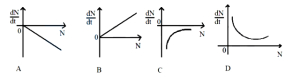
The variation of decay rate with the number of active nuclei is correctly shown in which graph?
A
$A$
B
$B$
C
$C$
D
$D$
Solution
(C) According to the law of radioactive decay,the rate of decay is given by the expression:
$-\frac{dN}{dt} = \lambda N$
where $\lambda$ is the decay constant and $N$ is the number of active nuclei present at time $t$.
This can be rewritten as:
$\frac{dN}{dt} = -\lambda N$
This equation represents a linear relationship between the decay rate $(R = -\frac{dN}{dt})$ and the number of active nuclei $(N)$,where the slope is negative $(-\lambda)$.
Comparing this to the equation of a straight line passing through the origin,$y = mx$,where $y = \frac{dN}{dt}$ and $x = N$,the slope $m = -\lambda$.
Therefore,the graph of $\frac{dN}{dt}$ versus $N$ is a straight line passing through the origin with a negative slope.
Looking at the provided options,graph $A$ represents a straight line passing through the origin with a negative slope.
Thus,the correct option is $A$.
$-\frac{dN}{dt} = \lambda N$
where $\lambda$ is the decay constant and $N$ is the number of active nuclei present at time $t$.
This can be rewritten as:
$\frac{dN}{dt} = -\lambda N$
This equation represents a linear relationship between the decay rate $(R = -\frac{dN}{dt})$ and the number of active nuclei $(N)$,where the slope is negative $(-\lambda)$.
Comparing this to the equation of a straight line passing through the origin,$y = mx$,where $y = \frac{dN}{dt}$ and $x = N$,the slope $m = -\lambda$.
Therefore,the graph of $\frac{dN}{dt}$ versus $N$ is a straight line passing through the origin with a negative slope.
Looking at the provided options,graph $A$ represents a straight line passing through the origin with a negative slope.
Thus,the correct option is $A$.
0 likes
View Solution488
EasyMCQ
If $T$ is the half-life of a radioactive substance,then its instantaneous rate of change of activity is proportional to
A
$\sqrt{T}$
B
$T$
C
$T^{2}$
D
$T^{-2}$
Solution
(D) The activity $A$ of a radioactive substance at any time $t$ is given by $A = A_0 e^{-\lambda t}$,where $\lambda$ is the decay constant.
The decay constant $\lambda$ is related to the half-life $T$ by the relation $\lambda = \frac{\ln 2}{T}$.
The rate of change of activity is given by $\frac{dA}{dt} = \frac{d}{dt}(A_0 e^{-\lambda t}) = -\lambda A_0 e^{-\lambda t} = -\lambda A$.
The magnitude of the rate of change of activity is $|\frac{dA}{dt}| = \lambda A$.
Since $\lambda = \frac{\ln 2}{T}$,we have $|\frac{dA}{dt}| = \frac{\ln 2}{T} A$.
Thus,the rate of change of activity is proportional to $T^{-1}$. However,looking at the instantaneous rate of change of activity $\frac{dA}{dt} = -\lambda^2 N_0 e^{-\lambda t}$,where $N = N_0 e^{-\lambda t}$.
Since $A = \lambda N$,then $\frac{dA}{dt} = -\lambda A = -\lambda (\lambda N) = -\lambda^2 N$.
Substituting $\lambda = \frac{\ln 2}{T}$,we get $\frac{dA}{dt} \propto \lambda^2 \propto (\frac{1}{T})^2 = T^{-2}$.
Therefore,the rate of change of activity is proportional to $T^{-2}$.
The decay constant $\lambda$ is related to the half-life $T$ by the relation $\lambda = \frac{\ln 2}{T}$.
The rate of change of activity is given by $\frac{dA}{dt} = \frac{d}{dt}(A_0 e^{-\lambda t}) = -\lambda A_0 e^{-\lambda t} = -\lambda A$.
The magnitude of the rate of change of activity is $|\frac{dA}{dt}| = \lambda A$.
Since $\lambda = \frac{\ln 2}{T}$,we have $|\frac{dA}{dt}| = \frac{\ln 2}{T} A$.
Thus,the rate of change of activity is proportional to $T^{-1}$. However,looking at the instantaneous rate of change of activity $\frac{dA}{dt} = -\lambda^2 N_0 e^{-\lambda t}$,where $N = N_0 e^{-\lambda t}$.
Since $A = \lambda N$,then $\frac{dA}{dt} = -\lambda A = -\lambda (\lambda N) = -\lambda^2 N$.
Substituting $\lambda = \frac{\ln 2}{T}$,we get $\frac{dA}{dt} \propto \lambda^2 \propto (\frac{1}{T})^2 = T^{-2}$.
Therefore,the rate of change of activity is proportional to $T^{-2}$.
0 likes
View Solution489
MediumMCQ
$A$ radioactive element has a rate of disintegration $10,000$ disintegrations per minute at a particular instant. After four minutes it becomes $2500$ disintegrations per minute. The decay constant per minute is (in $log _e 2$)
A
$0.2$
B
$0.5$
C
$0.6$
D
$0.8$
Solution
(B) The rate of disintegration $R$ is given by $R = R_0 e^{-\lambda t}$.
Given $R_0 = 10,000$ disintegrations per minute,$R = 2500$ disintegrations per minute,and $t = 4$ minutes.
Substituting these values into the equation:
$\frac{2500}{10000} = e^{-\lambda \times 4}$
$\frac{1}{4} = e^{-4 \lambda}$
Taking the natural logarithm on both sides:
$\ln(\frac{1}{4}) = -4 \lambda$
$-\ln(4) = -4 \lambda$
$\ln(2^2) = 4 \lambda$
$2 \ln(2) = 4 \lambda$
$\lambda = \frac{2}{4} \ln(2)$
$\lambda = 0.5 \log _e 2$ per minute.
Given $R_0 = 10,000$ disintegrations per minute,$R = 2500$ disintegrations per minute,and $t = 4$ minutes.
Substituting these values into the equation:
$\frac{2500}{10000} = e^{-\lambda \times 4}$
$\frac{1}{4} = e^{-4 \lambda}$
Taking the natural logarithm on both sides:
$\ln(\frac{1}{4}) = -4 \lambda$
$-\ln(4) = -4 \lambda$
$\ln(2^2) = 4 \lambda$
$2 \ln(2) = 4 \lambda$
$\lambda = \frac{2}{4} \ln(2)$
$\lambda = 0.5 \log _e 2$ per minute.
0 likes
View Solution490
EasyMCQ
The relation between half-life $(T)$ and decay constant $(\lambda)$ is
A
$\lambda T=1$
B
$\lambda T=\frac{1}{2}$
C
$\lambda T=\log _{e} 2$
D
$\lambda=\log 2 T$
Solution
(C) The radioactive decay law is given by $N(t) = N_0 e^{-\lambda t}$.
At half-life $t = T$,the number of undecayed nuclei $N(T) = \frac{N_0}{2}$.
Substituting these values into the decay law:
$\frac{N_0}{2} = N_0 e^{-\lambda T}$
$\frac{1}{2} = e^{-\lambda T}$
Taking the natural logarithm on both sides:
$\ln(1/2) = -\lambda T$
$-\ln(2) = -\lambda T$
$\lambda T = \ln(2) = \log_{e} 2$.
At half-life $t = T$,the number of undecayed nuclei $N(T) = \frac{N_0}{2}$.
Substituting these values into the decay law:
$\frac{N_0}{2} = N_0 e^{-\lambda T}$
$\frac{1}{2} = e^{-\lambda T}$
Taking the natural logarithm on both sides:
$\ln(1/2) = -\lambda T$
$-\ln(2) = -\lambda T$
$\lambda T = \ln(2) = \log_{e} 2$.
0 likes
View Solution491
DifficultMCQ
The half-life of a radioactive substance is $ 20 \text{ minutes} $. The time taken between $ 50\% $ decay and $ 87.5\% $ decay of the substance will be
A
$ 30 \text{ minutes} $
B
$ 40 \text{ minutes} $
C
$ 25 \text{ minutes} $
D
$ 10 \text{ minutes} $
Solution
(B) Given, half-life of the radioactive substance, $ T_{1/2} = 20 \text{ minutes} $.
At $ 50\% $ decay, the remaining amount $ N_1 = 50\% $ of $ N_0 = 0.5 N_0 $. This corresponds to $ 1 $ half-life, so $ t_1 = 20 \text{ minutes} $.
At $ 87.5\% $ decay, the remaining amount $ N_2 = (100 - 87.5)\% $ of $ N_0 = 12.5\% $ of $ N_0 = 0.125 N_0 = (1/8) N_0 = (1/2)^3 N_0 $.
This corresponds to $ 3 $ half-lives, so $ t_2 = 3 \times T_{1/2} = 3 \times 20 = 60 \text{ minutes} $.
The time taken between $ 50\% $ decay and $ 87.5\% $ decay is $ \Delta t = t_2 - t_1 = 60 - 20 = 40 \text{ minutes} $.
At $ 50\% $ decay, the remaining amount $ N_1 = 50\% $ of $ N_0 = 0.5 N_0 $. This corresponds to $ 1 $ half-life, so $ t_1 = 20 \text{ minutes} $.
At $ 87.5\% $ decay, the remaining amount $ N_2 = (100 - 87.5)\% $ of $ N_0 = 12.5\% $ of $ N_0 = 0.125 N_0 = (1/8) N_0 = (1/2)^3 N_0 $.
This corresponds to $ 3 $ half-lives, so $ t_2 = 3 \times T_{1/2} = 3 \times 20 = 60 \text{ minutes} $.
The time taken between $ 50\% $ decay and $ 87.5\% $ decay is $ \Delta t = t_2 - t_1 = 60 - 20 = 40 \text{ minutes} $.
0 likes
View Solution492
EasyMCQ
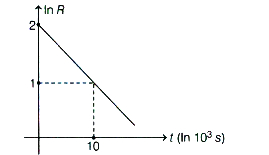
The natural logarithm of the activity $R$ of a radioactive sample varies with time $t$ as shown. At $t=0$,there are $N_0$ undecayed nuclei. Then,$N_0$ is equal to [Take $e^2=7.5$].
A
$7500$
B
$3500$
C
$75000$
D
$150000$
Solution
(C) The activity of a radioactive sample is given by $R = R_0 e^{-\lambda t}$.
Taking the natural logarithm on both sides,we get $\ln R = \ln R_0 - \lambda t$.
Comparing this with the equation of a straight line $y = mx + c$,the slope of the graph is $m = -\lambda$.
From the given graph,at $t = 0$,$\ln R_0 = 2$,which implies $R_0 = e^2 = 7.5$.
The slope of the graph is $\lambda = -\frac{\Delta(\ln R)}{\Delta t} = -\frac{1 - 2}{10 \times 10^3 - 0} = \frac{1}{10^4} = 10^{-4} \text{ s}^{-1}$.
We know that the activity $R_0 = \lambda N_0$,where $N_0$ is the number of undecayed nuclei at $t = 0$.
Therefore,$N_0 = \frac{R_0}{\lambda} = \frac{7.5}{10^{-4}} = 7.5 \times 10^4 = 75000$.
Taking the natural logarithm on both sides,we get $\ln R = \ln R_0 - \lambda t$.
Comparing this with the equation of a straight line $y = mx + c$,the slope of the graph is $m = -\lambda$.
From the given graph,at $t = 0$,$\ln R_0 = 2$,which implies $R_0 = e^2 = 7.5$.
The slope of the graph is $\lambda = -\frac{\Delta(\ln R)}{\Delta t} = -\frac{1 - 2}{10 \times 10^3 - 0} = \frac{1}{10^4} = 10^{-4} \text{ s}^{-1}$.
We know that the activity $R_0 = \lambda N_0$,where $N_0$ is the number of undecayed nuclei at $t = 0$.
Therefore,$N_0 = \frac{R_0}{\lambda} = \frac{7.5}{10^{-4}} = 7.5 \times 10^4 = 75000$.
0 likes
View Solution493
EasyMCQ
$A$ radioactive sample has a half-life of $3$ years. The time required for the activity of the sample to reduce to $\frac{1}{5}$th of its initial value is about (in $years$)
A
$10$
B
$7$
C
$15$
D
$5$
Solution
(B) Given, half-life $T_{1/2} = 3$ years.
We know that the activity $R$ at time $t$ is given by $R = R_0 e^{-\lambda t}$, where $\lambda = \frac{\ln 2}{T_{1/2}}$.
We want the time $t$ when $R = \frac{R_0}{5}$.
Substituting this into the equation: $\frac{R_0}{5} = R_0 e^{-\lambda t} \Rightarrow \frac{1}{5} = e^{-\lambda t}$.
Taking the natural logarithm on both sides: $\ln(1/5) = -\lambda t \Rightarrow \ln(5) = \lambda t$.
Therefore, $t = \frac{\ln 5}{\lambda} = \frac{\ln 5}{\ln 2 / T_{1/2}} = \frac{\ln 5}{\ln 2} \times T_{1/2}$.
Using $\ln 5 \approx 1.609$ and $\ln 2 \approx 0.693$:
$t = \frac{1.609}{0.693} \times 3 \approx 2.3218 \times 3 \approx 6.965$ years.
Rounding to the nearest integer, $t \approx 7$ years.
We know that the activity $R$ at time $t$ is given by $R = R_0 e^{-\lambda t}$, where $\lambda = \frac{\ln 2}{T_{1/2}}$.
We want the time $t$ when $R = \frac{R_0}{5}$.
Substituting this into the equation: $\frac{R_0}{5} = R_0 e^{-\lambda t} \Rightarrow \frac{1}{5} = e^{-\lambda t}$.
Taking the natural logarithm on both sides: $\ln(1/5) = -\lambda t \Rightarrow \ln(5) = \lambda t$.
Therefore, $t = \frac{\ln 5}{\lambda} = \frac{\ln 5}{\ln 2 / T_{1/2}} = \frac{\ln 5}{\ln 2} \times T_{1/2}$.
Using $\ln 5 \approx 1.609$ and $\ln 2 \approx 0.693$:
$t = \frac{1.609}{0.693} \times 3 \approx 2.3218 \times 3 \approx 6.965$ years.
Rounding to the nearest integer, $t \approx 7$ years.
0 likes
View Solution494
MediumMCQ
$A$ radioactive element has a half-life of $15$ years. What is the fraction that will decay in $30$ years?
A
$0.25$
B
$0.5$
C
$0.75$
D
$0.85$
Solution
(C) Given,half-life,$T_{1/2} = 15$ years.
Time,$t = 30$ years.
Number of half-lives,$n = \frac{t}{T_{1/2}} = \frac{30}{15} = 2$.
The fraction of nuclei remaining undecayed after $n$ half-lives is given by $\frac{N}{N_0} = (\frac{1}{2})^n$.
Substituting $n = 2$,we get $\frac{N}{N_0} = (\frac{1}{2})^2 = \frac{1}{4} = 0.25$.
The fraction of the element that has decayed is $1 - \frac{N}{N_0} = 1 - 0.25 = 0.75$.
Time,$t = 30$ years.
Number of half-lives,$n = \frac{t}{T_{1/2}} = \frac{30}{15} = 2$.
The fraction of nuclei remaining undecayed after $n$ half-lives is given by $\frac{N}{N_0} = (\frac{1}{2})^n$.
Substituting $n = 2$,we get $\frac{N}{N_0} = (\frac{1}{2})^2 = \frac{1}{4} = 0.25$.
The fraction of the element that has decayed is $1 - \frac{N}{N_0} = 1 - 0.25 = 0.75$.
0 likes
View Solution495
EasyMCQ
Which one of the following nuclei has a shorter mean life?
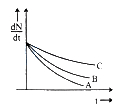
A
$C$
B
$A$
C
Same for all
D
$B$
Solution
(B) The activity of a radioactive sample is given by $R = |dN/dt|$.
From the graph,the decay curve for $A$ falls most rapidly,which means it has the highest decay constant $\lambda$.
The decay constant $\lambda$ and mean life $\tau$ are related by $\tau = 1/\lambda$.
Therefore,a higher decay constant $\lambda$ corresponds to a shorter mean life $\tau$.
Since curve $A$ has the steepest slope (highest activity),it has the largest $\lambda$ and thus the shortest mean life.
Hence,the correct option is $B$.
From the graph,the decay curve for $A$ falls most rapidly,which means it has the highest decay constant $\lambda$.
The decay constant $\lambda$ and mean life $\tau$ are related by $\tau = 1/\lambda$.
Therefore,a higher decay constant $\lambda$ corresponds to a shorter mean life $\tau$.
Since curve $A$ has the steepest slope (highest activity),it has the largest $\lambda$ and thus the shortest mean life.
Hence,the correct option is $B$.
0 likes
View Solution496
DifficultMCQ
The half-life of tritium is $ 12.5 $ years. What mass of tritium of initial mass $ 64 \ mg $ will remain undecayed after $ 50 $ years (in $mg$)?
A
$32$
B
$8$
C
$16$
D
$4$
Solution
(D) Given: Half-life $( T_{1/2} )$ $= 12.5 \text{ years}$,Initial mass $( N_0 )$ $= 64 \ mg$,Total time $( t )$ $= 50 \text{ years}$.
We use the formula for the number of half-lives passed: $ n = \frac{t}{T_{1/2}} $.
$ n = \frac{50}{12.5} = 4 $.
The remaining mass $( N )$ is given by the formula: $ N = N_0 \times (\frac{1}{2})^n $.
$ N = 64 \times (\frac{1}{2})^4 $.
$ N = 64 \times \frac{1}{16} $.
$ N = 4 \ mg $.
Thus,$ 4 \ mg $ of tritium will remain undecayed after $ 50 \text{ years} $.
We use the formula for the number of half-lives passed: $ n = \frac{t}{T_{1/2}} $.
$ n = \frac{50}{12.5} = 4 $.
The remaining mass $( N )$ is given by the formula: $ N = N_0 \times (\frac{1}{2})^n $.
$ N = 64 \times (\frac{1}{2})^4 $.
$ N = 64 \times \frac{1}{16} $.
$ N = 4 \ mg $.
Thus,$ 4 \ mg $ of tritium will remain undecayed after $ 50 \text{ years} $.
0 likes
View Solution497
MediumMCQ
$A$ radioactive sample of half-life $ 10 $ days contains $ 1000x $ nuclei. The number of original nuclei present after $ 5 $ days is: (in $x$)
A
$707$
B
$750$
C
$500$
D
$250$
Solution
(A) Given: Half-life $ T_{1/2} = 10 $ days,Initial number of nuclei $ N_0 = 1000x $,Time $ t = 5 $ days.
Using the radioactive decay law: $ N = N_0 \left( \frac{1}{2} \right)^{t / T_{1/2}} $.
Substituting the values: $ N = 1000x \left( \frac{1}{2} \right)^{5 / 10} $.
$ N = 1000x \left( \frac{1}{2} \right)^{1/2} $.
$ N = \frac{1000x}{\sqrt{2}} $.
Since $ \sqrt{2} \approx 1.414 $,
$ N = \frac{1000x}{1.414} \approx 707.21x $.
Therefore,the number of original nuclei present after $ 5 $ days is approximately $ 707x $.
Using the radioactive decay law: $ N = N_0 \left( \frac{1}{2} \right)^{t / T_{1/2}} $.
Substituting the values: $ N = 1000x \left( \frac{1}{2} \right)^{5 / 10} $.
$ N = 1000x \left( \frac{1}{2} \right)^{1/2} $.
$ N = \frac{1000x}{\sqrt{2}} $.
Since $ \sqrt{2} \approx 1.414 $,
$ N = \frac{1000x}{1.414} \approx 707.21x $.
Therefore,the number of original nuclei present after $ 5 $ days is approximately $ 707x $.
0 likes
View Solution498
MediumMCQ
$A$ radioactive substance emits $100$ beta particles in the first $2 \,s$ and $50$ beta particles in the next $2 \,s$. The mean life of the sample is
A
$4 \,s$
B
$2 \,s$
C
$\frac{2}{0.693} \,s$
D
$2 \times 0.693 \,s$
Solution
(C) The number of radioactive nuclei decaying in a given time interval is proportional to the number of nuclei present.
Let $N_0$ be the initial number of nuclei.
In the first $2 \,s$, $100$ particles are emitted, so the remaining nuclei are $N_0 - 100$.
In the next $2 \,s$, $50$ particles are emitted.
Since the number of decays is halved in equal time intervals, the half-life $T_{1/2}$ is $2 \,s$.
The mean life $T_m$ is related to the half-life by the formula $T_m = \frac{T_{1/2}}{\ln(2)} = \frac{T_{1/2}}{0.693}$.
Substituting $T_{1/2} = 2 \,s$, we get $T_m = \frac{2}{0.693} \,s$.
Let $N_0$ be the initial number of nuclei.
In the first $2 \,s$, $100$ particles are emitted, so the remaining nuclei are $N_0 - 100$.
In the next $2 \,s$, $50$ particles are emitted.
Since the number of decays is halved in equal time intervals, the half-life $T_{1/2}$ is $2 \,s$.
The mean life $T_m$ is related to the half-life by the formula $T_m = \frac{T_{1/2}}{\ln(2)} = \frac{T_{1/2}}{0.693}$.
Substituting $T_{1/2} = 2 \,s$, we get $T_m = \frac{2}{0.693} \,s$.
0 likes
View Solution499
MediumMCQ
$A$ and $B$ are two radioactive elements. The mixture of these elements shows a total activity of $1200 \text{ disintegrations/minute}$. The half-life of $A$ is $1 \text{ day}$ and that of $B$ is $2 \text{ days}$. What will be the total activity after $4 \text{ days}$? Given,the initial number of atoms in $A$ and $B$ are equal.
A
$200 \text{ dis/min}$
B
$250 \text{ dis/min}$
C
$500 \text{ dis/min}$
D
$150 \text{ dis/min}$
Solution
(D) The activity $A$ is given by $A = \lambda N = \frac{0.693}{T_{1/2}} N$.
Since the initial number of atoms $N_0$ for $A$ and $B$ are equal,the initial activity $A_0$ is inversely proportional to the half-life $T_{1/2}$.
Therefore,$\frac{A_0(A)}{A_0(B)} = \frac{T_{1/2}(B)}{T_{1/2}(A)} = \frac{2 \text{ days}}{1 \text{ day}} = 2$.
Given $A_0(A) + A_0(B) = 1200 \text{ dis/min}$.
Substituting $A_0(A) = 2 A_0(B)$,we get $2 A_0(B) + A_0(B) = 1200$,which implies $3 A_0(B) = 1200$,so $A_0(B) = 400 \text{ dis/min}$ and $A_0(A) = 800 \text{ dis/min}$.
After $t = 4 \text{ days}$,the activity of $A$ is $A(A) = \frac{A_0(A)}{2^{t/T_{1/2}(A)}} = \frac{800}{2^{4/1}} = \frac{800}{16} = 50 \text{ dis/min}$.
The activity of $B$ is $A(B) = \frac{A_0(B)}{2^{t/T_{1/2}(B)}} = \frac{400}{2^{4/2}} = \frac{400}{4} = 100 \text{ dis/min}$.
The total activity after $4 \text{ days}$ is $50 + 100 = 150 \text{ dis/min}$.
Since the initial number of atoms $N_0$ for $A$ and $B$ are equal,the initial activity $A_0$ is inversely proportional to the half-life $T_{1/2}$.
Therefore,$\frac{A_0(A)}{A_0(B)} = \frac{T_{1/2}(B)}{T_{1/2}(A)} = \frac{2 \text{ days}}{1 \text{ day}} = 2$.
Given $A_0(A) + A_0(B) = 1200 \text{ dis/min}$.
Substituting $A_0(A) = 2 A_0(B)$,we get $2 A_0(B) + A_0(B) = 1200$,which implies $3 A_0(B) = 1200$,so $A_0(B) = 400 \text{ dis/min}$ and $A_0(A) = 800 \text{ dis/min}$.
After $t = 4 \text{ days}$,the activity of $A$ is $A(A) = \frac{A_0(A)}{2^{t/T_{1/2}(A)}} = \frac{800}{2^{4/1}} = \frac{800}{16} = 50 \text{ dis/min}$.
The activity of $B$ is $A(B) = \frac{A_0(B)}{2^{t/T_{1/2}(B)}} = \frac{400}{2^{4/2}} = \frac{400}{4} = 100 \text{ dis/min}$.
The total activity after $4 \text{ days}$ is $50 + 100 = 150 \text{ dis/min}$.
0 likes
View SolutionNuclei — Law of Radioactivity by Rutherford and Soddy and Half Life and Mean Life · Frequently Asked Questions
1Are these Nuclei questions useful for JEE and NEET?
Yes. All questions in this section are mapped to JEE Main and NEET exam patterns. Previous year questions from JEE Main, NEET, GUJCET and state-level exams are included with full solutions.
2Can I switch to Hindi or Gujarati for these questions?
Yes. Use the language tabs in the hero section or the sidebar to view the same questions and solutions in English, Hindi or Gujarati.
3How do I generate a question paper from this subtopic?
Use the Vedclass Exam Paper Generator — select the chapter and subtopic, set difficulty, and generate Sets A, B, C, D automatically. First 3 chapters of every subject are free.
Vedclass Products
For Students
Vedclass Test Series
Mock tests in real JEE/NEET style with performance analysis. 5-day free trial.
Start Free TrialFor Teachers
Exam Paper Generator
Generate Set A/B/C/D papers from this chapter in 2 minutes. 3 chapters free.
Try FreeFor Institutes
Online Exam Module
Live online exams with unlimited students, 360° analytics & white-label branding.
See DemoFor Teachers & Institutes
Generate a Nuclei Exam Paper in 2 Minutes
Select subtopic & difficulty — Sets A, B, C, D auto-generated with No Repeat logic.
First 3 chapters of every subject are free — no payment required.