
A English
Motion of Charged Particle In Magnetic Field Questions in English
Class 12 Physics · Moving Charges and Magnetism · Motion of Charged Particle In Magnetic Field
513+
Questions
English
Language
100%
With Solutions
Showing 45 of 513 questions in English
351
DifficultMCQ
An electron and a proton are moving on straight parallel paths with the same velocity. They enter a semi-infinite region of uniform magnetic field perpendicular to the velocity. Which of the following statement$(s)$ is/are true?
$(A)$ They will never come out of the magnetic field region.
$(B)$ They will come out travelling along parallel paths.
$(C)$ They will come out at the same time.
$(D)$ They will come out at different times.
$(A)$ They will never come out of the magnetic field region.
$(B)$ They will come out travelling along parallel paths.
$(C)$ They will come out at the same time.
$(D)$ They will come out at different times.
A
$(B)$ and $(C)$
B
$(B)$ and $(D)$
C
$(A)$ and $(B)$
D
$(A)$ and $(D)$
Solution
(B) When a charged particle enters a uniform magnetic field perpendicular to its velocity,it follows a semi-circular path of radius $R = \frac{mv}{qB}$.
Since the magnetic field is semi-infinite,the particles will complete a semi-circle and exit the field region,so $(A)$ is false.
Because the particles enter with the same velocity $v$ and the magnetic field $B$ is uniform,they will exit the field moving in the opposite direction to their entry,but still parallel to each other. Thus,$(B)$ is true.
The time taken to complete a semi-circle is $t = \frac{\pi m}{qB}$.
Since the mass of a proton $(m_p)$ is much greater than the mass of an electron $(m_e)$,the time taken for the proton to exit will be much greater than the time taken for the electron to exit. Thus,$(D)$ is true and $(C)$ is false.
Therefore,statements $(B)$ and $(D)$ are correct.
Since the magnetic field is semi-infinite,the particles will complete a semi-circle and exit the field region,so $(A)$ is false.
Because the particles enter with the same velocity $v$ and the magnetic field $B$ is uniform,they will exit the field moving in the opposite direction to their entry,but still parallel to each other. Thus,$(B)$ is true.
The time taken to complete a semi-circle is $t = \frac{\pi m}{qB}$.
Since the mass of a proton $(m_p)$ is much greater than the mass of an electron $(m_e)$,the time taken for the proton to exit will be much greater than the time taken for the electron to exit. Thus,$(D)$ is true and $(C)$ is false.
Therefore,statements $(B)$ and $(D)$ are correct.
0 likes
View Solution352
AdvancedMCQ
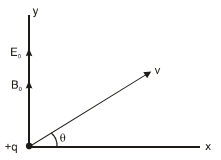
Consider the motion of a positive point charge in a region where there are simultaneous uniform electric and magnetic fields $\vec{E}=E_0 \hat{j}$ and $\vec{B}=B_0 \hat{j}$. At time $t=0$,this charge has velocity $\vec{v}$ in the $x-y$ plane,making an angle $\theta$ with the $x$-axis. Which of the following option$(s)$ is(are) correct for time $t>0$?
$(A)$ If $\theta=0^{\circ}$,the charge moves in a circular path in the $x-z$ plane.
$(B)$ If $\theta=0^{\circ}$,the charge undergoes helical motion with constant pitch along the $y$-axis.
$(C)$ If $\theta=10^{\circ}$,the charge undergoes helical motion with its pitch increasing with time,along the $y$-axis.
$(D)$ If $\theta=90^{\circ}$,the charge undergoes linear but accelerated motion along the $y$-axis.
$(A)$ If $\theta=0^{\circ}$,the charge moves in a circular path in the $x-z$ plane.
$(B)$ If $\theta=0^{\circ}$,the charge undergoes helical motion with constant pitch along the $y$-axis.
$(C)$ If $\theta=10^{\circ}$,the charge undergoes helical motion with its pitch increasing with time,along the $y$-axis.
$(D)$ If $\theta=90^{\circ}$,the charge undergoes linear but accelerated motion along the $y$-axis.
A
$(B,D)$
B
$(B,C)$
C
$(A,D)$
D
$(C,D)$
Solution
(D) The electric field $\vec{E}$ and magnetic field $\vec{B}$ are both along the $y$-axis. The Lorentz force is $\vec{F} = q(\vec{E} + \vec{v} \times \vec{B})$.
$1$. If $\theta=0^{\circ}$,the initial velocity is $\vec{v} = v_0 \hat{i}$. The magnetic force $\vec{F}_B = q(v_0 \hat{i} \times B_0 \hat{j}) = q v_0 B_0 \hat{k}$ acts in the $z$-direction,causing circular motion in the $x-z$ plane. Simultaneously,the electric force $\vec{F}_E = q E_0 \hat{j}$ causes acceleration along the $y$-axis. Thus,the path is a helical motion with increasing pitch along the $y$-axis. Both $(A)$ and $(B)$ are incorrect.
$2$. If $\theta=10^{\circ}$,the velocity has components $v_x = v \cos \theta$ and $v_y = v \sin \theta$. The magnetic force depends only on $v_x$,causing circular motion in the $x-z$ plane. The electric force and $v_y$ cause accelerated motion along the $y$-axis. The combined motion is helical with increasing pitch. Thus,$(C)$ is correct.
$3$. If $\theta=90^{\circ}$,the velocity is $\vec{v} = v_0 \hat{j}$. Since $\vec{v}$ is parallel to $\vec{B}$,$\vec{F}_B = 0$. The particle only experiences the electric force $\vec{F}_E = q E_0 \hat{j}$,resulting in linear accelerated motion along the $y$-axis. Thus,$(D)$ is correct.
Therefore,the correct options are $(C)$ and $(D)$.
$1$. If $\theta=0^{\circ}$,the initial velocity is $\vec{v} = v_0 \hat{i}$. The magnetic force $\vec{F}_B = q(v_0 \hat{i} \times B_0 \hat{j}) = q v_0 B_0 \hat{k}$ acts in the $z$-direction,causing circular motion in the $x-z$ plane. Simultaneously,the electric force $\vec{F}_E = q E_0 \hat{j}$ causes acceleration along the $y$-axis. Thus,the path is a helical motion with increasing pitch along the $y$-axis. Both $(A)$ and $(B)$ are incorrect.
$2$. If $\theta=10^{\circ}$,the velocity has components $v_x = v \cos \theta$ and $v_y = v \sin \theta$. The magnetic force depends only on $v_x$,causing circular motion in the $x-z$ plane. The electric force and $v_y$ cause accelerated motion along the $y$-axis. The combined motion is helical with increasing pitch. Thus,$(C)$ is correct.
$3$. If $\theta=90^{\circ}$,the velocity is $\vec{v} = v_0 \hat{j}$. Since $\vec{v}$ is parallel to $\vec{B}$,$\vec{F}_B = 0$. The particle only experiences the electric force $\vec{F}_E = q E_0 \hat{j}$,resulting in linear accelerated motion along the $y$-axis. Thus,$(D)$ is correct.
Therefore,the correct options are $(C)$ and $(D)$.
0 likes
View Solution353
AdvancedMCQ
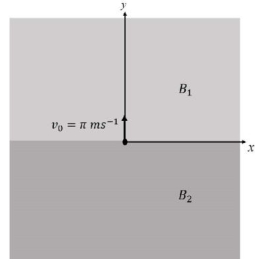
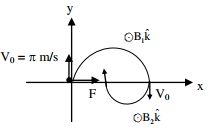
In the $xy$-plane,the region $y > 0$ has a uniform magnetic field $B_1 \hat{k}$ and the region $y < 0$ has another uniform magnetic field $B_2 \hat{k}$. $A$ positively charged particle is projected from the origin along the positive $y$-axis with speed $v_0 = \pi \text{ m s}^{-1}$ at $t = 0$,as shown in the figure. Neglect gravity in this problem. Let $t = T$ be the time when the particle crosses the $x$-axis from below for the first time. If $B_2 = 4 B_1$,the average speed of the particle,in $\text{m s}^{-1}$,along the $x$-axis in the time interval $T$ is. . . . . .
A
$2$
B
$5$
C
$10$
D
$15$
Solution
(A) The radius of the circular path of a charged particle in a magnetic field is given by $R = \frac{mv}{qB}$.
For the region $y > 0$,the radius is $R_1 = \frac{mv_0}{qB_1}$.
For the region $y < 0$,the radius is $R_2 = \frac{mv_0}{qB_2}$.
Given $B_2 = 4B_1$,we have $R_2 = \frac{mv_0}{q(4B_1)} = \frac{R_1}{4}$.
The particle moves in a semicircle of radius $R_1$ in the region $y > 0$ and then in a semicircle of radius $R_2$ in the region $y < 0$.
The total distance traveled along the $x$-axis is $\Delta x = 2R_1 + 2R_2 = 2R_1 + 2(\frac{R_1}{4}) = 2R_1 + \frac{R_1}{2} = \frac{5R_1}{2}$.
The time taken to complete a semicircle in region $y > 0$ is $t_1 = \frac{\pi m}{qB_1}$.
The time taken to complete a semicircle in region $y < 0$ is $t_2 = \frac{\pi m}{qB_2} = \frac{\pi m}{q(4B_1)} = \frac{t_1}{4}$.
The total time $T = t_1 + t_2 = t_1 + \frac{t_1}{4} = \frac{5t_1}{4}$.
The average speed along the $x$-axis is $v_{avg} = \frac{\Delta x}{T} = \frac{5R_1/2}{5t_1/4} = \frac{5R_1}{2} \times \frac{4}{5t_1} = 2 \frac{R_1}{t_1}$.
Substituting $R_1 = \frac{mv_0}{qB_1}$ and $t_1 = \frac{\pi m}{qB_1}$,we get $v_{avg} = 2 \frac{mv_0/qB_1}{\pi m/qB_1} = 2 \frac{v_0}{\pi}$.
Given $v_0 = \pi \text{ m s}^{-1}$,the average speed is $v_{avg} = 2 \frac{\pi}{\pi} = 2 \text{ m s}^{-1}$.
For the region $y > 0$,the radius is $R_1 = \frac{mv_0}{qB_1}$.
For the region $y < 0$,the radius is $R_2 = \frac{mv_0}{qB_2}$.
Given $B_2 = 4B_1$,we have $R_2 = \frac{mv_0}{q(4B_1)} = \frac{R_1}{4}$.
The particle moves in a semicircle of radius $R_1$ in the region $y > 0$ and then in a semicircle of radius $R_2$ in the region $y < 0$.
The total distance traveled along the $x$-axis is $\Delta x = 2R_1 + 2R_2 = 2R_1 + 2(\frac{R_1}{4}) = 2R_1 + \frac{R_1}{2} = \frac{5R_1}{2}$.
The time taken to complete a semicircle in region $y > 0$ is $t_1 = \frac{\pi m}{qB_1}$.
The time taken to complete a semicircle in region $y < 0$ is $t_2 = \frac{\pi m}{qB_2} = \frac{\pi m}{q(4B_1)} = \frac{t_1}{4}$.
The total time $T = t_1 + t_2 = t_1 + \frac{t_1}{4} = \frac{5t_1}{4}$.
The average speed along the $x$-axis is $v_{avg} = \frac{\Delta x}{T} = \frac{5R_1/2}{5t_1/4} = \frac{5R_1}{2} \times \frac{4}{5t_1} = 2 \frac{R_1}{t_1}$.
Substituting $R_1 = \frac{mv_0}{qB_1}$ and $t_1 = \frac{\pi m}{qB_1}$,we get $v_{avg} = 2 \frac{mv_0/qB_1}{\pi m/qB_1} = 2 \frac{v_0}{\pi}$.
Given $v_0 = \pi \text{ m s}^{-1}$,the average speed is $v_{avg} = 2 \frac{\pi}{\pi} = 2 \text{ m s}^{-1}$.
0 likes
View Solution354
EasyMCQ
An $\alpha$-particle (mass $4 \text{ amu}$) and a singly charged sulfur ion (mass $32 \text{ amu}$) are initially at rest. They are accelerated through a potential $V$ and then allowed to pass into a region of uniform magnetic field which is normal to the velocities of the particles. Within this region,the $\alpha$-particle and the sulfur ion move in circular orbits of radii $r_\alpha$ and $r_s$,respectively. The ratio $(r_s / r_\alpha)$ is:
A
$2$
B
$4$
C
$7$
D
$8$
Solution
(B) The radius of a charged particle moving in a magnetic field is given by $r = \frac{mv}{qB} = \frac{\sqrt{2mK}}{qB}$.
Since the particle is accelerated through a potential $V$,the kinetic energy $K = qV$.
Substituting this,we get $r = \frac{\sqrt{2mqV}}{qB} = \frac{1}{B} \sqrt{\frac{2mV}{q}}$.
For the $\alpha$-particle: $m_\alpha = 4 \text{ amu}$,$q_\alpha = 2e$.
For the sulfur ion: $m_s = 32 \text{ amu}$,$q_s = 1e$.
The ratio of the radii is $\frac{r_s}{r_\alpha} = \frac{\sqrt{m_s/q_s}}{\sqrt{m_\alpha/q_\alpha}} = \sqrt{\frac{m_s}{m_\alpha} \cdot \frac{q_\alpha}{q_s}}$.
Substituting the values: $\frac{r_s}{r_\alpha} = \sqrt{\frac{32}{4} \cdot \frac{2}{1}} = \sqrt{8 \cdot 2} = \sqrt{16} = 4$.
Since the particle is accelerated through a potential $V$,the kinetic energy $K = qV$.
Substituting this,we get $r = \frac{\sqrt{2mqV}}{qB} = \frac{1}{B} \sqrt{\frac{2mV}{q}}$.
For the $\alpha$-particle: $m_\alpha = 4 \text{ amu}$,$q_\alpha = 2e$.
For the sulfur ion: $m_s = 32 \text{ amu}$,$q_s = 1e$.
The ratio of the radii is $\frac{r_s}{r_\alpha} = \frac{\sqrt{m_s/q_s}}{\sqrt{m_\alpha/q_\alpha}} = \sqrt{\frac{m_s}{m_\alpha} \cdot \frac{q_\alpha}{q_s}}$.
Substituting the values: $\frac{r_s}{r_\alpha} = \sqrt{\frac{32}{4} \cdot \frac{2}{1}} = \sqrt{8 \cdot 2} = \sqrt{16} = 4$.
0 likes
View Solution355
MediumMCQ
$A$ particle of mass $M$ and positive charge $Q$,moving with a constant velocity $\vec{u}_1 = 4\hat{i} \text{ m/s}$,enters a region of uniform static magnetic field normal to the $x-y$ plane. The region of the magnetic field extends from $x = 0$ to $x = L$ for all values of $y$. After passing through this region,the particle emerges on the other side after $10 \text{ ms}$ with a velocity $\vec{u}_2 = 2(\sqrt{3}\hat{i} + \hat{j}) \text{ m/s}$. The correct statement$(s)$ is (are):
$(A)$ The direction of the magnetic field is $-z$ direction.
$(B)$ The direction of the magnetic field is $+z$ direction.
$(C)$ The magnitude of the magnetic field is $\frac{50\pi M}{3Q}$ units.
$(D)$ The magnitude of the magnetic field is $\frac{100\pi M}{3Q}$ units.
$(A)$ The direction of the magnetic field is $-z$ direction.
$(B)$ The direction of the magnetic field is $+z$ direction.
$(C)$ The magnitude of the magnetic field is $\frac{50\pi M}{3Q}$ units.
$(D)$ The magnitude of the magnetic field is $\frac{100\pi M}{3Q}$ units.
A
$(B, D)$
B
$(B, C)$
C
$(A, C)$
D
$(A, D)$
Solution
(C) The initial velocity is $\vec{u}_1 = 4\hat{i} \text{ m/s}$. The final velocity is $\vec{u}_2 = 2\sqrt{3}\hat{i} + 2\hat{j} \text{ m/s}$.
Since the magnetic force is perpendicular to the velocity,the speed remains constant: $|\vec{u}_1| = |\vec{u}_2| = 4 \text{ m/s}$.
The angle of deviation $\theta$ is given by $\tan \theta = \frac{v_y}{v_x} = \frac{2}{2\sqrt{3}} = \frac{1}{\sqrt{3}}$,so $\theta = 30^\circ = \frac{\pi}{6} \text{ rad}$.
The particle deflects in the $+y$ direction,implying the magnetic force $\vec{F} = Q(\vec{v} \times \vec{B})$ has a positive $y$-component. Given $\vec{v}$ is in the $x$-direction,$\hat{i} \times \vec{B}$ must have a positive $j$-component,which occurs if $\vec{B}$ is in the $-z$ direction.
The time taken to traverse the arc is $t = \frac{\theta}{\omega} = \frac{\theta M}{QB}$.
Given $t = 10 \text{ ms} = 0.01 \text{ s}$,we have $0.01 = \frac{\pi/6 \cdot M}{QB}$.
Solving for $B$: $B = \frac{\pi M}{6 \cdot 0.01 \cdot Q} = \frac{100\pi M}{6Q} = \frac{50\pi M}{3Q}$.
Thus,statements $(A)$ and $(C)$ are correct.
Since the magnetic force is perpendicular to the velocity,the speed remains constant: $|\vec{u}_1| = |\vec{u}_2| = 4 \text{ m/s}$.
The angle of deviation $\theta$ is given by $\tan \theta = \frac{v_y}{v_x} = \frac{2}{2\sqrt{3}} = \frac{1}{\sqrt{3}}$,so $\theta = 30^\circ = \frac{\pi}{6} \text{ rad}$.
The particle deflects in the $+y$ direction,implying the magnetic force $\vec{F} = Q(\vec{v} \times \vec{B})$ has a positive $y$-component. Given $\vec{v}$ is in the $x$-direction,$\hat{i} \times \vec{B}$ must have a positive $j$-component,which occurs if $\vec{B}$ is in the $-z$ direction.
The time taken to traverse the arc is $t = \frac{\theta}{\omega} = \frac{\theta M}{QB}$.
Given $t = 10 \text{ ms} = 0.01 \text{ s}$,we have $0.01 = \frac{\pi/6 \cdot M}{QB}$.
Solving for $B$: $B = \frac{\pi M}{6 \cdot 0.01 \cdot Q} = \frac{100\pi M}{6Q} = \frac{50\pi M}{3Q}$.
Thus,statements $(A)$ and $(C)$ are correct.
0 likes
View Solution356
AdvancedMCQ
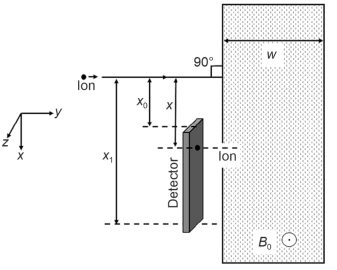
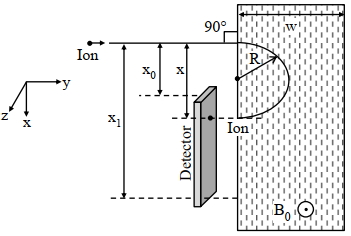
$A$ positive,singly ionized atom of mass number $A_M$ is accelerated from rest by a voltage $V = 192 \text{ V}$. Thereafter,it enters a rectangular region of width $w$ with a magnetic field $B_0 = 0.1 \hat{k} \text{ T}$,as shown in the figure. The ion finally hits a detector at a distance $x$ below its starting trajectory.
[Given: Mass of neutron/proton $= (5/3) \times 10^{-27} \text{ kg}$,charge of the electron $= 1.6 \times 10^{-19} \text{ C}$.]
Which of the following option$(s)$ is(are) correct?
$(A)$ The value of $x$ for $H^{+}$ ion is $4 \text{ cm}$.
$(B)$ The value of $x$ for an ion with $A_M = 144$ is $48 \text{ cm}$.
$(C)$ For detecting ions with $1 \leq A_M \leq 196$,the minimum height $(x_1 - x_0)$ of the detector is $52 \text{ cm}$.
$(D)$ The minimum width $w$ of the region of the magnetic field for detecting ions with $A_M = 196$ is $28 \text{ cm}$.
[Given: Mass of neutron/proton $= (5/3) \times 10^{-27} \text{ kg}$,charge of the electron $= 1.6 \times 10^{-19} \text{ C}$.]
Which of the following option$(s)$ is(are) correct?
$(A)$ The value of $x$ for $H^{+}$ ion is $4 \text{ cm}$.
$(B)$ The value of $x$ for an ion with $A_M = 144$ is $48 \text{ cm}$.
$(C)$ For detecting ions with $1 \leq A_M \leq 196$,the minimum height $(x_1 - x_0)$ of the detector is $52 \text{ cm}$.
$(D)$ The minimum width $w$ of the region of the magnetic field for detecting ions with $A_M = 196$ is $28 \text{ cm}$.
A
$A, B$
B
$A, C$
C
$A, D$
D
$A, B, C$
Solution
(D) The ion is accelerated through a potential $V$,so its kinetic energy is $K = qV = \frac{1}{2}mv^2$. The momentum $p = \sqrt{2mqV}$.
In the magnetic field,the ion follows a semi-circular path of radius $R = \frac{p}{qB} = \frac{\sqrt{2mqV}}{qB} = \frac{1}{B}\sqrt{\frac{2mV}{q}}$.
The ion hits the detector at a distance $x = 2R = \frac{2}{B}\sqrt{\frac{2mV}{q}}$.
Given $m = A_M \times (5/3) \times 10^{-27} \text{ kg}$,$V = 192 \text{ V}$,$q = 1.6 \times 10^{-19} \text{ C}$,$B = 0.1 \text{ T}$.
$(A)$ For $H^{+}$ $(A_M = 1)$: $x = \frac{2}{0.1}\sqrt{\frac{2 \times (5/3) \times 10^{-27} \times 192}{1.6 \times 10^{-19}}} = 20 \times \sqrt{4 \times 10^{-8}} = 20 \times 2 \times 10^{-4} \text{ m} = 4 \times 10^{-3} \text{ m} = 0.4 \text{ cm}$. Wait,re-calculating: $x = 20 \times \sqrt{\frac{640}{1.6} \times 10^{-8}} = 20 \times \sqrt{400 \times 10^{-8}} = 20 \times 20 \times 10^{-4} = 0.04 \text{ m} = 4 \text{ cm}$. So $(A)$ is correct.
$(B)$ For $A_M = 144$: $x = 4 \text{ cm} \times \sqrt{144} = 4 \times 12 = 48 \text{ cm}$. So $(B)$ is correct.
$(C)$ For $A_M = 1$,$x_0 = 4 \text{ cm}$. For $A_M = 196$,$x_1 = 4 \text{ cm} \times \sqrt{196} = 4 \times 14 = 56 \text{ cm}$. The height is $x_1 - x_0 = 56 - 4 = 52 \text{ cm}$. So $(C)$ is correct.
$(D)$ For $A_M = 196$,$R = x/2 = 56/2 = 28 \text{ cm}$. So $(D)$ is incorrect.
In the magnetic field,the ion follows a semi-circular path of radius $R = \frac{p}{qB} = \frac{\sqrt{2mqV}}{qB} = \frac{1}{B}\sqrt{\frac{2mV}{q}}$.
The ion hits the detector at a distance $x = 2R = \frac{2}{B}\sqrt{\frac{2mV}{q}}$.
Given $m = A_M \times (5/3) \times 10^{-27} \text{ kg}$,$V = 192 \text{ V}$,$q = 1.6 \times 10^{-19} \text{ C}$,$B = 0.1 \text{ T}$.
$(A)$ For $H^{+}$ $(A_M = 1)$: $x = \frac{2}{0.1}\sqrt{\frac{2 \times (5/3) \times 10^{-27} \times 192}{1.6 \times 10^{-19}}} = 20 \times \sqrt{4 \times 10^{-8}} = 20 \times 2 \times 10^{-4} \text{ m} = 4 \times 10^{-3} \text{ m} = 0.4 \text{ cm}$. Wait,re-calculating: $x = 20 \times \sqrt{\frac{640}{1.6} \times 10^{-8}} = 20 \times \sqrt{400 \times 10^{-8}} = 20 \times 20 \times 10^{-4} = 0.04 \text{ m} = 4 \text{ cm}$. So $(A)$ is correct.
$(B)$ For $A_M = 144$: $x = 4 \text{ cm} \times \sqrt{144} = 4 \times 12 = 48 \text{ cm}$. So $(B)$ is correct.
$(C)$ For $A_M = 1$,$x_0 = 4 \text{ cm}$. For $A_M = 196$,$x_1 = 4 \text{ cm} \times \sqrt{196} = 4 \times 14 = 56 \text{ cm}$. The height is $x_1 - x_0 = 56 - 4 = 52 \text{ cm}$. So $(C)$ is correct.
$(D)$ For $A_M = 196$,$R = x/2 = 56/2 = 28 \text{ cm}$. So $(D)$ is incorrect.
0 likes
View Solution357
DifficultMCQ
An electron projected perpendicular to a uniform magnetic field $B$ moves in a circle. If Bohr's quantization is applicable,then the radius of the electronic orbit in the first excited state is $:$
A
$\sqrt{\frac{2 h}{\pi e B}}$
B
$\sqrt{\frac{4 h}{\pi e B}}$
C
$\sqrt{\frac{ h }{2 \pi e B }}$
D
$\sqrt{\frac{h}{\pi e B}}$
Solution
(D) The magnetic force provides the centripetal force for the circular motion: $F_m = F_c \Rightarrow evB = \frac{mv^2}{r} \Rightarrow mv = eBr$.
According to Bohr's quantization condition for angular momentum: $mvr = \frac{nh}{2\pi}$.
Substituting $mv = eBr$ into the quantization condition: $(eBr)r = \frac{nh}{2\pi} \Rightarrow er^2B = \frac{nh}{2\pi}$.
Solving for $r$: $r = \sqrt{\frac{nh}{2\pi eB}}$.
For the first excited state,the principal quantum number is $n = 2$.
Substituting $n = 2$ into the expression: $r = \sqrt{\frac{2h}{2\pi eB}} = \sqrt{\frac{h}{\pi eB}}$.
According to Bohr's quantization condition for angular momentum: $mvr = \frac{nh}{2\pi}$.
Substituting $mv = eBr$ into the quantization condition: $(eBr)r = \frac{nh}{2\pi} \Rightarrow er^2B = \frac{nh}{2\pi}$.
Solving for $r$: $r = \sqrt{\frac{nh}{2\pi eB}}$.
For the first excited state,the principal quantum number is $n = 2$.
Substituting $n = 2$ into the expression: $r = \sqrt{\frac{2h}{2\pi eB}} = \sqrt{\frac{h}{\pi eB}}$.
0 likes
View Solution358
DifficultMCQ
$A$ proton is moving undeflected in a region of crossed electric and magnetic fields at a constant speed of $2 \times 10^5 \text{ ms}^{-1}$. When the electric field is switched off,the proton moves along a circular path of radius $2 \text{ cm}$. The magnitude of the electric field is $x \times 10^4 \text{ N/C}$. The value of $x$ is . . . . . . . (Take the mass of the proton $= 1.6 \times 10^{-27} \text{ kg}$ and charge $e = 1.6 \times 10^{-19} \text{ C}$)
A
$2$
B
$3$
C
$4$
D
$5$
Solution
(A) When the proton moves undeflected,the electric force equals the magnetic force: $eE = evB$,which gives $E = vB$ or $B = E/v$.
When the electric field is switched off,the proton moves in a circular path of radius $R$ due to the magnetic field: $R = \frac{mv}{eB}$.
Substituting $B = E/v$ into the radius formula: $R = \frac{mv}{e(E/v)} = \frac{mv^2}{eE}$.
Rearranging to solve for $E$: $E = \frac{mv^2}{eR}$.
Given: $m = 1.6 \times 10^{-27} \text{ kg}$,$v = 2 \times 10^5 \text{ ms}^{-1}$,$R = 2 \text{ cm} = 0.02 \text{ m}$,$e = 1.6 \times 10^{-19} \text{ C}$.
$E = \frac{(1.6 \times 10^{-27}) \times (2 \times 10^5)^2}{(1.6 \times 10^{-19}) \times 0.02} = \frac{1.6 \times 10^{-27} \times 4 \times 10^{10}}{1.6 \times 10^{-19} \times 2 \times 10^{-2}} = \frac{4 \times 10^{-17}}{2 \times 10^{-21}} = 2 \times 10^4 \text{ N/C}$.
Comparing this with $x \times 10^4 \text{ N/C}$,we get $x = 2$.
When the electric field is switched off,the proton moves in a circular path of radius $R$ due to the magnetic field: $R = \frac{mv}{eB}$.
Substituting $B = E/v$ into the radius formula: $R = \frac{mv}{e(E/v)} = \frac{mv^2}{eE}$.
Rearranging to solve for $E$: $E = \frac{mv^2}{eR}$.
Given: $m = 1.6 \times 10^{-27} \text{ kg}$,$v = 2 \times 10^5 \text{ ms}^{-1}$,$R = 2 \text{ cm} = 0.02 \text{ m}$,$e = 1.6 \times 10^{-19} \text{ C}$.
$E = \frac{(1.6 \times 10^{-27}) \times (2 \times 10^5)^2}{(1.6 \times 10^{-19}) \times 0.02} = \frac{1.6 \times 10^{-27} \times 4 \times 10^{10}}{1.6 \times 10^{-19} \times 2 \times 10^{-2}} = \frac{4 \times 10^{-17}}{2 \times 10^{-21}} = 2 \times 10^4 \text{ N/C}$.
Comparing this with $x \times 10^4 \text{ N/C}$,we get $x = 2$.
0 likes
View Solution359
MediumMCQ
Given below are two statements. One is labelled as Assertion $(A)$ and the other is labelled as Reason $(R)$.
Assertion $(A) :$ An electron in a certain region of uniform magnetic field is moving with constant velocity in a straight line path.
Reason $(R) :$ The magnetic field in that region is along the direction of velocity of the electron.
In the light of the above statements,choose the correct answer from the options given below.
Assertion $(A) :$ An electron in a certain region of uniform magnetic field is moving with constant velocity in a straight line path.
Reason $(R) :$ The magnetic field in that region is along the direction of velocity of the electron.
In the light of the above statements,choose the correct answer from the options given below.
A
$(A)$ is false but $(R)$ is true
B
Both $(A)$ and $(R)$ are true and $(R)$ is the correct explanation of $(A)$
C
Both $(A)$ and $(R)$ are true but $(R)$ is $\text{NOT}$ the correct explanation of $(A)$
D
$(A)$ is true but $(R)$ is false
Solution
(B) The magnetic force acting on a charged particle moving in a magnetic field is given by the Lorentz force formula: $\vec{F} = q(\vec{v} \times \vec{B})$.
For the electron to move in a straight line with constant velocity,the net magnetic force acting on it must be zero,i.e.,$\vec{F} = 0$.
Since $\vec{F} = qvB \sin \theta$,for $\vec{F} = 0$,the angle $\theta$ between the velocity vector $\vec{v}$ and the magnetic field vector $\vec{B}$ must be $0^\circ$ or $180^\circ$.
This implies that the magnetic field must be parallel or anti-parallel to the direction of the velocity of the electron.
Therefore,both Assertion $(A)$ and Reason $(R)$ are true,and $(R)$ is the correct explanation of $(A)$.
For the electron to move in a straight line with constant velocity,the net magnetic force acting on it must be zero,i.e.,$\vec{F} = 0$.
Since $\vec{F} = qvB \sin \theta$,for $\vec{F} = 0$,the angle $\theta$ between the velocity vector $\vec{v}$ and the magnetic field vector $\vec{B}$ must be $0^\circ$ or $180^\circ$.
This implies that the magnetic field must be parallel or anti-parallel to the direction of the velocity of the electron.
Therefore,both Assertion $(A)$ and Reason $(R)$ are true,and $(R)$ is the correct explanation of $(A)$.
0 likes
View Solution360
DifficultMCQ
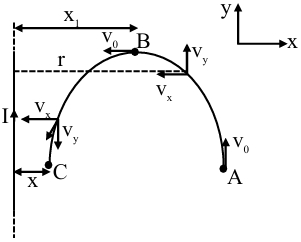
Consider a long thin conducting wire carrying a uniform current $I$. $A$ particle having mass $M$ and charge $q$ is released at a distance $a$ from the wire with a speed $v_0$ along the direction of current in the wire. The particle gets attracted to the wire due to magnetic force. The particle turns round when it is at distance $x$ from the wire. The value of $x$ is [$\mu_0$ is vacuum permeability]
A
$a\left[1-\frac{mv_0}{2 q \mu_0 I}\right]$
B
$\frac{a}{2}$
C
$a\left[1-\frac{mv_0}{q \mu_{o} I}\right]$
D
$ae^{-\frac{4 \pi m v_0}{q \mu_0 I}}$
Solution
(D) The magnetic field $\vec{B}$ due to the wire at a distance $r$ is $\vec{B} = \frac{\mu_0 I}{2 \pi r} (-\hat{k})$.
As the particle moves,the magnetic force $\vec{F} = q(\vec{v} \times \vec{B})$ acts on it. Since the magnetic force is always perpendicular to the velocity,the speed $v_0$ remains constant.
Let the velocity be $\vec{v} = -v_x \hat{i} + v_y \hat{j}$. The force is $\vec{F} = q(-v_x \hat{i} + v_y \hat{j}) \times \frac{\mu_0 I}{2 \pi r} (-\hat{k}) = \frac{\mu_0 I q}{2 \pi r} (-v_x \hat{j} - v_y \hat{i})$.
The acceleration components are $a_x = -\frac{\mu_0 I q}{2 \pi m r} v_y$ and $a_y = -\frac{\mu_0 I q}{2 \pi m r} v_x$.
Using $\frac{v_x dv_x}{dr} = a_x = -\frac{\mu_0 I q}{2 \pi m r} v_y$ and $v_y = \sqrt{v_0^2 - v_x^2}$,we get $\int_{0}^{v_0} \frac{v_x dv_x}{\sqrt{v_0^2 - v_x^2}} = -\frac{\mu_0 I q}{2 \pi m} \int_{a}^{x_1} \frac{dr}{r}$.
Solving this gives $v_0 = \frac{\mu_0 I q}{2 \pi m} \ln(\frac{a}{x_1})$,so $x_1 = a e^{-\frac{2 \pi m v_0}{\mu_0 I q}}$.
Due to symmetry,the particle turns back at $x = x_1 e^{-\frac{2 \pi m v_0}{\mu_0 I q}} = a e^{-\frac{4 \pi m v_0}{\mu_0 I q}}$.
As the particle moves,the magnetic force $\vec{F} = q(\vec{v} \times \vec{B})$ acts on it. Since the magnetic force is always perpendicular to the velocity,the speed $v_0$ remains constant.
Let the velocity be $\vec{v} = -v_x \hat{i} + v_y \hat{j}$. The force is $\vec{F} = q(-v_x \hat{i} + v_y \hat{j}) \times \frac{\mu_0 I}{2 \pi r} (-\hat{k}) = \frac{\mu_0 I q}{2 \pi r} (-v_x \hat{j} - v_y \hat{i})$.
The acceleration components are $a_x = -\frac{\mu_0 I q}{2 \pi m r} v_y$ and $a_y = -\frac{\mu_0 I q}{2 \pi m r} v_x$.
Using $\frac{v_x dv_x}{dr} = a_x = -\frac{\mu_0 I q}{2 \pi m r} v_y$ and $v_y = \sqrt{v_0^2 - v_x^2}$,we get $\int_{0}^{v_0} \frac{v_x dv_x}{\sqrt{v_0^2 - v_x^2}} = -\frac{\mu_0 I q}{2 \pi m} \int_{a}^{x_1} \frac{dr}{r}$.
Solving this gives $v_0 = \frac{\mu_0 I q}{2 \pi m} \ln(\frac{a}{x_1})$,so $x_1 = a e^{-\frac{2 \pi m v_0}{\mu_0 I q}}$.
Due to symmetry,the particle turns back at $x = x_1 e^{-\frac{2 \pi m v_0}{\mu_0 I q}} = a e^{-\frac{4 \pi m v_0}{\mu_0 I q}}$.
0 likes
View Solution361
MediumMCQ
Given below are two statements: one is labelled as Assertion $A$ and the other is labelled as Reason $R$.
Assertion $A$: If oxygen ion $(O^{-2})$ and hydrogen ion $(H^{+})$ enter normal to the magnetic field with equal momentum,then the path of $O^{-2}$ ion has a smaller curvature than that of $H^{+}$.
Reason $R$: $A$ proton with same linear momentum as an electron will form a path of smaller radius of curvature on entering a uniform magnetic field perpendicularly.
In the light of the above statement,choose the correct answer from the options given below.
Assertion $A$: If oxygen ion $(O^{-2})$ and hydrogen ion $(H^{+})$ enter normal to the magnetic field with equal momentum,then the path of $O^{-2}$ ion has a smaller curvature than that of $H^{+}$.
Reason $R$: $A$ proton with same linear momentum as an electron will form a path of smaller radius of curvature on entering a uniform magnetic field perpendicularly.
In the light of the above statement,choose the correct answer from the options given below.
A
$A$ is true but $R$ is false
B
Both $A$ and $R$ are true but $R$ is $NOT$ the correct explanation of $A$
C
$A$ is false but $R$ is true
D
Both $A$ and $R$ are true and $R$ is the correct explanation of $A$
Solution
(C) The radius of curvature $r$ of a charged particle moving perpendicular to a magnetic field $B$ is given by $r = \frac{mv}{qB} = \frac{p}{qB}$,where $p$ is the momentum and $q$ is the magnitude of the charge.
For Assertion $A$: Both ions have the same momentum $p$. Thus,$r \propto \frac{1}{q}$. Since the charge of $O^{-2}$ is $2e$ and $H^{+}$ is $1e$,the radius of curvature for $O^{-2}$ is $r_{O} = \frac{p}{2eB}$ and for $H^{+}$ is $r_{H} = \frac{p}{eB}$. Since $r_{O} < r_{H}$,the curvature (which is $\frac{1}{r}$) of $O^{-2}$ is greater than that of $H^{+}$. Thus,Assertion $A$ is false.
For Reason $R$: For a proton and an electron with the same momentum $p$,the radius of curvature is $r = \frac{p}{qB}$. Since both have the same magnitude of charge $e$,their radii of curvature will be identical $(r_{p} = r_{e} = \frac{p}{eB})$. Thus,Reason $R$ is false.
For Assertion $A$: Both ions have the same momentum $p$. Thus,$r \propto \frac{1}{q}$. Since the charge of $O^{-2}$ is $2e$ and $H^{+}$ is $1e$,the radius of curvature for $O^{-2}$ is $r_{O} = \frac{p}{2eB}$ and for $H^{+}$ is $r_{H} = \frac{p}{eB}$. Since $r_{O} < r_{H}$,the curvature (which is $\frac{1}{r}$) of $O^{-2}$ is greater than that of $H^{+}$. Thus,Assertion $A$ is false.
For Reason $R$: For a proton and an electron with the same momentum $p$,the radius of curvature is $r = \frac{p}{qB}$. Since both have the same magnitude of charge $e$,their radii of curvature will be identical $(r_{p} = r_{e} = \frac{p}{eB})$. Thus,Reason $R$ is false.
0 likes
View Solution362
MediumMCQ
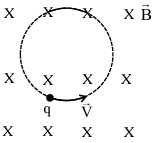
$A$ particle of charge $1.6 \ \mu C$ and mass $16 \ \mu g$ is present in a strong magnetic field of $6.28 \ T$. The particle is then fired perpendicular to the magnetic field. The time required for the particle to return to its original location for the first time is . . . . . . $s$. $(\pi = 3.14)$
A
$0.01$
B
$0.02$
C
$0.03$
D
$0.04$
Solution
(A) Given:
Charge $q = 1.6 \ \mu C = 1.6 \times 10^{-6} \ C$
Mass $m = 16 \ \mu g = 16 \times 10^{-9} \ kg$
Magnetic field $B = 6.28 \ T$
Since the particle is fired perpendicular to the magnetic field,it will perform uniform circular motion.
The time period $T$ for one complete revolution is given by the formula:
$T = \frac{2 \pi m}{qB}$
Substituting the values:
$T = \frac{2 \times 3.14 \times 16 \times 10^{-9}}{1.6 \times 10^{-6} \times 6.28}$
$T = \frac{6.28 \times 16 \times 10^{-9}}{1.6 \times 10^{-6} \times 6.28}$
$T = \frac{16 \times 10^{-9}}{1.6 \times 10^{-6}}$
$T = 10 \times 10^{-3} \ s = 0.01 \ s$
Thus,the time required to return to the original location is $0.01 \ s$.
Charge $q = 1.6 \ \mu C = 1.6 \times 10^{-6} \ C$
Mass $m = 16 \ \mu g = 16 \times 10^{-9} \ kg$
Magnetic field $B = 6.28 \ T$
Since the particle is fired perpendicular to the magnetic field,it will perform uniform circular motion.
The time period $T$ for one complete revolution is given by the formula:
$T = \frac{2 \pi m}{qB}$
Substituting the values:
$T = \frac{2 \times 3.14 \times 16 \times 10^{-9}}{1.6 \times 10^{-6} \times 6.28}$
$T = \frac{6.28 \times 16 \times 10^{-9}}{1.6 \times 10^{-6} \times 6.28}$
$T = \frac{16 \times 10^{-9}}{1.6 \times 10^{-6}}$
$T = 10 \times 10^{-3} \ s = 0.01 \ s$
Thus,the time required to return to the original location is $0.01 \ s$.
0 likes
View Solution363
DifficultMCQ
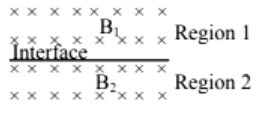
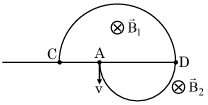
Uniform magnetic fields of different strengths ($B_1$ and $B_2$),both normal to the plane of the paper,exist as shown in the figure. $A$ charged particle of mass $m$ and charge $q$,at the interface at an instant,moves into the region $2$ with velocity $v$ and returns to the interface. It continues to move into region $1$ and finally reaches the interface. What is the displacement of the particle during this movement along the interface? (Consider the velocity of the particle to be normal to the magnetic field and $B_2 > B_1$)
A
$\frac{mv}{qB_1}\left(1-\frac{B_2}{B_1}\right) \times 2$
B
$\frac{mv}{qB_1}\left(1-\frac{B_1}{B_2}\right)$
C
$\frac{mv}{qB_1}\left(1-\frac{B_2}{B_1}\right)$
D
$\frac{mv}{qB_1}\left(1-\frac{B_1}{B_2}\right) \times 2$
Solution
(D) Since the velocity $\vec{v}$ is perpendicular to the magnetic field $\vec{B}$,the charged particle moves in a circular path with radius $R = \frac{mv}{qB}$.
In region $2$,the particle completes a semi-circle of radius $R_2 = \frac{mv}{qB_2}$ and returns to the interface at point $D$. The distance $AD = 2R_2 = \frac{2mv}{qB_2}$.
Then,the particle enters region $1$ and completes a semi-circle of radius $R_1 = \frac{mv}{qB_1}$ and returns to the interface at point $C$. The distance $AC = 2R_1 = \frac{2mv}{qB_1}$.
The net displacement along the interface is the distance between the starting point $A$ and the final point $C$. Since the particle moves in opposite directions in the two regions relative to the interface,the displacement is $AC = AD - CD$ is incorrect based on the geometry. Looking at the path,the particle moves from $A$ to $D$ (in region $2$) and then from $D$ to $C$ (in region $1$).
The total displacement along the interface is $AC = AD - CD$ is not correct; rather,the particle moves from $A$ to $D$ and then from $D$ to $C$. The distance $AC = AD - CD$ is not the correct interpretation. The distance $AC = 2R_1 - 2R_2 = \frac{2mv}{qB_1} - \frac{2mv}{qB_2} = \frac{2mv}{q} \left(\frac{1}{B_1} - \frac{1}{B_2}\right) = \frac{2mv}{qB_1} \left(1 - \frac{B_1}{B_2}\right)$.
In region $2$,the particle completes a semi-circle of radius $R_2 = \frac{mv}{qB_2}$ and returns to the interface at point $D$. The distance $AD = 2R_2 = \frac{2mv}{qB_2}$.
Then,the particle enters region $1$ and completes a semi-circle of radius $R_1 = \frac{mv}{qB_1}$ and returns to the interface at point $C$. The distance $AC = 2R_1 = \frac{2mv}{qB_1}$.
The net displacement along the interface is the distance between the starting point $A$ and the final point $C$. Since the particle moves in opposite directions in the two regions relative to the interface,the displacement is $AC = AD - CD$ is incorrect based on the geometry. Looking at the path,the particle moves from $A$ to $D$ (in region $2$) and then from $D$ to $C$ (in region $1$).
The total displacement along the interface is $AC = AD - CD$ is not correct; rather,the particle moves from $A$ to $D$ and then from $D$ to $C$. The distance $AC = AD - CD$ is not the correct interpretation. The distance $AC = 2R_1 - 2R_2 = \frac{2mv}{qB_1} - \frac{2mv}{qB_2} = \frac{2mv}{q} \left(\frac{1}{B_1} - \frac{1}{B_2}\right) = \frac{2mv}{qB_1} \left(1 - \frac{B_1}{B_2}\right)$.
0 likes
View Solution364
DifficultMCQ
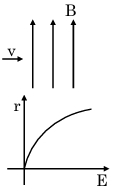
$A$ particle of charge $q$,mass $m$ and kinetic energy $E$ enters a magnetic field perpendicular to its velocity and undergoes a circular arc of radius $r$. Which of the following curves represents the variation of $r$ with $E$?
A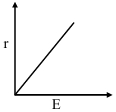
B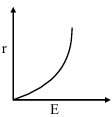
C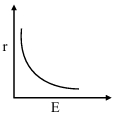
D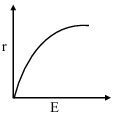
Solution
(D) The magnetic force provides the necessary centripetal force for circular motion:
$\frac{mv^2}{r} = qvB$
$mv = qBr$
$r = \frac{mv}{qB}$
Since kinetic energy $E = \frac{1}{2}mv^2$,we have $v = \sqrt{\frac{2E}{m}}$.
Substituting $v$ in the expression for $r$:
$r = \frac{m}{qB} \sqrt{\frac{2E}{m}} = \frac{\sqrt{2mE}}{qB}$
Thus,$r = \left( \frac{\sqrt{2m}}{qB} \right) \sqrt{E}$
This implies $r \propto \sqrt{E}$.
The graph of $r$ versus $E$ is a parabola opening towards the $E$-axis,which corresponds to Graph $D$.
$\frac{mv^2}{r} = qvB$
$mv = qBr$
$r = \frac{mv}{qB}$
Since kinetic energy $E = \frac{1}{2}mv^2$,we have $v = \sqrt{\frac{2E}{m}}$.
Substituting $v$ in the expression for $r$:
$r = \frac{m}{qB} \sqrt{\frac{2E}{m}} = \frac{\sqrt{2mE}}{qB}$
Thus,$r = \left( \frac{\sqrt{2m}}{qB} \right) \sqrt{E}$
This implies $r \propto \sqrt{E}$.
The graph of $r$ versus $E$ is a parabola opening towards the $E$-axis,which corresponds to Graph $D$.
0 likes
View Solution365
MediumMCQ
An $\alpha$-particle of $1 \text{ MeV}$ kinetic energy is moving on a circular path in a uniform magnetic field. The kinetic energy of a proton,to be moved in the same magnetic field on a circular path of double radius,is $..... \text{ MeV}$.
A
$1$
B
$4$
C
$2$
D
$0.5$
Solution
(B) The radius of a circular path for a charged particle in a magnetic field is given by $r = \frac{mv}{qB} = \frac{\sqrt{2mK}}{qB}$,where $K$ is the kinetic energy.
From this,$K = \frac{r^2 q^2 B^2}{2m}$,which implies $K \propto \frac{q^2 r^2}{m}$.
For an $\alpha$-particle,$q_{\alpha} = 2e$ and $m_{\alpha} = 4m_p$. For a proton,$q_p = e$ and $m_p = m_p$.
Given $K_{\alpha} = 1 \text{ MeV}$ and $r_{\alpha} = r$,we want to find $K_p$ for $r_p = 2r$.
Using the ratio: $\frac{K_{\alpha}}{K_p} = \frac{q_{\alpha}^2 r_{\alpha}^2}{m_{\alpha}} \times \frac{m_p}{q_p^2 r_p^2}$.
Substituting the values: $\frac{1}{K_p} = \frac{(2e)^2 (r)^2}{4m_p} \times \frac{m_p}{e^2 (2r)^2} = \frac{4e^2 r^2}{4m_p} \times \frac{m_p}{4e^2 r^2} = \frac{1}{4}$.
Therefore,$K_p = 4 \text{ MeV}$.
From this,$K = \frac{r^2 q^2 B^2}{2m}$,which implies $K \propto \frac{q^2 r^2}{m}$.
For an $\alpha$-particle,$q_{\alpha} = 2e$ and $m_{\alpha} = 4m_p$. For a proton,$q_p = e$ and $m_p = m_p$.
Given $K_{\alpha} = 1 \text{ MeV}$ and $r_{\alpha} = r$,we want to find $K_p$ for $r_p = 2r$.
Using the ratio: $\frac{K_{\alpha}}{K_p} = \frac{q_{\alpha}^2 r_{\alpha}^2}{m_{\alpha}} \times \frac{m_p}{q_p^2 r_p^2}$.
Substituting the values: $\frac{1}{K_p} = \frac{(2e)^2 (r)^2}{4m_p} \times \frac{m_p}{e^2 (2r)^2} = \frac{4e^2 r^2}{4m_p} \times \frac{m_p}{4e^2 r^2} = \frac{1}{4}$.
Therefore,$K_p = 4 \text{ MeV}$.
0 likes
View Solution366
MediumMCQ
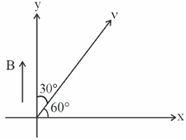
$A$ proton is projected with a speed of $2 \times 10^6 \ m/s$ at an angle of $60^{\circ}$ to the $x$-axis. If a uniform magnetic field of $0.104 \ T$ is applied along the $y$-axis,the path of the proton is:
A
$A$ circle of radius $0.2 \ m$ and time period $\pi \times 10^{-7} \ s$
B
$A$ circle of radius $0.1 \ m$ and time period $2\pi \times 10^{-7} \ s$
C
$A$ helix of radius $0.1 \ m$ and time period $2\pi \times 10^{-7} \ s$
D
$A$ helix of radius $0.2 \ m$ and time period $4\pi \times 10^{-7} \ s$
Solution
(C) The velocity vector makes an angle of $30^{\circ}$ with the $y$-axis (the direction of the magnetic field $\vec{B}$). Since the velocity has a component parallel to the magnetic field,the path of the proton will be a helix.
The radius of the helical path is given by $r = \frac{mv_{\perp}}{qB} = \frac{mv \sin(30^{\circ})}{qB}$.
Substituting the values: $m = 1.67 \times 10^{-27} \ kg$,$v = 2 \times 10^6 \ m/s$,$\sin(30^{\circ}) = 0.5$,$q = 1.6 \times 10^{-19} \ C$,and $B = 0.104 \ T$.
$r = \frac{1.67 \times 10^{-27} \times 2 \times 10^6 \times 0.5}{1.6 \times 10^{-19} \times 0.104} \approx 0.1 \ m$.
The time period of the helical motion is $T = \frac{2\pi m}{qB}$.
$T = \frac{2 \times \pi \times 1.67 \times 10^{-27}}{1.6 \times 10^{-19} \times 0.104} \approx 2\pi \times 10^{-7} \ s$.
Thus,the path is a helix of radius $0.1 \ m$ and time period $2\pi \times 10^{-7} \ s$.
The radius of the helical path is given by $r = \frac{mv_{\perp}}{qB} = \frac{mv \sin(30^{\circ})}{qB}$.
Substituting the values: $m = 1.67 \times 10^{-27} \ kg$,$v = 2 \times 10^6 \ m/s$,$\sin(30^{\circ}) = 0.5$,$q = 1.6 \times 10^{-19} \ C$,and $B = 0.104 \ T$.
$r = \frac{1.67 \times 10^{-27} \times 2 \times 10^6 \times 0.5}{1.6 \times 10^{-19} \times 0.104} \approx 0.1 \ m$.
The time period of the helical motion is $T = \frac{2\pi m}{qB}$.
$T = \frac{2 \times \pi \times 1.67 \times 10^{-27}}{1.6 \times 10^{-19} \times 0.104} \approx 2\pi \times 10^{-7} \ s$.
Thus,the path is a helix of radius $0.1 \ m$ and time period $2\pi \times 10^{-7} \ s$.
0 likes
View Solution367
DifficultMCQ
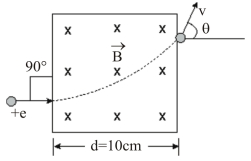
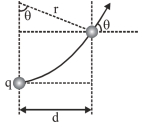
$A$ proton accelerated by a potential difference of $500 \ kV$ moves through a transverse magnetic field of $0.5 \ T$ as shown in the figure. The angle $\theta$,through which the proton deviates from the initial direction of its motion,is (mass of proton $= 1.6 \times 10^{-27} \ kg$):- (in $^{\circ}$)
A
$15$
B
$30$
C
$45$
D
$60$
Solution
(B) The radius of the circular path of a charged particle in a magnetic field is given by $r = \frac{mv}{qB}$.
Since the proton is accelerated by a potential difference $V$,its kinetic energy is $K = qV = \frac{1}{2}mv^2$,which gives $v = \sqrt{\frac{2qV}{m}}$.
Substituting $v$ in the radius formula,we get $r = \frac{m}{qB} \sqrt{\frac{2qV}{m}} = \frac{1}{B} \sqrt{\frac{2mV}{q}}$.
Given $V = 500 \times 10^3 \ V$,$B = 0.5 \ T$,$m = 1.6 \times 10^{-27} \ kg$,$q = 1.6 \times 10^{-19} \ C$,and $d = 0.1 \ m$.
$r = \frac{1}{0.5} \sqrt{\frac{2 \times 1.6 \times 10^{-27} \times 500 \times 10^3}{1.6 \times 10^{-19}}} = 2 \sqrt{\frac{2 \times 10^{-24} \times 500 \times 10^3}{10^{-19}}} = 2 \sqrt{1000 \times 10^{-2}} = 2 \sqrt{10} \approx 0.2 \ m$.
From the geometry of the path,$\sin \theta = \frac{d}{r} = \frac{0.1}{0.2} = 0.5$.
Therefore,$\theta = \arcsin(0.5) = 30^{\circ}$.
Since the proton is accelerated by a potential difference $V$,its kinetic energy is $K = qV = \frac{1}{2}mv^2$,which gives $v = \sqrt{\frac{2qV}{m}}$.
Substituting $v$ in the radius formula,we get $r = \frac{m}{qB} \sqrt{\frac{2qV}{m}} = \frac{1}{B} \sqrt{\frac{2mV}{q}}$.
Given $V = 500 \times 10^3 \ V$,$B = 0.5 \ T$,$m = 1.6 \times 10^{-27} \ kg$,$q = 1.6 \times 10^{-19} \ C$,and $d = 0.1 \ m$.
$r = \frac{1}{0.5} \sqrt{\frac{2 \times 1.6 \times 10^{-27} \times 500 \times 10^3}{1.6 \times 10^{-19}}} = 2 \sqrt{\frac{2 \times 10^{-24} \times 500 \times 10^3}{10^{-19}}} = 2 \sqrt{1000 \times 10^{-2}} = 2 \sqrt{10} \approx 0.2 \ m$.
From the geometry of the path,$\sin \theta = \frac{d}{r} = \frac{0.1}{0.2} = 0.5$.
Therefore,$\theta = \arcsin(0.5) = 30^{\circ}$.
0 likes
View Solution368
DifficultMCQ
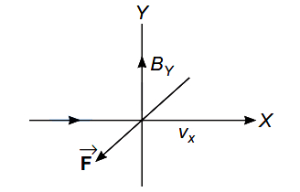
An electron is travelling along the $x$-direction. It encounters a magnetic field in the $y$-direction. Its subsequent motion will be
A
straight line along the $x$-direction
B
a circle in the $xz$-plane
C
a circle in the $yz$-plane
D
a circle in the $xz$-plane
Solution
(B) The magnetic force on a charged particle moving with velocity $\overrightarrow{v}$ in a magnetic field $\overrightarrow{B}$ is given by the Lorentz force formula: $\overrightarrow{F} = q(\overrightarrow{v} \times \overrightarrow{B})$.
For an electron,the charge $q = -e$.
The velocity of the electron is $\overrightarrow{v} = v_x \hat{i}$ and the magnetic field is $\overrightarrow{B} = B_y \hat{j}$.
Substituting these into the force equation:
$\overrightarrow{F} = -e(v_x \hat{i} \times B_y \hat{j})$
$\overrightarrow{F} = -e v_x B_y (\hat{i} \times \hat{j})$
Since $\hat{i} \times \hat{j} = \hat{k}$,we get $\overrightarrow{F} = -e v_x B_y \hat{k}$.
The force is always perpendicular to both the velocity and the magnetic field. Since the velocity is in the $x$-direction and the magnetic field is in the $y$-direction,the force acts in the $z$-direction (specifically $-z$ for an electron). The particle will move in a circle in the plane perpendicular to the magnetic field,which is the $xz$-plane.
For an electron,the charge $q = -e$.
The velocity of the electron is $\overrightarrow{v} = v_x \hat{i}$ and the magnetic field is $\overrightarrow{B} = B_y \hat{j}$.
Substituting these into the force equation:
$\overrightarrow{F} = -e(v_x \hat{i} \times B_y \hat{j})$
$\overrightarrow{F} = -e v_x B_y (\hat{i} \times \hat{j})$
Since $\hat{i} \times \hat{j} = \hat{k}$,we get $\overrightarrow{F} = -e v_x B_y \hat{k}$.
The force is always perpendicular to both the velocity and the magnetic field. Since the velocity is in the $x$-direction and the magnetic field is in the $y$-direction,the force acts in the $z$-direction (specifically $-z$ for an electron). The particle will move in a circle in the plane perpendicular to the magnetic field,which is the $xz$-plane.
0 likes
View Solution369
EasyMCQ
Bohr's atomic model is applied to a particle of mass $m$ and charge $q$ moving in a plane under the influence of a transverse magnetic field $B$. The energy of the charged particle in the $n^{\text{th}}$ level will be $(h = \text{Planck's constant})$
A
$2nhqB / \pi m$
B
$nhqB / 2\pi m$
C
$nhqB / 4\pi m$
D
$nhqB / \pi m$
Solution
(C) For a particle of mass $m$ and charge $q$ moving in a magnetic field $B$,the radius of the circular path is given by $r = \frac{mv}{qB}$.
According to Bohr's quantization condition,the angular momentum is $mvr = \frac{nh}{2\pi}$.
Substituting $r = \frac{mv}{qB}$ into the quantization condition: $mv \left( \frac{mv}{qB} \right) = \frac{nh}{2\pi}$.
This simplifies to $\frac{m^2 v^2}{qB} = \frac{nh}{2\pi}$,which gives $mv^2 = \frac{nhqB}{2\pi m}$.
The kinetic energy $E$ is given by $E = \frac{1}{2} mv^2$.
Substituting the expression for $mv^2$: $E = \frac{1}{2} \left( \frac{nhqB}{2\pi m} \right) = \frac{nhqB}{4\pi m}$.
According to Bohr's quantization condition,the angular momentum is $mvr = \frac{nh}{2\pi}$.
Substituting $r = \frac{mv}{qB}$ into the quantization condition: $mv \left( \frac{mv}{qB} \right) = \frac{nh}{2\pi}$.
This simplifies to $\frac{m^2 v^2}{qB} = \frac{nh}{2\pi}$,which gives $mv^2 = \frac{nhqB}{2\pi m}$.
The kinetic energy $E$ is given by $E = \frac{1}{2} mv^2$.
Substituting the expression for $mv^2$: $E = \frac{1}{2} \left( \frac{nhqB}{2\pi m} \right) = \frac{nhqB}{4\pi m}$.
0 likes
View Solution370
MediumMCQ
Bohr model is applied to a particle of mass $m$ and charge $q$ moving in a plane under the influence of a transverse magnetic field $B$. The energy of the charged particle in the $n^{\text{th}}$ level will be $[h = \text{Planck's constant}]$
A
$\frac{nhqB}{4 \pi m}$
B
$\frac{nhqB}{2 \pi m}$
C
$\frac{nhqB}{\pi m}$
D
$\frac{2 nhqB}{\pi m}$
Solution
(A) According to the Bohr quantization condition,the angular momentum is given by $mvr = \frac{nh}{2 \pi}$.
Therefore,$vr = \frac{nh}{2 \pi m} \dots (i)$.
For a particle moving in a circular path under a magnetic field,the magnetic force provides the centripetal force: $qvB = \frac{mv^2}{r}$.
This simplifies to $mv = qBr$,or $v = \frac{qBr}{m} \dots (ii)$.
Substituting $v$ from $(ii)$ into $(i)$,we get $(\frac{qBr}{m})r = \frac{nh}{2 \pi m}$,which implies $r^2 = \frac{nh}{2 \pi qB}$.
The kinetic energy $E$ is given by $E = \frac{1}{2}mv^2$. Since $mv = qBr$,we have $E = \frac{1}{2}m(\frac{qBr}{m})^2 = \frac{q^2 B^2 r^2}{2m}$.
Substituting $r^2$ into the energy expression: $E = \frac{q^2 B^2}{2m} \times \frac{nh}{2 \pi qB} = \frac{nhqB}{4 \pi m}$.
Therefore,$vr = \frac{nh}{2 \pi m} \dots (i)$.
For a particle moving in a circular path under a magnetic field,the magnetic force provides the centripetal force: $qvB = \frac{mv^2}{r}$.
This simplifies to $mv = qBr$,or $v = \frac{qBr}{m} \dots (ii)$.
Substituting $v$ from $(ii)$ into $(i)$,we get $(\frac{qBr}{m})r = \frac{nh}{2 \pi m}$,which implies $r^2 = \frac{nh}{2 \pi qB}$.
The kinetic energy $E$ is given by $E = \frac{1}{2}mv^2$. Since $mv = qBr$,we have $E = \frac{1}{2}m(\frac{qBr}{m})^2 = \frac{q^2 B^2 r^2}{2m}$.
Substituting $r^2$ into the energy expression: $E = \frac{q^2 B^2}{2m} \times \frac{nh}{2 \pi qB} = \frac{nhqB}{4 \pi m}$.
0 likes
View Solution371
EasyMCQ
Which of the following,while in motion,cannot be deflected by a magnetic field?
A
Protons
B
Cathode rays
C
Alpha particles
D
Neutrons
Solution
(D) The magnetic force $F$ on a moving charge $q$ in a magnetic field $B$ is given by the Lorentz force formula: $F = q(v \times B)$.
Protons,cathode rays (electrons),and alpha particles are all charged particles. Therefore,they experience a magnetic force when moving through a magnetic field and are deflected.
Neutrons are electrically neutral particles,meaning their charge $q = 0$.
Since the charge is zero,the magnetic force $F = 0 \times (v \times B) = 0$.
Thus,neutrons cannot be deflected by a magnetic field.
Protons,cathode rays (electrons),and alpha particles are all charged particles. Therefore,they experience a magnetic force when moving through a magnetic field and are deflected.
Neutrons are electrically neutral particles,meaning their charge $q = 0$.
Since the charge is zero,the magnetic force $F = 0 \times (v \times B) = 0$.
Thus,neutrons cannot be deflected by a magnetic field.
0 likes
View Solution372
MediumMCQ
An electron (mass $m$) is accelerated through a potential difference of $V$ and then it enters a magnetic field of induction $B$ normal to the field lines. The radius of the circular path is ($e$ = electronic charge).
A
$\sqrt{\frac{2 eV}{m}}$
B
$\sqrt{\frac{2 Vm}{eB^2}}$
C
$\sqrt{\frac{2 Vm}{eB}}$
D
$\sqrt{\frac{2 Vm}{e^2B}}$
Solution
(B) The kinetic energy gained by the electron accelerated through a potential difference $V$ is given by:
$KE = eV = \frac{1}{2} mv^2$
From this,the velocity $v$ of the electron is:
$v = \sqrt{\frac{2 eV}{m}}$
When a charged particle enters a magnetic field $B$ perpendicular to its velocity,it follows a circular path with radius $R$ given by:
$R = \frac{mv}{eB}$
Substituting the value of $v$ into the expression for $R$:
$R = \frac{m}{eB} \sqrt{\frac{2 eV}{m}} = \frac{1}{eB} \sqrt{m^2 \cdot \frac{2 eV}{m}} = \frac{1}{eB} \sqrt{2 Vme} = \sqrt{\frac{2 Vme}{e^2 B^2}} = \sqrt{\frac{2 Vm}{eB^2}}$
$KE = eV = \frac{1}{2} mv^2$
From this,the velocity $v$ of the electron is:
$v = \sqrt{\frac{2 eV}{m}}$
When a charged particle enters a magnetic field $B$ perpendicular to its velocity,it follows a circular path with radius $R$ given by:
$R = \frac{mv}{eB}$
Substituting the value of $v$ into the expression for $R$:
$R = \frac{m}{eB} \sqrt{\frac{2 eV}{m}} = \frac{1}{eB} \sqrt{m^2 \cdot \frac{2 eV}{m}} = \frac{1}{eB} \sqrt{2 Vme} = \sqrt{\frac{2 Vme}{e^2 B^2}} = \sqrt{\frac{2 Vm}{eB^2}}$
0 likes
View Solution373
EasyMCQ
$A$ particle of charge $q$ moves with a velocity $\vec{V} = a \hat{i}$ in a magnetic field $\vec{B} = b \hat{j} + c \hat{k}$,where $a$,$b$,and $c$ are constants. The magnitude of the force experienced by the particle is:
A
$q a \sqrt{b^2 + c^2}$
B
$q a(b + c)$
C
$q a \sqrt{b^2 - c^2}$
D
zero
Solution
(A) The magnetic force $\vec{F}$ on a charged particle moving with velocity $\vec{V}$ in a magnetic field $\vec{B}$ is given by the Lorentz force formula: $\vec{F} = q(\vec{V} \times \vec{B})$.
Given $\vec{V} = a \hat{i}$ and $\vec{B} = b \hat{j} + c \hat{k}$.
Calculating the cross product: $\vec{V} \times \vec{B} = (a \hat{i}) \times (b \hat{j} + c \hat{k}) = ab(\hat{i} \times \hat{j}) + ac(\hat{i} \times \hat{k})$.
Using unit vector cross products $\hat{i} \times \hat{j} = \hat{k}$ and $\hat{i} \times \hat{k} = -\hat{j}$,we get: $\vec{V} \times \vec{B} = ab \hat{k} - ac \hat{j}$.
Therefore,$\vec{F} = q(ab \hat{k} - ac \hat{j})$.
The magnitude of the force is $|\vec{F}| = q \sqrt{(ab)^2 + (-ac)^2} = q \sqrt{a^2b^2 + a^2c^2} = qa \sqrt{b^2 + c^2}$.
Given $\vec{V} = a \hat{i}$ and $\vec{B} = b \hat{j} + c \hat{k}$.
Calculating the cross product: $\vec{V} \times \vec{B} = (a \hat{i}) \times (b \hat{j} + c \hat{k}) = ab(\hat{i} \times \hat{j}) + ac(\hat{i} \times \hat{k})$.
Using unit vector cross products $\hat{i} \times \hat{j} = \hat{k}$ and $\hat{i} \times \hat{k} = -\hat{j}$,we get: $\vec{V} \times \vec{B} = ab \hat{k} - ac \hat{j}$.
Therefore,$\vec{F} = q(ab \hat{k} - ac \hat{j})$.
The magnitude of the force is $|\vec{F}| = q \sqrt{(ab)^2 + (-ac)^2} = q \sqrt{a^2b^2 + a^2c^2} = qa \sqrt{b^2 + c^2}$.
0 likes
View Solution374
EasyMCQ
$A$ charged particle is moving along a magnetic field line. What is the magnetic force acting on the particle? $(\sin 0^{\circ}=0, \sin \frac{\pi}{2}=1)$
A
Opposite to its velocity.
B
Perpendicular to its velocity.
C
Zero.
D
Along its velocity.
Solution
(C) The magnetic force $F$ acting on a charged particle moving with velocity $v$ in a magnetic field $B$ is given by the formula: $F = qvB \sin \theta$,where $\theta$ is the angle between the velocity vector and the magnetic field vector.
Since the charged particle is moving along a magnetic field line,the angle between its velocity and the magnetic field is $\theta = 0^{\circ}$.
Substituting this value into the force equation: $F = qvB \sin 0^{\circ}$.
Since $\sin 0^{\circ} = 0$,the magnetic force $F = 0$.
Since the charged particle is moving along a magnetic field line,the angle between its velocity and the magnetic field is $\theta = 0^{\circ}$.
Substituting this value into the force equation: $F = qvB \sin 0^{\circ}$.
Since $\sin 0^{\circ} = 0$,the magnetic force $F = 0$.
0 likes
View Solution375
MediumMCQ
$A$ charged particle is moving in a uniform magnetic field in a circular path with radius $R$. When the energy of the particle is doubled,then the new radius will be
A
$\frac{R}{\sqrt{2}}$
B
$2R$
C
$\frac{R}{2}$
D
$\sqrt{2}R$
Solution
(D) The magnetic Lorentz force provides the necessary centripetal force for circular motion: $F = qvB = \frac{mv^2}{R}$.
From this,the radius $R$ is given by $R = \frac{mv}{qB}$.
Since the kinetic energy $K = \frac{1}{2}mv^2$,we have $mv = \sqrt{2mK}$.
Substituting this into the radius formula: $R = \frac{\sqrt{2mK}}{qB}$.
This shows that $R \propto \sqrt{K}$.
If the energy is doubled $(K' = 2K)$,the new radius $R'$ is:
$\frac{R'}{R} = \sqrt{\frac{K'}{K}} = \sqrt{\frac{2K}{K}} = \sqrt{2}$.
Therefore,$R' = \sqrt{2}R$.
From this,the radius $R$ is given by $R = \frac{mv}{qB}$.
Since the kinetic energy $K = \frac{1}{2}mv^2$,we have $mv = \sqrt{2mK}$.
Substituting this into the radius formula: $R = \frac{\sqrt{2mK}}{qB}$.
This shows that $R \propto \sqrt{K}$.
If the energy is doubled $(K' = 2K)$,the new radius $R'$ is:
$\frac{R'}{R} = \sqrt{\frac{K'}{K}} = \sqrt{\frac{2K}{K}} = \sqrt{2}$.
Therefore,$R' = \sqrt{2}R$.
0 likes
View Solution376
MediumMCQ
$A$ charged particle of charge '$q$' is accelerated by a potential difference '$V$' and enters a region of uniform magnetic field '$B$' at right angles to the direction of the field. The charged particle completes a semicircle of radius '$r$' inside the magnetic field. The mass of the charged particle is
A
$\frac{r^2 q B^2}{2 V}$
B
$\frac{r^2 q^2 B^2}{\sqrt{2} V}$
C
$\frac{q r B}{2 V}$
D
$\frac{q^2 r^2 B^2}{V}$
Solution
(A) When a charged particle enters a uniform magnetic field perpendicularly,it follows a circular path.
The radius of this path is given by:
$R = \frac{mv}{qB} = \frac{\sqrt{2mK}}{qB}$
where $K$ is the kinetic energy of the particle.
Since the particle is accelerated through a potential difference $V$,its kinetic energy is $K = qV$.
Substituting this into the radius formula:
$R = \frac{\sqrt{2m(qV)}}{qB} = \frac{\sqrt{2mqV}}{qB}$
Squaring both sides:
$R^2 = \frac{2mqV}{q^2 B^2} = \frac{2mV}{qB^2}$
Given that the radius is $r$,we have $r^2 = \frac{2mV}{qB^2}$.
Solving for mass $m$:
$m = \frac{r^2 q B^2}{2V}$
The radius of this path is given by:
$R = \frac{mv}{qB} = \frac{\sqrt{2mK}}{qB}$
where $K$ is the kinetic energy of the particle.
Since the particle is accelerated through a potential difference $V$,its kinetic energy is $K = qV$.
Substituting this into the radius formula:
$R = \frac{\sqrt{2m(qV)}}{qB} = \frac{\sqrt{2mqV}}{qB}$
Squaring both sides:
$R^2 = \frac{2mqV}{q^2 B^2} = \frac{2mV}{qB^2}$
Given that the radius is $r$,we have $r^2 = \frac{2mV}{qB^2}$.
Solving for mass $m$:
$m = \frac{r^2 q B^2}{2V}$
0 likes
View Solution377
DifficultMCQ
An electron of mass '$m$' and charge '$q$' is travelling with speed '$v$' along a circular path of radius '$R$' at right angles to a uniform magnetic field of intensity '$B$'. If the speed of the electron is halved and the magnetic field is doubled,the resulting path would have a radius of:
A
$\frac{R}{2}$
B
$\frac{R}{4}$
C
$2R$
D
$4R$
Solution
(B) For a charged particle moving in a uniform magnetic field,the magnetic Lorentz force provides the necessary centripetal force for circular motion.
$qvB = \frac{mv^2}{R}$
$\therefore R = \frac{mv}{qB}$ ... $(i)$
Given the new speed $v' = \frac{v}{2}$ and the new magnetic field $B' = 2B$.
The new radius $R'$ is given by:
$R' = \frac{mv'}{qB'} = \frac{m(v/2)}{q(2B)}$
$R' = \frac{mv}{4qB}$
Substituting equation $(i)$ into the expression for $R'$:
$R' = \frac{R}{4}$
$qvB = \frac{mv^2}{R}$
$\therefore R = \frac{mv}{qB}$ ... $(i)$
Given the new speed $v' = \frac{v}{2}$ and the new magnetic field $B' = 2B$.
The new radius $R'$ is given by:
$R' = \frac{mv'}{qB'} = \frac{m(v/2)}{q(2B)}$
$R' = \frac{mv}{4qB}$
Substituting equation $(i)$ into the expression for $R'$:
$R' = \frac{R}{4}$
0 likes
View Solution378
EasyMCQ
$A$ charged particle is moving in a uniform magnetic field in a circular path of radius $R$. When the kinetic energy of the particle is increased to three times,then the new radius will be
A
$\frac{R}{3}$
B
$\frac{R}{\sqrt{3}}$
C
$\sqrt{3} \cdot R$
D
$3 \cdot R$
Solution
(C) The radius $r$ of a charged particle moving in a uniform magnetic field is given by the formula $r = \frac{mv}{qB}$.
Since kinetic energy $K = \frac{1}{2}mv^2$,we have $mv = \sqrt{2mK}$.
Substituting this into the radius formula,we get $r = \frac{\sqrt{2mK}}{qB}$.
This shows that $r \propto \sqrt{K}$.
Let the initial kinetic energy be $K_1 = K$ and the initial radius be $R_1 = R$.
Let the new kinetic energy be $K_2 = 3K$ and the new radius be $R_2$.
Using the proportionality $r \propto \sqrt{K}$,we have $\frac{R_2}{R_1} = \sqrt{\frac{K_2}{K_1}}$.
Substituting the values,$\frac{R_2}{R} = \sqrt{\frac{3K}{K}} = \sqrt{3}$.
Therefore,the new radius is $R_2 = \sqrt{3} \cdot R$.
Since kinetic energy $K = \frac{1}{2}mv^2$,we have $mv = \sqrt{2mK}$.
Substituting this into the radius formula,we get $r = \frac{\sqrt{2mK}}{qB}$.
This shows that $r \propto \sqrt{K}$.
Let the initial kinetic energy be $K_1 = K$ and the initial radius be $R_1 = R$.
Let the new kinetic energy be $K_2 = 3K$ and the new radius be $R_2$.
Using the proportionality $r \propto \sqrt{K}$,we have $\frac{R_2}{R_1} = \sqrt{\frac{K_2}{K_1}}$.
Substituting the values,$\frac{R_2}{R} = \sqrt{\frac{3K}{K}} = \sqrt{3}$.
Therefore,the new radius is $R_2 = \sqrt{3} \cdot R$.
0 likes
View Solution379
MediumMCQ
$A$ proton moving in a perpendicular magnetic field possesses energy $E$. The strength of the magnetic field is increased four times, but the proton is constrained to move in a path of the same radius. The kinetic energy of the proton will increase by: (in $times$)
A
$4$
B
$12$
C
$8$
D
$16$
Solution
(D) When a charged particle moves in a perpendicular magnetic field, it undergoes uniform circular motion.
The magnetic force provides the necessary centripetal force: $\frac{mv^2}{R} = qvB$.
This simplifies to $v = \frac{qBR}{m}$.
The kinetic energy $E$ is given by $E = \frac{1}{2}mv^2 = \frac{1}{2}m \left(\frac{qBR}{m}\right)^2 = \frac{q^2B^2R^2}{2m}$.
Since $q$, $m$, and $R$ are constant, $E \propto B^2$.
If the magnetic field $B$ is increased by $4$ times $(B' = 4B)$, the new kinetic energy $E'$ will be:
$E' \propto (4B)^2 = 16B^2$.
Therefore, $E' = 16E$. The kinetic energy increases by $16$ times.
The magnetic force provides the necessary centripetal force: $\frac{mv^2}{R} = qvB$.
This simplifies to $v = \frac{qBR}{m}$.
The kinetic energy $E$ is given by $E = \frac{1}{2}mv^2 = \frac{1}{2}m \left(\frac{qBR}{m}\right)^2 = \frac{q^2B^2R^2}{2m}$.
Since $q$, $m$, and $R$ are constant, $E \propto B^2$.
If the magnetic field $B$ is increased by $4$ times $(B' = 4B)$, the new kinetic energy $E'$ will be:
$E' \propto (4B)^2 = 16B^2$.
Therefore, $E' = 16E$. The kinetic energy increases by $16$ times.
0 likes
View Solution380
MediumMCQ
$A$ beam of electrons,initially at rest,is accelerated by a potential $V$. This beam experiences a force $F$ in a uniform magnetic field. The accelerating potential is increased to $V^{\prime}$ and the force experienced by the electrons in the same magnetic field becomes $2F$. The ratio $\frac{V}{V^{\prime}}$ is:
A
$2: 1$
B
$1: 2$
C
$1: 4$
D
$1: 1$
Solution
(C) The kinetic energy of the electrons is given by $\frac{1}{2}mv^2 = eV$,which implies the velocity $v = \sqrt{\frac{2eV}{m}}$.
The magnetic force experienced by the electrons is $F = evB = eB\sqrt{\frac{2eV}{m}}$.
This shows that $F \propto \sqrt{V}$.
Given that the new force $F^{\prime} = 2F$ when the potential is $V^{\prime}$,we have $\frac{F^{\prime}}{F} = \sqrt{\frac{V^{\prime}}{V}}$.
Substituting the values,$2 = \sqrt{\frac{V^{\prime}}{V}}$.
Squaring both sides,$4 = \frac{V^{\prime}}{V}$,which means $V^{\prime} = 4V$.
Therefore,the ratio $\frac{V}{V^{\prime}} = \frac{V}{4V} = \frac{1}{4}$.
The magnetic force experienced by the electrons is $F = evB = eB\sqrt{\frac{2eV}{m}}$.
This shows that $F \propto \sqrt{V}$.
Given that the new force $F^{\prime} = 2F$ when the potential is $V^{\prime}$,we have $\frac{F^{\prime}}{F} = \sqrt{\frac{V^{\prime}}{V}}$.
Substituting the values,$2 = \sqrt{\frac{V^{\prime}}{V}}$.
Squaring both sides,$4 = \frac{V^{\prime}}{V}$,which means $V^{\prime} = 4V$.
Therefore,the ratio $\frac{V}{V^{\prime}} = \frac{V}{4V} = \frac{1}{4}$.
0 likes
View Solution381
EasyMCQ
An electric charge moving with uniform velocity has
A
only magnetic field around it.
B
neither electric field nor magnetic field around it.
C
only electric field around it.
D
both electric and magnetic field around it.
Solution
(D) stationary electric charge produces an electric field in the space around it.
When an electric charge moves with a uniform velocity,it constitutes an electric current.
According to the Oersted experiment,an electric current produces a magnetic field in the surrounding space.
Since the charge is moving,it continues to possess its inherent electric field while simultaneously generating a magnetic field due to its motion.
Therefore,a charge moving with uniform velocity produces both electric and magnetic fields.
When an electric charge moves with a uniform velocity,it constitutes an electric current.
According to the Oersted experiment,an electric current produces a magnetic field in the surrounding space.
Since the charge is moving,it continues to possess its inherent electric field while simultaneously generating a magnetic field due to its motion.
Therefore,a charge moving with uniform velocity produces both electric and magnetic fields.
0 likes
View Solution382
EasyMCQ
$A$ charged particle moves through a magnetic field perpendicular to its direction. Then
A
both momentum and kinetic energy of the particle are changed
B
its momentum changes but its kinetic energy remains constant
C
its kinetic energy changes but momentum remains constant
D
both momentum and kinetic energy of the particle remains constant
Solution
(B) The magnetic force acting on a charged particle is given by $\vec{F} = q(\vec{v} \times \vec{B})$.
Since the force is always perpendicular to the velocity vector $\vec{v}$,the work done by the magnetic force is $W = \int \vec{F} \cdot d\vec{r} = \int \vec{F} \cdot \vec{v} dt = 0$.
According to the work-energy theorem,the change in kinetic energy is equal to the work done,so the kinetic energy remains constant.
However,because the direction of the velocity vector changes continuously during the motion,the momentum $\vec{p} = m\vec{v}$ changes.
Therefore,the momentum changes while the kinetic energy remains constant.
Since the force is always perpendicular to the velocity vector $\vec{v}$,the work done by the magnetic force is $W = \int \vec{F} \cdot d\vec{r} = \int \vec{F} \cdot \vec{v} dt = 0$.
According to the work-energy theorem,the change in kinetic energy is equal to the work done,so the kinetic energy remains constant.
However,because the direction of the velocity vector changes continuously during the motion,the momentum $\vec{p} = m\vec{v}$ changes.
Therefore,the momentum changes while the kinetic energy remains constant.
0 likes
View Solution383
EasyMCQ
$A$ charge moves in a circular path perpendicular to a magnetic field. The time period of the revolution is independent of
A
strength of charge.
B
magnetic field.
C
mass of the charge.
D
velocity of the charge.
Solution
(D) When a charged particle of mass $m$ and charge $q$ moves in a circular path perpendicular to a uniform magnetic field $B$,the magnetic Lorentz force provides the necessary centripetal force.
$qvB = \frac{mv^2}{r}$
From this,the radius of the path is $r = \frac{mv}{qB}$.
The time period $T$ is the time taken to complete one full circle,which is the circumference divided by the velocity:
$T = \frac{2 \pi r}{v} = \frac{2 \pi (mv/qB)}{v} = \frac{2 \pi m}{qB}$.
As seen from the formula $T = \frac{2 \pi m}{qB}$,the time period $T$ depends only on the mass $m$,charge $q$,and magnetic field $B$.
It is independent of the velocity $v$ of the charge.
$qvB = \frac{mv^2}{r}$
From this,the radius of the path is $r = \frac{mv}{qB}$.
The time period $T$ is the time taken to complete one full circle,which is the circumference divided by the velocity:
$T = \frac{2 \pi r}{v} = \frac{2 \pi (mv/qB)}{v} = \frac{2 \pi m}{qB}$.
As seen from the formula $T = \frac{2 \pi m}{qB}$,the time period $T$ depends only on the mass $m$,charge $q$,and magnetic field $B$.
It is independent of the velocity $v$ of the charge.
0 likes
View Solution384
MediumMCQ
An electron accelerated through a potential difference $V$ passes through a uniform transverse magnetic field and experiences a force $F$. If the accelerating potential is increased to $2V$,the electron in the same magnetic field will experience a force:
A
$\frac{F}{2}$
B
$3F$
C
$F$
D
$\sqrt{2}F$
Solution
(D) The magnetic force $F$ on a charged particle of mass $m$ and charge $q$ moving with velocity $v$ in a uniform magnetic field $B$ is given by $F = Bqv$.
When an electron is accelerated through a potential difference $V$,its kinetic energy is given by $\frac{1}{2}mv^2 = eV$.
From this,the velocity $v$ is $v = \sqrt{\frac{2eV}{m}}$.
Substituting this into the force equation,we get $F = B e \sqrt{\frac{2eV}{m}} = B e \sqrt{\frac{2e}{m}} \sqrt{V}$.
This shows that $F \propto \sqrt{V}$.
If the potential difference is increased to $2V$,the new force $F'$ will be $F' \propto \sqrt{2V}$.
Therefore,$\frac{F'}{F} = \frac{\sqrt{2V}}{\sqrt{V}} = \sqrt{2}$.
Thus,$F' = \sqrt{2}F$.
When an electron is accelerated through a potential difference $V$,its kinetic energy is given by $\frac{1}{2}mv^2 = eV$.
From this,the velocity $v$ is $v = \sqrt{\frac{2eV}{m}}$.
Substituting this into the force equation,we get $F = B e \sqrt{\frac{2eV}{m}} = B e \sqrt{\frac{2e}{m}} \sqrt{V}$.
This shows that $F \propto \sqrt{V}$.
If the potential difference is increased to $2V$,the new force $F'$ will be $F' \propto \sqrt{2V}$.
Therefore,$\frac{F'}{F} = \frac{\sqrt{2V}}{\sqrt{V}} = \sqrt{2}$.
Thus,$F' = \sqrt{2}F$.
0 likes
View Solution385
EasyMCQ
An electron and a proton having same momenta enter perpendicular into a magnetic field then
A
they will move undeflected
B
curved path of electron and proton will be same. (Neglect sense of revolution)
C
curved path of electron is more curved than proton
D
path of the proton is more curved
Solution
(B) The radius of curvature $r$ of a charged particle of mass $m$ and charge $q$ moving in a region with a uniform perpendicular magnetic field $B$ is given by the formula: $r = \frac{mv}{Bq} = \frac{p}{Bq}$.
Here,$p$ is the momentum of the charged particle.
Since the momenta $p$ are the same for both the electron and the proton,and the magnetic field $B$ is also the same,the radius of the circular path depends only on the charge $q$ of the particle.
However,the magnitude of the charge for both an electron and a proton is equal $(|q_e| = |q_p| = e)$.
Therefore,$r_e = \frac{p}{Be}$ and $r_p = \frac{p}{Be}$,which implies $r_e = r_p$.
Thus,both particles will follow a curved path of the same radius,neglecting the sense of revolution (direction of curvature).
Here,$p$ is the momentum of the charged particle.
Since the momenta $p$ are the same for both the electron and the proton,and the magnetic field $B$ is also the same,the radius of the circular path depends only on the charge $q$ of the particle.
However,the magnitude of the charge for both an electron and a proton is equal $(|q_e| = |q_p| = e)$.
Therefore,$r_e = \frac{p}{Be}$ and $r_p = \frac{p}{Be}$,which implies $r_e = r_p$.
Thus,both particles will follow a curved path of the same radius,neglecting the sense of revolution (direction of curvature).
0 likes
View Solution386
EasyMCQ
An electron is projected along the axis of a circular conductor carrying current $I$. The electron will experience:
A
a force perpendicular to the axis
B
a force along the axis
C
a force at an angle $30^{\circ}$ with the axis
D
no force
Solution
(D) The magnetic field produced by a circular current-carrying loop at any point on its axis is directed along the axis of the loop.
Since the electron is projected along the same axis,its velocity vector $\vec{v}$ is parallel or anti-parallel to the magnetic field vector $\vec{B}$.
Therefore,the angle $\theta$ between the velocity and the magnetic field is either $0^{\circ}$ or $180^{\circ}$.
The magnetic force on a moving charge is given by the Lorentz force formula: $F = qvB \sin \theta$.
Substituting $\theta = 0^{\circ}$ or $180^{\circ}$,we get $\sin(0^{\circ}) = 0$ or $\sin(180^{\circ}) = 0$.
Thus,$F = 0$. The electron experiences no force.
Since the electron is projected along the same axis,its velocity vector $\vec{v}$ is parallel or anti-parallel to the magnetic field vector $\vec{B}$.
Therefore,the angle $\theta$ between the velocity and the magnetic field is either $0^{\circ}$ or $180^{\circ}$.
The magnetic force on a moving charge is given by the Lorentz force formula: $F = qvB \sin \theta$.
Substituting $\theta = 0^{\circ}$ or $180^{\circ}$,we get $\sin(0^{\circ}) = 0$ or $\sin(180^{\circ}) = 0$.
Thus,$F = 0$. The electron experiences no force.
0 likes
View Solution387
EasyMCQ
$A$ charge $q_0$ moving with velocity $\overrightarrow{v}$ in a magnetic field of induction $\overrightarrow{B}$ experiences a force $\overrightarrow{F}$. The angle between $\overrightarrow{v}$ and $\overrightarrow{B}$ is $\theta$. The speed of $q_0$ after one second will be
A
$v / B$
B
$v$
C
$v \times B$
D
$B / v$
Solution
(B) The magnetic force acting on a moving charge is given by $\overrightarrow{F} = q_0(\overrightarrow{v} \times \overrightarrow{B})$.
Since the force $\overrightarrow{F}$ is always perpendicular to the velocity vector $\overrightarrow{v}$,the work done by the magnetic force on the charge is zero $(W = \overrightarrow{F} \cdot \overrightarrow{d} = 0)$.
According to the work-energy theorem,the change in kinetic energy is equal to the work done,which implies that the kinetic energy remains constant.
Since kinetic energy $K = \frac{1}{2}mv^2$,a constant kinetic energy implies that the speed $v$ of the charge remains constant over time.
Therefore,the speed of $q_0$ after one second remains $v$.
Since the force $\overrightarrow{F}$ is always perpendicular to the velocity vector $\overrightarrow{v}$,the work done by the magnetic force on the charge is zero $(W = \overrightarrow{F} \cdot \overrightarrow{d} = 0)$.
According to the work-energy theorem,the change in kinetic energy is equal to the work done,which implies that the kinetic energy remains constant.
Since kinetic energy $K = \frac{1}{2}mv^2$,a constant kinetic energy implies that the speed $v$ of the charge remains constant over time.
Therefore,the speed of $q_0$ after one second remains $v$.
0 likes
View Solution388
EasyMCQ
Two particles $A$ and $B$ have equal charges but different masses $M_{A}$ and $M_{B}$. After being accelerated through the same potential difference,they enter a region of uniform magnetic field and describe paths of radii $R_{A}$ and $R_{B}$ respectively. Then $M_{A} : M_{B}$ is
A
$\frac{R_{A}}{R_{B}}$
B
$\frac{R_{B}}{R_{A}}$
C
$\left(\frac{R_{A}}{R_{B}}\right)^{2}$
D
$\left(\frac{R_{B}}{R_{A}}\right)^{2}$
Solution
(C) When a particle of charge $q$ and mass $M$ is accelerated through a potential difference $V$,its kinetic energy is given by $\frac{1}{2} M v^{2} = qV$.
Thus,the velocity $v = \sqrt{\frac{2qV}{M}}$.
When this particle enters a uniform magnetic field $B$ perpendicular to its velocity,it describes a circular path of radius $R = \frac{Mv}{qB}$.
Substituting the value of $v$,we get $R = \frac{M}{qB} \sqrt{\frac{2qV}{M}} = \frac{1}{B} \sqrt{\frac{2MV}{q}}$.
Since $q$,$V$,and $B$ are the same for both particles,$R \propto \sqrt{M}$,which implies $R^{2} \propto M$.
Therefore,$\frac{M_{A}}{M_{B}} = \left(\frac{R_{A}}{R_{B}}\right)^{2}$.
Thus,the velocity $v = \sqrt{\frac{2qV}{M}}$.
When this particle enters a uniform magnetic field $B$ perpendicular to its velocity,it describes a circular path of radius $R = \frac{Mv}{qB}$.
Substituting the value of $v$,we get $R = \frac{M}{qB} \sqrt{\frac{2qV}{M}} = \frac{1}{B} \sqrt{\frac{2MV}{q}}$.
Since $q$,$V$,and $B$ are the same for both particles,$R \propto \sqrt{M}$,which implies $R^{2} \propto M$.
Therefore,$\frac{M_{A}}{M_{B}} = \left(\frac{R_{A}}{R_{B}}\right)^{2}$.
0 likes
View Solution389
EasyMCQ
$A$ charged particle is moving in a uniform magnetic field in a circular path of radius $R$. When the energy of the particle becomes three times the original,the new radius will be
A
$\frac{R}{3}$
B
$R$
C
$3 R$
D
$\sqrt{3} R$
Solution
(D) The magnetic force provides the centripetal force for circular motion: $Bqv = \frac{mv^2}{R}$,which simplifies to $R = \frac{mv}{qB} = \frac{p}{qB}$,where $p$ is the momentum.
Since kinetic energy $K = \frac{p^2}{2m}$,we have $p = \sqrt{2mK}$.
Substituting this into the radius formula: $R = \frac{\sqrt{2mK}}{qB}$.
This shows that $R \propto \sqrt{K}$.
Given that the new kinetic energy $K_2 = 3K_1$,the new radius $R_2$ is related to the original radius $R_1$ by:
$\frac{R_2}{R_1} = \sqrt{\frac{K_2}{K_1}} = \sqrt{3}$.
Therefore,$R_2 = \sqrt{3} R$.
Since kinetic energy $K = \frac{p^2}{2m}$,we have $p = \sqrt{2mK}$.
Substituting this into the radius formula: $R = \frac{\sqrt{2mK}}{qB}$.
This shows that $R \propto \sqrt{K}$.
Given that the new kinetic energy $K_2 = 3K_1$,the new radius $R_2$ is related to the original radius $R_1$ by:
$\frac{R_2}{R_1} = \sqrt{\frac{K_2}{K_1}} = \sqrt{3}$.
Therefore,$R_2 = \sqrt{3} R$.
0 likes
View Solution390
EasyMCQ
$A$ charged particle is moving parallel to the direction of a magnetic field. The magnetic force acting on the particle will be
A
opposite to its velocity.
B
zero.
C
perpendicular to its velocity.
D
along its velocity.
Solution
(B) The magnetic force $F$ acting on a charged particle moving with velocity $v$ in a magnetic field $B$ is given by the Lorentz force formula: $F = q(v \times B) = qvB \sin \theta$,where $\theta$ is the angle between the velocity vector and the magnetic field vector.
Since the particle is moving parallel to the magnetic field,the angle $\theta = 0^{\circ}$.
Substituting this into the formula: $F = qvB \sin(0^{\circ}) = qvB(0) = 0$.
Therefore,the magnetic force acting on the particle is zero.
Since the particle is moving parallel to the magnetic field,the angle $\theta = 0^{\circ}$.
Substituting this into the formula: $F = qvB \sin(0^{\circ}) = qvB(0) = 0$.
Therefore,the magnetic force acting on the particle is zero.
0 likes
View Solution391
EasyMCQ
An electron at rest is accelerated by a potential $V_{1}$ and then enters a uniform magnetic field,experiencing a force $F_{1}$. When the potential is changed to $V_{2}$,the force experienced by the electron becomes $2F_{1}$. The ratio of $V_{1}$ to $V_{2}$ is:
A
$4: 1$
B
$2: 1$
C
$1: 2$
D
$1: 4$
Solution
(D) The kinetic energy $K$ of an electron accelerated by a potential $V$ is given by $K = eV = \frac{1}{2}mv^2$. Thus,the velocity $v$ is proportional to $\sqrt{V}$.
The magnetic force on a charged particle moving in a magnetic field is $F = qvB \sin \theta$. Assuming the angle $\theta$ remains constant,$F \propto v$.
Since $v \propto \sqrt{V}$,it follows that $F \propto \sqrt{V}$.
Given $F_{1} \propto \sqrt{V_{1}}$ and $F_{2} = 2F_{1} \propto \sqrt{V_{2}}$.
Dividing the two expressions: $\frac{F_{2}}{F_{1}} = \frac{\sqrt{V_{2}}}{\sqrt{V_{1}}} = 2$.
Squaring both sides: $\frac{V_{2}}{V_{1}} = 4$,which implies $\frac{V_{1}}{V_{2}} = \frac{1}{4}$.
The magnetic force on a charged particle moving in a magnetic field is $F = qvB \sin \theta$. Assuming the angle $\theta$ remains constant,$F \propto v$.
Since $v \propto \sqrt{V}$,it follows that $F \propto \sqrt{V}$.
Given $F_{1} \propto \sqrt{V_{1}}$ and $F_{2} = 2F_{1} \propto \sqrt{V_{2}}$.
Dividing the two expressions: $\frac{F_{2}}{F_{1}} = \frac{\sqrt{V_{2}}}{\sqrt{V_{1}}} = 2$.
Squaring both sides: $\frac{V_{2}}{V_{1}} = 4$,which implies $\frac{V_{1}}{V_{2}} = \frac{1}{4}$.
0 likes
View Solution392
MediumMCQ
Two particles $X$ and $Y$ having equal charges,are accelerated through the same potential difference. They enter a region of a uniform magnetic field and describe a circular path of radii $r_1$ and $r_2$ respectively. The ratio of the mass of $X$ to that of $Y$ is
A
$\frac{r_1}{r_2}$
B
$\sqrt{\frac{r_1}{r_2}}$
C
$\left[\frac{r_2}{r_1}\right]^2$
D
$\left[\frac{r_1}{r_2}\right]^2$
Solution
(D) When a particle of charge $q$ and mass $m$ is accelerated through a potential difference $V$,its kinetic energy is given by $\frac{1}{2}mv^2 = qV$,which implies $v = \sqrt{\frac{2qV}{m}}$.
When this particle enters a uniform magnetic field $B$ perpendicular to its velocity,it follows a circular path of radius $r = \frac{mv}{qB}$.
Substituting the expression for $v$,we get $r = \frac{m}{qB} \sqrt{\frac{2qV}{m}} = \frac{1}{B} \sqrt{\frac{2mV}{q}}$.
Since $q$,$V$,and $B$ are the same for both particles,$r \propto \sqrt{m}$,which means $r^2 \propto m$.
Therefore,the ratio of the masses is $\frac{m_X}{m_Y} = \left( \frac{r_1}{r_2} \right)^2$.
When this particle enters a uniform magnetic field $B$ perpendicular to its velocity,it follows a circular path of radius $r = \frac{mv}{qB}$.
Substituting the expression for $v$,we get $r = \frac{m}{qB} \sqrt{\frac{2qV}{m}} = \frac{1}{B} \sqrt{\frac{2mV}{q}}$.
Since $q$,$V$,and $B$ are the same for both particles,$r \propto \sqrt{m}$,which means $r^2 \propto m$.
Therefore,the ratio of the masses is $\frac{m_X}{m_Y} = \left( \frac{r_1}{r_2} \right)^2$.
0 likes
View Solution393
EasyMCQ
Two particles of masses $m_{a}$ and $m_{b}$ and same charge are projected in a perpendicular magnetic field. They travel along circular paths of radius $r_{a}$ and $r_{b}$ such that $r_{a} > r_{b}$. Then which is true?
A
$m_{a} v_{a} > m_{b} v_{b}$
B
$m_{a} > m_{b}$ and $v_{a} > v_{b}$
C
$m_{a} = m_{b}$ and $v_{a} > v_{b}$
D
$m_{b} v_{b} > m_{a} v_{a}$
Solution
(A) The radius of a circular path for a charged particle in a perpendicular magnetic field is given by $r = \frac{mv}{qB}$.
For particle $a$,the radius is $r_{a} = \frac{m_{a} v_{a}}{q B}$.
For particle $b$,the radius is $r_{b} = \frac{m_{b} v_{b}}{q B}$.
Given that $r_{a} > r_{b}$,we substitute the expressions:
$\frac{m_{a} v_{a}}{q B} > \frac{m_{b} v_{b}}{q B}$.
Since the charge $q$ and magnetic field $B$ are the same for both particles,we can cancel them out.
Therefore,$m_{a} v_{a} > m_{b} v_{b}$.
For particle $a$,the radius is $r_{a} = \frac{m_{a} v_{a}}{q B}$.
For particle $b$,the radius is $r_{b} = \frac{m_{b} v_{b}}{q B}$.
Given that $r_{a} > r_{b}$,we substitute the expressions:
$\frac{m_{a} v_{a}}{q B} > \frac{m_{b} v_{b}}{q B}$.
Since the charge $q$ and magnetic field $B$ are the same for both particles,we can cancel them out.
Therefore,$m_{a} v_{a} > m_{b} v_{b}$.
0 likes
View Solution394
DifficultMCQ
In a mass spectrometer used for measuring the masses of ions,the ions are initially accelerated by an electric potential $V$ and then made to describe semicircular paths of radius $R$ using a magnetic field $B$. If $V$ and $B$ are kept constant,the ratio $\left(\frac{\text{charge on the ion}}{\text{mass of the ion}}\right)$ will be proportional to
A
$\frac{1}{R}$
B
$\frac{1}{R^{2}}$
C
$R^{2}$
D
$R$
Solution
(B) When an ion of charge $q$ and mass $m$ is accelerated through a potential difference $V$,its kinetic energy is given by: $E = qV = \frac{1}{2}mv^2$. From this,the velocity $v$ is $v = \sqrt{\frac{2qV}{m}}$.
When this ion enters a magnetic field $B$ perpendicular to its motion,it follows a circular path of radius $R$ due to the Lorentz force acting as the centripetal force: $qvB = \frac{mv^2}{R}$.
Substituting the expression for $v$ into the force equation: $qvB = \frac{m}{R} \left(\frac{2qV}{m}\right) = \frac{2qV}{R}$.
Simplifying for the charge-to-mass ratio: $qB = \frac{2qV}{vR} \implies B = \frac{mv}{qR} \implies R = \frac{mv}{qB}$.
Substituting $v = \sqrt{\frac{2qV}{m}}$ into the radius equation: $R = \frac{m}{qB} \sqrt{\frac{2qV}{m}} = \frac{1}{B} \sqrt{\frac{2mV}{q}}$.
Squaring both sides: $R^2 = \frac{2mV}{qB^2}$.
Rearranging to find the ratio $\frac{q}{m}$: $\frac{q}{m} = \frac{2V}{R^2 B^2}$.
Since $V$ and $B$ are constant,$\frac{q}{m} \propto \frac{1}{R^2}$.
When this ion enters a magnetic field $B$ perpendicular to its motion,it follows a circular path of radius $R$ due to the Lorentz force acting as the centripetal force: $qvB = \frac{mv^2}{R}$.
Substituting the expression for $v$ into the force equation: $qvB = \frac{m}{R} \left(\frac{2qV}{m}\right) = \frac{2qV}{R}$.
Simplifying for the charge-to-mass ratio: $qB = \frac{2qV}{vR} \implies B = \frac{mv}{qR} \implies R = \frac{mv}{qB}$.
Substituting $v = \sqrt{\frac{2qV}{m}}$ into the radius equation: $R = \frac{m}{qB} \sqrt{\frac{2qV}{m}} = \frac{1}{B} \sqrt{\frac{2mV}{q}}$.
Squaring both sides: $R^2 = \frac{2mV}{qB^2}$.
Rearranging to find the ratio $\frac{q}{m}$: $\frac{q}{m} = \frac{2V}{R^2 B^2}$.
Since $V$ and $B$ are constant,$\frac{q}{m} \propto \frac{1}{R^2}$.
0 likes
View Solution395
MediumMCQ
Under the influence of a uniform magnetic field,a charged particle is moving in a circle of radius $R$ with constant speed $v$. The time period of the motion
A
depends on $v$ and not on $R$
B
depends on both $R$ and $v$
C
is independent of both $R$ and $v$
D
depends on $R$ and not on $v$
Solution
(C) When a magnetic field is perpendicular to the motion of a charged particle,the magnetic force provides the necessary centripetal force.
$F_{c} = F_{m}$
$\frac{m v^{2}}{R} = B q v$
From this,the radius of the circular path is given by:
$R = \frac{m v}{B q}$
The time period $T$ of the circular motion is the time taken to complete one full circumference:
$T = \frac{2 \pi R}{v}$
Substituting the expression for $R$:
$T = \frac{2 \pi}{v} \left( \frac{m v}{B q} \right)$
$T = \frac{2 \pi m}{B q}$
Since $T$ depends only on the mass $m$,charge $q$,and magnetic field $B$,it is independent of both the radius $R$ and the speed $v$.
$F_{c} = F_{m}$
$\frac{m v^{2}}{R} = B q v$
From this,the radius of the circular path is given by:
$R = \frac{m v}{B q}$
The time period $T$ of the circular motion is the time taken to complete one full circumference:
$T = \frac{2 \pi R}{v}$
Substituting the expression for $R$:
$T = \frac{2 \pi}{v} \left( \frac{m v}{B q} \right)$
$T = \frac{2 \pi m}{B q}$
Since $T$ depends only on the mass $m$,charge $q$,and magnetic field $B$,it is independent of both the radius $R$ and the speed $v$.
0 likes
View SolutionMoving Charges and Magnetism — Motion of Charged Particle In Magnetic Field · Frequently Asked Questions
1Are these Moving Charges and Magnetism questions useful for JEE and NEET?
Yes. All questions in this section are mapped to JEE Main and NEET exam patterns. Previous year questions from JEE Main, NEET, GUJCET and state-level exams are included with full solutions.
2Can I switch to Hindi or Gujarati for these questions?
Yes. Use the language tabs in the hero section or the sidebar to view the same questions and solutions in English, Hindi or Gujarati.
3How do I generate a question paper from this subtopic?
Use the Vedclass Exam Paper Generator — select the chapter and subtopic, set difficulty, and generate Sets A, B, C, D automatically. First 3 chapters of every subject are free.
Vedclass Products
For Students
Vedclass Test Series
Mock tests in real JEE/NEET style with performance analysis. 5-day free trial.
Start Free TrialFor Teachers
Exam Paper Generator
Generate Set A/B/C/D papers from this chapter in 2 minutes. 3 chapters free.
Try FreeFor Institutes
Online Exam Module
Live online exams with unlimited students, 360° analytics & white-label branding.
See DemoFor Teachers & Institutes
Generate a Moving Charges and Magnetism Exam Paper in 2 Minutes
Select subtopic & difficulty — Sets A, B, C, D auto-generated with No Repeat logic.
First 3 chapters of every subject are free — no payment required.