
A English
Mix Examples-Moving Charges and Magnetism Questions in English
Class 12 Physics · Moving Charges and Magnetism · Mix Examples-Moving Charges and Magnetism
105+
Questions
English
Language
100%
With Solutions
Showing 5 of 105 questions in English
101
EasyMCQ
$A$ charged particle moves with constant velocity in a region where no effect of gravity is felt,but an electrostatic field $\vec{E}$ together with a magnetic field $\vec{B}$ may be present. Which of the following cases are possible?
A
$\vec{E} \neq 0, \vec{B} \neq 0$
B
$\vec{E} \neq 0, \vec{B} = 0$
C
$\vec{E} = 0, \vec{B} = 0$
D
$\vec{E} = 0, \vec{B} \neq 0$
Solution
(A, C, D) The net force on a charged particle moving with velocity $\vec{v}$ in the presence of electric field $\vec{E}$ and magnetic field $\vec{B}$ is given by the Lorentz force: $\vec{F} = q(\vec{E} + \vec{v} \times \vec{B})$.
For the velocity to remain constant,the net force must be zero $(\vec{F} = 0)$.
Case $(i)$: If $\vec{E} = 0$ and $\vec{B} = 0$,then $\vec{F} = 0$. The particle moves with constant velocity.
Case (ii): If $\vec{E} \neq 0$ and $\vec{B} \neq 0$,the forces can cancel each other if $\vec{E} = -(\vec{v} \times \vec{B})$. This is possible.
Case (iii): If $\vec{E} = 0$ and $\vec{B} \neq 0$,the force is $\vec{F} = q(\vec{v} \times \vec{B})$. If $\vec{v}$ is parallel or anti-parallel to $\vec{B}$,then $\vec{v} \times \vec{B} = 0$,so $\vec{F} = 0$. The particle moves with constant velocity.
Case (iv): If $\vec{E} \neq 0$ and $\vec{B} = 0$,the force is $\vec{F} = q\vec{E}$. For $\vec{F} = 0$,$\vec{E}$ must be zero,which contradicts the assumption. Thus,this case is not possible.
Therefore,cases $(A)$,$(C)$,and $(D)$ are possible.
For the velocity to remain constant,the net force must be zero $(\vec{F} = 0)$.
Case $(i)$: If $\vec{E} = 0$ and $\vec{B} = 0$,then $\vec{F} = 0$. The particle moves with constant velocity.
Case (ii): If $\vec{E} \neq 0$ and $\vec{B} \neq 0$,the forces can cancel each other if $\vec{E} = -(\vec{v} \times \vec{B})$. This is possible.
Case (iii): If $\vec{E} = 0$ and $\vec{B} \neq 0$,the force is $\vec{F} = q(\vec{v} \times \vec{B})$. If $\vec{v}$ is parallel or anti-parallel to $\vec{B}$,then $\vec{v} \times \vec{B} = 0$,so $\vec{F} = 0$. The particle moves with constant velocity.
Case (iv): If $\vec{E} \neq 0$ and $\vec{B} = 0$,the force is $\vec{F} = q\vec{E}$. For $\vec{F} = 0$,$\vec{E}$ must be zero,which contradicts the assumption. Thus,this case is not possible.
Therefore,cases $(A)$,$(C)$,and $(D)$ are possible.
0 likes
View Solution102
MediumMCQ
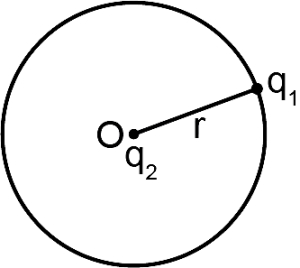
$A$ light charged particle is revolving in a circle of radius $r$ due to the electrostatic attraction of a static heavy particle with an opposite charge. How does the magnetic field $B$ at the centre of the circle,produced by the moving charge,depend on $r$?
A
$B \propto \frac{1}{r}$
B
$B \propto \frac{1}{r^{2}}$
C
$B \propto \frac{1}{r^{\frac{3}{2}}}$
D
$B \propto \frac{1}{r^{\frac{5}{2}}}$
Solution
(D) The centripetal force required for circular motion is provided by the electrostatic force of attraction:
$F_{\text{centripetal}} = m r \omega^{2} = \frac{1}{4 \pi \varepsilon_{0}} \cdot \frac{q_{1} q_{2}}{r^{2}}$
From this,we find the angular velocity $\omega$:
$\omega^{2} = \frac{q_{1} q_{2}}{4 \pi \varepsilon_{0} m r^{3}} \implies \omega \propto \frac{1}{r^{3/2}}$
The moving charge $q_{1}$ constitutes a current $i$ given by:
$i = \frac{q_{1}}{T} = \frac{q_{1} \omega}{2 \pi}$
The magnetic field $B$ at the center of a circular current loop is:
$B = \frac{\mu_{0} i}{2 r} = \frac{\mu_{0}}{2 r} \left( \frac{q_{1} \omega}{2 \pi} \right) = \frac{\mu_{0} q_{1} \omega}{4 \pi r}$
Since $\omega \propto r^{-3/2}$,we have:
$B \propto \frac{\omega}{r} \propto \frac{r^{-3/2}}{r} = r^{-5/2}$
Thus,$B \propto \frac{1}{r^{5/2}}$.
$F_{\text{centripetal}} = m r \omega^{2} = \frac{1}{4 \pi \varepsilon_{0}} \cdot \frac{q_{1} q_{2}}{r^{2}}$
From this,we find the angular velocity $\omega$:
$\omega^{2} = \frac{q_{1} q_{2}}{4 \pi \varepsilon_{0} m r^{3}} \implies \omega \propto \frac{1}{r^{3/2}}$
The moving charge $q_{1}$ constitutes a current $i$ given by:
$i = \frac{q_{1}}{T} = \frac{q_{1} \omega}{2 \pi}$
The magnetic field $B$ at the center of a circular current loop is:
$B = \frac{\mu_{0} i}{2 r} = \frac{\mu_{0}}{2 r} \left( \frac{q_{1} \omega}{2 \pi} \right) = \frac{\mu_{0} q_{1} \omega}{4 \pi r}$
Since $\omega \propto r^{-3/2}$,we have:
$B \propto \frac{\omega}{r} \propto \frac{r^{-3/2}}{r} = r^{-5/2}$
Thus,$B \propto \frac{1}{r^{5/2}}$.
0 likes
View Solution103
EasyMCQ
$A$ rectangular coil carrying current is placed in a non-uniform magnetic field. On that coil,the total:
A
force is non-zero
B
force is zero
C
torque is zero
D
torque is non-zero
Solution
(A) When a current-carrying rectangular coil is placed in a non-uniform magnetic field,the magnetic field strength varies at different points along the coil.
Since the magnetic field is non-uniform,the magnetic forces acting on different segments of the coil do not cancel each other out,resulting in a non-zero net force.
Additionally,because the forces are distributed such that they do not act through a single point or are not balanced,a non-zero net torque is also produced.
Therefore,both the net force and the net torque acting on the coil are non-zero.
Given the standard nature of such multiple-choice questions where one answer is expected,both $(a)$ and $(d)$ are physically correct statements.
Since the magnetic field is non-uniform,the magnetic forces acting on different segments of the coil do not cancel each other out,resulting in a non-zero net force.
Additionally,because the forces are distributed such that they do not act through a single point or are not balanced,a non-zero net torque is also produced.
Therefore,both the net force and the net torque acting on the coil are non-zero.
Given the standard nature of such multiple-choice questions where one answer is expected,both $(a)$ and $(d)$ are physically correct statements.
0 likes
View Solution104
MediumMCQ
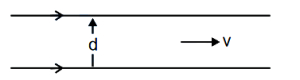
Two infinite line-charges parallel to each other are moving with a constant velocity $v$ in the same direction as shown in the figure. The separation between two line-charges is $d$. The magnetic attraction balances the electric repulsion when,[$c$ = speed of light in free space]
A
$v=\sqrt{2} c$
B
$v=\frac{c}{\sqrt{2}}$
C
$v=c$
D
$v=\frac{c}{2}$
Solution
(C) Consider a segment of length $\ell$ on both line charges with linear charge densities $\lambda_1$ and $\lambda_2$.
The electric force $F_E$ per unit length between the two line charges is given by Coulomb's law for infinite lines: $F_E = \frac{2 k \lambda_1 \lambda_2 \ell}{d} = \frac{2 \lambda_1 \lambda_2 \ell}{4 \pi \varepsilon_0 d} = \frac{\lambda_1 \lambda_2 \ell}{2 \pi \varepsilon_0 d}$.
The moving charges constitute currents $I_1 = \lambda_1 v$ and $I_2 = \lambda_2 v$.
The magnetic force $F_B$ per unit length between two parallel current-carrying wires is given by: $F_B = \frac{\mu_0 I_1 I_2 \ell}{2 \pi d} = \frac{\mu_0 (\lambda_1 v) (\lambda_2 v) \ell}{2 \pi d} = \frac{\mu_0 \lambda_1 \lambda_2 v^2 \ell}{2 \pi d}$.
For the magnetic attraction to balance the electric repulsion,we set $F_E = F_B$:
$\frac{\lambda_1 \lambda_2 \ell}{2 \pi \varepsilon_0 d} = \frac{\mu_0 \lambda_1 \lambda_2 v^2 \ell}{2 \pi d}$.
Simplifying the equation,we get: $\frac{1}{\varepsilon_0} = \mu_0 v^2$.
Since the speed of light $c = \frac{1}{\sqrt{\mu_0 \varepsilon_0}}$,it follows that $c^2 = \frac{1}{\mu_0 \varepsilon_0}$,which implies $v^2 = c^2$ or $v = c$.
The electric force $F_E$ per unit length between the two line charges is given by Coulomb's law for infinite lines: $F_E = \frac{2 k \lambda_1 \lambda_2 \ell}{d} = \frac{2 \lambda_1 \lambda_2 \ell}{4 \pi \varepsilon_0 d} = \frac{\lambda_1 \lambda_2 \ell}{2 \pi \varepsilon_0 d}$.
The moving charges constitute currents $I_1 = \lambda_1 v$ and $I_2 = \lambda_2 v$.
The magnetic force $F_B$ per unit length between two parallel current-carrying wires is given by: $F_B = \frac{\mu_0 I_1 I_2 \ell}{2 \pi d} = \frac{\mu_0 (\lambda_1 v) (\lambda_2 v) \ell}{2 \pi d} = \frac{\mu_0 \lambda_1 \lambda_2 v^2 \ell}{2 \pi d}$.
For the magnetic attraction to balance the electric repulsion,we set $F_E = F_B$:
$\frac{\lambda_1 \lambda_2 \ell}{2 \pi \varepsilon_0 d} = \frac{\mu_0 \lambda_1 \lambda_2 v^2 \ell}{2 \pi d}$.
Simplifying the equation,we get: $\frac{1}{\varepsilon_0} = \mu_0 v^2$.
Since the speed of light $c = \frac{1}{\sqrt{\mu_0 \varepsilon_0}}$,it follows that $c^2 = \frac{1}{\mu_0 \varepsilon_0}$,which implies $v^2 = c^2$ or $v = c$.
0 likes
View Solution105
MediumMCQ
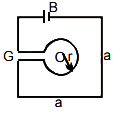
As shown in the figure,a single conducting wire is bent to form a loop in the form of a circle of radius '$r$' concentrically inside a square of side '$a$',where $a: r = 8: \pi$. $A$ battery $B$ drives a current $I$ through the wire. If the battery $B$ and the gap $G$ are of negligible sizes,determine the strength of the magnetic field at the common centre $O$.
A
$\frac{\mu_{0} I}{2 \pi a} \sqrt{2}(\sqrt{2}-1)$
B
$\frac{\mu_{0} I}{2 \pi a}(\sqrt{2}+1)$
C
$\frac{\mu_{0} I}{\pi a} 2 \sqrt{2}(\sqrt{2}+1)$
D
$\frac{\mu_{0} I}{\pi a} 2 \sqrt{2}(\sqrt{2}-1)$
Solution
(D) The magnetic field at the center $O$ due to the circular loop of radius $r$ is $B_{loop} = \frac{\mu_{0} I}{2r}$ (directed outwards).
The magnetic field at the center $O$ due to the square loop of side $a$ is $B_{square} = 4 \times \frac{\mu_{0} I}{4 \pi (a/2)} (\sin 45^{\circ} + \sin 45^{\circ}) = \frac{4 \mu_{0} I}{\pi a} \times \frac{2}{\sqrt{2}} = \frac{4 \sqrt{2} \mu_{0} I}{\pi a}$ (directed inwards).
Given $a/r = 8/\pi$,so $r = \frac{\pi a}{8}$.
Substituting $r$ in $B_{loop}$,we get $B_{loop} = \frac{\mu_{0} I}{2(\pi a / 8)} = \frac{4 \mu_{0} I}{\pi a}$.
The net magnetic field $B_{net} = B_{square} - B_{loop} = \frac{4 \sqrt{2} \mu_{0} I}{\pi a} - \frac{4 \mu_{0} I}{\pi a} = \frac{4 \mu_{0} I}{\pi a} (\sqrt{2} - 1)$.
This can be rewritten as $\frac{2 \mu_{0} I}{\pi a} \times 2(\sqrt{2} - 1)$,which matches option $D$.
The magnetic field at the center $O$ due to the square loop of side $a$ is $B_{square} = 4 \times \frac{\mu_{0} I}{4 \pi (a/2)} (\sin 45^{\circ} + \sin 45^{\circ}) = \frac{4 \mu_{0} I}{\pi a} \times \frac{2}{\sqrt{2}} = \frac{4 \sqrt{2} \mu_{0} I}{\pi a}$ (directed inwards).
Given $a/r = 8/\pi$,so $r = \frac{\pi a}{8}$.
Substituting $r$ in $B_{loop}$,we get $B_{loop} = \frac{\mu_{0} I}{2(\pi a / 8)} = \frac{4 \mu_{0} I}{\pi a}$.
The net magnetic field $B_{net} = B_{square} - B_{loop} = \frac{4 \sqrt{2} \mu_{0} I}{\pi a} - \frac{4 \mu_{0} I}{\pi a} = \frac{4 \mu_{0} I}{\pi a} (\sqrt{2} - 1)$.
This can be rewritten as $\frac{2 \mu_{0} I}{\pi a} \times 2(\sqrt{2} - 1)$,which matches option $D$.
0 likes
View SolutionMoving Charges and Magnetism — Mix Examples-Moving Charges and Magnetism · Frequently Asked Questions
1Are these Moving Charges and Magnetism questions useful for JEE and NEET?
Yes. All questions in this section are mapped to JEE Main and NEET exam patterns. Previous year questions from JEE Main, NEET, GUJCET and state-level exams are included with full solutions.
2Can I switch to Hindi or Gujarati for these questions?
Yes. Use the language tabs in the hero section or the sidebar to view the same questions and solutions in English, Hindi or Gujarati.
3How do I generate a question paper from this subtopic?
Use the Vedclass Exam Paper Generator — select the chapter and subtopic, set difficulty, and generate Sets A, B, C, D automatically. First 3 chapters of every subject are free.
Vedclass Products
For Students
Vedclass Test Series
Mock tests in real JEE/NEET style with performance analysis. 5-day free trial.
Start Free TrialFor Teachers
Exam Paper Generator
Generate Set A/B/C/D papers from this chapter in 2 minutes. 3 chapters free.
Try FreeFor Institutes
Online Exam Module
Live online exams with unlimited students, 360° analytics & white-label branding.
See DemoFor Teachers & Institutes
Generate a Moving Charges and Magnetism Exam Paper in 2 Minutes
Select subtopic & difficulty — Sets A, B, C, D auto-generated with No Repeat logic.
First 3 chapters of every subject are free — no payment required.