
A English
Mix Examples-Moving Charges and Magnetism Questions in English
Class 12 Physics · Moving Charges and Magnetism · Mix Examples-Moving Charges and Magnetism
105+
Questions
English
Language
100%
With Solutions
Showing 48 of 105 questions in English
51
DifficultMCQ
$A$ long,straight wire is turned into a loop of radius $10\,cm$ (see figure). If a current of $8\,A$ is passed through the loop,then the value of the magnetic field and its direction at the centre $C$ of the loop shall be close to
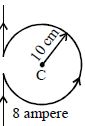
A
$5.0 \times 10^{-5} \,T$,outwards
B
$3.4 \times 10^{-5} \,T$,outwards
C
$1.6 \times 10^{-5} \,T$,inwards
D
$1.6 \times 10^{-5} \,T$,outwards
Solution
(B) The magnetic field $B$ at the centre of a circular loop carrying current $i$ is given by $B_{\text{loop}} = \frac{\mu_0 i}{2r}$ (outwards).
The magnetic field $B$ due to a long straight wire at a distance $r$ is $B_{\text{wire}} = \frac{\mu_0 i}{2\pi r}$ (inwards).
Given: $i = 8\,A$,$r = 10\,cm = 0.1\,m$.
The net magnetic field at the centre $C$ is $B_C = B_{\text{loop}} - B_{\text{wire}}$.
$B_C = \frac{\mu_0 i}{2r} - \frac{\mu_0 i}{2\pi r} = \frac{\mu_0 i}{2r} \left(1 - \frac{1}{\pi}\right)$.
Substituting the values:
$B_C = \frac{4\pi \times 10^{-7} \times 8}{2 \times 0.1} \left(1 - \frac{1}{3.14}\right)$.
$B_C = \frac{4 \times 3.14 \times 10^{-7} \times 8}{0.2} \times \left(\frac{2.14}{3.14}\right)$.
$B_C = 160 \times 10^{-7} \times 2.14 = 342.4 \times 10^{-7} = 3.424 \times 10^{-5} \,T$.
Since $B_{\text{loop}} > B_{\text{wire}}$,the direction is outwards.
The magnetic field $B$ due to a long straight wire at a distance $r$ is $B_{\text{wire}} = \frac{\mu_0 i}{2\pi r}$ (inwards).
Given: $i = 8\,A$,$r = 10\,cm = 0.1\,m$.
The net magnetic field at the centre $C$ is $B_C = B_{\text{loop}} - B_{\text{wire}}$.
$B_C = \frac{\mu_0 i}{2r} - \frac{\mu_0 i}{2\pi r} = \frac{\mu_0 i}{2r} \left(1 - \frac{1}{\pi}\right)$.
Substituting the values:
$B_C = \frac{4\pi \times 10^{-7} \times 8}{2 \times 0.1} \left(1 - \frac{1}{3.14}\right)$.
$B_C = \frac{4 \times 3.14 \times 10^{-7} \times 8}{0.2} \times \left(\frac{2.14}{3.14}\right)$.
$B_C = 160 \times 10^{-7} \times 2.14 = 342.4 \times 10^{-7} = 3.424 \times 10^{-5} \,T$.
Since $B_{\text{loop}} > B_{\text{wire}}$,the direction is outwards.
0 likes
View Solution52
MediumMCQ
Choose the correct sketch of the magnetic field lines for a pair of parallel current-carrying wires,one with current flowing into the plane (represented by $\otimes$) and one with current flowing out of the plane (represented by $\odot$).
A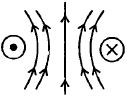
B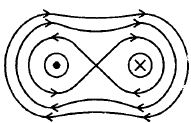
C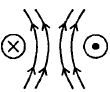
D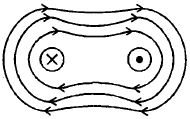
Solution
(D) According to the right-hand thumb rule,for a wire carrying current into the plane $(\otimes)$,the magnetic field lines form clockwise circles around it.
For a wire carrying current out of the plane $(\odot)$,the magnetic field lines form counter-clockwise circles around it.
When these two wires are placed side-by-side,the magnetic field lines between them add up in the same direction,while outside they tend to cancel or loop around the pair.
Specifically,the field lines emerge from the $\odot$ wire and enter the $\otimes$ wire,creating a pattern where the lines loop around both wires as shown in image $823-$d652.
For a wire carrying current out of the plane $(\odot)$,the magnetic field lines form counter-clockwise circles around it.
When these two wires are placed side-by-side,the magnetic field lines between them add up in the same direction,while outside they tend to cancel or loop around the pair.
Specifically,the field lines emerge from the $\odot$ wire and enter the $\otimes$ wire,creating a pattern where the lines loop around both wires as shown in image $823-$d652.
0 likes
View Solution53
DifficultMCQ
One of the two small circular coils (neither having any self-inductance) is suspended with a $V$-shaped copper wire,with its plane horizontal. The other coil is placed just below the first one with its plane horizontal. Both coils are connected in series with a $dc$ supply. The coils are found to attract each other with a force. Which one of the following statements is incorrect?
A
Both the coils carry currents in the same direction.
B
Coils will attract each other,even if the supply is an $ac$ source.
C
Force is proportional to $d^{-1}$.
D
Force is proportional to $d^{-2}$.
Solution
(C) When two parallel circular coils carry current in the same direction,they attract each other. Since they are in series,the current $I$ is the same in both. The magnetic field $B$ produced by one coil at a distance $d$ is proportional to $I/d^3$ for a dipole,but for the force between two current loops,the interaction force $F$ between two magnetic dipoles separated by distance $d$ is proportional to $d^{-4}$. However,considering the interaction of current elements,the force between two parallel current-carrying loops is proportional to $d^{-2}$ in the near field approximation. The statement that the force is proportional to $d^{-1}$ is incorrect.
0 likes
View Solution54
MediumMCQ
$A$ metal sample carrying a current along $X-$ axis with density $J_x$ is subjected to a magnetic field $B_z$ (along $z-$ axis). The electric field $E_y$ developed along $Y-$ axis is directly proportional to $J_x$ as well as $B_z$. The constant of proportionality has $SI$ unit:
A
$m^2/A$
B
$m^3/(A \cdot s)$
C
$m^2/(A \cdot s)$
D
$(A \cdot s)/m^3$
Solution
(B) According to the Hall effect,the electric field $E_y$ is given by $E_y = R_H J_x B_z$,where $R_H$ is the Hall coefficient.
The constant of proportionality $K$ is $R_H = \frac{E_y}{J_x B_z}$.
The $SI$ unit of $E_y$ is $V/m$ (or $N/C$).
The $SI$ unit of $J_x$ is $A/m^2$.
The $SI$ unit of $B_z$ is $T$ (Tesla),where $1 \ T = 1 \ (N \cdot s)/(C \cdot m) = 1 \ (N)/(A \cdot m)$.
Substituting the units:
$K = \frac{V/m}{(A/m^2) \cdot (N/(A \cdot m))} = \frac{V/m}{N/m^3} = \frac{V \cdot m^2}{N}$.
Since $V = (J/C) = (N \cdot m)/(A \cdot s)$,we have:
$K = \frac{(N \cdot m / (A \cdot s)) \cdot m^2}{N} = \frac{m^3}{A \cdot s}$.
The constant of proportionality $K$ is $R_H = \frac{E_y}{J_x B_z}$.
The $SI$ unit of $E_y$ is $V/m$ (or $N/C$).
The $SI$ unit of $J_x$ is $A/m^2$.
The $SI$ unit of $B_z$ is $T$ (Tesla),where $1 \ T = 1 \ (N \cdot s)/(C \cdot m) = 1 \ (N)/(A \cdot m)$.
Substituting the units:
$K = \frac{V/m}{(A/m^2) \cdot (N/(A \cdot m))} = \frac{V/m}{N/m^3} = \frac{V \cdot m^2}{N}$.
Since $V = (J/C) = (N \cdot m)/(A \cdot s)$,we have:
$K = \frac{(N \cdot m / (A \cdot s)) \cdot m^2}{N} = \frac{m^3}{A \cdot s}$.
0 likes
View Solution55
EasyMCQ
$A$ proton beam is moving from north to south and an electron beam is moving from south to north. Neglecting the Earth's magnetic field,the electron beam will be deflected (assuming zero gravity):
A
Towards the proton beam
B
Away from the proton beam
C
Upwards
D
Downwards
Solution
(A) $1$. The proton beam moves from North to South,which is equivalent to a conventional current $I_p$ flowing from North to South.
$2$. The electron beam moves from South to North,which is equivalent to a conventional current $I_e$ flowing from North to South (since electron flow is opposite to current direction).
$3$. Both beams represent parallel currents flowing in the same direction (North to South).
$4$. According to Ampere's law,parallel currents flowing in the same direction attract each other.
$5$. Therefore,the electron beam will be deflected towards the proton beam.
$2$. The electron beam moves from South to North,which is equivalent to a conventional current $I_e$ flowing from North to South (since electron flow is opposite to current direction).
$3$. Both beams represent parallel currents flowing in the same direction (North to South).
$4$. According to Ampere's law,parallel currents flowing in the same direction attract each other.
$5$. Therefore,the electron beam will be deflected towards the proton beam.
0 likes
View Solution56
EasyMCQ
Mark the correct statement.
A
$A$ charged particle can be accelerated by a magnetic field.
B
The speed of a charged particle can be changed by a magnetic field.
C
$A$ current loop placed in a magnetic field always experiences zero force.
D
None of the above.
Solution
(A) The magnetic force on a charged particle is given by $\vec{F} = q(\vec{v} \times \vec{B})$.
Since the force is always perpendicular to the velocity vector $\vec{v}$,the magnetic field does no work on the particle $(W = \vec{F} \cdot \vec{d} = 0)$.
Consequently,the kinetic energy and the speed of the charged particle remain constant.
However,the direction of velocity changes,meaning the particle undergoes acceleration (centripetal acceleration).
Therefore,a magnetic field can accelerate a charged particle (change its velocity vector) but cannot change its speed.
Regarding option $(C)$,a current loop in a non-uniform magnetic field can experience a non-zero net force.
Thus,none of the given statements $(A)$,$(B)$,or $(C)$ are universally correct as stated.
Since the force is always perpendicular to the velocity vector $\vec{v}$,the magnetic field does no work on the particle $(W = \vec{F} \cdot \vec{d} = 0)$.
Consequently,the kinetic energy and the speed of the charged particle remain constant.
However,the direction of velocity changes,meaning the particle undergoes acceleration (centripetal acceleration).
Therefore,a magnetic field can accelerate a charged particle (change its velocity vector) but cannot change its speed.
Regarding option $(C)$,a current loop in a non-uniform magnetic field can experience a non-zero net force.
Thus,none of the given statements $(A)$,$(B)$,or $(C)$ are universally correct as stated.
0 likes
View Solution57
DifficultMCQ
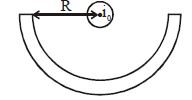
The adjoining figure shows a very long semi-cylindrical conducting shell of radius $R$ carrying a current $i$. An infinitely long straight current-carrying conductor is lying along the axis of the semi-cylinder. If the current flowing through the straight wire is $i_0$,then the force per unit length on the conducting wire is
A
$\frac{\mu_0 i i_0}{\pi^2 R}$
B
$\frac{\mu_0 i i_0}{\pi R^2}$
C
$\frac{\mu_0 i_0^2 i}{\pi^2 R}$
D
None of these
Solution
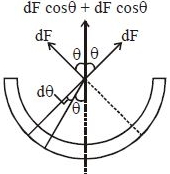
(A) Consider a small element of the semi-cylindrical shell subtending an angle $d\theta$ at the axis. The current in this element is $di = \frac{i}{\pi R} \cdot R d\theta = \frac{i d\theta}{\pi}$.
The magnetic field produced by the straight wire at the shell is $B = \frac{\mu_0 i_0}{2\pi R}$.
The force on the element of length $L$ is $dF = B(di)L$. For unit length $(L=1)$,$dF = \frac{\mu_0 i_0}{2\pi R} \cdot \frac{i d\theta}{\pi} = \frac{\mu_0 i i_0}{2\pi^2 R} d\theta$.
Due to symmetry,the horizontal components of the force cancel out,and the vertical components add up. The vertical component is $dF_y = dF \cos\theta$.
Integrating from $-\pi/2$ to $\pi/2$ is equivalent to $2 \int_0^{\pi/2} dF \cos\theta$.
$F = 2 \int_0^{\pi/2} \frac{\mu_0 i i_0}{2\pi^2 R} \cos\theta d\theta = \frac{\mu_0 i i_0}{\pi^2 R} [\sin\theta]_0^{\pi/2} = \frac{\mu_0 i i_0}{\pi^2 R}$.
The magnetic field produced by the straight wire at the shell is $B = \frac{\mu_0 i_0}{2\pi R}$.
The force on the element of length $L$ is $dF = B(di)L$. For unit length $(L=1)$,$dF = \frac{\mu_0 i_0}{2\pi R} \cdot \frac{i d\theta}{\pi} = \frac{\mu_0 i i_0}{2\pi^2 R} d\theta$.
Due to symmetry,the horizontal components of the force cancel out,and the vertical components add up. The vertical component is $dF_y = dF \cos\theta$.
Integrating from $-\pi/2$ to $\pi/2$ is equivalent to $2 \int_0^{\pi/2} dF \cos\theta$.
$F = 2 \int_0^{\pi/2} \frac{\mu_0 i i_0}{2\pi^2 R} \cos\theta d\theta = \frac{\mu_0 i i_0}{\pi^2 R} [\sin\theta]_0^{\pi/2} = \frac{\mu_0 i i_0}{\pi^2 R}$.
0 likes
View Solution58
EasyMCQ
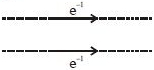
Two electrons are moving along parallel lines in the same direction with the same velocity. They will:
A
Repel each other
B
Attract each other
C
Not apply any force on each other
D
None of these
Solution
(A) When two electrons move parallel to each other with the same velocity,they experience two types of forces:
$1$. Electrostatic force: Since both are negatively charged,they experience a repulsive force given by Coulomb's law: $F_e = \frac{1}{4\pi\epsilon_0} \frac{e^2}{r^2}$.
$2$. Magnetic force: Moving charges constitute a current. Two parallel currents in the same direction attract each other. The magnetic force is given by $F_m = \frac{\mu_0 e^2 v^2}{4\pi r^2}$.
Comparing the magnitudes,the electrostatic repulsive force is much stronger than the magnetic attractive force (by a factor of $c^2/v^2$,where $c$ is the speed of light). Therefore,the net force is repulsive.
$1$. Electrostatic force: Since both are negatively charged,they experience a repulsive force given by Coulomb's law: $F_e = \frac{1}{4\pi\epsilon_0} \frac{e^2}{r^2}$.
$2$. Magnetic force: Moving charges constitute a current. Two parallel currents in the same direction attract each other. The magnetic force is given by $F_m = \frac{\mu_0 e^2 v^2}{4\pi r^2}$.
Comparing the magnitudes,the electrostatic repulsive force is much stronger than the magnetic attractive force (by a factor of $c^2/v^2$,where $c$ is the speed of light). Therefore,the net force is repulsive.
0 likes
View Solution59
EasyMCQ
Assertion : $A$ charge,whether stationary or in motion,produces a magnetic field around it.
Reason : Moving charges produce only electric field in the surrounding space.
Reason : Moving charges produce only electric field in the surrounding space.
A
If both Assertion and Reason are correct and Reason is the correct explanation of Assertion.
B
If both Assertion and Reason are correct,but Reason is not the correct explanation of Assertion.
C
If Assertion is correct but Reason is incorrect.
D
If both the Assertion and Reason are incorrect.
Solution
(D) stationary charge produces only an electric field in the surrounding space.
When a charge is in motion,it constitutes an electric current,which produces both an electric field and a magnetic field in the surrounding space.
Therefore,the Assertion is incorrect because a stationary charge does not produce a magnetic field.
The Reason is also incorrect because moving charges produce both electric and magnetic fields,not just an electric field.
When a charge is in motion,it constitutes an electric current,which produces both an electric field and a magnetic field in the surrounding space.
Therefore,the Assertion is incorrect because a stationary charge does not produce a magnetic field.
The Reason is also incorrect because moving charges produce both electric and magnetic fields,not just an electric field.
0 likes
View Solution60
DifficultMCQ
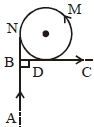
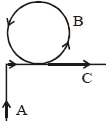
$A$ very long wire $ABDMNDC$ is shown in the figure carrying current $I$. $AB$ and $BC$ parts are straight,long,and at a right angle. At $D$,the wire forms a circular turn $DMND$ of radius $R$. $AB$ and $BC$ parts are tangential to the circular turn at $N$ and $D$. The magnetic field at the centre of the circle is
A
$\frac{\mu_{0} I}{2 R}$
B
$\frac{\mu_{0} I}{2 \pi R}(\pi+1)$
C
$\frac{\mu_{0} I}{2 \pi R}\left(\pi+\frac{1}{\sqrt{2}}\right)$
D
$\frac{\mu_{0} I}{2 \pi R}\left(\pi-\frac{1}{\sqrt{2}}\right)$
Solution
(B) The total magnetic field $B$ at the center is the vector sum of the fields produced by the three parts: the straight wire $AB$,the circular loop $DMND$,and the straight wire $BC$.
$1$. The magnetic field due to the straight wire $AB$ at the center of the circle (which is at a perpendicular distance $R$ from the line of $AB$): $B_{AB} = \frac{\mu_{0} I}{4 \pi R} (\sin 90^{\circ} + \sin 0^{\circ}) = \frac{\mu_{0} I}{4 \pi R}$.
$2$. The magnetic field due to the circular loop $DMND$ at its center: $B_{loop} = \frac{\mu_{0} I}{2 R}$.
$3$. The magnetic field due to the straight wire $BC$ at the center of the circle (which is at a perpendicular distance $R$ from the line of $BC$): $B_{BC} = \frac{\mu_{0} I}{4 \pi R} (\sin 90^{\circ} + \sin 0^{\circ}) = \frac{\mu_{0} I}{4 \pi R}$.
Since the current flows in the same sense for all parts,the magnetic fields add up:
$B = B_{AB} + B_{loop} + B_{BC} = \frac{\mu_{0} I}{4 \pi R} + \frac{\mu_{0} I}{2 R} + \frac{\mu_{0} I}{4 \pi R}$
$B = \frac{\mu_{0} I}{2 \pi R} + \frac{\mu_{0} I}{2 R} = \frac{\mu_{0} I}{2 \pi R} (1 + \pi)$.
$1$. The magnetic field due to the straight wire $AB$ at the center of the circle (which is at a perpendicular distance $R$ from the line of $AB$): $B_{AB} = \frac{\mu_{0} I}{4 \pi R} (\sin 90^{\circ} + \sin 0^{\circ}) = \frac{\mu_{0} I}{4 \pi R}$.
$2$. The magnetic field due to the circular loop $DMND$ at its center: $B_{loop} = \frac{\mu_{0} I}{2 R}$.
$3$. The magnetic field due to the straight wire $BC$ at the center of the circle (which is at a perpendicular distance $R$ from the line of $BC$): $B_{BC} = \frac{\mu_{0} I}{4 \pi R} (\sin 90^{\circ} + \sin 0^{\circ}) = \frac{\mu_{0} I}{4 \pi R}$.
Since the current flows in the same sense for all parts,the magnetic fields add up:
$B = B_{AB} + B_{loop} + B_{BC} = \frac{\mu_{0} I}{4 \pi R} + \frac{\mu_{0} I}{2 R} + \frac{\mu_{0} I}{4 \pi R}$
$B = \frac{\mu_{0} I}{2 \pi R} + \frac{\mu_{0} I}{2 R} = \frac{\mu_{0} I}{2 \pi R} (1 + \pi)$.
0 likes
View Solution61
DifficultMCQ
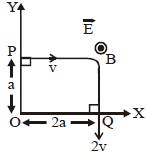
$A$ charged particle of mass $m$ and charge $q$ moving under the influence of a uniform electric field $E\hat{i}$ and a uniform magnetic field $B\hat{k}$ follows a trajectory from point $P$ to $Q$ as shown in the figure. The velocities at $P$ and $Q$ are respectively $v\hat{i}$ and $-2v\hat{j}$. Which of the following statements $(A, B, C, D)$ are correct? (Trajectory shown is schematic and not to scale)
$(A)$ $E = \frac{3}{4}\left(\frac{mv^{2}}{qa}\right)$
$(B)$ Rate of work done by the electric field at $P$ is $\frac{3}{4}\left(\frac{mv^{3}}{a}\right)$
$(C)$ Rate of work done by both the fields at $Q$ is zero
$(D)$ The difference between the magnitude of angular momentum of the particle at $P$ and $Q$ is $2mav$.
$(A)$ $E = \frac{3}{4}\left(\frac{mv^{2}}{qa}\right)$
$(B)$ Rate of work done by the electric field at $P$ is $\frac{3}{4}\left(\frac{mv^{3}}{a}\right)$
$(C)$ Rate of work done by both the fields at $Q$ is zero
$(D)$ The difference between the magnitude of angular momentum of the particle at $P$ and $Q$ is $2mav$.
A
$(A), (B), (C), (D)$
B
$(A), (B), (C)$
C
$(B), (C), (D)$
D
$(A), (C), (D)$
Solution
(B) Using the work-energy theorem: $W_{net} = \Delta K$
$qE(2a) = \frac{1}{2}m(2v)^2 - \frac{1}{2}mv^2 = \frac{3}{2}mv^2$
$E = \frac{3mv^2}{4qa}$. Thus,$(A)$ is correct.
Rate of work done by electric field $P_E = \vec{F}_E \cdot \vec{v} = (qE\hat{i}) \cdot (v\hat{i}) = qEv = q\left(\frac{3mv^2}{4qa}\right)v = \frac{3mv^3}{4a}$. Thus,$(B)$ is correct.
At $Q$,velocity is $-2v\hat{j}$. Electric force is $qE\hat{i}$. Since $\vec{F}_E \perp \vec{v}$,power by electric field is $0$. Magnetic force is always perpendicular to velocity,so power by magnetic field is $0$. Thus,$(C)$ is correct.
Angular momentum $L = \vec{r} \times \vec{p}$. At $P$,$\vec{r}_P = a\hat{j}$,$\vec{p}_P = mv\hat{i}$,so $L_P = (a\hat{j}) \times (mv\hat{i}) = -mav\hat{k}$. Magnitude $|L_P| = mav$.
At $Q$,$\vec{r}_Q = 2a\hat{i}$,$\vec{p}_Q = -2mv\hat{j}$,so $L_Q = (2a\hat{i}) \times (-2mv\hat{j}) = -4mav\hat{k}$. Magnitude $|L_Q| = 4mav$.
Difference $= 4mav - mav = 3mav$. Thus,$(D)$ is incorrect.
$qE(2a) = \frac{1}{2}m(2v)^2 - \frac{1}{2}mv^2 = \frac{3}{2}mv^2$
$E = \frac{3mv^2}{4qa}$. Thus,$(A)$ is correct.
Rate of work done by electric field $P_E = \vec{F}_E \cdot \vec{v} = (qE\hat{i}) \cdot (v\hat{i}) = qEv = q\left(\frac{3mv^2}{4qa}\right)v = \frac{3mv^3}{4a}$. Thus,$(B)$ is correct.
At $Q$,velocity is $-2v\hat{j}$. Electric force is $qE\hat{i}$. Since $\vec{F}_E \perp \vec{v}$,power by electric field is $0$. Magnetic force is always perpendicular to velocity,so power by magnetic field is $0$. Thus,$(C)$ is correct.
Angular momentum $L = \vec{r} \times \vec{p}$. At $P$,$\vec{r}_P = a\hat{j}$,$\vec{p}_P = mv\hat{i}$,so $L_P = (a\hat{j}) \times (mv\hat{i}) = -mav\hat{k}$. Magnitude $|L_P| = mav$.
At $Q$,$\vec{r}_Q = 2a\hat{i}$,$\vec{p}_Q = -2mv\hat{j}$,so $L_Q = (2a\hat{i}) \times (-2mv\hat{j}) = -4mav\hat{k}$. Magnitude $|L_Q| = 4mav$.
Difference $= 4mav - mav = 3mav$. Thus,$(D)$ is incorrect.
0 likes
View Solution62
Difficult
$A$ $100$ turn closely wound circular coil of radius $10\; cm$ carries a current of $3.2\; A$.
$(a)$ What is the field at the centre of the coil?
$(b)$ What is the magnetic moment of this coil?
The coil is placed in a vertical plane and is free to rotate about a horizontal axis which coincides with its diameter. $A$ uniform magnetic field of $2\; T$ in the horizontal direction exists such that initially the axis of the coil is in the direction of the field. The coil rotates through an angle of $90^{\circ}$ under the influence of the magnetic field.
$(c)$ What are the magnitudes of the torques on the coil in the initial and final position?
$(d)$ What is the angular speed acquired by the coil when it has rotated by $90^{\circ}$? The moment of inertia of the coil is $0.1\; kg\; m^{2}$.
$(a)$ What is the field at the centre of the coil?
$(b)$ What is the magnetic moment of this coil?
The coil is placed in a vertical plane and is free to rotate about a horizontal axis which coincides with its diameter. $A$ uniform magnetic field of $2\; T$ in the horizontal direction exists such that initially the axis of the coil is in the direction of the field. The coil rotates through an angle of $90^{\circ}$ under the influence of the magnetic field.
$(c)$ What are the magnitudes of the torques on the coil in the initial and final position?
$(d)$ What is the angular speed acquired by the coil when it has rotated by $90^{\circ}$? The moment of inertia of the coil is $0.1\; kg\; m^{2}$.
Solution
$(a)$ The magnetic field at the centre is given by $B = \frac{\mu_{0} N I}{2 R}$.
Given $N = 100$, $I = 3.2\; A$, $R = 0.1\; m$.
$B = \frac{4 \pi \times 10^{-7} \times 100 \times 3.2}{2 \times 0.1} = 2 \times 10^{-3}\; T$.
$(b)$ The magnetic moment is $m = N I A = N I \pi R^{2}$.
$m = 100 \times 3.2 \times 3.14 \times (0.1)^{2} = 10\; A\; m^{2}$.
$(c)$ Torque $\tau = |\vec{m} \times \vec{B}| = m B \sin \theta$.
Initially, $\theta = 0^{\circ}$, so $\tau_{i} = 0\; N\; m$.
Finally, $\theta = 90^{\circ}$, so $\tau_{f} = m B = 10 \times 2 = 20\; N\; m$.
$(d)$ Using the work-energy theorem, the work done by the magnetic torque equals the change in rotational kinetic energy.
$W = \int_{0}^{\pi/2} m B \sin \theta \; d\theta = m B [-\cos \theta]_{0}^{\pi/2} = m B$.
$W = \frac{1}{2} I_{coil} \omega^{2} = m B$.
$\omega = \sqrt{\frac{2 m B}{I_{coil}}} = \sqrt{\frac{2 \times 10 \times 2}{0.1}} = \sqrt{400} = 20\; rad/s$.
Given $N = 100$, $I = 3.2\; A$, $R = 0.1\; m$.
$B = \frac{4 \pi \times 10^{-7} \times 100 \times 3.2}{2 \times 0.1} = 2 \times 10^{-3}\; T$.
$(b)$ The magnetic moment is $m = N I A = N I \pi R^{2}$.
$m = 100 \times 3.2 \times 3.14 \times (0.1)^{2} = 10\; A\; m^{2}$.
$(c)$ Torque $\tau = |\vec{m} \times \vec{B}| = m B \sin \theta$.
Initially, $\theta = 0^{\circ}$, so $\tau_{i} = 0\; N\; m$.
Finally, $\theta = 90^{\circ}$, so $\tau_{f} = m B = 10 \times 2 = 20\; N\; m$.
$(d)$ Using the work-energy theorem, the work done by the magnetic torque equals the change in rotational kinetic energy.
$W = \int_{0}^{\pi/2} m B \sin \theta \; d\theta = m B [-\cos \theta]_{0}^{\pi/2} = m B$.
$W = \frac{1}{2} I_{coil} \omega^{2} = m B$.
$\omega = \sqrt{\frac{2 m B}{I_{coil}}} = \sqrt{\frac{2 \times 10 \times 2}{0.1}} = \sqrt{400} = 20\; rad/s$.
0 likes
View Solution63
Medium
Answer the following questions:
$(a)$ $A$ magnetic field that varies in magnitude from point to point but has a constant direction (east to west) is set up in a chamber. $A$ charged particle enters the chamber and travels undeflected along a straight path with constant speed. What can you say about the initial velocity of the particle?
$(b)$ $A$ charged particle enters an environment of a strong and non-uniform magnetic field varying from point to point both in magnitude and direction,and comes out of it following a complicated trajectory. Would its final speed equal the initial speed if it suffered no collisions with the environment?
$(c)$ An electron travelling west to east enters a chamber having a uniform electrostatic field in north to south direction. Specify the direction in which a uniform magnetic field should be set up to prevent the electron from deflecting from its straight line path.
$(a)$ $A$ magnetic field that varies in magnitude from point to point but has a constant direction (east to west) is set up in a chamber. $A$ charged particle enters the chamber and travels undeflected along a straight path with constant speed. What can you say about the initial velocity of the particle?
$(b)$ $A$ charged particle enters an environment of a strong and non-uniform magnetic field varying from point to point both in magnitude and direction,and comes out of it following a complicated trajectory. Would its final speed equal the initial speed if it suffered no collisions with the environment?
$(c)$ An electron travelling west to east enters a chamber having a uniform electrostatic field in north to south direction. Specify the direction in which a uniform magnetic field should be set up to prevent the electron from deflecting from its straight line path.
Solution
(N/A) The magnetic force on a charged particle is given by $\vec{F} = q(\vec{v} \times \vec{B})$. For the particle to travel undeflected,the magnetic force must be zero. This happens if the velocity $\vec{v}$ is parallel or anti-parallel to the magnetic field $\vec{B}$. Thus,the initial velocity of the particle is either parallel or anti-parallel to the magnetic field.
$(b)$ Yes,the final speed of the charged particle will be equal to its initial speed. The magnetic force acts perpendicular to the velocity vector at all times,meaning it does no work on the particle $(W = \vec{F} \cdot \vec{d} = 0)$. According to the work-energy theorem,the kinetic energy and hence the speed remains constant.
$(c)$ The electron travels from West to East. The electrostatic field is from North to South,so the electric force on the electron (which is negative) acts from South to North. To keep the electron undeflected,the magnetic force must act from North to South. Using Fleming's left-hand rule for a negative charge,the magnetic field must be applied in a vertically downward direction.
$(b)$ Yes,the final speed of the charged particle will be equal to its initial speed. The magnetic force acts perpendicular to the velocity vector at all times,meaning it does no work on the particle $(W = \vec{F} \cdot \vec{d} = 0)$. According to the work-energy theorem,the kinetic energy and hence the speed remains constant.
$(c)$ The electron travels from West to East. The electrostatic field is from North to South,so the electric force on the electron (which is negative) acts from South to North. To keep the electron undeflected,the magnetic force must act from North to South. Using Fleming's left-hand rule for a negative charge,the magnetic field must be applied in a vertically downward direction.
0 likes
View Solution64
Medium
$A$ compass needle free to turn in a horizontal plane is placed at the centre of a circular coil of $30$ turns and radius $12 \;cm$. The coil is in a vertical plane making an angle of $45^{\circ}$ with the magnetic meridian. When the current in the coil is $0.35 \;A$,the needle points west to east.
$(a)$ Determine the horizontal component of the earth's magnetic field at the location.
$(b)$ The current in the coil is reversed,and the coil is rotated about its vertical axis by an angle of $90^{\circ}$ in the anticlockwise sense looking from above. Predict the direction of the needle. Take the magnetic declination at the place to be zero.
$(a)$ Determine the horizontal component of the earth's magnetic field at the location.
$(b)$ The current in the coil is reversed,and the coil is rotated about its vertical axis by an angle of $90^{\circ}$ in the anticlockwise sense looking from above. Predict the direction of the needle. Take the magnetic declination at the place to be zero.
Solution
(A) Given:
Number of turns,$N = 30$
Radius,$r = 12 \;cm = 0.12 \;m$
Current,$I = 0.35 \;A$
Angle between coil plane and magnetic meridian,$\theta = 45^{\circ}$
$(a)$ The magnetic field $B$ at the centre of the coil is $B = \frac{\mu_0 N I}{2r} = \frac{4\pi \times 10^{-7} \times 30 \times 0.35}{2 \times 0.12} = 5.497 \times 10^{-5} \;T$.
The component of $B$ perpendicular to the magnetic meridian is $B \sin(45^{\circ})$. Since the needle points west to east,this component must balance the horizontal component of the Earth's magnetic field $B_H$.
$B_H = B \sin(45^{\circ}) = 5.497 \times 10^{-5} \times \frac{1}{\sqrt{2}} \approx 3.89 \times 10^{-5} \;T = 0.389 \;G$.
$(b)$ Reversing the current reverses the direction of $B$. Rotating the coil by $90^{\circ}$ anticlockwise changes the orientation of the coil plane relative to the meridian. The net effect of these operations results in the magnetic field of the coil still opposing the Earth's horizontal component in the same line of action. Thus,the needle will point from East to West.
Number of turns,$N = 30$
Radius,$r = 12 \;cm = 0.12 \;m$
Current,$I = 0.35 \;A$
Angle between coil plane and magnetic meridian,$\theta = 45^{\circ}$
$(a)$ The magnetic field $B$ at the centre of the coil is $B = \frac{\mu_0 N I}{2r} = \frac{4\pi \times 10^{-7} \times 30 \times 0.35}{2 \times 0.12} = 5.497 \times 10^{-5} \;T$.
The component of $B$ perpendicular to the magnetic meridian is $B \sin(45^{\circ})$. Since the needle points west to east,this component must balance the horizontal component of the Earth's magnetic field $B_H$.
$B_H = B \sin(45^{\circ}) = 5.497 \times 10^{-5} \times \frac{1}{\sqrt{2}} \approx 3.89 \times 10^{-5} \;T = 0.389 \;G$.
$(b)$ Reversing the current reverses the direction of $B$. Rotating the coil by $90^{\circ}$ anticlockwise changes the orientation of the coil plane relative to the meridian. The net effect of these operations results in the magnetic field of the coil still opposing the Earth's horizontal component in the same line of action. Thus,the needle will point from East to West.
0 likes
View Solution65
DifficultMCQ
If two protons are moving with speed $v = 4.5 \times 10^{5} \, m/s$ parallel to each other,then the ratio of electrostatic and magnetic force between them is:
A
$4.4 \times 10^{5}$
B
$2.2 \times 10^{5}$
C
$3.3 \times 10^{5}$
D
$1.1 \times 10^{5}$
Solution
(A) The electrostatic force between two protons separated by distance $r$ is given by $F_{E} = \frac{1}{4\pi\epsilon_{0}} \frac{e^{2}}{r^{2}} = \frac{k e^{2}}{r^{2}}$.
The magnetic force between two parallel moving charges is given by $F_{M} = \frac{\mu_{0}}{4\pi} \frac{e^{2} v^{2}}{r^{2}}$.
Taking the ratio of electrostatic force to magnetic force:
$\frac{F_{E}}{F_{M}} = \frac{\frac{1}{4\pi\epsilon_{0}} \frac{e^{2}}{r^{2}}}{\frac{\mu_{0}}{4\pi} \frac{e^{2} v^{2}}{r^{2}}} = \frac{1}{\epsilon_{0} \mu_{0} v^{2}}$.
We know that $c^{2} = \frac{1}{\epsilon_{0} \mu_{0}}$,where $c = 3 \times 10^{8} \, m/s$ is the speed of light.
Therefore,the ratio is $\frac{F_{E}}{F_{M}} = \frac{c^{2}}{v^{2}} = \left( \frac{c}{v} \right)^{2}$.
Substituting the given values $c = 3 \times 10^{8} \, m/s$ and $v = 4.5 \times 10^{5} \, m/s$:
$\frac{F_{E}}{F_{M}} = \left( \frac{3 \times 10^{8}}{4.5 \times 10^{5}} \right)^{2} = \left( \frac{3000}{4.5} \right)^{2} = \left( \frac{30000}{45} \right)^{2} = \left( \frac{2000}{3} \right)^{2} \approx (666.67)^{2} \approx 4.44 \times 10^{5}$.
The magnetic force between two parallel moving charges is given by $F_{M} = \frac{\mu_{0}}{4\pi} \frac{e^{2} v^{2}}{r^{2}}$.
Taking the ratio of electrostatic force to magnetic force:
$\frac{F_{E}}{F_{M}} = \frac{\frac{1}{4\pi\epsilon_{0}} \frac{e^{2}}{r^{2}}}{\frac{\mu_{0}}{4\pi} \frac{e^{2} v^{2}}{r^{2}}} = \frac{1}{\epsilon_{0} \mu_{0} v^{2}}$.
We know that $c^{2} = \frac{1}{\epsilon_{0} \mu_{0}}$,where $c = 3 \times 10^{8} \, m/s$ is the speed of light.
Therefore,the ratio is $\frac{F_{E}}{F_{M}} = \frac{c^{2}}{v^{2}} = \left( \frac{c}{v} \right)^{2}$.
Substituting the given values $c = 3 \times 10^{8} \, m/s$ and $v = 4.5 \times 10^{5} \, m/s$:
$\frac{F_{E}}{F_{M}} = \left( \frac{3 \times 10^{8}}{4.5 \times 10^{5}} \right)^{2} = \left( \frac{3000}{4.5} \right)^{2} = \left( \frac{30000}{45} \right)^{2} = \left( \frac{2000}{3} \right)^{2} \approx (666.67)^{2} \approx 4.44 \times 10^{5}$.
0 likes
View Solution66
MediumMCQ
The dimensions of $\left(\frac{B^{2}}{\mu_{0}}\right)$ will be. (where $\mu_{0}$ is the permeability of free space and $B$ is the magnetic field)
A
$[ML^{2}T^{-2}]$
B
$[MLT^{-2}]$
C
$[ML^{-1}T^{-2}]$
D
$[ML^{2}T^{-2}A^{-1}]$
Solution
(C) The energy density $u$ associated with a magnetic field $B$ is given by the formula $u = \frac{B^{2}}{2\mu_{0}}$.
Here,$u$ represents the energy per unit volume.
The dimensions of energy are $[ML^{2}T^{-2}]$ and the dimensions of volume are $[L^{3}]$.
Therefore,the dimensions of energy density $u$ are $\frac{[ML^{2}T^{-2}]}{[L^{3}]} = [ML^{-1}T^{-2}]$.
Since $\frac{B^{2}}{\mu_{0}} = 2u$,the dimensions of $\left(\frac{B^{2}}{\mu_{0}}\right)$ are the same as the dimensions of $u$,which is $[ML^{-1}T^{-2}]$.
Here,$u$ represents the energy per unit volume.
The dimensions of energy are $[ML^{2}T^{-2}]$ and the dimensions of volume are $[L^{3}]$.
Therefore,the dimensions of energy density $u$ are $\frac{[ML^{2}T^{-2}]}{[L^{3}]} = [ML^{-1}T^{-2}]$.
Since $\frac{B^{2}}{\mu_{0}} = 2u$,the dimensions of $\left(\frac{B^{2}}{\mu_{0}}\right)$ are the same as the dimensions of $u$,which is $[ML^{-1}T^{-2}]$.
0 likes
View Solution67
AdvancedMCQ
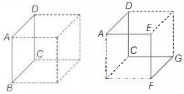
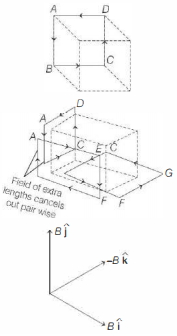
The current flowing along the path $A B C D$ of a cube (shown in the left figure) produces a magnetic field at the centre of the cube of magnitude $B$. Dashed lines depict the non-conducting part of the cube. Consider a cubical shape shown to the right which is identical in size and shape to the left. If the same current now flows in along the path $D A E F G C D$,then the magnitude of the magnetic field at the centre will be
A
zero
B
$\sqrt{2} B$
C
$\sqrt{3} B$
D
$B$
Solution
(C) The magnetic field at the centre of the cube due to a square loop $A B C D$ is given as $B$.
The path $D A E F G C D$ can be analyzed as a superposition of three square loops oriented in the $xy$,$yz$,and $zx$ planes.
By applying the principle of superposition,the net magnetic field at the centre is the vector sum of the magnetic fields produced by these three loops.
Let the magnetic field vectors be represented as $\vec{B}_1 = B \hat{i}$,$\vec{B}_2 = B \hat{j}$,and $\vec{B}_3 = -B \hat{k}$.
The net magnetic field is $\vec{B}_{net} = B \hat{i} + B \hat{j} - B \hat{k}$.
The magnitude of the resultant magnetic field is $|\vec{B}_{net}| = \sqrt{B^2 + B^2 + (-B)^2} = \sqrt{3B^2} = \sqrt{3} B$.
The path $D A E F G C D$ can be analyzed as a superposition of three square loops oriented in the $xy$,$yz$,and $zx$ planes.
By applying the principle of superposition,the net magnetic field at the centre is the vector sum of the magnetic fields produced by these three loops.
Let the magnetic field vectors be represented as $\vec{B}_1 = B \hat{i}$,$\vec{B}_2 = B \hat{j}$,and $\vec{B}_3 = -B \hat{k}$.
The net magnetic field is $\vec{B}_{net} = B \hat{i} + B \hat{j} - B \hat{k}$.
The magnitude of the resultant magnetic field is $|\vec{B}_{net}| = \sqrt{B^2 + B^2 + (-B)^2} = \sqrt{3B^2} = \sqrt{3} B$.
0 likes
View Solution68
DifficultMCQ
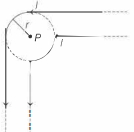
Two infinitely long wires each carrying current $I$ along the same direction are made into the geometry as shown in the figure below. The magnetic field at the point $P$ is
A
$\frac{\mu_0 I}{\pi r}$
B
$\frac{\mu_0 I}{r}\left(\frac{1}{\pi}+\frac{1}{4}\right)$
C
zero
D
$\frac{\mu_0 I}{2 \pi r}$
Solution
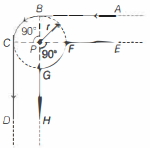
(D) In the given arrangement,the net magnetic field at point $P$ is the vector sum of the magnetic fields produced by the straight wire segments $AB$,$CD$,$EF$,$GH$ and the circular arc segments $BC$ and $FG$.
$1$. The point $P$ lies on the axis of the straight wires $EF$ and $GH$. Therefore,the magnetic field due to these segments at $P$ is zero: $B_{EF} = B_{GH} = 0$.
$2$. The magnetic field due to a semi-infinite wire at a distance $r$ from its end is $B = \frac{\mu_0 I}{4 \pi r}$.
$3$. The magnetic field due to the straight segment $AB$ at $P$ is $B_{AB} = \frac{\mu_0 I}{4 \pi r}$ (directed into the page).
$4$. The magnetic field due to the straight segment $CD$ at $P$ is $B_{CD} = \frac{\mu_0 I}{4 \pi r}$ (directed into the page).
$5$. The magnetic field due to the quarter-circular arc $BC$ at $P$ is $B_{BC} = \frac{\mu_0 I}{8 r}$ (directed out of the page).
$6$. The magnetic field due to the quarter-circular arc $FG$ at $P$ is $B_{FG} = \frac{\mu_0 I}{8 r}$ (directed into the page).
$7$. The net magnetic field is $B_{net} = B_{AB} + B_{CD} + B_{FG} - B_{BC} = \frac{\mu_0 I}{4 \pi r} + \frac{\mu_0 I}{4 \pi r} + \frac{\mu_0 I}{8 r} - \frac{\mu_0 I}{8 r} = \frac{2 \mu_0 I}{4 \pi r} = \frac{\mu_0 I}{2 \pi r}$.
Thus,the correct option is $(d)$.
$1$. The point $P$ lies on the axis of the straight wires $EF$ and $GH$. Therefore,the magnetic field due to these segments at $P$ is zero: $B_{EF} = B_{GH} = 0$.
$2$. The magnetic field due to a semi-infinite wire at a distance $r$ from its end is $B = \frac{\mu_0 I}{4 \pi r}$.
$3$. The magnetic field due to the straight segment $AB$ at $P$ is $B_{AB} = \frac{\mu_0 I}{4 \pi r}$ (directed into the page).
$4$. The magnetic field due to the straight segment $CD$ at $P$ is $B_{CD} = \frac{\mu_0 I}{4 \pi r}$ (directed into the page).
$5$. The magnetic field due to the quarter-circular arc $BC$ at $P$ is $B_{BC} = \frac{\mu_0 I}{8 r}$ (directed out of the page).
$6$. The magnetic field due to the quarter-circular arc $FG$ at $P$ is $B_{FG} = \frac{\mu_0 I}{8 r}$ (directed into the page).
$7$. The net magnetic field is $B_{net} = B_{AB} + B_{CD} + B_{FG} - B_{BC} = \frac{\mu_0 I}{4 \pi r} + \frac{\mu_0 I}{4 \pi r} + \frac{\mu_0 I}{8 r} - \frac{\mu_0 I}{8 r} = \frac{2 \mu_0 I}{4 \pi r} = \frac{\mu_0 I}{2 \pi r}$.
Thus,the correct option is $(d)$.
0 likes
View Solution69
MediumMCQ
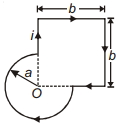
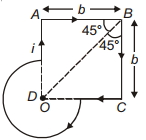
The magnetic field intensity at the point $O$ of a loop with current $i$,whose shape is illustrated below is
A
$\frac{\mu_0 i}{4 \pi}\left[\frac{3 \pi}{2 a}+\frac{\sqrt{2}}{b}\right]$
B
$\frac{\mu_0 i}{4 \pi^2}\left[\frac{2}{a}+b\right]$
C
$\frac{\mu_0 i}{2 \pi}\left[\frac{1}{a}+\frac{1}{b}\right]$
D
$\frac{\mu_0 i}{4 \pi}\left[\frac{1}{a}+\frac{1}{b}\right]$
Solution
(A) The loop consists of two parts: a square part and a circular arc part.
$1$. Magnetic field due to the square part:
The magnetic field at the center $O$ due to the segments lying on the axes passing through $O$ is zero because the current is directed towards or away from $O$. For the other two segments of length $b$,the distance from $O$ to each segment is $b/2$. The angle subtended by each segment at $O$ is $45^{\circ}$.
Using the formula for a finite wire,$B = \frac{\mu_0 i}{4 \pi d}(\sin \theta_1 + \sin \theta_2)$,where $d = b/2$ and $\theta_1 = 45^{\circ}, \theta_2 = 0^{\circ}$:
$B_1 = 2 \times \left[ \frac{\mu_0 i}{4 \pi (b/2)} (\sin 45^{\circ} + 0) \right] = 2 \times \frac{\mu_0 i}{2 \pi b} \times \frac{1}{\sqrt{2}} = \frac{\mu_0 i}{\sqrt{2} \pi b}$.
$2$. Magnetic field due to the circular arc:
The arc subtends an angle of $270^{\circ}$ or $\frac{3 \pi}{2}$ radians at the center. The magnetic field due to a circular arc is $B_2 = \frac{\mu_0 i \theta}{4 \pi a} = \frac{\mu_0 i (3 \pi / 2)}{4 \pi a} = \frac{3 \mu_0 i}{8 a}$.
$3$. Total magnetic field:
Since both fields are in the same direction (into the plane),the net field is:
$B_{\text{net}} = B_1 + B_2 = \frac{\mu_0 i}{\sqrt{2} \pi b} + \frac{3 \mu_0 i}{8 a} = \frac{\mu_0 i}{4 \pi} \left[ \frac{3 \pi}{2 a} + \frac{\sqrt{2}}{b} \right]$.
$1$. Magnetic field due to the square part:
The magnetic field at the center $O$ due to the segments lying on the axes passing through $O$ is zero because the current is directed towards or away from $O$. For the other two segments of length $b$,the distance from $O$ to each segment is $b/2$. The angle subtended by each segment at $O$ is $45^{\circ}$.
Using the formula for a finite wire,$B = \frac{\mu_0 i}{4 \pi d}(\sin \theta_1 + \sin \theta_2)$,where $d = b/2$ and $\theta_1 = 45^{\circ}, \theta_2 = 0^{\circ}$:
$B_1 = 2 \times \left[ \frac{\mu_0 i}{4 \pi (b/2)} (\sin 45^{\circ} + 0) \right] = 2 \times \frac{\mu_0 i}{2 \pi b} \times \frac{1}{\sqrt{2}} = \frac{\mu_0 i}{\sqrt{2} \pi b}$.
$2$. Magnetic field due to the circular arc:
The arc subtends an angle of $270^{\circ}$ or $\frac{3 \pi}{2}$ radians at the center. The magnetic field due to a circular arc is $B_2 = \frac{\mu_0 i \theta}{4 \pi a} = \frac{\mu_0 i (3 \pi / 2)}{4 \pi a} = \frac{3 \mu_0 i}{8 a}$.
$3$. Total magnetic field:
Since both fields are in the same direction (into the plane),the net field is:
$B_{\text{net}} = B_1 + B_2 = \frac{\mu_0 i}{\sqrt{2} \pi b} + \frac{3 \mu_0 i}{8 a} = \frac{\mu_0 i}{4 \pi} \left[ \frac{3 \pi}{2 a} + \frac{\sqrt{2}}{b} \right]$.
0 likes
View Solution70
MediumMCQ
Choose the correct statement.
A
It is possible for a current loop to stay without rotating in a uniform magnetic field.
B
If a uniform magnetic field exists in a cubical region and zero outside,then it is not possible to project a charged particle from outside into the field so that it describes a complete circle in the field.
C
$A$ moving charged particle can be accelerated by a magnetic field.
D
All of these.
Solution
(D) Statement $A$ is correct: $A$ current loop in a uniform magnetic field experiences a torque $\vec{\tau} = \vec{m} \times \vec{B}$. If the magnetic moment $\vec{m}$ is parallel or anti-parallel to the magnetic field $\vec{B}$,the torque is zero,and the loop remains in equilibrium without rotating.
Statement $B$ is correct: For a charged particle to describe a complete circle,the entire circular path must lie within the region of the uniform magnetic field. If the field is confined to a cubical region,a particle entering from outside will exit the field before completing a full circle.
Statement $C$ is correct: Although the magnetic force $\vec{F} = q(\vec{v} \times \vec{B})$ does no work on a charged particle (speed remains constant),the particle is constantly changing direction. Since velocity is a vector,a change in direction implies an acceleration $(\vec{a} = \frac{\vec{F}}{m} \neq 0)$.
Since all statements are correct,the correct option is $D$.
Statement $B$ is correct: For a charged particle to describe a complete circle,the entire circular path must lie within the region of the uniform magnetic field. If the field is confined to a cubical region,a particle entering from outside will exit the field before completing a full circle.
Statement $C$ is correct: Although the magnetic force $\vec{F} = q(\vec{v} \times \vec{B})$ does no work on a charged particle (speed remains constant),the particle is constantly changing direction. Since velocity is a vector,a change in direction implies an acceleration $(\vec{a} = \frac{\vec{F}}{m} \neq 0)$.
Since all statements are correct,the correct option is $D$.
0 likes
View Solution71
EasyMCQ
$A$ loop of irregular shape made of flexible conducting wire carrying a clockwise current is placed in a uniform inward magnetic field,such that its plane is perpendicular to the field. Then the loop:
A
Experiences a magnetic force.
B
Develops an induced current for a short time.
C
Changes to a circular shape.
D
All of these.
Solution
(D) When a flexible current-carrying loop is placed in a uniform magnetic field,the magnetic force acting on each element of the wire is given by $\vec{F} = I(\vec{dl} \times \vec{B})$.
For an inward magnetic field and a clockwise current,the magnetic force on every segment of the wire acts radially outward.
This outward force causes the flexible wire to expand until it takes the shape of a circle,which is the configuration that maximizes the area enclosed for a given perimeter.
As the loop expands,the area enclosed by the loop increases,which changes the magnetic flux linked with the loop.
According to Faraday's law of electromagnetic induction,this change in magnetic flux induces an electromotive force $(EMF)$ and consequently an induced current in the loop for a short duration until the loop reaches its stable circular equilibrium.
Therefore,the loop experiences a magnetic force,develops an induced current,and changes its shape to a circle. Thus,all the given statements are correct.
For an inward magnetic field and a clockwise current,the magnetic force on every segment of the wire acts radially outward.
This outward force causes the flexible wire to expand until it takes the shape of a circle,which is the configuration that maximizes the area enclosed for a given perimeter.
As the loop expands,the area enclosed by the loop increases,which changes the magnetic flux linked with the loop.
According to Faraday's law of electromagnetic induction,this change in magnetic flux induces an electromotive force $(EMF)$ and consequently an induced current in the loop for a short duration until the loop reaches its stable circular equilibrium.
Therefore,the loop experiences a magnetic force,develops an induced current,and changes its shape to a circle. Thus,all the given statements are correct.
0 likes
View Solution72
DifficultMCQ
$A$ proton moving with a constant velocity passes through a region of space without any change in its velocity. If $\vec{E}$ and $\vec{B}$ represent the electric and magnetic fields respectively,then the region of space may have :
$(A)$ $E=0, B=0$
$(B)$ $E=0, B \neq 0$
$(C)$ $E \neq 0, B=0$
$(D)$ $E \neq 0, B \neq 0$
Choose the most appropriate answer from the options given below :
$(A)$ $E=0, B=0$
$(B)$ $E=0, B \neq 0$
$(C)$ $E \neq 0, B=0$
$(D)$ $E \neq 0, B \neq 0$
Choose the most appropriate answer from the options given below :
A
$(A), (B)$ and $(C)$ only
B
$(A), (C)$ and $(D)$ only
C
$(A), (B)$ and $(D)$ only
D
$(B), (C)$ and $(D)$ only
Solution
(C) The net force on a charged particle moving with constant velocity must be zero. The Lorentz force is given by $\vec{F} = q(\vec{E} + \vec{v} \times \vec{B})$. For $\vec{F} = 0$,we have $\vec{E} + \vec{v} \times \vec{B} = 0$.
Case $(A)$: If $\vec{E} = 0$ and $\vec{B} = 0$,then $\vec{F} = 0$. The velocity remains constant.
Case $(B)$: If $\vec{E} = 0$ and $\vec{B} \neq 0$,the particle can move with constant velocity if $\vec{v}$ is parallel or anti-parallel to $\vec{B}$ (since $\vec{v} \times \vec{B} = 0$).
Case $(C)$: If $\vec{E} \neq 0$ and $\vec{B} = 0$,the electric force $q\vec{E}$ would cause acceleration,so the velocity cannot remain constant. Thus,$(C)$ is not possible.
Case $(D)$: If $\vec{E} \neq 0$ and $\vec{B} \neq 0$,the particle can move with constant velocity if $\vec{E} = -(\vec{v} \times \vec{B})$. This is possible (e.g.,in a velocity selector).
Therefore,cases $(A), (B),$ and $(D)$ are possible.
Case $(A)$: If $\vec{E} = 0$ and $\vec{B} = 0$,then $\vec{F} = 0$. The velocity remains constant.
Case $(B)$: If $\vec{E} = 0$ and $\vec{B} \neq 0$,the particle can move with constant velocity if $\vec{v}$ is parallel or anti-parallel to $\vec{B}$ (since $\vec{v} \times \vec{B} = 0$).
Case $(C)$: If $\vec{E} \neq 0$ and $\vec{B} = 0$,the electric force $q\vec{E}$ would cause acceleration,so the velocity cannot remain constant. Thus,$(C)$ is not possible.
Case $(D)$: If $\vec{E} \neq 0$ and $\vec{B} \neq 0$,the particle can move with constant velocity if $\vec{E} = -(\vec{v} \times \vec{B})$. This is possible (e.g.,in a velocity selector).
Therefore,cases $(A), (B),$ and $(D)$ are possible.
0 likes
View Solution73
DifficultMCQ
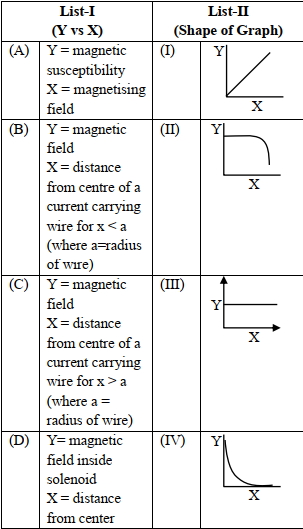
Match List-$I$ with List-$II$ and choose the correct answer from the options given below:
| List-$I$ ($Y$ vs $X$) | List-$II$ (Shape of Graph) |
| :--- | :--- |
| $(A)$ $Y$ = magnetic susceptibility, $X$ = magnetising field | $(I)$ Linear graph passing through origin |
| $(B)$ $Y$ = magnetic field, $X$ = distance from centre of a current carrying wire for $x < a$ (where $a$ = radius of wire) | $(II)$ Graph with a curve decreasing towards the axis |
| $(C)$ $Y$ = magnetic field, $X$ = distance from centre of a current carrying wire for $x > a$ (where $a$ = radius of wire) | $(III)$ Horizontal straight line graph |
| $(D)$ $Y$ = magnetic field inside solenoid, $X$ = distance from center | $(IV)$ Linear graph starting from origin |
| List-$I$ ($Y$ vs $X$) | List-$II$ (Shape of Graph) |
| :--- | :--- |
| $(A)$ $Y$ = magnetic susceptibility, $X$ = magnetising field | $(I)$ Linear graph passing through origin |
| $(B)$ $Y$ = magnetic field, $X$ = distance from centre of a current carrying wire for $x < a$ (where $a$ = radius of wire) | $(II)$ Graph with a curve decreasing towards the axis |
| $(C)$ $Y$ = magnetic field, $X$ = distance from centre of a current carrying wire for $x > a$ (where $a$ = radius of wire) | $(III)$ Horizontal straight line graph |
| $(D)$ $Y$ = magnetic field inside solenoid, $X$ = distance from center | $(IV)$ Linear graph starting from origin |
A
$(A)-(III), (B)-(IV), (C)-(II), (D)-(I)$
B
$(A)-(I), (B)-(III), (C)-(II), (D)-(IV)$
C
$(A)-(IV), (B)-(I), (C)-(III), (D)-(II)$
D
$(A)-(III), (B)-(IV), (C)-(I), (D)-(II)$
Solution
(A) The correct matches are as follows:
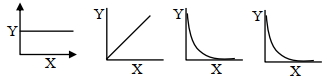
$(A)$ For a linear magnetic material, magnetic susceptibility $(\chi)$ is independent of the magnetising field $(H)$. Thus, the graph is a horizontal straight line. This corresponds to $(III)$.
$(B)$ For a current-carrying wire, the magnetic field inside $(x < a)$ is given by $B = \frac{\mu_0 i x}{2 \pi a^2}$. Since $B \propto x$, the graph is a straight line passing through the origin. This corresponds to $(IV)$.
$(C)$ For a current-carrying wire, the magnetic field outside $(x > a)$ is given by $B = \frac{\mu_0 i}{2 \pi x}$. Since $B \propto \frac{1}{x}$, the graph is a rectangular hyperbola. This corresponds to $(II)$.
$(D)$ The magnetic field inside an ideal long solenoid is uniform, meaning it does not vary with the distance from the center. Thus, it corresponds to $(III)$.
$(A)$ For a linear magnetic material, magnetic susceptibility $(\chi)$ is independent of the magnetising field $(H)$. Thus, the graph is a horizontal straight line. This corresponds to $(III)$.
$(B)$ For a current-carrying wire, the magnetic field inside $(x < a)$ is given by $B = \frac{\mu_0 i x}{2 \pi a^2}$. Since $B \propto x$, the graph is a straight line passing through the origin. This corresponds to $(IV)$.
$(C)$ For a current-carrying wire, the magnetic field outside $(x > a)$ is given by $B = \frac{\mu_0 i}{2 \pi x}$. Since $B \propto \frac{1}{x}$, the graph is a rectangular hyperbola. This corresponds to $(II)$.
$(D)$ The magnetic field inside an ideal long solenoid is uniform, meaning it does not vary with the distance from the center. Thus, it corresponds to $(III)$.
0 likes
View Solution74
AdvancedMCQ
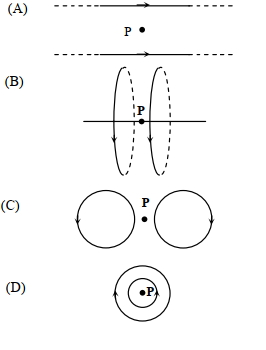
Two wires each carrying a steady current $I$ are shown in four configurations in Column $I$. Some of the resulting effects are described in Column $II$. Match the statements in Column $I$ with the statements in Column $II$.
| Column $I$ | Column $II$ |
| $(A)$ Two parallel wires with current in the same direction,$P$ is the midpoint. | $(p)$ The magnetic fields $(B)$ at $P$ due to the currents in the wires are in the same direction. |
| $(B)$ Two coaxial circular loops with current in the same direction,$P$ is the midpoint on the axis. | $(q)$ The magnetic fields $(B)$ at $P$ due to the currents in the wires are in opposite directions. |
| $(C)$ Two coplanar circular loops with current in opposite directions,$P$ is the midpoint. | $(r)$ There is no magnetic field at $P$. |
| $(D)$ Two concentric coplanar circular loops with current in the same direction,$P$ is the common center. | $(s)$ The wires repel each other. |
A
$A \rightarrow (s) \& (r), B \rightarrow (p), C \rightarrow (q) \& (r), D \rightarrow (r)$
B
$A \rightarrow (q) \& (r), B \rightarrow (p), C \rightarrow (q) \& (r), D \rightarrow (q)$
C
$A \rightarrow (s) \& (r), B \rightarrow (s), C \rightarrow (q) \& (r), D \rightarrow (p)$
D
$A \rightarrow (q) \& (r), B \rightarrow (s), C \rightarrow (q) \& (r), D \rightarrow (r)$
Solution
(A) Two parallel wires carrying current in the same direction attract each other $(s)$. At the midpoint $P$,the magnetic field due to the top wire is directed into the page,and the magnetic field due to the bottom wire is directed out of the page. Thus,they cancel out,resulting in zero magnetic field $(r)$.
$(B)$ Two coaxial loops with current in the same direction produce magnetic fields in the same direction $(p)$ at the midpoint on the axis.
$(C)$ Two coplanar loops with current in opposite directions (one clockwise,one counter-clockwise) produce magnetic fields in the same direction at the midpoint $P$ (both into the page). Wait,looking at the diagram: for $(C)$,the currents are in opposite directions,so at the midpoint,the fields add up. Actually,the fields are in the same direction $(p)$. Let's re-evaluate: $(C)$ shows currents in opposite directions,so at the midpoint,the fields are in the same direction. The correct match is $(p)$.
$(D)$ Two concentric loops with current in the same direction produce magnetic fields in the same direction at the center. However,if the currents are in opposite directions,they would cancel. Given the diagram,the fields at the center are in the same direction,so they add up. The correct option is $(A)$.
$(B)$ Two coaxial loops with current in the same direction produce magnetic fields in the same direction $(p)$ at the midpoint on the axis.
$(C)$ Two coplanar loops with current in opposite directions (one clockwise,one counter-clockwise) produce magnetic fields in the same direction at the midpoint $P$ (both into the page). Wait,looking at the diagram: for $(C)$,the currents are in opposite directions,so at the midpoint,the fields add up. Actually,the fields are in the same direction $(p)$. Let's re-evaluate: $(C)$ shows currents in opposite directions,so at the midpoint,the fields are in the same direction. The correct match is $(p)$.
$(D)$ Two concentric loops with current in the same direction produce magnetic fields in the same direction at the center. However,if the currents are in opposite directions,they would cancel. Given the diagram,the fields at the center are in the same direction,so they add up. The correct option is $(A)$.
0 likes
View Solution75
DifficultMCQ
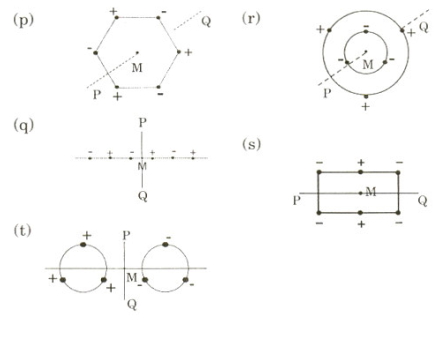
Six point charges,each of magnitude $q$,are arranged in different manners as shown in the image. In each case,a point $M$ and a line $PQ$ passing through $M$ are shown. Let $E$ be the electric field and $V$ be the electric potential at $M$ (potential at infinity is zero) due to the given charge distribution when it is at rest. Now,the whole system is set into rotation with a constant angular velocity about the line $PQ$. Let $B$ be the magnetic field at $M$ and $\mu$ be the magnetic moment of the system in this condition. Assume each rotating charge to be equivalent to a steady current. Match the conditions in Column $I$ with the configurations in Column $II$.
| Column $I$ | Column $II$ |
| $(A)$ $E=0$ | $(p)$ Charges at corners of a regular hexagon. $M$ is the centre. $PQ$ is perpendicular to the plane. |
| $(B)$ $V \neq 0$ | $(q)$ Charges on a line perpendicular to $PQ$ at equal intervals. $M$ is the mid-point. |
| $(C)$ $B=0$ | $(r)$ Charges on two coplanar concentric rings. $M$ is the common centre. $PQ$ is perpendicular to the plane. |
| $(D)$ $\mu \neq 0$ | $(s)$ Charges at corners and mid-points of a rectangle. $M$ is the centre. $PQ$ is parallel to the longer sides. |
| $(t)$ Charges on two coplanar,identical rings. $M$ is the mid-point between centres. $PQ$ is perpendicular to the line joining centres. |
A
$(A) \rightarrow p, r, s; (B) \rightarrow r, s; (C) \rightarrow p, q, t; (D) \rightarrow r, s$
B
$(A) \rightarrow p, t, s; (B) \rightarrow r, p; (C) \rightarrow r, q, t; (D) \rightarrow r, q$
C
$(A) \rightarrow q, r, s; (B) \rightarrow r, p; (C) \rightarrow t, q, t; (D) \rightarrow r, t$
D
$(A) \rightarrow t, q, p; (B) \rightarrow p, q; (C) \rightarrow r, q, s; (D) \rightarrow r, s$
Solution
(A) For $E=0$ at $M$,the charge distribution must be symmetric such that the vector sum of electric fields from all charges is zero. This occurs in $(p)$,$(r)$,and $(s)$.
For $V \neq 0$ at $M$,the potential due to positive and negative charges must not cancel out. In $(r)$ and $(s)$,the potential is zero due to symmetry of positive and negative charges at equal distances from $M$. Thus,$V \neq 0$ for $(p)$,$(q)$,and $(t)$.
For $B=0$ at $M$,the magnetic fields produced by rotating charges must cancel out. This occurs in $(p)$,$(q)$,and $(t)$ due to symmetric current loops.
For $\mu \neq 0$,the system must have a net magnetic moment. This occurs in $(r)$ and $(s)$ where the current loops do not cancel out.
For $V \neq 0$ at $M$,the potential due to positive and negative charges must not cancel out. In $(r)$ and $(s)$,the potential is zero due to symmetry of positive and negative charges at equal distances from $M$. Thus,$V \neq 0$ for $(p)$,$(q)$,and $(t)$.
For $B=0$ at $M$,the magnetic fields produced by rotating charges must cancel out. This occurs in $(p)$,$(q)$,and $(t)$ due to symmetric current loops.
For $\mu \neq 0$,the system must have a net magnetic moment. This occurs in $(r)$ and $(s)$ where the current loops do not cancel out.
0 likes
View Solution76
Advanced
$A$ charged particle (electron or proton) is introduced at the origin $(x=0, y=0, z=0)$ with a given initial velocity $\overrightarrow{v}$. $A$ uniform electric field $\overrightarrow{E}$ and magnetic field $\vec{B}$ are given in columns $I, II$ and $III$, respectively. The quantities $E_0, B_0$ are positive in magnitude.
$(1)$ In which case will the particle move in a straight line with constant velocity?
$(2)$ In which case will the particle describe a helical path with axis along the positive $z$ direction?
$(3)$ In which case would the particle move in a straight line along the negative direction of $y$-axis (i.e., move along $-\hat{y}$)?
| Column $I$ | Column $II$ | Column $III$ |
| $(I)$ Electron with $\overrightarrow{v}=2 \frac{E_0}{B_0} \hat{x}$ | $(i)$ $\overrightarrow{E}=E_0 \hat{z}$ | $(P)$ $\overrightarrow{B}=-B_0 \hat{x}$ |
| $(II)$ Electron with $\overrightarrow{v}=\frac{E_0}{B_0} \hat{y}$ | $(ii)$ $\overrightarrow{E}=-E_0 \hat{y}$ | $(Q)$ $\overrightarrow{B}=B_0 \hat{x}$ |
| $(III)$ Proton with $\overrightarrow{v}=0$ | $(iii)$ $\overrightarrow{E}=-E_0 \hat{x}$ | $(R)$ $\overrightarrow{B}=B_0 \hat{y}$ |
| $(IV)$ Proton with $\overrightarrow{v}=2 \frac{E_0}{B_0} \hat{x}$ | $(iv)$ $\overrightarrow{E}=E_0 \hat{x}$ | $(S)$ $\overrightarrow{B}=B_0 \hat{z}$ |
$(1)$ In which case will the particle move in a straight line with constant velocity?
$(2)$ In which case will the particle describe a helical path with axis along the positive $z$ direction?
$(3)$ In which case would the particle move in a straight line along the negative direction of $y$-axis (i.e., move along $-\hat{y}$)?
Solution
(A) For a particle to move with constant velocity, the net Lorentz force must be zero: $\vec{F} = q(\vec{E} + \vec{v} \times \vec{B}) = 0$.
$(1)$ For $(II)(iii)(Q)$: Electron $(q=-e)$, $\vec{v} = \frac{E_0}{B_0}\hat{y}$, $\vec{E} = -E_0\hat{x}$, $\vec{B} = B_0\hat{x}$. Force $\vec{F} = -e[(-E_0\hat{x}) + (\frac{E_0}{B_0}\hat{y} \times B_0\hat{x})] = -e[-E_0\hat{x} - E_0\hat{z}] \neq 0$. Checking $(III)(ii)(R)$: Proton $(q=+e)$, $\vec{v}=0$, $\vec{E}=-E_0\hat{y}$, $\vec{B}=B_0\hat{y}$. Force $\vec{F} = e(-E_0\hat{y}) \neq 0$. Correct match is $(II)(iii)(Q)$ for velocity selection, but for constant velocity, we need $\vec{E} = -\vec{v} \times \vec{B}$. For $(II)(iii)(Q)$, $\vec{v} \times \vec{B} = (\frac{E_0}{B_0}\hat{y}) \times (B_0\hat{x}) = -E_0\hat{z}$. This does not cancel $\vec{E}$. Re-evaluating, $(II)(iii)(Q)$ is a standard case for velocity selector where $\vec{E} = -\vec{v} \times \vec{B}$.
$(2)$ For a helical path along the $z$-axis, $\vec{B}$ must be along the $z$-axis $(S)$. The velocity must have a component perpendicular to $\vec{B}$. $(IV)(i)(S)$ gives $\vec{v} \perp \vec{B}$ and $\vec{E} \parallel \vec{B}$, resulting in a helix.
$(3)$ For motion along $-\hat{y}$, we need a force in the $-\hat{y}$ direction. $(III)(ii)(R)$ gives $\vec{E} = -E_0\hat{y}$ and $\vec{v}=0$, so $\vec{F} = q\vec{E} = e(-E_0\hat{y})$, moving the proton along $-\hat{y}$.
$(1)$ For $(II)(iii)(Q)$: Electron $(q=-e)$, $\vec{v} = \frac{E_0}{B_0}\hat{y}$, $\vec{E} = -E_0\hat{x}$, $\vec{B} = B_0\hat{x}$. Force $\vec{F} = -e[(-E_0\hat{x}) + (\frac{E_0}{B_0}\hat{y} \times B_0\hat{x})] = -e[-E_0\hat{x} - E_0\hat{z}] \neq 0$. Checking $(III)(ii)(R)$: Proton $(q=+e)$, $\vec{v}=0$, $\vec{E}=-E_0\hat{y}$, $\vec{B}=B_0\hat{y}$. Force $\vec{F} = e(-E_0\hat{y}) \neq 0$. Correct match is $(II)(iii)(Q)$ for velocity selection, but for constant velocity, we need $\vec{E} = -\vec{v} \times \vec{B}$. For $(II)(iii)(Q)$, $\vec{v} \times \vec{B} = (\frac{E_0}{B_0}\hat{y}) \times (B_0\hat{x}) = -E_0\hat{z}$. This does not cancel $\vec{E}$. Re-evaluating, $(II)(iii)(Q)$ is a standard case for velocity selector where $\vec{E} = -\vec{v} \times \vec{B}$.
$(2)$ For a helical path along the $z$-axis, $\vec{B}$ must be along the $z$-axis $(S)$. The velocity must have a component perpendicular to $\vec{B}$. $(IV)(i)(S)$ gives $\vec{v} \perp \vec{B}$ and $\vec{E} \parallel \vec{B}$, resulting in a helix.
$(3)$ For motion along $-\hat{y}$, we need a force in the $-\hat{y}$ direction. $(III)(ii)(R)$ gives $\vec{E} = -E_0\hat{y}$ and $\vec{v}=0$, so $\vec{F} = q\vec{E} = e(-E_0\hat{y})$, moving the proton along $-\hat{y}$.
0 likes
View Solution77
AdvancedMCQ
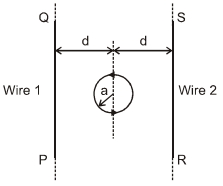
The figure shows a circular loop of radius $a$ with two long parallel wires (numbered $1$ and $2$) all in the plane of the paper. The distance of each wire from the centre of the loop is $d$. The loop and the wires are carrying the same current $I$. The current in the loop is in the counterclockwise direction if seen from above.
$1.$ When $d \approx a$ but wires are not touching the loop,it is found that the net magnetic field on the axis of the loop is zero at a height $h$ above the loop. In that case
$(A)$ current in wire $1$ and wire $2$ is in the direction $PQ$ and $RS$,respectively and $h \approx a$
$(B)$ current in wire $1$ and wire $2$ is in the direction $PQ$ and $SR$,respectively and $h \approx a$
$(C)$ current in wire $1$ and wire $2$ is in the direction $PQ$ and $SR$,respectively and $h \approx 1.2 a$
$(D)$ current in wire $1$ and wire $2$ is in the direction $PQ$ and $RS$,respectively and $h \approx 1.2 a$
$2.$ Consider $d \gg a$,and the loop is rotated about its diameter parallel to the wires by $30^{\circ}$ from the position shown in the figure. If the currents in the wires are in the opposite directions,the torque on the loop at its new position will be (assume that the net field due to the wires is constant over the loop)
$(A)$ $\frac{\mu_0 I^2 a^2}{d}$ $(B)$ $\frac{\mu_0 I^2 a^2}{2 d}$ $(C)$ $\frac{\sqrt{3} \mu_0 I^2 a^2}{d}$ $(D)$ $\frac{\sqrt{3} \mu_0 I^2 a^2}{2 d}$
Give the answer for question $1$ and $2$.
$1.$ When $d \approx a$ but wires are not touching the loop,it is found that the net magnetic field on the axis of the loop is zero at a height $h$ above the loop. In that case
$(A)$ current in wire $1$ and wire $2$ is in the direction $PQ$ and $RS$,respectively and $h \approx a$
$(B)$ current in wire $1$ and wire $2$ is in the direction $PQ$ and $SR$,respectively and $h \approx a$
$(C)$ current in wire $1$ and wire $2$ is in the direction $PQ$ and $SR$,respectively and $h \approx 1.2 a$
$(D)$ current in wire $1$ and wire $2$ is in the direction $PQ$ and $RS$,respectively and $h \approx 1.2 a$
$2.$ Consider $d \gg a$,and the loop is rotated about its diameter parallel to the wires by $30^{\circ}$ from the position shown in the figure. If the currents in the wires are in the opposite directions,the torque on the loop at its new position will be (assume that the net field due to the wires is constant over the loop)
$(A)$ $\frac{\mu_0 I^2 a^2}{d}$ $(B)$ $\frac{\mu_0 I^2 a^2}{2 d}$ $(C)$ $\frac{\sqrt{3} \mu_0 I^2 a^2}{d}$ $(D)$ $\frac{\sqrt{3} \mu_0 I^2 a^2}{2 d}$
Give the answer for question $1$ and $2$.
A
$(B, D)$
B
$(B, C)$
C
$(A, C)$
D
$(C, B)$
Solution
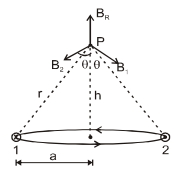
(B) $1.$ Let $\vec{B}_R$ be the magnetic field due to the ring at height $h$ on its axis,given by $\vec{B}_R = \frac{\mu_0 I a^2}{2(a^2 + h^2)^{3/2}}$.
Let $\vec{B}_1$ and $\vec{B}_2$ be the magnetic fields due to wire $1$ and wire $2$ respectively.
For the net field to be zero,the horizontal components of $\vec{B}_1$ and $\vec{B}_2$ must cancel out,which requires currents in opposite directions (e.g.,$PQ$ and $SR$).
The vertical components must sum to equal the magnitude of $\vec{B}_R$. The resultant field of the two wires at height $h$ is $B_{wires} = 2 \left( \frac{\mu_0 I}{2 \pi r} \right) \cos \theta$,where $r = \sqrt{d^2 + h^2}$ and $\cos \theta = \frac{d}{r}$.
Setting $B_{wires} = B_R$ and solving for $h$ with $d \approx a$ leads to $h \approx 1.2 a$.
Thus,the correct conditions are current in $PQ$ and $SR$ with $h \approx 1.2 a$.
$2.$ The magnetic field at the center due to two wires with opposite currents is $B = \frac{\mu_0 I}{2 \pi d} + \frac{\mu_0 I}{2 \pi d} = \frac{\mu_0 I}{\pi d}$ (directed into the page).
The magnetic moment of the loop is $M = I A = I \pi a^2$.
The torque is $\vec{\tau} = \vec{M} \times \vec{B}$,so $\tau = M B \sin \theta$.
With the loop rotated by $30^{\circ}$,the angle between the area vector and the magnetic field is $90^{\circ} + 30^{\circ} = 120^{\circ}$ or $60^{\circ}$ depending on orientation. Given the geometry,$\tau = (I \pi a^2) \left( \frac{\mu_0 I}{\pi d} \right) \sin 60^{\circ} = \frac{\mu_0 I^2 a^2}{d} \frac{\sqrt{3}}{2} = \frac{\sqrt{3} \mu_0 I^2 a^2}{2 d}$.
Let $\vec{B}_1$ and $\vec{B}_2$ be the magnetic fields due to wire $1$ and wire $2$ respectively.
For the net field to be zero,the horizontal components of $\vec{B}_1$ and $\vec{B}_2$ must cancel out,which requires currents in opposite directions (e.g.,$PQ$ and $SR$).
The vertical components must sum to equal the magnitude of $\vec{B}_R$. The resultant field of the two wires at height $h$ is $B_{wires} = 2 \left( \frac{\mu_0 I}{2 \pi r} \right) \cos \theta$,where $r = \sqrt{d^2 + h^2}$ and $\cos \theta = \frac{d}{r}$.
Setting $B_{wires} = B_R$ and solving for $h$ with $d \approx a$ leads to $h \approx 1.2 a$.
Thus,the correct conditions are current in $PQ$ and $SR$ with $h \approx 1.2 a$.
$2.$ The magnetic field at the center due to two wires with opposite currents is $B = \frac{\mu_0 I}{2 \pi d} + \frac{\mu_0 I}{2 \pi d} = \frac{\mu_0 I}{\pi d}$ (directed into the page).
The magnetic moment of the loop is $M = I A = I \pi a^2$.
The torque is $\vec{\tau} = \vec{M} \times \vec{B}$,so $\tau = M B \sin \theta$.
With the loop rotated by $30^{\circ}$,the angle between the area vector and the magnetic field is $90^{\circ} + 30^{\circ} = 120^{\circ}$ or $60^{\circ}$ depending on orientation. Given the geometry,$\tau = (I \pi a^2) \left( \frac{\mu_0 I}{\pi d} \right) \sin 60^{\circ} = \frac{\mu_0 I^2 a^2}{d} \frac{\sqrt{3}}{2} = \frac{\sqrt{3} \mu_0 I^2 a^2}{2 d}$.
0 likes
View Solution78
Advanced
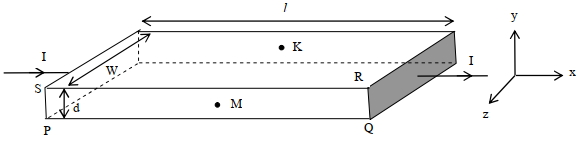
In a thin rectangular metallic strip, a constant current $I$ flows along the positive $x$-direction, as shown in the figure. The length, width, and thickness of the strip are $\ell$, $w$, and $d$, respectively. A uniform magnetic field $\vec{B}$ is applied on the strip along the positive $y$-direction. Due to this, the charge carriers experience a net deflection along the $z$-direction. This results in the accumulation of charge carriers on the surface $PQRS$ and the appearance of equal and opposite charges on the face opposite to $PQRS$. A potential difference along the $z$-direction is thus developed. Charge accumulation continues until the magnetic force is balanced by the electric force. The current is assumed to be uniformly distributed on the cross-section of the strip and carried by electrons.
$1.$ Consider two different metallic strips ($1$ and $2$) of the same material. Their lengths are the same, widths are $w_1$ and $w_2$, and thicknesses are $d_1$ and $d_2$, respectively. Two points $K$ and $M$ are symmetrically located on the opposite faces parallel to the $x$-$y$ plane (see figure). $V_1$ and $V_2$ are the potential differences between $K$ and $M$ in strips $1$ and $2$, respectively. Then, for a given current $I$ flowing through them in a given magnetic field strength $B$, the correct statement$(s)$ is(are):
$(A)$ If $w_1=w_2$ and $d_1=2d_2$, then $V_2=2V_1$
$(B)$ If $w_1=w_2$ and $d_1=2d_2$, then $V_2=V_1$
$(C)$ If $w_1=2w_2$ and $d_1=d_2$, then $V_2=2V_1$
$(D)$ If $w_1=2w_2$ and $d_1=d_2$, then $V_2=V_1$
$2.$ Consider two different metallic strips ($1$ and $2$) of same dimensions (lengths $\ell$, width $w$, and thickness $d$) with carrier densities $n_1$ and $n_2$, respectively. Strip $1$ is placed in magnetic field $B_1$ and strip $2$ is placed in magnetic field $B_2$, both along positive $y$-directions. Then $V_1$ and $V_2$ are the potential differences developed between $K$ and $M$ in strips $1$ and $2$, respectively. Assuming that the current $I$ is the same for both the strips, the correct option$(s)$ is(are):
$(A)$ If $B_1=B_2$ and $n_1=2n_2$, then $V_2=2V_1$
$(B)$ If $B_1=B_2$ and $n_1=2n_2$, then $V_2=V_1$
$(C)$ If $B_1=2B_2$ and $n_1=n_2$, then $V_2=0.5V_1$
$(D)$ If $B_1=2B_2$ and $n_1=n_2$, then $V_2=V_1$
Give the answer for question $1$ and $2$.
$1.$ Consider two different metallic strips ($1$ and $2$) of the same material. Their lengths are the same, widths are $w_1$ and $w_2$, and thicknesses are $d_1$ and $d_2$, respectively. Two points $K$ and $M$ are symmetrically located on the opposite faces parallel to the $x$-$y$ plane (see figure). $V_1$ and $V_2$ are the potential differences between $K$ and $M$ in strips $1$ and $2$, respectively. Then, for a given current $I$ flowing through them in a given magnetic field strength $B$, the correct statement$(s)$ is(are):
$(A)$ If $w_1=w_2$ and $d_1=2d_2$, then $V_2=2V_1$
$(B)$ If $w_1=w_2$ and $d_1=2d_2$, then $V_2=V_1$
$(C)$ If $w_1=2w_2$ and $d_1=d_2$, then $V_2=2V_1$
$(D)$ If $w_1=2w_2$ and $d_1=d_2$, then $V_2=V_1$
$2.$ Consider two different metallic strips ($1$ and $2$) of same dimensions (lengths $\ell$, width $w$, and thickness $d$) with carrier densities $n_1$ and $n_2$, respectively. Strip $1$ is placed in magnetic field $B_1$ and strip $2$ is placed in magnetic field $B_2$, both along positive $y$-directions. Then $V_1$ and $V_2$ are the potential differences developed between $K$ and $M$ in strips $1$ and $2$, respectively. Assuming that the current $I$ is the same for both the strips, the correct option$(s)$ is(are):
$(A)$ If $B_1=B_2$ and $n_1=2n_2$, then $V_2=2V_1$
$(B)$ If $B_1=B_2$ and $n_1=2n_2$, then $V_2=V_1$
$(C)$ If $B_1=2B_2$ and $n_1=n_2$, then $V_2=0.5V_1$
$(D)$ If $B_1=2B_2$ and $n_1=n_2$, then $V_2=V_1$
Give the answer for question $1$ and $2$.
Solution
(D) The Hall voltage $V$ is given by $V = v B w$, where $v$ is the drift velocity, $B$ is the magnetic field, and $w$ is the width.
Since $I = n e A v = n e (w d) v$, we have $v = \frac{I}{n e w d}$.
Substituting $v$ into the expression for $V$: $V = \left(\frac{I}{n e w d}\right) B w = \frac{I B}{n e d}$.
$1.$ For the same material ($n$ is constant) and same current $I$ and field $B$, $V \propto \frac{1}{d}$.
Thus, $\frac{V_2}{V_1} = \frac{d_1}{d_2}$.
If $w_1=w_2$ and $d_1=2d_2$, then $V_2 = \frac{2d_2}{d_2} V_1 = 2V_1$. (Option $A$ is correct).
If $w_1=2w_2$ and $d_1=d_2$, then $V_2 = \frac{d_1}{d_1} V_1 = V_1$. (Option $D$ is correct).
$2.$ For same dimensions ($w, d$ constant) and same current $I$, $V \propto \frac{B}{n}$.
Thus, $\frac{V_2}{V_1} = \frac{B_2}{B_1} \cdot \frac{n_1}{n_2}$.
If $B_1=B_2$ and $n_1=2n_2$, then $\frac{V_2}{V_1} = 1 \cdot \frac{2n_2}{n_2} = 2$, so $V_2=2V_1$. (Option $A$ is correct).
If $B_1=2B_2$ and $n_1=n_2$, then $\frac{V_2}{V_1} = \frac{B_2}{2B_2} \cdot 1 = 0.5$, so $V_2=0.5V_1$. (Option $C$ is correct).
Therefore, the correct answers are $AD$ and $AC$.
Since $I = n e A v = n e (w d) v$, we have $v = \frac{I}{n e w d}$.
Substituting $v$ into the expression for $V$: $V = \left(\frac{I}{n e w d}\right) B w = \frac{I B}{n e d}$.
$1.$ For the same material ($n$ is constant) and same current $I$ and field $B$, $V \propto \frac{1}{d}$.
Thus, $\frac{V_2}{V_1} = \frac{d_1}{d_2}$.
If $w_1=w_2$ and $d_1=2d_2$, then $V_2 = \frac{2d_2}{d_2} V_1 = 2V_1$. (Option $A$ is correct).
If $w_1=2w_2$ and $d_1=d_2$, then $V_2 = \frac{d_1}{d_1} V_1 = V_1$. (Option $D$ is correct).
$2.$ For same dimensions ($w, d$ constant) and same current $I$, $V \propto \frac{B}{n}$.
Thus, $\frac{V_2}{V_1} = \frac{B_2}{B_1} \cdot \frac{n_1}{n_2}$.
If $B_1=B_2$ and $n_1=2n_2$, then $\frac{V_2}{V_1} = 1 \cdot \frac{2n_2}{n_2} = 2$, so $V_2=2V_1$. (Option $A$ is correct).
If $B_1=2B_2$ and $n_1=n_2$, then $\frac{V_2}{V_1} = \frac{B_2}{2B_2} \cdot 1 = 0.5$, so $V_2=0.5V_1$. (Option $C$ is correct).
Therefore, the correct answers are $AD$ and $AC$.
0 likes
View Solution79
MediumMCQ
Match List-$I$ with List-$II$.
Choose the correct answer from the options given below:
| List-$I$ | List-$II$ |
| $(A)$ Permeability of free space | $(I) \ [M L^2 T^{-2}]$ |
| $(B)$ Magnetic field | $(II) \ [M T^{-2} A^{-1}]$ |
| $(C)$ Magnetic moment | $(III) \ [M L T^{-2} A^{-2}]$ |
| $(D)$ Torsional constant | $(IV) \ [L^2 A]$ |
Choose the correct answer from the options given below:
A
$(A)-(I), (B)-(IV), (C)-(II), (D)-(III)$
B
$(A)-(II), (B)-(I), (C)-(III), (D)-(IV)$
C
$(A)-(IV), (B)-(III), (C)-(I), (D)-(II)$
D
$(A)-(III), (B)-(II), (C)-(IV), (D)-(I)$
Solution
(D) $1$. Permeability of free space $(\mu_0)$: From $B = \frac{\mu_0 I}{2 \pi r}$,we have $[\mu_0] = [\frac{B \cdot r}{I}] = [\frac{(M T^{-2} A^{-1}) \cdot L}{A}] = [M L T^{-2} A^{-2}]$. Thus,$(A)-(III)$.
$2$. Magnetic field $(B)$: From $F = qvB$,we have $[B] = [\frac{F}{qv}] = [\frac{M L T^{-2}}{A T \cdot L T^{-1}}] = [M T^{-2} A^{-1}]$. Thus,$(B)-(II)$.
$3$. Magnetic moment $(M)$: $M = I \cdot A$,where $I$ is current and $A$ is area. So,$[M] = [A \cdot L^2] = [L^2 A]$. Thus,$(C)-(IV)$.
$4$. Torsional constant $(c)$: From $\tau = c \theta$,where $\tau$ is torque and $\theta$ is dimensionless angle,$[c] = [\tau] = [M L^2 T^{-2}]$. Thus,$(D)-(I)$.
$2$. Magnetic field $(B)$: From $F = qvB$,we have $[B] = [\frac{F}{qv}] = [\frac{M L T^{-2}}{A T \cdot L T^{-1}}] = [M T^{-2} A^{-1}]$. Thus,$(B)-(II)$.
$3$. Magnetic moment $(M)$: $M = I \cdot A$,where $I$ is current and $A$ is area. So,$[M] = [A \cdot L^2] = [L^2 A]$. Thus,$(C)-(IV)$.
$4$. Torsional constant $(c)$: From $\tau = c \theta$,where $\tau$ is torque and $\theta$ is dimensionless angle,$[c] = [\tau] = [M L^2 T^{-2}]$. Thus,$(D)-(I)$.
0 likes
View Solution80
MediumMCQ
An electron (mass $9 \times 10^{-31} \ kg$ and charge $1.6 \times 10^{-19} \ C$) moving with speed $v = c/100$ $(c = 3 \times 10^8 \ ms^{-1})$ is injected into a magnetic field $\vec{B}$ of magnitude $9 \times 10^{-4} \ T$ perpendicular to its direction of motion. We wish to apply a uniform electric field $\vec{E}$ together with the magnetic field so that the electron does not deflect from its path. Then:
A
$\vec{E}$ is perpendicular to $\vec{B}$ and its magnitude is $27 \times 10^4 \ V \ m^{-1}$
B
$\vec{E}$ is perpendicular to $\vec{B}$ and its magnitude is $27 \times 10^2 \ V \ m^{-1}$
C
$\vec{E}$ is parallel to $\vec{B}$ and its magnitude is $27 \times 10^2 \ V \ m^{-1}$
D
$\vec{E}$ is parallel to $\vec{B}$ and its magnitude is $27 \times 10^4 \ V \ m^{-1}$
Solution
(B) For the electron to move undeflected,the net Lorentz force must be zero: $\vec{F}_e + \vec{F}_m = 0$,which implies $\vec{F}_e = -\vec{F}_m$.
Since $\vec{F}_m = q(\vec{v} \times \vec{B})$,the magnitude is $F_m = qvB \sin(90^\circ) = qvB$.
The electric force is $F_e = qE$.
Equating the magnitudes: $qE = qvB \implies E = vB$.
Given $v = c/100 = (3 \times 10^8) / 100 = 3 \times 10^6 \ ms^{-1}$.
Given $B = 9 \times 10^{-4} \ T$.
Calculating $E$: $E = (3 \times 10^6) \times (9 \times 10^{-4}) = 27 \times 10^2 \ V \ m^{-1}$.
For the forces to cancel,$\vec{E}$ must be perpendicular to both $\vec{v}$ and $\vec{B}$. Since $\vec{v}$ is perpendicular to $\vec{B}$,$\vec{E}$ must be perpendicular to $\vec{B}$.
Since $\vec{F}_m = q(\vec{v} \times \vec{B})$,the magnitude is $F_m = qvB \sin(90^\circ) = qvB$.
The electric force is $F_e = qE$.
Equating the magnitudes: $qE = qvB \implies E = vB$.
Given $v = c/100 = (3 \times 10^8) / 100 = 3 \times 10^6 \ ms^{-1}$.
Given $B = 9 \times 10^{-4} \ T$.
Calculating $E$: $E = (3 \times 10^6) \times (9 \times 10^{-4}) = 27 \times 10^2 \ V \ m^{-1}$.
For the forces to cancel,$\vec{E}$ must be perpendicular to both $\vec{v}$ and $\vec{B}$. Since $\vec{v}$ is perpendicular to $\vec{B}$,$\vec{E}$ must be perpendicular to $\vec{B}$.
0 likes
View Solution81
DifficultMCQ
Two circular coils $1$ and $2$ are made from the same wire,but the radius of the first coil is twice that of the second coil. What is the ratio of the potential difference applied across them so that the magnetic field at their centres is the same?
A
$2: 1$
B
$4: 1$
C
$1: 2$
D
$1: 4$
Solution
(B) The magnetic field at the center of a circular coil is given by $B = \frac{\mu_0 i}{2r}$.
Given that $B_1 = B_2$,we have $\frac{i_1}{r_1} = \frac{i_2}{r_2}$.
Since $r_1 = 2r_2$,we get $\frac{i_1}{2r_2} = \frac{i_2}{r_2}$,which implies $i_1 = 2i_2$.
The resistance of a wire is $R = \rho \frac{L}{A}$. Since both coils are made of the same wire,$\rho$ and $A$ are constant. The length $L = 2\pi r$.
Thus,$R_1 = 2\pi r_1$ and $R_2 = 2\pi r_2$. Since $r_1 = 2r_2$,$R_1 = 2R_2$.
The potential difference is $V = iR$. Therefore,$\frac{V_1}{V_2} = \frac{i_1 R_1}{i_2 R_2}$.
Substituting the values: $\frac{V_1}{V_2} = \frac{(2i_2)(2R_2)}{i_2 R_2} = 4$.
Thus,the ratio is $4: 1$.
Given that $B_1 = B_2$,we have $\frac{i_1}{r_1} = \frac{i_2}{r_2}$.
Since $r_1 = 2r_2$,we get $\frac{i_1}{2r_2} = \frac{i_2}{r_2}$,which implies $i_1 = 2i_2$.
The resistance of a wire is $R = \rho \frac{L}{A}$. Since both coils are made of the same wire,$\rho$ and $A$ are constant. The length $L = 2\pi r$.
Thus,$R_1 = 2\pi r_1$ and $R_2 = 2\pi r_2$. Since $r_1 = 2r_2$,$R_1 = 2R_2$.
The potential difference is $V = iR$. Therefore,$\frac{V_1}{V_2} = \frac{i_1 R_1}{i_2 R_2}$.
Substituting the values: $\frac{V_1}{V_2} = \frac{(2i_2)(2R_2)}{i_2 R_2} = 4$.
Thus,the ratio is $4: 1$.
0 likes
View Solution82
MediumMCQ
The figure shows a circular coil carrying current $i$ kept very close but not touching at a point $A$ on a straight conductor carrying the same current $i$. The magnitude of magnetic induction at the centre $O$ of the circular coil will be:
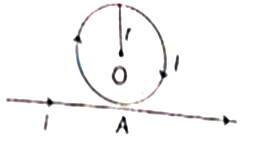
A
$\frac{\mu_0 i}{2 r}\left[1-\frac{1}{\pi}\right]$
B
$\frac{\mu_0 i}{2 \pi r}$
C
$\frac{\mu_0 i}{2 r}$
D
Zero
Solution
(A) The magnetic induction at the centre $O$ of the circular current-carrying loop is given by $B_1 = \frac{\mu_0 i}{2 r}$ (directed into the plane of the paper,i.e.,downward direction).
The magnetic induction at the centre $O$ due to the straight wire at a distance $r$ is given by $B_2 = \frac{\mu_0}{2 \pi} \cdot \frac{i}{r}$ (directed out of the plane of the paper,i.e.,upward direction).
The net magnetic induction at $O$ is the difference between these two magnitudes:
$B = B_1 - B_2 = \frac{\mu_0 i}{2 r} - \frac{\mu_0 i}{2 \pi r}$
$B = \frac{\mu_0 i}{2 r} \left[1 - \frac{1}{\pi}\right]$
The magnetic induction at the centre $O$ due to the straight wire at a distance $r$ is given by $B_2 = \frac{\mu_0}{2 \pi} \cdot \frac{i}{r}$ (directed out of the plane of the paper,i.e.,upward direction).
The net magnetic induction at $O$ is the difference between these two magnitudes:
$B = B_1 - B_2 = \frac{\mu_0 i}{2 r} - \frac{\mu_0 i}{2 \pi r}$
$B = \frac{\mu_0 i}{2 r} \left[1 - \frac{1}{\pi}\right]$
0 likes
View Solution83
MediumMCQ
An $\alpha$ particle of energy $10 \ eV$ is moving in a circular path in a uniform magnetic field. The energy of a proton moving in the same path and the same magnetic field will be [mass of $\alpha$ particle $= 4 \times$ mass of proton]. (in $eV$)
A
$4$
B
$8$
C
$16$
D
$10$
Solution
(D) The radius of a charged particle moving in a uniform magnetic field is given by $r = \frac{mv}{qB} = \frac{\sqrt{2mK}}{qB}$,where $K$ is the kinetic energy.
Since the path $(r)$ and the magnetic field $(B)$ are the same for both particles,we have $\frac{\sqrt{2m_{\alpha}K_{\alpha}}}{q_{\alpha}B} = \frac{\sqrt{2m_{p}K_{p}}}{q_{p}B}$.
Squaring both sides and rearranging,we get $\frac{2m_{\alpha}K_{\alpha}}{q_{\alpha}^2} = \frac{2m_{p}K_{p}}{q_{p}^2}$,which implies $K_{p} = K_{\alpha} \cdot \left(\frac{m_{\alpha}}{m_{p}}\right) \cdot \left(\frac{q_{p}}{q_{\alpha}}\right)^2$.
Given $m_{\alpha} = 4m_{p}$ and $q_{\alpha} = 2q_{p}$,we substitute these values:
$K_{p} = 10 \ eV \cdot \left(\frac{4m_{p}}{m_{p}}\right) \cdot \left(\frac{q_{p}}{2q_{p}}\right)^2 = 10 \ eV \cdot 4 \cdot \frac{1}{4} = 10 \ eV$.
Since the path $(r)$ and the magnetic field $(B)$ are the same for both particles,we have $\frac{\sqrt{2m_{\alpha}K_{\alpha}}}{q_{\alpha}B} = \frac{\sqrt{2m_{p}K_{p}}}{q_{p}B}$.
Squaring both sides and rearranging,we get $\frac{2m_{\alpha}K_{\alpha}}{q_{\alpha}^2} = \frac{2m_{p}K_{p}}{q_{p}^2}$,which implies $K_{p} = K_{\alpha} \cdot \left(\frac{m_{\alpha}}{m_{p}}\right) \cdot \left(\frac{q_{p}}{q_{\alpha}}\right)^2$.
Given $m_{\alpha} = 4m_{p}$ and $q_{\alpha} = 2q_{p}$,we substitute these values:
$K_{p} = 10 \ eV \cdot \left(\frac{4m_{p}}{m_{p}}\right) \cdot \left(\frac{q_{p}}{2q_{p}}\right)^2 = 10 \ eV \cdot 4 \cdot \frac{1}{4} = 10 \ eV$.
0 likes
View Solution84
EasyMCQ
If the temperature of the cold junction of a thermocouple is lowered,then the neutral temperature
A
increases
B
approaches inversion temperature
C
decreases
D
remains the same
Solution
(D) The neutral temperature $(T_n)$ of a thermocouple is a characteristic property of the materials used to form the thermocouple. It depends only on the nature of the metals used and is independent of the temperature of the cold junction $(T_c)$ and the inversion temperature $(T_i)$. Therefore,if the temperature of the cold junction is lowered,the neutral temperature remains the same.
0 likes
View Solution85
MediumMCQ
Select the dimensional formula of $\frac{B^2}{2\mu_0}$.
A
$M^1 L^1 T^{-2}$
B
$M^{-1} L^1 T^2$
C
$M^{-1} L^{-1} T^{-2}$
D
$M^1 L^{-1} T^{-2}$
Solution
(D) The expression $\frac{B^2}{2\mu_0}$ represents the magnetic energy density $(u_B)$ stored in a magnetic field.
Energy density is defined as energy per unit volume.
$u_B = \frac{B^2}{2\mu_0} = \frac{\text{Energy}}{\text{Volume}}$
The dimensional formula for energy is $[M^1 L^2 T^{-2}]$ and for volume is $[L^3]$.
Therefore,the dimensional formula for magnetic energy density is:
$\frac{[M^1 L^2 T^{-2}]}{[L^3]} = [M^1 L^{-1} T^{-2}]$
Thus,the correct option is $D$.
Energy density is defined as energy per unit volume.
$u_B = \frac{B^2}{2\mu_0} = \frac{\text{Energy}}{\text{Volume}}$
The dimensional formula for energy is $[M^1 L^2 T^{-2}]$ and for volume is $[L^3]$.
Therefore,the dimensional formula for magnetic energy density is:
$\frac{[M^1 L^2 T^{-2}]}{[L^3]} = [M^1 L^{-1} T^{-2}]$
Thus,the correct option is $D$.
0 likes
View Solution86
EasyMCQ
Which of the following is not a unit of magnetic induction?
A
$\frac{\text{Weber}}{\text{m}^2}$
B
$\frac{\text{Newton-meter}}{\text{Ampere}}$
C
Tesla
D
$\frac{\text{Newton}}{\text{meter-Ampere}}$
Solution
(B) The magnetic induction $B$ is defined by the force $F$ on a current-carrying wire of length $l$ carrying current $I$ as $F = BIl \sin \theta$.
Thus,the $SI$ unit of magnetic induction is $\frac{\text{Newton}}{\text{Ampere-meter}}$.
Since $1 \text{ Tesla} = 1 \frac{\text{Weber}}{\text{m}^2} = 1 \frac{\text{Newton}}{\text{Ampere-meter}}$,options $A$,$C$,and $D$ are all valid units of magnetic induction.
Option $B$,$\frac{\text{Newton-meter}}{\text{Ampere}}$,is not a unit of magnetic induction.
Thus,the $SI$ unit of magnetic induction is $\frac{\text{Newton}}{\text{Ampere-meter}}$.
Since $1 \text{ Tesla} = 1 \frac{\text{Weber}}{\text{m}^2} = 1 \frac{\text{Newton}}{\text{Ampere-meter}}$,options $A$,$C$,and $D$ are all valid units of magnetic induction.
Option $B$,$\frac{\text{Newton-meter}}{\text{Ampere}}$,is not a unit of magnetic induction.
0 likes
View Solution87
EasyMCQ
$A$ charge $q$ is accelerated through a potential difference $V$. It is then passed normally through a uniform magnetic field,where it moves in a circle of radius $r$. The potential difference required to move it in a circle of radius $2r$ is (in $V$)
A
$12$
B
$4$
C
$1$
D
$3$
Solution
(B) When a charge $q$ is accelerated through a potential difference $V$,its kinetic energy is given by $\frac{1}{2}mv^2 = qV$.
This implies $mv = \sqrt{2mqV}$.
The radius $r$ of the circular path in a magnetic field $B$ is given by $r = \frac{mv}{qB}$.
Substituting the value of $mv$,we get $r = \frac{\sqrt{2mqV}}{qB}$.
Since $m, q,$ and $B$ are constant,we have $r \propto \sqrt{V}$.
If the radius becomes $2r$,then $\frac{r'}{r} = \frac{\sqrt{V'}}{\sqrt{V}} = 2$.
Squaring both sides,$\frac{V'}{V} = 4$,which gives $V' = 4V$.
This implies $mv = \sqrt{2mqV}$.
The radius $r$ of the circular path in a magnetic field $B$ is given by $r = \frac{mv}{qB}$.
Substituting the value of $mv$,we get $r = \frac{\sqrt{2mqV}}{qB}$.
Since $m, q,$ and $B$ are constant,we have $r \propto \sqrt{V}$.
If the radius becomes $2r$,then $\frac{r'}{r} = \frac{\sqrt{V'}}{\sqrt{V}} = 2$.
Squaring both sides,$\frac{V'}{V} = 4$,which gives $V' = 4V$.
0 likes
View Solution88
MediumMCQ
Two long straight parallel wires are a distance $2d$ apart. They carry steady equal currents flowing out of the plane of the paper. The variation of magnetic field $B$ along the line $xx'$ is given by:
A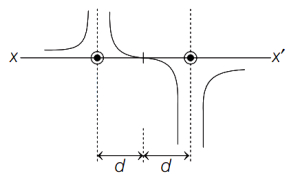
B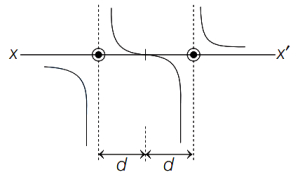
C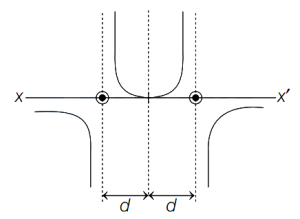
D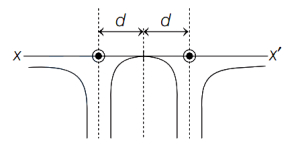
Solution
(A) Let the two wires be located at $x = -d$ and $x = +d$ on the $xx'$ axis. The currents are flowing out of the plane of the paper.
Using the right-hand rule, the magnetic field due to a wire carrying current $i$ at a distance $r$ is $B = \frac{\mu_0 i}{2\pi r}$.
For the wire at $x = -d$, the field is $B_1 = \frac{\mu_0 i}{2\pi (x+d)}$ in the $(-\hat{j})$ direction for $x > -d$.
For the wire at $x = +d$, the field is $B_2 = \frac{\mu_0 i}{2\pi (d-x)}$ in the $\hat{j}$ direction for $x < d$.
In the region between the wires $(-d < x < d)$, the net magnetic field is $B_{net} = B_2 - B_1 = \frac{\mu_0 i}{2\pi} \left[ \frac{1}{d-x} - \frac{1}{d+x} \right]$.
At the midpoint $x = 0$, $B_{net} = 0$. As $x$ approaches $d$, $B_{net} \to \infty$ in the $\hat{j}$ direction. As $x$ approaches $-d$, $B_{net} \to -\infty$ in the $(-\hat{j})$ direction.
Outside the wires, the fields add up in magnitude. The correct graphical representation showing the field passing through zero at the midpoint and having opposite signs on either side is represented by option $A$.
Using the right-hand rule, the magnetic field due to a wire carrying current $i$ at a distance $r$ is $B = \frac{\mu_0 i}{2\pi r}$.
For the wire at $x = -d$, the field is $B_1 = \frac{\mu_0 i}{2\pi (x+d)}$ in the $(-\hat{j})$ direction for $x > -d$.
For the wire at $x = +d$, the field is $B_2 = \frac{\mu_0 i}{2\pi (d-x)}$ in the $\hat{j}$ direction for $x < d$.
In the region between the wires $(-d < x < d)$, the net magnetic field is $B_{net} = B_2 - B_1 = \frac{\mu_0 i}{2\pi} \left[ \frac{1}{d-x} - \frac{1}{d+x} \right]$.
At the midpoint $x = 0$, $B_{net} = 0$. As $x$ approaches $d$, $B_{net} \to \infty$ in the $\hat{j}$ direction. As $x$ approaches $-d$, $B_{net} \to -\infty$ in the $(-\hat{j})$ direction.
Outside the wires, the fields add up in magnitude. The correct graphical representation showing the field passing through zero at the midpoint and having opposite signs on either side is represented by option $A$.
0 likes
View Solution89
EasyMCQ
Pick out the wrong statement.
A
An electron at rest experiences no force in the magnetic field.
B
The gain in the $KE$ of the electron moving at right angles to the magnetic field is zero.
C
When an electron is shot at right angles to the electric field,it traces a parabolic path.
D
An electron moving in the direction of the electric field gains $KE$.
Solution
(D) The magnetic force on a moving charge is given by $F = q(v \times B)$. If the electron is at rest $(v = 0)$,the force is zero. Thus,option $A$ is correct.
When an electron moves at right angles to a magnetic field,the force is always perpendicular to the velocity,so no work is done and the kinetic energy remains constant. Thus,option $B$ is correct.
When an electron enters an electric field at right angles,it experiences a constant force perpendicular to its initial velocity,resulting in a parabolic trajectory. Thus,option $C$ is correct.
An electron is negatively charged,so it experiences an electrostatic force $F = -eE$ opposite to the direction of the electric field. If it moves in the direction of the electric field,it is decelerated,meaning it loses kinetic energy. Thus,option $D$ is the wrong statement.
When an electron moves at right angles to a magnetic field,the force is always perpendicular to the velocity,so no work is done and the kinetic energy remains constant. Thus,option $B$ is correct.
When an electron enters an electric field at right angles,it experiences a constant force perpendicular to its initial velocity,resulting in a parabolic trajectory. Thus,option $C$ is correct.
An electron is negatively charged,so it experiences an electrostatic force $F = -eE$ opposite to the direction of the electric field. If it moves in the direction of the electric field,it is decelerated,meaning it loses kinetic energy. Thus,option $D$ is the wrong statement.
0 likes
View Solution90
MediumMCQ
The energies required to set up in a cube of side $10 \,cm$ $(i)$ a uniform electric field of $10^7 \,Vm^{-1}$ and (ii) a uniform magnetic field of $0.25 \,Wbm^{-2}$ are respectively about $(\mu_0=4 \pi \times 10^{-7} \,Hm^{-1}, \varepsilon_0=8.9 \times 10^{-12} \,Fm^{-1})$
A
$0.445 \,J, 25 \,J$
B
$4.45 \,J, 2.5 \,J$
C
$44.5 \,J, 25 \,J$
D
$0.44 \,J, 2.5 \,J$
Solution
(A) The energy density of an electric field is $u_E = \frac{1}{2} \varepsilon_0 E^2$ and the energy density of a magnetic field is $u_B = \frac{1}{2} \frac{B^2}{\mu_0}$.
Volume of the cube $V = l^3 = (0.1 \,m)^3 = 10^{-3} \,m^3$.
For the electric field:
$U_E = u_E \times V = \frac{1}{2} \varepsilon_0 E^2 \times V = \frac{1}{2} \times 8.9 \times 10^{-12} \times (10^7)^2 \times 10^{-3} = 4.45 \times 10^{-12+14-3} = 4.45 \times 10^{-1} = 0.445 \,J$.
For the magnetic field:
$U_B = u_B \times V = \frac{B^2}{2 \mu_0} \times V = \frac{(0.25)^2 \times 10^{-3}}{2 \times 4 \pi \times 10^{-7}} = \frac{0.0625 \times 10^{-3}}{8 \pi \times 10^{-7}} \approx \frac{0.0625 \times 10^4}{25.13} \approx 24.87 \,J \approx 25 \,J$.
Volume of the cube $V = l^3 = (0.1 \,m)^3 = 10^{-3} \,m^3$.
For the electric field:
$U_E = u_E \times V = \frac{1}{2} \varepsilon_0 E^2 \times V = \frac{1}{2} \times 8.9 \times 10^{-12} \times (10^7)^2 \times 10^{-3} = 4.45 \times 10^{-12+14-3} = 4.45 \times 10^{-1} = 0.445 \,J$.
For the magnetic field:
$U_B = u_B \times V = \frac{B^2}{2 \mu_0} \times V = \frac{(0.25)^2 \times 10^{-3}}{2 \times 4 \pi \times 10^{-7}} = \frac{0.0625 \times 10^{-3}}{8 \pi \times 10^{-7}} \approx \frac{0.0625 \times 10^4}{25.13} \approx 24.87 \,J \approx 25 \,J$.
0 likes
View Solution91
MediumMCQ
Two concentric loops $A$ and $B$ of same radius $R = 2 \pi \,cm = 2 \pi \times 10^{-2} \,m$ are placed at right angles to each other. If the currents flowing through $A$ and $B$ are $I_A = 3 \,A$ and $I_B = 4 \,A$ respectively, then the net magnetic field at their common centre is:
A
$0.5 \times 10^{-5} \,T$
B
$1.0 \times 10^{-5} \,T$
C
$2.5 \times 10^{-5} \,T$
D
$5.0 \times 10^{-5} \,T$
Solution
(D) The magnetic field at the centre of a circular loop is given by $B = \frac{\mu_0 I}{2R}$.
Given $R = 2 \pi \times 10^{-2} \,m$, $I_A = 3 \,A$, and $I_B = 4 \,A$.
The magnetic field due to loop $A$ is $B_A = \frac{\mu_0 I_A}{2R} = \frac{4 \pi \times 10^{-7} \times 3}{2 \times 2 \pi \times 10^{-2}} = 3 \times 10^{-5} \,T$.
The magnetic field due to loop $B$ is $B_B = \frac{\mu_0 I_B}{2R} = \frac{4 \pi \times 10^{-7} \times 4}{2 \times 2 \pi \times 10^{-2}} = 4 \times 10^{-5} \,T$.
Since the loops are at right angles, the net magnetic field is $B_{net} = \sqrt{B_A^2 + B_B^2} = \sqrt{(3 \times 10^{-5})^2 + (4 \times 10^{-5})^2} = \sqrt{9 + 16} \times 10^{-5} = 5 \times 10^{-5} \,T$.
Given $R = 2 \pi \times 10^{-2} \,m$, $I_A = 3 \,A$, and $I_B = 4 \,A$.
The magnetic field due to loop $A$ is $B_A = \frac{\mu_0 I_A}{2R} = \frac{4 \pi \times 10^{-7} \times 3}{2 \times 2 \pi \times 10^{-2}} = 3 \times 10^{-5} \,T$.
The magnetic field due to loop $B$ is $B_B = \frac{\mu_0 I_B}{2R} = \frac{4 \pi \times 10^{-7} \times 4}{2 \times 2 \pi \times 10^{-2}} = 4 \times 10^{-5} \,T$.
Since the loops are at right angles, the net magnetic field is $B_{net} = \sqrt{B_A^2 + B_B^2} = \sqrt{(3 \times 10^{-5})^2 + (4 \times 10^{-5})^2} = \sqrt{9 + 16} \times 10^{-5} = 5 \times 10^{-5} \,T$.
0 likes
View Solution92
EasyMCQ
Match the following:
The correct answer is:
| List-$I$ | List-$II$ |
| $a$. Fleming's left-hand rule | $e$. Direction of induced current |
| $b$. Fleming's right-hand rule | $f$. South pole |
| $c$. Clockwise current | $g$. North pole |
| $d$. Anticlockwise current | $h$. Direction of force |
The correct answer is:
A
$a-h; b-e; c-f; d-g$
B
$a-e; b-h; c-f; d-g$
C
$a-g; b-e; c-f; d-h$
D
$a-h; b-e; c-g; d-f$
Solution
(A) $1$. Fleming's left-hand rule is used to determine the direction of the force on a current-carrying conductor in a magnetic field $(a-h)$.
$2$. Fleming's right-hand rule is used to determine the direction of the induced current in a conductor moving in a magnetic field $(b-e)$.
$3$. According to the clock rule,a face of a current loop carrying clockwise current behaves as a south pole $(c-f)$.
$4$. $A$ face of a current loop carrying anticlockwise current behaves as a north pole $(d-g)$.
Therefore,the correct matching is $a-h, b-e, c-f, d-g$.
$2$. Fleming's right-hand rule is used to determine the direction of the induced current in a conductor moving in a magnetic field $(b-e)$.
$3$. According to the clock rule,a face of a current loop carrying clockwise current behaves as a south pole $(c-f)$.
$4$. $A$ face of a current loop carrying anticlockwise current behaves as a north pole $(d-g)$.
Therefore,the correct matching is $a-h, b-e, c-f, d-g$.
0 likes
View Solution93
DifficultMCQ
$A$ circular coil connected to a battery of emf $E$ produces a certain magnetic induction field at its centre. The coil is unwound,stretched to double its length,rewound into a coil of $1/3$ of the original radius,and connected to a battery of emf $E^{\prime}$ to produce the same field at the centre. Then $E^{\prime}$ is
A
$\frac{2 E}{9}$
B
$\frac{3 E}{7}$
C
$\frac{9 E}{4}$
D
$\frac{7 E}{4}$
Solution
(A) The magnetic field at the centre of a circular coil with $n$ turns is given by $B = \frac{\mu_0 i n}{2 r}$.
Let the original length be $L = 2 \pi r n$. When the wire is stretched to double its length,$L^{\prime} = 2L = 4 \pi r n$.
The new radius is $r^{\prime} = r/3$. The new number of turns $n^{\prime}$ is given by $L^{\prime} = 2 \pi r^{\prime} n^{\prime} \Rightarrow 4 \pi r n = 2 \pi (r/3) n^{\prime} \Rightarrow n^{\prime} = 6n$.
For the same magnetic field $B$,$\frac{\mu_0 i n}{2 r} = \frac{\mu_0 i^{\prime} n^{\prime}}{2 r^{\prime}}$.
Substituting $n^{\prime} = 6n$ and $r^{\prime} = r/3$,we get $\frac{i n}{r} = \frac{i^{\prime} (6n)}{r/3} \Rightarrow \frac{i n}{r} = \frac{18 i^{\prime} n}{r} \Rightarrow i^{\prime} = \frac{i}{18}$.
Since the volume of the wire remains constant,$A L = A^{\prime} L^{\prime} \Rightarrow A L = A^{\prime} (2L) \Rightarrow A^{\prime} = A/2$.
The new resistance is $R^{\prime} = \rho \frac{L^{\prime}}{A^{\prime}} = \rho \frac{2L}{A/2} = 4 \rho \frac{L}{A} = 4R$.
The new emf is $E^{\prime} = i^{\prime} R^{\prime} = (i/18) (4R) = \frac{2}{9} (iR) = \frac{2}{9} E$.
Let the original length be $L = 2 \pi r n$. When the wire is stretched to double its length,$L^{\prime} = 2L = 4 \pi r n$.
The new radius is $r^{\prime} = r/3$. The new number of turns $n^{\prime}$ is given by $L^{\prime} = 2 \pi r^{\prime} n^{\prime} \Rightarrow 4 \pi r n = 2 \pi (r/3) n^{\prime} \Rightarrow n^{\prime} = 6n$.
For the same magnetic field $B$,$\frac{\mu_0 i n}{2 r} = \frac{\mu_0 i^{\prime} n^{\prime}}{2 r^{\prime}}$.
Substituting $n^{\prime} = 6n$ and $r^{\prime} = r/3$,we get $\frac{i n}{r} = \frac{i^{\prime} (6n)}{r/3} \Rightarrow \frac{i n}{r} = \frac{18 i^{\prime} n}{r} \Rightarrow i^{\prime} = \frac{i}{18}$.
Since the volume of the wire remains constant,$A L = A^{\prime} L^{\prime} \Rightarrow A L = A^{\prime} (2L) \Rightarrow A^{\prime} = A/2$.
The new resistance is $R^{\prime} = \rho \frac{L^{\prime}}{A^{\prime}} = \rho \frac{2L}{A/2} = 4 \rho \frac{L}{A} = 4R$.
The new emf is $E^{\prime} = i^{\prime} R^{\prime} = (i/18) (4R) = \frac{2}{9} (iR) = \frac{2}{9} E$.
0 likes
View Solution94
EasyMCQ
Match the following and find the correct pairs.
| List-$I$ | List-$II$ |
|---|---|
| $(A)$ Fleming's left hand rule | $(i)$ Direction of induced current |
| $(B)$ Right hand thumb rule | (ii) Magnitude and direction of magnetic induction |
| $(C)$ Biot-Savart law | (iii) Direction of force due to magnetic induction |
| $(D)$ Fleming's right hand rule | (iv) Direction of magnetic lines due to current |
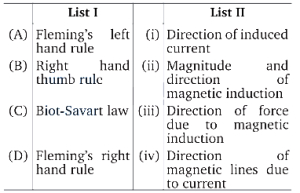
A
$(A)-(iii), (B)-(i), (C)-(ii), (D)-(iv)$
B
$(A)-(iii), (B)-(iv), (C)-(ii), (D)-(i)$
C
$(A)-(ii), (B)-(iv), (C)-(iii), (D)-(i)$
D
$(A)-(iv), (B)-(iii), (C)-(i), (D)-(ii)$
Solution
(B) The correct matches are as follows:
$(A)$ Fleming's left hand rule is used to find the direction of force on a current-carrying conductor in a magnetic field,which corresponds to (iii).
$(B)$ Right hand thumb rule is used to determine the direction of magnetic field lines around a current-carrying conductor,which corresponds to (iv).
$(C)$ Biot-Savart law is used to calculate the magnitude and direction of magnetic induction due to a small current element,which corresponds to (ii).
$(D)$ Fleming's right hand rule is used to find the direction of induced current in a conductor moving in a magnetic field,which corresponds to $(i)$.
Therefore,the correct matching is $(A)-(iii), (B)-(iv), (C)-(ii), (D)-(i)$.
Thus,the correct option is $(b)$.
$(A)$ Fleming's left hand rule is used to find the direction of force on a current-carrying conductor in a magnetic field,which corresponds to (iii).
$(B)$ Right hand thumb rule is used to determine the direction of magnetic field lines around a current-carrying conductor,which corresponds to (iv).
$(C)$ Biot-Savart law is used to calculate the magnitude and direction of magnetic induction due to a small current element,which corresponds to (ii).
$(D)$ Fleming's right hand rule is used to find the direction of induced current in a conductor moving in a magnetic field,which corresponds to $(i)$.
Therefore,the correct matching is $(A)-(iii), (B)-(iv), (C)-(ii), (D)-(i)$.
Thus,the correct option is $(b)$.
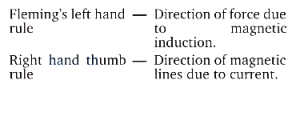
0 likes
View Solution95
EasyMCQ
Two particles carrying equal charges move parallel to each other with the speed $150 \ km/s$. If $F_1$ and $F_2$ are magnetic and electric forces between two charged particles,then $\frac{|F_1|}{|F_2|}$ is (Let $\mu_0 \varepsilon_0 = \frac{1}{9 \times 10^{16}} \ s^2/m^2$)
A
$1.0 \times 10^{-6}$
B
$1.5 \times 10^{-7}$
C
$3.0 \times 10^{-6}$
D
$2.5 \times 10^{-7}$
Solution
(D) Given two particles with equal charge $q$ moving with speed $v = 150 \ km/s = 1.5 \times 10^5 \ m/s$.
The electric force $|F_2|$ between two charges at distance $r$ is given by Coulomb's law:
$|F_2| = \frac{1}{4 \pi \varepsilon_0} \cdot \frac{q^2}{r^2}$ $(i)$
The magnetic force $|F_1|$ between two moving charges is given by:
$|F_1| = \frac{\mu_0}{4 \pi} \cdot \frac{q^2 v^2}{r^2}$ (ii)
Dividing equation (ii) by equation $(i)$:
$\frac{|F_1|}{|F_2|} = \frac{\frac{\mu_0}{4 \pi} \cdot \frac{q^2 v^2}{r^2}}{\frac{1}{4 \pi \varepsilon_0} \cdot \frac{q^2}{r^2}} = \mu_0 \varepsilon_0 v^2$
Substituting the given values $\mu_0 \varepsilon_0 = \frac{1}{9 \times 10^{16}} \ s^2/m^2$ and $v = 1.5 \times 10^5 \ m/s$:
$\frac{|F_1|}{|F_2|} = \frac{1}{9 \times 10^{16}} \times (1.5 \times 10^5)^2 = \frac{2.25 \times 10^{10}}{9 \times 10^{16}} = 0.25 \times 10^{-6} = 2.5 \times 10^{-7}$.
The electric force $|F_2|$ between two charges at distance $r$ is given by Coulomb's law:
$|F_2| = \frac{1}{4 \pi \varepsilon_0} \cdot \frac{q^2}{r^2}$ $(i)$
The magnetic force $|F_1|$ between two moving charges is given by:
$|F_1| = \frac{\mu_0}{4 \pi} \cdot \frac{q^2 v^2}{r^2}$ (ii)
Dividing equation (ii) by equation $(i)$:
$\frac{|F_1|}{|F_2|} = \frac{\frac{\mu_0}{4 \pi} \cdot \frac{q^2 v^2}{r^2}}{\frac{1}{4 \pi \varepsilon_0} \cdot \frac{q^2}{r^2}} = \mu_0 \varepsilon_0 v^2$
Substituting the given values $\mu_0 \varepsilon_0 = \frac{1}{9 \times 10^{16}} \ s^2/m^2$ and $v = 1.5 \times 10^5 \ m/s$:
$\frac{|F_1|}{|F_2|} = \frac{1}{9 \times 10^{16}} \times (1.5 \times 10^5)^2 = \frac{2.25 \times 10^{10}}{9 \times 10^{16}} = 0.25 \times 10^{-6} = 2.5 \times 10^{-7}$.
0 likes
View Solution96
MediumMCQ
Statement $(I)$: $A$ uniform electric field and a uniform magnetic field are pointed in the same direction. If an electron is projected in the same direction,the electron velocity will decrease in magnitude.
Statement $(II)$: Two infinitely long parallel wires are carrying current in the same direction. The magnetic field at a point midway between the wires is zero.
Statement $(III)$: No net force acts on a rectangular coil carrying a steady current when suspended in a uniform magnetic field.
Which of the following is correct?
Statement $(II)$: Two infinitely long parallel wires are carrying current in the same direction. The magnetic field at a point midway between the wires is zero.
Statement $(III)$: No net force acts on a rectangular coil carrying a steady current when suspended in a uniform magnetic field.
Which of the following is correct?
A
Statements $I$,$II$ and $III$ are true.
B
Statements $I$ and $II$ are true,but statement $III$ is false.
C
Statements $II$ and $III$ are true,but statement $I$ is false.
D
Statements $I$ and $III$ are true,but statement $II$ is false.
Solution
(A) Statement $(I)$: The magnetic force on the electron is $\vec{F}_m = q(\vec{v} \times \vec{B}) = 0$ because the velocity $\vec{v}$ is parallel to the magnetic field $\vec{B}$. The electric force is $\vec{F}_e = q\vec{E} = -e\vec{E}$. Since the electron is negatively charged,the electric force acts opposite to the direction of the electric field. As the electron moves in the direction of the field,the electric force acts against its motion,causing its velocity to decrease. Thus,Statement $(I)$ is true.
Statement $(II)$: For two parallel wires carrying current $i$ in the same direction,the magnetic field produced by each wire at the midpoint is equal in magnitude but opposite in direction (using the right-hand rule). Therefore,the net magnetic field $\vec{B}_{\text{net}} = \vec{B}_1 + \vec{B}_2 = 0$. Thus,Statement $(II)$ is true.
Statement $(III)$: For a rectangular coil carrying a steady current in a uniform magnetic field,the forces on opposite sides are equal and opposite,resulting in a net force of zero. Thus,Statement $(III)$ is true.
Therefore,all statements are true.
Statement $(II)$: For two parallel wires carrying current $i$ in the same direction,the magnetic field produced by each wire at the midpoint is equal in magnitude but opposite in direction (using the right-hand rule). Therefore,the net magnetic field $\vec{B}_{\text{net}} = \vec{B}_1 + \vec{B}_2 = 0$. Thus,Statement $(II)$ is true.
Statement $(III)$: For a rectangular coil carrying a steady current in a uniform magnetic field,the forces on opposite sides are equal and opposite,resulting in a net force of zero. Thus,Statement $(III)$ is true.
Therefore,all statements are true.
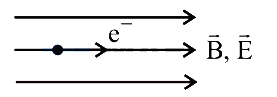
0 likes
View Solution97
EasyMCQ
Consider a current-carrying wire as shown in the figure. If the radius of the curved part of the wire is $R$ and the linear parts are assumed to be very long,then the magnetic induction of the field at the point $O$ is
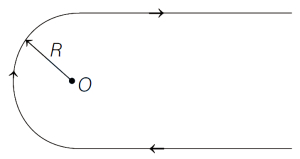
A
$\frac{\mu_0}{4 \pi} \frac{i}{R}(2+\pi)$
B
$\frac{\mu_0}{2 \pi R}$
C
$\frac{\mu_0}{2} \frac{i}{R}$
D
$\frac{\mu_0}{4} \frac{i}{R}$
Solution
(A) The magnetic field at point $O$ is the vector sum of the magnetic fields produced by the three segments of the wire: the two long straight parts and the semi-circular part.
$1$. For a semi-infinite straight wire,the magnetic field at a point on the line perpendicular to the wire at its end is $B_1 = \frac{\mu_0 i}{4 \pi R}$.
$2$. For a semi-circular arc of radius $R$,the magnetic field at its center is $B_2 = \frac{\mu_0 i}{4 R}$.
$3$. The two straight parts are both semi-infinite and contribute equally to the magnetic field at $O$ in the same direction.
$4$. Total magnetic field $B = B_{\text{straight1}} + B_{\text{arc}} + B_{\text{straight2}} = \frac{\mu_0 i}{4 \pi R} + \frac{\mu_0 i}{4 R} + \frac{\mu_0 i}{4 \pi R}$.
$5$. Simplifying the expression: $B = \frac{2 \mu_0 i}{4 \pi R} + \frac{\mu_0 i}{4 R} = \frac{\mu_0 i}{4 \pi R} (2 + \pi)$.
$1$. For a semi-infinite straight wire,the magnetic field at a point on the line perpendicular to the wire at its end is $B_1 = \frac{\mu_0 i}{4 \pi R}$.
$2$. For a semi-circular arc of radius $R$,the magnetic field at its center is $B_2 = \frac{\mu_0 i}{4 R}$.
$3$. The two straight parts are both semi-infinite and contribute equally to the magnetic field at $O$ in the same direction.
$4$. Total magnetic field $B = B_{\text{straight1}} + B_{\text{arc}} + B_{\text{straight2}} = \frac{\mu_0 i}{4 \pi R} + \frac{\mu_0 i}{4 R} + \frac{\mu_0 i}{4 \pi R}$.
$5$. Simplifying the expression: $B = \frac{2 \mu_0 i}{4 \pi R} + \frac{\mu_0 i}{4 R} = \frac{\mu_0 i}{4 \pi R} (2 + \pi)$.
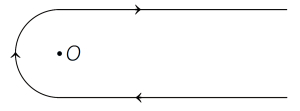
0 likes
View Solution98
MediumMCQ
The dimensional formula of $\frac{1}{2} \mu_0 H^2$ (where $\mu_0$ is the permeability of free space and $H$ is the magnetic field intensity) is:
A
$[MLT^{-1}]$
B
$[ML^2 T^{-2}]$
C
$[ML^{-1} T^{-2}]$
D
$[ML^2 T^{-1}]$
Solution
(C) The expression $\frac{1}{2} \mu_0 H^2$ represents the energy density of a magnetic field.
Energy density is defined as energy per unit volume.
The dimensional formula for energy is $[ML^2 T^{-2}]$ and for volume is $[L^3]$.
Therefore,the dimensional formula for energy density is $\frac{[ML^2 T^{-2}]}{[L^3]} = [ML^{-1} T^{-2}]$.
Alternatively,using the dimensions of the given quantities:
$[\mu_0] = [MLT^{-2} A^{-2}]$ and $[H] = [AL^{-1}]$.
Substituting these into the expression:
$[\frac{1}{2} \mu_0 H^2] = [MLT^{-2} A^{-2}] \times [AL^{-1}]^2 = [MLT^{-2} A^{-2}] \times [A^2 L^{-2}] = [ML^{-1} T^{-2}]$.
Energy density is defined as energy per unit volume.
The dimensional formula for energy is $[ML^2 T^{-2}]$ and for volume is $[L^3]$.
Therefore,the dimensional formula for energy density is $\frac{[ML^2 T^{-2}]}{[L^3]} = [ML^{-1} T^{-2}]$.
Alternatively,using the dimensions of the given quantities:
$[\mu_0] = [MLT^{-2} A^{-2}]$ and $[H] = [AL^{-1}]$.
Substituting these into the expression:
$[\frac{1}{2} \mu_0 H^2] = [MLT^{-2} A^{-2}] \times [AL^{-1}]^2 = [MLT^{-2} A^{-2}] \times [A^2 L^{-2}] = [ML^{-1} T^{-2}]$.
0 likes
View SolutionMoving Charges and Magnetism — Mix Examples-Moving Charges and Magnetism · Frequently Asked Questions
1Are these Moving Charges and Magnetism questions useful for JEE and NEET?
Yes. All questions in this section are mapped to JEE Main and NEET exam patterns. Previous year questions from JEE Main, NEET, GUJCET and state-level exams are included with full solutions.
2Can I switch to Hindi or Gujarati for these questions?
Yes. Use the language tabs in the hero section or the sidebar to view the same questions and solutions in English, Hindi or Gujarati.
3How do I generate a question paper from this subtopic?
Use the Vedclass Exam Paper Generator — select the chapter and subtopic, set difficulty, and generate Sets A, B, C, D automatically. First 3 chapters of every subject are free.
Vedclass Products
For Students
Vedclass Test Series
Mock tests in real JEE/NEET style with performance analysis. 5-day free trial.
Start Free TrialFor Teachers
Exam Paper Generator
Generate Set A/B/C/D papers from this chapter in 2 minutes. 3 chapters free.
Try FreeFor Institutes
Online Exam Module
Live online exams with unlimited students, 360° analytics & white-label branding.
See DemoFor Teachers & Institutes
Generate a Moving Charges and Magnetism Exam Paper in 2 Minutes
Select subtopic & difficulty — Sets A, B, C, D auto-generated with No Repeat logic.
First 3 chapters of every subject are free — no payment required.