
A English
Properties of Electromagnetic Waves Questions in English
Class 12 Physics · Electromagnetic waves · Properties of Electromagnetic Waves
494+
Questions
English
Language
100%
With Solutions
Showing 49 of 494 questions in English
351
DifficultMCQ
Electromagnetic waves travel in a medium with a speed of $1.5 \times 10^8 \ m/s$. The relative permeability of the medium is $2.0$. The relative permittivity will be:
A
$5$
B
$1$
C
$4$
D
$2$
Solution
(D) The speed of an electromagnetic wave in a medium is given by $v = \frac{1}{\sqrt{\mu \varepsilon}}$,where $\mu = \mu_0 \mu_r$ and $\varepsilon = \varepsilon_0 \varepsilon_r$.
Substituting these,we get $v = \frac{1}{\sqrt{\mu_0 \mu_r \varepsilon_0 \varepsilon_r}} = \frac{c}{\sqrt{\mu_r \varepsilon_r}}$,where $c = \frac{1}{\sqrt{\mu_0 \varepsilon_0}} = 3 \times 10^8 \ m/s$.
Rearranging the formula,we have $\sqrt{\mu_r \varepsilon_r} = \frac{c}{v}$.
Squaring both sides,$\mu_r \varepsilon_r = \left(\frac{c}{v}\right)^2$.
Given $\mu_r = 2.0$ and $v = 1.5 \times 10^8 \ m/s$,we have $2.0 \times \varepsilon_r = \left(\frac{3 \times 10^8}{1.5 \times 10^8}\right)^2$.
$2.0 \times \varepsilon_r = (2)^2 = 4$.
Therefore,$\varepsilon_r = \frac{4}{2} = 2$.
Substituting these,we get $v = \frac{1}{\sqrt{\mu_0 \mu_r \varepsilon_0 \varepsilon_r}} = \frac{c}{\sqrt{\mu_r \varepsilon_r}}$,where $c = \frac{1}{\sqrt{\mu_0 \varepsilon_0}} = 3 \times 10^8 \ m/s$.
Rearranging the formula,we have $\sqrt{\mu_r \varepsilon_r} = \frac{c}{v}$.
Squaring both sides,$\mu_r \varepsilon_r = \left(\frac{c}{v}\right)^2$.
Given $\mu_r = 2.0$ and $v = 1.5 \times 10^8 \ m/s$,we have $2.0 \times \varepsilon_r = \left(\frac{3 \times 10^8}{1.5 \times 10^8}\right)^2$.
$2.0 \times \varepsilon_r = (2)^2 = 4$.
Therefore,$\varepsilon_r = \frac{4}{2} = 2$.
3 likes
View Solution352
DifficultMCQ
In the given electromagnetic wave $E_y = 600 \sin (\omega t - kx) \ Vm^{-1}$,the intensity of the associated light beam is (in $W/m^2$); (Given $\epsilon_0 = 9 \times 10^{-12} \ C^2 N^{-1} m^{-2}$ and $c = 3 \times 10^8 \ m/s$)
A
$486$
B
$243$
C
$729$
D
$972$
Solution
(A) The intensity $I$ of an electromagnetic wave is given by the formula:
$I = \frac{1}{2} \epsilon_0 E_0^2 c$
Given:
$E_0 = 600 \ V/m$
$\epsilon_0 = 9 \times 10^{-12} \ C^2 N^{-1} m^{-2}$
$c = 3 \times 10^8 \ m/s$
Substituting the values:
$I = \frac{1}{2} \times (9 \times 10^{-12}) \times (600)^2 \times (3 \times 10^8)$
$I = \frac{1}{2} \times 9 \times 10^{-12} \times 360000 \times 3 \times 10^8$
$I = \frac{1}{2} \times 9 \times 36 \times 3 \times 10^{-12} \times 10^4 \times 10^8$
$I = \frac{1}{2} \times 972 \times 10^0$
$I = 486 \ W/m^2$
$I = \frac{1}{2} \epsilon_0 E_0^2 c$
Given:
$E_0 = 600 \ V/m$
$\epsilon_0 = 9 \times 10^{-12} \ C^2 N^{-1} m^{-2}$
$c = 3 \times 10^8 \ m/s$
Substituting the values:
$I = \frac{1}{2} \times (9 \times 10^{-12}) \times (600)^2 \times (3 \times 10^8)$
$I = \frac{1}{2} \times 9 \times 10^{-12} \times 360000 \times 3 \times 10^8$
$I = \frac{1}{2} \times 9 \times 36 \times 3 \times 10^{-12} \times 10^4 \times 10^8$
$I = \frac{1}{2} \times 972 \times 10^0$
$I = 486 \ W/m^2$
0 likes
View Solution353
DifficultMCQ
$A$ plane electromagnetic $(EM)$ wave is propagating along the $x$-direction. It has a wavelength of $4 \text{ mm}$. If the electric field is in the $y$-direction with a maximum magnitude of $60 \text{ Vm}^{-1}$,the equation for the magnetic field is:
A
$B_z = 60 \sin \left[ \frac{\pi}{2} (x - 3 \times 10^8 t) \right] \hat{k} \text{ T}$
B
$B_z = 2 \times 10^{-7} \sin \left[ \frac{\pi}{2} \times 10^3 (x - 3 \times 10^8 t) \right] \hat{k} \text{ T}$
C
$B_x = 60 \sin \left[ \frac{\pi}{2} (x - 3 \times 10^8 t) \right] \hat{i} \text{ T}$
D
$B_z = 2 \times 10^{-7} \sin \left[ \frac{\pi}{2} (x - 3 \times 10^8 t) \right] \hat{k} \text{ T}$
Solution
(B) The relationship between the maximum electric field $(E_0)$ and maximum magnetic field $(B_0)$ is given by $E_0 = B_0 c$.
Given $E_0 = 60 \text{ Vm}^{-1}$ and $c = 3 \times 10^8 \text{ ms}^{-1}$,we have $B_0 = \frac{E_0}{c} = \frac{60}{3 \times 10^8} = 2 \times 10^{-7} \text{ T}$.
The wave number $k$ is given by $k = \frac{2\pi}{\lambda}$. Given $\lambda = 4 \text{ mm} = 4 \times 10^{-3} \text{ m}$,we have $k = \frac{2\pi}{4 \times 10^{-3}} = \frac{\pi}{2} \times 10^3 \text{ rad/m}$.
The angular frequency $\omega$ is given by $\omega = ck = (3 \times 10^8) \times (\frac{\pi}{2} \times 10^3) = \frac{3\pi}{2} \times 10^{11} \text{ rad/s}$.
The wave propagates in the $+x$ direction and the electric field is in the $+y$ direction. Since the direction of propagation is $\vec{E} \times \vec{B}$,the magnetic field must be in the $+z$ direction.
Thus,the equation for the magnetic field is $B_z = B_0 \sin(kx - \omega t) = 2 \times 10^{-7} \sin \left[ \frac{\pi}{2} \times 10^3 (x - 3 \times 10^8 t) \right] \hat{k} \text{ T}$.
Given $E_0 = 60 \text{ Vm}^{-1}$ and $c = 3 \times 10^8 \text{ ms}^{-1}$,we have $B_0 = \frac{E_0}{c} = \frac{60}{3 \times 10^8} = 2 \times 10^{-7} \text{ T}$.
The wave number $k$ is given by $k = \frac{2\pi}{\lambda}$. Given $\lambda = 4 \text{ mm} = 4 \times 10^{-3} \text{ m}$,we have $k = \frac{2\pi}{4 \times 10^{-3}} = \frac{\pi}{2} \times 10^3 \text{ rad/m}$.
The angular frequency $\omega$ is given by $\omega = ck = (3 \times 10^8) \times (\frac{\pi}{2} \times 10^3) = \frac{3\pi}{2} \times 10^{11} \text{ rad/s}$.
The wave propagates in the $+x$ direction and the electric field is in the $+y$ direction. Since the direction of propagation is $\vec{E} \times \vec{B}$,the magnetic field must be in the $+z$ direction.
Thus,the equation for the magnetic field is $B_z = B_0 \sin(kx - \omega t) = 2 \times 10^{-7} \sin \left[ \frac{\pi}{2} \times 10^3 (x - 3 \times 10^8 t) \right] \hat{k} \text{ T}$.
0 likes
View Solution354
DifficultMCQ
The magnetic field in a plane electromagnetic wave is given by $B_y = (3.5 \times 10^{-7}) \sin (1.5 \times 10^3 x + 0.5 \times 10^{11} t) \ T$. The corresponding electric field will be:
A
$E_y = 1.17 \sin (1.5 \times 10^3 x + 0.5 \times 10^{11} t) \ Vm^{-1}$
B
$E_x = 105 \sin (1.5 \times 10^3 x + 0.5 \times 10^{11} t) \ Vm^{-1}$
C
$E_z = 1.17 \sin (1.5 \times 10^5 x + 0.5 \times 10^{11} t) \ Vm^{-1}$
D
$E_z = 105 \sin (1.5 \times 10^3 x + 0.5 \times 10^{11} t) \ Vm^{-1}$
Solution
(D) The relationship between the amplitude of the electric field $E_0$ and the magnetic field $B_0$ is given by $E_0 = B_0 c$,where $c$ is the speed of light in vacuum $(c \approx 3 \times 10^8 \ ms^{-1})$.
Given $B_0 = 3.5 \times 10^{-7} \ T$,we calculate $E_0 = (3.5 \times 10^{-7}) \times (3 \times 10^8) = 105 \ Vm^{-1}$.
The wave propagates in the negative $x$-direction (indicated by the $+kx$ term). The magnetic field is in the $y$-direction $(B_y)$. Since the electric field,magnetic field,and direction of propagation are mutually perpendicular,the electric field must be in the $z$-direction $(E_z)$.
Thus,the electric field is $E_z = 105 \sin (1.5 \times 10^3 x + 0.5 \times 10^{11} t) \ Vm^{-1}$.
Given $B_0 = 3.5 \times 10^{-7} \ T$,we calculate $E_0 = (3.5 \times 10^{-7}) \times (3 \times 10^8) = 105 \ Vm^{-1}$.
The wave propagates in the negative $x$-direction (indicated by the $+kx$ term). The magnetic field is in the $y$-direction $(B_y)$. Since the electric field,magnetic field,and direction of propagation are mutually perpendicular,the electric field must be in the $z$-direction $(E_z)$.
Thus,the electric field is $E_z = 105 \sin (1.5 \times 10^3 x + 0.5 \times 10^{11} t) \ Vm^{-1}$.
0 likes
View Solution355
MediumMCQ
The property which is not of an electromagnetic wave travelling in free space is that:
A
The energy density in electric field is equal to energy density in magnetic field
B
They travel with a speed equal to $\frac{1}{\sqrt{\mu_0 \varepsilon_0}}$
C
They originate from charges moving with uniform speed
D
They are transverse in nature
Solution
(C) Electromagnetic $(EM)$ waves are produced by accelerating charges.
According to the theory of electromagnetism,a charge moving with a uniform velocity produces a steady magnetic field and does not radiate energy in the form of $EM$ waves.
Therefore,the statement that they originate from charges moving with uniform speed is incorrect.
All other options are standard properties of $EM$ waves:
$1$. The energy density of the electric field $(u_E = \frac{1}{2} \varepsilon_0 E^2)$ is equal to the energy density of the magnetic field $(u_B = \frac{1}{2\mu_0} B^2)$.
$2$. The speed of $EM$ waves in free space is $c = \frac{1}{\sqrt{\mu_0 \varepsilon_0}}$.
$3$. $EM$ waves are transverse in nature,meaning the oscillations of electric and magnetic fields are perpendicular to the direction of wave propagation.
According to the theory of electromagnetism,a charge moving with a uniform velocity produces a steady magnetic field and does not radiate energy in the form of $EM$ waves.
Therefore,the statement that they originate from charges moving with uniform speed is incorrect.
All other options are standard properties of $EM$ waves:
$1$. The energy density of the electric field $(u_E = \frac{1}{2} \varepsilon_0 E^2)$ is equal to the energy density of the magnetic field $(u_B = \frac{1}{2\mu_0} B^2)$.
$2$. The speed of $EM$ waves in free space is $c = \frac{1}{\sqrt{\mu_0 \varepsilon_0}}$.
$3$. $EM$ waves are transverse in nature,meaning the oscillations of electric and magnetic fields are perpendicular to the direction of wave propagation.
0 likes
View Solution356
EasyMCQ
The electric field associated with an electromagnetic wave propagating in a dielectric medium is given by $\vec{E} = 30(2 \hat{x} + \hat{y}) \sin \left[2 \pi \left(5 \times 10^{14} t - \frac{10^7}{3} z\right)\right] \text{V m}^{-1}$. Which of the following option$(s)$ is(are) correct?
[Given: The speed of light in vacuum,$c = 3 \times 10^8 \text{ m s}^{-1}$]
$(A)$ $B_x = -2 \times 10^{-7} \sin \left[2 \pi \left(5 \times 10^{14} t - \frac{10^7}{3} z\right)\right] \text{Wb m}^{-2}$.
$(B)$ $B_y = 2 \times 10^{-7} \sin \left[2 \pi \left(5 \times 10^{14} t - \frac{10^7}{3} z\right)\right] \text{Wb m}^{-2}$.
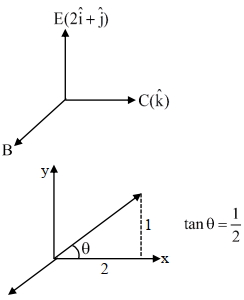
$(C)$ The wave is polarized in the $xy$-plane with a polarization angle $\theta = \tan^{-1}(0.5)$ with respect to the $x$-axis.
$(D)$ The refractive index of the medium is $2$.
[Given: The speed of light in vacuum,$c = 3 \times 10^8 \text{ m s}^{-1}$]
$(A)$ $B_x = -2 \times 10^{-7} \sin \left[2 \pi \left(5 \times 10^{14} t - \frac{10^7}{3} z\right)\right] \text{Wb m}^{-2}$.
$(B)$ $B_y = 2 \times 10^{-7} \sin \left[2 \pi \left(5 \times 10^{14} t - \frac{10^7}{3} z\right)\right] \text{Wb m}^{-2}$.
$(C)$ The wave is polarized in the $xy$-plane with a polarization angle $\theta = \tan^{-1}(0.5)$ with respect to the $x$-axis.
$(D)$ The refractive index of the medium is $2$.
A
$A, C, D$
B
$A, B$
C
$A, C$
D
$A, D$
Solution
(D) The given electric field is $\vec{E} = 30(2 \hat{x} + \hat{y}) \sin \left[2 \pi \left(5 \times 10^{14} t - \frac{10^7}{3} z\right)\right]$.
Comparing this with the standard wave equation $\vec{E} = \vec{E}_0 \sin(\omega t - kz)$,we get $\omega = 2 \pi \times 5 \times 10^{14} \text{ rad s}^{-1}$ and $k = 2 \pi \times \frac{10^7}{3} \text{ m}^{-1}$.
The speed of the wave in the medium is $v = \frac{\omega}{k} = \frac{5 \times 10^{14}}{10^7 / 3} = 1.5 \times 10^8 \text{ m s}^{-1}$.
The refractive index $\mu = \frac{c}{v} = \frac{3 \times 10^8}{1.5 \times 10^8} = 2$. Thus,option $(D)$ is correct.
The magnetic field is given by $\vec{B} = \frac{1}{v} (\hat{k} \times \vec{E})$.
$\vec{B} = \frac{1}{1.5 \times 10^8} \left[ \hat{k} \times 30(2 \hat{x} + \hat{y}) \right] \sin \left[2 \pi \left(5 \times 10^{14} t - \frac{10^7}{3} z\right)\right]$.
$\vec{B} = \frac{30}{1.5 \times 10^8} (2 \hat{y} - \hat{x}) \sin \left[2 \pi \left(5 \times 10^{14} t - \frac{10^7}{3} z\right)\right] = 2 \times 10^{-7} (- \hat{x} + 2 \hat{y}) \sin \left[2 \pi \left(5 \times 10^{14} t - \frac{10^7}{3} z\right)\right]$.
So,$B_x = -2 \times 10^{-7} \sin(\dots)$ and $B_y = 4 \times 10^{-7} \sin(\dots)$. Thus,option $(A)$ is correct and $(B)$ is incorrect.
The polarization direction is along $(2 \hat{x} + \hat{y})$,so $\tan \theta = \frac{E_y}{E_x} = \frac{1}{2} = 0.5$. Thus,$\theta = \tan^{-1}(0.5) \approx 26.57^{\circ}$,not $30^{\circ}$. Thus,option $(C)$ is incorrect.
Therefore,the correct options are $(A)$ and $(D)$.
Comparing this with the standard wave equation $\vec{E} = \vec{E}_0 \sin(\omega t - kz)$,we get $\omega = 2 \pi \times 5 \times 10^{14} \text{ rad s}^{-1}$ and $k = 2 \pi \times \frac{10^7}{3} \text{ m}^{-1}$.
The speed of the wave in the medium is $v = \frac{\omega}{k} = \frac{5 \times 10^{14}}{10^7 / 3} = 1.5 \times 10^8 \text{ m s}^{-1}$.
The refractive index $\mu = \frac{c}{v} = \frac{3 \times 10^8}{1.5 \times 10^8} = 2$. Thus,option $(D)$ is correct.
The magnetic field is given by $\vec{B} = \frac{1}{v} (\hat{k} \times \vec{E})$.
$\vec{B} = \frac{1}{1.5 \times 10^8} \left[ \hat{k} \times 30(2 \hat{x} + \hat{y}) \right] \sin \left[2 \pi \left(5 \times 10^{14} t - \frac{10^7}{3} z\right)\right]$.
$\vec{B} = \frac{30}{1.5 \times 10^8} (2 \hat{y} - \hat{x}) \sin \left[2 \pi \left(5 \times 10^{14} t - \frac{10^7}{3} z\right)\right] = 2 \times 10^{-7} (- \hat{x} + 2 \hat{y}) \sin \left[2 \pi \left(5 \times 10^{14} t - \frac{10^7}{3} z\right)\right]$.
So,$B_x = -2 \times 10^{-7} \sin(\dots)$ and $B_y = 4 \times 10^{-7} \sin(\dots)$. Thus,option $(A)$ is correct and $(B)$ is incorrect.
The polarization direction is along $(2 \hat{x} + \hat{y})$,so $\tan \theta = \frac{E_y}{E_x} = \frac{1}{2} = 0.5$. Thus,$\theta = \tan^{-1}(0.5) \approx 26.57^{\circ}$,not $30^{\circ}$. Thus,option $(C)$ is incorrect.
Therefore,the correct options are $(A)$ and $(D)$.
0 likes
View Solution357
MediumMCQ
The electric field of an electromagnetic wave in free space is $\overrightarrow{E}=57 \cos \left[7.5 \times 10^6 t-5 \times 10^{-3}(3 x+4 y)\right]\ (4 \hat{i}-3 \hat{j})\ N/C$. The associated magnetic field in Tesla is
A
$\overrightarrow{B}=\frac{57}{3 \times 10^8} \cos \left[7.5 \times 10^6 t-5 \times 10^{-3}(3 x+4 y)\right](5 \hat{k})$
B
$\overrightarrow{B}=\frac{57}{3 \times 10^8} \cos \left[7.5 \times 10^6 t-5 \times 10^{-3}(3 x+4 y)\right](\hat{k})$
C
$\overrightarrow{B}=-\frac{57}{3 \times 10^8} \cos \left[7.5 \times 10^6 t-5 \times 10^{-3}(3 x+4 y)\right](5 \hat{k})$
D
$\overrightarrow{B}=-\frac{57}{3 \times 10^8} \cos \left[7.5 \times 10^6 t-5 \times 10^{-3}(3 x+4 y)\right] (\hat{k})$
Solution
(D) The given electric field is $\overrightarrow{E} = E_0 \cos(\omega t - \vec{k} \cdot \vec{r}) \hat{n}_E$,where $\hat{n}_E = \frac{4\hat{i} - 3\hat{j}}{5}$ is the unit vector in the direction of the electric field.
The wave vector is $\vec{k} = 5 \times 10^{-3} (3\hat{i} + 4\hat{j}) = 1.5 \times 10^{-2} \hat{i} + 2 \times 10^{-2} \hat{j}$.
The unit vector in the direction of propagation is $\hat{k} = \frac{3\hat{i} + 4\hat{j}}{5}$.
The magnetic field direction is given by $\hat{n}_B = \hat{k} \times \hat{n}_E$.
$\hat{n}_B = \left( \frac{3\hat{i} + 4\hat{j}}{5} \right) \times \left( \frac{4\hat{i} - 3\hat{j}}{5} \right) = \frac{1}{25} [3\hat{i} \times (-3\hat{j}) + 4\hat{j} \times 4\hat{i}] = \frac{1}{25} [-9\hat{k} - 16\hat{k}] = -\frac{25}{25} \hat{k} = -\hat{k}$.
The magnitude of the magnetic field is $B_0 = \frac{E_0}{c} = \frac{57}{3 \times 10^8}$.
Thus,$\overrightarrow{B} = -\frac{57}{3 \times 10^8} \cos \left[7.5 \times 10^6 t - 5 \times 10^{-3}(3 x + 4 y)\right] \hat{k}$.
The wave vector is $\vec{k} = 5 \times 10^{-3} (3\hat{i} + 4\hat{j}) = 1.5 \times 10^{-2} \hat{i} + 2 \times 10^{-2} \hat{j}$.
The unit vector in the direction of propagation is $\hat{k} = \frac{3\hat{i} + 4\hat{j}}{5}$.
The magnetic field direction is given by $\hat{n}_B = \hat{k} \times \hat{n}_E$.
$\hat{n}_B = \left( \frac{3\hat{i} + 4\hat{j}}{5} \right) \times \left( \frac{4\hat{i} - 3\hat{j}}{5} \right) = \frac{1}{25} [3\hat{i} \times (-3\hat{j}) + 4\hat{j} \times 4\hat{i}] = \frac{1}{25} [-9\hat{k} - 16\hat{k}] = -\frac{25}{25} \hat{k} = -\hat{k}$.
The magnitude of the magnetic field is $B_0 = \frac{E_0}{c} = \frac{57}{3 \times 10^8}$.
Thus,$\overrightarrow{B} = -\frac{57}{3 \times 10^8} \cos \left[7.5 \times 10^6 t - 5 \times 10^{-3}(3 x + 4 y)\right] \hat{k}$.
0 likes
View Solution358
MediumMCQ
$A$ plane electromagnetic wave of frequency $20 \ MHz$ travels in free space along the $+x$ direction. At a particular point in space and time, the electric field vector of the wave is $E_y = 9.3 \ Vm^{-1}$. Then, the magnetic field vector of the wave at that point is:
A
$B_z = 9.3 \times 10^{-8} \ T$
B
$B_z = 1.55 \times 10^{-8} \ T$
C
$B_z = 6.2 \times 10^{-8} \ T$
D
$B_z = 3.1 \times 10^{-8} \ T$
Solution
(D) For an electromagnetic wave in free space, the relationship between the magnitude of the electric field $(E)$ and the magnetic field $(B)$ is given by $E = Bc$, where $c$ is the speed of light in vacuum $(c = 3 \times 10^8 \ ms^{-1})$.
Given $E_y = 9.3 \ Vm^{-1}$.
Using the relation $B_z = \frac{E_y}{c}$, we get:
$B_z = \frac{9.3}{3 \times 10^8} \ T$.
$B_z = 3.1 \times 10^{-8} \ T$.
Since the wave travels in the $+x$ direction and the electric field is in the $+y$ direction, the magnetic field must be in the $+z$ direction to satisfy the direction of propagation ($\vec{E} \times \vec{B}$ direction).
Given $E_y = 9.3 \ Vm^{-1}$.
Using the relation $B_z = \frac{E_y}{c}$, we get:
$B_z = \frac{9.3}{3 \times 10^8} \ T$.
$B_z = 3.1 \times 10^{-8} \ T$.
Since the wave travels in the $+x$ direction and the electric field is in the $+y$ direction, the magnetic field must be in the $+z$ direction to satisfy the direction of propagation ($\vec{E} \times \vec{B}$ direction).
0 likes
View Solution359
DifficultMCQ
Due to the presence of an em-wave whose electric component is given by $E = 100 \sin(\omega t - kx) \ NC^{-1}$,a cylinder of length $200 \ cm$ holds a certain amount of em-energy inside it. If another cylinder of the same length but half the diameter of the previous one holds the same amount of em-energy,the magnitude of the electric field of the corresponding em-wave should be modified as:
A
$25 \sin(\omega t - kx) \ NC^{-1}$
B
$200 \sin(\omega t - kx) \ NC^{-1}$
C
$400 \sin(\omega t - kx) \ NC^{-1}$
D
$50 \sin(\omega t - kx) \ NC^{-1}$
Solution
(B) The energy density of an electromagnetic wave is given by $u = \frac{1}{2} \epsilon_0 E^2$.
The total energy $U$ contained in a cylinder of length $L$ and radius $R$ is $U = u \times V = \frac{1}{2} \epsilon_0 E^2 \times (\pi R^2 L)$.
Given that the energy $U$ remains the same for both cylinders,we have $U_1 = U_2$.
$\frac{1}{2} \epsilon_0 E_1^2 \pi R_1^2 L_1 = \frac{1}{2} \epsilon_0 E_2^2 \pi R_2^2 L_2$.
Since $L_1 = L_2$ and $R_2 = \frac{R_1}{2}$,the equation simplifies to $E_1^2 R_1^2 = E_2^2 (\frac{R_1}{2})^2$.
$E_1^2 R_1^2 = E_2^2 \frac{R_1^2}{4}$.
$E_2^2 = 4 E_1^2$,which implies $E_2 = 2 E_1$.
Given $E_1 = 100 \ NC^{-1}$,we get $E_2 = 2 \times 100 = 200 \ NC^{-1}$.
Thus,the electric field is $200 \sin(\omega t - kx) \ NC^{-1}$.
The total energy $U$ contained in a cylinder of length $L$ and radius $R$ is $U = u \times V = \frac{1}{2} \epsilon_0 E^2 \times (\pi R^2 L)$.
Given that the energy $U$ remains the same for both cylinders,we have $U_1 = U_2$.
$\frac{1}{2} \epsilon_0 E_1^2 \pi R_1^2 L_1 = \frac{1}{2} \epsilon_0 E_2^2 \pi R_2^2 L_2$.
Since $L_1 = L_2$ and $R_2 = \frac{R_1}{2}$,the equation simplifies to $E_1^2 R_1^2 = E_2^2 (\frac{R_1}{2})^2$.
$E_1^2 R_1^2 = E_2^2 \frac{R_1^2}{4}$.
$E_2^2 = 4 E_1^2$,which implies $E_2 = 2 E_1$.
Given $E_1 = 100 \ NC^{-1}$,we get $E_2 = 2 \times 100 = 200 \ NC^{-1}$.
Thus,the electric field is $200 \sin(\omega t - kx) \ NC^{-1}$.
0 likes
View Solution360
MediumMCQ
The magnetic field of an $\text{E.M.}$ wave is given by $\overrightarrow{ B }=\left(\frac{\sqrt{3}}{2} \hat{ i }+\frac{1}{2} \hat{ j }\right) 30 \sin \left[\omega\left( t -\frac{ z }{ c }\right)\right]$ ($\text{S.I.}$ units). The corresponding electric field in $\text{S.I.}$ units is:
A
$\overrightarrow{ E }=\left(\frac{1}{2} \hat{ i }-\frac{\sqrt{3}}{2} \hat{ j }\right) 30 c \sin \left[\omega\left( t -\frac{ z }{ c }\right)\right]$
B
$\overrightarrow{ E }=\left(\frac{3}{4} \hat{ i }+\frac{1}{4} \hat{ j }\right) 30 c \cos \left[\omega\left( t -\frac{ z }{ c }\right)\right]$
C
$\overrightarrow{ E }=\left(\frac{1}{2} \hat{ i }+\frac{\sqrt{3}}{2} \hat{ j }\right) 30 c \sin \left[\omega\left( t +\frac{ z }{ c }\right)\right]$
D
$\overrightarrow{ E }=\left(\frac{\sqrt{3}}{2} \hat{ i }-\frac{1}{2} \hat{ j }\right) 30 c \sin \left[\omega\left( t +\frac{ z }{ c }\right)\right]$
Solution
(A) The given magnetic field is $\overrightarrow{ B } = B_0 \sin \left[\omega\left( t -\frac{ z }{ c }\right)\right] \hat{n}$, where $\hat{n} = \frac{\sqrt{3}}{2} \hat{ i } + \frac{1}{2} \hat{ j }$ and $B_0 = 30 \text{ T}$.
Since the wave propagates in the $+z$ direction $(\hat{k})$, the electric field $\overrightarrow{ E }$ is related to the magnetic field $\overrightarrow{ B }$ by the relation $\overrightarrow{ E } = c (\overrightarrow{ B } \times \hat{k})$.
Substituting the values: $\overrightarrow{ E } = c \left[ \left( \frac{\sqrt{3}}{2} \hat{ i } + \frac{1}{2} \hat{ j } \right) 30 \sin \left[\omega\left( t -\frac{ z }{ c }\right)\right] \times \hat{k} \right]$.
Using the cross products $\hat{ i } \times \hat{k} = -\hat{ j }$ and $\hat{ j } \times \hat{k} = \hat{ i }$, we get:
$\overrightarrow{ E } = 30 c \sin \left[\omega\left( t -\frac{ z }{ c }\right)\right] \left( \frac{\sqrt{3}}{2} (-\hat{ j }) + \frac{1}{2} \hat{ i } \right)$.
Rearranging the terms, we get $\overrightarrow{ E } = \left( \frac{1}{2} \hat{ i } - \frac{\sqrt{3}}{2} \hat{ j } \right) 30 c \sin \left[\omega\left( t -\frac{ z }{ c }\right)\right]$.
Since the wave propagates in the $+z$ direction $(\hat{k})$, the electric field $\overrightarrow{ E }$ is related to the magnetic field $\overrightarrow{ B }$ by the relation $\overrightarrow{ E } = c (\overrightarrow{ B } \times \hat{k})$.
Substituting the values: $\overrightarrow{ E } = c \left[ \left( \frac{\sqrt{3}}{2} \hat{ i } + \frac{1}{2} \hat{ j } \right) 30 \sin \left[\omega\left( t -\frac{ z }{ c }\right)\right] \times \hat{k} \right]$.
Using the cross products $\hat{ i } \times \hat{k} = -\hat{ j }$ and $\hat{ j } \times \hat{k} = \hat{ i }$, we get:
$\overrightarrow{ E } = 30 c \sin \left[\omega\left( t -\frac{ z }{ c }\right)\right] \left( \frac{\sqrt{3}}{2} (-\hat{ j }) + \frac{1}{2} \hat{ i } \right)$.
Rearranging the terms, we get $\overrightarrow{ E } = \left( \frac{1}{2} \hat{ i } - \frac{\sqrt{3}}{2} \hat{ j } \right) 30 c \sin \left[\omega\left( t -\frac{ z }{ c }\right)\right]$.
0 likes
View Solution361
MediumMCQ
Given below are two statements: one is labelled as Assertion $(A)$ and other is labelled as Reason $(R).$
Assertion $(A):$ Electromagnetic waves carry energy but not momentum.
Reason $(R):$ Mass of a photon is zero.
In the light of the above statements,choose the most appropriate answer from the options given below:
Assertion $(A):$ Electromagnetic waves carry energy but not momentum.
Reason $(R):$ Mass of a photon is zero.
In the light of the above statements,choose the most appropriate answer from the options given below:
A
$(A)$ is true but $(R)$ is false.
B
$(A)$ is false but $(R)$ is true.
C
Both $(A)$ and $(R)$ are true but $(R)$ is not the correct explanation of $(A).$
D
Both $(A)$ and $(R)$ are true and $(R)$ is the correct explanation of $(A).$
Solution
(B) Electromagnetic waves carry both energy and momentum. The momentum $p$ of a photon is given by $p = E/c = h/\lambda$,where $E$ is the energy,$c$ is the speed of light,$h$ is Planck's constant,and $\lambda$ is the wavelength. Therefore,Assertion $(A)$ is false.
The rest mass of a photon is indeed zero,which is a correct physical fact. Therefore,Reason $(R)$ is true.
Thus,$(A)$ is false but $(R)$ is true.
The rest mass of a photon is indeed zero,which is a correct physical fact. Therefore,Reason $(R)$ is true.
Thus,$(A)$ is false but $(R)$ is true.
0 likes
View Solution362
MediumMCQ
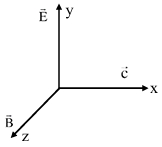
$A$ plane electromagnetic wave propagates along the $+x$ direction in free space. The components of the electric field,$\overrightarrow{E}$ and magnetic field,$\overrightarrow{B}$ vectors associated with the wave in a Cartesian frame are:
A
$E_y, B_x$
B
$E_y, B_z$
C
$E_x, B_y$
D
$E_z, B_y$
Solution
(B) The direction of propagation of an electromagnetic wave is given by the direction of the Poynting vector,which is $\overrightarrow{S} = \frac{1}{\mu_0} (\overrightarrow{E} \times \overrightarrow{B})$.
Thus,the direction of propagation is along $\overrightarrow{E} \times \overrightarrow{B}$.
Given that the wave propagates along the $+x$ direction,we have $\hat{i} = \hat{E} \times \hat{B}$.
If $\overrightarrow{E}$ is along the $y$-axis $(\hat{j})$ and $\overrightarrow{B}$ is along the $z$-axis $(\hat{k})$,then $\hat{j} \times \hat{k} = \hat{i}$.
Therefore,the components of the electric field and magnetic field are $E_y$ and $B_z$ respectively.
Thus,the direction of propagation is along $\overrightarrow{E} \times \overrightarrow{B}$.
Given that the wave propagates along the $+x$ direction,we have $\hat{i} = \hat{E} \times \hat{B}$.
If $\overrightarrow{E}$ is along the $y$-axis $(\hat{j})$ and $\overrightarrow{B}$ is along the $z$-axis $(\hat{k})$,then $\hat{j} \times \hat{k} = \hat{i}$.
Therefore,the components of the electric field and magnetic field are $E_y$ and $B_z$ respectively.
0 likes
View Solution363
MediumMCQ
If an optical medium possesses a relative permeability of $\frac{10}{\pi}$ and relative permittivity of $\frac{1}{0.0885}$,then the velocity of light is greater in vacuum than that in this medium by . . . . . . times. $\left(\mu_0=4 \pi \times 10^{-7} \ H/m, \varepsilon_0=8.85 \times 10^{-12} \ F/m, c=3 \times 10^8 \ m/s\right)$
A
$1$
B
$2$
C
$6$
D
$9$
Solution
(C) The velocity of light in a medium is given by $v = \frac{1}{\sqrt{\mu \epsilon}}$.
Since $\mu = \mu_0 \mu_r$ and $\epsilon = \epsilon_0 \epsilon_r$,we have $v = \frac{1}{\sqrt{\mu_0 \mu_r \epsilon_0 \epsilon_r}} = \frac{1}{\sqrt{\mu_0 \epsilon_0}} \cdot \frac{1}{\sqrt{\mu_r \epsilon_r}}$.
Given that the velocity of light in vacuum is $c = \frac{1}{\sqrt{\mu_0 \epsilon_0}}$,we can write $v = \frac{c}{\sqrt{\mu_r \epsilon_r}}$.
Given $\mu_r = \frac{10}{\pi}$ and $\epsilon_r = \frac{1}{0.0885 \times 10^{-10}}$ (Note: $8.85 \times 10^{-12} = 0.0885 \times 10^{-10}$),let's calculate the product $\mu_r \epsilon_r$.
Actually,using the provided values: $\mu_r \epsilon_r = \frac{10}{\pi} \times \frac{1}{0.0885} \approx 3.183 \times 11.299 \approx 36$.
Thus,$v = \frac{c}{\sqrt{36}} = \frac{c}{6}$.
Therefore,$c = 6v$. The velocity of light in vacuum is $6$ times greater than the velocity in the medium.
Since $\mu = \mu_0 \mu_r$ and $\epsilon = \epsilon_0 \epsilon_r$,we have $v = \frac{1}{\sqrt{\mu_0 \mu_r \epsilon_0 \epsilon_r}} = \frac{1}{\sqrt{\mu_0 \epsilon_0}} \cdot \frac{1}{\sqrt{\mu_r \epsilon_r}}$.
Given that the velocity of light in vacuum is $c = \frac{1}{\sqrt{\mu_0 \epsilon_0}}$,we can write $v = \frac{c}{\sqrt{\mu_r \epsilon_r}}$.
Given $\mu_r = \frac{10}{\pi}$ and $\epsilon_r = \frac{1}{0.0885 \times 10^{-10}}$ (Note: $8.85 \times 10^{-12} = 0.0885 \times 10^{-10}$),let's calculate the product $\mu_r \epsilon_r$.
Actually,using the provided values: $\mu_r \epsilon_r = \frac{10}{\pi} \times \frac{1}{0.0885} \approx 3.183 \times 11.299 \approx 36$.
Thus,$v = \frac{c}{\sqrt{36}} = \frac{c}{6}$.
Therefore,$c = 6v$. The velocity of light in vacuum is $6$ times greater than the velocity in the medium.
0 likes
View Solution364
DifficultMCQ
The unit of $\sqrt{\frac{2 I}{\varepsilon_0 c}}$ is
($I$: intensity of an electromagnetic wave,$c$: speed of light)
($I$: intensity of an electromagnetic wave,$c$: speed of light)
A
$V/m$
B
$N/C$
C
$N/m$
D
$N/C^{-1}$
Solution
(B) The intensity $I$ of an electromagnetic wave is given by the relation $I = \frac{1}{2} \varepsilon_0 E_0^2 c$,where $E_0$ is the amplitude of the electric field.
Rearranging the formula for $E_0$,we get $E_0^2 = \frac{2 I}{\varepsilon_0 c}$,which implies $E_0 = \sqrt{\frac{2 I}{\varepsilon_0 c}}$.
Since $E_0$ represents the electric field,its $SI$ unit is the same as the electric field,which is $\text{Volt per meter}$ $(V/m)$ or $\text{Newton per Coulomb}$ $(N/C)$.
Comparing this with the given options,the correct unit is $N/C$.
Rearranging the formula for $E_0$,we get $E_0^2 = \frac{2 I}{\varepsilon_0 c}$,which implies $E_0 = \sqrt{\frac{2 I}{\varepsilon_0 c}}$.
Since $E_0$ represents the electric field,its $SI$ unit is the same as the electric field,which is $\text{Volt per meter}$ $(V/m)$ or $\text{Newton per Coulomb}$ $(N/C)$.
Comparing this with the given options,the correct unit is $N/C$.
0 likes
View Solution365
MediumMCQ
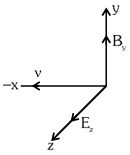
The electric field in a plane electromagnetic wave is given by $E_z = 60 \cos(5x + 1.5 \times 10^9 t) \text{ V/m}$. Then the expression for the corresponding magnetic field is (here subscripts denote the direction of the field):
A
$B_y = 2 \times 10^{-7} \cos(5x + 1.5 \times 10^9 t) \text{ T}$
B
$B_x = 2 \times 10^{-7} \cos(5x + 1.5 \times 10^9 t) \text{ T}$
C
$B_z = 60 \cos(5x + 1.5 \times 10^9 t) \text{ T}$
D
$B_y = 60 \sin(5x + 1.5 \times 10^9 t) \text{ T}$
Solution
(A) The wave equation is given by $E_z = E_0 \cos(kx + \omega t)$. Comparing this with the given equation,we have $E_0 = 60 \text{ V/m}$,$k = 5 \text{ rad/m}$,and $\omega = 1.5 \times 10^9 \text{ rad/s}$.
The speed of the wave is $v = \frac{\omega}{k} = \frac{1.5 \times 10^9}{5} = 3 \times 10^8 \text{ m/s}$.
The amplitude of the magnetic field is $B_0 = \frac{E_0}{v} = \frac{60}{3 \times 10^8} = 2 \times 10^{-7} \text{ T}$.
The direction of propagation is given by the vector $\vec{E} \times \vec{B}$. Since the wave propagates in the $-x$ direction and $\vec{E}$ is along the $z$-axis,we have $(-\hat{i}) = \hat{k} \times \vec{B}$. This implies $\vec{B}$ must be along the $y$-axis (since $\hat{k} \times \hat{j} = -\hat{i}$). Thus,the magnetic field is $B_y = B_0 \cos(kx + \omega t) = 2 \times 10^{-7} \cos(5x + 1.5 \times 10^9 t) \text{ T}$.
The speed of the wave is $v = \frac{\omega}{k} = \frac{1.5 \times 10^9}{5} = 3 \times 10^8 \text{ m/s}$.
The amplitude of the magnetic field is $B_0 = \frac{E_0}{v} = \frac{60}{3 \times 10^8} = 2 \times 10^{-7} \text{ T}$.
The direction of propagation is given by the vector $\vec{E} \times \vec{B}$. Since the wave propagates in the $-x$ direction and $\vec{E}$ is along the $z$-axis,we have $(-\hat{i}) = \hat{k} \times \vec{B}$. This implies $\vec{B}$ must be along the $y$-axis (since $\hat{k} \times \hat{j} = -\hat{i}$). Thus,the magnetic field is $B_y = B_0 \cos(kx + \omega t) = 2 \times 10^{-7} \cos(5x + 1.5 \times 10^9 t) \text{ T}$.
0 likes
View Solution366
MediumMCQ
The magnetic field of an electromagnetic wave is given by $B_y = 3 \times 10^{-7} \sin(10^3 x + 3 \times 10^{11} t)$,where $x$ is in meters and $t$ is in seconds. The wavelength of the electromagnetic wave is: (in $cm$)
A
$6.28$
B
$3.14$
C
$0.63$
D
$0.32$
Solution
(C) The given equation for the magnetic field is $B_y = 3 \times 10^{-7} \sin(10^3 x + 3 \times 10^{11} t)$.
Comparing this with the standard wave equation $B_y = B_0 \sin(kx + \omega t)$,we identify the wave number $k$ as $k = 10^3 \ m^{-1}$.
The relationship between the wave number $k$ and the wavelength $\lambda$ is given by $k = \frac{2\pi}{\lambda}$.
Substituting the value of $k$,we get $10^3 = \frac{2\pi}{\lambda}$.
Therefore,$\lambda = \frac{2\pi}{10^3} = 2 \times 3.14 \times 10^{-3} \ m = 6.28 \times 10^{-3} \ m$.
Converting meters to centimeters,$\lambda = 6.28 \times 10^{-3} \times 10^2 \ cm = 0.628 \ cm \approx 0.63 \ cm$.
Comparing this with the standard wave equation $B_y = B_0 \sin(kx + \omega t)$,we identify the wave number $k$ as $k = 10^3 \ m^{-1}$.
The relationship between the wave number $k$ and the wavelength $\lambda$ is given by $k = \frac{2\pi}{\lambda}$.
Substituting the value of $k$,we get $10^3 = \frac{2\pi}{\lambda}$.
Therefore,$\lambda = \frac{2\pi}{10^3} = 2 \times 3.14 \times 10^{-3} \ m = 6.28 \times 10^{-3} \ m$.
Converting meters to centimeters,$\lambda = 6.28 \times 10^{-3} \times 10^2 \ cm = 0.628 \ cm \approx 0.63 \ cm$.
0 likes
View Solution367
MediumMCQ
Statement-$I$ :- During propagation of electromagnetic wave,$\vec{E}$,$\vec{B}$ and direction of propagation are perpendicular to each other.
Statement-$II$ :- During propagation of electromagnetic wave,the energy density due to electric and magnetic fields are equal.
Statement-$II$ :- During propagation of electromagnetic wave,the energy density due to electric and magnetic fields are equal.
A
Both statement-$I$ and statement-$II$ are true.
B
Statement-$I$ is true but statement-$II$ is false.
C
Statement-$I$ is false but statement-$II$ is true.
D
Both statement-$I$ and statement-$II$ are false.
Solution
(A) Statement-$I$ is true: In an electromagnetic wave,the electric field vector $\vec{E}$,the magnetic field vector $\vec{B}$,and the direction of wave propagation are mutually perpendicular to each other.
Statement-$II$ is true: For an electromagnetic wave in vacuum,the average energy density associated with the electric field is $u_E = \frac{1}{2} \epsilon_0 E_{rms}^2$ and the average energy density associated with the magnetic field is $u_B = \frac{1}{2} \frac{B_{rms}^2}{\mu_0}$. Since $E_{rms} = c B_{rms}$ and $c = \frac{1}{\sqrt{\mu_0 \epsilon_0}}$,it follows that $u_E = u_B$. Thus,the energy is equally shared between the electric and magnetic fields.
Statement-$II$ is true: For an electromagnetic wave in vacuum,the average energy density associated with the electric field is $u_E = \frac{1}{2} \epsilon_0 E_{rms}^2$ and the average energy density associated with the magnetic field is $u_B = \frac{1}{2} \frac{B_{rms}^2}{\mu_0}$. Since $E_{rms} = c B_{rms}$ and $c = \frac{1}{\sqrt{\mu_0 \epsilon_0}}$,it follows that $u_E = u_B$. Thus,the energy is equally shared between the electric and magnetic fields.
0 likes
View Solution368
MediumMCQ
The rms value of the electric field of the light coming from the sun is $720 \ N/C$. The average total energy density of the electromagnetic wave is $:-$
A
$3.3 \times 10^{-3} \ J/m^3$
B
$4.58 \times 10^{-6} \ J/m^3$
C
$6.37 \times 10^{-9} \ J/m^3$
D
$81.35 \times 10^{-12} \ J/m^3$
Solution
(B) The average total energy density $\mu$ of an electromagnetic wave is the sum of the electric energy density $\mu_E$ and the magnetic energy density $\mu_B$.
$\mu = \mu_E + \mu_B = \frac{1}{2} \varepsilon_0 E_{rms}^2 + \frac{1}{2\mu_0} B_{rms}^2$
Since $B_{rms} = \frac{E_{rms}}{c}$ and $c^2 = \frac{1}{\mu_0 \varepsilon_0}$,we have $\mu_B = \frac{1}{2\mu_0} \left(\frac{E_{rms}^2}{c^2}\right) = \frac{1}{2\mu_0} (E_{rms}^2 \mu_0 \varepsilon_0) = \frac{1}{2} \varepsilon_0 E_{rms}^2$.
Therefore,$\mu = \frac{1}{2} \varepsilon_0 E_{rms}^2 + \frac{1}{2} \varepsilon_0 E_{rms}^2 = \varepsilon_0 E_{rms}^2$.
Given $E_{rms} = 720 \ N/C$ and $\varepsilon_0 = 8.85 \times 10^{-12} \ F/m$.
$\mu = (8.85 \times 10^{-12}) \times (720)^2$
$\mu = 8.85 \times 10^{-12} \times 518400$
$\mu \approx 4.587 \times 10^{-6} \ J/m^3$.
$\mu = \mu_E + \mu_B = \frac{1}{2} \varepsilon_0 E_{rms}^2 + \frac{1}{2\mu_0} B_{rms}^2$
Since $B_{rms} = \frac{E_{rms}}{c}$ and $c^2 = \frac{1}{\mu_0 \varepsilon_0}$,we have $\mu_B = \frac{1}{2\mu_0} \left(\frac{E_{rms}^2}{c^2}\right) = \frac{1}{2\mu_0} (E_{rms}^2 \mu_0 \varepsilon_0) = \frac{1}{2} \varepsilon_0 E_{rms}^2$.
Therefore,$\mu = \frac{1}{2} \varepsilon_0 E_{rms}^2 + \frac{1}{2} \varepsilon_0 E_{rms}^2 = \varepsilon_0 E_{rms}^2$.
Given $E_{rms} = 720 \ N/C$ and $\varepsilon_0 = 8.85 \times 10^{-12} \ F/m$.
$\mu = (8.85 \times 10^{-12}) \times (720)^2$
$\mu = 8.85 \times 10^{-12} \times 518400$
$\mu \approx 4.587 \times 10^{-6} \ J/m^3$.
0 likes
View Solution369
MediumMCQ
The electric field in an electromagnetic wave is given by $E = 50 \sin \frac{2 \pi}{\lambda}(ct - x) \ N/C$. Find the energy contained in a cylindrical region of cross-section $10 \ cm^2$ and length $50 \ cm$ along the $x$-axis.
A
$1.1 \times 10^{-8} \ J$
B
$5.0 \times 10^{10} \ J$
C
$5 \times 10^4 \ J$
D
$5.5 \times 10^{-12} \ J$
Solution
(D) The energy density $u$ of an electromagnetic wave is given by $u = \frac{1}{2} \epsilon_0 E_0^2$,where $E_0$ is the amplitude of the electric field.
Given $E_0 = 50 \ N/C$,$\epsilon_0 = 8.85 \times 10^{-12} \ F/m$.
The volume $V$ of the cylindrical region is $A \times l = 10 \ cm^2 \times 50 \ cm = 10 \times 10^{-4} \ m^2 \times 0.5 \ m = 5 \times 10^{-4} \ m^3$.
The total energy $U$ is $u \times V = \frac{1}{2} \epsilon_0 E_0^2 V$.
$U = \frac{1}{2} \times 8.85 \times 10^{-12} \times (50)^2 \times (5 \times 10^{-4})$.
$U = 0.5 \times 8.85 \times 10^{-12} \times 2500 \times 5 \times 10^{-4}$.
$U = 5.53 \times 10^{-12} \ J \approx 5.5 \times 10^{-12} \ J$.
Given $E_0 = 50 \ N/C$,$\epsilon_0 = 8.85 \times 10^{-12} \ F/m$.
The volume $V$ of the cylindrical region is $A \times l = 10 \ cm^2 \times 50 \ cm = 10 \times 10^{-4} \ m^2 \times 0.5 \ m = 5 \times 10^{-4} \ m^3$.
The total energy $U$ is $u \times V = \frac{1}{2} \epsilon_0 E_0^2 V$.
$U = \frac{1}{2} \times 8.85 \times 10^{-12} \times (50)^2 \times (5 \times 10^{-4})$.
$U = 0.5 \times 8.85 \times 10^{-12} \times 2500 \times 5 \times 10^{-4}$.
$U = 5.53 \times 10^{-12} \ J \approx 5.5 \times 10^{-12} \ J$.
0 likes
View Solution370
DifficultMCQ
In an electromagnetic wave,$E = 50 \sin(\omega t - kx)$. If $\mu = 4\mu_0$ and $\varepsilon = \varepsilon_0$,then the average power per unit area is $-$ (in $W/m^2$)
A
$1.65$
B
$165$
C
$16.5$
D
$0.165$
Solution
(A) The intensity $I$ (average power per unit area) of an electromagnetic wave is given by $I = \frac{1}{2} \varepsilon v E_p^2$,where $E_p$ is the peak electric field amplitude and $v$ is the speed of the wave in the medium.
Given $E_p = 50 \ V/m$,$\mu = 4\mu_0$,and $\varepsilon = \varepsilon_0$.
The speed of the wave in the medium is $v = \frac{1}{\sqrt{\mu\varepsilon}} = \frac{1}{\sqrt{4\mu_0\varepsilon_0}} = \frac{1}{2\sqrt{\mu_0\varepsilon_0}} = \frac{c}{2}$.
Substituting $c = 3 \times 10^8 \ m/s$,we get $v = \frac{3 \times 10^8}{2} = 1.5 \times 10^8 \ m/s$.
Now,calculating the intensity $I = \frac{1}{2} \varepsilon_0 v E_p^2 = \frac{1}{2} \times (8.854 \times 10^{-12}) \times (1.5 \times 10^8) \times (50)^2$.
$I = 0.5 \times 8.854 \times 10^{-12} \times 1.5 \times 10^8 \times 2500$.
$I \approx 1.66 \ W/m^2$. Using the approximation $\varepsilon_0 \approx 8.8 \times 10^{-12}$,we get $I = 0.5 \times 8.8 \times 10^{-12} \times 1.5 \times 10^8 \times 2500 = 1.65 \ W/m^2$.
Given $E_p = 50 \ V/m$,$\mu = 4\mu_0$,and $\varepsilon = \varepsilon_0$.
The speed of the wave in the medium is $v = \frac{1}{\sqrt{\mu\varepsilon}} = \frac{1}{\sqrt{4\mu_0\varepsilon_0}} = \frac{1}{2\sqrt{\mu_0\varepsilon_0}} = \frac{c}{2}$.
Substituting $c = 3 \times 10^8 \ m/s$,we get $v = \frac{3 \times 10^8}{2} = 1.5 \times 10^8 \ m/s$.
Now,calculating the intensity $I = \frac{1}{2} \varepsilon_0 v E_p^2 = \frac{1}{2} \times (8.854 \times 10^{-12}) \times (1.5 \times 10^8) \times (50)^2$.
$I = 0.5 \times 8.854 \times 10^{-12} \times 1.5 \times 10^8 \times 2500$.
$I \approx 1.66 \ W/m^2$. Using the approximation $\varepsilon_0 \approx 8.8 \times 10^{-12}$,we get $I = 0.5 \times 8.8 \times 10^{-12} \times 1.5 \times 10^8 \times 2500 = 1.65 \ W/m^2$.
0 likes
View Solution371
MediumMCQ
For an $EM$ wave,the electric field intensity due to a bulb of $100\ W$ at a distance of $3\ m$ is $E$. What is the electric field intensity produced by radiations coming from a $50\ W$ bulb at the same distance?
A
$\frac{E}{2}$
B
$2E$
C
$\frac{E}{\sqrt{2}}$
D
$\sqrt{2}E$
Solution
(C) The intensity $I$ of an electromagnetic wave at a distance $d$ from a point source of power $P$ is given by $I = \frac{P}{4\pi d^2}$.
Also,the intensity is related to the peak electric field $E_m$ by the relation $I = \frac{1}{2} \epsilon_0 E_m^2 c$.
Equating these,we get $\frac{P}{4\pi d^2} = \frac{1}{2} \epsilon_0 E_m^2 c$.
Since $4\pi, d^2, \epsilon_0,$ and $c$ are constant for a fixed distance,we have $E_m^2 \propto P$,which implies $E_m \propto \sqrt{P}$.
Given $P_1 = 100\ W$ and $P_2 = 50\ W$,and the corresponding electric fields are $E_1 = E$ and $E_2 = E'$,we have $\frac{E'}{E} = \sqrt{\frac{P_2}{P_1}}$.
Substituting the values,$\frac{E'}{E} = \sqrt{\frac{50}{100}} = \sqrt{\frac{1}{2}} = \frac{1}{\sqrt{2}}$.
Therefore,$E' = \frac{E}{\sqrt{2}}$.
Also,the intensity is related to the peak electric field $E_m$ by the relation $I = \frac{1}{2} \epsilon_0 E_m^2 c$.
Equating these,we get $\frac{P}{4\pi d^2} = \frac{1}{2} \epsilon_0 E_m^2 c$.
Since $4\pi, d^2, \epsilon_0,$ and $c$ are constant for a fixed distance,we have $E_m^2 \propto P$,which implies $E_m \propto \sqrt{P}$.
Given $P_1 = 100\ W$ and $P_2 = 50\ W$,and the corresponding electric fields are $E_1 = E$ and $E_2 = E'$,we have $\frac{E'}{E} = \sqrt{\frac{P_2}{P_1}}$.
Substituting the values,$\frac{E'}{E} = \sqrt{\frac{50}{100}} = \sqrt{\frac{1}{2}} = \frac{1}{\sqrt{2}}$.
Therefore,$E' = \frac{E}{\sqrt{2}}$.
0 likes
View Solution372
DifficultMCQ
$A$ cube of unit volume contains $35 \times 10^7$ photons of frequency $10^{15} \text{ Hz}$. If the energy of all the photons is viewed as the average energy being contained in the electromagnetic waves within the same volume,then the amplitude of the magnetic field is $\alpha \times 10^{-9} \text{ T}$. Taking permeability of free space $\mu_0 = 4\pi \times 10^{-7} \text{ Tm/A}$,Planck's constant $h = 6 \times 10^{-34} \text{ Js}$ and $\pi = \frac{22}{7}$,the value of $\alpha$ is $.....$
A
$22.98$
B
$23.12$
C
$24.25$
D
$29.20$
Solution
(A) The total energy $E$ of the photons in the unit volume is given by $E = N \times hf$,where $N = 35 \times 10^7$,$h = 6 \times 10^{-34} \text{ Js}$,and $f = 10^{15} \text{ Hz}$.
$E = (35 \times 10^7) \times (6 \times 10^{-34}) \times 10^{15} = 210 \times 10^{-12} = 2.1 \times 10^{-10} \text{ J}$.
The energy density $u$ of an electromagnetic wave is given by $u = \frac{B_0^2}{2\mu_0}$,where $B_0$ is the amplitude of the magnetic field.
Since the volume $V = 1 \text{ m}^3$,the total energy $E = u \times V = \frac{B_0^2}{2\mu_0} \times 1$.
Equating the energies: $2.1 \times 10^{-10} = \frac{B_0^2}{2 \times 4\pi \times 10^{-7}}$.
$B_0^2 = 2.1 \times 10^{-10} \times 8\pi \times 10^{-7} = 16.8\pi \times 10^{-17}$.
Using $\pi = \frac{22}{7}$,$B_0^2 = 16.8 \times \frac{22}{7} \times 10^{-17} = 2.4 \times 22 \times 10^{-17} = 52.8 \times 10^{-17} = 528 \times 10^{-18}$.
$B_0 = \sqrt{528} \times 10^{-9} \approx 22.978 \times 10^{-9} \text{ T}$.
Thus,$\alpha \approx 22.98$.
$E = (35 \times 10^7) \times (6 \times 10^{-34}) \times 10^{15} = 210 \times 10^{-12} = 2.1 \times 10^{-10} \text{ J}$.
The energy density $u$ of an electromagnetic wave is given by $u = \frac{B_0^2}{2\mu_0}$,where $B_0$ is the amplitude of the magnetic field.
Since the volume $V = 1 \text{ m}^3$,the total energy $E = u \times V = \frac{B_0^2}{2\mu_0} \times 1$.
Equating the energies: $2.1 \times 10^{-10} = \frac{B_0^2}{2 \times 4\pi \times 10^{-7}}$.
$B_0^2 = 2.1 \times 10^{-10} \times 8\pi \times 10^{-7} = 16.8\pi \times 10^{-17}$.
Using $\pi = \frac{22}{7}$,$B_0^2 = 16.8 \times \frac{22}{7} \times 10^{-17} = 2.4 \times 22 \times 10^{-17} = 52.8 \times 10^{-17} = 528 \times 10^{-18}$.
$B_0 = \sqrt{528} \times 10^{-9} \approx 22.978 \times 10^{-9} \text{ T}$.
Thus,$\alpha \approx 22.98$.
0 likes
View Solution373
EasyMCQ
Which one of the following statements is not the property of light?
A
Light involves transportation of energy.
B
Light can travel through vacuum.
C
Light requires material medium.
D
Light has finite speed.
Solution
(C) Light is an electromagnetic wave in nature.
Electromagnetic waves do not require any material medium for their propagation.
Therefore,the statement that 'Light requires a material medium' is incorrect and is not a property of light.
Electromagnetic waves do not require any material medium for their propagation.
Therefore,the statement that 'Light requires a material medium' is incorrect and is not a property of light.
0 likes
View Solution374
EasyMCQ
Select the '$WRONG$' statement out of the following.
A
Electromagnetic waves do not require any medium for their propagation.
B
Electromagnetic waves can travel through vacuum at the speed of light.
C
Material medium is necessary for propagation of electromagnetic waves.
D
Electromagnetic waves are transverse in nature.
Solution
(C) Electromagnetic waves do not require a material medium for their propagation; they can travel through a vacuum at the speed of light $(c \approx 3 \times 10^8 \ m/s)$.
This is because electromagnetic waves consist of oscillating electric and magnetic fields that sustain each other,as described by Maxwell's equations.
Therefore,the statement that a material medium is necessary for the propagation of electromagnetic waves is incorrect.
This is because electromagnetic waves consist of oscillating electric and magnetic fields that sustain each other,as described by Maxwell's equations.
Therefore,the statement that a material medium is necessary for the propagation of electromagnetic waves is incorrect.
0 likes
View Solution375
EasyMCQ
The electromagnetic waves travel in free space with the velocity of
A
sound
B
light
C
greater than that of light
D
greater than that of sound
Solution
(B) Electromagnetic waves travel in free space or vacuum with the velocity of light,which is approximately $3 \times 10^{8} \ m/s$.
0 likes
View Solution376
MediumMCQ
The frequency of radio waves corresponding to a wavelength of $10 \, m$ is
A
$3 \times 10^{7} \, Hz$
B
$3.3 \times 10^{8} \, Hz$
C
$3 \times 10^{9} \, Hz$
D
$3 \times 10^{-7} \, Hz$
Solution
(A) The relationship between the speed of light $(c)$, frequency $(\nu)$, and wavelength $(\lambda)$ is given by the formula: $c = \nu \lambda$.
Given:
Wavelength $\lambda = 10 \, m$.
Speed of light $c = 3 \times 10^{8} \, m/s$.
Rearranging the formula to solve for frequency: $\nu = \frac{c}{\lambda}$.
Substituting the values: $\nu = \frac{3 \times 10^{8} \, m/s}{10 \, m} = 3 \times 10^{7} \, Hz$.
Given:
Wavelength $\lambda = 10 \, m$.
Speed of light $c = 3 \times 10^{8} \, m/s$.
Rearranging the formula to solve for frequency: $\nu = \frac{c}{\lambda}$.
Substituting the values: $\nu = \frac{3 \times 10^{8} \, m/s}{10 \, m} = 3 \times 10^{7} \, Hz$.
0 likes
View Solution377
EasyMCQ
Electromagnetic theory suggests that light consists of
A
magnetic vector only
B
electric vector only
C
electric and magnetic vectors perpendicular to each other
D
parallel electric and magnetic vectors
Solution
(C) According to electromagnetic theory,light is an electromagnetic wave. It consists of time-varying electric and magnetic fields that oscillate in space and time. These electric and magnetic field vectors are mutually perpendicular to each other and also perpendicular to the direction of propagation of the wave.
0 likes
View Solution378
EasyMCQ
The velocity of electromagnetic radiation in a medium of permittivity $\varepsilon_{0}$ and permeability $\mu_{0}$ is given by
A
$\sqrt{\frac{\varepsilon_{0}}{\mu_{0}}}$
B
$\sqrt{\mu_{0} \varepsilon_{0}}$
C
$\frac{1}{\sqrt{\mu_{0} \varepsilon_{0}}}$
D
$\sqrt{\frac{\mu_{0}}{\varepsilon_{0}}}$
Solution
(C) The velocity of electromagnetic radiation in free space is given by the speed of light $(c)$.
According to Maxwell's equations,the speed of electromagnetic waves in a vacuum is related to the permeability of free space $(\mu_{0})$ and the permittivity of free space $(\varepsilon_{0})$ by the formula:
$c = \frac{1}{\sqrt{\mu_{0} \varepsilon_{0}}}$
Thus,the correct expression for the velocity is $\frac{1}{\sqrt{\mu_{0} \varepsilon_{0}}}$.
According to Maxwell's equations,the speed of electromagnetic waves in a vacuum is related to the permeability of free space $(\mu_{0})$ and the permittivity of free space $(\varepsilon_{0})$ by the formula:
$c = \frac{1}{\sqrt{\mu_{0} \varepsilon_{0}}}$
Thus,the correct expression for the velocity is $\frac{1}{\sqrt{\mu_{0} \varepsilon_{0}}}$.
0 likes
View Solution379
EasyMCQ
The Earth's atmosphere is divided into different layers. Out of these layers,the ionosphere consists of:
A
only positive ions.
B
only neutral particles.
C
only electrons.
D
electrons and positive ions.
Solution
(D) The ionosphere is a region of the Earth's upper atmosphere that is ionized by solar radiation. This ionization process strips electrons from atoms and molecules,resulting in a plasma composed of free electrons and positively charged ions.
0 likes
View Solution380
EasyMCQ
If $\overrightarrow{E}$ and $\overrightarrow{B}$ represent electric and magnetic field vectors of an electromagnetic wave,the direction of propagation of the electromagnetic wave is along . . . . . . .
A
$\vec{B}$
B
$\vec{E}$
C
$\vec{B} \times \vec{E}$
D
$\vec{E} \times \vec{B}$
Solution
(D) In an electromagnetic wave,the electric field vector $\overrightarrow{E}$ and the magnetic field vector $\overrightarrow{B}$ oscillate in phase and are mutually perpendicular to each other.
According to Maxwell's equations and the properties of electromagnetic waves,the direction of propagation of the wave is given by the direction of the Poynting vector $\overrightarrow{S}$,which is defined as $\overrightarrow{S} = \frac{1}{\mu_0} (\overrightarrow{E} \times \overrightarrow{B})$.
Therefore,the direction of propagation of the electromagnetic wave is along the direction of $\overrightarrow{E} \times \overrightarrow{B}$.
According to Maxwell's equations and the properties of electromagnetic waves,the direction of propagation of the wave is given by the direction of the Poynting vector $\overrightarrow{S}$,which is defined as $\overrightarrow{S} = \frac{1}{\mu_0} (\overrightarrow{E} \times \overrightarrow{B})$.
Therefore,the direction of propagation of the electromagnetic wave is along the direction of $\overrightarrow{E} \times \overrightarrow{B}$.
0 likes
View Solution381
EasyMCQ
$A$ radio can tune into any station in the $6 \text{ MHz}$ to $12 \text{ MHz}$ band. What is the corresponding wavelength band? ( $c = 3 \times 10^{8} \text{ m/s}$ )
A
$25 \text{ m}$ to $50 \text{ m}$
B
$20 \text{ m}$ to $30 \text{ m}$
C
$40 \text{ m}$ to $60 \text{ m}$
D
$10 \text{ m}$ to $20 \text{ m}$
Solution
(A) The relationship between speed of light $(c)$, frequency $(\nu)$, and wavelength $(\lambda)$ is given by $c = \nu \lambda$.
Therefore, the wavelength is $\lambda = \frac{c}{\nu}$.
For the lower frequency limit $\nu_1 = 6 \text{ MHz} = 6 \times 10^6 \text{ Hz}$, the wavelength is:
$\lambda_1 = \frac{3 \times 10^8}{6 \times 10^6} = \frac{300}{6} = 50 \text{ m}$.
For the upper frequency limit $\nu_2 = 12 \text{ MHz} = 12 \times 10^6 \text{ Hz}$, the wavelength is:
$\lambda_2 = \frac{3 \times 10^8}{12 \times 10^6} = \frac{300}{12} = 25 \text{ m}$.
Thus, the corresponding wavelength band is $25 \text{ m}$ to $50 \text{ m}$.
Therefore, the wavelength is $\lambda = \frac{c}{\nu}$.
For the lower frequency limit $\nu_1 = 6 \text{ MHz} = 6 \times 10^6 \text{ Hz}$, the wavelength is:
$\lambda_1 = \frac{3 \times 10^8}{6 \times 10^6} = \frac{300}{6} = 50 \text{ m}$.
For the upper frequency limit $\nu_2 = 12 \text{ MHz} = 12 \times 10^6 \text{ Hz}$, the wavelength is:
$\lambda_2 = \frac{3 \times 10^8}{12 \times 10^6} = \frac{300}{12} = 25 \text{ m}$.
Thus, the corresponding wavelength band is $25 \text{ m}$ to $50 \text{ m}$.
0 likes
View Solution382
EasyMCQ
$A$ charged particle oscillates about its mean equilibrium position with a frequency of $10^{9} \,Hz$. The frequency of electromagnetic waves produced by the oscillator is . . . . . . .
A
$10^{9} \,Hz$
B
$10^{-9} \,Hz$
C
$10^{18} \,Hz$
D
$10^{10} \,Hz$
Solution
(A) According to the theory of electromagnetic waves, an oscillating charge is a source of electromagnetic radiation.
When a charged particle oscillates with a frequency $f$, it produces electromagnetic waves of the same frequency $f$.
Given that the frequency of the oscillating particle is $10^{9} \,Hz$, the frequency of the electromagnetic waves produced will also be $10^{9} \,Hz$.
Therefore, the correct option is $A$.
When a charged particle oscillates with a frequency $f$, it produces electromagnetic waves of the same frequency $f$.
Given that the frequency of the oscillating particle is $10^{9} \,Hz$, the frequency of the electromagnetic waves produced will also be $10^{9} \,Hz$.
Therefore, the correct option is $A$.
0 likes
View Solution383
EasyMCQ
$A$ plane electromagnetic wave of frequency $25 \text{ MHz}$ travels in free space along the $X$-direction. At a particular point in space and time,the magnetic field is $\overrightarrow{B} = 2.1 \times 10^{-8} \hat{k} \text{ T}$. Find the electric field $\overrightarrow{E}$ at this point.
A
$-2.1 \hat{j} \text{ Vm}^{-1}$
B
$6.3 \hat{j} \text{ Vm}^{-1}$
C
$4.2 \hat{j} \text{ Vm}^{-1}$
D
$-3.2 \hat{j} \text{ Vm}^{-1}$
Solution
(B) The relationship between the magnitudes of the electric field $(E)$ and the magnetic field $(B)$ in an electromagnetic wave is given by $E = cB$,where $c$ is the speed of light in free space $(c = 3 \times 10^8 \text{ ms}^{-1})$.
Substituting the given values: $E = (3 \times 10^8 \text{ ms}^{-1}) \times (2.1 \times 10^{-8} \text{ T}) = 6.3 \text{ Vm}^{-1}$.
The direction of propagation of the electromagnetic wave is given by the direction of the vector $\overrightarrow{E} \times \overrightarrow{B}$.
Given that the wave travels along the $X$-direction $(\hat{i})$ and $\overrightarrow{B}$ is along the $Z$-direction $(\hat{k})$,we have $\overrightarrow{E} \times \hat{k} = \hat{i}$.
Since $\hat{j} \times \hat{k} = \hat{i}$,the electric field $\overrightarrow{E}$ must be in the $Y$-direction $(\hat{j})$.
Therefore,$\overrightarrow{E} = 6.3 \hat{j} \text{ Vm}^{-1}$.
Substituting the given values: $E = (3 \times 10^8 \text{ ms}^{-1}) \times (2.1 \times 10^{-8} \text{ T}) = 6.3 \text{ Vm}^{-1}$.
The direction of propagation of the electromagnetic wave is given by the direction of the vector $\overrightarrow{E} \times \overrightarrow{B}$.
Given that the wave travels along the $X$-direction $(\hat{i})$ and $\overrightarrow{B}$ is along the $Z$-direction $(\hat{k})$,we have $\overrightarrow{E} \times \hat{k} = \hat{i}$.
Since $\hat{j} \times \hat{k} = \hat{i}$,the electric field $\overrightarrow{E}$ must be in the $Y$-direction $(\hat{j})$.
Therefore,$\overrightarrow{E} = 6.3 \hat{j} \text{ Vm}^{-1}$.
0 likes
View Solution384
EasyMCQ
For a radiation of $9 \text{ GHz}$ passing through air,the number of waves passing through $1 \text{ m}$ length is . . . . . . .
A
$30$
B
$5$
C
$20$
D
$3$
Solution
(A) The number of waves in a given length $L$ is given by the formula: $\text{Number of waves} = \frac{L}{\lambda}$.
Since the radiation is passing through air,its velocity $v$ is approximately equal to the speed of light $c = 3 \times 10^8 \text{ m/s}$.
Given frequency $\nu = 9 \text{ GHz} = 9 \times 10^9 \text{ Hz}$ and length $L = 1 \text{ m}$.
Using the relation $\lambda = \frac{c}{\nu}$,we substitute this into the formula:
$\text{Number of waves} = \frac{L \times \nu}{c}$.
Substituting the values:
$\text{Number of waves} = \frac{1 \times 9 \times 10^9}{3 \times 10^8} = 3 \times 10^1 = 30$.
Thus,the number of waves is $30$.
Since the radiation is passing through air,its velocity $v$ is approximately equal to the speed of light $c = 3 \times 10^8 \text{ m/s}$.
Given frequency $\nu = 9 \text{ GHz} = 9 \times 10^9 \text{ Hz}$ and length $L = 1 \text{ m}$.
Using the relation $\lambda = \frac{c}{\nu}$,we substitute this into the formula:
$\text{Number of waves} = \frac{L \times \nu}{c}$.
Substituting the values:
$\text{Number of waves} = \frac{1 \times 9 \times 10^9}{3 \times 10^8} = 3 \times 10^1 = 30$.
Thus,the number of waves is $30$.
0 likes
View Solution385
EasyMCQ
If a source is transmitting electromagnetic waves of frequency $8.196 \times 10^{6} \ Hz$,then the wavelength of the $EM$ waves transmitted from the source will be . . . . . . . (in $cm$)
A
$4230$
B
$3660$
C
$5090$
D
$4050$
Solution
(B) The relationship between the speed of light $(c)$,frequency $(v)$,and wavelength $(\lambda)$ is given by the formula: $c = v \lambda$.
Given that the speed of light $c = 3 \times 10^{8} \ m/s$ and the frequency $v = 8.196 \times 10^{6} \ Hz$.
Rearranging the formula to solve for wavelength: $\lambda = \frac{c}{v}$.
Substituting the values: $\lambda = \frac{3 \times 10^{8}}{8.196 \times 10^{6}}$.
$\lambda = \frac{3}{8.196} \times 10^{2} \ m$.
$\lambda \approx 0.3660 \times 10^{2} \ m$.
$\lambda = 36.60 \ m$.
Converting meters to centimeters: $36.60 \ m = 3660 \ cm$.
Therefore,the correct option is $B$.
Given that the speed of light $c = 3 \times 10^{8} \ m/s$ and the frequency $v = 8.196 \times 10^{6} \ Hz$.
Rearranging the formula to solve for wavelength: $\lambda = \frac{c}{v}$.
Substituting the values: $\lambda = \frac{3 \times 10^{8}}{8.196 \times 10^{6}}$.
$\lambda = \frac{3}{8.196} \times 10^{2} \ m$.
$\lambda \approx 0.3660 \times 10^{2} \ m$.
$\lambda = 36.60 \ m$.
Converting meters to centimeters: $36.60 \ m = 3660 \ cm$.
Therefore,the correct option is $B$.
0 likes
View Solution386
EasyMCQ
The sun delivers $10^{3} \,W m^{-2}$ of electromagnetic flux on the Earth's surface. The total power that is incident on a roof of dimensions $6 \,m \times 30 \,m$ is . . . . . . .
A
$7.2 \times 10^{5} \,W$
B
$4.5 \times 10^{5} \,W$
C
$1.8 \times 10^{5} \,W$
D
$0.9 \times 10^{5} \,W$
Solution
(C) The intensity of radiation $I$ is defined as the power incident per unit area,given by $I = \frac{P}{A}$.
Given:
Intensity $I = 10^{3} \,W m^{-2}$
Area $A = 6 \,m \times 30 \,m = 180 \,m^{2}$
To find the total power $P$ incident on the roof:
$P = I \times A$
$P = 10^{3} \,W m^{-2} \times 180 \,m^{2}$
$P = 180 \times 10^{3} \,W$
$P = 1.8 \times 10^{5} \,W$
Thus,the correct option is $C$.
Given:
Intensity $I = 10^{3} \,W m^{-2}$
Area $A = 6 \,m \times 30 \,m = 180 \,m^{2}$
To find the total power $P$ incident on the roof:
$P = I \times A$
$P = 10^{3} \,W m^{-2} \times 180 \,m^{2}$
$P = 180 \times 10^{3} \,W$
$P = 1.8 \times 10^{5} \,W$
Thus,the correct option is $C$.
0 likes
View Solution387
EasyMCQ
For a given electromagnetic wave,the magnitude of the electric field is $6.6 \,V \,m^{-1}$ at a point in space. The magnitude of the magnetic field at this point is . . . . . . $T$.
A
$2.1 \times 10^{-8}$
B
$6.6 \times 10^{-8}$
C
$19.8 \times 10^{-8}$
D
$2.2 \times 10^{-8}$
Solution
(D) The relationship between the magnitude of the electric field $(E)$ and the magnetic field $(B)$ in an electromagnetic wave is given by the equation: $E/B = c$,where $c$ is the speed of light in vacuum.
Given: $E = 6.6 \,V \,m^{-1}$ and $c = 3 \times 10^8 \,m \,s^{-1}$.
Rearranging the formula to solve for $B$: $B = E/c$.
Substituting the values: $B = 6.6 / (3 \times 10^8) \,T$.
Calculating the result: $B = 2.2 \times 10^{-8} \,T$.
Therefore,the correct option is $D$.
Given: $E = 6.6 \,V \,m^{-1}$ and $c = 3 \times 10^8 \,m \,s^{-1}$.
Rearranging the formula to solve for $B$: $B = E/c$.
Substituting the values: $B = 6.6 / (3 \times 10^8) \,T$.
Calculating the result: $B = 2.2 \times 10^{-8} \,T$.
Therefore,the correct option is $D$.
0 likes
View Solution388
MediumMCQ
In fog, photographs of the objects taken with infrared radiations are more clear than those obtained during visible light because
A
$I-R$ radiation has lesser wavelength than visible radiation
B
scattering of $I-R$ light is more than visible light
C
the intensity of $I-R$ light from the object is less
D
scattering of $I-R$ light is less than visible light
Solution
(D) According to Rayleigh scattering, the intensity of scattered light is inversely proportional to the fourth power of its wavelength $(I \propto 1/\lambda^4)$.
Since infrared radiations have a longer wavelength compared to visible light, they undergo significantly less scattering by the particles in fog.
Because of this reduced scattering, infrared radiations can penetrate through fog more effectively than visible light.
Therefore, photographs taken with infrared radiations in foggy conditions are much clearer than those taken with visible light.
Since infrared radiations have a longer wavelength compared to visible light, they undergo significantly less scattering by the particles in fog.
Because of this reduced scattering, infrared radiations can penetrate through fog more effectively than visible light.
Therefore, photographs taken with infrared radiations in foggy conditions are much clearer than those taken with visible light.
0 likes
View Solution389
EasyMCQ
All components of the electromagnetic spectrum in vacuum have the same
A
energy
B
velocity
C
wavelength
D
frequency
Solution
(B) In a vacuum,all components of the electromagnetic spectrum travel with the same speed,which is the speed of light,denoted by $c$.
This value is approximately $3 \times 10^{8} \ m/s$.
While their frequencies and wavelengths differ,their velocity remains constant in a vacuum.
This value is approximately $3 \times 10^{8} \ m/s$.
While their frequencies and wavelengths differ,their velocity remains constant in a vacuum.
0 likes
View Solution390
EasyMCQ
Electromagnetic waves are incident normally on a perfectly reflecting surface having surface area $A$. If $I$ is the intensity of the incident electromagnetic radiation and $c$ is the speed of light in vacuum,the force exerted by the electromagnetic wave on the reflecting surface is
A
$2 I A / c$
B
$I A / c$
C
$I A / 2 c$
D
$I / 2 A c$
Solution
(A) The intensity $I$ is defined as the power per unit area,so the power $P = I A$.
The momentum $p$ of a photon is given by $p = E / c$,where $E$ is the energy.
For a perfectly reflecting surface,the change in momentum $\Delta p$ for a photon is $p_{final} - p_{initial} = (-p) - (p) = -2p = -2E / c$.
The force $F$ is the rate of change of momentum,$F = \frac{dp}{dt} = \frac{2}{c} \frac{dE}{dt}$.
Since the power $P = \frac{dE}{dt} = I A$,the force exerted on the surface is $F = \frac{2 I A}{c}$.
The momentum $p$ of a photon is given by $p = E / c$,where $E$ is the energy.
For a perfectly reflecting surface,the change in momentum $\Delta p$ for a photon is $p_{final} - p_{initial} = (-p) - (p) = -2p = -2E / c$.
The force $F$ is the rate of change of momentum,$F = \frac{dp}{dt} = \frac{2}{c} \frac{dE}{dt}$.
Since the power $P = \frac{dE}{dt} = I A$,the force exerted on the surface is $F = \frac{2 I A}{c}$.
0 likes
View Solution391
EasyMCQ
The ratio of the magnitudes of the electric field to the magnetic field of an electromagnetic wave is of the order of
A
$10^{-8} \,ms^{-1}$
B
$10^5 \,ms^{-1}$
C
$10^{-5} \,ms^{-1}$
D
$10^8 \,ms^{-1}$
Solution
(D) For an electromagnetic wave propagating in a vacuum,the relationship between the magnitude of the electric field $(E)$ and the magnetic field $(B)$ is given by the equation:
$v = \frac{E}{B}$
where $v$ is the speed of the electromagnetic wave.
In a vacuum,the speed of an electromagnetic wave is equal to the speed of light,$c$.
Therefore,the ratio is:
$\frac{E}{B} = c = 3 \times 10^8 \,ms^{-1}$
Thus,the ratio of the magnitudes of the electric field to the magnetic field is of the order of $10^8 \,ms^{-1}$.
$v = \frac{E}{B}$
where $v$ is the speed of the electromagnetic wave.
In a vacuum,the speed of an electromagnetic wave is equal to the speed of light,$c$.
Therefore,the ratio is:
$\frac{E}{B} = c = 3 \times 10^8 \,ms^{-1}$
Thus,the ratio of the magnitudes of the electric field to the magnetic field is of the order of $10^8 \,ms^{-1}$.
0 likes
View Solution392
EasyMCQ
Suppose that the electric field amplitude of an electromagnetic wave is $E_{0}=120 \text{ NC}^{-1}$ and its frequency $f=50 \text{ MHz}$. Then,which of the following values is incorrectly computed?
A
Magnetic field amplitude is $400 \text{ nT}$.
B
Angular frequency of $EM$ wave is $\pi \times 10^{8} \text{ rad/s}$.
C
Propagation constant (angular wave number) is $2.1 \text{ rad/m}$.
D
Wavelength of $EM$ wave is $6 \text{ m}$.
Solution
(C) Given: $E_{0}=120 \text{ NC}^{-1}$,$f=50 \text{ MHz} = 50 \times 10^{6} \text{ Hz}$.
$(a)$ Magnetic field amplitude: $B_{0} = \frac{E_{0}}{c} = \frac{120}{3 \times 10^{8}} = 40 \times 10^{-8} \text{ T} = 400 \text{ nT}$. (Correct)
$(b)$ Angular frequency: $\omega = 2\pi f = 2\pi \times 50 \times 10^{6} = \pi \times 10^{8} \text{ rad/s}$. (Correct)
$(c)$ Propagation constant: $k = \frac{\omega}{c} = \frac{\pi \times 10^{8}}{3 \times 10^{8}} = \frac{\pi}{3} \approx 1.047 \text{ rad/m}$. The given value $2.1 \text{ rad/m}$ is incorrect.
$(d)$ Wavelength: $\lambda = \frac{c}{f} = \frac{3 \times 10^{8}}{50 \times 10^{6}} = 6 \text{ m}$. (Correct)
$(a)$ Magnetic field amplitude: $B_{0} = \frac{E_{0}}{c} = \frac{120}{3 \times 10^{8}} = 40 \times 10^{-8} \text{ T} = 400 \text{ nT}$. (Correct)
$(b)$ Angular frequency: $\omega = 2\pi f = 2\pi \times 50 \times 10^{6} = \pi \times 10^{8} \text{ rad/s}$. (Correct)
$(c)$ Propagation constant: $k = \frac{\omega}{c} = \frac{\pi \times 10^{8}}{3 \times 10^{8}} = \frac{\pi}{3} \approx 1.047 \text{ rad/m}$. The given value $2.1 \text{ rad/m}$ is incorrect.
$(d)$ Wavelength: $\lambda = \frac{c}{f} = \frac{3 \times 10^{8}}{50 \times 10^{6}} = 6 \text{ m}$. (Correct)
0 likes
View Solution393
EasyMCQ
An electromagnetic wave is travelling in $x$-direction with electric field vector given by $\vec{E}_{y} = E_{0} \sin(kx - \omega t) \hat{j}$. The correct expression for the magnetic field vector is:
A
$\vec{B}_{y} = \frac{E_{0}}{C} \sin(kx - \omega t) \hat{j}$
B
$\vec{B}_{y} = E_{0} C \sin(kx - \omega t) \hat{j}$
C
$\vec{B}_{z} = \frac{E_{0}}{C} \sin(kx - \omega t) \hat{k}$
D
$\vec{B}_{z} = E_{0} C \sin(kx - \omega t) \hat{k}$
Solution
(C) The electric field is given by $\vec{E} = E_{0} \sin(kx - \omega t) \hat{j}$.
The wave travels in the $+x$-direction,so the direction of propagation is $\hat{i}$.
The relation between the magnitudes of the electric and magnetic fields is $E_{0} = C B_{0}$,which implies $B_{0} = \frac{E_{0}}{C}$.
The direction of the magnetic field $\vec{B}$ is given by the direction of $\vec{c} \times \vec{E}$,where $\vec{c}$ is the direction of wave propagation.
Here,$\hat{i} \times \hat{j} = \hat{k}$.
Therefore,the magnetic field vector is $\vec{B}_{z} = \frac{E_{0}}{C} \sin(kx - \omega t) \hat{k}$.
The wave travels in the $+x$-direction,so the direction of propagation is $\hat{i}$.
The relation between the magnitudes of the electric and magnetic fields is $E_{0} = C B_{0}$,which implies $B_{0} = \frac{E_{0}}{C}$.
The direction of the magnetic field $\vec{B}$ is given by the direction of $\vec{c} \times \vec{E}$,where $\vec{c}$ is the direction of wave propagation.
Here,$\hat{i} \times \hat{j} = \hat{k}$.
Therefore,the magnetic field vector is $\vec{B}_{z} = \frac{E_{0}}{C} \sin(kx - \omega t) \hat{k}$.
0 likes
View Solution394
EasyMCQ
$X$-rays,gamma rays and microwaves travelling in vacuum have
A
same velocity and same frequency
B
same wavelengths but different velocities
C
same frequency but different velocities
D
same velocity but different wavelengths
Solution
(D) $X$-rays,gamma rays,and microwaves are all types of electromagnetic waves.
In a vacuum,all electromagnetic waves travel at the same speed,which is the speed of light $(c \approx 3 \times 10^8 \ m/s)$.
However,they differ in their frequencies and wavelengths according to the relation $c = f \lambda$,where $f$ is the frequency and $\lambda$ is the wavelength.
Since their frequencies are different,their wavelengths must also be different to maintain the same constant velocity $c$.
In a vacuum,all electromagnetic waves travel at the same speed,which is the speed of light $(c \approx 3 \times 10^8 \ m/s)$.
However,they differ in their frequencies and wavelengths according to the relation $c = f \lambda$,where $f$ is the frequency and $\lambda$ is the wavelength.
Since their frequencies are different,their wavelengths must also be different to maintain the same constant velocity $c$.
0 likes
View Solution395
EasyMCQ
The speed of an electromagnetic wave in a vacuum depends upon the source of radiation.
A
increases as we move from $\gamma$-rays to radio waves
B
decreases as we move from $\gamma$-rays to radio waves
C
is same for all of them
D
None of the above
Solution
(C) The speed of all electromagnetic waves in a vacuum is given by the formula $c = \frac{1}{\sqrt{\mu_{0} \varepsilon_{0}}}$.
Here,$\mu_{0}$ is the permeability of free space and $\varepsilon_{0}$ is the permittivity of free space.
Since both $\mu_{0}$ and $\varepsilon_{0}$ are universal constants,the speed of electromagnetic waves in a vacuum is a constant value,approximately $3 \times 10^{8} \ m/s$,regardless of the frequency,wavelength,or the source of the radiation.
Therefore,the speed is the same for all electromagnetic waves in a vacuum.
Here,$\mu_{0}$ is the permeability of free space and $\varepsilon_{0}$ is the permittivity of free space.
Since both $\mu_{0}$ and $\varepsilon_{0}$ are universal constants,the speed of electromagnetic waves in a vacuum is a constant value,approximately $3 \times 10^{8} \ m/s$,regardless of the frequency,wavelength,or the source of the radiation.
Therefore,the speed is the same for all electromagnetic waves in a vacuum.
0 likes
View Solution396
EasyMCQ
If $\mu_{0}$ is permeability of free space and $\varepsilon_{0}$ is permittivity of free space,the speed of light in vacuum is given by
A
$\sqrt{\mu_{0} \varepsilon_{0}}$
B
$\sqrt{\frac{\mu_{0}}{\varepsilon_{0}}}$
C
$\sqrt{\frac{1}{\mu_{0} \varepsilon_{0}}}$
D
$\sqrt{\frac{\varepsilon_{0}}{\mu_{0}}}$
Solution
(C) The speed of light in vacuum $(c)$ is related to the fundamental electromagnetic constants of free space,namely the permeability of free space $(\mu_{0})$ and the permittivity of free space $(\varepsilon_{0})$.
According to Maxwell's equations,the speed of electromagnetic waves in vacuum is given by the formula:
$c = \frac{1}{\sqrt{\mu_{0} \varepsilon_{0}}}$
Thus,the correct expression is $\sqrt{\frac{1}{\mu_{0} \varepsilon_{0}}}$.
According to Maxwell's equations,the speed of electromagnetic waves in vacuum is given by the formula:
$c = \frac{1}{\sqrt{\mu_{0} \varepsilon_{0}}}$
Thus,the correct expression is $\sqrt{\frac{1}{\mu_{0} \varepsilon_{0}}}$.
0 likes
View Solution397
MediumMCQ
$A$ plane electromagnetic wave of frequency $20 \text{ MHz}$ travels through space along the $x$-direction. If the electric field vector at a certain point in space is $6 \text{ V m}^{-1}$,what is the magnetic field vector at that point?
A
$2 \times 10^{-8} \text{ T}$
B
$\frac{1}{2} \times 10^{-8} \text{ T}$
C
$2 \text{ T}$
D
$\frac{1}{2} \text{ T}$
Solution
(A) The relationship between the magnitude of the electric field $(E)$ and the magnetic field $(B)$ in an electromagnetic wave is given by the equation:
$E = cB$,where $c$ is the speed of light in vacuum.
Given values are $E = 6 \text{ V m}^{-1}$ and $c = 3 \times 10^{8} \text{ m s}^{-1}$.
Rearranging the formula to solve for $B$:
$B = \frac{E}{c}$
Substituting the values:
$B = \frac{6}{3 \times 10^{8}}$
$B = 2 \times 10^{-8} \text{ T}$.
Therefore,the magnitude of the magnetic field vector at that point is $2 \times 10^{-8} \text{ T}$.
$E = cB$,where $c$ is the speed of light in vacuum.
Given values are $E = 6 \text{ V m}^{-1}$ and $c = 3 \times 10^{8} \text{ m s}^{-1}$.
Rearranging the formula to solve for $B$:
$B = \frac{E}{c}$
Substituting the values:
$B = \frac{6}{3 \times 10^{8}}$
$B = 2 \times 10^{-8} \text{ T}$.
Therefore,the magnitude of the magnetic field vector at that point is $2 \times 10^{-8} \text{ T}$.
0 likes
View Solution398
EasyMCQ
If $\vec{E}$ and $\vec{B}$ represent electric and magnetic field vectors of an electromagnetic wave,the direction of propagation of the wave is along
A
$\vec{E}$
B
$\vec{B}$
C
$\vec{E} \times \vec{B}$
D
$\vec{B} \times \vec{E}$
Solution
(C) In an electromagnetic wave,the electric field vector $\vec{E}$ and the magnetic field vector $\vec{B}$ oscillate in phase and are perpendicular to each other.
According to the properties of electromagnetic waves,the direction of wave propagation is given by the direction of the Poynting vector $\vec{S}$,which is defined as $\vec{S} = \frac{1}{\mu_0} (\vec{E} \times \vec{B})$.
Therefore,the direction of propagation of the wave is along the direction of the cross product $\vec{E} \times \vec{B}$.
According to the properties of electromagnetic waves,the direction of wave propagation is given by the direction of the Poynting vector $\vec{S}$,which is defined as $\vec{S} = \frac{1}{\mu_0} (\vec{E} \times \vec{B})$.
Therefore,the direction of propagation of the wave is along the direction of the cross product $\vec{E} \times \vec{B}$.
0 likes
View Solution399
EasyMCQ
To heat the food containing water,the frequency of the microwaves used in a microwave oven is
A
independent of the resonant frequency of water molecules.
B
equal to the resonant frequency of water molecules.
C
$100$ times the resonant frequency of water molecules.
D
$\frac{1}{100}$ times the resonant frequency of water molecules.
Solution
(B) In a microwave oven,the frequency of the microwaves is chosen to be equal to the resonant frequency of water molecules.
When the frequency of the electromagnetic waves matches the natural resonant frequency of the water molecules,the molecules absorb the energy efficiently through the process of dielectric heating.
This resonance causes the water molecules to rotate and vibrate rapidly,generating heat that cooks the food.
When the frequency of the electromagnetic waves matches the natural resonant frequency of the water molecules,the molecules absorb the energy efficiently through the process of dielectric heating.
This resonance causes the water molecules to rotate and vibrate rapidly,generating heat that cooks the food.
0 likes
View SolutionElectromagnetic waves — Properties of Electromagnetic Waves · Frequently Asked Questions
1Are these Electromagnetic waves questions useful for JEE and NEET?
Yes. All questions in this section are mapped to JEE Main and NEET exam patterns. Previous year questions from JEE Main, NEET, GUJCET and state-level exams are included with full solutions.
2Can I switch to Hindi or Gujarati for these questions?
Yes. Use the language tabs in the hero section or the sidebar to view the same questions and solutions in English, Hindi or Gujarati.
3How do I generate a question paper from this subtopic?
Use the Vedclass Exam Paper Generator — select the chapter and subtopic, set difficulty, and generate Sets A, B, C, D automatically. First 3 chapters of every subject are free.
Vedclass Products
For Students
Vedclass Test Series
Mock tests in real JEE/NEET style with performance analysis. 5-day free trial.
Start Free TrialFor Teachers
Exam Paper Generator
Generate Set A/B/C/D papers from this chapter in 2 minutes. 3 chapters free.
Try FreeFor Institutes
Online Exam Module
Live online exams with unlimited students, 360° analytics & white-label branding.
See DemoFor Teachers & Institutes
Generate a Electromagnetic waves Exam Paper in 2 Minutes
Select subtopic & difficulty — Sets A, B, C, D auto-generated with No Repeat logic.
First 3 chapters of every subject are free — no payment required.