
A English
Properties of Electromagnetic Waves Questions in English
Class 12 Physics · Electromagnetic waves · Properties of Electromagnetic Waves
494+
Questions
English
Language
100%
With Solutions
Showing 43 of 494 questions in English
451
EasyMCQ
About $20 \%$ of the power of a $100 \ W$ bulb is converted to visible radiation. Assuming that the radiation is emitted isotropically and neglecting reflection,the average intensity of visible radiation at a distance of $5 \ m$ is $\frac{\alpha}{25 \pi} \ W/m^2$. The value of $\alpha$ is
A
$15$
B
$5$
C
$37.5$
D
$30$
Solution
(B) The total power of the bulb is $P_{total} = 100 \ W$.
Since $20 \%$ of the power is converted to visible radiation,the power of visible radiation $P_{vis}$ is:
$P_{vis} = 100 \ W \times \frac{20}{100} = 20 \ W$.
The intensity $I$ of radiation emitted isotropically at a distance $r$ from a point source is given by the formula:
$I = \frac{P_{vis}}{4 \pi r^2}$.
Given $r = 5 \ m$,we substitute the values:
$I = \frac{20}{4 \pi \times (5)^2} = \frac{20}{4 \pi \times 25} = \frac{5}{25 \pi} \ W/m^2$.
Comparing this with the given expression $\frac{\alpha}{25 \pi} \ W/m^2$,we find that $\alpha = 5$.
Since $20 \%$ of the power is converted to visible radiation,the power of visible radiation $P_{vis}$ is:
$P_{vis} = 100 \ W \times \frac{20}{100} = 20 \ W$.
The intensity $I$ of radiation emitted isotropically at a distance $r$ from a point source is given by the formula:
$I = \frac{P_{vis}}{4 \pi r^2}$.
Given $r = 5 \ m$,we substitute the values:
$I = \frac{20}{4 \pi \times (5)^2} = \frac{20}{4 \pi \times 25} = \frac{5}{25 \pi} \ W/m^2$.
Comparing this with the given expression $\frac{\alpha}{25 \pi} \ W/m^2$,we find that $\alpha = 5$.
0 likes
View Solution452
EasyMCQ
Choose the correct statement.
A
Photons carry some momentum because they have a finite rest mass.
B
Electromagnetic force is weaker than weak nuclear force but stronger than gravitational force.
C
Weak nuclear force is responsible for the stability of nuclei.
D
Electromagnetic force acts over large distances and does not need any intervening medium.
Solution
(D) The correct statement is given in option $(D)$.
Analysis of options:
Option $(A)$ is incorrect because photons have zero rest mass,yet they carry momentum due to their energy $(p = E/c)$.
Option $(B)$ is incorrect because the electromagnetic force is much stronger than the weak nuclear force.
Option $(C)$ is incorrect because the strong nuclear force is responsible for the stability of nuclei,not the weak nuclear force.
Option $(D)$ is correct because electromagnetic forces are long-range forces and do not require a material medium for propagation.
Analysis of options:
Option $(A)$ is incorrect because photons have zero rest mass,yet they carry momentum due to their energy $(p = E/c)$.
Option $(B)$ is incorrect because the electromagnetic force is much stronger than the weak nuclear force.
Option $(C)$ is incorrect because the strong nuclear force is responsible for the stability of nuclei,not the weak nuclear force.
Option $(D)$ is correct because electromagnetic forces are long-range forces and do not require a material medium for propagation.
0 likes
View Solution453
MediumMCQ
Let $E_0$ and $B_0$ denote the amplitude of the electric and magnetic fields of a plane electromagnetic wave in air. The magnitude of the average momentum transferred per unit area and per unit time to a totally absorbing surface is
A
$\frac{1}{2} \varepsilon_0 E_0^2$
B
$\frac{1}{2} \mu_0 B_0$
C
$\varepsilon_0 E_0^2$
D
$2 \frac{B_0^2}{\mu_0}$
Solution
(A) The intensity $I$ of an electromagnetic wave is given by $I = \frac{1}{2} \varepsilon_0 E_0^2 c = \frac{1}{2} \frac{B_0^2 c}{\mu_0}$.
Radiation pressure $P$ on a totally absorbing surface is defined as the momentum transferred per unit area per unit time,which is given by $P = \frac{I}{c}$.
Substituting the expression for intensity,we get $P = \frac{\frac{1}{2} \varepsilon_0 E_0^2 c}{c} = \frac{1}{2} \varepsilon_0 E_0^2$.
Thus,the magnitude of the average momentum transferred per unit area and per unit time is $\frac{1}{2} \varepsilon_0 E_0^2$.
Radiation pressure $P$ on a totally absorbing surface is defined as the momentum transferred per unit area per unit time,which is given by $P = \frac{I}{c}$.
Substituting the expression for intensity,we get $P = \frac{\frac{1}{2} \varepsilon_0 E_0^2 c}{c} = \frac{1}{2} \varepsilon_0 E_0^2$.
Thus,the magnitude of the average momentum transferred per unit area and per unit time is $\frac{1}{2} \varepsilon_0 E_0^2$.
0 likes
View Solution454
MediumMCQ
The dielectric constant of a medium is $8$ and its relative permeability is $200$. If an electromagnetic wave of frequency $100 \text{ MHz}$ travels in this medium,then its wavelength is
A
$5 \text{ m}$
B
$5 \text{ cm}$
C
$7.5 \text{ m}$
D
$7.5 \text{ cm}$
Solution
(D) The speed of an electromagnetic wave in a medium is given by $v = \frac{1}{\sqrt{\mu \epsilon}} = \frac{1}{\sqrt{\mu_0 \mu_r \epsilon_0 \epsilon_r}}$.
Since $c = \frac{1}{\sqrt{\mu_0 \epsilon_0}} = 3 \times 10^8 \text{ m/s}$,we can write $v = \frac{c}{\sqrt{\mu_r \epsilon_r}}$.
Given $\epsilon_r = 8$ and $\mu_r = 200$,the refractive index $n = \sqrt{\mu_r \epsilon_r} = \sqrt{200 \times 8} = \sqrt{1600} = 40$.
Thus,the speed $v = \frac{3 \times 10^8}{40} = 0.075 \times 10^8 = 7.5 \times 10^6 \text{ m/s}$.
The wavelength $\lambda$ is given by $\lambda = \frac{v}{f}$.
Given $f = 100 \text{ MHz} = 10^8 \text{ Hz}$.
Therefore,$\lambda = \frac{7.5 \times 10^6}{10^8} = 7.5 \times 10^{-2} \text{ m} = 7.5 \text{ cm}$.
Since $c = \frac{1}{\sqrt{\mu_0 \epsilon_0}} = 3 \times 10^8 \text{ m/s}$,we can write $v = \frac{c}{\sqrt{\mu_r \epsilon_r}}$.
Given $\epsilon_r = 8$ and $\mu_r = 200$,the refractive index $n = \sqrt{\mu_r \epsilon_r} = \sqrt{200 \times 8} = \sqrt{1600} = 40$.
Thus,the speed $v = \frac{3 \times 10^8}{40} = 0.075 \times 10^8 = 7.5 \times 10^6 \text{ m/s}$.
The wavelength $\lambda$ is given by $\lambda = \frac{v}{f}$.
Given $f = 100 \text{ MHz} = 10^8 \text{ Hz}$.
Therefore,$\lambda = \frac{7.5 \times 10^6}{10^8} = 7.5 \times 10^{-2} \text{ m} = 7.5 \text{ cm}$.
0 likes
View Solution455
MediumMCQ
The amplitude of the electric field associated with a light beam of intensity $\frac{15}{\pi} \text{ W m}^{-2}$ is (in $\text{ N C}^{-1}$)
A
$120$
B
$15$
C
$60$
D
$30$
Solution
(C) The intensity $I$ of an electromagnetic wave is related to the amplitude of the electric field $E_0$ by the formula: $I = \frac{1}{2} c \epsilon_0 E_0^2$.
Given: $I = \frac{15}{\pi} \text{ W m}^{-2}$, $c = 3 \times 10^8 \text{ m s}^{-1}$, and $\epsilon_0 = \frac{1}{36\pi} \times 10^{-9} \text{ F m}^{-1}$.
Substituting the values: $\frac{15}{\pi} = \frac{1}{2} \times (3 \times 10^8) \times (\frac{1}{36\pi} \times 10^{-9}) \times E_0^2$.
$\frac{15}{\pi} = \frac{3 \times 10^{-1}}{72\pi} \times E_0^2$.
$\frac{15}{\pi} = \frac{1}{240\pi} \times E_0^2$.
$E_0^2 = 15 \times 240 = 3600$.
$E_0 = \sqrt{3600} = 60 \text{ N C}^{-1}$.
Given: $I = \frac{15}{\pi} \text{ W m}^{-2}$, $c = 3 \times 10^8 \text{ m s}^{-1}$, and $\epsilon_0 = \frac{1}{36\pi} \times 10^{-9} \text{ F m}^{-1}$.
Substituting the values: $\frac{15}{\pi} = \frac{1}{2} \times (3 \times 10^8) \times (\frac{1}{36\pi} \times 10^{-9}) \times E_0^2$.
$\frac{15}{\pi} = \frac{3 \times 10^{-1}}{72\pi} \times E_0^2$.
$\frac{15}{\pi} = \frac{1}{240\pi} \times E_0^2$.
$E_0^2 = 15 \times 240 = 3600$.
$E_0 = \sqrt{3600} = 60 \text{ N C}^{-1}$.
0 likes
View Solution456
MediumMCQ
If the electric field of a plane electromagnetic wave is $E_z = 60 \sin(0.5 \times 10^3 x + 1.5 \times 10^{11} t) \ Vm^{-1}$,then the magnetic field of the wave is
A
$B_y = 2 \times 10^{-7} \sin(0.5 \times 10^3 x + 1.5 \times 10^{11} t) \ T$
B
$B_z = 2 \times 10^{-7} \sin(0.5 \times 10^3 x + 1.5 \times 10^{11} t) \ T$
C
$B_x = 180 \times 10^8 \sin(0.5 \times 10^3 x + 1.5 \times 10^{11} t) \ T$
D
$B_y = 180 \times 10^8 \sin(0.5 \times 10^3 x + 1.5 \times 10^{11} t) \ T$
Solution
(A) The given electric field is $E_z = 60 \sin(0.5 \times 10^3 x + 1.5 \times 10^{11} t) \ Vm^{-1}$.
Comparing this with the standard equation $E_z = E_0 \sin(kx + \omega t)$,we get $E_0 = 60 \ Vm^{-1}$.
The amplitude of the magnetic field $B_0$ is given by $B_0 = \frac{E_0}{c}$,where $c = 3 \times 10^8 \ ms^{-1}$ is the speed of light.
$B_0 = \frac{60}{3 \times 10^8} = 20 \times 10^{-8} = 2 \times 10^{-7} \ T$.
Since the wave propagates in the negative $x$-direction (indicated by the $+kx$ term) and the electric field is in the $z$-direction,the magnetic field must be in the $y$-direction to satisfy the direction of propagation $\vec{E} \times \vec{B} \propto \vec{v}$.
Specifically,$\hat{k} \times \hat{i} = \hat{j}$ (for propagation in $-x$,$\hat{E} \times \hat{B} = -\hat{i}$,so $\hat{k} \times \hat{j} = -\hat{i}$).
Thus,the magnetic field is $B_y = B_0 \sin(kx + \omega t) = 2 \times 10^{-7} \sin(0.5 \times 10^3 x + 1.5 \times 10^{11} t) \ T$.
Comparing this with the standard equation $E_z = E_0 \sin(kx + \omega t)$,we get $E_0 = 60 \ Vm^{-1}$.
The amplitude of the magnetic field $B_0$ is given by $B_0 = \frac{E_0}{c}$,where $c = 3 \times 10^8 \ ms^{-1}$ is the speed of light.
$B_0 = \frac{60}{3 \times 10^8} = 20 \times 10^{-8} = 2 \times 10^{-7} \ T$.
Since the wave propagates in the negative $x$-direction (indicated by the $+kx$ term) and the electric field is in the $z$-direction,the magnetic field must be in the $y$-direction to satisfy the direction of propagation $\vec{E} \times \vec{B} \propto \vec{v}$.
Specifically,$\hat{k} \times \hat{i} = \hat{j}$ (for propagation in $-x$,$\hat{E} \times \hat{B} = -\hat{i}$,so $\hat{k} \times \hat{j} = -\hat{i}$).
Thus,the magnetic field is $B_y = B_0 \sin(kx + \omega t) = 2 \times 10^{-7} \sin(0.5 \times 10^3 x + 1.5 \times 10^{11} t) \ T$.
0 likes
View Solution457
EasyMCQ
If the amplitude of the magnetic field part of a harmonic electromagnetic wave in vacuum is $270 \ nT$,the amplitude of the electric field part of the wave is: (in $NC^{-1}$)
A
$90$
B
$81$
C
$9$
D
$30$
Solution
(B) The relationship between the amplitude of the electric field $(E_0)$ and the amplitude of the magnetic field $(B_0)$ for an electromagnetic wave in vacuum is given by the equation: $E_0 = c B_0$,where $c$ is the speed of light in vacuum.
Given:
$B_0 = 270 \ nT = 270 \times 10^{-9} \ T$
$c = 3 \times 10^8 \ m/s$
Substituting the values:
$E_0 = (3 \times 10^8 \ m/s) \times (270 \times 10^{-9} \ T)$
$E_0 = 810 \times 10^{-1} \ NC^{-1} = 81 \ NC^{-1}$
Therefore,the amplitude of the electric field is $81 \ NC^{-1}$.
Given:
$B_0 = 270 \ nT = 270 \times 10^{-9} \ T$
$c = 3 \times 10^8 \ m/s$
Substituting the values:
$E_0 = (3 \times 10^8 \ m/s) \times (270 \times 10^{-9} \ T)$
$E_0 = 810 \times 10^{-1} \ NC^{-1} = 81 \ NC^{-1}$
Therefore,the amplitude of the electric field is $81 \ NC^{-1}$.
0 likes
View Solution458
EasyMCQ
$A$ plane electromagnetic wave with electric field amplitude $E_0$ and magnetic field amplitude $B_0$ is incident on a surface. If the total energy transferred to the surface in time $t$ is $U$,then the magnitude of the total momentum delivered to the surface for complete absorption is
A
$\frac{U E_0}{B_0}$
B
$\frac{U B_0}{E_0}$
C
$\frac{U}{E_0 B_0}$
D
$\frac{U}{c}$
Solution
(B) For a plane electromagnetic wave incident on a completely absorbing surface,the momentum $p$ delivered is given by the relation $p = \frac{U}{c}$,where $U$ is the energy transferred and $c$ is the speed of light in vacuum.
We know that for an electromagnetic wave,the relationship between the electric field amplitude $E_0$ and magnetic field amplitude $B_0$ is given by $c = \frac{E_0}{B_0}$.
Substituting this value of $c$ into the momentum equation:
$p = \frac{U}{E_0 / B_0} = \frac{U B_0}{E_0}$.
Thus,the magnitude of the total momentum delivered is $\frac{U B_0}{E_0}$.
We know that for an electromagnetic wave,the relationship between the electric field amplitude $E_0$ and magnetic field amplitude $B_0$ is given by $c = \frac{E_0}{B_0}$.
Substituting this value of $c$ into the momentum equation:
$p = \frac{U}{E_0 / B_0} = \frac{U B_0}{E_0}$.
Thus,the magnitude of the total momentum delivered is $\frac{U B_0}{E_0}$.
0 likes
View Solution459
EasyMCQ
If the peak value of the magnetic field of an electromagnetic wave is $30 \times 10^{-9} \ T$,then the peak value of the electric field is (in $Vm^{-1}$)
A
$3$
B
$12$
C
$6$
D
$9$
Solution
(D) For an electromagnetic wave,the relationship between the peak electric field $E_0$ and the peak magnetic field $B_0$ is given by the equation $E_0 = c B_0$,where $c$ is the speed of light in a vacuum.
Given:
$B_0 = 30 \times 10^{-9} \ T$
$c = 3 \times 10^8 \ m/s$
Substituting these values into the formula:
$E_0 = (3 \times 10^8 \ m/s) \times (30 \times 10^{-9} \ T)$
$E_0 = 90 \times 10^{-1} \ Vm^{-1}$
$E_0 = 9 \ Vm^{-1}$
Therefore,the peak value of the electric field is $9 \ Vm^{-1}$.
Given:
$B_0 = 30 \times 10^{-9} \ T$
$c = 3 \times 10^8 \ m/s$
Substituting these values into the formula:
$E_0 = (3 \times 10^8 \ m/s) \times (30 \times 10^{-9} \ T)$
$E_0 = 90 \times 10^{-1} \ Vm^{-1}$
$E_0 = 9 \ Vm^{-1}$
Therefore,the peak value of the electric field is $9 \ Vm^{-1}$.
0 likes
View Solution460
DifficultMCQ
If a plane electromagnetic wave has electric field oscillations of frequency $3 \text{ GHz}$, then the wavelength of the wave is (speed of light in vacuum $= 3 \times 10^8 \text{ m/s}$) (in $\text{ m}$)
A
$0.1$
B
$0.2$
C
$0.1$
D
$0.003$
Solution
(A) Given frequency, $f = 3 \text{ GHz} = 3 \times 10^9 \text{ Hz}$.
Speed of light, $c = 3 \times 10^8 \text{ m/s}$.
The relationship between wavelength $\lambda$, frequency $f$, and speed of light $c$ is given by $\lambda = \frac{c}{f}$.
Substituting the values: $\lambda = \frac{3 \times 10^8}{3 \times 10^9} = 10^{-1} \text{ m} = 0.1 \text{ m}$.
Speed of light, $c = 3 \times 10^8 \text{ m/s}$.
The relationship between wavelength $\lambda$, frequency $f$, and speed of light $c$ is given by $\lambda = \frac{c}{f}$.
Substituting the values: $\lambda = \frac{3 \times 10^8}{3 \times 10^9} = 10^{-1} \text{ m} = 0.1 \text{ m}$.
0 likes
View Solution461
EasyMCQ
The correct statement among the following is:
A
Electromagnetic waves cannot travel in vacuum.
B
Electromagnetic waves are longitudinal waves.
C
Electromagnetic waves are produced by charges moving with uniform velocity.
D
Electromagnetic waves carry both energy and momentum as they propagate through space.
Solution
(D) is incorrect because electromagnetic $(EM)$ waves do not require any medium to travel; thus,they can travel in a vacuum.
$B$ is incorrect because $EM$ waves are transverse waves,not longitudinal.
$C$ is incorrect because $EM$ waves are produced by an accelerating charge,not by charges moving with uniform velocity.
$D$ is correct because $EM$ waves carry both energy and momentum as they propagate through space.
$B$ is incorrect because $EM$ waves are transverse waves,not longitudinal.
$C$ is incorrect because $EM$ waves are produced by an accelerating charge,not by charges moving with uniform velocity.
$D$ is correct because $EM$ waves carry both energy and momentum as they propagate through space.
0 likes
View Solution462
MediumMCQ
The speed of electromagnetic waves in a medium is $1.5 \times 10^8 \ m/s$. If the relative permittivity of that medium is $2$,then its magnetic susceptibility is (speed of light in vacuum is $3 \times 10^8 \ m/s$).
A
$2$
B
$3$
C
$1$
D
-$1.5$
Solution
(C) The speed of an electromagnetic wave in a medium is given by $v = \frac{c}{\sqrt{\mu_r \epsilon_r}}$,where $c$ is the speed of light in vacuum,$\mu_r$ is the relative permeability,and $\epsilon_r$ is the relative permittivity.
Given: $v = 1.5 \times 10^8 \ m/s$,$c = 3 \times 10^8 \ m/s$,and $\epsilon_r = 2$.
Substituting the values: $1.5 \times 10^8 = \frac{3 \times 10^8}{\sqrt{\mu_r \times 2}}$.
Squaring both sides: $(1.5)^2 = \frac{3^2}{2\mu_r} \Rightarrow 2.25 = \frac{9}{2\mu_r}$.
Solving for $\mu_r$: $2\mu_r = \frac{9}{2.25} = 4 \Rightarrow \mu_r = 2$.
The magnetic susceptibility $\chi_m$ is related to relative permeability by $\mu_r = 1 + \chi_m$.
Therefore,$\chi_m = \mu_r - 1 = 2 - 1 = 1$.
Given: $v = 1.5 \times 10^8 \ m/s$,$c = 3 \times 10^8 \ m/s$,and $\epsilon_r = 2$.
Substituting the values: $1.5 \times 10^8 = \frac{3 \times 10^8}{\sqrt{\mu_r \times 2}}$.
Squaring both sides: $(1.5)^2 = \frac{3^2}{2\mu_r} \Rightarrow 2.25 = \frac{9}{2\mu_r}$.
Solving for $\mu_r$: $2\mu_r = \frac{9}{2.25} = 4 \Rightarrow \mu_r = 2$.
The magnetic susceptibility $\chi_m$ is related to relative permeability by $\mu_r = 1 + \chi_m$.
Therefore,$\chi_m = \mu_r - 1 = 2 - 1 = 1$.
0 likes
View Solution463
MediumMCQ
An electromagnetic wave is propagating in vacuum along $-\hat{j}$ direction. The magnetic field of the wave is given by $\vec{B} = (2 \times 10^{-8}) \cos [\pi \times 10^{15}(t + \frac{y}{c})] \hat{k} \text{ T}$. The electric field $\vec{E}$ of this wave is $(c = \text{speed of light})$
A
$\vec{E} = (4) \cos [\pi \times 10^{15}(t + \frac{y}{c})] \hat{j} \text{ V m}^{-1}$
B
$\vec{E} = (6) \cos [\pi \times 10^{15}(t + \frac{y}{c})] \hat{i} \text{ V m}^{-1}$
C
$\vec{E} = (6) \cos [\pi \times 10^{15}(t - \frac{y}{c})] \hat{j} \text{ V m}^{-1}$
D
$\vec{E} = (4) \cos [\pi \times 10^{15}(t - \frac{y}{c})] \hat{i} \text{ V m}^{-1}$
Solution
(B) We know that for an electromagnetic wave,the relation between the amplitudes of electric and magnetic fields is $E_0 = B_0 c$.
Given $B_0 = 2 \times 10^{-8} \text{ T}$ and $c = 3 \times 10^8 \text{ m/s}$.
$E_0 = (2 \times 10^{-8}) \times (3 \times 10^8) = 6 \text{ V m}^{-1}$.
The direction of propagation of the wave is given by the direction of the vector $\vec{E} \times \vec{B}$.
Here,the wave propagates along $-\hat{j}$ and the magnetic field is along $\hat{k}$.
Let the direction of $\vec{E}$ be $\hat{n}$. Then $\hat{n} \times \hat{k} = -\hat{j}$.
Since $\hat{i} \times \hat{k} = -\hat{j}$,the electric field must be along the $\hat{i}$ direction.
The phase of the wave remains the same,so the argument of the cosine function is $\pi \times 10^{15}(t + \frac{y}{c})$.
Thus,$\vec{E} = (6) \cos [\pi \times 10^{15}(t + \frac{y}{c})] \hat{i} \text{ V m}^{-1}$.
Given $B_0 = 2 \times 10^{-8} \text{ T}$ and $c = 3 \times 10^8 \text{ m/s}$.
$E_0 = (2 \times 10^{-8}) \times (3 \times 10^8) = 6 \text{ V m}^{-1}$.
The direction of propagation of the wave is given by the direction of the vector $\vec{E} \times \vec{B}$.
Here,the wave propagates along $-\hat{j}$ and the magnetic field is along $\hat{k}$.
Let the direction of $\vec{E}$ be $\hat{n}$. Then $\hat{n} \times \hat{k} = -\hat{j}$.
Since $\hat{i} \times \hat{k} = -\hat{j}$,the electric field must be along the $\hat{i}$ direction.
The phase of the wave remains the same,so the argument of the cosine function is $\pi \times 10^{15}(t + \frac{y}{c})$.
Thus,$\vec{E} = (6) \cos [\pi \times 10^{15}(t + \frac{y}{c})] \hat{i} \text{ V m}^{-1}$.
0 likes
View Solution464
EasyMCQ
An electromagnetic wave has its electric and magnetic fields given by $\vec{E}(t) = \vec{E}_m \sin(kx - \omega t)$ and $\vec{B}(t) = \vec{B}_m \sin(kx - \omega t)$. If the directions of $\vec{E}_m$ and $\vec{B}_m$ are in the direction of $\hat{i} + \hat{j}$ and $\hat{i} - \hat{j}$ respectively,the unit vector that gives the direction of propagation of the wave is:
A
$-\hat{k}$
B
$\hat{k}$
C
$\hat{i}$
D
$-\hat{i}$
Solution
(A) The direction of propagation of an electromagnetic wave is given by the direction of the Poynting vector,which is the direction of $\vec{E} \times \vec{B}$.
First,we find the unit vectors for the electric and magnetic fields:
$\hat{E} = \frac{\hat{i} + \hat{j}}{\sqrt{1^2 + 1^2}} = \frac{\hat{i} + \hat{j}}{\sqrt{2}}$
$\hat{B} = \frac{\hat{i} - \hat{j}}{\sqrt{1^2 + (-1)^2}} = \frac{\hat{i} - \hat{j}}{\sqrt{2}}$
The direction of propagation $\hat{n}$ is given by $\hat{E} \times \hat{B}$:
$\hat{n} = \left( \frac{\hat{i} + \hat{j}}{\sqrt{2}} \right) \times \left( \frac{\hat{i} - \hat{j}}{\sqrt{2}} \right)$
$\hat{n} = \frac{1}{2} [(\hat{i} \times \hat{i}) - (\hat{i} \times \hat{j}) + (\hat{j} \times \hat{i}) - (\hat{j} \times \hat{j})]$
Using the cross product rules $\hat{i} \times \hat{i} = 0$,$\hat{j} \times \hat{j} = 0$,$\hat{i} \times \hat{j} = \hat{k}$,and $\hat{j} \times \hat{i} = -\hat{k}$:
$\hat{n} = \frac{1}{2} [0 - \hat{k} - \hat{k} - 0] = \frac{1}{2} [-2\hat{k}] = -\hat{k}$.
First,we find the unit vectors for the electric and magnetic fields:
$\hat{E} = \frac{\hat{i} + \hat{j}}{\sqrt{1^2 + 1^2}} = \frac{\hat{i} + \hat{j}}{\sqrt{2}}$
$\hat{B} = \frac{\hat{i} - \hat{j}}{\sqrt{1^2 + (-1)^2}} = \frac{\hat{i} - \hat{j}}{\sqrt{2}}$
The direction of propagation $\hat{n}$ is given by $\hat{E} \times \hat{B}$:
$\hat{n} = \left( \frac{\hat{i} + \hat{j}}{\sqrt{2}} \right) \times \left( \frac{\hat{i} - \hat{j}}{\sqrt{2}} \right)$
$\hat{n} = \frac{1}{2} [(\hat{i} \times \hat{i}) - (\hat{i} \times \hat{j}) + (\hat{j} \times \hat{i}) - (\hat{j} \times \hat{j})]$
Using the cross product rules $\hat{i} \times \hat{i} = 0$,$\hat{j} \times \hat{j} = 0$,$\hat{i} \times \hat{j} = \hat{k}$,and $\hat{j} \times \hat{i} = -\hat{k}$:
$\hat{n} = \frac{1}{2} [0 - \hat{k} - \hat{k} - 0] = \frac{1}{2} [-2\hat{k}] = -\hat{k}$.
0 likes
View Solution465
EasyMCQ
$A$ laser beam has intensity $2.1 \times 10^{15} \ W/m^2$. The amplitude of the magnetic field in the beam is approximately: (in $T$)
A
$1.4$
B
$4.2$
C
$1$
D
$1.5$
Solution
(B) The intensity $I$ of an electromagnetic wave is related to the amplitude of the magnetic field $B_0$ by the formula: $I = \frac{B_0^2}{2 \mu_0} c$.
Given: $I = 2.1 \times 10^{15} \ W/m^2$,$c = 3 \times 10^8 \ m/s$,and $\mu_0 = 4 \pi \times 10^{-7} \ T \cdot m/A$.
Substituting the values: $2.1 \times 10^{15} = \frac{B_0^2 \times 3 \times 10^8}{2 \times 4 \pi \times 10^{-7}}$.
$2.1 \times 10^{15} = \frac{B_0^2 \times 3 \times 10^8}{8 \pi \times 10^{-7}}$.
$B_0^2 = \frac{2.1 \times 10^{15} \times 8 \pi \times 10^{-7}}{3 \times 10^8} = \frac{16.8 \pi \times 10^8}{3 \times 10^8} = 5.6 \pi \approx 5.6 \times 3.14 = 17.584 \approx 17.64$.
$B_0 = \sqrt{17.64} = 4.2 \ T$.
Given: $I = 2.1 \times 10^{15} \ W/m^2$,$c = 3 \times 10^8 \ m/s$,and $\mu_0 = 4 \pi \times 10^{-7} \ T \cdot m/A$.
Substituting the values: $2.1 \times 10^{15} = \frac{B_0^2 \times 3 \times 10^8}{2 \times 4 \pi \times 10^{-7}}$.
$2.1 \times 10^{15} = \frac{B_0^2 \times 3 \times 10^8}{8 \pi \times 10^{-7}}$.
$B_0^2 = \frac{2.1 \times 10^{15} \times 8 \pi \times 10^{-7}}{3 \times 10^8} = \frac{16.8 \pi \times 10^8}{3 \times 10^8} = 5.6 \pi \approx 5.6 \times 3.14 = 17.584 \approx 17.64$.
$B_0 = \sqrt{17.64} = 4.2 \ T$.
0 likes
View Solution466
MediumMCQ
On a particular day,the sun delivers an average power of $\left(\frac{6}{\pi} \times 10^3\right) \frac{W}{m^2}$ to the top of Earth's atmosphere. Find the amplitude of the magnetic field for the electromagnetic waves above the atmosphere. (Take $\mu_0 = 4\pi \times 10^{-7} \text{ SI units}$)
A
$5 \times 10^{-5} \text{ T}$
B
$4 \times 10^{-6} \text{ T}$
C
$6 \times 10^{-6} \text{ T}$
D
$3 \times 10^{-5} \text{ T}$
Solution
(B) The average intensity $I$ of an electromagnetic wave is related to the amplitude of the magnetic field $B_0$ by the formula: $I = \frac{B_0^2 C}{2 \mu_0}$.
Given,$I = \frac{6}{\pi} \times 10^3 \text{ W/m}^2$,$C = 3 \times 10^8 \text{ m/s}$,and $\mu_0 = 4\pi \times 10^{-7} \text{ T m/A}$.
Rearranging the formula for $B_0^2$: $B_0^2 = \frac{2 \mu_0 I}{C}$.
Substituting the values: $B_0^2 = \frac{2 \times (4\pi \times 10^{-7}) \times (\frac{6}{\pi} \times 10^3)}{3 \times 10^8}$.
Simplifying the expression: $B_0^2 = \frac{8\pi \times 10^{-7} \times 6 \times 10^3}{\pi \times 3 \times 10^8} = \frac{48 \times 10^{-4}}{3 \times 10^8} = 16 \times 10^{-12}$.
Taking the square root: $B_0 = \sqrt{16 \times 10^{-12}} = 4 \times 10^{-6} \text{ T}$.
Given,$I = \frac{6}{\pi} \times 10^3 \text{ W/m}^2$,$C = 3 \times 10^8 \text{ m/s}$,and $\mu_0 = 4\pi \times 10^{-7} \text{ T m/A}$.
Rearranging the formula for $B_0^2$: $B_0^2 = \frac{2 \mu_0 I}{C}$.
Substituting the values: $B_0^2 = \frac{2 \times (4\pi \times 10^{-7}) \times (\frac{6}{\pi} \times 10^3)}{3 \times 10^8}$.
Simplifying the expression: $B_0^2 = \frac{8\pi \times 10^{-7} \times 6 \times 10^3}{\pi \times 3 \times 10^8} = \frac{48 \times 10^{-4}}{3 \times 10^8} = 16 \times 10^{-12}$.
Taking the square root: $B_0 = \sqrt{16 \times 10^{-12}} = 4 \times 10^{-6} \text{ T}$.
0 likes
View Solution467
EasyMCQ
In a plane $EM$ wave,the electric field oscillates sinusoidally at a frequency of $30 \text{ MHz}$ and amplitude $150 \text{ V/m}$. Identify the correct expression for $\vec{B}$ assuming the wave is propagating along the $x$-axis and the electric field is oscillating along the $y$-axis.
A
$5 \times 10^{-7} \sin \left[\frac{x}{3}-6 \times 10^{+7} t\right] \hat{z} \text{ T}$
B
$5 \times 10^{-7} \sin \left[\pi \left(\frac{x}{5}-6 \times 10^{+7} t\right)\right] \hat{z} \text{ T}$
C
$5 \times 10^{-7} \sin \left[\pi \left(\frac{x}{10}-3 \times 10^{+7} t\right)\right] \hat{z} \text{ T}$
D
$5 \times 10^{-7} \sin \left[\pi \left(\frac{2x}{5}-6 \times 10^{+8} t\right)\right] \hat{z} \text{ T}$
Solution
(B) Given: $E_0 = 150 \text{ V/m}$,$f = 30 \text{ MHz} = 30 \times 10^6 \text{ Hz}$.
$1$. Calculate the magnetic field amplitude: $B_0 = \frac{E_0}{c} = \frac{150}{3 \times 10^8} = 5 \times 10^{-7} \text{ T}$.
$2$. Calculate angular frequency: $\omega = 2\pi f = 2\pi \times 30 \times 10^6 = 60\pi \times 10^6 \text{ rad/s} = 6\pi \times 10^7 \text{ rad/s}$.
$3$. Calculate wave number: $k = \frac{\omega}{c} = \frac{6\pi \times 10^7}{3 \times 10^8} = 0.2\pi = \frac{\pi}{5} \text{ rad/m}$.
$4$. Direction: The wave propagates along $\hat{i}$ ($x$-axis) and $\vec{E}$ is along $\hat{j}$ ($y$-axis). Since $\vec{B}$ must be perpendicular to both $\vec{E}$ and the direction of propagation,$\vec{B}$ is along $\hat{j} \times \hat{i} = -\hat{k}$ or $\hat{k} \times \hat{i} = \hat{j}$. Specifically,$\vec{E} \times \vec{B}$ must be in the direction of propagation $(\hat{i})$. Thus,$\hat{j} \times \hat{k} = \hat{i}$,so $\vec{B}$ is along the $z$-axis.
$5$. The wave equation is $\vec{B} = B_0 \sin(kx - \omega t) \hat{k} = 5 \times 10^{-7} \sin \left[\pi \left(\frac{x}{5} - 6 \times 10^7 t\right)\right] \hat{z} \text{ T}$.
$1$. Calculate the magnetic field amplitude: $B_0 = \frac{E_0}{c} = \frac{150}{3 \times 10^8} = 5 \times 10^{-7} \text{ T}$.
$2$. Calculate angular frequency: $\omega = 2\pi f = 2\pi \times 30 \times 10^6 = 60\pi \times 10^6 \text{ rad/s} = 6\pi \times 10^7 \text{ rad/s}$.
$3$. Calculate wave number: $k = \frac{\omega}{c} = \frac{6\pi \times 10^7}{3 \times 10^8} = 0.2\pi = \frac{\pi}{5} \text{ rad/m}$.
$4$. Direction: The wave propagates along $\hat{i}$ ($x$-axis) and $\vec{E}$ is along $\hat{j}$ ($y$-axis). Since $\vec{B}$ must be perpendicular to both $\vec{E}$ and the direction of propagation,$\vec{B}$ is along $\hat{j} \times \hat{i} = -\hat{k}$ or $\hat{k} \times \hat{i} = \hat{j}$. Specifically,$\vec{E} \times \vec{B}$ must be in the direction of propagation $(\hat{i})$. Thus,$\hat{j} \times \hat{k} = \hat{i}$,so $\vec{B}$ is along the $z$-axis.
$5$. The wave equation is $\vec{B} = B_0 \sin(kx - \omega t) \hat{k} = 5 \times 10^{-7} \sin \left[\pi \left(\frac{x}{5} - 6 \times 10^7 t\right)\right] \hat{z} \text{ T}$.
0 likes
View Solution468
MediumMCQ
If $10 \%$ of the power of a $(100 \pi) \ W$ light bulb is converted to visible radiation,then the average intensity of visible radiation at a distance of $10 \ m$ is (in $W \ m^{-2}$)
A
$0.025$
B
$0.01$
C
$0.031$
D
$0.05$
Solution
(A) The total power of the bulb is $P = 100 \pi \ W$.
The power converted to visible radiation is $10 \%$ of the total power,so $P' = 0.10 \times 100 \pi \ W = 10 \pi \ W$.
The intensity $I$ at a distance $d = 10 \ m$ from a point source is given by the formula $I = \frac{P'}{4 \pi d^2}$.
Substituting the values,we get $I = \frac{10 \pi}{4 \pi (10)^2} = \frac{10 \pi}{4 \pi \times 100} = \frac{10}{400} = 0.025 \ W \ m^{-2}$.
The power converted to visible radiation is $10 \%$ of the total power,so $P' = 0.10 \times 100 \pi \ W = 10 \pi \ W$.
The intensity $I$ at a distance $d = 10 \ m$ from a point source is given by the formula $I = \frac{P'}{4 \pi d^2}$.
Substituting the values,we get $I = \frac{10 \pi}{4 \pi (10)^2} = \frac{10 \pi}{4 \pi \times 100} = \frac{10}{400} = 0.025 \ W \ m^{-2}$.
0 likes
View Solution469
MediumMCQ
$A$ laser beam has intensity $17.7 \times 10^{14} \ W/m^2$. The amplitude of the electric field is
[Use $\epsilon_0 = 8.85 \times 10^{-12} \ C^2 / (N \cdot m^2)$]
[Use $\epsilon_0 = 8.85 \times 10^{-12} \ C^2 / (N \cdot m^2)$]
A
$\frac{2}{\sqrt{3}} \times 10^9 \ N \ C^{-1}$
B
$10^{10} \ N \ C^{-1}$
C
$\frac{\sqrt{3}}{2} \times 10^9 \ N \ C^{-1}$
D
$\frac{10}{\sqrt{3}} \times 10^9 \ N \ C^{-1}$
Solution
(A) The intensity $I$ of an electromagnetic wave is related to the amplitude of the electric field $E_0$ by the formula:
$I = \frac{1}{2} \epsilon_0 E_0^2 c$
Given:
$I = 17.7 \times 10^{14} \ W/m^2$
$\epsilon_0 = 8.85 \times 10^{-12} \ C^2 / (N \cdot m^2)$
$c = 3 \times 10^8 \ m/s$
Substituting the values into the formula:
$17.7 \times 10^{14} = \frac{1}{2} \times (8.85 \times 10^{-12}) \times E_0^2 \times (3 \times 10^8)$
$17.7 \times 10^{14} = \frac{26.55 \times 10^{-4}}{2} \times E_0^2$
$17.7 \times 10^{14} = 13.275 \times 10^{-4} \times E_0^2$
$E_0^2 = \frac{17.7 \times 10^{14}}{13.275 \times 10^{-4}} = \frac{17.7}{13.275} \times 10^{18} \approx 1.333 \times 10^{18} = \frac{4}{3} \times 10^{18}$
Taking the square root:
$E_0 = \sqrt{\frac{4}{3} \times 10^{18}} = \frac{2}{\sqrt{3}} \times 10^9 \ N \ C^{-1}$
$I = \frac{1}{2} \epsilon_0 E_0^2 c$
Given:
$I = 17.7 \times 10^{14} \ W/m^2$
$\epsilon_0 = 8.85 \times 10^{-12} \ C^2 / (N \cdot m^2)$
$c = 3 \times 10^8 \ m/s$
Substituting the values into the formula:
$17.7 \times 10^{14} = \frac{1}{2} \times (8.85 \times 10^{-12}) \times E_0^2 \times (3 \times 10^8)$
$17.7 \times 10^{14} = \frac{26.55 \times 10^{-4}}{2} \times E_0^2$
$17.7 \times 10^{14} = 13.275 \times 10^{-4} \times E_0^2$
$E_0^2 = \frac{17.7 \times 10^{14}}{13.275 \times 10^{-4}} = \frac{17.7}{13.275} \times 10^{18} \approx 1.333 \times 10^{18} = \frac{4}{3} \times 10^{18}$
Taking the square root:
$E_0 = \sqrt{\frac{4}{3} \times 10^{18}} = \frac{2}{\sqrt{3}} \times 10^9 \ N \ C^{-1}$
0 likes
View Solution470
DifficultMCQ
What is the amplitude of the electric field in a parallel beam of light of intensity $\left(\frac{15}{\pi}\right) \text{ W/m}^2$ (in $\text{ N/C}$)? $\left[\text{Assume} \frac{1}{4 \pi \varepsilon_0} = 9 \times 10^9 \text{ Nm}^2/\text{C}^2\right]$
A
$60$
B
$50$
C
$40$
D
$30$
Solution
(A) The intensity $I$ of a parallel beam of light is given by the formula:
$I = \frac{1}{2} \varepsilon_0 E_0^2 c$ ... $(i)$
where $E_0$ is the amplitude of the electric field,$\varepsilon_0$ is the permittivity of free space,and $c$ is the speed of light.
Given:
$I = \frac{15}{\pi} \text{ W/m}^2$
$\frac{1}{4 \pi \varepsilon_0} = 9 \times 10^9 \text{ Nm}^2/\text{C}^2 \implies \varepsilon_0 = \frac{1}{36 \pi \times 10^9} \text{ F/m}$
$c = 3 \times 10^8 \text{ m/s}$
Rearranging equation $(i)$ for $E_0^2$:
$E_0^2 = \frac{2I}{\varepsilon_0 c} = \frac{2I \times 4 \pi}{(4 \pi \varepsilon_0) c}$
Substituting the values:
$E_0^2 = \frac{2 \times (15/\pi) \times 4 \pi}{(1 / (9 \times 10^9)) \times 3 \times 10^8}$
$E_0^2 = \frac{120}{3 \times 10^8 / 9 \times 10^9} = \frac{120}{1/30} = 120 \times 30 = 3600$
$E_0 = \sqrt{3600} = 60 \text{ N/C}$
$I = \frac{1}{2} \varepsilon_0 E_0^2 c$ ... $(i)$
where $E_0$ is the amplitude of the electric field,$\varepsilon_0$ is the permittivity of free space,and $c$ is the speed of light.
Given:
$I = \frac{15}{\pi} \text{ W/m}^2$
$\frac{1}{4 \pi \varepsilon_0} = 9 \times 10^9 \text{ Nm}^2/\text{C}^2 \implies \varepsilon_0 = \frac{1}{36 \pi \times 10^9} \text{ F/m}$
$c = 3 \times 10^8 \text{ m/s}$
Rearranging equation $(i)$ for $E_0^2$:
$E_0^2 = \frac{2I}{\varepsilon_0 c} = \frac{2I \times 4 \pi}{(4 \pi \varepsilon_0) c}$
Substituting the values:
$E_0^2 = \frac{2 \times (15/\pi) \times 4 \pi}{(1 / (9 \times 10^9)) \times 3 \times 10^8}$
$E_0^2 = \frac{120}{3 \times 10^8 / 9 \times 10^9} = \frac{120}{1/30} = 120 \times 30 = 3600$
$E_0 = \sqrt{3600} = 60 \text{ N/C}$

0 likes
View Solution471
EasyMCQ
At an instant,a plane electromagnetic wave has its magnetic field in the direction of the vector $\hat{i}-\hat{j}$ and its electric field is in the direction of $\hat{i}+\hat{j}$. The wave is travelling along which direction?
A
$+x$-direction
B
$-x$-direction
C
$+z$-direction
D
$-z$-direction
Solution
(D) The direction of propagation of an electromagnetic wave is given by the direction of the Poynting vector,which is parallel to $\vec{E} \times \vec{B}$.
Given the direction of the magnetic field is $\hat{B} = \hat{i} - \hat{j}$.
Given the direction of the electric field is $\hat{E} = \hat{i} + \hat{j}$.
The direction of propagation $\hat{n}$ is given by the cross product of the unit vectors of the electric and magnetic fields:
$\hat{n} = \hat{E} \times \hat{B} = (\hat{i} + \hat{j}) \times (\hat{i} - \hat{j})$.
Expanding the cross product:
$\hat{n} = (\hat{i} \times \hat{i}) - (\hat{i} \times \hat{j}) + (\hat{j} \times \hat{i}) - (\hat{j} \times \hat{j})$.
Using the properties of unit vectors $\hat{i} \times \hat{i} = 0$,$\hat{j} \times \hat{j} = 0$,$\hat{i} \times \hat{j} = \hat{k}$,and $\hat{j} \times \hat{i} = -\hat{k}$:
$\hat{n} = 0 - \hat{k} - \hat{k} - 0 = -2\hat{k}$.
Since the direction is $-2\hat{k}$,the wave is travelling along the $-z$-direction.
Given the direction of the magnetic field is $\hat{B} = \hat{i} - \hat{j}$.
Given the direction of the electric field is $\hat{E} = \hat{i} + \hat{j}$.
The direction of propagation $\hat{n}$ is given by the cross product of the unit vectors of the electric and magnetic fields:
$\hat{n} = \hat{E} \times \hat{B} = (\hat{i} + \hat{j}) \times (\hat{i} - \hat{j})$.
Expanding the cross product:
$\hat{n} = (\hat{i} \times \hat{i}) - (\hat{i} \times \hat{j}) + (\hat{j} \times \hat{i}) - (\hat{j} \times \hat{j})$.
Using the properties of unit vectors $\hat{i} \times \hat{i} = 0$,$\hat{j} \times \hat{j} = 0$,$\hat{i} \times \hat{j} = \hat{k}$,and $\hat{j} \times \hat{i} = -\hat{k}$:
$\hat{n} = 0 - \hat{k} - \hat{k} - 0 = -2\hat{k}$.
Since the direction is $-2\hat{k}$,the wave is travelling along the $-z$-direction.
0 likes
View Solution472
MediumMCQ
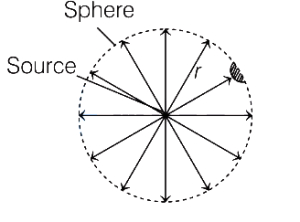
The radiation energy emitted per second by a point source is $100 \,W$. If the efficiency of the source is $4 \%$, then the rms value of the electric field at a distance of $2 \,m$ is [use $\frac{1}{4 \pi \varepsilon_0}=9 \times 10^9$ in $SI$ units].
A
$\sqrt{60} \,V / m$
B
$\sqrt{30} \,V / m$
C
$\sqrt{50} \,V / m$
D
$\sqrt{40} \,V / m$
Solution
(B) The average power emitted by the source is $P_{\text{avg}} = 4 \% \text{ of } 100 \,W = \frac{4}{100} \times 100 \,W = 4 \,W$.
At a distance $r = 2 \,m$, the radiation spreads over a spherical surface area $A = 4 \pi r^2 = 4 \pi (2)^2 = 16 \pi \,m^2$.
The average intensity $I_{\text{avg}}$ is given by $I_{\text{avg}} = \frac{P_{\text{avg}}}{A} = \frac{4}{16 \pi} = \frac{1}{4 \pi} \,W/m^2$.
Also, the average intensity of an electromagnetic wave is related to the rms electric field $E_{\text{rms}}$ by $I_{\text{avg}} = \varepsilon_0 c E_{\text{rms}}^2$, where $c = 3 \times 10^8 \,m/s$ is the speed of light.
Equating the two expressions for intensity: $\frac{1}{4 \pi} = \varepsilon_0 c E_{\text{rms}}^2$.
Rearranging for $E_{\text{rms}}^2$: $E_{\text{rms}}^2 = \frac{1}{4 \pi \varepsilon_0 c} = \left( \frac{1}{4 \pi \varepsilon_0} \right) \times \frac{1}{c}$.
Substituting the given values: $E_{\text{rms}}^2 = (9 \times 10^9) \times \frac{1}{3 \times 10^8} = 3 \times 10 = 30$.
Therefore, $E_{\text{rms}} = \sqrt{30} \,V/m$.
At a distance $r = 2 \,m$, the radiation spreads over a spherical surface area $A = 4 \pi r^2 = 4 \pi (2)^2 = 16 \pi \,m^2$.
The average intensity $I_{\text{avg}}$ is given by $I_{\text{avg}} = \frac{P_{\text{avg}}}{A} = \frac{4}{16 \pi} = \frac{1}{4 \pi} \,W/m^2$.
Also, the average intensity of an electromagnetic wave is related to the rms electric field $E_{\text{rms}}$ by $I_{\text{avg}} = \varepsilon_0 c E_{\text{rms}}^2$, where $c = 3 \times 10^8 \,m/s$ is the speed of light.
Equating the two expressions for intensity: $\frac{1}{4 \pi} = \varepsilon_0 c E_{\text{rms}}^2$.
Rearranging for $E_{\text{rms}}^2$: $E_{\text{rms}}^2 = \frac{1}{4 \pi \varepsilon_0 c} = \left( \frac{1}{4 \pi \varepsilon_0} \right) \times \frac{1}{c}$.
Substituting the given values: $E_{\text{rms}}^2 = (9 \times 10^9) \times \frac{1}{3 \times 10^8} = 3 \times 10 = 30$.
Therefore, $E_{\text{rms}} = \sqrt{30} \,V/m$.
0 likes
View Solution473
MediumMCQ
An electromagnetic wave of frequency $3.0 \ MHz$ passes from vacuum into a non-magnetic medium with permittivity $\epsilon = 16 \epsilon_0$,where $\epsilon_0$ is the free space permittivity. The change in wavelength is
A
$-75 \ m$
B
$+75 \ m$
C
$-50 \ m$
D
$+50 \ m$
Solution
(A) Given,frequency of the electromagnetic $(EM)$ wave,$f = 3 \ MHz = 3 \times 10^6 \ Hz$.
Permittivity of the non-magnetic medium,$\epsilon = 16 \epsilon_0$.
The wavelength of the $EM$ wave in vacuum is $\lambda = \frac{c}{f} = \frac{3 \times 10^8 \ m/s}{3 \times 10^6 \ Hz} = 100 \ m$.
The refractive index of the medium is $n = \sqrt{\epsilon_r \mu_r}$. Since the medium is non-magnetic,$\mu_r = 1$.
Thus,$n = \sqrt{\frac{\epsilon}{\epsilon_0}} = \sqrt{16} = 4$.
The wavelength in the medium is $\lambda' = \frac{\lambda}{n} = \frac{100 \ m}{4} = 25 \ m$.
The change in wavelength is $\Delta \lambda = \lambda' - \lambda = 25 \ m - 100 \ m = -75 \ m$.
Permittivity of the non-magnetic medium,$\epsilon = 16 \epsilon_0$.
The wavelength of the $EM$ wave in vacuum is $\lambda = \frac{c}{f} = \frac{3 \times 10^8 \ m/s}{3 \times 10^6 \ Hz} = 100 \ m$.
The refractive index of the medium is $n = \sqrt{\epsilon_r \mu_r}$. Since the medium is non-magnetic,$\mu_r = 1$.
Thus,$n = \sqrt{\frac{\epsilon}{\epsilon_0}} = \sqrt{16} = 4$.
The wavelength in the medium is $\lambda' = \frac{\lambda}{n} = \frac{100 \ m}{4} = 25 \ m$.
The change in wavelength is $\Delta \lambda = \lambda' - \lambda = 25 \ m - 100 \ m = -75 \ m$.
0 likes
View Solution474
EasyMCQ
In a travelling plane electromagnetic wave,the maximum magnetic field is $1.26 \times 10^{-4} \ T$. The intensity of the wave is (Assume,$\mu_0 = 1.26 \times 10^{-6} \ H/m$)
A
$1.56 \times 10^6 \ W/m^2$
B
$1.89 \times 10^6 \ W/m^2$
C
$8.92 \times 10^5 \ W/m^2$
D
$4.62 \times 10^6 \ W/m^2$
Solution
(B) Given,maximum magnetic field,$B_0 = 1.26 \times 10^{-4} \ T$ and permeability of free space,$\mu_0 = 1.26 \times 10^{-6} \ H/m$. The speed of light is $c = 3 \times 10^8 \ m/s$.
The intensity $I$ of an electromagnetic wave is given by the formula:
$I = \frac{1}{2} \frac{B_0^2 c}{\mu_0}$
Substituting the values:
$I = \frac{1}{2} \times \frac{(1.26 \times 10^{-4})^2 \times 3 \times 10^8}{1.26 \times 10^{-6}}$
$I = \frac{1}{2} \times \frac{1.26 \times 1.26 \times 10^{-8} \times 3 \times 10^8}{1.26 \times 10^{-6}}$
$I = \frac{1}{2} \times 1.26 \times 3 \times 10^2 \times 10^6$
$I = 0.63 \times 3 \times 10^6 = 1.89 \times 10^6 \ W/m^2$.
The intensity $I$ of an electromagnetic wave is given by the formula:
$I = \frac{1}{2} \frac{B_0^2 c}{\mu_0}$
Substituting the values:
$I = \frac{1}{2} \times \frac{(1.26 \times 10^{-4})^2 \times 3 \times 10^8}{1.26 \times 10^{-6}}$
$I = \frac{1}{2} \times \frac{1.26 \times 1.26 \times 10^{-8} \times 3 \times 10^8}{1.26 \times 10^{-6}}$
$I = \frac{1}{2} \times 1.26 \times 3 \times 10^2 \times 10^6$
$I = 0.63 \times 3 \times 10^6 = 1.89 \times 10^6 \ W/m^2$.
0 likes
View Solution475
EasyMCQ
If the magnetic field of a plane electromagnetic wave is given by $B = 5 \times 10^{-6} \sin (0.6 \times 10^2 x + 0.5 \times 10^{10} t)$,then the speed of the wave is
A
$0.83 \times 10^7 \text{ m/s}$
B
$0.83 \times 10^8 \text{ m/s}$
C
$5.24 \times 10^8 \text{ m/s}$
D
$5.24 \times 10^9 \text{ m/s}$
Solution
(B) The general equation for a plane electromagnetic wave is given by $B = B_0 \sin(kx + \omega t)$.
Comparing this with the given equation $B = 5 \times 10^{-6} \sin(0.6 \times 10^2 x + 0.5 \times 10^{10} t)$,we get:
Wave number $k = 0.6 \times 10^2 \text{ m}^{-1}$
Angular frequency $\omega = 0.5 \times 10^{10} \text{ rad/s}$
The speed of the wave $v$ is given by the relation $v = \frac{\omega}{k}$.
Substituting the values:
$v = \frac{0.5 \times 10^{10}}{0.6 \times 10^2}$
$v = \frac{5}{6} \times 10^8 \text{ m/s}$
$v \approx 0.833 \times 10^8 \text{ m/s}$.
Comparing this with the given equation $B = 5 \times 10^{-6} \sin(0.6 \times 10^2 x + 0.5 \times 10^{10} t)$,we get:
Wave number $k = 0.6 \times 10^2 \text{ m}^{-1}$
Angular frequency $\omega = 0.5 \times 10^{10} \text{ rad/s}$
The speed of the wave $v$ is given by the relation $v = \frac{\omega}{k}$.
Substituting the values:
$v = \frac{0.5 \times 10^{10}}{0.6 \times 10^2}$
$v = \frac{5}{6} \times 10^8 \text{ m/s}$
$v \approx 0.833 \times 10^8 \text{ m/s}$.
0 likes
View Solution476
EasyMCQ
An electromagnetic wave having frequency $4 \times 10^{14} \,Hz$ is passing through a small volume. The energy contained in this volume oscillates with frequency
A
$0 \,Hz$
B
$4 \times 10^{14} \,Hz$
C
$8 \times 10^{14} \,Hz$
D
$2 \times 10^{14} \,Hz$
Solution
(C) The energy density $u$ of an electromagnetic wave is given by $u = \frac{1}{2} \epsilon_0 E^2 + \frac{1}{2\mu_0} B^2$.
Since the electric field $E$ and magnetic field $B$ oscillate as $E = E_0 \sin(\omega t)$ and $B = B_0 \sin(\omega t)$, the energy density involves terms like $\sin^2(\omega t)$.
Using the trigonometric identity $\sin^2(\omega t) = \frac{1 - \cos(2\omega t)}{2}$, we see that the energy density oscillates with an angular frequency of $2\omega$.
Therefore, the frequency of energy oscillation is $f_{energy} = 2f = 2 \times (4 \times 10^{14} \,Hz) = 8 \times 10^{14} \,Hz$.
Since the electric field $E$ and magnetic field $B$ oscillate as $E = E_0 \sin(\omega t)$ and $B = B_0 \sin(\omega t)$, the energy density involves terms like $\sin^2(\omega t)$.
Using the trigonometric identity $\sin^2(\omega t) = \frac{1 - \cos(2\omega t)}{2}$, we see that the energy density oscillates with an angular frequency of $2\omega$.
Therefore, the frequency of energy oscillation is $f_{energy} = 2f = 2 \times (4 \times 10^{14} \,Hz) = 8 \times 10^{14} \,Hz$.
0 likes
View Solution477
DifficultMCQ
The electric field for an electromagnetic wave in free space is $E = i 30 \cos (k z - 5 \times 10^8 t)$,where the magnitude of $E$ is in $V/m$. The magnitude of the wave vector $k$ is (velocity of electromagnetic wave in free space $= 3 \times 10^8 \ m/s$).
A
$0.46 \ rad \ m^{-1}$
B
$3 \ rad \ m^{-1}$
C
$1.66 \ rad \ m^{-1}$
D
$0.83 \ rad \ m^{-1}$
Solution
(C) The given equation for the electric field is $E = i 30 \cos (k z - 5 \times 10^8 t)$.
Comparing this with the standard wave equation $E = E_0 \cos (k z - \omega t)$,we identify the angular frequency $\omega$ as $5 \times 10^8 \ rad/s$.
The relationship between the speed of light $c$,angular frequency $\omega$,and wave vector $k$ is given by $c = \frac{\omega}{k}$.
Rearranging to solve for $k$,we get $k = \frac{\omega}{c}$.
Substituting the given values: $k = \frac{5 \times 10^8 \ rad/s}{3 \times 10^8 \ m/s}$.
Thus,$k = \frac{5}{3} \approx 1.66 \ rad/m$.
Comparing this with the standard wave equation $E = E_0 \cos (k z - \omega t)$,we identify the angular frequency $\omega$ as $5 \times 10^8 \ rad/s$.
The relationship between the speed of light $c$,angular frequency $\omega$,and wave vector $k$ is given by $c = \frac{\omega}{k}$.
Rearranging to solve for $k$,we get $k = \frac{\omega}{c}$.
Substituting the given values: $k = \frac{5 \times 10^8 \ rad/s}{3 \times 10^8 \ m/s}$.
Thus,$k = \frac{5}{3} \approx 1.66 \ rad/m$.
0 likes
View Solution478
EasyMCQ
What is the dimension of $\frac{1}{\mu_0 \varepsilon_0}$? ($\mu_0 =$ magnetic permeability and $\varepsilon_0 =$ permittivity of free space)
A
$[L^2 T^{-2}]$
B
$[LT^{-1}]$
C
$[L^2 T^2]$
D
$[LT^2]$
Solution
(A) The velocity of an electromagnetic wave in free space is given by the relation:
$c = \frac{1}{\sqrt{\mu_0 \varepsilon_0}}$
Squaring both sides,we get:
$c^2 = \frac{1}{\mu_0 \varepsilon_0}$
Since $c$ represents the speed of light,its dimensions are $[LT^{-1}]$.
Therefore,the dimensions of $\frac{1}{\mu_0 \varepsilon_0}$ are the same as the dimensions of $c^2$:
$[\frac{1}{\mu_0 \varepsilon_0}] = [c^2] = [LT^{-1}]^2 = [L^2 T^{-2}]$.
$c = \frac{1}{\sqrt{\mu_0 \varepsilon_0}}$
Squaring both sides,we get:
$c^2 = \frac{1}{\mu_0 \varepsilon_0}$
Since $c$ represents the speed of light,its dimensions are $[LT^{-1}]$.
Therefore,the dimensions of $\frac{1}{\mu_0 \varepsilon_0}$ are the same as the dimensions of $c^2$:
$[\frac{1}{\mu_0 \varepsilon_0}] = [c^2] = [LT^{-1}]^2 = [L^2 T^{-2}]$.
0 likes
View Solution479
DifficultMCQ
The efficiency of a bulb of power $60 \ W$ is $16 \%$. The peak value of the electric field produced by the electromagnetic radiation from the bulb at a distance of $2 \ m$ from the bulb is $\left(\frac{1}{4 \pi \epsilon_0}=9 \times 10^9 \ Nm^2 C^{-2}\right)$ (in $Vm^{-1}$)
A
$24$
B
$16$
C
$9$
D
$12$
Solution
(D) Given: Power of the bulb $P = 60 \ W$,Efficiency $\eta = 16 \% = 0.16$,Distance $r = 2 \ m$.
First,calculate the intensity of the electromagnetic radiation emitted by the bulb at distance $r$:
The power radiated as electromagnetic waves is $P_{rad} = \eta \times P = 0.16 \times 60 = 9.6 \ W$.
The intensity $I$ at distance $r$ is given by $I = \frac{P_{rad}}{4 \pi r^2} = \frac{9.6}{4 \pi (2)^2} = \frac{9.6}{16 \pi} = \frac{0.6}{\pi} \ W/m^2$.
The intensity of an electromagnetic wave is also related to the peak electric field $E_0$ by $I = \frac{1}{2} c \epsilon_0 E_0^2$.
Equating the two expressions for intensity: $\frac{0.6}{\pi} = \frac{1}{2} c \epsilon_0 E_0^2$.
We know that $c = \frac{1}{\sqrt{\mu_0 \epsilon_0}}$ and $\frac{1}{4 \pi \epsilon_0} = 9 \times 10^9$,so $\epsilon_0 = \frac{1}{36 \pi \times 10^9}$.
Using $c = 3 \times 10^8 \ m/s$,we have $E_0^2 = \frac{2 \times I}{c \epsilon_0} = \frac{2 \times 0.6 / \pi}{3 \times 10^8 \times (1 / (36 \pi \times 10^9))}$.
$E_0^2 = \frac{1.2}{\pi} \times \frac{36 \pi \times 10^9}{3 \times 10^8} = 1.2 \times 12 \times 10 = 144$.
Therefore,$E_0 = \sqrt{144} = 12 \ Vm^{-1}$.
First,calculate the intensity of the electromagnetic radiation emitted by the bulb at distance $r$:
The power radiated as electromagnetic waves is $P_{rad} = \eta \times P = 0.16 \times 60 = 9.6 \ W$.
The intensity $I$ at distance $r$ is given by $I = \frac{P_{rad}}{4 \pi r^2} = \frac{9.6}{4 \pi (2)^2} = \frac{9.6}{16 \pi} = \frac{0.6}{\pi} \ W/m^2$.
The intensity of an electromagnetic wave is also related to the peak electric field $E_0$ by $I = \frac{1}{2} c \epsilon_0 E_0^2$.
Equating the two expressions for intensity: $\frac{0.6}{\pi} = \frac{1}{2} c \epsilon_0 E_0^2$.
We know that $c = \frac{1}{\sqrt{\mu_0 \epsilon_0}}$ and $\frac{1}{4 \pi \epsilon_0} = 9 \times 10^9$,so $\epsilon_0 = \frac{1}{36 \pi \times 10^9}$.
Using $c = 3 \times 10^8 \ m/s$,we have $E_0^2 = \frac{2 \times I}{c \epsilon_0} = \frac{2 \times 0.6 / \pi}{3 \times 10^8 \times (1 / (36 \pi \times 10^9))}$.
$E_0^2 = \frac{1.2}{\pi} \times \frac{36 \pi \times 10^9}{3 \times 10^8} = 1.2 \times 12 \times 10 = 144$.
Therefore,$E_0 = \sqrt{144} = 12 \ Vm^{-1}$.
0 likes
View Solution480
EasyMCQ
The electric field of a plane electromagnetic wave in a medium is given by $\vec{E}(x, y, z, t) = E_0 \hat{n} e^{i k_0[(x+y+z)-ct]}$,where $c$ is the speed of light in free space. The $\vec{E}$ field is polarized in the $x-z$ plane. If the speed of the wave in the medium is $v$,then:
A
$\hat{n} = \hat{i} - \hat{k}; v = c$
B
$\hat{n} = \frac{\hat{i} - \hat{k}}{\sqrt{2}}; v = \frac{c}{\sqrt{3}}$
C
The refractive index of the medium is $\sqrt{3}$
D
$\hat{n} = \frac{\hat{i} + \hat{k}}{\sqrt{2}}; v = \frac{c}{\sqrt{2}}$
Solution
(B) The given electric field is $\vec{E} = E_0 \hat{n} e^{i k_0[(x+y+z) - ct]}$.
Comparing this with the standard form $\vec{E} = E_0 \hat{n} e^{i(\vec{k} \cdot \vec{r} - \omega t)}$,we identify the wave vector $\vec{k} = k_0(\hat{i} + \hat{j} + \hat{k})$.
The magnitude of the wave vector is $k = |k_0(\hat{i} + \hat{j} + \hat{k})| = k_0 \sqrt{1^2 + 1^2 + 1^2} = k_0 \sqrt{3}$.
The speed of the wave in the medium is $v = \frac{\omega}{k} = \frac{k_0 c}{k_0 \sqrt{3}} = \frac{c}{\sqrt{3}}$.
The refractive index $n = \frac{c}{v} = \sqrt{3}$.
Since the wave is transverse,$\vec{E} \cdot \vec{k} = 0$,which implies $\hat{n} \cdot (\hat{i} + \hat{j} + \hat{k}) = 0$.
Given that $\vec{E}$ is polarized in the $x-z$ plane,$\hat{n}$ must be in the $x-z$ plane,so $\hat{n} = a\hat{i} + b\hat{k}$.
From $\hat{n} \cdot (\hat{i} + \hat{j} + \hat{k}) = 0$,we get $a + b = 0$,so $a = -b$.
Normalizing $\hat{n}$,we get $\hat{n} = \frac{\hat{i} - \hat{k}}{\sqrt{2}}$.
Thus,both options $B$ and $C$ are correct.
Comparing this with the standard form $\vec{E} = E_0 \hat{n} e^{i(\vec{k} \cdot \vec{r} - \omega t)}$,we identify the wave vector $\vec{k} = k_0(\hat{i} + \hat{j} + \hat{k})$.
The magnitude of the wave vector is $k = |k_0(\hat{i} + \hat{j} + \hat{k})| = k_0 \sqrt{1^2 + 1^2 + 1^2} = k_0 \sqrt{3}$.
The speed of the wave in the medium is $v = \frac{\omega}{k} = \frac{k_0 c}{k_0 \sqrt{3}} = \frac{c}{\sqrt{3}}$.
The refractive index $n = \frac{c}{v} = \sqrt{3}$.
Since the wave is transverse,$\vec{E} \cdot \vec{k} = 0$,which implies $\hat{n} \cdot (\hat{i} + \hat{j} + \hat{k}) = 0$.
Given that $\vec{E}$ is polarized in the $x-z$ plane,$\hat{n}$ must be in the $x-z$ plane,so $\hat{n} = a\hat{i} + b\hat{k}$.
From $\hat{n} \cdot (\hat{i} + \hat{j} + \hat{k}) = 0$,we get $a + b = 0$,so $a = -b$.
Normalizing $\hat{n}$,we get $\hat{n} = \frac{\hat{i} - \hat{k}}{\sqrt{2}}$.
Thus,both options $B$ and $C$ are correct.
0 likes
View Solution481
EasyMCQ
The electric field of a plane electromagnetic wave of wave number $k$ and angular frequency $\omega$ is given by $\vec{E} = E_0(\hat{i} + \hat{j}) \sin(kz - \omega t)$. Which of the following gives the direction of the associated magnetic field $\vec{B}$?
A
$\hat{k}$
B
$-\hat{i} + \hat{j}$
C
$-\hat{i} - \hat{j}$
D
$\hat{i} - \hat{k}$
Solution
(B) For an electromagnetic wave,the direction of propagation is given by the vector $\vec{k}_{dir} = \hat{k}$ (since the phase is $kz - \omega t$).
The electric field vector is $\vec{E} = E_0(\hat{i} + \hat{j})$.
The magnetic field $\vec{B}$ is perpendicular to both the direction of propagation and the electric field $\vec{E}$.
The direction of $\vec{B}$ is given by the cross product $\vec{k}_{dir} \times \vec{E}$.
$\vec{B}_{dir} = \hat{k} \times (\hat{i} + \hat{j}) = (\hat{k} \times \hat{i}) + (\hat{k} \times \hat{j}) = \hat{j} - \hat{i} = -\hat{i} + \hat{j}$.
Thus,the direction of the magnetic field is $-\hat{i} + \hat{j}$.
The electric field vector is $\vec{E} = E_0(\hat{i} + \hat{j})$.
The magnetic field $\vec{B}$ is perpendicular to both the direction of propagation and the electric field $\vec{E}$.
The direction of $\vec{B}$ is given by the cross product $\vec{k}_{dir} \times \vec{E}$.
$\vec{B}_{dir} = \hat{k} \times (\hat{i} + \hat{j}) = (\hat{k} \times \hat{i}) + (\hat{k} \times \hat{j}) = \hat{j} - \hat{i} = -\hat{i} + \hat{j}$.
Thus,the direction of the magnetic field is $-\hat{i} + \hat{j}$.
0 likes
View Solution482
EasyMCQ
For a plane electromagnetic wave,the electric field is given by $\overrightarrow{E} = 90 \sin (0.5 \times 10^{3} x + 1.5 \times 10^{11} t) \hat{k} \text{ V/m}$. The corresponding magnetic field $\vec{B}$ will be
A
$\vec{B} = 3 \times 10^{-7} \sin (0.5 \times 10^{3} x + 1.5 \times 10^{11} t) \hat{i} \text{ T}$
B
$\vec{B} = 3 \times 10^{-7} \sin (0.5 \times 10^{3} x + 1.5 \times 10^{11} t) \hat{j} \text{ T}$
C
$\vec{B} = 27 \times 10^{9} \sin (0.5 \times 10^{3} x + 1.5 \times 10^{11} t) \hat{j} \text{ T}$
D
$\vec{B} = 3 \times 10^{-7} \sin (0.5 \times 10^{3} x + 1.5 \times 10^{11} t) \hat{k} \text{ T}$
Solution
(B) Given,$\vec{E} = 90 \sin (0.5 \times 10^{3} x + 1.5 \times 10^{11} t) \hat{k} \text{ V/m}$.
Comparing this with the standard wave equation $\vec{E} = E_{0} \sin (kx + \omega t) \hat{n}$,we get $E_{0} = 90 \text{ V/m}$.
The direction of propagation is along $-\hat{i}$ (since the argument is $kx + \omega t$).
The amplitude of the magnetic field is $B_{0} = \frac{E_{0}}{c} = \frac{90}{3 \times 10^{8}} = 3 \times 10^{-7} \text{ T}$.
The direction of propagation is given by the direction of $\vec{E} \times \vec{B}$.
Here,$\vec{E}$ is along $\hat{k}$ and the direction of propagation is $-\hat{i}$.
So,$\hat{k} \times \hat{B} = -\hat{i}$.
Since $\hat{k} \times \hat{j} = \hat{i}$,it follows that $\hat{k} \times (-\hat{j}) = -\hat{i}$.
Therefore,the magnetic field $\vec{B}$ must be along $\hat{j}$ (Wait,checking cross product: $\hat{k} \times \hat{j} = -\hat{i}$,so $\vec{B}$ is along $\hat{j}$).
Thus,$\vec{B} = 3 \times 10^{-7} \sin (0.5 \times 10^{3} x + 1.5 \times 10^{11} t) \hat{j} \text{ T}$.
Comparing this with the standard wave equation $\vec{E} = E_{0} \sin (kx + \omega t) \hat{n}$,we get $E_{0} = 90 \text{ V/m}$.
The direction of propagation is along $-\hat{i}$ (since the argument is $kx + \omega t$).
The amplitude of the magnetic field is $B_{0} = \frac{E_{0}}{c} = \frac{90}{3 \times 10^{8}} = 3 \times 10^{-7} \text{ T}$.
The direction of propagation is given by the direction of $\vec{E} \times \vec{B}$.
Here,$\vec{E}$ is along $\hat{k}$ and the direction of propagation is $-\hat{i}$.
So,$\hat{k} \times \hat{B} = -\hat{i}$.
Since $\hat{k} \times \hat{j} = \hat{i}$,it follows that $\hat{k} \times (-\hat{j}) = -\hat{i}$.
Therefore,the magnetic field $\vec{B}$ must be along $\hat{j}$ (Wait,checking cross product: $\hat{k} \times \hat{j} = -\hat{i}$,so $\vec{B}$ is along $\hat{j}$).
Thus,$\vec{B} = 3 \times 10^{-7} \sin (0.5 \times 10^{3} x + 1.5 \times 10^{11} t) \hat{j} \text{ T}$.
0 likes
View Solution483
MediumMCQ
$A$ plane electromagnetic wave is moving in free space with velocity $c = 3 \times 10^8 \ m/s$ and its electric field is given as $\vec{E} = 54 \sin(kz - \omega t) \hat{j} \ V/m$,where $\hat{j}$ is the unit vector along the $y$-axis. The magnetic field vector $\vec{B}$ of the wave is:
A
$-1.8 \times 10^{-7} \sin(kz - \omega t) \hat{i} \ T$
B
$1.4 \times 10^{-7} \sin(kz - \omega t) \hat{k} \ T$
C
$1.4 \times 10^{-7} \sin(kz - \omega t) \hat{i} \ T$
D
$+1.8 \times 10^{-7} \sin(kz - \omega t) \hat{i} \ T$
Solution
(A) The direction of propagation of the wave is given by the wave vector $\vec{k}$,which is along the $z$-axis ($+\hat{k}$ direction).
The relationship between the electric field $\vec{E}$,magnetic field $\vec{B}$,and the direction of propagation $\hat{c}$ is given by $\vec{B} = \frac{1}{c} (\hat{c} \times \vec{E})$.
Here,$\hat{c} = \hat{k}$ and $\vec{E} = E_0 \sin(kz - \omega t) \hat{j}$.
The direction of $\vec{B}$ is $\hat{k} \times \hat{j} = -\hat{i}$.
The magnitude of the magnetic field is $B_0 = \frac{E_0}{c} = \frac{54}{3 \times 10^8} = 18 \times 10^{-8} = 1.8 \times 10^{-7} \ T$.
Therefore,$\vec{B} = -1.8 \times 10^{-7} \sin(kz - \omega t) \hat{i} \ T$.
The relationship between the electric field $\vec{E}$,magnetic field $\vec{B}$,and the direction of propagation $\hat{c}$ is given by $\vec{B} = \frac{1}{c} (\hat{c} \times \vec{E})$.
Here,$\hat{c} = \hat{k}$ and $\vec{E} = E_0 \sin(kz - \omega t) \hat{j}$.
The direction of $\vec{B}$ is $\hat{k} \times \hat{j} = -\hat{i}$.
The magnitude of the magnetic field is $B_0 = \frac{E_0}{c} = \frac{54}{3 \times 10^8} = 18 \times 10^{-8} = 1.8 \times 10^{-7} \ T$.
Therefore,$\vec{B} = -1.8 \times 10^{-7} \sin(kz - \omega t) \hat{i} \ T$.
0 likes
View Solution484
DifficultMCQ
The electric field of an electromagnetic wave travelling through a medium is given by $\overline{E}(x,t) = 25 \sin(2.0 \times 10^{15}t - 10^{7}x)\hat{n}$. The refractive index of the medium is . . . . . . . (All given measurements are in $SI$ units)
A
$1.2$
B
$2$
C
$1.5$
D
$1.7$
Solution
(C) The general equation for a wave is given by $E = E_0 \sin(\omega t - kx)$.
Comparing this with the given equation $\overline{E}(x,t) = 25 \sin(2.0 \times 10^{15}t - 10^{7}x)\hat{n}$,we get:
$\omega = 2.0 \times 10^{15} \text{ rad/s}$
$k = 10^{7} \text{ m}^{-1}$
The velocity of the wave in the medium is $v = \frac{\omega}{k}$.
$v = \frac{2.0 \times 10^{15}}{10^7} = 2.0 \times 10^8 \text{ m/s}$.
The refractive index $\mu$ is given by $\mu = \frac{c}{v}$,where $c = 3 \times 10^8 \text{ m/s}$ is the speed of light in vacuum.
$\mu = \frac{3 \times 10^8}{2 \times 10^8} = 1.5$.
Comparing this with the given equation $\overline{E}(x,t) = 25 \sin(2.0 \times 10^{15}t - 10^{7}x)\hat{n}$,we get:
$\omega = 2.0 \times 10^{15} \text{ rad/s}$
$k = 10^{7} \text{ m}^{-1}$
The velocity of the wave in the medium is $v = \frac{\omega}{k}$.
$v = \frac{2.0 \times 10^{15}}{10^7} = 2.0 \times 10^8 \text{ m/s}$.
The refractive index $\mu$ is given by $\mu = \frac{c}{v}$,where $c = 3 \times 10^8 \text{ m/s}$ is the speed of light in vacuum.
$\mu = \frac{3 \times 10^8}{2 \times 10^8} = 1.5$.
0 likes
View Solution485
EasyMCQ
The ratio of the speeds of electromagnetic waves in a vacuum and in a medium with dielectric constant $K=3$ and permeability $\mu=2\mu_{0}$ is (where $\mu_{0}$ is the permeability of vacuum).
A
$36 : 1$
B
$3 : 2$
C
$6 : 1$
D
$\sqrt{6} : 1$
Solution
(D) The speed of electromagnetic waves in a vacuum is $C = \frac{1}{\sqrt{\mu_{0}\varepsilon_{0}}}$.
The speed of electromagnetic waves in a medium is $V = \frac{1}{\sqrt{\mu\varepsilon}}$.
The ratio of speeds is $\frac{C}{V} = \sqrt{\frac{\mu\varepsilon}{\mu_{0}\varepsilon_{0}}} = \sqrt{\mu_{r}\varepsilon_{r}}$.
Given,dielectric constant $K = \varepsilon_{r} = 3$ and relative permeability $\mu_{r} = \frac{\mu}{\mu_{0}} = 2$.
Substituting these values,we get $\frac{C}{V} = \sqrt{3 \times 2} = \sqrt{6}$.
Therefore,the ratio is $\sqrt{6} : 1$.
The speed of electromagnetic waves in a medium is $V = \frac{1}{\sqrt{\mu\varepsilon}}$.
The ratio of speeds is $\frac{C}{V} = \sqrt{\frac{\mu\varepsilon}{\mu_{0}\varepsilon_{0}}} = \sqrt{\mu_{r}\varepsilon_{r}}$.
Given,dielectric constant $K = \varepsilon_{r} = 3$ and relative permeability $\mu_{r} = \frac{\mu}{\mu_{0}} = 2$.
Substituting these values,we get $\frac{C}{V} = \sqrt{3 \times 2} = \sqrt{6}$.
Therefore,the ratio is $\sqrt{6} : 1$.
0 likes
View Solution486
DifficultMCQ
$A$ laser beam has an intensity of $4.0 \times 10^{14} \ W/m^{2}$. The amplitude of the magnetic field associated with the beam is . . . . . . $T$. (Take $\epsilon_{0} = 8.85 \times 10^{-12} \ C^{2}/Nm^{2}$ and $c = 3 \times 10^{8} \ m/s$)
A
$2.0$
B
$18.3$
C
$5.5$
D
$1.83$
Solution
(D) The intensity $I$ of an electromagnetic wave is given by $I = \frac{1}{2} \epsilon_0 E_0^2 c$.
From this,the amplitude of the electric field $E_0$ is $E_0 = \sqrt{\frac{2I}{\epsilon_0 c}}$.
We know that the relation between the amplitudes of the electric and magnetic fields is $E_0 = B_0 c$,which implies $B_0 = \frac{E_0}{c}$.
Substituting $E_0$,we get $B_0 = \frac{1}{c} \sqrt{\frac{2I}{\epsilon_0 c}} = \sqrt{\frac{2I}{\epsilon_0 c^3}}$.
Given $I = 4.0 \times 10^{14} \ W/m^2$,$\epsilon_0 = 8.85 \times 10^{-12} \ C^2/Nm^2$,and $c = 3 \times 10^8 \ m/s$:
$B_0 = \sqrt{\frac{2 \times 4.0 \times 10^{14}}{8.85 \times 10^{-12} \times (3 \times 10^8)^3}} = \sqrt{\frac{8.0 \times 10^{14}}{8.85 \times 10^{-12} \times 27 \times 10^{24}}} = \sqrt{\frac{8.0 \times 10^{14}}{238.95 \times 10^{12}}} = \sqrt{\frac{800}{238.95}} \approx \sqrt{3.348} \approx 1.83 \ T$.
From this,the amplitude of the electric field $E_0$ is $E_0 = \sqrt{\frac{2I}{\epsilon_0 c}}$.
We know that the relation between the amplitudes of the electric and magnetic fields is $E_0 = B_0 c$,which implies $B_0 = \frac{E_0}{c}$.
Substituting $E_0$,we get $B_0 = \frac{1}{c} \sqrt{\frac{2I}{\epsilon_0 c}} = \sqrt{\frac{2I}{\epsilon_0 c^3}}$.
Given $I = 4.0 \times 10^{14} \ W/m^2$,$\epsilon_0 = 8.85 \times 10^{-12} \ C^2/Nm^2$,and $c = 3 \times 10^8 \ m/s$:
$B_0 = \sqrt{\frac{2 \times 4.0 \times 10^{14}}{8.85 \times 10^{-12} \times (3 \times 10^8)^3}} = \sqrt{\frac{8.0 \times 10^{14}}{8.85 \times 10^{-12} \times 27 \times 10^{24}}} = \sqrt{\frac{8.0 \times 10^{14}}{238.95 \times 10^{12}}} = \sqrt{\frac{800}{238.95}} \approx \sqrt{3.348} \approx 1.83 \ T$.
0 likes
View Solution487
MediumMCQ
The electric field of a plane electromagnetic wave,travelling in an unknown non-magnetic medium is given by,$E_y = 20 \sin(3 \times 10^6 x - 4.5 \times 10^{14} t) \text{ V/m}$ (where $x, t$ and other values are in $S$.$I$. units). The dielectric constant of the medium is . . . . . . . (Speed of light in free space is $c = 3 \times 10^8 \text{ m/s}$)
A
$1$
B
$2$
C
$3$
D
$4$
Solution
(D) The general equation for a plane wave is $E = E_0 \sin(kx - \omega t)$.
Comparing this with the given equation,we have the angular frequency $\omega = 4.5 \times 10^{14} \text{ rad/s}$ and the wave number $k = 3 \times 10^6 \text{ rad/m}$.
The phase velocity $v$ of the wave in the medium is given by $v = \frac{\omega}{k} = \frac{4.5 \times 10^{14}}{3 \times 10^6} = 1.5 \times 10^8 \text{ m/s}$.
The refractive index $n$ of the medium is $n = \frac{c}{v} = \frac{3 \times 10^8}{1.5 \times 10^8} = 2$.
For a non-magnetic medium,the relative permeability $\mu_r = 1$. The refractive index is related to the dielectric constant (relative permittivity) $\varepsilon_r$ by $n = \sqrt{\mu_r \varepsilon_r} = \sqrt{\varepsilon_r}$.
Thus,$\varepsilon_r = n^2 = 2^2 = 4$.
Comparing this with the given equation,we have the angular frequency $\omega = 4.5 \times 10^{14} \text{ rad/s}$ and the wave number $k = 3 \times 10^6 \text{ rad/m}$.
The phase velocity $v$ of the wave in the medium is given by $v = \frac{\omega}{k} = \frac{4.5 \times 10^{14}}{3 \times 10^6} = 1.5 \times 10^8 \text{ m/s}$.
The refractive index $n$ of the medium is $n = \frac{c}{v} = \frac{3 \times 10^8}{1.5 \times 10^8} = 2$.
For a non-magnetic medium,the relative permeability $\mu_r = 1$. The refractive index is related to the dielectric constant (relative permittivity) $\varepsilon_r$ by $n = \sqrt{\mu_r \varepsilon_r} = \sqrt{\varepsilon_r}$.
Thus,$\varepsilon_r = n^2 = 2^2 = 4$.
0 likes
View Solution488
DifficultMCQ
The electric field of a plane electromagnetic wave is given by: $E_y = 69 \sin[0.6 \times 10^3 x - 1.8 \times 10^{11} t] \text{ V/m}$. The expression for the magnetic field associated with this electromagnetic wave is . . . . . . $T$.
A
$B_z = 2.3 \times 10^{-7} \sin[0.6 \times 10^3 x - 1.8 \times 10^{11} t]$
B
$B_z = 2.3 \times 10^{-7} \sin[0.6 \times 10^3 x + 1.8 \times 10^{11} t]$
C
$B_y = 69 \sin[0.6 \times 10^3 x + 1.8 \times 10^{11} t]$
D
$B_y = 2.3 \times 10^{-7} \sin[0.6 \times 10^3 x - 1.8 \times 10^{11} t]$
Solution
(A) The given electric field is $E_y = E_0 \sin(kx - \omega t)$, where $E_0 = 69 \text{ V/m}$, $k = 0.6 \times 10^3 \text{ rad/m}$, and $\omega = 1.8 \times 10^{11} \text{ rad/s}$.
Since the wave propagates in the $+x$ direction $(\hat{i})$ and the electric field is in the $y$ direction $(\hat{j})$, the magnetic field must be in the $z$ direction $(\hat{k})$ because $\vec{B} = \frac{1}{c} (\hat{c} \times \vec{E}) = \frac{1}{c} (\hat{i} \times E_y \hat{j}) = \frac{E_y}{c} \hat{k}$.
The amplitude of the magnetic field is $B_0 = \frac{E_0}{c} = \frac{69}{3 \times 10^8} = 23 \times 10^{-8} = 2.3 \times 10^{-7} \text{ T}$.
The phase of the magnetic field is the same as the electric field, so $B_z = B_0 \sin(kx - \omega t) = 2.3 \times 10^{-7} \sin[0.6 \times 10^3 x - 1.8 \times 10^{11} t] \text{ T}$.
Since the wave propagates in the $+x$ direction $(\hat{i})$ and the electric field is in the $y$ direction $(\hat{j})$, the magnetic field must be in the $z$ direction $(\hat{k})$ because $\vec{B} = \frac{1}{c} (\hat{c} \times \vec{E}) = \frac{1}{c} (\hat{i} \times E_y \hat{j}) = \frac{E_y}{c} \hat{k}$.
The amplitude of the magnetic field is $B_0 = \frac{E_0}{c} = \frac{69}{3 \times 10^8} = 23 \times 10^{-8} = 2.3 \times 10^{-7} \text{ T}$.
The phase of the magnetic field is the same as the electric field, so $B_z = B_0 \sin(kx - \omega t) = 2.3 \times 10^{-7} \sin[0.6 \times 10^3 x - 1.8 \times 10^{11} t] \text{ T}$.
0 likes
View Solution489
MediumMCQ
$A$ point light source emits electromagnetic ($E$.$M$.) waves in free space. $A$ detector,placed at a distance of $L \text{ m}$,measures the intensity as $I_o$. The detector is now shifted to another location on the same spherical surface,ensuring the angle between the original location and the new location is $45^{\circ}$. The measured intensity at the new location will be . . . . . . .
A
$\frac{I_o}{4}$
B
$I_o$
C
$\frac{I_o}{\sqrt{2}}$
D
$\frac{I_o}{2}$
Solution
(B) The intensity $I$ of a point source at a distance $r$ is given by the formula $I = \frac{P}{4\pi r^2}$,where $P$ is the power of the source.
Since the detector is shifted to another location on the same spherical surface of radius $L$,the distance $r$ from the source remains constant $(r = L)$.
Because the intensity $I$ depends only on the distance $r$ for an isotropic point source,the intensity at the new location remains the same as the initial intensity $I_o$.
Therefore,the measured intensity at the new location is $I_o$.
Since the detector is shifted to another location on the same spherical surface of radius $L$,the distance $r$ from the source remains constant $(r = L)$.
Because the intensity $I$ depends only on the distance $r$ for an isotropic point source,the intensity at the new location remains the same as the initial intensity $I_o$.
Therefore,the measured intensity at the new location is $I_o$.
0 likes
View Solution490
DifficultMCQ
$A$ magnetic field vector in an electromagnetic wave is represented by $\vec{B} = B_0 \sin(2\pi vt - \frac{2\pi x}{\lambda}) \hat{j}$. Its associated electric field vector is . . . . . . .
A
$\vec{E} = -v\lambda B_0 \sin(2\pi vt - \frac{2\pi x}{\lambda}) \hat{k}$
B
$\vec{E} = -v B_0 \sin(2\pi vt - \frac{2\pi x}{\lambda}) \hat{i}$
C
$\vec{E} = v\lambda B_0 \sin(2\pi vt - \frac{2\pi x}{\lambda}) \hat{k}$
D
$\vec{E} = v B_0 \sin(2\pi vt - \frac{2\pi x}{\lambda}) \hat{i}$
Solution
(A) The relationship between the electric field $\vec{E}$ and the magnetic field $\vec{B}$ in an electromagnetic wave is given by $\vec{E} = c(\vec{B} \times \hat{n})$,where $\hat{n}$ is the direction of wave propagation.
Here,the wave propagates in the $+x$ direction,so $\hat{n} = \hat{i}$.
The magnetic field is given as $\vec{B} = B_0 \sin(2\pi vt - \frac{2\pi x}{\lambda}) \hat{j}$.
Using the relation $\vec{E} = c(\vec{B} \times \hat{i})$,we substitute $\vec{B}$:
$\vec{E} = c B_0 \sin(2\pi vt - \frac{2\pi x}{\lambda}) (\hat{j} \times \hat{i})$.
Since $\hat{j} \times \hat{i} = -\hat{k}$ and the speed of light $c = v\lambda$ (where $v$ is frequency and $\lambda$ is wavelength),we get:
$\vec{E} = -v\lambda B_0 \sin(2\pi vt - \frac{2\pi x}{\lambda}) \hat{k}$.
Here,the wave propagates in the $+x$ direction,so $\hat{n} = \hat{i}$.
The magnetic field is given as $\vec{B} = B_0 \sin(2\pi vt - \frac{2\pi x}{\lambda}) \hat{j}$.
Using the relation $\vec{E} = c(\vec{B} \times \hat{i})$,we substitute $\vec{B}$:
$\vec{E} = c B_0 \sin(2\pi vt - \frac{2\pi x}{\lambda}) (\hat{j} \times \hat{i})$.
Since $\hat{j} \times \hat{i} = -\hat{k}$ and the speed of light $c = v\lambda$ (where $v$ is frequency and $\lambda$ is wavelength),we get:
$\vec{E} = -v\lambda B_0 \sin(2\pi vt - \frac{2\pi x}{\lambda}) \hat{k}$.
0 likes
View Solution491
DifficultMCQ
An electromagnetic wave travelling in $x$-direction is described by field equation $E_y = 300 \sin \omega \left( t - \frac{x}{c} \right)$. If the electron is restricted to move in $y$-direction only with speed of $1.5 \times 10^6 \text{ m/s}$,then the ratio of maximum electric and magnetic forces acting on the electron is . . . . . . .
A
$200$
B
$150$
C
$400$
D
$300$
Solution
(A) The electric force on the electron is given by $F_e = eE$,where $e$ is the charge of the electron and $E$ is the electric field amplitude.
The magnetic force on the electron is given by $F_m = evB$,where $v$ is the speed of the electron and $B$ is the magnetic field amplitude.
For an electromagnetic wave,the relationship between the amplitudes of electric and magnetic fields is $E = cB$,where $c$ is the speed of light $(c = 3 \times 10^8 \text{ m/s})$.
Therefore,the ratio of maximum forces is $\frac{F_e}{F_m} = \frac{eE}{evB} = \frac{E}{v(E/c)} = \frac{c}{v}$.
Given $c = 3 \times 10^8 \text{ m/s}$ and $v = 1.5 \times 10^6 \text{ m/s}$,the ratio is $\frac{3 \times 10^8}{1.5 \times 10^6} = \frac{300 \times 10^6}{1.5 \times 10^6} = 200$.
The magnetic force on the electron is given by $F_m = evB$,where $v$ is the speed of the electron and $B$ is the magnetic field amplitude.
For an electromagnetic wave,the relationship between the amplitudes of electric and magnetic fields is $E = cB$,where $c$ is the speed of light $(c = 3 \times 10^8 \text{ m/s})$.
Therefore,the ratio of maximum forces is $\frac{F_e}{F_m} = \frac{eE}{evB} = \frac{E}{v(E/c)} = \frac{c}{v}$.
Given $c = 3 \times 10^8 \text{ m/s}$ and $v = 1.5 \times 10^6 \text{ m/s}$,the ratio is $\frac{3 \times 10^8}{1.5 \times 10^6} = \frac{300 \times 10^6}{1.5 \times 10^6} = 200$.
0 likes
View Solution492
MediumMCQ
An electromagnetic wave travels in free space along the $x$-direction. At a particular point in space and time,$\vec{B} = 2 \times 10^{-7} \hat{j} \text{ T}$ is associated with this wave. The value of corresponding electric field $\vec{E}$ at this point is . . . . . . $V$/m. (in $hat{k}$)
A
$60$
B
$-60$
C
$30$
D
$-600$
Solution
(B) The relationship between the electric field $\vec{E}$ and the magnetic field $\vec{B}$ in an electromagnetic wave is given by $\vec{E} = c(\vec{B} \times \hat{n})$,where $\hat{n}$ is the unit vector in the direction of wave propagation.
Here,the wave propagates along the $x$-direction,so $\hat{n} = \hat{i}$.
The speed of light in free space is $c = 3 \times 10^8 \text{ m/s}$.
Given $\vec{B} = 2 \times 10^{-7} \hat{j} \text{ T}$.
Substituting these values: $\vec{E} = (3 \times 10^8 \text{ m/s}) \times (2 \times 10^{-7} \hat{j} \text{ T} \times \hat{i})$.
Since $\hat{j} \times \hat{i} = -\hat{k}$,we have $\vec{E} = (3 \times 10^8) \times (2 \times 10^{-7}) \times (-\hat{k}) = 60 \times (-\hat{k}) = -60\hat{k} \text{ V/m}$.
Here,the wave propagates along the $x$-direction,so $\hat{n} = \hat{i}$.
The speed of light in free space is $c = 3 \times 10^8 \text{ m/s}$.
Given $\vec{B} = 2 \times 10^{-7} \hat{j} \text{ T}$.
Substituting these values: $\vec{E} = (3 \times 10^8 \text{ m/s}) \times (2 \times 10^{-7} \hat{j} \text{ T} \times \hat{i})$.
Since $\hat{j} \times \hat{i} = -\hat{k}$,we have $\vec{E} = (3 \times 10^8) \times (2 \times 10^{-7}) \times (-\hat{k}) = 60 \times (-\hat{k}) = -60\hat{k} \text{ V/m}$.
0 likes
View Solution493
MediumMCQ
For an electromagnetic wave propagating through vacuum,$\vec{k}$,$\vec{E}$,and $\omega$ represent the propagation vector,electric field,and angular frequency,respectively. The magnetic field associated with this wave is represented by:
A
$\frac{\vec{E} \times \vec{k}}{\omega}$
B
$\frac{\vec{k} \times \vec{E}}{\omega}$
C
$\omega(\vec{E} \times \vec{k})$
D
$\omega(\vec{k} \times \vec{E})$
Solution
(B) For an electromagnetic wave,the relationship between the electric field $\vec{E}$,the magnetic field $\vec{B}$,and the propagation vector $\vec{k}$ is given by the Maxwell-Faraday equation.
According to Faraday's law in differential form,$\nabla \times \vec{E} = -\frac{\partial \vec{B}}{\partial t}$.
For a plane electromagnetic wave,$\vec{E} = \vec{E}_0 \cos(\vec{k} \cdot \vec{r} - \omega t)$ and $\vec{B} = \vec{B}_0 \cos(\vec{k} \cdot \vec{r} - \omega t)$.
Substituting these into the differential equation,we get $\vec{k} \times \vec{E} = \omega \vec{B}$.
Therefore,the magnetic field is given by $\vec{B} = \frac{\vec{k} \times \vec{E}}{\omega}$.
According to Faraday's law in differential form,$\nabla \times \vec{E} = -\frac{\partial \vec{B}}{\partial t}$.
For a plane electromagnetic wave,$\vec{E} = \vec{E}_0 \cos(\vec{k} \cdot \vec{r} - \omega t)$ and $\vec{B} = \vec{B}_0 \cos(\vec{k} \cdot \vec{r} - \omega t)$.
Substituting these into the differential equation,we get $\vec{k} \times \vec{E} = \omega \vec{B}$.
Therefore,the magnetic field is given by $\vec{B} = \frac{\vec{k} \times \vec{E}}{\omega}$.
0 likes
View SolutionElectromagnetic waves — Properties of Electromagnetic Waves · Frequently Asked Questions
1Are these Electromagnetic waves questions useful for JEE and NEET?
Yes. All questions in this section are mapped to JEE Main and NEET exam patterns. Previous year questions from JEE Main, NEET, GUJCET and state-level exams are included with full solutions.
2Can I switch to Hindi or Gujarati for these questions?
Yes. Use the language tabs in the hero section or the sidebar to view the same questions and solutions in English, Hindi or Gujarati.
3How do I generate a question paper from this subtopic?
Use the Vedclass Exam Paper Generator — select the chapter and subtopic, set difficulty, and generate Sets A, B, C, D automatically. First 3 chapters of every subject are free.
Vedclass Products
For Students
Vedclass Test Series
Mock tests in real JEE/NEET style with performance analysis. 5-day free trial.
Start Free TrialFor Teachers
Exam Paper Generator
Generate Set A/B/C/D papers from this chapter in 2 minutes. 3 chapters free.
Try FreeFor Institutes
Online Exam Module
Live online exams with unlimited students, 360° analytics & white-label branding.
See DemoFor Teachers & Institutes
Generate a Electromagnetic waves Exam Paper in 2 Minutes
Select subtopic & difficulty — Sets A, B, C, D auto-generated with No Repeat logic.
First 3 chapters of every subject are free — no payment required.