
A English
Maxwell's equations , Concept of displacement current and Hertz experiment Questions in English
Class 12 Physics · Electromagnetic waves · Maxwell's equations , Concept of displacement current and Hertz experiment
124+
Questions
English
Language
100%
With Solutions
Showing 50 of 124 questions in English
1
EasyMCQ
$A$ magnetic field can be produced by
A
$A$ moving charge
B
$A$ changing electric field
C
None of these
D
Both of these
Solution
(D) magnetic field is produced by a moving charge (current) as described by the Biot-Savart law.
Additionally,a changing electric field (displacement current) also produces a magnetic field,as described by the Maxwell-Ampere law.
Therefore,both a moving charge and a changing electric field can produce a magnetic field.
Additionally,a changing electric field (displacement current) also produces a magnetic field,as described by the Maxwell-Ampere law.
Therefore,both a moving charge and a changing electric field can produce a magnetic field.
0 likes
View Solution2
EasyMCQ
According to Maxwell's hypothesis,a changing electric field gives rise to
A
An e.m.f.
B
Electric current
C
Magnetic field
D
Pressure radiant
Solution
(C) According to Maxwell's $EM$ theory,a time-varying electric field produces a displacement current,which in turn acts as a source of a magnetic field.
This is represented by the Maxwell-Ampere law: $\oint B \cdot dl = \mu_0 (I_c + I_d)$,where $I_d = \epsilon_0 \frac{d\Phi_E}{dt}$ is the displacement current.
Therefore,a changing electric field gives rise to a magnetic field.
This is represented by the Maxwell-Ampere law: $\oint B \cdot dl = \mu_0 (I_c + I_d)$,where $I_d = \epsilon_0 \frac{d\Phi_E}{dt}$ is the displacement current.
Therefore,a changing electric field gives rise to a magnetic field.
0 likes
View Solution3
EasyMCQ
Maxwell's equations describe the fundamental laws of
A
Electricity only
B
Magnetism only
C
Mechanics only
D
Both $(a)$ and $(b)$
Solution
(D) Maxwell's equations describe the fundamental laws of electricity and magnetism.
These equations explain how electric and magnetic fields are generated and altered by each other,as well as by electric charges and currents.
Therefore,they encompass the principles of both electricity and magnetism.
These equations explain how electric and magnetic fields are generated and altered by each other,as well as by electric charges and currents.
Therefore,they encompass the principles of both electricity and magnetism.
0 likes
View Solution4
EasyMCQ
Which scientist experimentally proved the existence of electromagnetic waves?
A
Sir $J$.$C$. Bose
B
Maxwell
C
Hertz
D
Marconi
Solution
(C) Heinrich Rudolf Hertz was a German physicist who first conclusively proved the existence of electromagnetic waves,which were previously theorized by James Clerk Maxwell.
He used an oscillating circuit to produce and detect these waves in his laboratory.
Therefore,the correct answer is $C$.
He used an oscillating circuit to produce and detect these waves in his laboratory.
Therefore,the correct answer is $C$.
0 likes
View Solution5
MediumMCQ
$A$ parallel plate capacitor with a plate separation of $2 \, mm$ is connected to an electric circuit with a source voltage of $400 \, V$. If the plate area is $60 \, cm^2$,what is the value of the displacement current for a time interval of $10^{-6} \, s$?
A
$1.062 \, A$
B
$1.062 \times 10^{-2} \, A$
C
$1.062 \times 10^{-3} \, A$
D
$1.062 \times 10^{-4} \, A$
Solution
(B) The displacement current $I_D$ is given by the formula $I_D = \varepsilon_0 \frac{d\phi_E}{dt}$.
Since the electric field $E = \frac{V}{d}$ and the electric flux $\phi_E = E \cdot A$,we have $I_D = \varepsilon_0 \frac{A}{d} \frac{dV}{dt}$.
Given: $\varepsilon_0 = 8.854 \times 10^{-12} \, F/m$,$V = 400 \, V$,$A = 60 \, cm^2 = 60 \times 10^{-4} \, m^2$,$d = 2 \, mm = 2 \times 10^{-3} \, m$,and $\Delta t = 10^{-6} \, s$.
Substituting these values:
$I_D = \frac{8.854 \times 10^{-12} \times 60 \times 10^{-4} \times 400}{2 \times 10^{-3} \times 10^{-6}}$
$I_D = \frac{8.854 \times 60 \times 4 \times 10^{-12} \times 10^{-4} \times 10^2}{2 \times 10^{-9}}$
$I_D = \frac{2124.96 \times 10^{-14}}{2 \times 10^{-9}} = 1062.48 \times 10^{-5} = 1.06248 \times 10^{-2} \, A$.
Thus,the correct option is $B$.
Since the electric field $E = \frac{V}{d}$ and the electric flux $\phi_E = E \cdot A$,we have $I_D = \varepsilon_0 \frac{A}{d} \frac{dV}{dt}$.
Given: $\varepsilon_0 = 8.854 \times 10^{-12} \, F/m$,$V = 400 \, V$,$A = 60 \, cm^2 = 60 \times 10^{-4} \, m^2$,$d = 2 \, mm = 2 \times 10^{-3} \, m$,and $\Delta t = 10^{-6} \, s$.
Substituting these values:
$I_D = \frac{8.854 \times 10^{-12} \times 60 \times 10^{-4} \times 400}{2 \times 10^{-3} \times 10^{-6}}$
$I_D = \frac{8.854 \times 60 \times 4 \times 10^{-12} \times 10^{-4} \times 10^2}{2 \times 10^{-9}}$
$I_D = \frac{2124.96 \times 10^{-14}}{2 \times 10^{-9}} = 1062.48 \times 10^{-5} = 1.06248 \times 10^{-2} \, A$.
Thus,the correct option is $B$.
0 likes
View Solution6
EasyMCQ
What is the phase difference between the space current and the capacitive displacement current produced when radio waves pass through the ionosphere?
A
$\pi \, rad$
B
$\pi / 2 \, rad$
C
$3\pi / 2 \, rad$
D
$0 \, rad$
Solution
(A) In the ionosphere,the interaction of electromagnetic waves with the plasma leads to two types of currents: the conduction current (space current) and the displacement current.
According to Maxwell's equations,the displacement current density is given by $J_d = \epsilon_0 \frac{\partial E}{\partial t}$.
For a harmonic wave $E = E_0 \sin(\omega t)$,the displacement current is $J_d = \epsilon_0 \omega E_0 \cos(\omega t) = \epsilon_0 \omega E_0 \sin(\omega t + \pi / 2)$.
The conduction current (space current) $J_c$ in a plasma is related to the electric field by $J_c = \sigma E$,where $\sigma$ is the conductivity. In the ionosphere,the motion of electrons is dominated by inertia,making the current lag behind the electric field by $\pi / 2$.
Thus,the conduction current $J_c$ is proportional to $\sin(\omega t - \pi / 2)$.
The phase difference between the displacement current $(\sin(\omega t + \pi / 2))$ and the conduction current $(\sin(\omega t - \pi / 2))$ is $(\pi / 2) - (-\pi / 2) = \pi \, rad$.
According to Maxwell's equations,the displacement current density is given by $J_d = \epsilon_0 \frac{\partial E}{\partial t}$.
For a harmonic wave $E = E_0 \sin(\omega t)$,the displacement current is $J_d = \epsilon_0 \omega E_0 \cos(\omega t) = \epsilon_0 \omega E_0 \sin(\omega t + \pi / 2)$.
The conduction current (space current) $J_c$ in a plasma is related to the electric field by $J_c = \sigma E$,where $\sigma$ is the conductivity. In the ionosphere,the motion of electrons is dominated by inertia,making the current lag behind the electric field by $\pi / 2$.
Thus,the conduction current $J_c$ is proportional to $\sin(\omega t - \pi / 2)$.
The phase difference between the displacement current $(\sin(\omega t + \pi / 2))$ and the conduction current $(\sin(\omega t - \pi / 2))$ is $(\pi / 2) - (-\pi / 2) = \pi \, rad$.
0 likes
View Solution7
EasyMCQ
An accelerated electron produces ...
A
$\gamma -$ rays
B
$\beta -$ rays
C
$\alpha -$ rays
D
Electromagnetic waves
Solution
(D) An electron carries an electric charge. $A$ stationary electron creates no magnetic field. An electron moving at a constant velocity generates a steady magnetic field,but a constant magnetic field does not produce an electric field. An electron moving with a changing velocity (i.e.,accelerating) generates a changing magnetic field,which in turn produces a changing electric field. This continuous cycle of changing electric and magnetic fields propagates through space as an electromagnetic wave.
0 likes
View Solution8
EasyMCQ
Maxwell's equations are derived from the laws of .......
A
Electricity
B
Magnetism
C
Electricity and Magnetism
D
Mechanics
Solution
(C) Maxwell's equations are a set of four partial differential equations that provide a comprehensive description of classical electromagnetism.
They describe how electric and magnetic fields are generated by charges,currents,and by each other.
Therefore,these equations are derived from the fundamental laws of electricity and magnetism.
They describe how electric and magnetic fields are generated by charges,currents,and by each other.
Therefore,these equations are derived from the fundamental laws of electricity and magnetism.
0 likes
View Solution9
EasyMCQ
In Hertz's experiment,the rods act as a/an ...... .
A
Inductor
B
Capacitor
C
Resistor
D
Coil
Solution
(B) In Hertz's experiment,two metal rods were connected to an induction coil.
These rods act as a capacitor because they store electrical energy in the electric field between them when a high potential difference is applied.
When the potential difference exceeds the breakdown voltage of the air gap,a spark is produced,and the system oscillates,generating electromagnetic waves.
These rods act as a capacitor because they store electrical energy in the electric field between them when a high potential difference is applied.
When the potential difference exceeds the breakdown voltage of the air gap,a spark is produced,and the system oscillates,generating electromagnetic waves.
0 likes
View Solution10
EasyMCQ
The existence of electromagnetic waves was first predicted by the scientist .......
A
Maxwell
B
Faraday
C
Ampere
D
Hertz
Solution
(A) James Clerk Maxwell was the first scientist to theoretically predict the existence of electromagnetic waves in $1865$. He unified the laws of electricity and magnetism through his set of four equations,known as Maxwell's equations. These equations implied that a time-varying electric field produces a time-varying magnetic field and vice versa,leading to the propagation of electromagnetic waves in free space.
0 likes
View Solution11
MediumMCQ
The potential difference between the two plates of a parallel plate capacitor changes at a rate of $10^6 \; V/s$. If the capacitance of the capacitor is $2 \; \mu F$, what is the displacement current in the dielectric of the capacitor?
A
$4$
B
$3$
C
$2$
D
$1$
Solution
(C) The displacement current $I_d$ in a capacitor is given by the formula: $I_d = \epsilon_0 \frac{d\Phi_E}{dt}$.
Since the electric flux $\Phi_E = E \cdot A = \frac{V}{d} \cdot A = \frac{V \cdot A}{d}$, and the capacitance $C = \frac{\epsilon_0 A}{d}$, we can write the displacement current as $I_d = C \frac{dV}{dt}$.
Given values are $C = 2 \; \mu F = 2 \times 10^{-6} \; F$ and $\frac{dV}{dt} = 10^6 \; V/s$.
Substituting these values into the formula:
$I_d = (2 \times 10^{-6} \; F) \times (10^6 \; V/s) = 2 \; A$.
Therefore, the displacement current is $2 \; A$.
Since the electric flux $\Phi_E = E \cdot A = \frac{V}{d} \cdot A = \frac{V \cdot A}{d}$, and the capacitance $C = \frac{\epsilon_0 A}{d}$, we can write the displacement current as $I_d = C \frac{dV}{dt}$.
Given values are $C = 2 \; \mu F = 2 \times 10^{-6} \; F$ and $\frac{dV}{dt} = 10^6 \; V/s$.
Substituting these values into the formula:
$I_d = (2 \times 10^{-6} \; F) \times (10^6 \; V/s) = 2 \; A$.
Therefore, the displacement current is $2 \; A$.
0 likes
View Solution12
EasyMCQ
According to Maxwell,a changing electric field produces .......
A
Magnetic field
B
Electric field
C
$emf$
D
Pressure
Solution
(A) According to the Maxwell-Ampere law,the modified Ampere's law is given by:
$\nabla \times B = \mu_0 \left( J + \epsilon_0 \frac{\partial E}{\partial t} \right)$
Here,the term $\epsilon_0 \frac{\partial E}{\partial t}$ represents the displacement current density.
This equation shows that a time-varying electric field $\frac{\partial E}{\partial t}$ acts as a source for a magnetic field $B$.
Therefore,a changing electric field produces a magnetic field.
$\nabla \times B = \mu_0 \left( J + \epsilon_0 \frac{\partial E}{\partial t} \right)$
Here,the term $\epsilon_0 \frac{\partial E}{\partial t}$ represents the displacement current density.
This equation shows that a time-varying electric field $\frac{\partial E}{\partial t}$ acts as a source for a magnetic field $B$.
Therefore,a changing electric field produces a magnetic field.
0 likes
View Solution13
EasyMCQ
The Maxwell-modified form of Ampere's circuital law is .......
A
$\oint \vec{B} \cdot d\vec{S} = 0$
B
$\oint \vec{B} \cdot d\vec{S} = \mu_0 i$
C
$\oint \vec{B} \cdot d\vec{l} = \mu_0 i + \mu_0 \epsilon_0 \frac{d\phi_E}{dt}$
D
$\oint \vec{B} \cdot d\vec{l} = \mu_0 i + \frac{1}{\epsilon_0} \frac{dq}{dt}$
Solution
(C) Ampere's original circuital law was found to be inconsistent for time-varying electric fields.
James Clerk Maxwell introduced the concept of displacement current,$I_d = \epsilon_0 \frac{d\phi_E}{dt}$,to resolve this inconsistency.
The modified Ampere-Maxwell law states that the line integral of the magnetic field around any closed path is equal to $\mu_0$ times the sum of the conduction current $i$ and the displacement current $I_d$.
Mathematically,this is expressed as: $\oint \vec{B} \cdot d\vec{l} = \mu_0 (i + I_d) = \mu_0 i + \mu_0 \epsilon_0 \frac{d\phi_E}{dt}$.
James Clerk Maxwell introduced the concept of displacement current,$I_d = \epsilon_0 \frac{d\phi_E}{dt}$,to resolve this inconsistency.
The modified Ampere-Maxwell law states that the line integral of the magnetic field around any closed path is equal to $\mu_0$ times the sum of the conduction current $i$ and the displacement current $I_d$.
Mathematically,this is expressed as: $\oint \vec{B} \cdot d\vec{l} = \mu_0 (i + I_d) = \mu_0 i + \mu_0 \epsilon_0 \frac{d\phi_E}{dt}$.
0 likes
View Solution14
EasyMCQ
When a displacement current $i_d$ flows in the region between the two plates of a capacitor,the charge on the capacitor is:
A
Increasing.
B
Decreasing.
C
Constant.
D
Both $A$ and $B$.
Solution
(D) The displacement current $i_d$ is defined as $i_d = \epsilon_0 \frac{d\phi_E}{dt}$,where $\phi_E$ is the electric flux between the plates.
Since the electric flux $\phi_E = \frac{q}{\epsilon_0}$,we have $i_d = \frac{dq}{dt}$.
This means that the displacement current exists whenever the charge $q$ on the capacitor plates is changing with time.
Therefore,the charge on the capacitor is either increasing (during charging) or decreasing (during discharging).
Thus,both $A$ and $B$ are correct.
Since the electric flux $\phi_E = \frac{q}{\epsilon_0}$,we have $i_d = \frac{dq}{dt}$.
This means that the displacement current exists whenever the charge $q$ on the capacitor plates is changing with time.
Therefore,the charge on the capacitor is either increasing (during charging) or decreasing (during discharging).
Thus,both $A$ and $B$ are correct.
0 likes
View Solution15
EasyMCQ
Electromagnetic waves can be produced by . . . . . . .
A
a stationary charge
B
a charge moving with a constant velocity
C
an accelerating charge
D
a chargeless particle
Solution
(C) According to the theory of electromagnetism,a stationary charge produces only an electric field.
$A$ charge moving with a constant velocity produces both an electric field and a magnetic field,but it does not radiate energy.
An accelerating charge (or an oscillating charge) produces time-varying electric and magnetic fields,which propagate through space as electromagnetic waves.
Therefore,an accelerating charge is the source of electromagnetic waves.
$A$ charge moving with a constant velocity produces both an electric field and a magnetic field,but it does not radiate energy.
An accelerating charge (or an oscillating charge) produces time-varying electric and magnetic fields,which propagate through space as electromagnetic waves.
Therefore,an accelerating charge is the source of electromagnetic waves.
0 likes
View Solution16
EasyMCQ
Who first produced electromagnetic waves?
A
Marconi
B
$J$. $C$. Bose
C
Maxwell
D
Hertz
Solution
(D) Heinrich Rudolf Hertz was a German physicist who first conclusively proved the existence of electromagnetic waves,which were previously theorized by James Clerk Maxwell.
By using a spark-gap transmitter,he demonstrated that electromagnetic waves could be generated and detected in a laboratory setting.
Therefore,$Hertz$ is the one who first produced and experimentally verified the existence of electromagnetic waves.
By using a spark-gap transmitter,he demonstrated that electromagnetic waves could be generated and detected in a laboratory setting.
Therefore,$Hertz$ is the one who first produced and experimentally verified the existence of electromagnetic waves.
0 likes
View Solution17
EasyMCQ
The capacitance of a capacitor is $2 \ pF$. If the electric field inside the capacitor changes at a rate of $10^{12} \ V \ s^{-1}$,the displacement current is ..... $A$.
A
$2$
B
$3$
C
$6$
D
$9$
Solution
(A) The displacement current $I_d$ is given by the formula $I_d = \epsilon_0 \frac{d\Phi_E}{dt}$.
Since $\Phi_E = E \cdot A$ and $V = E \cdot d$,we have $I_d = C \frac{dV}{dt}$.
Given: Capacitance $C = 2 \ pF = 2 \times 10^{-12} \ F$.
Rate of change of potential $\frac{dV}{dt} = 10^{12} \ V \ s^{-1}$.
Substituting the values: $I_d = (2 \times 10^{-12} \ F) \times (10^{12} \ V \ s^{-1})$.
$I_d = 2 \ A$.
Since $\Phi_E = E \cdot A$ and $V = E \cdot d$,we have $I_d = C \frac{dV}{dt}$.
Given: Capacitance $C = 2 \ pF = 2 \times 10^{-12} \ F$.
Rate of change of potential $\frac{dV}{dt} = 10^{12} \ V \ s^{-1}$.
Substituting the values: $I_d = (2 \times 10^{-12} \ F) \times (10^{12} \ V \ s^{-1})$.
$I_d = 2 \ A$.
0 likes
View Solution18
EasyMCQ
The charge on a capacitor varies with time as $q = q_0 \sin(2\pi nt)$. What is the displacement current produced in the dielectric of the capacitor?
A
$\frac{q}{\varepsilon_0 A}$
B
$\frac{q_0}{\varepsilon_0} \sin(2\pi nt)$
C
$2\pi n q_0 \cos(2\pi nt)$
D
$\frac{2\pi n q_0}{\varepsilon_0} \cos(2\pi nt)$
Solution
(C) The displacement current $I_D$ in a capacitor is equal to the conduction current flowing through the circuit,which is defined as the rate of change of charge on the plates.
$I_D = \frac{dq}{dt}$
Given $q = q_0 \sin(2\pi nt)$.
Differentiating with respect to time $t$:
$I_D = \frac{d}{dt} [q_0 \sin(2\pi nt)]$
$I_D = q_0 \cdot \cos(2\pi nt) \cdot \frac{d}{dt}(2\pi nt)$
$I_D = 2\pi n q_0 \cos(2\pi nt)$.
$I_D = \frac{dq}{dt}$
Given $q = q_0 \sin(2\pi nt)$.
Differentiating with respect to time $t$:
$I_D = \frac{d}{dt} [q_0 \sin(2\pi nt)]$
$I_D = q_0 \cdot \cos(2\pi nt) \cdot \frac{d}{dt}(2\pi nt)$
$I_D = 2\pi n q_0 \cos(2\pi nt)$.
0 likes
View Solution19
EasyMCQ
Inside a parallel plate capacitor,the electric field $E$ varies with time as $t^2$. The variation of the induced magnetic field with time is given by
A
No variation
B
$t^3$
C
$t$
D
$t^2$
Solution
(C) According to the Maxwell-Ampere law,the induced magnetic field $B$ is proportional to the displacement current density,which is proportional to the rate of change of the electric field $\frac{dE}{dt}$.
Given that the electric field $E$ varies with time as $E \propto t^2$.
We know that the induced magnetic field $B$ is related to the rate of change of the electric field: $B \propto \frac{dE}{dt}$.
Substituting the given variation: $B \propto \frac{d}{dt}(t^2)$.
Calculating the derivative: $B \propto 2t$.
Therefore,the induced magnetic field $B$ varies with time as $B \propto t$.
Given that the electric field $E$ varies with time as $E \propto t^2$.
We know that the induced magnetic field $B$ is related to the rate of change of the electric field: $B \propto \frac{dE}{dt}$.
Substituting the given variation: $B \propto \frac{d}{dt}(t^2)$.
Calculating the derivative: $B \propto 2t$.
Therefore,the induced magnetic field $B$ varies with time as $B \propto t$.
0 likes
View Solution20
MediumMCQ
$A$ parallel plate capacitor with plate area $A$ and separation between the plates $d$ is charged by a constant current $i$. Consider a plane surface of area $A/2$ parallel to the plates and drawn symmetrically between the plates. The displacement current through this area will be:
A
$i$
B
$i/2$
C
$i/4$
D
None of these
Solution
(B) The electric field $E$ between the plates of a parallel plate capacitor is given by $E = \frac{Q}{\varepsilon_0 A}$,where $Q$ is the charge on the capacitor at time $t$.
For a surface of area $A' = A/2$ placed parallel and symmetrically between the plates,the electric flux $\phi_E$ through this area is $\phi_E = E \cdot A' = \left( \frac{Q}{\varepsilon_0 A} \right) \left( \frac{A}{2} \right) = \frac{Q}{2\varepsilon_0}$.
The displacement current $i_d$ is defined as $i_d = \varepsilon_0 \frac{d\phi_E}{dt}$.
Substituting the expression for $\phi_E$,we get $i_d = \varepsilon_0 \frac{d}{dt} \left( \frac{Q}{2\varepsilon_0} \right) = \frac{1}{2} \frac{dQ}{dt}$.
Since the charging current $i = \frac{dQ}{dt}$,the displacement current is $i_d = \frac{i}{2}$.
For a surface of area $A' = A/2$ placed parallel and symmetrically between the plates,the electric flux $\phi_E$ through this area is $\phi_E = E \cdot A' = \left( \frac{Q}{\varepsilon_0 A} \right) \left( \frac{A}{2} \right) = \frac{Q}{2\varepsilon_0}$.
The displacement current $i_d$ is defined as $i_d = \varepsilon_0 \frac{d\phi_E}{dt}$.
Substituting the expression for $\phi_E$,we get $i_d = \varepsilon_0 \frac{d}{dt} \left( \frac{Q}{2\varepsilon_0} \right) = \frac{1}{2} \frac{dQ}{dt}$.
Since the charging current $i = \frac{dQ}{dt}$,the displacement current is $i_d = \frac{i}{2}$.
0 likes
View Solution21
MediumMCQ
$A$ plane electromagnetic wave of angular frequency $\omega$ propagates in a poorly conducting medium of conductivity $\sigma$ and relative permittivity $\varepsilon$. Find the ratio of conduction current density and displacement current density in the medium.
A
$\frac{\varepsilon \varepsilon_0 \omega}{\sigma}$
B
$\frac{\sigma}{\varepsilon \varepsilon_0 \omega}$
C
$\frac{\omega}{\sigma \varepsilon \varepsilon_0}$
D
$\frac{\omega \sigma}{\varepsilon \varepsilon_0}$
Solution
(B) The conduction current density is given by $J_c = \sigma E$,where $E = E_0 \sin(\omega t - kx)$. Thus,the magnitude is $J_c = \sigma E_0$.
The displacement current density is given by $J_d = \varepsilon \varepsilon_0 \frac{\partial E}{\partial t}$.
Since $E = E_0 \sin(\omega t - kx)$,we have $\frac{\partial E}{\partial t} = E_0 \omega \cos(\omega t - kx)$.
Thus,the magnitude of displacement current density is $J_d = \varepsilon \varepsilon_0 E_0 \omega$.
The ratio of conduction current density to displacement current density is $\frac{J_c}{J_d} = \frac{\sigma E_0}{\varepsilon \varepsilon_0 E_0 \omega} = \frac{\sigma}{\varepsilon \varepsilon_0 \omega}$.
The displacement current density is given by $J_d = \varepsilon \varepsilon_0 \frac{\partial E}{\partial t}$.
Since $E = E_0 \sin(\omega t - kx)$,we have $\frac{\partial E}{\partial t} = E_0 \omega \cos(\omega t - kx)$.
Thus,the magnitude of displacement current density is $J_d = \varepsilon \varepsilon_0 E_0 \omega$.
The ratio of conduction current density to displacement current density is $\frac{J_c}{J_d} = \frac{\sigma E_0}{\varepsilon \varepsilon_0 E_0 \omega} = \frac{\sigma}{\varepsilon \varepsilon_0 \omega}$.
0 likes
View Solution22
MediumMCQ
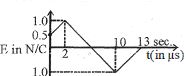
The electric field through an area of $2 \ m^2$ varies with time as shown in the graph. The greatest displacement current through the area is at $t = ..... \ \mu s$.
A
$1$
B
$4$
C
$8$
D
$12$
Solution
(D) The displacement current is given by the formula $I_d = \epsilon_0 A \frac{dE}{dt}$.
Since $\epsilon_0$ and $A$ are constants, the displacement current $I_d$ is directly proportional to the rate of change of the electric field, i.e., the slope of the $E-t$ graph $(\frac{dE}{dt})$.
We calculate the slope $(\frac{dE}{dt})$ for different intervals:
$1$. For $t = 0$ to $2 \ \mu s$: Slope = $\frac{1.0 - 0.5}{2 - 0} = 0.25 \ (N/C)/\mu s$.
$2$. For $t = 2$ to $10 \ \mu s$: Slope = $\frac{-1.0 - 1.0}{10 - 2} = \frac{-2.0}{8} = -0.25 \ (N/C)/\mu s$.
$3$. For $t = 10$ to $13 \ \mu s$: Slope = $\frac{0 - (-1.0)}{13 - 10} = \frac{1.0}{3} \approx 0.33 \ (N/C)/\mu s$.
The magnitude of the slope is greatest in the interval $t = 10$ to $13 \ \mu s$, where the slope is $0.33$. Among the given options, $t = 12 \ \mu s$ lies within this interval.
Since $\epsilon_0$ and $A$ are constants, the displacement current $I_d$ is directly proportional to the rate of change of the electric field, i.e., the slope of the $E-t$ graph $(\frac{dE}{dt})$.
We calculate the slope $(\frac{dE}{dt})$ for different intervals:
$1$. For $t = 0$ to $2 \ \mu s$: Slope = $\frac{1.0 - 0.5}{2 - 0} = 0.25 \ (N/C)/\mu s$.
$2$. For $t = 2$ to $10 \ \mu s$: Slope = $\frac{-1.0 - 1.0}{10 - 2} = \frac{-2.0}{8} = -0.25 \ (N/C)/\mu s$.
$3$. For $t = 10$ to $13 \ \mu s$: Slope = $\frac{0 - (-1.0)}{13 - 10} = \frac{1.0}{3} \approx 0.33 \ (N/C)/\mu s$.
The magnitude of the slope is greatest in the interval $t = 10$ to $13 \ \mu s$, where the slope is $0.33$. Among the given options, $t = 12 \ \mu s$ lies within this interval.
0 likes
View Solution23
MediumMCQ
Choose the $CORRECT$ expression for the Ampere-Maxwell law.
A
$\oint \vec{E} \cdot d\vec{l} = \mu_0 \epsilon_0 \frac{d\phi_E}{dt} + \mu_0 i_{\text{enclosed}}$
B
$\oint \vec{B} \cdot d\vec{l} = \mu_0 \epsilon_0 \frac{d\phi_B}{dt} + \mu_0 i_{\text{enclosed}}$
C
$\oint \vec{E} \cdot d\vec{l} = \mu_0 \epsilon_0 \frac{d\phi_E}{dt} - \mu_0 i_{\text{enclosed}}$
D
$\oint \vec{B} \cdot d\vec{l} = \mu_0 \epsilon_0 \frac{d\phi_E}{dt} + \mu_0 i_{\text{enclosed}}$
Solution
(D) The Ampere-Maxwell law is a modification of Ampere's circuital law to include the displacement current,which accounts for time-varying electric fields.
The generalized Ampere-Maxwell law is given by:
$\oint \vec{B} \cdot d\vec{l} = \mu_0 i_c + \mu_0 \epsilon_0 \frac{d\phi_E}{dt}$
Where:
$1. \oint \vec{B} \cdot d\vec{l}$ is the line integral of the magnetic field around a closed loop.
$2. i_c$ is the conduction current.
$3. \epsilon_0 \frac{d\phi_E}{dt}$ is the displacement current $(i_d)$.
Thus,the expression is $\oint \vec{B} \cdot d\vec{l} = \mu_0 i_{\text{enclosed}} + \mu_0 \epsilon_0 \frac{d\phi_E}{dt}$.
The generalized Ampere-Maxwell law is given by:
$\oint \vec{B} \cdot d\vec{l} = \mu_0 i_c + \mu_0 \epsilon_0 \frac{d\phi_E}{dt}$
Where:
$1. \oint \vec{B} \cdot d\vec{l}$ is the line integral of the magnetic field around a closed loop.
$2. i_c$ is the conduction current.
$3. \epsilon_0 \frac{d\phi_E}{dt}$ is the displacement current $(i_d)$.
Thus,the expression is $\oint \vec{B} \cdot d\vec{l} = \mu_0 i_{\text{enclosed}} + \mu_0 \epsilon_0 \frac{d\phi_E}{dt}$.
0 likes
View Solution24
MediumMCQ
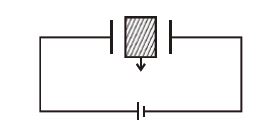
An insulator plate is passed between the plates of a capacitor. Then the displacement current
A
First flows anticlockwise and then clockwise
B
First flows clockwise then anticlockwise
C
Always flows clockwise
D
Always flows anticlockwise
Solution
(B) When an insulator (dielectric) plate enters the capacitor,the capacitance $C$ increases because $C = \frac{K \epsilon_0 A}{d}$.
Since the capacitor is connected to a battery,the potential difference $V$ remains constant.
The charge on the capacitor $Q = CV$ increases as the plate enters.
This increase in charge requires a current to flow from the battery to the capacitor plates,which corresponds to a charging current in the external circuit.
Inside the capacitor,the displacement current $I_d$ is equal to the conduction current in the external circuit,so it flows in the direction that supports the charging process (clockwise).
As the insulator plate leaves the capacitor,the capacitance $C$ decreases,causing the charge $Q$ on the capacitor to decrease.
This results in a discharge current flowing out of the capacitor,meaning the displacement current now flows in the opposite direction (anticlockwise).
Therefore,the displacement current first flows clockwise and then anticlockwise.
Since the capacitor is connected to a battery,the potential difference $V$ remains constant.
The charge on the capacitor $Q = CV$ increases as the plate enters.
This increase in charge requires a current to flow from the battery to the capacitor plates,which corresponds to a charging current in the external circuit.
Inside the capacitor,the displacement current $I_d$ is equal to the conduction current in the external circuit,so it flows in the direction that supports the charging process (clockwise).
As the insulator plate leaves the capacitor,the capacitance $C$ decreases,causing the charge $Q$ on the capacitor to decrease.
This results in a discharge current flowing out of the capacitor,meaning the displacement current now flows in the opposite direction (anticlockwise).
Therefore,the displacement current first flows clockwise and then anticlockwise.
0 likes
View Solution25
DifficultMCQ
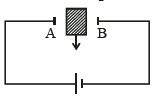
An insulator plate is passed between the plates of a capacitor. The displacement current
A
First flows from $A$ to $B$ and then from $B$ to $A$
B
First flows from $B$ to $A$ and then from $A$ to $B$
C
Always flows from $B$ to $A$
D
Always flows from $A$ to $B$
Solution
(A) When an insulator (dielectric) plate enters the capacitor,the capacitance $C$ increases. Since $Q = CV$,the charge on the plates increases. This increase in charge causes a change in the electric field between the plates. As the plate enters,the electric flux increases,leading to a displacement current in the direction of the electric field (from positive plate $A$ to negative plate $B$). As the plate leaves,the capacitance decreases,the charge decreases,and the electric flux decreases,causing the displacement current to flow in the opposite direction (from $B$ to $A$). Therefore,it first flows from $A$ to $B$ and then from $B$ to $A$.
0 likes
View Solution26
EasyMCQ
$A$ parallel plate capacitor is charged to $60\,\mu C$. Due to a radioactive source,the plate loses charge at the rate of $1.8 \times 10^{-8}\, C/s$. The magnitude of the displacement current is:
A
$1.8 \times 10^{-8}\, A$
B
$3.6 \times 10^{-8}\, A$
C
$1.1 \times 10^{-11}\, A$
D
$5.7 \times 10^{-12}\, A$
Solution
(A) The displacement current $I_d$ in a capacitor is defined as the rate of change of charge on the plates,which is equal to the conduction current $I_c$ flowing into the capacitor.
Mathematically,$I_d = I_c = \frac{dq}{dt}$.
Given that the rate of loss of charge is $\frac{dq}{dt} = 1.8 \times 10^{-8}\, C/s$.
Therefore,the magnitude of the displacement current is $I_d = 1.8 \times 10^{-8}\, A$.
Mathematically,$I_d = I_c = \frac{dq}{dt}$.
Given that the rate of loss of charge is $\frac{dq}{dt} = 1.8 \times 10^{-8}\, C/s$.
Therefore,the magnitude of the displacement current is $I_d = 1.8 \times 10^{-8}\, A$.
0 likes
View Solution27
EasyMCQ
$A$ cylindrical region contains a uniform electric field that is along the cylinder axis and is changing with time. If $r$ is the distance from the cylinder axis,the magnitude of the magnetic field within the region is:
A
uniform
B
proportional to $1/r$
C
proportional to $r^2$
D
proportional to $r$
Solution
(D) According to the Maxwell-Ampere law,the magnetic field $B$ induced by a time-varying electric field is given by the integral form: $\oint \vec{B} \cdot d\vec{l} = \mu_0 \epsilon_0 \frac{d\Phi_E}{dt}$.
For a cylindrical region of radius $R$ with a uniform electric field $E$ changing with time,we consider an Amperian loop of radius $r$ $(r < R)$ centered on the axis.
The electric flux through this loop is $\Phi_E = E \cdot \pi r^2$.
Substituting this into the Maxwell-Ampere law: $B(2\pi r) = \mu_0 \epsilon_0 \frac{d}{dt}(E \pi r^2)$.
Since $E$ is uniform in space,$\frac{dE}{dt}$ is constant with respect to $r$.
$B(2\pi r) = \mu_0 \epsilon_0 \pi r^2 \frac{dE}{dt}$.
Solving for $B$,we get $B = \frac{\mu_0 \epsilon_0 r}{2} \frac{dE}{dt}$.
Thus,the magnitude of the magnetic field $B$ is proportional to $r$.
For a cylindrical region of radius $R$ with a uniform electric field $E$ changing with time,we consider an Amperian loop of radius $r$ $(r < R)$ centered on the axis.
The electric flux through this loop is $\Phi_E = E \cdot \pi r^2$.
Substituting this into the Maxwell-Ampere law: $B(2\pi r) = \mu_0 \epsilon_0 \frac{d}{dt}(E \pi r^2)$.
Since $E$ is uniform in space,$\frac{dE}{dt}$ is constant with respect to $r$.
$B(2\pi r) = \mu_0 \epsilon_0 \pi r^2 \frac{dE}{dt}$.
Solving for $B$,we get $B = \frac{\mu_0 \epsilon_0 r}{2} \frac{dE}{dt}$.
Thus,the magnitude of the magnetic field $B$ is proportional to $r$.
0 likes
View Solution28
DifficultMCQ
To establish an instantaneous displacement current of $2\,A$ in the space between two parallel plates of a $1\,\mu F$ capacitor,the potential difference across the capacitor plates will have to be changed at the rate of:
A
$4 \times 10^4\,V/s$
B
$4 \times 10^6\,V/s$
C
$2 \times 10^4\,V/s$
D
$2 \times 10^6\,V/s$
Solution
(D) The displacement current $I_D$ in a capacitor is given by the formula $I_D = C \frac{dV}{dt}$,where $C$ is the capacitance and $\frac{dV}{dt}$ is the rate of change of potential difference.
Given,$I_D = 2\,A$ and $C = 1\,\mu F = 10^{-6}\,F$.
Substituting the values into the formula:
$2 = 10^{-6} \times \frac{dV}{dt}$
$\frac{dV}{dt} = \frac{2}{10^{-6}} = 2 \times 10^6\,V/s$.
Thus,the potential difference must be changed at the rate of $2 \times 10^6\,V/s$.
Given,$I_D = 2\,A$ and $C = 1\,\mu F = 10^{-6}\,F$.
Substituting the values into the formula:
$2 = 10^{-6} \times \frac{dV}{dt}$
$\frac{dV}{dt} = \frac{2}{10^{-6}} = 2 \times 10^6\,V/s$.
Thus,the potential difference must be changed at the rate of $2 \times 10^6\,V/s$.
0 likes
View Solution29
MediumMCQ
$A$ parallel plate capacitor of area $60\, cm^2$ and separation $3\, mm$ is charged initially to $90\, \mu C$. If the medium between the plates becomes slightly conducting and the plate loses the charge at the rate of $2.5\times10^{-8}\, C/s$,what is the magnetic field between the plates?
A
$2.5\times10^{-8}\, T$
B
$2.0\times10^{-7}\, T$
C
$1.63\times10^{-11}\, T$
D
Zero
Solution
(D) The magnetic field between the plates of a parallel plate capacitor is determined by the displacement current $I_d = \epsilon_0 \frac{d\Phi_E}{dt}$.
In this scenario,the medium between the plates is slightly conducting,which means there is a conduction current $I_c = -\frac{dq}{dt} = 2.5\times10^{-8}\, A$ flowing between the plates.
According to the modified Ampere-Maxwell law,the total current $I_{total} = I_c + I_d$ is the source of the magnetic field.
For a parallel plate capacitor,the conduction current $I_c$ and the displacement current $I_d$ are equal in magnitude but opposite in direction (or effectively cancel each other out in the context of the magnetic field generated between the plates in this specific idealized setup).
However,in a standard parallel plate capacitor where the plates are circular and the current is uniform,the magnetic field at a distance $r$ from the axis is given by $B = \frac{\mu_0 I r}{2\pi R^2}$.
Since the problem does not specify a radial distance $r$ and asks for the magnetic field 'between the plates' generally,and given the symmetry of the conduction current flowing through the medium,the magnetic field is zero at the center or if we consider the net current enclosed by an Amperian loop to be zero due to the continuity of current,the result is zero.
In this scenario,the medium between the plates is slightly conducting,which means there is a conduction current $I_c = -\frac{dq}{dt} = 2.5\times10^{-8}\, A$ flowing between the plates.
According to the modified Ampere-Maxwell law,the total current $I_{total} = I_c + I_d$ is the source of the magnetic field.
For a parallel plate capacitor,the conduction current $I_c$ and the displacement current $I_d$ are equal in magnitude but opposite in direction (or effectively cancel each other out in the context of the magnetic field generated between the plates in this specific idealized setup).
However,in a standard parallel plate capacitor where the plates are circular and the current is uniform,the magnetic field at a distance $r$ from the axis is given by $B = \frac{\mu_0 I r}{2\pi R^2}$.
Since the problem does not specify a radial distance $r$ and asks for the magnetic field 'between the plates' generally,and given the symmetry of the conduction current flowing through the medium,the magnetic field is zero at the center or if we consider the net current enclosed by an Amperian loop to be zero due to the continuity of current,the result is zero.
0 likes
View Solution30
EasyMCQ
Displacement current is given by
A
$\mu _0 \frac{d\phi _E}{dt}$
B
$\mu _0 \varepsilon _0 \frac{d\phi _E}{dt}$
C
$\varepsilon _0 \frac{d\phi _E}{dt}$
D
$\frac{1}{\varepsilon _0 \mu _0} \frac{d\phi _E}{dt}$
Solution
(C) The displacement current $(i_d)$ is a quantity that appears in the modified Ampere's law to account for the magnetic field produced by a time-varying electric field.
The formula for displacement current is defined as:
$i_d = \varepsilon_0 \frac{d\phi_E}{dt}$
Where:
$\varepsilon_0$ is the permittivity of free space.
$\phi_E$ is the electric flux.
$\frac{d\phi_E}{dt}$ is the rate of change of electric flux with respect to time.
The formula for displacement current is defined as:
$i_d = \varepsilon_0 \frac{d\phi_E}{dt}$
Where:
$\varepsilon_0$ is the permittivity of free space.
$\phi_E$ is the electric flux.
$\frac{d\phi_E}{dt}$ is the rate of change of electric flux with respect to time.
0 likes
View Solution31
DifficultMCQ
The charge on a parallel plate capacitor varies as $q = q_0 \cos(2\pi \nu t).$ The plates are very large and close together (area $= A,$ separation $= d$). The displacement current through the capacitor is
A
$q_0 \, 2\pi \nu \sin(2\pi \nu t)$
B
$-q_0 \, 2\pi \nu \sin(2\pi \nu t)$
C
$q_0 \, 2\pi \sin(\pi \nu t)$
D
$q_0 \, \pi \nu \sin(2\pi \nu t)$
Solution
(B) The displacement current $I_D$ in a capacitor is equal to the rate of change of charge on the plates,which is the conduction current $I_C$.
Given the charge $q = q_0 \cos(2\pi \nu t)$.
The displacement current is given by $I_D = \frac{dq}{dt}$.
$I_D = \frac{d}{dt} [q_0 \cos(2\pi \nu t)]$.
Using the chain rule for differentiation,$\frac{d}{dt} \cos(kt) = -k \sin(kt)$.
$I_D = q_0 \cdot (-2\pi \nu) \sin(2\pi \nu t)$.
$I_D = -q_0 \, 2\pi \nu \sin(2\pi \nu t)$.
Given the charge $q = q_0 \cos(2\pi \nu t)$.
The displacement current is given by $I_D = \frac{dq}{dt}$.
$I_D = \frac{d}{dt} [q_0 \cos(2\pi \nu t)]$.
Using the chain rule for differentiation,$\frac{d}{dt} \cos(kt) = -k \sin(kt)$.
$I_D = q_0 \cdot (-2\pi \nu) \sin(2\pi \nu t)$.
$I_D = -q_0 \, 2\pi \nu \sin(2\pi \nu t)$.
0 likes
View Solution32
EasyMCQ
Which of the following statements is true for displacement current?
A
It is due to drift of electrons in a conductor.
B
It is due to diffusion of electrons in a semiconductor.
C
It is due to change in electric flux with time.
D
It is due to change in magnetic flux with time.
Solution
(C) Displacement current $(I_d)$ is defined as the current that comes into existence in addition to the conduction current whenever the electric field and hence the electric flux changes with time. Mathematically, it is given by $I_d = \epsilon_0 \frac{d\Phi_E}{dt}$, where $\Phi_E$ is the electric flux. Therefore, it is due to the change in electric flux with time.
0 likes
View Solution33
MediumMCQ
At what rate must the potential difference between the plates of a capacitor be changed to set up a displacement current of $1 \, A$ in a capacitor of $2 \, \mu F$?
A
$10^{6} \, V/s$
B
$0.5 \times 10^{6} \, V/s$
C
$10^{-6} \, V/s$
D
$0.5 \times 10^{-6} \, V/s$
Solution
(B) The displacement current $I_D$ in a capacitor is given by the formula $I_D = C \frac{dV}{dt}$,where $C$ is the capacitance and $\frac{dV}{dt}$ is the rate of change of potential difference.
Given: $I_D = 1 \, A$ and $C = 2 \, \mu F = 2 \times 10^{-6} \, F$.
Substituting the values into the equation: $1 = (2 \times 10^{-6}) \times \frac{dV}{dt}$.
Solving for $\frac{dV}{dt}$: $\frac{dV}{dt} = \frac{1}{2 \times 10^{-6}} = 0.5 \times 10^{6} \, V/s$.
Given: $I_D = 1 \, A$ and $C = 2 \, \mu F = 2 \times 10^{-6} \, F$.
Substituting the values into the equation: $1 = (2 \times 10^{-6}) \times \frac{dV}{dt}$.
Solving for $\frac{dV}{dt}$: $\frac{dV}{dt} = \frac{1}{2 \times 10^{-6}} = 0.5 \times 10^{6} \, V/s$.
0 likes
View Solution34
EasyMCQ
Assertion : Dipole oscillations produce electromagnetic waves.
Reason : Accelerated charge produces electromagnetic waves.
Reason : Accelerated charge produces electromagnetic waves.
A
If both Assertion and Reason are correct and the Reason is a correct explanation of the Assertion.
B
If both Assertion and Reason are correct but Reason is not a correct explanation of the Assertion.
C
If the Assertion is correct but Reason is incorrect.
D
If both the Assertion and Reason are incorrect.
Solution
(A) An oscillating electric dipole consists of charges that are accelerating.
According to the fundamental principles of electromagnetism,an accelerated charge acts as a source of electromagnetic waves.
Since the charges in a dipole oscillation are undergoing acceleration,they necessarily produce electromagnetic waves.
Therefore,the Reason correctly explains why the Assertion is true.
According to the fundamental principles of electromagnetism,an accelerated charge acts as a source of electromagnetic waves.
Since the charges in a dipole oscillation are undergoing acceleration,they necessarily produce electromagnetic waves.
Therefore,the Reason correctly explains why the Assertion is true.
0 likes
View Solution35
MediumMCQ
$A$ parallel plate capacitor of capacitance $20 \; \mu F$ is being charged by a voltage source whose potential is changing at the rate of $3 \; V/s$. The conduction current through the connecting wires, and the displacement current through the plates of the capacitor, would be, respectively:
A
$0 \; \mu A, 60 \; \mu A$
B
$60 \; \mu A, 60 \; \mu A$
C
$60 \; \mu A, 0 \; \mu A$
D
$0 \; \mu A, 0 \; \mu A$
Solution
(B) The charge $Q$ on a capacitor is given by $Q = CV$, where $C$ is the capacitance and $V$ is the potential difference.
The conduction current $i_c$ in the connecting wires is the rate of change of charge: $i_c = \frac{dQ}{dt} = C \frac{dV}{dt}$.
Given $C = 20 \; \mu F$ and $\frac{dV}{dt} = 3 \; V/s$, we have $i_c = 20 \; \mu F \times 3 \; V/s = 60 \; \mu A$.
According to Maxwell's modification of Ampere's law, the displacement current $i_d$ between the plates of a capacitor is equal to the conduction current in the connecting wires.
Therefore, $i_d = i_c = 60 \; \mu A$.
Thus, the conduction current is $60 \; \mu A$ and the displacement current is $60 \; \mu A$.
The conduction current $i_c$ in the connecting wires is the rate of change of charge: $i_c = \frac{dQ}{dt} = C \frac{dV}{dt}$.
Given $C = 20 \; \mu F$ and $\frac{dV}{dt} = 3 \; V/s$, we have $i_c = 20 \; \mu F \times 3 \; V/s = 60 \; \mu A$.
According to Maxwell's modification of Ampere's law, the displacement current $i_d$ between the plates of a capacitor is equal to the conduction current in the connecting wires.
Therefore, $i_d = i_c = 60 \; \mu A$.
Thus, the conduction current is $60 \; \mu A$ and the displacement current is $60 \; \mu A$.
0 likes
View Solution36
Medium
Describe the research conducted by scientists regarding electricity and magnetism following Oersted's observation.
Solution
(N/A) Following Oersted's observation, scientists conducted significant research:
In $1864$, the laws governing electricity and magnetism were unified and formulated by James Clerk Maxwell, who subsequently realized that light consists of electromagnetic waves.
Radio waves were discovered by Heinrich Hertz and were later produced by $J. C. Bose$ and $G. Marconi$ by the end of the $19^{th}$ century.
A remarkable scientific and technological progress occurred in the $20^{th}$ century, primarily due to an increased understanding of electromagnetism and the invention of devices for the production, amplification, transmission, and detection of electromagnetic waves.
In $1864$, the laws governing electricity and magnetism were unified and formulated by James Clerk Maxwell, who subsequently realized that light consists of electromagnetic waves.
Radio waves were discovered by Heinrich Hertz and were later produced by $J. C. Bose$ and $G. Marconi$ by the end of the $19^{th}$ century.
A remarkable scientific and technological progress occurred in the $20^{th}$ century, primarily due to an increased understanding of electromagnetism and the invention of devices for the production, amplification, transmission, and detection of electromagnetic waves.
0 likes
View Solution37
MediumMCQ
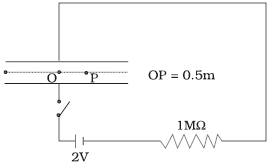
$A$ parallel plate capacitor with circular plates of radius $1\, m$ has a capacitance of $1 \;nF$. At $t=0,$ it is connected for charging in series with a resistor $R=1 \;M \Omega$ across a $2 \;V$ battery (Figure). Calculate the magnetic field at a point $P$,halfway between the centre and the periphery of the plates,after $t=10^{-3}\; s$.
(The charge on the capacitor at time $t$ is $q(t)=C V[1-\exp (-t / \tau)],$ where the time constant $\tau$ is equal to $C R .$ )
(The charge on the capacitor at time $t$ is $q(t)=C V[1-\exp (-t / \tau)],$ where the time constant $\tau$ is equal to $C R .$ )
A
$B=0.74 \times 10^{-13}\; T$
B
$B=2.64 \times 10^{-10}\; T$
C
$B=4.96 \times 10^{-14}\; T$
D
$B=9.64 \times 10^{-15}\; T$
Solution
(A) The time constant of the $CR$ circuit is $\tau = CR = (10^{-9} \; F) \times (10^6 \; \Omega) = 10^{-3} \; s$.
The charge on the capacitor at time $t$ is $q(t) = CV[1 - \exp(-t/\tau)] = (10^{-9} \; F)(2 \; V)[1 - \exp(-t/10^{-3})] = 2 \times 10^{-9} [1 - \exp(-t/10^{-3})] \; C$.
The electric field $E$ between the plates is $E = \frac{q(t)}{\varepsilon_0 A}$,where $A = \pi r_0^2 = \pi(1)^2 = \pi \; m^2$.
Consider a circular loop of radius $r = 0.5 \; m$ passing through point $P$. The electric flux through this loop is $\Phi_E = E \times (\pi r^2) = \frac{q(t)}{\varepsilon_0 A} \times (\pi r^2) = \frac{q(t)}{\varepsilon_0 \pi} \times \pi (0.5)^2 = \frac{q(t)}{4 \varepsilon_0}$.
The displacement current $i_d$ is $i_d = \varepsilon_0 \frac{d\Phi_E}{dt} = \varepsilon_0 \frac{d}{dt} \left( \frac{q(t)}{4 \varepsilon_0} \right) = \frac{1}{4} \frac{dq}{dt}$.
Since $\frac{dq}{dt} = \frac{d}{dt} [CV(1 - e^{-t/\tau})] = \frac{CV}{\tau} e^{-t/\tau} = \frac{V}{R} e^{-t/\tau}$,at $t = 10^{-3} \; s$ (which is $t = \tau$),$\frac{dq}{dt} = \frac{2 \; V}{10^6 \; \Omega} e^{-1} = 2 \times 10^{-6} e^{-1} \; A$.
Thus,$i_d = \frac{1}{4} (2 \times 10^{-6} e^{-1}) = 0.5 \times 10^{-6} e^{-1} \; A$.
Using the Ampere-Maxwell law,$\oint B \cdot dl = \mu_0 i_d \implies B(2 \pi r) = \mu_0 i_d$.
$B = \frac{\mu_0 i_d}{2 \pi (0.5)} = \frac{\mu_0 i_d}{\pi} = \frac{4 \pi \times 10^{-7} \times 0.5 \times 10^{-6} \times e^{-1}}{\pi} = 2 \times 10^{-13} \times e^{-1} \; T$.
Using $e^{-1} \approx 0.3678$,$B \approx 2 \times 10^{-13} \times 0.3678 \approx 0.7356 \times 10^{-13} \; T \approx 0.74 \times 10^{-13} \; T$.
The charge on the capacitor at time $t$ is $q(t) = CV[1 - \exp(-t/\tau)] = (10^{-9} \; F)(2 \; V)[1 - \exp(-t/10^{-3})] = 2 \times 10^{-9} [1 - \exp(-t/10^{-3})] \; C$.
The electric field $E$ between the plates is $E = \frac{q(t)}{\varepsilon_0 A}$,where $A = \pi r_0^2 = \pi(1)^2 = \pi \; m^2$.
Consider a circular loop of radius $r = 0.5 \; m$ passing through point $P$. The electric flux through this loop is $\Phi_E = E \times (\pi r^2) = \frac{q(t)}{\varepsilon_0 A} \times (\pi r^2) = \frac{q(t)}{\varepsilon_0 \pi} \times \pi (0.5)^2 = \frac{q(t)}{4 \varepsilon_0}$.
The displacement current $i_d$ is $i_d = \varepsilon_0 \frac{d\Phi_E}{dt} = \varepsilon_0 \frac{d}{dt} \left( \frac{q(t)}{4 \varepsilon_0} \right) = \frac{1}{4} \frac{dq}{dt}$.
Since $\frac{dq}{dt} = \frac{d}{dt} [CV(1 - e^{-t/\tau})] = \frac{CV}{\tau} e^{-t/\tau} = \frac{V}{R} e^{-t/\tau}$,at $t = 10^{-3} \; s$ (which is $t = \tau$),$\frac{dq}{dt} = \frac{2 \; V}{10^6 \; \Omega} e^{-1} = 2 \times 10^{-6} e^{-1} \; A$.
Thus,$i_d = \frac{1}{4} (2 \times 10^{-6} e^{-1}) = 0.5 \times 10^{-6} e^{-1} \; A$.
Using the Ampere-Maxwell law,$\oint B \cdot dl = \mu_0 i_d \implies B(2 \pi r) = \mu_0 i_d$.
$B = \frac{\mu_0 i_d}{2 \pi (0.5)} = \frac{\mu_0 i_d}{\pi} = \frac{4 \pi \times 10^{-7} \times 0.5 \times 10^{-6} \times e^{-1}}{\pi} = 2 \times 10^{-13} \times e^{-1} \; T$.
Using $e^{-1} \approx 0.3678$,$B \approx 2 \times 10^{-13} \times 0.3678 \approx 0.7356 \times 10^{-13} \; T \approx 0.74 \times 10^{-13} \; T$.
0 likes
View Solution38
Medium
The figure shows a capacitor made of two circular plates,each of radius $12 \; cm$,separated by $5.0 \; cm$. The capacitor is being charged by an external source (not shown in the figure). The charging current is constant and equal to $0.15 \; A$.
$(a)$ Calculate the capacitance and the rate of change of potential difference between the plates.
$(b)$ Obtain the displacement current across the plates.
$(c)$ Is Kirchhoff's first rule (junction rule) valid at each plate of the capacitor? Explain.
$(a)$ Calculate the capacitance and the rate of change of potential difference between the plates.
$(b)$ Obtain the displacement current across the plates.
$(c)$ Is Kirchhoff's first rule (junction rule) valid at each plate of the capacitor? Explain.
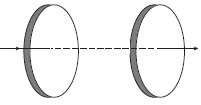
Solution
(N/A) Radius of each circular plate,$r = 12 \; cm = 0.12 \; m$
Distance between the plates,$d = 5 \; cm = 0.05 \; m$
Charging current,$I = 0.15 \; A$
Permittivity of free space,$\varepsilon_{0} = 8.85 \times 10^{-12} \; C^{2} \; N^{-1} \; m^{-2}$
$(a)$ Capacitance $C$ is given by $C = \frac{\varepsilon_{0} A}{d}$,where $A = \pi r^{2}$.
$C = \frac{8.85 \times 10^{-12} \times \pi \times (0.12)^{2}}{0.05} \approx 8.0032 \times 10^{-12} \; F = 80.032 \; pF$.
Since $q = CV$,differentiating with respect to time gives $\frac{dq}{dt} = C \frac{dV}{dt}$.
Given $\frac{dq}{dt} = I$,we have $\frac{dV}{dt} = \frac{I}{C} = \frac{0.15}{80.032 \times 10^{-12}} \approx 1.87 \times 10^{9} \; V/s$.
$(b)$ The displacement current $i_{d}$ between the plates is equal to the conduction current $I$ in the connecting wires. Thus,$i_{d} = 0.15 \; A$.
$(c)$ Yes,Kirchhoff's first rule is valid at each plate of the capacitor if we consider the total current as the sum of conduction current and displacement current.
Distance between the plates,$d = 5 \; cm = 0.05 \; m$
Charging current,$I = 0.15 \; A$
Permittivity of free space,$\varepsilon_{0} = 8.85 \times 10^{-12} \; C^{2} \; N^{-1} \; m^{-2}$
$(a)$ Capacitance $C$ is given by $C = \frac{\varepsilon_{0} A}{d}$,where $A = \pi r^{2}$.
$C = \frac{8.85 \times 10^{-12} \times \pi \times (0.12)^{2}}{0.05} \approx 8.0032 \times 10^{-12} \; F = 80.032 \; pF$.
Since $q = CV$,differentiating with respect to time gives $\frac{dq}{dt} = C \frac{dV}{dt}$.
Given $\frac{dq}{dt} = I$,we have $\frac{dV}{dt} = \frac{I}{C} = \frac{0.15}{80.032 \times 10^{-12}} \approx 1.87 \times 10^{9} \; V/s$.
$(b)$ The displacement current $i_{d}$ between the plates is equal to the conduction current $I$ in the connecting wires. Thus,$i_{d} = 0.15 \; A$.
$(c)$ Yes,Kirchhoff's first rule is valid at each plate of the capacitor if we consider the total current as the sum of conduction current and displacement current.
0 likes
View Solution39
Medium
$A$ parallel plate capacitor (Figure) made of circular plates each of radius $R=6.0\; cm$ has a capacitance $C=100\; pF$. The capacitor is connected to a $230\; V$ ac supply with a (angular) frequency of $300 \;rad \;s ^{-1}$.
$(a)$ What is the rms value of the conduction current?
$(b)$ Is the conduction current equal to the displacement current?
$(c)$ Determine the amplitude of $B$ at a point $3.0\; cm$ from the axis between the plates.
$(a)$ What is the rms value of the conduction current?
$(b)$ Is the conduction current equal to the displacement current?
$(c)$ Determine the amplitude of $B$ at a point $3.0\; cm$ from the axis between the plates.
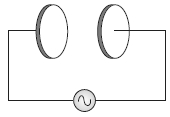
Solution
(N/A) Radius of each circular plate,$R = 6.0 \; cm = 0.06 \; m$
Capacitance of a parallel plate capacitor,$C = 100 \; pF = 100 \times 10^{-12} \; F$
Supply voltage,$V = 230 \; V$
Angular frequency,$\omega = 300 \; rad \; s^{-1}$
$(a)$ The rms value of conduction current is given by $I = \frac{V}{X_C}$,where $X_C = \frac{1}{\omega C}$ is the capacitive reactance.
Therefore,$I = V \omega C = 230 \times 300 \times 100 \times 10^{-12} \; A = 6.9 \times 10^{-6} \; A = 6.9 \; \mu A$.
$(b)$ Yes,the conduction current is equal to the displacement current in the circuit.
$(c)$ The magnetic field $B$ at a distance $r$ from the axis between the plates is given by $B = \frac{\mu_0 r}{2 \pi R^2} I_0$,where $I_0 = \sqrt{2} I$ is the peak current.
Given $r = 3.0 \; cm = 0.03 \; m$ and $\mu_0 = 4 \pi \times 10^{-7} \; T \; m \; A^{-1}$.
$B = \frac{4 \pi \times 10^{-7} \times 0.03 \times \sqrt{2} \times 6.9 \times 10^{-6}}{2 \pi \times (0.06)^2} \approx 1.63 \times 10^{-11} \; T$.
Capacitance of a parallel plate capacitor,$C = 100 \; pF = 100 \times 10^{-12} \; F$
Supply voltage,$V = 230 \; V$
Angular frequency,$\omega = 300 \; rad \; s^{-1}$
$(a)$ The rms value of conduction current is given by $I = \frac{V}{X_C}$,where $X_C = \frac{1}{\omega C}$ is the capacitive reactance.
Therefore,$I = V \omega C = 230 \times 300 \times 100 \times 10^{-12} \; A = 6.9 \times 10^{-6} \; A = 6.9 \; \mu A$.
$(b)$ Yes,the conduction current is equal to the displacement current in the circuit.
$(c)$ The magnetic field $B$ at a distance $r$ from the axis between the plates is given by $B = \frac{\mu_0 r}{2 \pi R^2} I_0$,where $I_0 = \sqrt{2} I$ is the peak current.
Given $r = 3.0 \; cm = 0.03 \; m$ and $\mu_0 = 4 \pi \times 10^{-7} \; T \; m \; A^{-1}$.
$B = \frac{4 \pi \times 10^{-7} \times 0.03 \times \sqrt{2} \times 6.9 \times 10^{-6}}{2 \pi \times (0.06)^2} \approx 1.63 \times 10^{-11} \; T$.
0 likes
View Solution40
EasyMCQ
What suggestion was made to correct the discrepancies in Ampere's circuital law?
A
Introduction of conduction current
B
Introduction of displacement current
C
Introduction of induced $EMF$
D
Introduction of magnetic flux
Solution
(B) Ampere's circuital law,in its original form,states that $\oint \vec{B} \cdot d\vec{l} = \mu_0 I_c$,where $I_c$ is the conduction current.
Maxwell observed that this law was inconsistent for non-steady currents,such as in a charging capacitor,where the current is not continuous through the dielectric.
To resolve this discrepancy,Maxwell proposed that a time-varying electric field acts as a source of magnetic field,similar to how a conduction current does.
He introduced a new term called 'displacement current' $(I_d = \epsilon_0 \frac{d\Phi_E}{dt})$.
Thus,the modified Ampere-Maxwell law is given by $\oint \vec{B} \cdot d\vec{l} = \mu_0 (I_c + I_d)$.
Maxwell observed that this law was inconsistent for non-steady currents,such as in a charging capacitor,where the current is not continuous through the dielectric.
To resolve this discrepancy,Maxwell proposed that a time-varying electric field acts as a source of magnetic field,similar to how a conduction current does.
He introduced a new term called 'displacement current' $(I_d = \epsilon_0 \frac{d\Phi_E}{dt})$.
Thus,the modified Ampere-Maxwell law is given by $\oint \vec{B} \cdot d\vec{l} = \mu_0 (I_c + I_d)$.
0 likes
View Solution41
Medium
What are Maxwell's equations? Write these equations.
Solution
(N/A) Maxwell's equations are a set of four fundamental equations that describe how electric and magnetic fields are generated by charges,currents,and by each other. These equations are as follows:
$(1)$ Gauss's Law for Electricity: $\oint \overrightarrow{E} \cdot d\overrightarrow{A} = \frac{Q}{\epsilon_{0}}$
$(2)$ Gauss's Law for Magnetism: $\oint \overrightarrow{B} \cdot d\overrightarrow{A} = 0$
$(3)$ Faraday's Law of Induction: $\oint \overrightarrow{E} \cdot d\overrightarrow{l} = -\frac{d\Phi_{B}}{dt}$
$(4)$ Ampere-Maxwell Law: $\oint \overrightarrow{B} \cdot d\overrightarrow{l} = \mu_{0} i_{C} + \mu_{0} \epsilon_{0} \frac{d\Phi_{E}}{dt}$
By using these equations along with the Lorentz force law,all basic principles of electromagnetism can be mathematically represented.
$(1)$ Gauss's Law for Electricity: $\oint \overrightarrow{E} \cdot d\overrightarrow{A} = \frac{Q}{\epsilon_{0}}$
$(2)$ Gauss's Law for Magnetism: $\oint \overrightarrow{B} \cdot d\overrightarrow{A} = 0$
$(3)$ Faraday's Law of Induction: $\oint \overrightarrow{E} \cdot d\overrightarrow{l} = -\frac{d\Phi_{B}}{dt}$
$(4)$ Ampere-Maxwell Law: $\oint \overrightarrow{B} \cdot d\overrightarrow{l} = \mu_{0} i_{C} + \mu_{0} \epsilon_{0} \frac{d\Phi_{E}}{dt}$
By using these equations along with the Lorentz force law,all basic principles of electromagnetism can be mathematically represented.
0 likes
View Solution42
Medium
Write inferences from Maxwell's equations.
Solution
(N/A) The most significant inference from Maxwell's equations is the existence of electromagnetic waves,which represent the coupled propagation of time-varying electric and magnetic fields in space.
Due to the propagation of these time-varying fields,electromagnetic waves are generated that travel through space at the speed of light,which is $c = 3 \times 10^{8} \text{ m/s}$.
Thus,Maxwell established a fundamental relationship between electric,magnetic,and optical phenomena.
In $1887$,the scientist Heinrich Hertz experimentally produced electromagnetic waves in the laboratory,confirming Maxwell's theoretical predictions. The subsequent application of this technology revolutionized modern communication systems.
Due to the propagation of these time-varying fields,electromagnetic waves are generated that travel through space at the speed of light,which is $c = 3 \times 10^{8} \text{ m/s}$.
Thus,Maxwell established a fundamental relationship between electric,magnetic,and optical phenomena.
In $1887$,the scientist Heinrich Hertz experimentally produced electromagnetic waves in the laboratory,confirming Maxwell's theoretical predictions. The subsequent application of this technology revolutionized modern communication systems.
0 likes
View Solution43
MediumMCQ
According to Maxwell,which is the missing term in Maxwell-Ampere circuital law?
A
Displacement current
B
Conduction current
C
Induced current
D
Eddy current
Solution
(A) The original Ampere's circuital law is given by $\oint B \cdot dl = \mu_0 I_c$,where $I_c$ is the conduction current.
Maxwell observed that this law was inconsistent for non-steady currents,such as in a charging capacitor.
He proposed that a changing electric field creates a current,which he called the displacement current,denoted by $I_d = \epsilon_0 \frac{d\phi_E}{dt}$.
Thus,the modified Maxwell-Ampere law is $\oint B \cdot dl = \mu_0 (I_c + I_d)$.
Therefore,the missing term identified by Maxwell is the displacement current.
Maxwell observed that this law was inconsistent for non-steady currents,such as in a charging capacitor.
He proposed that a changing electric field creates a current,which he called the displacement current,denoted by $I_d = \epsilon_0 \frac{d\phi_E}{dt}$.
Thus,the modified Maxwell-Ampere law is $\oint B \cdot dl = \mu_0 (I_c + I_d)$.
Therefore,the missing term identified by Maxwell is the displacement current.
0 likes
View Solution44
EasyMCQ
Which equations are called Maxwell's equations?
A
Gauss's law for electricity,Gauss's law for magnetism,Faraday's law of induction,and Ampere-Maxwell law.
B
Newton's laws of motion and Maxwell's equations.
C
Schrodinger's equation and Maxwell's equations.
D
Einstein's mass-energy equivalence and Maxwell's equations.
Solution
(A) Maxwell's equations are a set of four fundamental equations that describe how electric and magnetic fields are generated by charges,currents,and by each other. These are:
$1$. Gauss's Law for Electricity: $\oint E \cdot dA = \frac{q_{enclosed}}{\epsilon_0}$
$2$. Gauss's Law for Magnetism: $\oint B \cdot dA = 0$
$3$. Faraday's Law of Induction: $\oint E \cdot dl = -\frac{d\Phi_B}{dt}$
$4$. Ampere-Maxwell Law: $\oint B \cdot dl = \mu_0 I_{enclosed} + \mu_0 \epsilon_0 \frac{d\Phi_E}{dt}$
Therefore,the correct option is $A$.
$1$. Gauss's Law for Electricity: $\oint E \cdot dA = \frac{q_{enclosed}}{\epsilon_0}$
$2$. Gauss's Law for Magnetism: $\oint B \cdot dA = 0$
$3$. Faraday's Law of Induction: $\oint E \cdot dl = -\frac{d\Phi_B}{dt}$
$4$. Ampere-Maxwell Law: $\oint B \cdot dl = \mu_0 I_{enclosed} + \mu_0 \epsilon_0 \frac{d\Phi_E}{dt}$
Therefore,the correct option is $A$.
0 likes
View Solution45
MediumMCQ
Who obtained electromagnetic waves for the first time in the laboratory?
A
James Clerk Maxwell
B
Heinrich Hertz
C
Jagadish Chandra Bose
D
Guglielmo Marconi
Solution
(B) In $1887$,the German physicist $Heinrich \text{ } Hertz$ successfully generated and detected electromagnetic waves in the laboratory for the first time. This experiment confirmed the theoretical predictions made by $James \text{ } Clerk \text{ } Maxwell$ regarding the existence of electromagnetic waves and their propagation at the speed of light.
0 likes
View Solution46
Medium
"Changing electric field produces magnetic field". Explain the importance of the given statement.
Solution
(N/A) Maxwell logically demonstrated that a changing electric field induces a magnetic field. This phenomenon is of fundamental importance in physics.
Historically, the connection between electricity and magnetism was first observed by Oersted, who showed that a current-carrying wire produces a magnetic field.
This phenomenon is crucial for explaining the existence and propagation of electromagnetic waves, including radio waves, gamma rays, and visible light.
Specifically, the production of a magnetic field by a changing electric field is mathematically described by the displacement current term added to Ampere's circuital law, which is essential for understanding the charging of a capacitor.
Historically, the connection between electricity and magnetism was first observed by Oersted, who showed that a current-carrying wire produces a magnetic field.
This phenomenon is crucial for explaining the existence and propagation of electromagnetic waves, including radio waves, gamma rays, and visible light.
Specifically, the production of a magnetic field by a changing electric field is mathematically described by the displacement current term added to Ampere's circuital law, which is essential for understanding the charging of a capacitor.
0 likes
View Solution47
Medium
What contradiction is found by using Ampere's circuital law to obtain the magnetic field during the charging of a capacitor?
Solution
(N/A) When applying Ampere's circuital law to a loop enclosing a charging capacitor, we encounter a contradiction.
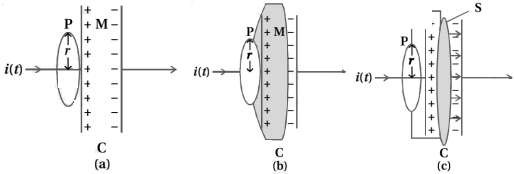
Consider a loop of radius $r$ outside the capacitor plates as shown in figure $(a)$. Applying Ampere's circuital law gives $\oint \vec{B} \cdot d\vec{l} = \mu_0 i(t)$, which yields a non-zero magnetic field $B = \frac{\mu_0 i(t)}{2\pi r}$.
Now, consider a surface bounded by the same loop but passing through the region between the capacitor plates, as shown in figures $(b)$ and $(c)$. Since there is no conduction current flowing between the plates, the current enclosed by this surface is zero $(\sum I = 0)$.
Applying Ampere's circuital law to this surface gives $\oint \vec{B} \cdot d\vec{l} = \mu_0 (0) = 0$, which implies $B = 0$.
This is a contradiction because the magnetic field at the same point $P$ cannot be both non-zero and zero. This inconsistency led Maxwell to propose the existence of displacement current $i_d = \epsilon_0 \frac{d\Phi_E}{dt}$ to complete the law.
Consider a loop of radius $r$ outside the capacitor plates as shown in figure $(a)$. Applying Ampere's circuital law gives $\oint \vec{B} \cdot d\vec{l} = \mu_0 i(t)$, which yields a non-zero magnetic field $B = \frac{\mu_0 i(t)}{2\pi r}$.
Now, consider a surface bounded by the same loop but passing through the region between the capacitor plates, as shown in figures $(b)$ and $(c)$. Since there is no conduction current flowing between the plates, the current enclosed by this surface is zero $(\sum I = 0)$.
Applying Ampere's circuital law to this surface gives $\oint \vec{B} \cdot d\vec{l} = \mu_0 (0) = 0$, which implies $B = 0$.
This is a contradiction because the magnetic field at the same point $P$ cannot be both non-zero and zero. This inconsistency led Maxwell to propose the existence of displacement current $i_d = \epsilon_0 \frac{d\Phi_E}{dt}$ to complete the law.
0 likes
View Solution48
Difficult
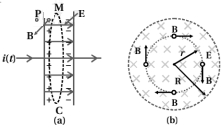
Derive the expression for the displacement current term in the modified Ampere's circuital law. Define displacement current and state its $SI$ unit.
Solution
(N/A) Ampere's circuital law states that $\oint \vec{B} \cdot d\vec{l} = \mu_0 I$. However,this law is inconsistent for time-varying electric fields,such as inside a charging capacitor.
Consider a parallel plate capacitor with plate area $A$ and charge $Q$. The electric field $E$ between the plates is given by $E = \frac{\sigma}{\epsilon_0} = \frac{Q}{A \epsilon_0}$.
The electric flux $\Phi_E$ through a surface $A$ inside the capacitor is $\Phi_E = E A = \left( \frac{Q}{A \epsilon_0} \right) A = \frac{Q}{\epsilon_0}$.
Therefore,$Q = \epsilon_0 \Phi_E$.
Differentiating with respect to time $t$,we get $\frac{dQ}{dt} = \epsilon_0 \frac{d\Phi_E}{dt}$.
Since the conduction current $I_c = \frac{dQ}{dt}$,we define the displacement current $I_d$ as $I_d = \epsilon_0 \frac{d\Phi_E}{dt}$.
Definition: Displacement current is the current that arises due to the time-varying electric field in a region,even in the absence of actual charge carriers.
$SI$ Unit: The $SI$ unit of displacement current is the Ampere $(A)$.
Consider a parallel plate capacitor with plate area $A$ and charge $Q$. The electric field $E$ between the plates is given by $E = \frac{\sigma}{\epsilon_0} = \frac{Q}{A \epsilon_0}$.
The electric flux $\Phi_E$ through a surface $A$ inside the capacitor is $\Phi_E = E A = \left( \frac{Q}{A \epsilon_0} \right) A = \frac{Q}{\epsilon_0}$.
Therefore,$Q = \epsilon_0 \Phi_E$.
Differentiating with respect to time $t$,we get $\frac{dQ}{dt} = \epsilon_0 \frac{d\Phi_E}{dt}$.
Since the conduction current $I_c = \frac{dQ}{dt}$,we define the displacement current $I_d$ as $I_d = \epsilon_0 \frac{d\Phi_E}{dt}$.
Definition: Displacement current is the current that arises due to the time-varying electric field in a region,even in the absence of actual charge carriers.
$SI$ Unit: The $SI$ unit of displacement current is the Ampere $(A)$.
0 likes
View Solution49
Medium
What is the effect of displacement current?
Solution
(N/A) The displacement current allows the laws of electric and magnetic fields to be represented more symmetrically.
Faraday's law of electromagnetic induction states that a time-varying magnetic field produces an electric field.
Maxwell's modification to Ampere's law (the Ampere-Maxwell law) states that a time-varying electric field (represented by displacement current) produces a magnetic field.
Thus,electric and magnetic fields changing with time produce each other.
This symmetry in the laws of electromagnetism leads to the prediction of the existence of electromagnetic waves,which propagate through space as self-sustaining oscillations of electric and magnetic fields.
Faraday's law of electromagnetic induction states that a time-varying magnetic field produces an electric field.
Maxwell's modification to Ampere's law (the Ampere-Maxwell law) states that a time-varying electric field (represented by displacement current) produces a magnetic field.
Thus,electric and magnetic fields changing with time produce each other.
This symmetry in the laws of electromagnetism leads to the prediction of the existence of electromagnetic waves,which propagate through space as self-sustaining oscillations of electric and magnetic fields.
0 likes
View Solution50
Easy
Write Maxwell's equations.
Solution
(N/A) $(1)$ Gauss's law for electricity: $\oint \overrightarrow{E} \cdot d \overrightarrow{A} = \frac{Q}{\epsilon_{0}}$
$(2)$ Gauss's law for magnetism: $\oint \overrightarrow{B} \cdot d \overrightarrow{A} = 0$
$(3)$ Faraday's law: $\oint \overrightarrow{E} \cdot d \vec{l} = -\frac{d \Phi_{B}}{d t}$
$(4)$ Ampere-Maxwell law: $\oint \overrightarrow{B} \cdot d \vec{l} = \mu_{0} i_{c} + \mu_{0} \epsilon_{0} \frac{d \Phi_{E}}{d t}$
Where:
$\overrightarrow{E} = \text{electric field}$
$\overrightarrow{B} = \text{magnetic field}$
$d \overrightarrow{A} = \text{area element}$
$d \vec{l} = \text{line element}$
$\frac{d \Phi_{B}}{d t} = \text{rate of change of magnetic flux}$
$\frac{d \Phi_{E}}{d t} = \text{rate of change of electric flux}$
$i_{c} = \text{conduction current}$
$i_{d} = \epsilon_{0} \frac{d \Phi_{E}}{d t} = \text{displacement current}$
$\mu_{0} = \text{permeability of vacuum}$
$(2)$ Gauss's law for magnetism: $\oint \overrightarrow{B} \cdot d \overrightarrow{A} = 0$
$(3)$ Faraday's law: $\oint \overrightarrow{E} \cdot d \vec{l} = -\frac{d \Phi_{B}}{d t}$
$(4)$ Ampere-Maxwell law: $\oint \overrightarrow{B} \cdot d \vec{l} = \mu_{0} i_{c} + \mu_{0} \epsilon_{0} \frac{d \Phi_{E}}{d t}$
Where:
$\overrightarrow{E} = \text{electric field}$
$\overrightarrow{B} = \text{magnetic field}$
$d \overrightarrow{A} = \text{area element}$
$d \vec{l} = \text{line element}$
$\frac{d \Phi_{B}}{d t} = \text{rate of change of magnetic flux}$
$\frac{d \Phi_{E}}{d t} = \text{rate of change of electric flux}$
$i_{c} = \text{conduction current}$
$i_{d} = \epsilon_{0} \frac{d \Phi_{E}}{d t} = \text{displacement current}$
$\mu_{0} = \text{permeability of vacuum}$
0 likes
View SolutionElectromagnetic waves — Maxwell's equations , Concept of displacement current and Hertz experiment · Frequently Asked Questions
1Are these Electromagnetic waves questions useful for JEE and NEET?
Yes. All questions in this section are mapped to JEE Main and NEET exam patterns. Previous year questions from JEE Main, NEET, GUJCET and state-level exams are included with full solutions.
2Can I switch to Hindi or Gujarati for these questions?
Yes. Use the language tabs in the hero section or the sidebar to view the same questions and solutions in English, Hindi or Gujarati.
3How do I generate a question paper from this subtopic?
Use the Vedclass Exam Paper Generator — select the chapter and subtopic, set difficulty, and generate Sets A, B, C, D automatically. First 3 chapters of every subject are free.
Vedclass Products
For Students
Vedclass Test Series
Mock tests in real JEE/NEET style with performance analysis. 5-day free trial.
Start Free TrialFor Teachers
Exam Paper Generator
Generate Set A/B/C/D papers from this chapter in 2 minutes. 3 chapters free.
Try FreeFor Institutes
Online Exam Module
Live online exams with unlimited students, 360° analytics & white-label branding.
See DemoFor Teachers & Institutes
Generate a Electromagnetic waves Exam Paper in 2 Minutes
Select subtopic & difficulty — Sets A, B, C, D auto-generated with No Repeat logic.
First 3 chapters of every subject are free — no payment required.