
A English
Maxwell's equations , Concept of displacement current and Hertz experiment Questions in English
Class 12 Physics · Electromagnetic waves · Maxwell's equations , Concept of displacement current and Hertz experiment
124+
Questions
English
Language
100%
With Solutions
Showing 24 of 124 questions in English
101
EasyMCQ
Which of the following options represents the Ampere-Maxwell Law?
A
$\oint \vec{B} \cdot d\vec{l} = \mu_{0} i_{c} + \mu_{0} \frac{d\phi_{E}}{dt}$
B
$\oint \vec{B} \cdot d\vec{l} = \mu_{0} i_{c} + \frac{d\phi_{E}}{dt}$
C
$\oint \vec{B} \cdot d\vec{l} = \mu_{0} i_{c} + \varepsilon_{0} \frac{d\phi_{E}}{dt}$
D
$\oint \vec{B} \cdot d\vec{l} = \mu_{0} i_{c} + \mu_{0} \varepsilon_{0} \frac{d\phi_{E}}{dt}$
Solution
(D) The Ampere-Maxwell Law is a modification of Ampere's Law that accounts for the displacement current.
The mathematical expression is given by:
$\oint \vec{B} \cdot d\vec{l} = \mu_{0} i_{c} + \mu_{0} \varepsilon_{0} \frac{d\phi_{E}}{dt}$
where:
- $\oint \vec{B} \cdot d\vec{l}$ is the line integral of the magnetic field.
- $i_{c}$ is the conduction current.
- $\varepsilon_{0} \frac{d\phi_{E}}{dt}$ is the displacement current $(i_{d})$.
- $\mu_{0}$ is the permeability of free space.
- $\varepsilon_{0}$ is the permittivity of free space.
Therefore,option $D$ is the correct representation.
The mathematical expression is given by:
$\oint \vec{B} \cdot d\vec{l} = \mu_{0} i_{c} + \mu_{0} \varepsilon_{0} \frac{d\phi_{E}}{dt}$
where:
- $\oint \vec{B} \cdot d\vec{l}$ is the line integral of the magnetic field.
- $i_{c}$ is the conduction current.
- $\varepsilon_{0} \frac{d\phi_{E}}{dt}$ is the displacement current $(i_{d})$.
- $\mu_{0}$ is the permeability of free space.
- $\varepsilon_{0}$ is the permittivity of free space.
Therefore,option $D$ is the correct representation.
0 likes
View Solution102
EasyMCQ
The source of an electromagnetic wave can be a charge
A
moving with a constant velocity
B
moving in a circular orbit
C
at rest
D
moving parallel to the magnetic field
Solution
(B) According to the principles of electromagnetism,electromagnetic waves are produced by accelerated charges.
An electric charge at rest produces only a static electric field.
$A$ charge moving with a constant velocity produces a steady electric current,which creates a constant magnetic field,but does not radiate energy as electromagnetic waves.
$A$ charge moving in a circular orbit is undergoing centripetal acceleration,which is a form of accelerated motion.
Therefore,a charge moving in a circular orbit acts as a source of electromagnetic waves.
An electric charge at rest produces only a static electric field.
$A$ charge moving with a constant velocity produces a steady electric current,which creates a constant magnetic field,but does not radiate energy as electromagnetic waves.
$A$ charge moving in a circular orbit is undergoing centripetal acceleration,which is a form of accelerated motion.
Therefore,a charge moving in a circular orbit acts as a source of electromagnetic waves.
0 likes
View Solution103
EasyMCQ
Which of the following produces electromagnetic waves?
A
Stationary charges
B
Charges in uniform motion
C
Accelerating charges
D
Stationary magnet
Solution
(C) According to the principles of electromagnetism,a charge at rest produces only an electric field. $A$ charge moving with uniform velocity produces both an electric field and a magnetic field,but it does not radiate energy. An accelerating charge produces a time-varying electric field,which in turn produces a time-varying magnetic field. This continuous process results in the propagation of electromagnetic waves through space.
0 likes
View Solution104
MediumMCQ
Among the following,the incorrect Maxwell's electromagnetic equation is:
A
$\oint \vec{B} \cdot d \vec{\ell} = \mu_0 i_c + \mu_0 \varepsilon_0 \frac{d \phi_E}{dt}$
B
$\oint \vec{B} \cdot d \vec{A} = \frac{Q}{\varepsilon_0}$
C
$\oint \vec{E} \cdot d \vec{\ell} = -\frac{d \phi_B}{dt}$
D
$\oint \vec{E} \cdot d \vec{A} = \frac{Q}{\varepsilon_0}$
Solution
(B) Maxwell's equations are as follows:
$1$. Gauss's Law for electricity: $\oint \vec{E} \cdot d \vec{A} = \frac{Q}{\varepsilon_0}$
$2$. Gauss's Law for magnetism: $\oint \vec{B} \cdot d \vec{A} = 0$
$3$. Faraday's Law of induction: $\oint \vec{E} \cdot d \vec{\ell} = -\frac{d \phi_B}{dt}$
$4$. Ampere-Maxwell Law: $\oint \vec{B} \cdot d \vec{\ell} = \mu_0 i_c + \mu_0 \varepsilon_0 \frac{d \phi_E}{dt}$
Comparing these with the given options,the equation $\oint \vec{B} \cdot d \vec{A} = \frac{Q}{\varepsilon_0}$ is incorrect because the magnetic flux through a closed surface is always zero.
$1$. Gauss's Law for electricity: $\oint \vec{E} \cdot d \vec{A} = \frac{Q}{\varepsilon_0}$
$2$. Gauss's Law for magnetism: $\oint \vec{B} \cdot d \vec{A} = 0$
$3$. Faraday's Law of induction: $\oint \vec{E} \cdot d \vec{\ell} = -\frac{d \phi_B}{dt}$
$4$. Ampere-Maxwell Law: $\oint \vec{B} \cdot d \vec{\ell} = \mu_0 i_c + \mu_0 \varepsilon_0 \frac{d \phi_E}{dt}$
Comparing these with the given options,the equation $\oint \vec{B} \cdot d \vec{A} = \frac{Q}{\varepsilon_0}$ is incorrect because the magnetic flux through a closed surface is always zero.
0 likes
View Solution105
EasyMCQ
The law which states that 'a variation in an electric field causes a magnetic field' is
A
Faraday's law
B
Biot-Savart law
C
Modified Ampere's law
D
Lenz's law
Solution
(C) The modified Ampere-Maxwell law is given by the expression: $\oint \vec{B} \cdot d\vec{l} = \mu_0 (i_c + i_d)$.
Here,$i_d$ is the displacement current,which is defined as $i_d = \epsilon_0 \frac{d\phi_E}{dt}$.
Substituting this into the equation,we get: $\oint \vec{B} \cdot d\vec{l} = \mu_0 \left( i_c + \epsilon_0 \frac{d\phi_E}{dt} \right)$.
From this expression,it is evident that a time-varying electric field (represented by $\frac{d\phi_E}{dt}$) produces a magnetic field. This is the essence of the modified Ampere's law.
Here,$i_d$ is the displacement current,which is defined as $i_d = \epsilon_0 \frac{d\phi_E}{dt}$.
Substituting this into the equation,we get: $\oint \vec{B} \cdot d\vec{l} = \mu_0 \left( i_c + \epsilon_0 \frac{d\phi_E}{dt} \right)$.
From this expression,it is evident that a time-varying electric field (represented by $\frac{d\phi_E}{dt}$) produces a magnetic field. This is the essence of the modified Ampere's law.
0 likes
View Solution106
EasyMCQ
Electromagnetic waves are produced by
A
charges at rest only
B
charges in uniform motion only
C
accelerated or decelerated charges only
D
an uncharged stable particle at rest
Solution
(C) According to Maxwell's theory,a charge at rest produces only an electric field.
$A$ charge moving with uniform velocity produces both an electric and a magnetic field,but these fields do not vary with time in a way that generates electromagnetic waves.
When a charge moves with acceleration or deceleration,it produces a time-varying electric field and a time-varying magnetic field.
These time-varying fields propagate through space as electromagnetic waves.
Therefore,electromagnetic waves are produced by accelerated or decelerated charges only.
$A$ charge moving with uniform velocity produces both an electric and a magnetic field,but these fields do not vary with time in a way that generates electromagnetic waves.
When a charge moves with acceleration or deceleration,it produces a time-varying electric field and a time-varying magnetic field.
These time-varying fields propagate through space as electromagnetic waves.
Therefore,electromagnetic waves are produced by accelerated or decelerated charges only.
0 likes
View Solution107
EasyMCQ
An accelerated electric charge emits
A
$\alpha$-rays
B
$\beta$-rays
C
Electromagnetic waves
D
Matter waves
Solution
(C) According to the classical theory of electromagnetism,an electric charge at rest produces only an electric field.
An electric charge moving with a constant velocity produces both an electric field and a magnetic field,but it does not radiate energy.
However,an accelerated electric charge produces a time-varying electric field,which in turn produces a time-varying magnetic field.
These time-varying fields propagate through space as electromagnetic waves.
Therefore,an accelerated electric charge is a source of electromagnetic waves.
An electric charge moving with a constant velocity produces both an electric field and a magnetic field,but it does not radiate energy.
However,an accelerated electric charge produces a time-varying electric field,which in turn produces a time-varying magnetic field.
These time-varying fields propagate through space as electromagnetic waves.
Therefore,an accelerated electric charge is a source of electromagnetic waves.
0 likes
View Solution108
EasyMCQ
Match the following List-$I$ with List-$II$.
| $A$. $\oint E \cdot dA$ | $(i)$ $0$ |
| $B$. $\oint B \cdot dA$ | $(ii)$ $-\frac{d\phi_B}{dt}$ |
| $C$. $\oint E \cdot dl$ | $(iii)$ $\frac{Q}{\varepsilon_0}$ |
| $D$. $\oint B \cdot dl$ | $(iv)$ $\mu_0(i_c + i_d)$ |
A
$A-(iii), B-(ii), C-(i), D-(iv)$
B
$A-(iv), B-(i), C-(iii), D-(ii)$
C
$A-(iii), B-(i), C-(ii), D-(iv)$
D
$A-(iii), B-(i), C-(iv), D-(ii)$
Solution
(C) $A \rightarrow (iii)$: According to Gauss's law for electricity,the total electric flux through a closed surface is $\oint E \cdot dA = \frac{Q}{\varepsilon_0}$.
$B \rightarrow (i)$: According to Gauss's law for magnetism,the net magnetic flux through any closed surface is zero,i.e.,$\oint B \cdot dA = 0$.
$C \rightarrow (ii)$: According to Faraday's law of electromagnetic induction,the induced electromotive force $(EMF)$ is the line integral of the electric field,$\oint E \cdot dl = -\frac{d\phi_B}{dt}$.
$D \rightarrow (iv)$: According to the Ampere-Maxwell law,the line integral of the magnetic field is $\oint B \cdot dl = \mu_0(i_c + i_d)$,where $i_c$ is conduction current and $i_d$ is displacement current.
$B \rightarrow (i)$: According to Gauss's law for magnetism,the net magnetic flux through any closed surface is zero,i.e.,$\oint B \cdot dA = 0$.
$C \rightarrow (ii)$: According to Faraday's law of electromagnetic induction,the induced electromotive force $(EMF)$ is the line integral of the electric field,$\oint E \cdot dl = -\frac{d\phi_B}{dt}$.
$D \rightarrow (iv)$: According to the Ampere-Maxwell law,the line integral of the magnetic field is $\oint B \cdot dl = \mu_0(i_c + i_d)$,where $i_c$ is conduction current and $i_d$ is displacement current.
0 likes
View Solution109
MediumMCQ
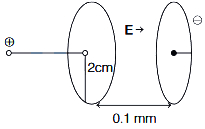
$A$ parallel plate capacitor consists of two circular plates each of radius $2 \,cm$, separated by a distance of $0.1 \,mm$. If the potential difference across the plates is varying at the rate of $5 \times 10^6 \,Vs^{-1}$, then the value of displacement current is
A
$5.56 \,A$
B
$5.56 \,mA$
C
$0.556 \,mA$
D
$2.28 \,mA$
Solution
(C) Given:
Radius of plates, $r = 2 \,cm = 2 \times 10^{-2} \,m$
Distance between plates, $d = 0.1 \,mm = 10^{-4} \,m$
Rate of change of potential difference, $\frac{dV}{dt} = 5 \times 10^6 \,Vs^{-1}$
Permittivity of free space, $\varepsilon_0 = 8.85 \times 10^{-12} \,F/m$
Area of the plates, $A = \pi r^2 = \pi \times (2 \times 10^{-2})^2 = 4\pi \times 10^{-4} \,m^2$
The displacement current $I_d$ is given by:
$I_d = \varepsilon_0 \frac{d\phi_E}{dt} = \varepsilon_0 A \frac{dE}{dt}$
Since $E = \frac{V}{d}$, we have $\frac{dE}{dt} = \frac{1}{d} \frac{dV}{dt}$
Therefore, $I_d = \varepsilon_0 \frac{A}{d} \frac{dV}{dt}$
Substituting the values:
$I_d = (8.85 \times 10^{-12}) \times \frac{4\pi \times 10^{-4}}{10^{-4}} \times (5 \times 10^6)$
$I_d = 8.85 \times 10^{-12} \times 4\pi \times 5 \times 10^6$
$I_d = 8.85 \times 20\pi \times 10^{-6} \,A$
$I_d \approx 8.85 \times 62.83 \times 10^{-6} \,A$
$I_d \approx 556 \times 10^{-6} \,A = 0.556 \,mA$
Thus, the correct option is $C$.
Radius of plates, $r = 2 \,cm = 2 \times 10^{-2} \,m$
Distance between plates, $d = 0.1 \,mm = 10^{-4} \,m$
Rate of change of potential difference, $\frac{dV}{dt} = 5 \times 10^6 \,Vs^{-1}$
Permittivity of free space, $\varepsilon_0 = 8.85 \times 10^{-12} \,F/m$
Area of the plates, $A = \pi r^2 = \pi \times (2 \times 10^{-2})^2 = 4\pi \times 10^{-4} \,m^2$
The displacement current $I_d$ is given by:
$I_d = \varepsilon_0 \frac{d\phi_E}{dt} = \varepsilon_0 A \frac{dE}{dt}$
Since $E = \frac{V}{d}$, we have $\frac{dE}{dt} = \frac{1}{d} \frac{dV}{dt}$
Therefore, $I_d = \varepsilon_0 \frac{A}{d} \frac{dV}{dt}$
Substituting the values:
$I_d = (8.85 \times 10^{-12}) \times \frac{4\pi \times 10^{-4}}{10^{-4}} \times (5 \times 10^6)$
$I_d = 8.85 \times 10^{-12} \times 4\pi \times 5 \times 10^6$
$I_d = 8.85 \times 20\pi \times 10^{-6} \,A$
$I_d \approx 8.85 \times 62.83 \times 10^{-6} \,A$
$I_d \approx 556 \times 10^{-6} \,A = 0.556 \,mA$
Thus, the correct option is $C$.
0 likes
View Solution110
DifficultMCQ
$A$ parallel plate capacitor is completely immersed in a liquid of resistivity $\rho = 0.25 \, \Omega m$ and relative permittivity $\epsilon_r = 80$. If the plates of the capacitor are connected to an alternating voltage source of $V = V_0 \sin(\omega t)$ at a frequency of $f = 0.4 \, GHz$,then the ratio of the amplitudes of the displacement current $(I_d)$ and conduction current $(I_c)$ is:
A
$3: 7$
B
$2: 5$
C
$2: 3$
D
$4: 9$
Solution
(D) The conduction current is given by $I_c = \frac{V}{R} = V \sigma A / d$,where $\sigma = 1/\rho$ is the conductivity. The amplitude is $I_{c,0} = \frac{V_0}{\rho} \frac{A}{d}$.
The displacement current is given by $I_d = \epsilon_0 \epsilon_r A \frac{dE}{dt} = \epsilon_0 \epsilon_r A \frac{d}{dt} (V/d) = \frac{\epsilon_0 \epsilon_r A}{d} \omega V_0 \cos(\omega t)$. The amplitude is $I_{d,0} = \frac{\epsilon_0 \epsilon_r A \omega V_0}{d}$.
The ratio of the amplitudes is $\frac{I_{d,0}}{I_{c,0}} = \frac{\epsilon_0 \epsilon_r A \omega V_0 / d}{V_0 A / (\rho d)} = \epsilon_0 \epsilon_r \omega \rho$.
Given $\epsilon_r = 80$,$\rho = 0.25 \, \Omega m$,$f = 0.4 \times 10^9 \, Hz$,and $\omega = 2 \pi f = 2 \pi (0.4 \times 10^9) = 0.8 \pi \times 10^9 \, rad/s$.
Using $\epsilon_0 = \frac{1}{36 \pi \times 10^9} \, F/m$,the ratio is $\frac{1}{36 \pi \times 10^9} \times 80 \times (0.8 \pi \times 10^9) \times 0.25 = \frac{80 \times 0.8 \times 0.25}{36} = \frac{16}{36} = \frac{4}{9}$.
The displacement current is given by $I_d = \epsilon_0 \epsilon_r A \frac{dE}{dt} = \epsilon_0 \epsilon_r A \frac{d}{dt} (V/d) = \frac{\epsilon_0 \epsilon_r A}{d} \omega V_0 \cos(\omega t)$. The amplitude is $I_{d,0} = \frac{\epsilon_0 \epsilon_r A \omega V_0}{d}$.
The ratio of the amplitudes is $\frac{I_{d,0}}{I_{c,0}} = \frac{\epsilon_0 \epsilon_r A \omega V_0 / d}{V_0 A / (\rho d)} = \epsilon_0 \epsilon_r \omega \rho$.
Given $\epsilon_r = 80$,$\rho = 0.25 \, \Omega m$,$f = 0.4 \times 10^9 \, Hz$,and $\omega = 2 \pi f = 2 \pi (0.4 \times 10^9) = 0.8 \pi \times 10^9 \, rad/s$.
Using $\epsilon_0 = \frac{1}{36 \pi \times 10^9} \, F/m$,the ratio is $\frac{1}{36 \pi \times 10^9} \times 80 \times (0.8 \pi \times 10^9) \times 0.25 = \frac{80 \times 0.8 \times 0.25}{36} = \frac{16}{36} = \frac{4}{9}$.
0 likes
View Solution111
MediumMCQ
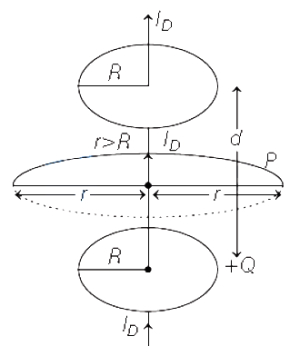
$A$ circular parallel plate capacitor of radius $R$ and spacing $d$ is being charged by a constant current $I_D$. Find the magnetic field between the plates at a distance $r$ from the axis,where $r > R$.
A
$\frac{\mu_0 I_D r}{2 \pi R^2}$
B
$\frac{\mu_0 I_D}{2 \pi R}$
C
$\frac{\mu_0 I_D}{2 \pi r}$
D
Zero
Solution
(C) According to the Ampere-Maxwell law,the magnetic field $B$ at a distance $r$ from the axis between the plates of a charging capacitor is given by the line integral of the magnetic field around a circular loop of radius $r$.
For $r > R$,the displacement current enclosed by the loop is equal to the total displacement current $I_D$ passing through the capacitor.
Applying Ampere-Maxwell law: $\oint B \cdot dl = \mu_0 I_{enclosed}$.
Since the current is $I_D$,we have $B(2 \pi r) = \mu_0 I_D$.
Therefore,the magnetic field is $B = \frac{\mu_0 I_D}{2 \pi r}$.
For $r > R$,the displacement current enclosed by the loop is equal to the total displacement current $I_D$ passing through the capacitor.
Applying Ampere-Maxwell law: $\oint B \cdot dl = \mu_0 I_{enclosed}$.
Since the current is $I_D$,we have $B(2 \pi r) = \mu_0 I_D$.
Therefore,the magnetic field is $B = \frac{\mu_0 I_D}{2 \pi r}$.
0 likes
View Solution112
MediumMCQ
$A$ parallel-plate capacitor with circular plates is being discharged. The radius of the circular plates is $10 \ cm$. $A$ circular loop of radius $20 \ cm$ is concentric with the capacitor and located halfway between the plates. If the electric field between the plates is changing at the rate of $3.6 \times 10^{12} \ V/(m \cdot s)$,then the displacement current through the loop is (Assume $\frac{1}{4 \pi \varepsilon_0} = 9 \times 10^9 \ N \cdot m^2/C^2$) (in $A$)
A
$1$
B
$2$
C
$3$
D
$4$
Solution
(A) The displacement current $I_d$ is given by the formula $I_d = \varepsilon_0 \frac{d\Phi_E}{dt}$,where $\Phi_E$ is the electric flux through the surface bounded by the loop.
Since the electric field $E$ exists only between the plates (within the radius $R = 10 \ cm$),the flux through the loop of radius $r = 20 \ cm$ is $\Phi_E = E \cdot A_{plate} = E \cdot \pi R^2$.
Thus,$I_d = \varepsilon_0 \frac{d}{dt}(E \cdot \pi R^2) = \varepsilon_0 \pi R^2 \frac{dE}{dt}$.
Given: $R = 10 \ cm = 0.1 \ m$,$\frac{dE}{dt} = 3.6 \times 10^{12} \ V/(m \cdot s)$,and $\frac{1}{4 \pi \varepsilon_0} = 9 \times 10^9 \ N \cdot m^2/C^2 \Rightarrow \varepsilon_0 = \frac{1}{36 \pi \times 10^9} \ F/m$.
Substituting these values:
$I_d = \left( \frac{1}{36 \pi \times 10^9} \right) \cdot \pi \cdot (0.1)^2 \cdot (3.6 \times 10^{12})$
$I_d = \frac{1}{36 \times 10^9} \cdot 0.01 \cdot 3.6 \times 10^{12}$
$I_d = \frac{3.6 \times 10^{10}}{36 \times 10^9} = \frac{36 \times 10^9}{36 \times 10^9} = 1 \ A$.
Since the electric field $E$ exists only between the plates (within the radius $R = 10 \ cm$),the flux through the loop of radius $r = 20 \ cm$ is $\Phi_E = E \cdot A_{plate} = E \cdot \pi R^2$.
Thus,$I_d = \varepsilon_0 \frac{d}{dt}(E \cdot \pi R^2) = \varepsilon_0 \pi R^2 \frac{dE}{dt}$.
Given: $R = 10 \ cm = 0.1 \ m$,$\frac{dE}{dt} = 3.6 \times 10^{12} \ V/(m \cdot s)$,and $\frac{1}{4 \pi \varepsilon_0} = 9 \times 10^9 \ N \cdot m^2/C^2 \Rightarrow \varepsilon_0 = \frac{1}{36 \pi \times 10^9} \ F/m$.
Substituting these values:
$I_d = \left( \frac{1}{36 \pi \times 10^9} \right) \cdot \pi \cdot (0.1)^2 \cdot (3.6 \times 10^{12})$
$I_d = \frac{1}{36 \times 10^9} \cdot 0.01 \cdot 3.6 \times 10^{12}$
$I_d = \frac{3.6 \times 10^{10}}{36 \times 10^9} = \frac{36 \times 10^9}{36 \times 10^9} = 1 \ A$.
0 likes
View Solution113
DifficultMCQ
The displacement current through the plates of a parallel plate capacitor of capacitance $30 \mu F$ is $150 \mu A$. The capacitor is charged by a source of varying potential at the rate of: (in $Vs^{-1}$)
A
$3.5$
B
$5$
C
$2$
D
$3$
Solution
(B) Given: Displacement current,$i_{d} = 150 \times 10^{-6} \ A$. Capacitance,$C = 30 \times 10^{-6} \ F$.
The displacement current $i_{d}$ in a capacitor is related to the rate of change of potential difference across its plates by the formula:
$i_{d} = C \frac{dv}{dt}$
Rearranging the formula to solve for the rate of change of potential $\frac{dv}{dt}$:
$\frac{dv}{dt} = \frac{i_{d}}{C}$
Substituting the given values:
$\frac{dv}{dt} = \frac{150 \times 10^{-6} \ A}{30 \times 10^{-6} \ F} = 5 \ Vs^{-1}$
Therefore,the capacitor is charged at a rate of $5 \ Vs^{-1}$.
The displacement current $i_{d}$ in a capacitor is related to the rate of change of potential difference across its plates by the formula:
$i_{d} = C \frac{dv}{dt}$
Rearranging the formula to solve for the rate of change of potential $\frac{dv}{dt}$:
$\frac{dv}{dt} = \frac{i_{d}}{C}$
Substituting the given values:
$\frac{dv}{dt} = \frac{150 \times 10^{-6} \ A}{30 \times 10^{-6} \ F} = 5 \ Vs^{-1}$
Therefore,the capacitor is charged at a rate of $5 \ Vs^{-1}$.
0 likes
View Solution114
EasyMCQ
The concept of displacement current solves an ambiguity in
A
Gauss's law
B
Faraday's law
C
Ampere's law
D
Coulomb's law
Solution
(C) The scientist Maxwell further investigated Ampere's law and identified that it was incomplete for time-varying electric fields.
He introduced the concept of displacement current,$I_d = \epsilon_0 \frac{d\Phi_E}{dt}$,to modify Ampere's law.
This modification,known as the Ampere-Maxwell law,resolves the inconsistency in Ampere's original circuital law regarding the continuity of current in circuits containing capacitors.
He introduced the concept of displacement current,$I_d = \epsilon_0 \frac{d\Phi_E}{dt}$,to modify Ampere's law.
This modification,known as the Ampere-Maxwell law,resolves the inconsistency in Ampere's original circuital law regarding the continuity of current in circuits containing capacitors.
0 likes
View Solution115
DifficultMCQ
Suppose that the electric flux inside a parallel plate capacitor changes at a rate of $7 \times 10^{14} \text{ V} \cdot \text{m/s}$. If the area of the plates is $1 \text{ m}^2$,calculate the magnetic field $B$ at a distance $r = 0.1 \text{ m}$ from the axis of the capacitor. (Given: $\varepsilon_0 = 8.85 \times 10^{-12} \text{ F/m}$,$\mu_0 = 4\pi \times 10^{-7} \text{ T} \cdot \text{m/A}$)
A
$2.0 \times 10^{-3} \text{ T}$
B
$0.779 \times 10^{-5} \text{ T}$
C
$8.85 \times 10^{-4} \text{ T}$
D
$88.5 \times 10^{-12} \text{ T}$
Solution
(B) The displacement current $I_d$ is given by $I_d = \varepsilon_0 \frac{d\phi_E}{dt}$.
Using the Ampere-Maxwell law for a circular path of radius $r$ inside the capacitor: $\oint B \cdot dl = \mu_0 I_d$.
Since the electric field is uniform,the flux through a circular area of radius $r$ is $\phi_r = \phi_E \left( \frac{\pi r^2}{A} \right)$,where $A$ is the total area of the plate.
Thus,$B(2\pi r) = \mu_0 \varepsilon_0 \frac{d}{dt} \left( \phi_E \frac{\pi r^2}{A} \right) = \mu_0 \varepsilon_0 \frac{r^2}{A} \frac{d\phi_E}{dt} \cdot \pi$.
$B = \frac{\mu_0 \varepsilon_0 r}{2A} \frac{d\phi_E}{dt}$.
Given $\frac{d\phi_E}{dt} = 7 \times 10^{14}$,$r = 0.1 \text{ m}$,$A = 1 \text{ m}^2$,$\varepsilon_0 = 8.85 \times 10^{-12}$,$\mu_0 = 4\pi \times 10^{-7}$.
$B = \frac{(4\pi \times 10^{-7})(8.85 \times 10^{-12})(0.1)}{2(1)} (7 \times 10^{14}) \approx 7.79 \times 10^{-6} \text{ T} = 0.779 \times 10^{-5} \text{ T}$.
Using the Ampere-Maxwell law for a circular path of radius $r$ inside the capacitor: $\oint B \cdot dl = \mu_0 I_d$.
Since the electric field is uniform,the flux through a circular area of radius $r$ is $\phi_r = \phi_E \left( \frac{\pi r^2}{A} \right)$,where $A$ is the total area of the plate.
Thus,$B(2\pi r) = \mu_0 \varepsilon_0 \frac{d}{dt} \left( \phi_E \frac{\pi r^2}{A} \right) = \mu_0 \varepsilon_0 \frac{r^2}{A} \frac{d\phi_E}{dt} \cdot \pi$.
$B = \frac{\mu_0 \varepsilon_0 r}{2A} \frac{d\phi_E}{dt}$.
Given $\frac{d\phi_E}{dt} = 7 \times 10^{14}$,$r = 0.1 \text{ m}$,$A = 1 \text{ m}^2$,$\varepsilon_0 = 8.85 \times 10^{-12}$,$\mu_0 = 4\pi \times 10^{-7}$.
$B = \frac{(4\pi \times 10^{-7})(8.85 \times 10^{-12})(0.1)}{2(1)} (7 \times 10^{14}) \approx 7.79 \times 10^{-6} \text{ T} = 0.779 \times 10^{-5} \text{ T}$.
0 likes
View Solution116
EasyMCQ
If the rate of change in electric flux between the plates of a capacitor is $9 \pi \times 10^3 \text{ Vm s}^{-1}$,then the displacement current inside the capacitor is (in $\mu \text{A}$)
A
$0.25$
B
$0.36$
C
$3.14$
D
$4$
Solution
(A) The displacement current $I_d$ is given by the formula $I_d = \epsilon_0 \frac{d\Phi_E}{dt}$,where $\epsilon_0$ is the permittivity of free space and $\frac{d\Phi_E}{dt}$ is the rate of change of electric flux.
Given $\epsilon_0 = 8.854 \times 10^{-12} \text{ F/m}$ and $\frac{d\Phi_E}{dt} = 9 \pi \times 10^3 \text{ Vm s}^{-1}$.
Substituting the values: $I_d = (8.854 \times 10^{-12}) \times (9 \times 3.14159 \times 10^3)$.
$I_d \approx 8.854 \times 10^{-12} \times 28.27 \times 10^3 \approx 250.3 \times 10^{-9} \text{ A} = 0.25 \mu \text{A}$.
Given $\epsilon_0 = 8.854 \times 10^{-12} \text{ F/m}$ and $\frac{d\Phi_E}{dt} = 9 \pi \times 10^3 \text{ Vm s}^{-1}$.
Substituting the values: $I_d = (8.854 \times 10^{-12}) \times (9 \times 3.14159 \times 10^3)$.
$I_d \approx 8.854 \times 10^{-12} \times 28.27 \times 10^3 \approx 250.3 \times 10^{-9} \text{ A} = 0.25 \mu \text{A}$.
0 likes
View Solution117
MediumMCQ
If the rate of change of electric field across the plates of a parallel plate capacitor is $E$ and the displacement current is $I$,then the area of one plate of the capacitor is ($\varepsilon_{0}$ is permittivity of free space).
A
$\frac{I}{2 \varepsilon_{0} E}$
B
$\frac{2 I}{\varepsilon_0 E}$
C
$I \varepsilon_0 E$
D
$\frac{I}{\varepsilon_0 E}$
Solution
(D) The displacement current $I$ in a parallel plate capacitor is given by the formula $I = \varepsilon_0 \frac{d\phi_E}{dt}$,where $\phi_E$ is the electric flux.
Since the electric flux $\phi_E$ through the area $A$ of the plates is given by $\phi_E = E_{field} \cdot A$,where $E_{field}$ is the electric field between the plates.
Substituting this into the displacement current formula,we get $I = \varepsilon_0 \frac{d}{dt}(E_{field} \cdot A)$.
Since the area $A$ is constant,we have $I = \varepsilon_0 A \frac{dE_{field}}{dt}$.
Given that the rate of change of the electric field is $E$,we substitute $\frac{dE_{field}}{dt} = E$.
Thus,$I = \varepsilon_0 A E$.
Solving for the area $A$,we get $A = \frac{I}{\varepsilon_0 E}$.
Since the electric flux $\phi_E$ through the area $A$ of the plates is given by $\phi_E = E_{field} \cdot A$,where $E_{field}$ is the electric field between the plates.
Substituting this into the displacement current formula,we get $I = \varepsilon_0 \frac{d}{dt}(E_{field} \cdot A)$.
Since the area $A$ is constant,we have $I = \varepsilon_0 A \frac{dE_{field}}{dt}$.
Given that the rate of change of the electric field is $E$,we substitute $\frac{dE_{field}}{dt} = E$.
Thus,$I = \varepsilon_0 A E$.
Solving for the area $A$,we get $A = \frac{I}{\varepsilon_0 E}$.
0 likes
View Solution118
DifficultMCQ
Consider a parallel plate capacitor which is maintained at a potential of $200 \, V$. The separation distance between the plates of the capacitor and the area of the plates are $1 \, mm$ and $20 \, cm^2$, respectively. Calculate the displacement current in $1 \, \mu s$. (in $ \, mA$)
A
$3.5$
B
$2.5$
C
$1.5$
D
$0.5$
Solution
(A) The displacement current is given by the formula:
$I_d = \varepsilon_0 \frac{d\phi_E}{dt} = \varepsilon_0 \frac{\Delta \phi_E}{\Delta t}$
Since the electric flux $\phi_E = E \cdot A$ and the electric field $E = \frac{V}{d}$, we have:
$I_d = \varepsilon_0 \frac{A}{d} \frac{\Delta V}{\Delta t}$
Given values are:
$\Delta V = 200 \, V$
$\Delta t = 1 \, \mu s = 10^{-6} \, s$
$d = 1 \, mm = 10^{-3} \, m$
$A = 20 \, cm^2 = 20 \times 10^{-4} \, m^2$
$\varepsilon_0 = 8.85 \times 10^{-12} \, F/m$
Substituting these values:
$I_d = \frac{8.85 \times 10^{-12} \times 20 \times 10^{-4} \times 200}{10^{-3} \times 10^{-6}}$
$I_d = \frac{8.85 \times 20 \times 200 \times 10^{-16}}{10^{-9}}$
$I_d = 35400 \times 10^{-7} \, A = 3.54 \times 10^{-3} \, A \approx 3.5 \, mA$
$I_d = \varepsilon_0 \frac{d\phi_E}{dt} = \varepsilon_0 \frac{\Delta \phi_E}{\Delta t}$
Since the electric flux $\phi_E = E \cdot A$ and the electric field $E = \frac{V}{d}$, we have:
$I_d = \varepsilon_0 \frac{A}{d} \frac{\Delta V}{\Delta t}$
Given values are:
$\Delta V = 200 \, V$
$\Delta t = 1 \, \mu s = 10^{-6} \, s$
$d = 1 \, mm = 10^{-3} \, m$
$A = 20 \, cm^2 = 20 \times 10^{-4} \, m^2$
$\varepsilon_0 = 8.85 \times 10^{-12} \, F/m$
Substituting these values:
$I_d = \frac{8.85 \times 10^{-12} \times 20 \times 10^{-4} \times 200}{10^{-3} \times 10^{-6}}$
$I_d = \frac{8.85 \times 20 \times 200 \times 10^{-16}}{10^{-9}}$
$I_d = 35400 \times 10^{-7} \, A = 3.54 \times 10^{-3} \, A \approx 3.5 \, mA$
0 likes
View Solution119
EasyMCQ
The law not described by any of the four Maxwell's equations is
A
Gauss' law for electricity
B
Le-Chatelier's law of equilibrium
C
Gauss' law for magnetism
D
Faraday's law of induction
Solution
(B) Maxwell's four equations are the fundamental equations of electromagnetism, which include:
$1$. Gauss' law for electricity $( \nabla \cdot E = \rho / \epsilon_0)$.
$2$. Gauss' law for magnetism $( \nabla \cdot B = 0)$.
$3$. Faraday's law of induction $( \nabla \times E = -\partial B / \partial t)$.
$4$. Ampere-Maxwell law $( \nabla \times B = \mu_0 J + \mu_0 \epsilon_0 \partial E / \partial t)$.
Le-Chatelier's law of equilibrium is a principle in chemistry related to chemical reactions, not electromagnetism. Therefore, it is not described by Maxwell's equations.
$1$. Gauss' law for electricity $( \nabla \cdot E = \rho / \epsilon_0)$.
$2$. Gauss' law for magnetism $( \nabla \cdot B = 0)$.
$3$. Faraday's law of induction $( \nabla \times E = -\partial B / \partial t)$.
$4$. Ampere-Maxwell law $( \nabla \times B = \mu_0 J + \mu_0 \epsilon_0 \partial E / \partial t)$.
Le-Chatelier's law of equilibrium is a principle in chemistry related to chemical reactions, not electromagnetism. Therefore, it is not described by Maxwell's equations.
0 likes
View Solution120
MediumMCQ
$A$ quantity $X$ is given by $\varepsilon_0 L \frac{\Delta V}{\Delta t}$,where $\varepsilon_0$ is the permittivity of free space,$L$ is the length,$\Delta V$ is a potential difference,and $\Delta t$ is a time interval. The dimension of $X$ is the same as that of
A
Resistance
B
Charge
C
Voltage
D
Current
Solution
(D) The expression is $X = \varepsilon_0 L \frac{\Delta V}{\Delta t}$.
We know that the electric flux $\phi_E = E \cdot A$,where $E = \frac{V}{L}$ and $A = L^2$.
Thus,$\phi_E = \frac{V}{L} \cdot L^2 = V \cdot L$.
Substituting this into the expression for $X$,we get $X = \varepsilon_0 \frac{\Delta \phi_E}{\Delta t}$.
According to the definition of displacement current $i_d = \varepsilon_0 \frac{d\phi_E}{dt}$,the quantity $X$ represents the displacement current.
Therefore,the dimension of $X$ is the same as that of current.
We know that the electric flux $\phi_E = E \cdot A$,where $E = \frac{V}{L}$ and $A = L^2$.
Thus,$\phi_E = \frac{V}{L} \cdot L^2 = V \cdot L$.
Substituting this into the expression for $X$,we get $X = \varepsilon_0 \frac{\Delta \phi_E}{\Delta t}$.
According to the definition of displacement current $i_d = \varepsilon_0 \frac{d\phi_E}{dt}$,the quantity $X$ represents the displacement current.
Therefore,the dimension of $X$ is the same as that of current.
0 likes
View Solution121
DifficultMCQ
An electromagnetic wave of frequency $100 \text{ MHz}$ propagates through a medium of conductivity $\sigma = 10 \text{ mho/m}$. The ratio of maximum conducting current density to maximum displacement current density is . . . . . . . $\left[ \text{Take } \frac{1}{4 \pi \epsilon_0} = 9 \times 10^9 \text{ Nm}^2/\text{C}^2 \right]$
A
$1800$
B
$900$
C
$1000$
D
$2000$
Solution
(A) The conducting current density is given by $j_c = \sigma E$.
For an electromagnetic wave,$E = E_0 \sin(\omega t - kx)$,so the maximum conducting current density is $(j_c)_{\max} = \sigma E_0$.
The displacement current density is given by $j_d = \epsilon_0 \frac{\partial E}{\partial t}$.
Substituting $E$,we get $j_d = \epsilon_0 E_0 \omega \cos(\omega t - kx)$,so the maximum displacement current density is $(j_d)_{\max} = \epsilon_0 E_0 \omega$.
The ratio is $\frac{(j_c)_{\max}}{(j_d)_{\max}} = \frac{\sigma E_0}{\epsilon_0 \omega E_0} = \frac{\sigma}{\epsilon_0 \omega}$.
Given $\sigma = 10 \text{ mho/m}$,$f = 100 \times 10^6 \text{ Hz}$,and $\omega = 2 \pi f = 2 \pi \times 10^8 \text{ rad/s}$.
Also,$\frac{1}{4 \pi \epsilon_0} = 9 \times 10^9$,so $\frac{1}{\epsilon_0} = 4 \pi \times 9 \times 10^9 = 36 \pi \times 10^9$.
Ratio $= \frac{10 \times 36 \pi \times 10^9}{2 \pi \times 10^8} = \frac{360 \pi \times 10^9}{2 \pi \times 10^8} = 180 \times 10 = 1800$.
For an electromagnetic wave,$E = E_0 \sin(\omega t - kx)$,so the maximum conducting current density is $(j_c)_{\max} = \sigma E_0$.
The displacement current density is given by $j_d = \epsilon_0 \frac{\partial E}{\partial t}$.
Substituting $E$,we get $j_d = \epsilon_0 E_0 \omega \cos(\omega t - kx)$,so the maximum displacement current density is $(j_d)_{\max} = \epsilon_0 E_0 \omega$.
The ratio is $\frac{(j_c)_{\max}}{(j_d)_{\max}} = \frac{\sigma E_0}{\epsilon_0 \omega E_0} = \frac{\sigma}{\epsilon_0 \omega}$.
Given $\sigma = 10 \text{ mho/m}$,$f = 100 \times 10^6 \text{ Hz}$,and $\omega = 2 \pi f = 2 \pi \times 10^8 \text{ rad/s}$.
Also,$\frac{1}{4 \pi \epsilon_0} = 9 \times 10^9$,so $\frac{1}{\epsilon_0} = 4 \pi \times 9 \times 10^9 = 36 \pi \times 10^9$.
Ratio $= \frac{10 \times 36 \pi \times 10^9}{2 \pi \times 10^8} = \frac{360 \pi \times 10^9}{2 \pi \times 10^8} = 180 \times 10 = 1800$.
0 likes
View Solution122
MediumMCQ
Match List-$I$ with List-$II$.
Choose the correct answer from the options given below:
| List-$I$ (Relation) | List-$II$ (Law) |
| $A$. $\oint \overrightarrow{E} \cdot d\vec{l} = -\frac{d}{dt} \oint \overrightarrow{B} \cdot d\vec{a}$ | $I$. Ampere's circuital law |
| $B$. $\oint \vec{B} \cdot d\vec{l} = \mu_0(I + \epsilon_0 \frac{d\phi_E}{dt})$ | $II$. Faraday's laws of electromagnetic induction |
| $C$. $\oint \overrightarrow{E} \cdot d\vec{a} = \frac{1}{\epsilon_0} \int \rho dv$ | $III$. Ampere-Maxwell law |
| $D$. $\oint \overrightarrow{B} \cdot d\vec{l} = \mu_0 I$ | $IV$. Gauss's law of electrostatics |
Choose the correct answer from the options given below:
A
$A-II, B-III, C-I, D-IV$
B
$A-II, B-III, C-IV, D-I$
C
$A-I, B-IV, C-III, D-II$
D
$A-IV, B-I, C-II, D-III$
Solution
(B) The four Maxwell's equations are as follows:
$1$. Gauss's law for electricity: $\oint \overrightarrow{E} \cdot d\vec{a} = \frac{q_{enclosed}}{\epsilon_0} = \frac{1}{\epsilon_0} \int \rho dv$. This matches $C-IV$.
$2$. Gauss's law for magnetism: $\oint \overrightarrow{B} \cdot d\vec{a} = 0$.
$3$. Faraday's law of induction: $\oint \overrightarrow{E} \cdot d\vec{l} = -\frac{d}{dt} \oint \overrightarrow{B} \cdot d\vec{a}$. This matches $A-II$.
$4$. Ampere-Maxwell law: $\oint \vec{B} \cdot d\vec{l} = \mu_0(I + \epsilon_0 \frac{d\phi_E}{dt})$. This matches $B-III$.
$5$. Ampere's circuital law (original form for steady currents): $\oint \overrightarrow{B} \cdot d\vec{l} = \mu_0 I$. This matches $D-I$.
Therefore,the correct matching is $A-II, B-III, C-IV, D-I$.
$1$. Gauss's law for electricity: $\oint \overrightarrow{E} \cdot d\vec{a} = \frac{q_{enclosed}}{\epsilon_0} = \frac{1}{\epsilon_0} \int \rho dv$. This matches $C-IV$.
$2$. Gauss's law for magnetism: $\oint \overrightarrow{B} \cdot d\vec{a} = 0$.
$3$. Faraday's law of induction: $\oint \overrightarrow{E} \cdot d\vec{l} = -\frac{d}{dt} \oint \overrightarrow{B} \cdot d\vec{a}$. This matches $A-II$.
$4$. Ampere-Maxwell law: $\oint \vec{B} \cdot d\vec{l} = \mu_0(I + \epsilon_0 \frac{d\phi_E}{dt})$. This matches $B-III$.
$5$. Ampere's circuital law (original form for steady currents): $\oint \overrightarrow{B} \cdot d\vec{l} = \mu_0 I$. This matches $D-I$.
Therefore,the correct matching is $A-II, B-III, C-IV, D-I$.
0 likes
View Solution123
MediumMCQ
$A$ charged particle oscillates about its mean equilibrium position with a frequency of $8 \times 10^9 \text{ Hz}$. What is the frequency of the electromagnetic waves produced by the oscillator?
A
$4 \times 10^9 \text{ Hz}$
B
$1.6 \times 10^{10} \text{ Hz}$
C
$8 \times 10^9 \text{ Hz}$
D
$2 \times 10^9 \text{ Hz}$
Solution
(C) An oscillating charge produces electromagnetic waves of the same frequency as the frequency of oscillation of the charge.
Since the frequency of the oscillating particle is $8 \times 10^9 \text{ Hz}$,the frequency of the electromagnetic waves produced will also be $8 \times 10^9 \text{ Hz}$.
Since the frequency of the oscillating particle is $8 \times 10^9 \text{ Hz}$,the frequency of the electromagnetic waves produced will also be $8 \times 10^9 \text{ Hz}$.
0 likes
View Solution124
DifficultMCQ
$A$ displacement current of $4.0 \text{ A}$ can be set up in the space between two parallel plates of a $6 \text{ }\mu\text{F}$ capacitor. The rate of change of potential difference across the plates of the capacitor is nearly $\alpha \times 10^6 \text{ V/s}$. The value of $\alpha$ is . . . . . . .
A
$0.58$
B
$0.67$
C
$0.82$
D
$0.75$
Solution
(B) The displacement current $I_d$ in a capacitor is given by the formula $I_d = C \frac{dV}{dt}$,where $C$ is the capacitance and $\frac{dV}{dt}$ is the rate of change of potential difference.
Given values are $I_d = 4.0 \text{ A}$ and $C = 6 \text{ }\mu\text{F} = 6 \times 10^{-6} \text{ F}$.
Rearranging the formula to find the rate of change of potential difference: $\frac{dV}{dt} = \frac{I_d}{C}$.
Substituting the values: $\frac{dV}{dt} = \frac{4.0}{6 \times 10^{-6}} = \frac{4.0}{6} \times 10^6 \text{ V/s}$.
Calculating the value: $\frac{dV}{dt} = 0.666... \times 10^6 \text{ V/s}$.
Rounding to two decimal places,we get $\frac{dV}{dt} \approx 0.67 \times 10^6 \text{ V/s}$.
Comparing this with $\alpha \times 10^6 \text{ V/s}$,we find $\alpha = 0.67$.
Given values are $I_d = 4.0 \text{ A}$ and $C = 6 \text{ }\mu\text{F} = 6 \times 10^{-6} \text{ F}$.
Rearranging the formula to find the rate of change of potential difference: $\frac{dV}{dt} = \frac{I_d}{C}$.
Substituting the values: $\frac{dV}{dt} = \frac{4.0}{6 \times 10^{-6}} = \frac{4.0}{6} \times 10^6 \text{ V/s}$.
Calculating the value: $\frac{dV}{dt} = 0.666... \times 10^6 \text{ V/s}$.
Rounding to two decimal places,we get $\frac{dV}{dt} \approx 0.67 \times 10^6 \text{ V/s}$.
Comparing this with $\alpha \times 10^6 \text{ V/s}$,we find $\alpha = 0.67$.
0 likes
View SolutionElectromagnetic waves — Maxwell's equations , Concept of displacement current and Hertz experiment · Frequently Asked Questions
1Are these Electromagnetic waves questions useful for JEE and NEET?
Yes. All questions in this section are mapped to JEE Main and NEET exam patterns. Previous year questions from JEE Main, NEET, GUJCET and state-level exams are included with full solutions.
2Can I switch to Hindi or Gujarati for these questions?
Yes. Use the language tabs in the hero section or the sidebar to view the same questions and solutions in English, Hindi or Gujarati.
3How do I generate a question paper from this subtopic?
Use the Vedclass Exam Paper Generator — select the chapter and subtopic, set difficulty, and generate Sets A, B, C, D automatically. First 3 chapters of every subject are free.
Vedclass Products
For Students
Vedclass Test Series
Mock tests in real JEE/NEET style with performance analysis. 5-day free trial.
Start Free TrialFor Teachers
Exam Paper Generator
Generate Set A/B/C/D papers from this chapter in 2 minutes. 3 chapters free.
Try FreeFor Institutes
Online Exam Module
Live online exams with unlimited students, 360° analytics & white-label branding.
See DemoFor Teachers & Institutes
Generate a Electromagnetic waves Exam Paper in 2 Minutes
Select subtopic & difficulty — Sets A, B, C, D auto-generated with No Repeat logic.
First 3 chapters of every subject are free — no payment required.