
A English
Maxwell's equations , Concept of displacement current and Hertz experiment Questions in English
Class 12 Physics · Electromagnetic waves · Maxwell's equations , Concept of displacement current and Hertz experiment
124+
Questions
English
Language
100%
With Solutions
Showing 50 of 124 questions in English
51
EasyMCQ
Who discovered for the first time that a changing electric field can produce a magnetic field?
A
James Clerk Maxwell
B
Michael Faraday
C
Heinrich Hertz
D
Andre-Marie Ampere
Solution
(A) James Clerk Maxwell proposed the concept of displacement current in $1861$. He realized that a time-varying electric field acts as a source of a magnetic field,just as a conduction current does. This modification to Ampere's law,known as the Ampere-Maxwell law,is expressed as $\oint B \cdot dl = \mu_0 (I_c + I_d)$,where $I_d = \epsilon_0 \frac{d\Phi_E}{dt}$ is the displacement current. Therefore,the correct answer is $A$.
0 likes
View Solution52
Medium
Which current flows inside a capacitor when it is being charged? Explain.
Solution
(N/A) When a capacitor is being charged, the current flowing inside the capacitor is known as the $displacement \ current$ $(I_d)$.
Explanation:
$1$. In the conducting wires connected to the capacitor plates, the current is the $conduction \ current$ $(I_c)$, which is due to the actual flow of electrons.
$2$. Between the plates of the capacitor, there is no physical medium for electrons to flow, so the $conduction \ current$ is zero.
$3$. However, as the capacitor charges, the electric field $(E)$ between the plates changes with time.
$4$. According to Maxwell's modification of Ampere's Law, this time-varying electric field produces a magnetic field, which is equivalent to a current.
$5$. This current is defined as $I_d = \epsilon_0 \frac{d\Phi_E}{dt}$, where $\epsilon_0$ is the permittivity of free space and $\frac{d\Phi_E}{dt}$ is the rate of change of electric flux.
$6$. Thus, the $displacement \ current$ ensures the continuity of the total current in the circuit.
Explanation:
$1$. In the conducting wires connected to the capacitor plates, the current is the $conduction \ current$ $(I_c)$, which is due to the actual flow of electrons.
$2$. Between the plates of the capacitor, there is no physical medium for electrons to flow, so the $conduction \ current$ is zero.
$3$. However, as the capacitor charges, the electric field $(E)$ between the plates changes with time.
$4$. According to Maxwell's modification of Ampere's Law, this time-varying electric field produces a magnetic field, which is equivalent to a current.
$5$. This current is defined as $I_d = \epsilon_0 \frac{d\Phi_E}{dt}$, where $\epsilon_0$ is the permittivity of free space and $\frac{d\Phi_E}{dt}$ is the rate of change of electric flux.
$6$. Thus, the $displacement \ current$ ensures the continuity of the total current in the circuit.
0 likes
View Solution53
DifficultMCQ
In the charging of a capacitor,what is the contradiction in Ampere's circuital law?
A
The law fails because the magnetic field is zero.
B
The law gives different values for the magnetic field at the same point depending on the surface chosen.
C
The law is only applicable to steady currents.
D
The law is only applicable to vacuum.
Solution
(B) Ampere's circuital law states that $\oint B \cdot dl = \mu_0 I_{enclosed}$.
Consider a parallel plate capacitor being charged. If we choose a flat circular surface between the plates,the current passing through it is zero,implying $B = 0$.
However,if we choose a balloon-shaped surface with the same boundary,the conduction current $I_c$ passes through it,implying $B \neq 0$.
This contradiction arises because Ampere's law does not account for the time-varying electric field between the plates,which acts as a displacement current $I_d = \epsilon_0 \frac{d\phi_E}{dt}$.
Thus,the law is incomplete for non-steady currents.
Consider a parallel plate capacitor being charged. If we choose a flat circular surface between the plates,the current passing through it is zero,implying $B = 0$.
However,if we choose a balloon-shaped surface with the same boundary,the conduction current $I_c$ passes through it,implying $B \neq 0$.
This contradiction arises because Ampere's law does not account for the time-varying electric field between the plates,which acts as a displacement current $I_d = \epsilon_0 \frac{d\phi_E}{dt}$.
Thus,the law is incomplete for non-steady currents.
0 likes
View Solution54
Easy
Write the Ampere-Maxwell law in the form of an equation.
Solution
(N/A) The Ampere-Maxwell law is a generalization of Ampere's circuital law,which accounts for the displacement current. It is expressed as:
$\oint B \cdot dl = \mu_0 (I_c + I_d)$
Where:
$1$. $\oint B \cdot dl$ is the line integral of the magnetic field around a closed loop.
$2$. $\mu_0$ is the permeability of free space.
$3$. $I_c$ is the conduction current.
$4$. $I_d$ is the displacement current,given by $I_d = \epsilon_0 \frac{d\Phi_E}{dt}$,where $\epsilon_0$ is the permittivity of free space and $\Phi_E$ is the electric flux.
Thus,the complete equation is: $\oint B \cdot dl = \mu_0 I_c + \mu_0 \epsilon_0 \frac{d\Phi_E}{dt}$.
$\oint B \cdot dl = \mu_0 (I_c + I_d)$
Where:
$1$. $\oint B \cdot dl$ is the line integral of the magnetic field around a closed loop.
$2$. $\mu_0$ is the permeability of free space.
$3$. $I_c$ is the conduction current.
$4$. $I_d$ is the displacement current,given by $I_d = \epsilon_0 \frac{d\Phi_E}{dt}$,where $\epsilon_0$ is the permittivity of free space and $\Phi_E$ is the electric flux.
Thus,the complete equation is: $\oint B \cdot dl = \mu_0 I_c + \mu_0 \epsilon_0 \frac{d\Phi_E}{dt}$.
0 likes
View Solution55
MediumMCQ
Write the $SI$ unit of ${\epsilon _0}\left( {\frac{{d{\Phi _E}}}{{dt}}} \right)$.
A
Ampere $(A)$
B
Volt $(V)$
C
Tesla $(T)$
D
Weber $(Wb)$
Solution
(A) The expression ${\epsilon _0}\left( {\frac{{d{\Phi _E}}}{{dt}}} \right)$ represents the displacement current,denoted by ${I_d}$.
According to Maxwell's modification of Ampere's circuital law,the displacement current is defined as ${I_d} = {\epsilon _0}\frac{{d{\Phi _E}}}{{dt}}$.
Since ${I_d}$ is a current,its $SI$ unit is the same as that of electric current.
The $SI$ unit of electric current is the Ampere $(A)$.
According to Maxwell's modification of Ampere's circuital law,the displacement current is defined as ${I_d} = {\epsilon _0}\frac{{d{\Phi _E}}}{{dt}}$.
Since ${I_d}$ is a current,its $SI$ unit is the same as that of electric current.
The $SI$ unit of electric current is the Ampere $(A)$.
0 likes
View Solution56
MediumMCQ
Which is the missing term in Ampere's circuital law?
A
$\mu_0 \epsilon_0 \frac{d\Phi_E}{dt}$
B
$\mu_0 \frac{d\Phi_E}{dt}$
C
$\epsilon_0 \frac{d\Phi_E}{dt}$
D
$\frac{d\Phi_E}{dt}$
Solution
(A) Ampere's circuital law states that the line integral of the magnetic field $\vec{B}$ around any closed path is equal to $\mu_0$ times the total current $I$ passing through the surface enclosed by the path.
Maxwell noticed that this law was inconsistent for time-varying electric fields.
He introduced the concept of displacement current $I_d = \epsilon_0 \frac{d\Phi_E}{dt}$ to maintain the continuity of current.
The modified Ampere's circuital law is given by $\oint \vec{B} \cdot d\vec{l} = \mu_0 (I_c + I_d) = \mu_0 I_c + \mu_0 \epsilon_0 \frac{d\Phi_E}{dt}$.
Therefore, the missing term that Maxwell added to the original law is $\mu_0 \epsilon_0 \frac{d\Phi_E}{dt}$.
Maxwell noticed that this law was inconsistent for time-varying electric fields.
He introduced the concept of displacement current $I_d = \epsilon_0 \frac{d\Phi_E}{dt}$ to maintain the continuity of current.
The modified Ampere's circuital law is given by $\oint \vec{B} \cdot d\vec{l} = \mu_0 (I_c + I_d) = \mu_0 I_c + \mu_0 \epsilon_0 \frac{d\Phi_E}{dt}$.
Therefore, the missing term that Maxwell added to the original law is $\mu_0 \epsilon_0 \frac{d\Phi_E}{dt}$.
0 likes
View Solution57
EasyMCQ
What is called displacement current?
A
The current produced by the flow of electrons in a conductor.
B
The current that arises due to the time-varying electric field in a region.
C
The current produced by the motion of ions in an electrolyte.
D
The current that flows only in a closed $DC$ circuit.
Solution
(B) Displacement current is defined as the current that arises in a region where the electric field is changing with time.
It was introduced by James Clerk Maxwell to maintain the consistency of Ampere's circuital law.
The mathematical expression for displacement current is given by $I_d = \epsilon_0 \frac{d\Phi_E}{dt}$,where $\epsilon_0$ is the permittivity of free space and $\frac{d\Phi_E}{dt}$ is the rate of change of electric flux.
Unlike conduction current,it does not involve the actual flow of charge carriers but is associated with the time-varying electric field.
It was introduced by James Clerk Maxwell to maintain the consistency of Ampere's circuital law.
The mathematical expression for displacement current is given by $I_d = \epsilon_0 \frac{d\Phi_E}{dt}$,where $\epsilon_0$ is the permittivity of free space and $\frac{d\Phi_E}{dt}$ is the rate of change of electric flux.
Unlike conduction current,it does not involve the actual flow of charge carriers but is associated with the time-varying electric field.
0 likes
View Solution58
Easy
Write the meaning of the equation $i = i_c + i_d$.
Solution
(N/A) The equation $i = i_c + i_d$ represents the total current in a circuit,which is the sum of the conduction current $(i_c)$ and the displacement current $(i_d)$.
$1$. Conduction current $(i_c)$: This is the current due to the actual flow of charges (electrons) through a conductor.
$2$. Displacement current $(i_d)$: This is the current that arises due to the time-varying electric field in a region,such as between the plates of a capacitor.
This equation was proposed by James Clerk Maxwell to generalize Ampere's Circuital Law,ensuring that the total current is continuous even in regions where there is no physical charge flow,such as across a capacitor gap.
$1$. Conduction current $(i_c)$: This is the current due to the actual flow of charges (electrons) through a conductor.
$2$. Displacement current $(i_d)$: This is the current that arises due to the time-varying electric field in a region,such as between the plates of a capacitor.
This equation was proposed by James Clerk Maxwell to generalize Ampere's Circuital Law,ensuring that the total current is continuous even in regions where there is no physical charge flow,such as across a capacitor gap.
0 likes
View Solution59
Medium
How are electromagnetic waves produced?
Solution
(N/A) Stationary charges or charges moving with constant velocity (steady current) cannot be the source of electromagnetic waves. This is because a stationary charge produces only an electric field,and charges moving with constant velocity produce both electric and magnetic fields,but these fields do not change with time.
According to Maxwell,accelerated charges produce electromagnetic waves.
An oscillating charge is an example of accelerated motion. When a charge oscillates with a certain frequency,it produces electric and magnetic fields that oscillate in space. As this phenomenon repeats,the oscillating electric and magnetic fields propagate through space,which are called electromagnetic waves.
These waves propagate in a direction perpendicular to both the electric and magnetic fields. The electric and magnetic fields oscillate perpendicular to each other.
The frequency of the electromagnetic waves is equal to the frequency of the oscillating charge. The energy of the accelerated charge is imparted to the propagating electromagnetic waves.
It is easy to imagine that light consists of electromagnetic waves,but it is difficult to test this in a laboratory because modern electronic circuits can typically produce frequencies up to $10^{11} \text{ Hz}$,whereas the frequency of yellow light in the visible spectrum is about $6 \times 10^{14} \text{ Hz}$. Hence,to provide experimental proof of electromagnetic waves,Hertz's experiment was performed in the lower range of radio waves.
After the success of Hertz's experiment,Jagdish Chandra Bose,working in Kolkata,succeeded in producing and observing electromagnetic waves of much shorter wavelengths ($25 \text{ mm}$ to $5 \text{ mm}$). His experiment was confined to the laboratory. During this time,the Italian scientist Marconi succeeded in sending electromagnetic waves over several miles.
According to Maxwell,accelerated charges produce electromagnetic waves.
An oscillating charge is an example of accelerated motion. When a charge oscillates with a certain frequency,it produces electric and magnetic fields that oscillate in space. As this phenomenon repeats,the oscillating electric and magnetic fields propagate through space,which are called electromagnetic waves.
These waves propagate in a direction perpendicular to both the electric and magnetic fields. The electric and magnetic fields oscillate perpendicular to each other.
The frequency of the electromagnetic waves is equal to the frequency of the oscillating charge. The energy of the accelerated charge is imparted to the propagating electromagnetic waves.
It is easy to imagine that light consists of electromagnetic waves,but it is difficult to test this in a laboratory because modern electronic circuits can typically produce frequencies up to $10^{11} \text{ Hz}$,whereas the frequency of yellow light in the visible spectrum is about $6 \times 10^{14} \text{ Hz}$. Hence,to provide experimental proof of electromagnetic waves,Hertz's experiment was performed in the lower range of radio waves.
After the success of Hertz's experiment,Jagdish Chandra Bose,working in Kolkata,succeeded in producing and observing electromagnetic waves of much shorter wavelengths ($25 \text{ mm}$ to $5 \text{ mm}$). His experiment was confined to the laboratory. During this time,the Italian scientist Marconi succeeded in sending electromagnetic waves over several miles.
0 likes
View Solution60
EasyMCQ
According to Maxwell,when do charges emit electromagnetic waves?
A
When they are at rest.
B
When they move with constant velocity.
C
When they are accelerated.
D
When they move in a circular path with constant speed.
Solution
(C) According to Maxwell's theory of electromagnetism,an electric charge at rest produces only an electric field.
When a charge moves with a constant velocity,it produces both an electric field and a magnetic field,but it does not radiate energy.
However,when a charge is accelerated,it produces a time-varying electric field and a time-varying magnetic field,which propagate through space as electromagnetic waves.
Therefore,acceleration is the necessary condition for the emission of electromagnetic waves by charges.
When a charge moves with a constant velocity,it produces both an electric field and a magnetic field,but it does not radiate energy.
However,when a charge is accelerated,it produces a time-varying electric field and a time-varying magnetic field,which propagate through space as electromagnetic waves.
Therefore,acceleration is the necessary condition for the emission of electromagnetic waves by charges.
0 likes
View Solution61
MediumMCQ
Which scientist first time produced electromagnetic waves in laboratory?
A
James Clerk Maxwell
B
Heinrich Hertz
C
Jagadish Chandra Bose
D
Guglielmo Marconi
Solution
(B) In $1887$,the German physicist $Heinrich \text{ } Hertz$ successfully produced and detected electromagnetic waves in the laboratory for the first time. This experimental verification confirmed the theoretical predictions made by $James \text{ } Clerk \text{ } Maxwell$ regarding the existence of electromagnetic waves. Therefore,the correct option is $B$.
0 likes
View Solution62
Medium
What was the primary difficulty in establishing the wave theory of light,and who explained it?
Solution
(N/A) The primary difficulty in establishing the wave theory of light was that,since waves traditionally required a medium for propagation,it was unclear how light waves could travel through a vacuum.
James Clerk Maxwell resolved this by developing a set of equations describing electricity and magnetism. From these equations,he derived a wave equation that predicted the existence of electromagnetic waves.
Maxwell calculated the speed of these electromagnetic waves in free space and found that the theoretical value matched the measured speed of light. Consequently,he proposed that light is an electromagnetic wave.
According to Maxwell,light waves consist of oscillating electric and magnetic fields. $A$ changing electric field generates a time-varying magnetic field,and a changing magnetic field generates a time-varying electric field. This self-sustaining process allows electromagnetic waves to propagate through a vacuum without a material medium.
While ray optics (based on rectilinear propagation) explains phenomena like reflection and refraction,wave optics explains phenomena like diffraction and interference,where light bends around obstacles comparable in size to its wavelength (approximately $0.5 \ \mu m$).
James Clerk Maxwell resolved this by developing a set of equations describing electricity and magnetism. From these equations,he derived a wave equation that predicted the existence of electromagnetic waves.
Maxwell calculated the speed of these electromagnetic waves in free space and found that the theoretical value matched the measured speed of light. Consequently,he proposed that light is an electromagnetic wave.
According to Maxwell,light waves consist of oscillating electric and magnetic fields. $A$ changing electric field generates a time-varying magnetic field,and a changing magnetic field generates a time-varying electric field. This self-sustaining process allows electromagnetic waves to propagate through a vacuum without a material medium.
While ray optics (based on rectilinear propagation) explains phenomena like reflection and refraction,wave optics explains phenomena like diffraction and interference,where light bends around obstacles comparable in size to its wavelength (approximately $0.5 \ \mu m$).
0 likes
View Solution63
EasyMCQ
Who produced electromagnetic waves for the first time?
A
Heinrich Hertz
B
James Clerk Maxwell
C
Guglielmo Marconi
D
Jagadish Chandra Bose
Solution
(A) The existence of electromagnetic waves was theoretically predicted by James Clerk Maxwell in $1865$. However,it was Heinrich Hertz who experimentally produced and detected electromagnetic waves for the first time in $1887$ using a spark-gap transmitter. This experiment confirmed Maxwell's theory.
0 likes
View Solution64
EasyMCQ
What was used to detect the radio waves?
A
Coherer
B
Transistor
C
Diode
D
Triode
Solution
(A) In the early experiments of radio communication,specifically those conducted by Jagadish Chandra Bose and Guglielmo Marconi,a $Coherer$ was used as a detector for radio waves. $A$ $Coherer$ consists of a tube filled with metal filings that change their electrical resistance when exposed to electromagnetic waves,allowing the detection of the signal.
0 likes
View Solution65
EasyMCQ
Give the equation that relates the speed of light $c$,the permeability of free space ${\mu _0}$,and the permittivity of free space ${\epsilon _0}$.
A
$c = \sqrt{\mu_0 \epsilon_0}$
B
$c = \frac{1}{\sqrt{\mu_0 \epsilon_0}}$
C
$c = \sqrt{\frac{\mu_0}{\epsilon_0}}$
D
$c = \sqrt{\frac{\epsilon_0}{\mu_0}}$
Solution
(B) The speed of electromagnetic waves in a vacuum is given by the relation derived from Maxwell's equations.
According to the theory of electromagnetism,the speed of light $c$ in free space is related to the permeability of free space ${\mu _0}$ and the permittivity of free space ${\epsilon _0}$ by the formula:
$c = \frac{1}{\sqrt{\mu_0 \epsilon_0}}$
This relationship shows that the speed of light is determined by the fundamental electromagnetic constants of the vacuum.
According to the theory of electromagnetism,the speed of light $c$ in free space is related to the permeability of free space ${\mu _0}$ and the permittivity of free space ${\epsilon _0}$ by the formula:
$c = \frac{1}{\sqrt{\mu_0 \epsilon_0}}$
This relationship shows that the speed of light is determined by the fundamental electromagnetic constants of the vacuum.
0 likes
View Solution66
EasyMCQ
How are radio waves produced?
A
By the rapid acceleration and deceleration of electrons in antennas.
B
By the vibration of atoms in a solid.
C
By the decay of radioactive nuclei.
D
By the transition of electrons between energy levels in an atom.
Solution
(A) Radio waves are produced by the rapid acceleration and deceleration of electrons in conducting wires or antennas. When an alternating current $(AC)$ flows through an antenna,the electrons oscillate back and forth. This oscillating motion of charges creates a time-varying electric field,which in turn generates a time-varying magnetic field. These mutually perpendicular,time-varying electric and magnetic fields propagate through space as electromagnetic waves,specifically radio waves.
0 likes
View Solution67
EasyMCQ
The charge on a parallel plate capacitor varies as $q = q_0 \cos(2\pi \nu t)$. The plates are very large and close together (area $= A$,separation $= d$). Neglecting the edge effects,find the displacement current through the capacitor.
A
$I_d = 2\pi \nu q_0 \sin(2\pi \nu t)$
B
$I_d = -2\pi \nu q_0 \sin(2\pi \nu t)$
C
$I_d = 2\pi \nu q_0 \cos(2\pi \nu t)$
D
$I_d = -2\pi \nu q_0 \cos(2\pi \nu t)$
Solution
(B) The displacement current $I_d$ in a capacitor is equal to the conduction current $I_c$ flowing through the connecting wires,which is defined as the rate of change of charge on the plates.
$I_d = I_c = \frac{dq}{dt}$
Given the charge $q = q_0 \cos(2\pi \nu t)$,we differentiate with respect to time $t$:
$I_d = \frac{d}{dt} [q_0 \cos(2\pi \nu t)]$
Using the chain rule,the derivative of $\cos(kx)$ is $-k \sin(kx)$:
$I_d = q_0 \cdot [-\sin(2\pi \nu t)] \cdot (2\pi \nu)$
$I_d = -2\pi \nu q_0 \sin(2\pi \nu t)$
$I_d = I_c = \frac{dq}{dt}$
Given the charge $q = q_0 \cos(2\pi \nu t)$,we differentiate with respect to time $t$:
$I_d = \frac{d}{dt} [q_0 \cos(2\pi \nu t)]$
Using the chain rule,the derivative of $\cos(kx)$ is $-k \sin(kx)$:
$I_d = q_0 \cdot [-\sin(2\pi \nu t)] \cdot (2\pi \nu)$
$I_d = -2\pi \nu q_0 \sin(2\pi \nu t)$
0 likes
View Solution68
EasyMCQ
$A$ variable frequency $AC$ source is connected to a capacitor. How will the displacement current change with a decrease in frequency?
A
It will increase.
B
It will decrease.
C
It will remain constant.
D
It will first increase and then decrease.
Solution
(B) The capacitive reactance $X_{c}$ is given by $X_{c} = \frac{1}{2 \pi f C}$.
The conduction current $I_{c}$ in the circuit is given by $I_{c} = \frac{V}{X_{c}} = V(2 \pi f C)$.
According to Maxwell's modification of Ampere's law,the displacement current $I_{d}$ is equal to the conduction current $I_{c}$ in the circuit,so $I_{d} = I_{c} = 2 \pi f C V$.
Since $I_{d} \propto f$,if the frequency $f$ decreases,the displacement current $I_{d}$ will also decrease.
The conduction current $I_{c}$ in the circuit is given by $I_{c} = \frac{V}{X_{c}} = V(2 \pi f C)$.
According to Maxwell's modification of Ampere's law,the displacement current $I_{d}$ is equal to the conduction current $I_{c}$ in the circuit,so $I_{d} = I_{c} = 2 \pi f C V$.
Since $I_{d} \propto f$,if the frequency $f$ decreases,the displacement current $I_{d}$ will also decrease.
0 likes
View Solution69
Medium
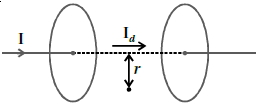
Show that the magnetic field $B$ at a point in between the plates of a parallel-plate capacitor during charging is $B = \frac{{\mu _0 \epsilon _0 r}}{2} \cdot \frac{{dE}}{{dt}}$ (symbols have their usual meanings).
Solution
(N/A) Consider a circular loop of radius $r$ between the plates of a parallel-plate capacitor. According to the Ampere-Maxwell law,the line integral of the magnetic field around this loop is given by:
$\oint B \cdot dl = \mu_0 I_d$
$B(2\pi r) = \mu_0 \epsilon_0 \frac{d\phi_E}{dt}$
Since the electric field $E$ is uniform between the plates,the electric flux $\phi_E$ through the circular loop of radius $r$ is $\phi_E = E \cdot A = E(\pi r^2)$.
Substituting this into the equation:
$B(2\pi r) = \mu_0 \epsilon_0 \frac{d}{dt}(E \pi r^2)$
$B(2\pi r) = \mu_0 \epsilon_0 \pi r^2 \frac{dE}{dt}$
Dividing both sides by $2\pi r$,we get:
$B = \frac{\mu_0 \epsilon_0 r}{2} \cdot \frac{dE}{dt}$
$\oint B \cdot dl = \mu_0 I_d$
$B(2\pi r) = \mu_0 \epsilon_0 \frac{d\phi_E}{dt}$
Since the electric field $E$ is uniform between the plates,the electric flux $\phi_E$ through the circular loop of radius $r$ is $\phi_E = E \cdot A = E(\pi r^2)$.
Substituting this into the equation:
$B(2\pi r) = \mu_0 \epsilon_0 \frac{d}{dt}(E \pi r^2)$
$B(2\pi r) = \mu_0 \epsilon_0 \pi r^2 \frac{dE}{dt}$
Dividing both sides by $2\pi r$,we get:
$B = \frac{\mu_0 \epsilon_0 r}{2} \cdot \frac{dE}{dt}$
0 likes
View Solution70
Medium
You are given a $2 \,\mu F$ parallel plate capacitor. How would you establish an instantaneous displacement current of $1 \, mA$ in the space between its plates?
Solution
(N/A) The displacement current $I_d$ in a capacitor is given by the formula $I_d = \epsilon_0 \frac{d\Phi_E}{dt}$,which is equivalent to $I_d = C \frac{dV}{dt}$.
Given:
Capacitance $C = 2 \,\mu F = 2 \times 10^{-6} \, F$
Displacement current $I_d = 1 \, mA = 10^{-3} \, A$
We need to find the rate of change of potential difference $\frac{dV}{dt}$.
Using the relation $I_d = C \frac{dV}{dt}$,we get:
$\frac{dV}{dt} = \frac{I_d}{C} = \frac{10^{-3}}{2 \times 10^{-6}} = 0.5 \times 10^3 = 500 \, V/s$.
Therefore,by changing the potential difference across the plates at a rate of $500 \, V/s$,an instantaneous displacement current of $1 \, mA$ can be established.
Given:
Capacitance $C = 2 \,\mu F = 2 \times 10^{-6} \, F$
Displacement current $I_d = 1 \, mA = 10^{-3} \, A$
We need to find the rate of change of potential difference $\frac{dV}{dt}$.
Using the relation $I_d = C \frac{dV}{dt}$,we get:
$\frac{dV}{dt} = \frac{I_d}{C} = \frac{10^{-3}}{2 \times 10^{-6}} = 0.5 \times 10^3 = 500 \, V/s$.
Therefore,by changing the potential difference across the plates at a rate of $500 \, V/s$,an instantaneous displacement current of $1 \, mA$ can be established.
0 likes
View Solution71
Medium
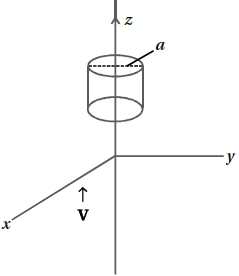
An infinitely long thin wire carrying a uniform linear static charge density $\lambda$ is placed along the $z-$axis. The wire is set into motion along its length with a uniform velocity $\vec{V} = v\hat{k}$. Calculate the Poynting vector $\vec{S} = \frac{1}{\mu_0}(\vec{E} \times \vec{B})$.
Solution
(N/A) The electric field $\vec{E}$ at a radial distance $a$ from an infinitely long charged wire with linear charge density $\lambda$ is given by Gauss's Law as $\vec{E} = \frac{\lambda}{2\pi\epsilon_0 a} \hat{r}$,where $\hat{r}$ is the radial unit vector in the $xy-$plane.
The moving charged wire constitutes a current $I = \lambda v$. The magnetic field $\vec{B}$ at a distance $a$ from the wire is given by Ampere's Law as $\vec{B} = \frac{\mu_0 I}{2\pi a} \hat{\phi} = \frac{\mu_0 \lambda v}{2\pi a} \hat{\phi}$,where $\hat{\phi}$ is the azimuthal unit vector.
The Poynting vector is defined as $\vec{S} = \frac{1}{\mu_0}(\vec{E} \times \vec{B})$.
Substituting the expressions for $\vec{E}$ and $\vec{B}$:
$\vec{S} = \frac{1}{\mu_0} \left( \frac{\lambda}{2\pi\epsilon_0 a} \hat{r} \times \frac{\mu_0 \lambda v}{2\pi a} \hat{\phi} \right)$
$\vec{S} = \frac{\lambda^2 v}{4\pi^2 \epsilon_0 a^2} (\hat{r} \times \hat{\phi})$
Since $\hat{r} \times \hat{\phi} = \hat{k}$ (the unit vector along the $z-$axis),
$\vec{S} = \frac{\lambda^2 v}{4\pi^2 \epsilon_0 a^2} \hat{k}$.
The moving charged wire constitutes a current $I = \lambda v$. The magnetic field $\vec{B}$ at a distance $a$ from the wire is given by Ampere's Law as $\vec{B} = \frac{\mu_0 I}{2\pi a} \hat{\phi} = \frac{\mu_0 \lambda v}{2\pi a} \hat{\phi}$,where $\hat{\phi}$ is the azimuthal unit vector.
The Poynting vector is defined as $\vec{S} = \frac{1}{\mu_0}(\vec{E} \times \vec{B})$.
Substituting the expressions for $\vec{E}$ and $\vec{B}$:
$\vec{S} = \frac{1}{\mu_0} \left( \frac{\lambda}{2\pi\epsilon_0 a} \hat{r} \times \frac{\mu_0 \lambda v}{2\pi a} \hat{\phi} \right)$
$\vec{S} = \frac{\lambda^2 v}{4\pi^2 \epsilon_0 a^2} (\hat{r} \times \hat{\phi})$
Since $\hat{r} \times \hat{\phi} = \hat{k}$ (the unit vector along the $z-$axis),
$\vec{S} = \frac{\lambda^2 v}{4\pi^2 \epsilon_0 a^2} \hat{k}$.
0 likes
View Solution72
Difficult
Sea water at frequency $v = 4 \times 10^8\, Hz$ has permittivity $\epsilon \approx 80\epsilon_0$,permeability $\mu = \mu_0$ and resistivity $\rho = 0.25\,\Omega m$. Imagine a parallel plate capacitor immersed in sea water and driven by an alternating voltage source $V(t) = V_0 \sin(2\pi vt)$. What fraction of the conduction current density is the displacement current density?
Solution
(4/9) Let the distance between the two plates of the capacitor be $d$ and the voltage applied be $V(t) = V_0 \sin(2\pi vt)$.
The electric field is given by $E = \frac{V_0}{d} \sin(2\pi vt)$.
By Ohm's law,the conduction current density is $J_c = \sigma E = \frac{E}{\rho} = \frac{V_0}{\rho d} \sin(2\pi vt)$.
Let $J_0^c = \frac{V_0}{\rho d}$,so $J_c = J_0^c \sin(2\pi vt)$.
The displacement current density is $J_d = \epsilon \frac{\partial E}{\partial t} = \epsilon \frac{\partial}{\partial t} \left[ \frac{V_0}{d} \sin(2\pi vt) \right] = \frac{\epsilon (2\pi v) V_0}{d} \cos(2\pi vt)$.
Let $J_0^d = \frac{2\pi v \epsilon V_0}{d}$,so $J_d = J_0^d \cos(2\pi vt)$.
The ratio of the amplitudes is $\frac{J_0^d}{J_0^c} = \frac{2\pi v \epsilon V_0}{d} \times \frac{\rho d}{V_0} = 2\pi v \epsilon \rho$.
Substituting the given values: $\epsilon = 80\epsilon_0$,$\rho = 0.25\,\Omega m$,and $v = 4 \times 10^8\, Hz$.
$\frac{J_0^d}{J_0^c} = 2\pi v (80\epsilon_0) \rho = 160\pi \epsilon_0 v \rho$.
Using $4\pi\epsilon_0 = \frac{1}{9 \times 10^9}$,we have $160\pi\epsilon_0 = 40 \times (4\pi\epsilon_0) = \frac{40}{9 \times 10^9}$.
$\frac{J_0^d}{J_0^c} = \frac{40}{9 \times 10^9} \times (4 \times 10^8) \times 0.25 = \frac{40 \times 4 \times 10^8 \times 0.25}{9 \times 10^9} = \frac{40}{90} = \frac{4}{9}$.
The electric field is given by $E = \frac{V_0}{d} \sin(2\pi vt)$.
By Ohm's law,the conduction current density is $J_c = \sigma E = \frac{E}{\rho} = \frac{V_0}{\rho d} \sin(2\pi vt)$.
Let $J_0^c = \frac{V_0}{\rho d}$,so $J_c = J_0^c \sin(2\pi vt)$.
The displacement current density is $J_d = \epsilon \frac{\partial E}{\partial t} = \epsilon \frac{\partial}{\partial t} \left[ \frac{V_0}{d} \sin(2\pi vt) \right] = \frac{\epsilon (2\pi v) V_0}{d} \cos(2\pi vt)$.
Let $J_0^d = \frac{2\pi v \epsilon V_0}{d}$,so $J_d = J_0^d \cos(2\pi vt)$.
The ratio of the amplitudes is $\frac{J_0^d}{J_0^c} = \frac{2\pi v \epsilon V_0}{d} \times \frac{\rho d}{V_0} = 2\pi v \epsilon \rho$.
Substituting the given values: $\epsilon = 80\epsilon_0$,$\rho = 0.25\,\Omega m$,and $v = 4 \times 10^8\, Hz$.
$\frac{J_0^d}{J_0^c} = 2\pi v (80\epsilon_0) \rho = 160\pi \epsilon_0 v \rho$.
Using $4\pi\epsilon_0 = \frac{1}{9 \times 10^9}$,we have $160\pi\epsilon_0 = 40 \times (4\pi\epsilon_0) = \frac{40}{9 \times 10^9}$.
$\frac{J_0^d}{J_0^c} = \frac{40}{9 \times 10^9} \times (4 \times 10^8) \times 0.25 = \frac{40 \times 4 \times 10^8 \times 0.25}{9 \times 10^9} = \frac{40}{90} = \frac{4}{9}$.
0 likes
View Solution73
Difficult
$A$ long straight cable of length $l$ is placed symmetrically along $z-$ axis and has radius $a (a << l)$. The cable consists of a thin wire and a co-axial conducting tube. An alternating current $I(t) = I_0 \sin(2\pi \nu t)$ flows down the central thin wire and returns along the co-axial conducting tube. The induced electric field at a distance $s$ from the wire inside the cable is $\vec{E}(s,t) = \mu_0 I_0 \nu \cos(2\pi \nu t) \ln(s/a) \hat{k}$.
$(i)$ Calculate the displacement current density inside the cable.
$(ii)$ Integrate the displacement current density across the cross-section of the cable to find the total displacement current $I_d$.
$(iii)$ Compare the conduction current $I_0$ with the displacement current $I_d$.
$(i)$ Calculate the displacement current density inside the cable.
$(ii)$ Integrate the displacement current density across the cross-section of the cable to find the total displacement current $I_d$.
$(iii)$ Compare the conduction current $I_0$ with the displacement current $I_d$.
Solution
(N/A) $(i)$ The displacement current density is given by $\vec{J}_d = \epsilon_0 \frac{\partial \vec{E}}{\partial t}$.
Given $\vec{E}(s,t) = \mu_0 I_0 \nu \cos(2\pi \nu t) \ln(s/a) \hat{k}$.
$\vec{J}_d = \epsilon_0 \frac{\partial}{\partial t} [\mu_0 I_0 \nu \cos(2\pi \nu t) \ln(s/a) \hat{k}] = \epsilon_0 \mu_0 I_0 \nu \ln(s/a) \hat{k} \cdot \frac{d}{dt} [\cos(2\pi \nu t)]$.
Since $\epsilon_0 \mu_0 = 1/c^2$,we have $\vec{J}_d = \frac{1}{c^2} I_0 \nu \ln(s/a) \hat{k} \cdot (-2\pi \nu \sin(2\pi \nu t)) = -\frac{2\pi \nu^2 I_0}{c^2} \ln(s/a) \sin(2\pi \nu t) \hat{k}$.
Using $\lambda = c/\nu$,$\vec{J}_d = \frac{2\pi I_0}{\lambda^2} \ln(a/s) \sin(2\pi \nu t) \hat{k}$.
$(ii)$ The total displacement current $I_d = \int \vec{J}_d \cdot d\vec{A} = \int_0^a J_d (2\pi s ds)$.
$I_d = \int_0^a \frac{2\pi I_0}{\lambda^2} \ln(a/s) \sin(2\pi \nu t) (2\pi s ds) = \frac{4\pi^2 I_0 \sin(2\pi \nu t)}{\lambda^2} \int_0^a s \ln(a/s) ds$.
Let $x = s/a$,then $ds = a dx$. The integral becomes $a^2 \int_0^1 x \ln(1/x) dx = a^2 \int_0^1 -x \ln x dx = a^2 [1/4] = a^2/4$.
Thus,$I_d = \frac{4\pi^2 I_0 \sin(2\pi \nu t)}{\lambda^2} \cdot \frac{a^2}{4} = I_0 \sin(2\pi \nu t) (\frac{\pi a}{\lambda})^2$.
$(iii)$ Comparing $I_d$ with $I(t) = I_0 \sin(2\pi \nu t)$,we find $I_d = I(t) (\frac{\pi a}{\lambda})^2$. Since $a << \lambda$,the displacement current is much smaller than the conduction current.
Given $\vec{E}(s,t) = \mu_0 I_0 \nu \cos(2\pi \nu t) \ln(s/a) \hat{k}$.
$\vec{J}_d = \epsilon_0 \frac{\partial}{\partial t} [\mu_0 I_0 \nu \cos(2\pi \nu t) \ln(s/a) \hat{k}] = \epsilon_0 \mu_0 I_0 \nu \ln(s/a) \hat{k} \cdot \frac{d}{dt} [\cos(2\pi \nu t)]$.
Since $\epsilon_0 \mu_0 = 1/c^2$,we have $\vec{J}_d = \frac{1}{c^2} I_0 \nu \ln(s/a) \hat{k} \cdot (-2\pi \nu \sin(2\pi \nu t)) = -\frac{2\pi \nu^2 I_0}{c^2} \ln(s/a) \sin(2\pi \nu t) \hat{k}$.
Using $\lambda = c/\nu$,$\vec{J}_d = \frac{2\pi I_0}{\lambda^2} \ln(a/s) \sin(2\pi \nu t) \hat{k}$.
$(ii)$ The total displacement current $I_d = \int \vec{J}_d \cdot d\vec{A} = \int_0^a J_d (2\pi s ds)$.
$I_d = \int_0^a \frac{2\pi I_0}{\lambda^2} \ln(a/s) \sin(2\pi \nu t) (2\pi s ds) = \frac{4\pi^2 I_0 \sin(2\pi \nu t)}{\lambda^2} \int_0^a s \ln(a/s) ds$.
Let $x = s/a$,then $ds = a dx$. The integral becomes $a^2 \int_0^1 x \ln(1/x) dx = a^2 \int_0^1 -x \ln x dx = a^2 [1/4] = a^2/4$.
Thus,$I_d = \frac{4\pi^2 I_0 \sin(2\pi \nu t)}{\lambda^2} \cdot \frac{a^2}{4} = I_0 \sin(2\pi \nu t) (\frac{\pi a}{\lambda})^2$.
$(iii)$ Comparing $I_d$ with $I(t) = I_0 \sin(2\pi \nu t)$,we find $I_d = I(t) (\frac{\pi a}{\lambda})^2$. Since $a << \lambda$,the displacement current is much smaller than the conduction current.
0 likes
View Solution74
EasyMCQ
What did Hertz observe in his experiment to produce electromagnetic waves?
A
Production of sparks across the gap of the receiver.
B
Emission of electrons from the metal surface.
C
Change in the magnetic field intensity.
D
Reflection of light waves.
Solution
(A) In $1887$,while performing experiments to produce electromagnetic waves,Heinrich Hertz observed that the production of sparks across the gap of the receiver was enhanced when the metal surface of the receiver was illuminated by ultraviolet light from an arc lamp. This phenomenon was later identified as the photoelectric effect.
0 likes
View Solution75
DifficultMCQ
Seawater at a frequency $f = 9 \times 10^{2} \, Hz$ has permittivity $\varepsilon = 80 \varepsilon_{0}$ and resistivity $\rho = 0.25 \, \Omega m$. Imagine a parallel plate capacitor is immersed in seawater and is driven by an alternating voltage source $V(t) = V_{0} \sin(2 \pi ft)$. Then the conduction current density becomes $10^{x}$ times the displacement current density after time $t = \frac{1}{800} \, s$. The value of $x$ is ......... . $\left(\frac{1}{4 \pi \varepsilon_{0}} = 9 \times 10^{9} \, Nm^{2} C^{-2}\right)$
A
$12$
B
$8$
C
$9$
D
$6$
Solution
(D) The conduction current density is $J_{c} = \sigma E = \frac{E}{\rho} = \frac{V(t)}{\rho d}$.
The displacement current density is $J_{d} = \varepsilon \frac{\partial E}{\partial t} = \varepsilon \frac{1}{d} \frac{dV}{dt} = \frac{\varepsilon}{d} V_{0} (2 \pi f) \cos(2 \pi ft)$.
Given $J_{c} = 10^{x} J_{d}$,we have $\frac{V_{0} \sin(2 \pi ft)}{\rho d} = 10^{x} \frac{\varepsilon}{d} V_{0} (2 \pi f) \cos(2 \pi ft)$.
This simplifies to $\tan(2 \pi ft) = 10^{x} \cdot \rho \cdot \varepsilon \cdot 2 \pi f$.
Given $f = 900 \, Hz$,$t = \frac{1}{800} \, s$,$\rho = 0.25 \, \Omega m$,and $\varepsilon = 80 \varepsilon_{0}$.
$2 \pi ft = 2 \pi \times 900 \times \frac{1}{800} = \frac{9 \pi}{4} = 2 \pi + \frac{\pi}{4}$.
So,$\tan(2 \pi ft) = \tan(\pi/4) = 1$.
Now,$1 = 10^{x} \times 0.25 \times 80 \varepsilon_{0} \times 2 \pi \times 900$.
Using $\frac{1}{4 \pi \varepsilon_{0}} = 9 \times 10^{9}$,we have $\varepsilon_{0} = \frac{1}{36 \pi \times 10^{9}}$.
$1 = 10^{x} \times 20 \times \frac{1}{36 \pi \times 10^{9}} \times 1800 \pi = 10^{x} \times \frac{20 \times 1800}{36 \times 10^{9}} = 10^{x} \times \frac{36000}{36 \times 10^{9}} = 10^{x} \times 10^{-6}$.
$10^{x} = 10^{6}$,which gives $x = 6$.
The displacement current density is $J_{d} = \varepsilon \frac{\partial E}{\partial t} = \varepsilon \frac{1}{d} \frac{dV}{dt} = \frac{\varepsilon}{d} V_{0} (2 \pi f) \cos(2 \pi ft)$.
Given $J_{c} = 10^{x} J_{d}$,we have $\frac{V_{0} \sin(2 \pi ft)}{\rho d} = 10^{x} \frac{\varepsilon}{d} V_{0} (2 \pi f) \cos(2 \pi ft)$.
This simplifies to $\tan(2 \pi ft) = 10^{x} \cdot \rho \cdot \varepsilon \cdot 2 \pi f$.
Given $f = 900 \, Hz$,$t = \frac{1}{800} \, s$,$\rho = 0.25 \, \Omega m$,and $\varepsilon = 80 \varepsilon_{0}$.
$2 \pi ft = 2 \pi \times 900 \times \frac{1}{800} = \frac{9 \pi}{4} = 2 \pi + \frac{\pi}{4}$.
So,$\tan(2 \pi ft) = \tan(\pi/4) = 1$.
Now,$1 = 10^{x} \times 0.25 \times 80 \varepsilon_{0} \times 2 \pi \times 900$.
Using $\frac{1}{4 \pi \varepsilon_{0}} = 9 \times 10^{9}$,we have $\varepsilon_{0} = \frac{1}{36 \pi \times 10^{9}}$.
$1 = 10^{x} \times 20 \times \frac{1}{36 \pi \times 10^{9}} \times 1800 \pi = 10^{x} \times \frac{20 \times 1800}{36 \times 10^{9}} = 10^{x} \times \frac{36000}{36 \times 10^{9}} = 10^{x} \times 10^{-6}$.
$10^{x} = 10^{6}$,which gives $x = 6$.
0 likes
View Solution76
MediumMCQ
$A$ capacitor of capacitance $C$ is connected across an $AC$ source of voltage $V$,given by $V = V_{0} \sin \omega t$. The displacement current between the plates of the capacitor would then be given by:
A
$I_{d} = V_{0} \omega C \cos \omega t$
B
$I_{d} = \frac{V_{0}}{\omega C} \cos \omega t$
C
$I_{d} = \frac{V_{0}}{\omega C} \sin \omega t$
D
$I_{d} = V_{0} \omega C \sin \omega t$
Solution
(A) The charge on the capacitor is given by $q = CV$.
Substituting the given voltage $V = V_{0} \sin \omega t$,we get $q = C V_{0} \sin \omega t$.
The displacement current $I_{d}$ is equal to the rate of change of charge on the capacitor plates,which is $I_{d} = \frac{dq}{dt}$.
$I_{d} = \frac{d}{dt} (C V_{0} \sin \omega t)$.
Since $C$ and $V_{0}$ are constants,$I_{d} = C V_{0} \frac{d}{dt} (\sin \omega t)$.
Using the derivative of $\sin \omega t$,which is $\omega \cos \omega t$,we get $I_{d} = C V_{0} \omega \cos \omega t$.
Therefore,$I_{d} = V_{0} \omega C \cos \omega t$.
Substituting the given voltage $V = V_{0} \sin \omega t$,we get $q = C V_{0} \sin \omega t$.
The displacement current $I_{d}$ is equal to the rate of change of charge on the capacitor plates,which is $I_{d} = \frac{dq}{dt}$.
$I_{d} = \frac{d}{dt} (C V_{0} \sin \omega t)$.
Since $C$ and $V_{0}$ are constants,$I_{d} = C V_{0} \frac{d}{dt} (\sin \omega t)$.
Using the derivative of $\sin \omega t$,which is $\omega \cos \omega t$,we get $I_{d} = C V_{0} \omega \cos \omega t$.
Therefore,$I_{d} = V_{0} \omega C \cos \omega t$.
0 likes
View Solution77
DifficultMCQ
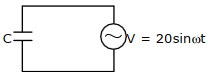
$AC$ voltage $V(t) = 20 \sin \omega t$ of frequency $50 \, Hz$ is applied to a parallel plate capacitor. The separation between the plates is $2 \, mm$ and the area is $1 \, m^2$. The amplitude of the oscillating displacement current for the applied $AC$ voltage is ...... $\mu A$.
[Take $\varepsilon_0 = 8.85 \times 10^{-12} \, F/m$]
[Take $\varepsilon_0 = 8.85 \times 10^{-12} \, F/m$]
A
$21.14$
B
$83.57$
C
$55.58$
D
$27.79$
Solution
(D) The capacitance of the parallel plate capacitor is given by $C = \frac{\varepsilon_0 A}{d}$.
Substituting the given values: $C = \frac{8.85 \times 10^{-12} \times 1}{2 \times 10^{-3}} = 4.425 \times 10^{-9} \, F$.
The angular frequency is $\omega = 2 \pi f = 2 \times \pi \times 50 = 100 \pi \, rad/s$.
The amplitude of the current $I_0$ is given by $I_0 = V_0 \omega C$.
Substituting the values: $I_0 = 20 \times (100 \pi) \times (4.425 \times 10^{-9})$.
$I_0 = 2000 \times 3.14159 \times 4.425 \times 10^{-9} \approx 27.79 \times 10^{-6} \, A$.
Therefore,the amplitude of the displacement current is $27.79 \, \mu A$.
Substituting the given values: $C = \frac{8.85 \times 10^{-12} \times 1}{2 \times 10^{-3}} = 4.425 \times 10^{-9} \, F$.
The angular frequency is $\omega = 2 \pi f = 2 \times \pi \times 50 = 100 \pi \, rad/s$.
The amplitude of the current $I_0$ is given by $I_0 = V_0 \omega C$.
Substituting the values: $I_0 = 20 \times (100 \pi) \times (4.425 \times 10^{-9})$.
$I_0 = 2000 \times 3.14159 \times 4.425 \times 10^{-9} \approx 27.79 \times 10^{-6} \, A$.
Therefore,the amplitude of the displacement current is $27.79 \, \mu A$.
0 likes
View Solution78
MediumMCQ
The displacement current of $4.425 \,\mu A$ is developed in the space between the plates of a parallel plate capacitor when the voltage is changing at a rate of $10^{6} \,V s^{-1}$. The area of each plate of the capacitor is $40 \,cm^{2}$. The distance between the plates of the capacitor is $x \times 10^{-3} \,m$. The value of $x$ is ................ (Permittivity of free space,$\varepsilon_{0} = 8.85 \times 10^{-12} \,C^{2} N^{-1} m^{-2}$)
A
$2$
B
$7$
C
$8$
D
$9$
Solution
(C) The displacement current $I_{d}$ in a parallel plate capacitor is given by the formula: $I_{d} = \varepsilon_{0} A \frac{dE}{dt} = \varepsilon_{0} A \frac{d}{dt} (\frac{V}{d}) = \frac{\varepsilon_{0} A}{d} \frac{dV}{dt}$.
Given values:
$I_{d} = 4.425 \times 10^{-6} \,A$
$\frac{dV}{dt} = 10^{6} \,V s^{-1}$
$A = 40 \,cm^{2} = 40 \times 10^{-4} \,m^{2} = 4 \times 10^{-3} \,m^{2}$
$\varepsilon_{0} = 8.85 \times 10^{-12} \,C^{2} N^{-1} m^{-2}$
Rearranging the formula to solve for $d$:
$d = \frac{\varepsilon_{0} A}{I_{d}} \frac{dV}{dt}$
Substituting the values:
$d = \frac{8.85 \times 10^{-12} \times 4 \times 10^{-3} \times 10^{6}}{4.425 \times 10^{-6}}$
$d = \frac{8.85 \times 4 \times 10^{-9}}{4.425 \times 10^{-6}}$
$d = 2 \times 4 \times 10^{-3} \,m = 8 \times 10^{-3} \,m$
Comparing this with $x \times 10^{-3} \,m$,we get $x = 8$.
Given values:
$I_{d} = 4.425 \times 10^{-6} \,A$
$\frac{dV}{dt} = 10^{6} \,V s^{-1}$
$A = 40 \,cm^{2} = 40 \times 10^{-4} \,m^{2} = 4 \times 10^{-3} \,m^{2}$
$\varepsilon_{0} = 8.85 \times 10^{-12} \,C^{2} N^{-1} m^{-2}$
Rearranging the formula to solve for $d$:
$d = \frac{\varepsilon_{0} A}{I_{d}} \frac{dV}{dt}$
Substituting the values:
$d = \frac{8.85 \times 10^{-12} \times 4 \times 10^{-3} \times 10^{6}}{4.425 \times 10^{-6}}$
$d = \frac{8.85 \times 4 \times 10^{-9}}{4.425 \times 10^{-6}}$
$d = 2 \times 4 \times 10^{-3} \,m = 8 \times 10^{-3} \,m$
Comparing this with $x \times 10^{-3} \,m$,we get $x = 8$.
0 likes
View Solution79
AdvancedMCQ
Imagine a world where free magnetic charges exist. In this world,a circuit is made with a $U$-shape wire and a rod free to slide on it. $A$ current carried by free magnetic charges can flow in the circuit. When the circuit is placed in a uniform electric field $E$ perpendicular to the plane of the circuit and the rod is pulled to the right with a constant speed $v$,the magnetic $emf$ in the circuit and the direction of the corresponding current,arising because of changing electric flux will be ($l$ is the length of the rod and $c$ is the speed of light).
A
$v E l$ clockwise
B
$v E l$ counter-clockwise
C
$\frac{v E l}{c^{2}}$ clockwise
D
$\frac{v E l}{c^{2}}$ counter-clockwise
Solution
(C-D) According to the modified Maxwell-Ampere law for a world with magnetic charges,the magnetic $emf$ is given by $\oint B \cdot dl = \mu_{0} \epsilon_{0} \frac{d\phi_{E}}{dt}$.
The electric flux $\phi_{E}$ through the circuit is $\phi_{E} = E \cdot A = E \cdot (l \cdot x)$,where $x$ is the position of the rod.
The rate of change of electric flux is $\frac{d\phi_{E}}{dt} = E \cdot l \cdot \frac{dx}{dt} = E \cdot l \cdot v$.
Substituting this into the $emf$ equation,we get $emf = \mu_{0} \epsilon_{0} E l v$.
Since $c^{2} = \frac{1}{\mu_{0} \epsilon_{0}}$,we have $emf = \frac{E v l}{c^{2}}$.
The direction of the induced magnetic current depends on the direction of the electric field $E$. If $E$ is directed outward,the current is clockwise; if $E$ is directed inward,the current is counter-clockwise. Thus,both options $(c)$ and $(d)$ are physically possible depending on the orientation of $E$.
The electric flux $\phi_{E}$ through the circuit is $\phi_{E} = E \cdot A = E \cdot (l \cdot x)$,where $x$ is the position of the rod.
The rate of change of electric flux is $\frac{d\phi_{E}}{dt} = E \cdot l \cdot \frac{dx}{dt} = E \cdot l \cdot v$.
Substituting this into the $emf$ equation,we get $emf = \mu_{0} \epsilon_{0} E l v$.
Since $c^{2} = \frac{1}{\mu_{0} \epsilon_{0}}$,we have $emf = \frac{E v l}{c^{2}}$.
The direction of the induced magnetic current depends on the direction of the electric field $E$. If $E$ is directed outward,the current is clockwise; if $E$ is directed inward,the current is counter-clockwise. Thus,both options $(c)$ and $(d)$ are physically possible depending on the orientation of $E$.
0 likes
View Solution80
EasyMCQ
Displacement current is set up between the plates of a capacitor when the potential difference across the plates is ..............
A
Maximum
B
Zero
C
Minimum
D
Varying
Solution
(D) The displacement current $I_d$ is defined by the formula $I_d = \varepsilon_0 \frac{d\phi_E}{dt}$,where $\phi_E$ is the electric flux.
Since the electric flux $\phi_E = E \cdot A = \frac{V}{d} \cdot A$ (where $V$ is the potential difference and $d$ is the distance between plates),the displacement current is proportional to the rate of change of the potential difference: $I_d = \frac{\varepsilon_0 A}{d} \frac{dV}{dt}$.
Therefore,for a displacement current to exist,the potential difference $V$ across the plates must be changing with time (i.e.,$\frac{dV}{dt} \neq 0$).
Since the electric flux $\phi_E = E \cdot A = \frac{V}{d} \cdot A$ (where $V$ is the potential difference and $d$ is the distance between plates),the displacement current is proportional to the rate of change of the potential difference: $I_d = \frac{\varepsilon_0 A}{d} \frac{dV}{dt}$.
Therefore,for a displacement current to exist,the potential difference $V$ across the plates must be changing with time (i.e.,$\frac{dV}{dt} \neq 0$).
0 likes
View Solution81
MediumMCQ
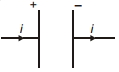
$A$ parallel plate capacitor with circular plates of radius $R$ is being charged as shown. At the instant shown,the displacement current in the region between the plates enclosed between $\frac{R}{2}$ and $R$ is given by
A
$\frac{3}{4} i$
B
$\frac{1}{4} i$
C
$3 i$
D
$\frac{4}{3} i$
Solution
(A) The total displacement current $I_d$ between the plates is equal to the conduction current $i$ in the wires,so $I_d = i = \varepsilon_0 A \frac{dE}{dt} = \varepsilon_0 (\pi R^2) \frac{dE}{dt}$.
The displacement current density $J_d$ is uniform across the plates,given by $J_d = \frac{I_d}{A} = \frac{i}{\pi R^2}$.
The displacement current $I_d'$ in the annular region between $r = \frac{R}{2}$ and $r = R$ is the integral of the current density over that area:
$I_d' = J_d \times A' = \frac{i}{\pi R^2} \times [\pi R^2 - \pi (\frac{R}{2})^2]$
$I_d' = \frac{i}{\pi R^2} \times [\pi R^2 - \frac{\pi R^2}{4}]$
$I_d' = \frac{i}{\pi R^2} \times [\frac{3}{4} \pi R^2] = \frac{3}{4} i$.
The displacement current density $J_d$ is uniform across the plates,given by $J_d = \frac{I_d}{A} = \frac{i}{\pi R^2}$.
The displacement current $I_d'$ in the annular region between $r = \frac{R}{2}$ and $r = R$ is the integral of the current density over that area:
$I_d' = J_d \times A' = \frac{i}{\pi R^2} \times [\pi R^2 - \pi (\frac{R}{2})^2]$
$I_d' = \frac{i}{\pi R^2} \times [\pi R^2 - \frac{\pi R^2}{4}]$
$I_d' = \frac{i}{\pi R^2} \times [\frac{3}{4} \pi R^2] = \frac{3}{4} i$.
0 likes
View Solution82
EasyMCQ
The Hertz experiment is used for:
A
Production of electromagnetic waves
B
Detection of electromagnetic waves
C
Both $(a)$ and $(b)$
D
None of these
Solution
(C) The Hertz experiment was the first experimental demonstration of the existence of electromagnetic waves.
In this experiment,Heinrich Hertz used an induction coil to create a high-voltage spark across a spark gap,which acted as a transmitter to produce electromagnetic waves.
He also used a separate loop with a small spark gap,which acted as a receiver to detect these waves.
Therefore,the Hertz experiment is used for both the production and detection of electromagnetic waves.
Thus,the correct option is $(c)$.
In this experiment,Heinrich Hertz used an induction coil to create a high-voltage spark across a spark gap,which acted as a transmitter to produce electromagnetic waves.
He also used a separate loop with a small spark gap,which acted as a receiver to detect these waves.
Therefore,the Hertz experiment is used for both the production and detection of electromagnetic waves.
Thus,the correct option is $(c)$.
0 likes
View Solution83
EasyMCQ
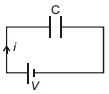
At a particular instant,the current in the circuit given below is $i$. The displacement current between the plates of the capacitor shown below is ..........
A
$0$
B
$i$
C
$\frac{i}{2}$
D
$\frac{i}{4}$
Solution
(B) According to the principle of continuity of current,the conduction current in the connecting wires is equal to the displacement current between the plates of the capacitor.
Since the conduction current in the circuit is given as $i$,the displacement current $i_d$ between the capacitor plates must also be equal to $i$.
Therefore,$i_d = i$.
Since the conduction current in the circuit is given as $i$,the displacement current $i_d$ between the capacitor plates must also be equal to $i$.
Therefore,$i_d = i$.
0 likes
View Solution84
MediumMCQ
To establish an instantaneous displacement current of $I$ ampere in the space between the plates of a parallel plate capacitor of $\frac{1}{2} \text{ F}$,the value of $\frac{dV}{dt}$ is .......
A
$2I$
B
$\frac{I}{2}$
C
$\frac{1}{2I}$
D
$I$
Solution
(A) The displacement current $I_d$ in a parallel plate capacitor is equal to the conduction current $I$ flowing through the circuit.
The formula for the current in a capacitor is given by $I = C \frac{dV}{dt}$.
Given that the capacitance $C = \frac{1}{2} \text{ F}$ and the displacement current $I_d = I$,we substitute these values into the equation:
$I = \frac{1}{2} \cdot \frac{dV}{dt}$.
Rearranging the equation to solve for $\frac{dV}{dt}$:
$\frac{dV}{dt} = 2I$.
Therefore,the correct option is $A$.
The formula for the current in a capacitor is given by $I = C \frac{dV}{dt}$.
Given that the capacitance $C = \frac{1}{2} \text{ F}$ and the displacement current $I_d = I$,we substitute these values into the equation:
$I = \frac{1}{2} \cdot \frac{dV}{dt}$.
Rearranging the equation to solve for $\frac{dV}{dt}$:
$\frac{dV}{dt} = 2I$.
Therefore,the correct option is $A$.
0 likes
View Solution85
MediumMCQ
Match List-$I$ with List-$II$:
Choose the correct answer from the options given below:
| List-$I$ | List-$II$ |
|---|---|
| $A$. Gauss's Law in Electrostatics | $I$. $\oint \vec{E} \cdot d \vec{l} = -\frac{d \phi_B}{d t}$ |
| $B$. Faraday's Law | $II$. $\oint \vec{B} \cdot d \vec{A} = 0$ |
| $C$. Gauss's Law in Magnetism | $III$. $\oint \vec{B} \cdot d \vec{l} = \mu_0 i_C + \mu_0 \epsilon_0 \frac{d \phi_E}{d t}$ |
| $D$. Ampere-Maxwell Law | $IV$. $\oint \vec{E} \cdot d \vec{s} = \frac{q}{\epsilon_0}$ |
Choose the correct answer from the options given below:
A
$A-IV, B-I, C-II, D-III$
B
$A-I, B-II, C-III, D-IV$
C
$A-III, B-IV, C-I, D-II$
D
$A-II, B-III, C-IV, D-I$
Solution
(A) The four Maxwell's equations are as follows:
$1$. Gauss's Law in Electrostatics: $\oint \vec{E} \cdot d \vec{s} = \frac{q}{\epsilon_0}$ $(A-IV)$
$2$. Faraday's Law of Induction: $\oint \vec{E} \cdot d \vec{l} = -\frac{d \phi_B}{d t}$ $(B-I)$
$3$. Gauss's Law in Magnetism: $\oint \vec{B} \cdot d \vec{A} = 0$ $(C-II)$
$4$. Ampere-Maxwell Law: $\oint \vec{B} \cdot d \vec{l} = \mu_0 i_C + \mu_0 \epsilon_0 \frac{d \phi_E}{d t}$ $(D-III)$
Therefore,the correct matching is $A-IV, B-I, C-II, D-III$.
$1$. Gauss's Law in Electrostatics: $\oint \vec{E} \cdot d \vec{s} = \frac{q}{\epsilon_0}$ $(A-IV)$
$2$. Faraday's Law of Induction: $\oint \vec{E} \cdot d \vec{l} = -\frac{d \phi_B}{d t}$ $(B-I)$
$3$. Gauss's Law in Magnetism: $\oint \vec{B} \cdot d \vec{A} = 0$ $(C-II)$
$4$. Ampere-Maxwell Law: $\oint \vec{B} \cdot d \vec{l} = \mu_0 i_C + \mu_0 \epsilon_0 \frac{d \phi_E}{d t}$ $(D-III)$
Therefore,the correct matching is $A-IV, B-I, C-II, D-III$.
0 likes
View Solution86
MediumMCQ
Which of the following Maxwell's equations is valid for time-varying conditions but not valid for static conditions?
A
$\oint \vec{B} \cdot d\vec{l} = \mu_0 I$
B
$\oint \vec{E} \cdot d\vec{l} = 0$
C
$\oint \vec{E} \cdot d\vec{l} = -\frac{\partial \phi_B}{\partial t}$
D
$\oint \vec{D} \cdot d\vec{A} = Q$
Solution
(C) Maxwell's equations describe how electric and magnetic fields are generated and altered by each other and by charges and currents.
Faraday's Law of Induction,given by $\oint \vec{E} \cdot d\vec{l} = -\frac{\partial \phi_B}{\partial t}$,states that a time-varying magnetic flux induces an electromotive force $(EMF)$.
In static conditions,the magnetic flux $\phi_B$ is constant with respect to time,so $\frac{\partial \phi_B}{\partial t} = 0$,which reduces the equation to $\oint \vec{E} \cdot d\vec{l} = 0$.
While the equation holds true in static conditions,it is specifically defined to describe the phenomenon of electromagnetic induction that occurs only under time-varying conditions.
However,the question asks for an equation that is valid for time-varying conditions but not valid for static conditions in its general form. Actually,all Maxwell's equations are valid for both,but the term involving time variation is only non-zero when conditions are time-varying. Among the choices,the Faraday's law equation explicitly represents the dynamic coupling.
Faraday's Law of Induction,given by $\oint \vec{E} \cdot d\vec{l} = -\frac{\partial \phi_B}{\partial t}$,states that a time-varying magnetic flux induces an electromotive force $(EMF)$.
In static conditions,the magnetic flux $\phi_B$ is constant with respect to time,so $\frac{\partial \phi_B}{\partial t} = 0$,which reduces the equation to $\oint \vec{E} \cdot d\vec{l} = 0$.
While the equation holds true in static conditions,it is specifically defined to describe the phenomenon of electromagnetic induction that occurs only under time-varying conditions.
However,the question asks for an equation that is valid for time-varying conditions but not valid for static conditions in its general form. Actually,all Maxwell's equations are valid for both,but the term involving time variation is only non-zero when conditions are time-varying. Among the choices,the Faraday's law equation explicitly represents the dynamic coupling.
0 likes
View Solution87
MediumMCQ
The source of a time-varying magnetic field may be:
$(A)$ A permanent magnet
$(B)$ An electric field changing linearly with time
$(C)$ Direct current
$(D)$ A decelerating charged particle
$(E)$ An antenna fed with a digital signal
Choose the correct answer from the options given below:
$(A)$ A permanent magnet
$(B)$ An electric field changing linearly with time
$(C)$ Direct current
$(D)$ A decelerating charged particle
$(E)$ An antenna fed with a digital signal
Choose the correct answer from the options given below:
A
$(D)$ only
B
$(C)$ and $(E)$ only
C
$(A)$ only
D
$(B)$ and $(D)$ only
Solution
$(A)$ time-varying magnetic field is generated by a time-varying electric current.
$1$. A permanent magnet produces a static magnetic field.
$2$. An electric field changing linearly with time produces a constant displacement current $(I_d = \epsilon_0 \frac{d\Phi_E}{dt})$, which results in a constant magnetic field, not a time-varying one.
$3$. Direct current produces a constant magnetic field.
$4$. A decelerating charged particle is an accelerated charge, which produces time-varying electric and magnetic fields (electromagnetic waves).
$5$. An antenna fed with a digital signal involves rapidly changing currents, which produce time-varying magnetic fields.
Therefore, both $(D)$ and $(E)$ are sources of time-varying magnetic fields. However, based on the provided options, the most appropriate choice is $(D)$ and $(E)$ (Note: If the provided options are restricted, $(D)$ is the primary physical source mentioned).
$1$. A permanent magnet produces a static magnetic field.
$2$. An electric field changing linearly with time produces a constant displacement current $(I_d = \epsilon_0 \frac{d\Phi_E}{dt})$, which results in a constant magnetic field, not a time-varying one.
$3$. Direct current produces a constant magnetic field.
$4$. A decelerating charged particle is an accelerated charge, which produces time-varying electric and magnetic fields (electromagnetic waves).
$5$. An antenna fed with a digital signal involves rapidly changing currents, which produce time-varying magnetic fields.
Therefore, both $(D)$ and $(E)$ are sources of time-varying magnetic fields. However, based on the provided options, the most appropriate choice is $(D)$ and $(E)$ (Note: If the provided options are restricted, $(D)$ is the primary physical source mentioned).
1 likes
View Solution88
DifficultMCQ
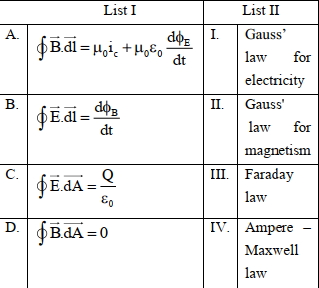
Match List-$I$ with List-$II$ and choose the correct answer from the options given below:
| List-$I$ | List-$II$ |
| :--- | :--- |
| $A. \oint \vec{B} \cdot d\vec{l} = \mu_0 i_c + \mu_0 \varepsilon_0 \frac{d\phi_E}{dt}$ | $I. \text{Gauss' law for electricity}$ |
| $B. \oint \vec{E} \cdot d\vec{l} = -\frac{d\phi_B}{dt}$ | $II. \text{Gauss' law for magnetism}$ |
| $C. \oint \vec{E} \cdot d\vec{A} = \frac{Q}{\varepsilon_0}$ | $III. \text{Faraday law}$ |
| $D. \oint \vec{B} \cdot d\vec{A} = 0$ | $IV. \text{Ampere-Maxwell law}$ |
| List-$I$ | List-$II$ |
| :--- | :--- |
| $A. \oint \vec{B} \cdot d\vec{l} = \mu_0 i_c + \mu_0 \varepsilon_0 \frac{d\phi_E}{dt}$ | $I. \text{Gauss' law for electricity}$ |
| $B. \oint \vec{E} \cdot d\vec{l} = -\frac{d\phi_B}{dt}$ | $II. \text{Gauss' law for magnetism}$ |
| $C. \oint \vec{E} \cdot d\vec{A} = \frac{Q}{\varepsilon_0}$ | $III. \text{Faraday law}$ |
| $D. \oint \vec{B} \cdot d\vec{A} = 0$ | $IV. \text{Ampere-Maxwell law}$ |
A
$A-IV, B-III, C-I, D-II$
B
$A-II, B-III, C-I, D-IV$
C
$A-IV, B-I, C-III, D-II$
D
$A-I, B-II, C-III, D-IV$
Solution
(A) The Maxwell's equations are as follows:
$1$. Ampere-Maxwell law: $\oint \vec{B} \cdot d\vec{l} = \mu_0 i_c + \mu_0 \varepsilon_0 \frac{d\phi_E}{dt}$ (Matches $A-IV$)
$2$. Faraday's law of induction: $\oint \vec{E} \cdot d\vec{l} = -\frac{d\phi_B}{dt}$ (Matches $B-III$)
$3$. Gauss' law for electricity: $\oint \vec{E} \cdot d\vec{A} = \frac{Q}{\varepsilon_0}$ (Matches $C-I$)
$4$. Gauss' law for magnetism: $\oint \vec{B} \cdot d\vec{A} = 0$ (Matches $D-II$)
Therefore,the correct matching is $A-IV, B-III, C-I, D-II$.
$1$. Ampere-Maxwell law: $\oint \vec{B} \cdot d\vec{l} = \mu_0 i_c + \mu_0 \varepsilon_0 \frac{d\phi_E}{dt}$ (Matches $A-IV$)
$2$. Faraday's law of induction: $\oint \vec{E} \cdot d\vec{l} = -\frac{d\phi_B}{dt}$ (Matches $B-III$)
$3$. Gauss' law for electricity: $\oint \vec{E} \cdot d\vec{A} = \frac{Q}{\varepsilon_0}$ (Matches $C-I$)
$4$. Gauss' law for magnetism: $\oint \vec{B} \cdot d\vec{A} = 0$ (Matches $D-II$)
Therefore,the correct matching is $A-IV, B-III, C-I, D-II$.
0 likes
View Solution89
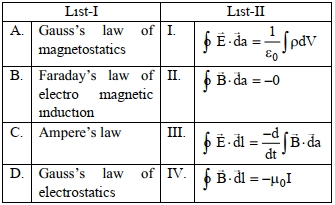
DifficultMCQ
Match List-$I$ with List-$II$ and choose the correct answer from the options given below:
| List-$I$ | List-$II$ |
| :--- | :--- |
| $A$. Gauss's law of magnetostatics | $I$. $\oint \vec{E} \cdot d\vec{a} = \frac{1}{\epsilon_0} \int \rho dV$ |
| $B$. Faraday's law of electromagnetic induction | $II$. $\oint \vec{B} \cdot d\vec{a} = 0$ |
| $C$. Ampere's law | $III$. $\oint \vec{E} \cdot d\vec{l} = -\frac{d}{dt} \int \vec{B} \cdot d\vec{a}$ |
| $D$. Gauss's law of electrostatics | $IV$. $\oint \vec{B} \cdot d\vec{l} = \mu_0 I$ |
| List-$I$ | List-$II$ |
| :--- | :--- |
| $A$. Gauss's law of magnetostatics | $I$. $\oint \vec{E} \cdot d\vec{a} = \frac{1}{\epsilon_0} \int \rho dV$ |
| $B$. Faraday's law of electromagnetic induction | $II$. $\oint \vec{B} \cdot d\vec{a} = 0$ |
| $C$. Ampere's law | $III$. $\oint \vec{E} \cdot d\vec{l} = -\frac{d}{dt} \int \vec{B} \cdot d\vec{a}$ |
| $D$. Gauss's law of electrostatics | $IV$. $\oint \vec{B} \cdot d\vec{l} = \mu_0 I$ |
A
$A-I, B-III, C-IV, D-II$
B
$A-III, B-IV, C-I, D-II$
C
$A-IV, B-II, C-III, D-I$
D
$A-II, B-III, C-IV, D-I$
Solution
(D) The Maxwell's equations in integral form are as follows:
$A$. Gauss's law of magnetostatics states that the net magnetic flux through any closed surface is zero: $\oint \vec{B} \cdot d\vec{a} = 0$ $(A-II)$.
$B$. Faraday's law of electromagnetic induction states that the induced electromotive force in a closed loop is equal to the negative rate of change of magnetic flux through the loop: $\oint \vec{E} \cdot d\vec{l} = -\frac{d}{dt} \int \vec{B} \cdot d\vec{a}$ $(B-III)$.
$C$. Ampere's law (in its original form) relates the line integral of the magnetic field around a closed loop to the current passing through the surface enclosed by the loop: $\oint \vec{B} \cdot d\vec{l} = \mu_0 I$ $(C-IV)$.
$D$. Gauss's law of electrostatics states that the total electric flux through a closed surface is equal to the total charge enclosed divided by the permittivity of free space: $\oint \vec{E} \cdot d\vec{a} = \frac{1}{\epsilon_0} \int \rho dV$ $(D-I)$.
Thus,the correct matching is $A-II, B-III, C-IV, D-I$.
$A$. Gauss's law of magnetostatics states that the net magnetic flux through any closed surface is zero: $\oint \vec{B} \cdot d\vec{a} = 0$ $(A-II)$.
$B$. Faraday's law of electromagnetic induction states that the induced electromotive force in a closed loop is equal to the negative rate of change of magnetic flux through the loop: $\oint \vec{E} \cdot d\vec{l} = -\frac{d}{dt} \int \vec{B} \cdot d\vec{a}$ $(B-III)$.
$C$. Ampere's law (in its original form) relates the line integral of the magnetic field around a closed loop to the current passing through the surface enclosed by the loop: $\oint \vec{B} \cdot d\vec{l} = \mu_0 I$ $(C-IV)$.
$D$. Gauss's law of electrostatics states that the total electric flux through a closed surface is equal to the total charge enclosed divided by the permittivity of free space: $\oint \vec{E} \cdot d\vec{a} = \frac{1}{\epsilon_0} \int \rho dV$ $(D-I)$.
Thus,the correct matching is $A-II, B-III, C-IV, D-I$.
0 likes
View Solution90
DifficultMCQ
An alternating voltage of amplitude $40 \, V$ and frequency $4 \, kHz$ is applied directly across a capacitor of $12 \, \mu F$. The maximum displacement current between the plates of the capacitor is nearly: (in $ \, A$)
A
$13$
B
$8$
C
$10$
D
$12$
Solution
(D) The displacement current $(I_d)$ in a capacitor is equal to the conduction current $(I_c)$ flowing through the circuit.
The capacitive reactance $(X_C)$ is given by the formula:
$X_C = \frac{1}{\omega C} = \frac{1}{2 \pi f C}$
Given:
$V_{max} = 40 \, V$
$f = 4 \, kHz = 4 \times 10^3 \, Hz$
$C = 12 \, \mu F = 12 \times 10^{-6} \, F$
Calculating $X_C$:
$X_C = \frac{1}{2 \times 3.1416 \times 4 \times 10^3 \times 12 \times 10^{-6}}$
$X_C = \frac{1}{8 \pi \times 12 \times 10^{-3}} = \frac{1}{0.3016} \approx 3.317 \, \Omega$
The maximum current $(I_{max})$ is:
$I_{max} = \frac{V_{max}}{X_C} = \frac{40}{3.317} \approx 12.06 \, A$
Thus, the maximum displacement current is nearly $12 \, A$.
The capacitive reactance $(X_C)$ is given by the formula:
$X_C = \frac{1}{\omega C} = \frac{1}{2 \pi f C}$
Given:
$V_{max} = 40 \, V$
$f = 4 \, kHz = 4 \times 10^3 \, Hz$
$C = 12 \, \mu F = 12 \times 10^{-6} \, F$
Calculating $X_C$:
$X_C = \frac{1}{2 \times 3.1416 \times 4 \times 10^3 \times 12 \times 10^{-6}}$
$X_C = \frac{1}{8 \pi \times 12 \times 10^{-3}} = \frac{1}{0.3016} \approx 3.317 \, \Omega$
The maximum current $(I_{max})$ is:
$I_{max} = \frac{V_{max}}{X_C} = \frac{40}{3.317} \approx 12.06 \, A$
Thus, the maximum displacement current is nearly $12 \, A$.
0 likes
View Solution91
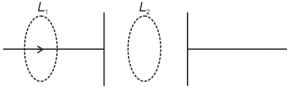
MediumMCQ
$A$ parallel plate capacitor is charged by connecting it to a battery through a resistor. If $I$ is the current in the circuit,then in the gap between the plates:
A
Displacement current of magnitude equal to $I$ flows in the same direction as $I$.
B
Displacement current of magnitude equal to $I$ flows in a direction opposite to that of $I$.
C
Displacement current of magnitude greater than $I$ flows but can be in any direction.
D
There is no current.
Solution
(A) According to the modified Ampere's circuital law,the total current is the sum of conduction current $(I_C)$ and displacement current $(I_D)$: $\oint B \cdot dl = \mu_0(I_C + I_D)$.
In the wire,there is only conduction current $I_C = I$,and the displacement current $I_D = 0$.
In the gap between the plates,there is no conduction current $(I_C = 0)$,but the changing electric field produces a displacement current $I_D$.
By the principle of continuity of current,the displacement current in the gap must be equal to the conduction current in the wire,i.e.,$I_D = I_C = I$.
This displacement current flows in the same direction as the conduction current to maintain the continuity of the total current in the circuit.
In the wire,there is only conduction current $I_C = I$,and the displacement current $I_D = 0$.
In the gap between the plates,there is no conduction current $(I_C = 0)$,but the changing electric field produces a displacement current $I_D$.
By the principle of continuity of current,the displacement current in the gap must be equal to the conduction current in the wire,i.e.,$I_D = I_C = I$.
This displacement current flows in the same direction as the conduction current to maintain the continuity of the total current in the circuit.
0 likes
View Solution92
MediumMCQ
$A$ parallel plate capacitor of area $A = 16 \ cm^2$ and separation between the plates $10 \ cm$ is charged by a $DC$ current. Consider a hypothetical plane surface of area $A_0 = 3.2 \ cm^2$ inside the capacitor and parallel to the plates. At an instant,the current through the circuit is $6 \ A$. At the same instant,the displacement current through $A_0$ is . . . . . . $mA$.
A
$1600$
B
$1400$
C
$1200$
D
$1900$
Solution
(C) The displacement current density $J_d$ is uniform across the cross-section of the capacitor plates.
$J_d = \frac{I}{A} = \frac{6 \ A}{16 \ cm^2}$.
The displacement current $I_d$ through a smaller area $A_0$ is given by $I_d = J_d \times A_0$.
$I_d = \left( \frac{6}{16} \right) \times 3.2 \ A$.
$I_d = 0.375 \times 3.2 \ A = 1.2 \ A$.
Since $1 \ A = 1000 \ mA$,the displacement current is $1.2 \times 1000 \ mA = 1200 \ mA$.
$J_d = \frac{I}{A} = \frac{6 \ A}{16 \ cm^2}$.
The displacement current $I_d$ through a smaller area $A_0$ is given by $I_d = J_d \times A_0$.
$I_d = \left( \frac{6}{16} \right) \times 3.2 \ A$.
$I_d = 0.375 \times 3.2 \ A = 1.2 \ A$.
Since $1 \ A = 1000 \ mA$,the displacement current is $1.2 \times 1000 \ mA = 1200 \ mA$.
0 likes
View Solution93
EasyMCQ
$A$ time-varying potential difference is applied between the plates of a parallel plate capacitor of capacitance $2.5 \mu \text{F}$. The dielectric constant of the medium between the capacitor plates is $1$. It produces an instantaneous displacement current of $0.25 \text{ mA}$ in the intervening space between the capacitor plates. The magnitude of the rate of change of the potential difference will be . . . . . . $\text{V s}^{-1}$.
A
$360$
B
$200$
C
$219$
D
$100$
Solution
(D) The displacement current $I_d$ in a capacitor is given by the formula: $I_d = C \frac{dV}{dt}$.
Here,$C = 2.5 \mu \text{F} = 2.5 \times 10^{-6} \text{ F}$ and $I_d = 0.25 \text{ mA} = 0.25 \times 10^{-3} \text{ A}$.
Rearranging the formula to find the rate of change of potential difference $\frac{dV}{dt}$:
$\frac{dV}{dt} = \frac{I_d}{C}$.
Substituting the given values:
$\frac{dV}{dt} = \frac{0.25 \times 10^{-3}}{2.5 \times 10^{-6}}$.
$\frac{dV}{dt} = \frac{0.25}{2.5} \times 10^{3} = 0.1 \times 1000 = 100 \text{ V s}^{-1}$.
Thus,the magnitude of the rate of change of the potential difference is $100 \text{ V s}^{-1}$.
Here,$C = 2.5 \mu \text{F} = 2.5 \times 10^{-6} \text{ F}$ and $I_d = 0.25 \text{ mA} = 0.25 \times 10^{-3} \text{ A}$.
Rearranging the formula to find the rate of change of potential difference $\frac{dV}{dt}$:
$\frac{dV}{dt} = \frac{I_d}{C}$.
Substituting the given values:
$\frac{dV}{dt} = \frac{0.25 \times 10^{-3}}{2.5 \times 10^{-6}}$.
$\frac{dV}{dt} = \frac{0.25}{2.5} \times 10^{3} = 0.1 \times 1000 = 100 \text{ V s}^{-1}$.
Thus,the magnitude of the rate of change of the potential difference is $100 \text{ V s}^{-1}$.
0 likes
View Solution94
MediumMCQ
If $\varepsilon_0$ denotes the permittivity of free space and $\phi_{E}$ is the flux of the electric field through the area bounded by the closed surface,then the dimensions of $\left(\varepsilon_0 \frac{d \phi_{E}}{dt}\right)$ are that of
A
Electric field
B
Electric potential
C
Electric charge
D
Electric current
Solution
(D) According to Maxwell's modification of Ampere's Law,the displacement current $i_d$ is defined as:
$i_d = \varepsilon_0 \frac{d \phi_{E}}{dt}$
Since $i_d$ represents a current,its dimensions are the same as those of electric current.
Therefore,the dimensions of $\left(\varepsilon_0 \frac{d \phi_{E}}{dt}\right)$ are equivalent to the dimensions of electric current.
$i_d = \varepsilon_0 \frac{d \phi_{E}}{dt}$
Since $i_d$ represents a current,its dimensions are the same as those of electric current.
Therefore,the dimensions of $\left(\varepsilon_0 \frac{d \phi_{E}}{dt}\right)$ are equivalent to the dimensions of electric current.
0 likes
View Solution95
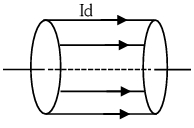
MediumMCQ
$A$ parallel plate capacitor made of circular plates is being charged such that the surface charge density on its plates is increasing at a constant rate with time. The magnetic field arising due to displacement current is
A
zero at all places
B
constant between the plates and zero outside the plates
C
non-zero everywhere with maximum at the imaginary cylindrical surface connecting peripheries of the plates
D
zero between the plates and non-zero outside
Solution
(C) The displacement current $I_d$ is given by $I_d = \epsilon_0 \frac{d\phi_e}{dt} = \epsilon_0 \frac{d}{dt}(EA \cos 0^{\circ})$.
Since $E = \frac{\sigma}{\epsilon_0}$,we have $I_d = \epsilon_0 A \frac{d}{dt}(\frac{\sigma}{\epsilon_0}) = A \frac{d\sigma}{dt}$.
Given that the surface charge density $\sigma$ increases at a constant rate,$\frac{d\sigma}{dt}$ is constant,so $I_d$ is constant.
Using Ampere-Maxwell law,the magnetic field $B$ at a distance $r$ from the axis (inside the plates,$r < R$) is $B(2\pi r) = \mu_0 I_{enclosed} = \mu_0 I_d (\frac{\pi r^2}{\pi R^2})$.
Thus,$B = \frac{\mu_0 I_d r}{2\pi R^2}$.
For $r > R$ (outside the plates),$B(2\pi r) = \mu_0 I_d$,so $B = \frac{\mu_0 I_d}{2\pi r}$.
The magnetic field is non-zero everywhere and reaches its maximum value at the boundary $r = R$ (the imaginary cylindrical surface connecting the peripheries of the plates).
Since $E = \frac{\sigma}{\epsilon_0}$,we have $I_d = \epsilon_0 A \frac{d}{dt}(\frac{\sigma}{\epsilon_0}) = A \frac{d\sigma}{dt}$.
Given that the surface charge density $\sigma$ increases at a constant rate,$\frac{d\sigma}{dt}$ is constant,so $I_d$ is constant.
Using Ampere-Maxwell law,the magnetic field $B$ at a distance $r$ from the axis (inside the plates,$r < R$) is $B(2\pi r) = \mu_0 I_{enclosed} = \mu_0 I_d (\frac{\pi r^2}{\pi R^2})$.
Thus,$B = \frac{\mu_0 I_d r}{2\pi R^2}$.
For $r > R$ (outside the plates),$B(2\pi r) = \mu_0 I_d$,so $B = \frac{\mu_0 I_d}{2\pi r}$.
The magnetic field is non-zero everywhere and reaches its maximum value at the boundary $r = R$ (the imaginary cylindrical surface connecting the peripheries of the plates).
0 likes
View Solution96
MediumMCQ
The voltage between the plates of a parallel plate capacitor of capacity $1 \ \mu F$ is changing at the rate of $4 \ V/s$. The displacement current in the capacitor is: (in $\mu A$)
A
$4$
B
$3$
C
$1$
D
$6$
Solution
(A) The displacement current $I_d$ in a capacitor is equal to the conduction current $I_c$ flowing through the connecting wires,which is given by the formula $I_d = I_c = C \frac{dV}{dt}$.
Given:
Capacitance $C = 1 \ \mu F = 1 \times 10^{-6} \ F$.
Rate of change of voltage $\frac{dV}{dt} = 4 \ V/s$.
Substituting these values into the formula:
$I_d = (1 \times 10^{-6} \ F) \times (4 \ V/s) = 4 \times 10^{-6} \ A = 4 \ \mu A$.
Therefore,the displacement current is $4 \ \mu A$.
Given:
Capacitance $C = 1 \ \mu F = 1 \times 10^{-6} \ F$.
Rate of change of voltage $\frac{dV}{dt} = 4 \ V/s$.
Substituting these values into the formula:
$I_d = (1 \times 10^{-6} \ F) \times (4 \ V/s) = 4 \times 10^{-6} \ A = 4 \ \mu A$.
Therefore,the displacement current is $4 \ \mu A$.
0 likes
View Solution97
MediumMCQ
$A$ parallel plate capacitor with plate area $A$ and plate separation $d$ is charged by a constant current $I$. $A$ plane surface of area $A/2$,parallel to the plates,is drawn between the plates. The displacement current through this area is
A
$I$
B
$I/2$
C
$I/4$
D
$I/8$
Solution
(B) The displacement current $I_d$ is defined as $I_d = \epsilon_0 \frac{d\Phi_E}{dt}$,where $\Phi_E$ is the electric flux through the surface.
For a parallel plate capacitor,the electric field $E$ between the plates is uniform and given by $E = \frac{q}{\epsilon_0 A}$,where $q$ is the charge on the plates.
The electric flux $\Phi_E$ through an area $A'$ parallel to the plates is $\Phi_E = E \cdot A' = \frac{q}{\epsilon_0 A} \cdot A'$.
Substituting $A' = A/2$,we get $\Phi_E = \frac{q}{\epsilon_0 A} \cdot \frac{A}{2} = \frac{q}{2\epsilon_0}$.
The displacement current is $I_d = \epsilon_0 \frac{d}{dt} \left( \frac{q}{2\epsilon_0} \right) = \frac{1}{2} \frac{dq}{dt}$.
Since the charging current $I = \frac{dq}{dt}$,we have $I_d = \frac{I}{2}$.
For a parallel plate capacitor,the electric field $E$ between the plates is uniform and given by $E = \frac{q}{\epsilon_0 A}$,where $q$ is the charge on the plates.
The electric flux $\Phi_E$ through an area $A'$ parallel to the plates is $\Phi_E = E \cdot A' = \frac{q}{\epsilon_0 A} \cdot A'$.
Substituting $A' = A/2$,we get $\Phi_E = \frac{q}{\epsilon_0 A} \cdot \frac{A}{2} = \frac{q}{2\epsilon_0}$.
The displacement current is $I_d = \epsilon_0 \frac{d}{dt} \left( \frac{q}{2\epsilon_0} \right) = \frac{1}{2} \frac{dq}{dt}$.
Since the charging current $I = \frac{dq}{dt}$,we have $I_d = \frac{I}{2}$.
0 likes
View Solution98
EasyMCQ
The existence of electromagnetic waves was experimentally confirmed by
A
Maxwell
B
Faraday
C
Hertz
D
Tesla
Solution
(C) The existence of electromagnetic waves was first experimentally confirmed by the German physicist Heinrich Hertz in $1887$. He used a spark-gap transmitter to produce and detect electromagnetic waves,thereby validating Maxwell's theoretical predictions.
0 likes
View Solution99
EasyMCQ
The source of displacement current is . . . . . . .
A
Changing Electric field
B
Static Electric field
C
Changing Magnetic field
D
Static Magnetic field
Solution
(A) The correct answer is $A$.
Displacement current $(i_{d})$ is defined as the current that arises due to a time-varying electric field.
The mathematical expression for displacement current is given by:
$i_{d} = \varepsilon_{0} \frac{d}{dt}(\phi_{E})$
where $\phi_{E}$ is the electric flux.
Since $\phi_{E} = E \cdot A$,for a constant area $A$,the expression becomes:
$i_{d} = \varepsilon_{0} A \frac{dE}{dt}$
Thus,a changing electric field is the source of displacement current.
Displacement current $(i_{d})$ is defined as the current that arises due to a time-varying electric field.
The mathematical expression for displacement current is given by:
$i_{d} = \varepsilon_{0} \frac{d}{dt}(\phi_{E})$
where $\phi_{E}$ is the electric flux.
Since $\phi_{E} = E \cdot A$,for a constant area $A$,the expression becomes:
$i_{d} = \varepsilon_{0} A \frac{dE}{dt}$
Thus,a changing electric field is the source of displacement current.
0 likes
View Solution100
EasyMCQ
In Hertz's experiment,the rods connected with an induction coil behave as . . . . . . .
A
a capacitor
B
an inductor
C
a resistor
D
a transformer
Solution
(A) In Hertz's experiment,the two metal rods connected to the high-voltage induction coil act as the plates of a capacitor. When the potential difference between the rods becomes sufficiently high,the air between them breaks down,causing a spark to jump across the gap. This oscillation of charge creates electromagnetic waves.
0 likes
View SolutionElectromagnetic waves — Maxwell's equations , Concept of displacement current and Hertz experiment · Frequently Asked Questions
1Are these Electromagnetic waves questions useful for JEE and NEET?
Yes. All questions in this section are mapped to JEE Main and NEET exam patterns. Previous year questions from JEE Main, NEET, GUJCET and state-level exams are included with full solutions.
2Can I switch to Hindi or Gujarati for these questions?
Yes. Use the language tabs in the hero section or the sidebar to view the same questions and solutions in English, Hindi or Gujarati.
3How do I generate a question paper from this subtopic?
Use the Vedclass Exam Paper Generator — select the chapter and subtopic, set difficulty, and generate Sets A, B, C, D automatically. First 3 chapters of every subject are free.
Vedclass Products
For Students
Vedclass Test Series
Mock tests in real JEE/NEET style with performance analysis. 5-day free trial.
Start Free TrialFor Teachers
Exam Paper Generator
Generate Set A/B/C/D papers from this chapter in 2 minutes. 3 chapters free.
Try FreeFor Institutes
Online Exam Module
Live online exams with unlimited students, 360° analytics & white-label branding.
See DemoFor Teachers & Institutes
Generate a Electromagnetic waves Exam Paper in 2 Minutes
Select subtopic & difficulty — Sets A, B, C, D auto-generated with No Repeat logic.
First 3 chapters of every subject are free — no payment required.