
A English
Electric Dipole and Electric Field Questions in English
Class 12 Physics · Electric Charges and Fields · Electric Dipole and Electric Field
270+
Questions
English
Language
100%
With Solutions
Showing 18 of 270 questions in English
251
MediumMCQ
The electric potential at a point on the axis of an electric dipole depends on the distance $r$ of the point from the dipole as
A
$r^{-1}$
B
$r^{-2}$
C
$r$
D
$r^{-3}$
Solution
(B) The electric potential $V$ at a point on the axial line of an electric dipole at a distance $r$ from its center is given by the formula:
$V = \frac{1}{4 \pi \varepsilon_0} \cdot \frac{p}{r^2}$
Where $p$ is the dipole moment.
From this expression,it is clear that the electric potential $V$ is inversely proportional to the square of the distance $r$.
Therefore,$V \propto \frac{1}{r^2}$ or $V \propto r^{-2}$.
$V = \frac{1}{4 \pi \varepsilon_0} \cdot \frac{p}{r^2}$
Where $p$ is the dipole moment.
From this expression,it is clear that the electric potential $V$ is inversely proportional to the square of the distance $r$.
Therefore,$V \propto \frac{1}{r^2}$ or $V \propto r^{-2}$.
0 likes
View Solution252
EasyMCQ
The electric field intensity at a point on the axis of an electric dipole in air is $4 \text{ NC}^{-1}$. Then the electric field intensity at a point on the equatorial line which is at a distance equal to twice the distance on the axial line and if the dipole is in a medium of dielectric constant $4$ is
A
$1 \text{ NC}^{-1}$
B
$\frac{1}{8} \text{ NC}^{-1}$
C
$16 \text{ NC}^{-1}$
D
$\frac{1}{16} \text{ NC}^{-1}$
Solution
(D) The electric field intensity on the axis of a dipole in air is given by $E_{\text{axis}} = \frac{2kP}{r^3}$.
Given $E_{\text{axis}} = 4 \text{ NC}^{-1}$,we have $4 = \frac{2kP}{r^3}$,which implies $\frac{kP}{r^3} = 2$ (Equation $i$).
The electric field intensity on the equatorial line of a dipole in a medium with dielectric constant $K$ is given by $E_{\text{eq}} = \frac{1}{K} \frac{kP}{r_1^3}$.
Here,$r_1 = 2r$ and $K = 4$.
Substituting these values,we get $E_{\text{eq}} = \frac{1}{4} \cdot \frac{kP}{(2r)^3} = \frac{1}{4} \cdot \frac{kP}{8r^3} = \frac{1}{32} \cdot \frac{kP}{r^3}$.
Using Equation $(i)$,$\frac{kP}{r^3} = 2$,so $E_{\text{eq}} = \frac{1}{32} \times 2 = \frac{1}{16} \text{ NC}^{-1}$.
Thus,the correct option is $(d)$.
Given $E_{\text{axis}} = 4 \text{ NC}^{-1}$,we have $4 = \frac{2kP}{r^3}$,which implies $\frac{kP}{r^3} = 2$ (Equation $i$).
The electric field intensity on the equatorial line of a dipole in a medium with dielectric constant $K$ is given by $E_{\text{eq}} = \frac{1}{K} \frac{kP}{r_1^3}$.
Here,$r_1 = 2r$ and $K = 4$.
Substituting these values,we get $E_{\text{eq}} = \frac{1}{4} \cdot \frac{kP}{(2r)^3} = \frac{1}{4} \cdot \frac{kP}{8r^3} = \frac{1}{32} \cdot \frac{kP}{r^3}$.
Using Equation $(i)$,$\frac{kP}{r^3} = 2$,so $E_{\text{eq}} = \frac{1}{32} \times 2 = \frac{1}{16} \text{ NC}^{-1}$.
Thus,the correct option is $(d)$.

0 likes
View Solution253
MediumMCQ
An electric dipole consists of two particles, each of mass $1 \ kg$, separated by $1 \ m$, carrying charges $1 \ \mu C$ and $-1 \ \mu C$ respectively. It is in equilibrium in a uniform electric field of $2 \times 10^4 \ Vm^{-1}$. If it is deflected by a small angle $2^{\circ}$, the minimum time taken by it to come back again to the mean position is (in seconds): (in $\pi$)
A
$2.5$
B
$2$
C
$5$
D
$4$
Solution
(A) The dipole moment is $p = q \times d = (1 \times 10^{-6} \ C) \times (1 \ m) = 10^{-6} \ Cm$.
The moment of inertia $I$ of the system about the center is $I = m(d/2)^2 + m(d/2)^2 = m(d^2/2) = 1 \times (1^2/2) = 0.5 \ kg \ m^2$.
For a small angular displacement $\theta$, the restoring torque is $\tau = -pE \sin \theta \approx -pE \theta$.
Since $\tau = I \alpha$, we have $I \alpha = -pE \theta$, which gives $\alpha = -(pE/I) \theta$.
This represents simple harmonic motion with angular frequency $\omega = \sqrt{pE/I}$.
Substituting the values: $\omega = \sqrt{(10^{-6} \times 2 \times 10^4) / 0.5} = \sqrt{2 \times 10^{-2} / 0.5} = \sqrt{0.04} = 0.2 \ rad/s$.
The time taken to return to the mean position from the extreme position is $t = T/4 = (2 \pi / \omega) / 4 = \pi / (2 \omega)$.
$t = \pi / (2 \times 0.2) = \pi / 0.4 = 2.5 \pi \ s$.
The moment of inertia $I$ of the system about the center is $I = m(d/2)^2 + m(d/2)^2 = m(d^2/2) = 1 \times (1^2/2) = 0.5 \ kg \ m^2$.
For a small angular displacement $\theta$, the restoring torque is $\tau = -pE \sin \theta \approx -pE \theta$.
Since $\tau = I \alpha$, we have $I \alpha = -pE \theta$, which gives $\alpha = -(pE/I) \theta$.
This represents simple harmonic motion with angular frequency $\omega = \sqrt{pE/I}$.
Substituting the values: $\omega = \sqrt{(10^{-6} \times 2 \times 10^4) / 0.5} = \sqrt{2 \times 10^{-2} / 0.5} = \sqrt{0.04} = 0.2 \ rad/s$.
The time taken to return to the mean position from the extreme position is $t = T/4 = (2 \pi / \omega) / 4 = \pi / (2 \omega)$.
$t = \pi / (2 \times 0.2) = \pi / 0.4 = 2.5 \pi \ s$.
0 likes
View Solution254
EasyMCQ
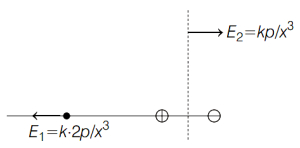
The electric field due to a short electric dipole at a distance $r$ on the axial line from its mid-point is $x$ times the electric field at a distance $2r$ on the equatorial line from the mid-point of the dipole. Then,the value of $x$ is
A
$16$
B
$9$
C
$25$
D
$36$
Solution
(A) The electric field on the axial line of a short dipole at a distance $r$ is given by:
$E_{axial} = \frac{2kp}{r^3}$
The electric field on the equatorial line of a short dipole at a distance $2r$ is given by:
$E_{equatorial} = \frac{kp}{(2r)^3} = \frac{kp}{8r^3}$
According to the problem,$E_{axial} = x \cdot E_{equatorial}$.
Substituting the expressions:
$\frac{2kp}{r^3} = x \cdot \frac{kp}{8r^3}$
Canceling $kp/r^3$ from both sides:
$2 = \frac{x}{8}$
$x = 16$
$E_{axial} = \frac{2kp}{r^3}$
The electric field on the equatorial line of a short dipole at a distance $2r$ is given by:
$E_{equatorial} = \frac{kp}{(2r)^3} = \frac{kp}{8r^3}$
According to the problem,$E_{axial} = x \cdot E_{equatorial}$.
Substituting the expressions:
$\frac{2kp}{r^3} = x \cdot \frac{kp}{8r^3}$
Canceling $kp/r^3$ from both sides:
$2 = \frac{x}{8}$
$x = 16$
0 likes
View Solution255
DifficultMCQ
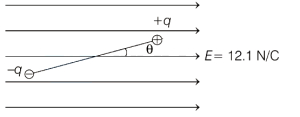
Two charged particles each of mass $9.8 \text{ g}$ and charges $+20 \mu\text{C}$ and $-20 \mu\text{C}$ are attached to the two ends of a massless and rigid uniform non-conducting rod of length $50 \text{ cm}$. This arrangement is held in a uniform electric field of $12.1 \text{ N/C}$,such that the rod makes a very small angle with the field direction. If the rod is set free,the minimum time needed for the rod to become parallel to the direction of the electric field is ................ seconds.
A
$5$
B
$8$
C
$12$
D
$17$
Solution
(A) The arrangement of the electric dipole in the electric field will undergo Simple Harmonic Motion $(SHM)$ when the rod is set free. The time period $T$ of this $SHM$ is given by:
$T = 2\pi \sqrt{\frac{I}{pE}}$
where $I$ is the moment of inertia of the dipole,$p$ is the electric dipole moment,and $E$ is the electric field.
The moment of inertia $I$ about the center of the rod is $I = m(l/2)^2 + m(l/2)^2 = 2m(l/2)^2 = \frac{ml^2}{2}$.
Given: $m = 9.8 \times 10^{-3} \text{ kg}$,$l = 0.5 \text{ m}$,$q = 20 \times 10^{-6} \text{ C}$,$E = 12.1 \text{ N/C}$.
$I = \frac{9.8 \times 10^{-3} \times (0.5)^2}{2} = 4.9 \times 10^{-3} \times 0.25 = 1.225 \times 10^{-3} \text{ kg m}^2$.
$p = q \times l = 20 \times 10^{-6} \times 0.5 = 10^{-5} \text{ C m}$.
$T = 2\pi \sqrt{\frac{1.225 \times 10^{-3}}{10^{-5} \times 12.1}} = 2\pi \sqrt{\frac{1.225 \times 100}{12.1}} = 2\pi \sqrt{\frac{122.5}{12.1}} \approx 2\pi \sqrt{10.12} \approx 2\pi \times 3.18 \approx 20 \text{ s}$.
The time taken by the rod to move from the initial small angle to the parallel position (equilibrium position) is $T/4$.
Required time $= \frac{20}{4} = 5 \text{ s}$.
$T = 2\pi \sqrt{\frac{I}{pE}}$
where $I$ is the moment of inertia of the dipole,$p$ is the electric dipole moment,and $E$ is the electric field.
The moment of inertia $I$ about the center of the rod is $I = m(l/2)^2 + m(l/2)^2 = 2m(l/2)^2 = \frac{ml^2}{2}$.
Given: $m = 9.8 \times 10^{-3} \text{ kg}$,$l = 0.5 \text{ m}$,$q = 20 \times 10^{-6} \text{ C}$,$E = 12.1 \text{ N/C}$.
$I = \frac{9.8 \times 10^{-3} \times (0.5)^2}{2} = 4.9 \times 10^{-3} \times 0.25 = 1.225 \times 10^{-3} \text{ kg m}^2$.
$p = q \times l = 20 \times 10^{-6} \times 0.5 = 10^{-5} \text{ C m}$.
$T = 2\pi \sqrt{\frac{1.225 \times 10^{-3}}{10^{-5} \times 12.1}} = 2\pi \sqrt{\frac{1.225 \times 100}{12.1}} = 2\pi \sqrt{\frac{122.5}{12.1}} \approx 2\pi \sqrt{10.12} \approx 2\pi \times 3.18 \approx 20 \text{ s}$.
The time taken by the rod to move from the initial small angle to the parallel position (equilibrium position) is $T/4$.
Required time $= \frac{20}{4} = 5 \text{ s}$.
0 likes
View Solution256
MediumMCQ
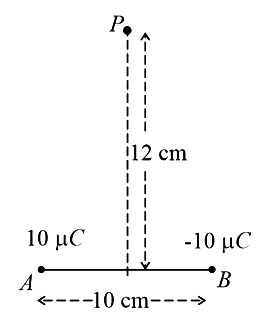
Two charges $10 \mu C$ and $-10 \mu C$ are placed at points $A$ and $B$ separated by a distance of $10 \ cm$. Find the electric field at a point $P$ on the perpendicular bisector of $AB$,at a distance of $12 \ cm$ from its midpoint.
A
$16.4 \times 10^6 \ N \ C^{-1}$
B
$28.4 \times 10^6 \ N \ C^{-1}$
C
$8.2 \times 10^6 \ N \ C^{-1}$
D
$4.1 \times 10^6 \ N \ C^{-1}$
Solution
(D) The charges are $q_1 = 10 \mu C$ and $q_2 = -10 \mu C$. The distance between them is $2a = 10 \ cm$,so $a = 5 \ cm = 0.05 \ m$.
The point $P$ is on the perpendicular bisector at a distance $r = 12 \ cm = 0.12 \ m$ from the midpoint.
The distance from each charge to point $P$ is $d = \sqrt{r^2 + a^2} = \sqrt{12^2 + 5^2} = \sqrt{144 + 25} = \sqrt{169} = 13 \ cm = 0.13 \ m$.
The electric field due to each charge at $P$ has a magnitude $E = \frac{k|q|}{d^2} = \frac{9 \times 10^9 \times 10 \times 10^{-6}}{(0.13)^2} = \frac{9 \times 10^4}{0.0169} \approx 5.325 \times 10^6 \ N \ C^{-1}$.
The components of the electric fields perpendicular to the line $AB$ cancel out,while the components parallel to $AB$ add up.
The net electric field is $E_{\text{net}} = 2E \cos(\theta)$,where $\cos(\theta) = \frac{a}{d} = \frac{5}{13}$.
$E_{\text{net}} = 2 \times \left( \frac{9 \times 10^9 \times 10 \times 10^{-6}}{(0.13)^2} \right) \times \frac{5}{13} = 2 \times \frac{9 \times 10^4}{0.0169} \times \frac{5}{13} \approx 4.1 \times 10^6 \ N \ C^{-1}$.
The point $P$ is on the perpendicular bisector at a distance $r = 12 \ cm = 0.12 \ m$ from the midpoint.
The distance from each charge to point $P$ is $d = \sqrt{r^2 + a^2} = \sqrt{12^2 + 5^2} = \sqrt{144 + 25} = \sqrt{169} = 13 \ cm = 0.13 \ m$.
The electric field due to each charge at $P$ has a magnitude $E = \frac{k|q|}{d^2} = \frac{9 \times 10^9 \times 10 \times 10^{-6}}{(0.13)^2} = \frac{9 \times 10^4}{0.0169} \approx 5.325 \times 10^6 \ N \ C^{-1}$.
The components of the electric fields perpendicular to the line $AB$ cancel out,while the components parallel to $AB$ add up.
The net electric field is $E_{\text{net}} = 2E \cos(\theta)$,where $\cos(\theta) = \frac{a}{d} = \frac{5}{13}$.
$E_{\text{net}} = 2 \times \left( \frac{9 \times 10^9 \times 10 \times 10^{-6}}{(0.13)^2} \right) \times \frac{5}{13} = 2 \times \frac{9 \times 10^4}{0.0169} \times \frac{5}{13} \approx 4.1 \times 10^6 \ N \ C^{-1}$.
0 likes
View Solution257
EasyMCQ
Two charges $+q$ and $-q$ are kept at a certain distance apart. Then, at any point on the right bisector of the line joining the two charges:
A
the electric field strength is zero
B
the electric potential is zero
C
both electric potential and electric field strength are zero
D
both electric potential and electric field strength are non-zero
Solution
(B) The line joining the two charges $+q$ and $-q$ forms an electric dipole.
Any point on the perpendicular bisector (equatorial line) of the dipole is equidistant from both charges.
Let the distance of a point $P$ on the perpendicular bisector from charge $+q$ be $r_1$ and from charge $-q$ be $r_2$. Since $P$ is on the perpendicular bisector, $r_1 = r_2 = r$.
The electric potential $V$ at point $P$ is given by $V = \frac{1}{4 \pi \varepsilon_0} (\frac{q}{r} + \frac{-q}{r}) = 0$.
However, the electric field $E$ at point $P$ is the vector sum of the fields due to $+q$ and $-q$. Since both fields are non-zero and directed such that they do not cancel out (the resultant field is parallel to the dipole axis), the electric field strength is non-zero.
Therefore, the electric potential is zero, but the electric field strength is non-zero.
Any point on the perpendicular bisector (equatorial line) of the dipole is equidistant from both charges.
Let the distance of a point $P$ on the perpendicular bisector from charge $+q$ be $r_1$ and from charge $-q$ be $r_2$. Since $P$ is on the perpendicular bisector, $r_1 = r_2 = r$.
The electric potential $V$ at point $P$ is given by $V = \frac{1}{4 \pi \varepsilon_0} (\frac{q}{r} + \frac{-q}{r}) = 0$.
However, the electric field $E$ at point $P$ is the vector sum of the fields due to $+q$ and $-q$. Since both fields are non-zero and directed such that they do not cancel out (the resultant field is parallel to the dipole axis), the electric field strength is non-zero.
Therefore, the electric potential is zero, but the electric field strength is non-zero.
0 likes
View Solution258
MediumMCQ
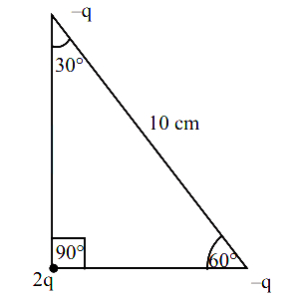
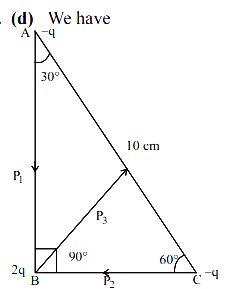
Three charges are arranged on the vertices of a right-angled triangle as shown in the figure. The magnitude of the dipole moment of the combination in the unit of $C-cm$ is:
A
$5 \sqrt{3} q$
B
$5 q$
C
$10 q$
D
$10 \sqrt{3} q$
Solution
(C) The charge $2q$ at vertex $B$ can be split into two charges of $+q$ each. One $+q$ charge forms a dipole with the $-q$ charge at vertex $A$,and the other $+q$ charge forms a dipole with the $-q$ charge at vertex $C$.
Let $AB = d_1$ and $BC = d_2$.
From the triangle,$d_1 = 10 \cos 30^{\circ} = 10 \times \frac{\sqrt{3}}{2} = 5\sqrt{3} \text{ cm}$ and $d_2 = 10 \sin 30^{\circ} = 10 \times \frac{1}{2} = 5 \text{ cm}$.
The dipole moment $p_1$ (along $BA$) is $q \times d_1 = 5\sqrt{3}q \text{ C-cm}$.
The dipole moment $p_2$ (along $BC$) is $q \times d_2 = 5q \text{ C-cm}$.
Since these two dipoles are perpendicular to each other,the resultant dipole moment $P$ is:
$P = \sqrt{p_1^2 + p_2^2} = \sqrt{(5\sqrt{3}q)^2 + (5q)^2} = \sqrt{75q^2 + 25q^2} = \sqrt{100q^2} = 10q \text{ C-cm}$.
Let $AB = d_1$ and $BC = d_2$.
From the triangle,$d_1 = 10 \cos 30^{\circ} = 10 \times \frac{\sqrt{3}}{2} = 5\sqrt{3} \text{ cm}$ and $d_2 = 10 \sin 30^{\circ} = 10 \times \frac{1}{2} = 5 \text{ cm}$.
The dipole moment $p_1$ (along $BA$) is $q \times d_1 = 5\sqrt{3}q \text{ C-cm}$.
The dipole moment $p_2$ (along $BC$) is $q \times d_2 = 5q \text{ C-cm}$.
Since these two dipoles are perpendicular to each other,the resultant dipole moment $P$ is:
$P = \sqrt{p_1^2 + p_2^2} = \sqrt{(5\sqrt{3}q)^2 + (5q)^2} = \sqrt{75q^2 + 25q^2} = \sqrt{100q^2} = 10q \text{ C-cm}$.
0 likes
View Solution259
EasyMCQ
Choose the incorrect statement from the following.
A
The electric field in electrostatics obeys the principle of superposition.
B
The electric field inside a perfect conductor is zero.
C
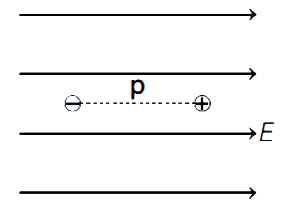
The electric dipole will try to orient in a direction opposite to the external electric field.
D
The electric flux passing through any closed surface enclosing the charges remains constant.
Solution
(C) The third statement is incorrect. An electric dipole in an external electric field experiences a torque that tends to align the dipole moment $p$ in the direction of the external electric field $E$. This alignment corresponds to the state of minimum potential energy $(U = -p \cdot E)$ and maximum stability. Therefore, the dipole does not orient itself in the opposite direction.
0 likes
View Solution260
MediumMCQ
Two charges $+q$ and $-q$ are kept at a certain distance apart. Then, at any point on the perpendicular bisector of the line joining the two charges:
A
the electric field strength is zero
B
the electric potential is zero
C
both electric potential and electric field strength are zero
D
both electric potential and electric field strength are non-zero
Solution
(B) The perpendicular bisector of the line joining two equal and opposite charges ($+q$ and $-q$) is known as the equatorial line of the electric dipole.
For any point on the equatorial line at a distance $r$ from the center of the dipole, the electric potential $V$ is given by the sum of potentials due to individual charges:
$V = \frac{1}{4 \pi \varepsilon_0} \left( \frac{q}{r_1} + \frac{-q}{r_2} \right)$
Since any point on the perpendicular bisector is equidistant from both charges, $r_1 = r_2$, which implies $V = 0$.
However, the electric field strength $E$ at this point is not zero. It is directed parallel to the dipole axis (from $+q$ to $-q$) and is given by $E = \frac{1}{4 \pi \varepsilon_0} \frac{p}{r^3}$ (for $r \gg a$).
For any point on the equatorial line at a distance $r$ from the center of the dipole, the electric potential $V$ is given by the sum of potentials due to individual charges:
$V = \frac{1}{4 \pi \varepsilon_0} \left( \frac{q}{r_1} + \frac{-q}{r_2} \right)$
Since any point on the perpendicular bisector is equidistant from both charges, $r_1 = r_2$, which implies $V = 0$.
However, the electric field strength $E$ at this point is not zero. It is directed parallel to the dipole axis (from $+q$ to $-q$) and is given by $E = \frac{1}{4 \pi \varepsilon_0} \frac{p}{r^3}$ (for $r \gg a$).
0 likes
View Solution261
DifficultMCQ
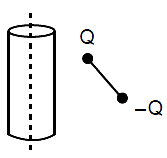
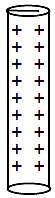
Consider a positively charged infinite cylinder with uniform volume charge density. An electric dipole consisting of $+Q$ and $-Q$ charges attached to opposite ends of a massless rod is oriented as shown in the figure. At the instant as shown in the figure,the dipole will experience,
A
a force to the left and no torque
B
a force to the right and a clockwise torque
C
a force to the right and a counter clockwise torque
D
no force but only a clockwise torque
Solution
(B) The electric field $E$ due to an infinite charged cylinder at a distance $r$ from its axis is given by $E \propto \frac{1}{r}$.
Since the $+Q$ charge is closer to the cylinder than the $-Q$ charge,the electric field at the position of $+Q$ $(E_1)$ is stronger than the electric field at the position of $-Q$ $(E_2)$,i.e.,$E_1 > E_2$.
The force on the $+Q$ charge is $F_1 = Q E_1$ (directed away from the cylinder,i.e.,to the right).
The force on the $-Q$ charge is $F_2 = Q E_2$ (directed towards the cylinder,i.e.,to the left).
Since $E_1 > E_2$,the net force $F_{\text{net}} = F_1 - F_2$ is directed to the right.
Regarding torque,the force $F_1$ acts at a greater distance from the center of the rod and is larger,while $F_2$ acts at a smaller distance. The combination of these forces creates a clockwise torque about the center of the rod.
Since the $+Q$ charge is closer to the cylinder than the $-Q$ charge,the electric field at the position of $+Q$ $(E_1)$ is stronger than the electric field at the position of $-Q$ $(E_2)$,i.e.,$E_1 > E_2$.
The force on the $+Q$ charge is $F_1 = Q E_1$ (directed away from the cylinder,i.e.,to the right).
The force on the $-Q$ charge is $F_2 = Q E_2$ (directed towards the cylinder,i.e.,to the left).
Since $E_1 > E_2$,the net force $F_{\text{net}} = F_1 - F_2$ is directed to the right.
Regarding torque,the force $F_1$ acts at a greater distance from the center of the rod and is larger,while $F_2$ acts at a smaller distance. The combination of these forces creates a clockwise torque about the center of the rod.
0 likes
View Solution262
DifficultMCQ
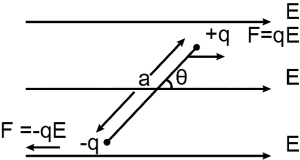
Two charges $+q$ and $-q$ are placed at a distance $a$ in a uniform electric field. The dipole moment of the combination is $2qa(\cos \theta \hat{i} + \sin \theta \hat{j})$,where $\theta$ is the angle between the direction of the field and the line joining the two charges. Which of the following statement$(s)$ is/are correct?
A
The torque exerted by the field on the dipole vanishes
B
The net force on the dipole vanishes
C
The torque is independent of the choice of coordinates
D
The net force is independent of $a$
Solution
(B, C) In a uniform electric field $\vec{E}$,the force on charge $+q$ is $\vec{F}_+ = q\vec{E}$ and the force on charge $-q$ is $\vec{F}_- = -q\vec{E}$.
The net force on the dipole is $\vec{F}_{net} = \vec{F}_+ + \vec{F}_- = q\vec{E} - q\vec{E} = 0$. Thus,the net force on the dipole always vanishes.
The torque on the dipole is given by $\vec{\tau} = \vec{p} \times \vec{E}$. Since the torque is defined as the cross product of the dipole moment and the electric field,it is a physical quantity and is independent of the choice of the coordinate system.
Therefore,statements $(b)$ and $(c)$ are correct.
The net force on the dipole is $\vec{F}_{net} = \vec{F}_+ + \vec{F}_- = q\vec{E} - q\vec{E} = 0$. Thus,the net force on the dipole always vanishes.
The torque on the dipole is given by $\vec{\tau} = \vec{p} \times \vec{E}$. Since the torque is defined as the cross product of the dipole moment and the electric field,it is a physical quantity and is independent of the choice of the coordinate system.
Therefore,statements $(b)$ and $(c)$ are correct.
0 likes
View Solution263
MediumMCQ
Three point charges $q, -2q$ and $q$ are placed along the $x$-axis at $x = -a, 0$ and $a$ respectively. As $a \rightarrow 0$ and $q \rightarrow \infty$ while $qa^2 = Q$ remains finite,the electric field at a point $P$,at a distance $x$ $(x \gg a)$ from $x = 0$ is $E = \frac{\alpha Q}{4 \pi \epsilon_0 x^\beta} \hat{i}$. Then:
A
$\alpha = \beta$
B
$\alpha = 2\beta$
C
$\alpha = \frac{2}{3}\beta$
D
$\alpha = \frac{3}{2}\beta$
Solution
(A) The electric field at point $P$ at distance $x$ due to the three charges is:
$E = \frac{1}{4 \pi \epsilon_0} \left[ \frac{q}{(x-a)^2} - \frac{2q}{x^2} + \frac{q}{(x+a)^2} \right]$
$E = \frac{q}{4 \pi \epsilon_0} \left[ \frac{(x+a)^2 - 2(x^2-a^2) + (x-a)^2}{x^2(x^2-a^2)} \right]$
$E = \frac{q}{4 \pi \epsilon_0} \left[ \frac{x^2 + 2ax + a^2 - 2x^2 + 2a^2 + x^2 - 2ax + a^2}{x^2(x^2-a^2)} \right]$
$E = \frac{q}{4 \pi \epsilon_0} \left[ \frac{4a^2}{x^2(x^2-a^2)} \right]$
Since $x \gg a$,we can approximate $x^2 - a^2 \approx x^2$:
$E = \frac{q}{4 \pi \epsilon_0} \left[ \frac{4a^2}{x^2(x^2)} \right] = \frac{4qa^2}{4 \pi \epsilon_0 x^4}$
Given $qa^2 = Q$,we have $E = \frac{4Q}{4 \pi \epsilon_0 x^4}$.
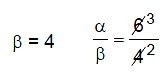
Comparing this with $E = \frac{\alpha Q}{4 \pi \epsilon_0 x^\beta}$,we get $\alpha = 4$ and $\beta = 4$.
Therefore,$\alpha = \beta$.
$E = \frac{1}{4 \pi \epsilon_0} \left[ \frac{q}{(x-a)^2} - \frac{2q}{x^2} + \frac{q}{(x+a)^2} \right]$
$E = \frac{q}{4 \pi \epsilon_0} \left[ \frac{(x+a)^2 - 2(x^2-a^2) + (x-a)^2}{x^2(x^2-a^2)} \right]$
$E = \frac{q}{4 \pi \epsilon_0} \left[ \frac{x^2 + 2ax + a^2 - 2x^2 + 2a^2 + x^2 - 2ax + a^2}{x^2(x^2-a^2)} \right]$
$E = \frac{q}{4 \pi \epsilon_0} \left[ \frac{4a^2}{x^2(x^2-a^2)} \right]$
Since $x \gg a$,we can approximate $x^2 - a^2 \approx x^2$:
$E = \frac{q}{4 \pi \epsilon_0} \left[ \frac{4a^2}{x^2(x^2)} \right] = \frac{4qa^2}{4 \pi \epsilon_0 x^4}$
Given $qa^2 = Q$,we have $E = \frac{4Q}{4 \pi \epsilon_0 x^4}$.
Comparing this with $E = \frac{\alpha Q}{4 \pi \epsilon_0 x^\beta}$,we get $\alpha = 4$ and $\beta = 4$.
Therefore,$\alpha = \beta$.
0 likes
View Solution264
DifficultMCQ
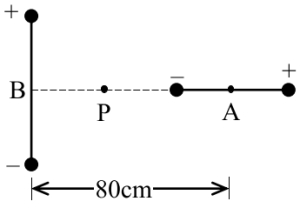
Two short dipoles $A$ and $B$,$A$ having charges $\pm 2 \mu C$ and length $1 \text{ cm}$,and $B$ having charges $\pm 4 \mu C$ and length $1 \text{ cm}$,are placed with their centres $80 \text{ cm}$ apart as shown in the figure. The electric field at a point $P$,equidistant from the centres of both dipoles,is . . . . . . $\text{N/C}$.
A
$\frac{9}{16}\sqrt{2}\times10^{5}$
B
$4.5 \sqrt{2}\times10^{4}$
C
$9\sqrt{2}\times10^{4}$
D
$\frac{9}{16}\sqrt{2}\times10^{4}$
Solution
(D) The dipole moments are $P_1 = q_1 \times l_1 = 2 \times 10^{-6} \text{ C} \times 10^{-2} \text{ m} = 2 \times 10^{-8} \text{ Cm}$ and $P_2 = q_2 \times l_2 = 4 \times 10^{-6} \text{ C} \times 10^{-2} \text{ m} = 4 \times 10^{-8} \text{ Cm}$.
Point $P$ is at a distance $r = 40 \text{ cm} = 0.4 \text{ m}$ from the centre of each dipole.
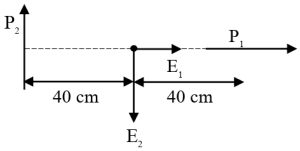
For dipole $A$,point $P$ is on its axial line. The electric field is $\vec{E}_1 = \frac{2KP_1}{r^3} \hat{i} = \frac{2 \times (9 \times 10^9) \times (2 \times 10^{-8})}{(0.4)^3} \hat{i} = \frac{360}{(0.064)} \hat{i} = 5625 \hat{i} \text{ N/C}$.
For dipole $B$,point $P$ is on its equatorial line. The electric field is $\vec{E}_2 = -\frac{KP_2}{r^3} \hat{j} = -\frac{(9 \times 10^9) \times (4 \times 10^{-8})}{(0.4)^3} \hat{j} = -\frac{360}{(0.064)} \hat{j} = -5625 \hat{j} \text{ N/C}$.
The net electric field is $\vec{E}_{net} = \vec{E}_1 + \vec{E}_2 = 5625(\hat{i} - \hat{j}) \text{ N/C}$.
The magnitude is $|\vec{E}_{net}| = 5625 \sqrt{1^2 + (-1)^2} = 5625 \sqrt{2} \text{ N/C}$.
Since $5625 = \frac{9 \times 10^4}{16}$,the magnitude is $\frac{9}{16} \sqrt{2} \times 10^4 \text{ N/C}$.
Point $P$ is at a distance $r = 40 \text{ cm} = 0.4 \text{ m}$ from the centre of each dipole.
For dipole $A$,point $P$ is on its axial line. The electric field is $\vec{E}_1 = \frac{2KP_1}{r^3} \hat{i} = \frac{2 \times (9 \times 10^9) \times (2 \times 10^{-8})}{(0.4)^3} \hat{i} = \frac{360}{(0.064)} \hat{i} = 5625 \hat{i} \text{ N/C}$.
For dipole $B$,point $P$ is on its equatorial line. The electric field is $\vec{E}_2 = -\frac{KP_2}{r^3} \hat{j} = -\frac{(9 \times 10^9) \times (4 \times 10^{-8})}{(0.4)^3} \hat{j} = -\frac{360}{(0.064)} \hat{j} = -5625 \hat{j} \text{ N/C}$.
The net electric field is $\vec{E}_{net} = \vec{E}_1 + \vec{E}_2 = 5625(\hat{i} - \hat{j}) \text{ N/C}$.
The magnitude is $|\vec{E}_{net}| = 5625 \sqrt{1^2 + (-1)^2} = 5625 \sqrt{2} \text{ N/C}$.
Since $5625 = \frac{9 \times 10^4}{16}$,the magnitude is $\frac{9}{16} \sqrt{2} \times 10^4 \text{ N/C}$.
0 likes
View Solution265
DifficultMCQ
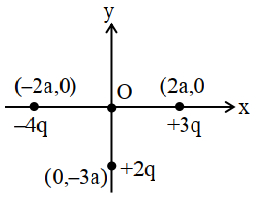
Three charges $+2q$,$+3q$,and $-4q$ are situated at $(0, -3a)$,$(2a, 0)$,and $(-2a, 0)$ respectively in the $xy$ plane. The resultant dipole moment about the origin is . . . . . .
A
$2qa(3\hat{j}-\hat{i})$
B
$2qa(3\hat{i}-7\hat{j})$
C
$2qa(7\hat{i}-3\hat{j})$
D
$2qa(3\hat{j}-7\hat{i})$
Solution
(C) The dipole moment $\vec{p}$ of a system of charges is given by $\vec{p} = \sum q_i \vec{r}_i$.
Given charges are $q_1 = +2q$ at $\vec{r}_1 = (0, -3a) = -3a\hat{j}$,$q_2 = +3q$ at $\vec{r}_2 = (2a, 0) = 2a\hat{i}$,and $q_3 = -4q$ at $\vec{r}_3 = (-2a, 0) = -2a\hat{i}$.
Substituting these values into the formula:
$\vec{p} = (2q)(-3a\hat{j}) + (3q)(2a\hat{i}) + (-4q)(-2a\hat{i})$
$\vec{p} = -6qa\hat{j} + 6qa\hat{i} + 8qa\hat{i}$
$\vec{p} = (6qa + 8qa)\hat{i} - 6qa\hat{j}$
$\vec{p} = 14qa\hat{i} - 6qa\hat{j}$
$\vec{p} = 2qa(7\hat{i} - 3\hat{j})$
Given charges are $q_1 = +2q$ at $\vec{r}_1 = (0, -3a) = -3a\hat{j}$,$q_2 = +3q$ at $\vec{r}_2 = (2a, 0) = 2a\hat{i}$,and $q_3 = -4q$ at $\vec{r}_3 = (-2a, 0) = -2a\hat{i}$.
Substituting these values into the formula:
$\vec{p} = (2q)(-3a\hat{j}) + (3q)(2a\hat{i}) + (-4q)(-2a\hat{i})$
$\vec{p} = -6qa\hat{j} + 6qa\hat{i} + 8qa\hat{i}$
$\vec{p} = (6qa + 8qa)\hat{i} - 6qa\hat{j}$
$\vec{p} = 14qa\hat{i} - 6qa\hat{j}$
$\vec{p} = 2qa(7\hat{i} - 3\hat{j})$
0 likes
View Solution266
MediumMCQ
An electric dipole of dipole moment $P$ is placed parallel to a uniform electric field of intensity $E$. On rotating it through an angle of $90^\circ$ from this position,the amount of work done is . . . . . . .
A
$2PE$
B
$PE/2$
C
$PE$
D
Zero
Solution
(C) The work done $W$ in rotating an electric dipole in a uniform electric field is given by the formula: $W = PE(\cos \theta_1 - \cos \theta_2)$.
Initially,the dipole is parallel to the electric field,so the initial angle $\theta_1 = 0^\circ$.
Finally,the dipole is rotated by an angle of $90^\circ$,so the final angle $\theta_2 = 90^\circ$.
Substituting these values into the formula:
$W = PE(\cos 0^\circ - \cos 90^\circ)$
Since $\cos 0^\circ = 1$ and $\cos 90^\circ = 0$,we get:
$W = PE(1 - 0) = PE$.
Initially,the dipole is parallel to the electric field,so the initial angle $\theta_1 = 0^\circ$.
Finally,the dipole is rotated by an angle of $90^\circ$,so the final angle $\theta_2 = 90^\circ$.
Substituting these values into the formula:
$W = PE(\cos 0^\circ - \cos 90^\circ)$
Since $\cos 0^\circ = 1$ and $\cos 90^\circ = 0$,we get:
$W = PE(1 - 0) = PE$.
0 likes
View Solution267
DifficultMCQ
$A$ rigid dipole undergoes a simple harmonic motion about its centre in the presence of an electric field $\vec{E}_1 = E_0\hat{i}$. If another electric field $\vec{E}_2 = 2E_0(\hat{j} + \hat{k})$ is introduced to the system,what will be the percentage change in the frequency of the oscillation (approximate) (in $\%$)?
A
$73$
B
$63$
C
$83$
D
$53$
Solution
(A) The frequency of oscillation for a dipole in a uniform electric field $\vec{E}$ is given by $\nu = \frac{1}{2\pi}\sqrt{\frac{pE}{I}}$,where $p$ is the dipole moment and $I$ is the moment of inertia.
Initially,the electric field is $\vec{E}_1 = E_0\hat{i}$,so its magnitude is $E_1 = E_0$.
The frequency is $\nu_1 = \frac{1}{2\pi}\sqrt{\frac{pE_0}{I}}$.
When the second field $\vec{E}_2 = 2E_0\hat{j} + 2E_0\hat{k}$ is added,the resultant electric field is $\vec{E}_{res} = E_0\hat{i} + 2E_0\hat{j} + 2E_0\hat{k}$.
The magnitude of the resultant field is $E_{res} = \sqrt{E_0^2 + (2E_0)^2 + (2E_0)^2} = \sqrt{E_0^2 + 4E_0^2 + 4E_0^2} = \sqrt{9E_0^2} = 3E_0$.
The new frequency is $\nu_2 = \frac{1}{2\pi}\sqrt{\frac{p(3E_0)}{I}} = \sqrt{3} \nu_1$.
The percentage change in frequency is $\frac{\nu_2 - \nu_1}{\nu_1} \times 100 = (\sqrt{3} - 1) \times 100 \approx (1.732 - 1) \times 100 = 73.2\%$.
Thus,the approximate percentage change is $73\%$.
Initially,the electric field is $\vec{E}_1 = E_0\hat{i}$,so its magnitude is $E_1 = E_0$.
The frequency is $\nu_1 = \frac{1}{2\pi}\sqrt{\frac{pE_0}{I}}$.
When the second field $\vec{E}_2 = 2E_0\hat{j} + 2E_0\hat{k}$ is added,the resultant electric field is $\vec{E}_{res} = E_0\hat{i} + 2E_0\hat{j} + 2E_0\hat{k}$.
The magnitude of the resultant field is $E_{res} = \sqrt{E_0^2 + (2E_0)^2 + (2E_0)^2} = \sqrt{E_0^2 + 4E_0^2 + 4E_0^2} = \sqrt{9E_0^2} = 3E_0$.
The new frequency is $\nu_2 = \frac{1}{2\pi}\sqrt{\frac{p(3E_0)}{I}} = \sqrt{3} \nu_1$.
The percentage change in frequency is $\frac{\nu_2 - \nu_1}{\nu_1} \times 100 = (\sqrt{3} - 1) \times 100 \approx (1.732 - 1) \times 100 = 73.2\%$.
Thus,the approximate percentage change is $73\%$.
0 likes
View Solution268
DifficultMCQ
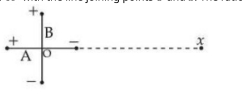
Two short electric dipoles $A$ and $B$ having dipole moments $p_1$ and $p_2$ respectively are placed with their axes mutually perpendicular as shown in the figure. The resultant electric field at a point $x$ makes an angle of $60^{\circ}$ with the line joining points $O$ and $x$. The ratio of the dipole moments $p_2/p_1$ is . . . . . . .
A
$\frac{\sqrt{3}}{2}$
B
$2\sqrt{3}$
C
$\frac{1}{\sqrt{3}}$
D
$\sqrt{3}$
Solution
(B) For a short electric dipole,the electric field at a point at distance $r$ and angle $\theta$ from the dipole axis is given by $\vec{E} = E_r \hat{r} + E_\theta \hat{\theta}$,where $E_r = \frac{2kp\cos\theta}{r^3}$ and $E_\theta = \frac{kp\sin\theta}{r^3}$.
For dipole $A$,the point $x$ lies on its axial line,so $\theta = 0^{\circ}$. The electric field due to $A$ is $E_A = \frac{2kp_1}{r^3}$ directed along the line $Ox$.
For dipole $B$,the point $x$ lies on its equatorial line,so $\theta = 90^{\circ}$. The electric field due to $B$ is $E_B = \frac{kp_2}{r^3}$ directed perpendicular to the line $Ox$.
The resultant electric field makes an angle of $60^{\circ}$ with the line $Ox$. Therefore,$\tan 60^{\circ} = \frac{E_B}{E_A}$.
Substituting the values,we get $\sqrt{3} = \frac{kp_2/r^3}{2kp_1/r^3} = \frac{p_2}{2p_1}$.
Thus,the ratio $\frac{p_2}{p_1} = 2\sqrt{3}$.
For dipole $A$,the point $x$ lies on its axial line,so $\theta = 0^{\circ}$. The electric field due to $A$ is $E_A = \frac{2kp_1}{r^3}$ directed along the line $Ox$.
For dipole $B$,the point $x$ lies on its equatorial line,so $\theta = 90^{\circ}$. The electric field due to $B$ is $E_B = \frac{kp_2}{r^3}$ directed perpendicular to the line $Ox$.
The resultant electric field makes an angle of $60^{\circ}$ with the line $Ox$. Therefore,$\tan 60^{\circ} = \frac{E_B}{E_A}$.
Substituting the values,we get $\sqrt{3} = \frac{kp_2/r^3}{2kp_1/r^3} = \frac{p_2}{2p_1}$.
Thus,the ratio $\frac{p_2}{p_1} = 2\sqrt{3}$.
0 likes
View SolutionElectric Charges and Fields — Electric Dipole and Electric Field · Frequently Asked Questions
1Are these Electric Charges and Fields questions useful for JEE and NEET?
Yes. All questions in this section are mapped to JEE Main and NEET exam patterns. Previous year questions from JEE Main, NEET, GUJCET and state-level exams are included with full solutions.
2Can I switch to Hindi or Gujarati for these questions?
Yes. Use the language tabs in the hero section or the sidebar to view the same questions and solutions in English, Hindi or Gujarati.
3How do I generate a question paper from this subtopic?
Use the Vedclass Exam Paper Generator — select the chapter and subtopic, set difficulty, and generate Sets A, B, C, D automatically. First 3 chapters of every subject are free.
Vedclass Products
For Students
Vedclass Test Series
Mock tests in real JEE/NEET style with performance analysis. 5-day free trial.
Start Free TrialFor Teachers
Exam Paper Generator
Generate Set A/B/C/D papers from this chapter in 2 minutes. 3 chapters free.
Try FreeFor Institutes
Online Exam Module
Live online exams with unlimited students, 360° analytics & white-label branding.
See DemoFor Teachers & Institutes
Generate a Electric Charges and Fields Exam Paper in 2 Minutes
Select subtopic & difficulty — Sets A, B, C, D auto-generated with No Repeat logic.
First 3 chapters of every subject are free — no payment required.