
A English
Resistance of wire, Resistivity and Conductivity Questions in English
Class 12 Physics · Current Electricity · Resistance of wire, Resistivity and Conductivity
308+
Questions
English
Language
100%
With Solutions
Showing 50 of 308 questions in English
51
MediumMCQ
$A$ wire of radius $r$ has resistance $R$. If it is stretched to a radius of $\frac{3r}{4}$,its resistance becomes
A
$\frac{9R}{16}$
B
$\frac{16R}{9}$
C
$\frac{81R}{256}$
D
$\frac{256R}{81}$
Solution
(D) The resistance of a wire is given by $R = \rho \frac{L}{A} = \rho \frac{L}{\pi r^2}$.
Since the volume of the wire remains constant during stretching,$V = A_1 L_1 = A_2 L_2$,which implies $\pi r_1^2 L_1 = \pi r_2^2 L_2$.
Thus,$\frac{L_2}{L_1} = \left( \frac{r_1}{r_2} \right)^2$.
The ratio of resistances is $\frac{R_2}{R_1} = \frac{\rho L_2 / A_2}{\rho L_1 / A_1} = \left( \frac{L_2}{L_1} \right) \left( \frac{A_1}{A_2} \right) = \left( \frac{r_1}{r_2} \right)^2 \left( \frac{r_1}{r_2} \right)^2 = \left( \frac{r_1}{r_2} \right)^4$.
Given $r_1 = r$ and $r_2 = \frac{3r}{4}$,we have $\frac{R_2}{R} = \left( \frac{r}{3r/4} \right)^4 = \left( \frac{4}{3} \right)^4 = \frac{256}{81}$.
Therefore,$R_2 = \frac{256R}{81}$.
Since the volume of the wire remains constant during stretching,$V = A_1 L_1 = A_2 L_2$,which implies $\pi r_1^2 L_1 = \pi r_2^2 L_2$.
Thus,$\frac{L_2}{L_1} = \left( \frac{r_1}{r_2} \right)^2$.
The ratio of resistances is $\frac{R_2}{R_1} = \frac{\rho L_2 / A_2}{\rho L_1 / A_1} = \left( \frac{L_2}{L_1} \right) \left( \frac{A_1}{A_2} \right) = \left( \frac{r_1}{r_2} \right)^2 \left( \frac{r_1}{r_2} \right)^2 = \left( \frac{r_1}{r_2} \right)^4$.
Given $r_1 = r$ and $r_2 = \frac{3r}{4}$,we have $\frac{R_2}{R} = \left( \frac{r}{3r/4} \right)^4 = \left( \frac{4}{3} \right)^4 = \frac{256}{81}$.
Therefore,$R_2 = \frac{256R}{81}$.
0 likes
View Solution52
EasyMCQ
The resistance of a conductor increases with:
A
Increase in length
B
Increase in temperature
C
Decrease in cross-sectional area
D
All of these
Solution
(D) The resistance $R$ of a conductor is given by the formula $R = \rho \frac{L}{A}$,where $\rho$ is resistivity,$L$ is length,and $A$ is the cross-sectional area.
$1$. As length $L$ increases,resistance $R$ increases.
$2$. As cross-sectional area $A$ decreases,resistance $R$ increases.
$3$. For a conductor,resistivity $\rho$ increases with an increase in temperature,which leads to an increase in resistance $R$.
Therefore,all the given factors lead to an increase in resistance.
$1$. As length $L$ increases,resistance $R$ increases.
$2$. As cross-sectional area $A$ decreases,resistance $R$ increases.
$3$. For a conductor,resistivity $\rho$ increases with an increase in temperature,which leads to an increase in resistance $R$.
Therefore,all the given factors lead to an increase in resistance.
0 likes
View Solution53
EasyMCQ
Two wires of the same material have lengths $L$ and $2L$ and cross-sectional areas $4A$ and $A$ respectively. The ratio of their specific resistance would be
A
$1:2$
B
$8:1$
C
$1:8$
D
$1:1$
Solution
(D) Specific resistance,also known as resistivity $(\rho)$,is an intrinsic property of a material.
It depends only on the nature of the material and the temperature.
It does not depend on the physical dimensions of the conductor,such as its length $(L)$ or cross-sectional area $(A)$.
Since both wires are made of the same material,their specific resistance will be equal.
Therefore,the ratio of their specific resistance is $1:1$.
It depends only on the nature of the material and the temperature.
It does not depend on the physical dimensions of the conductor,such as its length $(L)$ or cross-sectional area $(A)$.
Since both wires are made of the same material,their specific resistance will be equal.
Therefore,the ratio of their specific resistance is $1:1$.
0 likes
View Solution54
EasyMCQ
What length of the wire of specific resistance $48 \times 10^{-8} \, \Omega \, m$ is needed to make a resistance of $4.2 \, \Omega$ (in $.1$)? (Diameter of wire = $0.4 \, mm$)
A
$4$
B
$3$
C
$2$
D
$1$
Solution
(D) The resistance $R$ of a wire is given by the formula $R = \rho \frac{l}{A}$,where $\rho$ is the resistivity,$l$ is the length,and $A$ is the cross-sectional area.
Given: $\rho = 48 \times 10^{-8} \, \Omega \, m$,$R = 4.2 \, \Omega$,and diameter $d = 0.4 \, mm = 0.4 \times 10^{-3} \, m$.
The radius $r = \frac{d}{2} = 0.2 \times 10^{-3} \, m$.
The area $A = \pi r^2 = 3.14 \times (0.2 \times 10^{-3})^2 = 3.14 \times 0.04 \times 10^{-6} = 0.1256 \times 10^{-6} \, m^2$.
Rearranging the formula for length: $l = \frac{R \cdot A}{\rho}$.
Substituting the values: $l = \frac{4.2 \times 3.14 \times (0.2 \times 10^{-3})^2}{48 \times 10^{-8}}$.
$l = \frac{4.2 \times 3.14 \times 0.04 \times 10^{-6}}{48 \times 10^{-8}} = \frac{0.52752 \times 10^{-6}}{48 \times 10^{-8}} = \frac{52.752}{48} = 1.1 \, m$.
Given: $\rho = 48 \times 10^{-8} \, \Omega \, m$,$R = 4.2 \, \Omega$,and diameter $d = 0.4 \, mm = 0.4 \times 10^{-3} \, m$.
The radius $r = \frac{d}{2} = 0.2 \times 10^{-3} \, m$.
The area $A = \pi r^2 = 3.14 \times (0.2 \times 10^{-3})^2 = 3.14 \times 0.04 \times 10^{-6} = 0.1256 \times 10^{-6} \, m^2$.
Rearranging the formula for length: $l = \frac{R \cdot A}{\rho}$.
Substituting the values: $l = \frac{4.2 \times 3.14 \times (0.2 \times 10^{-3})^2}{48 \times 10^{-8}}$.
$l = \frac{4.2 \times 3.14 \times 0.04 \times 10^{-6}}{48 \times 10^{-8}} = \frac{0.52752 \times 10^{-6}}{48 \times 10^{-8}} = \frac{52.752}{48} = 1.1 \, m$.
0 likes
View Solution55
EasyMCQ
$A$ strip of copper and another of germanium are cooled from room temperature to $80\, K$. The resistance of
A
Each of these increases
B
Each of these decreases
C
Copper strip increases and that of germanium decreases
D
Copper strip decreases and that of germanium increases
Solution
(D) Copper is a metal (conductor). For metals,the resistance decreases as the temperature decreases because the collision frequency of electrons with lattice ions decreases.
Germanium is a semiconductor. For semiconductors,the resistance increases as the temperature decreases because the number of charge carriers (electrons and holes) decreases exponentially with a decrease in temperature.
Therefore,when cooled from room temperature to $80\, K$,the resistance of the copper strip decreases and the resistance of the germanium strip increases.
Germanium is a semiconductor. For semiconductors,the resistance increases as the temperature decreases because the number of charge carriers (electrons and holes) decreases exponentially with a decrease in temperature.
Therefore,when cooled from room temperature to $80\, K$,the resistance of the copper strip decreases and the resistance of the germanium strip increases.
0 likes
View Solution56
MediumMCQ
The length of a given cylindrical wire is increased by $100 \%$. Due to the consequent decrease in diameter, the change in the resistance of the wire will be .................. $\%$
A
$300$
B
$200$
C
$100$
D
$50$
Solution
$(A)$ Let the initial length be $l_1 = l$. Since the volume of the wire remains constant, $V = A_1 l_1 = A_2 l_2$.
Given that the length is increased by $100 \%$, the new length $l_2 = l_1 + 1.00 l_1 = 2l_1$.
From the volume conservation, $A_1 l_1 = A_2 (2l_1) \Rightarrow A_2 = \frac{A_1}{2}$.
The resistance of a wire is given by $R = \rho \frac{l}{A}$.
Thus, the initial resistance $R_1 = \rho \frac{l_1}{A_1}$ and the final resistance $R_2 = \rho \frac{l_2}{A_2} = \rho \frac{2l_1}{A_1/2} = 4 \rho \frac{l_1}{A_1} = 4R_1$.
The percentage change in resistance is $\frac{\Delta R}{R_1} \times 100 = \frac{R_2 - R_1}{R_1} \times 100 = \frac{4R_1 - R_1}{R_1} \times 100 = 300 \%$.
Given that the length is increased by $100 \%$, the new length $l_2 = l_1 + 1.00 l_1 = 2l_1$.
From the volume conservation, $A_1 l_1 = A_2 (2l_1) \Rightarrow A_2 = \frac{A_1}{2}$.
The resistance of a wire is given by $R = \rho \frac{l}{A}$.
Thus, the initial resistance $R_1 = \rho \frac{l_1}{A_1}$ and the final resistance $R_2 = \rho \frac{l_2}{A_2} = \rho \frac{2l_1}{A_1/2} = 4 \rho \frac{l_1}{A_1} = 4R_1$.
The percentage change in resistance is $\frac{\Delta R}{R_1} \times 100 = \frac{R_2 - R_1}{R_1} \times 100 = \frac{4R_1 - R_1}{R_1} \times 100 = 300 \%$.
1 likes
View Solution57
EasyMCQ
We have two wires $A$ and $B$ of the same mass and same material. The diameter of wire $A$ is half that of wire $B$. If the resistance of wire $A$ is $24 \, \Omega$,then the resistance of wire $B$ will be ................ $\Omega$.
A
$12$
B
$3$
C
$1.5$
D
None of the above
Solution
(C) Given: Both wires have the same mass $(m)$ and same material (same density $\rho_d$ and resistivity $\rho$).
Since mass = density $\times$ volume,and density is the same,the volume $(V = A \cdot l)$ must be the same for both wires.
$V_A = V_B \Rightarrow A_A l_A = A_B l_B \Rightarrow \frac{l_A}{l_B} = \frac{A_B}{A_A}$.
Since $A = \pi r^2 = \pi (d/2)^2$,we have $\frac{A_B}{A_A} = \frac{d_B^2}{d_A^2}$.
Given $d_A = \frac{d_B}{2}$,so $\frac{d_B}{d_A} = 2$. Thus,$\frac{A_B}{A_A} = (2)^2 = 4$.
Therefore,$\frac{l_A}{l_B} = 4$.
The resistance is given by $R = \rho \frac{l}{A}$.
Taking the ratio: $\frac{R_A}{R_B} = \frac{l_A}{l_B} \times \frac{A_B}{A_A} = 4 \times 4 = 16$.
Given $R_A = 24 \, \Omega$,then $R_B = \frac{R_A}{16} = \frac{24}{16} = 1.5 \, \Omega$.
Since mass = density $\times$ volume,and density is the same,the volume $(V = A \cdot l)$ must be the same for both wires.
$V_A = V_B \Rightarrow A_A l_A = A_B l_B \Rightarrow \frac{l_A}{l_B} = \frac{A_B}{A_A}$.
Since $A = \pi r^2 = \pi (d/2)^2$,we have $\frac{A_B}{A_A} = \frac{d_B^2}{d_A^2}$.
Given $d_A = \frac{d_B}{2}$,so $\frac{d_B}{d_A} = 2$. Thus,$\frac{A_B}{A_A} = (2)^2 = 4$.
Therefore,$\frac{l_A}{l_B} = 4$.
The resistance is given by $R = \rho \frac{l}{A}$.
Taking the ratio: $\frac{R_A}{R_B} = \frac{l_A}{l_B} \times \frac{A_B}{A_A} = 4 \times 4 = 16$.
Given $R_A = 24 \, \Omega$,then $R_B = \frac{R_A}{16} = \frac{24}{16} = 1.5 \, \Omega$.
0 likes
View Solution58
EasyMCQ
The length of the wire is doubled. Its conductance will be
A
Unchanged
B
Halved
C
Quadrupled
D
$1/4$ of the original value
Solution
(B) The resistance $R$ of a wire is given by $R = \rho \frac{l}{A}$,where $\rho$ is resistivity,$l$ is length,and $A$ is the cross-sectional area.
Conductance $C$ is the reciprocal of resistance,so $C = \frac{1}{R} = \frac{A}{\rho l}$.
From this expression,it is clear that $C \propto \frac{1}{l}$.
If the length $l$ is doubled $(l' = 2l)$,the new conductance $C'$ becomes $C' = \frac{A}{\rho (2l)} = \frac{1}{2} \left( \frac{A}{\rho l} \right) = \frac{1}{2} C$.
Therefore,the conductance is halved.
Conductance $C$ is the reciprocal of resistance,so $C = \frac{1}{R} = \frac{A}{\rho l}$.
From this expression,it is clear that $C \propto \frac{1}{l}$.
If the length $l$ is doubled $(l' = 2l)$,the new conductance $C'$ becomes $C' = \frac{A}{\rho (2l)} = \frac{1}{2} \left( \frac{A}{\rho l} \right) = \frac{1}{2} C$.
Therefore,the conductance is halved.
0 likes
View Solution59
DifficultMCQ
The new resistance of a wire of $R \, \Omega$,whose radius is reduced to half,is
A
$16 \, R$
B
$3 \, R$
C
$2 \, R$
D
$R$
Solution
(A) The resistance of a wire is given by $R = \rho \frac{L}{A} = \rho \frac{L}{\pi r^2}$.
Since the volume of the wire remains constant during stretching,$V = A_1 L_1 = A_2 L_2$,which implies $L_1 r_1^2 = L_2 r_2^2$.
Therefore,$\frac{L_2}{L_1} = \left( \frac{r_1}{r_2} \right)^2$.
The ratio of the new resistance $R_2$ to the original resistance $R_1$ is $\frac{R_2}{R_1} = \frac{\rho L_2 / A_2}{\rho L_1 / A_1} = \left( \frac{L_2}{L_1} \right) \left( \frac{A_1}{A_2} \right) = \left( \frac{r_1}{r_2} \right)^2 \left( \frac{r_1}{r_2} \right)^2 = \left( \frac{r_1}{r_2} \right)^4$.
Given that the radius is reduced to half,$r_2 = \frac{r_1}{2}$,so $\frac{r_1}{r_2} = 2$.
Substituting this into the formula,$\frac{R_2}{R} = (2)^4 = 16$.
Thus,the new resistance is $R_2 = 16 \, R$.
Since the volume of the wire remains constant during stretching,$V = A_1 L_1 = A_2 L_2$,which implies $L_1 r_1^2 = L_2 r_2^2$.
Therefore,$\frac{L_2}{L_1} = \left( \frac{r_1}{r_2} \right)^2$.
The ratio of the new resistance $R_2$ to the original resistance $R_1$ is $\frac{R_2}{R_1} = \frac{\rho L_2 / A_2}{\rho L_1 / A_1} = \left( \frac{L_2}{L_1} \right) \left( \frac{A_1}{A_2} \right) = \left( \frac{r_1}{r_2} \right)^2 \left( \frac{r_1}{r_2} \right)^2 = \left( \frac{r_1}{r_2} \right)^4$.
Given that the radius is reduced to half,$r_2 = \frac{r_1}{2}$,so $\frac{r_1}{r_2} = 2$.
Substituting this into the formula,$\frac{R_2}{R} = (2)^4 = 16$.
Thus,the new resistance is $R_2 = 16 \, R$.
0 likes
View Solution60
MediumMCQ
$A$ resistance $R$ is stretched to four times its length. Its new resistance will be
A
$4 R$
B
$64 R$
C
$R/4$
D
$16 R$
Solution
(D) When a wire of resistance $R$ is stretched to $n$ times its original length,its volume remains constant.
Since $V = A \cdot L$,if the length becomes $nL$,the new area $A'$ must be $A/n$ to keep the volume constant.
The resistance is given by $R = \rho \frac{L}{A}$.
The new resistance $R'$ is given by $R' = \rho \frac{nL}{A/n} = n^2 \rho \frac{L}{A} = n^2 R$.
Given that the length is stretched to $n = 4$ times,the new resistance is $R' = (4)^2 R = 16R$.
Since $V = A \cdot L$,if the length becomes $nL$,the new area $A'$ must be $A/n$ to keep the volume constant.
The resistance is given by $R = \rho \frac{L}{A}$.
The new resistance $R'$ is given by $R' = \rho \frac{nL}{A/n} = n^2 \rho \frac{L}{A} = n^2 R$.
Given that the length is stretched to $n = 4$ times,the new resistance is $R' = (4)^2 R = 16R$.
0 likes
View Solution61
EasyMCQ
The lead wires should have
A
Larger diameter and low resistance
B
Smaller diameter and high resistance
C
Smaller diameter and low resistance
D
Larger diameter and high resistance
Solution
(A) Lead wires are used to connect a power source to a load. To minimize power loss $(P = I^2R)$ and voltage drop $(V = IR)$ across the wires, the resistance $(R)$ of the wires should be as low as possible.
Since resistance is given by the formula $R = \rho \frac{L}{A}$, where $\rho$ is resistivity, $L$ is length, and $A$ is the cross-sectional area $(A = \pi r^2)$, to decrease resistance, we need to increase the cross-sectional area $(A)$.
Increasing the area means increasing the diameter of the wire.
Therefore, lead wires should have a larger diameter to ensure low resistance.
Since resistance is given by the formula $R = \rho \frac{L}{A}$, where $\rho$ is resistivity, $L$ is length, and $A$ is the cross-sectional area $(A = \pi r^2)$, to decrease resistance, we need to increase the cross-sectional area $(A)$.
Increasing the area means increasing the diameter of the wire.
Therefore, lead wires should have a larger diameter to ensure low resistance.
0 likes
View Solution62
EasyMCQ
The alloys constantan and manganin are used to make standard resistance due to they have
A
Low resistivity
B
High resistivity
C
Low temperature coefficient of resistance
D
Both $(B)$ and $(C)$
Solution
(D) Standard resistors are designed to maintain a constant resistance value regardless of changes in temperature.
Constantan and manganin are alloys that exhibit two key properties:
$1$. They have high resistivity,which allows for the construction of compact resistors.
$2$. They have a very low temperature coefficient of resistance,meaning their resistance changes negligibly with temperature fluctuations.
Therefore,both properties make them ideal for standard resistance.
Thus,the correct option is $(D)$.
Constantan and manganin are alloys that exhibit two key properties:
$1$. They have high resistivity,which allows for the construction of compact resistors.
$2$. They have a very low temperature coefficient of resistance,meaning their resistance changes negligibly with temperature fluctuations.
Therefore,both properties make them ideal for standard resistance.
Thus,the correct option is $(D)$.
0 likes
View Solution63
EasyMCQ
The following four wires are made of the same material and are at the same temperature. Which one of them has the highest electrical resistance?
A
Length = $50 \ cm$,diameter = $0.5 \ mm$
B
Length = $100 \ cm$,diameter = $1 \ mm$
C
Length = $200 \ cm$,diameter = $2 \ mm$
D
Length = $300 \ cm$,diameter = $3 \ mm$
Solution
(A) The resistance $R$ of a wire is given by the formula $R = \rho \frac{l}{A}$,where $\rho$ is the resistivity,$l$ is the length,and $A$ is the cross-sectional area.
Since $A = \pi r^2 = \pi (d/2)^2 = \frac{\pi d^2}{4}$,we have $R \propto \frac{l}{d^2}$.
For option $A$: $R_A \propto \frac{50}{(0.5)^2} = \frac{50}{0.25} = 200$.
For option $B$: $R_B \propto \frac{100}{(1)^2} = 100$.
For option $C$: $R_C \propto \frac{200}{(2)^2} = \frac{200}{4} = 50$.
For option $D$: $R_D \propto \frac{300}{(3)^2} = \frac{300}{9} \approx 33.3$.
Comparing these values,the ratio $\frac{l}{d^2}$ is maximum for option $A$. Therefore,the wire in option $A$ has the highest electrical resistance.
Since $A = \pi r^2 = \pi (d/2)^2 = \frac{\pi d^2}{4}$,we have $R \propto \frac{l}{d^2}$.
For option $A$: $R_A \propto \frac{50}{(0.5)^2} = \frac{50}{0.25} = 200$.
For option $B$: $R_B \propto \frac{100}{(1)^2} = 100$.
For option $C$: $R_C \propto \frac{200}{(2)^2} = \frac{200}{4} = 50$.
For option $D$: $R_D \propto \frac{300}{(3)^2} = \frac{300}{9} \approx 33.3$.
Comparing these values,the ratio $\frac{l}{d^2}$ is maximum for option $A$. Therefore,the wire in option $A$ has the highest electrical resistance.
0 likes
View Solution64
MediumMCQ
$A$ thick wire is stretched so that its length becomes two times. Assuming that there is no change in its density,what is the ratio of the change in resistance of the wire to the initial resistance of the wire?
A
$2:1$
B
$4:1$
C
$3:1$
D
$1:4$
Solution
(C) When a wire is stretched,its volume remains constant. Since $Volume = Area \times Length$,if the length becomes $n$ times,the area becomes $1/n$ times.
Resistance $R = \rho \frac{l}{A}$. Therefore,$R \propto l^2$.
Given that the length becomes $2$ times $(l_2 = 2l_1)$,the new resistance $R_2$ is:
$R_2 = R_1 \times (2)^2 = 4R_1$.
The change in resistance is $\Delta R = R_2 - R_1 = 4R_1 - R_1 = 3R_1$.
The ratio of the change in resistance to the initial resistance is $\frac{\Delta R}{R_1} = \frac{3R_1}{R_1} = 3:1$.
Resistance $R = \rho \frac{l}{A}$. Therefore,$R \propto l^2$.
Given that the length becomes $2$ times $(l_2 = 2l_1)$,the new resistance $R_2$ is:
$R_2 = R_1 \times (2)^2 = 4R_1$.
The change in resistance is $\Delta R = R_2 - R_1 = 4R_1 - R_1 = 3R_1$.
The ratio of the change in resistance to the initial resistance is $\frac{\Delta R}{R_1} = \frac{3R_1}{R_1} = 3:1$.
0 likes
View Solution65
MediumMCQ
The length of the resistance wire is increased by $10\%$. What is the corresponding change in the resistance of the wire? ................ $\%$
A
$10$
B
$25$
C
$21$
D
$9$
Solution
(C) The resistance of a wire is given by $R = \rho \frac{l}{A}$. Since the volume $V = A \times l$ remains constant, $A = \frac{V}{l}$.
Substituting this, we get $R = \rho \frac{l^2}{V}$, which implies $R \propto l^2$.
If the length increases by $10\%$, the new length $l_2 = l_1 + 0.10 l_1 = 1.1 l_1$.
The ratio of resistances is $\frac{R_2}{R_1} = \left( \frac{l_2}{l_1} \right)^2 = (1.1)^2 = 1.21$.
Thus, $R_2 = 1.21 R_1$.
The percentage change in resistance is $\frac{R_2 - R_1}{R_1} \times 100 = (1.21 - 1) \times 100 = 21\%$.
Substituting this, we get $R = \rho \frac{l^2}{V}$, which implies $R \propto l^2$.
If the length increases by $10\%$, the new length $l_2 = l_1 + 0.10 l_1 = 1.1 l_1$.
The ratio of resistances is $\frac{R_2}{R_1} = \left( \frac{l_2}{l_1} \right)^2 = (1.1)^2 = 1.21$.
Thus, $R_2 = 1.21 R_1$.
The percentage change in resistance is $\frac{R_2 - R_1}{R_1} \times 100 = (1.21 - 1) \times 100 = 21\%$.
0 likes
View Solution66
EasyMCQ
Two wires are made of two different materials whose specific resistances are in the ratio $2:3$,lengths are in the ratio $3:4$,and cross-sectional areas are in the ratio $4:5$. The ratio of their resistances is:
A
$6:5$
B
$6:8$
C
$5:8$
D
$1:2$
Solution
(C) The resistance $R$ of a wire is given by the formula $R = \rho \frac{l}{A}$,where $\rho$ is the specific resistance (resistivity),$l$ is the length,and $A$ is the cross-sectional area.
Given the ratios:
$\frac{\rho_1}{\rho_2} = \frac{2}{3}$
$\frac{l_1}{l_2} = \frac{3}{4}$
$\frac{A_1}{A_2} = \frac{4}{5}$
The ratio of their resistances is $\frac{R_1}{R_2} = \frac{\rho_1}{\rho_2} \times \frac{l_1}{l_2} \times \frac{A_2}{A_1}$.
Substituting the given values:
$\frac{R_1}{R_2} = \frac{2}{3} \times \frac{3}{4} \times \frac{5}{4} = \frac{2 \times 3 \times 5}{3 \times 4 \times 4} = \frac{30}{48} = \frac{5}{8}$.
Thus,the ratio of their resistances is $5:8$.
Given the ratios:
$\frac{\rho_1}{\rho_2} = \frac{2}{3}$
$\frac{l_1}{l_2} = \frac{3}{4}$
$\frac{A_1}{A_2} = \frac{4}{5}$
The ratio of their resistances is $\frac{R_1}{R_2} = \frac{\rho_1}{\rho_2} \times \frac{l_1}{l_2} \times \frac{A_2}{A_1}$.
Substituting the given values:
$\frac{R_1}{R_2} = \frac{2}{3} \times \frac{3}{4} \times \frac{5}{4} = \frac{2 \times 3 \times 5}{3 \times 4 \times 4} = \frac{30}{48} = \frac{5}{8}$.
Thus,the ratio of their resistances is $5:8$.
0 likes
View Solution67
MediumMCQ
Two wires of equal diameters,of resistivities $\rho_1$ and $\rho_2$ and lengths $l_1$ and $l_2$,respectively,are joined in series. The equivalent resistivity of the combination is
A
$\frac{\rho_1 l_1 + \rho_2 l_2}{l_1 + l_2}$
B
$\frac{\rho_1 l_2 + \rho_2 l_1}{l_1 - l_2}$
C
$\frac{\rho_1 l_2 + \rho_2 l_1}{l_1 + l_2}$
D
$\frac{\rho_1 l_1 - \rho_2 l_2}{l_1 - l_2}$
Solution
(A) The resistance of a wire is given by $R = \rho \frac{l}{A}$,where $\rho$ is resistivity,$l$ is length,and $A$ is the cross-sectional area.
Since the diameters are equal,the cross-sectional areas $A$ are equal for both wires.
The resistances are $R_1 = \frac{\rho_1 l_1}{A}$ and $R_2 = \frac{\rho_2 l_2}{A}$.
When joined in series,the equivalent resistance is $R_{eq} = R_1 + R_2$.
The equivalent wire has total length $(l_1 + l_2)$ and the same cross-sectional area $A$,so $R_{eq} = \frac{\rho_{eq}(l_1 + l_2)}{A}$.
Equating the expressions: $\frac{\rho_{eq}(l_1 + l_2)}{A} = \frac{\rho_1 l_1}{A} + \frac{\rho_2 l_2}{A}$.
Canceling $A$ from both sides,we get $\rho_{eq}(l_1 + l_2) = \rho_1 l_1 + \rho_2 l_2$.
Therefore,the equivalent resistivity is $\rho_{eq} = \frac{\rho_1 l_1 + \rho_2 l_2}{l_1 + l_2}$.
Since the diameters are equal,the cross-sectional areas $A$ are equal for both wires.
The resistances are $R_1 = \frac{\rho_1 l_1}{A}$ and $R_2 = \frac{\rho_2 l_2}{A}$.
When joined in series,the equivalent resistance is $R_{eq} = R_1 + R_2$.
The equivalent wire has total length $(l_1 + l_2)$ and the same cross-sectional area $A$,so $R_{eq} = \frac{\rho_{eq}(l_1 + l_2)}{A}$.
Equating the expressions: $\frac{\rho_{eq}(l_1 + l_2)}{A} = \frac{\rho_1 l_1}{A} + \frac{\rho_2 l_2}{A}$.
Canceling $A$ from both sides,we get $\rho_{eq}(l_1 + l_2) = \rho_1 l_1 + \rho_2 l_2$.
Therefore,the equivalent resistivity is $\rho_{eq} = \frac{\rho_1 l_1 + \rho_2 l_2}{l_1 + l_2}$.
0 likes
View Solution68
EasyMCQ
Two wires of the same dimensions but resistivities $\rho_1$ and $\rho_2$ are connected in series. The equivalent resistivity of the combination is
A
$\rho_1 + \rho_2$
B
$\frac{\rho_1 + \rho_2}{2}$
C
$\sqrt{\rho_1 \rho_2}$
D
$2(\rho_1 + \rho_2)$
Solution
(B) For two wires connected in series,the total resistance $R_{eq}$ is the sum of individual resistances: $R_{eq} = R_1 + R_2$.
Since the wires have the same dimensions (length $l$ and cross-sectional area $A$),the resistance of each wire is given by $R = \rho \frac{l}{A}$.
Substituting this into the series combination formula: $\rho_{eq} \frac{2l}{A} = \rho_1 \frac{l}{A} + \rho_2 \frac{l}{A}$.
Dividing both sides by $\frac{l}{A}$,we get: $2\rho_{eq} = \rho_1 + \rho_2$.
Therefore,the equivalent resistivity is $\rho_{eq} = \frac{\rho_1 + \rho_2}{2}$.
Since the wires have the same dimensions (length $l$ and cross-sectional area $A$),the resistance of each wire is given by $R = \rho \frac{l}{A}$.
Substituting this into the series combination formula: $\rho_{eq} \frac{2l}{A} = \rho_1 \frac{l}{A} + \rho_2 \frac{l}{A}$.
Dividing both sides by $\frac{l}{A}$,we get: $2\rho_{eq} = \rho_1 + \rho_2$.
Therefore,the equivalent resistivity is $\rho_{eq} = \frac{\rho_1 + \rho_2}{2}$.
0 likes
View Solution69
DifficultMCQ
This question contains statement-$1$ and statement-$2$. Of the four choices given after the statements,choose the one that best describes the two statements.
statement-$1$: The temperature dependence of resistance is usually given as $R=R_{0}(1+\alpha \Delta t)$. The resistance of a wire changes from $100 \; \Omega$ to $150 \; \Omega$ when its temperature is increased from $27^{\circ} C$ to $227^{\circ} C$. This implies that $\alpha=2.5 \times 10^{-3} /^{\circ} C$.
statement-$2$: $R=R_{0}(1+\alpha \Delta t)$ is valid only when the change in the temperature $\Delta t$ is small and $\Delta R=(R-R_{0}) << R_{0}$.
statement-$1$: The temperature dependence of resistance is usually given as $R=R_{0}(1+\alpha \Delta t)$. The resistance of a wire changes from $100 \; \Omega$ to $150 \; \Omega$ when its temperature is increased from $27^{\circ} C$ to $227^{\circ} C$. This implies that $\alpha=2.5 \times 10^{-3} /^{\circ} C$.
statement-$2$: $R=R_{0}(1+\alpha \Delta t)$ is valid only when the change in the temperature $\Delta t$ is small and $\Delta R=(R-R_{0}) << R_{0}$.
A
Statement-$1$ is true,statement-$2$ is false.
B
Statement-$1$ is true,statement-$2$ is true; statement-$2$ is the correct explanation of Statement-$1$.
C
Statement-$1$ is true,statement-$2$ is true; statement-$2$ is not the correct explanation of Statement-$1$.
D
Statement-$1$ is false,statement-$2$ is true.
Solution
(B) Given: $R = 150 \; \Omega$,$R_{0} = 100 \; \Omega$,and $\Delta t = 227^{\circ} C - 27^{\circ} C = 200^{\circ} C$.
Using the formula $R = R_{0}(1 + \alpha \Delta t)$:
$150 = 100(1 + \alpha \times 200)$
$1.5 = 1 + 200\alpha$
$0.5 = 200\alpha$
$\alpha = 0.5 / 200 = 2.5 \times 10^{-3} /^{\circ} C$.
Thus,Statement-$1$ is true.
Regarding Statement-$2$: The linear approximation $R = R_{0}(1 + \alpha \Delta t)$ is derived from the Taylor expansion $R = R_{0} e^{\alpha \Delta t} \approx R_{0}(1 + \alpha \Delta t + \dots)$,which is valid only when $\alpha \Delta t << 1$. In this problem,$\Delta R = 50 \; \Omega$,which is $50\%$ of $R_{0}$. Since $\Delta R$ is not much smaller than $R_{0}$,the linear approximation is technically inaccurate for large temperature changes. However,the statement claims the formula is *only* valid for small changes,which is a standard physical constraint for linear approximations. Therefore,Statement-$2$ is also true and provides the theoretical basis for the limitations of the formula used in Statement-$1$.
Using the formula $R = R_{0}(1 + \alpha \Delta t)$:
$150 = 100(1 + \alpha \times 200)$
$1.5 = 1 + 200\alpha$
$0.5 = 200\alpha$
$\alpha = 0.5 / 200 = 2.5 \times 10^{-3} /^{\circ} C$.
Thus,Statement-$1$ is true.
Regarding Statement-$2$: The linear approximation $R = R_{0}(1 + \alpha \Delta t)$ is derived from the Taylor expansion $R = R_{0} e^{\alpha \Delta t} \approx R_{0}(1 + \alpha \Delta t + \dots)$,which is valid only when $\alpha \Delta t << 1$. In this problem,$\Delta R = 50 \; \Omega$,which is $50\%$ of $R_{0}$. Since $\Delta R$ is not much smaller than $R_{0}$,the linear approximation is technically inaccurate for large temperature changes. However,the statement claims the formula is *only* valid for small changes,which is a standard physical constraint for linear approximations. Therefore,Statement-$2$ is also true and provides the theoretical basis for the limitations of the formula used in Statement-$1$.
0 likes
View Solution70
MediumMCQ
Constantan wire is used in making standard resistances because its
A
Specific resistance is low
B
Density is high
C
Temperature coefficient of resistance is negligible
D
Melting point is high
Solution
(C) Constantan is an alloy of copper and nickel.
It is widely used in making standard resistances because it has a very low (negligible) temperature coefficient of resistance.
This property ensures that the resistance value of the wire remains almost constant even when there are fluctuations in the surrounding temperature,making it ideal for precision instruments.
It is widely used in making standard resistances because it has a very low (negligible) temperature coefficient of resistance.
This property ensures that the resistance value of the wire remains almost constant even when there are fluctuations in the surrounding temperature,making it ideal for precision instruments.
0 likes
View Solution71
MediumMCQ
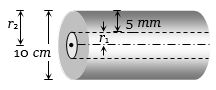
The length of a hollow tube is $5\,m$,its outer diameter is $10\,cm$,and the thickness of its wall is $5\,mm$. If the resistivity of the material of the tube is $1.7 \times 10^{-8} \,\Omega m$,then the resistance of the tube will be:
A
$5.6 \times 10^{-5} \,\Omega$
B
$2 \times 10^{-5} \,\Omega$
C
$4 \times 10^{-5} \,\Omega$
D
None of these
Solution
(A) The resistance $R$ of a conductor is given by $R = \rho \frac{l}{A}$,where $\rho$ is the resistivity,$l$ is the length,and $A$ is the cross-sectional area.
For a hollow tube,the cross-sectional area $A$ is given by $A = \pi (r_2^2 - r_1^2)$,where $r_2$ is the outer radius and $r_1$ is the inner radius.
Given:
Length $l = 5\,m$
Outer diameter $D_2 = 10\,cm$,so outer radius $r_2 = 5\,cm = 0.05\,m$.
Wall thickness $t = 5\,mm = 0.5\,cm = 0.005\,m$.
Inner radius $r_1 = r_2 - t = 5\,cm - 0.5\,cm = 4.5\,cm = 0.045\,m$.
Resistivity $\rho = 1.7 \times 10^{-8} \,\Omega m$.
Calculating the area $A$:
$A = \pi [(0.05)^2 - (0.045)^2] = \pi [0.0025 - 0.002025] = \pi [0.000475] \,m^2$.
Now,calculating the resistance $R$:
$R = (1.7 \times 10^{-8}) \times \frac{5}{\pi \times 0.000475} \approx \frac{8.5 \times 10^{-8}}{0.001492} \approx 5.69 \times 10^{-5} \,\Omega$.
Rounding to the nearest provided option,the resistance is approximately $5.6 \times 10^{-5} \,\Omega$.
For a hollow tube,the cross-sectional area $A$ is given by $A = \pi (r_2^2 - r_1^2)$,where $r_2$ is the outer radius and $r_1$ is the inner radius.
Given:
Length $l = 5\,m$
Outer diameter $D_2 = 10\,cm$,so outer radius $r_2 = 5\,cm = 0.05\,m$.
Wall thickness $t = 5\,mm = 0.5\,cm = 0.005\,m$.
Inner radius $r_1 = r_2 - t = 5\,cm - 0.5\,cm = 4.5\,cm = 0.045\,m$.
Resistivity $\rho = 1.7 \times 10^{-8} \,\Omega m$.
Calculating the area $A$:
$A = \pi [(0.05)^2 - (0.045)^2] = \pi [0.0025 - 0.002025] = \pi [0.000475] \,m^2$.
Now,calculating the resistance $R$:
$R = (1.7 \times 10^{-8}) \times \frac{5}{\pi \times 0.000475} \approx \frac{8.5 \times 10^{-8}}{0.001492} \approx 5.69 \times 10^{-5} \,\Omega$.
Rounding to the nearest provided option,the resistance is approximately $5.6 \times 10^{-5} \,\Omega$.
0 likes
View Solution72
DifficultMCQ
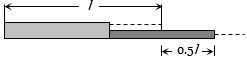
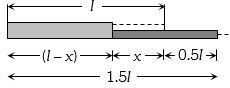
In order to quadruple the resistance of a uniform wire,a part of its length $x$ was uniformly stretched till the final length of the entire wire was $1.5$ times the original length $l$. The fraction of the wire that was stretched,$x/l$,is equal to:
A
$1/8$
B
$1/6$
C
$1/10$
D
$1/4$
Solution
(A) Let $l$ be the original length of the wire and $A$ be its original cross-sectional area. The original resistance is $R = \rho \frac{l}{A}$.
Let a length $x$ of the wire be stretched to a new length $x' = x + 0.5l$. Since the volume of this part remains constant,$A x = A' x'$,where $A'$ is the new cross-sectional area.
Thus,$A' = A \frac{x}{x + 0.5l}$.
The new resistance $R'$ is the sum of the resistance of the unstretched part $(l-x)$ and the stretched part $(x+0.5l)$:
$R' = \rho \frac{l-x}{A} + \rho \frac{x+0.5l}{A'} = \rho \frac{l-x}{A} + \rho \frac{(x+0.5l)^2}{Ax}$.
Given $R' = 4R$,we have $4 \frac{l}{A} = \frac{l-x}{A} + \frac{(x+0.5l)^2}{Ax}$.
Multiplying by $Ax$,we get $4lx = x(l-x) + (x+0.5l)^2$.
$4lx = lx - x^2 + x^2 + lx + 0.25l^2$.
$4lx = 2lx + 0.25l^2$.
$2lx = 0.25l^2$.
$x/l = 0.25/2 = 1/8$.
Let a length $x$ of the wire be stretched to a new length $x' = x + 0.5l$. Since the volume of this part remains constant,$A x = A' x'$,where $A'$ is the new cross-sectional area.
Thus,$A' = A \frac{x}{x + 0.5l}$.
The new resistance $R'$ is the sum of the resistance of the unstretched part $(l-x)$ and the stretched part $(x+0.5l)$:
$R' = \rho \frac{l-x}{A} + \rho \frac{x+0.5l}{A'} = \rho \frac{l-x}{A} + \rho \frac{(x+0.5l)^2}{Ax}$.
Given $R' = 4R$,we have $4 \frac{l}{A} = \frac{l-x}{A} + \frac{(x+0.5l)^2}{Ax}$.
Multiplying by $Ax$,we get $4lx = x(l-x) + (x+0.5l)^2$.
$4lx = lx - x^2 + x^2 + lx + 0.25l^2$.
$4lx = 2lx + 0.25l^2$.
$2lx = 0.25l^2$.
$x/l = 0.25/2 = 1/8$.
0 likes
View Solution73
MediumMCQ
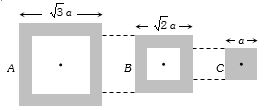
The following figure shows cross-sections through three long conductors of the same length and material,with square cross-sections of edge lengths as shown. Conductor $B$ will fit snugly within conductor $A$,and conductor $C$ will fit snugly within conductor $B$. The relationship between their end-to-end resistance is:
A
$R_A = R_B = R_C$
B
$R_A > R_B > R_C$
C
$R_A < R_B < R_C$
D
Information is not sufficient
Solution
(A) All the conductors have equal lengths $(l)$ and are made of the same material (same resistivity $\rho$).
The area of cross-section of conductor $A$ is $A_A = (\sqrt{3}a)^2 - (\sqrt{2}a)^2 = 3a^2 - 2a^2 = a^2$.
The area of cross-section of conductor $B$ is $A_B = (\sqrt{2}a)^2 - (a)^2 = 2a^2 - a^2 = a^2$.
The area of cross-section of conductor $C$ is $A_C = (a)^2 = a^2$.
Since the resistance is given by $R = \rho \frac{l}{A}$,and all conductors have the same $\rho$,$l$,and $A$,their resistances are equal:
$R_A = R_B = R_C$.
The area of cross-section of conductor $A$ is $A_A = (\sqrt{3}a)^2 - (\sqrt{2}a)^2 = 3a^2 - 2a^2 = a^2$.
The area of cross-section of conductor $B$ is $A_B = (\sqrt{2}a)^2 - (a)^2 = 2a^2 - a^2 = a^2$.
The area of cross-section of conductor $C$ is $A_C = (a)^2 = a^2$.
Since the resistance is given by $R = \rho \frac{l}{A}$,and all conductors have the same $\rho$,$l$,and $A$,their resistances are equal:
$R_A = R_B = R_C$.
0 likes
View Solution74
EasyMCQ
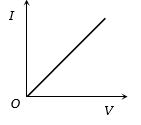
$I-V$ characteristic of a copper wire of length $L$ and area of cross-section $A$ is shown in the figure. The slope of the curve becomes
A
More if the experiment is performed at a higher temperature
B
More if a wire of steel of the same dimension is used
C
More if the length of the wire is increased
D
Less if the length of the wire is increased
Solution
(D) The slope of the $I-V$ curve is given by $\text{slope} = \frac{I}{V} = \frac{1}{R}$.
Since resistance $R = \frac{\rho L}{A}$, we have $\text{slope} = \frac{1}{R} = \frac{A}{\rho L}$.
From this expression, it is clear that the slope is inversely proportional to the length $L$ of the wire $(\text{slope} \propto \frac{1}{L})$.
Therefore, if the length of the wire is increased, the slope of the curve will decrease.
Thus, option $(d)$ is correct.
Since resistance $R = \frac{\rho L}{A}$, we have $\text{slope} = \frac{1}{R} = \frac{A}{\rho L}$.
From this expression, it is clear that the slope is inversely proportional to the length $L$ of the wire $(\text{slope} \propto \frac{1}{L})$.
Therefore, if the length of the wire is increased, the slope of the curve will decrease.
Thus, option $(d)$ is correct.
0 likes
View Solution75
MediumMCQ
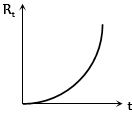
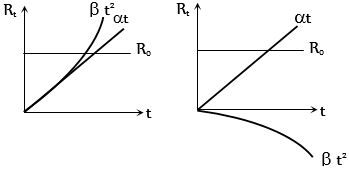
The resistance ${R_t}$ of a conductor varies with temperature $t$ as shown in the figure. If the variation is represented by ${R_t} = {R_0}[1 + \alpha t + \beta {t^2}]$,then
A
$\alpha$ and $\beta$ are both negative
B
$\alpha$ and $\beta$ are both positive
C
$\alpha$ is positive and $\beta$ is negative
D
$\alpha$ is negative and $\beta$ is positive
Solution
(B) The given equation is ${R_t} = {R_0} + {R_0}\alpha t + {R_0}\beta {t^2}$.
This is a quadratic equation of the form $y = ax^2 + bx + c$,which represents a parabola.
From the graph,we observe that the resistance ${R_t}$ increases with temperature $t$,and the slope of the curve $\frac{dR_t}{dt} = {R_0}\alpha + 2{R_0}\beta t$ is positive and increasing.
Since the curve is concave upwards,the second derivative $\frac{d^2R_t}{dt^2} = 2{R_0}\beta$ must be positive,which implies $\beta > 0$.
Also,at $t = 0$,the slope is ${R_0}\alpha$. Since the curve starts with a positive slope,$\alpha$ must be positive.
Therefore,both $\alpha$ and $\beta$ are positive. The correct option is $(b)$.
This is a quadratic equation of the form $y = ax^2 + bx + c$,which represents a parabola.
From the graph,we observe that the resistance ${R_t}$ increases with temperature $t$,and the slope of the curve $\frac{dR_t}{dt} = {R_0}\alpha + 2{R_0}\beta t$ is positive and increasing.
Since the curve is concave upwards,the second derivative $\frac{d^2R_t}{dt^2} = 2{R_0}\beta$ must be positive,which implies $\beta > 0$.
Also,at $t = 0$,the slope is ${R_0}\alpha$. Since the curve starts with a positive slope,$\alpha$ must be positive.
Therefore,both $\alpha$ and $\beta$ are positive. The correct option is $(b)$.
1 likes
View Solution76
EasyMCQ
$A$ cylindrical conductor has a uniform cross-section. The resistivity of its material increases linearly from the left end to the right end. If a constant current is flowing through it and at a section at distance $x$ from the left end,the magnitude of the electric field intensity is $E$,which of the following graphs is correct?
A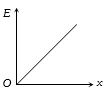
B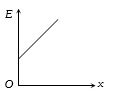
C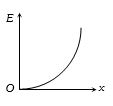
D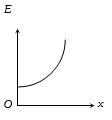
Solution
(B) Let the resistivity at a distance $x$ from the left end be $\rho = (\rho_0 + ax)$,where $\rho_0$ is the resistivity at $x = 0$ and $a$ is a positive constant.
According to Ohm's law,the current density $J$ is given by $J = \frac{i}{A} = \frac{E}{\rho}$,where $i$ is the constant current and $A$ is the uniform cross-sectional area.
Therefore,the electric field intensity $E$ at a distance $x$ is $E = \frac{i \rho}{A} = \frac{i(\rho_0 + ax)}{A}$.
This equation shows that $E$ is a linear function of $x$ of the form $E = mx + c$,where $m = \frac{ia}{A}$ and $c = \frac{i\rho_0}{A}$.
Since $\rho_0 > 0$,the intercept $c$ is non-zero,and the slope $m$ is positive.
Thus,the graph of $E$ versus $x$ is a straight line with a positive slope and a positive $y$-intercept. This corresponds to the graph shown in option $(B)$.
According to Ohm's law,the current density $J$ is given by $J = \frac{i}{A} = \frac{E}{\rho}$,where $i$ is the constant current and $A$ is the uniform cross-sectional area.
Therefore,the electric field intensity $E$ at a distance $x$ is $E = \frac{i \rho}{A} = \frac{i(\rho_0 + ax)}{A}$.
This equation shows that $E$ is a linear function of $x$ of the form $E = mx + c$,where $m = \frac{ia}{A}$ and $c = \frac{i\rho_0}{A}$.
Since $\rho_0 > 0$,the intercept $c$ is non-zero,and the slope $m$ is positive.
Thus,the graph of $E$ versus $x$ is a straight line with a positive slope and a positive $y$-intercept. This corresponds to the graph shown in option $(B)$.
0 likes
View Solution77
EasyMCQ
The resistances of a carbon filament lamp and a tungsten filament lamp are measured individually when the lamps are lit and compared with their respective resistances when cold. Which one of the following statements will be true?
A
Resistance of the carbon filament lamp will increase,but that of the tungsten will diminish when hot.
B
Resistance of the tungsten filament lamp will increase,but that of carbon will diminish when hot.
C
Resistances of both the lamps will increase when hot.
D
Resistances of both the lamps will decrease when hot.
Solution
(B) Tungsten is a metal (conductor). For metals,the resistance increases with an increase in temperature because the collision frequency of electrons increases.
Carbon is a non-metal (semiconductor). For semiconductors,the resistance decreases with an increase in temperature because more charge carriers are released as the temperature rises.
Therefore,when hot,the resistance of the tungsten filament increases,and the resistance of the carbon filament decreases.
Carbon is a non-metal (semiconductor). For semiconductors,the resistance decreases with an increase in temperature because more charge carriers are released as the temperature rises.
Therefore,when hot,the resistance of the tungsten filament increases,and the resistance of the carbon filament decreases.
0 likes
View Solution78
EasyMCQ
The electric bulbs have tungsten filaments of same length. If one of them gives $60 \, W$ and the other $100 \, W$,then:
A
$100 \, W$ bulb has a thicker filament
B
$60 \, W$ bulb has a thicker filament
C
Both filaments are of the same thickness
D
It is not possible to get different wattage unless the lengths are different
Solution
(A) The power rating of a bulb is given by $P = \frac{V^2}{R}$,where $V$ is the rated voltage and $R$ is the resistance of the filament.
Since $V$ is constant for both bulbs,$P \propto \frac{1}{R}$.
The resistance of a wire is given by $R = \rho \frac{L}{A}$,where $L$ is the length and $A$ is the cross-sectional area (thickness).
Given that the lengths $L$ are the same and the material (resistivity $\rho$) is the same,$R \propto \frac{1}{A}$.
Substituting this into the power relation,we get $P \propto \frac{1}{1/A} \implies P \propto A$.
Therefore,the bulb with higher power $(100 \, W)$ must have a larger cross-sectional area (thicker filament) compared to the bulb with lower power $(60 \, W)$.
Since $V$ is constant for both bulbs,$P \propto \frac{1}{R}$.
The resistance of a wire is given by $R = \rho \frac{L}{A}$,where $L$ is the length and $A$ is the cross-sectional area (thickness).
Given that the lengths $L$ are the same and the material (resistivity $\rho$) is the same,$R \propto \frac{1}{A}$.
Substituting this into the power relation,we get $P \propto \frac{1}{1/A} \implies P \propto A$.
Therefore,the bulb with higher power $(100 \, W)$ must have a larger cross-sectional area (thicker filament) compared to the bulb with lower power $(60 \, W)$.
0 likes
View Solution79
MediumMCQ
Three bulbs of $40\,W$,$60\,W$,and $100\,W$ are connected in series with a $220\,V$ supply. Which bulb has the minimum resistance?
A
$40\,W$
B
$60\,W$
C
$100\,W$
D
Equal in all bulbs
Solution
(C) The power rating of a bulb is given by the formula $P = \frac{V^2}{R}$,where $V$ is the rated voltage and $R$ is the resistance of the bulb.
From this relation,we can see that $R = \frac{V^2}{P}$.
Since the rated voltage $V$ is the same for all bulbs,the resistance $R$ is inversely proportional to the power $P$ $(R \propto \frac{1}{P})$.
Therefore,the bulb with the highest power rating will have the minimum resistance.
Comparing the given power ratings ($40\,W$,$60\,W$,and $100\,W$),the $100\,W$ bulb has the highest power.
Thus,the $100\,W$ bulb has the minimum resistance.
From this relation,we can see that $R = \frac{V^2}{P}$.
Since the rated voltage $V$ is the same for all bulbs,the resistance $R$ is inversely proportional to the power $P$ $(R \propto \frac{1}{P})$.
Therefore,the bulb with the highest power rating will have the minimum resistance.
Comparing the given power ratings ($40\,W$,$60\,W$,and $100\,W$),the $100\,W$ bulb has the highest power.
Thus,the $100\,W$ bulb has the minimum resistance.
0 likes
View Solution80
EasyMCQ
The temperature coefficient of resistance of a conductor is:
A
Positive always
B
Negative always
C
Zero
D
Infinite
Solution
(A) The resistance of a conductor increases with an increase in temperature because the collisions of electrons with the lattice ions increase.
For a conductor,the relationship is given by $R_t = R_0(1 + \alpha \Delta T)$,where $\alpha$ is the temperature coefficient of resistance.
Since $R_t > R_0$ for an increase in temperature,the value of $\alpha$ must be positive.
Therefore,the temperature coefficient of resistance for a conductor is always positive.
For a conductor,the relationship is given by $R_t = R_0(1 + \alpha \Delta T)$,where $\alpha$ is the temperature coefficient of resistance.
Since $R_t > R_0$ for an increase in temperature,the value of $\alpha$ must be positive.
Therefore,the temperature coefficient of resistance for a conductor is always positive.
0 likes
View Solution81
EasyMCQ
Wires $P$ and $Q$ have the same resistance at ordinary (room) temperature. When heated,the resistance of $P$ increases and that of $Q$ decreases. We conclude that:
A
$P$ and $Q$ are conductors of different materials
B
$P$ is $N$-type semiconductor and $Q$ is $P$-type semiconductor
C
$P$ is semiconductor and $Q$ is conductor
D
$P$ is conductor and $Q$ is semiconductor
Solution
(D) The resistance of a conductor increases with an increase in temperature because the collision frequency of electrons with lattice ions increases. Thus,conductors have a positive temperature coefficient of resistance.
In contrast,the resistance of a semiconductor decreases with an increase in temperature because more charge carriers (electrons and holes) are generated due to thermal excitation,which increases the conductivity. Thus,semiconductors have a negative temperature coefficient of resistance.
Since the resistance of $P$ increases with temperature,$P$ is a conductor.
Since the resistance of $Q$ decreases with temperature,$Q$ is a semiconductor.
Therefore,the correct option is $(d)$.
In contrast,the resistance of a semiconductor decreases with an increase in temperature because more charge carriers (electrons and holes) are generated due to thermal excitation,which increases the conductivity. Thus,semiconductors have a negative temperature coefficient of resistance.
Since the resistance of $P$ increases with temperature,$P$ is a conductor.
Since the resistance of $Q$ decreases with temperature,$Q$ is a semiconductor.
Therefore,the correct option is $(d)$.
0 likes
View Solution82
EasyMCQ
The difference in the variation of resistance with temperature in a metal and a semiconductor arises essentially due to the difference in the
A
Variation of scattering mechanism with temperature
B
Crystal structure
C
Variation of the number of charge carriers with temperature
D
Type of bonding
Solution
(C) In metals,the number of free charge carriers (electrons) is essentially constant with temperature. As temperature increases,the scattering of electrons by lattice vibrations increases,leading to an increase in resistance.
In semiconductors,the number of charge carriers (electrons and holes) increases exponentially with temperature due to the thermal excitation of electrons from the valence band to the conduction band. This increase in the number of charge carriers dominates over the scattering effect,causing the resistance to decrease as temperature increases.
Therefore,the fundamental difference arises due to the variation of the number of charge carriers with temperature.
In semiconductors,the number of charge carriers (electrons and holes) increases exponentially with temperature due to the thermal excitation of electrons from the valence band to the conduction band. This increase in the number of charge carriers dominates over the scattering effect,causing the resistance to decrease as temperature increases.
Therefore,the fundamental difference arises due to the variation of the number of charge carriers with temperature.
0 likes
View Solution83
EasyMCQ
Which of the following has a negative temperature coefficient of resistance?
A
Copper
B
Aluminium
C
Iron
D
Germanium
Solution
(D) The temperature coefficient of resistance $(\alpha)$ is defined as the fractional change in resistance per unit change in temperature.
For metals like Copper, Aluminium, and Iron, the resistance increases with an increase in temperature, resulting in a positive temperature coefficient of resistance.
For semiconductors like Germanium, the number of charge carriers increases significantly with an increase in temperature, leading to a decrease in resistance.
Therefore, semiconductors exhibit a negative temperature coefficient of resistance.
For metals like Copper, Aluminium, and Iron, the resistance increases with an increase in temperature, resulting in a positive temperature coefficient of resistance.
For semiconductors like Germanium, the number of charge carriers increases significantly with an increase in temperature, leading to a decrease in resistance.
Therefore, semiconductors exhibit a negative temperature coefficient of resistance.
0 likes
View Solution84
EasyMCQ
With an increase in temperature,the resistivity of a conductor ........ and the resistivity of a semiconductor ....... .
A
increases,increases
B
decreases,decreases
C
increases,decreases
D
decreases,increases
Solution
(C) The resistivity of a material depends on the temperature coefficient of resistance,denoted by $\alpha$.
For conductors,the value of $\alpha$ is positive. As temperature increases,the collision frequency of electrons with the lattice increases,leading to an increase in resistivity.
For semiconductors,the value of $\alpha$ is negative. As temperature increases,more charge carriers (electrons and holes) are generated due to the breaking of covalent bonds,which significantly increases conductivity and thus decreases resistivity.
Therefore,with an increase in temperature,the resistivity of a conductor increases and that of a semiconductor decreases.
For conductors,the value of $\alpha$ is positive. As temperature increases,the collision frequency of electrons with the lattice increases,leading to an increase in resistivity.
For semiconductors,the value of $\alpha$ is negative. As temperature increases,more charge carriers (electrons and holes) are generated due to the breaking of covalent bonds,which significantly increases conductivity and thus decreases resistivity.
Therefore,with an increase in temperature,the resistivity of a conductor increases and that of a semiconductor decreases.
0 likes
View Solution85
EasyMCQ
Why does the resistance of metallic conductors and semiconductors change differently with a change in temperature?
A
Crystal structure
B
Type of bonding
C
Change in the number of charge carriers with temperature
D
Change in scattering mechanism with temperature
Solution
(C) In metallic conductors,the number of charge carriers (free electrons) is constant,but as temperature increases,the amplitude of vibration of lattice ions increases,leading to more frequent collisions (scattering),which increases resistance.
In semiconductors,the number of charge carriers (electrons and holes) increases exponentially with temperature due to the breaking of covalent bonds,which significantly decreases resistance.
Therefore,the primary reason for the difference in temperature dependence is the change in the number of charge carriers with temperature.
In semiconductors,the number of charge carriers (electrons and holes) increases exponentially with temperature due to the breaking of covalent bonds,which significantly decreases resistance.
Therefore,the primary reason for the difference in temperature dependence is the change in the number of charge carriers with temperature.
0 likes
View Solution86
MediumMCQ
The electrical resistance of an iron wire is $R$. If both its length and radius are doubled,then:
A
The resistance will be halved and the resistivity will remain unchanged.
B
The resistance will be halved and the resistivity will be doubled.
C
Both resistance and resistivity will remain unchanged.
D
The resistance will be doubled and the resistivity will be halved.
Solution
(A) The resistance $R$ of a wire is given by the formula $R = \rho \frac{L}{A}$,where $\rho$ is the resistivity,$L$ is the length,and $A$ is the cross-sectional area.
Since the wire is cylindrical,the area $A = \pi r^2$,where $r$ is the radius.
Therefore,$R = \rho \frac{L}{\pi r^2}$.
When the length $L$ is doubled $(L' = 2L)$ and the radius $r$ is doubled $(r' = 2r)$,the new resistance $R'$ is:
$R' = \rho \frac{2L}{\pi (2r)^2} = \rho \frac{2L}{\pi (4r^2)} = \frac{1}{2} \left( \rho \frac{L}{\pi r^2} \right) = \frac{R}{2}$.
Resistivity $(\rho)$ is a material property that depends only on the nature of the material and temperature,not on the dimensions of the wire. Thus,it remains unchanged.
Therefore,the resistance is halved and the resistivity remains unchanged.
Since the wire is cylindrical,the area $A = \pi r^2$,where $r$ is the radius.
Therefore,$R = \rho \frac{L}{\pi r^2}$.
When the length $L$ is doubled $(L' = 2L)$ and the radius $r$ is doubled $(r' = 2r)$,the new resistance $R'$ is:
$R' = \rho \frac{2L}{\pi (2r)^2} = \rho \frac{2L}{\pi (4r^2)} = \frac{1}{2} \left( \rho \frac{L}{\pi r^2} \right) = \frac{R}{2}$.
Resistivity $(\rho)$ is a material property that depends only on the nature of the material and temperature,not on the dimensions of the wire. Thus,it remains unchanged.
Therefore,the resistance is halved and the resistivity remains unchanged.
0 likes
View Solution87
EasyMCQ
Which of the following wires made of the same material will have the highest resistance?
A
Radius $1 \, mm$ and length $40 \, m$.
B
Radius $2 \, mm$ and length $40 \, m$.
C
Radius $1 \, mm$ and length $80 \, m$.
D
Radius $2 \, mm$ and length $80 \, m$.
Solution
(C) The resistance $R$ of a wire is given by the formula $R = \rho \frac{l}{A} = \rho \frac{l}{\pi r^2}$,where $\rho$ is the resistivity,$l$ is the length,and $r$ is the radius.
Since all wires are made of the same material,$\rho$ is constant.
For option $A$: $R_A \propto \frac{40}{1^2} = 40$.
For option $B$: $R_B \propto \frac{40}{2^2} = 10$.
For option $C$: $R_C \propto \frac{80}{1^2} = 80$.
For option $D$: $R_D \propto \frac{80}{2^2} = 20$.
Comparing the values,$R_C$ is the highest. Therefore,the wire with radius $1 \, mm$ and length $80 \, m$ has the highest resistance.
Since all wires are made of the same material,$\rho$ is constant.
For option $A$: $R_A \propto \frac{40}{1^2} = 40$.
For option $B$: $R_B \propto \frac{40}{2^2} = 10$.
For option $C$: $R_C \propto \frac{80}{1^2} = 80$.
For option $D$: $R_D \propto \frac{80}{2^2} = 20$.
Comparing the values,$R_C$ is the highest. Therefore,the wire with radius $1 \, mm$ and length $80 \, m$ has the highest resistance.
0 likes
View Solution88
EasyMCQ
$A$ cylindrical wire is stretched such that its length is doubled but its volume remains constant. The resistance of the wire will become.......
A
Four times
B
Constant
C
Half
D
Double
Solution
(A) The resistance $R$ of a wire is given by $R = \frac{\rho l}{A}$.
Since the volume $V = A \times l$ is constant,we can write $A = \frac{V}{l}$.
Substituting this into the resistance formula: $R = \frac{\rho l}{(V/l)} = \frac{\rho l^2}{V}$.
Since $\rho$ (resistivity) and $V$ (volume) are constant,we have $R \propto l^2$.
When the length $l$ is doubled $(l' = 2l)$,the new resistance $R'$ becomes $R' \propto (2l)^2 = 4l^2$.
Therefore,$R' = 4R$,which means the resistance becomes four times the original value.
Since the volume $V = A \times l$ is constant,we can write $A = \frac{V}{l}$.
Substituting this into the resistance formula: $R = \frac{\rho l}{(V/l)} = \frac{\rho l^2}{V}$.
Since $\rho$ (resistivity) and $V$ (volume) are constant,we have $R \propto l^2$.
When the length $l$ is doubled $(l' = 2l)$,the new resistance $R'$ becomes $R' \propto (2l)^2 = 4l^2$.
Therefore,$R' = 4R$,which means the resistance becomes four times the original value.
0 likes
View Solution89
EasyMCQ
The conductivity of a superconductor is.......
A
Infinite
B
Very high
C
Very low
D
Zero
Solution
(A) superconductor is a material that exhibits zero electrical resistance when cooled below a characteristic critical temperature.
Since electrical conductivity $(\sigma)$ is the reciprocal of electrical resistivity $(\rho)$, i.e., $\sigma = 1 / \rho$.
As the resistivity $(\rho)$ of a superconductor is zero, its conductivity $(\sigma)$ becomes $1 / 0$, which is infinite.
Therefore, the conductivity of a superconductor is infinite.
Since electrical conductivity $(\sigma)$ is the reciprocal of electrical resistivity $(\rho)$, i.e., $\sigma = 1 / \rho$.
As the resistivity $(\rho)$ of a superconductor is zero, its conductivity $(\sigma)$ becomes $1 / 0$, which is infinite.
Therefore, the conductivity of a superconductor is infinite.
0 likes
View Solution90
MediumMCQ
If copper and silicon are cooled from $300 \, K$ to $60 \, K$,their resistivity will:
A
decrease in copper but increase in silicon
B
decrease in copper but decrease in silicon
C
increase in both
D
decrease in both
Solution
(A) Copper is a metal (conductor). For metals,the resistivity $\rho$ decreases as temperature $T$ decreases because the relaxation time increases.
Silicon is a semiconductor. For semiconductors,the resistivity $\rho$ increases as temperature $T$ decreases because the number of free charge carriers decreases exponentially with temperature.
Therefore,when cooled from $300 \, K$ to $60 \, K$,the resistivity of copper decreases and the resistivity of silicon increases.
Silicon is a semiconductor. For semiconductors,the resistivity $\rho$ increases as temperature $T$ decreases because the number of free charge carriers decreases exponentially with temperature.
Therefore,when cooled from $300 \, K$ to $60 \, K$,the resistivity of copper decreases and the resistivity of silicon increases.
0 likes
View Solution91
EasyMCQ
Tungsten wire is used to make standard resistors because...
A
Its specific resistance is low.
B
Its density is high.
C
The temperature coefficient of resistance is negligible.
D
Its melting point is high.
Solution
(C) Standard resistors are designed to maintain a constant resistance value over a wide range of temperatures.
For a material to be suitable for a standard resistor, its resistance should not change significantly with temperature.
The temperature coefficient of resistance $(\alpha)$ for such materials must be very low or negligible.
Tungsten is often used in specific applications, but for standard resistors, alloys like Manganin or Constantan are typically preferred because they have a very low temperature coefficient of resistance.
However, in the context of this specific question, the property that makes a material suitable for a standard resistor is that its resistance remains stable, which implies a negligible temperature coefficient of resistance.
For a material to be suitable for a standard resistor, its resistance should not change significantly with temperature.
The temperature coefficient of resistance $(\alpha)$ for such materials must be very low or negligible.
Tungsten is often used in specific applications, but for standard resistors, alloys like Manganin or Constantan are typically preferred because they have a very low temperature coefficient of resistance.
However, in the context of this specific question, the property that makes a material suitable for a standard resistor is that its resistance remains stable, which implies a negligible temperature coefficient of resistance.
0 likes
View Solution92
EasyMCQ
Two wires are made of the same material. The length and diameter of the second wire are both double those of the first wire. What will be the resistance of the first wire compared to the second wire?
A
Double the resistance of the second wire
B
Half the resistance of the second wire
C
Equal to the resistance of the second wire
D
Four times the resistance of the second wire
Solution
(A) The resistance $R$ of a wire is given by the formula $R = \rho \frac{L}{A}$,where $\rho$ is the resistivity,$L$ is the length,and $A$ is the cross-sectional area.
Since the area $A = \pi r^2 = \pi (d/2)^2 = \frac{\pi d^2}{4}$,we can write $R = \rho \frac{4L}{\pi d^2}$.
Let the first wire have length $L_1 = L$ and diameter $d_1 = d$. Its resistance is $R_1 = \rho \frac{4L}{\pi d^2}$.
For the second wire,$L_2 = 2L$ and $d_2 = 2d$. Its resistance is $R_2 = \rho \frac{4(2L)}{\pi (2d)^2} = \rho \frac{8L}{4\pi d^2} = \rho \frac{2L}{\pi d^2}$.
Comparing $R_1$ and $R_2$: $R_1 = 2 \times (\rho \frac{2L}{\pi d^2}) = 2 R_2$.
Thus,the resistance of the first wire is double the resistance of the second wire.
Since the area $A = \pi r^2 = \pi (d/2)^2 = \frac{\pi d^2}{4}$,we can write $R = \rho \frac{4L}{\pi d^2}$.
Let the first wire have length $L_1 = L$ and diameter $d_1 = d$. Its resistance is $R_1 = \rho \frac{4L}{\pi d^2}$.
For the second wire,$L_2 = 2L$ and $d_2 = 2d$. Its resistance is $R_2 = \rho \frac{4(2L)}{\pi (2d)^2} = \rho \frac{8L}{4\pi d^2} = \rho \frac{2L}{\pi d^2}$.
Comparing $R_1$ and $R_2$: $R_1 = 2 \times (\rho \frac{2L}{\pi d^2}) = 2 R_2$.
Thus,the resistance of the first wire is double the resistance of the second wire.
0 likes
View Solution93
EasyMCQ
If the length of a wire is doubled, its specific resistance (resistivity) will be.......
A
Doubled
B
$(1 / 2)$ times
C
Four times
D
The same
Solution
(D) The specific resistance, also known as resistivity $(\rho)$, is an intrinsic property of the material of the wire.
It depends only on the nature of the material and the temperature of the conductor.
It does not depend on the physical dimensions of the wire, such as its length $(l)$ or cross-sectional area $(A)$.
Therefore, if the length of the wire is doubled, the resistivity remains unchanged.
It depends only on the nature of the material and the temperature of the conductor.
It does not depend on the physical dimensions of the wire, such as its length $(l)$ or cross-sectional area $(A)$.
Therefore, if the length of the wire is doubled, the resistivity remains unchanged.
0 likes
View Solution94
EasyMCQ
If a wire is stretched to make it $0.1 \%$ longer,its resistance will.......
A
decrease by $0.2 \%$.
B
decrease by $0.05 \%$.
C
increase by $0.05 \%$.
D
increase by $0.2 \%$.
Solution
(D) The resistance $R$ of a wire is given by $R = \rho \frac{l}{A}$.
Since the volume $V = lA$ remains constant when the wire is stretched,we have $A = \frac{V}{l}$.
Substituting this into the resistance formula,we get $R = \rho \frac{l^2}{V}$.
Since $\rho$ and $V$ are constant,$R \propto l^2$.
For small changes,the percentage change in resistance is given by $\frac{\Delta R}{R} \times 100 \approx 2 \times (\frac{\Delta l}{l} \times 100)$.
Given that the length increases by $0.1 \%$,we have $\frac{\Delta l}{l} \times 100 = 0.1 \%$.
Therefore,the percentage change in resistance is $2 \times 0.1 \% = 0.2 \%$.
Since the length increases,the resistance increases by $0.2 \%$.
Since the volume $V = lA$ remains constant when the wire is stretched,we have $A = \frac{V}{l}$.
Substituting this into the resistance formula,we get $R = \rho \frac{l^2}{V}$.
Since $\rho$ and $V$ are constant,$R \propto l^2$.
For small changes,the percentage change in resistance is given by $\frac{\Delta R}{R} \times 100 \approx 2 \times (\frac{\Delta l}{l} \times 100)$.
Given that the length increases by $0.1 \%$,we have $\frac{\Delta l}{l} \times 100 = 0.1 \%$.
Therefore,the percentage change in resistance is $2 \times 0.1 \% = 0.2 \%$.
Since the length increases,the resistance increases by $0.2 \%$.
0 likes
View Solution95
DifficultMCQ
$A$ copper wire is stretched to increase its length by $0.1\%$. What is the percentage increase in the resistance of the wire (in $\%$)?
A
$0.1$
B
$0.2$
C
$0.3$
D
$0.4$
Solution
(B) The resistance of a wire is given by $R = \rho \frac{\ell}{A}$.
Since the volume $V = A \ell$ remains constant when the wire is stretched,we have $A = \frac{V}{\ell}$.
Substituting this into the resistance formula,we get $R = \rho \frac{\ell^2}{V}$.
Since $\rho$ and $V$ are constant,$R \propto \ell^2$.
Taking the derivative or using the approximation for small changes: $\frac{\Delta R}{R} \approx 2 \frac{\Delta \ell}{\ell}$.
Given $\frac{\Delta \ell}{\ell} = 0.1\%$,the percentage change in resistance is $\frac{\Delta R}{R} \times 100 = 2 \times 0.1\% = 0.2\%$.
Since the volume $V = A \ell$ remains constant when the wire is stretched,we have $A = \frac{V}{\ell}$.
Substituting this into the resistance formula,we get $R = \rho \frac{\ell^2}{V}$.
Since $\rho$ and $V$ are constant,$R \propto \ell^2$.
Taking the derivative or using the approximation for small changes: $\frac{\Delta R}{R} \approx 2 \frac{\Delta \ell}{\ell}$.
Given $\frac{\Delta \ell}{\ell} = 0.1\%$,the percentage change in resistance is $\frac{\Delta R}{R} \times 100 = 2 \times 0.1\% = 0.2\%$.
0 likes
View Solution96
MediumMCQ
The power of a heater is $500 \ W$ at a temperature of $800 \ ^oC$. What will be its power at $200 \ ^oC$ in $W$? Given $\alpha = 4 \times 10^{-4} \ ^oC^{-1}$.
A
$611$
B
$800$
C
$400$
D
$725$
Solution
(A) The power of a heater is given by $P = \frac{V^2}{R}$. Assuming the voltage $V$ remains constant,$P \propto \frac{1}{R}$.
The resistance at temperature $T$ is given by $R_T = R_0(1 + \alpha T)$.
Therefore,$\frac{P_{200}}{P_{800}} = \frac{R_{800}}{R_{200}} = \frac{R_0(1 + \alpha \times 800)}{R_0(1 + \alpha \times 200)}$.
Substituting the given values: $\alpha = 4 \times 10^{-4} \ ^oC^{-1}$,$P_{800} = 500 \ W$.
$\frac{P_{200}}{500} = \frac{1 + (4 \times 10^{-4} \times 800)}{1 + (4 \times 10^{-4} \times 200)} = \frac{1 + 0.32}{1 + 0.08} = \frac{1.32}{1.08}$.
$P_{200} = 500 \times \frac{1.32}{1.08} \approx 611.11 \ W$.
Rounding to the nearest integer,the power is $611 \ W$.
The resistance at temperature $T$ is given by $R_T = R_0(1 + \alpha T)$.
Therefore,$\frac{P_{200}}{P_{800}} = \frac{R_{800}}{R_{200}} = \frac{R_0(1 + \alpha \times 800)}{R_0(1 + \alpha \times 200)}$.
Substituting the given values: $\alpha = 4 \times 10^{-4} \ ^oC^{-1}$,$P_{800} = 500 \ W$.
$\frac{P_{200}}{500} = \frac{1 + (4 \times 10^{-4} \times 800)}{1 + (4 \times 10^{-4} \times 200)} = \frac{1 + 0.32}{1 + 0.08} = \frac{1.32}{1.08}$.
$P_{200} = 500 \times \frac{1.32}{1.08} \approx 611.11 \ W$.
Rounding to the nearest integer,the power is $611 \ W$.
0 likes
View Solution97
EasyMCQ
Specific resistance of a conductor increases with
A
Increase in cross-sectional area
B
Increase in temperature
C
Increase in cross-sectional area and decrease in length
D
Decrease in cross-sectional area
Solution
(B) Specific resistance, also known as resistivity $(\rho)$, is an intrinsic property of a material.
It depends on the nature of the material and the temperature.
For metallic conductors, resistivity increases with an increase in temperature due to increased scattering of electrons by vibrating lattice ions.
Resistivity does not depend on the physical dimensions of the conductor, such as its length or cross-sectional area.
It depends on the nature of the material and the temperature.
For metallic conductors, resistivity increases with an increase in temperature due to increased scattering of electrons by vibrating lattice ions.
Resistivity does not depend on the physical dimensions of the conductor, such as its length or cross-sectional area.
0 likes
View Solution98
MediumMCQ
The length of a given cylindrical wire is increased by $100\,\%$. Due to the consequent decrease in diameter,the percentage change in the resistance of the wire will be ................ $\%$.
A
$200$
B
$100$
C
$50$
D
$300$
Solution
(D) Let the initial length be $\ell$ and the initial resistance be $R = \rho \frac{\ell}{A}$.
Since the length is increased by $100\,\%$,the new length $\ell' = \ell + 1.00\ell = 2\ell$.
Since the volume $V = A \times \ell$ remains constant,$A' \ell' = A \ell \implies A' (2\ell) = A \ell \implies A' = \frac{A}{2}$.
The new resistance $R' = \rho \frac{\ell'}{A'} = \rho \frac{2\ell}{A/2} = 4 \left( \rho \frac{\ell}{A} \right) = 4R$.
The percentage change in resistance is given by $\frac{R' - R}{R} \times 100\,\% = \frac{4R - R}{R} \times 100\,\% = 3 \times 100\,\% = 300\,\%$.
Since the length is increased by $100\,\%$,the new length $\ell' = \ell + 1.00\ell = 2\ell$.
Since the volume $V = A \times \ell$ remains constant,$A' \ell' = A \ell \implies A' (2\ell) = A \ell \implies A' = \frac{A}{2}$.
The new resistance $R' = \rho \frac{\ell'}{A'} = \rho \frac{2\ell}{A/2} = 4 \left( \rho \frac{\ell}{A} \right) = 4R$.
The percentage change in resistance is given by $\frac{R' - R}{R} \times 100\,\% = \frac{4R - R}{R} \times 100\,\% = 3 \times 100\,\% = 300\,\%$.
0 likes
View Solution99
EasyMCQ
Copper and silicon are cooled from $300 \ K$ to $60 \ K$. The specific resistance:
A
decreases in copper but increases in silicon
B
increases in copper but decreases in silicon
C
increases in both
D
decreases in both
Solution
(A) The specific resistance or resistivity $\rho$ of a material depends on temperature.
For metals like copper,the resistivity decreases as the temperature decreases because the scattering of electrons by lattice vibrations reduces.
For semiconductors like silicon,the resistivity increases as the temperature decreases because the number of charge carriers (electrons and holes) decreases significantly due to the freezing out of carriers.
Therefore,when cooling from $300 \ K$ to $60 \ K$,the specific resistance of copper decreases,while the specific resistance of silicon increases.
For metals like copper,the resistivity decreases as the temperature decreases because the scattering of electrons by lattice vibrations reduces.
For semiconductors like silicon,the resistivity increases as the temperature decreases because the number of charge carriers (electrons and holes) decreases significantly due to the freezing out of carriers.
Therefore,when cooling from $300 \ K$ to $60 \ K$,the specific resistance of copper decreases,while the specific resistance of silicon increases.
0 likes
View Solution100
MediumMCQ
At what temperature $(^{\circ} C)$ will the resistance of a copper wire become $3$ times its resistance at $0^{\circ} C$? (Given: Temperature coefficient of resistance $\alpha = 4 \times 10^{-3} {}^{\circ} C^{-1}$)
A
$400$
B
$450$
C
$500$
D
$550$
Solution
(C) The resistance $R_t$ at temperature $t$ is given by the formula: $R_t = R_0(1 + \alpha t)$.
Given that $R_t = 3R_0$ and $\alpha = 4 \times 10^{-3}{}^{\circ} C^{-1}$.
Substituting these values into the equation:
$3R_0 = R_0(1 + 4 \times 10^{-3} \times t)$
$3 = 1 + 4 \times 10^{-3} \times t$
$2 = 4 \times 10^{-3} \times t$
$t = \frac{2}{4 \times 10^{-3}} = \frac{2000}{4} = 500 ^{\circ} C$.
Therefore, the temperature is $500 ^{\circ} C$.
Given that $R_t = 3R_0$ and $\alpha = 4 \times 10^{-3}{}^{\circ} C^{-1}$.
Substituting these values into the equation:
$3R_0 = R_0(1 + 4 \times 10^{-3} \times t)$
$3 = 1 + 4 \times 10^{-3} \times t$
$2 = 4 \times 10^{-3} \times t$
$t = \frac{2}{4 \times 10^{-3}} = \frac{2000}{4} = 500 ^{\circ} C$.
Therefore, the temperature is $500 ^{\circ} C$.
0 likes
View SolutionCurrent Electricity — Resistance of wire, Resistivity and Conductivity · Frequently Asked Questions
1Are these Current Electricity questions useful for JEE and NEET?
Yes. All questions in this section are mapped to JEE Main and NEET exam patterns. Previous year questions from JEE Main, NEET, GUJCET and state-level exams are included with full solutions.
2Can I switch to Hindi or Gujarati for these questions?
Yes. Use the language tabs in the hero section or the sidebar to view the same questions and solutions in English, Hindi or Gujarati.
3How do I generate a question paper from this subtopic?
Use the Vedclass Exam Paper Generator — select the chapter and subtopic, set difficulty, and generate Sets A, B, C, D automatically. First 3 chapters of every subject are free.
Vedclass Products
For Students
Vedclass Test Series
Mock tests in real JEE/NEET style with performance analysis. 5-day free trial.
Start Free TrialFor Teachers
Exam Paper Generator
Generate Set A/B/C/D papers from this chapter in 2 minutes. 3 chapters free.
Try FreeFor Institutes
Online Exam Module
Live online exams with unlimited students, 360° analytics & white-label branding.
See DemoFor Teachers & Institutes
Generate a Current Electricity Exam Paper in 2 Minutes
Select subtopic & difficulty — Sets A, B, C, D auto-generated with No Repeat logic.
First 3 chapters of every subject are free — no payment required.