
A English
Electrical Energy and Power Questions in English
Class 12 Physics · Current Electricity · Electrical Energy and Power
225+
Questions
English
Language
100%
With Solutions
Showing 25 of 225 questions in English
201
EasyMCQ
The power wasted in the connecting wires of voltage $V$ and finite resistance $R_C$ from the power station to the device of power $P$ is . . . . . . .
A
$\frac{PR_C^2}{V^2}$
B
$\frac{P^2 R_C}{V^2}$
C
$\frac{PR_C^2}{V}$
D
$\frac{P^2 R_C^2}{V^2}$
Solution
(B) The power $P$ delivered to the device is given by $P = V I$,where $V$ is the voltage and $I$ is the current flowing through the wires.
From this,the current $I$ can be expressed as $I = \frac{P}{V}$.
The power wasted in the connecting wires due to their finite resistance $R_C$ is given by the formula $P_C = I^2 R_C$.
Substituting the expression for $I$ into the power loss formula,we get $P_C = \left( \frac{P}{V} \right)^2 R_C$.
Therefore,the power wasted is $P_C = \frac{P^2 R_C}{V^2}$.
From this,the current $I$ can be expressed as $I = \frac{P}{V}$.
The power wasted in the connecting wires due to their finite resistance $R_C$ is given by the formula $P_C = I^2 R_C$.
Substituting the expression for $I$ into the power loss formula,we get $P_C = \left( \frac{P}{V} \right)^2 R_C$.
Therefore,the power wasted is $P_C = \frac{P^2 R_C}{V^2}$.
0 likes
View Solution202
EasyMCQ
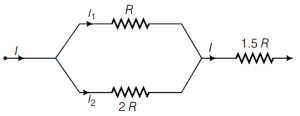
In the circuit diagram,the heat produced in resistors $R$,$2R$,and $1.5R$ are in the ratio of:
A
$4: 2: 3$
B
$8: 4: 27$
C
$2: 4: 3$
D
$27: 8: 4$
Solution
(B) The current $I$ splits into $I_1$ and $I_2$ through the parallel resistors $R$ and $2R$. Using the current divider rule:
$I_1 = I \times \frac{2R}{R + 2R} = \frac{2I}{3}$
$I_2 = I \times \frac{R}{R + 2R} = \frac{I}{3}$
The heat produced in a resistor is given by $H = I^2 R t$. Assuming time $t$ is the same for all:
$H_1 = I_1^2 R = \left(\frac{2I}{3}\right)^2 R = \frac{4I^2 R}{9}$
$H_2 = I_2^2 (2R) = \left(\frac{I}{3}\right)^2 (2R) = \frac{2I^2 R}{9}$
For the resistor $1.5R$,the total current $I$ flows through it:
$H_3 = I^2 (1.5R) = 1.5 I^2 R = \frac{13.5 I^2 R}{9}$
The ratio $H_1 : H_2 : H_3 = \frac{4}{9} : \frac{2}{9} : \frac{13.5}{9} = 4 : 2 : 13.5 = 8 : 4 : 27$.
$I_1 = I \times \frac{2R}{R + 2R} = \frac{2I}{3}$
$I_2 = I \times \frac{R}{R + 2R} = \frac{I}{3}$
The heat produced in a resistor is given by $H = I^2 R t$. Assuming time $t$ is the same for all:
$H_1 = I_1^2 R = \left(\frac{2I}{3}\right)^2 R = \frac{4I^2 R}{9}$
$H_2 = I_2^2 (2R) = \left(\frac{I}{3}\right)^2 (2R) = \frac{2I^2 R}{9}$
For the resistor $1.5R$,the total current $I$ flows through it:
$H_3 = I^2 (1.5R) = 1.5 I^2 R = \frac{13.5 I^2 R}{9}$
The ratio $H_1 : H_2 : H_3 = \frac{4}{9} : \frac{2}{9} : \frac{13.5}{9} = 4 : 2 : 13.5 = 8 : 4 : 27$.
0 likes
View Solution203
EasyMCQ
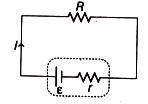
$A$ wire of resistance $R$ is connected across a cell of emf $\varepsilon$ and internal resistance $r$. The current through the circuit is $I$. In time $t$,the work done by the battery to establish the current $I$ is
A
$\varepsilon I t$
B
$\frac{\varepsilon^2 t}{R}$
C
$I R t$
D
$I^2 R t$
Solution
(A) The work done by a battery of emf $\varepsilon$ to drive a charge $q$ through the circuit is given by $W = \varepsilon q$.
Since the current $I$ flows for time $t$,the total charge transferred is $q = I t$.
Therefore,the work done by the battery is $W = \varepsilon I t$.
Note: The options provided in the question are potentially confusing. The total work done by the battery is $\varepsilon I t$. The energy dissipated as heat in the external resistor $R$ is $I^2 R t$,and in the internal resistor $r$ is $I^2 r t$. The total energy is $I^2(R+r)t = \varepsilon I t$. Given the standard form of such questions,if the question asks for the work done by the battery,the correct expression is $\varepsilon I t$.
Since the current $I$ flows for time $t$,the total charge transferred is $q = I t$.
Therefore,the work done by the battery is $W = \varepsilon I t$.
Note: The options provided in the question are potentially confusing. The total work done by the battery is $\varepsilon I t$. The energy dissipated as heat in the external resistor $R$ is $I^2 R t$,and in the internal resistor $r$ is $I^2 r t$. The total energy is $I^2(R+r)t = \varepsilon I t$. Given the standard form of such questions,if the question asks for the work done by the battery,the correct expression is $\varepsilon I t$.
0 likes
View Solution204
EasyMCQ
Consider an electrical conductor connected across a potential difference $V$. Let $\Delta q$ be a small charge moving through it in time $\Delta t$. If $I$ is the electric current through it,
$I$. the kinetic energy of the charge increases by $I V \Delta t$.
$II$. the electric potential energy of the charge decreases by $I V \Delta t$.
$III$. the thermal energy of the conductor increases by $I V \Delta t$.
Choose the correct option.
$I$. the kinetic energy of the charge increases by $I V \Delta t$.
$II$. the electric potential energy of the charge decreases by $I V \Delta t$.
$III$. the thermal energy of the conductor increases by $I V \Delta t$.
Choose the correct option.
A
Only $I$
B
$I$ and $II$
C
$I$ and $III$
D
$II$ and $III$
Solution
(D) When a charge $\Delta q$ moves through a potential difference $V$,the change in its electric potential energy is given by $\Delta U = \Delta q \cdot V$. Since $I = \frac{\Delta q}{\Delta t}$,we have $\Delta q = I \Delta t$. Thus,the potential energy decreases by $I V \Delta t$.
In a steady current,the drift velocity of the charge carriers remains constant,meaning the kinetic energy of the charge does not increase significantly. Instead,the lost potential energy is dissipated as heat due to collisions with the lattice ions of the conductor.
Therefore,the thermal energy of the conductor increases by $I V \Delta t$.
Statements $II$ and $III$ are correct.
In a steady current,the drift velocity of the charge carriers remains constant,meaning the kinetic energy of the charge does not increase significantly. Instead,the lost potential energy is dissipated as heat due to collisions with the lattice ions of the conductor.
Therefore,the thermal energy of the conductor increases by $I V \Delta t$.
Statements $II$ and $III$ are correct.
0 likes
View Solution205
DifficultMCQ
If voltage across a bulb rated $220 \,V, 100 \,W$ drops by $2.5 \%$ of its rated value, then the percentage of the rated value by which the power would decrease is (in $\%$)
A
$2.5$
B
$5$
C
$10$
D
$20$
Solution
(B) The power consumed by a bulb is given by $P = \frac{V^2}{R}$, where $V$ is the voltage and $R$ is the constant resistance of the bulb.
Taking the logarithmic derivative, we get $\frac{dP}{P} = 2 \frac{dV}{V}$.
Here, the percentage change in voltage is $\frac{dV}{V} = -2.5 \% = -0.025$.
Therefore, the percentage change in power is $\frac{dP}{P} = 2 \times (-2.5 \%) = -5 \%$.
The negative sign indicates a decrease in power.
Thus, the power decreases by $5 \%$ of its rated value.
Taking the logarithmic derivative, we get $\frac{dP}{P} = 2 \frac{dV}{V}$.
Here, the percentage change in voltage is $\frac{dV}{V} = -2.5 \% = -0.025$.
Therefore, the percentage change in power is $\frac{dP}{P} = 2 \times (-2.5 \%) = -5 \%$.
The negative sign indicates a decrease in power.
Thus, the power decreases by $5 \%$ of its rated value.
0 likes
View Solution206
EasyMCQ
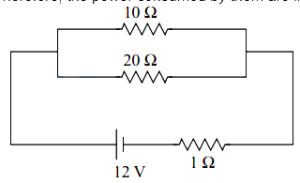
Two heating coils of resistances $10 \Omega$ and $20 \Omega$ are connected in parallel and connected to a battery of emf $12 \text{ V}$ and internal resistance $1 \Omega$. The ratio of the power consumed by them is:
A
$2: 1$
B
$1: 2$
C
$1: 4$
D
$4: 1$
Solution
(A) Since the resistors are connected in parallel,the potential difference $(V)$ across each resistor is the same.
Power consumed by a resistor is given by the formula $P = \frac{V^2}{R}$.
Since $V$ is constant for both resistors,we have $P \propto \frac{1}{R}$.
Therefore,the ratio of power consumed is $\frac{P_1}{P_2} = \frac{R_2}{R_1}$.
Given $R_1 = 10 \Omega$ and $R_2 = 20 \Omega$,we get:
$\frac{P_1}{P_2} = \frac{20}{10} = \frac{2}{1}$.
Thus,the ratio of power consumed by them is $2: 1$.
Power consumed by a resistor is given by the formula $P = \frac{V^2}{R}$.
Since $V$ is constant for both resistors,we have $P \propto \frac{1}{R}$.
Therefore,the ratio of power consumed is $\frac{P_1}{P_2} = \frac{R_2}{R_1}$.
Given $R_1 = 10 \Omega$ and $R_2 = 20 \Omega$,we get:
$\frac{P_1}{P_2} = \frac{20}{10} = \frac{2}{1}$.
Thus,the ratio of power consumed by them is $2: 1$.
0 likes
View Solution207
MediumMCQ
Which of the following graphs correctly represents the variation of heat energy $(U)$ produced in a metallic conductor in a given time as a function of potential difference $(V)$ across the conductor?
A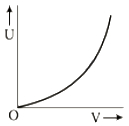
B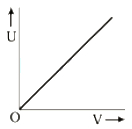
C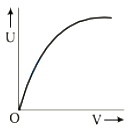
D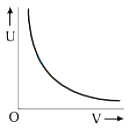
Solution
(A) The heat energy $(U)$ produced in a metallic conductor of resistance $(R)$ in a given time $(t)$ is given by the formula:
$U = \frac{V^2}{R} t$
Since the resistance $(R)$ and time $(t)$ are constant,we have:
$U \propto V^2$
This relationship represents a parabola that opens upwards,starting from the origin $(0,0)$.
Therefore,the graph in option $(A)$ correctly represents this variation.
$U = \frac{V^2}{R} t$
Since the resistance $(R)$ and time $(t)$ are constant,we have:
$U \propto V^2$
This relationship represents a parabola that opens upwards,starting from the origin $(0,0)$.
Therefore,the graph in option $(A)$ correctly represents this variation.
0 likes
View Solution208
EasyMCQ
An electric heater rated $220 \,V$ and $550 \,W$ is connected to $AC$ mains. The current drawn by it is (in $\,A$)
A
$0.8$
B
$2.5$
C
$0.4$
D
$1.25$
Solution
(B) The power $P$ and voltage $V$ are given as $P = 550 \,W$ and $V = 220 \,V$.
The relationship between power, voltage, and current $I$ is given by the formula $P = V \times I$.
Rearranging for current, we get $I = \frac{P}{V}$.
Substituting the given values: $I = \frac{550}{220} = 2.5 \,A$.
Therefore, the current drawn by the heater is $2.5 \,A$.
The relationship between power, voltage, and current $I$ is given by the formula $P = V \times I$.
Rearranging for current, we get $I = \frac{P}{V}$.
Substituting the given values: $I = \frac{550}{220} = 2.5 \,A$.
Therefore, the current drawn by the heater is $2.5 \,A$.
0 likes
View Solution209
DifficultMCQ
$A$ battery with a $12 \, V$ emf has an initial charge of $80 \, A \cdot h$. If the potential across the terminals stays constant until the battery is completely discharged, then this battery can deliver energy at the rate of $120 \, W$ for a time of: (in $ \, h$)
A
$16$
B
$8$
C
$4$
D
$5$
Solution
(B) Given:
Electromotive force (emf) $\varepsilon = 12 \, V$
Total charge capacity $q = 80 \, A \cdot h$
Power output $P = 120 \, W$
The total energy $E$ stored in the battery is given by $E = q \cdot \varepsilon$.
Substituting the values: $E = 80 \, A \cdot h \times 12 \, V = 960 \, W \cdot h$.
Since power $P$ is the rate of energy delivery, $P = E / \Delta t$, where $\Delta t$ is the time.
Therefore, $\Delta t = E / P = 960 \, W \cdot h / 120 \, W = 8 \, h$.
Thus, the battery can deliver energy at the rate of $120 \, W$ for $8 \, h$.
Electromotive force (emf) $\varepsilon = 12 \, V$
Total charge capacity $q = 80 \, A \cdot h$
Power output $P = 120 \, W$
The total energy $E$ stored in the battery is given by $E = q \cdot \varepsilon$.
Substituting the values: $E = 80 \, A \cdot h \times 12 \, V = 960 \, W \cdot h$.
Since power $P$ is the rate of energy delivery, $P = E / \Delta t$, where $\Delta t$ is the time.
Therefore, $\Delta t = E / P = 960 \, W \cdot h / 120 \, W = 8 \, h$.
Thus, the battery can deliver energy at the rate of $120 \, W$ for $8 \, h$.
0 likes
View Solution210
MediumMCQ
An electric kettle takes $4 \ A$ current at $220 \ V$. If the entire electric energy is converted into heat energy, then the time (in minutes) taken to increase the temperature of $1 \ kg$ of water from $34^{\circ} C$ to $100^{\circ} C$ is
A
$7.50$
B
$4.50$
C
$5.25$
D
$6.25$
Solution
(C) Given: Current $I = 4 \ A$, Voltage $V = 220 \ V$, Mass of water $m = 1 \ kg$, Initial temperature $T_1 = 34^{\circ} C$, Final temperature $T_2 = 100^{\circ} C$.
Specific heat capacity of water $c = 4200 \ J/(kg \cdot ^{\circ} C)$.
Electric power $P = V \times I = 220 \times 4 = 880 \ W$.
Heat energy required $Q = mc\Delta T = 1 \times 4200 \times (100 - 34) = 4200 \times 66 = 277200 \ J$.
Since electric energy is converted into heat energy, $P \times t = Q$.
$880 \times t = 277200$.
$t = 277200 / 880 = 315 \ seconds$.
To convert time into minutes: $t = 315 / 60 = 5.25 \ minutes$.
Specific heat capacity of water $c = 4200 \ J/(kg \cdot ^{\circ} C)$.
Electric power $P = V \times I = 220 \times 4 = 880 \ W$.
Heat energy required $Q = mc\Delta T = 1 \times 4200 \times (100 - 34) = 4200 \times 66 = 277200 \ J$.
Since electric energy is converted into heat energy, $P \times t = Q$.
$880 \times t = 277200$.
$t = 277200 / 880 = 315 \ seconds$.
To convert time into minutes: $t = 315 / 60 = 5.25 \ minutes$.
0 likes
View Solution211
EasyMCQ
The power dissipated by a uniform wire of resistance $100 \Omega$ when a potential difference of $120 \text{ V}$ is applied across its ends is (in $W$)
A
$122$
B
$144$
C
$160$
D
$200$
Solution
(B) The power $P$ dissipated in a resistor is given by the formula $P = \frac{V^2}{R}$,where $V$ is the potential difference and $R$ is the resistance.
Given:
Potential difference $V = 120 \text{ V}$
Resistance $R = 100 \Omega$
Substituting the values into the formula:
$P = \frac{(120)^2}{100}$
$P = \frac{14400}{100}$
$P = 144 \text{ W}$
Therefore,the power dissipated is $144 \text{ W}$.
Given:
Potential difference $V = 120 \text{ V}$
Resistance $R = 100 \Omega$
Substituting the values into the formula:
$P = \frac{(120)^2}{100}$
$P = \frac{14400}{100}$
$P = 144 \text{ W}$
Therefore,the power dissipated is $144 \text{ W}$.
0 likes
View Solution212
EasyMCQ
$A$ lamp is rated at $240 \ V, 60 \ W$. When in use,the resistance of the filament of the lamp is $20$ times that of the cold filament. The resistance of the lamp when not in use is: (in $Omega$)
A
$54$
B
$60$
C
$50$
D
$48$
Solution
(D) When the lamp is in use,the resistance $R$ is given by the formula $R = \frac{V^2}{P}$.
Substituting the given values: $R = \frac{240 \times 240}{60} = 960 \ \Omega$.
Let $R'$ be the resistance of the cold filament (when not in use).
According to the problem,$R = 20 \times R'$.
Therefore,$R' = \frac{R}{20} = \frac{960}{20} = 48 \ \Omega$.
Substituting the given values: $R = \frac{240 \times 240}{60} = 960 \ \Omega$.
Let $R'$ be the resistance of the cold filament (when not in use).
According to the problem,$R = 20 \times R'$.
Therefore,$R' = \frac{R}{20} = \frac{960}{20} = 48 \ \Omega$.
0 likes
View Solution213
EasyMCQ
$A$ heating element is designed to dissipate $2400 \, W$ when connected to $240 \, V$. The power it dissipates when it is connected to $120 \, V$ is (Assume that resistance of the filament is constant). (in $ \, W$)
A
$600$
B
$1200$
C
$1800$
D
$400$
Solution
(A) Given: Rated power,$P_R = 2400 \, W$ and Rated voltage,$V_R = 240 \, V$.
Since the resistance $R$ of the filament is constant,we use the formula $P = \frac{V^2}{R}$.
First,calculate the resistance $R$ of the heating element:
$R = \frac{V_R^2}{P_R} = \frac{240 \times 240}{2400} = 24 \, \Omega$.
Now,when the element is connected to a $V = 120 \, V$ supply,the new power dissipated $P'$ is:
$P' = \frac{V^2}{R} = \frac{120 \times 120}{24} = 600 \, W$.
Since the resistance $R$ of the filament is constant,we use the formula $P = \frac{V^2}{R}$.
First,calculate the resistance $R$ of the heating element:
$R = \frac{V_R^2}{P_R} = \frac{240 \times 240}{2400} = 24 \, \Omega$.
Now,when the element is connected to a $V = 120 \, V$ supply,the new power dissipated $P'$ is:
$P' = \frac{V^2}{R} = \frac{120 \times 120}{24} = 600 \, W$.
0 likes
View Solution214
EasyMCQ
There are four bulbs of power $100 \,W, 200 \,W, 500 \,W$ and $1000 \,W$. Among these, which filament has the highest resistance? (Assuming the same voltage source)
A
$100 \,W$ bulb
B
$200 \,W$ bulb
C
$500 \,W$ bulb
D
$1000 \,W$ bulb
Solution
(A) The power $P$ consumed by a bulb is given by the formula $P = \frac{V^2}{R}$, where $V$ is the voltage and $R$ is the resistance of the filament.
Since the voltage source is the same for all bulbs, $V$ is constant.
Therefore, the relationship between power and resistance is $R = \frac{V^2}{P}$, which implies $R \propto \frac{1}{P}$.
This means that the resistance is inversely proportional to the power rating of the bulb.
To have the highest resistance, the bulb must have the lowest power rating.
Comparing the given powers $(100 \,W, 200 \,W, 500 \,W, 1000 \,W)$, the $100 \,W$ bulb has the lowest power.
Thus, the $100 \,W$ bulb filament has the highest resistance.
Since the voltage source is the same for all bulbs, $V$ is constant.
Therefore, the relationship between power and resistance is $R = \frac{V^2}{P}$, which implies $R \propto \frac{1}{P}$.
This means that the resistance is inversely proportional to the power rating of the bulb.
To have the highest resistance, the bulb must have the lowest power rating.
Comparing the given powers $(100 \,W, 200 \,W, 500 \,W, 1000 \,W)$, the $100 \,W$ bulb has the lowest power.
Thus, the $100 \,W$ bulb filament has the highest resistance.
0 likes
View Solution215
DifficultMCQ
The resistance of a device component decreases as the current through it increases and it is described by the relation,$R = \frac{0.2 I}{I-4}$,where $I$ is the current. Determine the minimum power delivered. (Assume $I > 4$) (in $W$)
A
$22.4$
B
$18.6$
C
$19.8$
D
$21.6$
Solution
(D) Given,the resistance $R$ of a device is related to the current $I$ by the relation: $R = \frac{0.2 I}{I-4}$.
Power $P$ consumed by the device is given by $P = I^2 R$.
Substituting the expression for $R$: $P = I^2 \left( \frac{0.2 I}{I-4} \right) = \frac{0.2 I^3}{I-4}$.
To find the minimum power,we differentiate $P$ with respect to $I$ and set it to zero: $\frac{dP}{dI} = 0$.
$\frac{d}{dI} \left( \frac{0.2 I^3}{I-4} \right) = 0$.
Using the quotient rule: $\frac{(I-4)(0.6 I^2) - (0.2 I^3)(1)}{(I-4)^2} = 0$.
$0.6 I^3 - 2.4 I^2 - 0.2 I^3 = 0$.
$0.4 I^3 - 2.4 I^2 = 0$.
$0.4 I^2 (I - 6) = 0$.
Since $I > 4$,we have $I = 6 \ A$.
Substituting $I = 6 \ A$ into the power equation: $P_{\min} = \frac{0.2 \times (6)^3}{6-4} = \frac{0.2 \times 216}{2} = 0.2 \times 108 = 21.6 \ W$.
Power $P$ consumed by the device is given by $P = I^2 R$.
Substituting the expression for $R$: $P = I^2 \left( \frac{0.2 I}{I-4} \right) = \frac{0.2 I^3}{I-4}$.
To find the minimum power,we differentiate $P$ with respect to $I$ and set it to zero: $\frac{dP}{dI} = 0$.
$\frac{d}{dI} \left( \frac{0.2 I^3}{I-4} \right) = 0$.
Using the quotient rule: $\frac{(I-4)(0.6 I^2) - (0.2 I^3)(1)}{(I-4)^2} = 0$.
$0.6 I^3 - 2.4 I^2 - 0.2 I^3 = 0$.
$0.4 I^3 - 2.4 I^2 = 0$.
$0.4 I^2 (I - 6) = 0$.
Since $I > 4$,we have $I = 6 \ A$.
Substituting $I = 6 \ A$ into the power equation: $P_{\min} = \frac{0.2 \times (6)^3}{6-4} = \frac{0.2 \times 216}{2} = 0.2 \times 108 = 21.6 \ W$.
0 likes
View Solution216
EasyMCQ
The current density in a circular wire is given by $J(r) = (1 \times 10^5 \text{ A/m}^3) r$,where $r$ is the radial distance and the wire's radius is $2 \text{ mm}$. If the potential applied across the wire is $70 \text{ V}$,then the energy consumed by the wire in $1000 \text{ s}$ is:
A
$25 \text{ kJ}$
B
$37 \pi \text{ kJ}$
C
$18 \pi \text{ kJ}$
D
$88 \text{ kJ}$
Solution
(B) The total current $I$ flowing through the wire is given by the integral of current density $J$ over the cross-sectional area $A$: $I = \int J \, dA$.
Since the wire is circular,$dA = 2 \pi r \, dr$.
$I = \int_0^{R} J(r) \cdot 2 \pi r \, dr$,where $R = 2 \times 10^{-3} \text{ m}$.
$I = \int_0^{2 \times 10^{-3}} (10^5 r) \cdot (2 \pi r) \, dr = 2 \pi \times 10^5 \int_0^{2 \times 10^{-3}} r^2 \, dr$.
$I = 2 \pi \times 10^5 \left[ \frac{r^3}{3} \right]_0^{2 \times 10^{-3}} = 2 \pi \times 10^5 \times \frac{8 \times 10^{-9}}{3} = \frac{16 \pi}{3} \times 10^{-4} \text{ A}$.
The energy consumed $E$ is given by $E = V \cdot I \cdot t$.
$E = 70 \text{ V} \times \left( \frac{16 \pi}{3} \times 10^{-4} \text{ A} \right) \times 1000 \text{ s}$.
$E = 70 \times \frac{16 \pi}{3} \times 10^{-1} = \frac{1120 \pi}{30} = \frac{112}{3} \pi \approx 37.33 \pi \text{ J}$.
Given the options,the closest value is $37 \pi \text{ J}$ (Note: The unit in the provided options appears to be in Joules,not kJ).
Since the wire is circular,$dA = 2 \pi r \, dr$.
$I = \int_0^{R} J(r) \cdot 2 \pi r \, dr$,where $R = 2 \times 10^{-3} \text{ m}$.
$I = \int_0^{2 \times 10^{-3}} (10^5 r) \cdot (2 \pi r) \, dr = 2 \pi \times 10^5 \int_0^{2 \times 10^{-3}} r^2 \, dr$.
$I = 2 \pi \times 10^5 \left[ \frac{r^3}{3} \right]_0^{2 \times 10^{-3}} = 2 \pi \times 10^5 \times \frac{8 \times 10^{-9}}{3} = \frac{16 \pi}{3} \times 10^{-4} \text{ A}$.
The energy consumed $E$ is given by $E = V \cdot I \cdot t$.
$E = 70 \text{ V} \times \left( \frac{16 \pi}{3} \times 10^{-4} \text{ A} \right) \times 1000 \text{ s}$.
$E = 70 \times \frac{16 \pi}{3} \times 10^{-1} = \frac{1120 \pi}{30} = \frac{112}{3} \pi \approx 37.33 \pi \text{ J}$.
Given the options,the closest value is $37 \pi \text{ J}$ (Note: The unit in the provided options appears to be in Joules,not kJ).
0 likes
View Solution217
MediumMCQ
$A$ circular wire has a current density $J = (2 \times 10^{10} \text{ A/m}^2) r^2$, where $r$ is the radial distance from the center and the wire radius is $2 \text{ mm}$. The potential difference applied across the wire is $50 \text{ V}$. How much energy (in Joules) is converted to thermal energy in $100 \text{ s}$ (in $\pi$)?
A
$1200$
B
$800$
C
$3200$
D
$600$
Solution
(B) Given: Current density $J = (2 \times 10^{10}) r^2 \text{ A/m}^2$, potential $V = 50 \text{ V}$, time $t = 100 \text{ s}$, and radius $R = 2 \times 10^{-3} \text{ m}$.
Energy $E$ dissipated as heat is given by $E = VIt$.
First, calculate the total current $I$ using $I = \int J dA$, where $dA = 2 \pi r dr$.
$I = \int_{0}^{R} (2 \times 10^{10} r^2) (2 \pi r dr) = 4 \pi \times 10^{10} \int_{0}^{2 \times 10^{-3}} r^3 dr$.
$I = 4 \pi \times 10^{10} \left[ \frac{r^4}{4} \right]_{0}^{2 \times 10^{-3}} = \pi \times 10^{10} \times (2 \times 10^{-3})^4$.
$I = \pi \times 10^{10} \times 16 \times 10^{-12} = 16 \pi \times 10^{-2} = 0.16 \pi \text{ A}$.
Now, calculate energy $E = VIt = 50 \times (0.16 \pi) \times 100$.
$E = 5000 \times 0.16 \pi = 800 \pi \text{ J}$.
Energy $E$ dissipated as heat is given by $E = VIt$.
First, calculate the total current $I$ using $I = \int J dA$, where $dA = 2 \pi r dr$.
$I = \int_{0}^{R} (2 \times 10^{10} r^2) (2 \pi r dr) = 4 \pi \times 10^{10} \int_{0}^{2 \times 10^{-3}} r^3 dr$.
$I = 4 \pi \times 10^{10} \left[ \frac{r^4}{4} \right]_{0}^{2 \times 10^{-3}} = \pi \times 10^{10} \times (2 \times 10^{-3})^4$.
$I = \pi \times 10^{10} \times 16 \times 10^{-12} = 16 \pi \times 10^{-2} = 0.16 \pi \text{ A}$.
Now, calculate energy $E = VIt = 50 \times (0.16 \pi) \times 100$.
$E = 5000 \times 0.16 \pi = 800 \pi \text{ J}$.
0 likes
View Solution218
EasyMCQ
Heat is produced at a rate given by $H$ in a resistor when it is connected across a supply of voltage $V$. If now the resistance of the resistor is doubled and the supply voltage is made $V / 3$,then the rate of production of heat in the resistor will be
A
$H / 18$
B
$H / 9$
C
$6 H$
D
$18 H$
Solution
(A) The rate of heat production (power) in a resistor is given by the formula $H = \frac{V^2}{R}$.
In the first case,the power is $H = \frac{V^2}{R}$.
In the second case,the new voltage is $V' = \frac{V}{3}$ and the new resistance is $R' = 2R$.
The new rate of heat production $H'$ is given by:
$H' = \frac{(V')^2}{R'} = \frac{(\frac{V}{3})^2}{2R} = \frac{\frac{V^2}{9}}{2R} = \frac{V^2}{18R}$.
Since $H = \frac{V^2}{R}$,we can substitute this into the equation:
$H' = \frac{H}{18}$.
In the first case,the power is $H = \frac{V^2}{R}$.
In the second case,the new voltage is $V' = \frac{V}{3}$ and the new resistance is $R' = 2R$.
The new rate of heat production $H'$ is given by:
$H' = \frac{(V')^2}{R'} = \frac{(\frac{V}{3})^2}{2R} = \frac{\frac{V^2}{9}}{2R} = \frac{V^2}{18R}$.
Since $H = \frac{V^2}{R}$,we can substitute this into the equation:
$H' = \frac{H}{18}$.
0 likes
View Solution219
DifficultMCQ
An electric bulb marked as $50 W - 200 V$ is connected across a $100 V$ supply. The present power of the bulb is (in $W$)
A
$37.5$
B
$25$
C
$12.5$
D
$10$
Solution
(C) The resistance $R$ of the bulb is constant and is determined by its rated values:
$R = \frac{V_{rated}^2}{P_{rated}} = \frac{200^2}{50} = \frac{40000}{50} = 800 \, \Omega$
When connected to a new supply voltage $V' = 100 V$,the new power $P'$ consumed by the bulb is given by:
$P' = \frac{(V')^2}{R} = \frac{100^2}{800} = \frac{10000}{800} = 12.5 \, W$
Therefore,the present power of the bulb is $12.5 \, W$.
$R = \frac{V_{rated}^2}{P_{rated}} = \frac{200^2}{50} = \frac{40000}{50} = 800 \, \Omega$
When connected to a new supply voltage $V' = 100 V$,the new power $P'$ consumed by the bulb is given by:
$P' = \frac{(V')^2}{R} = \frac{100^2}{800} = \frac{10000}{800} = 12.5 \, W$
Therefore,the present power of the bulb is $12.5 \, W$.
0 likes
View Solution220
EasyMCQ
An electrical cable having a resistance of $0.2 \Omega$ delivers $10 \text{ kW}$ at $200 \text{ V}$ $D$.$C$. to a factory. What is the efficiency of transmission (in $\%$)?
A
$65$
B
$75$
C
$85$
D
$95$
Solution
(D) The power delivered to the factory is $P_{out} = 10 \text{ kW} = 10000 \text{ W}$ at a voltage $V = 200 \text{ V}$.
The current $I$ flowing through the cable is given by $I = \frac{P_{out}}{V} = \frac{10000}{200} = 50 \text{ A}$.
The power loss in the cable due to its resistance $R = 0.2 \Omega$ is $P_{loss} = I^2 R = (50)^2 \times 0.2 = 2500 \times 0.2 = 500 \text{ W}$.
The total power generated at the source is $P_{in} = P_{out} + P_{loss} = 10000 + 500 = 10500 \text{ W}$.
The efficiency of transmission is $\eta = \frac{P_{out}}{P_{in}} \times 100 = \frac{10000}{10500} \times 100 \approx 95.24 \%$.
Rounding to the nearest given option, the efficiency is $95 \%$.
The current $I$ flowing through the cable is given by $I = \frac{P_{out}}{V} = \frac{10000}{200} = 50 \text{ A}$.
The power loss in the cable due to its resistance $R = 0.2 \Omega$ is $P_{loss} = I^2 R = (50)^2 \times 0.2 = 2500 \times 0.2 = 500 \text{ W}$.
The total power generated at the source is $P_{in} = P_{out} + P_{loss} = 10000 + 500 = 10500 \text{ W}$.
The efficiency of transmission is $\eta = \frac{P_{out}}{P_{in}} \times 100 = \frac{10000}{10500} \times 100 \approx 95.24 \%$.
Rounding to the nearest given option, the efficiency is $95 \%$.
0 likes
View Solution221
MediumMCQ
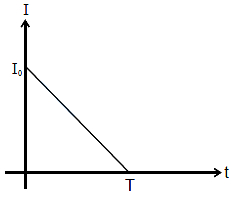
An amount of charge $Q$ passes through a coil of resistance $R$. If the current in the coil decreases to zero at a uniform rate during time $T$,then the amount of heat generated in the coil will be,
A
$\frac{4 Q^2 R}{3 T}$
B
$\frac{2 Q^2 R}{3 T}$
C
$\frac{Q^2 R}{4 T}$
D
$Q^2 R T$
Solution
(A) The total charge $Q$ passing through the coil is equal to the area under the current-time graph. Since the current decreases uniformly from $I_0$ to $0$ in time $T$,the graph is a triangle with base $T$ and height $I_0$.
$Q = \frac{1}{2} I_0 T \Rightarrow I_0 = \frac{2 Q}{T}$
The current as a function of time is given by $I(t) = I_0 \left(1 - \frac{t}{T}\right) = \frac{2 Q}{T} \left(1 - \frac{t}{T}\right)$.
The heat generated $H$ in the coil is given by $H = \int_0^T I^2 R \, dt$.
$H = R \int_0^T \left[ \frac{2 Q}{T} \left(1 - \frac{t}{T}\right) \right]^2 \, dt = \frac{4 Q^2 R}{T^2} \int_0^T \left(1 - \frac{t}{T}\right)^2 \, dt$.
Let $u = 1 - \frac{t}{T}$,then $du = -\frac{1}{T} dt$,so $dt = -T du$.
When $t=0, u=1$; when $t=T, u=0$.
$H = \frac{4 Q^2 R}{T^2} \int_1^0 u^2 (-T \, du) = \frac{4 Q^2 R}{T} \int_0^1 u^2 \, du$.
$H = \frac{4 Q^2 R}{T} \left[ \frac{u^3}{3} \right]_0^1 = \frac{4 Q^2 R}{3 T}$.
$Q = \frac{1}{2} I_0 T \Rightarrow I_0 = \frac{2 Q}{T}$
The current as a function of time is given by $I(t) = I_0 \left(1 - \frac{t}{T}\right) = \frac{2 Q}{T} \left(1 - \frac{t}{T}\right)$.
The heat generated $H$ in the coil is given by $H = \int_0^T I^2 R \, dt$.
$H = R \int_0^T \left[ \frac{2 Q}{T} \left(1 - \frac{t}{T}\right) \right]^2 \, dt = \frac{4 Q^2 R}{T^2} \int_0^T \left(1 - \frac{t}{T}\right)^2 \, dt$.
Let $u = 1 - \frac{t}{T}$,then $du = -\frac{1}{T} dt$,so $dt = -T du$.
When $t=0, u=1$; when $t=T, u=0$.
$H = \frac{4 Q^2 R}{T^2} \int_1^0 u^2 (-T \, du) = \frac{4 Q^2 R}{T} \int_0^1 u^2 \, du$.
$H = \frac{4 Q^2 R}{T} \left[ \frac{u^3}{3} \right]_0^1 = \frac{4 Q^2 R}{3 T}$.
0 likes
View Solution222
DifficultMCQ
$A$ battery with $EMF$ $E$ and internal resistance $r$ is connected across a resistance $R$. The power consumption in $R$ will be maximum when:
A
$R=2r$
B
$R=\frac{r}{2}$
C
$R=\sqrt{2}r$
D
$R=r$
Solution
(D) The current $I$ in the circuit is given by $I = \frac{E}{R+r}$.
The power $P$ consumed by the external resistance $R$ is $P = I^2 R = \left(\frac{E}{R+r}\right)^2 R$.
To find the condition for maximum power,we differentiate $P$ with respect to $R$ and set it to zero: $\frac{dP}{dR} = 0$.
$\frac{dP}{dR} = E^2 \left[ \frac{(R+r)^2(1) - R(2)(R+r)}{(R+r)^4} \right] = 0$.
This implies $(R+r)^2 - 2R(R+r) = 0$.
Dividing by $(R+r)$,we get $(R+r) - 2R = 0$,which simplifies to $r - R = 0$ or $R = r$.
Thus,the power consumption is maximum when the external resistance equals the internal resistance of the battery.
The power $P$ consumed by the external resistance $R$ is $P = I^2 R = \left(\frac{E}{R+r}\right)^2 R$.
To find the condition for maximum power,we differentiate $P$ with respect to $R$ and set it to zero: $\frac{dP}{dR} = 0$.
$\frac{dP}{dR} = E^2 \left[ \frac{(R+r)^2(1) - R(2)(R+r)}{(R+r)^4} \right] = 0$.
This implies $(R+r)^2 - 2R(R+r) = 0$.
Dividing by $(R+r)$,we get $(R+r) - 2R = 0$,which simplifies to $r - R = 0$ or $R = r$.
Thus,the power consumption is maximum when the external resistance equals the internal resistance of the battery.
0 likes
View Solution223
MediumMCQ
An electric power line having a total resistance of $2 \ \Omega$ delivers $1 \ kW$ of power at $250 \ V$. The percentage efficiency of the transmission line is: (in $\%$)
A
$96.9$
B
$86.5$
C
$100$
D
$92.5$
Solution
(A) Given: Power delivered $P_{out} = 1 \ kW = 1000 \ W$,Voltage $V = 250 \ V$,Resistance $R = 2 \ \Omega$.
The current $I$ flowing through the line is $I = \frac{P_{out}}{V} = \frac{1000}{250} = 4 \ A$.
The power loss in the transmission line is $P_{loss} = I^2 R = (4)^2 \times 2 = 16 \times 2 = 32 \ W$.
The total power generated at the source is $P_{in} = P_{out} + P_{loss} = 1000 + 32 = 1032 \ W$.
The efficiency $\eta$ is given by $\eta = \left( \frac{P_{out}}{P_{in}} \right) \times 100$.
$\eta = \left( \frac{1000}{1032} \right) \times 100 \approx 96.898 \% \approx 96.9 \%$.
The current $I$ flowing through the line is $I = \frac{P_{out}}{V} = \frac{1000}{250} = 4 \ A$.
The power loss in the transmission line is $P_{loss} = I^2 R = (4)^2 \times 2 = 16 \times 2 = 32 \ W$.
The total power generated at the source is $P_{in} = P_{out} + P_{loss} = 1000 + 32 = 1032 \ W$.
The efficiency $\eta$ is given by $\eta = \left( \frac{P_{out}}{P_{in}} \right) \times 100$.
$\eta = \left( \frac{1000}{1032} \right) \times 100 \approx 96.898 \% \approx 96.9 \%$.
0 likes
View Solution224
MediumMCQ
The emf of a storage battery of a car is $6.0 \ V$. If the internal resistance of the battery is $0.2 \ \Omega$,then the maximum power drawn from the battery is . . . . . . $W$.
A
$2.4$
B
$180$
C
$45$
D
Zero
Solution
(C) The maximum power is drawn from a battery when the external resistance $R$ is equal to the internal resistance $r$ of the battery $(R = r)$.
The power delivered to the external resistor is given by the formula: $P = I^2 R = \left(\frac{E}{R+r}\right)^2 \cdot R$.
Substituting $R = r$ for maximum power,we get:
$P_{max} = \frac{E^2 r}{(r+r)^2} = \frac{E^2 r}{4r^2} = \frac{E^2}{4r}$.
Given values are $E = 6.0 \ V$ and $r = 0.2 \ \Omega$.
Substituting these values into the formula:
$P_{max} = \frac{(6.0)^2}{4 \times 0.2} = \frac{36}{0.8} = 45 \ W$.
Therefore,the maximum power drawn is $45 \ W$.
The power delivered to the external resistor is given by the formula: $P = I^2 R = \left(\frac{E}{R+r}\right)^2 \cdot R$.
Substituting $R = r$ for maximum power,we get:
$P_{max} = \frac{E^2 r}{(r+r)^2} = \frac{E^2 r}{4r^2} = \frac{E^2}{4r}$.
Given values are $E = 6.0 \ V$ and $r = 0.2 \ \Omega$.
Substituting these values into the formula:
$P_{max} = \frac{(6.0)^2}{4 \times 0.2} = \frac{36}{0.8} = 45 \ W$.
Therefore,the maximum power drawn is $45 \ W$.
0 likes
View Solution225
DifficultMCQ
$A$ room heater is rated $400 \text{ W}$, $220 \text{ V}$. If the supply voltage drops to $200 \text{ V}$, what will be the power consumed (approximately) (in $\text{ W}$)?
A
$400$
B
$121$
C
$331$
D
$200$
Solution
(C) The resistance $R$ of the heater is constant.
Using the formula $R = \frac{V^2}{P}$, we calculate $R = \frac{220^2}{400} \Omega$.
The new power consumed $P'$ at the new voltage $V' = 200 \text{ V}$ is given by $P' = \frac{(V')^2}{R}$.
Substituting the value of $R$, we get $P' = \frac{(V')^2 \cdot P}{V^2} = \frac{200^2 \times 400}{220^2}$.
$P' = \frac{40000 \times 400}{48400} = \frac{16000000}{48400} \approx 330.57 \text{ W}$.
Rounding off to the nearest integer, we get $331 \text{ W}$.
Using the formula $R = \frac{V^2}{P}$, we calculate $R = \frac{220^2}{400} \Omega$.
The new power consumed $P'$ at the new voltage $V' = 200 \text{ V}$ is given by $P' = \frac{(V')^2}{R}$.
Substituting the value of $R$, we get $P' = \frac{(V')^2 \cdot P}{V^2} = \frac{200^2 \times 400}{220^2}$.
$P' = \frac{40000 \times 400}{48400} = \frac{16000000}{48400} \approx 330.57 \text{ W}$.
Rounding off to the nearest integer, we get $331 \text{ W}$.
0 likes
View SolutionCurrent Electricity — Electrical Energy and Power · Frequently Asked Questions
1Are these Current Electricity questions useful for JEE and NEET?
Yes. All questions in this section are mapped to JEE Main and NEET exam patterns. Previous year questions from JEE Main, NEET, GUJCET and state-level exams are included with full solutions.
2Can I switch to Hindi or Gujarati for these questions?
Yes. Use the language tabs in the hero section or the sidebar to view the same questions and solutions in English, Hindi or Gujarati.
3How do I generate a question paper from this subtopic?
Use the Vedclass Exam Paper Generator — select the chapter and subtopic, set difficulty, and generate Sets A, B, C, D automatically. First 3 chapters of every subject are free.
Vedclass Products
For Students
Vedclass Test Series
Mock tests in real JEE/NEET style with performance analysis. 5-day free trial.
Start Free TrialFor Teachers
Exam Paper Generator
Generate Set A/B/C/D papers from this chapter in 2 minutes. 3 chapters free.
Try FreeFor Institutes
Online Exam Module
Live online exams with unlimited students, 360° analytics & white-label branding.
See DemoFor Teachers & Institutes
Generate a Current Electricity Exam Paper in 2 Minutes
Select subtopic & difficulty — Sets A, B, C, D auto-generated with No Repeat logic.
First 3 chapters of every subject are free — no payment required.