
A English
Electrical Energy and Power Questions in English
Class 12 Physics · Current Electricity · Electrical Energy and Power
225+
Questions
English
Language
100%
With Solutions
Showing 50 of 225 questions in English
51
EasyMCQ
$A$ current $i$ passes through a wire of length $l$, radius of cross-section $r$ and resistivity $\rho$. The rate of heat generation is
A
$\frac{i^2 l \rho}{\pi r^2}$
B
$i^2 \left( \frac{l \rho}{\pi r^2} \right)^2$
C
$i^2 l \rho / r$
D
$i l \rho / r$
Solution
(A) The rate of heat generation is given by the electrical power $P = i^2 R$.
We know that the resistance $R$ of a wire is given by $R = \rho \frac{l}{A}$, where $A$ is the cross-sectional area.
The area of the cross-section of the wire is $A = \pi r^2$.
Substituting the value of $A$ into the resistance formula, we get $R = \frac{\rho l}{\pi r^2}$.
Now, substituting $R$ into the power formula, we get $P = i^2 \left( \frac{\rho l}{\pi r^2} \right) = \frac{i^2 l \rho}{\pi r^2}$.
We know that the resistance $R$ of a wire is given by $R = \rho \frac{l}{A}$, where $A$ is the cross-sectional area.
The area of the cross-section of the wire is $A = \pi r^2$.
Substituting the value of $A$ into the resistance formula, we get $R = \frac{\rho l}{\pi r^2}$.
Now, substituting $R$ into the power formula, we get $P = i^2 \left( \frac{\rho l}{\pi r^2} \right) = \frac{i^2 l \rho}{\pi r^2}$.
0 likes
View Solution52
EasyMCQ
Which of the following is not equal to $Watt$?
A
$(Amp)^2 \times Ohm$
B
$Amp / Volt$
C
$Amp \times Volt$
D
$Joule / sec$
Solution
(B) The unit of power is $Watt$ $(W)$.
$1 \ W = 1 \ J/s$ (Joule per second).
From the formula $P = VI$,$1 \ W = 1 \ V \times 1 \ A$ (Volt-Ampere).
From the formula $P = I^2R$,$1 \ W = (1 \ A)^2 \times 1 \ \Omega$ (Ampere$^2$-Ohm).
Comparing these with the options,$Amp / Volt$ is not equal to $Watt$ because $Amp / Volt = 1 / Ohm$ (Siemens),which is the unit of conductance.
Therefore,the correct option is $B$.
$1 \ W = 1 \ J/s$ (Joule per second).
From the formula $P = VI$,$1 \ W = 1 \ V \times 1 \ A$ (Volt-Ampere).
From the formula $P = I^2R$,$1 \ W = (1 \ A)^2 \times 1 \ \Omega$ (Ampere$^2$-Ohm).
Comparing these with the options,$Amp / Volt$ is not equal to $Watt$ because $Amp / Volt = 1 / Ohm$ (Siemens),which is the unit of conductance.
Therefore,the correct option is $B$.
0 likes
View Solution53
EasyMCQ
An expression for the rate of heat generated,if a current of $I$ ampere flows through a resistance of $R$ $\Omega$,is
A
$I^2Rt$
B
$I^2R$
C
$V^2R$
D
$IR$
Solution
(B) The rate of heat generated is defined as electrical power $(P)$.
By definition,power is the product of voltage $(V)$ and current $(I)$: $P = V \times I$.
According to Ohm's Law,the voltage across a resistor is given by $V = I \times R$.
Substituting this into the power formula,we get: $P = (I \times R) \times I = I^2R$.
Therefore,the rate of heat generated is $I^2R$.
By definition,power is the product of voltage $(V)$ and current $(I)$: $P = V \times I$.
According to Ohm's Law,the voltage across a resistor is given by $V = I \times R$.
Substituting this into the power formula,we get: $P = (I \times R) \times I = I^2R$.
Therefore,the rate of heat generated is $I^2R$.
0 likes
View Solution54
EasyMCQ
On giving $220\,V$ to a resistor,the power dissipated is $40\,W$. The value of the resistance is ............... $\Omega$.
A
$1210$
B
$2000$
C
$1000$
D
None of these
Solution
(A) The power dissipated in a resistor is given by the formula $P = \frac{V^2}{R}$,where $V$ is the potential difference and $R$ is the resistance.
Given: $V = 220\,V$ and $P = 40\,W$.
Rearranging the formula for $R$,we get $R = \frac{V^2}{P}$.
Substituting the values: $R = \frac{(220)^2}{40} = \frac{48400}{40} = 1210\,\Omega$.
Therefore,the resistance is $1210\,\Omega$.
Given: $V = 220\,V$ and $P = 40\,W$.
Rearranging the formula for $R$,we get $R = \frac{V^2}{P}$.
Substituting the values: $R = \frac{(220)^2}{40} = \frac{48400}{40} = 1210\,\Omega$.
Therefore,the resistance is $1210\,\Omega$.
0 likes
View Solution55
EasyMCQ
$A$ $60\,W$ bulb operates on a $220\,V$ supply. The current flowing through the bulb is:
A
$11/3\,A$
B
$3/11\,A$
C
$3\,A$
D
$6\,A$
Solution
(B) The power $P$ consumed by an electrical appliance is given by the formula $P = V \times i$,where $V$ is the voltage and $i$ is the current.
Given: Power $P = 60\,W$ and Voltage $V = 220\,V$.
Rearranging the formula to solve for current $i$: $i = \frac{P}{V}$.
Substituting the given values: $i = \frac{60}{220} = \frac{6}{22} = \frac{3}{11}\,A$.
Therefore,the current flowing through the bulb is $3/11\,A$.
Given: Power $P = 60\,W$ and Voltage $V = 220\,V$.
Rearranging the formula to solve for current $i$: $i = \frac{P}{V}$.
Substituting the given values: $i = \frac{60}{220} = \frac{6}{22} = \frac{3}{11}\,A$.
Therefore,the current flowing through the bulb is $3/11\,A$.
0 likes
View Solution56
MediumMCQ
Two wires $A$ and $B$ of the same material and mass have their lengths in the ratio $1 : 2$. On connecting them to the same source, the rate of heat dissipation in $B$ is found to be $5\,W$. The rate of heat dissipation in $A$ is............ $W$
A
$10$
B
$5$
C
$20$
D
None of these
Solution
(C) The rate of heat dissipation (power) is given by $P = \frac{V^2}{R}$. Since the voltage $V$ is the same, $P \propto \frac{1}{R}$.
Resistance $R$ is given by $R = \rho \frac{l}{A}$. Since the mass $m = \text{density} \times \text{volume} = \rho_d \times A \times l$, we have $A = \frac{m}{\rho_d \times l}$.
Substituting $A$ in the resistance formula: $R = \rho \frac{l^2 \rho_d}{m}$.
For wires of the same material and mass, $R \propto l^2$.
Therefore, $\frac{P_A}{P_B} = \frac{R_B}{R_A} = \frac{l_B^2}{l_A^2}$.
Given $\frac{l_A}{l_B} = \frac{1}{2}$, we have $\frac{P_A}{P_B} = (\frac{2}{1})^2 = 4$.
Given $P_B = 5\,W$, then $P_A = 4 \times 5\,W = 20\,W$.
Resistance $R$ is given by $R = \rho \frac{l}{A}$. Since the mass $m = \text{density} \times \text{volume} = \rho_d \times A \times l$, we have $A = \frac{m}{\rho_d \times l}$.
Substituting $A$ in the resistance formula: $R = \rho \frac{l^2 \rho_d}{m}$.
For wires of the same material and mass, $R \propto l^2$.
Therefore, $\frac{P_A}{P_B} = \frac{R_B}{R_A} = \frac{l_B^2}{l_A^2}$.
Given $\frac{l_A}{l_B} = \frac{1}{2}$, we have $\frac{P_A}{P_B} = (\frac{2}{1})^2 = 4$.
Given $P_B = 5\,W$, then $P_A = 4 \times 5\,W = 20\,W$.
0 likes
View Solution57
MediumMCQ
If two electric bulbs have $40\,W$ and $60\,W$ ratings at $220\,V$,then the ratio of their resistances will be
A
$3:2$
B
$2:3$
C
$3:4$
D
$4:3$
Solution
(A) The power $P$ of an electric bulb is given by the formula $P = \frac{V^2}{R}$,where $V$ is the voltage and $R$ is the resistance.
Since the voltage $V$ is the same for both bulbs,we have $R = \frac{V^2}{P}$.
Therefore,the resistance is inversely proportional to the power,i.e.,$R \propto \frac{1}{P}$.
For the two bulbs with powers $P_1 = 40\,W$ and $P_2 = 60\,W$,the ratio of their resistances is $\frac{R_1}{R_2} = \frac{P_2}{P_1}$.
Substituting the values,we get $\frac{R_1}{R_2} = \frac{60}{40} = \frac{3}{2}$.
Thus,the ratio of their resistances is $3:2$.
Since the voltage $V$ is the same for both bulbs,we have $R = \frac{V^2}{P}$.
Therefore,the resistance is inversely proportional to the power,i.e.,$R \propto \frac{1}{P}$.
For the two bulbs with powers $P_1 = 40\,W$ and $P_2 = 60\,W$,the ratio of their resistances is $\frac{R_1}{R_2} = \frac{P_2}{P_1}$.
Substituting the values,we get $\frac{R_1}{R_2} = \frac{60}{40} = \frac{3}{2}$.
Thus,the ratio of their resistances is $3:2$.
0 likes
View Solution58
EasyMCQ
An electric bulb is designed to draw power $P_0$ at voltage $V_0$. If the voltage is $V$,it draws a power $P$. Then:
A
$P = \left( \frac{V_0}{V} \right)^2 P_0$
B
$P = \left( \frac{V}{V_0} \right)^2 P_0$
C
$P = \left( \frac{V}{V_0} \right) P_0$
D
$P = \left( \frac{V_0}{V} \right) P_0$
Solution
(B) The power consumed by an electric bulb is given by the formula $P = \frac{V^2}{R}$,where $R$ is the resistance of the bulb.
Since the resistance $R$ of the bulb is constant,we have $P \propto V^2$.
Therefore,the ratio of power at voltage $V$ to the power at voltage $V_0$ is given by $\frac{P}{P_0} = \left( \frac{V}{V_0} \right)^2$.
Rearranging this,we get $P = \left( \frac{V}{V_0} \right)^2 P_0$.
Since the resistance $R$ of the bulb is constant,we have $P \propto V^2$.
Therefore,the ratio of power at voltage $V$ to the power at voltage $V_0$ is given by $\frac{P}{P_0} = \left( \frac{V}{V_0} \right)^2$.
Rearranging this,we get $P = \left( \frac{V}{V_0} \right)^2 P_0$.
0 likes
View Solution59
EasyMCQ
The amount of heat produced in a resistor when a current is passed through it can be found using
A
Faraday's Law
B
Kirchhoff's Law
C
Laplace's Law
D
Joule's Law
Solution
(D) The heat produced in a resistor of resistance $R$ when a current $I$ flows through it for a time $t$ is given by Joule's Law of heating.
According to this law,the heat energy $H$ is expressed as $H = I^2Rt$.
Therefore,the correct option is $D$.
According to this law,the heat energy $H$ is expressed as $H = I^2Rt$.
Therefore,the correct option is $D$.
0 likes
View Solution60
EasyMCQ
Two wires have resistances of $2 \ \Omega$ and $4 \ \Omega$ and are connected to the same voltage. The ratio of heat dissipated in the resistances is:
A
$1:2$
B
$4:3$
C
$2:1$
D
$5:2$
Solution
(C) The heat dissipated $H$ in a resistor is given by the formula $H = \frac{V^2}{R} t$,where $V$ is the voltage,$R$ is the resistance,and $t$ is the time.
Since the voltage $V$ and time $t$ are the same for both wires,the heat dissipated is inversely proportional to the resistance: $H \propto \frac{1}{R}$.
Therefore,the ratio of heat dissipated is $\frac{H_1}{H_2} = \frac{R_2}{R_1}$.
Given $R_1 = 2 \ \Omega$ and $R_2 = 4 \ \Omega$,we have $\frac{H_1}{H_2} = \frac{4}{2} = \frac{2}{1}$.
Thus,the ratio is $2:1$.
Since the voltage $V$ and time $t$ are the same for both wires,the heat dissipated is inversely proportional to the resistance: $H \propto \frac{1}{R}$.
Therefore,the ratio of heat dissipated is $\frac{H_1}{H_2} = \frac{R_2}{R_1}$.
Given $R_1 = 2 \ \Omega$ and $R_2 = 4 \ \Omega$,we have $\frac{H_1}{H_2} = \frac{4}{2} = \frac{2}{1}$.
Thus,the ratio is $2:1$.
0 likes
View Solution61
MediumMCQ
Two electric bulbs rated $P_1 \text{ watt}, V \text{ volts}$ and $P_2 \text{ watt}, V \text{ volts}$ are connected in parallel and $V \text{ volts}$ are applied to the combination. The total power consumed will be:
A
$P_1 + P_2 \text{ watt}$
B
$\sqrt{P_1 P_2} \text{ watt}$
C
$\frac{P_1 P_2}{P_1 + P_2} \text{ watt}$
D
$\frac{P_1 + P_2}{P_1 P_2} \text{ watt}$
Solution
(A) The power rating of a bulb is given by $P = \frac{V^2}{R}$,where $V$ is the rated voltage and $R$ is the resistance of the bulb.
For the two bulbs,the resistances are $R_1 = \frac{V^2}{P_1}$ and $R_2 = \frac{V^2}{P_2}$.
When connected in parallel to a voltage source $V$,the total power $P_p$ consumed is the sum of the power consumed by each bulb.
Since the voltage across each bulb remains $V$,the power consumed by each bulb is its rated power.
Therefore,the total power $P_p = P_1 + P_2$.
For the two bulbs,the resistances are $R_1 = \frac{V^2}{P_1}$ and $R_2 = \frac{V^2}{P_2}$.
When connected in parallel to a voltage source $V$,the total power $P_p$ consumed is the sum of the power consumed by each bulb.
Since the voltage across each bulb remains $V$,the power consumed by each bulb is its rated power.
Therefore,the total power $P_p = P_1 + P_2$.
0 likes
View Solution62
EasyMCQ
$n$ identical bulbs,each designed to draw a power $P$ from a certain voltage supply,are joined in series across that supply. The total power which they will draw is
A
$P/n^2$
B
$P/n$
C
$P$
D
$nP$
Solution
(B) Let the resistance of each bulb be $R$ and the voltage of the source be $V$.
The power rating of each bulb is given by $P = V^2 / R$,which implies the resistance of each bulb is $R = V^2 / P$.
When $n$ such bulbs are connected in series,the total resistance of the circuit becomes $R_t = nR$.
The current flowing through the series circuit is $I = V / R_t = V / (nR)$.
The total power drawn by the series combination is $P_t = I^2 R_t$.
Substituting the values of $I$ and $R_t$,we get $P_t = (V / nR)^2 \times (nR) = (V^2 / n^2 R^2) \times (nR) = V^2 / (nR)$.
Since $V^2 / R = P$,we can write $P_t = (V^2 / R) / n = P / n$.
The power rating of each bulb is given by $P = V^2 / R$,which implies the resistance of each bulb is $R = V^2 / P$.
When $n$ such bulbs are connected in series,the total resistance of the circuit becomes $R_t = nR$.
The current flowing through the series circuit is $I = V / R_t = V / (nR)$.
The total power drawn by the series combination is $P_t = I^2 R_t$.
Substituting the values of $I$ and $R_t$,we get $P_t = (V / nR)^2 \times (nR) = (V^2 / n^2 R^2) \times (nR) = V^2 / (nR)$.
Since $V^2 / R = P$,we can write $P_t = (V^2 / R) / n = P / n$.
0 likes
View Solution63
MediumMCQ
An electric bulb marked $40\, W$ and $200\, V$,is used in a circuit of supply voltage $100\, V$. Now its power is (in $, W$)
A
$100$
B
$40$
C
$20$
D
$10$
Solution
(D) The power rating of the bulb is $P_1 = 40\, W$ at a voltage $V_1 = 200\, V$.
Since the resistance $R$ of the bulb remains constant,we use the formula $P = \frac{V^2}{R}$.
Therefore,the ratio of the new power $P_2$ to the rated power $P_1$ is given by $\frac{P_2}{P_1} = \frac{V_2^2}{V_1^2}$.
Given $V_2 = 100\, V$,we have $\frac{P_2}{40} = \left( \frac{100}{200} \right)^2$.
$\frac{P_2}{40} = \left( \frac{1}{2} \right)^2 = \frac{1}{4}$.
$P_2 = \frac{40}{4} = 10\, W$.
Since the resistance $R$ of the bulb remains constant,we use the formula $P = \frac{V^2}{R}$.
Therefore,the ratio of the new power $P_2$ to the rated power $P_1$ is given by $\frac{P_2}{P_1} = \frac{V_2^2}{V_1^2}$.
Given $V_2 = 100\, V$,we have $\frac{P_2}{40} = \left( \frac{100}{200} \right)^2$.
$\frac{P_2}{40} = \left( \frac{1}{2} \right)^2 = \frac{1}{4}$.
$P_2 = \frac{40}{4} = 10\, W$.
0 likes
View Solution64
EasyMCQ
$A$ bulb has a specification of $1\, kW$ and $250\, V$. The resistance of the bulb is .................. $\Omega$.
A
$125$
B
$62.5$
C
$0.25$
D
$625$
Solution
(B) The power $P$ of the bulb is $1\, kW = 1000\, W$.
The voltage $V$ is $250\, V$.
The formula for resistance $R$ in terms of power and voltage is given by $R = \frac{V^2}{P}$.
Substituting the given values: $R = \frac{(250)^2}{1000} = \frac{62500}{1000} = 62.5\,\Omega$.
Therefore,the resistance of the bulb is $62.5\,\Omega$.
The voltage $V$ is $250\, V$.
The formula for resistance $R$ in terms of power and voltage is given by $R = \frac{V^2}{P}$.
Substituting the given values: $R = \frac{(250)^2}{1000} = \frac{62500}{1000} = 62.5\,\Omega$.
Therefore,the resistance of the bulb is $62.5\,\Omega$.
0 likes
View Solution65
EasyMCQ
An electric bulb is rated $60\,W$,$220\,V$. The resistance of its filament is ............. $\Omega$.
A
$708$
B
$870$
C
$807$
D
$780$
Solution
(C) The power $P$ and voltage $V$ of an electric bulb are related to its resistance $R$ by the formula: $P = \frac{V^2}{R}$.
Rearranging for $R$,we get $R = \frac{V^2}{P}$.
Given $V = 220\,V$ and $P = 60\,W$.
Substituting the values: $R = \frac{220 \times 220}{60} = \frac{48400}{60} \approx 806.67\,\Omega$.
Rounding to the nearest whole number,we get $R = 807\,\Omega$.
Rearranging for $R$,we get $R = \frac{V^2}{P}$.
Given $V = 220\,V$ and $P = 60\,W$.
Substituting the values: $R = \frac{220 \times 220}{60} = \frac{48400}{60} \approx 806.67\,\Omega$.
Rounding to the nearest whole number,we get $R = 807\,\Omega$.
0 likes
View Solution66
MediumMCQ
$A$ $220\, V$,$1000\, W$ bulb is connected across a $110\, V$ mains supply. The power consumed will be ............ $W$.
A
$1000$
B
$750$
C
$500$
D
$250$
Solution
(D) The resistance $R$ of the bulb is constant and is given by $R = \frac{V^2}{P}$.
For the given bulb,$R = \frac{220^2}{1000} = \frac{48400}{1000} = 48.4\, \Omega$.
When connected to a $110\, V$ supply,the power consumed $P'$ is given by $P' = \frac{V'^2}{R}$.
$P' = \frac{110^2}{48.4} = \frac{12100}{48.4} = 250\, W$.
Alternatively,using the ratio formula: $\frac{P_1}{P_2} = \left( \frac{V_1}{V_2} \right)^2$.
$\frac{1000}{P_2} = \left( \frac{220}{110} \right)^2 = 2^2 = 4$.
$P_2 = \frac{1000}{4} = 250\, W$.
For the given bulb,$R = \frac{220^2}{1000} = \frac{48400}{1000} = 48.4\, \Omega$.
When connected to a $110\, V$ supply,the power consumed $P'$ is given by $P' = \frac{V'^2}{R}$.
$P' = \frac{110^2}{48.4} = \frac{12100}{48.4} = 250\, W$.
Alternatively,using the ratio formula: $\frac{P_1}{P_2} = \left( \frac{V_1}{V_2} \right)^2$.
$\frac{1000}{P_2} = \left( \frac{220}{110} \right)^2 = 2^2 = 4$.
$P_2 = \frac{1000}{4} = 250\, W$.
0 likes
View Solution67
EasyMCQ
How many calories of heat will be produced approximately in a $210\, W$ electric bulb in $5$ minutes?
A
$80000$
B
$63000$
C
$1050$
D
$15000$
Solution
(D) The heat produced $H$ in an electric circuit is given by the formula $H = \frac{P \times t}{J}$,where $P$ is the power in watts,$t$ is the time in seconds,and $J$ is the mechanical equivalent of heat $(J \approx 4.2 \, J/cal)$.
Given: Power $P = 210 \, W$,Time $t = 5 \, \text{minutes} = 5 \times 60 = 300 \, s$.
Substituting the values: $H = \frac{210 \times 300}{4.2} = \frac{63000}{4.2} = 15000 \, cal$.
Given: Power $P = 210 \, W$,Time $t = 5 \, \text{minutes} = 5 \times 60 = 300 \, s$.
Substituting the values: $H = \frac{210 \times 300}{4.2} = \frac{63000}{4.2} = 15000 \, cal$.
0 likes
View Solution68
MediumMCQ
$A\, 5\, ^oC$ rise in the temperature is observed in a conductor by passing some current. When the current is doubled,then the rise in temperature will be equal to ............. $^oC$.
A
$5$
B
$10$
C
$20$
D
$40$
Solution
(C) Using the principle of conservation of energy,the electrical energy supplied to the conductor is converted into heat energy.
$H = I^2Rt = mS\Delta T$
Here,$I$ is the current,$R$ is the resistance,$t$ is time,$m$ is mass,$S$ is specific heat,and $\Delta T$ is the rise in temperature.
Since $R$,$t$,$m$,and $S$ are constant,we have $\Delta T \propto I^2$.
Given that the initial rise in temperature $\Delta T_1 = 5\, ^oC$ for current $I_1 = I$.
When the current is doubled,$I_2 = 2I$.
Then,$\frac{\Delta T_2}{\Delta T_1} = \left(\frac{I_2}{I_1}\right)^2 = \left(\frac{2I}{I}\right)^2 = 4$.
Therefore,$\Delta T_2 = 4 \times \Delta T_1 = 4 \times 5\, ^oC = 20\, ^oC$.
$H = I^2Rt = mS\Delta T$
Here,$I$ is the current,$R$ is the resistance,$t$ is time,$m$ is mass,$S$ is specific heat,and $\Delta T$ is the rise in temperature.
Since $R$,$t$,$m$,and $S$ are constant,we have $\Delta T \propto I^2$.
Given that the initial rise in temperature $\Delta T_1 = 5\, ^oC$ for current $I_1 = I$.
When the current is doubled,$I_2 = 2I$.
Then,$\frac{\Delta T_2}{\Delta T_1} = \left(\frac{I_2}{I_1}\right)^2 = \left(\frac{2I}{I}\right)^2 = 4$.
Therefore,$\Delta T_2 = 4 \times \Delta T_1 = 4 \times 5\, ^oC = 20\, ^oC$.
0 likes
View Solution69
EasyMCQ
If a $2\, kW$ boiler is used everyday for $1$ hour, then the electrical energy consumed by the boiler in thirty days is .......... $units$.
A
$15$
B
$60$
C
$120$
D
$240$
Solution
(B) The electrical energy consumed is calculated by the formula: $E = P \times t$.
Given power $P = 2\, kW$.
Time used per day $t_{day} = 1\, hour$.
Total time for $30$ days $t = 1 \times 30 = 30\, hours$.
Therefore, total energy consumed $E = 2\, kW \times 30\, hours = 60\, kWh$.
Since $1\, kWh = 1\, unit$, the total energy consumed is $60\, units$.
Given power $P = 2\, kW$.
Time used per day $t_{day} = 1\, hour$.
Total time for $30$ days $t = 1 \times 30 = 30\, hours$.
Therefore, total energy consumed $E = 2\, kW \times 30\, hours = 60\, kWh$.
Since $1\, kWh = 1\, unit$, the total energy consumed is $60\, units$.
0 likes
View Solution70
MediumMCQ
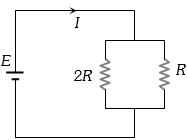
What is the ratio of heat generated in resistors $R$ and $2R$ connected in parallel as shown in the figure?
A
$2:1$
B
$1:2$
C
$4:1$
D
$1:4$
Solution
(A) The resistors $R$ and $2R$ are connected in parallel to the voltage source $E$.
In a parallel connection,the potential difference $V$ across each resistor is the same.
The heat generated $H$ in a resistor is given by the formula $H = \frac{V^2}{R} t$.
Since $V$ and $t$ are constant for both resistors,the heat generated is inversely proportional to the resistance: $H \propto \frac{1}{R}$.
Therefore,the ratio of heat generated in $R$ and $2R$ is $\frac{H_R}{H_{2R}} = \frac{2R}{R} = \frac{2}{1}$ or $2:1$.
In a parallel connection,the potential difference $V$ across each resistor is the same.
The heat generated $H$ in a resistor is given by the formula $H = \frac{V^2}{R} t$.
Since $V$ and $t$ are constant for both resistors,the heat generated is inversely proportional to the resistance: $H \propto \frac{1}{R}$.
Therefore,the ratio of heat generated in $R$ and $2R$ is $\frac{H_R}{H_{2R}} = \frac{2R}{R} = \frac{2}{1}$ or $2:1$.
0 likes
View Solution71
MediumMCQ
In an electric heater, $4\, A$ current passes for $1\, \text{minute}$ at a potential difference of $250\, V$. The power of the heater and the energy consumed will be, respectively:
A
$1\, kW, 60\, kJ$
B
$0.5\, kW, 30\, kJ$
C
$10\, kW, 600\, kJ$
D
None of these
Solution
$(A)$ Given: Current $I = 4\, A$, Potential difference $V = 250\, V$, Time $t = 1\, \text{minute} = 60\, s$.
Power $P$ is given by the formula $P = V \times I$.
$P = 250\, V \times 4\, A = 1000\, W = 1\, kW$.
Energy $E$ consumed is given by $E = P \times t$.
$E = 1\, kW \times 60\, s = 60\, kJ$ (or $1000\, W \times 60\, s = 60,000\, J = 60\, kJ$).
Thus, the power is $1\, kW$ and the energy consumed is $60\, kJ$.
Power $P$ is given by the formula $P = V \times I$.
$P = 250\, V \times 4\, A = 1000\, W = 1\, kW$.
Energy $E$ consumed is given by $E = P \times t$.
$E = 1\, kW \times 60\, s = 60\, kJ$ (or $1000\, W \times 60\, s = 60,000\, J = 60\, kJ$).
Thus, the power is $1\, kW$ and the energy consumed is $60\, kJ$.
0 likes
View Solution72
EasyMCQ
The resistor of resistance $R$ is connected to a $25\, V$ supply and the heat produced in it is $25\, J/s$. The value of $R$ is .......... $\Omega$.
A
$225$
B
$1$
C
$25$
D
$50$
Solution
(C) The power dissipated in a resistor is given by the formula $P = \frac{V^2}{R}$.
Given that the voltage $V = 25\, V$ and the heat produced per second (power) $P = 25\, J/s = 25\, W$.
Substituting these values into the formula:
$25 = \frac{25^2}{R}$
$R = \frac{625}{25} = 25\,\Omega$.
Therefore,the value of resistance $R$ is $25\,\Omega$.
Given that the voltage $V = 25\, V$ and the heat produced per second (power) $P = 25\, J/s = 25\, W$.
Substituting these values into the formula:
$25 = \frac{25^2}{R}$
$R = \frac{625}{25} = 25\,\Omega$.
Therefore,the value of resistance $R$ is $25\,\Omega$.
0 likes
View Solution73
MediumMCQ
If two electric bulbs have $40\, W$ and $60\, W$ rating at $220\, V$,then the ratio of their resistances will be
A
$9:4$
B
$4:3$
C
$3:8$
D
$3:2$
Solution
(D) The power rating of an electric bulb is given by the formula $P = \frac{V^2}{R}$,where $V$ is the voltage and $R$ is the resistance.
Since both bulbs are rated at the same voltage $V = 220\, V$,the resistance $R$ is inversely proportional to the power $P$,i.e.,$R \propto \frac{1}{P}$.
Therefore,the ratio of their resistances is given by $\frac{R_1}{R_2} = \frac{P_2}{P_1}$.
Given $P_1 = 40\, W$ and $P_2 = 60\, W$,we have $\frac{R_1}{R_2} = \frac{60}{40} = \frac{3}{2}$.
Thus,the ratio of their resistances is $3:2$.
Since both bulbs are rated at the same voltage $V = 220\, V$,the resistance $R$ is inversely proportional to the power $P$,i.e.,$R \propto \frac{1}{P}$.
Therefore,the ratio of their resistances is given by $\frac{R_1}{R_2} = \frac{P_2}{P_1}$.
Given $P_1 = 40\, W$ and $P_2 = 60\, W$,we have $\frac{R_1}{R_2} = \frac{60}{40} = \frac{3}{2}$.
Thus,the ratio of their resistances is $3:2$.
0 likes
View Solution74
MediumMCQ
$A$ $10\, V$ storage battery of negligible internal resistance is connected across a $50\,\Omega$ resistor. How much heat energy is produced in the resistor in $1$ hour? (in $J$)
A
$7200$
B
$6200$
C
$5200$
D
$4200$
Solution
(A) The heat energy produced in a resistor is given by the formula $H = \frac{V^2}{R} \times t$.
Given:
Voltage $V = 10\, V$
Resistance $R = 50\,\Omega$
Time $t = 1\, \text{hour} = 3600\, \text{seconds}$.
Substituting the values into the formula:
$H = \frac{10^2}{50} \times 3600$
$H = \frac{100}{50} \times 3600$
$H = 2 \times 3600 = 7200\, J$.
Therefore, the heat energy produced is $7200\, J$.
Given:
Voltage $V = 10\, V$
Resistance $R = 50\,\Omega$
Time $t = 1\, \text{hour} = 3600\, \text{seconds}$.
Substituting the values into the formula:
$H = \frac{10^2}{50} \times 3600$
$H = \frac{100}{50} \times 3600$
$H = 2 \times 3600 = 7200\, J$.
Therefore, the heat energy produced is $7200\, J$.
0 likes
View Solution75
MediumMCQ
$A$ hot electric iron has a resistance of $80\,\Omega$ and is used on a $200\,V$ source. The electrical energy spent,if it is used for two hours,will be ........... $Wh$.
A
$8000$
B
$2000$
C
$1000$
D
$800$
Solution
(C) The formula for electrical energy $E$ consumed is given by $E = P \times t$,where $P$ is power and $t$ is time.
Since power $P = \frac{V^2}{R}$,the energy formula becomes $E = \frac{V^2}{R} \times t$.
Given values are $V = 200\,V$,$R = 80\,\Omega$,and $t = 2\,h$.
Substituting these values into the formula:
$E = \frac{200 \times 200}{80} \times 2$
$E = \frac{40000}{80} \times 2$
$E = 500 \times 2 = 1000\,Wh$.
Since power $P = \frac{V^2}{R}$,the energy formula becomes $E = \frac{V^2}{R} \times t$.
Given values are $V = 200\,V$,$R = 80\,\Omega$,and $t = 2\,h$.
Substituting these values into the formula:
$E = \frac{200 \times 200}{80} \times 2$
$E = \frac{40000}{80} \times 2$
$E = 500 \times 2 = 1000\,Wh$.
0 likes
View Solution76
EasyMCQ
The heat produced by a $100\, W$ heater in $2\, minutes$ will be equal to:
A
$12 \times 10^3\, J$
B
$10 \times 10^3\, J$
C
$6 \times 10^3\, J$
D
$3 \times 10^3\, J$
Solution
(A) The heat produced $(H)$ by an electrical appliance is given by the formula $H = P \times t$, where $P$ is the power and $t$ is the time in seconds.
Given: Power $P = 100\, W$, Time $t = 2\, minutes = 2 \times 60\, s = 120\, s$.
Substituting the values: $H = 100\, W \times 120\, s = 12000\, J$.
This can be expressed in scientific notation as $12 \times 10^3\, J$.
Given: Power $P = 100\, W$, Time $t = 2\, minutes = 2 \times 60\, s = 120\, s$.
Substituting the values: $H = 100\, W \times 120\, s = 12000\, J$.
This can be expressed in scientific notation as $12 \times 10^3\, J$.
0 likes
View Solution77
EasyMCQ
Two electric bulbs $A$ and $B$ are rated as $60\, W$ and $100\, W$. They are connected in parallel to the same source. Then,
A
Both draw the same current
B
$A$ draws more current than $B$
C
$B$ draws more current than $A$
D
Current drawn are in the ratio of their resistances
Solution
(C) The power rating of a bulb is given by $P = \frac{V^2}{R}$,where $V$ is the rated voltage.
Since both bulbs are connected in parallel to the same source,the voltage $V$ across each bulb is the same.
From the relation $P = \frac{V^2}{R}$,we have $R = \frac{V^2}{P}$.
For bulb $A$,$P_A = 60\, W$,so $R_A = \frac{V^2}{60}$.
For bulb $B$,$P_B = 100\, W$,so $R_B = \frac{V^2}{100}$.
The current drawn by a bulb is given by $I = \frac{V}{R}$.
Substituting $R$,we get $I = \frac{V}{V^2/P} = \frac{P}{V}$.
Since $V$ is constant,$I \propto P$.
Because $P_B > P_A$ $(100\, W > 60\, W)$,the current drawn by bulb $B$ is greater than the current drawn by bulb $A$ $(I_B > I_A)$.
Since both bulbs are connected in parallel to the same source,the voltage $V$ across each bulb is the same.
From the relation $P = \frac{V^2}{R}$,we have $R = \frac{V^2}{P}$.
For bulb $A$,$P_A = 60\, W$,so $R_A = \frac{V^2}{60}$.
For bulb $B$,$P_B = 100\, W$,so $R_B = \frac{V^2}{100}$.
The current drawn by a bulb is given by $I = \frac{V}{R}$.
Substituting $R$,we get $I = \frac{V}{V^2/P} = \frac{P}{V}$.
Since $V$ is constant,$I \propto P$.
Because $P_B > P_A$ $(100\, W > 60\, W)$,the current drawn by bulb $B$ is greater than the current drawn by bulb $A$ $(I_B > I_A)$.
0 likes
View Solution78
MediumMCQ
If $2.2\,kW$ power is transmitted through a $100\,\Omega$ line at $22,000\,V,$ the power loss in the form of heat will be ............. $W$.
A
$0.1$
B
$1$
C
$10$
D
$100$
Solution
(B) Given power $P = 2.2\,kW = 2.2 \times 10^3\,W$.
Voltage $V = 22,000\,V$.
Resistance $R = 100\,\Omega$.
The current $i$ flowing through the line is given by $P = Vi$,so $i = \frac{P}{V}$.
$i = \frac{2.2 \times 10^3}{22,000} = \frac{2200}{22000} = 0.1\,A$.
The power loss in the form of heat is given by $P_{loss} = i^2R$.
$P_{loss} = (0.1)^2 \times 100 = 0.01 \times 100 = 1\,W$.
Voltage $V = 22,000\,V$.
Resistance $R = 100\,\Omega$.
The current $i$ flowing through the line is given by $P = Vi$,so $i = \frac{P}{V}$.
$i = \frac{2.2 \times 10^3}{22,000} = \frac{2200}{22000} = 0.1\,A$.
The power loss in the form of heat is given by $P_{loss} = i^2R$.
$P_{loss} = (0.1)^2 \times 100 = 0.01 \times 100 = 1\,W$.
0 likes
View Solution79
MediumMCQ
An electric lamp is marked $60\, W$, $230\, V$. The cost of $1\, kWh$ of energy is Rs. $1.25$. The cost of using this lamp for $8$ hours a day for $30$ days is Rs. ...............
A
$10$
B
$16$
C
$18$
D
$20$
Solution
(C) The power of the lamp is $P = 60\, W = 0.06\, kW$.
The total time of usage is $T = 8\, \text{hours/day} \times 30\, \text{days} = 240\, \text{hours}$.
The total energy consumed in $kWh$ is $E = P \times T = 0.06\, kW \times 240\, h = 14.4\, kWh$.
The cost of $1\, kWh$ is Rs. $1.25$.
Therefore, the total cost is $14.4 \times 1.25 = 18\, \text{Rs}$.
The total time of usage is $T = 8\, \text{hours/day} \times 30\, \text{days} = 240\, \text{hours}$.
The total energy consumed in $kWh$ is $E = P \times T = 0.06\, kW \times 240\, h = 14.4\, kWh$.
The cost of $1\, kWh$ is Rs. $1.25$.
Therefore, the total cost is $14.4 \times 1.25 = 18\, \text{Rs}$.
0 likes
View Solution80
EasyMCQ
The maximum current that flows through a fuse wire before it blows out varies with its radius as
A
$r^{3/2}$
B
$r$
C
$r^{2/3}$
D
$r^{1/2}$
Solution
(A) The heat generated in a fuse wire of length $l$,radius $r$,and resistivity $\rho$ due to current $I$ is given by $H = I^2 R t = I^2 (\rho l / \pi r^2) t$.
This heat is dissipated through the surface area of the wire via radiation,which is proportional to the surface area $A = 2\pi rl$ and the temperature difference $\Delta T$,following Stefan's Law: $H_{dissipated} \propto (2\pi rl) \Delta T$.
At the point of blowing out,the heat generated equals the heat dissipated: $I^2 (\rho l / \pi r^2) \propto 2\pi rl$.
Rearranging for $I^2$,we get $I^2 \propto r^3$,which implies $I \propto r^{3/2}$.
Therefore,the maximum current is proportional to $r^{3/2}$.
This heat is dissipated through the surface area of the wire via radiation,which is proportional to the surface area $A = 2\pi rl$ and the temperature difference $\Delta T$,following Stefan's Law: $H_{dissipated} \propto (2\pi rl) \Delta T$.
At the point of blowing out,the heat generated equals the heat dissipated: $I^2 (\rho l / \pi r^2) \propto 2\pi rl$.
Rearranging for $I^2$,we get $I^2 \propto r^3$,which implies $I \propto r^{3/2}$.
Therefore,the maximum current is proportional to $r^{3/2}$.
0 likes
View Solution81
EasyMCQ
The current flowing through a lamp marked as $50\, W$ and $250\, V$ is ............. $amp$.
A
$5$
B
$2.5$
C
$2$
D
$0.2$
Solution
(D) The power $P$ and voltage $V$ of the lamp are given as $P = 50\, W$ and $V = 250\, V$.
Using the formula for electrical power,$P = V \times I$,where $I$ is the current.
Rearranging the formula to solve for current: $I = \frac{P}{V}$.
Substituting the given values: $I = \frac{50}{250} = \frac{1}{5} = 0.2\, A$.
Therefore,the current flowing through the lamp is $0.2\, A$.
Using the formula for electrical power,$P = V \times I$,where $I$ is the current.
Rearranging the formula to solve for current: $I = \frac{P}{V}$.
Substituting the given values: $I = \frac{50}{250} = \frac{1}{5} = 0.2\, A$.
Therefore,the current flowing through the lamp is $0.2\, A$.
0 likes
View Solution82
EasyMCQ
$A$ heater coil is cut into two equal parts and only one part is now used in the heater. The heat generated will now be
A
One fourth
B
Halved
C
Doubled
D
Four times
Solution
(C) The heat generated by a heater is given by the formula $H = \frac{V^2 t}{R}$,where $V$ is the voltage,$t$ is the time,and $R$ is the resistance of the coil.
When the coil is cut into two equal parts,the resistance of each part becomes $R' = \frac{R}{2}$.
Since the voltage $V$ remains constant,the new heat generated $H'$ is given by $H' = \frac{V^2 t}{R'} = \frac{V^2 t}{R/2} = 2 \times \frac{V^2 t}{R}$.
Therefore,$H' = 2H$.
Thus,the heat generated is doubled.
When the coil is cut into two equal parts,the resistance of each part becomes $R' = \frac{R}{2}$.
Since the voltage $V$ remains constant,the new heat generated $H'$ is given by $H' = \frac{V^2 t}{R'} = \frac{V^2 t}{R/2} = 2 \times \frac{V^2 t}{R}$.
Therefore,$H' = 2H$.
Thus,the heat generated is doubled.
0 likes
View Solution83
EasyMCQ
$5.0 \, A$ current is set up in an external circuit by a $6.0 \, V$ storage battery for $6.0 \, \text{minutes}$. The chemical energy of the battery is reduced by:
A
$1.08 \times 10^{4} \, J$
B
$1.08 \times 10^{-4} \, V$
C
$1.8 \times 10^{4} \, J$
D
$1.08 \times 10^{4} \, V$
Solution
(A) The chemical energy reduced in the battery is equal to the electrical energy supplied by the battery to the external circuit.
Electrical energy $E = V \times I \times t$
Given:
Voltage $V = 6.0 \, V$
Current $I = 5.0 \, A$
Time $t = 6.0 \, \text{minutes} = 6.0 \times 60 \, \text{seconds} = 360 \, \text{s}$
Substituting the values:
$E = 6.0 \, V \times 5.0 \, A \times 360 \, \text{s}$
$E = 30 \times 360 \, J$
$E = 10800 \, J$
$E = 1.08 \times 10^{4} \, J$
Therefore, the chemical energy of the battery is reduced by $1.08 \times 10^{4} \, J$.
Electrical energy $E = V \times I \times t$
Given:
Voltage $V = 6.0 \, V$
Current $I = 5.0 \, A$
Time $t = 6.0 \, \text{minutes} = 6.0 \times 60 \, \text{seconds} = 360 \, \text{s}$
Substituting the values:
$E = 6.0 \, V \times 5.0 \, A \times 360 \, \text{s}$
$E = 30 \times 360 \, J$
$E = 10800 \, J$
$E = 1.08 \times 10^{4} \, J$
Therefore, the chemical energy of the battery is reduced by $1.08 \times 10^{4} \, J$.
0 likes
View Solution84
EasyMCQ
$A$ railway compartment is lit up by thirteen lamps,each taking $2.1\,A$ at $15\,V$. The heat generated per second in each lamp will be ............ $cal$.
A
$4.35$
B
$5.73$
C
$7.5$
D
$2.5$
Solution
(C) The heat generated per second is equivalent to the power consumed by the lamp.
The power $P$ is given by the formula $P = V \times I$.
Given: Voltage $V = 15\,V$ and Current $I = 2.1\,A$.
$P = 15\,V \times 2.1\,A = 31.5\,W$ (or $31.5\,J/s$).
To convert the heat generated in Joules to calories,we use the conversion factor $1\,cal = 4.2\,J$.
Heat in calories per second $= \frac{31.5\,J}{4.2\,J/cal} = 7.5\,cal/s$.
Therefore,the heat generated per second in each lamp is $7.5\,cal$.
The power $P$ is given by the formula $P = V \times I$.
Given: Voltage $V = 15\,V$ and Current $I = 2.1\,A$.
$P = 15\,V \times 2.1\,A = 31.5\,W$ (or $31.5\,J/s$).
To convert the heat generated in Joules to calories,we use the conversion factor $1\,cal = 4.2\,J$.
Heat in calories per second $= \frac{31.5\,J}{4.2\,J/cal} = 7.5\,cal/s$.
Therefore,the heat generated per second in each lamp is $7.5\,cal$.
0 likes
View Solution85
MediumMCQ
Which of the following statements is correct?
A
Both Peltier and Joule effects are reversible.
B
Both Peltier and Joule effects are irreversible.
C
Joule effect is reversible,whereas Peltier effect is irreversible.
D
Joule effect is irreversible,whereas Peltier effect is reversible.
Solution
(D) The Joule effect refers to the heating of a conductor when an electric current passes through it,given by $H = I^2Rt$. This process is irreversible because the heat generated is dissipated into the surroundings and cannot be converted back into electrical energy simply by reversing the current.
The Peltier effect refers to the production or absorption of heat at the junction of two dissimilar metals when an electric current flows through them. This effect is reversible; if the direction of the current is reversed,the heat that was previously absorbed will be released,and vice versa.
Therefore,the Joule effect is irreversible,while the Peltier effect is reversible.
The Peltier effect refers to the production or absorption of heat at the junction of two dissimilar metals when an electric current flows through them. This effect is reversible; if the direction of the current is reversed,the heat that was previously absorbed will be released,and vice versa.
Therefore,the Joule effect is irreversible,while the Peltier effect is reversible.
0 likes
View Solution86
EasyMCQ
$A$ house is served by a $220 \, V$ supply line in a circuit protected by a $9 \, A$ fuse. What is the maximum number of $60 \, W$ lamps in parallel that can be turned on simultaneously?
A
$44$
B
$20$
C
$22$
D
$33$
Solution
(D) The power supplied by the circuit is given by $P = V \times I$.
Given,$V = 220 \, V$ and $I = 9 \, A$.
Total power $P = 220 \times 9 = 1980 \, W$.
Let $n$ be the number of $60 \, W$ lamps connected in parallel.
The total power consumed by $n$ lamps is $n \times 60 \, W$.
For the fuse not to blow,the total power consumed must be less than or equal to the supply power:
$n \times 60 \leq 1980$.
$n \leq \frac{1980}{60} = 33$.
Therefore,the maximum number of lamps that can be turned on is $33$.
Given,$V = 220 \, V$ and $I = 9 \, A$.
Total power $P = 220 \times 9 = 1980 \, W$.
Let $n$ be the number of $60 \, W$ lamps connected in parallel.
The total power consumed by $n$ lamps is $n \times 60 \, W$.
For the fuse not to blow,the total power consumed must be less than or equal to the supply power:
$n \times 60 \leq 1980$.
$n \leq \frac{1980}{60} = 33$.
Therefore,the maximum number of lamps that can be turned on is $33$.
0 likes
View Solution87
MediumMCQ
$A$ $500\, W$ heating unit is designed to operate from a $115\, V$ line. If the line voltage drops to $110\, V$,the percentage drop in heat output will be ............... $\%$
A
$10.20$
B
$8.1$
C
$8.6$
D
$7.6$
Solution
(C) The power consumed by a heating element is given by $P = \frac{V^2}{R}$.
Since the resistance $R$ of the heating unit remains constant,the power is proportional to the square of the voltage: $P \propto V^2$.
Therefore,the ratio of the new power $P_{new}$ to the rated power $P_{rated}$ is given by $\frac{P_{new}}{P_{rated}} = \left( \frac{V_{new}}{V_{rated}} \right)^2$.
Given $P_{rated} = 500\, W$,$V_{rated} = 115\, V$,and $V_{new} = 110\, V$,we have:
$P_{new} = \left( \frac{110}{115} \right)^2 \times 500 = (0.9565)^2 \times 500 \approx 0.9149 \times 500 = 457.46\, W$.
The drop in power is $\Delta P = P_{rated} - P_{new} = 500 - 457.46 = 42.54\, W$.
The percentage drop in heat output is $\frac{\Delta P}{P_{rated}} \times 100 = \frac{42.54}{500} \times 100 = 8.508\% \approx 8.6\% $.
Since the resistance $R$ of the heating unit remains constant,the power is proportional to the square of the voltage: $P \propto V^2$.
Therefore,the ratio of the new power $P_{new}$ to the rated power $P_{rated}$ is given by $\frac{P_{new}}{P_{rated}} = \left( \frac{V_{new}}{V_{rated}} \right)^2$.
Given $P_{rated} = 500\, W$,$V_{rated} = 115\, V$,and $V_{new} = 110\, V$,we have:
$P_{new} = \left( \frac{110}{115} \right)^2 \times 500 = (0.9565)^2 \times 500 \approx 0.9149 \times 500 = 457.46\, W$.
The drop in power is $\Delta P = P_{rated} - P_{new} = 500 - 457.46 = 42.54\, W$.
The percentage drop in heat output is $\frac{\Delta P}{P_{rated}} \times 100 = \frac{42.54}{500} \times 100 = 8.508\% \approx 8.6\% $.
0 likes
View Solution88
EasyMCQ
$A$ heater of $220\, V$ heats a volume of water in $5\, \text{min}$ time. $A$ heater of $110\, V$ heats the same volume of water in ............... $\text{min}$.
A
$5$
B
$8$
C
$10$
D
$20$
Solution
(D) The heat energy $H$ required to heat a volume of water is constant.
The heat produced by a heater is given by $H = \frac{V^2}{R} t$, where $V$ is the voltage, $R$ is the resistance of the heater, and $t$ is the time.
Since the same volume of water is heated, the heat required $H$ is the same in both cases.
Assuming the resistance $R$ of the heater remains constant, we have $H = \frac{V_1^2}{R} t_1 = \frac{V_2^2}{R} t_2$.
Given $V_1 = 220\, V$, $t_1 = 5\, \text{min}$, and $V_2 = 110\, V$.
Substituting the values: $\frac{220^2}{R} \times 5 = \frac{110^2}{R} \times t_2$.
$t_2 = 5 \times \left( \frac{220}{110} \right)^2 = 5 \times (2)^2 = 5 \times 4 = 20\, \text{min}$.
The heat produced by a heater is given by $H = \frac{V^2}{R} t$, where $V$ is the voltage, $R$ is the resistance of the heater, and $t$ is the time.
Since the same volume of water is heated, the heat required $H$ is the same in both cases.
Assuming the resistance $R$ of the heater remains constant, we have $H = \frac{V_1^2}{R} t_1 = \frac{V_2^2}{R} t_2$.
Given $V_1 = 220\, V$, $t_1 = 5\, \text{min}$, and $V_2 = 110\, V$.
Substituting the values: $\frac{220^2}{R} \times 5 = \frac{110^2}{R} \times t_2$.
$t_2 = 5 \times \left( \frac{220}{110} \right)^2 = 5 \times (2)^2 = 5 \times 4 = 20\, \text{min}$.
0 likes
View Solution89
MediumMCQ
An electric kettle takes $4\, A$ current at $220\, V$. How much time will it take to boil $1\, kg$ of water from room temperature $20\, ^\circ C$? The temperature of boiling water is $100\, ^\circ C$. (Assume specific heat of water $c = 4200\, J/kg\, ^\circ C$)
A
$6.4$
B
$6.3$
C
$12.6$
D
$12.8$
Solution
(B) The power consumed by the electric kettle is $P = V \times I = 220\, V \times 4\, A = 880\, W$.
To boil $1\, kg$ of water,the heat required is $H = m \times c \times \Delta T$.
Given $m = 1\, kg$,$c = 4200\, J/kg\, ^\circ C$,and $\Delta T = (100 - 20)\, ^\circ C = 80\, ^\circ C$.
$H = 1 \times 4200 \times 80 = 336000\, J$.
Since $H = P \times t$,the time $t$ in seconds is $t = H / P = 336000 / 880 \approx 381.82\, s$.
Converting to minutes: $t = 381.82 / 60 \approx 6.36\, minutes$.
Rounding to the nearest provided option,the correct answer is $6.3\, minutes$.
To boil $1\, kg$ of water,the heat required is $H = m \times c \times \Delta T$.
Given $m = 1\, kg$,$c = 4200\, J/kg\, ^\circ C$,and $\Delta T = (100 - 20)\, ^\circ C = 80\, ^\circ C$.
$H = 1 \times 4200 \times 80 = 336000\, J$.
Since $H = P \times t$,the time $t$ in seconds is $t = H / P = 336000 / 880 \approx 381.82\, s$.
Converting to minutes: $t = 381.82 / 60 \approx 6.36\, minutes$.
Rounding to the nearest provided option,the correct answer is $6.3\, minutes$.
0 likes
View Solution90
MediumMCQ
If a wire of resistance $20\,\Omega$ is covered with ice and a voltage of $210\,V$ is applied across the wire,then the rate of melting of ice is .................. $g/s$. (Take latent heat of fusion of ice $L = 80\,cal/g$ and $1\,cal = 4.2\,J$)
A
$0.85$
B
$1.92$
C
$6.56$
D
$10.50$
Solution
(C) The electrical power dissipated in the wire is given by $P = \frac{V^2}{R}$.
Substituting the given values: $P = \frac{(210)^2}{20} = \frac{44100}{20} = 2205\,W$ (or $J/s$).
The rate of melting of ice $m$ is given by the formula $P = m \times L$,where $L$ is the latent heat of fusion of ice.
Given $L = 80\,cal/g$ and $1\,cal = 4.2\,J$,we have $L = 80 \times 4.2 = 336\,J/g$.
Therefore,$m = \frac{P}{L} = \frac{2205}{336} = 6.56\,g/s$.
Substituting the given values: $P = \frac{(210)^2}{20} = \frac{44100}{20} = 2205\,W$ (or $J/s$).
The rate of melting of ice $m$ is given by the formula $P = m \times L$,where $L$ is the latent heat of fusion of ice.
Given $L = 80\,cal/g$ and $1\,cal = 4.2\,J$,we have $L = 80 \times 4.2 = 336\,J/g$.
Therefore,$m = \frac{P}{L} = \frac{2205}{336} = 6.56\,g/s$.
0 likes
View Solution91
MediumMCQ
The same mass of copper is drawn into two wires $1 \, mm$ and $2 \, mm$ thick. Two wires are connected in series and current is passed through them. The ratio of heat produced in the wires is:
A
$2:1$
B
$1:16$
C
$4:1$
D
$16:1$
Solution
(D) The heat produced in a wire is given by $H = I^2 R t$.
Since the wires are connected in series, the current $I$ and time $t$ are the same for both.
Resistance $R = \rho \frac{l}{A}$.
Since the mass $m = \text{density} \times \text{volume} = \rho_d \times A \times l$ is constant, $l = \frac{m}{\rho_d A}$.
Substituting this into the resistance formula: $R = \rho \frac{m}{\rho_d A^2} \propto \frac{1}{A^2}$.
Since the area $A = \pi r^2$, we have $R \propto \frac{1}{(r^2)^2} = \frac{1}{r^4}$.
Therefore, $H \propto \frac{1}{r^4}$.
For the two wires with radii $r_1 = 1 \, mm$ and $r_2 = 2 \, mm$, the ratio of heat produced is:
$\frac{H_1}{H_2} = \left( \frac{r_2}{r_1} \right)^4 = \left( \frac{2}{1} \right)^4 = \frac{16}{1}$.
Since the wires are connected in series, the current $I$ and time $t$ are the same for both.
Resistance $R = \rho \frac{l}{A}$.
Since the mass $m = \text{density} \times \text{volume} = \rho_d \times A \times l$ is constant, $l = \frac{m}{\rho_d A}$.
Substituting this into the resistance formula: $R = \rho \frac{m}{\rho_d A^2} \propto \frac{1}{A^2}$.
Since the area $A = \pi r^2$, we have $R \propto \frac{1}{(r^2)^2} = \frac{1}{r^4}$.
Therefore, $H \propto \frac{1}{r^4}$.
For the two wires with radii $r_1 = 1 \, mm$ and $r_2 = 2 \, mm$, the ratio of heat produced is:
$\frac{H_1}{H_2} = \left( \frac{r_2}{r_1} \right)^4 = \left( \frac{2}{1} \right)^4 = \frac{16}{1}$.
0 likes
View Solution92
DifficultMCQ
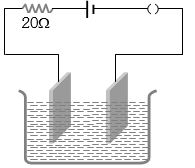
In a $Ag$ voltameter,$2.68 \, g$ of silver is deposited in $10 \, \min$. The heat developed in a $20 \, \Omega$ resistor during the same period will be:
A
$192 \, kJ$
B
$192 \, J$
C
$200 \, J$
D
$132 \, kJ$
Solution
(A) According to Faraday's first law of electrolysis,the mass $m$ deposited is given by $m = ZIt$,where $Z$ is the electrochemical equivalent of silver $(Ag)$.
For silver,the atomic mass is $108 \, g/mol$ and its valency is $1$. Thus,$Z = \frac{108}{96500} \, g/C$.
Given: $m = 2.68 \, g$,$t = 10 \, \min = 600 \, s$.
Calculating the current $I$:
$I = \frac{m}{Zt} = \frac{2.68}{\left(\frac{108}{96500}\right) \times 600} = \frac{2.68 \times 96500}{108 \times 600} \approx 4 \, A$.
Now,the heat $H$ developed in the resistor $R = 20 \, \Omega$ is given by Joule's law of heating:
$H = I^2 Rt = (4)^2 \times 20 \times 600 = 16 \times 20 \times 600 = 192000 \, J = 192 \, kJ$.
For silver,the atomic mass is $108 \, g/mol$ and its valency is $1$. Thus,$Z = \frac{108}{96500} \, g/C$.
Given: $m = 2.68 \, g$,$t = 10 \, \min = 600 \, s$.
Calculating the current $I$:
$I = \frac{m}{Zt} = \frac{2.68}{\left(\frac{108}{96500}\right) \times 600} = \frac{2.68 \times 96500}{108 \times 600} \approx 4 \, A$.
Now,the heat $H$ developed in the resistor $R = 20 \, \Omega$ is given by Joule's law of heating:
$H = I^2 Rt = (4)^2 \times 20 \times 600 = 16 \times 20 \times 600 = 192000 \, J = 192 \, kJ$.
0 likes
View Solution93
MediumMCQ
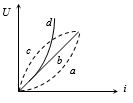
Which of the following plots may represent the thermal energy produced in a resistor in a given time as a function of the electric current?
A
$a$
B
$b$
C
$c$
D
$d$
Solution
(D) The thermal energy $U$ produced in a resistor of resistance $R$ in a given time $t$ is given by Joule's law of heating: $U = i^2 Rt$.
Since $R$ and $t$ are constants,we have $U \propto i^2$.
This relationship represents a parabola opening upwards along the $U$-axis.
Among the given plots,the curve $d$ represents a parabolic variation where $U$ increases more rapidly as $i$ increases,which is consistent with the $U \propto i^2$ relationship.
Therefore,the correct plot is $d$.
Since $R$ and $t$ are constants,we have $U \propto i^2$.
This relationship represents a parabola opening upwards along the $U$-axis.
Among the given plots,the curve $d$ represents a parabolic variation where $U$ increases more rapidly as $i$ increases,which is consistent with the $U \propto i^2$ relationship.
Therefore,the correct plot is $d$.
0 likes
View Solution94
DifficultMCQ
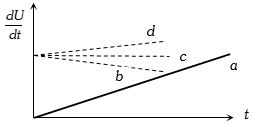
$A$ constant current $i$ is passed through a resistor. Taking the temperature coefficient of resistance into account,indicate which of the plots shown in the figure best represents the rate of production of thermal energy in the resistor.
A
$a$
B
$b$
C
$c$
D
$d$
Solution
(D) The rate of production of thermal energy in a resistor is given by the power $P = \frac{dU}{dt} = i^2 R$.
The resistance $R$ of a conductor depends on temperature $T$ as $R = R_0(1 + \alpha \Delta T)$,where $R_0$ is the initial resistance,$\alpha$ is the temperature coefficient of resistance,and $\Delta T$ is the change in temperature.
As current $i$ flows through the resistor,it heats up,so the temperature $T$ increases with time $t$. Assuming the temperature rise is proportional to the time elapsed (i.e.,$\Delta T \propto t$),we can write $R(t) = R_0(1 + \alpha' t)$,where $\alpha'$ is a constant.
Substituting this into the power equation:
$P(t) = i^2 R_0(1 + \alpha' t) = i^2 R_0 + (i^2 R_0 \alpha') t$.
This equation is of the form $y = mx + c$,which represents a straight line with a positive slope $(i^2 R_0 \alpha')$ and a positive y-intercept $(i^2 R_0)$.
Among the given plots,curve $d$ shows a linear increase starting from a non-zero value,which correctly represents the relationship.
The resistance $R$ of a conductor depends on temperature $T$ as $R = R_0(1 + \alpha \Delta T)$,where $R_0$ is the initial resistance,$\alpha$ is the temperature coefficient of resistance,and $\Delta T$ is the change in temperature.
As current $i$ flows through the resistor,it heats up,so the temperature $T$ increases with time $t$. Assuming the temperature rise is proportional to the time elapsed (i.e.,$\Delta T \propto t$),we can write $R(t) = R_0(1 + \alpha' t)$,where $\alpha'$ is a constant.
Substituting this into the power equation:
$P(t) = i^2 R_0(1 + \alpha' t) = i^2 R_0 + (i^2 R_0 \alpha') t$.
This equation is of the form $y = mx + c$,which represents a straight line with a positive slope $(i^2 R_0 \alpha')$ and a positive y-intercept $(i^2 R_0)$.
Among the given plots,curve $d$ shows a linear increase starting from a non-zero value,which correctly represents the relationship.
0 likes
View Solution95
EasyMCQ
Two bulbs of $40\,W$ each are connected in parallel. The total power consumed by this combination is ............. $W$.
A
$20$
B
$60$
C
$80$
D
$100$
Solution
(C) When $n$ identical electrical appliances,each of power $P$,are connected in parallel,the total power consumed is given by the formula $P_{total} = n \times P$.
Given that $n = 2$ and $P = 40\,W$.
Therefore,$P_{total} = 2 \times 40\,W = 80\,W$.
Thus,the total power consumed by the combination is $80\,W$.
Given that $n = 2$ and $P = 40\,W$.
Therefore,$P_{total} = 2 \times 40\,W = 80\,W$.
Thus,the total power consumed by the combination is $80\,W$.
0 likes
View Solution96
EasyMCQ
$A$ light bulb operates at a voltage $V_0$ and consumes power $P_0$. If the voltage is changed to $V$,what is the new power $P$ consumed by the bulb?
A
$P = \left( \frac{V}{V_0} \right) P_0$
B
$P = \left( \frac{V_0}{V} \right) P_0$
C
$P = \left( \frac{V_0}{V} \right)^2 P_0$
D
$P = \left( \frac{V}{V_0} \right)^2 P_0$
Solution
(D) The power consumed by a resistor (bulb) is given by the formula $P = \frac{V^2}{R}$,where $R$ is the resistance of the bulb.
Initially,the bulb operates at voltage $V_0$ and power $P_0$. Therefore,the resistance $R$ is given by:
$R = \frac{V_0^2}{P_0} \quad \dots(1)$
When the bulb is connected to a new voltage $V$,it consumes a new power $P$. Since the resistance $R$ of the bulb remains constant,we have:
$P = \frac{V^2}{R}$
Substituting the value of $R$ from equation $(1)$ into this expression:
$P = \frac{V^2}{(V_0^2 / P_0)}$
$P = \left( \frac{V^2}{V_0^2} \right) P_0$
$P = \left( \frac{V}{V_0} \right)^2 P_0$
Initially,the bulb operates at voltage $V_0$ and power $P_0$. Therefore,the resistance $R$ is given by:
$R = \frac{V_0^2}{P_0} \quad \dots(1)$
When the bulb is connected to a new voltage $V$,it consumes a new power $P$. Since the resistance $R$ of the bulb remains constant,we have:
$P = \frac{V^2}{R}$
Substituting the value of $R$ from equation $(1)$ into this expression:
$P = \frac{V^2}{(V_0^2 / P_0)}$
$P = \left( \frac{V^2}{V_0^2} \right) P_0$
$P = \left( \frac{V}{V_0} \right)^2 P_0$
0 likes
View Solution97
EasyMCQ
$n$ identical bulbs,each designed to consume power $P$ at a certain voltage source,are connected in series across the same source. The total power consumed by them is:
A
$P$
B
$nP$
C
$P/n^2$
D
$P/n$
Solution
(D) Let the voltage of the source be $V$ and the resistance of each bulb be $R$.
Since each bulb is designed to consume power $P$ at voltage $V$,we have $P = V^2/R$,which implies $R = V^2/P$.
When $n$ such bulbs are connected in series,the total resistance of the circuit becomes $R_{eq} = nR$.
The total power consumed by the series combination is $P_{total} = V^2 / R_{eq}$.
Substituting $R_{eq} = nR$,we get $P_{total} = V^2 / (nR) = (1/n) * (V^2/R)$.
Since $P = V^2/R$,the total power is $P_{total} = P/n$.
Since each bulb is designed to consume power $P$ at voltage $V$,we have $P = V^2/R$,which implies $R = V^2/P$.
When $n$ such bulbs are connected in series,the total resistance of the circuit becomes $R_{eq} = nR$.
The total power consumed by the series combination is $P_{total} = V^2 / R_{eq}$.
Substituting $R_{eq} = nR$,we get $P_{total} = V^2 / (nR) = (1/n) * (V^2/R)$.
Since $P = V^2/R$,the total power is $P_{total} = P/n$.
0 likes
View Solution98
EasyMCQ
When two electric bulbs of $40\, W$ and $60\, W$ are connected in parallel,then:
A
The $40\, W$ bulb glows brighter.
B
Both bulbs have the same brightness.
C
Brightness depends on the type of source ($A.C.$ or $D.C.$).
D
The $60\, W$ bulb glows brighter.
Solution
(D) In a parallel connection,the voltage $(V)$ across each bulb is the same.
The power consumed by a bulb is given by the formula $P = \frac{V^2}{R}$.
Since $P \propto \frac{1}{R}$,the bulb with lower resistance will consume more power.
For a given rated voltage,$R = \frac{V^2}{P}$,which means $R \propto \frac{1}{P}$.
Therefore,the $40\, W$ bulb has higher resistance than the $60\, W$ bulb.
However,in parallel,the power dissipated is $P_{dissipated} = \frac{V^2}{R}$.
Since the $60\, W$ bulb has lower resistance,it will dissipate more power $(P = \frac{V^2}{R})$ and thus glow brighter.
The power consumed by a bulb is given by the formula $P = \frac{V^2}{R}$.
Since $P \propto \frac{1}{R}$,the bulb with lower resistance will consume more power.
For a given rated voltage,$R = \frac{V^2}{P}$,which means $R \propto \frac{1}{P}$.
Therefore,the $40\, W$ bulb has higher resistance than the $60\, W$ bulb.
However,in parallel,the power dissipated is $P_{dissipated} = \frac{V^2}{R}$.
Since the $60\, W$ bulb has lower resistance,it will dissipate more power $(P = \frac{V^2}{R})$ and thus glow brighter.
0 likes
View Solution99
MediumMCQ
Two electric bulbs have power ratings $P_1$ and $P_2$ at voltage $V$. They are connected in parallel to a voltage source $V$. What is the total power consumed?
A
$P_1 + P_2$ Watts
B
$\sqrt{P_1 P_2}$ Watts
C
$\frac{P_1 P_2}{P_1 + P_2}$ Watts
D
$\frac{P_1 + P_2}{P_1 P_2}$ Watts
Solution
(A) The power rating of a bulb is given by $P = \frac{V^2}{R}$,where $V$ is the rated voltage and $R$ is the resistance of the bulb.
For the two bulbs,their resistances are $R_1 = \frac{V^2}{P_1}$ and $R_2 = \frac{V^2}{P_2}$.
When connected in parallel to the same voltage $V$,the total power consumed $P_{total}$ is the sum of the individual powers consumed by each bulb.
Since each bulb is connected to its rated voltage $V$,each bulb consumes its rated power.
Therefore,$P_{total} = P_1 + P_2$.
For the two bulbs,their resistances are $R_1 = \frac{V^2}{P_1}$ and $R_2 = \frac{V^2}{P_2}$.
When connected in parallel to the same voltage $V$,the total power consumed $P_{total}$ is the sum of the individual powers consumed by each bulb.
Since each bulb is connected to its rated voltage $V$,each bulb consumes its rated power.
Therefore,$P_{total} = P_1 + P_2$.
0 likes
View Solution100
EasyMCQ
Which of the following is not a unit of power?
A
$(Amp)^2 \times \Omega$
B
$Amp / Volt$
C
$Amp \times Volt$
D
$Joule / sec$
Solution
(B) Power $(P)$ is defined as the rate of doing work or the rate of energy consumption. The $SI$ unit of power is Watt $(W)$,which is equivalent to $Joule/sec$ $(J/s)$.
From Ohm's law,$V = IR$. The formula for power is $P = VI = I^2R = V^2/R$.
$1$. $P = I^2R$: The unit is $(Amp)^2 \times \Omega$.
$2$. $P = VI$: The unit is $Amp \times Volt$.
$3$. $P = W/t$: The unit is $Joule/sec$.
Comparing these with the options,$Amp / Volt$ is not a unit of power. In fact,$Amp / Volt$ is the unit of conductance $(1/Resistance)$,which is Siemens $(S)$.
From Ohm's law,$V = IR$. The formula for power is $P = VI = I^2R = V^2/R$.
$1$. $P = I^2R$: The unit is $(Amp)^2 \times \Omega$.
$2$. $P = VI$: The unit is $Amp \times Volt$.
$3$. $P = W/t$: The unit is $Joule/sec$.
Comparing these with the options,$Amp / Volt$ is not a unit of power. In fact,$Amp / Volt$ is the unit of conductance $(1/Resistance)$,which is Siemens $(S)$.
0 likes
View SolutionCurrent Electricity — Electrical Energy and Power · Frequently Asked Questions
1Are these Current Electricity questions useful for JEE and NEET?
Yes. All questions in this section are mapped to JEE Main and NEET exam patterns. Previous year questions from JEE Main, NEET, GUJCET and state-level exams are included with full solutions.
2Can I switch to Hindi or Gujarati for these questions?
Yes. Use the language tabs in the hero section or the sidebar to view the same questions and solutions in English, Hindi or Gujarati.
3How do I generate a question paper from this subtopic?
Use the Vedclass Exam Paper Generator — select the chapter and subtopic, set difficulty, and generate Sets A, B, C, D automatically. First 3 chapters of every subject are free.
Vedclass Products
For Students
Vedclass Test Series
Mock tests in real JEE/NEET style with performance analysis. 5-day free trial.
Start Free TrialFor Teachers
Exam Paper Generator
Generate Set A/B/C/D papers from this chapter in 2 minutes. 3 chapters free.
Try FreeFor Institutes
Online Exam Module
Live online exams with unlimited students, 360° analytics & white-label branding.
See DemoFor Teachers & Institutes
Generate a Current Electricity Exam Paper in 2 Minutes
Select subtopic & difficulty — Sets A, B, C, D auto-generated with No Repeat logic.
First 3 chapters of every subject are free — no payment required.