
A English
Electron Energy and Electron Energy Levels in Hydrogen Atom Questions in English
Class 12 Physics · Atoms · Electron Energy and Electron Energy Levels in Hydrogen Atom
224+
Questions
English
Language
100%
With Solutions
Showing 48 of 224 questions in English
1
MediumMCQ
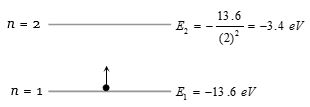
In the $n^{th}$ orbit,the energy of an electron is given by $E_n = -\frac{13.6}{n^2} \text{ eV}$ for a hydrogen atom. The energy required to excite the electron from the first orbit $(n=1)$ to the second orbit $(n=2)$ will be..... eV.
A
$10.2$
B
$12.1$
C
$13.6$
D
$3.4$
Solution
(A) The energy of an electron in the $n^{th}$ orbit is $E_n = -\frac{13.6}{n^2} \text{ eV}$.
For the first orbit $(n=1)$: $E_1 = -\frac{13.6}{1^2} = -13.6 \text{ eV}$.
For the second orbit $(n=2)$: $E_2 = -\frac{13.6}{2^2} = -\frac{13.6}{4} = -3.4 \text{ eV}$.
The energy required to excite the electron from the first orbit to the second orbit is given by the difference in energy levels:
$\Delta E = E_2 - E_1$
$\Delta E = -3.4 \text{ eV} - (-13.6 \text{ eV})$
$\Delta E = -3.4 + 13.6 = 10.2 \text{ eV}$.
Therefore,the energy required is $10.2 \text{ eV}$.
For the first orbit $(n=1)$: $E_1 = -\frac{13.6}{1^2} = -13.6 \text{ eV}$.
For the second orbit $(n=2)$: $E_2 = -\frac{13.6}{2^2} = -\frac{13.6}{4} = -3.4 \text{ eV}$.
The energy required to excite the electron from the first orbit to the second orbit is given by the difference in energy levels:
$\Delta E = E_2 - E_1$
$\Delta E = -3.4 \text{ eV} - (-13.6 \text{ eV})$
$\Delta E = -3.4 + 13.6 = 10.2 \text{ eV}$.
Therefore,the energy required is $10.2 \text{ eV}$.
0 likes
View Solution2
EasyMCQ
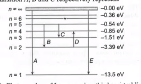
In the above figure,$D$ and $E$ respectively represent:
A
Absorption line of Balmer series and the ionization potential of hydrogen
B
Absorption line of Balmer series and the wavelength lesser than lowest of the Lyman series
C
Spectral line of Balmer series and the maximum wavelength of Lyman series
D
Spectral line of Lyman series and the absorption of greater wavelength of limiting value of Paschen series
Solution
(A) represents the excitation of an electron from the $n=2$ orbit to the $n=4$ orbit,which corresponds to an absorption line in the Balmer series.
$E$ represents the transition of an electron from the $\infty$ orbit to the $n=1$ orbit,which corresponds to the energy released equal to the ionization potential of hydrogen $(13.6 \ eV)$.
$E$ represents the transition of an electron from the $\infty$ orbit to the $n=1$ orbit,which corresponds to the energy released equal to the ionization potential of hydrogen $(13.6 \ eV)$.
0 likes
View Solution3
EasyMCQ
The energy required to knock out the electron in the third orbit of a hydrogen atom is equal to
A
$13.6 \ eV$
B
$+\frac{13.6}{9} \ eV$
C
$-\frac{13.6}{3} \ eV$
D
$-\frac{3}{13.6} \ eV$
Solution
(B) The energy of an electron in the $n^{th}$ orbit of a hydrogen atom is given by $E_n = -\frac{13.6}{n^2} \ eV$.
To knock out the electron (i.e.,to ionize it),we need to provide energy equal to the magnitude of the binding energy of that orbit.
The energy required to remove the electron from the $n^{th}$ orbit is $E = +\frac{13.6}{n^2} \ eV$.
For the third orbit,$n = 3$.
Therefore,the energy required is $E = +\frac{13.6}{3^2} \ eV = +\frac{13.6}{9} \ eV$.
To knock out the electron (i.e.,to ionize it),we need to provide energy equal to the magnitude of the binding energy of that orbit.
The energy required to remove the electron from the $n^{th}$ orbit is $E = +\frac{13.6}{n^2} \ eV$.
For the third orbit,$n = 3$.
Therefore,the energy required is $E = +\frac{13.6}{3^2} \ eV = +\frac{13.6}{9} \ eV$.
0 likes
View Solution4
EasyMCQ
The energy required to remove an electron in a hydrogen atom from $n = 10$ state is (in $\text{ eV}$)
A
$13.6$
B
$1.36$
C
$0.136$
D
$0.0136$
Solution
(C) The energy of an electron in the $n^{th}$ orbit of a hydrogen atom is given by the formula $E_n = -\frac{13.6}{n^2} \text{ eV}$.
To remove an electron from the $n = 10$ state to infinity $(E_{\infty} = 0)$, the energy required is the ionization energy for that state.
Energy required $= E_{\infty} - E_{10} = 0 - \left(-\frac{13.6}{10^2}\right) \text{ eV}$.
Energy required $= \frac{13.6}{100} \text{ eV} = 0.136 \text{ eV}$.
To remove an electron from the $n = 10$ state to infinity $(E_{\infty} = 0)$, the energy required is the ionization energy for that state.
Energy required $= E_{\infty} - E_{10} = 0 - \left(-\frac{13.6}{10^2}\right) \text{ eV}$.
Energy required $= \frac{13.6}{100} \text{ eV} = 0.136 \text{ eV}$.
0 likes
View Solution5
EasyMCQ
The ratio of the energies of the hydrogen atom in its first to second excited state is
A
$1/4$
B
$4/9$
C
$9/4$
D
$4$
Solution
(C) The energy of an electron in the $n^{th}$ orbit of a hydrogen atom is given by $E_n = -\frac{13.6 \text{ eV}}{n^2}$.
For the first excited state, the principal quantum number is $n_1 = 2$.
For the second excited state, the principal quantum number is $n_2 = 3$.
The energy in the first excited state is $E_2 = -\frac{13.6}{2^2} = -\frac{13.6}{4} \text{ eV}$.
The energy in the second excited state is $E_3 = -\frac{13.6}{3^2} = -\frac{13.6}{9} \text{ eV}$.
The ratio of the energies is $\frac{E_2}{E_3} = \frac{-13.6/4}{-13.6/9} = \frac{9}{4}$.
For the first excited state, the principal quantum number is $n_1 = 2$.
For the second excited state, the principal quantum number is $n_2 = 3$.
The energy in the first excited state is $E_2 = -\frac{13.6}{2^2} = -\frac{13.6}{4} \text{ eV}$.
The energy in the second excited state is $E_3 = -\frac{13.6}{3^2} = -\frac{13.6}{9} \text{ eV}$.
The ratio of the energies is $\frac{E_2}{E_3} = \frac{-13.6/4}{-13.6/9} = \frac{9}{4}$.
0 likes
View Solution6
MediumMCQ
An electron jumps from the $4th$ orbit to the $2nd$ orbit of a hydrogen atom. Given the Rydberg constant $R = 10^5 \text{ cm}^{-1}$. The frequency in $\text{Hz}$ of the emitted radiation will be:
A
$\frac{3}{16} \times 10^5$
B
$\frac{3}{16} \times 10^{15}$
C
$\frac{9}{16} \times 10^{15}$
D
$\frac{3}{4} \times 10^{15}$
Solution
(C) The Rydberg formula for the wavelength $\lambda$ is given by: $\frac{1}{\lambda} = R \left( \frac{1}{n_1^2} - \frac{1}{n_2^2} \right)$.
Given $n_1 = 2$,$n_2 = 4$,and $R = 10^5 \text{ cm}^{-1} = 10^7 \text{ m}^{-1}$.
$\frac{1}{\lambda} = 10^5 \left( \frac{1}{2^2} - \frac{1}{4^2} \right) = 10^5 \left( \frac{1}{4} - \frac{1}{16} \right) = 10^5 \left( \frac{3}{16} \right) \text{ cm}^{-1}$.
Thus,$\lambda = \frac{16}{3} \times 10^{-5} \text{ cm} = \frac{16}{3} \times 10^{-7} \text{ m}$.
The frequency $\nu$ is given by $\nu = \frac{c}{\lambda}$,where $c = 3 \times 10^8 \text{ m/s}$.
$\nu = \frac{3 \times 10^8}{\frac{16}{3} \times 10^{-7}} = \frac{9}{16} \times 10^{15} \text{ Hz}$.
Given $n_1 = 2$,$n_2 = 4$,and $R = 10^5 \text{ cm}^{-1} = 10^7 \text{ m}^{-1}$.
$\frac{1}{\lambda} = 10^5 \left( \frac{1}{2^2} - \frac{1}{4^2} \right) = 10^5 \left( \frac{1}{4} - \frac{1}{16} \right) = 10^5 \left( \frac{3}{16} \right) \text{ cm}^{-1}$.
Thus,$\lambda = \frac{16}{3} \times 10^{-5} \text{ cm} = \frac{16}{3} \times 10^{-7} \text{ m}$.
The frequency $\nu$ is given by $\nu = \frac{c}{\lambda}$,where $c = 3 \times 10^8 \text{ m/s}$.
$\nu = \frac{3 \times 10^8}{\frac{16}{3} \times 10^{-7}} = \frac{9}{16} \times 10^{15} \text{ Hz}$.
0 likes
View Solution7
EasyMCQ
The ionisation potential of a hydrogen atom is $13.6 \, V$. The energy required to remove an electron in the $n = 2$ state of the hydrogen atom is.....$eV$.
A
$27.2$
B
$13.6$
C
$6.8$
D
$3.4$
Solution
(D) The energy of an electron in the $n^{th}$ orbit of a hydrogen atom is given by the formula $E_n = -\frac{13.6}{n^2} \, eV$.
To remove an electron from the $n = 2$ state,we need to provide energy equal to the magnitude of its binding energy in that state.
The energy required is $E = |E_2| = |-\frac{13.6}{2^2}| \, eV$.
$E = \frac{13.6}{4} \, eV = 3.4 \, eV$.
Therefore,the correct option is $D$.
To remove an electron from the $n = 2$ state,we need to provide energy equal to the magnitude of its binding energy in that state.
The energy required is $E = |E_2| = |-\frac{13.6}{2^2}| \, eV$.
$E = \frac{13.6}{4} \, eV = 3.4 \, eV$.
Therefore,the correct option is $D$.
0 likes
View Solution8
MediumMCQ
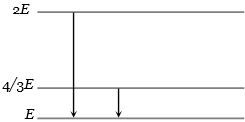
The following diagram indicates the energy levels of a certain atom. When the system moves from the $2E$ level to the $E$ level,a photon of wavelength $\lambda$ is emitted. The wavelength of the photon produced during its transition from the $\frac{4E}{3}$ level to the $E$ level is
A
$\lambda / 3$
B
$3\lambda / 4$
C
$4\lambda / 3$
D
$3\lambda$
Solution
(D) For the transition from $2E$ to $E$:
$\Delta E_1 = 2E - E = E = \frac{hc}{\lambda} \implies E = \frac{hc}{\lambda}$ (Equation $1$)
For the transition from $\frac{4E}{3}$ to $E$:
$\Delta E_2 = \frac{4E}{3} - E = \frac{E}{3} = \frac{hc}{\lambda'}$ (Equation $2$)
Substituting the value of $E$ from Equation $1$ into Equation $2$:
$\frac{1}{3} \left( \frac{hc}{\lambda} \right) = \frac{hc}{\lambda'}$
$\frac{1}{3\lambda} = \frac{1}{\lambda'} \implies \lambda' = 3\lambda$
Therefore,the correct option is $(D)$.
$\Delta E_1 = 2E - E = E = \frac{hc}{\lambda} \implies E = \frac{hc}{\lambda}$ (Equation $1$)
For the transition from $\frac{4E}{3}$ to $E$:
$\Delta E_2 = \frac{4E}{3} - E = \frac{E}{3} = \frac{hc}{\lambda'}$ (Equation $2$)
Substituting the value of $E$ from Equation $1$ into Equation $2$:
$\frac{1}{3} \left( \frac{hc}{\lambda} \right) = \frac{hc}{\lambda'}$
$\frac{1}{3\lambda} = \frac{1}{\lambda'} \implies \lambda' = 3\lambda$
Therefore,the correct option is $(D)$.
0 likes
View Solution9
EasyMCQ
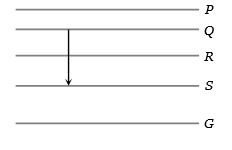
The figure shows the energy levels $P, Q, R, S$ and $G$ of an atom,where $G$ is the ground state. $A$ red line in the emission spectrum of the atom is obtained by an energy level transition from $Q$ to $S$. $A$ blue line can be obtained by which of the following energy level transitions?
A
$P$ to $Q$
B
$Q$ to $R$
C
$R$ to $S$
D
$R$ to $G$
Solution
(D) The energy of a photon emitted during a transition is given by $E = h\nu = \frac{hc}{\lambda}$.
Since the wavelength of blue light is shorter than that of red light $(\lambda_{\text{blue}} < \lambda_{\text{red}})$,the energy of the photon corresponding to the blue line must be greater than the energy of the photon corresponding to the red line $(E_{\text{blue}} > E_{\text{red}})$.
Given that the transition from $Q$ to $S$ corresponds to a red line,we need a transition with a larger energy difference than $E_{Q \to S}$.
Looking at the energy level diagram,the transition from $R$ to $G$ involves a larger energy gap compared to $Q$ to $S$.
Therefore,the transition $R$ to $G$ will emit a photon with higher energy,corresponding to the blue line.
Thus,option $(d)$ is correct.
Since the wavelength of blue light is shorter than that of red light $(\lambda_{\text{blue}} < \lambda_{\text{red}})$,the energy of the photon corresponding to the blue line must be greater than the energy of the photon corresponding to the red line $(E_{\text{blue}} > E_{\text{red}})$.
Given that the transition from $Q$ to $S$ corresponds to a red line,we need a transition with a larger energy difference than $E_{Q \to S}$.
Looking at the energy level diagram,the transition from $R$ to $G$ involves a larger energy gap compared to $Q$ to $S$.
Therefore,the transition $R$ to $G$ will emit a photon with higher energy,corresponding to the blue line.
Thus,option $(d)$ is correct.
0 likes
View Solution10
MediumMCQ
$A$ hydrogen atom (ionisation potential $13.6 \ eV$) makes a transition from the third excited state to the first excited state. The energy of the photon emitted in the process is.......$eV$.
A
$1.89$
B
$2.55$
C
$12.09$
D
$12.75$
Solution
(B) The energy of an electron in the $n^{th}$ orbit of a hydrogen atom is given by $E_n = -\frac{13.6}{n^2} \ eV$.
For the first excited state,$n_1 = 2$.
For the third excited state,$n_2 = 4$.
The energy of the emitted photon is given by the difference in energies: $\Delta E = E_{n_2} - E_{n_1} = 13.6 \left( \frac{1}{n_1^2} - \frac{1}{n_2^2} \right) \ eV$.
Substituting the values: $\Delta E = 13.6 \left( \frac{1}{2^2} - \frac{1}{4^2} \right) = 13.6 \left( \frac{1}{4} - \frac{1}{16} \right) = 13.6 \left( \frac{4-1}{16} \right) = 13.6 \times \frac{3}{16} = 2.55 \ eV$.
For the first excited state,$n_1 = 2$.
For the third excited state,$n_2 = 4$.
The energy of the emitted photon is given by the difference in energies: $\Delta E = E_{n_2} - E_{n_1} = 13.6 \left( \frac{1}{n_1^2} - \frac{1}{n_2^2} \right) \ eV$.
Substituting the values: $\Delta E = 13.6 \left( \frac{1}{2^2} - \frac{1}{4^2} \right) = 13.6 \left( \frac{1}{4} - \frac{1}{16} \right) = 13.6 \left( \frac{4-1}{16} \right) = 13.6 \times \frac{3}{16} = 2.55 \ eV$.
0 likes
View Solution11
EasyMCQ
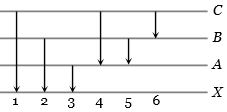
The figure indicates the energy level diagram of an atom and the origin of six spectral lines in emission (e.g.,line no. $5$ arises from the transition from level $B$ to $A$). Which of the following spectral lines will also occur in the absorption spectrum?
A
$1, 4, 6$
B
$4, 5, 6$
C
$1, 2, 3$
D
$1, 2, 3, 4, 5, 6$
Solution
(C) In an absorption spectrum,atoms absorb photons to transition from the ground state to higher energy levels.
In the given diagram,the ground state is represented by level $X$.
Therefore,only transitions starting from level $X$ will appear in the absorption spectrum.
Looking at the diagram,the transitions originating from level $X$ are lines $1, 2,$ and $3$.
Thus,lines $1, 2,$ and $3$ will occur in the absorption spectrum.
In the given diagram,the ground state is represented by level $X$.
Therefore,only transitions starting from level $X$ will appear in the absorption spectrum.
Looking at the diagram,the transitions originating from level $X$ are lines $1, 2,$ and $3$.
Thus,lines $1, 2,$ and $3$ will occur in the absorption spectrum.
0 likes
View Solution12
EasyMCQ
When a hydrogen atom is raised from the ground state to an excited state,
A
$P.E.$ increases and $K.E.$ decreases
B
$P.E.$ decreases and $K.E.$ increases
C
Both kinetic energy and potential energy increase
D
Both $K.E.$ and $P.E.$ decrease
Solution
(A) For a hydrogen atom,the kinetic energy $(K.E.)$ and potential energy $(P.E.)$ of an electron in an orbit of radius $r$ are given by:
$K.E. = \frac{1}{4 \pi \epsilon_0} \frac{e^2}{2r}$
$P.E. = -\frac{1}{4 \pi \epsilon_0} \frac{e^2}{r}$
As the hydrogen atom is raised from the ground state to an excited state,the principal quantum number $n$ increases,which causes the orbital radius $r$ to increase $(r \propto n^2)$.
Since $K.E. \propto \frac{1}{r}$,as $r$ increases,$K.E.$ decreases.
Since $P.E. \propto -\frac{1}{r}$,as $r$ increases,the magnitude of $P.E.$ decreases,but because it is negative,the value of $P.E.$ increases (becomes less negative).
Therefore,$P.E.$ increases and $K.E.$ decreases.
$K.E. = \frac{1}{4 \pi \epsilon_0} \frac{e^2}{2r}$
$P.E. = -\frac{1}{4 \pi \epsilon_0} \frac{e^2}{r}$
As the hydrogen atom is raised from the ground state to an excited state,the principal quantum number $n$ increases,which causes the orbital radius $r$ to increase $(r \propto n^2)$.
Since $K.E. \propto \frac{1}{r}$,as $r$ increases,$K.E.$ decreases.
Since $P.E. \propto -\frac{1}{r}$,as $r$ increases,the magnitude of $P.E.$ decreases,but because it is negative,the value of $P.E.$ increases (becomes less negative).
Therefore,$P.E.$ increases and $K.E.$ decreases.
0 likes
View Solution13
EasyMCQ
In the Bohr model of the hydrogen atom,the lowest orbit corresponds to:
A
Infinite energy
B
The maximum energy
C
The minimum energy
D
Zero energy
Solution
(C) According to the Bohr model of the hydrogen atom,the energy of an electron in the $n^{th}$ orbit is given by $E_n = -\frac{13.6}{n^2} \, eV$.
For the lowest orbit,$n = 1$.
Substituting $n = 1$ into the formula,we get $E_1 = -\frac{13.6}{1^2} = -13.6 \, eV$.
Since $-13.6 \, eV$ is the most negative value possible for the energy levels of a hydrogen atom,it represents the minimum energy state (ground state).
For the lowest orbit,$n = 1$.
Substituting $n = 1$ into the formula,we get $E_1 = -\frac{13.6}{1^2} = -13.6 \, eV$.
Since $-13.6 \, eV$ is the most negative value possible for the energy levels of a hydrogen atom,it represents the minimum energy state (ground state).
0 likes
View Solution14
EasyMCQ
An electron in the $n = 1$ orbit of a hydrogen atom is bound by $13.6 \, eV$. If a hydrogen atom is in the $n = 3$ state,how much energy is required to ionize it?
A
$13.6$
B
$4.53$
C
$3.4$
D
$1.51$
Solution
(D) The energy of an electron in the $n^{th}$ orbit of a hydrogen atom is given by the formula $E_n = -\frac{13.6}{n^2} \, eV$.
For the $n = 3$ state,the energy is $E_3 = -\frac{13.6}{3^2} = -\frac{13.6}{9} \, eV$.
$E_3 = -1.51 \, eV$.
To ionize the atom,we need to provide enough energy to bring the electron to the $n = \infty$ state,where the energy is $0 \, eV$.
The required ionization energy is $\Delta E = E_{\infty} - E_3 = 0 - (-1.51) = 1.51 \, eV$.
For the $n = 3$ state,the energy is $E_3 = -\frac{13.6}{3^2} = -\frac{13.6}{9} \, eV$.
$E_3 = -1.51 \, eV$.
To ionize the atom,we need to provide enough energy to bring the electron to the $n = \infty$ state,where the energy is $0 \, eV$.
The required ionization energy is $\Delta E = E_{\infty} - E_3 = 0 - (-1.51) = 1.51 \, eV$.
0 likes
View Solution15
MediumMCQ
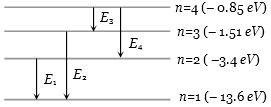
Which of the transitions in a hydrogen atom emits a photon of the lowest frequency? ($n =$ quantum number)
A
$n = 2$ to $n = 1$
B
$n = 4$ to $n = 3$
C
$n = 3$ to $n = 1$
D
$n = 4$ to $n = 2$
Solution
(B) The frequency of the emitted photon is given by $\nu = \frac{\Delta E}{h}$,where $\Delta E$ is the energy difference between the two levels. Since $\nu \propto \Delta E$,the lowest frequency corresponds to the transition with the smallest energy difference.
From the energy level diagram:
For $n = 2$ to $n = 1$: $\Delta E = -3.4 - (-13.6) = 10.2 \, eV$
For $n = 4$ to $n = 3$: $\Delta E = -0.85 - (-1.51) = 0.66 \, eV$
For $n = 3$ to $n = 1$: $\Delta E = -1.51 - (-13.6) = 12.09 \, eV$
For $n = 4$ to $n = 2$: $\Delta E = -0.85 - (-3.4) = 2.55 \, eV$
The transition $n = 4$ to $n = 3$ has the smallest energy difference $(0.66 \, eV)$,and therefore emits a photon of the lowest frequency. Thus,the correct option is $B$.
From the energy level diagram:
For $n = 2$ to $n = 1$: $\Delta E = -3.4 - (-13.6) = 10.2 \, eV$
For $n = 4$ to $n = 3$: $\Delta E = -0.85 - (-1.51) = 0.66 \, eV$
For $n = 3$ to $n = 1$: $\Delta E = -1.51 - (-13.6) = 12.09 \, eV$
For $n = 4$ to $n = 2$: $\Delta E = -0.85 - (-3.4) = 2.55 \, eV$
The transition $n = 4$ to $n = 3$ has the smallest energy difference $(0.66 \, eV)$,and therefore emits a photon of the lowest frequency. Thus,the correct option is $B$.
0 likes
View Solution16
MediumMCQ
In a hydrogen atom,which of the following electronic transitions would involve the maximum energy change?
A
From $n = 2$ to $n = 1$
B
From $n = 3$ to $n = 1$
C
From $n = 4$ to $n = 2$
D
From $n = 3$ to $n = 2$
Solution
(B) The energy of an electron in the $n^{th}$ orbit of a hydrogen atom is given by $E_n = -\frac{13.6}{n^2} \text{ eV}$.
The energy change for a transition from $n_i$ to $n_f$ is $\Delta E = E_{n_i} - E_{n_f} = 13.6 \left( \frac{1}{n_f^2} - \frac{1}{n_i^2} \right) \text{ eV}$.
Calculating the energy change for each option:
$(A)$ $n = 2$ to $n = 1$: $\Delta E = 13.6 \left( \frac{1}{1^2} - \frac{1}{2^2} \right) = 13.6 \times (1 - 0.25) = 10.2 \text{ eV}$.
$(B)$ $n = 3$ to $n = 1$: $\Delta E = 13.6 \left( \frac{1}{1^2} - \frac{1}{3^2} \right) = 13.6 \times (1 - 0.111) = 12.09 \text{ eV}$.
$(C)$ $n = 4$ to $n = 2$: $\Delta E = 13.6 \left( \frac{1}{2^2} - \frac{1}{4^2} \right) = 13.6 \times (0.25 - 0.0625) = 2.55 \text{ eV}$.
$(D)$ $n = 3$ to $n = 2$: $\Delta E = 13.6 \left( \frac{1}{2^2} - \frac{1}{3^2} \right) = 13.6 \times (0.25 - 0.111) = 1.89 \text{ eV}$.
Comparing these values,the transition from $n = 3$ to $n = 1$ involves the maximum energy change of $12.09 \text{ eV}$. Thus,option $(B)$ is correct.
The energy change for a transition from $n_i$ to $n_f$ is $\Delta E = E_{n_i} - E_{n_f} = 13.6 \left( \frac{1}{n_f^2} - \frac{1}{n_i^2} \right) \text{ eV}$.
Calculating the energy change for each option:
$(A)$ $n = 2$ to $n = 1$: $\Delta E = 13.6 \left( \frac{1}{1^2} - \frac{1}{2^2} \right) = 13.6 \times (1 - 0.25) = 10.2 \text{ eV}$.
$(B)$ $n = 3$ to $n = 1$: $\Delta E = 13.6 \left( \frac{1}{1^2} - \frac{1}{3^2} \right) = 13.6 \times (1 - 0.111) = 12.09 \text{ eV}$.
$(C)$ $n = 4$ to $n = 2$: $\Delta E = 13.6 \left( \frac{1}{2^2} - \frac{1}{4^2} \right) = 13.6 \times (0.25 - 0.0625) = 2.55 \text{ eV}$.
$(D)$ $n = 3$ to $n = 2$: $\Delta E = 13.6 \left( \frac{1}{2^2} - \frac{1}{3^2} \right) = 13.6 \times (0.25 - 0.111) = 1.89 \text{ eV}$.
Comparing these values,the transition from $n = 3$ to $n = 1$ involves the maximum energy change of $12.09 \text{ eV}$. Thus,option $(B)$ is correct.
0 likes
View Solution17
MediumMCQ
The minimum energy required to excite a hydrogen atom from its ground state is.....$ eV$.
A
$13.6$
B
$-13.6$
C
$3.4$
D
$10.2$
Solution
(D) The energy of an electron in the $n$-th orbit of a hydrogen atom is given by $E_n = -\frac{13.6}{n^2} \; eV$.
For the ground state $(n=1)$,the energy is $E_1 = -13.6 \; eV$.
To excite the atom to the first excited state $(n=2)$,the energy is $E_2 = -\frac{13.6}{2^2} = -3.4 \; eV$.
The minimum energy required for excitation is $\Delta E = E_2 - E_1 = -3.4 - (-13.6) = 10.2 \; eV$.
For the ground state $(n=1)$,the energy is $E_1 = -13.6 \; eV$.
To excite the atom to the first excited state $(n=2)$,the energy is $E_2 = -\frac{13.6}{2^2} = -3.4 \; eV$.
The minimum energy required for excitation is $\Delta E = E_2 - E_1 = -3.4 - (-13.6) = 10.2 \; eV$.
0 likes
View Solution18
MediumMCQ
The ionisation energy of a hydrogen atom is $13.6 \, eV$. Following Bohr's theory,the energy corresponding to a transition between the $3^{rd}$ and the $4^{th}$ orbit is.....$eV$.
A
$3.40$
B
$1.51$
C
$0.85$
D
$0.66$
Solution
(D) The energy of an electron in the $n^{th}$ orbit of a hydrogen atom is given by the formula: $E_n = -\frac{13.6}{n^2} \, eV$.
For the $3^{rd}$ orbit $(n=3)$: $E_3 = -\frac{13.6}{3^2} = -\frac{13.6}{9} \approx -1.51 \, eV$.
For the $4^{th}$ orbit $(n=4)$: $E_4 = -\frac{13.6}{4^2} = -\frac{13.6}{16} = -0.85 \, eV$.
The energy difference for a transition between the $4^{th}$ and $3^{rd}$ orbit is: $\Delta E = E_4 - E_3 = -0.85 - (-1.51) = 0.66 \, eV$.
For the $3^{rd}$ orbit $(n=3)$: $E_3 = -\frac{13.6}{3^2} = -\frac{13.6}{9} \approx -1.51 \, eV$.
For the $4^{th}$ orbit $(n=4)$: $E_4 = -\frac{13.6}{4^2} = -\frac{13.6}{16} = -0.85 \, eV$.
The energy difference for a transition between the $4^{th}$ and $3^{rd}$ orbit is: $\Delta E = E_4 - E_3 = -0.85 - (-1.51) = 0.66 \, eV$.
0 likes
View Solution19
MediumMCQ
$A$ hydrogen atom emits blue light when it changes from the $n = 4$ energy level to the $n = 2$ level. Which colour of light would the atom emit when it changes from the $n = 5$ level to the $n = 2$ level?
A
Red
B
Yellow
C
Green
D
Violet
Solution
(D) The energy of a photon emitted during a transition between energy levels $n_i$ and $n_f$ is given by $\Delta E = 13.6 \left( \frac{1}{n_f^2} - \frac{1}{n_i^2} \right) \text{ eV}$.
For the transition $n = 4 \to n = 2$,the energy emitted corresponds to blue light.
For the transition $n = 5 \to n = 2$,the energy difference is $\Delta E_{5 \to 2} = 13.6 \left( \frac{1}{2^2} - \frac{1}{5^2} \right) = 13.6 \left( \frac{1}{4} - \frac{1}{25} \right) = 13.6 \left( \frac{21}{100} \right) = 2.856 \text{ eV}$.
For the transition $n = 4 \to n = 2$,the energy difference is $\Delta E_{4 \to 2} = 13.6 \left( \frac{1}{2^2} - \frac{1}{4^2} \right) = 13.6 \left( \frac{1}{4} - \frac{1}{16} \right) = 13.6 \left( \frac{3}{16} \right) = 2.55 \text{ eV}$.
Since $\Delta E_{5 \to 2} > \Delta E_{4 \to 2}$,the frequency of the emitted light will be higher,and the wavelength will be shorter.
In the visible spectrum,violet light has a higher frequency and shorter wavelength than blue light. Therefore,the atom emits violet light.
For the transition $n = 4 \to n = 2$,the energy emitted corresponds to blue light.
For the transition $n = 5 \to n = 2$,the energy difference is $\Delta E_{5 \to 2} = 13.6 \left( \frac{1}{2^2} - \frac{1}{5^2} \right) = 13.6 \left( \frac{1}{4} - \frac{1}{25} \right) = 13.6 \left( \frac{21}{100} \right) = 2.856 \text{ eV}$.
For the transition $n = 4 \to n = 2$,the energy difference is $\Delta E_{4 \to 2} = 13.6 \left( \frac{1}{2^2} - \frac{1}{4^2} \right) = 13.6 \left( \frac{1}{4} - \frac{1}{16} \right) = 13.6 \left( \frac{3}{16} \right) = 2.55 \text{ eV}$.
Since $\Delta E_{5 \to 2} > \Delta E_{4 \to 2}$,the frequency of the emitted light will be higher,and the wavelength will be shorter.
In the visible spectrum,violet light has a higher frequency and shorter wavelength than blue light. Therefore,the atom emits violet light.
0 likes
View Solution20
EasyMCQ
The energy of a hydrogen atom in its ground state is $-13.6 \ eV$. The energy of the level corresponding to the quantum number $n = 2$ (first excited state) in the hydrogen atom is......$eV$.
A
$-2.72$
B
$-0.85$
C
$-0.54$
D
$-3.4$
Solution
(D) The energy of an electron in the $n^{th}$ orbit of a hydrogen atom is given by the formula: $E_n = \frac{-13.6 \ eV}{n^2}$.
For the first excited state,the quantum number is $n = 2$.
Substituting $n = 2$ into the formula:
$E_2 = \frac{-13.6 \ eV}{2^2} = \frac{-13.6 \ eV}{4} = -3.4 \ eV$.
For the first excited state,the quantum number is $n = 2$.
Substituting $n = 2$ into the formula:
$E_2 = \frac{-13.6 \ eV}{2^2} = \frac{-13.6 \ eV}{4} = -3.4 \ eV$.
0 likes
View Solution21
EasyMCQ
The energy of an electron in the first excited state of an $H$-atom is $-3.4 \ eV$. Its kinetic energy is ........ $eV$.
A
$-3.4$
B
$+3.4$
C
$-6.8$
D
$6.8$
Solution
(B) For an electron in a hydrogen atom,the total energy $(E)$,kinetic energy $(K)$,and potential energy $(U)$ are related as follows:
$E = -K$
$U = 2E = -2K$
Given that the total energy of the electron in the first excited state is $E = -3.4 \ eV$.
Therefore,the kinetic energy $K = -E = -(-3.4 \ eV) = +3.4 \ eV$.
Thus,the correct option is $B$.
$E = -K$
$U = 2E = -2K$
Given that the total energy of the electron in the first excited state is $E = -3.4 \ eV$.
Therefore,the kinetic energy $K = -E = -(-3.4 \ eV) = +3.4 \ eV$.
Thus,the correct option is $B$.
0 likes
View Solution22
MediumMCQ
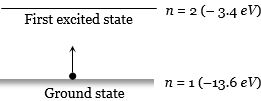
The energy required to excite an electron from the ground state of a hydrogen atom to the first excited state is:
A
$1.602 \times 10^{-14} \, J$
B
$1.619 \times 10^{-16} \, J$
C
$1.632 \times 10^{-18} \, J$
D
$1.656 \times 10^{-20} \, J$
Solution
(C) The energy of an electron in the $n$-th orbit of a hydrogen atom is given by $E_n = -\frac{13.6}{n^2} \, eV$.
For the ground state $(n = 1)$,$E_1 = -13.6 \, eV$.
For the first excited state $(n = 2)$,$E_2 = -\frac{13.6}{2^2} = -3.4 \, eV$.
The energy required to excite the electron from $n = 1$ to $n = 2$ is $\Delta E = E_2 - E_1 = -3.4 \, eV - (-13.6 \, eV) = 10.2 \, eV$.
To convert this energy into Joules,we multiply by the conversion factor $1.6 \times 10^{-19} \, J/eV$:
$\Delta E = 10.2 \times 1.6 \times 10^{-19} \, J = 16.32 \times 10^{-19} \, J = 1.632 \times 10^{-18} \, J$.
Thus,the correct option is $C$.
For the ground state $(n = 1)$,$E_1 = -13.6 \, eV$.
For the first excited state $(n = 2)$,$E_2 = -\frac{13.6}{2^2} = -3.4 \, eV$.
The energy required to excite the electron from $n = 1$ to $n = 2$ is $\Delta E = E_2 - E_1 = -3.4 \, eV - (-13.6 \, eV) = 10.2 \, eV$.
To convert this energy into Joules,we multiply by the conversion factor $1.6 \times 10^{-19} \, J/eV$:
$\Delta E = 10.2 \times 1.6 \times 10^{-19} \, J = 16.32 \times 10^{-19} \, J = 1.632 \times 10^{-18} \, J$.
Thus,the correct option is $C$.
0 likes
View Solution23
EasyMCQ
Which of the following phenomena suggests the presence of electron energy levels in atoms?
A
Radioactive decay
B
Isotopes
C
Spectral lines
D
$ \alpha $-particles scattering
Solution
(C) The existence of discrete spectral lines in the emission or absorption spectra of atoms provides direct evidence for the quantization of electron energy levels. According to the Bohr model,when an electron transitions between two energy levels $E_2$ and $E_1$,it emits or absorbs a photon with energy $h\nu = E_2 - E_1$. Since only specific energy levels are allowed,only specific frequencies of light are observed,resulting in distinct spectral lines.
0 likes
View Solution24
EasyMCQ
The energy of an electron in an orbit of an $H$-atom is:
A
Positive
B
Negative
C
Zero
D
Nothing can be said
Solution
(B) The total energy of an electron in the $n^{th}$ orbit of a hydrogen atom is given by the formula: $E_n = -\frac{13.6}{n^2} \text{ eV}$.
Since the value of $n$ (the principal quantum number) is always a positive integer $(n = 1, 2, 3, ...)$,the term $\frac{13.6}{n^2}$ is always positive.
Therefore,the total energy $E_n$ is always negative,which indicates that the electron is bound to the nucleus.
Since the value of $n$ (the principal quantum number) is always a positive integer $(n = 1, 2, 3, ...)$,the term $\frac{13.6}{n^2}$ is always positive.
Therefore,the total energy $E_n$ is always negative,which indicates that the electron is bound to the nucleus.
0 likes
View Solution25
MediumMCQ
In a hydrogen atom,if the difference in the energy of the electron in $n = 2$ and $n = 3$ orbits is $E,$ the ionization energy of the hydrogen atom is ....... $E$.
A
$13.2$
B
$7.2$
C
$5.6$
D
$3.2$
Solution
(B) The energy of an electron in the $n$-th orbit of a hydrogen atom is given by $E_n = -\frac{13.6 \text{ eV}}{n^2}$.
The energy difference between $n=2$ and $n=3$ is given as $E = E_3 - E_2$.
$E = -\frac{13.6}{3^2} - \left( -\frac{13.6}{2^2} \right) = 13.6 \left( \frac{1}{4} - \frac{1}{9} \right) = 13.6 \left( \frac{5}{36} \right)$.
Thus,$13.6 = E \times \frac{36}{5} = 7.2 E$.
The ionization energy of a hydrogen atom is the energy required to move an electron from $n=1$ to $n=\infty$,which is $E_{\infty} - E_1 = 0 - (-13.6) = 13.6 \text{ eV}$.
Therefore,the ionization energy is $7.2 E$.
The energy difference between $n=2$ and $n=3$ is given as $E = E_3 - E_2$.
$E = -\frac{13.6}{3^2} - \left( -\frac{13.6}{2^2} \right) = 13.6 \left( \frac{1}{4} - \frac{1}{9} \right) = 13.6 \left( \frac{5}{36} \right)$.
Thus,$13.6 = E \times \frac{36}{5} = 7.2 E$.
The ionization energy of a hydrogen atom is the energy required to move an electron from $n=1$ to $n=\infty$,which is $E_{\infty} - E_1 = 0 - (-13.6) = 13.6 \text{ eV}$.
Therefore,the ionization energy is $7.2 E$.
0 likes
View Solution26
MediumMCQ
The electron in a hydrogen atom makes a transition from an excited state to the ground state. Which of the following statements is true?
A
Its kinetic energy increases and its potential and total energies decrease.
B
Its kinetic energy decreases,potential energy increases and its total energy remains the same.
C
Its kinetic and total energies decrease and its potential energy increases.
D
Its kinetic,potential and total energies decrease.
Solution
(A) For a hydrogen atom,the total energy $E_n$,potential energy $U_n$,and kinetic energy $K_n$ are given by:
$E_n = -13.6 \frac{Z^2}{n^2} \text{ eV}$
$U_n = 2E_n = -27.2 \frac{Z^2}{n^2} \text{ eV}$
$K_n = |E_n| = 13.6 \frac{Z^2}{n^2} \text{ eV}$
When an electron transitions from an excited state $(n > 1)$ to the ground state $(n = 1)$,the value of $n$ decreases.
As $n$ decreases,$K_n$ increases because it is proportional to $1/n^2$.
Since $E_n$ and $U_n$ are negative and their magnitudes decrease as $n$ decreases,their values become more negative,meaning they decrease.
Therefore,kinetic energy increases,while potential and total energies decrease.
$E_n = -13.6 \frac{Z^2}{n^2} \text{ eV}$
$U_n = 2E_n = -27.2 \frac{Z^2}{n^2} \text{ eV}$
$K_n = |E_n| = 13.6 \frac{Z^2}{n^2} \text{ eV}$
When an electron transitions from an excited state $(n > 1)$ to the ground state $(n = 1)$,the value of $n$ decreases.
As $n$ decreases,$K_n$ increases because it is proportional to $1/n^2$.
Since $E_n$ and $U_n$ are negative and their magnitudes decrease as $n$ decreases,their values become more negative,meaning they decrease.
Therefore,kinetic energy increases,while potential and total energies decrease.
0 likes
View Solution27
EasyMCQ
The energy of a hydrogen atom in its ground state is $-13.6 \, eV$. The energy of the level corresponding to the quantum number $n = 5$ is ...... $eV$.
A
$-5.40$
B
$-2.72$
C
$-0.85$
D
$-0.54$
Solution
(D) The energy of an electron in the $n^{th}$ orbit of a hydrogen atom is given by the formula:
$E_n = \frac{-13.6}{n^2} \, eV$
Given the quantum number $n = 5$,we substitute this value into the formula:
$E_5 = \frac{-13.6}{5^2} \, eV$
$E_5 = \frac{-13.6}{25} \, eV$
$E_5 = -0.544 \, eV$
Rounding to two decimal places,we get $E_5 = -0.54 \, eV$.
$E_n = \frac{-13.6}{n^2} \, eV$
Given the quantum number $n = 5$,we substitute this value into the formula:
$E_5 = \frac{-13.6}{5^2} \, eV$
$E_5 = \frac{-13.6}{25} \, eV$
$E_5 = -0.544 \, eV$
Rounding to two decimal places,we get $E_5 = -0.54 \, eV$.
0 likes
View Solution28
EasyMCQ
In the following transitions of a hydrogen atom,which one corresponds to the highest frequency of emitted radiation?
A
$3 \rightarrow 2$
B
$4 \rightarrow 3$
C
$4 \rightarrow 2$
D
$3 \rightarrow 1$
Solution
(D) The energy of a photon emitted during a transition between energy levels $n_i$ and $n_f$ is given by $\Delta E = 13.6 \left( \frac{1}{n_f^2} - \frac{1}{n_i^2} \right) \text{ eV}$.
Frequency $\nu$ is related to energy by $\nu = \frac{\Delta E}{h}$.
Calculating the energy differences for the given transitions:
$(a)$ $3 \rightarrow 2$: $\Delta E \propto \left( \frac{1}{4} - \frac{1}{9} \right) = \frac{5}{36} \approx 0.138$
$(b)$ $4 \rightarrow 3$: $\Delta E \propto \left( \frac{1}{9} - \frac{1}{16} \right) = \frac{7}{144} \approx 0.048$
$(c)$ $4 \rightarrow 2$: $\Delta E \propto \left( \frac{1}{4} - \frac{1}{16} \right) = \frac{3}{16} = 0.1875$
$(d)$ $3 \rightarrow 1$: $\Delta E \propto \left( \frac{1}{1} - \frac{1}{9} \right) = \frac{8}{9} \approx 0.888$
Since the transition $3 \rightarrow 1$ has the largest energy difference,it corresponds to the highest frequency.
Frequency $\nu$ is related to energy by $\nu = \frac{\Delta E}{h}$.
Calculating the energy differences for the given transitions:
$(a)$ $3 \rightarrow 2$: $\Delta E \propto \left( \frac{1}{4} - \frac{1}{9} \right) = \frac{5}{36} \approx 0.138$
$(b)$ $4 \rightarrow 3$: $\Delta E \propto \left( \frac{1}{9} - \frac{1}{16} \right) = \frac{7}{144} \approx 0.048$
$(c)$ $4 \rightarrow 2$: $\Delta E \propto \left( \frac{1}{4} - \frac{1}{16} \right) = \frac{3}{16} = 0.1875$
$(d)$ $3 \rightarrow 1$: $\Delta E \propto \left( \frac{1}{1} - \frac{1}{9} \right) = \frac{8}{9} \approx 0.888$
Since the transition $3 \rightarrow 1$ has the largest energy difference,it corresponds to the highest frequency.
0 likes
View Solution29
MediumMCQ
An electron jumps from the $5^{th}$ orbit to the $4^{th}$ orbit of a hydrogen atom. Taking the Rydberg constant as $10^7 \ m^{-1}$,what will be the frequency of the radiation emitted?
A
$6.75 \times 10^{12} \ Hz$
B
$6.75 \times 10^{14} \ Hz$
C
$6.75 \times 10^{13} \ Hz$
D
None of these
Solution
(C) The frequency $\nu$ of the emitted radiation is given by the formula: $\nu = RC \left[ \frac{1}{n_1^2} - \frac{1}{n_2^2} \right]$
Here,$R = 10^7 \ m^{-1}$,$C = 3 \times 10^8 \ m/s$,$n_1 = 4$,and $n_2 = 5$.
Substituting the values:
$\nu = (10^7) \times (3 \times 10^8) \left[ \frac{1}{4^2} - \frac{1}{5^2} \right]$
$\nu = 3 \times 10^{15} \left[ \frac{1}{16} - \frac{1}{25} \right]$
$\nu = 3 \times 10^{15} \left[ \frac{25 - 16}{400} \right]$
$\nu = 3 \times 10^{15} \left[ \frac{9}{400} \right]$
$\nu = \frac{27}{400} \times 10^{15} = 0.0675 \times 10^{15} \ Hz = 6.75 \times 10^{13} \ Hz$.
Here,$R = 10^7 \ m^{-1}$,$C = 3 \times 10^8 \ m/s$,$n_1 = 4$,and $n_2 = 5$.
Substituting the values:
$\nu = (10^7) \times (3 \times 10^8) \left[ \frac{1}{4^2} - \frac{1}{5^2} \right]$
$\nu = 3 \times 10^{15} \left[ \frac{1}{16} - \frac{1}{25} \right]$
$\nu = 3 \times 10^{15} \left[ \frac{25 - 16}{400} \right]$
$\nu = 3 \times 10^{15} \left[ \frac{9}{400} \right]$
$\nu = \frac{27}{400} \times 10^{15} = 0.0675 \times 10^{15} \ Hz = 6.75 \times 10^{13} \ Hz$.
0 likes
View Solution30
EasyMCQ
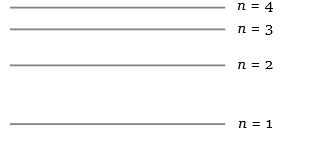
The four lowest energy levels of an $H$-atom are shown in the figure. The number of possible emission lines would be
A
$3$
B
$4$
C
$5$
D
$6$
Solution
(D) The number of possible emission lines when an electron transitions from an excited state $n$ to lower energy states is given by the formula:
$N = \frac{n(n - 1)}{2}$
Here,the highest energy level is $n = 4$.
Substituting $n = 4$ into the formula:
$N = \frac{4(4 - 1)}{2} = \frac{4 \times 3}{2} = \frac{12}{2} = 6$
Thus,there are $6$ possible emission lines corresponding to the transitions: $4 \to 3, 4 \to 2, 4 \to 1, 3 \to 2, 3 \to 1,$ and $2 \to 1$.
$N = \frac{n(n - 1)}{2}$
Here,the highest energy level is $n = 4$.
Substituting $n = 4$ into the formula:
$N = \frac{4(4 - 1)}{2} = \frac{4 \times 3}{2} = \frac{12}{2} = 6$
Thus,there are $6$ possible emission lines corresponding to the transitions: $4 \to 3, 4 \to 2, 4 \to 1, 3 \to 2, 3 \to 1,$ and $2 \to 1$.
0 likes
View Solution31
MediumMCQ
Energy of the electron in $n^{th}$ orbit of hydrogen atom is given by $E_n = - \frac{13.6}{n^2} \ eV$. The amount of energy needed to transfer an electron from the first orbit to the third orbit is........$eV$.
A
$13.6$
B
$3.4$
C
$12.09$
D
$1.51$
Solution
(C) The energy of an electron in the $n^{th}$ orbit is given by $E_n = - \frac{13.6}{n^2} \ eV$.
For the first orbit $(n = 1)$:
$E_1 = - \frac{13.6}{1^2} = - 13.6 \ eV$.
For the third orbit $(n = 3)$:
$E_3 = - \frac{13.6}{3^2} = - \frac{13.6}{9} = - 1.51 \ eV$.
The energy required to transfer the electron from the first orbit to the third orbit is $\Delta E = E_3 - E_1$.
$\Delta E = - 1.51 - (- 13.6) = - 1.51 + 13.6 = 12.09 \ eV$.
For the first orbit $(n = 1)$:
$E_1 = - \frac{13.6}{1^2} = - 13.6 \ eV$.
For the third orbit $(n = 3)$:
$E_3 = - \frac{13.6}{3^2} = - \frac{13.6}{9} = - 1.51 \ eV$.
The energy required to transfer the electron from the first orbit to the third orbit is $\Delta E = E_3 - E_1$.
$\Delta E = - 1.51 - (- 13.6) = - 1.51 + 13.6 = 12.09 \ eV$.
0 likes
View Solution32
MediumMCQ
In a hydrogen atom,when an electron jumps from the second to the first orbit,the energy emitted is:
A
$13.6 \ eV$
B
$27.2 \ eV$
C
$10.2 \ eV$
D
None of these
Solution
(D) The energy of an electron in the $n^{th}$ orbit of a hydrogen atom is given by $E_n = -\frac{13.6}{n^2} \ eV$.
When an electron jumps from an initial orbit $n_1 = 2$ to a final orbit $n_2 = 1$,the energy emitted is given by the difference in energy levels:
$\Delta E = E_{n_1} - E_{n_2} = -13.6 \left( \frac{1}{n_1^2} - \frac{1}{n_2^2} \right)$ (for emitted energy,we take the magnitude of the change).
$\Delta E = -13.6 \left( \frac{1}{2^2} - \frac{1}{1^2} \right) \ eV$
$\Delta E = -13.6 \left( \frac{1}{4} - 1 \right) \ eV$
$\Delta E = -13.6 \left( -\frac{3}{4} \right) \ eV$
$\Delta E = 10.2 \ eV$.
Since the question asks for the energy emitted,the value is $10.2 \ eV$. None of the provided options match this result.
When an electron jumps from an initial orbit $n_1 = 2$ to a final orbit $n_2 = 1$,the energy emitted is given by the difference in energy levels:
$\Delta E = E_{n_1} - E_{n_2} = -13.6 \left( \frac{1}{n_1^2} - \frac{1}{n_2^2} \right)$ (for emitted energy,we take the magnitude of the change).
$\Delta E = -13.6 \left( \frac{1}{2^2} - \frac{1}{1^2} \right) \ eV$
$\Delta E = -13.6 \left( \frac{1}{4} - 1 \right) \ eV$
$\Delta E = -13.6 \left( -\frac{3}{4} \right) \ eV$
$\Delta E = 10.2 \ eV$.
Since the question asks for the energy emitted,the value is $10.2 \ eV$. None of the provided options match this result.
0 likes
View Solution33
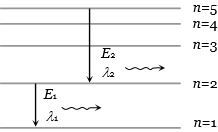
EasyMCQ
Which of the following transitions will have the highest emission wavelength?
A
$n = 2$ to $n = 1$
B
$n = 1$ to $n = 2$
C
$n = 2$ to $n = 5$
D
$n = 5$ to $n = 2$
Solution
(D) The energy of a photon emitted during a transition is given by $\Delta E = E_i - E_f = \frac{hc}{\lambda}$.
Since $\lambda = \frac{hc}{\Delta E}$,the wavelength $\lambda$ is inversely proportional to the energy difference $\Delta E$ of the transition.
Emission occurs when an electron moves from a higher energy level to a lower energy level.
Comparing the given transitions:
$(A)$ $n = 2$ to $n = 1$: Large energy difference.
$(B)$ $n = 1$ to $n = 2$: Absorption,not emission.
$(C)$ $n = 2$ to $n = 5$: Absorption,not emission.
$(D)$ $n = 5$ to $n = 2$: Smaller energy difference compared to $n = 2$ to $n = 1$.
Since $\Delta E$ for $n = 5 \to 2$ is smaller than $\Delta E$ for $n = 2 \to 1$,the wavelength $\lambda$ for the $n = 5 \to 2$ transition will be larger.
Therefore,the correct option is $(D)$.
Since $\lambda = \frac{hc}{\Delta E}$,the wavelength $\lambda$ is inversely proportional to the energy difference $\Delta E$ of the transition.
Emission occurs when an electron moves from a higher energy level to a lower energy level.
Comparing the given transitions:
$(A)$ $n = 2$ to $n = 1$: Large energy difference.
$(B)$ $n = 1$ to $n = 2$: Absorption,not emission.
$(C)$ $n = 2$ to $n = 5$: Absorption,not emission.
$(D)$ $n = 5$ to $n = 2$: Smaller energy difference compared to $n = 2$ to $n = 1$.
Since $\Delta E$ for $n = 5 \to 2$ is smaller than $\Delta E$ for $n = 2 \to 1$,the wavelength $\lambda$ for the $n = 5 \to 2$ transition will be larger.
Therefore,the correct option is $(D)$.
0 likes
View Solution34
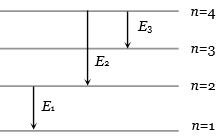
EasyMCQ
With the increase in principal quantum number,the energy difference between two successive energy levels
A
Increases
B
Decreases
C
Remains constant
D
Sometimes increases and sometimes decreases
Solution
(B) The energy of an electron in the $n^{th}$ orbit of a hydrogen atom is given by $E_n = -\frac{13.6}{n^2} \text{ eV}$.
The energy difference between two successive levels $n$ and $n+1$ is $\Delta E = E_{n+1} - E_n = -13.6 \left( \frac{1}{(n+1)^2} - \frac{1}{n^2} \right) = 13.6 \left( \frac{1}{n^2} - \frac{1}{(n+1)^2} \right) = 13.6 \left( \frac{(n+1)^2 - n^2}{n^2(n+1)^2} \right) = 13.6 \left( \frac{2n+1}{n^2(n+1)^2} \right)$.
As the principal quantum number $n$ increases,the denominator $n^2(n+1)^2$ increases much faster than the numerator $(2n+1)$.
Therefore,the energy difference $\Delta E$ decreases as $n$ increases.
From the provided image,we can see that the energy gap between levels decreases as we move to higher energy states: $E_1 > E_2 > E_3$.
The energy difference between two successive levels $n$ and $n+1$ is $\Delta E = E_{n+1} - E_n = -13.6 \left( \frac{1}{(n+1)^2} - \frac{1}{n^2} \right) = 13.6 \left( \frac{1}{n^2} - \frac{1}{(n+1)^2} \right) = 13.6 \left( \frac{(n+1)^2 - n^2}{n^2(n+1)^2} \right) = 13.6 \left( \frac{2n+1}{n^2(n+1)^2} \right)$.
As the principal quantum number $n$ increases,the denominator $n^2(n+1)^2$ increases much faster than the numerator $(2n+1)$.
Therefore,the energy difference $\Delta E$ decreases as $n$ increases.
From the provided image,we can see that the energy gap between levels decreases as we move to higher energy states: $E_1 > E_2 > E_3$.
0 likes
View Solution35
MediumMCQ
If the binding energy of the electron in a hydrogen atom is $13.6 \ eV$,the energy required to remove the electron from the first excited state of $Li^{++}$ is.....$eV$.
A
$122.4$
B
$30.6$
C
$13.6$
D
$3.4$
Solution
(B) The energy of an electron in the $n^{th}$ orbit of a hydrogen-like atom is given by the formula $E_n = -\frac{13.6 \ Z^2}{n^2} \ eV$.
For $Li^{++}$ (Lithium ion),the atomic number $Z = 3$.
The first excited state corresponds to $n = 2$.
Substituting these values into the formula,the energy of the electron in the first excited state is $E_2 = -\frac{13.6 \times 3^2}{2^2} = -\frac{13.6 \times 9}{4} = -30.6 \ eV$.
The binding energy (energy required to remove the electron) is the magnitude of this energy,which is $30.6 \ eV$.
For $Li^{++}$ (Lithium ion),the atomic number $Z = 3$.
The first excited state corresponds to $n = 2$.
Substituting these values into the formula,the energy of the electron in the first excited state is $E_2 = -\frac{13.6 \times 3^2}{2^2} = -\frac{13.6 \times 9}{4} = -30.6 \ eV$.
The binding energy (energy required to remove the electron) is the magnitude of this energy,which is $30.6 \ eV$.
0 likes
View Solution36
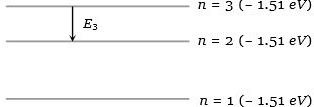
MediumMCQ
The energy $E$ of a hydrogen atom with principal quantum number $n$ is given by $E = \frac{-13.6}{n^2} \; eV$. The energy of a photon emitted when the electron jumps from the $n = 3$ state to the $n = 2$ state of hydrogen is approximately......$eV$.
A
$1.5$
B
$0.85$
C
$3.4$
D
$1.9$
Solution
(D) The energy of an electron in the $n$-th orbit is given by $E_n = \frac{-13.6}{n^2} \; eV$.
For $n = 3$,$E_3 = \frac{-13.6}{3^2} = \frac{-13.6}{9} \approx -1.51 \; eV$.
For $n = 2$,$E_2 = \frac{-13.6}{2^2} = \frac{-13.6}{4} = -3.4 \; eV$.
The energy of the emitted photon is equal to the difference in energy between the two states:
$\Delta E = E_3 - E_2 = -1.51 - (-3.4) = -1.51 + 3.4 = 1.89 \; eV$.
Rounding to one decimal place,the energy is approximately $1.9 \; eV$.
For $n = 3$,$E_3 = \frac{-13.6}{3^2} = \frac{-13.6}{9} \approx -1.51 \; eV$.
For $n = 2$,$E_2 = \frac{-13.6}{2^2} = \frac{-13.6}{4} = -3.4 \; eV$.
The energy of the emitted photon is equal to the difference in energy between the two states:
$\Delta E = E_3 - E_2 = -1.51 - (-3.4) = -1.51 + 3.4 = 1.89 \; eV$.
Rounding to one decimal place,the energy is approximately $1.9 \; eV$.
0 likes
View Solution37
MediumMCQ
The energy of the highest energy photon of the Balmer series of the hydrogen spectrum is close to $... eV$.
A
$13.6$
B
$3.4$
C
$1.5$
D
$0.85$
Solution
(B) The energy of a photon emitted during a transition in a hydrogen atom is given by the formula: $E = 13.6 \left[ \frac{1}{n_1^2} - \frac{1}{n_2^2} \right] eV$.
For the Balmer series,the transition ends at the energy level $n_1 = 2$.
The highest energy photon corresponds to the transition from the highest possible energy level,which is $n_2 = \infty$.
Substituting these values into the formula:
$E = 13.6 \left[ \frac{1}{2^2} - \frac{1}{\infty^2} \right] eV$
$E = 13.6 \left[ \frac{1}{4} - 0 \right] eV$
$E = \frac{13.6}{4} eV = 3.4 eV$.
Therefore,the energy of the highest energy photon of the Balmer series is $3.4 eV$.
For the Balmer series,the transition ends at the energy level $n_1 = 2$.
The highest energy photon corresponds to the transition from the highest possible energy level,which is $n_2 = \infty$.
Substituting these values into the formula:
$E = 13.6 \left[ \frac{1}{2^2} - \frac{1}{\infty^2} \right] eV$
$E = 13.6 \left[ \frac{1}{4} - 0 \right] eV$
$E = \frac{13.6}{4} eV = 3.4 eV$.
Therefore,the energy of the highest energy photon of the Balmer series is $3.4 eV$.
0 likes
View Solution38
MediumMCQ
Energy of an electron in $n^{th}$ orbit of hydrogen atom is $\left( {k = \frac{1}{{4\pi {\varepsilon _0}}}} \right)$
A
$ - \frac{{2{\pi ^2}{k^2}m{e^4}}}{{{n^2}{h^2}}}$
B
$ - \frac{{4{\pi ^2}mk{e^2}}}{{{n^2}{h^2}}}$
C
$ - \frac{{{n^2}{h^2}}}{{2\pi km{e^4}}}$
D
$ - \frac{{{n^2}{h^2}}}{{4{\pi ^2}km{e^2}}}$
Solution
(A) According to Bohr's postulates,the centripetal force required for an electron of mass $m$ and velocity $v$ to revolve in an orbit of radius $r$ is provided by the electrostatic force of attraction between the nucleus (charge $+e$) and the electron (charge $-e$):
$\frac{mv^2}{r} = \frac{ke^2}{r^2} \implies mv^2 = \frac{ke^2}{r} \quad (1)$
From Bohr's quantization condition,the angular momentum is quantized:
$mvr = \frac{nh}{2\pi} \implies v = \frac{nh}{2\pi mr} \quad (2)$
Substituting $(2)$ into $(1)$:
$m\left(\frac{nh}{2\pi mr}\right)^2 = \frac{ke^2}{r} \implies \frac{n^2h^2}{4\pi^2mr^2} = \frac{ke^2}{r} \implies r = \frac{n^2h^2}{4\pi^2kme^2}$
The kinetic energy $E_K$ is:
$E_K = \frac{1}{2}mv^2 = \frac{1}{2}\left(\frac{ke^2}{r}\right) = \frac{ke^2}{2} \left(\frac{4\pi^2kme^2}{n^2h^2}\right) = \frac{2\pi^2k^2me^4}{n^2h^2}$
The potential energy $E_p$ is:
$E_p = -\frac{ke^2}{r} = -ke^2 \left(\frac{4\pi^2kme^2}{n^2h^2}\right) = -\frac{4\pi^2k^2me^4}{n^2h^2}$
The total energy $E$ is the sum of kinetic and potential energy:
$E = E_K + E_p = \frac{2\pi^2k^2me^4}{n^2h^2} - \frac{4\pi^2k^2me^4}{n^2h^2} = -\frac{2\pi^2k^2me^4}{n^2h^2}$
$\frac{mv^2}{r} = \frac{ke^2}{r^2} \implies mv^2 = \frac{ke^2}{r} \quad (1)$
From Bohr's quantization condition,the angular momentum is quantized:
$mvr = \frac{nh}{2\pi} \implies v = \frac{nh}{2\pi mr} \quad (2)$
Substituting $(2)$ into $(1)$:
$m\left(\frac{nh}{2\pi mr}\right)^2 = \frac{ke^2}{r} \implies \frac{n^2h^2}{4\pi^2mr^2} = \frac{ke^2}{r} \implies r = \frac{n^2h^2}{4\pi^2kme^2}$
The kinetic energy $E_K$ is:
$E_K = \frac{1}{2}mv^2 = \frac{1}{2}\left(\frac{ke^2}{r}\right) = \frac{ke^2}{2} \left(\frac{4\pi^2kme^2}{n^2h^2}\right) = \frac{2\pi^2k^2me^4}{n^2h^2}$
The potential energy $E_p$ is:
$E_p = -\frac{ke^2}{r} = -ke^2 \left(\frac{4\pi^2kme^2}{n^2h^2}\right) = -\frac{4\pi^2k^2me^4}{n^2h^2}$
The total energy $E$ is the sum of kinetic and potential energy:
$E = E_K + E_p = \frac{2\pi^2k^2me^4}{n^2h^2} - \frac{4\pi^2k^2me^4}{n^2h^2} = -\frac{2\pi^2k^2me^4}{n^2h^2}$
0 likes
View Solution39
EasyMCQ
The ground state energy of a hydrogen atom is $-13.6 \, eV$. What is the potential energy of the electron in this state in $eV$ (in $, eV$)?
A
$0$
B
$-27.2$
C
$13.6$
D
$27.2$
Solution
(B) For a hydrogen atom,the total energy $(E)$,kinetic energy $(K)$,and potential energy $(U)$ are related as follows:
$E = -K$
$U = 2E$
Given the ground state energy $E = -13.6 \, eV$.
Therefore,the potential energy $U = 2 \times (-13.6 \, eV) = -27.2 \, eV$.
$E = -K$
$U = 2E$
Given the ground state energy $E = -13.6 \, eV$.
Therefore,the potential energy $U = 2 \times (-13.6 \, eV) = -27.2 \, eV$.
0 likes
View Solution40
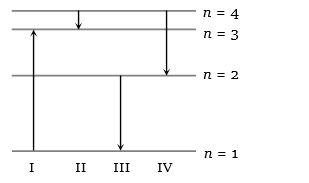
MediumMCQ
The diagram shows the energy levels for an electron in a certain atom. Which transition shown represents the emission of a photon with the most energy?
A
$I$
B
$II$
C
$III$
D
$IV$
Solution
(D) The energy of an emitted photon is given by $\Delta E = E_{initial} - E_{final}$.
Emission occurs when an electron transitions from a higher energy level to a lower energy level.
Transitions $II$ and $IV$ represent emission.
Transition $II$ is from $n=4$ to $n=3$,and transition $IV$ is from $n=4$ to $n=2$.
The energy difference $\Delta E$ is proportional to the gap between the energy levels.
Since the gap between $n=4$ and $n=2$ is larger than the gap between $n=4$ and $n=3$,transition $IV$ releases more energy than transition $II$.
Therefore,transition $IV$ represents the emission of a photon with the most energy.
Emission occurs when an electron transitions from a higher energy level to a lower energy level.
Transitions $II$ and $IV$ represent emission.
Transition $II$ is from $n=4$ to $n=3$,and transition $IV$ is from $n=4$ to $n=2$.
The energy difference $\Delta E$ is proportional to the gap between the energy levels.
Since the gap between $n=4$ and $n=2$ is larger than the gap between $n=4$ and $n=3$,transition $IV$ releases more energy than transition $II$.
Therefore,transition $IV$ represents the emission of a photon with the most energy.
0 likes
View Solution41
MediumMCQ
The first excited state of a hydrogen atom is $10.2 \, eV$ above its ground state. The temperature needed to excite hydrogen atoms to the first excited level is
A
$7.9 \times 10^4 \, K$
B
$3.5 \times 10^4 \, K$
C
$5.8 \times 10^4 \, K$
D
$14 \times 10^4 \, K$
Solution
(A) According to the kinetic theory of gases,the average kinetic energy of a gas molecule at temperature $T$ is given by $E = \frac{3}{2} kT$,where $k$ is the Boltzmann constant $(k = 1.38 \times 10^{-23} \, J/K)$.
To excite a hydrogen atom to the first excited state,the kinetic energy of the colliding particles must be at least $10.2 \, eV$.
Converting the energy to Joules: $E = 10.2 \times 1.6 \times 10^{-19} \, J = 1.632 \times 10^{-18} \, J$.
Equating the energy: $1.632 \times 10^{-18} = \frac{3}{2} \times (1.38 \times 10^{-23}) \times T$.
Solving for $T$: $T = \frac{1.632 \times 10^{-18} \times 2}{3 \times 1.38 \times 10^{-23}} \approx 7.88 \times 10^4 \, K$.
Rounding to the nearest given option,$T \approx 7.9 \times 10^4 \, K$.
To excite a hydrogen atom to the first excited state,the kinetic energy of the colliding particles must be at least $10.2 \, eV$.
Converting the energy to Joules: $E = 10.2 \times 1.6 \times 10^{-19} \, J = 1.632 \times 10^{-18} \, J$.
Equating the energy: $1.632 \times 10^{-18} = \frac{3}{2} \times (1.38 \times 10^{-23}) \times T$.
Solving for $T$: $T = \frac{1.632 \times 10^{-18} \times 2}{3 \times 1.38 \times 10^{-23}} \approx 7.88 \times 10^4 \, K$.
Rounding to the nearest given option,$T \approx 7.9 \times 10^4 \, K$.
0 likes
View Solution42
MediumMCQ
The first excited state of a hydrogen atom is $10.2 \ eV$ above the ground state. What temperature is needed to excite a hydrogen atom to its first excited state?
A
$6.28 \times 10^3 \ K$
B
$4.33 \times 10^3 \ K$
C
$7.88 \times 10^4 \ K$
D
$5.28 \times 10^4 \ K$
Solution
(C) The energy required to excite the hydrogen atom to the first excited state is $\Delta E = 10.2 \ eV$.
To find the temperature $T$,we equate the average kinetic energy of the gas atoms to the excitation energy: $\frac{3}{2} kT = \Delta E$.
Here,$k = 1.38 \times 10^{-23} \ J/K$ is the Boltzmann constant and $\Delta E = 10.2 \times 1.6 \times 10^{-19} \ J$.
Substituting the values: $T = \frac{2 \Delta E}{3k} = \frac{2 \times 10.2 \times 1.6 \times 10^{-19}}{3 \times 1.38 \times 10^{-23}}$.
$T = \frac{32.64 \times 10^{-19}}{4.14 \times 10^{-23}} \approx 7.88 \times 10^4 \ K$.
To find the temperature $T$,we equate the average kinetic energy of the gas atoms to the excitation energy: $\frac{3}{2} kT = \Delta E$.
Here,$k = 1.38 \times 10^{-23} \ J/K$ is the Boltzmann constant and $\Delta E = 10.2 \times 1.6 \times 10^{-19} \ J$.
Substituting the values: $T = \frac{2 \Delta E}{3k} = \frac{2 \times 10.2 \times 1.6 \times 10^{-19}}{3 \times 1.38 \times 10^{-23}}$.
$T = \frac{32.64 \times 10^{-19}}{4.14 \times 10^{-23}} \approx 7.88 \times 10^4 \ K$.
0 likes
View Solution43
EasyMCQ
In a hydrogen atom,when an electron jumps from the ground state to an excited state,the electron's ...
A
Potential energy increases and kinetic energy decreases.
B
Potential energy decreases and kinetic energy increases.
C
Both potential energy and kinetic energy increase.
D
Both potential energy and kinetic energy decrease.
Solution
(A) For an electron in a hydrogen atom,the potential energy $U$ is given by $U = -\frac{ke^2}{r}$,which means $U \propto -\frac{1}{r}$.
The kinetic energy $K$ is given by $K = \frac{ke^2}{2r}$,which means $K \propto \frac{1}{r}$.
When the electron jumps from the ground state to an excited state,the principal quantum number $n$ increases,which implies the orbital radius $r$ increases.
As $r$ increases,the kinetic energy $K$ decreases.
Since $U$ is negative and proportional to $-1/r$,as $r$ increases,the magnitude of $U$ decreases,making $U$ less negative (i.e.,it increases towards zero).
Therefore,the potential energy increases and the kinetic energy decreases.
The kinetic energy $K$ is given by $K = \frac{ke^2}{2r}$,which means $K \propto \frac{1}{r}$.
When the electron jumps from the ground state to an excited state,the principal quantum number $n$ increases,which implies the orbital radius $r$ increases.
As $r$ increases,the kinetic energy $K$ decreases.
Since $U$ is negative and proportional to $-1/r$,as $r$ increases,the magnitude of $U$ decreases,making $U$ less negative (i.e.,it increases towards zero).
Therefore,the potential energy increases and the kinetic energy decreases.
0 likes
View Solution44
MediumMCQ
In the Bohr model of the hydrogen atom,what is the energy required to remove an electron from the ground state $(n = 1)$ (in $eV$)?
A
$13.6$
B
$3.4$
C
$1.51$
D
$0$
Solution
(A) The energy of an electron in the $n^{th}$ orbit of a hydrogen atom is given by the formula: $E_n = -\frac{13.6 \ eV}{n^2}$.
For the ground state,$n = 1$,so the energy is $E_1 = -13.6 \ eV$.
To remove the electron from the atom (ionization),we need to provide enough energy to bring the electron to the state where $n = \infty$,where the energy is $E_{\infty} = 0 \ eV$.
The energy required is $\Delta E = E_{\infty} - E_1 = 0 - (-13.6 \ eV) = 13.6 \ eV$.
For the ground state,$n = 1$,so the energy is $E_1 = -13.6 \ eV$.
To remove the electron from the atom (ionization),we need to provide enough energy to bring the electron to the state where $n = \infty$,where the energy is $E_{\infty} = 0 \ eV$.
The energy required is $\Delta E = E_{\infty} - E_1 = 0 - (-13.6 \ eV) = 13.6 \ eV$.
0 likes
View Solution45
EasyMCQ
An electron in a hydrogen atom makes a transition from the $(n+1)^{th}$ orbit to the $n^{th}$ orbit. For large $n$,the wavelength of the emitted radiation is proportional to:
A
$n^3$
B
$n^2$
C
$n$
D
$n^4$
Solution
(A) The energy of an electron in the $n^{th}$ orbit of a hydrogen atom is given by $E_n = -\frac{13.6 \text{ eV}}{n^2}$.
When an electron transitions from $n+1$ to $n$,the energy of the emitted photon is $\Delta E = E_{n+1} - E_n = 13.6 \left( \frac{1}{n^2} - \frac{1}{(n+1)^2} \right) \text{ eV}$.
This simplifies to $\Delta E = 13.6 \left( \frac{(n+1)^2 - n^2}{n^2(n+1)^2} \right) = 13.6 \left( \frac{2n+1}{n^2(n+1)^2} \right)$.
For large $n$,$2n+1 \approx 2n$ and $n^2(n+1)^2 \approx n^4$.
Thus,$\Delta E \approx 13.6 \left( \frac{2n}{n^4} \right) = \frac{27.2}{n^3}$.
Since the energy of the photon is related to wavelength by $\Delta E = \frac{hc}{\lambda}$,we have $\lambda = \frac{hc}{\Delta E}$.
Substituting $\Delta E \propto \frac{1}{n^3}$,we get $\lambda \propto n^3$.
When an electron transitions from $n+1$ to $n$,the energy of the emitted photon is $\Delta E = E_{n+1} - E_n = 13.6 \left( \frac{1}{n^2} - \frac{1}{(n+1)^2} \right) \text{ eV}$.
This simplifies to $\Delta E = 13.6 \left( \frac{(n+1)^2 - n^2}{n^2(n+1)^2} \right) = 13.6 \left( \frac{2n+1}{n^2(n+1)^2} \right)$.
For large $n$,$2n+1 \approx 2n$ and $n^2(n+1)^2 \approx n^4$.
Thus,$\Delta E \approx 13.6 \left( \frac{2n}{n^4} \right) = \frac{27.2}{n^3}$.
Since the energy of the photon is related to wavelength by $\Delta E = \frac{hc}{\lambda}$,we have $\lambda = \frac{hc}{\Delta E}$.
Substituting $\Delta E \propto \frac{1}{n^3}$,we get $\lambda \propto n^3$.
0 likes
View Solution46
MediumMCQ
In a hydrogen atom,which of the following transitions will emit a photon of the highest frequency?
A
$n = 2$ to $n = 6$
B
$n = 6$ to $n = 2$
C
$n = 2$ to $n = 1$
D
$n = 1$ to $n = 2$
Solution
(C) The energy of an emitted photon is given by $E = h\nu$,where $h$ is Planck's constant and $\nu$ is the frequency.
Since $\nu = E/h$,the highest frequency corresponds to the transition with the largest energy difference $\Delta E$.
For a hydrogen atom,the energy of a level $n$ is $E_n = -13.6/n^2 \ eV$.
Transitions involving absorption (like $n=1$ to $n=2$ or $n=2$ to $n=6$) do not emit photons.
Comparing emission transitions:
For $n=6$ to $n=2$,$\Delta E = 13.6 \times (1/2^2 - 1/6^2) = 13.6 \times (1/4 - 1/36) = 13.6 \times (8/36) \approx 3.02 \ eV$.
For $n=2$ to $n=1$,$\Delta E = 13.6 \times (1/1^2 - 1/2^2) = 13.6 \times (1 - 1/4) = 13.6 \times (3/4) = 10.2 \ eV$.
Since $10.2 \ eV > 3.02 \ eV$,the transition from $n=2$ to $n=1$ releases the highest energy and thus emits a photon of the highest frequency.
Since $\nu = E/h$,the highest frequency corresponds to the transition with the largest energy difference $\Delta E$.
For a hydrogen atom,the energy of a level $n$ is $E_n = -13.6/n^2 \ eV$.
Transitions involving absorption (like $n=1$ to $n=2$ or $n=2$ to $n=6$) do not emit photons.
Comparing emission transitions:
For $n=6$ to $n=2$,$\Delta E = 13.6 \times (1/2^2 - 1/6^2) = 13.6 \times (1/4 - 1/36) = 13.6 \times (8/36) \approx 3.02 \ eV$.
For $n=2$ to $n=1$,$\Delta E = 13.6 \times (1/1^2 - 1/2^2) = 13.6 \times (1 - 1/4) = 13.6 \times (3/4) = 10.2 \ eV$.
Since $10.2 \ eV > 3.02 \ eV$,the transition from $n=2$ to $n=1$ releases the highest energy and thus emits a photon of the highest frequency.
0 likes
View Solution47
MediumMCQ
The energy levels for an electron in a certain atom are shown in the figure. Which of the following transitions will emit a photon with the highest energy?
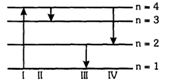
A
$III$
B
$IV$
C
$I$
D
$II$
Solution
(A) The energy of an emitted photon is given by the difference in energy between the two levels involved in the transition: $E = E_{initial} - E_{final} = h\nu$.
For emission to occur,the electron must transition from a higher energy level to a lower energy level.
Transitions $II$ and $III$ are emission transitions (downward arrows).
Transition $I$ is an absorption transition (upward arrow).
Transition $IV$ is also an emission transition.
Comparing the energy gaps:
Transition $II$ is from $n=4$ to $n=3$.
Transition $III$ is from $n=2$ to $n=1$.
Transition $IV$ is from $n=4$ to $n=2$.
The energy difference is proportional to the gap between the levels. The gap between $n=2$ and $n=1$ is significantly larger than the gap between $n=4$ and $n=3$ or $n=4$ and $n=2$.
Therefore,transition $III$ corresponds to the largest energy change and thus emits the photon with the highest energy.
For emission to occur,the electron must transition from a higher energy level to a lower energy level.
Transitions $II$ and $III$ are emission transitions (downward arrows).
Transition $I$ is an absorption transition (upward arrow).
Transition $IV$ is also an emission transition.
Comparing the energy gaps:
Transition $II$ is from $n=4$ to $n=3$.
Transition $III$ is from $n=2$ to $n=1$.
Transition $IV$ is from $n=4$ to $n=2$.
The energy difference is proportional to the gap between the levels. The gap between $n=2$ and $n=1$ is significantly larger than the gap between $n=4$ and $n=3$ or $n=4$ and $n=2$.
Therefore,transition $III$ corresponds to the largest energy change and thus emits the photon with the highest energy.
0 likes
View Solution48
EasyMCQ
In a hydrogen atom,which of the following transitions will have the minimum wavelength?
A
$n = 5$ to $n = 4$
B
$n = 4$ to $n = 3$
C
$n = 3$ to $n = 2$
D
$n = 2$ to $n = 1$
Solution
(D) The wavelength $\lambda$ of a photon emitted during a transition is given by the Rydberg formula: $\frac{1}{\lambda} = R \left( \frac{1}{n_f^2} - \frac{1}{n_i^2} \right)$.
This implies that $\lambda$ is inversely proportional to the energy difference $\Delta E$ of the transition,where $\Delta E = 13.6 \left( \frac{1}{n_f^2} - \frac{1}{n_i^2} \right) \text{ eV}$.
To have the minimum wavelength,the energy difference $\Delta E$ must be maximum.
Comparing the transitions:
$(A)$ $\Delta E \propto (1/16 - 1/25) = 0.0225$
$(B)$ $\Delta E \propto (1/9 - 1/16) = 0.0486$
$(C)$ $\Delta E \propto (1/4 - 1/9) = 0.1389$
$(D)$ $\Delta E \propto (1/1 - 1/4) = 0.7500$
The transition from $n = 2$ to $n = 1$ results in the largest energy change,and therefore,the minimum wavelength.
This implies that $\lambda$ is inversely proportional to the energy difference $\Delta E$ of the transition,where $\Delta E = 13.6 \left( \frac{1}{n_f^2} - \frac{1}{n_i^2} \right) \text{ eV}$.
To have the minimum wavelength,the energy difference $\Delta E$ must be maximum.
Comparing the transitions:
$(A)$ $\Delta E \propto (1/16 - 1/25) = 0.0225$
$(B)$ $\Delta E \propto (1/9 - 1/16) = 0.0486$
$(C)$ $\Delta E \propto (1/4 - 1/9) = 0.1389$
$(D)$ $\Delta E \propto (1/1 - 1/4) = 0.7500$
The transition from $n = 2$ to $n = 1$ results in the largest energy change,and therefore,the minimum wavelength.
0 likes
View SolutionAtoms — Electron Energy and Electron Energy Levels in Hydrogen Atom · Frequently Asked Questions
1Are these Atoms questions useful for JEE and NEET?
Yes. All questions in this section are mapped to JEE Main and NEET exam patterns. Previous year questions from JEE Main, NEET, GUJCET and state-level exams are included with full solutions.
2Can I switch to Hindi or Gujarati for these questions?
Yes. Use the language tabs in the hero section or the sidebar to view the same questions and solutions in English, Hindi or Gujarati.
3How do I generate a question paper from this subtopic?
Use the Vedclass Exam Paper Generator — select the chapter and subtopic, set difficulty, and generate Sets A, B, C, D automatically. First 3 chapters of every subject are free.
Vedclass Products
For Students
Vedclass Test Series
Mock tests in real JEE/NEET style with performance analysis. 5-day free trial.
Start Free TrialFor Teachers
Exam Paper Generator
Generate Set A/B/C/D papers from this chapter in 2 minutes. 3 chapters free.
Try FreeFor Institutes
Online Exam Module
Live online exams with unlimited students, 360° analytics & white-label branding.
See DemoFor Teachers & Institutes
Generate a Atoms Exam Paper in 2 Minutes
Select subtopic & difficulty — Sets A, B, C, D auto-generated with No Repeat logic.
First 3 chapters of every subject are free — no payment required.