
A English
Electron Energy and Electron Energy Levels in Hydrogen Atom Questions in English
Class 12 Physics · Atoms · Electron Energy and Electron Energy Levels in Hydrogen Atom
224+
Questions
English
Language
100%
With Solutions
Showing 49 of 224 questions in English
101
MediumMCQ
In a hydrogen-like atom,when an electron jumps from the $M$-shell to the $L$-shell,the wavelength of the emitted radiation is $\lambda$. If an electron jumps from the $N$-shell to the $L$-shell,the wavelength of the emitted radiation will be:
A
$\frac{27}{20} \lambda$
B
$\frac{16}{25} \lambda$
C
$\frac{25}{16} \lambda$
D
$\frac{20}{27} \lambda$
Solution
(D) The Rydberg formula for the wavelength of emitted radiation is given by $\frac{1}{\lambda} = R Z^2 \left( \frac{1}{n_f^2} - \frac{1}{n_i^2} \right)$,where $R$ is the Rydberg constant and $Z$ is the atomic number.
For the transition from $M$-shell $(n_i = 3)$ to $L$-shell $(n_f = 2)$:
$\frac{1}{\lambda} = K \left( \frac{1}{2^2} - \frac{1}{3^2} \right) = K \left( \frac{1}{4} - \frac{1}{9} \right) = K \left( \frac{9-4}{36} \right) = \frac{5K}{36}$,where $K = R Z^2$.
For the transition from $N$-shell $(n_i = 4)$ to $L$-shell $(n_f = 2)$:
$\frac{1}{\lambda'} = K \left( \frac{1}{2^2} - \frac{1}{4^2} \right) = K \left( \frac{1}{4} - \frac{1}{16} \right) = K \left( \frac{4-1}{16} \right) = \frac{3K}{16}$.
Now,taking the ratio of the two equations:
$\frac{\lambda'}{\lambda} = \frac{5K/36}{3K/16} = \frac{5}{36} \times \frac{16}{3} = \frac{5 \times 4}{9 \times 3} = \frac{20}{27}$.
Therefore,$\lambda' = \frac{20}{27} \lambda$.
For the transition from $M$-shell $(n_i = 3)$ to $L$-shell $(n_f = 2)$:
$\frac{1}{\lambda} = K \left( \frac{1}{2^2} - \frac{1}{3^2} \right) = K \left( \frac{1}{4} - \frac{1}{9} \right) = K \left( \frac{9-4}{36} \right) = \frac{5K}{36}$,where $K = R Z^2$.
For the transition from $N$-shell $(n_i = 4)$ to $L$-shell $(n_f = 2)$:
$\frac{1}{\lambda'} = K \left( \frac{1}{2^2} - \frac{1}{4^2} \right) = K \left( \frac{1}{4} - \frac{1}{16} \right) = K \left( \frac{4-1}{16} \right) = \frac{3K}{16}$.
Now,taking the ratio of the two equations:
$\frac{\lambda'}{\lambda} = \frac{5K/36}{3K/16} = \frac{5}{36} \times \frac{16}{3} = \frac{5 \times 4}{9 \times 3} = \frac{20}{27}$.
Therefore,$\lambda' = \frac{20}{27} \lambda$.
0 likes
View Solution102
MediumMCQ
If $13.6 \ eV$ energy is required to ionize the hydrogen atom,then the energy required to remove an electron from $n=2$ is (in $eV$)
A
$10.2$
B
$3.4$
C
$0$
D
$6.8$
Solution
(B) The energy of an electron in the $n$th orbit of a hydrogen atom is given by the formula $E_n = -\frac{13.6}{n^2} \ eV$.
To remove an electron from the $n=2$ orbit to infinity (ionization),we need to provide energy equal to the magnitude of the binding energy at that level.
The energy of the electron in the $n=2$ state is $E_2 = -\frac{13.6}{2^2} = -\frac{13.6}{4} = -3.4 \ eV$.
The energy required to remove this electron is the difference between the energy at infinity $(0 \ eV)$ and the energy at $n=2$ $(E_{\text{req}} = 0 - (-3.4) = 3.4 \ eV)$.
To remove an electron from the $n=2$ orbit to infinity (ionization),we need to provide energy equal to the magnitude of the binding energy at that level.
The energy of the electron in the $n=2$ state is $E_2 = -\frac{13.6}{2^2} = -\frac{13.6}{4} = -3.4 \ eV$.
The energy required to remove this electron is the difference between the energy at infinity $(0 \ eV)$ and the energy at $n=2$ $(E_{\text{req}} = 0 - (-3.4) = 3.4 \ eV)$.
0 likes
View Solution103
DifficultMCQ
The electron in a hydrogen atom first jumps from the third excited state to the second excited state and subsequently to the first excited state. The ratio of the respective wavelengths,$\lambda_1/\lambda_2$,of the photons emitted in this process is
A
$20/7$
B
$7/5$
C
$9/7$
D
$27/5$
Solution
(A) The Rydberg formula for the wavelength of emitted photons is given by $\frac{1}{\lambda} = R \left( \frac{1}{n_f^2} - \frac{1}{n_i^2} \right)$.
For the first jump from the third excited state $(n_i = 4)$ to the second excited state $(n_f = 3)$:
$\frac{1}{\lambda_1} = R \left( \frac{1}{3^2} - \frac{1}{4^2} \right) = R \left( \frac{1}{9} - \frac{1}{16} \right) = R \left( \frac{16 - 9}{144} \right) = R \left( \frac{7}{144} \right)$.
For the second jump from the second excited state $(n_i = 3)$ to the first excited state $(n_f = 2)$:
$\frac{1}{\lambda_2} = R \left( \frac{1}{2^2} - \frac{1}{3^2} \right) = R \left( \frac{1}{4} - \frac{1}{9} \right) = R \left( \frac{9 - 4}{36} \right) = R \left( \frac{5}{36} \right)$.
Now,calculating the ratio $\frac{\lambda_1}{\lambda_2} = \frac{1/\lambda_2}{1/\lambda_1} = \frac{R(5/36)}{R(7/144)} = \frac{5}{36} \times \frac{144}{7} = \frac{5 \times 4}{7} = \frac{20}{7}$.
For the first jump from the third excited state $(n_i = 4)$ to the second excited state $(n_f = 3)$:
$\frac{1}{\lambda_1} = R \left( \frac{1}{3^2} - \frac{1}{4^2} \right) = R \left( \frac{1}{9} - \frac{1}{16} \right) = R \left( \frac{16 - 9}{144} \right) = R \left( \frac{7}{144} \right)$.
For the second jump from the second excited state $(n_i = 3)$ to the first excited state $(n_f = 2)$:
$\frac{1}{\lambda_2} = R \left( \frac{1}{2^2} - \frac{1}{3^2} \right) = R \left( \frac{1}{4} - \frac{1}{9} \right) = R \left( \frac{9 - 4}{36} \right) = R \left( \frac{5}{36} \right)$.
Now,calculating the ratio $\frac{\lambda_1}{\lambda_2} = \frac{1/\lambda_2}{1/\lambda_1} = \frac{R(5/36)}{R(7/144)} = \frac{5}{36} \times \frac{144}{7} = \frac{5 \times 4}{7} = \frac{20}{7}$.
0 likes
View Solution104
MediumMCQ
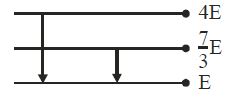
The following diagram indicates the energy levels of a certain atom. When the system moves from the $4E$ level to the $E$ level,a photon of wavelength ${\lambda _1}$ is emitted. The wavelength of the photon produced during its transition from the $\frac{7}{3}E$ level to the $E$ level is ${\lambda _2}$. The ratio $\frac{{{\lambda _1}}}{{{\lambda _2}}}$ will be:
A
$\frac{9}{4}$
B
$\frac{4}{9}$
C
$\frac{3}{2}$
D
$\frac{7}{3}$
Solution
(B) The energy of a photon emitted during a transition between two energy levels $E_i$ and $E_f$ is given by $\Delta E = E_i - E_f = \frac{hc}{\lambda}$.
For the transition from $4E$ to $E$:
$\Delta E_1 = 4E - E = 3E$
So,$3E = \frac{hc}{\lambda_1} \implies \lambda_1 = \frac{hc}{3E}$ --- $(1)$
For the transition from $\frac{7}{3}E$ to $E$:
$\Delta E_2 = \frac{7}{3}E - E = \frac{4}{3}E$
So,$\frac{4}{3}E = \frac{hc}{\lambda_2} \implies \lambda_2 = \frac{3hc}{4E}$ --- $(2)$
Taking the ratio of $\lambda_1$ to $\lambda_2$:
$\frac{\lambda_1}{\lambda_2} = \left( \frac{hc}{3E} \right) / \left( \frac{3hc}{4E} \right) = \frac{hc}{3E} \times \frac{4E}{3hc} = \frac{4}{9}$
For the transition from $4E$ to $E$:
$\Delta E_1 = 4E - E = 3E$
So,$3E = \frac{hc}{\lambda_1} \implies \lambda_1 = \frac{hc}{3E}$ --- $(1)$
For the transition from $\frac{7}{3}E$ to $E$:
$\Delta E_2 = \frac{7}{3}E - E = \frac{4}{3}E$
So,$\frac{4}{3}E = \frac{hc}{\lambda_2} \implies \lambda_2 = \frac{3hc}{4E}$ --- $(2)$
Taking the ratio of $\lambda_1$ to $\lambda_2$:
$\frac{\lambda_1}{\lambda_2} = \left( \frac{hc}{3E} \right) / \left( \frac{3hc}{4E} \right) = \frac{hc}{3E} \times \frac{4E}{3hc} = \frac{4}{9}$
0 likes
View Solution105
MediumMCQ
The kinetic energy of an electron in the $n^{th}$ orbit of a hydrogen-like species with atomic number $Z$ is $13.6 \frac{Z^2}{n^2} \ eV$. The potential energy of this electron in the same orbit will be:
A
$+27.2 \frac{Z^2}{n^2} \ eV$
B
$-6.8 \frac{Z^2}{n^2} \ eV$
C
$13.6 \frac{Z^2}{n^2} \ eV$
D
$-27.2 \frac{Z^2}{n^2} \ eV$
Solution
(D) In the Bohr model of an atom,the total energy $(E)$,kinetic energy $(K)$,and potential energy $(U)$ of an electron in the $n^{th}$ orbit are related as follows:
$K = -E$
$U = 2E$
Given that the kinetic energy $K = 13.6 \frac{Z^2}{n^2} \ eV$.
Since $K = -E$,the total energy $E = -13.6 \frac{Z^2}{n^2} \ eV$.
The potential energy $U$ is given by $U = 2E$.
Substituting the value of $E$:
$U = 2 \times (-13.6 \frac{Z^2}{n^2} \ eV) = -27.2 \frac{Z^2}{n^2} \ eV$.
Therefore,the potential energy is $-27.2 \frac{Z^2}{n^2} \ eV$.
$K = -E$
$U = 2E$
Given that the kinetic energy $K = 13.6 \frac{Z^2}{n^2} \ eV$.
Since $K = -E$,the total energy $E = -13.6 \frac{Z^2}{n^2} \ eV$.
The potential energy $U$ is given by $U = 2E$.
Substituting the value of $E$:
$U = 2 \times (-13.6 \frac{Z^2}{n^2} \ eV) = -27.2 \frac{Z^2}{n^2} \ eV$.
Therefore,the potential energy is $-27.2 \frac{Z^2}{n^2} \ eV$.
0 likes
View Solution106
DifficultMCQ
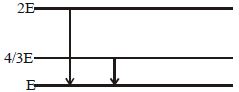
The following diagram indicates the energy levels of a certain atom. When the system moves from the $2E$ level to the $E$ level, it emits a photon of wavelength $\lambda$. What is the wavelength of the photon produced during its transition from the $\frac{4E}{3}$ level to the $E$ level?
A
$\lambda /3$
B
$3\lambda /4$
C
$4\lambda /3$
D
$3\lambda$
Solution
(D) The energy of the emitted photon is equal to the difference in energy levels.
For the transition from $2E$ to $E$:
$\Delta E_1 = 2E - E = E = \frac{hc}{\lambda} \Rightarrow E = \frac{hc}{\lambda} \quad ... (1)$
For the transition from $\frac{4E}{3}$ to $E$:
$\Delta E_2 = \frac{4E}{3} - E = \frac{E}{3} = \frac{hc}{\lambda'} \quad ... (2)$
Substituting the value of $E$ from equation $(1)$ into equation $(2)$:
$\frac{1}{3} \left( \frac{hc}{\lambda} \right) = \frac{hc}{\lambda'}$
$\frac{1}{3\lambda} = \frac{1}{\lambda'} \Rightarrow \lambda' = 3\lambda$
Therefore, the wavelength of the photon produced is $3\lambda$.
For the transition from $2E$ to $E$:
$\Delta E_1 = 2E - E = E = \frac{hc}{\lambda} \Rightarrow E = \frac{hc}{\lambda} \quad ... (1)$
For the transition from $\frac{4E}{3}$ to $E$:
$\Delta E_2 = \frac{4E}{3} - E = \frac{E}{3} = \frac{hc}{\lambda'} \quad ... (2)$
Substituting the value of $E$ from equation $(1)$ into equation $(2)$:
$\frac{1}{3} \left( \frac{hc}{\lambda} \right) = \frac{hc}{\lambda'}$
$\frac{1}{3\lambda} = \frac{1}{\lambda'} \Rightarrow \lambda' = 3\lambda$
Therefore, the wavelength of the photon produced is $3\lambda$.
0 likes
View Solution107
MediumMCQ
The energy of a hydrogen atom in the $n^{th}$ orbit is $E_n$. What will be the energy in the $n^{th}$ orbit of a singly ionized helium atom?
A
$4E_n$
B
$E_n/4$
C
$2E_n$
D
$E_n/2$
Solution
(A) The energy of an electron in the $n^{th}$ orbit of a hydrogen-like atom is given by the formula: $E_n = -13.6 \frac{Z^2}{n^2} \text{ eV}$.
For a hydrogen atom,the atomic number $Z = 1$,so $E_n(H) = -13.6 \frac{1^2}{n^2} = E_n$.
For a singly ionized helium atom $(He^+)$,the atomic number $Z = 2$.
The energy in the $n^{th}$ orbit for $He^+$ is $E_n(He^+) = -13.6 \frac{2^2}{n^2} = 4 \times (-13.6 \frac{1^2}{n^2}) = 4E_n$.
Therefore,the energy is $4E_n$.
For a hydrogen atom,the atomic number $Z = 1$,so $E_n(H) = -13.6 \frac{1^2}{n^2} = E_n$.
For a singly ionized helium atom $(He^+)$,the atomic number $Z = 2$.
The energy in the $n^{th}$ orbit for $He^+$ is $E_n(He^+) = -13.6 \frac{2^2}{n^2} = 4 \times (-13.6 \frac{1^2}{n^2}) = 4E_n$.
Therefore,the energy is $4E_n$.
0 likes
View Solution108
EasyMCQ
Assertion : Between any two given energy levels,the number of absorption transitions is always less than the number of emission transitions.
Reason : Absorption transitions start from the lowest energy level only and may end at any higher energy level. But emission transitions may start from any higher energy level and end at any energy level below it.
Reason : Absorption transitions start from the lowest energy level only and may end at any higher energy level. But emission transitions may start from any higher energy level and end at any energy level below it.
A
If both Assertion and Reason are correct and the Reason is a correct explanation of the Assertion.
B
If both Assertion and Reason are correct but Reason is not a correct explanation of the Assertion.
C
If the Assertion is correct but Reason is incorrect.
D
If both the Assertion and Reason are incorrect.
Solution
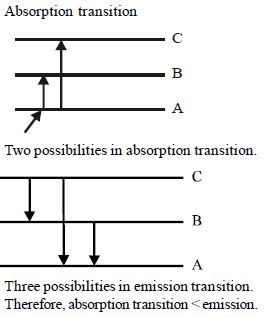
(A) In an absorption transition,an electron in a lower energy state absorbs a photon and jumps to a higher energy state. For a system with energy levels $A, B, C$ (where $A < B < C$),absorption can only occur from the ground state $A$ to $B$ or $A$ to $C$. Thus,there are $2$ possible absorption transitions.
In an emission transition,an electron in a higher energy state drops to a lower energy state by emitting a photon. For the same levels,emission can occur from $C \rightarrow B$,$C \rightarrow A$,and $B \rightarrow A$. Thus,there are $3$ possible emission transitions.
Since $2 < 3$,the number of absorption transitions is less than the number of emission transitions. The Reason correctly explains that absorption is restricted to starting from the lower level,whereas emission can occur between any two levels where the initial state is higher than the final state.
In an emission transition,an electron in a higher energy state drops to a lower energy state by emitting a photon. For the same levels,emission can occur from $C \rightarrow B$,$C \rightarrow A$,and $B \rightarrow A$. Thus,there are $3$ possible emission transitions.
Since $2 < 3$,the number of absorption transitions is less than the number of emission transitions. The Reason correctly explains that absorption is restricted to starting from the lower level,whereas emission can occur between any two levels where the initial state is higher than the final state.
0 likes
View Solution109
MediumMCQ
The total energy of an electron in an atom in an orbit is $-3.4 \; eV$. Its kinetic and potential energies are,respectively:
A
$-3.4 \; eV, -3.4 \; eV$
B
$-3.4 \; eV, -6.8 \; eV$
C
$3.4 \; eV, -6.8 \; eV$
D
$3.4 \; eV, 3.4 \; eV$
Solution
(C) The total energy $(TE)$ of an electron in an orbit is given as $-3.4 \; eV$.
For an electron in a hydrogen-like atom,the relationship between total energy $(TE)$,kinetic energy $(KE)$,and potential energy $(PE)$ is:
$KE = -TE$
$PE = 2 \times TE$
Substituting the given value of $TE = -3.4 \; eV$:
$KE = -(-3.4 \; eV) = +3.4 \; eV$
$PE = 2 \times (-3.4 \; eV) = -6.8 \; eV$
Therefore,the kinetic energy is $3.4 \; eV$ and the potential energy is $-6.8 \; eV$.
For an electron in a hydrogen-like atom,the relationship between total energy $(TE)$,kinetic energy $(KE)$,and potential energy $(PE)$ is:
$KE = -TE$
$PE = 2 \times TE$
Substituting the given value of $TE = -3.4 \; eV$:
$KE = -(-3.4 \; eV) = +3.4 \; eV$
$PE = 2 \times (-3.4 \; eV) = -6.8 \; eV$
Therefore,the kinetic energy is $3.4 \; eV$ and the potential energy is $-6.8 \; eV$.
0 likes
View Solution110
MediumMCQ
$A$ difference of $2.3\; eV$ separates two energy levels in an atom. What is the frequency of radiation emitted when the atom makes a transition from the upper level to the lower level?
A
$8.4 \times 10^{12}\; Hz$.
B
$5.6 \times 10^{14}\; Hz$.
C
$1.6 \times 10^{16}\; Hz$.
D
$7.1 \times 10^{15}\; Hz$.
Solution
(B) The energy difference between the two levels is given as $E = 2.3 \; eV$.
To convert this energy into Joules,we multiply by the charge of an electron $(1.6 \times 10^{-19} \; C)$:
$E = 2.3 \times 1.6 \times 10^{-19} \; J = 3.68 \times 10^{-19} \; J$.
According to the Bohr model,the frequency $\nu$ of the emitted radiation is related to the energy difference by the equation $E = h\nu$,where $h$ is Planck's constant $(6.626 \times 10^{-34} \; Js)$.
Rearranging for frequency: $\nu = \frac{E}{h}$.
Substituting the values: $\nu = \frac{3.68 \times 10^{-19}}{6.626 \times 10^{-34}} \approx 5.55 \times 10^{14} \; Hz$.
Rounding to two significant figures,we get $\nu \approx 5.6 \times 10^{14} \; Hz$.
To convert this energy into Joules,we multiply by the charge of an electron $(1.6 \times 10^{-19} \; C)$:
$E = 2.3 \times 1.6 \times 10^{-19} \; J = 3.68 \times 10^{-19} \; J$.
According to the Bohr model,the frequency $\nu$ of the emitted radiation is related to the energy difference by the equation $E = h\nu$,where $h$ is Planck's constant $(6.626 \times 10^{-34} \; Js)$.
Rearranging for frequency: $\nu = \frac{E}{h}$.
Substituting the values: $\nu = \frac{3.68 \times 10^{-19}}{6.626 \times 10^{-34}} \approx 5.55 \times 10^{14} \; Hz$.
Rounding to two significant figures,we get $\nu \approx 5.6 \times 10^{14} \; Hz$.
0 likes
View Solution111
Medium
$A$ hydrogen atom initially in the ground level absorbs a photon,which excites it to the $n = 4$ level. Determine the wavelength and frequency of the photon.
Solution
For the ground level,$n_{1} = 1$.
The energy of this level is given by $E_{1} = \frac{-13.6}{n_{1}^{2}} \, eV = -13.6 \, eV$.
The atom is excited to the level $n_{2} = 4$.
The energy of this level is $E_{2} = \frac{-13.6}{n_{2}^{2}} \, eV = \frac{-13.6}{16} = -0.85 \, eV$.
The energy of the absorbed photon is $E = E_{2} - E_{1} = -0.85 - (-13.6) = 12.75 \, eV$.
Converting energy to Joules: $E = 12.75 \times 1.6 \times 10^{-19} \, J = 2.04 \times 10^{-18} \, J$.
Using the relation $E = \frac{hc}{\lambda}$,the wavelength is $\lambda = \frac{hc}{E}$.
$\lambda = \frac{6.63 \times 10^{-34} \times 3 \times 10^{8}}{2.04 \times 10^{-18}} \approx 9.75 \times 10^{-8} \, m = 97.5 \, nm$.
The frequency is $\nu = \frac{c}{\lambda} = \frac{3 \times 10^{8}}{9.75 \times 10^{-8}} \approx 3.08 \times 10^{15} \, Hz$.
The energy of this level is given by $E_{1} = \frac{-13.6}{n_{1}^{2}} \, eV = -13.6 \, eV$.
The atom is excited to the level $n_{2} = 4$.
The energy of this level is $E_{2} = \frac{-13.6}{n_{2}^{2}} \, eV = \frac{-13.6}{16} = -0.85 \, eV$.
The energy of the absorbed photon is $E = E_{2} - E_{1} = -0.85 - (-13.6) = 12.75 \, eV$.
Converting energy to Joules: $E = 12.75 \times 1.6 \times 10^{-19} \, J = 2.04 \times 10^{-18} \, J$.
Using the relation $E = \frac{hc}{\lambda}$,the wavelength is $\lambda = \frac{hc}{E}$.
$\lambda = \frac{6.63 \times 10^{-34} \times 3 \times 10^{8}}{2.04 \times 10^{-18}} \approx 9.75 \times 10^{-8} \, m = 97.5 \, nm$.
The frequency is $\nu = \frac{c}{\lambda} = \frac{3 \times 10^{8}}{9.75 \times 10^{-8}} \approx 3.08 \times 10^{15} \, Hz$.
0 likes
View Solution112
Medium
The total energy of an electron in the first excited state of the hydrogen atom is about $-3.4 \; eV.$
$(a)$ What is the kinetic energy of the electron in this state?
$(b)$ What is the potential energy of the electron in this state?
$(c)$ Which of the answers above would change if the choice of the zero of potential energy is changed?
$(a)$ What is the kinetic energy of the electron in this state?
$(b)$ What is the potential energy of the electron in this state?
$(c)$ Which of the answers above would change if the choice of the zero of potential energy is changed?
Solution
(N/A) The total energy of the electron is $E = -3.4 \; eV$. The kinetic energy $(K)$ of an electron in a hydrogen atom is equal to the negative of its total energy.
$\Rightarrow K = -E$
$K = -(-3.4 \; eV) = +3.4 \; eV$
Thus,the kinetic energy of the electron in this state is $+3.4 \; eV$.
$(b)$ The potential energy $(U)$ of the electron in a hydrogen atom is equal to $-2$ times its kinetic energy.
$\Rightarrow U = -2K$
$U = -2 \times 3.4 \; eV = -6.8 \; eV$
Thus,the potential energy of the electron in this state is $-6.8 \; eV$.
$(c)$ Potential energy is defined relative to a reference point where it is assumed to be zero. If the reference point is changed,the potential energy $(U)$ and consequently the total energy $(E = K + U)$ will change. However,the kinetic energy $(K)$ remains unchanged because it depends only on the velocity of the electron.
$\Rightarrow K = -E$
$K = -(-3.4 \; eV) = +3.4 \; eV$
Thus,the kinetic energy of the electron in this state is $+3.4 \; eV$.
$(b)$ The potential energy $(U)$ of the electron in a hydrogen atom is equal to $-2$ times its kinetic energy.
$\Rightarrow U = -2K$
$U = -2 \times 3.4 \; eV = -6.8 \; eV$
Thus,the potential energy of the electron in this state is $-6.8 \; eV$.
$(c)$ Potential energy is defined relative to a reference point where it is assumed to be zero. If the reference point is changed,the potential energy $(U)$ and consequently the total energy $(E = K + U)$ will change. However,the kinetic energy $(K)$ remains unchanged because it depends only on the velocity of the electron.
0 likes
View Solution113
Medium
Explain the formulas for the energy of an electron in an atom revolving around the nucleus in different orbits.
Solution
(A) According to the Bohr model of the atom,an electron revolves around a positively charged nucleus in stable orbits. The electrostatic force of attraction $F_{e}$ between the electron and the nucleus provides the necessary centripetal force $F_{c}$ to keep the electron in its orbit.
For a stable orbit in a hydrogen atom:
$F_{e} = F_{c}$
$\frac{1}{4 \pi \epsilon_{0}} \cdot \frac{e^{2}}{r^{2}} = \frac{m v^{2}}{r}$
From this,we get the radius relation: $r = \frac{e^{2}}{4 \pi \epsilon_{0} m v^{2}} \quad \dots (1)$
The kinetic energy $K$ of the electron is:
$K = \frac{1}{2} m v^{2} = \frac{e^{2}}{8 \pi \epsilon_{0} r} \quad \dots (2)$
The potential energy $U$ of the electron in the field of the nucleus ($Z=1$ for hydrogen) is:
$U = -\frac{1}{4 \pi \epsilon_{0}} \cdot \frac{e^{2}}{r} \quad \dots (3)$
The total energy $E$ is the sum of kinetic and potential energy:
$E = K + U = \frac{e^{2}}{8 \pi \epsilon_{0} r} - \frac{e^{2}}{4 \pi \epsilon_{0} r} = -\frac{e^{2}}{8 \pi \epsilon_{0} r}$
The negative sign indicates that the electron is bound to the nucleus.
For a stable orbit in a hydrogen atom:
$F_{e} = F_{c}$
$\frac{1}{4 \pi \epsilon_{0}} \cdot \frac{e^{2}}{r^{2}} = \frac{m v^{2}}{r}$
From this,we get the radius relation: $r = \frac{e^{2}}{4 \pi \epsilon_{0} m v^{2}} \quad \dots (1)$
The kinetic energy $K$ of the electron is:
$K = \frac{1}{2} m v^{2} = \frac{e^{2}}{8 \pi \epsilon_{0} r} \quad \dots (2)$
The potential energy $U$ of the electron in the field of the nucleus ($Z=1$ for hydrogen) is:
$U = -\frac{1}{4 \pi \epsilon_{0}} \cdot \frac{e^{2}}{r} \quad \dots (3)$
The total energy $E$ is the sum of kinetic and potential energy:
$E = K + U = \frac{e^{2}}{8 \pi \epsilon_{0} r} - \frac{e^{2}}{4 \pi \epsilon_{0} r} = -\frac{e^{2}}{8 \pi \epsilon_{0} r}$
The negative sign indicates that the electron is bound to the nucleus.
0 likes
View Solution114
MediumMCQ
Which fact indicates that the total energy of an electron in an atom is negative?
A
The electron is attracted by the nucleus.
B
The electron is moving in a circular orbit.
C
The electron is revolving with a constant velocity.
D
The electron is in a quantized energy state.
Solution
(A) In an atom,the total energy $E$ of an electron is the sum of its kinetic energy $K$ and potential energy $U$.
Since the electron is bound to the nucleus by the electrostatic force of attraction,the potential energy $U$ is negative.
Mathematically,$U = -\frac{1}{4\pi\epsilon_0} \frac{Ze^2}{r}$.
The kinetic energy $K$ is positive,given by $K = \frac{1}{2}mv^2 = \frac{1}{4\pi\epsilon_0} \frac{Ze^2}{2r}$.
Thus,the total energy $E = K + U = -\frac{1}{4\pi\epsilon_0} \frac{Ze^2}{2r}$.
$A$ negative total energy indicates that the electron is in a bound state,meaning it is attracted to the nucleus and requires external energy to be removed from the atom. Therefore,the fact that the electron is attracted by the nucleus is the reason for its negative total energy.
Since the electron is bound to the nucleus by the electrostatic force of attraction,the potential energy $U$ is negative.
Mathematically,$U = -\frac{1}{4\pi\epsilon_0} \frac{Ze^2}{r}$.
The kinetic energy $K$ is positive,given by $K = \frac{1}{2}mv^2 = \frac{1}{4\pi\epsilon_0} \frac{Ze^2}{2r}$.
Thus,the total energy $E = K + U = -\frac{1}{4\pi\epsilon_0} \frac{Ze^2}{2r}$.
$A$ negative total energy indicates that the electron is in a bound state,meaning it is attracted to the nucleus and requires external energy to be removed from the atom. Therefore,the fact that the electron is attracted by the nucleus is the reason for its negative total energy.
0 likes
View Solution115
Medium
What is the ground state of an atom? And what is the ionization energy and excitation energy of a hydrogen atom?
Solution
(N/A) The total energy of an electron in an atom is given by:
$E_{n} = -\frac{m Z^{2} e^{4}}{8 n^{2} h^{2} \epsilon_{0}^{2}}$
This simplifies to:
$E_{n} = -\frac{13.6 Z^{2}}{n^{2}} \text{ eV}$
The negative sign indicates that as the value of $n$ increases,the magnitude of the negative energy decreases,meaning the energy of the electron increases as it moves to orbits further from the nucleus.
When an electron is in the orbit closest to the nucleus $(n = 1)$,it has the lowest energy (the maximum negative value). This state is called the ground state.
For a hydrogen atom $(Z = 1, n = 1)$:
$E_{1} = -13.6 \text{ eV}$
The ionization energy is the minimum energy required to remove an electron from the ground state to infinity. For hydrogen,this is $13.6 \text{ eV}$.
Excitation energy is the energy required to move an electron from the ground state to a higher energy state. For the first excited state $(n = 2)$:
$E_{2} = -\frac{13.6}{2^{2}} = -3.4 \text{ eV}$
$\Delta E = E_{2} - E_{1} = -3.4 - (-13.6) = 10.2 \text{ eV}$
$E_{n} = -\frac{m Z^{2} e^{4}}{8 n^{2} h^{2} \epsilon_{0}^{2}}$
This simplifies to:
$E_{n} = -\frac{13.6 Z^{2}}{n^{2}} \text{ eV}$
The negative sign indicates that as the value of $n$ increases,the magnitude of the negative energy decreases,meaning the energy of the electron increases as it moves to orbits further from the nucleus.
When an electron is in the orbit closest to the nucleus $(n = 1)$,it has the lowest energy (the maximum negative value). This state is called the ground state.
For a hydrogen atom $(Z = 1, n = 1)$:
$E_{1} = -13.6 \text{ eV}$
The ionization energy is the minimum energy required to remove an electron from the ground state to infinity. For hydrogen,this is $13.6 \text{ eV}$.
Excitation energy is the energy required to move an electron from the ground state to a higher energy state. For the first excited state $(n = 2)$:
$E_{2} = -\frac{13.6}{2^{2}} = -3.4 \text{ eV}$
$\Delta E = E_{2} - E_{1} = -3.4 - (-13.6) = 10.2 \text{ eV}$
0 likes
View Solution116
EasyMCQ
What is the excited state of an atom?
A
$A$ state where the atom has more energy than its ground state.
B
$A$ state where the atom has less energy than its ground state.
C
$A$ state where the atom is ionized.
D
$A$ state where the atom is in its lowest energy level.
Solution
(A) The ground state of an atom is its lowest energy state. When an atom absorbs energy,its electrons jump from a lower energy level to a higher energy level. This state,which has higher energy than the ground state,is called the excited state of the atom.
0 likes
View Solution117
EasyMCQ
What is the total energy of an electron at an infinite distance from the nucleus in an atom?
A
Positive
B
Negative
C
Zero
D
Infinite
Solution
(C) In an atom,the total energy of an electron in an orbit is given by $E_n = -\frac{13.6}{n^2} \text{ eV}$.
As the distance from the nucleus increases,the principal quantum number $n$ increases.
At an infinite distance,$n \to \infty$.
Therefore,the total energy $E_{\infty} = \lim_{n \to \infty} \left( -\frac{13.6}{n^2} \right) = 0 \text{ eV}$.
Thus,the total energy of an electron at an infinite distance from the nucleus is zero.
As the distance from the nucleus increases,the principal quantum number $n$ increases.
At an infinite distance,$n \to \infty$.
Therefore,the total energy $E_{\infty} = \lim_{n \to \infty} \left( -\frac{13.6}{n^2} \right) = 0 \text{ eV}$.
Thus,the total energy of an electron at an infinite distance from the nucleus is zero.
0 likes
View Solution118
MediumMCQ
How much energy is needed to release the electron from the second excited state in the hydrogen atom (in $eV$)?
A
$1.51$
B
$3.4$
C
$13.6$
D
$0.54$
Solution
(A) The energy of an electron in the $n^{th}$ orbit of a hydrogen atom is given by the formula $E_n = -\frac{13.6}{n^2} \ eV$.
For the ground state,$n = 1$.
The first excited state corresponds to $n = 2$.
The second excited state corresponds to $n = 3$.
Substituting $n = 3$ into the formula,we get $E_3 = -\frac{13.6}{3^2} = -\frac{13.6}{9} \approx -1.51 \ eV$.
To release the electron (ionize the atom),we need to provide enough energy to bring its total energy to $0 \ eV$.
Therefore,the energy required is $E_{\text{ionization}} = 0 - E_3 = 0 - (-1.51 \ eV) = 1.51 \ eV$.
For the ground state,$n = 1$.
The first excited state corresponds to $n = 2$.
The second excited state corresponds to $n = 3$.
Substituting $n = 3$ into the formula,we get $E_3 = -\frac{13.6}{3^2} = -\frac{13.6}{9} \approx -1.51 \ eV$.
To release the electron (ionize the atom),we need to provide enough energy to bring its total energy to $0 \ eV$.
Therefore,the energy required is $E_{\text{ionization}} = 0 - E_3 = 0 - (-1.51 \ eV) = 1.51 \ eV$.
0 likes
View Solution119
Medium
Explain emission lines and absorption lines.
Solution
(N/A) $1$. Emission Lines: When an atom in an excited state transitions to a lower energy state,it emits a photon with energy equal to the difference between the two energy levels $(E_2 - E_1 = h
u)$. This results in a bright line in the spectrum at a specific wavelength,known as an emission line.
$2$. Absorption Lines: When an atom in a lower energy state absorbs a photon of energy exactly equal to the difference between its current state and a higher energy state $(h
u = E_2 - E_1)$,it transitions to the higher state. This removal of specific wavelengths from a continuous spectrum creates dark lines,known as absorption lines.
u)$. This results in a bright line in the spectrum at a specific wavelength,known as an emission line.
$2$. Absorption Lines: When an atom in a lower energy state absorbs a photon of energy exactly equal to the difference between its current state and a higher energy state $(h
u = E_2 - E_1)$,it transitions to the higher state. This removal of specific wavelengths from a continuous spectrum creates dark lines,known as absorption lines.
0 likes
View Solution120
EasyMCQ
What is an emission line?
A
$A$ line produced when an electron absorbs energy.
B
$A$ line produced when an electron transitions from a higher energy level to a lower energy level.
C
$A$ line produced by the continuous spectrum of a black body.
D
$A$ line produced when an electron is removed from an atom.
Solution
(B) An emission line is a spectral line that is formed when an electron in an atom or molecule transitions from a higher energy state $(E_2)$ to a lower energy state $(E_1)$.
During this transition,the excess energy is released in the form of a photon.
The energy of the emitted photon is given by the equation: $E = E_2 - E_1 = h\nu$,where $h$ is Planck's constant and $\nu$ is the frequency of the emitted radiation.
This results in a bright line at a specific wavelength in the emission spectrum.
During this transition,the excess energy is released in the form of a photon.
The energy of the emitted photon is given by the equation: $E = E_2 - E_1 = h\nu$,where $h$ is Planck's constant and $\nu$ is the frequency of the emitted radiation.
This results in a bright line at a specific wavelength in the emission spectrum.
0 likes
View Solution121
DifficultMCQ
In a hydrogen atom,the electron makes a transition from the $(n+1)^{\text{th}}$ level to the $n^{\text{th}}$ level. If $n >> 1$,the frequency of the radiation emitted is proportional to:
A
$\frac{1}{n^{4}}$
B
$\frac{1}{n^{3}}$
C
$\frac{1}{n^{2}}$
D
$\frac{1}{n}$
Solution
(B) In a hydrogen atom,the energy of the $n^{\text{th}}$ level is given by $E_n = -\frac{E_0}{n^2}$,where $E_0$ is the ionization energy of hydrogen.
For a transition from $(n+1)$ to $n$,the energy of the emitted radiation $\Delta E$ is the difference between the energy levels:
$\Delta E = E_{n+1} - E_n = E_0 \left( \frac{1}{n^2} - \frac{1}{(n+1)^2} \right)$
Using the relation $\Delta E = h\nu$,we have:
$h\nu = E_0 \left( \frac{(n+1)^2 - n^2}{n^2(n+1)^2} \right) = E_0 \left( \frac{2n+1}{n^2(n+1)^2} \right)$
For $n >> 1$,we can approximate $(n+1) \approx n$ and $(2n+1) \approx 2n$:
$h\nu \approx E_0 \left( \frac{2n}{n^2 \cdot n^2} \right) = E_0 \left( \frac{2n}{n^4} \right) = \frac{2E_0}{n^3}$
Thus,the frequency $\nu$ is proportional to $\frac{1}{n^3}$.
For a transition from $(n+1)$ to $n$,the energy of the emitted radiation $\Delta E$ is the difference between the energy levels:
$\Delta E = E_{n+1} - E_n = E_0 \left( \frac{1}{n^2} - \frac{1}{(n+1)^2} \right)$
Using the relation $\Delta E = h\nu$,we have:
$h\nu = E_0 \left( \frac{(n+1)^2 - n^2}{n^2(n+1)^2} \right) = E_0 \left( \frac{2n+1}{n^2(n+1)^2} \right)$
For $n >> 1$,we can approximate $(n+1) \approx n$ and $(2n+1) \approx 2n$:
$h\nu \approx E_0 \left( \frac{2n}{n^2 \cdot n^2} \right) = E_0 \left( \frac{2n}{n^4} \right) = \frac{2E_0}{n^3}$
Thus,the frequency $\nu$ is proportional to $\frac{1}{n^3}$.
0 likes
View Solution122
EasyMCQ
The total energy of an electron in the $n^{th}$ stationary orbit of the hydrogen atom can be obtained by
A
$E_{n} = -13.6 \times n^{2} \; eV$
B
$E_{n} = \frac{13.6}{n^{2}} \; eV$
C
$E_{n} = -\frac{13.6}{n^{2}} \; eV$
D
$E_{n} = 13.6 \times n^{2} \; eV$
Solution
(C) According to the Bohr model of the hydrogen atom,the total energy of an electron in the $n^{th}$ stationary orbit is given by the formula:
$E_{n} = -\frac{13.6}{n^{2}} \; eV$
where $n$ is the principal quantum number representing the orbit number $(n = 1, 2, 3, \dots)$.
$E_{n} = -\frac{13.6}{n^{2}} \; eV$
where $n$ is the principal quantum number representing the orbit number $(n = 1, 2, 3, \dots)$.
0 likes
View Solution123
MediumMCQ
An electron collides elastically with an $H$-like atom and excites it from the ground state to $n = 3$. Find the energy transferred to the $H$-like atom in $eV$.
A
$12.1$
B
$10.2$
C
$12.75$
D
$10$
Solution
(A) The energy required to excite an electron in a hydrogen atom from state $n_1$ to $n_2$ is given by the formula:
$\Delta E = 13.6 Z^2 \left( \frac{1}{n_1^2} - \frac{1}{n_2^2} \right) eV$
For a hydrogen atom,$Z = 1$. The electron is excited from the ground state $(n_1 = 1)$ to the state $n_2 = 3$.
Substituting these values into the formula:
$\Delta E = 13.6 \times (1)^2 \left( \frac{1}{1^2} - \frac{1}{3^2} \right) eV$
$\Delta E = 13.6 \left( 1 - \frac{1}{9} \right) eV$
$\Delta E = 13.6 \left( \frac{8}{9} \right) eV$
$\Delta E = 13.6 \times 0.888... eV$
$\Delta E \approx 12.088 eV \approx 12.1 eV$
Thus,the energy transferred to the atom is $12.1 eV$.
$\Delta E = 13.6 Z^2 \left( \frac{1}{n_1^2} - \frac{1}{n_2^2} \right) eV$
For a hydrogen atom,$Z = 1$. The electron is excited from the ground state $(n_1 = 1)$ to the state $n_2 = 3$.
Substituting these values into the formula:
$\Delta E = 13.6 \times (1)^2 \left( \frac{1}{1^2} - \frac{1}{3^2} \right) eV$
$\Delta E = 13.6 \left( 1 - \frac{1}{9} \right) eV$
$\Delta E = 13.6 \left( \frac{8}{9} \right) eV$
$\Delta E = 13.6 \times 0.888... eV$
$\Delta E \approx 12.088 eV \approx 12.1 eV$
Thus,the energy transferred to the atom is $12.1 eV$.
0 likes
View Solution124
EasyMCQ
Energy of an electron (in $eV$) in the $2^{nd}$ orbit of a $He^{+}$ ion is (in $.6$)?
A
$-10$
B
$-13$
C
$-15$
D
$-25$
Solution
(B) The energy of an electron in the $n^{th}$ orbit of a hydrogen-like ion is given by the formula:
$E_n = -13.6 \times \frac{Z^2}{n^2} \ eV$
For a $He^{+}$ ion,the atomic number $Z = 2$.
For the $2^{nd}$ orbit,the principal quantum number $n = 2$.
Substituting these values into the formula:
$E_2 = -13.6 \times \frac{2^2}{2^2} \ eV$
$E_2 = -13.6 \times \frac{4}{4} \ eV$
$E_2 = -13.6 \ eV$
$E_n = -13.6 \times \frac{Z^2}{n^2} \ eV$
For a $He^{+}$ ion,the atomic number $Z = 2$.
For the $2^{nd}$ orbit,the principal quantum number $n = 2$.
Substituting these values into the formula:
$E_2 = -13.6 \times \frac{2^2}{2^2} \ eV$
$E_2 = -13.6 \times \frac{4}{4} \ eV$
$E_2 = -13.6 \ eV$
0 likes
View Solution125
MediumMCQ
If energy of $15 \ eV$ is given to an electron in the $4^{th}$ orbit,find its final energy when it comes out of the $H$-atom. (in $eV$)
A
$14.15$
B
$13.6$
C
$12.08$
D
$15.85$
Solution
(A) The energy of an electron in the $n^{th}$ orbit of a Hydrogen atom is given by the formula:
$E_n = -\frac{13.6}{n^2} \ eV$
For the $4^{th}$ orbit $(n=4)$:
$E_4 = -\frac{13.6}{4^2} = -\frac{13.6}{16} = -0.85 \ eV$
When an external energy of $15 \ eV$ is supplied to the electron,the final energy $(E_f)$ of the electron after it is ejected from the atom is given by:
$E_f = E_{supplied} + E_4$
$E_f = 15 \ eV + (-0.85 \ eV)$
$E_f = 14.15 \ eV$
Thus,the final kinetic energy of the electron is $14.15 \ eV$.
$E_n = -\frac{13.6}{n^2} \ eV$
For the $4^{th}$ orbit $(n=4)$:
$E_4 = -\frac{13.6}{4^2} = -\frac{13.6}{16} = -0.85 \ eV$
When an external energy of $15 \ eV$ is supplied to the electron,the final energy $(E_f)$ of the electron after it is ejected from the atom is given by:
$E_f = E_{supplied} + E_4$
$E_f = 15 \ eV + (-0.85 \ eV)$
$E_f = 14.15 \ eV$
Thus,the final kinetic energy of the electron is $14.15 \ eV$.
0 likes
View Solution126
MediumMCQ
Which energy level of the singly ionized carbon atom has the same energy as the ground state energy of the hydrogen atom?
A
$1$
B
$6$
C
$4$
D
$8$
Solution
(B) The energy of an electron in a hydrogen-like atom is given by the formula $E_n = -13.6 \frac{Z^2}{n^2} \text{ eV}$.
For the hydrogen atom,the atomic number $Z = 1$ and for the ground state,$n = 1$.
Thus,the ground state energy of hydrogen is $E_H = -13.6 \times \frac{1^2}{1^2} = -13.6 \text{ eV}$.
For a singly ionized carbon atom $(C^+)$,the atomic number $Z = 6$.
We want to find the energy level $n$ such that the energy $E_C$ equals the ground state energy of hydrogen:
$-13.6 \frac{6^2}{n^2} = -13.6$.
Dividing both sides by $-13.6$,we get $\frac{36}{n^2} = 1$.
Therefore,$n^2 = 36$,which gives $n = 6$.
For the hydrogen atom,the atomic number $Z = 1$ and for the ground state,$n = 1$.
Thus,the ground state energy of hydrogen is $E_H = -13.6 \times \frac{1^2}{1^2} = -13.6 \text{ eV}$.
For a singly ionized carbon atom $(C^+)$,the atomic number $Z = 6$.
We want to find the energy level $n$ such that the energy $E_C$ equals the ground state energy of hydrogen:
$-13.6 \frac{6^2}{n^2} = -13.6$.
Dividing both sides by $-13.6$,we get $\frac{36}{n^2} = 1$.
Therefore,$n^2 = 36$,which gives $n = 6$.
0 likes
View Solution127
DifficultMCQ
According to the Bohr atom model,in which of the following transitions will the frequency be maximum?
A
$n = 4$ to $n = 3$
B
$n = 2$ to $n = 1$
C
$n = 5$ to $n = 4$
D
$n = 3$ to $n = 2$
Solution
(B) The energy of a photon emitted during a transition is given by $\Delta E = h\nu = 13.6 \text{ eV} \left[ \frac{1}{n_1^2} - \frac{1}{n_2^2} \right]$.
Since $\nu = \frac{\Delta E}{h}$,the frequency $\nu$ is maximum when the energy difference $\Delta E$ is maximum.
Comparing the energy gaps:
For $n = 4$ to $n = 3$: $\Delta E = 13.6 \left( \frac{1}{9} - \frac{1}{16} \right) \approx 0.66 \text{ eV}$.
For $n = 2$ to $n = 1$: $\Delta E = 13.6 \left( \frac{1}{1} - \frac{1}{4} \right) = 13.6 \times 0.75 = 10.2 \text{ eV}$.
For $n = 5$ to $n = 4$: $\Delta E = 13.6 \left( \frac{1}{16} - \frac{1}{25} \right) \approx 0.31 \text{ eV}$.
For $n = 3$ to $n = 2$: $\Delta E = 13.6 \left( \frac{1}{4} - \frac{1}{9} \right) \approx 1.89 \text{ eV}$.
The transition from $n = 2$ to $n = 1$ results in the largest energy change,hence the maximum frequency.
Since $\nu = \frac{\Delta E}{h}$,the frequency $\nu$ is maximum when the energy difference $\Delta E$ is maximum.
Comparing the energy gaps:
For $n = 4$ to $n = 3$: $\Delta E = 13.6 \left( \frac{1}{9} - \frac{1}{16} \right) \approx 0.66 \text{ eV}$.
For $n = 2$ to $n = 1$: $\Delta E = 13.6 \left( \frac{1}{1} - \frac{1}{4} \right) = 13.6 \times 0.75 = 10.2 \text{ eV}$.
For $n = 5$ to $n = 4$: $\Delta E = 13.6 \left( \frac{1}{16} - \frac{1}{25} \right) \approx 0.31 \text{ eV}$.
For $n = 3$ to $n = 2$: $\Delta E = 13.6 \left( \frac{1}{4} - \frac{1}{9} \right) \approx 1.89 \text{ eV}$.
The transition from $n = 2$ to $n = 1$ results in the largest energy change,hence the maximum frequency.
0 likes
View Solution128
DifficultMCQ
The recoil speed of a hydrogen atom after it emits a photon in going from $n = 5$ state to $n = 1$ state will be ..... $m/s$.
A
$4.17$
B
$2.19$
C
$3.25$
D
$4.34$
Solution
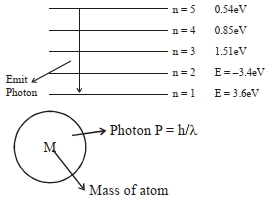
(A) The energy released when an electron transitions from $n = 5$ to $n = 1$ is given by:
$\Delta E = E_5 - E_1 = -0.54 \, eV - (-13.6 \, eV) = 13.06 \, eV$.
By the law of conservation of linear momentum,the initial momentum of the atom is zero,so the final momentum of the atom must be equal and opposite to the momentum of the emitted photon:
$P_{\text{atom}} = P_{\text{photon}} = \frac{h}{\lambda}$.
Since the energy of the photon is $\Delta E = \frac{hc}{\lambda}$,we have $\frac{1}{\lambda} = \frac{\Delta E}{hc}$.
Substituting this into the momentum equation,the recoil momentum of the atom is $Mv = \frac{\Delta E}{c}$,where $M$ is the mass of the hydrogen atom $(M \approx 1.67 \times 10^{-27} \, kg)$ and $c$ is the speed of light $(3 \times 10^8 \, m/s)$.
The recoil speed $v$ is given by:
$v = \frac{\Delta E}{Mc} = \frac{13.06 \times 1.6 \times 10^{-19} \, J}{1.67 \times 10^{-27} \, kg \times 3 \times 10^8 \, m/s} \approx 4.17 \, m/s$.
$\Delta E = E_5 - E_1 = -0.54 \, eV - (-13.6 \, eV) = 13.06 \, eV$.
By the law of conservation of linear momentum,the initial momentum of the atom is zero,so the final momentum of the atom must be equal and opposite to the momentum of the emitted photon:
$P_{\text{atom}} = P_{\text{photon}} = \frac{h}{\lambda}$.
Since the energy of the photon is $\Delta E = \frac{hc}{\lambda}$,we have $\frac{1}{\lambda} = \frac{\Delta E}{hc}$.
Substituting this into the momentum equation,the recoil momentum of the atom is $Mv = \frac{\Delta E}{c}$,where $M$ is the mass of the hydrogen atom $(M \approx 1.67 \times 10^{-27} \, kg)$ and $c$ is the speed of light $(3 \times 10^8 \, m/s)$.
The recoil speed $v$ is given by:
$v = \frac{\Delta E}{Mc} = \frac{13.06 \times 1.6 \times 10^{-19} \, J}{1.67 \times 10^{-27} \, kg \times 3 \times 10^8 \, m/s} \approx 4.17 \, m/s$.
0 likes
View Solution129
DifficultMCQ
$A$ free electron of $2.6 \, eV$ energy collides with a $H^+$ ion. This results in the formation of a hydrogen atom in the first excited state and a photon is released. Find the frequency of the emitted photon. $(h = 6.6 \times 10^{-34} \, J \cdot s)$
A
$1.45 \times 10^{16} \, MHz$
B
$0.19 \times 10^{15} \, MHz$
C
$1.45 \times 10^{9} \, MHz$
D
$9.0 \times 10^{27} \, MHz$
Solution
(C) The total energy of the system before collision is the kinetic energy of the free electron,as the potential energy at a large distance is $0$. Total energy $E_i = 2.6 \, eV + 0 = 2.6 \, eV$.
The hydrogen atom is formed in the first excited state $(n=2)$. The energy of the hydrogen atom in the $n$-th state is given by $E_n = -13.6/n^2 \, eV$. For $n=2$,$E_f = -13.6/4 = -3.4 \, eV$.
The energy released as a photon is the difference between the initial and final total energy: $\Delta E = E_i - E_f = 2.6 - (-3.4) = 6.0 \, eV$.
Convert the energy to Joules: $\Delta E = 6.0 \times 1.6 \times 10^{-19} \, J = 9.6 \times 10^{-19} \, J$.
Using the relation $\Delta E = hf$,the frequency $f = \Delta E / h = (9.6 \times 10^{-19}) / (6.6 \times 10^{-34}) \approx 1.45 \times 10^{15} \, Hz$.
Since $1 \, MHz = 10^6 \, Hz$,the frequency in $MHz$ is $1.45 \times 10^{15} / 10^6 = 1.45 \times 10^9 \, MHz$.
The hydrogen atom is formed in the first excited state $(n=2)$. The energy of the hydrogen atom in the $n$-th state is given by $E_n = -13.6/n^2 \, eV$. For $n=2$,$E_f = -13.6/4 = -3.4 \, eV$.
The energy released as a photon is the difference between the initial and final total energy: $\Delta E = E_i - E_f = 2.6 - (-3.4) = 6.0 \, eV$.
Convert the energy to Joules: $\Delta E = 6.0 \times 1.6 \times 10^{-19} \, J = 9.6 \times 10^{-19} \, J$.
Using the relation $\Delta E = hf$,the frequency $f = \Delta E / h = (9.6 \times 10^{-19}) / (6.6 \times 10^{-34}) \approx 1.45 \times 10^{15} \, Hz$.
Since $1 \, MHz = 10^6 \, Hz$,the frequency in $MHz$ is $1.45 \times 10^{15} / 10^6 = 1.45 \times 10^9 \, MHz$.
0 likes
View Solution130
EasyMCQ
Let $T_{1}$ and $T_{2}$ be the energy of an electron in the first and second excited states of a hydrogen atom,respectively. According to the Bohr's model of an atom,the ratio $T_{1}: T_{2}$ is
A
$4: 1$
B
$4: 9$
C
$9: 4$
D
$1: 4$
Solution
(C) The energy of an electron in the $n^{th}$ orbit of a hydrogen atom is given by $E_n = -\frac{13.6}{n^2} \text{ eV}$.
The first excited state corresponds to $n = 2$.
Therefore,$T_1 = -\frac{13.6}{2^2} = -\frac{13.6}{4} \text{ eV}$.
The second excited state corresponds to $n = 3$.
Therefore,$T_2 = -\frac{13.6}{3^2} = -\frac{13.6}{9} \text{ eV}$.
The ratio $T_1 : T_2$ is calculated as:
$\frac{T_1}{T_2} = \frac{-13.6/4}{-13.6/9} = \frac{9}{4}$.
Thus,the ratio is $9:4$.
The first excited state corresponds to $n = 2$.
Therefore,$T_1 = -\frac{13.6}{2^2} = -\frac{13.6}{4} \text{ eV}$.
The second excited state corresponds to $n = 3$.
Therefore,$T_2 = -\frac{13.6}{3^2} = -\frac{13.6}{9} \text{ eV}$.
The ratio $T_1 : T_2$ is calculated as:
$\frac{T_1}{T_2} = \frac{-13.6/4}{-13.6/9} = \frac{9}{4}$.
Thus,the ratio is $9:4$.
1 likes
View Solution131
MediumMCQ
In Bohr's atomic model of hydrogen,let $K$,$P$ and $E$ be the kinetic energy,potential energy and total energy of the electron,respectively. Choose the correct option when the electron undergoes transitions to a higher level.
A
All $K$,$P$ and $E$ increase.
B
$K$ decreases,$P$ and $E$ increase.
C
$P$ decreases,$K$ and $E$ increase.
D
$K$ increases,$P$ and $E$ decrease.
Solution
(B) In Bohr's model for a hydrogen atom,the energy levels are given by $E_n = -\frac{13.6 \text{ eV}}{n^2}$. As the electron transitions to a higher level ($n$ increases),$E$ increases (becomes less negative).
For a hydrogen-like atom,the kinetic energy is $K = -E = \frac{13.6 \text{ eV}}{n^2}$. As $n$ increases,$K$ decreases.
The potential energy is $P = 2E = -\frac{27.2 \text{ eV}}{n^2}$. As $n$ increases,the magnitude of $P$ decreases,meaning $P$ becomes less negative,so $P$ increases.
Therefore,as the electron moves to a higher energy level,$K$ decreases,while $P$ and $E$ increase.
For a hydrogen-like atom,the kinetic energy is $K = -E = \frac{13.6 \text{ eV}}{n^2}$. As $n$ increases,$K$ decreases.
The potential energy is $P = 2E = -\frac{27.2 \text{ eV}}{n^2}$. As $n$ increases,the magnitude of $P$ decreases,meaning $P$ becomes less negative,so $P$ increases.
Therefore,as the electron moves to a higher energy level,$K$ decreases,while $P$ and $E$ increase.
0 likes
View Solution132
MediumMCQ
$\frac{x}{x+4}$ is the ratio of energies of photons produced due to the transition of an electron of a hydrogen atom from its $(i)$ third permitted energy level to the second level and $(ii)$ the highest permitted energy level to the second permitted level. The value of $x$ will be.
A
$6$
B
$5$
C
$4$
D
$3$
Solution
(B) The energy of a photon emitted during a transition from level $n_2$ to $n_1$ is given by $E = 13.6 \left( \frac{1}{n_1^2} - \frac{1}{n_2^2} \right) \text{ eV}$.
For transition $(i)$ from $n=3$ to $n=2$: $E_1 = 13.6 \left( \frac{1}{2^2} - \frac{1}{3^2} \right) = 13.6 \left( \frac{1}{4} - \frac{1}{9} \right) = 13.6 \left( \frac{5}{36} \right)$.
For transition $(ii)$ from $n=\infty$ to $n=2$: $E_2 = 13.6 \left( \frac{1}{2^2} - \frac{1}{\infty^2} \right) = 13.6 \left( \frac{1}{4} - 0 \right) = 13.6 \left( \frac{1}{4} \right)$.
The ratio is $\frac{E_1}{E_2} = \frac{13.6(5/36)}{13.6(1/4)} = \frac{5/36}{1/4} = \frac{5}{9}$.
Given the ratio is $\frac{x}{x+4}$,we have $\frac{x}{x+4} = \frac{5}{9}$.
Cross-multiplying gives $9x = 5x + 20$,which simplifies to $4x = 20$,so $x = 5$.
For transition $(i)$ from $n=3$ to $n=2$: $E_1 = 13.6 \left( \frac{1}{2^2} - \frac{1}{3^2} \right) = 13.6 \left( \frac{1}{4} - \frac{1}{9} \right) = 13.6 \left( \frac{5}{36} \right)$.
For transition $(ii)$ from $n=\infty$ to $n=2$: $E_2 = 13.6 \left( \frac{1}{2^2} - \frac{1}{\infty^2} \right) = 13.6 \left( \frac{1}{4} - 0 \right) = 13.6 \left( \frac{1}{4} \right)$.
The ratio is $\frac{E_1}{E_2} = \frac{13.6(5/36)}{13.6(1/4)} = \frac{5/36}{1/4} = \frac{5}{9}$.
Given the ratio is $\frac{x}{x+4}$,we have $\frac{x}{x+4} = \frac{5}{9}$.
Cross-multiplying gives $9x = 5x + 20$,which simplifies to $4x = 20$,so $x = 5$.
0 likes
View Solution133
MediumMCQ
Find the ratio of energies of photons produced due to the transition of an electron in a hydrogen atom from its $(i)$ second permitted energy level to the first level,and $(ii)$ the highest permitted energy level to the first permitted level.
A
$3: 4$
B
$4: 3$
C
$1: 4$
D
$4: 1$
Solution
(A) The energy of an electron in the $n^{th}$ orbit of a hydrogen atom is given by $E_n = -\frac{13.6}{n^2} \text{ eV}$.
For the transition from the second energy level $(n=2)$ to the first energy level $(n=1)$,the energy of the emitted photon is:
$\Delta E_1 = E_2 - E_1 = -\frac{13.6}{2^2} - (-\frac{13.6}{1^2}) = 13.6(1 - \frac{1}{4}) = 13.6 \times \frac{3}{4} \text{ eV}$.
For the transition from the highest permitted energy level $(n=\infty)$ to the first energy level $(n=1)$,the energy of the emitted photon is:
$\Delta E_2 = E_{\infty} - E_1 = 0 - (-\frac{13.6}{1^2}) = 13.6 \text{ eV}$.
The ratio of the energies is:
$\frac{\Delta E_1}{\Delta E_2} = \frac{13.6 \times \frac{3}{4}}{13.6} = \frac{3}{4}$.
For the transition from the second energy level $(n=2)$ to the first energy level $(n=1)$,the energy of the emitted photon is:
$\Delta E_1 = E_2 - E_1 = -\frac{13.6}{2^2} - (-\frac{13.6}{1^2}) = 13.6(1 - \frac{1}{4}) = 13.6 \times \frac{3}{4} \text{ eV}$.
For the transition from the highest permitted energy level $(n=\infty)$ to the first energy level $(n=1)$,the energy of the emitted photon is:
$\Delta E_2 = E_{\infty} - E_1 = 0 - (-\frac{13.6}{1^2}) = 13.6 \text{ eV}$.
The ratio of the energies is:
$\frac{\Delta E_1}{\Delta E_2} = \frac{13.6 \times \frac{3}{4}}{13.6} = \frac{3}{4}$.
0 likes
View Solution134
AdvancedMCQ
Some of the wavelengths observed in the emission spectrum of neutral hydrogen gas are $912, 1026, 1216, 3646, 6563 \, \mathring{A}$. If broadband light is passing through neutral hydrogen gas at room temperature,then the wavelength that will not be absorbed strongly is .................. $\mathring{A}$.
A
$1026$
B
$1216$
C
$912$
D
$3646$
Solution
(D) The energy of a photon with wavelength $\lambda$ is given by $E = \frac{12400 \, \text{eV} \cdot \mathring{A}}{\lambda (\mathring{A})}$.
Calculating the energies of the given wavelengths:
$E_1 = \frac{12400}{912} \approx 13.6 \, \text{eV}$
$E_2 = \frac{12400}{1026} \approx 12.08 \, \text{eV}$
$E_3 = \frac{12400}{1216} \approx 10.2 \, \text{eV}$
$E_4 = \frac{12400}{3646} \approx 3.4 \, \text{eV}$
At room temperature,hydrogen atoms are in the ground state $(n=1)$.
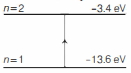
For absorption to occur,the photon energy must match the energy difference between the ground state and an excited state $(n > 1)$. The minimum energy required for excitation is $E_2 - E_1 = -3.4 - (-13.6) = 10.2 \, \text{eV}$.
Since $3.4 \, \text{eV}$ is less than the required $10.2 \, \text{eV}$ for excitation from the ground state,the wavelength $3646 \, \mathring{A}$ will not be strongly absorbed.
Calculating the energies of the given wavelengths:
$E_1 = \frac{12400}{912} \approx 13.6 \, \text{eV}$
$E_2 = \frac{12400}{1026} \approx 12.08 \, \text{eV}$
$E_3 = \frac{12400}{1216} \approx 10.2 \, \text{eV}$
$E_4 = \frac{12400}{3646} \approx 3.4 \, \text{eV}$
At room temperature,hydrogen atoms are in the ground state $(n=1)$.
For absorption to occur,the photon energy must match the energy difference between the ground state and an excited state $(n > 1)$. The minimum energy required for excitation is $E_2 - E_1 = -3.4 - (-13.6) = 10.2 \, \text{eV}$.
Since $3.4 \, \text{eV}$ is less than the required $10.2 \, \text{eV}$ for excitation from the ground state,the wavelength $3646 \, \mathring{A}$ will not be strongly absorbed.
0 likes
View Solution135
AdvancedMCQ
An electron with kinetic energy $E$ collides with a hydrogen atom in the ground state. The collision will be elastic
A
for all values of $E$
B
for $E < 10.2 \,eV$
C
for $10.2 \,eV < E < 13.6 \,eV$ only
D
for $0 < E < 3.4 \,eV$ only
Solution
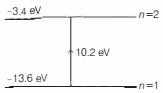
(B) The first excitation energy of a hydrogen atom in the ground state $(n=1)$ to the first excited state $(n=2)$ is $E_2 - E_1 = -3.4 \,eV - (-13.6 \,eV) = 10.2 \,eV$.
If the kinetic energy $E$ of the incident electron is less than $10.2 \,eV$,the hydrogen atom cannot absorb any energy because there are no energy levels available between $n=1$ and $n=2$. Consequently,no internal energy change occurs,and the collision is elastic.
If the kinetic energy $E$ is greater than or equal to $10.2 \,eV$,the hydrogen atom can absorb $10.2 \,eV$ of energy to transition to the $n=2$ state. In this case,the collision is inelastic.
Therefore,the collision is elastic for $E < 10.2 \,eV$.
If the kinetic energy $E$ of the incident electron is less than $10.2 \,eV$,the hydrogen atom cannot absorb any energy because there are no energy levels available between $n=1$ and $n=2$. Consequently,no internal energy change occurs,and the collision is elastic.
If the kinetic energy $E$ is greater than or equal to $10.2 \,eV$,the hydrogen atom can absorb $10.2 \,eV$ of energy to transition to the $n=2$ state. In this case,the collision is inelastic.
Therefore,the collision is elastic for $E < 10.2 \,eV$.
0 likes
View Solution136
AdvancedMCQ
$A$ photon of wavelength $\lambda$ is absorbed by an electron confined to a box of length $L = \sqrt{(35 h \lambda / 8 m c)}$. As a result,the electron makes a transition from state $k=1$ to the state $n$. Subsequently,the electron transitions from the state $n$ to the state $m$ by emitting a photon of wavelength $\lambda^{\prime} = 1.75 \lambda$. Then,
A
$n=4, m=2$
B
$n=5, m=3$
C
$n=6, m=4$
D
$n=3, m=1$
Solution
(C) For a particle of mass $m$ confined to a one-dimensional box of length $L$,the energy levels are given by $E_k = \frac{k^2 h^2}{8 m L^2}$.
Given $L = \sqrt{\frac{35 h \lambda}{8 m c}}$,we have $L^2 = \frac{35 h \lambda}{8 m c}$.
Substituting $L^2$ into the energy expression:
$E_k = \frac{k^2 h^2}{8 m (35 h \lambda / 8 m c)} = \frac{k^2 h c}{35 \lambda}$.
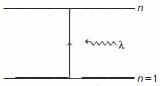
When the electron absorbs a photon of wavelength $\lambda$,it transitions from $k=1$ to $n$:
$E_n - E_1 = \frac{h c}{\lambda}$
$\frac{n^2 h c}{35 \lambda} - \frac{1^2 h c}{35 \lambda} = \frac{h c}{\lambda}$
$\frac{n^2 - 1}{35} = 1 \Rightarrow n^2 - 1 = 35 \Rightarrow n^2 = 36 \Rightarrow n = 6$.
Next,the electron transitions from $n=6$ to $m$ by emitting a photon of wavelength $\lambda^{\prime} = 1.75 \lambda = \frac{7}{4} \lambda$:
$E_6 - E_m = \frac{h c}{\lambda^{\prime}}$
$\frac{6^2 h c}{35 \lambda} - \frac{m^2 h c}{35 \lambda} = \frac{h c}{1.75 \lambda}$
$\frac{36 - m^2}{35} = \frac{1}{1.75} = \frac{1}{7/4} = \frac{4}{7}$
$36 - m^2 = 35 \times \frac{4}{7} = 5 \times 4 = 20$
$m^2 = 36 - 20 = 16 \Rightarrow m = 4$.
Thus,$n=6$ and $m=4$.
Given $L = \sqrt{\frac{35 h \lambda}{8 m c}}$,we have $L^2 = \frac{35 h \lambda}{8 m c}$.
Substituting $L^2$ into the energy expression:
$E_k = \frac{k^2 h^2}{8 m (35 h \lambda / 8 m c)} = \frac{k^2 h c}{35 \lambda}$.
When the electron absorbs a photon of wavelength $\lambda$,it transitions from $k=1$ to $n$:
$E_n - E_1 = \frac{h c}{\lambda}$
$\frac{n^2 h c}{35 \lambda} - \frac{1^2 h c}{35 \lambda} = \frac{h c}{\lambda}$
$\frac{n^2 - 1}{35} = 1 \Rightarrow n^2 - 1 = 35 \Rightarrow n^2 = 36 \Rightarrow n = 6$.
Next,the electron transitions from $n=6$ to $m$ by emitting a photon of wavelength $\lambda^{\prime} = 1.75 \lambda = \frac{7}{4} \lambda$:
$E_6 - E_m = \frac{h c}{\lambda^{\prime}}$
$\frac{6^2 h c}{35 \lambda} - \frac{m^2 h c}{35 \lambda} = \frac{h c}{1.75 \lambda}$
$\frac{36 - m^2}{35} = \frac{1}{1.75} = \frac{1}{7/4} = \frac{4}{7}$
$36 - m^2 = 35 \times \frac{4}{7} = 5 \times 4 = 20$
$m^2 = 36 - 20 = 16 \Rightarrow m = 4$.
Thus,$n=6$ and $m=4$.
0 likes
View Solution137
MediumMCQ
$A$ singly ionised helium atom in an excited state $(n=4)$ emits a photon of energy $2.6 \,eV$. Given that the ground state energy of hydrogen atom is $-13.6 \,eV$,the energy $E_f$ and quantum number $n$ of the resulting state are respectively,
A
$E_f=-13.6 \,eV , n=1$
B
$E_f=-6.0 \,eV , n=3$
C
$E_f=-6.0 \,eV , n=2$
D
$E_f=-13.6 \,eV , n=2$
Solution
(B) The energy of a hydrogen-like atom in the $n$th state is given by $E_n = -13.6 \frac{Z^2}{n^2} \,eV$.
For a singly ionised helium atom,the atomic number $Z = 2$.
Therefore,the energy of the state $n=4$ is:
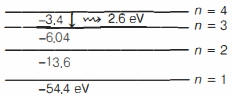
$E_4 = -13.6 \times \frac{2^2}{4^2} = -13.6 \times \frac{4}{16} = -3.4 \,eV$.
When the atom emits a photon of energy $2.6 \,eV$,its final energy $E_f$ will be:
$E_f = E_4 - 2.6 \,eV = -3.4 \,eV - 2.6 \,eV = -6.0 \,eV$.
Now,we find the quantum number $n$ for this energy level using $E_n = -13.6 \frac{Z^2}{n^2}$:
$-6.0 = -13.6 \times \frac{4}{n^2} \implies n^2 = \frac{13.6 \times 4}{6.0} \approx 9.06 \approx 9$.
Thus,$n = 3$.
The final energy is $-6.0 \,eV$ and the quantum number is $n=3$.
For a singly ionised helium atom,the atomic number $Z = 2$.
Therefore,the energy of the state $n=4$ is:
$E_4 = -13.6 \times \frac{2^2}{4^2} = -13.6 \times \frac{4}{16} = -3.4 \,eV$.
When the atom emits a photon of energy $2.6 \,eV$,its final energy $E_f$ will be:
$E_f = E_4 - 2.6 \,eV = -3.4 \,eV - 2.6 \,eV = -6.0 \,eV$.
Now,we find the quantum number $n$ for this energy level using $E_n = -13.6 \frac{Z^2}{n^2}$:
$-6.0 = -13.6 \times \frac{4}{n^2} \implies n^2 = \frac{13.6 \times 4}{6.0} \approx 9.06 \approx 9$.
Thus,$n = 3$.
The final energy is $-6.0 \,eV$ and the quantum number is $n=3$.
0 likes
View Solution138
MediumMCQ
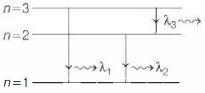
Due to transitions among its first three energy levels,a hydrogenic atom emits radiation at three discrete wavelengths $\lambda_1, \lambda_2$ and $\lambda_3$ (where $\lambda_1 < \lambda_2 < \lambda_3$). Then,
A
$\lambda_1 = \lambda_2 + \lambda_3$
B
$\lambda_1 + \lambda_2 = \lambda_3$
C
$\frac{1}{\lambda_1} + \frac{1}{\lambda_2} = \frac{1}{\lambda_3}$
D
$\frac{1}{\lambda_1} = \frac{1}{\lambda_2} + \frac{1}{\lambda_3}$
Solution
(D) The energy of a photon emitted during a transition is given by $E = \frac{hc}{\lambda}$,where $h$ is Planck's constant,$c$ is the speed of light,and $\lambda$ is the wavelength.
For the first three energy levels $(n=1, 2, 3)$,the possible transitions are:
$1$. $n=3 \rightarrow n=1$ (Energy $E_1$,wavelength $\lambda_1$)
$2$. $n=2 \rightarrow n=1$ (Energy $E_2$,wavelength $\lambda_2$)
$3$. $n=3 \rightarrow n=2$ (Energy $E_3$,wavelength $\lambda_3$)
Since energy is inversely proportional to wavelength $(E \propto \frac{1}{\lambda})$,the transition with the largest energy change corresponds to the shortest wavelength. Thus,$\lambda_1$ is the shortest wavelength $(n=3 \rightarrow n=1)$,and $\lambda_3$ is the longest wavelength $(n=3 \rightarrow n=2)$.
From the conservation of energy,the energy of the transition from $n=3$ to $n=1$ is equal to the sum of the energies of the transitions from $n=3$ to $n=2$ and $n=2$ to $n=1$:
$E_{3 \rightarrow 1} = E_{3 \rightarrow 2} + E_{2 \rightarrow 1}$
Substituting $E = \frac{hc}{\lambda}$:
$\frac{hc}{\lambda_1} = \frac{hc}{\lambda_3} + \frac{hc}{\lambda_2}$
Dividing by $hc$ on both sides,we get:
$\frac{1}{\lambda_1} = \frac{1}{\lambda_2} + \frac{1}{\lambda_3}$
For the first three energy levels $(n=1, 2, 3)$,the possible transitions are:
$1$. $n=3 \rightarrow n=1$ (Energy $E_1$,wavelength $\lambda_1$)
$2$. $n=2 \rightarrow n=1$ (Energy $E_2$,wavelength $\lambda_2$)
$3$. $n=3 \rightarrow n=2$ (Energy $E_3$,wavelength $\lambda_3$)
Since energy is inversely proportional to wavelength $(E \propto \frac{1}{\lambda})$,the transition with the largest energy change corresponds to the shortest wavelength. Thus,$\lambda_1$ is the shortest wavelength $(n=3 \rightarrow n=1)$,and $\lambda_3$ is the longest wavelength $(n=3 \rightarrow n=2)$.
From the conservation of energy,the energy of the transition from $n=3$ to $n=1$ is equal to the sum of the energies of the transitions from $n=3$ to $n=2$ and $n=2$ to $n=1$:
$E_{3 \rightarrow 1} = E_{3 \rightarrow 2} + E_{2 \rightarrow 1}$
Substituting $E = \frac{hc}{\lambda}$:
$\frac{hc}{\lambda_1} = \frac{hc}{\lambda_3} + \frac{hc}{\lambda_2}$
Dividing by $hc$ on both sides,we get:
$\frac{1}{\lambda_1} = \frac{1}{\lambda_2} + \frac{1}{\lambda_3}$
0 likes
View Solution139
EasyMCQ
As the $n$ (number of orbit) increases,the difference of energy between the consecutive energy levels
A
Remains the same
B
Increases
C
Decreases
D
Sometimes increases and sometimes decreases
Solution
(C) The energy of an electron in the $n^{th}$ orbit of a hydrogen atom is given by $E_n = -\frac{13.6 \ eV}{n^2}$.
The energy difference between two consecutive orbits $n$ and $n+1$ is $\Delta E = E_{n+1} - E_n = -13.6 \left( \frac{1}{(n+1)^2} - \frac{1}{n^2} \right) = 13.6 \left( \frac{1}{n^2} - \frac{1}{(n+1)^2} \right) = 13.6 \left( \frac{(n+1)^2 - n^2}{n^2(n+1)^2} \right) = 13.6 \left( \frac{2n+1}{n^2(n+1)^2} \right)$.
As $n$ increases,the denominator $n^2(n+1)^2$ grows much faster than the numerator $(2n+1)$,causing the value of $\Delta E$ to decrease.
Therefore,the energy difference between consecutive energy levels decreases as $n$ increases.
The energy difference between two consecutive orbits $n$ and $n+1$ is $\Delta E = E_{n+1} - E_n = -13.6 \left( \frac{1}{(n+1)^2} - \frac{1}{n^2} \right) = 13.6 \left( \frac{1}{n^2} - \frac{1}{(n+1)^2} \right) = 13.6 \left( \frac{(n+1)^2 - n^2}{n^2(n+1)^2} \right) = 13.6 \left( \frac{2n+1}{n^2(n+1)^2} \right)$.
As $n$ increases,the denominator $n^2(n+1)^2$ grows much faster than the numerator $(2n+1)$,causing the value of $\Delta E$ to decrease.
Therefore,the energy difference between consecutive energy levels decreases as $n$ increases.
0 likes
View Solution140
EasyMCQ
The energy of a hydrogen atom in its ground state is $-13.6 \,eV$. The energy of the level corresponding to $n=7$ is ...... $eV$.
A
$-0.544$
B
$-5.40$
C
$-0.85$
D
$-0.28$
Solution
(D) The energy of an electron in the $n^{th}$ orbit of a hydrogen atom is given by the formula:
$E_n = -\frac{13.6 \,eV}{n^2}$
For the energy level corresponding to $n=7$:
$E_7 = -\frac{13.6}{7^2} \,eV$
$E_7 = -\frac{13.6}{49} \,eV$
$E_7 \approx -0.27755 \,eV$
Rounding to two decimal places,we get:
$E_7 \approx -0.28 \,eV$
Therefore,the correct option is $D$.
$E_n = -\frac{13.6 \,eV}{n^2}$
For the energy level corresponding to $n=7$:
$E_7 = -\frac{13.6}{7^2} \,eV$
$E_7 = -\frac{13.6}{49} \,eV$
$E_7 \approx -0.27755 \,eV$
Rounding to two decimal places,we get:
$E_7 \approx -0.28 \,eV$
Therefore,the correct option is $D$.
0 likes
View Solution141
MediumMCQ
$A$ photon is emitted in transition from $n = 4$ to $n = 1$ level in a hydrogen atom. The corresponding wavelength for this transition is $......... \, nm$ (given,$h = 4 \times 10^{-15} \, eV \cdot s$ and $c = 3 \times 10^8 \, m/s$):
A
$94.1$
B
$941$
C
$97.4$
D
$99.3$
Solution
(A) The energy of a photon emitted during a transition between energy levels $n_i$ and $n_f$ is given by $\Delta E = 13.6 \left( \frac{1}{n_f^2} - \frac{1}{n_i^2} \right) \, eV$.
For the transition from $n = 4$ to $n = 1$,$\Delta E = 13.6 \left( 1 - \frac{1}{16} \right) = 13.6 \times \frac{15}{16} = 12.75 \, eV$.
The energy of the photon is also given by $E = \frac{hc}{\lambda}$.
Given $h = 4 \times 10^{-15} \, eV \cdot s$ and $c = 3 \times 10^8 \, m/s$,we have $hc = 12 \times 10^{-7} \, eV \cdot m = 1200 \, eV \cdot nm$.
Thus,$\lambda = \frac{hc}{\Delta E} = \frac{1200 \, eV \cdot nm}{12.75 \, eV} \approx 94.11 \, nm$.
Therefore,the wavelength is approximately $94.1 \, nm$.
For the transition from $n = 4$ to $n = 1$,$\Delta E = 13.6 \left( 1 - \frac{1}{16} \right) = 13.6 \times \frac{15}{16} = 12.75 \, eV$.
The energy of the photon is also given by $E = \frac{hc}{\lambda}$.
Given $h = 4 \times 10^{-15} \, eV \cdot s$ and $c = 3 \times 10^8 \, m/s$,we have $hc = 12 \times 10^{-7} \, eV \cdot m = 1200 \, eV \cdot nm$.
Thus,$\lambda = \frac{hc}{\Delta E} = \frac{1200 \, eV \cdot nm}{12.75 \, eV} \approx 94.11 \, nm$.
Therefore,the wavelength is approximately $94.1 \, nm$.
0 likes
View Solution142
MediumMCQ
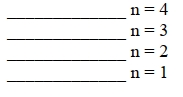
The wavelength of the radiation emitted is $\lambda_0$ when an electron jumps from the second excited state to the first excited state of a hydrogen atom. If the electron jumps from the third excited state to the second orbit of the hydrogen atom,the wavelength of the radiation emitted will be $\frac{20}{x} \lambda_0$. The value of $x$ is $........$
A
$22$
B
$21$
C
$20$
D
$27$
Solution
(D) For the hydrogen atom,the energy of a transition is given by $\Delta E = 13.6 \left( \frac{1}{n_f^2} - \frac{1}{n_i^2} \right) \text{ eV}$.
Case $1$: Second excited state $(n_i = 3)$ to first excited state $(n_f = 2)$.
$\frac{hc}{\lambda_0} = 13.6 \left( \frac{1}{2^2} - \frac{1}{3^2} \right) = 13.6 \left( \frac{1}{4} - \frac{1}{9} \right) = 13.6 \left( \frac{5}{36} \right) \ldots (i)$
Case $2$: Third excited state $(n_i = 4)$ to second orbit $(n_f = 2)$.
$\frac{hc}{\lambda'} = 13.6 \left( \frac{1}{2^2} - \frac{1}{4^2} \right) = 13.6 \left( \frac{1}{4} - \frac{1}{16} \right) = 13.6 \left( \frac{3}{16} \right) \ldots (ii)$
Given $\lambda' = \frac{20}{x} \lambda_0$,we divide equation $(i)$ by $(ii)$:
$\frac{\lambda'}{\lambda_0} = \frac{13.6 \left( \frac{5}{36} \right)}{13.6 \left( \frac{3}{16} \right)} = \frac{5}{36} \times \frac{16}{3} = \frac{5 \times 4}{9 \times 3} = \frac{20}{27}$
Comparing $\frac{\lambda'}{\lambda_0} = \frac{20}{27}$ with $\frac{20}{x}$,we get $x = 27$.
Case $1$: Second excited state $(n_i = 3)$ to first excited state $(n_f = 2)$.
$\frac{hc}{\lambda_0} = 13.6 \left( \frac{1}{2^2} - \frac{1}{3^2} \right) = 13.6 \left( \frac{1}{4} - \frac{1}{9} \right) = 13.6 \left( \frac{5}{36} \right) \ldots (i)$
Case $2$: Third excited state $(n_i = 4)$ to second orbit $(n_f = 2)$.
$\frac{hc}{\lambda'} = 13.6 \left( \frac{1}{2^2} - \frac{1}{4^2} \right) = 13.6 \left( \frac{1}{4} - \frac{1}{16} \right) = 13.6 \left( \frac{3}{16} \right) \ldots (ii)$
Given $\lambda' = \frac{20}{x} \lambda_0$,we divide equation $(i)$ by $(ii)$:
$\frac{\lambda'}{\lambda_0} = \frac{13.6 \left( \frac{5}{36} \right)}{13.6 \left( \frac{3}{16} \right)} = \frac{5}{36} \times \frac{16}{3} = \frac{5 \times 4}{9 \times 3} = \frac{20}{27}$
Comparing $\frac{\lambda'}{\lambda_0} = \frac{20}{27}$ with $\frac{20}{x}$,we get $x = 27$.
0 likes
View Solution143
MediumMCQ
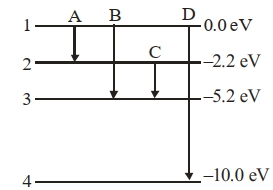
The energy levels of an atom are shown in the figure. Which one of these transitions will result in the emission of a photon of wavelength $124.1 \, nm$? Given $(h = 6.62 \times 10^{-34} \, Js)$.
A
$B$
B
$A$
C
$C$
D
$D$
Solution
(D) The energy of a photon emitted during a transition is given by $\Delta E = \frac{hc}{\lambda}$.
Given $\lambda = 124.1 \, nm = 124.1 \times 10^{-9} \, m$.
Using $hc \approx 1241 \, eV \cdot nm$,the required energy difference is $\Delta E = \frac{1241 \, eV \cdot nm}{124.1 \, nm} = 10 \, eV$.
From the figure:
Transition $A$: $\Delta E = 0 - (-2.2) = 2.2 \, eV$.
Transition $B$: $\Delta E = 0 - (-5.2) = 5.2 \, eV$.
Transition $C$: $\Delta E = -2.2 - (-5.2) = 3.0 \, eV$.
Transition $D$: $\Delta E = 0 - (-10.0) = 10.0 \, eV$.
Since transition $D$ corresponds to an energy difference of $10 \, eV$,it results in the emission of a photon with wavelength $124.1 \, nm$.
Given $\lambda = 124.1 \, nm = 124.1 \times 10^{-9} \, m$.
Using $hc \approx 1241 \, eV \cdot nm$,the required energy difference is $\Delta E = \frac{1241 \, eV \cdot nm}{124.1 \, nm} = 10 \, eV$.
From the figure:
Transition $A$: $\Delta E = 0 - (-2.2) = 2.2 \, eV$.
Transition $B$: $\Delta E = 0 - (-5.2) = 5.2 \, eV$.
Transition $C$: $\Delta E = -2.2 - (-5.2) = 3.0 \, eV$.
Transition $D$: $\Delta E = 0 - (-10.0) = 10.0 \, eV$.
Since transition $D$ corresponds to an energy difference of $10 \, eV$,it results in the emission of a photon with wavelength $124.1 \, nm$.
0 likes
View Solution144
MediumMCQ
If the binding energy of a ground state electron in a hydrogen atom is $13.6\,eV$,then the energy required to remove the electron from the second excited state of $Li^{2+}$ will be $x \times 10^{-1}\,eV$. The value of $x$ is $...........$
A
$135$
B
$134$
C
$136$
D
$133$
Solution
(C) The energy of an electron in the $n^{th}$ orbit of a hydrogen-like atom is given by $E_n = -13.6 \times \frac{Z^2}{n^2}\,eV$.
For $Li^{2+}$,the atomic number $Z = 3$.
The second excited state corresponds to $n = 3$.
Therefore,the energy of the electron in the second excited state is $E_3 = -13.6 \times \frac{3^2}{3^2} = -13.6\,eV$.
The energy required to remove the electron (binding energy) is the magnitude of this energy,which is $13.6\,eV$.
We are given that this energy is $x \times 10^{-1}\,eV$.
So,$13.6 = x \times 10^{-1} \implies x = 136$.
For $Li^{2+}$,the atomic number $Z = 3$.
The second excited state corresponds to $n = 3$.
Therefore,the energy of the electron in the second excited state is $E_3 = -13.6 \times \frac{3^2}{3^2} = -13.6\,eV$.
The energy required to remove the electron (binding energy) is the magnitude of this energy,which is $13.6\,eV$.
We are given that this energy is $x \times 10^{-1}\,eV$.
So,$13.6 = x \times 10^{-1} \implies x = 136$.
0 likes
View Solution145
MediumMCQ
An electron of a hydrogen-like atom,having $Z=4$,jumps from the $4^{\text{th}}$ energy state to the $2^{\text{nd}}$ energy state. The energy released in this process will be $......... \text{eV}$.
(Given $Rch = 13.6 \text{ eV}$)
Where $R =$ Rydberg constant,
$c =$ Speed of light in vacuum,
$h =$ Planck's constant.
(Given $Rch = 13.6 \text{ eV}$)
Where $R =$ Rydberg constant,
$c =$ Speed of light in vacuum,
$h =$ Planck's constant.
A
$13.6$
B
$10.5$
C
$3.4$
D
$40.8$
Solution
(D) The energy of an electron in the $n^{\text{th}}$ orbit of a hydrogen-like atom is given by $E_n = -13.6 \frac{Z^2}{n^2} \text{ eV}$.
The energy released when an electron jumps from an initial state $n_i$ to a final state $n_f$ is $\Delta E = E_{n_i} - E_{n_f} = 13.6 Z^2 \left( \frac{1}{n_f^2} - \frac{1}{n_i^2} \right) \text{ eV}$.
Given $Z = 4$,$n_i = 4$,and $n_f = 2$:
$\Delta E = 13.6 \times (4)^2 \left( \frac{1}{2^2} - \frac{1}{4^2} \right) \text{ eV}$.
$\Delta E = 13.6 \times 16 \left( \frac{1}{4} - \frac{1}{16} \right) \text{ eV}$.
$\Delta E = 13.6 \times 16 \left( \frac{4-1}{16} \right) \text{ eV}$.
$\Delta E = 13.6 \times 3 \text{ eV} = 40.8 \text{ eV}$.
The energy released when an electron jumps from an initial state $n_i$ to a final state $n_f$ is $\Delta E = E_{n_i} - E_{n_f} = 13.6 Z^2 \left( \frac{1}{n_f^2} - \frac{1}{n_i^2} \right) \text{ eV}$.
Given $Z = 4$,$n_i = 4$,and $n_f = 2$:
$\Delta E = 13.6 \times (4)^2 \left( \frac{1}{2^2} - \frac{1}{4^2} \right) \text{ eV}$.
$\Delta E = 13.6 \times 16 \left( \frac{1}{4} - \frac{1}{16} \right) \text{ eV}$.
$\Delta E = 13.6 \times 16 \left( \frac{4-1}{16} \right) \text{ eV}$.
$\Delta E = 13.6 \times 3 \text{ eV} = 40.8 \text{ eV}$.
0 likes
View Solution146
MediumMCQ
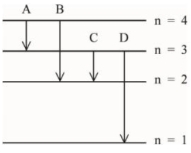
The energy levels of a hydrogen atom are shown below. The transition corresponding to the emission of the shortest wavelength is
A
$A$
B
$B$
C
$C$
D
$D$
Solution
(D) The energy of a photon emitted during a transition is given by $\Delta E = \frac{hc}{\lambda}$,where $h$ is Planck's constant,$c$ is the speed of light,and $\lambda$ is the wavelength.
From this relation,we have $\lambda = \frac{hc}{\Delta E}$,which implies $\lambda \propto \frac{1}{\Delta E}$.
For the shortest wavelength,the energy difference $\Delta E$ must be the maximum.
Looking at the provided energy level diagram:
Transition $A$ is from $n=4$ to $n=3$.
Transition $B$ is from $n=4$ to $n=2$.
Transition $C$ is from $n=3$ to $n=2$.
Transition $D$ is from $n=3$ to $n=1$.
The energy gap is largest for the transition from $n=3$ to $n=1$,which corresponds to transition $D$.
Therefore,the correct option is $D$.
From this relation,we have $\lambda = \frac{hc}{\Delta E}$,which implies $\lambda \propto \frac{1}{\Delta E}$.
For the shortest wavelength,the energy difference $\Delta E$ must be the maximum.
Looking at the provided energy level diagram:
Transition $A$ is from $n=4$ to $n=3$.
Transition $B$ is from $n=4$ to $n=2$.
Transition $C$ is from $n=3$ to $n=2$.
Transition $D$ is from $n=3$ to $n=1$.
The energy gap is largest for the transition from $n=3$ to $n=1$,which corresponds to transition $D$.
Therefore,the correct option is $D$.
0 likes
View Solution147
MediumMCQ
$A$ monochromatic light is incident on a hydrogen sample in the ground state. Hydrogen atoms absorb a fraction of light and subsequently emit radiation of six different wavelengths. The frequency of incident light is $x \times 10^{15} \ Hz$. The value of $x$ is (Given $h = 4.25 \times 10^{-15} \ eVs$)
A
$2$
B
$3$
C
$4$
D
$8$
Solution
(B) The number of spectral lines emitted when an electron transitions from an excited state $n_2$ to the ground state $n_1=1$ is given by the formula $N = \frac{n_2(n_2-1)}{2}$.
Given $N = 6$,we have $\frac{n_2(n_2-1)}{2} = 6$,which implies $n_2^2 - n_2 - 12 = 0$.
Solving this quadratic equation,we get $(n_2-4)(n_2+3) = 0$. Since $n_2 > 0$,we find $n_2 = 4$.
The energy of the incident photon must be equal to the energy difference between the ground state $(n=1)$ and the excited state $(n=4)$:
$h\nu = E_4 - E_1 = -0.85 \ eV - (-13.6 \ eV) = 12.75 \ eV$.
Given $h = 4.25 \times 10^{-15} \ eVs$,the frequency $\nu$ is:
$\nu = \frac{12.75 \ eV}{4.25 \times 10^{-15} \ eVs} = 3 \times 10^{15} \ Hz$.
Comparing this with $x \times 10^{15} \ Hz$,we get $x = 3$.
Given $N = 6$,we have $\frac{n_2(n_2-1)}{2} = 6$,which implies $n_2^2 - n_2 - 12 = 0$.
Solving this quadratic equation,we get $(n_2-4)(n_2+3) = 0$. Since $n_2 > 0$,we find $n_2 = 4$.
The energy of the incident photon must be equal to the energy difference between the ground state $(n=1)$ and the excited state $(n=4)$:
$h\nu = E_4 - E_1 = -0.85 \ eV - (-13.6 \ eV) = 12.75 \ eV$.
Given $h = 4.25 \times 10^{-15} \ eVs$,the frequency $\nu$ is:
$\nu = \frac{12.75 \ eV}{4.25 \times 10^{-15} \ eVs} = 3 \times 10^{15} \ Hz$.
Comparing this with $x \times 10^{15} \ Hz$,we get $x = 3$.
0 likes
View Solution148
DifficultMCQ
As per the given figure,$A$,$B$,and $C$ are the first,second,and third excited energy levels of a hydrogen atom,respectively. If the ratio of the two wavelengths (i.e.,$\frac{\lambda_1}{\lambda_2}$) is $\frac{7}{4n}$,then the value of $n$ will be
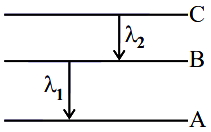
A
$5$
B
$10$
C
$15$
D
$20$
Solution
(A) The energy levels for a hydrogen atom are given by $n=1$ (ground state),$n=2$ (first excited state),$n=3$ (second excited state),and $n=4$ (third excited state).
From the figure,$A$ corresponds to $n=2$,$B$ corresponds to $n=3$,and $C$ corresponds to $n=4$.
The wavelength $\lambda$ for a transition from $n_2$ to $n_1$ is given by the Rydberg formula: $\frac{1}{\lambda} = R Z^2 \left[ \frac{1}{n_1^2} - \frac{1}{n_2^2} \right]$.
For transition $\lambda_1$ (from $n=3$ to $n=2$): $\frac{1}{\lambda_1} = R(1)^2 \left[ \frac{1}{2^2} - \frac{1}{3^2} \right] = R \left[ \frac{1}{4} - \frac{1}{9} \right] = R \left( \frac{5}{36} \right)$.
For transition $\lambda_2$ (from $n=4$ to $n=3$): $\frac{1}{\lambda_2} = R(1)^2 \left[ \frac{1}{3^2} - \frac{1}{4^2} \right] = R \left[ \frac{1}{9} - \frac{1}{16} \right] = R \left( \frac{7}{144} \right)$.
Now,calculate the ratio $\frac{\lambda_1}{\lambda_2}$:
$\frac{\lambda_1}{\lambda_2} = \frac{1/\lambda_2}{1/\lambda_1} = \frac{R(7/144)}{R(5/36)} = \frac{7}{144} \times \frac{36}{5} = \frac{7}{4 \times 5} = \frac{7}{20}$.
Given the ratio is $\frac{7}{4n}$,we have $\frac{7}{20} = \frac{7}{4n}$,which implies $4n = 20$,so $n = 5$.
From the figure,$A$ corresponds to $n=2$,$B$ corresponds to $n=3$,and $C$ corresponds to $n=4$.
The wavelength $\lambda$ for a transition from $n_2$ to $n_1$ is given by the Rydberg formula: $\frac{1}{\lambda} = R Z^2 \left[ \frac{1}{n_1^2} - \frac{1}{n_2^2} \right]$.
For transition $\lambda_1$ (from $n=3$ to $n=2$): $\frac{1}{\lambda_1} = R(1)^2 \left[ \frac{1}{2^2} - \frac{1}{3^2} \right] = R \left[ \frac{1}{4} - \frac{1}{9} \right] = R \left( \frac{5}{36} \right)$.
For transition $\lambda_2$ (from $n=4$ to $n=3$): $\frac{1}{\lambda_2} = R(1)^2 \left[ \frac{1}{3^2} - \frac{1}{4^2} \right] = R \left[ \frac{1}{9} - \frac{1}{16} \right] = R \left( \frac{7}{144} \right)$.
Now,calculate the ratio $\frac{\lambda_1}{\lambda_2}$:
$\frac{\lambda_1}{\lambda_2} = \frac{1/\lambda_2}{1/\lambda_1} = \frac{R(7/144)}{R(5/36)} = \frac{7}{144} \times \frac{36}{5} = \frac{7}{4 \times 5} = \frac{7}{20}$.
Given the ratio is $\frac{7}{4n}$,we have $\frac{7}{20} = \frac{7}{4n}$,which implies $4n = 20$,so $n = 5$.
0 likes
View Solution149
DifficultMCQ
When a hydrogen atom transitions from $n=2$ to $n=1$, it emits a photon. The recoil speed of the atom is $\frac{x}{5} \,m/s$. Find the value of $x$. (Use: mass of hydrogen atom $= 1.6 \times 10^{-27} \,kg$)
A
$17$
B
$18$
C
$19$
D
$20$
Solution
(A) The energy difference between the levels $n=2$ and $n=1$ is given by $\Delta E = E_2 - E_1 = -3.4 \,eV - (-13.6 \,eV) = 10.2 \,eV$.
By the principle of conservation of momentum, the momentum of the emitted photon must be equal in magnitude to the recoil momentum of the hydrogen atom.
$p_{\text{atom}} = p_{\text{photon}} = \frac{\Delta E}{c}$
Since $p_{\text{atom}} = m \cdot v$, where $m$ is the mass of the hydrogen atom and $v$ is the recoil speed:
$v = \frac{\Delta E}{m \cdot c}$
Substituting the given values:
$v = \frac{10.2 \,eV}{(1.6 \times 10^{-27} \,kg) \times (3 \times 10^8 \,m/s)}$
Convert $eV$ to Joules $(1 \,eV = 1.6 \times 10^{-19} \,J)$:
$v = \frac{10.2 \times 1.6 \times 10^{-19} \,J}{1.6 \times 10^{-27} \,kg \times 3 \times 10^8 \,m/s}$
$v = \frac{10.2 \times 10^{-19}}{3 \times 10^{-19}} \,m/s = 3.4 \,m/s$
Expressing $3.4 \,m/s$ as a fraction with denominator $5$:
$v = \frac{3.4 \times 5}{5} = \frac{17}{5} \,m/s$
Comparing this with $\frac{x}{5} \,m/s$, we get $x = 17$.
By the principle of conservation of momentum, the momentum of the emitted photon must be equal in magnitude to the recoil momentum of the hydrogen atom.
$p_{\text{atom}} = p_{\text{photon}} = \frac{\Delta E}{c}$
Since $p_{\text{atom}} = m \cdot v$, where $m$ is the mass of the hydrogen atom and $v$ is the recoil speed:
$v = \frac{\Delta E}{m \cdot c}$
Substituting the given values:
$v = \frac{10.2 \,eV}{(1.6 \times 10^{-27} \,kg) \times (3 \times 10^8 \,m/s)}$
Convert $eV$ to Joules $(1 \,eV = 1.6 \times 10^{-19} \,J)$:
$v = \frac{10.2 \times 1.6 \times 10^{-19} \,J}{1.6 \times 10^{-27} \,kg \times 3 \times 10^8 \,m/s}$
$v = \frac{10.2 \times 10^{-19}}{3 \times 10^{-19}} \,m/s = 3.4 \,m/s$
Expressing $3.4 \,m/s$ as a fraction with denominator $5$:
$v = \frac{3.4 \times 5}{5} = \frac{17}{5} \,m/s$
Comparing this with $\frac{x}{5} \,m/s$, we get $x = 17$.
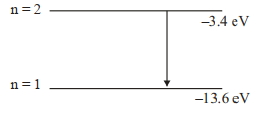
0 likes
View SolutionAtoms — Electron Energy and Electron Energy Levels in Hydrogen Atom · Frequently Asked Questions
1Are these Atoms questions useful for JEE and NEET?
Yes. All questions in this section are mapped to JEE Main and NEET exam patterns. Previous year questions from JEE Main, NEET, GUJCET and state-level exams are included with full solutions.
2Can I switch to Hindi or Gujarati for these questions?
Yes. Use the language tabs in the hero section or the sidebar to view the same questions and solutions in English, Hindi or Gujarati.
3How do I generate a question paper from this subtopic?
Use the Vedclass Exam Paper Generator — select the chapter and subtopic, set difficulty, and generate Sets A, B, C, D automatically. First 3 chapters of every subject are free.
Vedclass Products
For Students
Vedclass Test Series
Mock tests in real JEE/NEET style with performance analysis. 5-day free trial.
Start Free TrialFor Teachers
Exam Paper Generator
Generate Set A/B/C/D papers from this chapter in 2 minutes. 3 chapters free.
Try FreeFor Institutes
Online Exam Module
Live online exams with unlimited students, 360° analytics & white-label branding.
See DemoFor Teachers & Institutes
Generate a Atoms Exam Paper in 2 Minutes
Select subtopic & difficulty — Sets A, B, C, D auto-generated with No Repeat logic.
First 3 chapters of every subject are free — no payment required.