
A English
Electron Energy and Electron Energy Levels in Hydrogen Atom Questions in English
Class 12 Physics · Atoms · Electron Energy and Electron Energy Levels in Hydrogen Atom
224+
Questions
English
Language
100%
With Solutions
Showing 48 of 224 questions in English
51
MediumMCQ
The energy required to remove an electron from the $n = 10$ state of a hydrogen atom is ....... (in $, eV$)
A
$13.6$
B
$1.36$
C
$0.136$
D
$0.0136$
Solution
(C) The energy required to remove an electron from an orbit $n$ is given by the ionization energy formula: $E_n = \frac{13.6 \, Z^2}{n^2} \, eV$.
For a hydrogen atom,the atomic number $Z = 1$.
Given the state $n = 10$,we substitute these values into the formula:
$E_{10} = \frac{13.6 \times (1)^2}{(10)^2} \, eV$.
$E_{10} = \frac{13.6}{100} \, eV$.
$E_{10} = 0.136 \, eV$.
For a hydrogen atom,the atomic number $Z = 1$.
Given the state $n = 10$,we substitute these values into the formula:
$E_{10} = \frac{13.6 \times (1)^2}{(10)^2} \, eV$.
$E_{10} = \frac{13.6}{100} \, eV$.
$E_{10} = 0.136 \, eV$.
0 likes
View Solution52
EasyMCQ
The binding energy of an electron in a $H$-atom with $n = 4$ is ....... $eV$. (Magnitude only)
A
$13.6$
B
$3.4$
C
$1.51$
D
$0.85$
Solution
(D) The binding energy of an electron in a $H$-atom is given by the formula:
Binding Energy $= \frac{13.6}{n^2} \ eV$
Given $n = 4$,we substitute this value into the formula:
Binding Energy $= \frac{13.6}{4^2} \ eV$
Binding Energy $= \frac{13.6}{16} \ eV$
Binding Energy $= 0.85 \ eV$
Binding Energy $= \frac{13.6}{n^2} \ eV$
Given $n = 4$,we substitute this value into the formula:
Binding Energy $= \frac{13.6}{4^2} \ eV$
Binding Energy $= \frac{13.6}{16} \ eV$
Binding Energy $= 0.85 \ eV$
0 likes
View Solution53
MediumMCQ
Energy of $H$-atom in the ground state is $-13.6 \; eV$. The energy needed to ionize a hydrogen atom which is in its second excited state is ....... $eV$.
A
$1.51$
B
$3.4$
C
$13.6$
D
None of the above
Solution
(A) The ground state of a hydrogen atom corresponds to the principal quantum number $n = 1$.
The second excited state corresponds to the principal quantum number $n = 3$.
The energy of an electron in the $n$-th orbit of a hydrogen atom is given by $E_n = -\frac{13.6}{n^2} \; eV$.
For the second excited state $(n = 3)$,the energy is $E_3 = -\frac{13.6}{3^2} = -\frac{13.6}{9} = -1.51 \; eV$.
The energy required to ionize the atom is the energy needed to bring the electron from the current state to the state where $E = 0$.
Therefore,the ionization energy $E_{ion} = 0 - E_3 = 0 - (-1.51) = 1.51 \; eV$.
The second excited state corresponds to the principal quantum number $n = 3$.
The energy of an electron in the $n$-th orbit of a hydrogen atom is given by $E_n = -\frac{13.6}{n^2} \; eV$.
For the second excited state $(n = 3)$,the energy is $E_3 = -\frac{13.6}{3^2} = -\frac{13.6}{9} = -1.51 \; eV$.
The energy required to ionize the atom is the energy needed to bring the electron from the current state to the state where $E = 0$.
Therefore,the ionization energy $E_{ion} = 0 - E_3 = 0 - (-1.51) = 1.51 \; eV$.
0 likes
View Solution54
MediumMCQ
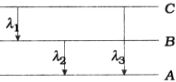
The energy levels of a certain atom are $A, B,$ and $C$ in increasing order of energy,i.e.,$E_A < E_B < E_C$. If $\lambda_1, \lambda_2,$ and $\lambda_3$ are the wavelengths of radiation corresponding to transitions from $C$ to $B$,$B$ to $A$,and $C$ to $A$ respectively,which of the following relations is correct?
A
$\lambda_1, \lambda_2, \lambda_3 = 0$
B
$\lambda_3 = \lambda_1 + \lambda_2$
C
$\lambda_3 = \frac{\lambda_1 \lambda_2}{\lambda_1 + \lambda_2}$
D
$\lambda_3^2 = \lambda_1^2 + \lambda_2^2$
Solution
(C) The energy difference between two levels is related to the wavelength of the emitted photon by the relation $\Delta E = \frac{hc}{\lambda}$.
For the given transitions:
$1$. Transition from $C$ to $B$: $E_C - E_B = \frac{hc}{\lambda_1}$
$2$. Transition from $B$ to $A$: $E_B - E_A = \frac{hc}{\lambda_2}$
$3$. Transition from $C$ to $A$: $E_C - E_A = \frac{hc}{\lambda_3}$
From the energy level diagram,we can see that:
$(E_C - E_A) = (E_C - E_B) + (E_B - E_A)$
Substituting the energy expressions in terms of wavelength:
$\frac{hc}{\lambda_3} = \frac{hc}{\lambda_1} + \frac{hc}{\lambda_2}$
Dividing both sides by $hc$:
$\frac{1}{\lambda_3} = \frac{1}{\lambda_1} + \frac{1}{\lambda_2}$
$\frac{1}{\lambda_3} = \frac{\lambda_2 + \lambda_1}{\lambda_1 \lambda_2}$
Therefore,$\lambda_3 = \frac{\lambda_1 \lambda_2}{\lambda_1 + \lambda_2}$.
For the given transitions:
$1$. Transition from $C$ to $B$: $E_C - E_B = \frac{hc}{\lambda_1}$
$2$. Transition from $B$ to $A$: $E_B - E_A = \frac{hc}{\lambda_2}$
$3$. Transition from $C$ to $A$: $E_C - E_A = \frac{hc}{\lambda_3}$
From the energy level diagram,we can see that:
$(E_C - E_A) = (E_C - E_B) + (E_B - E_A)$
Substituting the energy expressions in terms of wavelength:
$\frac{hc}{\lambda_3} = \frac{hc}{\lambda_1} + \frac{hc}{\lambda_2}$
Dividing both sides by $hc$:
$\frac{1}{\lambda_3} = \frac{1}{\lambda_1} + \frac{1}{\lambda_2}$
$\frac{1}{\lambda_3} = \frac{\lambda_2 + \lambda_1}{\lambda_1 \lambda_2}$
Therefore,$\lambda_3 = \frac{\lambda_1 \lambda_2}{\lambda_1 + \lambda_2}$.
0 likes
View Solution55
MediumMCQ
If the ionization potential of an atom is $122.4 \, V$,then the excitation potentials for the first and second excited states are respectively:
A
$91.8, 108.8 \, V$
B
$68.8, 98.8 \, V$
C
$81.8, 88.8 \, V$
D
$91.8, 180.8 \, V$
Solution
(A) The ionization potential $I.P.$ is given by $E_{\infty} - E_1 = 122.4 \, V$. Since $E_n = -\frac{I.P.}{n^2}$,the energy of the ground state is $E_1 = -122.4 \, eV$.
The energy of the $n^{th}$ state is $E_n = -\frac{122.4}{n^2} \, eV$.
The first excited state corresponds to $n = 2$. The excitation potential is $E_2 - E_1 = -\frac{122.4}{4} - (-122.4) = 122.4(1 - \frac{1}{4}) = 122.4 \times \frac{3}{4} = 91.8 \, V$.
The second excited state corresponds to $n = 3$. The excitation potential is $E_3 - E_1 = -\frac{122.4}{9} - (-122.4) = 122.4(1 - \frac{1}{9}) = 122.4 \times \frac{8}{9} = 108.8 \, V$.
The energy of the $n^{th}$ state is $E_n = -\frac{122.4}{n^2} \, eV$.
The first excited state corresponds to $n = 2$. The excitation potential is $E_2 - E_1 = -\frac{122.4}{4} - (-122.4) = 122.4(1 - \frac{1}{4}) = 122.4 \times \frac{3}{4} = 91.8 \, V$.
The second excited state corresponds to $n = 3$. The excitation potential is $E_3 - E_1 = -\frac{122.4}{9} - (-122.4) = 122.4(1 - \frac{1}{9}) = 122.4 \times \frac{8}{9} = 108.8 \, V$.
0 likes
View Solution56
MediumMCQ
$A$ hydrogen atom absorbs radiation of wavelength $975 \, \text{\AA}$ to transition from the ground state to an excited state. To which energy level will the atom transition?
A
$1$
B
$2$
C
$3$
D
$4$
Solution
(D) The wavelength of the absorbed radiation is $\lambda = 975 \, \text{\AA} = 975 \times 10^{-10} \, m$.
Using the Rydberg formula for the transition from the ground state $(n_1 = 1)$ to an excited state $(n_2 = n)$:
$\frac{1}{\lambda} = R \left( \frac{1}{n_1^2} - \frac{1}{n_2^2} \right)$
Substituting the values $(R \approx 1.097 \times 10^7 \, m^{-1})$:
$\frac{1}{975 \times 10^{-10}} = 1.097 \times 10^7 \left( 1 - \frac{1}{n^2} \right)$
$1.0256 \times 10^7 \approx 1.097 \times 10^7 \left( 1 - \frac{1}{n^2} \right)$
$0.935 \approx 1 - \frac{1}{n^2}$
$\frac{1}{n^2} \approx 1 - 0.935 = 0.065$
$n^2 \approx \frac{1}{0.065} \approx 15.38$
Since $n$ must be an integer, we round to the nearest perfect square, $n^2 = 16$, which gives $n = 4$.
Thus, the atom transitions to the $n = 4$ energy level.
Using the Rydberg formula for the transition from the ground state $(n_1 = 1)$ to an excited state $(n_2 = n)$:
$\frac{1}{\lambda} = R \left( \frac{1}{n_1^2} - \frac{1}{n_2^2} \right)$
Substituting the values $(R \approx 1.097 \times 10^7 \, m^{-1})$:
$\frac{1}{975 \times 10^{-10}} = 1.097 \times 10^7 \left( 1 - \frac{1}{n^2} \right)$
$1.0256 \times 10^7 \approx 1.097 \times 10^7 \left( 1 - \frac{1}{n^2} \right)$
$0.935 \approx 1 - \frac{1}{n^2}$
$\frac{1}{n^2} \approx 1 - 0.935 = 0.065$
$n^2 \approx \frac{1}{0.065} \approx 15.38$
Since $n$ must be an integer, we round to the nearest perfect square, $n^2 = 16$, which gives $n = 4$.
Thus, the atom transitions to the $n = 4$ energy level.
0 likes
View Solution57
MediumMCQ
If the ionization energy of a hydrogen atom in the ground state is $13.6 \ eV$,find the ionization potential of the third orbit in $eV$.
A
$1.36$
B
$1.51$
C
$0.66$
D
$1.06$
Solution
(B) The energy of an electron in the $n^{th}$ orbit of a hydrogen atom is given by $E_n = -\frac{13.6}{n^2} \ eV$.
The ionization potential of the $n^{th}$ orbit is the energy required to remove an electron from that orbit to infinity $(n = \infty)$,which is given by $I.P._n = E_{\infty} - E_n = 0 - E_n = -E_n$.
For the third orbit $(n = 3)$:
$I.P._3 = -E_3 = -\left( -\frac{13.6}{3^2} \right) \ eV$.
$I.P._3 = \frac{13.6}{9} \ eV \approx 1.51 \ eV$.
The ionization potential of the $n^{th}$ orbit is the energy required to remove an electron from that orbit to infinity $(n = \infty)$,which is given by $I.P._n = E_{\infty} - E_n = 0 - E_n = -E_n$.
For the third orbit $(n = 3)$:
$I.P._3 = -E_3 = -\left( -\frac{13.6}{3^2} \right) \ eV$.
$I.P._3 = \frac{13.6}{9} \ eV \approx 1.51 \ eV$.
0 likes
View Solution58
MediumMCQ
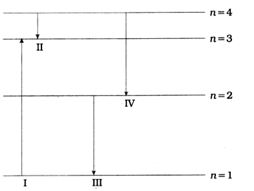
The energy levels of an electron in an atom are shown. Which transition of the electron represents the emission of a photon with the highest energy?
A
$I$
B
$II$
C
$III$
D
$IV$
Solution
(C) The transition $I$ represents the absorption of a photon because the electron moves from a lower energy level to a higher energy level.
Among the remaining transitions $(II, III, IV)$,all represent the emission of a photon as the electron moves from a higher energy level to a lower energy level.
The energy of the emitted photon is given by $\Delta E = E_{initial} - E_{final} = 13.6 \text{ eV} \times Z^2 \left( \frac{1}{n_{final}^2} - \frac{1}{n_{initial}^2} \right)$.
Comparing the transitions:
Transition $II$: $n=4$ to $n=3$,$\Delta E \propto (1/9 - 1/16) = 7/144 \approx 0.048$
Transition $III$: $n=2$ to $n=1$,$\Delta E \propto (1/1 - 1/4) = 3/4 = 0.75$
Transition $IV$: $n=4$ to $n=2$,$\Delta E \propto (1/4 - 1/16) = 3/16 = 0.1875$
Comparing the values,transition $III$ corresponds to the largest energy difference,thus representing the emission of a photon with the highest energy.
Among the remaining transitions $(II, III, IV)$,all represent the emission of a photon as the electron moves from a higher energy level to a lower energy level.
The energy of the emitted photon is given by $\Delta E = E_{initial} - E_{final} = 13.6 \text{ eV} \times Z^2 \left( \frac{1}{n_{final}^2} - \frac{1}{n_{initial}^2} \right)$.
Comparing the transitions:
Transition $II$: $n=4$ to $n=3$,$\Delta E \propto (1/9 - 1/16) = 7/144 \approx 0.048$
Transition $III$: $n=2$ to $n=1$,$\Delta E \propto (1/1 - 1/4) = 3/4 = 0.75$
Transition $IV$: $n=4$ to $n=2$,$\Delta E \propto (1/4 - 1/16) = 3/16 = 0.1875$
Comparing the values,transition $III$ corresponds to the largest energy difference,thus representing the emission of a photon with the highest energy.
0 likes
View Solution59
MediumMCQ
The binding energy of a hydrogen atom in the ground state is $13.6 \ eV$. The energies required to remove an electron from the first three energy levels of the hydrogen atom are,respectively,(in $eV$):
A
$13.6, 10.2, 3.4$
B
$13.6, 3.4, 1.5$
C
$10.2, 1.9, 0.7$
D
$13.6, 6.8, 1.5$
Solution
(B) The binding energy of an electron in the $n^{th}$ orbit of a hydrogen atom is given by the formula: $E_n = \frac{13.6 \ eV}{n^2}$.
For the ground state $(n = 1)$:
$E_1 = \frac{13.6}{1^2} = 13.6 \ eV$.
For the first excited state $(n = 2)$:
$E_2 = \frac{13.6}{2^2} = \frac{13.6}{4} = 3.4 \ eV$.
For the second excited state $(n = 3)$:
$E_3 = \frac{13.6}{3^2} = \frac{13.6}{9} \approx 1.51 \ eV$.
Thus,the energies required to remove the electron from these levels are $13.6 \ eV, 3.4 \ eV,$ and $1.5 \ eV$ respectively.
For the ground state $(n = 1)$:
$E_1 = \frac{13.6}{1^2} = 13.6 \ eV$.
For the first excited state $(n = 2)$:
$E_2 = \frac{13.6}{2^2} = \frac{13.6}{4} = 3.4 \ eV$.
For the second excited state $(n = 3)$:
$E_3 = \frac{13.6}{3^2} = \frac{13.6}{9} \approx 1.51 \ eV$.
Thus,the energies required to remove the electron from these levels are $13.6 \ eV, 3.4 \ eV,$ and $1.5 \ eV$ respectively.
0 likes
View Solution60
MediumMCQ
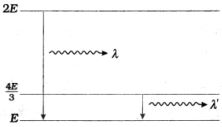
The energy levels of an atom are shown below. When an electron makes a transition from an energy level of $2E$ to an energy level of $E$,the wavelength of the emitted electromagnetic radiation is $\lambda$. What is the wavelength of the emitted photon when the electron makes a transition from an energy level of $4E/3$ to an energy level of $E$?
A
$\frac{\lambda}{3}$
B
$\frac{3\lambda}{4}$
C
$\frac{4\lambda}{3}$
D
$3\lambda$
Solution
(D) The energy of an emitted photon is given by $\Delta E = \frac{hc}{\lambda}$.
For the first transition from $2E$ to $E$:
$\Delta E_1 = 2E - E = E = \frac{hc}{\lambda} \implies E = \frac{hc}{\lambda}$.
For the second transition from $\frac{4E}{3}$ to $E$:
$\Delta E_2 = \frac{4E}{3} - E = \frac{E}{3} = \frac{hc}{\lambda'}$.
Substituting $E = \frac{hc}{\lambda}$ into the second equation:
$\frac{1}{3} \left( \frac{hc}{\lambda} \right) = \frac{hc}{\lambda'}$.
Therefore,$\lambda' = 3\lambda$.
For the first transition from $2E$ to $E$:
$\Delta E_1 = 2E - E = E = \frac{hc}{\lambda} \implies E = \frac{hc}{\lambda}$.
For the second transition from $\frac{4E}{3}$ to $E$:
$\Delta E_2 = \frac{4E}{3} - E = \frac{E}{3} = \frac{hc}{\lambda'}$.
Substituting $E = \frac{hc}{\lambda}$ into the second equation:
$\frac{1}{3} \left( \frac{hc}{\lambda} \right) = \frac{hc}{\lambda'}$.
Therefore,$\lambda' = 3\lambda$.
0 likes
View Solution61
DifficultMCQ
In a hydrogen-like atom,an electron makes a transition from an energy level with principal quantum number $n$ to another with principal quantum number $(n - 1)$. If $n >> 1$,the frequency of the emitted radiation is proportional to:
A
$\frac{1}{n^3}$
B
$\frac{1}{n}$
C
$\frac{1}{n^2}$
D
$\frac{1}{n^{3/2}}$
Solution
(A) The frequency $f$ of the emitted radiation is given by $f = c / \lambda = cR [1/(n-1)^2 - 1/n^2]$.
Simplifying the expression: $f = Rc [n^2 - (n-1)^2] / [n^2(n-1)^2]$.
$f = Rc [n^2 - (n^2 - 2n + 1)] / [n^2(n-1)^2] = Rc (2n - 1) / [n^2(n-1)^2]$.
Since $n >> 1$,we can approximate $(n-1) \approx n$ and $(2n - 1) \approx 2n$.
Substituting these approximations: $f \approx Rc (2n) / [n^2(n^2)] = 2Rc / n^3$.
Therefore,$f \propto 1/n^3$.
Simplifying the expression: $f = Rc [n^2 - (n-1)^2] / [n^2(n-1)^2]$.
$f = Rc [n^2 - (n^2 - 2n + 1)] / [n^2(n-1)^2] = Rc (2n - 1) / [n^2(n-1)^2]$.
Since $n >> 1$,we can approximate $(n-1) \approx n$ and $(2n - 1) \approx 2n$.
Substituting these approximations: $f \approx Rc (2n) / [n^2(n^2)] = 2Rc / n^3$.
Therefore,$f \propto 1/n^3$.
0 likes
View Solution62
MediumMCQ
The binding energy of an electron in the ground state of a hydrogen atom is $13.6 \ eV$. What is the energy in $eV$ required to remove an electron from the first excited state of a $Li^{++}$ ion?
A
$30.6$
B
$13.6$
C
$3.4$
D
$122.4$
Solution
(A) For hydrogen-like atoms,the energy of an electron in the $n^{th}$ orbit is given by $E_n = -13.6 \times \frac{Z^2}{n^2} \ eV$.
The binding energy is the magnitude of this energy,$E = 13.6 \times \frac{Z^2}{n^2} \ eV$.
For a $Li^{++}$ ion,the atomic number $Z = 3$.
The first excited state corresponds to $n = 2$.
Substituting these values into the formula:
$E = 13.6 \times \frac{3^2}{2^2} \ eV$
$E = 13.6 \times \frac{9}{4} \ eV$
$E = 13.6 \times 2.25 \ eV$
$E = 30.6 \ eV$.
The binding energy is the magnitude of this energy,$E = 13.6 \times \frac{Z^2}{n^2} \ eV$.
For a $Li^{++}$ ion,the atomic number $Z = 3$.
The first excited state corresponds to $n = 2$.
Substituting these values into the formula:
$E = 13.6 \times \frac{3^2}{2^2} \ eV$
$E = 13.6 \times \frac{9}{4} \ eV$
$E = 13.6 \times 2.25 \ eV$
$E = 30.6 \ eV$.
0 likes
View Solution63
MediumMCQ
The energy of an electron in the $n^{th}$ orbit of a hydrogen atom is given by $E_n = - \frac{13.6}{n^2} \ eV$. How much energy in $eV$ is required to move an electron from the first orbit to the third orbit?
A
$13.6$
B
$3.4$
C
$12.09$
D
$1.51$
Solution
(C) The energy of an electron in the $n^{th}$ orbit is given by $E_n = - \frac{13.6}{n^2} \ eV$.
For the first orbit $(n = 1)$: $E_1 = - \frac{13.6}{1^2} = - 13.6 \ eV$.
For the third orbit $(n = 3)$: $E_3 = - \frac{13.6}{3^2} = - \frac{13.6}{9} \approx - 1.51 \ eV$.
The energy required to move the electron from the first to the third orbit is $\Delta E = E_3 - E_1$.
$\Delta E = - 1.51 - (- 13.6) = 12.09 \ eV$.
For the first orbit $(n = 1)$: $E_1 = - \frac{13.6}{1^2} = - 13.6 \ eV$.
For the third orbit $(n = 3)$: $E_3 = - \frac{13.6}{3^2} = - \frac{13.6}{9} \approx - 1.51 \ eV$.
The energy required to move the electron from the first to the third orbit is $\Delta E = E_3 - E_1$.
$\Delta E = - 1.51 - (- 13.6) = 12.09 \ eV$.
0 likes
View Solution64
DifficultMCQ
The energy required to remove an electron from the first excited state of $Li^{++}$ is ......... $eV$.
A
$122.4$
B
$30.6$
C
$13.6$
D
$3.4$
Solution
(B) The energy of an electron in the $n^{th}$ orbit of a hydrogen-like ion is given by the formula: $E_n = -\frac{13.6 \times Z^2}{n^2} \ eV$.
For $Li^{++}$ (Lithium ion),the atomic number $Z = 3$.
The first excited state corresponds to $n = 2$.
Substituting these values into the formula:
$E_2 = -\frac{13.6 \times 3^2}{2^2} \ eV$
$E_2 = -\frac{13.6 \times 9}{4} \ eV$
$E_2 = -30.6 \ eV$.
The energy required to remove the electron (ionization energy from this state) is the energy needed to bring the electron to $n = \infty$ (where $E = 0$).
Therefore,the required energy is $E_{\infty} - E_2 = 0 - (-30.6 \ eV) = 30.6 \ eV$.
For $Li^{++}$ (Lithium ion),the atomic number $Z = 3$.
The first excited state corresponds to $n = 2$.
Substituting these values into the formula:
$E_2 = -\frac{13.6 \times 3^2}{2^2} \ eV$
$E_2 = -\frac{13.6 \times 9}{4} \ eV$
$E_2 = -30.6 \ eV$.
The energy required to remove the electron (ionization energy from this state) is the energy needed to bring the electron to $n = \infty$ (where $E = 0$).
Therefore,the required energy is $E_{\infty} - E_2 = 0 - (-30.6 \ eV) = 30.6 \ eV$.
0 likes
View Solution65
MediumMCQ
The energy of an electron in the $n^{th}$ orbit of a hydrogen atom is given by $E_n = -\frac{13.6}{n^2} \, eV$. How much energy in $eV$ is required to move an electron from the $n = 2$ orbit to the $n = 3$ orbit?
A
$1.9$
B
$1.5$
C
$0.85$
D
$3.4$
Solution
(A) The energy of an electron in the $n^{th}$ orbit is $E_n = -\frac{13.6}{n^2} \, eV$.
To move an electron from $n_1 = 2$ to $n_2 = 3$,the required energy $\Delta E$ is given by:
$\Delta E = E_3 - E_2$
$\Delta E = \left( -\frac{13.6}{3^2} \right) - \left( -\frac{13.6}{2^2} \right)$
$\Delta E = 13.6 \left( \frac{1}{2^2} - \frac{1}{3^2} \right)$
$\Delta E = 13.6 \left( \frac{1}{4} - \frac{1}{9} \right)$
$\Delta E = 13.6 \left( \frac{9 - 4}{36} \right) = 13.6 \times \frac{5}{36}$
$\Delta E \approx 1.888 \, eV \approx 1.9 \, eV$.
To move an electron from $n_1 = 2$ to $n_2 = 3$,the required energy $\Delta E$ is given by:
$\Delta E = E_3 - E_2$
$\Delta E = \left( -\frac{13.6}{3^2} \right) - \left( -\frac{13.6}{2^2} \right)$
$\Delta E = 13.6 \left( \frac{1}{2^2} - \frac{1}{3^2} \right)$
$\Delta E = 13.6 \left( \frac{1}{4} - \frac{1}{9} \right)$
$\Delta E = 13.6 \left( \frac{9 - 4}{36} \right) = 13.6 \times \frac{5}{36}$
$\Delta E \approx 1.888 \, eV \approx 1.9 \, eV$.
0 likes
View Solution66
MediumMCQ
In a hydrogen atom,if the energy difference between the $n = 2$ and $n = 3$ orbits is $E$,how much energy (in terms of $E$) is required to remove an electron from the ground state?
A
$13.2$
B
$7.2$
C
$5.6$
D
$3.2$
Solution
(B) The energy of an electron in the $n$-th orbit of a hydrogen atom is given by $E_n = -\frac{K}{n^2}$,where $K = 13.6 \ eV$.
The energy difference between $n = 2$ and $n = 3$ orbits is $E = E_3 - E_2 = -\frac{K}{3^2} - (-\frac{K}{2^2}) = K(\frac{1}{4} - \frac{1}{9}) = K(\frac{5}{36})$.
Therefore,$E = \frac{5}{36}K$,which implies $K = \frac{36}{5}E$.
The energy required to remove an electron from the ground state $(n = 1)$ to infinity $(n = \infty)$ is the ionization energy: $E_{ion} = E_{\infty} - E_1 = 0 - (-\frac{K}{1^2}) = K$.
Substituting the value of $K$ from the first equation: $E_{ion} = \frac{36}{5}E = 7.2 \ E$.
The energy difference between $n = 2$ and $n = 3$ orbits is $E = E_3 - E_2 = -\frac{K}{3^2} - (-\frac{K}{2^2}) = K(\frac{1}{4} - \frac{1}{9}) = K(\frac{5}{36})$.
Therefore,$E = \frac{5}{36}K$,which implies $K = \frac{36}{5}E$.
The energy required to remove an electron from the ground state $(n = 1)$ to infinity $(n = \infty)$ is the ionization energy: $E_{ion} = E_{\infty} - E_1 = 0 - (-\frac{K}{1^2}) = K$.
Substituting the value of $K$ from the first equation: $E_{ion} = \frac{36}{5}E = 7.2 \ E$.
0 likes
View Solution67
MediumMCQ
The $1^{st}, 2^{nd},$ and $3^{rd}$ energy levels of an atom are $E, 4E/3,$ and $2E$ respectively. If a wavelength $\lambda$ is emitted during the transition $3 \to 1$,what is the wavelength emitted during the transition $2 \to 1$?
A
$\lambda/3$
B
$4\lambda/3$
C
$3\lambda/4$
D
$3\lambda$
Solution
(D) For the transition $3 \to 1$,the energy difference is $\Delta E_{31} = 2E - E = E = \frac{hc}{\lambda} \implies E = \frac{hc}{\lambda} \dots (i)$
For the transition $2 \to 1$,the energy difference is $\Delta E_{21} = \frac{4E}{3} - E = \frac{E}{3} = \frac{hc}{\lambda'}$
Substituting the value of $E$ from equation $(i)$: $\frac{1}{3} \left( \frac{hc}{\lambda} \right) = \frac{hc}{\lambda'}$
Therefore,$\lambda' = 3\lambda$.
For the transition $2 \to 1$,the energy difference is $\Delta E_{21} = \frac{4E}{3} - E = \frac{E}{3} = \frac{hc}{\lambda'}$
Substituting the value of $E$ from equation $(i)$: $\frac{1}{3} \left( \frac{hc}{\lambda} \right) = \frac{hc}{\lambda'}$
Therefore,$\lambda' = 3\lambda$.
0 likes
View Solution68
MediumMCQ
In an atom,an electron requires $47.2 \, eV$ of energy to transition from the $n = 2$ orbit to the $n = 3$ orbit. The atomic number $Z$ of the atom is:
A
$2$
B
$5$
C
$3$
D
$4$
Solution
(B) The energy required for a transition between orbits $n_1$ and $n_2$ is given by the formula:
$\Delta E = 13.6 \, Z^2 \left( \frac{1}{n_1^2} - \frac{1}{n_2^2} \right) \, eV$
Given $\Delta E = 47.2 \, eV$,$n_1 = 2$,and $n_2 = 3$:
$47.2 = 13.6 \times Z^2 \left( \frac{1}{2^2} - \frac{1}{3^2} \right)$
$47.2 = 13.6 \times Z^2 \left( \frac{1}{4} - \frac{1}{9} \right)$
$47.2 = 13.6 \times Z^2 \left( \frac{9 - 4}{36} \right)$
$47.2 = 13.6 \times Z^2 \left( \frac{5}{36} \right)$
$Z^2 = \frac{47.2 \times 36}{13.6 \times 5}$
$Z^2 = \frac{1699.2}{68} \approx 24.988 \approx 25$
$Z = \sqrt{25} = 5$
Thus,the atomic number $Z$ is $5$.
$\Delta E = 13.6 \, Z^2 \left( \frac{1}{n_1^2} - \frac{1}{n_2^2} \right) \, eV$
Given $\Delta E = 47.2 \, eV$,$n_1 = 2$,and $n_2 = 3$:
$47.2 = 13.6 \times Z^2 \left( \frac{1}{2^2} - \frac{1}{3^2} \right)$
$47.2 = 13.6 \times Z^2 \left( \frac{1}{4} - \frac{1}{9} \right)$
$47.2 = 13.6 \times Z^2 \left( \frac{9 - 4}{36} \right)$
$47.2 = 13.6 \times Z^2 \left( \frac{5}{36} \right)$
$Z^2 = \frac{47.2 \times 36}{13.6 \times 5}$
$Z^2 = \frac{1699.2}{68} \approx 24.988 \approx 25$
$Z = \sqrt{25} = 5$
Thus,the atomic number $Z$ is $5$.
0 likes
View Solution69
MediumMCQ
When an electron in the ground state of a hydrogen atom is given $12.4 \, eV$ of energy,to which orbit will it transition?
A
$n = 1$
B
$n = 3$
C
$n = 4$
D
$n = \infty$
Solution
(B) The energy of an electron in the ground state $(n = 1)$ of a hydrogen atom is $E_1 = -13.6 \, eV$.
When energy $E_{given} = 12.4 \, eV$ is supplied,the new energy $E_n$ of the electron will be:
$E_n = E_1 + E_{given} = -13.6 \, eV + 12.4 \, eV = -1.2 \, eV$.
The energy of an electron in the $n^{th}$ orbit is given by $E_n = -\frac{13.6}{n^2} \, eV$.
Equating the two expressions:
$-\frac{13.6}{n^2} = -1.2$
$n^2 = \frac{13.6}{1.2} \approx 11.33$.
Since $n$ must be an integer,we look for the nearest orbit. The electron will transition to the $n = 3$ orbit $(E_3 = -1.51 \, eV)$ as it does not have enough energy to reach the $n = 4$ orbit $(E_4 = -0.85 \, eV)$.
When energy $E_{given} = 12.4 \, eV$ is supplied,the new energy $E_n$ of the electron will be:
$E_n = E_1 + E_{given} = -13.6 \, eV + 12.4 \, eV = -1.2 \, eV$.
The energy of an electron in the $n^{th}$ orbit is given by $E_n = -\frac{13.6}{n^2} \, eV$.
Equating the two expressions:
$-\frac{13.6}{n^2} = -1.2$
$n^2 = \frac{13.6}{1.2} \approx 11.33$.
Since $n$ must be an integer,we look for the nearest orbit. The electron will transition to the $n = 3$ orbit $(E_3 = -1.51 \, eV)$ as it does not have enough energy to reach the $n = 4$ orbit $(E_4 = -0.85 \, eV)$.
0 likes
View Solution70
MediumMCQ
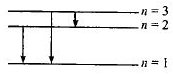
The total energy of an electron in the ground state of a hydrogen atom is $-13.6 \text{ eV}$. The kinetic energy of an electron in the first excited state is.....$\text{ eV}$
A
$6.8$
B
$13.6$
C
$1.7$
D
$3.4$
Solution
(D) The total energy of an electron in the $n^{\text{th}}$ orbit of a hydrogen atom is given by $E_n = \frac{-13.6}{n^2} \text{ eV}$.
For the ground state,$n = 1$,so $E_1 = -13.6 \text{ eV}$.
For the first excited state,$n = 2$.
Therefore,the total energy in the first excited state is $E_2 = \frac{-13.6}{2^2} = \frac{-13.6}{4} = -3.4 \text{ eV}$.
In any orbit,the kinetic energy $K$ is equal to the negative of the total energy $E$,i.e.,$K = -E$.
Thus,the kinetic energy of the electron in the first excited state is $K = -(-3.4 \text{ eV}) = 3.4 \text{ eV}$.
For the ground state,$n = 1$,so $E_1 = -13.6 \text{ eV}$.
For the first excited state,$n = 2$.
Therefore,the total energy in the first excited state is $E_2 = \frac{-13.6}{2^2} = \frac{-13.6}{4} = -3.4 \text{ eV}$.
In any orbit,the kinetic energy $K$ is equal to the negative of the total energy $E$,i.e.,$K = -E$.
Thus,the kinetic energy of the electron in the first excited state is $K = -(-3.4 \text{ eV}) = 3.4 \text{ eV}$.
0 likes
View Solution71
MediumMCQ
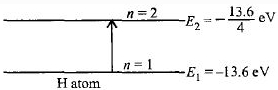
The ground state energy of a hydrogen atom is $-13.6 \, eV$. When its electron is in the first excited state,its excitation energy is ...... $eV$.
A
$10.2$
B
$0$
C
$6.8$
D
$3.4$
Solution
(A) The energy of an electron in the $n$-th orbit of a hydrogen atom is given by $E_n = -\frac{13.6}{n^2} \, eV$.
For the ground state $(n=1)$,$E_1 = -13.6 \, eV$.
For the first excited state $(n=2)$,$E_2 = -\frac{13.6}{2^2} = -\frac{13.6}{4} = -3.4 \, eV$.
The excitation energy required to move the electron from the ground state to the first excited state is $\Delta E = E_2 - E_1$.
$\Delta E = -3.4 \, eV - (-13.6 \, eV) = 10.2 \, eV$.
For the ground state $(n=1)$,$E_1 = -13.6 \, eV$.
For the first excited state $(n=2)$,$E_2 = -\frac{13.6}{2^2} = -\frac{13.6}{4} = -3.4 \, eV$.
The excitation energy required to move the electron from the ground state to the first excited state is $\Delta E = E_2 - E_1$.
$\Delta E = -3.4 \, eV - (-13.6 \, eV) = 10.2 \, eV$.
0 likes
View Solution72
DifficultMCQ
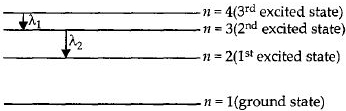
An electron in a hydrogen atom first jumps from the third excited state to the second excited state and then from the second excited state to the first excited state. The ratio of the wavelengths $\lambda_1 : \lambda_2$ emitted in the two cases is
A
$\frac{7}{5}$
B
$\frac{27}{20}$
C
$\frac{27}{5}$
D
$\frac{20}{7}$
Solution
(D) According to the Rydberg formula:
$\frac{1}{\lambda} = R \left[ \frac{1}{n_f^2} - \frac{1}{n_i^2} \right]$
In the first case,the electron jumps from the third excited state $(n_i = 4)$ to the second excited state $(n_f = 3)$:
$\frac{1}{\lambda_1} = R \left[ \frac{1}{3^2} - \frac{1}{4^2} \right] = R \left[ \frac{1}{9} - \frac{1}{16} \right] = R \left[ \frac{16 - 9}{144} \right] = \frac{7}{144} R$ .... $(i)$
In the second case,the electron jumps from the second excited state $(n_i = 3)$ to the first excited state $(n_f = 2)$:
$\frac{1}{\lambda_2} = R \left[ \frac{1}{2^2} - \frac{1}{3^2} \right] = R \left[ \frac{1}{4} - \frac{1}{9} \right] = R \left[ \frac{9 - 4}{36} \right] = \frac{5}{36} R$ .... $(ii)$
To find the ratio $\frac{\lambda_1}{\lambda_2}$,we divide the expression for $\frac{1}{\lambda_1}$ by $\frac{1}{\lambda_2}$:
$\frac{\lambda_2}{\lambda_1} = \frac{\frac{5}{36} R}{\frac{7}{144} R} = \frac{5}{36} \times \frac{144}{7} = \frac{5 \times 4}{7} = \frac{20}{7}$
Therefore,the ratio $\frac{\lambda_1}{\lambda_2} = \frac{20}{7}$.
$\frac{1}{\lambda} = R \left[ \frac{1}{n_f^2} - \frac{1}{n_i^2} \right]$
In the first case,the electron jumps from the third excited state $(n_i = 4)$ to the second excited state $(n_f = 3)$:
$\frac{1}{\lambda_1} = R \left[ \frac{1}{3^2} - \frac{1}{4^2} \right] = R \left[ \frac{1}{9} - \frac{1}{16} \right] = R \left[ \frac{16 - 9}{144} \right] = \frac{7}{144} R$ .... $(i)$
In the second case,the electron jumps from the second excited state $(n_i = 3)$ to the first excited state $(n_f = 2)$:
$\frac{1}{\lambda_2} = R \left[ \frac{1}{2^2} - \frac{1}{3^2} \right] = R \left[ \frac{1}{4} - \frac{1}{9} \right] = R \left[ \frac{9 - 4}{36} \right] = \frac{5}{36} R$ .... $(ii)$
To find the ratio $\frac{\lambda_1}{\lambda_2}$,we divide the expression for $\frac{1}{\lambda_1}$ by $\frac{1}{\lambda_2}$:
$\frac{\lambda_2}{\lambda_1} = \frac{\frac{5}{36} R}{\frac{7}{144} R} = \frac{5}{36} \times \frac{144}{7} = \frac{5 \times 4}{7} = \frac{20}{7}$
Therefore,the ratio $\frac{\lambda_1}{\lambda_2} = \frac{20}{7}$.
0 likes
View Solution73
MediumMCQ
How much work must be done to pull apart the electron and the proton that make up the Hydrogen atom,if the atom is initially in the state with $n = 2$?
A
$13.6 \times 1.6 \times 10^{-19} \text{ J}$
B
$3.4 \times 1.6 \times 10^{-19} \text{ J}$
C
$1.51 \times 1.6 \times 10^{-19} \text{ J}$
D
$0 \text{ J}$
Solution
(B) The electrostatic potential energy of the electron-proton system is defined as zero when they are at an infinite distance apart.
To pull the electron and proton apart from the state $n = 2$,we must provide energy equal to the binding energy of that state.
The energy of an electron in the $n$-th orbit of a Hydrogen atom is given by $E_n = -\frac{13.6}{n^2} \text{ eV}$.
For $n = 2$,the energy is $E_2 = -\frac{13.6}{2^2} = -\frac{13.6}{4} = -3.4 \text{ eV}$.
The work done $W$ required to move the electron to infinity (where $E_f = 0$) is $W = E_f - E_i = 0 - (-3.4 \text{ eV}) = 3.4 \text{ eV}$.
Converting this to Joules: $W = 3.4 \times 1.6 \times 10^{-19} \text{ J}$.
To pull the electron and proton apart from the state $n = 2$,we must provide energy equal to the binding energy of that state.
The energy of an electron in the $n$-th orbit of a Hydrogen atom is given by $E_n = -\frac{13.6}{n^2} \text{ eV}$.
For $n = 2$,the energy is $E_2 = -\frac{13.6}{2^2} = -\frac{13.6}{4} = -3.4 \text{ eV}$.
The work done $W$ required to move the electron to infinity (where $E_f = 0$) is $W = E_f - E_i = 0 - (-3.4 \text{ eV}) = 3.4 \text{ eV}$.
Converting this to Joules: $W = 3.4 \times 1.6 \times 10^{-19} \text{ J}$.
0 likes
View Solution74
MediumMCQ
In a sample of hydrogen-like atoms,all of which are in the ground state,a photon beam containing photons of various energies is passed. In the absorption spectrum,five dark lines are observed. The number of bright lines in the emission spectrum will be (assume that all transitions take place).
A
$5$
B
$10$
C
$15$
D
None of these
Solution
(C) The number of dark lines in an absorption spectrum is given by $(n - 1)$,where $n$ is the principal quantum number of the highest excited state reached by the atoms.
Given that there are $5$ dark lines,we have $n - 1 = 5$,which implies $n = 6$.
When these atoms return to the ground state,the number of bright lines in the emission spectrum is given by the formula $\frac{n(n - 1)}{2}$.
Substituting $n = 6$ into the formula,we get $\frac{6(6 - 1)}{2} = \frac{6 \times 5}{2} = 15$.
Therefore,the number of bright lines in the emission spectrum is $15$.
Given that there are $5$ dark lines,we have $n - 1 = 5$,which implies $n = 6$.
When these atoms return to the ground state,the number of bright lines in the emission spectrum is given by the formula $\frac{n(n - 1)}{2}$.
Substituting $n = 6$ into the formula,we get $\frac{6(6 - 1)}{2} = \frac{6 \times 5}{2} = 15$.
Therefore,the number of bright lines in the emission spectrum is $15$.
0 likes
View Solution75
DifficultMCQ
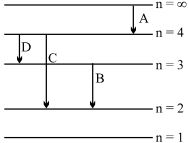
Consider the following electronic energy level diagram of $H-$ atom. Photons associated with shortest and longest wavelengths would be emitted from the atom by the transitions labelled:
A
$D$ and $C$ respectively
B
$C$ and $A$ respectively
C
$C$ and $D$ respectively
D
$A$ and $C$ respectively
Solution
(C) The energy of an emitted photon is given by $\Delta E = E_2 - E_1 = \frac{hc}{\lambda}$.
Since $\lambda = \frac{hc}{\Delta E}$,the wavelength $\lambda$ is inversely proportional to the energy difference $\Delta E$.
For the shortest wavelength,the energy difference $\Delta E$ must be maximum. Looking at the diagram,transition $C$ (from $n=4$ to $n=2$) covers a larger energy gap compared to $D$ (from $n=4$ to $n=3$) or $B$ (from $n=3$ to $n=2$).
For the longest wavelength,the energy difference $\Delta E$ must be minimum. Transition $D$ (from $n=4$ to $n=3$) represents the smallest energy gap among the given transitions.
Therefore,the shortest wavelength corresponds to transition $C$ and the longest wavelength corresponds to transition $D$.
Since $\lambda = \frac{hc}{\Delta E}$,the wavelength $\lambda$ is inversely proportional to the energy difference $\Delta E$.
For the shortest wavelength,the energy difference $\Delta E$ must be maximum. Looking at the diagram,transition $C$ (from $n=4$ to $n=2$) covers a larger energy gap compared to $D$ (from $n=4$ to $n=3$) or $B$ (from $n=3$ to $n=2$).
For the longest wavelength,the energy difference $\Delta E$ must be minimum. Transition $D$ (from $n=4$ to $n=3$) represents the smallest energy gap among the given transitions.
Therefore,the shortest wavelength corresponds to transition $C$ and the longest wavelength corresponds to transition $D$.
0 likes
View Solution76
DifficultMCQ
If the electron in a hydrogen atom were in the energy level with $n = 3$,how much energy in joule would be required to ionise the atom? (Ionisation energy of $H$-atom is $2.18 \times 10^{-18} \ J$):
A
$6.54 \times 10^{-19} \ J$
B
$1.43 \times 10^{-19} \ J$
C
$2.42 \times 10^{-19} \ J$
D
$3.14 \times 10^{-20} \ J$
Solution
(C) The energy of an electron in the $n^{th}$ shell of a hydrogen atom is given by $E_n = -\frac{E_1}{n^2}$,where $E_1 = 2.18 \times 10^{-18} \ J$ is the ionization energy of the ground state $(n=1)$.
For $n = 3$,the energy of the electron is $E_3 = -\frac{2.18 \times 10^{-18}}{3^2} \ J$.
$E_3 = -\frac{2.18 \times 10^{-18}}{9} \ J$.
To ionize the atom,we must provide energy equal to the magnitude of the electron's energy in that state to bring it to $E = 0$.
Required Energy $= |E_3| = \frac{2.18 \times 10^{-18}}{9} \ J$.
Required Energy $= 0.2422 \times 10^{-18} \ J = 2.42 \times 10^{-19} \ J$.
For $n = 3$,the energy of the electron is $E_3 = -\frac{2.18 \times 10^{-18}}{3^2} \ J$.
$E_3 = -\frac{2.18 \times 10^{-18}}{9} \ J$.
To ionize the atom,we must provide energy equal to the magnitude of the electron's energy in that state to bring it to $E = 0$.
Required Energy $= |E_3| = \frac{2.18 \times 10^{-18}}{9} \ J$.
Required Energy $= 0.2422 \times 10^{-18} \ J = 2.42 \times 10^{-19} \ J$.
0 likes
View Solution77
AdvancedMCQ
In hydrogen and hydrogen-like atoms,the ratio of the difference of energies $E_{4n}-E_{2n}$ and $E_{2n}-E_{n}$ varies with its atomic number $Z$ and $n$ as:
A
$Z^2 / n^2$
B
$Z^4 / n^4$
C
$Z / n$
D
$Z^0 n^0$
Solution
(D) The energy of an electron in the $n$-th orbit of a hydrogen-like atom is given by $E_n = -\frac{Z^2 E_0}{n^2}$,where $E_0 = 13.6 \text{ eV}$.
Calculating the energy differences:
$E_{4n} - E_{2n} = -\frac{Z^2 E_0}{(4n)^2} - \left( -\frac{Z^2 E_0}{(2n)^2} \right) = Z^2 E_0 \left( \frac{1}{4n^2} - \frac{1}{16n^2} \right) = Z^2 E_0 \left( \frac{4-1}{16n^2} \right) = \frac{3 Z^2 E_0}{16n^2}$.
$E_{2n} - E_n = -\frac{Z^2 E_0}{(2n)^2} - \left( -\frac{Z^2 E_0}{n^2} \right) = Z^2 E_0 \left( \frac{1}{n^2} - \frac{1}{4n^2} \right) = Z^2 E_0 \left( \frac{4-1}{4n^2} \right) = \frac{3 Z^2 E_0}{4n^2}$.
Taking the ratio:
$\frac{E_{4n} - E_{2n}}{E_{2n} - E_n} = \frac{3 Z^2 E_0 / 16n^2}{3 Z^2 E_0 / 4n^2} = \frac{4}{16} = \frac{1}{4}$.
Since the result is a constant,it is independent of $Z$ and $n$,which can be expressed as $Z^0 n^0$.
Calculating the energy differences:
$E_{4n} - E_{2n} = -\frac{Z^2 E_0}{(4n)^2} - \left( -\frac{Z^2 E_0}{(2n)^2} \right) = Z^2 E_0 \left( \frac{1}{4n^2} - \frac{1}{16n^2} \right) = Z^2 E_0 \left( \frac{4-1}{16n^2} \right) = \frac{3 Z^2 E_0}{16n^2}$.
$E_{2n} - E_n = -\frac{Z^2 E_0}{(2n)^2} - \left( -\frac{Z^2 E_0}{n^2} \right) = Z^2 E_0 \left( \frac{1}{n^2} - \frac{1}{4n^2} \right) = Z^2 E_0 \left( \frac{4-1}{4n^2} \right) = \frac{3 Z^2 E_0}{4n^2}$.
Taking the ratio:
$\frac{E_{4n} - E_{2n}}{E_{2n} - E_n} = \frac{3 Z^2 E_0 / 16n^2}{3 Z^2 E_0 / 4n^2} = \frac{4}{16} = \frac{1}{4}$.
Since the result is a constant,it is independent of $Z$ and $n$,which can be expressed as $Z^0 n^0$.
0 likes
View Solution78
DifficultMCQ
In a hydrogen atom,the electron is in the $n^{th}$ excited state. It may come down to the second excited state by emitting ten different wavelengths. What is the value of $n$?
A
$6$
B
$7$
C
$8$
D
$5$
Solution
(A) The number of spectral lines emitted when an electron transitions from an energy level $n_2$ to a lower energy level $n_1$ is given by the formula $N = \frac{(n_2 - n_1)(n_2 - n_1 + 1)}{2}$.
Here,the electron transitions from the $n^{th}$ excited state to the second excited state.
The $n^{th}$ excited state corresponds to the principal quantum number $n_2 = n + 1$.
The second excited state corresponds to the principal quantum number $n_1 = 3$.
Given that the number of wavelengths emitted is $10$,we have:
$10 = \frac{((n+1) - 3)((n+1) - 3 + 1)}{2}$
$10 = \frac{(n-2)(n-1)}{2}$
$20 = n^2 - 3n + 2$
$n^2 - 3n - 18 = 0$
$(n-6)(n+3) = 0$
Since $n$ must be positive,we get $n = 6$.
Here,the electron transitions from the $n^{th}$ excited state to the second excited state.
The $n^{th}$ excited state corresponds to the principal quantum number $n_2 = n + 1$.
The second excited state corresponds to the principal quantum number $n_1 = 3$.
Given that the number of wavelengths emitted is $10$,we have:
$10 = \frac{((n+1) - 3)((n+1) - 3 + 1)}{2}$
$10 = \frac{(n-2)(n-1)}{2}$
$20 = n^2 - 3n + 2$
$n^2 - 3n - 18 = 0$
$(n-6)(n+3) = 0$
Since $n$ must be positive,we get $n = 6$.
0 likes
View Solution79
MediumMCQ
The ionisation potential of hydrogen atom is $13.6 \ V$. The energy required to remove an electron from the second orbit of hydrogen is......$eV$.
A
$3.4$
B
$6.8$
C
$13.6$
D
$27.2$
Solution
(A) The energy of an electron in the $n^{th}$ orbit of a hydrogen atom is given by the formula $E_n = -\frac{13.6}{n^2} \ eV$.
For the second orbit,$n = 2$.
Substituting the value of $n$ into the formula: $E_2 = -\frac{13.6}{2^2} = -\frac{13.6}{4} = -3.4 \ eV$.
The energy required to remove an electron from the second orbit is the energy needed to bring the electron from $E_2 = -3.4 \ eV$ to $E = 0 \ eV$ (infinity).
Therefore,the required energy is $0 - (-3.4) = 3.4 \ eV$.
For the second orbit,$n = 2$.
Substituting the value of $n$ into the formula: $E_2 = -\frac{13.6}{2^2} = -\frac{13.6}{4} = -3.4 \ eV$.
The energy required to remove an electron from the second orbit is the energy needed to bring the electron from $E_2 = -3.4 \ eV$ to $E = 0 \ eV$ (infinity).
Therefore,the required energy is $0 - (-3.4) = 3.4 \ eV$.
0 likes
View Solution80
AdvancedMCQ
An electron collides with a fixed hydrogen atom in its ground state. The hydrogen atom gets excited and the colliding electron loses all its kinetic energy. Consequently,the hydrogen atom may emit a photon corresponding to the largest wavelength of the Balmer series. The minimum kinetic energy $(K.E.)$ of the colliding electron will be.....$eV$.
A
$10.2$
B
$1.9$
C
$12.1$
D
$13.6$
Solution
(C) The longest wavelength of the Balmer series for a hydrogen atom corresponds to the transition of an electron from the $n=3$ state to the $n=2$ state.
This implies that when the hydrogen atom was excited by the colliding electron,the electron was promoted from the $n=1$ ground state to the $n=3$ excited state.
The energy of the $n$-th quantum state for a hydrogen atom is given by $E_n = -\frac{13.6}{n^2} \text{ eV}$.
For the ground state $(n=1)$: $E_1 = -\frac{13.6}{1^2} = -13.6 \text{ eV}$.
For the excited state $(n=3)$: $E_3 = -\frac{13.6}{3^2} = -1.51 \text{ eV}$.
The energy required for this excitation is $\Delta E = E_3 - E_1 = -1.51 - (-13.6) = 12.09 \text{ eV} \approx 12.1 \text{ eV}$.
Since the colliding electron loses all its kinetic energy to excite the atom,the minimum kinetic energy of the electron must be equal to the excitation energy,which is $12.1 \text{ eV}$.
This implies that when the hydrogen atom was excited by the colliding electron,the electron was promoted from the $n=1$ ground state to the $n=3$ excited state.
The energy of the $n$-th quantum state for a hydrogen atom is given by $E_n = -\frac{13.6}{n^2} \text{ eV}$.
For the ground state $(n=1)$: $E_1 = -\frac{13.6}{1^2} = -13.6 \text{ eV}$.
For the excited state $(n=3)$: $E_3 = -\frac{13.6}{3^2} = -1.51 \text{ eV}$.
The energy required for this excitation is $\Delta E = E_3 - E_1 = -1.51 - (-13.6) = 12.09 \text{ eV} \approx 12.1 \text{ eV}$.
Since the colliding electron loses all its kinetic energy to excite the atom,the minimum kinetic energy of the electron must be equal to the excitation energy,which is $12.1 \text{ eV}$.
0 likes
View Solution81
MediumMCQ
The total energy of a hydrogen atom in its ground state is $-13.6 \ eV$. If the potential energy in the first excited state is taken as zero,then the total energy in the ground state will be ..... $eV$.
A
$-3.4$
B
$3.4$
C
$-6.8$
D
$6.8$
Solution
(C) In a hydrogen atom,the total energy $E$,kinetic energy $K$,and potential energy $U$ are related by $U = 2E$ and $K = -E$.
For the first excited state $(n=2)$,the total energy is $E_2 = -13.6 / 2^2 = -3.4 \ eV$.
The potential energy in the first excited state is $U_2 = 2E_2 = 2(-3.4) = -6.8 \ eV$.
If we shift the potential energy scale such that the new potential energy $U'_2 = 0$,we have added $+6.8 \ eV$ to the potential energy.
Since the total energy $E = K + U$,and kinetic energy $K$ remains unchanged by a shift in the potential energy reference point,the new total energy $E'$ is $E' = E + \Delta U$.
For the ground state $(n=1)$,the original total energy is $E_1 = -13.6 \ eV$.
The shift applied is $\Delta U = +6.8 \ eV$.
Therefore,the new total energy in the ground state is $E'_1 = -13.6 + 6.8 = -6.8 \ eV$.
For the first excited state $(n=2)$,the total energy is $E_2 = -13.6 / 2^2 = -3.4 \ eV$.
The potential energy in the first excited state is $U_2 = 2E_2 = 2(-3.4) = -6.8 \ eV$.
If we shift the potential energy scale such that the new potential energy $U'_2 = 0$,we have added $+6.8 \ eV$ to the potential energy.
Since the total energy $E = K + U$,and kinetic energy $K$ remains unchanged by a shift in the potential energy reference point,the new total energy $E'$ is $E' = E + \Delta U$.
For the ground state $(n=1)$,the original total energy is $E_1 = -13.6 \ eV$.
The shift applied is $\Delta U = +6.8 \ eV$.
Therefore,the new total energy in the ground state is $E'_1 = -13.6 + 6.8 = -6.8 \ eV$.
0 likes
View Solution82
DifficultMCQ
An electron is in an excited state in a hydrogen-like atom. It has a total energy of $-3.4 \, eV$. If the kinetic energy of the electron is $E$ and its de-Broglie wavelength is $\lambda$,then:
A
$E = 6.8 \, eV, \lambda = 6.6 \times 10^{-10} \, m$
B
$E = 3.4 \, eV, \lambda = 6.6 \times 10^{-10} \, m$
C
$E = 3.4 \, eV, \lambda = 6.6 \times 10^{-11} \, m$
D
$E = 6.8 \, eV, \lambda = 6.6 \times 10^{-11} \, m$
Solution
(B) For an electron in a hydrogen-like atom,the total energy $(TE)$ is equal to the negative of the kinetic energy $(KE)$: $TE = -KE$.
Given $TE = -3.4 \, eV$,we have $-3.4 \, eV = -KE$,which implies $KE = 3.4 \, eV$.
Thus,$E = 3.4 \, eV$.
The de-Broglie wavelength $\lambda$ is given by $\lambda = \frac{h}{p}$,where $p = \sqrt{2mE}$.
Substituting the values: $h = 6.63 \times 10^{-34} \, J \cdot s$,$m = 9.11 \times 10^{-31} \, kg$,and $E = 3.4 \times 1.6 \times 10^{-19} \, J$.
$\lambda = \frac{6.63 \times 10^{-34}}{\sqrt{2 \times 9.11 \times 10^{-31} \times 3.4 \times 1.6 \times 10^{-19}}}$
$\lambda = \frac{6.63 \times 10^{-34}}{\sqrt{9.92 \times 10^{-49}}} \approx \frac{6.63 \times 10^{-34}}{9.96 \times 10^{-25}} \approx 0.665 \times 10^{-9} \, m = 6.65 \times 10^{-10} \, m$.
Rounding to the given options,$\lambda \approx 6.6 \times 10^{-10} \, m$.
Given $TE = -3.4 \, eV$,we have $-3.4 \, eV = -KE$,which implies $KE = 3.4 \, eV$.
Thus,$E = 3.4 \, eV$.
The de-Broglie wavelength $\lambda$ is given by $\lambda = \frac{h}{p}$,where $p = \sqrt{2mE}$.
Substituting the values: $h = 6.63 \times 10^{-34} \, J \cdot s$,$m = 9.11 \times 10^{-31} \, kg$,and $E = 3.4 \times 1.6 \times 10^{-19} \, J$.
$\lambda = \frac{6.63 \times 10^{-34}}{\sqrt{2 \times 9.11 \times 10^{-31} \times 3.4 \times 1.6 \times 10^{-19}}}$
$\lambda = \frac{6.63 \times 10^{-34}}{\sqrt{9.92 \times 10^{-49}}} \approx \frac{6.63 \times 10^{-34}}{9.96 \times 10^{-25}} \approx 0.665 \times 10^{-9} \, m = 6.65 \times 10^{-10} \, m$.
Rounding to the given options,$\lambda \approx 6.6 \times 10^{-10} \, m$.
0 likes
View Solution83
MediumMCQ
In the hydrogen atom,if the reference level of potential energy is assumed to be zero at the ground state level,choose the incorrect statement.
A
The total energy of the shell increases with an increase in the value of $n$.
B
The total energy of the shell decreases with an increase in the value of $n$.
C
The difference in total energy of any two shells remains the same.
D
The total energy at the ground state becomes $13.6 \ eV$.
Solution
(B) In a standard hydrogen atom,the potential energy is $U = -\frac{27.2 \ eV}{n^2}$ and the total energy is $E = -\frac{13.6 \ eV}{n^2}$.
If we shift the reference level such that the potential energy at the ground state $(n=1)$ is zero,we add a constant $C$ to the potential energy expression.
Since $U(1) = -27.2 + C = 0$,we get $C = 27.2 \ eV$.
Thus,the new potential energy is $U' = -\frac{27.2}{n^2} + 27.2 \ eV$.
The total energy $E'$ becomes $E' = K + U' = \frac{13.6}{n^2} + (-\frac{27.2}{n^2} + 27.2) = 27.2 - \frac{13.6}{n^2} \ eV$.
For $n=1$,$E' = 27.2 - 13.6 = 13.6 \ eV$.
As $n$ increases,$\frac{13.6}{n^2}$ decreases,so $E'$ increases. Therefore,statement $B$ is incorrect.
If we shift the reference level such that the potential energy at the ground state $(n=1)$ is zero,we add a constant $C$ to the potential energy expression.
Since $U(1) = -27.2 + C = 0$,we get $C = 27.2 \ eV$.
Thus,the new potential energy is $U' = -\frac{27.2}{n^2} + 27.2 \ eV$.
The total energy $E'$ becomes $E' = K + U' = \frac{13.6}{n^2} + (-\frac{27.2}{n^2} + 27.2) = 27.2 - \frac{13.6}{n^2} \ eV$.
For $n=1$,$E' = 27.2 - 13.6 = 13.6 \ eV$.
As $n$ increases,$\frac{13.6}{n^2}$ decreases,so $E'$ increases. Therefore,statement $B$ is incorrect.
0 likes
View Solution84
MediumMCQ
Which of the following transitions in hydrogen atoms emit photons of highest frequency?
A
$n = 2$ to $n = 1$
B
$n = 1$ to $n = 2$
C
$n = 6$ to $n = 2$
D
$n = 2$ to $n = 6$
Solution
(A) The energy of a photon emitted during an electronic transition is given by $\Delta E = E_{initial} - E_{final} = h\nu$,where $\nu$ is the frequency.
For emission to occur,the electron must transition from a higher energy level to a lower energy level. Thus,options $(b)$ and $(d)$ are excluded as they represent absorption.
Comparing the energy differences for the remaining transitions:
For $n = 2$ to $n = 1$: $\Delta E_1 = 13.6 \left( \frac{1}{1^2} - \frac{1}{2^2} \right) = 13.6 \left( 1 - 0.25 \right) = 13.6 \times 0.75 = 10.2 \text{ eV}$.
For $n = 6$ to $n = 2$: $\Delta E_2 = 13.6 \left( \frac{1}{2^2} - \frac{1}{6^2} \right) = 13.6 \left( 0.25 - 0.0277 \right) = 13.6 \times 0.2223 \approx 3.02 \text{ eV}$.
Since $\nu = \frac{\Delta E}{h}$,the transition with the largest energy difference will emit the photon with the highest frequency.
Comparing $\Delta E_1$ and $\Delta E_2$,we see that $\Delta E_1 > \Delta E_2$.
Therefore,the transition from $n = 2$ to $n = 1$ emits the photon of the highest frequency.
For emission to occur,the electron must transition from a higher energy level to a lower energy level. Thus,options $(b)$ and $(d)$ are excluded as they represent absorption.
Comparing the energy differences for the remaining transitions:
For $n = 2$ to $n = 1$: $\Delta E_1 = 13.6 \left( \frac{1}{1^2} - \frac{1}{2^2} \right) = 13.6 \left( 1 - 0.25 \right) = 13.6 \times 0.75 = 10.2 \text{ eV}$.
For $n = 6$ to $n = 2$: $\Delta E_2 = 13.6 \left( \frac{1}{2^2} - \frac{1}{6^2} \right) = 13.6 \left( 0.25 - 0.0277 \right) = 13.6 \times 0.2223 \approx 3.02 \text{ eV}$.
Since $\nu = \frac{\Delta E}{h}$,the transition with the largest energy difference will emit the photon with the highest frequency.
Comparing $\Delta E_1$ and $\Delta E_2$,we see that $\Delta E_1 > \Delta E_2$.
Therefore,the transition from $n = 2$ to $n = 1$ emits the photon of the highest frequency.
0 likes
View Solution85
MediumMCQ
As an electron makes a transition from an excited state to the ground state of a hydrogen-like atom/ion:
A
kinetic energy,potential energy and total energy decrease
B
kinetic energy decreases,potential energy increases but total energy remains same
C
kinetic energy and total energy decrease but potential energy increases
D
its kinetic energy increases but potential energy and total energy decrease
Solution
(D) For a hydrogen-like atom,the radius of the orbit is given by $r_n \propto n^2$. As the electron transitions from an excited state to the ground state,the principal quantum number $n$ decreases,so the radius $r$ decreases.
The kinetic energy is $K.E. = \frac{kZe^2}{2r}$. Since $r$ decreases,$K.E.$ increases.
The potential energy is $P.E. = -\frac{kZe^2}{r}$. Since $r$ decreases,the magnitude of $P.E.$ increases,meaning $P.E.$ becomes more negative (decreases).
The total energy is $T.E. = -\frac{kZe^2}{2r}$. Since $r$ decreases,the magnitude of $T.E.$ increases,meaning $T.E.$ becomes more negative (decreases).
Therefore,kinetic energy increases,while potential energy and total energy decrease.
The kinetic energy is $K.E. = \frac{kZe^2}{2r}$. Since $r$ decreases,$K.E.$ increases.
The potential energy is $P.E. = -\frac{kZe^2}{r}$. Since $r$ decreases,the magnitude of $P.E.$ increases,meaning $P.E.$ becomes more negative (decreases).
The total energy is $T.E. = -\frac{kZe^2}{2r}$. Since $r$ decreases,the magnitude of $T.E.$ increases,meaning $T.E.$ becomes more negative (decreases).
Therefore,kinetic energy increases,while potential energy and total energy decrease.
0 likes
View Solution86
MediumMCQ
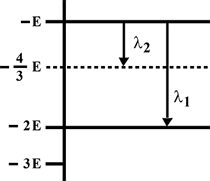
Some energy levels of a molecule are shown in the figure. The ratio of the wavelengths $r = \frac{\lambda_1}{\lambda_2}$ is given by
A
$r = \frac{4}{3}$
B
$r = \frac{2}{3}$
C
$r = \frac{3}{4}$
D
$r = \frac{1}{3}$
Solution
(D) From the energy level diagram,we use the relation $\Delta E = \frac{hc}{\lambda}$.
For the transition corresponding to wavelength $\lambda_1$,the energy difference is $\Delta E_1 = -E - (-2E) = E$.
Thus,$\frac{hc}{\lambda_1} = E$,which gives $\lambda_1 = \frac{hc}{E}$.
For the transition corresponding to wavelength $\lambda_2$,the energy difference is $\Delta E_2 = -E - (-\frac{4}{3}E) = \frac{1}{3}E$.
Thus,$\frac{hc}{\lambda_2} = \frac{E}{3}$,which gives $\lambda_2 = \frac{3hc}{E}$.
The ratio $r = \frac{\lambda_1}{\lambda_2} = \frac{hc/E}{3hc/E} = \frac{1}{3}$.
For the transition corresponding to wavelength $\lambda_1$,the energy difference is $\Delta E_1 = -E - (-2E) = E$.
Thus,$\frac{hc}{\lambda_1} = E$,which gives $\lambda_1 = \frac{hc}{E}$.
For the transition corresponding to wavelength $\lambda_2$,the energy difference is $\Delta E_2 = -E - (-\frac{4}{3}E) = \frac{1}{3}E$.
Thus,$\frac{hc}{\lambda_2} = \frac{E}{3}$,which gives $\lambda_2 = \frac{3hc}{E}$.
The ratio $r = \frac{\lambda_1}{\lambda_2} = \frac{hc/E}{3hc/E} = \frac{1}{3}$.
0 likes
View Solution87
MediumMCQ
$A$ sample of hydrogen atoms is in an excited state (all the atoms). The photons emitted from this sample are made to pass through a filter through which light having a wavelength greater than $800 \ nm$ can only pass. Only one type of photon is found to pass through the filter. The sample's initial excited state is: [Take $hc = 1240 \ eV \cdot nm$,ground state energy of hydrogen atom = $-13.6 \ eV$.]
A
$5^{th}$ excited state
B
$4^{th}$ excited state
C
$3^{rd}$ excited state
D
$2^{nd}$ excited state
Solution
(C) The energy of a photon with wavelength $\lambda = 800 \ nm$ is given by $E = \frac{hc}{\lambda} = \frac{1240}{800} = 1.55 \ eV$.
Since only photons with $\lambda > 800 \ nm$ pass through the filter,the energy of the emitted photons must be $E < 1.55 \ eV$.
The energy levels of the hydrogen atom are $E_n = -\frac{13.6}{n^2} \ eV$.
For $n=1, 2, 3, 4, 5$,the energies are $-13.6, -3.4, -1.51, -0.85, -0.54 \ eV$ respectively.
The energy difference for the transition $n=4 \to n=3$ is $\Delta E = E_4 - E_3 = -0.85 - (-1.51) = 0.66 \ eV$.
Since $0.66 \ eV < 1.55 \ eV$,this photon passes through the filter.
The next possible transition $n=5 \to n=4$ has $\Delta E = -0.54 - (-0.85) = 0.31 \ eV$,which also passes. However,if the sample were in the $4^{th}$ excited state $(n=5)$,multiple transitions would result in photons passing through the filter. Given that only one type of photon passes,the sample must be in the $3^{rd}$ excited state $(n=4)$.
Since only photons with $\lambda > 800 \ nm$ pass through the filter,the energy of the emitted photons must be $E < 1.55 \ eV$.
The energy levels of the hydrogen atom are $E_n = -\frac{13.6}{n^2} \ eV$.
For $n=1, 2, 3, 4, 5$,the energies are $-13.6, -3.4, -1.51, -0.85, -0.54 \ eV$ respectively.
The energy difference for the transition $n=4 \to n=3$ is $\Delta E = E_4 - E_3 = -0.85 - (-1.51) = 0.66 \ eV$.
Since $0.66 \ eV < 1.55 \ eV$,this photon passes through the filter.
The next possible transition $n=5 \to n=4$ has $\Delta E = -0.54 - (-0.85) = 0.31 \ eV$,which also passes. However,if the sample were in the $4^{th}$ excited state $(n=5)$,multiple transitions would result in photons passing through the filter. Given that only one type of photon passes,the sample must be in the $3^{rd}$ excited state $(n=4)$.
0 likes
View Solution88
MediumMCQ
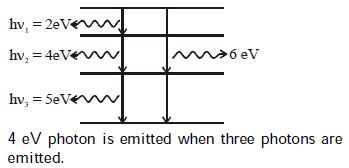
The diagram shows the lowest four energy levels for an electron in a hypothetical atom. The electron is excited to the $-1\, eV$ level and transitions to the lowest energy state by emitting exactly two photons. Which of the following energies could not belong to either of the photons (in $, eV$)?
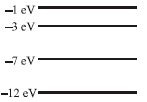
A
$2$
B
$4$
C
$5$
D
$6$
Solution
(B) The energy levels are $E_1 = -12\, eV$,$E_2 = -7\, eV$,$E_3 = -3\, eV$,and $E_4 = -1\, eV$.
The electron starts at $E_4 = -1\, eV$ and ends at $E_1 = -12\, eV$. The total energy released is $\Delta E = (-1\, eV) - (-12\, eV) = 11\, eV$.
Since the electron emits exactly two photons,the sum of the energies of the two photons must be $11\, eV$ $(h\nu_1 + h\nu_2 = 11\, eV)$.
Possible transitions from $E_4 = -1\, eV$ to $E_1 = -12\, eV$ in two steps:
$1$. $E_4 \to E_3 \to E_1$: Energies are $(-1 - (-3)) = 2\, eV$ and $(-3 - (-12)) = 9\, eV$.
$2$. $E_4 \to E_2 \to E_1$: Energies are $(-1 - (-7)) = 6\, eV$ and $(-7 - (-12)) = 5\, eV$.
Possible photon energies are $2\, eV, 9\, eV, 6\, eV, 5\, eV$.
Comparing these with the options,$4\, eV$ is not among the possible photon energies.
The electron starts at $E_4 = -1\, eV$ and ends at $E_1 = -12\, eV$. The total energy released is $\Delta E = (-1\, eV) - (-12\, eV) = 11\, eV$.
Since the electron emits exactly two photons,the sum of the energies of the two photons must be $11\, eV$ $(h\nu_1 + h\nu_2 = 11\, eV)$.
Possible transitions from $E_4 = -1\, eV$ to $E_1 = -12\, eV$ in two steps:
$1$. $E_4 \to E_3 \to E_1$: Energies are $(-1 - (-3)) = 2\, eV$ and $(-3 - (-12)) = 9\, eV$.
$2$. $E_4 \to E_2 \to E_1$: Energies are $(-1 - (-7)) = 6\, eV$ and $(-7 - (-12)) = 5\, eV$.
Possible photon energies are $2\, eV, 9\, eV, 6\, eV, 5\, eV$.
Comparing these with the options,$4\, eV$ is not among the possible photon energies.
0 likes
View Solution89
MediumMCQ
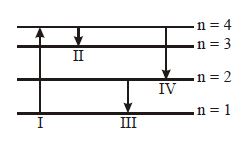
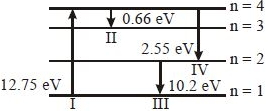
The diagram shows the energy levels for an electron in a certain atom. Which transition shown represents the emission of a photon with maximum wavelength?
A
$III$
B
$IV$
C
$I$
D
$II$
Solution
(D) The energy of an emitted photon is given by $\Delta E = E_2 - E_1 = \frac{hc}{\lambda}$.
From this relation,we see that the wavelength $\lambda = \frac{hc}{\Delta E}$.
Therefore,for the wavelength $\lambda$ to be maximum,the energy difference $\Delta E$ must be minimum.
Among the emission transitions shown $(II, III, IV)$,the transition $II$ occurs between $n=4$ and $n=3$,which has the smallest energy gap $(\Delta E = 0.66 \ eV)$.
Thus,transition $II$ corresponds to the emission of a photon with the maximum wavelength.
From this relation,we see that the wavelength $\lambda = \frac{hc}{\Delta E}$.
Therefore,for the wavelength $\lambda$ to be maximum,the energy difference $\Delta E$ must be minimum.
Among the emission transitions shown $(II, III, IV)$,the transition $II$ occurs between $n=4$ and $n=3$,which has the smallest energy gap $(\Delta E = 0.66 \ eV)$.
Thus,transition $II$ corresponds to the emission of a photon with the maximum wavelength.
0 likes
View Solution90
DifficultMCQ
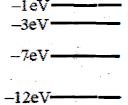
The diagram below shows the lowest four energy levels for an electron in a hypothetical atom. The electron is excited to the $-1\,eV$ level and transitions to the lowest energy state $(-12\,eV)$ by emitting exactly two photons. Which of the following energies could not belong to either of the photons (in $eV$)?
A
$2$
B
$4$
C
$5$
D
$6$
Solution
(B) The electron starts at $-1\,eV$ and ends at $-12\,eV$. The total energy released is $\Delta E = (-1\,eV) - (-12\,eV) = 11\,eV$.
Since the electron transitions by emitting exactly two photons, the sum of the energies of the two photons must be $11\,eV$ $(E_1 + E_2 = 11\,eV)$.
Possible intermediate states are $-3\,eV$ and $-7\,eV$.
Case $1$: Transition via $-3\,eV$ level:
Photon $1$: $(-1\,eV) - (-3\,eV) = 2\,eV$
Photon $2$: $(-3\,eV) - (-12\,eV) = 9\,eV$
Case $2$: Transition via $-7\,eV$ level:
Photon $1$: $(-1\,eV) - (-7\,eV) = 6\,eV$
Photon $2$: $(-7\,eV) - (-12\,eV) = 5\,eV$
Possible photon energies are $2\,eV, 9\,eV, 6\,eV, 5\,eV$.
Comparing with the options, $4\,eV$ is not among the possible photon energies.
Since the electron transitions by emitting exactly two photons, the sum of the energies of the two photons must be $11\,eV$ $(E_1 + E_2 = 11\,eV)$.
Possible intermediate states are $-3\,eV$ and $-7\,eV$.
Case $1$: Transition via $-3\,eV$ level:
Photon $1$: $(-1\,eV) - (-3\,eV) = 2\,eV$
Photon $2$: $(-3\,eV) - (-12\,eV) = 9\,eV$
Case $2$: Transition via $-7\,eV$ level:
Photon $1$: $(-1\,eV) - (-7\,eV) = 6\,eV$
Photon $2$: $(-7\,eV) - (-12\,eV) = 5\,eV$
Possible photon energies are $2\,eV, 9\,eV, 6\,eV, 5\,eV$.
Comparing with the options, $4\,eV$ is not among the possible photon energies.
0 likes
View Solution91
MediumMCQ
Energy levels $A, B$ and $C$ of a certain atom correspond to increasing values of energy, i.e., $E_A < E_B < E_C$. If $\lambda_1, \lambda_2$ and $\lambda_3$ are the wavelengths of radiations corresponding to transitions $C$ to $B, B$ to $A$ and $C$ to $A$ respectively, which of the following relations is correct?
A
$\lambda_3 = \lambda_1 + \lambda_2$
B
$\lambda_3 = \frac{\lambda_1 \lambda_2}{\lambda_1 + \lambda_2}$
C
$\lambda_1 + \lambda_2 + \lambda_3 = 0$
D
$\lambda_3^2 = \lambda_1^2 + \lambda_2^2$
Solution
(B) The energy difference for the transition from $C$ to $A$ is the sum of the energy differences for the transitions from $C$ to $B$ and $B$ to $A$.
$E_C - E_A = (E_C - E_B) + (E_B - E_A)$
Using the relation $E = \frac{hc}{\lambda}$, we can write:
$\frac{hc}{\lambda_3} = \frac{hc}{\lambda_1} + \frac{hc}{\lambda_2}$
Dividing both sides by $hc$:
$\frac{1}{\lambda_3} = \frac{1}{\lambda_1} + \frac{1}{\lambda_2}$
$\frac{1}{\lambda_3} = \frac{\lambda_2 + \lambda_1}{\lambda_1 \lambda_2}$
Therefore, $\lambda_3 = \frac{\lambda_1 \lambda_2}{\lambda_1 + \lambda_2}$.
$E_C - E_A = (E_C - E_B) + (E_B - E_A)$
Using the relation $E = \frac{hc}{\lambda}$, we can write:
$\frac{hc}{\lambda_3} = \frac{hc}{\lambda_1} + \frac{hc}{\lambda_2}$
Dividing both sides by $hc$:
$\frac{1}{\lambda_3} = \frac{1}{\lambda_1} + \frac{1}{\lambda_2}$
$\frac{1}{\lambda_3} = \frac{\lambda_2 + \lambda_1}{\lambda_1 \lambda_2}$
Therefore, $\lambda_3 = \frac{\lambda_1 \lambda_2}{\lambda_1 + \lambda_2}$.

0 likes
View Solution92
DifficultMCQ
For a certain hypothetical one-electron atom,the wavelength (in $\mathring{A}$) for the spectral lines for transition from $n = p$ to $n = 1$ is given by $\lambda = \frac{1500p^2}{p^2 - 1}$ (where $p > 1$). The ionization potential of this element must be ......$V$ (Take $hc = 12420 \text{ eV-} \mathring{A}$).
A
$0.95$
B
$2.05$
C
$8.28$
D
$13.6$
Solution
(C) The wavelength of the spectral lines is given by $\lambda = \frac{1500p^2}{p^2 - 1}$.
To find the ionization energy,we consider the transition from $n = \infty$ to $n = 1$,which corresponds to the series limit (minimum wavelength).
As $p \to \infty$,$\lambda_{\min} = \lim_{p \to \infty} \frac{1500p^2}{p^2 - 1} = 1500 \mathring{A}$.
The energy of the photon corresponding to this wavelength is $\Delta E = \frac{hc}{\lambda_{\min}}$.
Substituting the given values,$\Delta E = \frac{12420 \text{ eV-} \mathring{A}}{1500 \mathring{A}} = 8.28 \text{ eV}$.
Since the ionization potential is the energy required to remove an electron from the ground state $(n=1)$ to infinity,the ionization potential is $8.28 \text{ V}$.
To find the ionization energy,we consider the transition from $n = \infty$ to $n = 1$,which corresponds to the series limit (minimum wavelength).
As $p \to \infty$,$\lambda_{\min} = \lim_{p \to \infty} \frac{1500p^2}{p^2 - 1} = 1500 \mathring{A}$.
The energy of the photon corresponding to this wavelength is $\Delta E = \frac{hc}{\lambda_{\min}}$.
Substituting the given values,$\Delta E = \frac{12420 \text{ eV-} \mathring{A}}{1500 \mathring{A}} = 8.28 \text{ eV}$.
Since the ionization potential is the energy required to remove an electron from the ground state $(n=1)$ to infinity,the ionization potential is $8.28 \text{ V}$.
0 likes
View Solution93
DifficultMCQ
An electron of a stationary hydrogen atom transits from the fourth energy level to the ground level. The velocity of the hydrogen atom acquired as a result of photon emission will be:
{ $R =$ Rydberg constant,$m =$ mass of hydrogen atom }
{ $R =$ Rydberg constant,$m =$ mass of hydrogen atom }
A
$\frac{15}{16} \frac{hR}{m}$
B
$\frac{24}{25} \frac{hR}{m}$
C
$\frac{15}{16} \frac{R}{mh}$
D
None of these
Solution
(A) The energy of the emitted photon is given by the Rydberg formula: $\frac{1}{\lambda} = R Z^2 \left( \frac{1}{n_1^2} - \frac{1}{n_2^2} \right)$.
For a hydrogen atom $(Z=1)$ transitioning from $n_2 = 4$ to $n_1 = 1$:
$\frac{1}{\lambda} = R \left( \frac{1}{1^2} - \frac{1}{4^2} \right) = R \left( 1 - \frac{1}{16} \right) = \frac{15R}{16}$.
The momentum of the emitted photon is $p = \frac{h}{\lambda}$.
Substituting the value of $\frac{1}{\lambda}$: $p = h \left( \frac{15R}{16} \right) = \frac{15Rh}{16}$.
By the law of conservation of momentum,the momentum of the hydrogen atom must be equal and opposite to the momentum of the photon: $p_{\text{atom}} = p_{\text{photon}} = mv$.
Therefore,$mv = \frac{15Rh}{16}$,which gives $v = \frac{15}{16} \frac{Rh}{m}$.
For a hydrogen atom $(Z=1)$ transitioning from $n_2 = 4$ to $n_1 = 1$:
$\frac{1}{\lambda} = R \left( \frac{1}{1^2} - \frac{1}{4^2} \right) = R \left( 1 - \frac{1}{16} \right) = \frac{15R}{16}$.
The momentum of the emitted photon is $p = \frac{h}{\lambda}$.
Substituting the value of $\frac{1}{\lambda}$: $p = h \left( \frac{15R}{16} \right) = \frac{15Rh}{16}$.
By the law of conservation of momentum,the momentum of the hydrogen atom must be equal and opposite to the momentum of the photon: $p_{\text{atom}} = p_{\text{photon}} = mv$.
Therefore,$mv = \frac{15Rh}{16}$,which gives $v = \frac{15}{16} \frac{Rh}{m}$.
0 likes
View Solution94
MediumMCQ
$A$ stationary hydrogen atom has an electron that transitions from the fifth energy level to the ground level. The velocity that the atom acquires as a result of photon emission will be: ($m$ is the mass of the atom,$R$ is Rydberg constant,and $h$ is Planck's constant).
A
$\frac{25m}{24hR}$
B
$\frac{24m}{25hR}$
C
$\frac{24hR}{25m}$
D
$\frac{25hR}{24m}$
Solution
(C) The wavelength $\lambda$ of the emitted photon is given by the Rydberg formula:
$\frac{1}{\lambda} = R \left[ \frac{1}{n_1^2} - \frac{1}{n_2^2} \right] = R \left[ \frac{1}{1^2} - \frac{1}{5^2} \right] = R \left[ 1 - \frac{1}{25} \right] = \frac{24}{25} R$.
According to the law of conservation of momentum,the momentum of the atom $p_{atom}$ must be equal in magnitude to the momentum of the emitted photon $p_{photon}$ because the atom was initially stationary:
$p_{atom} = p_{photon} = \frac{h}{\lambda}$.
Since $p_{atom} = mv$,we have:
$mv = \frac{h}{\lambda}$.
Substituting the value of $\frac{1}{\lambda}$:
$v = \frac{h}{m} \cdot \frac{1}{\lambda} = \frac{h}{m} \cdot \left( \frac{24}{25} R \right) = \frac{24hR}{25m}$.
$\frac{1}{\lambda} = R \left[ \frac{1}{n_1^2} - \frac{1}{n_2^2} \right] = R \left[ \frac{1}{1^2} - \frac{1}{5^2} \right] = R \left[ 1 - \frac{1}{25} \right] = \frac{24}{25} R$.
According to the law of conservation of momentum,the momentum of the atom $p_{atom}$ must be equal in magnitude to the momentum of the emitted photon $p_{photon}$ because the atom was initially stationary:
$p_{atom} = p_{photon} = \frac{h}{\lambda}$.
Since $p_{atom} = mv$,we have:
$mv = \frac{h}{\lambda}$.
Substituting the value of $\frac{1}{\lambda}$:
$v = \frac{h}{m} \cdot \frac{1}{\lambda} = \frac{h}{m} \cdot \left( \frac{24}{25} R \right) = \frac{24hR}{25m}$.
0 likes
View Solution95
DifficultMCQ
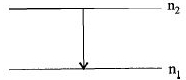
$A$ hydrogen atom makes a transition from $n = 2$ to $n = 1$ and emits a photon. This photon strikes a doubly ionized lithium atom $(Z = 3)$ in an excited state and completely removes the orbiting electron. The least quantum number for the excited state of the ion for this process is:
A
$2$
B
$4$
C
$5$
D
$3$
Solution
(B) The energy of the photon emitted by the hydrogen atom during the transition from $n = 2$ to $n = 1$ is given by:
$E = 13.6 \text{ eV} \times Z^2 \left( \frac{1}{n_1^2} - \frac{1}{n_2^2} \right)$
For hydrogen $(Z = 1)$,$E = 13.6 \times 1^2 \left( \frac{1}{1^2} - \frac{1}{2^2} \right) = 13.6 \times \frac{3}{4} = 10.2 \text{ eV}$.
This photon is absorbed by a doubly ionized lithium atom ($Li^{2+}$,$Z = 3$) in an excited state $n$. The energy required to remove an electron from the $n$-th state of a hydrogen-like ion is:
$E_n = 13.6 \text{ eV} \times \frac{Z^2}{n^2} = 13.6 \times \frac{3^2}{n^2} = 13.6 \times \frac{9}{n^2}$.
For the photon to completely remove the electron,its energy must be greater than or equal to the ionization energy of the state $n$:
$10.2 \ge 13.6 \times \frac{9}{n^2}$
$\frac{10.2}{13.6} \ge \frac{9}{n^2}$
$0.75 \ge \frac{9}{n^2}$
$n^2 \ge \frac{9}{0.75} = 12$
$n \ge \sqrt{12} \approx 3.46$.
Since $n$ must be an integer,the least quantum number is $n = 4$.
$E = 13.6 \text{ eV} \times Z^2 \left( \frac{1}{n_1^2} - \frac{1}{n_2^2} \right)$
For hydrogen $(Z = 1)$,$E = 13.6 \times 1^2 \left( \frac{1}{1^2} - \frac{1}{2^2} \right) = 13.6 \times \frac{3}{4} = 10.2 \text{ eV}$.
This photon is absorbed by a doubly ionized lithium atom ($Li^{2+}$,$Z = 3$) in an excited state $n$. The energy required to remove an electron from the $n$-th state of a hydrogen-like ion is:
$E_n = 13.6 \text{ eV} \times \frac{Z^2}{n^2} = 13.6 \times \frac{3^2}{n^2} = 13.6 \times \frac{9}{n^2}$.
For the photon to completely remove the electron,its energy must be greater than or equal to the ionization energy of the state $n$:
$10.2 \ge 13.6 \times \frac{9}{n^2}$
$\frac{10.2}{13.6} \ge \frac{9}{n^2}$
$0.75 \ge \frac{9}{n^2}$
$n^2 \ge \frac{9}{0.75} = 12$
$n \ge \sqrt{12} \approx 3.46$.
Since $n$ must be an integer,the least quantum number is $n = 4$.
0 likes
View Solution96
DifficultMCQ
The binding energy of the electron in a hydrogen atom is $13.6\, eV$. The energy required to remove the electron from the first excited state of $Li^{++}$ is ......... $eV$.
A
$122.4$
B
$30.6$
C
$13.6$
D
$3.4$
Solution
(B) The energy of an electron in the $n^{th}$ orbit of a hydrogen-like atom is given by the formula: $E_n = -13.6 \times \frac{Z^2}{n^2} \, eV$.
For $Li^{++}$,the atomic number $Z = 3$.
The first excited state corresponds to $n = 2$.
The binding energy (energy required to remove the electron) is the magnitude of the energy in that state: $E = 13.6 \times \frac{Z^2}{n^2} \, eV$.
Substituting the values: $E = 13.6 \times \frac{3^2}{2^2} = 13.6 \times \frac{9}{4} = 13.6 \times 2.25 = 30.6 \, eV$.
For $Li^{++}$,the atomic number $Z = 3$.
The first excited state corresponds to $n = 2$.
The binding energy (energy required to remove the electron) is the magnitude of the energy in that state: $E = 13.6 \times \frac{Z^2}{n^2} \, eV$.
Substituting the values: $E = 13.6 \times \frac{3^2}{2^2} = 13.6 \times \frac{9}{4} = 13.6 \times 2.25 = 30.6 \, eV$.
0 likes
View Solution97
DifficultMCQ
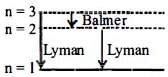
$A$ $12.5 \ eV$ electron beam is used to bombard gaseous hydrogen at room temperature. It will emit:
A
$2$ lines in the Lyman series and $1$ line in the Balmer series
B
$3$ lines in the Lyman series
C
$1$ line in the Lyman series and $2$ lines in the Balmer series
D
$3$ lines in the Balmer series
Solution
(A) The energy levels of a hydrogen atom are given by $E_n = -\frac{13.6}{n^2} \ eV$.
At room temperature,hydrogen atoms are in the ground state $(n=1)$.
The energy required to excite an electron from $n=1$ to $n=2$ is $E_2 - E_1 = -3.4 - (-13.6) = 10.2 \ eV$.
The energy required to excite an electron from $n=1$ to $n=3$ is $E_3 - E_1 = -1.51 - (-13.6) = 12.09 \ eV$.
The energy required to excite an electron from $n=1$ to $n=4$ is $E_4 - E_1 = -0.85 - (-13.6) = 12.75 \ eV$.
Since the incident electron beam has an energy of $12.5 \ eV$,it can excite hydrogen atoms up to the $n=3$ energy level.
When these excited atoms return to the ground state,the possible transitions are:
$n=3 \rightarrow n=2$ (Balmer series)
$n=3 \rightarrow n=1$ (Lyman series)
$n=2 \rightarrow n=1$ (Lyman series)
Thus,there are $2$ lines in the Lyman series and $1$ line in the Balmer series.
At room temperature,hydrogen atoms are in the ground state $(n=1)$.
The energy required to excite an electron from $n=1$ to $n=2$ is $E_2 - E_1 = -3.4 - (-13.6) = 10.2 \ eV$.
The energy required to excite an electron from $n=1$ to $n=3$ is $E_3 - E_1 = -1.51 - (-13.6) = 12.09 \ eV$.
The energy required to excite an electron from $n=1$ to $n=4$ is $E_4 - E_1 = -0.85 - (-13.6) = 12.75 \ eV$.
Since the incident electron beam has an energy of $12.5 \ eV$,it can excite hydrogen atoms up to the $n=3$ energy level.
When these excited atoms return to the ground state,the possible transitions are:
$n=3 \rightarrow n=2$ (Balmer series)
$n=3 \rightarrow n=1$ (Lyman series)
$n=2 \rightarrow n=1$ (Lyman series)
Thus,there are $2$ lines in the Lyman series and $1$ line in the Balmer series.
0 likes
View Solution98
MediumMCQ
$A$ hypothetical atom has only three energy levels. The ground level has energy,$E_1 = -8 \ eV$. The two excited states have energies,$E_2 = -6 \ eV$ and $E_3 = -2 \ eV$. Which of the following wavelengths will $NOT$ be present in the emission spectrum of this atom (in $nm$)?
A
$207$
B
$465$
C
$310$
D
$620$
Solution
(B) The possible transitions for emission are from higher energy levels to lower energy levels. The energy of the emitted photon is given by $\Delta E = E_f - E_i$. The possible transitions are:
$1$. From $E_3$ to $E_2$: $\Delta E_{32} = -2 \ eV - (-6 \ eV) = 4 \ eV$.
$2$. From $E_3$ to $E_1$: $\Delta E_{31} = -2 \ eV - (-8 \ eV) = 6 \ eV$.
$3$. From $E_2$ to $E_1$: $\Delta E_{21} = -6 \ eV - (-8 \ eV) = 2 \ eV$.
Using the formula $\lambda = \frac{hc}{\Delta E}$,where $hc \approx 1240 \ eV \cdot nm$:
- For $\Delta E = 4 \ eV$,$\lambda = \frac{1240}{4} = 310 \ nm$.
- For $\Delta E = 6 \ eV$,$\lambda = \frac{1240}{6} \approx 206.67 \ nm \approx 207 \ nm$.
- For $\Delta E = 2 \ eV$,$\lambda = \frac{1240}{2} = 620 \ nm$.
Comparing these with the given options,$465 \ nm$ is not present in the emission spectrum.
$1$. From $E_3$ to $E_2$: $\Delta E_{32} = -2 \ eV - (-6 \ eV) = 4 \ eV$.
$2$. From $E_3$ to $E_1$: $\Delta E_{31} = -2 \ eV - (-8 \ eV) = 6 \ eV$.
$3$. From $E_2$ to $E_1$: $\Delta E_{21} = -6 \ eV - (-8 \ eV) = 2 \ eV$.
Using the formula $\lambda = \frac{hc}{\Delta E}$,where $hc \approx 1240 \ eV \cdot nm$:
- For $\Delta E = 4 \ eV$,$\lambda = \frac{1240}{4} = 310 \ nm$.
- For $\Delta E = 6 \ eV$,$\lambda = \frac{1240}{6} \approx 206.67 \ nm \approx 207 \ nm$.
- For $\Delta E = 2 \ eV$,$\lambda = \frac{1240}{2} = 620 \ nm$.
Comparing these with the given options,$465 \ nm$ is not present in the emission spectrum.
0 likes
View SolutionAtoms — Electron Energy and Electron Energy Levels in Hydrogen Atom · Frequently Asked Questions
1Are these Atoms questions useful for JEE and NEET?
Yes. All questions in this section are mapped to JEE Main and NEET exam patterns. Previous year questions from JEE Main, NEET, GUJCET and state-level exams are included with full solutions.
2Can I switch to Hindi or Gujarati for these questions?
Yes. Use the language tabs in the hero section or the sidebar to view the same questions and solutions in English, Hindi or Gujarati.
3How do I generate a question paper from this subtopic?
Use the Vedclass Exam Paper Generator — select the chapter and subtopic, set difficulty, and generate Sets A, B, C, D automatically. First 3 chapters of every subject are free.
Vedclass Products
For Students
Vedclass Test Series
Mock tests in real JEE/NEET style with performance analysis. 5-day free trial.
Start Free TrialFor Teachers
Exam Paper Generator
Generate Set A/B/C/D papers from this chapter in 2 minutes. 3 chapters free.
Try FreeFor Institutes
Online Exam Module
Live online exams with unlimited students, 360° analytics & white-label branding.
See DemoFor Teachers & Institutes
Generate a Atoms Exam Paper in 2 Minutes
Select subtopic & difficulty — Sets A, B, C, D auto-generated with No Repeat logic.
First 3 chapters of every subject are free — no payment required.