
A English
Type of Functions based on Mapping Questions in English
Class 12 Mathematics · Relation and Function · Type of Functions based on Mapping
263+
Questions
English
Language
100%
With Solutions
Showing 50 of 263 questions in English
51
AdvancedMCQ
Let $f(x) = \cos(\sqrt{P}x),$ where $P = [\lambda]$ and $[.]$ denotes the Greatest Integer Function. If the period of $f(x)$ is $\pi$,then:
A
$\lambda \in [4, 5]$
B
$\lambda \in [1, 2)$
C
$\lambda \in [4, 5)$
D
$\lambda$ does not exist
Solution
(C) The period of the function $f(x) = \cos(ax)$ is given by $T = \frac{2\pi}{|a|}$.
Given $f(x) = \cos(\sqrt{P}x)$,the period is $T = \frac{2\pi}{\sqrt{P}}$.
We are given that the period is $\pi$,so $\frac{2\pi}{\sqrt{P}} = \pi$.
This implies $\sqrt{P} = 2$,which means $P = 4$.
Since $P = [\lambda]$,we have $[\lambda] = 4$.
By the definition of the Greatest Integer Function,$[\lambda] = 4$ implies $4 \le \lambda < 5$.
Thus,$\lambda \in [4, 5)$.
Given $f(x) = \cos(\sqrt{P}x)$,the period is $T = \frac{2\pi}{\sqrt{P}}$.
We are given that the period is $\pi$,so $\frac{2\pi}{\sqrt{P}} = \pi$.
This implies $\sqrt{P} = 2$,which means $P = 4$.
Since $P = [\lambda]$,we have $[\lambda] = 4$.
By the definition of the Greatest Integer Function,$[\lambda] = 4$ implies $4 \le \lambda < 5$.
Thus,$\lambda \in [4, 5)$.
0 likes
View Solution52
AdvancedMCQ
$f : R \to R$ is defined as $f(x) = \begin{cases} x^2 + 2mx - 1, & x \leq 0 \\ mx - 1, & x > 0 \end{cases}$. If $f(x)$ is one-one,then the set of values of $m$ is:
A
$( - \infty ,0)$
B
$( - \infty ,0]$
C
$(0,\infty )$
D
$[0,\infty )$
Solution
(A) For $f(x)$ to be one-one,the function must be strictly monotonic or the ranges of the two pieces must be disjoint.
Case $1$: For $x \leq 0$,$f(x) = x^2 + 2mx - 1$. The vertex of this parabola is at $x = -m$. For the function to be one-one on $(-\infty, 0]$,the vertex must be at $x \geq 0$,which implies $-m \geq 0$,so $m \leq 0$.
Case $2$: For $x > 0$,$f(x) = mx - 1$. For this to be one-one,$m$ must be $\geq 0$. However,if $m > 0$,the range of $f(x)$ for $x > 0$ is $(-1, \infty)$. The range of $f(x)$ for $x \leq 0$ is $[-1-m^2, \infty)$. These ranges overlap,so the function would not be one-one.
Case $3$: If $m < 0$,then for $x > 0$,$f(x) = mx - 1$ is a decreasing function with range $(-\infty, -1)$. For $x \leq 0$,$f(x) = x^2 + 2mx - 1$ is decreasing on $(-\infty, -m]$. Since $-m > 0$,the function is decreasing on $(-\infty, 0]$. The range for $x \leq 0$ is $[-1-m^2, \infty)$. Since the ranges $(-1, -\infty)$ and $[-1-m^2, \infty)$ do not overlap for $m < 0$,the function is one-one.
Thus,$m \in (-\infty, 0)$.
Case $1$: For $x \leq 0$,$f(x) = x^2 + 2mx - 1$. The vertex of this parabola is at $x = -m$. For the function to be one-one on $(-\infty, 0]$,the vertex must be at $x \geq 0$,which implies $-m \geq 0$,so $m \leq 0$.
Case $2$: For $x > 0$,$f(x) = mx - 1$. For this to be one-one,$m$ must be $\geq 0$. However,if $m > 0$,the range of $f(x)$ for $x > 0$ is $(-1, \infty)$. The range of $f(x)$ for $x \leq 0$ is $[-1-m^2, \infty)$. These ranges overlap,so the function would not be one-one.
Case $3$: If $m < 0$,then for $x > 0$,$f(x) = mx - 1$ is a decreasing function with range $(-\infty, -1)$. For $x \leq 0$,$f(x) = x^2 + 2mx - 1$ is decreasing on $(-\infty, -m]$. Since $-m > 0$,the function is decreasing on $(-\infty, 0]$. The range for $x \leq 0$ is $[-1-m^2, \infty)$. Since the ranges $(-1, -\infty)$ and $[-1-m^2, \infty)$ do not overlap for $m < 0$,the function is one-one.
Thus,$m \in (-\infty, 0)$.
0 likes
View Solution53
DifficultMCQ
The function $f : N \to N$ defined by $f(x) = x - 5[\frac{x}{5}]$,where $N$ is the set of natural numbers and $[x]$ denotes the greatest integer less than or equal to $x$,is
A
one-one and onto.
B
one-one but not onto.
C
onto but not one-one.
D
neither one-one nor onto.
Solution
(D) Given the function $f(x) = x - 5[\frac{x}{5}]$.
To check for one-one: Calculate $f(1) = 1 - 5[1/5] = 1 - 5(0) = 1$ and $f(6) = 6 - 5[6/5] = 6 - 5(1) = 1$.
Since $f(1) = f(6) = 1$ but $1 \neq 6$,the function is not one-one.
To check for onto: The codomain is $N = \{1, 2, 3, ...\}$.
Calculate $f(5) = 5 - 5[5/5] = 5 - 5(1) = 0$.
Since $0 \notin N$,the function is not onto.
Therefore,the function $f$ is neither one-one nor onto.
To check for one-one: Calculate $f(1) = 1 - 5[1/5] = 1 - 5(0) = 1$ and $f(6) = 6 - 5[6/5] = 6 - 5(1) = 1$.
Since $f(1) = f(6) = 1$ but $1 \neq 6$,the function is not one-one.
To check for onto: The codomain is $N = \{1, 2, 3, ...\}$.
Calculate $f(5) = 5 - 5[5/5] = 5 - 5(1) = 0$.
Since $0 \notin N$,the function is not onto.
Therefore,the function $f$ is neither one-one nor onto.
0 likes
View Solution54
DifficultMCQ
Let $A = \{x_1, x_2, \dots, x_7\}$ and $B = \{y_1, y_2, y_3\}$ be two sets containing seven and three distinct elements respectively. The total number of onto functions $f : A \to B$ such that there exist exactly three elements $x$ in $A$ with $f(x) = y_2$ is equal to:
A
$14 \times {}^7C_3$
B
$16 \times {}^7C_3$
C
$14 \times {}^7C_2$
D
$12 \times {}^7C_2$
Solution
(A) We are given $A = \{x_1, \dots, x_7\}$ and $B = \{y_1, y_2, y_3\}$.
We need to find the number of onto functions $f: A \to B$ such that exactly three elements in $A$ map to $y_2$.
First,we choose $3$ elements from $A$ to map to $y_2$,which can be done in ${}^7C_3$ ways.
Now,the remaining $4$ elements of $A$ must map to the remaining $2$ elements of $B$,which are $\{y_1, y_3\}$.
For the function to be onto,the set $\{y_1, y_3\}$ must be covered by the $4$ elements.
The total number of functions from these $4$ elements to $\{y_1, y_3\}$ is $2^4 = 16$.
We must exclude the cases where all $4$ elements map to only $y_1$ or only $y_3$ to ensure the function is onto (i.e.,$y_1$ and $y_3$ are both covered).
Thus,the number of ways is $2^4 - 2 = 16 - 2 = 14$.
Therefore,the total number of such onto functions is ${}^7C_3 \times 14 = 14 \times {}^7C_3$.
We need to find the number of onto functions $f: A \to B$ such that exactly three elements in $A$ map to $y_2$.
First,we choose $3$ elements from $A$ to map to $y_2$,which can be done in ${}^7C_3$ ways.
Now,the remaining $4$ elements of $A$ must map to the remaining $2$ elements of $B$,which are $\{y_1, y_3\}$.
For the function to be onto,the set $\{y_1, y_3\}$ must be covered by the $4$ elements.
The total number of functions from these $4$ elements to $\{y_1, y_3\}$ is $2^4 = 16$.
We must exclude the cases where all $4$ elements map to only $y_1$ or only $y_3$ to ensure the function is onto (i.e.,$y_1$ and $y_3$ are both covered).
Thus,the number of ways is $2^4 - 2 = 16 - 2 = 14$.
Therefore,the total number of such onto functions is ${}^7C_3 \times 14 = 14 \times {}^7C_3$.
1 likes
View Solution55
DifficultMCQ
If $f(x) = (\frac{3}{5})^x + (\frac{4}{5})^x - 1$,$x \in R$,then the equation $f(x) = 0$ has
A
no solution
B
one solution
C
two solutions
D
more than two solutions
Solution
(B) Given $f(x) = (\frac{3}{5})^x + (\frac{4}{5})^x - 1$.
Setting $f(x) = 0$,we get $(\frac{3}{5})^x + (\frac{4}{5})^x = 1$.
Dividing by $5^x$ is equivalent to solving $3^x + 4^x = 5^x$.
Divide both sides by $5^x$: $(\frac{3}{5})^x + (\frac{4}{5})^x = 1$.
Let $g(x) = (\frac{3}{5})^x + (\frac{4}{5})^x$.
Since both $(\frac{3}{5})^x$ and $(\frac{4}{5})^x$ are strictly decreasing functions for $x \in R$,their sum $g(x)$ is also a strictly decreasing function.
$A$ strictly decreasing function can intersect the horizontal line $y = 1$ at most once.
By inspection,for $x = 2$,we have $(\frac{3}{5})^2 + (\frac{4}{5})^2 = \frac{9}{25} + \frac{16}{25} = \frac{25}{25} = 1$.
Thus,$x = 2$ is the unique solution.
Setting $f(x) = 0$,we get $(\frac{3}{5})^x + (\frac{4}{5})^x = 1$.
Dividing by $5^x$ is equivalent to solving $3^x + 4^x = 5^x$.
Divide both sides by $5^x$: $(\frac{3}{5})^x + (\frac{4}{5})^x = 1$.
Let $g(x) = (\frac{3}{5})^x + (\frac{4}{5})^x$.
Since both $(\frac{3}{5})^x$ and $(\frac{4}{5})^x$ are strictly decreasing functions for $x \in R$,their sum $g(x)$ is also a strictly decreasing function.
$A$ strictly decreasing function can intersect the horizontal line $y = 1$ at most once.
By inspection,for $x = 2$,we have $(\frac{3}{5})^2 + (\frac{4}{5})^2 = \frac{9}{25} + \frac{16}{25} = \frac{25}{25} = 1$.
Thus,$x = 2$ is the unique solution.
0 likes
View Solution56
DifficultMCQ
Let $f : R \to R$ be defined by $f(x) = \frac{|x| - 1}{|x| + 1}$. Then $f$ is
A
both one-one and onto
B
one-one but not onto
C
onto but not one-one
D
neither one-one nor onto
Solution
(D) Given $f(x) = \frac{|x| - 1}{|x| + 1}$.
For a function to be one-one,if $f(x_1) = f(x_2)$,then $x_1$ must be equal to $x_2$.
Let $f(x_1) = f(x_2)$:
$\frac{|x_1| - 1}{|x_1| + 1} = \frac{|x_2| - 1}{|x_2| + 1}$
$(|x_1| - 1)(|x_2| + 1) = (|x_2| - 1)(|x_1| + 1)$
$|x_1||x_2| + |x_1| - |x_2| - 1 = |x_1||x_2| - |x_1| + |x_2| - 1$
$2|x_1| = 2|x_2| \implies |x_1| = |x_2|$
This implies $x_1 = x_2$ or $x_1 = -x_2$. Since $f(1) = f(-1) = 0$,the function is not one-one (it is many-one).
For onto: Let $y = \frac{|x| - 1}{|x| + 1}$.
$y(|x| + 1) = |x| - 1 \implies y|x| + y = |x| - 1 \implies |x|(y - 1) = -1 - y \implies |x| = \frac{1 + y}{1 - y}$.
Since $|x| \ge 0$,we must have $\frac{1 + y}{1 - y} \ge 0$. Solving this inequality,we get $y \in [-1, 1)$.
The range of $f$ is $[-1, 1)$,which is not equal to the codomain $R$. Therefore,the function is not onto.
For a function to be one-one,if $f(x_1) = f(x_2)$,then $x_1$ must be equal to $x_2$.
Let $f(x_1) = f(x_2)$:
$\frac{|x_1| - 1}{|x_1| + 1} = \frac{|x_2| - 1}{|x_2| + 1}$
$(|x_1| - 1)(|x_2| + 1) = (|x_2| - 1)(|x_1| + 1)$
$|x_1||x_2| + |x_1| - |x_2| - 1 = |x_1||x_2| - |x_1| + |x_2| - 1$
$2|x_1| = 2|x_2| \implies |x_1| = |x_2|$
This implies $x_1 = x_2$ or $x_1 = -x_2$. Since $f(1) = f(-1) = 0$,the function is not one-one (it is many-one).
For onto: Let $y = \frac{|x| - 1}{|x| + 1}$.
$y(|x| + 1) = |x| - 1 \implies y|x| + y = |x| - 1 \implies |x|(y - 1) = -1 - y \implies |x| = \frac{1 + y}{1 - y}$.
Since $|x| \ge 0$,we must have $\frac{1 + y}{1 - y} \ge 0$. Solving this inequality,we get $y \in [-1, 1)$.
The range of $f$ is $[-1, 1)$,which is not equal to the codomain $R$. Therefore,the function is not onto.
0 likes
View Solution57
DifficultMCQ
Let $A = \{1, 2, 3, 4\}$ and $R : A \to A$ be the relation defined by $R = \{ (1, 1), (2, 3), (3, 4), (4, 2) \}$. The correct statement is
A
$R$ does not have an inverse
B
$R$ is not a one-to-one function
C
$R$ is an onto function
D
$R$ is not a function
Solution
(C) Given the set $A = \{1, 2, 3, 4\}$ and the relation $R = \{ (1, 1), (2, 3), (3, 4), (4, 2) \}$.
First,we check if $R$ is a function. Since every element in the domain $A$ has a unique image in the codomain $A$,$R$ is a function.
Next,we check if $R$ is one-to-one. The images are $\{1, 3, 4, 2\}$. Since all images are distinct,$R$ is a one-to-one function.
Finally,we check if $R$ is onto. The range of $R$ is $\{1, 2, 3, 4\}$,which is equal to the codomain $A$.
Since the range equals the codomain,$R$ is an onto function.
Therefore,the correct statement is that $R$ is an onto function.
First,we check if $R$ is a function. Since every element in the domain $A$ has a unique image in the codomain $A$,$R$ is a function.
Next,we check if $R$ is one-to-one. The images are $\{1, 3, 4, 2\}$. Since all images are distinct,$R$ is a one-to-one function.
Finally,we check if $R$ is onto. The range of $R$ is $\{1, 2, 3, 4\}$,which is equal to the codomain $A$.
Since the range equals the codomain,$R$ is an onto function.
Therefore,the correct statement is that $R$ is an onto function.
0 likes
View Solution58
MediumMCQ
If $P(S)$ denotes the set of all subsets of a given set $S$,then the number of one-to-one functions from the set $S = \{ 1, 2, 3 \}$ to the set $P(S)$ is
A
$24$
B
$8$
C
$336$
D
$320$
Solution
(C) Given the set $S = \{ 1, 2, 3 \}$.
The number of elements in $S$ is $n(S) = 3$.
$P(S)$ is the power set of $S$,which is the set of all subsets of $S$.
The number of elements in the power set is $n(P(S)) = 2^{n(S)} = 2^3 = 8$.
$A$ function $f: S \to P(S)$ is one-to-one (injective) if each element in $S$ maps to a unique element in $P(S)$.
The number of one-to-one functions from a set with $m$ elements to a set with $n$ elements is given by the permutation formula $^nP_m = \frac{n!}{(n-m)!}$.
Here,$m = n(S) = 3$ and $n = n(P(S)) = 8$.
Therefore,the number of one-to-one functions is $^8P_3 = \frac{8!}{(8-3)!} = \frac{8!}{5!} = 8 \times 7 \times 6 = 336$.
The number of elements in $S$ is $n(S) = 3$.
$P(S)$ is the power set of $S$,which is the set of all subsets of $S$.
The number of elements in the power set is $n(P(S)) = 2^{n(S)} = 2^3 = 8$.
$A$ function $f: S \to P(S)$ is one-to-one (injective) if each element in $S$ maps to a unique element in $P(S)$.
The number of one-to-one functions from a set with $m$ elements to a set with $n$ elements is given by the permutation formula $^nP_m = \frac{n!}{(n-m)!}$.
Here,$m = n(S) = 3$ and $n = n(P(S)) = 8$.
Therefore,the number of one-to-one functions is $^8P_3 = \frac{8!}{(8-3)!} = \frac{8!}{5!} = 8 \times 7 \times 6 = 336$.
0 likes
View Solution59
DifficultMCQ
Let $A$ and $B$ be non-empty sets in $\mathbb{R}$ and $f : A \to B$ be a bijective function.
Statement $1$ : $f$ is an onto function.
Statement $2$ : There exists a function $g : B \to A$ such that $f \circ g = I_B$.
Statement $1$ : $f$ is an onto function.
Statement $2$ : There exists a function $g : B \to A$ such that $f \circ g = I_B$.
A
Statement $1$ is true,Statement $2$ is false.
B
Statement $1$ is true,Statement $2$ is true; Statement $2$ is a correct explanation for Statement $1$.
C
Statement $1$ is false,Statement $2$ is true.
D
Statement $1$ is true,Statement $2$ is true; Statement $2$ is not the correct explanation for Statement $1$.
Solution
(D) function $f : A \to B$ is bijective if it is both one-to-one (injective) and onto (surjective).
Statement $1$ states that $f$ is an onto function,which is true by the definition of a bijective function.
Statement $2$ states that there exists a function $g : B \to A$ such that $f \circ g = I_B$. Since $f$ is bijective,it is invertible,meaning there exists an inverse function $f^{-1} : B \to A$ such that $f \circ f^{-1} = I_B$. Thus,$g = f^{-1}$ satisfies the condition. Therefore,Statement $2$ is also true.
However,Statement $2$ describes the property of invertibility resulting from bijectivity,while Statement $1$ is simply the definition of one part of bijectivity. Statement $2$ is not the reason why $f$ is onto; rather,both are consequences of $f$ being bijective. Thus,Statement $2$ is not the correct explanation for Statement $1$.
Statement $1$ states that $f$ is an onto function,which is true by the definition of a bijective function.
Statement $2$ states that there exists a function $g : B \to A$ such that $f \circ g = I_B$. Since $f$ is bijective,it is invertible,meaning there exists an inverse function $f^{-1} : B \to A$ such that $f \circ f^{-1} = I_B$. Thus,$g = f^{-1}$ satisfies the condition. Therefore,Statement $2$ is also true.
However,Statement $2$ describes the property of invertibility resulting from bijectivity,while Statement $1$ is simply the definition of one part of bijectivity. Statement $2$ is not the reason why $f$ is onto; rather,both are consequences of $f$ being bijective. Thus,Statement $2$ is not the correct explanation for Statement $1$.
0 likes
View Solution60
DifficultMCQ
Let $A = \{x \in R : x \text{ is not a positive integer}\}$. Define a function $f : A \to R$ as $f(x) = \frac{2x}{x - 1}$. Then $f$ is
A
injective but not surjective
B
not injective
C
surjective but not injective
D
neither injective nor surjective
Solution
(A) Given $f(x) = \frac{2x}{x - 1}$ for $x \in A$,where $A = R \setminus \{1, 2, 3, \dots\}$.
To check for injectivity (one-one): Let $f(x_1) = f(x_2)$.
$\frac{2x_1}{x_1 - 1} = \frac{2x_2}{x_2 - 1}$
$x_1(x_2 - 1) = x_2(x_1 - 1)$
$x_1x_2 - x_1 = x_2x_1 - x_2$
$-x_1 = -x_2 \Rightarrow x_1 = x_2$.
Thus,$f$ is injective (one-one).
To check for surjectivity (onto): Let $y = \frac{2x}{x - 1}$.
$y(x - 1) = 2x$
$yx - y = 2x$
$x(y - 2) = y$
$x = \frac{y}{y - 2}$.
For $f$ to be surjective,for every $y \in R$,there must exist an $x \in A$ such that $f(x) = y$.
If $y = 2$,$x$ is undefined. Also,if $x$ is a positive integer,$x \notin A$.
For example,if $y = 4$,$x = \frac{4}{4 - 2} = 2$. Since $2 \notin A$,there is no $x \in A$ such that $f(x) = 4$.
Therefore,$f$ is not surjective.
To check for injectivity (one-one): Let $f(x_1) = f(x_2)$.
$\frac{2x_1}{x_1 - 1} = \frac{2x_2}{x_2 - 1}$
$x_1(x_2 - 1) = x_2(x_1 - 1)$
$x_1x_2 - x_1 = x_2x_1 - x_2$
$-x_1 = -x_2 \Rightarrow x_1 = x_2$.
Thus,$f$ is injective (one-one).
To check for surjectivity (onto): Let $y = \frac{2x}{x - 1}$.
$y(x - 1) = 2x$
$yx - y = 2x$
$x(y - 2) = y$
$x = \frac{y}{y - 2}$.
For $f$ to be surjective,for every $y \in R$,there must exist an $x \in A$ such that $f(x) = y$.
If $y = 2$,$x$ is undefined. Also,if $x$ is a positive integer,$x \notin A$.
For example,if $y = 4$,$x = \frac{4}{4 - 2} = 2$. Since $2 \notin A$,there is no $x \in A$ such that $f(x) = 4$.
Therefore,$f$ is not surjective.
0 likes
View Solution61
DifficultMCQ
Let a function $f: (0, \infty) \to (0, \infty)$ be defined by $f(x) = |1 - \frac{1}{x}|$. Then $f$ is
A
not injective but it is surjective
B
injective only
C
neither injective nor surjective
D
both injective as well as surjective
Solution
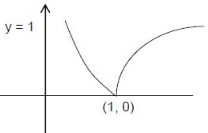
(C) Given $f(x) = |1 - \frac{1}{x}|$ for $x \in (0, \infty)$.
To check for injectivity (one-one): Consider $f(x) = y$. For $y \in (0, 1)$,there exist two values of $x$. For example,if $y = 0.5$,then $|1 - \frac{1}{x}| = 0.5$,which gives $1 - \frac{1}{x} = 0.5 \implies \frac{1}{x} = 0.5 \implies x = 2$,and $1 - \frac{1}{x} = -0.5 \implies \frac{1}{x} = 1.5 \implies x = \frac{2}{3}$. Since $f(2) = f(\frac{2}{3}) = 0.5$,the function is not injective.
To check for surjectivity (onto): The codomain is $(0, \infty)$. The range of $f(x) = |1 - \frac{1}{x}|$ for $x \in (0, \infty)$ is $[0, \infty)$. Since the range $[0, \infty)$ is not equal to the codomain $(0, \infty)$ (as $0$ is in the range but not in the codomain),the function is not surjective.
Thus,$f$ is neither injective nor surjective.
To check for injectivity (one-one): Consider $f(x) = y$. For $y \in (0, 1)$,there exist two values of $x$. For example,if $y = 0.5$,then $|1 - \frac{1}{x}| = 0.5$,which gives $1 - \frac{1}{x} = 0.5 \implies \frac{1}{x} = 0.5 \implies x = 2$,and $1 - \frac{1}{x} = -0.5 \implies \frac{1}{x} = 1.5 \implies x = \frac{2}{3}$. Since $f(2) = f(\frac{2}{3}) = 0.5$,the function is not injective.
To check for surjectivity (onto): The codomain is $(0, \infty)$. The range of $f(x) = |1 - \frac{1}{x}|$ for $x \in (0, \infty)$ is $[0, \infty)$. Since the range $[0, \infty)$ is not equal to the codomain $(0, \infty)$ (as $0$ is in the range but not in the codomain),the function is not surjective.
Thus,$f$ is neither injective nor surjective.
0 likes
View Solution62
DifficultMCQ
The number of onto functions $f$ from $\{1, 2, 3, \dots, 20\}$ to $\{1, 2, 3, \dots, 20\}$ such that $f(k)$ is a multiple of $3$ whenever $k$ is a multiple of $4$ is:
A
$6^5 \times 15!$
B
$5! \times 6!$
C
$15! \times 6!$
D
$5^6 \times 15$
Solution
(C) Let $S = \{1, 2, 3, \dots, 20\}$. The elements in $S$ that are multiples of $4$ are $K = \{4, 8, 12, 16, 20\}$. There are $5$ such elements.
For $k \in K$,$f(k)$ must be a multiple of $3$. The multiples of $3$ in $S$ are $M = \{3, 6, 9, 12, 15, 18\}$. There are $6$ such elements.
Since $f$ is an onto function,the $5$ elements of $K$ must be mapped to $5$ distinct elements of $M$. The number of ways to choose and arrange these is $^6P_5 = \frac{6!}{1!} = 6!$.
The remaining $15$ elements of $S \setminus K$ must be mapped onto the remaining $15$ elements of $S \setminus f(K)$ in a bijective manner,which can be done in $15!$ ways.
Therefore,the total number of onto functions is $6! \times 15!$.
For $k \in K$,$f(k)$ must be a multiple of $3$. The multiples of $3$ in $S$ are $M = \{3, 6, 9, 12, 15, 18\}$. There are $6$ such elements.
Since $f$ is an onto function,the $5$ elements of $K$ must be mapped to $5$ distinct elements of $M$. The number of ways to choose and arrange these is $^6P_5 = \frac{6!}{1!} = 6!$.
The remaining $15$ elements of $S \setminus K$ must be mapped onto the remaining $15$ elements of $S \setminus f(K)$ in a bijective manner,which can be done in $15!$ ways.
Therefore,the total number of onto functions is $6! \times 15!$.
0 likes
View Solution63
Easy
Let $A$ be the set of all $50$ students of Class $X$ in a school. Let $f: A \rightarrow N$ be a function defined by $f(x) = \text{roll number of the student } x$. Show that $f$ is one-one but not onto.
Solution
(N/A) $1$. To check for one-one: Let $x_1$ and $x_2$ be two different students in set $A$. Since no two different students can have the same roll number,$f(x_1) \neq f(x_2)$. Thus,$f$ is one-one.
$2$. To check for onto: The codomain of $f$ is the set of natural numbers $N = \{1, 2, 3, ...\}$. The range of $f$ is the set of roll numbers assigned to the $50$ students,which is $\{1, 2, 3, ..., 50\}$.
$3$. Since the range $\{1, 2, 3, ..., 50\}$ is a proper subset of the codomain $N$ (e.g.,$51 \in N$ but $51$ is not in the range),there exists at least one element in $N$ that has no pre-image in $A$.
$4$. Therefore,$f$ is not onto.
$2$. To check for onto: The codomain of $f$ is the set of natural numbers $N = \{1, 2, 3, ...\}$. The range of $f$ is the set of roll numbers assigned to the $50$ students,which is $\{1, 2, 3, ..., 50\}$.
$3$. Since the range $\{1, 2, 3, ..., 50\}$ is a proper subset of the codomain $N$ (e.g.,$51 \in N$ but $51$ is not in the range),there exists at least one element in $N$ that has no pre-image in $A$.
$4$. Therefore,$f$ is not onto.
0 likes
View Solution64
Medium
Show that the function $f: N \rightarrow N$ given by $f(x) = 2x$ is one-one but not onto.
Solution
(N/A) $1$. To check if the function is one-one: Let $x_{1}, x_{2} \in N$ such that $f(x_{1}) = f(x_{2})$.
Then,$2x_{1} = 2x_{2}$,which implies $x_{1} = x_{2}$.
Since $f(x_{1}) = f(x_{2})$ leads to $x_{1} = x_{2}$,the function $f$ is one-one.
$2$. To check if the function is onto: $A$ function is onto if for every $y \in N$ (codomain),there exists an $x \in N$ (domain) such that $f(x) = y$.
Here,$f(x) = 2x$. If we take $y = 1 \in N$,then $2x = 1$,which gives $x = 1/2$.
Since $1/2 \notin N$,there is no $x \in N$ such that $f(x) = 1$.
Therefore,the function $f$ is not onto.
Then,$2x_{1} = 2x_{2}$,which implies $x_{1} = x_{2}$.
Since $f(x_{1}) = f(x_{2})$ leads to $x_{1} = x_{2}$,the function $f$ is one-one.
$2$. To check if the function is onto: $A$ function is onto if for every $y \in N$ (codomain),there exists an $x \in N$ (domain) such that $f(x) = y$.
Here,$f(x) = 2x$. If we take $y = 1 \in N$,then $2x = 1$,which gives $x = 1/2$.
Since $1/2 \notin N$,there is no $x \in N$ such that $f(x) = 1$.
Therefore,the function $f$ is not onto.
0 likes
View Solution65
Medium
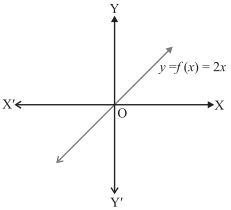
Prove that the function $f: R \rightarrow R$,defined by $f(x)=2x$,is one-one and onto.
Solution
(N/A) To prove that $f$ is one-one,we assume $f(x_1) = f(x_2)$ for any $x_1, x_2 \in R$.
$2x_1 = 2x_2$
Dividing both sides by $2$,we get $x_1 = x_2$.
Since $f(x_1) = f(x_2)$ implies $x_1 = x_2$,the function $f$ is one-one.
To prove that $f$ is onto,we take any element $y \in R$ (codomain).
We need to find an $x \in R$ (domain) such that $f(x) = y$.
$2x = y \Rightarrow x = \frac{y}{2}$.
Since $y \in R$,$\frac{y}{2}$ is also a real number,so $\frac{y}{2} \in R$.
For every $y \in R$,there exists $x = \frac{y}{2} \in R$ such that $f(x) = f(\frac{y}{2}) = 2(\frac{y}{2}) = y$.
Thus,$f$ is onto.
$2x_1 = 2x_2$
Dividing both sides by $2$,we get $x_1 = x_2$.
Since $f(x_1) = f(x_2)$ implies $x_1 = x_2$,the function $f$ is one-one.
To prove that $f$ is onto,we take any element $y \in R$ (codomain).
We need to find an $x \in R$ (domain) such that $f(x) = y$.
$2x = y \Rightarrow x = \frac{y}{2}$.
Since $y \in R$,$\frac{y}{2}$ is also a real number,so $\frac{y}{2} \in R$.
For every $y \in R$,there exists $x = \frac{y}{2} \in R$ such that $f(x) = f(\frac{y}{2}) = 2(\frac{y}{2}) = y$.
Thus,$f$ is onto.
0 likes
View Solution66
Medium
Show that the function $f: N \rightarrow N$,given by $f(1)=f(2)=1$ and $f(x)=x-1$ for every $x>2$,is onto but not one-one.
Solution
(N/A) To check if $f$ is one-one:
$A$ function $f$ is one-one if $f(x_1) = f(x_2) \implies x_1 = x_2$.
Here,$f(1) = 1$ and $f(2) = 1$.
Since $f(1) = f(2)$ but $1 \neq 2$,the function $f$ is not one-one.
To check if $f$ is onto:
$A$ function $f: N \rightarrow N$ is onto if for every $y \in N$,there exists an $x \in N$ such that $f(x) = y$.
Case $1$: If $y = 1$,we have $f(1) = 1$. Thus,$1$ has a pre-image.
Case $2$: If $y > 1$,then $y+1 > 2$. We can choose $x = y+1$. Then $f(x) = f(y+1) = (y+1) - 1 = y$.
Since every $y \in N$ has a pre-image in $N$,the function $f$ is onto.
$A$ function $f$ is one-one if $f(x_1) = f(x_2) \implies x_1 = x_2$.
Here,$f(1) = 1$ and $f(2) = 1$.
Since $f(1) = f(2)$ but $1 \neq 2$,the function $f$ is not one-one.
To check if $f$ is onto:
$A$ function $f: N \rightarrow N$ is onto if for every $y \in N$,there exists an $x \in N$ such that $f(x) = y$.
Case $1$: If $y = 1$,we have $f(1) = 1$. Thus,$1$ has a pre-image.
Case $2$: If $y > 1$,then $y+1 > 2$. We can choose $x = y+1$. Then $f(x) = f(y+1) = (y+1) - 1 = y$.
Since every $y \in N$ has a pre-image in $N$,the function $f$ is onto.
0 likes
View Solution67
Medium
Show that the function $f: R \rightarrow R$ defined as $f(x) = x^{2}$ is neither one-one nor onto.
Solution
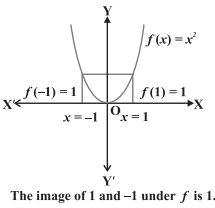
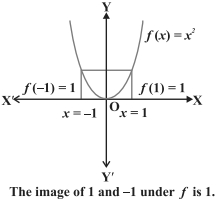
(N/A) To check for one-one: $A$ function $f$ is one-one if $f(x_{1}) = f(x_{2})$ implies $x_{1} = x_{2}$.
Here,$f(1) = (1)^{2} = 1$ and $f(-1) = (-1)^{2} = 1$.
Since $f(1) = f(-1)$ but $1 \neq -1$,the function $f$ is not one-one.
To check for onto: $A$ function $f: R \rightarrow R$ is onto if for every $y \in R$ (co-domain),there exists an $x \in R$ (domain) such that $f(x) = y$.
Here,the range of $f(x) = x^{2}$ is $[0, \infty)$,which is a subset of the co-domain $R$.
For example,consider $y = -2$ in the co-domain $R$. There is no real number $x$ such that $x^{2} = -2$,because the square of any real number is non-negative.
Therefore,$f$ is not onto.
Here,$f(1) = (1)^{2} = 1$ and $f(-1) = (-1)^{2} = 1$.
Since $f(1) = f(-1)$ but $1 \neq -1$,the function $f$ is not one-one.
To check for onto: $A$ function $f: R \rightarrow R$ is onto if for every $y \in R$ (co-domain),there exists an $x \in R$ (domain) such that $f(x) = y$.
Here,the range of $f(x) = x^{2}$ is $[0, \infty)$,which is a subset of the co-domain $R$.
For example,consider $y = -2$ in the co-domain $R$. There is no real number $x$ such that $x^{2} = -2$,because the square of any real number is non-negative.
Therefore,$f$ is not onto.
0 likes
View Solution68
Medium
Show that $f: N \rightarrow N$,given by $f(x) = \begin{cases} x+1, & \text{if } x \text{ is odd} \\ x-1, & \text{if } x \text{ is even} \end{cases}$ is both one-one and onto.
Solution
(A) Suppose $f(x_1) = f(x_2)$.
If $x_1$ is odd and $x_2$ is even,then $x_1+1 = x_2-1$,which implies $x_2-x_1 = 2$. Since $x_1$ is odd and $x_2$ is even,the difference between an even and an odd number is always odd,so $x_2-x_1$ cannot be $2$. Thus,this case is impossible.
Similarly,if $x_1$ is even and $x_2$ is odd,$x_1-1 = x_2+1$,implying $x_1-x_2 = 2$,which is also impossible.
Therefore,$x_1$ and $x_2$ must be both odd or both even.
If both are odd,$f(x_1) = f(x_2) \Rightarrow x_1+1 = x_2+1 \Rightarrow x_1 = x_2$.
If both are even,$f(x_1) = f(x_2) \Rightarrow x_1-1 = x_2-1 \Rightarrow x_1 = x_2$.
Thus,$f$ is one-one.
For onto,consider any $y \in N$. If $y$ is odd,$y = 2r+1$ for some $r \ge 0$. Then $f(2r+2) = (2r+2)-1 = 2r+1 = y$. If $y$ is even,$y = 2r$ for some $r \ge 1$. Then $f(2r-1) = (2r-1)+1 = 2r = y$. Since every $y \in N$ has a pre-image in $N$,$f$ is onto.
If $x_1$ is odd and $x_2$ is even,then $x_1+1 = x_2-1$,which implies $x_2-x_1 = 2$. Since $x_1$ is odd and $x_2$ is even,the difference between an even and an odd number is always odd,so $x_2-x_1$ cannot be $2$. Thus,this case is impossible.
Similarly,if $x_1$ is even and $x_2$ is odd,$x_1-1 = x_2+1$,implying $x_1-x_2 = 2$,which is also impossible.
Therefore,$x_1$ and $x_2$ must be both odd or both even.
If both are odd,$f(x_1) = f(x_2) \Rightarrow x_1+1 = x_2+1 \Rightarrow x_1 = x_2$.
If both are even,$f(x_1) = f(x_2) \Rightarrow x_1-1 = x_2-1 \Rightarrow x_1 = x_2$.
Thus,$f$ is one-one.
For onto,consider any $y \in N$. If $y$ is odd,$y = 2r+1$ for some $r \ge 0$. Then $f(2r+2) = (2r+2)-1 = 2r+1 = y$. If $y$ is even,$y = 2r$ for some $r \ge 1$. Then $f(2r-1) = (2r-1)+1 = 2r = y$. Since every $y \in N$ has a pre-image in $N$,$f$ is onto.
0 likes
View Solution69
Easy
Show that an onto function $f: \{1, 2, 3\} \rightarrow \{1, 2, 3\}$ is always one-one.
Solution
(A) Let $f: A \rightarrow A$ be a function where $A = \{1, 2, 3\}$.
Suppose $f$ is not one-one. Then there exist at least two distinct elements in the domain $A$ that have the same image in the co-domain $A$.
Since the domain has $3$ elements,if $f$ is not one-one,at most $2$ distinct elements can be mapped to the co-domain.
Specifically,if $f(x_1) = f(x_2) = y$ for $x_1 \neq x_2$,then the range of $f$ can contain at most $2$ elements (the image $y$ and the image of the third element).
However,for $f$ to be onto,the range must be equal to the co-domain,which has $3$ elements.
Since the range has at most $2$ elements,it cannot be equal to the co-domain $\{1, 2, 3\}$.
This contradicts the assumption that $f$ is onto.
Therefore,$f$ must be one-one.
Suppose $f$ is not one-one. Then there exist at least two distinct elements in the domain $A$ that have the same image in the co-domain $A$.
Since the domain has $3$ elements,if $f$ is not one-one,at most $2$ distinct elements can be mapped to the co-domain.
Specifically,if $f(x_1) = f(x_2) = y$ for $x_1 \neq x_2$,then the range of $f$ can contain at most $2$ elements (the image $y$ and the image of the third element).
However,for $f$ to be onto,the range must be equal to the co-domain,which has $3$ elements.
Since the range has at most $2$ elements,it cannot be equal to the co-domain $\{1, 2, 3\}$.
This contradicts the assumption that $f$ is onto.
Therefore,$f$ must be one-one.
0 likes
View Solution70
Easy
Show that a one-one function $f: \{1, 2, 3\} \rightarrow \{1, 2, 3\}$ must be onto.
Solution
(N/A) Let $A = \{1, 2, 3\}$. The function $f: A \rightarrow A$ is given as one-one.
By the definition of a one-one function,distinct elements in the domain $A$ must map to distinct elements in the codomain $A$.
Since the domain $A$ has $3$ elements,their images $f(1), f(2),$ and $f(3)$ must be $3$ distinct elements of the codomain $A$.
Because the codomain $A$ also contains exactly $3$ elements,the set of images ${f(1), f(2), f(3)}$ must be equal to the entire codomain $A$.
Therefore,every element in the codomain has a pre-image in the domain,which satisfies the definition of an onto function.
Thus,$f$ must be onto.
By the definition of a one-one function,distinct elements in the domain $A$ must map to distinct elements in the codomain $A$.
Since the domain $A$ has $3$ elements,their images $f(1), f(2),$ and $f(3)$ must be $3$ distinct elements of the codomain $A$.
Because the codomain $A$ also contains exactly $3$ elements,the set of images ${f(1), f(2), f(3)}$ must be equal to the entire codomain $A$.
Therefore,every element in the codomain has a pre-image in the domain,which satisfies the definition of an onto function.
Thus,$f$ must be onto.
0 likes
View Solution71
Medium
Show that the function $f: R_* \rightarrow R_*$ defined by $f(x) = \frac{1}{x}$ is one-one and onto,where $R_*$ is the set of all non-zero real numbers. Is the result true if the domain $R_*$ is replaced by $N$ with the co-domain remaining the same as $R_*$?
Solution
(N/A) Given $f: R_* \rightarrow R_*$ defined by $f(x) = \frac{1}{x}$.
For one-one:
Let $x, y \in R_*$ such that $f(x) = f(y)$.
$\Rightarrow \frac{1}{x} = \frac{1}{y}$
$\Rightarrow x = y$.
Therefore,$f$ is one-one.
For onto:
For any $y \in R_*$,there exists $x = \frac{1}{y} \in R_*$ (since $y \neq 0$) such that $f(x) = \frac{1}{(1/y)} = y$.
Therefore,$f$ is onto.
Thus,$f$ is one-one and onto.
Now,consider $g: N \rightarrow R_*$ defined by $g(x) = \frac{1}{x}$.
For one-one:
$g(x_1) = g(x_2) \Rightarrow \frac{1}{x_1} = \frac{1}{x_2} \Rightarrow x_1 = x_2$.
So,$g$ is one-one.
For onto:
$g$ is not onto because for $y = 1.2 \in R_*$,there is no $x \in N$ such that $g(x) = \frac{1}{x} = 1.2$ (as $x = \frac{1}{1.2} = \frac{5}{6} \notin N$).
Hence,$g$ is one-one but not onto.
For one-one:
Let $x, y \in R_*$ such that $f(x) = f(y)$.
$\Rightarrow \frac{1}{x} = \frac{1}{y}$
$\Rightarrow x = y$.
Therefore,$f$ is one-one.
For onto:
For any $y \in R_*$,there exists $x = \frac{1}{y} \in R_*$ (since $y \neq 0$) such that $f(x) = \frac{1}{(1/y)} = y$.
Therefore,$f$ is onto.
Thus,$f$ is one-one and onto.
Now,consider $g: N \rightarrow R_*$ defined by $g(x) = \frac{1}{x}$.
For one-one:
$g(x_1) = g(x_2) \Rightarrow \frac{1}{x_1} = \frac{1}{x_2} \Rightarrow x_1 = x_2$.
So,$g$ is one-one.
For onto:
$g$ is not onto because for $y = 1.2 \in R_*$,there is no $x \in N$ such that $g(x) = \frac{1}{x} = 1.2$ (as $x = \frac{1}{1.2} = \frac{5}{6} \notin N$).
Hence,$g$ is one-one but not onto.
0 likes
View Solution72
MediumMCQ
Check the injectivity and surjectivity of the following function $f: N \rightarrow N$ defined by $f(x)=x^{2}$.
A
Injective but not surjective
B
Surjective but not injective
C
Bijective
D
Neither injective nor surjective
Solution
(A) The function is $f: N \rightarrow N$ defined by $f(x) = x^{2}$.
For injectivity:
Let $x, y \in N$ such that $f(x) = f(y)$.
Then $x^{2} = y^{2}$.
Since $x, y \in N$ (natural numbers are positive),we have $x = y$.
Therefore,$f$ is injective.
For surjectivity:
$A$ function is surjective if for every $y \in N$,there exists an $x \in N$ such that $f(x) = y$.
Consider $y = 2 \in N$.
We need $x^{2} = 2$,which implies $x = \sqrt{2}$.
Since $\sqrt{2} \notin N$,there is no $x \in N$ such that $f(x) = 2$.
Therefore,$f$ is not surjective.
Conclusion: The function $f$ is injective but not surjective.
For injectivity:
Let $x, y \in N$ such that $f(x) = f(y)$.
Then $x^{2} = y^{2}$.
Since $x, y \in N$ (natural numbers are positive),we have $x = y$.
Therefore,$f$ is injective.
For surjectivity:
$A$ function is surjective if for every $y \in N$,there exists an $x \in N$ such that $f(x) = y$.
Consider $y = 2 \in N$.
We need $x^{2} = 2$,which implies $x = \sqrt{2}$.
Since $\sqrt{2} \notin N$,there is no $x \in N$ such that $f(x) = 2$.
Therefore,$f$ is not surjective.
Conclusion: The function $f$ is injective but not surjective.
0 likes
View Solution73
EasyMCQ
Check the injectivity and surjectivity of the function $f: Z \rightarrow Z$ defined by $f(x) = x^{2}$.
A
Injective but not surjective
B
Surjective but not injective
C
Neither injective nor surjective
D
Both injective and surjective
Solution
(C) The function $f: Z \rightarrow Z$ is defined by $f(x) = x^{2}$.
For injectivity:
Consider $f(-1) = (-1)^{2} = 1$ and $f(1) = (1)^{2} = 1$.
Since $f(-1) = f(1)$ but $-1 \neq 1$,the function is not injective.
For surjectivity:
Consider the codomain $Z$. For any negative integer,such as $-2 \in Z$,there exists no $x \in Z$ such that $f(x) = x^{2} = -2$,because the square of any integer is always non-negative.
Thus,the range of $f$ is ${0, 1, 4, 9, ...}$,which is not equal to the codomain $Z$.
Therefore,$f$ is not surjective.
Conclusion: The function $f$ is neither injective nor surjective.
For injectivity:
Consider $f(-1) = (-1)^{2} = 1$ and $f(1) = (1)^{2} = 1$.
Since $f(-1) = f(1)$ but $-1 \neq 1$,the function is not injective.
For surjectivity:
Consider the codomain $Z$. For any negative integer,such as $-2 \in Z$,there exists no $x \in Z$ such that $f(x) = x^{2} = -2$,because the square of any integer is always non-negative.
Thus,the range of $f$ is ${0, 1, 4, 9, ...}$,which is not equal to the codomain $Z$.
Therefore,$f$ is not surjective.
Conclusion: The function $f$ is neither injective nor surjective.
0 likes
View Solution74
Easy
Check the injectivity and surjectivity of the function $f: R \rightarrow R$ defined by $f(x) = x^2$.
Solution
(NONE) The function $f: R \rightarrow R$ is defined by $f(x) = x^2$.
For injectivity:
Consider $f(-1) = (-1)^2 = 1$ and $f(1) = (1)^2 = 1$.
Since $f(-1) = f(1)$ but $-1 \neq 1$,the function is not injective (one-to-one).
For surjectivity:
The codomain of $f$ is $R$ (the set of all real numbers).
For any $x \in R$,$x^2 \geq 0$. Thus,negative real numbers in the codomain have no pre-image in the domain.
For example,$-2 \in R$,but there exists no $x \in R$ such that $f(x) = -2$ (as $x^2 = -2$ has no real solution).
Therefore,the function is not surjective (onto).
Conclusion: The function $f$ is neither injective nor surjective.
For injectivity:
Consider $f(-1) = (-1)^2 = 1$ and $f(1) = (1)^2 = 1$.
Since $f(-1) = f(1)$ but $-1 \neq 1$,the function is not injective (one-to-one).
For surjectivity:
The codomain of $f$ is $R$ (the set of all real numbers).
For any $x \in R$,$x^2 \geq 0$. Thus,negative real numbers in the codomain have no pre-image in the domain.
For example,$-2 \in R$,but there exists no $x \in R$ such that $f(x) = -2$ (as $x^2 = -2$ has no real solution).
Therefore,the function is not surjective (onto).
Conclusion: The function $f$ is neither injective nor surjective.
0 likes
View Solution75
Medium
Check the injectivity and surjectivity of the following function $f : N \rightarrow N$ given by $f(x) = x^{3}$.
Solution
(N/A) Given function is $f : N \rightarrow N$ defined by $f(x) = x^{3}$.
For injectivity:
Let $x, y \in N$ such that $f(x) = f(y)$.
Then $x^{3} = y^{3}$.
Since $x, y$ are natural numbers,taking the cube root on both sides gives $x = y$.
Therefore,$f$ is injective.
For surjectivity:
$A$ function is surjective if for every $y \in N$,there exists an $x \in N$ such that $f(x) = y$.
Consider $y = 2 \in N$.
We need $x^{3} = 2$,which implies $x = \sqrt[3]{2}$.
Since $\sqrt[3]{2}$ is not a natural number $(\sqrt[3]{2} \notin N)$,there is no $x \in N$ such that $f(x) = 2$.
Therefore,$f$ is not surjective.
Conclusion: The function $f$ is injective but not surjective.
For injectivity:
Let $x, y \in N$ such that $f(x) = f(y)$.
Then $x^{3} = y^{3}$.
Since $x, y$ are natural numbers,taking the cube root on both sides gives $x = y$.
Therefore,$f$ is injective.
For surjectivity:
$A$ function is surjective if for every $y \in N$,there exists an $x \in N$ such that $f(x) = y$.
Consider $y = 2 \in N$.
We need $x^{3} = 2$,which implies $x = \sqrt[3]{2}$.
Since $\sqrt[3]{2}$ is not a natural number $(\sqrt[3]{2} \notin N)$,there is no $x \in N$ such that $f(x) = 2$.
Therefore,$f$ is not surjective.
Conclusion: The function $f$ is injective but not surjective.
0 likes
View Solution76
MediumMCQ
Check the injectivity and surjectivity of the function $f: Z \rightarrow Z$ defined by $f(x) = x^{3}$.
A
Injective but not surjective
B
Surjective but not injective
C
Both injective and surjective
D
Neither injective nor surjective
Solution
(A) The function is $f: Z \rightarrow Z$ defined by $f(x) = x^{3}$.
For injectivity: Let $x, y \in Z$ such that $f(x) = f(y)$.
Then $x^{3} = y^{3}$. Since the cube root function is well-defined for all real numbers,$x^{3} = y^{3} \implies x = y$.
Therefore,$f$ is injective.
For surjectivity: $A$ function is surjective if for every $y \in Z$,there exists an $x \in Z$ such that $f(x) = y$.
Consider $y = 2 \in Z$. We need $x^{3} = 2$,which implies $x = \sqrt[3]{2}$.
Since $\sqrt[3]{2} \notin Z$,there is no element $x \in Z$ such that $f(x) = 2$.
Therefore,$f$ is not surjective.
Conclusion: The function $f$ is injective but not surjective.
For injectivity: Let $x, y \in Z$ such that $f(x) = f(y)$.
Then $x^{3} = y^{3}$. Since the cube root function is well-defined for all real numbers,$x^{3} = y^{3} \implies x = y$.
Therefore,$f$ is injective.
For surjectivity: $A$ function is surjective if for every $y \in Z$,there exists an $x \in Z$ such that $f(x) = y$.
Consider $y = 2 \in Z$. We need $x^{3} = 2$,which implies $x = \sqrt[3]{2}$.
Since $\sqrt[3]{2} \notin Z$,there is no element $x \in Z$ such that $f(x) = 2$.
Therefore,$f$ is not surjective.
Conclusion: The function $f$ is injective but not surjective.
0 likes
View Solution77
Medium
Prove that the Greatest Integer Function $f: R \rightarrow R$,given by $f(x)=[x]$,is neither one-one nor onto,where $[x]$ denotes the greatest integer less than or equal to $x$.
Solution
(N/A) The function is defined as $f: R \rightarrow R$ where $f(x) = [x]$.
To check for one-one:
Consider $f(1.2) = [1.2] = 1$ and $f(1.9) = [1.9] = 1$.
Since $f(1.2) = f(1.9)$ but $1.2 \neq 1.9$,the function is not one-one.
To check for onto:
The range of the greatest integer function is the set of all integers $Z$.
Since the codomain is $R$ and the range $Z \subset R$,there exist elements in the codomain (e.g.,$0.7$) that have no pre-image in the domain.
For example,there is no $x \in R$ such that $f(x) = 0.7$ because $[x]$ must be an integer.
Therefore,the function is not onto.
Hence,the greatest integer function is neither one-one nor onto.
To check for one-one:
Consider $f(1.2) = [1.2] = 1$ and $f(1.9) = [1.9] = 1$.
Since $f(1.2) = f(1.9)$ but $1.2 \neq 1.9$,the function is not one-one.
To check for onto:
The range of the greatest integer function is the set of all integers $Z$.
Since the codomain is $R$ and the range $Z \subset R$,there exist elements in the codomain (e.g.,$0.7$) that have no pre-image in the domain.
For example,there is no $x \in R$ such that $f(x) = 0.7$ because $[x]$ must be an integer.
Therefore,the function is not onto.
Hence,the greatest integer function is neither one-one nor onto.
0 likes
View Solution78
Medium
Show that the modulus function $f : R \rightarrow R$ given by $f(x) = |x|$ is neither one-one nor onto,where $|x| = x$ if $x \ge 0$ and $|x| = -x$ if $x < 0$.
Solution
(N/A) The function $f: R \rightarrow R$ is defined as $f(x) = |x| = \begin{cases} x & \text{if } x \ge 0 \\ -x & \text{if } x < 0 \end{cases}$.
To check if $f$ is one-one:
Consider $f(-1) = |-1| = 1$ and $f(1) = |1| = 1$.
Since $f(-1) = f(1)$ but $-1 \neq 1$,the function $f$ is not one-one.
To check if $f$ is onto:
Consider the codomain $R$. For any negative value,such as $-1 \in R$,there exists no $x \in R$ such that $f(x) = |x| = -1$,because the absolute value of any real number is always non-negative $(|x| \ge 0)$.
Therefore,$f$ is not onto.
Hence,the modulus function is neither one-one nor onto.
To check if $f$ is one-one:
Consider $f(-1) = |-1| = 1$ and $f(1) = |1| = 1$.
Since $f(-1) = f(1)$ but $-1 \neq 1$,the function $f$ is not one-one.
To check if $f$ is onto:
Consider the codomain $R$. For any negative value,such as $-1 \in R$,there exists no $x \in R$ such that $f(x) = |x| = -1$,because the absolute value of any real number is always non-negative $(|x| \ge 0)$.
Therefore,$f$ is not onto.
Hence,the modulus function is neither one-one nor onto.
0 likes
View Solution79
Medium
Show that the Signum Function $f: R \rightarrow R$,given by $f(x) = \begin{cases} 1, & \text{if } x > 0 \\ 0, & \text{if } x = 0 \\ -1, & \text{if } x < 0 \end{cases}$ is neither one-one nor onto.
Solution
(N/A) Given $f: R \rightarrow R$ defined by $f(x) = \begin{cases} 1, & \text{if } x > 0 \\ 0, & \text{if } x = 0 \\ -1, & \text{if } x < 0 \end{cases}$.
$1$. Check for one-one:
Consider $x_1 = 1$ and $x_2 = 2$. Both $1 > 0$ and $2 > 0$,so $f(1) = 1$ and $f(2) = 1$.
Since $f(1) = f(2)$ but $1 \neq 2$,the function is not one-one.
$2$. Check for onto:
The range of $f$ is $\{ -1, 0, 1 \}$,which is a subset of the codomain $R$.
For any element $y \in R$ such that $y \notin \{ -1, 0, 1 \}$ (e.g.,$y = 2$),there exists no $x \in R$ such that $f(x) = y$.
Thus,the function is not onto.
Therefore,the Signum function is neither one-one nor onto.
$1$. Check for one-one:
Consider $x_1 = 1$ and $x_2 = 2$. Both $1 > 0$ and $2 > 0$,so $f(1) = 1$ and $f(2) = 1$.
Since $f(1) = f(2)$ but $1 \neq 2$,the function is not one-one.
$2$. Check for onto:
The range of $f$ is $\{ -1, 0, 1 \}$,which is a subset of the codomain $R$.
For any element $y \in R$ such that $y \notin \{ -1, 0, 1 \}$ (e.g.,$y = 2$),there exists no $x \in R$ such that $f(x) = y$.
Thus,the function is not onto.
Therefore,the Signum function is neither one-one nor onto.
0 likes
View Solution80
Easy
Let $A=\{1,2,3\}, \,B=\{4,5,6,7\}$ and let $f=\{(1,4),\,(2,5),\,(3,6)\}$ be a function from $A$ to $B$. Show that $f$ is one-one.
Solution
(N/A) It is given that $A=\{1,2,3\}$ and $B=\{4,5,6,7\}$.
The function $f: A \rightarrow B$ is defined by the set of ordered pairs $f = \{(1,4), (2,5), (3,6)\}$.
From the definition of the function,we have:
$f(1) = 4$
$f(2) = 5$
$f(3) = 6$
$A$ function $f: A \rightarrow B$ is said to be one-one (injective) if distinct elements of $A$ have distinct images in $B$. That is,$f(x_1) = f(x_2) \implies x_1 = x_2$ for all $x_1, x_2 \in A$.
Here,the images of the distinct elements $1, 2, 3$ are $4, 5, 6$ respectively,which are all distinct.
Since $f(1) \neq f(2)$,$f(2) \neq f(3)$,and $f(1) \neq f(3)$,it follows that the function $f$ is one-one.
The function $f: A \rightarrow B$ is defined by the set of ordered pairs $f = \{(1,4), (2,5), (3,6)\}$.
From the definition of the function,we have:
$f(1) = 4$
$f(2) = 5$
$f(3) = 6$
$A$ function $f: A \rightarrow B$ is said to be one-one (injective) if distinct elements of $A$ have distinct images in $B$. That is,$f(x_1) = f(x_2) \implies x_1 = x_2$ for all $x_1, x_2 \in A$.
Here,the images of the distinct elements $1, 2, 3$ are $4, 5, 6$ respectively,which are all distinct.
Since $f(1) \neq f(2)$,$f(2) \neq f(3)$,and $f(1) \neq f(3)$,it follows that the function $f$ is one-one.
0 likes
View Solution81
Medium
In each of the following cases,state whether the function is one-one,onto or bijective. Justify your answer. $f : R \rightarrow R$ defined by $f(x) = 3 - 4x$.
Solution
(D) Given $f : R \rightarrow R$ is defined by $f(x) = 3 - 4x$.
$1.$ Check for one-one:
Let $x_1, x_2 \in R$ such that $f(x_1) = f(x_2)$.
Then,$3 - 4x_1 = 3 - 4x_2$.
Subtracting $3$ from both sides,we get $-4x_1 = -4x_2$.
Dividing by $-4$,we get $x_1 = x_2$.
Since $f(x_1) = f(x_2) \implies x_1 = x_2$,the function $f$ is one-one.
$2.$ Check for onto:
Let $y \in R$ be any element in the codomain.
We want to find $x \in R$ such that $f(x) = y$.
$3 - 4x = y \implies 4x = 3 - y \implies x = \frac{3 - y}{4}$.
Since $y \in R$,$\frac{3 - y}{4}$ is also a real number $(R)$.
Thus,for every $y \in R$,there exists $x = \frac{3 - y}{4} \in R$ such that $f(x) = 3 - 4(\frac{3 - y}{4}) = 3 - (3 - y) = y$.
Since the range of $f$ is equal to the codomain $R$,the function $f$ is onto.
Conclusion:
Since the function is both one-one and onto,it is bijective.
$1.$ Check for one-one:
Let $x_1, x_2 \in R$ such that $f(x_1) = f(x_2)$.
Then,$3 - 4x_1 = 3 - 4x_2$.
Subtracting $3$ from both sides,we get $-4x_1 = -4x_2$.
Dividing by $-4$,we get $x_1 = x_2$.
Since $f(x_1) = f(x_2) \implies x_1 = x_2$,the function $f$ is one-one.
$2.$ Check for onto:
Let $y \in R$ be any element in the codomain.
We want to find $x \in R$ such that $f(x) = y$.
$3 - 4x = y \implies 4x = 3 - y \implies x = \frac{3 - y}{4}$.
Since $y \in R$,$\frac{3 - y}{4}$ is also a real number $(R)$.
Thus,for every $y \in R$,there exists $x = \frac{3 - y}{4} \in R$ such that $f(x) = 3 - 4(\frac{3 - y}{4}) = 3 - (3 - y) = y$.
Since the range of $f$ is equal to the codomain $R$,the function $f$ is onto.
Conclusion:
Since the function is both one-one and onto,it is bijective.
0 likes
View Solution82
Medium
In each of the following cases,state whether the function is one-one,onto or bijective. Justify your answer. $f : R \rightarrow R$ defined by $f(x) = 1 + x^2$.
Solution
(D) The function $f : R \rightarrow R$ is defined as $f(x) = 1 + x^2$.
To check for one-one:
Let $x_1, x_2 \in R$ such that $f(x_1) = f(x_2)$.
$\Rightarrow 1 + x_1^2 = 1 + x_2^2$
$\Rightarrow x_1^2 = x_2^2$
$\Rightarrow x_1 = \pm x_2$.
Since $f(1) = 1 + (1)^2 = 2$ and $f(-1) = 1 + (-1)^2 = 2$,we have $f(1) = f(-1)$ but $1 \neq -1$.
Therefore,$f$ is not one-one.
To check for onto:
Consider an element $-2$ in the codomain $R$.
Since $x^2 \geq 0$ for all $x \in R$,$f(x) = 1 + x^2 \geq 1$ for all $x \in R$.
Thus,there is no $x \in R$ such that $f(x) = -2$.
Therefore,$f$ is not onto.
Conclusion:
Since the function is neither one-one nor onto,it is not bijective.
To check for one-one:
Let $x_1, x_2 \in R$ such that $f(x_1) = f(x_2)$.
$\Rightarrow 1 + x_1^2 = 1 + x_2^2$
$\Rightarrow x_1^2 = x_2^2$
$\Rightarrow x_1 = \pm x_2$.
Since $f(1) = 1 + (1)^2 = 2$ and $f(-1) = 1 + (-1)^2 = 2$,we have $f(1) = f(-1)$ but $1 \neq -1$.
Therefore,$f$ is not one-one.
To check for onto:
Consider an element $-2$ in the codomain $R$.
Since $x^2 \geq 0$ for all $x \in R$,$f(x) = 1 + x^2 \geq 1$ for all $x \in R$.
Thus,there is no $x \in R$ such that $f(x) = -2$.
Therefore,$f$ is not onto.
Conclusion:
Since the function is neither one-one nor onto,it is not bijective.
0 likes
View Solution83
Easy
Let $A$ and $B$ be sets. Show that $f: A \times B \rightarrow B \times A$ defined by $f(a, b) = (b, a)$ is a bijective function.
Solution
(N/A) The function is defined as $f: A \times B \rightarrow B \times A$ where $f(a, b) = (b, a)$.
$1.$ To show $f$ is one-one (injective):
Let $(a_1, b_1), (a_2, b_2) \in A \times B$ such that $f(a_1, b_1) = f(a_2, b_2)$.
This implies $(b_1, a_1) = (b_2, a_2)$.
Equating the components,we get $b_1 = b_2$ and $a_1 = a_2$.
Therefore,$(a_1, b_1) = (a_2, b_2)$.
Since $f(a_1, b_1) = f(a_2, b_2) \Rightarrow (a_1, b_1) = (a_2, b_2)$,$f$ is one-one.
$2.$ To show $f$ is onto (surjective):
Let $(b, a) \in B \times A$ be any arbitrary element.
By the definition of the Cartesian product,$b \in B$ and $a \in A$,which implies $(a, b) \in A \times B$.
For this $(a, b) \in A \times B$,we have $f(a, b) = (b, a)$.
Since every element in the codomain $B \times A$ has a pre-image in the domain $A \times B$,$f$ is onto.
Since $f$ is both one-one and onto,$f$ is a bijective function.
$1.$ To show $f$ is one-one (injective):
Let $(a_1, b_1), (a_2, b_2) \in A \times B$ such that $f(a_1, b_1) = f(a_2, b_2)$.
This implies $(b_1, a_1) = (b_2, a_2)$.
Equating the components,we get $b_1 = b_2$ and $a_1 = a_2$.
Therefore,$(a_1, b_1) = (a_2, b_2)$.
Since $f(a_1, b_1) = f(a_2, b_2) \Rightarrow (a_1, b_1) = (a_2, b_2)$,$f$ is one-one.
$2.$ To show $f$ is onto (surjective):
Let $(b, a) \in B \times A$ be any arbitrary element.
By the definition of the Cartesian product,$b \in B$ and $a \in A$,which implies $(a, b) \in A \times B$.
For this $(a, b) \in A \times B$,we have $f(a, b) = (b, a)$.
Since every element in the codomain $B \times A$ has a pre-image in the domain $A \times B$,$f$ is onto.
Since $f$ is both one-one and onto,$f$ is a bijective function.
0 likes
View Solution84
Medium
Let $f : N \rightarrow N$ be defined by $f(n) = \begin{cases} \frac{n+1}{2}, & \text{if } n \text{ is odd} \\ \frac{n}{2}, & \text{if } n \text{ is even} \end{cases}$ for all $n \in N$. State whether the function $f$ is bijective. Justify your answer.
Solution
(D) Given $f : N \rightarrow N$ is defined by $f(n) = \begin{cases} \frac{n+1}{2}, & \text{if } n \text{ is odd} \\ \frac{n}{2}, & \text{if } n \text{ is even} \end{cases}$.
First,we check if $f$ is one-one:
$f(1) = \frac{1+1}{2} = 1$ and $f(2) = \frac{2}{2} = 1$.
Since $f(1) = f(2)$ but $1 \neq 2$,the function $f$ is not one-one.
Next,we check if $f$ is onto:
For any $n \in N$ (co-domain),we need to find $x \in N$ such that $f(x) = n$.
Case $I$: If $n$ is odd,let $n = 2r - 1$ for some $r \in N$. Then $f(4r - 3) = \frac{(4r - 3) + 1}{2} = 2r - 1 = n$.
Case $II$: If $n$ is even,let $n = 2r$ for some $r \in N$. Then $f(4r) = \frac{4r}{2} = 2r = n$.
Since for every $n \in N$,there exists a pre-image in the domain,$f$ is onto.
Conclusion: Since $f$ is not one-one,it is not a bijective function.
First,we check if $f$ is one-one:
$f(1) = \frac{1+1}{2} = 1$ and $f(2) = \frac{2}{2} = 1$.
Since $f(1) = f(2)$ but $1 \neq 2$,the function $f$ is not one-one.
Next,we check if $f$ is onto:
For any $n \in N$ (co-domain),we need to find $x \in N$ such that $f(x) = n$.
Case $I$: If $n$ is odd,let $n = 2r - 1$ for some $r \in N$. Then $f(4r - 3) = \frac{(4r - 3) + 1}{2} = 2r - 1 = n$.
Case $II$: If $n$ is even,let $n = 2r$ for some $r \in N$. Then $f(4r) = \frac{4r}{2} = 2r = n$.
Since for every $n \in N$,there exists a pre-image in the domain,$f$ is onto.
Conclusion: Since $f$ is not one-one,it is not a bijective function.
0 likes
View Solution85
Difficult
Let $A = R - \{3\}$ and $B = R - \{1\}$. Consider the function $f: A \rightarrow B$ defined by $f(x) = \left(\frac{x-2}{x-3}\right)$. Is $f$ one-one and onto? Justify your answer.
Solution
(A) Given $A = R - \{3\}$,$B = R - \{1\}$ and $f: A \rightarrow B$ defined by $f(x) = \frac{x-2}{x-3}$.
For one-one:
Let $x, y \in A$ such that $f(x) = f(y)$.
$\Rightarrow \frac{x-2}{x-3} = \frac{y-2}{y-3}$
$\Rightarrow (x-2)(y-3) = (y-2)(x-3)$
$\Rightarrow xy - 3x - 2y + 6 = xy - 3y - 2x + 6$
$\Rightarrow -3x - 2y = -3y - 2x$
$\Rightarrow x = y$.
Since $f(x) = f(y) \Rightarrow x = y$,$f$ is one-one.
For onto:
Let $y \in B = R - \{1\}$. Then $y \neq 1$.
We need to find $x \in A$ such that $f(x) = y$.
$\frac{x-2}{x-3} = y$
$\Rightarrow x - 2 = y(x - 3)$
$\Rightarrow x - 2 = xy - 3y$
$\Rightarrow x - xy = 2 - 3y$
$\Rightarrow x(1 - y) = 2 - 3y$
$\Rightarrow x = \frac{2 - 3y}{1 - y}$.
Since $y \neq 1$,$x$ is well-defined. Also,$x \neq 3$ because if $\frac{2 - 3y}{1 - y} = 3$,then $2 - 3y = 3 - 3y$,which implies $2 = 3$,a contradiction. Thus $x \in A$.
Since for every $y \in B$,there exists $x \in A$ such that $f(x) = y$,$f$ is onto.
Therefore,$f$ is both one-one and onto.
For one-one:
Let $x, y \in A$ such that $f(x) = f(y)$.
$\Rightarrow \frac{x-2}{x-3} = \frac{y-2}{y-3}$
$\Rightarrow (x-2)(y-3) = (y-2)(x-3)$
$\Rightarrow xy - 3x - 2y + 6 = xy - 3y - 2x + 6$
$\Rightarrow -3x - 2y = -3y - 2x$
$\Rightarrow x = y$.
Since $f(x) = f(y) \Rightarrow x = y$,$f$ is one-one.
For onto:
Let $y \in B = R - \{1\}$. Then $y \neq 1$.
We need to find $x \in A$ such that $f(x) = y$.
$\frac{x-2}{x-3} = y$
$\Rightarrow x - 2 = y(x - 3)$
$\Rightarrow x - 2 = xy - 3y$
$\Rightarrow x - xy = 2 - 3y$
$\Rightarrow x(1 - y) = 2 - 3y$
$\Rightarrow x = \frac{2 - 3y}{1 - y}$.
Since $y \neq 1$,$x$ is well-defined. Also,$x \neq 3$ because if $\frac{2 - 3y}{1 - y} = 3$,then $2 - 3y = 3 - 3y$,which implies $2 = 3$,a contradiction. Thus $x \in A$.
Since for every $y \in B$,there exists $x \in A$ such that $f(x) = y$,$f$ is onto.
Therefore,$f$ is both one-one and onto.
0 likes
View Solution86
EasyMCQ
Let $f: R \rightarrow R$ be defined as $f(x)=x^{4}$. Choose the correct answer.
A
$f$ is one-one onto
B
$f$ is many-one onto
C
$f$ is neither one-one nor onto
D
$f$ is one-one but not onto
Solution
(C) Given $f: R \rightarrow R$ is defined as $f(x) = x^{4}$.
To check for one-one:
Let $x, y \in R$ such that $f(x) = f(y)$.
$\Rightarrow x^{4} = y^{4}$
$\Rightarrow x = \pm y$.
Since $f(1) = 1^{4} = 1$ and $f(-1) = (-1)^{4} = 1$,we have $f(1) = f(-1)$ but $1 \neq -1$.
Therefore,$f$ is not one-one.
To check for onto:
$A$ function is onto if its range equals its co-domain. Here,the co-domain is $R$.
Since $x^{4} \geq 0$ for all $x \in R$,the range of $f$ is $[0, \infty)$.
Since the range $[0, \infty) \neq R$,the function is not onto.
For example,there is no $x \in R$ such that $f(x) = -2$.
Thus,$f$ is neither one-one nor onto.
The correct answer is $C$.
To check for one-one:
Let $x, y \in R$ such that $f(x) = f(y)$.
$\Rightarrow x^{4} = y^{4}$
$\Rightarrow x = \pm y$.
Since $f(1) = 1^{4} = 1$ and $f(-1) = (-1)^{4} = 1$,we have $f(1) = f(-1)$ but $1 \neq -1$.
Therefore,$f$ is not one-one.
To check for onto:
$A$ function is onto if its range equals its co-domain. Here,the co-domain is $R$.
Since $x^{4} \geq 0$ for all $x \in R$,the range of $f$ is $[0, \infty)$.
Since the range $[0, \infty) \neq R$,the function is not onto.
For example,there is no $x \in R$ such that $f(x) = -2$.
Thus,$f$ is neither one-one nor onto.
The correct answer is $C$.
0 likes
View Solution87
EasyMCQ
Let $f: R \rightarrow R$ be defined as $f(x)=3x$. Choose the correct answer.
A
$f$ is neither one-one nor onto
B
$f$ is many-one onto
C
$f$ is one-one but not onto
D
$f$ is one-one onto
Solution
(D) Given $f: R \rightarrow R$ defined by $f(x)=3x$.
Step $1$: Check for one-one (injective).
Let $x_1, x_2 \in R$ such that $f(x_1) = f(x_2)$.
$3x_1 = 3x_2$
$x_1 = x_2$
Since $f(x_1) = f(x_2) \implies x_1 = x_2$,the function $f$ is one-one.
Step $2$: Check for onto (surjective).
Let $y \in R$ be any element in the codomain.
We need to find $x \in R$ such that $f(x) = y$.
$3x = y \implies x = \frac{y}{3}$.
Since $y \in R$,$\frac{y}{3}$ is also a real number,so $x \in R$.
For every $y \in R$,there exists $x = \frac{y}{3} \in R$ such that $f(x) = 3(\frac{y}{3}) = y$.
Thus,the function $f$ is onto.
Conclusion: The function $f$ is both one-one and onto (bijective).
The correct answer is $D$.
Step $1$: Check for one-one (injective).
Let $x_1, x_2 \in R$ such that $f(x_1) = f(x_2)$.
$3x_1 = 3x_2$
$x_1 = x_2$
Since $f(x_1) = f(x_2) \implies x_1 = x_2$,the function $f$ is one-one.
Step $2$: Check for onto (surjective).
Let $y \in R$ be any element in the codomain.
We need to find $x \in R$ such that $f(x) = y$.
$3x = y \implies x = \frac{y}{3}$.
Since $y \in R$,$\frac{y}{3}$ is also a real number,so $x \in R$.
For every $y \in R$,there exists $x = \frac{y}{3} \in R$ such that $f(x) = 3(\frac{y}{3}) = y$.
Thus,the function $f$ is onto.
Conclusion: The function $f$ is both one-one and onto (bijective).
The correct answer is $D$.
0 likes
View Solution88
EasyMCQ
Are $f$ and $g$ both necessarily onto,if $g \circ f$ is onto?
A
Yes,both $f$ and $g$ must be onto.
B
No,only $f$ must be onto.
C
No,only $g$ must be onto.
D
No,neither $f$ nor $g$ is necessarily onto.
Solution
(C) If $g \circ f$ is onto,then $g$ must be onto,but $f$ does not necessarily have to be onto.
Consider $f: \{1, 2, 3, 4\} \rightarrow \{1, 2, 3, 4\}$ and $g: \{1, 2, 3, 4\} \rightarrow \{1, 2, 3\}$ defined as:
$f(1) = 1, f(2) = 2, f(3) = 3, f(4) = 3$
$g(1) = 1, g(2) = 2, g(3) = 3, g(4) = 3$
Here,the range of $g \circ f$ is $\{1, 2, 3\}$,which is equal to the codomain of $g$,so $g \circ f$ is onto.
However,the range of $f$ is $\{1, 2, 3\}$,which is not equal to its codomain $\{1, 2, 3, 4\}$.
Thus,$f$ is not onto.
Consider $f: \{1, 2, 3, 4\} \rightarrow \{1, 2, 3, 4\}$ and $g: \{1, 2, 3, 4\} \rightarrow \{1, 2, 3\}$ defined as:
$f(1) = 1, f(2) = 2, f(3) = 3, f(4) = 3$
$g(1) = 1, g(2) = 2, g(3) = 3, g(4) = 3$
Here,the range of $g \circ f$ is $\{1, 2, 3\}$,which is equal to the codomain of $g$,so $g \circ f$ is onto.
However,the range of $f$ is $\{1, 2, 3\}$,which is not equal to its codomain $\{1, 2, 3, 4\}$.
Thus,$f$ is not onto.
0 likes
View Solution89
MediumMCQ
Find the number of all one-one functions from set $A = \{1, 2, 3\}$ to itself.
A
$3$
B
$6$
C
$9$
D
$27$
Solution
(B) one-one function from a set $A$ to itself is a bijection if the set is finite.
For a set $A$ with $n$ elements,the number of one-one functions from $A$ to $A$ is given by $n!$.
Here,the set $A = \{1, 2, 3\}$ has $n = 3$ elements.
Therefore,the total number of one-one functions is $3! = 3 \times 2 \times 1 = 6$.
For a set $A$ with $n$ elements,the number of one-one functions from $A$ to $A$ is given by $n!$.
Here,the set $A = \{1, 2, 3\}$ has $n = 3$ elements.
Therefore,the total number of one-one functions is $3! = 3 \times 2 \times 1 = 6$.
0 likes
View Solution90
Easy
Consider the identity function $I_{N}: N \rightarrow N$ defined as $I_{N}(x) = x$ for all $x \in N$. Show that although $I_{N}$ is onto,the function $I_{N} + I_{N}: N \rightarrow N$ defined as $(I_{N} + I_{N})(x) = I_{N}(x) + I_{N}(x) = x + x = 2x$ is not onto.
Solution
(N/A) The identity function $I_{N}: N \rightarrow N$ is defined by $I_{N}(x) = x$. For any $y \in N$,there exists $x = y \in N$ such that $I_{N}(x) = y$,so $I_{N}$ is onto.
Now,consider the function $f(x) = (I_{N} + I_{N})(x) = 2x$. The range of this function is the set of all even natural numbers,i.e.,$\{2, 4, 6, \dots\}$.
Since the co-domain is $N = \{1, 2, 3, \dots\}$,we can observe that an element like $3 \in N$ does not have a pre-image in the domain $N$ because $2x = 3$ implies $x = 1.5$,which is not a natural number.
Therefore,$I_{N} + I_{N}$ is not onto.
Now,consider the function $f(x) = (I_{N} + I_{N})(x) = 2x$. The range of this function is the set of all even natural numbers,i.e.,$\{2, 4, 6, \dots\}$.
Since the co-domain is $N = \{1, 2, 3, \dots\}$,we can observe that an element like $3 \in N$ does not have a pre-image in the domain $N$ because $2x = 3$ implies $x = 1.5$,which is not a natural number.
Therefore,$I_{N} + I_{N}$ is not onto.
0 likes
View Solution91
Easy
Consider a function $f: [0, \frac{\pi}{2}] \rightarrow \mathbb{R}$ given by $f(x) = \sin x$ and $g: [0, \frac{\pi}{2}] \rightarrow \mathbb{R}$ given by $g(x) = \cos x$. Show that $f$ and $g$ are one-one,but $f + g$ is not one-one.
Solution
(N/A) For any two distinct elements $x_1, x_2 \in [0, \frac{\pi}{2}]$,we know that the sine function is strictly increasing on this interval,so $\sin x_1 \neq \sin x_2$. Thus,$f$ is one-one.
Similarly,the cosine function is strictly decreasing on $[0, \frac{\pi}{2}]$,so $\cos x_1 \neq \cos x_2$. Thus,$g$ is one-one.
Now,consider the function $h(x) = (f + g)(x) = \sin x + \cos x$.
We evaluate $h(0) = \sin 0 + \cos 0 = 0 + 1 = 1$.
We evaluate $h(\frac{\pi}{2}) = \sin \frac{\pi}{2} + \cos \frac{\pi}{2} = 1 + 0 = 1$.
Since $h(0) = h(\frac{\pi}{2})$ but $0 \neq \frac{\pi}{2}$,the function $f + g$ is not one-one.
Similarly,the cosine function is strictly decreasing on $[0, \frac{\pi}{2}]$,so $\cos x_1 \neq \cos x_2$. Thus,$g$ is one-one.
Now,consider the function $h(x) = (f + g)(x) = \sin x + \cos x$.
We evaluate $h(0) = \sin 0 + \cos 0 = 0 + 1 = 1$.
We evaluate $h(\frac{\pi}{2}) = \sin \frac{\pi}{2} + \cos \frac{\pi}{2} = 1 + 0 = 1$.
Since $h(0) = h(\frac{\pi}{2})$ but $0 \neq \frac{\pi}{2}$,the function $f + g$ is not one-one.
0 likes
View Solution92
Easy
Show that the function $f : R \rightarrow \{ x \in R : -1 < x < 1 \}$ defined by $f(x) = \frac{x}{1+|x|}$ for all $x \in R$ is a one-one and onto function.
Solution
(A) Given $f : R \rightarrow \{ x \in R : -1 < x < 1 \}$ defined by $f(x) = \frac{x}{1+|x|}$.
For one-one:
Suppose $f(x) = f(y)$ for $x, y \in R$.
If $x$ and $y$ have opposite signs,say $x > 0$ and $y < 0$,then $f(x) = \frac{x}{1+x} > 0$ and $f(y) = \frac{y}{1-y} < 0$. Thus $f(x) \neq f(y)$.
If $x, y \geq 0$,then $\frac{x}{1+x} = \frac{y}{1+y} \Rightarrow x + xy = y + xy \Rightarrow x = y$.
If $x, y < 0$,then $\frac{x}{1-x} = \frac{y}{1-y} \Rightarrow x - xy = y - xy \Rightarrow x = y$.
Thus,$f$ is one-one.
For onto:
Let $y \in (-1, 1)$. We want to find $x \in R$ such that $f(x) = y$.
If $y \geq 0$,let $x = \frac{y}{1-y}$. Since $0 \leq y < 1$,$x \geq 0$. Then $f(x) = \frac{\frac{y}{1-y}}{1 + \frac{y}{1-y}} = \frac{y}{1-y+y} = y$.
If $y < 0$,let $x = \frac{y}{1+y}$. Since $-1 < y < 0$,$x < 0$. Then $f(x) = \frac{\frac{y}{1+y}}{1 - \frac{y}{1+y}} = \frac{y}{1+y-y} = y$.
Since for every $y \in (-1, 1)$ there exists an $x \in R$ such that $f(x) = y$,$f$ is onto.
Therefore,$f$ is one-one and onto.
For one-one:
Suppose $f(x) = f(y)$ for $x, y \in R$.
If $x$ and $y$ have opposite signs,say $x > 0$ and $y < 0$,then $f(x) = \frac{x}{1+x} > 0$ and $f(y) = \frac{y}{1-y} < 0$. Thus $f(x) \neq f(y)$.
If $x, y \geq 0$,then $\frac{x}{1+x} = \frac{y}{1+y} \Rightarrow x + xy = y + xy \Rightarrow x = y$.
If $x, y < 0$,then $\frac{x}{1-x} = \frac{y}{1-y} \Rightarrow x - xy = y - xy \Rightarrow x = y$.
Thus,$f$ is one-one.
For onto:
Let $y \in (-1, 1)$. We want to find $x \in R$ such that $f(x) = y$.
If $y \geq 0$,let $x = \frac{y}{1-y}$. Since $0 \leq y < 1$,$x \geq 0$. Then $f(x) = \frac{\frac{y}{1-y}}{1 + \frac{y}{1-y}} = \frac{y}{1-y+y} = y$.
If $y < 0$,let $x = \frac{y}{1+y}$. Since $-1 < y < 0$,$x < 0$. Then $f(x) = \frac{\frac{y}{1+y}}{1 - \frac{y}{1+y}} = \frac{y}{1+y-y} = y$.
Since for every $y \in (-1, 1)$ there exists an $x \in R$ such that $f(x) = y$,$f$ is onto.
Therefore,$f$ is one-one and onto.
0 likes
View Solution93
Medium
Show that the function $f : R \rightarrow R$ given by $f(x) = x^{3}$ is injective.
Solution
(N/A) To check if the function $f(x) = x^{3}$ is injective (one-one),we assume $f(x_1) = f(x_2)$ for some $x_1, x_2 \in R$.
$f(x_1) = f(x_2) \Rightarrow x_1^{3} = x_2^{3}$.
Taking the cube root on both sides,we get $x_1 = x_2$.
Since $f(x_1) = f(x_2)$ implies $x_1 = x_2$ for all $x_1, x_2 \in R$,the function $f$ is injective.
$f(x_1) = f(x_2) \Rightarrow x_1^{3} = x_2^{3}$.
Taking the cube root on both sides,we get $x_1 = x_2$.
Since $f(x_1) = f(x_2)$ implies $x_1 = x_2$ for all $x_1, x_2 \in R$,the function $f$ is injective.
0 likes
View Solution94
EasyMCQ
Find the number of all onto functions from the set $\{1, 2, 3, \ldots, n\}$ to itself.
A
$n!$
B
$n^n$
C
$2^n$
D
$n$
Solution
(A) An onto function (surjective function) from a finite set $A$ to itself,where $|A| = n$,is a function where every element in the codomain has at least one pre-image in the domain.
Since the domain and codomain have the same number of elements $(n)$,an onto function must also be injective (one-to-one).
$A$ function that is both injective and surjective is called a bijection or a permutation.
The total number of permutations of a set with $n$ elements is given by $n!$.
Therefore,the total number of onto functions from the set $\{1, 2, 3, \ldots, n\}$ to itself is $n!$.
Since the domain and codomain have the same number of elements $(n)$,an onto function must also be injective (one-to-one).
$A$ function that is both injective and surjective is called a bijection or a permutation.
The total number of permutations of a set with $n$ elements is given by $n!$.
Therefore,the total number of onto functions from the set $\{1, 2, 3, \ldots, n\}$ to itself is $n!$.
0 likes
View Solution95
MediumMCQ
Let $f, g: N \rightarrow N$ such that $f(n+1)=f(n)+f(1)$ for all $n \in N$ and $g$ be any arbitrary function. Which of the following statements is $NOT$ true?
A
If $fog$ is one-one,then $g$ is one-one
B
If $f$ is onto,then $f(n)=n$ for all $n \in N$
C
$f$ is one-one
D
If $g$ is onto,then $fog$ is one-one
Solution
(D) Given $f(n+1) = f(n) + f(1)$. This is a linear recurrence relation.
For $n=1$,$f(2) = f(1) + f(1) = 2f(1)$.
For $n=2$,$f(3) = f(2) + f(1) = 3f(1)$.
By induction,$f(n) = n f(1)$.
Since $f: N \rightarrow N$,$f(1)$ must be a positive integer $k \in N$.
Thus,$f(n) = kn$. Since $k \geq 1$,$f(n_1) = f(n_2) \Rightarrow kn_1 = kn_2 \Rightarrow n_1 = n_2$,so $f$ is one-one. Statement $C$ is true.
If $fog$ is one-one,then $f(g(x_1)) = f(g(x_2)) \Rightarrow g(x_1) = g(x_2)$ because $f$ is one-one. Since $fog$ is one-one,$x_1 = x_2$. Thus $g$ is one-one. Statement $A$ is true.
If $f$ is onto,then for any $y \in N$,there exists $n \in N$ such that $f(n) = y$,i.e.,$kn = y$. This is only possible for all $y$ if $k=1$,so $f(n) = n$. Statement $B$ is true.
If $g$ is onto,$fog$ is not necessarily one-one. For example,if $g(n) = 1$ for all $n$ (not onto) or any non-injective function,$fog$ will not be one-one. Even if $g$ is onto,if $g$ is not one-one,$fog$ cannot be one-one. Thus,statement $D$ is $NOT$ true.
For $n=1$,$f(2) = f(1) + f(1) = 2f(1)$.
For $n=2$,$f(3) = f(2) + f(1) = 3f(1)$.
By induction,$f(n) = n f(1)$.
Since $f: N \rightarrow N$,$f(1)$ must be a positive integer $k \in N$.
Thus,$f(n) = kn$. Since $k \geq 1$,$f(n_1) = f(n_2) \Rightarrow kn_1 = kn_2 \Rightarrow n_1 = n_2$,so $f$ is one-one. Statement $C$ is true.
If $fog$ is one-one,then $f(g(x_1)) = f(g(x_2)) \Rightarrow g(x_1) = g(x_2)$ because $f$ is one-one. Since $fog$ is one-one,$x_1 = x_2$. Thus $g$ is one-one. Statement $A$ is true.
If $f$ is onto,then for any $y \in N$,there exists $n \in N$ such that $f(n) = y$,i.e.,$kn = y$. This is only possible for all $y$ if $k=1$,so $f(n) = n$. Statement $B$ is true.
If $g$ is onto,$fog$ is not necessarily one-one. For example,if $g(n) = 1$ for all $n$ (not onto) or any non-injective function,$fog$ will not be one-one. Even if $g$ is onto,if $g$ is not one-one,$fog$ cannot be one-one. Thus,statement $D$ is $NOT$ true.
0 likes
View Solution96
MediumMCQ
Let $x$ denote the total number of one-one functions from a set $A$ with $3$ elements to a set $B$ with $5$ elements,and $y$ denote the total number of one-one functions from the set $A$ to the set $A \times B$. Then ...... .
A
$y=273x$
B
$2y=91x$
C
$y=91x$
D
$2y=273x$
Solution
(B) The number of one-one functions from a set with $n$ elements to a set with $m$ elements $(m \ge n)$ is given by $P(m, n) = \frac{m!}{(m-n)!}$.
For $x$,the set $A$ has $3$ elements and set $B$ has $5$ elements. Thus,$x = P(5, 3) = 5 \times 4 \times 3 = 60$.
For $y$,the set $A$ has $3$ elements and the set $A \times B$ has $3 \times 5 = 15$ elements. Thus,$y = P(15, 3) = 15 \times 14 \times 13 = 2730$.
Now,we compare $x$ and $y$:
$x = 60$
$y = 2730$
Calculating the ratio $\frac{y}{x} = \frac{2730}{60} = \frac{273}{6} = \frac{91}{2}$.
Therefore,$2y = 91x$.
For $x$,the set $A$ has $3$ elements and set $B$ has $5$ elements. Thus,$x = P(5, 3) = 5 \times 4 \times 3 = 60$.
For $y$,the set $A$ has $3$ elements and the set $A \times B$ has $3 \times 5 = 15$ elements. Thus,$y = P(15, 3) = 15 \times 14 \times 13 = 2730$.
Now,we compare $x$ and $y$:
$x = 60$
$y = 2730$
Calculating the ratio $\frac{y}{x} = \frac{2730}{60} = \frac{273}{6} = \frac{91}{2}$.
Therefore,$2y = 91x$.
0 likes
View Solution97
MediumMCQ
Let $S = \{1, 2, 3, 4, 5, 6\}$. Then the probability that a randomly chosen onto function $g: S \to S$ satisfies $g(3) = 2g(1)$ is:
A
$\frac{1}{10}$
B
$\frac{1}{15}$
C
$\frac{1}{5}$
D
$\frac{1}{30}$
Solution
(A) The total number of onto functions from a set $S$ of $6$ elements to itself is $6! = 720$.
We are given the condition $g(3) = 2g(1)$. Since the codomain is $S = \{1, 2, 3, 4, 5, 6\}$,the possible pairs $(g(1), g(3))$ are $(1, 2), (2, 4),$ and $(3, 6)$. There are $3$ such pairs.
For each pair,the remaining $4$ elements of the domain must be mapped to the remaining $4$ elements of the codomain such that the function remains onto. This can be done in $4! = 24$ ways.
Thus,the number of favorable onto functions is $3 \times 4! = 3 \times 24 = 72$.
The required probability is $\frac{3 \times 4!}{6!} = \frac{3 \times 24}{720} = \frac{72}{720} = \frac{1}{10}$.
We are given the condition $g(3) = 2g(1)$. Since the codomain is $S = \{1, 2, 3, 4, 5, 6\}$,the possible pairs $(g(1), g(3))$ are $(1, 2), (2, 4),$ and $(3, 6)$. There are $3$ such pairs.
For each pair,the remaining $4$ elements of the domain must be mapped to the remaining $4$ elements of the codomain such that the function remains onto. This can be done in $4! = 24$ ways.
Thus,the number of favorable onto functions is $3 \times 4! = 3 \times 24 = 72$.
The required probability is $\frac{3 \times 4!}{6!} = \frac{3 \times 24}{720} = \frac{72}{720} = \frac{1}{10}$.
0 likes
View Solution98
DifficultMCQ
Let $A = \{0, 1, 2, 3, 4, 5, 6, 7\}$. Then the number of bijective functions $f: A \rightarrow A$ such that $f(1) + f(2) = 3 - f(3)$ is equal to $.....$
A
$500$
B
$620$
C
$720$
D
$885$
Solution
(C) Given the condition $f(1) + f(2) = 3 - f(3)$,we can rewrite it as $f(1) + f(2) + f(3) = 3$.
Since $f$ is a bijective function from $A$ to $A$,all values $f(1), f(2), f(3)$ must be distinct elements from the set $A = \{0, 1, 2, 3, 4, 5, 6, 7\}$.
The only distinct non-negative integers that sum to $3$ are $0, 1,$ and $2$.
Thus,the set of values $\{f(1), f(2), f(3)\}$ must be equal to the set $\{0, 1, 2\}$.
The number of ways to assign these $3$ values to $f(1), f(2),$ and $f(3)$ is $3! = 6$.
The remaining $5$ elements of the domain $\{0, 4, 5, 6, 7\}$ must be mapped to the remaining $5$ elements of the codomain $\{3, 4, 5, 6, 7\}$.
The number of ways to map these is $5! = 120$.
Therefore,the total number of bijective functions is $3! \times 5! = 6 \times 120 = 720$.
Since $f$ is a bijective function from $A$ to $A$,all values $f(1), f(2), f(3)$ must be distinct elements from the set $A = \{0, 1, 2, 3, 4, 5, 6, 7\}$.
The only distinct non-negative integers that sum to $3$ are $0, 1,$ and $2$.
Thus,the set of values $\{f(1), f(2), f(3)\}$ must be equal to the set $\{0, 1, 2\}$.
The number of ways to assign these $3$ values to $f(1), f(2),$ and $f(3)$ is $3! = 6$.
The remaining $5$ elements of the domain $\{0, 4, 5, 6, 7\}$ must be mapped to the remaining $5$ elements of the codomain $\{3, 4, 5, 6, 7\}$.
The number of ways to map these is $5! = 120$.
Therefore,the total number of bijective functions is $3! \times 5! = 6 \times 120 = 720$.
2 likes
View Solution99
DifficultMCQ
Let $g: N \rightarrow N$ be defined as
$g(3n+1)=3n+2$
$g(3n+2)=3n+3$
$g(3n+3)=3n+1, \text{ for all } n \geq 0$
Then which of the following statements is true?
$g(3n+1)=3n+2$
$g(3n+2)=3n+3$
$g(3n+3)=3n+1, \text{ for all } n \geq 0$
Then which of the following statements is true?
A
$g \circ g \circ g = g$
B
There exists an onto function $f: N \rightarrow N$ such that $f \circ g = f$
C
There exists a one-one function $f: N \rightarrow N$ such that $f \circ g = f$
D
There exists a function $f: N \rightarrow N$ such that $g \circ f = f$
Solution
(B) Given $g(3n+1)=3n+2$,$g(3n+2)=3n+3$,and $g(3n+3)=3n+1$ for $n \geq 0$.
First,we calculate $g \circ g \circ g(x)$:
For $x = 3n+1$,$g(g(g(3n+1))) = g(g(3n+2)) = g(3n+3) = 3n+1$.
Similarly,$g(g(g(3n+2))) = 3n+2$ and $g(g(g(3n+3))) = 3n+3$.
Thus,$g \circ g \circ g(x) = x$ for all $x \in N$.
Now,consider the condition $f(g(x)) = f(x)$.
If $f$ is a constant function,say $f(x) = c$ for all $x \in N$,then $f(g(x)) = c = f(x)$. However,a constant function is not onto on $N$.
If we define $f$ such that it maps all elements in the same cycle of $g$ to the same value,$f$ will satisfy $f(g(x)) = f(x)$.
For example,define $f(3n+1) = f(3n+2) = f(3n+3) = n+1$. This function $f$ is onto because for any $y \in N$,we can choose $n = y-1$ such that $f(3(y-1)+1) = y$.
Thus,there exists an onto function $f$ such that $f \circ g = f$.
First,we calculate $g \circ g \circ g(x)$:
For $x = 3n+1$,$g(g(g(3n+1))) = g(g(3n+2)) = g(3n+3) = 3n+1$.
Similarly,$g(g(g(3n+2))) = 3n+2$ and $g(g(g(3n+3))) = 3n+3$.
Thus,$g \circ g \circ g(x) = x$ for all $x \in N$.
Now,consider the condition $f(g(x)) = f(x)$.
If $f$ is a constant function,say $f(x) = c$ for all $x \in N$,then $f(g(x)) = c = f(x)$. However,a constant function is not onto on $N$.
If we define $f$ such that it maps all elements in the same cycle of $g$ to the same value,$f$ will satisfy $f(g(x)) = f(x)$.
For example,define $f(3n+1) = f(3n+2) = f(3n+3) = n+1$. This function $f$ is onto because for any $y \in N$,we can choose $n = y-1$ such that $f(3(y-1)+1) = y$.
Thus,there exists an onto function $f$ such that $f \circ g = f$.
0 likes
View Solution100
DifficultMCQ
The number of one-one functions $f : \{a, b, c, d\} \rightarrow \{0, 1, 2, \dots, 10\}$ such that $2f(a) - f(b) + 3f(c) + f(d) = 0$ is
A
$32$
B
$31$
C
$22$
D
$89$
Solution
(B) The given equation is $2f(a) + 3f(c) = f(b) - f(d)$.
Let $S = \{0, 1, 2, \dots, 10\}$. We need to find the number of one-one functions $f$ such that $f(b) - f(d) = 2f(a) + 3f(c)$.
Since $f$ is one-one,$f(a), f(b), f(c), f(d)$ must be distinct elements from $S$.
Let $X = 2f(a) + 3f(c)$. Since $f(a), f(c) \in S$ and $f(a) \neq f(c)$,we calculate possible values for $X$:
If $f(a)=0, f(c)=1 \implies X=3$. If $f(a)=1, f(c)=0 \implies X=2$. If $f(a)=0, f(c)=2 \implies X=6$. If $f(a)=2, f(c)=0 \implies X=4$. If $f(a)=1, f(c)=2 \implies X=8$. If $f(a)=2, f(c)=1 \implies X=7$. If $f(a)=0, f(c)=3 \implies X=9$. If $f(a)=3, f(c)=0 \implies X=6$. If $f(a)=1, f(c)=3 \implies X=11$. If $f(a)=3, f(c)=1 \implies X=9$. If $f(a)=0, f(c)=4 \implies X=12$. If $f(a)=4, f(c)=0 \implies X=8$. If $f(a)=2, f(c)=3 \implies X=13$. If $f(a)=3, f(c)=2 \implies X=12$. If $f(a)=1, f(c)=4 \implies X=14$. If $f(a)=4, f(c)=1 \implies X=11$. If $f(a)=0, f(c)=5 \implies X=15$. If $f(a)=5, f(c)=0 \implies X=10$. If $f(a)=2, f(c)=4 \implies X=16$. If $f(a)=4, f(c)=2 \implies X=14$. If $f(a)=3, f(c)=4 \implies X=18$. If $f(a)=4, f(c)=3 \implies X=17$. If $f(a)=0, f(c)=6 \implies X=18$. If $f(a)=6, f(c)=0 \implies X=12$. If $f(a)=1, f(c)=5 \implies X=17$. If $f(a)=5, f(c)=1 \implies X=13$. If $f(a)=2, f(c)=5 \implies X=19$. If $f(a)=5, f(c)=2 \implies X=16$. If $f(a)=3, f(c)=5 \implies X=21$. If $f(a)=5, f(c)=3 \implies X=19$. If $f(a)=4, f(c)=5 \implies X=23$. If $f(a)=5, f(c)=4 \implies X=22$.
For each pair $(f(a), f(c))$,we check if there exist distinct $f(b), f(d) \in S \setminus \{f(a), f(c)\}$ such that $f(b) - f(d) = X$. The number of such pairs $(f(b), f(d))$ is the number of ways to choose $f(d)$ such that $0 \leq f(d) \leq 10$ and $0 \leq f(d) + X \leq 10$,excluding cases where $f(d) = f(a), f(d) = f(c), f(d)+X = f(a), f(d)+X = f(c)$.
Summing these possibilities yields $31$ valid one-one functions.
Let $S = \{0, 1, 2, \dots, 10\}$. We need to find the number of one-one functions $f$ such that $f(b) - f(d) = 2f(a) + 3f(c)$.
Since $f$ is one-one,$f(a), f(b), f(c), f(d)$ must be distinct elements from $S$.
Let $X = 2f(a) + 3f(c)$. Since $f(a), f(c) \in S$ and $f(a) \neq f(c)$,we calculate possible values for $X$:
If $f(a)=0, f(c)=1 \implies X=3$. If $f(a)=1, f(c)=0 \implies X=2$. If $f(a)=0, f(c)=2 \implies X=6$. If $f(a)=2, f(c)=0 \implies X=4$. If $f(a)=1, f(c)=2 \implies X=8$. If $f(a)=2, f(c)=1 \implies X=7$. If $f(a)=0, f(c)=3 \implies X=9$. If $f(a)=3, f(c)=0 \implies X=6$. If $f(a)=1, f(c)=3 \implies X=11$. If $f(a)=3, f(c)=1 \implies X=9$. If $f(a)=0, f(c)=4 \implies X=12$. If $f(a)=4, f(c)=0 \implies X=8$. If $f(a)=2, f(c)=3 \implies X=13$. If $f(a)=3, f(c)=2 \implies X=12$. If $f(a)=1, f(c)=4 \implies X=14$. If $f(a)=4, f(c)=1 \implies X=11$. If $f(a)=0, f(c)=5 \implies X=15$. If $f(a)=5, f(c)=0 \implies X=10$. If $f(a)=2, f(c)=4 \implies X=16$. If $f(a)=4, f(c)=2 \implies X=14$. If $f(a)=3, f(c)=4 \implies X=18$. If $f(a)=4, f(c)=3 \implies X=17$. If $f(a)=0, f(c)=6 \implies X=18$. If $f(a)=6, f(c)=0 \implies X=12$. If $f(a)=1, f(c)=5 \implies X=17$. If $f(a)=5, f(c)=1 \implies X=13$. If $f(a)=2, f(c)=5 \implies X=19$. If $f(a)=5, f(c)=2 \implies X=16$. If $f(a)=3, f(c)=5 \implies X=21$. If $f(a)=5, f(c)=3 \implies X=19$. If $f(a)=4, f(c)=5 \implies X=23$. If $f(a)=5, f(c)=4 \implies X=22$.
For each pair $(f(a), f(c))$,we check if there exist distinct $f(b), f(d) \in S \setminus \{f(a), f(c)\}$ such that $f(b) - f(d) = X$. The number of such pairs $(f(b), f(d))$ is the number of ways to choose $f(d)$ such that $0 \leq f(d) \leq 10$ and $0 \leq f(d) + X \leq 10$,excluding cases where $f(d) = f(a), f(d) = f(c), f(d)+X = f(a), f(d)+X = f(c)$.
Summing these possibilities yields $31$ valid one-one functions.
0 likes
View SolutionRelation and Function — Type of Functions based on Mapping · Frequently Asked Questions
1Are these Relation and Function questions useful for JEE and NEET?
Yes. All questions in this section are mapped to JEE Main and NEET exam patterns. Previous year questions from JEE Main, NEET, GUJCET and state-level exams are included with full solutions.
2Can I switch to Hindi or Gujarati for these questions?
Yes. Use the language tabs in the hero section or the sidebar to view the same questions and solutions in English, Hindi or Gujarati.
3How do I generate a question paper from this subtopic?
Use the Vedclass Exam Paper Generator — select the chapter and subtopic, set difficulty, and generate Sets A, B, C, D automatically. First 3 chapters of every subject are free.
Vedclass Products
For Students
Vedclass Test Series
Mock tests in real JEE/NEET style with performance analysis. 5-day free trial.
Start Free TrialFor Teachers
Exam Paper Generator
Generate Set A/B/C/D papers from this chapter in 2 minutes. 3 chapters free.
Try FreeFor Institutes
Online Exam Module
Live online exams with unlimited students, 360° analytics & white-label branding.
See DemoFor Teachers & Institutes
Generate a Relation and Function Exam Paper in 2 Minutes
Select subtopic & difficulty — Sets A, B, C, D auto-generated with No Repeat logic.
First 3 chapters of every subject are free — no payment required.