
A English
Type of Functions based on Mapping Questions in English
Class 12 Mathematics · Relation and Function · Type of Functions based on Mapping
263+
Questions
English
Language
100%
With Solutions
Showing 47 of 263 questions in English
151
EasyMCQ
The function $f(x) = \sqrt{3} \sin 2x - \cos 2x + 4$ is one-one in the interval
A
$[-\frac{\pi}{6}, \frac{\pi}{3}]$
B
$[\frac{\pi}{6}, -\frac{\pi}{3}]$
C
$[-\frac{\pi}{2}, \frac{\pi}{2}]$
D
$[-\frac{\pi}{6}, -\frac{\pi}{3}]$
Solution
(A) Given function,$f(x) = \sqrt{3} \sin 2x - \cos 2x + 4$.
We can rewrite this as:
$f(x) = 2(\sin 2x \cdot \frac{\sqrt{3}}{2} - \cos 2x \cdot \frac{1}{2}) + 4$
$f(x) = 2(\sin 2x \cos \frac{\pi}{6} - \cos 2x \sin \frac{\pi}{6}) + 4$
$f(x) = 2 \sin(2x - \frac{\pi}{6}) + 4$.
$A$ function $f(x) = \sin(\theta)$ is one-one when the argument $\theta$ lies in the interval $[-\frac{\pi}{2}, \frac{\pi}{2}]$.
Therefore,for $f(x)$ to be one-one:
$-\frac{\pi}{2} \leq 2x - \frac{\pi}{6} \leq \frac{\pi}{2}$
Adding $\frac{\pi}{6}$ to all parts:
$-\frac{\pi}{2} + \frac{\pi}{6} \leq 2x \leq \frac{\pi}{2} + \frac{\pi}{6}$
$-\frac{2\pi}{6} \leq 2x \leq \frac{4\pi}{6}$
$-\frac{\pi}{3} \leq 2x \leq \frac{2\pi}{3}$
Dividing by $2$:
$-\frac{\pi}{6} \leq x \leq \frac{\pi}{3}$.
Thus,the function is one-one in the interval $[-\frac{\pi}{6}, \frac{\pi}{3}]$.
We can rewrite this as:
$f(x) = 2(\sin 2x \cdot \frac{\sqrt{3}}{2} - \cos 2x \cdot \frac{1}{2}) + 4$
$f(x) = 2(\sin 2x \cos \frac{\pi}{6} - \cos 2x \sin \frac{\pi}{6}) + 4$
$f(x) = 2 \sin(2x - \frac{\pi}{6}) + 4$.
$A$ function $f(x) = \sin(\theta)$ is one-one when the argument $\theta$ lies in the interval $[-\frac{\pi}{2}, \frac{\pi}{2}]$.
Therefore,for $f(x)$ to be one-one:
$-\frac{\pi}{2} \leq 2x - \frac{\pi}{6} \leq \frac{\pi}{2}$
Adding $\frac{\pi}{6}$ to all parts:
$-\frac{\pi}{2} + \frac{\pi}{6} \leq 2x \leq \frac{\pi}{2} + \frac{\pi}{6}$
$-\frac{2\pi}{6} \leq 2x \leq \frac{4\pi}{6}$
$-\frac{\pi}{3} \leq 2x \leq \frac{2\pi}{3}$
Dividing by $2$:
$-\frac{\pi}{6} \leq x \leq \frac{\pi}{3}$.
Thus,the function is one-one in the interval $[-\frac{\pi}{6}, \frac{\pi}{3}]$.
0 likes
View Solution152
MediumMCQ
If $A = \{x \mid x \in N, x \leq 5\}$ and $B = \{x \mid x \in Z, x^{2} - 5x + 6 = 0\}$,then the number of onto functions from $A$ to $B$ is:
A
$23$
B
$32$
C
$02$
D
$30$
Solution
(D) Given sets are $A = \{1, 2, 3, 4, 5\}$ and $B = \{x \in Z \mid x^{2} - 5x + 6 = 0\}$.
Solving the quadratic equation $x^{2} - 5x + 6 = 0$,we get $(x - 2)(x - 3) = 0$,so $x = 2$ or $x = 3$.
Thus,$B = \{2, 3\}$.
The number of elements in $A$ is $n(A) = 5$ and the number of elements in $B$ is $n(B) = 2$.
The number of onto (surjective) functions from a set with $n$ elements to a set with $m$ elements is given by the formula $\sum_{k=0}^{m} (-1)^{m-k} \binom{m}{k} k^{n}$.
For $n = 5$ and $m = 2$,the number of onto functions is $2^{n} - 2 = 2^{5} - 2$.
$2^{5} - 2 = 32 - 2 = 30$.
Therefore,the number of onto functions is $30$.
Solving the quadratic equation $x^{2} - 5x + 6 = 0$,we get $(x - 2)(x - 3) = 0$,so $x = 2$ or $x = 3$.
Thus,$B = \{2, 3\}$.
The number of elements in $A$ is $n(A) = 5$ and the number of elements in $B$ is $n(B) = 2$.
The number of onto (surjective) functions from a set with $n$ elements to a set with $m$ elements is given by the formula $\sum_{k=0}^{m} (-1)^{m-k} \binom{m}{k} k^{n}$.
For $n = 5$ and $m = 2$,the number of onto functions is $2^{n} - 2 = 2^{5} - 2$.
$2^{5} - 2 = 32 - 2 = 30$.
Therefore,the number of onto functions is $30$.
0 likes
View Solution153
MediumMCQ
The set $A$ has $4$ elements and the set $B$ has $5$ elements. Then,the number of injective mappings that can be defined from $A$ to $B$ is:
A
$144$
B
$72$
C
$60$
D
$120$
Solution
(D) Given that,$n(A) = 4$ and $n(B) = 5$.
An injective mapping (one-to-one function) from set $A$ to set $B$ exists if each element of $A$ is mapped to a unique element of $B$.
The number of injective mappings from a set with $m$ elements to a set with $n$ elements (where $n \ge m$) is given by the formula $P(n, m) = \frac{n!}{(n-m)!}$.
Here,$n = 5$ and $m = 4$.
Therefore,the number of injective mappings is $P(5, 4) = \frac{5!}{(5-4)!} = \frac{5!}{1!} = 5 \times 4 \times 3 \times 2 \times 1 = 120$.
An injective mapping (one-to-one function) from set $A$ to set $B$ exists if each element of $A$ is mapped to a unique element of $B$.
The number of injective mappings from a set with $m$ elements to a set with $n$ elements (where $n \ge m$) is given by the formula $P(n, m) = \frac{n!}{(n-m)!}$.
Here,$n = 5$ and $m = 4$.
Therefore,the number of injective mappings is $P(5, 4) = \frac{5!}{(5-4)!} = \frac{5!}{1!} = 5 \times 4 \times 3 \times 2 \times 1 = 120$.
0 likes
View Solution154
EasyMCQ
On the set of integers $Z$,define $f: Z \rightarrow Z$ as $f(n) = \begin{cases} \frac{n}{2}, & n \text{ is even} \\ 0, & n \text{ is odd} \end{cases}$. Then $f$ is:
A
injective but not surjective
B
neither injective nor surjective
C
surjective but not injective
D
bijective
Solution
(C) Given the function $f: Z \rightarrow Z$ defined by $f(n) = \begin{cases} \frac{n}{2}, & n \text{ is even} \\ 0, & n \text{ is odd} \end{cases}$.
$1$. Check for Injectivity (One-to-One): $A$ function is injective if $f(n_1) = f(n_2) \implies n_1 = n_2$. Consider odd integers $n_1 = 1$ and $n_2 = 3$. Then $f(1) = 0$ and $f(3) = 0$. Since $f(1) = f(3)$ but $1 \neq 3$,the function is not injective (it is many-to-one).
$2$. Check for Surjectivity (Onto): $A$ function is surjective if for every $y \in Z$,there exists an $n \in Z$ such that $f(n) = y$. If we choose $y = 5$,there is no integer $n$ such that $f(n) = 5$ because even numbers map to $n/2$ (which would require $n=10$) and odd numbers map to $0$. However,the range of $f$ is the set of all integers $Z$ because for any $y \in Z$,we can choose $n = 2y$ (which is even),then $f(2y) = \frac{2y}{2} = y$. Thus,for every $y \in Z$,there exists $n = 2y$ such that $f(n) = y$. Therefore,the function is surjective.
Conclusion: The function is surjective but not injective.
$1$. Check for Injectivity (One-to-One): $A$ function is injective if $f(n_1) = f(n_2) \implies n_1 = n_2$. Consider odd integers $n_1 = 1$ and $n_2 = 3$. Then $f(1) = 0$ and $f(3) = 0$. Since $f(1) = f(3)$ but $1 \neq 3$,the function is not injective (it is many-to-one).
$2$. Check for Surjectivity (Onto): $A$ function is surjective if for every $y \in Z$,there exists an $n \in Z$ such that $f(n) = y$. If we choose $y = 5$,there is no integer $n$ such that $f(n) = 5$ because even numbers map to $n/2$ (which would require $n=10$) and odd numbers map to $0$. However,the range of $f$ is the set of all integers $Z$ because for any $y \in Z$,we can choose $n = 2y$ (which is even),then $f(2y) = \frac{2y}{2} = y$. Thus,for every $y \in Z$,there exists $n = 2y$ such that $f(n) = y$. Therefore,the function is surjective.
Conclusion: The function is surjective but not injective.
0 likes
View Solution155
EasyMCQ
If $f: R \rightarrow R$ is defined by $f(x) = \begin{cases} 2x & : x > 3 \\ x^2 & : 1 < x \leq 3 \\ 3x & : x \leq 1 \end{cases}$,then the value of $f(-1) + f(2) + f(4)$ is:
A
$5$
B
$10$
C
$9$
D
$14$
Solution
(C) Given the function $f(x) = \begin{cases} 2x & : x > 3 \\ x^2 & : 1 < x \leq 3 \\ 3x & : x \leq 1 \end{cases}$.
To find $f(-1) + f(2) + f(4)$,we evaluate each term individually based on the given conditions:
$1$. For $f(-1)$,since $-1 \leq 1$,we use the third condition: $f(-1) = 3(-1) = -3$.
$2$. For $f(2)$,since $1 < 2 \leq 3$,we use the second condition: $f(2) = (2)^2 = 4$.
$3$. For $f(4)$,since $4 > 3$,we use the first condition: $f(4) = 2(4) = 8$.
Adding these values together: $f(-1) + f(2) + f(4) = -3 + 4 + 8 = 9$.
To find $f(-1) + f(2) + f(4)$,we evaluate each term individually based on the given conditions:
$1$. For $f(-1)$,since $-1 \leq 1$,we use the third condition: $f(-1) = 3(-1) = -3$.
$2$. For $f(2)$,since $1 < 2 \leq 3$,we use the second condition: $f(2) = (2)^2 = 4$.
$3$. For $f(4)$,since $4 > 3$,we use the first condition: $f(4) = 2(4) = 8$.
Adding these values together: $f(-1) + f(2) + f(4) = -3 + 4 + 8 = 9$.
0 likes
View Solution156
EasyMCQ
If the set $x$ contains $7$ elements and set $y$ contains $8$ elements,then the number of bijections from $x$ to $y$ is
A
$0$
B
$8 P_7$
C
$7 !$
D
$8 !$
Solution
(A) bijection (one-to-one and onto function) exists between two sets if and only if they have the same number of elements (cardinality).
Since the number of elements in set $x$ is $7$ and the number of elements in set $y$ is $8$,the cardinalities are not equal.
Therefore,it is impossible to define a bijection from $x$ to $y$.
Thus,the number of bijections is $0$.
Since the number of elements in set $x$ is $7$ and the number of elements in set $y$ is $8$,the cardinalities are not equal.
Therefore,it is impossible to define a bijection from $x$ to $y$.
Thus,the number of bijections is $0$.
0 likes
View Solution157
EasyMCQ
Let $f: R \rightarrow R$ be defined by $f(x) = \left\{\begin{array}{cc} 2x, & x > 3 \\ x^2, & 1 < x \leq 3 \\ 3x, & x \leq 1 \end{array}\right.$. Then,the value of $f(-2) + f(3) + f(4)$ is:
A
$14$
B
$9$
C
$5$
D
$11$
Solution
(D) Given the function $f(x) = \left\{\begin{array}{cc} 2x, & x > 3 \\ x^2, & 1 < x \leq 3 \\ 3x, & x \leq 1 \end{array}\right.$.
To find $f(-2) + f(3) + f(4)$,we calculate each term individually:
$1$. For $f(-2)$: Since $-2 \leq 1$,we use $f(x) = 3x$. Thus,$f(-2) = 3(-2) = -6$.
$2$. For $f(3)$: Since $1 < 3 \leq 3$,we use $f(x) = x^2$. Thus,$f(3) = (3)^2 = 9$.
$3$. For $f(4)$: Since $4 > 3$,we use $f(x) = 2x$. Thus,$f(4) = 2(4) = 8$.
Summing these values: $f(-2) + f(3) + f(4) = -6 + 9 + 8 = 11$.
To find $f(-2) + f(3) + f(4)$,we calculate each term individually:
$1$. For $f(-2)$: Since $-2 \leq 1$,we use $f(x) = 3x$. Thus,$f(-2) = 3(-2) = -6$.
$2$. For $f(3)$: Since $1 < 3 \leq 3$,we use $f(x) = x^2$. Thus,$f(3) = (3)^2 = 9$.
$3$. For $f(4)$: Since $4 > 3$,we use $f(x) = 2x$. Thus,$f(4) = 2(4) = 8$.
Summing these values: $f(-2) + f(3) + f(4) = -6 + 9 + 8 = 11$.
0 likes
View Solution158
DifficultMCQ
Let $f: N \rightarrow N$ be defined by $f(n) = \begin{cases} \frac{n+1}{2}; & \text{if } n \text{ is odd} \\ \frac{n}{2}; & \text{if } n \text{ is even} \end{cases}$. Then $f$ is:
A
one-one and onto
B
one-one but not onto
C
onto but not one-one
D
neither one-one nor onto
Solution
(C) Given the function $f: N \rightarrow N$ defined by $f(n) = \begin{cases} \frac{n+1}{2} & n \text{ is odd} \\ \frac{n}{2} & n \text{ is even} \end{cases}$.
To check for one-one: Consider $n=1$ (odd) and $n=2$ (even).
$f(1) = \frac{1+1}{2} = 1$.
$f(2) = \frac{2}{2} = 1$.
Since $f(1) = f(2)$ but $1 \neq 2$,the function $f$ is not one-one.
To check for onto: For any $y \in N$,we need to find $n \in N$ such that $f(n) = y$.
If $y$ is any natural number,we can choose $n = 2y$ (which is even). Then $f(2y) = \frac{2y}{2} = y$.
Since for every $y \in N$,there exists an $n \in N$ such that $f(n) = y$,the function $f$ is onto.
Thus,$f$ is onto but not one-one.
To check for one-one: Consider $n=1$ (odd) and $n=2$ (even).
$f(1) = \frac{1+1}{2} = 1$.
$f(2) = \frac{2}{2} = 1$.
Since $f(1) = f(2)$ but $1 \neq 2$,the function $f$ is not one-one.
To check for onto: For any $y \in N$,we need to find $n \in N$ such that $f(n) = y$.
If $y$ is any natural number,we can choose $n = 2y$ (which is even). Then $f(2y) = \frac{2y}{2} = y$.
Since for every $y \in N$,there exists an $n \in N$ such that $f(n) = y$,the function $f$ is onto.
Thus,$f$ is onto but not one-one.
0 likes
View Solution159
EasyMCQ
Let $A = \{x, y, z, u\}$ and $B = \{a, b\}$. $A$ function $f: A \rightarrow B$ is selected randomly. The probability that the function is an onto function is
A
$\frac{1}{8}$
B
$\frac{5}{8}$
C
$\frac{1}{35}$
D
$\frac{7}{8}$
Solution
(D) The total number of functions from set $A$ to set $B$ is given by $|B|^{|A|} = 2^4 = 16$.
An onto function (surjective function) means every element in $B$ must have at least one pre-image in $A$.
The only functions that are not onto are the constant functions: $f(x) = a$ for all $x \in A$ and $f(x) = b$ for all $x \in A$.
There are $2$ such constant functions.
Number of onto functions $= 16 - 2 = 14$.
Probability of onto function $= \frac{14}{16} = \frac{7}{8}$.
An onto function (surjective function) means every element in $B$ must have at least one pre-image in $A$.
The only functions that are not onto are the constant functions: $f(x) = a$ for all $x \in A$ and $f(x) = b$ for all $x \in A$.
There are $2$ such constant functions.
Number of onto functions $= 16 - 2 = 14$.
Probability of onto function $= \frac{14}{16} = \frac{7}{8}$.
0 likes
View Solution160
DifficultMCQ
Let $f: R \rightarrow R$ be defined by $f(x)=x^{4}$,then
A
$f$ is one-one and onto
B
$f$ may be one-one and onto
C
$f$ is one-one but not onto
D
$f$ is neither one-one nor onto
Solution
(D) Given that,$f: R \rightarrow R$ and $f(x)=x^{4}$.
For $f$ to be one-one,$f(x_{1}) = f(x_{2})$ must imply $x_{1} = x_{2}$.
Here,$x_{1}^{4} = x_{2}^{4} \Rightarrow x_{1} = \pm x_{2}$.
For example,$f(1) = 1^{4} = 1$ and $f(-1) = (-1)^{4} = 1$.
Since $f(1) = f(-1)$ but $1 \neq -1$,$f$ is not one-one.
For $f$ to be onto,the range must equal the codomain $R$.
Since $x^{4} \geq 0$ for all $x \in R$,the range is $[0, \infty)$.
Since the range $[0, \infty) \neq R$,$f$ is not onto.
Therefore,$f$ is neither one-one nor onto.
For $f$ to be one-one,$f(x_{1}) = f(x_{2})$ must imply $x_{1} = x_{2}$.
Here,$x_{1}^{4} = x_{2}^{4} \Rightarrow x_{1} = \pm x_{2}$.
For example,$f(1) = 1^{4} = 1$ and $f(-1) = (-1)^{4} = 1$.
Since $f(1) = f(-1)$ but $1 \neq -1$,$f$ is not one-one.
For $f$ to be onto,the range must equal the codomain $R$.
Since $x^{4} \geq 0$ for all $x \in R$,the range is $[0, \infty)$.
Since the range $[0, \infty) \neq R$,$f$ is not onto.
Therefore,$f$ is neither one-one nor onto.
0 likes
View Solution161
EasyMCQ
If a set $A$ has $m$ elements and set $B$ has $n$ elements and the number of injections from $A$ to $B$ is $2520$. Then,$m$ is equal to
A
$2$
B
$7$
C
$6$
D
$5$
Solution
(D) Given,$|A| = m$ and $|B| = n$.
The total number of injective functions from $A$ to $B$ is given by the formula $^nP_m = \frac{n!}{(n-m)!} = 2520$.
We need to express $2520$ as a product of consecutive integers starting from $n$ down to $(n-m+1)$.
$2520 = 7 \times 6 \times 5 \times 4 \times 3$.
This is equivalent to $^7P_5 = \frac{7!}{(7-5)!} = \frac{7!}{2!} = 7 \times 6 \times 5 \times 4 \times 3 = 2520$.
Comparing $^nP_m$ with $^7P_5$,we get $n = 7$ and $m = 5$.
Thus,$m = 5$.
The total number of injective functions from $A$ to $B$ is given by the formula $^nP_m = \frac{n!}{(n-m)!} = 2520$.
We need to express $2520$ as a product of consecutive integers starting from $n$ down to $(n-m+1)$.
$2520 = 7 \times 6 \times 5 \times 4 \times 3$.
This is equivalent to $^7P_5 = \frac{7!}{(7-5)!} = \frac{7!}{2!} = 7 \times 6 \times 5 \times 4 \times 3 = 2520$.
Comparing $^nP_m$ with $^7P_5$,we get $n = 7$ and $m = 5$.
Thus,$m = 5$.
0 likes
View Solution162
EasyMCQ
If a real-valued function $f$ is defined by $f(x) = \frac{ax + \sqrt{a^2 - x^2}}{bx}$,then $f$ is
A
only one-one
B
only onto
C
both one-one and onto
D
neither one-one nor onto
Solution
(C) Given $f(x) = \frac{ax + \sqrt{a^2 - x^2}}{bx}$. The domain is determined by $a^2 - x^2 \geq 0$,so $x \in [-|a|, |a|]$ (excluding $x=0$).
For $x \in (0, |a|]$,$f(x) = \frac{a}{b} + \frac{1}{b}\sqrt{\frac{a^2}{x^2} - 1}$.
Let $g(x) = \frac{a^2}{x^2} - 1$. As $x$ increases from $0$ to $|a|$,$g(x)$ decreases from $\infty$ to $0$.
Thus,$f(x)$ is a strictly monotonic function on its domain intervals.
Since the function is strictly monotonic on its domain,it is one-one.
For the range,as $x \to 0^+$,$f(x) \to \infty$,and as $x \to |a|$,$f(x) = \frac{a^2}{b|a|} = \frac{|a|}{b}$.
Since the function covers all real values in its codomain (assuming $R$ as codomain),it is onto.
Therefore,$f$ is both one-one and onto.
For $x \in (0, |a|]$,$f(x) = \frac{a}{b} + \frac{1}{b}\sqrt{\frac{a^2}{x^2} - 1}$.
Let $g(x) = \frac{a^2}{x^2} - 1$. As $x$ increases from $0$ to $|a|$,$g(x)$ decreases from $\infty$ to $0$.
Thus,$f(x)$ is a strictly monotonic function on its domain intervals.
Since the function is strictly monotonic on its domain,it is one-one.
For the range,as $x \to 0^+$,$f(x) \to \infty$,and as $x \to |a|$,$f(x) = \frac{a^2}{b|a|} = \frac{|a|}{b}$.
Since the function covers all real values in its codomain (assuming $R$ as codomain),it is onto.
Therefore,$f$ is both one-one and onto.
0 likes
View Solution163
MediumMCQ
$f(x) = \log \left( \left( \frac{2x^2 - 3}{x} \right) + \sqrt{\frac{4x^4 - 11x^2 + 9}{|x|}} \right)$ is
A
an odd function
B
an even function
C
a polynomial function
D
not a function
Solution
(A) Let $f(x) = \log \left( \frac{2x^2 - 3}{x} + \sqrt{\frac{4x^4 - 11x^2 + 9}{|x|}} \right)$.
To check if the function is odd,we evaluate $f(-x)$:
$f(-x) = \log \left( \frac{2(-x)^2 - 3}{-x} + \sqrt{\frac{4(-x)^4 - 11(-x)^2 + 9}{|-x|}} \right)$
$f(-x) = \log \left( -\left( \frac{2x^2 - 3}{x} \right) + \sqrt{\frac{4x^4 - 11x^2 + 9}{|x|}} \right)$
Now,consider $f(x) + f(-x) = \log \left( \sqrt{\frac{4x^4 - 11x^2 + 9}{|x|}} + \frac{2x^2 - 3}{x} \right) + \log \left( \sqrt{\frac{4x^4 - 11x^2 + 9}{|x|}} - \frac{2x^2 - 3}{x} \right)$
Using the property $\log(a) + \log(b) = \log(ab)$:
$f(x) + f(-x) = \log \left( \left( \sqrt{\frac{4x^4 - 11x^2 + 9}{|x|}} \right)^2 - \left( \frac{2x^2 - 3}{x} \right)^2 \right)$
$f(x) + f(-x) = \log \left( \frac{4x^4 - 11x^2 + 9}{|x|^2} - \frac{4x^4 - 12x^2 + 9}{x^2} \right)$
Since $|x|^2 = x^2$:
$f(x) + f(-x) = \log \left( \frac{4x^4 - 11x^2 + 9 - (4x^4 - 12x^2 + 9)}{x^2} \right)$
$f(x) + f(-x) = \log \left( \frac{x^2}{x^2} \right) = \log(1) = 0$
Since $f(x) + f(-x) = 0$,the function is an odd function.
To check if the function is odd,we evaluate $f(-x)$:
$f(-x) = \log \left( \frac{2(-x)^2 - 3}{-x} + \sqrt{\frac{4(-x)^4 - 11(-x)^2 + 9}{|-x|}} \right)$
$f(-x) = \log \left( -\left( \frac{2x^2 - 3}{x} \right) + \sqrt{\frac{4x^4 - 11x^2 + 9}{|x|}} \right)$
Now,consider $f(x) + f(-x) = \log \left( \sqrt{\frac{4x^4 - 11x^2 + 9}{|x|}} + \frac{2x^2 - 3}{x} \right) + \log \left( \sqrt{\frac{4x^4 - 11x^2 + 9}{|x|}} - \frac{2x^2 - 3}{x} \right)$
Using the property $\log(a) + \log(b) = \log(ab)$:
$f(x) + f(-x) = \log \left( \left( \sqrt{\frac{4x^4 - 11x^2 + 9}{|x|}} \right)^2 - \left( \frac{2x^2 - 3}{x} \right)^2 \right)$
$f(x) + f(-x) = \log \left( \frac{4x^4 - 11x^2 + 9}{|x|^2} - \frac{4x^4 - 12x^2 + 9}{x^2} \right)$
Since $|x|^2 = x^2$:
$f(x) + f(-x) = \log \left( \frac{4x^4 - 11x^2 + 9 - (4x^4 - 12x^2 + 9)}{x^2} \right)$
$f(x) + f(-x) = \log \left( \frac{x^2}{x^2} \right) = \log(1) = 0$
Since $f(x) + f(-x) = 0$,the function is an odd function.
0 likes
View Solution164
EasyMCQ
The real valued function $f(x) = \frac{x}{e^x - 1} + \frac{x}{2} + 1$ defined on $R \backslash \{0\}$ is
A
An odd function
B
An even function
C
Both even $\&$ odd function
D
Neither even nor odd function
Solution
(B) Given $f(x) = \frac{x}{e^x - 1} + \frac{x}{2} + 1$.
To check if the function is even or odd,we evaluate $f(-x)$.
$f(-x) = \frac{-x}{e^{-x} - 1} + \frac{-x}{2} + 1$.
Multiply the numerator and denominator of the first term by $e^x$:
$f(-x) = \frac{-x e^x}{1 - e^x} - \frac{x}{2} + 1 = \frac{x e^x}{e^x - 1} - \frac{x}{2} + 1$.
We can rewrite $\frac{x e^x}{e^x - 1}$ as $\frac{x(e^x - 1 + 1)}{e^x - 1} = x + \frac{x}{e^x - 1}$.
Substituting this back:
$f(-x) = x + \frac{x}{e^x - 1} - \frac{x}{2} + 1 = \frac{x}{e^x - 1} + \frac{x}{2} + 1$.
Since $f(-x) = f(x)$,the function is an even function.
To check if the function is even or odd,we evaluate $f(-x)$.
$f(-x) = \frac{-x}{e^{-x} - 1} + \frac{-x}{2} + 1$.
Multiply the numerator and denominator of the first term by $e^x$:
$f(-x) = \frac{-x e^x}{1 - e^x} - \frac{x}{2} + 1 = \frac{x e^x}{e^x - 1} - \frac{x}{2} + 1$.
We can rewrite $\frac{x e^x}{e^x - 1}$ as $\frac{x(e^x - 1 + 1)}{e^x - 1} = x + \frac{x}{e^x - 1}$.
Substituting this back:
$f(-x) = x + \frac{x}{e^x - 1} - \frac{x}{2} + 1 = \frac{x}{e^x - 1} + \frac{x}{2} + 1$.
Since $f(-x) = f(x)$,the function is an even function.
0 likes
View Solution165
EasyMCQ
If $f : R \rightarrow R$ is defined as $f(x) = x - [x] + 3$,$\forall x \in R$,then $f$ is
A
not a function
B
a periodic function with period $\pi$
C
a periodic function with period $1$
D
an invertible function
Solution
(C) Given the function $f : R \rightarrow R$ defined by $f(x) = x - [x] + 3$.
We know that the fractional part function is defined as $\{x\} = x - [x]$.
Substituting this into the expression for $f(x)$,we get $f(x) = \{x\} + 3$.
The fractional part function $\{x\}$ is a periodic function with a fundamental period of $1$.
Since adding a constant to a periodic function does not change its period,$f(x) = \{x\} + 3$ is also a periodic function with period $1$.
Therefore,the correct option is $C$.
We know that the fractional part function is defined as $\{x\} = x - [x]$.
Substituting this into the expression for $f(x)$,we get $f(x) = \{x\} + 3$.
The fractional part function $\{x\}$ is a periodic function with a fundamental period of $1$.
Since adding a constant to a periodic function does not change its period,$f(x) = \{x\} + 3$ is also a periodic function with period $1$.
Therefore,the correct option is $C$.
0 likes
View Solution166
Difficult
If $f: R \rightarrow R$ is defined by $f(x) = \begin{cases} x+4 & \text{for } x < -4 \\ 3x+2 & \text{for } -4 \leq x < 4 \\ x-4 & \text{for } x \geq 4 \end{cases}$ then the correct matching of List-$I$ from List-$II$ is:
| List-$I$ | List-$II$ |
| $(A)$ $f(-5) + f(-4)$ | $(i)$ $14$ |
| $(B)$ $f(|f(-8)|)$ | $(ii)$ $4$ |
| $(C)$ $f(f(-7) + f(3))$ | $(iii)$ $-11$ |
| $(D)$ $f(f(f(f(0)))) + 1$ | $(iv)$ $-1$ |
| $(v)$ $1$ | |
| $(vi)$ $0$ |
Solution
(A-III, B-VI, C-II, D-V) Given $f(x) = \begin{cases} x+4 & \text{for } x < -4 \\ 3x+2 & \text{for } -4 \leq x < 4 \\ x-4 & \text{for } x \geq 4 \end{cases}$
$(A)$ $f(-5) + f(-4) = (-5+4) + (3(-4)+2) = -1 + (-12+2) = -1 - 10 = -11$. Thus,$(A)$ matches $(iii)$.
$(B)$ $f(|f(-8)|) = f(|-8+4|) = f(|-4|) = f(4) = 4-4 = 0$. Thus,$(B)$ matches $(vi)$.
$(C)$ $f(f(-7) + f(3)) = f((-7+4) + (3(3)+2)) = f(-3 + 11) = f(8) = 8-4 = 4$. Thus,$(C)$ matches $(ii)$.
$(D)$ $f(f(f(f(0)))) + 1 = f(f(f(3(0)+2))) + 1 = f(f(f(2))) + 1 = f(f(3(2)+2)) + 1 = f(f(8)) + 1 = f(8-4) + 1 = f(4) + 1 = (4-4) + 1 = 1$. Thus,$(D)$ matches $(v)$.
$(A)$ $f(-5) + f(-4) = (-5+4) + (3(-4)+2) = -1 + (-12+2) = -1 - 10 = -11$. Thus,$(A)$ matches $(iii)$.
$(B)$ $f(|f(-8)|) = f(|-8+4|) = f(|-4|) = f(4) = 4-4 = 0$. Thus,$(B)$ matches $(vi)$.
$(C)$ $f(f(-7) + f(3)) = f((-7+4) + (3(3)+2)) = f(-3 + 11) = f(8) = 8-4 = 4$. Thus,$(C)$ matches $(ii)$.
$(D)$ $f(f(f(f(0)))) + 1 = f(f(f(3(0)+2))) + 1 = f(f(f(2))) + 1 = f(f(3(2)+2)) + 1 = f(f(8)) + 1 = f(8-4) + 1 = f(4) + 1 = (4-4) + 1 = 1$. Thus,$(D)$ matches $(v)$.
0 likes
View Solution167
MediumMCQ
If $f(x) = \begin{cases} [x] & \text{if } -3 < x \leq -1 \\ |x| & \text{if } -1 < x < 1 \\ |[x]| & \text{if } 1 \leq x < 3 \end{cases}$,then the set $\{x : f(x) \geq 0\}$ is equal to
A
$(-1, 3)$
B
$[-1, 3)$
C
$(-1, 3]$
D
$[0, 3)$
Solution
(A) We analyze the function $f(x)$ in three intervals:
$1$. For $-3 < x \leq -1$,$f(x) = [x]$. Since $x \leq -1$,$[x] \leq -1$,so $f(x) < 0$.
$2$. For $-1 < x < 1$,$f(x) = |x|$. Since the absolute value is always non-negative,$f(x) \geq 0$ for all $x \in (-1, 1)$.
$3$. For $1 \leq x < 3$,$f(x) = |[x]|$. Since the absolute value of any integer is $\geq 0$,$f(x) \geq 0$ for all $x \in [1, 3)$.
Combining these intervals where $f(x) \geq 0$,we get $(-1, 1) \cup [1, 3) = (-1, 3)$.
Thus,the set is $(-1, 3)$.
$1$. For $-3 < x \leq -1$,$f(x) = [x]$. Since $x \leq -1$,$[x] \leq -1$,so $f(x) < 0$.
$2$. For $-1 < x < 1$,$f(x) = |x|$. Since the absolute value is always non-negative,$f(x) \geq 0$ for all $x \in (-1, 1)$.
$3$. For $1 \leq x < 3$,$f(x) = |[x]|$. Since the absolute value of any integer is $\geq 0$,$f(x) \geq 0$ for all $x \in [1, 3)$.
Combining these intervals where $f(x) \geq 0$,we get $(-1, 1) \cup [1, 3) = (-1, 3)$.
Thus,the set is $(-1, 3)$.
0 likes
View Solution168
MediumMCQ
If a function $f: Z \rightarrow Z$ is defined by $f(x) = x - (-1)^x$,then $f(x)$ is
A
one-one,but not onto
B
onto,but not one-one
C
both one-one and onto
D
neither one-one nor onto
Solution
(C) Given $f(x) = x - (-1)^x$ where $x \in Z$.
Case $1$: If $x$ is even,let $x = 2k$ for some $k \in Z$.
Then $f(2k) = 2k - (-1)^{2k} = 2k - 1$.
Case $2$: If $x$ is odd,let $x = 2k+1$ for some $k \in Z$.
Then $f(2k+1) = (2k+1) - (-1)^{2k+1} = 2k+1 - (-1) = 2k+2$.
For one-one: Let $f(x_1) = f(x_2)$. If $x_1$ is even and $x_2$ is odd,$2k_1 - 1 = 2k_2 + 2 \implies 2(k_1 - k_2) = 3$,which has no integer solution. If both are even,$2k_1 - 1 = 2k_2 - 1 \implies k_1 = k_2 \implies x_1 = x_2$. If both are odd,$2k_1 + 2 = 2k_2 + 2 \implies k_1 = k_2 \implies x_1 = x_2$. Thus,$f$ is one-one.
For onto: The range consists of all odd numbers (from even inputs) and all even numbers (from odd inputs). Since every integer $y \in Z$ is either even or odd,$f$ is onto.
Therefore,$f$ is both one-one and onto.
Case $1$: If $x$ is even,let $x = 2k$ for some $k \in Z$.
Then $f(2k) = 2k - (-1)^{2k} = 2k - 1$.
Case $2$: If $x$ is odd,let $x = 2k+1$ for some $k \in Z$.
Then $f(2k+1) = (2k+1) - (-1)^{2k+1} = 2k+1 - (-1) = 2k+2$.
For one-one: Let $f(x_1) = f(x_2)$. If $x_1$ is even and $x_2$ is odd,$2k_1 - 1 = 2k_2 + 2 \implies 2(k_1 - k_2) = 3$,which has no integer solution. If both are even,$2k_1 - 1 = 2k_2 - 1 \implies k_1 = k_2 \implies x_1 = x_2$. If both are odd,$2k_1 + 2 = 2k_2 + 2 \implies k_1 = k_2 \implies x_1 = x_2$. Thus,$f$ is one-one.
For onto: The range consists of all odd numbers (from even inputs) and all even numbers (from odd inputs). Since every integer $y \in Z$ is either even or odd,$f$ is onto.
Therefore,$f$ is both one-one and onto.
0 likes
View Solution169
EasyMCQ
Consider the following statements:
Statement-$I$ : $A$ function $f: A \rightarrow B$ is said to be one-one if and only if $f(x) \neq f(y) \Rightarrow x \neq y$.
Statement-$II$ : $A$ relation $f: A \rightarrow B$ is said to be a function if $x \neq y \Rightarrow f(x) \neq f(y)$.
Then which one of the following is true?
Statement-$I$ : $A$ function $f: A \rightarrow B$ is said to be one-one if and only if $f(x) \neq f(y) \Rightarrow x \neq y$.
Statement-$II$ : $A$ relation $f: A \rightarrow B$ is said to be a function if $x \neq y \Rightarrow f(x) \neq f(y)$.
Then which one of the following is true?
A
only statement-$I$ is true
B
only statement-$II$ is true
C
Both Statement-$I$ and Statement-$II$ are true
D
Neither Statement-$I$ nor Statement-$II$ is true
Solution
(D) Statement-$I$: $A$ function $f: A \rightarrow B$ is one-one (injective) if distinct elements in $A$ have distinct images in $B$. This is equivalent to the contrapositive statement: $f(x) = f(y) \Rightarrow x = y$. The given statement $f(x) \neq f(y) \Rightarrow x \neq y$ is the contrapositive of the definition $x = y \Rightarrow f(x) = f(y)$,which is the definition of a function. However,the definition of one-one is $x \neq y \Rightarrow f(x) \neq f(y)$. The statement $f(x) \neq f(y) \Rightarrow x \neq y$ is logically equivalent to $x = y \Rightarrow f(x) = f(y)$,which is the definition of a function,not one-one. Thus,Statement-$I$ is false.
Statement-$II$: $A$ relation $f: A \rightarrow B$ is a function if every element in $A$ has a unique image in $B$. The condition $x \neq y \Rightarrow f(x) \neq f(y)$ defines an injective (one-one) function,not the definition of a function itself. $A$ function can map different inputs to the same output (many-one). Thus,Statement-$II$ is false.
Therefore,neither statement is true.
Statement-$II$: $A$ relation $f: A \rightarrow B$ is a function if every element in $A$ has a unique image in $B$. The condition $x \neq y \Rightarrow f(x) \neq f(y)$ defines an injective (one-one) function,not the definition of a function itself. $A$ function can map different inputs to the same output (many-one). Thus,Statement-$II$ is false.
Therefore,neither statement is true.
0 likes
View Solution170
MediumMCQ
If a function $f: R \rightarrow R$ is defined by $f(x)=x^3-x$,then $f$ is
A
one-one and onto
B
one-one but not onto
C
onto but not one-one
D
neither one-one nor onto
Solution
(C) Given $f: R \rightarrow R$ such that $f(x)=x^3-x=x(x-1)(x+1)$.
For one-one check: $f(1) = 1^3 - 1 = 0$ and $f(0) = 0^3 - 0 = 0$. Since $f(1) = f(0)$ but $1 \neq 0$,the function is not one-one.
For onto check: $f(x)$ is a polynomial of odd degree. As $x \rightarrow \infty$,$f(x) \rightarrow \infty$ and as $x \rightarrow -\infty$,$f(x) \rightarrow -\infty$. Since the function is continuous,its range is $(-\infty, \infty)$,which is equal to the codomain $R$. Therefore,$f$ is onto.
Thus,$f$ is onto but not one-one.
For one-one check: $f(1) = 1^3 - 1 = 0$ and $f(0) = 0^3 - 0 = 0$. Since $f(1) = f(0)$ but $1 \neq 0$,the function is not one-one.
For onto check: $f(x)$ is a polynomial of odd degree. As $x \rightarrow \infty$,$f(x) \rightarrow \infty$ and as $x \rightarrow -\infty$,$f(x) \rightarrow -\infty$. Since the function is continuous,its range is $(-\infty, \infty)$,which is equal to the codomain $R$. Therefore,$f$ is onto.
Thus,$f$ is onto but not one-one.
0 likes
View Solution171
EasyMCQ
If a real-valued function $f:[a, \infty) \rightarrow [b, \infty)$ defined by $f(x) = 2x^2 - 3x + 5$ is a bijection,then $3a + 2b =$
A
$20$
B
$10$
C
$12$
D
$6$
Solution
(B) Given the function $f:[a, \infty) \rightarrow [b, \infty)$ where $f(x) = 2x^2 - 3x + 5$.
For a quadratic function to be a bijection (one-to-one and onto) on the interval $[a, \infty)$,it must be monotonic.
The derivative is $f'(x) = 4x - 3$.
Setting $f'(x) = 0$ gives $x = \frac{3}{4}$.
Thus,the function is increasing for $x \ge \frac{3}{4}$,so $a = \frac{3}{4}$.
Since the function is onto,the range $[b, \infty)$ must equal the image of $[a, \infty)$.
$b = f(a) = f\left(\frac{3}{4}\right) = 2\left(\frac{3}{4}\right)^2 - 3\left(\frac{3}{4}\right) + 5 = 2\left(\frac{9}{16}\right) - \frac{9}{4} + 5 = \frac{9}{8} - \frac{18}{8} + \frac{40}{8} = \frac{31}{8}$.
Finally,$3a + 2b = 3\left(\frac{3}{4}\right) + 2\left(\frac{31}{8}\right) = \frac{9}{4} + \frac{31}{4} = \frac{40}{4} = 10$.
For a quadratic function to be a bijection (one-to-one and onto) on the interval $[a, \infty)$,it must be monotonic.
The derivative is $f'(x) = 4x - 3$.
Setting $f'(x) = 0$ gives $x = \frac{3}{4}$.
Thus,the function is increasing for $x \ge \frac{3}{4}$,so $a = \frac{3}{4}$.
Since the function is onto,the range $[b, \infty)$ must equal the image of $[a, \infty)$.
$b = f(a) = f\left(\frac{3}{4}\right) = 2\left(\frac{3}{4}\right)^2 - 3\left(\frac{3}{4}\right) + 5 = 2\left(\frac{9}{16}\right) - \frac{9}{4} + 5 = \frac{9}{8} - \frac{18}{8} + \frac{40}{8} = \frac{31}{8}$.
Finally,$3a + 2b = 3\left(\frac{3}{4}\right) + 2\left(\frac{31}{8}\right) = \frac{9}{4} + \frac{31}{4} = \frac{40}{4} = 10$.
0 likes
View Solution172
MediumMCQ
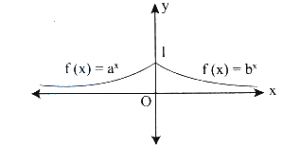
Let $a > 1$ and $0 < b < 1$. If $f: R \rightarrow [0, 1]$ is defined by $f(x) = \begin{cases} a^x, & -\infty < x < 0 \\ b^x, & 0 \leq x < \infty \end{cases}$,then $f(x)$ is
A
$(A)$ $A$ bijection
B
$(B)$ One-one but not onto
C
$(C)$ Onto but not one-one
D
$(D)$ Neither one-one nor onto
Solution
(D) Given the function $f(x) = \begin{cases} a^x, & -\infty < x < 0 \\ b^x, & 0 \leq x < \infty \end{cases}$ with $a > 1$ and $0 < b < 1$.
For $x < 0$,$f(x) = a^x$. Since $a > 1$,as $x \to -\infty$,$f(x) \to 0$,and as $x \to 0^-$,$f(x) \to 1$. Thus,the range for this part is $(0, 1)$.
For $x \geq 0$,$f(x) = b^x$. Since $0 < b < 1$,as $x = 0$,$f(0) = b^0 = 1$,and as $x \to \infty$,$f(x) \to 0$. Thus,the range for this part is $(0, 1]$.
Combining these,the range of $f(x)$ is $(0, 1]$.
$1$. One-one check: For any $y \in (0, 1)$,there exist two values of $x$,one negative and one positive,such that $f(x) = y$. For example,if $y = 0.5$,there is an $x_1 < 0$ such that $a^{x_1} = 0.5$ and an $x_2 > 0$ such that $b^{x_2} = 0.5$. Thus,$f(x)$ is not one-one.
$2$. Onto check: The codomain is given as $[0, 1]$. Since the range is $(0, 1]$,the value $0$ is not in the range (as $a^x > 0$ and $b^x > 0$ for all $x$). Therefore,$f(x)$ is not onto.
Thus,$f(x)$ is neither one-one nor onto.
For $x < 0$,$f(x) = a^x$. Since $a > 1$,as $x \to -\infty$,$f(x) \to 0$,and as $x \to 0^-$,$f(x) \to 1$. Thus,the range for this part is $(0, 1)$.
For $x \geq 0$,$f(x) = b^x$. Since $0 < b < 1$,as $x = 0$,$f(0) = b^0 = 1$,and as $x \to \infty$,$f(x) \to 0$. Thus,the range for this part is $(0, 1]$.
Combining these,the range of $f(x)$ is $(0, 1]$.
$1$. One-one check: For any $y \in (0, 1)$,there exist two values of $x$,one negative and one positive,such that $f(x) = y$. For example,if $y = 0.5$,there is an $x_1 < 0$ such that $a^{x_1} = 0.5$ and an $x_2 > 0$ such that $b^{x_2} = 0.5$. Thus,$f(x)$ is not one-one.
$2$. Onto check: The codomain is given as $[0, 1]$. Since the range is $(0, 1]$,the value $0$ is not in the range (as $a^x > 0$ and $b^x > 0$ for all $x$). Therefore,$f(x)$ is not onto.
Thus,$f(x)$ is neither one-one nor onto.
0 likes
View Solution173
EasyMCQ
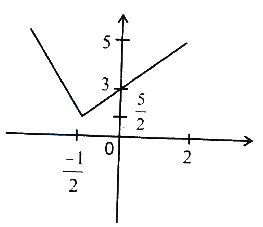
The real-valued function $f: R \rightarrow [ \frac{5}{2}, \infty )$ defined by $f(x) = | 2x + 1 | + | x - 2 |$ is
A
One-one function but not onto
B
Onto function but not one-one
C
Bijection
D
Neither one-one function nor onto
Solution
(B) Given $f(x) = | 2x + 1 | + | x - 2 |$.
We can write the function as:
$f(x) = \begin{cases} -(2x+1) - (x-2) = -3x + 1, & x < -\frac{1}{2} \\ (2x+1) - (x-2) = x + 3, & -\frac{1}{2} \leq x < 2 \\ (2x+1) + (x-2) = 3x - 1, & x \geq 2 \end{cases}$
At $x = -\frac{1}{2}$,$f(-\frac{1}{2}) = 0 + |-\frac{1}{2} - 2| = \frac{5}{2}$.
At $x = 2$,$f(2) = |4+1| + 0 = 5$.
The minimum value of the function is $\frac{5}{2}$ at $x = -\frac{1}{2}$.
Since the function is not strictly increasing or decreasing,it is not one-one (e.g.,$f(0) = 3$ and $f(1) = 4$,but there exist values where $f(x_1) = f(x_2)$ for $x_1 \neq x_2$).
Since the codomain is $[ \frac{5}{2}, \infty )$ and the range of the function is also $[ \frac{5}{2}, \infty )$,the function is onto.
Therefore,the function is onto but not one-one.
We can write the function as:
$f(x) = \begin{cases} -(2x+1) - (x-2) = -3x + 1, & x < -\frac{1}{2} \\ (2x+1) - (x-2) = x + 3, & -\frac{1}{2} \leq x < 2 \\ (2x+1) + (x-2) = 3x - 1, & x \geq 2 \end{cases}$
At $x = -\frac{1}{2}$,$f(-\frac{1}{2}) = 0 + |-\frac{1}{2} - 2| = \frac{5}{2}$.
At $x = 2$,$f(2) = |4+1| + 0 = 5$.
The minimum value of the function is $\frac{5}{2}$ at $x = -\frac{1}{2}$.
Since the function is not strictly increasing or decreasing,it is not one-one (e.g.,$f(0) = 3$ and $f(1) = 4$,but there exist values where $f(x_1) = f(x_2)$ for $x_1 \neq x_2$).
Since the codomain is $[ \frac{5}{2}, \infty )$ and the range of the function is also $[ \frac{5}{2}, \infty )$,the function is onto.
Therefore,the function is onto but not one-one.
0 likes
View Solution174
EasyMCQ
If set $A$ has $5$ elements and set $B$ has $7$ elements,then the number of many-one functions that can be defined from $A$ to $B$ is:
A
$7^5-7$
B
$5^7-5$
C
$5^7-{ }^7 P_5$
D
$7^5-{ }^7 P_5$
Solution
(D) Let $n(A) = 5$ and $n(B) = 7$.
Total number of functions from $A$ to $B$ is given by $|B|^{|A|} = 7^5$.
$A$ function is one-one if every element in $A$ maps to a distinct element in $B$. The number of one-one functions is given by $P(7, 5) = { }^7 P_5$.
$A$ function is many-one if it is not one-one.
Therefore,the number of many-one functions = (Total number of functions) - (Number of one-one functions) = $7^5 - { }^7 P_5$.
Total number of functions from $A$ to $B$ is given by $|B|^{|A|} = 7^5$.
$A$ function is one-one if every element in $A$ maps to a distinct element in $B$. The number of one-one functions is given by $P(7, 5) = { }^7 P_5$.
$A$ function is many-one if it is not one-one.
Therefore,the number of many-one functions = (Total number of functions) - (Number of one-one functions) = $7^5 - { }^7 P_5$.
0 likes
View Solution175
MediumMCQ
Let $A \subseteq R, B \subseteq R$ and $f: A \rightarrow B$ be defined by $f(x)=x^2-3x+2$. If $f$ is a bijection,then
A
$A=(-\infty, 0], B=\left(-\infty, \frac{-1}{4}\right]$
B
$A=\left(-\infty, \frac{3}{2}\right], B=\left[\frac{-1}{4}, \infty\right)$
C
$A=\left[\frac{3}{2}, \infty\right), B=\left[\frac{-1}{4}, \infty\right)$
D
$A=(-\infty, \infty), B=\left[\frac{-1}{4}, \infty\right)$
Solution
(C) The function $f: A \rightarrow B$ is defined by $f(x)=x^2-3x+2$.
To be a bijection,the function must be both one-one and onto.
The derivative is $f'(x) = 2x - 3$.
Setting $f'(x) = 0$ gives the vertex at $x = \frac{3}{2}$.
The minimum value of the function is $f\left(\frac{3}{2}\right) = \left(\frac{3}{2}\right)^2 - 3\left(\frac{3}{2}\right) + 2 = \frac{9}{4} - \frac{9}{2} + 2 = \frac{9-18+8}{4} = -\frac{1}{4}$.
For the function to be one-one,we must restrict the domain to either $A = \left(-\infty, \frac{3}{2}\right]$ or $A = \left[\frac{3}{2}, \infty\right)$.
For the function to be onto,the codomain $B$ must be equal to the range,which is $\left[-\frac{1}{4}, \infty\right)$.
Comparing this with the given options,option $B$ and $C$ are candidates. However,standard convention for such problems usually selects the interval starting from the vertex. Thus,$A = \left[\frac{3}{2}, \infty\right)$ and $B = \left[-\frac{1}{4}, \infty\right)$ is a valid bijection.
To be a bijection,the function must be both one-one and onto.
The derivative is $f'(x) = 2x - 3$.
Setting $f'(x) = 0$ gives the vertex at $x = \frac{3}{2}$.
The minimum value of the function is $f\left(\frac{3}{2}\right) = \left(\frac{3}{2}\right)^2 - 3\left(\frac{3}{2}\right) + 2 = \frac{9}{4} - \frac{9}{2} + 2 = \frac{9-18+8}{4} = -\frac{1}{4}$.
For the function to be one-one,we must restrict the domain to either $A = \left(-\infty, \frac{3}{2}\right]$ or $A = \left[\frac{3}{2}, \infty\right)$.
For the function to be onto,the codomain $B$ must be equal to the range,which is $\left[-\frac{1}{4}, \infty\right)$.
Comparing this with the given options,option $B$ and $C$ are candidates. However,standard convention for such problems usually selects the interval starting from the vertex. Thus,$A = \left[\frac{3}{2}, \infty\right)$ and $B = \left[-\frac{1}{4}, \infty\right)$ is a valid bijection.
0 likes
View Solution176
EasyMCQ
If a set $A$ has $n$ elements,then the number of functions defined from $A$ to $A$ that are not one-one is
A
$(n)^{n^2}$
B
$n! - \sum_{k=0}^{n} {}^{n}C_{k}$
C
$n^{n} - n!$
D
$n^{n}$
Solution
(C) The total number of functions from a set $A$ with $n$ elements to itself is $n^n$.
$A$ function is one-one if every element in the domain has a unique image in the codomain. For a set with $n$ elements,the number of one-one functions is given by the number of permutations of $n$ elements,which is $n!$.
Therefore,the number of functions that are not one-one is the total number of functions minus the number of one-one functions.
Number of functions that are not one-one $= n^n - n!$.
$A$ function is one-one if every element in the domain has a unique image in the codomain. For a set with $n$ elements,the number of one-one functions is given by the number of permutations of $n$ elements,which is $n!$.
Therefore,the number of functions that are not one-one is the total number of functions minus the number of one-one functions.
Number of functions that are not one-one $= n^n - n!$.
0 likes
View Solution177
EasyMCQ
If a set $A$ has $m$ elements and the set $B$ has $n$ elements,then the number of injections from $A$ to $B$ is
A
$^nC_m$ if $n \ge m$
B
$^nP_m$ if $n \ge m$
C
$0$ if $n \ge m$
D
$m \cdot ^nC_m$ if $n \ge m$
Solution
(B) An injection (or one-to-one function) from set $A$ to set $B$ exists only if the number of elements in $A$ is less than or equal to the number of elements in $B$,i.e.,$m \le n$.
If $n < m$,it is impossible to map each element of $A$ to a unique element in $B$,so the number of injections is $0$.
If $n \ge m$,we need to choose $m$ distinct elements from $B$ and arrange them in a specific order to map to the $m$ elements of $A$.
The number of ways to do this is given by the permutation formula $^nP_m = \frac{n!}{(n-m)!}$.
Thus,the number of injections is $\begin{cases} ^nP_m, & n \ge m \\ 0, & n < m \end{cases}$.
If $n < m$,it is impossible to map each element of $A$ to a unique element in $B$,so the number of injections is $0$.
If $n \ge m$,we need to choose $m$ distinct elements from $B$ and arrange them in a specific order to map to the $m$ elements of $A$.
The number of ways to do this is given by the permutation formula $^nP_m = \frac{n!}{(n-m)!}$.
Thus,the number of injections is $\begin{cases} ^nP_m, & n \ge m \\ 0, & n < m \end{cases}$.
0 likes
View Solution178
MediumMCQ
If a function $f: R-\{l\} \to R-\{m\}$ defined by $f(x) = \frac{x+3}{x-2}$ is a bijection,then $3l - 2m =$
A
$10$
B
$12$
C
$8$
D
$4$
Solution
(D) The function is given by $f(x) = \frac{x+3}{x-2}$.
Since the function is not defined when the denominator is zero,we have $x - 2 = 0$,which implies $x = 2$. Thus,the domain is $R - \{2\}$,so $l = 2$.
To find the range,let $y = \frac{x+3}{x-2}$.
Then $y(x - 2) = x + 3$,which gives $xy - 2y = x + 3$.
Rearranging for $x$,we get $x(y - 1) = 2y + 3$,or $x = \frac{2y+3}{y-1}$.
The function is not defined for $y = 1$,so the range is $R - \{1\}$. Thus,$m = 1$.
We need to calculate $3l - 2m$.
Substituting the values,$3(2) - 2(1) = 6 - 2 = 4$.
Since the function is not defined when the denominator is zero,we have $x - 2 = 0$,which implies $x = 2$. Thus,the domain is $R - \{2\}$,so $l = 2$.
To find the range,let $y = \frac{x+3}{x-2}$.
Then $y(x - 2) = x + 3$,which gives $xy - 2y = x + 3$.
Rearranging for $x$,we get $x(y - 1) = 2y + 3$,or $x = \frac{2y+3}{y-1}$.
The function is not defined for $y = 1$,so the range is $R - \{1\}$. Thus,$m = 1$.
We need to calculate $3l - 2m$.
Substituting the values,$3(2) - 2(1) = 6 - 2 = 4$.
0 likes
View Solution179
EasyMCQ
Let $f: R \rightarrow R$ be defined by $f(x)=5x^4+2$. Then
A
$f$ is one-one but not onto
B
$f$ is onto but not one-one
C
$f$ is both one-one and onto
D
$f$ is neither one-one nor onto
Solution
(D) Given the function $f: R \rightarrow R$ defined by $f(x) = 5x^4 + 2$.
To check for one-one:
Consider $f(x_1) = f(x_2)$.
$5x_1^4 + 2 = 5x_2^4 + 2$
$x_1^4 = x_2^4$
$x_1 = \pm x_2$.
Since $f(1) = 5(1)^4 + 2 = 7$ and $f(-1) = 5(-1)^4 + 2 = 7$,we have $f(1) = f(-1)$ but $1 \neq -1$.
Therefore,$f$ is not one-one.
To check for onto:
Since $x^4 \geq 0$ for all $x \in R$,it follows that $5x^4 \geq 0$.
Thus,$f(x) = 5x^4 + 2 \geq 2$.
The range of $f$ is $[2, \infty)$,which is not equal to the codomain $R$.
Therefore,$f$ is not onto.
Hence,$f$ is neither one-one nor onto.
To check for one-one:
Consider $f(x_1) = f(x_2)$.
$5x_1^4 + 2 = 5x_2^4 + 2$
$x_1^4 = x_2^4$
$x_1 = \pm x_2$.
Since $f(1) = 5(1)^4 + 2 = 7$ and $f(-1) = 5(-1)^4 + 2 = 7$,we have $f(1) = f(-1)$ but $1 \neq -1$.
Therefore,$f$ is not one-one.
To check for onto:
Since $x^4 \geq 0$ for all $x \in R$,it follows that $5x^4 \geq 0$.
Thus,$f(x) = 5x^4 + 2 \geq 2$.
The range of $f$ is $[2, \infty)$,which is not equal to the codomain $R$.
Therefore,$f$ is not onto.
Hence,$f$ is neither one-one nor onto.
0 likes
View Solution180
EasyMCQ
If $f: R \rightarrow R$ is defined as $f(x)=x^2-2x-3$,then $f$ is
A
one-one but not onto
B
onto but not one-one
C
neither one-one nor onto
D
a bijection
Solution
(C) Given $f(x) = x^2 - 2x - 3$.
For one-one:
Let $f(x_1) = f(x_2)$.
$x_1^2 - 2x_1 - 3 = x_2^2 - 2x_2 - 3$
$x_1^2 - x_2^2 - 2(x_1 - x_2) = 0$
$(x_1 - x_2)(x_1 + x_2) - 2(x_1 - x_2) = 0$
$(x_1 - x_2)(x_1 + x_2 - 2) = 0$
This implies $x_1 = x_2$ or $x_1 + x_2 = 2$.
Since $x_1 + x_2 = 2$ allows distinct values (e.g.,$f(0) = -3$ and $f(2) = -3$),the function is not one-one.
For onto:
Let $y = x^2 - 2x - 3$.
$y = (x-1)^2 - 4$
$(x-1)^2 = y + 4$
Since $(x-1)^2 \geq 0$,we must have $y + 4 \geq 0$,which means $y \geq -4$.
The range of $f$ is $[-4, \infty)$,which is not equal to the codomain $R$.
Therefore,the function is not onto.
Thus,$f$ is neither one-one nor onto.
For one-one:
Let $f(x_1) = f(x_2)$.
$x_1^2 - 2x_1 - 3 = x_2^2 - 2x_2 - 3$
$x_1^2 - x_2^2 - 2(x_1 - x_2) = 0$
$(x_1 - x_2)(x_1 + x_2) - 2(x_1 - x_2) = 0$
$(x_1 - x_2)(x_1 + x_2 - 2) = 0$
This implies $x_1 = x_2$ or $x_1 + x_2 = 2$.
Since $x_1 + x_2 = 2$ allows distinct values (e.g.,$f(0) = -3$ and $f(2) = -3$),the function is not one-one.
For onto:
Let $y = x^2 - 2x - 3$.
$y = (x-1)^2 - 4$
$(x-1)^2 = y + 4$
Since $(x-1)^2 \geq 0$,we must have $y + 4 \geq 0$,which means $y \geq -4$.
The range of $f$ is $[-4, \infty)$,which is not equal to the codomain $R$.
Therefore,the function is not onto.
Thus,$f$ is neither one-one nor onto.
0 likes
View Solution181
EasyMCQ
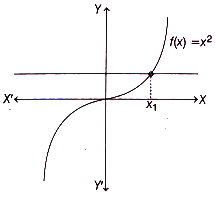
If the function $f: R \rightarrow R$ is defined by $f(x)=x|x|$,then:
A
$f$ is one-one but not onto
B
$f$ is onto but not one-one
C
$f$ is both one-one and onto
D
$f$ is neither one-one nor onto
Solution
(C) Given,$f(x)=x|x|$.
We can write this as:
$f(x) = \begin{cases} x^2, & x \geq 0 \\ -x^2, & x < 0 \end{cases}$
$1$. One-one check:
Let $f(x_1) = f(x_2)$.
If $x_1, x_2 \geq 0$,then $x_1^2 = x_2^2 \Rightarrow x_1 = x_2$ (since $x \geq 0$).
If $x_1, x_2 < 0$,then $-x_1^2 = -x_2^2 \Rightarrow x_1^2 = x_2^2 \Rightarrow x_1 = x_2$ (since $x < 0$).
If one is positive and one is negative,$f(x)$ will have different signs,so $f(x_1) \neq f(x_2)$.
Thus,$f(x)$ is one-one.
$2$. Onto check:
For any $y \in R$,we can find $x$ such that $f(x) = y$.
If $y \geq 0$,$x = \sqrt{y}$. If $y < 0$,$x = -\sqrt{-y}$.
Since for every $y$ in the codomain $R$,there exists an $x$ in the domain $R$,the function is onto.
Therefore,$f$ is both one-one and onto.
We can write this as:
$f(x) = \begin{cases} x^2, & x \geq 0 \\ -x^2, & x < 0 \end{cases}$
$1$. One-one check:
Let $f(x_1) = f(x_2)$.
If $x_1, x_2 \geq 0$,then $x_1^2 = x_2^2 \Rightarrow x_1 = x_2$ (since $x \geq 0$).
If $x_1, x_2 < 0$,then $-x_1^2 = -x_2^2 \Rightarrow x_1^2 = x_2^2 \Rightarrow x_1 = x_2$ (since $x < 0$).
If one is positive and one is negative,$f(x)$ will have different signs,so $f(x_1) \neq f(x_2)$.
Thus,$f(x)$ is one-one.
$2$. Onto check:
For any $y \in R$,we can find $x$ such that $f(x) = y$.
If $y \geq 0$,$x = \sqrt{y}$. If $y < 0$,$x = -\sqrt{-y}$.
Since for every $y$ in the codomain $R$,there exists an $x$ in the domain $R$,the function is onto.
Therefore,$f$ is both one-one and onto.
0 likes
View Solution182
EasyMCQ
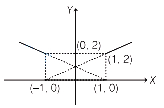
Define $f: R \rightarrow R$ by $f(x) = \max \{x+1, 1-x, 2\}$. Then,$f$ is
A
one-one but not onto
B
onto but not one-one
C
neither one-one nor onto
D
both one-one and onto
Solution
(C) Given $f(x) = \max \{x+1, 1-x, 2\}$.
We can analyze the function by breaking it into intervals:
For $x < -1$,$x+1 < 0$ and $1-x > 2$,so $f(x) = 1-x$.
For $-1 \leq x \leq 1$,$x+1 \geq 0$,$1-x \geq 0$,and the maximum of these and $2$ is $2$ (since $x+1 \leq 2$ and $1-x \leq 2$ for $x \in [-1, 1]$).
For $x > 1$,$x+1 > 2$ and $1-x < 0$,so $f(x) = x+1$.
Thus,$f(x) = \begin{cases} 1-x, & x < -1 \\ 2, & -1 \leq x \leq 1 \\ x+1, & x > 1 \end{cases}$.
Since $f(x) = 2$ for all $x \in [-1, 1]$,the function is not one-one (many-to-one).
Since the range of $f(x)$ is $[2, \infty)$,which is a proper subset of the codomain $R$,the function is not onto.
Therefore,$f$ is neither one-one nor onto.
We can analyze the function by breaking it into intervals:
For $x < -1$,$x+1 < 0$ and $1-x > 2$,so $f(x) = 1-x$.
For $-1 \leq x \leq 1$,$x+1 \geq 0$,$1-x \geq 0$,and the maximum of these and $2$ is $2$ (since $x+1 \leq 2$ and $1-x \leq 2$ for $x \in [-1, 1]$).
For $x > 1$,$x+1 > 2$ and $1-x < 0$,so $f(x) = x+1$.
Thus,$f(x) = \begin{cases} 1-x, & x < -1 \\ 2, & -1 \leq x \leq 1 \\ x+1, & x > 1 \end{cases}$.
Since $f(x) = 2$ for all $x \in [-1, 1]$,the function is not one-one (many-to-one).
Since the range of $f(x)$ is $[2, \infty)$,which is a proper subset of the codomain $R$,the function is not onto.
Therefore,$f$ is neither one-one nor onto.
0 likes
View Solution183
DifficultMCQ
Let $A$ be the set of all $3 \times 3$ scalar matrices with real entries. If $f: A \rightarrow R$ is defined by $f(M) = \operatorname{det}(M)$ for all $M \in A$,then $f$ is
A
one-one but not onto
B
onto but not one-one
C
bijective
D
neither one-one nor onto
Solution
(C) scalar matrix $M$ of order $3 \times 3$ is of the form $M = \begin{bmatrix} m & 0 & 0 \\ 0 & m & 0 \\ 0 & 0 & m \end{bmatrix}$ for some $m \in R$.
The determinant of $M$ is given by $\operatorname{det}(M) = m^3$.
Thus,the function $f: A \rightarrow R$ is defined as $f(M) = m^3$.
Since $f(m) = m^3$ is a strictly increasing function,for any $m_1, m_2 \in R$,$f(m_1) = f(m_2) \implies m_1^3 = m_2^3 \implies m_1 = m_2$. Therefore,$f$ is one-one (injective).
For any real number $y \in R$,there exists a real number $m = \sqrt[3]{y}$ such that $f(m) = (\sqrt[3]{y})^3 = y$. Thus,the range of $f$ is $R$,which is equal to the codomain. Therefore,$f$ is onto (surjective).
Since $f$ is both one-one and onto,it is bijective.
The determinant of $M$ is given by $\operatorname{det}(M) = m^3$.
Thus,the function $f: A \rightarrow R$ is defined as $f(M) = m^3$.
Since $f(m) = m^3$ is a strictly increasing function,for any $m_1, m_2 \in R$,$f(m_1) = f(m_2) \implies m_1^3 = m_2^3 \implies m_1 = m_2$. Therefore,$f$ is one-one (injective).
For any real number $y \in R$,there exists a real number $m = \sqrt[3]{y}$ such that $f(m) = (\sqrt[3]{y})^3 = y$. Thus,the range of $f$ is $R$,which is equal to the codomain. Therefore,$f$ is onto (surjective).
Since $f$ is both one-one and onto,it is bijective.
0 likes
View Solution184
EasyMCQ
If $f: N \times N \rightarrow N$ is defined by $f(m, n) = 2^{m-1}(2n-1)$ for all $(m, n) \in N \times N$,then $f$ is
A
One-one but not onto
B
Onto but not one-one
C
Neither one-one nor onto
D
Both one-one and onto
Solution
(D) The function $f: N \times N \rightarrow N$ is defined by $f(m, n) = 2^{m-1}(2n-1)$.
To check for one-one: Let $f(m_1, n_1) = f(m_2, n_2)$.
Then $2^{m_1-1}(2n_1-1) = 2^{m_2-1}(2n_2-1)$.
Since any natural number $k$ can be uniquely written as $2^{m-1}(2n-1)$ where $2n-1$ is the odd part of $k$ and $2^{m-1}$ is the highest power of $2$ dividing $k$,we must have $m_1-1 = m_2-1$ and $2n_1-1 = 2n_2-1$.
This implies $m_1 = m_2$ and $n_1 = n_2$. Thus,$f$ is one-one.
To check for onto: For any $k \in N$,if $k$ is odd,$k = 2^{1-1}(2n-1)$ with $m=1$. If $k$ is even,$k = 2^p \cdot q$ where $q$ is odd,so $m-1 = p$ and $2n-1 = q$.
Since every $k \in N$ has a unique representation of this form,$f$ is onto.
Therefore,$f$ is both one-one and onto.
To check for one-one: Let $f(m_1, n_1) = f(m_2, n_2)$.
Then $2^{m_1-1}(2n_1-1) = 2^{m_2-1}(2n_2-1)$.
Since any natural number $k$ can be uniquely written as $2^{m-1}(2n-1)$ where $2n-1$ is the odd part of $k$ and $2^{m-1}$ is the highest power of $2$ dividing $k$,we must have $m_1-1 = m_2-1$ and $2n_1-1 = 2n_2-1$.
This implies $m_1 = m_2$ and $n_1 = n_2$. Thus,$f$ is one-one.
To check for onto: For any $k \in N$,if $k$ is odd,$k = 2^{1-1}(2n-1)$ with $m=1$. If $k$ is even,$k = 2^p \cdot q$ where $q$ is odd,so $m-1 = p$ and $2n-1 = q$.
Since every $k \in N$ has a unique representation of this form,$f$ is onto.
Therefore,$f$ is both one-one and onto.
0 likes
View Solution185
MediumMCQ
The function $f(x) = \frac{e^{|x|} - e^{-x}}{e^x + e^{-x}} + \cos^3\left(\frac{x}{2}\right)$ from $R$ to itself is
A
An injective function
B
$A$ surjective function
C
An even function
D
Not bijective
Solution
(D) Let $f(x) = \frac{e^{|x|} - e^{-x}}{e^x + e^{-x}} + \cos^3\left(\frac{x}{2}\right)$.
For $x \ge 0$,$|x| = x$,so $f(x) = \frac{e^x - e^{-x}}{e^x + e^{-x}} + \cos^3\left(\frac{x}{2}\right) = \tanh(x) + \cos^3\left(\frac{x}{2}\right)$.
For $x < 0$,$|x| = -x$,so $f(x) = \frac{e^{-x} - e^{-x}}{e^x + e^{-x}} + \cos^3\left(\frac{x}{2}\right) = 0 + \cos^3\left(\frac{x}{2}\right) = \cos^3\left(\frac{x}{2}\right)$.
Since $f(x)$ is not symmetric about the $y$-axis $(f(x) \neq f(-x))$,it is not an even function.
Since $f(x)$ is not symmetric about the origin $(f(-x) \neq -f(x))$,it is not an odd function.
As $x \to \infty$,$f(x) \to 1 + 0 = 1$. As $x \to -\infty$,$f(x) = \cos^3(x/2)$,which oscillates between $-1$ and $1$.
Since the function is not monotonic and its range is not $R$,it is not surjective.
Since it is not surjective,it cannot be bijective. Thus,the function is not bijective.
For $x \ge 0$,$|x| = x$,so $f(x) = \frac{e^x - e^{-x}}{e^x + e^{-x}} + \cos^3\left(\frac{x}{2}\right) = \tanh(x) + \cos^3\left(\frac{x}{2}\right)$.
For $x < 0$,$|x| = -x$,so $f(x) = \frac{e^{-x} - e^{-x}}{e^x + e^{-x}} + \cos^3\left(\frac{x}{2}\right) = 0 + \cos^3\left(\frac{x}{2}\right) = \cos^3\left(\frac{x}{2}\right)$.
Since $f(x)$ is not symmetric about the $y$-axis $(f(x) \neq f(-x))$,it is not an even function.
Since $f(x)$ is not symmetric about the origin $(f(-x) \neq -f(x))$,it is not an odd function.
As $x \to \infty$,$f(x) \to 1 + 0 = 1$. As $x \to -\infty$,$f(x) = \cos^3(x/2)$,which oscillates between $-1$ and $1$.
Since the function is not monotonic and its range is not $R$,it is not surjective.
Since it is not surjective,it cannot be bijective. Thus,the function is not bijective.
0 likes
View Solution186
MediumMCQ
Let $A = \{1, 2, 3, \ldots, n\}$ and $B = \{a, b\}$. If the number of onto functions from $A$ to $B$ is $62$,then the number of subsets of $A$ containing exactly three elements is:
A
$15$
B
$6$
C
$20$
D
$10$
Solution
(C) The number of onto functions from a set $A$ with $n$ elements to a set $B$ with $m$ elements is given by $m^n - \binom{m}{1}(m-1)^n + \binom{m}{2}(m-2)^n - \ldots$.
Here,$m = 2$ and $n = n$. The number of onto functions is $2^n - \binom{2}{1}(2-1)^n = 2^n - 2$.
Given $2^n - 2 = 62$,we have $2^n = 64$,which implies $n = 6$.
The number of subsets of $A$ containing exactly three elements is given by $\binom{n}{3} = \binom{6}{3}$.
Calculating this,$\binom{6}{3} = \frac{6 \times 5 \times 4}{3 \times 2 \times 1} = 20$.
Here,$m = 2$ and $n = n$. The number of onto functions is $2^n - \binom{2}{1}(2-1)^n = 2^n - 2$.
Given $2^n - 2 = 62$,we have $2^n = 64$,which implies $n = 6$.
The number of subsets of $A$ containing exactly three elements is given by $\binom{n}{3} = \binom{6}{3}$.
Calculating this,$\binom{6}{3} = \frac{6 \times 5 \times 4}{3 \times 2 \times 1} = 20$.
0 likes
View Solution187
EasyMCQ
$f(x)=\frac{x}{e^x-1}+\frac{x}{2}+2 \cos ^3 \frac{x}{2}$ on $R-\{0\}$ is
A
one-one function
B
bijection
C
algebraic function
D
even function
Solution
(D) Given function $f(x)=\frac{x}{e^x-1}+\frac{x}{2}+2 \cos ^3 \frac{x}{2}$ on $R-\{0\}$.
To check if the function is even,we evaluate $f(-x)$:
$f(-x) = \frac{-x}{e^{-x}-1} + \frac{-x}{2} + 2 \cos ^3 \left(-\frac{x}{2}\right)$
Since $\cos(- \theta) = \cos(\theta)$,we have $\cos^3(-\frac{x}{2}) = \cos^3(\frac{x}{2})$.
$f(-x) = \frac{-x}{\frac{1}{e^x}-1} - \frac{x}{2} + 2 \cos ^3 \frac{x}{2}$
$f(-x) = \frac{-x e^x}{1-e^x} - \frac{x}{2} + 2 \cos ^3 \frac{x}{2}$
$f(-x) = \frac{x e^x}{e^x-1} - \frac{x}{2} + 2 \cos ^3 \frac{x}{2}$
$f(-x) = \frac{x(e^x-1+1)}{e^x-1} - \frac{x}{2} + 2 \cos ^3 \frac{x}{2}$
$f(-x) = x + \frac{x}{e^x-1} - \frac{x}{2} + 2 \cos ^3 \frac{x}{2}$
$f(-x) = \frac{x}{e^x-1} + \frac{x}{2} + 2 \cos ^3 \frac{x}{2} = f(x)$
Since $f(-x) = f(x)$ for all $x \in R-\{0\}$,the function is an even function.
Therefore,option $D$ is correct.
To check if the function is even,we evaluate $f(-x)$:
$f(-x) = \frac{-x}{e^{-x}-1} + \frac{-x}{2} + 2 \cos ^3 \left(-\frac{x}{2}\right)$
Since $\cos(- \theta) = \cos(\theta)$,we have $\cos^3(-\frac{x}{2}) = \cos^3(\frac{x}{2})$.
$f(-x) = \frac{-x}{\frac{1}{e^x}-1} - \frac{x}{2} + 2 \cos ^3 \frac{x}{2}$
$f(-x) = \frac{-x e^x}{1-e^x} - \frac{x}{2} + 2 \cos ^3 \frac{x}{2}$
$f(-x) = \frac{x e^x}{e^x-1} - \frac{x}{2} + 2 \cos ^3 \frac{x}{2}$
$f(-x) = \frac{x(e^x-1+1)}{e^x-1} - \frac{x}{2} + 2 \cos ^3 \frac{x}{2}$
$f(-x) = x + \frac{x}{e^x-1} - \frac{x}{2} + 2 \cos ^3 \frac{x}{2}$
$f(-x) = \frac{x}{e^x-1} + \frac{x}{2} + 2 \cos ^3 \frac{x}{2} = f(x)$
Since $f(-x) = f(x)$ for all $x \in R-\{0\}$,the function is an even function.
Therefore,option $D$ is correct.
0 likes
View Solution188
EasyMCQ
Match the following:
| $(A)$ $f: R \rightarrow R$ is such that $f(x)=px+q$ $(p \neq 0)$,$\forall x \in R$ | $I.$ $f$ is neither one-one nor onto |
| $(B)$ $f: R \rightarrow R^{+} \cup\{0\}$ is such that $f(x)=x^2$,$\forall x \in R$ | $II.$ $f$ is both one-one and onto |
| $(C)$ $f: N \rightarrow N$ is such that $f(n)=n^2+2n+3$,$\forall n \in N$ | $III.$ $f$ is one-one but not onto |
| $(D)$ $f: R \rightarrow R$ is such that $f(x)=2(\cos ^2 5x+\sin ^2 5x)$ $\forall x \in R$ | $IV.$ $f$ is onto but not one-one |
| $V.$ $f$ is a constant function and also a bijection |
A
$(A)-II, (B)-IV, (C)-III, (D)-I$
B
$(A)-II, (B)-IV, (C)-V, (D)-I$
C
$(A)-II, (B)-I, (C)-III, (D)-V$
D
$(A)-III, (B)-II, (C)-I, (D)-IV$
Solution
(A) For the function $f: R \rightarrow R$ defined by $f(x)=px+q$ $(p \neq 0)$,it is a linear function. Linear functions are bijections (both one-one and onto) on the set of real numbers $R$. Thus,$A \rightarrow II$.
$(B)$ For the function $f: R \rightarrow R^{+} \cup \{0\}$ defined by $f(x)=x^2$,we observe that $f(-1)=f(1)=1$,so it is not one-one. However,for every $y \in R^{+} \cup \{0\}$,there exists $x = \sqrt{y} \in R$ such that $f(x)=y$,so it is onto. Thus,$B \rightarrow IV$.
$(C)$ For $f: N \rightarrow N$ defined by $f(n)=n^2+2n+3$,it is one-one because $f(n_1)=f(n_2) \implies n_1^2+2n_1+3 = n_2^2+2n_2+3 \implies (n_1-n_2)(n_1+n_2+2)=0$,which implies $n_1=n_2$ for $n \in N$. It is not onto because for $f(n)=3$,$n^2+2n+3=3 \implies n(n+2)=0$,which gives $n=0$ or $n=-2$,neither of which is in $N$. Thus,$C \rightarrow III$.
$(D)$ For $f: R \rightarrow R$ defined by $f(x)=2(\cos^2 5x + \sin^2 5x) = 2(1) = 2$. This is a constant function. $A$ constant function is neither one-one nor onto (unless the domain and codomain are singletons). Thus,$D \rightarrow I$.
Therefore,the correct matching is $(A)-II, (B)-IV, (C)-III, (D)-I$.
$(B)$ For the function $f: R \rightarrow R^{+} \cup \{0\}$ defined by $f(x)=x^2$,we observe that $f(-1)=f(1)=1$,so it is not one-one. However,for every $y \in R^{+} \cup \{0\}$,there exists $x = \sqrt{y} \in R$ such that $f(x)=y$,so it is onto. Thus,$B \rightarrow IV$.
$(C)$ For $f: N \rightarrow N$ defined by $f(n)=n^2+2n+3$,it is one-one because $f(n_1)=f(n_2) \implies n_1^2+2n_1+3 = n_2^2+2n_2+3 \implies (n_1-n_2)(n_1+n_2+2)=0$,which implies $n_1=n_2$ for $n \in N$. It is not onto because for $f(n)=3$,$n^2+2n+3=3 \implies n(n+2)=0$,which gives $n=0$ or $n=-2$,neither of which is in $N$. Thus,$C \rightarrow III$.
$(D)$ For $f: R \rightarrow R$ defined by $f(x)=2(\cos^2 5x + \sin^2 5x) = 2(1) = 2$. This is a constant function. $A$ constant function is neither one-one nor onto (unless the domain and codomain are singletons). Thus,$D \rightarrow I$.
Therefore,the correct matching is $(A)-II, (B)-IV, (C)-III, (D)-I$.
0 likes
View Solution189
MediumMCQ
The function $f:[0, \infty) \rightarrow [0, \infty)$ defined by $f(x) = \frac{x}{1+x}$ is
A
One-one and onto
B
One-one but not onto
C
Onto but not one-one
D
Neither one-one nor onto
Solution
(B) To check for one-one: Let $f(x_1) = f(x_2)$ for $x_1, x_2 \in [0, \infty)$.
$\frac{x_1}{1+x_1} = \frac{x_2}{1+x_2}$
$x_1(1+x_2) = x_2(1+x_1)$
$x_1 + x_1x_2 = x_2 + x_1x_2$
$x_1 = x_2$.
Thus,$f$ is one-one.
To check for onto: Let $y = \frac{x}{1+x}$.
$y(1+x) = x \implies y + xy = x \implies y = x(1-y) \implies x = \frac{y}{1-y}$.
For $x \in [0, \infty)$,we need $y \in [0, 1)$.
Since the codomain is $[0, \infty)$,values like $y = 2$ have no pre-image in the domain.
Thus,$f$ is not onto.
Therefore,the function is one-one but not onto.
$\frac{x_1}{1+x_1} = \frac{x_2}{1+x_2}$
$x_1(1+x_2) = x_2(1+x_1)$
$x_1 + x_1x_2 = x_2 + x_1x_2$
$x_1 = x_2$.
Thus,$f$ is one-one.
To check for onto: Let $y = \frac{x}{1+x}$.
$y(1+x) = x \implies y + xy = x \implies y = x(1-y) \implies x = \frac{y}{1-y}$.
For $x \in [0, \infty)$,we need $y \in [0, 1)$.
Since the codomain is $[0, \infty)$,values like $y = 2$ have no pre-image in the domain.
Thus,$f$ is not onto.
Therefore,the function is one-one but not onto.
0 likes
View Solution190
MediumMCQ
The function $f: R-\{1\} \rightarrow R-\{4\}$ defined by $f(x) = \frac{4x-3}{x-1}$ for $x \in R-\{1\}$ is
A
One-one but not onto
B
Onto but not one-one
C
One-one and onto
D
Neither one-one nor onto
Solution
(C) To check for one-one: Let $f(x_1) = f(x_2)$.
$\frac{4x_1-3}{x_1-1} = \frac{4x_2-3}{x_2-1}$
$(4x_1-3)(x_2-1) = (4x_2-3)(x_1-1)$
$4x_1x_2 - 4x_1 - 3x_2 + 3 = 4x_1x_2 - 4x_2 - 3x_1 + 3$
$-4x_1 - 3x_2 = -4x_2 - 3x_1$
$x_1 = x_2$.
Thus,the function is one-one.
To check for onto: Let $y = \frac{4x-3}{x-1}$.
$y(x-1) = 4x-3$
$yx - y = 4x - 3$
$yx - 4x = y - 3$
$x(y-4) = y-3$
$x = \frac{y-3}{y-4}$.
For every $y \in R-\{4\}$,there exists an $x = \frac{y-3}{y-4} \in R-\{1\}$.
Thus,the function is onto.
Therefore,the function is one-one and onto.
$\frac{4x_1-3}{x_1-1} = \frac{4x_2-3}{x_2-1}$
$(4x_1-3)(x_2-1) = (4x_2-3)(x_1-1)$
$4x_1x_2 - 4x_1 - 3x_2 + 3 = 4x_1x_2 - 4x_2 - 3x_1 + 3$
$-4x_1 - 3x_2 = -4x_2 - 3x_1$
$x_1 = x_2$.
Thus,the function is one-one.
To check for onto: Let $y = \frac{4x-3}{x-1}$.
$y(x-1) = 4x-3$
$yx - y = 4x - 3$
$yx - 4x = y - 3$
$x(y-4) = y-3$
$x = \frac{y-3}{y-4}$.
For every $y \in R-\{4\}$,there exists an $x = \frac{y-3}{y-4} \in R-\{1\}$.
Thus,the function is onto.
Therefore,the function is one-one and onto.
0 likes
View Solution191
EasyMCQ
Let $N$ be the set of all natural numbers,$Z$ be the set of all integers and $\sigma: N \rightarrow Z$ be defined by $\sigma(n)=\begin{cases} \frac{n}{2}, & \text{if } n \text{ is even} \\ -\frac{n-1}{2}, & \text{if } n \text{ is odd} \end{cases}$. Then,
A
$\sigma$ is onto but not one-one
B
$\sigma$ is one-one but not onto
C
$\sigma$ is neither one-one nor onto
D
$\sigma$ is one-one and onto
Solution
(D) Given the function $\sigma: N \rightarrow Z$ defined as:
$\sigma(n) = \begin{cases} \frac{n}{2} & \text{if } n \text{ is even} \\ -\frac{n-1}{2} & \text{if } n \text{ is odd} \end{cases}$
Case-$I$: If $n$ is even,let $n = 2k$ for $k \in N$. Then $\sigma(2k) = \frac{2k}{2} = k$. As $k$ takes values $1, 2, 3, \dots$,$\sigma(n)$ takes values $1, 2, 3, \dots$ (all positive integers).
Case-$II$: If $n$ is odd,let $n = 2k-1$ for $k \in N$. Then $\sigma(2k-1) = -\frac{(2k-1)-1}{2} = -\frac{2k-2}{2} = -(k-1) = 1-k$. As $k$ takes values $1, 2, 3, \dots$,$\sigma(n)$ takes values $0, -1, -2, \dots$ (all non-positive integers).
Combining both cases,the range of $\sigma$ is ${0, 1, -1, 2, -2, 3, -3, \dots} = Z$.
Since every distinct $n \in N$ maps to a distinct integer in $Z$,the function is one-one.
Since the range of $\sigma$ is equal to the codomain $Z$,the function is onto.
Therefore,$\sigma$ is both one-one and onto.
$\sigma(n) = \begin{cases} \frac{n}{2} & \text{if } n \text{ is even} \\ -\frac{n-1}{2} & \text{if } n \text{ is odd} \end{cases}$
Case-$I$: If $n$ is even,let $n = 2k$ for $k \in N$. Then $\sigma(2k) = \frac{2k}{2} = k$. As $k$ takes values $1, 2, 3, \dots$,$\sigma(n)$ takes values $1, 2, 3, \dots$ (all positive integers).
Case-$II$: If $n$ is odd,let $n = 2k-1$ for $k \in N$. Then $\sigma(2k-1) = -\frac{(2k-1)-1}{2} = -\frac{2k-2}{2} = -(k-1) = 1-k$. As $k$ takes values $1, 2, 3, \dots$,$\sigma(n)$ takes values $0, -1, -2, \dots$ (all non-positive integers).
Combining both cases,the range of $\sigma$ is ${0, 1, -1, 2, -2, 3, -3, \dots} = Z$.
Since every distinct $n \in N$ maps to a distinct integer in $Z$,the function is one-one.
Since the range of $\sigma$ is equal to the codomain $Z$,the function is onto.
Therefore,$\sigma$ is both one-one and onto.
0 likes
View Solution192
EasyMCQ
If $f(x)=|x-1|+|x-2|+|x-3|$ for $2 < x < 3$,then $f$ is
A
an onto function but not one-one
B
one-one function but not onto
C
a bijection
D
neither one-one nor onto
Solution
(C) We have $f(x) = |x-1| + |x-2| + |x-3|$.
For the interval $2 < x < 3$:
$|x-1| = x-1$ (since $x > 1$)
$|x-2| = x-2$ (since $x > 2$)
$|x-3| = -(x-3) = 3-x$ (since $x < 3$)
Therefore,$f(x) = (x-1) + (x-2) + (3-x) = x - 2 + 3 - 2 = x$.
In the interval $(2, 3)$,the function $f(x) = x$ is strictly increasing.
Since $f(x) = x$,for every $x \in (2, 3)$,the range is $(2, 3)$.
Thus,the function is one-one and onto,which means it is a bijection.
For the interval $2 < x < 3$:
$|x-1| = x-1$ (since $x > 1$)
$|x-2| = x-2$ (since $x > 2$)
$|x-3| = -(x-3) = 3-x$ (since $x < 3$)
Therefore,$f(x) = (x-1) + (x-2) + (3-x) = x - 2 + 3 - 2 = x$.
In the interval $(2, 3)$,the function $f(x) = x$ is strictly increasing.
Since $f(x) = x$,for every $x \in (2, 3)$,the range is $(2, 3)$.
Thus,the function is one-one and onto,which means it is a bijection.
0 likes
View Solution193
MediumMCQ
If $f: Z \rightarrow Z$ is defined by $f(x)=\begin{cases} \frac{x}{2}, & \text{if } x \text{ is even} \\ 0, & \text{if } x \text{ is odd} \end{cases}$,then $f$ is
A
onto but not one-to-one
B
one-to-one but not onto
C
one-to-one and onto
D
neither one-to-one nor onto
Solution
(A) Given,$f: Z \rightarrow Z$ defined as $f(x)=\begin{cases} \frac{x}{2}, & \text{if } x \text{ is even} \\ 0, & \text{if } x \text{ is odd} \end{cases}$.
For one-to-one check: Consider $x_1 = 1$ and $x_2 = 3$. Both are odd,so $f(1) = 0$ and $f(3) = 0$. Since $f(1) = f(3)$ but $1 \neq 3$,the function is not one-to-one.
For onto check: The range of $f$ consists of all integers. For any integer $y \in Z$,we can find an $x \in Z$ such that $f(x) = y$. If $y = 0$,$f(1) = 0$. If $y \neq 0$,let $x = 2y$,which is even,then $f(2y) = \frac{2y}{2} = y$. Since the range equals the codomain $(Z)$,the function is onto.
Therefore,$f$ is onto but not one-to-one.
For one-to-one check: Consider $x_1 = 1$ and $x_2 = 3$. Both are odd,so $f(1) = 0$ and $f(3) = 0$. Since $f(1) = f(3)$ but $1 \neq 3$,the function is not one-to-one.
For onto check: The range of $f$ consists of all integers. For any integer $y \in Z$,we can find an $x \in Z$ such that $f(x) = y$. If $y = 0$,$f(1) = 0$. If $y \neq 0$,let $x = 2y$,which is even,then $f(2y) = \frac{2y}{2} = y$. Since the range equals the codomain $(Z)$,the function is onto.
Therefore,$f$ is onto but not one-to-one.
0 likes
View Solution194
Difficult
Let $R$ denote the set of all real numbers and $R^{+}$ denote the set of all positive real numbers. For the subsets $A$ and $B$ of $R$,define $f: A \rightarrow B$ by $f(x) = x^2$ for $x \in A$. Match the items in Column-$I$ with the items in Column-$II$.
| Column-$I$ | Column-$II$ |
|---|---|
| $A$. $f$ is one-one and onto,if | $1$. $A = R^{+}, B = R$ |
| $B$. $f$ is one-one but not onto,if | $2$. $A = B = R$ |
| $C$. $f$ is onto but not one-one,if | $3$. $A = R, B = R^{+}$ |
| $D$. $f$ is neither one-one nor onto,if | $4$. $A = B = R^{+}$ |
Solution
(A) The function is $f(x) = x^2$.
For $f$ to be one-one,$f(x_1) = f(x_2) \implies x_1^2 = x_2^2$. This implies $x_1 = x_2$ only if $x_1, x_2$ have the same sign.
For $f$ to be onto,the range of $f$ must equal the codomain $B$. The range of $f(x) = x^2$ for $x \in A$ is ${x^2 : x \in A}$.
Analysis:
$(A)$ $A = B = R^{+}$: $f(x) = x^2$ maps positive reals to positive reals. It is one-one (since $x_1^2 = x_2^2$ and $x_1, x_2 > 0 \implies x_1 = x_2$) and onto (since for any $y \in R^{+}$,$x = \sqrt{y} \in R^{+}$ exists). Thus,$A \rightarrow 4$.
$(B)$ $A = R^{+}, B = R$: $f(x) = x^2$ is one-one (as $x > 0$),but not onto because negative values in $B$ are not covered by the range $(R^{+})$. Thus,$B \rightarrow 1$.
$(C)$ $A = R, B = R^{+}$: $f(x) = x^2$ is not one-one (as $f(1) = f(-1) = 1$) but is onto (since every $y \in R^{+}$ has a pre-image $x = \pm \sqrt{y} \in R$). Thus,$C \rightarrow 3$.
$(D)$ $A = B = R$: $f(x) = x^2$ is not one-one (as $f(1) = f(-1)$) and not onto (as negative values in $B$ are not covered). Thus,$D \rightarrow 2$.
The correct matching is $A-4, B-1, C-3, D-2$.
For $f$ to be one-one,$f(x_1) = f(x_2) \implies x_1^2 = x_2^2$. This implies $x_1 = x_2$ only if $x_1, x_2$ have the same sign.
For $f$ to be onto,the range of $f$ must equal the codomain $B$. The range of $f(x) = x^2$ for $x \in A$ is ${x^2 : x \in A}$.
Analysis:
$(A)$ $A = B = R^{+}$: $f(x) = x^2$ maps positive reals to positive reals. It is one-one (since $x_1^2 = x_2^2$ and $x_1, x_2 > 0 \implies x_1 = x_2$) and onto (since for any $y \in R^{+}$,$x = \sqrt{y} \in R^{+}$ exists). Thus,$A \rightarrow 4$.
$(B)$ $A = R^{+}, B = R$: $f(x) = x^2$ is one-one (as $x > 0$),but not onto because negative values in $B$ are not covered by the range $(R^{+})$. Thus,$B \rightarrow 1$.
$(C)$ $A = R, B = R^{+}$: $f(x) = x^2$ is not one-one (as $f(1) = f(-1) = 1$) but is onto (since every $y \in R^{+}$ has a pre-image $x = \pm \sqrt{y} \in R$). Thus,$C \rightarrow 3$.
$(D)$ $A = B = R$: $f(x) = x^2$ is not one-one (as $f(1) = f(-1)$) and not onto (as negative values in $B$ are not covered). Thus,$D \rightarrow 2$.
The correct matching is $A-4, B-1, C-3, D-2$.
0 likes
View Solution195
DifficultMCQ
If $f: R \rightarrow C$ is defined by $f(x)=e^{2 i x}$ for $x \in R$,then $f$ is (where $C$ denotes the set of all complex numbers)
A
one-one
B
onto
C
one-one and onto
D
neither one-one nor onto
Solution
(D) Given the function $f(x) = e^{2ix} = \cos(2x) + i \sin(2x)$.
For $f$ to be one-one,$f(x_1) = f(x_2)$ must imply $x_1 = x_2$. However,$f(x + \pi) = e^{2i(x+\pi)} = e^{2ix} \cdot e^{2i\pi} = e^{2ix} \cdot 1 = f(x)$. Since $f(x) = f(x+\pi)$ for all $x \in R$,the function is many-one.
For $f$ to be onto,the range of $f$ must be equal to the codomain $C$. The range of $f(x) = \cos(2x) + i \sin(2x)$ is the set of all complex numbers with modulus $1$,i.e.,${z \in C : |z| = 1}$. Since this is a subset of $C$ and not equal to $C$,the function is not onto.
Therefore,$f$ is neither one-one nor onto.
For $f$ to be one-one,$f(x_1) = f(x_2)$ must imply $x_1 = x_2$. However,$f(x + \pi) = e^{2i(x+\pi)} = e^{2ix} \cdot e^{2i\pi} = e^{2ix} \cdot 1 = f(x)$. Since $f(x) = f(x+\pi)$ for all $x \in R$,the function is many-one.
For $f$ to be onto,the range of $f$ must be equal to the codomain $C$. The range of $f(x) = \cos(2x) + i \sin(2x)$ is the set of all complex numbers with modulus $1$,i.e.,${z \in C : |z| = 1}$. Since this is a subset of $C$ and not equal to $C$,the function is not onto.
Therefore,$f$ is neither one-one nor onto.
0 likes
View Solution196
MediumMCQ
$A$ function from $A = \{x : -1 \leq x \leq 1\}$ to itself which is not a bijection is
A
$f(x) = x|x|$
B
$f(x) = x^3$
C
$f(x) = x^2$
D
$f(x) = \sin \left(\frac{\pi x}{2}\right)$
Solution
(C) function is a bijection if it is both injective (one-to-one) and surjective (onto).
For the domain and codomain $A = [-1, 1]$:
$A) f(x) = x|x|$ is a bijection because it is strictly increasing and maps $[-1, 1]$ onto $[-1, 1]$.
$B) f(x) = x^3$ is a bijection because it is strictly increasing and maps $[-1, 1]$ onto $[-1, 1]$.
$C) f(x) = x^2$ is not a bijection. It is not injective because $f(1) = f(-1) = 1$. It is also not surjective because the range is $[0, 1]$,which is not equal to the codomain $[-1, 1]$.
$D) f(x) = \sin \left(\frac{\pi x}{2}\right)$ is a bijection because it is strictly increasing and maps $[-1, 1]$ onto $[-1, 1]$.
Thus,the correct option is $C$.
For the domain and codomain $A = [-1, 1]$:
$A) f(x) = x|x|$ is a bijection because it is strictly increasing and maps $[-1, 1]$ onto $[-1, 1]$.
$B) f(x) = x^3$ is a bijection because it is strictly increasing and maps $[-1, 1]$ onto $[-1, 1]$.
$C) f(x) = x^2$ is not a bijection. It is not injective because $f(1) = f(-1) = 1$. It is also not surjective because the range is $[0, 1]$,which is not equal to the codomain $[-1, 1]$.
$D) f(x) = \sin \left(\frac{\pi x}{2}\right)$ is a bijection because it is strictly increasing and maps $[-1, 1]$ onto $[-1, 1]$.
Thus,the correct option is $C$.
0 likes
View Solution197
MediumMCQ
The function $f: C \rightarrow C$ defined by $f(x) = \frac{ax + b}{cx + d}$ for $x \in C$,where $ad - bc \neq 0$,reduces to a constant function if:
A
$a = c$
B
$b = d$
C
$ad = bc$
D
$ab = cd$
Solution
(C) The given function is $f(x) = \frac{ax + b}{cx + d}$.
For the function to be a constant function,its derivative with respect to $x$ must be zero,or the numerator must be a constant multiple of the denominator.
Let $f(x) = k$ (a constant).
Then $\frac{ax + b}{cx + d} = k$.
$ax + b = k(cx + d) = (kc)x + kd$.
Comparing the coefficients of $x$ and the constant terms,we get $a = kc$ and $b = kd$.
This implies $\frac{a}{c} = k$ and $\frac{b}{d} = k$ (assuming $c, d \neq 0$).
Therefore,$\frac{a}{c} = \frac{b}{d}$,which gives $ad = bc$.
Alternatively,if we take option $(c)$,i.e.,$ad = bc$,then $ad - bc = 0$.
If $ad = bc$,then $\frac{a}{c} = \frac{b}{d} = k$ (for $c, d \neq 0$).
Substituting $a = kc$ and $b = kd$ into the function:
$f(x) = \frac{(kc)x + kd}{cx + d} = \frac{k(cx + d)}{cx + d} = k$.
Since $f(x) = k$,the function is constant.
For the function to be a constant function,its derivative with respect to $x$ must be zero,or the numerator must be a constant multiple of the denominator.
Let $f(x) = k$ (a constant).
Then $\frac{ax + b}{cx + d} = k$.
$ax + b = k(cx + d) = (kc)x + kd$.
Comparing the coefficients of $x$ and the constant terms,we get $a = kc$ and $b = kd$.
This implies $\frac{a}{c} = k$ and $\frac{b}{d} = k$ (assuming $c, d \neq 0$).
Therefore,$\frac{a}{c} = \frac{b}{d}$,which gives $ad = bc$.
Alternatively,if we take option $(c)$,i.e.,$ad = bc$,then $ad - bc = 0$.
If $ad = bc$,then $\frac{a}{c} = \frac{b}{d} = k$ (for $c, d \neq 0$).
Substituting $a = kc$ and $b = kd$ into the function:
$f(x) = \frac{(kc)x + kd}{cx + d} = \frac{k(cx + d)}{cx + d} = k$.
Since $f(x) = k$,the function is constant.
0 likes
View SolutionRelation and Function — Type of Functions based on Mapping · Frequently Asked Questions
1Are these Relation and Function questions useful for JEE and NEET?
Yes. All questions in this section are mapped to JEE Main and NEET exam patterns. Previous year questions from JEE Main, NEET, GUJCET and state-level exams are included with full solutions.
2Can I switch to Hindi or Gujarati for these questions?
Yes. Use the language tabs in the hero section or the sidebar to view the same questions and solutions in English, Hindi or Gujarati.
3How do I generate a question paper from this subtopic?
Use the Vedclass Exam Paper Generator — select the chapter and subtopic, set difficulty, and generate Sets A, B, C, D automatically. First 3 chapters of every subject are free.
Vedclass Products
For Students
Vedclass Test Series
Mock tests in real JEE/NEET style with performance analysis. 5-day free trial.
Start Free TrialFor Teachers
Exam Paper Generator
Generate Set A/B/C/D papers from this chapter in 2 minutes. 3 chapters free.
Try FreeFor Institutes
Online Exam Module
Live online exams with unlimited students, 360° analytics & white-label branding.
See DemoFor Teachers & Institutes
Generate a Relation and Function Exam Paper in 2 Minutes
Select subtopic & difficulty — Sets A, B, C, D auto-generated with No Repeat logic.
First 3 chapters of every subject are free — no payment required.