
A English
Rate of Change of Quantities Questions in English
Class 12 Mathematics · Applications of Derivatives · Rate of Change of Quantities
365+
Questions
English
Language
100%
With Solutions
Showing 49 of 365 questions in English
151
EasyMCQ
The total revenue in Rupees received from the sale of $x$ units of a product is given by $R(x)=3 x^{2}+36 x+5$. The marginal revenue,when $x=15$ is
A
$116$
B
$90$
C
$126$
D
$96$
Solution
(C) Marginal revenue is defined as the rate of change of total revenue with respect to the number of units sold.
$\therefore$ Marginal Revenue $(MR) = \frac{dR}{dx} = \frac{d}{dx}(3x^2 + 36x + 5) = 6x + 36$.
Now,we calculate the marginal revenue when $x = 15$:
$MR = 6(15) + 36 = 90 + 36 = 126$.
Hence,the required marginal revenue is $Rs. 126$.
The correct answer is $C$.
$\therefore$ Marginal Revenue $(MR) = \frac{dR}{dx} = \frac{d}{dx}(3x^2 + 36x + 5) = 6x + 36$.
Now,we calculate the marginal revenue when $x = 15$:
$MR = 6(15) + 36 = 90 + 36 = 126$.
Hence,the required marginal revenue is $Rs. 126$.
The correct answer is $C$.
0 likes
View Solution152
MediumMCQ
$A$ car starts from a point $P$ at time $t=0$ seconds and stops at point $Q$. The distance $x$,in metres,covered by it in $t$ seconds is given by $x=t^{2}(2-\frac{t}{3})$. Find the time taken by it to reach $Q$ and also find the distance between $P$ and $Q$.
A
$t=4 \, s, \text{ distance} = \frac{32}{3} \, m$
B
$t=2 \, s, \text{ distance} = \frac{16}{3} \, m$
C
$t=6 \, s, \text{ distance} = 0 \, m$
D
$t=3 \, s, \text{ distance} = 9 \, m$
Solution
(A) Let $v$ be the velocity of the car at $t$ seconds.
The distance covered is given by $x = t^{2}(2 - \frac{t}{3}) = 2t^{2} - \frac{t^{3}}{3}$.
The velocity $v$ is the rate of change of distance with respect to time,so $v = \frac{dx}{dt}$.
$v = \frac{d}{dt}(2t^{2} - \frac{t^{3}}{3}) = 4t - t^{2} = t(4 - t)$.
The car stops at point $Q$ when the velocity $v = 0$.
Setting $v = 0$,we get $t(4 - t) = 0$,which implies $t = 0$ or $t = 4$.
Since the car starts at $t = 0$ at point $P$,it reaches point $Q$ at $t = 4$ seconds.
The distance between $P$ and $Q$ is the value of $x$ at $t = 4$.
$x(4) = 4^{2}(2 - \frac{4}{3}) = 16(\frac{6-4}{3}) = 16(\frac{2}{3}) = \frac{32}{3} \, m$.
The distance covered is given by $x = t^{2}(2 - \frac{t}{3}) = 2t^{2} - \frac{t^{3}}{3}$.
The velocity $v$ is the rate of change of distance with respect to time,so $v = \frac{dx}{dt}$.
$v = \frac{d}{dt}(2t^{2} - \frac{t^{3}}{3}) = 4t - t^{2} = t(4 - t)$.
The car stops at point $Q$ when the velocity $v = 0$.
Setting $v = 0$,we get $t(4 - t) = 0$,which implies $t = 0$ or $t = 4$.
Since the car starts at $t = 0$ at point $P$,it reaches point $Q$ at $t = 4$ seconds.
The distance between $P$ and $Q$ is the value of $x$ at $t = 4$.
$x(4) = 4^{2}(2 - \frac{4}{3}) = 16(\frac{6-4}{3}) = 16(\frac{2}{3}) = \frac{32}{3} \, m$.
0 likes
View Solution153
DifficultMCQ
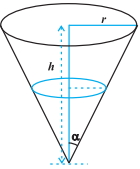
$A$ water tank has the shape of an inverted right circular cone with its axis vertical and vertex lowermost. Its semi-vertical angle is $\tan ^{-1}(0.5)$. Water is poured into it at a constant rate of $5 \ m^3/h$. Find the rate at which the level of the water is rising at the instant when the depth of the water in the tank is $4 \ m$.
A
$\frac{5}{4\pi} \ m/h$
B
$\frac{35}{88} \ m/h$
C
$\frac{5}{2\pi} \ m/h$
D
$\frac{1}{4\pi} \ m/h$
Solution
(A) Let $r$ be the radius and $h$ be the depth of the water at any time $t$. The semi-vertical angle $\alpha$ is given by $\tan \alpha = 0.5 = \frac{1}{2}$.
From the geometry of the cone,$\tan \alpha = \frac{r}{h}$,so $\frac{r}{h} = \frac{1}{2}$,which implies $r = \frac{h}{2}$.
The volume $V$ of the water in the cone is given by $V = \frac{1}{3} \pi r^2 h$.
Substituting $r = \frac{h}{2}$,we get $V = \frac{1}{3} \pi \left(\frac{h}{2}\right)^2 h = \frac{\pi h^3}{12}$.
Differentiating with respect to time $t$,we get $\frac{dV}{dt} = \frac{\pi}{12} \cdot 3h^2 \cdot \frac{dh}{dt} = \frac{\pi h^2}{4} \cdot \frac{dh}{dt}$.
Given $\frac{dV}{dt} = 5 \ m^3/h$ and $h = 4 \ m$,we substitute these values:
$5 = \frac{\pi (4)^2}{4} \cdot \frac{dh}{dt} = 4\pi \cdot \frac{dh}{dt}$.
Therefore,$\frac{dh}{dt} = \frac{5}{4\pi} \ m/h$.
From the geometry of the cone,$\tan \alpha = \frac{r}{h}$,so $\frac{r}{h} = \frac{1}{2}$,which implies $r = \frac{h}{2}$.
The volume $V$ of the water in the cone is given by $V = \frac{1}{3} \pi r^2 h$.
Substituting $r = \frac{h}{2}$,we get $V = \frac{1}{3} \pi \left(\frac{h}{2}\right)^2 h = \frac{\pi h^3}{12}$.
Differentiating with respect to time $t$,we get $\frac{dV}{dt} = \frac{\pi}{12} \cdot 3h^2 \cdot \frac{dh}{dt} = \frac{\pi h^2}{4} \cdot \frac{dh}{dt}$.
Given $\frac{dV}{dt} = 5 \ m^3/h$ and $h = 4 \ m$,we substitute these values:
$5 = \frac{\pi (4)^2}{4} \cdot \frac{dh}{dt} = 4\pi \cdot \frac{dh}{dt}$.
Therefore,$\frac{dh}{dt} = \frac{5}{4\pi} \ m/h$.
0 likes
View Solution154
DifficultMCQ
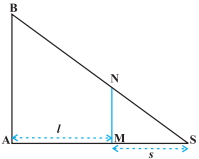
$A$ man of height $2 \text{ m}$ walks at a uniform speed of $5 \text{ km/h}$ away from a lamp post which is $6 \text{ m}$ high. Find the rate at which the length of his shadow increases. (in $\text{ km/h}$)
A
$2.5$
B
$5$
C
$1.25$
D
$10$
Solution
(A) Let $AB$ be the lamp post of height $6 \text{ m}$ and $MN$ be the man of height $2 \text{ m}$. Let the man be at a distance $l$ from the lamp post at time $t$,so $AM = l$. Let $MS = s$ be the length of the shadow.
Since $\triangle MSN \sim \triangle ASB$,we have:
$\frac{MS}{AS} = \frac{MN}{AB}$
Substituting the values,we get:
$\frac{s}{l + s} = \frac{2}{6}$
$\frac{s}{l + s} = \frac{1}{3}$
$3s = l + s$
$l = 2s$
Differentiating both sides with respect to time $t$:
$\frac{dl}{dt} = 2 \frac{ds}{dt}$
Given that the man walks at a speed of $\frac{dl}{dt} = 5 \text{ km/h}$,we have:
$5 = 2 \frac{ds}{dt}$
$\frac{ds}{dt} = \frac{5}{2} = 2.5 \text{ km/h}$
Thus,the length of the shadow increases at the rate of $2.5 \text{ km/h}$.
Since $\triangle MSN \sim \triangle ASB$,we have:
$\frac{MS}{AS} = \frac{MN}{AB}$
Substituting the values,we get:
$\frac{s}{l + s} = \frac{2}{6}$
$\frac{s}{l + s} = \frac{1}{3}$
$3s = l + s$
$l = 2s$
Differentiating both sides with respect to time $t$:
$\frac{dl}{dt} = 2 \frac{ds}{dt}$
Given that the man walks at a speed of $\frac{dl}{dt} = 5 \text{ km/h}$,we have:
$5 = 2 \frac{ds}{dt}$
$\frac{ds}{dt} = \frac{5}{2} = 2.5 \text{ km/h}$
Thus,the length of the shadow increases at the rate of $2.5 \text{ km/h}$.
0 likes
View Solution155
DifficultMCQ
$A$ circular disc of radius $3 \text{ cm}$ is being heated. Due to expansion,its radius increases at the rate of $0.05 \text{ cm/s}$. Find the rate at which its area is increasing when the radius is $3.2 \text{ cm}$.
A
$0.320\pi \text{ cm}^2\text{/s}$
B
$0.300\pi \text{ cm}^2\text{/s}$
C
$0.350\pi \text{ cm}^2\text{/s}$
D
$0.400\pi \text{ cm}^2\text{/s}$
Solution
(A) Let $r$ be the radius of the circular disc and $A$ be its area.
The area of the disc is given by $A = \pi r^2$.
Differentiating both sides with respect to time $t$,we get:
$\frac{dA}{dt} = 2\pi r \frac{dr}{dt}$.
Given that the rate of increase of the radius is $\frac{dr}{dt} = 0.05 \text{ cm/s}$.
We need to find the rate of increase of the area when $r = 3.2 \text{ cm}$.
Substituting the values into the derivative formula:
$\frac{dA}{dt} = 2 \times \pi \times (3.2 \text{ cm}) \times (0.05 \text{ cm/s})$
$\frac{dA}{dt} = 2 \times 3.2 \times 0.05 \times \pi \text{ cm}^2\text{/s}$
$\frac{dA}{dt} = 0.320\pi \text{ cm}^2\text{/s}$.
Thus,the rate at which the area is increasing is $0.320\pi \text{ cm}^2\text{/s}$.
The area of the disc is given by $A = \pi r^2$.
Differentiating both sides with respect to time $t$,we get:
$\frac{dA}{dt} = 2\pi r \frac{dr}{dt}$.
Given that the rate of increase of the radius is $\frac{dr}{dt} = 0.05 \text{ cm/s}$.
We need to find the rate of increase of the area when $r = 3.2 \text{ cm}$.
Substituting the values into the derivative formula:
$\frac{dA}{dt} = 2 \times \pi \times (3.2 \text{ cm}) \times (0.05 \text{ cm/s})$
$\frac{dA}{dt} = 2 \times 3.2 \times 0.05 \times \pi \text{ cm}^2\text{/s}$
$\frac{dA}{dt} = 0.320\pi \text{ cm}^2\text{/s}$.
Thus,the rate at which the area is increasing is $0.320\pi \text{ cm}^2\text{/s}$.
0 likes
View Solution156
DifficultMCQ
The two equal sides of an isosceles triangle with a fixed base $b$ are decreasing at the rate of $3 \ cm/s$. How fast is the area decreasing when the two equal sides are equal to the base?
A
$3b \ cm^2/s$
B
$\sqrt{3}b \ cm^2/s$
C
$\frac{3b}{2} \ cm^2/s$
D
$\frac{\sqrt{3}b}{2} \ cm^2/s$
Solution
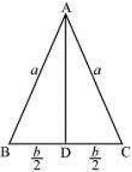
(B) Let $\triangle ABC$ be an isosceles triangle where $BC$ is the base of fixed length $b$. Let the length of the two equal sides be $a$.
Draw $AD \perp BC$. In $\triangle ADC$,by the Pythagoras theorem,the height $h = AD = \sqrt{a^2 - (b/2)^2} = \sqrt{a^2 - b^2/4}$.
The area $A$ of the triangle is given by $A = \frac{1}{2} \times \text{base} \times \text{height} = \frac{1}{2} \times b \times \sqrt{a^2 - b^2/4} = \frac{b}{2} \sqrt{a^2 - b^2/4}$.
Differentiating with respect to time $t$,we get $\frac{dA}{dt} = \frac{b}{2} \times \frac{1}{2\sqrt{a^2 - b^2/4}} \times 2a \times \frac{da}{dt} = \frac{ab}{2\sqrt{a^2 - b^2/4}} \times \frac{da}{dt}$.
Given $\frac{da}{dt} = -3 \ cm/s$. When $a = b$,the height $h = \sqrt{b^2 - b^2/4} = \sqrt{3b^2/4} = \frac{\sqrt{3}b}{2}$.
Substituting $a = b$ and $\frac{da}{dt} = -3$ into the derivative:
$\frac{dA}{dt} = \frac{b \cdot b}{2(\sqrt{3}b/2)} \times (-3) = \frac{b^2}{\sqrt{3}b} \times (-3) = -\frac{3b}{\sqrt{3}} = -\sqrt{3}b$.
The area is decreasing at the rate of $\sqrt{3}b \ cm^2/s$.
Draw $AD \perp BC$. In $\triangle ADC$,by the Pythagoras theorem,the height $h = AD = \sqrt{a^2 - (b/2)^2} = \sqrt{a^2 - b^2/4}$.
The area $A$ of the triangle is given by $A = \frac{1}{2} \times \text{base} \times \text{height} = \frac{1}{2} \times b \times \sqrt{a^2 - b^2/4} = \frac{b}{2} \sqrt{a^2 - b^2/4}$.
Differentiating with respect to time $t$,we get $\frac{dA}{dt} = \frac{b}{2} \times \frac{1}{2\sqrt{a^2 - b^2/4}} \times 2a \times \frac{da}{dt} = \frac{ab}{2\sqrt{a^2 - b^2/4}} \times \frac{da}{dt}$.
Given $\frac{da}{dt} = -3 \ cm/s$. When $a = b$,the height $h = \sqrt{b^2 - b^2/4} = \sqrt{3b^2/4} = \frac{\sqrt{3}b}{2}$.
Substituting $a = b$ and $\frac{da}{dt} = -3$ into the derivative:
$\frac{dA}{dt} = \frac{b \cdot b}{2(\sqrt{3}b/2)} \times (-3) = \frac{b^2}{\sqrt{3}b} \times (-3) = -\frac{3b}{\sqrt{3}} = -\sqrt{3}b$.
The area is decreasing at the rate of $\sqrt{3}b \ cm^2/s$.
0 likes
View Solution157
DifficultMCQ
$A$ cylindrical tank of radius $10 \ m$ is being filled with wheat at the rate of $314 \ m^3/h$. The rate at which the depth of the wheat is increasing is: (in $m/h$)
A
$0.5$
B
$0.1$
C
$1$
D
$1.1$
Solution
(C) Let $r$ be the radius of the cylinder and $h$ be the depth (height) of the wheat.
The volume $V$ of the cylinder is given by $V = \pi r^2 h$.
Given $r = 10 \ m$,we have $V = \pi (10)^2 h = 100 \pi h$.
Differentiating with respect to time $t$,we get $\frac{dV}{dt} = 100 \pi \frac{dh}{dt}$.
We are given $\frac{dV}{dt} = 314 \ m^3/h$.
Substituting the values,$314 = 100 \pi \frac{dh}{dt}$.
Using $\pi \approx 3.14$,we get $314 = 100(3.14) \frac{dh}{dt} = 314 \frac{dh}{dt}$.
Therefore,$\frac{dh}{dt} = \frac{314}{314} = 1 \ m/h$.
The depth of the wheat is increasing at the rate of $1 \ m/h$.
The correct answer is $C$.
The volume $V$ of the cylinder is given by $V = \pi r^2 h$.
Given $r = 10 \ m$,we have $V = \pi (10)^2 h = 100 \pi h$.
Differentiating with respect to time $t$,we get $\frac{dV}{dt} = 100 \pi \frac{dh}{dt}$.
We are given $\frac{dV}{dt} = 314 \ m^3/h$.
Substituting the values,$314 = 100 \pi \frac{dh}{dt}$.
Using $\pi \approx 3.14$,we get $314 = 100(3.14) \frac{dh}{dt} = 314 \frac{dh}{dt}$.
Therefore,$\frac{dh}{dt} = \frac{314}{314} = 1 \ m/h$.
The depth of the wheat is increasing at the rate of $1 \ m/h$.
The correct answer is $C$.
0 likes
View Solution158
EasyMCQ
For the curve $y=5x-2x^{3}$,if $x$ increases at the rate of $2 \text{ units/sec}$,then how fast is the slope of the curve changing when $x=3$?
A
-$72$ units/sec
B
$72$ units/sec
C
$36$ units/sec
D
-$36$ units/sec
Solution
(A) The slope of the curve is given by $m = \frac{dy}{dx} = 5 - 6x^{2}$.
To find the rate of change of the slope with respect to time $t$,we differentiate $m$ with respect to $t$ using the chain rule:
$\frac{dm}{dt} = \frac{d}{dt}(5 - 6x^{2}) = -12x \cdot \frac{dx}{dt}$.
Given that $x = 3$ and $\frac{dx}{dt} = 2 \text{ units/sec}$,we substitute these values into the equation:
$\frac{dm}{dt} = -12(3)(2) = -72 \text{ units/sec}$.
Thus,the slope of the curve is changing at the rate of $-72 \text{ units/sec}$,which means it is decreasing at a rate of $72 \text{ units/sec}$.
To find the rate of change of the slope with respect to time $t$,we differentiate $m$ with respect to $t$ using the chain rule:
$\frac{dm}{dt} = \frac{d}{dt}(5 - 6x^{2}) = -12x \cdot \frac{dx}{dt}$.
Given that $x = 3$ and $\frac{dx}{dt} = 2 \text{ units/sec}$,we substitute these values into the equation:
$\frac{dm}{dt} = -12(3)(2) = -72 \text{ units/sec}$.
Thus,the slope of the curve is changing at the rate of $-72 \text{ units/sec}$,which means it is decreasing at a rate of $72 \text{ units/sec}$.
0 likes
View Solution159
Medium
Water is dripping out at a steady rate of $1 \text{ cm}^3/\text{sec}$ through a tiny hole at the vertex of a conical vessel,whose axis is vertical. When the slant height of water in the vessel is $4 \text{ cm}$,find the rate of decrease of the slant height,where the semi-vertical angle of the conical vessel is $\frac{\pi}{6}$.
Solution
(N/A) Let $v$ be the volume of water in the conical vessel at time $t$. We are given that $\frac{dv}{dt} = -1 \text{ cm}^3/\text{s}$ (negative because water is dripping out).
Let $l$ be the slant height,$h$ be the vertical height,and $r$ be the radius of the water surface.
The semi-vertical angle is $\alpha = \frac{\pi}{6}$.
From the geometry of the cone,we have $h = l \cos \alpha = l \cos \frac{\pi}{6} = l \frac{\sqrt{3}}{2}$ and $r = l \sin \alpha = l \sin \frac{\pi}{6} = \frac{l}{2}$.
The volume of the cone is $v = \frac{1}{3} \pi r^2 h = \frac{1}{3} \pi \left(\frac{l}{2}\right)^2 \left(l \frac{\sqrt{3}}{2}\right) = \frac{\sqrt{3} \pi}{24} l^3$.
Differentiating with respect to $t$,we get $\frac{dv}{dt} = \frac{\sqrt{3} \pi}{24} \cdot 3l^2 \frac{dl}{dt} = \frac{\sqrt{3} \pi}{8} l^2 \frac{dl}{dt}$.
Given $l = 4 \text{ cm}$ and $\frac{dv}{dt} = -1 \text{ cm}^3/\text{s}$,we substitute these values:
$-1 = \frac{\sqrt{3} \pi}{8} (4)^2 \frac{dl}{dt} = \frac{\sqrt{3} \pi}{8} \cdot 16 \frac{dl}{dt} = 2\sqrt{3} \pi \frac{dl}{dt}$.
Thus,$\frac{dl}{dt} = -\frac{1}{2\sqrt{3} \pi} \text{ cm/s}$.
The rate of decrease of the slant height is $\frac{1}{2\sqrt{3} \pi} \text{ cm/s}$.
Let $l$ be the slant height,$h$ be the vertical height,and $r$ be the radius of the water surface.
The semi-vertical angle is $\alpha = \frac{\pi}{6}$.
From the geometry of the cone,we have $h = l \cos \alpha = l \cos \frac{\pi}{6} = l \frac{\sqrt{3}}{2}$ and $r = l \sin \alpha = l \sin \frac{\pi}{6} = \frac{l}{2}$.
The volume of the cone is $v = \frac{1}{3} \pi r^2 h = \frac{1}{3} \pi \left(\frac{l}{2}\right)^2 \left(l \frac{\sqrt{3}}{2}\right) = \frac{\sqrt{3} \pi}{24} l^3$.
Differentiating with respect to $t$,we get $\frac{dv}{dt} = \frac{\sqrt{3} \pi}{24} \cdot 3l^2 \frac{dl}{dt} = \frac{\sqrt{3} \pi}{8} l^2 \frac{dl}{dt}$.
Given $l = 4 \text{ cm}$ and $\frac{dv}{dt} = -1 \text{ cm}^3/\text{s}$,we substitute these values:
$-1 = \frac{\sqrt{3} \pi}{8} (4)^2 \frac{dl}{dt} = \frac{\sqrt{3} \pi}{8} \cdot 16 \frac{dl}{dt} = 2\sqrt{3} \pi \frac{dl}{dt}$.
Thus,$\frac{dl}{dt} = -\frac{1}{2\sqrt{3} \pi} \text{ cm/s}$.
The rate of decrease of the slant height is $\frac{1}{2\sqrt{3} \pi} \text{ cm/s}$.
0 likes
View Solution160
Difficult
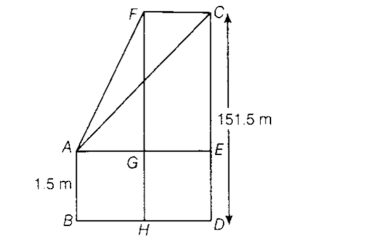
$A$ kite is moving horizontally at a height of $151.5 \ m$. If the speed of the kite is $10 \ m/s$,how fast is the string being let out when the kite is $250 \ m$ away from the boy who is flying the kite? The height of the boy is $1.5 \ m$.
Solution
(8 M/S) Let the height of the kite be $CD = 151.5 \ m$ and the height of the boy be $AB = 1.5 \ m$. Let the horizontal distance between the boy and the kite be $x$ and the length of the string be $y$.
From the geometry of the problem,the effective height of the kite above the boy's eye level is $h = 151.5 - 1.5 = 150 \ m$.
Using the Pythagorean theorem in the right-angled triangle formed by the string,the horizontal distance,and the effective height:
$x^2 + h^2 = y^2$
$x^2 + (150)^2 = y^2$ --- $(i)$
Given that the kite moves horizontally at $10 \ m/s$,we have $\frac{dx}{dt} = 10 \ m/s$.
When the string length $y = 250 \ m$,we find $x$ from $(i)$:
$x^2 + 150^2 = 250^2$
$x^2 = 62500 - 22500 = 40000$
$x = 200 \ m$.
Differentiating $(i)$ with respect to $t$:
$2x \frac{dx}{dt} + 0 = 2y \frac{dy}{dt}$
$x \frac{dx}{dt} = y \frac{dy}{dt}$
Substituting the values:
$200 \times 10 = 250 \times \frac{dy}{dt}$
$\frac{dy}{dt} = \frac{2000}{250} = 8 \ m/s$.
Thus,the string is being let out at a rate of $8 \ m/s$.
From the geometry of the problem,the effective height of the kite above the boy's eye level is $h = 151.5 - 1.5 = 150 \ m$.
Using the Pythagorean theorem in the right-angled triangle formed by the string,the horizontal distance,and the effective height:
$x^2 + h^2 = y^2$
$x^2 + (150)^2 = y^2$ --- $(i)$
Given that the kite moves horizontally at $10 \ m/s$,we have $\frac{dx}{dt} = 10 \ m/s$.
When the string length $y = 250 \ m$,we find $x$ from $(i)$:
$x^2 + 150^2 = 250^2$
$x^2 = 62500 - 22500 = 40000$
$x = 200 \ m$.
Differentiating $(i)$ with respect to $t$:
$2x \frac{dx}{dt} + 0 = 2y \frac{dy}{dt}$
$x \frac{dx}{dt} = y \frac{dy}{dt}$
Substituting the values:
$200 \times 10 = 250 \times \frac{dy}{dt}$
$\frac{dy}{dt} = \frac{2000}{250} = 8 \ m/s$.
Thus,the string is being let out at a rate of $8 \ m/s$.
0 likes
View Solution161
Difficult
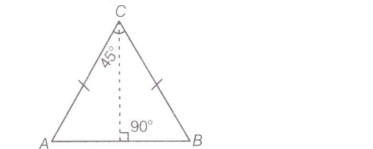
Two men $A$ and $B$ start with velocities $v$ at the same time from the junction of two roads inclined at $45^{\circ}$ to each other. If they travel by different roads,find the rate at which they are being separated.
Solution
(A) Let two men start from the point $C$ with velocity $v$ each at the same time. Also,$\angle BCA = 45^{\circ}$.
Since $A$ and $B$ are moving with the same velocity $v$,they will cover the same distance in the same time.
Therefore,$\Delta ABC$ is an isosceles triangle with $AC = BC$. Let $AC = BC = x$ and the distance between them at any instant $t$ be $y = AB$.
Draw $CD \perp AB$. In $\Delta ACD$ and $\Delta DCB$:
$\angle CAD = \angle CBD$ (since $AC = BC$)
$\angle CDA = \angle CDB = 90^{\circ}$
Therefore,$\angle ACD = \angle DCB = \frac{1}{2} \times \angle ACB = \frac{1}{2} \times 45^{\circ} = 22.5^{\circ} = \frac{\pi}{8}$.
In $\Delta ACD$,$\sin(\frac{\pi}{8}) = \frac{AD}{AC} = \frac{y/2}{x}$.
Thus,$y = 2x \sin(\frac{\pi}{8})$.
Differentiating with respect to $t$:
$\frac{dy}{dt} = 2 \sin(\frac{\pi}{8}) \frac{dx}{dt} = 2v \sin(\frac{\pi}{8})$.
Using $\sin(\frac{\pi}{8}) = \frac{\sqrt{2-\sqrt{2}}}{2}$,we get:
$\frac{dy}{dt} = 2v \cdot \frac{\sqrt{2-\sqrt{2}}}{2} = v \sqrt{2-\sqrt{2}}$.
Since $A$ and $B$ are moving with the same velocity $v$,they will cover the same distance in the same time.
Therefore,$\Delta ABC$ is an isosceles triangle with $AC = BC$. Let $AC = BC = x$ and the distance between them at any instant $t$ be $y = AB$.
Draw $CD \perp AB$. In $\Delta ACD$ and $\Delta DCB$:
$\angle CAD = \angle CBD$ (since $AC = BC$)
$\angle CDA = \angle CDB = 90^{\circ}$
Therefore,$\angle ACD = \angle DCB = \frac{1}{2} \times \angle ACB = \frac{1}{2} \times 45^{\circ} = 22.5^{\circ} = \frac{\pi}{8}$.
In $\Delta ACD$,$\sin(\frac{\pi}{8}) = \frac{AD}{AC} = \frac{y/2}{x}$.
Thus,$y = 2x \sin(\frac{\pi}{8})$.
Differentiating with respect to $t$:
$\frac{dy}{dt} = 2 \sin(\frac{\pi}{8}) \frac{dx}{dt} = 2v \sin(\frac{\pi}{8})$.
Using $\sin(\frac{\pi}{8}) = \frac{\sqrt{2-\sqrt{2}}}{2}$,we get:
$\frac{dy}{dt} = 2v \cdot \frac{\sqrt{2-\sqrt{2}}}{2} = v \sqrt{2-\sqrt{2}}$.
0 likes
View Solution162
Difficult
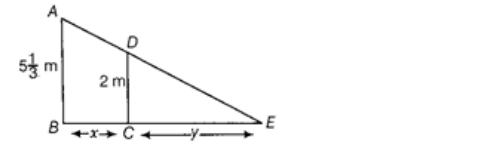
$A$ man,$2 \ m$ tall,walks at the rate of $1 \frac{2}{3} \ m/s$ towards a street light which is $5 \frac{1}{3} \ m$ above the ground. At what rate is the tip of his shadow moving? At what rate is the length of the shadow changing when he is $3 \frac{1}{3} \ m$ from the base of the light?
Solution
(A) Let $AB$ be the street light post and $CD$ be the height of the man,i.e.,$CD = 2 \ m$.
Let $BC = x \ m$,$CE = y \ m$,and $\frac{dx}{dt} = -\frac{5}{3} \ m/s$ (since the man is moving towards the light post).
From $\Delta ABE$ and $\Delta DCE$,we see that $\Delta ABE \sim \Delta DCE$ by $AAA$ similarity.
Therefore,$\frac{AB}{DC} = \frac{BE}{CE} \Rightarrow \frac{16/3}{2} = \frac{x+y}{y}$.
$\Rightarrow \frac{16}{6} = \frac{x+y}{y} \Rightarrow \frac{8}{3} = \frac{x+y}{y}$.
$\Rightarrow 8y = 3x + 3y \Rightarrow 5y = 3x \Rightarrow y = \frac{3}{5}x$.
On differentiating both sides with respect to $t$,we get $\frac{dy}{dt} = \frac{3}{5} \cdot \frac{dx}{dt} = \frac{3}{5} \cdot \left(-\frac{5}{3}\right) = -1 \ m/s$.
Thus,the length of the shadow is decreasing at the rate of $1 \ m/s$.
Let $z = x + y$ be the distance of the tip of the shadow from the light post.
Now,differentiating both sides with respect to $t$,we get $\frac{dz}{dt} = \frac{dx}{dt} + \frac{dy}{dt} = -\frac{5}{3} - 1 = -\frac{8}{3} = -2 \frac{2}{3} \ m/s$.
Hence,the tip of the shadow is moving at the rate of $2 \frac{2}{3} \ m/s$ towards the light source.
Let $BC = x \ m$,$CE = y \ m$,and $\frac{dx}{dt} = -\frac{5}{3} \ m/s$ (since the man is moving towards the light post).
From $\Delta ABE$ and $\Delta DCE$,we see that $\Delta ABE \sim \Delta DCE$ by $AAA$ similarity.
Therefore,$\frac{AB}{DC} = \frac{BE}{CE} \Rightarrow \frac{16/3}{2} = \frac{x+y}{y}$.
$\Rightarrow \frac{16}{6} = \frac{x+y}{y} \Rightarrow \frac{8}{3} = \frac{x+y}{y}$.
$\Rightarrow 8y = 3x + 3y \Rightarrow 5y = 3x \Rightarrow y = \frac{3}{5}x$.
On differentiating both sides with respect to $t$,we get $\frac{dy}{dt} = \frac{3}{5} \cdot \frac{dx}{dt} = \frac{3}{5} \cdot \left(-\frac{5}{3}\right) = -1 \ m/s$.
Thus,the length of the shadow is decreasing at the rate of $1 \ m/s$.
Let $z = x + y$ be the distance of the tip of the shadow from the light post.
Now,differentiating both sides with respect to $t$,we get $\frac{dz}{dt} = \frac{dx}{dt} + \frac{dy}{dt} = -\frac{5}{3} - 1 = -\frac{8}{3} = -2 \frac{2}{3} \ m/s$.
Hence,the tip of the shadow is moving at the rate of $2 \frac{2}{3} \ m/s$ towards the light source.
0 likes
View Solution163
MediumMCQ
If $f(x) = x^{2}$,find $\frac{f(1.1) - f(1)}{1.1 - 1}$.
A
$2.1$
B
$2.2$
C
$2.3$
D
$2.4$
Solution
(A) Given $f(x) = x^{2}$.
We need to calculate $\frac{f(1.1) - f(1)}{1.1 - 1}$.
First,calculate $f(1.1) = (1.1)^{2} = 1.21$.
Next,calculate $f(1) = (1)^{2} = 1$.
Substitute these values into the expression:
$\frac{1.21 - 1}{1.1 - 1} = \frac{0.21}{0.1} = 2.1$.
We need to calculate $\frac{f(1.1) - f(1)}{1.1 - 1}$.
First,calculate $f(1.1) = (1.1)^{2} = 1.21$.
Next,calculate $f(1) = (1)^{2} = 1$.
Substitute these values into the expression:
$\frac{1.21 - 1}{1.1 - 1} = \frac{0.21}{0.1} = 2.1$.
0 likes
View Solution164
Medium
$A$ spherical ball of salt is dissolving in water in such a manner that the rate of decrease of the volume at any instant is proportional to its surface area. Prove that the radius is decreasing at a constant rate.
Solution
(N/A) Let the radius of the spherical ball of salt at any time $t$ be $r$.
The volume of the ball is $V = \frac{4}{3} \pi r^{3}$ and the surface area is $S = 4 \pi r^{2}$.
According to the problem,the rate of decrease of volume is proportional to the surface area:
$-\frac{dV}{dt} \propto S$
This implies $-\frac{dV}{dt} = kS$,where $k$ is a positive constant of proportionality.
Substituting the expressions for $V$ and $S$:
$-\frac{d}{dt} \left( \frac{4}{3} \pi r^{3} \right) = k(4 \pi r^{2})$
Using the chain rule:
$-\frac{4}{3} \pi \cdot 3r^{2} \cdot \frac{dr}{dt} = k(4 \pi r^{2})$
$-4 \pi r^{2} \cdot \frac{dr}{dt} = k(4 \pi r^{2})$
Dividing both sides by $4 \pi r^{2}$ (assuming $r \neq 0$):
$-\frac{dr}{dt} = k$
$\frac{dr}{dt} = -k$
Since $k$ is a constant,the rate of change of the radius $\frac{dr}{dt}$ is a constant. Thus,the radius is decreasing at a constant rate.
The volume of the ball is $V = \frac{4}{3} \pi r^{3}$ and the surface area is $S = 4 \pi r^{2}$.
According to the problem,the rate of decrease of volume is proportional to the surface area:
$-\frac{dV}{dt} \propto S$
This implies $-\frac{dV}{dt} = kS$,where $k$ is a positive constant of proportionality.
Substituting the expressions for $V$ and $S$:
$-\frac{d}{dt} \left( \frac{4}{3} \pi r^{3} \right) = k(4 \pi r^{2})$
Using the chain rule:
$-\frac{4}{3} \pi \cdot 3r^{2} \cdot \frac{dr}{dt} = k(4 \pi r^{2})$
$-4 \pi r^{2} \cdot \frac{dr}{dt} = k(4 \pi r^{2})$
Dividing both sides by $4 \pi r^{2}$ (assuming $r \neq 0$):
$-\frac{dr}{dt} = k$
$\frac{dr}{dt} = -k$
Since $k$ is a constant,the rate of change of the radius $\frac{dr}{dt}$ is a constant. Thus,the radius is decreasing at a constant rate.
0 likes
View Solution165
Medium
If the area of a circle increases at a uniform rate,then prove that the rate of change of its perimeter varies inversely as the radius.
Solution
(N/A) Let the radius of the circle be $r$ and the area of the circle be $A = \pi r^2$.
Differentiating both sides with respect to time $t$,we get:
$\frac{dA}{dt} = 2\pi r \cdot \frac{dr}{dt} \quad \dots(i)$
Given that the area of the circle increases at a uniform rate,let $\frac{dA}{dt} = k$,where $k$ is a constant.
From equation $(i)$,we have:
$k = 2\pi r \cdot \frac{dr}{dt} \implies \frac{dr}{dt} = \frac{k}{2\pi r} \quad \dots(ii)$
Let the perimeter of the circle be $P = 2\pi r$.
Differentiating the perimeter with respect to time $t$:
$\frac{dP}{dt} = \frac{d}{dt}(2\pi r) = 2\pi \cdot \frac{dr}{dt}$
Substituting the value of $\frac{dr}{dt}$ from equation $(ii)$:
$\frac{dP}{dt} = 2\pi \cdot \left( \frac{k}{2\pi r} \right) = \frac{k}{r}$
Since $k$ is a constant,we have $\frac{dP}{dt} \propto \frac{1}{r}$.
Thus,the rate of change of the perimeter varies inversely as the radius.
Differentiating both sides with respect to time $t$,we get:
$\frac{dA}{dt} = 2\pi r \cdot \frac{dr}{dt} \quad \dots(i)$
Given that the area of the circle increases at a uniform rate,let $\frac{dA}{dt} = k$,where $k$ is a constant.
From equation $(i)$,we have:
$k = 2\pi r \cdot \frac{dr}{dt} \implies \frac{dr}{dt} = \frac{k}{2\pi r} \quad \dots(ii)$
Let the perimeter of the circle be $P = 2\pi r$.
Differentiating the perimeter with respect to time $t$:
$\frac{dP}{dt} = \frac{d}{dt}(2\pi r) = 2\pi \cdot \frac{dr}{dt}$
Substituting the value of $\frac{dr}{dt}$ from equation $(ii)$:
$\frac{dP}{dt} = 2\pi \cdot \left( \frac{k}{2\pi r} \right) = \frac{k}{r}$
Since $k$ is a constant,we have $\frac{dP}{dt} \propto \frac{1}{r}$.
Thus,the rate of change of the perimeter varies inversely as the radius.
0 likes
View Solution166
Difficult
$A$ swimming pool is to be drained for cleaning. If $L$ represents the number of litres of water in the pool $t$ seconds after the pool has been plugged off to drain and $L=200(10-t)^{2}$,how fast is the water running out at the end of $5$ seconds? What is the average rate at which the water flows out during the first $5$ seconds?
Solution
(A) Given the volume of water $L$ at time $t$ is $L = 200(10-t)^2$.
The rate at which water flows out is given by $-\frac{dL}{dt}$.
First,find the derivative: $\frac{dL}{dt} = 200 \cdot 2(10-t) \cdot (-1) = -400(10-t)$.
Thus,the rate of flow is $-\frac{dL}{dt} = 400(10-t)$.
At $t = 5$ seconds,the rate is $400(10-5) = 400(5) = 2000 \text{ L/s}$.
To find the average rate during the first $5$ seconds,we calculate the total change in volume divided by the time interval: $\text{Average Rate} = \frac{L(0) - L(5)}{5 - 0}$.
$L(0) = 200(10-0)^2 = 200(100) = 20000 \text{ L}$.
$L(5) = 200(10-5)^2 = 200(25) = 5000 \text{ L}$.
$\text{Average Rate} = \frac{20000 - 5000}{5} = \frac{15000}{5} = 3000 \text{ L/s}$.
The rate at which water flows out is given by $-\frac{dL}{dt}$.
First,find the derivative: $\frac{dL}{dt} = 200 \cdot 2(10-t) \cdot (-1) = -400(10-t)$.
Thus,the rate of flow is $-\frac{dL}{dt} = 400(10-t)$.
At $t = 5$ seconds,the rate is $400(10-5) = 400(5) = 2000 \text{ L/s}$.
To find the average rate during the first $5$ seconds,we calculate the total change in volume divided by the time interval: $\text{Average Rate} = \frac{L(0) - L(5)}{5 - 0}$.
$L(0) = 200(10-0)^2 = 200(100) = 20000 \text{ L}$.
$L(5) = 200(10-5)^2 = 200(25) = 5000 \text{ L}$.
$\text{Average Rate} = \frac{20000 - 5000}{5} = \frac{15000}{5} = 3000 \text{ L/s}$.
0 likes
View Solution167
Difficult
The volume of a cube increases at a constant rate. Prove that the increase in its surface area varies inversely as the length of the side.
Solution
(N/A) Let the side of a cube be $x$ units.
Volume of cube $V = x^{3}$.
Differentiating both sides with respect to $t$,we get $\frac{dV}{dt} = 3x^{2} \frac{dx}{dt} = k$ (where $k$ is a constant).
$\Rightarrow \frac{dx}{dt} = \frac{k}{3x^{2}} \dots (i)$.
Surface area of the cube $S = 6x^{2}$.
Differentiating with respect to $t$,we get $\frac{dS}{dt} = 12x \cdot \frac{dx}{dt}$.
Substituting the value of $\frac{dx}{dt}$ from equation $(i)$:
$\frac{dS}{dt} = 12x \cdot \left( \frac{k}{3x^{2}} \right) = \frac{4k}{x}$.
Since $4k$ is a constant,$\frac{dS}{dt} \propto \frac{1}{x}$.
Thus,the rate of increase of the surface area varies inversely as the length of the side $x$.
Volume of cube $V = x^{3}$.
Differentiating both sides with respect to $t$,we get $\frac{dV}{dt} = 3x^{2} \frac{dx}{dt} = k$ (where $k$ is a constant).
$\Rightarrow \frac{dx}{dt} = \frac{k}{3x^{2}} \dots (i)$.
Surface area of the cube $S = 6x^{2}$.
Differentiating with respect to $t$,we get $\frac{dS}{dt} = 12x \cdot \frac{dx}{dt}$.
Substituting the value of $\frac{dx}{dt}$ from equation $(i)$:
$\frac{dS}{dt} = 12x \cdot \left( \frac{k}{3x^{2}} \right) = \frac{4k}{x}$.
Since $4k$ is a constant,$\frac{dS}{dt} \propto \frac{1}{x}$.
Thus,the rate of increase of the surface area varies inversely as the length of the side $x$.
0 likes
View Solution168
MediumMCQ
$x$ and $y$ are the sides of two squares such that $y = x - x^{2}$. Find the rate of change of the area of the second square with respect to the area of the first square.
A
$2x^{2} - 3x + 1$
B
$2x^{2} + 3x - 1$
C
$x^{2} - 3x + 1$
D
$2x^{2} - 3x - 1$
Solution
(A) Let $A_{1}$ be the area of the first square and $A_{2}$ be the area of the second square.
Given that the side of the first square is $x$,so $A_{1} = x^{2}$.
The side of the second square is $y = x - x^{2}$,so $A_{2} = y^{2} = (x - x^{2})^{2}$.
We need to find the rate of change of $A_{2}$ with respect to $A_{1}$,which is $\frac{dA_{2}}{dA_{1}}$.
Using the chain rule,$\frac{dA_{2}}{dA_{1}} = \frac{dA_{2}/dx}{dA_{1}/dx}$.
First,calculate $\frac{dA_{1}}{dx} = \frac{d}{dx}(x^{2}) = 2x$.
Next,calculate $\frac{dA_{2}}{dx} = \frac{d}{dx}(x - x^{2})^{2} = 2(x - x^{2}) \cdot \frac{d}{dx}(x - x^{2}) = 2(x - x^{2})(1 - 2x)$.
Now,$\frac{dA_{2}}{dA_{1}} = \frac{2(x - x^{2})(1 - 2x)}{2x} = \frac{2x(1 - x)(1 - 2x)}{2x}$.
Simplifying this,we get $\frac{dA_{2}}{dA_{1}} = (1 - x)(1 - 2x) = 1 - 2x - x + 2x^{2} = 2x^{2} - 3x + 1$.
Given that the side of the first square is $x$,so $A_{1} = x^{2}$.
The side of the second square is $y = x - x^{2}$,so $A_{2} = y^{2} = (x - x^{2})^{2}$.
We need to find the rate of change of $A_{2}$ with respect to $A_{1}$,which is $\frac{dA_{2}}{dA_{1}}$.
Using the chain rule,$\frac{dA_{2}}{dA_{1}} = \frac{dA_{2}/dx}{dA_{1}/dx}$.
First,calculate $\frac{dA_{1}}{dx} = \frac{d}{dx}(x^{2}) = 2x$.
Next,calculate $\frac{dA_{2}}{dx} = \frac{d}{dx}(x - x^{2})^{2} = 2(x - x^{2}) \cdot \frac{d}{dx}(x - x^{2}) = 2(x - x^{2})(1 - 2x)$.
Now,$\frac{dA_{2}}{dA_{1}} = \frac{2(x - x^{2})(1 - 2x)}{2x} = \frac{2x(1 - x)(1 - 2x)}{2x}$.
Simplifying this,we get $\frac{dA_{2}}{dA_{1}} = (1 - x)(1 - 2x) = 1 - 2x - x + 2x^{2} = 2x^{2} - 3x + 1$.
0 likes
View Solution169
MediumMCQ
If the surface area of a cube is increasing at a rate of $3.6 \text{ cm}^2/\text{sec}$,while maintaining its shape,then the rate of change of its volume (in $\text{cm}^3/\text{sec}$),when the length of a side of the cube is $10 \text{ cm}$,is:
A
$9$
B
$18$
C
$10$
D
$20$
Solution
(A) Let the side length of the cube be $a$. The surface area $S$ of the cube is given by $S = 6a^2$.
Given that $\frac{dS}{dt} = 3.6 \text{ cm}^2/\text{sec}$.
Differentiating $S$ with respect to $t$,we get $\frac{dS}{dt} = 12a \frac{da}{dt}$.
Substituting the given values: $3.6 = 12(10) \frac{da}{dt} \Rightarrow 3.6 = 120 \frac{da}{dt} \Rightarrow \frac{da}{dt} = \frac{3.6}{120} = 0.03 \text{ cm}/\text{sec}$.
The volume $V$ of the cube is $V = a^3$.
Differentiating $V$ with respect to $t$,we get $\frac{dV}{dt} = 3a^2 \frac{da}{dt}$.
Substituting $a = 10$ and $\frac{da}{dt} = 0.03$: $\frac{dV}{dt} = 3(10)^2(0.03) = 3(100)(0.03) = 300 \times 0.03 = 9 \text{ cm}^3/\text{sec}$.
Given that $\frac{dS}{dt} = 3.6 \text{ cm}^2/\text{sec}$.
Differentiating $S$ with respect to $t$,we get $\frac{dS}{dt} = 12a \frac{da}{dt}$.
Substituting the given values: $3.6 = 12(10) \frac{da}{dt} \Rightarrow 3.6 = 120 \frac{da}{dt} \Rightarrow \frac{da}{dt} = \frac{3.6}{120} = 0.03 \text{ cm}/\text{sec}$.
The volume $V$ of the cube is $V = a^3$.
Differentiating $V$ with respect to $t$,we get $\frac{dV}{dt} = 3a^2 \frac{da}{dt}$.
Substituting $a = 10$ and $\frac{da}{dt} = 0.03$: $\frac{dV}{dt} = 3(10)^2(0.03) = 3(100)(0.03) = 300 \times 0.03 = 9 \text{ cm}^3/\text{sec}$.
0 likes
View Solution170
MediumMCQ
The surface area of a spherical balloon being inflated increases at a constant rate. If initially,the radius of the balloon is $3$ units and after $5$ seconds,it becomes $7$ units,then its radius after $9$ seconds is
A
$9$
B
$10$
C
$11$
D
$12$
Solution
(A) Let $r$ be the radius of the spherical balloon.
The surface area $S$ is given by $S = 4 \pi r^2$.
Given that the surface area increases at a constant rate,we have $\frac{dS}{dt} = k$,where $k$ is a constant.
Integrating with respect to $t$,we get $S = kt + C$,where $C$ is the constant of integration.
Substituting $S = 4 \pi r^2$,we have $4 \pi r^2 = kt + C$.
At $t = 0$,$r = 3$,so $4 \pi (3)^2 = k(0) + C \Rightarrow C = 36 \pi$.
At $t = 5$,$r = 7$,so $4 \pi (7)^2 = k(5) + 36 \pi \Rightarrow 196 \pi = 5k + 36 \pi \Rightarrow 5k = 160 \pi \Rightarrow k = 32 \pi$.
Thus,the equation becomes $4 \pi r^2 = 32 \pi t + 36 \pi$.
Dividing by $4 \pi$,we get $r^2 = 8t + 9$.
For $t = 9$,$r^2 = 8(9) + 9 = 72 + 9 = 81$.
Therefore,$r = \sqrt{81} = 9$ units.
The surface area $S$ is given by $S = 4 \pi r^2$.
Given that the surface area increases at a constant rate,we have $\frac{dS}{dt} = k$,where $k$ is a constant.
Integrating with respect to $t$,we get $S = kt + C$,where $C$ is the constant of integration.
Substituting $S = 4 \pi r^2$,we have $4 \pi r^2 = kt + C$.
At $t = 0$,$r = 3$,so $4 \pi (3)^2 = k(0) + C \Rightarrow C = 36 \pi$.
At $t = 5$,$r = 7$,so $4 \pi (7)^2 = k(5) + 36 \pi \Rightarrow 196 \pi = 5k + 36 \pi \Rightarrow 5k = 160 \pi \Rightarrow k = 32 \pi$.
Thus,the equation becomes $4 \pi r^2 = 32 \pi t + 36 \pi$.
Dividing by $4 \pi$,we get $r^2 = 8t + 9$.
For $t = 9$,$r^2 = 8(9) + 9 = 72 + 9 = 81$.
Therefore,$r = \sqrt{81} = 9$ units.
0 likes
View Solution171
DifficultMCQ
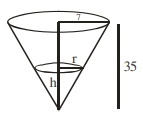
Water is being filled at the rate of $1 \, cm^3/sec$ in a right circular conical vessel (vertex downwards) of height $35 \, cm$ and diameter $14 \, cm$. When the height of the water level is $10 \, cm$,the rate (in $cm^2/sec$) at which the wet conical surface area of the vessel increases is
A
$5$
B
$\frac{\sqrt{21}}{5}$
C
$\frac{\sqrt{26}}{5}$
D
$\frac{\sqrt{26}}{10}$
Solution
(C) Let the radius of the cone be $R = 7 \, cm$ and height be $H = 35 \, cm$. By similar triangles,$\frac{r}{h} = \frac{R}{H} = \frac{7}{35} = \frac{1}{5}$,so $h = 5r$.
The volume of water is $V = \frac{1}{3} \pi r^2 h = \frac{1}{3} \pi r^2 (5r) = \frac{5}{3} \pi r^3$.
Given $\frac{dV}{dt} = 1 \, cm^3/sec$,we have $\frac{d}{dt} (\frac{5}{3} \pi r^3) = 5 \pi r^2 \frac{dr}{dt} = 1$,so $\frac{dr}{dt} = \frac{1}{5 \pi r^2}$.
The wet conical surface area is $S = \pi r l = \pi r \sqrt{r^2 + h^2} = \pi r \sqrt{r^2 + (5r)^2} = \pi r \sqrt{26r^2} = \sqrt{26} \pi r^2$.
Differentiating with respect to $t$,$\frac{dS}{dt} = 2 \sqrt{26} \pi r \frac{dr}{dt}$.
Substituting $\frac{dr}{dt} = \frac{1}{5 \pi r^2}$,we get $\frac{dS}{dt} = 2 \sqrt{26} \pi r (\frac{1}{5 \pi r^2}) = \frac{2 \sqrt{26}}{5r}$.
When $h = 10 \, cm$,$r = \frac{h}{5} = \frac{10}{5} = 2 \, cm$.
Thus,$\frac{dS}{dt} = \frac{2 \sqrt{26}}{5(2)} = \frac{\sqrt{26}}{5} \, cm^2/sec$.
The volume of water is $V = \frac{1}{3} \pi r^2 h = \frac{1}{3} \pi r^2 (5r) = \frac{5}{3} \pi r^3$.
Given $\frac{dV}{dt} = 1 \, cm^3/sec$,we have $\frac{d}{dt} (\frac{5}{3} \pi r^3) = 5 \pi r^2 \frac{dr}{dt} = 1$,so $\frac{dr}{dt} = \frac{1}{5 \pi r^2}$.
The wet conical surface area is $S = \pi r l = \pi r \sqrt{r^2 + h^2} = \pi r \sqrt{r^2 + (5r)^2} = \pi r \sqrt{26r^2} = \sqrt{26} \pi r^2$.
Differentiating with respect to $t$,$\frac{dS}{dt} = 2 \sqrt{26} \pi r \frac{dr}{dt}$.
Substituting $\frac{dr}{dt} = \frac{1}{5 \pi r^2}$,we get $\frac{dS}{dt} = 2 \sqrt{26} \pi r (\frac{1}{5 \pi r^2}) = \frac{2 \sqrt{26}}{5r}$.
When $h = 10 \, cm$,$r = \frac{h}{5} = \frac{10}{5} = 2 \, cm$.
Thus,$\frac{dS}{dt} = \frac{2 \sqrt{26}}{5(2)} = \frac{\sqrt{26}}{5} \, cm^2/sec$.
0 likes
View Solution172
DifficultMCQ
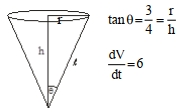
$A$ water tank has the shape of a right circular cone with its axis vertical and vertex downwards. Its semi-vertical angle is $\tan^{-1} \frac{3}{4}$. Water is poured into it at a constant rate of $6 \text{ m}^3/\text{hr}$. The rate (in $\text{m}^2/\text{hr}$) at which the wet curved surface area of the tank is increasing when the depth of water in the tank is $4 \text{ m}$ is:
A
$4$
B
$3$
C
$5$
D
$8$
Solution
(C) Let $h$ be the depth of water,$r$ be the radius of the water surface,and $\theta$ be the semi-vertical angle. Given $\tan \theta = \frac{r}{h} = \frac{3}{4}$,so $r = \frac{3}{4}h$.
The volume of water is $V = \frac{1}{3} \pi r^2 h = \frac{1}{3} \pi \left(\frac{3}{4}h\right)^2 h = \frac{3 \pi}{16} h^3$.
Differentiating with respect to time $t$,we get $\frac{dV}{dt} = \frac{3 \pi}{16} \cdot 3h^2 \frac{dh}{dt} = \frac{9 \pi}{16} h^2 \frac{dh}{dt}$.
Given $\frac{dV}{dt} = 6 \text{ m}^3/\text{hr}$. At $h = 4 \text{ m}$,$6 = \frac{9 \pi}{16} (4)^2 \frac{dh}{dt} = 9 \pi \frac{dh}{dt}$,so $\frac{dh}{dt} = \frac{6}{9 \pi} = \frac{2}{3 \pi} \text{ m/hr}$.
The slant height is $\ell = \sqrt{r^2 + h^2} = \sqrt{(\frac{3}{4}h)^2 + h^2} = \sqrt{\frac{9}{16}h^2 + h^2} = \sqrt{\frac{25}{16}h^2} = \frac{5}{4}h$.
The curved surface area is $S = \pi r \ell = \pi (\frac{3}{4}h) (\frac{5}{4}h) = \frac{15 \pi}{16} h^2$.
Differentiating with respect to $t$,$\frac{dS}{dt} = \frac{15 \pi}{16} \cdot 2h \frac{dh}{dt} = \frac{15 \pi}{8} h \frac{dh}{dt}$.
Substituting $h = 4$ and $\frac{dh}{dt} = \frac{2}{3 \pi}$,we get $\frac{dS}{dt} = \frac{15 \pi}{8} (4) (\frac{2}{3 \pi}) = \frac{15 \pi}{8} \cdot \frac{8}{3 \pi} = 5 \text{ m}^2/\text{hr}$.
The volume of water is $V = \frac{1}{3} \pi r^2 h = \frac{1}{3} \pi \left(\frac{3}{4}h\right)^2 h = \frac{3 \pi}{16} h^3$.
Differentiating with respect to time $t$,we get $\frac{dV}{dt} = \frac{3 \pi}{16} \cdot 3h^2 \frac{dh}{dt} = \frac{9 \pi}{16} h^2 \frac{dh}{dt}$.
Given $\frac{dV}{dt} = 6 \text{ m}^3/\text{hr}$. At $h = 4 \text{ m}$,$6 = \frac{9 \pi}{16} (4)^2 \frac{dh}{dt} = 9 \pi \frac{dh}{dt}$,so $\frac{dh}{dt} = \frac{6}{9 \pi} = \frac{2}{3 \pi} \text{ m/hr}$.
The slant height is $\ell = \sqrt{r^2 + h^2} = \sqrt{(\frac{3}{4}h)^2 + h^2} = \sqrt{\frac{9}{16}h^2 + h^2} = \sqrt{\frac{25}{16}h^2} = \frac{5}{4}h$.
The curved surface area is $S = \pi r \ell = \pi (\frac{3}{4}h) (\frac{5}{4}h) = \frac{15 \pi}{16} h^2$.
Differentiating with respect to $t$,$\frac{dS}{dt} = \frac{15 \pi}{16} \cdot 2h \frac{dh}{dt} = \frac{15 \pi}{8} h \frac{dh}{dt}$.
Substituting $h = 4$ and $\frac{dh}{dt} = \frac{2}{3 \pi}$,we get $\frac{dS}{dt} = \frac{15 \pi}{8} (4) (\frac{2}{3 \pi}) = \frac{15 \pi}{8} \cdot \frac{8}{3 \pi} = 5 \text{ m}^2/\text{hr}$.
0 likes
View Solution173
AdvancedMCQ
The diameter of one of the bases of a truncated cone is $100 \, mm$. If the diameter of this base is increased by $21 \%$ such that it still remains a truncated cone with the height and the other base unchanged,the volume also increases by $21 \%$. The radius of the other base (in $mm$) is
A
$65$
B
$55$
C
$45$
D
$35$
Solution
(B) Let the radius of the first base be $R_1 = 50 \, mm$ and the radius of the second base be $R_2 = r \, mm$. The height is $h$. The volume of a truncated cone is given by $V = \frac{\pi h}{3} (R_1^2 + R_1 R_2 + R_2^2)$.
Given $R_1 = 50 \, mm$. The new radius $R_1' = R_1 + 0.21 R_1 = 1.21 R_1 = 1.21 \times 50 = 60.5 \, mm$.
The new volume $V' = 1.21 V$. Substituting the values:
$1.21 \times \frac{\pi h}{3} (50^2 + 50r + r^2) = \frac{\pi h}{3} (60.5^2 + 60.5r + r^2)$.
Dividing both sides by $\frac{\pi h}{3}$:
$1.21 (2500 + 50r + r^2) = 3660.25 + 60.5r + r^2$.
$3025 + 60.5r + 1.21r^2 = 3660.25 + 60.5r + r^2$.
Subtracting $60.5r$ from both sides:
$3025 + 1.21r^2 = 3660.25 + r^2$.
$0.21r^2 = 635.25$.
$r^2 = \frac{635.25}{0.21} = 3025$.
$r = \sqrt{3025} = 55 \, mm$.
Given $R_1 = 50 \, mm$. The new radius $R_1' = R_1 + 0.21 R_1 = 1.21 R_1 = 1.21 \times 50 = 60.5 \, mm$.
The new volume $V' = 1.21 V$. Substituting the values:
$1.21 \times \frac{\pi h}{3} (50^2 + 50r + r^2) = \frac{\pi h}{3} (60.5^2 + 60.5r + r^2)$.
Dividing both sides by $\frac{\pi h}{3}$:
$1.21 (2500 + 50r + r^2) = 3660.25 + 60.5r + r^2$.
$3025 + 60.5r + 1.21r^2 = 3660.25 + 60.5r + r^2$.
Subtracting $60.5r$ from both sides:
$3025 + 1.21r^2 = 3660.25 + r^2$.
$0.21r^2 = 635.25$.
$r^2 = \frac{635.25}{0.21} = 3025$.
$r = \sqrt{3025} = 55 \, mm$.
0 likes
View Solution174
DifficultMCQ
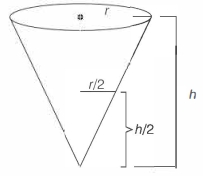
$A$ closed conical vessel is filled with water fully and is placed with its vertex down. The water is let out at a constant speed. After $21 \, min$,it was found that the height of the water column is half of the original height. How much more time in minutes does it require to empty the vessel?
A
$21$
B
$14$
C
$7$
D
$3$
Solution
(D) Let $R$ and $H$ be the radius and height of the full cone,respectively. The volume of the full cone is $V = \frac{1}{3} \pi R^2 H$.
Since the water is let out at a constant speed,the rate of change of volume is constant,i.e.,$\frac{dV}{dt} = -k$ for some constant $k > 0$.
At any height $h$,the radius $r$ of the water surface is given by $\frac{r}{h} = \frac{R}{H}$,so $r = \frac{R}{H} h$.
The volume of water at height $h$ is $V(h) = \frac{1}{3} \pi r^2 h = \frac{1}{3} \pi \left(\frac{R}{H} h\right)^2 h = \frac{\pi R^2}{3 H^2} h^3$.
Given that at $t = 0$,$h = H$,so $V(H) = \frac{1}{3} \pi R^2 H$.
At $t = 21 \, min$,$h = \frac{H}{2}$,so the volume of water remaining is $V\left(\frac{H}{2}\right) = \frac{\pi R^2}{3 H^2} \left(\frac{H}{2}\right)^3 = \frac{1}{8} \left(\frac{1}{3} \pi R^2 H\right) = \frac{V}{8}$.
The volume of water removed in $21 \, min$ is $V - \frac{V}{8} = \frac{7V}{8}$.
Since the rate of outflow is constant,the time taken to remove the remaining volume $\frac{V}{8}$ is $t'$.
Using the proportion: $\frac{\text{Volume removed}}{\text{Time taken}} = \text{constant}$.
$\frac{7V/8}{21} = \frac{V/8}{t'}$.
$t' = 21 \times \frac{V/8}{7V/8} = 21 \times \frac{1}{7} = 3 \, min$.
Thus,it requires $3 \, min$ more to empty the vessel.
Since the water is let out at a constant speed,the rate of change of volume is constant,i.e.,$\frac{dV}{dt} = -k$ for some constant $k > 0$.
At any height $h$,the radius $r$ of the water surface is given by $\frac{r}{h} = \frac{R}{H}$,so $r = \frac{R}{H} h$.
The volume of water at height $h$ is $V(h) = \frac{1}{3} \pi r^2 h = \frac{1}{3} \pi \left(\frac{R}{H} h\right)^2 h = \frac{\pi R^2}{3 H^2} h^3$.
Given that at $t = 0$,$h = H$,so $V(H) = \frac{1}{3} \pi R^2 H$.
At $t = 21 \, min$,$h = \frac{H}{2}$,so the volume of water remaining is $V\left(\frac{H}{2}\right) = \frac{\pi R^2}{3 H^2} \left(\frac{H}{2}\right)^3 = \frac{1}{8} \left(\frac{1}{3} \pi R^2 H\right) = \frac{V}{8}$.
The volume of water removed in $21 \, min$ is $V - \frac{V}{8} = \frac{7V}{8}$.
Since the rate of outflow is constant,the time taken to remove the remaining volume $\frac{V}{8}$ is $t'$.
Using the proportion: $\frac{\text{Volume removed}}{\text{Time taken}} = \text{constant}$.
$\frac{7V/8}{21} = \frac{V/8}{t'}$.
$t' = 21 \times \frac{V/8}{7V/8} = 21 \times \frac{1}{7} = 3 \, min$.
Thus,it requires $3 \, min$ more to empty the vessel.
0 likes
View Solution175
MediumMCQ
Consider an expanding sphere of instantaneous radius $R$ whose total mass remains constant. The expansion is such that the instantaneous density $\rho$ remains uniform throughout the volume. The rate of fractional change in density $\left(\frac{1}{\rho} \frac{d \rho}{dt}\right)$ is constant. The velocity $v$ of any point on the surface of the expanding sphere is proportional to
A
$R$
B
$R^3$
C
$\frac{1}{R}$
D
$R^{2/3}$
Solution
(A) The mass $m$ of the sphere is given by $m = \rho \cdot \frac{4}{3} \pi R^3$.
Since the total mass $m$ is constant,its derivative with respect to time $t$ is zero: $\frac{dm}{dt} = 0$.
Differentiating the mass equation with respect to $t$:
$0 = \frac{d\rho}{dt} \cdot \frac{4}{3} \pi R^3 + \rho \cdot 4 \pi R^2 \frac{dR}{dt}$.
Dividing by $\rho \cdot \frac{4}{3} \pi R^3$,we get:
$0 = \frac{1}{\rho} \frac{d\rho}{dt} + \frac{3}{R} \frac{dR}{dt}$.
Rearranging for the velocity of the surface $v = \frac{dR}{dt}$:
$\frac{dR}{dt} = -\frac{R}{3} \left(\frac{1}{\rho} \frac{d\rho}{dt}\right)$.
Given that the rate of fractional change in density $\left(\frac{1}{\rho} \frac{d\rho}{dt}\right)$ is a constant,let this constant be $k$.
Then $v = \frac{dR}{dt} = -\frac{k}{3} R$.
Thus,$v \propto R$.
Since the total mass $m$ is constant,its derivative with respect to time $t$ is zero: $\frac{dm}{dt} = 0$.
Differentiating the mass equation with respect to $t$:
$0 = \frac{d\rho}{dt} \cdot \frac{4}{3} \pi R^3 + \rho \cdot 4 \pi R^2 \frac{dR}{dt}$.
Dividing by $\rho \cdot \frac{4}{3} \pi R^3$,we get:
$0 = \frac{1}{\rho} \frac{d\rho}{dt} + \frac{3}{R} \frac{dR}{dt}$.
Rearranging for the velocity of the surface $v = \frac{dR}{dt}$:
$\frac{dR}{dt} = -\frac{R}{3} \left(\frac{1}{\rho} \frac{d\rho}{dt}\right)$.
Given that the rate of fractional change in density $\left(\frac{1}{\rho} \frac{d\rho}{dt}\right)$ is a constant,let this constant be $k$.
Then $v = \frac{dR}{dt} = -\frac{k}{3} R$.
Thus,$v \propto R$.
0 likes
View Solution176
MediumMCQ
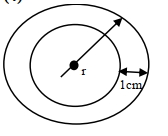
$A$ spherical chocolate ball has a layer of ice-cream of uniform thickness around it. When the thickness of the ice-cream layer is $1 \ cm$, the ice-cream melts at the rate of $81 \ cm^3/min$ and the thickness of the ice-cream layer decreases at the rate of $\frac{1}{4\pi} \ cm/min$. The surface area (in $cm^2$) of the chocolate ball (without the ice-cream layer) is: (in $\pi$)
A
$225$
B
$128$
C
$196$
D
$256$
Solution
(D) Let $r$ be the radius of the chocolate ball and $x$ be the thickness of the ice-cream layer. The total radius of the sphere (chocolate + ice-cream) is $R = r + x$.
Given $x = 1 \ cm$, the total volume $V$ of the sphere is $V = \frac{4}{3}\pi R^3$.
Differentiating with respect to time $t$, we get $\frac{dV}{dt} = 4\pi R^2 \frac{dR}{dt}$.
Since the chocolate ball is constant, $\frac{dR}{dt} = \frac{dx}{dt}$.
We are given $\frac{dV}{dt} = -81 \ cm^3/min$ (as it melts) and $\frac{dx}{dt} = -\frac{1}{4\pi} \ cm/min$.
Substituting these values: $-81 = 4\pi R^2 \left(-\frac{1}{4\pi}\right)$.
$-81 = -R^2 \implies R^2 = 81 \implies R = 9 \ cm$.
Since $R = r + x$ and $x = 1 \ cm$, we have $r = 9 - 1 = 8 \ cm$.
The surface area of the chocolate ball is $4\pi r^2 = 4\pi(8)^2 = 4\pi(64) = 256\pi \ cm^2$.
Given $x = 1 \ cm$, the total volume $V$ of the sphere is $V = \frac{4}{3}\pi R^3$.
Differentiating with respect to time $t$, we get $\frac{dV}{dt} = 4\pi R^2 \frac{dR}{dt}$.
Since the chocolate ball is constant, $\frac{dR}{dt} = \frac{dx}{dt}$.
We are given $\frac{dV}{dt} = -81 \ cm^3/min$ (as it melts) and $\frac{dx}{dt} = -\frac{1}{4\pi} \ cm/min$.
Substituting these values: $-81 = 4\pi R^2 \left(-\frac{1}{4\pi}\right)$.
$-81 = -R^2 \implies R^2 = 81 \implies R = 9 \ cm$.
Since $R = r + x$ and $x = 1 \ cm$, we have $r = 9 - 1 = 8 \ cm$.
The surface area of the chocolate ball is $4\pi r^2 = 4\pi(8)^2 = 4\pi(64) = 256\pi \ cm^2$.
0 likes
View Solution177
MediumMCQ
$A$ particle moves along a curve $y = \frac{2x^3 - 1}{3}$. The points on the curve at which the $y$-coordinate is changing $18$ times as fast as the $x$-coordinate are
A
$(-3, -\frac{55}{3}), (3, -\frac{53}{3})$
B
$(-3, \frac{53}{3}), (3, \frac{55}{3})$
C
$(-3, -\frac{53}{3}), (3, \frac{55}{3})$
D
$(-3, -\frac{55}{3}), (3, \frac{53}{3})$
Solution
(D) Given the curve equation is $y = \frac{2x^3 - 1}{3}$.
We are given that the rate of change of the $y$-coordinate is $18$ times the rate of change of the $x$-coordinate,which implies $\frac{dy}{dt} = 18 \frac{dx}{dt}$.
Dividing both sides by $\frac{dx}{dt}$,we get $\frac{dy}{dx} = 18$.
Now,differentiate the curve equation with respect to $x$:
$\frac{dy}{dx} = \frac{d}{dx} (\frac{2x^3 - 1}{3}) = \frac{1}{3} \cdot 6x^2 = 2x^2$.
Equating the derivative to $18$:
$2x^2 = 18 \implies x^2 = 9 \implies x = \pm 3$.
For $x = 3$,$y = \frac{2(3)^3 - 1}{3} = \frac{54 - 1}{3} = \frac{53}{3}$.
For $x = -3$,$y = \frac{2(-3)^3 - 1}{3} = \frac{-54 - 1}{3} = -\frac{55}{3}$.
Thus,the points are $(3, \frac{53}{3})$ and $(-3, -\frac{55}{3})$.
Comparing this with the given options,the correct option is $D$.
We are given that the rate of change of the $y$-coordinate is $18$ times the rate of change of the $x$-coordinate,which implies $\frac{dy}{dt} = 18 \frac{dx}{dt}$.
Dividing both sides by $\frac{dx}{dt}$,we get $\frac{dy}{dx} = 18$.
Now,differentiate the curve equation with respect to $x$:
$\frac{dy}{dx} = \frac{d}{dx} (\frac{2x^3 - 1}{3}) = \frac{1}{3} \cdot 6x^2 = 2x^2$.
Equating the derivative to $18$:
$2x^2 = 18 \implies x^2 = 9 \implies x = \pm 3$.
For $x = 3$,$y = \frac{2(3)^3 - 1}{3} = \frac{54 - 1}{3} = \frac{53}{3}$.
For $x = -3$,$y = \frac{2(-3)^3 - 1}{3} = \frac{-54 - 1}{3} = -\frac{55}{3}$.
Thus,the points are $(3, \frac{53}{3})$ and $(-3, -\frac{55}{3})$.
Comparing this with the given options,the correct option is $D$.
0 likes
View Solution178
EasyMCQ
$A$ particle moves such that $x = 2 + 27t - t^3$. The direction of motion reverses after moving a distance of ... units.
A
$80$
B
$56$
C
$60$
D
$65$
Solution
(B) Given the position function $x = 2 + 27t - t^3$.
To find the velocity,we differentiate $x$ with respect to $t$:
$v = \frac{dx}{dt} = 27 - 3t^2$.
The direction of motion reverses when the velocity becomes zero:
$27 - 3t^2 = 0$
$3t^2 = 27$
$t^2 = 9$
$t = 3$ (since $t > 0$).
Now,we calculate the distance $x$ at $t = 3$:
$x = 2 + 27(3) - (3)^3$
$x = 2 + 81 - 27$
$x = 56 \text{ units}$.
To find the velocity,we differentiate $x$ with respect to $t$:
$v = \frac{dx}{dt} = 27 - 3t^2$.
The direction of motion reverses when the velocity becomes zero:
$27 - 3t^2 = 0$
$3t^2 = 27$
$t^2 = 9$
$t = 3$ (since $t > 0$).
Now,we calculate the distance $x$ at $t = 3$:
$x = 2 + 27(3) - (3)^3$
$x = 2 + 81 - 27$
$x = 56 \text{ units}$.
0 likes
View Solution179
EasyMCQ
By dropping a stone in a quiet lake,a wave in the form of a circle is generated. The radius of the circular wave increases at the rate of $2.1 \text{ cm/sec}$. Then the rate of increase of the enclosed circular region,when the radius of the circular wave is $10 \text{ cm}$,is (Given $\pi = \frac{22}{7}$)
A
$66 \text{ cm}^2/\text{sec}$
B
$122 \text{ cm}^2/\text{sec}$
C
$132 \text{ cm}^2/\text{sec}$
D
$110 \text{ cm}^2/\text{sec}$
Solution
(C) Let $r$ be the radius of the circular wave and $A$ be the area of the circular region.
Given that the rate of change of the radius is $\frac{dr}{dt} = 2.1 \text{ cm/sec}$.
The area of the circle is given by $A = \pi r^2$.
Differentiating both sides with respect to $t$,we get $\frac{dA}{dt} = 2\pi r \frac{dr}{dt}$.
Given $r = 10 \text{ cm}$ and $\frac{dr}{dt} = 2.1 \text{ cm/sec}$.
Substituting these values,$\frac{dA}{dt} = 2 \times \frac{22}{7} \times 10 \times 2.1$.
$\frac{dA}{dt} = 2 \times \frac{22}{7} \times 10 \times \frac{21}{10}$.
$\frac{dA}{dt} = 2 \times 22 \times 3 = 132 \text{ cm}^2/\text{sec}$.
Given that the rate of change of the radius is $\frac{dr}{dt} = 2.1 \text{ cm/sec}$.
The area of the circle is given by $A = \pi r^2$.
Differentiating both sides with respect to $t$,we get $\frac{dA}{dt} = 2\pi r \frac{dr}{dt}$.
Given $r = 10 \text{ cm}$ and $\frac{dr}{dt} = 2.1 \text{ cm/sec}$.
Substituting these values,$\frac{dA}{dt} = 2 \times \frac{22}{7} \times 10 \times 2.1$.
$\frac{dA}{dt} = 2 \times \frac{22}{7} \times 10 \times \frac{21}{10}$.
$\frac{dA}{dt} = 2 \times 22 \times 3 = 132 \text{ cm}^2/\text{sec}$.
0 likes
View Solution180
MediumMCQ
The radius of the base of a cone is increasing at the rate $3 \text{ cm/min}$ and the altitude is decreasing at the rate $4 \text{ cm/min}$. The rate at which the lateral surface area is changing,when the radius is $7 \text{ cm}$ and altitude is $24 \text{ cm}$,is:
A
$75 \pi \text{ cm}^2/\text{min}$
B
$25 \pi \text{ cm}^2/\text{min}$
C
$3 \pi \text{ cm}^2/\text{min}$
D
$54 \pi \text{ cm}^2/\text{min}$
Solution
(D) Let $r$ be the radius and $h$ be the altitude of the cone. The slant height $l$ is given by $l = \sqrt{r^2 + h^2}$.
Given: $\frac{dr}{dt} = 3 \text{ cm/min}$ and $\frac{dh}{dt} = -4 \text{ cm/min}$.
The lateral surface area $S$ of a cone is $S = \pi rl = \pi r \sqrt{r^2 + h^2}$.
At $r = 7$ and $h = 24$,$l = \sqrt{7^2 + 24^2} = \sqrt{49 + 576} = \sqrt{625} = 25 \text{ cm}$.
Differentiating $S$ with respect to $t$:
$\frac{dS}{dt} = \pi \left( \frac{dr}{dt} \sqrt{r^2 + h^2} + r \cdot \frac{1}{2\sqrt{r^2 + h^2}} \cdot (2r \frac{dr}{dt} + 2h \frac{dh}{dt}) \right)$.
$\frac{dS}{dt} = \pi \left( 3 \cdot 25 + 7 \cdot \frac{1}{25} \cdot (7 \cdot 3 + 24 \cdot (-4)) \right)$.
$\frac{dS}{dt} = \pi \left( 75 + \frac{7}{25} \cdot (21 - 96) \right) = \pi \left( 75 + \frac{7}{25} \cdot (-75) \right)$.
$\frac{dS}{dt} = \pi (75 - 7 \cdot 3) = \pi (75 - 21) = 54 \pi \text{ cm}^2/\text{min}$.
Given: $\frac{dr}{dt} = 3 \text{ cm/min}$ and $\frac{dh}{dt} = -4 \text{ cm/min}$.
The lateral surface area $S$ of a cone is $S = \pi rl = \pi r \sqrt{r^2 + h^2}$.
At $r = 7$ and $h = 24$,$l = \sqrt{7^2 + 24^2} = \sqrt{49 + 576} = \sqrt{625} = 25 \text{ cm}$.
Differentiating $S$ with respect to $t$:
$\frac{dS}{dt} = \pi \left( \frac{dr}{dt} \sqrt{r^2 + h^2} + r \cdot \frac{1}{2\sqrt{r^2 + h^2}} \cdot (2r \frac{dr}{dt} + 2h \frac{dh}{dt}) \right)$.
$\frac{dS}{dt} = \pi \left( 3 \cdot 25 + 7 \cdot \frac{1}{25} \cdot (7 \cdot 3 + 24 \cdot (-4)) \right)$.
$\frac{dS}{dt} = \pi \left( 75 + \frac{7}{25} \cdot (21 - 96) \right) = \pi \left( 75 + \frac{7}{25} \cdot (-75) \right)$.
$\frac{dS}{dt} = \pi (75 - 7 \cdot 3) = \pi (75 - 21) = 54 \pi \text{ cm}^2/\text{min}$.
0 likes
View Solution181
MediumMCQ
Let $x$ be the length of each of the equal sides of an isosceles triangle and $\theta$ be the angle between these sides. If $x$ is increasing at the rate $\frac{1}{12} \text{ m/hour}$ and $\theta$ is increasing at the rate $\frac{\pi}{180} \text{ rad/hour}$,then the rate at which the area of the triangle is increasing when $x=12 \text{ m}$ and $\theta=\frac{\pi}{4}$ is:
A
$\left(\frac{\pi}{5}+\frac{1}{2}\right) \text{ m}^2/\text{hour}$
B
$\sqrt{2}\left(\frac{\pi}{5}+\frac{1}{2}\right) \text{ m}^2/\text{hour}$
C
$2\left(\frac{\pi}{5}+\frac{1}{2}\right) \text{ m}^2/\text{hour}$
D
$\sqrt{3}\left(\frac{\pi}{5}+\frac{1}{2}\right) \text{ m}^2/\text{hour}$
Solution
(B) The area $A$ of an isosceles triangle with equal sides $x$ and included angle $\theta$ is given by $A = \frac{1}{2} x^2 \sin \theta$.
To find the rate of change of the area,we differentiate $A$ with respect to time $t$ using the product rule:
$\frac{dA}{dt} = \frac{1}{2} \left( 2x \frac{dx}{dt} \sin \theta + x^2 \cos \theta \frac{d\theta}{dt} \right) = x \frac{dx}{dt} \sin \theta + \frac{1}{2} x^2 \cos \theta \frac{d\theta}{dt}$.
Given values: $x = 12 \text{ m}$,$\theta = \frac{\pi}{4}$,$\frac{dx}{dt} = \frac{1}{12} \text{ m/h}$,and $\frac{d\theta}{dt} = \frac{\pi}{180} \text{ rad/h}$.
Substituting these values into the derivative:
$\frac{dA}{dt} = (12) \left( \frac{1}{12} \right) \sin \left( \frac{\pi}{4} \right) + \frac{1}{2} (12)^2 \cos \left( \frac{\pi}{4} \right) \left( \frac{\pi}{180} \right)$.
$\frac{dA}{dt} = (1) \left( \frac{1}{\sqrt{2}} \right) + \frac{1}{2} (144) \left( \frac{1}{\sqrt{2}} \right) \left( \frac{\pi}{180} \right)$.
$\frac{dA}{dt} = \frac{1}{\sqrt{2}} + \frac{72}{\sqrt{2}} \left( \frac{\pi}{180} \right) = \frac{1}{\sqrt{2}} + \frac{2\pi}{5\sqrt{2}} = \frac{1}{\sqrt{2}} \left( 1 + \frac{2\pi}{5} \right)$.
Note: The provided options seem to contain a typo in the coefficient. Re-evaluating the expression: $\frac{1}{\sqrt{2}} (1 + \frac{2\pi}{5}) = \frac{\sqrt{2}}{2} (1 + \frac{2\pi}{5}) = \sqrt{2} (\frac{1}{2} + \frac{\pi}{5})$.
Thus,the correct option is $B$.
To find the rate of change of the area,we differentiate $A$ with respect to time $t$ using the product rule:
$\frac{dA}{dt} = \frac{1}{2} \left( 2x \frac{dx}{dt} \sin \theta + x^2 \cos \theta \frac{d\theta}{dt} \right) = x \frac{dx}{dt} \sin \theta + \frac{1}{2} x^2 \cos \theta \frac{d\theta}{dt}$.
Given values: $x = 12 \text{ m}$,$\theta = \frac{\pi}{4}$,$\frac{dx}{dt} = \frac{1}{12} \text{ m/h}$,and $\frac{d\theta}{dt} = \frac{\pi}{180} \text{ rad/h}$.
Substituting these values into the derivative:
$\frac{dA}{dt} = (12) \left( \frac{1}{12} \right) \sin \left( \frac{\pi}{4} \right) + \frac{1}{2} (12)^2 \cos \left( \frac{\pi}{4} \right) \left( \frac{\pi}{180} \right)$.
$\frac{dA}{dt} = (1) \left( \frac{1}{\sqrt{2}} \right) + \frac{1}{2} (144) \left( \frac{1}{\sqrt{2}} \right) \left( \frac{\pi}{180} \right)$.
$\frac{dA}{dt} = \frac{1}{\sqrt{2}} + \frac{72}{\sqrt{2}} \left( \frac{\pi}{180} \right) = \frac{1}{\sqrt{2}} + \frac{2\pi}{5\sqrt{2}} = \frac{1}{\sqrt{2}} \left( 1 + \frac{2\pi}{5} \right)$.
Note: The provided options seem to contain a typo in the coefficient. Re-evaluating the expression: $\frac{1}{\sqrt{2}} (1 + \frac{2\pi}{5}) = \frac{\sqrt{2}}{2} (1 + \frac{2\pi}{5}) = \sqrt{2} (\frac{1}{2} + \frac{\pi}{5})$.
Thus,the correct option is $B$.
0 likes
View Solution182
MediumMCQ
The equation of motion of a particle is given by $s = at^2 + bt + c$. If the displacement after $1 \ s$ is $20 \ m$,the velocity after $2 \ s$ is $30 \ m/s$,and the acceleration is $10 \ m/s^2$,then which of the following is true?
A
$a + c = 2b$
B
$a + c = b$
C
$a - c = b$
D
$a + c = 3b$
Solution
(B) Given the equation of motion: $s(t) = at^2 + bt + c$.
Velocity $v(t) = \frac{ds}{dt} = 2at + b$.
Acceleration $a_{acc}(t) = \frac{dv}{dt} = 2a$.
Given acceleration is $10 \ m/s^2$,so $2a = 10 \implies a = 5$.
Given velocity after $2 \ s$ is $30 \ m/s$: $v(2) = 2a(2) + b = 30 \implies 4a + b = 30$.
Substituting $a = 5$: $4(5) + b = 30 \implies 20 + b = 30 \implies b = 10$.
Given displacement after $1 \ s$ is $20 \ m$: $s(1) = a(1)^2 + b(1) + c = 20 \implies a + b + c = 20$.
Substituting $a = 5$ and $b = 10$: $5 + 10 + c = 20 \implies 15 + c = 20 \implies c = 5$.
Now check the options:
$a + c = 5 + 5 = 10$.
Since $b = 10$,we have $a + c = b$.
Velocity $v(t) = \frac{ds}{dt} = 2at + b$.
Acceleration $a_{acc}(t) = \frac{dv}{dt} = 2a$.
Given acceleration is $10 \ m/s^2$,so $2a = 10 \implies a = 5$.
Given velocity after $2 \ s$ is $30 \ m/s$: $v(2) = 2a(2) + b = 30 \implies 4a + b = 30$.
Substituting $a = 5$: $4(5) + b = 30 \implies 20 + b = 30 \implies b = 10$.
Given displacement after $1 \ s$ is $20 \ m$: $s(1) = a(1)^2 + b(1) + c = 20 \implies a + b + c = 20$.
Substituting $a = 5$ and $b = 10$: $5 + 10 + c = 20 \implies 15 + c = 20 \implies c = 5$.
Now check the options:
$a + c = 5 + 5 = 10$.
Since $b = 10$,we have $a + c = b$.
0 likes
View Solution183
MediumMCQ
The length and breadth of a rectangle are $x \text{ cm}$ and $y \text{ cm}$ respectively. If the length decreases at the rate of $5 \text{ cm/min}$ and the breadth increases at the rate of $3 \text{ cm/min}$,then the rates of change of the perimeter and area respectively when $x = 5 \text{ cm}$ and $y = 2 \text{ cm}$ are:
A
$-4 \text{ cm/min}$ and $5 \text{ cm}^2\text{/min}$
B
$-5 \text{ cm/min}$ and $3 \text{ cm}^2\text{/min}$
C
$3 \text{ cm/min}$ and $5 \text{ cm}^2\text{/min}$
D
$3 \text{ cm/min}$ and $-5 \text{ cm}^2\text{/min}$
Solution
(A) Let $x$ be the length and $y$ be the breadth of the rectangle. Given $\frac{dx}{dt} = -5 \text{ cm/min}$ and $\frac{dy}{dt} = 3 \text{ cm/min}$.
Perimeter $P = 2(x + y)$.
The rate of change of perimeter is $\frac{dP}{dt} = 2(\frac{dx}{dt} + \frac{dy}{dt}) = 2(-5 + 3) = 2(-2) = -4 \text{ cm/min}$.
Area $A = xy$.
The rate of change of area is $\frac{dA}{dt} = x \frac{dy}{dt} + y \frac{dx}{dt}$.
Substituting the values $x = 5$,$y = 2$,$\frac{dx}{dt} = -5$,and $\frac{dy}{dt} = 3$:
$\frac{dA}{dt} = (5)(3) + (2)(-5) = 15 - 10 = 5 \text{ cm}^2\text{/min}$.
Thus,the rates of change are $-4 \text{ cm/min}$ and $5 \text{ cm}^2\text{/min}$.
Perimeter $P = 2(x + y)$.
The rate of change of perimeter is $\frac{dP}{dt} = 2(\frac{dx}{dt} + \frac{dy}{dt}) = 2(-5 + 3) = 2(-2) = -4 \text{ cm/min}$.
Area $A = xy$.
The rate of change of area is $\frac{dA}{dt} = x \frac{dy}{dt} + y \frac{dx}{dt}$.
Substituting the values $x = 5$,$y = 2$,$\frac{dx}{dt} = -5$,and $\frac{dy}{dt} = 3$:
$\frac{dA}{dt} = (5)(3) + (2)(-5) = 15 - 10 = 5 \text{ cm}^2\text{/min}$.
Thus,the rates of change are $-4 \text{ cm/min}$ and $5 \text{ cm}^2\text{/min}$.
0 likes
View Solution184
EasyMCQ
The rate of change of the volume of a sphere with respect to its surface area,when the radius is $5 \ m$ is
A
$5/2 \ m$
B
$2/5 \ m$
C
$1/2 \ m$
D
$5/1 \ m$
Solution
(A) Let $r$ be the radius of the sphere.
The volume $V$ of the sphere is given by $V = \frac{4}{3} \pi r^3$.
The surface area $S$ of the sphere is given by $S = 4 \pi r^2$.
We need to find the rate of change of volume with respect to surface area,which is $\frac{dV}{dS}$.
Using the chain rule,$\frac{dV}{dS} = \frac{dV/dr}{dS/dr}$.
Differentiating $V$ with respect to $r$: $\frac{dV}{dr} = \frac{d}{dr}(\frac{4}{3} \pi r^3) = 4 \pi r^2$.
Differentiating $S$ with respect to $r$: $\frac{dS}{dr} = \frac{d}{dr}(4 \pi r^2) = 8 \pi r$.
Therefore,$\frac{dV}{dS} = \frac{4 \pi r^2}{8 \pi r} = \frac{r}{2}$.
When the radius $r = 5 \ m$,the rate of change is $\frac{5}{2} \ m$.
The volume $V$ of the sphere is given by $V = \frac{4}{3} \pi r^3$.
The surface area $S$ of the sphere is given by $S = 4 \pi r^2$.
We need to find the rate of change of volume with respect to surface area,which is $\frac{dV}{dS}$.
Using the chain rule,$\frac{dV}{dS} = \frac{dV/dr}{dS/dr}$.
Differentiating $V$ with respect to $r$: $\frac{dV}{dr} = \frac{d}{dr}(\frac{4}{3} \pi r^3) = 4 \pi r^2$.
Differentiating $S$ with respect to $r$: $\frac{dS}{dr} = \frac{d}{dr}(4 \pi r^2) = 8 \pi r$.
Therefore,$\frac{dV}{dS} = \frac{4 \pi r^2}{8 \pi r} = \frac{r}{2}$.
When the radius $r = 5 \ m$,the rate of change is $\frac{5}{2} \ m$.
0 likes
View Solution185
MediumMCQ
If $x$ and $y$ are sides of two squares such that $y = x - x^2$,then the rate of change of area of the second square with respect to that of the first square is
A
$(1 - 2x)^2$
B
$2(1 - 2x)(1 - x)$
C
$2(1 - 2x)(1 - 2x)$
D
$2(1 - 2x)(x - 1)$
Solution
(C) Let $A_1$ be the area of the first square and $A_2$ be the area of the second square.
Given that the side of the first square is $x$,so $A_1 = x^2$.
Given that the side of the second square is $y = x - x^2$,so $A_2 = y^2 = (x - x^2)^2$.
We need to find the rate of change of $A_2$ with respect to $A_1$,which is $\frac{dA_2}{dA_1}$.
Using the chain rule,$\frac{dA_2}{dA_1} = \frac{dA_2/dx}{dA_1/dx}$.
First,calculate $\frac{dA_1}{dx} = \frac{d}{dx}(x^2) = 2x$.
Next,calculate $\frac{dA_2}{dx} = \frac{d}{dx}((x - x^2)^2) = 2(x - x^2) \cdot \frac{d}{dx}(x - x^2) = 2(x - x^2)(1 - 2x)$.
Now,substitute these into the chain rule formula:
$\frac{dA_2}{dA_1} = \frac{2(x - x^2)(1 - 2x)}{2x} = \frac{2x(1 - x)(1 - 2x)}{2x} = (1 - x)(1 - 2x) = 1 - 2x - x + 2x^2 = 2x^2 - 3x + 1$.
Given that the side of the first square is $x$,so $A_1 = x^2$.
Given that the side of the second square is $y = x - x^2$,so $A_2 = y^2 = (x - x^2)^2$.
We need to find the rate of change of $A_2$ with respect to $A_1$,which is $\frac{dA_2}{dA_1}$.
Using the chain rule,$\frac{dA_2}{dA_1} = \frac{dA_2/dx}{dA_1/dx}$.
First,calculate $\frac{dA_1}{dx} = \frac{d}{dx}(x^2) = 2x$.
Next,calculate $\frac{dA_2}{dx} = \frac{d}{dx}((x - x^2)^2) = 2(x - x^2) \cdot \frac{d}{dx}(x - x^2) = 2(x - x^2)(1 - 2x)$.
Now,substitute these into the chain rule formula:
$\frac{dA_2}{dA_1} = \frac{2(x - x^2)(1 - 2x)}{2x} = \frac{2x(1 - x)(1 - 2x)}{2x} = (1 - x)(1 - 2x) = 1 - 2x - x + 2x^2 = 2x^2 - 3x + 1$.
0 likes
View Solution186
EasyMCQ
The surface area of a spherical ball is increasing at the rate of $4 \pi \,cm^2/s$. The rate at which the radius is increasing when the surface area is $16 \pi \,cm^2$ is: (in $\,cm/s$)
A
$0.5$
B
$0.25$
C
$0.125$
D
$1$
Solution
(B) Let $S$ be the surface area and $r$ be the radius of the spherical ball. The surface area is given by $S = 4 \pi r^2$.
Given that $\frac{dS}{dt} = 4 \pi \,cm^2/s$.
Differentiating $S$ with respect to $t$,we get $\frac{dS}{dt} = 8 \pi r \frac{dr}{dt}$.
When $S = 16 \pi \,cm^2$,we have $4 \pi r^2 = 16 \pi$,which implies $r^2 = 4$,so $r = 2 \,cm$.
Substituting the values into the derivative equation: $4 \pi = 8 \pi (2) \frac{dr}{dt}$.
$4 \pi = 16 \pi \frac{dr}{dt}$.
$\frac{dr}{dt} = \frac{4 \pi}{16 \pi} = 0.25 \,cm/s$.
Given that $\frac{dS}{dt} = 4 \pi \,cm^2/s$.
Differentiating $S$ with respect to $t$,we get $\frac{dS}{dt} = 8 \pi r \frac{dr}{dt}$.
When $S = 16 \pi \,cm^2$,we have $4 \pi r^2 = 16 \pi$,which implies $r^2 = 4$,so $r = 2 \,cm$.
Substituting the values into the derivative equation: $4 \pi = 8 \pi (2) \frac{dr}{dt}$.
$4 \pi = 16 \pi \frac{dr}{dt}$.
$\frac{dr}{dt} = \frac{4 \pi}{16 \pi} = 0.25 \,cm/s$.
0 likes
View Solution187
MediumMCQ
$A$ spherical balloon is filled with $4500 \pi$ cubic meters of helium gas. If a leak in the balloon causes the gas to escape at the rate of $72 \pi$ cubic meters per minute,then the rate (in meters per minute) at which the radius of the balloon decreases $49$ minutes after the leakage has begun,is
A
$\frac{9}{7}$
B
$-\frac{2}{9}$
C
$\frac{9}{2}$
D
$\frac{2}{9}$
Solution
(D) The volume of a spherical balloon is given by $V = \frac{4}{3} \pi r^3$.
Given the initial volume $V_0 = 4500 \pi \ m^3$.
The rate of change of volume is $\frac{dV}{dt} = -72 \pi \ m^3/\text{min}$.
After $t = 49$ minutes,the volume $V$ is $V = V_0 + (\frac{dV}{dt}) \times t = 4500 \pi - 72 \pi \times 49$.
$V = 4500 \pi - 3528 \pi = 972 \pi \ m^3$.
Using $V = \frac{4}{3} \pi r^3$,we find the radius $r$ at $t = 49$:
$972 \pi = \frac{4}{3} \pi r^3 \implies r^3 = 972 \times \frac{3}{4} = 729$.
$r = \sqrt[3]{729} = 9 \ m$.
Now,differentiate $V = \frac{4}{3} \pi r^3$ with respect to $t$:
$\frac{dV}{dt} = 4 \pi r^2 \frac{dr}{dt}$.
Substitute the known values: $-72 \pi = 4 \pi (9)^2 \frac{dr}{dt}$.
$-72 \pi = 4 \pi (81) \frac{dr}{dt} \implies -72 \pi = 324 \pi \frac{dr}{dt}$.
$\frac{dr}{dt} = -\frac{72}{324} = -\frac{2}{9} \ m/\text{min}$.
The rate at which the radius decreases is $\frac{2}{9} \ m/\text{min}$.
Given the initial volume $V_0 = 4500 \pi \ m^3$.
The rate of change of volume is $\frac{dV}{dt} = -72 \pi \ m^3/\text{min}$.
After $t = 49$ minutes,the volume $V$ is $V = V_0 + (\frac{dV}{dt}) \times t = 4500 \pi - 72 \pi \times 49$.
$V = 4500 \pi - 3528 \pi = 972 \pi \ m^3$.
Using $V = \frac{4}{3} \pi r^3$,we find the radius $r$ at $t = 49$:
$972 \pi = \frac{4}{3} \pi r^3 \implies r^3 = 972 \times \frac{3}{4} = 729$.
$r = \sqrt[3]{729} = 9 \ m$.
Now,differentiate $V = \frac{4}{3} \pi r^3$ with respect to $t$:
$\frac{dV}{dt} = 4 \pi r^2 \frac{dr}{dt}$.
Substitute the known values: $-72 \pi = 4 \pi (9)^2 \frac{dr}{dt}$.
$-72 \pi = 4 \pi (81) \frac{dr}{dt} \implies -72 \pi = 324 \pi \frac{dr}{dt}$.
$\frac{dr}{dt} = -\frac{72}{324} = -\frac{2}{9} \ m/\text{min}$.
The rate at which the radius decreases is $\frac{2}{9} \ m/\text{min}$.
0 likes
View Solution188
EasyMCQ
$A$ bullet is shot horizontally and its distance $S$ cm at time $t$ second is given by $S=1200t-15t^2$. Then, the distance covered by the bullet when it comes to rest is: (in $\text{ cm}$)
A
$12000$
B
$24000$
C
$1200$
D
$2400$
Solution
(B) The distance equation is given by $S = 1200t - 15t^2$.
To find the velocity $v$, we differentiate $S$ with respect to $t$:
$v = \frac{dS}{dt} = \frac{d}{dt}(1200t - 15t^2) = 1200 - 30t$.
When the bullet comes to rest, its velocity $v$ becomes $0$:
$1200 - 30t = 0$
$30t = 1200$
$t = 40 \text{ seconds}$.
Now, substitute $t = 40$ into the distance equation to find the total distance covered:
$S = 1200(40) - 15(40)^2$
$S = 48000 - 15(1600)$
$S = 48000 - 24000$
$S = 24000 \text{ cm}$.
To find the velocity $v$, we differentiate $S$ with respect to $t$:
$v = \frac{dS}{dt} = \frac{d}{dt}(1200t - 15t^2) = 1200 - 30t$.
When the bullet comes to rest, its velocity $v$ becomes $0$:
$1200 - 30t = 0$
$30t = 1200$
$t = 40 \text{ seconds}$.
Now, substitute $t = 40$ into the distance equation to find the total distance covered:
$S = 1200(40) - 15(40)^2$
$S = 48000 - 15(1600)$
$S = 48000 - 24000$
$S = 24000 \text{ cm}$.
0 likes
View Solution189
EasyMCQ
$A$ stone is dropped into a quiet lake and waves move in circles at a speed of $8 \,cm/sec$. At the instant when the radius of the circular wave is $12 \,cm$, how fast is the enclosed area increasing?
A
$180 \pi \,cm^2/sec$
B
$196 \pi \,cm^2/sec$
C
$192 \pi \,cm^2/sec$
D
$200 \pi \,cm^2/sec$
Solution
(C) Given, the rate of change of the radius is $\frac{dr}{dt} = 8 \,cm/sec$.
The area of the circular wave is $A = \pi r^2$.
Differentiating both sides with respect to time $t$, we get $\frac{dA}{dt} = 2 \pi r \frac{dr}{dt}$.
At the instant when $r = 12 \,cm$, substituting the values:
$\frac{dA}{dt} = 2 \pi (12) (8)$.
$\frac{dA}{dt} = 192 \pi \,cm^2/sec$.
The area of the circular wave is $A = \pi r^2$.
Differentiating both sides with respect to time $t$, we get $\frac{dA}{dt} = 2 \pi r \frac{dr}{dt}$.
At the instant when $r = 12 \,cm$, substituting the values:
$\frac{dA}{dt} = 2 \pi (12) (8)$.
$\frac{dA}{dt} = 192 \pi \,cm^2/sec$.
0 likes
View Solution190
EasyMCQ
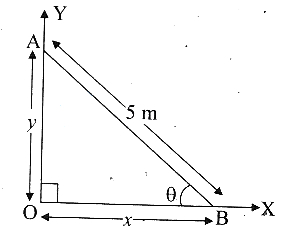
$A$ ladder $5 \ m$ long rests against a vertical wall. If its top slides downwards at the rate of $10 \ cm/sec$,then the foot of the ladder is sliding at the rate of . . . . . . $m/sec$,when it is $4 \ m$ away from the wall.
A
$0.75$
B
$7.5$
C
$0.0075$
D
$0.075$
Solution
(D) Let $x$ be the distance of the foot of the ladder from the wall and $y$ be the height of the top of the ladder from the ground.
According to the Pythagorean theorem,$x^2 + y^2 = 5^2 = 25$.
Given that the top slides downwards at a rate of $10 \ cm/sec$,so $\frac{dy}{dt} = -10 \ cm/sec = -0.1 \ m/sec$.
When $x = 4 \ m$,we have $4^2 + y^2 = 25$,which gives $y^2 = 25 - 16 = 9$,so $y = 3 \ m$.
Differentiating $x^2 + y^2 = 25$ with respect to $t$,we get:
$2x \frac{dx}{dt} + 2y \frac{dy}{dt} = 0$
$x \frac{dx}{dt} = -y \frac{dy}{dt}$
Substituting the values $x = 4$,$y = 3$,and $\frac{dy}{dt} = -0.1$:
$4 \frac{dx}{dt} = -3(-0.1)$
$4 \frac{dx}{dt} = 0.3$
$\frac{dx}{dt} = \frac{0.3}{4} = 0.075 \ m/sec$.
Thus,the foot of the ladder is sliding at the rate of $0.075 \ m/sec$.
According to the Pythagorean theorem,$x^2 + y^2 = 5^2 = 25$.
Given that the top slides downwards at a rate of $10 \ cm/sec$,so $\frac{dy}{dt} = -10 \ cm/sec = -0.1 \ m/sec$.
When $x = 4 \ m$,we have $4^2 + y^2 = 25$,which gives $y^2 = 25 - 16 = 9$,so $y = 3 \ m$.
Differentiating $x^2 + y^2 = 25$ with respect to $t$,we get:
$2x \frac{dx}{dt} + 2y \frac{dy}{dt} = 0$
$x \frac{dx}{dt} = -y \frac{dy}{dt}$
Substituting the values $x = 4$,$y = 3$,and $\frac{dy}{dt} = -0.1$:
$4 \frac{dx}{dt} = -3(-0.1)$
$4 \frac{dx}{dt} = 0.3$
$\frac{dx}{dt} = \frac{0.3}{4} = 0.075 \ m/sec$.
Thus,the foot of the ladder is sliding at the rate of $0.075 \ m/sec$.
0 likes
View Solution191
EasyMCQ
$A$ square plate is contracting at the uniform rate $3 \,cm^2 / sec$. The rate at which the perimeter is decreasing, when the side of the square is $15 \,cm$, is
A
$\frac{1}{5} \,cm / sec$
B
$\frac{2}{5} \,cm / sec$
C
$\frac{1}{10} \,cm / sec$
D
$\frac{3}{10} \,cm / sec$
Solution
(B) Let $A$, $P$, and $X$ be the area, perimeter, and length of the side of the square respectively at time $t$ seconds.
Given that the area is contracting at a rate of $\frac{dA}{dt} = -3 \,cm^2 / sec$.
The area of the square is $A = X^2$ and the perimeter is $P = 4X$.
From $A = X^2$, we have $X = \sqrt{A}$.
Substituting this into the perimeter formula: $P = 4\sqrt{A}$.
Differentiating with respect to $t$:
$\frac{dP}{dt} = 4 \cdot \frac{1}{2\sqrt{A}} \cdot \frac{dA}{dt} = \frac{2}{X} \cdot \frac{dA}{dt}$.
Given $X = 15 \,cm$ and $\frac{dA}{dt} = -3 \,cm^2 / sec$ (since it is contracting):
$\frac{dP}{dt} = \frac{2}{15} \cdot (-3) = -\frac{6}{15} = -\frac{2}{5} \,cm / sec$.
The negative sign indicates that the perimeter is decreasing at a rate of $\frac{2}{5} \,cm / sec$.
Given that the area is contracting at a rate of $\frac{dA}{dt} = -3 \,cm^2 / sec$.
The area of the square is $A = X^2$ and the perimeter is $P = 4X$.
From $A = X^2$, we have $X = \sqrt{A}$.
Substituting this into the perimeter formula: $P = 4\sqrt{A}$.
Differentiating with respect to $t$:
$\frac{dP}{dt} = 4 \cdot \frac{1}{2\sqrt{A}} \cdot \frac{dA}{dt} = \frac{2}{X} \cdot \frac{dA}{dt}$.
Given $X = 15 \,cm$ and $\frac{dA}{dt} = -3 \,cm^2 / sec$ (since it is contracting):
$\frac{dP}{dt} = \frac{2}{15} \cdot (-3) = -\frac{6}{15} = -\frac{2}{5} \,cm / sec$.
The negative sign indicates that the perimeter is decreasing at a rate of $\frac{2}{5} \,cm / sec$.
0 likes
View Solution192
DifficultMCQ
$A$ point moves along the arc of the parabola $y = 2x^2$. Its abscissa increases uniformly at the rate of $2 \text{ units/sec}$. At the instant the point is passing through $(1, 2)$,its distance from the origin is increasing at the rate of
A
$\frac{36}{\sqrt{5}} \text{ units/sec}$
B
$\frac{18}{\sqrt{5}} \text{ units/sec}$
C
$\frac{36}{5} \text{ units/sec}$
D
$\frac{18}{5} \text{ units/sec}$
Solution
(B) Given,$\frac{dx}{dt} = 2 \text{ units/sec}$.
Given equation of the parabola is $y = 2x^2$.
Differentiating with respect to $t$,we get $\frac{dy}{dt} = 4x \cdot \frac{dx}{dt}$.
Substituting $\frac{dx}{dt} = 2$,we get $\frac{dy}{dt} = 4x(2) = 8x$ ... $(i)$.
Let $r$ be the distance of the point $(x, y)$ from the origin $(0, 0)$,so $r = \sqrt{x^2 + y^2}$.
The rate of change of distance is $\frac{dr}{dt} = \frac{1}{2\sqrt{x^2 + y^2}} \cdot \frac{d}{dt}(x^2 + y^2) = \frac{2x \frac{dx}{dt} + 2y \frac{dy}{dt}}{2\sqrt{x^2 + y^2}} = \frac{x \frac{dx}{dt} + y \frac{dy}{dt}}{\sqrt{x^2 + y^2}}$.
Substituting $\frac{dx}{dt} = 2$ and $\frac{dy}{dt} = 8x$,we get $\frac{dr}{dt} = \frac{x(2) + y(8x)}{\sqrt{x^2 + y^2}} = \frac{2x + 8xy}{\sqrt{x^2 + y^2}}$.
At the point $(1, 2)$,$x = 1$ and $y = 2$.
$\frac{dr}{dt} = \frac{2(1) + 8(1)(2)}{\sqrt{1^2 + 2^2}} = \frac{2 + 16}{\sqrt{1 + 4}} = \frac{18}{\sqrt{5}} \text{ units/sec}$.
Given equation of the parabola is $y = 2x^2$.
Differentiating with respect to $t$,we get $\frac{dy}{dt} = 4x \cdot \frac{dx}{dt}$.
Substituting $\frac{dx}{dt} = 2$,we get $\frac{dy}{dt} = 4x(2) = 8x$ ... $(i)$.
Let $r$ be the distance of the point $(x, y)$ from the origin $(0, 0)$,so $r = \sqrt{x^2 + y^2}$.
The rate of change of distance is $\frac{dr}{dt} = \frac{1}{2\sqrt{x^2 + y^2}} \cdot \frac{d}{dt}(x^2 + y^2) = \frac{2x \frac{dx}{dt} + 2y \frac{dy}{dt}}{2\sqrt{x^2 + y^2}} = \frac{x \frac{dx}{dt} + y \frac{dy}{dt}}{\sqrt{x^2 + y^2}}$.
Substituting $\frac{dx}{dt} = 2$ and $\frac{dy}{dt} = 8x$,we get $\frac{dr}{dt} = \frac{x(2) + y(8x)}{\sqrt{x^2 + y^2}} = \frac{2x + 8xy}{\sqrt{x^2 + y^2}}$.
At the point $(1, 2)$,$x = 1$ and $y = 2$.
$\frac{dr}{dt} = \frac{2(1) + 8(1)(2)}{\sqrt{1^2 + 2^2}} = \frac{2 + 16}{\sqrt{1 + 4}} = \frac{18}{\sqrt{5}} \text{ units/sec}$.
0 likes
View Solution193
MediumMCQ
Water is running into a hemispherical bowl of radius $180 \text{ cm}$ at the rate of $108 \text{ dm}^3/\text{min}$. How fast is the water level rising when the depth of the water in the bowl is $120 \text{ cm}$? $(1 \text{ dm} = 10 \text{ cm})$
A
$16 \pi \text{ cm/s}$
B
$\frac{16}{\pi} \text{ cm/s}$
C
$\frac{1}{16 \pi} \text{ cm/s}$
D
$\frac{\pi}{16} \text{ cm/s}$
Solution
(C) Radius of the hemispherical bowl $R = 180 \text{ cm}$.
Rate of flow of water $\frac{dV}{dt} = 108 \text{ dm}^3/\text{min} = 108 \times 1000 \text{ cm}^3/\text{min} = 108000 \text{ cm}^3/\text{min}$.
Converting to seconds: $\frac{dV}{dt} = \frac{108000}{60} \text{ cm}^3/\text{s} = 1800 \text{ cm}^3/\text{s}$.
Let the depth of water be $x$. The volume of water in a hemispherical bowl is given by $V = \frac{\pi}{3} x^2(3R - x)$.
Substituting $R = 180$: $V = \frac{\pi}{3} x^2(540 - x) = 180 \pi x^2 - \frac{\pi}{3} x^3$.
Differentiating with respect to time $t$: $\frac{dV}{dt} = (360 \pi x - \pi x^2) \frac{dx}{dt}$.
At $x = 120 \text{ cm}$,we have $1800 = (360 \pi(120) - \pi(120)^2) \frac{dx}{dt}$.
$1800 = (43200 \pi - 14400 \pi) \frac{dx}{dt} = 28800 \pi \frac{dx}{dt}$.
$\frac{dx}{dt} = \frac{1800}{28800 \pi} = \frac{18}{288 \pi} = \frac{1}{16 \pi} \text{ cm/s}$.
Rate of flow of water $\frac{dV}{dt} = 108 \text{ dm}^3/\text{min} = 108 \times 1000 \text{ cm}^3/\text{min} = 108000 \text{ cm}^3/\text{min}$.
Converting to seconds: $\frac{dV}{dt} = \frac{108000}{60} \text{ cm}^3/\text{s} = 1800 \text{ cm}^3/\text{s}$.
Let the depth of water be $x$. The volume of water in a hemispherical bowl is given by $V = \frac{\pi}{3} x^2(3R - x)$.
Substituting $R = 180$: $V = \frac{\pi}{3} x^2(540 - x) = 180 \pi x^2 - \frac{\pi}{3} x^3$.
Differentiating with respect to time $t$: $\frac{dV}{dt} = (360 \pi x - \pi x^2) \frac{dx}{dt}$.
At $x = 120 \text{ cm}$,we have $1800 = (360 \pi(120) - \pi(120)^2) \frac{dx}{dt}$.
$1800 = (43200 \pi - 14400 \pi) \frac{dx}{dt} = 28800 \pi \frac{dx}{dt}$.
$\frac{dx}{dt} = \frac{1800}{28800 \pi} = \frac{18}{288 \pi} = \frac{1}{16 \pi} \text{ cm/s}$.
0 likes
View Solution194
EasyMCQ
The volume of a ball is increasing at the rate of $4 \pi \text{ cc/sec}$. The rate of increase of the radius,when the volume is $288 \pi \text{ cc}$,is
A
$\frac{1}{6} \text{ cm/sec}$
B
$\frac{1}{36} \text{ cm/sec}$
C
$6 \text{ cm/sec}$
D
$36 \text{ cm/sec}$
Solution
(B) Given,the volume of a ball $V = \frac{4}{3} \pi r^3$.
When $V = 288 \pi$,we have:
$288 \pi = \frac{4}{3} \pi r^3$
$r^3 = 288 \times \frac{3}{4} = 216$
$r = 6 \text{ cm}$.
Now,differentiating $V$ with respect to $t$:
$\frac{dV}{dt} = 4 \pi r^2 \frac{dr}{dt}$
Given $\frac{dV}{dt} = 4 \pi \text{ cc/sec}$,substituting the values:
$4 \pi = 4 \pi (6)^2 \frac{dr}{dt}$
$1 = 36 \frac{dr}{dt}$
$\frac{dr}{dt} = \frac{1}{36} \text{ cm/sec}$.
When $V = 288 \pi$,we have:
$288 \pi = \frac{4}{3} \pi r^3$
$r^3 = 288 \times \frac{3}{4} = 216$
$r = 6 \text{ cm}$.
Now,differentiating $V$ with respect to $t$:
$\frac{dV}{dt} = 4 \pi r^2 \frac{dr}{dt}$
Given $\frac{dV}{dt} = 4 \pi \text{ cc/sec}$,substituting the values:
$4 \pi = 4 \pi (6)^2 \frac{dr}{dt}$
$1 = 36 \frac{dr}{dt}$
$\frac{dr}{dt} = \frac{1}{36} \text{ cm/sec}$.
0 likes
View Solution195
EasyMCQ
The distance $s$ in meters covered by a body in $t$ seconds is given by $s = 3t^2 - 8t + 5$. The body will stop after
A
$1 \text{ sec}$
B
$\frac{3}{4} \text{ sec}$
C
$\frac{4}{3} \text{ sec}$
D
$4 \text{ sec}$
Solution
(C) The distance covered by the body is given by $s = 3t^2 - 8t + 5$.
To find the velocity $v$,we differentiate $s$ with respect to time $t$:
$v = \frac{ds}{dt} = \frac{d}{dt}(3t^2 - 8t + 5) = 6t - 8$.
The body stops when its velocity becomes zero,i.e.,$v = 0$.
Setting the velocity to zero: $6t - 8 = 0$.
Solving for $t$: $6t = 8 \Rightarrow t = \frac{8}{6} = \frac{4}{3} \text{ sec}$.
Therefore,the body will stop after $\frac{4}{3} \text{ sec}$.
To find the velocity $v$,we differentiate $s$ with respect to time $t$:
$v = \frac{ds}{dt} = \frac{d}{dt}(3t^2 - 8t + 5) = 6t - 8$.
The body stops when its velocity becomes zero,i.e.,$v = 0$.
Setting the velocity to zero: $6t - 8 = 0$.
Solving for $t$: $6t = 8 \Rightarrow t = \frac{8}{6} = \frac{4}{3} \text{ sec}$.
Therefore,the body will stop after $\frac{4}{3} \text{ sec}$.
0 likes
View Solution196
EasyMCQ
The rate of change of the volume of a sphere with respect to its surface area,when its radius is $2 \text{ cm}$,is
A
$0.1 \text{ cm}^3 / \text{ cm}^2$
B
$\frac{1}{2} \text{ cm}^3 / \text{ cm}^2$
C
$1 \text{ cm}^3 / \text{ cm}^2$
D
$2 \text{ cm}^3 / \text{ cm}^2$
Solution
(C) Let the radius of the sphere be $r$.
Volume of the sphere $V = \frac{4}{3} \pi r^3$.
Surface area of the sphere $A = 4 \pi r^2$.
We need to find the rate of change of volume with respect to surface area,which is $\frac{dV}{dA}$.
Using the chain rule,$\frac{dV}{dA} = \frac{dV/dr}{dA/dr}$.
First,differentiate $V$ with respect to $r$: $\frac{dV}{dr} = \frac{d}{dr}(\frac{4}{3} \pi r^3) = 4 \pi r^2$.
Next,differentiate $A$ with respect to $r$: $\frac{dA}{dr} = \frac{d}{dr}(4 \pi r^2) = 8 \pi r$.
Now,calculate $\frac{dV}{dA} = \frac{4 \pi r^2}{8 \pi r} = \frac{r}{2}$.
Given the radius $r = 2 \text{ cm}$,substitute this value into the expression:
$\frac{dV}{dA} = \frac{2}{2} = 1 \text{ cm}^3 / \text{ cm}^2$.
Volume of the sphere $V = \frac{4}{3} \pi r^3$.
Surface area of the sphere $A = 4 \pi r^2$.
We need to find the rate of change of volume with respect to surface area,which is $\frac{dV}{dA}$.
Using the chain rule,$\frac{dV}{dA} = \frac{dV/dr}{dA/dr}$.
First,differentiate $V$ with respect to $r$: $\frac{dV}{dr} = \frac{d}{dr}(\frac{4}{3} \pi r^3) = 4 \pi r^2$.
Next,differentiate $A$ with respect to $r$: $\frac{dA}{dr} = \frac{d}{dr}(4 \pi r^2) = 8 \pi r$.
Now,calculate $\frac{dV}{dA} = \frac{4 \pi r^2}{8 \pi r} = \frac{r}{2}$.
Given the radius $r = 2 \text{ cm}$,substitute this value into the expression:
$\frac{dV}{dA} = \frac{2}{2} = 1 \text{ cm}^3 / \text{ cm}^2$.
0 likes
View Solution197
EasyMCQ
$A$ ladder $5 \ m$ in length is leaning against a wall. The bottom of the ladder is pulled along the ground away from the wall at the rate of $2 \ m/sec$. How fast is the height on the wall decreasing when the foot of the ladder is $4 \ m$ away from the wall?
A
$\frac{4}{3} \ m/sec$
B
$\frac{2}{3} \ m/sec$
C
$\frac{5}{3} \ m/sec$
D
$\frac{8}{3} \ m/sec$
Solution
(D) Let $x$ be the distance of the foot of the ladder from the wall and $y$ be the height of the top of the ladder on the wall.
Given that the length of the ladder is $5 \ m$,by the Pythagorean theorem,we have $x^2 + y^2 = 5^2 = 25$.
Differentiating both sides with respect to time $t$,we get:
$2x \frac{dx}{dt} + 2y \frac{dy}{dt} = 0$
$\frac{dy}{dt} = -\frac{x}{y} \frac{dx}{dt}$
Given $\frac{dx}{dt} = 2 \ m/sec$ and at the instant when $x = 4 \ m$,we have $y = \sqrt{25 - 4^2} = \sqrt{9} = 3 \ m$.
Substituting these values into the derivative equation:
$\frac{dy}{dt} = -\frac{4}{3} \times 2 = -\frac{8}{3} \ m/sec$.
The negative sign indicates that the height is decreasing.
Therefore,the height on the wall is decreasing at the rate of $\frac{8}{3} \ m/sec$.
Given that the length of the ladder is $5 \ m$,by the Pythagorean theorem,we have $x^2 + y^2 = 5^2 = 25$.
Differentiating both sides with respect to time $t$,we get:
$2x \frac{dx}{dt} + 2y \frac{dy}{dt} = 0$
$\frac{dy}{dt} = -\frac{x}{y} \frac{dx}{dt}$
Given $\frac{dx}{dt} = 2 \ m/sec$ and at the instant when $x = 4 \ m$,we have $y = \sqrt{25 - 4^2} = \sqrt{9} = 3 \ m$.
Substituting these values into the derivative equation:
$\frac{dy}{dt} = -\frac{4}{3} \times 2 = -\frac{8}{3} \ m/sec$.
The negative sign indicates that the height is decreasing.
Therefore,the height on the wall is decreasing at the rate of $\frac{8}{3} \ m/sec$.
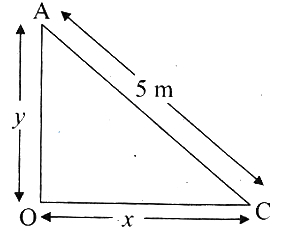
0 likes
View Solution198
EasyMCQ
Water is being poured at the rate of $36 \ m^3/min$ into a cylindrical vessel,whose circular base has a radius of $3 \ m$. The rate at which the water level in the cylinder is rising is:
A
$4 \pi \ m/min$
B
$\frac{4}{\pi} \ m/min$
C
$\frac{1}{4 \pi} \ m/min$
D
$\frac{\pi}{4} \ m/min$
Solution
(B) Given that the rate of change of volume is $\frac{dV}{dt} = 36 \ m^3/min$ and the radius of the base is $r = 3 \ m$.
The volume of a cylinder is given by $V = \pi r^2 h$.
Differentiating both sides with respect to time $t$,we get $\frac{dV}{dt} = \pi r^2 \frac{dh}{dt}$.
Substituting the given values,$36 = \pi \times (3)^2 \times \frac{dh}{dt}$.
$36 = 9 \pi \times \frac{dh}{dt}$.
Therefore,$\frac{dh}{dt} = \frac{36}{9 \pi} = \frac{4}{\pi} \ m/min$.
The volume of a cylinder is given by $V = \pi r^2 h$.
Differentiating both sides with respect to time $t$,we get $\frac{dV}{dt} = \pi r^2 \frac{dh}{dt}$.
Substituting the given values,$36 = \pi \times (3)^2 \times \frac{dh}{dt}$.
$36 = 9 \pi \times \frac{dh}{dt}$.
Therefore,$\frac{dh}{dt} = \frac{36}{9 \pi} = \frac{4}{\pi} \ m/min$.
0 likes
View Solution199
EasyMCQ
The rate of change of the volume of a sphere with respect to its surface area,when its radius is $2 \text{ cm}$,is . . . . . . $\text{cm}^3 / \text{cm}^2$.
A
$0.1$
B
$0.5$
C
$1$
D
$2$
Solution
(C) Volume of a sphere $(V) = \frac{4}{3} \pi r^3$.
Surface area of a sphere $(A) = 4 \pi r^2$.
Differentiating both with respect to $r$:
$\frac{dV}{dr} = 4 \pi r^2$ and $\frac{dA}{dr} = 8 \pi r$.
We need to find the rate of change of volume with respect to surface area,which is $\frac{dV}{dA}$.
Using the chain rule: $\frac{dV}{dA} = \frac{dV/dr}{dA/dr} = \frac{4 \pi r^2}{8 \pi r} = \frac{r}{2}$.
Given the radius $r = 2 \text{ cm}$,we substitute this value:
$\frac{dV}{dA} = \frac{2}{2} = 1 \text{ cm}^3 / \text{cm}^2$.
Surface area of a sphere $(A) = 4 \pi r^2$.
Differentiating both with respect to $r$:
$\frac{dV}{dr} = 4 \pi r^2$ and $\frac{dA}{dr} = 8 \pi r$.
We need to find the rate of change of volume with respect to surface area,which is $\frac{dV}{dA}$.
Using the chain rule: $\frac{dV}{dA} = \frac{dV/dr}{dA/dr} = \frac{4 \pi r^2}{8 \pi r} = \frac{r}{2}$.
Given the radius $r = 2 \text{ cm}$,we substitute this value:
$\frac{dV}{dA} = \frac{2}{2} = 1 \text{ cm}^3 / \text{cm}^2$.
0 likes
View SolutionApplications of Derivatives — Rate of Change of Quantities · Frequently Asked Questions
1Are these Applications of Derivatives questions useful for JEE and NEET?
Yes. All questions in this section are mapped to JEE Main and NEET exam patterns. Previous year questions from JEE Main, NEET, GUJCET and state-level exams are included with full solutions.
2Can I switch to Hindi or Gujarati for these questions?
Yes. Use the language tabs in the hero section or the sidebar to view the same questions and solutions in English, Hindi or Gujarati.
3How do I generate a question paper from this subtopic?
Use the Vedclass Exam Paper Generator — select the chapter and subtopic, set difficulty, and generate Sets A, B, C, D automatically. First 3 chapters of every subject are free.
Vedclass Products
For Students
Vedclass Test Series
Mock tests in real JEE/NEET style with performance analysis. 5-day free trial.
Start Free TrialFor Teachers
Exam Paper Generator
Generate Set A/B/C/D papers from this chapter in 2 minutes. 3 chapters free.
Try FreeFor Institutes
Online Exam Module
Live online exams with unlimited students, 360° analytics & white-label branding.
See DemoFor Teachers & Institutes
Generate a Applications of Derivatives Exam Paper in 2 Minutes
Select subtopic & difficulty — Sets A, B, C, D auto-generated with No Repeat logic.
First 3 chapters of every subject are free — no payment required.