
A English
Mix Example of Applications of Derivatives Questions in English
Class 12 Mathematics · Applications of Derivatives · Mix Example of Applications of Derivatives
17+
Questions
English
Language
100%
With Solutions
Showing 17 of 17 questions in English
1
AdvancedMCQ
For the function $f(x) = x^4 (12 \ln x - 7)$,which of the following statements is true?
A
The point $(1, -7)$ is the point of inflection.
B
$x = e^{1/3}$ is the point of minima.
C
The graph is concave downwards in $(0, 1)$.
D
All of the above.
Solution
(D) Given $f(x) = x^4 (12 \ln x - 7)$.
First derivative: $f'(x) = 4x^3 (12 \ln x - 7) + x^4 (\frac{12}{x}) = 48x^3 \ln x - 28x^3 + 12x^3 = 48x^3 \ln x - 16x^3 = 16x^3 (3 \ln x - 1)$.
Setting $f'(x) = 0$,we get $3 \ln x = 1 \implies \ln x = 1/3 \implies x = e^{1/3}$.
Since $f''(x) = 48x^2 (3 \ln x - 1) + 16x^3 (3/x) = 144x^2 \ln x - 48x^2 + 48x^2 = 144x^2 \ln x$,at $x = e^{1/3}$,$f''(e^{1/3}) = 144(e^{1/3})^2 (1/3) > 0$,so $x = e^{1/3}$ is a point of minima.
For concavity,we check $f''(x) = 144x^2 \ln x$. In $(0, 1)$,$\ln x < 0$,so $f''(x) < 0$,meaning the graph is concave downwards.
At $x = 1$,$f(1) = 1^4 (12 \ln 1 - 7) = -7$. Since $f''(1) = 144(1)^2 \ln 1 = 0$ and the sign of $f''(x)$ changes at $x=1$,$(1, -7)$ is a point of inflection.
Thus,all statements are true.
First derivative: $f'(x) = 4x^3 (12 \ln x - 7) + x^4 (\frac{12}{x}) = 48x^3 \ln x - 28x^3 + 12x^3 = 48x^3 \ln x - 16x^3 = 16x^3 (3 \ln x - 1)$.
Setting $f'(x) = 0$,we get $3 \ln x = 1 \implies \ln x = 1/3 \implies x = e^{1/3}$.
Since $f''(x) = 48x^2 (3 \ln x - 1) + 16x^3 (3/x) = 144x^2 \ln x - 48x^2 + 48x^2 = 144x^2 \ln x$,at $x = e^{1/3}$,$f''(e^{1/3}) = 144(e^{1/3})^2 (1/3) > 0$,so $x = e^{1/3}$ is a point of minima.
For concavity,we check $f''(x) = 144x^2 \ln x$. In $(0, 1)$,$\ln x < 0$,so $f''(x) < 0$,meaning the graph is concave downwards.
At $x = 1$,$f(1) = 1^4 (12 \ln 1 - 7) = -7$. Since $f''(1) = 144(1)^2 \ln 1 = 0$ and the sign of $f''(x)$ changes at $x=1$,$(1, -7)$ is a point of inflection.
Thus,all statements are true.
0 likes
View Solution2
AdvancedMCQ
The number of solutions of the equation $2e^{|x|} \tan^{-1}|x| = 1$ is -
A
$0$
B
$1$
C
$2$
D
$4$
Solution
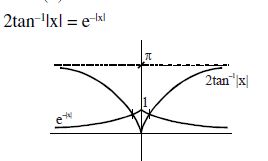
(C) The given equation is $2e^{|x|} \tan^{-1}|x| = 1$.
This can be rewritten as $2 \tan^{-1}|x| = e^{-|x|}$.
Let $f(x) = 2 \tan^{-1}|x|$ and $g(x) = e^{-|x|}$.
Since both functions are even,we can analyze the behavior for $x \ge 0$.
For $x \ge 0$,$f(x) = 2 \tan^{-1}x$ and $g(x) = e^{-x}$.
At $x = 0$,$f(0) = 2 \tan^{-1}(0) = 0$ and $g(0) = e^0 = 1$. Thus,$f(0) < g(0)$.
As $x \to \infty$,$f(x) \to 2(\frac{\pi}{2}) = \pi \approx 3.14$ and $g(x) \to 0$.
Since $f(x)$ is a strictly increasing function for $x \ge 0$ and $g(x)$ is a strictly decreasing function for $x \ge 0$,there must be exactly one intersection point for $x > 0$.
Due to symmetry about the $y$-axis,there will also be exactly one intersection point for $x < 0$.
Therefore,there are $2$ solutions in total.
This can be rewritten as $2 \tan^{-1}|x| = e^{-|x|}$.
Let $f(x) = 2 \tan^{-1}|x|$ and $g(x) = e^{-|x|}$.
Since both functions are even,we can analyze the behavior for $x \ge 0$.
For $x \ge 0$,$f(x) = 2 \tan^{-1}x$ and $g(x) = e^{-x}$.
At $x = 0$,$f(0) = 2 \tan^{-1}(0) = 0$ and $g(0) = e^0 = 1$. Thus,$f(0) < g(0)$.
As $x \to \infty$,$f(x) \to 2(\frac{\pi}{2}) = \pi \approx 3.14$ and $g(x) \to 0$.
Since $f(x)$ is a strictly increasing function for $x \ge 0$ and $g(x)$ is a strictly decreasing function for $x \ge 0$,there must be exactly one intersection point for $x > 0$.
Due to symmetry about the $y$-axis,there will also be exactly one intersection point for $x < 0$.
Therefore,there are $2$ solutions in total.
0 likes
View Solution3
AdvancedMCQ
Let $f(x) = \min (\{x\}, \{e^{-x}\})$ for $x \in [0, 10]$. If $C$ and $D$ are the number of points where $f(x)$ is discontinuous and non-differentiable respectively,then $(C + D)$ is equal to (where $\{.\}$ denotes the fractional part function).
A
$20$
B
$31$
C
$28$
D
$30$
Solution
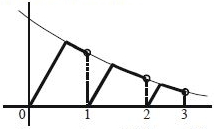
(C) The function is $f(x) = \min (\{x\}, \{e^{-x}\})$.
$1$. Discontinuity: The fractional part function $\{x\}$ is discontinuous at all integers $x = 1, 2, \dots, 9$. At $x=10$,the interval is closed,so we consider the limit from the left. Thus,there are $9$ points of discontinuity $(x=1, 2, \dots, 9)$. So,$C = 9$.
$2$. Non-differentiability: The function is non-differentiable at:
- Points of discontinuity: $9$ points.
- Points where $\{x\} = \{e^{-x}\}$: In each interval $(n, n+1)$,$\{x\} = x-n$ and $\{e^{-x}\} = e^{-x} - \lfloor e^{-x} \rfloor$. Since $e^{-x}$ is strictly decreasing,$\{e^{-x}\}$ is also piecewise defined. For $x \in [0, 10]$,$\{e^{-x}\}$ has discontinuities at $x = -\ln(k)$ for $k \in \mathbb{Z}$.
- Sharp corners: Within each interval $(n, n+1)$,the function switches between $\{x\}$ and $\{e^{-x}\}$. There are $10$ such intervals,and in each,there is exactly one intersection point where the graph has a sharp corner. Thus,there are $10$ such points.
- Total non-differentiable points $D = C + 10 = 9 + 10 = 19$.
Therefore,$C + D = 9 + 19 = 28$.
$1$. Discontinuity: The fractional part function $\{x\}$ is discontinuous at all integers $x = 1, 2, \dots, 9$. At $x=10$,the interval is closed,so we consider the limit from the left. Thus,there are $9$ points of discontinuity $(x=1, 2, \dots, 9)$. So,$C = 9$.
$2$. Non-differentiability: The function is non-differentiable at:
- Points of discontinuity: $9$ points.
- Points where $\{x\} = \{e^{-x}\}$: In each interval $(n, n+1)$,$\{x\} = x-n$ and $\{e^{-x}\} = e^{-x} - \lfloor e^{-x} \rfloor$. Since $e^{-x}$ is strictly decreasing,$\{e^{-x}\}$ is also piecewise defined. For $x \in [0, 10]$,$\{e^{-x}\}$ has discontinuities at $x = -\ln(k)$ for $k \in \mathbb{Z}$.
- Sharp corners: Within each interval $(n, n+1)$,the function switches between $\{x\}$ and $\{e^{-x}\}$. There are $10$ such intervals,and in each,there is exactly one intersection point where the graph has a sharp corner. Thus,there are $10$ such points.
- Total non-differentiable points $D = C + 10 = 9 + 10 = 19$.
Therefore,$C + D = 9 + 19 = 28$.
0 likes
View Solution4
AdvancedMCQ
Two differentiable functions $f(x)$ and $g(x)$ are such that $f''(x) > 0$ and $g''(x) < 0$ for all $x \in (a,b)$ and $\int_{a}^{b} f(x) dx = \int_{a}^{b} g(x) dx$. If $f(x) = g(x)$ for $x = \alpha, \beta \in (a,b)$ $(\alpha < \beta)$,then:
A
$\int_{\alpha}^{\beta} (g(x) - f(x)) dx = \int_{a}^{\alpha} (f(x) - g(x)) dx + \int_{\beta}^{b} (f(x) - g(x)) dx$
B
$\int_{\alpha}^{\beta} (g(x) - f(x)) dx = \int_{a}^{\alpha} (f(x) - g(x)) dx$
C
$\int_{\alpha}^{\beta} (g(x) - f(x)) dx = \int_{\beta}^{b} (f(x) - g(x)) dx$
D
$\int_{\alpha}^{\beta} (g(x) - f(x)) dx = \int_{\alpha}^{\beta} (f(x) - g(x)) dx$
Solution
(A) Given $\int_{a}^{b} f(x) dx = \int_{a}^{b} g(x) dx$,we can write $\int_{a}^{b} (f(x) - g(x)) dx = 0$.
Splitting the integral into three parts based on the intersection points $\alpha$ and $\beta$:
$\int_{a}^{\alpha} (f(x) - g(x)) dx + \int_{\alpha}^{\beta} (f(x) - g(x)) dx + \int_{\beta}^{b} (f(x) - g(x)) dx = 0$.
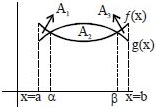
From the graph,in the interval $(a, \alpha)$,$f(x) > g(x)$,so the area $A_1 = \int_{a}^{\alpha} (f(x) - g(x)) dx$.
In the interval $(\alpha, \beta)$,$g(x) > f(x)$,so the area $A_2 = \int_{\alpha}^{\beta} (g(x) - f(x)) dx = -\int_{\alpha}^{\beta} (f(x) - g(x)) dx$.
In the interval $(\beta, b)$,$f(x) > g(x)$,so the area $A_3 = \int_{\beta}^{b} (f(x) - g(x)) dx$.
Substituting these into the integral equation: $A_1 - A_2 + A_3 = 0$,which implies $A_2 = A_1 + A_3$.
Thus,$\int_{\alpha}^{\beta} (g(x) - f(x)) dx = \int_{a}^{\alpha} (f(x) - g(x)) dx + \int_{\beta}^{b} (f(x) - g(x)) dx$.
Splitting the integral into three parts based on the intersection points $\alpha$ and $\beta$:
$\int_{a}^{\alpha} (f(x) - g(x)) dx + \int_{\alpha}^{\beta} (f(x) - g(x)) dx + \int_{\beta}^{b} (f(x) - g(x)) dx = 0$.
From the graph,in the interval $(a, \alpha)$,$f(x) > g(x)$,so the area $A_1 = \int_{a}^{\alpha} (f(x) - g(x)) dx$.
In the interval $(\alpha, \beta)$,$g(x) > f(x)$,so the area $A_2 = \int_{\alpha}^{\beta} (g(x) - f(x)) dx = -\int_{\alpha}^{\beta} (f(x) - g(x)) dx$.
In the interval $(\beta, b)$,$f(x) > g(x)$,so the area $A_3 = \int_{\beta}^{b} (f(x) - g(x)) dx$.
Substituting these into the integral equation: $A_1 - A_2 + A_3 = 0$,which implies $A_2 = A_1 + A_3$.
Thus,$\int_{\alpha}^{\beta} (g(x) - f(x)) dx = \int_{a}^{\alpha} (f(x) - g(x)) dx + \int_{\beta}^{b} (f(x) - g(x)) dx$.
0 likes
View Solution5
DifficultMCQ
Let $f(x) = x \cos^{-1}(-\sin |x|)$,$x \in \left[-\frac{\pi}{2}, \frac{\pi}{2}\right]$. Then which of the following is true?
A
$f^{\prime}$ is decreasing in $\left(-\frac{\pi}{2}, 0\right)$ and increasing in $\left(0, \frac{\pi}{2}\right)$
B
$f$ is not differentiable at $x = 0$
C
$f^{\prime}(0) = -\frac{\pi}{2}$
D
$f^{\prime}$ is increasing in $\left(-\frac{\pi}{2}, 0\right)$ and decreasing in $\left(0, \frac{\pi}{2}\right)$
Solution
(A) Given $f(x) = x \cos^{-1}(-\sin |x|)$. Since $\cos^{-1}(-u) = \pi - \cos^{-1}(u)$,we have $f(x) = x(\pi - \cos^{-1}(\sin |x|))$.
Using $\cos^{-1}(\sin |x|) = \cos^{-1}(\cos(\frac{\pi}{2} - |x|)) = \frac{\pi}{2} - |x|$ for $|x| \in [0, \frac{\pi}{2}]$,we get:
$f(x) = x(\pi - (\frac{\pi}{2} - |x|)) = x(\frac{\pi}{2} + |x|)$.
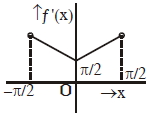
For $x \geq 0$,$f(x) = x(\frac{\pi}{2} + x) = \frac{\pi}{2}x + x^2$. Thus $f^{\prime}(x) = \frac{\pi}{2} + 2x$.
For $x < 0$,$f(x) = x(\frac{\pi}{2} - x) = \frac{\pi}{2}x - x^2$. Thus $f^{\prime}(x) = \frac{\pi}{2} - 2x$.
Checking differentiability at $x=0$: $LHD = \lim_{x \to 0^-} (\frac{\pi}{2} - 2x) = \frac{\pi}{2}$ and $RHD = \lim_{x \to 0^+} (\frac{\pi}{2} + 2x) = \frac{\pi}{2}$. Since $LHD = RHD$,$f$ is differentiable at $x=0$ and $f^{\prime}(0) = \frac{\pi}{2}$.
Now,for $x \in (-\frac{\pi}{2}, 0)$,$f^{\prime\prime}(x) = -2 < 0$,so $f^{\prime}$ is decreasing.
For $x \in (0, \frac{\pi}{2})$,$f^{\prime\prime}(x) = 2 > 0$,so $f^{\prime}$ is increasing.
Thus,option $A$ is correct.
Using $\cos^{-1}(\sin |x|) = \cos^{-1}(\cos(\frac{\pi}{2} - |x|)) = \frac{\pi}{2} - |x|$ for $|x| \in [0, \frac{\pi}{2}]$,we get:
$f(x) = x(\pi - (\frac{\pi}{2} - |x|)) = x(\frac{\pi}{2} + |x|)$.
For $x \geq 0$,$f(x) = x(\frac{\pi}{2} + x) = \frac{\pi}{2}x + x^2$. Thus $f^{\prime}(x) = \frac{\pi}{2} + 2x$.
For $x < 0$,$f(x) = x(\frac{\pi}{2} - x) = \frac{\pi}{2}x - x^2$. Thus $f^{\prime}(x) = \frac{\pi}{2} - 2x$.
Checking differentiability at $x=0$: $LHD = \lim_{x \to 0^-} (\frac{\pi}{2} - 2x) = \frac{\pi}{2}$ and $RHD = \lim_{x \to 0^+} (\frac{\pi}{2} + 2x) = \frac{\pi}{2}$. Since $LHD = RHD$,$f$ is differentiable at $x=0$ and $f^{\prime}(0) = \frac{\pi}{2}$.
Now,for $x \in (-\frac{\pi}{2}, 0)$,$f^{\prime\prime}(x) = -2 < 0$,so $f^{\prime}$ is decreasing.
For $x \in (0, \frac{\pi}{2})$,$f^{\prime\prime}(x) = 2 > 0$,so $f^{\prime}$ is increasing.
Thus,option $A$ is correct.
0 likes
View Solution6
Difficult
If $(x-a)^{2}+(y-b)^{2}=c^{2},$ for some $c > 0,$ prove that $\frac{\left[1+\left(\frac{d y}{d x}\right)^{2}\right]^{\frac{3}{2}}}{\frac{d^{2} y}{d x^{2}}}$ is a constant independent of $a$ and $b.$
Solution
(N/A) Given equation: $(x-a)^{2}+(y-b)^{2}=c^{2}$
Differentiating both sides with respect to $x$:
$\frac{d}{d x}[(x-a)^{2}]+\frac{d}{d x}[(y-b)^{2}]=\frac{d}{d x}(c^{2})$
$2(x-a) + 2(y-b) \cdot \frac{d y}{d x} = 0$
$\frac{d y}{d x} = -\frac{x-a}{y-b}$ --- $(1)$
Differentiating again with respect to $x$:
$\frac{d^{2} y}{d x^{2}} = -\frac{d}{d x} \left[ \frac{x-a}{y-b} \right] = -\frac{(y-b) \cdot 1 - (x-a) \cdot \frac{d y}{d x}}{(y-b)^{2}}$
Substituting $\frac{d y}{d x}$ from $(1)$:
$\frac{d^{2} y}{d x^{2}} = -\frac{(y-b) - (x-a) \cdot \left( -\frac{x-a}{y-b} \right)}{(y-b)^{2}} = -\frac{(y-b)^{2} + (x-a)^{2}}{(y-b)^{3}} = -\frac{c^{2}}{(y-b)^{3}}$
Now,evaluate the expression:
$\frac{\left[1+\left(\frac{d y}{d x}\right)^{2}\right]^{\frac{3}{2}}}{\frac{d^{2} y}{d x^{2}}} = \frac{\left[1 + \frac{(x-a)^{2}}{(y-b)^{2}}\right]^{\frac{3}{2}}}{-\frac{c^{2}}{(y-b)^{3}}} = \frac{\left[\frac{(y-b)^{2} + (x-a)^{2}}{(y-b)^{2}}\right]^{\frac{3}{2}}}{-\frac{c^{2}}{(y-b)^{3}}} = \frac{\left[\frac{c^{2}}{(y-b)^{2}}\right]^{\frac{3}{2}}}{-\frac{c^{2}}{(y-b)^{3}}}$
$= \frac{\frac{c^{3}}{|y-b|^{3}}}{-\frac{c^{2}}{(y-b)^{3}}} = -c$
Since $-c$ is a constant independent of $a$ and $b$,the proof is complete.
Differentiating both sides with respect to $x$:
$\frac{d}{d x}[(x-a)^{2}]+\frac{d}{d x}[(y-b)^{2}]=\frac{d}{d x}(c^{2})$
$2(x-a) + 2(y-b) \cdot \frac{d y}{d x} = 0$
$\frac{d y}{d x} = -\frac{x-a}{y-b}$ --- $(1)$
Differentiating again with respect to $x$:
$\frac{d^{2} y}{d x^{2}} = -\frac{d}{d x} \left[ \frac{x-a}{y-b} \right] = -\frac{(y-b) \cdot 1 - (x-a) \cdot \frac{d y}{d x}}{(y-b)^{2}}$
Substituting $\frac{d y}{d x}$ from $(1)$:
$\frac{d^{2} y}{d x^{2}} = -\frac{(y-b) - (x-a) \cdot \left( -\frac{x-a}{y-b} \right)}{(y-b)^{2}} = -\frac{(y-b)^{2} + (x-a)^{2}}{(y-b)^{3}} = -\frac{c^{2}}{(y-b)^{3}}$
Now,evaluate the expression:
$\frac{\left[1+\left(\frac{d y}{d x}\right)^{2}\right]^{\frac{3}{2}}}{\frac{d^{2} y}{d x^{2}}} = \frac{\left[1 + \frac{(x-a)^{2}}{(y-b)^{2}}\right]^{\frac{3}{2}}}{-\frac{c^{2}}{(y-b)^{3}}} = \frac{\left[\frac{(y-b)^{2} + (x-a)^{2}}{(y-b)^{2}}\right]^{\frac{3}{2}}}{-\frac{c^{2}}{(y-b)^{3}}} = \frac{\left[\frac{c^{2}}{(y-b)^{2}}\right]^{\frac{3}{2}}}{-\frac{c^{2}}{(y-b)^{3}}}$
$= \frac{\frac{c^{3}}{|y-b|^{3}}}{-\frac{c^{2}}{(y-b)^{3}}} = -c$
Since $-c$ is a constant independent of $a$ and $b$,the proof is complete.
0 likes
View Solution7
DifficultMCQ
The function $f(x) = x^{3} - 6x^{2} + ax + b$ is such that $f(2) = f(4) = 0$. Consider two statements.
$(S_1)$ There exists $x_{1}, x_{2} \in (2, 4)$,$x_{1} < x_{2}$,such that $f^{\prime}(x_{1}) = -1$ and $f^{\prime}(x_{2}) = 0$.
$(S_2)$ There exists $x_{3}, x_{4} \in (2, 4)$,$x_{3} < x_{4}$,such that $f$ is decreasing in $(2, x_{4})$,increasing in $(x_{4}, 4)$ and $2f^{\prime}(x_{3}) = \sqrt{3}f(x_{4})$.
Then
$(S_1)$ There exists $x_{1}, x_{2} \in (2, 4)$,$x_{1} < x_{2}$,such that $f^{\prime}(x_{1}) = -1$ and $f^{\prime}(x_{2}) = 0$.
$(S_2)$ There exists $x_{3}, x_{4} \in (2, 4)$,$x_{3} < x_{4}$,such that $f$ is decreasing in $(2, x_{4})$,increasing in $(x_{4}, 4)$ and $2f^{\prime}(x_{3}) = \sqrt{3}f(x_{4})$.
Then
A
both $(S_1)$ and $(S_2)$ are true
B
$(S_1)$ is false and $(S_2)$ is true
C
both $(S_1)$ and $(S_2)$ are false
D
$(S_1)$ is true and $(S_2)$ is false
Solution
(A) Given $f(x) = x^{3} - 6x^{2} + ax + b$. Since $f(2) = 0$,$8 - 24 + 2a + b = 0 \Rightarrow 2a + b = 16$.
Since $f(4) = 0$,$64 - 96 + 4a + b = 0 \Rightarrow 4a + b = 32$.
Solving these,$a = 8, b = 0$. Thus $f(x) = x^{3} - 6x^{2} + 8x$.
$f^{\prime}(x) = 3x^{2} - 12x + 8$. The roots of $f^{\prime}(x) = 0$ are $x = \frac{12 \pm \sqrt{144 - 96}}{6} = 2 \pm \frac{\sqrt{48}}{6} = 2 \pm \frac{2}{\sqrt{3}}$.
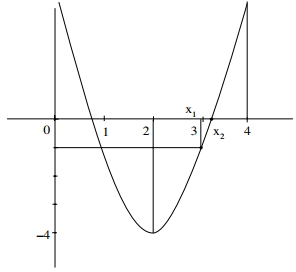
For $(S_1)$: $f^{\prime}(2) = -4$ and $f^{\prime}(4) = 8$. Since $f^{\prime}(x)$ is continuous,by the Intermediate Value Theorem,there exists $x_{1} \in (2, 4)$ such that $f^{\prime}(x_{1}) = -1$ (as $-1 \in (-4, 8)$). Also,$f^{\prime}(x)$ has a root $x_{2} = 2 + \frac{2}{\sqrt{3}} \approx 3.15 \in (2, 4)$. Since $f^{\prime}(3) = 27 - 36 + 8 = -1$,we have $x_{1} = 3 < x_{2} \approx 3.15$. Thus $(S_1)$ is true.
For $(S_2)$: $f$ is decreasing on $(2, x_{4})$ and increasing on $(x_{4}, 4)$ where $x_{4} = 2 + \frac{2}{\sqrt{3}}$. $f(x_{4}) = (2 + \frac{2}{\sqrt{3}})^{3} - 6(2 + \frac{2}{\sqrt{3}})^{2} + 8(2 + \frac{2}{\sqrt{3}}) = -\frac{16}{3\sqrt{3}}$.
$2f^{\prime}(x_{3}) = \sqrt{3}f(x_{4}) = \sqrt{3}(-\frac{16}{3\sqrt{3}}) = -\frac{16}{3} \approx -5.33$. So $f^{\prime}(x_{3}) = -\frac{8}{3} \approx -2.67$. Since $f^{\prime}(x)$ takes all values in $[-4, 8]$ on $(2, 4)$,such $x_{3}$ exists. Thus $(S_2)$ is true.
Since $f(4) = 0$,$64 - 96 + 4a + b = 0 \Rightarrow 4a + b = 32$.
Solving these,$a = 8, b = 0$. Thus $f(x) = x^{3} - 6x^{2} + 8x$.
$f^{\prime}(x) = 3x^{2} - 12x + 8$. The roots of $f^{\prime}(x) = 0$ are $x = \frac{12 \pm \sqrt{144 - 96}}{6} = 2 \pm \frac{\sqrt{48}}{6} = 2 \pm \frac{2}{\sqrt{3}}$.
For $(S_1)$: $f^{\prime}(2) = -4$ and $f^{\prime}(4) = 8$. Since $f^{\prime}(x)$ is continuous,by the Intermediate Value Theorem,there exists $x_{1} \in (2, 4)$ such that $f^{\prime}(x_{1}) = -1$ (as $-1 \in (-4, 8)$). Also,$f^{\prime}(x)$ has a root $x_{2} = 2 + \frac{2}{\sqrt{3}} \approx 3.15 \in (2, 4)$. Since $f^{\prime}(3) = 27 - 36 + 8 = -1$,we have $x_{1} = 3 < x_{2} \approx 3.15$. Thus $(S_1)$ is true.
For $(S_2)$: $f$ is decreasing on $(2, x_{4})$ and increasing on $(x_{4}, 4)$ where $x_{4} = 2 + \frac{2}{\sqrt{3}}$. $f(x_{4}) = (2 + \frac{2}{\sqrt{3}})^{3} - 6(2 + \frac{2}{\sqrt{3}})^{2} + 8(2 + \frac{2}{\sqrt{3}}) = -\frac{16}{3\sqrt{3}}$.
$2f^{\prime}(x_{3}) = \sqrt{3}f(x_{4}) = \sqrt{3}(-\frac{16}{3\sqrt{3}}) = -\frac{16}{3} \approx -5.33$. So $f^{\prime}(x_{3}) = -\frac{8}{3} \approx -2.67$. Since $f^{\prime}(x)$ takes all values in $[-4, 8]$ on $(2, 4)$,such $x_{3}$ exists. Thus $(S_2)$ is true.
0 likes
View Solution8
DifficultMCQ
$f(x)=4 \log _{e}(x-1)-2 x^{2}+4 x+5, x>1$,which one of the following is $NOT$ correct?
A
$f$ is increasing in $(1,2)$ and decreasing in $(2, \infty)$
B
$f(x)=-1$ has exactly two solutions
C
$f'(e) - f''(2) < 0$
D
$f(x)=0$ has a root in the interval $(e, e+1)$
Solution
(C) Given $f(x) = 4 \log_{e}(x-1) - 2x^2 + 4x + 5$ for $x > 1$.
First,find the derivative $f'(x)$:
$f'(x) = \frac{4}{x-1} - 4x + 4 = \frac{4}{x-1} - 4(x-1)$.
For $1 < x < 2$,$(x-1) < 1$,so $\frac{4}{x-1} > 4$,implying $f'(x) > 0$. Thus,$f$ is increasing on $(1, 2)$.
For $x > 2$,$(x-1) > 1$,so $\frac{4}{x-1} < 4$,implying $f'(x) < 0$. Thus,$f$ is decreasing on $(2, \infty)$. (Option $A$ is correct).
Since $f$ increases on $(1, 2)$ to a maximum at $x=2$ where $f(2) = 4 \log_{e}(1) - 2(4) + 4(2) + 5 = 5$,and decreases on $(2, \infty)$ towards $-\infty$,the equation $f(x) = -1$ has exactly two solutions. (Option $B$ is correct).
Check $f(e)$ and $f(e+1)$:
$f(e) = 4 \log_{e}(e-1) - 2e^2 + 4e + 5 \approx 4(0.54) - 2(7.39) + 4(2.718) + 5 \approx 2.16 - 14.78 + 10.87 + 5 = 3.25 > 0$.
$f(e+1) = 4 \log_{e}(e) - 2(e+1)^2 + 4(e+1) + 5 = 4 - 2(e^2 + 2e + 1) + 4e + 4 + 5 = 13 - 2e^2 - 4e - 2 + 4e = 11 - 2e^2 \approx 11 - 14.78 = -3.78 < 0$.
Since $f(e) > 0$ and $f(e+1) < 0$,there is a root in $(e, e+1)$. (Option $D$ is correct).
Calculate $f'(e) - f''(2)$:
$f'(e) = \frac{4}{e-1} - 4(e-1) \approx \frac{4}{1.718} - 4(1.718) \approx 2.33 - 6.87 = -4.54$.
$f''(x) = -\frac{4}{(x-1)^2} - 4$.
$f''(2) = -\frac{4}{(2-1)^2} - 4 = -4 - 4 = -8$.
$f'(e) - f''(2) = -4.54 - (-8) = 3.46 > 0$.
Thus,$f'(e) - f''(2) < 0$ is incorrect. (Option $C$ is incorrect).
First,find the derivative $f'(x)$:
$f'(x) = \frac{4}{x-1} - 4x + 4 = \frac{4}{x-1} - 4(x-1)$.
For $1 < x < 2$,$(x-1) < 1$,so $\frac{4}{x-1} > 4$,implying $f'(x) > 0$. Thus,$f$ is increasing on $(1, 2)$.
For $x > 2$,$(x-1) > 1$,so $\frac{4}{x-1} < 4$,implying $f'(x) < 0$. Thus,$f$ is decreasing on $(2, \infty)$. (Option $A$ is correct).
Since $f$ increases on $(1, 2)$ to a maximum at $x=2$ where $f(2) = 4 \log_{e}(1) - 2(4) + 4(2) + 5 = 5$,and decreases on $(2, \infty)$ towards $-\infty$,the equation $f(x) = -1$ has exactly two solutions. (Option $B$ is correct).
Check $f(e)$ and $f(e+1)$:
$f(e) = 4 \log_{e}(e-1) - 2e^2 + 4e + 5 \approx 4(0.54) - 2(7.39) + 4(2.718) + 5 \approx 2.16 - 14.78 + 10.87 + 5 = 3.25 > 0$.
$f(e+1) = 4 \log_{e}(e) - 2(e+1)^2 + 4(e+1) + 5 = 4 - 2(e^2 + 2e + 1) + 4e + 4 + 5 = 13 - 2e^2 - 4e - 2 + 4e = 11 - 2e^2 \approx 11 - 14.78 = -3.78 < 0$.
Since $f(e) > 0$ and $f(e+1) < 0$,there is a root in $(e, e+1)$. (Option $D$ is correct).
Calculate $f'(e) - f''(2)$:
$f'(e) = \frac{4}{e-1} - 4(e-1) \approx \frac{4}{1.718} - 4(1.718) \approx 2.33 - 6.87 = -4.54$.
$f''(x) = -\frac{4}{(x-1)^2} - 4$.
$f''(2) = -\frac{4}{(2-1)^2} - 4 = -4 - 4 = -8$.
$f'(e) - f''(2) = -4.54 - (-8) = 3.46 > 0$.
Thus,$f'(e) - f''(2) < 0$ is incorrect. (Option $C$ is incorrect).
0 likes
View Solution9
AdvancedMCQ
Let $f(x) = \sin x + (x^3 - 3x^2 + 4x - 2) \cos x$ for $x \in (0, 1)$. Consider the following statements:
$I.$ $f$ has a zero in $(0, 1)$.
$II.$ $f$ is monotone in $(0, 1)$.
Then,
$I.$ $f$ has a zero in $(0, 1)$.
$II.$ $f$ is monotone in $(0, 1)$.
Then,
A
$I$ and $II$ are true
B
$I$ is true and $II$ is false
C
$I$ is false and $II$ is true
D
$I$ and $II$ are false
Solution
(A) Given $f(x) = \sin x + (x^3 - 3x^2 + 4x - 2) \cos x$.
Note that $x^3 - 3x^2 + 4x - 2 = (x-1)^3 + (x-1)$.
So,$f(x) = \sin x + ((x-1)^3 + (x-1)) \cos x$.
Calculating the derivative:
$f'(x) = \cos x + [3(x-1)^2 + 1] \cos x - [(x-1)^3 + (x-1)] \sin x$
$f'(x) = \cos x [1 + 3(x-1)^2 + 1] - (x-1)((x-1)^2 + 1) \sin x$
$f'(x) = \cos x [3(x-1)^2 + 2] + (1-x)((x-1)^2 + 1) \sin x$.
For $x \in (0, 1)$,$\cos x > 0$,$\sin x > 0$,$(1-x) > 0$,and the terms in brackets are positive.
Thus,$f'(x) > 0$ for all $x \in (0, 1)$,which means $f$ is strictly increasing (monotone).
Also,$f(0) = \sin(0) + (-2) \cos(0) = -2 < 0$ and $f(1) = \sin(1) + (1-3+4-2) \cos(1) = \sin(1) > 0$.
Since $f$ is continuous and changes sign on $(0, 1)$,by the Intermediate Value Theorem,$f$ has a zero in $(0, 1)$.
Therefore,both statements $I$ and $II$ are true.
Note that $x^3 - 3x^2 + 4x - 2 = (x-1)^3 + (x-1)$.
So,$f(x) = \sin x + ((x-1)^3 + (x-1)) \cos x$.
Calculating the derivative:
$f'(x) = \cos x + [3(x-1)^2 + 1] \cos x - [(x-1)^3 + (x-1)] \sin x$
$f'(x) = \cos x [1 + 3(x-1)^2 + 1] - (x-1)((x-1)^2 + 1) \sin x$
$f'(x) = \cos x [3(x-1)^2 + 2] + (1-x)((x-1)^2 + 1) \sin x$.
For $x \in (0, 1)$,$\cos x > 0$,$\sin x > 0$,$(1-x) > 0$,and the terms in brackets are positive.
Thus,$f'(x) > 0$ for all $x \in (0, 1)$,which means $f$ is strictly increasing (monotone).
Also,$f(0) = \sin(0) + (-2) \cos(0) = -2 < 0$ and $f(1) = \sin(1) + (1-3+4-2) \cos(1) = \sin(1) > 0$.
Since $f$ is continuous and changes sign on $(0, 1)$,by the Intermediate Value Theorem,$f$ has a zero in $(0, 1)$.
Therefore,both statements $I$ and $II$ are true.
0 likes
View Solution10
DifficultMCQ
Let $f(x) = 2x + \tan^{-1} x$ and $g(x) = \log_e(\sqrt{1+x^2} + x)$,$x \in [0, 3]$. Then:
A
There exists $\hat{x} \in [0, 3]$ such that $f'(\hat{x}) < g'(\hat{x})$
B
$\max f(x) > \max g(x)$
C
There exist $0 < x_1 < x_2 < 3$ such that $f(x) < g(x)$,$\forall x \in (x_1, x_2)$
D
$\min f'(x) = 1 + \max g'(x)$
Solution
(B) Given $f(x) = 2x + \tan^{-1} x$ and $g(x) = \ln(\sqrt{1+x^2} + x)$ for $x \in [0, 3]$.
First,find the derivatives:
$f'(x) = 2 + \frac{1}{1+x^2}$
$g'(x) = \frac{1}{\sqrt{1+x^2} + x} \cdot \left(\frac{x}{\sqrt{1+x^2}} + 1\right) = \frac{1}{\sqrt{1+x^2} + x} \cdot \frac{x + \sqrt{1+x^2}}{\sqrt{1+x^2}} = \frac{1}{\sqrt{1+x^2}}$.
For $x \in [0, 3]$:
$f'(x) \in [2 + \frac{1}{1+3^2}, 2 + \frac{1}{1+0^2}] = [2.1, 3]$.
$g'(x) \in [\frac{1}{\sqrt{1+3^2}}, \frac{1}{\sqrt{1+0^2}}] = [\frac{1}{\sqrt{10}}, 1] \approx [0.316, 1]$.
Since $f'(x) > g'(x)$ for all $x \in [0, 3]$,option $A$ is incorrect.
Both $f(x)$ and $g(x)$ are strictly increasing functions on $[0, 3]$.
Thus,$\max f(x) = f(3) = 6 + \tan^{-1} 3$ and $\max g(x) = g(3) = \ln(3 + \sqrt{10})$.
Since $6 + \tan^{-1} 3 > 6$ and $\ln(3 + \sqrt{10}) \approx \ln(6.16) < 2$,it is clear that $f(3) > g(3)$.
Therefore,option $B$ is correct.
First,find the derivatives:
$f'(x) = 2 + \frac{1}{1+x^2}$
$g'(x) = \frac{1}{\sqrt{1+x^2} + x} \cdot \left(\frac{x}{\sqrt{1+x^2}} + 1\right) = \frac{1}{\sqrt{1+x^2} + x} \cdot \frac{x + \sqrt{1+x^2}}{\sqrt{1+x^2}} = \frac{1}{\sqrt{1+x^2}}$.
For $x \in [0, 3]$:
$f'(x) \in [2 + \frac{1}{1+3^2}, 2 + \frac{1}{1+0^2}] = [2.1, 3]$.
$g'(x) \in [\frac{1}{\sqrt{1+3^2}}, \frac{1}{\sqrt{1+0^2}}] = [\frac{1}{\sqrt{10}}, 1] \approx [0.316, 1]$.
Since $f'(x) > g'(x)$ for all $x \in [0, 3]$,option $A$ is incorrect.
Both $f(x)$ and $g(x)$ are strictly increasing functions on $[0, 3]$.
Thus,$\max f(x) = f(3) = 6 + \tan^{-1} 3$ and $\max g(x) = g(3) = \ln(3 + \sqrt{10})$.
Since $6 + \tan^{-1} 3 > 6$ and $\ln(3 + \sqrt{10}) \approx \ln(6.16) < 2$,it is clear that $f(3) > g(3)$.
Therefore,option $B$ is correct.
0 likes
View Solution11
DifficultMCQ
Let $f(x)=2^x-x^2, x \in R$. If $m$ and $n$ are respectively the number of points at which the curves $y=f(x)$ and $y=f^{\prime}(x)$ intersect the $x$-axis,then the value of $m+n$ is
A
$8$
B
$7$
C
$6$
D
$5$
Solution
(D) To find $m$,we look for the number of roots of $f(x) = 2^x - x^2 = 0$,which is equivalent to $2^x = x^2$.
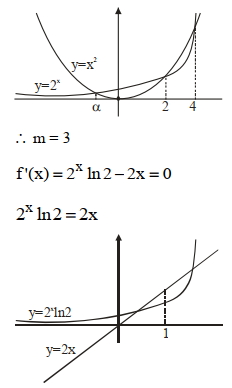
From the graph,we can see that the curves $y = 2^x$ and $y = x^2$ intersect at three points: one in the negative region (let it be $\alpha$),one at $x = 2$,and one at $x = 4$. Thus,$m = 3$.
To find $n$,we look for the number of roots of $f'(x) = 2^x \ln 2 - 2x = 0$,which is equivalent to $2^x \ln 2 = 2x$.
From the graph of $y = 2^x \ln 2$ and $y = 2x$,we can see that these two curves intersect at two points. Thus,$n = 2$.
Therefore,$m + n = 3 + 2 = 5$.
From the graph,we can see that the curves $y = 2^x$ and $y = x^2$ intersect at three points: one in the negative region (let it be $\alpha$),one at $x = 2$,and one at $x = 4$. Thus,$m = 3$.
To find $n$,we look for the number of roots of $f'(x) = 2^x \ln 2 - 2x = 0$,which is equivalent to $2^x \ln 2 = 2x$.
From the graph of $y = 2^x \ln 2$ and $y = 2x$,we can see that these two curves intersect at two points. Thus,$n = 2$.
Therefore,$m + n = 3 + 2 = 5$.
0 likes
View Solution12
AdvancedMCQ
Consider the polynomial $f(x)=1+2x+3x^2+4x^3$. Let $s$ be the sum of all distinct real roots of $f(x)$ and let $t=|s|$.
$1.$ The real number $s$ lies in the interval
$(A)$ $\left(-\frac{1}{4}, 0\right)$ $(B)$ $\left(-1,-\frac{3}{4}\right)$
$(C)$ $\left(-\frac{3}{4},-\frac{1}{2}\right)$ $(D)$ $\left(0, \frac{1}{4}\right)$
$2.$ The area bounded by the curve $y=f(x)$ and the lines $x=0, y=0$ and $x=t$,lies in the interval
$(A)$ $\left(\frac{3}{4}, 3\right)$ $(B)$ $\left(\frac{21}{64}, \frac{11}{16}\right)$
$(C)$ $(9,10)$ $(D)$ $\left(0, \frac{21}{64}\right)$
$3.$ The function $f^{\prime}(x)$ is
$(A)$ increasing in $\left(-t,-\frac{1}{4}\right)$ and decreasing in $\left(-\frac{1}{4}, t\right)$
$(B)$ decreasing in $\left(-t,-\frac{1}{4}\right)$ and increasing in $\left(-\frac{1}{4}, t\right)$
$(C)$ increasing in $(-t, t)$ $(D)$ decreasing in $(-t, t)$
Give the answer for questions $1, 2$ and $3.$
$1.$ The real number $s$ lies in the interval
$(A)$ $\left(-\frac{1}{4}, 0\right)$ $(B)$ $\left(-1,-\frac{3}{4}\right)$
$(C)$ $\left(-\frac{3}{4},-\frac{1}{2}\right)$ $(D)$ $\left(0, \frac{1}{4}\right)$
$2.$ The area bounded by the curve $y=f(x)$ and the lines $x=0, y=0$ and $x=t$,lies in the interval
$(A)$ $\left(\frac{3}{4}, 3\right)$ $(B)$ $\left(\frac{21}{64}, \frac{11}{16}\right)$
$(C)$ $(9,10)$ $(D)$ $\left(0, \frac{21}{64}\right)$
$3.$ The function $f^{\prime}(x)$ is
$(A)$ increasing in $\left(-t,-\frac{1}{4}\right)$ and decreasing in $\left(-\frac{1}{4}, t\right)$
$(B)$ decreasing in $\left(-t,-\frac{1}{4}\right)$ and increasing in $\left(-\frac{1}{4}, t\right)$
$(C)$ increasing in $(-t, t)$ $(D)$ decreasing in $(-t, t)$
Give the answer for questions $1, 2$ and $3.$
A
$(C, A, B)$
B
$(A, B, C)$
C
$(A, B, D)$
D
$(B, C, A)$
Solution
(C, A, B) $1.$ $f(x) = 4x^3 + 3x^2 + 2x + 1$. Since $f(-1) = -4+3-2+1 = -2$ and $f(-1/2) = 4(-1/8) + 3(1/4) + 2(-1/2) + 1 = -0.5 + 0.75 - 1 + 1 = 0.25$. Since $f(-1) < 0$ and $f(-1/2) > 0$,the root $s$ lies in $(-1, -1/2)$. Checking the options,$s$ lies in $(-3/4, -1/2)$ is a subset of this,so $(C)$ is correct.
$2.$ $t = |s|$. Since $s \in (-3/4, -1/2)$,$t \in (1/2, 3/4)$. The area $A = \int_0^t (4x^3+3x^2+2x+1) dx = [x^4+x^3+x^2+x]_0^t = t^4+t^3+t^2+t$. For $t=1/2$,$A = 1/16 + 1/8 + 1/4 + 1/2 = 15/16 = 0.9375$. For $t=3/4$,$A = 81/256 + 27/64 + 9/16 + 3/4 = (81+108+144+192)/256 = 525/256 \approx 2.05$. The interval $(21/64, 11/16)$ is $(0.328, 0.6875)$,which is incorrect. Re-evaluating: $f(x)$ is increasing. The area is $A(t)$. For $t \in (0.5, 0.75)$,$A(0.5) = 0.9375$ and $A(0.75) \approx 2.05$. Option $(A)$ is $(0.75, 3)$,which contains the range $(0.9375, 2.05)$. Thus $(A)$ is correct.
$3.$ $f'(x) = 12x^2 + 6x + 2$. $f''(x) = 24x + 6$. $f''(x) = 0$ at $x = -1/4$. For $x > -1/4$,$f''(x) > 0$ (increasing). For $x < -1/4$,$f''(x) < 0$ (decreasing). Thus $(B)$ is correct.
$2.$ $t = |s|$. Since $s \in (-3/4, -1/2)$,$t \in (1/2, 3/4)$. The area $A = \int_0^t (4x^3+3x^2+2x+1) dx = [x^4+x^3+x^2+x]_0^t = t^4+t^3+t^2+t$. For $t=1/2$,$A = 1/16 + 1/8 + 1/4 + 1/2 = 15/16 = 0.9375$. For $t=3/4$,$A = 81/256 + 27/64 + 9/16 + 3/4 = (81+108+144+192)/256 = 525/256 \approx 2.05$. The interval $(21/64, 11/16)$ is $(0.328, 0.6875)$,which is incorrect. Re-evaluating: $f(x)$ is increasing. The area is $A(t)$. For $t \in (0.5, 0.75)$,$A(0.5) = 0.9375$ and $A(0.75) \approx 2.05$. Option $(A)$ is $(0.75, 3)$,which contains the range $(0.9375, 2.05)$. Thus $(A)$ is correct.
$3.$ $f'(x) = 12x^2 + 6x + 2$. $f''(x) = 24x + 6$. $f''(x) = 0$ at $x = -1/4$. For $x > -1/4$,$f''(x) > 0$ (increasing). For $x < -1/4$,$f''(x) < 0$ (decreasing). Thus $(B)$ is correct.
0 likes
View Solution13
AdvancedMCQ
Let $f: R \rightarrow R$ be defined by $f(x) = \frac{x^2-3x-6}{x^2+2x+4}$. Then which of the following statements is (are) $TRUE$?
$(A)$ $f$ is decreasing in the interval $(-2, -1)$
$(B)$ $f$ is increasing in the interval $(1, 2)$
$(C)$ $f$ is onto
$(D)$ Range of $f$ is $[-\frac{3}{2}, 2]$
$(A)$ $f$ is decreasing in the interval $(-2, -1)$
$(B)$ $f$ is increasing in the interval $(1, 2)$
$(C)$ $f$ is onto
$(D)$ Range of $f$ is $[-\frac{3}{2}, 2]$
A
$A, C$
B
$A, D$
C
$A, C, D$
D
$A, B$
Solution
(D) Given $f(x) = \frac{x^2-3x-6}{x^2+2x+4}$.
First,find the derivative $f'(x)$ using the quotient rule:
$f'(x) = \frac{(x^2+2x+4)(2x-3) - (x^2-3x-6)(2x+2)}{(x^2+2x+4)^2}$
$f'(x) = \frac{(2x^3 - 3x^2 + 4x^2 - 6x + 8x - 12) - (2x^3 + 2x^2 - 6x^2 - 6x - 12x - 12)}{(x^2+2x+4)^2}$
$f'(x) = \frac{2x^3 + x^2 + 2x - 12 - (2x^3 - 4x^2 - 18x - 12)}{(x^2+2x+4)^2}$
$f'(x) = \frac{5x^2 + 20x}{(x^2+2x+4)^2} = \frac{5x(x+4)}{(x^2+2x+4)^2}$.
Critical points are $x = 0$ and $x = -4$.
For $x \in (-4, 0)$,$f'(x) < 0$,so $f$ is decreasing. Thus,$f$ is decreasing in $(-2, -1)$,so $(A)$ is $TRUE$.
For $x \in (1, 2)$,$f'(x) > 0$,so $f$ is increasing. Thus,$(B)$ is $TRUE$.
To find the range,evaluate $f(0) = -\frac{6}{4} = -\frac{3}{2}$ and $f(-4) = \frac{16+12-6}{16-8+4} = \frac{22}{12} = \frac{11}{6}$.
As $x \rightarrow \pm \infty$,$f(x) \rightarrow 1$.
The range is $[-\frac{3}{2}, \frac{11}{6}]$.
Since the range is not $R$,$f$ is not onto. Thus,$(C)$ and $(D)$ are $FALSE$.
First,find the derivative $f'(x)$ using the quotient rule:
$f'(x) = \frac{(x^2+2x+4)(2x-3) - (x^2-3x-6)(2x+2)}{(x^2+2x+4)^2}$
$f'(x) = \frac{(2x^3 - 3x^2 + 4x^2 - 6x + 8x - 12) - (2x^3 + 2x^2 - 6x^2 - 6x - 12x - 12)}{(x^2+2x+4)^2}$
$f'(x) = \frac{2x^3 + x^2 + 2x - 12 - (2x^3 - 4x^2 - 18x - 12)}{(x^2+2x+4)^2}$
$f'(x) = \frac{5x^2 + 20x}{(x^2+2x+4)^2} = \frac{5x(x+4)}{(x^2+2x+4)^2}$.
Critical points are $x = 0$ and $x = -4$.
For $x \in (-4, 0)$,$f'(x) < 0$,so $f$ is decreasing. Thus,$f$ is decreasing in $(-2, -1)$,so $(A)$ is $TRUE$.
For $x \in (1, 2)$,$f'(x) > 0$,so $f$ is increasing. Thus,$(B)$ is $TRUE$.
To find the range,evaluate $f(0) = -\frac{6}{4} = -\frac{3}{2}$ and $f(-4) = \frac{16+12-6}{16-8+4} = \frac{22}{12} = \frac{11}{6}$.
As $x \rightarrow \pm \infty$,$f(x) \rightarrow 1$.
The range is $[-\frac{3}{2}, \frac{11}{6}]$.
Since the range is not $R$,$f$ is not onto. Thus,$(C)$ and $(D)$ are $FALSE$.
0 likes
View Solution14
DifficultMCQ
If $f(x)=\int_0^x e^{t^2}(t-2)(t-3) dt$ for all $x \in(0, \infty)$,then
$(A)$ $f$ has a local maximum at $x=2$
$(B)$ $f$ is decreasing on $(2,3)$
$(C)$ there exists some $c \in(0, \infty)$ such that $f^{\prime \prime}(c)=0$
$(D)$ $f$ has a local minimum at $x=3$
$(A)$ $f$ has a local maximum at $x=2$
$(B)$ $f$ is decreasing on $(2,3)$
$(C)$ there exists some $c \in(0, \infty)$ such that $f^{\prime \prime}(c)=0$
$(D)$ $f$ has a local minimum at $x=3$
A
$(B, C, D)$
B
$(A, B, C)$
C
$(A, B, C, D)$
D
$(A, C, D)$
Solution
(C) Given $f(x)=\int_0^x e^{t^2}(t-2)(t-3) dt$.
By the Fundamental Theorem of Calculus,$f^{\prime}(x)=e^{x^2}(x-2)(x-3)$.
To find the critical points,set $f^{\prime}(x)=0$,which gives $x=2$ and $x=3$.
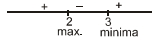
Analyzing the sign of $f^{\prime}(x)$:
For $x < 2$,$f^{\prime}(x) > 0$ (increasing).
For $2 < x < 3$,$f^{\prime}(x) < 0$ (decreasing).
For $x > 3$,$f^{\prime}(x) > 0$ (increasing).
Thus,$f$ has a local maximum at $x=2$ and a local minimum at $x=3$. This confirms $(A)$,$(B)$,and $(D)$ are correct.
Now,find $f^{\prime \prime}(x)$:
$f^{\prime \prime}(x) = \frac{d}{dx} [e^{x^2}(x^2-5x+6)] = e^{x^2}(2x)(x^2-5x+6) + e^{x^2}(2x-5) = e^{x^2}(2x^3-10x^2+12x+2x-5) = e^{x^2}(2x^3-10x^2+14x-5)$.
Let $g(x) = 2x^3-10x^2+14x-5$. Since $g(0) = -5$ and $g(1) = 2-10+14-5 = 1$,by the Intermediate Value Theorem,there exists $c \in (0, 1)$ such that $g(c) = 0$,implying $f^{\prime \prime}(c) = 0$. Thus,$(C)$ is also correct.
Therefore,all options $(A), (B), (C), (D)$ are correct.
By the Fundamental Theorem of Calculus,$f^{\prime}(x)=e^{x^2}(x-2)(x-3)$.
To find the critical points,set $f^{\prime}(x)=0$,which gives $x=2$ and $x=3$.
Analyzing the sign of $f^{\prime}(x)$:
For $x < 2$,$f^{\prime}(x) > 0$ (increasing).
For $2 < x < 3$,$f^{\prime}(x) < 0$ (decreasing).
For $x > 3$,$f^{\prime}(x) > 0$ (increasing).
Thus,$f$ has a local maximum at $x=2$ and a local minimum at $x=3$. This confirms $(A)$,$(B)$,and $(D)$ are correct.
Now,find $f^{\prime \prime}(x)$:
$f^{\prime \prime}(x) = \frac{d}{dx} [e^{x^2}(x^2-5x+6)] = e^{x^2}(2x)(x^2-5x+6) + e^{x^2}(2x-5) = e^{x^2}(2x^3-10x^2+12x+2x-5) = e^{x^2}(2x^3-10x^2+14x-5)$.
Let $g(x) = 2x^3-10x^2+14x-5$. Since $g(0) = -5$ and $g(1) = 2-10+14-5 = 1$,by the Intermediate Value Theorem,there exists $c \in (0, 1)$ such that $g(c) = 0$,implying $f^{\prime \prime}(c) = 0$. Thus,$(C)$ is also correct.
Therefore,all options $(A), (B), (C), (D)$ are correct.
0 likes
View Solution15
AdvancedMCQ
Let $R$ denote the set of all real numbers. For a real number $x$,let $[x]$ denote the greatest integer less than or equal to $x$. Let $n$ denote a natural number. Match each entry in List-$I$ to the correct entry in List-$II$ and choose the correct option.
| List-$I$ | List-$II$ |
| $(P)$ The minimum value of $n$ for which the function $f(x)=\left[\frac{10 x^3-45 x^2+60 x+35}{n}\right]$ is continuous on the interval $[1,2]$,is | $(1)$ $8$ |
| $(Q)$ The minimum value of $n$ for which $g(x)=\left(2 n^2-13 n-15\right)\left(x^3+3 x\right), x \in R$,is an increasing function on $R$,is | $(2)$ $9$ |
| $(R)$ The smallest natural number $n$ which is greater than $5$,such that $x=3$ is a point of local minima of $h(x)=\left(x^2-9\right)^{n}\left(x^2+2 x+3\right)$,is | $(3)$ $5$ |
| $(S)$ Number of $x_0 \in R$ such that $l(x)=\sum_{k=0}^4\left(\sin |x-k|+\cos \left|x-k+\frac{1}{2}\right|\right), x \in R$ is not differentiable at $x_0$,is | $(4)$ $6$ |
| $(5)$ $10$ |
A
$(P) \rightarrow (2), (Q) \rightarrow (3), (R) \rightarrow (4), (S) \rightarrow (5)$
B
$(P) \rightarrow (2), (Q) \rightarrow (1), (R) \rightarrow (4), (S) \rightarrow (3)$
C
$(P) \rightarrow (5), (Q) \rightarrow (1), (R) \rightarrow (4), (S) \rightarrow (3)$
D
$(P) \rightarrow (2), (Q) \rightarrow (3), (R) \rightarrow (1), (S) \rightarrow (5)$
Solution
(B) $(P)$ Let $P(x) = 10x^3 - 45x^2 + 60x + 35$. Then $P'(x) = 30x^2 - 90x + 60 = 30(x-1)(x-2)$.
Since $P'(x) \leq 0$ for $x \in [1, 2]$,$P(x)$ decreases from $P(1) = 60$ to $P(2) = 55$.
For $f(x) = [P(x)/n]$ to be continuous,the range of $P(x)/n$ must not contain any integer. The range is $[55/n, 60/n]$. The length of this interval is $5/n$. For this to contain no integers,we need $5/n < 1$,so $n > 5$. Also,for the function to be continuous,the values must be between two consecutive integers. Checking $n=9$,range is $[55/9, 60/9] = [6.11, 6.66]$,which contains no integer. Thus,$n=9$ is the minimum value.
$(Q)$ For $g(x)$ to be increasing,$g'(x) = (2n^2 - 13n - 15)(3x^2 + 3) \geq 0$. Since $3x^2+3 > 0$,we need $2n^2 - 13n - 15 \geq 0$. Solving $(2n+2)(n-7.5) \geq 0$,we get $n \geq 7.5$. The smallest natural number is $n=8$.
$(R)$ $h'(x) = n(x^2-9)^{n-1}(2x)(x^2+2x+3) + (x^2-9)^n(2x+2) = (x^2-9)^{n-1} [2nx(x^2+2x+3) + 2(x+3)(x-3)]$. For $x=3$ to be a local minimum,the derivative must change sign from negative to positive. This requires $(x-3)^{n-1}$ to change sign,so $n-1$ must be odd,meaning $n$ is even. The smallest even $n > 5$ is $n=6$.
$(S)$ $l(x) = \sum_{k=0}^4 (\sin|x-k| + \cos|x-k+1/2|)$. The term $\sin|x-k|$ is not differentiable at $x=k$. There are $5$ such points $(k=0, 1, 2, 3, 4)$. Thus,there are $5$ points of non-differentiability.
Since $P'(x) \leq 0$ for $x \in [1, 2]$,$P(x)$ decreases from $P(1) = 60$ to $P(2) = 55$.
For $f(x) = [P(x)/n]$ to be continuous,the range of $P(x)/n$ must not contain any integer. The range is $[55/n, 60/n]$. The length of this interval is $5/n$. For this to contain no integers,we need $5/n < 1$,so $n > 5$. Also,for the function to be continuous,the values must be between two consecutive integers. Checking $n=9$,range is $[55/9, 60/9] = [6.11, 6.66]$,which contains no integer. Thus,$n=9$ is the minimum value.
$(Q)$ For $g(x)$ to be increasing,$g'(x) = (2n^2 - 13n - 15)(3x^2 + 3) \geq 0$. Since $3x^2+3 > 0$,we need $2n^2 - 13n - 15 \geq 0$. Solving $(2n+2)(n-7.5) \geq 0$,we get $n \geq 7.5$. The smallest natural number is $n=8$.
$(R)$ $h'(x) = n(x^2-9)^{n-1}(2x)(x^2+2x+3) + (x^2-9)^n(2x+2) = (x^2-9)^{n-1} [2nx(x^2+2x+3) + 2(x+3)(x-3)]$. For $x=3$ to be a local minimum,the derivative must change sign from negative to positive. This requires $(x-3)^{n-1}$ to change sign,so $n-1$ must be odd,meaning $n$ is even. The smallest even $n > 5$ is $n=6$.
$(S)$ $l(x) = \sum_{k=0}^4 (\sin|x-k| + \cos|x-k+1/2|)$. The term $\sin|x-k|$ is not differentiable at $x=k$. There are $5$ such points $(k=0, 1, 2, 3, 4)$. Thus,there are $5$ points of non-differentiability.
0 likes
View Solution16
MediumMCQ
If $f(x)=\sqrt{x+\sin x}$,then all the points of the set $\{(x, f(x)) \mid f^{\prime}(x)=0\}$ lie on
A
a circle
B
a straight line
C
an ellipse
D
a parabola
Solution
(D) Given $f(x)=\sqrt{x+\sin x}$.
For $f^{\prime}(x)=0$,we differentiate $f(x)$ with respect to $x$:
$f^{\prime}(x) = \frac{1}{2\sqrt{x+\sin x}} \cdot (1+\cos x) = 0$.
This implies $1+\cos x = 0$,so $\cos x = -1$.
Thus,$x = (2n+1)\pi$ for $n \in \mathbb{Z}$.
Now,we find the value of $f(x)$ at these points:
$f((2n+1)\pi) = \sqrt{(2n+1)\pi + \sin((2n+1)\pi)}$.
Since $\sin((2n+1)\pi) = 0$ for all $n \in \mathbb{Z}$,we have $f((2n+1)\pi) = \sqrt{(2n+1)\pi}$.
Let $x = (2n+1)\pi$ and $y = f(x) = \sqrt{x}$.
Squaring both sides,we get $y^2 = x$,which is the equation of a parabola.
For $f^{\prime}(x)=0$,we differentiate $f(x)$ with respect to $x$:
$f^{\prime}(x) = \frac{1}{2\sqrt{x+\sin x}} \cdot (1+\cos x) = 0$.
This implies $1+\cos x = 0$,so $\cos x = -1$.
Thus,$x = (2n+1)\pi$ for $n \in \mathbb{Z}$.
Now,we find the value of $f(x)$ at these points:
$f((2n+1)\pi) = \sqrt{(2n+1)\pi + \sin((2n+1)\pi)}$.
Since $\sin((2n+1)\pi) = 0$ for all $n \in \mathbb{Z}$,we have $f((2n+1)\pi) = \sqrt{(2n+1)\pi}$.
Let $x = (2n+1)\pi$ and $y = f(x) = \sqrt{x}$.
Squaring both sides,we get $y^2 = x$,which is the equation of a parabola.
0 likes
View Solution17
EasyMCQ
Match the functions of List $I$ with the items of List $II$.
| List $I$ | List $II$ |
| $A. 3x^4 - 2x^3 - 6x^2 + 6x + 1$ | $(I)$ has minimum value at $x = 4$ |
| $B. x + \frac{1}{x}, \forall x < 0$ | $(II)$ has maximum value at $x = -1$ |
| $C. x^4(7 - x)^3$ | $(III)$ has maximum value at $x = 4$ |
| $D. x^4 + (8 - x)^4$ | $(IV)$ is decreasing in $[2, \infty)$ |
| $(V)$ is increasing in $[2, \infty)$ |
A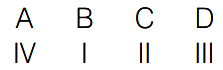
B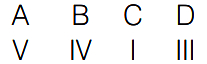
C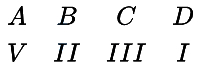
D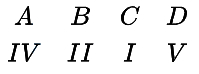
Solution
(D) $A. f(x) = 3x^4 - 2x^3 - 6x^2 + 6x + 1$
$f'(x) = 12x^3 - 6x^2 - 12x + 6 = 6(2x^3 - x^2 - 2x + 1) = 6(x-1)(2x-1)(x+1)$
For $x > 1$,$f'(x) > 0$,so $f(x)$ is increasing in $[1, \infty)$. Since $[2, \infty) \subset [1, \infty)$,$f(x)$ is increasing in $[2, \infty)$. Thus,$A \rightarrow V$.
$B. f(x) = x + \frac{1}{x}, x < 0$
$f'(x) = 1 - \frac{1}{x^2} = \frac{x^2 - 1}{x^2}$
For $x < -1$,$f'(x) > 0$ (increasing). For $-1 < x < 0$,$f'(x) < 0$ (decreasing).
At $x = -1$,$f'(-1) = 0$ and $f''(x) = \frac{2}{x^3} < 0$ for $x < 0$. Thus,$f(x)$ has a maximum at $x = -1$. Thus,$B \rightarrow II$.
$C. f(x) = x^4(7 - x)^3$
$f'(x) = 4x^3(7-x)^3 - 3x^4(7-x)^2 = x^3(7-x)^2 [4(7-x) - 3x] = x^3(7-x)^2(28 - 7x) = 7x^3(7-x)^2(4-x)$
Critical points are $x = 0, 4, 7$. Checking signs of $f'(x)$ around $x = 4$: for $x < 4$,$f'(x) > 0$; for $x > 4$,$f'(x) < 0$. Thus,$f(x)$ has a maximum at $x = 4$. Thus,$C \rightarrow III$.
$D. f(x) = x^4 + (8-x)^4$
$f'(x) = 4x^3 - 4(8-x)^3 = 4(x^3 - (8-x)^3)$
Setting $f'(x) = 0 \Rightarrow x = 8-x \Rightarrow x = 4$.
$f''(x) = 12x^2 + 12(8-x)^2$. Since $f''(4) = 12(16) + 12(16) > 0$,$f(x)$ has a minimum at $x = 4$. Thus,$D \rightarrow I$.
Correct match: $A-V, B-II, C-III, D-I$.
$f'(x) = 12x^3 - 6x^2 - 12x + 6 = 6(2x^3 - x^2 - 2x + 1) = 6(x-1)(2x-1)(x+1)$
For $x > 1$,$f'(x) > 0$,so $f(x)$ is increasing in $[1, \infty)$. Since $[2, \infty) \subset [1, \infty)$,$f(x)$ is increasing in $[2, \infty)$. Thus,$A \rightarrow V$.
$B. f(x) = x + \frac{1}{x}, x < 0$
$f'(x) = 1 - \frac{1}{x^2} = \frac{x^2 - 1}{x^2}$
For $x < -1$,$f'(x) > 0$ (increasing). For $-1 < x < 0$,$f'(x) < 0$ (decreasing).
At $x = -1$,$f'(-1) = 0$ and $f''(x) = \frac{2}{x^3} < 0$ for $x < 0$. Thus,$f(x)$ has a maximum at $x = -1$. Thus,$B \rightarrow II$.
$C. f(x) = x^4(7 - x)^3$
$f'(x) = 4x^3(7-x)^3 - 3x^4(7-x)^2 = x^3(7-x)^2 [4(7-x) - 3x] = x^3(7-x)^2(28 - 7x) = 7x^3(7-x)^2(4-x)$
Critical points are $x = 0, 4, 7$. Checking signs of $f'(x)$ around $x = 4$: for $x < 4$,$f'(x) > 0$; for $x > 4$,$f'(x) < 0$. Thus,$f(x)$ has a maximum at $x = 4$. Thus,$C \rightarrow III$.
$D. f(x) = x^4 + (8-x)^4$
$f'(x) = 4x^3 - 4(8-x)^3 = 4(x^3 - (8-x)^3)$
Setting $f'(x) = 0 \Rightarrow x = 8-x \Rightarrow x = 4$.
$f''(x) = 12x^2 + 12(8-x)^2$. Since $f''(4) = 12(16) + 12(16) > 0$,$f(x)$ has a minimum at $x = 4$. Thus,$D \rightarrow I$.
Correct match: $A-V, B-II, C-III, D-I$.
0 likes
View SolutionApplications of Derivatives — Mix Example of Applications of Derivatives · Frequently Asked Questions
1Are these Applications of Derivatives questions useful for JEE and NEET?
Yes. All questions in this section are mapped to JEE Main and NEET exam patterns. Previous year questions from JEE Main, NEET, GUJCET and state-level exams are included with full solutions.
2Can I switch to Hindi or Gujarati for these questions?
Yes. Use the language tabs in the hero section or the sidebar to view the same questions and solutions in English, Hindi or Gujarati.
3How do I generate a question paper from this subtopic?
Use the Vedclass Exam Paper Generator — select the chapter and subtopic, set difficulty, and generate Sets A, B, C, D automatically. First 3 chapters of every subject are free.
Vedclass Products
For Students
Vedclass Test Series
Mock tests in real JEE/NEET style with performance analysis. 5-day free trial.
Start Free TrialFor Teachers
Exam Paper Generator
Generate Set A/B/C/D papers from this chapter in 2 minutes. 3 chapters free.
Try FreeFor Institutes
Online Exam Module
Live online exams with unlimited students, 360° analytics & white-label branding.
See DemoFor Teachers & Institutes
Generate a Applications of Derivatives Exam Paper in 2 Minutes
Select subtopic & difficulty — Sets A, B, C, D auto-generated with No Repeat logic.
First 3 chapters of every subject are free — no payment required.